Short Note

2-((6,7-Dimethoxy-4-oxo-3-(4-(trifluoromethyl)phenethyl)-3,4-dihydroquinazolin-2-yl)thio)-N-(4-ethylphenyl)butanamide


1
Samjin Central Research Institute, Samjin Pharma Co., Ltd., Cheongju 28158, Republic of Korea
2
College of Pharmacy and Medicinal Research Center (MRC), Chungbuk National University, Cheongju 28160, Republic of Korea
*
Author to whom correspondence should be addressed.
Molbank 2026, 2026(1), M2128; https://doi.org/10.3390/M2128
Submission received: 7 January 2026 / Revised: 19 January 2026 / Accepted: 21 January 2026 / Published: 26 January 2026
(This article belongs to the Section Organic Synthesis and Biosynthesis)

Abstract

2-({3-[2-(1-cyclohexen-1-yl)ethyl]-6,7-dimethoxy-4-oxo-3,4-dihydro-2-quinazolinyl}sulfanyl)-N-(4-ethylphenyl)butanamide (K284-6111; K284), the representative CHI3L1 inhibitor, has interesting biological activities, including anti-cancer and anti-inflammatory effects on neuroinflammation. Following our hit-to-lead program, we report the most active novel derivative, named CBJL-025, 2-((6,7-dimethoxy-4-oxo-3-(4-(trifluoromethyl)phenethyl)-3,4-dihydroquinazolin-2-yl)thio)-N-(4-ethylphenyl)butanamide. The title compound, CBJL-025, was successfully synthesized by S-alkylation of the p-trifluoromethyl phenethyl group possessing quinazoline and the corresponding bromide. The structure of CBJL-025 was confirmed by 1H and 13C nuclear magnetic resonance (NMR) and high-resolution mass spectrometry (HRMS).

1. Introduction

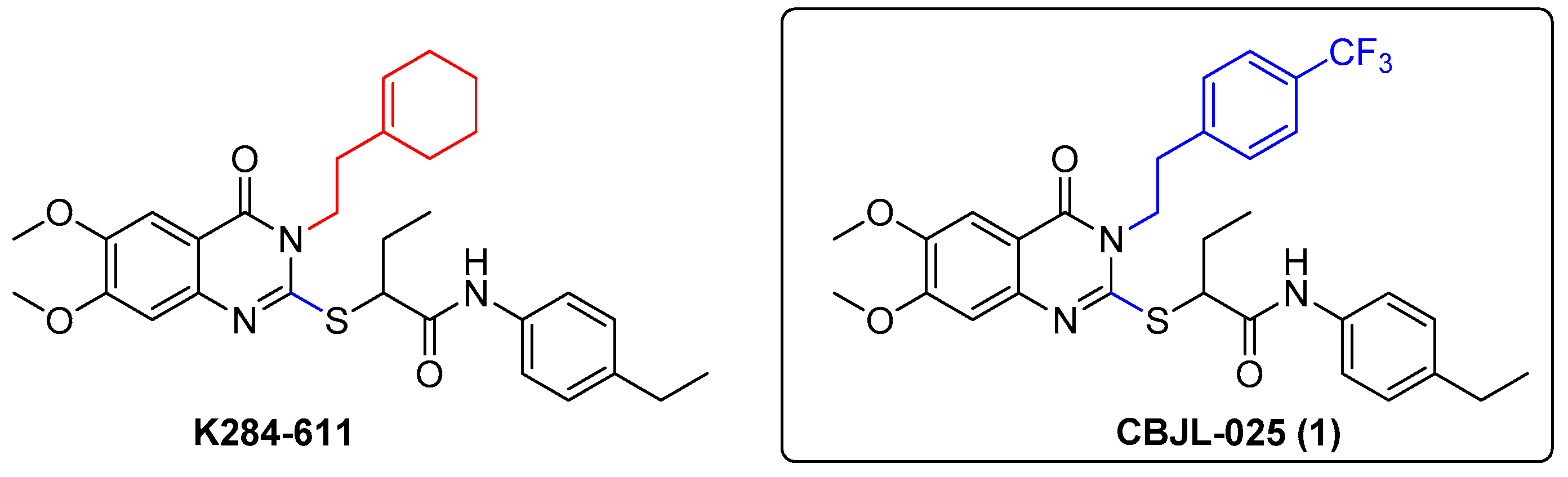
Chitinase-3-like protein 1 (CHI3L1), encoded by the CHI3L1 gene, is a secreted glycoprotein in humans. CHI3L1, also known as YKL-40, has an approximate molecular weight of 40 kDa. An increasing number of studies [1,2] have reported that the expression of CHI3L1 is markedly upregulated in various inflammatory conditions [3,4], Alzheimer’s disease [5], and several types of cancer [6]. Accordingly, numerous reports have demonstrated a close association between CHI3L1 and these diseases. In particular, a recent lead optimization study based on the compound K284-611 for the treatment of glioblastoma has been reported [7] (Figure 1).
We also conducted a medicinal chemistry program based on K284-611 and herein report the title compound 1, CBJL-025 (2-((6,7-dimethoxy-4-oxo-3-(4-(trifluoromethyl)phenethyl)-3,4-dihydroquinazolin-2-yl)thio)-N-(4-ethylphenyl)butanamide), which exhibited the most potent cytotoxic activity among the synthesized compounds. The title compound was designed to incorporate a p-trifluoromethylphenyl group, motivated by the well-documented success of fluorinated substituents in medicinal chemistry [8].

2. Results

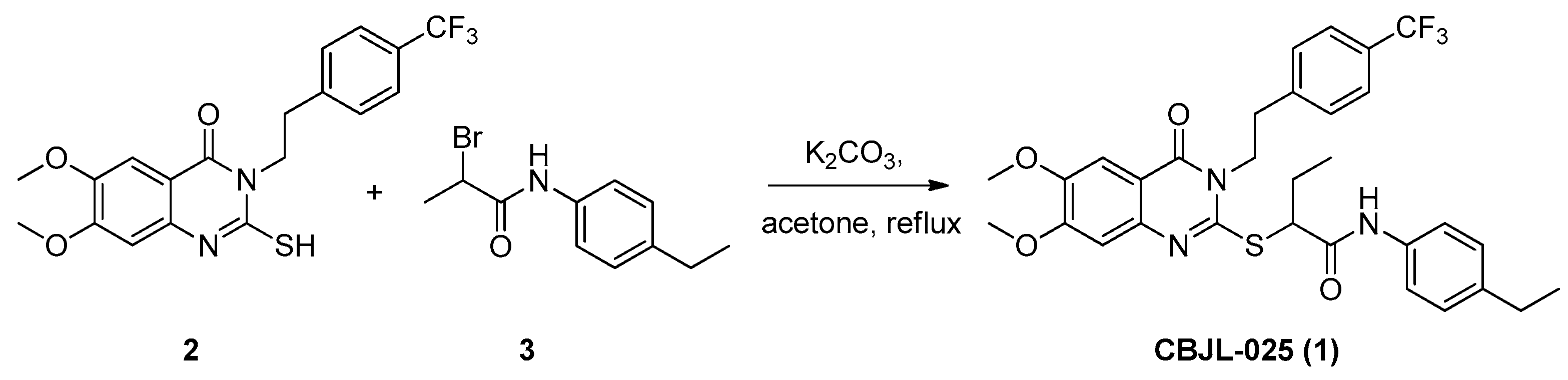
To synthesize CBJL-025, quinazoline 2 and bromide 3 were first prepared from commercially available starting materials according to a reported procedure [7]. With key intermediates 2 and 3 in hand, they were coupled under reflux conditions using potassium carbonate in acetone, as depicted in Scheme 1. The structure of the synthesized compound 1 was confirmed by 1H NMR (Figure S1), 13C NMR (Figure S2), 19F NMR (Figure S3), and high-resolution mass spectrometry (HRMS, Figure S4). Notably, this strategy provided an overall yield exceeding 70% on the gram scale. The synthesized compound 1, CBJL-025, exhibited a fourfold increase in cytotoxic activity compared with the reference compound K284-611.
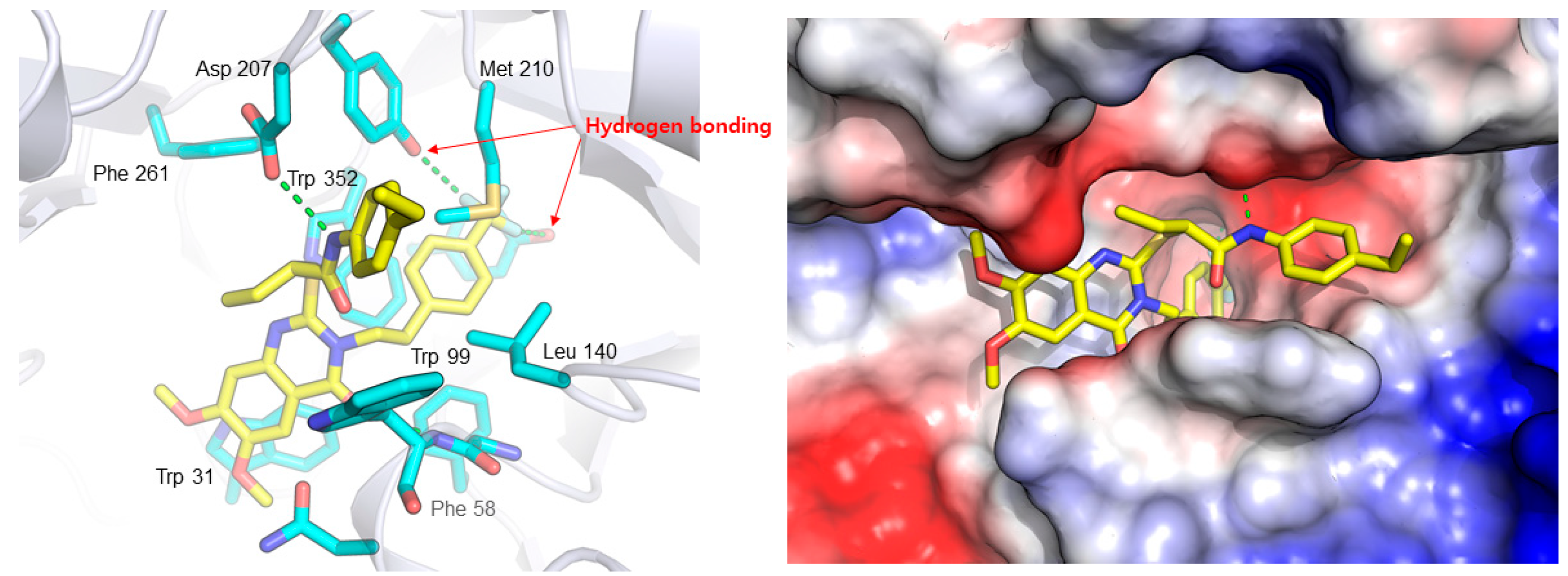
Encouraged by these promising results, we investigated the structural modeling of CBJL-025 in complex with the CHI3L1 protein. Two distinct hydrogen-bonding interactions between the trifluoromethyl group and CHI3L1 were identified (Figure 2). These strong intermolecular interactions are expected to significantly enhance the binding affinity of the designed molecule toward the CHI3L1 protein.

3. Materials and Methods

3.1. General Information

All reactions performed under air were conducted with a reflux condenser, leaving the vent open to prevent solvent evaporation. All reagents were purchased from Sigma-Aldrich (St. Louis, MO, USA), TCI (Tokyo, Japan), Alfa Aesar (Ward Hill, MA, USA), and Acros Organics (Geel, Belgium) and were used directly without further purification unless otherwise indicated. Thin-layer chromatography (TLC) was performed on silica gel 60 F254 glass plates (Merck, Darmstadt, Germany), visualized by UV light at 254 or 365 nm, using anisaldehyde, ninhydrin, and KMnO4. 1H, 13C, and 19F NMR spectra were recorded with a Jeol ECZL 400S FT NMR (Tokyo, Japan) (400 MHz for 1H NMR) using chloroform-d as the solvent. Chemical shifts (δ) were reported in parts per million (ppm), referenced to the residual solvent signals as follows: 1H-7.26 ppm for chloroform-d and 13C-77.16 ppm for chloroform-d. The following abbreviations were used to explain multiplicities: s = singlet, d = doublet, t = triplet, q = quartet, m = multiplet, and br = broad. Coupling constants, J, were reported in Hertz (Hz). 13C NMR spectra were recorded with broad-band proton decoupling. High-resolution mass spectrometry was performed with a SCIEX X500B Q-TOF (Framingham, MA, USA), a Bruker MaXis 4G Q-TOF (Billerica, MA, USA), and a Waters Xevo G2-XS Q-Tof (Milford, MA, USA) in positive ion mode using electrospray ionization (ESI) or atmospheric pressure chemical ionization (APCI) as an ionization method. Silica gel column chromatography was performed using silica gel with a particle size of 40–63 μm (230–400 mesh).

3.2. 2-((6,7-Dimethoxy-4-oxo-3-(4-(trifluoromethyl)phenethyl)-3,4-dihydroquinazolin-2-yl)thio)-N-(4-ethylphenyl)butanamide (CBJL-025)

To a solution of quinazoline 2 (410 mg, 1.0 mmol) and bromide 3 (256 mg, 1.0 mmol) in acetone, potassium carbonate was added (276 mg, 2.0 mmol). The mixture was heated to reflux for 5 h. After completion, acetone was evaporated under reduced pressure, and the residue was extracted with DCM (2 × 150 mL). The combined organic layers were washed with water, dried over anhydrous sodium sulfate, and concentrated in vacuo. The crude product was purified by flash chromatography using hexane/ethyl acetate (3:2 to 1:1) as the eluent to afford final compound 1 (491 mg) in 82% yield.
1H NMR (400 MHz, CDCl3,) δ 9.71 (s, 1H), 7.56–7.58 (m, 3H), 7.42 (d, 2H, J = 8.0 Hz), 7.36 (d, 2H, J = 8.0 Hz), 7.09 (d, 2H, J = 8.0 Hz), 7.04 (s, 1H), 4.49 (t, 1H, J = 7.6 Hz), 4.21 (t, 2H, J = 8.0 Hz), 4.03 (s, 3H), 4.02 (s, 3H), 3.05–3.19 (m, 2H), 2.58 (q, J = 7.6 Hz, 2H), 2.31 (m, 1H), 1.92 (m, 1H), 1.15–1.19 (m, 6H); 13C{1H} NMR (100 MHz, CDCl3): δ 168.8, 160.6, 155.8, 155.7, 149.1, 143.0, 141.7, 140.4, 135.9, 129.4 (q, 2JC–F = 32.6 Hz), 129.4, 128.5, 125.8 (q, 3JC–F = 3.8 Hz), 124.3 (q, 1JC–F = 270.2 Hz), 119.4, 112.7, 106.4, 105.8, 56.6, 56.5, 50.1, 46.1, 34.0, 28.4, 23.1, 15.8, 12.4; 19F NMR (CDCl3, 376 MHz) δ (ppm)–62.35 (s); HRMS-Q-TOF m/z calcd for C31H32F3N3O4S [M + H]+; and 600.2138, found: 600.2139.

4. Conclusions

In summary, 2-((6,7-dimethoxy-4-oxo-3-(4-(trifluoromethyl)phenethyl)-3,4-dihydroquinazolin-2-yl)thio)-N-(4-ethylphenyl)butanamide (1, CBJL-025) was synthesized by a simple S-alkylation reaction under mild conditions in a satisfactory yield. The pure compound was obtained as a white solid. Its structure was confirmed by HRMS, as well as 1H NMR, 13C NMR, and 19F NMR spectroscopy. Together with this compound, a comprehensive medicinal chemistry study of related derivatives, including their diverse biological activities, is currently underway and will be reported in future publications.

Supplementary Materials

The following supporting information for the characterization of compound 1 can be downloaded online: Figure S1: 1H NMR spectrum of compound 1 (400 MHz in CDCl3); Figure S2: 13C NMR spectrum of compound 1 (100 MHz in CDCl3); Figure S3: 19F NMR spectrum of compound 1 (376 MHz in CDCl3); Figure S4: HRMS of compound 1.

Author Contributions

Y.H.L. prepared the compound and recorded the NMR spectra; J.-K.J. designed the study, analyzed the data, and wrote the paper. All authors have read and agreed to the published version of the manuscript.

Funding

This work was supported by a grant from the “Chungbuk RISE (Regional Innovation System & Education Center) project” funded by the Ministry of Education (MOE) and Chungcheongbuk-do (2025-RISE-11-014-03).

Data Availability Statement

The original contributions presented in this study are included in the article/Supplementary Materials. Further inquiries can be directed to the corresponding author.

Conflicts of Interest

Author Young Hee Lee is an employee of Samjin Pharmaceutical Co., Ltd. The remaining authors declare that they have no conflicts of interest.

References

  1. Zhao, T.; Su, Z.P.; Li, Y.C.; Zhang, X.R.; You, Q. Chitinase-3 like-protein-1 function and its role in diseases. Signal Transduct. Target. Ther. 2020, 5, 201. [Google Scholar] [CrossRef] [PubMed]
  2. Kurç, Ö.; Rähse, N.; Gohlke, H.; Cramer, J. Human chitinases and chitinase-like proteins as emerging drug targets—A medicinal chemistry perspective. RSC Med. Chem. 2025, 16, 2388–2402. [Google Scholar] [CrossRef] [PubMed]
  3. Mushtaq, U.; Ahmad, B.; Khanday, F.A.; Ahmad, M. CHI3L1: An Emerging Player in Neuroinflammation and Neurodegeneration. Mol. Neurobiol. 2025, 63, 23. [Google Scholar] [CrossRef] [PubMed]
  4. Yu, J.E.; Yeo, I.J.; Han, S.-B.; Yun, J.; Kim, B.; Yong, Y.J.; Lim, Y.; Kim, T.H.; Son, D.J.; Hong, J.T. Significance of chitinase-3-like protein 1 in the pathogenesis of inflammatory diseases and cancer. Exp. Mol. Med. 2024, 56, 1–18. [Google Scholar] [CrossRef] [PubMed]
  5. Ham, H.J.; Lee, Y.S.; Yun, J.; Son, D.J.; Lee, H.P.; Han, S.B.; Hong, J.T. K284-6111 alleviates memory impairment and neuroinflammation in Tg2576 mice by inhibition of Chitinase-3-like 1 regulating ERK-dependent PTX3 pathway. J. Neuroinflamm. 2020, 17, 350. [Google Scholar] [CrossRef] [PubMed]
  6. Lee, Y.S.; Yu, J.E.; Kim, K.C.; Lee, D.H.; Son, D.J.; Lee, H.P.; Jung, J.-K.; Kim, N.D.; Ham, Y.W.; Yun, J.; et al. A small molecule targeting CHI3L1 inhibits lung metastasis by blocking of IL-13Rα2-mediated JNK/AP-1 signals. Mol. Oncol. 2022, 16, 508–526. [Google Scholar] [CrossRef] [PubMed]
  7. Kaur, B.; Nada, H.; Zhang, L.; Gabr, M.T. Lead optimization of a CHI3L1 inhibitor for Glioblastoma: Enhanced target engagement, pharmacokinetics, and efficacy in 3D spheroid models. Eur. J. Med. Chem. 2025, 297, 117924. [Google Scholar] [CrossRef] [PubMed]
  8. Purser, S.; Moore, P.R.; Swallow, S.; Gouverneur, V. Fluorine in medicinal chemistry. Chem. Soc. Rev. 2008, 37, 320–330. [Google Scholar] [CrossRef] [PubMed]
Figure 1. Structures of K284-611 and CBJL-025.
Molbank 2026 m2128 g001
Scheme 1. Synthesis route for obtaining CBJL-025.
Molbank 2026 m2128 sch001
Figure 2. Molecular modeling of the CBJL-025 and CHI3L1 complex.
Molbank 2026 m2128 g002
Disclaimer/Publisher’s Note: The statements, opinions and data contained in all publications are solely those of the individual author(s) and contributor(s) and not of MDPI and/or the editor(s). MDPI and/or the editor(s) disclaim responsibility for any injury to people or property resulting from any ideas, methods, instructions or products referred to in the content.