
Short Note

Methyl 2-(Chloromethoxy-1-carbonyl)-7-oxabicyclo[2.2.1]heptane-3-carboxylate
Department of Chemistry, University of South Alabama, 6040 USA Drive South, Mobile, AL 36608, USA
*
Author to whom correspondence should be addressed.
Molbank 2026, 2026(1), M2124; https://doi.org/10.3390/M2124
Submission received: 20 December 2025 / Revised: 8 January 2026 / Accepted: 12 January 2026 / Published: 13 January 2026

Abstract

Overexpression of protein phosphatase 5 (PP5) is implicated in tumor cell growth, establishing PP5 as a compelling target for small-molecule anticancer therapy. Building on prior success in achieving selectivity within the PP2A domain through scaffold functionalization that maximizes active-site interactions, we propose a parallel strategy for PP5 inhibition. Norcantharidin, the demethylated cousin of cantharidin, is a potent yet unselective phosphatase inhibitor, making its bicyclic framework an attractive platform for systematic derivatization. The approach reported herein exploits anhydride reactivity to generate a carboxylic acid derivative that is transformed into a chloromethyl ester. Chloromethyl ester functionality serves as a strategically activated intermediate enabling downstream functional-group diversification under mild, neutral conditions while preserving scaffold integrity. This modular synthetic strategy establishes a foundation for the development of PP5-selective norcantharidin derivatives with improved tumor selectivity, potency, and synthetic feasibility.

1. Introduction

Over the past two decades, cancer research has increasingly focused on protein kinases and phosphatases, which regulate phosphorylation states essential for cell-cycle progression, DNA repair, and cell survival. Deregulation of these pathways is a hallmark of tumorigenesis, and while kinases have historically dominated the landscape of targeted therapeutics, serine/threonine phosphatases are now emerging as viable and mechanistically distinct drug targets [1]. Among these, phosphoprotein phosphatase 5 (PP5), encoded on human chromosome 19 and conserved across eukaryotes, has gained attention due to its role in coordinating protein–protein interactions through its tetratricopeptide repeat (TPR) domain and modulating key oncogenic signaling pathways [2].
PP5 regulates several antiproliferative mechanisms, including glucocorticoid receptor (GR)–mediated transcription and p53 stability. Binding of PP5 to GR suppresses transcription of cell-cycle inhibitors such as p21, and a truncated PP5 retaining only the TPR domain remains capable of inhibiting GR function, underscoring important non-catalytic roles. PP5 further attenuates p53 signaling by dephosphorylating p53 and promoting its destabilization, while p53 negatively regulates PP5 expression, suggesting a tightly controlled feedback loop [3]. Inhibition or suppression of PP5 enhances GR-driven transcription, disrupts DNA repair through DNA-PK dephosphorylation, promotes apoptosis under hypoxic conditions via ASK-1 signaling, and correlates with reduced tumor growth, collectively positioning PP5 as an attractive therapeutic target in cancer [4].
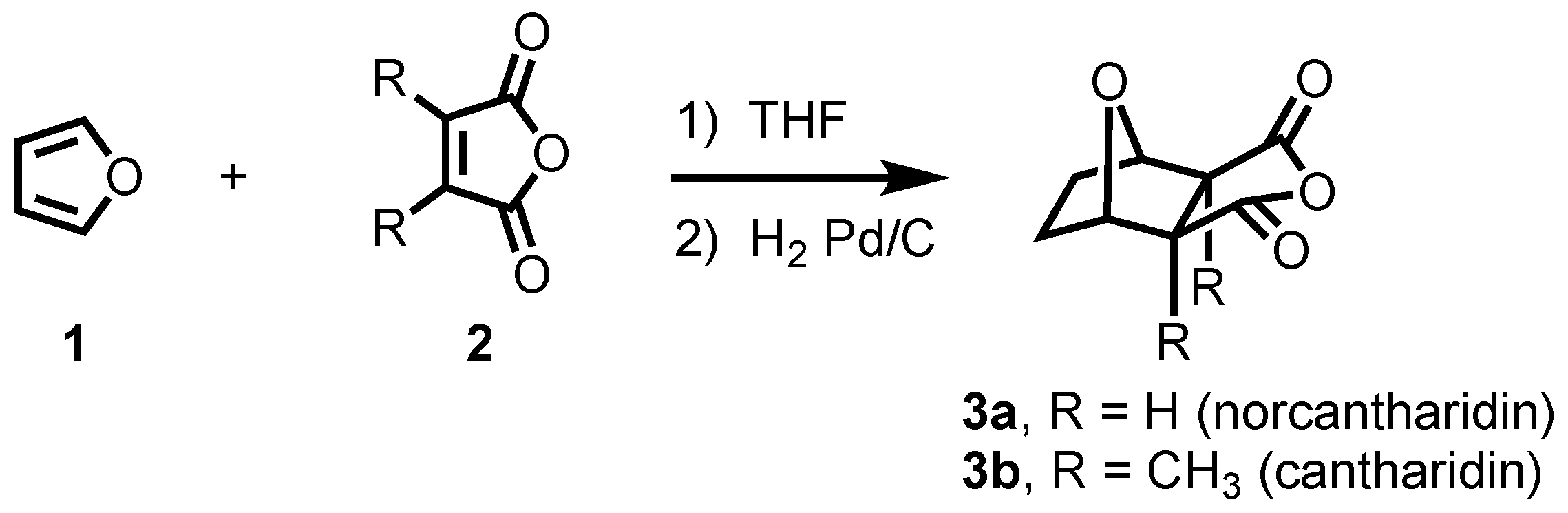
Although selective inhibition of serine/threonine phosphatases has been achieved for PP2A using natural products such as fostriecin, microcystin, and okadaic acid, these compounds are far from ideal because of limitations such as synthetic accessibility and scalability [5]. Cantharidin (3b), however, a natural toxin derived from blister beetles, exhibits semi-selective phosphatase inhibition with notable PP5 activity arising from specific active-site interactions [6]. The demethylated cousin, norcantharidin (3a), retains potent phosphatase inhibition while offering significant synthetic advantages: the bicyclic derivative can be prepared in just two steps from maleic anhydride at a fraction of the cost (Scheme 1).
Our research centers on a simple but powerful idea: Design inhibitors of protein phosphatase 5 (PP5) to restore apoptosis in cancer cells and develop more selective and potent cancer therapies [7]. Ideated from biochemistry and engineered in chemistry, our restoration plan starts with the synthetic assembly of systems exhibiting both potency and selectivity toward PP5.
While derivatization of the diene prior to cycloaddition is synthetically feasible, modification via anhydride ring-opening of norcantharidin itself provides a substantially lower synthetic overhead and superior flexibility. Conversion of the anhydride to a carboxylic acid derivative further strengthens this platform by enabling systematic linker installation and site-specific functionalization without compromising scaffold integrity [8].
In this work, we leverage this advantage by transforming the carboxylic acid into a chloromethyl ester, which serves as a strategically activated intermediate that enables downstream functional-group diversification under mild, neutral conditions while preserving scaffold integrity and facilitating modular synthesis [9,10]. This approach establishes a robust and adaptable synthetic framework for the rational design and optimization of next-generation norcantharidin-based PP5 inhibitors with improved selectivity, potency, and translational feasibility.

2. Results and Discussion

The development of next-generation PP5 inhibitors requires synthetic strategies that balance structural integrity with efficient diversification. Norcantharidin (3a) offers a uniquely accessible and robust bicyclic framework whose anhydride functionality enables controlled modification without compromising scaffold stability.
Significant with this approach is that ring opening of the anhydride moiety provides direct access to carboxylic acid derivatives that serve as versatile precursors for further functionalization under mild conditions, allowing systematic tuning of molecular properties relevant to biological activity.
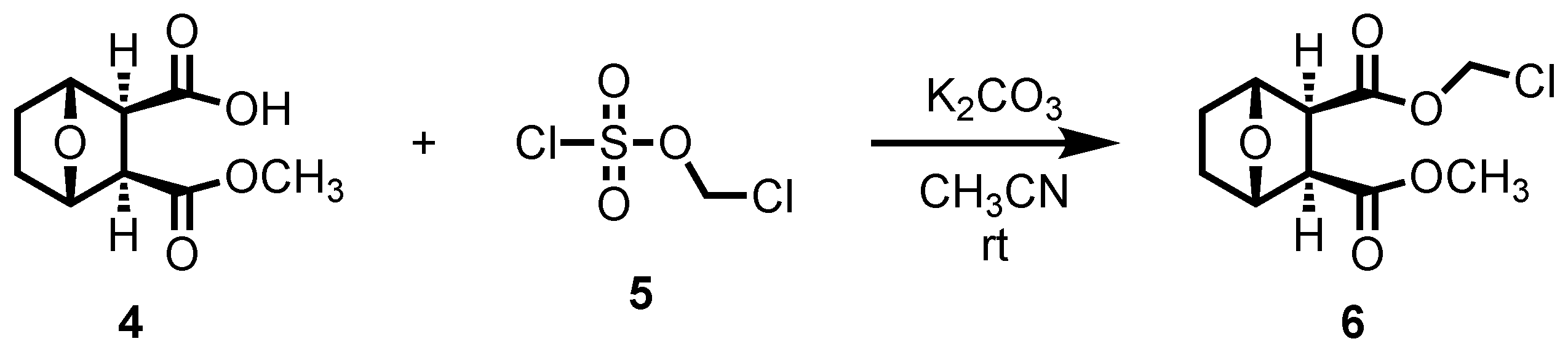
As outlined in Scheme 2, the assembly of our cousin once removed begins with chloromethyl chlorosulfate (5) and a carboxylic acid in the presence of potassium carbonate. Carboxylic acid 4, in racemic form, was prepared in excellent yield following a well-established protocol involving the ring-opening of nocantharidin’s anhydride in the presence of methanol [8]. Chloromethyl chlorosulfate (5) has been shown to be a versatile and viable reagent when needing to prepare chloromethyl esters [11]. In our hands, the title compound 6 was chromatographically isolated in 61% yield at 1.0 mmol scale (All corresponding spectral data are provided in the Supplementary Materials). This transformation establishes a synthetically efficient entry point for downstream manipulation.
Unique to the assembly of this system was the isolation of compound 6 by chromatography to afford a stable white crystalline solid. This approach highlights the practicality and scalability of derivatizing key intermediates. Conversion of carboxylic acid 4 into the corresponding chloromethyl ester (6) furnishes a strategically activated intermediate that enables downstream functional-group diversification under mild, neutral conditions. The assembly of chloromethyl ester 6 represents a confluence of the forks, tethering functional group manipulation with our inhibitory compounds for downstream installation of diverse functional appendages to support rational optimization of PP5-selective inhibitors.

3. Materials and Methods

All spectra were obtained as solutions in CDCl3 having the following field strength: 1H NMR (500 MHz) and 13C NMR (125 MHz). The NMR that generated the spectra was a JEOL ECA-500 spectrometer (JEOL Ltd., Tokyo, Japan) using JEOL DeltaTM Version 6.1.0 (MAC) software. Chemical shifts were reported in parts per million (ppm). Chemical shifts were referenced to δ 0.00 ppm (TMS) in 1H NMR and 13C NMR. Infrared spectra were reported in wavenumbers (cm−1) and recorded using a JASCO FT/IR-4100 equipped with an Attenuated Total Reflectance (ATR) accessory (JASCO, Tokyo, Japan). For the synthetic procedures performed in a hood, all hazardous materials were handled while wearing protective gloves, protective clothing, and eye protection. Additional considerations consisted of the following: TLC analyses were performed on flexible aluminum backed TLC plates with silica gel and a fluorescent indicator. Detection was conducted by UV absorption (254 nm). Solutions were concentrated in vacuo using a rotary evaporator. The HRMS data were generated on a Waters SYNAPT (Waters Corporation, Milford, MA, USA) at the Mass Spectrometry Laboratory which is part of the School of Chemical Sciences at the University of Illinois Urbana-Champaign. The chemicals used for this synthetic procedure were the following: acetonitrile, chloromethyl chlorosulfonate (5), 3-(methoxy-1-carbonyl)-7-oxabicyclo[2.2.1]heptane-2-carboxylic acid (4), and potassium carbonate and were reagent-grade or better.

4. Experimental

Methyl 2-(Chloromethoxy-1-carbonyl)-7-oxabicyclo[2.2.1]heptane-3-carboxylate (6)

3-(Methoxy-1-carbonyl)-7-oxabicyclo[2.2.1]heptane-2-carboxylic acid (4) (183 mg, 1.0 mmol, 1.0 equiv.) was added to a 10 mL round-bottomed flask (RBF) equipped with a magnetic stir bar. Acetonitrile (3.4 mL) was then added to the RBF at room temperature. After adding potassium carbonate (551 mg, 4.0 mmol, 4.0 equiv.), the reaction mixture was externally cooled using an ice bath and placed under a blanket of argon. Chloromethyl chlorosulfonate (0.12 mL, 1.1 mmol, 1.1 equiv.) was next added to the RBF by syringe and the resulting mixture was allowed to stir overnight while maintaining the blanket of argon. The reaction mixture was concentrated in vacuo and chromatographed (TLC; SiO2, 1% methanol in chloroform, Rf = 0.3). The column chromatography (SiO2) gradient system increased in polarity using the following methanol in chloroform mixtures, all representing three column equivalents: 0.25%, 0.5%, and 1%. Obtained from the column was a white crystalline solid (mp 47–50 °C) in 141 mg (61% yield). Access to all the spectra acquired can be found within the Supplementary Materials.
1H NMR (500 MHz, CDCl3); 5.73 (d, J = 6.0 Hz, 1H, -CHO-), 5.65 (d, J = 6.0 Hz, 1H, -CHO-), 4.95–4.92 (m, 2H, -OCH2Cl), 3.68 (s, 3H, -OCH3), 3.04 (s, 2H, -CHCH-), 1.86–1.82 (m, 2H), 1.57–1.53 (m, 2H). 13C NMR (125 MHz, CDCl3); 171.0, 169.3, 78.5, 78.3, 69.0, 52.3, 52.2, 51.8, 29.1, 29.0. IR (Attenuated Total Reflectance); 2988, 2955, 2883, 1764, 1742, 1438, 1200, 1053, 816, 734, 709 cm−1. HRMS (LC-MS) m/z: [M + H]+ calcd for C10H14ClO5 249.0530; found 249.0532 and m/z: [M + Na]+ calcd for C10H13ClNaO5 271.0349; found 271.0348.

Supplementary Materials

The following are available online. Figure S1: 1H NMR (500 MHz, (CDCl3)) spectrum of compound 6; Figure S2: Expanded 1H NMR (500 MHz, (CDCl3)) spectrum of compound 6; Figure S3: Expanded 1H NMR (500 MHz, (CDCl3)) spectrum of compound 6; Figure S4: 13C NMR (125 MHz, (CDCl3)) spectrum of compound 6; Figure S5: Expanded 13C NMR (125 MHz, (CDCl3)) spectrum of compound 6; Figure S6: Expanded 13C NMR (125 MHz, (CDCl3)) spectrum of compound 6; Figure S7: IR (ATR) spectrum of compound 6; Figure S8: Expanded IR (ATR) spectrum of compound 6; Figure S9: Expanded IR (ATR) spectrum of compound 6; Figure S10: Elemental Composition Reports (HRMS) of compound 6; Figure S11: High-resolution mass spectrum of compound 6 ([M + Na]+).

Author Contributions

Conceptualization, H.K.L. and D.C.F.; methodology, B.N.B., H.K.L., C.N.L., M.H.M., K.N.M., L.A.O. and D.C.F.; validation, B.N.B., H.K.L., M.H.M., K.N.M. and L.A.O.; writing—original draft, D.C.F.; writing—review & editing, B.N.B., H.K.L., C.N.L., M.H.M., K.N.M., L.A.O. and D.C.F. All authors have read and agreed to the published version of the manuscript.

Funding

This research was funded, in part, by the Office of Undergraduate Research, University of South Alabama.

Data Availability Statement

The original contributions presented in this study are included in the article/Supplementary Materials. Further inquiries can be directed to the corresponding author.

Acknowledgments

The authors are grateful for the support from the Department of Chemistry, University Honors College, the Office of Undergraduate Research, and University of South Alabama Foundation.

Conflicts of Interest

The authors declare no conflict of interest.

References

  1. Golden, T.; Swingle, M.R.; Honkanen, R.E. The role of serine/threonine protein phosphatase type 5 (PP5) in the regulation of stress-induced signaling networks and cancer. Cancer Metastasis Rev. 2008, 27, 169–178. [Google Scholar] [CrossRef] [PubMed]
  2. Chen, M.S.; Silverstein, A.M.; Pratt, W.B.; Chinkers, M. The tetratricopeptide repeat domain of protein phosphatase 5 mediates binding to glucocorticoid receptor heterocomplexes and acts as a dominant negative mutant. J. Biol. Chem. 1996, 271, 32315–32320. [Google Scholar] [CrossRef] [PubMed]
  3. Zuo, Z.; Urban, G.; Scammell, J.G.; Dean, N.M.; McLean, T.K.; Aragon, I.; Honkanen, R.E. Ser/Thr protein phosphatase type 5 (PP5) is a negative regulator of glucocorticoid receptor-mediated growth arrest. Biochemistry 1999, 38, 8849–8857. [Google Scholar] [CrossRef] [PubMed]
  4. Zhou, G.; Golden, T.; Aragon, I.V.; Honkanen, R.E. Ser/Thr protein phosphatase 5 inactivates hypoxia-induced activation of an apoptosis signal-regulating kinase 1/MKK-4/JNK signaling cascade. J. Biol. Chem. 2004, 279, 46595–46605. [Google Scholar] [CrossRef] [PubMed]
  5. Swingle, M.R.; Honkanen, R.E. Small Molecule Inhibitors of Ser/Thr Protein Phosphatases: Specificity, Use and Common Forms of Abuse. Methods Mol. Biol. 2007, 365, 23–38. [Google Scholar] [PubMed]
  6. Swingle, M.R.; Honkanen, R.E. Inhibitors of serine/threonine protein phosphatases: Biochemical and structural studies provide insight for further development. Curr. Med. Chem. 2019, 26, 2634–2660. [Google Scholar] [CrossRef] [PubMed]
  7. Chattopadhyay, D.; Swingle, M.R.; Salter, E.A.; Wood, E.C.; D’Arcy, B.; Zivanov, C.N.; Abney, K.; Musiyenko, A.; Rusin, S.F.; Kettenbach, A.; et al. Crystal Structures and Mutagenesis of PPP-Family Ser/Thr Protein Phosphatases Elucidate the Selectivity of Cantharidin and Novel Norcantharidin-Based Inhibitors of PP5C. Biochem. Pharmacol. 2016, 109, 14–26. [Google Scholar] [CrossRef] [PubMed]
  8. Mayeaux, K.N.; Baxter, B.N.; Lawley, H.K.; Lopansri, C.N.; Marmande, M.H.; Orr, L.A.; Forbes, D.C. 3-([4-(Acetylamino)phenyl]methoxy-1-carbonyl)-7-oxabicyclo[2.2.1]heptane-2-carboxylic Acid. Molbank 2025, 2025, M2056. [Google Scholar] [CrossRef]
  9. Jiangsu Vanguard Pharmaceutical Co., Ltd. Substituted Pyrazole Compound, Preparation Method Therefor, Pharmaceutical Composition and Medical Use Thereof. U.S. Patent Application US 2022/0372058 A1, 1 December 2022. [Google Scholar]
  10. Mudryk, B.; Rajaraman, S.; Soundararajan, N. A Practical Synthesis of Chloromethyl Esters from Acid Chlorides and Trioxane or Paraformaldehyde Promoted by Zirconium Tetrachloride. Tetrahedron Lett. 2002, 43, 6317–6318. [Google Scholar] [CrossRef]
  11. Binderup, E.; Hansen, E.T. Chlorosulfates as Reagents in the Synthesis of Carboxylic Acid Esters under Phase-Transfer Conditions. Synth. Commun. 1984, 14, 857–864. [Google Scholar] [CrossRef]
Scheme 1. Assembly of bicyclic scaffolds cantharidin (3b) and norcantharidin (3a).
Molbank 2026 m2124 sch001
Scheme 2. Synthesis of chloromethyl ester 6 using chloromethyl chlorosulfate (5).
Molbank 2026 m2124 sch002
Disclaimer/Publisher’s Note: The statements, opinions and data contained in all publications are solely those of the individual author(s) and contributor(s) and not of MDPI and/or the editor(s). MDPI and/or the editor(s) disclaim responsibility for any injury to people or property resulting from any ideas, methods, instructions or products referred to in the content.