Short Note

N-(2-(1H-Indol-3-yl)ethyl)-2-propylpentanamide


Department of Organic Chemistry, Faculty of Chemistry, University of Plovdiv, 24 Tsar Assen Str., 4000 Plovdiv, Bulgaria
*
Author to whom correspondence should be addressed.
Molbank 2026, 2026(1), M2123; https://doi.org/10.3390/M2123
Submission received: 21 December 2025 / Revised: 29 December 2025 / Accepted: 8 January 2026 / Published: 9 January 2026
(This article belongs to the Section Structure Determination)

Abstract

Herein we describe the synthesis of N-(2-(1H-indol-3-yl)ethyl)-2-propylpentanamide. The compound was comprehensively characterized using melting-point analysis, 1H and 13C NMR spectroscopy, infrared spectroscopy, and mass spectrometry. The collective analytical results confirm the successful synthesis and structural integrity of the target molecule.

1. Introduction

The indole nucleus plays a important role in various naturally occurring heterocyclic compounds, significantly impacting industries such as industrial, agricultural, and pharmaceutical chemistry. This scaffold serves as a pharmacophoric group in numerous natural compounds and synthetic medications, facilitating crucial receptor interactions. Among the indole derivatives, tryptamine stands out as a vital chemical building block, essential in synthesizing physiologically active substances [1].
Established for its diverse applications in drug development, tryptamine and its analogues exhibit various pharmacological actions, including anticancer, antimicrobial, and anti-migraine effects, categorizing tryptamine as a common functional group within a broader family of substituted tryptamines, known for their wide-ranging biological activities. Its potent biological actions are attributed to the efficient coupling between its amine and pyrrole groups, as it functions as a monoamine alkaloid with neuronal and hallucinogenic properties, demonstrating cytotoxicity for anticancer purposes, and contributing to treatments for migraines and obesity [2,3,4].
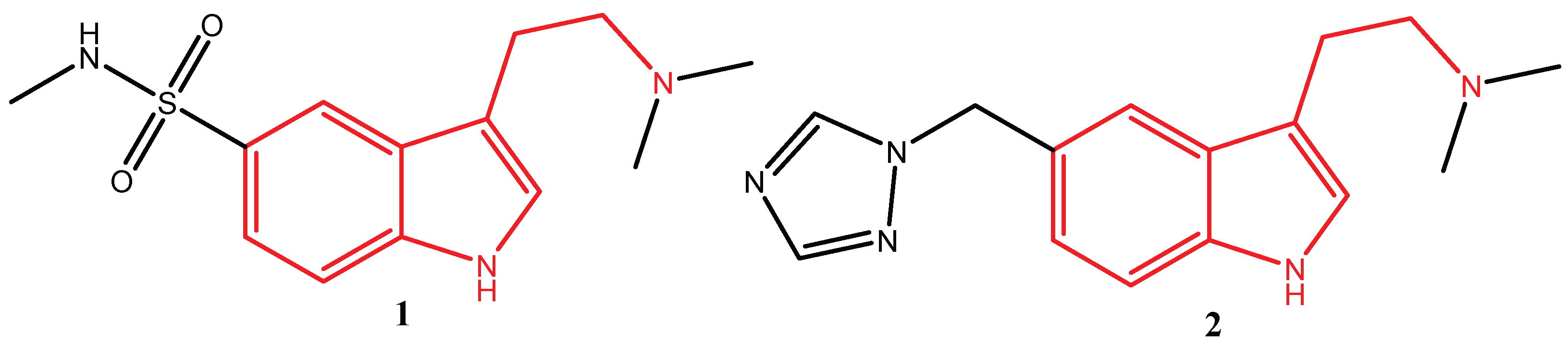
Tryptamine acts as a biosynthetic precursor for various natural alkaloids and is integral to medications such as sumatriptan 1 and rizatriptan 2 (Figure 1), which target migraines. The tryptamine skeleton is given in red.
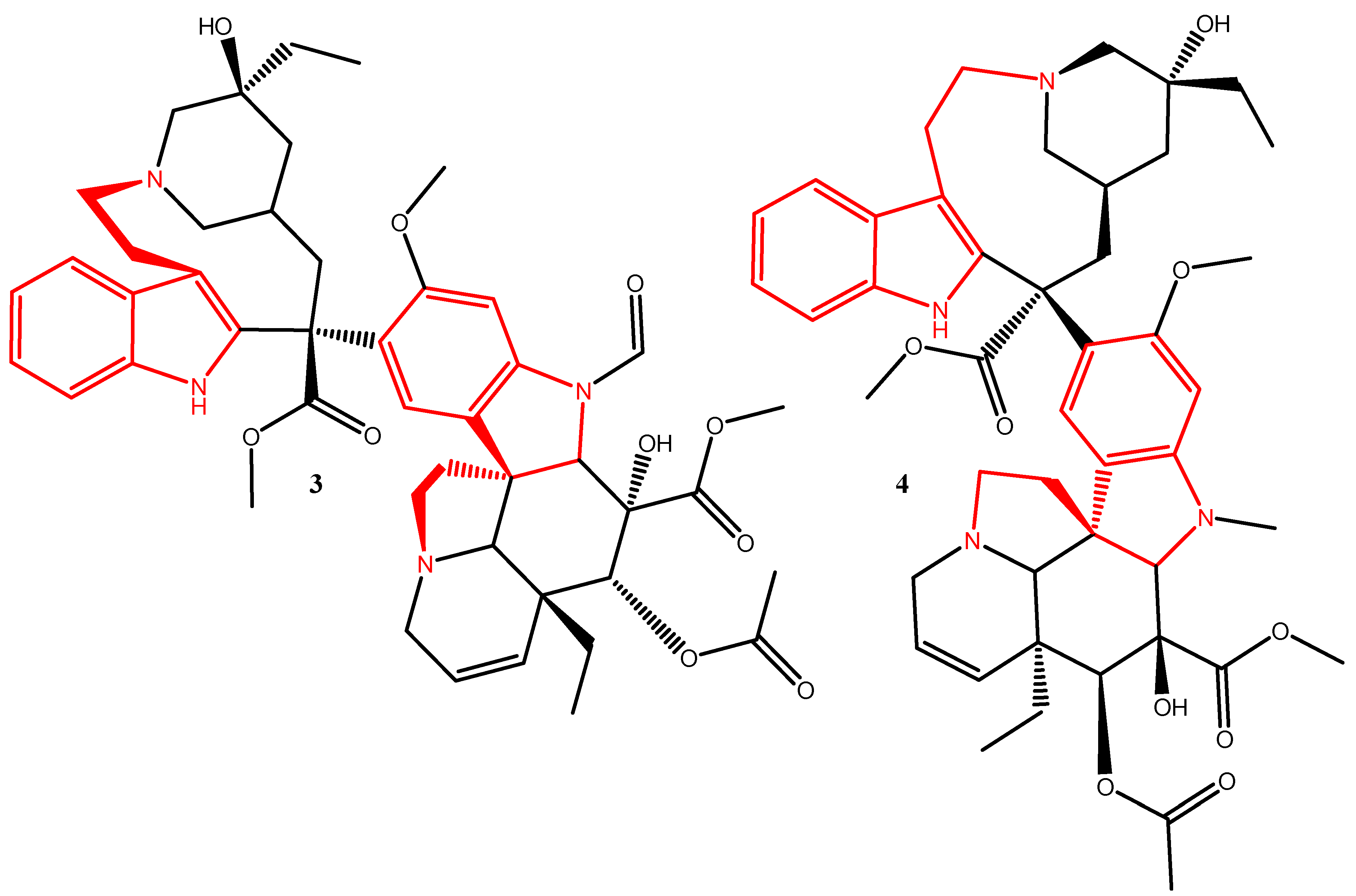
Clinically important anticancer drugs, including vincristine 3 and vinblastine 4, highlight the therapeutic significance of this class of compounds (Figure 2).
The potential uses of tryptamine and its derivatives in cancer therapy to improve preventative and treatment approaches are still being investigated. Tryptamines are neurotransmitters with anti-inflammatory and antioxidant qualities, among other biological functions. When taken orally, unsubstituted tryptamines, such as 2-(1H-indol-3-yl)-ethylamine, are often non-psychoactive [5].
An anti-epileptic medication called valproic acid is used to treat schizophrenia, bipolar disorder, major depression, epilepsy, migraine prevention, and seizures. Its promise as an anticancer drug is limited by worries about serious side effects, such as teratogenicity, neural tube abnormalities, and liver damage. By inhibiting histone deacetylase (HDAC), valproic acid modifies chromatin structure, which is essential for the development of tumors. It works well with other pan-HDAC inhibitors and has demonstrated anti-Alzheimer’s disease benefits. Valproic acid has been shown in preclinical research to promote differentiation in tumor cells, decrease their growth and invasion in animal models, and cause apoptosis in various hematological malignancies, breast, lung, and thyroid cancers. It has recently been used in cancer therapies in conjunction with chemotherapy drugs [6,7].
Despite being an effective antiepileptic medication, valproic acid’s pharmacokinetic limitations-such as its short half-life and dose-dependent adverse effects-present therapeutic difficulties. Patient adherence and efficacy are impacted by these problems, which result in frequent dosage. Controlled-release and sustained-release devices, especially bi-layer tablets, have been studied as a solution. Bi-layer tablets increase bioavailability and lessen gastrointestinal side effects by combining an immediate-release layer for rapid response with a sustained-release layer for extended activity. The safety and effectiveness of these formulations, which have demonstrated enhanced drug release and dissolving performance for long-term treatment, are supported by predictive modeling and compatibility evaluations [8].
The synthesis of a hybrid molecule combining tryptamine and valproic acid is of interest due to the complementary pharmacological properties of these two structures. Tryptamine, an indole-based scaffold, exhibits diverse biological activities, including anticancer and neurological effects, while valproic acid is a well-known antiepileptic agent with emerging anticancer potential through HDAC inhibition, despite its pharmacokinetic limitations and side effects. Integrating both moieties into a single entity may enhance therapeutic efficacy, promote synergistic biological activity, and improve the overall pharmacological profile, making this approach promising for the development of novel anticancer and neuroactive agents.

2. Results and Discussion

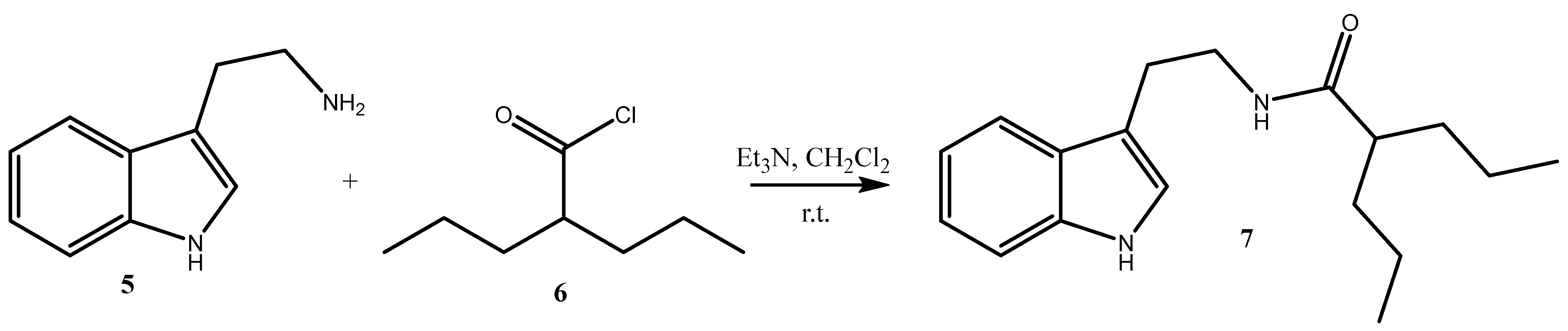
The present study reports the efficient synthesis of N-(2-(1H-indol-3-yl)ethyl)-2-propylpentanamide. The target compound was obtained via initial conversion of the carboxylic acid functionality of valproic acid into the corresponding acyl chloride 6, followed by its subsequent reaction with tryptamine 5, as outlined in Scheme 1.
The structure of the synthesized compound 7 was confirmed through comprehensive spectroscopic analysis, including melting-point determination, 1H and 13C NMR spectroscopy, infrared spectroscopy, and mass spectrometry. The reported molecule have not been reported previously. The narrow melting-point range observed for the synthesized compound 7 (m.p. 88–89 °C), indicates a high degree of purity, which is confirmed via all the spectral data obtained.
Upon examination of the 1H NMR spectrum of compound 7, it is evident that the observed signals are fully consistent with the expected number of protons. The proton attached to the nitrogen atom of the indole ring appears as a singlet at 10.80 ppm, while the proton adjacent to the second nitrogen atom is observed as a well-defined triplet at 7.91 ppm. Signals corresponding to the aromatic protons are detected in the range of 6.98–7.55 ppm, along with the CH proton of the five-membered heterocycle at 7.13 ppm.
A signal at 3.35 ppm corresponds to two protons of the methylene group adjacent to the amide nitrogen atom and appears as a quartet overlapped with one of the residual water signals originating from moisture in the solvent, DMSO. Additional solvent-related water signals are typically observed at δ = 2.50 and 3.33 ppm [9]. The neighboring methylene group directly attached to the indole moiety gives rise to a triplet signal at 2.82 ppm. A multiplet at 2.13 ppm is assigned to the methine (CH) proton of the valproic acid fragment. The subsequent three multiplets at 1.45, 1.23, and 1.18 ppm correspond to the methylene (CH2) protons of the valproic acid moiety. Finally, the two methyl groups appear as a well-resolved triplet integrating for six protons at 0.84 ppm. Examination of the 13C NMR spectrum likewise shows that the observed signals correspond to the expected carbon atoms, thereby confirming the structure of hybrid compound 7. However, the signal for the CH2 group adjacent to the amide nitrogen is not observed, most likely due to overlap with the solvent signal. Analysis of the solvent signal (Figure S4) indicates that the second line of the multiplet at 39.72 ppm is not symmetric with the other line at 40.27 ppm (it is more intense) and has most likely overlapped with the signal of the carbon atom.
The IR and mass spectrometric data also unambiguously confirm the presence of the corresponding functional groups in compound 7, as well as the molecular mass of the newly synthesized hybrid molecule, reported here for the first time.

3. Materials and Methods

All reagents and chemicals were purchased from commercial suppliers (Sigma-Aldrich S.A. and Riedel-de Haën, Sofia, Bulgaria) and were used without further purification. Nuclear magnetic resonance (NMR) spectra were recorded on a Bruker Avance II+600 spectrometer (BAS-IOCCP—Sofia, Bruker, Billerica, MA, USA), operating at 600 MHz for 1H and 150.9 MHz for 13C. Spectra were acquired in DMSO-d6, with chemical shifts (δ) referenced to tetramethylsilane (TMS, δ = 0.00 ppm) and coupling constants (J) reported in hertz (Hz). All NMR measurements were performed at ambient temperature (approximately 295 K). Melting points were determined using a Boetius hot-stage apparatus (Plovdiv University; Boetius, Germany) and are reported uncorrected. Infrared spectra were obtained on a Bruker Alpha II FT-IR spectrometer (Plovdiv University; Bruker, Billerica, MA, USA). High-resolution mass spectrometry (HRMS) analyses were conducted using a Q Exactive Plus mass spectrometer equipped with a heated electrospray ionization (HESI-II) source (Thermo Fisher Scientific, Bremen, Germany) and coupled to a Dionex Ultimate 3000RSLC UHPLC system (Thermo Fisher Scientific, Waltham, MA, USA). Thin-layer chromatography (TLC) was carried out on 0.2 mm silica gel 60 plates (Fluka, Merck KGaA, Darmstadt, Germany).

3.1. Synthetic Procedures

3.1.1. Synthesis of 2-Propylpentanoyl chloride 6

Valproic acid (1.0 mmol, 0.1442 g) was dissolved in toluene (20 mL), after which thionyl chloride in excess (1.2 mmol, 0.087 mL) was added to the solution. The mixture was refluxed at 110–115 °C for 2 h to promote conversion of the carboxylic acid to the corresponding acid chloride. Upon completion, excess toluene and volatile byproducts were removed under reduced pressure using rotary evaporation. The resulting residue was then dissolved in dichloromethane for use in the subsequent reaction step, without further purification.

3.1.2. Synthesis of N-(2-(1H-Indol-3-yl)ethyl)-2-propylpentanamide 7

A solution of tryptamine 5 (1 mmol, 0.1602 g) in dichloromethane (20 mL) was prepared. To this solution, 2-propylpentanoyl chloride (1 mmol, 0.1626 g) was added. The resulting mixture was stirred at room temperature for 10 min, after that triethylamine (Et3N, 0.168 mL, 1.2 mmol) was added dropwise. The reaction was stirred continuously on an electromagnetic stirrer for 30 min. Progress of the reaction was monitored by thin-layer chromatography (petroleum ether/diethyl ether 1:3 (v/v)), confirming complete consumption of the amine starting material. Upon completion, the reaction mixture was washed with dilute aqueous hydrochloric acid (HCl:H2O = 1:4), saturated aqueous sodium carbonate (Na2CO3), and brine. The organic phase was separated, dried over anhydrous Na2SO4, and concentrated under reduced pressure. The crude product was purified by short-column chromatography on neutral aluminum oxide (Al2O3) using CH2Cl2 as eluent to afford the new hybrid molecule 7.
N-(2-(1H-indol-3-yl)ethyl)-2-propylpentanamide 7
White solid (m.p. 88–89 °C), yield 95% (0.2734 g), Rf = 0.56 (petrol/diethyl ether = 1/3 v/v), 1H NMR (600 MHz, DMSO-d6) δ 10.80 (s, 1H), 7.91 (t, J = 5.7 Hz, 1H), 7.55 (d, J = 7.8 Hz, 1H), 7.34 (d, J = 8.1 Hz, 1H), 7.13 (d, J = 2.3 Hz, 1H), 7.07 (ddd, J = 8.1, 6.9, 1.2 Hz, 1H), 6.98 (ddd, J = 7.9, 6.9, 1.1 Hz, 1H), 3.39–3.32 (m, 2H, overlapped with H2O), 2.82 (t, J = 7.5 Hz, 2H), 2.17–2.08 (m, 1H), 1.49–1.41 (m, 2H), 1.26–1.21 (m, 2H), 1.20–1.14 (m, 4H), 0.84 (t, J = 7.2 Hz, 6H). 13C NMR (151 MHz, DMSO-d6) δ 175.20 (C=O), 136.72 (Ar), 127.69 (Ar), 123.06 (NHC=C), 121.32 (Ar), 118.73 (Ar), 118.62 (Ar), 112.31 (NHC=C), 111.78 (Ar), 45.76 (CH), 35.37 (2× CHCH2CH2CH3), 25.90 (CH2CH2NH), 20.67 (2× CH2CH3), 14.49 (2× CH3). Electrospray ionization (ESI) m/z calculated for [M + Na]+ C18H26N2NaO+ = 309.1937, found 309.1928 (mass error ∆m = −2.91 ppm). IR (KBr) νmax., cm−1: 3283, 3107 ν(N-H), 2956 νas (CH3), 2927 νas (CH2), 2873 νs (CH3), 1614 ν (C=O), 1458 δas (CH3), 1378 δs (CH3).

Supplementary Materials

The following are available online. Figure S1: 1H-NMR spectrum of compound 7; Figure S2: 1H-NMR Overlapping CH2 signal; Figure S3: 13C-NMR spectrum of compound 7; Figure S4: 13C-NMR overlapping CH2 signal; Figure S5: IR spectrum of compound 7; Figure S6: ESI-HRMS of compound 7.

Author Contributions

Conceptualization, I.I. and S.M.; methodology, S.M.; software, S.M.; validation, I.I., S.M. and D.B.; formal analysis, D.D., S.I., and I.C.; investigation, S.M. and D.B.; resources, I.I.; data curation, S.M.; writing—original draft preparation, S.M.; writing—review and editing, S.M.; visualization, S.M.; supervision, I.I.; project administration, S.M.; funding acquisition, I.I. All authors have read and agreed to the published version of the manuscript.

Funding

This research received no external funding.

Data Availability Statement

The data presented in this study are available in this article and the supporting Supplementary Materials.

Acknowledgments

The authors thank the Faculty of Chemistry at the “Paisii Hilendarski” University of Plovdiv.

Conflicts of Interest

The authors declare no conflicts of interest.

References

  1. Simonetti, G.; Boga, C.; Durante, J.; Micheletti, G.; Telese, D.; Caruana, P.; Ghelli Luserna di Rorà, A.; Mantellini, F.; Bruno, S.; Martinelli, G.; et al. Synthesis of Novel Tryptamine Derivatives and Their Biological Activity as Antitumor Agents. Molecules 2021, 26, 683. [Google Scholar] [CrossRef] [PubMed]
  2. Guo, Z.; Xu, Y.; Peng, Y.; Rashid, H.; Quan, W.; Xie, P.; Wu, L.; Jiang, J.; Wang, L.; Liu, X. Design, synthesis and evaluation of novel (S)-tryptamine derivatives containing an allyl group and an aryl sulfonamide unit as anticancer agents. Bioorg. Med. Chem. Lett. 2019, 29, 1133–1137. [Google Scholar] [CrossRef] [PubMed]
  3. Meng, J.-P.; Li, S.-Q.; Tang, Y.; Xu, Z.-G.; Chen, Z.-Z.; Gao, L.-X. Facile synthesis and biological evaluation of tryptamine-piperazine-2,5-dione conjugates as anticancer agents. RSC Adv. 2021, 11, 27767–27771. [Google Scholar] [CrossRef] [PubMed]
  4. Hemachandran, K.; Anbusrinivasan, P.; Ramalingam, S.; Manoharan, C.; Aarthi, R. Biological and structural properties’ interpretation on antitumour drug 3-(2-aminoethyl) indole (tryptamine) using molecular spectroscopy and computational tools. J. Taibah Univ. Sci. 2019, 13, 231–247. [Google Scholar] [CrossRef]
  5. Ashokan, A.; Muthu, S.; Chakkarapani, N.; Rajakannan, V.; Khamrang, T.; Kavitha, S.; Hemamalini, M. Multifaceted analysis of a p-Coumaric acid-tryptamine organic salt: Structure, spectra, computational modelling, and biological potential. J. Mol. Struct. 2025, 1345, 143075. [Google Scholar] [CrossRef]
  6. Sargazi, S.; Hajinezhad, M.; Barani, M.; Rahdar, A.; Shahraki, S.; Karimi, P.; Cucchiarini, M.; Khatami, M.; Pandey, S. Synthesis, characterization, toxicity and morphology assessments of newly prepared microemulsion systems for delivery of valproic acid. J. Mol. Liq. 2021, 338, 116625. [Google Scholar] [CrossRef]
  7. Hsu, K.-C.; Chu, J.-C.; Tseng, H.-J.; Liu, C.-I.; Wang, H.-C.; Lin, T.; Lee, H.-S.; Hsin, L.-W.; Wang, A.; Lin, C.-H.; et al. Synthesis and biological evaluation of phenothiazine derivative-containing hydroxamic acids as potent class II histone deacetylase inhibitors. Eur. J. Med. Chem. 2021, 219, 113419. [Google Scholar] [CrossRef] [PubMed]
  8. Shreya; Thakur, A.; Thakur, S.; Devi, A. Pharmaceutical Design and In Vitro Evaluation of a Dual Layer Valproic Acid Tablet for Enhanced Therapeutic Efficacy and Controlled Drug Release. J. Neonatal Surg. 2025, 14, 22–37. [Google Scholar]
  9. Valvi, M.; Badhani, G.; More, K.; Adimurthy, S. Brønsted Acid Mediated Mono- and Di-substitution of Quinoxalines with ndoles: A Pathway to Indolocarbazole-Quinoxaline Scaffolds. Chem. Commun. 2025, 61, 4698–4701. [Google Scholar] [CrossRef] [PubMed]
Figure 1. Structural formulas of sumatriptan 1 and rizatriptan 2.
Molbank 2026 m2123 g001
Figure 2. Structural formulas of vincristine 3 and vinblastine 4.
Molbank 2026 m2123 g002
Scheme 1. Synthesis of hybrid molecule 7.
Molbank 2026 m2123 sch001
Disclaimer/Publisher’s Note: The statements, opinions and data contained in all publications are solely those of the individual author(s) and contributor(s) and not of MDPI and/or the editor(s). MDPI and/or the editor(s) disclaim responsibility for any injury to people or property resulting from any ideas, methods, instructions or products referred to in the content.