Communication

Synthesis of 5′-Chlorospiro(benzo[d][1,3]dioxole-2,4′-[1,2,6]thiadiazin)-3′-amine and 10-Chloro-1,4-dioxa-8-thia-7,9-diazaspiro[4.5]deca-6,9-dien-6-amine


by
Andreas S. Kalogirou
1,* and
Panayiotis A. Koutentis
2
1
Department of Life Sciences, School of Sciences, European University Cyprus, 6 Diogenis Str., Engomi, P.O. Box 22006, 1516 Nicosia, Cyprus
2
Department of Chemistry, University of Cyprus, P.O. Box 20537, 1678 Nicosia, Cyprus
*
Author to whom correspondence should be addressed.
Molbank 2026, 2026(1), M2125; https://doi.org/10.3390/M2125
Submission received: 11 December 2025 / Revised: 9 January 2026 / Accepted: 12 January 2026 / Published: 16 January 2026
(This article belongs to the Section Organic Synthesis and Biosynthesis)

Abstract

Reactions of 3′,5′-dichlorospiro(benzo[d][1,3]dioxole-2,4′-[1,2,6]thiadiazine) or 6,10-dichloro-1,4-dioxa-8-thia-7,9-diazaspiro[4.5]deca-6,9-diene with ammonia in MeCN, at ca. 20 °C, gave 5′-chlorospiro(benzo[d][1,3]dioxole-2,4′-[1,2,6]thiadiazin)-3′-amine and 10-chloro-1,4-dioxa-8-thia-7,9-diazaspiro[4.5]deca-6,9-dien-6-amine, respectively, in near quantitative yields.

1. Introduction

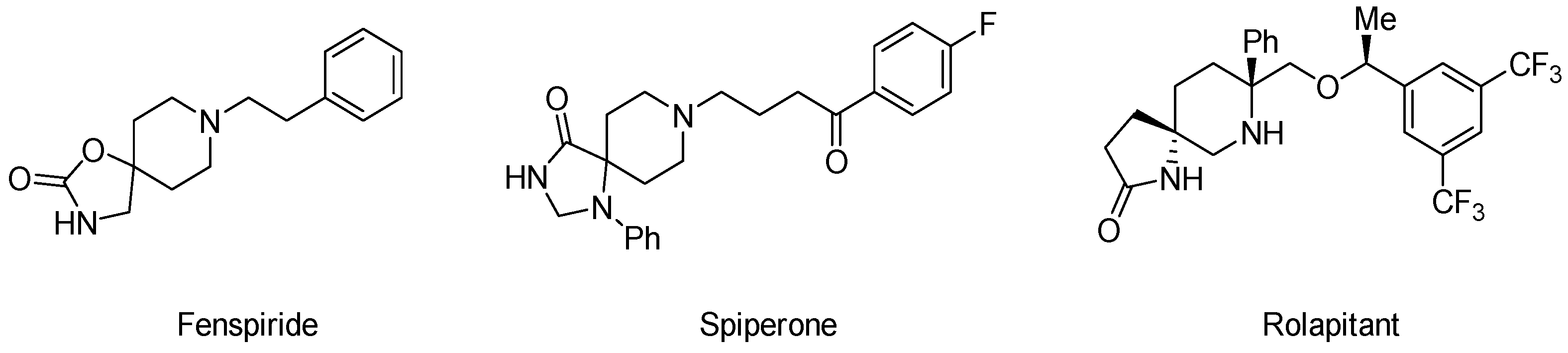
Spiroheterocycles are organic compounds characterized by two fused rings (at least one of which contains a non-carbon atom) that share a single common atom. Since this shared atom is typically tetrahedral (specifically sp3-hybridized), the two rings are forced to adopt a rigid, non-planar geometry where the ring planes are often mutually orthogonal. This unique, constrained shape makes them invaluable scaffolds in medicinal chemistry, exemplified by the anti-inflammatory drug fenspiride [1], the anti-psychotic drug spiperone [2], and the anti-CINV drug rolapitant [3] (Figure 1). The synthesis and applications of spiroheterocycles have been reviewed [4].
Our interest in spiroheterocycles stems from our work on the synthesis of oligomeric 4H-1,2,6-thiadiazines [5]. This work forms part of a broader goal to access π-conjugated polymers structurally and electronically analogous to the superconductor poly(sulfur nitride) [6], as first proposed by Woodward [7] and Rees [8]. While the synthesis and properties of these specific polymers remain unexplored, similar conjugated polymers have demonstrated a plethora of applications [9]. These include roles in coatings [10,11], sensing [12,13], electronics [12,13,14,15], energy storage [12], as well as potential biomedical applications [12,16,17,18].
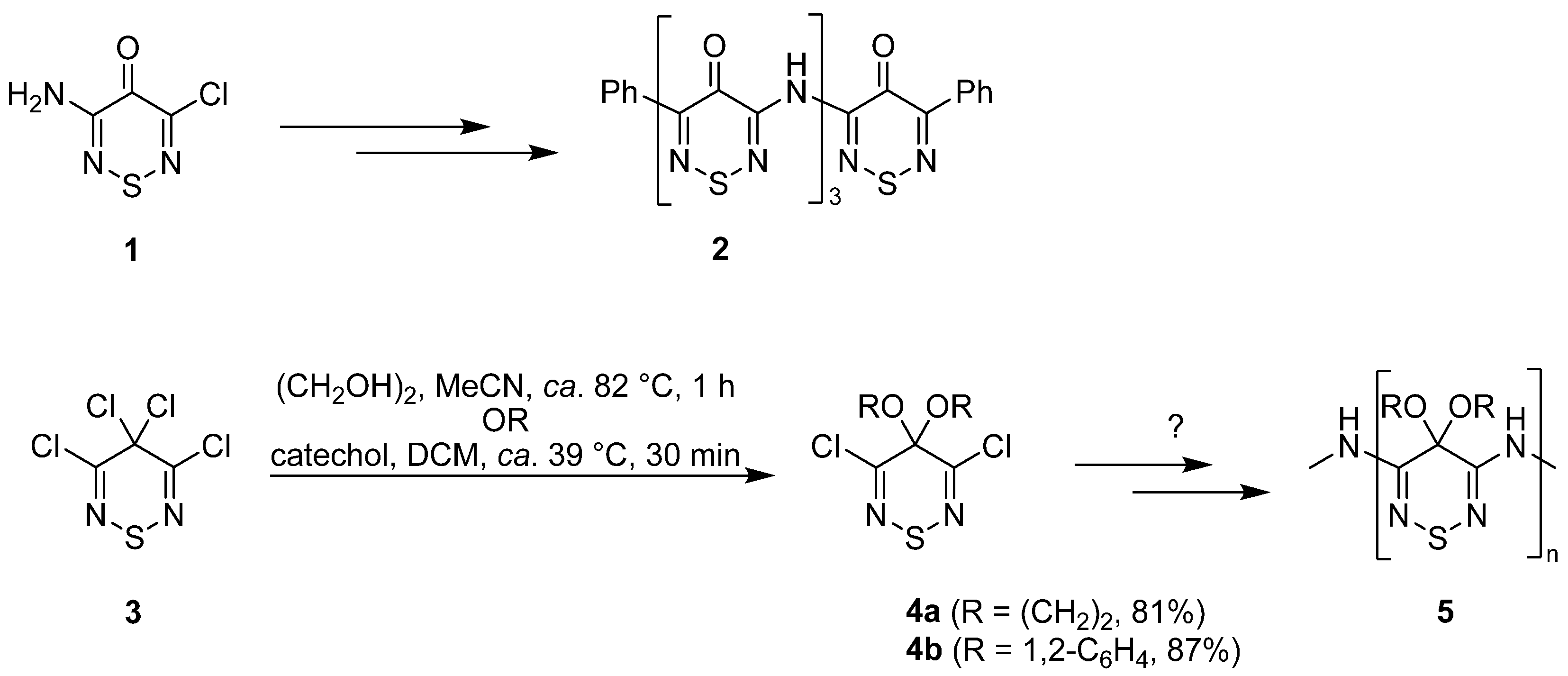
In our previous work [5], we focused on making oligomers of 1,2,6-thiadiazin-4-ones and succeeded in accessing oligomers with up to four thiadiazine units (compound 2, Scheme 1) starting from 3-aminothiadiazinone 1. However, accessing longer oligomers based on 1,2,6-thiadiazine-4-ones was prevented owing to solubility issues due to increased aggregation. We therefore considered that one way to access longer oligomers would be to move away from the flat 1,2,6-thiadiazin-4-ones and investigate the use of C-4-saturated derivatives instead, which, due to their three-dimensional structure, should hinder aggregation. This aligns with the prediction of Woodward, who envisioned a polymer containing C-4-saturated 1,2,6-thiadiazine. Having previously accessed 3,5-dichloro-4H-1,2,6-thiadiazine 4,4-ketals 4a and 4b starting from tetrachlorothiadiazine 3 [19,20,21,22] and studied their nucleophilic substitution chemistry [23], we considered these compounds as suitable monomers for the preparation of thiadiazine oligomers 5 (Scheme 1). The route to oligomers 5 required access to the respective 3-amino derivatives 6a and 6b (Scheme 2).

2. Results and Discussion

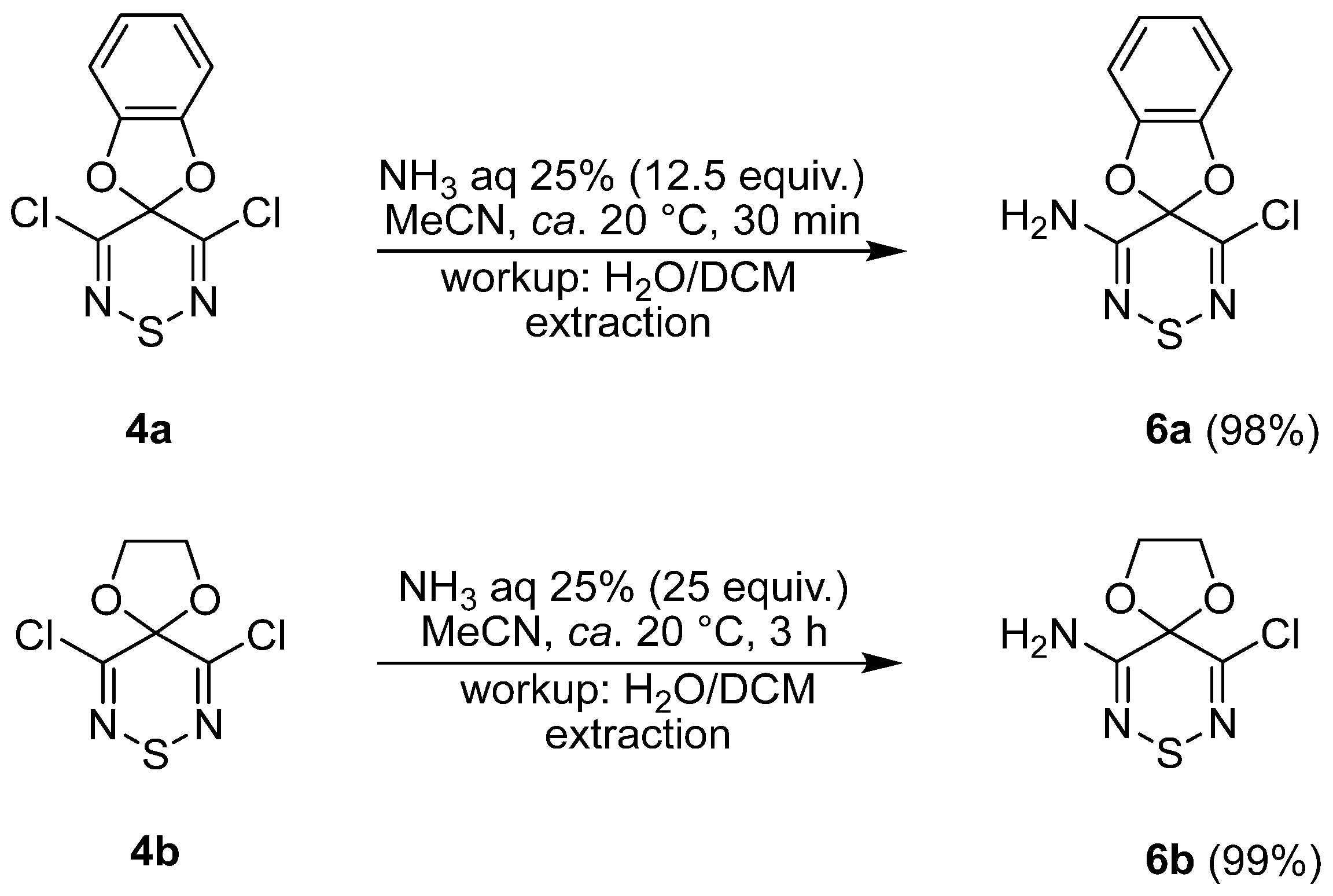
Inspired by our chromatography-free method for accessing 3-aminothiadiazinone 1 [5], we investigated the synthesis of aminothiadiazines 6a and 6b (Scheme 2). Treatment of dichlorothiadiazine 4a with aqueous ammonia in MeCN at ca. 20 °C led to a quick consumption of the starting material (30 min), giving aminothiadiazine 6a in 98% yield. The reaction of ethylene glycol ketal 4b required a longer reaction time and a higher loading of aqueous ammonia; however, aminothiadiazine 6b was also isolated in near quantitative yield (Scheme 2).
The two products were isolated as colorless needles [m.p. 112–113 °C and 115–116 °C, respectively], and their UV absorption in solution [λmax (DCM) 303 nm, log ε 3.95 and 300 nm, log ε 3.95, respectively] indicated the presence of the thiadiazine chromophore. The FTIR spectrum showed absorptions corresponding to an amine [ν(N-H) 3441 and 3456 cm−1, respectively]. The 13C NMR spectra confirmed the presence of four and three quaternary carbon atoms, with the C-4 sp3 carbon appearing at 97.2 and 92.2 ppm, respectively (see the Supporting Information, SI).
Attempts to prepare aminothiadiazine oligomers from spirocycles 6a and 6b have so far being unsuccessful. In particular, attempted C–N coupling of aminothiadiazines 6a or 6b with the corresponding dichlorothiadiazines 4a and 4b with the previously used reaction conditions [5] led to a slow degradation of the starting materials. However, the two thiadiazines may serve as useful synthetic scaffolds due to the presence of the readily functionalizable amino group, which could enable incorporation of this rare bicyclic motif into biologically active molecules, although such applications are not currently the focus of our work.

3. Materials and Methods

Aqueous NH3 solution 25% (Sigma-Aldrich, Burlington, MA, USA), MeCN (Sigma-Aldrich, Burlington, MA, USA), CH2Cl2 (Fischer Scientific, Hampton, NH, USA), 1,2-dichloroethane (DCE, Sigma-Aldrich, Burlington, MA, USA), cyclohexane (Sigma-Aldrich, Burlington, MA, USA), and MgSO4 (Alfa Aesar, 99.5%, Haverhill, MA, USA) were used as received. The reaction mixture was monitored by TLC using commercial glass-backed thin-layer chromatography (TLC) plates (Merck Kieselgel 60 F254, Darmstadt, Germany). The plates were observed under UV light at 254 and 365 nm. The melting point was determined using a PolyTherm-A, Wagner and Munz, Kofler—Hotstage Microscope apparatus (Wagner and Munz, Munich, Germany). The solvent used for recrystallization is indicated after the melting point. The UV–vis spectrum was obtained using a Perkin-Elmer Lambda-25 UV/vis spectrophotometer (Perkin-Elmer, Waltham, MA, USA) and inflections are identified by the abbreviation “inf”. The IR spectrum was recorded on a Shimadzu FTIR-NIR Prestige-21 spectrometer (Shimadzu, Kyoto, Japan) with Pike Miracle Ge ATR accessory (Pike Miracle, Madison, WI, USA), and strong, medium, and weak peaks are represented by s, m, and w, respectively. 1H and 13C NMR spectra were recorded on a Bruker Avance 500 machine [at 500 and 125 MHz, respectively (Bruker, Billerica, MA, USA)]. Deuterated solvents were used for homonuclear lock, and the signals are referenced to the deuterated solvent peaks. Attached proton test (APT) NMR studies were used for the assignment of the 13C peaks as CH3, CH2, CH, and Cq (quaternary). GC-MS analysis (EI) was performed on an Agilent 5973 Inert Mass Selective Detector (Agilent Technologies, Santa Clara, CA, USA) coupled to an Agilent 6890N GC system equipped with a HP-5MS capillary column (30 m × 0.25 mm, 0.25 μm) (Agilent Technologies, Santa Clara, CA, USA). Helium was used as carrier gas at a flow rate of 0.9 mL/min. The injector was heated to 285 °C, and the oven temperature was increased from 50 to 120 °C at the rate of 6 °C/min, after which it was further increased to 260 °C at 30 °C/min. The MALDI-TOF mass spectrum (+ve mode) was recorded on a Bruker Autoflex III Smartbeam instrument (Bruker). 3′,5′-dichlorospiro(benzo[d][1,3]dioxole-2,4′-[1,2,6]thiadiazine) (4a) and 6,10-dichloro-1,4-dioxa-8-thia-7,9-diazaspiro [4.5]deca-6,9-diene (4b) were prepared according to the literature procedure [19].
5′-Chlorospiro(benzo[d][1,3]dioxole-2,4′-[1,2,6]thiadiazin)-3′-amine (6a)
A stirred solution of 3′,5′-dichlorospiro(benzo[d][1,3]dioxole-2,4′-[1,2,6]thiadiazine) (4a) (127.5 mg, 0.500 mmol) in MeCN (5 mL) at ca. 20 °C was added 25% NH3 (aq) (475 µL, 6.25 mmol). The flask was then sealed with a septum and stirred at this temperature until no starting material remained (TLC, 30 min). The mixture was then transferred to a separating funnel, water (20 mL) was added, and the mixture extracted with DCM (3 × 20 mL). The combined organic phase was dried over MgSO4 and evaporated in vacuo to give the title compound 6a (125.3 mg, 98%) as colorless needles, m.p. 112–113 °C (from c-hexane); Rf 0.35 (n-hexane/DCM, 50:50); (found: C, 42.05; H, 2.68; N, 16.37. C9H6ClN3O2S requires C, 42.28; H, 2.37; N, 16.44%); λmax(CH2Cl2)/nm 277 (log ε 4.16), 303 (3.95); νmax/cm−1 3441 m and 3310 m (N-H), 3186 w and 3117 w (C-H), 1636 m, 1574 w, 1543 w, 1481 s, 1381 m, 1358 m, 1296 w, 1281 w, 1234 s, 1204 m, 1180 m, 1150 w, 1111 m, 1096 m, 1072 w, 1011 w, 926 w, 903 m, 856 w, 818 m, 787 m, 764 w, 741 w; δH[500 MHz; (CD3)2CO] 6.98–6.94 (4H, m, Ar CH), 6.73 (2H, br. s, NH2); δC[125 MHz; (CD3)2CO] 147.2 (Cq), 146.0 (Cq), 130.8 (Cq), 123.7 (CH), 109.3 (CH), 97.2 (Cq); m/z (GC-MS) 287 (25%), 285 (6), 256 (M+-H+2, 38), 254 (M+-H, 100), 110 (C6H6O2+, 17) (Minor ions observed above the nominal molecular mass are attributed to low-intensity source-related ion–molecule recombination events and do not indicate chemical modification of the analyte); m/z (MALDI-TOF) 258 (MH++2, 33%), 256 (MH+, 43), 231 (71), 220 (M+-Cl, 89), 215 (68), 193 (100), 177 (97), 137 (45).
10-Chloro-1,4-dioxa-8-thia-7,9-diazaspiro[4.5]deca-6,9-dien-6-amine (6b)
A stirred solution of 6,10-dichloro-1,4-dioxa-8-thia-7,9-diazaspiro[4.5]deca-6,9-diene (4b) (113.5 mg, 0.500 mmol) in MeCN (5 mL) at ca. 20 °C was added 25% NH3 (aq) (0.95 mL, 12.5 mmol). The flask was then sealed with a septum and stirred at this temperature until no starting material remained (TLC, 3 h). The mixture was then transferred to a separating funnel, water (20 mL) was added, and the mixture extracted with DCM (3 × 20 mL). The combined organic phase was dried over MgSO4 and evaporated in vacuo to give the title compound 6b (102.9 mg, 99%) as colorless needles, m.p. 115–116 °C (from DCE/c-hexane); Rf 0.38 (DCM); (found: C, 29.04; H, 2.85; N, 20.18. C5H6ClN3O2S requires C, 28.92; H, 2.91; N, 20.24%); λmax(CH2Cl2)/nm 264 (log ε 4.03), 300 (3.95); νmax/cm−1 3456 m (N-H), 3279 w, 3210 w and 3179 w (C-H Arom), 2963 w, 2924 w and 2893 w (C-H Aliph.), 1620 s, 1566 m, 1551 m, 1474 w, 1389 m, 1265 w, 1227 w, 1188 m, 1142 m, 1119 m, 1081 m, 980 m, 949 m, 895 m, 787 m, 764 m; δH[500 MHz; (CD3)2CO] 6.28 (2H, br. S, NH2), 4.36–4.33 (2H, m, CH2), 4.32–4.29 (2H, m, CH2); δC[125 MHz; (CD3)2CO] 149.82 (Cq), 149.76 (Cq), 135.5 (Cq), 92.2 (Cq), 68.7 (CH2); m/z (GC-MS) 209 (M++2, 35%), 207 (M+, 100), 172 (M+-Cl, 81), 128 (M+-Cl-CH2CH2O, 62), 107 (23), 93 (31), 73 (CHN2S+, 46); m/z (MALDI-TOF) 232 (M+Na++2, 61%), 230 (M+Na+, 92), 210 (MH++2, 22), 208 (MH+, 49), 207 (M+, 42), 182 (100), 175 (M+-S, 17), 172 (M+-Cl, 83), 73 (55).

Supplementary Materials

The following supporting information can be downloaded online: molfile, UV–vis, IR, 1H, and 13C NMR spectra, GC-MS data.

Author Contributions

A.S.K. designed and performed the experiments, analyzed the data, and wrote the paper; P.A.K. conceived the experiment and edited the manuscript. All authors have read and agreed to the published version of the manuscript.

Funding

The authors thank the Cyprus Research Promotion Foundation (Grants ∑TPATHII/0308/06, NEKYP/0308/02 ΥΓEIA/0506/19 and ENI∑X/0308/83) for funding.

Data Availability Statement

Data is contained within the article or the Supplementary Material.

Acknowledgments

The authors thank the following organizations and companies in Cyprus for generous donations of chemicals and glassware: the State General Laboratory, the Agricultural Research Institute, the Ministry of Agriculture, MedoChemie Ltd., Medisell Ltd., and Biotronics Ltd. Furthermore, we thank the A. G. Leventis Foundation for helping to establish the NMR facility at the University of Cyprus.

Conflicts of Interest

The authors declare no conflicts of interest.

References

  1. Doebel, K.J.; Graeme, M.L.; Gruenfeld, N.; Ignarro, L.J.; Piliero, S.J.; Wasley, J.W.F. Non-steroidal Anti-inflammatory Agents. Annu. Rep. Med. Chem. 1969, 5, 225–236. [Google Scholar]
  2. Hidaka, K.; Matsumoto, M.; Tada, S.; Tasaki, Y.; Yamaguchi, T. Differential effects of [3H]nemonapride and [3H]spiperone binding on human dopamine D4 receptors. Neurosci. Lett. 1995, 186, 145–148. [Google Scholar] [CrossRef]
  3. Diemunsch, P.; Joshi, G.P.; Brichant, J.F. Neurokinin-1 receptor antagonists in the prevention of postoperative nausea and vomiting. Br. J. Anaesth. 2009, 103, 7–13. [Google Scholar] [CrossRef]
  4. Basavaraja, D.; Siby, A.; Sreelakshmi, V.; Ancy, A.; Somappa, S.B. Spiro-heterocycles: Recent advances in biological applications and synthetic strategies. Tetrahedron 2025, 173, 134468. [Google Scholar] [CrossRef]
  5. Kalogirou, A.S.; Kourtellaris, A.; Koutentis, P.A. Synthesis of Oligomeric 4H-1,2,6-Thiadiazines. ChemistrySelect 2025, 10, e202405838. [Google Scholar] [CrossRef]
  6. Burt, F.P. XCIX.—A new sulphide of nitrogen. J. Chem. Soc. Trans. 1910, 97, 1171–1174. [Google Scholar] [CrossRef]
  7. Cava, M.P.; Lakshmikantham, M.V.; Hoffmann, R.; Williams, R.M. R. B. Woodward’s unfinished symphony: Designing organic superconductors (1975–79). Tetrahedron 2011, 67, 6771–6797. [Google Scholar] [CrossRef]
  8. Koutentis, P.A.; Rees, C.W. Reaction of tetracyanoethylene with SCl2; new molecular rearrangements. J. Chem. Soc. Perkin Trans. 2000, 1, 1089–1094. [Google Scholar] [CrossRef]
  9. Müllen, K.; Scherf, U. Conjugated Polymers: Where We Come From, Where We Stand, and Where We Might Go. Macromol. Chem. Phys. 2023, 224, 2200337. [Google Scholar] [CrossRef]
  10. Dwivedi, R.; Dwivedi, R.K. A Comprehensive Review on Conducting Polymers for Multifaceted Applications. J. Inorg. Organomet. Polym. Mater. 2025, 35, 1–39. [Google Scholar] [CrossRef]
  11. Lu, H.; Li, X.; Lei, Q. Conjugated Conductive Polymer Materials and its Applications: A Mini-Review. Front. Chem. 2021, 9, 732132. [Google Scholar] [CrossRef] [PubMed]
  12. Namsheer, K.; Rout, C.S. Conducting polymers: A comprehensive review on recent advances in synthesis, properties and applications. RSC Adv. 2021, 11, 5659–5697. [Google Scholar] [CrossRef] [PubMed]
  13. Alsolami, E.S.; Alorfi, H.S.; Alamry, K.A.; Hussein, M.A. One-pot multicomponent polymerization towards heterocyclic polymers: A mini review. RSC Adv. 2024, 14, 1757–1781. [Google Scholar] [CrossRef] [PubMed]
  14. Kanibolotsky, A.L.; Findlay, N.J.; Skabara, P.J. Polythiophene and oligothiophene systems modified by TTF electroactive units for organic electronics. Beilstein J. Org. Chem. 2015, 11, 1749–1766. [Google Scholar] [CrossRef]
  15. Hsua, H.-W.; Liu, C.-L. Spray-coating semiconducting conjugated polymers for organic thin film transistor applications. RSC Adv. 2014, 4, 30145–30149. [Google Scholar] [CrossRef]
  16. Ma, Q.; Li, L.; Zhang, Y.; Geng, Y.; Li, J. Progress in Sulfur-Containing Dynamic Polymers. J. Funct. Polym. 2024, 37, 66–81. [Google Scholar] [CrossRef]
  17. Lin, H.; Bai, H.; Yang, Z.; Shen, Q.; Li, M.; Huang, Y.; Lv, F.; Wang, S. Conjugated polymers for biomedical applications. Chem. Commun. 2022, 58, 7232–7244. [Google Scholar] [CrossRef]
  18. Wang, Y.; Zhang, H.; Wang, Z.; Feng, L. Photothermal Conjugated Polymers and Their Biological Applications in Imaging and Therapy. ACS Appl. Polym. Mater. 2020, 2, 4222–4240. [Google Scholar] [CrossRef]
  19. Kalogirou, A.S.; Koutentis, P.A. Regioselective geminal dichloride reactivity of 3,4,4,5-tetrachloro-4H-1,2,6-thiadiazine: Access to 4,4-dioxo- and dithio-ketals. Tetrahedron Lett. 2016, 57, 203–205. [Google Scholar] [CrossRef]
  20. Geevers, J.; Trompen, W.P. Synthesis and reactions of 3,5-dichloro-4H-1,2,6-thiadiazin-4-one. Recl. Trav. Chim. Pays-Bas 1974, 93, 270–272. [Google Scholar] [CrossRef]
  21. Kristinsson, A. Addition of sulfenyl chlorides to the cyanogen bond in activated nitriles. Tetrahedron Lett. 1973, 14, 4489. [Google Scholar] [CrossRef]
  22. Geevers, J.; Trompen, W.P. Reactions of N-chloro formimidoyl chlorides with sulfur. Tetrahedron Lett. 1974, 15, 1687–1690. [Google Scholar] [CrossRef]
  23. Kalogirou, A.S.; Koutentis, P.A. Substitution chemistry of 3,5-dichloro-4H-1,2,6-thiadiazine 4,4-ketals. Tetrahedron Lett. 2016, 57, 3307–3310. [Google Scholar] [CrossRef]
Figure 1. Drug molecules containing spiroheterocycles.
Molbank 2026 m2125 g001
Scheme 1. Structures of reported 1,2,6-thiadiazin-4-one oligomer 2 and proposed synthesis of C-4-saturated oligomers 5.
Molbank 2026 m2125 sch001
Scheme 2. Synthesis of aminothiadiazines 6a and 6b.
Molbank 2026 m2125 sch002
Disclaimer/Publisher’s Note: The statements, opinions and data contained in all publications are solely those of the individual author(s) and contributor(s) and not of MDPI and/or the editor(s). MDPI and/or the editor(s) disclaim responsibility for any injury to people or property resulting from any ideas, methods, instructions or products referred to in the content.