Short Note

(RS)-6,6,7′,7′-Tetramethyl-2-sulfanylidene-5,6,6′,7′-tetrahydro-2H,2′H,4H,4′H,5′H-spiro[thiopyran-3,3′-thiopyrano [2,3-b]thiopyran]-4,5′-dione


1
Pharmaceutical Chemistry, Institute of Pharmaceutical Sciences, University of Graz, Schubertstrasse 1, 8010 Graz, Austria
2
Institute of Chemistry, University of Graz, Schubertstrasse 1, 8010 Graz, Austria
3
Pharmacognosy, Institute of Pharmaceutical Sciences, University of Graz, Beethovenstrasse 8, 8010 Graz, Austria
4
Institute for Chemistry and Technology of Materials (ICTM), Graz University of Technology, Stremayrgasse 9, 8010 Graz, Austria
*
Author to whom correspondence should be addressed.
Molbank 2026, 2026(1), M2117; https://doi.org/10.3390/M2117
Submission received: 1 December 2025 / Revised: 22 December 2025 / Accepted: 30 December 2025 / Published: 4 January 2026
(This article belongs to the Section Organic Synthesis and Biosynthesis)

Abstract

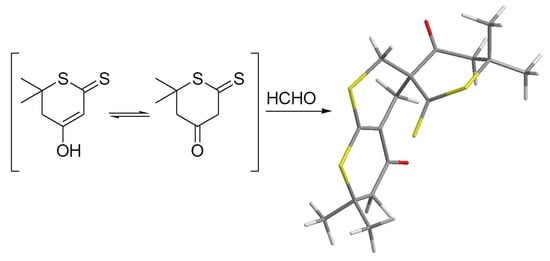
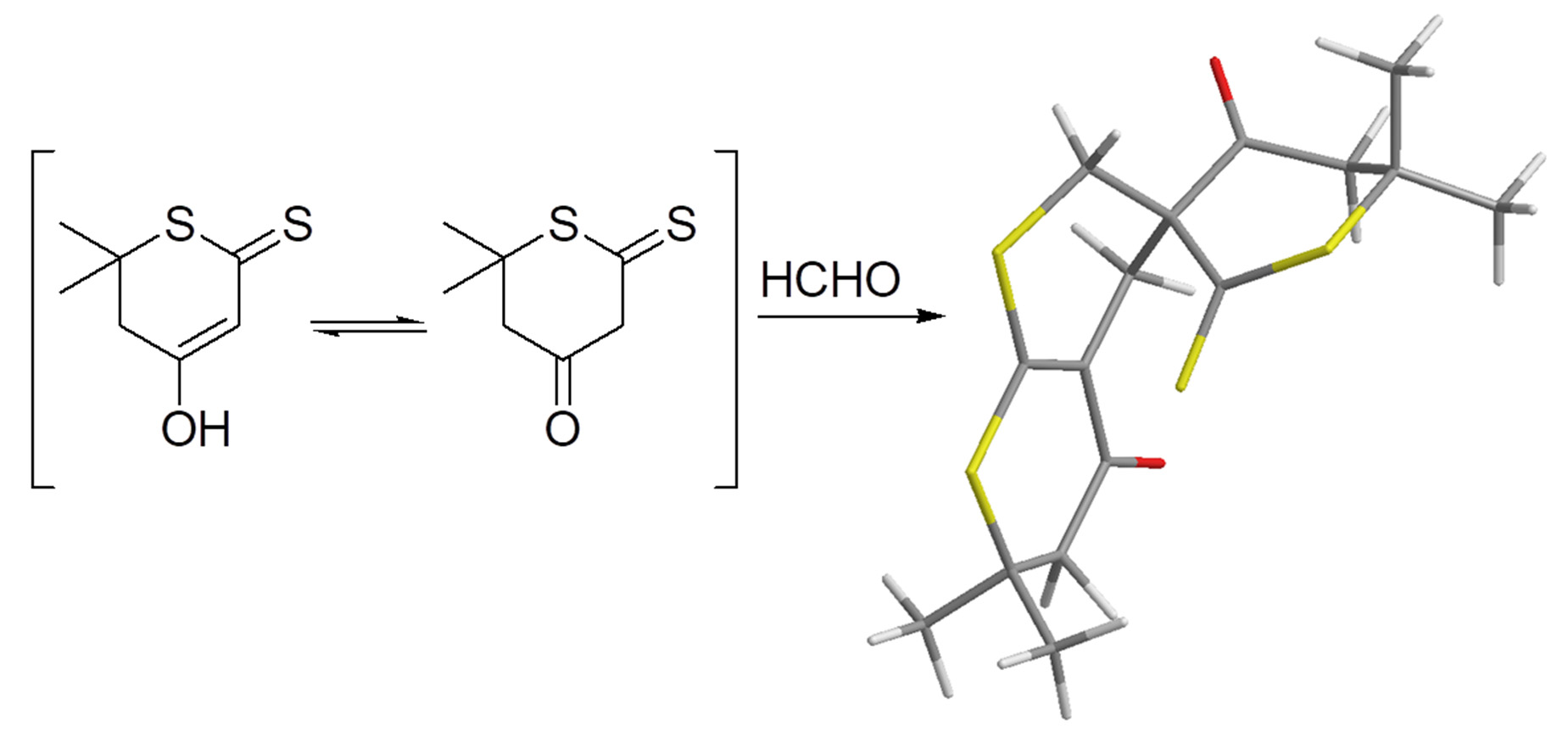
The reaction of aliphatic aldehydes with the tautomers 6,6-dimethyl-4-hydroxy-2H-thiopyrane-2-thione and 6,6-dimethyl-2-mercapto-4H-thiopyrane-4-one is reported to yield spiro compounds. However, the spiro compound of the reaction with formaldehyde is postulated, but has not been isolated to date. Due to a change in reaction conditions, we managed to isolate (RS)-6,6,7′,7′-Tetramethyl-2-sulfanylidene-5,6,6′,7′-tetrahydro-2H,2′H,4H,4′H,5′H-spiro[thiopyran-3,3′-thiopyrano [2,3-b]thiopyran]-4,5′-dione for the first time. The structure was proven with the help of a single X-ray crystal analysis. Furthermore, the new compound was fully characterized using one- and two- dimensional NMR techniques such as 1H, 13C, DEPT, COSY, HSQC and HMBC spectra, as well as IR and HRMS measurements.

Graphical Abstract

1. Introduction

Schweiger et al. reported the synthesis of spiro compounds from aliphatic aldehydes and of the tautomers 6,6-dimethyl-4-hydroxy-2H-thiopyrane-2-thione and 6,6-dimethyl-2-mercapto-4H-thiopyrane-4-one [1]. The synthesis of two 2′,4′-dialkyl-6,6,7′,7′-Tetramethyl-2-sulfanylidene-5,6,6′,7′-tetrahydro-2H,2′H,4H,4′H,5′H-spiro[thiopyran-3,3′-thiopyrano [2,3-b]thiopyran]-4,5′-diones is described as having two asymmetric centres in position 2′ and 4′. The aim of this work was to investigate if it is possible to prepare a derivative which is not substituted in these positions to avoid diastereomeric mixtures and pave the way for derivatizations of an interesting spiro skeleton which has scarcely been described until now.

2. Results

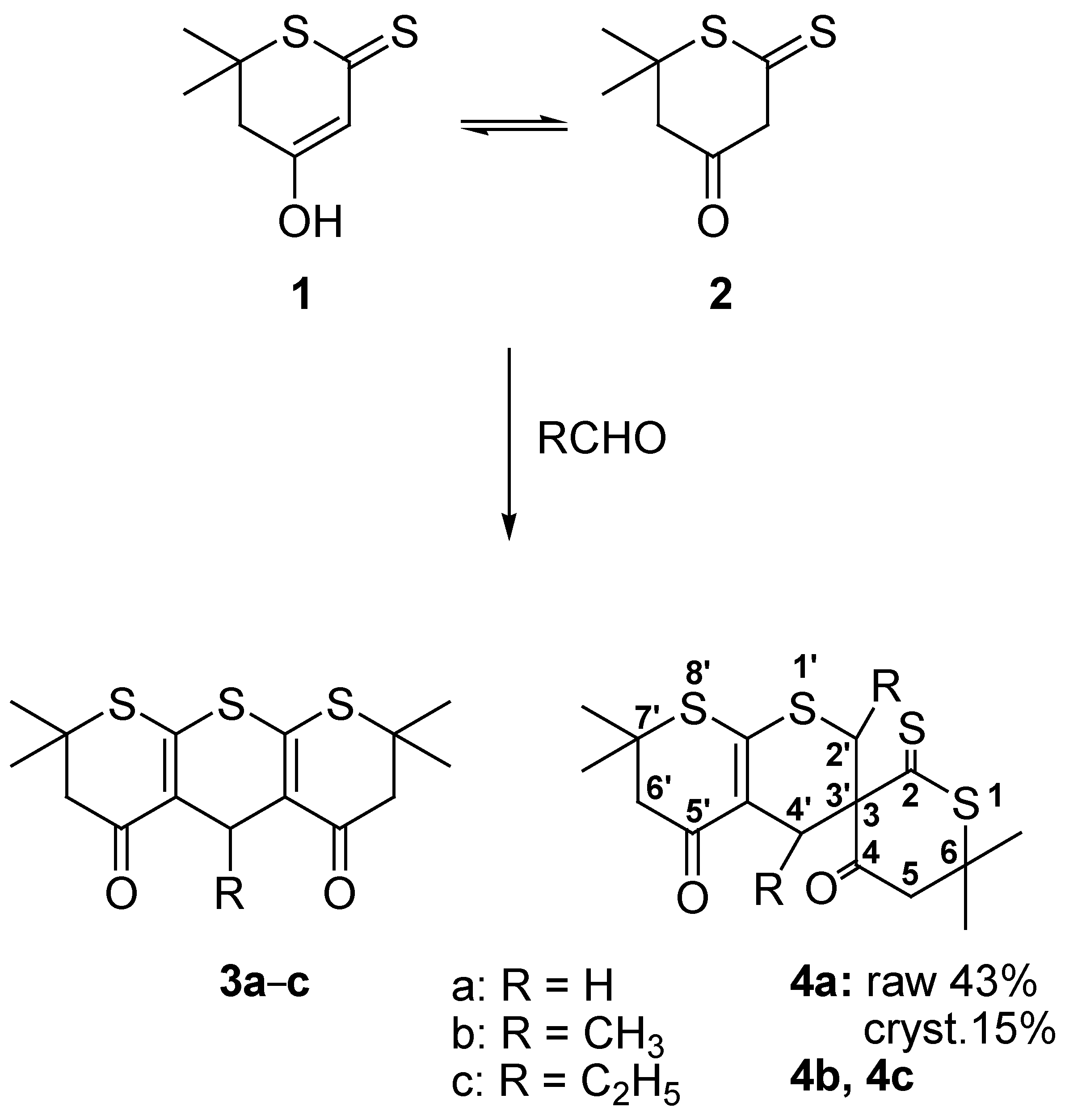
The reported synthesis [1], shown in Scheme 1, was started from the tautomers 1 and 2 and was carried out in ethanol with the molar ratio of aldehyde/1 and 2 = 1:1, reflux, 4 h or in chloroform with the molar ratio of aldehyde/1 and 2 = 1.5:1, reflux, 5 h. In both cases, mainly compounds 3a3c were formed and isolated using crystallization. From the filtrates, compounds 4b and 4c were isolated using CC over silica gel. Compounds 4b and 4c were isolated as the main products when the reaction was carried out in benzene with the molar ratio of aldehyde/1 and 2 = 1:1 and under 5 h reflux on a water separator or when 1 and 2 were treated with a large excess of aldehyde for 6 h under reflux [1]. In any of these cases, it was not possible to isolate 4a since the separation using CC was hindered by an unknown impurity.
We repeated the procedure with ethanol and prolonged the reaction time for one hour, but not a trace of the spiro compound 4a was found in the reaction mixture. When we used a 37% formaldehyde solution instead of paraformaldehyde and added a molar amount of ammonium chloride to the reaction mixture, a precipitate was formed after 10 min. The latter was sucked off, dried, dissolved in DMSO and heated for 20 min to 175 °C. From this reaction mixture, we were able to isolate 4a.
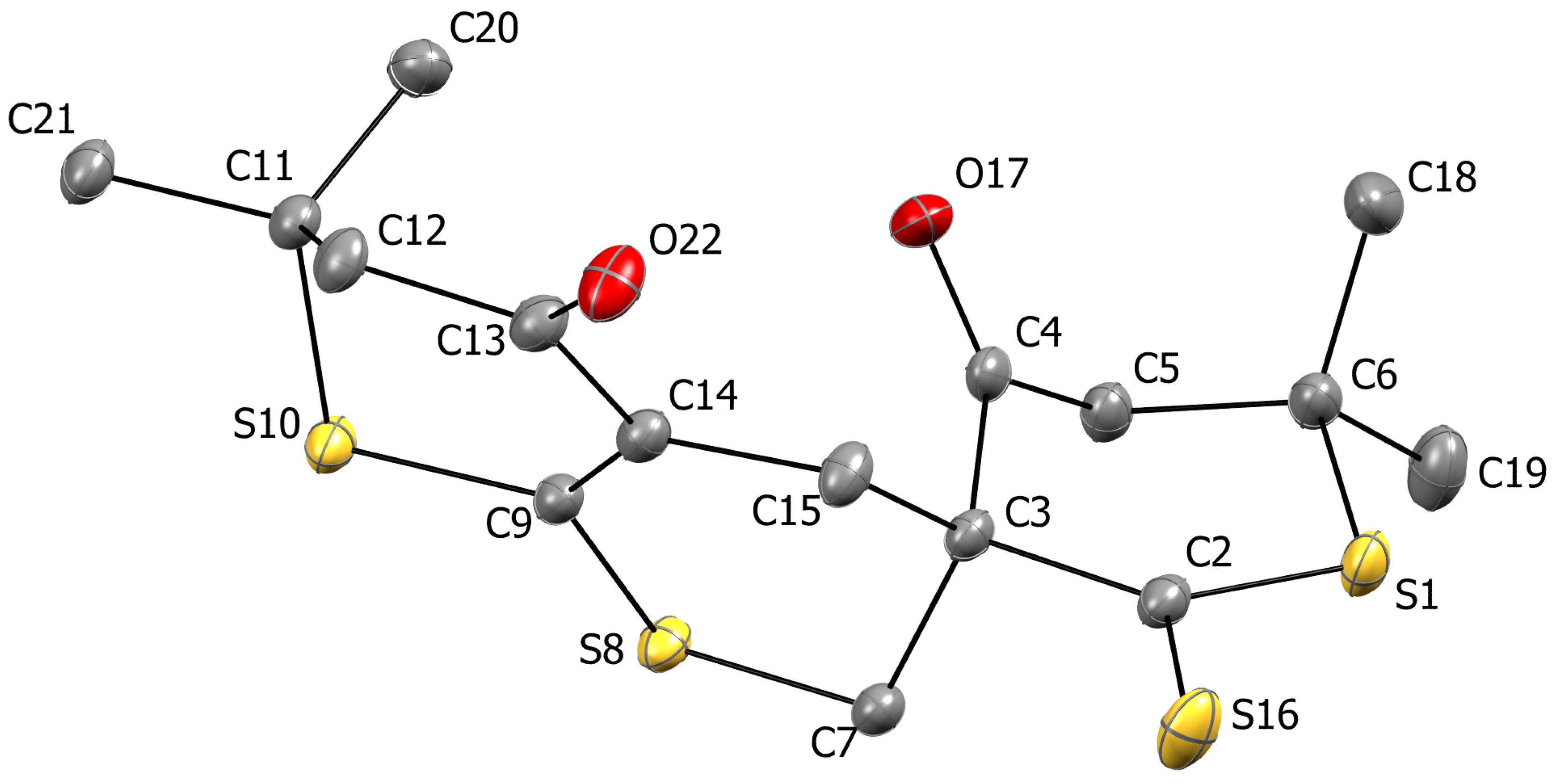
The structure of 4a was confirmed with the aid of a single X-ray crystal analysis (see Figure 1) and further characterization was performed using one- and two-dimensional NMR techniques, infrared spectra and high-resolution mass spectra.
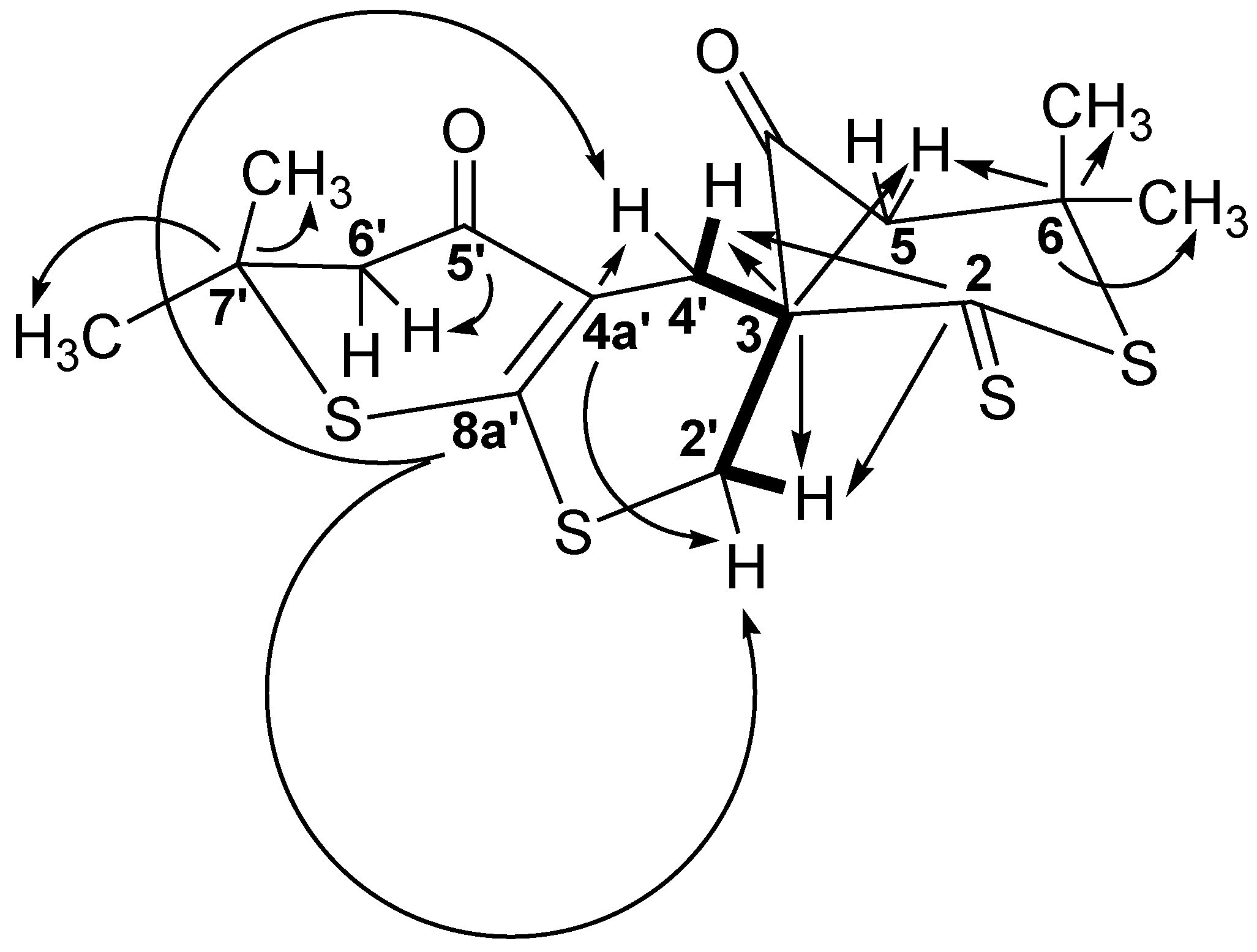
Following long-range couplings in HMBC spectra supporting the structure, the thiopyran-thion carbon C-2 at 240 ppm showed couplings to H-2′ and H-4′, the oxo function C-4 at 202 ppm to H-2′ and H-4′, the oxo function C-5′ at 190 ppm to H-6′, the quaternary C-8a’ at 148 ppm to H-2′ and H-4′, the quaternary C-4a’ at 123 ppm to H-2′ and H-4′ and the spiro carbon C-3 at 66 ppm to H-2′, H-4′ and H-5. The signals for the four methyl groups were assigned using the long-range coupling of their protons to C-6 and C-7′, respectively. The position of C-6 was given by the long-range coupling to protons in position 5 and they showed, as mentioned above, interactions with spiro carbon C-3. In addition, w-couplings were observed between H-2′ and H-4′, as shown in Figure 2.
In IR spectra, typical peaks for the ketone in position 4 at 1715 cm−1 and at 1630 cm−1 for the double bond were found. Additionally, a peak for the thiopyran-thione [2] at 1538 cm−1 was observed. Two methods of high-resolution mass spectra (DIP-EI and HESI) confirmed the molecular mass. Homogeneity was proven by a chromatographic method. All NMR and crystal data as well as HPLC data are reported in the supplementary material.

3. Materials and Methods

3.1. Instrumentation and Chemicals

The tautomeric mixture of 1 and 2 was prepared as reported [3]. Solvents were used without further purification. Melting points were obtained on the digital melting point apparatus Cole-Parmer MP250 (Alessandria, Italy). IR spectra: Bruker Alpha Platinum ATR FT-IR spectrometer (Faellanden, Switzerland). Frequencies are reported in cm−1. Peaks are described as strong (s), medium (m) and weak (w). NMR spectra: Nuclear magnetic resonance spectrometer Bruker Avance 400 (Faellanden, Switzerland), (300 K) 5 mm tubes; spectra were acquired in DMSO. Chemical shifts were recorded in parts per million (ppm). The proton signal at 2.49 ppm served as internal reference as well as the central peak of the DMSO-d6 signal at 39.7 ppm. Signal multiplicities are abbreviated as follows: s, singlet; d, doublet; dd, double–doublet. Coupling constants (J) are reported in Hertz (Hz). 1 H and 13 C resonances were assigned using 1 H, 1 H- and 1 H, 13 C-correlation spectra. 1 H and 13 C resonances are numbered as given in the formulae. HRMS: Electron ionization (EI+, 70 eV, source at 250 °C) mass spectra were acquired on a JMS-T2000GC (AccuTOFTM GC-Alpha) from JEOL Ltd. (Tokyo, Japan) equipped with a direct insertion probe (DIP), and HESI spectra were recorded on a Q Exactive Hybrid Quadrupole-Orbitrap mass spectrometer, Thermo Fisher Scientific, Austin, TX, USA (HESI, capillary voltage 3.5 kV). Thin-layer chromatography (TLC): TLC plates (Merck, Darmstadt, Germany, silica gel 60 F254 0.2 mm, 200 × 200 mm); the substance was detected in UV light at 254 nm. Purity and homogeneity of 4a was assessed by a HPLC separation method, using an Ultimate 3000 UHPLC system equipped with a photodiode array (PDA) and hyphenated to a Q Exactive Hybrid Quadrupol-Orbitrap MS (Thermo Fisher Scientific). Column: AcquityTM, Milford, MA, USA, Premier BEH 1.7 μm, 2.1 × 100 mm column protected by AcquityTM UPLC BEH C18 1.7 μm VanGuardTM, Malvern, PA, USA, guard column (Waters). Mobile phase: A: H2O + 0.1%HCOOC, B: MeCN. Gradient: 0–10 min, 10–100% B in A, 10–12 min, 100% B, 12–12.5 min, 100–10% B, 12.5–16 min, 10% B. Column temperature: 40 °C.

3.2. Synthesis of (RS)-6,6,7′,7′-Tetramethyl-2-sulfanylidene-5,6,6′,7′-tetrahydro-2H,2′H,4H,4′H,5′H-spiro[thiopyrane-3,3′-thiopyrano [2,3-b]thiopyran]-4,5′-dione 4a

To a solution of tautomeric mixture 1 and 2 (1.74 g, 10 mmol) in ethanol (50 mL), ammonium chloride (535 mg, 10 mmol) was added as well as a solution of formaldehyde (37%, 854 mg, 10.5 mmol). The mixture was refluxed for 10 min in an oil bath (117–119 °C) and precipitation took place. It was left for crystallization at r.t. for three days. Then the mixture was stirred on an ice bath, the solid sucked off and dried over phosphorous pentoxide in a desiccator. The dry solid was suspended in DMSO (16 mL) and the mixture heated for 20 min in an oil bath at 175 °C. Demineralized water (500 mL) was added to the resulting dark red solution and the formed emulsion transferred into a separatory funnel and extracted 7 times with heptane. The combined organic phases were dried with sodium sulfate, filtered and the solvent evaporated giving a dark red resin (800 mg, 43%) which was nearly pure 4a. The resin was dissolved in the minimum amount of hot methanol and left for crystallization overnight at r.t. The red crystals were sucked off and dried to give the product 4a (287 mg, 15%) as red plates. m.p.: 165 °C; Rf (CH2Cl2:CH3OH = 20:1) = 0.80; Rf (CH2Cl2:CH3OH = 1:1) = 0.91; IR (νmax) = 1715 (m), 1628 (s), 1538 (s), 1367 (w), 1338 (m), 1306 (m), 1279 (m), 1212 (s), 1163 (w), 1123 (w), 982 (s), 951 (w), 928 (w), 892 (w), 877 (w) cm−1; 1H NMR (DMSO-d6, δ 400 MHz): 1.36 (s, 6H, 6-CH3, 7′-CH3), 1.38 (s, 3H, 7′-CH3), 1.48 (s, 3H, 6-CH3), 2.60 (d, J = 16.4 Hz, 1H, 6′-H), 2.79 (d, J = 12.0 Hz, 1H, 5-H), 2.85 (d, J = 16.5 Hz, 1H, 6′-H), 2.94 (dd, J = 17.2, 2.4 Hz, 1H, 4′-H), 3.05 (d, J = 17.1 Hz, 1H, 4′-H), 3.36 (d, J = 13.1 Hz, 1H, 2′-H), 3.80 (d, J = 11.6 Hz, 1H, 5-H), 3.83 (dd, J = 13.2, 2.4 Hz, 1H, 2′-H) ppm; 13C NMR (DMSO-d6, δ, 100 MHz): 26.11 (7′-CH3), 28.3 (7′-CH3), 29.7 (6-CH3), 30.3 (6-CH3), 30.5 (C-4′), 39.4 (C-2′), 47.1 (C-7′), 47.9 (C-5), 52.0 (C-6), 52.6 (C-6′), 66.2 (C-3), 123.4 (C-4a’), 147.6 (C-8a’), 190.0 (C-5′), 201.9 (C-4), 239.7 (C-2) ppm; HRMS (DIP-EI): calcd. C16H20O2S4 [M]+: 372.0341; found: 372.0343; HRMS (HESI): calcd. C16H21O2S4 [M + H]+: 373.0419; found: 373.0410; HPLC separation confirmed 96% purity based on integration of peak areas detected by PDA.

3.3. X-Ray Structure Determination of 4a

Single red plate-shaped crystals of 4a were recrystallized from methanol. A suitable crystal with dimensions 0.11 × 0.08 × 0.03 mm3 was selected and mounted on a MiTeGen, Ithaca, NY, USA, loop on an XtaLAB Synergy, Dualflex, HyPix-Arc 100 diffractometer (Tokyo, Japan). Reflection data were collected at T = 100 K using monochromatized Cu Kα radiation (λ = 1.54184 Å). Data reduction, scaling and absorption corrections were performed using the CrysAlisPro software (1.171.43.120a) [4]. A numerical absorption correction based on gaussian integration over a multifaceted crystal model and an empirical absorption correction using spherical harmonics, implemented in SCALE3 ABSPACK scaling algorithm, were performed. The absorption coefficient µ of this material is 5.030 mm−1 at this wavelength and the minimum and maximum transmissions are 0.593 and 1.000.
The structure was solved with the ShelXT [5] structure solution program using the intrinsic phasing solution method and by using Olex2 [6] as the graphical interface. The model was refined with version 2019/3 of ShelXL [7] using full-matrix least-squares techniques against F2. All non-hydrogen atoms were refined anisotropically. Hydrogen atom positions were calculated geometrically and refined using a riding model.
Crystal data for C16H20O2S4, Mr = 372.56, monoclinic, P21/n (No. 14), a = 7.60960(10) Å, b = 27.9654(4) Å, c = 8.26570(10) Å, β = 97.3050(10)°, α = γ = 90°, V = 1744.71(4) Å3, T = 100.0(2) K, Z = 4, Z′ = 1, µ(Cu Kα) = 5.030 mm−1, 18,900 reflections measured, 3697 unique (Rint = 0.0394) which were used in all calculations. The final wR2 was 0.0644 (all data) and R1 was 0.0262 (I ≥ 2σ(I)). All atoms of the complex lie on general positions. Further crystal data and refinement for 4a are presented in Table 1. The final atomic parameters, as well as bond lengths and angles, were deposited at the Cambridge Crystallographic Data Centre. CCDC 2497225 contains the Supplementary crystallographic data for this paper. These data can be obtained free of charge via http://www.ccdc.cam.ac.uk/conts/retrieving.html (accessed on 22 October 2025), (or from the CCDC, 12 Union Road, Cambridge CB2 1EZ, UK; Fax: +44 1223 336033; E-mail: deposit@ccdc.cam.ac.uk).

Supplementary Materials

The following supporting information are available online. Figure S1: 400 MHz 1H spectrum of 4a (DMSO), Figure S2: 400 MHz 1H spectrum of 4a (DMSO) (expansion), Figure S3: 100 MHz 13C spectrum of 4a (DMSO), Figure S4: 100 MHz 13C spectrum of 4a (DMSO) (expansion 1), Figure S5: 100 MHz 13C spectrum of 4a (DMSO) (expansion 2), Figure S6: 100 MHz DEPT spectrum of 4a (DMSO), Figure S7: 400 MHz COSY spectrum of 4a (DMSO) (expansion), Figure S8: HSQC spectrum of 4a (DMSO) (expansion), Figure S9: HMBC spectrum of 4a (DMSO) (expansion 1), Figure S10: HMBC spectrum of 4a (DMSO) (expansion 2), Figure S11: HRMS (DIP-EI) of 4a, Figure S12: HRMS (HESI) of 4a, Figure S13: HPLC-Chromatogram of 4a, Table S1: Bond lengths in Å for 4a, Table S2: Bond angles in ° for 4a, Table S3: Selected torsion angles in ° for 4a, Table S4: Fractional atomic coordinates (×104) and equivalent isotropic displacement parameters (Å2×10³) for 4a, Table S5: Anisotropic displacement parameters (×104) for 4a, Table S6: Hydrogen fractional atomic coordinates (×104) and equivalent isotropic displacement parameters (Å2×10³) for 4a.

Author Contributions

Conceptualization, W.S.; methodology, W.S.; formal analysis, A.D.; investigation, W.S., A.D., E.-M.P.-W., R.S. and T.H.; data curation, W.S., A.D., E.-M.P.-W., R.S. and T.H.; writing—original draft preparation, W.S.; writing—review and editing, R.W. All authors have read and agreed to the published version of the manuscript.

Funding

Open access funding by the University of Graz.

Data Availability Statement

The data presented in this study are available in this article.

Acknowledgments

The authors acknowledge open access funding by the University of Graz. Furthermore, NAWI Graz is acknowledged for supporting the Graz Central Lab Environmental, Plant and Microbial Metabolomics. Support from the “Jeol Application Lab” at Graz University of Technology is gratefully acknowledged.

Conflicts of Interest

The authors declare no conflicts of interest.

Abbreviations

The following abbreviations are used in this manuscript:
CCColumn Chromatography
COSYCorrelated Spectroscopy
DEPTDistortionless Enhancement by Polarization Transfer
DIP-EIDirect Insertion Probe-Electron Ionization
DMSODimethylsulfoxide
FT-IRFourier-Transform-Infrared Spectroscopy
HCOOHFormic Acid
HESIHeated-Electronspray Ionization
HMBCHeteronuclear Multiple Bond Correlation
HPLCHigh-Performance Liquid Chromatography
HRMSHigh-Resolution Mass Spectroscopy
HSQCHeteronuclear Single Quantum Coherence
MeCNAcetonitrile
MSMass Spectroscopy
PDAPhotodiode Array
TLCThin-Layer Chromatography
UVUltra-Violet

References

  1. Schweiger, K.; Wendelin, W.; Kratky, C. Reaction of the Tautomers 4-Hydroxy-2H-thiopyrane-2-thione and 2-Mercapto-4H-thiopyrane-4-one with Aliphatic Aldehydes. Chem. Mon. 1983, 114, 1359–1370. [Google Scholar] [CrossRef]
  2. Schweiger, K. Syntheses of 4-Dialkylamino-5,6-dihydrothiopyrane-2-thiones. Chem. Mon. 1980, 111, 1175–1184. [Google Scholar] [CrossRef]
  3. Schweiger, K. Syntheses of 4-Hydroxy-6,6-dimethyl-5,6-dihydro-2H-thiopyran-2-thion resp. -one and the Corresponding Tautomers. Chem. Mon. 1982, 113, 1283–1297. [Google Scholar] [CrossRef]
  4. Rigaku Corporation. CrysAlisPro, 1.171.43.120a; Rigaku Oxford Diffraction: Tokyo, Japan, 2024. [Google Scholar]
  5. Scheldrick, G.M. SHELXT-Integrated space-group crystal structure determination. Acta Crystallogr. Sect. A Found. Adv. 2015, 71, 3–8. [Google Scholar] [CrossRef] [PubMed]
  6. Dolomanov, O.V.; Bourhis, L.J.; Gildea, R.J.; Howard, J.A.K.; Puschmann, H. OLEX2: A complete structure solution, refinement and analysis program. J. Appl. Crystallogr. 2009, 42, 339–341. [Google Scholar] [CrossRef]
  7. Scheldrick, G.M. Crystal structure refinement with SHELXL. Acta Crystallogr. Sect. C Struct. Chem. 2015, 71, 3–8. [Google Scholar] [CrossRef] [PubMed]
Scheme 1. Reaction of the tautomeric mixture of 1 and 2 with aldehydes. Synthesis of compounds 3a3c and 4b, 4c is reported [1].
Molbank 2026 m2117 sch001
Figure 1. Molecular structure of 4a. The probability ellipsoids are drawn at 50% level. Hydrogen atoms are omitted for clarity.
Molbank 2026 m2117 g001
Figure 2. Observed w-couplings between H-2′ and H-4′ (bold) and long-range couplings (arrows).
Molbank 2026 m2117 g002
Table 1. Crystal data and structure refinement for 4a.
Empirical formulaC16H20O2S4
Formula weight372.56
Temperature/K100.0(2)
Crystal systemmonoclinic
Space groupP21/n
a/Å7.60960(10)
b/Å27.9654(4)
c/Å8.26570(10)
α/°90
β/°97.3050(10)
γ/°90
Volume/Å31744.71(4)
Z4
ρcalc g/cm31.418
μ/mm−15.030
F(000)784.0
Crystal size/mm30.11 × 0.08 × 0.03
RadiationCu Kα (λ = 1.54184 Å)
2Θ range for data collection/°6.322 to 154.72
Index ranges−9 ≤ h ≤ 9, −35 ≤ k ≤ 35, −7 ≤ l ≤ 10
Reflections collected18,900
Independent reflections3697 [Rint = 0.0394, Rsigma = 0.0300]
Data/restraints/parameters3697/0/203
Goodness-of-fit on F21.051
Final R indexes [I ≥ 2σ (I)]R1 = 0.0262, wR2 = 0.0628
Final R indexes [all data]R1 = 0.0303, wR2 = 0.0644
Largest diff. peak/hole/e.Å−30.35/−0.20
Disclaimer/Publisher’s Note: The statements, opinions and data contained in all publications are solely those of the individual author(s) and contributor(s) and not of MDPI and/or the editor(s). MDPI and/or the editor(s) disclaim responsibility for any injury to people or property resulting from any ideas, methods, instructions or products referred to in the content.