Advances in Pharmacotherapy and Physiotherapy for Dry Eye Disease: Molecular Mechanisms and Future Directions—A Narrative Literature Review

 , ,
, ,
Abstract
1. Introduction
2. Methodology
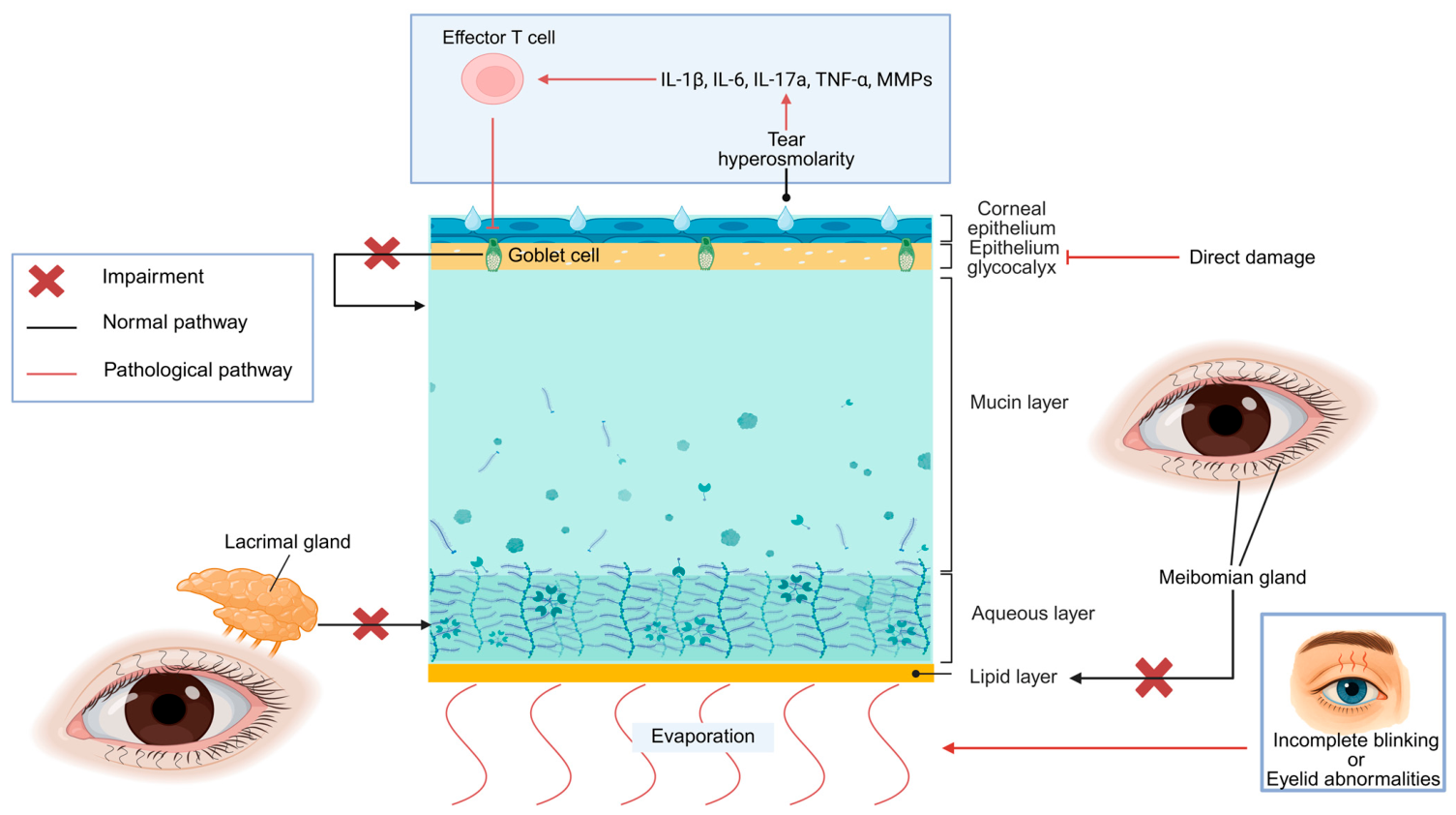
3. Pathophysiology
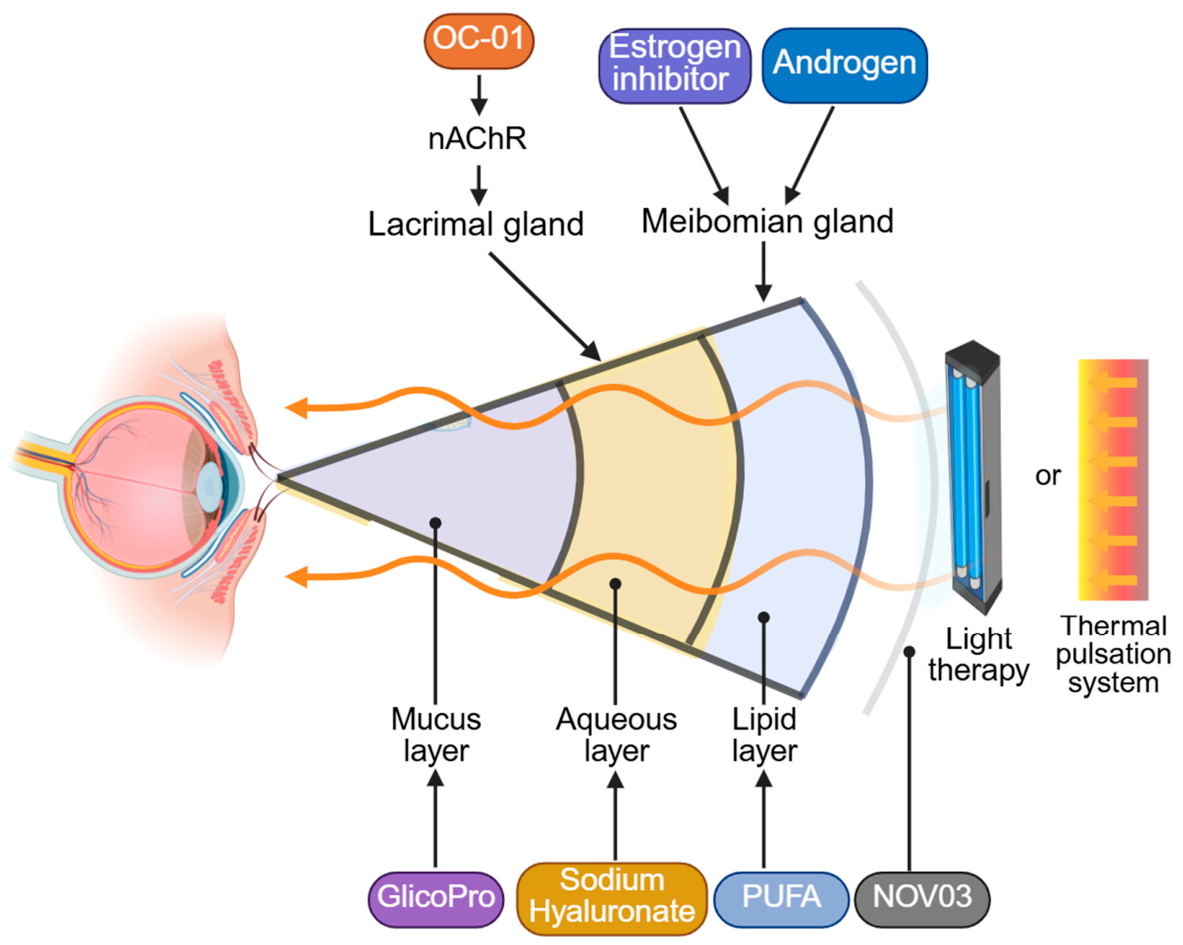
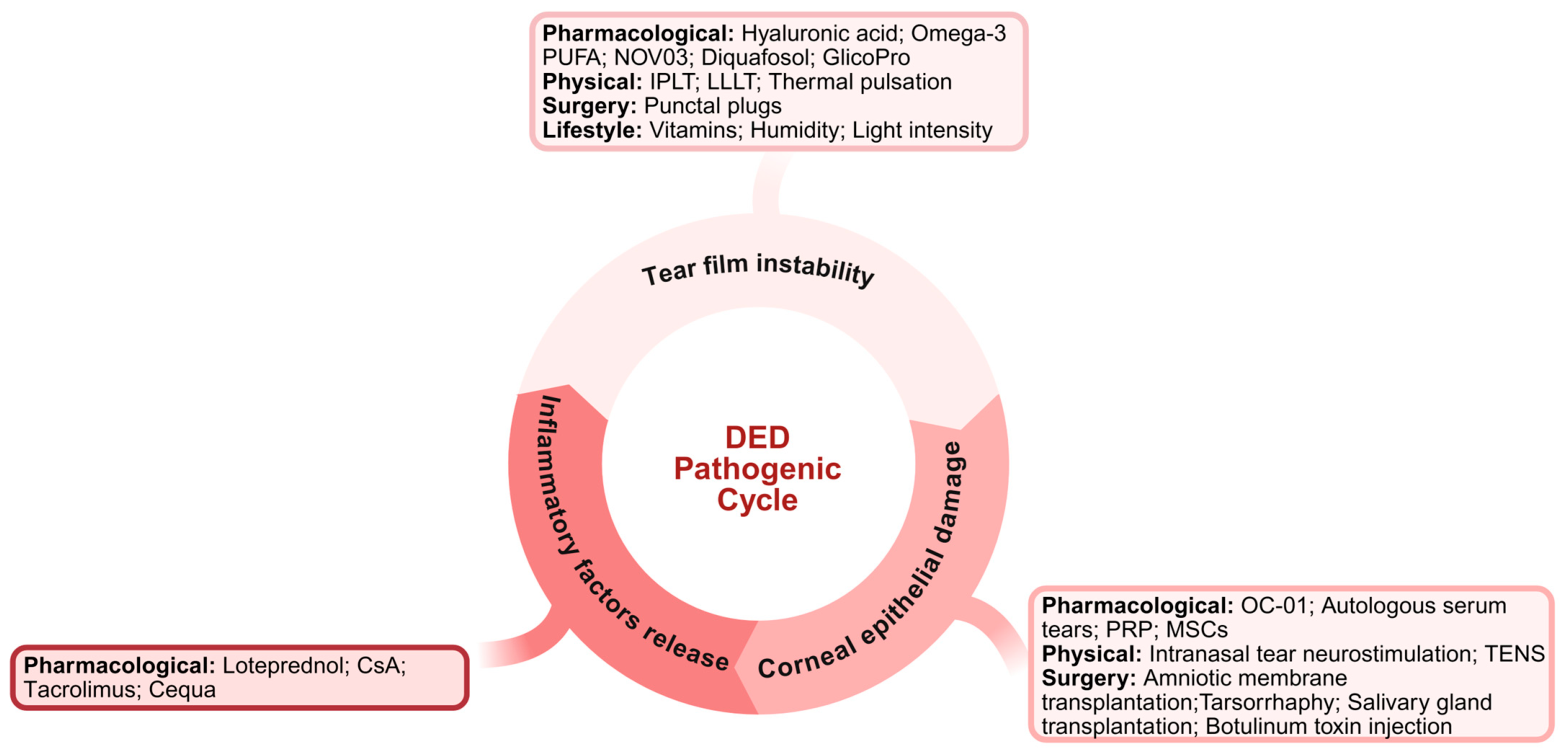
4. Treatment
4.1. Conventional Pharmacotherapy
4.1.1. Tear Substitutes
Artificial Tears
Biological Blood Products
Omega-3 and Omega-6 Polyunsaturated Fatty Acids
GlicoPro
4.1.2. Anti-Inflammatory Drugs and Immunosuppressants
4.1.3. Perfluorohexyloctane
4.1.4. Receptor Agonists
4.1.5. Sex Hormones
4.2. Biological Agents
4.2.1. Mesenchymal Stromal Cells and Their Derivatives
4.2.2. Fibroblast Growth Factor 10
4.3. Novel Drug Delivery Systems
4.4. Device-Based Therapies
4.4.1. Photobiomodulation Therapies
4.4.2. Thermal Pulsation Therapies
4.4.3. Neurostimulation Therapies
Intranasal Tear Neurostimulation
Transcutaneous Electrical Nerve Stimulation
Quantum Molecular Resonance
Transcranial Magnetic Stimulation
Sonic Stimulation
4.4.4. Acupuncture
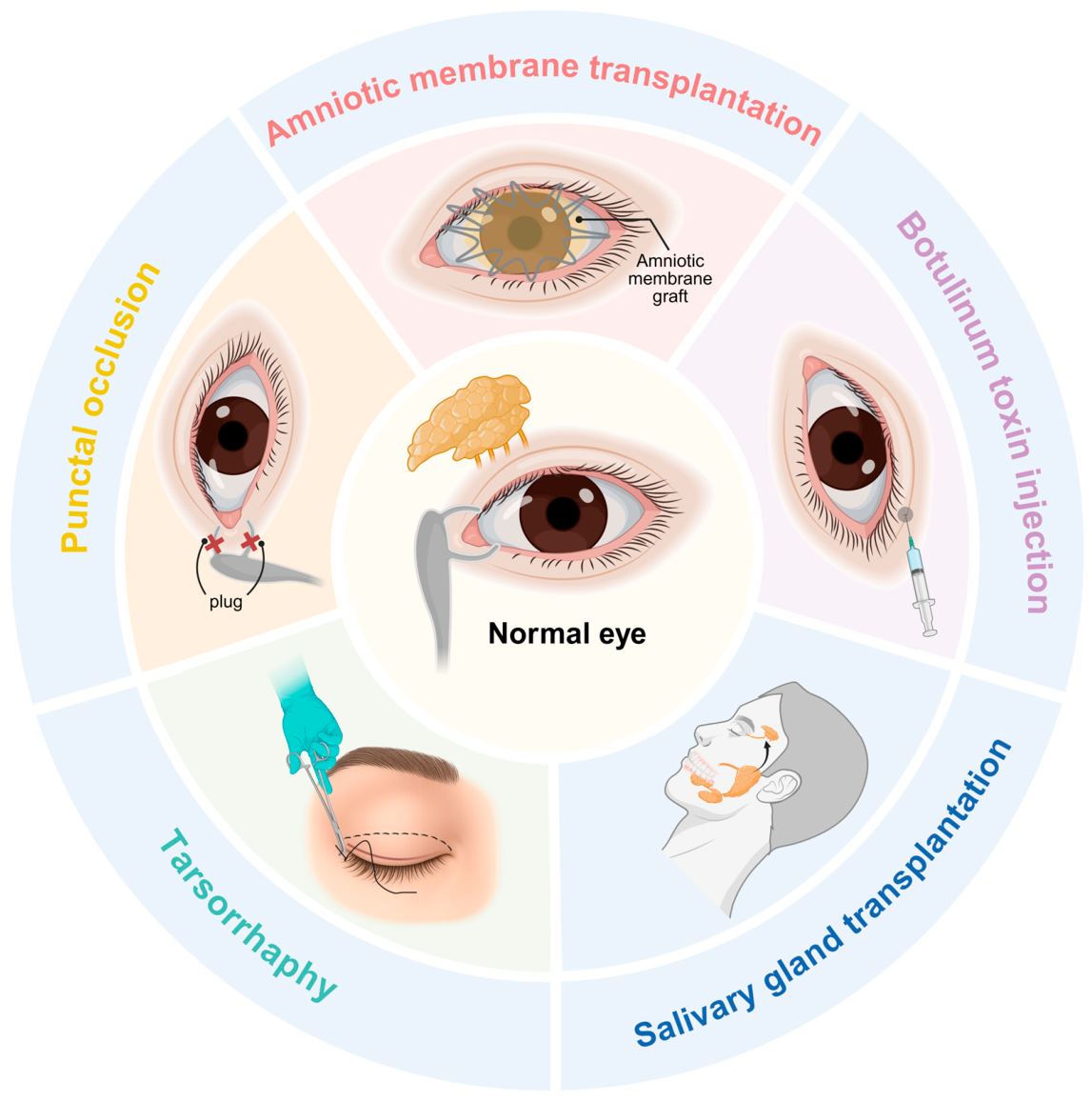
4.5. Surgical Treatments
4.6. Lifestyle and Environmental Interventions for DED
5. Discussion and Future Perspectives
6. Conclusions
Author Contributions
Funding
Institutional Review Board Statement
Informed Consent Statement
Data Availability Statement
Acknowledgments
Conflicts of Interest
Abbreviations
| ASEDs | Autologous serum eye drops |
| BTX-A | Botulinum toxin A |
| CsA | Cyclosporin A |
| DED | Dry eye disease |
| FGF10 | Fibroblast growth factor 10 |
| HA | Hyaluronic acid |
| hAEC-EVs | Human amniotic epithelial cells–extracellular vesicles |
| IL | Interleukin |
| IPLT | Intense pulsed light therapy |
| LLLT | Low-level light therapy |
| MAPK | Mitogen-activated protein kinases |
| MGD | Meibomian gland dysfunction |
| MMP | Matrix metalloproteinase |
| MSCs | Mesenchymal stromal cells |
| MSC-Exos | MSC-derived exosomes |
| MSGT | Minor salivary gland transplantation |
| nAChR | Nicotinic acetylcholine receptor |
| NSAID | Nonsteroidal anti-inflammatory drug |
| OSDI | Ocular surface disease index |
| PRP | Platelet-rich plasma |
| PUFA | Polyunsaturated fatty acids |
| QMR | Quantum molecular resonance |
| RCT | Randomized controlled trial |
| ROS | Reactive oxygen species |
| SMGT | Submandibular gland to the temporal fossa |
| TBUT | Tear film breakup time |
| TMS | Transcranial magnetic stimulation |
| TNF-α | Tumor necrosis factor-α |
References
- Wolffsohn, J.S.; Benítez-Del-Castillo, J.M.; Loya-Garcia, D.; Inomata, T.; Iyer, G.; Liang, L.; Pult, H.; Sabater, A.L.; Starr, C.E.; Vehof, J.; et al. TFOS DEWS III: Diagnostic Methodology. Am. J. Ophthalmol. 2025, 279, 387–450. [Google Scholar] [CrossRef]
- Britten-Jones, A.C.; Wang, M.T.M.; Samuels, I.; Jennings, C.; Stapleton, F.; Craig, J.P. Epidemiology and Risk Factors of Dry Eye Disease: Considerations for Clinical Management. Medicina 2024, 60, 1458. [Google Scholar] [CrossRef]
- Papas, E.B. The global prevalence of dry eye disease: A Bayesian view. Ophthalmic Physiol. Opt. 2021, 41, 1254–1266. [Google Scholar] [CrossRef]
- Ji, H.; Yang, Y.; Lu, Y.; Kong, X.; Yang, G.; Liu, J.; Yang, Y.; Wang, X.; Ma, X. Prevalence of dry eye during the COVID-19 pandemic: A systematic review and meta-analysis. PLoS ONE 2023, 18, e0288523. [Google Scholar] [CrossRef]
- Hakim, F.E.; Farooq, A.V. Dry Eye Disease: An Update in 2022. JAMA 2022, 327, 478–479. [Google Scholar] [CrossRef]
- Sheppard, J.; Shen Lee, B.; Periman, L.M. Dry eye disease: Identification and therapeutic strategies for primary care clinicians and clinical specialists. Ann. Med. 2023, 55, 241–252. [Google Scholar] [CrossRef]
- Jones, L.; Downie, L.E.; Korb, D.; Benitez-Del-Castillo, J.M.; Dana, R.; Deng, S.X.; Dong, P.N.; Geerling, G.; Hida, R.Y.; Liu, Y.; et al. TFOS DEWS II Management and Therapy Report. Ocul. Surf. 2017, 15, 575–628. [Google Scholar] [CrossRef] [PubMed]
- Huang, R.; Su, C.; Fang, L.; Lu, J.; Chen, J.; Ding, Y. Dry eye syndrome: Comprehensive etiologies and recent clinical trials. Int. Ophthalmol. 2022, 42, 3253–3272. [Google Scholar] [CrossRef]
- Clayton, J.A. Dry Eye. N. Engl. J. Med. 2018, 378, 2212–2223. [Google Scholar] [CrossRef]
- Xia, Y.; Zhang, Y.; Du, Y.; Wang, Z.; Cheng, L.; Du, Z. Comprehensive dry eye therapy: Overcoming ocular surface barrier and combating inflammation, oxidation, and mitochondrial damage. J. Nanobiotechnol. 2024, 22, 233. [Google Scholar] [CrossRef] [PubMed]
- D’Souza, S.; Shetty, R.; Nair, A.P.; Agrawal, R.; Dickman, M.M.; Khamar, P.; Nuijts, R.; Ghosh, A.; Sethu, S. Corneal Confocal Microscopy Features and Tear Molecular Profile in Study Participants with Discordance between Ocular Surface Disease Clinical Signs and Discomfort. J. Clin. Med. 2022, 11, 2407. [Google Scholar] [CrossRef]
- Kelagere, Y.; Scholand, K.K.; DeJong, E.N.; Boyd, A.I.; Yu, Z.; Astley, R.A.; Callegan, M.C.; Bowdish, D.M.; Makarenkova, H.P.; de Paiva, C.S. TNF is a critical cytokine in age-related dry eye disease. Ocul. Surf. 2023, 30, 119–128. [Google Scholar] [CrossRef]
- Shoari, A.; Kanavi, M.R.; Rasaee, M.J. Inhibition of matrix metalloproteinase-9 for the treatment of dry eye syndrome; a review study. Exp. Eye Res. 2021, 205, 108523. [Google Scholar] [CrossRef]
- Stapleton, F.; Argüeso, P.; Asbell, P.; Azar, D.; Bosworth, C.; Chen, W.; Ciolino, J.B.; Craig, J.P.; Gallar, J.; Galor, A.; et al. TFOS DEWS III: Digest. Am. J. Ophthalmol. 2025, 279, 451–553. [Google Scholar] [CrossRef]
- Kojima, T.; Dogru, M.; Kawashima, M.; Nakamura, S.; Tsubota, K. Advances in the diagnosis and treatment of dry eye. Prog. Retin. Eye Res. 2020, 78, 100842. [Google Scholar] [CrossRef] [PubMed]
- Vereertbrugghen, A.; Pizzano, M.; Cernutto, A.; Sabbione, F.; Keitelman, I.A.; Aguilar, D.V.; Podhorzer, A.; Fuentes, F.; Corral-Vázquez, C.; Guzmán, M.; et al. CD4+ T cells drive corneal nerve damage but not epitheliopathy in an acute aqueous-deficient dry eye model. Proc. Natl. Acad. Sci. USA 2024, 121, e2407648121. [Google Scholar] [CrossRef]
- Narang, P.; Donthineni, P.R.; D’Souza, S.; Basu, S. Evaporative dry eye disease due to meibomian gland dysfunction: Preferred practice pattern guidelines for diagnosis and treatment. Indian J. Ophthalmol. 2023, 71, 1348–1356. [Google Scholar] [CrossRef]
- Arita, R.; Fukuoka, S.; Matsumoto, R.; Kaido, M. Effects of blinking exercises on palpebral fissure height and tear film parameters. Ocul. Surf. 2025, 36, 237–243. [Google Scholar] [CrossRef]
- Chang, V.; Mahoney, K.E.; Lian, I.; Chen, R.; Chung, N.; Utheim, T.P.; Karlsson, N.G.; Malaker, S.A. In-depth analysis of the tear fluid glycoproteome reveals diverse lacritin glycosylation and spliceoforms. J. Biol. Chem. 2025, 301, 110580. [Google Scholar] [CrossRef]
- Schmelter, C.; Brueck, A.; Perumal, N.; Qu, S.; Pfeiffer, N.; Grus, F.H. Lectin-Based Affinity Enrichment and Characterization of N-Glycoproteins from Human Tear Film by Mass Spectrometry. Molecules 2023, 28, 648. [Google Scholar] [CrossRef]
- Georgiev, G.A.; Gh, M.S.; Romano, J.; Dias Teixeira, K.L.; Struble, C.; Ryan, D.S.; Sia, R.K.; Kitt, J.P.; Harris, J.M.; Hsu, K.L.; et al. Lacritin proteoforms prevent tear film collapse and maintain epithelial homeostasis. J. Biol. Chem. 2021, 296, 100070. [Google Scholar] [CrossRef]
- Sharifian Gh, M.; Norouzi, F.; Sorci, M.; Zaidi, T.S.; Pier, G.B.; Achimovich, A.; Ongwae, G.M.; Liang, B.; Ryan, M.; Lemke, M.; et al. Lacritin cleavage-potentiated targeting of iron—Respiratory reciprocity promotes bacterial death. J. Biol. Chem. 2025, 301, 108455. [Google Scholar] [CrossRef]
- Hynnekleiv, L.; Magno, M.; Vernhardsdottir, R.R.; Moschowits, E.; Tønseth, K.A.; Dartt, D.A.; Vehof, J.; Utheim, T.P. Hyaluronic acid in the treatment of dry eye disease. Acta Ophthalmol. 2022, 100, 844–860. [Google Scholar] [CrossRef] [PubMed]
- Agarwal, P.; Craig, J.P.; Rupenthal, I.D. Formulation Considerations for the Management of Dry Eye Disease. Pharmaceutics 2021, 13, 207. [Google Scholar] [CrossRef]
- Jun, J.H.; Bang, S.P.; Park, H.S.; Yoon, D.; Ahn, J.Y.; Kim, S.J.; Kim, H.K. A randomized multicenter clinical evaluation of sequential application of 0.3% and 0.15% hyaluronic acid for treatment of dry eye. Jpn. J. Ophthalmol. 2022, 66, 58–67. [Google Scholar] [CrossRef]
- Aragona, P.; Benítez-Del-Castillo, J.M.; Coroneo, M.T.; Mukherji, S.; Tan, J.; Vandewalle, E.; Vingrys, A.; Liu, H.; Carlisle-Wilcox, C.; Vehige, J.; et al. Safety and Efficacy of a Preservative-Free Artificial Tear Containing Carboxymethylcellulose and Hyaluronic Acid for Dry Eye Disease: A Randomized, Controlled, Multicenter 3-Month Study. Clin. Ophthalmol. 2020, 14, 2951–2963. [Google Scholar] [CrossRef]
- Srinivasan, S.; Garofalo, R.; Williams, R. Safe and Effective Management of Dry Eye Symptoms with Hydroxypropyl Guar and Hyaluronic Acid Dual-Polymer Lubricating Eye Drops: A Review of Preclinical and Clinical Studies. Clin. Ophthalmol. 2023, 17, 3883–3898. [Google Scholar] [CrossRef]
- Labetoulle, M.; Benitez-Del-Castillo, J.M.; Barabino, S.; Herrero Vanrell, R.; Daull, P.; Garrigue, J.S.; Rolando, M. Artificial Tears: Biological Role of Their Ingredients in the Management of Dry Eye Disease. Int. J. Mol. Sci. 2022, 23, 2434. [Google Scholar] [CrossRef]
- Suanno, G.; Fonteyne, P.; Ferrari, G. Neurosensory abnormalities and stability of a mouse model of dry eye disease. Exp. Eye Res. 2023, 232, 109516. [Google Scholar] [CrossRef] [PubMed]
- Weng, J.; Fink, M.K.; Sharma, A. A Critical Appraisal of the Physicochemical Properties and Biological Effects of Artificial Tear Ingredients and Formulations. Int. J. Mol. Sci. 2023, 24, 2758. [Google Scholar] [CrossRef]
- Patterson, B.; Crary, M.; Shannon, P. Microbial Ingress Evaluation of NOVELIA Package of Systane Ultra. Contact Lens Anterior Eye 2022, 45, 101660. [Google Scholar] [CrossRef]
- Kong, L.; Sun, J.; Abedi-Firouzjah, R. Emerging treatment strategies in dry eye disease: Potential of blood-derived approaches and natural plant-based products. Exp. Eye Res. 2025, 251, 110217. [Google Scholar] [CrossRef]
- Valencia Castillo, S.L.; Martín, E.S.; García Frade, L.J.; García-Miguel, F.J. Autologous serum eye drops improve tear production, both lachrymal flow and stability tests and conjunctival impression cytology with transfer in dry eye disease. Blood Transfus. 2021, 19, 45–53. [Google Scholar]
- Carreno-Galeano, J.T.; Johns, L.K.; Dana, R.; Yin, J. Autologous serum tears improve corneal nerve density and sensitivity in patients with ocular graft-versus-host disease-associated dry eye disease. Ocul. Surf. 2023, 28, 37–39. [Google Scholar] [CrossRef]
- van der Meer, P.F.; Verbakel, S.K.; Honohan, Á.; Lorinser, J.; Thurlings, R.M.; Jacobs, J.F.M.; de Korte, D.; Eggink, C.A. Allogeneic and autologous serum eye drops: A pilot double-blind randomized crossover trial. Acta Ophthalmol. 2021, 99, 837–842. [Google Scholar] [CrossRef] [PubMed]
- Kang, M.J.; Lee, J.H.; Hwang, J.; Chung, S.H. Efficacy and safety of platelet-rich plasma and autologous-serum eye drops for dry eye in primary Sjögren’s syndrome: A randomized trial. Sci. Rep. 2023, 13, 19279. [Google Scholar] [CrossRef]
- Wróbel-Dudzińska, D.; Przekora, A.; Kazimierczak, P.; Ćwiklińska-Haszcz, A.; Kosior-Jarecka, E.; Żarnowski, T. The Comparison between the Composition of 100% Autologous Serum and 100% Platelet-Rich Plasma Eye Drops and Their Impact on the Treatment Effectiveness of Dry Eye Disease in Primary Sjogren Syndrome. J. Clin. Med. 2023, 12, 3126. [Google Scholar] [CrossRef] [PubMed]
- Downie, L.E.; Ng, S.M.; Lindsley, K.B.; Akpek, E.K. Omega-3 and omega-6 polyunsaturated fatty acids for dry eye disease. Cochrane Database Syst. Rev. 2019, 12, Cd011016. [Google Scholar] [CrossRef]
- Bhargava, R.; Kumar, P.; Arora, Y. Short-Term Omega 3 Fatty Acids Treatment for Dry Eye in Young and Middle-Aged Visual Display Terminal Users. Eye Contact Lens 2016, 42, 231–236. [Google Scholar] [CrossRef]
- Bhargava, R.; Kumar, P.; Phogat, H.; Kaur, A.; Kumar, M. Oral omega-3 fatty acids treatment in computer vision syndrome related dry eye. Contact Lens Anterior Eye 2015, 38, 206–210. [Google Scholar] [CrossRef]
- Asbell, P.A.; Maguire, M.G.; Pistilli, M.; Ying, G.S.; Szczotka-Flynn, L.B.; Hardten, D.R.; Lin, M.C.; Shtein, R.M. n-3 Fatty Acid Supplementation for the Treatment of Dry Eye Disease. N. Engl. J. Med. 2018, 378, 1681–1690. [Google Scholar] [PubMed]
- Eom, Y.; Jun, I.; Jeon, H.S.; Lim, D.H.; Lee, H.; Hwang, H.S.; Chung, S.H.; Chung, T.Y.; Kim, J.Y.; Kim, S.W.; et al. Re-Esterified Triglyceride ω-3 Fatty Acids in Dry Eye Disease with Meibomian Gland Dysfunction: A Randomized Clinical Trial. JAMA Ophthalmol. 2024, 142, 617–624. [Google Scholar] [CrossRef]
- Aragona, P.; Bucolo, C.; Spinella, R.; Giuffrida, S.; Ferreri, G. Systemic omega-6 essential fatty acid treatment and pge1 tear content in Sjögren’s syndrome patients. Investig. Ophthalmol. Vis. Sci. 2005, 46, 4474–4479. [Google Scholar] [CrossRef]
- Molina-Leyva, I.; Molina-Leyva, A.; Bueno-Cavanillas, A. Efficacy of nutritional supplementation with omega-3 and omega-6 fatty acids in dry eye syndrome: A systematic review of randomized clinical trials. Acta Ophthalmol. 2017, 95, e677–e685. [Google Scholar] [CrossRef]
- Mencucci, R.; Strazzabosco, G.; Cristofori, V.; Alogna, A.; Bortolotti, D.; Gafà, R.; Cennamo, M.; Favuzza, E.; Trapella, C.; Gentili, V.; et al. GlicoPro, Novel Standardized and Sterile Snail Mucus Extract for Multi-Modulative Ocular Formulations: New Perspective in Dry Eye Disease Management. Pharmaceutics 2021, 13, 2139. [Google Scholar] [CrossRef]
- Ballesteros-Sánchez, A.; Sánchez-González, J.M.; Tedesco, G.R.; Rocha-de-Lossada, C.; Murano, G.; Spinelli, A.; Mazzotta, C.; Borroni, D. Evaluating GlicoPro Tear Substitute Derived from Helix aspersa Snail Mucus in Alleviating Severe Dry Eye Disease: A First-in-Human Study on Corneal Esthesiometry Recovery and Ocular Pain Relief. J. Clin. Med. 2024, 13, 1618. [Google Scholar] [CrossRef]
- Giannaccare, G.; Vaccaro, S.; Borselli, M.; Rossi, C.; Carnovale Scalzo, G.; Scalia, G.; Di Cesare Mannelli, L.; Ghelardini, C.; Zerillo, L.; Polvere, I.; et al. A Novel Ophthalmic Solution Containing Glicopro® Complex for the Treatment of Patients with Dry Eye Disease: Results from a Pilot Study. J. Clin. Med. 2024, 13, 1447. [Google Scholar] [CrossRef] [PubMed]
- Villani, E.; Campagna, G.; Gentili, V.; Postorino, E.I.; Genovese, P.; Palino, P.; Maini, G.; Carbucicchio, A.; Ferioli, E.; Nucci, P.; et al. Hydroxypropyl-Methylcellulose and GlicoPro® Eyedrops in the Treatment of Dry Eye Disease: In Vitro and Clinical Study. Ophthalmol. Ther. 2025, 14, 787–803. [Google Scholar] [CrossRef] [PubMed]
- Liu, S.H.; Saldanha, I.J.; Abraham, A.G.; Rittiphairoj, T.; Hauswirth, S.; Gregory, D.; Ifantides, C.; Li, T. Topical corticosteroids for dry eye. Cochrane Database Syst. Rev. 2022, 10, Cd015070. [Google Scholar]
- Bucolo, C.; Fidilio, A.; Fresta, C.G.; Lazzara, F.; Platania, C.B.M.; Cantarella, G.; Di Benedetto, G.; Burgaletto, C.; Bernardini, R.; Piazza, C.; et al. Ocular Pharmacological Profile of Hydrocortisone in Dry Eye Disease. Front. Pharmacol. 2019, 10, 1240. [Google Scholar] [CrossRef]
- Blanco, A.R.; Zasa, G. Dry Eye Para-Inflammation Management: Preclinical and Clinical Evidence on a Novel 0.2% Hyaluronic Acid-Based Tear Substitute with 0.001% Hydrocortisone Sodium Phosphate. J. Clin. Med. 2024, 13, 5639. [Google Scholar] [CrossRef]
- Wladis, E.J.; Bradley, E.A.; Bilyk, J.R.; Yen, M.T.; Mawn, L.A. Oral Antibiotics for Meibomian Gland-Related Ocular Surface Disease: A Report by the American Academy of Ophthalmology. Ophthalmology 2016, 123, 492–496. [Google Scholar] [CrossRef] [PubMed]
- Patocka, J.; Nepovimova, E.; Kuca, K.; Wu, W. Cyclosporine A: Chemistry and Toxicity—A Review. Curr. Med. Chem. 2021, 28, 3925–3934. [Google Scholar] [CrossRef] [PubMed]
- Akpek, E.K.; Wirta, D.L.; Downing, J.E.; Tauber, J.; Sheppard, J.D.; Ciolino, J.B.; Meides, A.S.; Krösser, S. Efficacy and Safety of a Water-Free Topical Cyclosporine, 0.1%, Solution for the Treatment of Moderate to Severe Dry Eye Disease: The ESSENCE-2 Randomized Clinical Trial. JAMA Ophthalmol. 2023, 141, 459–466. [Google Scholar] [CrossRef] [PubMed]
- Moawad, P.; Shamma, R.; Hassanein, D.; Ragab, G.; El Zawahry, O. Evaluation of the effect of topical tacrolimus 0.03% versus cyclosporine 0.05% in the treatment of dry eye secondary to Sjogren syndrome. Eur. J. Ophthalmol. 2022, 32, 673–679. [Google Scholar] [CrossRef]
- Vittitow, J.; Kissling, R.; DeCory, H.; Borchman, D. In Vitro Inhibition of Evaporation with Perfluorohexyloctane, an Eye Drop for Dry Eye Disease. Curr. Ther. Res. Clin. Exp. 2023, 98, 100704. [Google Scholar] [CrossRef]
- Fahmy, A.; Ahmed, M.; Pflugfelder, S.; Serikbaeva, A.; Tsao, F.W. Comparative Efficacy of Current Topical Treatments for Dry Eye Disease: A Review of Pivotal Clinical Trials Evaluating Corneal Staining Outcomes. J. Ocul. Pharmacol. Ther. 2025, 41, 293–304. [Google Scholar] [CrossRef]
- Sheppard, J.D.; Kurata, F.; Epitropoulos, A.T.; Krösser, S.; Vittitow, J.L. NOV03 for Signs and Symptoms of Dry Eye Disease Associated with Meibomian Gland Dysfunction: The Randomized Phase 3 MOJAVE Study. Am. J. Ophthalmol. 2023, 252, 265–274. [Google Scholar] [CrossRef]
- Tauber, J.; Berdy, G.J.; Wirta, D.L.; Krösser, S.; Vittitow, J.L. NOV03 for Dry Eye Disease Associated with Meibomian Gland Dysfunction: Results of the Randomized Phase 3 GOBI Study. Ophthalmology 2023, 130, 516–524. [Google Scholar] [CrossRef]
- Ballesteros-Sánchez, A.; Borroni, D.; De-Hita-Cantalejo, C.; Sánchez-González, M.C.; Sanchez-Gomez, S.; Rocha-de-Lossada, C.; Sánchez-González, J.M. Efficacy of bilateral OC-01 (varenicline solution) nasal spray in alleviating signs and symptoms of dry eye disease: A systematic review. Contact Lens Anterior Eye 2024, 47, 102097. [Google Scholar] [CrossRef]
- Alimohammadi, H.; Silver, W.L. Evidence for nicotinic acetylcholine receptors on nasal trigeminal nerve endings of the rat. Chem. Senses 2000, 25, 61–66. [Google Scholar] [CrossRef] [PubMed]
- Wirta, D.; Torkildsen, G.L.; Boehmer, B.; Hollander, D.A.; Bendert, E.; Zeng, L.; Ackermann, M.; Nau, J. ONSET-1 Phase 2b Randomized Trial to Evaluate the Safety and Efficacy of OC-01 (Varenicline Solution) Nasal Spray on Signs and Symptoms of Dry Eye Disease. Cornea 2022, 41, 1207–1216. [Google Scholar] [CrossRef]
- Wirta, D.; Vollmer, P.; Paauw, J.; Chiu, K.H.; Henry, E.; Striffler, K.; Nau, J. Efficacy and Safety of OC-01 (Varenicline Solution) Nasal Spray on Signs and Symptoms of Dry Eye Disease: The ONSET-2 Phase 3 Randomized Trial. Ophthalmology 2022, 129, 379–387. [Google Scholar] [CrossRef]
- Tian, L.; Jin, X.; Wang, J.; Xu, Y.; Lu, C.; Zhao, S.; Zhu, Q.; Dai, H.; Gu, H.; Zhang, M.; et al. Varenicline solution nasal spray for dry eye disease in Chinese patients: A randomized phase 3 trial. Lancet Reg. Health West. Pac. 2024, 45, 101032. [Google Scholar] [CrossRef]
- Frampton, J.E. Varenicline Solution Nasal Spray: A Review in Dry Eye Disease. Drugs 2022, 82, 1481–1488. [Google Scholar] [CrossRef] [PubMed]
- Wang, J.N.; Fan, H.; Song, J.T. Targeting purinergic receptors to attenuate inflammation of dry eye. Purinergic Signal 2023, 19, 199–206. [Google Scholar] [CrossRef] [PubMed]
- Ishikawa, S.; Sasaki, T.; Maruyama, T.; Murayama, K.; Shinoda, K. Effectiveness and Adherence of Dry Eye Patients Who Switched from Short- to Long-Acting Diquafosol Ophthalmic Solution. J. Clin. Med. 2023, 12, 4495. [Google Scholar] [CrossRef] [PubMed]
- Kaido, M.; Arita, R. Effects of a Long-Acting Diquafosol Ophthalmic Solution on the Ocular Surface, Tolerability, and Usability in Dry Eye Disease. Adv. Ther. 2024, 41, 2477–2485. [Google Scholar] [CrossRef]
- Golebiowski, B.; Badarudin, N.; Eden, J.; You, J.; Hampel, U.; Stapleton, F. Does endogenous serum oestrogen play a role in meibomian gland dysfunction in postmenopausal women with dry eye? Br. J. Ophthalmol. 2017, 101, 218–222. [Google Scholar] [CrossRef]
- Ablamowicz, A.F.; Nichols, J.J.; Nichols, K.K. Association Between Serum Levels of Testosterone and Estradiol with Meibomian Gland Assessments in Postmenopausal Women. Investig. Ophthalmol. Vis. Sci. 2016, 57, 295–300. [Google Scholar] [CrossRef]
- Grasso, A.; Di Zazzo, A.; Giannaccare, G.; Sung, J.; Inomata, T.; Shih, K.C.; Micera, A.; Gaudenzi, D.; Spelta, S.; Romeo, M.A.; et al. Sex Hormones Related Ocular Dryness in Breast Cancer Women. J. Clin. Med. 2021, 10, 2620. [Google Scholar] [CrossRef] [PubMed]
- Gagliano, C.; Caruso, S.; Napolitano, G.; Malaguarnera, G.; Cicinelli, M.V.; Amato, R.; Reibaldi, M.; Incarbone, G.; Bucolo, C.; Drago, F.; et al. Low levels of 17-β-oestradiol, oestrone and testosterone correlate with severe evaporative dysfunctional tear syndrome in postmenopausal women: A case-control study. Br. J. Ophthalmol. 2014, 98, 371–376. [Google Scholar] [CrossRef]
- Jiang, Y.; Lin, S.; Gao, Y. Mesenchymal Stromal Cell-Based Therapy for Dry Eye: Current Status and Future Perspectives. Cell Transplant. 2022, 31, 9636897221133818. [Google Scholar] [CrossRef]
- Jaffet, J.; Mohanty, A.; Veernala, I.; Singh, S.; Ali, M.J.; Basu, S.; Vemuganti, G.K.; Singh, V. Human Lacrimal Gland Derived Mesenchymal Stem Cells—Isolation, Propagation, and Characterization. Investig. Ophthalmol. Vis. Sci. 2023, 64, 12. [Google Scholar] [CrossRef]
- Møller-Hansen, M.; Larsen, A.C.; Toft, P.B.; Lynggaard, C.D.; Schwartz, C.; Bruunsgaard, H.; Haack-Sørensen, M.; Ekblond, A.; Kastrup, J.; Heegaard, S. Safety and feasibility of mesenchymal stem cell therapy in patients with aqueous deficient dry eye disease. Ocul. Surf. 2021, 19, 43–52. [Google Scholar] [CrossRef] [PubMed]
- Møller-Hansen, M.; Larsen, A.C.; Wiencke, A.K.; Terslev, L.; Siersma, V.; Andersen, T.T.; Hansen, A.E.; Bruunsgaard, H.; Haack-Sørensen, M.; Ekblond, A.; et al. Allogeneic mesenchymal stem cell therapy for dry eye disease in patients with Sjögren’s syndrome: A randomized clinical trial. Ocul. Surf. 2024, 31, 1–8. [Google Scholar] [CrossRef]
- Guo, R.; Liang, Q.; He, Y.; Wang, C.; Jiang, J.; Chen, T.; Zhang, D.; Hu, K. Mesenchymal Stromal Cells-Derived Extracellular Vesicles Regulate Dendritic Cell Functions in Dry Eye Disease. Cells 2022, 12, 33. [Google Scholar] [CrossRef] [PubMed]
- Wang, L.; Wang, X.; Chen, Q.; Wei, Z.; Xu, X.; Han, D.; Zhang, Y.; Chen, Z.; Liang, Q. MicroRNAs of extracellular vesicles derived from mesenchymal stromal cells alleviate inflammation in dry eye disease by targeting the IRAK1/TAB2/NF-κB pathway. Ocul. Surf. 2023, 28, 131–140. [Google Scholar] [CrossRef]
- Chen, L.; Gu, C.; Yang, Y.; He, T.; Zhang, Q. Exosomal miR-146a derived from human umbilical cord mesenchymal stem cells alleviates inflammation and apoptosis in dry eye disease by targeting SQSTM1. Exp. Eye Res. 2025, 258, 110490. [Google Scholar] [CrossRef]
- Finburgh, E.N.; Mauduit, O.; Noguchi, T.; Bu, J.J.; Abbas, A.A.; Hakim, D.F.; Bellusci, S.; Meech, R.; Makarenkova, H.P.; Afshari, N.A. Role of FGF10/FGFR2b Signaling in Homeostasis and Regeneration of Adult Lacrimal Gland and Corneal Epithelium Proliferation. Investig. Ophthalmol. Vis. Sci. 2023, 64, 21. [Google Scholar] [CrossRef]
- Zheng, W.; Ma, M.; Du, E.; Zhang, Z.; Jiang, K.; Gu, Q.; Ke, B. Therapeutic efficacy of fibroblast growth factor 10 in a rabbit model of dry eye. Mol. Med. Rep. 2015, 12, 7344–7350. [Google Scholar] [CrossRef]
- Zha, Z.; Li, J.; Xie, S.; Shang, X.; Xu, Z.; Chang, H.; Wang, K.; Liu, Y.; Chen, W. FGF10 Protects the Corneal Epithelium from Dry Eye-Induced Oxidative and ER Stress via Upregulation of SLC7A11. Investig. Ophthalmol. Vis. Sci. 2025, 66, 72. [Google Scholar] [CrossRef] [PubMed]
- Bachu, R.D.; Chowdhury, P.; Al-Saedi, Z.H.F.; Karla, P.K.; Boddu, S.H.S. Ocular Drug Delivery Barriers—Role of Nanocarriers in the Treatment of Anterior Segment Ocular Diseases. Pharmaceutics 2018, 10, 28. [Google Scholar] [CrossRef]
- Wang, C.; Pang, Y. Nano-based eye drop: Topical and noninvasive therapy for ocular diseases. Adv. Drug Deliv. Rev. 2023, 194, 114721. [Google Scholar] [CrossRef]
- Natesan, S.; Boddu, S.H.S.; Krishnaswami, V.; Shahwan, M. The Role of Nano-ophthalmology in Treating Dry Eye Disease. Pharm. Nanotechnol. 2020, 8, 258–289. [Google Scholar] [CrossRef] [PubMed]
- Zhu, R.; Chen, W.; Gu, D.; Wang, T.; Li, J.; Pan, H. Chondroitin sulfate and L-Cysteine conjugate modified cationic nanostructured lipid carriers: Pre-corneal retention, permeability, and related studies for dry eye treatment. Int. J. Biol. Macromol. 2023, 228, 624–637. [Google Scholar] [CrossRef] [PubMed]
- Amhare, A.F.; Lei, J.; Deng, H.; Lv, Y.; Han, J.; Zhang, L. Biomedical application of chondroitin sulfate with nanoparticles in drug delivery systems: Systematic review. J. Drug Target. 2021, 29, 259–268. [Google Scholar] [CrossRef]
- Leichner, C.; Jelkmann, M.; Bernkop-Schnürch, A. Thiolated polymers: Bioinspired polymers utilizing one of the most important bridging structures in nature. Adv. Drug Deliv. Rev. 2019, 151–152, 191–221. [Google Scholar] [CrossRef]
- Shao, M.; Chai, Y.; Jiang, Y.; Wu, X.; Xie, W.; Lu, J.; Fu, X.; He, Y.; Zhang, X.; Zhang, H.; et al. Eye-Drop Nano-Formulation of Catalase Self-Assembled with Thiolated Chitosan for Effective Treatment of Dry Eye Disease. Adv. Mater. 2025, 37, e2415353. [Google Scholar] [CrossRef]
- Racaniello, G.F.; Balenzano, G.; Arduino, I.; Iacobazzi, R.M.; Lopalco, A.; Lopedota, A.A.; Sigurdsson, H.H.; Denora, N. Chitosan and Anionic Solubility Enhancer Sulfobutylether-β-Cyclodextrin-Based Nanoparticles as Dexamethasone Ophthalmic Delivery System for Anti-Inflammatory Therapy. Pharmaceutics 2024, 16, 277. [Google Scholar] [CrossRef]
- Nepp, J.; Knoetzl, W.; Prinz, A.; Hoeller, S.; Prinz, M. Management of moderate-to-severe dry eye disease using chitosan-N-acetylcysteine (Lacrimera®) eye drops: A retrospective case series. Int. Ophthalmol. 2020, 40, 1547–1552. [Google Scholar] [CrossRef] [PubMed]
- Sall, K.; Stevenson, O.D.; Mundorf, T.K.; Reis, B.L. Two multicenter, randomized studies of the efficacy and safety of cyclosporine ophthalmic emulsion in moderate to severe dry eye disease. CsA Phase 3 Study Group. Ophthalmology 2000, 107, 631–639, Erratum in Ophthalmology 2000, 107, 1220. [Google Scholar] [CrossRef]
- Buggage, R.R.; Amrane, M.; Ismail, D.; Deniaud, M.; Lemp, M.A.; Baudouin, C. The Effect of Cyclokat® (preservative-free cyclosporine 0.1% cationic emulsion) on Dry Eye Disease Signs and Symptoms in Sjogren and non-Sjogren Patients with Moderate to Severe DED in a Phase III Randomized Clinical Trial. Investig. Ophthalmol. Vis. Sci. 2012, 53, 576. [Google Scholar]
- Goldberg, D.F.; Malhotra, R.P.; Schechter, B.A.; Justice, A.; Weiss, S.L.; Sheppard, J.D. A Phase 3, Randomized, Double-Masked Study of OTX-101 Ophthalmic Solution 0.09% in the Treatment of Dry Eye Disease. Ophthalmology 2019, 126, 1230–1237. [Google Scholar] [CrossRef]
- Eldesouky, L.M.; El-Moslemany, R.M.; Ramadan, A.A.; Morsi, M.H.; Khalafallah, N.M. Cyclosporine Lipid Nanocapsules as Thermoresponsive Gel for Dry Eye Management: Promising Corneal Mucoadhesion, Biodistribution and Preclinical Efficacy in Rabbits. Pharmaceutics 2021, 13, 360. [Google Scholar] [CrossRef]
- Li, S.; Lu, Z.; Huang, Y.; Wang, Y.; Jin, Q.; Shentu, X.; Ye, J.; Ji, J.; Yao, K.; Han, H. Anti-Oxidative and Anti-Inflammatory Micelles: Break the Dry Eye Vicious Cycle. Adv. Sci. 2022, 9, e2200435. [Google Scholar] [CrossRef] [PubMed]
- Wang, Y.; Wu, Q.; Wang, J.; Li, L.; Sun, X.; Zhang, Z.; Zhang, L. Co-delivery of p38α MAPK and p65 siRNA by novel liposomal glomerulus-targeting nano carriers for effective immunoglobulin a nephropathy treatment. J. Control. Release 2020, 320, 457–468. [Google Scholar] [CrossRef]
- Bartosz, G.; Pieńkowska, N.; Sadowska-Bartosz, I. Effect of Selected Antioxidants on the In Vitro Aging of Human Fibroblasts. Int. J. Mol. Sci. 2024, 25, 1529. [Google Scholar] [CrossRef]
- Zuo, X.; Zeng, H.; Wang, B.; Yang, X.; He, D.; Wang, L.; Ouyang, H.; Yuan, J. AKR1C1 Protects Corneal Epithelial Cells Against Oxidative Stress-Mediated Ferroptosis in Dry Eye. Investig. Ophthalmol. Vis. Sci. 2022, 63, 3. [Google Scholar] [CrossRef]
- Zhang, Y.; Zhou, T.; Wang, K.; Luo, C.; Chen, D.; Lv, Z.; Han, H.; Yao, K. Corneal Mucin-Targeting Liposome Nanoplatforms Enable Effective Treatment of Dry Eye Diseases by Integrated Regulation of Ferroptosis and Inflammation. Adv. Sci. 2025, 12, e2411172. [Google Scholar] [CrossRef] [PubMed]
- Chang, W.H.; Liu, P.Y.; Lin, M.H.; Lu, C.J.; Chou, H.Y.; Nian, C.Y.; Jiang, Y.T.; Hsu, Y.H. Applications of Hyaluronic Acid in Ophthalmology and Contact Lenses. Molecules 2021, 26, 2485. [Google Scholar] [CrossRef]
- Ngo, H.V.; Nguyen, H.D.; Lee, B.J. Hyaluronic acid conjugates with controlled oleic acid substitution as new nanomaterials for improving ocular co-delivery of cyclosporine A and oleic acid. Asian J. Pharm. Sci. 2025, 20, 101009. [Google Scholar] [CrossRef]
- López-Machado, A.; Díaz-Garrido, N.; Cano, A.; Espina, M.; Badia, J.; Baldomà, L.; Calpena, A.C.; Souto, E.B.; García, M.L.; Sánchez-López, E. Development of Lactoferrin-Loaded Liposomes for the Management of Dry Eye Disease and Ocular Inflammation. Pharmaceutics 2021, 13, 1698. [Google Scholar] [CrossRef] [PubMed]
- Jones, L.; Craig, J.P.; Markoulli, M.; Karpecki, P.; Akpek, E.K.; Basu, S.; Bitton, E.; Chen, W.; Dhaliwal, D.K.; Dogru, M.; et al. TFOS DEWS III Management and Therapy Report. Am. J. Ophthalmol. 2025, 279, 289–386. [Google Scholar] [CrossRef]
- Chen, R.; Lu, J.; Dong, J.; Zhu, Y. Intense pulsed light therapy for ocular surface diseases. Lasers Med. Sci. 2024, 39, 111. [Google Scholar] [CrossRef]
- Pac, C.P.; Munteanu, M.; Sánchez-González, J.M.; Rocha-de-Lossada, C.; Mercea, N.; Ferrari, F.; Stanca, H.T.; Cosnita, D.A.R.; Ionica, M.; Boruga, O.; et al. Long-Term Impacts of Intense Pulsed Light Therapy on Ocular Surface Health and Tear Film Dynamics in Patients with Dry Eye Disease: Detailed Analysis and Observations over a 1-Year Follow-Up Period. Ophthalmol. Ther. 2024, 13, 2715–2730. [Google Scholar] [CrossRef]
- Qin, G.; Chen, J.; Li, L.; Xia, Y.; Zhang, Q.; Wu, Y.; Yang, L.; Moutari, S.; Moore, J.E.; Xu, L.; et al. Managing Severe Evaporative Dry Eye with Intense Pulsed Light Therapy. Ophthalmol. Ther. 2023, 12, 1059–1071. [Google Scholar] [CrossRef]
- Markoulli, M.; Chandramohan, N.; Papas, E.B. Photobiomodulation (low-level light therapy) and dry eye disease. Clin. Exp. Optom. 2021, 104, 561–566. [Google Scholar] [CrossRef] [PubMed]
- Lin, J.; Ding, X.; Hong, C.; Pang, Y.; Chen, L.; Liu, Q.; Zhang, X.; Xin, H.; Wang, X. Several biological benefits of the low color temperature light-emitting diodes based normal indoor lighting source. Sci. Rep. 2019, 9, 7560. [Google Scholar] [CrossRef] [PubMed]
- Pang, Y.; Cao, T.; Hu, H.; Peng, Z.; Xu, K.; Jiang, Y.; Wang, F.; Jin, M.; Zeng, L.; Zhang, X. Therapeutic effects of low-color-temperature light-emitting diodes on dry eye. J. Biophotonics 2023, 16, e202300188. [Google Scholar] [CrossRef]
- Sommer, A.P. Mitochondrial cytochrome c oxidase is not the primary acceptor for near infrared light-it is mitochondrial bound water: The principles of low-level light therapy. Ann. Transl. Med. 2019, 7, S13. [Google Scholar] [CrossRef]
- Kashiwagi, S.; Morita, A.; Yokomizo, S.; Ogawa, E.; Komai, E.; Huang, P.L.; Bragin, D.E.; Atochin, D.N. Photobiomodulation and nitric oxide signaling. Nitric Oxide 2023, 130, 58–68. [Google Scholar] [CrossRef]
- Giannaccare, G.; Vaccaro, S.; Pellegrini, M.; Borselli, M.; Carnovale Scalzo, G.; Taloni, A.; Pietropaolo, R.; Odadi, A.S.; Carnevali, A. Serial Sessions of a Novel Low-Level Light Therapy Device for Home Treatment of Dry Eye Disease. Ophthalmol. Ther. 2023, 12, 459–468. [Google Scholar] [CrossRef]
- Giannaccare, G.; Rossi, C.; Borselli, M.; Carnovale Scalzo, G.; Scalia, G.; Pietropaolo, R.; Fratto, B.; Pellegrini, M.; Yu, A.C.; Scorcia, V. Outcomes of low-level light therapy before and after cataract surgery for the prophylaxis of postoperative dry eye: A prospective randomised double-masked controlled clinical trial. Br. J. Ophthalmol. 2024, 108, 1172–1176. [Google Scholar] [CrossRef]
- Pang, Y.; Wei, C.; Li, R.; Wu, Y.; Liu, W.; Wang, F.; Zhang, X.; Wang, X. Photothermal conversion hydrogel based mini-eye patch for relieving dry eye with long-term use of the light-emitting screen. Int. J. Nanomed. 2019, 14, 5125–5133. [Google Scholar] [CrossRef] [PubMed]
- Li, Z.; Kurouski, D. Can Light Alter the Yield of Plasmon-Driven Reactions on Gold and Gold-Palladium Nanoplates? Nano Lett. 2022, 22, 7484–7491. [Google Scholar] [CrossRef] [PubMed]
- Beining, M.W.; Magnø, M.S.; Moschowits, E.; Olafsson, J.; Vehof, J.; Dartt, D.A.; Utheim, T.P. In-office thermal systems for the treatment of dry eye disease. Surv. Ophthalmol. 2022, 67, 1405–1418. [Google Scholar] [CrossRef]
- Blackie, C.A.; Murakami, D.; Donnenfeld, E.; Oliff, H.S. Vectored Thermal Pulsation as a Treatment for Meibomian Gland Dysfunction: A Review Spanning 15 Years. Ophthalmol. Ther. 2024, 13, 2083–2123. [Google Scholar] [CrossRef]
- Pucker, A.D.; Yim, T.W.; Rueff, E.; Ngo, W.; Tichenor, A.A.; Conto, J.E. LipiFlow for the treatment of dry eye disease. Cochrane Database Syst. Rev. 2024, 2, Cd015448. [Google Scholar]
- Wesley, G.; Bickle, K.; Downing, J.; Fisher, B.; Greene, B.; Heinrich, C.; Kading, D.; Kannarr, S.; Miller, J.; Modi, S.; et al. Comparison of Two Thermal Pulsation Systems in the Treatment of Meibomian Gland Dysfunction: A Randomized, Multicenter Study. Optom. Vis. Sci. 2022, 99, 323–332. [Google Scholar] [CrossRef] [PubMed]
- Tauber, J.; Owen, J.; Bloomenstein, M.; Hovanesian, J.; Bullimore, M.A. Comparison of the iLUX and the LipiFlow for the Treatment of Meibomian Gland Dysfunction and Symptoms: A Randomized Clinical Trial. Clin. Ophthalmol. 2020, 14, 405–418. [Google Scholar] [CrossRef] [PubMed]
- Li, Z.; Wang, X.; Li, X. Effectiveness of Intranasal Tear Neurostimulation for Treatment of Dry Eye Disease: A Meta-Analysis. Ophthalmol. Ther. 2023, 12, 389–400. [Google Scholar] [CrossRef] [PubMed]
- Farhangi, M.; Cheng, A.M.; Baksh, B.; Sarantopoulos, C.D.; Felix, E.R.; Levitt, R.C.; Galor, A. Effect of non-invasive intranasal neurostimulation on tear volume, dryness and ocular pain. Br. J. Ophthalmol. 2020, 104, 1310–1316. [Google Scholar] [CrossRef]
- Cai, M.M.; Zhang, J. Effectiveness of transcutaneous electrical stimulation combined with artificial tears for the treatment of dry eye: A randomized controlled trial. Exp. Ther. Med. 2020, 20, 175. [Google Scholar] [CrossRef]
- Dieckmann, G.; Fregni, F.; Hamrah, P. Neurostimulation in dry eye disease-past, present, and future. Ocul. Surf. 2019, 17, 20–27. [Google Scholar] [CrossRef]
- Zeng, W.; Lou, H.; Huang, Q.; Li, K.; Liu, X.; Wu, K. Eliciting blinks by transcutaneous electric nerve stimulation improves tear fluid in healthy video display terminal users: A self-controlled study. Medicine 2022, 101, e31352. [Google Scholar] [CrossRef]
- Foo, V.H.X.; Liu, Y.C.; Tho, B.; Tong, L. Quantum molecular resonance electrotherapy (Rexon-Eye) for recalcitrant dry eye in an Asian population. Front. Med. 2023, 10, 1209886. [Google Scholar] [CrossRef] [PubMed]
- Ballesteros-Sánchez, A.; Sánchez-González, J.M.; Tedesco, G.R.; Rocha-De-Lossada, C.; Russo, F.; Spinelli, A.; Ingrande, I.; Borroni, D. Efficacy and Safety of Quantum Molecular Resonance Electrotherapy in Patients with Aqueous-Deficient, Evaporative and Mixed-Type Dry Eye: A Randomized Interventional Study. Ophthalmol. Ther. 2024, 13, 495–507. [Google Scholar] [CrossRef]
- Trivli, A.; Karmiris, E.; Dalianis, G.; Ruggeri, A.; Terzidou, C. Evaluating the efficacy of Quantum Molecular Resonance (QMR) electrotherapy in mixed-type dry eye patients. J. Optom. 2023, 16, 128–134. [Google Scholar] [CrossRef]
- Kavroulaki, D.; Konstantinidou, E.; Tsiogka, A.; Rallis, K.; Mavrikakis, E. Quantum Molecular Resonance Electrical Stimulation as a Beneficial and Safe Treatment for Multifactorial Dry Eye Disease. Cureus 2023, 15, e39695. [Google Scholar] [CrossRef]
- Mittal, R.; Patel, S.; Galor, A. Alternative therapies for dry eye disease. Curr. Opin. Ophthalmol. 2021, 32, 348–361. [Google Scholar] [CrossRef] [PubMed]
- Ben-Eli, H.; Perelman, S.; Wajnsztajn, D.; Solomon, A. Evaluating Magnetic Stimulation as an Innovative Approach for Treating Dry Eye Disease: An Initial Safety and Efficacy Study. Biomedicines 2025, 13, 1064. [Google Scholar] [CrossRef] [PubMed]
- Erdinest, N.; Pincovich, S.; London, N.; Solomon, A. Neurostimulation for dry eye disease. Curr. Opin. Allergy Clin. Immunol. 2022, 22, 328–334. [Google Scholar] [CrossRef]
- Ji, M.H.; Moshfeghi, D.M.; Periman, L.; Kading, D.; Matossian, C.; Walman, G.; Markham, S.; Mu, A.; Jayaram, A.; Gertner, M.; et al. Novel Extranasal Tear Stimulation: Pivotal Study Results. Transl. Vis. Sci. Technol. 2020, 9, 23. [Google Scholar] [CrossRef]
- Prinz, J.; Maffulli, N.; Fuest, M.; Walter, P.; Hildebrand, F.; Migliorini, F. Acupuncture for the management of dry eye disease. Front. Med. 2022, 16, 975–983. [Google Scholar] [CrossRef] [PubMed]
- Na, J.H.; Jung, J.H.; Park, J.G.; Song, P.H.; Song, C.H. Therapeutic effects of acupuncture in typical dry eye: A systematic review and meta-analysis. Acta Ophthalmol. 2021, 99, 489–498. [Google Scholar] [CrossRef]
- Gomes-Silva, J.M.; Torres, C.P.; Teixeira, L.R.; Saraiva, M.; Oliveira, F.R.; Rocha, E.M.; Borsatto, M.C.; Motta, A.C.F. Prospective Sham-Controlled trial: Acupuncture for symptom-relieving in patients with Sjögren’s disease. Clin. Rheumatol. 2025, 44, 1971–1982. [Google Scholar] [CrossRef]
- Liu, R.; Zhang, Y.; Li, K.; Xu, H.; Cheng, Z.; Pang, F.; Wu, H.; Guo, Z.; He, J.; Tang, X.; et al. Effect of acupuncture on regulating IL-17, TNF-α and AQPs in Sjögren’s syndrome. Oral Dis. 2024, 30, 50–62. [Google Scholar] [CrossRef]
- Møller-Hansen, M.; Utheim, T.P.; Heegaard, S. Surgical Procedures in the Treatment of Dry Eye Disease. J. Ocul. Pharmacol. Ther. 2023, 39, 692–698. [Google Scholar] [CrossRef]
- Chen, A.Y.; Sloan, B.; Misra, S.L. The effect of botulinum toxin A on dry eye disease and syndromes. Clin. Exp. Optom. 2026, 109, 351–358. [Google Scholar] [CrossRef]
- Sawaed, A.; Friedrich, S.N.; Farhan, A.; Nassar, A.; Hamed, M.; Hartstein, M.; Hamed Azzam, S. The effect of botulinum neurotoxin A injections on meibomian glands and dry eye. Ocul. Surf. 2025, 35, 25–30. [Google Scholar] [CrossRef] [PubMed]
- McCann, P.; Kruoch, Z.; Lopez, S.; Malli, S.; Qureshi, R.; Li, T. Interventions for Dry Eye: An Overview of Systematic Reviews. JAMA Ophthalmol. 2024, 142, 58–74. [Google Scholar] [CrossRef]
- Kuroda, K.; Toshida, H.; Sorita, Y.; Ichikawa, K.; Matsuzaki, Y.; Ohta, T. Surgical Punctal Occlusion; Combined Lacrimal Canaliculi Cauterization and Punctal Suturing for Severe Dry Eye. J. Ophthalmic Vis. Res. 2023, 18, 143–149. [Google Scholar] [CrossRef]
- Parmar, U.P.S.; Surico, P.L.; Scarabosio, A.; Barone, V.; Singh, R.B.; D’Ancona, F.; Zeppieri, M.; Parodi, P.C.; Mori, T.; Cutrupi, F.; et al. Amniotic Membrane Transplantation for Wound Healing, Tissue Regeneration and Immune Modulation. Stem Cell Rev. Rep. 2025, 21, 1428–1448. [Google Scholar] [CrossRef]
- Ozcan, A.A.; Ulas, B.; Ciloglu, E. Tarsorrhaphy with Sutureless Amnion Transplantation: Practical Management of Ocular Surface Pathologies. Beyoglu Eye J. 2022, 7, 313–319. [Google Scholar] [CrossRef]
- Yi, S.; Kim, J.; Kim, M.J.; Yae, C.G.; Kim, K.H.; Kim, H.K. Development of human amniotic epithelial cell-derived extracellular vesicles as cell-free therapy for dry eye disease. Ocul. Surf. 2024, 34, 370–380. [Google Scholar] [CrossRef] [PubMed]
- Singh, S.; Basu, S.; Geerling, G. Salivary gland transplantation for dry eye disease: Indications, techniques, and outcomes. Ocul. Surf. 2022, 26, 53–62. [Google Scholar] [CrossRef]
- Chen, J.; Bai, T.; Su, J.; Cong, X.; Lv, L.; Tong, L.; Yu, H.; Feng, Y.; Yu, G. Salivary Gland Transplantation as a Promising Approach for Tear Film Restoration in Severe Dry Eye Disease. J. Clin. Med. 2024, 13, 521. [Google Scholar] [CrossRef]
- Wolffsohn, J.S.; Lingham, G.; Downie, L.E.; Huntjens, B.; Inomata, T.; Jivraj, S.; Kobia-Acquah, E.; Muntz, A.; Mohamed-Noriega, K.; Plainis, S.; et al. TFOS Lifestyle: Impact of the digital environment on the ocular surface. Ocul. Surf. 2023, 28, 213–252. [Google Scholar] [CrossRef] [PubMed]
- Wang, M.T.M.; Muntz, A.; Mamidi, B.; Wolffsohn, J.S.; Craig, J.P. Modifiable lifestyle risk factors for dry eye disease. Contact Lens Anterior Eye 2021, 44, 101409. [Google Scholar] [CrossRef]
- Kamøy, B.; Magno, M.; Nøland, S.T.; Moe, M.C.; Petrovski, G.; Vehof, J.; Utheim, T.P. Video display terminal use and dry eye: Preventive measures and future perspectives. Acta Ophthalmol. 2022, 100, 723–739. [Google Scholar] [CrossRef]
- Radić, M.; Kolak, E.; Đogaš, H.; Gelemanović, A.; Bučan Nenadić, D.; Vučković, M.; Radić, J. Vitamin D and Sjögren’s Disease: Revealing the Connections-A Systematic Review and Meta-Analysis. Nutrients 2023, 15, 497. [Google Scholar] [CrossRef]
- Guo, B.; Gopinath, B.; Watson, S.; Burlutsky, G.; Mitchell, P.; Ooi, K. Associations between intake of dietary micro- and macro-nutrients with Dry eye syndrome: Blue Mountains Eye Study. Clin. Nutr. ESPEN 2023, 54, 258–263. [Google Scholar] [CrossRef]
- Song, A.; Mousa, H.M.; Soifer, M.; Perez, V.L. Recognizing vitamin A deficiency: Special considerations in low-prevalence areas. Curr. Opin. Pediatr. 2022, 34, 241–247. [Google Scholar] [CrossRef]
- Furgała, R.; Stompor, M. Effects of vitamin B12 supplementation on pain relief in certain diseases—A literature review. Acta Biochim. Pol. 2022, 69, 265–271. [Google Scholar] [CrossRef]
- Wang, M.T.; Muntz, A.; Wolffsohn, J.S.; Craig, J.P. Association between dry eye disease, self-perceived health status, and self-reported psychological stress burden. Clin. Exp. Optom. 2021, 104, 835–840. [Google Scholar] [CrossRef] [PubMed]
- Villani, E.; Barabino, S.; Giannaccare, G.; Di Zazzo, A.; Aragona, P.; Rolando, M. From Symptoms to Satisfaction: Optimizing Patient-Centered Care in Dry Eye Disease. J. Clin. Med. 2025, 14, 196. [Google Scholar] [CrossRef] [PubMed]
- Toshida, H.; Funaki, T.; Ono, K.; Tabuchi, N.; Watanabe, S.; Seki, T.; Otake, H.; Kato, T.; Ebihara, N.; Murakami, A. Efficacy and safety of retinol palmitate ophthalmic solution in the treatment of dry eye: A Japanese Phase II clinical trial. Drug Des. Dev. Ther. 2017, 11, 1871–1879, Erratum in Drug Des. Dev. Ther. 2021, 15, 813–816. [Google Scholar] [CrossRef]
- Lin, T.; Wang, W.; Lu, Y.; Gong, L. Treatment of Dry Eye with Intracanalicular Injection of Hydroxybutyl Chitosan: A Prospective Randomized Clinical Trial. Front. Med. 2021, 8, 769448. [Google Scholar] [CrossRef] [PubMed]
- Gumus, K.; Pflugfelder, S.C. Intranasal Tear Neurostimulation: An Emerging Concept in the Treatment of Dry Eye. Int. Ophthalmol. Clin. 2017, 57, 101–108. [Google Scholar] [CrossRef]
- Cosar, C.B.; Cohen, E.J.; Rapuano, C.J.; Maus, M.; Penne, R.P.; Flanagan, J.C.; Laibson, P.R. Tarsorrhaphy: Clinical experience from a cornea practice. Cornea 2001, 20, 787–791. [Google Scholar] [CrossRef]
- Lyu, Q.; Peng, L.; Hong, X.; Fan, T.; Li, J.; Cui, Y.; Zhang, H.; Zhao, J. Smart nano-micro platforms for ophthalmological applications: The state-of-the-art and future perspectives. Biomaterials 2021, 270, 120682. [Google Scholar] [CrossRef]
- Rodrigues, G.A.; Lutz, D.; Shen, J.; Yuan, X.; Shen, H.; Cunningham, J.; Rivers, H.M. Topical Drug Delivery to the Posterior Segment of the Eye: Addressing the Challenge of Preclinical to Clinical Translation. Pharm. Res. 2018, 35, 245. [Google Scholar] [CrossRef] [PubMed]
- Baghban, R.; Bamdad, S.; Attar, A.; Mortazavi, M. Implications of nanotechnology for the treatment of Dry Eye Disease: Recent advances. Int. J. Pharm. 2025, 672, 125355. [Google Scholar] [CrossRef]
- Paliwal, R.; Kumar, P.; Chaurasiya, A.; Kenwat, R.; Katke, S.; Paliwal, S.R. Development of Nanomedicines and Nano-Similars: Recent Advances in Regulatory Landscape. Curr. Pharm. Des. 2022, 28, 165–177. [Google Scholar] [CrossRef] [PubMed]
- Labetoulle, M.; Benichou, J.; M’Nafek, N.; Garnier, F.; Rabut, G.; Ben Hadj Salah, W.; Labbé, A.; Rousseau, A.; Baudouin, C. Assessment of patient burden from dry eye disease using a combination of five visual analogue scales and a radar graph: A pilot study of the PENTASCORE. Br. J. Ophthalmol. 2022, 106, 467–473. [Google Scholar] [CrossRef] [PubMed]
- Messmer, E.M.; von Lindenfels, V.; Garbe, A.; Kampik, A. Matrix Metalloproteinase 9 Testing in Dry Eye Disease Using a Commercially Available Point-of-Care Immunoassay. Ophthalmology 2016, 123, 2300–2308. [Google Scholar] [CrossRef]
- Sambursky, R.; Davitt, W.F., 3rd; Latkany, R.; Tauber, S.; Starr, C.; Friedberg, M.; Dirks, M.S.; McDonald, M. Sensitivity and specificity of a point-of-care matrix metalloproteinase 9 immunoassay for diagnosing inflammation related to dry eye. JAMA Ophthalmol. 2013, 131, 24–28. [Google Scholar] [CrossRef]
- Wan, X.; Cheng, M.; Xin, C.; Lu, Y.; Yang, P.; Zhou, S.; Zhou, X.; Le, Q.; Sun, J.; Zhou, F.; et al. Identification of Matrix Metalloproteinase 3 as a Potential Biomarker for Dry Eye Disease. Transl. Vis. Sci. Technol. 2025, 14, 23. [Google Scholar] [CrossRef]
- Storås, A.M.; Strümke, I.; Riegler, M.A.; Grauslund, J.; Hammer, H.L.; Yazidi, A.; Halvorsen, P.; Gundersen, K.G.; Utheim, T.P.; Jackson, C.J. Artificial intelligence in dry eye disease. Ocul. Surf. 2022, 23, 74–86. [Google Scholar] [CrossRef]
- Zhu, J.; Wang, J.; Wang, X.; Gao, M.; Guo, B.; Gao, M.; Liu, J.; Yu, Y.; Wang, L.; Kong, W.; et al. Prediction of drug efficacy from transcriptional profiles with deep learning. Nat. Biotechnol. 2021, 39, 1444–1452. [Google Scholar] [CrossRef] [PubMed]
- Pushpakom, S.; Iorio, F.; Eyers, P.A.; Escott, K.J.; Hopper, S.; Wells, A.; Doig, A.; Guilliams, T.; Latimer, J.; McNamee, C.; et al. Drug repurposing: Progress, challenges and recommendations. Nat. Rev. Drug Discov. 2019, 18, 41–58. [Google Scholar] [CrossRef]
- Aragona, P.; Barabino, S.; Di Zazzo, A.; Giannaccare, G.; Villani, E.; Aiello, F.; Antoniazzi, E.; Bonini, S.; Cantera, E.; Carlini, G.; et al. Dry Eye Disease: From Causes to Patient Care and Clinical Collaboration—A Narrative Review. Ophthalmol. Ther. 2025, 14, 1411–1428. [Google Scholar] [CrossRef] [PubMed]
- Kandel, H.; Stapleton, F.A.; Downie, L.E.; Chidi-Egboka, N.C.; Mingo-Botin, D.; Arnalich-Montiel, F.; Rauz, S.; Recchioni, A.; Sitaula, S.; Markoulli, M.; et al. The impact of dry eye disease on patient-reported quality of life: A Save Sight Dry Eye Registry study. Ocul. Surf. 2025, 37, 11–23. [Google Scholar] [CrossRef]
- Shen Lee, B.; Kabat, A.G.; Bacharach, J.; Karpecki, P.; Luchs, J. Managing Dry Eye Disease and Facilitating Realistic Patient Expectations: A Review and Appraisal of Current Therapies. Clin. Ophthalmol. 2020, 14, 119–126. [Google Scholar] [CrossRef] [PubMed]



| Therapy | TFOS DEWS III Category | DED Subtype | Main Indications | Evidence Level | Limitation |
|---|---|---|---|---|---|
| Hyaluronic acid [23] | Tear supplements and stabilizers | Tear film deficiencies | Aqueous deficiency | Approved | Preservatives |
| Omega-3 PUFA [39,40] | Tear supplements and stabilizers | Tear film deficiencies | Lipid deficiency | Phase II clinical trial | Gastric intolerance |
| NOV03 [58,59] | Tear supplements and stabilizers | Tear film deficiencies | Lipid deficiency | Approved | - |
| Vitamin A [158] | Tear supplements and stabilizers | Tear film deficiencies | - | Phase II clinical trial | - |
| Punctal plugs [159] | Tear conservation devices | Tear film deficiencies | Aqueous deficiency | RCT | Infection |
| Diquafosol [67] | Restoration or stimulation of aqueous | Tear film deficiencies | Aqueous/mucin deficiency | Observational study | - |
| Thermal pulsation (LipiFlow, iLUX) [118,121] | Restoration or stimulation of lipid | Tear film deficiencies | Lipid deficiency | Approved | Burn |
| IPLT [107] | Restoration or stimulation of lipid | Tear film deficiencies | Lipid deficiency | Phase II clinical trial | Burn |
| LLLT [113] | Restoration or stimulation of lipid | Tear film deficiencies | Lipid deficiency | RCT | - |
| Intranasal tear neurostimulation [160] | Neuromodulation/neurostimulation | Ocular surface abnormalities | Neural dysfunction | Approved | - |
| TENS [126] | Neuromodulation/neurostimulation | Ocular surface abnormalities | Neural dysfunction | RCT | - |
| OC-01/Varenicline [60] | Neuromodulation/neurostimulation | Ocular surface abnormalities | Neural dysfunction | Approved | - |
| Loteprednol [49] | Corticosteroids | Ocular surface abnormalities | Inflammation | Approved | Infection |
| CsA [54] | T-cell immunomodulatory topical drugs | Ocular surface abnormalities | Inflammation | Approved | Delayed onset |
| Tacrolimus [55] | T-cell immunomodulatory topical drugs | Ocular surface abnormalities | Inflammation | RCT | Delayed onset |
| OTX-101 [94] | T-cell immunomodulatory topical drugs | Tear film deficiencies | Aqueous deficiency | Approved | - |
| Autologous serum tears [33] | Ocular surface promotors/regenerators | Ocular surface abnormalities | Epithelial damage | Single arm clinical trial | Susceptibility to degradation |
| PRP [36] | Ocular surface promotors/regenerators | Ocular surface abnormalities | Epithelial damage | RCT | - |
| Amniotic membrane transplantation [144] | Ocular surface promotors/regenerators | Ocular surface abnormalities | Epithelial damage | RCT | Surgical complications |
| Tarsorrhaphy [161] | Surgery | Eyelid-related anomalies | Blink dynamics/lid closure | Observational study | Surgical complications |
| Salivary gland transplantation [148] | Surgery | Eyelid-related anomalies | Anatomical misalignment | RCT | Surgical complications |
| Botulinum toxin injection [141] | Surgery | Eyelid-related anomalies | Blink dynamics/lid closure | Cohort study | Surgical complications |
| GlicoPro [47] | - | Tear film deficiencies | Mucin deficiency | Pilot study | - |
| MSCs [76] | - | Ocular surface abnormalities | Inflammation; epithelial damage | Phase II clinical trial | Immunogenicity |
| MSC-Exos [77] | - | Ocular surface abnormalities | Inflammation; epithelial damage | Preclinical | Difficult purification |
| Cyclokat [93] | - | Ocular surface abnormalities | Inflammation | Approved | - |
| FGF10 [81] | - | Tear film deficiencies/ocular surface abnormalities | Mucin deficiency; Inflammation; epithelial damage | Preclinical | - |
Disclaimer/Publisher’s Note: The statements, opinions and data contained in all publications are solely those of the individual author(s) and contributor(s) and not of MDPI and/or the editor(s). MDPI and/or the editor(s) disclaim responsibility for any injury to people or property resulting from any ideas, methods, instructions or products referred to in the content. |
© 2026 by the authors. Licensee MDPI, Basel, Switzerland. This article is an open access article distributed under the terms and conditions of the Creative Commons Attribution (CC BY) license.
Share and Cite
Liu, J.; Zheng, H.; Shi, J.; Hao, M.; Yang, Q.; Luo, H.; Zhang, X. Advances in Pharmacotherapy and Physiotherapy for Dry Eye Disease: Molecular Mechanisms and Future Directions—A Narrative Literature Review. Int. J. Mol. Sci. 2026, 27, 4024. https://doi.org/10.3390/ijms27094024
Liu J, Zheng H, Shi J, Hao M, Yang Q, Luo H, Zhang X. Advances in Pharmacotherapy and Physiotherapy for Dry Eye Disease: Molecular Mechanisms and Future Directions—A Narrative Literature Review. International Journal of Molecular Sciences. 2026; 27(9):4024. https://doi.org/10.3390/ijms27094024
Chicago/Turabian StyleLiu, Jiaxiang, Haina Zheng, Jiashu Shi, Miaomiao Hao, Qin Yang, Hongdou Luo, and Xu Zhang. 2026. "Advances in Pharmacotherapy and Physiotherapy for Dry Eye Disease: Molecular Mechanisms and Future Directions—A Narrative Literature Review" International Journal of Molecular Sciences 27, no. 9: 4024. https://doi.org/10.3390/ijms27094024
APA StyleLiu, J., Zheng, H., Shi, J., Hao, M., Yang, Q., Luo, H., & Zhang, X. (2026). Advances in Pharmacotherapy and Physiotherapy for Dry Eye Disease: Molecular Mechanisms and Future Directions—A Narrative Literature Review. International Journal of Molecular Sciences, 27(9), 4024. https://doi.org/10.3390/ijms27094024