


Abstract
Sjögren’s disease (SjD) is a chronic autoimmune disorder characterized by progressive dysfunction of the exocrine glands, driven primarily by aberrant T- and B-cell activation. Current therapeutic strategies remain largely symptomatic and are frequently limited by off-target effects and long-term toxicity, underscoring an urgent need for safer, mechanism-based adjunctive approaches. In recent years, nutritional interventions and medicinal herbs have emerged as promising complementary strategies, owing to their capacity to modulate immune–metabolic pathways and restore immune homeostasis. Nutrients such as n-3 polyunsaturated fatty acids (PUFAs) and short-chain fatty acids (SCFAs) exert well-documented anti-inflammatory effects and influence immune cell differentiation via immunometabolic reprogramming. Concurrently, bioactive constituents derived from medicinal herbs offer multi-target regulation of inflammatory signaling and lymphocyte function. This review synthesizes current advances in the immunomodulatory roles of dietary components and edible herbs in the context of SjD, focusing on their mechanistic convergence on T-cell subsets, B-cell responses, and the gut–immune axis. By integrating traditional knowledge with contemporary immunological insights, this article aims to provide a conceptual framework for the rational integration of nutritional and herbal strategies into the clinical management of SjD.
1. Introduction
Sjögren’s disease (SjD) is an autoimmune disorder affecting the exocrine glands of the human body. Xerostomia and keratoconjunctivitis sicca are the hallmark manifestations of the disorder; nevertheless, these manifestations are not limited to the exocrine glands. Several patients also present with systemic manifestations of the disorder. For instance, patients with SjD often complain of arthralgia or fatigue [1]. From an immunological perspective, the disease is characterized by an abnormal attack on the salivary and lacrimal glands. This results in the infiltration of the affected tissues with large numbers of lymphocytes and, consequently, permanent tissue damage. This abnormal immune response causes localized tissue damage and results in the overall complications that define SjD [2].
Epidemiological studies show that SjD is much more common in women, particularly middle-aged to elderly women, with a female-to-male ratio of 9:1. Though researchers are still investigating this, most experts believe that this significant gender gap is associated with hormonal factors, as well as how immunity is regulated in each gender [3]. Furthermore, the frequency of SjD shows significant geographical variation. In Asia, the rate of SjD is approximately 40–60 per 100,000 people, while in Europe, it is slightly higher, at 60–80 per 100,000 people. Ultimately, the development of SjD involves a combination of genetics, the environment, and the endocrine system [4].
As a systemic condition, SjD is defined by the uncontrolled activation of T and B cells, where pro-inflammatory factors promote disease progression [5]. This process usually begins with an abnormal response to autoantigens. These endogenous antigens, such as Ro and La, are released and then prime dendritic cells and T cells to continue the autoimmune disease cycle. These cells then continuously attack glandular tissues, thus creating a condition of inflammation [6]. Meanwhile, hyperactive B cells produce autoantibodies, which, in turn, form complexes with self-antigens, thereby activating the complement cascade and causing more damage.
The management of SjD remains the same, i.e., attempting to manage the symptoms, as well as the immunological response. The current first-line management protocols include the use of glucocorticoids, as well as immunosuppressants, though these are far from ideal, as the risk of adverse effects, including osteoporosis, hepatorenal toxicity, and increased infection risk, is a major hindrance in the disease’s management. In addition, the drugs cannot produce consistent responses in patients, as they find it difficult to tolerate such a regimen [7]. Considering these disadvantages and the need for a more individualized approach, new alternatives with low toxicity must be urgently sought. This prompted the recent focus on dietary and herbal approaches to reset the immune system and improve patients’ quality of life with fewer side effects.
Recent research on immune regulation using herbs has shown that various herb-derived agents have significant anti-inflammatory and antioxidant properties. For example, medicinal herbs such as Astragalus, Ganoderma lucidum, Lycium barbarum, and Allium sativum have demonstrated immunomodulatory properties, which will be discussed in detail below.
This review aims to critically evaluate the use of dietary nutrients and edible medicinal herbs as supportive therapies for SjD, considering their role in the mechanistic modulation of the immune system. By bridging traditional dietary wisdom with contemporary immunometabolic insights, this review aims to establish a mechanistic foundation for the rational integration of nutritional and herbal strategies into evidence-based clinical management for SjD.
2. The Immunopathogenesis of SjD
Phenotypic mapping has highlighted the functional importance of CD4+ T cells and B cells in the pathology of SjD [8,9]. T cells play a key role in the secretion of pro-inflammatory cytokines and are responsible for the direct interaction with B cells through the formation of immune synapses. T cells, upon activation, infiltrate the exocrine glands, leading to the release of high concentrations of cytokines (e.g., TNF-a, IFN-γ, and IL-17). The release of these cytokines causes damage, leading to the destruction of gland functionality. The excessive activity of the Th1 and Th17 pathways, along with the presence of T follicular helper cells, signifies the pathological landscape of SjD [10,11,12]. This is reinforced by T-cell-mediated signals, which enhance B-cell dysfunction. Autoantibodies, including anti-SSA (Ro) and anti-SSB (La), are commonly elevated in the sera of SjD patients, serving as a disease marker and mediator of tissue damage through complement activation [13]. Thus, T cells and B cells actively modulate the systemic and glandular microenvironment, which increases glandular tissue damage by promoting lymphocyte chemotaxis and the inflammatory cascade [14]. For example, the production of effector molecules, including IL-6, by cells such as dendritic cells, macrophages, and T cells, which may enhance B-cell differentiation, is a key mediator of disease progression [15]. Upon initiation of the inflammatory cascade, the affected tissues become dysfunctional, leading to a state of chronic inflammation [16].
Emerging evidence also highlights the critical involvement of myeloid cell subsets—including monocytes, macrophages, and plasmacytoid dendritic cells (pDCs)—in SjD pathogenesis. Single-cell transcriptomics has revealed a novel monocyte subset with high VNN2 and S100A12 expression that is expanded in SjD, alongside upregulation of TNFSF10 (TRAIL) across most monocyte subsets, suggesting a pathogenic role [17]. A consistent M1/M2 macrophage imbalance has been further demonstrated: patients with primary SjD exhibit increased M1 and decreased M2 macrophages in blood and salivary glands, with elevated M1-related cytokines (IL-6, IL-23, TNF-α) and reduced IL-10; M1 proportion correlates positively with IgG and rheumatoid factor, linking M1 polarization to disease activity [18,19]. Furthermore, pDCs drive early disease in the NOD mouse model via type I interferon signaling; pDC depletion reduces glandular inflammation, lymphocyte infiltration, and pro-inflammatory factors while improving salivary flow, although autoantibody levels remain unchanged [20]. Collectively, myeloid dysregulation—encompassing pathogenic monocyte subsets, M1-dominant polarization, and pDC-driven IFN responses—plays a central role in SjD pathogenesis and offers novel therapeutic targets.
3. Role of Dietary Supplementation in Regulating Immune Responses in SjD
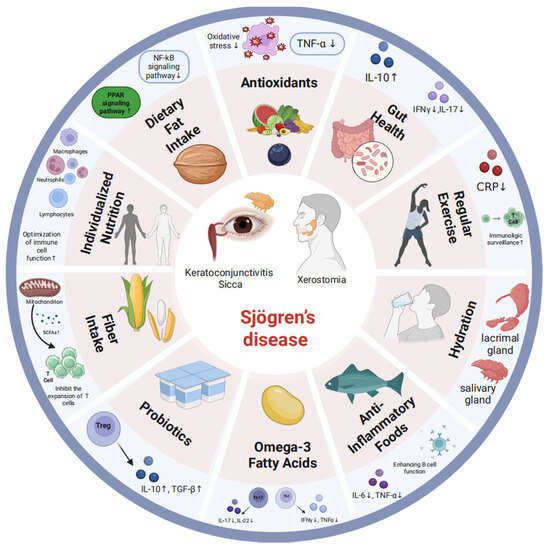
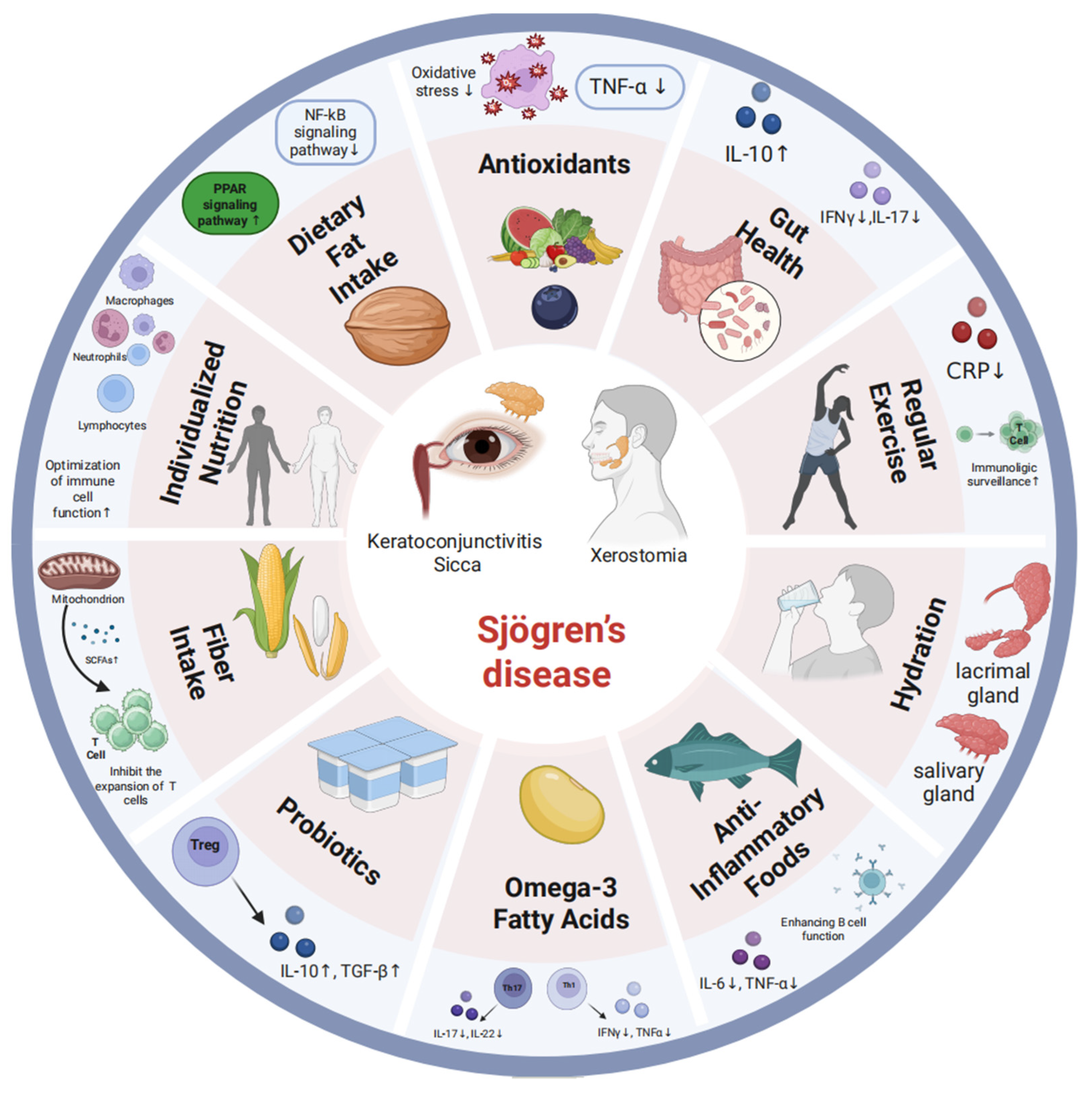
Dietary factors have profound effects on immune cell function and inflammatory signaling, offering a modulable entry point for intervention in SjD. Figure 1 provides a conceptual overview of this interplay, organizing dietary components on the left and their corresponding effects on immune cell subsets and signaling pathways on the right. Broadly, nutrients such as short-chain fatty acids (SCFAs), omega-3 polyunsaturated fatty acids (n-3 PUFAs), and dietary fibers exert immunoregulatory effects by shaping T-cell differentiation, modulating B-cell responses, and influencing the gut microbiota. In the following sections, we discuss in detail how specific dietary factors influence distinct lymphocyte populations—including B cells, CD4+ T-helper subsets, and regulatory T cells—and how these insights may inform dietary strategies in SjD.
Figure 1.
Dietary and lifestyle interventions for the management of Sjögren’s disease (SjD). This figure illustrates the multifaceted approach to managing SjD via dietary and lifestyle modifications. The diagram is organized into two main sections: dietary factors and their corresponding effects on immune cell functions and signaling pathways.
3.1. Modulating B-Cell Response
Humoral autoimmunity is the hallmark of SjD, in which the aberrant activation of B cells is a significant immunological feature [11,21]. Plasma cells are antibody-secreting cells that differentiate from B cells following activation. By recognizing tissue-specific autoantigens, recent advances report that epithelial stromal interaction protein 1 is highly expressed in B cells in SjD and plays a regulatory role in the aberrant activation of B cells [22]. In SjD, plasma cells produce autoantibodies that target the body’s own tissues, particularly the salivary and lacrimal glands, thereby further activating the complement system, recruiting and stimulating immune cells such as macrophages and neutrophils, and amplifying the inflammatory response [23,24]. Despite the absence of clinical evidence of the impact of dietary factors on B-cell response in SjD, recent studies have indicated the multidimensional role of dietary factors in B cells, including immune regulation and metabolic processes. A large-scale isocaloric diet study in murine models revealed that high-carbohydrate diets—particularly those rich in glucose—significantly promote B-cell development and function [25]. While such enhancement may bolster general immunity, it carries the risk of exacerbating autoimmune inflammation, particularly in obese individuals. In contrast, high-fat diets have been shown to impair gut microbiota composition, leading to disrupted B-cell development and reduced IgA responses [26,27].
Meanwhile, (n-3) PUFAs, abundant in fish and nuts, can normalize B-cell function and downregulate pro-inflammatory signals [28]. Diets rich in SCFAs are also known to support the microbiome and regulate autoreactive T cell expansion by modifying B-cell co-stimulation and differentiation [29]. Finally, dietary fibers from whole grains and vegetables are essential nutrients for the growth of beneficial microbes such as Bifidobacteria, which can produce SCFAs such as butyrate and acetate from dietary fibers. These are essential in maintaining the integrity of the intestinal barrier and controlling inflammation. In contrast, Western diets rich in processed meats and sugars are known to induce dysbiosis and insulin resistance, which can contribute to the pathological activation of plasma cells [30].
In addition to effector subsets, another important immunomodulatory role of regulatory B cells (Bregs) is their ability to secrete anti-inflammatory cytokines that prevent or restrain an overactive immune response [31,32]. These cells may alleviate symptoms of SjD by mitigating chronic inflammation. Leucine-rich dietary intake has been observed to promote a novel subpopulation of Bregs, identified as Lars2-expressing B cells. These cells exhibit significant mitochondrial respiratory chain complex I inhibition, impaired NAD+ regeneration, reduced NAD+/NADH ratios, and diminished mitochondrial membrane potential [33]. These metabolic alterations activate NAD+-dependent enzymes, including SIRT1, which upregulates transforming growth factor beta-1 (TGF-β1) expression through the deacetylation of paired box 5, thereby contributing to a sustained and exacerbated inflammatory response that may drive disease progression in SjD [33] (Table 1). For patients with SjD, adopting a diet rich in (n-3) PUFAs and fibers to support SCFA production, while limiting saturated fats, may help attenuate B-cell hyperactivation and support immune homeostasis.
3.2. Modulating T-Cell Response
CD8+ T cells are crucial components of the cellular immune response. In SjD, these cells may aggravate tissue damage by recognizing self-antigens, triggering immune-mediated attacks, and releasing a spectrum of pro-inflammatory cytokines, ultimately resulting in tissue fibrosis and functional impairment [34]. High-fat diets (HFDs) promote the accumulation of CD8+ T cells in adipose tissue, contributing to chronic low-grade inflammation, especially in obese individuals, through interactions with macrophages [35]. Moreover, HFDs have been shown to elevate the levels of CD8+ T cells in the brains of aged rats, thereby exacerbating neuroinflammatory responses and impairing memory function [36]. Trans-oleic acid, a fatty acid abundant in human breast milk, enhances CD8+ T-cell functionality by inhibiting the GPR43 receptor and activating the cAMP-dependent protein kinase A-cyclic AMP response element-binding protein signaling pathway [37]. This finding may not only suggest a promising therapeutic target in cancer treatment but also a potential risk factor in autoimmune disorders such as SjD.
Memory T cells are a critical component of the adaptive immune response; however, in SjD, immune tolerance may become impaired, leading memory T cells to attack self-tissues and aggravate glandular infiltration [38]. Compiled evidence indicates that moderate caloric restriction, particularly when implemented without causing malnutrition, enhances memory T-cell functionality. This effect is likely due to the optimization of these cells’ metabolic state, thereby boosting the efficiency of their immune response [39]. Furthermore, a high-fiber diet supports the maintenance and functionality of memory T cells, primarily because SCFAs, e.g., butyric acid, enhance mitochondrial oxidative metabolism of effector T cells, thereby indirectly promoting systemic immune function [40].
T follicular helper (Tfh) cells are a subset of effector T cells and are essential in effector B-cell responses, aiding in the production of high-affinity antibodies. In patients with SjD, the frequency of circulating Tfh cells is increased and positively correlates with the disease severity [41]. Recent advances reveal that HFDs lead to an expansion of Tfh cells, exacerbating the inflammatory process by enhancing B-cell activation and antibody production. However, in contrast, marginal zone B (MZB) cells regulate Tfh cell differentiation and accumulation under HFDs by activating programmed death-ligand 1 expression. This regulatory role of MZB cells limits the excessive adaptive immune response [42]. A high-salt diet promotes Tfh cell differentiation through TET2-induced DNA demethylation, a mechanism that plays a crucial role in autoimmune diseases, such as systemic lupus erythematosus (SLE) [43].
Th1 cells are critical mediators of the adaptive immune response during SjD progression. They exhibit abnormal activation and dysregulated balance, which boosts the immune system to erroneously attack its own tissues [44], including anti-SSA/Ro and anti-SSB/La, and participate in glandular tissue damage [45]. This is achieved by the production of their predominant cytokines, including IFN-γ, along with other pro-inflammatory cytokines, thus amplifying inflammatory responses and resulting in systemic and glandular tissue destruction [8]. The effects of HFDs on Th1 cell response have multiple layers, but generally, they enhance Th1 differentiation and activation.
HFDs’ ability to enhance the secretion capacity of IFN-γ via Th1 cells was demonstrated in [46]. Detailed mechanistic studies have revealed that HFDs induce metabolic reprogramming that increases glycolysis and fatty acid oxidation, thereby providing the metabolic support required for Th1 cell activation and clonal expansion [47]. Additionally, HFDs may modulate Th1 cell function indirectly through their effects on the commensal flora. Murine models have shown that HFDs reduce beneficial flora while promoting pathogenic outgrowth; the resulting compromise of gastrointestinal barrier integrity allows bacterial products to enter systemic circulation, further exacerbating Th1-mediated inflammation [48].
Meanwhile, (n-3) PUFA-enriched diets have an immunosuppressive role in Th1 cell activity. Experimental research using C57BL/6 mice showed that diets enriched with fish oil resulted in a substantial reduction in Th1 cell frequency, even when Th2 polarization was attempted. A similar finding of increased Th2 cell levels suggests that (n-3) PUFAs may affect Th1/Th2 immunology [49]. Moreover, diets enriched with guar gum, a soluble fiber, resulted in substantial delays of the onset of experimental autoimmune encephalomyelitis, an animal model of human multiple sclerosis. Guar gum has been shown to affect Th1 cell activation, proliferation, and differentiation, as well as their migration ability [50].
Th17 cells represent another critical subset whose activity is profoundly influenced by dietary factors. Th17 cells are a subset of effector CD4+ T cells, with a pivotal role in host defense against extracellular pathogens, particularly at mucosal and epithelial barriers, by producing cytokine IL-17. However, when aberrantly activated, Th17 cells can produce excessive IL-17, leading to heightened inflammatory responses, infiltration of inflammatory cells, and subsequent tissue damage. Salivary epithelial cells highly express IL-17 receptors, conveying localized inflammation and tissue damage that manifest as glandular dysfunction and dryness symptoms [51].
Several dietary factors have been shown to promote Th17 differentiation. A high-salt diet facilitates Th17 differentiation and augments IL-17 production, an effect mediated, in part, via NLRP3 inflammasome activation and gut microbiota modification [52]. This effect is achieved, at least in part, through the activation of inflammasomes associated with NLRP3 [53,54], as well as altered gut microbiota species [55]. Similarly, high-fat diets and high-sugar diets have been associated with increased Th17 cell counts [43], accompanied by blood sugar levels [56]. Conversely, specific dietary elements impede Th17 differentiation and activation. (n-3) PUFAs, however, inhibit Th17 cell frequencies and are associated with enhanced regulatory T-cell (Treg) function [57]. These opposing effects highlight the importance of nutritional composition in maintaining Th17–Treg balance and immune homeostasis.
Treg cells are well-recognized to sustain immune tolerance by producing immunosuppressive cytokines [58]. Thus, HFDs, particularly those rich in trans and saturated fats, may impair Treg cell function and, thus, elevate the risk of chronic inflammation and autoimmune diseases [59]. Meanwhile, diets rich in antioxidants and polyphenolic compounds, such as those found in green tea, berries, and dark green vegetables, have been shown to promote the differentiation and function of Treg cells, thereby facilitating the suppression of overt immune responses [60,61]. Antioxidants, including vitamins C and E, neutralize free radicals, thus reducing oxidative stress-induced damage in response to an inflammatory microenvironment. This mechanism supports the stability and functionality of Treg cells [62]. Dietary polyphenolic compounds help to reduce oxidative stress, thus protecting Treg cells from trans-differentiation into effector phenotypes with preserved cell numbers and function [63]. Similarly, epigallocatechin gallate, a compound found in green tea, promotes Treg cell response [62]. Furthermore, dietary anthocyanins and flavonoids, rich in berries, are also beneficial to health with enhanced Treg cell function [64].
Nutrients in these foods also work together to impact the metabolic health of Treg cells and alter their immunoregulatory capacity. Trans and saturated fats from HFDs and a high-salt diet also impede Treg cell function during chronic inflammation and autoimmune diseases, while (n-3) polyunsaturated fatty acids and SCFAs facilitate Treg cell differentiation indirectly.
Myeloid-derived suppressor cells (MDSCs), similar to Treg cells, are a heterogeneous population of myeloid cells with strong immunosuppressive capacity [65]. Recent studies have shown that tryptophan metabolites (such as indole-3-propionic acid (IPA)) can significantly promote the differentiation and function of polymorphonuclear myeloid-derived suppressor cells (PMN-MDSCs), primarily through the activation of the aryl hydrocarbon receptor (AhR) [66]. The AhR is a cytoplasmic receptor that can respond to various exogenous and endogenous compounds and is widely present in the gut microbiota, host metabolism, and environment [67,68,69]. In addition to IPA, the natural ligands of AhR also include various compounds derived from foods and herbs, such as resveratrol (a polyphenolic compound found in grape skins and certain berries), curcumin (derived from turmeric), and certain fungal metabolites [70]. These natural ligands regulate the activation and function of immune cells by binding to the AhR, thereby affecting inflammatory responses and immune balance. In the pathogenesis of SjD, activation of the AhR may alleviate immune-mediated tissue damage by enhancing the immunosuppressive function of PMN-MDSCs, providing a new potential target for the immunomodulatory treatment of SjD.
Table 1.
Dietary recommendations for SjD.
4. Immunomodulatory Effects of Edible Herbs
In addition to dietary nutrients, edible medicinal herbs, owing to their diverse bioactive components such as polysaccharides [71], flavonoids [72], and polyphenols, have been extensively studied and utilized in immune regulation. The immunomodulatory effects of herbs have been recently demonstrated to be a key mechanism in treating SjD [73,74]. These natural bioactive compounds are pivotal in the prevention and treatment of various inflammatory diseases, which is beneficial in restoring immune tolerance [75,76,77]. These herbs have usually been reported to exhibit multi-target actions and multi-component regulation, improving patient outcomes. For example, active constituents in herbs, such as astragaloside IV from Astragalus, polysaccharides from Ganoderma lucidum, and polysaccharides from Lycium barbarum, all showed pronounced anti-inflammatory and immunomodulatory effects, albeit through distinct molecular pathways [78,79,80,81] (Table 2).
Clinical practice using medicinal herbs suggested that symptoms of dryness associated with SjD were alleviated, including xerostomia and keratoconjunctivitis sicca, as well as mitigating fatigue, thereby enhancing patients’ overall quality of life. Extracts from Astragalus have shown significant efficacy in enhancing SG function and alleviating dry mouth symptoms [82]. Moreover, the combination of peony and hydroxychloroquine can enhance immune regulatory effects while mitigating drug toxicity [83]. These mechanisms offer a theoretical foundation for the application of herbal therapies in the treatment of SjD and provide new options for the comprehensive management of SjD. Herein, we first review the available clinical trials using traditional Chinese medicines, followed by the introduction of several edible medicinal herbs that may benefit patients.
4.1. Clinical Evidence of Chinese Medicine in SjD
Over the past decade, a growing number of randomized controlled trials (RCTs) have evaluated the clinical efficacy of TCM in SjD, with several promising signals emerging. A multi-center, double-blind, placebo-controlled trial assigned 320 pSS patients to receive total glucosides of peony (TGP) 600 mg three times daily or placebo for 24 weeks; the TGP group showed significantly greater improvement in ESSPRI (p < 0.001), dry eye VAS, fatigue VAS, PGA, Schirmer‘s test and ESR, with only mild diarrhea (4.8%) as the main adverse event [84]. A smaller double-blind trial added JieDuTongLuoShengJin granules (consisting of Paeoniae, Zedoariae, Angelica and Astragalus) to hydroxychloroquine (HCQ) in 40 low-activity pSS patients; the combination significantly improved ESSPRI and PGA compared to HCQ alone, and the treatment group also showed significant within-group improvements in unstimulated salivary flow and IgG, though between-group differences did not reach significance for these objective measures [85]. Similarly, in a pilot RCT, Wu et al. also conducted a comparison between HCQ alone and in combination with an herbal formula (containing Ophiopogonis, Paeoniae, Polygonati, Salviae Miltiorrhizae, Artemisiae Annuae, Notoginseng and Puerariae) in 68 pSS patients over 3 months; the combination led to significantly greater reductions in IgG, ESR and osteopontin (OPN) levels, as well as improvements in several health domains (SF 36 scores, p < 0.05) [86]. Meta-analyses further support the overall superiority of TCM over conventional Western medicine. Liu et al. [87] (2016) pooled 31 RCTs (2137 patients) and found a significantly higher effective rate for TCM monotherapy (87.18%) compared to Western medicine alone (65.63%), with an odds ratio of 3.74 (95% CI: 2.99–4.69). A more recent network meta-analysis (2024) including 66 RCTs (5052 patients) concluded that TCM combined with conventional Western medicine is significantly more effective than first-line medication alone across multiple outcome indicators.
Despite these encouraging findings, several methodological limitations must be acknowledged. First, sample sizes are relatively small (n = 40; Wu et al. n = 68), and most trials have short follow-up periods (6–24 weeks), insufficient to assess long-term efficacy, durability of response, or delayed adverse events [85]. Second, TCM formulas are complex, multi-herb mixtures with wide inter-study heterogeneity; the optimal composition, dosing regimen, and pharmaceutical standardization remain to be clearly defined, which may hinder further replication, direct comparison, and meta-analytic synthesis. Third, pharmacokinetic data, active constituent profiling, and quality control information for TCM products are largely lacking. Future research should prioritize large-scale, multi-center, double-blind, placebo-controlled trials with longer observation periods (≥48 weeks) to confirm sustained efficacy and safety. Outcome assessment should adhere to internationally validated instruments (ESSDAI/ESSPRI) and include sensitive, objective biomarkers of glandular function, such as salivary scintigraphy or novel imaging modalities. Mechanistic studies exploring the immunomodulatory pathways of specific TCM compounds are needed to identify active constituents and enable targeted development. Finally, rigorous pharmaceutical quality control and standardization of TCM formulas—through modern analytical methods—are essential prerequisites for reproducible, evidence-based integration of TCM into SjD management guidelines.
4.2. Astragalus
Astragalus is a widely utilized medicinal herb renowned for its ability to modulate immune responses and, importantly, is the most frequently prescribed medicinal herb in clinical management [88,89]. Research has demonstrated that Astragalus plays a significant role in immunomodulation. Astragalus polysaccharide (APS), one of its major active components, enhances immune function by activating various immune cells, including macrophages, natural killer (NK) cells, and T lymphocytes [90,91]. Mechanistic studies have revealed that APS improves CD8+ T-cell function by regulating the STAT3/Gal-3/LAG3 signaling pathway, thereby exerting immunomodulatory effects in inflammation-related diseases. In addition, Astragalus exhibits potent anti-inflammatory activity. Total flavonoids extracted from Astragalus have been shown to significantly reduce the expression of pro-inflammatory cytokines (such as TNF-α, IL-6, and IL-1β) in lipopolysaccharide (LPS)-stimulated RAW 264.7 macrophages. These effects are mediated by inhibiting the activation of the NF-κB and MAPK signaling pathways [92]. Specifically, these compounds block the nuclear translocation of the p65 protein and downregulate the phosphorylation levels of ERK, JNK, and p38 MAPK, thereby alleviating inflammatory responses. Clinically, the application of Astragalus has also demonstrated promising therapeutic potential. A clinical trial involving patients with Sjögren’s disease (SjD) showed that Astragalus effectively alleviated dry mouth symptoms, suggesting its value in modulating immune dysregulation and reducing glandular inflammation [93].
Mechanistic studies demonstrated that the improvement might be linked to the astragaloside-induced rise in intracellular calcium ion levels and the activation of protein kinase C (PKC) alongside tyrosine kinases, including Lck and Fyn [94,95]. Once activated, these kinases promote the initiation of critical nuclear transcription factors. Consequently, this process enhances cytokine expression, including IL-2 and IFN-γ [96,97]. Astragalus polysaccharides (APSs) can modulate T-cell proliferation during activation by enhancing the signaling pathways of T-cell receptors (TCRs) and co-stimulatory molecules, including CD28 [98]. Meanwhile, APS also amplifies TGF-β signaling, consequently boosting the expression of the Foxp3 gene, a crucial transcription factor for Treg cell development [99]. Stable Foxp3 expression allows Treg cells to effectively suppress the activity of other immune cells. This regulation plays a vital role in maintaining immune tolerance and preventing autoimmune responses, thus ensuring the immune system operates correctly without targeting the body’s own tissues [100]. APS facilitates the proliferation of B cells and their differentiation into Breg [101] and plasma cells [102]. This process increases immune regulation and antibody production, thereby strengthening the body’s immune response against pathogens and maintaining immune homeostasis.
4.3. Dendrobium
Dendrobium is a medicinal plant known for its diverse pharmacological activities, and its primary chemical constituents include polysaccharides, gigantol, dendrobin, moupinamide, and isoliquiritin [82]. Extensive investigations have shown the various pharmacological properties of this medicinal plant, including immunomodulation [103], blood glucose regulation [104], and anti-cataract effects [105]. For instance, polysaccharides derived from Dendrobium officinale can significantly decrease levels of inflammatory cytokines in the retina and systemically in rats with diabetic retinopathy by inhibiting retinal VEGF expression [106]. These effects may help alleviate dry eye symptoms and the systemic inflammatory state observed in patients with SjD. In a mouse model of experimental SjD (ESS), Dendrobium polysaccharides enhanced SG function by enhancing their cholinergic response and promoted Breg function, thus serving as a promising candidate [107,108]. Clinical evidence further validates the increased saliva production in polysaccharide-treated SjD patients [109]. Moreover, alkaloids from Dendrobium nobile could protect against liver damage induced by carbon tetrachloride, which is associated with reduced mitochondrial oxidative stress [110]. In addition, growing evidence shows that gigantol effectively inhibits IL-6 signaling and oxidative stress pathways in murine nephritis [111,112], while polysaccharides from Dendrobium elicit therapeutic potential in treating inflammatory bowel disease (IBD) via the MAPK pathway [113]. The evidence demonstrates potent anti-inflammatory properties of Dendrobium that can be utilized to alleviate symptoms and inflammation associated with SjD.
4.4. Reishi Mushroom (Ganoderma lucidum)
Ganoderma lucidum is a medicinal fungus renowned for its immunomodulatory effects, particularly in regulating immune responses [114]. Studies suggest that Ganoderma lucidum boosts the activity of T and B cells, modulating gut microbiota and immune responses in inflammatory diseases and cancer development [115]. Moreover, Ganoderma lucidum can alleviate chronic inflammation by restraining effector T-cell counts, thus effectively alleviating the symptoms of sialadenitis and ameliorating glandular infiltration in a mouse model of SjD [116]. The immunomodulatory effects of Ganoderma lucidum make it a potential herbal candidate for treating SjD.
4.5. Goji Berry
Goji berries are widely utilized for their potent antioxidant and immunomodulatory properties [117,118,119]. Studies indicate that the polysaccharides and flavonoids in goji berries enhance the body’s antioxidant capacity, neutralize free radicals, and thereby mitigate immune dysregulation induced by oxidative stress [81]. Goji berries also have anti-inflammatory qualities that may ease the symptoms of SjD and various autoimmune disorders by reducing the release of pro-inflammatory cytokines [120]. Clinical data suggest that Goji berry extract positively impacts inflammatory diseases to ease symptoms, including fatigue, in patients [121].
4.6. Garlic
Garlic, a traditional herbal remedy, exhibits significant antioxidant, anti-inflammatory, and immunomodulatory properties. Garlic’s sulfur-containing compounds (e.g., allicin) are its key active ingredients, boosting the body’s immune response by modulating immune cell activity [122,123]. Recent findings show that garlic polysaccharides markedly increase the cytotoxic potential of immune cells and mitigate inflammatory responses by modulating the activities of diverse immune cell populations [124]. Several clinical trials indicate that garlic supplements significantly reduce oxidative stress levels in patients and, thus, alleviate inflammation [125], which may also be beneficial for patients with autoimmune diseases such as SjD.
4.7. Chrysanthemum
Chrysanthemum is a medicinal herb that possesses anti-inflammatory and antioxidant properties. Chrysanthemum contains compounds such as flavonoids, terpenes, and polysaccharides. These components, e.g., 6,8-C,C-diglucosylapigenin and eriodicyol-7-O-glucoside, show anti-inflammatory activity and can effectively inhibit the production of pro-inflammatory cytokines [126]. Additionally, the antioxidant components in chrysanthemum can scavenge free radicals in vitro and in vivo, thereby alleviating immune system damage caused by oxidative stress [127]. In diet-induced low-grade inflammation, the water extract of chrysanthemum can modulate the gut microbiota and increase SCFA levels [128], which may serve as a complementary diet in patients with inflammatory diseases, including SjD.
4.8. Lily
Accumulated pharmacological studies report that extracts and further compounds of lily possess a wide range of biological activities [129]. These properties suggest that lily could offer potential dietary approaches for alleviating symptoms associated with SjD. Lily exhibits its anti-inflammatory properties by modulating the expression of key inflammatory mediators, including IL-1β, TNF-α, inducible nitric oxide synthase (iNOS), and cyclooxygenase-2 (COX-2). By regulating these mediators, lily can help reduce inflammation and provide therapeutic benefits in various inflammatory conditions [130,131]. Studies have shown that lily extracts significantly inhibit the expression of iNOS, COX-2, IL-1β, IL-6, and TNF-α in RAW264.7 macrophage cells stimulated by LPS [132]. Additionally, in vivo studies have shown that lily extracts reduce the RNA expression levels of crucial inflammatory factors in the lung tissues of cigarette smoke-exposed mice. This indicates that lily extracts possess certain anti-inflammatory properties in the presence of cigarette smoke-induced lung inflammation [133]. Studies carried out by Chen et al. have indicated that a Lactobacillus brownii broth can reduce inflammation in tissues affected by chronic liver injury [134] by reducing the production of inflammatory cytokines, hence promoting the broth’s anti-inflammatory effect. This discovery shows the possible therapeutic effect of Lactobacillus brownii in the management of chronic liver inflammation. Therefore, moderate consumption of lily or its products, such as porridge, can have an adjuvant therapeutic effect in the management of patients with SjD.
The medicinal herbs discussed above—Astragalus, Dendrobium, Ganoderma lucidum, goji berry, garlic, chrysanthemum, and lily—exhibit a broad spectrum of immunomodulatory activities that converge on key pathogenic pathways reported in SjD. While each herb possesses distinct bioactive constituents and preferentially targets specific immune cell subsets, their mechanisms collectively span the regulation of T-helper cell polarization, enhancement of regulatory T- and B-cell function, modulation of gut microbiota, and attenuation of oxidative stress and pro-inflammatory cytokine production. These herbs often exert multi-target effects that align with the complex, heterogeneous nature of SjD, offering potential advantages over single-agent conventional therapies. However, clinical evidence remains limited, and most studies have been conducted using preclinical models. Future investigations should prioritize well-designed randomized controlled trials to validate efficacy, define optimal dosing regimens, and explore synergistic combinations that may harness the complementary mechanisms of different herbs. Thus, medicinal herbs may be rationally integrated into a comprehensive, personalized management strategy for SjD.
Table 2.
Medicinal plants, active components, and immunomodulatory mechanisms.
5. Conclusions
The intricate interplay between diet, immunity, and autoimmunity offers a challenge in its complexity and an opportunity to intervene at the roots of immune dysregulation. Nutritional and herbal strategies hold considerable promise as complementary approaches in the management of SjD. By targeting key immunological checkpoints—ranging from T- and B-cell subset differentiation to metabolic reprogramming and gut microbiota modulation—these interventions offer a multifaceted means of restoring immune homeostasis. Unlike conventional immunosuppressants, which often carry significant toxicity and lack sustained efficacy, dietary components and medicinal herbs can engage diverse bioactive pathways simultaneously, aligning well with the complex pathophysiology of SjD. Nevertheless, translating these promising findings into clinical practice will require more than mechanistic insights. Future efforts must prioritize rigorous, well-controlled clinical trials to establish efficacy, safety, and patient-specific response profiles. Moreover, integrating modern analytical technologies—such as metabolomics, single-cell immunophenotyping, and gut microbiome sequencing—will be essential to decoding the molecular interplay between diet, herbal bioactives, and host immunity. As we stand at the intersection of traditional knowledge and precision medicine, the path forward lies not in replacing conventional therapy but in thoughtfully weaving nutritional and herbal interventions into a holistic, individualized treatment framework. In doing so, we may move beyond symptomatic management toward a more sustainable, immune-resetting approach for Sjögren’s disease and other autoimmune conditions.
Author Contributions
Conceptualization, X.L.; writing—original draft preparation, X.X. and J.Y.; writing—review and editing, X.X., Y.F. and J.H.; supervision, X.L. All authors have read and agreed to the published version of the manuscript.
Funding
This work was supported by the General Research Fund, the Hong Kong Research Grants Council (17109123 and 17116521), and the Mainland-Hong Kong Joint Funding Scheme (MHP/104/22).
Data Availability Statement
The original contributions presented in this study are included in the article. Further inquiries can be directed to the corresponding author.
Conflicts of Interest
The authors declare no conflicts of interest.
References
- Zhan, Q.; Zhang, J.; Lin, Y.; Chen, W.; Fan, X.; Zhang, D. Pathogenesis and treatment of Sjogren’s syndrome: Review and update. Front. Immunol. 2023, 14, 1127417. [Google Scholar] [CrossRef] [Scilit]
- Meng, Q.; Ma, J.; Cui, J.; Gu, Y.; Shan, Y. Subpopulation dynamics of T and B lymphocytes in Sjögren’s syndrome: Implications for disease activity and treatment. Front. Immunol. 2024, 15, 1468469. [Google Scholar] [CrossRef] [Scilit]
- Qin, B.; Wang, J.; Yang, Z.; Yang, M.; Ma, N.; Huang, F.; Zhong, R. Epidemiology of primary Sjögren’s syndrome: A systematic review and meta-analysis. Ann. Rheum. Dis. 2015, 74, 1983–1989. [Google Scholar] [CrossRef] [Scilit]
- Beydon, M.; McCoy, S.; Nguyen, Y.; Sumida, T.; Mariette, X.; Seror, R. Epidemiology of Sjögren syndrome. Nat. Rev. Rheumatol. 2024, 20, 158–169. [Google Scholar] [CrossRef] [Scilit]
- Longhino, S.; Chatzis, L.G.; Dal Pozzolo, R.; Peretti, S.; Fulvio, G.; La Rocca, G.; Navarro Garcia, I.C.; Orlandi, M.; Quartuccio, L.; Baldini, C.; et al. Sjögren’s syndrome: One year in review 2023. Clin. Exp. Rheumatol. 2023, 41, 2343–2356. [Google Scholar] [CrossRef] [Scilit]
- Qi, W.; Tian, J.; Wang, G.; Yan, Y.; Wang, T.; Wei, Y.; Wang, Z.; Zhang, G.; Zhang, Y.; Wang, J. Advances in cellular and molecular pathways of salivary gland damage in Sjögren’s syndrome. Front. Immunol. 2024, 15, 1405126. [Google Scholar] [CrossRef] [Scilit]
- Ramos-Casals, M.; Brito-Zerón, P.; Bombardieri, S.; Bootsma, H.; De Vita, S.; Dörner, T.; Fisher, B.A.; Gottenberg, J.-E.; Hernandez-Molina, G.; Kocher, A.; et al. EULAR recommendations for the management of Sjögren’s syndrome with topical and systemic therapies. Ann. Rheum. Dis. 2020, 79, 3–18. [Google Scholar] [CrossRef] [Scilit]
- Chen, Y.; Luo, X.; Deng, C.; Zhao, L.; Gao, H.; Zhou, J.; Peng, L.; Yang, H.; Li, M.; Zhang, W.; et al. Immunometabolic alteration of CD4+ T cells in the pathogenesis of primary Sjögren’s syndrome. Clin. Exp. Med. 2024, 24, 163. [Google Scholar] [CrossRef] [Scilit]
- Du, W.; Han, M.; Zhu, X.; Xiao, F.; Huang, E.; Che, N.; Tang, X.; Zou, H.; Jiang, Q.; Lu, L. The Multiple Roles of B Cells in the Pathogenesis of Sjögren’s Syndrome. Front. Immunol. 2021, 12, 684999. [Google Scholar] [CrossRef] [Scilit]
- Ewert, P.; Aguilera, S.; Alliende, C.; Kwon, Y.-J.; Albornoz, A.; Molina, C.; Urzúa, U.; Quest, A.F.G.; Olea, N.; Pérez, P.; et al. Disruption of tight junction structure in salivary glands from Sjögren’s syndrome patients is linked to proinflammatory cytokine exposure. Arthritis Rheum. 2010, 62, 1280–1289. [Google Scholar] [CrossRef] [Scilit]
- Voulgarelis, M.; Tzioufas, A.G. Pathogenetic mechanisms in the initiation and perpetuation of Sjögren’s syndrome. Nat. Rev. Rheumatol. 2010, 6, 529–537. [Google Scholar] [CrossRef] [Scilit]
- Ríos-Ríos Wde, J.; Sosa-Luis, S.A.; Torres-Aguilar, H. T Cells Subsets in the Immunopathology and Treatment of Sjogren’s Syndrome. Biomolecules 2020, 10, 1539. [Google Scholar] [CrossRef] [Scilit]
- Nocturne, G.; Mariette, X. B cells in the pathogenesis of primary Sjögren syndrome. Nat. Rev. Rheumatol. 2018, 14, 133–145. [Google Scholar] [CrossRef] [Scilit]
- Xu, J.; Chen, C.; Yin, J.; Fu, J.; Yang, X.; Wang, B.; Yu, C.; Zheng, L.; Zhang, Z. Lactate-induced mtDNA Accumulation Activates cGAS-STING Signaling and the Inflammatory Response in Sjögren’s Syndrome. Int. J. Med. Sci. 2023, 20, 1256–1271. [Google Scholar] [CrossRef] [Scilit]
- Arango Duque, G.; Descoteaux, A. Macrophage cytokines: Involvement in immunity and infectious diseases. Front. Immunol. 2014, 5, 491. [Google Scholar] [CrossRef] [Scilit]
- Manfrè, V.; Chatzis, L.G.; Cafaro, G.; Fonzetti, S.; Calvacchi, S.; Fulvio, G.; Navarro Garcia, I.C.; La Rocca, G.; Ferro, F.; Perricone, C.; et al. Sjögren’s syndrome: One year in review 2022. Clin. Exp. Rheumatol. 2022, 40, 2211–2224. [Google Scholar] [CrossRef] [Scilit]
- He, Y.; Chen, R.; Zhang, M.; Wang, B.; Liao, Z.; Shi, G.; Li, Y. Abnormal Changes of Monocyte Subsets in Patients with Sjögren’s Syndrome. Front. Immunol. 2022, 13, 864920. [Google Scholar] [CrossRef] [Scilit]
- Chen, X.; Zhu, L.; Wu, H. The role of M1/M2 macrophage polarization in primary Sjogren’s syndrome. Arthritis Res. Ther. 2024, 26, 101. [Google Scholar] [CrossRef] [Scilit]
- Zong, Y.; Yang, Y.; Zhao, J.; Li, L.; Luo, D.; Hu, J.; Gao, Y.; Wei, L.; Li, N.; Jiang, L. Characterisation of macrophage infiltration and polarisation based on integrated transcriptomic and histological analyses in Primary Sjögren’s syndrome. Front. Immunol. 2023, 14, 1292146. [Google Scholar] [CrossRef] [Scilit]
- Zhou, J.; Zhang, X.; Yu, Q. Plasmacytoid dendritic cells promote the pathogenesis of Sjögren’s syndrome. Biochim. Biophys. Acta Mol. Basis Dis. 2022, 1868, 166302. [Google Scholar] [CrossRef] [Scilit]
- Salomonsson, S.; Jonsson, M.V.; Skarstein, K.; Brokstad, K.A.; Hjelmström, P.; Wahren-Herlenius, M.; Jonsson, R. Cellular basis of ectopic germinal center formation and autoantibody production in the target organ of patients with Sjögren’s syndrome. Arthritis Rheum. 2003, 48, 3187–3201. [Google Scholar] [CrossRef] [Scilit] [PubMed]
- Sun, J.-L.; Zhang, H.-Z.; Liu, S.-Y.; Lian, C.-F.; Chen, Z.-L.; Shao, T.-H.; Zhang, S.; Zhao, L.-L.; He, C.-M.; Wang, M.; et al. Elevated EPSTI1 promote B cell hyperactivation through NF-κB signalling in patients with primary Sjögren’s syndrome. Ann. Rheum. Dis. 2020, 79, 518–524. [Google Scholar] [CrossRef] [Scilit]
- Szyszko, E.A.; Brokstad, K.A.; Oijordsbakken, G.; Jonsson, M.V.; Jonsson, R.; Skarstein, K. Salivary glands of primary Sjögren’s syndrome patients express factors vital for plasma cell survival. Arthritis Res. Ther. 2011, 13, R2. [Google Scholar] [CrossRef] [Scilit]
- Jin, L.; Yu, D.; Li, X.; Yu, N.; Li, X.; Wang, Y. CD4+CXCR5+ follicular helper T cells in salivary gland promote B cells maturation in patients with primary Sjogren’s syndrome. Int. J. Clin. Exp. Pathol. 2014, 7, 1988–1996. [Google Scholar]
- Zaloga, G.P. Narrative Review of n-3 Polyunsaturated Fatty Acid Supplementation upon Immune Functions, Resolution Molecules and Lipid Peroxidation. Nutrients 2021, 13, 662. [Google Scholar] [CrossRef] [Scilit]
- Yang, J.; Wei, H.; Zhou, Y.; Szeto, C.-H.; Li, C.; Lin, Y.; Coker, O.O.; Lau, H.C.H.; Chan, A.W.H.; Sung, J.J.Y.; et al. High-Fat Diet Promotes Colorectal Tumorigenesis Through Modulating Gut Microbiota and Metabolites. Gastroenterology 2022, 162, 135–149.e2. [Google Scholar] [CrossRef] [Scilit]
- Smith, P.M.; Howitt, M.R.; Panikov, N.; Michaud, M.; Gallini, C.A.; Bohlooly, Y.M.; Glickman, J.N.; Garrett, W.S. The microbial metabolites, short-chain fatty acids, regulate colonic Treg cell homeostasis. Science 2013, 341, 569–573. [Google Scholar] [CrossRef] [Scilit]
- Cai, Y.; Folkerts, J.; Folkerts, G.; Maurer, M.; Braber, S. Microbiota-dependent and -independent effects of dietary fibre on human health. Br. J. Pharmacol. 2020, 177, 1363–1381. [Google Scholar] [CrossRef] [Scilit]
- Hays, K.E.; Pfaffinger, J.M.; Ryznar, R. The interplay between gut microbiota, short-chain fatty acids, and implications for host health and disease. Gut Microbes 2024, 16, 2393270. [Google Scholar] [CrossRef] [Scilit]
- Ross, F.C.; Patangia, D.; Grimaud, G.; Lavelle, A.; Dempsey, E.M.; Ross, R.P.; Stanton, C. The interplay between diet and the gut microbiome: Implications for health and disease. Nat. Rev. Microbiol. 2024, 22, 671–686. [Google Scholar] [CrossRef] [Scilit]
- Brosseau, C.; Durand, M.; Colas, L.; Durand, E.; Foureau, A.; Cheminant, M.-A.; Bouchaud, G.; Castan, L.; Klein, M.; Magnan, A.; et al. CD9+ Regulatory B Cells Induce T Cell Apoptosis via IL-10 and Are Reduced in Severe Asthmatic Patients. Front. Immunol. 2018, 9, 3034. [Google Scholar] [CrossRef] [Scilit]
- Menon, M.; Hussell, T.; Ali Shuwa, H. Regulatory B cells in respiratory health and diseases. Immunol. Rev. 2021, 299, 61–73. [Google Scholar] [CrossRef] [Scilit]
- Wang, Z.; Lu, Z.; Lin, S.; Xia, J.; Zhong, Z.; Xie, Z.; Xing, Y.; Qie, J.; Jiao, M.; Li, Y.; et al. Leucine-tRNA-synthase-2-expressing B cells contribute to colorectal cancer immunoevasion. Immunity 2022, 55, 1067–1081.e8, Erratum in Immunity 2022, 55, 1748. [Google Scholar] [CrossRef] [Scilit]
- Zhou, H.; Yang, J.; Tian, J.; Wang, S. CD8+ T Lymphocytes: Crucial Players in Sjögren’s Syndrome. Front. Immunol. 2021, 11, 602823. [Google Scholar] [CrossRef] [Scilit] [PubMed]
- Kiran, S.; Kumar, V.; Murphy, E.A.; Enos, R.T.; Singh, U.P. High Fat Diet-Induced CD8+ T Cells in Adipose Tissue Mediate Macrophages to Sustain Low-Grade Chronic Inflammation. Front. Immunol. 2021, 12, 680944. [Google Scholar] [CrossRef] [Scilit] [PubMed]
- Chen, J.; Xiao, Y.; Li, D.; Zhang, S.; Wu, Y.; Zhang, Q.; Bai, W. New insights into the mechanisms of high-fat diet mediated gut microbiota in chronic diseases. Imeta 2023, 2, e69. [Google Scholar] [CrossRef] [Scilit] [PubMed]
- Fan, H.; Xia, S.; Xiang, J.; Li, Y.; Ross, M.O.; Lim, S.A.; Yang, F.; Tu, J.; Xie, L.; Dougherty, U.; et al. Trans-vaccenic acid reprograms CD8+ T cells and anti-tumour immunity. Nature 2023, 623, 1034–1043. [Google Scholar] [CrossRef] [Scilit]
- Joachims, M.L.; Leehan, K.M.; Dozmorov, M.G.; Georgescu, C.; Pan, Z.; Lawrence, C.; Marlin, M.C.; Macwana, S.; Rasmussen, A.; Radfar, L.; et al. Sjögren’s Syndrome Minor Salivary Gland CD4+ Memory T Cells Associate with Glandular Disease Features and have a Germinal Center T Follicular Helper Transcriptional Profile. J. Clin. Med. 2020, 9, 2164. [Google Scholar] [CrossRef] [Scilit]
- Collins, N.; Han, S.-J.; Enamorado, M.; Link, V.M.; Huang, B.; Moseman, E.A.; Kishton, R.J.; Shannon, J.P.; Dixit, D.; Schwab, S.R.; et al. The Bone Marrow Protects and Optimizes Immunological Memory during Dietary Restriction. Cell 2019, 178, 1088–1101.e15. [Google Scholar] [CrossRef] [Scilit]
- Bachem, A.; Makhlouf, C.; Binger, K.J.; de Souza, D.P.; Tull, D.; Hochheiser, K.; Whitney, P.G.; Fernandez-Ruiz, D.; Dähling, S.; Kastenmüller, W.; et al. Microbiota-Derived Short-Chain Fatty Acids Promote the Memory Potential of Antigen-Activated CD8+ T Cells. Immunity 2019, 51, 285–297.e5. [Google Scholar] [CrossRef] [Scilit]
- Wang, Y.; Guo, H.; Liang, Z.; Feng, M.; Wu, Y.; Qin, Y.; Zhao, X.; Gao, C.; Liu, G.; Luo, J. Sirolimus therapy restores the PD-1+ICOS+Tfh:CD45RA-Foxp3high activated Tfr cell balance in primary Sjögren’s syndrome. Mol. Immunol. 2022, 147, 90–100. [Google Scholar] [CrossRef] [Scilit] [PubMed]
- Nus, M.; Sage, A.P.; Lu, Y.; Masters, L.; Lam, B.Y.H.; Newland, S.; Weller, S.; Tsiantoulas, D.; Raffort, J.; Marcus, D.; et al. Marginal zone B cells control the response of follicular helper T cells to a high-cholesterol diet. Nat. Med. 2017, 23, 601–610. [Google Scholar] [CrossRef] [Scilit]
- Wu, H.; Huang, X.; Qiu, H.; Zhao, M.; Liao, W.; Yuan, S.; Xie, Y.; Dai, Y.; Chang, C.; Yoshimura, A.; et al. High salt promotes autoimmunity by TET2-induced DNA demethylation and driving the differentiation of Tfh cells. Sci. Rep. 2016, 6, 28065. [Google Scholar] [CrossRef] [Scilit] [PubMed]
- Maehara, T.; Moriyama, M.; Hayashida, J.-N.; Tanaka, A.; Shinozaki, S.; Kubo, Y.; Matsumura, K.; Nakamura, S. Selective localization of T helper subsets in labial salivary glands from primary Sjögren’s syndrome patients. Clin. Exp. Immunol. 2012, 169, 89–99. [Google Scholar] [CrossRef] [Scilit] [PubMed]
- Mitsias, D.I.; Tzioufas, A.G.; Veiopoulou, C.; Zintzaras, E.; Tassios, I.K.; Kogopoulou, O.; Moutsopoulos, H.M.; Thyphronitis, G. The Th1/Th2 cytokine balance changes with the progress of the immunopathological lesion of Sjogren’s syndrome. Clin. Exp. Immunol. 2002, 128, 562–568. [Google Scholar] [CrossRef] [Scilit]
- Jung, C.; Lichtenauer, M.; Strodthoff, D.; Winkels, H.; Wernly, B.; Bürger, C.; Kamchybekov, U.; Lutgens, E.; Figulla, H.-R.; Gerdes, N. Alterations in systemic levels of Th1, Th2, and Th17 cytokines in overweight adolescents and obese mice. Pediatr. Diabetes 2017, 18, 714–721. [Google Scholar] [CrossRef] [Scilit]
- Strissel, K.J.; DeFuria, J.; Shaul, M.E.; Bennett, G.; Greenberg, A.S.; Obin, M.S. T-cell recruitment and Th1 polarization in adipose tissue during diet-induced obesity in C57BL/6 mice. Obesity 2010, 18, 1918–1925. [Google Scholar] [CrossRef] [Scilit]
- Umemura, M.; Honda, A.; Yamashita, M.; Chida, T.; Noritake, H.; Yamamoto, K.; Honda, T.; Ichimura-Shimizu, M.; Tsuneyama, K.; Miyazaki, T.; et al. High-fat diet modulates bile acid composition and gut microbiota, affecting severe cholangitis and cirrhotic change in murine primary biliary cholangitis. J. Autoimmun. 2024, 148, 103287. [Google Scholar] [CrossRef] [Scilit]
- Zhang, P.; Smith, R.; Chapkin, R.S.; McMurray, D.N. Dietary (n-3) polyunsaturated fatty acids modulate murine Th1/Th2 balance toward the Th2 pole by suppression of Th1 development. J. Nutr. 2005, 135, 1745–1751. [Google Scholar] [CrossRef] [Scilit]
- Fettig, N.M.; Robinson, H.G.; Allanach, J.R.; Davis, K.M.; Simister, R.L.; Wang, E.J.; Sharon, A.J.; Ye, J.; Popple, S.J.; Seo, J.H.; et al. Inhibition of Th1 activation and differentiation by dietary guar gum ameliorates experimental autoimmune encephalomyelitis. Cell Rep. 2022, 40, 111328. [Google Scholar] [CrossRef] [Scilit]
- Verstappen, G.M.; Corneth, O.B.J.; Bootsma, H.; Kroese, F.G.M. Th17 cells in primary Sjögren’s syndrome: Pathogenicity and plasticity. J. Autoimmun. 2018, 87, 16–25. [Google Scholar] [CrossRef] [Scilit]
- Aguiar, S.L.F.; Miranda, M.C.G.; Guimarães, M.A.F.; Santiago, H.C.; Queiroz, C.P.; Cunha Pda, S.; Cara, D.C.; Foureaux, G.; Ferreira, A.J.; Cardoso, V.N.; et al. High-Salt Diet Induces IL-17-Dependent Gut Inflammation and Exacerbates Colitis in Mice. Front. Immunol. 2017, 8, 1969. [Google Scholar] [CrossRef] [Scilit]
- Wu, C.; Yosef, N.; Thalhamer, T.; Zhu, C.; Xiao, S.; Kishi, Y.; Regev, A.; Kuchroo, V.K. Induction of pathogenic TH17 cells by inducible salt-sensing kinase SGK1. Nature 2013, 496, 513–517. [Google Scholar] [CrossRef] [Scilit]
- Kleinewietfeld, M.; Manzel, A.; Titze, J.; Kvakan, H.; Yosef, N.; Linker, R.A.; Muller, D.N.; Hafler, D.A. Sodium chloride drives autoimmune disease by the induction of pathogenic TH17 cells. Nature 2013, 496, 518–522. [Google Scholar] [CrossRef] [Scilit]
- Haase, S.; Wilck, N.; Kleinewietfeld, M.; Müller, D.N.; Linker, R.A. Sodium chloride triggers Th17 mediated autoimmunity. J. Neuroimmunol. 2019, 329, 9–13. [Google Scholar] [CrossRef] [Scilit]
- Kawano, Y.; Edwards, M.; Huang, Y.; Bilate, A.M.; Araujo, L.P.; Tanoue, T.; Atarashi, K.; Ladinsky, M.S.; Reiner, S.L.; Wang, H.H.; et al. Microbiota imbalance induced by dietary sugar disrupts immune-mediated protection from metabolic syndrome. Cell 2022, 185, 3501–3519.e20. [Google Scholar] [CrossRef] [Scilit]
- Shoda, H.; Yanai, R.; Yoshimura, T.; Nagai, T.; Kimura, K.; Sobrin, L.; Connor, K.M.; Sakoda, Y.; Tamada, K.; Ikeda, T.; et al. Dietary Omega-3 Fatty Acids Suppress Experimental Autoimmune Uveitis in Association with Inhibition of Th1 and Th17 Cell Function. PLoS ONE 2015, 10, e0138241. [Google Scholar] [CrossRef] [Scilit]
- Gershon, R.K. A disquisition on suppressor T cells. Transplant. Rev. 1975, 26, 170–185. [Google Scholar] [CrossRef] [Scilit]
- Cai, Y.; Deng, W.; Yang, Q.; Pan, G.; Liang, Z.; Yang, X.; Li, S.; Xiao, X. High-fat diet-induced obesity causes intestinal Th17/Treg imbalance that impairs the intestinal barrier and aggravates anxiety-like behavior in mice. Int. Immunopharmacol. 2024, 130, 111783. [Google Scholar] [CrossRef] [Scilit]
- Sakaguchi, S.; Miyara, M.; Costantino, C.M.; Hafler, D.A. FOXP3+ regulatory T cells in the human immune system. Nat. Rev. Immunol. 2010, 10, 490–500. [Google Scholar] [CrossRef] [Scilit]
- Boissier, M.-C.; Assier, E.; Biton, J.; Denys, A.; Falgarone, G.; Bessis, N. Regulatory T cells (Treg) in rheumatoid arthritis. Jt. Bone Spine 2009, 76, 10–14. [Google Scholar] [CrossRef] [Scilit]
- Wu, D.; Wang, J.; Pae, M.; Meydani, S.N. Green tea EGCG, T cells, and T cell-mediated autoimmune diseases. Mol. Asp. Med. 2012, 33, 107–118. [Google Scholar] [CrossRef] [Scilit]
- Yahfoufi, N.; Alsadi, N.; Jambi, M.; Matar, C. The Immunomodulatory and Anti-Inflammatory Role of Polyphenols. Nutrients 2018, 10, 1618. [Google Scholar] [CrossRef] [Scilit]
- Yu, Q.; Yu, F.; Li, Q.; Zhang, J.; Peng, Y.; Wang, X.; Li, T.; Yin, N.; Sun, G.; Ouyang, H.; et al. Anthocyanin-Rich Butterfly Pea Flower Extract Ameliorating Low-Grade Inflammation in a High-Fat-Diet and Lipopolysaccharide-Induced Mouse Model. J. Agric. Food Chem. 2023, 71, 11941–11956. [Google Scholar] [CrossRef] [Scilit]
- Wei, Y.; Peng, N.; Deng, C.; Zhao, F.; Tian, J.; Tang, Y.; Yu, S.; Chen, Y.; Xue, Y.; Xiao, F.; et al. Aryl hydrocarbon receptor activation drives polymorphonuclear myeloid-derived suppressor cell response and efficiently attenuates experimental Sjögren’s syndrome. Cell. Mol. Immunol. 2022, 19, 1361–1372. [Google Scholar] [CrossRef] [Scilit]
- Rothhammer, V.; Mascanfroni, I.D.; Bunse, L.; Takenaka, M.C.; Kenison, J.E.; Mayo, L.; Chao, C.-C.; Patel, B.; Yan, R.; Blain, M.; et al. Type I interferons and microbial metabolites of tryptophan modulate astrocyte activity and central nervous system inflammation via the aryl hydrocarbon receptor. Nat. Med. 2016, 22, 586–597. [Google Scholar] [CrossRef] [Scilit]
- Fu, W.; Liu, X.; Lin, X.; Feng, H.; Sun, L.; Li, S.; Chen, H.; Tang, H.; Lu, L.; Jin, W.; et al. Deficiency in T follicular regulatory cells promotes autoimmunity. J. Exp. Med. 2018, 215, 815–825. [Google Scholar] [CrossRef] [Scilit]
- Ainsua-Enrich, E.; Hatipoglu, I.; Kadel, S.; Turner, S.; Paul, J.; Singh, S.; Bagavant, H.; Kovats, S. IRF4-dependent dendritic cells regulate CD8+ T-cell differentiation and memory responses in influenza infection. Mucosal Immunol. 2019, 12, 1025–1037. [Google Scholar] [CrossRef] [Scilit]
- Chistiakov, D.A.; Myasoedova, V.A.; Revin, V.V.; Orekhov, A.N.; Bobryshev, Y.V. The impact of interferon-regulatory factors to macrophage differentiation and polarization into M1 and M2. Immunobiology 2018, 223, 101–111. [Google Scholar] [CrossRef] [Scilit]
- Mohammadi-Bardbori, A.; Bengtsson, J.; Rannug, U.; Rannug, A.; Wincent, E. Quercetin, resveratrol, and curcumin are indirect activators of the aryl hydrocarbon receptor (AHR). Chem. Res. Toxicol. 2012, 25, 1878–1884. [Google Scholar] [CrossRef] [Scilit]
- Jiang, M.-H.; Zhu, L.; Jiang, J.-G. Immunoregulatory actions of polysaccharides from Chinese herbal medicine. Expert Opin. Ther. Targets 2010, 14, 1367–1402. [Google Scholar] [CrossRef] [Scilit]
- Liang, M.-S.; Huang, Y.; Huang, S.-F.; Zhao, Q.; Chen, Z.-S.; Yang, S. Flavonoids in the Treatment of Non-small Cell Lung Cancer via Immunomodulation: Progress to Date. Mol. Diagn. Ther. 2025, 29, 307–327. [Google Scholar] [CrossRef] [Scilit]
- Zhang, S.-Y. The TCM etiology, pathogenesy and differential treatment for Sjogren’s syndrome. J. Tradit. Chin. Med. 2011, 31, 73–78. [Google Scholar] [CrossRef] [Scilit]
- Hsu, S.D.; Dickinson, D.P.; Qin, H.; Borke, J.; Ogbureke, K.U.; Winger, J.N.; Camba, A.M.; Bollag, W.B.; Stöppler, H.J.; Sharawy, M.M.; et al. Green tea polyphenols reduce autoimmune symptoms in a murine model for human Sjögren’s syndrome and protect human salivary acinar cells from TNF-alpha-induced cytotoxicity. Autoimmunity 2007, 40, 138–147. [Google Scholar] [CrossRef] [Scilit]
- Wu, M.; Yu, S.; Chen, Y.; Meng, W.; Chen, H.; He, J.; Shen, J.; Lin, X. Acteoside promotes B cell-derived IL-10 production and ameliorates autoimmunity. J. Leukoc. Biol. 2022, 112, 875–885. [Google Scholar] [CrossRef] [Scilit]
- Lin, X.; Shaw, P.-C.; Sze, S.C.-W.; Tong, Y.; Zhang, Y. Dendrobium officinale polysaccharides ameliorate the abnormality of aquaporin 5, pro-inflammatory cytokines and inhibit apoptosis in the experimental Sjögren’s syndrome mice. Int. Immunopharmacol. 2011, 11, 2025–2032. [Google Scholar] [CrossRef] [Scilit]
- Xu, Y.; Ding, Q.; Xie, Y.; Zhang, Q.; Zhou, Y.; Sun, H.; Qian, R.; Wang, L.; Chen, X.; Gao, Y.; et al. Green tea polyphenol alleviates silica particle-induced lung injury by suppressing IL-17/NF-κB p65 signaling-driven inflammation. Phytomedicine 2024, 135, 156238. [Google Scholar] [CrossRef] [Scilit]
- Mlcek, J.; Jurikova, T.; Skrovankova, S.; Sochor, J. Quercetin and Its Anti-Allergic Immune Response. Molecules 2016, 21, 623. [Google Scholar] [CrossRef] [Scilit]
- Kim, B.-H.; Oh, I.; Kim, J.-H.; Jeon, J.-E.; Jeon, B.; Shin, J.; Kim, T.-Y. Anti-inflammatory activity of compounds isolated from Astragalus sinicus L. in cytokine-induced keratinocytes and skin. Exp. Mol. Med. 2014, 46, e87. [Google Scholar] [CrossRef] [Scilit]
- Song, Y.; Xu, W.; Wang, J.; Wang, X.; Yang, H. Astragaloside IV inhibits NF-κB activation and inflammatory gene expression in LPS-treated mice. Evid. Based Complement. Alternat. Med. 2015, 2015, 274314. [Google Scholar] [CrossRef] [Scilit]
- Zhu, S.; Li, X.; Dang, B.; Wu, F.; Wang, C.; Lin, C. Lycium Barbarum polysaccharide protects HaCaT cells from PM2.5-induced apoptosis via inhibiting oxidative stress, ER stress and autophagy. Redox Rep. 2022, 27, 32–44. [Google Scholar] [CrossRef] [Scilit] [PubMed]
- Yu, S.-L.; Wu, M.-L.; Li, P.H.; Chen, Y.-C.; Xie, J.; Xu, X.-Y.; Ma, D.-B.; Feng, Y.; Shen, J.-G.; Lin, X. Calycosin synergizes with methotrexate in the treatment of Sjögren’s disease by targeting BATF in T follicular helper cells. Acta Pharmacol. Sin. 2025, 46, 1990–2005. [Google Scholar] [CrossRef] [Scilit] [PubMed]
- Zhang, A.; Chen, S.; Lin, R. Combined use of total glucosides of paeony and hydroxychloroquine in primary Sjögren’s syndrome: A systematic review. Immun. Inflamm. Dis. 2023, 11, e1044. [Google Scholar] [CrossRef] [Scilit] [PubMed]
- Liu, X.; Li, X.; Li, X.; Li, Z.; Zhao, D.; Liu, S.; Zhang, M.; Zhang, F.; Zhu, P.; Chen, J.; et al. The efficacy and safety of total glucosides of peony in the treatment of primary Sjögren’s syndrome: A multi-center, randomized, double-blinded, placebo-controlled clinical trial. Clin. Rheumatol. 2019, 38, 657–664. [Google Scholar] [CrossRef] [Scilit]
- Li, B.; Hou, J.; Yang, Y.; Piao, X.; Chen, Y.; Xue, L.; Wang, D.; Hu, J.; Li, G.; Wu, X.; et al. Effectiveness of Traditional Chinese Medicine Compound JieDuTongLuoShengJin Granules Treatment in Primary Sjögren’s Syndrome: A Randomized, Double-Blind, Placebo-Controlled Clinical Trial. Evid. Based Complement. Altern. Med. 2017, 2017, 1315432. [Google Scholar] [CrossRef] [Scilit]
- Wu, G.; Li, T.; Fan, Y.; Yu, G. Therapeutic effect of Chinese herbal medicine for strengthening qi, nourishing yin, and removing stasis on serum osteopontin and quality of life of patients with primary Sjogren’s syndrome. Chin. J. Integr. Med. 2011, 17, 710–714. [Google Scholar] [CrossRef] [Scilit]
- Liu, J.; Zhou, H.; Li, Y.; Wu, B. Meta-analysis of the efficacy in treatment of primary sjögren’s syndrome: Traditional Chinese Medicine vs Western Medicine. J. Tradit. Chin. Med. 2016, 36, 596–605. [Google Scholar] [CrossRef] [Scilit]
- Yu, S.; Zhou, X.; Liu, R.; Xu, X.; Ma, D.; Feng, Y.; Lin, X. Immunomodulatory effects of Yu-Ping-Feng formula on primary Sjögren syndrome: Interrogating the T-cell response. J. Leukoc. Biol. 2025, 117, qiae155. [Google Scholar] [CrossRef] [Scilit]
- Du, Y.; Wan, H.; Huang, P.; Yang, J.; He, Y. A critical review of Astragalus polysaccharides: From therapeutic mechanisms to pharmaceutics. Biomed. Pharmacother. 2022, 147, 112654. [Google Scholar] [CrossRef] [Scilit]
- Li, C.-X.; Liu, Y.; Zhang, Y.-Z.; Li, J.-C.; Lai, J. Astragalus polysaccharide: A review of its immunomodulatory effect. Arch. Pharm. Res. 2022, 45, 367–389. [Google Scholar] [CrossRef] [Scilit]
- Li, Q.; Zhang, C.; Xu, G.; Shang, X.; Nan, X.; Li, Y.; Liu, J.; Hong, Y.; Wang, Q.; Peng, G. Astragalus polysaccharide ameliorates CD8+ T cell dysfunction through STAT3/Gal-3/LAG3 pathway in inflammation-induced colorectal cancer. Biomed. Pharmacother. 2024, 171, 116172. [Google Scholar] [CrossRef] [Scilit]
- Li, J.; Xu, L.; Sang, R.; Yu, Y.; Ge, B.; Zhang, X. Immunomodulatory and anti-inflammatory effects of total flavonoids of Astragalus by regulating NF-ΚB and MAPK signalling pathways in RAW 264.7 macrophages. Pharmazie 2018, 73, 589–593. [Google Scholar] [CrossRef] [Scilit] [PubMed]
- Liu, H.; Qiu, L.; Li, H.; Tang, Y.; Wang, F.; Song, Y.; Pan, Y.; Li, R.; Yan, X. A 3D-printed acinar-mimetic silk fibroin-collagen-astragalus polysaccharide scaffold for tissue reconstruction and functional repair of damaged parotid glands. Int. J. Biol. Macromol. 2024, 277, 134427. [Google Scholar] [CrossRef] [Scilit] [PubMed]
- Ma, Y.; Zhao, Y.; Zhang, R.; Liang, X.; Yin, Z.; Geng, Y.; Shu, G.; Song, X.; Zou, Y.; Li, L.; et al. Astragaloside IV inhibits PMA-induced EPCR shedding through MAPKs and PKC pathway. Immunopharmacol. Immunotoxicol. 2017, 39, 148–156. [Google Scholar] [CrossRef] [Scilit] [PubMed]
- Huang, X.-P.; Ding, H.; Lu, J.-D.; Tang, Y.-H.; Deng, B.-X.; Deng, C.-Q. Effects of the Combination of the Main Active Components of Astragalus and Panax notoginseng on Inflammation and Apoptosis of Nerve Cell after Cerebral Ischemia-Reperfusion. Am. J. Chin. Med. 2015, 43, 1419–1438. [Google Scholar] [CrossRef] [Scilit]
- Brizuela, L.; Ulug, E.T.; Jones, M.A.; Courtneidge, S.A. Induction of interleukin-2 transcription by the hamster polyomavirus middle T antigen: A role for Fyn in T cell signal transduction. Eur. J. Immunol. 1995, 25, 385–393. [Google Scholar] [CrossRef] [Scilit]
- Tomkowicz, B.; Walsh, E.; Cotty, A.; Verona, R.; Sabins, N.; Kaplan, F.; Santulli-Marotto, S.; Chin, C.-N.; Mooney, J.; Lingham, R.B.; et al. TIM-3 Suppresses Anti-CD3/CD28-Induced TCR Activation and IL-2 Expression through the NFAT Signaling Pathway. PLoS ONE 2015, 10, e0140694. [Google Scholar] [CrossRef] [Scilit]
- Henriksson, J.; Chen, X.; Gomes, T.; Ullah, U.; Meyer, K.B.; Miragaia, R.; Duddy, G.; Pramanik, J.; Yusa, K.; Lahesmaa, R.; et al. Genome-wide CRISPR Screens in T Helper Cells Reveal Pervasive Crosstalk between Activation and Differentiation. Cell 2019, 176, 882–896.e18. [Google Scholar] [CrossRef] [Scilit]
- Zhong, Y.; Xiao, Q.; Kang, Z.; Huang, J.; Ge, W.; Wan, Q.; Wang, H.; Zhou, W.; Zhao, H.; Liu, D. Astragalus polysaccharide alleviates ulcerative colitis by regulating the balance of Tfh/Treg cells. Int. Immunopharmacol. 2022, 111, 109108. [Google Scholar] [CrossRef] [Scilit]
- Deng, G.; Song, X.; Fujimoto, S.; Piccirillo, C.A.; Nagai, Y.; Greene, M.I. Foxp3 Post-translational Modifications and Treg Suppressive Activity. Front. Immunol. 2019, 10, 2486. [Google Scholar] [CrossRef] [Scilit]
- Deng, Y.; Song, L.; Huang, J.; Zhou, W.; Liu, Y.; Lu, X.; Zhao, H.; Liu, D. Astragalus polysaccharides ameliorates experimental colitis by regulating memory B cells metabolism. Chem. Biol. Interact. 2024, 394, 110969. [Google Scholar] [CrossRef] [Scilit]
- Ghabeshi, S.; Mousavizadeh, L.; Ghasemi, S. Enhancing the Antiviral Potential and Anti-inflammatory Properties of Astragalus membranaceus: A Comprehensive Review. Anti-Inflamm. Anti-Allergy Agents Med. Chem. 2023, 22, 211–219. [Google Scholar] [CrossRef] [Scilit] [PubMed]
- Zha, X.-Q.; Zhao, H.-W.; Bansal, V.; Pan, L.-H.; Wang, Z.-M.; Luo, J.-P. Immunoregulatory activities of Dendrobium huoshanense polysaccharides in mouse intestine, spleen and liver. Int. J. Biol. Macromol. 2014, 64, 377–382. [Google Scholar] [CrossRef] [Scilit] [PubMed]
- Wang, H.-Y.; Li, Q.-M.; Yu, N.-J.; Chen, W.-D.; Zha, X.-Q.; Wu, D.-L.; Pan, L.-H.; Duan, J.; Luo, J.-P. Dendrobium huoshanense polysaccharide regulates hepatic glucose homeostasis and pancreatic β-cell function in type 2 diabetic mice. Carbohydr. Polym. 2019, 211, 39–48. [Google Scholar] [CrossRef] [Scilit] [PubMed]
- Wu, J.; Li, X.; Wan, W.; Yang, Q.; Ma, W.; Chen, D.; Hu, J.; Chen, C.-Y.O.; Wei, X. Gigantol from Dendrobium chrysotoxum Lindl. binds and inhibits aldose reductase gene to exert its anti-cataract activity: An in vitro mechanistic study. J. Ethnopharmacol. 2017, 198, 255–261. [Google Scholar] [CrossRef] [Scilit]
- Liu, D.; Chen, X.; Cai, S. Inhibition of retinal neovascularization by Dendrobium polysaccharides: A review. Front. Pharmacol. 2025, 16, 1584553. [Google Scholar] [CrossRef] [Scilit]
- Lin, X.; Liu, J.; Chung, W.; Sze, S.C.-W.; Li, H.; Lao, L.; Zhang, Y. Polysaccharides of Dendrobium officinale induce aquaporin 5 translocation by activating M3 muscarinic receptors. Planta Med. 2015, 81, 130–137. [Google Scholar] [CrossRef] [Scilit]
- Xiao, L.; Ng, T.B.; Feng, Y.-B.; Yao, T.; Wong, J.H.; Yao, R.-M.; Li, L.; Mo, F.-Z.; Xiao, Y.; Shaw, P.-C.; et al. Dendrobium candidum extract increases the expression of aquaporin-5 in labial glands from patients with Sjögren’s syndrome. Phytomedicine 2011, 18, 194–198. [Google Scholar] [CrossRef] [Scilit]
- Zhou, J.; Zhang, Y.; Li, S.; Zhou, Q.; Lu, Y.; Shi, J.; Liu, J.; Wu, Q.; Zhou, S. Dendrobium nobile Lindl. alkaloids-mediated protection against CCl4-induced liver mitochondrial oxidative damage is dependent on the activation of Nrf2 signaling pathway. Biomed. Pharmacother. 2020, 129, 110351. [Google Scholar] [CrossRef] [Scilit]
- Chen, M.-F.; Liou, S.-S.; Hong, T.-Y.; Kao, S.-T.; Liu, I.-M. Gigantol has Protective Effects against High Glucose-Evoked Nephrotoxicity in Mouse Glomerulus Mesangial Cells by Suppressing ROS/MAPK/NF-κB Signaling Pathways. Molecules 2018, 24, 80. [Google Scholar] [CrossRef] [Scilit]
- Warinhomhoun, S.; Muangnoi, C.; Buranasudja, V.; Mekboonsonglarp, W.; Rojsitthisak, P.; Likhitwitayawuid, K.; Sritularak, B. Antioxidant Activities and Protective Effects of Dendropachol, a New Bisbibenzyl Compound from Dendrobium pachyglossum, on Hydrogen Peroxide-Induced Oxidative Stress in HaCaT Keratinocytes. Antioxidants 2021, 10, 252. [Google Scholar] [CrossRef] [Scilit]
- Liu, H.; Liang, J.; Zhong, Y.; Xiao, G.; Efferth, T.; Georgiev, M.I.; Vargas-De-La-Cruz, C.; Bajpai, V.K.; Caprioli, G.; Liu, J.; et al. Dendrobium officinale Polysaccharide Alleviates Intestinal Inflammation by Promoting Small Extracellular Vesicle Packaging of miR-433-3p. J. Agric. Food Chem. 2021, 69, 13510–13523. [Google Scholar] [CrossRef] [Scilit] [PubMed]
- Huang, Q.; Li, L.; Chen, H.; Liu, Q.; Wang, Z. GPP (Composition of Ganoderma lucidum Poly-saccharides and Polyporus umbellatus Poly-saccharides) Enhances Innate Immune Function in Mice. Nutrients 2019, 11, 1480. [Google Scholar] [CrossRef] [Scilit] [PubMed]
- Guo, C.; Guo, D.; Fang, L.; Sang, T.; Wu, J.; Guo, C.; Wang, Y.; Wang, Y.; Chen, C.; Chen, J.; et al. Ganoderma lucidum polysaccharide modulates gut microbiota and immune cell function to inhibit inflammation and tumorigenesis in colon. Carbohydr. Polym. 2021, 267, 118231. [Google Scholar] [CrossRef] [Scilit] [PubMed]
- Qi, G.; Hua, H.; Gao, Y.; Lin, Q.; Yu, G. Effects of Ganoderma lucidum spores on sialoadenitis of nonobese diabetic mice. Chin. Med. J. 2009, 122, 556–560. [Google Scholar]
- Tang, W.-M.; Chan, E.; Kwok, C.-Y.; Lee, Y.-K.; Wu, J.-H.; Wan, C.-W.; Chan, R.Y.-K.; Yu, P.H.-F.; Chan, S.-W. A review of the anticancer and immunomodulatory effects of Lycium barbarum fruit. Inflammopharmacology 2012, 20, 307–314. [Google Scholar] [CrossRef] [Scilit]
- Gao, Y.; Wei, Y.; Wang, Y.; Gao, F.; Chen, Z. Lycium Barbarum: A Traditional Chinese Herb and A Promising Anti-Aging Agent. Aging Dis. 2017, 8, 778–791. [Google Scholar] [CrossRef] [Scilit]
- Ma, Z.F.; Zhang, H.; Teh, S.S.; Wang, C.W.; Zhang, Y.; Hayford, F.; Wang, L.; Ma, T.; Dong, Z.; Zhang, Y.; et al. Goji Berries as a Potential Natural Antioxidant Medicine: An Insight into Their Molecular Mechanisms of Action. Oxid. Med. Cell. Longev. 2019, 2019, 2437397. [Google Scholar] [CrossRef] [Scilit]
- Takakura, M.; Mizutani, A.; Kudo, M.; Ishikawa, A.; Okamoto, T.; Fu, T.X.; Kurimoto, S.-I.; Koike, Y.; Mishima, K.; Tanaka, J.; et al. Goji Berry Juice Prevents Tumor Necrosis Factor Alpha-Induced Xerostomia in Human Salivary Gland Cells. Biol. Pharm. Bull. 2024, 47, 138–144. [Google Scholar] [CrossRef] [Scilit]
- Zhao, C.; Lu, X.; Zhao, Y.; Shi, W. Lycium barbarum glycopeptide mitigates retinal ischemia-reperfusion injury through its anti-inflammatory, anti-senescence, and anti-apoptosis properties. Sci. Rep. 2025, 15, 27806. [Google Scholar] [CrossRef] [Scilit]
- Witkowska, A.; Gryn-Rynko, A.; Syrkiewicz, P.; Kitala-Tańska, K.; Majewski, M.S. Characterizations of White Mulberry, Sea-Buckthorn, Garlic, Lily of the Valley, Motherwort, and Hawthorn as Potential Candidates for Managing Cardiovascular Disease-In Vitro and Ex Vivo Animal Studies. Nutrients 2024, 16, 1313. [Google Scholar] [CrossRef] [Scilit] [PubMed]
- Gao, Y.; Wang, B.; Qin, G.; Liang, S.; Yin, J.; Jiang, H.; Liu, M.; Li, X. Therapeutic potentials of allicin in cardiovascular disease: Advances and future directions. Chin. Med. 2024, 19, 93. [Google Scholar] [CrossRef] [Scilit] [PubMed]
- Wu, J.; Yu, G.; Zhang, X.; Staiger, M.P.; Gupta, T.B.; Yao, H.; Wu, X. A fructan-type garlic polysaccharide upregulates immune responses in macrophage cells and in immunosuppressive mice. Carbohydr. Polym. 2024, 344, 122530. [Google Scholar] [CrossRef] [Scilit] [PubMed]
- Farhat, Z.; Scheving, T.; Aga, D.S.; Hershberger, P.A.; Freudenheim, J.L.; Hageman Blair, R.; Mammen, M.J.; Mu, L. Antioxidant and Antiproliferative Activities of Several Garlic Forms. Nutrients 2023, 15, 4099. [Google Scholar] [CrossRef] [Scilit]
- Li, Y.; Yang, P.; Luo, Y.; Gao, B.; Sun, J.; Lu, W.; Liu, J.; Chen, P.; Zhang, Y.; Yu, L.L. Chemical compositions of chrysanthemum teas and their anti-inflammatory and antioxidant properties. Food Chem. 2019, 286, 8–16. [Google Scholar] [CrossRef] [Scilit]
- Shao, Y.; Sun, Y.; Li, D.; Chen, Y. Chrysanthemum indicum L.: A Comprehensive Review of its Botany, Phytochemistry and Pharmacology. Am. J. Chin. Med. 2020, 48, 871–897. [Google Scholar] [CrossRef] [Scilit]
- Yang, B.; Sun, D.; Sun, L.; Cheng, Y.; Wang, C.; Hu, L.; Fang, Z.; Deng, Q.; Zhao, J. Water Extract of Chrysanthemum indicum L. Flower Inhibits Capsaicin-Induced Systemic Low-Grade Inflammation by Modulating Gut Microbiota and Short-Chain Fatty Acids. Nutrients 2023, 15, 1069. [Google Scholar] [CrossRef] [Scilit]
- Wang, M.; Tang, H.-P.; Bai, Q.-X.; Yu, A.-Q.; Wang, S.; Wu, L.-H.; Fu, L.; Wang, Z.-B.; Kuang, H.-X. Extraction, purification, structural characteristics, biological activities, and applications of polysaccharides from the genus Lilium: A review. Int. J. Biol. Macromol. 2024, 267, 131499. [Google Scholar] [CrossRef] [Scilit]
- Sim, W.-S.; Choi, S.-I.; Jung, T.-D.; Cho, B.-Y.; Choi, S.-H.; Park, S.-M.; Lee, O.-H. Antioxidant and anti-inflammatory effects of Lilium lancifolium bulbs extract. J. Food Biochem. 2020, 44, e13176. [Google Scholar] [CrossRef] [Scilit]
- Wang, T.; Huang, H.; Zhang, Y.; Li, X.; Li, H.; Jiang, Q.; Gao, W. Role of effective composition on antioxidant, anti-inflammatory, sedative-hypnotic capacities of 6 common edible Lilium varieties. J. Food Sci. 2015, 80, H857–H868. [Google Scholar] [CrossRef] [Scilit]
- Lee, E.; Yun, N.; Jang, Y.P.; Kim, J. Lilium lancifolium Thunb. extract attenuates pulmonary inflammation and air space enlargement in a cigarette smoke-exposed mouse model. J. Ethnopharmacol. 2013, 149, 148–156. [Google Scholar] [CrossRef] [Scilit]
- Chen, Y.; Li, R.; Hu, N.; Yu, C.; Song, H.; Li, Y.; Dai, Y.; Guo, Z.; Li, M.; Zheng, Y.; et al. Baihe Wuyao decoction ameliorates CCl4-induced chronic liver injury and liver fibrosis in mice through blocking TGF-β1/Smad2/3 signaling, anti-inflammation and anti-oxidation effects. J. Ethnopharmacol. 2020, 263, 113227. [Google Scholar] [CrossRef] [Scilit]
- Leelarungrayub, N.; Rattanapanone, V.; Chanarat, N.; Gebicki, J.M. Quantitative evaluation of the antioxidant properties of garlic and shallot preparations. Nutrition 2006, 22, 266–274. [Google Scholar] [CrossRef] [Scilit]
- Lu, Y.-F.; Li, D.-X.; Zhang, R.; Zhao, L.-L.; Qiu, Z.; Du, Y.; Ji, S.; Tang, D.-Q. Chemical Antioxidant Quality Markers of Chrysanthemum morifolium Using a Spectrum-Effect Approach. Front. Pharmacol. 2022, 13, 809482. [Google Scholar] [CrossRef] [Scilit]
Disclaimer/Publisher’s Note: The statements, opinions and data contained in all publications are solely those of the individual author(s) and contributor(s) and not of MDPI and/or the editor(s). MDPI and/or the editor(s) disclaim responsibility for any injury to people or property resulting from any ideas, methods, instructions or products referred to in the content. |
© 2026 by the authors. Licensee MDPI, Basel, Switzerland. This article is an open access article distributed under the terms and conditions of the Creative Commons Attribution (CC BY) license.