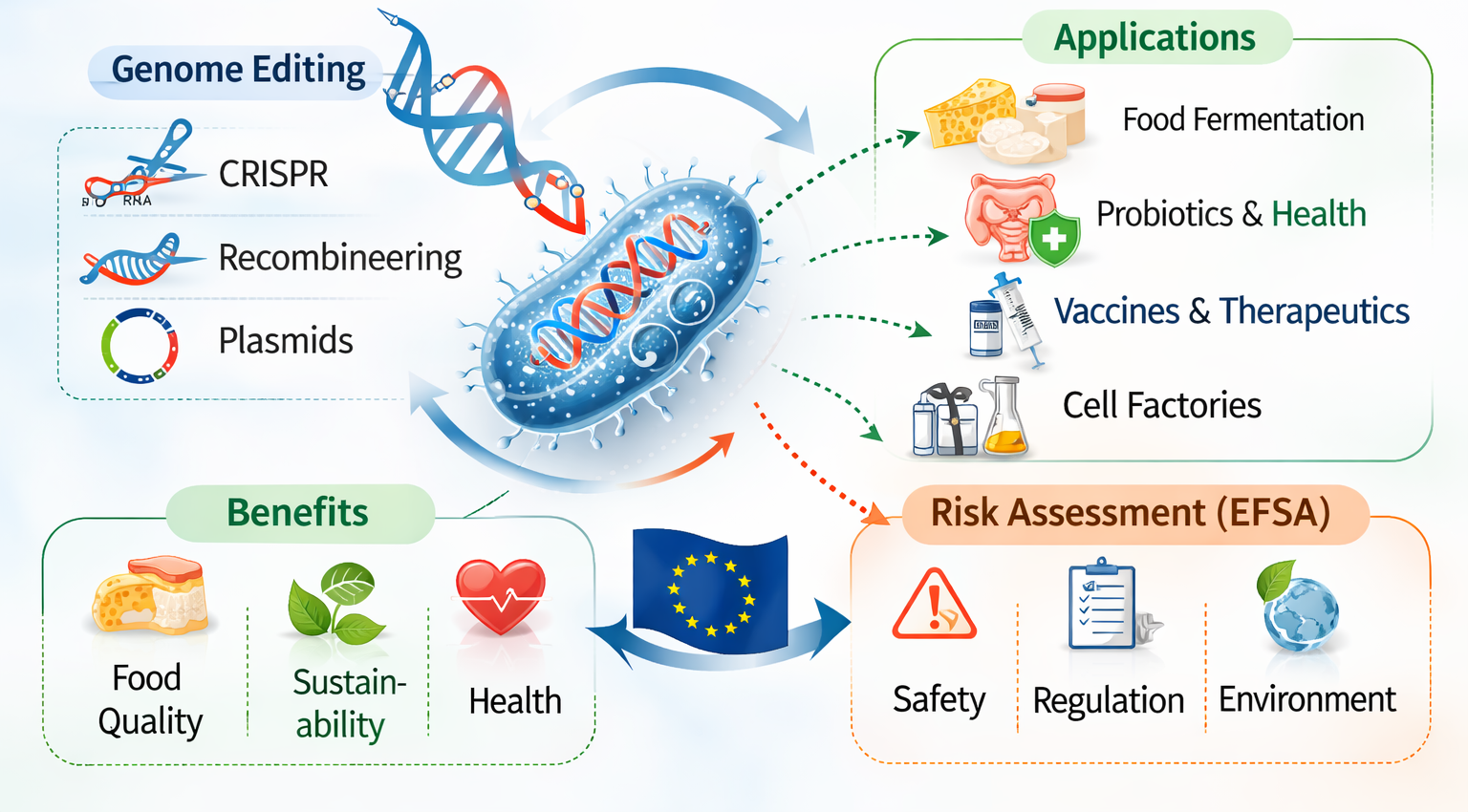
Genetically Modified Lactic Acid Bacteria in the EU Food Chain: Applications, Benefits, and Risk Assessment




Abstract
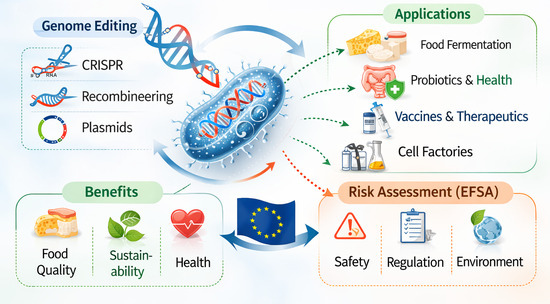
1. Introduction
2. Non-GMO LAB and Their Application in the Food Chain and Human Health
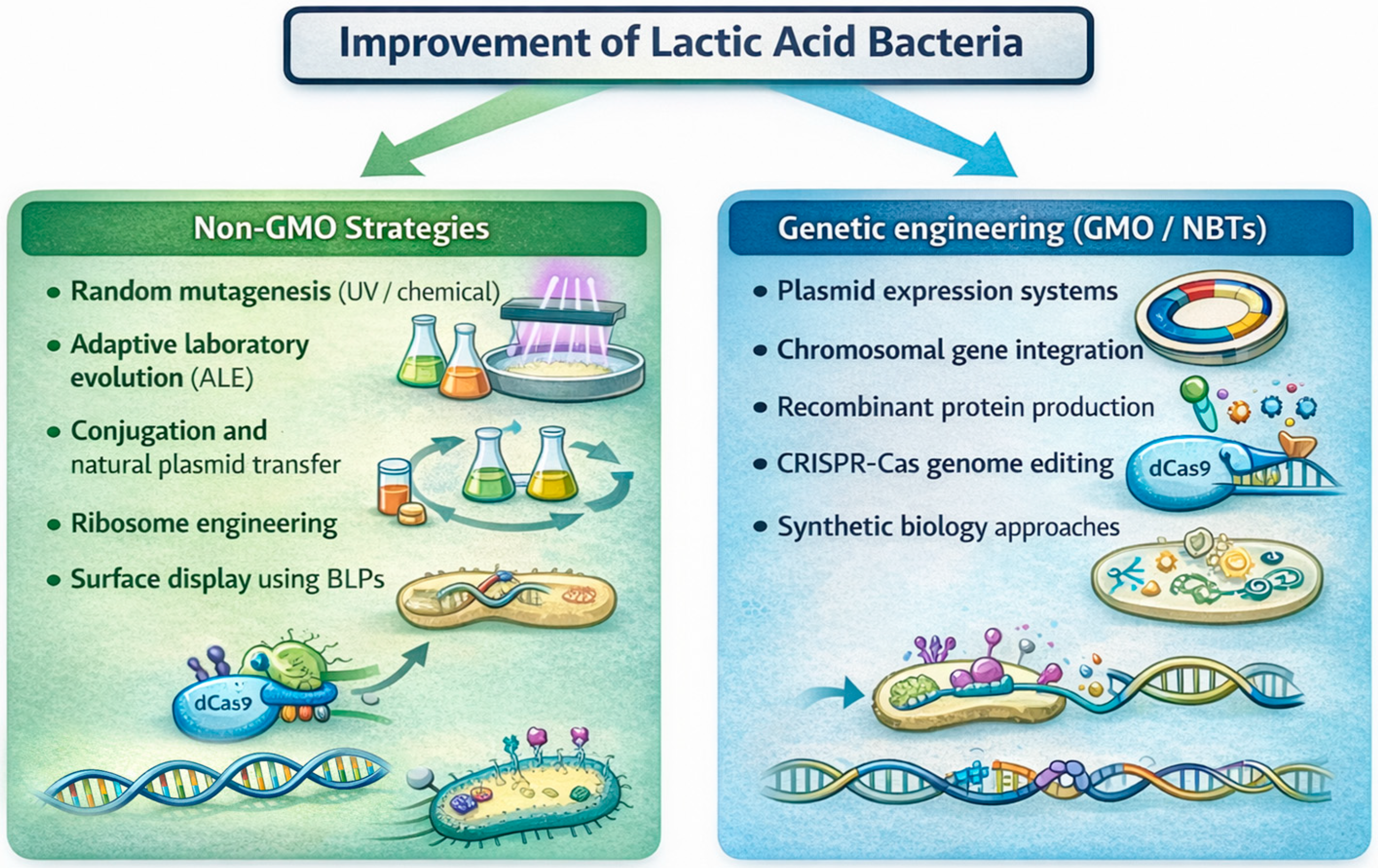
Non-GMO Strain Improvement Approaches
3. Advances in Genetic Engineering of LAB
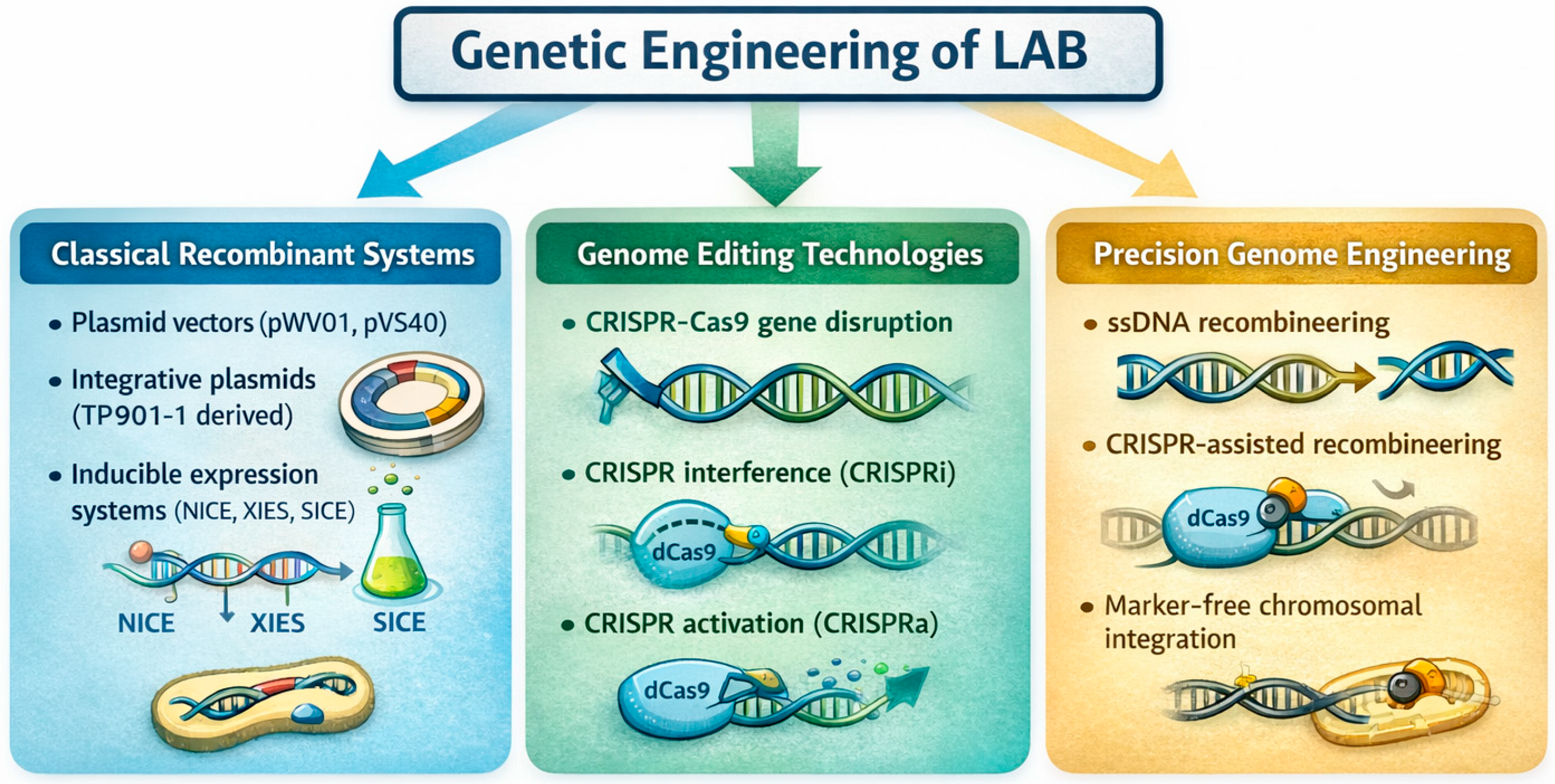
3.1. Classical Genetic Engineering of LAB
3.2. Genome-Editing and Synthetic Biology Tools
4. Applications of GM-LAB in the Food Chain and Human Health
4.1. Improved Fermentation Performance
4.2. Nutritional Enhancement of Foods and Bioactive Metabolite Synthesis
4.3. Food Safety Improvement and Biopreservation
4.4. Application of Engineered Probiotics In Vivo
4.5. GM-LAB as Cell Factories
5. Benefits of GM-LAB Application
5.1. Technological and Economic Benefits
5.2. Nutritional and Functional Benefits
5.3. Sustainability and Environmental Benefits
5.4. Safety Benefits
5.5. Evidence from Toxicological Studies
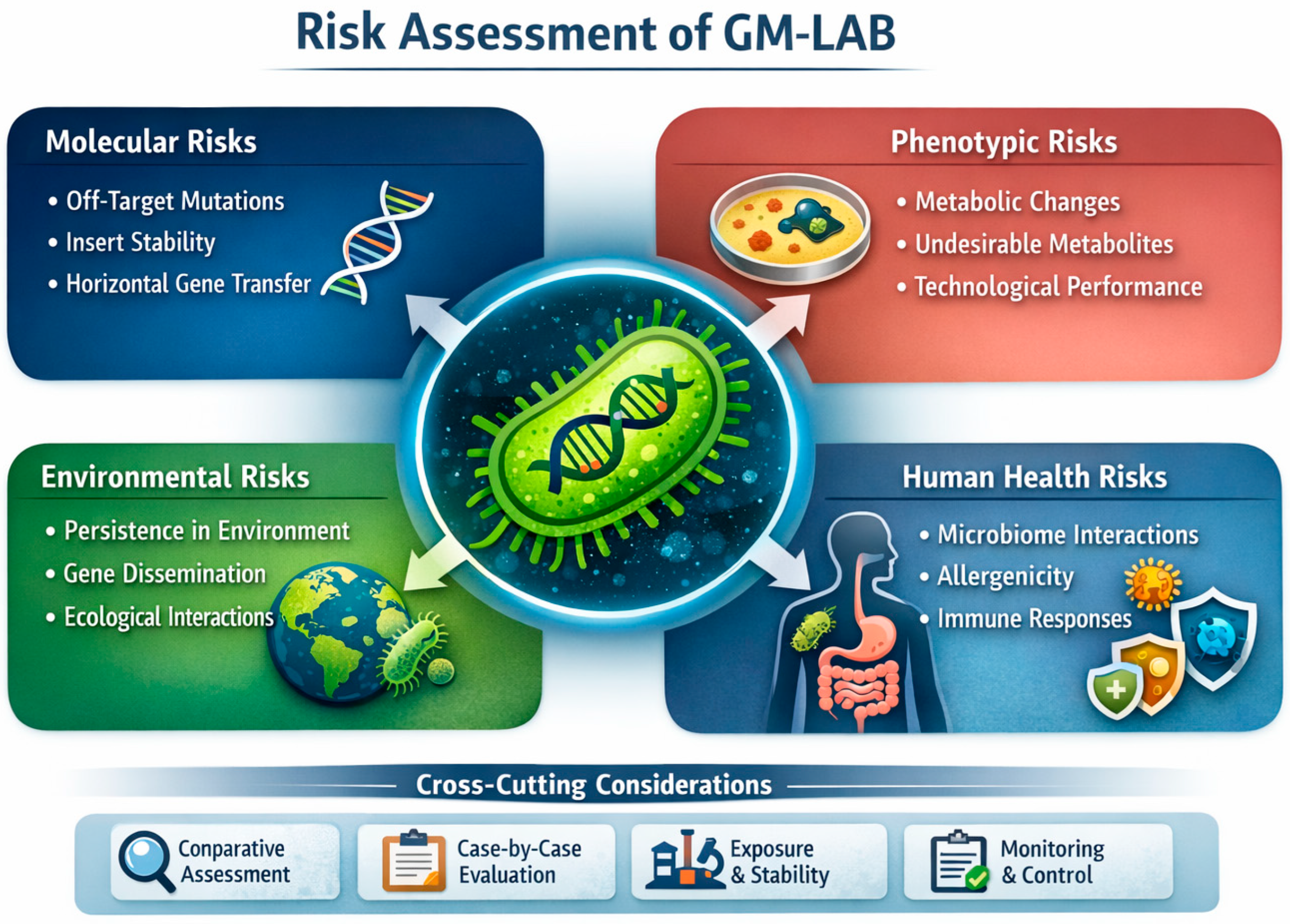
6. Risks, Safety Considerations, and EFSA Assessment
6.1. Molecular and Genetic Risks
6.2. Phenotypic and Metabolic Risks
6.3. Environmental Risks
6.4. Human Health Risks
7. Regulatory Framework for GM-LAB in the Food Chain
7.1. EU Regulatory Framework for GM-LAB
7.2. Regulatory Classification of Engineered LAB Products
8. Consumer Acceptance, Future Perspectives, and Research Gaps
9. Conclusions
Author Contributions
Funding
Institutional Review Board Statement
Informed Consent Statement
Data Availability Statement
Conflicts of Interest
Abbreviations
| ALE | Adaptive Laboratory Evolution |
| BLPs | Bacteria-Like Particles |
| CFU | Colony-Forming Units |
| CRISPR | Clustered Regularly Interspaced Short Palindromic Repeat |
| CRISPRa | CRISPR activation |
| CRISPRi | CRISPR interference |
| DSS | Dextran Sodium Sulfate |
| ECJ | European Court of Justice |
| EFSA | European Food Safety Authority |
| EMA | European Medicines Agency |
| EPSs | Exopolysaccharides |
| EU | European Union |
| GABA | γ-Aminobutyric Acid |
| GI | Gastrointestinal |
| GIT | Gastrointestinal tract |
| GM | Genetically Modified |
| GM-LAB | Genetically Modified Lactic Acid Bacteria |
| GMMs | Genetically Modified Microorganisms |
| GMO | Genetically Modified Organism |
| GRAS | Generally Recognized as Safe |
| HGT | Horizontal Gene Transfer |
| HPV | Human Papillomavirus |
| IBD | Inflammatory Bowel Disease |
| IJMS | International Journal of Molecular Sciences |
| IL | Interleukin |
| LAB | Lactic Acid Bacteria |
| LA | Lactic Acid |
| NBTs | New Breeding Techniques |
| NICE | Nisin-Controlled Gene Expression |
| PLA | Polylactic Acid |
| QPS | Qualified Presumption of Safety |
| RNP | Ribonucleoprotein |
| SCFAs | Short-Chain Fatty Acids |
| SICE | Stress-Inducible Controlled Expression |
| ssDNA | Single-Stranded DNA |
| SSCF | Simultaneous Saccharification and Co-Fermentation |
| TNBS | Trinitrobenzene Sulfonic Acid |
| XIES | Xylose-Inducible Expression System |
References
- Vindigni, G.; Peri, I.; Consentino, F.; Selvaggi, R.; Spina, D. Exploring Consumers’ Attitudes towards Food Products Derived by New Plant Breeding Techniques. Sustainability 2022, 14, 5995. [Google Scholar] [CrossRef]
- Laezza, C.; Francesca, S.; Barone, A.; Rigano, M.M. Genetic and Biotechnological Approaches to Preserve Food Quality against Climate Change. Food Agric. Immunol. 2024, 35, 2358795. [Google Scholar] [CrossRef]
- Gracia-Rodriguez, C.; Martínez-Medina, A.E.; Torres-Cosio, L.; Lopez-Ortiz, C.; Nimmakayala, P.; Luévanos-Escareño, M.P.; Hernández-Almanza, A.Y.; Castro-Alonso, M.J.; Sosa-Martínez, J.D.; Reddy, U.K.; et al. Can the Molecular and Transgenic Breeding of Crops Be an Alternative and Sustainable Technology to Meet Food Demand? Funct. Integr. Genom. 2025, 25, 83. [Google Scholar] [CrossRef]
- Khan, N. Unlocking Innovation in Crop Resilience and Productivity: Breakthroughs in Biotechnology and Sustainable Farming. Innov. Discov. 2024, 1, 28. [Google Scholar] [CrossRef]
- Chaudhary, D.; Pal, N.; Arora, A.; Prashant, B.D.; Venadan, S. Plant Functional Traits in Crop Breeding: Advancement and Challenges. In Plant Functional Traits for Improving Productivity; Kumar, N., Singh, H., Eds.; Springer Nature: Singapore, 2024; pp. 169–202. ISBN 978-981-97-1509-1. [Google Scholar]
- Mikiciuk, G.; Miller, T.; Kisiel, A.; Cembrowska-Lech, D.; Mikiciuk, M.; Łobodzińska, A.; Bokszczanin, K. Harnessing Beneficial Microbes for Drought Tolerance: A Review of Ecological and Agricultural Innovations. Agriculture 2024, 14, 2228. [Google Scholar] [CrossRef]
- Misu, I.J.; Kayess, M.O.; Siddiqui, M.N.; Gupta, D.R.; Islam, M.N.; Islam, T. Microbiome Engineering for Sustainable Rice Production: Strategies for Biofertilization, Stress Tolerance, and Climate Resilience. Microorganisms 2025, 13, 233. [Google Scholar] [CrossRef]
- Kumar, N.M.; Muthukumaran, C.; Sharmila, G.; Gurunathan, B. Genetically Modified Organisms and Its Impact on the Enhancement of Bioremediation. In Bioremediation: Applications for Environmental Protection and Management; Varjani, S.J., Agarwal, A.K., Gnansounou, E., Gurunathan, B., Eds.; Energy, Environment, and Sustainability; Springer: Singapore, 2018; pp. 53–76. ISBN 978-981-10-7484-4. [Google Scholar]
- Kumar, R.S.; Singh, D.; Bose, S.K.; Trivedi, P.K. Biodegradation of Environmental Pollutant through Pathways Engineering and Genetically Modified Organisms Approaches. In Microorganisms for Sustainable Environment and Health; Elsevier: Amsterdam, The Netherlands, 2020; pp. 137–165. ISBN 978-0-12-819001-2. [Google Scholar]
- Saxena, G.; Kishor, R.; Saratale, G.D.; Bharagava, R.N. Genetically Modified Organisms (GMOs) and Their Potential in Environmental Management: Constraints, Prospects, and Challenges. In Bioremediation of Industrial Waste for Environmental Safety; Bharagava, R.N., Saxena, G., Eds.; Springer: Singapore, 2020; pp. 1–19. ISBN 978-981-13-3425-2. [Google Scholar]
- Halecký, M.; Kozliak, E. Modern Bioremediation Approaches: Use of Biosurfactants, Emulsifiers, Enzymes, Biopesticides, GMOs. In Advanced Nano-Bio Technologies for Water and Soil Treatment; Filip, J., Cajthaml, T., Najmanová, P., Černík, M., Zbořil, R., Eds.; Applied Environmental Science and Engineering for a Sustainable Future; Springer International Publishing: Cham, Switzerland, 2020; pp. 495–526. ISBN 978-3-030-29839-5. [Google Scholar]
- Rebello, S.; Nathan, V.K.; Sindhu, R.; Binod, P.; Awasthi, M.K.; Pandey, A. Bioengineered Microbes for Soil Health Restoration: Present Status and Future. Bioengineered 2021, 12, 12839–12853. [Google Scholar] [CrossRef] [PubMed]
- Deckers, M.; Deforce, D.; Fraiture, M.-A.; Roosens, N.H.C. Genetically Modified Micro-Organisms for Industrial Food Enzyme Production: An Overview. Foods 2020, 9, 326. [Google Scholar] [CrossRef]
- Hanlon, P.; Sewalt, V. GEMs: Genetically Engineered Microorganisms and the Regulatory Oversight of Their Uses in Modern Food Production. Crit. Rev. Food Sci. Nutr. 2021, 61, 959–970. [Google Scholar] [CrossRef]
- Mirsalami, S.M.; Mirsalami, M. Advances in Genetically Engineered Microorganisms: Transforming Food Production through Precision Fermentation and Synthetic Biology. Future Foods 2025, 11, 100601. [Google Scholar] [CrossRef]
- Shi, C.; Maktabdar, M. Lactic Acid Bacteria as Biopreservation Against Spoilage Molds in Dairy Products—A Review. Front. Microbiol. 2022, 12, 819684. [Google Scholar] [CrossRef]
- Vacca, M.; Celano, G.; Serale, N.; Costantino, G.; Calabrese, F.M.; Calasso, M.; De Angelis, M. Dynamic Microbial and Metabolic Changes during Apulian Caciocavallo Cheesemaking and Ripening Produced According to a Standardized Protocol. J. Dairy Sci. 2024, 107, 6541–6557. [Google Scholar] [CrossRef]
- Lahiri, D.; Nag, M.; Sarkar, T.; Ray, R.R.; Shariati, M.A.; Rebezov, M.; Bangar, S.P.; Lorenzo, J.M.; Domínguez, R. Lactic Acid Bacteria (LAB): Autochthonous and Probiotic Microbes for Meat Preservation and Fortification. Foods 2022, 11, 2792. [Google Scholar] [CrossRef]
- Calasso, M.; Marzano, M.; Caponio, G.R.; Celano, G.; Fosso, B.; Calabrese, F.M.; De Palma, D.; Vacca, M.; Notario, E.; Pesole, G.; et al. Shelf-Life Extension of Leavened Bakery Products by Using Bio-Protective Cultures and Type-III Sourdough. LWT 2023, 177, 114587. [Google Scholar] [CrossRef]
- Marzano, M.; Calasso, M.; Caponio, G.R.; Celano, G.; Fosso, B.; De Palma, D.; Vacca, M.; Notario, E.; Pesole, G.; De Leo, F.; et al. Extension of the Shelf-Life of Fresh Pasta Using Modified Atmosphere Packaging and Bioprotective Cultures. Front. Microbiol. 2022, 13, 1003437. [Google Scholar] [CrossRef] [PubMed]
- Amenu, D.; Nugusa, A.; Tafesse, T. Preservative Effectiveness of Lactic Acid Bacteria on Fruits and Vegetables. Int. J. Cell Biol. 2025, 2025, 5833236. [Google Scholar] [CrossRef]
- Vacca, M.; Pinto, D.; Annunziato, A.; Ressa, A.; Calasso, M.; Pontonio, E.; Celano, G.; De Angelis, M. Gluten-Free Bread Enriched with Artichoke Leaf Extract In Vitro Exerted Antioxidant and Anti-Inflammatory Properties. Antioxidants 2023, 12, 845. [Google Scholar] [CrossRef] [PubMed]
- Zapaśnik, A.; Sokołowska, B.; Bryła, M. Role of Lactic Acid Bacteria in Food Preservation and Safety. Foods 2022, 11, 1283. [Google Scholar] [CrossRef]
- Börner, R.A.; Kandasamy, V.; Axelsen, A.M.; Nielsen, A.T.; Bosma, E.F. Genome Editing of Lactic Acid Bacteria: Opportunities for Food, Feed, Pharma and Biotech. FEMS Microbiol. Lett. 2019, 366, fny291. [Google Scholar] [CrossRef]
- Dorau, R.; Liu, J.; Solem, C.; Jensen, P.R. Metabolic Engineering of Lactic Acid Bacteria. In Metabolic Engineering; Nielsen, J., Stephanopoulos, G., Lee, S.Y., Eds.; Wiley: Hoboken, NJ, USA, 2021; pp. 551–610. ISBN 978-3-527-34662-2. [Google Scholar]
- Mugwanda, K.; Hamese, S.; Van Zyl, W.F.; Prinsloo, E.; Du Plessis, M.; Dicks, L.M.T.; Thimiri Govinda Raj, D.B. Recent Advances in Genetic Tools for Engineering Probiotic Lactic Acid Bacteria. Biosci. Rep. 2023, 43, BSR20211299. [Google Scholar] [CrossRef]
- Ullah, M.; Naeem, M.; Andoh, V.; Khan, M.N.; Han, J.; Rizwan, M.; Hussain, N.; Saeed, M.; Chen, Y.; Chen, H. Lactic Acid Bacteria as Biofactories: Mechanistic Insights, Engineering Strategies, and Future Horizons for Heterologous Enzyme Expression. J. Agric. Food Chem. 2025, 73, 16028–16048. [Google Scholar] [CrossRef]
- Kazi, T.A.; Acharya, A.; Mukhopadhyay, B.C.; Mandal, S.; Arukha, A.P.; Nayak, S.; Biswas, S.R. Plasmid-Based Gene Expression Systems for Lactic Acid Bacteria: A Review. Microorganisms 2022, 10, 1132. [Google Scholar] [CrossRef] [PubMed]
- Xie, Z.; McAuliffe, O.; Jin, Y.-S.; Miller, M.J. Invited Review: Genomic Modifications of Lactic Acid Bacteria and Their Applications in Dairy Fermentation. J. Dairy Sci. 2024, 107, 8749–8764. [Google Scholar] [CrossRef]
- Cui, Y.; Qu, X. CRISPR-Cas Systems of Lactic Acid Bacteria and Applications in Food Science. Biotechnol. Adv. 2024, 71, 108323. [Google Scholar] [CrossRef]
- Ali, R.M.; Arshad, H.; Zafar, A.Q.; Gull, S.; Gul, A.; Mansoor, F.; Zahid, R. A Comprehensive Review on Engineering Lactic Acid Bacteria: Emerging Genetic Tools and Synthetic Biology Strategies. Biotech. Appl. Biochem. 2025, bab.70079. [Google Scholar] [CrossRef]
- Bruetschy, C. The EU Regulatory Framework on Genetically Modified Organisms (GMOs). Transgenic Res. 2019, 28, 169–174. [Google Scholar] [CrossRef]
- European Parliament. Directive 2001/18/EC of the European Parliament and of the Council of 12 March 2001 on the Deliberate Release into the Environment of Genetically Modified Organisms and Repealing Council Directive 90/220/EEC-Commission Declaration. Off. J. L 2001, 106, 0001–0039. [Google Scholar]
- European Parliament. Regulation (EC) No 1829/2003 of the European Parliament and of the Council of 22 September 2003 on Genetically Modified Food and Feed. Off. J. L 2003, 268, 0001–0023. [Google Scholar]
- Akpoghelie, P.O.; Edo, G.I.; Ali, A.B.M.; Yousif, E.; Zainulabdeen, K.; Owheruo, J.O.; Isoje, E.F.; Igbuku, U.A.; Essaghah, A.E.A.; Makia, R.S.; et al. Lactic Acid Bacteria: Nature, Characterization, Mode of Action, Products and Applications. Process Biochem. 2025, 152, 1–28. [Google Scholar] [CrossRef]
- Abdul Hakim, B.N.; Xuan, N.J.; Oslan, S.N.H. A Comprehensive Review of Bioactive Compounds from Lactic Acid Bacteria: Potential Functions as Functional Food in Dietetics and the Food Industry. Foods 2023, 12, 2850. [Google Scholar] [CrossRef]
- Arora, K.; Ameur, H.; Polo, A.; Di Cagno, R.; Rizzello, C.G.; Gobbetti, M. Thirty Years of Knowledge on Sourdough Fermentation: A Systematic Review. Trends Food Sci. Technol. 2021, 108, 71–83. [Google Scholar] [CrossRef]
- Calabrese, F.M.; Ameur, H.; Nikoloudaki, O.; Celano, G.; Vacca, M.; JFLemos, W., Jr.; Manzari, C.; Vertè, F.; Di Cagno, R.; Pesole, G.; et al. Metabolic Framework of Spontaneous and Synthetic Sourdough Metacommunities to Reveal Microbial Players Responsible for Resilience and Performance. Microbiome 2022, 10, 148. [Google Scholar] [CrossRef]
- Ray, R.C.; Paramithiotis, S.; Thekkangil, A.; Nethravathy, V.; Rai, A.K.; Martin, J.G.P. Food Fermentation and Its Relevance in the Human History. In Trending Topics on Fermented Foods; Martin, J.G.P., De Dea Lindner, J., Melo Pereira, G.V.D., Ray, R.C., Eds.; Springer Nature: Cham, Switzerland, 2024; pp. 1–57. ISBN 978-3-031-71999-8. [Google Scholar]
- Garcia, C.; Guerin, M.; Souidi, K.; Remize, F. Lactic Fermented Fruit or Vegetable Juices: Past, Present and Future. Beverages 2020, 6, 8. [Google Scholar] [CrossRef]
- Russo, P.; Spano, G.; Capozzi, V. Safety Evaluation of Starter Cultures. In Starter Cultures in Food Production; Speranza, B., Bevilacqua, A., Corbo, M.R., Sinigaglia, M., Eds.; Wiley: Hoboken, NJ, USA, 2017; pp. 101–128. ISBN 978-1-118-93376-3. [Google Scholar]
- Vinicius De Melo Pereira, G.; De Carvalho Neto, D.P.; Junqueira, A.C.D.O.; Karp, S.G.; Letti, L.A.J.; Magalhães Júnior, A.I.; Soccol, C.R. A Review of Selection Criteria for Starter Culture Development in the Food Fermentation Industry. Food Rev. Int. 2020, 36, 135–167. [Google Scholar] [CrossRef]
- Coelho, M.C.; Malcata, F.X.; Silva, C.C.G. Lactic Acid Bacteria in Raw-Milk Cheeses: From Starter Cultures to Probiotic Functions. Foods 2022, 11, 2276. [Google Scholar] [CrossRef]
- Cai, H.; Thompson, R.; Budinich, M.F.; Broadbent, J.R.; Steele, J.L. Genome Sequence and Comparative Genome Analysis of Lactobacillus Casei: Insights into Their Niche-Associated Evolution. Genome Biol. Evol. 2009, 1, 239–257. [Google Scholar] [CrossRef] [PubMed]
- Stefanovic, E.; McAuliffe, O. Comparative Genomic and Metabolic Analysis of Three Lactobacillus Paracasei Cheese Isolates Reveals Considerable Genomic Differences in Strains from the Same Niche. BMC Genom. 2018, 19, 205. [Google Scholar] [CrossRef]
- Li, W.; Sun, J.; Wu, Q.; Kwok, L.-Y.; Dong, G.; Sun, Z. Global Genomics of Lactococcus Lactis: Horizontal Gene Transfer and Intergenic Variation Drive Multiple Domestication and Dairy Adaptation. J. Adv. Res. 2025; in press. [CrossRef] [PubMed]
- Wels, M.; Siezen, R.; Van Hijum, S.; Kelly, W.J.; Bachmann, H. Comparative Genome Analysis of Lactococcus Lactis Indicates Niche Adaptation and Resolves Genotype/Phenotype Disparity. Front. Microbiol. 2019, 10, 4. [Google Scholar] [CrossRef]
- You, L.; Jin, H.; Kwok, L.-Y.; Lv, R.; Zhao, Z.; Bilige, M.; Sun, Z.; Liu, W.; Zhang, H. Intraspecific Microdiversity and Ecological Drivers of Lactic Acid Bacteria in Naturally Fermented Milk Ecosystem. Sci. Bull. 2023, 68, 2405–2417. [Google Scholar] [CrossRef]
- Lindgren, S. Biosafety Aspects of Genetically Modified Lactic Acid Bacteria in EU Legislation. Int. Dairy J. 1999, 9, 37–41. [Google Scholar] [CrossRef]
- Rozanov, A.S.; Shaposhnikov, L.A.; Bondarenko, K.D.; Sazonov, A.E. Advances in Genetic Transformation of Lactic Acid Bacteria: Overcoming Barriers and Enhancing Plasmid Tools. Int. J. Mol. Sci. 2025, 26, 9146. [Google Scholar] [CrossRef] [PubMed]
- Biørnstad, T.J.; Håvarstein, L.S. ClpC Acts as a Negative Regulator of Competence in Streptococcus Thermophilus. Microbiology 2011, 157, 1676–1684. [Google Scholar] [CrossRef] [PubMed]
- Dalia, A.B.; Dalia, T.N. Spatiotemporal Analysis of DNA Integration during Natural Transformation Reveals a Mode of Nongenetic Inheritance in Bacteria. Cell 2019, 179, 1499–1511.e10. [Google Scholar] [CrossRef]
- Fontaine, L.; Wahl, A.; Fléchard, M.; Mignolet, J.; Hols, P. Regulation of Competence for Natural Transformation in Streptococci. Infect. Genet. Evol. 2015, 33, 343–360. [Google Scholar] [CrossRef]
- Van Pijkeren, J.-P.; Barrangou, R. Genome Editing of Food-Grade Lactobacilli To Develop Therapeutic Probiotics. Microbiol. Spectr. 2017, 5, 10-1128. [Google Scholar] [CrossRef]
- Dorau, R.; Chen, J.; Liu, J.; Ruhdal Jensen, P.; Solem, C. Adaptive Laboratory Evolution as a Means To Generate Lactococcus Lactis Strains with Improved Thermotolerance and Ability To Autolyze. Appl. Environ. Microbiol. 2021, 87, e01035-21. [Google Scholar] [CrossRef] [PubMed]
- Wang, G.; Li, Q.; Zhang, Z.; Yin, X.; Wang, B.; Yang, X. Recent Progress in Adaptive Laboratory Evolution of Industrial Microorganisms. J. Ind. Microbiol. Biotechnol. 2023, 50, kuac023. [Google Scholar] [CrossRef]
- Mills, S.; McAuliffe, O.E.; Coffey, A.; Fitzgerald, G.F.; Ross, R.P. Plasmids of Lactococci–Genetic Accessories or Genetic Necessities? FEMS Microbiol. Rev. 2006, 30, 243–273. [Google Scholar] [CrossRef] [PubMed]
- Raleigh, E.A.; Low, K.B. Conjugation. In Brenner’s Encyclopedia of Genetics; Elsevier: Amsterdam, The Netherlands, 2013; pp. 144–151. ISBN 978-0-08-096156-9. [Google Scholar]
- Igler, C.; Schwyter, L.; Gehrig, D.; Wendling, C.C. Conjugative Plasmid Transfer Is Limited by Prophages but Can Be Overcome by High Conjugation Rates. Phil. Trans. R. Soc. B 2022, 377, 20200470. [Google Scholar] [CrossRef]
- Pfeifer, E.; Bonnin, R.A.; Rocha, E.P.C. Phage-Plasmids Spread Antibiotic Resistance Genes through Infection and Lysogenic Conversion. mBio 2022, 13, e01851-22. [Google Scholar] [CrossRef]
- Salzano, G.; Villani, F.; Pepe, O.; Sorrentino, E.; Moschetti, G.; Coppola, S. Conjugal Transfer of Plasmid-Borne Bacteriocin Production in Enterococcus faecalis 226 NWC. FEMS Microbiol. Lett. 1992, 99, 1–6. [Google Scholar] [CrossRef][Green Version]
- Ito, Y.; Kawai, Y.; Arakawa, K.; Honme, Y.; Sasaki, T.; Saito, T. Conjugative Plasmid from Lactobacillus gasseri LA39 That Carries Genes for Production of and Immunity to the Circular Bacteriocin Gassericin A. Appl. Env. Microbiol. 2009, 75, 6340–6351. [Google Scholar] [CrossRef]
- Devi, S.M.; Halami, P.M. Conjugal Transfer of Bacteriocin Plasmids from Different Genera of Lactic Acid Bacteria into Enterococcus Faecalis JH2-2. Ann. Microbiol. 2013, 63, 1611–1617. [Google Scholar] [CrossRef]
- Van Pijkeren, J.-P.; Britton, R.A. High Efficiency Recombineering in Lactic Acid Bacteria. Nucleic Acids Res. 2012, 40, e76. [Google Scholar] [CrossRef]
- Galgano, M.; Pellegrini, F.; Catalano, E.; Capozzi, L.; Del Sambro, L.; Sposato, A.; Lucente, M.S.; Vasinioti, V.I.; Catella, C.; Odigie, A.E.; et al. Acquired Bacterial Resistance to Antibiotics and Resistance Genes: From Past to Future. Antibiotics 2025, 14, 222. [Google Scholar] [CrossRef] [PubMed]
- Namai, F.; Nishiyama, K.; Kitazawa, H.; Shimosato, T. Introduction of Spontaneous Mutations Using Streptomycin as a Method for Lactic Acid Bacteria Breeding. In Lactic Acid Bacteria; Kanauchi, M., Ed.; Methods in Molecular Biology; Springer: New York, NY, USA, 2024; Volume 2851, pp. 15–21. ISBN 978-1-0716-4095-1. [Google Scholar]
- Tsukagoshi, M.; Soyolmaa, J.; Nomoto, S.; Namai, F.; Murakami, A.; Inoue, K.; Yoda, M.; Hibi, T.; Sato, T.; Kinoshita, H.; et al. Ribosome-Engineered Lacticaseibacillus rhamnosus GG with Enhanced Adhesion and Immune Activation via Surface Moonlighting Proteins. Microbiol. Spectr. 2025, 13, e0263525. [Google Scholar] [CrossRef] [PubMed]
- Visweswaran, G.R.R.; Leenhouts, K.; Van Roosmalen, M.; Kok, J.; Buist, G. Exploiting the Peptidoglycan-Binding Motif, LysM, for Medical and Industrial Applications. Appl. Microbiol. Biotechnol. 2014, 98, 4331–4345. [Google Scholar] [CrossRef] [PubMed]
- Jiang, J.-N.; Kong, F.-H.; Lei, Q.; Zhang, X.-Z. Surface-Functionalized Bacteria: Frontier Explorations in next-Generation Live Biotherapeutics. Biomaterials 2025, 317, 123029. [Google Scholar] [CrossRef] [PubMed]
- Sybesma, W.; Hugenholtz, J.; De Vos, W.M.; Smid, E.J. Safe Use of Genetically Modified Lactic Acid Bacteria in Food. Bridging the Gap between Consumers, Green Groups, and Industry. Electron. J. Biotechnol. 2006, 9, 424–448. [Google Scholar] [CrossRef]
- LeBlanc, J.G.; Van Sinderen, D.; Hugenholtz, J.; Piard, J.-C.; Sesma, F.; Savoy De Giori, G. Risk Assessment of Genetically Modified Lactic Acid Bacteria Using the Concept of Substantial Equivalence. Curr. Microbiol. 2010, 61, 590–595. [Google Scholar] [CrossRef]
- Shaposhnikov, L.A.; Rozanov, A.S.; Sazonov, A.E. Genome-Editing Tools for Lactic Acid Bacteria: Past Achievements, Current Platforms, and Future Directions. Int. J. Mol. Sci. 2025, 26, 7483. [Google Scholar] [CrossRef]
- Benbouziane, B.; Ribelles, P.; Aubry, C.; Martin, R.; Kharrat, P.; Riazi, A.; Langella, P.; Bermúdez-Humarán, L.G. Development of a Stress-Inducible Controlled Expression (SICE) System in Lactococcus Lactis for the Production and Delivery of Therapeutic Molecules at Mucosal Surfaces. J. Biotechnol. 2013, 168, 120–129. [Google Scholar] [CrossRef]
- Miyoshi, A.; Jamet, E.; Commissaire, J.; Renault, P.; Langella, P.; Azevedo, V. A Xylose-Inducible Expression System for Lactococcus lactis. FEMS Microbiol. Lett. 2004, 239, 205–212. [Google Scholar] [CrossRef]
- De Moreno De LeBlanc, A.; Del Carmen, S.; Chatel, J.-M.; Miyoshi, A.; Azevedo, V.; Langella, P.; Bermúdez-Humarán, L.G.; LeBlanc, J.G. Current Review of Genetically Modified Lactic Acid Bacteria for the Prevention and Treatment of Colitis Using Murine Models. Gastroenterol. Res. Pract. 2015, 2015, 1–8. [Google Scholar] [CrossRef]
- Levit, R.; Cortes-Perez, N.G.; De Moreno De Leblanc, A.; Loiseau, J.; Aucouturier, A.; Langella, P.; LeBlanc, J.G.; Bermúdez-Humarán, L.G. Use of Genetically Modified Lactic Acid Bacteria and Bifidobacteria as Live Delivery Vectors for Human and Animal Health. Gut Microbes 2022, 14, 2110821. [Google Scholar] [CrossRef]
- Chou, C.P. Engineering Cell Physiology to Enhance Recombinant Protein Production in Escherichia Coli. Appl. Microbiol. Biotechnol. 2007, 76, 521–532. [Google Scholar] [CrossRef] [PubMed]
- Chen, X.; Li, C.; Liu, H. Enhanced Recombinant Protein Production Under Special Environmental Stress. Front. Microbiol. 2021, 12, 630814. [Google Scholar] [CrossRef] [PubMed]
- Palomares, L.A.; Estrada-Mondaca, S.; Ramírez, O.T. Production of Recombinant Proteins: Challenges and Solutions. In Recombinant Gene Expression; Humana Press: Clifton, NJ, USA, 2004; Volume 267, pp. 015–052. ISBN 978-1-59259-774-1. [Google Scholar]
- Yao, R.; Liu, D.; Jia, X.; Zheng, Y.; Liu, W.; Xiao, Y. CRISPR-Cas9/Cas12a Biotechnology and Application in Bacteria. Synth. Syst. Biotechnol. 2018, 3, 135–149, Erratum in Synth. Syst. Biotechnol. 2020, 5, 328. [Google Scholar] [CrossRef] [PubMed]
- Aljabali, A.A.A.; El-Tanani, M.; Tambuwala, M.M. Principles of CRISPR-Cas9 Technology: Advancements in Genome Editing and Emerging Trends in Drug Delivery. J. Drug Deliv. Sci. Technol. 2024, 92, 105338. [Google Scholar] [CrossRef]
- Schultenkämper, K.; Brito, L.F.; Wendisch, V.F. Impact of CRISPR Interference on Strain Development in Biotechnology. Biotech. Appl. Biochem. 2020, 67, 7–21. [Google Scholar] [CrossRef]
- Replogle, J.M.; Bonnar, J.L.; Pogson, A.N.; Liem, C.R.; Maier, N.K.; Ding, Y.; Russell, B.J.; Wang, X.; Leng, K.; Guna, A.; et al. Maximizing CRISPRi Efficacy and Accessibility with Dual-sgRNA Libraries and Optimal Effectors. eLife 2022, 11, e81856. [Google Scholar] [CrossRef]
- Khambhati, K.; Bhattacharjee, G.; Gohil, N.; Dhanoa, G.K.; Sagona, A.P.; Mani, I.; Bui, N.L.; Chu, D.-T.; Karapurkar, J.K.; Jang, S.H.; et al. Phage Engineering and Phage-Assisted CRISPR-Cas Delivery to Combat Multidrug-Resistant Pathogens. Bioeng. Transl. Med. 2023, 8, e10381. [Google Scholar] [CrossRef] [PubMed]
- Alessa, O.; Aiba, Y.; Arbaah, M.; Hidaka, Y.; Watanabe, S.; Miyanaga, K.; Wannigama, D.L.; Cui, L. Synthetic and Functional Engineering of Bacteriophages: Approaches for Tailored Bactericidal, Diagnostic, and Delivery Platforms. Molecules 2025, 30, 3132. [Google Scholar] [CrossRef] [PubMed]
- Maguin, E.; Duwat, P.; Hege, T.; Ehrlich, D.; Gruss, A. New Thermosensitive Plasmid for Gram-Positive Bacteria. J. Bacteriol. 1992, 174, 5633–5638. [Google Scholar] [CrossRef]
- Serror, P.; Ilami, G.; Chouayekh, H.; Ehrlich, S.D.; Maguin, E. Transposition in Lactobacillus Delbrueckii Subsp. Bulgaricus: Identification of Two Thermosensitive Replicons and Two Functional Insertion Sequences. Microbiology 2003, 149, 1503–1511. [Google Scholar] [CrossRef] [PubMed][Green Version]
- Cotter, P.D.; Hill, C.; Ross, R.P. A Food-Grade Approach for Functional Analysis and Modification of Native Plasmids in Lactococcus lactis. Appl. Environ. Microbiol. 2003, 69, 702–706. [Google Scholar] [CrossRef] [PubMed][Green Version]
- Cui, Y.; Hu, T.; Qu, X.; Zhang, L.; Ding, Z.; Dong, A. Plasmids from Food Lactic Acid Bacteria: Diversity, Similarity, and New Developments. Int. J. Mol. Sci. 2015, 16, 13172–13202. [Google Scholar] [CrossRef]
- Landete, J.M. A Review of Food-Grade Vectors in Lactic Acid Bacteria: From the Laboratory to Their Application. Crit. Rev. Biotechnol. 2017, 37, 296–308. [Google Scholar] [CrossRef]
- Plavec, T.V.; Berlec, A. Safety Aspects of Genetically Modified Lactic Acid Bacteria. Microorganisms 2020, 8, 297. [Google Scholar] [CrossRef]
- Konings, W.N.; Kuipers, O.P.; Huis Veld, J.H.J. (Eds.) Lactic Acid Bacteria: Genetics, Metabolism and Applications; Springer: Dordrecht, The Netherlands, 1999; ISBN 978-90-481-5312-1. [Google Scholar]
- Martinussen, J.; Hammer, K. Cloning and Characterization of Upp, a Gene Encoding Uracil Phosphoribosyltransferase from Lactococcus lactis. J. Bacteriol. 1994, 176, 6457–6463. [Google Scholar] [CrossRef]
- Martinussen, J.; Hammer, K. Powerful Methods to Establish Chromosomal Markers in Lactococcus Lactis: An Analysis of Pyrimidine Salvage Pathway Mutants Obtained by Positive Selections. Microbiology 1995, 141, 1883–1890. [Google Scholar] [CrossRef][Green Version]
- Bron, P.A.; Benchimol, M.G.; Lambert, J.; Palumbo, E.; Deghorain, M.; Delcour, J.; De Vos, W.M.; Kleerebezem, M.; Hols, P. Use of the Alr Gene as a Food-Grade Selection Marker in Lactic Acid Bacteria. Appl. Environ. Microbiol. 2002, 68, 5663–5670. [Google Scholar] [CrossRef] [PubMed]
- Liang, Z.; Zheng, K.; Xie, G.; Luo, X.; Li, H. Sugar Utilization-Associated Food-Grade Selection Markers in Lactic Acid Bacteria and Yeast. Pol. J. Microbiol. 2024, 73, 3–10. [Google Scholar] [CrossRef] [PubMed]
- Xin, Y.; Guo, T.; Mu, Y.; Kong, J. Development of a Counterselectable Seamless Mutagenesis System in Lactic Acid Bacteria. Microb. Cell Fact. 2017, 16, 116. [Google Scholar] [CrossRef] [PubMed]
- Petersen, K.V.; Martinussen, J.; Jensen, P.R.; Solem, C. Repetitive, Marker-Free, Site-Specific Integration as a Novel Tool for Multiple Chromosomal Integration of DNA. Appl. Environ. Microbiol. 2013, 79, 3563–3569. [Google Scholar] [CrossRef]
- Koko, I.; Song, A.A.-L.; Masarudin, M.J.; Abdul Rahim, R. Engineering Integrative Vectors Based on Phage Site-Specific Recombination Mechanism for Lactococcus lactis. BMC Biotechnol. 2019, 19, 82. [Google Scholar] [CrossRef]
- Guo, T.; Xin, Y.; Zhang, Y.; Gu, X.; Kong, J. A Rapid and Versatile Tool for Genomic Engineering in Lactococcus lactis. Microb. Cell Fact. 2019, 18, 22. [Google Scholar] [CrossRef]
- Datta, S.; Costantino, N.; Zhou, X.; Court, D.L. Identification and Analysis of Recombineering Functions from Gram-Negative and Gram-Positive Bacteria and Their Phages. Proc. Natl. Acad. Sci. USA 2008, 105, 1626–1631. [Google Scholar] [CrossRef]
- Song, X.; Liu, L.; Liu, X.-X.; Xiong, Z.-Q.; Xie, C.-L.; Wang, S.-J.; Ai, L.-Z. Single-Plasmid Systems Based on CRISPR-Cas9 for Gene Editing in Lactococcus lactis. J. Dairy Sci. 2021, 104, 10576–10585. [Google Scholar] [CrossRef]
- Oh, J.-H.; van Pijkeren, J.-P. CRISPR–Cas9-Assisted Recombineering in Lactobacillus reuteri. Nucleic Acids Res. 2014, 42, e131. [Google Scholar] [CrossRef]
- Liu, Z.; Zhao, X.; Bangash, H.I. Expression of Stress Responsive Genes Enables Limosilactobacillus Reuteri to Cross-Protection against Acid, Bile Salt, and Freeze-Drying. Front. Microbiol. 2024, 15, 1437803. [Google Scholar] [CrossRef]
- Pyne, M.E.; Moo-Young, M.; Chung, D.A.; Chou, C.P. Coupling the CRISPR/Cas9 System with Lambda Red Recombineering Enables Simplified Chromosomal Gene Replacement in Escherichia Coli. Appl. Environ. Microbiol. 2015, 81, 5103–5114. [Google Scholar] [CrossRef]
- Barrangou, R.; Horvath, P. The CRISPR System Protects Microbes against Phages, Plasmids. Microbe Mag. 2009, 4, 224–230. [Google Scholar] [CrossRef]
- Barrangou, R.; Marraffini, L.A. CRISPR-Cas Systems: Prokaryotes Upgrade to Adaptive Immunity. Mol. Cell 2014, 54, 234–244. [Google Scholar] [CrossRef] [PubMed]
- Xue, C.; Sashital, D.G. Mechanisms of Type I-E and I-F CRISPR-Cas Systems in Enterobacteriaceae. EcoSal Plus 2019, 8, 1–24. [Google Scholar] [CrossRef] [PubMed]
- Mierau, I.; Kleerebezem, M. 10 Years of the Nisin-Controlled Gene Expression System (NICE) in Lactococcus lactis. Appl. Microbiol. Biotechnol. 2005, 68, 705–717. [Google Scholar] [CrossRef]
- Linares, D.M.; Kok, J.; Poolman, B. Genome Sequences of Lactococcus lactis MG1363 (Revised) and NZ9000 and Comparative Physiological Studies. J. Bacteriol. 2010, 192, 5806–5812. [Google Scholar] [CrossRef] [PubMed]
- Morello, E.; Bermúdez-Humarán, L.G.; Llull, D.; Solé, V.; Miraglio, N.; Langella, P.; Poquet, I. Lactococcus lactis, an Efficient Cell Factory for Recombinant Protein Production and Secretion. Microb. Physiol. 2008, 14, 48–58. [Google Scholar] [CrossRef]
- Hollmann, A.; Saviello, M.; Delfederico, L.; Saraiva, T.D.L.; Barh, D.; Jain, N.; Tiwari, S.; Chandra, S.; Gupta, K.; Zambare, V.; et al. Tight Controlled Expression and Secretion of Lactobacillus Brevis SlpA in Lactococcus lactis. Biotechnol. Lett. 2012, 34, 1275–1281. [Google Scholar] [CrossRef]
- Hidalgo-Cantabrana, C.; O’Flaherty, S.; Barrangou, R. CRISPR-Based Engineering of next-Generation Lactic Acid Bacteria. Curr. Opin. Microbiol. 2017, 37, 79–87. [Google Scholar] [CrossRef]
- Zhao, L.; Xin, J.; Hu, M.; Xue, C.; Dong, N. Programmable Microbial Therapeutics: Advances in Engineered Bacteria for Targeted in Vivo Delivery and Precision Medicine. J. Adv. Res. 2025; in press. [CrossRef]
- Liu, Y.; Zhu, Z.; Jiang, L. Programming Therapeutic Probiotics by Self-Tunable Sense-and-Respond Genetic Circuits. Trends Microbiol. 2023, 31, 1099–1101. [Google Scholar] [CrossRef] [PubMed]
- Jin, K.; Huang, Y.; Che, H.; Wu, Y. Engineered Bacteria for Disease Diagnosis and Treatment Using Synthetic Biology. Microb. Biotechnol. 2025, 18, e70080. [Google Scholar] [CrossRef] [PubMed]
- Borrero, J.; Chen, Y.; Dunny, G.M.; Kaznessis, Y.N. Modified Lactic Acid Bacteria Detect and Inhibit Multiresistant Enterococci. ACS Synth. Biol. 2015, 4, 299–306. [Google Scholar] [CrossRef]
- Cano-Garrido, O.; Seras-Franzoso, J.; Garcia-Fruitós, E. Lactic Acid Bacteria: Reviewing the Potential of a Promising Delivery Live Vector for Biomedical Purposes. Microb. Cell Fact. 2015, 14, 137. [Google Scholar] [CrossRef] [PubMed]
- De Vos, W.M. Safe and Sustainable Systems for Food-Grade Fermentations by Genetically Modified Lactic Acid Bacteria. Int. Dairy. J. 1999, 9, 3–10. [Google Scholar] [CrossRef]
- Dong, H.; Wang, H.; Fu, S.; Zhang, D. CRISPR/Cas Tools for Enhancing the Biopreservation Ability of Lactic Acid Bacteria in Aquatic Products. Front. Bioeng. Biotechnol. 2022, 10, 1114588. [Google Scholar] [CrossRef]
- LeBlanc, J.G.; Aubry, C.; Cortes-Perez, N.G.; De Moreno De LeBlanc, A.; Vergnolle, N.; Langella, P.; Azevedo, V.; Chatel, J.-M.; Miyoshi, A.; Bermúdez-Humarán, L.G. Mucosal Targeting of Therapeutic Molecules Using Genetically Modified Lactic Acid Bacteria: An Update. FEMS Microbiol. Lett. 2013, 344, 1–9. [Google Scholar] [CrossRef]
- Renault, P. Genetically Modified Lactic Acid Bacteria: Applications to Food or Health and Risk Assessment. Biochimie 2002, 84, 1073–1087. [Google Scholar] [CrossRef]
- Van Pijkeren, J.P.; Britton, R.A. Precision Genome Engineering in Lactic Acid Bacteria. Microb. Cell Fact. 2014, 13, S10. [Google Scholar] [CrossRef]
- Wu, J.; Xin, Y.; Kong, J.; Guo, T. Genetic Tools for the Development of Recombinant Lactic Acid Bacteria. Microb. Cell Fact. 2021, 20, 118. [Google Scholar] [CrossRef]
- Shonyela, S.M.; Shi, C.; Yang, W.; Cao, X.; Yang, G.; Wang, C. Recombinant Lactobacillus plantarum NC8 Strain Expressing Porcine Rotavirus VP7 Induces Specific Antibodies in BALB/c Mice. Acta Biochim. Biophys. Sin. 2021, 53, 707–718. [Google Scholar] [CrossRef]
- Zhou, D.; Jiang, Z.; Pang, Q.; Zhu, Y.; Wang, Q.; Qi, Q. CRISPR/Cas9-Assisted Seamless Genome Editing in Lactobacillus plantarum and Its Application in N.-Acetylglucosamine Production. Appl. Environ. Microbiol. 2019, 85, e01367-19. [Google Scholar] [CrossRef]
- Steidler, L.; Vandenbroucke, K. Genetically Modified Lactococcus lactis: Novel Tools for Drug Delivery. Int. J. Dairy Tech. 2006, 59, 140–146. [Google Scholar] [CrossRef]
- Pan, N.; Liu, B.; Bao, X.; Zhang, H.; Sheng, S.; Liang, Y.; Pan, H.; Wang, X. Oral Delivery of Novel Recombinant Lactobacillus Elicit High Protection against Staphylococcus Aureus Pulmonary and Skin Infections. Vaccines 2021, 9, 984. [Google Scholar] [CrossRef] [PubMed]
- Li, L.; Wang, M.; Hao, J.; Han, J.; Fu, T.; Bai, J.; Tian, M.; Jin, N.; Zhu, G.; Li, C. Mucosal IgA Response Elicited by Intranasal Immunization of Lactobacillus plantarum Expressing Surface-Displayed RBD Protein of SARS-CoV-2. Int. J. Biol. Macromol. 2021, 190, 409–416. [Google Scholar] [CrossRef] [PubMed]
- Bai, Y.; Wang, G.; Qi, H.; Wang, Y.; Xu, C.; Yue, L.; Hou, X.; Yu, L. Immunogenicity of 987P Fimbriae of Enterotoxigenic Escherichia Coli Surface-Displayed on Lactobacillus Casei. Res. Vet. Sci. 2020, 128, 308–314. [Google Scholar] [CrossRef] [PubMed]
- Icer, M.A.; Sarikaya, B.; Kocyigit, E.; Atabilen, B.; Çelik, M.N.; Capasso, R.; Ağagündüz, D.; Budán, F. Contributions of Gamma-Aminobutyric Acid (GABA) Produced by Lactic Acid Bacteria on Food Quality and Human Health: Current Applications and Future Prospects. Foods 2024, 13, 2437. [Google Scholar] [CrossRef]
- Di Cagno, R.; Mazzacane, F.; Rizzello, C.G.; De Angelis, M.; Giuliani, G.; Meloni, M.; De Servi, B.; Gobbetti, M. Synthesis of γ-Aminobutyric Acid (GABA) by Lactobacillus plantarum DSM19463: Functional Grape Must Beverage and Dermatological Applications. Appl. Microbiol. Biotechnol. 2010, 86, 731–741. [Google Scholar] [CrossRef]
- Vacca, M.; Celano, G.; Nikoloudaki, O.; Speckmann, B.; Calabrese, F.M.; Gobbetti, M.; De Angelis, M. Metabolic Characterization of Selected Probiotic Consortia during Gluten and Wheat Bread Simulated Digestion. Food Sci. Hum. Wellness 2025, 14, 9250033. [Google Scholar] [CrossRef]
- Tian, H.; Jing, Y.; Yu, H.; Huang, J.; Yuan, H.; Lou, X.; Wang, B.; Xu, Z.; Chen, C. Effect of alsD Deletion and Overexpression of Nox and alsS on Diacetyl and Acetoin Production by Lacticaseibacillus Casei during Milk Fermentation. J. Dairy Sci. 2022, 105, 2868–2879. [Google Scholar] [CrossRef] [PubMed]
- Li, P.; Song, W.; Wu, S.; Wang, Y.; Fan, Y.; Zhang, C. Research on Engineering the Saccharomyces Uvarum for Constructing a High Efficiency to Degrade Malic Acid and Low Yield of Diacetyl Biosynthesis Pathway. Foods 2024, 13, 3161. [Google Scholar] [CrossRef]
- Godon, J.J.; Delorme, C.; Bardowski, J.; Chopin, M.C.; Ehrlich, S.D.; Renault, P. Gene Inactivation in Lactococcus Lactis: Branched-Chain Amino Acid Biosynthesis. J. Bacteriol. 1993, 175, 4383–4390. [Google Scholar] [CrossRef]
- Swindell, S.R.; Benson, K.H.; Griffin, H.G.; Renault, P.; Ehrlich, S.D.; Gasson, M.J. Genetic Manipulation of the Pathway for Diacetyl Metabolism in Lactococcus lactis. Appl. Environ. Microbiol. 1996, 62, 2641–2643. [Google Scholar] [CrossRef] [PubMed]
- Del Rio, B.; Linares, D.M.; Redruello, B.; Martin, M.C.; Fernandez, M.; De Jong, A.; Kuipers, O.P.; Ladero, V.; Alvarez, M.A. Transcriptomic Profile of aguR Deletion Mutant of Lactococcus lactis Subsp. Cremoris CECT 8666. Genom. Data 2015, 6, 228–230. [Google Scholar] [CrossRef]
- Kraus, J.; Geller, B.L. Cloning of Genomic DNA of Lactococcus lactis That Restores Phage Sensitivity to an Unusual Bacteriophage Sk1-Resistant Mutant. Appl. Environ. Microbiol. 2001, 67, 791–798. [Google Scholar] [CrossRef]
- Rothstein, S.M.; Sen, S.; Mansell, T.J. Towards High-Throughput Genome Engineering in Lactic Acid Bacteria. Curr. Opin. Biotechnol. 2020, 61, 181–188. [Google Scholar] [CrossRef]
- Sørensen, K.I.; Curic-Bawden, M.; Junge, M.P.; Janzen, T.; Johansen, E. Enhancing the Sweetness of Yoghurt through Metabolic Remodeling of Carbohydrate Metabolism in Streptococcus Thermophilus and Lactobacillus Delbrueckii Subsp. Bulgaricus. Appl. Environ. Microbiol. 2016, 82, 3683–3692. [Google Scholar] [CrossRef]
- Zhu, N.; Xia, H.; Wang, Z.; Zhao, X.; Chen, T. Engineering of Acetate Recycling and Citrate Synthase to Improve Aerobic Succinate Production in Corynebacterium Glutamicum. PLoS ONE 2013, 8, e60659. [Google Scholar] [CrossRef]
- Joutsjoki, V.; Luoma, S.; Tamminen, M.; Kilpi, M.; Johansen, E.; Palva, A. Recombinant Lactococcus Starters as a Potential Source of Additional Peptidolytic Activity in Cheese Ripening. J. Appl. Microbiol. 2002, 92, 1159–1166. [Google Scholar] [CrossRef]
- Dong, C.; Cui, S.; Ren, J.; Gong, G.; Zha, J.; Wu, X. Engineering of Bacteria towards Programmed Autolysis: Why, How, and When? Microb. Cell Fact. 2024, 23, 293. [Google Scholar] [CrossRef]
- Liu, X.; Liu, W.; Sun, L.; Li, N.; Kwok, L.-Y.; Zhang, H.; Zhang, W. Exopolysaccharide-Producing Lacticaseibacillus rhamnosus Space Mutant Improves the Techno-Functional Characteristics of Fermented Cow and Goat Milks. J. Agric. Food Chem. 2023, 71, 10729–10741. [Google Scholar] [CrossRef]
- Pham, M.N.; Nishimura, F.; Lan, J.C.W.; Khoo, K.S. Recent Advancement of Eliminating Antibiotic Resistance Bacteria and Antibiotic Resistance Genes in Livestock Waste: A Review. Environ. Technol. Innov. 2024, 36, 103751. [Google Scholar] [CrossRef]
- Rosander, A.; Connolly, E.; Roos, S. Removal of Antibiotic Resistance Gene-Carrying Plasmids from Lactobacillus reuteri ATCC 55730 and Characterization of the Resulting Daughter Strain, L. reuteri DSM 17938. Appl. Environ. Microbiol. 2008, 74, 6032–6040. [Google Scholar] [CrossRef] [PubMed]
- Zhang, Y.; Kumar, A.; Hardwidge, P.R.; Tanaka, T.; Kondo, A.; Vadlani, P.V. d-lactic Acid Production from Renewable Lignocellulosic Biomass via Genetically Modified Lactobacillus plantarum. Biotechnol. Prog. 2016, 32, 271–278. [Google Scholar] [CrossRef] [PubMed]
- Stingele, F.; Vincent, S.J.F.; Faber, E.J.; Newell, J.W.; Kamerling, J.P.; Neeser, J. Introduction of the Exopolysaccharide Gene Cluster from Streptococcus thermophilus Sfi6 into Lactococcus lactis MG1363: Production and Characterization of an Altered Polysaccharide. Mol. Microbiol. 1999, 32, 1287–1295. [Google Scholar] [CrossRef]
- Wu, Q.; Tun, H.M.; Leung, F.C.-C.; Shah, N.P. Genomic Insights into High Exopolysaccharide-Producing Dairy Starter Bacterium Streptococcus Thermophilus ASCC 1275. Sci. Rep. 2014, 4, 4974. [Google Scholar] [CrossRef] [PubMed]
- Fang, H.; Kang, J.; Zhang, D. Microbial Production of Vitamin B12: A Review and Future Perspectives. Microb. Cell Fact. 2017, 16, 15. [Google Scholar] [CrossRef] [PubMed]
- Revuelta, J.L.; Ledesma-Amaro, R.; Lozano-Martinez, P.; Díaz-Fernández, D.; Buey, R.M.; Jiménez, A. Bioproduction of Riboflavin: A Bright Yellow History. J. Ind. Microbiol. Biotechnol. 2017, 44, 659–665. [Google Scholar] [CrossRef]
- Rosa, J.C.C.; Colombo, L.T.; Alvim, M.C.T.; Avonce, N.; Van Dijck, P.; Passos, F.M.L. Metabolic Engineering of Kluyveromyces Lactis for L-Ascorbic Acid (Vitamin C) Biosynthesis. Microb. Cell Fact. 2013, 12, 59. [Google Scholar] [CrossRef] [PubMed]
- Revuelta, J.L.; Serrano-Amatriain, C.; Ledesma-Amaro, R.; Jiménez, A. Formation of Folates by Microorganisms: Towards the Biotechnological Production of This Vitamin. Appl. Microbiol. Biotechnol. 2018, 102, 8613–8620. [Google Scholar] [CrossRef]
- Sybesma, W.; Starrenburg, M.; Kleerebezem, M.; Mierau, I.; de Vos, W.M.; Hugenholtz, J. Increased Production of Folate by Metabolic Engineering of Lactococcus lactis. Appl. Environ. Microbiol. 2003, 69, 3069–3076. [Google Scholar] [CrossRef]
- Zheng, Z.; Zhu, Y.; Zhou, B.; Chen, M. Screening of High-Yield Nisin-Producing Lactococcus lactis Mutants Using Adaptive Mutation Methods. Ind. Biotechnol. 2016, 12, 350–356. [Google Scholar] [CrossRef]
- Mesa-Pereira, B.; O’Connor, P.M.; Rea, M.C.; Cotter, P.D.; Hill, C.; Ross, R.P. Controlled Functional Expression of the Bacteriocins Pediocin PA-1 and Bactofencin A in Escherichia Coli. Sci. Rep. 2017, 7, 3069. [Google Scholar] [CrossRef]
- Rahman, M.S.; Soltani, S.; LaPointe, G.; Karboune, S.; Fliss, I. Lactic Acid Bacteria: Beyond Fermentation to Bio-Protection against Fungal Spoilage and Mycotoxins in Food Systems. Front. Microbiol. 2025, 16, 1580670. [Google Scholar] [CrossRef] [PubMed]
- Abdelshafy, A.M.; Mahmoud, A.R.; Abdelrahman, T.M.; Mustafa, M.A.; Atta, O.M.; Abdelmegiud, M.H.; Al-Asmari, F. Biodegradation of Chemical Contamination by Lactic Acid Bacteria: A Biological Tool for Food Safety. Food Chem. 2024, 460, 140732. [Google Scholar] [CrossRef]
- Niu, T.; Li, X.; Guo, Y.; Ma, Y. Identification of a Lactic Acid Bacteria to Degrade Biogenic Amines in Chinese Rice Wine and Its Enzymatic Mechanism. Foods 2019, 8, 312. [Google Scholar] [CrossRef] [PubMed]
- Steidler, L. In Situ Delivery of Cytokines by Genetically Engineered Lactococcus Lactis. In Lactic Acid Bacteria: Genetics, Metabolism and Applications; Siezen, R.J., Kok, J., Abee, T., Schasfsma, G., Eds.; Springer: Dordrecht, The Netherlands, 2002; pp. 323–331. ISBN 978-90-481-6141-6. [Google Scholar]
- Schotte, L.; Steidler, L.; Vandekerckhove, J.; Remaut, E. Secretion of Biologically Active Murine Interleukin-10 by Lactococcus lactis. Enzym. Microb. Technol. 2000, 27, 761–765. [Google Scholar] [CrossRef]
- Campos, G.M.; Américo, M.F.; Dos Santos Freitas, A.; Barroso, F.A.L.; da Cruz Ferraz Dutra, J.; Quaresma, L.S.; Cordeiro, B.F.; Laguna, J.G.; de Jesus, L.C.L.; Fontes, A.M.; et al. Lactococcus Lactis as an Interleukin Delivery System for Prophylaxis and Treatment of Inflammatory and Autoimmune Diseases. Probiotics Antimicrob. Proteins 2024, 16, 352–366. [Google Scholar] [CrossRef]
- Del Carmen, S.; De Moreno De LeBlanc, A.; Levit, R.; Azevedo, V.; Langella, P.; Bermúdez-Humarán, L.G.; LeBlanc, J.G. Anti-Cancer Effect of Lactic Acid Bacteria Expressing Antioxidant Enzymes or IL-10 in a Colorectal Cancer Mouse Model. Int. Immunopharmacol. 2017, 42, 122–129. [Google Scholar] [CrossRef] [PubMed]
- Del Carmen, S.; De Moreno De LeBlanc, A.; Martin, R.; Chain, F.; Langella, P.; Bermúdez-Humarán, L.G.; LeBlanc, J.G. Genetically Engineered Immunomodulatory Streptococcus Thermophilus Strains Producing Antioxidant Enzymes Exhibit Enhanced Anti-Inflammatory Activities. Appl. Environ. Microbiol. 2014, 80, 869–877. [Google Scholar] [CrossRef] [PubMed]
- LeBlanc, J.G.; Del Carmen, S.; Miyoshi, A.; Azevedo, V.; Sesma, F.; Langella, P.; Bermúdez-Humarán, L.G.; Watterlot, L.; Perdigon, G.; De Moreno De LeBlanc, A. Use of Superoxide Dismutase and Catalase Producing Lactic Acid Bacteria in TNBS Induced Crohn’s Disease in Mice. J. Biotechnol. 2011, 151, 287–293. [Google Scholar] [CrossRef]
- Bermúdez-Humarán, L.G.; Kharrat, P.; Chatel, J.-M.; Langella, P. Lactococci and Lactobacilli as Mucosal Delivery Vectors for Therapeutic Proteins and DNA Vaccines. Microb. Cell Fact. 2011, 10, S4. [Google Scholar] [CrossRef] [PubMed]
- Chowdhury, M.R.; Islam, A.; Yurina, V.; Shimosato, T. Genetically Modified Lactic Acid Bacteria: A Promising Mucosal Delivery Vector for Vaccines. Probiotics Antimicro. Prot. 2025, 18, 3094–3112. [Google Scholar] [CrossRef]
- Vilander, A.C.; Dean, G.A. Adjuvant Strategies for Lactic Acid Bacterial Mucosal Vaccines. Vaccines 2019, 7, 150. [Google Scholar] [CrossRef]
- Taghinezhad-S, S.; Keyvani, H.; Bermúdez-Humarán, L.G.; Donders, G.G.G.; Fu, X.; Mohseni, A.H. Twenty Years of Research on HPV Vaccines Based on Genetically Modified Lactic Acid Bacteria: An Overview on the Gut-Vagina Axis. Cell Mol. Life Sci. 2021, 78, 1191–1206. [Google Scholar] [CrossRef] [PubMed]
- Oh, S.-H.; Kim, S.-H.; Jeon, J.-H.; Kim, E.B.; Lee, N.-K.; Beck, S.; Choi, Y.-J.; Kang, S.-K. Cytoplasmic Expression of a Model Antigen with M Cell-Targeting Moiety in Lactic Acid Bacteria and Implication of the Mechanism as a Mucosal Vaccine via Oral Route. Vaccine 2021, 39, 4072–4081. [Google Scholar] [CrossRef]
- Turner, M.S.; Hafner, L.M.; Walsh, T.; Giffard, P.M. Peptide Surface Display and Secretion Using Two LPXTG-Containing Surface Proteins from Lactobacillus Fermentum BR11. Appl. Environ. Microbiol. 2003, 69, 5855–5863, Correction in Appl. Environ. Microbiol. 2005, 71, 1675. [Google Scholar] [CrossRef]
- Zhou, X.; Gao, M.; De, X.; Sun, T.; Bai, Z.; Luo, J.; Wang, F.; Ge, J. Bacterium-like Particles Derived from Probiotics: Progress, Challenges and Prospects. Front. Immunol. 2023, 14, 1263586. [Google Scholar] [CrossRef] [PubMed]
- Bosma, T.; Kanninga, R.; Neef, J.; Audouy, S.A.L.; Van Roosmalen, M.L.; Steen, A.; Buist, G.; Kok, J.; Kuipers, O.P.; Robillard, G.; et al. Novel Surface Display System for Proteins on Non-Genetically Modified Gram-Positive Bacteria. Appl. Environ. Microbiol. 2006, 72, 880–889. [Google Scholar] [CrossRef]
- Stern, J.; Moraïs, S.; Ben-David, Y.; Salama, R.; Shamshoum, M.; Lamed, R.; Shoham, Y.; Bayer, E.A.; Mizrahi, I. Assembly of Synthetic Functional Cellulosomal Structures onto the Cell Surface of Lactobacillus plantarum, a Potent Member of the Gut Microbiome. Appl. Environ. Microbiol. 2018, 84, e00282-18. [Google Scholar] [CrossRef]
- Fredriksen, L.; Mathiesen, G.; Sioud, M.; Eijsink, V.G.H. Cell Wall Anchoring of the 37-Kilodalton Oncofetal Antigen by Lactobacillus plantarum for Mucosal Cancer Vaccine Delivery. Appl. Environ. Microbiol. 2010, 76, 7359–7362. [Google Scholar] [CrossRef] [PubMed]
- Kajikawa, A.; Nordone, S.K.; Zhang, L.; Stoeker, L.L.; LaVoy, A.S.; Klaenhammer, T.R.; Dean, G.A. Dissimilar Properties of Two Recombinant Lactobacillus Acidophilus Strains Displaying Salmonella FliC with Different Anchoring Motifs. Appl. Environ. Microbiol. 2011, 77, 6587–6596. [Google Scholar] [CrossRef]
- Minic, R.; Gavrovic-Jankulovic, M.; Petrusic, V.; Zivkovic, I.; Eijsink, V.G.H.; Dimitrijevic, L.; Mathiesen, G. Effects of Orally Applied Fes P1-Displaying L. plantarum WCFS1 on Fes P1 Induced Allergy in Mice. J. Biotechnol. 2015, 199, 23–28. [Google Scholar] [CrossRef]
- Mathiesen, G.; Øverland, L.; Kuczkowska, K.; Eijsink, V.G.H. Anchoring of Heterologous Proteins in Multiple Lactobacillus Species Using Anchors Derived from Lactobacillus plantarum. Sci. Rep. 2020, 10, 9640. [Google Scholar] [CrossRef]
- Krüger, C.; Hu, Y.; Pan, Q.; Marcotte, H.; Hultberg, A.; Delwar, D.; Van Dalen, P.J.; Pouwels, P.H.; Leer, R.J.; Kelly, C.G.; et al. In Situ Delivery of Passive Immunity by Lactobacilli Producing Single-Chain Antibodies. Nat. Biotechnol. 2002, 20, 702–706. [Google Scholar] [CrossRef] [PubMed]
- Krüger, C.; Hultberg, A.; Van Dollenweerd, C.; Marcotte, H.; Hammarström, L. Passive Immunization by Lactobacilli Expressing Single-Chain Antibodies Against Streptococcus mutans. Mol. Biotechnol. 2005, 31, 221–232. [Google Scholar] [CrossRef]
- Ishijima, S.A.; Hayama, K.; Burton, J.P.; Reid, G.; Okada, M.; Matsushita, Y.; Abe, S. Effect of Streptococcus Salivarius K12 on the In Vitro Growth of Candida Albicans and Its Protective Effect in an Oral Candidiasis Model. Appl. Environ. Microbiol. 2012, 78, 2190–2199. [Google Scholar] [CrossRef] [PubMed]
- Zheng, C.; Gao, L.; Sun, H.; Zhao, X.-Y.; Gao, Z.; Liu, J.; Guo, W. Advancements in Enzymatic Reaction-Mediated Microbial Transformation. Heliyon 2024, 10, e38187. [Google Scholar] [CrossRef] [PubMed]
- Verma, K.; Duhan, P.; Pal, D.; Verma, P.; Bansal, P. Precision Fermentation for the next Generation of Food Ingredients: Opportunities and Challenges. Future Foods 2025, 12, 100750. [Google Scholar] [CrossRef]
- Zhang, J.; Wu, C.; Du, G.; Chen, J. Enhanced Acid Tolerance in Lactobacillus Casei by Adaptive Evolution and Compared Stress Response during Acid Stress. Biotechnol. Bioprocess Eng. 2012, 17, 283–289. [Google Scholar] [CrossRef]
- Bruno-Bárcena, J.M.; Andrus, J.M.; Libby, S.L.; Klaenhammer, T.R.; Hassan, H.M. Expression of a Heterologous Manganese Superoxide Dismutase Gene in Intestinal Lactobacilli Provides Protection against Hydrogen Peroxide Toxicity. Appl. Environ. Microbiol. 2004, 70, 4702–4710. [Google Scholar] [CrossRef]
- Kwon, Y.W.; Bae, J.-H.; Kim, S.-A.; Han, N.S. Development of Freeze-Thaw Tolerant Lactobacillus Rhamnosus GG by Adaptive Laboratory Evolution. Front. Microbiol. 2018, 9, 2781. [Google Scholar] [CrossRef]
- Papagianni, M.; Avramidis, N. Lactococcus Lactis as a Cell Factory: A Twofold Increase in Phosphofructokinase Activity Results in a Proportional Increase in Specific Rates of Glucose Uptake and Lactate Formation. Enzym. Microb. Technol. 2011, 49, 197–202. [Google Scholar] [CrossRef]
- Kylä-Nikkilä, K.; Hujanen, M.; Leisola, M.; Palva, A. Metabolic Engineering of Lactobacillus helveticus CNRZ32 for Production of Pure l -(+)-Lactic Acid. Appl. Environ. Microbiol. 2000, 66, 3835–3841. [Google Scholar] [CrossRef]
- Jiang, A.; Hu, W.; Li, W.; Liu, L.; Tian, X.; Liu, J.; Wang, S.; Lu, D.; Chen, J. Enhanced Production of l -lactic Acid by Lactobacillus thermophilus SRZ50 Mutant Generated by High-linear Energy Transfer Heavy Ion Mutagenesis. Eng. Life Sci. 2018, 18, 626–634. [Google Scholar] [CrossRef] [PubMed]
- Tian, X.; Liu, X.; Zhang, Y.; Chen, Y.; Hang, H.; Chu, J.; Zhuang, Y. Metabolic Engineering Coupled with Adaptive Evolution Strategies for the Efficient Production of High-Quality L-Lactic Acid by Lactobacillus paracasei. Bioresour. Technol. 2021, 323, 124549. [Google Scholar] [CrossRef]
- Hugenholtz, J.; Kleerebezem, M.; Starrenburg, M.; Delcour, J.; De Vos, W.; Hols, P. Lactococcus lactis as a Cell Factory for High-Level Diacetyl Production. Appl. Environ. Microbiol. 2000, 66, 4112–4114. [Google Scholar] [CrossRef] [PubMed]
- Vaidyanathan, H.; Kandasamy, V.; Gopal Ramakrishnan, G.; Ramachandran, K.; Jayaraman, G.; Ramalingam, S. Glycerol Conversion to 1, 3-Propanediol Is Enhanced by the Expression of a Heterologous Alcohol Dehydrogenase Gene in Lactobacillus Reuteri. AMB Express 2011, 1, 37. [Google Scholar] [CrossRef]
- Chaves, A.C.S.D.; Fernandez, M.; Lerayer, A.L.S.; Mierau, I.; Kleerebezem, M.; Hugenholtz, J. Metabolic Engineering of Acetaldehyde Production by Streptococcus thermophilus. Appl. Environ. Microbiol. 2002, 68, 5656–5662. [Google Scholar] [CrossRef]
- Arshad, Z.; Shahid, S.; Hasnain, A.; Yaseen, E.; Rahimi, M. Functional Foods Enriched With Bioactive Compounds: Therapeutic Potential and Technological Innovations. Food Sci. Nutr. 2025, 13, e71024. [Google Scholar] [CrossRef]
- Santos, F.; Wegkamp, A.; De Vos, W.M.; Smid, E.J.; Hugenholtz, J. High-Level Folate Production in Fermented Foods by the B12 Producer Lactobacillus reuteri JCM1112. Appl. Environ. Microbiol. 2008, 74, 3291–3294. [Google Scholar] [CrossRef]
- Chen, J.; Vestergaard, M.; Jensen, T.G.; Shen, J.; Dufva, M.; Solem, C.; Jensen, P.R. Finding the Needle in the Haystack—The Use of Microfluidic Droplet Technology to Identify Vitamin-Secreting Lactic Acid Bacteria. mBio 2017, 8, e00526-17. [Google Scholar] [CrossRef]
- Ge, Y.-Y.; Zhang, J.-R.; Corke, H.; Gan, R.-Y. Screening and Spontaneous Mutation of Pickle-Derived Lactobacillus plantarum with Overproduction of Riboflavin, Related Mechanism, and Food Application. Foods 2020, 9, 88. [Google Scholar] [CrossRef] [PubMed]
- Nyyssölä, A.; Pihlajaniemi, A.; Palva, A.; Von Weymarn, N.; Leisola, M. Production of Xylitol from D-Xylose by Recombinant Lactococcus lactis. J. Biotechnol. 2005, 118, 55–66. [Google Scholar] [CrossRef]
- Xiao, H.; Bang-Berthelsen, C.H.; Jensen, P.R.; Solem, C. Deciphering the Regulation of the Mannitol Operon Paves the Way for Efficient Production of Mannitol in Lactococcus lactis. Appl. Environ. Microbiol. 2021, 87, e00779-21. [Google Scholar] [CrossRef]
- De Boeck, R.; Sarmiento-Rubiano, L.A.; Nadal, I.; Monedero, V.; Pérez-Martínez, G.; Yebra, M.J. Sorbitol Production from Lactose by Engineered Lactobacillus Casei Deficient in Sorbitol Transport System and Mannitol-1-Phosphate Dehydrogenase. Appl. Microbiol. Biotechnol. 2010, 85, 1915–1922. [Google Scholar] [CrossRef]
- Yang, W.-C.; Hsu, T.-C.; Cheng, K.-C.; Liu, J.-R. Expression of the Clonostachys Rosea Lactonohydrolase Gene by Lactobacillus Reuteri to Increase Its Zearalenone-Removing Ability. Microb. Cell Fact. 2017, 16, 69, Erratum in Microb. Cell Fact. 2017, 16, 102. [Google Scholar] [CrossRef] [PubMed]
- Reverón, I.; Jiménez, N.; Curiel, J.A.; Peñas, E.; López De Felipe, F.; De Las Rivas, B.; Muñoz, R. Differential Gene Expression by Lactobacillus plantarum WCFS1 in Response to Phenolic Compounds Reveals New Genes Involved in Tannin Degradation. Appl. Environ. Microbiol. 2017, 83, e03387-16. [Google Scholar] [CrossRef] [PubMed]
- Rachwał, K.; Gustaw, K. Lactic Acid Bacteria in Sustainable Food Production. Sustainability 2024, 16, 3362. [Google Scholar] [CrossRef]
- Bala, S.; Garg, D.; Thirumalesh, B.V.; Sharma, M.; Sridhar, K.; Inbaraj, B.S.; Tripathi, M. Recent Strategies for Bioremediation of Emerging Pollutants: A Review for a Green and Sustainable Environment. Toxics 2022, 10, 484. [Google Scholar] [CrossRef] [PubMed]
- Cozma, P.; Roșca, M.; Minuț, M.; Gavrilescu, M. Phytoremediation: A Sustainable and Promising Bio-Based Approach to Heavy Metal Pollution Management. Sci. Total Environ. 2025, 1001, 180458. [Google Scholar] [CrossRef] [PubMed]
- Ryan, M.P.; Rea, M.C.; Hill, C.; Ross, R.P. An Application in Cheddar Cheese Manufacture for a Strain of Lactococcus Lactis Producing a Novel Broad-Spectrum Bacteriocin, Lacticin 3147. Appl. Environ. Microbiol. 1996, 62, 612–619. [Google Scholar] [CrossRef] [PubMed]
- Mills, S.; Griffin, C.; O’Connor, P.M.; Serrano, L.M.; Meijer, W.C.; Hill, C.; Ross, R.P. A Multibacteriocin Cheese Starter System, Comprising Nisin and Lacticin 3147 in Lactococcus Lactis, in Combination with Plantaricin from Lactobacillus plantarum. Appl. Environ. Microbiol. 2017, 83, e00799-17. [Google Scholar] [CrossRef] [PubMed]
- Ni, Z.-J.; Zhang, X.; Liu, F.; Wang, M.; Hao, R.; Ling, P.; Zhu, X.-Q. Effect of Co-Overexpression of Nisin Key Genes on Nisin Production Improvement in Lactococcus Lactis LS01. Probiotics Antimicro. Prot. 2017, 9, 204–212. [Google Scholar] [CrossRef]
- Zhao, G.; Liu, J.; Zhao, J.; Dorau, R.; Jensen, P.R.; Solem, C. Efficient Production of Nisin A from Low-Value Dairy Side Streams Using a Nonengineered Dairy Lactococcus lactis Strain with Low Lactate Dehydrogenase Activity. J. Agric. Food Chem. 2021, 69, 2826–2835. [Google Scholar] [CrossRef]
- Portieles, R.; Xu, H.; Chen, F.; Gao, J.; Du, L.; Gao, X.; Nordelo, C.B.; Yue, Q.; Zhao, L.; Gonzalez, N.P.; et al. Bioengineering of a Lactococcus Lactis Subsp. Lactis Strain Enhances Nisin Production and Bioactivity. PLoS ONE 2023, 18, e0281175. [Google Scholar] [CrossRef]
- Tanhaeian, A.; Mirzaii, M.; Pirkhezranian, Z.; Sekhavati, M.H. Generation of an Engineered Food-Grade Lactococcus Lactis Strain for Production of an Antimicrobial Peptide: In Vitro and in Silico Evaluation. BMC Biotechnol. 2020, 20, 19. [Google Scholar] [CrossRef]
- Liu, H.; Xu, W.; Yuan, Y.; Cao, S.; He, X.; Li, S.; Huang, K.; Luo, Y. The Effect of Genetically Modified Lactobacillus plantarum 590 on the Gut Health of Sprague–Dawley Rats. IUBMB Life 2012, 64, 617–627. [Google Scholar] [CrossRef]
- Liu, H.; He, X.; Xu, W.; Huang, K.; Zhang, J. Safety Evaluation of Subchronic Feeding of nisI Transformed Lactobacillus plantarum in Sprague-Dawley Rats. J. Food Saf. 2018, 38, e12427. [Google Scholar] [CrossRef]
- Liu, H.; Zhao, C.; Hou, Y.; He, X.; Xu, W. Oral Toxicity Evaluation of Genetically Modified Lactic Acid Bacteria in Three Generations of Sprague Dawley Rats. Food Chem. Toxicol. 2022, 167, 113280. [Google Scholar] [CrossRef]
- EFSA Panel on Genetically Modified Organisms (GMO). Guidance on the Risk Assessment of Genetically Modified Microorganisms and Their Products Intended for Food and Feed Use. EFSA J. 2011, 9, 2193. [Google Scholar] [CrossRef]
- European Commission. Directorate General for Health and Food Safety; ICF GHK. In State of Play in the EU on GM-Free Food Labelling Schemes and Assessment of the Need for Possible Harmonisation: Final Report; Publications Office: Luxembourg, 2015. [Google Scholar]
- Musazzi, U.M.; Rocco, P.; Manellari, S.; Azari, S.; Pompilio, G.; Minghetti, P. Back to Gene Therapy: Bringing the EU Regulation into the Future. Drug Discov. Today 2025, 30, 104424. [Google Scholar] [CrossRef] [PubMed]
- Yu, Q.; Zhu, L.; Kang, H.; Yang, Q. Mucosal Lactobacillus Vectored Vaccines. Hum. Vaccin. Immunother. 2013, 9, 805–807. [Google Scholar] [CrossRef] [PubMed]
- Szatraj, K.; Szczepankowska, A.K.; Chmielewska-Jeznach, M. Lactic Acid Bacteria-Promising Vaccine Vectors: Possibilities, Limitations, Doubts. J. Appl. Microbiol. 2017, 123, 325–339. [Google Scholar] [CrossRef]
- Steidler, L.; Neirynck, S.; Huyghebaert, N.; Snoeck, V.; Vermeire, A.; Goddeeris, B.; Cox, E.; Remon, J.P.; Remaut, E. Biological Containment of Genetically Modified Lactococcus Lactis for Intestinal Delivery of Human Interleukin 10. Nat. Biotechnol. 2003, 21, 785–789. [Google Scholar] [CrossRef] [PubMed]
- Braat, H.; Rottiers, P.; Hommes, D.W.; Huyghebaert, N.; Remaut, E.; Remon, J.; Van Deventer, S.J.H.; Neirynck, S.; Peppelenbosch, M.P.; Steidler, L. A Phase I Trial With Transgenic Bacteria Expressing Interleukin-10 in Crohn’s Disease. Clin. Gastroenterol. Hepatol. 2006, 4, 754–759. [Google Scholar] [CrossRef]
- Hanin, A.; Culligan, E.P.; Casey, P.G.; Bahey-El-Din, M.; Hill, C.; Gahan, C.G. Two-Tiered Biological Containment Strategy for Lactococcus lactis-Based Vaccine or Immunotherapy Vectors. Hum. Vaccines Immunother. 2014, 10, 333–337. [Google Scholar] [CrossRef]
- Chen, G.; Yang, Z.; Cao, C.; Xiao, X.; Huang, Y.; Tian, L.; Bai, W. Subacute Safety Assessment of Recombinant Lactococcus lactis on the Gut Microbiota of Male Sprague–Dawley Rats. J. Sci. Food Agric. 2021, 101, 5807–5812. [Google Scholar] [CrossRef]
- Kalter, N.; Fuster-García, C.; Silva, A.; Ronco-Díaz, V.; Roncelli, S.; Turchiano, G.; Gorodkin, J.; Cathomen, T.; Benabdellah, K.; Lee, C.; et al. Off-Target Effects in CRISPR-Cas Genome Editing for Human Therapeutics: Progress and Challenges. Mol. Ther. Nucleic Acids 2025, 36, 102636. [Google Scholar] [CrossRef] [PubMed]
- Mout, R.; Ray, M.; Lee, Y.-W.; Scaletti, F.; Rotello, V.M. In Vivo Delivery of CRISPR/Cas9 for Therapeutic Gene Editing: Progress and Challenges. Bioconjug Chem. 2017, 28, 880–884. [Google Scholar] [CrossRef]
- Zhang, Y.; Iaffaldano, B.; Qi, Y. CRISPR Ribonucleoprotein-Mediated Genetic Engineering in Plants. Plant Commun. 2021, 2, 100168. [Google Scholar] [CrossRef]
- Ramakrishnan, M.; Kaul, R.; Sharma, A.; Ahmad, Z.; Vijayakanth, V.; Keerthana, K.; Gao, Z.; Zhou, M.; Wei, Q. CRISPR RNP-Mediated Transgene-Free Genome Editing in Plants: Advances, Challenges and Future Directions for Tree Species. Plant Cell Environ 2025, pce.70176. [Google Scholar] [CrossRef] [PubMed]
- Kuiper, H.A.; Kleter, G.A.; Noteborn, H.P.J.M.; Kok, E.J. Assessment of the Food Safety Issues Related to Genetically Modified Foods. Plant J. 2001, 27, 503–528. [Google Scholar] [CrossRef]
- FAO. GM Food Safety Assessment: Tools for Trainers; Food and Agriculture Organization of the United Nations: Rome, Italy, 2009; ISBN 978-92-5-105978-4. [Google Scholar]
- Hirayama, Y.; Sakanaka, M.; Fukuma, H.; Murayama, H.; Kano, Y.; Fukiya, S.; Yokota, A. Development of a Double-Crossover Markerless Gene Deletion System in Bifidobacterium Longum: Functional Analysis of the α-Galactosidase Gene for Raffinose Assimilation. Appl. Environ. Microbiol. 2012, 78, 4984–4994. [Google Scholar] [CrossRef]
- Saleski, T.E.; Chung, M.T.; Carruthers, D.N.; Khasbaatar, A.; Kurabayashi, K.; Lin, X.N. Optimized Gene Expression from Bacterial Chromosome by High-Throughput Integration and Screening. Sci. Adv. 2021, 7, eabe1767. [Google Scholar] [CrossRef]
- Partridge, S.R.; Kwong, S.M.; Firth, N.; Jensen, S.O. Mobile Genetic Elements Associated with Antimicrobial Resistance. Clin. Microbiol. Rev. 2018, 31, e00088-17. [Google Scholar] [CrossRef]
- EFSA Scientific Committee. Guidance on the characterisation of microorganisms in support of the risk assessment of products used in the food chain. EFSA J. 2025, 23, e9705. [Google Scholar] [CrossRef] [PubMed]
- EFSA Panel on Genetically Modified Organisms (EFSA GMO Panel). Guidance on allergenicity assessment of genetically modified plants. EFSA J. 2017, 15, 4862. [Google Scholar] [CrossRef] [PubMed]
- EFSA Panel on Additives and Products or Substances used in Animal Feed (EFSA FEEDAP Panel). Guidance on the characterisation of microorganisms used as feed additives or as production organisms. EFSA J. 2018, 16, 5206. [Google Scholar] [CrossRef]
- Panel on Genetically Modified Organisms (EFSA GMO Panel). Assessment of genetically modified cotton GHB614 × T304-40 × GHB119 × COT102 (application EFSA-GMO-ES-2017-147). EFSA J. 2025, 23, e9752. [Google Scholar] [CrossRef]
- Lensch, A.; Lindfors, H.A.; Duwenig, E.; Fleischmann, T.; Hjort, C.; Kärenlampi, S.O.; McMurtry, L.; Melton, E.-D.; Andersen, M.R.; Skinner, R.; et al. Safety Aspects of Microorganisms Deliberately Released into the Environment. EFB Bioeconomy J. 2024, 4, 100061. [Google Scholar] [CrossRef]
- Allen, J.R.; Torres-Acosta, M.A.; Mohan, N.; Lye, G.J.; Ward, J.M. Segregationally Stabilised Plasmids Improve Production of Commodity Chemicals in Glucose-Limited Continuous Fermentation. Microb. Cell Fact. 2022, 21, 229. [Google Scholar] [CrossRef]
- Algan Ozkok, G. Genetically Modified Foods and the Probable Risks on Human Health. Int. J. Nutr. Food Sci. 2015, 4, 356. [Google Scholar] [CrossRef]
- Warda, M.; Tekin, S.; Khafaga, N.; Sengul, E.; Çelebi, F.; Laçin, B.B. Comprehensive Insights Into Genetically Modified Foods: Technological Advances, Nutritional Benefits, Therapeutic Applications, and Health Implications. Food Saf. Health 2025, 3, 334–355. [Google Scholar] [CrossRef]
- Lerner, A.; Benzvi, C.; Vojdani, A. The Potential Harmful Effects of Genetically Engineered Microorganisms (GEMs) on the Intestinal Microbiome and Public Health. Microorganisms 2024, 12, 238. [Google Scholar] [CrossRef]
- Lerner, A.; Lieber, A.D.; Nelson-Dooley, C.; Leu, A.; Perro, M.; Koch, G.; Benzvi, C.; Smith, J. Genetically Modified Microorganisms: Risks and Regulatory Considerations for Human and Environmental Health. Microorganisms 2026, 14, 467. [Google Scholar] [CrossRef]
- Kowal, M.; Sorokowski, P.; David, O.; Iuga, I.A.; Renwick, S.; Sorokowska, A. Microbiome and Well-Being: A Meta-Analysis. npj Biofilms Microbiomes 2025, 11, 201. [Google Scholar] [CrossRef]
- Levy, M.; Kolodziejczyk, A.A.; Thaiss, C.A.; Elinav, E. Dysbiosis and the Immune System. Nat. Rev. Immunol. 2017, 17, 219–232. [Google Scholar] [CrossRef]
- De Santis, S.; Liso, M.; Vacca, M.; Verna, G.; Cavalcanti, E.; Coletta, S.; Calabrese, F.M.; Eri, R.; Lippolis, A.; Armentano, R.; et al. Dysbiosis Triggers ACF Development in Genetically Predisposed Subjects. Cancers 2021, 13, 283. [Google Scholar] [CrossRef] [PubMed]
- Shen, Y.; Fan, N.; Ma, S.; Cheng, X.; Yang, X.; Wang, G. Gut Microbiota Dysbiosis: Pathogenesis, Diseases, Prevention, and Therapy. MedComm 2025, 6, e70168. [Google Scholar] [CrossRef]
- Hrncir, T. Gut Microbiota Dysbiosis: Triggers, Consequences, Diagnostic and Therapeutic Options. Microorganisms 2022, 10, 578. [Google Scholar] [CrossRef]
- Annunziato, A.; Vacca, M.; Cristofori, F.; Dargenio, V.N.; Celano, G.; Francavilla, R.; De Angelis, M. Celiac Disease: The Importance of Studying the Duodenal Mucosa-Associated Microbiota. Nutrients 2024, 16, 1649. [Google Scholar] [CrossRef]
- Vacca, M.; Porrelli, A.; Calabrese, F.M.; Lippolis, T.; Iacobellis, I.; Celano, G.; Pinto, D.; Russo, F.; Giannelli, G.; De Angelis, M. How Metabolomics Provides Novel Insights on Celiac Disease and Gluten-Free Diet: A Narrative Review. Front. Microbiol. 2022, 13, 859467. [Google Scholar] [CrossRef]
- Ciocan, D.; Elinav, E. Engineering Bacteria to Modulate Host Metabolism. Acta Physiol. 2023, 238, e14001. [Google Scholar] [CrossRef] [PubMed]
- Sadhu, S.; Paul, T.; Yadav, N. Therapeutic Engineering of the Gut Microbiome Using Synthetic Biology and Metabolic Tools: A Comprehensive Review with E. Coli Nissle 1917 as a Model Case Study. Arch. Microbiol. 2025, 207, 213. [Google Scholar] [CrossRef]
- Romero-Luna, H.E.; Hernández-Mendoza, A.; González-Córdova, A.F.; Peredo-Lovillo, A. Bioactive Peptides Produced by Engineered Probiotics and Other Food-Grade Bacteria: A Review. Food Chem. X 2022, 13, 100196. [Google Scholar] [CrossRef]
- Lerner, A.; Matthias, T. Processed Food Additive Microbial Transglutaminase and Its Cross-Linked Gliadin Complexes Are Potential Public Health Concerns in Celiac Disease. Int. J. Mol. Sci. 2020, 21, 1127. [Google Scholar] [CrossRef] [PubMed]
- Lerner, A.; Benzvi, C.; Vojdani, A. Cross-Reactivity and Sequence Similarity between Microbial Transglutaminase and Human Tissue Antigens. Sci. Rep. 2023, 13, 17526. [Google Scholar] [CrossRef]
- Liu, W.; Tang, Y.; Zhang, J.; Bai, J.; Zhu, Y.; Zhu, L.; Zhao, Y.; Daglia, M.; Xiao, X.; He, Y. Microbial Interactions in Food Fermentation: Interactions, Analysis Strategies, and Quality Enhancement. Foods 2025, 14, 2515. [Google Scholar] [CrossRef] [PubMed]
- Lahiri, D.; Nag, M.; Dutta, B.; Sarkar, T.; Pati, S.; Basu, D.; Abdul Kari, Z.; Wei, L.S.; Smaoui, S.; Wen Goh, K.; et al. Bacteriocin: A Natural Approach for Food Safety and Food Security. Front. Bioeng. Biotechnol. 2022, 10, 1005918. [Google Scholar] [CrossRef]
- Francavilla, R.; Cristofori, F.; Vacca, M.; Barone, M.; De Angelis, M. Advances in Understanding the Potential Therapeutic Applications of Gut Microbiota and Probiotic Mediated Therapies in Celiac Disease. Expert. Rev. Gastroenterol. Hepatol. 2020, 14, 323–333. [Google Scholar] [CrossRef]
- Kenny, D.J.; Balskus, E.P. Engineering Chemical Interactions in Microbial Communities. Chem. Soc. Rev. 2018, 47, 1705–1729. [Google Scholar] [CrossRef]
- McInnes, R.S.; McCallum, G.E.; Lamberte, L.E.; Van Schaik, W. Horizontal Transfer of Antibiotic Resistance Genes in the Human Gut Microbiome. Curr. Opin. Microbiol. 2020, 53, 35–43. [Google Scholar] [CrossRef] [PubMed]
- Brito, I.L. Examining Horizontal Gene Transfer in Microbial Communities. Nat. Rev. Microbiol. 2021, 19, 442–453. [Google Scholar] [CrossRef] [PubMed]



| Species | Outcome and Technological Stressor | Ref. |
|---|---|---|
| Lc. casei | Improved biomass by 60% at a pH of ~4 | [185] |
| Lb. gasseri | Improved cell density at 1.4 mM H2O2: +30% | [186] |
| Lb. acidophilus | Improved cell density at 1.4 mM H2O2: +90% | [186] |
| Lc. rhamnosus | Resistance (survival) to FTG: +40–90% | [187] |
| Species | Improved Fermentation Performance | Ref. |
|---|---|---|
| L. lactis | L-lactate: ≈+150% | [188] |
| Lb. helveticus | L-lactate: ≈+20% | [189] |
| Lb. thermophilus | L-lactate: ≈+16% | [190] |
| Lc. paracasei | Total (D-/L-) lactate: ≈+3.7% L-lactate OP (95.4% ⟶ 99.1%) | [191] |
| L. lactis | Diacetyl: ≈+289% | [192] |
| Ls. reuteri | 1, 3-propanediol: +34% | [193] |
| S. thermophilus | Acetaldehyde: ≈+80–90% | [194] |
| Species | In Situ Metabolite Production | Ref. |
|---|---|---|
| Ls. reuteri | folate | [196] |
| L. lactis | riboflavin | [197] |
| Lp. plantarum | riboflavin | [198] |
| L. lactis | xylitol | [199] |
| L. lactis | mannitol | [200] |
| Lc. casei | sorbitol | [201] |
| Degradation of Harmful Substances | ||
| Ls. reuteri | Zearalenone | [202] |
| Lp. plantarum | Tannins | [203] |
| Species | In Situ Antimicrobial Molecule Synthesis | Ref. |
|---|---|---|
| L. lactis | Lacticin 3147 | [207] |
| L. lactis | Nisin, lacticin 3147 | [208] |
| Lp. plantarum | Plantaricin | [208] |
| L. lactis | Nisin | [209,210,211] |
| L. lactis | cLFchimera | [212] |
| Assessment Dimension | Key Data Requirements | Relevance for GM-LAB | Typical Evaluation Approach | EFSA Reference |
|---|---|---|---|---|
| Molecular characterization | Insert sequence and structure, copy number, genetic stability, absence of vector backbone and unintended sequences | Confirms genetic integrity and absence of unintended modifications | Whole-genome sequencing (WGS), PCR, Southern blot, bioinformatics analyses | EFSA, 2011 [216]; EFSA, 2021 [234] |
| Phenotypic characterization | Growth kinetics, metabolic activity, stress tolerance, technological performance | Identifies unintended phenotypic changes affecting functionality or safety | Fermentation assays, metabolic profiling, stress response tests | EFSA GMO Panel, 2011 [216]; EFSA, 2023 [234] |
| Toxicological assessment | Toxicity, pathogenicity, allergenicity potential | Ensures safety for human and animal consumption | In vitro assays, in vivo studies, bioinformatic allergenicity assessment | EFSA, 2011 [216]; EFSA, 2017 [235] |
| Nutritional assessment | Composition, bioavailability, nutritional equivalence | Verifies equivalence to non-GM comparator | Comparative compositional analysis, nutrient bioavailability studies | EFSA, 2011 [216] |
| Environmental risk assessment | Persistence, dissemination, ecological interactions, gene transfer potential | Evaluates environmental impact and ecological safety | Survival studies, environmental exposure modeling | EFSA GMO Panel, 2011 [216]; EFSA, 2010 [236] |
| Horizontal gene transfer (HGT) | Mobility of genetic elements, transfer frequency, DNA stability | Assesses risk of dissemination of engineered DNA | Genomic stability analysis, in situ/in vitro HGT models | EFSA, 2011 [216]; EFSA, 2012 [237] |
| Post-market monitoring | Environmental and health surveillance after commercialization | Ensures long-term safety when required | Monitoring plans, surveillance systems, reporting frameworks | EFSA GMO Panel, 2011 [216]; EFSA, 2011 [216] |
Disclaimer/Publisher’s Note: The statements, opinions and data contained in all publications are solely those of the individual author(s) and contributor(s) and not of MDPI and/or the editor(s). MDPI and/or the editor(s) disclaim responsibility for any injury to people or property resulting from any ideas, methods, instructions or products referred to in the content. |
© 2026 by the authors. Licensee MDPI, Basel, Switzerland. This article is an open access article distributed under the terms and conditions of the Creative Commons Attribution (CC BY) license.
Share and Cite
Vacca, M.; Calabrese, F.M.; Filannino, P.; De Angelis, M. Genetically Modified Lactic Acid Bacteria in the EU Food Chain: Applications, Benefits, and Risk Assessment. Int. J. Mol. Sci. 2026, 27, 3759. https://doi.org/10.3390/ijms27093759
Vacca M, Calabrese FM, Filannino P, De Angelis M. Genetically Modified Lactic Acid Bacteria in the EU Food Chain: Applications, Benefits, and Risk Assessment. International Journal of Molecular Sciences. 2026; 27(9):3759. https://doi.org/10.3390/ijms27093759
Chicago/Turabian StyleVacca, Mirco, Francesco Maria Calabrese, Pasquale Filannino, and Maria De Angelis. 2026. "Genetically Modified Lactic Acid Bacteria in the EU Food Chain: Applications, Benefits, and Risk Assessment" International Journal of Molecular Sciences 27, no. 9: 3759. https://doi.org/10.3390/ijms27093759
APA StyleVacca, M., Calabrese, F. M., Filannino, P., & De Angelis, M. (2026). Genetically Modified Lactic Acid Bacteria in the EU Food Chain: Applications, Benefits, and Risk Assessment. International Journal of Molecular Sciences, 27(9), 3759. https://doi.org/10.3390/ijms27093759