The Distribution of Average Pairwise Distances Among Human Pre-miRNAs for Disease Association Analysis



Abstract
1. Introduction
2. Results
2.1. Percentile Table
2.2. Applications
2.2.1. Single Disease
2.2.2. Associated Diseases
3. Discussion
Limitation
4. Materials and Methods
4.1. Materials
4.2. Nucleotide Substitution Models
4.3. Pairwise Distance
4.4. Percentiles of Average Pairwise Distance
| Algorithm 1. Procedure for estimating the percentiles of the average pairwise distance distribution for a given number of miRNAs. |
| Step 1. Among the 1917 human miRNAs, randomly select n miRNAs. Calculate the pairwise distances, and average the distances. Step 2. Repeat Step 1 for k times for a large k, say 10,000. Then k average values can be obtained. Step 3. Rank the k average values from the smallest to the largest, say . Step 4. The ith percentile of the average pairwise distance distribution is , where denotes the floor function, indicating the greatest integer less than or equal to the given value. |
5. Conclusions
Supplementary Materials
Author Contributions
Funding
Institutional Review Board Statement
Informed Consent Statement
Data Availability Statement
Conflicts of Interest
References
- Wang, H. Anti-NMDA Receptor Encephalitis, Human Papillomavirus, and microRNA. Curr. Med. Chem. 2025, 32, 771–787. [Google Scholar] [CrossRef]
- Wang, H. Predicting cancer-related MiRNAs using expression profiles in tumor tissue. Curr. Pharm. Biotechnol. 2014, 15, 438–444. [Google Scholar] [CrossRef]
- Väisänen, M.; Siukosaari, P.; Tjäderhane, L. How epigenetics and miRNA affect gene expression in dental pulp inflammation: A narrative review. Int. Endod. J. 2025, 58, 833–847. [Google Scholar] [CrossRef]
- Lee, R.C.; Feinbaum, R.L.; Ambros, V. The C. elegans heterochronic gene lin-4 encodes small RNAs with antisense complementarity to lin-14. Cell 1993, 75, 843–854. [Google Scholar] [CrossRef]
- Pasquinelli, A.E.; Reinhart, B.J.; Slack, F.; Martindale, M.Q.; Kuroda, M.I.; Maller, B.; Hayward, D.C.; Ball, E.E.; Degnan, B.; Muller, P.; et al. Conservation of the sequence and temporal expression of let-7 heterochronic regulatory RNA. Nature 2000, 408, 86–89. [Google Scholar] [CrossRef]
- Treiber, T.; Treiber, N.; Meister, G. Regulation of microRNA biogenesis and its crosstalk with other cellular pathways. Nat. Rev. Mol. Cell Biol. 2019, 20, 5–20, Correction in Nat. Rev. Mol. Cell Biol. 2019, 20, 321. [Google Scholar] [CrossRef] [PubMed]
- De Rie, D.; Abugessaisa, I.; Alam, T.; Arner, E.; Arner, P.; Ashoor, H.; Åström, G.; Babina, M.; Bertin, N.; Burroughs, A.M. An integrated expression atlas of miRNAs and their promoters in human and mouse. Nat. Biotechnol. 2017, 35, 872–878. [Google Scholar] [CrossRef] [PubMed]
- O’Brien, J.; Hayder, H.; Zayed, Y.; Peng, C. Overview of microRNA biogenesis, mechanisms of actions, and circulation. Front. Endocrinol. 2018, 9, 402. [Google Scholar] [CrossRef] [PubMed]
- Kim, V.N.; Han, J.; Siomi, M.C. Biogenesis of small RNAs in animals. Nat. Rev. Mol. Cell Biol. 2009, 10, 126–139. [Google Scholar] [CrossRef]
- Hatfield, S.; Ruohola-Baker, H. microRNA and stem cell function. Cell Tissue Res. 2008, 331, 57–66. [Google Scholar] [CrossRef]
- Sevcikova, A.; Fridrichova, I.; Nikolaieva, N.; Kalinkova, L.; Omelka, R.; Martiniakova, M.; Ciernikova, S. Clinical significance of microRNAs in hematologic malignancies and hematopoietic stem cell transplantation. Cancers 2023, 15, 2658. [Google Scholar] [CrossRef]
- Qian, H.; Cui, N.; Zhou, Q.; Zhang, S. Identification of miRNA biomarkers for stomach adenocarcinoma. BMC Bioinform. 2022, 23, 181. [Google Scholar] [CrossRef]
- Petrescu, G.E.; Sabo, A.A.; Torsin, L.I.; Calin, G.A.; Dragomir, M.P. MicroRNA based theranostics for brain cancer: Basic principles. J. Exp. Clin. Cancer Res. 2019, 38, 231. [Google Scholar] [CrossRef]
- Ishiguro, H.; Kimura, M.; Takeyama, H. Role of microRNAs in gastric cancer. World J. Gastroenterol. WJG 2014, 20, 5694. [Google Scholar] [CrossRef]
- Hussen, B.M.; Hidayat, H.J.; Salihi, A.; Sabir, D.K.; Taheri, M.; Ghafouri-Fard, S. MicroRNA: A signature for cancer progression. Biomed. Pharmacother. 2021, 138, 111528. [Google Scholar] [CrossRef]
- Wang, H.; Taguchi, Y.; Liu, X. miRNAs and neurological diseases. Front. Neurol. 2021, 12, 662373. [Google Scholar] [CrossRef]
- Nishiguchi, T.; Imanishi, T.; Akasaka, T. MicroRNAs and cardiovascular diseases. BioMed Res. Int. 2015, 2015, 682857. [Google Scholar] [CrossRef] [PubMed]
- Franczyk, B.; Gluba-Brzózka, A.; Olszewski, R.; Parolczyk, M.; Rysz-Górzyńska, M.; Rysz, J. miRNA biomarkers in renal disease. Int. Urol. Nephrol. 2022, 54, 575–588. [Google Scholar] [CrossRef] [PubMed]
- Hicks, S.D.; Onks, C.; Kim, R.Y.; Zhen, K.J.; Loeffert, J.; Loeffert, A.C.; Olympia, R.P.; Fedorchak, G.; DeVita, S.; Gagnon, Z. Refinement of saliva microRNA biomarkers for sports-related concussion. J. Sport Health Sci. 2023, 12, 369–378. [Google Scholar] [CrossRef]
- Wang, H. The distance distribution of human microRNAs in MirGeneDB database. Sci. Rep. 2022, 12, 17696. [Google Scholar] [CrossRef] [PubMed]
- Wang, H.; Ho, C. The Human Pre-miRNA Distance Distribution for Exploring Disease Association. Int. J. Mol. Sci. 2023, 24, 1009. [Google Scholar] [CrossRef] [PubMed]
- Kozomara, A.; Birgaoanu, M.; Griffiths-Jones, S. miRBase: From microRNA sequences to function. Nucleic Acids Res. 2019, 47, D155–D162. [Google Scholar] [CrossRef]
- Huang, L.; Zhang, L.; Chen, X. Updated review of advances in microRNAs and complex diseases: Experimental results, databases, webservers and data fusion. Brief. Bioinform. 2022, 23, bbac397. [Google Scholar] [CrossRef]
- Cui, C.; Zhong, B.; Fan, R.; Cui, Q. HMDD v4. 0: A database for experimentally supported human microRNA-disease associations. Nucleic Acids Res. 2024, 52, D1327–D1332. [Google Scholar] [CrossRef]
- Wang, H. MicroRNA, Diabetes Mellitus and Colorectal Cancer. Biomedicines 2020, 8, 530. [Google Scholar] [CrossRef]
- Jadon, A.S.; Kaushik, M.P.; Anitha, K.; Bhatt, S.; Bhadauriya, P.; Sharma, M. Types of diabetes mellitus, mechanism of insulin resistance and associated complications. In Biochemical Immunology of Diabetes and Associated Complications; Elsevier: Amsterdam, The Netherlands, 2024; pp. 1–18. [Google Scholar]
- Forouhi, N.G.; Wareham, N.J. Epidemiology of diabetes. Medicine 2019, 47, 22–27. [Google Scholar] [CrossRef]
- Zhao, D.; Cho, J.; Kim, M.H.; Friedman, D.S.; Guallar, E. Diabetes, fasting glucose, and the risk of glaucoma: A meta-analysis. Ophthalmology 2015, 122, 72–78. [Google Scholar] [CrossRef]
- AlDarrab, A.; Al Jarallah, O.J.; Al Balawi, H.B. Association of diabetes, fasting glucose, and the risk of glaucoma: A systematic review and meta-analysis. Eur. Rev. Med. Pharmacol. Sci. 2023, 27, 2419–2427. [Google Scholar] [CrossRef]
- Li, Y.; Mitchell, W.; Elze, T.; Zebardast, N. Association between diabetes, diabetic retinopathy, and glaucoma. Curr. Diabetes Rep. 2021, 21, 38. [Google Scholar] [CrossRef] [PubMed]
- Saini, N.; Singh, N.; Kaur, N.; Garg, S.; Kaur, M.; Kumar, A.; Verma, M.; Singh, K.; Sohal, H.S. Motor and non-motor symptoms, drugs, and their mode of action in Parkinson’s disease (PD): A review. Med. Chem. Res. 2024, 33, 580–599. [Google Scholar] [CrossRef]
- Church, F.C. Treatment options for motor and non-motor symptoms of Parkinson’s disease. Biomolecules 2021, 11, 612. [Google Scholar] [CrossRef]
- Pagano, G.; Polychronis, S.; Wilson, H.; Giordano, B.; Ferrara, N.; Niccolini, F.; Politis, M. Diabetes mellitus and Parkinson disease. Neurology 2018, 90, e1654–e1662. [Google Scholar] [CrossRef]
- Chen, Y.-H.; Wang, H. The association between migraine and depression based on miRNA biomarkers and cohort studies. Curr. Med. Chem. 2021, 28, 5648–5656. [Google Scholar] [CrossRef]
- McCracken, H.T.; Thaxter, L.Y.; Smitherman, T.A. Psychiatric comorbidities of migraine. Handb. Clin. Neurol. 2024, 199, 505–516. [Google Scholar]
- Zhang, Q.; Shao, A.; Jiang, Z.; Tsai, H.; Liu, W. The exploration of mechanisms of comorbidity between migraine and depression. J. Cell. Mol. Med. 2019, 23, 4505–4513. [Google Scholar] [CrossRef]
- Viudez-Martínez, A.; Torregrosa, A.B.; Navarrete, F.; García-Gutiérrez, M.S. Understanding the biological relationship between migraine and depression. Biomolecules 2024, 14, 163. [Google Scholar] [CrossRef] [PubMed]
- Wajngarten, M.; Silva, G.S. Hypertension and stroke: Update on treatment. Eur. Cardiol. Rev. 2019, 14, 111. [Google Scholar] [CrossRef] [PubMed]
- Li, A.-L.; Ji, Y.; Zhu, S.; Hu, Z.-H.; Xu, X.-J.; Wang, Y.-W.; Jian, X.-Z. Risk probability and influencing factors of stroke in followed-up hypertension patients. BMC Cardiovasc. Disord. 2022, 22, 328. [Google Scholar] [CrossRef] [PubMed]
- Pietrykowska, H.; Sierocka, I.; Zielezinski, A.; Alisha, A.; Carrasco-Sanchez, J.C.; Jarmolowski, A.; Karlowski, W.M.; Szweykowska-Kulinska, Z. Biogenesis, conservation, and function of miRNA in liverworts. J. Exp. Bot. 2022, 73, 4528–4545. [Google Scholar] [CrossRef]
- Wang, Y.; Tang, X.; Lu, J. Convergent and divergent evolution of microRNA-mediated regulation in metazoans. Biol. Rev. 2024, 99, 525–545. [Google Scholar] [CrossRef]
- Chen, H.; Guo, R.; Li, G.; Zhang, W.; Zhang, Z. Comparative analysis of similarity measurements in miRNAs with applications to miRNA-disease association predictions. BMC Bioinform. 2020, 21, 176. [Google Scholar] [CrossRef]
- Liu, G.; Min, H.; Yue, S.; Chen, C.-Z. Pre-miRNA loop nucleotides control the distinct activities of mir-181a-1 and mir-181c in early T cell development. PLoS ONE 2008, 3, e3592. [Google Scholar] [CrossRef]
- Yue, S.-B.; Trujillo, R.D.; Tang, Y.; O’Gorman, W.E.; Chen, C.-Z. Loop nucleotides control primary and mature miRNA function in target recognition and repression. RNA Biol. 2011, 8, 1115–1123. [Google Scholar] [CrossRef][Green Version]
- Nei, M.; Kumar, S. Molecular Evolution and Phylogenetics; Oxford University Press: Oxford, UK, 2000. [Google Scholar]
- Jovelin, R. Pleiotropic constraints, expression level, and the evolution of miRNA sequences. J. Mol. Evol. 2013, 77, 206–220. [Google Scholar] [CrossRef] [PubMed]
- Wang, H. COVID-19, anti-NMDA receptor encephalitis and microRNA. Front. Immunol. 2022, 13, 825103. [Google Scholar] [CrossRef]
- Ganie, S.A.; Debnath, A.B.; Gumi, A.M.; Mondal, T.K. Comprehensive survey and evolutionary analysis of genome-wide miRNA genes from ten diploid Oryza species. BMC Genom. 2017, 18, 711. [Google Scholar] [CrossRef] [PubMed]
- Singh, G.B. Processing Biological Sequences in MATLAB. In Fundamentals of Bioinformatics and Computational Biology: Methods and Exercises in MATLAB; Springer: Berlin/Heidelberg, Germany, 2025; pp. 37–67. [Google Scholar]
- Kimura, M.; Ohta, T. On the stochastic model for estimation of mutational distance between homologous proteins. J. Mol. Evolution 1972, 2, 87–90. [Google Scholar] [CrossRef] [PubMed]
- Wang, H.; Tzeng, Y.H.; Li, W.H. Improved variance estimators for one- and two-parameter models of nucleotide substitution. J. Theor. Biol. 2008, 254, 164–167. [Google Scholar] [CrossRef]


| Percentile Rank | ||||||
|---|---|---|---|---|---|---|
| 10 | 20 | 40 | 60 | 80 | 100 | |
| 1 | 0.883 | 0.918 | 0.939 | 0.948 | 0.954 | 0.958 |
| 5 | 0.910 | 0.936 | 0.952 | 0.959 | 0.963 | 0.967 |
| 10 | 0.925 | 0.947 | 0.959 | 0.965 | 0.968 | 0.972 |
| 20 | 0.936 | 0.960 | 0.969 | 0.973 | 0.976 | 0.978 |
| 30 | 0.945 | 0.970 | 0.976 | 0.980 | 0.981 | 0.983 |
| 40 | 0.953 | 0.979 | 0.983 | 0.985 | 0.986 | 0.987 |
| 50 | 0.960 | 0.988 | 0.989 | 0.990 | 0.991 | 0.991 |
| 60 | 0.966 | 0.997 | 0.996 | 0.996 | 0.996 | 0.996 |
| 70 | 0.973 | 1.007 | 1.004 | 1.002 | 1.002 | 1.001 |
| 80 | 0.979 | 1.019 | 1.013 | 1.011 | 1.010 | 1.009 |
| 90 | 0.985 | 1.040 | 1.033 | 1.028 | 1.026 | 1.023 |
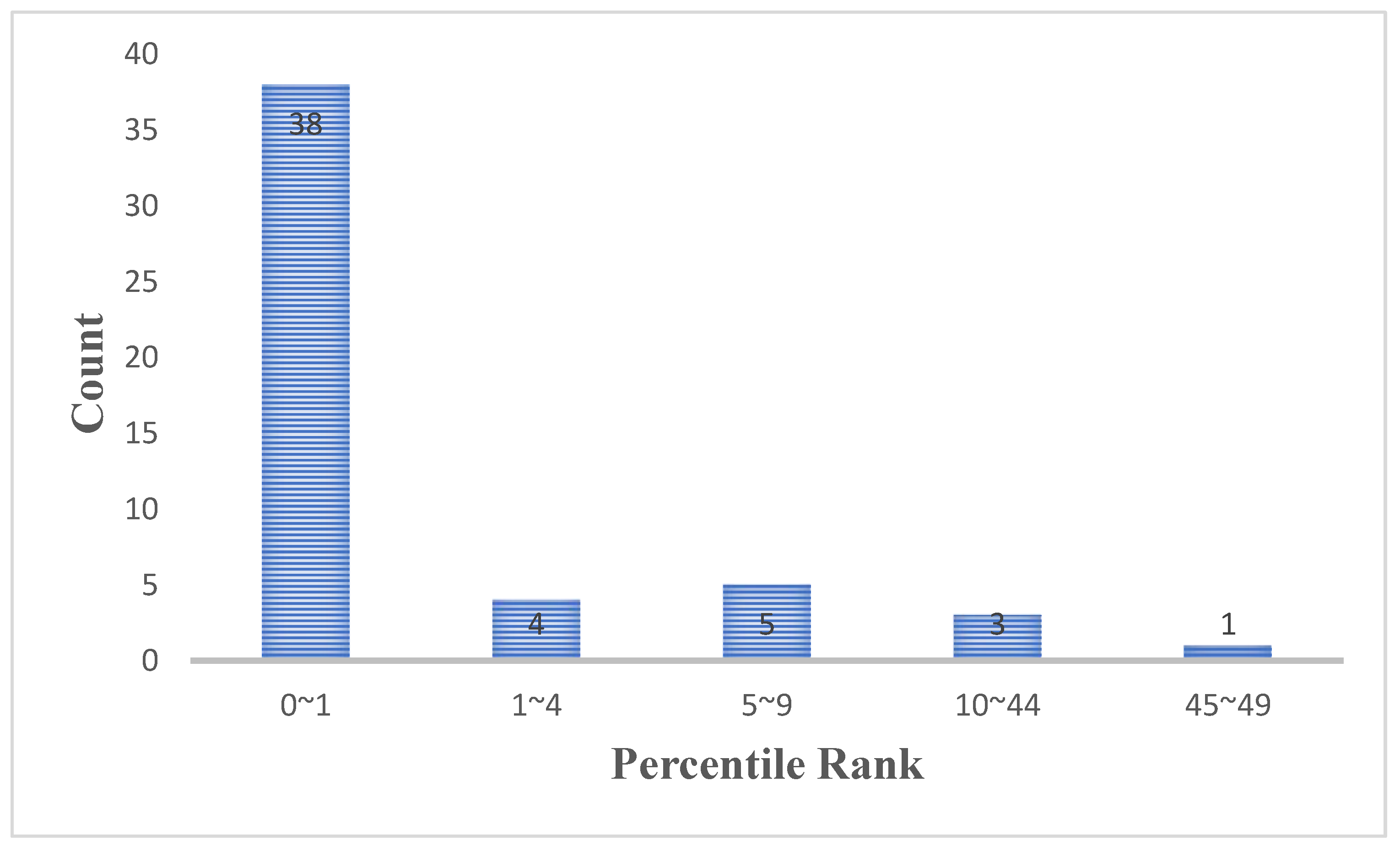
| Disease | Number of miRNA Biomarkers | Average Pairwise Distances | Percentile Rank |
|---|---|---|---|
| Anovulation | 10 | 0.8669 | <1 |
| Brucellosis | 9 | 0.9258 | 10 |
| Cardiomegaly | 103 | 0.909 | <1 |
| Cataract | 34 | 0.8918 | <1 |
| Choriocarcinoma | 35 | 0.8776 | <1 |
| Coronary Occlusion | 11 | 0.9209 | 5 |
| Gout | 29 | 0.76 | <1 |
| Infertility, Female | 7 | 0.8858 | 1 |
| Infertility, Male | 52 | 0.9516 | 1 |
| Kidney Calculi | 11 | 0.9101 | 5 |
| Laryngeal Neoplasms | 112 | 0.9147 | <1 |
| Mastitis | 24 | 0.8918 | <1 |
| Melanoma | 302 | 0.9163 | <1 |
| Myocarditis | 33 | 0.9305 | <1 |
| Myopia | 7 | 0.9826 | 45 |
| Necrosis | 17 | 0.9497 | 10 |
| Nerve Degeneration | 39 | 0.9124 | <1 |
| Neuroendocrine Tumors | 18 | 0.9389 | 5 |
| Norrie Disease | 41 | 0.9362 | <1 |
| Obesity | 164 | 0.9238 | <1 |
| Ovarian epithelial cancer | 108 | 0.9323 | <1 |
| Pancreatitis | 52 | 0.9206 | <1 |
| Papillomaviridae | 22 | 0.9104 | <1 |
| Parkinson Disease | 158 | 0.9123 | <1 |
| Pediatric Obesity | 22 | 0.8988 | <1 |
| Pre Eclampsia | 202 | 0.9215 | <1 |
| Precancerous Conditions | 36 | 0.9309 | <1 |
| Prediabetic State | 23 | 0.9069 | <1 |
| Premature Birth | 54 | 0.8978 | <1 |
| Pterygium | 32 | 0.9517 | 5 |
| Radiation Injuries | 15 | 0.8953 | <1 |
| Rectal Neoplasms | 83 | 0.9188 | <1 |
| Renal Insufficiency, Chronic | 37 | 0.8893 | <1 |
| Reperfusion Injury | 83 | 0.9076 | <1 |
| Sarcoma | 30 | 0.9244 | <1 |
| Schizophrenia | 66 | 0.9198 | <1 |
| Seizures | 11 | 0.9342 | 10 |
| Sepsis | 159 | 0.9231 | <1 |
| Skin Neoplasms | 20 | 0.902 | <1 |
| Solitary Fibrous Tumor, Pleural | 43 | 0.9156 | <1 |
| Spinal Cord Injuries | 125 | 0.9124 | <1 |
| Stroke | 86 | 0.9299 | <1 |
| Subarachnoid Hemorrhage | 38 | 0.8941 | <1 |
| Syphilis | 20 | 0.8884 | <1 |
| Teratoma | 8 | 0.86779 | <1 |
| Testicular Diseases | 14 | 0.9151 | 5 |
| Testicular Germ Cell Tumor | 24 | 0.926 | 1 |
| Thrombocytopenia | 28 | 0.9168 | <1 |
| Thrombosis | 19 | 0.9289 | 1 |
| Thyroid Carcinoma, Anaplastic | 29 | 0.898 | <1 |
| Thyroid Neoplasms | 172 | 0.9123 | <1 |
| Associated Diseases | Total Number of miRNA Biomarkers (n) | Average Pairwise Distance | Percentile Rank |
|---|---|---|---|
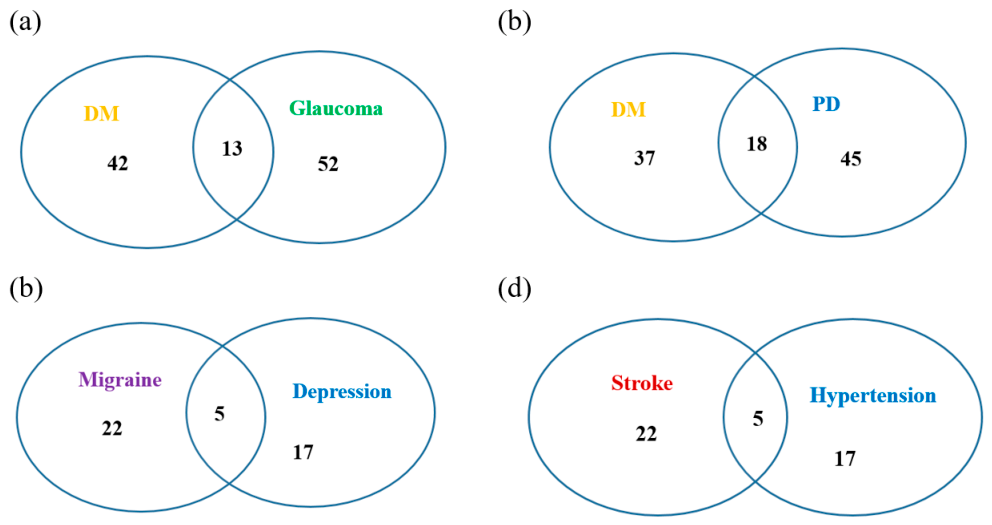
| Diabetes Mellitus, Glaucoma | 107 | 0.93343 | <1 |
| Diabetes Mellitus, Parkinson’s disease | 100 | 0.89359 | <1 |
| Migraine Disorders, Depression | 44 | 0.94824 | <5 |
| Stroke, Hypertension | 76 | 0.90521 | <1 |
| miRNA | Mature Sequence |
|---|---|
| has-miR-181a-1 | AACAUUCAACGCUGUCGGUGAGU |
| has-miR-181c | AACAUUCAACCUGUCGGUGAGU |
Disclaimer/Publisher’s Note: The statements, opinions and data contained in all publications are solely those of the individual author(s) and contributor(s) and not of MDPI and/or the editor(s). MDPI and/or the editor(s) disclaim responsibility for any injury to people or property resulting from any ideas, methods, instructions or products referred to in the content. |
© 2026 by the authors. Licensee MDPI, Basel, Switzerland. This article is an open access article distributed under the terms and conditions of the Creative Commons Attribution (CC BY) license.
Share and Cite
Wang, H.; Jiang, Y.-S.; Huang, W.-C. The Distribution of Average Pairwise Distances Among Human Pre-miRNAs for Disease Association Analysis. Int. J. Mol. Sci. 2026, 27, 3750. https://doi.org/10.3390/ijms27093750
Wang H, Jiang Y-S, Huang W-C. The Distribution of Average Pairwise Distances Among Human Pre-miRNAs for Disease Association Analysis. International Journal of Molecular Sciences. 2026; 27(9):3750. https://doi.org/10.3390/ijms27093750
Chicago/Turabian StyleWang, Hsiuying, You-Shan Jiang, and Wei-Ching Huang. 2026. "The Distribution of Average Pairwise Distances Among Human Pre-miRNAs for Disease Association Analysis" International Journal of Molecular Sciences 27, no. 9: 3750. https://doi.org/10.3390/ijms27093750
APA StyleWang, H., Jiang, Y.-S., & Huang, W.-C. (2026). The Distribution of Average Pairwise Distances Among Human Pre-miRNAs for Disease Association Analysis. International Journal of Molecular Sciences, 27(9), 3750. https://doi.org/10.3390/ijms27093750