A System-Level Perspective on Epstein–Barr Virus Persistence: The Partial Lytic Reactivation


Abstract
1. Introduction
The Spread of the Virus in the Human Body
2. Phases of Virus Activation
2.1. Latency Programs (Lat)

| Inhibited Function | Viral Protein | Description | Ref. |
|---|---|---|---|
| Autophagy modulation | LMP1 (Lat) | Activates early stages, inhibits late stages of autophagy | [42,54,55,56,57,58,59] |
| LMP2a (Lat) | ↑ vPI3K/AKT/mTOR | [60,61] | |
| BZLF1 (IE) | Initial autophagy activation | [62,63] | |
| BHRF1 (E) | vBCL-2, inhibiting autophagy, activating mitophagy | [64] | |
| BPLF1 (E) | Inhibition by SQSTM1/p62 | [65] | |
| Interferon inhibition | EBER1/2 (Lat) | ↓ PKR | [66] |
| LMP1 (Lat) | ↓ Tyk2 | [67] | |
| BRLF1 (IE) | ↓ IRF3/7 | [68] | |
| BZLF1 (IE) | ↓ IRF7 | [69] | |
| BPLF1 (E) | (Deubiquitinase) ↓ TLR (TRAF6/NEMO/IKK) and RIG-I–TRIM25 axis | [70,71,72] | |
| BGLF2 (E) | SHP1 phosphatase recruitment, STAT2 degradation, ↓ Tyk2, STAT1, and STAT3 phosphorylation | [73,74] | |
| LF2 (E) | ↓ IRF7 | [75] | |
| BGLF4 (E) | ↓ IRF3 | [76] | |
| BHRF1 (E) | ↓ vBCL2, mitophagy | [64] | |
| BFRF1 (E) | ↓ IRF3 | [77] | |
| BGLF5 (E) | Degradation TLR2/9 | [78,79] | |
| NFkB inhibition | EBNA1 (Lat) | Inhibition of IKK phosphorylation | [80] |
| BGLF2 (E) | Inhibition of p65 Ser536 phosphorylation | [81] | |
| BZLF1 (IE) | TNFa/IFNg inhibitor | [82] | |
| BGLF4 (E) | UXT phosphorylation | [83] | |
| BPLF1 (E) | Deubiquitines TRAF6 | [71] | |
| CTL inhibition | EBNA1 (Lat) | NK cells inhibition | [77] |
| LMP2a (Lat) | ↓ CD8+ | [84] | |
| LMP1 (Lat) | Inhibition of T cell proliferation and NK cytotoxicity | [85] | |
| EBER1/2 (Lat) | Inducing IL-10 | [86] | |
| BCRF1 (E) | vIL-10 | [87] | |
| BNLF2a (E) | ↓ TAP1/2 | [87] | |
| Macrophages/DC | BCRF1 (L) | vIL-10 | [87] |
| BARF1 (E) | Binds CSF1, inhibits CSF1R (CD115) activation | [88] | |
| BZLF2-BXLF2 (L) | GM-CSF, IL4 | [89] | |
| Apoptosis inhibition | LMP1 (Lat) | RIPK1/3 ubiquitination. NF-κB activation, increasing MDM2 binding to p53, p53 ubiquitination and degradation, Bcl-2 expression enhancement | [90,91] |
| EBER1/2 (Lat) | IFNα and GAS2 inhibition, BCL-2 activation | [92,93] | |
| LMP2a (Lat) | BCR inhibition | [94] | |
| BHRF1 (E) | vBCL2 | [64] | |
| CD4+ inhibition | EBER1/2 (Lat) | Inhibits IL12 and peptide presentation on HLA-II | [95] |
| LMP1 (Lat) | Enhances PD-L1 level | [96] | |
| BZLF2 (L) | gp42, blocks antigen presentation on MHC-II | [97,98] | |
| BDLF3 (L) | Reduces expression of MHC-I/II | [99] |
2.2. Immediate-Early Phase (IE)
2.3. Early Phase
2.4. Late Phase (L)
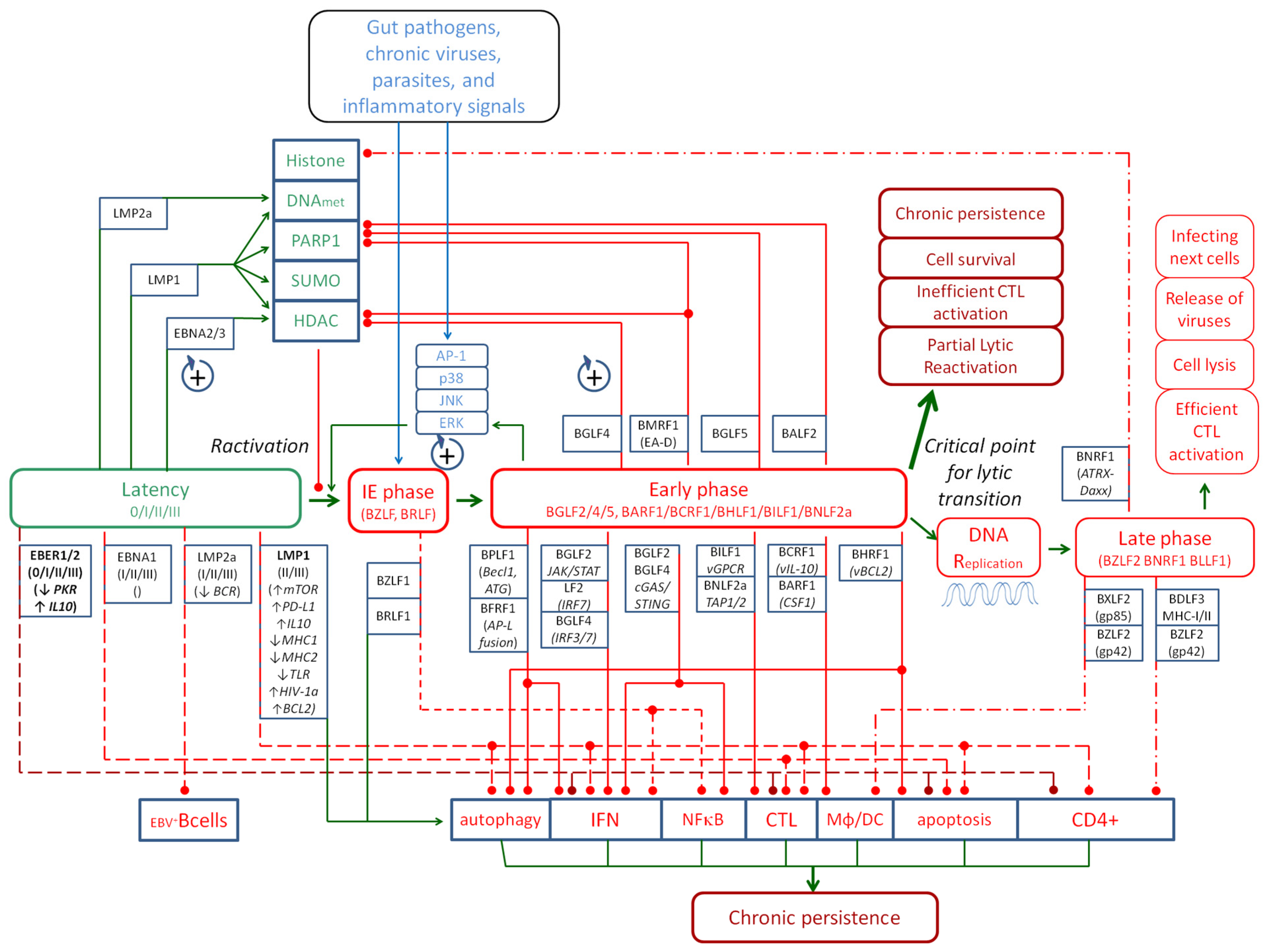
3. General Regulatory Model of EBV Infection
4. LAT ↔ IE Balance
4.1. Epigenetic and Chromatin-Based Repression of Immediate-Early Gene Expression
4.2. Early Phase Proteins Support Lat → IE Transition
4.3. Positive Couplings Between BZLF1/BRLF1 and AP-1/p38/ERK/JNK Pathways
4.4. Late Phase Supports Lat → IE Transition
5. Clinical Conditions for the LAT → IE/E Phase Induction
5.1. Parasitic Infections
5.2. Psychological Stress
5.3. Coexisting EBV and Other Viral Pathogens
5.4. Gut Microbiota as a Potential Regulator of the Lat → IE Transition
5.5. Immunosuppression and Clinical Contexts Associated with Increased EBV Reactivation
6. Regulation of EBV DNA Replication as a Central Checkpoint of Lytic Progression
7. Abortive/Partial Lytic Reactivation as a Common Outcome of EBV Reactivation
7.1. Partial Lytic Gene Expression During Early EBV Infection and Latency Establishment
7.2. Partial Lytic Reactivation as a Continuum Revealed by Single-Cell Approaches
7.3. Partial Lytic States in Epithelial Infection and Tumor-Associated EBV
7.4. Early Lytic Reactivation and Host Shutoff Without Late-Phase Completion
8. Conditions Necessary for the Chronic Partial Lytic Reactivation State
9. Discussion
9.1. EBV Persistence as a Dynamically Stabilized Survival Strategy
9.2. Chronic Stability and Biological Significance of Partial Lytic Reactivation
9.3. Building the Mathematical Models of Lat/IE/E/L Equilibrium
9.4. The Challenge of Detecting Partial Lytic Reactivation
9.5. Redefining “Kick and Kill” Strategy
9.6. Possible Reversal from Partial Lytic to Latent State
Author Contributions
Funding
Institutional Review Board Statement
Informed Consent Statement
Data Availability Statement
Acknowledgments
Conflicts of Interest
References
- Soldan, S.S.; Lieberman, P.M. Epstein–Barr virus and multiple sclerosis. Nat. Rev. Microbiol. 2023, 21, 51–64. [Google Scholar] [CrossRef]
- Bjornevik, K.; Münz, C.; Cohen, J.I.; Ascherio, A. Epstein-Barr virus as a leading cause of multiple sclerosis: Mechanisms and implications. Nat. Rev. Neurol. 2023, 19, 160–171. [Google Scholar] [CrossRef]
- Bjornevik, K.; Cortese, M.; Healy, B.C.; Kuhle, J.; Mina, M.J.; Leng, Y.; Elledge, S.J.; Niebuhr, D.W.; Scher, A.I.; Munger, K.L.; et al. Longitudinal analysis reveals high prevalence of Epstein-Barr virus associated with multiple sclerosis. Science 2022, 375, 296–301. [Google Scholar] [CrossRef]
- Wahbeh, F.; Sabatino, J.J. Epstein-Barr Virus in Multiple Sclerosis. Neurol. Neuroimmunol. Neuroinflamm. 2025, 12, e200460. [Google Scholar] [CrossRef]
- Toussirot, É.; Roudier, J. Epstein–Barr virus in autoimmune diseases. Best Pract. Res. Clin. Rheumatol. 2008, 22, 883–896. [Google Scholar] [CrossRef]
- Toussirot, E.; Wendling, D.; Tiberghien, P.; Luka, J.; Roudier, J. Decreased T cell precursor frequencies to Epstein-Barr virus glycoprotein gp110 in peripheral blood correlate with disease activity and severity in patients with rheumatoid arthritis. Ann. Rheum. Dis. 2000, 59, 533–538. [Google Scholar] [CrossRef]
- Houen, G.; Trier, N.H. Epstein-Barr Virus and Systemic Autoimmune Diseases. Front. Immunol. 2021, 11, 587380. [Google Scholar] [CrossRef]
- Draborg, A.H.; Duus, K.; Houen, G. Epstein-Barr virus and systemic lupus erythematosus. Clin. Dev. Immunol. 2012, 2012, 370516. [Google Scholar] [CrossRef]
- Paroli, M.; Gioia, C.; Accapezzato, D.; Caccavale, R. Inflammation, Autoimmunity, and Infection in Fibromyalgia: A Narrative Review. Int. J. Mol. Sci. 2024, 25, 5922. [Google Scholar] [CrossRef]
- Fang, J.; Kifle, Z.D.; Tian, J.; Bettiol, S.; Cicuttini, F.; Jones, G.; Pan, F. Pathogen-specific exposure is associated with multisite chronic pain: A prospective cohort study. Brain Behav. Immun. 2025, 129, 157–164. [Google Scholar] [CrossRef]
- Wang, Z.; Chang, X.; Cheng, X. Epstein-Barr virus in thyroid disease: An integrated immunovirological perspective. Front. Immunol. 2025, 16, 1687214. [Google Scholar] [CrossRef]
- Assaad, S.N.; Meheissen, M.A.; Elsayed, E.T.; Alnakhal, S.N.; Salem, T.M. Study of Epstein-Barr virus serological profile in Egyptian patients with Hashimoto’s thyroiditis: A case-control study. J. Clin. Transl. Endocrinol. 2020, 20, 100222, Erratum in J. Clin. Transl. Endocrinol. 2020, 23, 100242. [Google Scholar] [CrossRef]
- Janegova, A.; Janega, P.; Rychly, B.; Kuracinova, K.; Babal, P. The role of Epstein-Barr virus infection in the development of autoimmune thyroid diseases. Endokrynol. Pol. 2015, 66, 132–136. [Google Scholar] [CrossRef] [PubMed]
- Imashuku, S. Clinical features and treatment strategies of Epstein-Barr virus-associated hemophagocytic lymphohistiocytosis. Crit. Rev. Oncol. Hematol. 2002, 44, 259–272. [Google Scholar] [CrossRef]
- Marsh, R.A. Epstein–Barr Virus and Hemophagocytic Lymphohistiocytosis. Front. Immunol. 2018, 8, 1902. [Google Scholar] [CrossRef] [PubMed]
- Chan, E.W.; Sun, V.; Eldeeb, M.; Kapusta, M.A. Epstein-Barr Virus Acute Retinal Necrosis in an Immunocompetent Host. Retin. Cases Brief Rep. 2021, 15, 412–416. [Google Scholar] [CrossRef] [PubMed]
- Moussa, K.; Gonzales, J.A.; Shantha, J.; Acharya, N.R.; Doan, T. Prevalence of Epstein-Barr Virus in Patients with Intraocular Inflammation. Ocul. Immunol. Inflamm. 2023, 31, 978–980. [Google Scholar] [CrossRef]
- Radosavljevic, A.; Agarwal, M.; Chee, S.P.; Zierhut, M. Epidemiology of Viral Induced Anterior Uveitis. Ocul. Immunol. Inflamm. 2022, 30, 297–309. [Google Scholar] [CrossRef]
- Kanakry, J.A.; Hegde, A.M.; Durand, C.M.; Massie, A.B.; Greer, A.E.; Ambinder, R.F.; Valsamakis, A. The clinical significance of EBV DNA in the plasma and peripheral blood mononuclear cells of patients with or without EBV diseases. Blood 2016, 127, 2007–2017. [Google Scholar] [CrossRef]
- Lo, Y.M.; Chan, W.Y.; Ng, E.K.; Chan, L.Y.; Lai, P.B.; Tam, J.S.; Chung, S.C. Circulating Epstein-Barr virus DNA in the serum of patients with gastric carcinoma. Clin. Cancer Res. 2001, 7, 1856–1859. [Google Scholar]
- Yu, K.H.; Lo, Y.M.; Tse, G.M.; Chan, K.C.; Chan, A.B.; Chow, K.C.; Ma, T.K.; Vlantis, A.C.; Leung, S.F.; van Hasselt, C.A.; et al. Quantitative analysis of cell-free Epstein-Barr virus DNA in plasma of patients with nonnasopharyngeal head and neck carcinomas. Clin. Cancer Res. 2004, 10, 1726–1732. [Google Scholar] [CrossRef]
- Kim, K.Y.; Le, Q.T.; Yom, S.S.; Pinsky, B.A.; Bratman, S.V.; Ng, R.H.; El Mubarak, H.S.; Chan, K.C.; Sander, M.; Conley, B.A. Current State of PCR-Based Epstein-Barr Virus DNA Testing for Nasopharyngeal Cancer. J. Natl. Cancer Inst. 2017, 109, djx007. [Google Scholar] [CrossRef]
- Damania, B.; Kenney, S.C.; Raab-Traub, N. Epstein-Barr virus: Biology and clinical disease. Cell 2022, 185, 3652–3670. [Google Scholar] [CrossRef]
- Smatti, M.K.; Al-Sadeq, D.W.; Ali, N.H.; Pintus, G.; Abou-Saleh, H.; Nasrallah, G.K. Epstein–Barr Virus Epidemiology, Serology, and Genetic Variability of LMP-1 Oncogene Among Healthy Population: An Update. Front. Oncol. 2018, 8, 211. [Google Scholar] [CrossRef] [PubMed]
- Kimura, H.; Hoshino, Y.; Kanegane, H.; Tsuge, I.; Okamura, T.; Kawa, K.; Morishima, T. Clinical and virologic characteristics of chronic active Epstein-Barr virus infection. Blood 2001, 98, 280–286. [Google Scholar] [CrossRef] [PubMed]
- Kimura, H.; Cohen, J.I. Chronic Active Epstein-Barr Virus Disease. Front. Immunol. 2017, 8, 1867. [Google Scholar] [CrossRef] [PubMed]
- Chang, M.S.; Kim, W.H. Epstein-Barr virus in human malignancy: A special reference to Epstein-Barr virus associated gastric carcinoma. Cancer Res. Treat. 2005, 37, 257–267. [Google Scholar] [CrossRef]
- Han, S.; Tay, J.K.; Loh, C.J.L.; Chu, A.J.M.; Yeong, J.P.S.; Lim, C.M.; Toh, H.C. Epstein–Barr Virus Epithelial Cancers—A Comprehensive Understanding to Drive Novel Therapies. Front. Immunol. 2021, 12, 734293. [Google Scholar] [CrossRef]
- Kasahara, Y.; Yachie, A. Cell type specific infection of Epstein–Barr virus (EBV) in EBV-associated hemophagocytic lymphohistiocytosis and chronic active EBV infection. Crit. Rev. Oncol./Hematol. 2002, 44, 283–294. [Google Scholar] [CrossRef]
- Gulley, M.L.; Tang, W. Laboratory assays for Epstein-Barr virus-related disease. J. Mol. Diagn. JMD 2008, 10, 279–292. [Google Scholar] [CrossRef]
- Sausen, D.G.; Bhutta, M.S.; Gallo, E.S.; Dahari, H.; Borenstein, R. Stress-Induced Epstein-Barr Virus Reactivation. Biomolecules 2021, 11, 1380. [Google Scholar] [CrossRef] [PubMed]
- Indari, O.; Ghosh, S.; Bal, A.S.; James, A.; Garg, M.; Mishra, A.; Karmodiya, K.; Jha, H.C. Awakening the sleeping giant: Epstein–Barr virus reactivation by biological agents. Pathog. Dis. 2024, 82, ftae002. [Google Scholar] [CrossRef]
- Wang, Y.; Yu, J.; Pei, Y. Identifying the key regulators orchestrating Epstein-Barr virus reactivation. Front. Microbiol. 2024, 15, 1505191. [Google Scholar] [CrossRef]
- Li, H.; Liu, S.; Hu, J.; Luo, X.; Li, N.; Bode, A.M.; Cao, Y. Epstein-Barr virus lytic reactivation regulation and its pathogenic role in carcinogenesis. Int. J. Biol. Sci. 2016, 12, 1309–1318. [Google Scholar] [CrossRef]
- Hawkins, J.B.; Delgado-Eckert, E.; Thorley-Lawson, D.A.; Shapiro, M. The Cycle of EBV Infection Explains Persistence, the Sizes of the Infected Cell Populations and Which Come under CTL Regulation. PLoS Pathog. 2013, 9, e1003685. [Google Scholar] [CrossRef]
- Veroni, C.; Aloisi, F. The CD8 T Cell-Epstein-Barr Virus-B Cell Trialogue: A Central Issue in Multiple Sclerosis Pathogenesis. Front. Immunol. 2021, 12, 665718. [Google Scholar] [CrossRef] [PubMed]
- Murata, T.; Sugimoto, A.; Inagaki, T.; Yanagi, Y.; Watanabe, T.; Sato, Y.; Kimura, H. Molecular Basis of Epstein-Barr Virus Latency Establishment and Lytic Reactivation. Viruses 2021, 13, 2344. [Google Scholar] [CrossRef]
- Lyu, L.; Li, Q.; Wang, C. EBV Latency Programs: Molecular and Epigenetic Regulation and Its Role in Disease Pathogenesis. J. Med. Virol. 2025, 97, e70501. [Google Scholar] [CrossRef]
- Volaric, A.K.; Saleem, A.; Younes, S.F.; Zhao, S.; Natkunam, Y. Epstein-Barr virus latency patterns in polymorphic lymphoproliferative disorders and lymphomas in immunodeficiency settings: Diagnostic implications. Ann. Diagn. Pathol. 2024, 70, 152286. [Google Scholar] [CrossRef] [PubMed]
- Iwakiri, D. Epstein-Barr Virus-Encoded RNAs: Key Molecules in Viral Pathogenesis. Cancers 2014, 6, 1615–1630. [Google Scholar] [CrossRef]
- Young, L.S.; Rickinson, A.B. Epstein–Barr virus: 40 years on. Nat. Rev. Cancer 2004, 4, 757–768. [Google Scholar] [CrossRef]
- Wang, L.; Ning, S. New Look of EBV LMP1 Signaling Landscape. Cancers 2021, 13, 5451. [Google Scholar] [CrossRef]
- Vrazo, A.C.; Chauchard, M.; Raab-Traub, N.; Longnecker, R. Epstein-Barr virus LMP2A reduces hyperactivation induced by LMP1 to restore normal B cell phenotype in transgenic mice. PLoS Pathog. 2012, 8, e1002662. [Google Scholar] [CrossRef]
- Incrocci, R.; Monroy Del Toro, R.; Devitt, G.; Salimian, M.; Braich, K.; Swanson-Mungerson, M. Epstein–Barr Virus Latent Membrane Protein 2A (LMP2A) Enhances ATP Production in B Cell Tumors through mTOR and HIF-1α. Int. J. Mol. Sci. 2024, 25, 3944. [Google Scholar] [CrossRef]
- Wasil, L.R.; Wei, L.; Chang, C.; Lan, L.; Shair, K.H. Regulation of DNA Damage Signaling and Cell Death Responses by Epstein-Barr Virus Latent Membrane Protein 1 (LMP1) and LMP2A in Nasopharyngeal Carcinoma Cells. J. Virol. 2015, 89, 7612–7624. [Google Scholar] [CrossRef] [PubMed]
- Kempkes, B.; Robertson, E.S. Epstein-Barr virus latency: Current and future perspectives. Curr. Opin. Virol. 2015, 14, 138–144. [Google Scholar] [CrossRef]
- Bentz Gretchen, L.; Moss Charles, R.; Whitehurst Christopher, B.; Moody Cary, A.; Pagano Joseph, S. LMP1-Induced Sumoylation Influences the Maintenance of Epstein-Barr Virus Latency through KAP1. J. Virol. 2015, 89, 7465–7477. [Google Scholar] [CrossRef]
- Martin, K.A.; Lupey, L.N.; Tempera, I. Epstein-Barr Virus Oncoprotein LMP1 Mediates Epigenetic Changes in Host Gene Expression through PARP1. J. Virol. 2016, 90, 8520–8530. [Google Scholar] [CrossRef] [PubMed]
- Bentz Gretchen, L.; Shackelford, J.; Pagano Joseph, S. Epstein-Barr Virus Latent Membrane Protein 1 Regulates the Function of Interferon Regulatory Factor 7 by Inducing Its Sumoylation. J. Virol. 2012, 86, 12251–12261. [Google Scholar] [CrossRef] [PubMed]
- Kondo, S.; Okabe, A.; Nakagawa, T.; Matsusaka, K.; Fukuyo, M.; Rahmutulla, B.; Dochi, H.; Mizokami, H.; Kitagawa, Y.; Kurokawa, T.; et al. Repression of DERL3 via DNA methylation by Epstein-Barr virus latent membrane protein 1 in nasopharyngeal carcinoma. Biochim. Biophys. Acta Mol. Basis Dis. 2023, 1869, 166598. [Google Scholar] [CrossRef]
- Peng, H.; Chen, Y.; Gong, P.; Cai, L.; Lyu, X.; Jiang, Q.; Wang, J.; Lu, J.; Yao, K.; Liu, K.; et al. Higher methylation intensity induced by EBV LMP1 via NF-κB/DNMT3b signaling contributes to silencing of PTEN gene. Oncotarget 2016, 7, 40025–40037. [Google Scholar] [CrossRef] [PubMed]
- Birdwell Christine, E.; Queen Krista, J.; Kilgore Phillip, C.S.R.; Rollyson, P.; Trutschl, M.; Cvek, U.; Scott Rona, S. Genome-Wide DNA Methylation as an Epigenetic Consequence of Epstein-Barr Virus Infection of Immortalized Keratinocytes. J. Virol. 2014, 88, 11442–11458. [Google Scholar] [CrossRef]
- Xie, J.; Wang, Z.; Fan, W.; Liu, Y.; Liu, F.; Wan, X.; Liu, M.; Wang, X.; Zeng, D.; Wang, Y.; et al. Targeting cancer cell plasticity by HDAC inhibition to reverse EBV-induced dedifferentiation in nasopharyngeal carcinoma. Signal Transduct. Target. Ther. 2021, 6, 333. [Google Scholar] [CrossRef]
- Hung, C.-H.; Chen, L.-W.; Wang, W.-H.; Chang, P.-J.; Chiu, Y.-F.; Hung, C.-C.; Lin, Y.-J.; Liou, J.-Y.; Tsai, W.-J.; Hung, C.-L.; et al. Regulation of Autophagic Activation by Rta of Epstein-Barr Virus via the Extracellular Signal-Regulated Kinase Pathway. J. Virol. 2014, 88, 12133–12145. [Google Scholar] [CrossRef] [PubMed]
- Xu, S.; Zhou, Z.; Peng, X.; Tao, X.; Zhou, P.; Zhang, K.; Peng, J.; Li, D.; Shen, L.; Yang, L. EBV-LMP1 promotes radioresistance by inducing protective autophagy through BNIP3 in nasopharyngeal carcinoma. Cell Death Dis. 2021, 12, 344. [Google Scholar] [CrossRef] [PubMed]
- Lin, H.C.; Chang, Y.; Chen, R.Y.; Hung, L.Y.; Chen, P.C.; Chen, Y.P.; Medeiros, L.J.; Chiang, P.M.; Chang, K.C. Epstein-Barr virus latent membrane protein-1 upregulates autophagy and promotes viability in Hodgkin lymphoma: Implications for targeted therapy. Cancer Sci. 2021, 112, 1589–1602. [Google Scholar] [CrossRef]
- Lee, D.Y.; Sugden, B. The latent membrane protein 1 oncogene modifies B-cell physiology by regulating autophagy. Oncogene 2008, 27, 2833–2842. [Google Scholar] [CrossRef]
- Pratt, Z.L.; Zhang, J.; Sugden, B. The latent membrane protein 1 (LMP1) oncogene of Epstein-Barr virus can simultaneously induce and inhibit apoptosis in B cells. J. Virol. 2012, 86, 4380–4393. [Google Scholar] [CrossRef]
- Granato, M.; Santarelli, R.; Farina, A.; Gonnella, R.; Lotti, L.V.; Faggioni, A.; Cirone, M. Epstein-barr virus blocks the autophagic flux and appropriates the autophagic machinery to enhance viral replication. J. Virol. 2014, 88, 12715–12726. [Google Scholar] [CrossRef]
- Zhao, X.; Shi, D.; Sun, L.; Gong, Z.; Liu, W.; Zhang, Y.; Luo, B. Epstein-Barr virus modulates iron metabolism and ferritin expression to promote tumorigenesis in gastric cancer. J. Mol. Histol. 2025, 56, 231. [Google Scholar] [CrossRef]
- Liu, D.; Shi, D.; Xu, L.; Sun, L.; Liu, S.; Luo, B. LMP2A inhibits the expression of KLF5 through the mTORC1 pathway in EBV-associated gastric carcinoma. Virus Res. 2022, 315, 198792, Erratum in Virus Res. 2022, 318, 198828. [Google Scholar] [CrossRef]
- Imajoh, M.; Hashida, Y.; Murakami, M.; Maeda, A.; Sato, T.; Fujieda, M.; Wakiguchi, H.; Daibata, M. Characterization of Epstein-Barr virus (EBV) BZLF1 gene promoter variants and comparison of cellular gene expression profiles in Japanese patients with infectious mononucleosis, chronic active EBV infection, and EBV-associated hemophagocytic lymphohistiocytosis. J. Med. Virol. 2012, 84, 940–946. [Google Scholar] [CrossRef] [PubMed]
- Kim, J.Y.; Min, Y.J.; Lee, M.H.; An, Y.R.; Ashktorab, H.; Smoot, D.T.; Kwon, S.W.; Lee, S.K. Ceramide promotes lytic reactivation of Epstein-Barr virus in gastric carcinoma. J. Virol. 2024, 98, e0177623. [Google Scholar] [CrossRef] [PubMed]
- Vilmen, G.; Glon, D.; Siracusano, G.; Lussignol, M.; Shao, Z.; Hernandez, E.; Perdiz, D.; Quignon, F.; Mouna, L.; Poüs, C.; et al. BHRF1, a BCL2 viral homolog, disturbs mitochondrial dynamics and stimulates mitophagy to dampen type I IFN induction. Autophagy 2021, 17, 1296–1315. [Google Scholar] [CrossRef]
- Ylä-Anttila, P.; Gupta, S.; Masucci, M.G. The Epstein-Barr virus deubiquitinase BPLF1 targets SQSTM1/p62 to inhibit selective autophagy. Autophagy 2021, 17, 3461–3474. [Google Scholar] [CrossRef]
- Sharp, T.V.; Schwemmle, M.; Jeffrey, I.; Laing, K.; Mellor, H.; Proud, C.G.; Hilse, K.; Clemens, M.J. Comparative analysis of the regulation of the interferoninducible protein kinase PKR by Epstein—Barr virus RNAs EBER-1 and EBER-2 and adenovirus VA, RNA. Nucleic Acids Res. 1993, 21, 4483–4490. [Google Scholar] [CrossRef]
- Geiger, T.R.; Martin, J.M. The Epstein-Barr virus-encoded LMP-1 oncoprotein negatively affects Tyk2 phosphorylation and interferon signaling in human B cells. J. Virol. 2006, 80, 11638–11650. [Google Scholar] [CrossRef]
- Bentz, G.L.; Liu, R.; Hahn, A.M.; Shackelford, J.; Pagano, J.S. Epstein–Barr virus BRLF1 inhibits transcription of IRF3 and IRF7 and suppresses induction of interferon-β. Virology 2010, 402, 121–128. [Google Scholar] [CrossRef] [PubMed]
- Hahn Angela, M.; Huye Leslie, E.; Ning, S.; Webster-Cyriaque, J.; Pagano Joseph, S. Interferon Regulatory Factor 7 Is Negatively Regulated by the Epstein-Barr Virus Immediate-Early Gene, BZLF-1. J. Virol. 2005, 79, 10040–10052. [Google Scholar] [CrossRef]
- van Gent, M.; Braem, S.G.E.; de Jong, A.; Delagic, N.; Peeters, J.G.C.; Boer, I.G.J.; Moynagh, P.N.; Kremmer, E.; Wiertz, E.J.; Ovaa, H.; et al. Epstein-Barr Virus Large Tegument Protein BPLF1 Contributes to Innate Immune Evasion through Interference with Toll-Like Receptor Signaling. PLoS Pathog. 2014, 10, e1003960. [Google Scholar] [CrossRef]
- Saito, S.; Murata, T.; Kanda, T.; Isomura, H.; Narita, Y.; Sugimoto, A.; Kawashima, D.; Tsurumi, T. Epstein-Barr Virus Deubiquitinase Downregulates TRAF6-Mediated NF-κB Signaling during Productive Replication. J. Virol. 2013, 87, 4060–4070. [Google Scholar] [CrossRef]
- Lui, W.-Y.; Bharti, A.; Wong, N.-H.M.; Jangra, S.; Botelho, M.G.; Yuen, K.-S.; Jin, D.-Y. Suppression of cGAS- and RIG-I-mediated innate immune signaling by Epstein-Barr virus deubiquitinase BPLF1. PLoS Pathog. 2023, 19, e1011186. [Google Scholar] [CrossRef]
- Jangra, S.; Bharti, A.; Lui, W.-Y.; Chaudhary, V.; Botelho, M.G.; Yuen, K.-S.; Jin, D.-Y. Suppression of JAK-STAT signaling by Epstein-Barr virus tegument protein BGLF2 through recruitment of SHP1 phosphatase and promotion of STAT2 degradation. J. Virol. 2021, 95, e0102721. [Google Scholar] [CrossRef] [PubMed]
- Liu, X.; Cohen, J.I. Epstein-Barr Virus (EBV) Tegument Protein BGLF2 Promotes EBV Reactivation through Activation of the p38 Mitogen-Activated Protein Kinase. J. Virol. 2016, 90, 1129–1138. [Google Scholar] [CrossRef] [PubMed]
- Wu, L.; Fossum, E.; Joo, C.H.; Inn, K.-S.; Shin, Y.C.; Johannsen, E.; Hutt-Fletcher, L.M.; Hass, J.; Jung, J.U. Epstein-Barr virus LF2: An antagonist to type I interferon. J. Virol. 2009, 83, 1140–1146. [Google Scholar] [CrossRef]
- Wang, J.-T.; Doong, S.-L.; Teng, S.-C.; Lee, C.-P.; Tsai, C.-H.; Chen, M.-R. Epstein-Barr virus BGLF4 kinase suppresses the interferon regulatory factor 3 signaling pathway. J. Virol. 2009, 83, 1856–1869. [Google Scholar] [CrossRef]
- Wang, P.; Deng, Y.; Guo, Y.; Xu, Z.; Li, Y.; Ou, X.; Xie, L.; Lu, M.; Zhong, J.; Li, B.; et al. Epstein-Barr Virus Early Protein BFRF1 Suppresses IFN-β Activity by Inhibiting the Activation of IRF3. Front. Immunol. 2020, 11, 513383. [Google Scholar] [CrossRef]
- van Gent, M.; Gram, A.M.; Boer, I.G.J.; Geerdink, R.J.; Lindenbergh, M.F.S.; Lebbink, R.J.; Wiertz, E.J.; Ressing, M.E. Silencing the shutoff protein of Epstein–Barr virus in productively infected B cells points to (innate) targets for immune evasion. J. Gen. Virol. 2015, 96, 858–865. [Google Scholar] [CrossRef]
- van Gent, M.; Griffin, B.D.; Berkhoff, E.G.; van Leeuwen, D.; Boer, I.G.; Buisson, M.; Hartgers, F.C.; Burmeister, W.P.; Wiertz, E.J.; Ressing, M.E. EBV lytic-phase protein BGLF5 contributes to TLR9 downregulation during productive infection. J. Immunol. 2011, 186, 1694–1702. [Google Scholar] [CrossRef]
- Valentine, R.; Dawson, C.W.; Hu, C.; Shah, K.M.; Owen, T.J.; Date, K.L.; Maia, S.P.; Shao, J.; Arrand, J.R.; Young, L.S.; et al. Epstein-Barr virus-encoded EBNA1 inhibits the canonical NF-κB pathway in carcinoma cells by inhibiting IKK phosphorylation. Mol. Cancer 2010, 9, 1. [Google Scholar] [CrossRef] [PubMed]
- Chen, T.; Wang, Y.; Xu, Z.; Zou, X.; Wang, P.; Ou, X.; Li, Y.; Peng, T.; Chen, D.; Li, M.; et al. Epstein-Barr virus tegument protein BGLF2 inhibits NF-κB activity by preventing p65 Ser536 phosphorylation. FASEB J. 2019, 33, 10563–10576. [Google Scholar] [CrossRef]
- Li, Y.; Long, X.; Huang, L.; Yang, M.; Yuan, Y.; Wang, Y.; Delecluse, H.-J.; Kuang, E. Epstein-Barr Virus BZLF1-Mediated Downregulation of Proinflammatory Factors Is Essential for Optimal Lytic Viral Replication. J. Virol. 2015, 90, 887–903. [Google Scholar] [CrossRef]
- Chang, L.-S.; Wang, J.-T.; Doong, S.-L.; Lee, C.-P.; Chang, C.-W.; Tsai, C.-H.; Yeh, S.-W.; Hsieh, C.-Y.; Chen, M.-R. Epstein-Barr Virus BGLF4 Kinase Downregulates NF-κB Transactivation through Phosphorylation of Coactivator UXT. J. Virol. 2012, 86, 12176–12186. [Google Scholar] [CrossRef]
- Rancan, C.; Schirrmann, L.; Hüls, C.; Zeidler, R.; Moosmann, A. Latent Membrane Protein LMP2A Impairs Recognition of EBV-Infected Cells by CD8+ T Cells. PLoS Pathog. 2015, 11, e1004906. [Google Scholar] [CrossRef] [PubMed]
- Dukers, D.F.; Meij, P.; Vervoort, M.B.; Vos, W.; Scheper, R.J.; Meijer, C.J.; Bloemena, E.; Middeldorp, J.M. Direct immunosuppressive effects of EBV-encoded latent membrane protein 1. J. Immunol. 2000, 165, 663–670. [Google Scholar] [CrossRef] [PubMed]
- Samanta, M.; Iwakiri, D.; Takada, K. Epstein-Barr virus-encoded small RNA induces IL-10 through RIG-I-mediated IRF-3 signaling. Oncogene 2008, 27, 4150–4160. [Google Scholar] [CrossRef]
- Jochum, S.; Moosmann, A.; Lang, S.; Hammerschmidt, W.; Zeidler, R. The EBV Immunoevasins vIL-10 and BNLF2a Protect Newly Infected B Cells from Immune Recognition and Elimination. PLoS Pathog. 2012, 8, e1002704. [Google Scholar] [CrossRef]
- Hoebe, E.K.; Le Large, T.Y.; Tarbouriech, N.; Oosterhoff, D.; De Gruijl, T.D.; Middeldorp, J.M.; Greijer, A.E. Epstein-Barr virus-encoded BARF1 protein is a decoy receptor for macrophage colony stimulating factor and interferes with macrophage differentiation and activation. Viral Immunol. 2012, 25, 461–470. [Google Scholar] [CrossRef]
- Li, L. Epstein-Barr virus inhibits the development of dendritic cells by promoting apoptosis of their monocyte precursors in the presence of granulocyte macrophage-colony-stimulating factor and interleukin-4. Blood 2002, 99, 3725–3734. [Google Scholar] [CrossRef]
- Liu, X.; Li, Y.; Peng, S.; Yu, X.; Li, W.; Shi, F.; Luo, X.; Tang, M.; Tan, Z.; Bode, A.M.; et al. Epstein-Barr virus encoded latent membrane protein 1 suppresses necroptosis through targeting RIPK1/3 ubiquitination. Cell Death Dis. 2018, 9, 53. [Google Scholar] [CrossRef] [PubMed]
- Zeng, M.; Chen, Y.; Jia, X.; Liu, Y. The Anti-Apoptotic Role of EBV-LMP1 in Lymphoma Cells. Cancer Manag. Res. 2020, 12, 8801–8811. [Google Scholar] [CrossRef]
- Gregorovic, G.; Bosshard, R.; Karstegl, C.E.; White, R.E.; Pattle, S.; Chiang, A.K.; Dittrich-Breiholz, O.; Kracht, M.; Russ, R.; Farrell, P.J. Cellular gene expression that correlates with EBER expression in Epstein-Barr Virus-infected lymphoblastoid cell lines. J. Virol. 2011, 85, 3535–3545. [Google Scholar] [CrossRef]
- Ruf, I.K.; Lackey, K.A.; Warudkar, S.; Sample, J.T. Protection from interferon-induced apoptosis by Epstein-Barr virus small RNAs is not mediated by inhibition of PKR. J. Virol. 2005, 79, 14562–14569. [Google Scholar] [CrossRef]
- Fukuda, M.; Longnecker, R. Epstein-Barr Virus (EBV) Latent Membrane Protein 2A Regulates B-Cell Receptor-Induced Apoptosis and EBV Reactivation through Tyrosine Phosphorylation. J. Virol. 2005, 79, 8655–8660. [Google Scholar] [CrossRef]
- Tagawa, T.; Albanese, M.; Bouvet, M.; Moosmann, A.; Mautner, J.; Heissmeyer, V.; Zielinski, C.; Lutter, D.; Hoser, J.; Hastreiter, M.; et al. Epstein-Barr viral miRNAs inhibit antiviral CD4+ T cell responses targeting IL-12 and peptide processing. J. Exp. Med. 2016, 213, 2065–2080. [Google Scholar] [CrossRef]
- Abou Harb, M.; Meckes, D.G., Jr.; Sun, L. Epstein-Barr virus LMP1 enhances levels of large extracellular vesicle-associated PD-L1. J. Virol. 2023, 97, e0021923. [Google Scholar] [CrossRef] [PubMed]
- Ressing, M.E.; van Leeuwen, D.; Verreck, F.A.; Keating, S.; Gomez, R.; Franken, K.L.; Ottenhoff, T.H.; Spriggs, M.; Schumacher, T.N.; Hutt-Fletcher, L.M.; et al. Epstein-Barr virus gp42 is posttranslationally modified to produce soluble gp42 that mediates HLA class II immune evasion. J. Virol. 2005, 79, 841–852. [Google Scholar] [CrossRef] [PubMed]
- Ressing, M.E.; van Leeuwen, D.; Verreck, F.A.; Gomez, R.; Heemskerk, B.; Toebes, M.; Mullen, M.M.; Jardetzky, T.S.; Longnecker, R.; Schilham, M.W.; et al. Interference with T cell receptor-HLA-DR interactions by Epstein-Barr virus gp42 results in reduced T helper cell recognition. Proc. Natl. Acad. Sci. USA 2003, 100, 11583–11588. [Google Scholar] [CrossRef]
- Quinn, L.L.; Williams, L.R.; White, C.; Forrest, C.; Zuo, J.; Rowe, M. The Missing Link in Epstein-Barr Virus Immune Evasion: The BDLF3 Gene Induces Ubiquitination and Downregulation of Major Histocompatibility Complex Class I (MHC-I) and MHC-II. J. Virol. 2016, 90, 356–367. [Google Scholar] [CrossRef] [PubMed]
- Murata, T.; Tsurumi, T. Epigenetic modification of the Epstein-Barr virus BZLF1 promoter regulates viral reactivation from latency. Front. Genet. 2013, 4, 53. [Google Scholar] [CrossRef]
- Woellmer, A.; Arteaga-Salas, J.M.; Hammerschmidt, W. BZLF1 Governs CpG-Methylated Chromatin of Epstein-Barr Virus Reversing Epigenetic Repression. PLoS Pathog. 2012, 8, e1002902. [Google Scholar] [CrossRef]
- Lupey-Green, L.N.; Caruso, L.B.; Madzo, J.; Martin, K.A.; Tan, Y.; Hulse, M.; Tempera, I. PARP1 Stabilizes CTCF Binding and Chromatin Structure To Maintain Epstein-Barr Virus Latency Type. J. Virol. 2018, 92, e00755-18. [Google Scholar] [CrossRef]
- Lupey-Green, L.N.; Moquin, S.A.; Martin, K.A.; McDevitt, S.M.; Hulse, M.; Caruso, L.B.; Pomerantz, R.T.; Miranda, J.L.; Tempera, I. PARP1 restricts Epstein Barr Virus lytic reactivation by binding the BZLF1 promoter. Virology 2017, 507, 220–230. [Google Scholar] [CrossRef] [PubMed]
- Ellis, A.L.; Wang, Z.; Yu, X.; Mertz, J.E. Either ZEB1 or ZEB2/SIP1 can play a central role in regulating the Epstein-Barr virus latent-lytic switch in a cell-type-specific manner. J. Virol. 2010, 84, 6139–6152. [Google Scholar] [CrossRef]
- Swenson, J.J.; Holley-Guthrie, E.; Kenney, S.C. Epstein-Barr virus immediate-early protein BRLF1 interacts with CBP, promoting enhanced BRLF1 transactivation. J. Virol. 2001, 75, 6228–6234. [Google Scholar] [CrossRef]
- Zerby, D.; Chen, C.J.; Poon, E.; Lee, D.; Shiekhattar, R.; Lieberman, P.M. The amino-terminal C/H1 domain of CREB binding protein mediates zta transcriptional activation of latent Epstein-Barr virus. Mol. Cell Biol. 1999, 19, 1617–1626. [Google Scholar] [CrossRef][Green Version]
- Chen, C.J.; Deng, Z.; Kim, A.Y.; Blobel, G.A.; Lieberman, P.M. Stimulation of CREB binding protein nucleosomal histone acetyltransferase activity by a class of transcriptional activators. Mol. Cell Biol. 2001, 21, 476–487. [Google Scholar] [CrossRef] [PubMed]
- Feederle, R.; Kost, M.; Baumann, M.; Janz, A.; Drouet, E.; Hammerschmidt, W.; Delecluse, H.J. The Epstein-Barr virus lytic program is controlled by the co-operative functions of two transactivators. EMBO J. 2000, 19, 3080–3089. [Google Scholar] [CrossRef] [PubMed]
- Kenney, S.C. Reactivation and lytic replication of EBV. In Human Herpesviruses: Biology, Therapy, and Immunoprophylaxis; Arvin, A., Campadelli-Fiume, G., Mocarski, E., Moore, P.S., Roizman, B., Whitley, R., Yamanishi, K., Eds.; Chapter 25; Cambridge University Press: Cambridge, UK, 2007. [Google Scholar]
- Tsurumi, T.; Kobayashi, A.; Tamai, K.; Yamada, H.; Daikoku, T.; Yamashita, Y.; Nishiyama, Y. Epstein-Barr virus single-stranded DNA-binding protein: Purification, characterization, and action on DNA synthesis by the viral DNA polymerase. Virology 1996, 222, 352–364. [Google Scholar] [CrossRef]
- Wang’ondu, R.; Teal, S.; Park, R.; Heston, L.; Delecluse, H.; Miller, G. DNA Damage Signaling Is Induced in the Absence of Epstein—Barr Virus (EBV) Lytic DNA Replication and in Response to Expression of ZEBRA. PLoS ONE 2015, 10, e0126088. [Google Scholar] [CrossRef]
- Griffin, B.D.; Gram, A.M.; Mulder, A.; Van Leeuwen, D.; Claas, F.H.; Wang, F.; Ressing, M.E.; Wiertz, E. EBV BILF1 evolved to downregulate cell surface display of a wide range of HLA class I molecules through their cytoplasmic tail. J. Immunol. 2013, 190, 1672–1684. [Google Scholar] [CrossRef]
- Dorothea, M.; Xie, J.; Yiu, S.P.; Chiang, A.K. Contribution of Epstein–Barr Virus Lytic Proteins to Cancer Hallmarks and Implications from Other Oncoviruses. Cancers 2023, 15, 2120. [Google Scholar] [CrossRef]
- Lee, S.; Kim, J.; Chung, W.C.; Han, J.H.; Song, M.J. Epstein-Barr Virus Viral Processivity Factor EA-D Facilitates Virus Lytic Replication by Inducing Poly(ADP-Ribose) Polymerase 1 Degradation. J. Virol. 2022, 96, e0037122. [Google Scholar] [CrossRef]
- Wycisk, A.I.; Lin, J.; Loch, S.; Hobohm, K.; Funke, J.; Wieneke, R.; Koch, J.; Skach, W.R.; Mayerhofer, P.U.; Tampé, R. Epstein-Barr viral BNLF2a protein hijacks the tail-anchored protein insertion machinery to block antigen processing by the transport complex TAP. J. Biol. Chem. 2011, 286, 41402–41412. [Google Scholar] [CrossRef]
- Croft, N.P.; Shannon-Lowe, C.; Bell, A.I.; Horst, D.; Kremmer, E.; Ressing, M.E.; Wiertz, E.J.H.J.; Middeldorp, J.M.; Rowe, M.; Rickinson, A.B.; et al. Stage-Specific Inhibition of MHC Class I Presentation by the Epstein-Barr Virus BNLF2a Protein during Virus Lytic Cycle. PLoS Pathog. 2009, 5, e1000490. [Google Scholar] [CrossRef] [PubMed]
- Kenney, S.C.; Mertz, J.E. Regulation of the latent-lytic switch in Epstein-Barr virus. Semin. Cancer Biol. 2014, 26, 60–68. [Google Scholar] [CrossRef] [PubMed]
- Li, R.; Zhu, J.; Xie, Z.; Liao, G.; Liu, J.; Chen, M.R.; Hu, S.; Woodard, C.; Lin, J.; Taverna, S.D.; et al. Conserved herpesvirus kinases target the DNA damage response pathway and TIP60 histone acetyltransferase to promote virus replication. Cell Host Microbe 2011, 10, 390–400. [Google Scholar] [CrossRef]
- Salamun, S.G.; Sitz, J.; De La Cruz-Herrera, C.F.; Yockteng-Melgar, J.; Marcon, E.; Greenblatt, J.; Fradet-Turcotte, A.; Frappier, L. The Epstein-Barr Virus BMRF1 Protein Activates Transcription and Inhibits the DNA Damage Response by Binding NuRD. J. Virol. 2019, 93, e01070-19. [Google Scholar] [CrossRef]
- Horst, D.; Burmeister, W.; Boer, I.; Leeuwen, D.; Buisson, M.; Gorbalenya, A.; Wiertz, E.; Ressing, M. The “Bridge” in the Epstein-Barr Virus Alkaline Exonuclease Protein BGLF5 Contributes to Shutoff Activity during Productive Infection. J. Virol. 2012, 86, 9175–9187. [Google Scholar] [CrossRef] [PubMed]
- Li, R.; Liao, G.; Nirujogi, R.S.; Pinto, S.M.; Shaw, P.G.; Huang, T.-C.; Wan, J.; Qian, J.; Gowda, H.; Wu, X.; et al. Phosphoproteomic Profiling Reveals Epstein-Barr Virus Protein Kinase Integration of DNA Damage Response and Mitotic Signaling. PLoS Pathog. 2016, 11, e1005346. [Google Scholar] [CrossRef]
- Matusali, G.; Arena, G.; De Leo, A.; Di Renzo, L.; Mattia, E. Inhibition of p38 MAP kinase pathway induces apoptosis and prevents Epstein Barr virus reactivation in Raji cells exposed to lytic cycle inducing compounds. Mol. Cancer 2009, 8, 18. [Google Scholar] [CrossRef]
- Liu, X.; Sadaoka, T.; Krogmann, T.; Cohen, J.I. Epstein-Barr Virus (EBV) Tegument Protein BGLF2 Suppresses Type I Interferon Signaling To Promote EBV Reactivation. J. Virol. 2020, 94, e00258-20. [Google Scholar] [CrossRef]
- Konishi, N.; Narita, Y.; Hijioka, F.; Masud, H.; Sato, Y.; Kimura, H.; Murata, T. BGLF2 Increases Infectivity of Epstein-Barr Virus by Activating AP-1 upon De Novo Infection. mSphere 2018, 3, e00138-18. [Google Scholar] [CrossRef]
- Sugimoto, A. Replication Compartments—The Great Survival Strategy for Epstein–Barr Virus Lytic Replication. Microorganisms 2022, 10, 896. [Google Scholar] [CrossRef]
- Hui, K.F.; Yiu, S.P.T.; Tam, K.P.; Chiang, A.K.S. Viral-Targeted Strategies Against EBV-Associated Lymphoproliferative Diseases. Front. Oncol. 2019, 9, 81. [Google Scholar] [CrossRef] [PubMed]
- Li, H.; Hu, J.; Luo, X.; Bode, A.M.; Dong, Z.; Cao, Y. Therapies based on targeting Epstein-Barr virus lytic replication for EBV-associated malignancies. Cancer Sci. 2018, 109, 2101–2108. [Google Scholar] [CrossRef]
- Daikoku, T.; Kudoh, A.; Fujita, M.; Sugaya, Y.; Isomura, H.; Shirata, N.; Tsurumi, T. Architecture of replication compartments formed during Epstein-Barr virus lytic replication. J. Virol. 2005, 79, 3409–3418. [Google Scholar] [CrossRef] [PubMed]
- Jacobson, J.G.; Martin, S.L.; Coen, D.M. A conserved open reading frame that overlaps the herpes simplex virus thymidine kinase gene is important for viral growth in cell culture. J. Virol. 1989, 63, 1839–1843. [Google Scholar] [CrossRef] [PubMed]
- Hume, A.J.; Kalejta, R.F. Regulation of the retinoblastoma proteins by the human herpesviruses. Cell Div. 2009, 4, 1. [Google Scholar] [CrossRef]
- Sato, Y.; Watanabe, T.; Suzuki, C.; Abe, Y.; Masud, H.; Inagaki, T.; Yoshida, M.; Suzuki, T.; Goshima, F.; Adachi, J.; et al. S-Like-Phase Cyclin-Dependent Kinases Stabilize the Epstein-Barr Virus BDLF4 Protein To Temporally Control Late Gene Transcription. J. Virol. 2019, 93, e01707-18. [Google Scholar] [CrossRef]
- Sanchez, E.L.; Lagunoff, M. Viral activation of cellular metabolism. Virology 2015, 479–480, 609–618. [Google Scholar] [CrossRef]
- Honess Robert, W.; Roizman, B. Regulation of Herpesvirus Macromolecular Synthesis I. Cascade Regulation of the Synthesis of Three Groups of Viral Proteins. J. Virol. 1974, 14, 8–19. [Google Scholar] [CrossRef] [PubMed]
- Gruffat, H.; Marchione, R.; Manet, E. Herpesvirus Late Gene Expression: A Viral-Specific Pre-initiation Complex Is Key. Front. Microbiol. 2016, 7, 869. [Google Scholar] [CrossRef] [PubMed]
- Archin, N.M.; Margolis, D.M. Emerging strategies to deplete the HIV reservoir. Curr. Opin. Infect. Dis. 2014, 27, 29–35. [Google Scholar] [CrossRef]
- Chakravorty, A.; Sugden, B.; Johannsen Eric, C. An Epigenetic Journey: Epstein-Barr Virus Transcribes Chromatinized and Subsequently Unchromatinized Templates during Its Lytic Cycle. J. Virol. 2019, 93, e02247-18. [Google Scholar] [CrossRef]
- Aubry, V.; Mure, F.; Mariamé, B.; Deschamps, T.; Wyrwicz Lucjan, S.; Manet, E.; Gruffat, H. Epstein-Barr Virus Late Gene Transcription Depends on the Assembly of a Virus-Specific Preinitiation Complex. J. Virol. 2014, 88, 12825–12838. [Google Scholar] [CrossRef]
- Rosemarie, Q.; Sugden, B. Epstein-Barr Virus: How Its Lytic Phase Contributes to Oncogenesis. Microorganisms 2020, 8, 1824. [Google Scholar] [CrossRef]
- Huang, W.; Bai, L.; Tang, H. Epstein-Barr virus infection: The micro and macro worlds. Virol. J. 2023, 20, 220. [Google Scholar] [CrossRef] [PubMed]
- Silva, J.d.M.; Alves, C.E.d.C.; Pontes, G.S. Epstein-Barr virus: The mastermind of immune chaos. Front. Immunol. 2024, 15, 1297994. [Google Scholar] [CrossRef] [PubMed]
- Li, H.; Lee, C.-Y.; Delecluse, H.-J. Epstein–Barr virus lytic replication and cancer. Curr. Opin. Virol. 2025, 70, 101438. [Google Scholar] [CrossRef]
- Murata, T.; Hotta, N.; Toyama, S.; Nakayama, S.; Chiba, S.; Isomura, H.; Ohshima, T.; Kanda, T.; Tsurumi, T. Transcriptional repression by sumoylation of Epstein-Barr virus BZLF1 protein correlates with association of histone deacetylase. J. Biol. Chem. 2010, 285, 23925–23935. [Google Scholar] [CrossRef]
- Everett, R.D.; Chelbi-Alix, M.K. PML and PML nuclear bodies: Implications in antiviral defence. Biochimie 2007, 89, 819–830. [Google Scholar] [CrossRef]
- Wang, W.H.; Kuo, C.W.; Chang, L.K.; Hung, C.C.; Chang, T.H.; Liu, S.T. Assembly of Epstein-Barr Virus Capsid in Promyelocytic Leukemia Nuclear Bodies. J. Virol. 2015, 89, 8922–8931. [Google Scholar] [CrossRef] [PubMed]
- Lewis, P.W.; Elsaesser, S.J.; Noh, K.M.; Stadler, S.C.; Allis, C.D. Daxx is an H3.3-specific histone chaperone and cooperates with ATRX in replication-independent chromatin assembly at telomeres. Proc. Natl. Acad. Sci. USA 2010, 107, 14075–14080. [Google Scholar] [CrossRef] [PubMed]
- Sinclair, A.J. Could Changing the DNA Methylation Landscape Promote the Destruction of Epstein-Barr Virus-Associated Cancers? Front. Cell. Infect. Microbiol. 2021, 11, 695093. [Google Scholar] [CrossRef]
- Namba-Fukuyo, H.; Funata, S.; Matsusaka, K.; Fukuyo, M.; Rahmutulla, B.; Mano, Y.; Fukayama, M.; Aburatani, H.; Kaneda, A. TET2 functions as a resistance factor against DNA methylation acquisition during Epstein-Barr virus infection. Oncotarget 2016, 7, 81512–81526. [Google Scholar] [CrossRef]
- Mounce, B.C.; Mboko, W.P.; Bigley, T.M.; Terhune, S.S.; Tarakanova, V.L. A conserved gammaherpesvirus protein kinase targets histone deacetylases 1 and 2 to facilitate viral replication in primary macrophages. J. Virol. 2013, 87, 7314–7325, Erratum in J. Virol. 2017, 92, e01601-17. [Google Scholar] [CrossRef][Green Version]
- El-Guindy, A.; Lopez-Giraldez, F.; Delecluse, H.J.; McKenzie, J.; Miller, G. A locus encompassing the Epstein-Barr virus bglf4 kinase regulates expression of genes encoding viral structural proteins. PLoS Pathog. 2014, 10, e1004307. [Google Scholar] [CrossRef] [PubMed][Green Version]
- Rowe, M.; Glaunsinger, B.; van Leeuwen, D.; Zuo, J.; Sweetman, D.; Ganem, D.; Middeldorp, J.; Wiertz, E.J.H.J.; Ressing, M.E. Host shutoff during productive Epstein–Barr virus infection is mediated by BGLF5 and may contribute to immune evasion. Proc. Natl. Acad. Sci. USA 2007, 104, 3366–3371. [Google Scholar] [CrossRef]
- Casco, A.; Johannsen, E. EBV Reactivation from Latency Is a Degrading Experience for the Host. Viruses 2023, 15, 726. [Google Scholar] [CrossRef]
- Casco, A.; Ohashi, M.; Johannsen, E. Epstein-Barr virus induces host shutoff extensively via BGLF5-independent mechanisms. Cell Rep. 2024, 43, 114743. [Google Scholar] [CrossRef]
- Huang, H.; Deng, Z.; Vladimirova, O.; Wiedmer, A.; Lu, F.; Lieberman, P.M.; Patel, D.J. Structural basis underlying viral hijacking of a histone chaperone complex. Nat. Commun. 2016, 7, 12707. [Google Scholar] [CrossRef]
- Luo, Y.; Liu, Y.; Wang, C.; Gan, R. Signaling pathways of EBV-induced oncogenesis. Cancer Cell Int. 2021, 21, 93. [Google Scholar] [CrossRef]
- Adamson, A.L.; Darr, D.; Holley-Guthrie, E.; Johnson, R.A.; Mauser, A.; Swenson, J.; Kenney, S. Epstein-Barr virus immediate-early proteins BZLF1 and BRLF1 activate the ATF2 transcription factor by increasing the levels of phosphorylated p38 and c-Jun N-terminal kinases. J. Virol. 2000, 74, 1224–1233. [Google Scholar] [CrossRef] [PubMed]
- Mogensen Trine, H.; Paludan Søren, R. Molecular Pathways in Virus-Induced Cytokine Production. Microbiol. Mol. Biol. Rev. 2001, 65, 131–150. [Google Scholar] [CrossRef] [PubMed]
- Darr, C.D.; Mauser, A.; Kenney, S. Epstein-Barr virus immediate-early protein BRLF1 induces the lytic form of viral replication through a mechanism involving phosphatidylinositol-3 kinase activation. J. Virol. 2001, 75, 6135–6142. [Google Scholar] [CrossRef]
- Lee, Y.H.; Chiu, Y.F.; Wang, W.H.; Chang, L.K.; Liu, S.T. Activation of the ERK signal transduction pathway by Epstein-Barr virus immediate-early protein Rta. J. Gen. Virol. 2008, 89, 2437–2446. [Google Scholar] [CrossRef] [PubMed]
- Indari, O.; Kumar Singh, A.; Tiwari, D.; Chandra Jha, H.; Nath Jha, A. Deciphering antiviral efficacy of malaria box compounds against malaria exacerbating viral pathogens- Epstein Barr virus and SARS-CoV-2, an in silico study. Med. Drug Discov. 2022, 16, 100146. [Google Scholar] [CrossRef]
- Shoeran, G.; Anand, N. Interplay of autophagy and Th1/Th2-mediated macrophage polarization in host-pathogen dynamics. Front. Cell Infect. Microbiol. 2025, 15, 1679514. [Google Scholar] [CrossRef]
- Henry, E.K.; Inclan-Rico, J.M.; Siracusa, M.C. Type 2 cytokine responses: Regulating immunity to helminth parasites and allergic inflammation. Curr. Pharmacol. Rep. 2017, 3, 346–359. [Google Scholar] [CrossRef]
- Kumar, V. Cytotoxic T Cells: Kill, Memorize, and Mask to Maintain Immune Homeostasis. Int. J. Mol. Sci. 2025, 26, 8788. [Google Scholar] [CrossRef] [PubMed]
- Glaser, R.; Pearl, D.K.; Kiecolt-Glaser, J.K.; Malarkey, W.B. Plasma cortisol levels and reactivation of latent Epstein-Barr virus in response to examination stress. Psychoneuroendocrinology 1994, 19, 765–772. [Google Scholar] [CrossRef] [PubMed]
- Coskun, O.; Sener, K.; Kilic, S.; Erdem, H.; Yaman, H.; Besirbellioglu, A.B.; Gul, H.C.; Eyigun, C.P. Stress-related Epstein-Barr virus reactivation. Clin. Exp. Med. 2010, 10, 15–20. [Google Scholar] [CrossRef] [PubMed]
- Glaser, R.; Padgett, D.A.; Litsky, M.L.; Baiocchi, R.A.; Yang, E.V.; Chen, M.; Yeh, P.E.; Klimas, N.G.; Marshall, G.D.; Whiteside, T.; et al. Stress-associated changes in the steady-state expression of latent Epstein-Barr virus: Implications for chronic fatigue syndrome and cancer. Brain Behav. Immun. 2005, 19, 91–103. [Google Scholar] [CrossRef]
- Glaser, R.; Pearson, G.R.; Bonneau, R.H.; Esterling, B.A.; Atkinson, C.; Kiecolt-Glaser, J.K. Stress and the memory T-cell response to the Epstein-Barr virus in healthy medical students. Health Psychol. 1993, 12, 435–442. [Google Scholar] [CrossRef]
- Jaremka, L.M.; Glaser, R.; Malarkey, W.B.; Kiecolt-Glaser, J.K. Marital distress prospectively predicts poorer cellular immune function. Psychoneuroendocrinology 2013, 38, 2713–2719. [Google Scholar] [CrossRef]
- Fagundes, C.P.; Jaremka, L.M.; Glaser, R.; Alfano, C.M.; Povoski, S.P.; Lipari, A.M.; Agnese, D.M.; Yee, L.D.; Carson, W.E., 3rd; Farrar, W.B.; et al. Attachment anxiety is related to Epstein-Barr virus latency. Brain Behav. Immun. 2014, 41, 232–238. [Google Scholar] [CrossRef]
- Yang, E.V.; Webster Marketon, J.I.; Chen, M.; Lo, K.W.; Kim, S.J.; Glaser, R. Glucocorticoids activate Epstein Barr virus lytic replication through the upregulation of immediate early BZLF1 gene expression. Brain Behav. Immun. 2010, 24, 1089–1096. [Google Scholar] [CrossRef]
- Li, X.; Brown, K.; Honeyfield, K.; Hunter-Schlichting, D.; Gruner, M.; Blackstad, M.; Schleiss, M.R.; Teoh, D.; Geller, M.A.; Nelson, H.H.; et al. Assessment of Active Cytomegalovirus (CMV) and Epstein-Barr Virus (EBV) Infections and Patient Reported Fatigue in Ovarian Cancer Survivors. Cancer Rep. 2025, 8, e70380. [Google Scholar] [CrossRef]
- Ding, Y.; Ru, Y.; Song, T.; Guo, L.; Zhang, X.; Zhu, J.; Li, C.; Jin, Z.; Huang, H.; Tu, Y.; et al. Epstein-Barr virus and cytomegalovirus reactivation after allogeneic hematopoietic cell transplantation in patients with non-Hodgkin lymphoma: The prevalence and impacts on outcomes: EBV and CMV reactivation post allo-HCT in NHL. Ann. Hematol. 2021, 100, 2773–2785. [Google Scholar] [CrossRef]
- Mahajan, S.; Mahajan, S.; Patgiri, S. Association and Interaction of Epstein-Barr Virus with SARS-CoV-2 Infection-A Review. Viruses 2025, 17, 903. [Google Scholar] [CrossRef]
- Singh, M.; Kaur, M.; Dogra, G.; Awasthi, V.; Dua, A. A Case of Prolonged SARS-CoV-2 Shedding and HIV Co-infection: Clinical and Diagnostic Challenges. Infect. Disord. Drug Targets, 2025; early view. [CrossRef]
- Li, S.; Niu, Y.; Ning, J. Evolution’s double-edged sword: SARS-CoV-2 adaptation in HIV reveals nature’s safety valve. Lancet Microbe 2025, 6, 101212. [Google Scholar] [CrossRef]
- Michalak, K.P.; Michalak, A.Z. Understanding chronic inflammation: Couplings between cytokines, ROS, NO, Ca2+(i), HIF-1alpha, Nrf2 and autophagy. Front. Immunol. 2025, 16, 1558263. [Google Scholar] [CrossRef]
- Michalak, K.P.; Michalak, A.Z.; Brenk-Krakowska, A. Acute COVID-19 and LongCOVID syndrome—Molecular implications for therapeutic strategies—Review. Front. Immunol. 2025, 16, 1582783. [Google Scholar] [CrossRef] [PubMed]
- Chen, D.; Zhang, H. Autophagy in severe acute respiratory syndrome coronavirus 2 infection. Curr. Opin. Physiol. 2022, 29, 100596. [Google Scholar] [CrossRef] [PubMed]
- Chen, T.; Tu, S.; Ding, L.; Jin, M.; Chen, H.; Zhou, H. The role of autophagy in viral infections. J. Biomed. Sci. 2023, 30, 5. [Google Scholar] [CrossRef]
- Mouna, L.; Hernandez, E.; Bonte, D.; Brost, R.; Amazit, L.; Delgui, L.R.; Brune, W.; Geballe, A.P.; Beau, I.; Esclatine, A. Analysis of the role of autophagy inhibition by two complementary human cytomegalovirus BECN1/Beclin 1-binding proteins. Autophagy 2016, 12, 327–342. [Google Scholar] [CrossRef] [PubMed]
- Shahnazaryan, D.; Khalil, R.; Wynne, C.; Jefferies, C.A.; Gabhann-Dromgoole, J.N.; Murphy, C.C. Herpes simplex virus 1 targets IRF7 via ICP0 to limit type I IFN induction. Sci. Rep. 2020, 10, 22216. [Google Scholar] [CrossRef]
- Danastas, K.; Miranda-Saksena, M.; Cunningham, A.L. Herpes Simplex Virus Type 1 Interactions with the Interferon System. Int. J. Mol. Sci. 2020, 21, 5150. [Google Scholar] [CrossRef]
- Albright, E.R.; Mickelson, C.K.; Kalejta, R.F. Human Cytomegalovirus UL138 Protein Inhibits the STING Pathway and Reduces Interferon Beta mRNA Accumulation during Lytic and Latent Infections. mBio 2021, 12, e0226721. [Google Scholar] [CrossRef]
- Li, W.; Avey, D.; Fu, B.; Wu, J.J.; Ma, S.; Liu, X.; Zhu, F. Kaposi’s Sarcoma-Associated Herpesvirus Inhibitor of cGAS (KicGAS), Encoded by ORF52, Is an Abundant Tegument Protein and Is Required for Production of Infectious Progeny Viruses. J. Virol. 2016, 90, 5329–5342. [Google Scholar] [CrossRef]
- Sen, N.; Sommer, M.; Che, X.; White, K.; Ruyechan, W.T.; Arvin, A.M. Varicella-zoster virus immediate-early protein 62 blocks interferon regulatory factor 3 (IRF3) phosphorylation at key serine residues: A novel mechanism of IRF3 inhibition among herpesviruses. J. Virol. 2010, 84, 9240–9253. [Google Scholar] [CrossRef] [PubMed]
- Takiishi, T.; Fenero, C.I.M.; Câmara, N.O.S. Intestinal barrier and gut microbiota: Shaping our immune responses throughout life. Tissue Barriers 2017, 5, e1373208. [Google Scholar] [CrossRef] [PubMed]
- Barnes, M.J.; Powrie, F. Regulatory T cells reinforce intestinal homeostasis. Immunity 2009, 31, 401–411. [Google Scholar] [CrossRef]
- Spiljar, M.; Merkler, D.; Trajkovski, M. The Immune System Bridges the Gut Microbiota with Systemic Energy Homeostasis: Focus on TLRs, Mucosal Barrier, and SCFAs. Front. Immunol. 2017, 8, 1353. [Google Scholar] [CrossRef] [PubMed]
- Zheng, D.; Liwinski, T.; Elinav, E. Interaction between microbiota and immunity in health and disease. Cell Res. 2020, 30, 492–506. [Google Scholar] [CrossRef]
- Honda, K.; Littman, D.R. The microbiota in adaptive immune homeostasis and disease. Nature 2016, 535, 75–84. [Google Scholar] [CrossRef]
- Belkaid, Y.; Harrison, O.J. Homeostatic Immunity and the Microbiota. Immunity 2017, 46, 562–576. [Google Scholar] [CrossRef]
- Li, G.; Xiong, Y.; Li, Z.; Yu, Q.; Li, S.; Xie, J.; Zeng, S.; Yu, D.; Yang, Y.; Yu, J. Gut microbiota-derived metabolites modulate Treg/Th17 balance: Novel therapeutic targets in autoimmune diseases. Front. Immunol. 2025, 16, 1710733. [Google Scholar] [CrossRef]
- Cheng, H.; Guan, X.; Chen, D.; Ma, W. The Th17/Treg Cell Balance: A Gut Microbiota-Modulated Story. Microorganisms 2019, 7, 583. [Google Scholar] [CrossRef]
- Furusawa, Y.; Obata, Y.; Fukuda, S.; Endo, T.A.; Nakato, G.; Takahashi, D.; Nakanishi, Y.; Uetake, C.; Kato, K.; Kato, T.; et al. Commensal microbe-derived butyrate induces the differentiation of colonic regulatory T cells. Nature 2013, 504, 446–450, Erratum in Nature 2014, 506, 254. [Google Scholar] [CrossRef]
- Gaffen, S.L. Structure and signalling in the IL-17 receptor family. Nat. Rev. Immunol. 2009, 9, 556–567, Erratum in Nat Rev Immunol. 2009, 9, 747. [Google Scholar] [CrossRef]
- Dinarello, C.A. Immunological and inflammatory functions of the interleukin-1 family. Annu. Rev. Immunol. 2009, 27, 519–550. [Google Scholar] [CrossRef]
- Weber, A.; Wasiliew, P.; Kracht, M. Interleukin-1 (IL-1) pathway. Sci. Signal 2010, 3, cm1. [Google Scholar] [CrossRef]
- Zhang, L.; Guo, X.; Sun, X.; Liao, J.; Liu, Q.; Ye, Y.; Yang, Z.; Cressey, R.; He, Q.; Yuan, Q. Analysis of tumor-infiltrating exhausted T cells highlights IL-6 and PD1 blockade as a combined immunotherapy strategy for non-small cell lung cancer. Front. Immunol. 2025, 16, 1486329. [Google Scholar] [CrossRef] [PubMed]
- Li, S.; Lin, J.; Huang, L.; Hu, S.; Wang, M.; Sun, W.; Sun, S. STK31 drives tumor immune evasion through STAT3-IL-6 mediated CD8(+) T cell exhaustion. Oncogene 2025, 44, 1452–1462. [Google Scholar] [CrossRef] [PubMed]
- Yang, X.; Zhao, Q.; Wang, X.; Zhang, Y.; Ma, J.; Liu, Y.; Wang, H. Investigation of Clostridium butyricum on atopic dermatitis based on gut microbiota and TLR4/MyD88/ NF-kappaB signaling pathway. Technol. Health Care 2025, 33, 1532–1547. [Google Scholar] [CrossRef] [PubMed]
- Zhou, M.; Xu, W.; Wang, J.; Yan, J.; Shi, Y.; Zhang, C.; Ge, W.; Wu, J.; Du, P.; Chen, Y. Boosting mTOR-dependent autophagy via upstream TLR4-MyD88-MAPK signalling and downstream NF-kappaB pathway quenches intestinal inflammation and oxidative stress injury. eBioMedicine 2018, 35, 345–360. [Google Scholar] [CrossRef]
- Li, J.; Sasaki, G.Y.; Dey, P.; Chitchumroonchokchai, C.; Labyk, A.N.; McDonald, J.D.; Kim, J.B.; Bruno, R.S. Green tea extract protects against hepatic NFkappaB activation along the gut-liver axis in diet-induced obese mice with nonalcoholic steatohepatitis by reducing endotoxin and TLR4/MyD88 signaling. J. Nutr. Biochem. 2018, 53, 58–65. [Google Scholar] [CrossRef]
- Allen, U.D.; Preiksaitis, J.K. Epstein-Barr virus and posttransplant lymphoproliferative disorder in solid organ transplantation. Am. J. Transpl. 2013, 13, 107–120. [Google Scholar] [CrossRef]
- Ressing, M.E.; van Gent, M.; Gram, A.M.; Hooykaas, M.J.; Piersma, S.J.; Wiertz, E.J. Immune Evasion by Epstein-Barr Virus. Curr. Top. Microbiol. Immunol. 2015, 391, 355–381. [Google Scholar] [CrossRef] [PubMed]
- Styczynski, J.; van der Velden, W.; Fox, C.P.; Engelhard, D.; de la Camara, R.; Cordonnier, C.; Ljungman, P. Management of Epstein-Barr Virus infections and post-transplant lymphoproliferative disorders in patients after allogeneic hematopoietic stem cell transplantation: Sixth European Conference on Infections in Leukemia (ECIL-6) guidelines. Haematologica 2016, 101, 803–811. [Google Scholar] [CrossRef] [PubMed]
- Liu, M.; Ma, Y.; Hong, Z.; Yin, Q.; Gu, J.; Chen, L.; Zheng, M. Long-term outcomes in patients with persistent EBV-DNA positivity after primary Epstein-Barr virus infection and clinical implications of rituximab therapy. Int. Immunopharmacol. 2025, 156, 114695. [Google Scholar] [CrossRef] [PubMed]
- Shroff, R.; Trompeter, R.; Cubitt, D.; Thaker, U.; Rees, L. Epstein-Barr virus monitoring in paediatric renal transplant recipients. Pediatr. Nephrol. 2002, 17, 770–775. [Google Scholar] [CrossRef]
- Yamamoto, T.; Nakajima, Y.; Yamamoto, M.; Hironaka, T.; Hirai, K.; Nakamura, Y. Epstein-Barr virus activity in patients on chronic hemodialysis. Nephron 1995, 70, 449–454. [Google Scholar] [CrossRef]
- Ihsan, E.A.; Mohammed, L.M.; Ali, W.M. Prevalence of Epstein-Barr virus among hemodialysis patients in Kirkuk city. NTU J. Pure Sci. 2023, 2, 17–22. [Google Scholar] [CrossRef]
- Le, J.; Durand, C.M.; Agha, I.; Brennan, D.C. Epstein-Barr virus and renal transplantation. Transpl. Rev. 2017, 31, 55–60. [Google Scholar] [CrossRef]
- Xu, X.; Zhu, N.; Zheng, J.; Peng, Y.; Zeng, M.S.; Deng, K.; Duan, C.; Yuan, Y. EBV abortive lytic cycle promotes nasopharyngeal carcinoma progression through recruiting monocytes and regulating their directed differentiation. PLoS Pathog. 2024, 20, e1011934. [Google Scholar] [CrossRef]
- Inagaki, T.; Sato, Y.; Ito, J.; Takaki, M.; Okuno, Y.; Yaguchi, M.; Masud, H.M.A.A.; Watanabe, T.; Sato, K.; Iwami, S.; et al. Direct Evidence of Abortive Lytic Infection-Mediated Establishment of Epstein-Barr Virus Latency During B-Cell Infection. Front. Microbiol. 2021, 11, 575255, Erratum in Front Microbiol. 2024, 15, 1426311. [Google Scholar] [CrossRef]
- Tsurumi, T.; Daikoku, T.; Kurachi, R.; Nishiyama, Y. Functional interaction between Epstein-Barr virus DNA polymerase catalytic subunit and its accessory subunit in vitro. J. Virol. 1993, 67, 7648–7653. [Google Scholar] [CrossRef]
- Hammerschmidt, W.; Sugden, B. Identification and characterization of oriLyt, a lytic origin of DNA replication of Epstein-Barr virus. Cell 1988, 55, 427–433. [Google Scholar] [CrossRef]
- Lieberman, P.M.; Tempera, I. Chromatin Control of EBV Infection and Latency. Curr. Top. Microbiol. Immunol. 2025; Online ahead of print. [CrossRef]
- Guo, R.; Gewurz, B.E. Epigenetic control of the Epstein-Barr lifecycle. Curr. Opin. Virol. 2022, 52, 78–88. [Google Scholar] [CrossRef]
- Bergbauer, M.; Kalla, M.; Schmeinck, A.; Göbel, C.; Rothbauer, U.; Eck, S.; Benet-Pagès, A.; Strom, T.M.; Hammerschmidt, W. CpG-Methylation Regulates a Class of Epstein-Barr Virus Promoters. PLoS Pathog. 2010, 6, e1001114. [Google Scholar] [CrossRef]
- Kalla, M.; Schmeinck, A.; Bergbauer, M.; Pich, D.; Hammerschmidt, W. AP-1 homolog BZLF1 of Epstein–Barr virus has two essential functions dependent on the epigenetic state of the viral genome. Proc. Natl. Acad. Sci. USA 2010, 107, 850–855. [Google Scholar] [CrossRef]
- SoRelle, E.D.; Haynes, L.E.; Willard, K.A.; Chang, B.; Ch’ng, J.; Christofk, H.; Luftig, M.A. Epstein-Barr virus reactivation induces divergent abortive, reprogrammed, and host shutoff states by lytic progression. PLoS Pathog. 2024, 20, e1012341. [Google Scholar] [CrossRef]
- Ramasubramanyan, S.; Osborn, K.; Flower, K.; Sinclair Alison, J. Dynamic Chromatin Environment of Key Lytic Cycle Regulatory Regions of the Epstein-Barr Virus Genome. J. Virol. 2012, 86, 1809–1819. [Google Scholar] [CrossRef][Green Version]
- Caruso, L.B.; Napoletani, G.; Soldan, S.S.; Maestri, D.; Kannan, T.; Preston-Alp, S.; Vogel, P.; Kossenkov, A.; Sobotka, A.; Lieberman, P.M.; et al. PARP1 Inhibition Halts EBV+ Lymphoma Progression by Disrupting the EBNA2/MYC Axis. J. Med. Virol. 2025, 97, e70485. [Google Scholar] [CrossRef]
- Weitzman, M.D.; Carson, C.T.; Schwartz, R.A.; Lilley, C.E. Interactions of viruses with the cellular DNA repair machinery. DNA Repair. 2004, 3, 1165–1173. [Google Scholar] [CrossRef]
- Chaurushiya, M.S.; Weitzman, M.D. Viral manipulation of DNA repair and cell cycle checkpoints. DNA Repair. 2009, 8, 1166–1176. [Google Scholar] [CrossRef]
- Weitzman, M.D.; Weitzman, J.B. What’s the damage? The impact of pathogens on pathways that maintain host genome integrity. Cell Host Microbe 2014, 15, 283–294. [Google Scholar] [CrossRef]
- Ryan, E.L.; Hollingworth, R.; Grand, R.J. Activation of the DNA Damage Response by RNA Viruses. Biomolecules 2016, 6, 2. [Google Scholar] [CrossRef]
- Lieberman, P.M. Epigenetics and Genetics of Viral Latency. Cell Host Microbe 2016, 19, 619–628. [Google Scholar] [CrossRef] [PubMed]
- Buschle, A.; Mrozek-Gorska, P.; Cernilogar, F.M.; Ettinger, A.; Pich, D.; Krebs, S.; Mocanu, B.; Blum, H.; Schotta, G.; Straub, T.; et al. Epstein-Barr virus inactivates the transcriptome and disrupts the chromatin architecture of its host cell in the first phase of lytic reactivation. Nucleic Acids Res. 2021, 49, 3217–3241. [Google Scholar] [CrossRef]
- Djavadian, R.; Chiu, Y.-F.; Johannsen, E. An Epstein-Barr Virus-Encoded Protein Complex Requires an Origin of Lytic Replication In Cis to Mediate Late Gene Transcription. PLoS Pathog. 2016, 12, e1005718. [Google Scholar] [CrossRef]
- Tsai, M.-H.; Raykova, A.; Klinke, O.; Bernhardt, K.; Gärtner, K.; Leung, C.S.; Geletneky, K.; Sertel, S.; Münz, C.; Feederle, R.; et al. Spontaneous Lytic Replication and Epitheliotropism Define an Epstein-Barr Virus Strain Found in Carcinomas. Cell Rep. 2013, 5, 458–470. [Google Scholar] [CrossRef]
- Yap, L.F.; Wong, A.K.; Paterson, I.C.; Young, L.S. Functional Implications of Epstein-Barr Virus Lytic Genes in Carcinogenesis. Cancers 2022, 14, 5780. [Google Scholar] [CrossRef]
- Rowe, M.; Zuo, J. Immune responses to Epstein-Barr virus: Molecular interactions in the virus evasion of CD8+ T cell immunity. Microbes Infect. 2010, 12, 173–181. [Google Scholar] [CrossRef]
- Liu, M.; Wang, R.; Xie, Z. T cell-mediated immunity during Epstein-Barr virus infections in children. Infect. Genet. Evol. 2023, 112, 105443. [Google Scholar] [CrossRef]
- Serafini, B.; Rosicarelli, B.; Franciotta, D.; Magliozzi, R.; Reynolds, R.; Cinque, P.; Andreoni, L.; Trivedi, P.; Salvetti, M.; Faggioni, A.; et al. Dysregulated Epstein-Barr virus infection in the multiple sclerosis brain. J. Exp. Med. 2007, 204, 2899–2912. [Google Scholar] [CrossRef] [PubMed]
- Poole, B.D.; Templeton, A.K.; Guthridge, J.M.; Brown, E.J.; Harley, J.B.; James, J.A. Aberrant Epstein-Barr viral infection in systemic lupus erythematosus. Autoimmun. Rev. 2009, 8, 337–342. [Google Scholar] [CrossRef]
- Pender, M.P.; Burrows, S.R. Epstein-Barr virus and multiple sclerosis: Potential opportunities for immunotherapy. Clin. Transl. Immunol. 2014, 3, e27. [Google Scholar] [CrossRef]
- Huynh, G.T.; Adler, F.R. Mathematical modelling the age dependence of Epstein-Barr virus associated infectious mononucleosis. Math. Med. Biol. 2012, 29, 245–261. [Google Scholar] [CrossRef] [PubMed]
- Dittfeld, A.; Gwizdek, K.; Michalski, M.; Wojnicz, R. A possible link between the Epstein-Barr virus infection and autoimmune thyroid disorders. Cent. Eur. J. Immunol. 2016, 41, 297–301. [Google Scholar] [CrossRef]
- Vento, S.; Guella, L.; Mirandola, F.; Cainelli, F.; Di Perri, G.; Solbiati, M.; Ferraro, T.; Concia, E. Epstein-Barr virus as a trigger for autoimmune hepatitis in susceptible individuals. Lancet 1995, 346, 608–609. [Google Scholar] [CrossRef]
- Hess, R.D. Routine Epstein-Barr virus diagnostics from the laboratory perspective: Still challenging after 35 years. J. Clin. Microbiol. 2004, 42, 3381–3387. [Google Scholar] [CrossRef]
- Reynaldi, A.; Schlub, T.E.; Piriou, E.; Ogolla, S.; Sumba, O.P.; Moormann, A.M.; Rochford, R.; Davenport, M.P. Modeling of EBV Infection and Antibody Responses in Kenyan Infants With Different Levels of Malaria Exposure Shows Maternal Antibody Decay is a Major Determinant of Early EBV Infection. J. Infect. Dis. 2016, 214, 1390–1398. [Google Scholar] [CrossRef]
- Karsten, C.B.; Bartsch, Y.C.; Shin, S.A.; Slein, M.D.; Heller, H.M.; Kolandaivelu, K.; Middeldorp, J.M.; Alter, G.; Julg, B. Evolution of functional antibodies following acute Epstein-Barr virus infection. PLoS Pathog. 2022, 18, e1010738. [Google Scholar] [CrossRef]
- Shannon-Lowe, C.D.; Neuhierl, B.; Baldwin, G.; Rickinson, A.B.; Delecluse, H.J. Resting B cells as a transfer vehicle for Epstein-Barr virus infection of epithelial cells. Proc. Natl. Acad. Sci. USA 2006, 103, 7065–7070. [Google Scholar] [CrossRef] [PubMed]
- Pitjadi, T.M.; Grayson, W. Epstein-Barr Virus-Associated Smooth Muscle Tumour: A Case Series with a Significant Proportion of Tumours Showing Proclivity for Cutaneous Soft Tissues. Dermatopathology 2019, 6, 133–146. [Google Scholar] [CrossRef]
- Khan, A.A.; Estfan, B.N.; Yalamanchali, A.; Niang, D.; Savage, E.C.; Fulmer, C.G.; Gosnell, H.L.; Modaresi Esfeh, J. Epstein-Barr virus-associated smooth muscle tumors in immunocompromised patients: Six case reports. World J. Clin. Oncol. 2022, 13, 540–552. [Google Scholar] [CrossRef]
- Cancer Genome Atlas Research Network. Comprehensive molecular characterization of gastric adenocarcinoma. Nature 2014, 513, 202–209. [Google Scholar] [CrossRef]
- Habib, M.; Buisson, M.; Lupo, J.; Agbalika, F.; Socié, G.; Germi, R.; Baccard, M.; Imbert-Marcille, B.M.; Dantal, J.; Morand, P.; et al. Lytic EBV infection investigated by detection of Soluble Epstein-Barr virus ZEBRA in the serum of patients with PTLD. Sci. Rep. 2017, 7, 10479. [Google Scholar] [CrossRef] [PubMed]
- AbuSalah, M.A.H.; Gan, S.H.; Al-Hatamleh, M.A.I.; Irekeola, A.A.; Shueb, R.H.; Yean Yean, C. Recent Advances in Diagnostic Approaches for Epstein-Barr Virus. Pathogens 2020, 9, 226. [Google Scholar] [CrossRef]
- Teow, S.; Peh, S. Novel Implications of Exosomes in Diagnosis and Treatment of Cancer and Infectious Diseases; InTechOpen: Rijeka, Croatia, 2017. [Google Scholar]
- Teow, S.Y.; Liew, K.; Khoo, A.S.; Peh, S.C. Pathogenic Role of Exosomes in Epstein-Barr Virus (EBV)-Associated Cancers. Int. J. Biol. Sci. 2017, 13, 1276–1286. [Google Scholar] [CrossRef]
- Kumar, A.; Herbein, G. Epigenetic regulation of human cytomegalovirus latency: An update. Epigenomics 2014, 6, 533–546. [Google Scholar] [CrossRef]
- Dupont, L.; Reeves, M.B. Cytomegalovirus latency and reactivation: Recent insights into an age old problem. Rev. Med. Virol. 2016, 26, 75–89. [Google Scholar] [CrossRef]
- Grinde, B. Herpesviruses: Latency and reactivation—Viral strategies and host response. J. Oral Microbiol. 2013, 5. [Google Scholar] [CrossRef]
- Khanal, S.; Schank, M.; El Gazzar, M.; Moorman, J.P.; Yao, Z.Q. HIV-1 Latency and Viral Reservoirs: Existing Reversal Approaches and Potential Technologies, Targets, and Pathways Involved in HIV Latency Studies. Cells 2021, 10, 475. [Google Scholar] [CrossRef]
- Cox, A.; Siliciano, R. HIV Not-so-innocent bystanders. Nature 2014, 505, 492–493. [Google Scholar] [CrossRef] [PubMed]
- Monel, B.; McKeon, A.; Lamothe-Molina, P.; Jani, P.; Boucau, J.; Pacheco, Y.; Jones, R.B.; Le Gall, S.; Walker, B.D. HIV Controllers Exhibit Effective CD8(+) T Cell Recognition of HIV-1-Infected Non-activated CD4(+) T Cells. Cell Rep. 2019, 27, 142–153.e144. [Google Scholar] [CrossRef] [PubMed]
- Peng, B.; Jing, Z.; Zhou, Z.; Sun, Y.; Guo, G.; Tan, Z.; Diao, Y.; Yao, Q.; Ping, Y.; Li, X.; et al. Nonproductive Hepatitis B Virus Covalently Closed Circular DNA Generates HBx-Related Transcripts from the HBx/Enhancer I Region and Acquires Reactivation by Superinfection in Single Cells. J. Virol. 2023, 97, e0171722. [Google Scholar] [CrossRef]
- Biswas, J.; Ali, S.K.A.; Malik, S.; Nag, S.; Mukherjee, P.; Saha, A. E2F1 suppresses Epstein-Barr virus lytic reactivation through cellular and viral transcriptional networks. PLoS Pathog. 2025, 21, e1013410. [Google Scholar] [CrossRef]
- Sista, N.D.; Barry, C.; Sampson, K.; Pagano, J. Physical and functional interaction of the Epstein-Barr virus BZLF1 transactivator with the retinoic acid receptors RAR alpha and RXR alpha. Nucleic Acids Res. 1995, 23, 1729–1736. [Google Scholar] [CrossRef] [PubMed][Green Version]

| Factor | Mechanism | Effect | Transition |
|---|---|---|---|
| p38 MAPK | AP-1 activation → BZLF1 | Promotes IE gene expression | L → IE |
| ERK | AP-1 activation → BZLF1 | Promotes IE gene expression | L → IE |
| PI3K/AKT | Survival and metabolic signaling | Supports cell survival during lytic activation | Context dependent |
| AP-1 | Transcriptional activation | Induces IE genes | L → IE |
| ROS | Stress signaling → AP-1 | Promotes IE expression | L → IE |
| ATR/DDR | Replication stress response, support of viral replication compartments | Enables viral DNA replication | E → Late |
| Macrophage polarization (M1/M2) | Cytokine milieu (e.g., IL-10 vs. proinflammatory signals) | Modulates immune clearance of infected cells | System–level (immune control) |
| Autophagy | Flux modulation by EBV (induction with impaired completion) | Modulates lytic progression and immune recognition | System-level |
| Psychological stress | HPA axis activation and immunomodulation | Associated with increased frequency of lytic reactivation | L → IE (indirect) |
Disclaimer/Publisher’s Note: The statements, opinions and data contained in all publications are solely those of the individual author(s) and contributor(s) and not of MDPI and/or the editor(s). MDPI and/or the editor(s) disclaim responsibility for any injury to people or property resulting from any ideas, methods, instructions or products referred to in the content. |
© 2026 by the authors. Licensee MDPI, Basel, Switzerland. This article is an open access article distributed under the terms and conditions of the Creative Commons Attribution (CC BY) license.
Share and Cite
Michalak, K.P.; Adamski, W. A System-Level Perspective on Epstein–Barr Virus Persistence: The Partial Lytic Reactivation. Int. J. Mol. Sci. 2026, 27, 3337. https://doi.org/10.3390/ijms27073337
Michalak KP, Adamski W. A System-Level Perspective on Epstein–Barr Virus Persistence: The Partial Lytic Reactivation. International Journal of Molecular Sciences. 2026; 27(7):3337. https://doi.org/10.3390/ijms27073337
Chicago/Turabian StyleMichalak, Krzysztof Piotr, and Wojciech Adamski. 2026. "A System-Level Perspective on Epstein–Barr Virus Persistence: The Partial Lytic Reactivation" International Journal of Molecular Sciences 27, no. 7: 3337. https://doi.org/10.3390/ijms27073337
APA StyleMichalak, K. P., & Adamski, W. (2026). A System-Level Perspective on Epstein–Barr Virus Persistence: The Partial Lytic Reactivation. International Journal of Molecular Sciences, 27(7), 3337. https://doi.org/10.3390/ijms27073337