Article

Coordination of Lipid Storage and Mobilization Pathways During Osteoblast Maturation in a 3D Human Bone Model


by
Maria Giovanna Rizzo
1,*,
Dario Morganti
1,2,
Emanuele Luigi Sciuto
1,
Antonella Smeriglio
1,
Giorgia Cannatà
1,
Barbara Fazio
2,
Salvatore P. P. Guglielmino
1,
Domenico Trombetta
1,
Caterina Faggio
1,3,* and
Sabrina Conoci
1,4
1
Department of Chemical, Biological, Pharmaceutical and Environmental Sciences (ChiBioFarAm), University of Messina, 98166 Messina, Italy
2
Institute for Microelectronics and Microsystems (CNR IMM-ME), 98166 Messina, Italy
3
Department of Eco-Sustainable Marine Biotechnology, Stazione Zoologica Anton Dohrn, 80122 Naples, Italy
4
Department of Chemistry “Giacomo Ciamician”, University of Bologna, Via Selmi, 2, 40126 Bologna, Italy
*
Authors to whom correspondence should be addressed.
Int. J. Mol. Sci. 2026, 27(7), 3325; https://doi.org/10.3390/ijms27073325
Submission received: 25 February 2026 / Revised: 30 March 2026 / Accepted: 2 April 2026 / Published: 7 April 2026
(This article belongs to the Section Molecular Biology)

Abstract

Bone formation requires a substantial energy supply to sustain extracellular matrix production and mineralization, yet the temporal contribution of lipid metabolism during osteoblast maturation remains incompletely characterized. This study investigated the molecular and transcriptional remodeling of lipid metabolism. Intracellular lipid distribution was analyzed by confocal microscopy using Nile Red staining. Transcriptional modulation of lipid synthesis, storage, lipolysis, genes associated with mitochondrial fatty acid oxidation, and osteogenic markers were assessed by quantitative real-time PCR, and the biochemical composition was evaluated by Raman spectroscopy. Early stages of spheroid development showed higher expression of genes involved in lipid synthesis and storage (FASN, DGAT2, and PLIN2) together with intracellular lipid accumulation, whereas later stages displayed increased expression of lipolytic and β-oxidation markers (PNPLA2/ATGL, CPT1A, and HADHA), accompanied by the redistribution of lipid droplets. The Raman analysis revealed a time-dependent variation of lipid-associated CH2/CH3 bands and modulation of protein-related Amide I–III signals, consistent with biochemical remodeling during maturation. Overall, the data indicate a coordinated transcriptional shift from lipid accumulation-associated pathways toward lipid mobilization during osteogenic progression in a 3D culture. This model provides a controlled experimental platform for investigating metabolic regulation during bone formation and for studying metabolic alterations associated with skeletal disorders.

1. Introduction

Bone is a dynamic tissue that undergoes continuous remodelling to preserve skeletal integrity [1,2,3]. This process relies on the balance between osteoclast-mediated resorption and osteoblast-driven bone formation, maintained through tightly coordinated mechanisms [4,5]. Bone formation is a highly energy-demanding process characterized by a high energetic demand for extracellular matrix (ECM) synthesis and mineralization vesicle production [6]. Osteoblasts require substantial amounts of adenosine triphosphate (ATP) [7], derived from metabolic processes utilizing substrates such as glucose, amino acids, and fatty acids [8]. Although osteoblasts display a predominantly glycolytic phenotype, oxidative metabolism also contributes significantly to ATP production [8,9]. Recent evidence highlights the importance of lipid metabolism in osteoblast bioenergetics. The skeleton has been identified as a site of significant lipoprotein uptake [10], and excess fatty acids are incorporated into intracellular lipid droplets. Importantly, inhibition of lipid droplet formation impairs osteoblast differentiation, supporting their functional relevance [11]. Lipid metabolism in osteoblasts involves a balance between synthesis, storage, and utilization. De novo lipogenesis enables the conversion of carbon substrates into fatty acids, which are stored as triglycerides in lipid droplets. These organelles are metabolically active and interact with mitochondria, allowing rapid mobilization of fatty acids to meet energetic demands [4]. Free fatty acids are then oxidized via mitochondrial β-oxidation and oxidative phosphorylation [11,12]. Thus, lipid metabolism represents a key component of osteoblast differentiation and function rather than a secondary energy source, contributing to metabolic adaptation during differentiation and functional demand [11,12,13]. Furthermore, the spatial organization of lipid droplets appears to be associated with osteoblast cellular architecture and differentiation status [14].
Despite these advances, most knowledge on osteoblast metabolism derives from two-dimensional (2D) culture systems, which present significant limitations. In 2D cultures, cells do not accurately reproduce bone architecture, mechanical cues, or biochemical gradients, leading to altered morphology, gene expression, and metabolic behavior [15]. In particular, metabolic pathways are strongly influenced by cell–cell interactions, oxygen availability, and spatial organization, which are poorly represented in 2D conditions [15].
Three-dimensional (3D) cell culture models have, therefore, emerged as more physiologically relevant systems. In 3D environments, osteoblasts establish complex cell–cell and cell–matrix interactions and are exposed to gradients of nutrients and oxygen that better mimic in vivo conditions [16,17,18]. These features are particularly relevant for studying metabolic regulation, including lipid metabolism [16,19]. Accordingly, 3D osteoblast cultures represent a valuable platform to investigate how lipid metabolic pathways are regulated during bone formation [13,20].
In a previous study [21], a reproducible 3D human osteoblast spheroid model was established and structurally characterized to recapitulate key morphological and extracellular matrix features of bone tissue. Building on this model, the present study investigates the temporal regulation of lipid metabolism during osteogenic differentiation in a 3D microenvironment. Specifically, we evaluate lipid synthesis, lipid droplet dynamics, lipolysis, and mitochondrial β-oxidation during spheroid maturation, correlating transcriptional changes with spatial and biochemical lipid organization.
The aim of this study is to define the contribution of lipid metabolism to osteoblast functional progression in a 3D culture and to determine whether coordinated modulation of lipid-related pathways accompanies extracellular matrix organization and mineralization.

2. Results

2.1. Subsection

Lipid Distribution Assessed by Confocal Microscopy

The spheroids were characterized by confocal microscopy, from 1 day to 4 weeks, as shown in Figure 1. Figure 1a shows early aggregates observed after day 1 of growth, characterized by small and dispersed Nile Red-positive lipid vesicles, showing the presence of lipid droplets. After 1 week (Figure 1b), spheroids exhibited cell–cell self-aggregation and a marked increase in lipid signal intensity. Lipid droplets appeared more abundant and mainly concentrated in central regions, suggesting active lipid accumulation during structural consolidation. After 2 weeks (Figure 1c), spheroids showed a higher aggregation level and size, while lipid droplets appeared more uniformly distributed throughout the structure, showing a more homogeneous lipid distribution. After 4 weeks (Figure 1d), a confocal analysis revealed clear spatial compartmentalization of lipid distribution within mature spheroids. Lipid-rich regions were predominantly located at the periphery, where large, intensely fluorescent vesicular structures were observed (Figure 1d), while the inner core showed a trabecular-like organization characterized by smaller, more dispersed lipid droplets (Figure 1d). This spatial heterogeneity indicates stage-dependent redistribution of lipid droplets within the spheroid architecture. These observations provide a qualitative visualization of lipid droplet distribution within the spheroid architecture during maturation.
Control samples processed under identical acquisition conditions, but without Nile Red staining, were examined to assess background fluorescence. Under these conditions, a negligible signal was detected, confirming that the observed fluorescence signal was specifically associated with the Nile Red staining of lipid droplets.

2.2. Expression of Lipid Metabolism and Osteogenic Genes

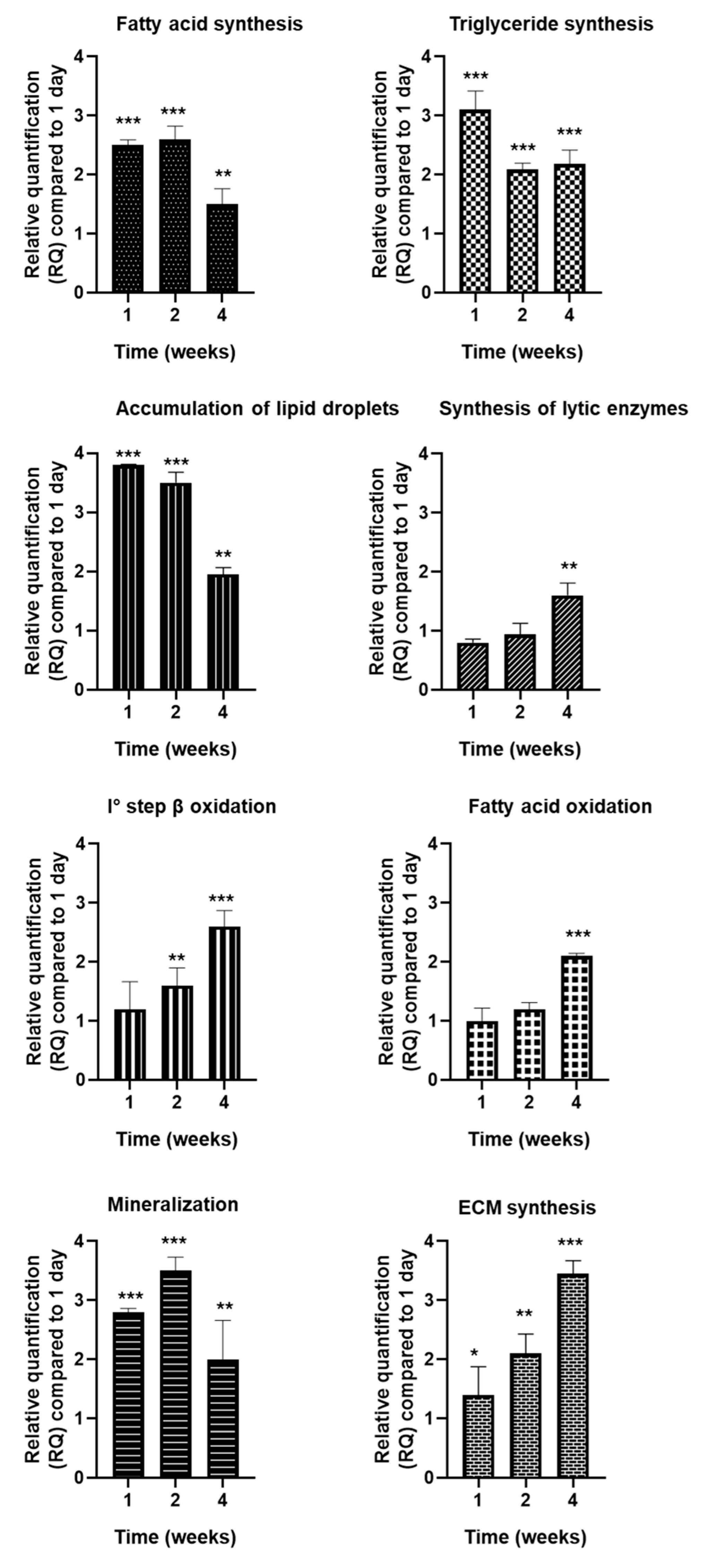
Gene expression levels were normalized to day 1 of culture and are expressed as fold change ± SD relative to this baseline (Figure 2).
Genes associated with de novo fatty acid synthesis showed variation over time. FASN expression was 2.5 ± 0.09-fold at 1 week, slightly increased to 2.6 ± 0.23-fold at 2 weeks, and decreased to 1.5 ± 0.26-fold at 4 weeks. Similarly, genes associated with triglyceride synthesis varied over time. DGAT2 expression was 3.1 ± 0.32-fold at 1 week, decreased to 2.09 ± 0.11-fold at 2 weeks, and remained at 2.18 ± 0.24-fold at 4 weeks. Genes associated with lipid droplet accumulation were higher at early time points. PLIN2 was 3.8 ± 0.01-fold at 1 week, slightly reduced to 3.5 ± 0.18-fold at 2 weeks, and further decreased to 1.95 ± 0.12-fold at 4 weeks. In contrast, genes associated with lipolytic activity increased over time. PNPLA2/ATGL expression was 0.80 ± 0.06-fold at 1 week, increased to 0.94 ± 0.19-fold at 2 weeks, and further to 1.60 ± 0.21-fold at 4 weeks. Genes associated with mitochondrial fatty acid oxidation increased over time. CPT1A expression increased from 1.2 ± 0.5-fold at 1 week to 1.6 ± 0.3-fold at 2 weeks and reached 2.6 ± 0.3-fold at 4 weeks. Similarly, HADHA expression increased from 1.0 ± 0.2-fold at 1 week to 1.2 ± 0.1-fold at 2 weeks and further to 2.1 ± 0.1-fold at 4 weeks. Genes associated with osteogenic activity also varied over time. ALPL expression increased from 2.8 ± 0.1-fold at 1 week to 3.5 ± 0.2-fold at 2 weeks, followed by a reduction to 2.0 ± 0.7-fold at 4 weeks. In contrast, SPARC exhibited a progressive increase over time, rising from 1.40 ± 0.48-fold at 1 week to 2.10 ± 0.33-fold at 2 weeks and reaching 3.45 ± 0.22-fold at 4 weeks.

2.3. Raman Spectroscopy Characterization

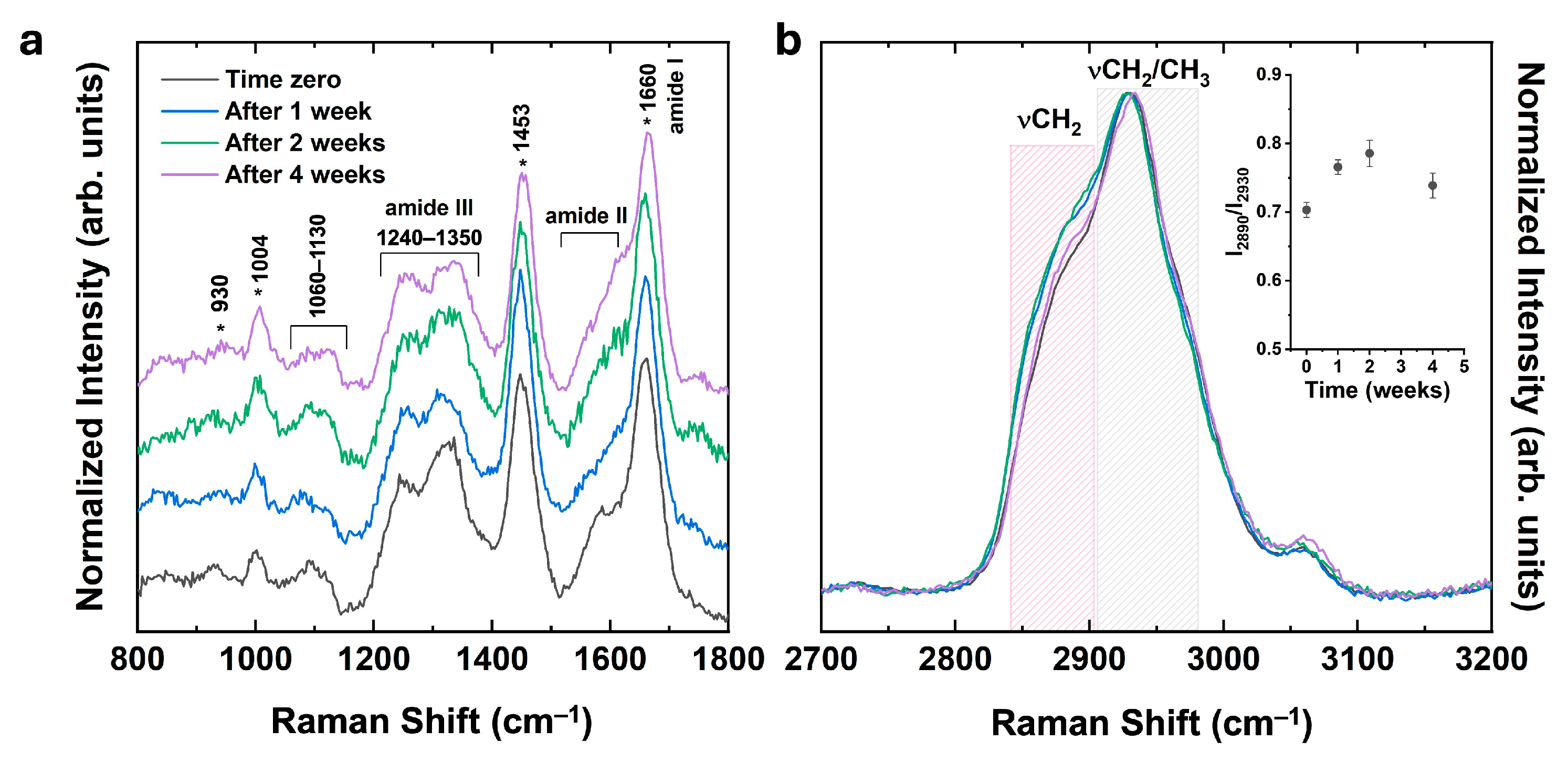
A spectroscopic characterization of 3D human osteoblast spheroids was performed using Raman spectroscopy (Figure 3) to investigate biochemical changes during spheroid maturation.
All Raman spectra were acquired in the spectral range between 800 and 3200 cm−1 at various time points ranging from 1 to 4 weeks, to capture the complete vibrational pattern of the samples. In Figure 3a, the Raman spectra of the 3D spheroids in the fingerprint region between 800 and 1800 cm−1 are shown, revealing * key peaks associated with the typical vibrational features of biological systems [22,23], as detailed in Table 1. The peak at 1004 cm−1 corresponds to the aromatic ring breathing mode characteristic of the phenylalanine amino acid [24]. The peak at 1250 cm−1 is assigned to Amide III vibrations [25], while the group of peaks between 1340 cm−1 and 1455 cm−1 is associated with the typical CH bending and deformation modes, including CH2 twisting, CH2 rocking, and CH2/CH3 scissoring [24,26]. The broad peak at 1660 cm−1, associated with Amide I vibrations and C=C stretching [26], indicates the presence of protein secondary structures indicative of protein backbone organization and collagen-related structures. In the high-frequency region (2700–3200 cm−1), lipid-associated bands were observed, particularly within the 2850–2890 cm−1 range, attributed to CH2 stretching of lipid acyl chains and the 2900–2930 cm−1 region associated with CH2/CH3 stretching modes [27,28]. The intensity of the lipid-related CH2 stretching band changed during spheroid maturation. The insert of Figure 3b highlights the temporal evolution of the intensity ratio between the 2890 cm−1 and the 2930 cm−1 bands (I2890/I2930). This ratio initially rises from early to intermediate stages, followed by a decrease at 4 weeks, suggesting time-dependent variation in lipid-associated spectral features. In parallel, progressive modulation of Amide I and Amide III bands was observed, suggesting changes in protein-related spectral features during spheroid maturation. The coordinated evolution of lipid- and protein-associated vibrational features is consistent with time-dependent changes in biochemical composition during spheroid development.

3. Discussion

Bone formation is a highly demanding biosynthetic process requiring sustained extracellular matrix (ECM) synthesis and mineral deposition [32,33]. While glucose metabolism has traditionally been considered the principal energetic source for osteoblasts, accumulating evidence indicates that lipid metabolism represents a relevant component of osteoblast differentiation. In this context, the present study examined the temporal coordination of lipid storage and utilization pathways in a controlled three-dimensional (3D) human osteoblast spheroid model.
Confocal imaging demonstrated that intracellular lipid distribution in 3D osteoblast spheroids underwent progressive spatial remodeling during maturation. Early stages were characterized by discrete lipid vesicles distributed within individual cells, whereas later stages exhibited compartmentalized organization, including peripheral lipid enrichment and structural reorganization within the spheroid core. The emergence of spatial heterogeneity at advanced stages further indicates that 3D architecture, with its intrinsic gradients of nutrients and oxygen, can influence lipid trafficking and metabolic adaptation in ways not observed in conventional 2D systems.
Gene expression analysis revealed a stage-dependent sequence of lipid metabolic events consistent with the morphological findings. During early spheroid maturation (1 week), the transcriptional profile was characterized by activation of pathways involved in fatty acid synthesis and triglyceride assembly, together with stabilization of intracellular lipid stores, consistent with a predominance of lipid accumulation processes during initial structural consolidation. At 2 weeks, this storage-oriented metabolic configuration remained evident, concomitant with peak osteogenic activity, suggesting increased biosynthetic and matrix-related demands. By 4 weeks, a coordinated transcriptional shift toward genes involved in lipid mobilization and mitochondrial fatty acid oxidation became apparent, suggesting enhanced utilization of stored fatty acids to sustain energy requirements during advanced spheroid maturation. This temporal transcriptional shift from lipid accumulation-associated pathways toward lipid mobilization-related pathways is consistent with previous observations showing that lipolysis derived fatty acids support mitochondrial bioenergetic function and osteoblast activity during bone formation [5,34].
Raman spectroscopy provided complementary spectroscopic information on these molecular trends. A time-dependent variation of lipid-associated CH2/CH3 stretching bands suggests changes in lipid-related molecular composition during spheroid maturation. Parallel, progressive changes in Amide I–III regions suggest modifications in protein-related spectral features during spheroid maturation. The convergence of spectroscopic signatures with gene expression data suggests a coordinated remodeling of lipid-related molecular features and extracellular matrix organization in this 3D system [35].
Consequently, the reproducible model provides a controlled platform for studying how alterations in lipid flux and oxidative metabolism influence bone formation activity. Given the recognized association between metabolic dysfunction and skeletal disorders, including osteoporosis and metabolic bone disorders, this system may represent a valuable experimental tool for studying energy-related bone diseases. In particular, the temporal coordination between lipid storage and lipid mobilization observed in this study may be used to investigate how alterations in lipid metabolism affect osteoblast differentiation and bone formation efficiency. This model may, therefore, be applied to evaluate metabolic conditions characterized by altered lipid handling and to test metabolic interventions targeting osteoblast function by modulating lipid synthesis, lipid mobilization, or mitochondrial fatty acid oxidation.
Although 3D spheroid models do not fully reproduce the complexity of in vivo bone tissue, they represent a reproducible and controlled experimental system that allows the investigation of cell–cell interactions, spatial organization, and metabolic regulation under defined conditions. In this context, the 3D spheroid model provides a complementary approach to more complex systems such as organoids, which may represent an important direction for future studies aimed at further recapitulating tissue-level architecture.
A limitation of the present study is the lack of functional perturbation approaches, such as gene silencing or knockdown strategies (e.g., siRNA). Future studies integrating these approaches, together with protein-level validation (e.g., immunoblot analysis), will further clarify the causal contribution and functional regulation of lipid metabolism pathways during osteoblast maturation in this 3D model.

4. Materials and Methods

4.1. Cell Culture Conditions

The human fetal osteoblast cell line hFOB 1.19 (ATCC, Manassas, VA, USA) was cultured in a 1:1 mixture of Ham’s F12 and Dulbecco’s Modified Eagle Medium (DMEM/F12; D8437, Sigma-Aldrich, St. Louis, MO, USA) (D8437, Sigma/Merck Life Science), supplemented with 2.5 mM L-glutamine (G7513, Sigma-Aldrich, St. Louis, MO, USA), 0.3 mg/mL G418 (4727878001, Merck Life Science, Darmstadt, Germany), and 10% fetal bovine serum (FBS; F7524, Sigma-Aldrich, St. Louis, MO, USA). Cells were maintained at 37 °C in a humidified atmosphere with 5% CO2 [36]. The culture medium was replaced twice per week, and cells were subcultured at ~80% confluence. Cells were routinely tested for mycoplasma contamination and confirmed to be mycoplasma-free.

4.2. 3D Spheroid Formation

The 3D spheroid models were generated using the hanging drop method, as previously published [21]. Spheroid formation and growth were monitored at defined time points (1, 2, and 4 weeks). Each experimental condition was performed in triplicate and repeated in three independent experiments (n = 3) to ensure reproducibility.

4.3. Confocal Microscopy and Lipid Staining

Lipid droplets were stained using Nile Red, a fluorescent dye specific for hydrophobic lipid environments. A 30 mM Nile Red stock solution was prepared in dimethyl sulfoxide (DMSO) and diluted 1:3000 in DMEM/F12 Ham’s medium immediately before use. Spheroids were gently transferred onto glass slides using sterile forceps and washed twice with Dulbecco’s Phosphate-Buffered Saline (DPBS) [37]. Samples were fixed with 4% formalin for 15 min at room temperature, followed by incubation with Nile Red for 30 min at room temperature in the dark. After staining, samples were washed twice with DPBS to remove excess dye, mounted on glass slides, and analyzed using a Leica DMIRE2 inverted microscope equipped with a TCS SP2 confocal system. Confocal microscopy was used to evaluate intracellular lipid accumulation in 3D spheroids at baseline (time zero) and after 1, 2, and 4 weeks of culture. Confocal imaging was used to assess the spatial distribution of intracellular lipid droplets within the spheroid architecture during culture. For the analysis, the fluorescence excitation was performed at 514 nm, and the emission was collected at 550–600 nm to exclude the laser reflection [38]. Images were acquired at 45× magnification, and the fluorescence analysis was performed using ImageJ software v1.53 (NIH, Bethesda, MD, USA).

4.4. Quantitative Real-Time PCR (qRT-PCR)

The expression of genes involved in lipid metabolism, mitochondrial fatty acid oxidation, and osteogenic differentiation was analysed during 3D spheroid development at defined time points (1, 2, and 4 weeks) [39,40,41]. Total RNA was extracted from 3D spheroids using TRIzol reagent (Invitrogen, Carlsbad, CA, USA) according to the manufacturer’s instructions and quantified using a NanoDrop ND-1000 UV spectrophotometer (Thermo Fisher Scientific, Waltham, MA, USA). Complementary DNA (cDNA) was synthesized from 1 µg total RNA using a reverse transcription kit (Promega, Madison, WI, USA; Cat. No. A3800), and quantitative real-time PCR (qRT-PCR) was performed using SsoAdvanced Universal SYBR Green Supermix (Bio-Rad Laboratories, Hercules, CA, USA) in a final reaction volume of 20 μL containing 1 μL of cDNA, 0.5 μM of forward and reverse primers, and 10 μL of SYBR Green Supermix. Gene expression levels were calculated using the 2−ΔΔCt method, normalized to GAPDH as the housekeeping gene, and expressed as fold changes relative to day 1. Primer sequences used for the qRT-PCR analysis are reported in Table 2.

4.5. Raman Spectroscopy

For the Raman experiments, all the analysed samples were transferred onto commercial CaF2 slides, which were selected because they minimize substrate-related fluorescence background [29] compared with glass or silica-based slides. After deposition, the samples were washed with phosphate-buffered saline (PBS), fixed with 4% formalin for 20 min, and finally rinsed with ultrapure water before the spectroscopic analysis. Raman spectra were acquired by focusing 0.5 mW of a 473 nm laser line (COBOLT) through a 100× objective with a numerical aperture of 0.9 mounted on an Olympus microscope. The backscattered signals were collected over 10 s by a Horiba iHR550 spectrometer equipped with a 600 lines/mm diffraction grating and a CCD detector (Syncerity) from Horiba. Data analysis was performed using the LabSpec 6 (version 6.1.180 beta) software (Horiba Scientific, Kyoto, Japan).

4.6. Statistical Analysis

All experiments were conducted in technical triplicate and performed in three independent biological replicates. Results are expressed as mean ± standard deviation (SD). Data were analysed using GraphPad Prism 8.0 (GraphPad Software, San Diego, CA, USA). Statistical significance was determined using one-way ANOVA followed by a Bonferroni post-hoc test for multiple comparisons. Statistical significance was set at a threshold of 0.05.

5. Conclusions

This study describes the coordinated transcriptional modulation of genes involved in lipogenic, lipolytic, and mitochondrial fatty acid oxidation pathways associated with the energetic and biosynthetic demands of osteoblast maturation and bone matrix formation. Combining 3D morphology, intracellular lipid visualization, gene expression profiling, and Raman spectroscopy, our findings indicate dynamic molecular remodeling of lipid handling pathways involving lipid droplets.
These data could contribute to the development of advanced experimental platforms for studying metabolic alterations associated with bone diseases, including conditions characterized by altered osteoblast activity and bone remodeling, such as osteoporosis and metabolic bone disorders. Furthermore, this model may represent a useful experimental platform for investigating lipid-related metabolic pathways involved in osteoblast function and for testing metabolic modulators under controlled experimental conditions.

Author Contributions

Conceptualization, M.G.R. and S.P.P.G.; methodology, M.G.R., D.M. and E.L.S.; software, E.L.S.; validation, A.S.; investigation, M.G.R.; resources, M.G.R.; data curation, G.C., D.M. and B.F.; writing—original draft preparation, M.G.R., A.S. and D.M.; writing—review and editing, D.T.; supervision, C.F. and S.C. All authors have read and agreed to the published version of the manuscript.

Funding

This research was funded by the European Union (NextGeneration EU), through the MURPNRR Project SAMOTHRACE (ECS00000022).

Institutional Review Board Statement

Not applicable.

Informed Consent Statement

Not applicable.

Data Availability Statement

All data supporting the findings of this study are available within the document.

Conflicts of Interest

The authors declare no conflicts of interest.

Abbreviations

The following abbreviations are used in this manuscript:
3DThree-dimensional
ALPLAlkaline phosphatase, tissue-nonspecific isozyme
ATGLAdipose triglyceride lipase
CPT1ACarnitine palmitoyltransferase 1A
DGAT2Diacylglycerol O-acyltransferase 2
DMEMDulbecco’s Modified Eagle Medium
DPBSDulbecco’s phosphate-buffered saline
ECMExtracellular matrix
FASNFatty acid synthase
FBSFetal bovine serum
GAPDHGlyceraldehyde-3-phosphate dehydrogenase
HADHAHydroxyacyl-CoA dehydrogenase trifunctional multienzyme complex subunit alpha
PBSPhosphate-buffered saline
PLIN2Perilipin 2
PNPLA2Patatin-like phospholipase domain-containing protein 2
qRT-PCRQuantitative real-time polymerase chain reaction
SDStandard deviation
SPARCSecreted protein acidic and cysteine rich

References

  1. Feng, X.; McDonald, J.M. Disorders of Bone Remodeling. Annu. Rev. Pathol. Mech. Dis. 2011, 6, 121–145. [Google Scholar] [CrossRef] [PubMed]
  2. Bolamperti, S.; Villa, I.; Rubinacci, A. Bone Remodeling: An Operational Process Ensuring Survival and Bone Mechanical Competence. Bone Res. 2022, 10, 48. [Google Scholar] [CrossRef] [PubMed]
  3. Rowe, P.; Koller, A.; Sharma, S. Physiology, Bone Remodeling. In StatPearls; StatPearls Publishing: Treasure Island, FL, USA, 2026. [Google Scholar]
  4. Nandy, A.; Helderman, R.C.M.; Thapa, S.; Jayapalan, S.; Richards, A.; Narayani, N.; Czech, M.P.; Rosen, C.J.; Rendina-Ruedy, E. Lipolysis Supports Bone Formation by Providing Osteoblasts with Endogenous Fatty Acid Substrates to Maintain Bioenergetic Status. Bone Res. 2023, 11, 62. [Google Scholar] [CrossRef] [PubMed]
  5. Alekos, N.S.; Moorer, M.C.; Riddle, R.C. Dual Effects of Lipid Metabolism on Osteoblast Function. Front. Endocrinol. 2020, 11, 578194. [Google Scholar] [CrossRef]
  6. Florencio-Silva, R.; da Silva Sasso, G.R.; Sasso-Cerri, E.; Simões, M.J.; Cerri, P.S. Biology of Bone Tissue: Structure, Function, and Factors That Influence Bone Cells. BioMed Res. Int. 2015, 2015, 421746. [Google Scholar] [CrossRef]
  7. Orimo, H. The Mechanism of Mineralization and the Role of Alkaline Phosphatase in Health and Disease. J. Nippon Med. Sch. 2010, 77, 4–12. [Google Scholar] [CrossRef]
  8. Shen, L.; Hu, G.; Karner, C.M. Bioenergetic Metabolism In Osteoblast Differentiation. Curr. Osteoporos. Rep. 2022, 20, 53–64. [Google Scholar] [CrossRef]
  9. Adamek, G.; Felix, R.; Guenther, H.L.; Fleisch, H. Fatty Acid Oxidation in Bone Tissue and Bone Cells in Culture. Characterization and Hormonal Influences. Biochem. J. 1987, 248, 129–137. [Google Scholar] [CrossRef]
  10. Niemeier, A.; Niedzielska, D.; Secer, R.; Schilling, A.; Merkel, M.; Enrich, C.; Rensen, P.C.N.; Heeren, J. Uptake of Postprandial Lipoproteins into Bone in Vivo: Impact on Osteoblast Function. Bone 2008, 43, 230–237. [Google Scholar] [CrossRef]
  11. Rendina-Ruedy, E.; Guntur, A.R.; Rosen, C.J. Intracellular Lipid Droplets Support Osteoblast Function. Adipocyte 2017, 6, 250–258. [Google Scholar] [CrossRef]
  12. Lass, A.; Zimmermann, R.; Oberer, M.; Zechner, R. Lipolysis—A Highly Regulated Multi-Enzyme Complex Mediates the Catabolism of Cellular Fat Stores. Prog. Lipid Res. 2011, 50, 14–27. [Google Scholar] [CrossRef]
  13. Nandy, A.; Helderman, R.C.M.; Thapa, S.; Peck, S.H.; Richards, A.; Jayapalan, S.; Narayani, N.; Czech, M.P.; Rosen, C.J.; Rendina-Ruedy, E. Enhanced Fatty Acid Oxidation in Osteoprogenitor Cells Provides Protection from High-Fat Diet Induced Bone Dysfunction. J. Bone Miner. Res. 2025, 40, 283–298. [Google Scholar] [CrossRef]
  14. Kim, S.P.; Li, Z.; Zoch, M.L.; Frey, J.L.; Bowman, C.E.; Kushwaha, P.; Ryan, K.A.; Goh, B.C.; Scafidi, S.; Pickett, J.E.; et al. Fatty Acid Oxidation by the Osteoblast Is Required for Normal Bone Acquisition in a Sex- and Diet-Dependent Manner. JCI Insight 2017, 2, e92704. [Google Scholar] [CrossRef] [PubMed]
  15. Payr, S.; Rosado-Balmayor, E.; Tiefenboeck, T.; Schuseil, T.; Unger, M.; Seeliger, C.; van Griensven, M. Direct Comparison of 3D and 2D Cultivation Reveals Higher Osteogenic Capacity of Elderly Osteoblasts in 3D. J. Orthop. Surg. Res. 2021, 16, 13. [Google Scholar] [CrossRef] [PubMed]
  16. Park, C.H.; Park, J.H.; Suh, Y.J. Perspective of 3D Culture in Medicine: Transforming Disease Research and Therapeutic Applications. Front. Bioeng. Biotechnol. 2024, 12, 1491669. [Google Scholar] [CrossRef] [PubMed]
  17. Rizzo, M.G.; Fazio, E.; Pasquale, C.D.; Sciuto, E.L.; Cannatà, G.; Multisanti, C.R.; Impellitteri, F.; D’Agostino, F.G.; Guglielmino, S.P.P.; Faggio, C.; et al. Physiopathological Features in a Three-Dimensional In Vitro Model of Hepatocellular Carcinoma: Hypoxia-Driven Oxidative Stress and ECM Remodeling. Cancers 2025, 17, 3082. [Google Scholar] [CrossRef]
  18. Urzì, O.; Gasparro, R.; Costanzo, E.; Luca, A.D.; Giavaresi, G.; Fontana, S.; Alessandro, R. Three-Dimensional Cell Cultures: The Bridge between In Vitro and In Vivo Models. Int. J. Mol. Sci. 2023, 24, 12046. [Google Scholar] [CrossRef]
  19. Radi, S.; EzEldeen, M.; Végvári, Á.; Coates, D.; Jacobs, R.; Bostanci, N.; Bao, K. The Proteome of Osteoblasts in a 3D Culture Perfusion Bioreactor Model Compared with Static Conditions. Sci. Rep. 2025, 15, 12120. [Google Scholar] [CrossRef]
  20. Gurkan, U.A.; Kishore, V.; Condon, K.W.; Bellido, T.M.; Akkus, O. A Scaffold-Free Multicellular Three-Dimensional In Vitro Model of Osteogenesis. Calcif. Tissue Int. 2011, 88, 388–401. [Google Scholar] [CrossRef]
  21. Rizzo, M.G.; Morganti, D.; Smeriglio, A.; Sciuto, E.L.; Spata, M.O.; Trombetta, D.; Fazio, B.; Guglielmino, S.P.P.; Conoci, S. Formation of 3D Human Osteoblast Spheroids Incorporating Extracellular Matrix-Mimetic Phage Peptides as a Surrogate Bone Tissue Model. Int. J. Mol. Sci. 2025, 26, 8482. [Google Scholar] [CrossRef]
  22. Fosca, M.; Basoli, V.; Della Bella, E.; Russo, F.; Vadalà, G.; Alini, M.; Rau, J.V.; Verrier, S. Raman Spectroscopy in Skeletal Tissue Disorders and Tissue Engineering: Present and Prospective. Tissue Eng. Part B Rev. 2022, 28, 949–965. [Google Scholar] [CrossRef] [PubMed]
  23. Notingher, I. Raman Spectroscopy Cell-Based Biosensors. Sensors 2007, 7, 1343–1358. [Google Scholar] [CrossRef]
  24. Zhu, G.; Zhu, X.; Fan, Q.; Wan, X. Raman Spectra of Amino Acids and Their Aqueous Solutions. Spectrochim. Acta Part A Mol. Biomol. Spectrosc. 2011, 78, 1187–1195. [Google Scholar] [CrossRef] [PubMed]
  25. Chan, J.W.; Taylor, D.S.; Zwerdling, T.; Lane, S.M.; Ihara, K.; Huser, T. Micro-Raman Spectroscopy Detects Individual Neoplastic and Normal Hematopoietic Cells. Biophys. J. 2006, 90, 648–656. [Google Scholar] [CrossRef]
  26. Kuhar, N.; Sil, S.; Umapathy, S. Potential of Raman Spectroscopic Techniques to Study Proteins. Spectrochim. Acta Part A Mol. Biomol. Spectrosc. 2021, 258, 119712. [Google Scholar] [CrossRef]
  27. Czamara, K.; Majzner, K.; Pacia, M.Z.; Kochan, K.; Kaczor, A.; Baranska, M. Raman Spectroscopy of Lipids: A Review. J. Raman Spectrosc. 2015, 46, 4–20. [Google Scholar]
  28. Morganti, D.; Leonardi, A.A.; Faro, M.J.L.; Conoci, S.; Irrera, A.; Fazio, B. Synthesis of Silver Dendrites as a Powerful SERS Platform for Hydrated Proteins Detection. In Sensors and Microsystems; Springer: Cham, Switzerland, 2025; pp. 304–310. [Google Scholar]
  29. Morganti, D.; Longo, V.; Leonardi, A.A.; Irrera, A.; Colombo, P.; Fazio, B. First Vibrational Fingerprint of Parietaria Judaica Protein via Surface-Enhanced Raman Spectroscopy. Biosensors 2025, 15, 182. [Google Scholar] [CrossRef]
  30. Leonardi, A.A.; Sciuto, E.L.; Lo Faro, M.J.; Morganti, D.; Midiri, A.; Spinella, C.; Conoci, S.; Irrera, A.; Fazio, B. Molecular Fingerprinting of the Omicron Variant Genome of SARS-CoV-2 by SERS Spectroscopy. Nanomaterials 2022, 12, 2134. [Google Scholar] [CrossRef]
  31. David, C.; d’Andrea, C.; Lancelot, E.; Bochterle, J.; Guillot, N.; Fazio, B.; Maragò, O.M.; Sutton, A.; Charnaux, N.; Neubrech, F.; et al. Raman and IR Spectroscopy of Manganese Superoxide Dismutase, a Pathology Biomarker. Vib. Spectrosc. 2012, 62, 50–58. [Google Scholar] [CrossRef]
  32. Lin, X.; Patil, S.; Gao, Y.-G.; Qian, A. The Bone Extracellular Matrix in Bone Formation and Regeneration. Front. Pharmacol. 2020, 11, 757. [Google Scholar] [CrossRef]
  33. Derbel, H.; Elleuch, J.; Tounsi, L.; Nicolo, M.S.; Rizzo, M.G.; Michaud, P.; Fendri, I.; Abdelkafi, S. Improvement of Biomass and Phycoerythrin Production by a Strain of Rhodomonas Sp. Isolated from the Tunisian Coast of Sidi Mansour. Biomolecules 2022, 12, 885. [Google Scholar] [CrossRef]
  34. Xiao, H.; Li, W.; Qin, Y.; Lin, Z.; Qian, C.; Wu, M.; Xia, Y.; Bai, J.; Geng, D. Crosstalk between Lipid Metabolism and Bone Homeostasis: Exploring Intricate Signaling Relationships. Research 2024, 7, 0447. [Google Scholar] [CrossRef] [PubMed]
  35. Morris, M.D.; Mandair, G.S. Raman Assessment of Bone Quality. Clin. Orthop. Relat. Res. 2011, 469, 2160–2169. [Google Scholar] [CrossRef] [PubMed]
  36. Rizzo, M.G.; Palermo, N.; Alibrandi, P.; Sciuto, E.L.; Gaudio, C.D.; Filardi, V.; Fazio, B.; Caccamo, A.; Oddo, S.; Calabrese, G.; et al. Physiologic Response Evaluation of Human Foetal Osteoblast Cells within Engineered 3D-Printed Polylactic Acid Scaffolds. Biology 2023, 12, 424. [Google Scholar] [CrossRef] [PubMed]
  37. Rizzo, M.G.; De Plano, L.M.; Franco, D. Regulation of Filamentation by Bacteria and Its Impact on the Productivity of Compounds in Biotechnological Processes. Appl. Microbiol. Biotechnol. 2020, 104, 4631–4642. [Google Scholar] [CrossRef]
  38. Elliott, A.D. Confocal Microscopy: Principles and Modern Practices. Curr. Protoc. Cytom. 2020, 92, e68. [Google Scholar] [CrossRef]
  39. Xiong, R.; Wang, H.; Li, Y.; Zheng, J.; Cheng, Y.; Liu, S.; Yang, G. Machine Learning-Based Transcriptome Analysis of Lipid Metabolism Biomarkers for the Survival Prediction in Hepatocellular Carcinoma. Front. Genet. 2022, 13, 1005271. [Google Scholar] [CrossRef]
  40. Lu, X.; Chen, Y.; Wang, H.; Bai, Y.; Zhao, J.; Zhang, X.; Liang, L.; Chen, Y.; Ye, C.; Li, Y.; et al. Integrated Lipidomics and Transcriptomics Characterization upon Aging-Related Changes of Lipid Species and Pathways in Human Bone Marrow Mesenchymal Stem Cells. J. Proteome Res. 2019, 18, 2065–2077. [Google Scholar] [CrossRef]
  41. Liu, Y.; Xia, G.; Zhu, S.; Shi, Y.; Huang, X.; Wu, J.; Xu, C.; Du, A. Differential Transcriptomic Profiling of Lipid Metabolism and Collagen Remodeling in Fast- and Slow-Twitch Skeletal Muscles in Aging. FASEB J. 2025, 39, e70335. [Google Scholar] [CrossRef]
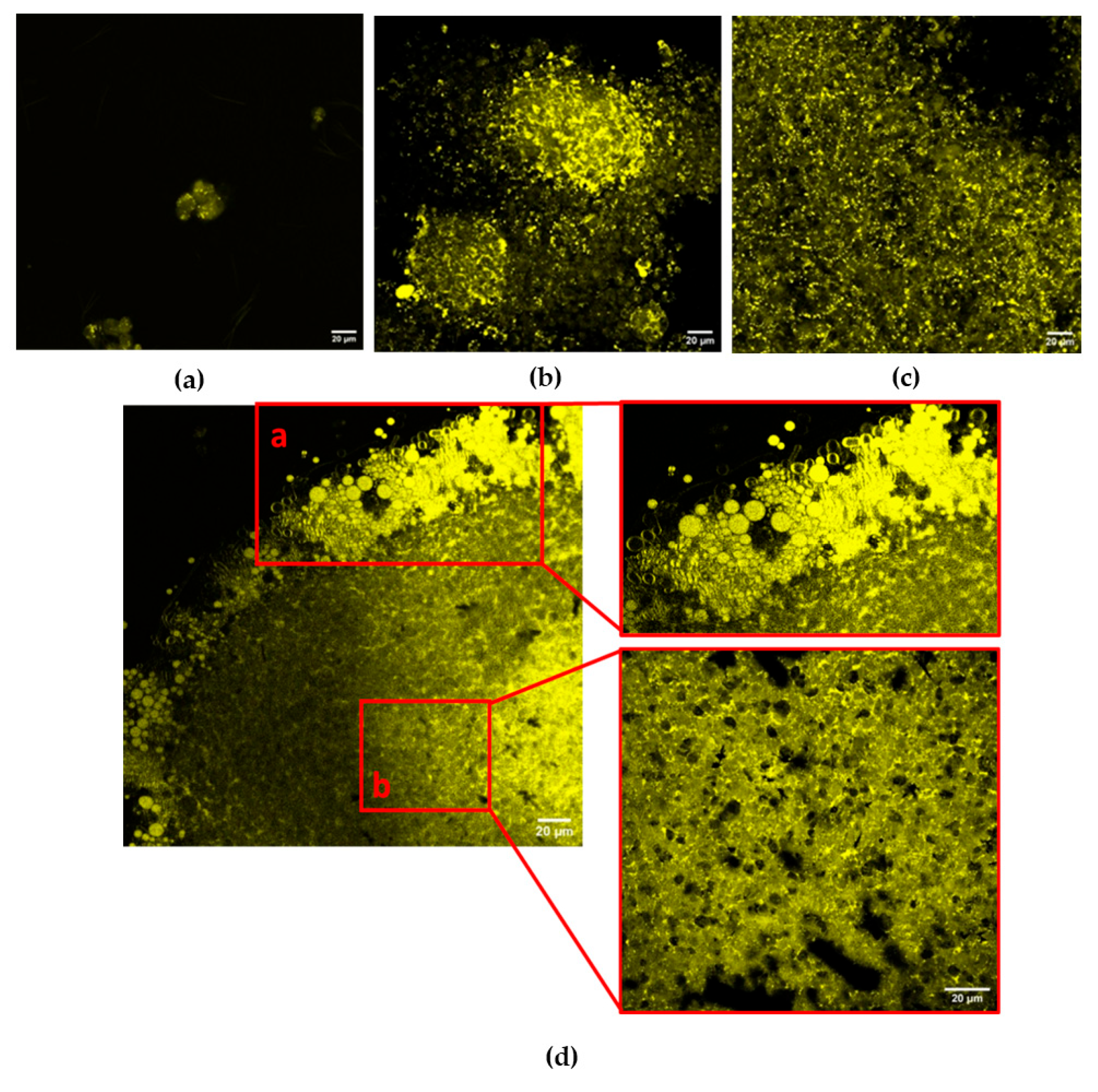
Figure 1. Confocal microscopy images of hFOB spheroid development at 1 day (a), 1 week (b), 2 weeks (c), and 4 weeks (d) of culture. Higher magnification views of 4-week spheroids highlight lipid-rich peripheral regions (red box a) and inner core areas (red box b). Nile Red-positive lipid droplets are shown in yellow. Scale bar: 20 µm.
Ijms 27 03325 g001
Figure 2. qRT-PCR analysis of lipid metabolism and osteogenic markers in 3D human osteoblast spheroids. Relative mRNA levels (FASN, DGAT2, PLIN2, PNPLA2/ATGL, CPT1A, HADHA, ALPL, and SPARC) are expressed as fold change ± SD normalized to day 1 and to GAPDH. The data represent three independent experiments performed in triplicate. Statistical significance: * p < 0.05, ** p < 0.01, *** p < 0.001.
Ijms 27 03325 g002
Figure 3. Normalized Raman spectra in staked view of the 3D human osteoblast spheroids in the protein fingerprint region (a) and in the high-frequency region (b). The inset shows the variation of the ratio between the Raman intensities at 2890 cm−1 and 2930 cm−1 (I2890/I2930) over time.
Ijms 27 03325 g003
Table 1. Raman peak assignments in 3D human osteoblast spheroids.
Frequency (cm−1)Vibrational ModeAssignmentReferences
930C–C stretchingProteins, Lipids[24,26]
1004C=C stretching Proteins (Phenylalanine ring breathing mode)[21,29]
1060–1130C–N stretching
C–C rocking
Proteins[21,30]
1240–1350CH2 twisting
Amide III (α-helix, β-sheet)
Proteins, Lipids[26,29]
1455CH2 scissoring
CH2 rocking
Proteins, Lipids[24,29]
1550–1620Amide II
C=C stretching (aromatic ring)
Amide I (antiparallel β-sheet)
Proteins[26,31]
1660Amide I (α-helix)Proteins[24,26]
2850–2890CH2 stretching Lipids[31]
2900–2930CH2 and CH3 stretchingLipids[31]
Table 2. Gene target used in qRT-PCR.
Protein NameTarget GeneForwardReverse
Glyceraldehyde3-phosphate dehydrogenaseGAPDHGTCTCCTCTGACTTCAACAGCGACCACCCTGTTGCTGTAGCCAA
Fatty Acid SynthaseFASNTTCTACGGCTCCACGCTCTTCCGAAGAGTCTTCGTCAGCCAGGA
Diacylglycerol O-Acyltransferase 2DGAT2GCTACAGGTCATCTCAGTGCTCGTGAAGTAGAGCACAGCGATGAG
Perilipin 2PLIN2GATGGCAGAGAACGGTGTGAAGCAGGCATAGGTATTGGCAACTGC
Adipose Triglyceride LipasePNPLA2/ATGLCCCACTTCAACTCCAAGGACGAGCAGGTTGTCTGAAATGCCACC
Carnitine Palmitoyltransferase 1ACPT1AGATCCTGGACAATACCTCGGAGCTCCACAGCATCAAGAGACTGC
Hydroxyacyl-CoA dehydrogenase trifunctional multienzyme complex subunit alphaHADHAGCCGACATGGTGATTGAAGCTGGGAGAGCAGATGTGTTACTGGC
Secreted protein acidic and cysteine-richSPARCTGCCTGATGAGACAGAGGTGGTCTTCGGTTTCCTCTGCACCATC
Alkaline Phosphatase, Biomineralization AssociatedALPLGCTGTAAGGACATCGCCTACCACCTGGCTTTCTCGTCACTCTCA
Disclaimer/Publisher’s Note: The statements, opinions and data contained in all publications are solely those of the individual author(s) and contributor(s) and not of MDPI and/or the editor(s). MDPI and/or the editor(s) disclaim responsibility for any injury to people or property resulting from any ideas, methods, instructions or products referred to in the content.