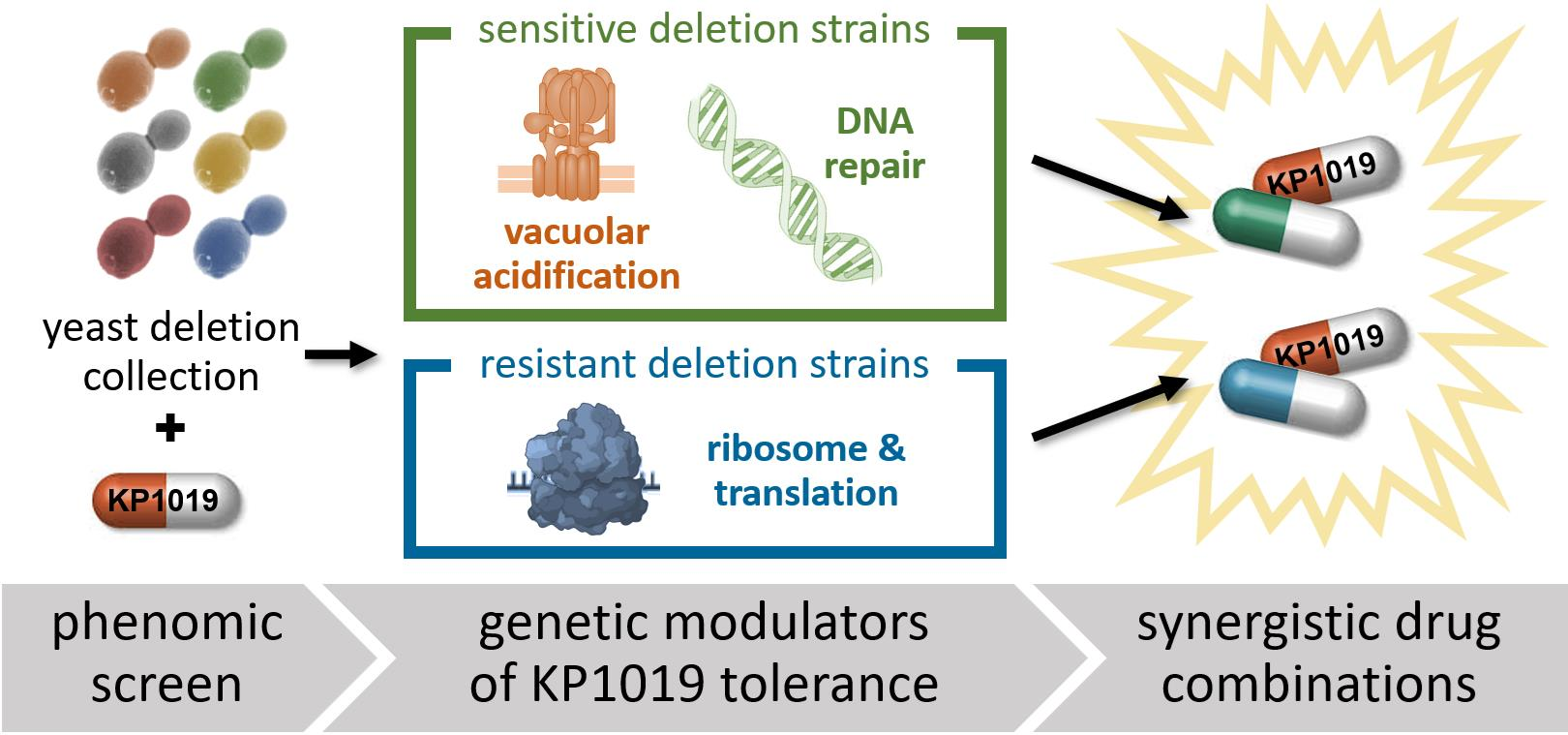
Yeast Phenomic Analysis Reveals DNA Repair, pH Homeostasis, and Ribosomal Biogenesis as Modulators of Anticancer Ruthenium Complex KP1019
 , , , and
Abstract
1. Introduction
2. Results
2.1. Global Response of Yeast Deletion Collection to KP1019
2.2. KP1019 Damages DNA
2.3. pH-Dependence of KP1019 Bioactivity
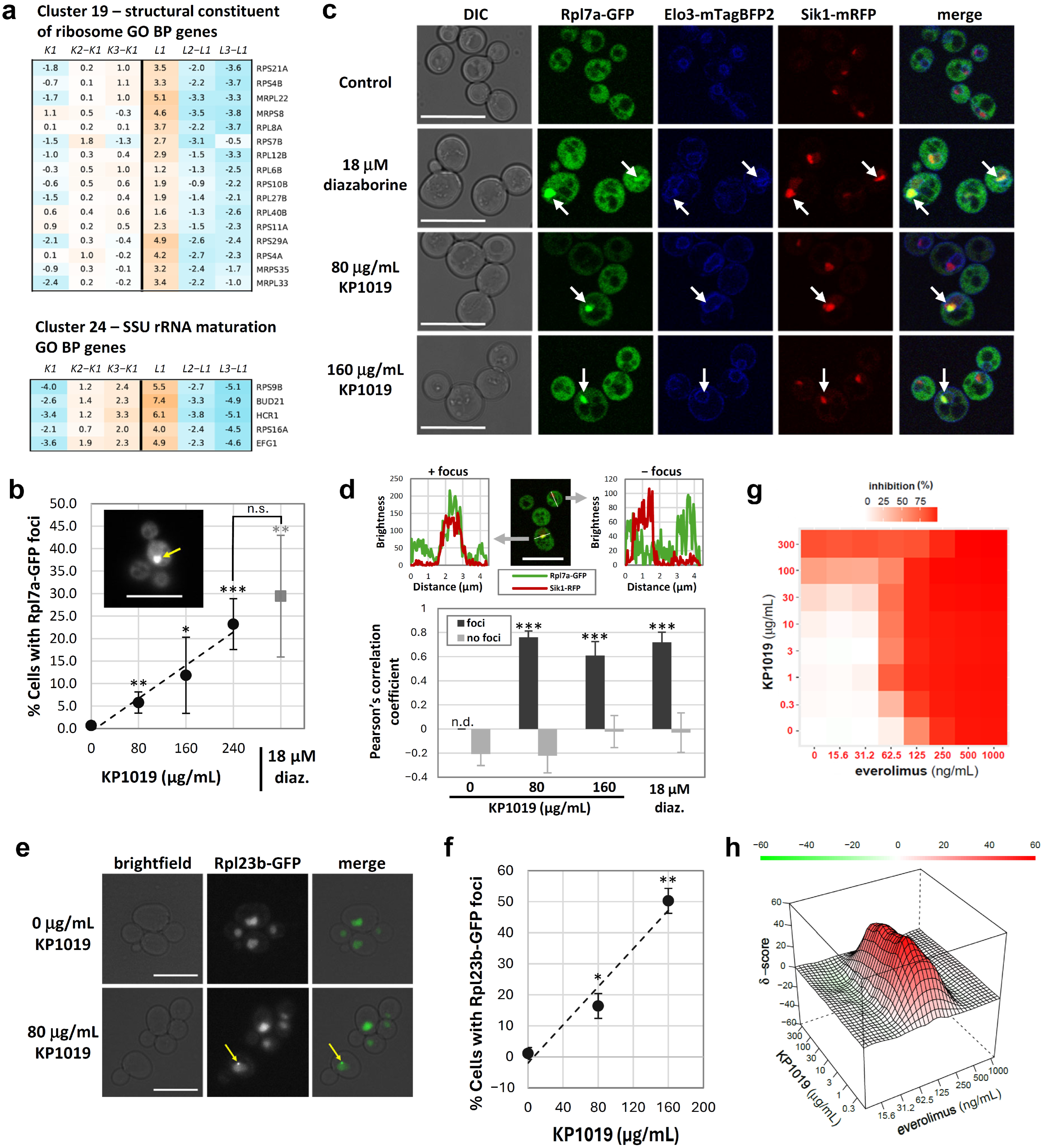
2.4. KP1019 Induces Ribosome Biogenesis Stress
3. Discussion
3.1. Verification of DNA as One of the Targets of KP1019
3.2. pH Homeostasis as a Physiologically Relevant Modulator of KP1019 Toxicity
3.3. Perturbation of Ribosomal Biogenesis by KP1019
4. Materials and Methods
4.1. Yeast Strains and Plasmids
4.2. Yeast Media and Drugs
4.3. Phenomic Screening, Clustering, and Gene Ontology Enrichment Analysis
4.4. Microscopy
4.5. Drug Sensitivity and Synergy Assays
4.6. UV–Vis Spectrophotometry
Supplementary Materials
Author Contributions
Funding
Institutional Review Board Statement
Informed Consent Statement
Data Availability Statement
Acknowledgments
Conflicts of Interest
Abbreviations
| BOLD-100 | Sodium trans-[tetrachlorobis(1H-indazole)ruthenate(III)] |
| CPP | Cell proliferation parameter |
| 5-FU | 5-fluorouracil |
| GO | Gene ontology |
| HR | Homologous recombination |
| IC50 | Half-maximal inhibitory concentration |
| ICL | Interstrand cross-link |
| KP1019 | Indazolium trans-[tetrachlorobis(1H-indazole)ruthenate(III)] |
| LMCT | Ligand to metal charge transfer |
| Ribi | Ribosomal biogenesis |
| RNR | Ribonucleotide reductase |
| RP | Ribosomal protein |
| TLS | Translesion synthesis |
| TOR | Target of rapamycin |
| ZIP | Zero interaction potency |
References
- Ishida, S.; Lee, J.; Thiele, D.J.; Herskowitz, I. Uptake of the Anticancer Drug Cisplatin Mediated by the Copper Transporter Ctr1 in Yeast and Mammals. Proc. Natl. Acad. Sci. USA 2002, 99, 14298–14302. [Google Scholar] [CrossRef] [PubMed]
- Howell, S.B.; Safaei, R.; Larson, C.A.; Sailor, M.J. Copper Transporters and the Cellular Pharmacology of the Platinum-Containing Cancer Drugs. Mol. Pharmacol. 2010, 77, 887. [Google Scholar] [CrossRef] [PubMed]
- Giaever, G.; Nislow, C. The Yeast Deletion Collection: A Decade of Functional Genomics. Genetics 2014, 197, 451–465. [Google Scholar] [CrossRef] [PubMed]
- Rodgers, J.; Guo, J.; Hartman, J.L. Phenomic Assessment of Genetic Buffering by Kinetic Analysis of Cell Arrays. Methods Mol. Biol. 2014, 1205, 187–208. [Google Scholar] [CrossRef]
- Hartman, J.L.; Stisher, C.; Outlaw, D.A.; Guo, J.; Shah, N.A.; Tian, D.; Santos, S.M.; Rodgers, J.W.; White, R.A. Yeast Phenomics: An Experimental Approach for Modeling Gene Interaction Networks that Buffer Disease. Genes 2015, 6, 24–45. [Google Scholar] [CrossRef]
- Shah, N.A.; Laws, R.J.; Wardman, B.; Zhao, L.P.; Hartman, J.L., IV. Accurate, Precise Modeling of Cell Proliferation Kinetics from Time-Lapse Imaging and Automated Image Analysis of Agar Yeast Culture Arrays. BMC Syst. Biol. 2007, 1, 3. [Google Scholar] [CrossRef]
- Santos, S.M.; Hartman, J.L. A Yeast Phenomic Model for the Influence of Warburg Metabolism on Genetic Buffering of Doxorubicin. Cancer Metab. 2019, 7, 9. [Google Scholar] [CrossRef]
- Depenbrock, H.; Schmelcher, S.; Peter, R.; Keppler, B.K.; Weirich, G.; Block, T.; Rastetter, J.; Hanauske, A.R. Preclinical Activity of Trans-Indazolium [Tetrachlorobisindazoleruthenate(III)] (NSC 666158; IndCR.; KP 1019) against Tumour Colony-Forming Units and Haematopoietic Progenitor Cells. Eur. J. Cancer 1997, 33, 2404–2410. [Google Scholar] [CrossRef]
- Kapitza, S.; Jakupec, M.A.; Uhl, M.; Keppler, B.K.; Marian, B. The Heterocyclic Ruthenium(III) Complex KP1019 (FFC14A) Causes DNA Damage and Oxidative Stress in Colorectal Tumor Cells. Cancer Lett. 2005, 226, 115–121. [Google Scholar] [CrossRef]
- Heffeter, P.; Böck, K.; Atil, B.; Reza Hoda, M.A.; Körner, W.; Bartel, C.; Jungwirth, U.; Keppler, B.K.; Micksche, M.; Berger, W.; et al. Intracellular Protein Binding Patterns of the Anticancer Ruthenium Drugs KP1019 and KP1339. J. Biol. Inorg. Chem. 2010, 15, 737–748. [Google Scholar] [CrossRef]
- Berger, M.R.; Garzon, F.T.; Keppler, B.K.; Schmähl, D. Efficacy of New Ruthenium Complexes against Chemically Induced Autochthonous Colorectal Carcinoma in Rats. Anticancer Res. 1989, 9, 761–765. [Google Scholar]
- Hartinger, C.G.; Jakupec, M.A.; Zorbas-Seifried, S.; Groessl, M.; Egger, A.; Berger, W.; Zorbas, H.; Dyson, P.J.; Keppler, B.K. KP1019, A New Redox-Active Anticancer Agent—Preclinical Development and Results of a Clinical Phase I Study in Tumor Patients. Chem. Biodivers. 2008, 5, 2140–2155. [Google Scholar] [CrossRef] [PubMed]
- Lentz, F.; Drescher, A.; Lindauer, A.; Henke, M.; Hilger, R.A.; Hartinger, C.G.; Scheulen, M.E.; Dittrich, C.; Keppler, B.K.; Jaehde, U.; et al. Pharmacokinetics of a Novel Anticancer Ruthenium Complex (KP1019, FFC14A) in a Phase I Dose-Escalation Study. Anticancer Drugs 2009, 20, 97–103. [Google Scholar] [CrossRef] [PubMed]
- Stevens, S.K.; Strehle, A.P.; Miller, R.L.; Gammons, S.H.; Hoffman, K.J.; McCarty, J.T.; Miller, M.E.; Stultz, L.K.; Hanson, P.K. The Anticancer Ruthenium Complex KP1019 Induces DNA Damage, Leading to Cell Cycle Delay and Cell Death in Saccharomyces cerevisiae. Mol. Pharmacol. 2013, 83, 225–234. [Google Scholar] [CrossRef] [PubMed]
- Bierle, L.A.; Reich, K.L.; Taylor, B.E.; Blatt, E.B.; Middleton, S.M.; Burke, S.D.; Stultz, L.K.; Hanson, P.K.; Partridge, J.F.; Miller, M.E. DNA Damage Response Checkpoint Activation Drives KP1019 Dependent Pre-Anaphase Cell Cycle Delay in S. cerevisiae. PLoS ONE 2015, 10, e0138085, Erratum in PLoS ONE 2015, 10, e0141518. https://doi.org/10.1371/journal.pone.0141518. [Google Scholar] [CrossRef][Green Version]
- Singh, V.; Kumar Azad, G.; Mandal, P.; Reddy, M.A.; Tomar, R.S. Anti-Cancer Drug KP1019 Modulates Epigenetics and Induces DNA Damage Response in Saccharomyces cerevisiae. FEBS Lett. 2014, 588, 1044–1052. [Google Scholar] [CrossRef]
- Stultz, L.K.; Hunsucker, A.; Middleton, S.; Grovenstein, E.; O’Leary, J.; Blatt, E.; Miller, M.; Mobley, J.; Hanson, P.K. Proteomic Analysis of the S. cerevisiae Response to the Anticancer Ruthenium Complex KP1019. Metallomics 2020, 12, 876–890. [Google Scholar] [CrossRef]
- Groessl, M.; Zava, O.; Dyson, P.J. Cellular Uptake and Subcellular Distribution of Ruthenium-Based Metallodrugs under Clinical Investigation versus Cisplatin. Metallomics 2011, 3, 591. [Google Scholar] [CrossRef]
- Aitken, J.B.; Antony, S.; Weekley, C.M.; Lai, B.; Spiccia, L.; Harris, H.H. Distinct Cellular Fates for KP1019 and NAMI-A Determined by X-Ray Fluorescence Imaging of Single Cells. Metallomics 2012, 4, 1051–1056. [Google Scholar] [CrossRef]
- Webb, M.I.; Walsby, C.J. EPR as a Probe of the Intracellular Speciation of Ruthenium(III) Anticancer Compounds. Metallomics 2013, 5, 1624. [Google Scholar] [CrossRef]
- Levina, A.; Aitken, J.B.; Gwee, Y.Y.; Lim, Z.J.; Liu, M.; Singharay, A.M.; Wong, P.F.; Lay, P.A. Biotransformations of Anticancer Ruthenium(III) Complexes: An X-Ray Absorption Spectroscopic Study. Chemistry 2013, 19, 3609–3619. [Google Scholar] [CrossRef]
- Hartinger, C.G.; Zorbas-Seifried, S.; Jakupec, M.A.; Kynast, B.; Zorbas, H.; Keppler, B.K. From Bench to Bedside—Preclinical and Early Clinical Development of the Anticancer Agent Indazolium Trans-[Tetrachlorobis(1H-Indazole)Ruthenate(III)] (KP1019 or FFC14A). J. Inorg. Biochem. 2006, 100, 891–904. [Google Scholar] [CrossRef] [PubMed]
- Levina, A.; Chetcuti, A.R.M.; Lay, P.A. Controversial Role of Transferrin in the Transport of Ruthenium Anticancer Drugs. Biomolecules 2022, 12, 1319. [Google Scholar] [CrossRef] [PubMed]
- Pongratz, M.; Schluga, P.; Jakupec, M.A.; Arion, V.B.; Hartinger, C.G.; Allmaier, G.; Keppler, B.K. Transferrin Binding and Transferrin-Mediated Cellular Uptake of the Ruthenium Coordination Compound KP1019, Studied by Means of AAS, ESI-MS and CD Spectroscopy. J. Anal. At. Spectrom. 2004, 19, 46–51. [Google Scholar] [CrossRef]
- Bartel, C.; Egger, A.E.; Jakupec, M.A.; Heffeter, P.; Galanski, M.; Berger, W.; Keppler, B.K. Influence of Ascorbic Acid on the Activity of the Investigational Anticancer Drug KP1019. J. Biol. Inorg. Chem. 2011, 16, 1205–1215. [Google Scholar] [CrossRef]
- Golla, U.; Swagatika, S.; Chauhan, S.; Tomar, R.S. A Systematic Assessment of Chemical, Genetic, and Epigenetic Factors Influencing the Activity of Anticancer Drug KP1019 (FFC14A). Oncotarget 2017, 8, 98426–98454. [Google Scholar] [CrossRef]
- Birrell, G.W.; Brown, J.A.; Wu, H.I.; Giaever, G.; Chu, A.M.; Davis, R.W.; Brown, J.M. Transcriptional Response of Saccharomyces cerevisiae to DNA-damaging Agents Does not Identify the Genes that Protect against these Agents. Proc. Natl. Acad. Sci. USA 2002, 99, 8778–8783. [Google Scholar] [CrossRef]
- Mani, R.; St Onge, R.P.; Hartman, J.L., IV; Giaever, G.; Roth, F.P. Defining genetic interaction. Proc. Natl. Acad. Sci. USA 2008, 105, 3461–3466. [Google Scholar] [CrossRef]
- Engel, S.R.; Aleksander, S.; Nash, R.S.; Wong, E.D.; Weng, S.; Miyasato, S.R.; Sherlock, G.; Cherry, J.M. Saccharomyces Genome Database: Advances in genome annotation, expanded biochemical pathways, and other key enhancements. Genetics 2025, 229, iyae185. [Google Scholar] [CrossRef]
- Huang, M.; Elledge, S.J. Identification of RNR4, Encoding a Second Essential Small Subunit of Ribonucleotide Reductase in Saccharomyces cerevisiae. Mol. Cell. Biol. 1997, 17, 6105–6113. [Google Scholar] [CrossRef]
- Wang, P.J.; Chabes, A.; Casagrande, R.; Tian, X.C.; Thelander, L.; Huffaker, T.C. Rnr4p, a Novel Ribonucleotide Reductase Small-Subunit Protein. Mol. Cell. Biol. 1997, 17, 6114–6121. [Google Scholar] [CrossRef] [PubMed]
- Yao, R.; Zhang, Z.; An, X.; Bucci, B.; Perlstein, D.L.; Stubbe, J.A.; Huang, M. Subcellular Localization of Yeast Ribonucleotide Reductase Regulated by the DNA Replication and Damage Checkpoint Pathways. Proc. Natl. Acad. Sci. USA 2003, 100, 6628–6633. [Google Scholar] [CrossRef] [PubMed]
- An, X.; Zhang, Z.; Yang, K.; Huang, M. Cotransport of the Heterodimeric Small Subunit of the Saccharomyces cerevisiae Ribonucleotide Reductase between the Nucleus and the Cytoplasm. Genetics 2006, 173, 63–73. [Google Scholar] [CrossRef] [PubMed]
- Hartwell, L.H.; Culotti, J.; Pringle, J.R.; Reid, B.J. Genetic Control of the Cell Division Cycle in Yeast. Science 1974, 183, 46–51. [Google Scholar] [CrossRef]
- Wu, X.; An, X.; Zhang, C.; Huang, M. Clb6-Cdc28 Promotes Ribonucleotide Reductase Subcellular Redistribution during S Phase. Mol. Cell. Biol. 2018, 38, e00497-17. [Google Scholar] [CrossRef]
- Munari, F.M.; Guecheva, T.N.; Bonatto, D.; Henriques, J.A.Ô.P. New Features on Pso2 Protein Family in DNA Interstrand Cross-Link Repair and in the Maintenance of Genomic Integrity in Saccharomyces cerevisiae. Fungal Genet. Biol. 2013, 60, 122–132. [Google Scholar] [CrossRef][Green Version]
- Lehoczký, P.; McHugh, P.J.; Chovanec, M. DNA Interstrand Cross-Link Repair in Saccharomyces cerevisiae. FEMS Microbiol. Rev. 2007, 31, 109–133. [Google Scholar] [CrossRef]
- Prado, F. Homologous Recombination: To Fork and Beyond. Genes 2018, 9, 603. [Google Scholar] [CrossRef]
- Martin, S.K.; Wood, R.D. DNA Polymerase ζ in DNA Replication and Repair. Nucleic Acids Res. 2019, 47, 8348. [Google Scholar] [CrossRef]
- Lopez-Martinez, D.; Liang, C.-C.; Cohn, M.A. Cellular Response to DNA Interstrand Crosslinks: The Fanconi Anemia Pathway. Cell Mol. Life Sci. 2016, 73, 3097–3114. [Google Scholar] [CrossRef]
- Deans, A.J.; West, S.C. DNA Interstrand Crosslink Repair and Cancer. Nat. Rev. Cancer 2011, 11, 467–480. [Google Scholar] [CrossRef] [PubMed]
- Pinedo, H.M.; Peters, G.F.J. Fluorouracil: Biochemistry and Pharmacology. J. Clin. Oncol. 1988, 6, 1653–1664. [Google Scholar] [CrossRef] [PubMed]
- Schluga, P.; Hartinger, C.G.; Egger, A.; Reisner, E.; Galanski, M.; Jakupec, M.A.; Keppler, B.K. Redox Behavior of Tumor-Inhibiting Ruthenium(III) Complexes and Effects of Physiological Reductants on Their Binding to GMP. Dalton Trans. 2006, 14, 1796–1802. [Google Scholar] [CrossRef]
- Groessl, M.; Tsybin, Y.O.; Hartinger, C.G.; Keppler, B.K.; Dyson, P.J. Ruthenium versus platinum: Interactions of anticancer metallodrugs with duplex oligonucleotides characterised by electrospray ionisation mass spectrometry. J. Biol. Inorg. Chem. 2010, 15, 677–688. [Google Scholar] [CrossRef] [PubMed]
- Yadav, B.; Wennerberg, K.; Aittokallio, T.; Tang, J. Searching for Drug Synergy in Complex Dose-Response Landscapes Using an Interaction Potency Model. Comput. Struct. Biotechnol. J. 2015, 13, 504–513, Erratum in Comput. Struct. Biotechnol. J. 2017, 15, 387. [Google Scholar] [CrossRef]
- Graham, L.A.; Powell, B.; Stevens, T.H. Composition and assembly of the yeast vacuolar H+-ATPase complex. J. Exp. Biol. 2000, 203, 61–70. [Google Scholar] [CrossRef]
- Charoenbhakdi, S.; Dokpikul, T.; Burphan, T.; Techo, T.; Auesukaree, C. Vacuolar H+-ATPase Protects Saccharomyces cerevisiae Cells against Ethanol-induced Oxidative and Cell Wall Stresses. Appl. Environ. Microbiol. 2016, 82, 3121–3130, Erratum in Appl. Environ. Microbiol. 2016, 82, 5057. https://doi.org/10.1128/AEM.01691-16. [Google Scholar] [CrossRef]
- Tarsio, M.; Zheng, H.; Smardon, A.M.; Martínez-Muñoz, G.A.; Kane, P.M. Consequences of Loss of Vph1 Protein-Containing Vacuolar ATPases (V-ATPases) for Overall Cellular pH Homeostasis. J. Biol. Chem. 2011, 286, 28089–28096. [Google Scholar] [CrossRef]
- Martínez-Muñoz, G.A.; Kane, P. Vacuolar and Plasma Membrane Proton Pumps Collaborate to Achieve Cytosolic pH Homeostasis in Yeast. J. Biol. Chem. 2008, 283, 20309–20319, Erratum in J. Biol. Chem. 2017, 292, 7743. https://doi.org/10.1074/jbc.A117.710470. [Google Scholar] [CrossRef]
- Küng, A.; Pieper, T.; Wissiack, R.; Rosenberg, E.; Keppler, B.K. Hydrolysis of the Tumor-Inhibiting Ruthenium(III) Complexes HIm Trans-[RuCl4 (Im)2 ] and HInd Trans-[RuCl4 (Ind)2 ] Investigated by Means of HPCE and HPLC-MS. J. Biol. Inorg. Chem. 2001, 6, 292–299. [Google Scholar] [CrossRef]
- Hummer, A.A.; Heffeter, P.; Berger, W.; Filipits, M.; Batchelor, D.; Büchel, G.E.; Jakupec, M.A.; Keppler, B.K.; Rompel, A. X-Ray Absorption Near Edge Structure Spectroscopy to Resolve the in vivo Chemistry of the Redox-Active Indazolium Trans-[Tetrachlorobis(1H-Indazole) Ruthenate(III)] (KP1019). J. Med. Chem. 2013, 56, 1182–1196. [Google Scholar] [CrossRef]
- Orij, R.; Brul, S.; Smits, G.J. Intracellular pH Is a Tightly Controlled Signal in Yeast. Biochim. Biophys. Acta 2011, 1810, 933–944. [Google Scholar] [CrossRef] [PubMed]
- Küng, A.; Pieper, T.; Keppler, B.K. Investigations into the Interaction between Tumor-Inhibiting Ruthenium(III) Complexes and Nucleotides by Capillary Electrophoresis. J. Chromatogr. B Biomed. Sci. Appl. 2001, 759, 81–89. [Google Scholar] [CrossRef] [PubMed]
- Kratz, F.; Hartmann, M.; Keppler, B.; Messori, L. The Binding Properties of Two Antitumor Ruthenium(II1) Complexes to Apotransferrin. J. Biol. Chem. 1994, 269, 2581–2588. [Google Scholar] [CrossRef] [PubMed]
- Bruno, P.M.; Liu, Y.; Park, G.Y.; Murai, J.; Koch, C.E.; Eisen, T.J.; Pritchard, J.R.; Pommier, Y.; Lippard, S.J.; Hemann, M.T. A Subset of Platinum-Containing Chemotherapeutic Agents Kills Cells by Inducing Ribosome Biogenesis Stress. Nat. Med. 2017, 23, 461–471. [Google Scholar] [CrossRef]
- Awad, D.; Prattes, M.; Kofler, L.; Rössler, I.; Loibl, M.; Pertl, M.; Zisser, G.; Wolinski, H.; Pertschy, B.; Bergler, H. Inhibiting Eukaryotic Ribosome Biogenesis. BMC Biol. 2019, 17, 46. [Google Scholar] [CrossRef]
- Pertschy, B.; Zisser, G.; Schein, H.; Köffel, R.; Rauch, G.; Grillitsch, K.; Morgenstern, C.; Durchschlag, M.; Högenauer, G.; Bergler, H. Diazaborine Treatment of Yeast Cells Inhibits Maturation of the 60S Ribosomal Subunit. Mol. Cell. Biol. 2004, 24, 6476–6487. [Google Scholar] [CrossRef]
- Gautier, T.; Bergès, T.; Tollervey, D.; Hurt, E. Nucleolar KKE/D Repeat Proteins Nop56p and Nop58p Interact with Nop1p and Are Required for Ribosome Biogenesis. Mol. Cell. Biol. 1997, 17, 7088. [Google Scholar] [CrossRef]
- Newman, D.R.; Kuhn, J.F.; Shanab, G.M.; Maxwell, E.S. Box C/D SnoRNA-Associated Proteins: Two Pairs of Evolutionarily Ancient Proteins and Possible Links to Replication and Transcription. RNA 2000, 6, 861–879. [Google Scholar] [CrossRef]
- Li, Z.; Lee, I.; Moradi, E.; Hung, N.J.; Johnson, A.W.; Marcotte, E.M. Rational Extension of the Ribosome Biogenesis Pathway Using Network-Guided Genetics. PLoS Biol. 2009, 7, e1000213. [Google Scholar] [CrossRef]
- Oh, C.S.; Toke, D.A.; Mandala, S.; Martin, C.E. ELO2 and ELO3, Homologues of The Saccharomyces cerevisiae ELO1 Gene, Function in Fatty Acid Elongation and Are Required for Sphingolipid Formation. J. Biol. Chem. 1997, 272, 17376–17384. [Google Scholar] [CrossRef] [PubMed]
- Zhu, J.; Zhang, Z.T.; Tang, S.W.; Zhao, B.S.; Li, H.; Song, J.Z.; Li, D.; Xie, Z. A Validated Set of Fluorescent-Protein-Based Markers for Major Organelles in Yeast (Saccharomyces cerevisiae). mBio 2019, 10, e01691-19. [Google Scholar] [CrossRef] [PubMed]
- Suresh, H.G.; Bonneil, E.; Albert, B.; Dominique, C.; Costanzo, M.; Pons, C.; Masinas, M.P.D.; Shuteriqi, E.; Shore, D.; Henras, A.K.; et al. K29-linked free polyubiquitin chains affect ribosome biogenesis and direct ribosomal proteins to the intranuclear quality control compartment. Mol. Cell 2024, 84, 2337–2352.e9. [Google Scholar] [CrossRef] [PubMed]
- Huang, S.; Bjornsti, M.A.; Houghton, P.J. Rapamycins: Mechanisms of Action and Cellular Resistance. Cancer Biol. Ther. 2003, 2, 222–232. [Google Scholar] [CrossRef]
- Loewith, R.; Hall, M.N. Target of Rapamycin (TOR) in Nutrient Signaling and Growth Control. Genetics 2011, 189, 1177. [Google Scholar] [CrossRef]
- Devlin, J.R.; Hannan, K.M.; Hein, N.; Cullinane, C.; Kusnadi, E.; Ng, P.Y.; George, A.J.; Shortt, J.; Bywater, M.J.; Poortinga, G.; et al. Combination Therapy Targeting Ribosome Biogenesis and mRNA Translation Synergistically Extends Survival in MYC-Driven Lymphoma. Cancer Discov. 2016, 6, 59–70. [Google Scholar] [CrossRef]
- Shi, S.; Luo, H.; Wang, L.; Li, H.; Liang, Y.; Xia, J.; Wang, Z.; Cheng, B.; Huang, L.; Liao, G.; et al. Combined Inhibition of RNA Polymerase I and mTORC1/2 Synergize to Combat Oral Squamous Cell Carcinoma. Biomed. Pharmacother. 2021, 133, 110906. [Google Scholar] [CrossRef]
- Fruhauf, S.; Zeller, W. New Platinum, Titanium, and Ruthenium Complexes with Different Patterns of DNA Damage in Rat Ovarian Tumor Cells. Cancer Res. 1991, 51, 2943–2948. [Google Scholar]
- Kolisek, M.; Zsurka, G.; Samaj, J.; Weghuber, J.; Schweyen, R.J.; Schweigel, M. Mrs2p is an essential component of the major electrophoretic Mg2+ influx system in mitochondria. EMBO J. 2003, 22, 1235–1244. [Google Scholar] [CrossRef]
- Cui, Y.; Zhao, S.; Wang, J.; Wang, X.; Gao, B.; Fan, Q.; Sun, F.; Zhou, B. A novel mitochondrial carrier protein Mme1 acts as a yeast mitochondrial magnesium exporter. Biochim. Biophys. Acta 2015, 1853, 724–732. [Google Scholar] [CrossRef]
- Bakewell, S.J.; Rangel, D.F.; Ha, D.P.; Sethuraman, J.; Crouse, R.; Hadley, E.; Costich, T.L.; Zhou, X.; Nichols, P.; Lee, A.S. Suppression of Stress Induction of the 78-Kilodalton Glucose Regulated Protein (GRP78) in Cancer by IT-139, an Anti-Tumor Ruthenium Small Molecule Inhibitor. Oncotarget 2018, 9, 29698–29714. [Google Scholar] [CrossRef]
- Park, B.J.; Raha, P.; Pankovich, J.; Bazett, M. Utilization of Cancer Cell Line Screening to Elucidate the Anticancer Activity and Biological Pathways Related to the Ruthenium-Based Therapeutic BOLD-100. Cancers 2023, 15, 28. [Google Scholar] [CrossRef] [PubMed]
- Moruno-Manchon, J.F.; Koellhoffer, E.C.; Gopakumar, J.; Hambarde, S.; Kim, N.; McCullough, L.D.; Tsvetkov, A.S. The G-Quadruplex DNA Stabilizing Drug Pyridostatin Promotes DNA Damage and Downregulates Transcription of Brca1 in Neurons. Aging 2017, 9, 1957. [Google Scholar] [CrossRef]
- Malina, J.; Novakova, O.; Keppler, B.K.; Alessio, E.; Brabec, V. Biophysical Analysis of Natural, Double-Helical DNA Modified by Anticancer Heterocyclic Complexes of Ruthenium(III) in Cell-Free Media. J. Biol. Inorg. Chem. 2001, 6, 435–445. [Google Scholar] [CrossRef] [PubMed]
- Beljanski, V.; Marzilli, L.G.; Doetsch, P.W. DNA Damage-Processing Pathways Involved in the Eukaryotic Cellular Response to Anticancer DNA Cross-Linking Drugs. Mol. Pharmacol. 2004, 65, 1496–1506. [Google Scholar] [CrossRef] [PubMed]
- Lee, Y.K.; Lim, J.; Yoon, S.Y.; Joo, J.C.; Park, S.J.; Park, Y.J. Promotion of Cell Death in Cisplatin-Resistant Ovarian Cancer Cells through KDM1B-DCLRE1B Modulation. Int. J. Mol. Sci. 2019, 20, 2443. [Google Scholar] [CrossRef]
- Wang, X.; Wang, S.; Zhou, L.; Yu, L.; Zhang, L. A Network-Pathway Based Module Identification for Predicting the Prognosis of Ovarian Cancer Patients. J. Ovarian Res. 2016, 9, 73. [Google Scholar] [CrossRef]
- Jin, Y.H.; Dunlap, P.E.; McBride, S.J.; Al-Refai, H.; Bushel, P.R.; Freedman, J.H. Global Transcriptome and Deletome Profiles of Yeast Exposed to Transition Metals. PLoS Genet. 2008, 4, e1000053. [Google Scholar] [CrossRef]
- Gharieb, M.M.; Gadd, G.M. Evidence for the Involvement of Vacuolar Activity in Metal(Loid) Tolerance: Vacuolar-Lacking and -Defective Mutants of Saccharomyces cerevisiae Display Higher Sensitivity to Chromate, Tellurite and Selenite. BioMetals 1998, 11, 101–106. [Google Scholar] [CrossRef]
- Sousa, C.A.; Perez, R.R.; Soares, E.V. Saccharomyces cerevisiae Mutants Affected in Vacuole Assembly or Vacuolar H+-ATPase Are Hypersensitive to Lead (Pb) Toxicity. Curr. Microbiol. 2014, 68, 113–119. [Google Scholar] [CrossRef][Green Version]
- Hamilton, C.A.; Good, A.G.; Taylor, G.J. Vacuolar H+-ATPase, but Not Mitochondrial F1F0-ATPase, Is Required for Aluminum Resistance in Saccharomyces cerevisiae. FEMS Microbiol. Lett. 2001, 205, 231–236. [Google Scholar] [CrossRef] [PubMed]
- Liao, C.; Hu, B.; Arno, M.J.; Panaretou, B. Genomic Screening in Vivo Reveals the Role Played by Vacuolar H+ ATPase and Cytosolic Acidification in Sensitivity to DNA-Damaging Agents Such as Cisplatin. Mol. Pharmacol. 2007, 71, 416–425. [Google Scholar] [CrossRef] [PubMed]
- Kane, P.M. Proton Transport and pH Control in Fungi. Adv. Exp. Med. Biol. 2016, 892, 33–68. [Google Scholar] [CrossRef] [PubMed]
- Techo, T.; Jindarungrueng, S.; Tatip, S.; Limcharoensuk, T.; Pokethitiyook, P.; Kruatrachue, M.; Auesukaree, C. Vacuolar H+-ATPase Is Involved in Preventing Heavy Metal-Induced Oxidative Stress in Saccharomyces cerevisiae. Environ. Microbiol. 2020, 22, 2403–2418. [Google Scholar] [CrossRef]
- Kawahata, M.; Masaki, K.; Fujii, T.; Iefuji, H. Yeast Genes Involved in Response to Lactic Acid and Acetic Acid: Acidic Conditions Caused by the Organic Acids in Saccharomyces cerevisiae Cultures Induce Expression of Intracellular Metal Metabolism Genes Regulated by Aft1p. FEMS Yeast Res. 2006, 6, 924–936. [Google Scholar] [CrossRef]
- Mollapour, M.; Fong, D.; Balakrishnan, K.; Harris, N.; Thompson, S.; Schüller, C.; Kuchler, K.; Piper, P.W. Screening the Yeast Deletant Mutant Collection for Hypersensitivity and Hyper-Resistance to Sorbate, a Weak Organic Acid Food Preservative. Yeast 2004, 21, 927–946. [Google Scholar] [CrossRef]
- Groessl, M.; Hartinger, C.G.; Dyson, P.J.; Keppler, B.K. CZE–ICP-MS as a Tool for Studying the Hydrolysis of Ruthenium Anticancer Drug Candidates and Their Reactivity towards the DNA Model Compound dGMP. J. Inorg. Biochem. 2008, 102, 1060–1065. [Google Scholar] [CrossRef]
- Sharma, V.; Kaur, R.; Bhatnagar, A.; Kaur, J. Low-pH-induced apoptosis: Role of endoplasmic reticulum stress-induced calcium permeability and mitochondria-dependent signaling. Cell Stress. Chaperones 2015, 20, 431–440. [Google Scholar] [CrossRef]
- Lee, S.; Shanti, A. Effect of exogenous pH on cell growth of breast cancer cells. Int. J. Mol. Sci. 2021, 22, 9910. [Google Scholar] [CrossRef]
- Teixeira, J.; Basit, F.; Swarts, H.G.; Forkink, M.; Oliveira, P.J.; Willems, P.H.; Koopman, W.J. Extracellular acidification induces ROS-and mPTP-mediated death in HEK293 cells. Redox Biol. 2018, 15, 394–404. [Google Scholar] [CrossRef]
- Valli, M.; Sauer, M.; Branduardi, P.; Borth, N.; Porro, D.; Mattanovich, D. Intracellular pH Distribution in Saccharomyces cerevisiae Cell Populations, Analyzed by Flow Cytometry. Appl. Environ. Microbiol. 2005, 71, 1515–1521. [Google Scholar] [CrossRef] [PubMed]
- Orij, R.; Urbanus, M.L.; Vizeacoumar, F.J.; Giaever, G.; Boone, C.; Nislow, C.; Brul, S.; Smits, G.J. Genome-Wide Analysis of Intracellular pH Reveals Quantitative Control of Cell Division Rate by pH(c) in Saccharomyces cerevisiae. Genome Biol. 2012, 13, R80. [Google Scholar] [CrossRef] [PubMed]
- Carmelo, V.; Santos, H.; Sá-Correia, I. Effect of Extracellular Acidification on the Activity of Plasma Membrane ATPase and on the Cytosolic and Vacuolar pH of Saccharomyces cerevisiae. Biochim. Biophys. Acta 1997, 1325, 63–70. [Google Scholar] [CrossRef] [PubMed][Green Version]
- Shirmanova, M.V.; Druzhkova, I.N.; Lukina, M.M.; Matlashov, M.E.; Belousov, V.V.; Snopova, L.B.; Prodanetz, N.N.; Dudenkova, V.V.; Lukyanov, S.A.; Zagaynova, E.V. Intracellular pH Imaging in Cancer Cells in vitro and Tumors in vivo Using the New Genetically Encoded Sensor SypHer2. Biochim. Biophys. Acta 2015, 1850, 1905–1911. [Google Scholar] [CrossRef]
- Swietach, P.; Patiar, S.; Supuran, C.T.; Harris, A.L.; Vaughan-Jones, R.D. The Role of Carbonic Anhydrase 9 in Regulating Extracellular and Intracellular pH in Three-Dimensional Tumor Cell Growths. J. Biol. Chem. 2009, 284, 20299–20310. [Google Scholar] [CrossRef]
- Zhu, Y.; Kang, E.; Wilson, M.; Basso, T.; Chen, E.; Yu, Y.; Li, Y.-R.; Liebau, S.; Parvin, B.; Ergün, S.; et al. 3D Tumor Spheroid and Organoid to Model Tumor Microenvironment for Cancer Immunotherapy. Organoids 2022, 1, 149–167. [Google Scholar] [CrossRef]
- Koltai, T. Targeting the pH Paradigm at the Bedside: A Practical Approach. Int. J. Mol. Sci. 2020, 21, 9221. [Google Scholar] [CrossRef]
- Matthews, H.; Ranson, M.; Kelso, M.J. Anti-Tumour/Metastasis Effects of the Potassium-Sparing Diuretic Amiloride: An Orally Active Anti-Cancer Drug Waiting for Its Call-of-Duty? Int. J. Cancer 2011, 129, 2051–2061. [Google Scholar] [CrossRef]
- Gao, G.; Liu, F.; Xu, Z.; Wan, D.; Han, Y.; Kuang, Y.; Wang, Q.; Zhi, Q. Evidence of Nigericin as a Potential Therapeutic Candidate for Cancers: A Review. Biomed. Pharmacother. 2021, 137, 111262. [Google Scholar] [CrossRef]
- Neuditschko, B.; Legin, A.A.; Baier, D.; Schintlmeister, A.; Reipert, S.; Wagner, M.; Keppler, B.K.; Berger, W.; Meier-Menches, S.M.; Gerner, C. Interaction with Ribosomal Proteins Accompanies ER Stress-induction of the Anticancer Metallodrug BOLD-100/KP1339. Angew. Chem. Int. Ed. Engl. 2020, 60, 5063–5068. [Google Scholar] [CrossRef]
- Shamsuzzaman, M.; Rahman, N.; Gregory, B.; Bommakanti, A.; Zengel, J.M.; Bruno, V.M.; Lindahl, L.; Matthew Traxler, E.F. Inhibition of Ribosome Assembly and Ribosome Translation Has Distinctly Different Effects on Abundance and Paralogue Composition of Ribosomal Protein mRNAs in Saccharomyces cerevisiae. mSystems 2023, 8, e0109822. [Google Scholar] [CrossRef]
- Kirchner, G.I.; Meier-Wiedenbach, I.; Manns, M.P. Clinical Pharmacokinetics of Everolimus. Clin. Pharmacokinet. 2004, 43, 83–95. [Google Scholar] [CrossRef] [PubMed]
- Albert, B.; Kos-Braun, I.C.; Henras, A.K.; Dez, C.; Rueda, M.P.; Zhang, X.; Gadal, O.; Kos, M.; Shore, D. A Ribosome Assembly Stress Response Regulates Transcription to Maintain Proteome Homeostasis. Elife 2019, 8, e45002. [Google Scholar] [CrossRef] [PubMed]
- Tye, B.W.; Commins, N.; Ryazanova, L.V.; Wuhr, M.; Springer, M.; Pincus, D.; Churchman, L.S. Proteotoxicity from Aberrant Ribosome Biogenesis Compromises Cell Fitness. Elife 2019, 8, e43002. [Google Scholar] [CrossRef] [PubMed]
- Dwyer, B.G.; Johnson, E.; Cazares, E.; McFarlane Holman, K.L.; Kirk, S.R. Ruthenium Anticancer Agent KP1019 Binds More Tightly than NAMI-A to tRNAPhe. J. Inorg. Biochem. 2018, 182, 177–183. [Google Scholar] [CrossRef]
- Steffen, K.K.; McCormick, M.A.; Pham, K.M.; Mackay, V.L.; Delaney, J.R.; Murakami, C.J.; Kaeberlein, M.; Kennedy, B.K. Ribosome Deficiency Protects Against ER Stress in Saccharomyces cerevisiae. Genetics 2012, 191, 107–118. [Google Scholar] [CrossRef]
- Zadali, R.; Tomecki, R.; Topf, U. Ribosomal Protein Rps29/us14 Contributes to 18S rRNA Maturation and its Abundance Regulates Osmotic Stress Response in S. cerevisiae. Nucleic Acids Res. 2025, 53, gkaf807. [Google Scholar] [CrossRef]
- Malik Ghulam, M.; Catala, M.; Reulet, G.; Scott, M.S.; Abou Elela, S. Duplicated Ribosomal Protein Paralogs Promote Alternative Translation and Drug Resistance. Nat. Commun. 2022, 13, 4938. [Google Scholar] [CrossRef]
- Fuentes, P.; Pelletier, J.; Gentilella, A. Decoding Ribosome Complexity: Role of Ribosomal Proteins in Cancer and Disease. NAR Cancer 2024, 6, zcae032. [Google Scholar] [CrossRef]
- Ramalho, S.; Dopler, A.; Faller, W.J. Ribosome Specialization in Cancer: A Spotlight on Ribosomal Proteins. NAR Cancer 2024, 6, zcae029. [Google Scholar] [CrossRef]
- Gietz, R.D.; Schiestl, R.H.; Willems, A.R.; Woods, R.A. Studies on the Transformation of Intact Yeast Cells by the LiAc/SS-DNA/PEG Procedure. Yeast 1995, 11, 355–360. [Google Scholar] [CrossRef]
- Voth, W.P.; Jiang, Y.W.; Stillman, D.J. New ‘Marker Swap’ Plasmids for Converting Selectable Markers on Budding Yeast Gene Disruptions and Plasmids. Yeast 2003, 20, 985–993. [Google Scholar] [CrossRef] [PubMed]
- Winzeler, E.A.; Shoemaker, D.D.; Astromoff, A.; Liang, H.; Anderson, K.; Andre, B.; Bangham, R.; Benito, R.; Boeke, J.D.; Bussey, H.; et al. Functional Characterization of the S. cerevisiae Genome by Gene Deletion and Parallel Analysis. Science 1999, 285, 901–906. [Google Scholar] [CrossRef] [PubMed]
- Huh, W.-K.; Falvo, J.V.; Gerke, L.C.; Carroll, A.S.; Howson, R.W.; Weissman, J.S.; O’Shea, E.K. Global Analysis of Protein Localization in Budding Yeast. Nature 2003, 425, 686–691. [Google Scholar] [CrossRef] [PubMed]
- Kaiser, C.; Michaelis, S.; Mitchell, A. Methods in Yeast Genetics; Cold Spring Harbor Laboratory Press: Cold Spring Harbor, NY, USA, 1994. [Google Scholar]
- Davis, J.; Cetto, A.; Campbell, M.; Scoggins, S.; Stultz, L.; Hanson, P. DMSO Reduces the Cytotoxicity of Anticancer Ruthenium Complex KP1019 in Yeast. microPubl. Biol. 2021, 10, 17912. [Google Scholar] [CrossRef]
- Louie, R.J.; Guo, J.; Rodgers, J.W.; White, R.; Shah, N.A.; Pagant, S.; Kim, P.; Livstone, M.; Dolinski, K.; Mckinney, B.A.; et al. A Yeast Phenomic Model for the Gene Interaction Network Modulating CFTR-ΔF508 Protein Biogenesis. Genome Med. 2012, 4, 103. [Google Scholar] [CrossRef]
- Hartman, J.L.; Tippery, N.P. Systematic Quantification of Gene Interactions by Phenotypic Array Analysis. Genome Biol. 2004, 5, R49. [Google Scholar] [CrossRef]
- Klopfenstein, D.V.; Zhang, L.; Pedersen, B.S.; Ramírez, F.; Warwick Vesztrocy, A.; Naldi, A.; Mungall, J.; Yunes, J.M.; Botvinnik, O.; Weigel, M.; et al. GOATOOLS: A Python library for Gene Ontology analyses. Sci. Rep. 2018, 8, 10872. [Google Scholar] [CrossRef]
- Schindelin, J.; Arganda-Carreras, I.; Frise, E.; Kaynig, V.; Longair, M.; Pietzsch, T.; Preibisch, S.; Rueden, C.; Saalfeld, S.; Schmid, B.; et al. Fiji: An open-source platform for biological-image analysis. Nat. Methods 2012, 9, 676–682. [Google Scholar] [CrossRef]
- Brewster, D.J. A Simple Micro-Growth Assay for Enumerating Bacteria. J. Microbiol. Methods 2003, 25, 77–86. [Google Scholar] [CrossRef]
- Ianevski, A.; Giri, A.K.; Aittokallio, T. SynergyFinder 3.0: An Interactive Analysis and Consensus Interpretation of Multi-Drug Synergies across Multiple Samples. Nucleic Acids Res. 2022, 50, 739–743. [Google Scholar] [CrossRef]



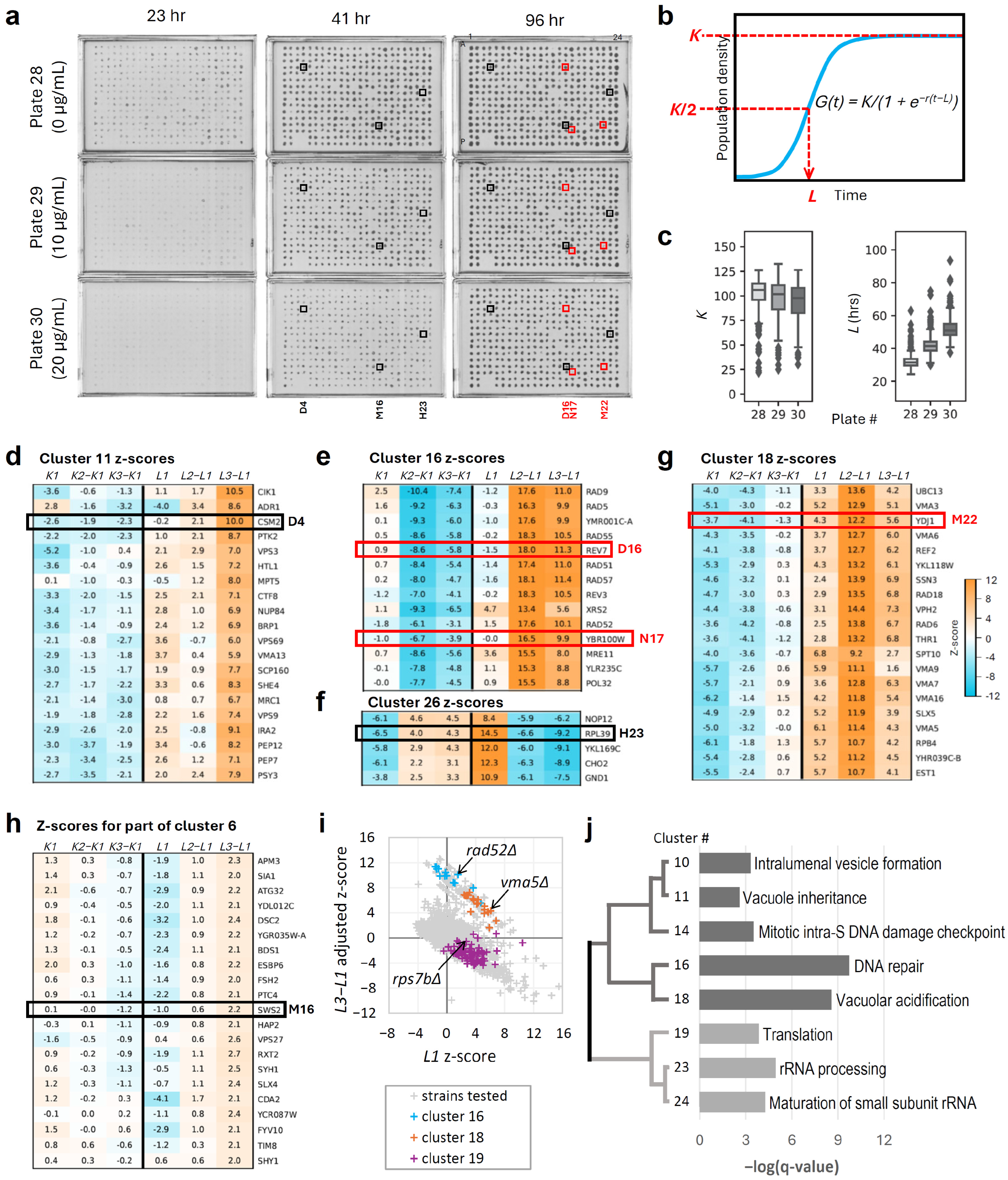
| Deleted Gene/Open Reading Frame | Description | Adjusted z-Score (K2 − K1) |
|---|---|---|
| RAD9 | DNA damage-dependent checkpoint protein | −10.4 |
| XRS2 | Component of the Mre11 complex, which is involved in double-strand break repair | −9.3 |
| YMR001C-A | protein of unknown function | −9.3 |
| RAD5 | DNA helicase/Ubiquitin ligase; involved in error-free branch of DNA damage tolerance (DDT) pathway | −9.2 |
| RAD55 | Protein involved in the recombinational repair of double-strand breaks in DNA | −8.6 |
| MRE11 | Nuclease subunit of the MRX complex that functions in repair of DNA double-strand breaks | −8.6 |
| REV7 | Accessory subunit of DNA pol zeta; involved in translesion synthesis during post-replication repair | −8.6 |
| RAD51 | Strand exchange protein involved in the recombinational repair of double-strand breaks in DNA | −8.4 |
| RAD57 | Protein involved in the recombinational repair of double-strand breaks in DNA | −8.0 |
| YLR235C | Dubious open reading frame; partially overlaps with DNA topoisomerase III gene TOP3 | −7.8 |
| Deleted Gene/Open Reading Frame | Description | Adjusted z-Score (L3 − L1) |
|---|---|---|
| RPL36B | Ribosomal 60S subunit protein L36B | −10.0 |
| SOM1 | Subunit of the mitochondrial inner membrane peptidase (IMP) required for maturation of mitochondrial proteins of the intermembrane space | −9.9 |
| YMR242W-A | Putative protein of unknown function | −9.5 |
| RPL39 | Ribosomal 60S subunit protein L39 | −9.2 |
| YKL169C | Dubious open reading frame; partially overlaps with mitochondrial ribosomal protein gene MRPL38 | −9.1 |
| CHO2 | Phosphatidylethanolamine methyltransferase (PEMT) | −8.9 |
| CCR4 | Component of the CCR4-NOT complex, which is involved in regulation of gene expression | −8.8 |
| YGR160W | Dubious open reading frame, overlaps with nucleolar protein gene NSR1, which is required for pre-rRNA processing and ribosomal biogenesis | −8.4 |
| AAH1 | Adenine deaminase (adenine aminohydrolase); converts adenine to hypoxanthine | −8.2 |
| RPL37A | Ribosomal 60S subunit protein L37A | −8.1 |
| Strain | Genotype | Refs. |
|---|---|---|
| BY4741 | MATa his3Δ1 leu2Δ0 met17Δ0 ura3Δ0 | [113] |
| BY4742 | MATα his3Δ1 leu2Δ0 lys2Δ0 ura3Δ0 | [113] |
| pso2Δ | pso2::kanMX in BY4742 | [113] |
| Rnr4-GFP | RNR4-GFP::HIS3 in BY4741 | [114] |
| Rpl7a-GFP | RPL7A-GFP::HIS3 in BY4741 | [114] |
| Rpl7a-GFP Elo3-mTagBFP2 | RPL7A-GFP::HIS3 trp1::kanMX ELO3-mTagBFP2::TRP1 in BY4741 | This study |
| Rpl23b-GFP | RPL23B-GFP::HIS3 in BY4741 | [114] |
Disclaimer/Publisher’s Note: The statements, opinions and data contained in all publications are solely those of the individual author(s) and contributor(s) and not of MDPI and/or the editor(s). MDPI and/or the editor(s) disclaim responsibility for any injury to people or property resulting from any ideas, methods, instructions or products referred to in the content. |
© 2026 by the authors. Licensee MDPI, Basel, Switzerland. This article is an open access article distributed under the terms and conditions of the Creative Commons Attribution (CC BY) license.
Share and Cite
Bible, A.F.; Blackman, J.S.; Rodgers, J.W.; Gary, S.R.; Rainey, M.; Miller, M.E.; Stepanov, A.; Hartman 4th, J.L.; Stultz, L.K.; Hanson, P.K. Yeast Phenomic Analysis Reveals DNA Repair, pH Homeostasis, and Ribosomal Biogenesis as Modulators of Anticancer Ruthenium Complex KP1019. Int. J. Mol. Sci. 2026, 27, 3275. https://doi.org/10.3390/ijms27073275
Bible AF, Blackman JS, Rodgers JW, Gary SR, Rainey M, Miller ME, Stepanov A, Hartman 4th JL, Stultz LK, Hanson PK. Yeast Phenomic Analysis Reveals DNA Repair, pH Homeostasis, and Ribosomal Biogenesis as Modulators of Anticancer Ruthenium Complex KP1019. International Journal of Molecular Sciences. 2026; 27(7):3275. https://doi.org/10.3390/ijms27073275
Chicago/Turabian StyleBible, Amanda F., Jackson S. Blackman, John W. Rodgers, Samuel R. Gary, Megan Rainey, Mary E. Miller, Alexander Stepanov, John L. Hartman 4th, Laura K. Stultz, and Pamela K. Hanson. 2026. "Yeast Phenomic Analysis Reveals DNA Repair, pH Homeostasis, and Ribosomal Biogenesis as Modulators of Anticancer Ruthenium Complex KP1019" International Journal of Molecular Sciences 27, no. 7: 3275. https://doi.org/10.3390/ijms27073275
APA StyleBible, A. F., Blackman, J. S., Rodgers, J. W., Gary, S. R., Rainey, M., Miller, M. E., Stepanov, A., Hartman 4th, J. L., Stultz, L. K., & Hanson, P. K. (2026). Yeast Phenomic Analysis Reveals DNA Repair, pH Homeostasis, and Ribosomal Biogenesis as Modulators of Anticancer Ruthenium Complex KP1019. International Journal of Molecular Sciences, 27(7), 3275. https://doi.org/10.3390/ijms27073275