Ion-Imprinted Chitosan Technology for Heavy Metal Ion Removal from Water and Wastewater: A Review on Recent Insights and Future Perspectives


Abstract
1. Introduction
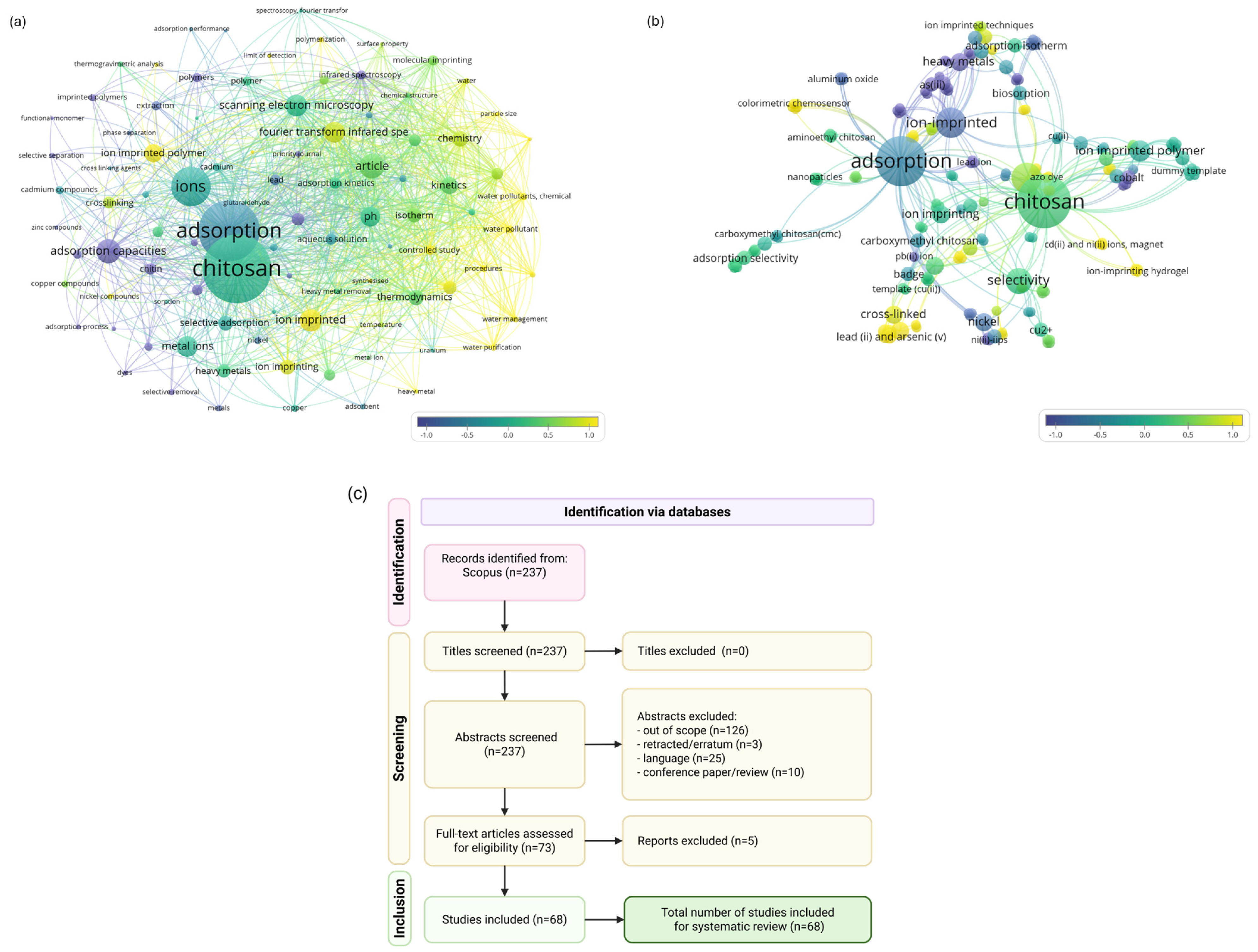
2. Bibliometric Study
2.1. The Search Strategy
2.2. Study Selection Process
2.3. Bibliometric Analysis
3. Chitosan—Base Material for Ion-Imprinting Process
3.1. Chitosan Principles and New Insights
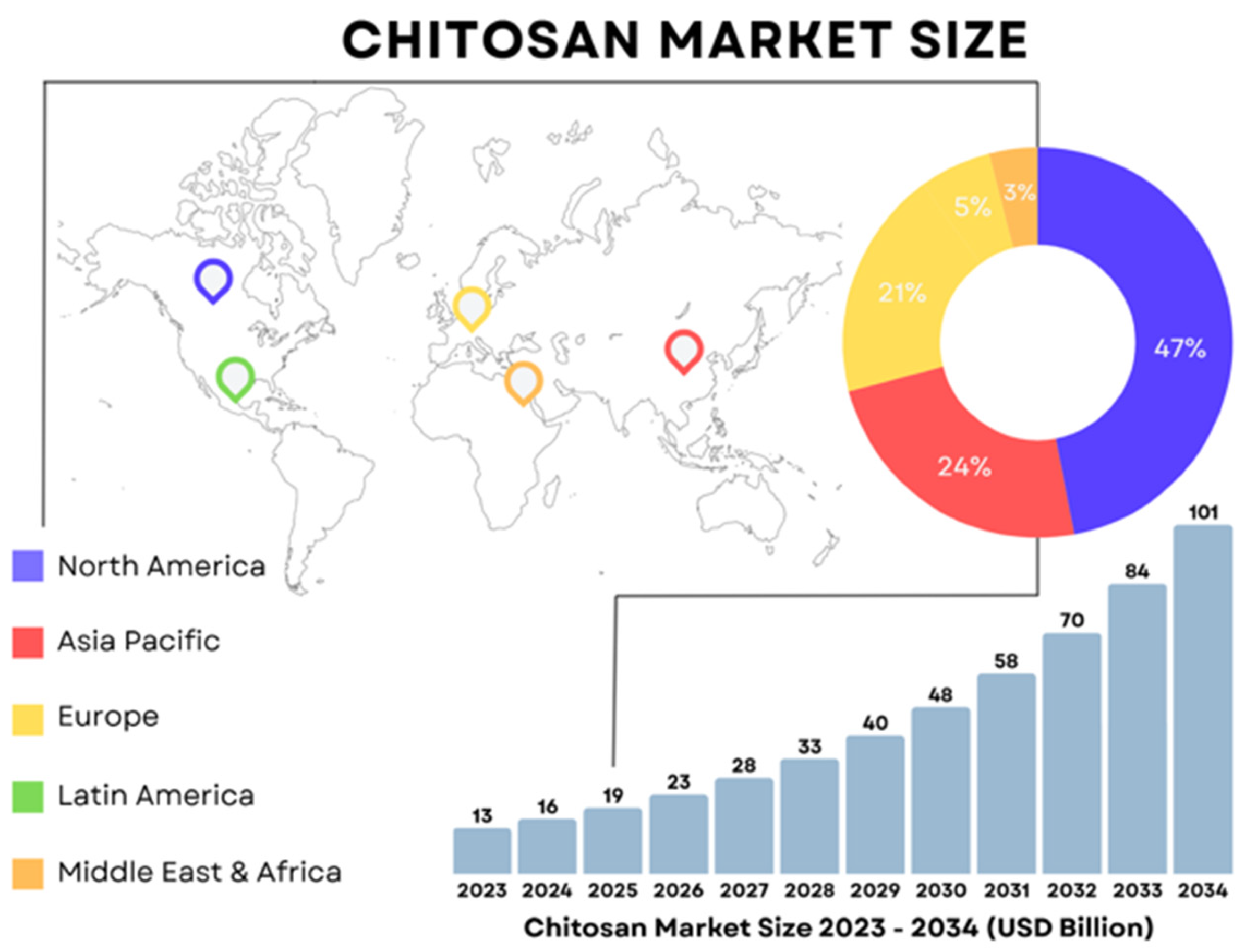
3.2. Economic Aspects of the Chitosan Market
3.3. Chitosan Main Source and Costs
4. Selective Sorption in Ion-Imprinting Technology
4.1. Selectivity in the Sorption Process
4.2. Mathematical Considerations in Selective Sorption Processes
5. Classification of the Techniques Used in Ion-Imprinting Technology
5.1. Chemical Immobilization
5.2. Trapping
5.3. Polymer Chain Cross-Linking
5.4. Surface Imprinting
6. Mechanistic Study of Selective Binding Site Formation and Sorption Behavior Using Ion-Imprinting Technology
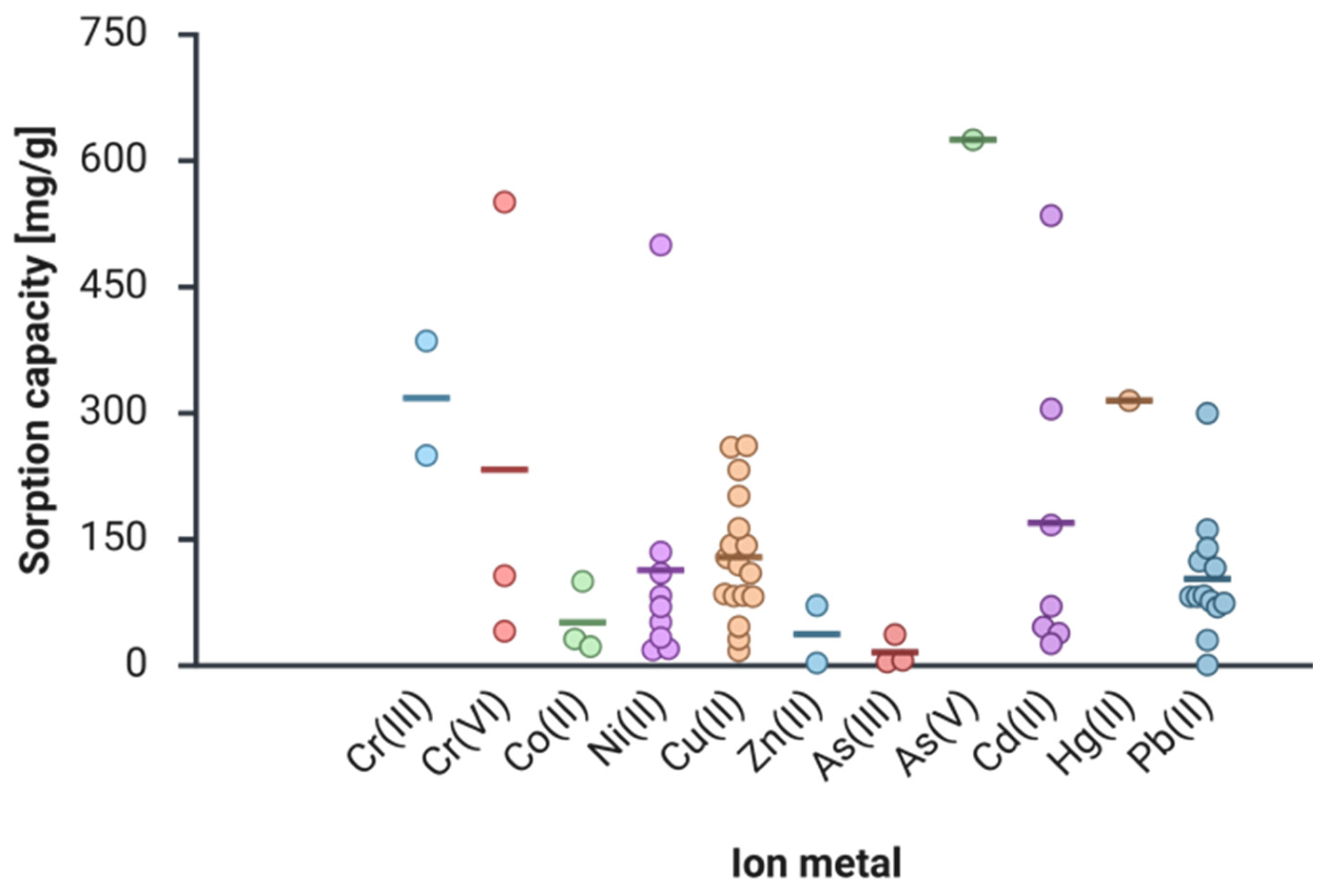
7. Metal Ion Removal Using IIC Sorbents
7.1. The Removal of Chromium (Cr)
7.2. The Removal of Cobalt (Co)
7.3. The Removal of Nickel (Ni)
7.4. The Removal of Copper (Cu)
7.5. The Removal of Zinc (Zn)
7.6. The Removal of Arsenic (As)
7.7. The Removal of Cadmium (Cd)
7.8. The Removal of Mercury (Hg)
7.9. The Removal of Lead (Pb)
8. Conclusions and Future Perspectives
8.1. Summary and Conclusions
8.1.1. Research Focus on Different Metals
8.1.2. Synthesis Approaches
8.2. Limitations and Future Perspectives
Supplementary Materials
Author Contributions
Funding
Institutional Review Board Statement
Informed Consent Statement
Data Availability Statement
Conflicts of Interest
Abbreviations
| AIBN | 2-Azobisisobutyronitrile |
| BADGE | Bisphenol A Diglycidyl Ether |
| CMC | Carboxymethyl Chitosan |
| CNT | Carbon Nanotube |
| CP | Controlled Polymer |
| DDA | Degree of Deacetylation |
| DNA | Deoxyribonucleic Acid |
| ECH | Epichlorohydrin |
| EDC | 1-Ethyl-3-(3-dimethylaminopropyl)carbodiimide |
| EDTA | Ethylenediaminetetraacetic Acid |
| EDTA-Na | Sodium Salt of Ethylenediaminetetraacetic Acid |
| EGDMA | Ethylene Glycol Dimethacrylate |
| FAAS | Flame Atomic Absorption Spectroscopy |
| GLA | Glutaraldehyde |
| GO | Graphene Oxide |
| 4-HBA | 4-Hydroxybenzoic Acid |
| IIC | Ion-Imprinted Chitosan |
| IIP | Ion-Imprinted Polymer |
| IP | Imprinted Polymer |
| k’ | Relative Selectivity Coefficient |
| Kd | Partition Constant |
| KH-560 | (3-Glycidyloxypropyl)trimethoxysilane |
| MBA | N,N’-Methylenebisacrylamide |
| MIC | Molecular-Imprinted Chitosan |
| MIP | Molecular-Imprinted Polymer |
| NHS | N-Hydroxysuccinimide |
| NIP | Non-Imprinted Polymer |
| PAN | 1-(2-Pyridylazo)-2-naphthol |
| PEGDE | Poly(ethylene)-glycol Diglycidyl Ether |
| PVA | Polyvinyl Alcohol |
| q | Sorption Capacity (mg/g) |
| R% | Recovery Percentage/Removal Percentage (%) |
| SEM | Scanning Electron Microscopy |
| STPP | Sodium Tripolyphosphate |
| TEOS | Tetraethyl Orthosilicate |
| UA-µ-SPE | Ultrasonic-Assisted Solid-Phase Microextraction |
References
- Bochynska, S.; Duszewska, A.; Maciejewska-Jeske, M.; Wrona, M.; Szeliga, A.; Budzik, M.; Szcesnowicz, A.; Bala, G.; Trzcinski, M.; Maczekalski, B.; et al. The impact of water pollution on the health of older people. Maturitas 2024, 185, 107981. [Google Scholar] [CrossRef]
- Morse, G.K. The Economic and Environmental Impact of Phosphorus Removal from Wastewater in the European Community; Selper: London, UK, 1993. [Google Scholar]
- Shrestha, R.; Ban, S.; Devkota, S.; Sharma, S.; Joshi, R.; Tiwari, A.P.; Kim, H.Y.; Joshi, M.K. Technological trends in heavy metals removal from industrial wastewater: A review. J. Environ. Chem. Eng. 2021, 9, 105688. [Google Scholar] [CrossRef]
- Shammas, N.K.; Wang, L.K.; Sung-Wang, M.H. Removal of Heavy Metals from Industrial Effluents by Chemical Precipitation and Chemical Coagulation. In Handbook of Advanced Industrial and Hazardous Wastes Management; CRC Press: Boca Raton, FL, USA, 2017; pp. 1129–1140. [Google Scholar]
- Witkowska, D.; Słowik, J.; Chilicka, K. Heavy Metals and Human Health: Possible Exposure Pathways and the Competition for Protein Binding Sites. Molecules 2021, 26, 6060. [Google Scholar] [CrossRef] [PubMed]
- Yu, Y.; Zhu, X.; Li, L.; Lin, B.; Xiang, M.; Zhang, X.; Chen, X.; Yu, Z.; Wang, Z.; Wan, Y. Health implication of heavy metals exposure via multiple pathways for residents living near a former e-waste recycling area in China: A comparative study. Ecotoxicol. Environ. Saf. 2019, 169, 178–184. [Google Scholar] [CrossRef] [PubMed]
- Voulvoulis, N.; Georges, K. Industrial and Agricultural Sources and Pathways of Aquatic Pollution. In Practice, Progress, and Proficiency in Sustainability; Imperial College: London, UK, 2016; pp. 29–54. [Google Scholar]
- Manasa, R.L.; Mehta, A. Wastewater: Sources of Pollutants and Its Remediation. Environ. Biotech. 2020, 2, 197–219. [Google Scholar]
- Harwood, J.J. Molecular markers for identifying municipal, domestic and agricultural sources of organic matter in natural waters. Chemosphere 2014, 95, 3–8. [Google Scholar] [CrossRef]
- Bashir, I.; Lone, F.A.; Bhat, R.A.; Mir, S.A.; Dar, Z.A.; Dar, S.A. Concerns and Threats of Contamination on Aquatic Ecosystems. In Bioremediation and Biotechnology, Sustainable Approaches to Pollution Degradation; Springer: Cham, Switzerland, 2020; pp. 1–26. [Google Scholar]
- Regulation (EU) 2024/1252. Available online: https://eur-lex.europa.eu/legal-content/EN/TXT/?uri=OJ:L_202401252 (accessed on 31 August 2025).
- Ferro, G.; Guarino, F.; Castiglione, S.; Rizzo, L. Antibiotic resistance spread potential in urban wastewater effluents disinfected by UV/H2O2 process. Sci. Total Environ. 2016, 560–561, 29–35. [Google Scholar] [CrossRef]
- Rashed, I.G.A.A.; Afify, H.A.; Ahmed, A.E.M.; Ayoub, M.A.E.S. Optimization of chemical precipitation to improve the primary treatment of wastewater. Desalination Water Treat. 2013, 51, 7048–7056. [Google Scholar] [CrossRef]
- Matlock, M.M.; Howerton, B.S.; Atwood, D.A. Chemical precipitation of heavy metals from acid mine drainage. Water Res. 2002, 36, 4757–4764. [Google Scholar] [CrossRef]
- Nyamato, G.S. Perspectives and prospects of chelation extraction of heavy metals from wastewater: A review. Water Sci. Technol. 2023, 88, 47–61. [Google Scholar] [CrossRef]
- Wazeer, I.; Hizaddin, H.F.; Hashim, M.A.; Hadj-Kali, M.K. An overview about the extraction of heavy metals and other critical pollutants from contaminated water via hydrophobic deep eutectic solvents. J. Environ. Chem. Eng. 2022, 10, 108574. [Google Scholar] [CrossRef]
- Hu, G.; Li, J.; Hou, H. A combination of solvent extraction and freeze thaw for oil recovery from petroleum refinery wastewater treatment pond sludge. J. Hazard. Mater. 2015, 283, 832–840. [Google Scholar] [CrossRef]
- Crini, G.; Lichtfouse, E.; Wilson, L.D.; Morin-Crini, N. Adsorption-Oriented Processes Using Conventional and Non-conventional Adsorbents for Wastewater Treatment. In Green Adsorbents for Pollutant Removal; Springer: Cham, Switzerland, 2018; pp. 23–71. [Google Scholar]
- Burakov, A.E.; Galunin, E.V.; Burakova, I.V.; Kucherova, A.E.; Agarwal, S.; Tkachev, A.G.; Gupta, V.K. Adsorption of heavy metals on conventional and nanostructured materials for wastewater treatment purposes: A review. Ecotoxicol. Environ. Saf. 2018, 148, 702–712. [Google Scholar] [CrossRef]
- Sun, Y.; Zhou, S.; Pan, S.Y.; Zhu, S.; Yu, Y.; Zheng, H. Performance evaluation and optimization of flocculation process for removing heavy metal. Chem. Eng. J. 2020, 385, 123911. [Google Scholar] [CrossRef]
- Hube, S.; Eskafi, M.; Hrafnkelsdóttir, K.F.; Bjarnadóttir, B.; Bjarnadóttir, M.Á.; Axelsdóttir, S.; Wu, B. Direct membrane filtration for wastewater treatment and resource recovery: A review. Sci. Total Environ. 2019, 710, 136375. [Google Scholar] [CrossRef] [PubMed]
- Zhao, C.; Ge, R.; Zhen, Y.; Wang, Y.; Li, Z.; Shi, Y.; Chen, X. A hybrid process of coprecipitation-induced crystallization-capacitive deionization-ion exchange process for heavy metals removal from hypersaline ternary precursor wastewater. Chem. Eng. J. 2019, 378, 122136. [Google Scholar] [CrossRef]
- Bashir, A.; Malik, L.A.; Ahad, S.; Manzoor, T.; Bhat, M.A.; Dar, G.N.; Pandith, A.H. Removal of heavy metal ions from aqueous system by ion-exchange and biosorption methods. Environ. Chem. Lett. 2018, 17, 729–754. [Google Scholar] [CrossRef]
- Roy, D.; Neogi, S.; De, S. Adsorptive removal of heavy metals from battery industry effluent using MOF incorporated polymeric beads: A combined experimental and modeling approach. J. Hazard. Mater. 2021, 403, 123624. [Google Scholar] [CrossRef]
- Ince, M.; Ince, O.K. Heavy Metal Removal Techniques Using Response Surface Methodology: Water/Wastewater Treatment. In Toxicity of Nanomaterials; IntechOpen: London, UK, 2019. [Google Scholar]
- Sun, H.; Feng, J.; Song, Y.; Xu, L.; Cui, X.; Yu, B. Preparation of the Carbonized Zif−8@PAN Nanofiber Membrane for Cadmium Ion Adsorption. Polymers 2022, 14, 2523. [Google Scholar] [CrossRef]
- Harugade, A.; Sherje, A.P.; Pethe, A. Chitosan: A review on properties, biological activities and recent progress in biomedical applications. React. Funct. Polym. 2023, 191, 105634. [Google Scholar] [CrossRef]
- Sundhararasu, E.; Tuomikoski, S.; Runtti, H.; Hu, T.; Varila, T.; Kangas, T.; Lassi, U. Alkali-Activated Adsorbents from Slags: Column Adsorption and Regeneration Study for Nickel(II) Removal. ChemEngineering 2021, 5, 13. [Google Scholar] [CrossRef]
- Aranaz, I.; Alcántara, A.R.; Civera, M.C.; Arias, C.; Elorza, B.; Caballero, A.H.; Acosta, N. Chitosan: An Overview of Its Properties and Applications. Polymers 2021, 13, 3256. [Google Scholar] [CrossRef] [PubMed]
- Nishide, H.; Tsuchida, E. Selective adsorption of metal ions on poly(4-vinylpyridine) resins in which the ligand chain is immobilized by crosslinking. Macromol. Chem. Phys. 1976, 177, 2295–2310. [Google Scholar] [CrossRef]
- Rao, T.P.; Kala, R.; Daniel, S. Metal ion-imprinted polymers-Novel materials for selective recognition of inorganics. Anal. Chim. Acta 2006, 578, 105–116. [Google Scholar] [CrossRef] [PubMed]
- Lazar, M.M.; Ghiorghita, C.A.; Dragan, E.S.; Humelnicu, D.; Dinu, M.V. Ion-Imprinted Polymeric Materials for Selective Adsorption of Heavy Metal Ions from Aqueous Solution. Molecules 2023, 28, 2798. [Google Scholar] [CrossRef]
- Du, M.; Xu, Z.; Xue, Y.; Li, F.; Bi, J.; Liu, J.; Wang, S.; Guo, X.; Zhang, P.; Yuan, J. Application Prospect of Ion-Imprinted Polymers in Harmless Treatment of Heavy Metal Wastewater. Molecules 2024, 29, 3160. [Google Scholar] [CrossRef]
- Xu, L.; Huang, Y.A.; Zhu, Q.J.; Ye, C. Chitosan in Molecularly-Imprinted Polymers: Current and Future Prospects. Int. J. Mol. Sci. 2015, 16, 18328–18347. [Google Scholar] [CrossRef]
- Karrat, A.; Lamaoui, A.; Amine, A.; Palacios-Santander, J.M.; Cubillana-Aguilera, L. Applications of Chitosan in Molecularly and Ion Imprinted Polymers. Chem. Afr. 2020, 3, 513–533. [Google Scholar] [CrossRef]
- Passas, I. Bibliometric Analysis: The Main Steps. Encyclopedia 2024, 4, 1014–1025. [Google Scholar] [CrossRef]
- Aria, M.; Cuccurullo, C. Bibliometrix: An R-tool for comprehensive science mapping analysis. J. Informetr. 2017, 11, 959–975. [Google Scholar] [CrossRef]
- Hamed, I.; Özogul, F.; Regenstein, J.M. Industrial applications of crustacean by-products (chitin, chitosan, and chitooligosaccharides): A review. Trends Food Sci. Technol. 2016, 48, 40–50. [Google Scholar] [CrossRef]
- Alemu, D.; Getachew, E.; Mondal, A.K. Study on the Physicochemical Properties of Chitosan and their Applications in the Biomedical Sector. Int. J. Polym. Sci. 2023, 2023, 5025341. [Google Scholar] [CrossRef]
- Younes, I.; Rinaudo, M. Chitin and chitosan preparation from marine sources. Structure, properties, and applications. Mar. Drugs 2015, 13, 1133–1174. [Google Scholar] [CrossRef] [PubMed]
- El Knidri, H.; Belaabed, R.; Addaou, A.; Laajeb, A.; Lahsini, A. Extraction, chemical modification and characterization of chitin and chitosan. Int. J. Biol. Macromol. 2018, 120, 1181–1189. [Google Scholar] [CrossRef]
- Jiménez-Gómez, C.P.; Cecilia, J.A. Chitosan: A Natural Biopolymer with a Wide and Varied Range of Applications. Molecules 2020, 25, 3981. [Google Scholar] [CrossRef]
- López-Muñoz, F.; García-Perez, A.; Cárdenas, V.O.; Meramo, S.; Ricardez-Sandoval, L.; González-Delgado, Á.D.; Leon, J.; Mainardi, D. A bibliometric study of Chitosan Applications: Insights from processes. Rev. Ion 2023, 36, 59–78. [Google Scholar] [CrossRef]
- Morin-Crini, N.; Lichtfouse, E.; Torri, G.; Crini, G. Applications of chitosan in food, pharmaceuticals, medicine, cosmetics, agriculture, textiles, pulp and paper, biotechnology, and environmental chemistry. Environ. Chem. Lett. 2019, 17, 1667–1692. [Google Scholar] [CrossRef]
- Pellis, A.; Guebitz, G.M.; Nyanhongo, G.S. Chitosan: Sources, Processing and Modification Techniques. Gels 2022, 8, 393. [Google Scholar] [CrossRef]
- Abuzar; Sharif, H.R.; Sharif, M.K.; Arshad, R.; Rehman, A.; Ashraf, W.; Karim, A.; Awan, K.A.; Raza, H.; Khalid, W.; et al. Potential industrial and nutritional applications of shrimp by-products: A review. Int. J. Food Prop. 2023, 26, 3407–3432. [Google Scholar] [CrossRef]
- Ghormade, V.; Pathan, E.K.; Deshpande, M.V. Can fungi compete with marine sources for chitosan production? Int. J. Biol. Macromol. 2017, 104, 1415–1421. [Google Scholar] [CrossRef]
- Introducing Dyson ChitosanTM a New Haircare Technology Range for Flexible Hold with Movement and Shine. Available online: https://www.dyson.com/discover/news/latest/dyson-launches-chitosan-formulations (accessed on 31 August 2025).
- Parra, A.G.; Clavijo, C.; Castillo, A.; Ortega-Toro, R. Polymeric Coatings with Electrolyzed Acidic Water: A Novel Approach to Extending Egg Shelf Life and Quality. Polymers 2025, 17, 84. [Google Scholar] [CrossRef] [PubMed]
- Wujcicki, Ł.; Kluczka, J. Recovery of Phosphate(V) Ions from Water and Wastewater Using Chitosan-Based Sorbents Modified—A Literature Review. Int. J. Mol. Sci. 2023, 24, 12060. [Google Scholar] [CrossRef] [PubMed]
- Kyzas, G.Z.; Bikiaris, D.N. Recent modifications of chitosan for adsorption applications: A critical and systematic review. Mar. Drugs 2015, 13, 312–337. [Google Scholar] [CrossRef] [PubMed]
- Cohen, E.; Poverenov, E. Hydrophilic Chitosan Derivatives: Synthesis and Applications. Chem.—Eur. J. 2022, 28, e202202156. [Google Scholar] [CrossRef]
- Chen, Y.; Liu, Y.; Dong, Q.; Xu, C.; Deng, S.; Kang, Y.; Fan, M.; Li, L. Application of functionalized chitosan in food: A review. Int. J. Biol. Macromol. 2025, 235, 123716. [Google Scholar] [CrossRef]
- Chitosan Market Size to Hit Around USD 101.06 Billion by 2034. Available online: https://www.precedenceresearch.com/chitosan-market (accessed on 31 August 2025).
- Jeon, Y.T.; Lee, M.Y.; Lee, H.S.; Lee, J.W. The Global Market Trend and Perspectives of Chitosan. J. Chitin Chitosan 2021, 26, 63–68. [Google Scholar] [CrossRef]
- China Shrimp Market: Production, Size, Trends 2025–2033. Available online: https://www.imarcgroup.com/china-shrimp-market (accessed on 31 August 2025).
- Parthiban, F.; Balasundari, S.; Gopalakannan, A.; Rathnakumar, K.; Felix, S. Comparison of the Quality of Chitin and Chitosan from Shrimp, Crab and Squilla Waste. Curr. World Environ. 2017, 12, 670–677. [Google Scholar] [CrossRef]
- Muñoz, I.; Rodríguez, C.; Gillet, D.; Moerschbacher, B.M. Challenges and best practice in LCAS of seafood and other aquatic products Life cycle assessment of chitosan production in India and Europe. Int. J. Life Cycle Assess. 2018, 23, 1151–1160. [Google Scholar] [CrossRef]
- Rossi, N.; Grosso, C.; Delerue-Matos, C. Shrimp Waste Upcycling: Unveiling the Potential of Polysaccharides, Proteins, Carotenoids, and Fatty Acids with Emphasis on Extraction Techniques and Bioactive Properties. Mar. Drugs 2024, 22, 153. [Google Scholar] [CrossRef]
- Suryawanshi, N.; Jujjavarapu, S.E.; Ayothiraman, S. Marine shell industrial wastes—An abundant source of chitin and its derivatives: Constituents, pretreatment, fermentation, and pleiotropic applications-a revisit. Int. J. Environ. Sci. Technol. 2019, 16, 3877–3898. [Google Scholar] [CrossRef]
- Wholesale Chitosan Prices: Shipping Costs and Tariffs Guide. Available online: https://chitosanglobal.com/wholesale-prices/ (accessed on 31 August 2025).
- Kyzas, G.Z.; Fu, J.; Matis, K.A. New Biosorbent Materials: Selectivity and Bioengineering Insights. Processes 2014, 2, 419–440. [Google Scholar] [CrossRef]
- Nevskaia, D.M.; Castillejos-Lopez, E.; Muñoz, V.; Guerrero-Ruiz, A. Adsorption of aromatic compounds from water by treated carbon materials. Environ. Sci. Technol. 2004, 38, 5786–5796. [Google Scholar] [CrossRef] [PubMed]
- Fontanals, N. Application of Novel Materials in Sample Treatment and Separation: Cleanup and Chromatographic Improvements. Chromatogr. Anal. Environ. 2017, 25, 199–220. [Google Scholar]
- Cashin, V.B.; Eldridge, D.S.; Yu, A.; Zhao, D. Surface functionalization and manipulation of mesoporous silica adsorbents for improved removal of pollutants: A review. Environ. Sci. Water Res. Technol. 2018, 4, 110–128. [Google Scholar] [CrossRef]
- Fuks, L.; Herdzik-Koniecko, I. Metal-selective sorbents. In Solid-Phase Extraction; Elsevier: Amsterdam, The Netherlands, 2020; pp. 185–213. [Google Scholar]
- Mohsenzadeh, E.; Ratautaite, V.; Brazys, E.; Ramanavicius, S.; Zukauskas, S.; Plausinaitis, D.; Ramanavicius, A. Application of computational methods in the design of molecularly imprinted polymers (review). TrAC Trends Anal. Chem. 2024, 171, 117480. [Google Scholar] [CrossRef]
- Cowen, T.; Karim, K.; Piletsky, S. Computational approaches in the design of synthetic receptors—A review. Anal. Chim. Acta 2016, 936, 62–74. [Google Scholar] [CrossRef]
- Iacob, B.-C.; Bodoki, A.E.; Oprean, L.; Bodoki, E. Metal–ligand interactions in molecular imprinting. In Ligand; InTech: London, UK, 2018. [Google Scholar] [CrossRef]
- Bhaskarapillai, A.; Chandra, S.; Sevilimedu, N.V.; Sellergren, B. Theoretical investigations of the experimentally observed selectivity of a cobalt imprinted polymer. Biosens. Bioelectron. 2009, 25, 558–562. [Google Scholar] [CrossRef]
- Sazali, N.; Harun, Z.; Sazali, N. A Review on Batch and Column Adsorption of Various Adsorbent Towards the Removal of Heavy Metal. J. Adv. Res. Fluid Mech. Therm. Sci. 2020, 67, 66–88. [Google Scholar]
- Pakade, V.E.; Cukrowska, E.M.; Darkwa, J.; Darko, G.; Torto, N.; Chimuka, L. Simple and efficient ion imprinted polymer for recovery of uranium from environmental samples. Water Sci. Technol. 2012, 65, 728–736. [Google Scholar] [CrossRef]
- Mafu, L.D.; Msagati, T.A.M.; Mamba, B.B. Ion-imprinted polymers for environmental monitoring of inorganic pollutants: Synthesis, characterization, and applications. Environ. Sci. Pollut. Res. 2013, 20, 790–802. [Google Scholar] [CrossRef]
- Karabork, M.; Gok, A. A novel ion-imprinted nanocomposite for selective separation of Pb2+ ions. J. Macromol. Sci. 2018, 55, 90–97. [Google Scholar] [CrossRef]
- Burleigh, M.C.; Dai, S.; Hagaman, E.W.; Lin, J.S. Imprinted polysilsesquioxanes for the enhanced recognition of metal ions. Chem. Mater. 2001, 13, 2537–2546. [Google Scholar] [CrossRef]
- Zhou, X.; Wang, B.; Wang, R. Insights into ion-imprinted materials for the recovery of metal ions: Preparation, evaluation and application. Sep. Purif. Technol. 2022, 298, 121469. [Google Scholar] [CrossRef]
- An, F.; Li, H.; Guo, X.; Gao, B.; Hu, T.; Gao, J. Novel ionic surface imprinting technology: Design and application for selectively recognizing heavy metal ions. RSC Adv. 2019, 9, 2431–2440. [Google Scholar] [CrossRef]
- Öpik, A.; Menaker, A.; Reut, J.; Syritski, V. Molecularly imprinted polymers: A new approach to the preparation of Functional materials. Proc. Est. Acad. Sci. 2009, 58, 3–11. [Google Scholar] [CrossRef]
- Ng, S.M.; Narayanaswamy, R. Demonstration of a simple, economical and practical technique utilising an imprinted polymer for metal ion sensing. Microchim. Acta 2010, 169, 303–311. [Google Scholar] [CrossRef]
- Ganjali, M.R.; Alizadeh, T.; Azimi, F.; Larjani, B.; Faridbod, F.; Norouzi, P. Bio-Mimetic Ion Imprinted Polymer Based Potentiometric Mercury Sensor Composed of Nano-Materials. Int. J. Electrochem. Sci. 2011, 6, 5200–5208. [Google Scholar] [CrossRef]
- Giove, A.; El Ouardi, Y.; Sala, A.; Ibrahim, F.; Hietala, S.; Sievänen, E.; Branger, C.; Laatikainen, K. Highly selective recovery of Ni(II) in neutral and acidic media using a novel Ni(II)-ion imprinted polymer. J. Hazard. Mater. 2023, 444, 130453. [Google Scholar] [CrossRef]
- Bhaskarapillai, A.; Sevilimedu, N.V.; Sellergren, B. Synthesis and characterization of imprinted polymers for radioactive waste reduction. Ind. Eng. Chem. Res. 2009, 48, 3730–3737. [Google Scholar] [CrossRef]
- Biju, V.M.; Gladis, J.M.; Rao, T.P. Ion imprinted polymer particles: Synthesis, characterization and dysprosium ion uptake properties suitable for analytical applications. Anal. Chim. Acta 2003, 478, 43–51. [Google Scholar] [CrossRef]
- Metilda, P.; Gladis, J.M.; Venkateswaran, G.; Prasada Rao, T. Investigation of the role of chelating ligand in the synthesis of ion-imprinted polymeric resins on the selective enrichment of uranium(VI). Anal. Chim. Acta 2007, 587, 263–271. [Google Scholar] [CrossRef]
- Nishide, H.; Deguchi, J.; Tsuchida, E. Adsorption of metal ions on crosslinked poly(4-vinylpyridine) resins prepared with a metal ion as template. J. Polym. Sci. Polym. Chem. Ed. 1977, 15, 3023–3029. [Google Scholar] [CrossRef]
- Hashem, A.; Abou-Okeil, A.; El-Shafie, A.; El-Sakhawy, M. Grafting of high α-cellulose pulp extracted from sunflower stalks for removal of Hg (II) from aqueous solution. Polym.—Plast. Technol. Eng. 2006, 45, 135–141. [Google Scholar] [CrossRef]
- Chen, A.H.; Yang, C.Y.; Chen, C.Y.; Chen, C.Y.; Chen, C.W. The chemically crosslinked metal-complexed chitosans for comparative adsorptions of Cu(II), Zn(II), Ni(II) and Pb(II) ions in aqueous medium. J. Hazard. Mater. 2009, 163, 1068–1075. [Google Scholar] [CrossRef] [PubMed]
- Chen, C.Y.; Yang, C.Y.; Chen, A.H. Biosorption of Cu(II), Zn(II), Ni(II) and Pb(II) ions by cross-linked metal-imprinted chitosans with epichlorohydrin. J. Environ. Manag. 2011, 92, 796–802. [Google Scholar] [CrossRef] [PubMed]
- Nishad, P.A.; Bhaskarapillai, A.; Velmurugan, S.; Narasimhan, S.V. Cobalt (II) imprinted chitosan for selective removal of cobalt during nuclear reactor decontamination. Carbohydr. Polym. 2012, 87, 2690–2696. [Google Scholar] [CrossRef]
- Liu, B.; Quan, K.; Chen, J.; Zhang, H.; Qiu, H. One-step formation of functionalized mesoporous shell on silica core for chromatography. Colloids Surf. A Physicochem. Eng. Asp. 2024, 684, 133238. [Google Scholar] [CrossRef]
- Huo, H.; Su, H.; Tan, T. Adsorption of Ag+ by a surface molecular-imprinted biosorbent. Chem. Eng. J. 2009, 150, 139–144. [Google Scholar] [CrossRef]
- Hasanah, A.N.; Safitri, N.; Zulfa, A.; Neli, N.; Rahayu, D. Factors Affecting Preparation of Molecularly Imprinted Polymer and Methods on Finding Template-Monomer Interaction as the Key of Selective Properties of the Materials. Molecules 2021, 26, 5612. [Google Scholar] [CrossRef]
- Fu, J.; Chen, L.; Li, J.; Zhang, Z. Current Status and Challenges of Ion Imprinting. J. Mater. Chem. A 2015, 3, 13598–13627. [Google Scholar] [CrossRef]
- Eldridge, D.S.; Crawford, R.J.; Harding, I.H. The Role of Metal Ion–Ligand Interactions during Divalent Metal Ion Adsorption. J. Colloid Interface Sci. 2015, 454, 20–26. [Google Scholar] [CrossRef] [PubMed]
- Yang, Y.; Alexandratos, S.D. Affinity of Polymer-Supported Reagents for Lanthanides as a Function of Donor Atom Polarizability. Ind. Eng. Chem. Res. 2009, 48, 6173–6187. [Google Scholar] [CrossRef]
- Zhang, Y.; Wang, J.; Li, X.; Chen, L. Ion-Imprinted Polymers Based on Biopolymers for Selective Removal of Heavy Metal Ions: A Review. Int. J. Biol. Macromol. 2021, 167, 1283–1295. [Google Scholar]
- Bini, G.; Pillai, V.N.R.; Mathew, B. Effect of the Nature of the Crosslinking Agent on the Metal-Ion Complexation Characteristics of 4 mol % DVB- and NNMBA-Crosslinked Polyacrylamide-Supported Glycines. J. Appl. Polym. Sci. 1999, 74, 3432–3444. [Google Scholar]
- Shi, H.; Tsai, W.B.; Garrison, M.D.; Ferrari, S.; Ratner, B.D. Template-Imprinted Nanostructured Surfaces for Protein Recognition. Nature 1999, 398, 593–597. [Google Scholar] [CrossRef]
- Uibel, R.H.; Harris, J.M. Templating of Multiple Ligand Metal Ion Complexation Sites in 8-Hydroxyquinoline-Modified Silica Sol–Gel Materials Investigated by in Situ Raman Spectroscopy. Anal. Chem. 2005, 77, 991–1000. [Google Scholar] [CrossRef]
- Dean, J.A. Lange’s Handbook of Chemistry; McGraw-Hill: New York, NY, USA, 1978. [Google Scholar]
- Yatsimirskii, K.B.; Vasil’ev, V.P. Instability Constants of Complex Compounds; Springer: New York, NY, USA, 2012. [Google Scholar]
- Shannon, R.D. Revised effective ionic radii and systematic studies of interatomic distances in halides and chalcogenides. Found. Crystallogr. 1976, 32, 751–767. [Google Scholar] [CrossRef]
- Navarro, R.N.; Guzmán, J.; Saucedo, I.; Revilla, J.; Guibal, E. Recovery of Metal Ions by Chitosan: Sorption Mechanisms and Influence of Metal Speciation. Macromol. Biosci. 2003, 3, 552c561. [Google Scholar] [CrossRef]
- Chauhan, E. Modification of chitosan for sorption of metal ions. J. Chem. Pharm. Res. 2015, 7, 49–55. [Google Scholar]
- Desai, K.G.H.; Park, H.J. Preparation of cross-linked chitosan microspheres by spray drying: Effect of cross-linking agent on the properties of spray dried microspheres. J. Microencapsul. 2005, 22, 377–395. [Google Scholar] [CrossRef]
- Jadaa, W.; Mohammed, H. Heavy Metals—Definition, Natural and Anthropogenic Sources of Releasing into Ecosystems, Toxicity, and Removal Methods—An Overview Study. J. Ecol. Eng. 2023, 24, 249–271. [Google Scholar] [CrossRef] [PubMed]
- Arora, V.D.; Bithel, N.; Singh, R.J. A Study on Heavy Metal Sources and Pollution: Challenge to Biological and Ecosystem. Bull. Pure Appl. Sci.—Bot. 2023, 42, 44–49. [Google Scholar] [CrossRef]
- Nazmul, M.H.M.; Devaraj, S.; Farzana, Y.; Vasu, N.; Gupalo, S.; Doustjalali, S.R.; Sabet, N.S. Bioaccumulation of heavy metals in aquatic organisms and its effects on human consumption. Int. J. Aquat. Res. Environ. Stud. 2025, 5, 262–288. [Google Scholar] [CrossRef] [PubMed]
- Tumolo, M.; Ancona, V.; De Paola, D.; Losacco, D.; Campanale, C.; Massarelli, C.; Uricchio, V.F. Chromium pollution in European water, sources, health risk, and remediation strategies: An overview. Int. J. Environ. Res. Public Health 2020, 17, 5438. [Google Scholar] [CrossRef]
- Yang, S.; Wu, Y.; Bi, S.; Xu, X.; Wu, W.; Wang, Y. Reel silk from cocoons: Optimized fabrication of chitosan-sodium tripolyphosphate imprinted polymers for high-efficiency and selective capture of hexavalent chromium. Sep. Purif. Technol. 2025, 354, 129182. [Google Scholar] [CrossRef]
- Fu, D.; Wang, G.; Zhao, L.; Hong, Y.; Yang, B.; Cheng, H. Design of ion-imprinted amino-modified chitosan for selective chromium (III) ion removal. Sep. Purif. Technol. 2024, 336, 126341. [Google Scholar] [CrossRef]
- Elsayed, N.H.; Monier, M.; Alatawi, R.A.S.; Albalawi, M.A.; Alhawiti, A.S. Preparation of chromium (III) ion-imprinted polymer based on azo dye functionalized chitosan. Carbohydr. Polym. 2022, 284, 119139. [Google Scholar] [CrossRef]
- Etemadi, M.; Samadi, S.; Yazd, S.S.; Jafari, P.; Yousefi, N.; Aliabadi, M. Selective adsorption of Cr(VI) ions from aqueous solutions using Cr6+-imprinted Pebax/chitosan/GO/APTES nanofibrous adsorbent. Int. J. Biol. Macromol. 2017, 95, 725–733. [Google Scholar] [CrossRef]
- Genchi, G.; Lauria, G.; Catalano, A.; Carocci, A.; Sinicropi, M.S. Prevalence of Cobalt in the Environment and Its Role in Biological Processes. Biology 2023, 12, 1335. [Google Scholar] [CrossRef]
- Silva, T.A.C.; Paula, M.; Silva, W.S.; Lacorte, G.A. Deposition of Potentially Toxic Metals in the Soil from Surrounding Cement Plants in a Karst Area of Southeastern Brazil. Conservation 2021, 1, 137–150. [Google Scholar] [CrossRef]
- Garza Amaya, D.L.; Thiel, A.; Möller, M.; Gasparoni, G.; Pirritano, M.; Drews, F.; Bornhorst, J.; Simon, M. Microbial impact to environmental toxicants Ni(II) and Co(II): Joint toxicity and cellular response in Paramecium. Chemosphere 2023, 345, 140434. [Google Scholar] [CrossRef] [PubMed]
- Gourgues, S.; Goñi-Urriza, M.; Baldoni-Andrey, P.; Bagger Gurieff, N.; Gelber, C.; Le Faucheur, S. Cobalt induces the set-up of new structural networks in river biofilms: Impairment of autotrophic-heterotrophic coupling. Environ. Pollut. 2025, 385, 127035. [Google Scholar] [CrossRef] [PubMed]
- Zhang, K.; Luo, Q.; Wang, Z. Selective adsorption of Co2+ and Mn2+ by cobalt/manganese imprinted thiourea-chitosan. J. Radiat. Res. Radiat. Process. 2022, 40, 80–88. [Google Scholar]
- Hossein Beyki, M.; Shemirani, F.; Shirkhodaie, M. Aqueous Co(II) adsorption using 8-hydroxyquinoline anchored γ-Fe2O3@chitosan with Co(II) as imprinted ions. Int. J. Biol. Macromol. 2016, 87, 375–384. [Google Scholar] [CrossRef]
- Li, C.; Pan, J.; Zou, X.; Gao, J.; Xie, J.; Yongsheng, Y. Synthesis and applications of novel attapulgite-supported Co(II)-imprinted polymers for selective solid-phase extraction of cobalt(II) from aqueous solutions. Int. J. Environ. Anal. Chem. 2011, 91, 1035–1049. [Google Scholar] [CrossRef]
- Liu, Y.; Gao, J.; Li, C.; Pan, J.; Yan, Y.; Xie, J. Synthesis and Adsorption Performance of Surface-Grafted Co(II)-Imprinted Polymer for Selective Removal of Cobalt. Chin. J. Chem. 2010, 28, 548–554. [Google Scholar] [CrossRef]
- Genchi, G.; Carocci, A.; Lauria, G.; Sinicropi, M.S.; Catalano, A. Nickel: Human health and environmental toxicology. Int. J. Environ. Res. Public Health 2020, 17, 679. [Google Scholar] [CrossRef]
- Saud, A.; Saleem, H.; Munira, N.; Shahab, A.A.; Rahman Siddiqui, H.; Zaidi, S.J. Sustainable Preparation of Graphene Quantum Dots for Metal Ion Sensing Application. Nanomaterials 2023, 13, 148. [Google Scholar] [CrossRef]
- Gole, A.; John, D.; Krishnamoorthy, K.; Wagh, N.S.; Lakkakula, J.; Khan, M.S.; Odeibat, H.A.M.; Tarique, M.; Islam, M.R. Role of Phytonanotechnology in the Removal of Water Contamination. J. Nanomater. 2022, 2022, 7957007. [Google Scholar] [CrossRef]
- Chen, Y.; Ma, X.; Peng, J. Highly selective removal and recovery of Ni(II) from aqueous solution using magnetic ion-imprinted chitosan nanoparticles. Carbohydr. Polym. 2021, 271, 118435. [Google Scholar] [CrossRef]
- Mousavi-Qeydari, S.R.; Samimi, A.; Mohebbi-Kalhori, D.; Ahmadi, E. A mesoporous melamine/chitosan/activated carbon biocomposite: Preparation, characterization and its application for Ni (II) uptake via ion imprinting. Int. J. Biol. Macromol. 2021, 188, 126–136. [Google Scholar] [CrossRef] [PubMed]
- Liu, W.; Zhang, M.; Liu, X.; Zhang, H.; Jiao, J.; Zhu, H.; Zhou, Z.; Ren, Z. Preparation of Surface Ion-Imprinted Materials Based on Modified Chitosan for Highly Selective Recognition and Adsorption of Nickel Ions in Aqueous Solutions. Ind. Eng. Chem. Res. 2020, 59, 6033–6042. [Google Scholar] [CrossRef]
- Elsayed, N.H.; Alatawi, A.; Monier, M. Diacetylmonoxine modified chitosan derived ion-imprinted polymer for selective solid-phase extraction of nickel (II) ions. React. Funct. Polym. 2020, 151, 104570. [Google Scholar] [CrossRef]
- Lu, S.; Yang, F.; Tian, C.; Shi, P.; Liu, X.; Bao, Z.; Nie, J. Sorption Properties of Ion-imprinted Seaweed-Chitosan Composite Adsorbents for Nickel Ions. IOP Conf. Ser. Earth Environ. Sci. 2019, 295, 032070. [Google Scholar] [CrossRef]
- Zhang, Y.; Bai, Z.; Luo, W.; Zhai, L.; Wang, B.; Kang, X.; Zong, J. Ion imprinted adsorbent for the removal of Ni(II) from waste water: Preparation, characterization, and adsorption. J. Dispers. Sci. Technol. 2019, 40, 1751–1760. [Google Scholar] [CrossRef]
- He, J.; Shang, H.; Zhang, X.; Sun, X. Synthesis and application of ion imprinting polymer coated magnetic multi-walled carbon nanotubes for selective adsorption of nickel ion. Appl. Surf. Sci. 2018, 428, 110–117. [Google Scholar] [CrossRef]
- Guo, N.; Su, S.J.; Liao, B.; Ding, S.L.; Sun, W.Y. Preparation and properties of a novel macro porous Ni2+-imprinted chitosan foam adsorbents for adsorption of nickel ions from aqueous solution. Carbohydr. Polym. 2017, 165, 376–383. [Google Scholar] [CrossRef]
- Chen, Y.; Ma, X.; Huang, M.; Peng, J.; Li, C. Use of a new magnetic ion-imprinted nanocomposite adsorbent for selective and rapid preconcentration and determination of trace nickel by flame atomic absorption spectrometry. Anal. Methods 2016, 8, 824–829. [Google Scholar] [CrossRef]
- Zhang, L.; Zhong, L.; Yang, S.; Liu, D.; Wang, Y.; Wang, S.; Han, X.; Zhang, X. Adsorption of Ni(II) ion on Ni(II) ion-imprinted magnetic chitosan/poly(vinyl alcohol) composite. Colloid Polym. Sci. 2015, 293, 2497–2506. [Google Scholar] [CrossRef]
- Xu, W.Z.; Xu, P.P.; Zhou, W.; Yan, Y.S. Synthesis, characterization, evaluation of potassium tertatitanium whisker surface Ni(II) ion-imprinted polymers and selective adsorption of nickel. Adv. Mater. Res. 2010, 113–116, 644–650. [Google Scholar] [CrossRef]
- Alkhanjaf, A.A.M.; Sharma, S.; Sharma, M.; Kumar, R.; Arora, N.K.; Kumar, B.; Umar, A.; Baskoutas, S.; Mukherjee, T.K. Microbial strategies for copper pollution remediation: Mechanistic insights and recent advances. Environ. Pollut. 2024, 346, 123588. [Google Scholar] [CrossRef] [PubMed]
- Xiang, H.; Yu, X.Y. Toxic Effect of Copper Pollution on Water and Hydrophyte. Hunan Agric. Sci. 2009, 11, 54–56. [Google Scholar]
- Elkhatat, A.M.; Soliman, M.; Ismail, R.; Ahmed, S.; Abounahia, N.; Mubashir, S.; Fouladi, S.; Khraisheh, M. Recent trends of copper detection in water samples. Bull. Natl. Res. Cent. 2021, 45, 218. [Google Scholar] [CrossRef]
- Wu, S.D.; He, S.Q.; Yang, Y.L.; Lin, Y.C.; Chang, T.Y.; Peng, C.Y.; Hsieh, M.T. Research on Environmentally Friendly Chemical Technology for Green Reusable and Sustainable Water Metal Copper Ions. IOP Conf. Ser. Earth Environ. Sci. 2020, 555, 012013. [Google Scholar] [CrossRef]
- Ma, L.; Zheng, Q. Selective adsorption behavior of ion-imprinted magnetic chitosan beads for removal of Cu(II) ions from aqueous solution. Chin. J. Chem. Eng. 2021, 39, 103–111. [Google Scholar] [CrossRef]
- Zeng, J.; Chen, H.; Yuan, X.; Guo, Q.; Yu, X. A ion-imprinted chitosan/Al2O3 composite material for selective separation of copper(II). Desalination Water Treat. 2015, 55, 1229–1239. [Google Scholar] [CrossRef]
- Cai, Y.; Zheng, L.; Fang, Z. Selective adsorption of Cu(II) from an aqueous solution by ion imprinted magnetic chitosan microspheres prepared from steel pickling waste liquor. RSC Adv. 2015, 5, 97435–97445. [Google Scholar] [CrossRef]
- Ren, Y.; Wei, X.; Zhang, M. Adsorption character for removal Cu(II) by magnetic Cu(II) ion imprinted composite adsorbent. J. Hazard. Mater. 2008, 158, 14–22. [Google Scholar] [CrossRef]
- Humelnicu, D.; Lazar, M.M.; Ignat, M.; Dinu, I.A.; Dragan, E.S.; Dinu, M.V. Removal of heavy metal ions from multi-component aqueous solutions by eco-friendly and low-cost composite sorbents with anisotropic pores. J. Hazard. Mater. 2020, 381, 120980. [Google Scholar] [CrossRef]
- Zhang, Y.; Bian, T.; Xia, D.; Wang, D.; Zhang, Y.; Zheng, X.; Li, Z. Optimum selective separation of Cu(ii) using 3D ordered macroporous chitosan films with different pore sizes. RSC Adv. 2019, 9, 13065–13076. [Google Scholar] [CrossRef]
- Zhu, Y.; Bai, Z.; Luo, W.; Wang, B.; Zhai, L. A facile ion imprinted synthesis of selective biosorbent for Cu2+ via microfluidic technology. J. Chem. Technol. Biotechnol. 2017, 92, 2009–2022. [Google Scholar] [CrossRef]
- Feng, T.; Wang, J.; Zhang, F.; Shi, X. Removal of copper(II) from an aqueous solution with copper(II)-imprinted chitosan microspheres. J. Appl. Polym. Sci. 2013, 128, 3631–3638. [Google Scholar] [CrossRef]
- Monier, M.; Bukhari, A.A.H.; Elsayed, N.H. Designing and characterization of copper (II) ion-imprinted adsorbent based on isatin functionalized chitosan. Int. J. Biol. Macromol. 2020, 155, 795–804. [Google Scholar] [CrossRef] [PubMed]
- Wang, L.; Li, J.; Wang, J.; Guo, X.; Wang, X.; Choo, J.; Chen, L. Green multi-functional monomer based ion imprinted polymers for selective removal of copper ions from aqueous solution. J. Colloid Interface Sci. 2019, 541, 376–386. [Google Scholar] [CrossRef]
- Yoshida, W.; Oshima, T.; Baba, Y.; Goto, M. Cu(II)-imprinted chitosan derivative containing carboxyl groups for the selective removal of Cu(II) from aqueous solution. J. Chem. Eng. Jpn. 2016, 49, 630–634. [Google Scholar] [CrossRef]
- Masykur, A.; Wibowo, A.H.; Salsabilah. Preparation of Cu(II) ion-imprinted based on carboxymethyl chitosan and application as adsorbent of Cu(II) ion. IOP Conf. Ser. Mater. Sci. Eng. 2019, 509, 012001. [Google Scholar] [CrossRef]
- Qin, L.; Zhao, Y.; Wang, L.; Zhang, L.; Kang, S.; Wang, W.; Zhang, T.; Song, S. Preparation of ion-imprinted montmorillonite nanosheets/chitosan gel beads for selective recovery of Cu(II) from wastewater. Chemosphere 2020, 252, 126560. [Google Scholar] [CrossRef]
- Zhang, W.; Yun, M.; Yu, Z.; Chen, D.; Li, X. A Novel Cu(II) Ion-Imprinted Alginate–Chitosan Complex Adsorbent for Selective Separation of Cu(II) from Aqueous Solution. Polym. Bull. 2019, 76, 1861–1876. [Google Scholar] [CrossRef]
- Zarghami, S.; Mohammadi, T.; Kazemimoghadam, M. Adsorption Behavior of Cu(II) Ions on Crosslinked Chitosan/Polyvinyl Alcohol Ion Imprinted Membrane. J. Dispers. Sci. Technol. 2015, 36, 190–195. [Google Scholar] [CrossRef]
- Dinu, M.V.; Dinu, I.A.; Lazar, M.M.; Dragan, E.S. Chitosan-based ion-imprinted cryo-composites with excellent selectivity for copper ions. Carbohydr. Polym. 2018, 186, 140–149. [Google Scholar] [CrossRef]
- Kong, D.; Wang, N.; Qiao, N.; Wang, Q.; Wang, Z.; Zhou, Z.; Ren, Z. Facile Preparation of Ion-Imprinted Chitosan Microspheres Enwrapping Fe3O4 and Graphene Oxide by Inverse Suspension Cross-Linking for Highly Selective Removal of Copper(II). ACS Sustain. Chem. Eng. 2017, 5, 7401–7409. [Google Scholar] [CrossRef]
- Zahra, N.; Nazir Butt, Y. Biological and Physiochemical Techniques for the Removal of Zinc from Drinking Water: A Review. Pak. J. Anal. Environ. Chem. 2015, 16, 1–10. [Google Scholar]
- Sankhla, M.S.; Kumar, R.; Prasad, L. Zinc Impurity in Drinking Water and Its Toxic Effect on Human Health. Indian Internet J. Forensic Med. Toxicol. 2019, 17, 84–87. [Google Scholar] [CrossRef]
- Andarani, P.; Alimuddin, H.; Suzuki, R.; Yokota, K.; Inoue, T. Zinc contamination in surface water of the Umeda River, Japan. IOP Conf. Ser. Earth Environ. Sci. 2020, 623, 012064. [Google Scholar] [CrossRef]
- Plum, L.M.; Rink, L.; Haase, H. The Essential Toxin: Impact of Zinc on Human Health. Int. J. Environ. Res. Public Health 2010, 7, 1342–1365. [Google Scholar] [CrossRef]
- Khairnar, N.A.; Choudhary, B.C.; Karnakar, R.R.; Gite, V.V. Chitosan-based ion-imprinted polymer for selective extraction of Zn(II) in aqueous samples. Int. J. Environ. Anal. Chem. 2022, 102, 8234–8249. [Google Scholar] [CrossRef]
- Kazemi, E.; Dadfarnia, S.; Haji Shabani, A.M.; Ranjbar, M. Synthesis, characterization, and application of a Zn (II)-imprinted polymer grafted on graphene oxide/magnetic chitosan nanocomposite for selective extraction of zinc ions from different food samples. Food Chem. 2017, 237, 921–928. [Google Scholar] [CrossRef]
- Bhadauria, R. Arsenic toxicity: An overview. Hortic. Int. J. 2019, 3, 20–22. [Google Scholar] [CrossRef]
- Sevak, P.; Pushkar, B. Arsenic pollution cycle, toxicity and sustainable remediation technologies: A comprehensive review and bibliometric analysis. J. Environ. Manag. 2023, 349, 119504. [Google Scholar] [CrossRef]
- Banejad, H.; Olyaie, E. Arsenic Toxicity in the Irrigation Water-Soil-Plant System: A Significant Environmental Problem. J. Am. Sci. 2011, 7, 125–131. [Google Scholar]
- Sarkar, A.; Paul, B. The global menace of arsenic and its conventional remediation—A critical review. Chemosphere 2016, 158, 37–49, Erratum in Chemosphere 2017, 173, 630–631. [Google Scholar] [CrossRef] [PubMed]
- Larios, R.; Fernandez-Martinez, R.; Lehecho, I.; Rucandio, I. A methodological approach to evaluate arsenic speciation and bioaccumulation in different plant species from two highly polluted mining areas. Sci. Total Environ. 2012, 414, 600–607. [Google Scholar] [CrossRef] [PubMed]
- Hawash, H.B.; Hagar, M.; Elkady, M.F.; Moneer, A.A.; Galhoum, A.A.; Attia, N.F.; Kassem, T.S. Synthesis and functionalization of cross-linked molecularly imprinted polymer (MIP) microwave-assisted for recognition and selective extraction of lead (II) and arsenic (V) from water: Isotherms modeling and integrative mechanisms. Chem. Eng. J. 2023, 475, 146019. [Google Scholar] [CrossRef]
- Jalilian, R.; Shahmari, M.; Taheri, A.; Gholami, K. Ultrasonic-assisted micro solid phase extraction of arsenic on a new ion-imprinted polymer synthesized from chitosan-stabilized pickering emulsion in water, rice and vegetable samples. Ultrason. Sonochem. 2020, 61, 104802. [Google Scholar] [CrossRef]
- Liu, B.; Lv, X.; Wang, D.; Xu, Y.; Zhang, L.; Li, Y. Adsorption behavior of As(III) onto chitosan resin with As(III) as template ions. J. Appl. Polym. Sci. 2012, 125, 246–253. [Google Scholar] [CrossRef]
- Liu, B.; Wang, D.; Gao, X.; Zhang, L.; Xu, Y.; Li, Y. Removal of arsenic from Laminaria japonica Aresch juice using As(III)-imprinted chitosan resin. Eur. Food Res. Technol. 2011, 232, 911–917. [Google Scholar] [CrossRef]
- Liu, B.; Wang, D.; Li, H.; Xu, Y.; Zhang, L. As(III) removal from aqueous solution using α-Fe2O3 impregnated chitosan beads with As(III) as imprinted ions. Desalination 2011, 272, 286–292. [Google Scholar] [CrossRef]
- Hocaoglu-Ozyigit, A.; Nazli Genc, B. Cadmium in plants, humans and the environment. Front. Life Sci. Relat. Technol. 2020, 1, 12–21. [Google Scholar]
- Bernard, A. Cadmium & its adverse effects on human health. Indian J. Med. Res. 2008, 128, 557–564. [Google Scholar]
- Sharma, H.; Rawal, N.; Mathew, B.B. The characteristics, toxicity and effects of cadmium. Int. J. Nanotechnol. Nanosci. 2015, 3, 1–9. [Google Scholar]
- Branca, J.J.V.; Pacini, A.; Gulisano, M.; Taddei, N.; Fiorillo, C.; Becatti, M. Cadmium-Induced Cytotoxicity: Effects on Mitochondrial Electron Transport Chain. Front. Cell Dev. Biol. 2020, 8, 604377. [Google Scholar] [CrossRef]
- Babakhani, A.; Sartaj, M. Synthesis, Characterization, and Application of Ion-Imprinted Crosslinked Chitosan for Competitive Adsorption of Cd(II), Ni(II), and Co(II). Min. Metall. Explor. 2025, 42, 4115–4134. [Google Scholar] [CrossRef]
- Babakhani, A.; Sartaj, M. Synthesis, characterization, and performance evaluation of ion-imprinted crosslinked chitosan (with sodium tripolyphosphate) for cadmium biosorption. J. Environ. Chem. Eng. 2022, 10, 107147. [Google Scholar] [CrossRef]
- Bao, Y.; Zheng, X.; Guo, R.; Wang, L.; Liu, C.; Zhang, W. Biomass chitosan/sodium alginate colorimetric imprinting hydrogels with integrated capture and visualization detection for cadmium(II). Carbohydr. Polym. 2024, 331, 121841. [Google Scholar] [CrossRef]
- Bao, Y.; Liu, S.; Shao, N.; Tian, Z.; Zhu, X. Synthesis of a novel magnetic chitosan-mediated GO dual-template imprinted polymer for the simultaneous and selective removal of Cd(II) and Ni(II) from aqueous solution. Colloids Surf. A Physicochem. Eng. Asp. 2023, 676, 132266. [Google Scholar] [CrossRef]
- Wang, H.; Lin, Y.; Li, Y.; Dolgormaa, A.; Fang, H.; Guo, L.; Huang, J.; Yang, J. A Novel Magnetic Cd(II) Ion-Imprinted Polymer as a Selective Sorbent for the Removal of Cadmium Ions from Aqueous Solution. J. Inorg. Organomet. Polym. Mater. 2019, 29, 1874–1885. [Google Scholar] [CrossRef]
- Alamrani, N.A.; Almutairi, F.M.; Alotaibi, F.A.; Alenazi, D.A.K.; Monier, M.; Abdel-Latif, D.A.; Elsayed, N.H. Developing thiosemicarbazide-modified/ion-imprinted chitosan for selective cadmium ion biosorption. Mater. Today Chem. 2023, 30, 101547. [Google Scholar] [CrossRef]
- Rahangdale, D.; Kumar, A. Acrylamide grafted chitosan based ion imprinted polymer for the recovery of cadmium from nickel-cadmium battery waste. J. Environ. Chem. Eng. 2018, 6, 1828–1839. [Google Scholar] [CrossRef]
- Wu, S.; Liang, L.; Zhang, Q.; Xiong, L.; Shi, S.; Chen, Z.; Lu, Z.; Fan, L. The ion-imprinted oyster shell material for targeted removal of Cd(II) from aqueous solution. J. Environ. Manag. 2022, 302, 114031. [Google Scholar] [CrossRef]
- Rahangdale, D.; Kumar, A.; Archana, G.; Dhodapkar, R.S. Ion cum molecularly dual imprinted polymer for simultaneous removal of cadmium and salicylic acid. J. Mol. Recognit. 2018, 31, e2630. [Google Scholar] [CrossRef]
- Manpreetkaur, K.G.; Kalpana, R.C. A comprehensive and detailed review on Mercury Toxicity. J. Ayurveda Integrat. Med. Sci. 2023, 8, 82–86. [Google Scholar] [CrossRef]
- Fields, C.A.; Borak, J.; Louis, E.D. Mercury-induced motor and sensory neurotoxicity: Systematic review of workers currently exposed to mercury vapor. Crit. Rev. Toxicol. 2017, 47, 815–848, Erratum in Crit. Rev. Toxicol. 2017, 47, i. [Google Scholar] [CrossRef] [PubMed]
- Dang, W.; Li, Y.; Zhang, J. Highly sensitive detection of Hg2+ based on imprinting sensor modified DNA. IEEE Sens. J. 2024, 24, 23369–23375. [Google Scholar] [CrossRef]
- Hajri, A.K.; Jamoussi, B.; Albalawi, A.E.; Alhawiti, O.H.N.; Alsharif, A.A. Designing of modified ion-imprinted chitosan particles for selective removal of mercury (II) ions. Carbohydr. Polym. 2022, 286, 119207. [Google Scholar] [CrossRef]
- Wani, A.L.; Ara, A.; Usmani, J.A. Lead toxicity: A review. Interdiscip. Toxicol. 2015, 8, 55–64. [Google Scholar] [CrossRef]
- Debnath, B.; Singh, W.; Manna, K. Sources and toxicological effects of lead on human health. Indian J. Med. Spec. 2019, 10, 66. [Google Scholar]
- Hamed, M.G.; El-Kamash, A.M.; El-Sayed, A.A. Selective removal of lead using nanostructured chitosan ion-imprinted polymer grafted with sodium styrene sulphonate and acrylic acid from aqueous solution. Int. J. Environ. Anal. Chem. 2023, 103, 5465–5482. [Google Scholar] [CrossRef]
- Wu, P.; He, Y.; Lu, S.; Wang, S.; Yi, J.; He, Y.; Zhang, J.; Xiang, S.; Ding, P.; Kai, T.; et al. A regenerable ion-imprinted magnetic biocomposite for selective adsorption and detection of Pb2+ in aqueous solution. J. Hazard. Mater. 2021, 408, 124410. [Google Scholar] [CrossRef]
- Gatabi, J.; Sarrafi, Y.; Lakouraj, M.M.; Taghavi, M. Facile and efficient removal of Pb(II) from aqueous solution by chitosan-lead ion imprinted polymer network. Chemosphere 2020, 240, 124772. [Google Scholar] [CrossRef]
- Wang, H.; Shang, H.; Sun, X.; Hou, L.; Wen, M.; Qiao, Y. Preparation of thermo-sensitive surface ion-imprinted polymers based on multi-walled carbon nanotube composites for selective adsorption of lead(II) ion. Colloids Surf. A Physicochem. Eng. Asp. 2020, 585, 124139. [Google Scholar] [CrossRef]
- Masykur, A.; Santosa, S.J.; Siswanta, D.; Jumina, J. Synthesis of Pb(II) imprinted carboxymethyl chitosan and the application as sorbent for Pb(II) ion. Indones. J. Chem. 2014, 14, 152–159. [Google Scholar] [CrossRef]
- Hastuti, B.; Siswanta, D.; Mudasir, M.; Triyono, T. Kinetic and thermodynamic biosorption of Pb(II) by using a carboxymethyl chitosan–pectin–BADGE–Pb(II)-imprinted ion polymer adsorbent. Bull. Mater. Sci. 2019, 42, 143. [Google Scholar] [CrossRef]
- Hastuti, B.; Siswanta, D.; Mudasir, M.; Triyono, T. Kinetics and isotherm studies of pb(II) imprinted carboxymethyl chitosan–pectin-pegde. J. Teknol. 2017, 79, 141–147. [Google Scholar] [CrossRef][Green Version]
- He, Y.; Wu, P.; Xiao, W.; Li, G.; Yi, J.; He, Y.; Chen, C.; Ding, P.; Duan, Y. Efficient removal of Pb(II) from aqueous solution by a novel ion imprinted magnetic biosorbent: Adsorption kinetics and mechanisms. PLoS ONE 2019, 14, e0213377. [Google Scholar] [CrossRef]
- He, Y.; Xiao, W.; Li, G.; Yang, F.; Wu, P.; Yang, T.; Chen, C.; Ding, P. A novel lead-ion-imprinted magnetic biosorbent: Preparation.; optimization and characterization. Environ. Technol. 2019, 40, 499–507. [Google Scholar] [CrossRef]
- Jiang, W.; Su, H.; Huo, H.; Tan, T. Synthesis and properties of surface molecular imprinting adsorbent for removal of Pb2+. Appl. Biochem. Biotechnol. 2010, 160, 467–476. [Google Scholar] [CrossRef]
- Lv, X.; Liu, Y.; Zhang, J.; Zhao, M.; Zhu, K. Study on the adsorption behavior of glutaric acid modified Pb(II) imprinted chitosan-based composite membrane to Pb(II) in aqueous solution. Mater. Lett. 2019, 251, 172–175. [Google Scholar] [CrossRef]





| Species | Chitin Content (% of Dry Weight) |
|---|---|
| Shrimp | 15–40% |
| Crab | 15–30% |
| Lobster | 17–32% |
| Krill | 20–30% |
| Octopus | 5–10% |
| Squid | 35–50% |
| Fungi | 10–30% (cell wall) |
| Source | Specification | Type | Grades | Price USD/kg |
|---|---|---|---|---|
| Shellfish chitosan | Acid soluble | Chitosan | Food Grade | 28.00 |
| Other Grades (Industrial, Cosmetic, Agriculture) | 27.00 | |||
| Water soluble | Chitosan hydrochloride | Food, Industrial, Cosmetic, Agriculture | 35.00 | |
| Quaternary chitosan | Food, Industrial, Cosmetic, Agriculture | 50.00 | ||
| Carboxymethyl chitosan | Medical Grade | 188.00 | ||
| Chitosan oligosaccharide | Food Grade | 78.00 | ||
| Other Grades (Industrial, Cosmetic, Agriculture) | 46.00 | |||
| Mushroom chitosan | Acid soluble | Chitosan | Food Grade | 38.00 |
| Other Grades (Industrial, Cosmetic, Agriculture) | 35.00 | |||
| Water soluble | Chitosan hydrochloride | Food, Industrial, Cosmetic, Agriculture | 46.00 | |
| Carboxymethyl chitosan | Medical Grade | 273.00 | ||
| Chitosan oligosaccharide | Food Grade | 94.00 | ||
| Other Grades (Industrial, Cosmetic, Agriculture) | 55.00 |
| Ion Metal | Atomic Weight | r (Å) Shannon (CN = 6) | CN/Geometry | Aquacomplex | Pauling Electronegativity χ | Ionic Potential z/r (Å−1) | M–L Bond Energy (kJ·mol−1) | NH3 (Log β) | CN− (Log β) | OAc− (Log β) |
|---|---|---|---|---|---|---|---|---|---|---|
| Cr(III) | 51.99 | 0.62 | 6/octahedral | [Cr(H2O)6]3+ | 1.66 | 4.9 | 250–320 | 10–12 | 30–40 | 3–5 |
| Cr(VI) | 51.99 | 0.26 | 4/tetrahedral (CrO42−) | - 1 | 1.66 | 13.6 | 500–600 | - | - | - |
| Co(II) | 58.93 | 0.75 | 6/octahedral | [Co(H2O)6]2+ | 1.88 | 2.68 | 140–180 | 4.7 | 13–20 | 1–3 |
| Ni(II) | 58.69 | 0.69 | 6/octahedral | [Ni(H2O)6]2+ | 1.91 | 2.90 | 160–210 | 8.3 | 16–18 | 1–3 |
| Cu(II) | 63.55 | 0.73 | 6/octahedral | [Cu(H2O)6]2+ | 1.90 | 2.74 | 200–260 | 13 | 27 | 2–4 |
| Zn(II) | 65.39 | 0.74 | 6/octahedral | [Zn(H2O)6]2+ | 1.65 | 2.70 | 150–180 | 8.9 | 10–20 | 1–3 |
| Cd(II) | 112.4 | 0.95 | 6/octahedral | [Cd(H2O)6]2+ | 1.69 | 2.11 | 120–150 | 5.4 | 16.9 | 1–2 |
| Hg(II) | 200.6 | 1.02 | 4–6/variable | [Hg(H2O)6]2+ | 2.00 | 1.96 | 250–320 | 19 | >30 | 3–5 |
| Pb(II) | 207.24 | 1.19 | 8/irregular | [Pb(H2O)8]2+ | 2.33 | 1.68 | 150–190 | - | 10–15 | 2–4 |
| As(III) | 74.92 | 0.58 | 6/octahedral | - | 2.18 | 5.2 | 250–320 | - | - | - |
| As(V) | 74.92 | 0.34 | 4/tetrahedral (AsO43−) | - | 2.18 | 14.9 | 450–550 | - | - | - |
| Heavy Metal Ion as a Template | Crosslinker | Eluent | Sorption Capacity q 1 [mg/g] | (Relative) Selectivity Coefficient β | teq(s) [min] | pH, T [K] | CM+ [mg/L], Dosage [g/L] | Year Ref. |
|---|---|---|---|---|---|---|---|---|
| Cr(VI) | STPP | 1 M NaOH 5 mM HNO3 | 41.29 | - | 24 h | 6.7, 298 | -, 0.5 | 2025 [110] |
| Cr(III) | ECH | 0.1 M HCl | 385.9 | 3.2./2.1/1.3 Co(II)/Ni(II)/Cd(II) | 120 | 3, 298 | 8000, 2 | 2024 [111] |
| Cr(III) | Glyoxal | EDTA | 250.0 | 15.2/13.3/11.0 Fe(III)/Cu(II)/Eu(III) | 30 | 5, 303 | 400, 1.0 | 2022 [112] |
| Cr(VI) | ECH | 0.2 M HNO3 | 550.5 | 7.35 | 30 | 3, 313 | 500, 0.5 | 2017 [113] |
| Co(II) | ECH | 1% HCl | - | - | 60 | -, 313 | 100, 10 | 2022 [118] |
| Co(II) | ECH | 0.5 M HNO3 | 100.0 | 42/11/2 Ni(II)/Cd(II)/Pb(II) | 10 | 8, - | 40, 0.2 | 2016 [119] |
| Co(II) | ECH | 1 M H2SO4 | 92.2 µmol/g | 2.81 | 3 days | 4.8, - | 4 mM, - | 2012 [89] |
| Co(II) | KH-560 | 1 M H2SO4 | 31.5 | 8.23 | 90 | 4.0, 293 | 400, 4 | 2011 [120] |
| Co(II) | KH-560 | 3 M HNO3 | 22.5 | 13.8/11.5/9.4 Ni(II)/Pb(II)/Sr(II) | 300 | 6.0, 298 | 500, 4 | 2010 [121] |
| Ni(II) | ECH STTP | 5% Na-EDTA | 18.5 | 5.6/8.4 Cu(II)/Zn(II) | 60 | 7.0, 298 | 25, 0.5 | 2021 [125] |
| Ni(II) | GLA | 0.1 M HCl | 109.9 | 5.45 | 40 | 5.0, 293 | 100, 0.2 | 2021 [126] |
| Ni(II) | ECH | 1 M HCl | 29.5 | 56.9/55.2/49.2 Co(II)/Ca(II)/Mn(II) | 240 | 4.0, 298 | 100, 50 | 2020 [127] |
| Ni(II) | Glyoxal | 0.05 M EDTA | 135.0 | 12.1/11.3/10.2 Co(II)/Cd(II)/Pb(II) | 120 | 5.0, 303 | 400, 1.0 | 2020 [128] |
| Ni(II) | ECH | 0.007 M EDTA | 0.99 mmol/g | 2.4 | 24 h | 7.0, 298 | 2 mmol/L, 3.0 | 2019 [129] |
| Ni(II) | GLA | 0.1 M HCl | 82.8 | 3.53 | 300 | 6.0, 323 | 400, 1.0 | 2018 [130] |
| Ni(II) | MBA | 0.1 M EDTA | 51.6 | 7.33 | 10 | 6.0, 303 | 60, - | 2018 [131] |
| Ni(II) | ECH | 1 M H2SO4 | 69.9 | 2.6/10.5 Co(II)/Mn(II) | 120 | 6.0, 313 | 2000, 1.0 | 2017 [132] |
| Ni(II) | STPP ECH | 5% EDTA | - | 2.3/6.0/2.2 Cd(II)/Cu(II)/Pb(II) | 10 | 5.0–7.0, 293 | -, 0.25 | 2016 [133] |
| Ni(II) | - | 10 g/L EDTA | 500 | 1.2/2.0/2.1 Cu(II)/Ag(I)/Zn(II) | 360 | 5.0–6.0, 298 | 8000, 2.5 | 2015 [134] |
| Ni(II) | KH-560 | 2 M HNO3 | 33.2 | 4.8/6.5/28.1 Co(II)/Hg(II)/Mn(II) | - | 5.0, - | 400, 16 | 2010 [135] |
| Cu(II) | ECH | 1 M H2SO4 | 85.1 | 3.3/2.7/2.4 Zn(II)/Ni(II)/Co(II) | 180 | 5.0, 298 | 900, 20 | 2021 [140] |
| Cu(II) | GLA | 0.05 EDTA | 82.6 | 11.3/4.6/1.9 Cr(III)/Ni(II)/Fe(III) | 150 | 4.5, 298 | 1000, 3.5 | 2020 [144] |
| Cu(II) | ECH | 0.1 M HCl | 143 | 9.2/8.5/8.8 Co(II)/Ni(II)/Pb(II) | - | 5.9, 303 | 400, 1.0 | 2020 [148] |
| Cu(II) | - | 0.1 M H2SO4 | 119.4 | - | 250 | 5.0, 298 | 500, 1.0 | 2020 [152] |
| Cu(II) | GLA | 1 M HCl | 83.3 | 2.3 Zn(II) | 8 h | 5.7, 298 | 60, 0.2 | 2019 [153] |
| Cu(II) | BADGE | 1 M HCl | 17.5 | 1.5/7.9/60.6 Zn(II)/Pb(II)/Cd(II) | 120 | 5.0, - | 200, 0.4 | 2019 [151] |
| Cu(II) | GLA | 0.1 M AcO | 163.1 | 18.2/69.4/85.1 Ni(II)/Mn(II)/Mg(II) | 60 | 6.0, 318 | 500, 1.0 | 2019 [149] |
| Cu(II) | GLA | 0.05 M EDTA | 259.56 | 7.0/15.2/64.5 Zn(II)/Ni(II)/Pb(II) | 30 | 6.0/298 | 500, 1.0 | 2018 [155] |
| Cu(II) | GLA | AcO | 261.3 | 24.1/30.2/32.4 Pb(II)/Ni(II)/Zn(II) | 100 | 7.0, 298 | 100, 1.0 | 2019 [145] |
| Cu(II) | GLA | 0.2 M HCl | 142.9 | 2.1/2.4/4.2 Zn(II)/Cd(II)/Co(II) | 120 | 6.0, 293 | 500, 1.0 | 2017 [156] |
| Cu(II) | GLA | 0.05 M EDTA | 82.0 | 2.1/2.2/2.2 Co(II)/Mn(II)/Pb(II) | 6000 | 5.5, 303 | 400, - | 2017 [146] |
| Cu(II) | ECH | 3 M HCl | 4.8 mmol/L | 52.3/74.7/105 Ni(II)/Cd(II)/Co(II) | - | 5.7, 303 | 1 mol, 3.3 | 2016 [150] |
| Cu(II) | KH-560 | 1 M HCl | 31.4 | 6.9/7.7 Ni(II)/Zn(II) | 30 | 5.0, 298 | 600, 5.0 | 2015 [141] |
| Cu(II) | GLA | 0.5 M HCl | 232.6 | - | - | 5.5, 293 | 150, - | 2015 [154] |
| Cu(II) | GLA | 1 mg/L HCl | 109.9 | 4.0/10.6/14.4 Ni(II)/Cd(II)/Zn(II) | 180 | 5.0, 298 | 900, 20 | 2015 [142] |
| Cu(II) | ECH | 1% HCl | 201.7 | 4.0/4.8 Zn(II)/Pb(II) | 300 | 5.0, 298 | 500, 1.0 | 2012 [147] |
| Cu(II) | ECH STPP | 0.2 M EDTA | 46.3 | 2.3/2.7 Zn(II)/Ni(II) | 6 h | 5.5, 298 | 300, 0.5 | 2008 [143] |
| Zn(II) | EGDMA TEOS | 1 N HCl | 3.1 | - | - | 7.0, - | 30, 2.0 | 2020 [161] |
| Zn(II) | EDGMA | 0.005 M EDTA | 71.4 | - | 150 | 8.5, 298 | 500, 0.2 | 2017 [162] |
| As(V) | GLA | 0.1 M HCl | 625 | 11.2/6.2/5.3 Ca(II)/Na(I)/K(I) | 20 s | 4.0, 303 | 200, 0.7 | 2023 [168] |
| As(III) | EGDMA | 0.5 M HCl | 37.0 | 29.4 | 48 | 7.25, 303 | 300, 0.2 | 2020 [169] |
| As(III) | GLA | 0.5 M HCl | 4.1 | 7.4/10.0/17.8 Cd(II)/Zn(II)/Mg(II) | 10 h | 6.0, 303 | 100, 4.0 | 2011 [170] |
| As(III) | 2011 [171] | |||||||
| As(III) | GLA | 0.5 M HCl | 9.4 | 502.3/12.6/12.3 Fe(III)/Pb(II)/Cd(II) | 6 h | 5.0, 303 | 100, 5.0 | 2011 [172] |
| Cd(II) | STPP | 0.01 M H2SO4 0.2 M NaCl | 1.05 mmol/g | 2.0/2.0 Ni(II)/Co(II) | 48 h | 6.5, - | 8 mM, 0.65 | 2025 [177] |
| Cd(II) | - | 0.06 M Na-EDTA | 535 | 3.9/3.1/3.2 Ni(II)/Pb(II)/Mn(II) | 4 h | -, | 800, 0.5 | 2024 [179] |
| Cd(II) | GLA | 10% HCl in ethanol | 45.87 | 4.6/3.0/2.8 Pb(II)/Mg(II)/Zn(II) | 30 | 6, 298 | 400, 1.0 | 2023 [180] |
| Cd(II) | ECH | 0.1 M EDTA | 305 | 23.2/21.3/20.1 Pb(II)/Cu(II)/Ni(II) | 3 h | 6, 303 | 400, 1.0 | 2023 [182] |
| Cd(II) | STPP | 0.01 M H2SO4 0.2 M NaCl | 1.05 mmol/g | - | 48 h | 7.5, 298 | 1500, 0.65 | 2022 [178] |
| Cd(II) | GLA | 0.1 M AcO | 70.5 | 12.9/3.1/1.1 Pb(II)/Fe(III)/Zn(II) | 4 h | 5, 298 | 75, 1.0 | 2021 [184] |
| Cd(II) | GLA | 1 M HNO3 | 26.1 | 3.9/3.3/2.1 Cu(II)/Cr(II)/Pb(II) | 60 | 6, 298 | 500, 0.5 | 2019 [181] |
| Cd(II) | ECH | 1.2 M HCl | 167 | 3.4/3.3/3.2 Ag(I)/Cu(II)/Zn(II) | 120 | 6, 303 | 5 mmol, 1.25 | 2018 [183] |
| Cd(II) | ECH | 1.2 M HCl | 38.6 | 3.0/2.5/2.5 Ni(II)/Cu(II)/Zn(II) | 90 | -, 293 | 50, 2.5 | 2017 [185] |
| Hg(II) | STPP | 0.5 M EDTA | - | - | - | - | - | 2024 [188] |
| Hg(II) | GLA | 0.1 M EDTA | 315 | 17.9/16.1/15.4 Pb(II)/Cd(II)/Cu(II) | 70 | 5, 303 | 500, 1.0 | 2022 [189] |
| Pb(II) | GLA | 0.1 M HCl | 82.0 | 25.8/28.9/28.5 Cu(II)/Ca(II)/Mg(II) | 25 s | 5, 303 | 200, 0.7 | 2023 [168] |
| Pb(II) | ECH | 1 M H2SO4 | 82.0 | 13.4/9.1/7.1 Co(II)/Ni(II)/Cd(II) | 90 | 4, 303 | 500, 5 | 2023 [192] |
| Pb(II) | ECH | 0.1 M EDTA | 124.1 | 3.9/3.4/3.0 Cu(II)/Cd(II)/Ni(II) | 120 | 6, 298 | 400, 2.5 | 2020 [193] |
| Pb(II) | MBA | 0.2 M HNO3 | 30.1 | 17.3/16.0/15.5 Ni(II)/Cu(II)/Co(II) | 15 | 7, 313 | 100, 0.7 | 2020 [194] |
| Pb(II) | GLA | 0.1 M EDTA | 83.2 | 59.5/24.8/20.5 Cd(II)/Zn(II)/Ni(II) | 80 | 6, 308 | 100, 1.0 | 2020 [195] |
| Pb(II) | BADGE | 0.2 M Na-EDTA | 0.7 | 5.06/0.06 Cu(II)/Zn(II) | - | - | 500, 1.0 | 2023 [197] |
| Pb(II) | GLA | 2 M HCl | 76.6 | - | - | 4, 298 | 500, - | 2019 [202] |
| Pb(II) | ECH | EDTA | 116.3 | 7.9/4.7/3.6 Ni(II)/Cd(II)/Cu(II) | 480 | 5, - | 800, 2.5 | 2019 [199] |
| Pb(II) | ECH | EDTA | 69.5 | 2.3/2.2/2.1 Cu(II)/Cd(II)/Ni(II) | - | 5, - | 200, 2.5 | 2017 [200] |
| Pb(II) | PEGDE | Na-EDTA | 40 mmol/g | - | 60 | 5, - | -, 1.0 | 2017 [198] |
| Pb(II) | BADGE | 1 M HCl | 167.1 | -/-/- Ni(II)/Cd(II)/Cu(II) | 250 | 5, - | 500, 0.6 | 2014 [196] |
| Pb(II) | ECH | HCl | 74.1 | - | 240 | 5, 298 | 10,0.1 | 2011 [88] |
| Pb(II) | ECH | 0.05% EDTA | 139.6 | - | 180 | 5–7, 298 | 1000, 1.0 | 2010 [201] |
Disclaimer/Publisher’s Note: The statements, opinions and data contained in all publications are solely those of the individual author(s) and contributor(s) and not of MDPI and/or the editor(s). MDPI and/or the editor(s) disclaim responsibility for any injury to people or property resulting from any ideas, methods, instructions or products referred to in the content. |
© 2026 by the authors. Licensee MDPI, Basel, Switzerland. This article is an open access article distributed under the terms and conditions of the Creative Commons Attribution (CC BY) license.
Share and Cite
Wujcicki, Ł.; Kluczka, J. Ion-Imprinted Chitosan Technology for Heavy Metal Ion Removal from Water and Wastewater: A Review on Recent Insights and Future Perspectives. Int. J. Mol. Sci. 2026, 27, 3183. https://doi.org/10.3390/ijms27073183
Wujcicki Ł, Kluczka J. Ion-Imprinted Chitosan Technology for Heavy Metal Ion Removal from Water and Wastewater: A Review on Recent Insights and Future Perspectives. International Journal of Molecular Sciences. 2026; 27(7):3183. https://doi.org/10.3390/ijms27073183
Chicago/Turabian StyleWujcicki, Łukasz, and Joanna Kluczka. 2026. "Ion-Imprinted Chitosan Technology for Heavy Metal Ion Removal from Water and Wastewater: A Review on Recent Insights and Future Perspectives" International Journal of Molecular Sciences 27, no. 7: 3183. https://doi.org/10.3390/ijms27073183
APA StyleWujcicki, Ł., & Kluczka, J. (2026). Ion-Imprinted Chitosan Technology for Heavy Metal Ion Removal from Water and Wastewater: A Review on Recent Insights and Future Perspectives. International Journal of Molecular Sciences, 27(7), 3183. https://doi.org/10.3390/ijms27073183