The Regulatory Potential of Long Non-Coding RNAs in Bipolar Disorder

Abstract
1. Introduction
2. Methods
2.1. Literature Search and Study Selection
2.1.1. Inclusion Criteria
- Examine therapeutic criteria, episode features, neurobiological changes, genetic variations, and treatments for three BD subtypes.
- Compare clinical, demographic, and genetic differences among the three BD subtypes.
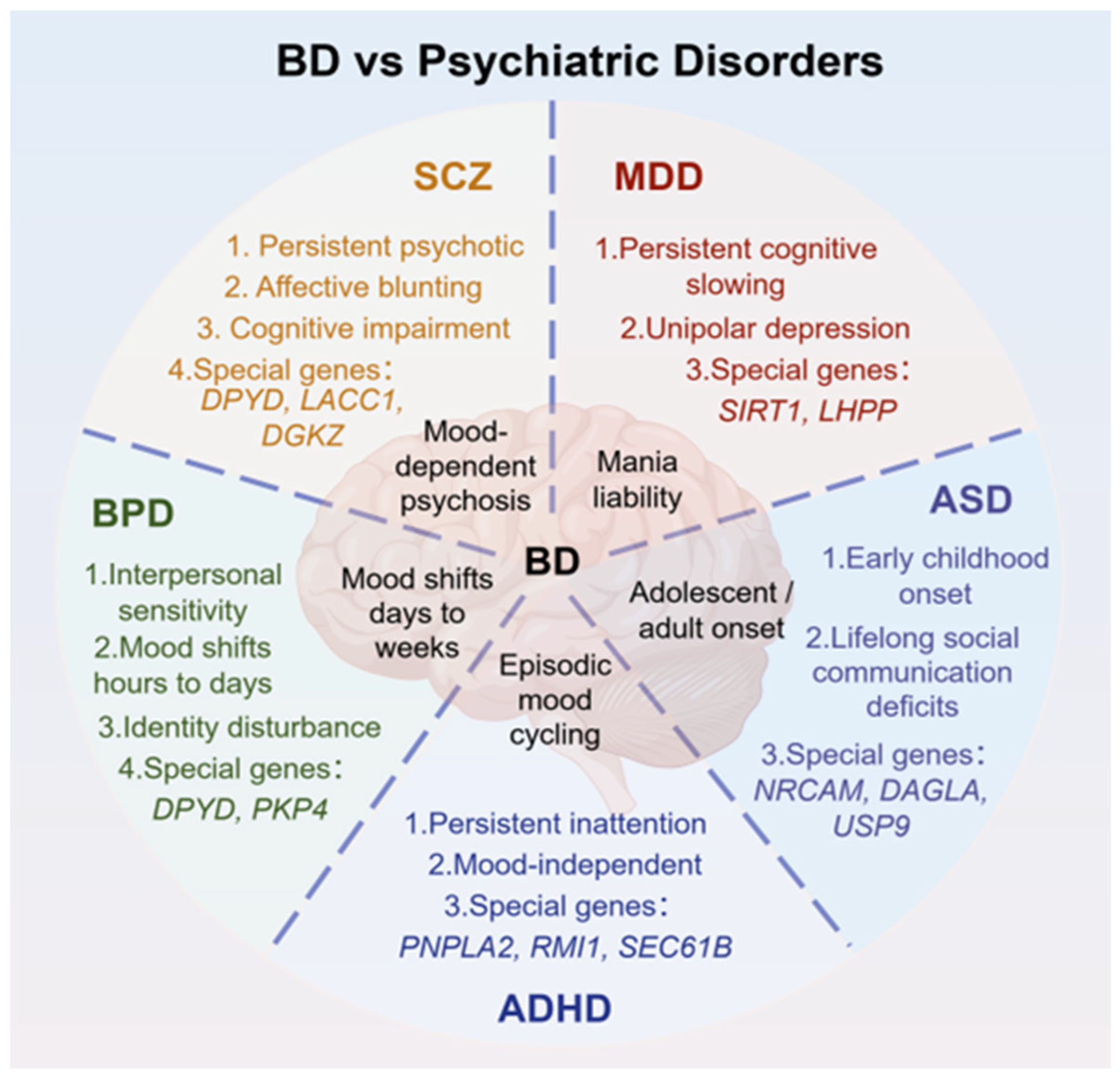
- Analyze similarities and differences between bipolar disorder and other psychiatric disorders in terms of symptoms, neurobiology, genetics, and treatments.
- Study neurotransmitters, neurotrophic factors, miRNAs, and circRNAs in bipolar disorder.
- Detail mechanisms, databases, sequencing, and experimental methods in lncRNA research.
- Focus on lncRNA studies related to BD in blood, PBMCs, and human cell lines.
- Explore brain-specific lncRNAs in BD patients and animal models.
- Include studies with both in vitro and in vivo components only if in vitro data are separately extractable.
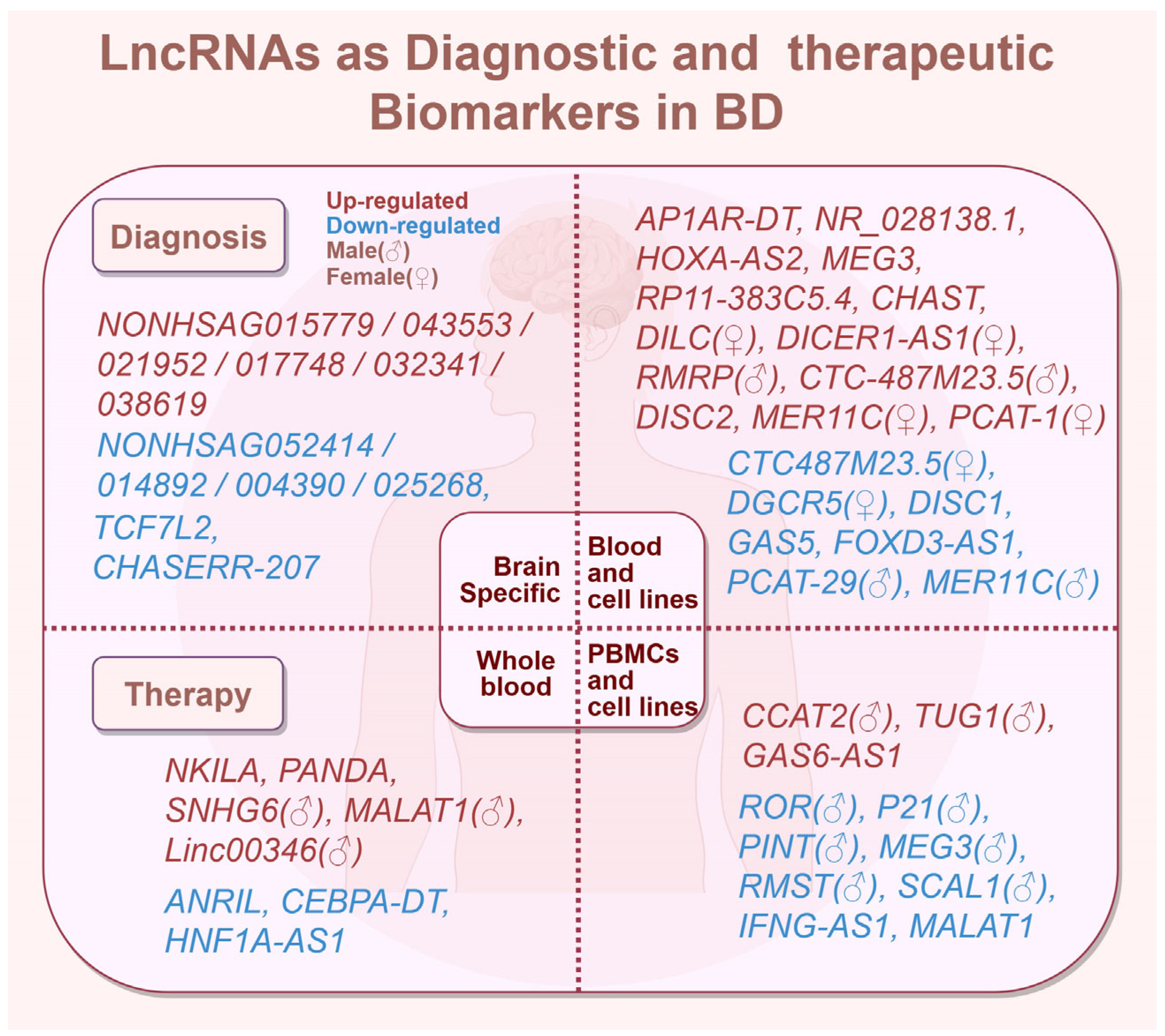
- Include studies on lncRNAs (AP1AR-DT, Malat1, and Meg3) in BD diagnosis as the main focus.
- Consider articles published in English up to 1 February 2026.
2.1.2. Exclusion Criteria
- Exclude studies not using miRNA or circRNA in interventions.
- Exclude some studies on clinical treatment of BD and other psychiatric disorders.
- Exclude simplified studies on lncRNA molecular mechanisms and methodologies.
- Exclude non-peer-reviewed sources like conference abstracts, editorials, dissertations, or gray literature.
- Exclude studies not published in English.
- Exclude studies lacking relevant control groups or proper experimental design.
- Exclude studies published after 1 February 2026.
2.2. Data Extraction and Synthesis of Evidence
2.3. Summary of Review Design and Methods of Studies Included
2.3.1. Summary of Review Design
- Section 3 summarizes the similarities and differences among the three BD subtypes and compares BD with other psychiatric disorders.
- Section 4 introduces the regulatory roles of neurotransmitters, neurotrophic factors, miRNAs, and circRNAs in bipolar disorder.
- Section 5 provides a simplified overview of lncRNAs, including their mechanisms, related databases, and methods.
- Section 6 discusses the diagnostic and therapeutic potential of lncRNAs in BD patients, covering both in vitro and in vivo studies, and summarizes brain-specific lncRNAs and their regulatory roles in humans and animal models.
2.3.2. Table and Figure Construction
- To classify the three subtypes of bipolar disorder (BD), in Section 3.1, we present therapeutic criteria, episode features, risk-associated genomic loci, and alterations in brain structure in Tables.
- To enhance the presentation of studies comparing BD with other psychiatric disorders in Section 3.2, we synthesize relevant descriptions and present Figures.
- In Section 4.2, we provide a clear overview of pertinent long non-coding RNA (lncRNA) databases by concisely presenting detailed information, including species, functions, and resources, in Tables.
- To provide a comprehensive understanding of the lncRNAs in BD diagnosis and therapy, we provide detailed information about lncRNAs in Tables, with up-/down-regulated lncRNAs in multiple samples shown in Figures.
2.3.3. Reference Refinement
- Under the predefined criteria, full-text articles were evaluated for eligibility. Studies were excluded if they did not specifically report on lncRNAs in BD. In total, over 30 studies were removed in the initial submission, and 11 unrelated studies were eliminated during the two rounds of revisions. In this review, 233 valid references were included in the final version.
3. Basic Information About Bipolar Disorder
3.1. Classification
3.1.1. BD-I
3.1.2. BD-II
3.1.3. CD
3.1.4. Differences in Three Subtypes
3.2. Differences Between Bipolar Disorder and Other Psychiatric Disorders
3.2.1. BD-I vs. SCZ
3.2.2. BD-II vs. MDD
3.2.3. BD vs. BPD
3.2.4. BD vs. ADHD
3.2.5. BD vs. ASD
4. Roles of Neurotransmitters, Neurotrophic Factors, miRNAs, and circRNAs in Bipolar Disorder
4.1. Neurotransmitters
4.2. Neurotrophic Factors
4.3. miRNAs
4.4. circRNAs
5. Basic Information About lncRNAs
5.1. Mechanisms of lncRNAs
5.2. Databases for lncRNA Analysis
5.3. Sequencing Methods for lncRNA Study
5.4. Experimental Validation in lncRNA Study
6. Diagnostic and Therapeutic Potential of lncRNAs in Bipolar Disorder
6.1. Diagnostic Potential of lncRNAs in BD
6.1.1. Abnormally Expressed lncRNAs in Blood and PBMCs in BD
6.1.2. Brain-Specific lncRNAs in BD
6.2. Drug Response Potential of lncRNAs in BD
7. Conclusions
8. Limitations
Author Contributions
Funding
Data Availability Statement
Acknowledgments
Conflicts of Interest
References
- Ayano, G.; Shumet, S.; Tesfaw, G.; Tsegay, L. A systematic review and meta-analysis of the prevalence of bipolar disorder among homeless people. BMC Public Health 2020, 20, 731. [Google Scholar] [CrossRef]
- Tondo, L.; Vazquez, G.H.; Baldessarini, R.J. Depression and Mania in Bipolar Disorder. Curr. Neuropharmacol. 2017, 15, 353–358. [Google Scholar] [CrossRef]
- Chen, Y.; Shi, J.; Liu, H.; Wang, Q.; Chen, X.; Tang, H.; Yan, R.; Yao, Z.; Lu, Q. Plasma microRNA Array Analysis Identifies Overexpressed miR-19b-3p as a Biomarker of Bipolar Depression Distinguishing From Unipolar Depression. Front. Psychiatry 2020, 11, 757. [Google Scholar] [CrossRef]
- Bipolar Disorder and Schizophrenia Working Group of the Psychiatric Genomics Consortium. Genomic Dissection of Bipolar Disorder and Schizophrenia, Including 28 Subphenotypes. Cell 2018, 173, 1705–1715.e16. [Google Scholar] [CrossRef] [PubMed]
- Casey, C.; Fullard, J.F.; Sleator, R.D. Unravelling the genetic basis of Schizophrenia. Gene 2024, 902, 148198. [Google Scholar] [CrossRef] [PubMed]
- Cui, L.; Li, S.; Wang, S.; Wu, X.; Liu, Y.; Yu, W.; Wang, Y.; Tang, Y.; Xia, M.; Li, B. Major depressive disorder: Hypothesis, mechanism, prevention and treatment. Signal Transduct. Target. Ther. 2024, 9, 30. [Google Scholar] [CrossRef] [PubMed]
- Howland, R.H.; Thase, M.E. A comprehensive review of cyclothymic disorder. J. Nerv. Ment. Dis. 1993, 181, 485–493. [Google Scholar] [CrossRef]
- Pirbalouti, R.G.; Mohseni, M.M.; Taheri, M.; Neishabouri, S.M.; Shirvani-Farsani, Z. Deregulation of NF-κB associated long non-coding RNAs in bipolar disorder. Metab. Brain Dis. 2023, 38, 2223–2230. [Google Scholar] [CrossRef]
- Hosseini, E.; Bagheri-Hosseinabadi, Z.; De Toma, I.; Jafarisani, M.; Sadeghi, I. The importance of long non-coding RNAs in neuropsychiatric disorders. Mol. Asp. Med. 2019, 70, 127–140. [Google Scholar] [CrossRef]
- Ilieva, M.S. Non-Coding RNAs in Neurological and Neuropsychiatric Disorders: Unraveling the Hidden Players in Disease Pathogenesis. Cells 2024, 13, 1063. [Google Scholar] [CrossRef]
- Roberts, T.C.; Morris, K.V.; Wood, M.J. The role of long non-coding RNAs in neurodevelopment, brain function and neurological disease. Philos. Trans. R. Soc. B Biol. Sci. 2014, 369, 20130507. [Google Scholar] [CrossRef]
- Katsel, P.; Roussos, P.; Fam, P.; Khan, S.; Tan, W.; Hirose, T.; Nakagawa, S.; Pletnikov, M.V.; Haroutunian, V. The expression of long noncoding RNA NEAT1 is reduced in schizophrenia and modulates oligodendrocytes transcription. NPJ Schizophr. 2019, 5, 3. [Google Scholar] [CrossRef] [PubMed]
- Huan, Z.; Mei, Z.; Na, H.; Xinxin, M.; Yaping, W.; Ling, L.; Lei, W.; Kejin, Z.; Yanan, L. lncRNA MIR155HG Alleviates Depression-Like Behaviors in Mice by Regulating the miR-155/BDNF Axis. Neurochem. Res. 2021, 46, 935–944. [Google Scholar] [CrossRef] [PubMed]
- Luo, T.; Ou, J.N.; Cao, L.F.; Peng, X.Q.; Li, Y.M.; Tian, Y.Q. The Autism-Related lncRNA MSNP1AS Regulates Moesin Protein to Influence the RhoA, Rac1, and PI3K/Akt Pathways and Regulate the Structure and Survival of Neurons. Autism Res. 2020, 13, 2073–2082. [Google Scholar] [CrossRef]
- Dini, N.; Taheri, M.; Shirvani-Farsani, Z. The expression analysis of long noncoding RNAs PCAT-1, PCAT-29, and MER11C in bipolar disorder. BMC Psychiatry 2024, 24, 524. [Google Scholar] [CrossRef]
- He, L.; Zou, P.; Sun, W.; Fu, Y.; He, W.; Li, J. Identification of lncRNA NR_028138.1 as a biomarker and construction of a ceRNA network for bipolar disorder. Sci. Rep. 2021, 11, 15653. [Google Scholar] [CrossRef] [PubMed]
- Zamani, B.; Mehrab Mohseni, M.; Naghavi Gargari, B.; Taheri, M.; Sayad, A.; Shirvani-Farsani, Z. Reduction of GAS5 and FOXD3-AS1 long non-coding RNAs in patients with bipolar disorder. Sci. Rep. 2023, 13, 13870. [Google Scholar] [CrossRef]
- Ghamari, M.; Mehrab Mohseni, M.; Taheri, M.; Neishabouri, S.M.; Shirvani-Farsani, Z. Abnormal expression of long non-coding RNAs RMRP, CTC-487M23.5, and DGCR5 in the peripheral blood of patients with Bipolar disorder. Metab. Brain Dis. 2024, 39, 313–320. [Google Scholar] [CrossRef]
- Sayad, A.; Taheri, M.; Omrani, M.D.; Fallah, H.; Kholghi Oskooei, V.; Ghafouri-Fard, S. Peripheral expression of long non-coding RNAs in bipolar patients. J. Affect. Disord. 2019, 249, 169–174. [Google Scholar] [CrossRef]
- Maloum, Z.; Taheri, M.; Ghafouri-Fard, S.; Shirvani-Farsani, Z. Significant reduction of long non-coding RNAs expression in bipolar disorder. BMC Psychiatry 2022, 22, 256. [Google Scholar] [CrossRef]
- Baldessarini, R.J.; Tondo, L.; Pinna, M.; Nunez, N.; Vazquez, G.H. Suicidal risk factors in major affective disorders. Br. J. Psychiatry 2019, 215, 621–626. [Google Scholar] [CrossRef] [PubMed]
- Miola, A.; Salvucci, M.; Meda, N.; Cattarinussi, G.; Lore, M.L.; Ghiotto, N.; Collantoni, E.; Boldrini, T.; Nunez, N.A.; Ercis, M.; et al. Neural signatures of bipolar disorder subtypes: A comprehensive systematic review of neuroimaging studies. J. Affect. Disord. 2026, 394, 120605. [Google Scholar] [CrossRef]
- Haukvik, U.K.; Gurholt, T.P.; Nerland, S.; Elvsashagen, T.; Akudjedu, T.N.; Alda, M.; Alnaes, D.; Alonso-Lana, S.; Bauer, J.; Baune, B.T.; et al. In vivo hippocampal subfield volumes in bipolar disorder-A mega-analysis from The Enhancing Neuro Imaging Genetics through Meta-Analysis Bipolar Disorder Working Group. Hum. Brain Mapp. 2022, 43, 385–398. [Google Scholar] [CrossRef]
- Choi, S.Y.; Pang, K.; Kim, J.Y.; Ryu, J.R.; Kang, H.; Liu, Z.; Kim, W.K.; Sun, W.; Kim, H.; Han, K. Post-transcriptional regulation of SHANK3 expression by microRNAs related to multiple neuropsychiatric disorders. Mol. Brain 2015, 8, 74. [Google Scholar] [CrossRef] [PubMed]
- Yoon, S.; Piguel, N.H.; Penzes, P. Roles and mechanisms of ankyrin-G in neuropsychiatric disorders. Exp. Mol. Med. 2022, 54, 867–877. [Google Scholar] [CrossRef]
- Craddock, N.; Jones, L.; Jones, I.R.; Kirov, G.; Green, E.K.; Grozeva, D.; Moskvina, V.; Nikolov, I.; Hamshere, M.L.; Vukcevic, D.; et al. Strong genetic evidence for a selective influence of GABAA receptors on a component of the bipolar disorder phenotype. Mol. Psychiatry 2010, 15, 146–153, Erratum in Mol. Psychiatry 2010, 15, 1121. https://doi.org/10.1038/mp.2010.62. [Google Scholar] [CrossRef]
- Green, E.K.; Grozeva, D.; Moskvina, V.; Hamshere, M.L.; Jones, I.R.; Jones, L.; Forty, L.; Caesar, S.; Gordon-Smith, K.; Fraser, C.; et al. Variation at the GABAA receptor gene, Rho 1 (GABRR1) associated with susceptibility to bipolar schizoaffective disorder. Am. J. Med. Genet. B Neuropsychiatr. Genet. 2010, 153, 1347–1349. [Google Scholar] [CrossRef]
- Drago, A.; Giegling, I.; Schäfer, M.; Hartmann, A.M.; Friedl, M.; Konte, B.; Möller, H.-J.; De Ronchi, D.; Stassen, H.H.; Serretti, A.; et al. AKAP13, CACNA1, GRIK4 and GRIA1 genetic variations may be associated with haloperidol efficacy during acute treatment. Eur. Neuropsychopharmacol. 2013, 23, 887–894. [Google Scholar] [CrossRef]
- Green, E.K.; Grozeva, D.; Jones, I.; Jones, L.; Kirov, G.; Caesar, S.; Gordon-Smith, K.; Fraser, C.; Forty, L.; Russell, E.; et al. The bipolar disorder risk allele at CACNA1C also confers risk of recurrent major depression and of schizophrenia. Mol. Psychiatry 2010, 15, 1016–1022. [Google Scholar] [CrossRef] [PubMed]
- Zou, S.; Mendes-Silva, A.P.; Dos Santos, F.C.; Ebrahimi, M.; Kennedy, J.L.; Goncalves, V.F. Multi-omics Analysis of Energy Metabolism Pathways Across Major Psychiatric Disorders. Mol. Neurobiol. 2025, 62, 13272–13285. [Google Scholar] [CrossRef]
- Sen, P.; Ortiz, O.; Brivio, E.; Menegaz, D.; Sotillos Elliott, L.; Du, Y.; Ries, C.; Chen, A.; Wurst, W.; Lopez, J.P.; et al. A bipolar disorder-associated missense variant alters adenylyl cyclase 2 activity and promotes mania-like behavior. Mol. Psychiatry 2025, 30, 97–110. [Google Scholar] [CrossRef]
- Witt, S.H.; Kleindienst, N.; Frank, J.; Treutlein, J.; Muhleisen, T.; Degenhardt, F.; Jungkunz, M.; Krumm, B.; Cichon, S.; Tadic, A.; et al. Analysis of genome-wide significant bipolar disorder genes in borderline personality disorder. Psychiatr. Genet. 2014, 24, 262–265. [Google Scholar] [CrossRef] [PubMed]
- O’Connell, K.S.; Shadrin, A.; Bahrami, S.; Smeland, O.B.; Bettella, F.; Frei, O.; Krull, F.; Askeland, R.B.; Walters, G.B.; Daviethsdottir, K.; et al. Identification of genetic overlap and novel risk loci for attention-deficit/hyperactivity disorder and bipolar disorder. Mol. Psychiatry 2021, 26, 4055–4065. [Google Scholar] [CrossRef]
- Huang, Y.; Liu, Y.; Wu, Y.; Tang, Y.; Zhang, M.; Liu, S.; Xiao, L.; Tao, S.; Xie, M.; Dai, M.; et al. Patterns of Convergence and Divergence Between Bipolar Disorder Type I and Type II: Evidence From Integrative Genomic Analyses. Front. Cell Dev. Biol. 2022, 10, 956265. [Google Scholar] [CrossRef]
- Shah, N.; Grover, S.; Rao, G.P. Clinical Practice Guidelines for Management of Bipolar Disorder. Indian J. Psychiatry 2017, 59, S51–S66. [Google Scholar] [CrossRef]
- Rathje, M.; Waxman, H.; Benoit, M.; Tammineni, P.; Leu, C.; Loebrich, S.; Nedivi, E. Genetic variants in the bipolar disorder risk locus SYNE1 that affect CPG2 expression and protein function. Mol. Psychiatry 2021, 26, 508–523. [Google Scholar] [CrossRef]
- Ferreira, M.A.; O’Donovan, M.C.; Meng, Y.A.; Jones, I.R.; Ruderfer, D.M.; Jones, L.; Fan, J.; Kirov, G.; Perlis, R.H.; Green, E.K.; et al. Collaborative genome-wide association analysis supports a role for ANK3 and CACNA1C in bipolar disorder. Nat. Genet. 2008, 40, 1056–1058. [Google Scholar] [CrossRef]
- Wang, Z.; Zhang, C.; Huang, J.; Yuan, C.; Hong, W.; Chen, J.; Yu, S.; Xu, L.; Gao, K.; Fang, Y. MiRNA-206 and BDNF genes interacted in bipolar I disorder. J. Affect. Disord. 2014, 162, 116–119. [Google Scholar] [CrossRef] [PubMed]
- Skold, M.; Kallstrand, J.; Nehlstedt, S.; Nordin, A.; Nielzen, S.; Holmberg, J.; Adolfsson, R. Thalamocortical abnormalities in auditory brainstem response patterns distinguish DSM-IV bipolar disorder type I from schizophrenia. J. Affect. Disord. 2014, 169, 105–111. [Google Scholar] [CrossRef] [PubMed]
- Yildiz, A.; Siafis, S.; Mavridis, D.; Vieta, E.; Leucht, S. Comparative efficacy and tolerability of pharmacological interventions for acute bipolar depression in adults: A systematic review and network meta-analysis. Lancet Psychiatry 2023, 10, 693–705. [Google Scholar] [CrossRef]
- D’Addario, C.; Palazzo, M.C.; Benatti, B.; Grancini, B.; Pucci, M.; Di Francesco, A.; Camuri, G.; Galimberti, D.; Fenoglio, C.; Scarpini, E.; et al. Regulation of gene transcription in bipolar disorders: Role of DNA methylation in the relationship between prodynorphin and brain derived neurotrophic factor. Prog. Neuro-Psychopharmacol. Biol. Psychiatry 2018, 82, 314–321. [Google Scholar] [CrossRef]
- Li, B.; Zhang, C.; Chen, W.; Xie, G.; Liang, J. Amygdala volume abnormalities and cognitive impairment in major depressive disorder and bipolar disorder II. BMC Psychiatry 2025, 25, 839. [Google Scholar] [CrossRef] [PubMed]
- Goldman, D.A.; Sankar, A.; Rich, A.; Kim, J.A.; Pittman, B.; Constable, R.T.; Scheinost, D.; Blumberg, H.P. A graph theory neuroimaging approach to distinguish the depression of bipolar disorder from major depressive disorder in adolescents and young adults. J. Affect. Disord. 2022, 319, 15–26. [Google Scholar] [CrossRef] [PubMed]
- Van Meter, A.R.; Youngstrom, E.A. Cyclothymic disorder in youth: Why is it overlooked, what do we know and where is the field headed? Neuropsychiatry 2012, 2, 509–519. [Google Scholar] [CrossRef]
- Kodama, K.; Terao, T.; Hatano, K.; Kohno, K.; Makino, M.; Mizokami, Y.; Kamei, K.; Katayama, Y.; Hoaki, Y.; Sakai, A.; et al. Identification of the neural correlates of cyclothymic temperament using a working memory task in fMRI. J. Affect. Disord. 2015, 171, 1–5. [Google Scholar] [CrossRef]
- Izci, F.; Findikli, E.K.; Zincir, S.; Zincir, S.B.; Koc, M.I. The differences in temperament-character traits, suicide attempts, impulsivity, and functionality levels of patients with bipolar disorder I and II. Neuropsychiatr. Dis. Treat. 2016, 12, 177–184. [Google Scholar] [CrossRef] [PubMed]
- Fayyazi Bordbar, M.R.; Faridhosseini, F.; Kaviani, H.; Kazemian, M.; Samari, A.A.; Kashani Lotfabadi, M. Temperament and character personality dimensions in patients with bipolar I disorder. Turk. J. Psychiatry 2014, 25, 149–156. [Google Scholar]
- Mantere, O.; Suominen, K.; Arvilommi, P.; Valtonen, H.; Leppamaki, S.; Isometsa, E. Clinical predictors of unrecognized bipolar I and II disorders. Bipolar Disord. 2008, 10, 238–244. [Google Scholar] [CrossRef]
- Chakrabarti, S. Bipolar disorder in the International Classification of Diseases-Eleventh version: A review of the changes, their basis, and usefulness. World J. Psychiatry 2022, 12, 1335–1355. [Google Scholar] [CrossRef]
- Alloy, L.B.; Abramson, L.Y.; Urosevic, S.; Walshaw, P.D.; Nusslock, R.; Neeren, A.M. The psychosocial context of bipolar disorder: Environmental, cognitive, and developmental risk factors. Clin. Psychol. Rev. 2005, 25, 1043–1075. [Google Scholar] [CrossRef]
- Presne, C.; Fakhouri, F.; Noel, L.H.; Stengel, B.; Even, C.; Kreis, H.; Mignon, F.; Grunfeld, J.P. Lithium-induced nephropathy: Rate of progression and prognostic factors. Kidney Int. 2003, 64, 585–592. [Google Scholar] [CrossRef]
- Kraszewska, A.; Ziemnicka, K.; Jonczyk-Potoczna, K.; Sowinski, J.; Rybakowski, J.K. Thyroid structure and function in long-term lithium-treated and lithium-naive bipolar patients. Hum. Psychopharmacol. Clin. Exp. 2019, 34, e2708. [Google Scholar] [CrossRef]
- Cipriani, A.; Pretty, H.; Hawton, K.; Geddes, J.R. Lithium in the prevention of suicidal behavior and all-cause mortality in patients with mood disorders: A systematic review of randomized trials. Am. J. Psychiatry 2005, 162, 1805–1819. [Google Scholar] [CrossRef]
- Epstein, R.A.; Moore, K.M.; Bobo, W.V. Treatment of bipolar disorders during pregnancy: Maternal and fetal safety and challenges. Drug Healthc. Patient Saf. 2015, 7, 7–29. [Google Scholar] [CrossRef]
- Anmella, G.; Vieta, E. Teratogenicity of valproate: Further reasons for action. Eur. Neuropsychopharmacol. 2024, 80, 25–26. [Google Scholar] [CrossRef]
- Goodwin, G.M.; Haddad, P.M.; Ferrier, I.N.; Aronson, J.K.; Barnes, T.; Cipriani, A.; Coghill, D.R.; Fazel, S.; Geddes, J.R.; Grunze, H.; et al. Evidence-based guidelines for treating bipolar disorder: Revised third edition recommendations from the British Association for Psychopharmacology. J. Psychopharmacol. 2016, 30, 495–553. [Google Scholar] [CrossRef]
- Grunze, H.; Vieta, E.; Goodwin, G.M.; Bowden, C.; Licht, R.W.; Azorin, J.M.; Yatham, L.; Mosolov, S.; Moller, H.J.; Kasper, S.; et al. The World Federation of Societies of Biological Psychiatry (WFSBP) Guidelines for the Biological Treatment of Bipolar Disorders: Acute and long-term treatment of mixed states in bipolar disorder. World J. Biol. Psychiatry 2018, 19, 2–58. [Google Scholar] [CrossRef] [PubMed]
- Mosolov, S.; Born, C.; Grunze, H. Electroconvulsive Therapy (ECT) in Bipolar Disorder Patients with Ultra-Rapid Cycling and Unstable Mixed States. Medicina 2021, 57, 624. [Google Scholar] [CrossRef] [PubMed]
- Yang, L.L.; Zhao, D.; Kong, L.L.; Sun, Y.Q.; Wang, Z.Y.; Gao, Y.Y.; Li, N.; Lu, L.; Shi, L.; Wang, X.Y.; et al. High-frequency repetitive transcranial magnetic stimulation (rTMS) improves neurocognitive function in bipolar disorder. J. Affect. Disord. 2019, 246, 851–856. [Google Scholar] [CrossRef] [PubMed]
- Wang, S.; Zhang, Z.; Yao, L.; Ding, N.; Jiang, L.; Wu, Y. Bright light therapy in the treatment of patients with bipolar disorder: A systematic review and meta-analysis. PLoS ONE 2020, 15, e0232798. [Google Scholar] [CrossRef]
- Ruggero, C.J.; Chelminski, I.; Young, D.; Zimmerman, M. Psychosocial impairment associated with bipolar II disorder. J. Affect. Disord. 2007, 104, 53–60. [Google Scholar] [CrossRef]
- Xiang, Y.T.; Zhang, L.; Wang, G.; Hu, C.; Ungvari, G.S.; Dickerson, F.B.; Kilbourne, A.M.; Si, T.M.; Fang, Y.R.; Lu, Z.; et al. Sociodemographic and clinical features of bipolar disorder patients misdiagnosed with major depressive disorder in China. Bipolar Disord. 2013, 15, 199–205. [Google Scholar] [CrossRef]
- Berk, M.; Corrales, A.; Trisno, R.; Dodd, S.; Yatham, L.N.; Vieta, E.; McIntyre, R.S.; Suppes, T.; Agustini, B. Bipolar II disorder: A state-of-the-art review. World Psychiatry 2025, 24, 175–189. [Google Scholar] [CrossRef]
- Yatham, L.N.; Kennedy, S.H.; Parikh, S.V.; Schaffer, A.; Bond, D.J.; Frey, B.N.; Sharma, V.; Goldstein, B.I.; Rej, S.; Beaulieu, S.; et al. Canadian Network for Mood and Anxiety Treatments (CANMAT) and International Society for Bipolar Disorders (ISBD) 2018 guidelines for the management of patients with bipolar disorder. Bipolar Disord. 2018, 20, 97–170. [Google Scholar] [CrossRef]
- Young, A.H.; Calabrese, J.R.; Gustafsson, U.; Berk, M.; McElroy, S.L.; Thase, M.E.; Suppes, T.; Earley, W. Quetiapine monotherapy in bipolar II depression: Combined data from four large, randomized studies. Int. J. Bipolar Disord. 2013, 1, 10. [Google Scholar] [CrossRef]
- van der Loos, M.L.; Mulder, P.G.; Hartong, E.G.; Blom, M.B.; Vergouwen, A.C.; de Keyzer, H.J.; Notten, P.J.; Luteijn, M.L.; Timmermans, M.A.; Vieta, E.; et al. Efficacy and safety of lamotrigine as add-on treatment to lithium in bipolar depression: A multicenter, double-blind, placebo-controlled trial. J. Clin. Psychiatry 2009, 70, 223–231. [Google Scholar] [CrossRef] [PubMed]
- Pacchiarotti, I.; Verdolini, N. Antidepressants in Bipolar II Depression: Yes and no. Eur. Neuropsychopharmacol. 2021, 47, 48–50. [Google Scholar] [CrossRef]
- Bielecki, J.E.; Gupta, V. Cyclothymic Disorder. In StatPearls; StatPearls: Treasure Island, FL, USA, 2025. [Google Scholar]
- Perugi, G.; Hantouche, E.; Vannucchi, G. Diagnosis and Treatment of Cyclothymia: The “Primacy” of Temperament. Curr. Neuropharmacol. 2017, 15, 372–379. [Google Scholar] [CrossRef] [PubMed]
- Van Meter, A.; Youngstrom, E.A.; Youngstrom, J.K.; Feeny, N.C.; Findling, R.L. Examining the validity of cyclothymic disorder in a youth sample. J. Affect. Disord. 2011, 132, 55–63. [Google Scholar] [CrossRef] [PubMed]
- Van Meter, A.; Goldstein, B.I.; Goldstein, T.R.; Yen, S.; Hower, H.; Strober, M.; Merranko, J.A.; Gill, M.K.; Diler, R.S.; Axelson, D.; et al. Parsing cyclothymic disorder and other specified bipolar spectrum disorders in youth. J. Affect. Disord. 2018, 238, 375–382. [Google Scholar] [CrossRef] [PubMed]
- Quaranta, G.; Barbuti, M.; Pallucchini, A.; Colombini, P.; Moriconi, M.; Gemmellaro, T.; Tripodi, B.; Palagini, L.; Schiavi, E.; Perugi, G. Relationships Among Delayed Sleep Phase Disorder, Emotional Dysregulation, and Affective Temperaments in Adults With Attention Deficit Hyperactivity Disorder and Cyclothymia. J. Nerv. Ment. Dis. 2020, 208, 857–862. [Google Scholar] [CrossRef]
- Brancati, G.E.; Barbuti, M.; Schiavi, E.; Colombini, P.; Moriconi, M.; Pallucchini, A.; Maiello, M.; Menculini, G.; Perugi, G. Comparison of Emotional Dysregulation Features in Cyclothymia and Adult ADHD. Medicina 2021, 57, 489. [Google Scholar] [CrossRef]
- Van Meter, A.R.; Youngstrom, E.A.; Findling, R.L. Cyclothymic disorder: A critical review. Clin. Psychol. Rev. 2012, 32, 229–243. [Google Scholar] [CrossRef]
- Barroilhet, S.A.; Ghaemi, S.N. When and how to use lithium. Acta Psychiatr. Scand. 2020, 142, 161–172. [Google Scholar] [CrossRef]
- Besag, F.M.C.; Vasey, M.J.; Sharma, A.N.; Lam, I.C.H. Efficacy and safety of lamotrigine in the treatment of bipolar disorder across the lifespan: A systematic review. Ther. Adv. Psychopharmacol. 2021, 11, 20451253211045870. [Google Scholar] [CrossRef] [PubMed]
- Loftus, J.; Scott, J.; Vorspan, F.; Icick, R.; Henry, C.; Gard, S.; Kahn, J.P.; Leboyer, M.; Bellivier, F.; Etain, B. Psychiatric comorbidities in bipolar disorders: An examination of the prevalence and chronology of onset according to sex and bipolar subtype. J. Affect. Disord. 2020, 267, 258–263. [Google Scholar] [CrossRef] [PubMed]
- Hu, F.H.; Jia, Y.J.; Zhao, D.Y.; Fu, X.L.; Zhang, W.Q.; Tang, W.; Hu, S.Q.; Wu, H.; Ge, M.W.; Du, W.; et al. Gender differences in suicide among patients with bipolar disorder: A systematic review and meta-analysis. J. Affect. Disord. 2023, 339, 601–614. [Google Scholar] [CrossRef]
- Tseng, P.T.; Chen, Y.W.; Tu, K.Y.; Wang, H.Y.; Chung, W.; Wu, C.K.; Hsu, S.P.; Kuo, H.C.; Lin, P.Y. State-dependent increase in the levels of neurotrophin-3 and neurotrophin-4/5 in patients with bipolar disorder: A meta-analysis. J. Psychiatr. Res. 2016, 79, 86–92. [Google Scholar] [CrossRef]
- Loch, A.A.; Zanetti, M.V.; de Sousa, R.T.; Chaim, T.M.; Serpa, M.H.; Gattaz, W.F.; Teixeira, A.L.; Machado-Vieira, R. Elevated neurotrophin-3 and neurotrophin 4/5 levels in unmedicated bipolar depression and the effects of lithium. Prog. Neuro-Psychopharmacol. Biol. Psychiatry 2015, 56, 243–246. [Google Scholar] [CrossRef] [PubMed]
- Ino, H.; Honda, S.; Yamada, K.; Horita, N.; Tsugawa, S.; Yoshida, K.; Noda, Y.; Meyer, J.H.; Mimura, M.; Nakajima, S.; et al. Glutamatergic Neurometabolite Levels in Bipolar Disorder: A Systematic Review and Meta-analysis of Proton Magnetic Resonance Spectroscopy Studies. Biol. Psychiatry Cogn. Neurosci. Neuroimaging 2023, 8, 140–150. [Google Scholar] [CrossRef]
- Scotti-Muzzi, E.; Chile, T.; Moreno, R.; Pastorello, B.F.; da Costa Leite, C.; Henning, A.; Otaduy, M.C.G.; Vallada, H.; Soeiro-de-Souza, M.G. ACC Glu/GABA ratio is decreased in euthymic bipolar disorder I patients: Possible in vivo neurometabolite explanation for mood stabilization. Eur. Arch. Psychiatry Clin. Neurosci. 2021, 271, 537–547. [Google Scholar] [CrossRef]
- Lee, S.Y.; Lu, R.B.; Wang, L.J.; Chang, C.H.; Lu, T.; Wang, T.Y.; Tsai, K.W. Serum miRNA as a possible biomarker in the diagnosis of bipolar II disorder. Sci. Rep. 2020, 10, 1131. [Google Scholar] [CrossRef] [PubMed]
- Ohi, K.; Muto, Y.; Takai, K.; Sugiyama, S.; Shioiri, T. Investigating genetic overlaps of the genetic factor differentiating schizophrenia from bipolar disorder with cognitive function and hippocampal volume. BJPsych Open 2022, 8, e33. [Google Scholar] [CrossRef] [PubMed]
- Cross-Disorder Group of the Psychiatric Genomics Consortium. Identification of risk loci with shared effects on five major psychiatric disorders: A genome-wide analysis. Lancet 2013, 381, 1371–1379, Erratum in Lancet 2013, 381, 1360. https://doi.org/10.1016/S0140-6736(13)60886-7. [Google Scholar] [CrossRef] [PubMed]
- The International Schizophrenia Consortium; Purcell, S.M.; Wray, N.R.; Stone, J.L.; Visscher, P.M.; O’Donovan, M.C.; Sullivan, P.F.; Sklar, P. Common polygenic variation contributes to risk of schizophrenia and bipolar disorder. Nature 2009, 460, 748–752. [Google Scholar] [CrossRef]
- Grotzinger, A.D.; Werme, J.; Peyrot, W.J.; Frei, O.; de Leeuw, C.; Bicks, L.K.; Guo, Q.; Margolis, M.P.; Coombes, B.J.; Batzler, A.; et al. Mapping the genetic landscape across 14 psychiatric disorders. Nature 2025, 649, 406–415. [Google Scholar] [CrossRef]
- Dacquino, C.; De Rossi, P.; Spalletta, G. Schizophrenia and bipolar disorder: The road from similarities and clinical heterogeneity to neurobiological types. Clin. Chim. Acta 2015, 449, 49–59. [Google Scholar] [CrossRef]
- Maier, W.; Zobel, A.; Wagner, M. Schizophrenia and bipolar disorder: Differences and overlaps. Curr. Opin. Psychiatry 2006, 19, 165–170. [Google Scholar] [CrossRef]
- Lee, D.K.; Lee, H.; Park, K.; Joh, E.; Kim, C.E.; Ryu, S. Common gray and white matter abnormalities in schizophrenia and bipolar disorder. PLoS ONE 2020, 15, e0232826. [Google Scholar] [CrossRef]
- Li, X.; Fan, L.; Zhao, Y.; Li, Y.; Wang, J.; Xu, S.; Xia, J. Integrating genetic regulation and schizophrenia-specific splicing quantitative expression with GWAS prioritizes novel risk genes for schizophrenia. Transl. Psychiatry 2025, 15, 379. [Google Scholar] [CrossRef]
- Post, R.M. Comparative pharmacology of bipolar disorder and schizophrenia. Schizophr. Res. 1999, 39, 153–158; discussion 163. [Google Scholar] [CrossRef]
- Hirschfeld, R.M. Differential diagnosis of bipolar disorder and major depressive disorder. J. Affect. Disord. 2014, 169, S12–S16. [Google Scholar] [CrossRef]
- Douglas, K.M.; Gallagher, P.; Robinson, L.J.; Carter, J.D.; McIntosh, V.V.; Frampton, C.M.; Watson, S.; Young, A.H.; Ferrier, I.N.; Porter, R.J. Prevalence of cognitive impairment in major depression and bipolar disorder. Bipolar Disord. 2018, 20, 260–274. [Google Scholar] [CrossRef]
- CONVERGE Consortium; Cai, N.; Bigdeli, T.B.; Kretzschmar, W.; Li, Y.; Liang, J.; Song, L.; Hu, J.; Li, Q.; Jin, W.; et al. Sparse whole-genome sequencing identifies two loci for major depressive disorder. Nature 2015, 523, 588–591, Erratum in Nature 2023, 620, E28. https://doi.org/10.1038/s41586-023-06276-1 . [Google Scholar] [CrossRef]
- John, R.L., Jr.; Antai-Otong, D. Contemporary Treatment Approaches to Major Depression and Bipolar Disorders. Nurs. Clin. North Am. 2016, 51, 335–351. [Google Scholar] [CrossRef]
- Bayes, A.; Parker, G.; Paris, J. Differential Diagnosis of Bipolar II Disorder and Borderline Personality Disorder. Curr. Psychiatry Rep. 2019, 21, 125. [Google Scholar] [CrossRef]
- Koenigsberg, H.W. Affective instability: Toward an integration of neuroscience and psychological perspectives. J. Pers. Disord. 2010, 24, 60–82. [Google Scholar] [CrossRef]
- Carr, O.; Saunders, K.E.A.; Bilderbeck, A.C.; Tsanas, A.; Palmius, N.; Geddes, J.R.; Foster, R.; De Vos, M.; Goodwin, G.M. Desynchronization of diurnal rhythms in bipolar disorder and borderline personality disorder. Transl. Psychiatry 2018, 8, 79. [Google Scholar] [CrossRef] [PubMed]
- Yen, S.; Frazier, E.; Hower, H.; Weinstock, L.M.; Topor, D.R.; Hunt, J.; Goldstein, T.R.; Goldstein, B.I.; Gill, M.K.; Ryan, N.D.; et al. Borderline personality disorder in transition age youth with bipolar disorder. Acta Psychiatr. Scand. 2015, 132, 270–280. [Google Scholar] [CrossRef] [PubMed]
- Renaud, S.; Corbalan, F.; Beaulieu, S. Differential diagnosis of bipolar affective disorder type II and borderline personality disorder: Analysis of the affective dimension. Compr. Psychiatry 2012, 53, 952–961. [Google Scholar] [CrossRef] [PubMed]
- Alafia, J.; Manjula, M. Emotion Dysregulation and Early Trauma in Borderline Personality Disorder: An Exploratory Study. Indian J. Psychol. Med. 2020, 42, 290–298. [Google Scholar] [CrossRef] [PubMed]
- Witt, S.H.; Streit, F.; Jungkunz, M.; Frank, J.; Awasthi, S.; Reinbold, C.S.; Treutlein, J.; Degenhardt, F.; Forstner, A.J.; Heilmann-Heimbach, S.; et al. Genome-wide association study of borderline personality disorder reveals genetic overlap with bipolar disorder, major depression and schizophrenia. Transl. Psychiatry 2017, 7, e1155. [Google Scholar] [CrossRef] [PubMed]
- Crotty, K.; Viswanathan, M.; Kennedy, S.; Edlund, M.J.; Ali, R.; Siddiqui, M.; Wines, R.; Ratajczak, P.; Gartlehner, G. Psychotherapies for the treatment of borderline personality disorder: A systematic review. J. Consult. Clin. Psychol. 2024, 92, 275–295. [Google Scholar] [CrossRef]
- Walshaw, P.D.; Alloy, L.B.; Sabb, F.W. Executive function in pediatric bipolar disorder and attention-deficit hyperactivity disorder: In search of distinct phenotypic profiles. Neuropsychol. Rev. 2010, 20, 103–120. [Google Scholar] [CrossRef]
- Khoury, E.; Acquaviva, E.; Purper-Ouakil, D.; Delorme, R.; Ellul, P. Meta-analysis of personal and familial co-occurrence of Attention Deficit/Hyperactivity Disorder and Bipolar Disorder. Neurosci. Biobehav. Rev. 2023, 146, 105050. [Google Scholar] [CrossRef]
- Comparelli, A.; Polidori, L.; Sarli, G.; Pistollato, A.; Pompili, M. Differentiation and comorbidity of bipolar disorder and attention deficit and hyperactivity disorder in children, adolescents, and adults: A clinical and nosological perspective. Front. Psychiatry 2022, 13, 949375. [Google Scholar] [CrossRef]
- Mechler, K.; Banaschewski, T.; Hohmann, S.; Hage, A. Evidence-based pharmacological treatment options for ADHD in children and adolescents. Pharmacol. Ther. 2022, 230, 107940. [Google Scholar] [CrossRef] [PubMed]
- Sharma, S.R.; Gonda, X.; Tarazi, F.I. Autism Spectrum Disorder: Classification, diagnosis and therapy. Pharmacol. Ther. 2018, 190, 91–104. [Google Scholar] [CrossRef]
- Vasconcelos-Moreno, M.P.; Prates-Baldez, D.; Santos-Terra, J.; Deckmann, I.; Di Gesu, I.N.; Lemann, R.S.; Riesgo, R.; Gottfried, C.; Kapczinski, F. Clinical Interplay Between Autism Spectrum Disorder and Bipolar Disorder: A Narrative Review. Trends Psychiatry Psychother. 2025, 47, e20240939. [Google Scholar] [CrossRef]
- Keehn, B.; Muller, R.A.; Townsend, J. Atypical attentional networks and the emergence of autism. Neurosci. Biobehav. Rev. 2013, 37, 164–183. [Google Scholar] [CrossRef]
- Joshi, G.; Biederman, J.; Wozniak, J.; Doyle, R.; Hammerness, P.; Galdo, M.; Sullivan, N.; Williams, C.; Brethel, K.; Woodworth, K.Y.; et al. Response to second generation antipsychotics in youth with comorbid bipolar disorder and autism spectrum disorder. CNS Neurosci. Ther. 2012, 18, 28–33. [Google Scholar] [CrossRef] [PubMed]
- Radonjic, N.V.; Hess, J.L.; Rovira, P.; Andreassen, O.; Buitelaar, J.K.; Ching, C.R.K.; Franke, B.; Hoogman, M.; Jahanshad, N.; McDonald, C.; et al. Structural brain imaging studies offer clues about the effects of the shared genetic etiology among neuropsychiatric disorders. Mol. Psychiatry 2021, 26, 2101–2110. [Google Scholar] [CrossRef]
- Ouali, U.; Zgueb, Y.; Jouini, L.; Aissa, A.; Jomli, R.; Ouertani, A.; Omrani, A.; Nacef, F.; Carta, M.G.; Preti, A. Accuracy of the Arabic HCL-32 and MDQ in detecting patients with bipolar disorder. BMC Psychiatry 2023, 23, 70. [Google Scholar] [CrossRef] [PubMed]
- Craddock, N.; Sklar, P. Genetics of bipolar disorder. Lancet 2013, 381, 1654–1662. [Google Scholar] [CrossRef]
- Marangoni, C.; Hernandez, M.; Faedda, G.L. The role of environmental exposures as risk factors for bipolar disorder: A systematic review of longitudinal studies. J. Affect. Disord. 2016, 193, 165–174. [Google Scholar] [CrossRef]
- Rowland, T.A.; Marwaha, S. Epidemiology and risk factors for bipolar disorder. Ther. Adv. Psychopharmacol. 2018, 8, 251–269. [Google Scholar] [CrossRef] [PubMed]
- Teleanu, R.I.; Niculescu, A.G.; Roza, E.; Vladacenco, O.; Grumezescu, A.M.; Teleanu, D.M. Neurotransmitters-Key Factors in Neurological and Neurodegenerative Disorders of the Central Nervous System. Int. J. Mol. Sci. 2022, 23, 5954. [Google Scholar] [CrossRef]
- Yuksel, C.; Ongur, D. Magnetic resonance spectroscopy studies of glutamate-related abnormalities in mood disorders. Biol. Psychiatry 2010, 68, 785–794. [Google Scholar] [CrossRef]
- Gigante, A.D.; Bond, D.J.; Lafer, B.; Lam, R.W.; Young, L.T.; Yatham, L.N. Brain glutamate levels measured by magnetic resonance spectroscopy in patients with bipolar disorder: A meta-analysis. Bipolar Disord. 2012, 14, 478–487. [Google Scholar] [CrossRef]
- Bond, D.J.; da Silveira, L.E.; MacMillan, E.L.; Torres, I.J.; Lang, D.J.; Su, W.; Honer, W.G.; Lam, R.W.; Yatham, L.N. Relationship between body mass index and hippocampal glutamate/glutamine in bipolar disorder. Br. J. Psychiatry 2016, 208, 146–152. [Google Scholar] [CrossRef]
- Shen, J.; Tomar, J.S. Elevated Brain Glutamate Levels in Bipolar Disorder and Pyruvate Carboxylase-Mediated Anaplerosis. Front. Psychiatry 2021, 12, 640977. [Google Scholar] [CrossRef]
- Yoon, S.J.; Lyoo, I.K.; Haws, C.; Kim, T.S.; Cohen, B.M.; Renshaw, P.F. Decreased glutamate/glutamine levels may mediate cytidine’s efficacy in treating bipolar depression: A longitudinal proton magnetic resonance spectroscopy study. Neuropsychopharmacology 2009, 34, 1810–1818. [Google Scholar] [CrossRef] [PubMed]
- Meng, C.; Yang, X.; Liu, Y.; Zhou, Y.; Rui, J.; Li, S.; Xu, C.; Zhuang, Y.; Lao, J.; Zhao, X. Decreased expression of lncRNA Malat1 in rat spinal cord contributes to neuropathic pain by increasing neuron excitability after brachial plexus avulsion. J. Pain. Res. 2019, 12, 1297–1310. [Google Scholar] [CrossRef] [PubMed]
- Fatemi, S.H.; Folsom, T.D.; Thuras, P.D. GABAA and GABAB receptor dysregulation in superior frontal cortex of subjects with schizophrenia and bipolar disorder. Synapse 2017, 71, e21973. [Google Scholar] [CrossRef] [PubMed]
- Brady, R.O., Jr.; McCarthy, J.M.; Prescot, A.P.; Jensen, J.E.; Cooper, A.J.; Cohen, B.M.; Renshaw, P.F.; Ongur, D. Brain gamma-aminobutyric acid (GABA) abnormalities in bipolar disorder. Bipolar Disord. 2013, 15, 434–439. [Google Scholar] [CrossRef]
- Nassan, M.; Li, Q.; Croarkin, P.E.; Chen, W.; Colby, C.L.; Veldic, M.; McElroy, S.L.; Jenkins, G.D.; Ryu, E.; Cunningham, J.M.; et al. A genome wide association study suggests the association of muskelin with early onset bipolar disorder: Implications for a GABAergic epileptogenic neurogenesis model. J. Affect. Disord. 2017, 208, 120–129. [Google Scholar] [CrossRef]
- Chen, C.H.; Lee, C.S.; Lee, M.T.; Ouyang, W.C.; Chen, C.C.; Chong, M.Y.; Wu, J.Y.; Tan, H.K.; Lee, Y.C.; Chuo, L.J.; et al. Variant GADL1 and response to lithium therapy in bipolar I disorder. N. Engl. J. Med. 2014, 370, 119–128, Erratum in N. Engl. J. Med. 2014, 370, 1866. https://doi.org/10.1056/NEJMx140013. [Google Scholar] [CrossRef] [PubMed]
- Fatemi, S.H.; Folsom, T.D.; Thuras, P.D. Deficits in GABAB receptor system in schizophrenia and mood disorders: A postmortem study. Schizophr. Res. 2011, 128, 37–43. [Google Scholar] [CrossRef]
- Fatemi, S.H.; Stary, J.M.; Earle, J.A.; Araghi-Niknam, M.; Eagan, E. GABAergic dysfunction in schizophrenia and mood disorders as reflected by decreased levels of glutamic acid decarboxylase 65 and 67 kDa and Reelin proteins in cerebellum. Schizophr. Res. 2005, 72, 109–122, Erratum in Schizophr. Res. 2005, 74, 287. https://doi.org/10.1016/j.schres.2004.12.001. [Google Scholar] [CrossRef]
- Brambilla, P.; Perez, J.; Barale, F.; Schettini, G.; Soares, J.C. GABAergic dysfunction in mood disorders. Mol. Psychiatry 2003, 8, 715, 721–737. [Google Scholar] [CrossRef]
- Shiah, I.S.; Yatham, L.N. GABA function in mood disorders: An update and critical review. Life Sci. 1998, 63, 1289–1303. [Google Scholar] [CrossRef]
- Prosser, J.; Hughes, C.W.; Sheikha, S.; Kowatch, R.A.; Kramer, G.L.; Rosenbarger, N.; Trent, J.; Petty, F. Plasma GABA in children and adolescents with mood, behavior, and comorbid mood and behavior disorders: A preliminary study. J. Child Adolesc. Psychopharmacol. 1997, 7, 181–199. [Google Scholar] [CrossRef]
- Massone, S.; Vassallo, I.; Fiorino, G.; Castelnuovo, M.; Barbieri, F.; Borghi, R.; Tabaton, M.; Robello, M.; Gatta, E.; Russo, C.; et al. 17A, a novel non-coding RNA, regulates GABA B alternative splicing and signaling in response to inflammatory stimuli and in Alzheimer disease. Neurobiol. Dis. 2011, 41, 308–317. [Google Scholar] [CrossRef]
- Baik, J.H. Dopamine signaling in reward-related behaviors. Front. Neural Circuits 2013, 7, 152. [Google Scholar] [CrossRef]
- Keramatian, K.; Torres, I.J.; Yatham, L.N. Neurocognitive functioning in bipolar disorder: What we know and what we don’t. Dialogues Clin. Neurosci. 2021, 23, 29–38. [Google Scholar] [CrossRef] [PubMed]
- Arjmand, S.; Behzadi, M.; Stephens, G.J.; Ezzatabadipour, S.; Seifaddini, R.; Arjmand, S.; Shabani, M. A Brain on a Roller Coaster: Can the Dopamine Reward System Act as a Protagonist to Subdue the Ups and Downs of Bipolar Disorder? Neuroscientist 2018, 24, 423–439. [Google Scholar] [CrossRef]
- Pinsonneault, J.K.; Han, D.D.; Burdick, K.E.; Kataki, M.; Bertolino, A.; Malhotra, A.K.; Gu, H.H.; Sadee, W. Dopamine transporter gene variant affecting expression in human brain is associated with bipolar disorder. Neuropsychopharmacology 2011, 36, 1644–1655. [Google Scholar] [CrossRef] [PubMed]
- de Bartolomeis, A.; Tomasetti, C.; Iasevoli, F. Update on the Mechanism of Action of Aripiprazole: Translational Insights into Antipsychotic Strategies Beyond Dopamine Receptor Antagonism. CNS Drugs 2015, 29, 773–799. [Google Scholar] [CrossRef] [PubMed]
- Pardossi, S.; Cuomo, A.; Koukouna, D.; Pinzi, M.; Fagiolini, A. Cariprazine in Bipolar Disorder and Substance Use: A Dual Approach to Treatment? Pharmaceuticals 2024, 17, 1464. [Google Scholar] [CrossRef]
- Berggren, U.; Ahlenius, S.; Engel, J. Effects of acute lithium administration on conditioned avoidance behavior and monoamine synthesis in rats. J. Neural Transm. 1980, 47, 1–10. [Google Scholar] [CrossRef]
- Chen, S.; Zhu, X.; Niu, W.; Yao, G.; Kong, L.; He, M.; Chen, C.; Lu, Z.; Cui, X.; Zhang, L. Regulatory Role of lncRNA NONHSAT089447 in the Dopamine Signaling Pathway in Schizophrenic Patients. Med. Sci. Monit. 2019, 25, 4322–4332. [Google Scholar] [CrossRef]
- Monisha, M.; Keshri, N.; Nandeesha, H.; Menon, V. Relationship of Neurotropin-3 Gene Polymorphism with Cognitive Impairment in Bipolar Disorder. Indian J. Psychol. Med. 2025, 02537176251314157. [Google Scholar] [CrossRef]
- de Miranda, A.S.; de Barros, J.; Teixeira, A.L. Is neurotrophin-3 (NT-3): A potential therapeutic target for depression and anxiety? Expert Opin. Ther. Targets 2020, 24, 1225–1238. [Google Scholar] [CrossRef]
- Fernandes, B.S.; Molendijk, M.L.; Kohler, C.A.; Soares, J.C.; Leite, C.M.; Machado-Vieira, R.; Ribeiro, T.L.; Silva, J.C.; Sales, P.M.; Quevedo, J.; et al. Peripheral brain-derived neurotrophic factor (BDNF) as a biomarker in bipolar disorder: A meta-analysis of 52 studies. BMC Med. 2015, 13, 289. [Google Scholar] [CrossRef] [PubMed]
- Ishima, T.; Illes, S.; Iwayama, Y.; Dean, B.; Yoshikawa, T.; Ågren, H.; Funa, K.; Hashimoto, K. Abnormal gene expression of BDNF, but not BDNF-AS, in iPSC, neural stem cells and postmortem brain samples from bipolar disorder. J. Affect. Disord. 2021, 290, 61–64. [Google Scholar] [CrossRef] [PubMed]
- Chen, S.L.; Lee, S.Y.; Chang, Y.H.; Chen, P.S.; Lee, I.H.; Wang, T.Y.; Chen, K.C.; Yang, Y.K.; Hong, J.S.; Lu, R.B. Therapeutic effects of add-on low-dose dextromethorphan plus valproic acid in bipolar disorder. Eur. Neuropsychopharmacol. 2014, 24, 1753–1759. [Google Scholar] [CrossRef]
- Chen, S.L.; Lee, S.Y.; Chang, Y.H.; Chen, S.H.; Chu, C.H.; Wang, T.Y.; Chen, P.S.; Lee, I.H.; Yang, Y.K.; Hong, J.S.; et al. The BDNF Val66Met polymorphism and plasma brain-derived neurotrophic factor levels in Han Chinese patients with bipolar disorder and schizophrenia. Prog. Neuro-Psychopharmacol. Biol. Psychiatry 2014, 51, 99–104. [Google Scholar] [CrossRef] [PubMed]
- Veenakumari, M.; Goyal, N.; Kumar, M.; Kshitiz, K.K.; Kumar, P. Serum glial cell derived neurotrophic factor (GDNF) as a predictor of response to HD-tDCS in bipolar affective disorder. Asian J. Psychiatr. 2022, 68, 102965. [Google Scholar] [CrossRef]
- Wiener, C.D.; Molina, M.L.; Moreira, F.P.; Dos Passos, M.B.; Jansen, K.; da Silva, R.A.; de Mattos Souza, L.D.; Oses, J.P. Brief psychoeducation for bipolar disorder: Evaluation of trophic factors serum levels in young adults. Psychiatry Res. 2017, 257, 367–371. [Google Scholar] [CrossRef]
- Pedrotti Moreira, F.; Cardoso, T.C.; Mondin, T.C.; Wiener, C.D.; de Mattos Souza, L.D.; Oses, J.P.; Jansen, K.; da Silva, R.A. Serum level of nerve growth factor is a potential biomarker of conversion to bipolar disorder in women with major depressive disorder. Psychiatry Clin. Neurosci. 2019, 73, 590–593. [Google Scholar] [CrossRef]
- Liu, X.; Zhang, T.; He, S.; Hong, B.; Chen, Z.; Peng, D.; Wu, Y.; Wen, H.; Lin, Z.; Fang, Y.; et al. Elevated serum levels of FGF-2, NGF and IGF-1 in patients with manic episode of bipolar disorder. Psychiatry Res. 2014, 218, 54–60. [Google Scholar] [CrossRef]
- Pfaffenseller, B.; Fries, G.R.; Wollenhaupt-Aguiar, B.; Colpo, G.D.; Stertz, L.; Panizzutti, B.; Magalhaes, P.V.; Kapczinski, F. Neurotrophins, inflammation and oxidative stress as illness activity biomarkers in bipolar disorder. Expert Rev. Neurother. 2013, 13, 827–842. [Google Scholar] [CrossRef] [PubMed]
- Martinez, B.; Peplow, P.V. MicroRNAs as potential diagnostic biomarkers for bipolar disorder. Neural Regen. Res. 2025, 20, 1681–1695. [Google Scholar] [CrossRef] [PubMed]
- Camkurt, M.A.; Karababa, I.F.; Erdal, M.E.; Kandemir, S.B.; Fries, G.R.; Bayazit, H.; Ay, M.E.; Kandemir, H.; Ay, O.I.; Coskun, S.; et al. MicroRNA dysregulation in manic and euthymic patients with bipolar disorder. J. Affect. Disord. 2020, 261, 84–90. [Google Scholar] [CrossRef] [PubMed]
- Maffioletti, E.; Cattaneo, A.; Rosso, G.; Maina, G.; Maj, C.; Gennarelli, M.; Tardito, D.; Bocchio-Chiavetto, L. Peripheral whole blood microRNA alterations in major depression and bipolar disorder. J. Affect. Disord. 2016, 200, 250–258. [Google Scholar] [CrossRef]
- Tekdemir, R.; Selvi, Y.; Altinbas, K.; Kocak, N. Decreased miR-15b-5p/miR-155-5p levels and increased miR-134-5p/miR-652-3p levels among BD patients under lithium treatment. J. Affect. Disord. 2022, 317, 6–14. [Google Scholar] [CrossRef]
- Tabano, S.; Caldiroli, A.; Terrasi, A.; Colapietro, P.; Grassi, S.; Carnevali, G.S.; Fontana, L.; Serati, M.; Vaira, V.; Altamura, A.C.; et al. A miRNome analysis of drug-free manic psychotic bipolar patients versus healthy controls. Eur. Arch. Psychiatry Clin. Neurosci. 2020, 270, 893–900. [Google Scholar] [CrossRef]
- Gecys, D.; Dambrauskiene, K.; Simonyte, S.; Patamsyte, V.; Vilkeviciute, A.; Musneckis, A.; Butkute-Sliuoziene, K.; Lesauskaite, V.; Zemaitis, L.; Usaite, D.; et al. Circulating hsa-let-7e-5p and hsa-miR-125a-5p as Possible Biomarkers in the Diagnosis of Major Depression and Bipolar Disorders. Dis. Markers 2022, 2022, 3004338. [Google Scholar] [CrossRef]
- Banach, E.; Dmitrzak-Weglarz, M.; Pawlak, J.; Kapelski, P.; Szczepankiewicz, A.; Rajewska-Rager, A.; Slopien, A.; Skibinska, M.; Czerski, P.; Hauser, J. Dysregulation of miR-499, miR-708 and miR-1908 during a depression episode in bipolar disorders. Neurosci. Lett. 2017, 654, 117–119. [Google Scholar] [CrossRef]
- Gilardi, C.; Martins, H.C.; Levone, B.R.; Bianco, A.L.; Bicker, S.; Germain, P.L.; Gross, F.; Sungur, A.O.; Kisko, T.M.; Stein, F.; et al. miR-708-5p is elevated in bipolar patients and can induce mood disorder-associated behavior in mice. EMBO Rep. 2025, 26, 2121–2145. [Google Scholar] [CrossRef]
- Walker, R.M.; Rybka, J.; Anderson, S.M.; Torrance, H.S.; Boxall, R.; Sussmann, J.E.; Porteous, D.J.; McIntosh, A.M.; Evans, K.L. Preliminary investigation of miRNA expression in individuals at high familial risk of bipolar disorder. J. Psychiatr. Res. 2015, 62, 48–55. [Google Scholar] [CrossRef]
- Rong, H.; Liu, T.B.; Yang, K.J.; Yang, H.C.; Wu, D.H.; Liao, C.P.; Hong, F.; Yang, H.Z.; Wan, F.; Ye, X.Y.; et al. MicroRNA-134 plasma levels before and after treatment for bipolar mania. J. Psychiatr. Res. 2011, 45, 92–95. [Google Scholar] [CrossRef]
- Pisanu, C.; Merkouri Papadima, E.; Melis, C.; Congiu, D.; Loizedda, A.; Orru, N.; Calza, S.; Orru, S.; Carcassi, C.; Severino, G.; et al. Whole Genome Expression Analyses of miRNAs and mRNAs Suggest the Involvement of miR-320a and miR-155-3p and their Targeted Genes in Lithium Response in Bipolar Disorder. Int. J. Mol. Sci. 2019, 20, 6040. [Google Scholar] [CrossRef]
- Chen, H.; Wang, N.; Burmeister, M.; McInnis, M.G. MicroRNA expression changes in lymphoblastoid cell lines in response to lithium treatment. Int. J. Neuropsychopharmacol. 2009, 12, 975–981. [Google Scholar] [CrossRef]
- Zhou, R.; Yuan, P.; Wang, Y.; Hunsberger, J.G.; Elkahloun, A.; Wei, Y.; Damschroder-Williams, P.; Du, J.; Chen, G.; Manji, H.K. Evidence for Selective microRNAs and Their Effectors as Common Long-Term Targets for the Actions of Mood Stabilizers. Neuropsychopharmacology 2008, 34, 1395–1405. [Google Scholar] [CrossRef]
- Hunsberger, J.G.; Fessler, E.B.; Chibane, F.L.; Leng, Y.; Maric, D.; Elkahloun, A.G.; Chuang, D.M. Mood stabilizer-regulated miRNAs in neuropsychiatric and neurodegenerative diseases: Identifying associations and functions. Am. J. Transl. Res. 2013, 5, 450–464. [Google Scholar] [PubMed]
- Mehta, S.L.; Dempsey, R.J.; Vemuganti, R. Role of circular RNAs in brain development and CNS diseases. Prog. Neurobiol. 2020, 186, 101746. [Google Scholar] [CrossRef] [PubMed]
- Zimmerman, A.J.; Hafez, A.K.; Amoah, S.K.; Rodriguez, B.A.; Dell’Orco, M.; Lozano, E.; Hartley, B.J.; Alural, B.; Lalonde, J.; Chander, P.; et al. A psychiatric disease-related circular RNA controls synaptic gene expression and cognition. Mol. Psychiatry 2020, 25, 2712–2727. [Google Scholar] [CrossRef]
- Luykx, J.J.; Giuliani, F.; Giuliani, G.; Veldink, J. Coding and Non-Coding RNA Abnormalities in Bipolar Disorder. Genes 2019, 10, 946. [Google Scholar] [CrossRef] [PubMed]
- Mahmoudi, E.; Green, M.J.; Cairns, M.J. Dysregulation of circRNA expression in the peripheral blood of individuals with schizophrenia and bipolar disorder. J. Mol. Med. 2021, 99, 981–991. [Google Scholar] [CrossRef]
- Fu, Y.; He, W.; Zhou, C.; Fu, X.; Wan, Q.; He, L.; Wei, B. Bioinformatics Analysis of circRNA Expression and Construction of “circRNA-miRNA-mRNA” Competing Endogenous RNAs Networks in Bipolar Disorder Patients. Front. Genet. 2021, 12, 718976. [Google Scholar] [CrossRef]
- Lin, R.; Lopez, J.P.; Cruceanu, C.; Pierotti, C.; Fiori, L.M.; Squassina, A.; Chillotti, C.; Dieterich, C.; Mellios, N.; Turecki, G. Circular RNA circCCNT2 is upregulated in the anterior cingulate cortex of individuals with bipolar disorder. Transl. Psychiatry 2021, 11, 629. [Google Scholar] [CrossRef]
- Dudekula, D.B.; Panda, A.C.; Grammatikakis, I.; De, S.; Abdelmohsen, K.; Gorospe, M. CircInteractome: A web tool for exploring circular RNAs and their interacting proteins and microRNAs. RNA Biol. 2016, 13, 34–42. [Google Scholar] [CrossRef]
- Statello, L.; Guo, C.J.; Chen, L.L.; Huarte, M. Gene regulation by long non-coding RNAs and its biological functions. Nat. Rev. Mol. Cell Biol. 2021, 22, 96–118, Erratum in Mol. Cell Biol. 2021, 22, 159. https://doi.org/10.1038/s41580-021-00330-4. [Google Scholar] [CrossRef] [PubMed]
- Costa, S.; La Rocca, G.; Cavalieri, V. Epigenetic Regulation of Chromatin Functions by MicroRNAs and Long Noncoding RNAs and Implications in Human Diseases. Biomedicines 2025, 13, 725. [Google Scholar] [CrossRef] [PubMed]
- Gil, N.; Ulitsky, I. Regulation of gene expression by cis-acting long non-coding RNAs. Nat. Rev. Genet. 2020, 21, 102–117. [Google Scholar] [CrossRef] [PubMed]
- Salmena, L.; Poliseno, L.; Tay, Y.; Kats, L.; Pandolfi, P.P. A ceRNA Hypothesis: The Rosetta Stone of a Hidden RNA Language? Cell 2011, 146, 353–358. [Google Scholar] [CrossRef]
- Zhang, X.; Wang, W.; Zhu, W.; Dong, J.; Cheng, Y.; Yin, Z.; Shen, F. Mechanisms and Functions of Long Non-Coding RNAs at Multiple Regulatory Levels. Int. J. Mol. Sci. 2019, 20, 5573. [Google Scholar] [CrossRef]
- Ho, C.W.; Lee, J.W.; Shin, C.H.; Min, K.W. LncRNA-Encoded Micropeptides: Expression Validation, Translational Mechanisms, and Roles in Cellular Metabolism. Int. J. Mol. Sci. 2025, 26, 5913. [Google Scholar] [CrossRef]
- Martin, F.J.; Amode, M.R.; Aneja, A.; Austine-Orimoloye, O.; Azov, A.G.; Barnes, I.; Becker, A.; Bennett, R.; Berry, A.; Bhai, J.; et al. Ensembl 2023. Nucleic Acids Res. 2023, 51, D933–D941. [Google Scholar] [CrossRef]
- Volders, P.J.; Anckaert, J.; Verheggen, K.; Nuytens, J.; Martens, L.; Mestdagh, P.; Vandesompele, J. LNCipedia 5: Towards a reference set of human long non-coding RNAs. Nucleic Acids Res. 2019, 47, D135–D139. [Google Scholar] [CrossRef]
- Li, Z.; Liu, L.; Feng, C.; Qin, Y.; Xiao, J.; Zhang, Z.; Ma, L. LncBook 2.0: Integrating human long non-coding RNAs with multi-omics annotations. Nucleic Acids Res. 2023, 51, D186–D191. [Google Scholar] [CrossRef]
- Zhang, G.; Song, C.; Fan, S.; Yin, M.; Wang, X.; Zhang, Y.; Huang, X.; Li, Y.; Shang, D.; Li, C.; et al. LncSEA 2.0: An updated platform for long non-coding RNA related sets and enrichment analysis. Nucleic Acids Res. 2024, 52, D919–D928. [Google Scholar] [CrossRef]
- Das, T.; Deb, A.; Parida, S.; Mondal, S.; Khatua, S.; Ghosh, Z. LncRBase V.2: An updated resource for multispecies lncRNAs and ClinicLSNP hosting genetic variants in lncRNAs for cancer patients. RNA Biol. 2021, 18, 1136–1151. [Google Scholar] [CrossRef]
- Lin, X.; Lu, Y.; Zhang, C.; Cui, Q.; Tang, Y.D.; Ji, X.; Cui, C. LncRNADisease v3.0: An updated database of long non-coding RNA-associated diseases. Nucleic Acids Res. 2024, 52, D1365–D1369. [Google Scholar] [CrossRef]
- Cui, T.; Dou, Y.; Tan, P.; Ni, Z.; Liu, T.; Wang, D.; Huang, Y.; Cai, K.; Zhao, X.; Xu, D.; et al. RNALocate v2.0: An updated resource for RNA subcellular localization with increased coverage and annotation. Nucleic Acids Res. 2022, 50, D333–D339. [Google Scholar] [CrossRef] [PubMed]
- Yang, Y.; Wang, D.; Miao, Y.R.; Wu, X.; Luo, H.; Cao, W.; Yang, W.; Yang, J.; Guo, A.Y.; Gong, J. lncRNASNP v3: An updated database for functional variants in long non-coding RNAs. Nucleic Acids Res. 2023, 51, D192–D198. [Google Scholar] [CrossRef] [PubMed]
- Schena, M.; Heller, R.A.; Theriault, T.P.; Konrad, K.; Lachenmeier, E.; Davis, R.W. Microarrays: Biotechnology’s Discov-ery Platform for Functional Genomics. Trends Biotechnol. 1998, 16, 301–306. [Google Scholar] [CrossRef]
- Yang, R.; Yang, B.; Liu, W.; Tan, C.; Chen, H.; Wang, X. Emerging role of non-coding RNAs in neuroinflammation mediated by microglia and astrocytes. J. Neuroinflammation 2023, 20, 173. [Google Scholar] [CrossRef] [PubMed]
- Zhang, D.; Chen, Y.; Wei, Y.; Chen, H.; Wu, Y.; Wu, L.; Li, J.; Ren, Q.; Miao, C.; Zhu, T.; et al. Spatial transcriptomics and single-nucleus RNA sequencing reveal a transcriptomic atlas of adult human spinal cord. eLife 2024, 12, RP92046. [Google Scholar] [CrossRef]
- Lawrence, J.E.G.; Roberts, K.; Tuck, E.; Li, T.; Mamanova, L.; Balogh, P.; Usher, I.; Piapi, A.; Mazin, P.; Anderson, N.D.; et al. HOX gene expression in the developing human spine. Nat. Commun. 2024, 15, 10023. [Google Scholar] [CrossRef]
- Aghagolzadeh, P.; Plaisance, I.; Bernasconi, R.; Treibel, T.A.; Pulido Quetglas, C.; Wyss, T.; Wigger, L.; Nemir, M.; Sarre, A.; Chouvardas, P.; et al. Assessment of the Cardiac Noncoding Transcriptome by Single-Cell RNA Sequencing Identifies FIXER, a Conserved Profibrogenic Long Noncoding RNA. Circulation 2023, 148, 778–797. [Google Scholar] [CrossRef]
- Bocchi, V.D.; Conforti, P.; Vezzoli, E.; Besusso, D.; Cappadona, C.; Lischetti, T.; Galimberti, M.; Ranzani, V.; Bonnal, R.J.P.; De Simone, M.; et al. The coding and long noncoding single-cell atlas of the developing human fetal striatum. Science 2021, 372, eabf5759. [Google Scholar] [CrossRef]
- Wen, X.; Luo, Z.; Zhao, W.; Calandrelli, R.; Nguyen, T.C.; Wan, X.; Charles Richard, J.L.; Zhong, S. Single-cell multiplex chromatin and RNA interactions in ageing human brain. Nature 2024, 628, 648–656. [Google Scholar] [CrossRef]
- He, Z.; Lan, Y.; Zhou, X.; Yu, B.; Zhu, T.; Yang, F.; Fu, L.Y.; Chao, H.; Wang, J.; Feng, R.X.; et al. Single-cell transcriptome analysis dissects lncRNA-associated gene networks in Arabidopsis. Plant Commun. 2024, 5, 100717. [Google Scholar] [CrossRef] [PubMed]
- Bitar, M.; Rivera, I.S.; Almeida, I.; Shi, W.; Ferguson, K.; Beesley, J.; Lakhani, S.R.; Edwards, S.L.; French, J.D. Redefining normal breast cell populations using long noncoding RNAs. Nucleic Acids Res. 2023, 51, 6389–6410. [Google Scholar] [CrossRef] [PubMed]
- Johnsson, P.; Ziegenhain, C.; Hartmanis, L.; Hendriks, G.J.; Hagemann-Jensen, M.; Reinius, B.; Sandberg, R. Transcriptional kinetics and molecular functions of long noncoding RNAs. Nat. Genet. 2022, 54, 306–317. [Google Scholar] [CrossRef] [PubMed]
- Kim, D.H.; Marinov, G.K.; Pepke, S.; Singer, Z.S.; He, P.; Williams, B.; Schroth, G.P.; Elowitz, M.B.; Wold, B.J. Single-cell transcriptome analysis reveals dynamic changes in lncRNA expression during reprogramming. Cell Stem Cell 2015, 16, 88–101. [Google Scholar] [CrossRef]
- See, K.; Tan, W.L.W.; Lim, E.H.; Tiang, Z.; Lee, L.T.; Li, P.Y.Q.; Luu, T.D.A.; Ackers-Johnson, M.; Foo, R.S. Single cardiomyocyte nuclear transcriptomes reveal a lincRNA-regulated de-differentiation and cell cycle stress-response in vivo. Nat. Commun. 2017, 8, 225. [Google Scholar] [CrossRef] [PubMed]
- Goni, E.; Mas, A.M.; Gonzalez, J.; Abad, A.; Santisteban, M.; Fortes, P.; Huarte, M.; Hernaez, M. Uncovering functional lncRNAs by scRNA-seq with ELATUS. Nat. Commun. 2024, 15, 9709, Correction in Nat. Commun. 2025, 16, 452. https://doi.org/10.1038/s41467-024-55730-9. [Google Scholar] [CrossRef]
- de Gonzalo-Calvo, D.; Marchese, M.; Hellemans, J.; Betsou, F.; Skov Frisk, N.L.; Dalgaard, L.T.; Lakkisto, P.; Foy, C.; Scherer, A.; Garcia Bermejo, M.L.; et al. Consensus guidelines for the validation of qRT-PCR assays in clinical research by the CardioRNA consortium. Mol. Ther. Methods Clin. Dev. 2022, 24, 171–180. [Google Scholar] [CrossRef]
- Hutchinson, J.N.; Ensminger, A.W.; Clemson, C.M.; Lynch, C.R.; Lawrence, J.B.; Chess, A. A screen for nuclear transcripts identifies two linked noncoding RNAs associated with SC35 splicing domains. BMC Genom. 2007, 8, 39. [Google Scholar] [CrossRef]
- Safieddine, A.; Coleno, E.; Lionneton, F.; Traboulsi, A.M.; Salloum, S.; Lecellier, C.H.; Gostan, T.; Georget, V.; Hassen-Khodja, C.; Imbert, A.; et al. HT-smFISH: A cost-effective and flexible workflow for high-throughput single-molecule RNA imaging. Nat. Protoc. 2023, 18, 157–187. [Google Scholar] [CrossRef]
- Ali Zaidi, S.S.; Fatima, F.; Ali Zaidi, S.A.; Zhou, D.; Deng, W.; Liu, S. Engineering siRNA therapeutics: Challenges and strategies. J. Nanobiotechnology 2023, 21, 381. [Google Scholar] [CrossRef]
- Zibitt, M.S.; Hartford, C.C.R.; Lal, A. Interrogating lncRNA functions via CRISPR/Cas systems. RNA Biol. 2021, 18, 2097–2106. [Google Scholar] [CrossRef] [PubMed]
- Jiang, Y.F.; Zhang, H.Y.; Ke, J.; Shen, H.; Ou, H.B.; Liu, Y. Overexpression of LncRNA GHET1 predicts an unfavourable survival and clinical parameters of patients in various cancers. J. Cell. Mol. Med. 2019, 23, 4891–4899. [Google Scholar] [CrossRef] [PubMed]
- Liu, W.; Gan, C.Y.; Wang, W.; Liao, L.D.; Li, C.Q.; Xu, L.Y.; Li, E.M. Identification of lncRNA-associated differential subnetworks in oesophageal squamous cell carcinoma by differential co-expression analysis. J. Cell. Mol. Med. 2020, 24, 4804–4818. [Google Scholar] [CrossRef]
- Mousavinejad, S.N.; Ferdosi, F.; Abdolghaderi, S.; Shahpasand, S.; Dadgostar, E.; Asadi, A.; Anoosheh, S.; Khatami, S.H. Long non-coding RNAs in bipolar disorder. Clin. Chim. Acta 2025, 572, 120265. [Google Scholar] [CrossRef]
- Bharadwaj, R.; Nath, P.; Phukan, J.K.; Deb, K.; Gogoi, V.; Bhattacharyya, D.K.; Barah, P. Integrative ceRNA network analysis identifies unique and shared molecular signatures in Bipolar Disorder and Schizophrenia. J. Psychiatr. Res. 2024, 176, 47–57. [Google Scholar] [CrossRef]
- Li, S.; Ni, H.; Wang, Y.; Wu, X.; Bi, J.; Ou, H.; Li, Z.; Ping, J.; Wang, Z.; Chen, R.; et al. Gain of bipolar disorder-related lncRNA AP1AR-DT in mice induces depressive and anxiety-like behaviors by reducing Negr1-mediated excitatory synaptic transmission. BMC Med. 2024, 22, 543. [Google Scholar] [CrossRef]
- Winham, S.J.; Cuellar-Barboza, A.B.; Oliveros, A.; McElroy, S.L.; Crow, S.; Colby, C.; Choi, D.S.; Chauhan, M.; Frye, M.; Biernacka, J.M. Genome-wide association study of bipolar disorder accounting for effect of body mass index identifies a new risk allele in TCF7L2. Mol. Psychiatry 2014, 19, 1010–1016. [Google Scholar] [CrossRef] [PubMed]
- Balasubramanian, R.; Vinod, P.K. Inferring miRNA sponge modules across major neuropsychiatric disorders. Front. Mol. Neurosci. 2022, 15, 1009662. [Google Scholar] [CrossRef] [PubMed]
- Truong, T.T.T.; Bortolasci, C.C.; Spolding, B.; Panizzutti, B.; Liu, Z.S.J.; Kidnapillai, S.; Richardson, M.; Gray, L.; Smith, C.M.; Dean, O.M.; et al. Co-Expression Networks Unveiled Long Non-Coding RNAs as Molecular Targets of Drugs Used to Treat Bipolar Disorder. Front. Pharmacol. 2022, 13, 873271. [Google Scholar] [CrossRef]
- Ghafelehbashi, H.; Pahlevan Kakhki, M.; Kular, L.; Moghbelinejad, S.; Ghafelehbashi, S.H. Decreased Expression of IFNG-AS1, IFNG and IL-1B Inflammatory Genes in Medicated Schizophrenia and Bipolar Patients. Scand. J. Immunol. 2017, 86, 479–485. [Google Scholar] [CrossRef] [PubMed]
- Hosseini, M.; Mokhtari, M.J. Up-regulation of HOXA-AS2 and MEG3 long non-coding RNAs acts as a potential peripheral biomarker for bipolar disorder. J. Cell. Mol. Med. 2024, 28, e70150. [Google Scholar] [CrossRef]
- Teshnizi, S.A.; Shahani, P.; Taheri, M.; Hussen, B.M.; Eslami, S.; Sadeghzadeh, Z.; Ghafouri-Fard, S.; Sayad, A. Expression analysis of NF-kB-related long non-coding RNAs in bipolar disorder. Sci. Rep. 2022, 12, 20941. [Google Scholar] [CrossRef]
- Eghtedarian, R.; Ghafouri-Fard, S.; Bouraghi, H.; Hussen, B.M.; Arsang-Jang, S.; Taheri, M. Abnormal pattern of vitamin D receptor-associated genes and lncRNAs in patients with bipolar disorder. BMC Psychiatry 2022, 22, 178. [Google Scholar] [CrossRef]
- Naghavi-Gargari, B.; Zahirodin, A.; Ghaderian, S.M.H.; Shirvani-Farsani, Z. Significant increasing of DISC2 long non-coding RNA expression as a potential biomarker in bipolar disorder. Neurosci. Lett. 2019, 696, 206–211. [Google Scholar] [CrossRef]
- Maloum, Z.; Ramezani, S.; Taheri, M.; Ghafouri-Fard, S.; Shirvani-Farsani, Z. Downregulation of long non-coding RNAs in patients with bipolar disorder. Sci. Rep. 2022, 12, 7479. [Google Scholar] [CrossRef]
- Shirvani Farsani, Z.; Zahirodin, A.; Ghaderian, S.M.H.; Shams, J.; Naghavi Gargari, B. The role of long non-coding RNA MALAT1 in patients with bipolar disorder. Metab. Brain Dis. 2020, 35, 1077–1083. [Google Scholar] [CrossRef] [PubMed]
- Liu, D.; Nguyen, T.T.L.; Gao, H.; Huang, H.; Kim, D.C.; Sharp, B.; Ye, Z.; Lee, J.-H.; Coombes, B.J.; Ordog, T.; et al. TCF7L2 lncRNA: A link between bipolar disorder and body mass index through glucocorticoid signaling. Mol. Psychiatry 2021, 26, 7454–7464. [Google Scholar] [CrossRef] [PubMed]
- Shamaeizadeh, N.; Mirian, M. MicroRNA-219 in the central nervous system: A potential theranostic approach. Res. Pharm. Sci. 2024, 19, 634–655. [Google Scholar] [CrossRef]
- Seki, T.; Yamagata, H.; Uchida, S.; Chen, C.; Kobayashi, A.; Kobayashi, M.; Harada, K.; Matsuo, K.; Watanabe, Y.; Nakagawa, S. Altered expression of long noncoding RNAs in patients with major depressive disorder. J. Psychiatr. Res. 2019, 117, 92–99. [Google Scholar] [CrossRef] [PubMed]
- Mullins, N.; Forstner, A.J.; O’Connell, K.S.; Coombes, B.; Coleman, J.R.I.; Qiao, Z.; Als, T.D.; Bigdeli, T.B.; Borte, S.; Bryois, J.; et al. Genome-wide association study of more than 40,000 bipolar disorder cases provides new insights into the underlying biology. Nat. Genet. 2021, 53, 817–829. [Google Scholar] [CrossRef]
- Abrishamdar, M.; Jalali, M.S.; Rashno, M. MALAT1 lncRNA and Parkinson’s Disease: The role in the Pathophysiology and Significance for Diagnostic and Therapeutic Approaches. Mol. Neurobiol. 2022, 59, 5253–5262, Correction in Mol. Neurobiol. 2022, 59, 5263https://doi.org/10.1007/s12035-022-02961-w. [Google Scholar] [CrossRef]
- Zhang, B.; Arun, G.; Mao, Y.S.; Lazar, Z.; Hung, G.; Bhattacharjee, G.; Xiao, X.; Booth, C.J.; Wu, J.; Zhang, C.; et al. The lncRNA Malat1 is dispensable for mouse development but its transcription plays a cis-regulatory role in the adult. Cell Rep. 2012, 2, 111–123. [Google Scholar] [CrossRef]
- Yanev, P.; Ujas, T.A.; Kim, H.K.; Fujikawa, T.; Isozumi, N.; Mori, E.; Turchan-Cholewo, J.; Stuart, C.; Sturgill, R.; Birnbaum, S.G.; et al. High dietary phosphate intake induces anxiety in normal male mice. Brain Behav. Immun. Health 2025, 49, 101112. [Google Scholar] [CrossRef]
- Balusu, S.; Horre, K.; Thrupp, N.; Craessaerts, K.; Snellinx, A.; Serneels, L.; T’Syen, D.; Chrysidou, I.; Arranz, A.M.; Sierksma, A.; et al. MEG3 activates necroptosis in human neuron xenografts modeling Alzheimer’s disease. Science 2023, 381, 1176–1182. [Google Scholar] [CrossRef]
- Zhao, H.; Wang, X.; Feng, X.; Li, X.; Pan, L.; Liu, J.; Wang, F.; Yuan, Z.; Yang, L.; Yu, J.; et al. Long non-coding RNA MEG3 regulates proliferation, apoptosis, and autophagy and is associated with prognosis in glioma. J. Neuro-Oncol. 2018, 140, 281–288. [Google Scholar] [CrossRef] [PubMed]
- Zhang, H.; Tao, J.; Zhang, S.; Lv, X. LncRNA MEG3 Reduces Hippocampal Neuron Apoptosis via the PI3K/AKT/mTOR Pathway in a Rat Model of Temporal Lobe Epilepsy. Neuropsychiatr. Dis. Treat. 2020, 16, 2519–2528. [Google Scholar] [CrossRef] [PubMed]



| Type | Therapeutic Criteria | Episode Features | Risk Loci | Brain Structural Changes |
|---|---|---|---|---|
| BD-I | Over 1 manic episode > 7 days | Elevated/irritable mood, grandiosity, hyperactivity, risk-taking [35] | SYNE1 [36] CACNA1C [37] ANK3 [37] MAD1L1 [34] TMEM258 [34] miR-206 [38] BDNF (rs6265) [38] | |
| BD-II | Over 1 hypomanic episode > 4 days; Over 1 depressive episode > 1–2 weeks | Hypomanic episode: elevated mood, hyperactivity Depressive episode: low mood, anhedonia, sleep/appetite changes, suicidal ideation [40] | BDNF [41] PDYN [41] SLIT3 [34] | |
| CD | At least 2 years chronic mood fluctuations | Recurrent subthreshold hypomanic and depressive symptoms, >50% duration, symptom-free intervals ≤ 2 months [44] | / |
|
| Database | Species | Function | Source |
|---|---|---|---|
| Public | |||
| Ensembl [181] | 300 species | Annotation, function, and mapping | https://www.ensembl.org/index.html https://www.ensembl.org, accessed on 16 January 2026 |
| LNCipedia [182] | Human | Annotation, encoding potential, and secondary structure | https://lncipedia.org, accessed on 16 January 2026 |
| LncBook [183] | Human | Multi-omics integration, disease association, and regulatory network | https://ngdc.cncb.ac.cn/lncbook/, accessed on 16 January 2026 |
| Specific | |||
| lncSEA [184] | Human | Chromatin regulators, ceRNA mechanisms, and tissue specificity | http://bio.liclab.net/LncSEA/index.php, accessed on 16 January 2026 |
| LncRBase [185] | Human, mouse, rat, chicken, zebrafish, Drosophila melanogaster, cow, and C. elegans | lncRNA–miRNA interaction, prediction, and validation | http://dibresources.jcbose.ac.in/zhumur/lncrbase2/, accessed on 16 January 2026 |
| LncRNADisease [186] | Human | Annotation, disease associations | http://www.rnanut.net/lncrnadisease/, accessed on 16 January 2026 |
| RNALocate [187] | 242 species | Subcellular localization and functional analysis | http://www.rnalocate.org/, accessed on 16 January 2026 |
| LncRNASNP [188] | Human, chimpanzee, pig, mouse, rat, chicken, zebrafish, fruit fly | SNP annotation in lncRNAs, miRNA binding sites, and secondary structure prediction | http://gong_lab.hzau.edu.cn/lncRNASNP3/, accessed on 16 January 2026 |
| lncRNA | Tissue | Participants | Log2FC | p-Value | ROC | Ref. |
|---|---|---|---|---|---|---|
| AP1AR-DT | Peripheral blood | HC twin pairs = 4, BD twin pairs = 5 | +0.8329 | 0.0494 | / | [211] |
| NR_028138.1 | Whole blood | RNA-seq cohort: HC = 4, BD = 4; Clinical validation: HC = 116, BD = 130 | +1.585 | <0.01 | 0.923 | [16] |
| HOXA-AS2 | Whole blood | HC = 50, BD-I = 50 | +1.57 | 0.003 | 0.70 | [216] |
| MEG3 | +1.47 | 0.015 | 0.71 | |||
| ANRIL | Whole blood | HC = 50, BD-I = 50 | / | 0.0011 | 0.68 | [217] |
| CEBPA-DT | / | <0.0001 | 0.65 | |||
| HNF1A-AS1 | / | <0.0001 | 0.86 | |||
| NKILA | / | 0.0007 | 0.71 | |||
| SNHG6 | Whole blood | HC = 50, BD = 50 | / | <0.0001 | 0.94 | [218] |
| MALAT1 | / | <0.0001 | 0.95 | |||
| Linc00346 | / | 0.012 | 0.83 | |||
| RP11-383C5.4 | PBMC | HC = 254, BD = 47 | / | / | 0.81 | [213] |
| CHAST | PBMC | HC = 50, BD-I =50 | +4.18 | <0.0001 | 0.83 | [8] |
| RMRP | PBMC | HC = 50, BD-I = 50 | +4.13 | <0.0001 | 0.80 | [18] |
| CTC-487M23.5 | +1.38 | 0.049 | 0.68 | |||
| DISC1 | PBMC | HC = 50, BD-I = 50 | −2.47 | <0.0001 | 0.76 | [219] |
| DISC2 | +3.82 | 0.0015 | 0.68 | |||
| GAS5 | PBMC | HC = 50, BD = 50 | −5.1 | <0.0001 | 0.90 | [17] |
| FOXD3-AS1 | −2.4 | 0.0028 | 0.84 | |||
| PCAT-29 | PBMC | HC = 50, BD-I = 50 | −5.30 | <0.0001 | 0.76 | [15] |
| MER11C | −3.49 | 0.0033 | 0.68 | |||
| CCAT2 | PBMC | HC = 50, BD-I = 50 | / | 0.006 | 0.69 | [19] |
| TUG1 | / | <0.001 | 0.72 | |||
| lncRNA-p21 | PBMC | HC = 50, BD = 50 | −2.54 | 0.0055 | 0.66 | [220] |
| ROR | PBMC | HC = 50, BD = 50 | −4.26 | 0.0001 | 0.75 | [20] |
| PINT | −3.34 | 0.0016 | 0.66 | |||
| MEG3 | −2.25 | 0.011 | 0.63 | |||
| RMST | −2.46 | 0.001 | 0.70 | |||
| SCAL1 | −2.12 | 0.022 | 0.61 | |||
| IFNG-AS1 | PBMC | HC = 32, BD = 30 | / | <0.0001 | 0.81 | [215] |
| MALAT1 | PBMC | HC = 50, BD-I =50 | −2.39 | <0.0001 | 0.80 | [221] |
| CHASERR-207 | Postmortem basal ganglia | HC = 36, BD = 8 | −21.134 | 2.52 × 10⁻⁶ | / | [210] |
| TCF7L2 | hiPSC-derived astrocytes | HC = 1020, BD-I = 388 | / | 2.85 × 10⁻⁸ | / | [222] |
| GAS6-AS1 | NT2-N cells | 24 cell samples | / | 0.002 | / | [214] |
Disclaimer/Publisher’s Note: The statements, opinions and data contained in all publications are solely those of the individual author(s) and contributor(s) and not of MDPI and/or the editor(s). MDPI and/or the editor(s) disclaim responsibility for any injury to people or property resulting from any ideas, methods, instructions or products referred to in the content. |
© 2026 by the authors. Licensee MDPI, Basel, Switzerland. This article is an open access article distributed under the terms and conditions of the Creative Commons Attribution (CC BY) license.
Share and Cite
Li, S.; Fu, Y.; Wang, Z.; Zhang, Y.; Sun, T.; Miao, N. The Regulatory Potential of Long Non-Coding RNAs in Bipolar Disorder. Int. J. Mol. Sci. 2026, 27, 3099. https://doi.org/10.3390/ijms27073099
Li S, Fu Y, Wang Z, Zhang Y, Sun T, Miao N. The Regulatory Potential of Long Non-Coding RNAs in Bipolar Disorder. International Journal of Molecular Sciences. 2026; 27(7):3099. https://doi.org/10.3390/ijms27073099
Chicago/Turabian StyleLi, Siqi, Yuhan Fu, Zhenzhen Wang, Yan Zhang, Tao Sun, and Nan Miao. 2026. "The Regulatory Potential of Long Non-Coding RNAs in Bipolar Disorder" International Journal of Molecular Sciences 27, no. 7: 3099. https://doi.org/10.3390/ijms27073099
APA StyleLi, S., Fu, Y., Wang, Z., Zhang, Y., Sun, T., & Miao, N. (2026). The Regulatory Potential of Long Non-Coding RNAs in Bipolar Disorder. International Journal of Molecular Sciences, 27(7), 3099. https://doi.org/10.3390/ijms27073099