1. Introduction
Cancer and neurodegeneration represent fundamentally opposing biological phenomena: uncontrolled cell proliferation versus progressive neuronal loss. Epidemiological research reveals a fascinating inverse correlation between these diseases [
1]. Patients diagnosed with Alzheimer’s disease (AD) and Parkinson’s disease (PD) exhibit a reduced incidence of various cancers, and conversely, cancer survivors often show a decreased incidence of neurodegenerative disorders [
2,
3,
4]. This complex interplay suggests that susceptibility to one disease may confer defense against the other, although exceptions exist, such as the elevated melanoma risk observed in PD patients [
5]. Cancer therapies further complicate this relationship; for instance, chemotherapy in breast cancer survivors has been linked to both cognitive impairment and, yet, paradoxically, reduced subsequent AD risk, highlighting the multifaceted nature of disease interactions influenced by diagnosis, therapy, and survival [
6,
7].
At the molecular level, cancer and neurodegenerative diseases (NDDs) share numerous dysregulated genes, proteins, and signaling pathways, often exhibiting inverse expression patterns. For example, the tumor suppressor p53 is typically upregulated in NDDs such as AD, PD, and Huntington’s disease (HD), yet downregulated or mutated in most cancers [
8,
9]. Transcriptomic meta-analyses have demonstrated significant overlaps where genes upregulated in neurodegeneration are downregulated in cancer, and vice versa [
10]. Despite these opposing trends, both disease groups share common pathophysiological features including inflammation, metabolic dysregulation, oxidative stress, DNA damage, and aberrant cell cycle activation [
1]. Key genes implicated in both disease categories include PINK1, α-synuclein, PTEN, DJ-1, PSEN1/2, CDK5, LRRK2, APP and MAPT, highlighting a shared molecular framework with divergent functional outcomes [
11].
At the cellular level, neurodegenerative disorders are characterized by hallmark features such as impaired proteostasis, protein misfolding, mitochondrial dysfunction, and chronic neuroinflammation. Aggregates of β-amyloid and tau in AD, α-synuclein in PD, and TDP-43 and FUS inclusions in amyotrophic lateral sclerosis (ALS) exemplify pathological protein accumulation [
12,
13]. Central to both neurodegeneration and cancer suppression are mitochondrial stress responses and defective autophagy mechanisms, particularly involving PINK1, Parkin, and DJ-1 [
14]. While impaired mitophagy in neurons leads to reactive oxygen species (ROS) accumulation and apoptosis, in cancer cells, enhanced mitophagy supports metabolic adaptation and survival [
15,
16]. Rare “degenerative cancers,” such as glioblastoma multiforme, illustrate the coexistence of tumor proliferation alongside local neuronal degeneration, further blurring the boundaries between these disease processes [
17,
18]. Molecular players like apolipoprotein E (ApoE) further demonstrate how pathways involved in neurodegeneration also modulate tumorigenesis [
19].
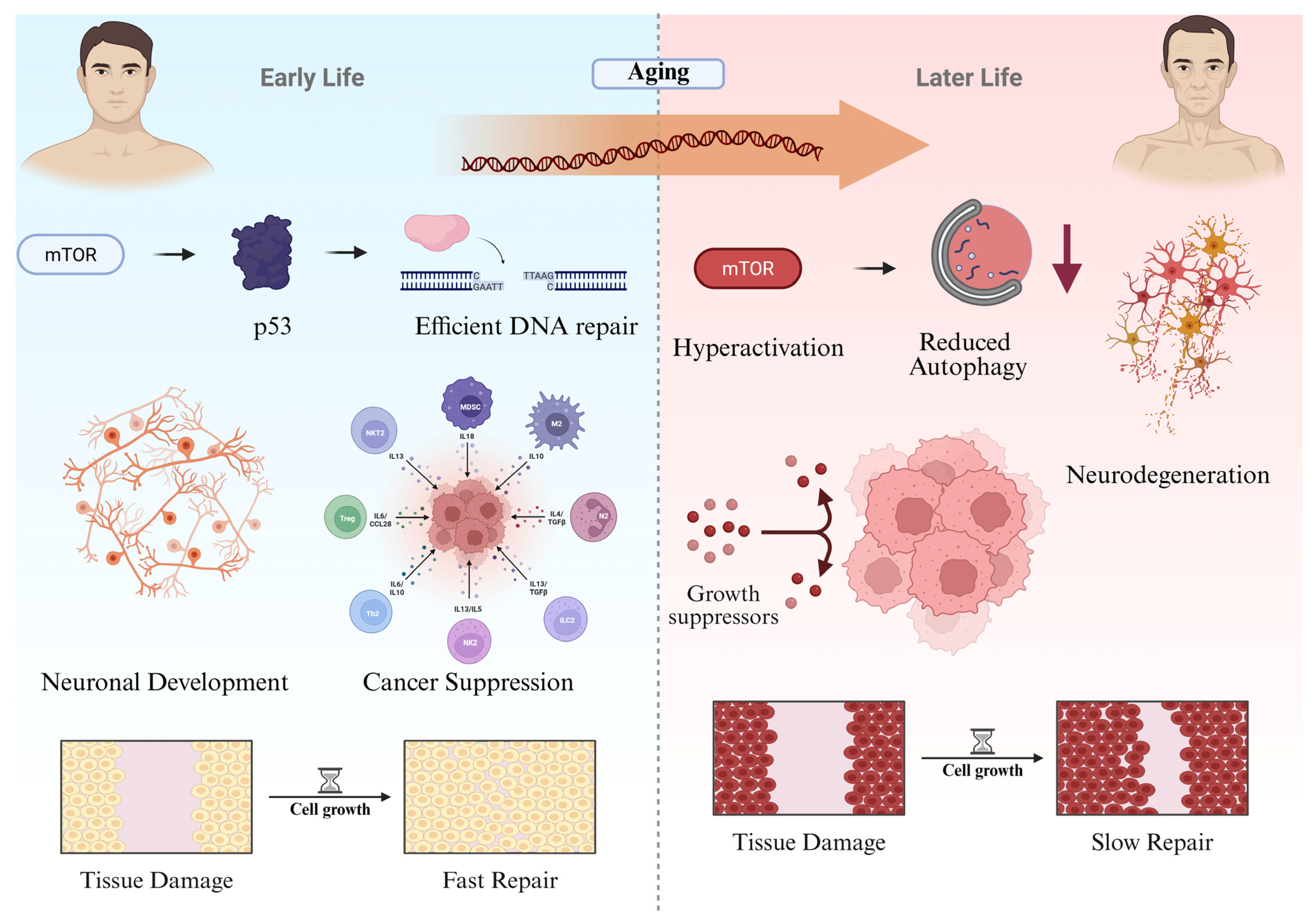
From an evolutionary perspective, the inverse relationship between cancer and neurodegeneration can be understood through the lens of evolutionary trade-offs and antagonistic pleiotropy. Certain pathways such as mTOR/IGF-1 and DNA repair mechanisms act as “double-edged swords” where adaptations beneficial in early life become detrimental with aging. For example, mTOR signaling promotes tumor growth by regulating metabolism and proliferation but, when hyperactivated, impairs autophagy contributing to neurodegenerative pathology. Similarly, p53 maintains genomic integrity and suppresses cancer by orchestrating DNA repair and apoptosis; however, constitutive p53 activation accelerates aging and neuronal loss [
8,
20]. Mouse models with augmented p53 activity demonstrate enhanced tumor resistance but premature aging phenotypes, illustrating antagonistic pleiotropy where evolutionary benefits come at the cost of late-life decline [
20].
This review adopts a cross-species genomics perspective to explore how conserved molecular pathways governing cancer resistance and neurodegenerative vulnerability have evolved across diverse taxa, including humans, elephants, naked mole-rats, whales, and birds. By integrating comparative genomic data with mechanistic insights, it highlights how identical molecular networks can be fine-tuned toward tumor suppression, neural preservation, or, alternatively, late-life degeneration. Natural models exhibiting exceptional longevity and disease resistance provide valuable translational insights for balancing cancer prevention and neuroprotection, advancing therapeutic strategies that modulate shared pathways to mitigate both disease burdens.
2. Evolutionary Trade-Offs in Cancer and Neurodegeneration
Disease risk often reflects evolutionary adaptations optimized for early-life survival and reproduction rather than lifelong cellular stability [
21]. Key cellular pathways regulating growth, stress responses, immune defense, and genome maintenance have been shaped by natural selection to maximize reproductive fitness, but these adaptations carry delayed costs that contribute to age-related diseases [
22].
Cancer and neurodegeneration illustrate this trade-off: in spite of their different outcomes—uncontrolled growth versus gradual cell death—both result from dysregulation of conserved molecular programs [
23]. Enhanced proliferative capacity or tumor suppression early in life can predispose to oncogenesis or neuronal vulnerability with aging [
24]. This antagonistic pleiotropy framework explains the inverse epidemiological relationship observed between these diseases [
25,
26].
The following sections explore how conserved cellular systems are differentially engaged across tissues, cell types, and life stages to influence disease susceptibility.
2.1. Conserved Growth and Survival Pathways
Conserved molecular circuits regulate growth, metabolism, genome surveillance, and stress responses. Their biological effect varies depending on cellular context (proliferative versus post-mitotic (PM)), temporal stage (development versus aging), and the surrounding metabolic and inflammatory milieu [
8]. This framework links the molecular frameworks of cancer and neurodegeneration as manifestations of evolutionary trade-offs embedded within conserved cellular systems [
26,
27].
2.1.1. mTOR/IGF-1 Signaling: Proliferation Versus Proteostasis
The mTOR/IGF-1 signaling pathway regulates anabolic growth and cellular survival and functions as a key determinant of cellular fate across tissues. The mammalian target of rapamycin (mTOR), a serine/threonine kinase, processes signals from nutrient availability, growth factors, and cellular energy conditions to manage metabolism, autophagy, immune responses, protein synthesis, survival, proliferation, and migration, thereby maintaining cellular equilibrium [
28]. Increased activation of mTOR signaling is a frequent hallmark of numerous human malignancies—including breast, lung, pancreatic, liver, renal, and prostate cancers—where it drives tumor growth by enhancing growth factor receptor signaling, glycolysis, lipid metabolism, angiogenesis, and therapy resistance [
29,
30]. These proliferative and metabolic advantages likely provided strong selective benefits early in life by supporting tissue growth, wound repair, and immune competence.
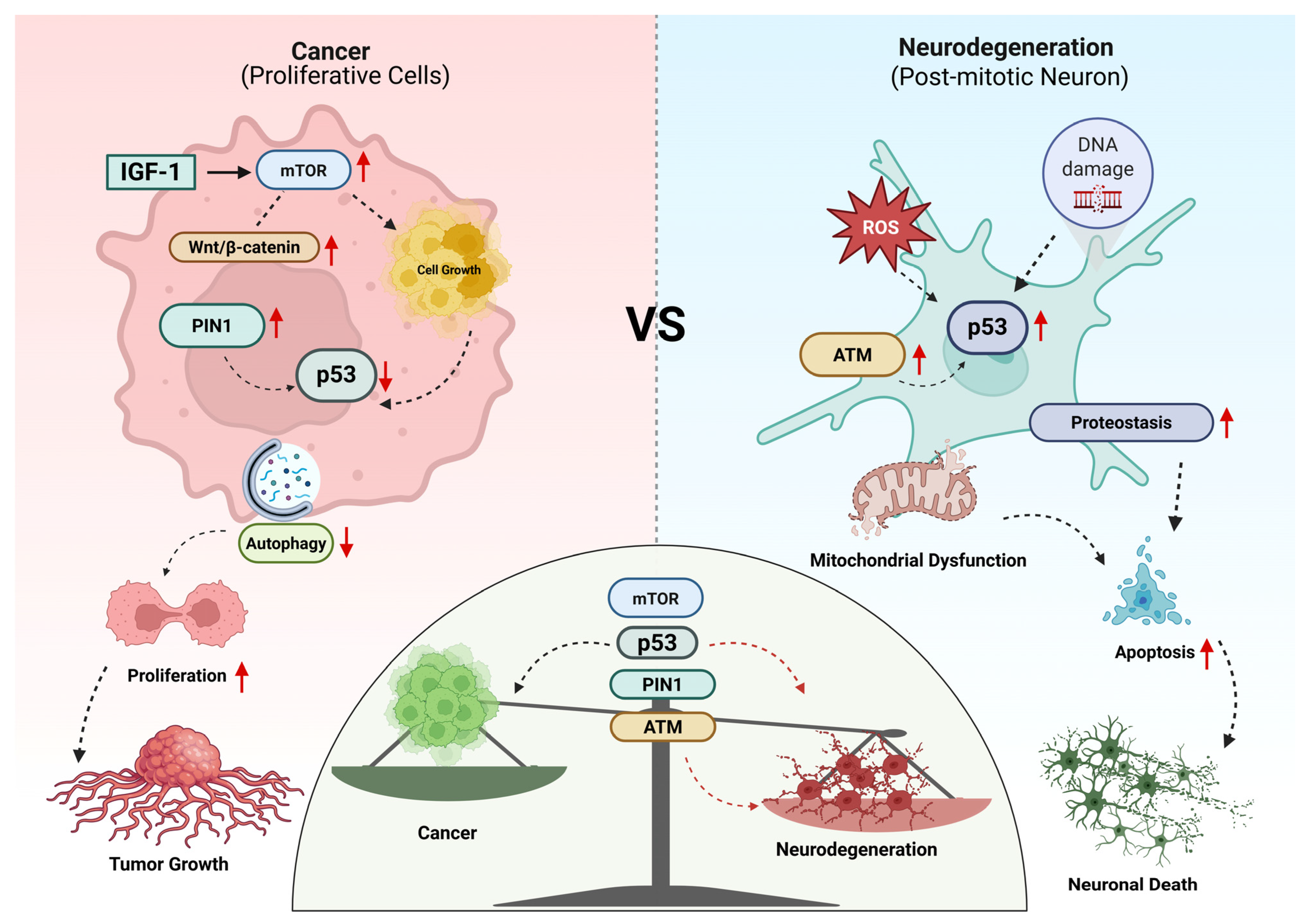
Conversely, in the nervous system, chronic mTORC1 activation impairs autophagy, reducing clearance of damaged proteins and mitochondria. This leads to accumulation of aggregation-prone species like β-amyloid, tau, and α-synuclein, which drive NDDs such as AD and PD [
31]. The inverse relationship between mTORC1 activity and autophagy is well established; pharmacological or genetic inhibition of mTORC1 restores autophagic flux and provides neuroprotection in various models [
32]. This contrast illustrates how a pathway that promotes proliferation and survival in dividing tissues can disrupt homeostasis and accelerate degeneration when persistently active in post-mitotic neurons (
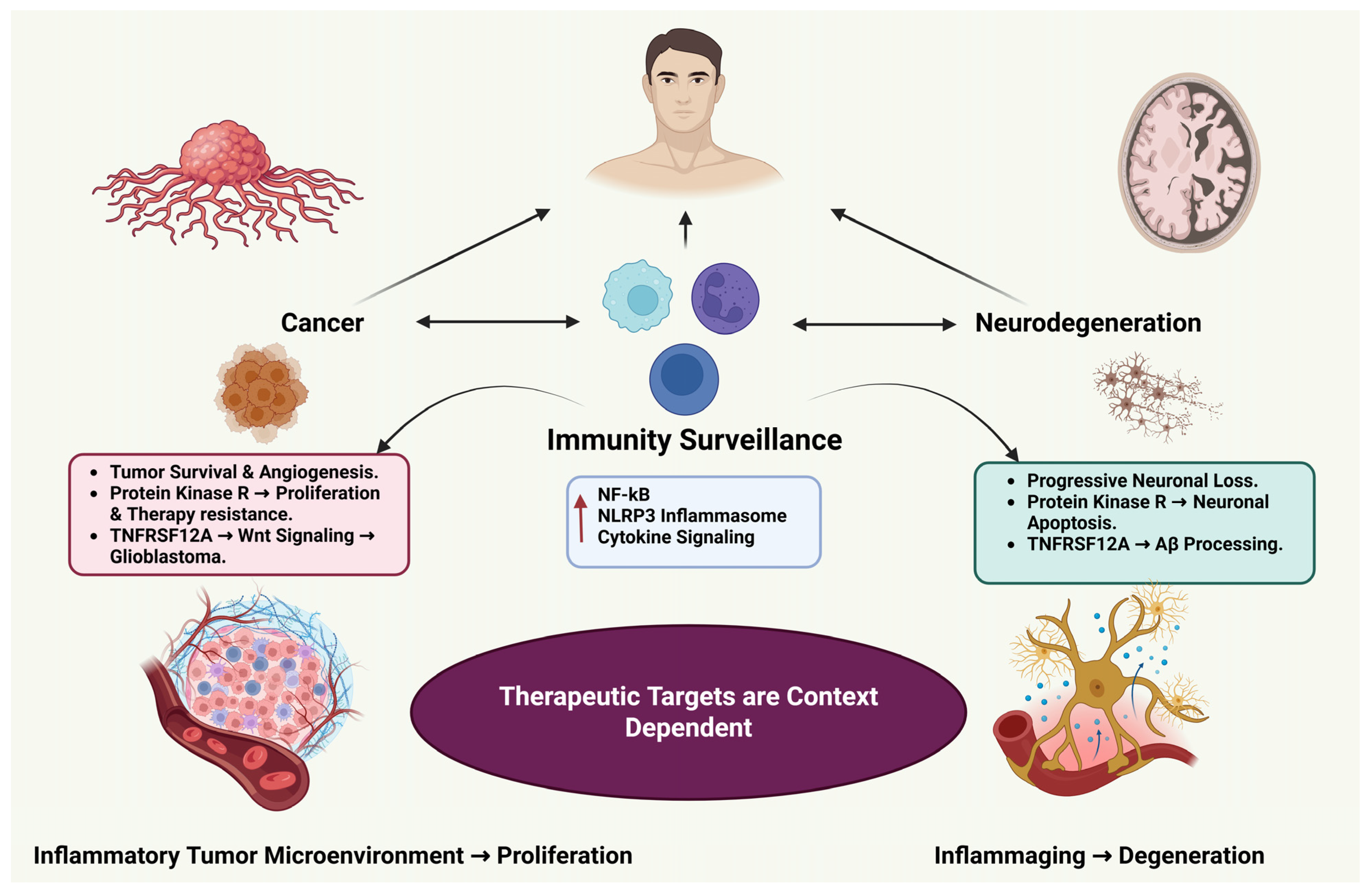
Figure 1). Comparative studies across species further suggest that evolutionary modulation of mTOR signaling is a recurring strategy to balance cancer resistance with neural maintenance in long-lived mammals.
2.1.2. p53-Mediated Genome Surveillance: Cancer Suppression Versus Neuronal Loss
As a central genome surveillance module, p53 maintains genomic integrity by sensing genotoxic stress and coordinating DNA repair, transient cell-cycle arrest, senescence, or apoptosis to prevent propagation of damaged cells in proliferative tissues [
33,
34]. Loss-of-function mutations in TP53 are among the most frequent variations in cancers, disabling tumor suppression and, in many cases, conferring gain-of-function activities that actively promote cell growth, survival, and metastasis [
35]. Notably, mutant p53 proteins can suppress the expression of apoptotic receptors such as CD95 (Fas/APO-1), thereby exerting antiapoptotic effects that facilitate tumor progression [
36].
From an evolutionary perspective, robust p53 activity confers substantial early-life advantages by maintaining genomic integrity, limiting malignant transformation, and supporting reproductive success [
37]. However, sustained or constitutive p53 activation accelerates aging-related decline. Mouse models engineered to express augmented wild-type p53 activity (p53+/m) exhibit enhanced resistance to spontaneous tumors yet develop premature aging phenotypes, including reduced longevity, osteoporosis, organ atrophy, and reduced stress tolerance [
37,
38,
39].
In PM neurons, which are energetically demanding and largely irreplaceable, chronic or excessive p53 activation promotes apoptosis, synaptic loss, and neurite degeneration rather than cell-cycle arrest [
40,
41]. Aging-associated accumulation of DNA damage, mitochondrial dysfunction, and oxidative stress sustains p53 signaling in vulnerable neuronal populations, converting a cancer-protective genome surveillance mechanism into a driver of neurodegeneration [
42]. These findings underscore the importance of tightly regulated p53 activity across tissues and lifespan.
Integrative Perspective
mTOR and p53 illustrate how conserved growth and stress-response pathways generate divergent outcomes across tissues and lifespan. In dividing cells, sustained signaling may support malignant expansion; in PM neurons, prolonged activation may impair proteostasis and promote cell loss.
This view aligns with geroscience frameworks proposing that aging-associated diseases arise from dysregulation of interconnected systems governing growth signaling (mTOR/IGF-1), genome integrity (p53), mitochondrial homeostasis, protein quality control, and inflammation [
43,
44]. Therapeutic strategies therefore require tissue-specific and age-dependent modulation of these networks.
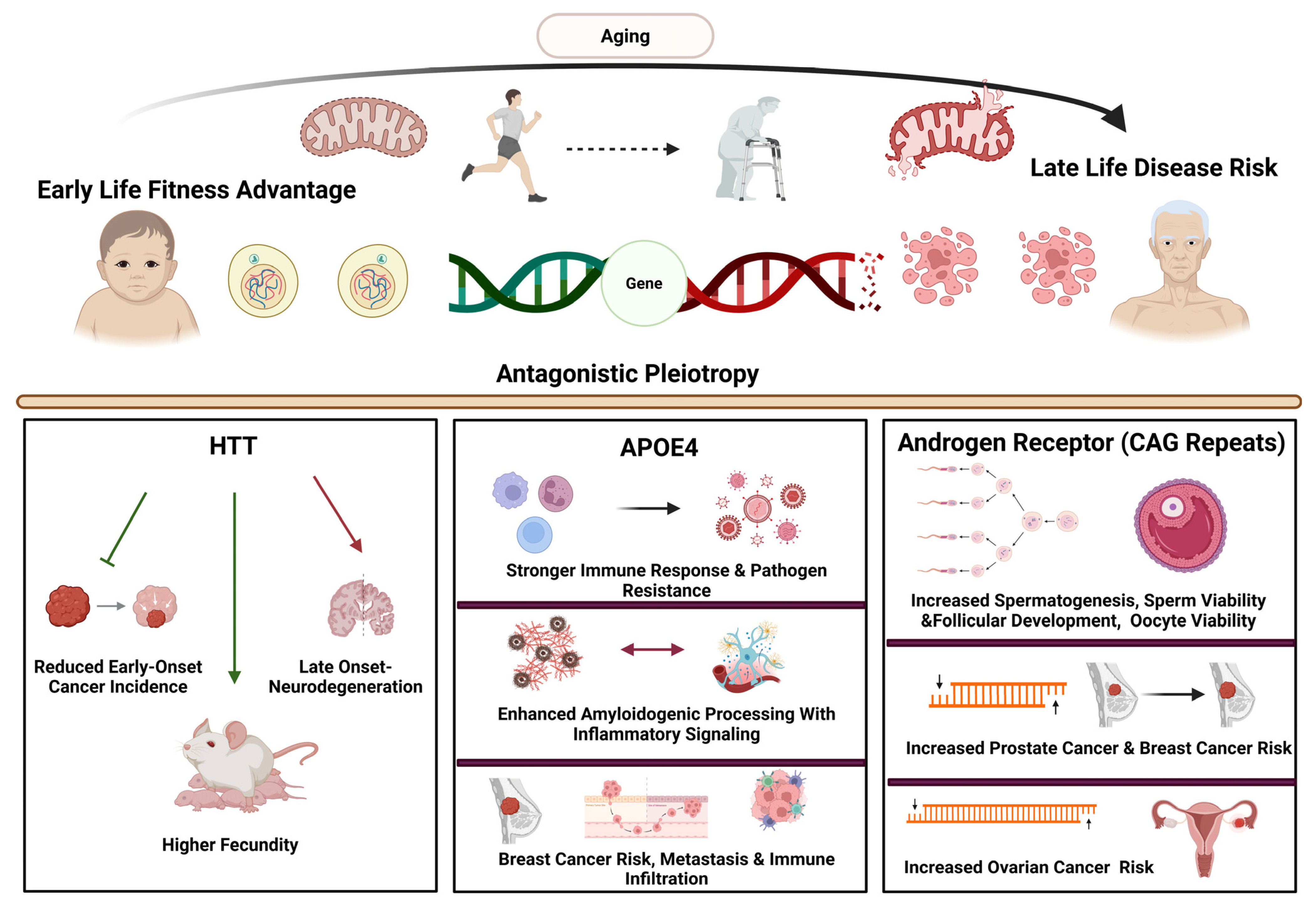
2.2. Antagonistic Pleiotropy Across Cell Types
Antagonistic pleiotropy provides an evolutionary framework explaining how genetic variants that enhance early-life fitness persist despite increasing susceptibility to age-related diseases [
26,
45]. Cancer and neurodegeneration represent divergent outcomes of this principle, arising from shared, evolutionarily conserved molecular pathways whose effects differ across cell types [
46]. Traits favored for growth, reproduction, immune defense, or metabolic efficiency confer advantages in proliferative tissues but impose delayed detrimental consequences on PM neurons, thereby linking reproductive success with late-life vulnerability to both oncogenic transformation and neurodegeneration [
47] (
Figure 2).
2.2.1. Huntingtin (HTT): Reproductive Fitness, Cancer Protection, and Neurodegeneration
CAG trinucleotide repeat expansion in the HTT gene causes HD. This leads to an elongated polyglutamine tract in mutant huntingtin protein (mHTT), leading to progressive neurodegeneration primarily in striatal projection neurons [
48]. Despite this late-life neurotoxicity, HD-associated alleles endure in human populations, suggesting compensatory evolutionary advantages [
49]. Epidemiological data indicate enhanced reproductive fitness and reduced early-onset cancer incidence among HD individuals [
50]. Supporting this, Morton et al. developed a transgenic mouse model (R6/2_50) with 50 CAG repeats, which displayed hallmark HD pathology but also extended lifespan, improved locomotor function, increased reproductive success, and enhanced male survival compared to wild-type controls [
51]. Huntingtin’s roles in vesicular trafficking, transcriptional regulation, and stress responses underpin cellular resilience during development and reproduction, yet these same features predispose neurons to proteostatic failure and aggregation with aging [
51]. These findings suggest that HTT alleles confer developmental and reproductive benefits, while also lowering cancer risk and increasing susceptibility to late-onset neurodegeneration.
2.2.2. APOE ε4: Infection Resistance, Metabolic Advantage, and Alzheimer’s Disease Risk
The APOE ε4 variant stands as the primary genetic factor increasing the risk for late-onset AD, increasing susceptibility by two- to twelvefold depending on zygosity and hastening disease onset [
52]. Despite its substantial neurodegenerative impact in later life, APOE ε4 remains common in human populations, implying it provided important evolutionary benefits under ancestral conditions [
52]. Anthropological and population studies suggest APOE ε4 was positively selected in environments with high pathogen exposure and nutritional challenges [
53,
54]. Trumble et al. found that carriers of APOE ε4 in parasite-dense settings experienced fewer diarrheal diseases, better growth, and enhanced cognitive function compared to non-carriers [
55]. These advantages likely stem from improved lipid transport, more efficient cholesterol absorption, and stronger immune responses, all supporting survival and reproductive success during early life [
56].
In contrast, in modern environments characterized by low pathogen burden and longer lifespan, these same immune-metabolic traits become detrimental. APOE ε4’s association with increased inflammatory signaling, disrupted lipid balance, and elevated amyloidogenic processing accelerates synaptic damage and neurodegeneration, illustrating antagonistic pleiotropy where early-life benefits contribute to late-life disease risk [
57,
58,
59]. Beyond neurodegeneration, evidence shows APOE variants also influence cancer susceptibility and progression in a context-dependent manner [
60]. Although APOE ε4 is best studied in AD, it acts as a low-penetrance genetic modifier in various cancers [
61].
Meta-analyses indicate APOE ε4 is linked to higher breast cancer risk, primarily among Asian populations, though this association is inconsistent in Caucasians [
62]. Additionally, APOE genotype affects cognitive outcomes in postmenopausal women diagnosed with early-stage breast cancer, especially after chemotherapy, suggesting a role in cancer-related cognitive vulnerability [
63]. In gastric cancer, risk appears more strongly connected to the APOE ε2 allele, possibly through altered lipid metabolism, while APOE ε4’s role remains unclear [
64].
More broadly, pan-cancer analyses demonstrate that APOE expression correlates with tumor growth, metastasis, immune infiltration, and patient prognosis across multiple cancer types [
65]. These findings position APOE as a major switch of tumor-immune interactions and metabolic adaptation within the tumor microenvironment, with implications for chemotherapy and immunotherapy responses. However, the specific influence of APOE ε4 in these processes—beyond breast cancer—remains insufficiently understood and requires further study.
Collectively, APOE ε4 functions as a context-dependent immune-metabolic modifier, whose early-life advantages contrast with increased risk of neurodegeneration and cancer in aging populations.
2.2.3. Androgen Receptor (AR) CAG Repeats: Balancing Reproductive Fitness and Oncogenic Risk
AR serves as a prime example of antagonistic pleiotropy, influencing both reproductive and somatic tissues [
26]. The AR gene harbors a polymorphic CAG trinucleotide repeat within its transactivation domain, where repeat length inversely affects receptor transcriptional activity. Shorter CAG repeats enhance AR signaling and androgen sensitivity, while longer repeats diminish AR transactivation [
26,
66]. This genetic variation has been shaped by evolutionary forces favoring reproductive success but entails delayed oncogenic consequences in hormone-responsive tissues.
From an evolutionary standpoint, shorter AR CAG repeats confer significant early-life advantages. In males, increased AR activity promotes spermatogenesis, sperm viability, and androgen-dependent sexual function, thereby enhancing reproductive fitness [
66,
67,
68]. Additionally, shorter repeats are linked to a lower risk of Kennedy’s disease, a neuromuscular disorder caused by excessive CAG expansions in AR [
67]. In females, elevated AR activity associated with shorter repeats supports follicular development, oocyte viability, and reduces premature ovarian failure risk [
69]. These benefits likely drove the positive selection and persistence of shorter AR CAG alleles in human populations.
However, the reproductive advantages conferred by heightened androgenic signaling come with substantial late-life costs. In proliferative, hormone-sensitive tissues, increased AR activity driven by shorter CAG repeats stimulates epithelial cell proliferation, elevating the risk of oncogenic transformation. Prostate cancer studies consistently link shorter AR CAG repeats with higher cancer risk, earlier onset, and more aggressive disease, including metastasis [
70,
71,
72]. Although population variability exists, heightened AR signaling generally correlates with poorer prognosis and tumor aggressiveness [
73]. Notably, short CAG repeats are less common in benign prostatic hyperplasia than in prostate cancer, suggesting distinct androgen-dependent mechanisms underlie benign versus malignant growth [
72].
In breast cancer, AR CAG repeat length similarly modulates tumor behavior. Shorter repeats, indicative of increased AR activity, are associated with more aggressive tumors and poorer survival, whereas longer repeats are more frequent in less aggressive cases, implying a protective effect dependent on context [
74]. Intriguingly, among BRCA1 mutation carriers, shorter AR CAG repeats correlate with reduced breast cancer risk, highlighting the complex interaction between AR signaling and tumor suppressor pathways [
75]. These findings emphasize that AR-mediated trade-offs vary according to genetic background, tissue type, and hormonal milieu.
Conversely, ovarian cancer risk appears more strongly linked to longer AR CAG repeats. Reduced AR transactivation associated with longer repeats (≥22) may increase susceptibility, suggesting that diminished androgen signaling can also promote oncogenesis in certain cellular contexts [
76]. This contrast underscores how the same polymorphism can yield divergent disease outcomes depending on tissue and endocrine environment.
Overall, AR CAG repeat polymorphisms enhance androgen signaling and reproductive fitness early in life while increasing cancer risk later. Conversely, longer repeats reduce AR activity and elevate ovarian cancer susceptibility depending on genetic, tissue, and hormonal context, reflecting evolutionary trade-offs linking fertility and oncogenic vulnerability across diverse tissues.
Integrative Perspective
Together, these examples illustrate how conserved regulatory pathways controlling proteostasis, immune–metabolic function, and hormone signaling produce tissue- and lifespan-specific effects. Genetic variants that enhance development and reproduction differentially influence cellular survival mechanisms in neurons versus proliferative tissues, shaping susceptibility to protein aggregation–related degeneration or malignant transformation. Recognizing these regulatory differences supports therapeutic strategies that emphasize tissue- and age-specific pathway modulation rather than uniform inhibition.
2.3. Selective Vulnerability: Evolutionary Outcome in Cancer and Neurodegeneration
Selective vulnerability denotes the disproportionate susceptibility of specific cell populations to disease, despite widespread exposure to genetic risks or pathological factors [
77,
78]. In both cancer and neurodegenerative disorders, this phenomenon reflects trade-offs embedded within conserved cellular programs rather than random cellular fragility. Although the affected cell types and underlying mechanisms differ, selective vulnerability in both contexts arises from evolutionary optimization of growth, repair, and function during early life, often at the expense of long-term resilience.
2.3.1. Selective Vulnerability in Cancer: Stem Cells, Division, and Tissue Context
In cancer, selective vulnerability is closely tied to tissue-resident stem cells and their division dynamics [
77]. The stem-cell division hypothesis posits that cancers emerge from normal tissue stem cells or their immediate progeny due to dysregulation of tightly regulated self-renewal processes [
79]. Because stem cells sustain tissue maintenance through repeated divisions, they are inherently exposed to replication-associated mutations. Consequently, tissues with higher stem cell turnover accumulate oncogenic mutations more rapidly, explaining tissue-specific differences in cancer incidence [
80].
This vulnerability is shaped by the stem cell niche, which regulates proliferation, differentiation, and quiescence [
81]. Disruption of these signals—whether through genetic mutations or microenvironmental changes—can generate cancer stem cells (CSCs) that acquire self-sufficient proliferative capacity, driving tumor initiation, heterogeneity, and progression [
80]. Because niche composition and signaling vary across tissues, CSC behavior and cancer susceptibility also differ accordingly [
82].
Tissue-specific examples underscore this principle. In breast tissue, mammary stem and progenitor cells are tightly regulated during development and hormonal cycling. Dysregulation, particularly via oncogenic drivers like HER2 amplification, expands stem-like cell populations and promotes invasion and tumorigenesis [
83,
84]. In the liver, hepatocellular carcinoma can emerge from hepatic progenitor cells, through aberrant activation of conserved developmental pathways such as Wnt/β-catenin, Notch, Hedgehog, and TGF-β, highlighting how tissue-specific signaling environments shape selective cancer vulnerability [
85,
86].
Thus, selective vulnerability in cancer emerges from regenerative capacity and sustained stem-cell division within proliferative tissues.
2.3.2. Selective Neuronal Vulnerability in Neurodegeneration: Post-Mitotic Costs of Optimization
By contrast, selective vulnerability in neurodegeneration targets PM neurons—cells that evolved to suppress proliferation to minimize cancer risk. Despite widespread expression of pathological proteins or genetic risk factors, only specific neuronal populations degenerate in diseases such as AD, PD, and ALS [
87,
88]. This selective neuronal loss underpins regional pathology and clinical heterogeneity.
Rather than random damage, selective neuronal vulnerability is increasingly viewed as a consequence of evolutionary optimization. The human brain evolved under pressures favoring cognitive efficiency, metabolic restraint, and functional longevity sufficient for reproduction and kin survival—not indefinite neuronal maintenance [
89,
90,
91]. Consequently, neuronal systems conferring high adaptive value early in life are disproportionately vulnerable to degeneration in later decades.
Highly specialized neuronal populations—such as hippocampal excitatory neurons, substantia nigra dopaminergic neurons, and long-range cortical projection neurons—share features shaped by evolutionary pressures: extreme metabolic demand, extensive axonal arbors, dense synaptic connectivity, and sustained calcium signaling [
92,
93]. These properties support complex functions like learning, memory, and motor control but impose substantial energetic costs. Over time, high mitochondrial load and intense synaptic activity generate oxidative stress and metabolic by-products that exceed the declining proteostatic and autophagic capacity of aging neurons [
94].
The PM state further shapes neuronal susceptibility. The suppression of cell division provides strong cancer protection—a major evolutionary advantage in long-lived species—but eliminates neuronal replacement capacity [
8,
27]. Genome surveillance mechanisms, including persistent p53 activation and strict cell-cycle checkpoints, protect neurons from oncogenic transformation but simultaneously sensitize them to apoptosis under cumulative stress [
95,
96]. Unlike proliferative tissues, where damaged cells can be replaced or diluted, neurons accumulate damage over decades [
97,
98].
Molecular specialization contributes additional vulnerability. Proteins such as α-synuclein and tau possess intrinsically disordered structures enabling rapid vesicle trafficking and cytoskeletal plasticity essential for synaptic function and learning [
99,
100]. However, these same features increase aggregation propensity as proteostasis declines with age [
101,
102]. Similarly, dopaminergic neurons undergo high cytosolic dopamine turnover, generating reactive species that damage proteins, lipids, and DNA—an evolutionary cost of systems optimized for reward processing and motor control [
103,
104].
Thus, neuronal selective vulnerability reflects the interaction between long-term metabolic demand, proteostatic burden, and limited regenerative capacity within specialized PM systems.
Converging Insights: Selective Vulnerability and Disease Risk
Despite differing cellular contexts, selective vulnerability in cancer and neurodegeneration shares dependence on the cellular microenvironment. In cancer, stem cell niches influence CSC emergence and tumor progression [
80]. In neurodegeneration, region-specific microenvironments—defined by glial interactions, vascular support, metal homeostasis, and local proteostatic capacity—modulate neuronal susceptibility to protein misfolding and stress, as seen in prion diseases [
102].
Across tissues, disease risk reflects how specialized cellular programs respond to cumulative stress within their structural and functional constraints. In proliferative systems, regenerative capacity increases opportunities for oncogenic mutation and clonal expansion. In contrast, PM neural systems optimized for long-term function rather than renewal become more vulnerable to metabolic and proteostatic decline.
2.4. Immune Trade-Offs: Linking Cancer and Neurodegeneration
The immune system illustrates how conserved regulatory networks influence disease susceptibility across tissues and lifespan. Immune responses, conserved across species, evolved under strong selective pressures to defend against pathogens, clear damaged cells, and suppress malignant transformation during early life, thereby maximizing survival and reproductive fitness [
105]. However, as lifespan extends beyond evolutionary norms, these same immune mechanisms can become maladaptive, facilitating tumor immune evasion while driving chronic neuroinflammation and neurodegeneration [
106,
107]. Consequently, cancer and neurodegenerative diseases represent divergent outcomes of shared immune regulatory pathways functioning in distinct cellular and tissue contexts.
2.4.1. Immune Trade-Offs in Cancer: Surveillance Versus Evasion
In cancer, immune dynamics revolve around the equilibrium between immune tolerance and immune surveillance [
108]. While effective immune surveillance detects and eliminates emerging malignant cells, immune tolerance prevents autoimmunity against self-antigens. Tumors exploit this balance by hijacking conserved immune pathways to suppress antitumor immunity without compromising host viability [
109]. Genetic alterations impairing antigen presentation—such as mutations in human leukocyte antigen (HLA) genes—and dysregulation of immune checkpoint signaling diminish cytotoxic T-cell recognition, enabling malignant cells to escape immune destruction [
110].
Tumors also co-opt innate immune programs originally evolved for antiviral and stress responses. For instance, interferon-γ (IFN-γ), a critical cytokine in pathogen defense, is repurposed by tumors to upregulate non-classical MHC class I molecules like HLA-E (Qa-1b in mice), thereby suppressing the activity of natural killer (NK) cells and CD8
+ T-cells [
111]. Additional tumor strategies include expression of vascular cell adhesion molecule-1 (VCAM-1) to restrict T-cell infiltration and secretion of immunosuppressive factors such as galectin-1, which skew immune responses toward tolerance and tumor progression [
112,
113].
At the systemic level, immune tolerance further limits antitumor immunity. Many tumor antigens are self or developmentally regulated proteins, so central and peripheral tolerance mechanisms restrict the diversity and efficacy of tumor-reactive T cells [
114]. This reflects an evolutionary compromise: immune systems optimized to prevent autoimmunity inherently reduce long-term cancer surveillance. Thus, tumor immune escape is not immune failure but a predictable consequence of immune systems prioritizing organismal integrity during early life.
2.4.2. Neuroimmune Trade-Offs in Neurodegeneration: Protection Versus Toxicity
In the nervous system, immune trade-offs manifest differently. Brain innate immune responses evolved to clear debris, combat infection, and refine neural circuits during development. However, chronic stimulation of these pathways with aging leads to persistent neuroinflammation, synaptic loss, and neuronal death. Disorders such as AD and PD illustrate how sustained immune activation can become pathogenic in long-lived neural tissue [
115,
116].
Microglia exemplify this shift. Originating from embryonic myeloid progenitors, microglia rapidly detect danger signals, phagocytose debris, and sculpt synaptic networks via complement-mediated pruning—functions essential in pathogen-rich ancestral environments and neurodevelopment [
117,
118]. With aging, microglia adopt a “primed” phenotype characterized by heightened inflammatory responses, reduced phagocytic capacity, and sustained cytokine secretion [
119]. IFN-γ further sensitizes aged microglia, exacerbating oxidative stress and neuronal injury [
120]. Thus, immune mechanisms that once preserved neural integrity become drivers of neurodegeneration in later life.
Genetic regulators such as TREM2 highlight the shared immune logic linking cancer and neurodegeneration. TREM2 signaling promotes myeloid cell survival, lipid metabolism, and immune regulation—traits advantageous for host defense early in life. In aging, altered TREM2 function modifies microglial inflammatory states, influencing AD risk and immune suppression within tumor microenvironments [
121]. These parallels underscore how conserved immune regulators can contribute to distinct pathological outcomes depending on tissue context.
2.4.3. Glial Evolution and Immune Specialization
The expansion and specialization of glial populations further shape immune vulnerability in the brain. Astrocytes and oligodendrocytes evolved beyond structural support to regulate synaptic transmission, metabolic coupling, blood–brain barrier integrity, and immune signaling. Human astrocytes are larger and more complex than those in non-primates, supporting advanced cognition but increasing vulnerability to metabolic and inflammatory stress [
122,
123]. Under chronic injury or aging, astrocytes adopt reactive phenotypes that impair glutamate clearance, disrupt ionic homeostasis, and secrete complement factors promoting synaptic elimination [
124,
125].
Oligodendrocytes present a parallel compromise. Although myelination enhances conduction velocity and cognitive integration, it imposes high metabolic demands reliant on lipid synthesis and mitochondrial function. Oligodendrocyte lineage cells are highly vulnerable to oxidative and inflammatory stress, and immune-metabolic dysregulation impairs remyelination, contributing to neurodegenerative vulnerability [
126,
127].
2.4.4. The Neuro–Immune–Cancer Axis: Systemic Trade-Offs in Regulation
Beyond cell-intrinsic immune mechanisms, cancer and neurodegeneration emerge from systemic neuro–immune crosstalk sculpted by evolution. The nervous system regulates immune responses through conserved neuroimmune and neuroendocrine signaling pathways. Neurotransmitters, neuropeptides, and neurotrophic factors play crucial roles in tailoring immune cell functions by influencing the behavior of T cells, macrophages, dendritic cells, and myeloid-derived suppressor cells (MDSCs), thereby shaping immune surveillance, inflammation, and tumor progression [
128].
This coordination occurs within the neuro-endocrine–immune axis, optimized to balance rapid immune activation with suppression of chronic inflammation. Neural and endocrine signals influence immune tone, metabolism, angiogenesis, and cellular proliferation, affecting tumor growth, invasion, and therapeutic resistance [
129]. Emerging evidence indicates that neurodegenerative processes remodel tumor immune microenvironments by altering immune infiltration and cytokine profiles, while tumor-driven immune reprogramming exacerbates neural dysfunction [
128]. This bidirectional interaction reinforces the context-dependent relationship between cancer and neurodegeneration.
Convergent Immune Logic Across Diseases
Despite divergent outcomes, cancer and neurodegeneration share common immune principles governed by conserved signaling pathways such as NF-κB, JAK/STAT, PI3K/AKT, Wnt/β-catenin, TGF-β, and Hippo. In cancer, these pathways promote immune evasion, stromal remodeling, and angiogenesis; in neurodegeneration, they drive sterile inflammation, synaptic loss, and neuronal death [
130,
131].
The differing outcomes reflect tissue-specific regulation rather than fundamentally distinct immune systems. In proliferative environments, immune modulation influences clonal expansion and tumor persistence. In the brain, sustained inflammatory signaling contributes to progressive neuronal dysfunction. Recognizing these shared regulatory networks supports therapeutic strategies that reshape immune responses in a tissue- and age-specific manner rather than broadly amplifying or suppressing immunity.
3. Beyond Peto’s Paradox: Lessons in Disease Resistance from Unusual Species
Multicellular organisms face the evolutionary challenge of maintaining tissue integrity while preventing unchecked cell proliferation over extended lifespans [
132]. Traditional models predict that cancer risk should correlate positively with body size and lifespan, as larger and longer-lived species accumulate more cells and undergo more replication events, elevating the chance of oncogenic mutations [
133,
134]. Yet, comparative epidemiological data contradict this, revealing no direct correlation between cancer incidence and these factors across species—a phenomenon called Peto’s paradox. This paradox underscores the evolution of potent, species-specific mechanisms that uncouple cancer risk from organismal size and lifespan [
133,
135].
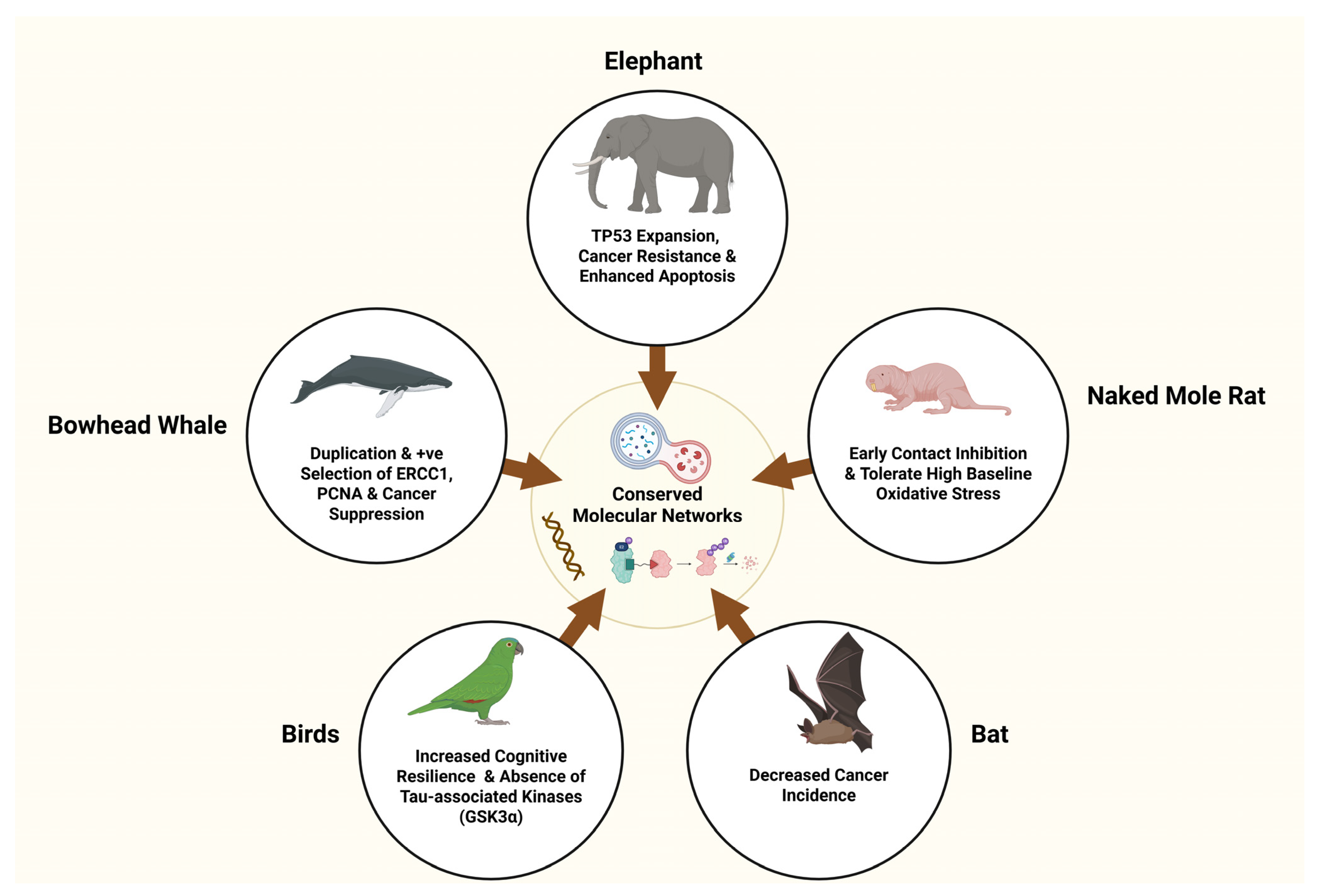
Beyond cancer, Peto’s paradox highlights a broader biological balance. Species achieving exceptional longevity or gigantism must suppress malignant transformation while preserving long-term cellular function, especially in PM tissues like the nervous system. Comparative biology thus provides a framework to understand how evolution tunes conserved molecular pathways—governing genome stability, proteostasis, metabolism, and immune regulation—to balance tumor suppression with neural maintenance. These natural adaptations clarify why identical pathways in humans can lead to divergent outcomes: uncontrolled cell division in cancer versus gradual neuronal loss in neurodegeneration (
Figure 3).
3.1. Genome Surveillance and Growth Control as Foundations of Disease Resistance
Long-lived and large-bodied mammals exemplify how reinforced genome surveillance and growth control underpin both cancer resistance and tissue preservation.
Elephants (
Loxodonta africana and
Elephas maximus) offer a striking example. Despite their vast cellular abundance, elephants display markedly lower cancer mortality. Genomic studies reveal an expanded tumor suppressor gene repertoire, particularly at least 20 copies of TP53, which increase DNA damage sensitivity and lower the apoptotic threshold [
136,
137]. This mechanism promotes early removal of damaged or potentially malignant cells, favoring organismal integrity over individual cell survival.
Crucially, this intensified tumor suppression does not impair neural function. Elephants maintain complex cognition, long-term social memory, and learning over decades. Comparative analyses suggest that enhanced DNA repair capacity, antioxidant defenses, and tightly regulated neuroimmune signaling preserve neural circuits while preventing chronic inflammation [
138,
139]. Thus, elephants demonstrate that robust genome surveillance can coexist with long-term neural maintenance when precisely regulated.
Cetaceans extend this principle to extreme longevity. The bowhead whale (Balaena mysticetus), the longest-lived mammal, surpasses 200 years of age. Comparative genomic and transcriptomic analyses reveal lineage-specific adaptations in DNA repair, regulation of cell cycle, and genome stability, including positive selection and duplication of genes such as ERCC1 and PCNA [
140,
141]. These adaptations reinforce cancer suppression and promote long-term tissue preservation. Sustained expression of DNA repair and checkpoint genes likely limits mutation accumulation while avoiding excessive apoptosis that could damage PM tissues.
3.2. Proteostasis and Metabolic Stability as Shared Defenses Against Cancer and Neurodegeneration
Enhanced proteostasis and metabolic resilience emerge as convergent strategies across taxa that counter both malignant transformation and neurodegenerative decline.
Bowhead whales exhibit sustained upregulation of the ubiquitin–proteasome system and autophagy pathways across tissues [
142]. These mechanisms facilitate efficient clearance of damaged or misfolded proteins, mitigating oncogenic stress and preventing accumulation of aggregation-prone species central to NDDs such as AD and PD. Although direct neuropathological data remain limited, cetacean molecular profiles align with resistance to proteostasis collapse, mitochondrial dysfunction, and chronic inflammation—key contributors to both cancer progression and neurodegeneration in humans.
The naked mole-rat (
Heterocephalus glaber) represents a distinct but complementary evolutionary strategy. Despite its small size, it exhibits exceptional longevity, near-complete cancer resistance, and preserved neural function. Rather than relying predominantly on apoptosis, naked mole-rats enforce stringent tissue-level growth control via early contact inhibition facilitated by ultra-high-molecular-weight hyaluronan and a two-tiered cell-cycle arrest involving p27 and p16 [
143,
144]. Concurrently, they maintain robust proteostasis through sustained autophagic and proteasomal activity, coupled with dampened inflammatory responses [
145,
146].
Remarkably, naked mole-rats tolerate high baseline oxidative stress without neuronal loss, suggesting an evolutionary shift from damage avoidance to damage tolerance. This strategy preserves long-term tissue function while limiting chronic inflammation and proteotoxicity [
147]. This tolerance suppresses tumor-promoting inflammation and neuroimmune priming, linking cancer resistance with neuroprotection.
3.3. Neural Resilience and Cognitive Longevity Across Vertebrates
Genome surveillance is fundamental to disease resistance; however, maintaining neural function requires additional mechanisms beyond apoptosis and cell renewal. This presents a distinct evolutionary challenge, particularly in species with prolonged lifespans or heightened cognitive demands.
Both elephants and cetaceans display molecular signatures consistent with sustained neural preservation, including enhanced mitochondrial maintenance, antioxidant defenses, and regulated glial activation [
139,
140,
142]. These features mitigate age-associated protein aggregation, metabolic failure, and sterile inflammation: processes central to human neurodegenerative diseases.
Long-lived, cognitively sophisticated birds such as corvids and parrots exemplify convergent neural resilience beyond mammals. Despite high neuronal density, extended lifespans, and advanced cognitive abilities—including problem-solving, tool use, and long-term memory—these species exhibit low natural incidence of neurodegeneration [
148,
149]. Their genomes harbor distinctive features relevant to neurodegenerative resistance, including the absence of tau-associated kinases like GSK3α and refined proteostasis regulation [
150]. These adaptations may reduce susceptibility to pathological protein aggregation while sustaining lifelong learning and synaptic plasticity [
151]. Moreover, birds appear inherently resistant to virus-driven tumorigenesis. For example, avian polyomaviruses, which induce inflammatory and proliferative disorders in parrots, have not been documented to cause tumors in their natural hosts. This contrasts with mammalian polyomaviruses, which are oncogenic in experimental rodent models [
152]. Such observations imply that avian species possess distinct oncogenic viral response mechanisms, potentially involving more effective immune surveillance or unique cellular growth control pathways. Collectively, these findings reinforce the concept that evolutionarily conserved molecular networks can be selectively modulated across taxa to concurrently suppress neurodegeneration and oncogenesis.
Bats further challenge life-history expectations. Despite small body size and the extreme metabolic demands of flight, many bat species are exceptionally long-lived and exhibit low cancer incidence. Genomic studies reveal adaptations in DNA repair, cell-cycle control, and innate immune signaling, including dampened inflammasome activation and constitutive interferon signaling [
153,
154,
155]. This immune profile enables efficient pathogen defense while limiting chronic inflammation, suppressing tumorigenesis without provoking neuroinflammatory damage. Like naked mole-rats, bats tolerate elevated oxidative stress, reinforcing damage tolerance as a recurring evolutionary strategy [
156].
3.4. Mechanistic Insight from Short-Lived Models: Pathway Tuning over Lifespan
Resistance to cancer and neurodegeneration is not exclusive to long-lived species. Model organisms such as Drosophila melanogaster illustrate that selective tuning of conserved pathways, rather than lifespan alone, governs disease outcomes. Drosophila serves as an excellent model to study both cancer and neurodegeneration because it shares deeply conserved regulators of growth, proteostasis, mitochondrial quality control, and innate immunity with humans.
In cancer models,
Drosophila studies have elucidated fundamental processes such as clonal evolution, tumor microenvironment interactions, and drug resistance. Critical tumor suppressor pathways like the Hippo pathway were first identified using
Drosophila genetics [
157]. Hippo signaling controls organ size and cell proliferation, balancing cell survival and apoptosis, which helps prevent uncontrolled growth [
158]. Selective modulation of this pathway influences whether cells undergo normal growth control or tumorigenic overgrowth [
159,
160]. Additionally,
Drosophila models reveal how regulation of cell polarity and intercellular cooperation affects tumor progression, highlighting that finely tuned signaling rather than a static lifespan limits cancer development [
159].
In neurodegeneration,
Drosophila models mimic human disorders such as Parkinson’s disease through genetic manipulation of conserved genes involved in synaptic function, oxidative stress, autophagy, and mitochondrial integrity [
161]. For example, the Highwire ubiquitin ligase regulates axonal degeneration by modulating protein levels that protect neurons, illustrating pathway tuning that determines neuronal survival or degeneration [
161,
162]. Hippo signaling also plays a role in neurodegeneration by controlling apoptosis; its dysregulation can lead to neural cell loss, and its targeted inactivation rescues neurons from degeneration, indicating the importance of pathway balance [
163]. Furthermore, common pathogenic mechanisms involve apoptosis, protein misfolding, and histone acetylation, with modifiers identified in fly models that modify toxicity in both retinal and brain neurons, underscoring the conserved molecular determinants of neurodegeneration [
164,
165,
166].
Thus, outcomes in disease—cancer versus neurodegeneration—depend on the selective and tissue-specific tuning of conserved signaling pathways such as Hippo, ubiquitin ligase networks, autophagy, and apoptosis regulators. These pathways govern cellular growth, survival, and clearance mechanisms and act independently of the organism’s lifespan to influence disease susceptibility and progression in Drosophila. This highlights that resistance to cancer and neurodegeneration arises from precise regulatory control of conserved molecular pathways rather than longevity alone.
3.5. Evolutionary Principles Emerging from Natural Disease Resistance
Across diverse taxa—elephants, whales, naked mole-rats, bats, birds, and
Drosophila—species resistant to both cancer and neurodegeneration converge on shared evolutionary priorities: reinforced genome stability, robust proteostasis, restrained inflammation, metabolic resilience, and precise regulation of growth and stress-response pathways [
167]. These strategies reflect life-history optimizations for early-life survival, reproductive success, and long-term tissue maintenance rather than disease-specific adaptations.
Importantly, these models demonstrate that cancer suppression and neuroprotection are not inherently opposing outcomes but depend on how conserved pathways are tuned across tissues and lifespan.
By elucidating how evolution resolves these competing demands, cross-species comparisons provide a conceptual bridge to the following section, which examines how conserved molecular pathways—shared across species and cell types—produce divergent outcomes in cancer and neurodegeneration depending on cellular identity, regulatory state, and timing. (
Supplementary Table S1 encapsulates these convergent evolutionary mechanisms underlying natural resistance to neurodegeneration and cancer, highlighting representative species, key features, and disease-relevant outcomes).
4. Context-Dependent Outcomes of Conserved Molecular Pathways in Cancer and Neurodegeneration
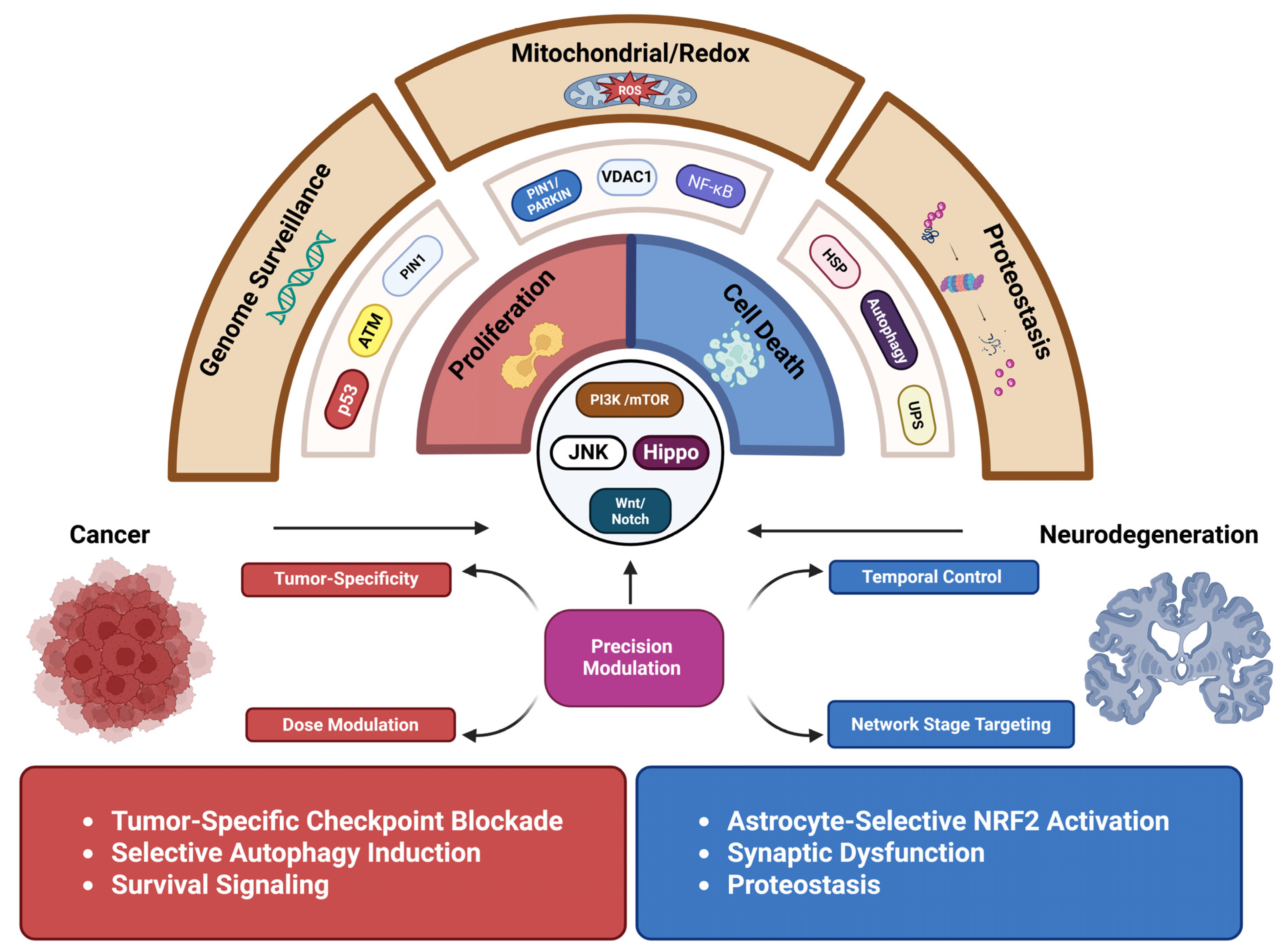
Cancer and neurodegeneration both stem from dysregulation of deeply conserved molecular systems rather than distinct disease-specific pathways. Core cellular programs regulating genome integrity, mitochondrial function, proteostasis, developmental signaling, metabolism, and immune responses are shared across tissues and species. However, the biological consequences diverge sharply based on cellular identity, proliferative ability, metabolic demands, and the duration of signaling. In some contexts, these pathways support survival, clonal expansion, and tissue remodeling, whereas in others, similar perturbations lead to synaptic failure, mitochondrial dysfunction, and irreversible cell loss [
1,
10,
11,
19] (
Figure 4). This section integrates mechanisms to explain how conserved molecular networks drive opposing disease trajectories in cancer and neurodegeneration.
4.1. Genome Surveillance and DNA Damage Responses: Protection Versus Attrition
Genome surveillance integrates DNA repair, cell-cycle checkpoint enforcement, and apoptosis via a conserved network centered on p53, PIN1, and ATM. Rather than functioning as isolated tumor suppressors, these molecules form a dynamic stress-response network whose outcomes depend on cellular identity, proliferative capacity, and metabolic state.
In proliferative cells, transient activation of p53 induces DNA repair and cell-cycle arrest through effectors such as p21, thereby preventing the propagation of damaged genomes [
168,
169]. When TP53 function is compromised, checkpoint control collapses, enabling proliferation despite genomic instability and facilitating oncogenic transformation [
170]. In this context, p53 primarily functions as a barrier to clonal expansion of damaged cells.
In contrast, in PM neurons with limited regenerative capacity, sustained p53 activation shifts from repair toward apoptosis and mitochondrial dysfunction, contributing to synaptic degeneration [
171]. Neuronal p53 dysregulation often arises from oxidative stress or aberrant interactions with misfolded proteins, converting a genome-protective response into a driver of progressive neurodegeneration [
172]. Thus, a mechanism that constrains proliferation in dividing tissues can promote progressive attrition in long-lived neural populations.
PIN1 further refines this genome surveillance by inducing conformational switching at phosphorylated Ser/Thr–Pro residues and thus regulating the stability, activity, and interactions of numerous phosphorylated proteins, including p53 and key cell-cycle regulators [
173,
174]. This fine-tuning of protein dynamics governs cell fate decisions in response to genomic stress [
173].
In cancer, PIN1 is frequently overexpressed or hyperactivated. It stabilizes proliferative and survival-promoting substrates such as cyclin D1, c-Myc, and mutant p53, amplifying oncogenic signaling, tumor progression and therapeutic resistance [
175]. Notably, PIN1-mediated enhancement of p53 activity can paradoxically support tumor growth when p53 is mutated or dysfunctional, underscoring its context-dependent oncogenic potential [
176].
In PM neurons, however, PIN1 levels and activity decline with aging and disease. Reduced PIN1 activity has been associated with tau hyperphosphorylation and increased amyloidogenic processing of amyloid precursor protein, linking impaired prolyl isomerization to proteostasis failure in AD [
177]. This breakdown of PIN1-mediated conformational control links genome surveillance failure directly to proteostasis collapse, exacerbating neurodegeneration.
Nevertheless, the role of PIN1 in neurodegeneration remains incompletely resolved. While several studies support a protective function whereby PIN1 loss accelerates tau pathology, others propose that altered PIN1 expression may represent a compensatory response to proteotoxic stress rather than a primary driver of disease. Whether PIN1 dysregulation is causative, permissive, or reactive in neurodegenerative progression therefore remains debated.
Upstream, ATM kinase serves as a central kinase that senses DNA double-strand breaks, orchestrating DNA repair, checkpoint activation, and apoptosis via phosphorylation of substrates including p53, CHK2, and histone variant H2AX [
177]. In proliferative cells, ATM enforces genomic fidelity by coordinating repair pathways and limiting mutation accumulation, functioning as a critical tumor suppressor [
178].
Beyond its nuclear functions, ATM also regulates mitochondrial dynamics, redox balance, and synaptic stability [
179,
180]. ATM deficiency, as observed in ataxia-telangiectasia, results in increased cancer susceptibility alongside progressive neurodegeneration, exemplifying the dual consequences of impaired DNA damage responses [
181,
182]. This phenotype illustrates how disruption of a single conserved pathway can simultaneously enhance proliferative risk and accelerate neuronal loss.
Evolutionary and comparative studies indicate that ATM’s dual functionality is conserved, shaped by selective pressures balancing genome surveillance with long-term tissue preservation [
136,
137]. This regulatory tuning sustains malignant transformation suppression alongside neural function preservation over extended lifespans [
142,
146].
Collectively, the p53–PIN1–ATM axis illustrates a central principle of conserved pathway biology: genome surveillance mechanisms are not inherently oncogenic or neurotoxic. Their consequences depend on activation dynamics, regenerative capacity, and metabolic context. In proliferative environments, this network constrains malignant transformation. In long-lived PM neurons, chronic or dysregulated activation can convert protective stress responses into progressive cellular attrition. The divergence reflects differences in regenerative capacity, metabolic demand, and activation dynamics rather than differences in pathway identity.
4.2. Mitochondrial Quality Control and Redox Signaling: Adaptive Flexibility Versus Energetic Collapse
Mitochondria serve as central hubs for cellular metabolism, redox homeostasis, and apoptotic signaling [
183]. Their integrity is maintained by evolutionarily conserved regulators that coordinate mitochondrial dynamics, selective autophagic clearance (mitophagy), and antioxidant defenses [
184]. Key molecules in these processes include the PINK1–Parkin pathway, Voltage-Dependent Anion Channel 1 (VDAC1), and the transcription factor NRF2 [
185,
186,
187].
4.2.1. PINK1–Parkin-Mediated Mitophagy
The PINK1–Parkin axis selectively removes damaged mitochondria to avert accumulation of damaged organelles and limit ROS production [
188,
189]. Upon mitochondrial depolarization, PINK1 accumulates on the outer membrane and recruits Parkin, which ubiquitinates mitochondrial substrates and targets them for autophagic degradation [
190]. This pathway maintains mitochondrial turnover and metabolic adaptability.
Despite its well-characterized molecular framework, the extent to which PINK1–Parkin-mediated mitophagy governs basal mitochondrial quality control in vivo remains debated. While robust in cultured systems, neuronal mitophagy in physiological settings appears less dependent on Parkin, and alternative receptor-mediated pathways (e.g., BNIP3, NIX, FUNDC1) may predominate in certain tissues. These discrepancies highlight unresolved questions regarding tissue specificity, compensatory mechanisms, and stress-dependent activation of parallel mitophagy programs.
In neurodegeneration, particularly PD, mutations in PINK1 or Parkin impair mitochondrial clearance, contributing to oxidative stress and dopaminergic vulnerability [
191]. Although genetic and cellular models support a neuroprotective role for this pathway, causal links between mitophagy failure and neuronal loss in mammalian systems remain incompletely resolved and may depend on additional stressors or compensatory pathways.
In cancer, the impact of mitophagy varies with tumor context: it represses tumor initiation by limiting ROS-induced DNA damage but also sustains tumor survival under hypoxic or metabolic stress by maintaining mitochondrial fitness [
192]. Conversely, in established tumors, mitophagy can facilitate survival under hypoxia or therapeutic stress by preserving mitochondrial function and limiting apoptosis. Beyond organelle clearance, Parkin also modulates non-mitochondrial substrates and transcriptional programs, including NF-κB signaling, thereby influencing inflammatory and survival networks in tumor cells.
These opposing roles of PINK1–parkin-mediated mitophagy illustrate how a conserved quality control pathway can both constrain tumor initiation and promote tumor adaptation, depending on disease stage and metabolic context. Its impact on neuroprotection and tumor biology reflects regulatory context rather than intrinsic pathway identity.
4.2.2. VDAC1 Functional Duality
VDAC1, a mitochondrial outer membrane channel, regulates metabolite and ion flux essential for production of energy and apoptosis [
193]. By coupling mitochondrial metabolism to cellular survival pathways, VDAC1 functions as a metabolic and death-signaling checkpoint whose effects vary markedly across pathological contexts.
In cancer, VDAC1 is frequently overexpressed and supports tumor growth by sustaining metabolic reprogramming and resistance to apoptosis. A key mechanism involves its interaction with hexokinases (HK-I and HK-II), which are often upregulated in tumors. Binding of hexokinase to VDAC1 facilitates high glycolytic flux characteristic of the Warburg phenotype while simultaneously inhibiting cytochrome c release, thereby suppressing apoptosis and enhancing chemoresistance [
194]. Disruption of VDAC1–hexokinase complexes restores apoptotic signaling in experimental systems, underscoring the importance of this interaction in tumor maintenance. Additionally, cytoskeletal components such as β-tubulin modulate VDAC1 permeability, influencing the balance between oxidative phosphorylation and glycolysis and further shaping tumor metabolic plasticity.
Paradoxically, VDAC1 can also mediate programmed cell death. Oligomerization of VDAC1 forms large pores that permit the release of apoptogenic factors, including cytochrome c, promoting mitochondria-dependent apoptosis. VDAC1 oligomerization has also been implicated in ferroptosis, linking mitochondrial permeability to iron-dependent oxidative cell death. Thus, while elevated VDAC1 expression supports tumor survival under certain conditions, its structural reorganization can instead promote tumor-suppressive cell death. The determinants governing this switch—expression level, post-translational modification, interacting partners, and metabolic state—remain incompletely defined and may vary across tumor types.
In neurodegeneration, VDAC1 exhibits a similarly complex duality. Under physiological conditions, it maintains neuronal survival by regulating mitochondrial metabolism, calcium flux, and ATP production. However, VDAC1 also acts as a docking platform for misfolded proteins associated with neurodegenerative diseases, including amyloid-β and tau in Alzheimer’s disease, α-synuclein in Parkinson’s disease, and mutant SOD1 in amyotrophic lateral sclerosis [
195,
196]. Binding of these pathogenic proteins alters VDAC1 conformation and permeability, disrupts bioenergetics, and promotes apoptotic signaling. In Alzheimer’s models, VDAC1 overexpression and hyperphosphorylation correlate with increased mitochondrial permeability and neuronal death, whereas loss of protective VDAC1–hexokinase interactions exacerbates apoptosis [
197].
Regulatory mechanisms further complicate its role. Post-translational modifications such as phosphorylation and ubiquitination influence VDAC1 oligomerization and stability. For example, E3 ubiquitin ligases that promote VDAC1 degradation can protect dopaminergic neurons by limiting excessive mitochondrial permeability, suggesting that balanced VDAC1 turnover is neuroprotective. Conversely, excessive VDAC1 accumulation or oligomerization has been linked to neuronal loss in models of ischemia and polyglutamine expansion disorders.
Isoform-specific differences also remain under investigation. Although VDAC1 appears more strongly associated with pro-apoptotic signaling than other VDAC isoforms, the relative contributions of VDAC2 and VDAC3 to mitochondrial homeostasis and cell fate are not fully resolved. Whether VDAC1 upregulation is causative in neurodegeneration or represents a secondary response to mitochondrial stress remains debated.
Collectively, VDAC1 exemplifies how a conserved metabolic channel can support tumor survival, trigger tumor cell death, preserve neuronal function, or promote neurodegeneration depending on structural state, interacting partners, and cellular context. Its dual role in apoptosis, ferroptosis, and metabolic adaptation makes VDAC1 a promising yet high-risk therapeutic target, as indiscriminate inhibition could impair normal mitochondrial function while insufficient modulation may fail to shift the balance toward disease-modifying outcomes.
4.2.3. NRF2 Signaling Complexity
NRF2 is a key regulator of cellular antioxidant responses, modulating gene expression to counteract oxidative stress [
198]. Under basal conditions, NRF2 is retained in the cytoplasm and targeted for proteasomal degradation by its repressor KEAP1. Stress-induced modification of KEAP1 cysteine residues disrupts this interaction, allowing NRF2 stabilization, nuclear translocation, and transcriptional activation of cytoprotective programs [
199]. Through regulation of glutathione synthesis, NADPH production, xenobiotic metabolism, and mitochondrial function, NRF2 maintains cellular resilience against metabolic and inflammatory stress.
In cancer, however, NRF2 exhibits a dual role. In normal or premalignant cells, NRF2 activation limits oxidative DNA damage and inflammation, thereby suppressing tumor initiation [
200]. Consistent with this protective function, Nrf2-deficient mice show increased susceptibility to carcinogen-induced tumorigenesis. In contrast, in established tumors, constitutive NRF2 activation—often driven by mutations in KEAP1 or NRF2, epigenetic silencing of KEAP1, oncogenic signaling (e.g., KRAS), or metabolic reprogramming—confers a selective advantage. Persistent NRF2 activity enhances antioxidant buffering, supports metabolic flexibility, promotes glutathione-dependent detoxification, increases drug efflux transporter expression, and contributes to resistance against chemotherapy and radiotherapy. High NRF2 expression or KEAP1 mutation status frequently correlates with poor prognosis and reduced therapeutic responsiveness. Thus, NRF2 can function as a tumor suppressor during initiation but as a tumor-promoting factor during progression and treatment adaptation. The boundary between these roles remains incompletely defined and likely depends on tumor stage, mutational landscape, and metabolic context.
In neurodegenerative diseases, NRF2 is generally regarded as protective. Oxidative stress and mitochondrial dysfunction are early features of disorders such as AD and PD, and impaired NRF2 signaling has been associated with reduced antioxidant defenses and heightened neuronal vulnerability [
201,
202]. Activation of NRF2 in astrocytes, in particular, enhances redox support to neighboring neurons and mitigates inflammatory damage. Pharmacologic NRF2 inducers have shown neuroprotective effects in preclinical models, improving mitochondrial integrity, reducing proteotoxic stress, and attenuating neuroinflammation.
However, the neuroprotective paradigm is not without complexity. NRF2 activation appears more robust in glial cells than in neurons, raising questions about cell-type–specific responsiveness and therapeutic targeting. Moreover, chronic or excessive NRF2 activation may carry risks. Sustained NRF2 signaling has been associated with shortened lifespan in Drosophila and may theoretically increase oncogenic potential if prolonged systemically. Clinical experience with potent NRF2 activators, such as electrophilic compounds, has revealed off-target toxicities, underscoring the challenge of safely modulating this pathway.
Collectively, NRF2 exemplifies how a conserved stress-response pathway can generate divergent disease outcomes. Moderate, transient activation preserves genomic and metabolic integrity, whereas chronic or constitutive activation can enable tumor survival and therapy resistance. In the nervous system, reduced NRF2 activity contributes to oxidative injury, yet indiscriminate activation may carry long-term risks. Effective therapeutic strategies therefore require context-sensitive modulation—accounting for disease stage, tissue specificity, mutational background, and duration of activation—rather than uniform enhancement or inhibition of NRF2 signaling.
Integration of Mitochondrial and Redox Networks
The PINK1/Parkin pathway, VDAC1-mediated metabolic control, and NRF2-driven antioxidant responses form an interconnected axis that coordinates mitochondrial turnover, redox balance, and cell fate. Mitophagy limits ROS accumulation, NRF2 adjusts antioxidant capacity and metabolic gene expression, and VDAC1 integrates substrate flux with apoptotic signaling. Together, these systems determine whether cells adapt to stress or undergo programmed death.
In cancer, this network is frequently rewired to favor survival. Enhanced mitophagy preserves mitochondrial fitness under metabolic stress, NRF2 hyperactivation buffers ROS and promotes metabolic flexibility, and VDAC1–hexokinase interactions suppress apoptosis. These adaptations collectively support tumor resilience and therapy resistance.
In post-mitotic neurons, however, the same regulatory systems operate within a narrow tolerance window. Impaired mitophagy, dysregulated VDAC1 permeability, or insufficient NRF2 activation leads to cumulative mitochondrial dysfunction and oxidative injury. Importantly, excessive activation may also be harmful, underscoring the need for tightly balanced signaling.
Comparative studies of long-lived, cancer-resistant species suggest that longevity arises not from novel pathways but from refined regulation of existing mitochondrial and redox programs [
142,
146]. Yet the molecular determinants of this balance remain incompletely understood.
Thus, conserved mitochondrial–redox networks do not intrinsically promote cancer or neurodegeneration. Disease emerges from context, timing, and activation dynamics. Therapeutic strategies should therefore prioritize calibrated, tissue-specific modulation rather than global activation or inhibition.
4.3. Proteostasis Networks: Stress Adaptation Versus Proteotoxicity
Proteostasis—the balanced regulation of protein folding, trafficking, and degradation—is a fundamental network comprising molecular chaperones, the ubiquitin–proteasome system (UPS), and the autophagy–lysosomal pathway [
203]. These systems collectively mitigate proteotoxic stress and preserve cellular function, yet their activation yields fundamentally divergent effects in cancer and neurodegeneration, reflecting differences in cellular context, metabolic demand, and regenerative capacity [
204,
205,
206].
Heat shock proteins (HSP27, HSP70, HSP90) are central chaperones that maintain folding capacity under stress. Central to proteostasis, the molecular chaperone Hsp90 stabilizes a broad array of proteins engaged in cellular growth, survival, and stress responses [
207]. In cancer, Hsp90 and its co-chaperone Aha1 are frequently upregulated, enhancing the maturation and persistence of oncogenic clients and conferring resistance to therapeutic stressors [
208,
209]. Yet clinical inhibition of Hsp90 has shown limited success in solid tumors, partly due to compensatory heat shock responses and systemic toxicity, underscoring the complexity of targeting chaperone networks. Conversely, in neurons, Hsp90–Aha1 complexes assist in managing aggregation-prone proteins such as tau, α-synuclein and TDP-43 [
210,
211,
212]. While increased chaperone activity may initially mitigate aggregation, excessive stabilization of misfolded conformers can paradoxically preserve toxic oligomers. Co-chaperones such as BAG3 promote selective autophagy of aggregated proteins, yet dysregulated BAG3 activity may also reinforce survival pathways or alter cell death signaling. Whether chaperone upregulation in neurodegeneration is protective, maladaptive, or stage-dependent remains incompletely resolved.
Proteostasis is further supported by degradative pathways. The UPS, a highly conserved mechanism, selectively clears misfolded and regulatory proteins [
213]. In cancer, dysregulation of ubiquitination and deubiquitination enzymes stabilizes cell-cycle and survival proteins, fostering oncogenesis and representing a therapeutic target for proteasome inhibitors, especially in hematologic malignancies [
214,
215]. For example, the E3 ligase STUB1/HSP70 complex regulates androgen receptor variant stability in advanced prostate cancer, directly influencing drug resistance. Proteasome inhibitors are effective in hematologic malignancies but have largely failed in solid tumors, reflecting tumor-specific proteostatic adaptations and systemic toxicity. In neurodegenerative diseases, partial UPS impairment contributes to accumulation of ubiquitinated protein aggregates, intensifying proteotoxic stress and neuronal loss [
216,
217]. Importantly, mammalian and
Drosophila models demonstrate that the UPS remains functionally accessible, underscoring its therapeutic potential to enhance clearance of neurotoxic proteins [
218,
219].
Autophagy, alongside chaperone and proteasomal systems, facilitates lysosomal degradation of aggregated proteins and impaired organelles. During early tumorigenesis, basal autophagy inhibits malignant transformation by removing damaged organelles, reducing reactive oxygen species (ROS) accumulation, and maintaining genomic stability. Impaired autophagy has been shown to promote spontaneous tumor development in experimental models [
220,
221].
Conversely, established tumors exploit autophagy to survive hypoxia, nutrient deprivation, and therapeutic stress. This process provides recycled metabolites and enhances resistance to chemotherapy, radiotherapy, and immunotherapy. Tumor reliance on autophagy may increase in the presence of CD8+ T cell-mediated immune pressure, suggesting that autophagy inhibition could enhance anti-tumor immune responses. Yet clinical trials of autophagy inhibitors have yielded mixed outcomes, highlighting stage- and tumor-specific dependencies.
In neurodegenerative disorders, autophagy clears aggregation-prone proteins and damaged mitochondria and is broadly considered neuroprotective [
222,
223]. Enhancing autophagy via key regulators such as Beclin-1 and ATG proteins confers neuroprotection across multiple models, reinforcing its conserved role in neuronal maintenance [
224,
225,
226]. Lysosomal dysfunction, genetic mutations (e.g., TDP-43, C9orf72), and age-related decline in autophagic capacity shift autophagy from protective to maladaptive. Excessive or dysregulated autophagy may contribute to neuronal self-digestion or increased stress signaling. Importantly, autophagy interacts tightly with ER stress and mitochondrial pathways. Impaired autophagy amplifies UPR signaling, which in chronic settings shifts from adaptive to pro-apoptotic outputs.
Comparative biology reveals that proteostasis networks are differentially tuned rather than uniquely altered in disease. Long-lived, cancer-resistant species like naked mole-rats and bowhead whales maintain sustained proteasome activity, efficient autophagic flux, and stable chaperone expression throughout life, buffering proteotoxic stress while preserving neuronal integrity [
142,
145]. These species exemplify evolutionary optimization of conserved proteostasis mechanisms, demonstrating that enhanced disease resistance arises from precise regulatory modulation rather than novel pathway acquisition.
In summary, proteostasis networks constitute a conserved stress-buffering system whose functional outcomes diverge sharply depending on cellular identity and regulatory context. In cancer, an increased proteostatic capacity supports survival amid persistent oncogenic stress while simultaneously creating vulnerabilities that can be targeted therapeutically. In neurons, insufficient, dysregulated, or chronically activated proteostasis contributes to aggregate accumulation, ER stress amplification, and inflammatory feedback loops. Therapeutic strategies must therefore navigate this duality, selectively attenuating proteostatic support in malignancies while restoring balance in NDDs.
4.4. Growth and Developmental Signaling Across Cellular Contexts
Evolutionarily conserved growth and developmental signaling pathways, including PI3K/Akt/mTOR, Wnt, Notch, Hippo, and TGF-β, coordinate essential processes such as cell proliferation, metabolism, differentiation, and tissue remodeling throughout metazoans. As illustrated previously for mTOR signaling (
Section 2.1), these pathways are critical for development and regeneration [
227,
228,
229,
230,
231,
232]. However, when their activation becomes sustained, mistimed, or spatially misregulated, they generate divergent pathological outcomes in cancer and neurodegeneration.
These divergent effects reflect variations in cellular identity, regenerative capacity, and temporal regulation rather than differences in the pathways themselves.
4.4.1. Wnt and Notch Signaling: From Cellular Plasticity to Pathological Persistence
Wnt and Notch pathways regulate cell fate determination, stemness, and tissue patterning across species [
233]. In cancer, aberrant Wnt signaling supports sustained proliferation, invasion, and tumor stem cell maintenance, particularly in colorectal and brain cancers [
234,
235]. For example, in colorectal carcinoma, mutations in APC or CTNNB1 (β-catenin) drive constitutive pathway activation. Loss of APC function disrupts the β-catenin destruction complex, leading to nuclear accumulation of β-catenin and sustained transcription of proliferative gene programs. Similar hyperactivation is observed across several solid tumors. However, therapeutic targeting of Wnt has proven challenging. Because APC is a tumor suppressor, it cannot be directly restored pharmacologically. Consequently, attention has shifted toward downstream effectors such as TNIK, β-catenin–TCF interactions, and components of the destruction complex. Small-molecule inhibitors targeting these nodes have entered early clinical evaluation. Despite these advances, Wnt inhibition carries risks. The pathway is essential for normal stem cell maintenance in intestinal crypts and hematopoietic compartments, and systemic blockade frequently produces toxicity. Thus, the therapeutic window remains narrow.
In contrast, in neurodegenerative diseases, impaired or insufficient Wnt signaling has been implicated in synaptic dysfunction, reduced neurogenesis, and neuronal vulnerability. Experimental approaches therefore aim to enhance rather than inhibit Wnt activity to support neuronal survival. However, no Wnt-targeted therapies are currently approved in neurodegeneration, and the field remains largely preclinical. A critical unresolved question is whether observed Wnt alterations in aging brains represent pathogenic suppression or compensatory attempts at repair. This therapeutic asymmetry—Wnt inhibition in cancer versus Wnt enhancement in neurodegeneration—exemplifies the context-dependent polarity of conserved signaling pathways.
Notch signaling similarly illustrates duality. Notch signaling likewise enhances cancer stem cell programs, epithelial–mesenchymal transition (EMT), and therapy resistance [
236,
237]. These roles have motivated clinical development of γ-secretase inhibitors (GSIs), which block Notch receptor activation. However, broad Notch inhibition has shown modest efficacy and significant gastrointestinal and immune toxicities due to pathway suppression in normal tissues.
Complicating this landscape further, Notch can function as either an oncogene or a tumor suppressor depending on tissue context and mutational background. As a result, biomarker-driven stratification is increasingly recognized as essential for effective clinical deployment.
In the nervous system, Notch regulates adult neurogenesis, glial differentiation, and synaptic plasticity [
238,
239,
240]. Dysregulation has been linked to impaired circuit stability and neuroinflammatory responses. Yet whether Notch activation in degenerative contexts is maladaptive or protective remains debated, and therapeutic modulation in neurodegenerative disease is still exploratory [
241].
4.4.2. Hippo Pathway: Regulating Size, Polarity, and Cell Fate Decisions
The Hippo pathway, first identified in
Drosophila, is a conserved switch of organ size, cell proliferation, and apoptosis [
242]. In cancer, loss of Hippo signaling results in nuclear accumulation of YAP/TAZ, activating oncogenic transcriptional programs that promote invasion and metastasis across diverse tumor types [
243,
244]. Additionally, disruption of epithelial polarity proteins like Dlg5 exacerbates Hippo pathway dysfunction, further driving malignancy via YAP-dependent mechanisms [
245,
246]. Notably, YAP/TAZ activity is also influenced by interactions with receptor tyrosine kinases and G-protein-coupled receptor-mediated growth pathways, integrating Hippo signaling into broader oncogenic networks that support proliferation and survival. Although pharmacologic inhibitors of YAP, including verteporfin, have shown preclinical promise, systemic targeting remains difficult due to the context-specific roles of YAP in normal tissues.
In parallel with its oncogenic roles, within the nervous system, Hippo signaling modulates neuronal survival, differentiation, and inflammatory processes [
163,
247]. Its dysregulation leads to abnormal apoptosis and glial activation, indicating that polarity-associated growth control mechanisms, conserved to maintain tissue integrity, can increase neuronal vulnerability to degeneration when improperly regulated [
248]. Thus, growth-control mechanisms conserved to maintain tissue integrity can increase neuronal vulnerability when temporally misregulated or chronically activated.
4.4.3. TGF-β Signaling: Mediating Homeostasis, Inflammation, and Disease Progression
TGF-β signaling is an evolutionarily conserved regulatory hub that integrates canonical Smad-dependent transcription with noncanonical pathways—including MAPK, PI3K/AKT, Rho GTPases, and NF-κB—to coordinate cell proliferation, differentiation, apoptosis, extracellular matrix remodeling, and immune modulation [
249]. Its functional impact is profoundly stage- and context-dependent in both cancer and neurodegeneration.
Early in tumorigenesis, TGF-β suppresses proliferation and enforces growth restraint; however, in advanced cancers, it facilitates immune evasion, invasion, and metastatic remodeling through interactions with redox and inflammatory pathways [
250,
251,
252]. This functional shift reflects changes in receptor signaling, Smad availability, and crosstalk with oncogenic networks. Interactions between TGF-β and redox pathways further amplify this complexity: TGF-β can modulate reactive oxygen species (ROS) production, while ROS can enhance TGF-β activation, forming feedback loops that either reinforce senescence and apoptosis or drive pro-metastatic remodeling depending on tumor stage and microenvironmental context. Such bidirectional signaling underscores why therapeutic inhibition of TGF-β has yielded mixed outcomes and remains limited by systemic toxicity and pleiotropic effects.
In the central nervous system, TGF-β supports synaptic stability and limits inflammation, exerting neuroprotective effects [
253]. Canonical TGF-β/Smad signaling in astrocytes and microglia restrains excessive inflammatory activation and supports tissue repair. However, aging, chronic stress, or sustained inflammatory signaling can dysregulate this pathway. Reduced Smad responsiveness or aberrant TGF-β activation may impair clearance of protein aggregates, promote maladaptive gliosis, and contribute to synaptic dysfunction during neurodegeneration [
254,
255]. Thus, as in cancer, TGF-β signaling in the brain transitions from protective homeostatic regulation to maladaptive persistence when regulatory balance is lost.
The evolutionary diversification of Smad modules and noncanonical branches allows TGF-β signaling to adapt to diverse cellular demands. Yet this adaptability also increases vulnerability to context-specific dysregulation. In proliferative tissues, evasion of TGF-β growth suppression enables malignant expansion; in post-mitotic neural tissues, chronic or improperly resolved signaling can exacerbate inflammatory and fibrotic responses, impairing regeneration and accelerating degeneration.
Together, these growth and developmental signaling pathways illustrate a fundamental principle in disease biology: conserved pathways do not dictate disease specificity; rather, it is the regulatory context that shapes outcomes. Evolution has optimized these signaling networks to balance growth, plasticity, and tissue maintenance. Cancer exploits sustained pathway activation to drive expansion and survival, whereas neurodegeneration arises when these pathways are chronically engaged or improperly suppressed in post-mitotic cells.
Recognizing that evolution has tuned—not reinvented—these pathways provides a strategic framework for therapeutic precision, aiming to attenuate growth signals in cancer while restoring temporal and cell-type–specific signaling dynamics to preserve neuronal function.
4.5. Immune and Inflammatory Set Points as Disease Modulators
Innate immune signaling establishes tissue-specific inflammatory thresholds shaping disease trajectories (
Figure 5). NF-κB integrates cytokine, oxidative stress, and mitochondrial dysfunction signals to regulate immunity and survival [
256]. Persistent NF-κB activation promotes angiogenesis, immune evasion, and metastasis in cancer [
257,
258], whereas sustained NF-κB signaling in microglia and astrocytes drives chronic neuroinflammation and synaptic failure in the CNS [
259,
260].
The NLRP3 inflammasome shows context-dependent roles in cancer [
261] but is consistently pathogenic in neurodegeneration, activated by aggregated proteins and mitochondrial dysfunction, leading to chronic inflammation and pyroptotic cell death [
262,
263]. Cytokine networks further shape tumor-supportive microenvironments or drive synaptic dysfunction and neuronal loss [
264,
265,
266].
Comparative and evolutionary analyses reveal that these immune mechanisms are deeply conserved rather than recent innovations. Immune checkpoint pathways, such as CD200–CD200R1 interactions, exemplify this conservation. Studies of transmissible cancers in Tasmanian devils show that immune evasion strategies exploiting conserved checkpoint signaling closely parallel those in human cancers, reflecting over 160 million years of evolutionary preservation in immune tolerance mechanisms that facilitate tumor survival across species [
267]. This underscores that cancer progression often arises from exploitation of ancestral immune regulatory programs rather than novel pathway acquisition.
Similarly, excessive or misdirected innate immune activation is a conserved driver of neurodegeneration across taxa. In
Drosophila, chronic overactivation of innate immune pathways—including NF-κB–dependent transcription and antimicrobial peptide expression in the brain—induces progressive neuronal loss, establishing a mechanistic link between immune hyperactivation and neurodegeneration conserved from invertebrates to mammals [
268]. Mitochondrial dysfunction and oxidative stress function as conserved immune checkpoints, amplifying inflammasome activation and inflammatory signaling that heighten neuronal vulnerability across species [
269].
Additional conserved immune regulators illustrate context-dependent divergence. Protein kinase R (PKR), an interferon-inducible kinase conserved among eukaryotes, modulates apoptosis, translational arrest, and NF-κB signaling. Dysregulated PKR activation drives neuronal apoptosis in neurodegeneration, while altered PKR activity in cancer influences proliferation, immune evasion, and therapy resistance [
270]. Similarly, immune-associated tumor suppressors such as TNFRSF12A participate in shared regulatory networks affecting Wnt signaling and amyloid precursor protein processing, linking glioblastoma biology with AD progression through conserved immune–growth signaling crosstalk [
271].
At an evolutionary level, the inverse epidemiological relationship between cancer and NDDs reflects trade-offs embedded within conserved immune, cell-cycle, and survival pathways. While proliferative tissues harness inflammatory signaling to promote expansion and repair, neurons—optimized for longevity and functional stability—accumulate damage under chronic immune activation [
8]. Immune-associated protein quality control mechanisms, including chaperone-mediated autophagy, further modulate this balance by connecting inflammation, proteostasis, and neuronal survival within conserved pathways disrupted across neurodegenerative disorders [
272,
273,
274,
275,
276].
Across genome maintenance, mitochondrial regulation, proteostasis, growth signaling, and immune control, a unifying principle emerges: conserved molecular pathways are not inherently oncogenic or neurotoxic. Their effects depend on cellular context, temporal dynamics, metabolic state, and proliferative capacity. Adaptive stress responses promote survival and expansion in dividing cells but culminate in degeneration in post-mitotic neurons. Therapeutic strategies must, therefore, target these pathways with cell-type specificity and temporal precision to avoid inadvertently exacerbating cancer or neurodegeneration (
Supplementary Table S2 illustrates the context-dependent roles of conserved molecular pathways in cancer and neurodegeneration, emphasizing that disease-specific outcomes reflect differences in cellular context, proliferative capacity, metabolic demand, and temporal regulation rather than pathway novelty).
5. Systems-Level Integration of the Cancer–Neurodegeneration Paradox
The contrasting phenomena of uncontrolled cellular proliferation in cancer and premature cell loss in neurodegeneration reflect a systems-level dynamic rather than isolated molecular events. Systems biology offers a comprehensive framework to integrate multiscale data—from genes and proteins to cells, tissues, and species—to elucidate how conserved molecular networks are differentially regulated in these disease contexts. Advances in network biology, multi-omics integration, single-cell and spatial profiling, and comparative systems analysis have begun to clarify this paradox by revealing shared modules, regulatory hubs, and context-dependent network behaviors across cancer and neurodegenerative disorders.
5.1. Network-Based Integration of Cancer and Neurodegeneration
Network biology condenses complex omics data into interpretable disease modules representing coordinated molecular activities beyond single-gene effects [
277]. Methods like co-expression networks, network propagation, and matrix factorization help identify both shared and unique modules across diseases. For example, Zhao et al. demonstrated that network integration can uncover conserved functional modules spanning multiple disease states by aggregating transcriptomic and proteomic datasets into coherent subnetworks [
278]. Similarly, Greco et al. applied matrix factorization to lung cancer and Alzheimer’s disease transcriptomes, identifying cross-disease gene candidates—including ER, CDH1, and HDACs—that contribute to inverse comorbidity [
279]. These shared modules were enriched in mitochondrial, immune, and metabolic pathways, indicating that divergence arises from regulatory reconfiguration of shared networks. Large-scale disease-gene network analyses by Zeighami et al. further support this, revealing distinct “tumor-related” and “neurodegenerative” co-expression clusters, with most disease-associated genes expressed within the same cell types across humans and mice, highlighting the deep conservation of cellular disease modules [
280].
5.2. Multi-Omics and Cross-Disease Integration
Multi-omics integration strengthens mechanistic insight by linking genetic variation to downstream transcriptional, epigenetic, and metabolic states [
278]. Cross-disease analyses combining Mendelian randomization, bulk and single-cell RNA sequencing, and functional validation have identified shared regulatory nodes between AD and glioblastoma, including TNFRSF12A, whose perturbation influences amyloid-processing and Wnt signaling pathways in tumor cells [
271]. These findings illustrate how conserved growth and immune signaling modules are repurposed across divergent pathologies.
Cross-species multi-omic analyses by Foerster et al. further demonstrate that developmental and epigenetic programs can be reactivated in disease. Integration of transcriptomic and DNA methylation data from human glioblastoma and mouse neural stem cells identified regulators such as SFRP1 that modulate tumor epigenetic states and cellular quiescence [
281]. Such analyses highlight how conserved regulatory frameworks are re-engaged in context-dependent ways to shape disease trajectories.
5.3. Single-Cell and Spatial Systems Biology
Single-cell and spatial omics technologies have revolutionized systems-level analysis by resolving cellular heterogeneity and microenvironmental context—critical determinants of disease outcomes. In cancer, single-cell RNA sequencing reveals clonal evolution, transcriptional plasticity, and immune heterogeneity within tumors, while spatial transcriptomics maps these states within tumor architecture [
282,
283,
284]. In neurodegenerative diseases, single-cell profiling identifies vulnerable neuronal and glial subpopulations marked by mitochondrial dysfunction, inflammatory activation, or impaired proteostasis. Spatial omics further reveal how microglial and astrocytic states spatially correlate with amyloid plaques, tau pathology, or motor neuron degeneration in AD, PD, ALS, and FTD [
285,
286,
287]. These studies demonstrate that conserved pathways—immune signaling, metabolic regulation, and stress responses—are deployed in spatially and temporally distinct patterns that shape divergent disease phenotypes.
5.4. Computational Modeling, Machine Learning, and Predictive Systems Biology
Computational modeling facilitates dynamic simulation of disease networks, capturing feedback loops and emergent behaviors not evident from static data [
288]. Bayesian and graphical network models have identified master regulators such as TYROBP in microglial activation in AD [
289], while simulations of NF-κB and mTOR pathways reveal self-sustaining inflammatory and autophagy-inhibitory loops accelerating neurodegeneration [
290]. Machine learning approaches integrate molecular, imaging, and clinical data to predict disease trajectories and stratify patients. AI models combining genetic, proteomic, and MRI data accurately forecast AD progression, while similar frameworks in cancer identify therapy-resistant states and optimize treatment combinations [
291,
292]. Genome-scale metabolic modeling further reveals conserved metabolic dependencies influencing immune and stress pathways across both diseases [
293,
294].
5.5. Cross-Species Comparative Systems Biology
Comparative systems biology exploits evolutionary conservation to identify resilience and vulnerability pathways across species. Model organisms—from
Drosophila and
C. elegans to rodents and non-human primates—have been pivotal in dissecting shared mechanisms including DNA damage response, proteostasis, RNA metabolism, and immune signaling [
295,
296,
297]. Cross-species analyses reveal that genes regulating proliferation in cancer often have orthologs controlling neuronal survival or death, explaining epidemiological inverse comorbidity patterns [
11]. At a systems level, these conserved mitochondrial, oxidative stress, and inflammatory modules emerge across taxa, with alterations in mtDNA copy number and immune activation serving as shared disease markers [
298,
299]. Such cross-species convergence provides a strategy to prioritize therapeutic targets that are evolutionarily constrained yet differentially regulated across tissues.
5.6. Conceptual Synthesis: Resolving the Paradox
The cancer–neurodegeneration paradox arises from shared molecular networks governing cell survival, stress adaptation, and quality control, which are differentially regulated depending on cellular context. Cancer exploits sustained activation of these networks to promote proliferation and evade cell death, whereas neurons—optimized for longevity and functional stability—are vulnerable to damage when these pathways are chronically engaged. Systems-level integration across omics layers, cell types, and species reveals that disease specificity depends not on pathway novelty but on network state, temporal dynamics, and cellular constraints. These insights lay the groundwork for identifying dual-purpose biomarkers and developing therapies that selectively modulate conserved pathways—suppressing maladaptive survival in cancer while enhancing resilience in neurodegeneration.
6. Bioinformatics and Cross-Species Genomic Approaches in Cancer and Neurodegeneration
Bioinformatics and cross-species genomic methodologies have become essential for elucidating the shared and distinct molecular mechanisms driving cancer and neurodegeneration. By harnessing evolutionary conservation alongside large-scale genomic and multi-omics data integration, these approaches transcend single-gene studies to enable systems-level insights. Comparative oncology and neurogenomics reveal that core regulatory networks—governing genome stability, cell cycle control, proteostasis, metabolism, and immune signaling—are deeply conserved but differentially repurposed according to tissue identity and disease state. Cross-species alignment therefore enables the identification of evolutionarily constrained nodes that may serve as robust translational targets or biomarkers.
6.1. Genome-Level Comparative Oncology and Evolutionary Constraint
Comparative oncology employs genome-scale bioinformatics to explore cancer susceptibility and resistance across species by analyzing conserved and divergent genomic regions linked to disease risk. Ortholog identification and sequence alignment tools, such as Ensembl Compara, facilitate gene tree construction and pairwise or multiple genome alignments, enabling cross-species gene comparisons [
300].
A major advance in this field is the Zoonomia Project, which assembled high-quality genomes for 131 mammals and generated whole-genome alignments across 240 species, covering over 80% of mammalian families [
301]. This extensive dataset serves as a foundation for conservation-based analyses of disease-associated genes. Phylogenetic profiling further predicts cancer susceptibility by assessing evolutionary constraint. For example, Nair et al. applied BLAST-derived conservation scores across 193 vertebrates, revealing that genes highly conserved in long-lived, cancer-resistant species including elephants, whales, and bats are enriched for DNA repair, cell-cycle regulation, and immune pathways [
302]. Notably, these genes significantly overlap with established human cancer driver genes. This phylogeny-informed approach supports a genomics-based predictor of intrinsic cancer resistance grounded in purifying selection rather than species-specific innovations.
Cancer, an ancient disease with deep evolutionary roots, exhibits variable incidence across taxa, with some species evolving remarkable resistance mechanisms through natural selection [
303]. Protein evolution in cancer is shaped by the roles of these proteins in protein interaction networks: proteins at the center of highly connected groups are conserved, while those linking different groups are more adaptable. This suggests that cancer-related changes often happen by altering connections between protein groups, similar to domain shuffling in protein evolution [
304].
Comparative oncology also addresses Peto’s paradox, which notes that large, longer-lived animals have evolved better cancer defenses. For example, elephants have extra copies of the tumor suppressor gene TP53 and enhanced immune regulation, helping them resist cancer [
305,
306].
Beyond tumor suppressors, evolutionary adaptation extends to immune defense genes. Comparative genomics reveals that highly conserved gene structures enable cross-species identification of novel resistance genes protecting against both malignancies and infectious diseases [
307]. Genetic variations such as aneuploidy also influence cancer progression and therapeutic vulnerabilities, modulated by species-specific genomic contexts and environmental factors [
308].
Viewing cancer as an evolutionary and speciation-like process emphasizes the genomic plasticity and clonal evolution of cancer cells within hosts, framing cancer biology within broader evolutionary dynamics. This perspective opens therapeutic avenues targeting mechanisms rooted in cancer’s evolutionary origins and genomic complexity [
309]. Furthermore, recognizing cancer as a multispecies process involving host and microbial genomes expands comparative oncology’s scope, implicating host–microbe interactions in cancer evolution and treatment strategies [
310].
In summary, genome-level comparative oncology integrates evolutionary principles and cross-species genomic analyses to uncover natural cancer resistance mechanisms and evolutionary constraints shaping susceptibility. Insights from diverse organisms promise to advance cancer prevention, diagnosis, and therapy by revealing fundamental biological rules and innovative adaptations refined over millions of years [
303,
304,
305].
6.2. Canine Cancer Models as Translational Genomic Platforms
6.2.1. Comparative Genomics of Canine Tumors
Domestic dogs serve as valuable translational models due to their high incidence of spontaneous cancers, shared environmental exposures with humans, and intact immune systems. Rodrigues et al. performed large-scale cancer genome sequencing on 671 dogs spanning 96 breeds and 23 tumor types, revealing mutational hotspots conserved with human cancers [
311]. Recurrent oncogenic alterations were detected in canonical drivers such as PIK3CA, KRAS, NRAS, BRAF, KIT, and EGFR. Tumor-specific mutations paralleled those in human malignancies, including NRAS G61R and PIK3CA H1047R in hemangiosarcoma, ERBB2 V659E in pulmonary carcinoma, and BRAF V588E (homologous to human V600E) in urothelial carcinoma [
311].
Similarly, Shao et al. identified DLG2 as a tumor suppressor gene through comparative genomic analysis of spontaneous osteosarcoma in humans and dogs, with copy number loss observed in 42% of human and 56% of canine tumors, implicating conserved polarity and synaptic scaffold genes in oncogenesis [
312].
6.2.2. Transcriptomic and Subtype-Level Conservation
Whole-exome and transcriptomic profiling of 191 canine mammary tumors by Kim et al. demonstrated strong molecular resemblance to human breast cancer. PIK3CA mutations occurred frequently (43.1%), with PI3K–Akt pathway alterations present in 61.7% of cases. Transcriptomic clustering revealed three canine tumor subtypes, including one closely resembling basal-like human breast cancer, characterized by EMT activation, low claudin expression, and poor prognosis [
313].
6.2.3. Canine Genomic Resources and Public Repositories
Dogs exhibit cancer incidence approximately five times higher than humans [
314], with over one million cases treated annually in the US [
315], facilitating longitudinal biomarker studies through repeated sampling of blood, urine, and tissues.
The CanFam4 reference genome [
316] markedly enhanced canine genomic resolution, particularly in immunogenomic regions such as the major histocompatibility complex (DLA), T-cell receptor loci, and hundreds of cancer-related genes cataloged in COSMIC. Concurrently, the Dog10K Consortium sequenced ~2000 canids across 321 breeds [
317], establishing the most comprehensive canine variant reference to date.
Public repositories like the Integrated Canine Data Commons (ICDC) aggregate harmonized genomic and clinical datasets of spontaneous canine cancers [
318]. The ICDC-Glioma collection integrates whole-genome sequencing, whole-exome sequencing, RNA-seq, DNA methylation, MRI, and histopathology data, enabling direct comparative analyses between canine and human gliomas. The Cancer Imaging Archive (TCIA) further supports cross-species imaging-genomics integration.
Comparative studies consistently show conservation of chromosomal aberrations, copy number alterations, and transcriptional subtypes between canine and human tumors. For example, recurrent DNA copy number changes in canine osteosarcoma involve orthologous regions containing RUNX2 and PTEN [
319]. Canine mammary tumors also mirror human molecular subtypes, including luminal and basal-like signatures defined by transcriptomic and genomic profiling [
313,
320,
321]. Intracranial tumors and mucosal melanoma display conserved syntenic alterations and shared candidate oncogenes, reinforcing their translational relevance [
322,
323].
Advances such as high-resolution canine CGH arrays enable precise mapping of cytogenetic abnormalities to genomic coordinates, enhancing cross-species tumor cytogenetics [
324]. Canine cancer research benefits from publicly available genomic datasets and bioinformatics platforms that support multi-omics integration and analysis, paralleling human resources like The Cancer Genome Atlas. These databases facilitate comparative oncogenomics, subtype characterization, and identification of conserved oncogenic pathways, promoting translational discoveries in diagnostics and therapeutics [
325].
In summary, comparative genomic and transcriptomic analyses of canine tumors reveal significant conservation of molecular subtypes, gene expression signatures, and oncogenic pathways with human cancers. The canine model, supported by comprehensive genomic resources and public repositories, advances understanding of cancer biology and facilitates precision oncology development for both species [
326,
327].
6.3. Bovine Models: Environmental Carcinogenesis and Leukemia Networks
6.3.1. Bovine Urothelial Carcinoma as an Environmental Cancer Model
Cattle grazing on bracken fern (BF) develop spontaneous urothelial carcinoma driven by the carcinogen ptaquiloside (PT). Wong et al. demonstrated that BF-exposed cattle exhibit exceptionally high mutational burdens with distinctive mutational signatures characterized by T/A substitutions and deletions. In vitro assays confirmed PT as the causative mutagen. These findings have direct implications for human bladder, esophageal, and gastric cancers linked to BF exposure through contaminated food and water sources.
6.3.2. Bovine Leukemia Virus and Network-Level Oncogenesis
Bovine leukemia virus (BLV), a retrovirus closely related to human T-cell leukemia virus type 1 (HTLV-1), serves as a valuable model for studying viral oncogenesis and leukemia networks [
328]. Although natural BLV infection in cattle results in low tumor incidence, experimental infection in sheep induces overt leukemia, facilitating investigation of leukemogenesis mechanisms. Klener et al. employed cross-species ovine-to-human microarrays to analyze BLV Tax-responsive transcriptional changes, revealing deregulation of apoptosis, DNA repair, transcriptional regulation, proto-oncogenes, and Rho GTPase signaling [
329]. This broad perturbation of interconnected oncogenic pathways, rather than lineage-specific effects, mirrors molecular events in human B-cell malignancies, underscoring the translational relevance of bovine models.
Environmental carcinogens also contribute to leukemogenesis in bovine systems. Benzene, a recognized human carcinogen, has been studied for its impact on hematopoietic signaling pathways. Animal models indicate that in utero benzene exposure elevates tumor incidence in offspring, implicating disruption of pathways such as Hedgehog, Notch/Delta, Wingless/Integrated, and NF-κB in leukemia development. However, mechanistic understanding remains incomplete, warranting further research [
330].
Bovine papillomaviruses (BPVs) further exemplify interactions between viral oncogenesis and environmental factors. BPVs induce benign hyperplastic lesions that may progress to malignancy, especially when combined with environmental co-factors like immunosuppressants and carcinogens from bracken fern. This synergy between viral oncoproteins and environmental carcinogens parallels mechanisms observed in human papillomavirus-associated cancers. Detailed studies of BPV molecular biology and oncoprotein functions provide insights into environmentally influenced tumorigenesis in bovine models [
331].
More broadly, bovine and other animal models have significantly advanced understanding of chemical and environmental carcinogenesis. These models have elucidated multistage tumor development, identified key genetic and epigenetic alterations driving cancer initiation and progression, and explored genotype–environment interactions, inflammation, and prevention strategies. Such insights are directly applicable to human environmental carcinogenesis [
332,
333,
334].
In summary, bovine leukemia and papillomavirus models illustrate how viral oncogenes, environmental carcinogens, and host signaling networks converge to drive malignancy. By recapitulating conserved pathways—apoptosis, DNA repair, inflammatory signaling, and developmental cascades—these systems provide translational insight into virus-associated and environmentally influenced cancers in humans [
329,
330].
6.4. Murine Cross-Species Genomics and Multi-Omics Integration
Murine models remain foundational in cancer bioinformatics due to their genetic tractability and extensive dataset availability. Comparative genomic microarray analyses (CGMA), combined with pathway enrichment tools such as KEGG and Reactome, have demonstrated that tumors in mice, rats, and humans share dysregulated processes including apoptosis, cell cycle control, differentiation, and metabolism [
335].
Cross-species integration studies highlight both conservation and limitations. Connolly et al. compared PDGF-driven gliomas across rats, mice, dogs, and humans, identifying a conserved neoplastic core centered on signal transduction and invasion pathways [
336]. However, immunosuppressive M2 macrophage signatures were detected in rat and human gliomas but not in mouse models, underscoring species-specific differences in tumor microenvironment recapitulation. Integrative alignment frameworks such as AJIVE, Celligner, PRECISE/TRANSACT, and MOFA further enhance translational fidelity by disentangling shared biological signals from cohort-specific noise across mouse models, cell lines, and human tumors [
337].
Cross-species oncogenomic studies have illuminated conserved genetic and molecular features relevant to cancer progression and therapeutic stratification. For instance, analyses of chromosomally unstable murine tumors revealed genomic alterations closely mirroring those in human cancers, including T-cell acute lymphoblastic leukemia/lymphoma (T-ALL). Shared deletions in FBXW7 and PTEN, alongside recurrent syntenic amplifications and deletions across human hematopoietic, mesenchymal, and epithelial tumors, highlight biological processes driven by orthologous genetic events, validating the use of genomically unstable murine models for human cancer gene discovery [
338].
Carcinogen-induced oral squamous cell carcinoma (OSCC) models demonstrate conserved alterations in Trp53, MAPK, PI3K, NOTCH, and JAK/STAT pathways, and identify metastasis-associated transcriptional signatures predictive of aggressive human disease [
339].
Cross-species analyses also uncover conserved tumor suppressors and subtype parallels. For instance, integrated human–canine–murine osteosarcoma studies identified DLG2 as a novel tumor suppressor. Following its identification through comparative genomics, functional studies in DLG2-deficient cell lines and osteoblast-specific knockout mouse models demonstrated accelerated tumor development, impaired cell cycle regulation, and enhanced migratory capacity. These findings demonstrate that polarity-associated scaffold proteins operate within evolutionarily conserved tumor suppressor networks, reinforcing the translational value of cross-species validation [
312].
In breast cancer, transcriptomic classification of murine models revealed subtypes closely aligned with human basal-like and HER2-enriched tumors, supporting subtype-specific translational modeling [
340]. Additionally, comparative genomics has revealed age-specific gene expression signatures and progression markers in breast cancer among young women, involving cell cycle and invasion-related genes, validated by multiple approaches [
341]. Likewise, integrative genomic comparisons in hepatocellular carcinoma demonstrated that the STAM murine model recapitulates aggressive human HCC molecular features, whereas other models diverge, emphasizing the importance of careful model selection [
342].
Collectively, these examples demonstrate how murine cross-species genomics and multi-omics integration identify conserved genetic alterations, molecular pathways, and transcriptional programs that enhance understanding of tumor biology and improve preclinical modeling, ultimately facilitating translational advances in cancer therapy.
6.5. Proteomic, Phosphoproteomic, and Epigenomic Cross-Species Analysis
Proteomic and phosphoproteomic profiling extends functional understanding beyond genomic data by elucidating dynamic signaling networks. Brubaker et al. integrated murine phosphoproteomics with human tumor genomics, revealing tissue- and mutation-specific rewiring of KRAS signaling, including differential activation of MAPK, TGF-β, angiogenesis, and EMT pathways [
343].
Epigenomic cross-species alignment represents a growing frontier. Foerster et al. (2025) employed pseudotime alignment (ptalign) to map human glioblastoma single-cell RNA-seq profiles onto mouse neural stem cell activation trajectories, uncovering conserved dysregulation of SFRP1 at the quiescence–activation transition [
281]. Restoration of SFRP1 reprogrammed the tumor DNA methylome and extended survival in murine models, highlighting conserved epigenetic control of tumor growth [
281].
Large-scale proteomic and phosphoproteomic studies have characterized molecular heterogeneity in cancers. For example, profiling adenocarcinoma of the esophagogastric junction identified distinct proteomic subtypes with altered kinase-phosphosubstrate networks, revealing hundreds of potential druggable targets to inform precision therapies [
344]. Similarly, analyses of Clinical Proteomic Tumor Analysis Consortium (CPTAC) datasets across multiple cancers identified phosphorylation signatures and recurrent activation of kinases such as Aurora kinase A (AURKA) and NEK2, common to breast, colon, lung, ovarian, and endometrial tumors [
345]. Integrated platforms like the ProteoCancer Analysis Suite (PCAS) leverage these datasets to pinpoint oncogenic mechanisms and therapeutic candidates with cross-cancer translational relevance [
346].
Cross-species phosphoproteomic and epigenomic analyses also illuminate the intersection of aging and cancer. Tools such as PTMoreR map conserved phosphorylation events across mammals, identifying phospho-signaling modules associated with aging phenotypes [
347]. Single-cell epigenomic studies reveal overlapping transcriptomic and methylation signatures between aging tissues and cancer, suggesting that epigenetic reprogramming alters cellular identity and increases disease susceptibility [
347,
348].
Epigenomic regulation also critically influences cancer immunometabolism by modulating metabolic states of tumor and immune cells, thereby affecting tumor progression and immune evasion. Targeting epigenetic modifications presents a promising approach to reprogram tumor immunometabolism and enhance immunotherapy efficacy [
349]. At the organismal level, cellular senescence exemplifies this duality: while initially tumor suppressive, senescent cells contribute to chronic inflammation and tissue dysfunction, linking aging, immune remodeling, and cancer risk [
24].
Collectively, cross-species proteomic, phosphoproteomic, and epigenomic analyses have illuminated conserved molecular pathways underlying aging and cancer, identifying actionable therapeutic targets and biomarkers for disease prevention and treatment across species.
6.6. Bioinformatics Approaches for Cross-Species Neurodegeneration Analysis
Cross-species bioinformatics in neurodegeneration integrates multi-omics datasets—including genomics, transcriptomics, proteomics, metabolomics, and microbiome profiles—to elucidate conserved disease mechanisms. Comparative transcriptomic studies of mouse models of AD and human patients reveal closer resemblance to late-onset AD, sharing immune and lysosomal regulators such as SLC11A1, CD14, CD33, and C1QB, alongside conserved transcription factor networks [
350,
351].
Network alignment techniques have uncovered conserved protein–protein interaction subnetworks in AD [
352] across humans and
C. elegans. Complementary bioinformatics tools applied to redox proteomics, mass spectrometry, and metabolomics further clarify pathways involving oxidative stress, mitochondrial dysfunction, and neuroinflammation.
Canine neurodegeneration models, which naturally develop amyloid and tau pathologies, facilitate integrative analyses combining brain omics with gut microbiome and metabolomic data, advancing understanding of conserved gut–brain axis mechanisms [
352]. In murine neurodegeneration research, integration of multi-omics data with imaging and machine learning enables disease state classification, biomarker identification, and progression prediction, while also revealing translational limitations inherent to these models [
353].
Comparative biomarker analysis is a key bioinformatics strategy, integrating molecular profiles such as proteins, RNAs, and metabolites associated with neurodegeneration across species. Blood-based biomarkers including amyloid-β peptides and phosphorylated tau, extensively studied in human AD, are evaluated in animal models to confirm their conservation and pathological relevance [
354,
355]. Similarly, markers like neurofilament light chain provide comparative measures of neuronal damage.
Extracellular vesicle (EV) and exosome analyses represent another important approach. Bioinformatics characterizes EV cargo across neurodegenerative models, revealing conserved roles in disease progression and biomarker potential. These studies demonstrate EV-mediated propagation of pathological proteins and microRNAs, including inflammatory cytokines, conserved across species [
356,
357].
MicroRNA profiling further enhances cross-species neurodegeneration research by identifying conserved regulatory patterns implicated in neurogenesis and neuronal loss. Advanced computational tools facilitate integration across species, uncovering candidate biomarkers and therapeutic targets despite the evolving nature of this field [
358].
Lipidomic bioinformatics focuses on sphingolipid metabolism alterations linked to neuronal survival and death. Cross-species analyses reveal conserved sphingolipid profile shifts in neurodegenerative models, connecting lipid dysregulation with oxidative stress and neurodegeneration pathways [
359].
Bioinformatics also aids in dissecting molecular pathways affected by neurotoxic exposures with cross-species relevance, such as manganese-induced neurodegeneration. Integrative omics approaches identify therapeutic targets and elucidate toxicity mechanisms critical for translational applications from model organisms to humans [
360].
Cross-species neurodegeneration analyses encompassing murine, bovine, canine, parrot, and whale models highlight both conserved biological processes and lineage-specific gene expression profiles through transcriptomic and signaling pathway studies. For instance, single-cell transcriptomics of SOD1 ALS patient-derived motor neurons in mice identified TGF-β pathway activation, specifically SMAD2, as a key driver of neurodegeneration, demonstrating conserved dysregulated pathways across ALS variants [
361].
Canine transcriptomic studies reveal immune signaling upregulation, such as JAK-STAT and MAPK pathways, paralleling human inflammatory and neurodegenerative conditions, confirming conservation of immune-mediated disease progression [
362]. Marine mammal transcriptomics provide insights into longevity and neurodegeneration resistance. Gray whale brain transcriptomes show elevated expression of genes associated with DNA repair, ubiquitination, apoptosis, and immune responses, consistent with neuroprotective adaptations [
363]. Similarly, bowhead whales exhibit altered expression in insulin signaling and lipid metabolism pathways, linking metabolic adaptations to neurodegenerative resilience and extended lifespan [
142]. Though less explored in parrots and bovines for neurodegeneration, cross-species transcriptomic analyses highlight species differences in pathways like vascular senescence across rats, monkeys, and humans, emphasizing the importance of selecting appropriate models based on pathway conservation.
Collectively, these cross-species bioinformatics studies reveal that while humans may exhibit unique gene expression profiles in adult hippocampal neurogenesis, fundamental processes such as DNA repair, immune activation, and oxidative stress responses are conserved. Leveraging these insights improves model selection and guides intervention development across species, enriching neurodegenerative disease research from murine models to whales.
6.7. Bioinformatics Tools and Resources for Cross-Species Analysis
A comprehensive suite of bioinformatics tools and resources underpins cross-species research in cancer and neurodegeneration, facilitating the integration and comparative analysis of multi-omics data across diverse species and disease contexts (
Table 1). Genomic and orthology databases such as Ensembl Compara, NCBI Gene, and Mouse Genome Informatics enable precise mapping and comparison of orthologous genes, while expression alignment and integration tools—including AJIVE, JIVE, Celligner, PRECISE/TRANSACT, and MOFA—allow harmonization of transcriptomic and proteomic datasets by distinguishing shared biological signals from cohort-specific noise [
337,
364].
Network and pathway analysis platforms like Cytoscape, STRING, network alignment algorithms, Gene set enrichment analysis (GSEA), Enrichr, and ReactomePA support the identification of conserved molecular interactions and enriched biological pathways, enhancing the interpretation of complex cross-species datasets. Proteomic and epigenomic analyses benefit from specialized tools such as KiPNA for kinase activity profiling, Bismark and MethyKit for DNA methylation analysis, and LiftOver for coordinate conversion between genomes. Public data repositories—including TCGA, CPTAC, CCLE, GEO, SRA, ProteomeXchange, and ICDC—provide extensive multi-omics datasets critical for comparative studies.
In cancer research, resources like The Cancer Genome Atlas (TCGA) offer large-scale multi-omics data encompassing somatic mutations, gene and protein expression, and epigenetic modifications across thousands of tumors, facilitating cross-species comparisons of tumorigenic processes [
325,
365]. Tools such as ReactomeGSA enable automated mapping of species-specific data onto a unified pathway framework, allowing integrated analysis of transcriptomic and proteomic datasets across species to elucidate conserved biological mechanisms, including immune cell dynamics within tumor microenvironments [
366,
367]. Cloud-based platforms like Galaxy and DNAnexus streamline multi-omics data processing and integration, supporting precision oncology research enhanced by AI and machine learning approaches for biomarker discovery and therapeutic target identification [
367].
For NDDs, bioinformatics efforts focus on mining and integrating complex omics datasets such as epigenomics, transcriptomics, proteomics, metabolomics, lipidomics, and spatial omics—to uncover molecular signatures and pathways implicated in disorders like AD and PD [
368]. Cross-species systems bioinformatics approaches leverage data from animal models alongside human datasets to model disease mechanisms and identify candidate biomarkers, facilitating translational insights [
369]. The analysis of microRNAs has become particularly important, with dedicated tools enabling their functional characterization and validation across species, highlighting their roles as regulators and biomarkers in neurodegeneration [
358]. Integrative bioinformatics frameworks support the synthesis of heterogeneous data, aiding the identification of early causal events and mechanistic pathways that are otherwise difficult to resolve, thereby advancing understanding of neurodegenerative disease biology [
369].
Bioinformatics and cross-species genomic approaches collectively demonstrate that cancer and neurodegeneration originate from conserved molecular frameworks shaped by distinct evolutionary, cellular, and environmental pressures. Comparative genomics uncovers fundamental disease modules, while multi-omics integration elucidates complex regulatory hierarchies. Cross-species alignments differentiate universally conserved mechanisms from species-specific modifiers. This comprehensive framework enhances translational insights, enabling targeted biomarker identification and the development of therapeutic strategies that precisely modulate shared pathways to inhibit cancer progression while safeguarding neuronal function.
7. Translational Insights and Future Directions
The divergent cellular outcomes of unchecked growth in cancer versus neuronal loss in neurodegeneration reflect a systems-level imbalance rather than isolated molecular defects. The cancer–neurodegeneration paradox underscores how deeply conserved molecular networks—regulating cell survival, stress adaptation, metabolism, immune signaling, and proteostasis—are differentially engaged depending on cellular identity, tissue microenvironment, and life stage. This complexity challenges reductionist therapeutic approaches and necessitates strategies that acknowledge evolutionary trade-offs inherent within shared biological systems (
Figure 6).
A key insight is that conserved pathways are not inherently oncogenic or neurotoxic; rather, their pathological effects emerge from context-dependent dysregulation. For example, p53 activation prevents cancer in dividing cells but induces apoptosis in neurons. Similarly, mTOR inhibition enhances autophagy in neurodegeneration but may impair immune competence and metabolism if applied systemically. Therefore, interventions require nuanced calibration rather than simple on/off modulation.
Among conserved pathways, autophagy and proteostasis regulators are promising targets in neurodegeneration, where partial restoration of degradative capacity can alleviate proteotoxic stress without widespread pathway activation. NRF2 modulation, especially via astrocyte-selective activation, may boost neuronal redox balance while minimizing oncogenic risk. Context-specific mTOR modulation, such as intermittent or low-dose regimens, holds potential to enhance neuronal resilience without compromising systemic functions. Selective immune recalibration, avoiding broad suppression or activation, could balance tumor surveillance with neuroprotection. Conversely, global NRF2 activation, systemic mTOR inhibition, broad immune checkpoint blockade, and pan-Wnt or Notch pathway suppression pose significant risks due to their essential roles in tissue regeneration, immune defense, and stem cell maintenance, limiting therapeutic windows.
Previous therapeutic failures largely stem from insufficient specificity. mTOR inhibitors caused metabolic side effects by affecting both tumor and normal tissues; HSP90 inhibitors triggered compensatory heat shock responses reflecting network adaptability; broad anti-inflammatory treatments failed due to immune activation’s dual protective and pathological roles; and γ-secretase inhibitors caused toxicity through systemic Notch suppression. These outcomes highlight that the conserved pathways function within adaptive networks resistant to uniform inhibition, emphasizing the need to target disease-specific network states rather than pathways alone.
Feasible precision strategies include cell-type–specific delivery methods (e.g., viral vectors, nanoparticles, antibody-drug conjugates), temporal modulation through intermittent dosing or stage-specific interventions, circuit-level targeting informed by single-cell and spatial transcriptomics, genotype-informed patient stratification focusing on mutations like KEAP1 or TP53, and combination therapies preserving stress resilience in healthy tissues. Emerging gene-editing and RNA-based therapeutics enable refined, compartmentalized pathway modulation.
Advances in comparative genomics and multi-omics studies demonstrate that longevity and cancer resistance arise from finely tuned regulatory balance rather than pathway elimination. Long-lived species maintain balanced p53 activity, enhanced proteostasis, and mitochondrial resilience without inducing neurodegeneration, suggesting that restoring regulatory equilibrium is key to disease prevention.
Future translational approaches should adopt a network-state medicine framework, integrating multi-omics and artificial intelligence to define cell-type–specific vulnerability signatures and identify master regulators of disease-specific network configurations. Digital twin modeling can facilitate in silico testing of pathway modulation strategies prior to clinical application, reducing risk and improving precision.
Ultimately, addressing the cancer–neurodegeneration paradox requires tissue-specific, age-aware, stage-dependent, and dosage-precise interventions that modulate conserved pathways to restore physiological balance without destabilizing interconnected systems. The central translational question shifts from whether to inhibit or activate a pathway to how, where, and when to tune it for optimal therapeutic outcomes.
8. Conclusions
Cancer and neurodegeneration, traditionally seen as opposing disease processes, originate from the dysregulation of shared, evolutionarily conserved molecular networks. Their distinct manifestations are shaped not by the pathways themselves but by the cellular environment, temporal regulation, and organismal constraints. This review is focused on the evolutionarily conserved pathways across species that control genome stability, metabolism, proteostasis, and immune regulation in proliferative or post-mitotic cells. Consequently, the cancer–neurodegeneration paradox reflects a core biological trade-off between regeneration and degeneration, with antagonistic pleiotropy serving as an integrated evolutionary mechanism influencing disease susceptibility.
Embracing this integrative perspective transforms the cancer–neurodegeneration paradox into a strategic opportunity for translational advances. By aligning therapeutic development with evolutionary principles and systems biology, future interventions may extend human healthspan by concurrently restraining malignant growth and preserving neuronal resilience. If cancer and neurodegeneration represent divergent outcomes of the same conserved molecular networks, can emerging therapies be designed to retune—rather than silence—these pathways, achieving a balance between effective tumor suppression and sustained neural preservation?
Author Contributions
Conceptualization, R.A. and B.G.N.; methodology, D.N. and R.A.; software, D.N.; validation, R.A., P.V. and B.G.N.; formal analysis, R.A.; investigation, B.R. and D.N.; resources, B.G.N., R.A. and P.V.; data curation, D.N., B.R., A.M.N. and S.J.; writing—original draft preparation, D.N. and B.R.; writing—review and editing, R.A., P.V. and B.G.N.; visualization, D.N.; supervision, R.A. and B.G.N.; project administration, B.G.N.; funding acquisition, R.A. and B.G.N. All authors have read and agreed to the published version of the manuscript.
Funding
This research received no external funding.
Data Availability Statement
No new data were created or analyzed in this study. Data sharing is not applicable to this article.
Acknowledgments
We acknowledge Mata Amritanandamayi Devi, Chancellor, Amrita Vishwa. Vidyapeetham (Amrita University), for being the inspiration behind this study. We thank the Amrita Ph.D. scholarship committee (Institutional funding) for providing scholarships for Bhargavi Rajarathinam and UGC SJSGC for Durga Nandan. We acknowledge the PROVOST, Amrita Vishwa Vidyapeetham, for providing APC funding. We thank Nikhil Raj S, for creating the images. We also thank Amrita Vishwa Vidyapeetham for the research support. Images were made with the aid of BioRender.
Conflicts of Interest
The authors declare no conflicts of interest.
Abbreviations
The following abbreviations are used in this manuscript:
| AD | Alzheimer’s Disease |
| PD | Parkinson’s Disease |
| ALS | Amyotrophic Lateral Sclerosis |
| HD | Huntington’s disease |
| NDDs | Neurodegenerative diseases |
| PM | Post mitotic |
| AR | Androgen Receptor |
| CSC | Cancer Stem cell |
| NK | Natural Killer cell |
| EMT | Epithelial–mesenchymal transition |
| UPS | Ubiquitin–proteasome system |
| UPR | Unfolded protein response |
| ICDC | Integrated Canine Data Commons |
| EV | Extracellular Vesicle |
| TCGA | The Cancer Genome Atlas |
| BLV | Bovine leukemia virus |
| CGH | Comparative Genomic Hybridization |
| CGMA | Comparative Genomic Microarray Analysis |
References
- Driver, J.A. Inverse association between cancer and neurodegenerative disease: Review of the epidemiologic and biological evidence. Biogerontology 2014, 15, 547–557. [Google Scholar] [CrossRef]
- Lanni, C.; Govoni, S.; Racchi, M.; Masi, M. Cancer and Alzheimer’s disease inverse relationship: An age-associated diverging derailment of shared pathways. Mol. Psychiatry 2020, 26, 280–295. [Google Scholar] [CrossRef] [PubMed]
- Surguchov, A.; Surguchev, A.A. Association between Parkinson’s Disease and Cancer: New Findings and Possible Mediators. Int. J. Mol. Sci. 2024, 25, 3899. [Google Scholar] [CrossRef] [PubMed]
- Bassil, D.T.; Zheng, B.; Su, B.; Kafetsouli, D.; Udeh-Momoh, C.; Tzoulaki, I.; Ahmadi-Abhari, S.; Muller, D.C.; Riboli, E.; Middleton, L.T. Lower Incidence of Dementia Following Cancer Diagnoses: Evidence from a Large Cohort and Mendelian Randomization Study. J. Prev. Alzheimer’s Dis. 2024, 11, 1397–1405. [Google Scholar] [CrossRef]
- Moller, H.; Mellemkjaer, L.; Mclaughlin, J.K.; Olsen, J.H. Occurrence of different scancers in patients with Parkinson’s disease. BMJ 1995, 310, 1500–1501. [Google Scholar] [CrossRef]
- Kesler, S.R.; Watson, C.L.; Blayney, D.W. Brain network alterations and vulnerability to simulated neurodegeneration in breast cancer. Neurobiol. Aging 2015, 36, 2429–2442. [Google Scholar] [CrossRef]
- Frain, L.; Swanson, D.; Cho, K.; Gagnon, D.; Lu, K.P.; Betensky, R.A.; Driver, J. Association of cancer and Alzheimer’s disease risk in a national cohort of veterans. Alzheimer’s Dement. 2017, 13, 1364–1370. [Google Scholar] [CrossRef] [PubMed]
- Houck, A.L.; Seddighi, S.; Driver, J.A. At the Crossroads Between Neurodegeneration and Cancer: A Review of Overlapping Biology and Its Implications. Curr. Aging Sci. 2019, 11, 77–89. [Google Scholar] [CrossRef]
- Meek, D.W. Regulation of the p53 response and its relationship to cancer. Biochem. J. 2015, 469, 325–346. [Google Scholar] [CrossRef]
- Ibáñez, K.; Boullosa, C.; Baudot, A.; Valencia, A.; Tabarés-Seisdedos, R. Molecular Evidence for the Inverse Comorbidity between Central Nervous System Disorders and Cancers Detected by Transcriptomic Meta-analyses. PLoS Genet. 2014, 10, e1004173. [Google Scholar] [CrossRef]
- Seo, J.; Park, M. Molecular crosstalk between cancer and neurodegenerative diseases. Cell. Mol. Life Sci. 2019, 77, 2659–2680. [Google Scholar] [CrossRef] [PubMed]
- Robinson, J.L.; Xie, S.X.; Baer, D.R.; Suh, E.; Van Deerlin, V.M.; Loh, N.J.; Irwin, D.J.; McMillan, C.T.; Wolk, A.D.; Chen-Plotkin, A.; et al. Pathological combinations in neurodegenerative disease are heterogeneous and disease-associated. Brain 2023, 146, 2557–2569. [Google Scholar] [CrossRef] [PubMed]
- Selvaraj, N.R.; Nandan, D.; Nair, B.G.; Nair, V.A.; Venugopal, P.; Aradhya, R. Oxidative Stress and Redox Imbalance: Common Mechanisms in Cancer Stem Cells and Neurodegenerative Diseases. Cells 2025, 14, 511. [Google Scholar] [CrossRef] [PubMed]
- Ejma, M.; Madetko, N.; Brzecka, A.; Guranski, K.; Alster, P.; Misiuk-Hojło, M.; Somasundaram, S.G.; Kirkland, C.E.; Aliev, G. The Links between Parkinson’s Disease and Cancer. Biomedicines 2020, 8, 416. [Google Scholar] [CrossRef]
- Fang, C.; Mao, S.; Xiong, X.; Smerin, D.; Gu, L. The Interrelation between Reactive Oxygen Species and Autophagy in Neurological Disorders. Oxidative Med. Cell. Longev. 2017, 2017, 8495160. [Google Scholar] [CrossRef]
- Vara-Perez, M.; Agostinis, P.; Felipe-Abrio, B. Mitophagy in Cancer: A Tale of Adaptation. Cells 2019, 8, 493. [Google Scholar] [CrossRef]
- Civita, P.; Pilkington, G.J.; Naccarato, A.G.; Valerio, O.; Gumbleton, M. Satellitosis, a Crosstalk between Neurons, Vascular Structures and Neoplastic Cells in Brain Tumours; Early Manifestation of Invasive Behaviour. Cancers 2020, 12, 3720. [Google Scholar] [CrossRef]
- Graus, F.; Dalmau, J. Paraneoplastic neurological syndromes in the era of immune-checkpoint inhibitors. Nat. Rev. Clin. Oncol. 2019, 16, 535–548. [Google Scholar] [CrossRef]
- Miao, G.; Zhuo, D.; Han, X.; Yao, W.; Liu, C.; Liu, H.; Cao, H.; Sun, Y.; Chen, Z.; Feng, T. From degenerative disease to malignant tumors: Insight to the function of ApoE. Biomed. Pharmacother. 2022, 158, 114127. [Google Scholar] [CrossRef]
- Tyner, S.D.; Venkatachalam, S.; Choi, J.; Jones, S.; Ghebranious, N.; Igelmann, H.; Lu, X.; Soron, G.; Cooper, B.; Brayton, C.; et al. p53 mutant mice that display early ageing-associated phenotypes. Nature 2002, 415, 45–53. [Google Scholar] [CrossRef]
- Griffiths, P.E.; Matthewson, J. Diseases are Not Adaptations and Neither are Their Causes. Biol. Theory 2020, 15, 136–142. [Google Scholar] [CrossRef]
- Maklakov, A.A.; Chapman, T. Evolution of ageing as a tangle of trade-offs: Energy versus function. Proc. R. Soc. B Biol. Sci. 2019, 286, 20191604. [Google Scholar] [CrossRef]
- Tang, Y.; Robinson, S.; Zheng, J.; Zhang, D. Inhibition of Pancreatic Cancer Cells by Different Amyloid Proteins Reveals an Inverse Relationship between Neurodegenerative Diseases and Cancer. Adv. Biol. 2023, 7, e2300070. [Google Scholar] [CrossRef] [PubMed]
- Campisi, J. Cellular senescence, aging, and cancer. Innov. Aging 2018, 2, 798. [Google Scholar] [CrossRef]
- Hashimoto, M.; Ho, G.; Sugama, S.; Takenouchi, T.; Waragai, M.; Sugino, H.; Inoue, S.; Masliah, E. Possible Role of Activin in the Adiponectin Paradox-Induced Progress of Alzheimer’s Disease. J. Alzheimer’s Dis. 2021, 81, 451–458. [Google Scholar] [CrossRef]
- Carter, A.J.R.; Nguyen, A.Q. Antagonistic pleiotropy as a widespread mechanism for the maintenance of polymorphic disease alleles. BMC Med. Genet. 2011, 12, 160. [Google Scholar] [CrossRef] [PubMed]
- Crespi, B.J.; Go, M.C. Diametrical diseases reflect evolutionary-genetic tradeoffs: Evidence from psychiatry, neurology, rheumatology, oncology and immunology. Evol. Med. Public Health 2015, 2015, 216–253. [Google Scholar] [CrossRef] [PubMed]
- Panwar, V.; Singh, A.; Bhatt, M.; Tonk, R.K.; Azizov, S.; Raza, A.S.; Sengupta, S.; Kumar, D.; Garg, M. Multifaceted role of mTOR (mammalian target of rapamycin) signaling pathway in human health and disease. Signal Transduct. Target. Ther. 2023, 8, 835. [Google Scholar] [CrossRef] [PubMed]
- Popova, N.V.; Jücker, M. The Role of mTOR Signaling as a Therapeutic Target in Cancer. Int. J. Mol. Sci. 2021, 22, 1743. [Google Scholar] [CrossRef] [PubMed]
- Conciatori, F.; Bazzichetto, C.; Falcone, I.; Pilotto, S.; Bria, E.; Cognetti, F.; Milella, M.; Ciuffreda, L. Role of mTOR Signaling in Tumor Microenvironment: An Overview. Int. J. Mol. Sci. 2018, 19, 2453. [Google Scholar] [CrossRef]
- Limanaqi, F.; Biagioni, F.; Gambardella, S.; Familiari, P.; Frati, A.; Fornai, F. Promiscuous Roles of Autophagy and Proteasome in Neurodegenerative Proteinopathies. Int. J. Mol. Sci. 2020, 21, 3028. [Google Scholar] [CrossRef]
- Maiese, K. Targeting molecules to medicine with mTOR, autophagy and neurodegenerative disorders. Br. J. Clin. Pharmacol. 2015, 82, 1245–1266. [Google Scholar] [CrossRef] [PubMed]
- Feroz, W.; Sheikh, A.M.A. Exploring the multiple roles of guardian of the genome: P53. Egypt. J. Med. Hum. Genet. 2020, 21, 49. [Google Scholar] [CrossRef]
- Xu, B.; Maimaitijiang, A.; Nuerbiyamu, D.; Su, Z.; Li, W. The Multifaceted Role of p53 in Cancer Molecular Biology: Insights for Precision Diagnosis and Therapeutic Breakthroughs. Biomolecules 2025, 15, 1088. [Google Scholar] [CrossRef] [PubMed]
- Speidel, D. The role of DNA damage responses in p53 biology. Arch. Toxicol. 2015, 89, 501–517. [Google Scholar] [CrossRef] [PubMed]
- Zalcenstein, A.; Stambolsky, P.; Weisz, L.; Müller, M.; Wallach, D.; Goncharov, T.M.; Krammer, P.H.; Rotter, V.; Oren, M.A. Mutant p53 gain of function: Repression of CD95(Fas/APO-1) gene expression by tumor-associated p53 mutants. Oncogene 2003, 22, 5667–5676. [Google Scholar] [CrossRef] [PubMed]
- Moore, L.; Lu, X.; Ghebranious, N.; Tyner, S.; Donehower, L.A. Aging-associated truncated form of p53 interacts with wild-type p53 and alters p53 stability, localization, and activity. Mech. Ageing Dev. 2007, 128, 717–730. [Google Scholar] [CrossRef]
- Rodier, F.; Campisi, J.; Bhaumik, D. Two faces of p53: Aging and tumor suppression. Nucleic Acids Res. 2007, 35, 7475–7484. [Google Scholar] [CrossRef] [PubMed]
- Ungewitter, E.; Scrable, H. Antagonistic pleiotropy and p53. Mech. Ageing Dev. 2009, 130, 10–17. [Google Scholar] [CrossRef]
- Szybińska, A.; Leśniakx, L. P53 Dysfunction in Neurodegenerative Diseases—The Cause or Effect of Pathological Changes? Aging Dis. 2017, 8, 506. [Google Scholar] [CrossRef]
- Shadfar, S.; Atkin, J.D.; Brocardo, M. The Complex Mechanisms by Which Neurons Die Following DNA Damage in Neurodegenerative Diseases. Int. J. Mol. Sci. 2022, 23, 2484. [Google Scholar] [CrossRef] [PubMed]
- Mattson, M.P.; Magnus, T. Ageing and neuronal vulnerability. Nat. Rev. Neurosci. 2006, 7, 278–294. [Google Scholar] [CrossRef]
- Tenchov, R.; Sasso, J.M.; Wang, X.; Zhou, Q.A. Aging Hallmarksand Progression and Age-Related Diseases: A Landscape View of Research Advancement. ACS Chem. Neurosci. 2023, 15, 1–30. [Google Scholar] [CrossRef]
- Rojas, N.G.; Cesarini, M.; Etcheverry, J.L.; Prat, G.A.D.; Arciuch, V.A.; Gatto, E.M. Neurodegenerative diseases and cancer: Sharing common mechanisms in complex interactions. J. Integr. Neurosci. 2020, 19, 187. [Google Scholar] [CrossRef] [PubMed]
- Provenzano, F.; Deleidi, M. Reassessing neurodegenerative disease: Immune protection pathways and antagonistic pleiotropy. Trends Neurosci. 2021, 44, 771–780. [Google Scholar] [CrossRef]
- Byars, S.G.; Voskarides, K. Antagonistic Pleiotropy in Human Disease. J. Mol. Evol. 2019, 88, 12–25. [Google Scholar] [CrossRef] [PubMed]
- Boddy, A.M.; Kokko, H.; Breden, F.; Wilkinson, G.S.; Aktipis, C.A. Cancer susceptibility and reproductive trade-offs: A model of the evolution of cancer defences. Philos. Trans. R. Soc. B 2015, 370, 20140220. [Google Scholar] [CrossRef]
- Huang, W.-J.; Chen, W.-W.; Zhang, X. Huntington’s disease: Molecular basis of pathology and status of current therapeutic approaches. Exp. Ther. Med. 2016, 12, 1951–1956. [Google Scholar] [CrossRef] [PubMed]
- Eskenazi, B.R.; Wilson-Rich, N.S.; Starks, P.T. A Darwinian approach to Huntington’s disease: Subtle health benefits of a neurological disorder. Med. Hypotheses 2007, 69, 1183–1189. [Google Scholar] [CrossRef] [PubMed]
- Sørensen, S.A.; Fenger, K.; Olsen, J.H. Significantly lower incidence of cancer among patients with Huntington disease. Cancer 1999, 86, 1342–1346. [Google Scholar] [CrossRef]
- Morton, A.J.; Zheng, Z.; Skillings, E.A.; Wood, N.I. Antagonistic pleiotropy in mice carrying a CAG repeat expansion in the range causing Huntington’s disease. Sci. Rep. 2019, 9, 37. [Google Scholar] [CrossRef]
- Serrano-Pozo, A.; Das, S.; Hyman, B.T. APOE and Alzheimer’s disease: Advances in genetics, pathophysiology, and therapeutic approaches. Lancet Neurol. 2020, 20, 68–80, Correction in Lancet Neurol. 2021, 20, 68–80. [Google Scholar] [CrossRef]
- Garcia, A.R.; Finch, C.; Gatz, M.; Kraft, T.; Rodriguez, D.E.; Cummings, D.; Charifson, M.; Buetow, K.; Beheim, A.B.; Allayee, H.; et al. APOE4 is associated with elevated blood lipids and lower levels of innate immune biomarkers in a tropical Amerindian subsistence population. eLife 2021, 10, e68231. [Google Scholar] [CrossRef]
- Van Exel, E.; Koopman, E.J.J.; Van Bodegom, D.; Meij, J.J.; De Knijff, P.; Ziem, J.B.; Finch, E.C.; Westendorp, R.G.J. Effect of APOE ε4 allele on survival and fertility in an adverse environment. PLoS ONE 2017, 12, e0179497. [Google Scholar] [CrossRef]
- Trumble, B.C.; Stieglitz, J.; Blackwell, A.D.; Allayee, H.; Beheim, B.; Finch, C.E.; Gurven, M.; Kaplan, H. Apolipoprotein E4 is associated with improved cognitive function in Amazonian forager-horticulturalists with a high parasite burden. FASEB J. 2016, 31, 1508–1515. [Google Scholar] [CrossRef] [PubMed]
- Griffin, B.A.; Walker, C.G.; Jebb, S.A.; Moore, C.; Frost, G.S.; Goff, L.; Sanders, T.A.B.; Lewis, F.; Griffin, M.; Gitau, R.; et al. APOE4 Genotype Exerts Greater Benefit in Lowering Plasma Cholesterol and Apolipoprotein B than Wild Type (E3/E3), after Replacement of Dietary Saturated Fats with Low Glycaemic Index Carbohydrates. Nutrients 2018, 10, 1524. [Google Scholar] [CrossRef]
- Zhang, Y.; Cheng, Y.; Tang, H.; Yue, Q.; Cai, X.; Lu, Z.; Hao, Y.; Dai, A.; Hou, T.; Liu, H.; et al. APOE ε4-associated downregulation of the IL-7/IL-7R pathway in effector memory T cells: Implications for Alzheimer’s disease. Alzheimer’s Dement. 2024, 20, 6441–6455. [Google Scholar] [CrossRef] [PubMed]
- Yang, L.G.; March, Z.M.; Stephenson, R.A.; Narayan, P.S. Apolipoprotein E in lipid metabolism and neurodegenerative disease. Trends Endocrinol. Metab. 2023, 34, 430–445. [Google Scholar] [CrossRef]
- Kim, H.; Kim, S.; Cho, B.; Shin, J.; Kim, J. APOE ε4-dependent effects on the early amyloid pathology in induced neurons of patients with Alzheimer’s disease. Transl. Neurodegener. 2022, 11, 45. [Google Scholar] [CrossRef] [PubMed]
- Lin, Y.; Yoo, J.M.; Li, Y.; Heo, Y.; Okumura, M.; Won, H.-S.; Vendruscolo, M.; Lim, M.H.; Lee, Y.-H. Disease–disease interactions: Molecular links of neurodegenerative diseases with cancer, viral infections, and type 2 diabetes. Transl. Neurodegener. 2025, 14, 52. [Google Scholar] [CrossRef]
- He, Y.; Chen, H.; Chen, J.; Ma, Y. Apolipoproteins: New players in cancers. Front. Pharmacol. 2022, 13, 1051280. [Google Scholar] [CrossRef] [PubMed]
- Saadat, M. Apolipoprotein E (APOE) Polymorphisms and Susceptibility to Breast Cancer: A Meta-Analysis. Cancer Res. Treat. 2012, 44, 121–126. [Google Scholar] [CrossRef] [PubMed]
- Koleck, T.A.; Bender, C.M.; Sereika, S.M.; Ahrendt, G.; Jankowitz, R.C.; McGuire, K.P.; Ryan, C.M.; Conley, Y.P. Apolipoprotein E genotype and cognitive function in postmenopausal women with early-stage breast cancer. Oncol. Nurs. Forum 2014, 41, E313–E325. [Google Scholar] [CrossRef]
- Kang, R.; Li, P.; Wang, T.; Li, X.; Wei, Z.; Zhang, Z.; Zhong, L.; Cao, L.; Heckman, M.G.; Zhang, Y.-W.; et al. Apolipoprotein E epsilon 2 allele and low serum cholesterol as risk factors for gastric cancer in a Chinese Han population. Sci. Rep. 2016, 6, 19930. [Google Scholar] [CrossRef] [PubMed]
- Chen, J.; Zhu, H.; Chen, S.; Mi, H. Apolipoprotein E is a Potential Biomarker for Predicting Cancer Prognosis and is Correlated with Immune Infiltration. OncoTargets Ther. 2024, 17, 199–214. [Google Scholar] [CrossRef] [PubMed]
- Tirabassi, G.; Cignarelli, A.; Perrini, S.; Muti, N.D.; Furlani, G.; Gallo, M.; Pallotti, F.; Paoli, D.; Giorgino, F.; Lombardo, F.; et al. Influence of CAG Repeat Polymorphism on the Targets of Testosterone Action. Int. J. Endocrinol. 2015, 2015, 298107. [Google Scholar] [CrossRef]
- Spada, A.R.L.; Fischbeck, K.H.; Wilson, E.M.; Lubahn, D.B.; Harding, A.E. Androgen receptor gene mutations in X-linked spinal and bulbar muscular atrophy. Nature 1991, 352, 77–79. [Google Scholar] [CrossRef]
- Dowsing, A.T.; Yong, E.; Clark, M.; Mclachlan, R.I.; De Kretser, D.M.; Trounson, A.O. Linkage between male infertility and trinucleotide repeat expansion in the androgen-receptor gene. Lancet 1999, 354, 640–643. [Google Scholar] [CrossRef] [PubMed]
- Horie, K.; Mori, T.; Imai, K.; Liao, S.; Takakura, K. Immunohistochemical localization of androgen receptor in the human endometrium, decidua, placenta and pathological conditions of the endometrium. Hum. Reprod. 1992, 7, 1461–1466. [Google Scholar] [CrossRef] [PubMed]
- Giovannucci, E.; Stampfer, M.J.; Krithivas, K.; Brown, M.; Brufsky, A.; Talcott, J.; Hennekens, C.H.; Kantoff, P.W. The CAG repeat within the androgen receptor gene and its relationship to prostate cancer. Proc. Natl. Acad. Sci. USA 1997, 94, 3320–3323. [Google Scholar] [CrossRef]
- Hardy, D.O.; Scher, H.I.; Bogenreider, T.; Sabbatini, P.; Zhang, Z.F.; Nanus, D.M.; Catterall, J.F. Androgen receptor CAG repeat lengths in prostate cancer: Correlation with age of onset. J. Clin. Endocrinol. Metab. 1996, 81, 4400–4405. [Google Scholar] [CrossRef] [PubMed]
- Mononen, N.; Ikonen, T.; Autio, V.; Rökman, A.; Matikainen, M.P.; Tammela, T.L.; Kallioniemi, O.-P.; Koivisto, P.A.; Schleutker, J. Androgen receptor CAG polymorphism and prostate cancer risk. Hum. Genet. 2002, 111, 166–171. [Google Scholar] [CrossRef]
- Bratt, O.; Borg, Å.; Kristoffersson, U.; Lundgren, R.; Zhang, Q.-X.; Olsson, H. CAG repeat length in the androgen receptor gene is related to age at diagnosis of prostate cancer and response to endocrine therapy, but not to prostate cancer risk. Br. J. Cancer 1999, 81, 672–676. [Google Scholar] [CrossRef] [PubMed][Green Version]
- Yu, H.; Bharaj, B.; Diamandis, E.P.; Giai, M.; Vassilikos, E.J.K. Shorter CAG repeat length in the androgen receptor gene is associated with more aggressive forms of breast cancer. Breast Cancer Res. Treat. 2000, 59, 153–161. [Google Scholar] [CrossRef]
- Rebbeck, T.R.; Kantoff, P.W.; Krithivas, K.; Neuhausen, S.; Blackwood, M.A.; Godwin, A.K.; Daly, M.B.; Narod, S.A.; Garber, J.E.; Lynch, H.T.; et al. Modification of BRCA1-Associated Breast Cancer Risk by the Polymorphic Androgen-Receptor CAG Repeat. Am. J. Hum. Genet. 1999, 64, 1371–1377. [Google Scholar] [CrossRef]
- Terry, K.L.; Shih, M.-C.; De Vivo, I.; Titus-Ernstoff, L.; Cramer, D.W. Androgen Receptor Cytosine, Adenine, Guanine Repeats, and Haplotypes in Relation to Ovarian Cancer Risk. Cancer Res. 2005, 65, 5974–5981. [Google Scholar] [CrossRef]
- Cárdenas, C.; Müller, M.; McNeal, A.; Lovy, A.; Jaňa, F.; Bustos, G.; Urra, F.; Smith, N.; Molgó, J.; Diehl, J.A.; et al. Selective Vulnerability of Cancer Cells by Inhibition of Ca2+ Transfer from Endoplasmic Reticulum to Mitochondria. Cell Rep. 2016, 14, 2313–2324. [Google Scholar] [CrossRef]
- Kampmann, M. Molecular and cellular mechanisms of selective vulnerability in neurodegenerative diseases. Nat. Rev. Neurosci. 2024, 25, 351–371. [Google Scholar] [CrossRef] [PubMed]
- Wicha, M.S.; Liu, S.; Dontu, G. Cancer Stem Cells: An Old Idea—A Paradigm Shift. AACR Educ. Book 2008, 2008, 383–396. [Google Scholar] [CrossRef]
- Li, L.; Neaves, W.B. Normal Stem Cells and Cancer Stem Cells: The Niche Matters. Cancer Res. 2006, 66, 4553–4557. [Google Scholar] [CrossRef]
- Mannino, G.; Russo, C.; Maugeri, G.; Musumeci, G.; Vicario, N.; Tibullo, D.; Giuffrida, R.; Parenti, R.; Furno, D.L. Adult stem cell niches for tissue homeostasis. J. Cell. Physiol. 2021, 237, 239–257. [Google Scholar] [CrossRef]
- Ju, F.; Atyah, M.M.; Horstmann, N.; Gul, S.; Vago, R.; Bruns, C.J.; Zhao, Y.; Dong, Q.Z.; Ren, N. Characteristics of the cancer stem cell niche and therapeutic strategies. Stem Cell Res. Ther. 2022, 13, 233. [Google Scholar] [CrossRef] [PubMed]
- Korkaya, H.; Paulson, A.; Iovino, F.; Wicha, M.S. HER2 regulates the mammary stem/progenitor cell population driving tumorigenesis and invasion. Oncogene 2008, 27, 6120–6130. [Google Scholar] [CrossRef]
- Oliveira, L.R.; Jeffrey, S.; Ribeiro-Silva, A. Stem cells in human breast cancer. Histol. Histopathol. 2010, 25, 371–385. [Google Scholar] [CrossRef]
- Oishi, N.; Wang, X.W. Novel therapeutic Strategies for Targeting Liver Cancer Stem Cells. Int. J. Biol. Sci. 2011, 7, 517–535. [Google Scholar] [CrossRef]
- Liu, Y.-C.; Yeh, C.-T.; Lin, K.-H. Cancer Stem Cell Functions in Hepatocellular Carcinoma and Comprehensive Therapeutic Strategies. Cells 2020, 9, 1331. [Google Scholar] [CrossRef] [PubMed]
- Saxena, S.; Caroni, P. Selective Neuronal Vulnerability in Neurodegenerative Diseases: From Stressor Thresholds to Degeneration. Neuron 2011, 71, 35–48. [Google Scholar] [CrossRef]
- Fu, H.; Hardy, J.; Duff, K.E. Selective vulnerability in neurodegenerative diseases. Nat. Neurosci. 2018, 21, 1350–1358. [Google Scholar] [CrossRef]
- Finlay, B.L.; Darlington, R.B. Linked Regularities in the Development and Evolution of Mammalian Brains. Science 1995, 268, 1578–1584. [Google Scholar] [CrossRef]
- Trindade, L.S.; Aigaki, T.; Peixoto, A.A.; Balduino, A.; Da Cruz, I.B.M.; Heddle, J.G. A novel classification system for evolutionary aging theories. Front. Genet. 2013, 4, 41138. [Google Scholar] [CrossRef]
- Dames, B.A.R.; Kilili, H.; Charvet, C.J.; Díaz-Barba, K.; Proulx, M.J.; de Sousa, A.A.; Araxi, O. UrrutiaEvolutionary and genomic perspectives of brain aging and neurodegenerative diseases. Prog. Brain Res. 2023, 275, 165–215. [Google Scholar] [CrossRef]
- Attwell, D.; Laughlin, S.B. An energy budget for signaling in the grey matter of the brain. J. Cereb. Blood Flow. Metab. 2001, 21, 1133–1145. [Google Scholar] [CrossRef]
- Surmeier, D.J. Determinants of dopaminergic neuron loss in Parkinson’s disease. FEBS J. 2018, 285, 3657–3668. [Google Scholar] [CrossRef] [PubMed]
- Pacelli, C.; Giguère, N.; Bourque, M.-J.; Lévesque, M.; Slack, R.S.; Trudeau, L.-É. Elevated Mitochondrial Bioenergetics and Axonal Arborization Size Are Key Contributors to the Vulnerability of Dopamine Neurons. Curr. Biol. 2015, 25, 2349–2360. [Google Scholar] [CrossRef] [PubMed]
- Herrup, K.; Yang, Y. Cell cycle regulation in the postmitotic neuron: Oxymoron or new biology? Nat. Rev. Neurosci. 2007, 8, 368–378. [Google Scholar] [CrossRef]
- Advani, D.; Kumar, P. Uncovering Cell Cycle Dysregulations and Associated Mechanisms in Cancer and Neurodegenerative Disorders: A Glimpse of Hope for Repurposed Drugs. Mol. Neurobiol. 2024, 61, 8600–8630. [Google Scholar] [CrossRef]
- Kirkwood, T.B.L. Understanding the Odd Science of Aging. Cell 2005, 120, 437–447. [Google Scholar] [CrossRef] [PubMed]
- Welch, G.; Tsai, L. Mechanisms of DNA damage-mediated neurotoxicity in neurodegenerative disease. Embo Rep. 2022, 23, e54217. [Google Scholar] [CrossRef]
- Medina, M.; Avila, J. The role of extracellular Tau in the spreading of neurofibrillary pathology. Front. Cell. Neurosci. 2014, 8, 113. [Google Scholar] [CrossRef]
- Tan, L.Y.; Ong, J.X.; Tang, K.H.; Jung, S.; Lim, L.Y.Y.; Park, H. α-Synuclein at the Presynaptic Axon Terminal as a Double-Edged Sword. Biomolecules 2022, 12, 507. [Google Scholar] [CrossRef]
- Uversky, V.N. Targeting intrinsically disordered proteins in neurodegenerative and protein dysfunction diseases: Another illustration of the D2 concept. Expert. Rev. Proteom. 2010, 7, 543–564. [Google Scholar] [CrossRef]
- Jackson, W.S. Selective vulnerability to neurodegenerative disease: The curious case of Prion Protein. Dis. Models Mech. 2014, 7, 21–29. [Google Scholar] [CrossRef] [PubMed]
- Segura-Aguilar, J. A new mechanism for protection of dopaminergic neurons mediated by astrocytes. Neural Regen. Res. 2015, 10, 1225. [Google Scholar] [CrossRef]
- Dias, V.; Mouradian, M.M.; Junn, E. The role of oxidative stress in Parkinson’s disease. J. Parkinsons Dis. 2013, 3, 461–491. [Google Scholar] [CrossRef] [PubMed]
- Khan, M.M. Overview of the Immune Response; Springer: Boston, MA, USA, 2008; pp. 1–32. [Google Scholar] [CrossRef]
- Franceschi, C.; Valensin, S.; Fagnoni, F.; Barbi, C.; Bonafè, M. Biomarkers of immunosenescence within an evolutionary perspective: The challenge of heterogeneity and the role of antigenic load. Exp. Gerontol. 1999, 34, 911–921. [Google Scholar] [CrossRef]
- Finch, C.E. Evolution in health and medicine Sackler colloquium: Evolution of the human lifespan and diseases of aging: Roles of infection, inflammation, and nutrition. Proc. Natl. Acad. Sci. USA 2009, 107, 1718–1724. [Google Scholar] [CrossRef]
- Aktar, N.; Yueting, C.; Abbas, M.; Zafar, H.; Paiva-Santos, A.C.; Zhang, Q.; Chen, T.; Ahmed, M.; Raza, F.; Zhou, X. Understanding of Immune Escape Mechanisms and Advances in Cancer Immunotherapy. J. Oncol. 2022, 2022, 8901326. [Google Scholar] [CrossRef]
- Sakowska, J.; Arcimowicz, Ł.; Jankowiak, M.; Papak, I.; Markiewicz, A.; Dziubek, K.; Kurkowiak, M.; Kote, S.; Kaźmierczak-Siedlecka, K.; Połom, K.; et al. Autoimmunity and Cancer—Two Sides of the Same Coin. Front. Immunol. 2022, 13, 793234. [Google Scholar] [CrossRef]
- Pizzi, M.; Bertoni, F.; Inghirami, G.; Boi, M. Emerging therapies provide new opportunities to reshape the multifaceted interactions between the immune system and lymphoma cells. Leukemia 2016, 30, 1805–1815. [Google Scholar] [CrossRef] [PubMed]
- Dubrot, J.; Du, P.P.; Lane-Reticker, S.K.; Kessler, E.A.; Muscato, A.J.; Mehta, A.; Freeman, S.S.; Allen, P.M.; Olander, K.E.; Ockerman, K.M.; et al. In vivo CRISPR screens reveal the landscape of immune evasion pathways across cancer. Nat. Immunol. 2022, 23, 1495–1506. [Google Scholar] [CrossRef]
- Lin, K.-Y.; Lu, D.; Hung, C.-F.; Peng, S.; Huang, L.; Jie, C.; Murillo, F.; Rowley, J.; Tsai, Y.-C.; He, L.; et al. Ectopic expression of vascular cell adhesion molecule-1 as a new mechanism for tumor immune evasion. Cancer Res. 2007, 67, 1832–1841. [Google Scholar] [CrossRef]
- Huang, Y.; Wang, H.-C.; Zhao, J.; Wu, M.-H.; Shih, T.-C. Immunosuppressive Roles of Galectin-1 in the Tumor Microenvironment. Biomolecules 2021, 11, 1398. [Google Scholar] [CrossRef] [PubMed]
- Teague, R.M.; Kline, J. Immune evasion in acute myeloid leukemia: Current concepts and future directions. J. Immunother. Cancer 2013, 1, 13. [Google Scholar] [CrossRef] [PubMed][Green Version]
- Fakhoury, M. Immune-mediated processes in neurodegeneration: Where do we stand? J. Neurol. 2016, 263, 1683–1701. [Google Scholar] [CrossRef] [PubMed]
- Amor, S.; Van Der Valk, P.; Baker, D.; Puentes, F. Inflammation in neurodegenerative diseases. Immunology 2010, 129, 154–169. [Google Scholar] [CrossRef] [PubMed]
- Sharma, K.; Bisht, K.; Eyo, U.B. A Comparative Biology of Microglia across Species. Front. Cell Dev. Biol. 2021, 9, 652748. [Google Scholar] [CrossRef]
- Guedes, J.R.; Ferreira, P.A.; Costa, J.M.; Cardoso, A.L.; Peça, J. Microglia-dependent remodeling of neuronal circuits. J. Neurochem. 2022, 163, 74–93. [Google Scholar] [CrossRef]
- Norden, D.M.; Godbout, J.P. Review: Microglia of the aged brain: Primed to be activated and resistant to regulation. Neuropathol. Appl. Neurobiol. 2013, 39, 19–34. [Google Scholar] [CrossRef] [PubMed]
- Spencer, N.G.; Miralles, F.; Schilling, T.; Eder, C. Mechanisms Underlying Interferon-γ-Induced Priming of Microglial Reactive Oxygen Species Production. PLoS ONE 2016, 11, e0162497. [Google Scholar] [CrossRef]
- Qiu, H.; Shao, Z.; Wen, X.; Jiang, J.; Ma, Q.; Wang, Y.; Huang, L.; Ding, X.; Zhang, L. TREM2: Keeping Pace with Immune Checkpoint Inhibitors in Cancer Immunotherapy. Front. Immunol. 2021, 12, 716710. [Google Scholar] [CrossRef] [PubMed]
- Krencik, R.; Van Asperen, J.V.; Ullian, E.M. Human astrocytes are distinct contributors to the complexity of synaptic function. Brain Res. Bull. 2016, 129, 66–73. [Google Scholar] [CrossRef]
- Verkhratsky, A.; Butt, A.; Li, B.; Illes, P.; Zorec, R.; Semyanov, A.; Tang, Y.; Sofroniew, M.V. Astrocytes in human central nervous system diseases: A frontier for new therapies. Signal Transduct. Target. Ther. 2023, 8, 396. [Google Scholar] [CrossRef] [PubMed]
- Brandebura, A.N.; Paumier, A.; Allen, N.J.; Onur, T.S. Astrocyte contribution to dysfunction, risk and progression in neurodegenerative disorders. Nat. Rev. Neurosci. 2022, 24, 23–39. [Google Scholar] [CrossRef]
- Lazic, A.; Stevanovic, M.; Ninkovic, D.S.; Peric, M.; Balint, V. Reactive and Senescent Astroglial Phenotypes as Hallmarks of Brain Pathologies. Int. J. Mol. Sci. 2022, 23, 4995. [Google Scholar] [CrossRef]
- Nave, K.-A.; Asadollahi, E.; Sasmita, A. Expanding the function of oligodendrocytes to brain energy metabolism. Curr. Opin. Neurobiol. 2023, 83, 102782. [Google Scholar] [CrossRef]
- Butts, B.D.; Mehmet, H.; Houde, C. Maturation-dependent sensitivity of oligodendrocyte lineage cells to apoptosis: Implications for normal development and disease. Cell Death Differ. 2008, 15, 1178–1186. [Google Scholar] [CrossRef] [PubMed]
- Zhang, N.; Yi, R.; Zhong, F.; Lu, Y.; Chen, W.; Ke, Z.; Zhang, Y.; Zhou, L.; Wang, P.; Li, W. Oligodendrocytes and myelination: Pioneering new frontiers in cognitive neuroscience. Front. Neurosci. 2025, 19, 1618468. [Google Scholar] [CrossRef]
- Jiang, S.-H.; Zhang, X.-X.; Hu, L.-P.; Wang, X.; Li, Q.; Zhang, X.-L.; Li, J.; Gu, J.-R.; Zhang, Z.-G. Systemic Regulation of Cancer Development by Neuro-Endocrine-Immune Signaling Network at Multiple Levels. Front. Cell. Dev. Biol. 2020, 8, 586757. [Google Scholar] [CrossRef]
- Ha, E.T.; Antonios, J.P.; Soto, H.; Prins, R.M.; Yang, I.; Kasahara, N.; Liau, L.M.; Kruse, C.A. Chronic inflammation drives glioma growth: Cellular and molecular factors responsible for an immunosuppressive microenvironment. Neuroimmunol. Neuroinflamm. 2014, 1, 66. [Google Scholar] [CrossRef]
- Wen, Y.; Zhu, Y.; Zhang, C.; Yang, X.; Gao, Y.; Li, M.; Yang, H.; Liu, T.; Tang, H. Chronic inflammation, cancer development and immunotherapy. Front. Pharmacol. 2022, 13, 1040163. [Google Scholar] [CrossRef]
- Grosberg, R.K.; Strathmann, R.R. The Evolution of Multicellularity: A Minor Major Transition? Annu. Rev. Ecol. Evol. Syst. 2007, 38, 621–654. [Google Scholar] [CrossRef]
- Peto, R.; Lee, P.N.; Roe, F.J.; Levy, L.; Clack, J. Cancer and ageing in mice and men. Br. J. Cancer 1975, 32, 411–426. [Google Scholar] [CrossRef]
- Tomasetti, C.; Vogelstein, B. Cancer etiology. Variation in cancer risk among tissues can be explained by the number of stem cell divisions. Science 2015, 347, 78–81. [Google Scholar] [CrossRef] [PubMed]
- Caulin, A.F.; Maley, C.C. Peto’s Paradox: Evolution’s prescription for cancer prevention. Trends Ecol. Evol. 2011, 26, 175–182. [Google Scholar] [CrossRef]
- Abegglen, L.M.; Caulin, A.F.; Chan, A.; Lee, K.; Robinson, R.; Campbell, M.S.; Kiso, W.K.; Schmitt, D.L.; Waddell, P.J.; Bhaskara, S.; et al. sPotential Mechanisms for Cancer Resistance in Elephants and Comparative Cellular Response to DNA Damage in Humans. JAMA 2015, 314, 1850. [Google Scholar] [CrossRef]
- Sulak, M.; Fong, L.; Mika, K.; Chigurupati, S.; Yon, L.; Mongan, N.P.; Emes, R.D.; Lynch, V.J. TP53 copy number expansion is associated with the evolution of increased body size and an enhanced DNA damage response in elephants. eLife 2016, 5, e11994. [Google Scholar] [CrossRef] [PubMed]
- Shoshani, J.; Kupsky, W.J.; Marchant, G.H. Elephant brain: Part I: Gross morphology, functions, comparative anatomy, and evolution. Brain Res. Bull. 2006, 70, 124–157. [Google Scholar] [CrossRef] [PubMed]
- Li, X.; Wang, P.; Pan, Q.; Liu, G.; Liu, W.; Omotoso, O.; Du, J.; Li, Z.; Yu, Y.; Huang, Y.; et al. Chromosome-level Asian elephant genome assembly and comparative genomics of long-lived mammals reveal the common substitutions for cancer resistance. Aging Cell 2023, 22, e13917. [Google Scholar] [CrossRef] [PubMed]
- Keane, M.; Semeiks, J.; Webb, A.E.; Li, Y.I.; Quesada, V.; Craig, T.; Madsen, L.B.; van Dam, S.; Brawand, D.; Marques, P.I.; et al. Insights into the Evolution of Longevity from the Bowhead Whale Genome. Cell Rep. 2015, 10, 112–122. [Google Scholar] [CrossRef] [PubMed]
- Tollis, M.; Robbins, J.; Webb, E.A.; Kuderna, L.F.K.; Caulin, A.F.; Garcia, J.D.; Bèrubè, M.; Pourmand, N.; Marques-Bonet, T.; O’Connell, M.J.; et al. Return to the Sea, Get Huge, Beat Cancer: An Analysis of Cetacean Genomes Including an Assembly for the Humpback Whale (Megaptera novaeangliae). Mol. Biol. Evol. 2019, 36, 1746–1763. [Google Scholar] [CrossRef]
- Seim, I.; Ma, S.; Zhou, X.; Gerashchenko, M.V.; Lee, S.-G.; Suydam, R.; George, J.C.; Bickham, J.W.; Gladyshev, V.N. The transcriptome of the bowhead whale Balaena mysticetus reveals adaptations of the longest-lived mammal. Aging 2014, 6, 879–899. [Google Scholar] [CrossRef]
- Seluanov, A.; Hine, C.; Azpurua, J.; Feigenson, M.; Bozzella, M.; Mao, Z.; Catania, K.C.; Gorbunova, V. Hypersensitivity to contact inhibition provides a clue to cancer resistance of naked mole-rat. Proc. Natl. Acad. Sci. USA 2009, 106, 19352–19357. [Google Scholar] [CrossRef]
- Tian, X.; Azpurua, J.; Hine, C.; Vaidya, A.; Myakishev-Rempel, M.; Ablaeva, J.; Mao, Z.; Nevo, E.; Gorbunova, V.; Seluanov, A. High-molecular-mass hyaluronan mediates the cancer resistance of the naked mole rat. Nature 2013, 499, 346–349. [Google Scholar] [CrossRef] [PubMed]
- Rodriguez, K.A.; Osmulski, P.A.; Pierce, A.; Weintraub, S.T.; Gaczynska, M.; Buffenstein, R. A cytosolic protein factor from the naked mole-rat activates proteasomes of other species and protects these from inhibition. Biochim. Biophys. Acta (BBA) Mol. Basis Dis. 2014, 1842, 2060–2072. [Google Scholar] [CrossRef] [PubMed]
- Narayan, V.; O’Brien, J.J.; Buffenstein, R.; Mcmahon, M.; Mcallister, F. Insights into the Molecular Basis of Genome Stability and Pristine Proteostasis in Naked Mole-Rats; Advances in Experimental Medicine and Biology; Springer: Cham, Switzerland, 2021; Volume 1319, pp. 287–314. [Google Scholar] [CrossRef]
- Saldmann, F.; Viltard, M.; Leroy, C.; Friedlander, G. The Naked Mole Rat: A Unique Example of Positive Oxidative Stress. Oxidative Med. Cell. Longev. 2019, 2019, 4502819. [Google Scholar] [CrossRef]
- Emery, N.J. Cognitive ornithology: The evolution of avian intelligence. Philos. Trans. R. Soc. B Biol. Sci. 2005, 361, 23–43. [Google Scholar] [CrossRef]
- Smeele, S.Q.; Conde, D.A.; Baudisch, A.; Bruslund, S.; Iwaniuk, A.; Staerk, J.; Wright, T.F.; Young, A.M.; McElreath, M.B.; Aplin, L. Coevolution of Relative Brain Size and Life Expectancy in Parrots; Cold Spring Harbor Laboratory: Laurel Hollow, NY, USA, 2021. [Google Scholar] [CrossRef]
- Alon, L.T.; Pietrokovski, S.; Barkan, S.; Avrahami, L.; Kaidanovich-Beilin, O.; Woodgett, J.R.; Barnea, A.; Eldar-Finkelman, H. Selective loss of glycogen synthase kinase-3α in birds reveals distinct roles for GSK-3 isozymes in tau phosphorylation. FEBS Lett. 2011, 585, 1158–1162. [Google Scholar] [CrossRef]
- Lorenzo-Betancor, O.; Galosi, L.; Bonfili, L.; Eleuteri, A.M.; Cecarini, V.; Verin, R.; Dini, F.; Attili, A.; Berardi, S.; Biagini, L.; et al. Homozygous CADPS2 Mutations Cause Neurodegenerative Disease with Lewy Body-like Pathology in Parrots. Mov. Disord. 2022, 37, 2345–2354. [Google Scholar] [CrossRef]
- Johne, R.; Mu, H. Polyomaviruses of Birds: Etiologic Agents of Inflammatory Diseases in a Tumor Virus Family. J. Virol. 2007, 81, 11554–11559. [Google Scholar] [CrossRef]
- Zhang, G.; Cowled, C.; Shi, Z.; Huang, Z.; Bishop-Lilly, K.A.; Fang, X.; Wynne, J.W.; Xiong, Z.; Baker, M.L.; Zhao, W.; et al. Comparative analysis of bat genomes provides insight into the evolution of flight and immunity. Science 2012, 339, 456–460. [Google Scholar] [CrossRef] [PubMed]
- Morales, A.E.; Dong, Y.; Brown, T.; Baid, K.; Kontopoulos, D.-G.; Gonzalez, V.; Huang, Z.; Ahmed, A.-W.; Bhuinya, A.; Hilgers, L.; et al. Bat genomes illuminate adaptations to viral tolerance and disease resistance. Nature 2025, 638, 449–458. [Google Scholar] [CrossRef]
- Scheben, A.; Ramos, O.M.; Kramer, M.; Goodwin, S.; Oppenheim, S.; Becker, D.J.; Schatz, M.C.; Simmons, N.B.; Siepel, A.; McCombie, W.R. Long-Read Sequencing Reveals Rapid Evolution of Immunity- and Cancer-Related Genes in Bats. Genome Biol. Evol. 2023, 15, evad148. [Google Scholar] [CrossRef] [PubMed]
- Salmon, A.B.; Leonard, S.; Masamsetti, V.; Pierce, A.; Podlutsky, A.J.; Podlutskaya, N.; Richardson, A.; Austad, S.N.; Chaudhuri, A.R. The long lifespan of two bat species is correlated with resistance to protein oxidation and enhanced protein homeostasis. FASEB J. 2009, 23, 2317–2326. [Google Scholar] [CrossRef] [PubMed]
- Sebio, A.; Lenz, H.-J. Molecular Pathways: Hippo Signaling, a Critical Tumor Suppressor. Clin. Cancer Res. 2015, 21, 5002–5007. [Google Scholar] [CrossRef] [PubMed]
- Johnson, R.L. Hippo Signaling and Organ Size Control; Springer: New York, NY, USA, 2013; pp. 281–291. [Google Scholar] [CrossRef]
- Enomoto, M.; Siow, C.; Igaki, T. Drosophila as a Cancer Model. Adv. Exp. Med. Biol. 2018, 1076, 173–194. [Google Scholar] [CrossRef] [PubMed]
- Mirzoyan, Z.; Sollazzo, M.; Allocca, M.; Valenza, A.M.; Grifoni, D.; Bellosta, P. Drosophila melanogaster: A Model Organism to Study Cancer. Front. Genet. 2019, 10, 51. [Google Scholar] [CrossRef]
- Hewitt, V.L.; Whitworth, A.J. Mechanisms of Parkinson’s Disease: Lessons from Drosophila. Curr. Top. Dev. Biol. 2017, 121, 173–200. [Google Scholar] [CrossRef]
- Xiong, X.; Hao, Y.; Sun, K.; Li, J.; Li, X.; Mishra, B.; Soppina, P.; Wu, C.; Hume, R.I.; Collins, C.A. The Highwire ubiquitin ligase promotes axonal degeneration by tuning levels of Nmnat protein. PLoS Biol. 2012, 10, e1001440. [Google Scholar] [CrossRef]
- Sahu, M.R.; Mondal, A.C. The emerging role of Hippo signaling in neurodegeneration. J. Neurosci. Res. 2019, 98, 796–814. [Google Scholar] [CrossRef]
- Basavarajappa, B.S.; Subbanna, S. Unlocking the epigenetic symphony: Histone acetylation’s impact on neurobehavioral change in neurodegenerative disorders. Epigenomics 2024, 16, 331–358. [Google Scholar] [CrossRef] [PubMed]
- Xie, J.; Chen, S.; Bopassa, J.C.; Banerjee, S. Drosophila tubulin polymerization promoting protein mutants reveal pathological correlates relevant to human Parkinson’s disease. Sci. Rep. 2021, 11, 13614. [Google Scholar] [CrossRef] [PubMed]
- Ghosh, S.; Feany, M.B. Comparison of pathways controlling toxicity in the eye and brain in Drosophila models of human neurodegenerative diseases. Hum. Mol. Genet. 2004, 13, 2011–2018. [Google Scholar] [CrossRef]
- Seluanov, A.; Gorbunova, V.; Gladyshev, V.N.; Vijg, J. Mechanisms of cancer resistance in long-lived mammals. Nat. Rev. Cancer 2018, 18, 433–441. [Google Scholar] [CrossRef] [PubMed]
- Friedel, L.; Loewer, A. The guardian’s choice: How p53 enables context-specific decision-making in individual cells. FEBS J. 2021, 289, 40–52. [Google Scholar] [CrossRef]
- Insinga, A.; Cicalese, A.; Faretta, M.; Gallo, B.; Albano, L.; Ronzoni, S.; Furia, L.; Viale, A.; Pelicci, P.G. DNA damage in stem cells activates p21, inhibits p53, and induces symmetric self-renewing divisions. Proc. Natl. Acad. Sci. USA 2013, 110, 3931–3936. [Google Scholar] [CrossRef] [PubMed]
- Marei, H.E.; Althani, A.; Afifi, N.; Hasan, A.; Caceci, T.; Pozzoli, G.; Morrione, A.; Giordano, A.; Cenciarelli, C. p53 signaling in cancer progression and therapy. Cancer Cell Int. 2021, 21, 703. [Google Scholar] [CrossRef]
- Lanni, C.; Racchi, M.; Memo, M.; Govoni, S.; Uberti, D. p53 at the crossroads between cancer and neurodegeneration. Free Radic. Biol. Med. 2012, 52, 1727–1733. [Google Scholar] [CrossRef]
- Abate, G.; Frisoni, G.B.; Bourdon, J.-C.; Piccirella, S.; Memo, M.; Uberti, D. The pleiotropic role of p53 in functional/dysfunctional neurons: Focus on pathogenesis and diagnosis of Alzheimer’s disease. Alzheimer’s Res. Ther. 2020, 12, 160. [Google Scholar] [CrossRef]
- Lee, T.H.; Lu, K.P.; Pastorino, L. Peptidyl-prolyl cis–trans isomerase Pin1 in ageing, cancer and Alzheimer disease. Expert Rev. Mol. Med. 2011, 13, e21. [Google Scholar] [CrossRef]
- Wang, L.; Chen, D.; Lee, T.H.; Zhou, Y. Peptidyl-Prolyl Cis/Trans Isomerase Pin1 and Alzheimer’s Disease. Front. Cell. Dev. Biol. 2020, 8, 355. [Google Scholar] [CrossRef]
- Holzer, M.; Gärtner, U.; Stöbe, A.; Härtig, W.; Gruschka, H.; Brückner, M.K.; Arendt, T. Inverse association of Pin1 and tau accumulation in Alzheimer’s disease hippocampus. Acta Neuropathol. 2002, 104, 471–481. [Google Scholar] [CrossRef]
- Girardini, J.E.; Napoli, M.; Piazza, S.; Rustighi, A.; Marotta, C.; Radaelli, E.; Capaci, V.; Jordan, L.; Quinlan, P.; Thompson, A.; et al. A Pin1/Mutant p53 Axis Promotes Aggressiveness in Breast Cancer. Cancer Cell 2011, 20, 79–91. [Google Scholar] [CrossRef] [PubMed]
- Bianchi, M.; Manco, M. Pin1 Modulation in Physiological Status and Neurodegeneration. Any Contribution to the Pathogenesis of Type 3 Diabetes? Int. J. Mol. Sci. 2018, 19, 2319. [Google Scholar] [CrossRef] [PubMed]
- Molinaro, C.; Cailliau, K.; Martoriati, A. Proteins from the DNA Damage Response: Regulation, Dysfunction, and Anticancer Strategies. Cancers 2021, 13, 3819. [Google Scholar] [CrossRef] [PubMed]
- Lee, J.-H.; Paull, T.T. Cellular functions of the protein kinase ATM and their relevance to human disease. Nat. Rev. Mol. Cell Biol. 2021, 22, 796–814. [Google Scholar] [CrossRef]
- Lee, J.-H. Oxidative stress and the multifaceted roles of ATM in maintaining cellular redox homeostasis. Redox Biol. 2024, 75, 103269. [Google Scholar] [CrossRef]
- Choy, K.R.; Watters, D.J. Neurodegeneration in ataxia-telangiectasia: Multiple roles of ATM kinase in cellular homeostasis. Dev. Dyn. 2017, 247, 33–46. [Google Scholar] [CrossRef]
- Putti, S.; Falchetti, M.L.; Pellegrini, M.; Merolle, M.; Giovinazzo, A. ATM Kinase Dead: From Ataxia Telangiectasia Syndrome to Cancer. Cancers 2021, 13, 5498. [Google Scholar] [CrossRef]
- Shadel, G.S.; Horvath, T.L. Mitochondrial ROS Signaling in Organismal Homeostasis. Cell 2015, 163, 560–569. [Google Scholar] [CrossRef]
- Huang, M.L.-H.; Chiang, S.; Kalinowski, D.S.; Bae, D.-H.; Sahni, S.; Richardson, D.R. The Role of the Antioxidant Response in Mitochondrial Dysfunction in Degenerative Diseases: Cross-Talk between Antioxidant Defense, Autophagy, and Apoptosis. Oxidative Med. Cell. Longev. 2019, 2019, 6392763. [Google Scholar] [CrossRef] [PubMed]
- Whitworth, A.J.; Pallanck, L.J. The PINK1/Parkin pathway: A mitochondrial quality control system? J. Bioenerg. Biomembr. 2009, 41, 499–503. [Google Scholar] [CrossRef]
- Hu, H.; Guo, L.; Overholser, J.; Wang, X. Mitochondrial VDAC1: A Potential Therapeutic Target of Inflammation-Related Diseases and Clinical Opportunities. Cells 2022, 11, 3174. [Google Scholar] [CrossRef] [PubMed]
- Dinkova-Kostova, A.T.; Abramov, A.Y. The emerging role of Nrf2 in mitochondrial function. Free. Radic. Biol. Med. 2015, 88, 179–188. [Google Scholar] [CrossRef] [PubMed]
- Springer, W.; Kahle, P.J. Regulation of PINK1-Parkin-mediated mitophagy. Autophagy 2011, 7, 266–278. [Google Scholar] [CrossRef]
- Agarwal, S.; Muqit, M.M.K. PTEN-induced kinase 1 (PINK1) and Parkin: Unlocking a mitochondrial quality control pathway linked to Parkinson’s disease. Curr. Opin. Neurobiol. 2022, 72, 111–119. [Google Scholar] [CrossRef] [PubMed]
- Narendra, D.P.; Youle, R.J. Targeting Mitochondrial Dysfunction: Role for PINK1 and Parkin in Mitochondrial Quality Control. Antioxid. Redox Signal. 2011, 14, 1929–1938. [Google Scholar] [CrossRef] [PubMed]
- Pickrell, A.M.; Youle, R.J. The Roles of PINK1, Parkin, and Mitochondrial Fidelity in Parkinson’s Disease. Neuron 2015, 85, 257–273. [Google Scholar] [CrossRef]
- Russell, R.C.; Guan, K. The multifaceted role of autophagy in cancer. EMBO J. 2022, 41, e110031. [Google Scholar] [CrossRef]
- Shoshan-Barmatz, V.; Krelin, Y.; Maldonado, E.N. VDAC1 at the crossroads of cell metabolism, apoptosis and cell stress. Cell Stress 2017, 1, 11–36. [Google Scholar] [CrossRef]
- Camara, A.K.S.; Zhou, Y.; Wen, P.-C.; Tajkhorshid, E.; Kwok, W.-M. Mitochondrial VDAC1: A Key Gatekeeper as Potential Therapeutic Target. Front. Physiol. 2017, 8, 460. [Google Scholar] [CrossRef]
- Atlante, A.; Valenti, D.; Latina, V.; Amadoro, G. Dysfunction of Mitochondria in Alzheimer’s Disease: ANT and VDAC Interact with Toxic Proteins and Aid to Determine the Fate of Brain Cells. Int. J. Mol. Sci. 2022, 23, 7722. [Google Scholar] [CrossRef]
- Neumann, S.; Heumann, R. Is the Voltage-Dependent Anion Channel a Major Player in Neurodegenerative Diseases? Int. J. Mol. Sci. 2025, 26, 6138. [Google Scholar] [CrossRef]
- Magrì, A.; Reina, S.; De Pinto, V. VDAC1 as Pharmacological Target in Cancer and Neurodegeneration: Focus on Its Role in Apoptosis. Front. Chem. 2018, 6, 108. [Google Scholar] [CrossRef] [PubMed]
- Joof, A.N.; Zhou, Y.; Tan, Y.; Ren, F.; Bajinka, O. The Central Role of NRF2 in Cancer Metabolism and Redox Signaling: Novel Insights into Crosstalk with ER Stress and Therapeutic Modulation. Cell Biochem. Biophys. 2025, 83, 4145–4161. [Google Scholar] [CrossRef] [PubMed]
- Lee, S.; Hu, L. Nrf2 activation through the inhibition of Keap1-Nrf2 protein-protein interaction. Med. Chem. Res. 2020, 29, 846–867. [Google Scholar] [CrossRef]
- Bae, T.; Hallis, S.P.; Kwak, M.-K. Hypoxia, oxidative stress, and the interplay of HIFs and NRF2 signaling in cancer. Exp. Mol. Med. 2024, 56, 501–514. [Google Scholar] [CrossRef]
- Chu, C.-T.; Uruno, A.; Katsuoka, F.; Yamamoto, M. Role of NRF2 in Pathogenesis of Alzheimer’s Disease. Antioxidants 2024, 13, 1529. [Google Scholar] [CrossRef]
- Buttari, B.; Tramutola, A.; Rojo, A.I.; Chondrogianni, N.; Saha, S.; Berry, A.; Giona, L.; Miranda, J.P.; Profumo, E.; Davinelli, S.; et al. Proteostasis Decline and Redox Imbalance in Age-Related Diseases: The Therapeutic Potential of NRF2. Biomolecules 2025, 15, 113. [Google Scholar] [CrossRef] [PubMed]
- Shukla, M.; Narayan, M. Proteostasis and Its Role in Disease Development. Cell Biochem. Biophys. 2024, 83, 1725–1741. [Google Scholar] [CrossRef]
- Morimoto, R.I. Proteotoxic stress and inducible chaperone networks in neurodegenerative disease and aging. Genes Dev. 2008, 22, 1427–1438. [Google Scholar] [CrossRef]
- Paul, S. Dysfunction of the ubiquitin–proteasome system in multiple disease conditions: Therapeutic approaches. BioEssays 2008, 30, 1172–1184. [Google Scholar] [CrossRef] [PubMed]
- Arroyo, D.S.; Rodriguez-Galan, M.C.; Gaviglio, E.A.; Iribarren, P.; Ramos, J.M.P.; Bussi, C. Autophagy in inflammation, infection, neurodegeneration and cancer. Int. Immunopharmacol. 2013, 18, 55–65. [Google Scholar] [CrossRef]
- Schopf, F.H.; Biebl, M.M.; Buchner, J. The HSP90 chaperone machinery. Nat. Rev. Mol. Cell Biol. 2017, 18, 345–360. [Google Scholar] [CrossRef]
- Singh, M.K.; Han, S.; Ju, S.; Ranbhise, J.S.; Ha, J.; Yeo, S.G.; Kim, S.S.; Kang, I. Hsp70: A Multifunctional Chaperone in Maintaining Proteostasis and Its Implications in Human Disease. Cells 2025, 14, 509. [Google Scholar] [CrossRef] [PubMed]
- Kunachowicz, D.; Raczycka, W.; Błażejewska, M.; Sleziak, J.; Kulbacka, J.; Król-Kulikowska, M. Heat Shock Proteins, a Double-Edged Sword: Significance in Cancer Progression, Chemotherapy Resistance and Novel Therapeutic Perspectives. Cancers 2024, 16, 1500. [Google Scholar] [CrossRef] [PubMed]
- Chaudhury, S.; Blagg, B.S.J.; Keegan, B.M. The role and therapeutic potential of Hsp90, Hsp70, and smaller heat shock proteins in peripheral and central neuropathies. Med. Res. Rev. 2020, 41, 202–222. [Google Scholar] [CrossRef]
- Mannini, B.; Chiti, F. Chaperones as Suppressors of Protein Misfolded Oligomer Toxicity. Front. Mol. Neurosci. 2017, 10, 98. [Google Scholar] [CrossRef] [PubMed]
- Rutledge, B.S.; Choy, W.-Y.; Duennwald, M.L. Folding or holding?—Hsp70 and Hsp90 chaperoning of misfolded proteins in neurodegenerative disease. J. Biol. Chem. 2022, 298, 101905. [Google Scholar] [CrossRef]
- Hetz, C.; Zhang, K.; Kaufman, R.J. Mechanisms, regulation and functions of the unfolded protein response. Nat. Rev. Mol. Cell Biol. 2020, 21, 421–438. [Google Scholar] [CrossRef] [PubMed]
- Edelmann, M.J.; Nicholson, B.; Kessler, B.M. Pharmacological targets in the ubiquitin system offer new ways of treating cancer, neurodegenerative disorders and infectious diseases. Expert Rev. Mol. Med. 2011, 13, e35. [Google Scholar] [CrossRef]
- Park, J.; Cho, J.; Song, E.J. Ubiquitin–proteasome system (UPS) as a target for anticancer treatment. Arch. Pharmacal Res. 2020, 43, 1144–1161. [Google Scholar] [CrossRef] [PubMed]
- Dantuma, N.P.; Bott, L.C. The ubiquitin-proteasome system in neurodegenerative diseases: Precipitating factor, yet part of the solution. Front. Mol. Neurosci. 2014, 7, 70. [Google Scholar] [CrossRef]
- Zheng, Q.; Huang, T.; Zhang, L.; Zhou, Y.; Luo, H.; Xu, H.; Wang, X. Dysregulation of Ubiquitin-Proteasome System in Neurodegenerative Diseases. Front. Aging Neurosci. 2016, 8, 303. [Google Scholar] [CrossRef]
- Lindsten, K.; Masucci, M.G.; Menéndez-Benito, V.; Dantuma, N.P. A transgenic mouse model of the ubiquitin/proteasome system. Nat. Biotechnol. 2003, 21, 897–902. [Google Scholar] [CrossRef]
- Korhonen, L.; Lindholm, D. The ubiquitin proteasome system in synaptic and axonal degeneration. J. Cell Biol. 2004, 165, 27–30. [Google Scholar] [CrossRef] [PubMed]
- Yun, C.W.; Go, G.; Jeon, J.; Lee, S.H.; Lee, J.H. The Dual Role of Autophagy in Cancer Development and a Therapeutic Strategy for Cancer by Targeting Autophagy. Int. J. Mol. Sci. 2020, 22, 179. [Google Scholar] [CrossRef] [PubMed]
- Chavez-Dominguez, R.; Lopez-Gonzalez, J.S.; Aguilar-Cazares, D.; Galicia-Velasco, M.; Perez-Medina, M. The Double-Edge Sword of Autophagy in Cancer: From Tumor Suppression to Pro-tumor Activity. Front. Oncol. 2020, 10, 578418. [Google Scholar] [CrossRef]
- Kiriyama, Y.; Nochi, H. The Function of Autophagy in Neurodegenerative Diseases. Int. J. Mol. Sci. 2015, 16, 26797–26812. [Google Scholar] [CrossRef]
- Suresh, S.N.; Sateesh, S.; Clement, J.P.; Manjithaya, R.; Verma, V. Neurodegenerative diseases: Model organisms, pathology and autophagy. J. Genet. 2018, 97, 679–701. [Google Scholar] [CrossRef] [PubMed]
- Djajadikerta, A.; Keshri, S.; Pavel, M.; Prestil, R.; Ryan, L.; Rubinsztein, D.C. Autophagy Induction as a Therapeutic Strategy for Neurodegenerative Diseases. J. Mol. Biol. 2019, 432, 2799–2821. [Google Scholar] [CrossRef]
- Rahman, A.; Rahman, S.; Rahman, H.; Rasheduzzaman, M.; Mamun-Or-Rashid, A.; Uddin, J.; Rahman, R.; Hwang, H.; Pang, M.-G.; Rhim, H. Modulatory Effects of Autophagy on APP Processing as a Potential Treatment Target for Alzheimer’s Disease. Biomedicines 2020, 9, 5. [Google Scholar] [CrossRef] [PubMed]
- Hill, S.M.; Wrobel, L.; Ashkenazi, A.; Fernandez-Estevez, M.; Tan, K.; Bürli, R.W.; Rubinsztein, D.C. VCP/p97 regulates Beclin-1-dependent autophagy initiation. Nat. Chem. Biol. 2021, 17, 448–455. [Google Scholar] [CrossRef]
- Yu, J.S.L.; Cui, W. Proliferation, survival and metabolism: The role of PI3K/AKT/mTOR signalling in pluripotency and cell fate determination. Development 2016, 143, 3050–3060. [Google Scholar] [CrossRef]
- Bussink, J.; Kaanders, J.H.; Van Der Kogel, A.J. Activation of the PI3-K/AKT pathway and implications for radioresistance mechanisms in head and neck cancer. Lancet Oncol. 2008, 9, 288–296. [Google Scholar] [CrossRef]
- He, Y.; Sun, M.M.; Zhang, G.G.; Yang, J.; Chen, K.S.; Xu, W.W.; Li, B. Targeting PI3K/Akt signal transduction for cancer therapy. Signal Transduct. Target. Ther. 2021, 6, 425. [Google Scholar] [CrossRef] [PubMed]
- Huang, J.; Chen, L.; Wu, J.; Ai, D.; Zhang, J.-Q.; Chen, T.-G.; Wang, L. Targeting the PI3K/AKT/mTOR Signaling Pathway in the Treatment of Human Diseases: Current Status, Trends, and Solutions. J. Med. Chem. 2022, 65, 16033–16061. [Google Scholar] [CrossRef]
- Perluigi, M.; Di Domenico, F.; Butterfield, D.A. mTOR signaling in aging and neurodegeneration: At the crossroad between metabolism dysfunction and impairment of autophagy. Neurobiol. Dis. 2015, 84, 39–49. [Google Scholar] [CrossRef]
- Ramasubbu, K.; Rajeswari, V.D. Impairment of insulin signaling pathway PI3K/Akt/mTOR and insulin resistance induced AGEs on diabetes mellitus and neurodegenerative diseases: A perspective review. Mol. Cell. Biochem. 2022, 478, 1307–1324. [Google Scholar] [CrossRef] [PubMed]
- Uribe-Etxebarria, V.; Pineda, J.R.; García-Gallastegi, P.; Agliano, A.; Unda, F.; Ibarretxe, G. Notch and Wnt Signaling Modulation to Enhance DPSC Stemness and Therapeutic Potential. Int. J. Mol. Sci. 2023, 24, 7389. [Google Scholar] [CrossRef]
- Zhan, T.; Rindtorff, N.; Boutros, M. Wnt signaling in cancer. Oncogene 2016, 36, 1461–1473. [Google Scholar] [CrossRef]
- Yu, F.; Yu, C.; Li, F.; Zuo, Y.; Wang, Y.; Yao, L.; Wu, C.; Wang, C. Wnt/β-catenin signaling in cancers and targeted therapies. Signal Transduct. Target. Ther. 2021, 6, 307. [Google Scholar] [CrossRef]
- Meisel, C.T.; Mitsiadis, T.A.; Porcheri, C. Cancer Stem Cells, Quo Vadis? The Notch Signaling Pathway in Tumor Initiation and Progression. Cells 2020, 9, 1879. [Google Scholar] [CrossRef] [PubMed]
- Shi, Q.; Xue, C.; Zeng, Y.; Yuan, X.; Chu, Q.; Jiang, S.; Wang, J.; Zhang, Y.; Zhu, D. Notch signaling pathway in cancer: From mechanistic insights to targeted therapies. Signal Transduct. Target. Ther. 2024, 9, 128. [Google Scholar] [CrossRef]
- Parambath, S.; Aradhya, R.; Selvraj, N.R.; Venugopal, P. Notch Signaling: An Emerging Paradigm in the Pathogenesis of Reproductive Disorders and Diverse Pathological Conditions. Int. J. Mol. Sci. 2024, 25, 5423. [Google Scholar] [CrossRef] [PubMed]
- He, C.-W.; Liao, C.-P.; Pan, C.-L. Wnt signalling in the development of axon, dendrites and synapses. Open Biol. 2018, 8, 180116. [Google Scholar] [CrossRef]
- Ho, D.M.; Artavanis-Tsakonas, S.; Louvi, A. The Notch pathway in CNS homeostasis and neurodegeneration. Wiley Interdiscip. Rev. Dev. Biol. 2019, 9, e358. [Google Scholar] [CrossRef]
- Gonzalez, R.; Reinberg, D. The Notch pathway: A guardian of cell fate during neurogenesis. Curr. Opin. Cell Biol. 2025, 95, 102543. [Google Scholar] [CrossRef] [PubMed]
- Kango-Singh, M.; Singh, A. Regulation of organ size: Insights from the Drosophila Hippo signaling pathway. Dev. Dyn. 2009, 238, 1627–1637. [Google Scholar] [CrossRef]
- Cunningham, R.; Hansen, C.G. The Hippo pathway in cancer: YAP/TAZ and TEAD as therapeutic targets in cancer. Clin. Sci. 2022, 136, 197–222. [Google Scholar] [CrossRef]
- Akrida, I.; Papadaki, H.; Bravou, V. The deadly cross-talk between Hippo pathway and epithelial-mesenchymal transition (EMT) in cancer. Mol. Biol. Rep. 2022, 49, 10065–10076. [Google Scholar] [CrossRef] [PubMed]
- Liu, J.; Li, J.; Li, P.; Wang, Y.; Liang, Z.; Jiang, Y.; Li, J.; Feng, C.; Wang, R.; Chen, H.; et al. Loss of DLG5 promotes breast cancer malignancy by inhibiting the Hippo signaling pathway. Sci. Rep. 2017, 7, 42125. [Google Scholar] [CrossRef]
- Venugopal, P.; Veyssière, H.; Couderc, J.-L.; Richard, G.; Vachias, C.; Mirouse, V. Multiple functions of the scaffold protein Discs large 5 in the control of growth, cell polarity and cell adhesion in Drosophila melanogaster. BMC Dev. Biol. 2020, 20, 10. [Google Scholar] [CrossRef]
- Sahu, M.R.; Mondal, A.C. Neuronal Hippo signaling: From development to diseases. Dev. Neurobiol. 2020, 81, 92–109. [Google Scholar] [CrossRef] [PubMed]
- Sileo, P.; Simonin, C.; Melnyk, P.; Cotelle, P.; Chartier-Harlin, M.-C. Crosstalk between the Hippo Pathway and the Wnt Pathway in Huntington’s Disease and Other Neurodegenerative Disorders. Cells 2022, 11, 3631. [Google Scholar] [CrossRef]
- Krieglstein, K.; Miyazono, K.; Dijke, P.T.; Unsicker, K. TGF-β in aging and disease. Cell Tissue Res. 2011, 347, 5–9. [Google Scholar] [CrossRef]
- Neel, J.-C.; Lebrun, J.-J.; Humbert, L. The Dual Role of TGFβ in Human Cancer: From Tumor Suppression to Cancer Metastasis. ISRN Mol. Biol. 2012, 2012, 381428. [Google Scholar] [CrossRef]
- Seoane, J.; Gomis, R.R. TGF-β Family Signaling in Tumor Suppression and Cancer Progression. Cold Spring Harb. Perspect. Biol. 2017, 9, a022277. [Google Scholar] [CrossRef] [PubMed]
- Chung, J.; Huda, N.; Shin, Y.; Han, S.; Akter, S.; Kang, I.; Ha, J.; Choe, W.; Choi, T.G.; Kim, S.S. Correlation between Oxidative Stress and Transforming Growth Factor-Beta in Cancers. Int. J. Mol. Sci. 2021, 22, 13181. [Google Scholar] [CrossRef] [PubMed]
- Martínez-Canabal, A. Potential neuroprotective role of transforming growth factor β1 (TGFβ1) in the brain. Int. J. Neurosci. 2014, 125, 1–9. [Google Scholar] [CrossRef]
- Diniz, L.P.; Siqueira, M.; Gomes, F.C.A.; Stipursky, J.; Matias, I. Astrocytes and the TGF-β1 Pathway in the Healthy and Diseased Brain: A Double-Edged Sword. Mol. Neurobiol. 2018, 56, 4653–4679. [Google Scholar] [CrossRef] [PubMed]
- Kapoor, M.; Chinnathambi, S. TGF-β1 signalling in Alzheimer’s pathology and cytoskeletal reorganization: A specialized Tau perspective. J. Neuroinflamm. 2023, 20, 72. [Google Scholar] [CrossRef]
- Guo, Q.; Jin, Y.; Chen, X.; Ye, X.; Shen, X.; Lin, M.; Zeng, C.; Zhou, T.; Zhang, J. NF-κB in biology and targeted therapy: New insights and translational implications. Signal Transduct. Target. Ther. 2024, 9, 53. [Google Scholar] [CrossRef]
- Khan, A.; Zhang, Y.; Ma, N.; Shi, J.; Hou, Y. NF-κB role on tumor proliferation, migration, invasion and immune escape. Cancer Gene Ther. 2024, 31, 1599–1610. [Google Scholar] [CrossRef] [PubMed]
- Cao, Y.; Yi, Y.; Han, C.; Shi, B. NF-κB signaling pathway in tumor microenvironment. Front. Immunol. 2024, 15, 1476030. [Google Scholar] [CrossRef]
- Anilkumar, S.; Wright-Jin, E. NF-κB as an Inducible Regulator of Inflammation in the Central Nervous System. Cells 2024, 13, 485. [Google Scholar] [CrossRef] [PubMed]
- Hammond, S.L.; Bantle, C.M.; Popichak, A.K.; Wright, A.K.; Thompson, D.; Forero, C.; Kirkley, K.S.; Damale, P.U.; Chong, E.K.P.; Tjalkens, R.B. NF-κB Signaling in Astrocytes Modulates Brain Inflammation and Neuronal Injury Following Sequential Exposure to Manganese and MPTP During Development and Aging. Toxicol. Sci. 2020, 177, 506–520. [Google Scholar] [CrossRef]
- Jalali, A.M.; Mitchell, K.J.; Pompoco, C.; Poludasu, S.; Tran, S.; Ramana, K.V. Therapeutic Significance of NLRP3 Inflammasome in Cancer: Friend or Foe? Int. J. Mol. Sci. 2024, 25, 13689. [Google Scholar] [CrossRef] [PubMed]
- Bright, F.; Chan, G.; Van Hummel, A.; Ittner, L.M.; Ke, Y.D. TDP-43 and Inflammation: Implications for Amyotrophic Lateral Sclerosis and Frontotemporal Dementia. Int. J. Mol. Sci. 2021, 22, 7781. [Google Scholar] [CrossRef]
- Xu, W.; Huang, Y.; Zhou, R. NLRP3 inflammasome in neuroinflammation and central nervous system diseases. Cell. Mol. Immunol. 2025, 22, 341–355. [Google Scholar] [CrossRef]
- Yi, M.; Li, T.; Niu, M.; Zhang, H.; Wu, Y.; Wu, K.; Dai, Z. Targeting cytokine and chemokine signaling pathways for cancer therapy. Signal Transduct. Target. Ther. 2024, 9, 176. [Google Scholar] [CrossRef] [PubMed]
- Levin, S.G.; Godukhin, O.V. Modulating effect of cytokines on mechanisms of synaptic plasticity in the brain. Biochemistry 2017, 82, 264–274. [Google Scholar] [CrossRef] [PubMed]
- Wang, J.; He, Y.; Hu, F.; Hu, C.; Sun, Y.; Yang, K.; Yang, S. Metabolic Reprogramming of Immune Cells in the Tumor Microenvironment. Int. J. Mol. Sci. 2024, 25, 12223. [Google Scholar] [CrossRef]
- Flies, A.S.; Darby, J.M.; Lennard, P.R.; Murphy, P.R.; Ong, C.E.B.; Pinfold, T.L.; De Luca, A.; Lyons, A.B.; Woods, G.M.; Patchett, A.L. A novel system to map protein interactions reveals evolutionarily conserved immune evasion pathways on transmissible cancers. Sci. Adv. 2020, 6, eaba5031. [Google Scholar] [CrossRef]
- Cao, Y.; Petersen, A.J.; Ganetzky, B.; Chtarbanova, S. Dnr1 mutations cause neurodegeneration in Drosophila by activating the innate immune response in the brain. Proc. Natl. Acad. Sci. USA 2013, 110, E1752–E1760. [Google Scholar] [CrossRef]
- Abadin, X.; de Dios, C.; Zubillaga, M.; Ivars, E.; Puigròs, M.; Marí, M.; Morales, A.; Vizuete, M.; Vitorica, J.; Trullas, R.; et al. Neuroinflammation in Age-Related Neurodegenerative Diseases: Role of Mitochondrial Oxidative Stress. Antioxidants 2024, 13, 1440. [Google Scholar] [CrossRef]
- Marchal, J.A.; Lopez, G.J.; Peran, M.; Comino, A.; Delgado, J.R.; García-García, J.A.; Conde, V.; Aranda, F.M.; Rivas, C.; Esteban, M.; et al. The impact of PKR activation: From neurodegeneration to cancer. FASEB J. 2014, 28, 1965–1974. [Google Scholar] [CrossRef] [PubMed]
- Liu, T.; Pu, J.; Theil, S.; Liu, Y.; Jiang, L.; Liu, H.; Maciaczyk, J.; Schmidt-Wolf, I.G.H.; Walter, J.; Sharma, A. Potential role of TNFRSF12A in linking glioblastoma and alzheimer’s disease via shared tumour suppressor pathways. Sci. Rep. 2025, 15, 21535. [Google Scholar] [CrossRef]
- Wu, J.; Xu, W.; Su, Y.; Wang, G.-H.; Ma, J.-J. Targeting chaperone-mediated autophagy in neurodegenerative diseases: Mechanisms and therapeutic potential. Acta Pharmacol. Sin. 2024, 46, 816–828. [Google Scholar] [CrossRef]
- Gupta, J.; Saeed, B.I.; Bishoyi, A.K.; Alkhathami, A.G.; Asliddin, S.; Nathiya, D.; Kumar, M.R.; Bhanot, D.; Rashed, A.B.; Mustafa, Y.F. From cell cycle control to cancer therapy: Exploring the role of CDK1 and CDK2 in tumorigenesis. Med. Oncol. 2025, 42, 422. [Google Scholar] [CrossRef]
- Tokarz, P.; Blasiak, J.; Kaarniranta, K. Role of the Cell Cycle Re-Initiation in DNA Damage Response of Post-Mitotic Cells and Its Implication in the Pathogenesis of Neurodegenerative Diseases. Rejuvenation Res. 2016, 19, 131–139. [Google Scholar] [CrossRef]
- Jackson, J.T.; Mulazzani, E.; Nutt, S.L.; Masters, S.L. The role of PLCγ2 in immunological disorders, cancer, and neurodegeneration. J. Biol. Chem. 2021, 297, 100905. [Google Scholar] [CrossRef] [PubMed]
- Takalo, M.; Wittrahm, R.; Wefers, B.; Parhizkar, S.; Jokivarsi, K.; Kuulasmaa, T.; Mäkinen, P.; Martiskainen, H.; Wurst, W.; Xiang, X.; et al. The Alzheimer’s disease-associated protective Plcγ2-P522R variant promotes immune functions. Mol. Neurodegener. 2020, 15, 52. [Google Scholar] [CrossRef]
- Wu, S.; Chen, D.; Snyder, M.P. Network biology bridges the gaps between quantitative genetics and multi-omics to map complex diseases. Curr. Opin. Chem. Biol. 2022, 66, 102101. [Google Scholar] [CrossRef]
- Zhao, N.; Ren, Y.; Asmann, Y.W.; Quicksall, Z. Network approaches for omics studies of neurodegenerative diseases. Front. Genet. 2022, 13, 984338. [Google Scholar] [CrossRef]
- Greco, A.; Valle, J.S.; Pancaldi, V.; Baudot, A.; Barillot, E.; Caselle, M.; Valencia, A.; Zinovyev, A.; Cantini, L. Molecular Inverse Comorbidity between Alzheimer’s Disease and Lung Cancer: New Insights from Matrix Factorization. Int. J. Mol. Sci. 2019, 20, 3114. [Google Scholar] [CrossRef] [PubMed]
- Zeighami, Y.; Bakken, T.E.; Nickl-Jockschat, T.; Peterson, Z.; Jegga, A.G.; Miller, J.A.; Schulkin, J.; Evans, A.C.; Lein, E.S.; Hawrylycz, M. A comparison of anatomic and cellular transcriptome structures across 40 human brain diseases. PLoS Biol. 2023, 21, e3002058. [Google Scholar] [CrossRef] [PubMed]
- Foerster, L.C.; Kaya, O.; Wüst, V.; Danciu, D.-P.; Akcay, V.; Bekavac, M.; Ziegler, K.C.; Stinchcombe, N.; Tang, A.; Kleber, S.; et al. Cross-species comparison reveals therapeutic vulnerabilities halting glioblastoma progression. Nat. Commun. 2025, 16, 7250, Correction in Nat. Commun. 2025, 16, 9243. [Google Scholar] [CrossRef] [PubMed]
- Yu, X.; Liu, R.; Gao, W.; Wang, X.; Zhang, Y. Single-cell omics traces the heterogeneity of prostate cancer cells and the tumor microenvironment. Cell. Mol. Biol. Lett. 2023, 28, 38. [Google Scholar] [CrossRef] [PubMed]
- Hsieh, Y.-P.; Wu, Y.-H.; Cheng, S.-M.; Lin, F.-K.; Hwang, D.-Y.; Jiang, S.-S.; Chen, K.-C.; Chen, M.-Y.; Chiang, W.-F.; Liu, K.-J.; et al. Single-Cell RNA Sequencing Analysis for Oncogenic Mechanisms Underlying Oral Squamous Cell Carcinoma Carcinogenesis with Candida albicans Infection. Int. J. Mol. Sci. 2022, 23, 4833. [Google Scholar] [CrossRef]
- Ren, L.; Huang, D.; Liu, H.; Ning, L.; Cai, P.; Yu, X.; Zhang, Y.; Luo, N.; Lin, H.; Su, J.; et al. Applications of single-cell omics and spatial transcriptomics technologies in gastric cancer (Review). Oncol. Lett. 2024, 27, 1532. [Google Scholar] [CrossRef]
- Chen, K.; Baluya, D.; Tosun, M.; Li, F.; Maletic-Savatic, M. Imaging Mass Spectrometry: A New Tool to Assess Molecular Underpinnings of Neurodegeneration. Metabolites 2019, 9, 135. [Google Scholar] [CrossRef]
- Mallach, A.; Zielonka, M.; van Lieshout, V.; An, Y.; Khoo, J.H.; Vanheusden, M.; Chen, W.-T.; Moechars, D.; Arancibia-Carcamo, I.L.; Fiers, M.; et al. Microglia-astrocyte crosstalk in the amyloid plaque niche of an Alzheimer’s disease mouse model, as revealed by spatial transcriptomics. Cell Rep. 2024, 43, 114216. [Google Scholar] [CrossRef]
- He, Y.; Lu, W.; Zhou, X.; Mu, J.; Shen, W. Unraveling Alzheimer’s disease: Insights from single-cell sequencing and spatial transcriptomic. Front. Neurol. 2024, 15, 1515981. [Google Scholar] [CrossRef]
- Yue, R.; Dutta, A. Computational Systems Biology in Disease Modeling and Control, Review and Perspectives; Research Square Platform LLC.: Durham, NC, USA, 2022. [Google Scholar] [CrossRef]
- Patel, K.R.; Zhu, K.; Henrion, M.Y.R.; Beckmann, N.D.; Moein, S.; Alamprese, M.L.; Allen, M.; Wang, X.; Chan, G.; Pertel, T.; et al. Single Cell-Type Integrative Network Modeling Identified Novel Microglial-Specific Targets for the Phagosome in Alzheimer’s Disease; Cold Spring Harbor Laboratory: Laurel Hollow, NY, USA, 2020. [Google Scholar] [CrossRef]
- Shareena, G.; Kumar, D. Deciphering the Deep Learning and Machine Learning Tactics in Advancement of Neuroprotection by Phytochemicals; CRC Press: Boca Raton, FL, USA, 2023; pp. 205–220. [Google Scholar] [CrossRef]
- Yalcin, G.D.; Acar, A.; Baygin, R.C.; Danisik, N. Systems Biology and Experimental Model Systems of Cancer. J. Pers. Med. 2020, 10, 180. [Google Scholar] [CrossRef]
- Huang, H.-H.; Liang, Y.; Shu, J. MUMA: A multi-omics meta-learning algorithm for data interpretation and classification. J. Biomed. Health Inform. 2024, 28, 2428–2436. [Google Scholar] [CrossRef] [PubMed]
- Rosario, D.; Boren, J.; Uhlen, M.; Proctor, G.; Aarsland, D.; Mardinoglu, A.; Shoaie, S. Systems Biology Approaches to Understand the Host–Microbiome Interactions in Neurodegenerative Diseases. Front. Neurosci. 2020, 14, 716. [Google Scholar] [CrossRef]
- Heinken, A.; Thiele, I.; Thinnes, C.; Basile, A.; Hertel, J. Genome-Scale Metabolic Modeling of the Human Microbiome in the Era of Personalized Medicine. Annu. Rev. Microbiol. 2021, 75, 199–222. [Google Scholar] [CrossRef] [PubMed]
- Lu, B.; Vogel, H. Drosophila models of neurodegenerative diseases. Annu. Rev. Pathol. Mech. Dis. 2009, 4, 315–342. [Google Scholar] [CrossRef]
- Sosa, M.A.G.; De Gasperi, R.; Elder, G.A. Modeling human neurodegenerative diseases in transgenic systems. Hum. Genet. 2011, 131, 535–563. [Google Scholar] [CrossRef] [PubMed]
- Nitta, Y.; Sugie, A. Studies of neurodegenerative diseases using Drosophila and the development of novel approaches for their analysis. Fly 2022, 16, 275–298. [Google Scholar] [CrossRef]
- Miller, E.; Saluk, J.; Morel, A.; Saso, L. Isoprostanes and neuroprostanes as biomarkers of oxidative stress in neurodegenerative diseases. Oxidative Med. Cell. Longev. 2014, 2014, 572491. [Google Scholar] [CrossRef] [PubMed]
- Cerantonio, A.; Citrigno, L.; Greco, B.M.; De Benedittis, S.; Passarino, G.; Maletta, R.; Qualtieri, A.; Montesanto, A.; Spadafora, P.; Cavalcanti, F.A. The Role of Mitochondrial Copy Number in Neurodegenerative Diseases: Present Insights and Future Directions. Int. J. Mol. Sci. 2024, 25, 6062. [Google Scholar] [CrossRef]
- Frazer, K.A.; Elnitski, L.; Church, D.M.; Dubchak, I.; Hardison, R.C. Cross-species sequence comparisons: A review of methods and available resources. Genome Res. 2003, 13, 1–12. [Google Scholar] [CrossRef] [PubMed]
- Zoonomia Consortium. A comparative genomics multitool for scientific discovery and conservation. Nature 2020, 587, 240–245. [Google Scholar] [CrossRef]
- Nair, N.U.; Cheng, K.; Naddaf, L.; Sharon, E.; Pal, L.R.; Rajagopal, P.S.; Unterman, I.; Aldape, K.; Hannenhalli, S.; Day, C.-P.; et al. Cross-species identification of cancer resistance–associated genes that may mediate human cancer risk. Sci. Adv. 2022, 8, eabj7176. [Google Scholar] [CrossRef]
- Boddy, A.M.; Abegglen, L.M.; Harrison, T.M. Comparative Oncology: New Insights into an Ancient Disease. iScience 2020, 23, 101373. [Google Scholar] [CrossRef] [PubMed]
- Fraser, H.B. Modularity and evolutionary constraint on proteins. Nat. Genet. 2005, 37, 351–352. [Google Scholar] [CrossRef]
- Nunney, L.; Hochberg, M.E.; Schiffman, J.D.; Breen, M.; Maley, C.C. Peto’s paradox and the promise of comparative oncology. Philos. Trans. R. Soc. B Biol. Sci. 2015, 370, 20140177. [Google Scholar] [CrossRef]
- Tollis, M.; Ferris, E.; Campbell, M.S.; Harris, V.K.; Rupp, S.M.; Harrison, T.M.; Kiso, W.K.; Schmitt, D.L.; Garner, M.M.; Aktipis, C.A.; et al. Elephant Genomes Reveal Accelerated Evolution in Mechanisms Underlying Disease Defenses. Mol. Biol. Evol. 2021, 38, 3606–3620. [Google Scholar] [CrossRef]
- Qureshi, S.T.; Malo, D.; Skamene, E. Comparative genomics and host resistance against infectious diseases. Emerg. Infect. Dis. 1999, 5, 36–47. [Google Scholar] [CrossRef]
- Simonetti, G.; Bruno, S.; Padella, A.; Tenti, E.; Martinelli, G. Aneuploidy: Cancer strength or vulnerability? Int. J. Cancer 2018, 144, 8–25. [Google Scholar] [CrossRef]
- Vincent, M.D. The animal within: Carcinogenesis and the clonal evolution of cancer cells are speciation events sensu stricto. Evolution 2009, 64, 1173–1183. [Google Scholar] [CrossRef] [PubMed]
- Sepich-Poore, G.D.; Curtius, K.; Laplane, L.; Pradeu, T.; Knight, R.; Guccione, C. Cancer’s second genome: Microbial cancer diagnostics and redefining clonal evolution as a multispecies process. BioEssays 2022, 44, 2100252. [Google Scholar] [CrossRef]
- Rodrigues, L.; Watson, J.; Feng, Y.; Lewis, B.; Harvey, G.; Post, G.; Megquier, K.; White, M.E.; Lambert, L.; Miller, A.; et al. Shared hotspot mutations in oncogenes position dogs as an unparalleled comparative model for precision therapeutics. Sci. Rep. 2023, 13, 10935. [Google Scholar] [CrossRef] [PubMed]
- Shao, Y.W.; Wood, G.A.; Lu, J.; Tang, Q.-L.; Liu, J.; Molyneux, S.; Chen, Y.; Fang, H.; Adissu, H.; McKee, T.; et al. Cross-species genomics identifies DLG2 as a tumor suppressor in osteosarcoma. Oncogene 2018, 38, 291–298. [Google Scholar] [CrossRef]
- Kim, T.-M.; Yang, I.S.; Seung, B.-J.; Lee, S.; Kim, D.; Ha, Y.-J.; Seo, M.-K.; Kim, K.-K.; Kim, H.S.; Cheong, J.-H.; et al. Cross-species oncogenic signatures of breast cancer in canine mammary tumors. Nat. Commun. 2020, 11, 3616. [Google Scholar] [CrossRef]
- Thomas, R.; Wiley, C.A.; Droste, E.L.; Robertson, J.; Inman, B.A.; Breen, M. Whole exome sequencing analysis of canine urothelial carcinomas without BRAF V595E mutation: Short in-frame deletions in BRAF and MAP2K1 suggest alternative mechanisms for MAPK pathway disruption. PLoS Genet. 2023, 19, e1010575. [Google Scholar] [CrossRef] [PubMed]
- Chibuk, J.; Flory, A.; Kruglyak, K.M.; Leibman, N.; Nahama, A.; Dharajiya, N.; Boom, D.v.D.; Jensen, T.J.; Friedman, J.S.; Shen, M.R.; et al. Horizons in Veterinary Precision Oncology: Fundamentals of Cancer Genomics and Applications of Liquid Biopsy for the Detection, Characterization, and Management of Cancer in Dogs. Front. Vet. Sci. 2021, 8, 664718. [Google Scholar] [CrossRef]
- Wang, C.; Wallerman, O.; Arendt, M.-L.; Sundström, E.; Karlsson, Å.; Nordin, J.; Mäkeläinen, S.; Pielberg, G.R.; Hanson, J.; Ohlsson, Å.; et al. GSD_1.0 (canFam4): A Novel Canine Reference Genome Resolves Genomic Architecture and Uncovers Transcript Complexity; Springer Science Business Media Llc.: Berlin/Heidelberg, Germany, 2020. [Google Scholar] [CrossRef]
- Meadows, J.R.S.; Kidd, J.M.; Wang, G.-D.; Parker, H.G.; Schall, P.Z.; Bianchi, M.; Christmas, M.J.; Bougiouri, K.; Buckley, R.M.; Hitte, C.; et al. Genome sequencing of 2000 canids by the Dog10K consortium advances the understanding of demography, genome function and architecture. Genome Biol. 2023, 24, 87. [Google Scholar] [CrossRef] [PubMed]
- Amin, S.B.; Anderson, K.J.; Boudreau, C.E.; Martinez-Ledesma, E.; Kocakavuk, E.; Johnson, K.C.; Barthel, F.P.; Varn, F.S.; Kassab, C.; Ling, X.; et al. Comparative Molecular Life History of Spontaneous Canine and Human Gliomas; Cold Spring Harbor Laboratory: Laurel Hollow, NY, USA, 2019. [Google Scholar] [CrossRef]
- Angstadt, A.Y.; Motsinger-Reif, A.; Thomas, R.; Kisseberth, W.C.; Couto, C.G.; Duval, D.L.; Nielsen, D.M.; Modiano, J.F.; Breen, M. Characterization of canine osteosarcoma by array comparative genomic hybridization and RT-qPCR: Signatures of genomic imbalance in canine osteosarcoma parallel the human counterpart. Genes. Chromosomes Cancer 2011, 50, 859–874. [Google Scholar] [CrossRef]
- Bergholtz, H.; Lien, T.; Lingaas, F.; Sørlie, T. Comparative analysis of the molecular subtype landscape in canine and human mammary gland tumors. J. Mammary Gland. Biol. Neoplasia 2022, 27, 171–183. [Google Scholar] [CrossRef]
- Lee, K.-H.; Son, K.-H.; Cho, J.-Y.; Park, H.-M.; Shin, T.-J. Transcriptome Signatures of Canine Mammary Gland Tumors and Its Comparison to Human Breast Cancers. Cancers 2018, 10, 317. [Google Scholar] [CrossRef]
- Thomas, R.; Duke, S.E.; Wang, H.J.; Breen, T.E.; Higgins, R.J.; Linder, K.E.; Ellis, P.; Langford, C.F.; Dickinson, P.J.; Olby, N.J.; et al. ‘Putting our heads together’: Insights into genomic conservation between human and canine intracranial tumors. J. Neurooncol. 2009, 94, 333–349. [Google Scholar] [CrossRef]
- Prouteau, A.; Mottier, S.; Primot, A.; Cadieu, E.; Bachelot, L.; Botherel, N.; Cabillic, F.; Houel, A.; Cornevin, L.; Kergal, C.; et al. Canine Oral Melanoma Genomic and Transcriptomic Study Defines Two Molecular Subgroups with Different Therapeutical Targets. Cancers 2022, 14, 276. [Google Scholar] [CrossRef]
- Thomas, R.; Scott, A.; Langford, C.F.; Fosmire, S.P.; Jubala, C.M.; Lorentzen, T.D.; Hitte, C.; Karlsson, E.K.; Kirkness, E.; Ostrander, E.A.; et al. Construction of a 2-Mb resolution BAC microarray for CGH analysis of canine tumors. Genome Res. 2005, 15, 1831–1837. [Google Scholar] [CrossRef][Green Version]
- Creighton, C.J. Making Use of Cancer Genomic Databases. Curr. Protoc. Mol. Biol. 2018, 121, 19.14.1–19.14.13. [Google Scholar] [CrossRef]
- Uva, P.; Aurisicchio, L.; Watters, J.; Loboda, A.; Kulkarni, A.; Castle, J.; Palombo, F.; Viti, V.; Mesiti, G.; Zappulli, V.; et al. Comparative expression pathway analysis of human and canine mammary tumors. BMC Genom. 2009, 10, 135. [Google Scholar] [CrossRef] [PubMed]
- Im, K.S.; Sur, J.H.; Kim, H.W.; Shin, J.I.; Kim, N.H.; Lim, H.Y. Analysis of a New Histological and Molecular-Based Classification of Canine Mammary Neoplasia. Vet. Pathol. 2013, 51, 549–559. [Google Scholar] [CrossRef]
- Saied, A.A.; Metwally, A.A.; Mohamed, H.M.A.; Haridy, M.A.M. The contribution of bovines to human health against viral infections. Environ. Sci. Pollut. Res. 2021, 28, 46999–47023. [Google Scholar] [CrossRef] [PubMed]
- Klener, P.; Szynal, M.; Cleuter, Y.; Merimi, M.; Duvillier, H.; Lallemand, F.; Bagnis, C.; Griebel, P.; Sotiriou, C.; Burny, A.; et al. Insights into Gene Expression Changes Impacting B-Cell Transformation: Cross-Species Microarray Analysis of Bovine Leukemia Virus Tax-Responsive Genes in Ovine B Cells. J. Virol. 2006, 80, 1922–1938. [Google Scholar] [CrossRef]
- Lu, P.C.W.; Winn, L.M.; Shahbaz, S. Benzene and its effects on cell signaling pathways related to hematopoiesis and leukemia. J. Appl. Toxicol. 2020, 40, 1018–1032. [Google Scholar] [CrossRef]
- Borzacchiello, G.; Roperto, F. Bovine papillomaviruses, papillomas and cancer in cattle. Vet. Res. 2008, 39, 45. [Google Scholar] [CrossRef] [PubMed]
- Kemp, C.J. Animal Models of Chemical Carcinogenesis: Driving Breakthroughs in Cancer Research for 100 Years. Cold Spring Harb. Protoc. 2015, 2015, e000337. [Google Scholar] [CrossRef]
- Mccreery, M.Q.; Balmain, A. Chemical Carcinogenesis Models of Cancer: Back to the Future. Annu. Rev. Cancer Biol. 2017, 1, 295–312. [Google Scholar] [CrossRef]
- Minamoto, T.; Ronai, Z.; Mai, M. Environmental factors as regulators and effectors of multistep carcinogenesis. Carcinogenesis 1999, 20, 519–527. [Google Scholar] [CrossRef] [PubMed]
- Fang, H.; Tong, W.; Perkins, R.; Shi, L.; Hong, H.; Cao, X.; Xie, Q.; Yim, S.; Ward, J.; Pitot, H.; et al. Bioinformatics approaches for cross-species liver cancer analysis based on microarray gene expression profiling. BMC Bioinform. 2005, 6, S6. [Google Scholar] [CrossRef]
- Connolly, N.P.; Shetty, A.C.; Stokum, J.A.; Hoeschele, I.; Siegel, M.B.; Miller, C.R.; Kim, A.J.; Ho, C.-Y.; Davila, E.; Simard, J.M.; et al. Cross-species transcriptional analysis reveals conserved and host-specific neoplastic processes in mammalian glioma. Sci. Rep. 2018, 8, 1180. [Google Scholar] [CrossRef]
- Price, B.A.; Marron, J.S.; Mose, L.E.; Perou, C.M.; Parker, J.S. Translating transcriptomic findings from cancer model systems to humans through joint dimension reduction. Commun. Biol. 2023, 6, 179. [Google Scholar] [CrossRef]
- Maser, R.S.; Choudhury, B.; Campbell, P.J.; Feng, B.; Wong, K.-K.; Protopopov, A.; O’nEil, J.; Gutierrez, A.; Ivanova, E.; Perna, I.; et al. Chromosomally unstable mouse tumours have genomic alterations similar to diverse human cancers. Nature 2007, 447, 966–971. [Google Scholar] [CrossRef] [PubMed]
- Onken, M.D.; Winkler, A.E.; Kanchi, K.-L.; Chalivendra, V.; Law, J.H.; Rickert, C.G.; Kallogjeri, D.; Judd, N.P.; Dunn, G.P.; Piccirillo, J.F.; et al. A surprising cross-species conservation in the genomic landscape of mouse and human oral cancer identifies a transcriptional signature predicting metastatic disease. Clin. Cancer Res. 2014, 20, 2873–2884. [Google Scholar] [CrossRef]
- Pfefferle, A.D.; Herschkowitz, J.I.; Usary, J.; Harrell, J.C.; Spike, B.T.; Adams, J.R.; Torres-Arzayus, M.I.; Brown, M.; E Egan, S.; Wahl, G.M.; et al. Transcriptomic classification of genetically engineered mouse models of breast cancer identifies human subtype counterparts. Genome Biol. 2013, 14, R125. [Google Scholar] [CrossRef] [PubMed]
- Colak, D.; Nofal, A.; AlBakheet, A.; Nirmal, M.; Jeprel, H.; Eldali, A.; Al-Tweigeri, T.; Tulbah, A.; Ajarim, D.; Al Malik, O.; et al. Age-Specific Gene Expression Signatures for Breast Tumors and Cross-Species Conserved Potential Cancer Progression Markers in Young Women. PLoS ONE 2013, 8, e63204. [Google Scholar] [CrossRef] [PubMed]
- Dow, M.; Pyke, R.M.; Tsui, B.Y.; Alexandrov, L.B.; Nakagawa, H.; Taniguchi, K.; Seki, E.; Harismendy, O.; Shalapour, S.; Karin, M.; et al. Integrative genomic analysis of mouse and human hepatocellular carcinoma. Proc. Natl. Acad. Sci. USA 2018, 115, E9879–E9888. [Google Scholar] [CrossRef] [PubMed]
- Brubaker, D.K.; Paulo, J.A.; Sheth, S.; Poulin, E.J.; Popow, O.; Joughin, B.A.; Strasser, S.D.; Starchenko, A.; Gygi, S.P.; Lauffenburger, D.A.; et al. Proteogenomic Network Analysis of Context-Specific KRAS Signaling in Mouse-to-Human Cross-Species Translation. Cell Syst. 2019, 9, 258–270.e6. [Google Scholar] [CrossRef]
- Li, S.; Yuan, L.; Xu, Z.-Y.; Xu, J.-L.; Chen, G.-P.; Guan, X.; Pan, G.-Z.; Hu, C.; Dong, J.; Du, Y.-A.; et al. Integrative proteomic characterization of adenocarcinoma of esophagogastric junction. Nat. Commun. 2023, 14, 778. [Google Scholar] [CrossRef] [PubMed]
- Deb, B.; Sengupta, P.; Sambath, J.; Kumar, P. Bioinformatics Analysis of Global Proteomic and Phosphoproteomic Data Sets Revealed Activation of NEK2 and AURKA in Cancers. Biomolecules 2020, 10, 237. [Google Scholar] [CrossRef]
- Wang, J.; Song, X.; Wei, M.; Qin, L.; Zhu, Q.; Wang, S.; Liang, T.; Hu, W.; Zhu, X.; Li, J. PCAS: An Integrated Tool for Multi-Dimensional Cancer Research Utilizing Clinical Proteomic Tumor Analysis Consortium Data. Int. J. Mol. Sci. 2024, 25, 6690. [Google Scholar] [CrossRef]
- Angarola, B.L.; Sharma, S.; Katiyar, N.; Kang, H.G.; Nehar-Belaid, D.; Park, S.; Gott, R.; Eryilmaz, G.N.; LaBarge, M.A.; Palucka, K.; et al. Comprehensive single-cell aging atlas of healthy mammary tissues reveals shared epigenomic and transcriptomic signatures of aging and cancer. Nat. Aging 2024, 5, 122–143. [Google Scholar] [CrossRef] [PubMed]
- Ruprecht, B.; Lemeer, S. Proteomic analysis of phosphorylation in cancer. Expert Rev. Proteom. 2014, 11, 259–267. [Google Scholar] [CrossRef]
- Xie, X.; Liu, W.; Yuan, Z.; Chen, H.; Mao, W. Bridging epigenomics and tumor immunometabolism: Molecular mechanisms and therapeutic implications. Mol. Cancer 2025, 24, 71. [Google Scholar] [CrossRef]
- De Bastiani, M.A.; Bellaver, B.; Carello-Collar, G.; Zimmermann, M.; Kunach, P.; Lima-Filho, R.A.S.; Forner, S.; Martini, A.C.; Pascoal, T.A.; Lourenco, M.V.; et al. Cross-Species Comparative Hippocampal Transcriptomics in Alzheimer’s Disease; Cold Spring Harbor Laboratory: Laurel Hollow, NY, USA, 2021. [Google Scholar] [CrossRef]
- Uyar, A.; Garceau, D.; Carter, G.W.; Bednarczyk, D.; Howell, G.R.; Sasner, M. Incorporating genetic diversity to improve alignment of mouse models to human Alzheimer’s disease. Alzheimer’s Dement. 2021, 17, e056498. [Google Scholar] [CrossRef]
- Ambrosini, Y.M.; Borcherding, D.; Kanthasamy, A.; Kim, H.J.; Willette, A.A.; Jergens, A.; Allenspach, K.; Mochel, J.P. The Gut-Brain Axis in Neurodegenerative Diseases and Relevance of the Canine Model: A Review. Front. Alzheimer’s Dement. 2021, 17, e056498. [Google Scholar] [CrossRef]
- Yin, P.; Yang, W.; Li, S.; Li, X.-J. New pathogenic insights from large animal models of neurodegenerative diseases. Protein Cell 2022, 13, 707–720. [Google Scholar] [CrossRef] [PubMed]
- Alcolea, D.; Beeri, M.S.; Rojas, J.C.; Gardner, R.C.; Lleó, A. Blood Biomarkers in Neurodegenerative Diseases: Implications for the Clinical Neurologist. Neurology 2023, 101, 172–180. [Google Scholar] [CrossRef] [PubMed]
- Hansson, O. Biomarkers for neurodegenerative diseases. Nat. Med. 2021, 27, 954–963. [Google Scholar] [CrossRef] [PubMed]
- Li, Z.; Wang, X.; Wang, X.; Yi, X.; Wong, Y.K.; Wu, J.; Xie, F.; Hu, D.; Wang, Q.; Wang, J.; et al. Research progress on the role of extracellular vesicles in neurodegenerative diseases. Transl. Neurodegener. 2023, 12, 43. [Google Scholar] [CrossRef] [PubMed]
- Chen, H.; Li, N.; Cai, Y.; Ma, C.; Ye, Y.; Shi, X.; Guo, J.; Han, Z.; Liu, Y.; Wei, X. Exosomes in neurodegenerative diseases: Therapeutic potential and modification methods. Neural Regen. Res. 2024, 21, 478–490. [Google Scholar] [CrossRef] [PubMed]
- Basak, I.; Møller, S.G.; Patil, K.S.; Larsen, J.P.; Alves, G. microRNAs as neuroregulators, biomarkers and therapeutic agents in neurodegenerative diseases. Cell. Mol. Life Sci. 2015, 73, 811–827. [Google Scholar] [CrossRef] [PubMed]
- Pujol-Lereis, L.M. Alteration of Sphingolipids in Biofluids: Implications for Neurodegenerative Diseases. Int. J. Mol. Sci. 2019, 20, 3564. [Google Scholar] [CrossRef] [PubMed]
- Martins, A.C.; Gubert, P.; Boas, G.R.V.; Paes, M.M.; Santamaría, A.; Lee, E.; Tinkov, A.A.; Bowman, A.B.; Aschner, M. Manganese-induced neurodegenerative diseases and possible therapeutic approaches. Expert Rev. Neurother. 2020, 20, 1109–1121. [Google Scholar] [CrossRef]
- Namboori, S.C.; Thomas, P.; Ames, R.; Hawkins, S.; Garrett, L.O.; Willis, C.R.; Rosa, A.; Stanton, L.W.; Bhinge, A. Single-cell transcriptomics identifies master regulators of neurodegeneration in SOD1 ALS iPSC-derived motor neurons. Stem Cell Rep. 2021, 16, 3020–3035. [Google Scholar] [CrossRef]
- Starr, H.; Banovic, F.; Gogal, R.M.; Howerth, E.W.; Leon, R. Microarray Gene Expression Analysis of Lesional Skin in Canine Pemphigus Foliaceus. Vet. Sci. 2024, 11, 89. [Google Scholar] [CrossRef] [PubMed]
- Toren, D.; Kulaga, A.; Jethva, M.; Rubin, E.; Snezhkina, A.V.; Kudryavtseva, A.V.; Nowicki, D.; Tacutu, R.; Moskalev, A.A.; Fraifeld, V.E. Gray whale transcriptome reveals longevity adaptations associated with DNA repair and ubiquitination. Aging Cell 2020, 19, e13158. [Google Scholar] [CrossRef] [PubMed]
- Bult, C.J. From information to understanding: The role of model organism databases in comparative and functional genomics. Anim. Genet. 2006, 37, 28–40. [Google Scholar] [CrossRef] [PubMed]
- Huang, J.; Mao, L.; Lei, Q.; Guo, A.-Y. Bioinformatics tools and resources for cancer and application. Chin. Med. J. 2024, 137, 2052–2064. [Google Scholar] [CrossRef]
- Griss, J.; Viteri, G.; Sidiropoulos, K.; Nguyen, V.; Fabregat, A.; Hermjakob, H. ReactomeGSA—Efficient Multi-Omics Comparative Pathway Analysis. Mol. Cell. Proteom. 2020, 19, 2115–2125. [Google Scholar] [CrossRef]
- Wolde, T.; Bhardwaj, V.; Pandey, V. Current Bioinformatics Tools in Precision Oncology. Medcomm 2025, 6, e70243. [Google Scholar] [CrossRef]
- O’Connor, L.M.; O’Connor, B.A.; Lim, S.B.; Zeng, J.; Lo, C.H. Integrative multi-omics and systems bioinformatics in translational neuroscience: A data mining perspective. J. Pharm. Anal. 2023, 13, 836–850. [Google Scholar] [CrossRef]
- Hofmann-Apitius, M.; Ball, G.; Gebel, S.; Bagewadi, S.; De Bono, B.; Schneider, R.; Page, M.; Kodamullil, A.T.; Younesi, E.; Ebeling, C.; et al. Bioinformatics Mining and Modeling Methods for the Identification of Disease Mechanisms in Neurodegenerative Disorders. Int. J. Mol. Sci. 2015, 16, 29179–29206. [Google Scholar] [CrossRef]
| Disclaimer/Publisher’s Note: The statements, opinions and data contained in all publications are solely those of the individual author(s) and contributor(s) and not of MDPI and/or the editor(s). MDPI and/or the editor(s) disclaim responsibility for any injury to people or property resulting from any ideas, methods, instructions or products referred to in the content. |





 ,
,