Bioactivity of Novel Colchicine, Colchiceine, and 10-Methylthiocolchicine Complexes with Lithium, Sodium, and Potassium Chlorides: Experimental and Theoretical Studies

 , , , ,
  ,
,
Abstract
1. Introduction
2. Results and Discussion
3. Materials and Methods
3.1. Materials
3.1.1. Preparation of Complexes
3.1.2. Measurements
3.2. Biological Tests
3.2.1. Fungicidal Activity
3.2.2. Cytotoxic Activity
3.3. In Silico Screening/Calculations
3.3.1. Molecular Lipophilicity
3.3.2. DFT Theoretical Studies
3.3.3. Molecular Modeling
3.3.4. In Silico Screening
4. Conclusions
Supplementary Materials
Author Contributions
Funding
Institutional Review Board Statement
Informed Consent Statement
Data Availability Statement
Acknowledgments
Conflicts of Interest
References
- Brossi, A.; Yeh, H.J.; Chrzanowska, M.; Wolff, J.; Hamel, E.; Lin, C.M.; Quin, F.; Suffness, M.; Silverton, J. Colchicine and its analogues: Recent findings. J. Med. Res. Rev. 1988, 8, 77–94. [Google Scholar] [CrossRef]
- Bhat, S.; Nagasampagi, B.; Sivakumar, M. Chemistry of Natural Products; Springer: Berlin/Heidelberg, Germany; Narosa: New Deli, India, 2005. [Google Scholar]
- Klintscher, M.; Beham–Schmidt, C.; Radner, H.; Henning, G.; Roll, P. Colchicine poisoning by accidental ingestion of meadow saffron (Colchicum autumnale): Pathological and medicolegal aspects. Forensic Sci. Int. 1999, 106, 191–200. [Google Scholar] [CrossRef]
- Wilson, L. Properties of colchicine binding protein from chick embryo brain. Interaction with Vinca Alkaloids and Podophyllotoxin. Biochemistry 1970, 9, 4999–5007. [Google Scholar] [CrossRef]
- Körner, A.; Kohn, S. Development and optimization of a stability indicating method on a monolithic reversed-phase column for Colchicum dry extract. J. Chrom. A 2005, 1089, 148–157. [Google Scholar] [CrossRef] [PubMed]
- Cook, J.W.; Loudon, J.D. The Alkaloids; Manske, R.H., Ed.; Academic Press: New York, NY, USA, 1952; Volume 2, p. 261. [Google Scholar]
- Wildman, W.C.; Pursey, B.A. The Alkaloids; Academic Press: New York, NY, USA, 1962; Volume 11. [Google Scholar]
- Budavari, S. The Merck Index: An Encyclopedia of Chemicals, Drugs and Biologicals; White House Station: New York, NY, USA, 1989. [Google Scholar]
- Gohar, M.A.; Makkawi, M. The antibacterial action of colchicine and colchiceine. J. Pharm. Pharmacol. 1951, 3, 415–419. [Google Scholar] [CrossRef]
- Boyland, E.; Mawson, E.H. The conversion of colchicine into colchiceine. Biochem J. 1938, 32, 1204–1209. [Google Scholar] [CrossRef]
- Schonharting, M.; Mende, G.; Siebert, G. Hoppe—Seyler’s Zeitschrift für physiologische Chemie. Biol. Chem. 1974, 355, 1991–1996. [Google Scholar] [CrossRef]
- Tateischi, T.; Soucek, P.; Caraco, Y.; Guengerich, F.P.; Wood, A.J.J. Colchicine biotransformation by human liver microsomes: Identification of cyp3a4 as the major isoform responsible for colchicine demethylation. Biochem. Pharmacol. 1997, 53, 111–116. [Google Scholar] [CrossRef]
- Mourelle, M.; Fraginals, R.; Rodrigez, L.; Favari, L.; Perez–Alvarez, V. Protective effect of colchiceine against acute liver damage. Life Sci. 1989, 45, 891–900. [Google Scholar] [CrossRef] [PubMed]
- Pelegrin, P. Many ways to dilate the P2X7 receptor pore. Br. J. Pharmacol. 2011, 163, 908–911. [Google Scholar] [CrossRef] [PubMed]
- Patel, A.J.; Honorѐ, E.; Lesage, F.; Fink, M.; Romey, G.; Lazdunski, M. Inhalation anesthetics activate two-pore-domain background K+ channels. Nat. Neurosci. 1999, 2, 422–426. [Google Scholar] [CrossRef]
- Stanton, R.A.; Gernert, K.M.; Nettles, J.H.; Aneja, R. Drugs That Target Dynamic Microtubules: A New Molecular Perspective. Med. Res. Rev. 2011, 31, 443–481. [Google Scholar] [CrossRef]
- Kurek, J.; Myszkowski, K.; Boczoń, W.; Borowiak, T.; Wolska, I.; Murias, M. Synthesis of sulfur containing colchicine derivatives and their biological evaluation as cytotoxic agents. Lett. Drug Des. Discov. 2014, 11, 279–286. [Google Scholar] [CrossRef]
- Mackay, M.F.; Gable, R.W.; Morrison, J.D.; Satzke, L.O. Structure of Hydrated Copper(II) Colchiceine. Austr. J. Chem. 1999, 52, 333–338. [Google Scholar] [CrossRef]
- Kurek, J.; Boczoń, W.; Przybylski, P.; Brzeziński, B. ESI MS, Spectroscopic and PM5 Semiempirical Studies of Colchicine Complexes with Lithium, Sodium and Potassium Salts. J. Mol. Struct. 2007, 846, 13–22. [Google Scholar] [CrossRef]
- Kurek, J.; Barczyński, P. Colchiceine complexes with lithium, sodium and potassium salts Spectroscopic studies. Croat. Chem. Acta 2016, 89, 297–308. [Google Scholar] [CrossRef]
- Kurek, J.; Bartkowiak, G.; Jankowski, W.; Kwaśniewska-Sip, P.; Schroeder, G.; Hoffmann, M.; Cofta, G.; Barczyński, P. Human Body Fluid Ions In colchicine complexes ESI MS, MADLI MS, Spectroscopic, DFT Studies and Fungicidal Activity of colchicine complexes with Sodium, Potassium, Magnesium and calcium carbonates and Sulphates. IOSR J. Pharm. 2016, 6, 40–55. [Google Scholar] [CrossRef]
- Kurek, J.; Bartkowiak, G.; Schroeder, G. Matrix-assisted Laser Desorption/Ionization Mass Spectra Study of Complexed Alkaloid from Colchicum Species. J. Mater. Sci. Rev. 2018, 1, 134–143. [Google Scholar] [CrossRef]
- Kwaśniewska-Sip, P.; Cofta, G.; Kurek, J.; Barczyński, P. Fungicidal activity of alkaloid from Colchicum species and its complexes. Ann. WULS-SGGW. For. Wood Technol. 2018, 104, 252–254. [Google Scholar]
- Jankowski, W.; Kurek, J.; Barczyński, P.; Hoffmann, M. Quantum-chemical, NMR, FT IR, and ESI MS studies of complexes of colchicine with Zn(II). J. Mol. Model. 2017, 23, 127. [Google Scholar] [CrossRef]
- Kurek, J.; Kwaśniewska-Sip, P.; Myszkowski, K.; Cofta, G.; Barczyński, P.; Pietruś, W.; Murias, M. Alkaloid from Colchicum species in complexes with lithium, sodium, potassium and magnesium cations spectroscopic characterization, semiempirical and theoretical calculation, fungicidal and cytotoxic activity. J. Mol Struct. 2020, 1204, 127520. [Google Scholar] [CrossRef]
- Wang, D.; Yu, X.; Gongyuan, W. Pullulan production and physiological characteristics of Aureobasidium pullulans under acid stress. Appl. Microbiol. Biotechnol. 2013, 97, 8069–8077. [Google Scholar] [CrossRef]
- Wan, C.; Min, L.; Qin, F.; Liang, S.; Pan, Y.; Yi, T.; Zhang, Y. Production of liamocins by Aureobasidium spp. with potential applications. Biochem. Eng. J. 2022, 188, 108687. [Google Scholar] [CrossRef]
- Giudetti, G.; Sharada, S.M.; Krylov, A.I. AIMD-Based Protocols for Modeling Exciplex Fluorescence Spectra and Inter-System Crossing in Photocatalytic Chromophores. J. Comput. Chem. 2025, 46, e70049. [Google Scholar] [CrossRef]
- Weigend, F. Accurate Coulomb-Fitting Basis Sets for H to Rn. Phys. Chem. Chem. Phys. 2006, 8, 1057–1065. [Google Scholar] [CrossRef]
- Kedves, O.; Kocsubé, S.; Bata, T.; Andersson, M.A.; Salo, J.M.; Mikkola, R.; Salonen, H.; Szűcs, A.; Kedves, A.; Kónya, Z.; et al. Chaetomium and Chaetomium-like Species from European Indoor Environments Include Dichotomopilus finlandicus sp. nov. Pathogens 2021, 10, 1133. [Google Scholar] [CrossRef] [PubMed]
- Heba, H.; Reda, M.; Ahmed, E. Mohamed Abdelsattar and Huda Zakaria1, Impact of Chaetomium globosum on Growth, Yield and Quality of Cucumber Plants in Relation to Damping-off Disease under Greenhouses. Am.-Eurasian J. Agric. Environ. Sci. 2024, 24, 28–39. [Google Scholar]
- MolInspiration Cheminformatics. Available online: https://www.molinspiration.com/ (accessed on 20 November 2025).
- Arnott, J.A.; Lobo Planey, S. The influence of lipophilicity in drug discovery and design. Expert Opin. Drug Discov. 2012, 7, 863–875. [Google Scholar] [CrossRef]
- Mannhold, R.; Poda, G.I.; Ostermann, C.; Tetko, I.V. Review Calculation of molecular lipophilicity: State-of-the-art and comparison of log P methods on more than 96,000 compounds. J. Pharm. Sci. 2009, 98, 861–893. [Google Scholar] [CrossRef]
- Kurek, J.; Kwaśniewska-Sip, P.; Myszkowski, K.; Cofta, G.; Barczyński, P.; Murias, M.; Kurczab, R.; Śliwa, P.; Przybylski, P. Antifungal, anticancer and docking studies of colchiceine complexes with monovalent metal cation salts. Chem. Biol. Drug Des. 2019, 94, 1930–1943. [Google Scholar] [CrossRef]
- Kurek, J.; Kwaśniewska-Sip, P.; Myszkowski, K.; Pospieszny, T.; Cofta, G.; Murias, M.; Kurczab, R.; Śliwa, P. 10-Methylthiocolchicine complexes with lithium, sodium, potassium, rubidium and cesium metal cations salts—Cytotoxic, semiempirical and molecular modeling studies. Polyhedron 2020, 190, 114791–114801. [Google Scholar] [CrossRef]
- Kurek, J.; Kwaśniewska-Sip, P.; Myszkowski, K.; Jasiewicz, B.; Murias, M.; Cofta, G.; Barczynski, P.; Kurczab, R. 7-Deacetyl-10-alkylthiocolchicine derivatives—New compounds with potent anticancer and fungicidal activity. Med. Chem. Comm. 2018, 9, 1708–1714. [Google Scholar] [CrossRef]
- Stefański, T.; Mikstacka, R.; Kurczab, R.; Dutkiewicz, Z.; Kucińska, M.; Murias, M.; Zielińska-Przyjemska, M.; Cichocki, M.; Teubert, A.; Kaczmarek, M.; et al. Design, synthesis, and biological evaluation of novel combretastatin A-4 thio derivatives as microtubule targeting agents. Eur. J. Med. Chem. 2018, 144, 797–816. [Google Scholar] [CrossRef]
- Roy, K.; Roy, K.K. Exploring QSAR and QAAR for inhibitors of cytochrome P450 2A6 and 2A5 enzymes using GFA and G/PLS techniques. Eur. J. Med. Chem. 2009, 44, 1941–1951. [Google Scholar] [CrossRef] [PubMed]
- Viitanen, H.; Ritschkoff, A.-C. Fundamentals of Mold Growth in Indoor Environments and Strategies for Healthy Living, Coating and Surface Treatment of Wood; Adan and Samson: Wageningen, The Netherlands, 2011. [Google Scholar] [CrossRef]
- Kalirajan, R.; Sivakumar, S.U.; Jubie, S.; Gowramma, B. Synthesis and Biological evaluation of some heterocyclic derivatives of Chalcones. Int. J. ChemTech Res. 2009, 1, 27–34. [Google Scholar]
- Berridge, M.V.; Herst, P.M.; Tan, A.S. Tetrazolium dyes as tools in cell biology: New insights into their cellular reduction. Biotechnol Annu Rev. 2005, 11, 127–133. [Google Scholar] [CrossRef]
- Delaney, J.S. Estimating Aqueous Solubility Directly from Molecular Structure. J. Chem. Inf. Comput. Sci. 2004, 44, 1000–1005. [Google Scholar] [CrossRef]
- Ali, J.; Camilleri, P.; Brown, M.B.; Hutt, A.J.; Kirton, S.B. In Silico Prediction of Aqueous Solubility Using Simple QSPR Models: The Importance of Phenol and Phenol-like Moieties. J. Chem. Inf. Model. 2012, 52, 2950–2957. [Google Scholar] [CrossRef]
- SILICOS-IT Fragmental Metod Calculated by FILTER-IT Program, version 1.0.2. Courtesy of SILICOS-IT. SILICOS-IT: Wijnegem, Belgium. Available online: https://www.silicos-it.com (accessed on 20 November 2025).
- Daina, A.; Michielin, O.; Zoete, V. iLOGP: A simple, robust, and efficient description of n-octanol/water partition coefficient for drug design using the GB/SA approach. J. Chem. Inf. Model. 2014, 54, 3284–3301. [Google Scholar] [CrossRef] [PubMed]
- Atomistic and Knowledge-Based Method Calculated by XLOGP Program, version 3.2.2. Courtesy of CCBG. Shanghai Institute of Organic Chemistry: Shanghai, China, March 2017.
- Wildman, S.A.; Crippen, G.M. Prediction of Physicochemical Parameters by Atomic Contributions. J. Chem. Inf. Model. 1999, 39, 868–873. [Google Scholar] [CrossRef]
- Morigichi, I.; Hirono, S.; Liu, Q.; Nakagome, I.; Matsushita, Y. Topological method implemented from: Simple method of calculating octanol/water partition coefficient. Chem. Pharm. Bull. 1992, 40, 127–130. [Google Scholar] [CrossRef]
- Lipinski, P.A.; Lombardo, F.; Dominy, B.W.; Feeney, P.J. Experimental and computational approaches to estimate solubility and permeability in drug discovery and development settings. Adv. Drug. Deliv. Rev. 2001, 46, 3–26. [Google Scholar] [CrossRef] [PubMed]
- Log P (MLOGP) Hybrid Fragmental/Topological Method Calculated by FILTER-IT Program, version 1.0.2. Courtesy of SILI-COS-IT. SILI-COS-IT: Wijnegem, Belgium, March 2017. Available online: https://www.swissadme.ch/ (accessed on 20 November 2025).
- Log P (SILICOS-IT). Available online: http://www.swissadme.ch/ (accessed on 20 November 2025).
- Consensus Log P Average of All Five Predictions 2–6. Available online: http://www.swissadme.ch/ (accessed on 20 November 2025).
- Banerjee, P.; Eckert, A.O.; Schrey, A.K.; Preissner, R. ProTox-II: A webserver for the prediction of toxicity of chemicals. Nucleic Acids Res. 2018, 46, W257–W263. [Google Scholar] [CrossRef]
- Lessinger, L.; Margulis, T.N. The crystal structure of colchicine. A new application of magic integers to multiple-solution direct methods. Acta Crystallogr. B 1978, 34, 578–584. [Google Scholar] [CrossRef]
- Zhao, Y.; Truhlar, D.G. The M06 suite of density functionals for main group thermochemistry, thermochemical kinetics, noncovalent interactions, excited states, and transition elements: Two new functionals and systematic testing of four M06-class functionals and 12 other functionals. Theor. Chem. Acc. 2008, 120, 215–241, Erratum in Theor. Chem. Acc. 2008, 119, 252. https://doi.org/10.1007/s00214-007-0401-8.. [Google Scholar] [CrossRef]
- Wang, Y.; Verma, P.; Jin, X.; Truhlar, D.G.; He, X. Revised M06 density functional for main-group and transition-metal chemistry. Proc. Natl. Acad. Sci. USA 2018, 115, 10257–10262. [Google Scholar] [CrossRef] [PubMed]
- Blois, L.; Moura, R.T.; Longo, R.L., Jr.; Malta, O.L.; Brito, H.F.; Carneiro Neto, A.N. Assessment of DFT Functionals for Structural Determination of Lanthanide(III) Complexes Using Ligand Field Splitting. J Comput. Chem. 2025, 46, e70034. [Google Scholar] [CrossRef] [PubMed]
- de la Garza, C.G.V.; Solís Rodríguez, L.D.; Fomine, S.; Vallejo Narváez, W.E. Lithium complexes of doped phosphorene nanoflakes with aluminum, silicon and sulfur. Comput. Theor. Chem. 2022, 1209, 113599. [Google Scholar] [CrossRef]
- Zhang, E.; Chen, Y.; Holoubek, J.; Yu, Z.; Zhang, W.; Lyu, H.; Choi, I.R.; Kim, S.C.; Serrao, C.; Cui, Y.; et al. Monofluorinated acetal electrolyte for high-performance lithium metal batteries. Proc. Natl. Acad. Sci. USA 2025, 122, e2418623122. [Google Scholar] [CrossRef]
- Sadowska, P.; Bregier-Jarzębowska, R.; Jankowski, W.; Gołdyn, M.R.; Jastrząb, R. Characterization of the Binding Modes of Cu2+ Ions with Tyrosine and Ado, AMP, ADP, and ATP: A Comprehensive Potentiometric, Spectroscopic, and Computational Approach. Int. J. Mol. Sci. 2025, 26, 8865. [Google Scholar] [CrossRef]
- Sadowska, P.; Jankowski, W.; Bregier-Jarzębowska, R.; Pietrzyk, P.; Jastrząb, R. Deciphering the Impact of Nucleosides and Nucleotides on Copper Ion and Dopamine Coordination Dynamics. Int. J. Mol. Sci. 2024, 25, 9137. [Google Scholar] [CrossRef]
- Al Laham, M.A.; Raghavachari, K. A complete basis set model chemistry. II. Open shell systems and the total energies of the first row atoms. J. Chem. Phys. 1991, 94, 6081–6090. [Google Scholar] [CrossRef]
- Petersson, G.; Bennett, A.; Tensfeldt, T. A Complete Basis Set Model Chemistry. 1. the Total Energies of Closed-Shell Atoms and Hydrides of the 1st-Row Elements. J. Chem. Phys. 1988, 89, 2193–2218. [Google Scholar] [CrossRef]
- Bregier-Jarzębowska, R.; Malczewska-Jaskóła, K.; Jankowski, W.; Jasiewicz, B.; Hoffmann, M.; Gąsowska, A.; Jastrząb, R. Experimental and quantum-chemical studies of anabasine complexes with copper(II) and zinc(II) ions. Polyhedron 2015, 85, 841–848. [Google Scholar] [CrossRef]
- Malczewska-Jaskóła, K.; Jankowski, W.; Warżajtis, B.; Jasiewicz, B.; Hoffmann, M.; Rychlewska, U. Chalcogenated (S)-(−)-nicotine derivatives as chiral linkers for 1D coordination polymers. Polyhedron 2015, 100, 404–411. [Google Scholar] [CrossRef]
- Mulliken, R.S. Electronic Population Analysis on LCAO–MO Molecular Wave Functions. I. J. Chem. Phys. 1955, 23, 1833–1840. [Google Scholar] [CrossRef]
- Boys, S.F.; Bernardi, F. The calculation of small molecular interactions by the differences of separate total energies. Some procedures with reduced errors. Mol. Phys. 1970, 19, 553–566. [Google Scholar] [CrossRef]
- Simon, S.; Duran, M.; Dannenberg, J.J. How does basis set superposition error change the potential surfaces for hydrogen bonded dimers? J. Chem. Phys. 1996, 105, 11024–11031. [Google Scholar] [CrossRef]
- Tomasi, J.; Mennucci, B.; Cammi, R. Quantum mechanical continuum solvation models. Chem. Rev. 2005, 105, 2999–3093. [Google Scholar] [CrossRef]
- Frisch, M.J.; Trucks, G.W.; Schlegel, H.B.; Scuseria, G.E.; Robb, M.A.; Cheeseman, J.R.; Scalmani, G.; Barone, V.; Mennucci, B.; Petersson, G.A.; et al. Gaussian 09, revision A.1; Gaussian, Inc.: Wallingford, CT, USA, 2009. [Google Scholar]
- Ahmad, S.; Pecqueur, L.; Dreier, B.; Hamdane, D.; Aumont-Nicaise, M.; Plückthun, A.; Knossow, M.; Gigant, B. Destabilizing an interacting motif strengthens the association of a designed ankyrin repeat protein with tubulin. Sci. Rep. 2016, 6, 28922. [Google Scholar] [CrossRef]
- Frisch, M.J.; Trucks, G.W.; Schlegel, H.B.; Scuseria, G.E.; Robb, M.A.; Cheeseman, J.R.; Scalmani, G.; Barone, V.; Petersson, G.A.; Nakatsuji, H.; et al. Gaussian 16, revision C.01; Gaussian, Inc.: Wallingford, CT, USA, 2016. [Google Scholar]
- Schmidt, M.W.; Baldridge, K.K.; Boatz, J.A.; Elbert, S.T.; Gordon, M.S.; Jensen, J.H.; Koseki, S.; Matsunaga, N.; Nguyen, K.A.; Su, S.; et al. General atomic and molecular electronic structure system. J. Comput Chem. 1993, 14, 1347–1363. [Google Scholar] [CrossRef]
- Becke, A.D. A new mixing of Hartree–Fock and local density-functional theories. J. Chem. Phys. 1993, 98, 1372–1377. [Google Scholar] [CrossRef]
- Becke, A.D. Density-functional thermochemistry. III. The role of exact Exchange. J. Chem. Phys. 1993, 98, 5648–5652. [Google Scholar] [CrossRef]
- Dobbs, K.D.; Hehre, W.J. Molecular orbital theory of the properties of inorganic and organometallic compounds. 4. Extended basis sets for third and fourth row, main group elements. J. Comp. Chem. 1986, 7, 359–378. [Google Scholar] [CrossRef]
- Dobbs, K.D.; Hehre, W.J. Molecular orbital theory of the properties of inorganic and organometallic compounds. 6. Extended basis sets for second-row transition metals. J. Comp. Chem. 1987, 8, 880–893. [Google Scholar] [CrossRef]
- Pietro, W.J.; Francl, M.M.; Hehre, W.J.; Defrees, D.J.; Pople, J.A.; Binkley, J.S.J. Self-consistent molecular orbital methods. 24. Supplemented small split-valence basis sets for second-row elements. Am. Chem. Soc. 1982, 104, 5039–5048. [Google Scholar] [CrossRef]
- Gordon, M.S.; Binkley, J.S.; Pople, J.A.; Pietro, W.J.; Hehre, W.J. Self-consistent molecular-orbital methods. 22. Small split-valence basis sets for second-row elements. J. Am. Chem. Soc. 1982, 104, 2803–2979. [Google Scholar] [CrossRef]
- Hall, M.L.; Goldfeld, D.A.; Bochevarov, A.D.; Friesner, R.A. Localized Orbital Corrections for the Barrier Heights in Density Functional Theory. J. Chem. Theory Comput. 2009, 5, 2996–3007. [Google Scholar] [CrossRef]
- Fedorov, D.G.; Kitaura, K. Pair interaction energy decomposition analysis. J. Comput. Chem. 2007, 28, 222–237. [Google Scholar] [CrossRef]
- Fedorov, D.G.; Kitaura, K.; Li, H.; Jensen, J.H.; Gordon, M.S. The polarizable continuum model (PCM) interfaced with the fragment molecular orbital method (FMO). J. Comput. Chem. 2006, 27, 976–985. [Google Scholar] [CrossRef]
- Heifetz, A.; Chudyk, E.I.; Gleave, L.; Aldeghi, M.; Cherezov, V.; Fedorov, D.G.; Biggin, P.C.; Bodkin, M.J. The fragment molecular orbital method reveals new insight into the chemical nature of GPCR-ligand interactions. J. Chem. Inf. Model. 2016, 56, 159–172. [Google Scholar] [CrossRef]
- Fedorov, D.G.; Kitaura, K. The Fragment Molecular Orbital Method; CRC Press Taylor & Francis Group: Boca Raton, FL, USA, 2009. [Google Scholar]
- Chudyk, E.I.; Sarrat, L.; Aldeghi, M.; Fedorov, D.G.; Bodkin, M.J.; James, T.; Southey, M.; Robinson, R.; Morao, I.; Heifetz, A. Exploring GPCR-Ligand Interactions with the Fragment Molecular Orbital (FMO) Method. Methods Mol. Biol. 2018, 1705, 179–195. [Google Scholar] [CrossRef] [PubMed]
- Morao, I.; Fedorov, D.G.; Robinson, R.; Southey, M.; Townsend-Nicholson, A.; Bodkin, M.J.; Heifetz, A. Rapid and Accurate Assessment of GPCR–Ligand Interactions Using the Fragment Molecular Orbital-Based Density-Functional Tight-Binding Method. J. Comput. Chem. 2017, 38, 1987–1990. [Google Scholar] [CrossRef] [PubMed]
- Dennington, R.; Keith, T.M.J.; Millam, J.M. GaussView, Version 5; Semichem Inc.: Shawnee, KS, USA, 2009. [Google Scholar]
- Suenaga, M. FACIO, Version 18.8.2. 2014. Available online: https://zzzfelis.sakura.ne.jp/ (accessed on 20 November 2025).
- Kurek, J.; Sierakowska, A.; Berdzik, N.; Jasiewicz, B. Colchicine, Caffeine, Gramine, and Their Derivatives as Potential Herbicides, Fungicides, and Insecticides. Int. J. Mol. Sci. 2024, 25, 10081. [Google Scholar] [CrossRef] [PubMed]



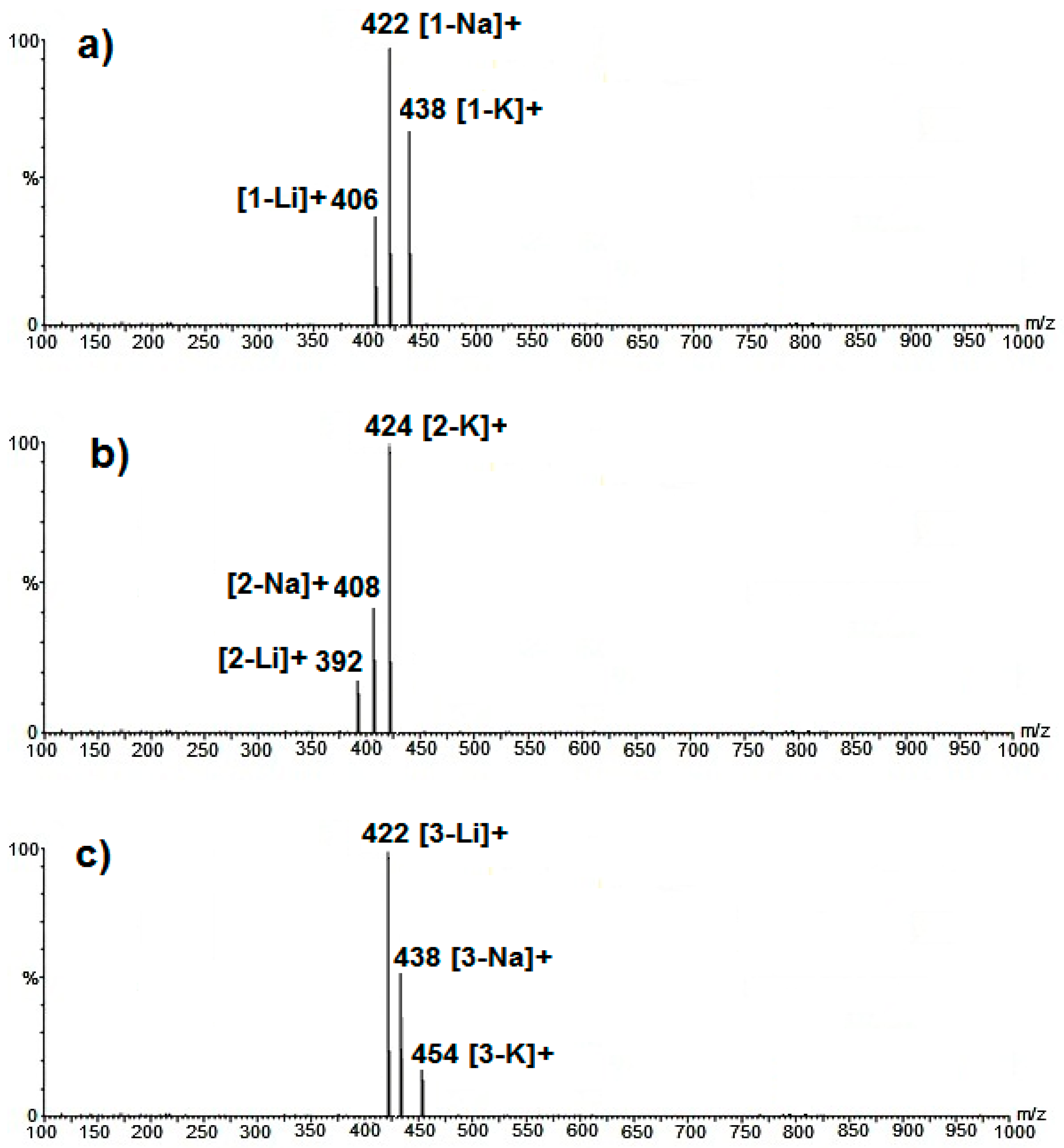
| Cpd. | 1:1 Complex L-M+[%] | 2:1 Complex 2 L-M+[%] | 3:1 Complex 3 L-M+[%] | 1:2:1 Complex L-2M+-X−[%] | 2:2:1 Complex 2 L-2M+-X−[%] |
|---|---|---|---|---|---|
| 1-LiCl | 406 [80] | 805 [100] | 1204 [10] | 448 [10] | 847 [8] |
| 1-NaCl | 422 [100] | 821 [70] | - | 480 [10] | - |
| 1-KCl | 438 [100] | 837 [30] | - | 512 [10] | - |
| 2-LiCl | 392 [100] | 777 [33] | - | 435 [10] | - |
| 2-NaCl | 408 [100] | 794 [10] | - | - | - |
| 2-KCl | 424 [100] | 809 [10] | - | - | - |
| 3-LiCl | 422 [100] | 837 [15] | - | 464 [65] | 879 [20] |
| 3-NaCl | 438 [100] | 853 [20] | - | 496 [15] | - |
| 3-KCl | 454 [100] | 869 [20] | - | 528 [10] | - |
| Vacuum | Methanol | ||
|---|---|---|---|
| Complex | Interaction Energy (Raw) [kcal/mol] | Interaction Energy (Corrected) [kcal/mol] | Interaction Energy [kcal/mol] |
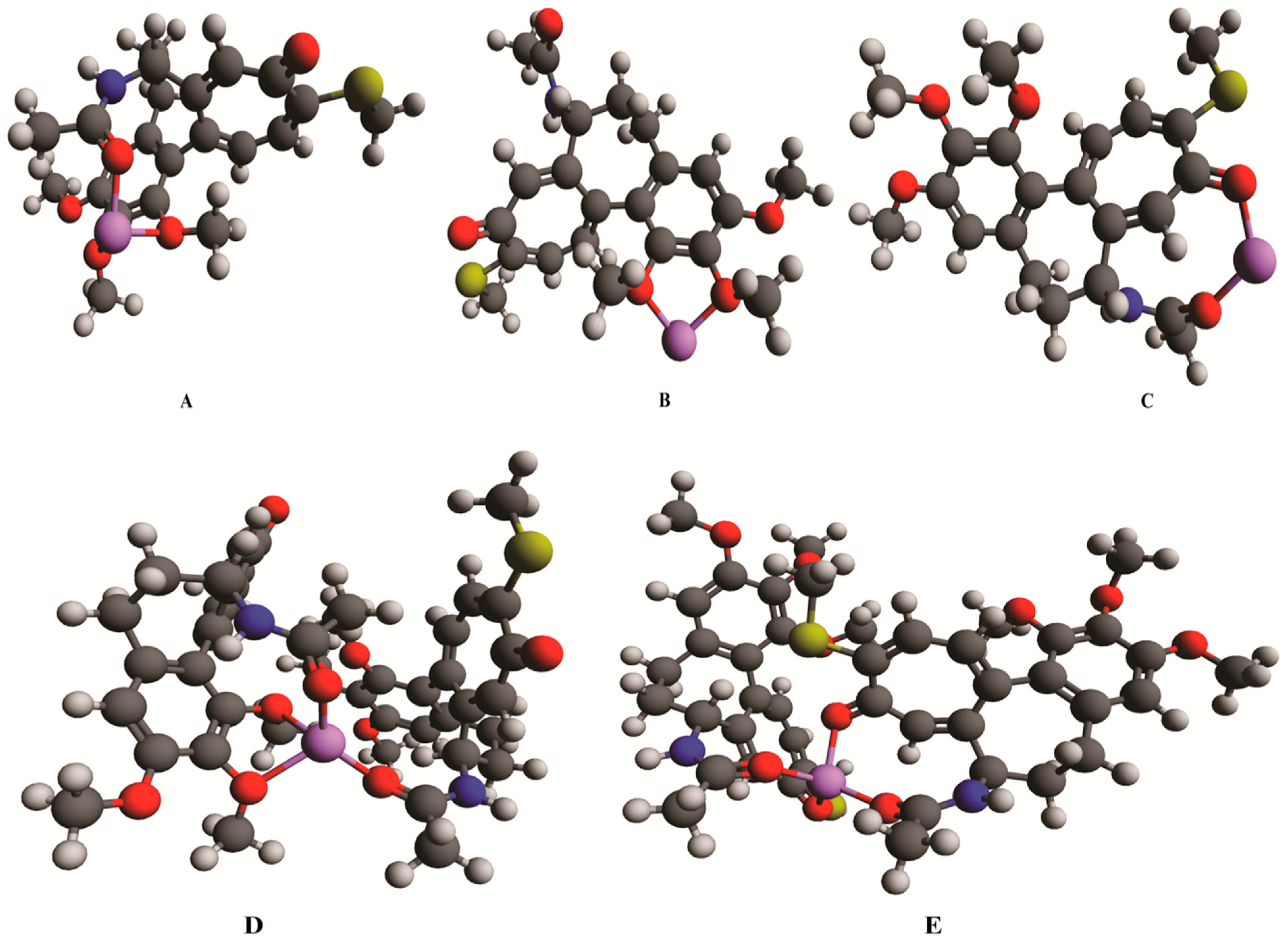
| 1:1 Type A | −89.6 | −88.8 | −8.5 |
| 1:1 Type B | −62.2 | −61.6 | −2.5 |
| 1:1 Type C | −96.9 | −96.6 | −9.8 |
| 2:1 Type D | −135.2 | −131.9 | −25.4 |
| 2:1 Type E | −143.2 | −139.8 | −25.7 |
| Complex | MIC [μg/mL and [mMol/mL]] of Different Fungal Species | |||||||
|---|---|---|---|---|---|---|---|---|
| A. niger | A. versicolor | P. variotti | P. funiculosum | T. viride | P. cyclopium | A. pullulans | Ch. globosum | |
| 1 | >4000 | >4000 | >4000 | >4000 | >4000 | >4000 | 1 ± 0.0 [2.5 × 10⁻¹⁰] | >4000 |
| 1-LiCl | >4000 | >4000 | >4000 | >4000 | >4000 | >4000 | >4000 | >4000 |
| 1-NaCl | >4000 | >4000 | >4000 | >4000 | >4000 | >4000 | >4000 | >4000 |
| 1-KCl | >4000 | >4000 | >4000 | >4000 | >4000 | >4000 | >4000 | >4000 |
| 2 | 500 ± 0.0 [1.3 × 10⁻¹⁰] | 500 ± 0.0 [1.3 × 10⁻¹⁰] | 260 ± 0.0 [6.8 × 10⁻¹¹] | 1000 ± 0.0 [2.6 × 10⁻¹⁰] | 500 ± 0.0 [1.3 × 10⁻¹⁰] | 500 ± 0.0 [1.3 × 10⁻¹⁰] | 2 ± 0.0 [5.5 × 10⁻¹²] | 2000 ± 0.0 [5.2 × 10⁻¹⁰] |
| 2-LiCl | >4000 | >4000 | >4000 | 1000 ± 0.0 [2.3 × 10⁻¹⁰] | >4000 | >4000 | 130 ± 0.0 [3.0 × 10⁻¹¹] | 65 ± 0.0 [1.5 × 10⁻¹¹ ] |
| 2-NaCl | >4000 | >4000 | >4000 | 1000 ± 0.0 [2.2 × 10⁻¹⁰] | >4000 | >4000 | 260 ± 0.0 [5.8 × 10⁻¹¹] | 65 ± 0.0 [1.5 × 10⁻¹¹] |
| 2-KCl | >4000 | >4000 | >4000 | 1000 ± 0.0 [2.2 × 10⁻¹⁰] | >4000 | >4000 | 500 ± 0.0 [1.1 × 10⁻¹⁰] | 65 ± 0.0 [1.4 × 10⁻¹¹] |
| 3 | >4000 | >4000 | >4000 | >4000 | >4000 | >4000 | >4000 | >4000 |
| 3-LiCl | >4000 | >4000 | >4000 | >4000 | >4000 | 2000 ± 0.0 [4.4 × 10⁻¹⁰] | 2000 ± 600 [4.4 × 10⁻¹⁰] | >4000 |
| 3-NaCl | >4000 | >4000 | >4000 | >4000 | >4000 | 2000 ± 0.0 [4.2 × 10⁻¹⁰] | 2000 ± 600 [4.2 × 10⁻¹⁰] | >4000 |
| 3-KCl | >4000 | >4000 | >4000 | >4000 | >4000 | 2000 ± 0.0 [4.1 × 10⁻¹⁰] | 2000 ± 0.0 [4.1 × 10⁻¹⁰] | >4000 |
| Chalcone (fungicide) * | 65 ± 0.0 [3.1 × 10⁻¹¹] | 2000 ± 0.0 [9.6 × 10⁻¹⁰] | 1000 ± 0.0 [4.8 × 10⁻¹⁰] | 130 ± 0.0 [6.2 × 10⁻¹¹] | 500 ± 0.0 [2.4 × 10⁻¹⁰] | 260 ± 0.0 [1.2 × 10⁻¹⁰] | 500 ± 0.0 [2.4 × 10⁻¹⁰] | 130 ± 0.0 [6.2 × 10⁻¹¹] |
| IPBC (fungicide) * | 2 ± 0.0 [7 × 10⁻¹²] | 2 ± 0.0 [7 × 10⁻¹²] | 2 ± 0.0 [7 × 10⁻¹¹] | 2 ± 0.0 [7 × 10⁻¹²] | 100 ± 0.0 [3.5 × 10⁻⁸] | 2 ± 0.0 [7 × 10⁻¹²] | 1 ± 0.0 [3.5 × 10⁻¹²] | 5 ± 0.0 [1.7 × 10⁻¹¹] |
| Compounds | IC50 [nM/mL] |  |
| 1 | 36.50 ± 5.01 | |
| 1-LiCl | 26.17 ± 3.09 | |
| 1-NaCl | 24.90 ± 1.55 | |
| 1-KCl | 29.05 ± 0.87 | |
| 2 | 334.73 ± 3.38 | |
| 2-LiCl | 372.80 ± 8.00 | |
| 2-NaCl | 150.61 ± 2.18 | |
| 2-KCl | 72.45 ± 1.64 | |
| 3 | 5.80 ± 0.49 | |
| 3-LiCl | 3.36 ± 0.16 | |
| 3-NaCl | 4.28 ± 0.17 | |
| 3-KCl | 3.24 ± 0.43 | |
| doxorubicin | 3265.89 ± 33.24.17 |
| Compound | Water Solubility | |||
|---|---|---|---|---|
| LogS ESOL/Class | LogS Ali/Class | LogS SILICOS-IT/Class | [mg/mL] | |
| 1 | −2.90/ soluble | −2.36/ soluble | −6.66/ poorly soluble | 45 |
| 1-LiCl | −3.94/ soluble | −3.84/ soluble | −5.97/ moderately soluble | 40 |
| 1-NaCl | −4.04/ moderately soluble | −3.84/ soluble | −6.01/ poorly soluble | 38 |
| 1-KCl | −4.14/ moderately soluble | −3.84/ soluble | −6.05/ poorly soluble | 40 |
| 2 | −3.00/ soluble | −2.77/ soluble | −5.97/ moderately soluble | 0.125 |
| 2-LiCl | −4.03/ moderately soluble | −4.14/ moderately soluble | −5.29/ moderately soluble | 0.2 |
| 2-NaCl | −4.14/ moderately soluble | −4.13/ moderately soluble | −5.32/ moderately soluble | 0.1 |
| 2-KCl | −4.23/ moderately soluble | −4.14/ moderately soluble | −5.36/ moderately soluble | 0.15 |
| 3 | −3.46/ soluble | −3.46/ soluble | −7.01/ poorly soluble | 7 |
| 3-LiCl | −4.57/ moderately soluble | −5.06/ moderately soluble | −6.01/ poorly soluble | 8 |
| 3-NaCl | −4.67/ moderately soluble | −5.06/ moderately soluble | −6.05/ poorly soluble | 7 |
| 3-KCl | −4.77/ moderately soluble | −5.06/ moderately soluble | −6.09/ poorly soluble | 6 |
| doxorubicin | −3.91/soluble | −5.20/ moderately soluble | −3.46/ soluble | 50 |
| IPBC | −2.52/soluble | −2.55/soluble | −2.66/soluble | insoluble |
| chalcone | −3.43/ soluble | −3.11/ soluble | −4.96/ moderately soluble | 0.16 |
| Comp. | Lipophilicity | |||||||
|---|---|---|---|---|---|---|---|---|
| LogP Mol Inspiration | SwissADME | Log P Protox II | ||||||
| LogP (iLOGP) | LogP (XLOGP3) | LogP (WLOGP) | Log P (MLOGP) | Log P (SILICOS-IT) | Consensus Log P | |||
| 1 | 1.10 | 3.28 | 1.03 | 2.55 | 1.02 | 3.90 | 2.36 | 3.26 |
| 1-LiCl | 1.10 | 0.00 | 2.45 | 3.28 | 1.00 | 0.18 | 1.38 | 3.79 |
| 1-NaCl | 1.10 | 0.00 | 2.45 | 3.28 | 1.00 | 0.28 | 1.40 | 3.79 |
| 1-KCl | 1.10 | 0.00 | 2.45 | 3.28 | 1.00 | 0.38 | 1.42 | 3.79 |
| 2 | 0.83 | 3.10 | 1.20 | 2.24 | 0.80 | 3.35 | 2.14 | 2.96 |
| 2-LiCl | 0.83 | 0.00 | 2.74 | 3.11 | 0.79 | 0.78 | 1.48 | 2.86 |
| 2-NaCl | 0.83 | 0.00 | 2.74 | 3.11 | 0.79 | 0.88 | 1.50 | 2.86 |
| 2-KCl | 0.83 | 0.00 | 2.74 | 3.11 | 0.79 | 0.98 | 1.53 | 2.86 |
| 3 | 2.17 | 3.32 | 1.76 | 3.26 | 1.82 | 4.46 | 2.92 | 3.98 |
| 3-LiCl | 2.17 | 0.00 | 3.30 | 3.99 | 1.80 | 0.28 | 1.87 | 4.50 |
| 3-NaCl | 2.17 | 0.00 | 3.30 | 3.99 | 1.80 | 0.38 | 1.89 | 4.01 |
| 3-KCl | 2.17 | 0.00 | 3.30 | 3.99 | 1.80 | 0.48 | 1.91 | 4.01 |
| doxorubicin | 0.57 | 2.16 | 1.27 | −0.32 | −2.10 | 1.17 | 0.44 | 0.70 |
| IPBC | 2.23 | 2.87 | 2.11 | 1.99 | 2.00 | 1.82 | 2.16 | 2.26 |
| chalcone | 3.81 | 2.54 | 3.08 | 3.47 | 3.44 | 3.95 | 3.30 | 3.58 |
Disclaimer/Publisher’s Note: The statements, opinions and data contained in all publications are solely those of the individual author(s) and contributor(s) and not of MDPI and/or the editor(s). MDPI and/or the editor(s) disclaim responsibility for any injury to people or property resulting from any ideas, methods, instructions or products referred to in the content. |
© 2026 by the authors. Licensee MDPI, Basel, Switzerland. This article is an open access article distributed under the terms and conditions of the Creative Commons Attribution (CC BY) license.
Share and Cite
Kurek, J.; Kwaśniewska-Sip, P.; Jankowski, W.; Myszkowski, K.; Cofta, G.; Hoffmann, M.; Murias, M.; Kurczab, R.; Śliwa, P. Bioactivity of Novel Colchicine, Colchiceine, and 10-Methylthiocolchicine Complexes with Lithium, Sodium, and Potassium Chlorides: Experimental and Theoretical Studies. Int. J. Mol. Sci. 2026, 27, 2985. https://doi.org/10.3390/ijms27072985
Kurek J, Kwaśniewska-Sip P, Jankowski W, Myszkowski K, Cofta G, Hoffmann M, Murias M, Kurczab R, Śliwa P. Bioactivity of Novel Colchicine, Colchiceine, and 10-Methylthiocolchicine Complexes with Lithium, Sodium, and Potassium Chlorides: Experimental and Theoretical Studies. International Journal of Molecular Sciences. 2026; 27(7):2985. https://doi.org/10.3390/ijms27072985
Chicago/Turabian StyleKurek, Joanna, Patrycja Kwaśniewska-Sip, Wojciech Jankowski, Krzysztof Myszkowski, Grzegorz Cofta, Marcin Hoffmann, Marek Murias, Rafał Kurczab, and Paweł Śliwa. 2026. "Bioactivity of Novel Colchicine, Colchiceine, and 10-Methylthiocolchicine Complexes with Lithium, Sodium, and Potassium Chlorides: Experimental and Theoretical Studies" International Journal of Molecular Sciences 27, no. 7: 2985. https://doi.org/10.3390/ijms27072985
APA StyleKurek, J., Kwaśniewska-Sip, P., Jankowski, W., Myszkowski, K., Cofta, G., Hoffmann, M., Murias, M., Kurczab, R., & Śliwa, P. (2026). Bioactivity of Novel Colchicine, Colchiceine, and 10-Methylthiocolchicine Complexes with Lithium, Sodium, and Potassium Chlorides: Experimental and Theoretical Studies. International Journal of Molecular Sciences, 27(7), 2985. https://doi.org/10.3390/ijms27072985