Article

Identification of Actionable Gene Variants in Pulmonary Large-Cell Neuroendocrine Carcinoma: A Real-World Analysis of a Polish Cohort


by
Adam Szpechcinski
1,*,†,
Magdalena Pelc
1,*,†,
Urszula Lechowicz
1,
Malgorzata Szolkowska
2,
Joanna Moes-Sosnowska
1,
Piotr Rudzinski
3,
Emil Wojda
4,
Paulina Skronska
1,
Elzbieta Podgorska
1,
Krystyna Maszkowska-Kopij
5,
Mateusz Polaczek
4,
Tadeusz Orlowski
3,
Renata Langfort
2 and
Joanna Chorostowska-Wynimko
1
1
Department of Genetics and Clinical Immunology, The Institute of Tuberculosis and Lung Diseases, 01-138 Warsaw, Poland
2
Department of Pathology, The Institute of Tuberculosis and Lung Diseases, 01-138 Warsaw, Poland
3
Clinical Department of Thoracic Surgery, The Institute of Tuberculosis and Lung Diseases, 01-138 Warsaw, Poland
4
Clinical Department of Thoracic Tumors, The Institute of Tuberculosis and Lung Diseases, 01-138 Warsaw, Poland
5
Outpatient Clinic, The Institute of Tuberculosis and Lung Diseases, 01-138 Warsaw, Poland
*
Authors to whom correspondence should be addressed.
These authors contributed equally to this work.
Int. J. Mol. Sci. 2026, 27(7), 2939; https://doi.org/10.3390/ijms27072939
Submission received: 9 February 2026 / Revised: 12 March 2026 / Accepted: 18 March 2026 / Published: 24 March 2026
(This article belongs to the Special Issue Research on Gene Mutations in Cancer and Chronic Diseases)

Abstract

Pulmonary large-cell neuroendocrine carcinoma (LCNEC) is a rare lung malignancy characterized by an aggressive clinical course and an unfavorable prognosis. Next-generation sequencing (NGS) has revealed that LCNECs exhibit molecular features resembling either small-cell lung carcinoma (SCLC-like LCNEC) or non-small cell lung carcinoma (NSCLC-like LCNEC). This study aimed to characterize the incidence of actionable gene variants in a retrospective cohort of LCNEC patients using a targeted NGS approach. Microscopic diagnosis was established according to the 2021 World Health Organization (WHO) classification using a standard immunohistochemical (IHC) panel. In total, 216 LCNEC tumor samples were analyzed for molecular variants in 17 genes using the RNA-based Archer FusionPlex Lung NGS assay (Integrated DNA Technologies, USA) and the MiSeq platform (Illumina, USA)—an algorithm utilized for routine NSCLC diagnosis. Overall, 46 variants were identified in 46/216 (21.3%) tumor samples, with 28/216 (13%) LCNECs harboring at least one actionable molecular variant potentially targetable by registered or investigational agents. KRAS variants (5%; including G12C at 2%) and PIK3CA variants (5%) were the most prevalent, followed by RET single-nucleotide variants (3%), uncommon EGFR variants (1%), and BRAF class II and III variants (<1%). Notably, no classical EGFR exon 18–21 mutations nor ALK, FGFR1/2/3, or ROS1 alterations (mutations or fusions) were detected, despite the technical capability of the assay to identify such variants. A novel in-frame gene fusion (TMEM79::NTRK1) was identified in a single tumor sample (0.5%). Our results confirm that LCNECs harbor potentially targetable alterations in KRAS, PIK3CA, RET, BRAF, and NTRK1, albeit at lower frequencies than those typically observed in NSCLC.

1. Introduction

Lung neuroendocrine neoplasms account for approximately 20% of all lung malignancies and represent a heterogeneous group of carcinomas originating from specialized, peptide- and amine-producing neuroendocrine cells [1]. Pulmonary large-cell neuroendocrine carcinoma (LCNEC) is a highly aggressive tumor characterized by neuroendocrine differentiation, representing approximately 3% of all resected carcinomas [2]. The prognosis for pulmonary LCNEC is generally poor; the median overall survival often does not exceed one year, with five-year survival rates of only 8% for stage III and 0% for stage IV disease [3].
According to the 2021 World Health Organization (WHO) classification, lung neuroendocrine neoplasms are divided into neuroendocrine tumors (typical and atypical carcinoids) and neuroendocrine carcinomas, which include LCNEC and small-cell lung carcinoma (SCLC) [4]. LCNEC containing any non-neuroendocrine, non-small cell lung carcinoma (NSCLC) component is classified as combined LCNEC. Diagnosis requires the identification of neuroendocrine morphology and the expression of at least one neuroendocrine marker (e.g., chromogranin A, synaptophysin, CD56, or INSM1) via immunohistochemical (IHC) testing [2]. To date, no standard treatment regimen has been established, and the optimal management of LCNEC remains under debate [5]. For early-stage LCNEC, surgery is the cornerstone of treatment. However, while improved outcomes following surgery have been demonstrated, data regarding the efficacy of adjuvant chemotherapy in stage I disease remain inconclusive [6]. For unresectable LCNEC, a multimodal approach comprising systemic chemotherapy and radiotherapy is recommended [7]. Nevertheless, 40–50% of patients are diagnosed with metastatic disease at the time of presentation [2]. Due to the low overall incidence of LCNEC and the clinical and molecular characteristics it shares with both SCLC and NSCLC, first-line treatment for metastatic disease is not yet standardized. Most available data on chemotherapy effectiveness stem from retrospective analyses of small patient cohorts receiving regimens typically used for SCLC (platinum-etoposide) or NSCLC (platinum–taxane, platinum–irinotecan, or platinum–pemetrexed), alongside a few prospective clinical trials [8,9,10,11,12]. Data regarding the efficacy of immunotherapy in LCNEC are encouraging but limited, derived primarily from case reports, case series, and real-world evidence. Several clinical trials evaluating combination strategies with anti-PD-L1 therapies in LCNEC are currently ongoing [13,14].
Targetable driver alterations are uncommon in LCNEC but occur more often in combined LCNEC with an adenocarcinoma component [15]. Several studies reported on classical NSCLC-driver alterations, though with varying frequencies, in anaplastic lymphoma receptor tyrosine kinase (ALK), B-raf proto-oncogene, serine/threonine kinase (BRAF), epidermal growth factor receptor (EGFR), erb-B2 receptor tyrosine kinase 2 (ERBB2), KRAS proto-oncogene, GTPase (KRAS), MET proto-oncogene, receptor tyrosine kinase (MET), neurotrophic receptor tyrosine kinase 1/2/3 (NTRK1/2/3), phosphatidylinositol-4,5-bisphosphate 3-kinase catalytic subunit alpha (PIK3CA), rearranged during transfection proto-oncogene (RET), ROS proto-oncogene 1, receptor tyrosine kinase (ROS1) genes found in LCNEC tumors using next-generation sequencing (NGS) techniques [16,17,18,19]. Clinical experience with targeted agents in LCNEC remains primarily limited to case reports. These have demonstrated promising outcomes in patients with ALK [20,21,22,23], BRAF [24,25], EGFR [26,27], and RET [28,29] alterations, establishing a strong rationale for larger prospective clinical trials in this patient population. In this study, we evaluated more than 200 pulmonary LCNECs for actionable variants in genes commonly used as predictive biomarkers for NSCLC targeted therapies, utilizing a well-established targeted NGS assay. The objective was to assess the frequency of clinically significant alterations in a Polish cohort of LCNEC patients and to estimate the number of subjects who could potentially benefit from personalized treatment if they were to undergo routine molecular testing as part of standard diagnostic procedures. Currently, molecular testing is a critical consideration in LCNEC management given the recent development of effective targeted agents; however, neither dedicated recommendations nor formal guidelines have been established to date [30].

2. Results

2.1. Technical Performance of NGS Assay

NGS provided valid raw genomic data for all samples analyzed. All NGS reactions were conducted with high-quality parameters: QC30 range of 85.0–94.0% (quality norm according to manufacturer—QC > 85%), cluster density spreading 1101–1564 k/mm2 (optimum according to manufacturer 1200–1400 k/mm2). The median (min–max) total number of fragments (read pairs) that were present in the original FASTQ file was 1,287,721 (1,000,487–1,969,612) at the recommended minimum of 1 mln reads, and the median (min–max) percentage of on-target reads was 98.3% (93.9–99.1%). A QC metric (the average number of unique control molecules that were characterized as RNA fragments) of at least 10 was required to support the targets of the assay. The median QC metric of analyzed samples was 213.5 (range: 37.4–416.8).

2.2. The Detection of Molecular Variants in Clinical Samples by NGS Assay

The pulmonary LCNEC tumor samples were tested for single nucleotide variants (SNVs), deletion/insertion (DELINS), splicing variants, exon-skipping variants, and gene fusion variants by targeted NGS using the FusionPlex Lung panel (Integrated Sciences, Chatswood, CA, USA) in specific genomic regions (including 323 amplicons from 17 genes associated with lung cancer; Tables S1 and S2). Only non-synonymous, in-frame variants in the coding regions of targeted genes that potentially modulate protein structure and function were analyzed.
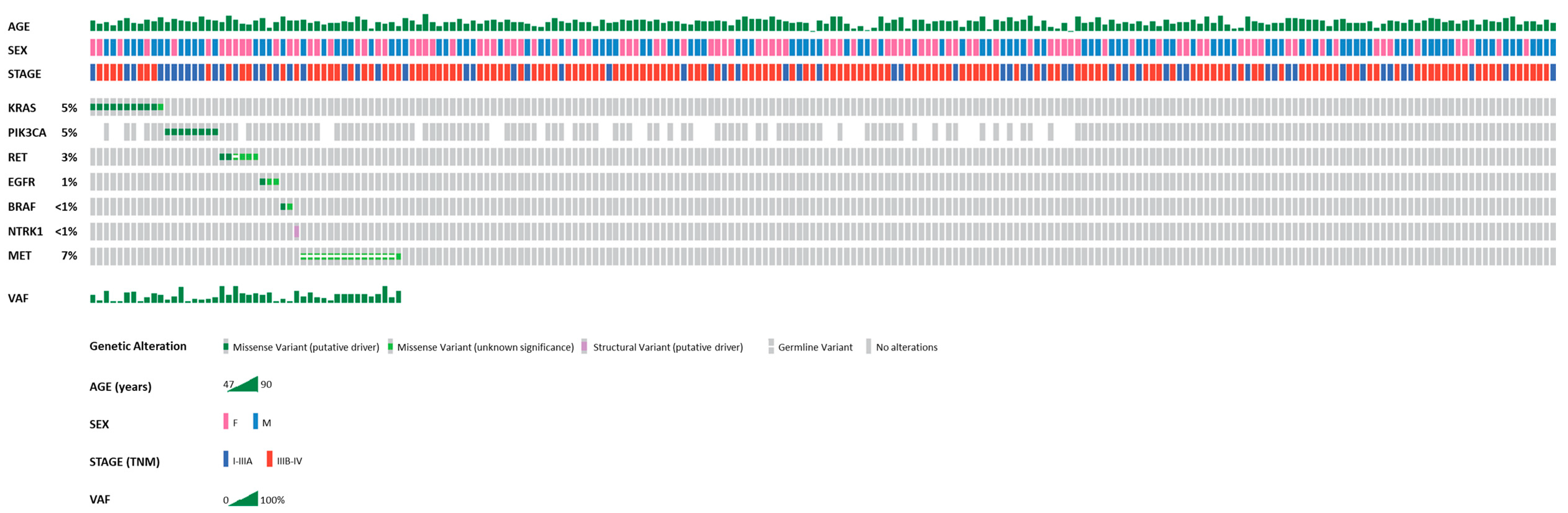
In this study, we identified 21 unique single-nucleotide variants within the 6 genes in 45/216 (20.8%) tumor samples and a fusion variant within a single sample (0.5%; Table 1, Figure 1). In total, 46 variants have been found in 46/216 (21.3%) tumor samples (Table S3). No sample presented more than one variant in the analysis. Twenty-six out of 45 (58%) samples presented an SNV known to be oncogenic/likely oncogenic with mostly gain-of-function effect on the protein. The remaining 19/45 (42%) samples presented an SNV classified as benign/likely benign or a variant of unknown clinical significance.
Sixteen missense or DELINS variants in BRAF (p.Gly469Ala, p.Asn581Lys), EGFR (p.Glu330Lys, p.Gly598Arg), KRAS (p.Gly12Cys, p.Gly12Val, p.Gly12Leu, p.Ala11_Gly12 delinsProVal), PIK3CA (p.Glu542Lys, p.Glu545Lys, p.Gln546Lys, p.His1047Leu, p.His1047Arg), and RET (p.Cys609Gly, p.Ser649Leu, p.Met918Thr) genes were frequently reported in databases (listed in Section 4.6) as somatic in various solid tumor types. We also identified several missense variants in MET (p.Asn375Ser) and RET (p.Gly691Ser, p.Tyr791Phe) classified as benign/likely benign germline polymorphisms in clinical databases. The classification of remaining variants detected in EGFR (p.Ala743Ser) and MET (p.Arg970Cys) genes is conflicting or unknown.
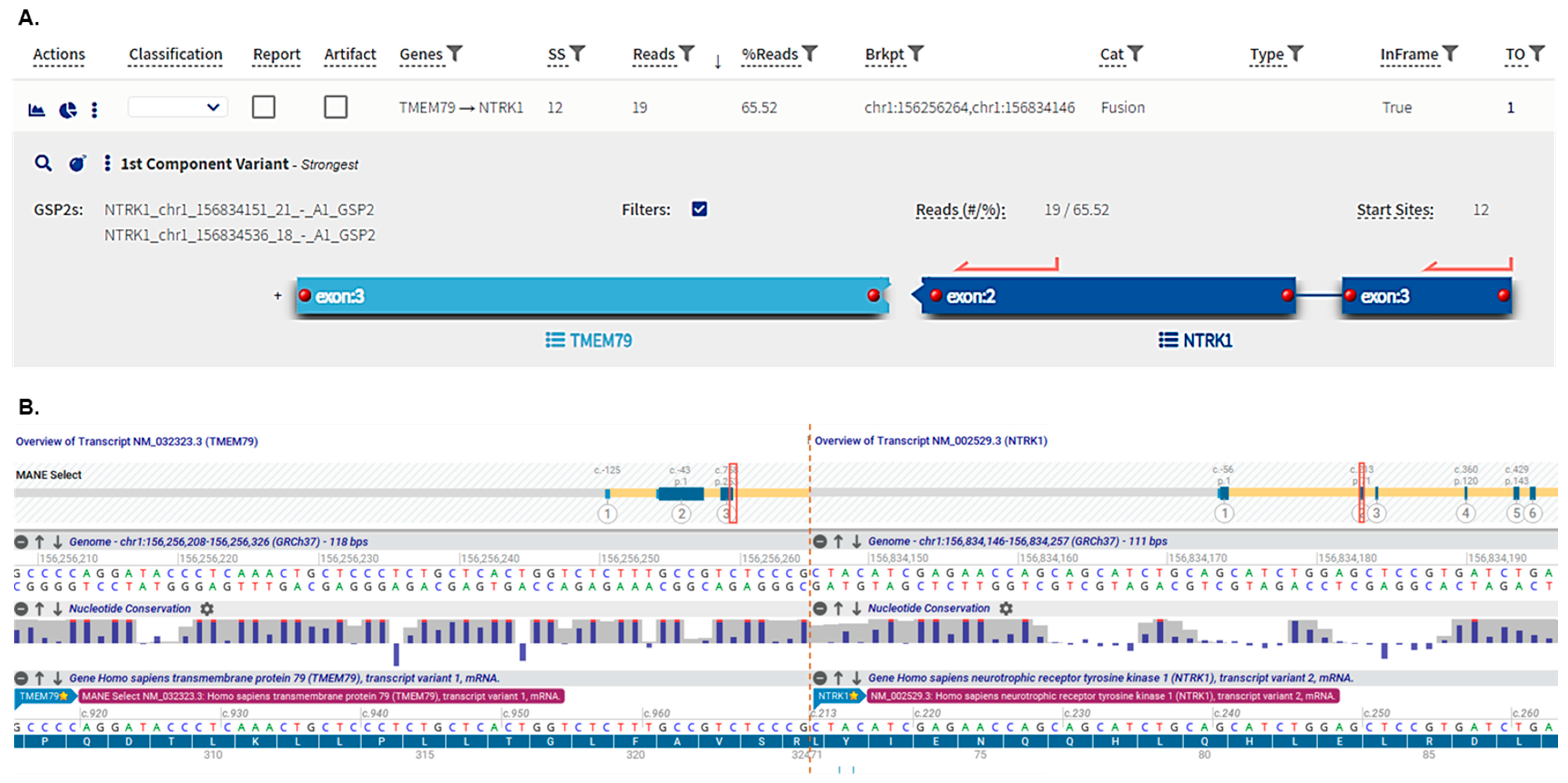
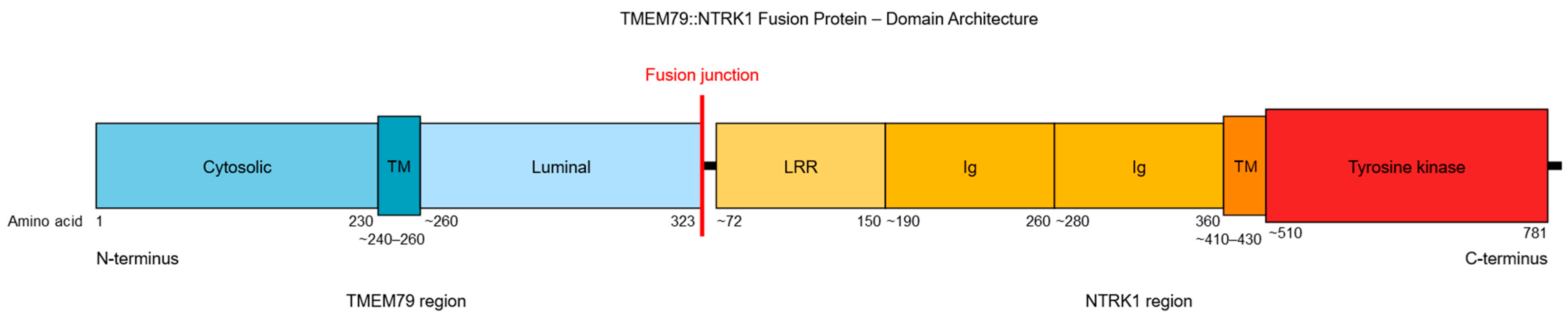
A single tumor sample (female, 72 years old, stage IVB) demonstrated an in-frame fusion variant formed by transmembrane protein 79 (TMEM79) and NTRK1 genes, both located on chromosome 1, with a breakpoint occurring in exon 3 of TMEM79 (chr1:156256264) and exon 2 of NTRK1 (chr1:156834146; Figure 2). This fusion variant has not been reported in databases nor reviewed in the scientific literature. The predicted fusion protein retains the entire tyrosine kinase domain with conserved catalytic motifs (Figure 3).
No significant associations have been found between genetic variants and demographic (sex, age) or clinical parameters (tumor stage).
Furthermore, no ALK, FGFR1, FGFR2, FGFR3, ROS1 alterations (mutations, fusions) were found in our pulmonary LCNEC cohort despite technical capability of our NGS assay to detect such variants.

3. Discussion

In this study, we evaluated pulmonary LCNECs for molecular alterations commonly found in NSCLC and other solid tumors that carry predictive or prognostic value for targeted therapies and immunotherapies. Specifically, we utilized targeted NGS to identify actionable single-nucleotide variants (SNVs) and fusions.
To date, comprehensive genomic profiling studies revealed a C:G>A:T transversion rate of 38.7–47.5%, indicative of tobacco exposure, and high tumor mutational burden of 8.6–10.5 non-synonymous mutations per million base pairs in pulmonary LCNECs [31,32]. Furthermore, genomic and transcriptomic analyses have enabled the distinction of different molecular subtypes of LCNEC, which are large cell neuroendocrine carcinomas with molecular features similar to SCLC (SCLC-like LCNEC overlapping with LCNEC type II classification) and large cell neuroendocrine carcinomas with molecular features similar to NSCLC (NSCLC-like LCNECs overlapping with LCNEC type I classification) [16,31,32,33]. The SCLC-like LCNEC subtype is characterized by the inactivation of RB1/TP53 genes, resulting in the lack of RB1 protein expression and frequent RB1/TP53 co-mutations. It also features other alterations typical of small-cell lung carcinoma, such as MYCL amplification, while notably lacking STK11 or KRAS mutations. This subtype typically exhibits low expression of neuroendocrine markers, specifically ASCL1 (Achaete-Scute family BHLH transcription factor 1) and DLL3 (delta-like canonical notch ligand 3), alongside the activation of Notch signaling pathway genes (ASCLlow/DLL3low/NOTCHhigh) [2,13,34]. Conversely, the NSCLC-like LCNEC subtype is characterized by the presence of wild-type RB1 protein and a lack of RB1/TP53 co-mutations. Instead, it frequently harbors additional molecular alterations in BRAF, ERBB2, CDKN2A, KRAS, STK11, or KEAP1 genes, which may co-occur with TP53 mutations. This subtype shows high expression of ASCL1 and DLL3 but exhibits suppression of the Notch signaling pathway (ASCLhigh/DLL3high/NOTCHlow). This molecular classification has significant prognostic and predictive implications for treatment efficacy, as Type I (with TP53 and STK11/KEAP1 alterations) and Type II LCNECs (with TP53 and RB1 alterations) demonstrate heterogeneous responses to chemotherapy and immunotherapy [2,34]. In the present study, we did not perform molecular subtyping into SCLC-like and NSCLC-like categories, as this procedure has neither been standardized nor recommended in current clinical guidelines.
In our study, molecular variants have been found in 46/216 (21.3%) tumor samples. Twenty-eight out of two-hundred sixteen (13%) LCNEC tumors showed at least one molecular alteration potentially targetable by registered or investigational agents (Table 1 and Table S3). Among these alterations, oncogenic KRAS and PIK3CA variants have shown the highest frequency in tested samples (5% and 5%, respectively). Similar frequencies of oncogenic alterations in KRAS (6–10%) and PIK3CA (3–6%) genes have been reported in other studies using NGS techniques for molecular profiling of pulmonary LCNEC tumors [16,18,35,36]. Importantly, 6 out of 11 (55%) KRAS variants detected in our LCNEC cohort were p.Gly12Cys substitutions that offer a unique opportunity for therapeutic targeting using small-molecule inhibitors, adagrasib and sotorasib, currently approved by the U.S. Food and Drug Administration (FDA) and the European Medicines Agency (EMA) in NSCLC [37]. The available, early data on clinical efficacy of these drugs in KRAS G12C-mutated pulmonary LCNECs, though limited to a few case reports, show favorable antitumor responses [38,39]. The other (non-G12C) KRAS variants observed in our study also show potential for therapeutic inhibition by experimental drugs currently at different levels of clinical development [40,41]. No clinical evidence on the efficacy of PI3K inhibition in pulmonary LCNECs, to the best of our knowledge, has been published to date. Still, all PIK3CA gene alterations detected in our study are targetable by drugs that are already approved with indications to other solid tumors (e.g., alpelisib, copanlisib) or by novel investigational medicinal products (e.g., zovegalisib) [42].
Despite a large number of pulmonary LCNEC tumors analyzed in our study, we observed either no classical EGFR mutations (exon 19 deletions, p.Leu858Arg) nor class I BRAF variants (p.Val600Asp/Glu/Lys/Arg) that have been sporadically reported by other groups [16,18,32]. Instead, we identified several uncommon EGFR variants located in the extracellular domain (p.Glu330Lys, p.Gly598Arg) and the kinase domain of the protein (p.Ala743Ser), whose oncogenicity and sensitivity to EGFR-TKIs have not been fully elucidated. Likewise, only class II (p.Gly469Ala) and III (p.Asn581Lys) BRAF variants were found in two different LCNEC tumors. Substitutions at these positions in the BRAF gene have been previously observed in pulmonary LCNEC at low frequencies [25]. In a patient with metastatic LCNEC of the lung with BRAF p.Gly469Arg variant, treated with trametinib and dabrafenib combination, a stable disease has been maintained for 15 months. Unlike V600 mutations, non-V600 BRAF alterations are not yet well-validated as therapeutic targets, and clinical evidence for effective targeted treatments is still limited [43,44].
The RET proto-oncogene plays a critical role in normal neuroendocrine development, encoding a receptor tyrosine kinase that regulates cell growth, survival, and differentiation, particularly within neural-crest-derived cells and the enteric nervous system [45]. Ligand-independent activation of RET typically arises from gain-of-function mutations or the formation of fusion proteins. These fusions combine the intracellular kinase domain of RET with an N-terminal domain from a partner protein capable of dimerization [46].
Once altered, RET becomes constitutively active, persistently stimulating downstream signaling cascades such as the ERK and PI3K/Akt pathways, which promote cellular proliferation, survival, and metastasis [47]. While neuroendocrine tumors often arise from hormone-secreting cells of neural crest origin (such as those in medullary thyroid carcinoma, where RET alterations are identified in approximately 50% of patients), these alterations are notably rare in small-cell lung cancer [48]. In contrast, RET gene fusions are found in 1–2% of all non-small cell lung carcinomas [49]. In our study, we found RET gene mutations in six (2.7%) patients with pulmonary LCNEC, whereas three of these variants have been confirmed to be activating and oncogenic (p.Cys609Gly, p.Ser649Leu, p.Met918Thr), and potentially druggable with selective RET inhibitors. Selpercatinib has been found to be effective at treating NSCLC and certain thyroid cancers caused by changes to the RET gene [50,51]. Recent case reports show the successful use of selpercatinib as a first-line treatment in a patient with advanced pulmonary LCNEC harboring a RET fusion gene [28,29]. To date, activating RET alterations, including both point mutations and fusions, have rarely been reported in pulmonary LCNEC, with most occurrences documented only in isolated case reports [16,35]. Our findings suggest that the true prevalence of these alterations in LCNEC may be underestimated, potentially due to factors such as limited study cohort sizes or the technical constraints of specific NGS assays.
In addition to SNV and DELINS variants, we detected a TMEM79::NTRK1 fusion variant (t(1;1), NM_032323.3 exon A: 3; NM_002529.3 exon B: 2; (chr1:156256264,chr1:156834146)) in a single tumor sample. The resulting in-frame fusion protein comprises the N-terminal portion of TMEM79 fused to the NTRK1 sequence beginning at exon 2 (Figure 2). The predicted protein structure retains two transmembrane helices—derived from TMEM79 and NTRK1, respectively—while the extracellular portion includes the leucine-rich repeat and immunoglobulin-like domains characteristic of TRKA (Figure 3). Crucially, the cytoplasmic region preserves the entire tyrosine kinase domain, including all conserved catalytic motifs. The fusion junction is located between the luminal region of TMEM79 and the extracellular region of NTRK1. Notably, this fusion protein lacks a classical oligomerization domain (such as coiled-coil, zinc-finger, or WD domains) typically required for the ligand-independent activation of NTRK oncoproteins [52]. While over 80 NTRK fusion partners have been identified—most of which facilitate constitutive downstream signaling via introduced oligomerization domains—certain fusions, such as SCYL3::NTRK1, lack these motifs [53]. In such cases, the fusion partner may drive kinase self-activation through alternative mechanisms, such as inducing liquid–liquid phase separation (LLPS) [54]. Collectively, these structural features suggest that TMEM79::NTRK1 likely encodes a functional kinase, and the fusion protein would likely remain sensitive to tropomyosin receptor kinase inhibitors targeting the ATP pocket of TRKA, including larotrectinib and entrectinib [55]. To our knowledge, this specific fusion variant has not been previously documented in the literature or genomic databases. However, other rare in-frame NTRK fusions, such as RFWD2::NTRK1, have been reported in pulmonary large-cell neuroendocrine carcinomas [32,56]. While members of the transmembrane (TMEM) protein family, including TMEM79, are recognized fusion partners in prostate carcinoma, they have not been previously described in lung cancer [57,58]. Compared to ALK and RET fusions, which are more prevalent in pulmonary LCNEC and typically associated with clinical sensitivity to tyrosine kinase inhibitors (TKIs), NTRK rearrangements appear to be sporadic molecular events in this malignancy [20,21,22,23,28,29,59,60,61,62].
Notably, 14 out of 216 (6.5%) LCNEC cases harbored the p.Asn375Ser (N375S) variant within the semaphorin domain of the MET protein—the ligand-binding region for hepatocyte growth factor (HGF). While this variant appears to be a common germline polymorphism [63], it has been shown to slightly reduce MET binding affinity for HGF [64]. More recently, research has demonstrated that N375S confers an exquisite binding affinity for HER2, enabling METN375S to interact with HER2 in a ligand-independent manner. This interaction drives aggressive squamous cell carcinomas of the head, neck, and lung and is associated with a poor prognosis [65]. Paradoxically, HER2 inhibitors—rather than c-MET inhibitors—have proven effective in restraining in vivo and in vitro models expressing METN375S.
The MET p.Arg970Cys (R970C) mutation—also identified as R988C in alternative transcripts—is located in the juxtamembrane domain of the protein and was identified in a single LCNEC case in our study. Available data regarding the clinical significance of this variant remains conflicting. Some studies suggest that METR970C enhances oncogenic function, for instance, by promoting calpain-dependent generation of a p45 MET fragment that facilitates epithelial cell scattering and invasion in NSCLC [66] or by inducing constitutive MET phosphorylation that increases cell motility, migration, and colony formation in SCLC [67]. Conversely, other reports suggest that the p.R970C variant is non-oncogenic and has no significant effect on MET phosphorylation levels [68,69].
This study has several limitations. While the 17-gene NGS panel may appear limited in scope, it encompasses all clinically significant predictive biomarkers for FDA/EMA-approved targeted therapies in NSCLC, as established by the National Comprehensive Cancer Network (NCCN) [70] and the European Society for Medical Oncology (ESMO) guidelines [71]. Furthermore, the FusionPlex Lung panel is capable of detecting not only established actionable biomarkers but also emerging, sporadic, and novel rearrangements, including single-nucleotide variants (SNVs), insertions/deletions (indels), and gene fusions within the targeted genomic regions [72]. The STK11 and KEAP1 mutations, which have emerged as predictive biomarkers of immunotherapy resistance in KRAS-positive NSCLC, were not included in the molecular analysis since this study is focused on actionable variants related to targeted therapies [73]. Additionally, all NGS analyses were performed using total RNA isolated from LCNEC tissue specimens, rather than the more conventional approach of separate DNA and RNA isolation for the detection of SNVs, copy number variants (CNVs), and fusions, respectively. This focused method offers several technical advantages for clinical FFPE samples, e.g., higher RNA yield (the tissue is not subdivided for separate extractions, which is critical for small biopsies), and increased sensitivity (we achieved a high sequencing depth, at least 1 million reads per sample, allowing for variant detection down to 5% tumor cellularity). In our experience, this RNA-based targeted NGS approach has proven to be a reliable and informative diagnostic tool for the simultaneous detection of both known and novel actionable variants, providing pivotal data for therapeutic decision-making in NSCLC [74,75,76].

4. Materials and Methods

4.1. Patients

A total of 216 patients with pulmonary LCNEC were enrolled in this study (median age: 70 years; range: 47–90 years). According to the international Tumor-Node-Metastasis (TNM) staging system [77], 66 patients (31%) presented with operable localized or locally advanced disease (stages I–IIIA), while 150 patients (69%) had advanced metastatic disease (stages IIIB–IV). All patients were of Caucasian descent and were treatment-naïve prior to mutation testing. The study was approved by the Ethics Committee of the Institute of Tuberculosis and Lung Diseases in Warsaw, Poland (Reference: KB.0028.22.2025, 25 June 2025). Patient demographic and clinical characteristics are summarized in Table 2.

4.2. Pathological Diagnosis

The microscopic diagnosis of LCNEC has been established according to the 2021 World Health Organization (WHO) histological classification [4]. Microscopic criteria included morphology, the number of mitotic figures (>10/2 mm2), the presence of necrosis and distinct expression of at least one immunohistochemical neuroendocrine marker (chromogranin A, synaptophysin or CD56/NCAM). Ki-67 proliferation index was not a diagnostic criterion; however, a threshold >30% favored a diagnosis of carcinoma. Other immunohistochemical tests used included: pancytokeratin or cytokeratin 5/6, TTF-1 or napsin A and p40. The study did not analyze LCNEC and combined LCNEC separately, as it was usually impossible to identify both components in biopsies.

4.3. Types of Tumor Specimens

The tumor tissue specimens were obtained from patients with LCNEC during surgery or biopsy, following standard clinical procedures. In total, 216 FFPE tumor tissue samples were analyzed for molecular alterations. The median tumor cell content was 80% (range: 5–100%) in FFPE tissues. The minimum number of 1000 tumor cells required for NGS analysis was confirmed in every specimen.

4.4. RNA Extraction

FFPET blocks were cut into 5 μm thick sections and collected in sterile Eppendorf tubes. Total RNA was extracted from the FFPE tumor tissue sections using the spin column-based ReliaPrep FFPE Total RNA Miniprep System (Promega Corporation, Madison, WI, USA). The concentration and purity of RNA eluates were determined via spectrophotometry and fluorometry. RNA quality, specifically the integrity of amplifiable RNA, was evaluated using a qPCR-based assay (PreSeq RNA QC Assay, Integrated Sciences, Chatswood, CA, USA), according to the manufacturer’s protocols and established laboratory guidelines [78,79].

4.5. NGS Analysis of Gene Variants

Tumor RNA was sequenced and screened for SNVs and gene fusions using the FusionPlex Lung panel (Integrated Sciences, Chatswood, CA, USA). Initially, 44 (20%) samples were evaluated by the v1 panel, while the remaining 172 (80%) samples were analyzed using the extended v2 panel, which replaced the earlier version (Supplementary Tables S1 and S2). Briefly, RNA (250 ng) was reverse-transcribed to cDNA using random priming. cDNA quality was subsequently verified with the PreSeq RNA QC Assay (Integrated Sciences, Chatswood, CA, USA); only samples with a Cp < 29 proceeded to library construction according to the manufacturer’s protocol. Library concentration and quality were determined using the KAPA Universal Library Quantification Kit (Roche Diagnostics, Basel, Switzerland). Finally, libraries were normalized, multiplexed, and sequenced on the MiSeq platform using the MiSeq Reagent Kit, v3 (600 cycles) (Illumina, San Diego, CA, USA).

4.6. Bioinformatics and Computational Analysis of NGS Output Data

NGS data were analyzed using Archer Analysis software (v7.2; ArcherDX, Inc., Boulder, CO, USA) with the GRCh37 (hg19) reference genome. Quality control (QC) was based on four control genes (CHMP2A (charged multivesicular body protein 2A), GPI (glucose-6-phosphate isomerase), RAB7A (RAB7A, member RAS oncogene family), and VCP (valosin containing protein)) as indicators of RNA quality and content. Gene fusion variants were further evaluated using Alamut Visual Plus (v1.12; SOPHiA GENETICS, Inc., Boston, MA, USA). Single-nucleotide variants were identified based on total read depth ≥ 100, ≥10 alternate observations, and a variant allelic frequency ≥ 5%. Gene fusions were called if supported by ≥5 unique reads, ≥10% total reads, and ≥3 unique start sites [80].
All variants were assessed for their impact on the coding region (missense, nonsense, frameshift) and clinical significance (pathogenic, likely pathogenic, benign, likely benign, uncertain) using Catalogue of Somatic Mutations in Cancer (COSMIC), v103 [81], ClinVar [82] and VarSome, v13.13.1 [83]. Therapeutic evidence was determined via OncoKB, v6.0 [84,85], the Cancer Knowledgebase (CKB; Genomenon, Ann Arbor, MI, USA), and the My Cancer Genome database [86]. The origin (somatic or germline) of the SNVs was evaluated according to previously reported data (COSMIC, ClinVar, and VarSome) and the allele frequencies estimated in Non-Finnish European populations in the Genome Aggregation Database (gnomAD), v.2.1.1 [87], using a cut-off of ≥4.0 × 10⁻⁴ for germline variants [88].
Synonymous variants were excluded from the final analysis. Variants were annotated according to the Human Genome Variation Society (HGVS) nomenclature [89] and are described in the text using HGVS protein (HGVSp) or HGVSp short-form notation. The distribution of variants was visualized using the OncoPrinter tool in cBioPortal (v6.3.1) [90,91]. Structural modeling of the fusion protein was based on the ORF reconstruction from RNA fusion junction, reference transcript comparison (RefSeq), InterPro [92] and Pfam protein domain databases [93], and AlphaFold Protein Structure Database [94,95].

4.7. Statistical Analysis

Descriptive statistics, including the median and range (min–max), were used to summarize the technical performance of the NGS assay. Clinicopathological characteristics and the frequency of genetic variants in LCNEC patients were compared using the Pearson’s chi-squared test and the Kruskal–Wallis H test. All analyses were performed using MedCalc Statistical Software (v23.4.5; Ostend, Belgium). Statistical significance was defined as p < 0.05.

5. Conclusions

Our study results revealed that up to 13% of patients with LCNEC could potentially benefit from personalized treatment strategies involving either approved or investigational targeted therapies. The most common genetic alterations were found in the KRAS and PIK3CA genes, less common in the RET, EGFR, BRAF, and NTRK1 genes. Despite the current lack of standardized treatment and molecular testing protocols for pulmonary LCNEC, our data align with existing literature suggesting that a significant portion of these patients are candidates for targeted therapy. Future research should focus on establishing an optimal gene panel for LCNEC, alongside prospective clinical trials to validate the efficacy of personalized medicine in this aggressive histological subtype of lung carcinoma.

Supplementary Materials

The following supporting information can be downloaded at: https://www.mdpi.com/article/10.3390/ijms27072939/s1.

Author Contributions

A.S. initialized and conceptualized the study, performed literature search and drafted the manuscript. M.P. (Magdalena Pelc) curated the genetic database and provided clinical annotation of variants. E.W., K.M.-K. and M.P. (Mateusz Polaczek) consulted the patients and provided medical data. P.R. and T.O. consulted the patients, performed surgical procedures and provided tumor tissues for the study. M.S. and R.L. provided the pathological evaluation of tumor specimens. M.P. (Magdalena Pelc), U.L., J.M.-S., P.S. and E.P. performed the NGS analysis. A.S., M.P. (Magdalena Pelc) and U.L. provided the bioinformatics and computational analysis of next-generation sequencing data. J.C.-W. provided the clinical expertise in evaluation of the medical data. M.P. (Magdalena Pelc), M.S., M.P. (Mateusz Polaczek), and J.C.-W. revised the manuscript. All authors were involved in preparation of the paper and had final approval of the submitted and published versions. All authors have read and agreed to the published version of the manuscript.

Funding

This study was supported by the statutory research activity projects no. 3.3/2022, 3.11/2023, and 3.13/2025 from the Institute of Tuberculosis and Lung Diseases in Warsaw, Poland.

Institutional Review Board Statement

The study was conducted in accordance with the Declaration of Helsinki and approved by the Ethics Committee of the Institute of Tuberculosis and Lung Diseases in Warsaw, Poland (approval no. KB.0028.22.2025, 25 June 2025).

Informed Consent Statement

Informed consent was obtained from all subjects involved in the study.

Data Availability Statement

The detailed data presented in this study are available from the corresponding authors on reasonable request.

Conflicts of Interest

The authors declare no conflicts of interest.

References

  1. Randhawa, S.; Trikalinos, N.; Patterson, G.A. Neuroendocrine Tumors of the Lung. Thorac. Surg. Clin. 2021, 31, 469–476. [Google Scholar] [CrossRef]
  2. Andrini, E.; Marchese, P.V.; De Biase, D.; Mosconi, C.; Siepe, G.; Panzuto, F.; Ardizzoni, A.; Campana, D.; Lamberti, G. Large Cell Neuroendocrine Carcinoma of the Lung: Current Understanding and Challenges. J. Clin. Med. 2022, 11, 1461. [Google Scholar] [CrossRef]
  3. Lowczak, A.; Kolasinska-Cwikla, A.; Osowiecka, K.; Glinka, L.; Palucki, J.; Rzepko, R.; Doboszynska, A.; Cwikla, J.B. Outcomes of Patients with Pulmonary Large Cell Neuroendocrine Carcinoma in I-IV Stage. Medicina 2021, 57, 118. [Google Scholar] [CrossRef]
  4. WHO Classification of Tumours Editorial Board. Thoracic Tumours, 5th ed.; International Agency for Research on Cancer: Lyon, France, 2021. [Google Scholar]
  5. Ferrara, M.G.; Stefani, A.; Simbolo, M.; Pilotto, S.; Martini, M.; Lococo, F.; Vita, E.; Chiappetta, M.; Cancellieri, A.; D’Argento, E.; et al. Large Cell Neuro-Endocrine Carcinoma of the Lung: Current Treatment Options and Potential Future Opportunities. Front. Oncol. 2021, 11, 650293. [Google Scholar] [CrossRef]
  6. Chen, H.; Ishihara, M.; Horita, N.; Kazahari, H.; Ochiai, R.; Tanzawa, S.; Honda, T.; Ichikawa, Y.; Watanabe, K.; Seki, N. Effect of Adjuvant and Palliative Chemotherapy in Large Cell Neuroendocrine Carcinoma of the Lung: A Systematic Review and Meta-Analysis. Cancers 2021, 13, 5948. [Google Scholar] [CrossRef]
  7. Postmus, P.E.; Kerr, K.M.; Oudkerk, M.; Senan, S.; Waller, D.A.; Vansteenkiste, J.; Escriu, C.; Peters, S.; Committee, E.G. Early and locally advanced non-small-cell lung cancer (NSCLC): ESMO Clinical Practice Guidelines for diagnosis, treatment and follow-up. Ann. Oncol. 2017, 28, iv1–iv21. [Google Scholar] [CrossRef]
  8. Veronesi, G.; Morandi, U.; Alloisio, M.; Terzi, A.; Cardillo, G.; Filosso, P.; Rea, F.; Facciolo, F.; Pelosi, G.; Gandini, S.; et al. Large cell neuroendocrine carcinoma of the lung: A retrospective analysis of 144 surgical cases. Lung Cancer 2006, 53, 111–115. [Google Scholar] [CrossRef] [PubMed]
  9. Sarkaria, I.S.; Iyoda, A.; Roh, M.S.; Sica, G.; Kuk, D.; Sima, C.S.; Pietanza, M.C.; Park, B.J.; Travis, W.D.; Rusch, V.W. Neoadjuvant and adjuvant chemotherapy in resected pulmonary large cell neuroendocrine carcinomas: A single institution experience. Ann. Thorac. Surg. 2011, 92, 1180–1186; discussion 1186–1187. [Google Scholar] [CrossRef]
  10. Sun, J.M.; Ahn, M.J.; Ahn, J.S.; Um, S.W.; Kim, H.; Kim, H.K.; Choi, Y.S.; Han, J.; Kim, J.; Kwon, O.J.; et al. Chemotherapy for pulmonary large cell neuroendocrine carcinoma: Similar to that for small cell lung cancer or non-small cell lung cancer? Lung Cancer 2012, 77, 365–370. [Google Scholar] [CrossRef] [PubMed]
  11. Igawa, S.; Watanabe, R.; Ito, I.; Murakami, H.; Takahashi, T.; Nakamura, Y.; Tsuya, A.; Kaira, K.; Naito, T.; Endo, M.; et al. Comparison of chemotherapy for unresectable pulmonary high-grade non-small cell neuroendocrine carcinoma and small-cell lung cancer. Lung Cancer 2010, 68, 438–445. [Google Scholar] [CrossRef]
  12. Fujiwara, Y.; Sekine, I.; Tsuta, K.; Ohe, Y.; Kunitoh, H.; Yamamoto, N.; Nokihara, H.; Yamada, K.; Tamura, T. Effect of platinum combined with irinotecan or paclitaxel against large cell neuroendocrine carcinoma of the lung. Jpn. J. Clin. Oncol. 2007, 37, 482–486. [Google Scholar] [CrossRef]
  13. Stencel, K.; Bryl, M.; Langfort, R. Pulmonary large cell neuroendocrine carcinoma—Diagnostic and therapeutic clinical dilemmas. Oncol. Clin. Pract. 2025, 21, 360–369. [Google Scholar] [CrossRef]
  14. Sen, T.; Dotsu, Y.; Corbett, V.; Puri, S.; Sen, U.; Boyle, T.A.; Mack, P.; Hirsch, F.; Aljumaily, R.; Naqash, A.R.; et al. Pulmonary neuroendocrine neoplasms: The molecular landscape, therapeutic challenges, and diagnosis and management strategies. Lancet Oncol. 2025, 26, e13–e33. [Google Scholar] [CrossRef]
  15. Buium, C.; Negru, S.; Ionescu, D.N.; Dediu, M. The Unmet Diagnostic and Treatment Needs in Large Cell Neuroendocrine Carcinoma of the Lung. Curr. Oncol. 2023, 30, 7218–7228. [Google Scholar] [CrossRef]
  16. Miyoshi, T.; Umemura, S.; Matsumura, Y.; Mimaki, S.; Tada, S.; Makinoshima, H.; Ishii, G.; Udagawa, H.; Matsumoto, S.; Yoh, K.; et al. Genomic Profiling of Large-Cell Neuroendocrine Carcinoma of the Lung. Clin. Cancer Res. 2017, 23, 757–765. [Google Scholar] [CrossRef] [PubMed]
  17. Burns, L.; Tukachinsky, H.; Raskina, K.; Huang, R.S.P.; Schrock, A.B.; Sands, J.; Kulke, M.H.; Oxnard, G.R.; Tapan, U. Real-World comprehensive genomic profiling data for diagnostic clarity in pulmonary Large-Cell neuroendocrine carcinoma. Lung Cancer 2024, 188, 107454. [Google Scholar] [CrossRef] [PubMed]
  18. Kim, C.; McGrath, J.E.; Xiu, J.; Nagasaka, M.; Ma, P.C.; Nieva, J.J.; Lopes, G.; Borghaei, H.; Ikpeazu, C.; Owonikoko, T.K.; et al. Genomic and immunologic characterization of large-cell neuroendocrine carcinoma of the lung. J. Clin. Oncol. 2021, 39, 8535. [Google Scholar] [CrossRef]
  19. Peng, W.; Cao, L.; Chen, L.; Lin, G.; Zhu, B.; Hu, X.; Lin, Y.; Zhang, S.; Jiang, M.; Wang, J.; et al. Comprehensive Characterization of the Genomic Landscape in Chinese Pulmonary Neuroendocrine Tumors Reveals Prognostic and Therapeutic Markers (CSWOG-1901). Oncologist 2022, 27, e116–e125. [Google Scholar] [CrossRef]
  20. Suetsugu, T.; Masada, Y.; Kozono, T.; Morita, K.; Yonezawa, H.; Tabata, K.; Seki, N.; Mizuno, K.; Tanaka, K.; Inoue, H. Therapeutic effects of an ALK inhibitor, brigatinib, on lung large cell neuroendocrine carcinoma with EML4-ALK fusion. Respir. Investig. 2024, 62, 1157–1160. [Google Scholar] [CrossRef]
  21. Chen, D.; Ma, S.; Sun, L.; Lang, Y.; Yang, B. EML4-ALK rearrangement of lung large cell neuroendocrine carcinoma: A case report. Ann. Transl. Med. 2023, 11, 134. [Google Scholar] [CrossRef]
  22. Chen, Q.; Zhang, J.; Wang, X.; Zong, W.; Sun, L.; Qin, J.; Yin, Y. Two case reports: EML4-ALK rearrangement large cell neuroendocrine carcinoma and literature review. Front. Oncol. 2023, 13, 1227980. [Google Scholar] [CrossRef]
  23. Kobayashi, T.; Uehara, Y.; Watanabe, K.; Hishima, T.; Hosomi, Y. Successful Treatment of ALK-Positive Large-Cell Neuroendocrine Carcinoma of the Lung With Sequential ALK Inhibitors: A Case Report. JTO Clin. Res. Rep. 2023, 4, 100538. [Google Scholar] [CrossRef]
  24. Sakamoto, T.; Arai, K.; Makishima, K.; Yamasaki, A. BRAF V600E-mutated combined large cell neuroendocrine carcinoma and adenocarcinoma responding to targeted therapy. BMJ Case Rep. 2021, 14, e243295. [Google Scholar] [CrossRef] [PubMed]
  25. Chae, Y.K.; Tamragouri, K.B.; Chung, J.; Lin, X.; Miller, V.; Ali, S.M.; Giles, F.J. Large-Cell Neuroendocrine Carcinoma of the Lung: A Focused Analysis of BRAF Alterations and Case Report of a BRAF Non-V600-Mutated Tumor Responding to Targeted Therapy. JCO Precis. Oncol. 2018, 2, 1–12. [Google Scholar] [CrossRef]
  26. Aroldi, F.; Bertocchi, P.; Meriggi, F.; Abeni, C.; Ogliosi, C.; Rota, L.; Zambelli, C.; Bna, C.; Zaniboni, A. Tyrosine Kinase Inhibitors in EGFR-Mutated Large-Cell Neuroendocrine Carcinoma of the Lung? A Case Report. Case Rep. Oncol. 2014, 7, 478–483. [Google Scholar] [CrossRef]
  27. Wang, Y.; Shen, Y.H.; Ma, S.; Zhou, J. A marked response to icotinib in a patient with large cell neuroendocrine carcinoma harboring an EGFR mutation: A case report. Oncol. Lett. 2015, 10, 1575–1578. [Google Scholar] [CrossRef]
  28. Eihuku, T.; Miwa, S.; Oshima, T.; Ohba, H.; Shirai, M. First-line selpercatinib for a patient with RET fusion-positive pulmonary large cell neuroendocrine carcinoma. Respir. Med. Case Rep. 2024, 52, 102116. [Google Scholar] [CrossRef]
  29. Arora, A.; Zaemes, J.; Ozdemirli, M.; Kim, C. Response to selpercatinib in a patient with RET fusion-positive pulmonary large-cell neuroendocrine carcinoma: A case report. Front. Oncol. 2023, 13, 1134151. [Google Scholar] [CrossRef] [PubMed]
  30. Rekhtman, N. Lung neuroendocrine neoplasms: Recent progress and persistent challenges. Mod. Pathol. 2022, 35, 36–50. [Google Scholar] [CrossRef] [PubMed]
  31. Rekhtman, N.; Pietanza, M.C.; Hellmann, M.D.; Naidoo, J.; Arora, A.; Won, H.; Halpenny, D.F.; Wang, H.; Tian, S.K.; Litvak, A.M.; et al. Next-Generation Sequencing of Pulmonary Large Cell Neuroendocrine Carcinoma Reveals Small Cell Carcinoma-like and Non-Small Cell Carcinoma-like Subsets. Clin. Cancer Res. 2016, 22, 3618–3629. [Google Scholar] [CrossRef]
  32. George, J.; Walter, V.; Peifer, M.; Alexandrov, L.B.; Seidel, D.; Leenders, F.; Maas, L.; Muller, C.; Dahmen, I.; Delhomme, T.M.; et al. Integrative genomic profiling of large-cell neuroendocrine carcinomas reveals distinct subtypes of high-grade neuroendocrine lung tumors. Nat. Commun. 2018, 9, 1048. [Google Scholar] [CrossRef]
  33. Simbolo, M.; Barbi, S.; Fassan, M.; Mafficini, A.; Ali, G.; Vicentini, C.; Sperandio, N.; Corbo, V.; Rusev, B.; Mastracci, L.; et al. Gene Expression Profiling of Lung Atypical Carcinoids and Large Cell Neuroendocrine Carcinomas Identifies Three Transcriptomic Subtypes with Specific Genomic Alterations. J. Thorac. Oncol. 2019, 14, 1651–1661. [Google Scholar] [CrossRef]
  34. Yoshimura, M.; Seki, K.; Bychkov, A.; Fukuoka, J. Molecular Pathology of Pulmonary Large Cell Neuroendocrine Carcinoma: Novel Concepts and Treatments. Front. Oncol. 2021, 11, 671799. [Google Scholar] [CrossRef]
  35. Chen, Y.; Cui, X.; Wang, D.; Xia, G.; Xing, M.; Cheng, L.; Sheng, L.; Du, X. Molecular Characterization and Prognostication of Large Cell Neuroendocrine Carcinoma and Large Cell Carcinoma. Front. Oncol. 2021, 11, 664397. [Google Scholar] [CrossRef] [PubMed]
  36. Karlsson, A.; Brunnstrom, H.; Lindquist, K.E.; Jirstrom, K.; Jonsson, M.; Rosengren, F.; Reutersward, C.; Cirenajwis, H.; Borg, A.; Jonsson, P.; et al. Mutational and gene fusion analyses of primary large cell and large cell neuroendocrine lung cancer. Oncotarget 2015, 6, 22028–22037. [Google Scholar] [CrossRef] [PubMed]
  37. Lim, J.U.; Negrao, M.V.; Hong, D.S. Optimizing KRAS Therapeutics for Non-Small Cell Lung Cancer. Annu. Rev. Med. 2025, 77, 193–205. [Google Scholar] [CrossRef]
  38. Nakanishi, K.; Ogino, H.; Murakami, K.; Saijo, Y.; Naito, N.; Matsumoto, R.; Morita, Y.; Tsukazaki, Y.; Ozaki, R.; Yabuki, Y.; et al. A favorable antitumor efficacy of sotorasib in a patient with KRAS G12C-mutated pulmonary large-cell neuroendocrine carcinoma. Int. Cancer Conf. J. 2025, 14, 374–380. [Google Scholar] [CrossRef] [PubMed]
  39. Saiki, M.; Omori, C.; Morikawa, H.; Shinohara, K.; Shimamura, S.; Ohkoshi, H.; Uchida, Y.; Inoue, T.; Kondo, T.; Ikemura, S.; et al. The First Case Report of Effective Treatment With Sotorasib for Metastatic Atypical Lung Carcinoid Harboring KRAS G12C Mutation and Aggressive Disseminated Lung Metastasis: A Case Report. JTO Clin. Res. Rep. 2024, 5, 100620. [Google Scholar] [CrossRef]
  40. Tang, D.; Kroemer, G.; Kang, R. KRAS-targeted therapies in cancer: Novel approaches and overcoming resistance. BMJ Oncol. 2025, 4, e000946. [Google Scholar] [CrossRef]
  41. Drosten, M.; Barbacid, M. The rapidly growing landscape of RAS inhibitors: From selective allele blockade to broad inhibition strategies. Mol. Oncol. 2025, 19, 2991–2995. [Google Scholar] [CrossRef]
  42. Caputo, C.; Lombardi, A.; Vicario, M.; Cautela, D.; Addeo, R.; Melisi, F.; Grimaldi, A.; Necas, A.; Amler, E.; Sperlongano, R.; et al. Early phase development of PI3kinase inhibitors for anticancer therapies. Expert. Opin. Investig. Drugs 2025, 34, 905–920. [Google Scholar] [CrossRef] [PubMed]
  43. Wang, W.; Lian, B.; Xu, C.; Wang, Q.; Li, Z.; Zheng, N.; Liu, A.; Yu, J.; Zhong, W.; Wang, Z.; et al. Expert consensus on the diagnosis and treatment of solid tumors with BRAF mutations. Innovation 2024, 5, 100661. [Google Scholar] [CrossRef]
  44. Pradervand, S.; Freundler, N.; Gosztonyi, B.; Roncoroni, L.; Achermann, R.; Schwenk, T.; de Fraipont, G.; Garessus, J.; Haefliger, S.; Leichtle, A.B.; et al. Real-world occurrence, therapy, and outcome of patients with class 2 or 3 BRAF compared with class 1 BRAF-mutated cancers. ESMO Real World Data Digit. Oncol. 2024, 6, 100075. [Google Scholar] [CrossRef]
  45. Manie, S.; Santoro, M.; Fusco, A.; Billaud, M. The RET receptor: Function in development and dysfunction in congenital malformation. Trends Genet. 2001, 17, 580–589. [Google Scholar] [CrossRef]
  46. Mahato, A.K.; Sidorova, Y.A. RET Receptor Tyrosine Kinase: Role in Neurodegeneration, Obesity, and Cancer. Int. J. Mol. Sci. 2020, 21, 7108. [Google Scholar] [CrossRef]
  47. Regad, T. Targeting RTK Signaling Pathways in Cancer. Cancers 2015, 7, 1758–1784. [Google Scholar] [CrossRef]
  48. Rudin, C.M.; Drilon, A.; Poirier, J.T. RET mutations in neuroendocrine tumors: Including small-cell lung cancer. J. Thorac. Oncol. 2014, 9, 1240–1242. [Google Scholar] [CrossRef] [PubMed]
  49. Hoe, H.J.; Solomon, B.J. Treatment of non-small cell lung cancer with RET rearrangements. Cancer 2025, 131, e35779. [Google Scholar] [CrossRef]
  50. Gautschi, O.; Park, K.; Solomon, B.J.; Tomasini, P.; Loong, H.H.; De Braud, F.; Goto, K.; Peterson, P.; Barker, S.; Liming, K.; et al. Selpercatinib in RET Fusion-Positive Non-Small Cell Lung Cancer: Final Safety and Efficacy, Including Overall Survival, From the LIBRETTO-001 Phase I/II Trial. J. Clin. Oncol. 2025, 43, 1758–1764. [Google Scholar] [CrossRef]
  51. Hadoux, J.; Elisei, R.; Brose, M.S.; Hoff, A.O.; Robinson, B.G.; Gao, M.; Jarzab, B.; Isaev, P.; Kopeckova, K.; Wadsley, J.; et al. Phase 3 Trial of Selpercatinib in Advanced RET-Mutant Medullary Thyroid Cancer. N. Engl. J. Med. 2023, 389, 1851–1861. [Google Scholar] [CrossRef] [PubMed]
  52. Hechtman, J.F. NTRK insights: Best practices for pathologists. Mod. Pathol. 2022, 35, 298–305. [Google Scholar] [CrossRef]
  53. Cocco, E.; Scaltriti, M.; Drilon, A. NTRK fusion-positive cancers and TRK inhibitor therapy. Nat. Rev. Clin. Oncol. 2018, 15, 731–747. [Google Scholar] [CrossRef]
  54. Zhu, T.; Xie, J.; He, H.; Li, H.; Tang, X.; Wang, S.; Li, Z.; Tian, Y.; Li, L.; Zhu, J.; et al. Phase separation underlies signaling activation of oncogenic NTRK fusions. Proc. Natl. Acad. Sci. USA 2023, 120, e2219589120. [Google Scholar] [CrossRef]
  55. Liu, H.Y.; Sun, Y.H.; Wang, Y.P.; Zhang, X.; Guo, S.; Wang, L.; Meng, F.H.; Zhang, T.J. TRK inhibitors in cancer therapeutics: Recent advances and future perspectives. Bioorg. Chem. 2026, 170, 109534. [Google Scholar] [CrossRef]
  56. Sigal, D.S.; Bhangoo, M.S.; Hermel, J.A.; Pavlick, D.C.; Frampton, G.; Miller, V.A.; Ross, J.S.; Ali, S.M. Comprehensive genomic profiling identifies novel NTRK fusions in neuroendocrine tumors. Oncotarget 2018, 9, 35809–35812. [Google Scholar] [CrossRef]
  57. Song, C.; Chen, H. Overview of research on fusion genes in prostate cancer. Transl. Cancer Res. 2020, 9, 1998–2011. [Google Scholar] [CrossRef]
  58. Marx, S.; Dal Maso, T.; Chen, J.W.; Bury, M.; Wouters, J.; Michiels, C.; Le Calve, B. Transmembrane (TMEM) protein family members: Poorly characterized even if essential for the metastatic process. Semin. Cancer Biol. 2020, 60, 96–106. [Google Scholar] [CrossRef] [PubMed]
  59. Fu, Z.; Zhu, G.; Wang, L.; Hu, S.; Cheng, L.; Liu, F. Case Report: A Pregnant Woman Diagnosed as ALK-Rearrangement Lung Large Cell Neuroendocrine Cancer With Brain Metastasis. Front. Oncol. 2022, 12, 823813. [Google Scholar] [CrossRef] [PubMed]
  60. Akhoundova, D.; Haberecker, M.; Fritsch, R.; Holler, S.; Kiessling, M.K.; Rechsteiner, M.; Ruschoff, J.H.; Curioni-Fontecedro, A. Targeting ALK in Neuroendocrine Tumors of the Lung. Front. Oncol. 2022, 12, 911294. [Google Scholar] [CrossRef] [PubMed]
  61. Wang, Y.; Tian, P.; Wang, W.; Li, Y.; Wang, Y.; Li, W. A case of large-cell neuroendocrine carcinoma harboring rare ALK fusion with initial response to the ALK inhibitor crizotinib and acquired F1174L mutation after resistance. Precis. Clin. Med. 2019, 2, 1–5. [Google Scholar] [CrossRef] [PubMed]
  62. Zhu, Z.; Liu, Y.; Xu, H.; Ning, H.; Xia, Y.; Shen, L. Combined large cell neuroendocrine carcinoma, lung adenocarcinoma, and squamous cell carcinoma: A case report and review of the literature. J. Cardiothorac. Surg. 2023, 18, 254. [Google Scholar] [CrossRef]
  63. Tengs, T.; Lee, J.C.; Paez, J.G.; Zhao, X.; LaFramboise, T.; Giannoukos, G.; Thomas, R.K. A transforming MET mutation discovered in non-small cell lung cancer using microarray-based resequencing. Cancer Lett. 2006, 239, 227–233. [Google Scholar] [CrossRef] [PubMed]
  64. Krishnaswamy, S.; Kanteti, R.; Duke-Cohan, J.S.; Loganathan, S.; Liu, W.; Ma, P.C.; Sattler, M.; Singleton, P.A.; Ramnath, N.; Innocenti, F.; et al. Ethnic differences and functional analysis of MET mutations in lung cancer. Clin. Cancer Res. 2009, 15, 5714–5723. [Google Scholar] [CrossRef] [PubMed]
  65. Kong, L.R.; Mohamed Salleh, N.A.B.; Ong, R.W.; Tan, T.Z.; Syn, N.L.; Goh, R.M.; Fhu, C.W.; Tan, D.S.W.; Iyer, N.G.; Kannan, S.; et al. A common MET polymorphism harnesses HER2 signaling to drive aggressive squamous cell carcinoma. Nat. Commun. 2020, 11, 1556. [Google Scholar] [CrossRef] [PubMed]
  66. Montagne, R.; Baranzelli, A.; Muharram, G.; Catherine, L.; Lesaffre, M.; Vinchent, A.; Kherrouche, Z.; Werkmeister, E.; Cortot, A.B.; Tulasne, D. MET receptor variant R970C favors calpain-dependent generation of a fragment promoting epithelial cell scattering. Oncotarget 2017, 8, 11268–11283. [Google Scholar] [CrossRef]
  67. Ma, P.C.; Kijima, T.; Maulik, G.; Fox, E.A.; Sattler, M.; Griffin, J.D.; Johnson, B.E.; Salgia, R. c-MET mutational analysis in small cell lung cancer: Novel juxtamembrane domain mutations regulating cytoskeletal functions. Cancer Res. 2003, 63, 6272–6281. [Google Scholar]
  68. Voortman, J.; Harada, T.; Chang, R.P.; Killian, J.K.; Suuriniemi, M.; Smith, W.I.; Meltzer, P.S.; Lucchi, M.; Wang, Y.; Giaccone, G. Detection and therapeutic implications of c-Met mutations in small cell lung cancer and neuroendocrine tumors. Curr. Pharm. Des. 2013, 19, 833–840. [Google Scholar] [CrossRef]
  69. Tyner, J.W.; Fletcher, L.B.; Wang, E.Q.; Yang, W.F.; Rutenberg-Schoenberg, M.L.; Beadling, C.; Mori, M.; Heinrich, M.C.; Deininger, M.W.; Druker, B.J.; et al. MET receptor sequence variants R970C and T992I lack transforming capacity. Cancer Res. 2010, 70, 6233–6237. [Google Scholar] [CrossRef]
  70. National Comprehensive Cancer Network. Non-Small Cell Lung Cancer. Version 3. 2026. Available online: https://www.nccn.org/professionals/physician_gls/pdf/nscl.pdf (accessed on 9 January 2026).
  71. Hendriks, L.E.; Kerr, K.M.; Menis, J.; Mok, T.S.; Nestle, U.; Passaro, A.; Peters, S.; Planchard, D.; Smit, E.F.; Solomon, B.J.; et al. Oncogene-addicted metastatic non-small-cell lung cancer: ESMO Clinical Practice Guideline for diagnosis, treatment and follow-up. Ann. Oncol. 2023, 34, 339–357. [Google Scholar] [CrossRef]
  72. Pelc, M.; Lechowicz, U.; Szpechcinski, A.; Moes-Sosnowska, J.; Skronska, P.; Podgorska, E.; Rozy, A.; Zdral, A.; Wojda, E.; Polaczek, M.; et al. Molecular testing of non-small cell lung cancer (NSCLC)—Focus on uncommon, emerging and rare alterations. Eur. Respir. J. 2025, 66, PA4239. [Google Scholar] [CrossRef]
  73. Knetki-Wroblewska, M.; Wojas-Krawczyk, K.; Krawczyk, P.; Krzakowski, M. Emerging insights into STK11, KEAP1 and KRAS mutations: Implications for immunotherapy in patients with advanced non-small cell lung cancer. Transl. Lung Cancer Res. 2024, 13, 3718–3730. [Google Scholar] [CrossRef]
  74. Claerhout, S.; Lehnert, S.; Vander Borght, S.; Spans, L.; Dooms, C.; Wauters, E.; Vansteenkiste, J.; Weynand, B.; Deraedt, K.; Bourgain, C.; et al. Targeted RNA sequencing for upfront analysis of actionable driver alterations in non-small cell lung cancer. Lung Cancer 2022, 166, 242–249. [Google Scholar] [CrossRef]
  75. Desmeules, P.; Boudreau, D.K.; Bastien, N.; Boulanger, M.C.; Bosse, Y.; Joubert, P.; Couture, C. Performance of an RNA-Based Next-Generation Sequencing Assay for Combined Detection of Clinically Actionable Fusions and Hotspot Mutations in NSCLC. JTO Clin. Res. Rep. 2022, 3, 100276. [Google Scholar] [CrossRef]
  76. Pelc, M.; Lechowicz, U.; Szpechcinski, A.; Moes-Sosnowska, J.; Skronska, P.; Rozy, A.; Zdral, A.; Wojda, E.; Polaczek, M.; Szolkowska, M.; et al. Targeted RNA-based next-generation sequencing as a robust diagnostic tool for non-small cell lung cancer genetic testing. Eur. Respir. J. 2024, 64, PA2645. [Google Scholar] [CrossRef]
  77. Brierley, J.; Gospodarowicz, M.; Wittekind, C. TNM Classification of Malignant Tumours; Wiley: Chichester, UK, 2017. [Google Scholar]
  78. Jennings, L.J.; Arcila, M.E.; Corless, C.; Kamel-Reid, S.; Lubin, I.M.; Pfeifer, J.; Temple-Smolkin, R.L.; Voelkerding, K.V.; Nikiforova, M.N. Guidelines for Validation of Next-Generation Sequencing-Based Oncology Panels: A Joint Consensus Recommendation of the Association for Molecular Pathology and College of American Pathologists. J. Mol. Diagn. 2017, 19, 341–365. [Google Scholar] [CrossRef]
  79. Bronner, I.F.; Quail, M.A.; Turner, D.J.; Swerdlow, H. Improved Protocols for Illumina Sequencing. Curr. Protoc. Hum. Genet. 2014, 80, 18.2.1–18.2.42. [Google Scholar] [CrossRef]
  80. Moes-Sosnowska, J.; Skupinska, M.; Lechowicz, U.; Szczepulska-Wojcik, E.; Skronska, P.; Rozy, A.; Stepniewska, A.; Langfort, R.; Rudzinski, P.; Orlowski, T.; et al. FGFR1-4 RNA-Based Gene Alteration and Expression Analysis in Squamous Non-Small Cell Lung Cancer. Int. J. Mol. Sci. 2022, 23, 10506. [Google Scholar] [CrossRef] [PubMed]
  81. Tate, J.G.; Bamford, S.; Jubb, H.C.; Sondka, Z.; Beare, D.M.; Bindal, N.; Boutselakis, H.; Cole, C.G.; Creatore, C.; Dawson, E.; et al. COSMIC: The Catalogue Of Somatic Mutations In Cancer. Nucleic Acids Res. 2019, 47, D941–D947. [Google Scholar] [CrossRef] [PubMed]
  82. Landrum, M.J.; Lee, J.M.; Riley, G.R.; Jang, W.; Rubinstein, W.S.; Church, D.M.; Maglott, D.R. ClinVar: Public archive of relationships among sequence variation and human phenotype. Nucleic Acids Res. 2014, 42, D980–D985. [Google Scholar] [CrossRef]
  83. Kopanos, C.; Tsiolkas, V.; Kouris, A.; Chapple, C.E.; Albarca Aguilera, M.; Meyer, R.; Massouras, A. VarSome: The human genomic variant search engine. Bioinformatics 2019, 35, 1978–1980. [Google Scholar] [CrossRef] [PubMed]
  84. Chakravarty, D.; Gao, J.; Phillips, S.M.; Kundra, R.; Zhang, H.; Wang, J.; Rudolph, J.E.; Yaeger, R.; Soumerai, T.; Nissan, M.H.; et al. OncoKB: A Precision Oncology Knowledge Base. JCO Precis. Oncol. 2017, 2017, PO.17.00011. [Google Scholar] [CrossRef]
  85. Suehnholz, S.P.; Nissan, M.H.; Zhang, H.; Kundra, R.; Nandakumar, S.; Lu, C.; Carrero, S.; Dhaneshwar, A.; Fernandez, N.; Xu, B.W.; et al. Quantifying the Expanding Landscape of Clinical Actionability for Patients with Cancer. Cancer Discov. 2024, 14, 49–65. [Google Scholar] [CrossRef]
  86. My Cancer Genome. Available online: https://www.MyCancerGenome.org (accessed on 9 January 2026).
  87. Karczewski, K.J.; Francioli, L.C.; Tiao, G.; Cummings, B.B.; Alfoldi, J.; Wang, Q.; Collins, R.L.; Laricchia, K.M.; Ganna, A.; Birnbaum, D.P.; et al. The mutational constraint spectrum quantified from variation in 141,456 humans. Nature 2020, 581, 434–443, Erratum in Nature 2021, 590, E53. Erratum in Nature 2021, 597, E3–E4. [Google Scholar] [CrossRef] [PubMed]
  88. McNulty, S.N.; Parikh, B.A.; Duncavage, E.J.; Heusel, J.W.; Pfeifer, J.D. Optimization of Population Frequency Cutoffs for Filtering Common Germline Polymorphisms from Tumor-Only Next-Generation Sequencing Data. J. Mol. Diagn. 2019, 21, 903–912. [Google Scholar] [CrossRef] [PubMed]
  89. den Dunnen, J.T.; Dalgleish, R.; Maglott, D.R.; Hart, R.K.; Greenblatt, M.S.; McGowan-Jordan, J.; Roux, A.F.; Smith, T.; Antonarakis, S.E.; Taschner, P.E. HGVS Recommendations for the Description of Sequence Variants: 2016 Update. Hum. Mutat. 2016, 37, 564–569. [Google Scholar] [CrossRef]
  90. Cerami, E.; Gao, J.; Dogrusoz, U.; Gross, B.E.; Sumer, S.O.; Aksoy, B.A.; Jacobsen, A.; Byrne, C.J.; Heuer, M.L.; Larsson, E.; et al. The cBio cancer genomics portal: An open platform for exploring multidimensional cancer genomics data. Cancer Discov. 2012, 2, 401–404, Erratum in Cancer Discov. 2012, 2, 960. [Google Scholar] [CrossRef]
  91. Gao, J.; Aksoy, B.A.; Dogrusoz, U.; Dresdner, G.; Gross, B.; Sumer, S.O.; Sun, Y.; Jacobsen, A.; Sinha, R.; Larsson, E.; et al. Integrative analysis of complex cancer genomics and clinical profiles using the cBioPortal. Sci. Signal. 2013, 6, pl1. [Google Scholar] [CrossRef]
  92. Blum, M.; Andreeva, A.; Florentino, L.C.; Chuguransky, S.R.; Grego, T.; Hobbs, E.; Pinto, B.L.; Orr, A.; Paysan-Lafosse, T.; Ponamareva, I.; et al. InterPro: The protein sequence classification resource in 2025. Nucleic Acids Res 2025, 53, D444–D456. [Google Scholar] [CrossRef]
  93. Paysan-Lafosse, T.; Andreeva, A.; Blum, M.; Chuguransky, S.R.; Grego, T.; Pinto, B.L.; Salazar, G.A.; Bileschi, M.L.; Llinares-Lopez, F.; Meng-Papaxanthos, L.; et al. The Pfam protein families database: Embracing AI/ML. Nucleic Acids Res. 2025, 53, D523–D534. [Google Scholar] [CrossRef] [PubMed]
  94. Jumper, J.; Evans, R.; Pritzel, A.; Green, T.; Figurnov, M.; Ronneberger, O.; Tunyasuvunakool, K.; Bates, R.; Zidek, A.; Potapenko, A.; et al. Highly accurate protein structure prediction with AlphaFold. Nature 2021, 596, 583–589. [Google Scholar] [CrossRef]
  95. Fleming, J.; Magana, P.; Nair, S.; Tsenkov, M.; Bertoni, D.; Pidruchna, I.; Lima Afonso, M.Q.; Midlik, A.; Paramval, U.; Zidek, A.; et al. AlphaFold Protein Structure Database and 3D-Beacons: New Data and Capabilities. J. Mol. Biol. 2025, 437, 168967. [Google Scholar] [CrossRef] [PubMed]
Figure 1. The OncoPrint showing the distribution and variant allele frequency (VAF) of molecular alterations within 17 targeted genes, detected in 216 pulmonary large-cell neuroendocrine carcinoma (LCNEC) samples by targeted NGS assay. Additionally, basic demographic (age, sex) and pathological (clinical stage) data of patients with LCNEC are presented. The variant type is labeled in the color legend and tumor samples in columns. The samples not evaluated for PIK3CA variants are shown as blank boxes.
Ijms 27 02939 g001
Figure 2. The graphic representation of TMEM79::NTRK1 fusion, including exonic (TMEM79 NM_032323.3 exon 3; NTRK1 NM_002529.3 exon 2) and chromosomal (chr1:156256264, chr1:156834146) breakpoint positions based on the output data from the Archer Analysis software version 7.2 (ArcherDX, Inc., Boulder, CO, USA; (A)) and on the variant visualization by the Alamut Visual Plus v1.12 software (SOPHiA GENETICS, Inc., Boston, MA, USA; (B)).
Ijms 27 02939 g002
Figure 3. Predicted domain organization of the TMEM79::NTRK1 fusion protein. The fusion protein consists of the N-terminal portion of TMEM79 (aa 1–323) fused in-frame to the NTRK1 sequence starting from exon 2 (aa ~72–796). The predicted protein contains two transmembrane helices (TM) derived from TMEM79 and NTRK1, respectively. The extracellular portion includes leucine-rich repeat (LRR) and immunoglobulin-like domains (Ig) typical for TRKA. The cytoplasmic region retains the entire tyrosine kinase domain with conserved catalytic motifs. The fusion junction occurs between the luminal region of TMEM79 and the extracellular region of NTRK1.
Ijms 27 02939 g003
Table 1. The summary of unique single nucleotide variants detected in pulmonary large-cell neuroendocrine carcinoma (LCNEC) tissue samples and possible targeted treatment options based on approved or experimental drugs.
GeneHGVScHGVSpVariant Position GRCh37 (hg19)dbSNPVariation ID
(ClinVar)
Allele
Frequency
(GnomAD)
Molecular
Consequence
(ClinVar)
Pathogenicity (ClinVar/VarSome)Oncogenicity
(OncoKB/CKB)
Biological Effect (OncoKB)FDA/EMA-
Approved Drug
in NSCLC
Experimental Drug
in NSCLC
BRAFc.1406G>Cp.Gly469Alachr7:140481402rs121913355139710.000MissensePathogenicOncogenicGain-of-function Plixorafenib
BRAFc.1743T>Ap.Asn581Lyschr7:140453192rs39751689544811n/aMissensePathogenic/Likely pathogenicLikely OncogenicUnknown
EGFRc.988G>Ap.Glu330Lyschr7:55223621rs1394297935600080.00003553MissenseConflicting classificationsOncogenicGain-of-function Nimotuzumab
EGFRc.1792G>Ap.Gly598Argchr7:55233042rs21289462942582257n/aMissensePathogenicLikely OncogenicUnknown
EGFRc.2227G>Tp.Ala743Serchr7:55242457rs759256622 n/aMissensePathogenic Supporting (in silico)UnknownUnknown
KRASc.34G>Tp.Gly12Cyschr12:25398285rs121913530125780.000MissenseLikely PathogenicOncogenicGain-of-functionAdagrasib, Sotorasib
KRASc.35G>Tp.Gly12Valchr12:25398284rs121913529125830.000MissensePathogenicOncogenicGain-of-function Daraxonrasib, Binimetinib, Cobimetinib, Trametinib
KRASc.34_35delins CTp.Gly12Leuchr12:25398284rs2135806231 n/aDELINS Likely OncogenicLikely Gain-of-function Binimetinib, Cobimetinib, Trametinib
KRASc.27_35delins AGGACCTGTp.Ala11_Gly12 delinsProValchr12:25398284 n/aDELINS UnknownUnknown Daraxonrasib Binimetinib, Cobimetinib, Trametinib
METc.1124A>Gp.Asn375Serchr7:116340262rs33917957416110.01847MissenseBenignInconclusiveInconclusive
METc.2908C>Tp.Arg970Cyschr7:116411923rs34589476416230.005042MissenseConflicting classificationsInconclusiveInconclusive
PIK3CAc.1624G>Ap.Glu542Lyschr3:178936082rs12191327331944n/aMissensePathogenicOncogenicGain-of-function Alpelisib, RLY-2608
PIK3CAc.1633G>Ap.Glu545Lyschr3:178936091rs104886003136550.000008879MissenseLikely PathogenicOncogenicGain-of-function Alpelisib, RLY-2608
PIK3CAc.1636C>Ap.Gln546Lyschr3:178936094rs12191328613657n/aMissenseLikely PathogenicOncogenicGain-of-function Alpelisib, RLY-2608
PIK3CAc.3140A>Gp.His1047Argchr3:178952085rs121913279136520.000008910MissensePathogenicOncogenicGain-of-function Alpelisib, RLY-2608
PIK3CAc.3140A>Tp.His1047Leuchr3:178952085rs121913279136530.000008910MissensePathogenicOncogenicGain-of-function Alpelisib, RLY-2608
RETc.1825T>Gp.Cys609Glychr10:43609069rs775582923254419n/aMissensePathogenicLikely OncogenicLikely Gain-of-function Selpercatinib, Pralsetinib
RETc.1946C>Tp.Ser649Leuchr10:43609994rs148935214249280.0005887MissenseConflicting classificationsLikely OncogenicLikely Gain-of-function Selpercatinib, Pralsetinib
RETc.2071G>Ap.Gly691Serchr10:43610119rs1799939249340.1847MissenseBenignInconclusiveUnknown Dovitinib (TKI258)
RETc.2372A>Tp.Tyr791Phechr10:43613908rs77724903139360.002048MissenseLikely BenignInconclusiveUnknown
RETc.2753T>Cp.Met918Thrchr10:43617416rs74799832139190.000008791MissensePathogenicOncogenicGain-of-function Selpercatinib, Pralsetinib
BRAF—B-raf proto-oncogene, serine/threonine kinase; EGFR—epidermal growth factor receptor kinase; KRAS—KRAS proto-oncogene, GTPase; MET—MET proto-oncogene, receptor tyrosine kinase; PIK3CA—phosphatidylinositol-4,5-bisphosphate 3-kinase catalytic subunit alpha; RET—rearranged during transfection proto-oncogene; n/a = data not available. Reference transcripts: NM_004333.6 for BRAF, NM_005228.5 for EGFR, NM_004985.5 for KRAS, NM_000245.4 for MET, NM_006218.4 for PIK3CA, NM_020975.6 for RET gene. Reference genome version: GRCh37 (hg19).
Table 2. The clinicopathological characteristics of LCNEC patients from whom tumor samples were obtained for molecular analysis.
Characteristics N (%)
Patients with lung carcinoma 216 (100%)
Median age (range), years70 (47–90)
Sex
Female 100 (46%)
Male 116 (54%)
Histology (WHO)
LCNEC 216 (100%)
Stage (cTNM)
operable (I-IIIA) 66 (31%)
advanced (IIIB-IV) 150 (69%)
Disclaimer/Publisher’s Note: The statements, opinions and data contained in all publications are solely those of the individual author(s) and contributor(s) and not of MDPI and/or the editor(s). MDPI and/or the editor(s) disclaim responsibility for any injury to people or property resulting from any ideas, methods, instructions or products referred to in the content.