Lysine Propionylation as a Metabolically Coupled PTM: Mechanisms, Functional Consequences, and Therapeutic Potentials
Abstract
1. Introduction
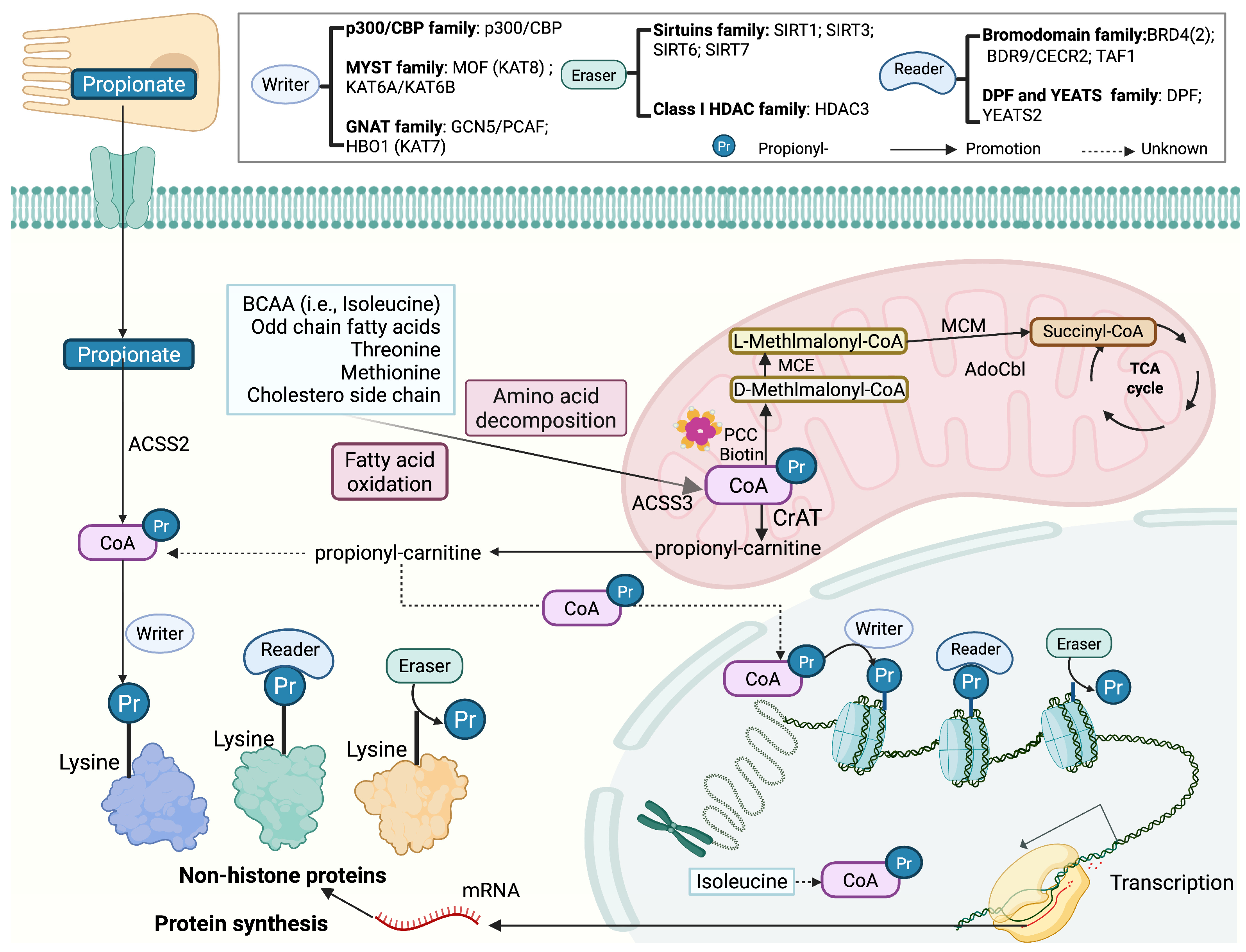
1.1. Sources and Metabolic Diversion of Propionyl-CoA
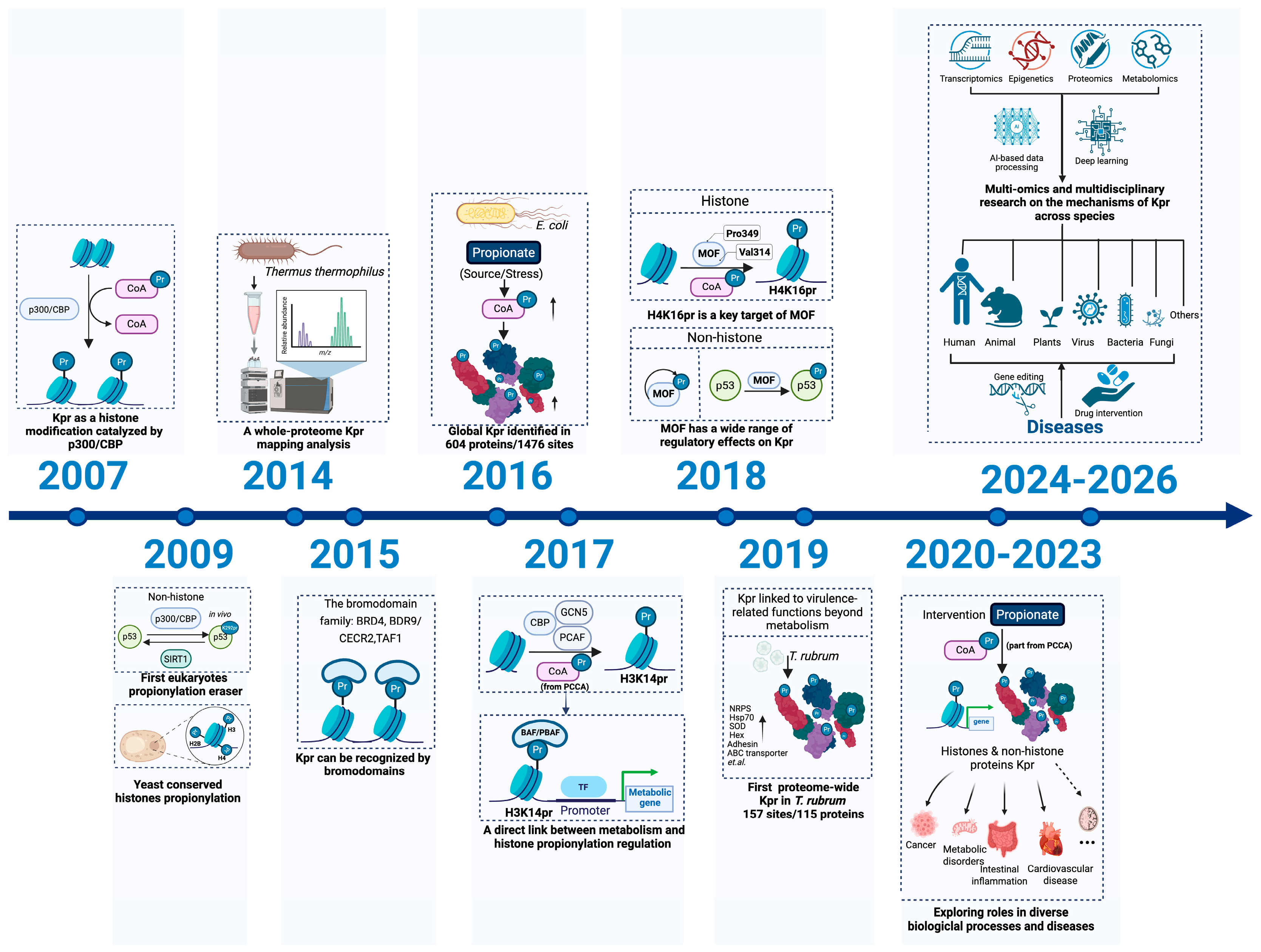
1.2. Historical Context and Key Advances in Lysine Propionylation Research
2. Mechanisms of Lysine Propionylation Regulation
2.1. The Writers of Kpr
2.2. The Erasers of Kpr
2.2.1. Sirtuin Family
2.2.2. Class I HDAC Family
2.3. The Readers of Kpr
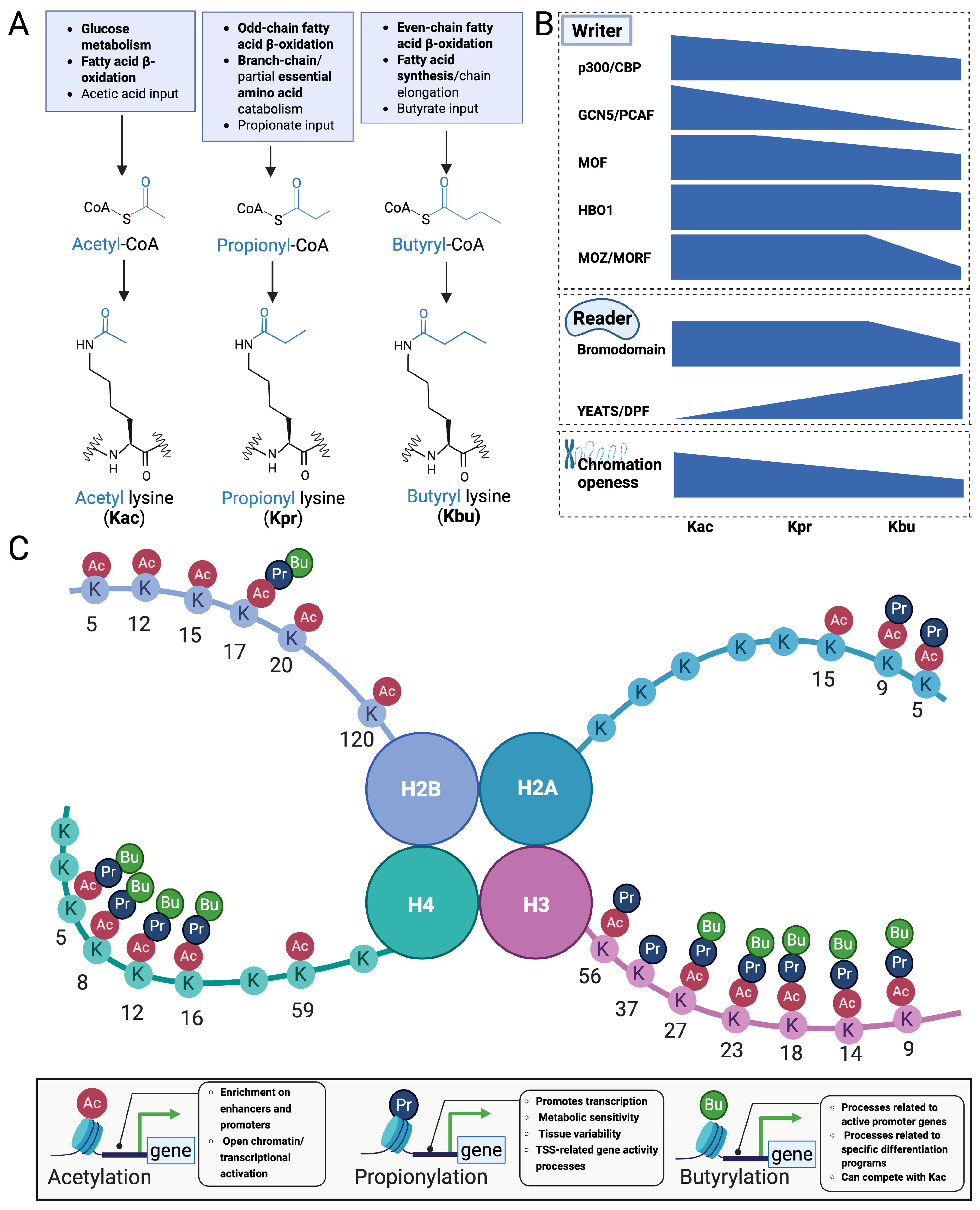
2.4. Multi-Level Comparison and Dynamic Interaction Between Kpr and Kac
2.4.1. Structural Differences and Recognition Specificity
2.4.2. Overlap and Independence of Modification Sites
2.4.3. Selective Catalysis and Removal by Enzyme Systems
2.4.4. Dynamic Regulation of the Metabolic Substrate Pool
2.4.5. Differences and Similarities Between Genomic Occupancy and Functional Output
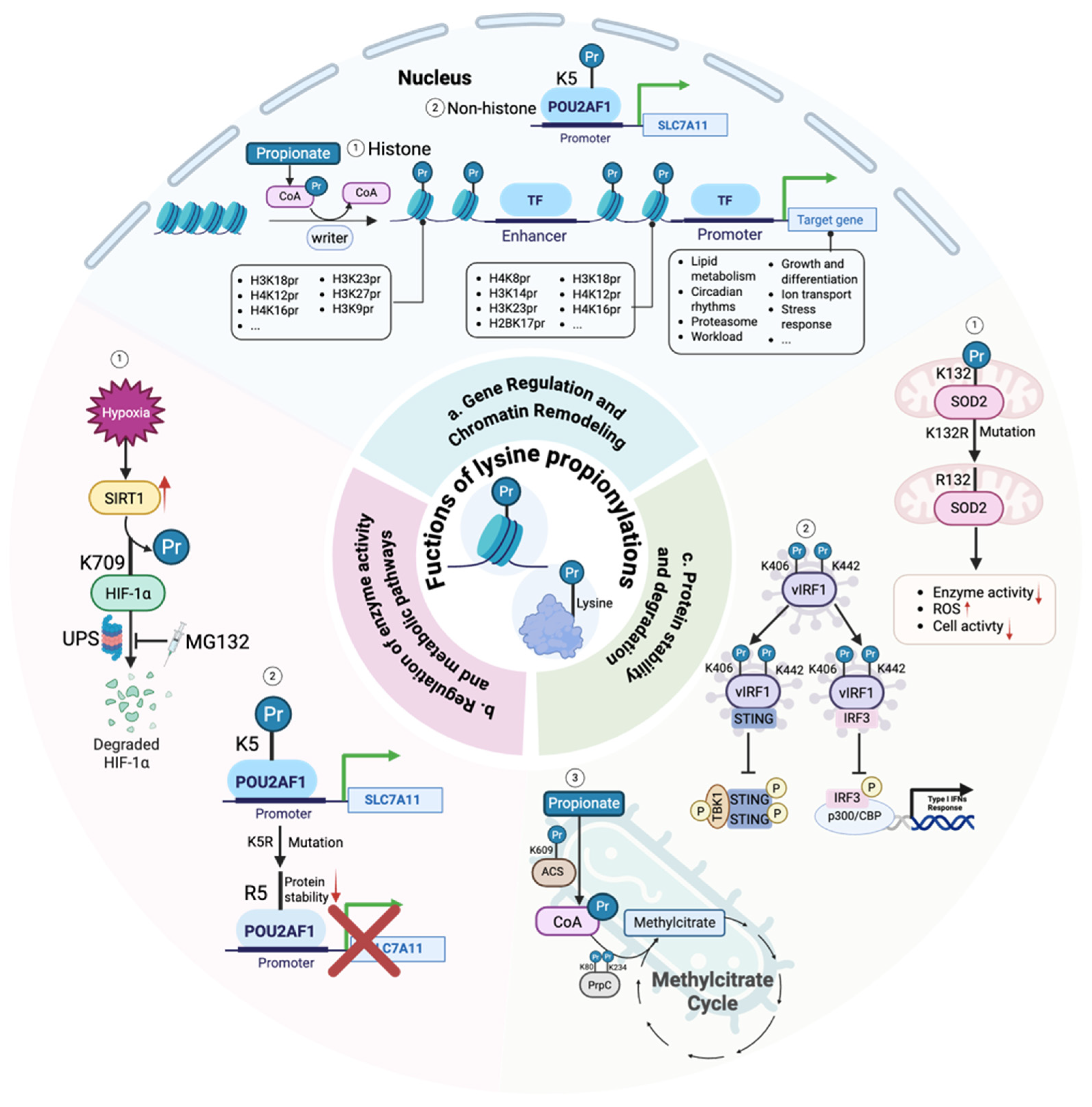
3. Functional Regulatory Mechanism of Propionylation
3.1. Gene Regulation and Chromatin Remodeling
3.2. Regulation of Enzyme Activity and Metabolic Pathways
3.3. Protein Stability and Degradation
4. Propionylation in Diseases: Associations, Mechanistic Insights, and Causal Inference
4.1. Propionylation in Metabolism-Related Diseases
4.2. Propionylation in Cancer
4.3. Propionylation in Cardiovascular Diseases
4.4. Propionylation in Neurodevelopmental Disorders
4.5. Disease Intervention Strategies Targeting Kpr
4.5.1. Direct Pharmacological Intervention Based on Targeted Modified Enzymes
4.5.2. Indirect Intervention Strategies Based on Metabolic Regulation
5. Conclusions
6. Outlook
Author Contributions
Funding
Institutional Review Board Statement
Informed Consent Statement
Data Availability Statement
Acknowledgments
Conflicts of Interest
Abbreviations
| ACSS | Short-chain member of the acyl-CoA synthase family |
| BAF/PBAF | BRG1/BRM-related factor/polybrominated BAF complex |
| BCAA | Branched-chain amino acids |
| BCAT1/2 | Branched-chain amino acid transaminases 1/2 |
| BCKDH | Branched-chain ketoate dehydrogenase complex |
| BRD4 | Bromodomain protein 4 |
| BRPF1 | Bromodomain and PHD finger domain protein 1 |
| CAR-T | Chimeric antigen receptor T cell |
| CBP | CREB-binding protein |
| ChIP-seq | Chromatin immunoprecipitation sequencing |
| CrAT | Carnitine O-acetyltransferase |
| DPF | Double PHD Hepatic domain |
| EHMT2 | Euchromatin histone lysine methyltransferase 2 |
| FRET | Fluorescence resonance energy transfer |
| GCN5 | Universally controlled non-repressor protein 5 |
| GPCR | G protein-coupled receptor |
| HBO1 | Histone acetyltransferase bound to ORC1 |
| HCC | Hepatocellular carcinoma |
| HDACs | Histone deacetylases |
| HECTD2 | HECT domain E3 ubiquitin ligase 2 |
| HIF-1α | Hypoxia-inducible factor 1α |
| Kac | Lysine acetylation |
| KAT | Lysine acetyltransferase |
| Kpr | Lysine propionylation |
| MOF | Male-deficient factor, also called KAT8 |
| mTOR | Mammalian target of rapamycin |
| MYOD | Myogenic differentiation protein |
| NAD+ | Nicotinamide adenine dinucleotide |
| NAFLD | Nonalcoholic fatty liver disease |
| PCAF | p300/CBP-related factor |
| PBRM1 | Polybromin 1 |
| PCCA | Propionyl-CoA carboxylase subunit α |
| PCCB | Propionyl-CoA carboxylase subunit β |
| PDAC | Pancreatic ductal adenocarcinoma |
| PDE9A | Phosphodiesterase 9A |
| Pr-CoA | Propionyl-CoA |
| ProCharTS | Time-resolved spectrophotometry for propionylation characterization |
| PTMs | Post-translational modifications of proteins |
| ROS | Reactive oxygen species |
| RUNX2 | Runt-related transcription factor 2 |
| SAHA | S-saturated aniline hydroxamic acid |
| SIRT1/3/6/7 | Silent signaling regulator 1/3/6/7 |
| SOD2 | Superoxide dismutase 2 |
| STING-TBK1-IRF3 | Interferon gene stimulating protein-tank-binding kinase 1-interferon regulatory factor 3 |
| T-ALL | T-cell acute lymphoblastic leukemia |
| TCA | Tricarboxylic acid cycle |
| TSA | Trichostatin A |
| VPA | Valproic acid |
| YEATS | Yaf9, ENL, AF9, Taf14, Sas5 domains |
References
- Sabari, B.R.; Zhang, D.; Allis, C.D.; Zhao, Y. Metabolic regulation of gene expression through histone acylations. Nat. Rev. Mol. Cell Biol. 2017, 18, 90–101. [Google Scholar] [CrossRef]
- Verma, A.; Lindroth, A.M. The emerging intertwined activities of metabolism and epigenetics unveils culprits and prospects in cancer. Exp. Mol. Med. 2025, 57, 1928–1939. [Google Scholar] [CrossRef]
- Sahu, V.; Lu, C. Metabolism-driven chromatin dynamics: Molecular principles and technological advances. Mol. Cell 2025, 85, 262–275. [Google Scholar] [CrossRef]
- Chen, Y.; Sprung, R.; Tang, Y.; Ball, H.; Sangras, B.; Kim, S.C.; Falck, J.R.; Peng, J.; Gu, W.; Zhao, Y. Lysine propionylation and butyrylation are novel post-translational modifications in histones. Mol. Cell. Proteom. 2007, 6, 812–819. [Google Scholar] [CrossRef] [PubMed]
- Jo, C.; Park, S.; Oh, S.; Choi, J.; Kim, E.K.; Youn, H.D.; Cho, E.J. Histone acylation marks respond to metabolic perturbations and enable cellular adaptation. Exp. Mol. Med. 2020, 52, 2005–2019. [Google Scholar] [CrossRef]
- Trefely, S.; Huber, K.; Liu, J.; Noji, M.; Stransky, S.; Singh, J.; Doan, M.T.; Lovell, C.D.; von Krusenstiern, E.; Jiang, H.; et al. Quantitative subcellular acyl-CoA analysis reveals distinct nuclear metabolism and isoleucine-dependent histone propionylation. Mol. Cell 2022, 82, 447–462.E6. [Google Scholar] [CrossRef]
- Vai, A.; Noberini, R.; Ghirardi, C.; Rodrigues de Paula, D.; Carminati, M.; Pallavi, R.; Araújo, N.; Varga-Weisz, P.; Bonaldi, T. Improved Mass Spectrometry-Based Methods Reveal Abundant Propionylation and Tissue-Specific Histone Propionylation Profiles. Mol. Cell. Proteom. 2024, 23, 100799. [Google Scholar] [CrossRef]
- Nshanian, M.; Gruber, J.J.; Geller, B.S.; Chleilat, F.; Lancaster, S.M.; White, S.M.; Alexandrova, L.; Camarillo, J.M.; Kelleher, N.L.; Zhao, Y.; et al. Short-chain fatty acid metabolites propionate and butyrate are unique epigenetic regulatory elements linking diet, metabolism and gene expression. Nat. Metab. 2025, 7, 196–211. [Google Scholar] [CrossRef] [PubMed]
- Nitsch, S.; Coraor, A.E.; Schauer, T.; Wu, Y.; Sun, J.; Möritz, N.; Funke, J.; Nagpal, H.; Chua, G.N.L.; Battistini, F.; et al. H4K16 acylations destabilize chromatin architecture and facilitate transcriptional response during metabolic perturbations. Mol. Cell 2026, 86, 24–40.e10. [Google Scholar] [CrossRef]
- Fu, J.; Zheng, Y.; Gao, Y.; Xu, W. Dietary Fiber Intake and Gut Microbiota in Human Health. Microorganisms 2022, 10, 2507. [Google Scholar] [CrossRef] [PubMed]
- Wongkittichote, P.; Ah Mew, N.; Chapman, K.A. Propionyl-CoA carboxylase—A review. Mol. Genet. Metab. 2017, 122, 145–152. [Google Scholar] [CrossRef] [PubMed]
- Crown, S.B.; Marze, N.; Antoniewicz, M.R. Catabolism of Branched Chain Amino Acids Contributes Significantly to Synthesis of Odd-Chain and Even-Chain Fatty Acids in 3T3-L1 Adipocytes. PLoS ONE 2015, 10, e0145850. [Google Scholar] [CrossRef] [PubMed]
- Demetriadou, C.; Noji, M.; Good, A.L.; Mitchell-Velasquez, E.; Venkatesh, S.; Kantner, D.S.; Pennise, J.; Costa-Pinheiro, P.; Pinheiro, L.V.; Harada, T.; et al. A nuclear branched-chain amino acid catabolism pathway controls histone propionylation in pancreatic cancer. bioRxiv 2025. [Google Scholar] [CrossRef]
- Yang, Z.; He, M.; Austin, J.; Sayed, D.; Abdellatif, M. Reducing branched-chain amino acids improves cardiac stress response in mice by decreasing histone H3K23 propionylation. J. Clin. Investig. 2023, 133, e169399. [Google Scholar] [CrossRef]
- Meert, P.; Govaert, E.; Scheerlinck, E.; Dhaenens, M.; Deforce, D. Pitfalls in histone propionylation during bottom-up mass spectrometry analysis. Proteomics 2015, 15, 2966–2971. [Google Scholar] [CrossRef]
- Paternoster, V.; Edhager, A.V.; Sibbersen, C.; Nielsen, A.L.; Børglum, A.D.; Christensen, J.H.; Palmfeldt, J. Quantitative assessment of methyl-esterification and other side reactions in a standard propionylation protocol for detection of histone modifications. Proteomics 2016, 16, 2059–2063. [Google Scholar] [CrossRef]
- Kuchaříková, H.; Dobrovolná, P.; Lochmanová, G.; Zdráhal, Z. Trimethylacetic Anhydride-Based Derivatization Facilitates Quantification of Histone Marks at the MS1 Level. Mol. Cell. Proteom. 2021, 20, 100114. [Google Scholar] [CrossRef]
- Cheng, Z.; Tang, Y.; Chen, Y.; Kim, S.; Liu, H.; Li, S.S.; Gu, W.; Zhao, Y. Molecular characterization of propionyllysines in non-histone proteins. Mol. Cell. Proteom. 2009, 8, 45–52. [Google Scholar] [CrossRef]
- Liu, B.; Lin, Y.; Darwanto, A.; Song, X.; Xu, G.; Zhang, K. Identification and characterization of propionylation at histone H3 lysine 23 in mammalian cells. J. Biol. Chem. 2009, 284, 32288–32295. [Google Scholar] [CrossRef]
- Zhang, K.; Chen, Y.; Zhang, Z.; Zhao, Y. Identification and verification of lysine propionylation and butyrylation in yeast core histones using PTMap software. J. Proteome Res. 2009, 8, 900–906. [Google Scholar] [CrossRef] [PubMed]
- Okanishi, H.; Kim, K.; Masui, R.; Kuramitsu, S. Lysine propionylation is a prevalent post-translational modification in Thermus thermophilus. Mol. Cell. Proteom. 2014, 13, 2382–2398. [Google Scholar] [CrossRef]
- Flynn, E.M.; Huang, O.W.; Poy, F.; Oppikofer, M.; Bellon, S.F.; Tang, Y.; Cochran, A.G. A Subset of Human Bromodomains Recognizes Butyryllysine and Crotonyllysine Histone Peptide Modifications. Structure 2015, 23, 1801–1814. [Google Scholar] [CrossRef]
- Sun, M.; Xu, J.; Wu, Z.; Zhai, L.; Liu, C.; Cheng, Z.; Xu, G.; Tao, S.; Ye, B.C.; Zhao, Y.; et al. Characterization of Protein Lysine Propionylation in Escherichia coli: Global Profiling, Dynamic Change, and Enzymatic Regulation. J. Proteome Res. 2016, 15, 4696–4708. [Google Scholar] [CrossRef] [PubMed]
- Kebede, A.F.; Nieborak, A.; Shahidian, L.Z.; Le Gras, S.; Richter, F.; Gómez, D.A.; Baltissen, M.P.; Meszaros, G.; Magliarelli, H.F.; Taudt, A.; et al. Histone propionylation is a mark of active chromatin. Nat. Struct. Mol. Biol. 2017, 24, 1048–1056. [Google Scholar] [CrossRef] [PubMed]
- Han, Z.; Wu, H.; Kim, S.; Yang, X.; Li, Q.; Huang, H.; Cai, H.; Bartlett, M.G.; Dong, A.; Zeng, H.; et al. Revealing the protein propionylation activity of the histone acetyltransferase MOF (males absent on the first). J. Biol. Chem. 2018, 293, 3410–3420. [Google Scholar] [CrossRef] [PubMed]
- Li, L.; Ghorbani, M.; Weisz-Hubshman, M.; Rousseau, J.; Thiffault, I.; Schnur, R.E.; Breen, C.; Oegema, R.; Weiss, M.M.; Waisfisz, Q.; et al. Lysine acetyltransferase 8 is involved in cerebral development and syndromic intellectual disability. J. Clin. Investig. 2020, 130, 1431–1445. [Google Scholar] [CrossRef]
- Xu, X.; Cao, X.; Yang, J.; Chen, L.; Liu, B.; Liu, T.; Jin, Q. Proteome-Wide Identification of Lysine Propionylation in the Conidial and Mycelial Stages of Trichophyton rubrum. Front. Microbiol. 2019, 10, 2613. [Google Scholar] [CrossRef]
- Xu, X.; Hu, X.; Dong, J.; Xue, Y.; Liu, T.; Jin, Q. Proteome-Wide Identification and Functional Analysis of Lysine Crotonylation in Trichophyton rubrum Conidial and Mycelial Stages. Front. Genet. 2022, 13, 832668. [Google Scholar] [CrossRef]
- Yang, M.; Huang, H.; Ge, F. Lysine Propionylation is a Widespread Post-Translational Modification Involved in Regulation of Photosynthesis and Metabolism in Cyanobacteria. Int. J. Mol. Sci. 2019, 20, 4792. [Google Scholar] [CrossRef]
- Ding, Q.; Zhang, Z.; Li, Y.; Liu, H.; Hao, Q.; Yang, Y.; Ringø, E.; Olsen, R.E.; Clarke, J.L.; Ran, C.; et al. Propionate induces intestinal oxidative stress via Sod2 propionylation in zebrafish. iScience 2021, 24, 102515. [Google Scholar] [CrossRef]
- Lagerwaard, B.; Pougovkina, O.; Bekebrede, A.F.; Te Brinke, H.; Wanders, R.J.A.; Nieuwenhuizen, A.G.; Keijer, J.; de Boer, V.C.J. Increased protein propionylation contributes to mitochondrial dysfunction in liver cells and fibroblasts, but not in myotubes. J. Inherit. Metab. Dis. 2021, 44, 438–449. [Google Scholar] [CrossRef]
- Lagerwaard, B.; van der Hoek, M.D.; Hoeks, J.; Grevendonk, L.; Nieuwenhuizen, A.G.; Keijer, J.; de Boer, V.C.J. Propionate hampers differentiation and modifies histone propionylation and acetylation in skeletal muscle cells. Mech. Ageing Dev. 2021, 196, 111495. [Google Scholar] [CrossRef] [PubMed]
- Park, K.C.; Crump, N.T.; Louwman, N.; Krywawych, S.; Cheong, Y.J.; Vendrell, I.; Gill, E.K.; Gunadasa-Rohling, M.; Ford, K.L.; Hauton, D.; et al. Disrupted propionate metabolism evokes transcriptional changes in the heart by increasing histone acetylation and propionylation. Nat. Cardiovasc. Res. 2023, 2, 1221–1245. [Google Scholar] [CrossRef]
- Shui, K.; Wang, C.; Zhang, X.; Ma, S.; Li, Q.; Ning, W.; Zhang, W.; Chen, M.; Peng, D.; Hu, H.; et al. Small-sample learning reveals propionylation in determining global protein homeostasis. Nat. Commun. 2023, 14, 2813. [Google Scholar] [CrossRef]
- Demetriadou, C.; Kantner, D.S.; Snyder, N.W. Dietary branched-chain amino acids get to the heart of H3K23Pr. J. Clin. Investig. 2023, 133, e174953. [Google Scholar] [CrossRef]
- Zhou, B.; Luo, Y.; Bi, H.; Zhang, N.; Ma, M.; Dong, Z.; Ji, N.; Zhang, S.; Wang, X.; Liu, Y.; et al. Amelioration of nonalcoholic fatty liver disease by inhibiting the deubiquitylating enzyme RPN11. Cell Metab. 2024, 36, 2228–2244.e7. [Google Scholar] [CrossRef] [PubMed]
- Smolko, A.E.; Sullivan, D.W.; Olsen, S.N.; Kang, H.; Whedon, S.D.; Baell, J.B.; Cole, P.A.; Armstrong, S.A.; Kuroda, M.I. A MOZ-TIF2 leukemia mouse model displays KAT6-dependent H3K23 propionylation and overexpression of a set of active developmental genes. Proc. Natl. Acad. Sci. USA 2024, 121, e2405905121. [Google Scholar] [CrossRef]
- Chen, J.; Li, W.; Wang, S.; Li, J.; Zhao, L.; Ao, X.; Wang, W.; Zhu, L.; Rao, H.; Xu, S.; et al. Sodium valproate drives propionylation-mediated epigenetic reprogramming to enhance mesothelin CAR-T cell therapy in solid tumors. Mol. Ther. 2026, 34, 1448–1464. [Google Scholar] [CrossRef]
- Zhang, L.; Yang, Y.; Yuan, W.; Dai, Z.; Li, L.; Sun, Z.; Shao, C.; Zang, G.; Qian, Y.; Wang, Z. Vascular Smooth Muscle Cell-Specific BCAT2 Deficiency Attenuates Diabetic Atherosclerotic Calcification via Histone Propionylation. Research 2026, 9, 1052. [Google Scholar] [CrossRef]
- Simithy, J.; Sidoli, S.; Yuan, Z.F.; Coradin, M.; Bhanu, N.V.; Marchione, D.M.; Klein, B.J.; Bazilevsky, G.A.; McCullough, C.E.; Magin, R.S.; et al. Characterization of histone acylations links chromatin modifications with metabolism. Nat. Commun. 2017, 8, 1141. [Google Scholar] [CrossRef] [PubMed]
- Kaczmarska, Z.; Ortega, E.; Goudarzi, A.; Huang, H.; Kim, S.; Márquez, J.A.; Zhao, Y.; Khochbin, S.; Panne, D. Structure of p300 in complex with acyl-CoA variants. Nat. Chem. Biol. 2017, 13, 21–29. [Google Scholar] [CrossRef]
- Jeong, K.; Choi, J.; Choi, A.; Shim, J.; Kim, Y.A.; Oh, C.; Youn, H.D.; Cho, E.J. Determination of HIF-1α degradation pathways via modulation of the propionyl mark. BMB Rep. 2023, 56, 252–257. [Google Scholar] [CrossRef]
- Cui, G.; Ley, M.; Mechaly, A.E.; Bui, L.C.; Michail, C.; Berthelet, J.; Dairou, J.; Yang, H.; Chevreux, G.; Moroy, G.; et al. Structural and functional characterization of CREB-binding protein (CREBBP) as a histone propionyltransferase. J. Biol. Chem. 2025, 301, 110444. [Google Scholar] [CrossRef] [PubMed]
- Yan, K.; Rousseau, J.; Machol, K.; Cross, L.A.; Agre, K.E.; Gibson, C.F.; Goverde, A.; Engleman, K.L.; Verdin, H.; De Baere, E.; et al. Deficient histone H3 propionylation by BRPF1-KAT6 complexes in neurodevelopmental disorders and cancer. Sci. Adv. 2020, 6, eaax0021. [Google Scholar] [CrossRef] [PubMed]
- Klein, B.J.; Simithy, J.; Wang, X.; Ahn, J.; Andrews, F.H.; Zhang, Y.; Côté, J.; Shi, X.; Garcia, B.A.; Kutateladze, T.G. Recognition of Histone H3K14 Acylation by MORF. Structure 2017, 25, 650–654.e652. [Google Scholar] [CrossRef]
- Xiao, Y.; Li, W.; Yang, H.; Pan, L.; Zhang, L.; Lu, L.; Chen, J.; Wei, W.; Ye, J.; Li, J.; et al. HBO1 is a versatile histone acyltransferase critical for promoter histone acylations. Nucleic Acids Res. 2021, 49, 8037–8059. [Google Scholar] [CrossRef] [PubMed]
- Garrity, J.; Gardner, J.G.; Hawse, W.; Wolberger, C.; Escalante-Semerena, J.C. N-lysine propionylation controls the activity of propionyl-CoA synthetase. J. Biol. Chem. 2007, 282, 30239–30245. [Google Scholar] [CrossRef]
- Lin, J.; Li, Q.; Liu, X.; Zhan, J.; Yuan, L.; Yang, M.; Ge, F. The role of CddA and cGNAT2 in crotonylation of proteins in cyanobacteria. New Phytol. 2025, 247, 2270–2292. [Google Scholar] [CrossRef]
- Leemhuis, H.; Packman, L.C.; Nightingale, K.P.; Hollfelder, F. The human histone acetyltransferase P/CAF is a promiscuous histone propionyltransferase. Chembiochem 2008, 9, 499–503. [Google Scholar] [CrossRef]
- Ringel, A.E.; Wolberger, C. Structural basis for acyl-group discrimination by human Gcn5L2. Acta Crystallogr. Sect. D Struct. Biol. 2016, 72, 841–848. [Google Scholar] [CrossRef]
- Shi, J.; Jia, X.; He, Y.; Ma, X.; Qi, X.; Li, W.; Gao, S.J.; Yan, Q.; Lu, C. Immune evasion strategy involving propionylation by the KSHV interferon regulatory factor 1 (vIRF1). PLoS Pathog. 2023, 19, e1011324. [Google Scholar] [CrossRef]
- Kibria, M.G.; Yoshizawa, T.; Zhang, T.; Ono, K.; Mizumoto, T.; Sato, Y.; Sawa, T.; Yamagata, K. SIRT7 Is a Lysine Deacylase with a Preference for Depropionylation and Demyristoylation. Int. J. Mol. Sci. 2025, 26, 3153. [Google Scholar] [CrossRef]
- Moreno-Yruela, C.; Zhang, D.; Wei, W.; Bæk, M.; Liu, W.; Gao, J.; Danková, D.; Nielsen, A.L.; Bolding, J.E.; Yang, L.; et al. Class I histone deacetylases (HDAC1-3) are histone lysine delactylases. Sci. Adv. 2022, 8, eabi6696. [Google Scholar] [CrossRef]
- Vollmuth, F.; Geyer, M. Interaction of propionylated and butyrylated histone H3 lysine marks with Brd4 bromodomains. Angew. Chem. Int. Ed. Engl. 2010, 49, 6768–6772. [Google Scholar] [CrossRef]
- Xiong, X.; Panchenko, T.; Yang, S.; Zhao, S.; Yan, P.; Zhang, W.; Xie, W.; Li, Y.; Zhao, Y.; Allis, C.D.; et al. Selective recognition of histone crotonylation by double PHD fingers of MOZ and DPF2. Nat. Chem. Biol. 2016, 12, 1111–1118. [Google Scholar] [CrossRef] [PubMed]
- Zhao, D.; Guan, H.; Zhao, S.; Mi, W.; Wen, H.; Li, Y.; Zhao, Y.; Allis, C.D.; Shi, X.; Li, H. YEATS2 is a selective histone crotonylation reader. Cell Res. 2016, 26, 629–632. [Google Scholar] [CrossRef]
- Shi, H.; Cui, W.; Qin, Y.; Chen, L.; Yu, T.; Lv, J. A glimpse into novel acylations and their emerging role in regulating cancer metastasis. Cell. Mol. Life Sci. 2024, 81, 76. [Google Scholar] [CrossRef] [PubMed]
- Anmangandla, A.; Ren, Y.; Fu, Q.; Zhang, S.; Lin, H. The Acyl-CoA Specificity of Human Lysine Acetyltransferase KAT2A. Biochemistry 2022, 61, 1874–1882. [Google Scholar] [CrossRef]
- Bheda, P.; Wang, J.T.; Escalante-Semerena, J.C.; Wolberger, C. Structure of Sir2Tm bound to a propionylated peptide. Protein Sci. 2011, 20, 131–139. [Google Scholar] [CrossRef]
- Gates, L.A.; Reis, B.S.; Lund, P.J.; Paul, M.R.; Leboeuf, M.; Djomo, A.M.; Nadeem, Z.; Lopes, M.; Vitorino, F.N.; Unlu, G.; et al. Histone butyrylation in the mouse intestine is mediated by the microbiota and associated with regulation of gene expression. Nat. Metab. 2024, 6, 697–707. [Google Scholar] [CrossRef] [PubMed]
- Ryu, T.Y.; Kim, K.; Han, T.S.; Lee, M.O.; Lee, J.; Choi, J.; Jung, K.B.; Jeong, E.J.; An, D.M.; Jung, C.R.; et al. Human gut-microbiome-derived propionate coordinates proteasomal degradation via HECTD2 upregulation to target EHMT2 in colorectal cancer. ISME J. 2022, 16, 1205–1221. [Google Scholar] [CrossRef]
- Zheng, J.-K.; Dan, S.; Xu, Y.; He, X.; Liu, H.; Zhao, L.; Cao, L.; Qu, B.; Lu, Y.; Chen, C. BCAA catabolism mediates POU2AF1 propionylation to enhance T-ALL development. Res. Sq. 2025. [Google Scholar] [CrossRef]
- Jia, Z.; Chen, X.; Chen, J.; Zhang, L.; Oprescu, S.N.; Luo, N.; Xiong, Y.; Yue, F.; Kuang, S. ACSS3 in brown fat drives propionate catabolism and its deficiency leads to autophagy and systemic metabolic dysfunction. Clin. Transl. Med. 2022, 12, e665. [Google Scholar] [CrossRef]
- Sun, J.; Ding, J.; Shen, Q.; Wang, X.; Wang, M.; Huang, Y.; Zhang, X.; Zhu, H.; Zhang, F.; Wu, D.; et al. Decreased propionyl-CoA metabolism facilitates metabolic reprogramming and promotes hepatocellular carcinoma. J. Hepatol. 2023, 78, 627–642. [Google Scholar] [CrossRef] [PubMed]
- Povero, D. Novel oncometabolites and metabolic checkpoints involved in hepatocellular carcinoma development. J. Hepatol. 2023, 78, 463–466. [Google Scholar] [CrossRef] [PubMed]
- Zhang, Y.; Chen, H.X.; Hou, H.T.; Liu, Y.Q.; Chen, Z.; Yang, Q.; He, G.W. Atlas of lysine propionylation of human right atrium and ALDH6A1-NADH pathway in new-onset atrial fibrillation after coronary surgery. Commun. Biol. 2025, 8, 858. [Google Scholar] [CrossRef] [PubMed]




| Level | Kpr | Kac | Key Readouts | Source |
|---|---|---|---|---|
| Chemical properties | One extra methylene; bulkier, more hydrophobic | Shorter acyl; smaller, less hydrophobic | Physicochemical shift enables differential recognition | [1] |
| Reader specificity | Higher affinity for YEATS domains | Higher affinity for BRD4 BET bromodomain | BRD4 prefers Kac; YEATS prefers Kpr | [57] |
| Co-enriched modules | Ribosome proteins co-enriched with Kac, succinylation | Ribosome proteins co-enriched with Kpr, succinylation | Suggests dense cross-regulatory acylation hotspots | [28] |
| Site overlap | Most Kpr sites lack Kac | Most Kac sites lack Kpr | Kpr ∩ Kac 19.5%; Kac ∩ Kpr 35%. Note: potential technical limitations | [21] |
| Nutrient-stress independence | Ile/Val deprivation lowers H3K23pr, H3K18pr, H4K16pr | Corresponding acetylation unchanged at those sites | Decoupling supports independent regulation | [13] |
| Substrate-driven bias | Propionate preferentially increases H3K23pr | H3K23ac not preferentially increased | Substrate pool shifts site-specific marking | [44] |
| Writer kinetics and efficiency | p300 writes Kpr about threefold slower | p300 writes Kac faster | KAT2A: H3K9pr 4% vs. H3K9ac 30% | [41,58] |
| Writer donor permissiveness | HBO1–BRPF2 binds propionyl-CoA similarly to acetyl-CoA | HBO1–BRPF2 binds acetyl-CoA similarly to propionyl-CoA | Permissive pocket couples donor ratios to marks | [46] |
| Eraser selectivity | Sir2Tm binds Kpr stronger; turnover slightly lower | Sir2Tm binds Kac weaker; turnover slightly higher | Product release kinetics shape steady-state levels | [59] |
| Acyl-CoA availability | Lower in whole liver; in nucleus can approach acetyl-CoA | Higher in whole liver; nuclear dominance; reduced under stress | Fasted liver 20:1; nuclear near 1:1 | [6,18,41,42] |
| Global balance and competition | Propionate raises global Kpr; enriches propionate-metabolism pathways | Often inversely changes at dual-modified sites | 119 sites carry both; opposite nutrient responses | [23] |
| Ratio-based chromatin tuning | Shared readers allow tuning via propionyl-CoA fraction | Shared readers allow tuning via acetyl-CoA abundance | Acyl-CoA ratio may modulate transcription | [24] |
| Genomic occupancy | Propionate shifts differential peaks toward H3K18pr | H3K18ac contributes fewer differential peaks | Co-localizes with H3K27ac; rhythmic patterns differ | [8,34] |
| Functional outputs and synergy | Propionate-associated Kpr correlates with reduced total protein | Co-varies with Kpr and Kbu at H4K16 | H4K16 Kac/Kpr/Kbu co-exist; support transcriptional robustness | [9,34] |
| Drug Name | Intervention Drug | Mode of Action | Direct/Indirect | Disease Type | Source |
|---|---|---|---|---|---|
| C646 | C646 | p300/CBP inhibition | Direct | Experimental model, histone Kpr regulation | [32,34] |
| A485 | A485 | p300/CBP inhibition | Direct | Model context, histone Kpr regulation | [32,34] |
| MG149 | MG149 | TIP60/MOF inhibition | Direct | Drosophila model, histone Kpr regulation | [34] |
| VPA | Valproic acid | HDAC inhibition; converted to propionyl-CoA | Direct | Solid-tumor CAR-T enhancement; global Kpr modulation | [38] |
| TSA | Trichostatin A | HDAC inhibition | Direct | Global Kpr modulation | [38] |
| SAHA | SAHA | HDAC inhibition | Direct | Global Kpr modulation | [38] |
| UBCS039 | UBCS039 | SIRT6 activation | Direct | KSHV infection, antiviral immunity | [51] |
| Propionate | Propionate | Increases propionyl-CoA supply | Indirect | Diet-linked epigenetic regulation | [32,44] |
| Dietary fiber fermentation | Dietary fiber | Raises propionyl-CoA via fermentation | Indirect | Diet-linked epigenetic regulation | [44] |
| Dietary isoleucine | Isoleucine | Alters nuclear propionyl-CoA via BCAA catabolism | Indirect | Stress-induced cardiac remodeling | [35] |
| Capzimin | Capzimin | RPN11 inhibition | Indirect | NAFLD | [36] |
| Gabapentin | Gabapentin | BCAT1-pathway suppression | Indirect | T-ALL | [62] |
| Low-BCAA diet + PD-1 blockade | Low-BCAA diet + PD-1 blockade | Limits BCAA-derived propionyl groups; immunotherapy synergy | Indirect | T-ALL | [62] |
Disclaimer/Publisher’s Note: The statements, opinions and data contained in all publications are solely those of the individual author(s) and contributor(s) and not of MDPI and/or the editor(s). MDPI and/or the editor(s) disclaim responsibility for any injury to people or property resulting from any ideas, methods, instructions or products referred to in the content. |
© 2026 by the authors. Licensee MDPI, Basel, Switzerland. This article is an open access article distributed under the terms and conditions of the Creative Commons Attribution (CC BY) license.
Share and Cite
Liu, Z.; Wang, X.; Li, L. Lysine Propionylation as a Metabolically Coupled PTM: Mechanisms, Functional Consequences, and Therapeutic Potentials. Int. J. Mol. Sci. 2026, 27, 2937. https://doi.org/10.3390/ijms27072937
Liu Z, Wang X, Li L. Lysine Propionylation as a Metabolically Coupled PTM: Mechanisms, Functional Consequences, and Therapeutic Potentials. International Journal of Molecular Sciences. 2026; 27(7):2937. https://doi.org/10.3390/ijms27072937
Chicago/Turabian StyleLiu, Zhuofan, Xiaoqiang Wang, and Lin Li. 2026. "Lysine Propionylation as a Metabolically Coupled PTM: Mechanisms, Functional Consequences, and Therapeutic Potentials" International Journal of Molecular Sciences 27, no. 7: 2937. https://doi.org/10.3390/ijms27072937
APA StyleLiu, Z., Wang, X., & Li, L. (2026). Lysine Propionylation as a Metabolically Coupled PTM: Mechanisms, Functional Consequences, and Therapeutic Potentials. International Journal of Molecular Sciences, 27(7), 2937. https://doi.org/10.3390/ijms27072937