Review of the Pathology of Muscle in Amyotrophic Lateral Sclerosis
 , ,
, ,  , ,
, ,
Abstract
1. Introduction
2. Overview of Skeletal Muscle Structure and Fiber Types
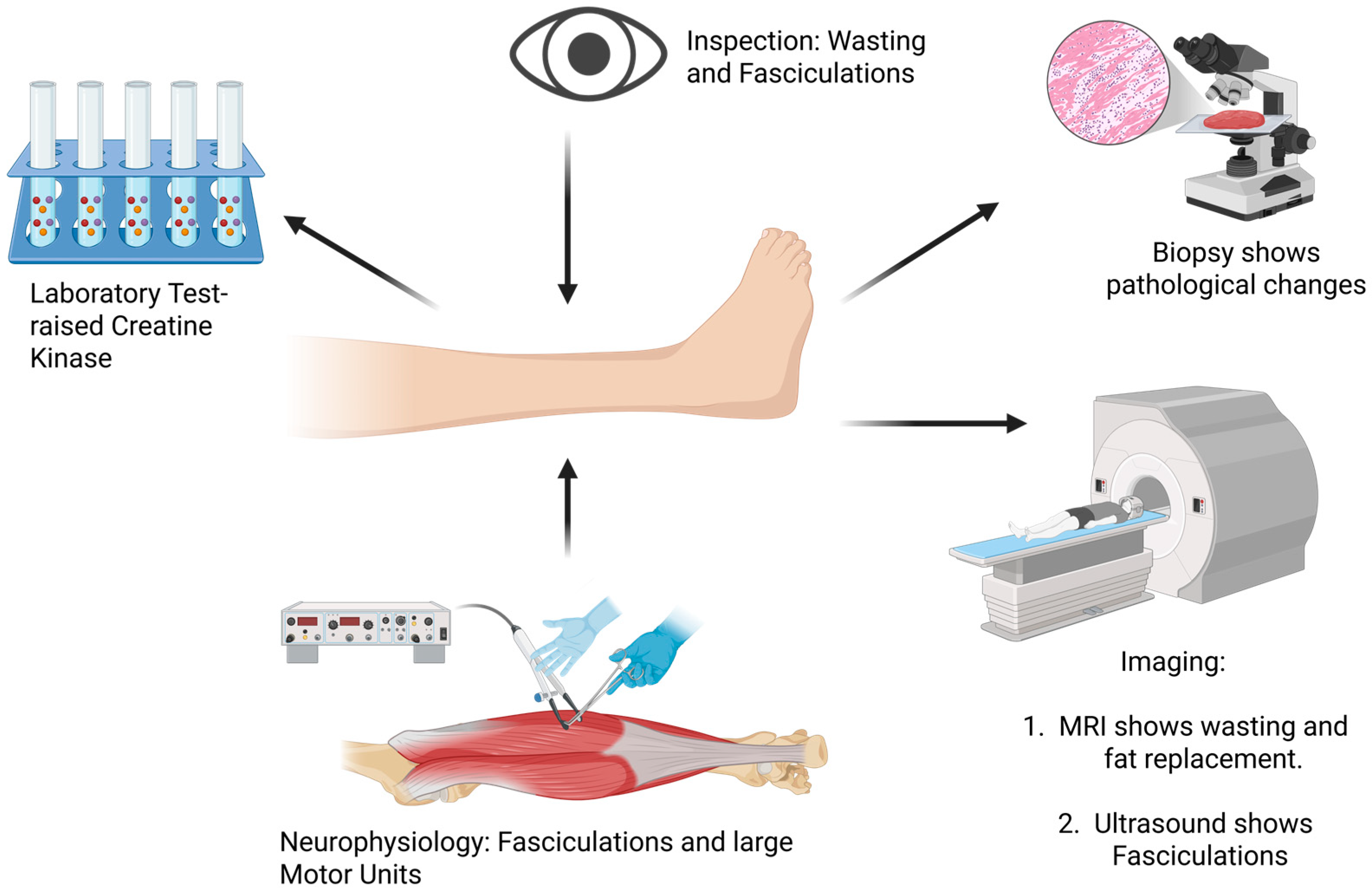
3. Clinical and Biomarker Changes in Muscle in ALS
4. Histological Changes in Muscle in ALS
4.1. Morphological Changes
4.2. Changes in Fiber Type
4.3. Inflammation in Muscle
4.4. Expression of Abnormal Proteins in ALS Muscle
4.5. Mitochondria in ALS Muscle
4.6. Replacement of Muscle with Fat
4.7. Neuromuscular Junction in ALS
4.8. Satellite Cells in ALS
5. Metabolic and Molecular Changes
5.1. Metabolic Reprogramming
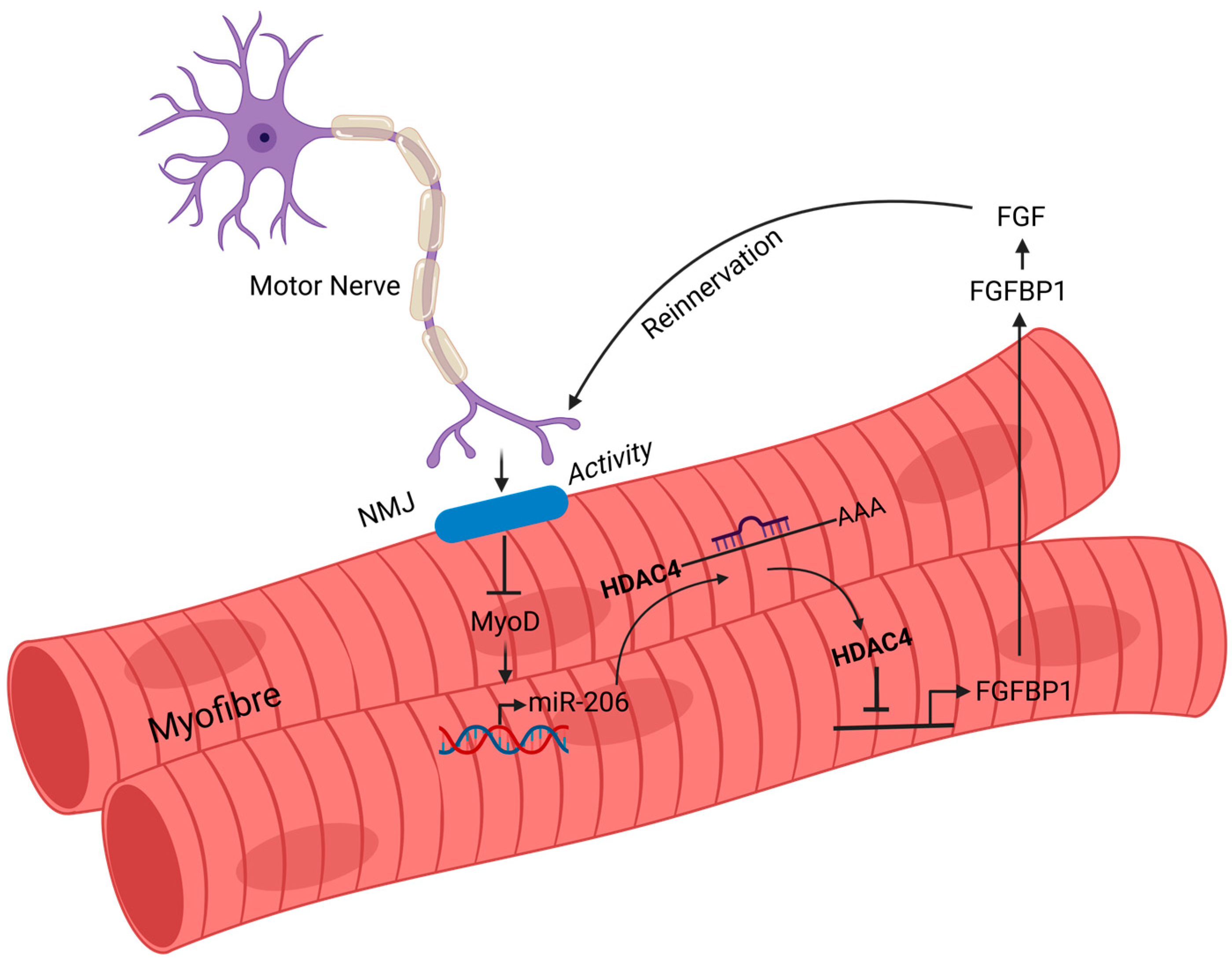
5.2. Myokines, Neurotrophins and Muscle Growth Factors
5.3. Gene/microRNA Expression
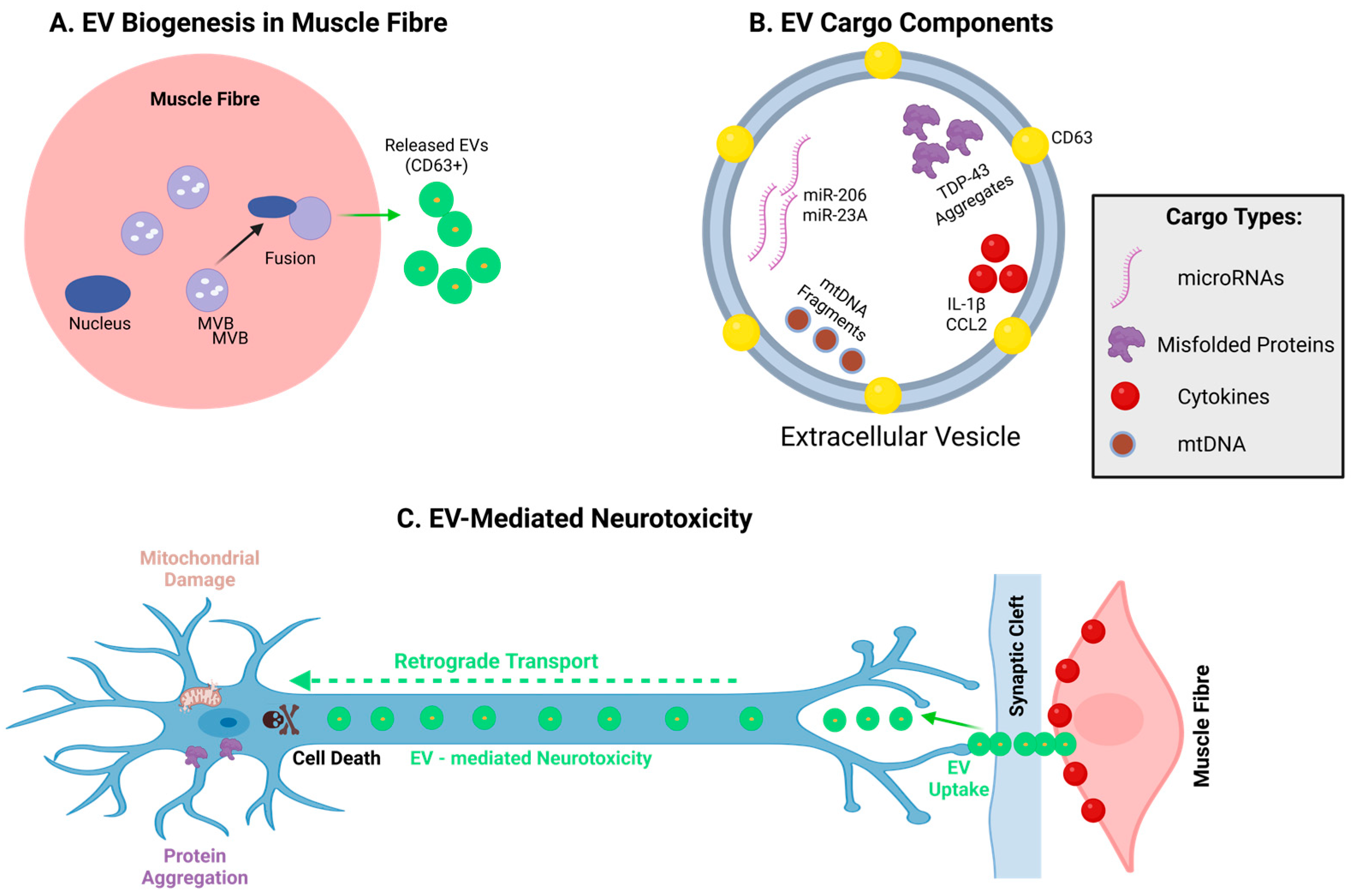
5.4. Extracellular Vesicles
5.5. ALS Modeling Using Neuromuscular Organoids and ALS Proteomics
6. Conclusions
Author Contributions
Funding
Data Availability Statement
Conflicts of Interest
Abbreviations
| AChRs | acetyl choline receptors |
| AMPK | AMP-activated protein kinase |
| ATP | adenosine triphosphate |
| α-MNs | alpha-motor neurons |
| ALS | amyotrophic lateral sclerosis |
| C5aR1 | C5a receptor 1 |
| CK | creatine kinase |
| EMG | electromyography |
| EOMs | extraocular muscles |
| EVs | extracellular vesicles |
| FF | fast fatigable |
| FR | fast fatigable resistant |
| FGFBP1 | fibroblast growth factor binding protein 1 |
| FGF21 | fibroblast growth factor 21 |
| IGF-2 | insulin-like growth factor 2 |
| MUNE | motor unit number estimation |
| MuSK | muscle specific tyrosine kinase |
| MRFs | myogenic regulatory factors |
| MHC | myosin heavy chain |
| NFAT | nuclear factor of activated T cells |
| NMJ | neuromuscular junction |
| PGC1α | peroxisome proliferator-activated receptor-gamma coactivator-1 alpha |
| PDK4 | pyruvate dehydrogenase kinase 4 |
| Ref. | references |
| SR | sarcoplasmic reticulum |
| SIRT1 | sirtuin 1 |
| SOD1 | superoxide dismutase 1 |
| TDP-43 | tar DNA binding protein 43 |
References
- Tandan, R.; Bradley, W.G. Amyotrophic lateral sclerosis: Part 1. Clinical features, pathology, and ethical issues in management. Ann. Neurol. 1985, 18, 271–280. [Google Scholar] [CrossRef]
- Saberi, S.; Stauffer, J.E.; Schulte, D.J.; Ravits, J. Neuropathology of Amyotrophic Lateral Sclerosis and Its Variants. Neurol. Clin. 2015, 33, 855–876. [Google Scholar] [CrossRef] [PubMed]
- Al-Chalabi, A.; Calvo, A.; Chio, A.; Colville, S.; Ellis, C.M.; Hardiman, O.; Heverin, M.; Howard, R.S.; Huisman, M.H.B.; Keren, N.; et al. Analysis of amyotrophic lateral sclerosis as a multistep process: A population-based modelling study. Lancet Neurol. 2014, 13, 1108–1113. [Google Scholar] [CrossRef] [PubMed]
- Ziser, L.; van Eijk, R.P.A.; Kiernan, M.C.; McRae, A.; Henderson, R.D.; Schultz, D.; Needham, M.; Mathers, S.; McCombe, P.; Talman, P.; et al. Amyotrophic lateral sclerosis established as a multistep process across phenotypes. Eur. J. Neurol. 2025, 32, e16532. [Google Scholar] [CrossRef] [PubMed]
- Al-Chalabi, A.; Fang, F.; Hanby, M.F.; Leigh, P.N.; Shaw, C.E.; Ye, W.; Rijsdijk, F. An estimate of amyotrophic lateral sclerosis heritability using twin data. J. Neurol. Neurosurg. Psychiatry 2010, 81, 1324–1326. [Google Scholar] [CrossRef]
- Duranti, E.; Villa, C. Muscle Involvement in Amyotrophic Lateral Sclerosis: Understanding the Pathogenesis and Advancing Therapeutics. Biomolecules 2023, 13, 1583. [Google Scholar] [CrossRef]
- Pliner, H.A.; Mann, D.M.; Traynor, B.J. Searching for Grendel: Origin and global spread of the C9ORF72 repeat expansion. Acta Neuropathol. 2014, 127, 391–396. [Google Scholar] [CrossRef]
- van Rheenen, W.; van der Spek, R.A.A.; Bakker, M.K.; van Vugt, J.J.F.A.; Hop, P.J.; Zwamborn, R.A.J.; de Klein, N.; Westra, H.-J.; Bakker, O.B.; Deelen, P.; et al. Common and rare variant association analyses in amyotrophic lateral sclerosis identify 15 risk loci with distinct genetic architectures and neuron-specific biology. Nat. Genet. 2012, 53, 1636–1648, Correction in Nat. Genet. 2022, 54, 361. [Google Scholar] [CrossRef]
- Li, C.; Lin, J.; Jiang, Q.; Yang, T.; Xiao, Y.; Huang, J.; Hou, Y.; Wei, Q.; Cui, Y.; Wang, S.; et al. Genetic Modifiers of Age at Onset for Amyotrophic Lateral Sclerosis: A Genome-Wide Association Study. Ann. Neurol. 2023, 94, 933–941. [Google Scholar] [CrossRef]
- Benyamin, B.; He, J.; Zhao, Q.; Gratten, J.; Garton, F.; Leo, P.J.; Liu, Z.; Mangelsdorf, M.; Al-Chalabi, A.; Anderson, L.; et al. Cross-ethnic meta-analysis identifies association of the GPX3-TNIP1 locus with amyotrophic lateral sclerosis. Nat. Commun. 2017, 8, 611. [Google Scholar] [CrossRef]
- Restuadi, R.; Steyn, F.J.; Kabashi, E.; Ngo, S.T.; Cheng, F.-F.; Nabais, M.F.; Thompson, M.J.; Ting, Q.; Wu, Y.; Henders, A.K.; et al. Functional characterisation of the amyotrophic lateral sclerosis risk locus GPX3/TNIP1. Genome Med. 2022, 14, 7. [Google Scholar] [CrossRef]
- Henderson, R.D.; Garton, F.C.; Kiernan, M.C.; Turner, M.R.; Eisen, A. Human cerebral evolution and the clinical syndrome of amyotrophic lateral sclerosis. J. Neurol. Neurosurg. Psychiatry 2019, 90, 570–575. [Google Scholar] [CrossRef]
- Spedding, M. Does Amyotrophic Lateral Sclerosis (ALS) Have Metabolic Causes from Human Evolution? Cells 2025, 14, 1734. [Google Scholar] [CrossRef] [PubMed]
- Zhou, L.; Xie, M.; Wang, X.; Xu, R. The usage and advantages of several common amyotrophic lateral sclerosis animal models. Front. Neurosci. 2024, 18, 1341109. [Google Scholar] [CrossRef] [PubMed]
- Gurney, M.E.; Pu, H.; Chiu, A.Y.; Dal Canto, M.C.; Polchow, C.Y.; Alexander, D.D.; Caliendo, J.; Hentati, A.; Kwon, Y.W.; Deng, H.X.; et al. Motor neuron degeneration in mice that express a human Cu,Zn superoxide dismutase mutation. Science 1994, 264, 1772–1775. [Google Scholar] [CrossRef]
- Slater, C.R. Structural factors influencing the efficacy of neuromuscular transmission. Ann. N. Y. Acad. Sci. 2008, 1132, 1–12. [Google Scholar] [CrossRef]
- Slater, C.R. The Structure of Human Neuromuscular Junctions: Some Unanswered Molecular Questions. Int. J. Mol. Sci. 2017, 18, 2183. [Google Scholar] [CrossRef] [PubMed]
- Ding, Q.; Kesavan, K.; Lee, K.M.; Wimberger, E.; Robertson, T.; Gill, M.; Power, D.; Chang, J.; Fard, A.T.; Mar, J.C.; et al. Impaired signaling for neuromuscular synaptic maintenance is a feature of Motor Neuron Disease. Acta Neuropathol. Commun. 2022, 10, 61. [Google Scholar] [CrossRef]
- Pansarasa, O.; Rossi, D.; Berardinelli, A.; Cereda, C. Amyotrophic lateral sclerosis and skeletal muscle: An update. Mol. Neurobiol. 2014, 49, 984–990. [Google Scholar] [CrossRef]
- Loeffler, J.P.; Picchiarelli, G.; Dupuis, L.; Gonzalez De Aguilar, J.L. The Role of Skeletal Muscle in Amyotrophic Lateral Sclerosis. Brain Pathol. 2016, 26, 227–236. [Google Scholar] [CrossRef]
- Shefner, J.M.; Musaro, A.; Ngo, S.T.; Lunetta, C.; Steyn, F.J.; Robitaille, R.; De Carvalho, M.; Rutkove, S.; Ludolph, A.C.; Dupuis, L. Skeletal muscle in amyotrophic lateral sclerosis. Brain 2023, 146, 4425–4436. [Google Scholar] [CrossRef]
- Noakes, P.G.; Phillips, W.D.; Jeffree, R.L.; Steyn, F.J.; Wolvetang, E.J.; Henderson, R.D.; McCombe, P.A.; Ngo, S.T. Muscle and Its Neuromuscular Synapse—Players in the Pathogenesis of Motor Neuron Disease. J. Exp. Neurol. 2023, 4, 1–5. [Google Scholar] [CrossRef]
- Chargé, S.B.; Rudnicki, M.A. Cellular and molecular regulation of muscle regeneration. Physiol. Rev. 2004, 84, 209–238. [Google Scholar] [CrossRef] [PubMed]
- Zammit, P.S.; Partridge, T.A.; Yablonka-Reuveni, Z. The skeletal muscle satellite cell: The stem cell that came in from the cold. J. Histochem. Cytochem. 2006, 54, 1177–1191. [Google Scholar] [CrossRef]
- Frontera, W.R.; Ochala, J. Skeletal muscle: A brief review of structure and function. Calcif. Tissue Int. 2015, 96, 183–195. [Google Scholar] [CrossRef] [PubMed]
- Petrany, M.J.; Millay, D.P. Cell Fusion: Merging Membranes and Making Muscle. Trends Cell Biol. 2019, 29, 964–973. [Google Scholar] [CrossRef] [PubMed]
- Araya, R.; Liberona, J.L.; Cárdenas, J.C.; Riveros, N.; Estrada, M.; Powell, J.A.; Carrasco, M.A.; Jaimovich, E. Dihydropyridine receptors as voltage sensors for a depolarization-evoked, IP3R-mediated, slow calcium signal in skeletal muscle cells. J. Gen. Physiol. 2003, 121, 3–16. [Google Scholar] [CrossRef]
- Sherrington, C.S. Remarks on some aspects of reflex inhibition. Proc. R. Soc. Lond. 1925, B97, 519–545. [Google Scholar] [CrossRef]
- Duchateau, J.; Enoka, R.M. Human motor unit recordings: Origins and insight into the integrated motor system. Brain Res. 2011, 1409, 42–61, Correction in Brain Res. 2011, 1421, 121. [Google Scholar] [CrossRef]
- Feinstein, B.; Lindegard, B.; Nyman, E.; Wohlfart, G. Morphologic studies of motor units in normal human muscles. Acta Anat. 1955, 23, 127–142. [Google Scholar] [CrossRef]
- Schiaffino, S.; Chemello, F.; Reggiani, C. The Diversity of Skeletal Muscle Fiber Types. Cold Spring Harb. Perspect. Biol. 2024, 17, a041477. [Google Scholar] [CrossRef]
- Burke, R.E.; Levine, D.N.; Tsairis, P.; Zajac, F.E., 3rd. Physiological types and histochemical profiles in motor units of the cat gastrocnemius. J. Physiol. 1973, 234, 723–748. [Google Scholar] [CrossRef]
- Burke, R.E.; Levine, D.N.; Salcman, M.; Tsairis, P. Motor units in cat soleus muscle: Physiological, histochemical and morphological characteristics. J. Physiol. 1974, 238, 503–514. [Google Scholar] [CrossRef]
- Nijssen, J.; Comley, L.H.; Hedlund, E. Motor neuron vulnerability and resistance in amyotrophic lateral sclerosis. Acta Neuropathol. 2017, 133, 863–885. [Google Scholar] [CrossRef] [PubMed]
- Hennig, R.; Lømo, T. Firing patterns of motor units in normal rats. Nature 1985, 314, 164–166. [Google Scholar] [CrossRef] [PubMed]
- Schiaffino, S.; Reggiani, C. Fiber types in mammalian skeletal muscles. Physiol. Rev. 2011, 91, 1447–1531. [Google Scholar] [CrossRef]
- Henneman, E.; Clamann, H.P.; Gillies, J.D.; Skinner, R.D. Rank order of motoneurons within a pool: Law of combination. J. Neurophysiol. 1974, 37, 1338–1349. [Google Scholar] [CrossRef]
- Sypert, G.W.; Munson, J.B. Basis of segmental motor control: Motoneuron size or motor unit type? Neurosurgery 1981, 8, 608–621. [Google Scholar] [CrossRef]
- Hintz, C.S.; Coyle, E.F.; Kaiser, K.K.; Chi, M.M.; Lowry, O.H. Comparison of muscle fiber typing by quantitative enzyme assays and by myosin ATPase staining. J. Histochem. Cytochem. 1984, 32, 655–660. [Google Scholar] [CrossRef] [PubMed]
- Scott, W.; Stevens, J.; Binder-Macleod, S.A. Human skeletal muscle fiber type classifications. Phys. Ther. 2001, 81, 1810–1816. [Google Scholar] [CrossRef]
- Gundersen, K. Determination of muscle contractile properties: The importance of the nerve. Acta Physiol. Scand. 1998, 162, 333–341. [Google Scholar] [CrossRef]
- Gollnick, P.D.; Sjödin, B.; Karlsson, J.; Jansson, E.; Saltin, B. Human soleus muscle: A comparison of fiber composition and enzyme activities with other leg muscles. Pflugers Arch. 1974, 348, 247–255. [Google Scholar] [CrossRef]
- Moritani, T.; Oddsson, L.; Thorstensson, A. Activation patterns of the soleus and gastrocnemius muscles during different motor tasks. J. Electromyogr. Kinesiol. 1991, 1, 81–88. [Google Scholar] [CrossRef] [PubMed]
- Eccles, J.C.; Eccles, R.M.; Lundberg, A. The action potentials of the alpha motoneurones supplying fast and slow muscles. J. Physiol. 1958, 142, 275–291. [Google Scholar] [CrossRef] [PubMed]
- Nemeth, P.M.; Solanki, L.; Gordon, D.A.; Hamm, T.M.; Reinking, R.M.; Stuart, D.G. Uniformity of metabolic enzymes within individual motor units. J. Neurosci. 1986, 6, 892–898. [Google Scholar] [CrossRef]
- Burke, R.E. Revisiting the notion of ‘motor unit types’. Prog. Brain Res. 1999, 123, 167–175. [Google Scholar]
- Buchthal, F.; Schmalbruch, H. Motor unit of mammalian muscle. Physiol. Rev. 1980, 60, 90–142. [Google Scholar] [CrossRef]
- Garnett, R.A.; O’Donovan, M.J.; Stephens, J.A.; Taylor, A. Motor unit organization of human medial gastrocnemius. J. Physiol. 1979, 287, 33–43. [Google Scholar] [CrossRef]
- Buller, A.J.; Eccles, J.C.; Eccles, R.M. Interactions between motoneurones and muscles in respect of the characteristic speeds of their responses. J. Physiol. 1960, 150, 417–439. [Google Scholar] [CrossRef] [PubMed]
- Engel, W.K. Selective and nonselective susceptibility of muscle fiber types. A new approach to human neuromuscular diseases. Arch. Neurol. 1970, 22, 97–117. [Google Scholar] [CrossRef] [PubMed]
- Hughes, S.M.; Salinas, P.C. Control of muscle fibre and motoneuron diversification. Curr. Opin. Neurobiol. 1999, 9, 54–64. [Google Scholar] [CrossRef]
- Salmons, S.; Sréter, F.A. Significance of impulse activity in the transformation of skeletal muscle type. Nature 1976, 263, 30–34, Erratum in Nature 1976, 263, 352. https://doi.org/10.1038/263352a0. [Google Scholar] [CrossRef]
- Henneman, E.; Somjen, G.; Carpenter, D.O. Functional Significance of Cell Size in Spinal Motoneurons. J. Neurophysiol. 1965, 28, 560–580. [Google Scholar] [CrossRef]
- McCullagh, K.J.; Calabria, E.; Pallafacchina, G.; Ciciliot, S.; Serrano, A.L.; Argentini, C.; Kalhovde, J.M.; Lømo, T.; Schiaffino, S. NFAT is a nerve activity sensor in skeletal muscle and controls activity-dependent myosin switching. Proc. Natl. Acad. Sci. USA 2004, 101, 10590–10595, Erratum in Proc. Natl. Acad. Sci. USA 2004, 121, e2424252121. https://doi.org/10.1073/pnas.2424252121. [Google Scholar] [CrossRef] [PubMed]
- Morris, C.J. Human skeletal muscle fibre type grouping and collateral re-innervation. J. Neurol. Neurosurg. Psychiatry 1969, 32, 440–444. [Google Scholar] [CrossRef] [PubMed][Green Version]
- Gordon, T.; Thomas, C.K.; Munson, J.B.; Stein, R.B. The resilience of the size principle in the organization of motor unit properties in normal and reinnervated adult skeletal muscles. Can. J. Physiol. Pharmacol. 2004, 82, 645–661. [Google Scholar] [CrossRef] [PubMed]
- Unguez, G.A.; Roy, R.R.; Pierotti, D.J.; Bodine-Fowler, S.; Edgerton, V.R. Further evidence of incomplete neural control of muscle properties in cat tibialis anterior motor units. Am. J. Physiol. 1995, 268, C527–C534. [Google Scholar] [CrossRef]
- Foehring, R.C.; Munson, J.B. Motoneuron and muscle-unit properties after long-term direct innervation of soleus muscle by medial gastrocnemius nerve in cat. J. Neurophysiol. 1990, 64, 847–861. [Google Scholar] [CrossRef]
- Birbrair, A.; Zhang, T.; Wang, Z.M.; Messi, M.L.; Enikolopov, G.N.; Mintz, A.; Delbono, O. Role of pericytes in skeletal muscle regeneration and fat accumulation. Stem Cells Dev. 2013, 22, 2298–2314. [Google Scholar] [CrossRef]
- Mauro, A. Satellite cell of skeletal muscle fibers. J. Biophys. Biochem. Cytol. 1961, 9, 493–495. [Google Scholar] [CrossRef]
- Dumont, N.A.; Bentzinger, C.F.; Sincennes, M.C.; Rudnicki, M.A. Satellite Cells and Skeletal Muscle Regeneration. Compr. Physiol. 2015, 5, 1027–1059. [Google Scholar] [CrossRef] [PubMed]
- Olguín, H.C.; Pisconti, A. Marking the tempo for myogenesis: Pax7 and the regulation of muscle stem cell fate decisions. J. Cell. Mol. Med. 2012, 16, 1013–1025. [Google Scholar] [CrossRef]
- Salpeter, M.M.; Loring, R.H. Nicotinic acetylcholine receptors in vertebrate muscle: Properties, distribution and neural control. Prog. Neurobiol. 1985, 25, 297–325. [Google Scholar] [CrossRef]
- Herbst, R. MuSk function during health and disease. Neurosci. Lett. 2020, 716, 134676. [Google Scholar] [CrossRef]
- Rodríguez Cruz, P.M.; Cossins, J.; Beeson, D.; Vincent, A. The Neuromuscular Junction in Health and Disease: Molecular Mechanisms Governing Synaptic Formation and Homeostasis. Front. Mol. Neurosci. 2020, 13, 610964. [Google Scholar] [CrossRef]
- Noakes, P.G.; Gautam, M.; Mudd, J.; Sanes, J.R.; Merlie, J.P. Aberrant differentiation of neuromuscular junctions in mice lacking s-laminin/laminin β2. Nature 1995, 374, 258–262. [Google Scholar] [CrossRef]
- Patton, B.L.; Miner, J.H.; Chiu, A.Y.; Sanes, J.R. Distribution and function of laminins in the neuromuscular system of developing, adult, and mutant mice. J. Cell Biol. 1997, 139, 1507–1521. [Google Scholar] [CrossRef]
- Patton, B.L.; Cunningham, J.M.; Thyboll, J.; Kortesmaa, J.; Westerblad, H.; Edström, L.; Tryggvason, K.; Sanes, J.R. Properly formed but improperly localized synaptic specializations in the absence of laminin α4. Nat. Neurosci. 2001, 4, 597–604. [Google Scholar] [CrossRef] [PubMed]
- Knight, D.; Tolley, L.K.; Kim, D.K.; Lavidis, N.A.; Noakes, P.G. Functional analysis of neurotransmission at β2-laminin deficient terminals. J. Physiol. 2003, 546, 789–800. [Google Scholar] [CrossRef] [PubMed]
- Chand, K.K.; Lee, K.M.; Schenning, M.P.; Lavidis, N.A.; Noakes, P.G. Loss of β2-laminin alters calcium sensitivity and voltage-gated calcium channel maturation of neurotransmission at the neuromuscular junction. J. Physiol. 2015, 593, 245–265. [Google Scholar] [CrossRef]
- Chand, K.K.; Lee, K.M.; Lee, J.D.; Qiu, H.; Willis, E.F.; Lavidis, N.A.; Hilliard, M.A.; Noakes, P.G. Defects in synaptic transmission at the neuromuscular junction precede motor deficits in a TDP-43(Q331K) transgenic mouse model of amyotrophic lateral sclerosis. FASEB J. 2018, 32, 2676–2689. [Google Scholar] [CrossRef]
- Badawi, Y.; Nishimune, H. Impairment Mechanisms and Intervention Approaches for Aged Human Neuromuscular Junctions. Front. Mol. Neurosci. 2020, 13, 568426. [Google Scholar] [CrossRef]
- McMahan, U.J. The agrin hypothesis. Cold Spring Harb. Symp. Quant. Biol. 1990, 55, 407–418. [Google Scholar] [CrossRef]
- Gautam, M.; Noakes, P.G.; Moscoso, L.; Rupp, F.; Scheller, R.H.; Merlie, J.P.; Sanes, J.R. Defective neuromuscular synaptogenesis in agrin-deficient mutant mice. Cell 1996, 85, 525–535. [Google Scholar] [CrossRef] [PubMed]
- Samuel, M.A.; Valdez, G.; Tapia, J.C.; Lichtman, J.W.; Sanes, J.R. Agrin and synaptic laminin are required to maintain adult neuromuscular junctions. PLoS ONE 2012, 7, e46663. [Google Scholar] [CrossRef] [PubMed]
- Ghazanfari, N.; Fernandez, K.J.; Murata, Y.; Morsch, M.; Ngo, S.T.; Reddel, S.W.; Noakes, P.G.; Phillips, W.D. Muscle specific kinase: Organiser of synaptic membrane domains. Int. J. Biochem. Cell Biol. 2011, 43, 295–298. [Google Scholar] [CrossRef]
- Ohkawara, B.; Ito, M.; Ohno, K. Secreted Signaling Molecules at the Neuromuscular Junction in Physiology and Pathology. Int. J. Mol. Sci. 2021, 22, 2455. [Google Scholar] [CrossRef]
- Herbst, R.; Huijbers, M.G.; Oury, J.; Burden, S.J. Building, Breaking, and Repairing Neuromuscular Synapses. Cold Spring Harb. Perspect. Biol. 2024, 16, a041490. [Google Scholar] [CrossRef]
- Tsitkanou, S.; Della Gatta, P.A.; Russell, A.P. Skeletal Muscle Satellite Cells, Mitochondria, and MicroRNAs: Their Involvement in the Pathogenesis of ALS. Front. Physiol. 2016, 7, 403. [Google Scholar] [CrossRef] [PubMed]
- Santosa, K.B.; Keane, A.M.; Jablonka-Shariff, A.; Vannucci, B.; Snyder-Warwick, A.K. Clinical relevance of terminal Schwann cells: An overlooked component of the neuromuscular junction. J. Neurosci. Res. 2018, 96, 1125–1135. [Google Scholar] [CrossRef] [PubMed]
- Darabid, H.; St-Pierre-See, A.; Robitaille, R. Purinergic-Dependent Glial Regulation of Synaptic Plasticity of Competing Terminals and Synapse Elimination at the Neuromuscular Junction. Cell Rep. 2018, 25, 2070–2082.E6. [Google Scholar] [CrossRef]
- Perez-Gonzalez, A.P.; Provost, F.; Rousse, I.; Piovesana, R.; Benzina, O.; Darabid, H.; Lamoureux, B.; Wang, Y.S.; Arbour, D.; Robitaille, R. Functional adaptation of glial cells at neuromuscular junctions in response to injury. Glia 2022, 70, 1605–1629. [Google Scholar] [CrossRef]
- Gould, T.W.; Ko, C.P.; Willison, H.; Robitaille, R. Perisynaptic Schwann Cells: Guardians of Neuromuscular Junction Integrity and Function in Health and Disease. Cold Spring Harb. Perspect. Biol. 2025, 17, a041362. [Google Scholar] [CrossRef]
- Martineau, É.; Di Polo, A.; Vande Velde, C.; Robitaille, R. Dynamic neuromuscular remodeling precedes motor-unit loss in a mouse model of ALS. eLife 2018, 7, e41973. [Google Scholar] [CrossRef]
- Verma, S.; Khurana, S.; Vats, A.; Sahu, B.; Ganguly, N.K.; Chakraborti, P.; Gourie-Devi, M.; Taneja, V. Neuromuscular Junction Dysfunction in Amyotrophic Lateral Sclerosis. Mol. Neurobiol. 2022, 59, 1502–1527. [Google Scholar] [CrossRef] [PubMed]
- Pérez-García, M.J.; Burden, S.J. Increasing MuSK activity delays denervation and improves motor function in ALS mice. Cell Rep. 2012, 2, 497–502. [Google Scholar] [CrossRef] [PubMed]
- Miyoshi, S.; Tezuka, T.; Arimura, S.; Tomono, T.; Okada, T.; Yamanashi, Y. DOK7 gene therapy enhances motor activity and life span in ALS model mice. EMBO Mol. Med. 2017, 9, 880–889. [Google Scholar] [CrossRef]
- Huang, Y.-T.; Crick, H.R.; Chaytow, H.; van der Hoorn, D.; Alhindi, A.; Jones, R.A.; Hector, R.D.; Cobb, S.R.; Gillingwater, T.H. Long-term muscle-specific overexpression of DOK7 in mice using AAV9-tMCK-DOK7. Mol. Ther. Nucleic Acids 2023, 33, 617–628. [Google Scholar] [CrossRef] [PubMed]
- Cantor, S.; Zhang, W.; Delestrée, N.; Remédio, L.; Mentis, G.Z.; Burden, S.J. Preserving neuromuscular synapses in ALS by stimulating MuSK with a therapeutic agonist antibody. eLife 2018, 7, e34375. [Google Scholar] [CrossRef]
- Sun, S.; Shen, Y.; Zhang, X.; Ding, N.; Xu, Z.; Zhang, Q.; Li, L. The MuSK agonist antibody protects the neuromuscular junction and extends the lifespan in C9orf72-ALS mice. Mol. Ther. 2024, 32, 2176–2189. [Google Scholar] [CrossRef]
- Vanhauwaert, R.; Oury, J.; Vankerckhoven, B.; Steyaert, C.; Jensen, S.M.; Vergoossen, D.L.E.; Kneip, C.; Santana, L.; Lim, J.L.; Plomp, J.J.; et al. ARGX-119 is an agonist antibody for human MuSK that reverses disease relapse in a mouse model of congenital myasthenic syndrome. Sci. Transl. Med. 2024, 16, eado7189. [Google Scholar] [CrossRef]
- Wohlfart, G. Collateral regeneration from residual motor nerve fibers in amyotrophic lateral sclerosis. Neurology 1957, 7, 124–134. [Google Scholar] [CrossRef] [PubMed]
- de Carvalho, M.; Kiernan, M.C.; Swash, M. Fasciculation in amyotrophic lateral sclerosis: Origin and pathophysiological relevance. J. Neurol. Neurosurg. Psychiatry 2017, 88, 773–779. [Google Scholar] [CrossRef] [PubMed]
- Fukushima, K.; Takamatsu, N.; Yamamoto, Y.; Yamazaki, H.; Yoshida, T.; Osaki, Y.; Haji, S.; Fujita, K.; Sugie, K.; Izumi, Y. Early diagnosis of amyotrophic lateral sclerosis based on fasciculations in muscle ultrasonography: A machine learning approach. Clin. Neurophysiol. 2022, 140, 136–144. [Google Scholar] [CrossRef] [PubMed]
- Bruneteau, G.; Simonet, T.; Bauché, S.; Mandjee, N.; Malfatti, E.; Girard, E.; Tanguy, M.L.; Behin, A.; Khiami, F.; Sariali, E.; et al. Muscle histone deacetylase 4 upregulation in amyotrophic lateral sclerosis: Potential role in reinnervation ability and disease progression. Brain 2013, 136, 2359–2368. [Google Scholar] [CrossRef]
- Bruneteau, G.; Bauché, S.; Gonzalez de Aguilar, J.L.; Brochier, G.; Mandjee, N.; Tanguy, M.L.; Hussain, G.; Behin, A.; Khiami, F.; Sariali, E.; et al. Endplate denervation correlates with Nogo-A muscle expression in amyotrophic lateral sclerosis patients. Ann. Clin. Transl. Neurol. 2015, 2, 362–372. [Google Scholar] [CrossRef]
- Nona, R.H.; Henderson, R.D.; McCombe, P.A. Routine blood biochemical biomarkers in amyotrophic lateral sclerosis: Systematic review and cohort analysis. Amyotroph. Lateral Scler. Front. Degener. 2024; in press. [Google Scholar]
- Achari, A.N.; Anderson, M.S. Myopathic changes in amyotrophic lateral sclerosis. Pathologic analysis of muscle biopsy changes in 111 cases. Neurology 1974, 24, 477–481. [Google Scholar] [CrossRef]
- Rafiq, M.K.; Lee, E.; Bradburn, M.; McDermott, C.J.; Shaw, P.J. Creatine kinase enzyme level correlates positively with serum creatinine and lean body mass, and is a prognostic factor for survival in amyotrophic lateral sclerosis. Eur. J. Neurol. 2016, 23, 1071–1078. [Google Scholar] [CrossRef]
- Tai, H.; Cui, L.; Guan, Y.; Liu, M.; Li, X.; Shen, D.; Li, D.; Cui, B.; Fang, J.; Ding, Q.; et al. Correlation of Creatine Kinase Levels with Clinical Features and Survival in Amyotrophic Lateral Sclerosis. Front. Neurol. 2017, 8, 322. [Google Scholar] [CrossRef]
- Steyn, F.J.; Li, R.; Kirk, S.E.; Tefera, T.W.; Xie, T.Y.; Tracey, T.J.; Kelk, D.; Wimberger, E.; Garton, F.C.; Roberts, L.; et al. Altered skeletal muscle glucose-fatty acid flux in amyotrophic lateral sclerosis. Brain Commun. 2020, 2, fcaa154. [Google Scholar] [CrossRef]
- Daube, J.R. Electrodiagnostic studies in amyotrophic lateral sclerosis and other motor neuron disorders. Muscle Nerve 2000, 23, 1488–1502. [Google Scholar] [CrossRef] [PubMed]
- Duleep, A.; Shefner, J. Electrodiagnosis of motor neuron disease. Phys. Med. Rehabil. Clin. N. Am. 2013, 24, 139–151. [Google Scholar] [CrossRef] [PubMed]
- Henderson, R.; Baumann, F.; Hutchinson, N.; McCombe, P. CMAP decrement in ALS. Muscle Nerve 2009, 39, 555–556. [Google Scholar] [CrossRef]
- Maselli, R.A.; Wollman, R.L.; Leung, C.; Distad, B.; Palombi, S.; Richman, D.P.; Salazar-Grueso, E.F.; Roos, R.P. Neuromuscular transmission in amyotrophic lateral sclerosis. Muscle Nerve 1993, 16, 1193–1203. [Google Scholar] [CrossRef]
- Henderson, R.D.; McCombe, P.A. Assessment of Motor Units in Neuromuscular Disease. Neurotherapeutics 2017, 14, 69–77. [Google Scholar] [CrossRef]
- Shin-Yi Lin, C.; Howells, J.; Rutkove, S.; Nandedkar, S.; Neuwirth, C.; Noto, Y.I.; Shahrizaila, N.; Whittaker, R.G.; Bostock, H.; Burke, D.; et al. Neurophysiological and imaging biomarkers of lower motor neuron dysfunction in motor neuron diseases/amyotrophic lateral sclerosis: IFCN handbook chapter. Clin. Neurophysiol. 2024, 162, 91–120. [Google Scholar] [CrossRef]
- Baumann, F.; Henderson, R.D.; Gareth Ridall, P.; Pettitt, A.N.; McCombe, P.A. Quantitative studies of lower motor neuron degeneration in amyotrophic lateral sclerosis: Evidence for exponential decay of motor unit numbers and greatest rate of loss at the site of onset. Clin. Neurophysiol. 2012, 123, 2092–2098. [Google Scholar] [CrossRef]
- Diamanti, L.; Alfonsi, E.; Ferraro, O.E.; Cereda, C.; Pansarasa, O.; Bastianello, S.; Pichiecchio, A. A pilot study assessing T1-weighted muscle MRI in amyotrophic lateral sclerosis (ALS). Skelet. Radiol. 2019, 48, 569–575. [Google Scholar] [CrossRef]
- Vielhaber, S.; Kunz, D.; Winkler, K.; Wiedemann, F.R.; Kirches, E.; Feistner, H.; Heinze, H.J.; Elger, C.E.; Schubert, W.; Kunz, W.S. Mitochondrial DNA abnormalities in skeletal muscle of patients with sporadic amyotrophic lateral sclerosis. Brain 2000, 123, 1339–1348. [Google Scholar] [CrossRef]
- Diamanti, L.; Paoletti, M.; Vita, U.D.; Muzic, S.I.; Cereda, C.; Ballante, E.; Pichiecchio, A. MRI study of paraspinal muscles in patients with Amyotrophic Lateral Sclerosis (ALS). J. Clin. Med. 2020, 9, 934. [Google Scholar] [CrossRef] [PubMed]
- Klickovic, U.; Zampedri, L.; Zafeiropoulos, N.; Ziff, O.J.; Sinclair, C.D.; Wastling, S.; Dudziec, M.; Allen, J.; Trimmel, K.; Howard, R.S.; et al. Muscle MRI quantifies disease progression in Amyotrophic Lateral Sclerosis. medRxiv 2025. [Google Scholar] [CrossRef]
- Jenkins, T.M.; Burness, C.; Connolly, D.J.; Rao, D.G.; Hoggard, N.; Mawson, S.; McDermott, C.J.; Wilkinson, I.D.; Shaw, P.J. A prospective pilot study measuring muscle volumetric change in amyotrophic lateral sclerosis. Amyotroph. Lateral Scler. Front. Degener. 2013, 14, 414–423. [Google Scholar] [CrossRef]
- El Khalfi, R.; Maupoint, E.; Chiavassa-Gandois, H.; Goumarre, C.; Filliole, A.; Lapègue, F.; Fabry, V.; Acket, B.; Laforet, A.; Sans, N.; et al. Assessment of whole-body muscle MRI for the early diagnosis of Amyotrophic Lateral Sclerosis. Eur. J. Radiol. 2024, 176, 111481. [Google Scholar] [CrossRef] [PubMed]
- Heskamp, L.; Birkbeck, M.G.; Hall, J.; Schofield, I.S.; Bashford, J.; Williams, T.L.; De Oliveira, H.M.; Whittaker, R.G.; Blamire, A.M. Whole-body fasciculation detection in amyotrophic lateral sclerosis using motor unit MRI. Clin. Neurophysiol. 2024, 161, 246–255. [Google Scholar] [CrossRef]
- Sassani, M.; Alix, J.J.; McDermott, C.J.; Baster, K.; Hoggard, N.; Wild, J.M.; Mortiboys, H.J.; Shaw, P.J.; Wilkinson, I.D.; Jenkins, T.M. Magnetic resonance spectroscopy reveals mitochondrial dysfunction in amyotrophic lateral sclerosis. Brain 2020, 143, 3603–3618. [Google Scholar] [CrossRef] [PubMed]
- Griesinger, V.W. Ueber Muskelhypertrophie. Am. J. Dis. Child. 1973, 125, 894–898. [Google Scholar] [CrossRef]
- Adams, R.D.; Denny-Brown, D.; Pearson, C.M. Experimental Pathology. In Diseases of Muscle; Paul B Hoebner: New York, NY, USA, 1953; pp. 101–126. [Google Scholar]
- Anderson, P.J.; Song, S.K.; Slotwiner, P. The muscle biopsy program at Mount Sinai Hospital: Results of a five year prospective study. J. Mt. Sinai Hosp. 1967, 34, 171–205. [Google Scholar]
- Telerman-Toppet, N.; Coërs, C. Motor innervation and fiber type pattern in amyotrophic lateral sclerosis and in Charcot-Marie-Tooth disease. Muscle Nerve 1978, 1, 133–139. [Google Scholar] [CrossRef]
- Al Sarraj, S.; King, A.; Cleveland, M.; Pradat, P.F.; Corse, A.; Rothstein, J.D.; Leigh, P.N.; Abila, B.; Bates, S.; Wurthner, J.; et al. Mitochondrial abnormalities and low grade inflammation are present in the skeletal muscle of a minority of patients with amyotrophic lateral sclerosis; an observational myopathology study. Acta Neuropathol. Commun. 2014, 2, 165. [Google Scholar] [CrossRef]
- Jensen, L.; Jørgensen, L.H.; Bech, R.D.; Frandsen, U.; Schrøder, H.D. Skeletal Muscle Remodelling as a Function of Disease Progression in Amyotrophic Lateral Sclerosis. BioMed Res. Int. 2016, 2016, 5930621. [Google Scholar] [CrossRef]
- Iwasaki, Y.; Sugimoto, H.; Ikeda, K.; Takamiya, K.; Shiojima, T.; Kinoshita, M. Muscle morphometry in amyotrophic lateral sclerosis. Int. J. Neurosci. 1991, 58, 165–170. [Google Scholar] [CrossRef]
- Brooke, M.H.; Engel, W.K. The histographic analysis of human muscle biopsies with regard to fiber types. 2. Diseases of the upper and lower motor neuron. Neurology 1969, 19, 378–393. [Google Scholar] [CrossRef]
- Patten, B.M.; Zito, G.; Harati, Y. Histologic findings in motor neuron disease. Relation to clinically determined activity, duration, and severity of disease. Arch. Neurol. 1979, 36, 560–564. [Google Scholar] [CrossRef]
- Haase, G.R.; Shy, G.M. Pathological changes in muscle biopsies from patients with peroneal muscular atrophy. Brain 1960, 83, 631–637. [Google Scholar] [CrossRef]
- Brooke, M.H.; Engel, W.K. The histographic analysis of human muscle biopsies with regard to fiber types. 1. Adult male and female. Neurology 1969, 19, 221–233. [Google Scholar] [CrossRef]
- Mastaglia, F.L.; Walton, J.N. Histological and histochemical changes in skeletal muscle from cases of chronic juvenile and early adult spinal muscular atrophy (the Kugelberg-Welander syndrome). J. Neurol. Sci. 1971, 12, 15–44. [Google Scholar] [CrossRef]
- Dastur, D.K.; Razzak, Z.A. Possible neurogenic factor in muscular dystrophy: Its similarity to denervation atrophy. J. Neurol. Neurosurg. Psychiatry 1973, 36, 399–410. [Google Scholar] [CrossRef]
- Fidzianska, A. Morphological differences between the atrophied small muscle fibres in amyotrophic lateral sclerosis and Werdnig-Hoffmann disease. Acta Neuropathol. 1976, 34, 321–327. [Google Scholar] [CrossRef] [PubMed]
- Froes, M.M.; Kristmundsdottir, F.; Mahon, M.; Cumming, W.J. Muscle morphometry in motor neuron disease. Neuropathol. Appl. Neurobiol. 1987, 13, 405–419. [Google Scholar] [CrossRef] [PubMed]
- Baloh, R.H.; Rakowicz, W.; Gardner, R.; Pestronk, A. Frequent atrophic groups with mixed-type myofibers is distinctive to motor neuron syndromes. Muscle Nerve 2007, 36, 107–110. [Google Scholar] [CrossRef] [PubMed]
- Augusto, V.; Padovani, C.R.; Campos, G.E.R. Skeletal muscle fiber types in C57BLJ6 mice. Braz. J. Morphol. Sci. 2004, 21, 89–94. [Google Scholar]
- Suetterlin, K.J.; Männikkö, R.; Matthews, E.; Greensmith, L.; Hanna, M.G.; Bostock, H.; Tan, S.V. Excitability properties of mouse and human skeletal muscle fibres compared by muscle velocity recovery cycles. Neuromuscul. Disord. 2022, 32, 347–357. [Google Scholar] [CrossRef]
- Perlman, R.L. Mouse models of human disease: An evolutionary perspective. Evol. Med. Public Health 2016, 2016, 170–176. [Google Scholar] [CrossRef]
- Frey, D.; Schneider, C.; Xu, L.; Borg, J.; Spooren, W.; Caroni, P. Early and selective loss of neuromuscular synapse subtypes with low sprouting competence in motoneuron diseases. J. Neurosci. 2000, 20, 2534–2542. [Google Scholar] [CrossRef]
- Pun, S.; Santos, A.F.; Saxena, S.; Xu, L.; Caroni, P. Selective vulnerability and pruning of phasic motoneuron axons in motoneuron disease alleviated by CNTF. Nat. Neurosci. 2006, 9, 408–419. [Google Scholar] [CrossRef]
- Hegedus, J.; Putman, C.T.; Gordon, T. Time course of preferential motor unit loss in the SOD1 G93A mouse model of amyotrophic lateral sclerosis. Neurobiol. Dis. 2007, 28, 154–164. [Google Scholar] [CrossRef]
- Hegedus, J.; Putman, C.T.; Tyreman, N.; Gordon, T. Preferential motor unit loss in the SOD1 G93A transgenic mouse model of amyotrophic lateral sclerosis. J. Physiol. 2008, 586, 3337–3351. [Google Scholar] [CrossRef] [PubMed]
- Vinsant, S.; Mansfield, C.; Jimenez-Moreno, R.; Del Gaizo Moore, V.; Yoshikawa, M.; Hampton, T.G.; Prevette, D.; Caress, J.; Oppenheim, R.W.; Milligan, C. Characterization of early pathogenesis in the SOD1(G93A) mouse model of ALS: Part I, background and methods. Brain Behav. 2013, 3, 335–350. [Google Scholar] [CrossRef] [PubMed]
- Spiller, K.J.; Cheung, C.J.; Restrepo, C.R.; Kwong, L.K.; Stieber, A.M.; Trojanowski, J.Q.; Lee, V.M. Selective Motor Neuron Resistance and Recovery in a New Inducible Mouse Model of TDP-43 Proteinopathy. J. Neurosci. 2016, 36, 7707–7717. [Google Scholar] [CrossRef]
- Deforges, S.; Branchu, J.; Biondi, O.; Grondard, C.; Pariset, C.; Lécolle, S.; Lopes, P.; Vidal, P.P.; Chanoine, C.; Charbonnier, F. Motoneuron survival is promoted by specific exercise in a mouse model of amyotrophic lateral sclerosis. J. Physiol. 2009, 587, 3561–3572. [Google Scholar] [CrossRef] [PubMed]
- Peggion, C.; Massimino, M.L.; Biancotto, G.; Angeletti, R.; Reggiani, C.; Sorgato, M.C.; Bertoli, A.; Stella, R. Absolute quantification of myosin heavy chain isoforms by selected reaction monitoring can underscore skeletal muscle changes in a mouse model of amyotrophic lateral sclerosis. Anal. Bioanal. Chem. 2017, 409, 2143–2153. [Google Scholar] [CrossRef]
- Scaricamazza, S.; Salvatori, I.; Giacovazzo, G.; Loeffler, J.P.; Renè, F.; Rosina, M.; Quessada, C.; Proietti, D.; Heil, C.; Rossi, S.; et al. Skeletal-Muscle Metabolic Reprogramming in ALS-SOD1(G93A) Mice Predates Disease Onset and Is a Promising Therapeutic Target. iScience 2020, 23, 101087. [Google Scholar] [CrossRef]
- Sharp, P.S.; Dick, J.R.; Greensmith, L. The effect of peripheral nerve injury on disease progression in the SOD1(G93A) mouse model of amyotrophic lateral sclerosis. Neuroscience 2005, 130, 897–910. [Google Scholar] [CrossRef]
- Dobrowolny, G.; Aucello, M.; Musarò, A. Muscle atrophy induced by SOD1G93A expression does not involve the activation of caspase in the absence of denervation. Skelet. Muscle 2011, 1, 3. [Google Scholar] [CrossRef]
- Dengler, R.; Konstanzer, A.; Küther, G.; Hesse, S.; Wolf, W.; Struppler, A. Amyotrophic lateral sclerosis: Macro-EMG and twitch forces of single motor units. Muscle Nerve 1990, 13, 545–550. [Google Scholar] [CrossRef]
- Krivickas, L.S.; Yang, J.I.; Kim, S.K.; Frontera, W.R. Skeletal muscle fiber function and rate of disease progression in amyotrophic lateral sclerosis. Muscle Nerve 2002, 26, 636–643. [Google Scholar] [CrossRef] [PubMed]
- Edgerton, V.R.; Smith, J.L.; Simpson, D.R. Muscle fibre type populations of human leg muscles. Histochem. J. 1975, 7, 259–266. [Google Scholar] [CrossRef]
- Tasić, D.; Dimov, D.; Gligorijević, J.; Ljubinka, V.; Kati, K.; Krsti, M.; Dimov, I. Muscle fibre types and fibre morphometry in the tibialis posterior and anterior of the rat: A comparative study. FACTA Univ. Ser. Med. Biol. 2003, 10, 16–21. [Google Scholar]
- Min, Y.G.; Choi, S.J.; Hong, Y.H.; Kim, S.M.; Shin, J.Y.; Sung, J.J. Dissociated leg muscle atrophy in amyotrophic lateral sclerosis/motor neuron disease: The ‘split-leg’ sign. Sci. Rep. 2020, 10, 15661. [Google Scholar] [CrossRef] [PubMed]
- Kjellgren, D.; Thornell, L.E.; Andersen, J.; Pedrosa-Domellöf, F. Myosin heavy chain isoforms in human extraocular muscles. Investig. Opthalmol. Vis. Sci. 2003, 44, 1419–1425. [Google Scholar] [CrossRef][Green Version]
- Ahmadi, M.; Liu, J.X.; Brännström, T.; Andersen, P.M.; Stål, P.; Pedrosa-Domellöf, F. Human extraocular muscles in ALS. Investig. Opthalmol. Vis. Sci. 2010, 51, 3494–3501. [Google Scholar] [CrossRef] [PubMed]
- Tjust, A.E.; Danielsson, A.; Andersen, P.M.; Brännström, T.; Pedrosa Domellöf, F. Impact of Amyotrophic Lateral Sclerosis on Slow Tonic Myofiber Composition in Human Extraocular Muscles. Investig. Opthalmol. Vis. Sci. 2017, 58, 3708–3715. [Google Scholar] [CrossRef]
- Behzadi, A.; Tjust, A.E.; Liu, J.X.; Andersen, P.M.; Brännström, T.; Pedrosa Domellöf, F. Myofiber Type Shift in Extraocular Muscles in Amyotrophic Lateral Sclerosis. Investig. Opthalmol. Vis. Sci. 2023, 64, 15. [Google Scholar] [CrossRef]
- Chiu, I.M.; Phatnani, H.; Kuligowski, M.; Tapia, J.C.; Carrasco, M.A.; Zhang, M.; Maniatis, T.; Carroll, M.C. Activation of innate and humoral immunity in the peripheral nervous system of ALS transgenic mice. Proc. Natl. Acad. Sci. USA 2009, 106, 20960–20965. [Google Scholar] [CrossRef]
- Van Dyke, J.M.; Smit-Oistad, I.M.; Macrander, C.; Krakora, D.; Meyer, M.G.; Suzuki, M. Macrophage-mediated inflammation and glial response in the skeletal muscle of a rat model of familial amyotrophic lateral sclerosis (ALS). Exp. Neurol. 2016, 277, 275–282. [Google Scholar] [CrossRef]
- Wang, H.A.; Lee, J.D.; Lee, K.M.; Woodruff, T.M.; Noakes, P.G. Complement C5a-C5aR1 signalling drives skeletal muscle macrophage recruitment in the hSOD1G93A mouse model of amyotrophic lateral sclerosis. Skelet. Muscle 2017, 7, 10. [Google Scholar] [CrossRef] [PubMed]
- Nógrádi, B.; Molnár, K.; Kristóf, R.; Horváth, O.; Huang, Y.-T.; Ridgway, Z.; Elicegui, A.; Fuertes-Alvarez, S.; Alonso-Martin, S.; Szebeni, G.J.; et al. The CCL2-CCR2 axis drives neuromuscular denervation in amyotrophic lateral sclerosis. Nat. Commun. 2025, 16, 7053. [Google Scholar] [CrossRef]
- Barrette, B.; Hébert, M.A.; Filali, M.; Lafortune, K.; Vallières, N.; Gowing, G.; Julien, J.P.; Lacroix, S. Requirement of myeloid cells for axon regeneration. J. Neurosci. 2008, 28, 9363–9376. [Google Scholar] [CrossRef]
- Troost, D.; Das, P.K.; van den Oord, J.J.; Louwerse, E.S. Immunohistological alterations in muscle of patients with amyotrophic lateral sclerosis: Mononuclear cell phenotypes and expression of MHC products. Clin. Neuropathol. 1992, 11, 115–120. [Google Scholar]
- Lee, J.D.; Kumar, V.; Fung, J.N.; Ruitenberg, M.J.; Noakes, P.G.; Woodruff, T.M. Pharmacological inhibition of complement C5a-C5a1 receptor signalling ameliorates disease pathology in the hSOD1G93A mouse model of amyotrophic lateral sclerosis. Br. J. Pharmacol. 2017, 174, 689–699. [Google Scholar] [CrossRef] [PubMed]
- Woodruff, T.M.; Costantini, K.J.; Crane, J.W.; Atkin, J.D.; Monk, P.N.; Taylor, S.M.; Noakes, P.G. The complement factor C5a contributes to pathology in a rat model of amyotrophic lateral sclerosis. J. Immunol. 2008, 181, 8727–8734. [Google Scholar] [CrossRef]
- Kumar, V.; Lee, J.D.; Clark, R.J.; Noakes, P.G.; Taylor, S.M.; Woodruff, T.M. Preclinical Pharmacokinetics of Complement C5a Receptor Antagonists PMX53 and PMX205 in Mice. ACS Omega 2020, 5, 2345–2354. [Google Scholar] [CrossRef] [PubMed]
- Lehmann, S.; Esch, E.; Hartmann, P.; Goswami, A.; Nikolin, S.; Weis, J.; Beyer, C.; Johann, S. Expression profile of pattern recognition receptors in skeletal muscle of SOD1((G93A)) amyotrophic lateral sclerosis (ALS) mice and sporadic ALS patients. Neuropathol. Appl. Neurobiol. 2018, 44, 606–627. [Google Scholar] [CrossRef] [PubMed]
- Blokhuis, A.M.; Groen, E.J.; Koppers, M.; van den Berg, L.H.; Pasterkamp, R.J. Protein aggregation in amyotrophic lateral sclerosis. Acta Neuropathol. 2013, 125, 777–794. [Google Scholar] [CrossRef]
- Lee, Y.B.; Baskaran, P.; Gomez-Deza, J.; Chen, H.J.; Nishimura, A.L.; Smith, B.N.; Troakes, C.; Adachi, Y.; Stepto, A.; Petrucelli, L.; et al. C9orf72 poly GA RAN-translated protein plays a key role in amyotrophic lateral sclerosis via aggregation and toxicity. Hum. Mol. Genet. 2017, 26, 4765–4777. [Google Scholar] [CrossRef] [PubMed]
- Sorarú, G.; Orsetti, V.; Buratti, E.; Baralle, F.; Cima, V.; Volpe, M.; D’Ascenzo, C.; Palmieri, A.; Koutsikos, K.; Pegoraro, E.; et al. TDP-43 in skeletal muscle of patients affected with amyotrophic lateral sclerosis. Amyotroph. Lateral Scler. 2010, 11, 240–243. [Google Scholar] [CrossRef]
- Cykowski, M.D.; Powell, S.Z.; Appel, J.W.; Arumanayagam, A.S.; Rivera, A.L.; Appel, S.H. Phosphorylated TDP-43 (pTDP-43) aggregates in the axial skeletal muscle of patients with sporadic and familial amyotrophic lateral sclerosis. Acta Neuropathol. Commun. 2018, 6, 28. [Google Scholar] [CrossRef]
- Zhang, Q.J.; Lin, J.; Wang, Y.L.; Chen, L.; Ding, Y.; Zheng, F.Z.; Song, H.H.; Lv, A.W.; Li, Y.Y.; Guo, Q.F.; et al. Detection of pTDP-43 via routine muscle biopsy: A promising diagnostic biomarker for amyotrophic lateral sclerosis. Brain Pathol. 2024, 34, e13261. [Google Scholar] [CrossRef]
- Kurashige, T.; Morino, H.; Murao, T.; Izumi, Y.; Sugiura, T.; Kuraoka, K.; Kawakami, H.; Torii, T.; Maruyama, H. TDP-43 Accumulation Within Intramuscular Nerve Bundles of Patients with Amyotrophic Lateral Sclerosis. JAMA Neurol. 2022, 79, 693–701, Correction in JAMA Neurol. 2022, 79, 727. https://doi.org/10.1001/jamaneurol.2022.1883. [Google Scholar] [CrossRef]
- Cykowski, M.D.; Dickson, D.W.; Powell, S.Z.; Arumanayagam, A.S.; Rivera, A.L.; Appel, S.H. Dipeptide repeat (DPR) pathology in the skeletal muscle of ALS patients with C9ORF72 repeat expansion. Acta Neuropathol. 2019, 138, 667–670. [Google Scholar] [CrossRef]
- Turner, B.J.; Lopes, E.C.; Cheema, S.S. Neuromuscular accumulation of mutant superoxide dismutase 1 aggregates in a transgenic mouse model of familial amyotrophic lateral sclerosis. Neurosci. Lett. 2003, 350, 132–136. [Google Scholar] [CrossRef]
- Wong, M.; Martin, L.J. Skeletal muscle-restricted expression of human SOD1 causes motor neuron degeneration in transgenic mice. Hum. Mol. Genet. 2010, 19, 2284–2302. [Google Scholar] [CrossRef]
- Onesto, E.; Rusmini, P.; Crippa, V.; Ferri, N.; Zito, A.; Galbiati, M.; Poletti, A. Muscle cells and motoneurons differentially remove mutant SOD1 causing familial amyotrophic lateral sclerosis. J. Neurochem. 2011, 118, 266–280. [Google Scholar] [CrossRef]
- Crippa, V.; Boncoraglio, A.; Galbiati, M.; Aggarwal, T.; Rusmini, P.; Giorgetti, E.; Cristofani, R.; Carra, S.; Pennuto, M.; Poletti, A. Differential autophagy power in the spinal cord and muscle of transgenic ALS mice. Front. Cell. Neurosci. 2013, 7, 234. [Google Scholar] [CrossRef]
- Krasnianski, A.; Deschauer, M.; Neudecker, S.; Gellerich, F.N.; Müller, T.; Schoser, B.G.; Krasnianski, M.; Zierz, S. Mitochondrial changes in skeletal muscle in amyotrophic lateral sclerosis and other neurogenic atrophies. Brain 2005, 128, 1870–1876. [Google Scholar] [CrossRef]
- Crugnola, V.; Lamperti, C.; Lucchini, V.; Ronchi, D.; Peverelli, L.; Prelle, A.; Sciacco, M.; Bordoni, A.; Fassone, E.; Fortunato, F.; et al. Mitochondrial respiratory chain dysfunction in muscle from patients with amyotrophic lateral sclerosis. Arch. Neurol. 2010, 67, 849–854. [Google Scholar] [CrossRef] [PubMed]
- Ro, L.S.; Lai, S.L.; Chen, C.M.; Chen, S.T. Deleted 4977-bp mitochondrial DNA mutation is associated with sporadic amyotrophic lateral sclerosis: A hospital-based case-control study. Muscle Nerve 2003, 28, 737–743. [Google Scholar] [CrossRef] [PubMed]
- Hirano, M.; Angelini, C.; Montagna, P.; Hays, A.P.; Tanji, K.; Mitsumoto, H.; Gordon, P.H.; Naini, A.B.; DiMauro, S.; Rowland, L.P. Amyotrophic lateral sclerosis with ragged-red fibers. Arch. Neurol. 2008, 65, 403–406. [Google Scholar] [CrossRef] [PubMed]
- Afifi, A.K.; Aleu, F.P.; Goodgold, J.; MacKay, B. Ultrastructure of atrophic muscle in amyotrophic lateral sclerosis. Neurology 1966, 16, 475–481. [Google Scholar] [CrossRef]
- Sasaki, S.; Iwata, M. Ultrastructural study of synapses in the anterior horn neurons of patients with amyotrophic lateral sclerosis. Neurosci. Lett. 1996, 204, 53–56. [Google Scholar] [CrossRef]
- Chung, M.J.; Suh, Y.L. Ultrastructural changes of mitochondria in the skeletal muscle of patients with amyotrophic lateral sclerosis. Ultrastruct. Pathol. 2002, 26, 3–7. [Google Scholar] [CrossRef]
- Wiedemann, F.R.; Winkler, K.; Kuznetsov, A.V.; Bartels, C.; Vielhaber, S.; Feistner, H.; Kunz, W.S. Impairment of mitochondrial function in skeletal muscle of patients with amyotrophic lateral sclerosis. J. Neurol. Sci. 1998, 156, 65–72. [Google Scholar] [CrossRef]
- Siciliano, G.; Pastorini, E.; Pasquali, L.; Manca, M.L.; Iudice, A.; Murri, L. Impaired oxidative metabolism in exercising muscle from ALS patients. J. Neurol. Sci. 2001, 191, 61–65. [Google Scholar] [CrossRef]
- Finsterer, J. Lactate stress testing in sporadic amyotrophic lateral sclerosis. Int. J. Neurosci. 2005, 115, 583–591. [Google Scholar] [CrossRef] [PubMed]
- Russell, A.P.; Wada, S.; Vergani, L.; Hock, M.B.; Lamon, S.; Léger, B.; Ushida, T.; Cartoni, R.; Wadley, G.D.; Hespel, P.; et al. Disruption of skeletal muscle mitochondrial network genes and miRNAs in amyotrophic lateral sclerosis. Neurobiol. Dis. 2013, 49, 107–117. [Google Scholar] [CrossRef] [PubMed]
- Briones, M.R.S.; Campos, J.H.; Ferreira, R.C.; Schneper, L.; Santos, I.M.; Antoneli, F.M.; Broach, J.R. Mitochondrial genome variants associated with amyotrophic lateral sclerosis and their haplogroup distribution. Muscle Nerve 2024, 70, 862–872. [Google Scholar] [CrossRef]
- Doherty, C.M.; Morrow, J.M.; Zuccarino, R.; Howard, P.; Wastling, S.; Pipis, M.; Zafeiropoulos, N.; Stephens, K.J.; Grider, T.; Feely, S.M.E.; et al. Lower limb muscle MRI fat fraction is a responsive outcome measure in CMT X1, 1B and 2A. Ann. Clin. Transl. Neurol. 2024, 11, 607–617. [Google Scholar] [CrossRef] [PubMed]
- Tkotz, K.; Zeiger, P.; Hanspach, J.; Mathy, C.S.; Laun, F.B.; Uder, M.; Nagel, A.M.; Gast, L.V. Parameter optimization for proton density fat fraction quantification in skeletal muscle tissue at 7 T. Magn. Reson. Mater. Physics Biol. Med. 2024, 37, 969–981. [Google Scholar] [CrossRef]
- Hatzantonis, C.; Satkunam, L.; Rabey, K.N.; Hocking, J.C.; Agur, A.M.R. Fatty infiltration of gastrocnemius-soleus muscle complex: Considerations for myosteatosis rehabilitation. J. Anat. 2024, 245, 50–57. [Google Scholar] [CrossRef]
- Seibert, J.T.; Najt, C.P.; Heden, T.D.; Mashek, D.G.; Chow, L.S. Muscle Lipid Droplets: Cellular Signaling to Exercise Physiology and Beyond. Trends Endocrinol. Metab. 2020, 31, 928–938. [Google Scholar] [CrossRef]
- Zhou, B.; Zheng, Y.; Li, X.; Dong, H.; Yu, J.; Zou, Y.; Zhu, M.; Yu, Y.; Fang, X.; Zhou, M.; et al. FUS Mutation Causes Disordered Lipid Metabolism in Skeletal Muscle Associated with ALS. Mol. Neurobiol. 2022, 59, 7265–7277. [Google Scholar] [CrossRef]
- Watkins, J.A.; Alix, J.P.; Shaw, P.J.; Mead, R.J. Extensive phenotypic characterisation of a human TDP-43Q331K transgenic mouse model of amyotrophic lateral sclerosis (ALS). Sci. Rep. 2021, 11, 16659. [Google Scholar] [CrossRef]
- Cappello, V.; Francolini, M. Neuromuscular Junction Dismantling in Amyotrophic Lateral Sclerosis. Int. J. Mol. Sci. 2017, 18, 2092. [Google Scholar] [CrossRef]
- Bahia El Idrissi, N.; Bosch, S.; Ramaglia, V.; Aronica, E.; Baas, F.; Troost, D. Complement activation at the motor end-plates in amyotrophic lateral sclerosis. J. Neuroinflamm. 2016, 13, 72. [Google Scholar] [CrossRef]
- Kang, H.; Tian, L.; Mikesh, M.; Lichtman, J.W.; Thompson, W.J. Terminal Schwann cells participate in neuromuscular synapse remodeling during reinnervation following nerve injury. J. Neurosci. 2014, 34, 6323–6333. [Google Scholar] [CrossRef]
- Bjornskov, E.K.; Dekker, N.P.; Norris, F.H., Jr.; Stuart, M.E. End-plate morphology in amyotrophic lateral sclerosis. Arch. Neurol. 1975, 32, 711–712. [Google Scholar] [CrossRef] [PubMed]
- Bjorn Skov, E.K.; Norris, F.H., Jr.; Mower-Kuby, J. Quantitative axon terminal and end-plate morphology in amyotrophic lateral sclerosis. Arch. Neurol. 1984, 41, 527–530. [Google Scholar] [CrossRef]
- Tsujihata, M.; Hazama, R.; Yoshimura, T.; Satoh, A.; Mori, M.; Nagataki, S. The motor end-plate fine structure and ultrastructural localization of acetylcholine receptors in amyotrophic lateral sclerosis. Muscle Nerve 1984, 7, 243–249. [Google Scholar] [CrossRef] [PubMed]
- Yoshihara, T.; Ishii, T.; Iwata, M.; Nomoto, M. Ultrastructural and histochemical study of the motor end plates of the intrinsic laryngeal muscles in amyotrophic lateral sclerosis. Ultrastruct. Pathol. 1998, 22, 121–126. [Google Scholar] [CrossRef] [PubMed]
- Badu-Mensah, A.; Guo, X.; Nimbalkar, S.; Cai, Y.; Hickman, J.J. ALS mutations in both human skeletal muscle and motoneurons differentially affects neuromuscular junction integrity and function. Biomaterials 2022, 289, 121752. [Google Scholar] [CrossRef]
- Sengupta-Ghosh, A.; Dominguez, S.L.; Xie, L.; Barck, K.H.; Jiang, Z.; Earr, T.; Imperio, J.; Phu, L.; Budayeva, H.G.; Kirkpatrick, D.S.; et al. Muscle specific kinase (MuSK) activation preserves neuromuscular junctions in the diaphragm but is not sufficient to provide a functional benefit in the SOD1(G93A) mouse model of ALS. Neurobiol. Dis. 2019, 124, 340–352, Correction in Neurobiol. Dis. 2019, 132, 104558. https://doi.org/10.1016/j.nbd.2019.104558. [Google Scholar] [CrossRef]
- Okada, K.; Inoue, A.; Okada, M.; Murata, Y.; Kakuta, S.; Jigami, T.; Kubo, S.; Shiraishi, H.; Eguchi, K.; Motomura, M.; et al. The muscle protein Dok-7 is essential for neuromuscular synaptogenesis. Science 2006, 312, 1802–1805. [Google Scholar] [CrossRef] [PubMed]
- Ben Ammar, A.; Petit, F.; Alexandri, N.; Gaudon, K.; Bauché, S.; Rouche, A.; Gras, D.; Fournier, E.; Koenig, J.; Stojkovic, T.; et al. Phenotype genotype analysis in 15 patients presenting a congenital myasthenic syndrome due to mutations in DOK7. J. Neurol. 2010, 257, 754–766. [Google Scholar] [CrossRef] [PubMed]
- Tzartos, J.S.; Zisimopoulou, P.; Rentzos, M.; Karandreas, N.; Zouvelou, V.; Evangelakou, P.; Tsonis, A.; Thomaidis, T.; Lauria, G.; Andreetta, F.; et al. LRP4 antibodies in serum and CSF from amyotrophic lateral sclerosis patients. Ann. Clin. Transl. Neurol. 2014, 1, 80–87. [Google Scholar] [CrossRef]
- Rivner, M.H.; Liu, S.; Quarles, B.; Fleenor, B.; Shen, C.; Pan, J.; Mei, L. Agrin and low-density lipoprotein-related receptor protein 4 antibodies in amyotrophic lateral sclerosis patients. Muscle Nerve 2017, 55, 430–432. [Google Scholar] [CrossRef] [PubMed]
- von Kügelgen, N.; Ludwik, K.; Mendonsa, S.; Römer, C.; Becher, E.; Breimann, L.; Strauch, M.; Mari, T.; Mongellaz, S.; Zuckerman, B.; et al. Neuromuscular dysfunction in patient-derived FUSR244RR–ALS iPSC model via axonal downregulation of neuromuscular junction proteins. NAR Mol. Med. 2025, 2, ugaf005. [Google Scholar] [CrossRef]
- Pradat, P.F.; Barani, A.; Wanschitz, J.; Dubourg, O.; Lombès, A.; Bigot, A.; Mouly, V.; Bruneteau, G.; Salachas, F.; Lenglet, T.; et al. Abnormalities of satellite cells function in amyotrophic lateral sclerosis. Amyotroph. Lateral Scler. 2011, 12, 264–271. [Google Scholar] [CrossRef]
- Scaramozza, A.; Marchese, V.; Papa, V.; Salaroli, R.; Sorarù, G.; Angelini, C.; Cenacchi, G. Skeletal muscle satellite cells in amyotrophic lateral sclerosis. Ultrastruct. Pathol. 2014, 38, 295–302. [Google Scholar] [CrossRef]
- McLoon, L.K. A new role for satellite cells: Control of reinnervation after muscle injury by semaphorin 3A. Focus on “Possible implication of satellite cells in regenerative motoneuritogenesis: HGF upregulates neural chemorepellent Sema3A during myogenic differentiation”. Am. J. Physiol. Cell Physiol. 2009, 297, C227–C230. [Google Scholar]
- Yamada, M.; Tatsumi, R.; Yamanouchi, K.; Hosoyama, T.; Shiratsuchi, S.; Sato, A.; Mizunoya, W.; Ikeuchi, Y.; Furuse, M.; Allen, R.E. High concentrations of HGF inhibit skeletal muscle satellite cell proliferation in vitro by inducing expression of myostatin: A possible mechanism for reestablishing satellite cell quiescence in vivo. Am. J. Physiol. Cell Physiol. 2009, 298, C465–C476. [Google Scholar] [CrossRef]
- Liu, W.; Wei-LaPierre, L.; Klose, A.; Dirksen, R.T.; Chakkalakal, J.V. Inducible depletion of adult skeletal muscle stem cells impairs the regeneration of neuromuscular junctions. eLife 2015, 4, e09221. [Google Scholar] [CrossRef][Green Version]
- Ganassi, M.; Zammit, P.S. Involvement of muscle satellite cell dysfunction in neuromuscular disorders: Expanding the portfolio of satellite cell-opathies. Eur. J. Transl. Myol. 2022, 32, 10064. [Google Scholar] [CrossRef]
- Henze, H.; Hüttner, S.S.; Koch, P.; Schüler, S.C.; Groth, M.; von Eyss, B.; von Maltzahn, J. Denervation alters the secretome of myofibers and thereby affects muscle stem cell lineage progression and functionality. npj Regen. Med. 2024, 9, 10. [Google Scholar] [CrossRef]
- Li, X.; Rossi, F.M.V.; Rudnicki, M.A. Extraocular muscle satellite cells exhibit enhanced self-renewal and axonal guidance signatures in a SOD1G93A mouse model of ALS. Stem Cell Rep. 2024, 19, 451–467. [Google Scholar]
- Yoshida, G.J. Metabolic reprogramming: The emerging concept and associated therapeutic strategies. J. Exp. Clin. Cancer Res. 2015, 34, 111. [Google Scholar] [CrossRef] [PubMed]
- Kelly, B.; O’Neill, L.A. Metabolic reprogramming in macrophages and dendritic cells in innate immunity. Cell Res. 2015, 25, 771–784. [Google Scholar] [CrossRef] [PubMed]
- Jha, M.K.; Lee, I.K.; Suk, K. Metabolic reprogramming by the pyruvate dehydrogenase kinase-lactic acid axis: Linking metabolism and diverse neuropathophysiologies. Neurosci. Biobehav. Rev. 2016, 68, 1–19. [Google Scholar] [CrossRef] [PubMed]
- Szelechowski, M.; Amoedo, N.; Obre, E.; Léger, C.; Allard, L.; Bonneu, M.; Claverol, S.; Lacombe, D.; Oliet, S.; Chevallier, S.; et al. Metabolic Reprogramming in Amyotrophic Lateral Sclerosis. Sci. Rep. 2018, 8, 3953. [Google Scholar] [CrossRef]
- Pharaoh, G.; Sataranatarajan, K.; Street, K.; Hill, S.; Gregston, J.; Ahn, B.; Kinter, C.; Kinter, M.; Van Remmen, H. Metabolic and Stress Response Changes Precede Disease Onset in the Spinal Cord of Mutant SOD1 ALS Mice. Front. Neurosci. 2019, 13, 487. [Google Scholar] [CrossRef]
- Palamiuc, L.; Schlagowski, A.; Ngo, S.T.; Vernay, A.; Dirrig-Grosch, S.; Henriques, A.; Boutillier, A.L.; Zoll, J.; Echaniz-Laguna, A.; Loeffler, J.P.; et al. A metabolic switch toward lipid use in glycolytic muscle is an early pathologic event in a mouse model of amyotrophic lateral sclerosis. EMBO Mol. Med. 2015, 7, 526–546. [Google Scholar] [CrossRef]
- Scaricamazza, S.; Salvatori, I.; Amadio, S.; Nesci, V.; Torcinaro, A.; Giacovazzo, G.; Primiano, A.; Gloriani, M.; Candelise, N.; Pieroni, L.; et al. Repurposing of Trimetazidine for amyotrophic lateral sclerosis: A study in SOD1G93A mice. Br. J. Pharmacol. 2022, 179, 1732–1752. [Google Scholar] [CrossRef]
- Dobrowolny, G.; Lepore, E.; Martini, M.; Barberi, L.; Nunn, A.; Scicchitano, B.M.; Musarò, A. Metabolic Changes Associated with Muscle Expression of SOD1(G93A). Front. Physiol. 2018, 9, 831. [Google Scholar] [CrossRef]
- Elf, K.; Shevchenko, G.; Nygren, I.; Larsson, L.; Bergquist, J.; Askmark, H.; Artemenko, K. Alterations in muscle proteome of patients diagnosed with amyotrophic lateral sclerosis. J. Proteom. 2014, 108, 55–64. [Google Scholar] [CrossRef]
- Zufiría, M.; Pikatza-Menoio, O.; Garciandia-Arcelus, M.; Bengoetxea, X.; Jiménez, A.; Elicegui, A.; Levchuk, M.; Arnold-García, O.; Ondaro, J.; Iruzubieta, P.; et al. Dysregulated FOXO1 activity drives skeletal muscle intrinsic dysfunction in amyotrophic lateral sclerosis. Acta Neuropathol. 2024, 148, 43. [Google Scholar] [CrossRef]
- Sapaly, D.; Cheguillaume, F.; Weill, L.; Clerc, Z.; Biondi, O.; Bendris, S.; Buon, C.; Slika, R.; Piller, E.; Sundaram, V.K.; et al. Dysregulation of muscle cholesterol transport in amyotrophic lateral sclerosis. Brain 2024, 148, 788–802. [Google Scholar] [CrossRef]
- Rudnicki, M.A.; Le Grand, F.; McKinnell, I.; Kuang, S. The molecular regulation of muscle stem cell function. Cold Spring Harb. Symp. Quant. Biol. 2008, 73, 323–331. [Google Scholar] [CrossRef] [PubMed]
- Manzano, R.; Toivonen, J.M.; Oliván, S.; Calvo, A.C.; Moreno-Igoa, M.; Muñoz, M.J.; Zaragoza, P.; García-Redondo, A.; Osta, R. Altered expression of myogenic regulatory factors in the mouse model of amyotrophic lateral sclerosis. Neurodegener. Dis. 2011, 8, 386–396. [Google Scholar] [CrossRef] [PubMed]
- Giudice, J.; Taylor, J.M. Muscle as a paracrine and endocrine organ. Curr. Opin. Pharmacol. 2017, 34, 49–55. [Google Scholar] [CrossRef]
- Gomarasca, M.; Banfi, G.; Lombardi, G. Myokines: The endocrine coupling of skeletal muscle and bone. Adv. Clin. Chem. 2020, 94, 155–218. [Google Scholar] [PubMed]
- Chung, H.S.; Choi, K.M. Organokines in disease. Adv. Clin. Chem. 2020, 94, 261–321. [Google Scholar]
- Panati, K.; Suneetha, Y.; Narala, V.R. Irisin/FNDC5—An updated review. Eur. Rev. Med. Pharmacol. Sci. 2016, 20, 689–697. [Google Scholar]
- Lunetta, C.; Lizio, A.; Tremolizzo, L.; Ruscica, M.; Macchi, C.; Riva, N.; Weydt, P.; Corradi, E.; Magni, P.; Sansone, V. Serum irisin is upregulated in patients affected by amyotrophic lateral sclerosis and correlates with functional and metabolic status. J. Neurol. 2018, 265, 3001–3008. [Google Scholar] [CrossRef] [PubMed]
- Guha, A.; Si, Y.; Smith, R.; Kazamel, M.; Jiang, N.; Smith, K.A.; Thalacker-Mercer, A.; Singh, B.K.; Ho, R.; Andrabi, S.A.; et al. The myokine FGF21 associates with enhanced survival in ALS and mitigates stress-induced cytotoxicity. bioRxiv 2024. [Google Scholar] [CrossRef] [PubMed]
- Taetzsch, T.; Tenga, M.J.; Valdez, G. Muscle Fibers Secrete FGFBP1 to Slow Degeneration of Neuromuscular Synapses during Aging and Progression of ALS. J. Neurosci. 2017, 37, 70–82. [Google Scholar] [CrossRef]
- Allodi, I.; Comley, L.; Nichterwitz, S.; Nizzardo, M.; Simone, C.; Benitez, J.A.; Cao, M.; Corti, S.; Hedlund, E. Differential neuronal vulnerability identifies IGF-2 as a protective factor in ALS. Sci. Rep. 2016, 6, 25960. [Google Scholar] [CrossRef] [PubMed]
- Kingham, P.J.; Terenghi, G. Bioengineered nerve regeneration and muscle reinnervation. J. Anat. 2006, 209, 511–526. [Google Scholar] [CrossRef]
- Mills, R.; Taylor-Weiner, H.; Correia, J.C.; Agudelo, L.Z.; Allodi, I.; Kolonelou, C.; Martinez-Redondo, V.; Ferreira, D.M.S.; Nichterwitz, S.; Comley, L.H.; et al. Neurturin is a PGC-1α1-controlled myokine that promotes motor neuron recruitment and neuromuscular junction formation. Mol. Metab. 2018, 7, 12–22. [Google Scholar] [CrossRef]
- Gross, S.K.; Shim, B.S.; Bartus, R.T.; Deaver, D.; McEachin, Z.; Bétourné, A.; Boulis, N.M.; Maragakis, N.J. Focal and dose-dependent neuroprotection in ALS mice following AAV2-neurturin delivery. Exp. Neurol. 2020, 323, 113091. [Google Scholar] [CrossRef]
- Di Pietro, L.; Lattanzi, W.; Bernardini, C. Skeletal Muscle MicroRNAs as Key Players in the Pathogenesis of Amyotrophic Lateral Sclerosis. Int. J. Mol. Sci. 2018, 19, 1534. [Google Scholar] [CrossRef]
- Russell, A.P.; Ghobrial, L.; Ngo, S.; Yerbury, J.; Zacharewicz, E.; Chung, R.; Lamon, S. Dysregulation of microRNA biogenesis machinery and microRNA/RNA ratio in skeletal muscle of amyotrophic lateral sclerosis mice. Muscle Nerve 2018, 57, 838–847. [Google Scholar] [CrossRef]
- Gonzalez, D.; Contreras, O.; Rebolledo, D.L.; Espinoza, J.P.; van Zundert, B.; Brandan, E. ALS skeletal muscle shows enhanced TGF-β signaling, fibrosis and induction of fibro/adipogenic progenitor markers. PLoS ONE 2017, 12, e0177649. [Google Scholar] [CrossRef]
- Williams, A.H.; Valdez, G.; Moresi, V.; Qi, X.; McAnally, J.; Elliott, J.L.; Bassel-Duby, R.; Sanes, J.R.; Olson, E.N. MicroRNA-206 delays ALS progression and promotes regeneration of neuromuscular synapses in mice. Science 2009, 326, 1549–1554. [Google Scholar] [CrossRef] [PubMed]
- Wang, R.; Chen, L.; Zhang, Y.; Sun, B.; Liang, M. Expression Changes of miRNAs in Humans and Animal Models of Amyotrophic Lateral Sclerosis and Their Potential Application for Clinical Diagnosis. Life 2024, 14, 1125. [Google Scholar] [CrossRef]
- Tsitkanou, S.; Della Gatta, P.A.; Abbott, G.; Wallace, M.A.; Lindsay, A.; Gerlinger-Romero, F.; Walker, A.K.; Foletta, V.C.; Russell, A.P. miR-23a suppression accelerates functional decline in the rNLS8 mouse model of TDP-43 proteinopathy. Neurobiol. Dis. 2022, 162, 105559. [Google Scholar] [CrossRef]
- Quadros, A.R.A.A.; Li, Z.; Wang, X.; Ndayambaje, S.; Aryal, S.; Ramesh, N.; Nolan, M.; Jayakumar, R.; Han, Y.; Stillman, H.; et al. Cryptic splicing of stathmin-2 and UNC13A mRNAs is a pathological hallmark of TDP-43-associated Alzheimer’s disease. Acta Neuropathol. 2024, 147, 9. [Google Scholar] [CrossRef]
- Keuss, M.J.; Harley, P.; Ryadnov, E.; Jackson, R.E.; Zanovello, M.; Wilkins, O.G.; Barattucci, S.; Mehta, P.R.; Oliveira, M.G.; Parkes, J.E.; et al. Loss of TDP-43 induces synaptic dysfunction that is rescued by UNC13A splice-switching ASOs. bioRxiv 2024. [Google Scholar] [CrossRef]
- Bryce-Smith, S.; Brown, A.-L.; Chien, M.Z.Y.J.; Dattilo, D.; Mehta, P.R.; Mattedi, F.; Barattucci, S.; Mikheenko, A.; Zanovello, M.; Pellegrini, F.; et al. TDP-43 loss induces cryptic polyadenylation in ALS/FTD. Nat. Neurosci. 2025, 28, 2190–2200. [Google Scholar] [CrossRef] [PubMed]
- Fahrenkrog, B.; Harel, A. Perturbations in Traffic: Aberrant Nucleocytoplasmic Transport at the Heart of Neurodegeneration. Cells 2018, 7, 232. [Google Scholar] [CrossRef]
- Rothstein, J.D.; Keeley, O.; Warlick, C.; Miller, T.M.; Ly, C.V.; Glass, J.D.; Coyne, A.N. Sporadic ALS induced pluripotent stem cell derived neurons reveal hallmarks of TDP-43 loss of function. Nat. Commun. 2025, 16, 7092. [Google Scholar] [CrossRef]
- Militello, G.; Hosen, M.R.; Ponomareva, Y.; Gellert, P.; Weirick, T.; John, D.; Hindi, S.M.; Mamchaoui, K.; Mouly, V.; Döring, C.; et al. A novel long non-coding RNA Myolinc regulates myogenesis through TDP-43 and Filip1. J. Mol. Cell Biol. 2018, 10, 102–117. [Google Scholar] [CrossRef] [PubMed]
- Vogler, T.O.; Wheeler, J.R.; Nguyen, E.D.; Hughes, M.P.; Britson, K.A.; Lester, E.; Rao, B.; Betta, N.D.; Whitney, O.N.; Ewachiw, T.E.; et al. TDP-43 and RNA form amyloid-like myo-granules in regenerating muscle. Nature 2018, 563, 508–513. [Google Scholar] [CrossRef]
- Versluys, L.; Pereira, P.E.; Schuermans, N.; De Paepe, B.; De Bleecker, J.L.; Bogaert, E.; Dermaut, B. Expanding the TDP-43 Proteinopathy Pathway from Neurons to Muscle: Physiological and Pathophysiological Functions. Front. Neurosci. 2022, 16, 815765. [Google Scholar] [CrossRef]
- Zhuang, S.; Rastabi, N.H.; Robatjazi, S.; Podar, A.; Lindsay, A.; Gharibi, S.; Dunlop, F.; Davis, J.; Laird, C.; Walker, A.K.; et al. Skeletal muscle TDP-43 aggregation drives progressive motor dysfunction and neurodegeneration with potential for functional recovery after clearance. bioRxiv 2025. [Google Scholar] [CrossRef]
- Le Gall, L.; Duddy, W.J.; Martinat, C.; Mariot, V.; Connolly, O.; Milla, V.; Anakor, E.; Ouandaogo, Z.G.; Millecamps, S.; Lainé, J.; et al. Muscle cells of sporadic amyotrophic lateral sclerosis patients secrete neurotoxic vesicles. J. Cachexia Sarcopenia Muscle 2022, 13, 1385–1402. [Google Scholar] [CrossRef]
- McCluskey, G.; Morrison, K.E.; Donaghy, C.; Rene, F.; Duddy, W.; Duguez, S. Extracellular Vesicles in Amyotrophic Lateral Sclerosis. Life 2022, 13, 121. [Google Scholar] [CrossRef] [PubMed]
- Afonso, G.J.M.; Cavaleiro, C.; Valero, J.; Mota, S.I.; Ferreiro, E. Recent Advances in Extracellular Vesicles in Amyotrophic Lateral Sclerosis and Emergent Perspectives. Cells 2023, 12, 1763. [Google Scholar] [CrossRef] [PubMed]
- Anakor, E.; Milla, V.; Connolly, O.; Martinat, C.; Pradat, P.F.; Dumonceaux, J.; Duddy, W.; Duguez, S. The Neurotoxicity of Vesicles Secreted by ALS Patient Myotubes Is Specific to Exosome-Like and Not Larger Subtypes. Cells 2022, 11, 845. [Google Scholar] [CrossRef]
- Maffioletti, S.M.; Sarcar, S.; Henderson, A.B.H.; Mannhardt, I.; Pinton, L.; Moyle, L.A.; Steele-Stallard, H.; Cappellari, O.; Wells, K.E.; Ferrari, G.; et al. Three-Dimensional Human iPSC-Derived Artificial Skeletal Muscles Model Muscular Dystrophies and Enable Multilineage Tissue Engineering. Cell Rep. 2018, 23, 899–908. [Google Scholar] [CrossRef]
- Quarta, R.; Cristiano, E.; Han, M.K.L.; Boccanegra, B.; Marinelli, M.; Gaio, N.; Ohana, J.; Mouly, V.; Cappellari, O.; De Luca, A. Patient-Oriented In Vitro Studies in Duchenne Muscular Dystrophy: Validation of a 3D Skeletal Muscle Organoid Platform. Biomedicines 2025, 13, 1109. [Google Scholar] [CrossRef]
- Faustino Martins, J.-M.F.; Fischer, C.; Urzi, A.; Vidal, R.; Kunz, S.; Ruffault, P.-L.; Kabuss, L.; Hube, I.; Gazzerro, E.; Birchmeier, C.; et al. Self-Organizing 3D Human Trunk Neuromuscular Organoids. Cell Stem Cell 2020, 26, 172–186.e6. [Google Scholar] [CrossRef]
- Fogarty, M.J.; Kanjhan, R.; Bellingham, M.C.; Noakes, P.G. Glycinergic Neurotransmission: A Potent Regulator of Embryonic Motor Neuron Dendritic Morphology and Synaptic Plasticity. J. Neurosci. 2016, 36, 80–87. [Google Scholar] [CrossRef]
- Banks, G.B.; Kanjhan, R.; Wiese, S.; Kneussel, M.; Wong, L.M.; O’Sullivan, G.; Sendtner, M.; Bellingham, M.C.; Betz, H.; Noakes, P.G. Glycinergic and GABAergic synaptic activity differentially regulate motoneuron survival and skeletal muscle innervation. J. Neurosci. 2005, 25, 1249–1259. [Google Scholar] [CrossRef]
- Liu, Q.; Wong-Riley, M.T. Postnatal development of Na+-K+-2Cl− co-transporter 1 (NKCC1) and K+-Cl−co-transporter 2 (KCC2) immunoreactivity in multiple brain stem respiratory nuclei of the rat. Neuroscience 2012, 210, 1–20. [Google Scholar] [CrossRef]
- Takahashi, T.; Momiyama, A.; Hirai, K.; Hishinuma, F.; Akagi, H. Functional correlation of fetal and adult forms of glycine receptors with developmental changes in inhibitory synaptic receptor channels. Neuron 1992, 9, 1155–1161. [Google Scholar] [CrossRef]
- Ishikawa, T.; Kaneko, M.; Shin, H.-S.; Takahashi, T. Presynaptic N-type and P/Q-type Ca2+ channels mediating synaptic transmission at the calyx of Held of mice. J. Physiol. 2005, 568, 199–209. [Google Scholar] [CrossRef] [PubMed]
- Missias, A.C.; Chu, G.C.; Klocke, B.J.; Sanes, J.R.; Merlie, J.P. Maturation of the acetylcholine receptor in skeletal muscle: Regulation of the AChR gamma-to-epsilon. Dev. Biol. 1996, 179, 223–238. [Google Scholar] [CrossRef] [PubMed]
- Pereira, J.D.; DuBreuil, D.M.; Devlin, A.-C.; Held, A.; Sapir, Y.; Berezovski, E.; Hawrot, J.; Dorfman, K.; Chander, V.; Wainger, B.J. Human sensorimotor organoids derived from healthy and amyotrophic lateral sclerosis stem cells form neuromuscular junctions. Nat. Commun. 2021, 12, 4744. [Google Scholar] [CrossRef] [PubMed]
- Yang, J.-L.; Qian, S.-Y.; Chen, M.-L.; Wang, L.-X.; Wang, Y.; Liu, J.-J.; Xi, C.-S.; Yang, Y.-X.; Li, Y.; Gao, C.; et al. Skeletal muscle, neuromuscular organoids and assembloids: A scoping review. eBioMedicine 2025, 118, 105825. [Google Scholar] [CrossRef]
- Rhine, K.; Li, R.; Kopalle, H.M.; Rothamel, K.; Ge, X.; Epstein, E.; Mizrahi, O.; Madrigal, A.A.; Her, H.-L.; Gomberg, T.A.; et al. Neuronal aging causes mislocalization of splicing proteins and unchecked cellular stress. Nat. Neurosci. 2025, 28, 1174–1184. [Google Scholar] [CrossRef]
- Mengistu, D.Y.; Terribili, M.; Pellacani, C.; Ciapponi, L.; Marzullo, M. Epigenetic regulation of TDP-43: Potential implications for amyotrophic lateral sclerosis. Front. Mol. Med. 2025, 5, 1530719. [Google Scholar] [CrossRef]
- Wong, J.P.H.; Blazev, R.; Ng, Y.-K.; Goodman, C.A.; Montgomery, M.K.; Watt, K.I.; Carl, C.S.; Watt, M.J.; Voldstedlund, C.T.; Richter, E.A.; et al. Characterization of the skeletal muscle arginine methylome in health and disease reveals remodeling in amyotrophic lateral sclerosis. FASEB J. 2024, 38, e23647. [Google Scholar] [CrossRef] [PubMed]
- Gao, J.; Sterling, E.; Hankin, R.; Sikal, A.; Yao, Y. Therapeutics Targeting Skeletal Muscle in Amyotrophic Lateral Sclerosis. Biomolecules 2024, 14, 878. [Google Scholar] [CrossRef] [PubMed]



| Author, Date | No of ALS Subjects | No of Controls; Type of Controls | Findings in ALS | Refs. |
|---|---|---|---|---|
| Haase and Shy, 1960 | 14 | 17; Charcot–Marie–Tooth disease | Groups of small fibers, 20% showed inflammation. | [126] |
| Anderson 1967 | 24 | 324; various disorders | Small group atrophy, large group atrophy, angulated fibers, abnormal motor endplates. | [119] |
| Brooke, 1969 | 182 | 83; various disorders | Greater atrophy of Type I fibers. | [124,127] |
| Mastaglia 1971 | 6 | 31; spinal muscular atrophy, peripheral neuropathy | Denervation and atrophy. | [128] |
| Dastur 1973 | 21 | 238; muscular dystrophies and other diseases | Denervation changes. | [129] |
| Achari 1974 | 111 | Nil | Atrophy of single fibers, group atrophy, majority showed denervation, 11 showed mononuclear infiltrate. | [98] |
| Fidzianska 1976 | 5 | 4; early onset spinal muscular atrophy | Atrophy of muscle fibers. | [130] |
| Telerman-Toppet 1978 | 18 | 12; Charcot Marie Tooth disease | Group atrophy, loss of Type II fibers, increased intermediate type fibers. | [120] |
| Patten 1979 | 24 | Nil | Grouped Type I fibers, Type I fiber atrophy correlated with severity. | [125] |
| Froes 1987 | 20 | 20; healthy controls | Denervation and re-innervation, increased connective tissue, increased variation in fiber size. | [131] |
| Iwasaki 1991 | 24 | 20; healthy controls | No change in the ratio of Type 1 to Type II fibers. | [123] |
| Maselli, 1993 | 10 | 0 | Grouped atrophy, Type I fiber predominance. | [105] |
| Baloh 2007 | 9 | 21; various | Grouped atrophy, no change in fiber type proportions | [132] |
| Al Sarraj 2014 | 31 | 20; healthy controls | Atrophy, 6/31 had inflammation, 4/31 had Cox negative fibers, none showed TDP43 pathology. | [121] |
| Jensen 2016 | 5 | 2; healthy controls | Denervation, atrophy increased over 12 weeks, lack of activation of satellite cells, trend to loss of Type II fibers over time. | [122] |
| Ding 2022 | 6 | 3; non-MND | Denervation, increased Type 1 fibers, small fibers in ALS. | [18] |
| Author, Date | Staining Techniques | Methods | Refs. |
|---|---|---|---|
| Haase and Shy 1960 | Paraffin sections, H&E, Gomori trichrome | Presence or absence of isolated lesions, group lesions, architectural changes, phagocytosis and inflammation, basophilia and prominent nucleoli, endomysial collagen, increased endomysial fat, increased internal nuclei. | [126] |
| Anderson 1967 | Paraffin & frozen sections, H&E, Gomori trichrome, Bielschowsky, enzyme histochemistry | Scoring of: fiber size, sarcoplasm and nuclei, abnormalities of supporting tissue. | [119] |
| Brooke, 1969 | Frozen sections, ATPase staining | Measurement of fiber size. | [124,127] |
| Mastaglia 1971 | Paraffin & frozen sections. H&E, picro-Mallory and phosphotungstic acid haematoxylm 21 (PTAH). Sudan black (neutral fat), succinic de-hydrogenase, myosin ATPase and acid phosphatase | The number of necrotic fibers, regenerating fibers, fibers with internal nuclei and fibers with enlarged vesicular nuclei in this sample of 100 fibers was then estimated. The severity of other changes such as nuclear clumping and chain formation. Increase in fat and connective tissue and inflammatory infiltrates, degree of grouped atrophy and the numbers of randomly distributed presumably denervated fibers were assessed subjectively. | [128] |
| Dastur 1973 | Paraffin & frozen sections, H&E, Picro-Mallory, enzyme histochemistry, SDH | Measurement of fiber size, assessment of group atrophy, percentage of Type I and Type II fibers. | [129] |
| Achari 1974 | H&E and other stains | Evaluation of changes in fibers, nuclei, and connective tissue; presence of cellular infiltrate. | [98] |
| Fidzianska 1976 | Epoxy sections, methylene blue staining | Assessment of atrophy and degeneration. | [130] |
| Telerman-Toppet 1978 | Methylene blue staining, ATPase and NADH diaphorase staining | Proportions of fibers types, fiber type grouping, atrophy. | [120] |
| Patten 1979 | ATPase and Electron microscopy | Atrophy, group atrophy, fiber type numbers. | [125] |
| Froes 1987 | H&E, Masson’s trichrome, modified Gomori trichrome, NADH-TR, SDH, non-specific esterase, ATPase | Qualitative assessment by recording the presence of central nuclei, split fibers, degenerating or regenerating fibers, structural changes within muscle fibers (targets, ‘moth-eaten’ and ring binden), hypertrophic or atrophic fibers (scattered or grouped), and fiber type grouping. Each parameter was graded from 0 (not present) to ++++ (greater than 50 fibers affected). | [131] |
| Iwasaki 1991 | H&E, Gomori trichrome, ATPase | Qualitative assessment of central nuclei, split fibers, degeneration or regenerating fibers, structural changes within muscle fibers (target, moth-eaten and ring fiber), hypertrophic and atrophic fibers (scattered or grouped). Each parameter was graded from 0 (not present) to +++ (greater than 30 fibers affected). | [123] |
| Baloh 2007 | ATPase staining | The frequency of groups of atrophic fibers was defined by the mean number per high-power field (HPF, 20× magnification). The number of atrophic fibers in each group were counted, and groups were scored as containing either a single fiber type (I or II) or mixed fiber types on myosin ATPase staining. | [132] |
| Al Sarraj 2014 | H&E, ATPase, NADH-TR, SDH, COX, Gomori trichrome, acid phosphatase Periodic acid-Schiff, myo-phosphorylase, Sudan Black. Immune staining for P62, lymphocytes, complement | Examined for small angular fibers, grouped atrophy, fiber type grouping. Scored for presence or absence of neurogenic changes, inflammation, necrosis, COX negative fibers, HLA, C5b-9, P62 and TDP 43. | [121] |
| Jensen 2016 | H&E, myosin heavy chain, PAX7, C68 staining | Quantitation of stained cells. | [122] |
| Ding 2022 | H&E and myosin heavy chain staining | Quantification of fast and slow fibers, fiber type grouping, muscle fiber diameter, small angular fibers. | [18] |
| Author, Date | No of ALS Subjects | No of Controls; Type of Controls | Type of Sample | Findings in ALS | Ref. |
|---|---|---|---|---|---|
| Bjornskov 1975 | 21 (267 endplates) | 5 (120 endplates) | Intercostal muscle biopsy | Enlarged, segmented motor endplates in ALS. | [198] |
| Bjorn Skov 1984 | 467 endplates | 600 endplates | Intercostal muscle biopsy | Segmented endplates. | [199] |
| Tsujihata 1984 | 11 (74 endplates) | 0 | Biceps brachii muscle biopsy | Loss of nerve terminals in 33% of motor endplates in ALS. | [200] |
| Yoshihara 1998 | 4 (Endplate number not specified) | 3 normal controls (Endplate number not specified) | Laryngeal muscle from laryngectomy | In ALS: some NMJs showed absent nerve terminal, flattened synaptic clefts and intrusion of Schwann cells. | [201] |
| Bruneteau 2015 | 9 (430 NMJs) | 0 | Deltoid or anconeus muscle biopsy | In ALS, denervation of 19% of endplates, 56% of innervated endplates showed re-innervation, intrusion of terminal Schwann cells into synaptic clefts. | [96] |
| Bahia 2016 | 11 (No of endplates not stated) | 6 normal controls (No of endplates not stated) | Post-mortem intercostal muscle | Fewer and smaller endplates in ALS, with complement deposition. | [196] |
| Ding 2022 | 3 (77 NMJs) | 5 non-MNDs (55 NMJs) | Vastus lateralis and deltoid muscle biopsies | Smaller motor nerve boutons, loss of nerve terminal area over the motor endplate, which led to a drop in the % of motor nerve terminal to AChR overlap. Evidence of terminal Schwan cell intrusion into the synaptic cleft. De-localization of MuSK from the motor endplate. | [18] |
Disclaimer/Publisher’s Note: The statements, opinions and data contained in all publications are solely those of the individual author(s) and contributor(s) and not of MDPI and/or the editor(s). MDPI and/or the editor(s) disclaim responsibility for any injury to people or property resulting from any ideas, methods, instructions or products referred to in the content. |
© 2026 by the authors. Licensee MDPI, Basel, Switzerland. This article is an open access article distributed under the terms and conditions of the Creative Commons Attribution (CC BY) license.
Share and Cite
Katz, M.; Robertson, T.; Ngo, S.T.; Yarlagadda, S.; Henderson, R.D.; McCombe, P.A.; Noakes, P.G. Review of the Pathology of Muscle in Amyotrophic Lateral Sclerosis. Int. J. Mol. Sci. 2026, 27, 2802. https://doi.org/10.3390/ijms27062802
Katz M, Robertson T, Ngo ST, Yarlagadda S, Henderson RD, McCombe PA, Noakes PG. Review of the Pathology of Muscle in Amyotrophic Lateral Sclerosis. International Journal of Molecular Sciences. 2026; 27(6):2802. https://doi.org/10.3390/ijms27062802
Chicago/Turabian StyleKatz, Matthew, Thomas Robertson, Shyuan T. Ngo, Sai Yarlagadda, Robert D. Henderson, Pamela A. McCombe, and Peter G. Noakes. 2026. "Review of the Pathology of Muscle in Amyotrophic Lateral Sclerosis" International Journal of Molecular Sciences 27, no. 6: 2802. https://doi.org/10.3390/ijms27062802
APA StyleKatz, M., Robertson, T., Ngo, S. T., Yarlagadda, S., Henderson, R. D., McCombe, P. A., & Noakes, P. G. (2026). Review of the Pathology of Muscle in Amyotrophic Lateral Sclerosis. International Journal of Molecular Sciences, 27(6), 2802. https://doi.org/10.3390/ijms27062802