Kombucha as a Bioactive Functional Beverage: Current Evidence, Production Challenges, and Future Perspectives


Abstract
1. Introduction
2. Methodology
3. Chemical Composition of Kombucha
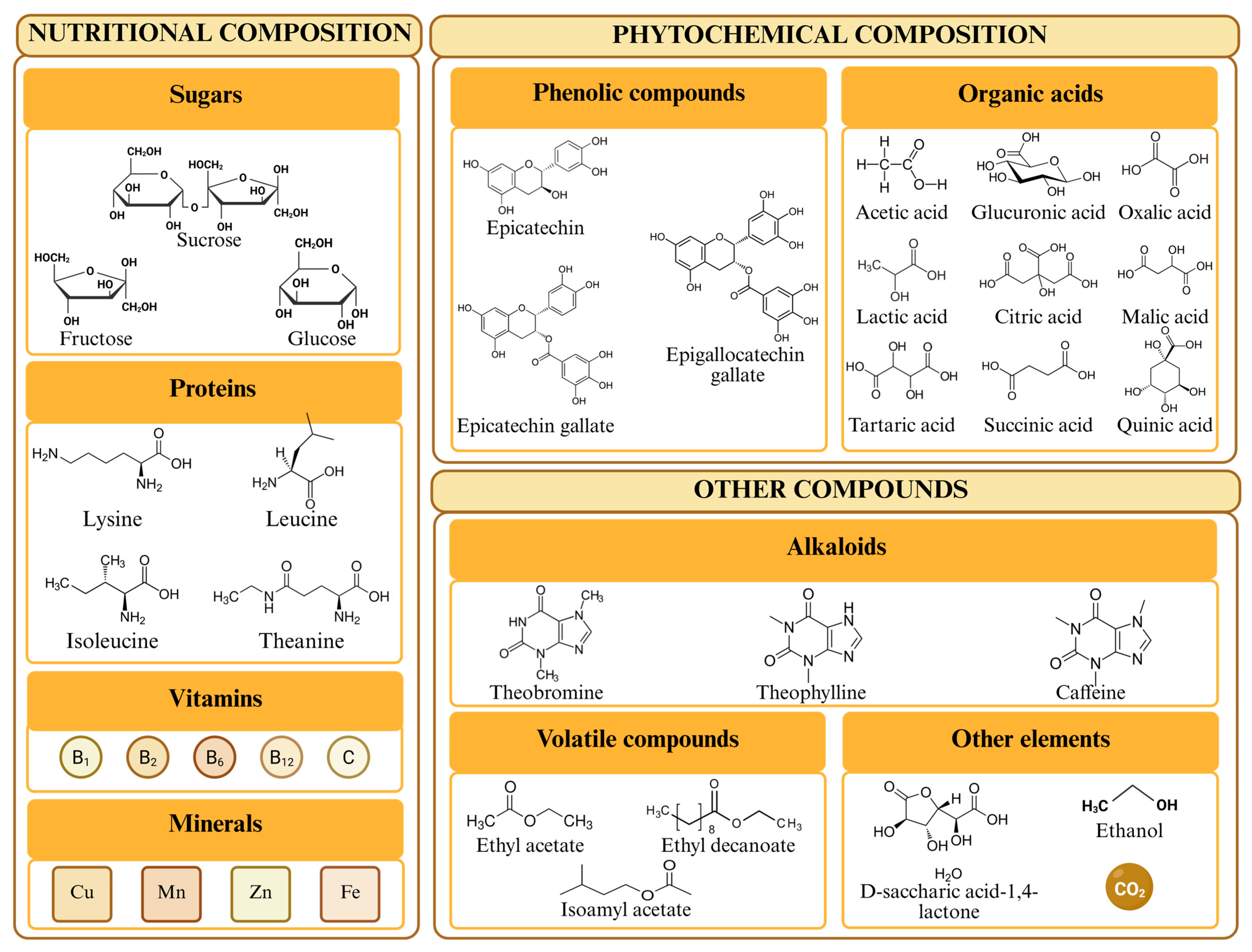
3.1. Nutritional Composition
3.2. Phytochemical Composition
3.2.1. Phenolic Compounds
3.2.2. Organic Acids
3.3. Others
3.3.1. Alcohol
3.3.2. Alkaloids
3.3.3. D-Saccharic Acid-1,4-Lactone
3.3.4. Volatile Compounds
4. Bioactive Properties of Kombucha
4.1. Antioxidant
4.2. Anticancer
4.3. Antimicrobial
4.4. Others
5. Innovations in Kombucha Formulation

| Yeast | Bacteria | Fermentation | Ref. |
|---|---|---|---|
| Zygosaccharomyces bailii, Schizosaccharomyces pombe, Torulospora delbreuckii, Rhodotorula mucilaginosa, Brettanomyces bruxellensis, Candida stellata | Acetobacter spp. | Black tea//5 min, 100 °C, 1 L W, 100 g sucrose, 5.4 g/L tea//14 days, RT | [142] |
| Zygosaccharomyces sp., Saccharomyces cerevisiae | Acetobacter spp. | Green and black tea//5 min, 100 °C, 1 L W, 70 g sucrose, 1.5 g/L tea//10 days, 28 °C | [26] |
| Dekkera bruxellensis, Dekkera anomala, Zygosaccharomyces bisporus, Zygosaccharomyces lentus, Pichia kudriavzevii, Davidiella tassiana, Wallemia sebi, Lachancea fermentati, Leucosporidiella fragaria, Kazachstania unispora, Kluyveromyces marxianus, Naumovozyma castelli, Hanseniaspora vineae | Lactobacillus, Lactococcus, Leuconostoc, Bifidobacterium, Acetobacter, Gluconacetobacter | Black tea//15 min, 100 °C, 1 L W, 100 g sucrose, 0.49% w/v tea//10 days, 23 °C | [143] |
| Candida, Lachancea, Kluyveromyces, Debaryomyces, Pichia, Waitea, Eromothecium, Meyerozyma, Zygowilliopsis, Saccharomyces, Saccharomycopsis, Hanseniaspora, Kazachstania, Starmera, Merimbla, Sporopachydermia, Sugiyamaella | Lactobacillus, Weissella, Bifidobacterium, Komagataeibacter, Gluconobacter | Black tea//5 min, 100 °C, 1 L W, 100 g sucrose, 5 g/L tea//21 days, 28 °C | [37] |
| Candida boidinii, D. anomala, D. bruxellensis, Hanseniaspora valbyensis, Wickerhamomyces anomalus, Pichia membranifaciens, S. cerevisiae, Saccharomyces uvarum, Torulaspora microellipsoides, Z. bailii, Zygosaccharomyces florentina | Oenococcus oeni, Lactobacillus nagelii, Lactobacillus satsumensis, Acetobacter lovaniensis, Acetobacter okinawensis, Acetobacter peroxydans, Acetobacter syzgii, Acetobacter tropicalis, Gluconacetobacter eurapaeus, Gluconacetobacter hansenii, Gluconacetobacter intermedius, Gluconacetobacter liquefaciens, Gluconacetobacter xylinus, Gluconobacter cerinus, Gluconobacter oxydans, Tanticharoemia sakaeratensis | Black and green tea//CP//8 days, RT | [144] |
| Dekkera, Pichia, Zygosaccharomyces | Lactobacillus, Leuconostoc, Lactococcus, Bifidobacterium, Gluconacetobacter, Acetobacter | Black tea//5 min, 100 °C, 1 L W, 100 g artificial sweeteners, 0.1 g/L tea//7 days, 24 °C | [71] |
| Nd | Lactobacillus, Lactococcus, Streptococcus, Acetobacter, G. xylinus, Gluconacetobacter saccharivorans | Green tea//10 min, 100 °C, 1 L W, 100 g sucrose, 10 g/L tea//21 days, 20 °C | [145] |
| B. bruxellensis, Zygosaccharomyces parabailii | Lactobacillaceae, Leuconostocaceae, Streptococcaceae, Komagataeibacter intermedius, Komagataeibacter rhaeticus, Gluconobacter entanii | Green and black tea, roiboos//3 min, 74 °C, 1 L W, 80 g sucrose, 8 g/L tea//14 days, 27 °C | [86] |
| Zygosaccharomyces, Z. bailii | Komagataeibacter, K. rhaeticus | Nd//10 min, 100 °C, 1.35 L W, 150 g sucrose, 6.7 g/L tea//15 days, 28 °C | [146] |
| Candida arabinofermentans, B. bruxellensis, S. pombe, Z. bailii | Acetobacter maolroum, Acetobacter pasteurianus, Acetobacter pomorum, Acetobacter tropicalis, K. rhaeticus, Komagataeibacter xylinus, Komagataeibacter europaeus, K. intermedius, G. oxydans, Gluconacetobacter sp. SXCC-1 | Black tea//15 min, 80 °C, 1 L W, 70 g sugar, 10 g/L tea//14 days, 25 °C | [68] |
| Z. bailii | A. pasteurianus, G. xylinus | Black tea//15 min, 100 °C, 1 L W, 100 g sucrose, 8 g/L tea//10 days, 29 °C | [147] |
| B. bruxellensis, Zygosaccharomyces bisporus | Acetobacteraceae, K. rhaeticus, K. hansenii, K. xylinus | Green tea//15 min, 121 °C, 1 L W, 70 g sucrose, 0.5% tea//15 days, 30 °C | [148] |
| D. bruxellensis, S. uvarum, Z. bailii | L. nagelii, O. oeni, A. tropicalis, A. okinawensis, K. hansenii, G. oxydans | Green tea//30 min, 104 °C, 1 L W, 55 g blond sugar, 0.5% tea//27 days, 25 °C | [149] |
| B. bruxellensis, H. valbyensis, S. cerevisiae | Acetobacter papayae, Gluconobacter takamatsuzukensis | Black tea//1 L W, 60 g sucrose, 1% tea//3 days, 26 °C | [150] |
| B. bruxellensis, D. bruxellensis | G. intermedius | Black tea//121 °C, 1 L W, 100 g sucrose, 1 g/L tea//8 days, RT | [151] |
| Zygosaccharomyces sp. | Acetobacter xylinum | Tea bag//10 min, RT, 1 L W, 70 g sucrose, 1.5 g/L tea//60 days, RT | [152] |
| Nd | Acetobacteraceae, Gluconacetobacter | CE | [153] |
| Nd | Acetobacteraceae, Komagataeibacter | CE | [154] |
6. Safety and Regulations
7. Conclusions and Prospects
Funding
Data Availability Statement
Conflicts of Interest
References
- Abaci, N.; Senol Deniz, F.S.; Orhan, I.E. Kombucha—An Ancient Fermented Beverage with Desired Bioactivities: A Narrowed Review. Food Chem. X 2022, 14, 100302. [Google Scholar] [CrossRef]
- Kaashyap, M.; Cohen, M.; Mantri, N. Microbial Diversity and Characteristics of Kombucha as Revealed by Metagenomic and Physicochemical Analysis. Nutrients 2021, 13, 4446. [Google Scholar] [CrossRef]
- Ramírez Tapias, Y.A.; Di Monte, M.V.; Peltzer, M.A.; Salvay, A.G. Bacterial Cellulose Films Production by Kombucha Symbiotic Community Cultured on Different Herbal Infusions. Food Chem. 2022, 372, 131346. [Google Scholar] [CrossRef] [PubMed]
- Antolak, H.; Piechota, D.; Kucharska, A. Kombucha Tea—A Double Power of Bioactive Compounds from Tea and Symbiotic Culture of Bacteria and Yeasts (SCOBY). Antioxidants 2021, 10, 1541. [Google Scholar] [CrossRef] [PubMed]
- Villarreal-Soto, S.A.; Beaufort, S.; Bouajila, J.; Souchard, J.-P.; Taillandier, P. Understanding Kombucha Tea Fermentation: A Review. J. Food Sci. 2018, 83, 580–588. [Google Scholar] [CrossRef]
- Wang, B.; Rutherfurd-Markwick, K.; Zhang, X.-X.; Mutukumira, A.N. Kombucha: Production and Microbiological Research. Foods 2022, 11, 3456. [Google Scholar] [CrossRef]
- Dufresne, C.; Farnworth, E. Tea, Kombucha, and Health: A Review. Food Res. Int. 2000, 33, 409–421. [Google Scholar] [CrossRef]
- Jayabalan, R.; Malbaša, R.V.; Lončar, E.S.; Vitas, J.S.; Sathishkumar, M. A Review on Kombucha Tea—Microbiology, Composition, Fermentation, Beneficial Effects, Toxicity, and Tea Fungus. Compr. Rev. Food Sci. Food Saf. 2014, 13, 538–550. [Google Scholar] [CrossRef]
- Kapp, J.M.; Sumner, W. Kombucha: A Systematic Review of the Empirical Evidence of Human Health Benefit. Ann. Epidemiol. 2019, 30, 66–70. [Google Scholar] [CrossRef]
- Andrade, D.K.A.; Wang, B.; Lima, E.M.F.; Shebeko, S.K.; Ermakov, A.M.; Khramova, V.N.; Ivanova, I.V.; Rocha, R.d.S.; Vaz-Velho, M.; Mutukumira, A.N.; et al. Kombucha: An Old Tradition into a New Concept of a Beneficial, Health-Promoting Beverage. Foods 2025, 14, 1547. [Google Scholar] [CrossRef]
- Kim, J.; Adhikari, K. Current Trends in Kombucha: Marketing Perspectives and the Need for Improved Sensory Research. Beverages 2020, 6, 15. [Google Scholar] [CrossRef]
- Morales, D. Biological Activities of Kombucha Beverages: The Need of Clinical Evidence. Trends Food Sci. Technol. 2020, 105, 323–333. [Google Scholar] [CrossRef]
- Ghion, G.; Sica, J.; Massaro, S.; Tarrah, A.; Devold, T.G.; Porcellato, D.; Giacomini, A.; de Barros, F.A.R.; Corich, V.; Nadai, C. Functional Compound Bioaccessibility and Microbial Viability in Green and Black Tea Kombucha During Simulated Digestion. Foods 2025, 14, 2770. [Google Scholar] [CrossRef]
- De Roos, J.; De Vuyst, L. Acetic Acid Bacteria in Fermented Foods and Beverages. Curr. Opin. Biotechnol. 2018, 49, 115–119. [Google Scholar] [CrossRef]
- Ivanišová, E.; Meňhartová, K.; Terentjeva, M.; Harangozo, Ľ.; Kántor, A.; Kačániová, M. The Evaluation of Chemical, Antioxidant, Antimicrobial and Sensory Properties of Kombucha Tea Beverage. J. Food Sci. Technol. 2020, 57, 1840–1846. [Google Scholar] [CrossRef] [PubMed]
- da Silva Júnior, J.C.; Meireles Mafaldo, Í.; de Lima Brito, I.; Tribuzy de Magalhães Cordeiro, A.M. Kombucha: Formulation, Chemical Composition, and Therapeutic Potentialities. Curr. Res. Food Sci. 2022, 5, 360–365. [Google Scholar] [CrossRef] [PubMed]
- Malbaša, R.V.; Lončar, E.S.; Kolarov, L.J.A. Sucrose and Inulin Balance During Tea Fungus Fermentation. Roum. Biotechnol. Lett. 2002, 7, 573–576. [Google Scholar]
- Petrović, S.; Petrović, S.; Malbasa, R.; Verac, R. Biosynthesis of Glucuronic Acid by Means of Tea Fungus. Nahrung 2000, 44, 138–139. [Google Scholar] [CrossRef]
- Kitwetcharoen, H.; Phung, L.T.; Klanrit, P.; Thanonkeo, S.; Tippayawat, P.; Yamada, M.; Thanonkeo, P. Kombucha Healthy Drink—Recent Advances in Production, Chemical Composition and Health Benefits. Fermentation 2023, 9, 48. [Google Scholar] [CrossRef]
- Martínez Leal, J.; Valenzuela Suárez, L.; Jayabalan, R.; Huerta Oros, J.; Escalante-Aburto, A. A Review on Health Benefits of Kombucha Nutritional Compounds and Metabolites. CyTA-J. Food 2018, 16, 390–399. [Google Scholar] [CrossRef]
- Ruiz-Capillas, C.; Herrero, A.M. Impact of Biogenic Amines on Food Quality and Safety. Foods 2019, 8, 62. [Google Scholar] [CrossRef]
- Dimidi, E.; Cox, S.R.; Rossi, M.; Whelan, K. Fermented Foods: Definitions and Characteristics, Impact on the Gut Microbiota and Effects on Gastrointestinal Health and Disease. Nutrients 2019, 11, 1806. [Google Scholar] [CrossRef] [PubMed]
- Bishop, P.; Pitts, E.R.; Budner, D.; Thompson-Witrick, K.A. Chemical Composition of Kombucha. Beverages 2022, 8, 45. [Google Scholar] [CrossRef]
- de Miranda, J.F.; Ruiz, L.F.; Silva, C.B.; Uekane, T.M.; Silva, K.A.; Gonzalez, A.G.M.; Fernandes, F.F.; Lima, A.R. Kombucha: A Review of Substrates, Regulations, Composition, and Biological Properties. J. Food Sci. 2022, 87, 503–527. [Google Scholar] [CrossRef] [PubMed]
- Bauer-Petrovska, B.; Petrushevska-Tozi, L. Mineral and Water Soluble Vitamin Content in the Kombucha Drink. Int. J. Food Sci. Technol. 2000, 35, 201–205. [Google Scholar] [CrossRef]
- Malbaša, R.V.; Lončar, E.S.; Vitas, J.S.; Čanadanović-Brunet, J.M. Influence of Starter Cultures on the Antioxidant Activity of Kombucha Beverage. Food Chem. 2011, 127, 1727–1731. [Google Scholar] [CrossRef]
- Jakubczyk, K.; Gutowska, I.; Antoniewicz, J.; Janda, K. Evaluation of Fluoride and Selected Chemical Parameters in Kombucha Derived from White, Green, Black and Red Tea. Biol. Trace Elem. Res. 2021, 199, 3547–3552. [Google Scholar] [CrossRef]
- Pereira, A.G.; Cassani, L.; Liu, C.; Li, N.; Chamorro, F.; Barreira, J.C.M.; Simal-Gandara, J.; Prieto, M.A. Camellia Japonica Flowers as a Source of Nutritional and Bioactive Compounds. Foods 2023, 12, 2825. [Google Scholar] [CrossRef]
- Jakubczyk, K.; Kałduńska, J.; Kochman, J.; Janda, K. Chemical Profile and Antioxidant Activity of the Kombucha Beverage Derived from White, Green, Black and Red Tea. Antioxidants 2020, 9, 447. [Google Scholar] [CrossRef]
- Kumar, S.D.; Narayan, G.; Hassarajani, S. Determination of Anionic Minerals in Black and Kombucha Tea Using Ion Chromatography. Food Chem. 2008, 111, 784–788. [Google Scholar] [CrossRef]
- Ojo, A.O.; de Smidt, O. Microbial Composition, Bioactive Compounds, Potential Benefits and Risks Associated with Kombucha: A Concise Review. Fermentation 2023, 9, 472. [Google Scholar] [CrossRef]
- Yuksek, E.N.; Prieto, M.A.; Pereira, A.G. Phytochemical Insights and Industrial Applications of Camellia Japonica Leaves: A Focus on Sustainable Utilization. Nutrients 2025, 17, 3382. [Google Scholar] [CrossRef]
- Grondalska, J.; Kolniak-Ostek, J. Evaluation of Anti-Inflammatory, Antidiabetic, Antioxidant, and Anticholinergic Activities, as Well as Chemical Composition and Polyphenolic Compounds in Novel SCOBY-Fermented Juices. Molecules 2025, 30, 1940. [Google Scholar] [CrossRef] [PubMed]
- Mfopa, A.N.; Kemzeu, R.; Fokom, R.; Yamthe, L.R.T.; Dize, D.; Boyom, F.F. Phenolic Compounds, Antioxidant and Antileishmanial Activities of Kombucha as Affected by Fermentation Time. Heliyon 2024, 10, e40463. [Google Scholar] [CrossRef] [PubMed]
- Phung, L.T.; Kitwetcharoen, H.; Chamnipa, N.; Boonchot, N.; Thanonkeo, S.; Tippayawat, P.; Klanrit, P.; Yamada, M.; Thanonkeo, P. Changes in the Chemical Compositions and Biological Properties of Kombucha Beverages Made from Black Teas and Pineapple Peels and Cores. Sci. Rep. 2023, 13, 7859. [Google Scholar] [CrossRef]
- Kim, H.; Hur, S.; Lim, J.; Jin, K.; Yang, T.; Keehm, I.; Kim, S.W.; Kim, T.; Kim, D. Enhancement of the Phenolic Compounds and Antioxidant Activities of Kombucha Prepared Using Specific Bacterial and Yeast. Food Biosci. 2023, 56, 103431. [Google Scholar] [CrossRef]
- Chakravorty, S.; Bhattacharya, S.; Chatzinotas, A.; Chakraborty, W.; Bhattacharya, D.; Gachhui, R. Kombucha Tea Fermentation: Microbial and Biochemical Dynamics. Int. J. Food Microbiol. 2016, 220, 63–72. [Google Scholar] [CrossRef] [PubMed]
- Chu, S.-C.; Chen, C. Effects of Origins and Fermentation Time on the Antioxidant Activities of Kombucha. Food Chem. 2006, 98, 502–507. [Google Scholar] [CrossRef]
- Jayabalan, R.; Marimuthu, S.; Swaminathan, K. Changes in Content of Organic Acids and Tea Polyphenols during Kombucha Tea Fermentation. Food Chem. 2007, 102, 392–398. [Google Scholar] [CrossRef]
- Ziemlewska, A.; Nizioł-Łukaszewska, Z.; Bujak, T.; Zagórska-Dziok, M.; Wójciak, M.; Sowa, I. Effect of Fermentation Time on the Content of Bioactive Compounds with Cosmetic and Dermatological Properties in Kombucha Yerba Mate Extracts. Sci. Rep. 2021, 11, 18792. [Google Scholar] [CrossRef]
- Aung, T.; Eun, J.-B. Production and Characterization of a Novel Beverage from Laver (Porphyra Dentata) through Fermentation with Kombucha Consortium. Food Chem. 2021, 350, 129274. [Google Scholar] [CrossRef]
- Shi, S.; Wei, Y.; Lin, X.; Liang, H.; Zhang, S.; Chen, Y.; Dong, L.; Ji, C. Microbial Metabolic Transformation and Antioxidant Activity Evaluation of Polyphenols in Kombucha. Food Biosci. 2023, 51, 102287. [Google Scholar] [CrossRef]
- Cardoso, R.R.; Neto, R.O.; dos Santos D’Almeida, C.T.; do Nascimento, T.P.; Pressete, C.G.; Azevedo, L.; Martino, H.S.D.; Cameron, L.C.; Ferreira, M.S.L.; de Barros, F.A.R. Kombuchas from Green and Black Teas Have Different Phenolic Profile, Which Impacts Their Antioxidant Capacities, Antibacterial and Antiproliferative Activities. Food Res. Int. 2020, 128, 108782. [Google Scholar] [CrossRef]
- Yang, J.; Lagishetty, V.; Kurnia, P.; Henning, S.M.; Ahdoot, A.I.; Jacobs, J.P. Microbial and Chemical Profiles of Commercial Kombucha Products. Nutrients 2022, 14, 670. [Google Scholar] [CrossRef]
- Zhou, D.-D.; Saimaiti, A.; Luo, M.; Huang, S.-Y.; Xiong, R.-G.; Shang, A.; Gan, R.-Y.; Li, H.-B. Fermentation with Tea Residues Enhances Antioxidant Activities and Polyphenol Contents in Kombucha Beverages. Antioxidants 2022, 11, 155. [Google Scholar] [CrossRef]
- Pereira, A.G.; Cassani, L.; Oludemi, T.; Chamorro, F.; Calhelha, R.C.; Prieto, M.A.; Barros, L.; Simal-Gandara, J.; Lucini, L.; Garcia-Perez, P. Untargeted Metabolomics and in Vitro Functional Analysis Unravel the Intraspecific Bioactive Potential of Flowers from Underexplored Camellia Japonica Cultivars Facing Their Industrial Application. Ind. Crops Prod. 2023, 204, 117389. [Google Scholar] [CrossRef]
- Bhattacharya, D.; Bhattacharya, S.; Patra, M.M.; Chakravorty, S.; Sarkar, S.; Chakraborty, W.; Koley, H.; Gachhui, R. Antibacterial Activity of Polyphenolic Fraction of Kombucha Against Enteric Bacterial Pathogens. Curr. Microbiol. 2016, 73, 885–896. [Google Scholar] [CrossRef] [PubMed]
- Tsuru, V.H.; Gomes, R.J.; Silva, J.R.; Prudencio, S.H.; Costa, G.N.; Spinosa, W.A. Physicochemical, Antioxidant and Sensory Properties of Kombucha Beverages Obtained from Oolong or Yerba Mate Tea Fermentation. Res. Soc. Dev. 2021, 10, e62101118790. [Google Scholar] [CrossRef]
- Vukmanović, S.; Vitas, J.; Ranitović, A.; Cvetković, D.; Tomić, A.; Malbaša, R. Certain Production Variables and Antimicrobial Activity of Novel Winery Effluent Based Kombucha. LWT 2022, 154, 112726. [Google Scholar] [CrossRef]
- Chen, C.; Liu, B.Y. Changes in Major Components of Tea Fungus Metabolites during Prolonged Fermentation. J. Appl. Microbiol. 2000, 89, 834–839. [Google Scholar] [CrossRef]
- Velićanski, A.S.; Cvetković, D.D.; Markov, S.L.; Šaponjac, V.T.T.; Vulić, J.J. Antioxidant and Antibacterial Activity of the Beverage Obtained by Fermentation of Sweetened Lemon Balm (Melissa officinalis L.) Tea with Symbiotic Consortium of Bacteria and Yeasts. Food Technol. Biotechnol. 2014, 52, 420–429. [Google Scholar] [CrossRef]
- Tu, C.; Tang, S.; Azi, F.; Hu, W.; Dong, M. Use of Kombucha Consortium to Transform Soy Whey into a Novel Functional Beverage. J. Funct. Foods 2019, 52, 81–89. [Google Scholar] [CrossRef]
- Malbaša, R.; Lončar, E.; Djurić, M. Comparison of the Products of Kombucha Fermentation on Sucrose and Molasses. Food Chem. 2008, 106, 1039–1045. [Google Scholar] [CrossRef]
- Neffe-Skocińska, K.; Sionek, B.; Ścibisz, I.; Kołożyn-Krajewska, D. Acid Contents and the Effect of Fermentation Condition of Kombucha Tea Beverages on Physicochemical, Microbiological and Sensory Properties. CyTA-J. Food 2017, 15, 601–607. [Google Scholar] [CrossRef]
- Talebi, M.; Frink, L.A.; Patil, R.A.; Armstrong, D.W. Examination of the Varied and Changing Ethanol Content of Commercial Kombucha Products. Food Anal. Methods 2017, 10, 4062–4067. [Google Scholar] [CrossRef]
- Australian Government Department of Health. Fermented Beverages Stakeholder Roundtable; Australian Government Department of Health: Canberra, Australia, 2019. [Google Scholar]
- Kallel, L.; Desseaux, V.; Hamdi, M.; Stocker, P.; Ajandouz, E.H. Insights into the Fermentation Biochemistry of Kombucha Teas and Potential Impacts of Kombucha Drinking on Starch Digestion. Food Res. Int. 2012, 49, 226–232. [Google Scholar] [CrossRef]
- Nummer, B.A. Kombucha Brewing under the Food and Drug Administration Model Food Code: Risk Analysis and Processing Guidance. J. Environ. Health 2013, 76, 8–11. [Google Scholar]
- Sharma, V.K.; Bhattacharya, A.; Kumar, A.; Sharma, H.K. Health Benefits of Tea Consumption. Trop. J. Pharm. Res. 2007, 6, 785–792. [Google Scholar] [CrossRef]
- Hara, Y.; Luo ShaoJun, L.S.; Wickremasinghe, R.L.; Yamanishi, T. Chemical Composition of Tea. Food Rev. Int. 1995, 11, 435–456. [Google Scholar] [CrossRef]
- Ivani\vsová, E.; Meňhartová, K.; Terentjeva, M.; Godo\vciková, L.; Árvay, J.; Ka\vcániová, M. Kombucha Tea Beverage: Microbiological Characteristic, Antioxidant Activity, and Phytochemical Composition. Acta Aliment. 2019, 48, 324–331. [Google Scholar] [CrossRef]
- Bhattacharya, S.; Gachhui, R.; Sil, P.C. The Prophylactic Role of D-Saccharic Acid-1,4-Lactone against Hyperglycemia-Induced Hepatic Apoptosis via Inhibition of Both Extrinsic and Intrinsic Pathways in Diabetic Rats. Food Funct. 2013, 4, 283–296. [Google Scholar] [CrossRef]
- Wang, K.; Gan, X.; Tang, X.; Wang, S.; Tan, H. Determination of D-Saccharic Acid-1,4-Lactone from Brewed Kombucha Broth by High-Performance Capillary Electrophoresis. J. Chromatogr. B 2010, 878, 371–374. [Google Scholar] [CrossRef]
- Strains, L.S.; Nguyen, N.K.; Dong, N.T.N.; Le, P.H.; Nguyen, H.T. Evaluation of the Glucuronic Acid Production and Other Biological Activities of Fermented Sweeten-Black Tea by Kombucha Layer and the Co-Culture with Different. Int. J. Mod. Eng. Res. 2014, 4, 12–17. [Google Scholar]
- Yang, Z.; Zhou, F.; Ji, B.; Li, B.; Luo, Y.; Yang, L.; Li, T. Symbiosis between Microorganisms from Kombucha and Kefir: Potential Significance to the Enhancement of Kombucha Function. Appl. Biochem. Biotechnol. 2010, 160, 446–455. [Google Scholar] [CrossRef]
- Mozzon, M.; Rinaldi, L.; Ahmed, A.E.M.; Kovács, B.; Foligni, R. Investigating the Volatiles of Kombucha During Storage Under Refrigerated Conditions. Beverages 2025, 11, 143. [Google Scholar] [CrossRef]
- Ahmed, R.F.; Hikal, M.S.; Abou-Taleb, K.A. Biological, Chemical and Antioxidant Activities of Different Types Kombucha. Ann. Agric. Sci. 2020, 65, 35–41, Erratum in Ann. Agric. Sci. 2021, 66, 98–99. [Google Scholar] [CrossRef]
- Villarreal-Soto, S.A.; Bouajila, J.; Pace, M.; Leech, J.; Cotter, P.D.; Souchard, J.-P.; Taillandier, P.; Beaufort, S. Metabolome-Microbiome Signatures in the Fermented Beverage, Kombucha. Int. J. Food Microbiol. 2020, 333, 108778. [Google Scholar] [CrossRef]
- Hasan, B.J.M.M.; Osman, F.; Muhamad, R.; Sapawi, C.W.N.S.C.W.; Anzian, A.; Voon, W.W.Y.; Hussin, A.S.M. Effects of Sugar Sources and Fermentation Time on the Properties of Tea Fungus (Kombucha) Beverage. Int. Food Res. J. 2019, 26, 481–487. [Google Scholar]
- Vohra, B.M.; Fazry, S.; Sairi, F.; Babul-airianah, O. Effects of Medium Variation and Fermentation Time on the Antioxidant and Antimicrobial Properties of Kombucha. Malasian J. Fundam. Appl. Sci. 2019, 2018, 298–302. [Google Scholar] [CrossRef]
- Watawana, M.I.; Jayawardena, N.; Ranasinghe, S.J.; Waisundara, V.Y. Evaluation of the Effect of Different Sweetening Agents on the Polyphenol Contents and Antioxidant and Starch Hydrolase Inhibitory Properties of Kombucha. J. Food Process. Preserv. 2017, 41, e12752. [Google Scholar] [CrossRef]
- Amarasinghe, H.; Weerakkody, N.S.; Waisundara, V.Y. Evaluation of Physicochemical Properties and Antioxidant Activities of Kombucha “Tea Fungus” during Extended Periods of Fermentation. Food Sci. Nutr. 2018, 6, 659–665. [Google Scholar] [CrossRef]
- Pure, A.E.; Pure, M.E. Antioxidant, Antibacterial and Color Analysis of Garlic Fermented in Kombucha and Red Grape Vinegar. Appl. Food Biotechnol. 2016, 3, 246–252. [Google Scholar]
- Jayabalan, R.; Subathradevi, P.; Marimuthu, S.; Sathishkumar, M.; Swaminathan, K. Changes in Free-Radical Scavenging Ability of Kombucha Tea during Fermentation. Food Chem. 2008, 109, 227–234. [Google Scholar] [CrossRef]
- Silva, K.A.; Uekane, T.M.; de Miranda, J.F.; Ruiz, L.F.; da Motta, J.C.B.; Silva, C.B.; de Souza Pitangui, N.; Gonzalez, A.G.M.; Fernandes, F.F.; Lima, A.R. Kombucha Beverage from Non-Conventional Edible Plant Infusion and Green Tea: Characterization, Toxicity, Antioxidant Activities and Antimicrobial Properties. Biocatal. Agric. Biotechnol. 2021, 34, 102032. [Google Scholar] [CrossRef]
- Uțoiu, E.; Matei, F.; Toma, A.; Diguță, C.F.; Ștefan, L.M.; Mănoiu, S.; Vrăjmașu, V.V.; Moraru, I.; Oancea, A.; Israel-Roming, F.; et al. Bee Collected Pollen with Enhanced Health Benefits, Produced by Fermentation with a Kombucha Consortium. Nutrients 2018, 10, 1365. [Google Scholar] [CrossRef]
- Gramza-michałowska, A.; Kulczyński, B.; Xindi, Y. Research on the Effect of Culture Time on the Kombucha Tea Beverage’s Antiradical Capacity and Sensory Value. Acta Sci. Pol. Technol. Aliment. 2016, 15, 447–457. [Google Scholar] [CrossRef]
- Shahbazi, H.; Hashemi Gahruie, H.; Golmakani, M.-T.; Eskandari, M.H.; Movahedi, M. Effect of Medicinal Plant Type and Concentration on Physicochemical, Antioxidant, Antimicrobial, and Sensorial Properties of Kombucha. Food Sci. Nutr. 2018, 6, 2568–2577. [Google Scholar] [CrossRef]
- Villarreal-Soto, S.A.; Beaufort, S.; Bouajila, J.; Souchard, J.-P.; Renard, T.; Rollan, S.; Taillandier, P. Impact of Fermentation Conditions on the Production of Bioactive Compounds with Anticancer, Anti-Inflammatory and Antioxidant Properties in Kombucha Tea Extracts. Process Biochem. 2019, 83, 44–54. [Google Scholar] [CrossRef]
- Mizuta, A.G.; de Menezes, J.L.; Dutra, T.V.; Ferreira, T.V.; Castro, J.C.; da Silva, C.A.J.; Pilau, E.J.; Machinski Junior, M.; de Abreu Filho, B.A. Evaluation of Antimicrobial Activity of Green Tea Kombucha at Two Fermentation Time Points against Alicyclobacillus spp. LWT 2020, 130, 109641. [Google Scholar] [CrossRef]
- Kaewkod, T.; Bovonsombut, S.; Tragoolpua, Y. Efficacy of Kombucha Obtained from Green, Oolong, and Black Teas on Inhibition of Pathogenic Bacteria, Antioxidation, and Toxicity on Colorectal Cancer Cell Line. Microorganisms 2019, 7, 700. [Google Scholar] [CrossRef] [PubMed]
- Xia, X.; Dai, Y.; Wu, H.; Liu, X.; Wang, Y.; Yin, L.; Wang, Z.; Li, X.; Zhou, J. Kombucha Fermentation Enhances the Health-Promoting Properties of Soymilk Beverage. J. Funct. Foods 2019, 62, 103549, Erratum in J. Funct. Foods 2020, 69, 103913. [Google Scholar] [CrossRef]
- Vukmanović, S.; Vitas, J.; Malbaša, R. Valorization of Winery Effluent Using Kombucha Culture. J. Food Process. Preserv. 2020, 44, e14627. [Google Scholar] [CrossRef]
- Hrnjez, D.; Vaštag, Ž.; Milanović, S.; Vukić, V.; Iličić, M.; Popović, L.; Kanurić, K. The Biological Activity of Fermented Dairy Products Obtained by Kombucha and Conventional Starter Cultures during Storage. J. Funct. Foods 2014, 10, 336–345. [Google Scholar] [CrossRef]
- Vázquez-Cabral, B.D.; Larrosa-Pérez, M.; Gallegos-Infante, J.A.; Moreno-Jiménez, M.R.; González-Laredo, R.F.; Rutiaga-Quiñones, J.G.; Gamboa-Gómez, C.I.; Rocha-Guzmán, N.E. Oak Kombucha Protects against Oxidative Stress and Inflammatory Processes. Chem. Biol. Interact. 2017, 272, 1–9. [Google Scholar] [CrossRef]
- Gaggìa, F.; Baffoni, L.; Galiano, M.; Nielsen, D.S.; Jakobsen, R.R.; Castro-Mejía, J.L.; Bosi, S.; Truzzi, F.; Musumeci, F.; Dinelli, G.; et al. Kombucha Beverage from Green, Black and Rooibos Teas: A Comparative Study Looking at Microbiology, Chemistry and Antioxidant Activity. Nutrients 2019, 11, 1. [Google Scholar] [CrossRef] [PubMed]
- Bhattacharya, S.; Gachhui, R.; Sil, P.C. Effect of Kombucha, a Fermented Black Tea in Attenuating Oxidative Stress Mediated Tissue Damage in Alloxan Induced Diabetic Rats. Food Chem. Toxicol. 2013, 60, 328–340. [Google Scholar] [CrossRef]
- Yang, Z.-W.; Ji, B.-P.; Zhou, F.; Li, B.; Luo, Y.; Yang, L.; Li, T. Hypocholesterolaemic and Antioxidant Effects of Kombucha Tea in High-Cholesterol Fed Mice. J. Sci. Food Agric. 2009, 89, 150–156. [Google Scholar] [CrossRef]
- Sai Ram, M.; Anju, B.; Pauline, T.; Prasad, D.; Kain, A.K.; Mongia, S.S.; Sharma, S.K.; Singh, B.; Singh, R.; Ilavazhagan, G.; et al. Effect of Kombucha Tea on chromate(VI)-Induced Oxidative Stress in Albino Rats. J. Ethnopharmacol. 2000, 71, 235–240. [Google Scholar] [CrossRef] [PubMed]
- Jayabalan, R.; Chen, P.-N.; Hsieh, Y.-S.; Prabhakaran, K.; Pitchai, P.; Marimuthu, S.; Thangaraj, P.; Swaminathan, K.; Eok, S. Effect of Solvent Fractions of Kombucha Tea on Viability and Invasiveness of Cancer cells—Characterization of Dimethyl 2-(2-Hydroxy-2-Methoxypropylidine) Malonate and Vitexin. Indian J. Biotechnol. 2011, 10, 75–82. [Google Scholar]
- Rasouli, L.; Aryaeian, N.; Gorjian, M.; Nourbakhsh, M.; Amiri, F. Evaluation of Cytotoxicity and Anticancer Activity of Kombucha and Doxorubicin Combination Therapy on Colorectal Cancer Cell Line HCT-116. J. Educ. Health Promot. 2021, 10, 376. [Google Scholar] [CrossRef]
- Četojević-Simin, D.; Velićanski, A.S.; Cvetković, D.D.; Markov, S.L.; Mrđanović, J.Ž.; Bogdanović, V.; Šolajić, S.V. Bioactivity of Lemon Balm Kombucha. Food Bioprocess Technol. 2012, 5, 1756–1765. [Google Scholar] [CrossRef]
- Srihari, T.; Arunkumar, R.; Arunakaran, J.; Satyanarayana, U. Downregulation of Signalling Molecules Involved in Angiogenesis of Prostate Cancer Cell Line (PC-3) by Kombucha (Lyophilized). Biomed. Prev. Nutr. 2013, 3, 53–58. [Google Scholar] [CrossRef]
- Sinaga, E.; Hasanah, U.; Sipahutar, F.R.P.; Simorangkir, M.; Sipahutar, M.N. Identifying Therapeutic Effect of Kombucha Pirdot (Saurauia Vulcani Korth.) against Colorectal Cancer: The Experimental Data and in Silico Approach. Med. Microecol. 2024, 20, 100105. [Google Scholar] [CrossRef]
- Battikh, H.; Chaieb, K.; Bakhrouf, A.; Ammar, E. Antibacterial and Antifungal Activities of Black and Green Kombucha Teas. J. Food Biochem. 2013, 37, 231–236. [Google Scholar] [CrossRef]
- Bhattacharya, D.; Sinha, R.; Mukherjee, P.; Howlader, D.R.; Nag, D.; Sarkar, S.; Koley, H.; Withey, J.H.; Gachhui, R. Anti-Virulence Activity of Polyphenolic Fraction Isolated from Kombucha against Vibrio cholerae. Microb. Pathog. 2020, 140, 103927. [Google Scholar] [CrossRef] [PubMed]
- Pei, J.; Jin, W.; Abd El-Aty, A.M.; Baranenko, D.A.; Gou, X.; Zhang, H.; Geng, J.; Jiang, L.; Chen, D.; Yue, T. Isolation, Purification, and Structural Identification of a New Bacteriocin Made by Lactobacillus Plantarum Found in Conventional Kombucha. Food Control 2020, 110, 106923. [Google Scholar] [CrossRef]
- Zubaidah, E.; Afgani, C.A.; Kalsum, U.; Srianta, I.; Blanc, P.J. Comparison of in Vivo Antidiabetes Activity of Snake Fruit Kombucha, Black Tea Kombucha and Metformin. Biocatal. Agric. Biotechnol. 2019, 17, 465–469. [Google Scholar] [CrossRef]
- Srihari, T.; Karthikesan, K.; Ashokkumar, N.; Satyanarayana, U. Antihyperglycaemic Efficacy of Kombucha in Streptozotocin-Induced Rats. J. Funct. Foods 2013, 5, 1794–1802. [Google Scholar] [CrossRef]
- Aloulou, A.; Hamden, K.; Elloumi, D.; Ali, M.B.; Hargafi, K.; Jaouadi, B.; Ayadi, F.; Elfeki, A.; Ammar, E. Hypoglycemic and Antilipidemic Properties of Kombucha Tea in Alloxan-Induced Diabetic Rats. BMC Complement. Altern. Med. 2012, 12, 63. [Google Scholar] [CrossRef]
- Adriani, L.; Mayasari, N.; Kartasudjana, R. The Effect of Feeding Fermented Kombucha Tea on Hdl, Ldl and Total Cholesterol Levels in the Duck Bloods. Biotechnol. Anim. Husb. 2011, 27, 1749–1755. [Google Scholar] [CrossRef]
- El Nady, G.H.; Ibrahim, N.; Gamar, G.; El-Dougdoug, N. Assessment of Antiproliferation Effects of Kombucha Tea in HepG-2 Cells. Egypt. Acad. J. Biol. Sci. 2023, 15, 513–527. [Google Scholar]
- Onsun, B.; Toprak, K.; Sanlier, N. Kombucha Tea: A Functional Beverage and All Its Aspects. Curr. Nutr. Rep. 2025, 14, 69. [Google Scholar] [CrossRef]
- Taupiqurrohman, O.; Hastuti, L.P.; Oktavia, D.; Al-Najjar, B.O.; Yusuf, M.; Suryani, Y.; Gaffar, S. From Fermentation to Cancer Prevention: The Anticancer Potential of Kombucha. Phytomed. Plus 2024, 4, 100633. [Google Scholar] [CrossRef]
- Neffe-Skocińska, K.; Długosz, E.; Szulc-Dąbrowska, L.; Zielińska, D. Novel Gluconobacter Oxydans Strains Selected from Kombucha with Potential Postbiotic Activity. Appl. Microbiol. Biotechnol. 2024, 108, 27. [Google Scholar] [CrossRef]
- Içen, H.; Corbo, M.R.; Sinigaglia, M.; Korkmaz, B.I.O.; Bevilacqua, A. Microbiology and Antimicrobial Effects of Kombucha, a Short Overview. Food Biosci. 2023, 56, 103270. [Google Scholar] [CrossRef]
- Vamanu, E. Complementary Functional Strategy for Modulation of Human Gut Microbiota. Curr. Pharm. Des. 2018, 24, 4144–4149. [Google Scholar] [CrossRef]
- Jung, Y.; Kim, I.; Mannaa, M.; Kim, J.; Wang, S.; Park, I.; Kim, J.; Seo, Y.-S. Effect of Kombucha on Gut-Microbiota in Mouse Having Non-Alcoholic Fatty Liver Disease. Food Sci. Biotechnol. 2019, 28, 261–267. [Google Scholar] [CrossRef] [PubMed]
- Kozyrovska, N.O.; Reva, O.M.; Goginyan, V.B.; Vera, J. De Kombucha Microbiome as a Probiotic: A View from the Perspective of Post-Genomics and Synthetic Ecology. Biopolym. Cell 2012, 28, 103–113. [Google Scholar] [CrossRef]
- Marzban, F.; Azizi, G.; Afraei, S.; Sedaghat, R.; Seyedzadeh, M.H.; Razavi, A.; Mirshafiey, A. Kombucha Tea Ameliorates Experimental Autoimmune Encephalomyelitis in Mouse Model of Multiple Sclerosis. Food Agric. Immunol. 2015, 26, 782–793. [Google Scholar] [CrossRef]
- Jayabalan, R.; Baskaran, S.; Marimuthu, S.; Swaminathan, K.; Yun, S.E. Effect of Kombucha Tea on Aflatoxin B1 Induced Acute Hepatotoxicity in Albino Rats-Prophylactic and Curative Studies. J. Korean Soc. Appl. Biol. Chem. 2010, 53, 407–416. [Google Scholar] [CrossRef]
- Wang, Y.; Ji, B.; Wu, W.; Wang, R.; Yang, Z.; Zhang, D.; Tian, W. Hepatoprotective Effects of Kombucha Tea: Identification of Functional Strains and Quantification of Functional Components. J. Sci. Food Agric. 2014, 94, 265–272. [Google Scholar] [CrossRef]
- Lee, C.; Kim, J.; Wang, S.; Sung, S.; Kim, N.; Lee, H.-H.; Seo, Y.-S.; Jung, Y. Hepatoprotective Effect of Kombucha Tea in Rodent Model of Nonalcoholic Fatty Liver Disease/Nonalcoholic Steatohepatitis. Int. J. Mol. Sci. 2019, 20, 2369. [Google Scholar] [CrossRef]
- Coelho, R.M.D.; de Almeida, A.L.; do Amaral, R.Q.G.; da Mota, R.N.; de Sousa, P.H.M. Kombucha: Review. Int. J. Gastron. Food Sci. 2020, 22, 100272. [Google Scholar] [CrossRef]
- Liao, T.; Li, L.; Yang, J.-R.; Shao, S.-T.; Zheng, W.-M.; Cheng, L.-H.; Fan, L. Reconstitution of Dominant Kombucha Strains to Enhance Functional Properties and Product Quality. Front. Nutr. 2025, 12, 1687776. [Google Scholar] [CrossRef]
- Njieukam, J.A.; Ciccone, M.; Gottardi, D.; Ricci, A.; Parpinello, G.P.; Siroli, L.; Lanciotti, R.; Patrignani, F. Microbiological, Functional, and Chemico-Physical Characterization of Artisanal Kombucha: An Interesting Reservoir of Microbial Diversity. Foods 2024, 13, 1947. [Google Scholar] [CrossRef]
- Alves, R.O.; de Oliveira, R.L.; de Moraes, M.M.; Santos, W.W.V.; da Câmara, C.A.; da Silva, S.P.; Porto, C.S.; Porto, T.S. Evaluation of the Impact of Fermentation Conditions, Scale Up and Stirring on Physicochemical Parameters, Antioxidant Capacity and Volatile Compounds of Green Tea Kombucha. Fermentation 2025, 11, 201. [Google Scholar] [CrossRef]
- Gagliardi, T.R.; de Farias Nascimento, A.; Valencia, G.A. Kombucha Bacterial Cellulose: A Promising Biopolymer for Advanced Food and Nonfood Applications. Foods 2025, 14, 738. [Google Scholar] [CrossRef] [PubMed]
- Santiago-Santiago, R.M.; Michel, M.R.; Rodríguez-Herrera, R.; Aguilar-Zárate, P.; Ascacio-Valdés, J.A.; Flores-Gallegos, A.C. Symbiotic Culture of Bacteria and Yeast (SCOBY) in the Food Sector as a Source of Polysaccharides and Other Applications in the Food Sector. Polysaccharides 2025, 6, 97. [Google Scholar] [CrossRef]
- Samakkarn, W.; Wai, H.P.; Pichaiyotinkul, P.; Paemanee, A.; Soontorngun, N. Co-Fermentation of Probiotic and Aromatic Yeasts Enriched Antimicrobial Acid and Antioxidant Content of Rosé Yeast Kombucha. Food Biosci. 2025, 73, 107575. [Google Scholar] [CrossRef]
- Wang, B.; Rutherfurd-Markwick, K.; Naren, N.; Zhang, X.-X.; Mutukumira, A.N. Microbiological and Physico-Chemical Characteristics of Black Tea Kombucha Fermented with a New Zealand Starter Culture. Foods 2023, 12, 2314. [Google Scholar] [CrossRef]
- Kilmanoglu, H.; Yigit Cinar, A.; Durak, M.Z. Evaluation of Microbiota-Induced Changes in Biochemical, Sensory Properties and Volatile Profile of Kombucha Produced by Reformed Microbial Community. Food Chem. X 2024, 22, 101469. [Google Scholar] [CrossRef]
- Fabricio, M.F.; Vargas, B.K.; Tischer, B.; Wagner, R.; Ribeiro, S.R.; Cordeiro, N.; Flôres, S.H.; Záchia Ayub, M.A. Revamping Kombucha Production: Achieving Consistency and Probiotic Potential through a Tailor-Made Microbial Consortium. Int. J. Gastron. Food Sci. 2023, 34, 100844. [Google Scholar] [CrossRef]
- Ouili, A.S.; Mogmenga, I.; Ouattara, A.; Tidiane Compaoré, C.O.; Maiga, Y.; Nikiema, M.; Ouattara, A.S. Assessment of the Probiotic Properties of Pediococcus Acidilactici, Pediococcus Pentosaceus, and Lactiplantibacillus Plantarum Strains Isolated From Fermented Maize Grains. J. Food Prot. 2025, 88, 100514. [Google Scholar] [CrossRef]
- Sanwal, N.; Gupta, A.; Bareen, M.A.; Sharma, N.; Sahu, J.K. Kombucha Fermentation: Recent Trends in Process Dynamics, Functional Bioactivities, Toxicity Management, and Potential Applications. Food Chem. Adv. 2023, 3, 100421. [Google Scholar] [CrossRef]
- Saito, M.S.; dos Santos, W.A.; Mamede, M.E.d.O. Coffee-Flavoured Kombucha: Development, Physicochemical Characterisation, and Sensory Analysis. Fermentation 2024, 10, 334. [Google Scholar] [CrossRef]
- Rodríguez-Castro, R.; Guerrero, R.; Valero, A.; Franco-Rodriguez, J.; Posada-Izquierdo, G. Cocoa Mucilage as a Novel Ingredient in Innovative Kombucha Fermentation. Foods 2024, 13, 1636. [Google Scholar] [CrossRef] [PubMed]
- Vázquez-Cabral, B.D.; Rocha-Guzmán, N.E.; Gallegos-Infante, J.A.; González-Herrera, S.M.; González-Laredo, R.F.; Moreno-Jiménez, M.R.; Córdova-Moreno, I.T.S. Chemical and Sensory Evaluation of a Functional Beverage Obtained from Infusions of Oak Leaves (Quercus resinosa) Inoculated with the Kombucha Consortium under Different Processing Conditions. Nutrafoods 2014, 13, 169–178. [Google Scholar] [CrossRef]
- Vitas, J.S.; Cvetanović, A.D.; Mašković, P.Z.; Švarc-Gajić, J.V.; Malbaša, R.V. Chemical Composition and Biological Activity of Novel Types of Kombucha Beverages with Yarrow. J. Funct. Foods 2018, 44, 95–102. [Google Scholar] [CrossRef]
- Yavari, N.; Assadi, M.M.; Larijani, K.; Moghadam, M.B. Response Surface Methodology for Optimization of Glucuronic Acid Production Using Kombucha Layer on Sour Cherry Juice. Aust. J. Basic Appl. Sci. 2010, 4, 3250–3256. [Google Scholar]
- Ayed, L.; Hamdi, M. Manufacture of a Beverage from Cactus Pear Juice Using “tea Fungus” Fermentation. Ann. Microbiol. 2015, 65, 2293–2299. [Google Scholar] [CrossRef]
- Zhang, J.; Van Mullem, J.; Dias, D.R.; Schwan, R.F. The Chemistry and Sensory Characteristics of New Herbal Tea-Based Kombuchas. J. Food Sci. 2021, 86, 740–748. [Google Scholar] [CrossRef]
- Salafzoon, S.; Mahmoodzadeh Hosseini, H.; Halabian, R. Evaluation of the Antioxidant Impact of Ginger-Based Kombucha on the Murine Breast Cancer Model. J. Complement. Integr. Med. 2018, 15, 20170071. [Google Scholar] [CrossRef]
- Sharifudin, S.A.; Ho, W.Y.; Yeap, S.K.; Abdullah, R.; Koh, S.P. Fermentation and Characterisation of Potential Kombucha Cultures on Papaya-Based Substrates. LWT 2021, 151, 112060. [Google Scholar] [CrossRef]
- Do, A.D.; Nguyen, L.B.X.; Pham, D.Q.; Le, T.T.; Leya, M.; Phan Van, T. Kombucha Tea Derived from Papaya (Carica papaya L.) as a Potential Functional Food: Physicochemical Parameters, Biological Activities, and Sensory Evaluation. Int. J. Food Sci. Technol. 2024, 59, 7786–7794. [Google Scholar] [CrossRef]
- Yavari, N.; Mazaheri-assadi, M.; Mazhari, Z.H.; Moghadam, M.B. Glucuronic Acid Rich Kombucha-Fermented Pomegranate Juice. J. Food Res. 2018, 7, 61–69. [Google Scholar] [CrossRef]
- Ayed, L.; Ben Abid, S.; Hamdi, M. Development of a Beverage from Red Grape Juice Fermented with the Kombucha Consortium. Ann. Microbiol. 2017, 67, 111–121. [Google Scholar] [CrossRef]
- Linhares, M.d.F.D.; Fonteles, T.V.; de Oliveira, L.S.; de Souza, S.B.; de Castro Miguel, E.; Fernandes, F.A.N.; Rodrigues, S. Powdered Kombucha Flavored with Fruit By-Products: A Sustainable Functional Innovation. Processes 2025, 13, 3020. [Google Scholar] [CrossRef]
- Pure, A.E.; Pure, M.E. Antioxidant and Antibacterial Activity of Kombucha Beverages Prepared Using Banana Peel, Common Nettles and Black Tea Infusions. Appl. Food Biotechnol. 2016, 3, 125–130. [Google Scholar]
- Jakubczyk, K.; Melkis, K.; Maciejewska-Markiewicz, D.; Muzykiewicz-Szymańska, A.; Nowak, A.; Skonieczna-Żydecka, K. Innovative Approaches to Enhancing Kombucha through Flavour Additives: A Phytochemical and Antioxidant Analysis. Food Funct. 2025, 16, 1442–1457. [Google Scholar] [CrossRef] [PubMed]
- Senna, M.; Melo, R.; Ferreira, S.; Camile, A.; De Jesus, A.; Eugênia, M.; Mamede, D.O. Analysis of Innovations in Kombucha Production and the Protection of Intellectual Property. Biotechnol. Res. Innov. 2024, 8, e2024016. [Google Scholar] [CrossRef]
- Teoh, A.L.; Heard, G.; Cox, J. Yeast Ecology of Kombucha Fermentation. Int. J. Food Microbiol. 2004, 95, 119–126. [Google Scholar] [CrossRef] [PubMed]
- Marsh, A.J.; O’Sullivan, O.; Hill, C.; Ross, R.P.; Cotter, P.D. Sequence-Based Analysis of the Bacterial and Fungal Compositions of Multiple Kombucha (Tea Fungus) Samples. Food Microbiol. 2014, 38, 171–178. [Google Scholar] [CrossRef]
- Coton, M.; Pawtowski, A.; Taminiau, B.; Burgaud, G.; Deniel, F.; Coulloumme-Labarthe, L.; Fall, A.; Daube, G.; Coton, E. Unraveling Microbial Ecology of Industrial-Scale Kombucha Fermentations by Metabarcoding and Culture-Based Methods. FEMS Microbiol. Ecol. 2017, 93, fix048. [Google Scholar] [CrossRef]
- De Filippis, F.; Troise, A.D.; Vitaglione, P.; Ercolini, D. Different Temperatures Select Distinctive Acetic Acid Bacteria Species and Promotes Organic Acids Production during Kombucha Tea Fermentation. Food Microbiol. 2018, 73, 11–16. [Google Scholar] [CrossRef]
- Arıkan, M.; Mitchell, A.L.; Finn, R.D.; Gürel, F. Microbial Composition of Kombucha Determined Using Amplicon Sequencing and Shotgun Metagenomics. J. Food Sci. 2020, 85, 455–464. [Google Scholar] [CrossRef]
- Wang, S.; Zhang, L.; Qi, L.; Liang, H.; Lin, X.; Li, S.; Yu, C.; Ji, C. Effect of Synthetic Microbial Community on Nutraceutical and Sensory Qualities of Kombucha. Int. J. Food Sci. Technol. 2020, 55, 3327–3333. [Google Scholar] [CrossRef]
- Leonarski, E.; Cesca, K.; Borges, O.M.A.; de Oliveira, D.; Poletto, P. Typical Kombucha Fermentation: Kinetic Evaluation of Beverage and Morphological Characterization of Bacterial Cellulose. J. Food Process. Preserv. 2021, 45, e16100. [Google Scholar] [CrossRef]
- Savary, O.; Mounier, J.; Thierry, A.; Poirier, E.; Jourdren, J.; Maillard, M.-B.; Penland, M.; Decamps, C.; Coton, E.; Coton, M. Tailor-Made Microbial Consortium for Kombucha Fermentation: Microbiota-Induced Biochemical Changes and Biofilm Formation. Food Res. Int. 2021, 147, 110549. [Google Scholar] [CrossRef] [PubMed]
- Tran, T.; Grandvalet, C.; Winckler, P.; Verdier, F.; Martin, A.; Alexandre, H.; Tourdot-Maréchal, R. Shedding Light on the Formation and Structure of Kombucha Biofilm Using Two-Photon Fluorescence Microscopy. Front. Microbiol. 2021, 12, 725379. [Google Scholar] [CrossRef]
- Nguyen, N.K.; Nguyen, P.B.; Nguyen, H.T.; Le, P.H. Screening the Optimal Ratio of Symbiosis between Isolated Yeast and Acetic Acid Bacteria Strain from Traditional Kombucha for High-Level Production of Glucuronic Acid. LWT-Food Sci. Technol. 2015, 64, 1149–1155. [Google Scholar] [CrossRef]
- Sievers, M.; Lanini, C.; Weber, A.; Schuler-Schmid, U.; Teuber, M. Microbiology and Fermentation Balance in a Kombucha Beverage Obtained from a Tea Fungus Fermentation. Syst. Appl. Microbiol. 1995, 18, 590–594. [Google Scholar] [CrossRef]
- Dutta, D.; Gachhui, R. Nitrogen-Fixing and Cellulose-Producing Gluconacetobacter kombuchae sp. Nov., Isolated from Kombucha Tea. Int. J. Syst. Evol. Microbiol. 2007, 57, 353–357. [Google Scholar] [CrossRef] [PubMed]
- Yamada, Y.; Yukphan, P.; Lan Vu, H.T.; Muramatsu, Y.; Ochaikul, D.; Tanasupawat, S.; Nakagawa, Y. Description of Komagataeibacter Gen. Nov., with Proposals of New Combinations (Acetobacteraceae). J. Gen. Appl. Microbiol. 2012, 58, 397–404. [Google Scholar] [CrossRef] [PubMed]
- La Torre, C.; Fazio, A.; Caputo, P.; Plastina, P.; Caroleo, M.C.; Cannataro, R.; Cione, E. Effects of Long-Term Storage on Radical Scavenging Properties and Phenolic Content of Kombucha from Black Tea. Molecules 2021, 26, 5474. [Google Scholar] [CrossRef]
- Chen, F.-I.; Yang, Y.-J.; Khoirunnida, F.L.; Tanzil, L.; Agustino, S.V.; Lu, Y.-C. Functional Bread Development Using Kombucha-Enriched Sourdough: Effects on Antioxidant Activity, Shelf Life, and Consumer Acceptance. Int. J. Gastron. Food Sci. 2025, 42, 101344. [Google Scholar] [CrossRef]
- Batista, P.; Penas, M.R.; Pintado, M.; Oliveira-Silva, P. Kombucha: Perceptions and Future Prospects. Foods 2022, 11, 1977. [Google Scholar] [CrossRef]
- Selvaraj, S.; Gurumurthy, K. Metagenomic, Organoleptic Profiling, and Nutritional Properties of Fermented Kombucha Tea Substituted with Recycled Substrates. Front. Microbiol. 2024, 15, 1367697. [Google Scholar] [CrossRef] [PubMed]
- Cubas, A.L.V.; Provin, A.P.; Dutra, A.R.A.; Mouro, C.; Gouveia, I.C. Advances in the Production of Biomaterials through Kombucha Using Food Waste: Concepts, Challenges, and Potential. Polymers 2023, 15, 1701. [Google Scholar] [CrossRef]
- Vera-Guerrero, D.; Mendoza, L.M.; Lara, G.B.; Vallejo, D.L.; Valenzuela-Cobos, A.; Domínguez-Brito, L.; Fiallos-Cárdenas, M. Sustainable Kombucha Production: A Conceptual Framework Integrating Life Cycle Assessment and Circular Economy Principles. Trends Food Sci. Technol. 2025, 159, 104996. [Google Scholar] [CrossRef]
- González-Laredo, R.F.; Herrera-Rocha, K.M.; Gallegos-Infante, J.A. Use of Kombucha for Valorization of Food Wastes an Agro-Residues Managing the Circular Economy. In Kombucha; Rocha-Guzmán, N.E., González-Laredo, R.F., Gallegos-Infante, J.A., Moreno-Jiménez, M.R., Eds.; Academic Press: Cambridge, MA, USA, 2025; pp. 165–179. [Google Scholar]
- Jang, S.S.; McIntyre, L.; Chan, M.; Brown, P.N.; Finley, J.; Chen, S.X. Ethanol Concentration of Kombucha Teas in British Columbia, Canada. J. Food Prot. 2021, 84, 1878–1883. [Google Scholar] [CrossRef]
- Greenwalt, C.J.; Ledford, R.A.; Steinkraus, K.H. Determination and Characterization of the Antimicrobial Activity of the Fermented TeaKombucha. LWT-Food Sci. Technol. 1998, 31, 291–296. [Google Scholar] [CrossRef]
- Liao, T.; Li, X.-R.; Fan, L.; Zhang, B.; Zheng, W.-M.; Hua, J.-J.; Li, L.; Mahror, N.; Cheng, L.-H. Nature of Back Slopping Kombucha Fermentation Process: Insights from the Microbial Succession, Metabolites Composition Changes and Their Correlations. Front. Microbiol. 2024, 15, 1433127. [Google Scholar] [CrossRef]
- Saha Turna, N.; Chung, R.; McIntyre, L. A Review of Biogenic Amines in Fermented Foods: Occurrence and Health Effects. Heliyon 2024, 10, e24501. [Google Scholar] [CrossRef]
- Li, L.; Wen, X.; Wen, Z.; Chen, S.; Wang, L.; Wei, X. Evaluation of the Biogenic Amines Formation and Degradation Abilities of Lactobacillus Curvatus From Chinese Bacon. Front. Microbiol. 2018, 9, 1015. [Google Scholar] [CrossRef]
- Sun, X.; Sun, E.; Sun, L.; Su, L.; Jin, Y.; Ren, L.; Zhao, L. Effect of Biogenic Amine-Degrading Lactobacillus on the Biogenic Amines and Quality in Fermented Lamb Jerky. Foods 2022, 11, 2057. [Google Scholar] [CrossRef] [PubMed]
- Phan, T.G.; Duggin, G.; Estell, J.; Beer, I.; Smith, D.; Ferson, M.J. Lead Poisoning from Drinking Kombucha Tea Brewed in a Ceramic Pot. Med. J. Aust. 1998, 169, 644–646. [Google Scholar] [CrossRef]
- Bintsis, T. Foodborne Pathogens. AIMS Microbiol. 2017, 3, 529–563. [Google Scholar] [CrossRef]
- Watawana, M.I.; Jayawardena, N.; Gunawardhana, C.B.; Waisundara, V.Y. Health, Wellness, and Safety Aspects of the Consumption of Kombucha. J. Chem. 2015, 2015, 591869. [Google Scholar] [CrossRef]
- Lind, E.; Mähönen, H.; Latonen, R.-M.; Lassila, L.; Pöllänen, M.; Loimaranta, V.; Laine, M. Erosive Potential of Ice Tea Beverages and Kombuchas. Acta Odontol. Scand. 2023, 81, 491–498. [Google Scholar] [CrossRef]
- de Oliveira, P.V.; da Silva Júnior, A.H.; de Oliveira, C.R.S.; Assumpção, C.F.; Ogeda, C.H. Kombucha Benefits, Risks and Regulatory Frameworks: A Review. Food Chem. Adv. 2023, 2, 100288. [Google Scholar] [CrossRef]
- Otávio, L.; Cavicchia, A.; Elisa, M.; De Almeida, F. The Risks, Toxicity and Contamination of Kombucha Beverage: A Perspective on Its Production, Storage, and Consumption. Segur. Aliment. Nutr. 2024, 31, e024005. [Google Scholar]
- Lee, R.J.; Bayne, A.; Tiangco, M.; Garen, G.; Chow, A.K. Prevention of Tea-Induced Extrinsic Tooth Stain. Int. J. Dent. Hyg. 2014, 12, 267–272. [Google Scholar] [CrossRef] [PubMed]
- Ehlen, L.A.; Marshall, T.A.; Qian, F.; Wefel, J.S.; Warren, J.J. Acidic Beverages Increase the Risk of in Vitro Tooth Erosion. Nutr. Res. 2008, 28, 299–303. [Google Scholar] [CrossRef] [PubMed]
- Păcală, M.-L.; Căpăţână, C.; Oancea, S. Insight into the Implementation of the Ifs Food Version 8 Requirements in the Food Safety Management System: Key Steps and Benefits. Sci. Study Res. Chem. Chem. Eng. Biotechnol. Food Ind. 2024, 25, 455–482. [Google Scholar] [CrossRef]
- Granja, N.M.C. Worldwide Diffusion of Food Safety Management System Standards. Master’s Thesis, Universidade do Minho (Portugal), Braga, Portugal, 2022. [Google Scholar]
- Mukherjee, A.; Gómez-Sala, B.; O’Connor, E.M.; Kenny, J.G.; Cotter, P.D. Global Regulatory Frameworks for Fermented Foods: A Review. Front. Nutr. 2022, 9, 902642. [Google Scholar] [CrossRef]
- U.S. Food & Drug. Food Code 2009. Available online: https://www.fda.gov/food/fda-food-code/food-code-2009 (accessed on 2 February 2026).


| Compounds | Fermentation Conditions | Concentration | Results | Ref. |
|---|---|---|---|---|
| Sugars | ||||
| Sucrose, glucose, fructose | Black tea//15 min, 80 °C, W, 70 g sucrose//21 days | Up to 19.60% glucose and 10.25% fructose. | Highest glucose and fructose levels at 14 and 10 days. | [17] |
| Inulin and its polyfructan fractions, sucrose, glucose, fructose | Jerusalem Artichoke tubers + black tea//15 min, 80 °C, W, 70 g sucrose//21 days | Up to 0.59% glucose and 10.41% fructose. | Much less content of glucose and fructose than kombucha without artichoke. | [17] |
| Sucrose, glucose, fructose | Black tea//5 min, 100 °C, W, 100 g sucrose//21 days | Up to 0.22 mol/L glucose and 0.10 mol/L fructose. | Maximum concentrations at 14th day of fermentation. | [18] |
| Sucrose, glucose, fructose | Black tea//5 min, 100 °C, W, 30 g sucrose//7 days | Up to 17.81 g/L sucrose, 9.35 g/L glucose, and 1.41 g/L fructose. | Fructose is preferred as the source of carbon by yeast. | [15] |
| Proteins | ||||
| Total proteins | Black tea//5 min, 100 °C, W, 100 g sucrose//15 days | Up to 3 mg/mL. | Originate from tea leaves. | [5] |
| Amino acids: lysine, leucine, isoleucine, theanine | Black tea//5 min, 100 °C, W, 100 g sucrose//21 days | Theanine up to 50% of total amino acids. | Minor quantities can be produced during fermentation. | [19,20] |
| Amino acids | Black tea//5 min, 100 °C, W, 100 g sucrose//21 days | Theanine up to 50% of total amino acids. | Trace levels of alanine, aspartic acid, glutamic acid, methionine, phenylalanine, proline, threonine, tryptophan, and valine. | [19,20] |
| Biogenic amines (ethylamine, choline, and adenine) | CE | NS | None are harmful. | [23] |
| Vitamins | ||||
| Vitamins B | Black tea//5 min, 100 °C, W, 70 g sucrose//15 days | B1: 74 mg/100 mL, B6: 52 mg/100 mL, B12: 84 mg/100 mL | Relevant source of vitamins. | [25,26] |
| Vitamin C | Black tea//5 min, 100 °C, W, 70 g sucrose//15 days | 1.51 mg/mL | Relevant source of vitamins. | [25] |
| Vitamins B3, B5, B7, B9 and C | Black tea//5 min, 100 °C, W, 70 g sucrose//10 days | Up to 28.98 mg/L | All are water-soluble. | [23,26] |
| Minerals | ||||
| Iron, potassium, and manganese | Black and green tea//10 min, 90 °C, W, 100 g sucrose//14 days | Mn ≈ 1.57 mg/L; Fe ≈ 0.31 mg/L | Mineral profile largely reflects the composition of the tea substrate. | [27,28] |
| Cobalt, copper, magnesium, nickel, zinc, and fluoride ions | Black tea//5 min, 100 °C, W, 70 g sucrose//15 days | 0.004 μg/mL to 0.462 μg/mL for cobalt and manganese, respectively. | [25,29] | |
| Bioactive Compounds | Infusion | Model and Results | Ref. | |
|---|---|---|---|---|
| Antioxidant activity | ||||
| In vitro (RSA) | PP//TP | Black tea//5 min, 100 °C, W, 100 g sucrose | Time dependent; ↑ up to 70% | [38] |
| PP//TP | Black tea//5 min, 100 °C, W | ↓ activity after 8 weeks | [72] | |
| PP//TP | Black tea//5 min, 100 °C, 1 L W, 20 g sucrose, garlic | IC50 0.086 mL | [73] | |
| PP//TP | Black tea//10 min, 100 °C, 1 L W, 70 g sucrose | Tea (89.69%) > barley (76.19%) > rice (36.04%) | [67] | |
| PP//TP | Black tea//5 min, 100 °C, 1 L W, 100 g artificial sweeteners | ↑ activity with brown sugar, white sugar, glucose, and sucrose | [71] | |
| PP//TP | Green, black tea//5 min, 100 °C, 1 L W, 100 g sucrose | 50–80 µg GAE/mL | [74] | |
| PP//TP | Green tea//5 min, 100 °C, 700 mL W, 35 g sucrose, Malvaviscus arboreus | EC50 80.7 mL/L | [75] | |
| PP//TP | Green tea//15 min, 100 °C, 1 L W, 70 g sucrose, bee pollen | IC50 10.56–15.16 mg/mL | [76] | |
| PP//TP | Commercial preparation | No changes during shelf-life | [77] | |
| PP//HPLC | Green tea//15 min, 100 °C, 1 L W, 65 g sucrose, cinnamon, cardamom, or Shirazi thyme | ↑ activity kombucha with cinnamon | [78] | |
| PP//HPLC | Black tea//5 min, 100 °C, 1 L W, 100 g sucrose, soy whey | EC50 1.66–9.11 mg extract/mL | [52] | |
| PP//GC-MS | Black tea//HAE (15 min, 80 °C, W) | Activity not affected by the vessel geometry or the fermented volume. IC50 9–28.0 μg/mL | [79] | |
| PP//UHPLC-HRMS | Green tea//20 min, 100 °C, 1 L W, 100 g sucrose | Food preservative | [80] | |
| PP//UHPLC-QTOF-MS | Green and black tea//2–4 min, 75–95 °C, 1 L W, 50 g sucrose | ↑ activity black tea | [43] | |
| PP, OA//TP, FTIR | Black tea//5 min, 100 °C, 1 L W, 30 g sugar | 180.17 mg GAE/L | [15] | |
| PP, OA//CG-MS | Black tea//15 min, 80 °C, 1 L W, 70 g sugar | Non-polar phenolic compounds exhibited a higher activity | [68] | |
| PP, OA//HPLC, TP | Green, oolong, and black tea//15 min, 100 °C, 1 L W, 100 g sucrose | 1.248–2.642 mg GAE/mL | [81] | |
| PP, OA, vitamin C, sugars//HPLC | Black tea//10 days, 28 °C, 1 L soymilk, 70 g sucrose | 0.1 mL, 50% | [82] | |
| PP, OA, vitamin C, sugars//HPLC | Black tea//7 days, 25 °C, 1 L winery effluent, 70 g sugar | 89% | [83] | |
| OA, vitamin C//HPLC | Green and black tea//5 min, 100 °C, 1 L W, 70 g sucrose | 47.7% | [26] | |
| In vitro (ACE) | Vitamin C//HPLC | Black tea//7 days, 25 °C, 1 L milk, 70 g sucrose | ↑ ACE inhibition on 14th day of storage | [84] |
| In vitro (macrophages) | PP//LC-ESI-MS/MS | Black tea//10 min, 80 °C, 1 L W, 100 g sucrose, oak | ↓ oxidative stress (2–200 μg/mL) | [85] |
| In vitro (RSA, cell cultures) | PP, OA//HPLC | Green and black tea, rooibos//3 min, 74 °C, 1 L W, 80 g sucrose | ↑ activity in black and green kombucha; rooibos important effect on the recovery of oxidative damage on fibroblast cell lines against oxidative stress | [86] |
| In vivo (mice) | PP//TP | Black tea//5 min, 100 °C, W | Suppressed the oxidative stress mediated organ dysfunction in ALX induced diabetes | [87] |
| In vivo (mice) | PP//HPLC | Black tea//15 min, 100 °C, 1 L W, 100 g sucrose | Potent antioxidants to radicals and inhibitors of LDL oxidation | [88] |
| In vivo (rats) | Nd | Commercial preparation | ↑ plasma and tissue MDA levels; ↓ DTH response, enhanced glutathione peroxidase, and catalase activities | [89] |
| Anticancer activity | ||||
| In vitro | PP//TP | Green tea//15 min, 100 °C, 1 L W, 70 g sucrose, bee pollen | Hep-2//IC65 20 mg/mL | [76] |
| PP//GC-MS | Black tea//15 min, 80 °C, W | MCF7, HCT-116//IC30 50 μg/mL, IC50 50 μg/mL in HCT-116 | [79] | |
| PP//NMR | Black tea//5 min, 100 °C, 1 L W, 100 g sucrose | A549, U2OS, 786-O//0.25 μg/mL | [90] | |
| PP//UPLC-QTOF-MS | Green and black tea//2–4 min, 75–95 °C, 1 L W, 50 g sucrose | CACO-2, A549//low cytotoxicity and antiproliferative action against non-cancer cells; GI50 40.93–47.15 and 116.8–137.0 μg/mL | [43] | |
| PP, OA//HPLC, TP | Green, oolong, and black tea//15 min, 100 °C, 1 L W, 100 g sucrose | CACO-2//IC50 1.18–16.34% | [81] | |
| PP, OA//CG-MS | Black tea//15 min, 80 °C, 1 L W, 70 g sugar | HCT-116, MCF-7, OVCAR//50 μg/mL inhibition of up to 8.0, 14.6, and 34.7% | [68] | |
| Nd | Green tea//15 min, 100 °C, 1 L W | HCT-116//apoptosis induction and G0/G1 phase arrest, IC50 0.9 mg/mL | [91] | |
| Nd | Tea leaves//15 min, 100 °C, 1 L W with lemon balm, 70 g sucrose | HeLa, MCF7, HT-29//IC50 > 500μg/mL | [92] | |
| Nd | Black tea//100 °C, 1 L W, 100 g sucrose | PC-3//IC50 400 μg/mL | [93] | |
| In vivo | Nd | Commercial preparation | Colon cancer//500 mg/kg | [94] |
| Antimicrobial activity | ||||
| In vitro (DDM) | PP//TP | Black tea//5 min, 100 °C, 1 L W, 20 g sucrose, garlic | Staphylococcus saprophyticus, Staphylococcus aureus, Staphylococcus epidermidis, B. stearothermophilus, Staphylococcus typhimurium, Escherichia coli, P. aeruginosa (32–11 mm) | [73] |
| PP//HPLC | Black tea//5 min, 100 °C, 1 L W, 100 g sucrose, soy whey | S. aureus, E. coli, Bacillus subtilis (0.9–1.9 mm) | [52] | |
| PP//ESI-MS | Black tea//5 min, 100 °C, 1 L W, 50 g sugar | E. coli, Vibrio cholerae, Shigella flexneri, Salmonella Typhimurium, S. aureus (4.3–20.7 mm) | [47] | |
| PP, OA//TP, FTIR | Black tea//5 min, 100 °C, 1 L W, 30 g sugar | Candida krusei, Candida glabrata, Candida albicans, Candida. tropicalis, Haemophilus influenzae, E. coli (4–16 mm) | [15] | |
| OA//HPLC, TP | Green, oolong, and black tea//15 min, 100 °C, 1 L W, 100 g sucrose | E. coli, Shigella dysenteriae, Salmonella Typhi, Vibrio cholera (15–25 mm) | [81] | |
| Nd | Tea leaves//15 min, 100 °C, 1 L W with lemon balm, 70 g sucrose | Pseudomonas aeruginosa, Proteus mirabilis, E. coli, Salmonella enteritidis, Erwinia carotovora, S. aureus, Bacillus cereus, Sarcina lutea (13.67–17.83 mm) | [92] | |
| Nd | Green tea//15 min, 100 °C, 1 L W, 20 g sugar | S. epidermidis, Listeria monocytogenes, Micrococcus luteus (21.5–22.0 mm) | [95] | |
| In vitro (MIC) | PP//TP | Green tea//5 min, 100 °C, 700 mL W, 35 g sucrose, Malvaviscus arboreus | C. albicans, Cryptococcus neoformans, Paracoccidioides brasiliensis, S. aureus, L. monocytogenes, E. coli | [75] |
| PP//TP, HPLC | Green tea//15 min, 100 °C, 1 L W, 65 g sucrose, cinnamon, cardamom, or Shirazi thyme | ↑ activity kombucha with cinnamon (S. aureus, Bacillus cereus, E. coli, S. typhimurium) | [78] | |
| PP//UHPLC-HRMS | Green tea//20 min, 100 °C, 1 L W, 100 g sucrose | Alicycobacillus acidoterrestris, Alicyclobacillus herbarius, Alicyclobacillus acidiphilus, Alicyclobacillus cycloheptanicus, Alicyclobacillus hesperidum (<50–12.5%) | [80] | |
| PP//ESI-MS | Black tea//5 min, 100 °C, 1 L W, 50 g sugar | Vibrio cholerae (800 μg/mL) | [96] | |
| Bacteriocin SLG10//HPLC | Commercial preparation | B. subtilis, B. cereus, M. luteus, Brochothrix thermosphacta, Clostridium butyricum, S. aureus, Listeria innocua, L. monocytogenes, E. coli, P. aeruginosa, Enterobacter cloacae, Salmonella paratyphi (nd-32 μg/mL) | [97] | |
| In vitro (RSA) | PP//UPLC-QTOF-MS | Green and black tea//2–4 min, 75–95 °C, 1 L W, 50 g sucrose | ↑ activity green tea (250 µL/mL) | [43] |
| Anti-inflammatory | ||||
| In vitro (macrophages) | PP//LC-ESI-MS/MS | Black tea, oak//10 min, 80 °C, 1 L W, 100 g sucrose | Nitric oxide, TNF-alpha, and IL-6 production | [85] |
| PP, OA//CG-MS | Black tea//15 min, 80 °C, 1 L W, 70 g sugar | 28–44.5% | [68] | |
| Antidiabetic | ||||
| In vivo (rats) | PP//TP | Black tea//10 min, 100 °C, 1 L W, 100 g sugar | ↓ fasting plasma glucose; ↑ oxidative stress indices and lipid profiles | [98] |
| PP//TP | Black tea//5 min, 100 °C, 1,6 L, 160 g sucrose | 150 mg lyophilized extract/kg body weight 14 days; restored alloxan-induced pathophysiological changes | [87] | |
| Nd | Commercial preparation | 6 mg/kg body weight 45 days; ↓ glycosylated hemoglobin; ↑ plasma insulin, hemoglobin, tissue glycogen; reversed the altered activities of gluconeogenic enzymes | [99] | |
| Nd | Commercial preparation | 5 mL/kg body weight 30 days; inhibitor of α-amylase and lipase; suppressor of increased blood glucose levels | [100] | |
| Hypocholesterolemic | ||||
| In vivo (rats) | PP//HPLC | Black tea//15 min, 100 °C, 1 L W, 100 g sucrose | ↓ total cholesterol and LDL-cholesterol | [88] |
| In vivo (ducks) | Nd | Commercial preparation | ↓ total cholesterol and LDL-cholesterol | [101] |
| Secondary Fermentation | Primary Fermentation | BC | Results | Ref. |
|---|---|---|---|---|
| Lemon balm (5 g/L) | Black tea//15 min, 100 °C, 1 L W, 70 g sucrose//7 days//SCOBY Y: Saccharomycodes ludwigii, Saccharomyces cerevisiae, Saccharomyces bisporus, Torulopsis sp., Zygosaccharomyces sp./B: Acetobacter genus | RA, AA | TPC 850.3 µg GAE/L, AO, AM (Listeria spp., Escherichia coli, Salmonella sp., Citrobacter freundii, Staphylococcus equorum, Staphylococcus saprophyticus, Bacillus sp.) | [51] |
| Lemon balm | Tea leaves//15 min, 100 °C, 1 L W with lemon balm, 70 g sucrose//SCOBY Commercial preparation (nd) | Nd | AM (Pseudomonas aeruginosa, Proteus mirabilis, E. coli, Salmonella enteritidis, Erwinia carotovora, Staphylococcus aureus, Bacillus cereus, Sarcina lutea), AT | [92] |
| Arabica coffee (2–13%) | Green tea//6 min, 93 °C, 1 L W//18 days//SCOBY Commercial preparation (nd) | GA | ↓ luminosity; low-calorie; ↑ consumer acceptation | [126] |
| Cocoa mucilage | Green tea//up to 100 g/L sugar//15 days//SCOBY Commercial preparation (nd) | PP | ↑ consumer acceptation | [127] |
| Oak (1%) | Black tea//10 min, 80 °C, 1 L W, 100 g sucrose//7 days//SCOBY Commercial preparation (nd) | PP | AI | [85,128] |
| Yarrow (2%) | Black tea//15 min, 100 °C, 1 L W//7 days//SCOBY Y: S. ludwigii, S. cerevisiae, S. bisporus, Torulopsis sp., Zygosaccharomyces sp./B: Acetobacter genus | AA, OA, FA, SA, MA, CA | AM, CY, ↑ consumer acceptation | [129] |
| Wax mallow (7%) | Green tea//5 min, 100 °C, 700 mL W, 35 g sugar//18 days//SCOBY Medusomyces gisevii | AA | TPC 124.6 mg GAE/L, AO | [75] |
| Sour cherry juice | Green tea//5 min, 100 °C, 1 L W, 80 g sugar//14 days//SCOBY Osmophilic Y, acetic acid bacteria | GA | AO | [130] |
| Cactus pear juice (10%) | Black tea//5 min, 100 °C, 400 mL W, 40 g saccharose//15 days//SCOBY nd | GU | TPC 857 mg GAE/L, AO, AM (S. aureus, Staphylococcus epidermidis, Enterococcus faecalis, B. cereus, Klebsiella pneumoniae, Pseudomonas aeruginosa, E. coli) | [131] |
| Snake fruit juice | Black tea//10 min, 100 °C, 1 L W, 100 g sugar//15 days//SCOBY nd | PP | TPC 535.59 mg GAE/L, AO, AD | [98] |
| Soy milk (1:2 v/v) | Black tea//10 min, 28 °C, 1 L soymilk, 70 g sucrose//10 days//SCOBY Acetobacter, Lactobacillus | AA, GA, MA, CA, LA | TPC 3.58 GAE/g dw, AO | [82] |
| Soy whey (1:10 v/v) | Black tea//5 min, 100 °C, 1 L W, 100 g sucrose//7 days//SCOBY Y: Pichia, Dekkera/B: Acetobacter, Lactobacillus | PP | AO (EC50 1.66–9.11 mg extract/mL), AM (S. aureus, E. coli, Bacillus subtilis) | [52] |
| Cinnamon (50:50 w/w) | Green tea//15 min, 100 °C, 1 L W, 65 g sucrose//16 days//SCOBY Commercial preparation (nd) | AA, GA, CA, LA | TPC 0.55 mg GAE/mL, AO, AM (S. aureus, B. cereus, E. coli, Salmonella typhimurium, Helicobacter pylori) | [78] |
| Cardamon (50:50 w/w) | Green tea//15 min, 100 °C, 1 L W, 65 g sucrose//16 days//SCOBY Commercial preparation (nd) | AA, GA, CA, LA | TPC 0.45 mg GAE/mL, AO, AM (S. aureus, B. cereus, E. coli, S. typhimurium) | [78] |
| Mint (10 g/L) | Black tea//100 °C, 1 L W, 50 g sucrose//13 days//SCOBY Commercial preparation (nd) | AC | ↑ consumer acceptation | [132] |
| Ginger | Black tea//100 °C, 1 L W, 10 g sucrose//10 days//SCOBY Commercial preparation (nd) | nd | AO, AT | [133] |
| Papaya (10% w/v) | 1 L W, 10 g sugar//4 days//SCOBY Commercial preparation (nd) | AA | Further optimization needed | [134] |
| Papaya (10 g/L) | 20 min, 1 L W, 100 g sugar//14 days//SCOBY Y: Brettanomyces bruxellensis, S. cerevisiae/B: Komagataeibacter pomaceri, Komagataeibacter rhaeticus | PP | AM (S. aureus, Salmonella typhi, E. coli), AD, ↑ consumer acceptation | [135] |
| Pomegranate juice | Black tea//100 °C, 5 min, 200 mL W, 8 g sucrose//14 days//SCOBY Y: Saccharomyces, Koleckera, Pichia, Schizosaccharomyces/B: Acteobacter spp., Gluconobacter spp. | GA | Potential functional beverage candidate due to GA content | [136] |
| Red grape juice | Black tea//100 °C, 5 min, 200 mL W, 20 g saccharose//15 days//SCOBY Y: Zygosaccharomyces, Saccharomyces/B: Acetobacter xylinus, Acetobacter pasteurianus, Gluconobacter oxydans | PP | AO, AM, ↑ consumer acceptation | [137] |
| Grape by-products (20% v/v) | Green tea//15 min, 90 °C, 1 L W, 30 g sucrose//15 days//SCOBY Commercial preparation (nd) | PP | TPC 227.34 mg GAE/L | [138] |
| Mango by-products (20% v/v) | Green tea//15 min, 90 °C, 1 L W, 30 g sucrose//15 days//SCOBY Commercial preparation (nd) | PP | TPC 165.77 mg GAE/L | [138] |
| Banana peel (10 g) | Green tea//5 min, 100 °C, 1 L W, 20 g sucrose//21 days//SCOBY Commercial preparation (nd) | PP, AC | TPC 530.5 ppm, AO | [139] |
| Flavor additives | Green tea-based kombucha and different additives (lemongrass; lavender; liquorice-mint; turmeric-lemon; mango; reishi-chaga; mint-rose-pomegranate) | PP | TPC up to 265.82 mg GAE/L, AO | [140] |
Disclaimer/Publisher’s Note: The statements, opinions and data contained in all publications are solely those of the individual author(s) and contributor(s) and not of MDPI and/or the editor(s). MDPI and/or the editor(s) disclaim responsibility for any injury to people or property resulting from any ideas, methods, instructions or products referred to in the content. |
© 2026 by the author. Licensee MDPI, Basel, Switzerland. This article is an open access article distributed under the terms and conditions of the Creative Commons Attribution (CC BY) license.
Share and Cite
Pereira, A.G. Kombucha as a Bioactive Functional Beverage: Current Evidence, Production Challenges, and Future Perspectives. Int. J. Mol. Sci. 2026, 27, 2739. https://doi.org/10.3390/ijms27062739
Pereira AG. Kombucha as a Bioactive Functional Beverage: Current Evidence, Production Challenges, and Future Perspectives. International Journal of Molecular Sciences. 2026; 27(6):2739. https://doi.org/10.3390/ijms27062739
Chicago/Turabian StylePereira, Antia G. 2026. "Kombucha as a Bioactive Functional Beverage: Current Evidence, Production Challenges, and Future Perspectives" International Journal of Molecular Sciences 27, no. 6: 2739. https://doi.org/10.3390/ijms27062739
APA StylePereira, A. G. (2026). Kombucha as a Bioactive Functional Beverage: Current Evidence, Production Challenges, and Future Perspectives. International Journal of Molecular Sciences, 27(6), 2739. https://doi.org/10.3390/ijms27062739