Accuracy of Diagnostic Investigations in Monitoring Hepatitis B Virus Infection: Strengths, Limitations, and Emerging Biomarkers
 , , , , , , and
Abstract
1. Introduction
2. Materials and Methods
3. HBV Components
- P ORF encodes the HBV polymerase, thus mediating reverse transcription of the pgRNA into rcDNA [7].
- The C gene region encodes the core protein (HBcAg), which forms the nucleocapsid, and the precore protein, which is processed through the secretory pathway to generate HBeAg [8].
- S ORF encodes the surface antigens (S, M, L-HBs), essential for virion assembly and immunogenicity.
3.1. Clinical and Serological Biomarkers of HBV Infection
3.2. Emerging Viral and Host Immune—Related Biomarkers
- HBV RNA and its relationship to cccDNA
- HBcrAg and host-immune response HBV biomarkers
- ▪
- The assessment of disease phase and replication intensity;
- ▪
- The prediction of HBeAg seroconversion;
- ▪
- The monitoring of the response and durability of NA therapy;
- ▪
- The identification of the necroinflammatory activity and the reactivation risk with immunosuppression;
- ▪
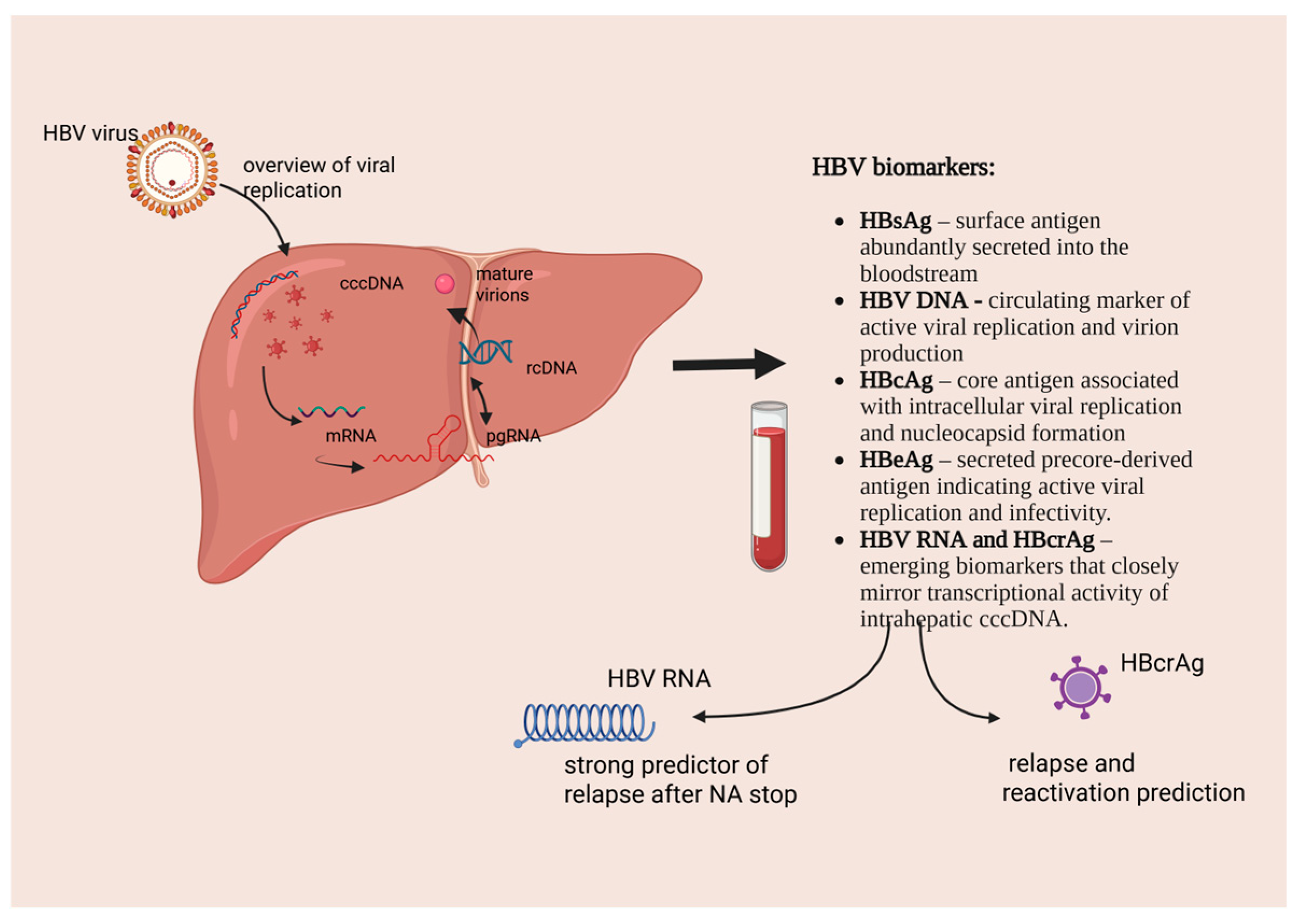
3.3. Overview of Viral Replication and Biomarker Origin
- Entry and cccDNA formation—HBV enters the hepatocytes and converts relaxed circular DNA (rcDNA) into cccDNA, a stable nuclear episome.
- Transcription and translation—cccDNA acts as a template for multiple transcripts (mRNAs and pgRNA), directing the synthesis of viral structural and regulatory proteins.
- Replication and assembly—pgRNA is reverse-transcribed into rcDNA and assembled with capsid and envelope proteins (HBsAg) to form mature virions.
3.4. HBV RNA Transcripts and RNA-Interference-Based Therapeutics
- pgRNA serves as a template for both reverse transcription into rcDNA and the translation of the polymerase and core proteins.
- Pre-S mRNA encodes the large envelope protein (L-HBs, containing Pre-S1/Pre-S2/S domains).
- S mRNA gives rise to medium and small surface proteins (M-HBs and S-HBs).
4. Predictive Studies on Relapse After Nucleos(t)ide Analogue (NA) Withdrawal
4.1. HBV RNA and HBcrAg as Predictors of Virological Relapse
- More accurately reflect the transcriptional activity of intrahepatic cccDNA;
- Serve as a predictor for relapse risk after treatment discontinuation;
- Function as a monitoring indicator of antiviral efficacy;
- Provide prognostic insights into outcomes such as HBeAg seroconversion and hepatocellular carcinoma (HCC) risk.
4.2. The Ideal Therapeutic Goal: Toward Functional and Sterilizing Cure
4.3. Novel Antiviral and Immunomodulatory Strategies
- Capsid assembly modulators/inhibitors (CAMs) disrupt pgRNA encapsidation, cccDNA recycling, and the capsid formation, halting replication at multiple stages.
- Entry and release inhibitors, which limit viral spread and reduce antigenemia [48].
- Therapeutic vaccines, Toll-like receptor (TLR) agonists, and RIG-I activators which are under investigation to boost innate and adaptive immune responses [49,50]. Together, these emerging modalities aim to achieve a more durable immune control and to complement biomarker-guided treatment strategies.
4.4. Clinical Relevance of Serum HBV RNA in Monitoring Viral Replication and Treatment Outcomes
- Monitoring active viral replication;
- Assessing antiviral efficacy;
- Guiding NA discontinuation;
- Evaluating a functional cure—patients with undetectable HBV RNA at the end of therapy exhibit a significantly lower risk of relapse, whereas persistent low-level positivity suggests ongoing transcriptional activity. Consequently, HBV RNA measurement bridges the diagnostic gap between biochemical remission and the true viral silence [54,55].
4.5. Quantitative HBsAg and HBV DNA as Dynamic Risk Stratifiers
- Monitoring response to pegylated interferon therapy;
- Estimating the likelihood of functional clearance of HBsAg;
- Predicting reactivation risk in immunosuppressed patients;
- Differentiating inactive carriers from those with low-level viral activity [59].
4.6. Predictive Biomarkers for Nucleos(t)ide Analogue (NA) Therapy Discontinuation
- qHBsAg < 1000 IU/mL (ideally <100 IU/mL);
- HBV RNA and HBcrAg are undetectable;
- ALT levels remain stable under long-term suppression [62].
5. Integrative Framework and Clinical Implications
5.1. Combined Stratification Scheme: Viral, Inflammatory, Fibrotic, and Risk Parameters
- Initiation of therapy when HBV DNA > 2000 IU/mL + elevated ALT + fibrosis ≥ F2–F3;
- Periodic monitoring every 3–12 months for untreated patients, based on individual risk profiles;
- Discontinuation of NA therapy only when HBsAg < 1000 IU/mL, ideally combined with HBcrAg and/or HBV RNA assessment and close post-cessation follow-up.
5.2. Anti-HBc Levels as a Predictor of Relapse
- Prospective evidence (2025): In a multicenter prospective cohort of patients stopping NA therapy, end-of-treatment (EOT) anti-HBc ≥ 300 IU/mL identified a subgroup with low risk of virological relapse and severe biochemical flares; none of the patients above this threshold experienced severe relapse (PPV 100% for “no severe flare,” NPV 48%) [65].
- Earlier prospective data (2019): A large study found that higher EOT anti-HBc independently associated with lower clinical relapse over long-term follow-up after NA cessation, supporting a protective immune correlate captured by qAnti-HBc [66].
- Cohort heterogeneity (2022–2025): Not all data sets align perfectly. An HBeAg-negative cohort (mostly genotypes B/C) reported lower anti-HBc levels linked to lower relapse risk, highlighting possible genotype, disease-phase, and assay differences; a 2025 analysis again emphasized HBV-RNA’s added value but also variability across platforms. These mixed findings argue for context-specific cut-offs rather than a single universal threshold [67].
- Guideline position (2025): EASL 2025 acknowledges qAnti-HBc as a useful adjunct—particularly at NA stop—but recommends multimarker approaches (HBV DNA, quantitative HBsAg, HBcrAg, ±HBV RNA) until prospective validation and standardization of qAnti-HBc cut-offs are finalized [62].
5.3. Functional Pathway
- Main points:
- Borderline qAnti-HBc values have shown variable associations with outcomes across studies, with differences influenced by viral genotype, HBeAg status, fibrosis stage, and assay methodology, supporting the need for context- and laboratory-specific interpretation rather than universal cut-offs [67].
- Current evidence and EASL 2025 guidance indicate that qAnti-HBc is best interpreted as an adjunct biomarker within multimarker frameworks, rather than as a standalone determinant of clinical decision making [62].
6. Occult HBV Infection
7. Analysis of HBV Biomarkers Interpretation
7.1. Clinical Implications of HBV Biomarkers Across Age Groups: Pediatric Versus Adult Populations
7.1.1. Pediatric Population
- In children, especially those infected perinatally or during early childhood, HBV infection frequently evolves toward chronicity, given the immaturity of the immune system and the inability to mount an effective cytotoxic response against infected hepatocytes. In this setting, biomarkers play a decisive role in early detection, classification of the disease phase, and in treatment monitoring: HBsAg and HBeAg remain essential for the identification of chronic infection and for defining the immune-tolerant versus immune-active phase. HBV DNA quantification provides information about replication intensity, guiding the timing of therapeutic intervention [52,79].
- In recent years, novel biomarkers such as HBV RNA and HBcrAg have emerged as potential tools for monitoring intrahepatic viral activity (cccDNA transcription) in pediatric patients, particularly useful when liver biopsy is not feasible. From a preventive standpoint, biomarker-based screening of pregnant women with HBV infection is fundamental to prevent mother-to-child transmission (MTCT). HBeAg positivity or high HBV DNA levels during pregnancy indicate the need for antiviral prophylaxis (e.g., tenofovir) in the third trimester and postnatal immunoprophylaxis in the newborn, thus substantially reducing the perinatal transmission risk [80,81]. Overall, in children, biomarkers predominantly inform monitoring and prevention rather than relapse prediction or functional cure assessment.
7.1.2. Adult Population
- In adults, HBV infection is more often acquired horizontally and has a higher likelihood of spontaneous resolution; however, once chronicity is established, it carries a greater risk of progressive liver injury. Unlike in children, biomarkers in this population have distinct implications for disease stratification, treatment optimization, and long-term surveillance: HBV DNA, HBeAg, and quantitative HBsAg remain standard tools for evaluating viral replication and treatment response with nucleos(t)ide analogue therapy [82,83]. Emerging biomarkers—particularly HBV RNA and HBcrAg—offer complementary insight into cccDNA transcriptional activity, providing early predictive value for sustained virological remission after treatment cessation (Figure 1).
- Quantitative decline of HBsAg and HBcrAg has been associated with functional cure and can assist in identifying patients eligible for treatment discontinuation. In individuals with advanced chronic liver disease, these markers contribute to the early detection and prevention of hepatocellular carcinoma (HCC), especially when integrated with imaging and serum AFP surveillance [84,85].
8. Conclusions
Author Contributions
Funding
Institutional Review Board Statement
Informed Consent Statement
Data Availability Statement
Conflicts of Interest
References
- Chang, M.H. Natural history and clinical management of chronic hepatitis B virus infection in children. Hepatol. Int. 2008, 2, 28–36. [Google Scholar] [CrossRef]
- Forna, L.; Bozomitu, L.; Lupu, A.; Lupu, V.V.; Cojocariu, C.; Anton, C.; Girleanu, I.; Singeap, A.M.; Muzica, C.M.; Trifan, A. Insights into the Natural and Treatment Courses of Hepatitis B in Children: A Retrospective Study. Biomedicines 2024, 12, 1585. [Google Scholar] [CrossRef]
- Nguyen, M.H.; Wong, G.; Gane, E.; Kao, J.H.; Dusheiko, G. Hepatitis B Virus: Advances in Prevention, Diagnosis, and Therapy. Clin. Microbiol. Rev. 2020, 33, e00046-19. [Google Scholar] [CrossRef]
- Locarnini, S.; Littlejohn, M.; Aziz, M.N.; Yuen, L. Possible origins and evolution of the hepatitis B virus (HBV). Semin. Cancer Biol. 2013, 23, 561–575. [Google Scholar] [CrossRef]
- Wu, J.F.; Tai, C.S.; Chang, K.C.; Chen, Y.J.; Hsu, C.T.; Chen, H.L.; Ni, Y.H.; Chang, M.H. Predictors of Functional Cure of Chronic Hepatitis B Virus Infection: A Long-Term Follow-Up Study. Clin. Gastroenterol. Hepatol. 2025, 23, 583–590.e3. [Google Scholar] [CrossRef]
- Datta, S.; Chatterjee, S.; Veer, V.; Chakravarty, R. Molecular biology of the hepatitis B virus for clinicians. J. Clin. Exp. Hepatol. 2012, 2, 353–365. [Google Scholar] [CrossRef]
- Hu, J.; Seeger, C. Expression and characterization of hepadnavirus reverse transcriptases. Methods Enzymol. 1996, 275, 195–208. [Google Scholar] [CrossRef] [PubMed]
- McFadden, W.M.; Sarafianos, S.G. Biology of the hepatitis B virus (HBV) core and capsid assembly modulators (CAMs) for chronic hepatitis B (CHB) cure. Glob. Health Med. 2023, 5, 199–207. [Google Scholar] [CrossRef] [PubMed]
- Belloni, L.; Pollicino, T.; De Nicola, F.; Guerrieri, F.; Raffa, G.; Fanciulli, M.; Raimondo, G.; Levrero, M. Nuclear HBx binds the HBV minichromosome and modifies the epigenetic regulation of cccDNA function. Proc. Natl. Acad. Sci. USA 2009, 106, 19975–19979. [Google Scholar] [CrossRef] [PubMed]
- Murphy, C.M.; Xu, Y.; Li, F.; Nio, K.; Reszka-Blanco, N.; Li, X.; Wu, Y.; Yu, Y.; Xiong, Y.; Su, L. Hepatitis B Virus X Protein Promotes Degradation of SMC5/6 to Enhance HBV Replication. Cell Rep. 2016, 16, 2846–2854. [Google Scholar] [CrossRef]
- Siegler, V.D.; Bruss, V. Role of transmembrane domains of hepatitis B virus small surface proteins in subviral-particle biogenesis. J. Virol. 2013, 87, 1491–1496. [Google Scholar] [CrossRef]
- Gish, R.G.; Given, B.D.; Lai, C.L.; Locarnini, S.A.; Lau, J.Y.; Lewis, D.L.; Schluep, T. Chronic hepatitis B: Virology, natural history, current management and a glimpse at future opportunities. Antivir. Res. 2015, 121, 47–58. [Google Scholar] [CrossRef]
- Liu, J.; Li, T.; Zhang, L.; Xu, A. The Role of Hepatitis B Surface Antigen in Nucleos(t)ide Analogues Cessation Among Asian Patients With Chronic Hepatitis B: A Systematic Review. Hepatology 2019, 70, 1045–1055. [Google Scholar] [CrossRef]
- Kim, S.W.; Yoon, J.S.; Lee, M.; Cho, Y. Toward a complete cure for chronic hepatitis B: Novel therapeutic targets for hepatitis B virus. Clin. Mol. Hepatol. 2022, 28, 17–30. [Google Scholar] [CrossRef] [PubMed]
- Huang, X.; Hollinger, F.B. Occult hepatitis B virus infection and hepatocellular carcinoma: A systematic review. J. Viral Hepat. 2014, 21, 153–162. [Google Scholar] [CrossRef]
- Mak, L.Y.; Boettler, T.; Gill, U.S. HBV Biomarkers and Their Role in Guiding Treatment Decisions. Semin. Liver Dis. 2024, 44, 474–491. [Google Scholar] [CrossRef]
- Paganelli, M.; Stephenne, X.; Sokal, E.M. Chronic hepatitis B in children and adolescents. J. Hepatol. 2012, 57, 885–896. [Google Scholar] [CrossRef]
- Terrault, N.A.; Bzowej, N.H.; Chang, K.M.; Hwang, J.P.; Jonas, M.M.; Murad, M.H.; American Association for the Study of Liver Diseases. AASLD guidelines for treatment of chronic hepatitis B. Hepatology 2016, 63, 261–283. [Google Scholar] [CrossRef]
- Deng, R.; Liu, S.; Shen, S.; Guo, H.; Sun, J. Circulating HBV RNA: From biology to clinical applications. Hepatology 2022, 76, 1520–1530. [Google Scholar] [CrossRef] [PubMed]
- Choi, W.-M.; Choi, J.; Lim, Y.-S. Chapter 7—Hepatitis B: Epidemiology, Natural History, and Diagnosis. In Comprehensive Guide 403 to Hepatitis Advances; Seto, W.-K., Eslam, M., Eds.; Academic Press: San Diego, CA, USA, 2023; pp. 183–203. [Google Scholar]
- Martinez, M.G.; Villeret, F.; Testoni, B.; Zoulim, F. Can we cure hepatitis B virus with novel direct-acting antivirals? Liver Int. 2020, 40, 27–34. [Google Scholar] [CrossRef] [PubMed]
- Medas, R.; Liberal, R.; Macedo, G. Discontinuation of antiviral therapy in chronic hepatitis B patients. World J. Clin. Cases 2021, 9, 6979–6986. [Google Scholar] [CrossRef] [PubMed]
- Chang, M.L.; Liaw, Y.F.; Hadziyannis, S.J. Systematic review: Cessation of long-term nucleos(t)ide analogue therapy in patients with hepatitis B e antigen-negative chronic hepatitis B. Aliment. Pharmacol. Ther. 2015, 42, 243–257. [Google Scholar] [CrossRef]
- Gerlich, W.H.; Glebe, D.; Kramvis, A.; Magnius, L.O. Peculiarities in the designations of hepatitis B virus genes, their products, and their antigenic specificities: A potential source of misunderstandings. Virus Genes 2020, 56, 109–119. [Google Scholar] [CrossRef]
- Tong, S.; Revill, P. Overview of hepatitis B viral replication and genetic variability. J. Hepatol. 2016, 64, S4–S16. [Google Scholar] [CrossRef]
- Niklasch, M.; Zimmermann, P.; Nassal, M. The Hepatitis B Virus Nucleocapsid-Dynamic Compartment for Infectious Virus Production and New Antiviral Target. Biomedicines 2021, 9, 1577. [Google Scholar] [CrossRef]
- Papatheodoridi, M.; Papatheodoridis, G. Can we stop nucleoside analogues before HBsAg loss? J. Viral Hepat. 2019, 26, 936–941. [Google Scholar] [CrossRef]
- Philips, C.A.; Ahamed, R.; Abduljaleel, J.K.; Rajesh, S.; Augustine, P. Critical Updates on Chronic Hepatitis B Virus Infection in 2021. Cureus 2021, 13, e19152. [Google Scholar] [CrossRef] [PubMed]
- Feng, S.; Gao, L.; Han, X.; Hu, T.; Hu, Y.; Liu, H.; Thomas, A.W.; Yan, Z.; Yang, S.; Young, J.A.T.; et al. Discovery of Small Molecule Therapeutics for Treatment of Chronic HBV Infection. ACS Infect. Dis. 2018, 4, 257–277. [Google Scholar] [CrossRef] [PubMed]
- Coffin, C.S.; Zhou, K.; Terrault, N.A. New and old biomarkers for diagnosis and management of chronic hepatitis B virus infection. Gastroenterology 2019, 156, 355–368.e3. [Google Scholar] [CrossRef]
- Mak, L.Y.; Wong, D.K.; Cheung, K.S.; Seto, W.K.; Lai, C.L.; Yuen, M.F. Review article: Hepatitis B core-related antigen (HBcrAg): An emerging marker for chronic hepatitis B virus infection. Aliment. Pharmacol. Ther. 2018, 47, 43–54. [Google Scholar] [CrossRef]
- Martinez, M.G.; Boyd, A.; Combe, E.; Testoni, B.; Zoulim, F. Covalently closed circular DNA: The ultimate therapeutic target for curing HBV infections. J. Hepatol. 2021, 75, 706–717. [Google Scholar] [CrossRef]
- Piermatteo, L.; Scutari, R.; Chirichiello, R.; Alkhatib, M.; Malagnino, V.; Bertoli, A.; Iapadre, N.; Ciotti, M.; Sarmati, L.; Andreoni, M.; et al. Droplet digital PCR assay as an innovative and promising highly sensitive assay to unveil residual and cryptic HBV replication in peripheral compartment. Methods 2022, 201, 74–81. [Google Scholar] [CrossRef]
- Gao, Y.; Li, Y.; Meng, Q.; Zhang, Z.; Zhao, P.; Shang, Q.; Li, Y.; Su, M.; Li, T.; Liu, X.; et al. Serum hepatitis B virus DNA, RNA, and HBsAg: Which correlated better with intrahepatic covalently closed circular DNA before and after nucleos(t)ide analogue treatment? J. Clin. Microbiol. 2017, 55, 2972–2982. [Google Scholar] [CrossRef]
- Butler, E.K.; Gersch, J.; McNamara, A.; Luk, K.C.; Holzmayer, V.; de Medina, M.; Schiff, E.; Kuhns, M.; Cloherty, G.A. Hepatitis B virus serum DNA and RNA levels in nucleos(t)ide analog-treated or untreated patients during chronic and acute infection. Hepatology 2018, 68, 2106–2117. [Google Scholar] [CrossRef]
- Wang, J.; Shen, T.; Huang, X.; Kumar, G.R.; Chen, X.; Zeng, Z.; Zhang, R.; Chen, R.; Li, T.; Zhang, T.; et al. Serum hepatitis B virus RNA is encapsidated pregenome RNA that may be associated with persistence of viral infection and rebound. J. Hepatol. 2016, 65, 700–710. [Google Scholar] [CrossRef]
- Mak, L.Y.; Yuen, M.F. Letter: Serum HBcrAg is a useful marker for disease monitoring, predicting treatment response and disease outcome of chronic hepatitis B virus infection-authors’ reply. Aliment. Pharmacol. Ther. 2018, 47, 1720–1721. [Google Scholar] [CrossRef] [PubMed]
- Hong, X.; Luckenbaugh, L.; Mendenhall, M.; Walsh, R.; Cabuang, L.; Soppe, S.; Revill, P.A.; Burdette, D.; Feierbach, B.; Delaney, W.; et al. Characterization of hepatitis B precore/core-related antigens. J. Virol. 2021, 95, e01695-20. [Google Scholar] [CrossRef]
- Tseng, T.N.; Jeng, W.J.; Hu, T.H.; Wang, J.H.; Hung, C.H.; Lu, S.N.; Chen, C.H. Combined baseline HBcrAg and end-of-treatment HBsAg predict HBV relapse after entecavir or tenofovir cessation. J. Antimicrob. Chemother. 2023, 78, 436–439. [Google Scholar] [CrossRef] [PubMed]
- Carey, I.; Gersch, J.; Wang, B.; Moigboi, C.; Kuhns, M.; Cloherty, G.; Dusheiko, G.; Agarwal, K. Pregenomic HBV RNA and Hepatitis B Core-Related Antigen Predict Outcomes in Hepatitis B e Antigen-Negative Chronic Hepatitis B Patients Suppressed on Nucleos(T)ide Analogue Therapy. Hepatology 2020, 72, 42–57. [Google Scholar] [CrossRef] [PubMed]
- Adraneda, C.; Tan, Y.C.; Yeo, E.J.; Kew, G.S.; Khakpoor, A.; Lim, S.G. A critique and systematic review of the clinical utility of hepatitis B core-related antigen. J. Hepatol. 2023, 78, 731–741. [Google Scholar] [CrossRef]
- Pattyn, J.; Hendrickx, G.; Vorsters, A.; Van Damme, P. Hepatitis B Vaccines. J. Infect. Dis. 2021, 224, S343–S351. [Google Scholar] [CrossRef]
- Fan, R.; Zhou, B.; Xu, M.; Tan, D.; Niu, J.; Wang, H.; Ren, H.; Chen, X.; Wang, M.; Ning, Q.; et al. Association between negative results from tests for HBV DNA and RNA and durability of response after discontinuation of nucles(t)ide analogue therapy. Clin. Gastroenterol. Hepatol. 2020, 18, 719–727.e7. [Google Scholar] [CrossRef]
- You, C.R.; Lee, S.W.; Jang, J.W.; Yoon, S.K. Update on hepatitis B virus infection. World J. Gastroenterol. 2014, 20, 13293–13305. [Google Scholar] [CrossRef]
- Chan, H.L.Y. Okuda lecture: Challenges of hepatitis B in the era of antiviral therapy. J. Gastroenterol. Hepatol. 2019, 34, 501–506. [Google Scholar] [CrossRef] [PubMed]
- Karthikeyan, E.; Gish, R.G. Strategies to Achieve Functional Cure in HBV: Focus on siRNA. Curr. Hepatol. Rep. 2025, 24, 36. [Google Scholar] [CrossRef]
- Lu, F.; Wang, J.; Chen, X.; Xu, D.; Xia, N. Potential use of serum HBV RNA in antiviral therapy for chronic hepatitis B in the era of nucleos(t)ide analogs. Front. Med. 2017, 11, 502–508. [Google Scholar] [CrossRef]
- Hall, S.; Howell, J.; Visvanathan, K.; Thompson, A. The Yin and the Yang of Treatment for Chronic Hepatitis B-When to Start, When to Stop Nucleos(t)ide Analogue Therapy. Viruses 2020, 12, 934. [Google Scholar] [CrossRef] [PubMed]
- Yan, Q.; Fu, X.; Wang, Y.; Wang, G. Do the therapeutic vaccines hold hope for the treatment of hepatitis B? Hepatol. Int. 2025, 19, 1320–1330. [Google Scholar] [CrossRef]
- Jansen, L.; Kootstra, N.A.; van Dort, K.A.; Takkenberg, R.B.; Reesink, H.W.; Zaaijer, H.L. Hepatitis B virus pregenomic RNA is present in virions in plasma and is associated with a response to pegylated interferon Alfa-2a and nucleos(t)ide analogues. J. Infect. Dis. 2016, 213, 224–232. [Google Scholar] [CrossRef] [PubMed]
- Lai, C.L.; Wong, D.K.; Wong, G.T.; Seto, W.K.; Fung, J.; Yuen, M.F. Rebound of HBV DNA after cessation of nucleos/tide analogues in chronic hepatitis B patients with undetectable covalently closed. JHEP Rep. 2020, 2, 100112. [Google Scholar] [CrossRef]
- Zhang, M.; Li, J.; Xu, Z.; Fan, P.; Dong, Y.; Wang, F.; Gao, Y.; Yan, J.; Cao, L.; Ji, D.; et al. Functional cure is associated with younger age in children undergoing antiviral treatment for active chronic hepatitis B. Hepatol. Int. 2024, 18, 435–448. [Google Scholar] [CrossRef]
- Hui, R.W.; Fung, J.; Seto, W.K.; Yuen, M.F.; Mak, L.Y. Emerging therapies for HBsAg seroclearance: Spotlight on novel combination strategies. Hepatol. Int. 2025, 19, 704–719. [Google Scholar] [CrossRef] [PubMed]
- Seto, W.; Liu, K.S.; Mak, L.; Cloherty, G.; Wong, D.K.; Gersch, J.; Lam, Y.F.; Cheung, K.S.; Chow, N.; Ko, K.L.; et al. Role of serum HBV RNA and hepatitis B surface antigen levels in identifying Asian patients with chronic hepatitis B suitable for entecavir cessation. Gut 2021, 70, 775–783. [Google Scholar] [CrossRef]
- Wang, J.; Yu, Y.; Li, G.; Shen, C.; Meng, Z.; Zheng, J.; Jia, Y.; Chen, S.; Zhang, X.; Zhu, M.; et al. Relationship between serum HBV-RNA levels and intrahepatic viral as well as histologic activity markers in entecavir-treated patients. J. Hepatol. 2018, 68, 16–24. [Google Scholar] [CrossRef]
- Rinker, F.; Zimmer, C.L.; Höner Zu Siederdissen, C.; Manns, M.P.; Kraft, A.R.M.; Wedemeyer, H.; Björkström, N.K.; Cornberg, M. Hepatitis B virus-specific T cell responses after stopping nucleos(t)ide analogue therapy in HBeAg-negative chronic hepatitis B. J. Hepatol. 2018, 69, 584–593. [Google Scholar] [CrossRef]
- Hume, S.J.; Wong, D.K.; Yuen, M.F.; Jackson, K.; Bonanzinga, S.; Vogrin, S.; Hall, S.A.L.; Burns, G.S.; Desmond, P.V.; Sundararajan, V.; et al. High end-of-treatment hepatitis B core-related antigen levels predict hepatitis flare after stopping nucleot(s)ide analogue therapy. Liver Int. 2024, 44, 2605–2614. [Google Scholar] [CrossRef]
- Fan, R.; Peng, J.; Xie, Q.; Tan, D.; Xu, M.; Niu, J.; Wang, H.; Ren, H.; Chen, X.; Wang, M.; et al. Combining Hepatitis B Virus RNA and Hepatitis B Core-Related Antigen: Guidance for Safely Stopping Nucleos(t)ide Analogues in Hepatitis B e Antigen-Positive Patients With Chronic Hepatitis B. J. Infect. Dis. 2020, 222, 611–618. [Google Scholar] [CrossRef]
- Komatsu, H.; Inui, A.; Fujisawa, T. Pediatric Hepatitis B Treatment. Ann. Transl. Med. 2017, 5, 37. [Google Scholar] [CrossRef]
- Liu, Z.; Jin, Q.; Zhang, Y.; Gong, G.; Wu, G.; Yao, L.; Wen, X.; Gao, Z.; Huang, Y.; Yang, D.; et al. 96-Week Treatment of Tenofovir Amibufenamide and Tenofovir Disoproxil Fumarate in Chronic Hepatitis B Patients. J. Clin. Transl. Hepatol. 2023, 11, 649–660. [Google Scholar] [CrossRef] [PubMed]
- Lim, S.G.; Baumert, T.F.; Boni, C.; Gane, E.; Levrero, M.; Lok, A.S.; Maini, M.K.; Terrault, N.A.; Zoulim, F. The scientific basis of combination therapy for chronic hepatitis B functional cure. Nat. Rev. Gastroenterol. Hepatol. 2023, 20, 238–253. [Google Scholar] [CrossRef] [PubMed]
- Cornberg, M.; Sandmann, L.; Jaroszewicz, J.; Kennedy, P.; Lampertico, P.; Lemoine, M.; Lens, S.; Testoni, B.; Wong, G.L.-H.; Russo, F.P. EASL Clinical Practice Guidelines on the management of hepatitis B virus infection. J. Hepatol. 2025, 83, 502–583. [Google Scholar] [CrossRef]
- Liang, H.; Jiang, J.; Ren, F. Relationship Between Serum HBV-RNA Levels, Sero-biochemical Indices, and Clinicopathological Parameters in Patients with Hepatitis B Virus. Hepat. Mon. 2024, 24, e145421. [Google Scholar] [CrossRef]
- Song, H.; Zhang, Q.; Fang, G.; Luo, X.; Wu, D.; Li, H.; Zhou, K.; Zhao, X.; Xu, F.; Zhang, Y.; et al. Unraveling the Mechanisms of MicroRNA in Suppressing Hepatitis B Virus Progression: A Comprehensive Review for Designing Treatment Strategies. Hepat. Mon. 2024, 24, e144239. [Google Scholar] [CrossRef]
- van Bömmel, F.; Verbinnen, T.; Agarwal, K.; Vanwolleghem, T.; Lampertico, P.; Buti, M.; Janczewska, E.; Bourliere, M.; Jezorwski, J.; Donohue, K.; et al. Serum levels of hepatitis B core antibodies and hepatitis B core-related antigen at the time of nucleos(t)ide analog cessation and risk of severe flares in patients with chronic hepatitis B. Hepatol. Commun. 2025, 9, e0656. [Google Scholar]
- Chi, H.; Li, Z.; Hansen, B.E.; Yu, T.; Zhang, X.; Sun, J.; Hou, J.; Janssen, H.L.A.; Peng, J. Serum Level of Antibodies Against Hepatitis B Core Protein Is Associated With Clinical Relapse After Discontinuation of Nucleos(t)ide Analogue Therapy. Clin. Gastroenterol. Hepatol. 2019, 17, 182–191.e1. [Google Scholar] [CrossRef] [PubMed]
- Ohlendorf, V.; Wübbolding, M.; Gineste, P.; Höner Zu Siederdissen, C.; Bremer, B.; Wedemeyer, H.; Cornberg, M.; Maasoumy, B. Low anti-HBc levels are associated with lower risk of virological relapse after nucleos(t)ide analogue cessation in HBe antigen-negative patients. Liver Int. 2022, 42, 2674–2682. [Google Scholar] [CrossRef]
- Wong, D.K.; Seto, W.K.; Fung, J.; Ip, P.; Huang, F.Y.; Lai, C.L.; Yuen, M.F. Reduction of hepatitis B surface antigen and covalently closed circular DNA by nucleos(t)ide analogues of different potency. Clin. Gastroenterol. Hepatol. 2013, 11, 1004–1010.e1. [Google Scholar] [CrossRef] [PubMed]
- Liu, Y.; Zeng, W.; Xi, J.; Liu, H.; Liao, H.; Yu, G.; Chen, X.; Lu, F. Over-gap PCR amplification to identify presence of replication-competent HBV DNA from integrated HBV DNA: An updated occult HBV infection definition. J. Hepatol. 2019, 70, 557–559. [Google Scholar] [CrossRef] [PubMed]
- Caviglia, G.P.; Abate, M.L.; Tandoi, F.; Ciancio, A.; Amoroso, A.; Salizzoni, M.; Saracco, G.M.; Rizzetto, M.; Romagnoli, R.; Smedile, A. Quantitation of HBV cccDNA in anti-HBc-positive liver donors by droplet digital PCR: A new tool to detect occult infection. J. Hepatol. 2018, 69, 301–307. [Google Scholar] [CrossRef]
- Raimondo, G.; Locarnini, S.; Pollicino, T.; Levrero, M.; Zoulim, F.; Lok, A.S. Update of the statements on biology and clinical impact of occult hepatitis B virus infection. J. Hepatol. 2019, 71, 397–408. [Google Scholar] [CrossRef]
- Sosa-Jurado, F.; Meléndez-Mena, D.; Rosas-Murrieta, N.H.; Guzmán-Flores, B.; Mendoza-Torres, M.A.; Barcenas-Villalobos, R.; Márquez-Domínguez, L.; Cortés-Hernández, P.; Reyes-Leyva, J.; Vallejo-Ruiz, V.; et al. Effectiveness of PCR primers for the detection of occult hepatitis B virus infection in Mexican patients. PLoS ONE 2018, 13, e0205356. [Google Scholar] [CrossRef] [PubMed]
- Hui, R.W.; Wong, D.K.; Mak, L.Y.; Fung, J.; Seto, W.K.; Yuen, M.F. Development and Validation of a High-Sensitivity Droplet Digital PCR Assay for Serum Hepatitis B Virus DNA Detection. J. Viral Hepat. 2025, 32, e70023. [Google Scholar] [CrossRef]
- Musolino, C.; Cacciola, I.; Tripodi, G.; Lombardo, D.; Raffa, G.; Alibrandi, A.; Squadrito, G.; Raimondo, G.; Pollicino, T. Behaviour of Occult HBV Infection in HCV-Infected Patients under Treatment with Direct-Acting Antivirals. Antivir. Ther. 2018, 24, 187–192. [Google Scholar] [CrossRef]
- Kramvis, A.; Chang, K.M.; Dandri, M.; Farci, P.; Glebe, D.; Hu, J.; Janssen, H.L.A.; Lau, D.T.Y.; Penicaud, C.; Pollicino, T.; et al. A roadmap for serum biomarkers for hepatitis B virus: Current status and future outlook. Nat. Rev. Gastroenterol. Hepatol. 2022, 19, 727–745. [Google Scholar] [CrossRef]
- Zuccaro, V.; Asperges, E.; Colaneri, M.; Marvulli, L.N.; Bruno, R. HBV and HDV: New Treatments on the Horizon. J. Clin. Med. 2021, 10, 4054. [Google Scholar] [CrossRef] [PubMed]
- Saitta, C.; Pollicino, T.; Raimondo, G. Occult Hepatitis B Virus Infection: An Update. Viruses 2022, 14, 1504. [Google Scholar] [CrossRef] [PubMed]
- Testoni, B.; Lebossé, F.; Scholtes, C.; Berby, F.; Miaglia, C.; Subic, M.; Loglio, A.; Facchetti, F.; Lampertico, P.; Levrero, M.; et al. Serum hepatitis B core-related antigen (HBcrAg) correlates with covalently closed circular DNA transcriptional activity in chronic hepatitis B patients. J. Hepatol. 2019, 70, 615–625. [Google Scholar] [CrossRef] [PubMed]
- Chien, R.N.; Liaw, Y.F. Current Trend in Antiviral Therapy for Chronic Hepatitis B. Viruses 2022, 14, 434. [Google Scholar] [CrossRef]
- Navabakhsh, B.; Mehrabi, N.; Estakhri, A.; Mohamadnejad, M.; Poustchi, H. Hepatitis B Virus Infection during Pregnancy: Transmission and Prevention. Middle East. J. Dig. Dis. 2011, 3, 92–102. [Google Scholar] [PubMed] [PubMed Central]
- Yi, P.; Chen, R.; Huang, Y.; Zhou, R.R.; Fan, X.G. Management of mother-to-child transmission of hepatitis B virus: Propositions and challenges. J. Clin. Virol. 2016, 77, 32–39. [Google Scholar] [CrossRef][Green Version]
- Weng, D.; Zhang, C.; Wei, Q.; Zhang, L.; Zang, X.; Huang, G.; Cao, Z.; Xie, Q. Combination therapies for chronic hepatitis B in the era of emerging novel drugs. Hepatol. Int. 2025, 20, 9–18. [Google Scholar] [CrossRef] [PubMed]
- Hou, J.; Zhang, W.; Xie, Q.; Hua, R.; Tang, H.; Morano Amado, L.E.; Yang, S.S.; Peng, C.Y.; Su, W.W.; Chuang, W.L.; et al. Xalnesiran with or without an Immunomodulator in Chronic Hepatitis B. N. Engl. J. Med. 2024, 391, 2098–2109. [Google Scholar] [CrossRef]
- Bertoletti, A.; Le Bert, N. Immunotherapy for Chronic Hepatitis B Virus Infection. Gut Liver 2018, 12, 497–507. [Google Scholar] [CrossRef] [PubMed]
- Dandri, M.; Petersen, J. Latest developments in the treatment of hepatitis B. Minerva Gastroenterol. E Dietol. 2016, 62, 88–102. [Google Scholar]


| Clinical Phase | Serological/Viral Features | Inflammation and Fibrosis | Interpretation |
|---|---|---|---|
| HBeAg-positive infection (non-inflammatory phase) | HBeAg+, HBV DNA markedly elevated, ALT normal | LSM < 7 kPa | Chronic infection without active hepatitis |
| HBeAg-positive hepatitis | HBeAg+, HBV DNA elevated, ALT increased | LSM ≥ 7–8 kPa | Active hepatitis with inflammation |
| Inactive HBeAg-negative carrier | HBeAg−, HBV DNA < 2000 IU/mL, ALT normal | LSM < 7 kPa | Inactive carrier phase |
| HBeAg-negative hepatitis | HBeAg−, HBV DNA > 2000 IU/mL, ALT elevated | LSM ≥ 7–8 kPa | Active hepatitis |
| HBsAg-negative phase (functional cure) | Loss of HBsAg, anti-HBs positive | - | Functional recovery |
| Marker | Reflects | Main Clinical Utility | Predictive Role |
|---|---|---|---|
| Anti-HBc | Host immune memory | Immune control marker | Lower relapse risk (≥300 IU/mL) |
| HBV DNA | Active replication | Diagnosis, treatment monitoring | Limited relapse prediction |
| HBsAg (quant.) | cccDNA + integrated DNA | Response to therapy, phase classification | Functional cure assessment |
| HBcrAg | Transcriptional cccDNA activity | Treatment response, HCC risk | Relapse and reactivation prediction |
| HBV RNA | cccDNA transcription | Detects residual replication | Strong predictor of relapse after NA stop |
Disclaimer/Publisher’s Note: The statements, opinions and data contained in all publications are solely those of the individual author(s) and contributor(s) and not of MDPI and/or the editor(s). MDPI and/or the editor(s) disclaim responsibility for any injury to people or property resulting from any ideas, methods, instructions or products referred to in the content. |
© 2026 by the authors. Licensee MDPI, Basel, Switzerland. This article is an open access article distributed under the terms and conditions of the Creative Commons Attribution (CC BY) license.
Share and Cite
Bozomitu, L.I.; Lupu, A.; Lupu, V.V.; Gimiga, N.; Anton Paduraru, D.T.; Mîndru, D.E.; Mihai, M.; Anton, C.; Anton, E.; Mitrea, M.; et al. Accuracy of Diagnostic Investigations in Monitoring Hepatitis B Virus Infection: Strengths, Limitations, and Emerging Biomarkers. Int. J. Mol. Sci. 2026, 27, 2464. https://doi.org/10.3390/ijms27052464
Bozomitu LI, Lupu A, Lupu VV, Gimiga N, Anton Paduraru DT, Mîndru DE, Mihai M, Anton C, Anton E, Mitrea M, et al. Accuracy of Diagnostic Investigations in Monitoring Hepatitis B Virus Infection: Strengths, Limitations, and Emerging Biomarkers. International Journal of Molecular Sciences. 2026; 27(5):2464. https://doi.org/10.3390/ijms27052464
Chicago/Turabian StyleBozomitu, Laura Iulia, Ancuta Lupu, Vasile Valeriu Lupu, Nicoleta Gimiga, Dana Teodora Anton Paduraru, Dana Elena Mîndru, Mihaela Mihai, Carmen Anton, Emil Anton, Mihaela Mitrea, and et al. 2026. "Accuracy of Diagnostic Investigations in Monitoring Hepatitis B Virus Infection: Strengths, Limitations, and Emerging Biomarkers" International Journal of Molecular Sciences 27, no. 5: 2464. https://doi.org/10.3390/ijms27052464
APA StyleBozomitu, L. I., Lupu, A., Lupu, V. V., Gimiga, N., Anton Paduraru, D. T., Mîndru, D. E., Mihai, M., Anton, C., Anton, E., Mitrea, M., Adam-Raileanu, A., & Forna, L. (2026). Accuracy of Diagnostic Investigations in Monitoring Hepatitis B Virus Infection: Strengths, Limitations, and Emerging Biomarkers. International Journal of Molecular Sciences, 27(5), 2464. https://doi.org/10.3390/ijms27052464