In Vivo Evaluation of the Effect of Limosilactobacillus fermentum MC1 and Its EPSs on the Microbiota and Inflammatory Processes in the Mouse Intestine

 ,
,  , , , , , , , and
Abstract
1. Introduction
2. Results and Discussion
2.1. Capacity of Llb. fermentum MC1 and MC1-EPSs to Modulate the Intestinal Microbiota
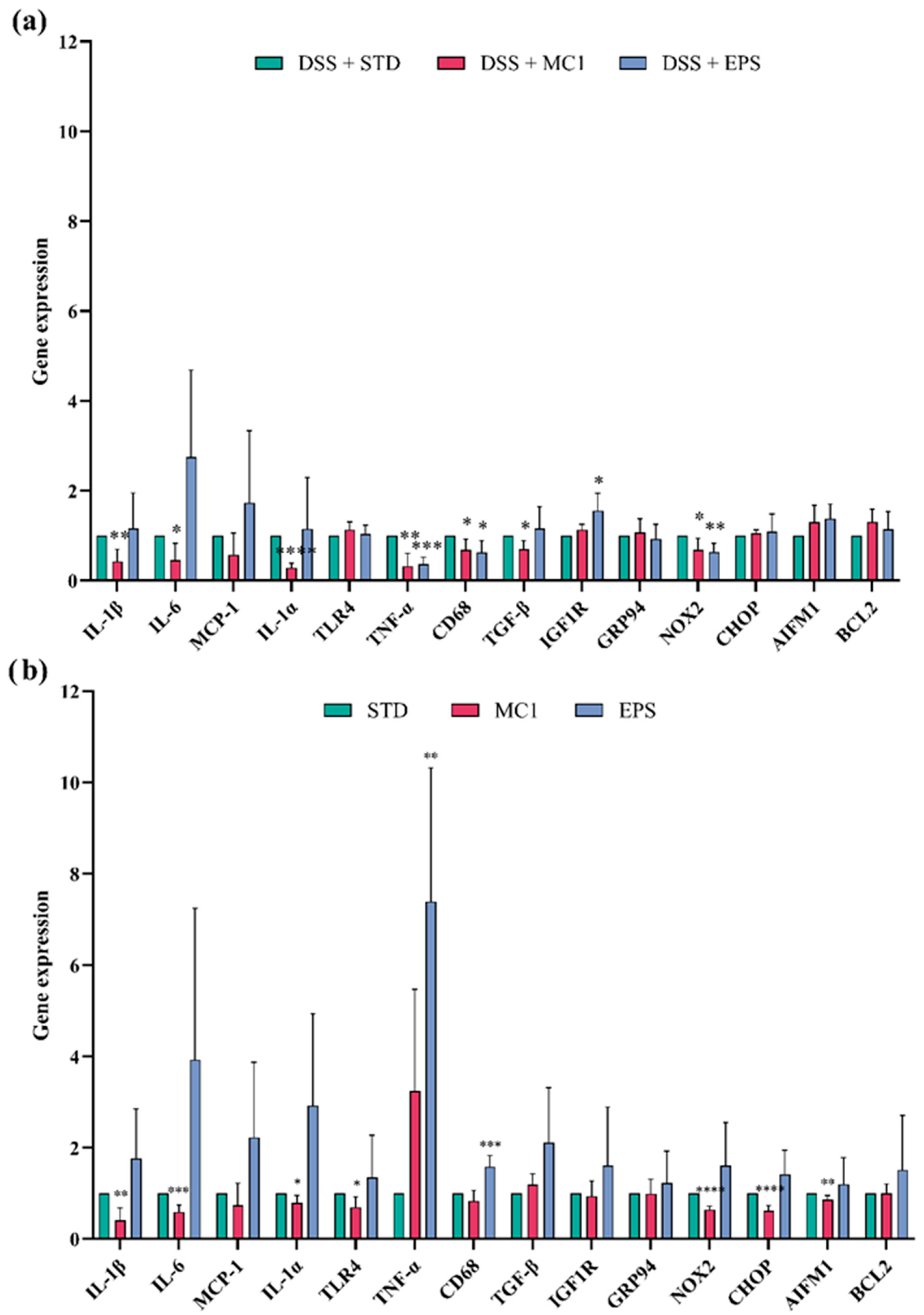
2.2. Llb. fermentum MC1 and MC1-EPSs Attenuate DSS-Induced Histopathological Changes and Gene Expression of Pro-Inflammatory Cytokines in the Colon Tissue
2.3. Enhancing the Viability of Llb. fermentum MC1 by Encapsulation Methods
3. Materials and Methods
3.1. Conditions for Maintaining and Growing Lactobacillus Strain
3.2. Experimental Animals and Study Design
3.3. Fecal Microbiota Compositional Analysis
3.4. Physiological Parameters in C57BL/6J Mice
3.4.1. Body Weight
3.4.2. Disease Activity Index Assessment
3.4.3. Histologic Injury Score
3.4.4. Detection of Nitric Oxide (NO) via the Griess Reaction
3.5. Hematological Assay
3.6. RNA Isolation, cDNA Synthesis and qPCR
3.7. Micro- and Nanoencapsulation of Llb. fermentum MC1
3.8. Statistical Analysis
4. Conclusions
Supplementary Materials
Author Contributions
Funding
Institutional Review Board Statement
Informed Consent Statement
Data Availability Statement
Conflicts of Interest
References
- Clark, R.L.; Connors, B.M.; Stevenson, D.M.; Hromada, S.E.; Hamilton, J.J.; Amador-Noguez, D.; Venturelli, O.S. Design of synthetic human gut microbiome assembly and butyrate production. Nat. Commun. 2021, 12, 3254. [Google Scholar] [CrossRef]
- Butorac, K.; Novak, J.; Banić, M.; Leboš Pavunc, A.; Čuljak, N.; Oršolić, N.; Odeh, D.; Perica, J.; Šušković, J.; Kos, B. Modulation of the Gut Microbiota by the Plantaricin-Producing Lactiplantibacillus plantarum D13, Analysed in the DSS-Induced Colitis Mouse Model. Int. J. Mol. Sci. 2023, 24, 15322. [Google Scholar] [CrossRef]
- Roux, A.E.; Langella, P.; Martin, R. Overview on biotics development. Curr. Opin. Biotech. 2024, 86, 103073. [Google Scholar] [CrossRef]
- Vallejos, O.P.; Bueno, S.M.; Kalergis, A.M. Probiotics in inflammatory bowel disease: Microbial modulation and therapeutic prospects. Trends Mol. Med. 2025, 31, 731–742. [Google Scholar] [CrossRef]
- Guo, X.Y.; Liu, X.J.; Hao, J.Y. Gut microbiota in ulcerative colitis: Insights on pathogenesis and treatment. J. Dig. Dis. 2020, 21, 147–159. [Google Scholar] [CrossRef] [PubMed]
- Lao, J.; Chen, M.; Yan, S.; Gong, H.; Wen, Z.; Yong, Y.; Jia, D.; Lv, S.; Zou, W.; Li, J.; et al. Lacticaseibacillus rhamnosus G7 alleviates DSS-induced ulcerative colitis by regulating the intestinal microbiota. BMC Microbiol. 2025, 25, 168. [Google Scholar] [CrossRef] [PubMed]
- de Brito, L.P.; da Silva, E.C.; Silva, P.H.; de Freitas, L.D.B.R.; Pastrana, L.; Soares, M.T.C.V.; Porto, A.L.F. Exopolysaccharides in immunomodulation of ulcerative colitis: A systematic review and meta-analysis of randomized controlled trials in an animal model. Food Hydrocoll. Health 2023, 4, 100158. [Google Scholar] [CrossRef]
- Banić, M.; Butorac, K.; Čuljak, N.; Leboš Pavunc, A.; Novak, J.; Bellich, B.; Kazazić, S.; Kazazić, S.; Cescutti, P.; Šušković, J.; et al. The Human Milk Microbiota Produces Potential Therapeutic Biomolecules and Shapes the Intestinal Microbiota of Infants. Int. J. Mol. Sci. 2022, 23, 14382. [Google Scholar] [CrossRef]
- Čuljak, N.; Bellich, B.; Pedron, A.; Butorac, K.; Leboš Pavunc, A.; Novak, J.; Banić, M.; Šušković, J.; Cescutti, P.; Kos, B. Limosilactobacillus fermentum strains MC1 and D12: Functional properties and exopolysaccharides characterization. Int. J. Biol. Macromol. 2024, 273, 133215. [Google Scholar] [CrossRef]
- Li, H.; Li, H.; Stanton, C.; Ross, R.P.; Zhao, J.; Chen, W.; Yang, B. Exopolysaccharides Produced by Bifidobacterium longum subsp. longum YS108R Ameliorates DSS-Induced Ulcerative Colitis in Mice by Improving the Gut Barrier and Regulating the Gut Microbiota. J. Agric. Food Chem. 2024, 72, 7055–7073. [Google Scholar] [CrossRef]
- Čuljak, N.; Bendelja, K.; Leboš Pavunc, A.; Butorac, K.; Banić, M.; Savić Mlakar, A.; Cvetić, Ž.; Hrsan, J.; Novak, J.; Šušković, J.; et al. In Vitro Analysis of Probiotic Properties Related to the Adaptation of Levilactobacillus brevis to Intestinal Microenvironment and Involvement of S-Layer Proteins. Int. J. Mol. Sci. 2025, 26, 2425. [Google Scholar] [CrossRef]
- Tett, A.; Pasolli, E.; Masetti, G.; Ercolini, D.; Segata, N. Prevotella diversity, niches and interactions with the human host. Nat. Rev. Microbiol. 2021, 19, 585–599. [Google Scholar] [CrossRef] [PubMed]
- Zhou, Y.; Ji, G.; Yang, X.; Chen, Z.; Zhou, L. Behavioral abnormalities in C57BL/6 mice with chronic ulcerative colitis induced by DSS. BMC Gastroenterol. 2023, 23, 84. [Google Scholar] [CrossRef] [PubMed]
- Lao, L.; Yang, G.; Zhang, A.; Liu, L.; Guo, Y.; Lian, L.; Pan, D.; Wu, Z. Anti-inflammation and gut microbiota regulation properties of fatty acids derived from fermented milk in mice with dextran sulfate sodium-induced colitis. J. Dairy Sci. 2022, 105, 7865–7877. [Google Scholar] [CrossRef] [PubMed]
- Wang, Z.; Liu, T.; Liu, L.; Xie, J.; Tang, F.; Pi, Y.; Zhong, Y.; He, Z.; Zhang, W.; Zheng, C. Lactobacillus vaginalis alleviates DSS induced colitis by regulating the gut microbiota and increasing the production of 3-indoleacrylic acid. Pharmacol Res. 2025, 213, 107663. [Google Scholar] [CrossRef]
- Wang, Y.; Yin, J.; Zhang, T.; Xin, Y.; Huang, X.; Nie, S. Utilizing relative ordered structure theory to guide polysaccharide purification for structural characterization. Food Hydrocoll. 2021, 115, 106603. [Google Scholar] [CrossRef]
- Melamed, J.; LeBlanc, G.; Constantinides, M.G. Gut microbiota gestalt. Cell Host Microbe 2022, 30, 899–901. [Google Scholar] [CrossRef]
- Lynch, J.B.; Gonzalez, E.L.; Choy, K.; Faull, K.F.; Jewell, T.; Arellano, A.; Liang, J.; Yu, K.B.; Paramo, J.; Hsiao, E.Y. Gut microbiota Turicibacter strains differentially modify bile acids and host lipids. Nat. Commun. 2023, 14, 3669. [Google Scholar] [CrossRef]
- Smits, W.K.; Lyras, D.; Lacy, D.B.; Wilcox, M.H.; Kuijper, E.J. Clostridium difficile infection. Nat. Rev. Dis. Primers 2016, 2, 16020. [Google Scholar] [CrossRef]
- Halimeh, F.B.; Rafei, R.; Osman, M.; Kassem, I.I.; Diene, S.M.; Dabboussi, F.; Rolain, J.M.; Hamze, M. Historical, current, and emerging tools for identification and serotyping of Shigella. Braz. J. Microbiol. 2021, 52, 2043–2055. [Google Scholar] [CrossRef]
- Banzragch, M.; Sanli, K.; Stensvold, C.R.; Kurt, O.; Ari, S. Metabarcoding of colonic cleansing fluid reveals unique bacterial members of mucosal microbiota associated with Inflammatory Bowel Disease. Scand. J. Gastroenterol. 2023, 58, 1253–1263. [Google Scholar] [CrossRef]
- Zhang, F.; Li, Y.; Wang, X.; Wang, S.; Bi, D. The impact of Lactobacillus plantarum on the gut microbiota of mice with DSS-induced colitis. BioMed. Res. Int. 2019, 2019, 3921315. [Google Scholar] [CrossRef]
- Kers, J.G.; Saccenti, E. The power of microbiome studies: Some considerations on which alpha and beta metrics to use and how to report results. Front. Microbiol. 2022, 12, 796025. [Google Scholar] [CrossRef]
- Guan, Q. A comprehensive review and update on the pathogenesis of inflammatory bowel disease. J. Immunol. Res. 2019, 2019, 7247238. [Google Scholar] [CrossRef]
- Min, Z.; Xiaona, H.; Aziz, T.; Jian, Z.; Zhennai, Y. Exopolysaccharides from Lactobacillus plantarum YW11 improve immune response and ameliorate inflammatory bowel disease symptoms. Acta Biochim. Pol. 2020, 67, 485–493. [Google Scholar] [CrossRef]
- Bergamaschi, G.; Castiglione, F.; D’Incà, R.; Astegiano, M.; Fries, W.; Milla, M.; Ciacci, C.; Rizzello, F.; Saibeni, S.; Ciccocioppo, R.; et al. Prevalence, pathogenesis and management of anemia in inflammatory bowel disease: An IG-IBD multicenter, prospective, and observational study. Inflamm. Bowel Dis. 2023, 29, 76–84. [Google Scholar] [CrossRef]
- Kamiya, N.; Ishikawa, Y.; Kotani, K.; Hatakeyama, S.; Matsumura, M. Monocyte-to-Lymphocyte Ratio in the Diagnosis of Lymphoma in Adult Patients. Int. J. Gen. Med. 2022, 15, 4221–4226. [Google Scholar] [CrossRef]
- Al-Okbi, S.Y.; Al-Siedy, E.S.K.; Mohamed, R.S.; Mabrok, H.B.; Mehaya, F.M. Ulcerative Colitis, Immune System and Iron Status Inter-Relationship and the Protective Role of Date and Grape Seed Extracts in Rat Model. Egypt J. Chem. 2022, 65, 57–69. [Google Scholar] [CrossRef]
- Kałużna, A.; Olczyk, P.; Komosińska-Vassev, K. The role of innate and adaptive immune cells in the pathogenesis and development of the inflammatory response in ulcerative colitis. J. Clin. Med. 2022, 11, 400. [Google Scholar] [CrossRef] [PubMed]
- Chauhan, R.; Vasanthakumari, A.S.; Panwar, H.; Mallapa, R.H.; Duary, R.K.; Batish, V.K.; Grover, S. Amelioration of colitis in mouse model by exploring antioxidative potentials of an indigenous probiotic strain of Lactobacillus fermentum Lf1. Biomed. Res. Int. 2014, 2014, 206732. [Google Scholar] [CrossRef] [PubMed]
- Jang, S.E.; Han, M.J.; Kim, S.Y.; Kim, D.H. Lactobacillus plantarum CLP-0611 ameliorates colitis in mice by polarizing M1 to M2-like macrophages. Int. Immunopharmacol. 2014, 21, 186–192. [Google Scholar] [CrossRef]
- Fuke, N.; Takagi, T.; Higashimura, Y.; Tsuji, T.; Umeda, R.; Mizushima, K.; Tanaka, M.; Suganuma, H.; Aizawa, K.; Yajima, N.; et al. Lactobacillus brevis KB290 With Vitamin A Ameliorates Murine Intestinal Inflammation Associated With the Increase of CD11c+ Macrophage/CD103− Dendritic Cell Ratio. Inflamm. Bowel Dis. 2018, 24, 317–331. [Google Scholar] [CrossRef]
- Wang, L.; Harrington, L.; Trebicka, E.; Shi, H.N.; Kagan, J.C.; Hong, C.C.; Lin, H.Y.; Babitt, J.L.; Cherayil, B.J. Selective modulation of TLR4-activated inflammatory responses by altered iron homeostasis in mice. J. Clin. Invest. 2009, 119, 3322–3328. [Google Scholar] [CrossRef]
- Hamad, M.; Bajbouj, K. The re-emerging role of iron in infection and immunity. Integr. Mol. Med. 2016, 3, 807–810. [Google Scholar] [CrossRef]
- Liu, Y.; Zheng, S.; Cui, J.; Guo, T.; Zhang, J.; Li, B. Alleviative effects of exopolysaccharide produced by Lactobacillus helveticus KLDS1.8701 on dextran sulfate sodium-induced colitis in mice. Microorganisms 2021, 9, 2086. [Google Scholar] [CrossRef] [PubMed]
- Yang, B.; Li, M.; Wang, S.; Ross, R.P.; Stanton, C.; Zhao, J.; Zhang, H.; Chen, W. Lactobacillus ruminis alleviates DSS-induced colitis by inflammatory cytokines and gut microbiota modulation. Foods 2021, 10, 1349. [Google Scholar] [CrossRef] [PubMed]
- Marciniak, S.J.; Yun, C.Y.; Oyadomari, S.; Novoa, I.; Zhang, Y.; Jungreis, R.; Nagata, K.; Harding, H.P.; Ron, D. CHOP induces death by promoting protein synthesis and oxidation in the stressed endoplasmic reticulum. Genes. Dev. 2004, 18, 3066–3077. [Google Scholar] [CrossRef] [PubMed]
- Rozpedek, W.; Pytel, D.; Mucha, B.; Leszczynska, H.; Diehl, J.A.; Majsterek, I. The role of the PERK/eIF2α/ATF4/CHOP signaling pathway in tumor progression during endoplasmic reticulum stress. Curr. Mol. Med. 2016, 16, 533–544. [Google Scholar] [CrossRef]
- Wang, M.; Yang, J.; Li, M.; Wang, Y.; Wu, H.; Xiong, L.; Sun, Q. Enhanced viability of layer-by-layer encapsulated Lactobacillus pentosus using chitosan and sodium phytate. Food Chem. 2019, 285, 260–265. [Google Scholar] [CrossRef]
- Luo, Y.; De Souza, C.; Ramachandran, M.; Wang, S.; Yi, H.; Ma, Z.; Zhang, L.; Lin, K. Precise oral delivery systems for probiotics: A review. J. Contr. Release 2022, 352, 371–384. [Google Scholar] [CrossRef]
- Butorac, K.; Novak, J.; Bellich, B.; Terán, L.C.; Banić, M.; Pavunc, A.L.; Zjalić, S.; Cescutti, P.; Šušković, J.; Kos, B. Lyophilized alginate-based microspheres containing Lactobacillus fermentum D12, an exopolysaccharides producer, contribute to the strain’s functionality in vitro. Microb. Cell Fact. 2021, 20, 85. [Google Scholar] [CrossRef]
- Sun, Q.; Yin, S.; He, Y.; Cao, Y.; Jiang, C. Biomaterials and Encapsulation Techniques for Probiotics: Current Status and Future Prospects in Biomedical Applications. Nanomaterials 2023, 13, 2185. [Google Scholar] [CrossRef]
- Liao, N.; Luo, B.; Gao, J.; Li, X.; Zhao, Z.; Zhang, Y.; Ni, Y.; Tian, F. Oligosaccharides as co-encapsulating agents: Effect on oral Lactobacillus fermentum survival in a simulated gastrointestinal tract. Biotechnol. Lett. 2019, 41, 263–272. [Google Scholar] [CrossRef]
- Koelink, P.J.; Wildenberg, M.E.; Stitt, L.W.; Feagan, B.G.; Koldijk, M.; van’t Wout, A.B.; Atreya, R.; Vieth, M.; Brandse, J.F.; Duijst, S.; et al. Development of Reliable, Valid and Responsive Scoring Systems for Endoscopy and Histology in Animal Models for Inflammatory Bowel Disease. J. Crohns Colitis 2018, 12, 794–803. [Google Scholar] [CrossRef] [PubMed]
- Odeh, D.; Oršolić, N.; Adrović, E.; Gaćina, L.; Perić, P.; Odeh, S.; Balta, V.; Lesar, N.; Kukolj, M. Effects of volatile anaesthetics and iron dextran on chronic inflammation and antioxidant defense system in rats. Antioxidants 2022, 11, 708. [Google Scholar] [CrossRef]
- Clinical Laboratory Standards Institute. Procedures for the Collection of Diagnostic Blood Specimens by Venipuncture–CLSI: H3-A6, 6th ed.; Clinical and Laboratory Standards Institute: Pennsylvania, PA, USA, 2007. [Google Scholar]
- World Health Organization. Guidelines on Drawing Blood: Best Practices in Phlebotomy, 1st ed.; World Health Organization Press: Geneva, Switzerland, 2010. [Google Scholar]
- Šešelja, K.; Bazina, I.; Vrecl, M.; Farger, J.; Schicht, M.; Paulsen, F.; Lončar, M.B.; Pirman, T. Tff3 Deficiency Differentially Affects the Morphology of Male and Female Intestines in a Long-Term High-Fat-Diet-Fed Mouse Model. Int. J. Mol. Sci. 2023, 24, 16342. [Google Scholar] [CrossRef] [PubMed]
- Čuljak, N.; Pavunc, A.L.; Dučkić, K.; Butorac, K.; Banić, M.; Novak, J.; Šušković, J.; Kos, B. Functionality and protective effect of S-layer proteins in microencapsulated freeze-dried probiotic Levilactobacillus brevis strains. Mljekarstvo 2024, 74, 208–218. [Google Scholar] [CrossRef]
- Anselmo, A.C.; McHugh, K.J.; Webster, J.; Langer, R.; Jaklenec, A. Layer-by-Layer Encapsulation of Probiotics for Delivery to the Microbiome. Adv. Mater 2016, 28, 9486–9490. [Google Scholar] [CrossRef]





| Parameters | DSS + STD | DSS + MC1 | DSS + EPS |
|---|---|---|---|
| Goblet cell loss | 1.83 ± 0.17 (1–2) | 0.67 ± 0.21 (0–1) * | 0.67 ± 0.21 (0–1) * |
| Crypt density | 2.00 ± 0.00 (2–2) | 0.33 ± 0.21 (0–1) ** | 1.50 ± 0.22 (1–2) |
| Crypt hyperplasia | 2.33 ± 0.21 (2–3) | 0.67 ± 0.21 (0–1) ** | 1.33 ± 0.21 (1–2) |
| Muscle thickening | 2.17 ± 0.17(2–3) | 0.67 ± 0.21(0–1) ** | 1.17 ± 0.17(1–2) |
| Submucosal infiltrate | 2.00 ± 0.00 (2–2) | 1.00 ± 0.26 (0–2) * | 1.67 ± 0.21 (1–2) |
| Score | 16.50 ± 0.50 (15–18) | 5.67 ± 1.23 (0–8) *** | 11.33 ± 1.31 (7–15) |
| Hematological Parameters | DSS + STD | DSS + MC1 | DSS + EPS |
|---|---|---|---|
| Erythrocytes (1012/L) | 6.35 ± 0.17 | 6.71 ± 0.26 | 7.81 ± 0.18 ** |
| Leukocytes (109/L) | 3.73 ± 0.37 | 3.27 ± 0.32 ΔΔ | 5.13 ± 0.27 |
| Hemoglobin (g/L) | 96.25 ± 2.17 | 96.83 ± 3.69 Δ | 117.83 ± 2.95 * |
| Hematocrit (%) | 0.35 ± 0.02 | 0.40 ± 0.01 | 0.46 ± 0.01 ** |
| Erythrocyte volume (fL) | 55.07 ± 3.18 | 59.37 ± 1.19 | 59.07 ± 1.04 |
| Mean corpuscular hemoglobin (pg) | 15.18 ± 0.17 | 14.40 ± 0.00 * | 15.10 ± 0.06 |
| Mean corpuscular hemoglobin concentration (g/L) | 279.83 ± 15.07 | 243.33 ± 4.81 | 255.67 ± 5.67 |
| Erythrocyte distribution (%) | 22.83 ± 0.66 | 20.63 ± 2.65 | 21.60 ± 1.16 |
| Thrombocytes (109/L) | 431.08 ± 32.41 | 431.67 ± 14.36 | 534.33 ± 38.45 |
| Thrombocyte volume (fL) | 6.92 ± 0.13 | 6.63 ± 0.09 | 6.73 ± 0.06 |
| Groups | Neutrophils (%) | Lymphocytes (%) | Monocytes (%) | Eosinophils (%) | Basophils (%) |
|---|---|---|---|---|---|
| DSS + STD | 19.98 ± 5.66 | 69.43 ± 3.07 | 16.46 ± 2.72 | 0.28 ± 0.28 | 0.00 ± 0.00 |
| DSS + MC1 | 2.60 ± 0.26 ** | 62.77 ± 2.61 | 34.37 ± 2.76 ** | 0.27 ± 0.27 | 0.00 ± 0.00 |
| DSS + EPS | 1.37 ± 0.74 ** | 76.80 ± 3.50 Δ | 20.37 ± 2.86 Δ | 1.47 ± 1.47 | 0.00 ± 0.00 |
Disclaimer/Publisher’s Note: The statements, opinions and data contained in all publications are solely those of the individual author(s) and contributor(s) and not of MDPI and/or the editor(s). MDPI and/or the editor(s) disclaim responsibility for any injury to people or property resulting from any ideas, methods, instructions or products referred to in the content. |
© 2026 by the authors. Licensee MDPI, Basel, Switzerland. This article is an open access article distributed under the terms and conditions of the Creative Commons Attribution (CC BY) license.
Share and Cite
Čuljak, N.; Oršolić, N.; Odeh, D.; Leboš Pavunc, A.; Butorac, K.; Banić, M.; Novak, J.; Šešelja, K.; Baus Lončar, M.; Ramić, S.; et al. In Vivo Evaluation of the Effect of Limosilactobacillus fermentum MC1 and Its EPSs on the Microbiota and Inflammatory Processes in the Mouse Intestine. Int. J. Mol. Sci. 2026, 27, 2321. https://doi.org/10.3390/ijms27052321
Čuljak N, Oršolić N, Odeh D, Leboš Pavunc A, Butorac K, Banić M, Novak J, Šešelja K, Baus Lončar M, Ramić S, et al. In Vivo Evaluation of the Effect of Limosilactobacillus fermentum MC1 and Its EPSs on the Microbiota and Inflammatory Processes in the Mouse Intestine. International Journal of Molecular Sciences. 2026; 27(5):2321. https://doi.org/10.3390/ijms27052321
Chicago/Turabian StyleČuljak, Nina, Nada Oršolić, Dyana Odeh, Andreja Leboš Pavunc, Katarina Butorac, Martina Banić, Jasna Novak, Kate Šešelja, Mirela Baus Lončar, Snježana Ramić, and et al. 2026. "In Vivo Evaluation of the Effect of Limosilactobacillus fermentum MC1 and Its EPSs on the Microbiota and Inflammatory Processes in the Mouse Intestine" International Journal of Molecular Sciences 27, no. 5: 2321. https://doi.org/10.3390/ijms27052321
APA StyleČuljak, N., Oršolić, N., Odeh, D., Leboš Pavunc, A., Butorac, K., Banić, M., Novak, J., Šešelja, K., Baus Lončar, M., Ramić, S., Jurkin, T., Šušković, J., & Kos, B. (2026). In Vivo Evaluation of the Effect of Limosilactobacillus fermentum MC1 and Its EPSs on the Microbiota and Inflammatory Processes in the Mouse Intestine. International Journal of Molecular Sciences, 27(5), 2321. https://doi.org/10.3390/ijms27052321