Lipedema and Dynapenia: Inflammatory Myosteatosis as a Mechanistic Link Between Tissue Expansion and Muscle Dysfunction


Abstract
1. Introduction
2. The Clinical Paradox: Lipedematous Dynapenia
2.1. The Illusion of Mass: Pseudo-Hypertrophy Versus Functional Reality
2.2. The Failure of Standard Metrics: Why BMI Is Blind
2.3. Inflammatory Myosteatosis as a Metabolic Bottleneck
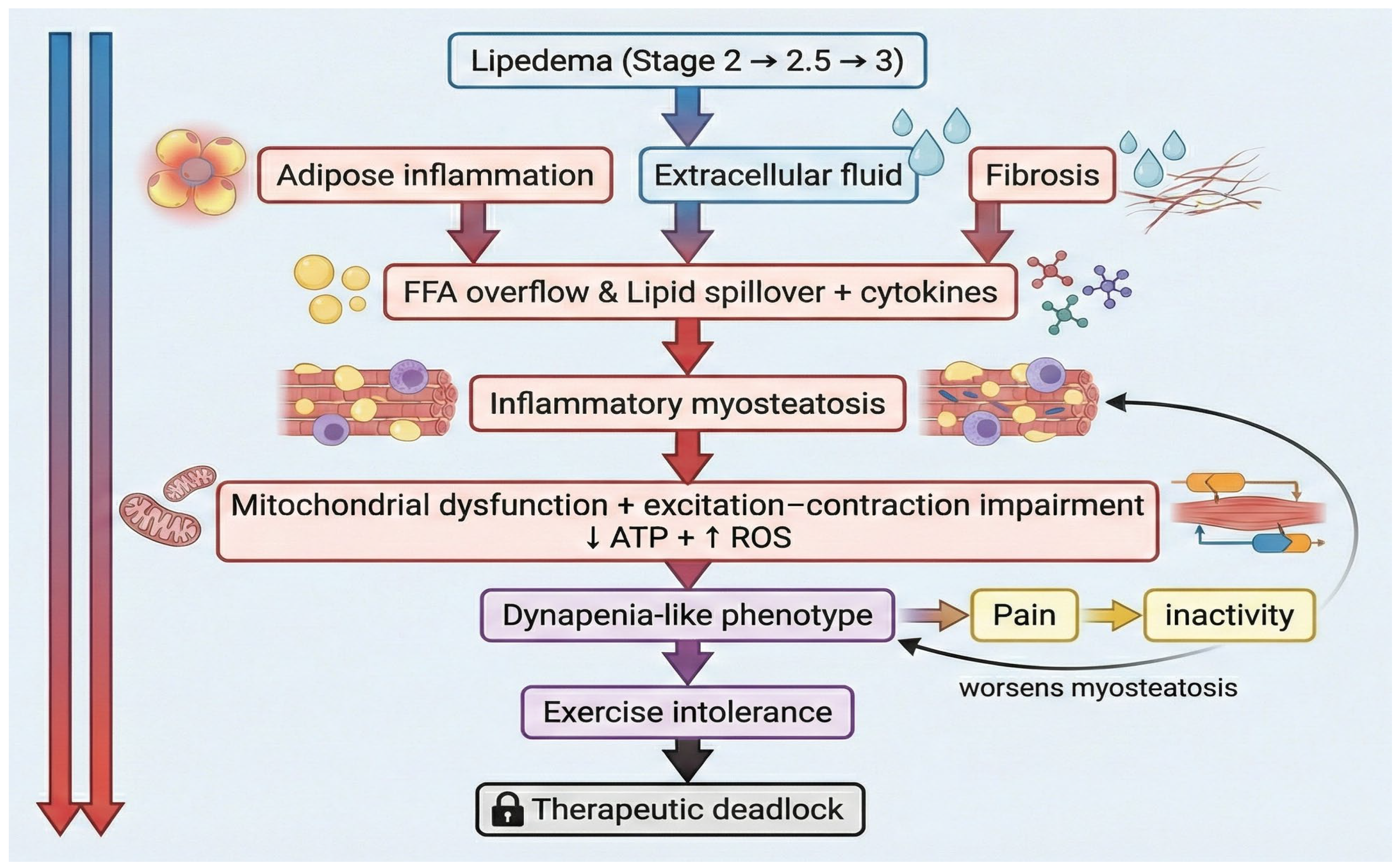
2.4. From Lipedema to Dynapenia: A Unified Mechanistic Axis
2.5. The Vicious Cycle of Pain, Inactivity, and Functional Decline
3. The Therapeutic Deadlock and a Translational, Hypothesis-Driven Pharmacological Bypass
3.1. The Exercise Paradox: Why Mechanical Loading May Fail
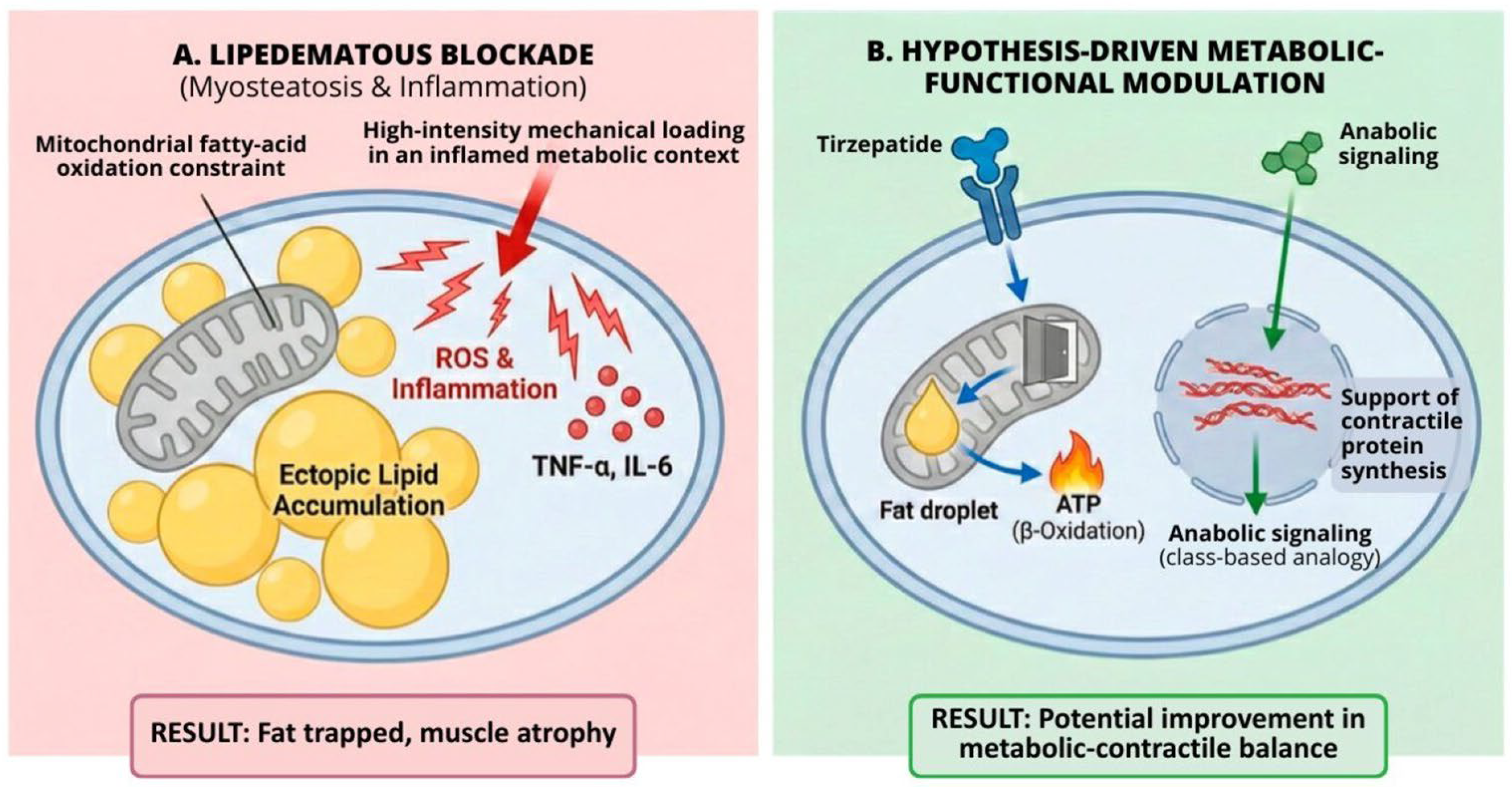
3.2. The Dual-Target Hypothesis: Breaking the Pathophysiological Cycle
3.2.1. Metabolic Modulation: Tirzepatide and Mitochondrial Flexibility
Lipolysis–Oxidation Mismatch
3.2.2. Anabolic Signaling as a Functional Rescue Analogy
4. Discussion: Translational Implications and Safety Considerations
4.1. Identifying the Functional Inflection Point
4.2. Contextualizing the Anabolic Rationale Within Evidence-Based Medicine
4.3. Safety Considerations in a Hypothesis-Driven Framework
4.4. Non-Pharmacological Strategies Within the Proposed Framework
4.5. Methodological Gaps and Future Research Priorities

| Domain | Operational Definition & Assessment (Literature-Based Examples) | Pathophysiological Significance | Suggested Objective Endpoints |
|---|---|---|---|
| 1. Objective dynapenia (function) | Timed Up and Go (TUG) > 10 s based on mobility risk thresholds [49,50,51]. Sit-to-Stand (5 × STS or 30 s STS) below age- and sex-adjusted normative values [52,53]. Handgrip strength below established cutoffs for sarcopenia/dynapenia [50,54,55]. | Dissociation between limb volume and contractile performance, indicating failure of muscle quality rather than simple mass loss. | TUG, STS, handgrip strength, isokinetic quadriceps torque, gait speed, mobility-related patient-reported outcomes. |
| 2. Mechanical intolerance and refractoriness to loading | Post-exertional pain persisting >24 h; measurable limb volume increase within 24–48 h after activity; persistence of symptoms despite ≥6 months of documented conservative therapy (compression, physiotherapy, diet) [56,57]. | Captures the “exercise paradox,” in which inflammatory and edematous responses limit tolerance to mechanical loading and promote disuse atrophy. | Pain NRS/VAS, post-exertional symptom diary, limb volume change, pressure pain thresholds, accelerometry-based activity metrics. |
| 3. Myosteatosis and impaired muscle quality (structure) | MRI Dixon fat fraction, muscle radiodensity (CT), or ultrasound echo-intensity based on established muscle quality imaging standards [17,31,58] | Links dynapenia to ectopic lipid deposition, inflammatory muscle remodeling, and reduced contractile efficiency. | Muscle fat fraction, radiodensity/echo-intensity, correlation with strength and mobility, longitudinal structural change. |
| 4. Metabolic–inflammatory milieu consistent with oxidative mismatch | Insulin resistance indices, inflammatory cytokines, adipokines, fibrosis/ECM-related biomarkers, indirect calorimetry-derived RQ for metabolic flexibility [59,60]. | Tests the proposed lipolysis–oxidation mismatch and immunometabolic drivers sustaining myosteatosis and functional decline. | RQ (respiratory quotient), insulin sensitivity, inflammatory panels, fibrosis markers, association with imaging and function. |
5. Conclusions
Author Contributions
Funding
Institutional Review Board Statement
Informed Consent Statement
Data Availability Statement
Acknowledgments
Conflicts of Interest
Abbreviations
| 30 s STS | 30-Second Sit-to-Stand Test |
| 5 × STS | Five Times Sit-to-Stand Test |
| AAS | Anabolic Androgenic Steroids |
| ACT | α1-Antichymotrypsin |
| ATP | Adenosine Triphosphate |
| BIA | Bioelectrical Impedance Analysis |
| BMI | Body Mass Index |
| Ca2+ | Calcium Ion |
| CPT-1 | Carnitine Palmitoyltransferase 1 |
| CRP | C-Reactive Protein |
| CSA | Cross-Sectional Area |
| DEXA | Dual-Energy X-ray Absorptiometry |
| DHPR | Dihydropyridine Receptor |
| ECM | Extracellular Matrix |
| ERα | Estrogen Receptor Alpha |
| ERβ | Estrogen Receptor Beta |
| FFA | Free Fatty Acids |
| FFM | Fat-Free Mass |
| FSR | Fractional Synthesis Rate |
| GIP | Glucose-Dependent Insulinotropic Polypeptide |
| GLP-1 | Glucagon-Like Peptide-1 |
| HDL | High-Density Lipoprotein |
| HFpEF | Heart Failure with Preserved Ejection Fraction |
| HIV | Human Immunodeficiency Virus |
| IL-15 | Interleukin-15 |
| IL-6 | Interleukin-6 |
| IMF | Intermuscular Fat |
| LDL | Low-Density Lipoprotein |
| MRI | Magnetic Resonance Imaging |
| NRS | Numeric Rating Scale |
| ROS | Reactive Oxygen Species |
| RQ | Respiratory Quotient |
| RyR1 | Ryanodine Receptor Type 1 |
| SAT | Subcutaneous Adipose Tissue |
| SIF | Italian Society of Phlebology |
| SISMES | Italian Society of Motor and Sports Sciences |
| SMAD2/3 | Mothers Against Decapentaplegic Homolog 2/3 (intracellular signaling proteins) |
| SMM | Skeletal Muscle Mass |
| SPARC | Secreted Protein Acidic and Rich in Cysteine |
| STS | Sit-to-Stand Test |
| TNF-α | Tumor Necrosis Factor Alpha |
| TUG | Timed Up and Go Test |
| VAS | Visual Analog Scale |
References
- Allen, E.V.; Hines, E.A.; Hines, E.A. Lipedema of the Legs: A Syndrome Characterized by Fat Legs and Orthostatic Edema. Proc. Staff Meet Mayo Clin. 1940, 15, 184–187. [Google Scholar] [CrossRef]
- Wold, L.E.; Hines, E.A.; Allen, E.V. Lipedema of the Legs: A Syndrome Characterized by Fat Legs and Edema. Ann. Intern. Med. 1951, 34, 1243–1250. [Google Scholar] [CrossRef] [PubMed]
- Földi, E.; Földi, M. Lipedema. In Földi’s Textbook of Lymphology: For Physicians and Lymphedema Therapists, 2nd ed.; Elsevier: Amsterdam, The Netherlands, 2006; pp. 364–369. [Google Scholar]
- Herbst, K.L. Rare Adipose Disorders (RADs) Masquerading as Obesity. Acta Pharmacol. Sin. 2012, 33, 155–172. [Google Scholar] [CrossRef] [PubMed]
- Al-Ghadban, S.; Evancio, J.V.; Alfiscar, P.E.F.; Herbst, K.L. New Characterization of Lipedema Stages: Focus on Pain, Water, Fat and Skeletal Muscle. Life 2025, 15, 1397. [Google Scholar] [CrossRef]
- Christoffersen, V.; Tennfjord, M.K. Younger Women with Lipedema, Their Experiences with Healthcare Providers, and the Importance of Social Support and Belonging: A Qualitative Study. Int. J. Environ. Res. Public Health 2023, 20, 1925. [Google Scholar] [CrossRef]
- Falck, J.; Rolander, B.; Nygardh, A.; Jonasson, L.-L.; Mårtensson, J. Women with Lipoedema: A National Survey on Their Health, Health-Related Quality of Life, and Sense of Coherence. BMC Women’s Health 2022, 22, 457. [Google Scholar] [CrossRef]
- Romeijn, J.R.M.; De Rooij, M.J.M.; Janssen, L.; Martens, H. Exploration of Patient Characteristics and Quality of Life in Patients with Lipoedema Using a Survey. Dermatol. Ther. 2018, 8, 303–311. [Google Scholar] [CrossRef]
- Dudek, J.E.; Białaszek, W.; Gabriel, M. Quality of Life, Its Factors, and Sociodemographic Characteristics of Polish Women with Lipedema. BMC Women’s Health 2021, 21, 27. [Google Scholar] [CrossRef]
- De Oliveira, J. Lipedema, Body-Related Emotional and Disordered Eating to Cope. Surg. Obes. Relat. Dis. 2023, 19, 667–668. [Google Scholar] [CrossRef]
- Clarke, C.; Kirby, J.N.; Best, T. Beyond the Physical: The Interplay of Experienced Weight Stigma, Internalised Weight Bias and Depression in Lipoedema. Clin. Obes. 2025, 15, e12727. [Google Scholar] [CrossRef]
- Torre, Y.S.-D.L.; Wadeea, R.; Rosas, V.; Herbst, K.L. Lipedema: Friend and Foe. Horm. Mol. Biol. Clin. Investig. 2018, 33, 20170076. [Google Scholar] [CrossRef]
- Bertsch, T.; Erbacher, G.; Elwell, R.; Partsch, H. Lipoedema: A Paradigm Shift and Consensus. J. Wound Care 2020, 29, 1–51. [Google Scholar] [CrossRef]
- Viana, D.P.D.C.; Invitti, A.L.; Schor, E. Tirzepatide as a Potential Disease-Modifying Therapy in Lipedema: A Narrative Review on Bridging Metabolism, Inflammation, and Fibrosis. Int. J. Mol. Sci. 2025, 26, 10741. [Google Scholar] [CrossRef] [PubMed]
- Clark, B.C.; Manini, T.M. Sarcopenia!= Dynapenia. J. Gerontol. A Biol. Sci. Med. Sci. 2008, 63, 829–834. [Google Scholar] [CrossRef] [PubMed]
- Schaap, L.A.; Pluijm, S.M.F.; Deeg, D.J.H.; Visser, M. Inflammatory Markers and Loss of Muscle Mass (Sarcopenia) and Strength. Am. J. Med. 2006, 119, e9–e526. [Google Scholar] [CrossRef] [PubMed]
- Delmonico, M.J.; Harris, T.B.; Visser, M.; Park, S.W.; Conroy, M.B.; Velasquez-Mieyer, P.; Boudreau, R.; Manini, T.M.; Nevitt, M.; Newman, A.B.; et al. Longitudinal Study of Muscle Strength, Quality, and Adipose Tissue Infiltration. Am. J. Clin. Nutr. 2009, 90, 1579–1585. [Google Scholar] [CrossRef]
- Kortebein, P.; Ferrando, A.; Lombeida, J.; Wolfe, R.; Evans, W.J. Effect of 10 Days of Bed Rest on Skeletal Muscle in Healthy Older Adults. JAMA 2007, 297, 1769. [Google Scholar] [CrossRef]
- van Esch-Smeenge, J.; Damstra, R.J.; Hendrickx, A.A. Muscle Strength and Functional Exercise Capacity in Patients with Lipoedema and Obesity: A Comparative Study. J. Lymphoedema 2017, 12, 27–31. [Google Scholar]
- Crescenzi, R.; Marton, A.; Donahue, P.M.C.; Mahany, H.B.; Lants, S.K.; Wang, P.; Beckman, J.A.; Donahue, M.J.; Titze, J. Tissue Sodium Content Is Elevated in the Skin and Subcutaneous Adipose Tissue in Women with Lipedema. Obesity 2018, 26, 310–317. [Google Scholar] [CrossRef]
- Shiose, K.; Tanabe, Y.; Ohnishi, T.; Takahashi, H. Effect of Regional Muscle Damage and Inflammation Following Eccentric Exercise on Electrical Resistance and the Body Composition Assessment Using Bioimpedance Spectroscopy. J. Physiol. Sci. 2019, 69, 895–901. [Google Scholar] [CrossRef]
- Borga, M.; West, J.; Bell, J.D.; Harvey, N.C.; Romu, T.; Heymsfield, S.B.; Dahlqvist Leinhard, O. Advanced Body Composition Assessment: From Body Mass Index to Body Composition Profiling. J. Investig. Med. 2018, 66, 1–9. [Google Scholar] [CrossRef]
- Taylor, S.L.; Donahue, P.M.C.; Pridmore, M.D.; Garza, M.E.; Patel, N.J.; Custer, C.A.; Luo, Y.; Aday, A.W.; Beckman, J.A.; Donahue, M.J.; et al. Semiautomated Segmentation of Lower Extremity MRI Reveals Distinctive Subcutaneous Adipose Tissue in Lipedema: A Pilot Study. J. Med. Imaging 2023, 10, 036001. [Google Scholar] [CrossRef] [PubMed]
- Goodpaster, B.H.; Wolf, D. Skeletal Muscle Lipid Accumulation in Obesity, Insulin Resistance, and Type 2 Diabetes. Pediatr. Diabetes 2004, 5, 219–226. [Google Scholar] [CrossRef] [PubMed]
- Gumucio, J.P.; Qasawa, A.H.; Ferrara, P.J.; Malik, A.N.; Funai, K.; Mcdonagh, B.; Mendias, C.L. Reduced Mitochondrial Lipid Oxidation Leads to Fat Accumulation in Myosteatosis. FASEB J. 2019, 33, 7863–7881. [Google Scholar] [CrossRef] [PubMed]
- Delbono, O. Regulation of Excitation Contraction Coupling by Insulin-like Growth Factor-1 in Aging Skeletal Muscle. J. Nutr. Health Aging 2000, 4, 162–164. [Google Scholar]
- Visser, M.; Deeg, D.J.H.; Lips, P. Low Vitamin D and High Parathyroid Hormone Levels as Determinants of Loss of Muscle Strength and Muscle Mass (Sarcopenia): The Longitudinal Aging Study Amsterdam. J. Clin. Endocrinol. Metab. 2003, 88, 5766–5772. [Google Scholar] [CrossRef]
- Iglesias, P. Muscle in Endocrinology: From Skeletal Muscle Hormone Regulation to Myokine Secretion and Its Implications in Endocrine–Metabolic Diseases. J. Clin. Med. 2025, 14, 4490. [Google Scholar] [CrossRef]
- Barbalho, S.M.; Prado Neto, E.V.; De Alvares Goulart, R.; Bechara, M.D.; Baisi Chagas, E.F.; Audi, M.; Guissoni Campos, L.M.; Landgraf Guiger, E.; Buchaim, R.L.; Buchaim, D.V.; et al. Myokines: A Descriptive Review. J. Sports Med. Phys. Fitness 2020, 60, 1583–1590. [Google Scholar] [CrossRef]
- Pedersen, B.K.; Febbraio, M.A. Muscle as an Endocrine Organ: Focus on Muscle-Derived Interleukin-6. Physiol. Rev. 2008, 88, 1379–1406. [Google Scholar] [CrossRef]
- Goodpaster, B.H.; Kelley, D.E.; Thaete, F.L.; He, J.; Ross, R. Skeletal Muscle Attenuation Determined by Computed Tomography Is Associated with Skeletal Muscle Lipid Content. J. Appl. Physiol. 2000, 89, 104–110. [Google Scholar] [CrossRef]
- Erbacher, G.; Bertsch, T. Lipoedema and Pain: What is the role of the psyche?—Results of a pilot study with 150 patients with Lipoedema. Phlebologie 2020, 49, 305–316. [Google Scholar] [CrossRef]
- Kunzová, M.; Lagová, E.; Keith, L. Mental and Physical Health Burden and Quality of Life in Czech Women with Lipedema. Front. Glob. Women’s Health 2025, 6, 1629077. [Google Scholar] [CrossRef] [PubMed]
- Aitzetmüller-Klietz, M.-L.; Busch, L.; Hamatschek, M.; Paul, M.; Schriek, C.; Wiebringhaus, P.; Aitzetmüller-Klietz, M.; Kückelhaus, M.; Hirsch, T. Understanding the Vicious Circle of Pain, Physical Activity, and Mental Health in Lipedema Patients—A Response Surface Analysis. J. Clin. Med. 2023, 12, 5319. [Google Scholar] [CrossRef] [PubMed]
- Janota, B.; Michalska, P.; Janota, K. Lipedema: The Intersection of Physical and Mental Health. Arch. Psych. Psych. 2025, 27, 59–66. [Google Scholar] [CrossRef]
- Annunziata, G.; Paoli, A.; Manzi, V.; Camajani, E.; Laterza, F.; Verde, L.; Capó, X.; Padua, E.; Bianco, A.; Carraro, A.; et al. The Role of Physical Exercise as a Therapeutic Tool to Improve Lipedema: A Consensus Statement from the Italian Society of Motor and Sports Sciences (Società Italiana Di Scienze Motorie e Sportive, SISMeS) and the Italian Society of Phlebology (Società Italiana Di Flebologia, SIF). Curr. Obes. Rep. 2024, 13, 667–679. [Google Scholar] [CrossRef]
- Clarkson, P.M.; Hubal, M.J. Exercise-Induced Muscle Damage in Humans. Am. J. Phys. Med. Rehabil. 2002, 81, S52–S69. [Google Scholar] [CrossRef]
- Orr, R.; Fiatarone Singh, M. The Anabolic Androgenic Steroid Oxandrolone in the Treatment of Wasting and Catabolic Disorders: Review of Efficacy and Safety. Drugs 2004, 64, 725–750. [Google Scholar] [CrossRef]
- Ring, J.; Heinelt, M.; Sharma, S.; Letourneau, S.; Jeschke, M.G. Oxandrolone in the Treatment of Burn Injuries: A Systematic Review and Meta-Analysis. J. Burn Care Res. 2020, 41, 190–199. [Google Scholar] [CrossRef]
- Jeschke, M.G.; Finnerty, C.C.; Suman, O.E.; Kulp, G.; Mlcak, R.P.; Herndon, D.N. The Effect of Oxandrolone on the Endocrinologic, Inflammatory, and Hypermetabolic Responses During the Acute Phase Postburn. Ann. Surg. 2007, 246, 351–362. [Google Scholar] [CrossRef]
- Grunfeld, C.; Kotler, D.P.; Dobs, A.; Glesby, M.; Bhasin, S. Oxandrolone in the Treatment of HIV-Associated Weight Loss in Men: A Randomized, Double-Blind, Placebo-Controlled Study. J. Acquir. Immune Defic. Syndr. 2006, 41, 304–314. [Google Scholar] [CrossRef]
- Pharo, A.; Salvato, P.; Vergel, N.; Carroll, E.; Sauer, L.; Mooney, M. Oxandrolone: Anabolic Steroid Use in HIV Positive Women. Nutrition 1997, 13, 268. [Google Scholar] [CrossRef]
- Fontanarosa, P.B.; Romeyn, M.; Gunn Iii, N. Resistance Exercise and Oxandrolone for Men with HIV-Related Weight Loss. JAMA 2000, 284, 176. [Google Scholar] [CrossRef] [PubMed]
- Fox-Wheeler, S.; Heller, L.; Salata, C.M.; Kaufman, F.; Loro, M.L.; Gilsanz, V.; Haight, M.; Umman, G.C.; Barton, N.; Church, J.A. Evaluation of the Effects of Oxandrolone on Malnourished HIV-Positive Pediatric Patients. Pediatrics 1999, 104, e73. [Google Scholar] [CrossRef] [PubMed]
- Reeves, P.T.; Herndon, D.N.; Tanksley, J.D.; Jennings, K.; Klein, G.L.; Mlcak, R.P.; Clayton, R.P.; Crites, N.N.; Hays, J.P.; Andersen, C.; et al. Five-Year Outcomes after Long-Term Oxandrolone Administration in Severely Burned Children: A Randomized Clinical Trial. Shock 2016, 45, 367–374. [Google Scholar] [CrossRef]
- De Mello Gindri, I.; Almeida, G.; Saraiva, C.; Ferrari, G.; Dallacosta, D.; De Mello Roesler, C.R. The Safety and Effectiveness of Oxandrolone on Different Clinical Conditions: A Systematic Review. Endocr. Metab. Sci. 2025, 18, 100246. [Google Scholar] [CrossRef]
- Li, H.; Guo, Y.; Yang, Z.; Roy, M.; Guo, Q. The Efficacy and Safety of Oxandrolone Treatment for Patients with Severe Burns: A Systematic Review and Meta-Analysis. Burns 2016, 42, 717–727. [Google Scholar] [CrossRef]
- Jastreboff, A.M.; Aronne, L.J.; Ahmad, N.N.; Wharton, S.; Connery, L.; Alves, B.; Kiyosue, A.; Zhang, S.; Liu, B.; Bunck, M.C.; et al. Tirzepatide Once Weekly for the Treatment of Obesity. N. Engl. J. Med. 2022, 387, 205–216. [Google Scholar] [CrossRef]
- Cruz-Jentoft, A.J.; Sayer, A.A. Sarcopenia. Lancet 2019, 393, 2636–2646. Erratum in Lancet 2019, 393, 10191. https://doi.org/10.1016/S0140-6736(19)31465-5. [CrossRef]
- Cawthon, P.M.; Manini, T.; Patel, S.M.; Newman, A.; Travison, T.; Kiel, D.P.; Santanasto, A.J.; Ensrud, K.E.; Xue, Q.; Shardell, M.; et al. Putative Cut-Points in Sarcopenia Components and Incident Adverse Health Outcomes: An SDOC Analysis. J. Am. Geriatr. Soc. 2020, 68, 1429–1437. [Google Scholar] [CrossRef]
- Da Costa Teixeira, L.A.; Soares, L.A.; De Moura Oliveira, M.C.; Dos Santos Mourão, M.F.; Lima, L.P.; Nobre, J.N.P.; Costa, H.S.; Figueiredo, P.H.S.; Parentoni, A.N.; Mendonça, V.A.; et al. Diagnostic Accuracy of Sit-to-Stand Chair Test and Timed up and Go Test with Proposed Cutoff Point for Identifying Sarcopenia in Community-Dwelling Older Women: A Cross-Sectional Study. BMC Musculoskelet. Disord. 2026, 27, 111. [Google Scholar] [CrossRef]
- Warden, S.J.; Liu, Z.; Moe, S.M. Sex- and Age-Specific Centile Curves and Downloadable Calculator for Clinical Muscle Strength Tests to Identify Probable Sarcopenia. Phys. Ther. 2022, 102, pzab299. [Google Scholar] [CrossRef] [PubMed]
- Grgic, J.; Schoenfeld, B.J.; Maier, A.B.; Pedisic, Z. Reference Values for the Five-Times-Sit-to-Stand Test: A Pooled Analysis Including 45,470 Participants from 14 Countries. GeroScience 2025. [Google Scholar] [CrossRef]
- Patel, S.M.; Duchowny, K.A.; Kiel, D.P.; Correa-de-Araujo, R.; Fielding, R.A.; Travison, T.; Magaziner, J.; Manini, T.; Xue, Q.; Newman, A.B.; et al. Sarcopenia Definition & Outcomes Consortium Defined Low Grip Strength in Two Cross-Sectional, Population-Based Cohorts. J. Am. Geriatr. Soc. 2020, 68, 1438–1444. [Google Scholar] [CrossRef]
- Santos, C.A.; Maia, H.F.; Pitanga, F.J.G.; Almeida, M.d.C.C.d.; Fonseca, M.d.J.M.d.; de Aquino, E.M.L.; Cardoso, L.d.O.; Griep, R.H.; Barreto, S.M.; Suemoto, C.K.; et al. Hand Grip Strength Cut-Off Points as a Discriminator of Sarcopenia and Sarcopenic Obesity: Results from the ELSA-Brasil Cohort. J. Cachexia Sarcopenia Muscle 2025, 16, e13723. [Google Scholar] [CrossRef]
- Clarkson, P.M.; Tremblay, I. Exercise-Induced Muscle Damage, Repair, and Adaptation in Humans. J. Appl. Physiol. 1988, 65, 1–6. [Google Scholar] [CrossRef]
- Mense, S. Muscle Pain. Dtsch. Arztebl. Int. 2008, 105, 214. [Google Scholar] [CrossRef]
- Garcia-Diez, A.I.; Porta-Vilaro, M.; Isern-Kebschull, J.; Naude, N.; Guggenberger, R.; Brugnara, L.; Milinkovic, A.; Bartolome-Solanas, A.; Soler-Perromat, J.C.; Del Amo, M.; et al. Myosteatosis: Diagnostic Significance and Assessment by Imaging Approaches. Quant Imaging Med. Surg. 2024, 14, 7937–7957. [Google Scholar] [CrossRef]
- Petersen, K.F.; Dufour, S.; Befroy, D.; Garcia, R.; Shulman, G.I. Impaired Mitochondrial Activity in the Insulin-Resistant Offspring of Patients with Type 2 Diabetes. N. Engl. J. Med. 2004, 350, 664–671. [Google Scholar] [CrossRef] [PubMed]
- Goodpaster, B.H.; Sparks, L.M. Metabolic Flexibility in Health and Disease. Cell Metab. 2017, 25, 1027–1036. [Google Scholar] [CrossRef] [PubMed]


| Study | Study Design (N) | Population | Methods | Key Findings | Relevance to Proposed Framework |
|---|---|---|---|---|---|
| Delbono, 2000 [26] | Mechanistic review (N/A) | Aging skeletal muscle (animal & human data) | Analysis of excitation–contraction coupling mechanisms | Reduced DHPR density and impaired coupling to RyR1 lead to decreased Ca2+ release and force | Supports excitation–contraction uncoupling as qualitative contributor to dynapenia |
| Goodpaster et al., 2000 [31] | Cross-sectional imaging study (n ≈ 70–80) | Older adults | CT muscle attenuation as proxy of intramuscular lipid content | Lower muscle attenuation associated with higher intramuscular lipid and reduced strength | Validates radiodensity as marker of muscle quality |
| Schaap et al., 2006 [16] | Prospective cohort (n = 986) | Community-dwelling older adults | Baseline IL-6, CRP, ACT; grip strength measured over 3 years | Elevated IL-6 and CRP associated with 2–3× increased risk of >40% decline in muscle strength | Supports inflammation-driven component of dynapenia |
| Kortebein et al., 2007 [18] | Experimental interventional study (n = 12; 10 analyzed for synthesis) | Healthy older adults (mean age 67 years) | 10-day strict bed rest; muscle protein synthesis (FSR), DEXA lean mass, knee extension strength | −30% muscle protein synthesis; −6% lower extremity lean mass; −15.6% strength | Supports disuse-mediated dynapenia and rapid functional decline |
| Clark & Manini, 2008 [15] | Conceptual review (N/A) | Older adults | Narrative review of longitudinal and mechanistic studies | Muscle strength declines exceed loss of muscle mass; neural and excitation–contraction mechanisms contribute to dynapenia | Establishes the conceptual distinction between sarcopenia and dynapenia; supports the quality-over-quantity paradigm |
| Delmonico et al., 2009 [17] | Longitudinal cohort (n = 1678) | Older men and women | CT mid-thigh cross-sectional area (CSA), intermuscular fat (IMF), strength over 5 years | Strength declined 2–5× more than CSA; IMF increased with aging and correlated with reduced muscle quality | Supports dissociation between muscle mass and strength; age-related myosteatosis |
Disclaimer/Publisher’s Note: The statements, opinions and data contained in all publications are solely those of the individual author(s) and contributor(s) and not of MDPI and/or the editor(s). MDPI and/or the editor(s) disclaim responsibility for any injury to people or property resulting from any ideas, methods, instructions or products referred to in the content. |
© 2026 by the authors. Licensee MDPI, Basel, Switzerland. This article is an open access article distributed under the terms and conditions of the Creative Commons Attribution (CC BY) license.
Share and Cite
Viana, D.P.d.C.; Invitti, A.L.; Schor, E. Lipedema and Dynapenia: Inflammatory Myosteatosis as a Mechanistic Link Between Tissue Expansion and Muscle Dysfunction. Int. J. Mol. Sci. 2026, 27, 2319. https://doi.org/10.3390/ijms27052319
Viana DPdC, Invitti AL, Schor E. Lipedema and Dynapenia: Inflammatory Myosteatosis as a Mechanistic Link Between Tissue Expansion and Muscle Dysfunction. International Journal of Molecular Sciences. 2026; 27(5):2319. https://doi.org/10.3390/ijms27052319
Chicago/Turabian StyleViana, Diogo Pinto da Costa, Adriana Luckow Invitti, and Eduardo Schor. 2026. "Lipedema and Dynapenia: Inflammatory Myosteatosis as a Mechanistic Link Between Tissue Expansion and Muscle Dysfunction" International Journal of Molecular Sciences 27, no. 5: 2319. https://doi.org/10.3390/ijms27052319
APA StyleViana, D. P. d. C., Invitti, A. L., & Schor, E. (2026). Lipedema and Dynapenia: Inflammatory Myosteatosis as a Mechanistic Link Between Tissue Expansion and Muscle Dysfunction. International Journal of Molecular Sciences, 27(5), 2319. https://doi.org/10.3390/ijms27052319