Review

Molecular Pathways and Circulating Biomarkers in Cerebral Cavernous Malformations—A Systematic Review


by
Hanah Hadice Karadachi
1,2,3,*,
Enrique González-Gallardo
1,4,
Laurèl Rauschenbach
1,2,3,
Thiemo Dinger
1,2,3,
Denise Zwanziger
5,
Börge Schmidt
6,
Anna Michel
1,2,3,
Adrian Engel
1,2,3,
Lisa Schock
1,2,3,
Yuan Zhu
1,2,3,
Oliver Gembruch
1,2,3,
Marvin Darkwah Oppong
1,2,3,
Ramazan Jabbarli
1,2,3,
Yahya Ahmadipour
1,2,3,
Ulrich Sure
1,2,3 and
Philipp Dammann
1,2,3
1
Department of Neurosurgery and Spine Surgery, University Hospital Essen, Hufelandstraße 55, 45147 Essen, Germany
2
Center for Translational Neuro & Behavioral Sciences (C-TNBS), University Duisburg-Essen, 45147 Essen, Germany
3
Center for Familial Cavernous Malformations, Center for Rare Diseases (ESZE), University Hospital Essen, 45147 Essen, Germany
4
Department of Neurosurgery, Mayo Clinic in Jacksonville, Jacksonville, FL 32224, USA
5
Department of Endocrinology, Diabetology and Metabolism, Clinical Chemistry-Division of Laboratory Research, University Duisburg-Essen, University Hospital Essen, 45141 Essen, Germany
6
Institute for Medical Informatics, Biometry and Epidemiology, University Hospital of Essen, 45147 Essen, Germany
*
Author to whom correspondence should be addressed.
Int. J. Mol. Sci. 2026, 27(5), 2277; https://doi.org/10.3390/ijms27052277
Submission received: 11 January 2026 / Revised: 23 February 2026 / Accepted: 24 February 2026 / Published: 28 February 2026
(This article belongs to the Section Molecular Biology)

Abstract

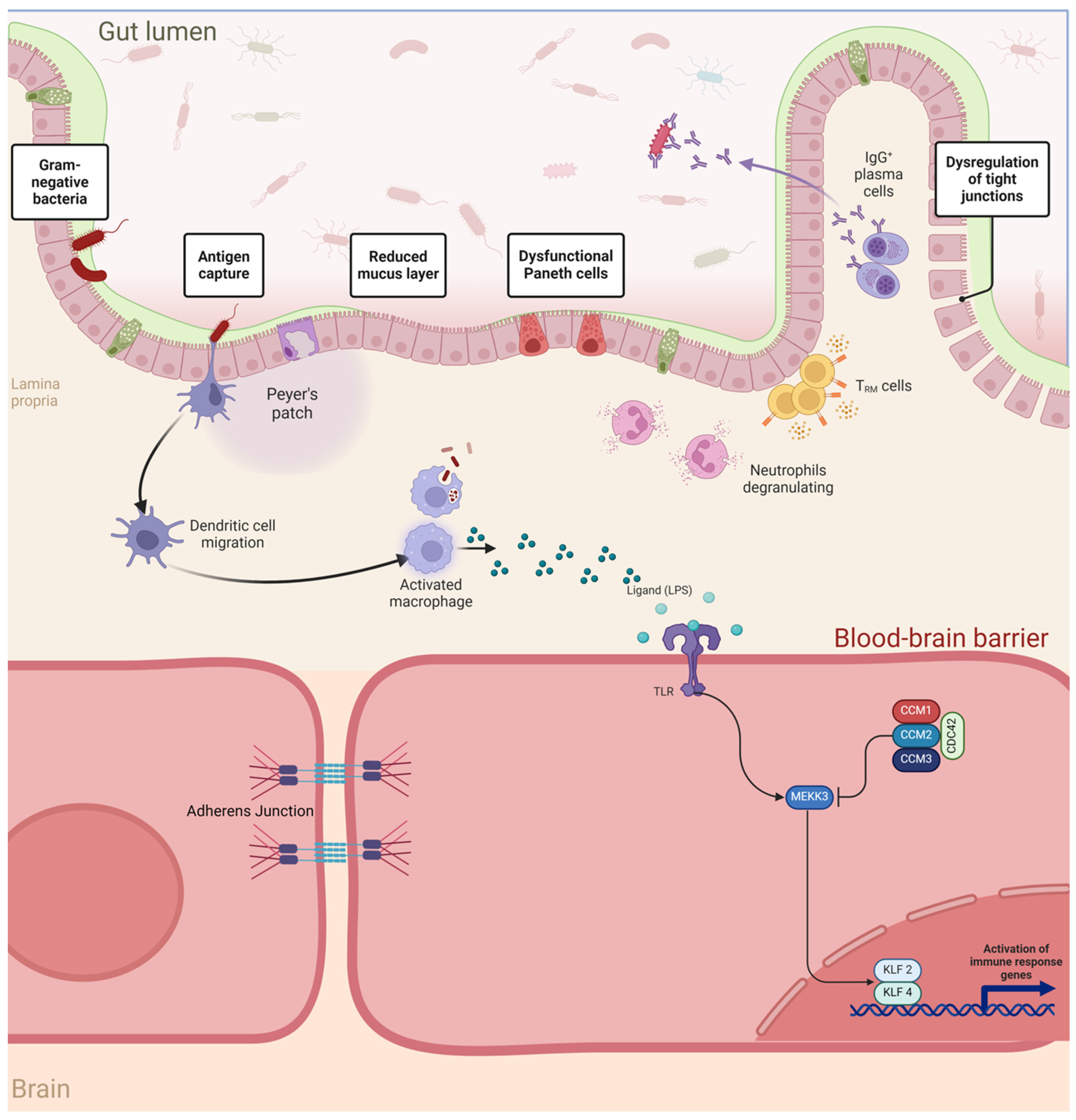
Cerebral Cavernous Malformations (CCMs) are low-flow vascular lesions located within the central nervous system, with a reported prevalence in the general population of 0.16–0.5%. Patients with CCMs may remain asymptomatic or present new onset symptoms such as seizures or focal neurological deficits often related to the occurrence of intracerebral hemorrhage. CCM may appear sporadic or as part of familial forms linked to mutations in the CCM-gene cluster, affecting endothelial cell integrity and triggering molecular cascades, including the MEKK3/KLF2/4 signaling pathway. Recent studies have highlighted the roles of inflammatory, angiogenic, and coagulation pathways alongside the emerging evidence of a gut–brain axis influencing microbiome-driven TLR4 signaling. This systematic review aims to describe molecular biomarkers associated with CCM pathophysiology, emphasizing their potential use as diagnostic and prognostic tools. Circulating plasma biomarkers such as CRP, vitamin D, and interleukins may reflect ongoing inflammatory and endothelial processes, while some imaging biomarkers like Quantitative Susceptibility Mapping (QSM) have shown a correlation with iron deposition and vascular leakage. Leveraging both circulating and imaging biomarkers may improve the therapeutic decision-making process. Further studies are encouraged to validate these findings and to facilitate the development of personalized, evidence-based strategies for the management of CCM.
Keywords: cavernoma; cerebral cavernous malformations; biomarker; plasma biomarker; molecular pathways; circulating biomarkers; endothelial dysfunction; MEKK3 signaling; systematic review cavernoma; cerebral cavernous malformations; biomarker; plasma biomarker; molecular pathways; circulating biomarkers; endothelial dysfunction; MEKK3 signaling; systematic review