The Placenta as a Target Organ for Poly- and Perfluoroalkyl Substances (PFASs): Molecular Mechanisms of Toxicity

Abstract
1. Introduction
2. Prenatal and Preconception PFAS Exposure and Pregnancy Outcomes
3. Placenta as a Target—Mechanisms of Action
3.1. Cellular and Functional Alterations in In Vitro Trophoblast Models
3.2. Molecular and Transcriptomic Dysregulation of Trophoblast Differentiation and Placentation
3.3. Epigenetic Alterations and Sex-Specific Placental Susceptibility
3.4. Maternal Placental Alterations and Redox Imbalance Associated with PFAS Exposure
4. Current Methodologies for the Analysis of Complex Chemical Mixtures
4.1. Analytical Challenges and Advances in PFAS Biomonitoring
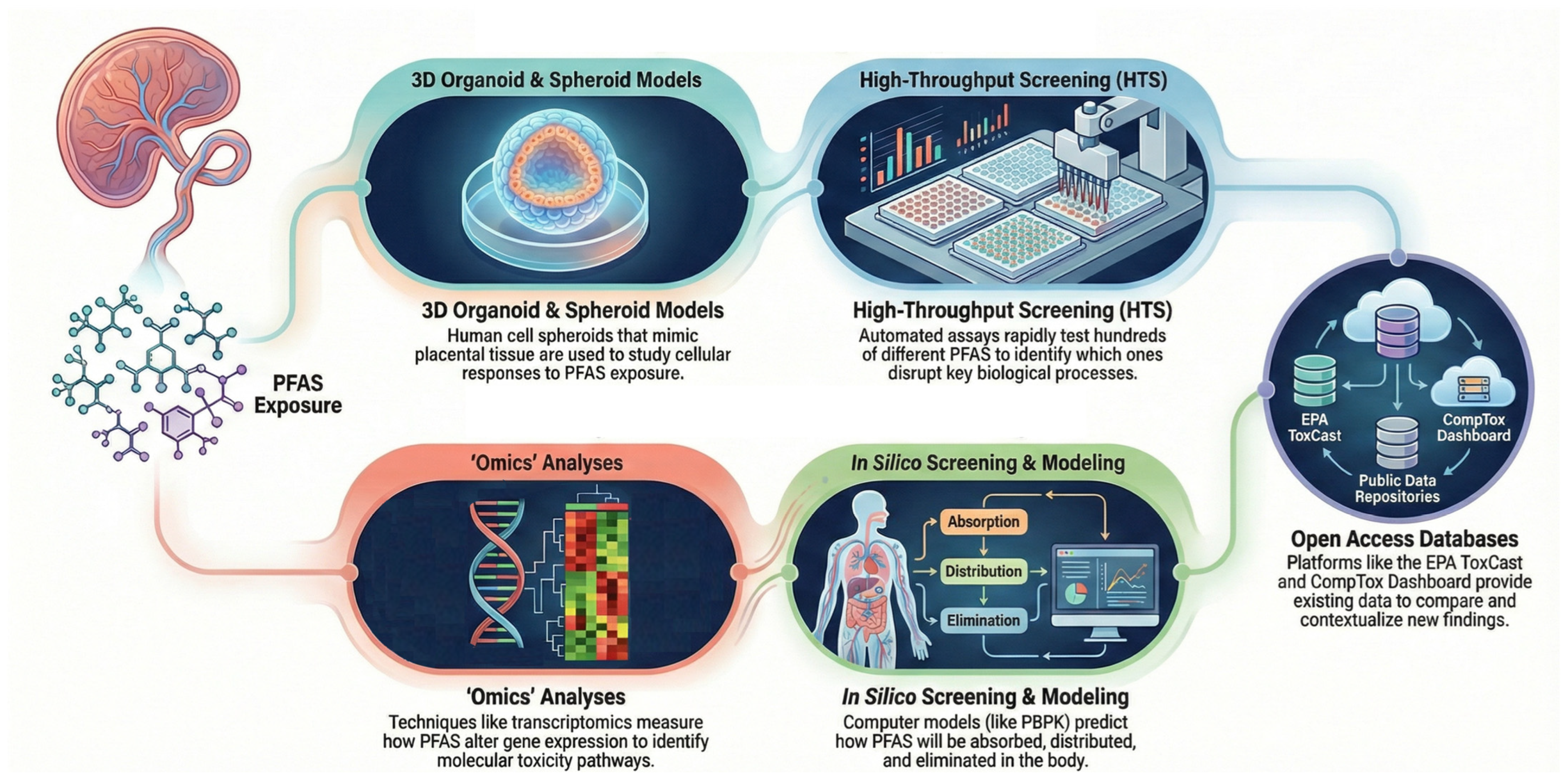
4.2. Use of New Approach Methodologies (NAMs)
5. Discussion
Author Contributions
Funding
Institutional Review Board Statement
Informed Consent Statement
Data Availability Statement
Acknowledgments
Conflicts of Interest
References
- Wang, Z.; Buser, A.M.; Cousins, I.T.; Demattio, S.; Drost, W.; Johansson, O.; Ohno, K.; Patlewicz, G.; Richard, A.M.; Walker, G.W.; et al. A New OECD Definition for Per- and Polyfluoroalkyl Substances. Environ. Sci. Technol. 2021, 55, 15575–15578. [Google Scholar] [CrossRef] [Scilit] [PubMed]
- Dobrzyńska, E.; Wasilewski, P.; Pośniak, M. Per- and Polyfluoroalkyl Substances (PFASs): A Comprehensive Review of Environmental Distribution, Health Impacts, and Regulatory Landscape. Appl. Sci. 2025, 15, 11884. [Google Scholar] [CrossRef] [Scilit]
- Brunn, H.; Arnold, G.; Körner, W.; Rippen, G.; Steinhäuser, K.G.; Valentin, I. PFAS: Forever Chemicals—Persistent, Bioaccumulative and Mobile. Reviewing the Status and the Need for Their Phase out and Remediation of Contaminated Sites. Environ. Sci. Eur. 2023, 35, 20, Correction in Environ. Sci. Eur. 2023, 35, 30. [Google Scholar] [CrossRef] [Scilit]
- Dehghani, M.H.; Aghaei, M.; Bashardoust, P.; Rezvani Ghalhari, M.; Nayeri, D.; Malekpoor, M.; Sheikhi, S.; Shi, Z. An Insight into the Environmental and Human Health Impacts of Per- and Polyfluoroalkyl Substances (PFAS): Exploring Exposure Pathways and Their Implications. Environ. Sci. Eur. 2025, 37, 81. [Google Scholar] [CrossRef] [Scilit]
- Kato, K.; Wong, L.-Y.; Jia, L.T.; Kuklenyik, Z.; Calafat, A.M. Trends in Exposure to Polyfluoroalkyl Chemicals in the U.S. Population: 1999−2008. Environ. Sci. Technol. 2011, 45, 8037–8045. [Google Scholar] [CrossRef] [Scilit]
- Cheng, C.; Zhu, X.; Li, J.; Ornelas-Soto, N.; Wang, Y. Emerging PFAS Alternatives: Unveiling Environmental Fates and Ecological Risks. Energy Environ. Sustain. 2025, 1, 100041. [Google Scholar] [CrossRef] [Scilit]
- Sunderland, E.M.; Hu, X.C.; Dassuncao, C.; Tokranov, A.K.; Wagner, C.C.; Allen, J.G. A Review of the Pathways of Human Exposure to Poly- and Perfluoroalkyl Substances (PFASs) and Present Understanding of Health Effects. J. Expo. Sci. Environ. Epidemiol. 2019, 29, 131–147. [Google Scholar] [CrossRef] [Scilit]
- Belay, M.H.; Robotti, E.; Ghignone, A.; Fabbris, A.; Brandi, J.; Cecconi, D.; Masini, M.A.; Dondero, F.; Marengo, E. Sensitive and Accurate Determination of 32 PFAS in Human Serum Using Online SPE-UHPLC-HRMS. J. Hazard. Mater. 2025, 485, 136780. [Google Scholar] [CrossRef] [Scilit]
- Gomis, M.I.; Vestergren, R.; Borg, D.; Cousins, I.T. Comparing the Toxic Potency in Vivo of Long-Chain Perfluoroalkyl Acids and Fluorinated Alternatives. Environ. Int. 2018, 113, 1–9. [Google Scholar] [CrossRef] [Scilit]
- Blake, B.E.; Fenton, S.E. Early Life Exposure to Per- and Polyfluoroalkyl Substances (PFAS) and Latent Health Outcomes: A Review Including the Placenta as a Target Tissue and Possible Driver of Peri- and Postnatal Effects. Toxicology 2020, 443, 152565. [Google Scholar] [CrossRef] [Scilit]
- Zhang, Y.; Mustieles, V.; Sun, Q.; Coull, B.; McElrath, T.; Rifas-Shiman, S.L.; Martin, L.; Sun, Y.; Wang, Y.-X.; Oken, E.; et al. Association of Early Pregnancy Perfluoroalkyl and Polyfluoroalkyl Substance Exposure with Birth Outcomes. JAMA Netw. Open 2023, 6, e2314934. [Google Scholar] [CrossRef] [Scilit] [PubMed]
- Jaus, A.; Fragnière Rime, C.; Riou, J.; Brüschweiler, B.J.; Bochud, M.; von Goetz, N. Serum Biomonitoring of Per- and Polyfluoroalkyl Substances (PFASs) in the Adult Population of Switzerland: Results from the Pilot Phase of the Swiss Health Study. Environ. Int. 2025, 198, 109382. [Google Scholar] [CrossRef] [Scilit] [PubMed]
- Jia, J.; Duan, L.; Dong, B.; Dong, Q.; Liu, Y.; Yu, W.; Yang, L.; Shi, H. Perfluoroalkyl and Polyfluoroalkyl Substances in Cord Serum of Newborns and Their Potential Factors. Chemosphere 2023, 313, 137525. [Google Scholar] [CrossRef] [Scilit] [PubMed]
- Giorgetti, A.; Fornasari, A.; Bonasoni, M.P.; Ferretti, A.; Seidenari, A.; Sech, M.; Piva, E.; Pascali, J.P.; Fais, P. Per- and Polyfluoroalkyl Substances (PFAS) in Placental Compartments: Histopathological and Toxicological Data Integration in an Italian Cohort. Environ. Res. 2025, 279, 121846. [Google Scholar] [CrossRef] [Scilit]
- Wang, Y.; Han, W.; Wang, C.; Zhou, Y.; Shi, R.; Bonefeld-Jørgensen, E.C.; Yao, Q.; Yuan, T.; Gao, Y.; Zhang, J.; et al. Efficiency of Maternal-Fetal Transfer of Perfluoroalkyl and Polyfluoroalkyl Substances. Environ. Sci. Pollut. Res. Int. 2019, 26, 2691–2698. [Google Scholar] [CrossRef] [Scilit]
- Gützkow, K.B.; Haug, L.S.; Thomsen, C.; Sabaredzovic, A.; Becher, G.; Brunborg, G. Placental Transfer of Perfluorinated Compounds Is Selective—A Norwegian Mother and Child Sub-Cohort Study. Int. J. Hyg. Environ. Health 2012, 215, 216–219. [Google Scholar] [CrossRef] [Scilit]
- Mišľanová, C.; Valachovičová, M. Health Impacts of Per- and Polyfluoroalkyl Substances (PFASs): A Comprehensive Review. Life 2025, 15, 573. [Google Scholar] [CrossRef] [Scilit]
- Rabotnick, M.H.; Haidari, A.; Dolinoy, D.C.; Meijer, J.L.; Harris, S.M.; Burant, C.F.; Padmanabhan, V.; Goodrich, J.M. Early Pregnancy Serum PFAS Are Associated with Alterations in the Maternal Lipidome. Environ. Res. 2024, 263, 120183. [Google Scholar] [CrossRef] [Scilit]
- Siwakoti, R.C.; Rosario-Pabon, Z.; Vélez Vega, C.M.; Hao, W.; Alshawabkeh, A.; Cordero, J.F.; Watkins, D.J.; Meeker, J.D. Assessment of Per- and Polyfluoroalkyl Substances (PFAS) Exposure and Associations with Oxidative Stress Biomarkers among Pregnant Women from the PROTECT Cohort. Sci. Total Environ. 2025, 973, 179130. [Google Scholar] [CrossRef] [Scilit]
- Palaniyandi, J.; Bruin, J.E.; Fisher, M.; Borghese, M.M.; Hoyeck, M.P.; Panagiotopoulos, C.; Ashley-Martin, J. Prenatal Concentrations of Perfluoroalkyl Substances and Maternal Beta Cell Function at 7 to 9 Years of Follow-Up. J. Clin. Endocrinol. Metab. 2025, 110, e4221–e4231. [Google Scholar] [CrossRef] [Scilit]
- Mishra, J.S.; Bosse, B.; Hoppe, K.K.; Malecki, K.; Hetzel, S.J.; Kumar, S. Perfluoroalkyl Substances (PFAS) Exposure and Preeclampsia Risk: Impaired Angiogenesis through Suppression of VEGF Signaling. Reprod. Toxicol. 2025, 132, 108827. [Google Scholar] [CrossRef] [Scilit] [PubMed]
- Siwakoti, R.C.; Harris, S.M.; Ferguson, K.K.; Hao, W.; Cantonwine, D.E.; Mukherjee, B.; McElrath, T.F.; Meeker, J.D. Prenatal Exposure to Per- and Polyfluoroalkyl Substances (PFAS) and Their Influence on Inflammatory Biomarkers in Pregnancy: Findings from the LIFECODES Cohort. Environ. Int. 2024, 194, 109145. [Google Scholar] [CrossRef] [Scilit] [PubMed]
- Jensen, I.K.B.; Budtz-Jørgensen, E.; Lindh, C.; Roland, C.B.; de Place Knudsen, S.; Bendix, J.M.; Molsted, S.; Clausen, T.D.; Stallknecht, B.; Mortensen, O.H.; et al. Serum Concentrations of Per- and Poly-Fluoroalkyl Substances (PFAS) in Danish Pregnant Women-Temporal Trends during Pregnancy, Correlations with Partners, Associations with Physical Activity, and Blood Lipid Concentrations. Environ. Health Glob. Access Sci. Source 2025, 24, 16. [Google Scholar] [CrossRef] [Scilit] [PubMed]
- Cinzori, M.E.; Pacyga, D.C.; Rosas, L.; Whalen, J.; Smith, S.; Park, J.-S.; Geiger, S.D.; Gardiner, J.C.; Braun, J.M.; Schantz, S.L.; et al. Associations of Per- and Polyfluoroalkyl Substances with Maternal Metabolic and Inflammatory Biomarkers in Early-to-Mid-Pregnancy. Environ. Res. 2024, 250, 118434. [Google Scholar] [CrossRef] [Scilit]
- Ren, M.; Wu, T.; Zhang, H.; Yang, S.; Zhao, L.; Zhuang, L.; Lu, Q.; Han, X.; Pan, B.; Li, T.; et al. Using Environmental Mixture Exposure-Triggered Biological Knowledge-Driven Machine Learning to Predict Early Pregnancy Loss. Environ. Sci. Technol. 2025, 59, 19691–19704. [Google Scholar] [CrossRef] [Scilit]
- Bao, J.; Shao, L.-X.; Liu, Y.; Cui, S.-W.; Wang, X.; Lu, G.-L.; Wang, X.; Jin, Y.-H. Target Analysis and Suspect Screening of Per- and Polyfluoroalkyl Substances in Paired Samples of Maternal Serum, Umbilical Cord Serum, and Placenta near Fluorochemical Plants in Fuxin, China. Chemosphere 2022, 307, 135731. [Google Scholar] [CrossRef] [Scilit]
- Everson, T.M.; Sehgal, N.; Campbell, K.; Barr, D.B.; Panuwet, P.; Yakimavets, V.; Chen, K.; Perez, C.; Shankar, K.; Eick, S.M.; et al. Placental PFAS Concentrations Are Associated with Perturbations of Placental DNA Methylation. Environ. Pollut. 2025, 368, 125737. [Google Scholar] [CrossRef] [Scilit]
- Chen, F.; Yin, S.; Kelly, B.C.; Liu, W. Chlorinated Polyfluoroalkyl Ether Sulfonic Acids in Matched Maternal, Cord, and Placenta Samples: A Study of Transplacental Transfer. Environ. Sci. Technol. 2017, 51, 6387–6394. [Google Scholar] [CrossRef] [Scilit]
- Pascali, J.P.; Piva, E.; Bonasoni, M.P.; Migliavacca, C.; Seidenari, A.; Fais, P. Analysis and Distribution of Per- and Polyfluoroalkyl Substances in Decidua and Villi Placenta Explants. Environ. Res. 2023, 229, 115955. [Google Scholar] [CrossRef] [Scilit]
- Zhang, Y.; Mustieles, V.; Martin, L.; Sun, Y.; Hillcoat, A.; Fang, X.; Bibi, Z.; Torres, N.; Coburn-Sanderson, A.; First, O.; et al. Maternal and Paternal Preconception Serum Concentrations of Per and Polyfluoroalkyl Substances in Relation to Birth Outcomes. Environ. Sci. Technol. 2024, 58, 2683–2692. [Google Scholar] [CrossRef] [Scilit]
- Preston, E.V.; Webster, T.F.; Claus Henn, B.; McClean, M.D.; Gennings, C.; Oken, E.; Rifas-Shiman, S.L.; Pearce, E.N.; Calafat, A.M.; Fleisch, A.F.; et al. Prenatal Exposure to Per- and Polyfluoroalkyl Substances and Maternal and Neonatal Thyroid Function in the Project Viva Cohort: A Mixtures Approach. Environ. Int. 2020, 139, 105728. [Google Scholar] [CrossRef] [Scilit]
- Blake, B.E.; Rickard, B.P.; Fenton, S.E. A High-Throughput Toxicity Screen of 42 Per- and Polyfluoroalkyl Substances (PFAS) and Functional Assessment of Migration and Gene Expression in Human Placental Trophoblast Cells. Front. Toxicol. 2022, 4, 881347. [Google Scholar] [CrossRef] [Scilit]
- Xia, Y.; Fu, Q.; Voss, H.; Fest, S.; Arnold, S.; Bauer, M.; Fink, B.; Zenclussen, A.C.; Stojanovska, V. Real-Life per- and Polyfluoroalkyl Substances Mixture Impairs Placental Function: Insights from a Trophoblast Spheroid Model. Environ. Res. 2025, 287, 123037. [Google Scholar] [CrossRef] [Scilit]
- Li, M.; Xu, C.; Li, L.; Gao, F.; Xu, C.; Yu, Y.; Huang, C.; Liu, Y.; Shen, X.; Hu, J. Placentation Disruption by Perfluorooctanoic Acid and Perfluorooctanesulfonate in Human Trophoblast Organoids. Environ. Sci. Technol. 2025, 59, 20263–20275. [Google Scholar] [CrossRef] [Scilit] [PubMed]
- Happel, J.; Mellouk, N.; Crute, C.; Feng, L. PFBS Disrupts Lipid Metabolism and Mitochondrial Function in Human Trophoblast Cells. Toxicology 2025, 518, 154269. [Google Scholar] [CrossRef] [Scilit] [PubMed]
- Bangma, J.; Szilagyi, J.; Blake, B.E.; Plazas, C.; Kepper, S.; Fenton, S.E.; Fry, R.C. An Assessment of Serum-Dependent Impacts on Intracellular Accumulation and Genomic Response of per- and Polyfluoroalkyl Substances in a Placental Trophoblast Model. Environ. Toxicol. 2020, 35, 1395–1405. [Google Scholar] [CrossRef] [Scilit] [PubMed]
- Chen, H.; Kapidzic, M.; Gantar, D.; Aksel, S.; Levan, J.; Abrahamsson, D.P.; Jigmeddagva, U.; Basrai, S.; San, A.; Gaw, S.L.; et al. Perfluorooctanoic Acid Induces Transcriptomic Alterations in Second Trimester Human Cytotrophoblasts. Toxicol. Sci. Off. J. Soc. Toxicol. 2023, 196, 187–199. [Google Scholar] [CrossRef] [Scilit]
- Abdulkadir, A.; Kandel, S.; Lewis, N.; D’Auvergne, O.; Rosby, R.; Hossain, E. Epigenetic Consequences of In Utero PFAS Exposure: Implications for Development and Long-Term Health. Int. J. Environ. Res. Public Health 2025, 22, 917. [Google Scholar] [CrossRef] [Scilit]
- Liang, D.; Taibl, K.R.; Dunlop, A.L.; Barr, D.B.; Ryan, P.B.; Everson, T.; Huels, A.; Tan, Y.; Panuwet, P.; Kannan, K.; et al. Metabolic Perturbations Associated with an Exposure Mixture of Per- and Polyfluoroalkyl Substances in the Atlanta African American Maternal-Child Cohort. Environ. Sci. Technol. 2023, 57, 16206–16218. [Google Scholar] [CrossRef] [Scilit]
- Tsai, W.-J.; Hsieh, W.-S.; Chen, P.-C.; Liu, C.-Y. Prenatal Perfluoroalkyl Substance Exposure in Association with Global Histone Post-Translational Methylation in 2-Year-Old Children. Toxics 2024, 12, 876. [Google Scholar] [CrossRef] [Scilit]
- Xie, Z.; Jin, L.; Wu, Q.; Ji, H.; Miao, M.; Song, X.; Zhu, H.; Su, H.; Yuan, W.; Liang, H. Maternal Per- and Polyfluoroalkyl Substance Concentrations and Placental DNA Methylation of Thyroid Hormone-Related Genes. J. Hazard. Mater. 2025, 489, 137545. [Google Scholar] [CrossRef] [Scilit]
- Toh, H.; Sasaki, H. Spatiotemporal DNA Methylation Dynamics Shape Megabase-Scale Methylome Landscapes. Life Sci. Alliance 2024, 7, e202302403. [Google Scholar] [CrossRef] [Scilit] [PubMed]
- Sands, M.; Wen, Y.; Sachdeva, A.; Irudayaraj, J. A CpG Epigenetic Switch Reverts PFAS Toxicity—An In Vitro Study. Environ. Health 2025, 3, 1406–1422. [Google Scholar] [CrossRef] [Scilit] [PubMed]
- Perez, C.; Sehgal, N.; Eick, S.M.; Barr, D.B.; Panuwet, P.; Yakimavets, V.; Chen, K.; Shankar, K.; Pearson, K.J.; Andres, A.; et al. Sex-Specific Effects of in Utero Exposure to per- and Polyfluoroalkyl Substances on Placental Development. Environ. Res. 2025, 270, 120868. [Google Scholar] [CrossRef] [Scilit] [PubMed]
- Choi, J.W.; Parenti, M.; Slupsky, C.M.; Tancredi, D.J.; Schmidt, R.J.; Shin, H.-M. Maternal Serum and Placental Metabolomes in Association with Prenatal Exposure to Per- and Polyfluoroalkyl Substances and Their Relevance to Child Neurodevelopment in an ASD-Enriched Cohort. Environ. Pollut. 2025, 383, 126811. [Google Scholar] [CrossRef] [Scilit]
- Cheng, Z.; Wan, H.T.; Chan, W.Y.; Lam, T.K.Y.; Wong, C.K.C. Impact of PFOS on Maternal and Placental Lipid Metabolism and Decreased Placental Vascularization in a Murine Model. J. Hazard. Mater. 2026, 501, 140636. [Google Scholar] [CrossRef] [Scilit]
- Widhalm, R.; Granitzer, S.; Natha, B.; Zoboli, O.; Derx, J.; Zeisler, H.; Salzer, H.; Weiss, S.; Schmitner, N.; Kimmel, R.A.; et al. Perfluorodecanoic Acid (PFDA) Increases Oxidative Stress through Inhibition of Mitochondrial β-Oxidation. Environ. Pollut. 2025, 367, 125595. [Google Scholar] [CrossRef] [Scilit]
- Bellette, H.F.F.; Pires Souto, D.E.; Xavier Mendes, A.; Moulton, S.E.; Coimbra Pimenta, T.; Pithaih, V.; Greene, G.W.; Silva, S.M. Point-of-Need PFAS Detection: A Yes/No Biosensor Solution. ACS Sens. 2025, 10, 9237–9245. [Google Scholar] [CrossRef] [Scilit]
- Yun, X.; Kurz, M.J.; Suri, R.; McKenzie, E.R. A Modified QuEChERS Sample Processing Method for the Determination of Per- and Polyfluoroalkyl Substances (PFAS) in Environmental Biological Matrices. MethodsX 2023, 11, 102290. [Google Scholar] [CrossRef] [Scilit]
- Bangma, J.T.; Reiner, J.; Fry, R.C.; Manuck, T.; McCord, J.; Strynar, M.J. Identification of an Analytical Method Interference for Perfluorobutanoic Acid in Biological Samples. Environ. Sci. Technol. Lett. 2021, 8, 1085–1090. [Google Scholar] [CrossRef] [Scilit]
- Bangma, J.; McCord, J.; Giffard, N.; Buckman, K.; Petali, J.; Chen, C.; Amparo, D.; Turpin, B.; Morrison, G.; Strynar, M. Analytical Method Interferences for Perfluoropentanoic Acid (PFPeA) and Perfluorobutanoic Acid (PFBA) in Biological and Environmental Samples. Chemosphere 2023, 315, 137722. [Google Scholar] [CrossRef] [Scilit] [PubMed]
- Strynar, M.; McCord, J.; Newton, S.; Washington, J.; Barzen-Hanson, K.; Trier, X.; Liu, Y.; Dimzon, I.K.; Bugsel, B.; Zwiener, C.; et al. Practical Application Guide for the Discovery of Novel PFAS in Environmental Samples Using High Resolution Mass Spectrometry. J. Expo. Sci. Environ. Epidemiol. 2023, 33, 575–588. [Google Scholar] [CrossRef] [Scilit] [PubMed]
- Buckenmaier, S.; Riemenschneider, C.; Schächtele, A.; Sölter, S. Chromatographic Techniques for Improving the LC/MS Quantification of PFAS. J. Sep. Sci. 2025, 48, e70155. [Google Scholar] [CrossRef] [Scilit] [PubMed]
- Ryan, C.R.M.; Nazdrajić, E.; Campbell, J.L.; Bell, K.Y.; Hopkins, W.S. Two-Dimensional LC × DMS Analysis of 34 PFAS Compounds. Anal. Chem. 2025, 97, 21050–21059. [Google Scholar] [CrossRef] [Scilit]
- Bil, W.; Hartmann, J.; Bakker, M.; Bokkers, B. Mixture Risk Assessment Approaches to Evaluate Oral Exposure to PFAS: Outputs and Recommendations of an Expert Workshop. Regul. Toxicol. Pharmacol. 2025, 162, 105907. [Google Scholar] [CrossRef] [Scilit]
- Taylor, K.W.; Joubert, B.R.; Braun, J.M.; Dilworth, C.; Gennings, C.; Hauser, R.; Heindel, J.J.; Rider, C.V.; Webster, T.F.; Carlin, D.J. Statistical Approaches for Assessing Health Effects of Environmental Chemical Mixtures in Epidemiology: Lessons from an Innovative Workshop. Environ. Health Perspect. 2016, 124, A227–A229. [Google Scholar] [CrossRef] [Scilit]
- Gómez-Olarte, S.; Röder, S.; Rolle-Kampczyk, U.; Sack, U.; von Bergen, M.; Borte, M.; Zenclussen, A.C.; Herberth, G. Prenatal Exposure to Mixtures of Phthalates and Bisphenol A and Eczema Risk: Findings in Atopic and Non-Atopic Children from the LiNA Birth Cohort. Environ. Res. 2025, 278, 121667. [Google Scholar] [CrossRef] [Scilit]
- Taibl, K.R.; Schantz, S.; Aung, M.T.; Padula, A.; Geiger, S.; Smith, S.; Park, J.-S.; Milne, G.L.; Robinson, J.F.; Woodruff, T.J.; et al. Associations of Per- and Polyfluoroalkyl Substances (PFAS) and Their Mixture with Oxidative Stress Biomarkers during Pregnancy. Environ. Int. 2022, 169, 107541. [Google Scholar] [CrossRef] [Scilit]
- Addicks, G.C.; Rowan-Carroll, A.; Reardon, A.J.F.; Leingartner, K.; Williams, A.; Meier, M.J.; Moffat, I.; Carrier, R.; Lorusso, L.; Wetmore, B.A.; et al. Per- and Polyfluoroalkyl Substances (PFAS) in Mixtures Show Additive Effects on Transcriptomic Points of Departure in Human Liver Spheroids. Toxicol. Sci. Off. J. Soc. Toxicol. 2023, 194, 38–52. [Google Scholar] [CrossRef] [Scilit]
- Conley, J.M.; Lambright, C.S.; Evans, N.; Medlock-Kakaley, E.; Dixon, A.; Hill, D.; McCord, J.; Strynar, M.J.; Ford, J.; Gray, L.E. Cumulative Maternal and Neonatal Effects of Combined Exposure to a Mixture of Perfluorooctanoic Acid (PFOA) and Perfluorooctane Sulfonic Acid (PFOS) during Pregnancy in the Sprague-Dawley Rat. Environ. Int. 2022, 170, 107631. [Google Scholar] [CrossRef] [Scilit]
- Golosovskaia, E.; Örn, S.; Ahrens, L.; Chelcea, I.; Andersson, P.L. Studying Mixture Effects on Uptake and Tissue Distribution of PFAS in Zebrafish (Danio Rerio) Using Physiologically Based Kinetic (PBK) Modelling. Sci. Total Environ. 2024, 912, 168738. [Google Scholar] [CrossRef] [Scilit] [PubMed]
- Bernstein, A.S.; Kapraun, D.F.; Schlosser, P.M. A Model Template Approach for Rapid Evaluation and Application of Physiologically Based Pharmacokinetic Models for Use in Human Health Risk Assessments: A Case Study on Per- and Polyfluoroalkyl Substances. Toxicol. Sci. 2021, 182, 215–228. [Google Scholar] [CrossRef] [Scilit] [PubMed]
- Deepika, D.; Kumar, V. The Role of “Physiologically Based Pharmacokinetic Model (PBPK)” New Approach Methodology (NAM) in Pharmaceuticals and Environmental Chemical Risk Assessment. Int. J. Environ. Res. Public Health 2023, 20, 3473. [Google Scholar] [CrossRef] [Scilit] [PubMed]
- Worley, R.R.; Yang, X.; Fisher, J. Physiologically Based Pharmacokinetic Modeling of Human Exposure to Perfluorooctanoic Acid Suggests Historical Non Drinking-Water Exposures Are Important for Predicting Current Serum Concentrations. Toxicol. Appl. Pharmacol. 2017, 330, 9–21. [Google Scholar] [CrossRef] [Scilit]
- Paré, A.; Ratier, A.; Desroziers, E.; Mhaouty-Kodja, S.; Chardon, K.; Zeman, F. Development of a Generic Physiologically Based Pharmacokinetic (PBPK) Model for Female Mouse Including Gestation: Application to PFOA to Link Environmental Levels to New Approaches Methodologies (NAMs) Results for Environmental Risk Assessment. Environ. Res. 2026, 295, 123933. [Google Scholar] [CrossRef] [Scilit]
- Limbu, S.; Glasgow, E.; Block, T.; Dakshanamurthy, S. A Machine-Learning-Driven Pathophysiology-Based New Approach Method for the Dose-Dependent Assessment of Hazardous Chemical Mixtures and Experimental Validations. Toxics 2024, 12, 481. [Google Scholar] [CrossRef] [Scilit]
- Song, Y.; Fan, X.; Hultman, M.T.; Christou, M.; Rundberget, J.T.; Klefbom, C.K.; Lin, Y.; Sun, Y.; Huang, J.; Xie, L. Next Generation Risk Assessment of Emerging PFOA Alternatives Using Integrated New Approach Methodologies. Environ. Sci. Technol. 2025, 59, 25649–25660. [Google Scholar] [CrossRef] [Scilit]
- Moyer, H.L.; Kim, S.; Lam, B.P.; Richardson, L.S.; Tsai, H.-H.D.; Ford, L.C.; Lin, H.-C.C.; Chiu, W.A.; Menon, R.; Han, A.; et al. Fetal Response to Maternal Exposures of Environmental Chemicals: Utility of a Four-Cell Human Feto-Maternal Interface Organ-on-Chip. Chem.-Biol. Interact. 2025, 421, 111782. [Google Scholar] [CrossRef] [Scilit]
- Silva, M.; Capps, S.; London, J.K. Community-Engaged Research and the Use of Open Access ToxVal/ToxRef In Vivo Databases and New Approach Methodologies (NAM) to Address Human Health Risks from Environmental Contaminants. Birth Defects Res. 2024, 116, e2395. [Google Scholar] [CrossRef] [Scilit]
- Davidsen, N.; Rosenmai, A.K.; Lauschke, K.; Svingen, T.; Vinggaard, A.M. Developmental Effects of PFOS, PFOA and GenX in a 3D Human Induced Pluripotent Stem Cell Differentiation Model. Chemosphere 2021, 279, 130624. [Google Scholar] [CrossRef] [Scilit]
- Liang, L.; Pan, Y.; Bin, L.; Liu, Y.; Huang, W.; Li, R.; Lai, K.P. Immunotoxicity Mechanisms of Perfluorinated Compounds PFOA and PFOS. Chemosphere 2022, 291, 132892. [Google Scholar] [CrossRef] [Scilit] [PubMed]
- Shi, W.; Zhang, Z.; Li, M.; Dong, H.; Li, J. Reproductive Toxicity of PFOA, PFOS and Their Substitutes: A Review Based on Epidemiological and Toxicological Evidence. Environ. Res. 2024, 250, 118485. [Google Scholar] [CrossRef] [Scilit] [PubMed]
- Lallas, P.L. The Stockholm Convention on Persistent Organic Pollutants. Am. J. Int. Law 2001, 95, 692–708. [Google Scholar] [CrossRef] [Scilit]
- Patlewicz, G.; Judson, R.S.; Williams, A.J.; Butler, T.; Barone, S.J.; Carstens, K.E.; Cowden, J.; Dawson, J.L.; Degitz, S.J.; Fay, K.; et al. Development of Chemical Categories for Per- and Polyfluoroalkyl Substances (PFAS) and the Proof-of-Concept Approach to the Identification of Potential Candidates for Tiered Toxicological Testing and Human Health Assessment. Comput. Toxicol. 2024, 31, 100327. [Google Scholar] [CrossRef] [Scilit]
- Yu, G.; Jin, M.; Huang, Y.; Aimuzi, R.; Zheng, T.; Nian, M.; Tian, Y.; Wang, W.; Luo, Z.; Shen, L.; et al. Environmental Exposure to Perfluoroalkyl Substances in Early Pregnancy, Maternal Glucose Homeostasis and the Risk of Gestational Diabetes: A Prospective Cohort Study. Environ. Int. 2021, 156, 106621. [Google Scholar] [CrossRef] [Scilit]
- Säve-Söderbergh, M.; Gyllenhammar, I.; Schillemans, T.; Lindfeldt, E.; Vogs, C.; Donat-Vargas, C.; Helte, E.; Ankarberg, E.; Glynn, A.; Ahrens, L.; et al. Per- and Polyfluoroalkyl Substances (PFAS) in Drinking Water, Gestational Diabetes Mellitus, Hypertension and Preeclampsia: A Nation-Wide Register-Based Study on PFAS in Drinking Water. Environ. Int. 2025, 198, 109415. [Google Scholar] [CrossRef] [Scilit]
- Ebel, M.; Rylander, L.; Fletcher, T.; Jakobsson, K.; Nielsen, C. Gestational Hypertension, Preeclampsia, and Gestational Diabetes Mellitus after High Exposure to Perfluoroalkyl Substances from Drinking Water in Ronneby, Sweden. Environ. Res. 2023, 239, 117316. [Google Scholar] [CrossRef] [Scilit]
- Yang, L.; Ji, H.; Liang, H.; Yuan, W.; Song, X.; Li, X.; Niu, J.; Shi, H.; Wen, S.; Miao, M. Associations of Perfluoroalkyl and Polyfluoroalkyl Substances with Gestational Hypertension and Blood Pressure during Pregnancy: A Cohort Study. Environ. Res. 2022, 215, 114284. [Google Scholar] [CrossRef] [Scilit]
- Mamsen, L.S.; Björvang, R.D.; Mucs, D.; Vinnars, M.-T.; Papadogiannakis, N.; Lindh, C.H.; Andersen, C.Y.; Damdimopoulou, P. Concentrations of Perfluoroalkyl Substances (PFASs) in Human Embryonic and Fetal Organs from First, Second, and Third Trimester Pregnancies. Environ. Int. 2019, 124, 482–492. [Google Scholar] [CrossRef] [Scilit]
- Groisman, L.; Berman, T.; Quinn, A.; Pariente, G.; Rorman, E.; Karakis, I.; Gat, R.; Sarov, B.; Novack, L. Levels of PFAS Concentrations in the Placenta and Pregnancy Complications. Ecotoxicol. Environ. Saf. 2023, 262, 115165. [Google Scholar] [CrossRef] [Scilit]
- Zhao, L.; Zhang, Y.; Zhu, L.; Ma, X.; Wang, Y.; Sun, H.; Luo, Y. Isomer-Specific Transplacental Efficiencies of Perfluoroalkyl Substances in Human Whole Blood. Environ. Sci. Technol. Lett. 2017, 4, 391–398. [Google Scholar] [CrossRef] [Scilit]
- Chen, F.; Yin, S.; Kelly, B.C.; Liu, W. Isomer-Specific Transplacental Transfer of Perfluoroalkyl Acids: Results from a Survey of Paired Maternal, Cord Sera, and Placentas. Environ. Sci. Technol. 2017, 51, 5756–5763. [Google Scholar] [CrossRef] [Scilit]
- Solan, M.E.; Lavado, R. The Use of in Vitro Methods in Assessing Human Health Risks Associated with Short-Chain Perfluoroalkyl and Polyfluoroalkyl Substances (PFAS). J. Appl. Toxicol. 2022, 42, 1298–1309. [Google Scholar] [CrossRef] [Scilit]
- Serafini, M.M.; Sepehri, S.; Midali, M.; Stinckens, M.; Biesiekierska, M.; Wolniakowska, A.; Gatzios, A.; Rundén-Pran, E.; Reszka, E.; Marinovich, M.; et al. Recent Advances and Current Challenges of New Approach Methodologies in Developmental and Adult Neurotoxicity Testing. Arch. Toxicol. 2024, 98, 1271–1295. [Google Scholar] [CrossRef] [Scilit]
- Phillip, A. Understanding Per- and Polyfluoroalkyl Substances (PFAS): Environmental Persistence, Health Risks, and Regulatory Challenges. Eur. J. Sci. Res. Rev. 2025, 2, 199–211. [Google Scholar] [CrossRef] [Scilit]
- Fenton, S.E.; Ducatman, A.; Boobis, A.; DeWitt, J.C.; Lau, C.; Ng, C.; Smith, J.S.; Roberts, S.M. Per- and Polyfluoroalkyl Substance Toxicity and Human Health Review: Current State of Knowledge and Strategies for Informing Future Research. Environ. Toxicol. Chem. 2021, 40, 606–630. [Google Scholar] [CrossRef] [Scilit]
- Deepika, D.; Rovira, J.; Sabuz, Ó.; Balaguer, J.; Schuhmacher, M.; Domingo, J.L.; Kumar, V. Framework for Risk Assessment of PFAS Utilizing Experimental Studies and In-Silico Models. Environ. Res. 2022, 208, 112722. [Google Scholar] [CrossRef] [Scilit]


| PFAS Category | Compound Abbreviations | Maternal Serum/Plasma | Fetal Serum | Umbilical Cord Blood | Placenta | References |
|---|---|---|---|---|---|---|
| Legacy PFASs | PFOS, PFOA, PFHxS, PFNA | ✔ | ✔ | ✔ | ✔ | [5,11,15,16,17,18,21,22,23,24,30,31] |
| Legacy PFASs (placental-focused studies) | PFOS, PFOA, PFHxS | — | — | — | ✔ | [11,14,28,29] |
| Emerging PFASs (short-chain) | PFBS, PFHxA, PFBA, PFHpA | ✔ | — | ✔ | ✔ | [13,17,27] |
| Emerging PFASs (ether based/chlorinated) | HFPO-DA (GenX), Cl-PFESA (F-53B) | ✔ | — | ✔ | ✔ | [6,17,27] |
| Emerging PFASs (review evidence) | Multiple emerging PFAS | ✔ | ✔ | ✔ | ✔ | [12,17] |
| PFAS | Experimental Model | Primary Effects on Trophoblasts or Placentas | Key Molecular Pathways/Mechanisms Affected | Reference |
|---|---|---|---|---|
| PFOA, PFOS, GenX | JEG-3 monolayers | Diminished viability, proliferation, mitochondrial membrane potential; diminished migration | Oxidative stress genes (GPX1, SOD1), xenobiotic transport (ABCG2) | [32] |
| PFAS mixture | JEG-3 spheroids | Structural damage at high dose; high invasion at low dose | Apoptosis, invasion related signaling | [33] |
| PFAS mixture | HTR-8/SVNeo spheroids | Consistent diminished invasion at low-medium doses | Apoptotic balance (CASP3), immune modulation (MIF) | [33] |
| PFAS mixture | JEG-3/HTR-8 | Diminished β-hCG secretion; diminished CBG7 expression | Endocrine signaling; CREB-dependent transcription | [33] |
| PFOA, PFOS | Human trophoblast organoids | Altered lineage specification, diminished hormone secretion; diminished invasion | CREB-signaling; differentiation programs | [34] |
| PFBS | Placental cells (integrated omics) | Impaired lipid metabolism; diminished mitochondrial fatty acid utilization | PPARG; carnitine shuttle (CPT1A, SLC25A20) | [35] |
| PFOA | Primary human cytotrophoblasts (2nd trimester) | Diminished viability; transcriptomic reprogramming at sub-cytotoxic doses | Lipid metabolism; innate immune genes (CRH, IFIT1, TNFSF10) | [37] |
| PFOA, PFOS, PFHxS | Human placenta (epigenome-wide) | Differential DNA methylation; sex-specific effects | Developmental, cardiometabolic and endocrine pathways | [28] |
| PFDA | HTR-8/SVNeo; zebrafish embryos | Diminished β-oxidation; augmented oxidative stress | Mitochondrial metabolism; NRF2 response | [47] |
| PFOS | Placental cells; human samples | Oxidative damage | Redox imbalance; genotoxic stress | [46] |
Disclaimer/Publisher’s Note: The statements, opinions and data contained in all publications are solely those of the individual author(s) and contributor(s) and not of MDPI and/or the editor(s). MDPI and/or the editor(s) disclaim responsibility for any injury to people or property resulting from any ideas, methods, instructions or products referred to in the content. |
© 2026 by the authors. Licensee MDPI, Basel, Switzerland. This article is an open access article distributed under the terms and conditions of the Creative Commons Attribution (CC BY) license.
Share and Cite
Ingaramo, P.I.; Zenclussen, M.L. The Placenta as a Target Organ for Poly- and Perfluoroalkyl Substances (PFASs): Molecular Mechanisms of Toxicity. Int. J. Mol. Sci. 2026, 27, 2036. https://doi.org/10.3390/ijms27042036
Ingaramo PI, Zenclussen ML. The Placenta as a Target Organ for Poly- and Perfluoroalkyl Substances (PFASs): Molecular Mechanisms of Toxicity. International Journal of Molecular Sciences. 2026; 27(4):2036. https://doi.org/10.3390/ijms27042036
Chicago/Turabian StyleIngaramo, Paola Inés, and Maria Laura Zenclussen. 2026. "The Placenta as a Target Organ for Poly- and Perfluoroalkyl Substances (PFASs): Molecular Mechanisms of Toxicity" International Journal of Molecular Sciences 27, no. 4: 2036. https://doi.org/10.3390/ijms27042036
APA StyleIngaramo, P. I., & Zenclussen, M. L. (2026). The Placenta as a Target Organ for Poly- and Perfluoroalkyl Substances (PFASs): Molecular Mechanisms of Toxicity. International Journal of Molecular Sciences, 27(4), 2036. https://doi.org/10.3390/ijms27042036