Article

Thermodynamic Inhibition of Carbon Dioxide Hydrate with Magnesium Chloride and Methanol: Comparative Phase Equilibrium and PXRD Study


1
Department of Physical and Colloid Chemistry, Gubkin University, 65, Leninsky Prospekt, Building 1, 119991 Moscow, Russia
2
Moscow Center for Advanced Studies, Kulakova Str. 20, 123592 Moscow, Russia
3
Center for Petroleum Science and Engineering, Skolkovo Institute of Science and Technology (Skoltech), Bolshoy Boulevard, 30, Building 1, 121205 Moscow, Russia
4
Institute of Fundamental Medicine and Biology, Kazan Federal University, Kreml uramı 18, Kazan 420008, Republic of Tatarstan, Russia
*
Authors to whom correspondence should be addressed.
Int. J. Mol. Sci. 2026, 27(4), 1792; https://doi.org/10.3390/ijms27041792
Submission received: 31 December 2025 / Revised: 1 February 2026 / Accepted: 7 February 2026 / Published: 13 February 2026
(This article belongs to the Collection Feature Papers in 'Physical Chemistry and Chemical Physics')

Abstract

Clathrate hydrates of carbon dioxide represent a subject of considerable interest in both fundamental science and the development of promising technologies. The phase behavior of CO2 hydrate in the presence of concentrated aqueous solutions remains poorly understood. In this study, we conducted a comprehensive investigation into the impact of magnesium chloride (0–24 mass%) and methanol (0–40 mass%) on the thermodynamic stability of CO2 hydrate. New experimental data on the three-phase gas–aqueous solution–gas hydrate equilibrium in the temperature range 243–283 K and pressure range 1–4.5 MPa were obtained. A correlation is proposed for the precise representation of equilibrium pressure–temperature lines. A comparison of the anti-hydrate effect, as indicated by the parameter ∆Th, of these substances demonstrated that ionic MgCl2 exhibits a stronger thermodynamic inhibitory effect on CO2 hydrate formation than nonionic MeOH. The results of measuring the melting point of ice at 0.1 MPa for aqueous solutions of MgCl2 and MeOH confirmed the thermodynamic consistency of the hydrate equilibrium data. A detailed comparison of the anti-hydrate effect of MgCl2 and MeOH in a wide concentration range was performed on hydrates of different gases (CO2 and CH4). The phase composition of CO2 hydrate samples obtained from water and aqueous solutions of MgCl2 and MeOH was examined using powder X-ray diffraction (PXRD) at 133 K. The PXRD results indicate the formation of sI CO2 hydrate with a cell parameter of 11.86 ± 0.04 Å in all cases.

1. Introduction

Gas clathrate hydrates are ice-like inclusion compounds that form when water interacts with small guest molecules (e.g., carbon dioxide, hydrogen sulfide, C1–C4 hydrocarbons, nitrogen, etc.) under specific temperature and pressure conditions, depending on the system’s composition [1]. The water molecules are interconnected by hydrogen bonds, thereby forming a framework of empty cavities that are filled by guest molecules. These guest molecules interact with water through van der Waals forces. A hydrate structure with unfilled cavities is thermodynamically unstable. Filling the cavities with guest molecules stabilizes the hydrate structure.
Gas hydrates are an interesting subject from both fundamental and applied science perspectives. Presently, hydrate technologies are under development for a variety of applications, including natural gas production [2,3], natural gas storage and transportation [4,5], gas mixture separation [6,7], greenhouse gas sequestration [8,9], seawater desalination [10,11], and others. Currently, particular attention is being directed toward the study of the phase behavior of carbon dioxide hydrates in the context of developing these technologies. Single and mixed carbon dioxide hydrates are promising phase change materials with high specific melting enthalpy [12,13]. In order to utilize the processes of carbon dioxide hydrate formation and decomposition in various technologies, reliable experimental data on phase behavior in different systems are required.
Gas hydrate formation potentially occurs during the processes of oil and gas production and transportation. This phenomenon arises due to the presence of suitable thermobaric conditions and the existence of free water and natural gas components within the flow [14]. These particles tend to agglomerate, forming hydrate plugs that can impede processing pipelines and equipment. Consequently, gas hydrate formation poses a substantial challenge to the oil and gas industry. This challenge is addressed via chemical reagents, such as gas hydrate inhibitors. The predominant class of reagents employed in industry is represented by thermodynamic hydrate inhibitors (THIs). THIs decrease the thermodynamic activity of water in solution when added, causing a shift in the three-phase equilibrium lines (gas–water solution–gas hydrate, or V–Lw–H) to lower temperatures. In order to apply THIs practically, it is necessary to have reliable experimental data on gas hydrate phase equilibria over a wide range of concentrations.
The thermodynamics of carbon dioxide hydrate formation have been studied in experimental works [15,16,17,18,19,20,21,22,23]. Literature data indicate that thermodynamic inhibitors of carbon dioxide hydrate formation include a wide range of compounds, such as amino acids (e.g., glycine, alanine, valine, proline, serine, arginine, and lysine) [24,25,26,27,28], ionic liquids with various structures [29,30,31,32,33,34,35,36,37,38], lower alcohols and other oxygen-containing compounds (e.g., methanol [19,39,40,41,42], ethanol [43], ethylene glycol [19,39,40,41,42,44], glycerol [39], 1-propanol [40], 2-propanol [40,45], 2-butanol [46], D-sorbitol [47], dimethyl sulfoxide [22,48], and 1,4-cyclohexanedione [49]), salts (e.g., sodium chloride [40,43,44,45,50], potassium chloride [42,50], calcium chloride [41,50,51], and magnesium chloride [19,50,51]), and nitrogen-containing compounds (e.g., N-methyldiethanolamine [52], 2-pyrrolidone [53], and 1,2,4-triazole [54]). A review indicates that the thermodynamics of carbon dioxide hydrate formation have been predominantly studied in dilute solutions within a limited concentration range. In this study, we investigated the phase behavior of CO2 hydrate over a wide concentration range by using two thermodynamic inhibitors of different nature: nonionic methanol and ionic magnesium chloride. This comparative analysis examines the influence of these compounds on the thermodynamics of CO2 hydrate formation. These findings contribute to the advancement of knowledge in the field of physical chemistry of gas hydrates. These results are pertinent to the potential application of magnesium chloride (the mineral bischofite) as a more effective, natural thermodynamic inhibitor of gas hydrates compared with the ones employed in industry (methanol and ethylene glycol).

2. Results

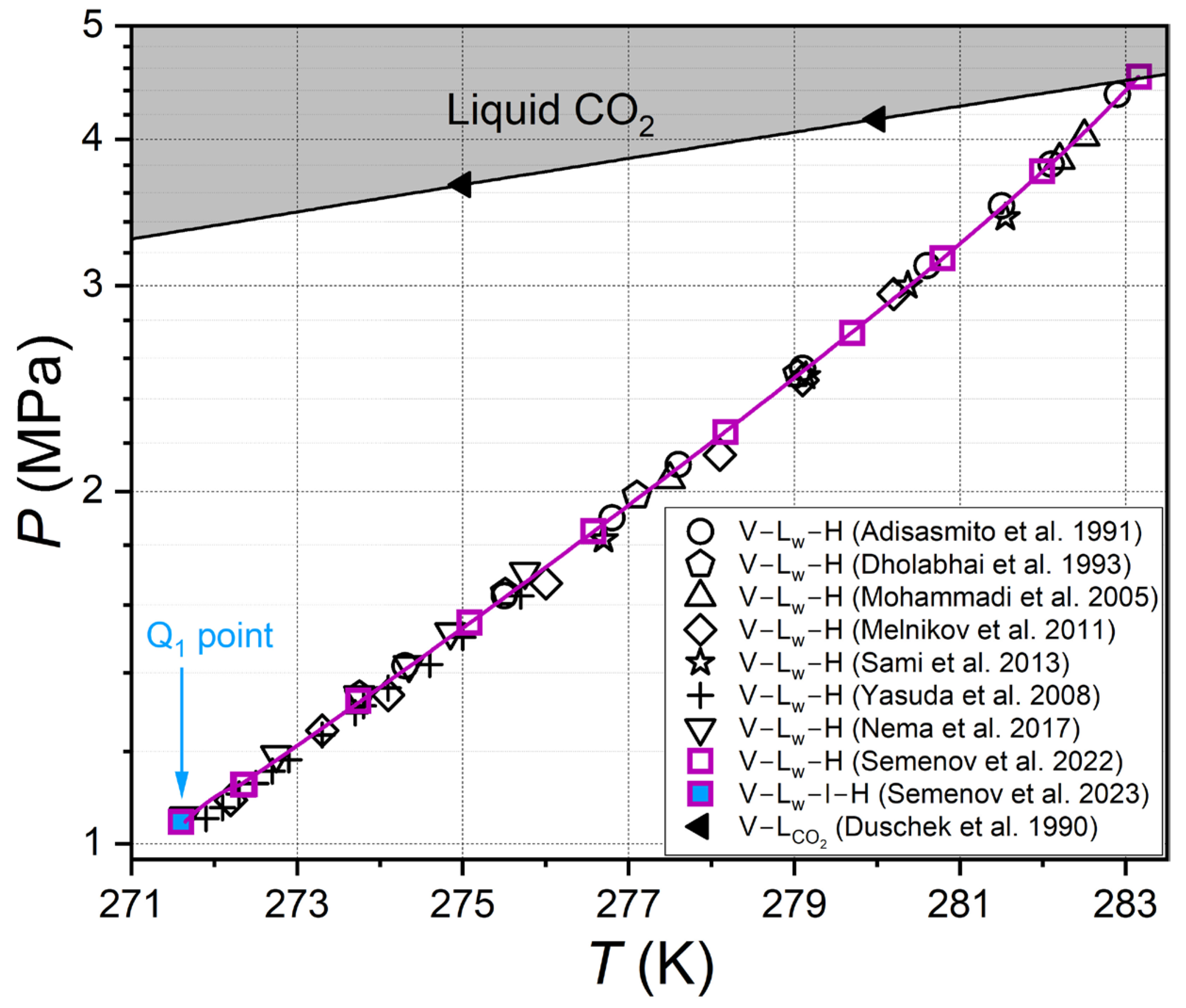
Prior to the investigation of the phase behavior of carbon dioxide hydrate in aqueous solutions of methanol (MeOH) and MgCl2, a comparison of the hydrate equilibrium conditions for the CO2–H2O reference system was made. The results are displayed in Figure 1, in which the measured data from our previous work [22] are compared with literature findings [15,16,17,18,19,20,21]. As demonstrated, our V–Lw–H equilibrium data are in strong agreement with those reported in the extant literature.

2.1. Carbon Dioxide Hydrate Equilibrium Data for Methanol and Magnesium Chloride Aqueous Solutions

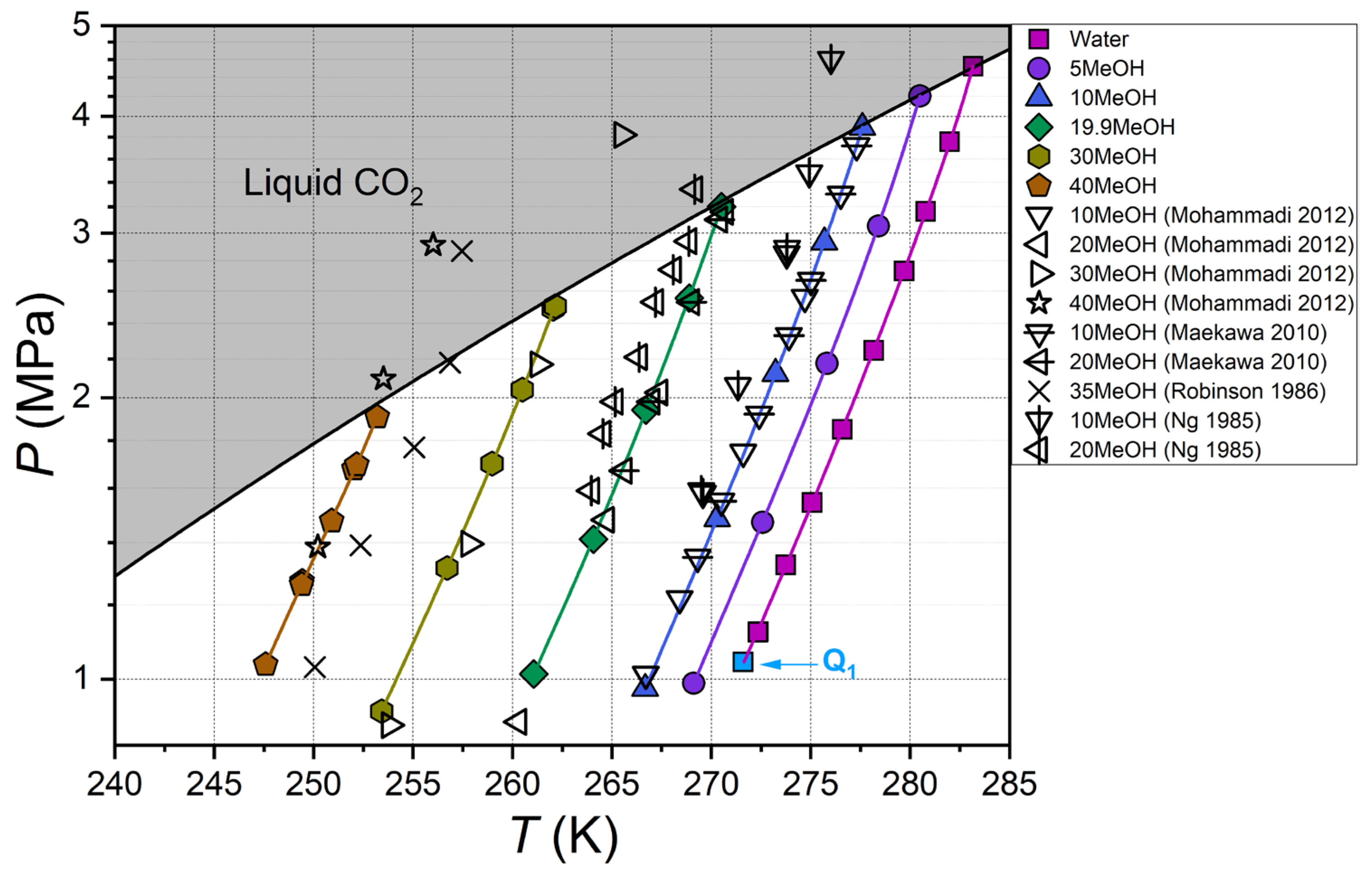
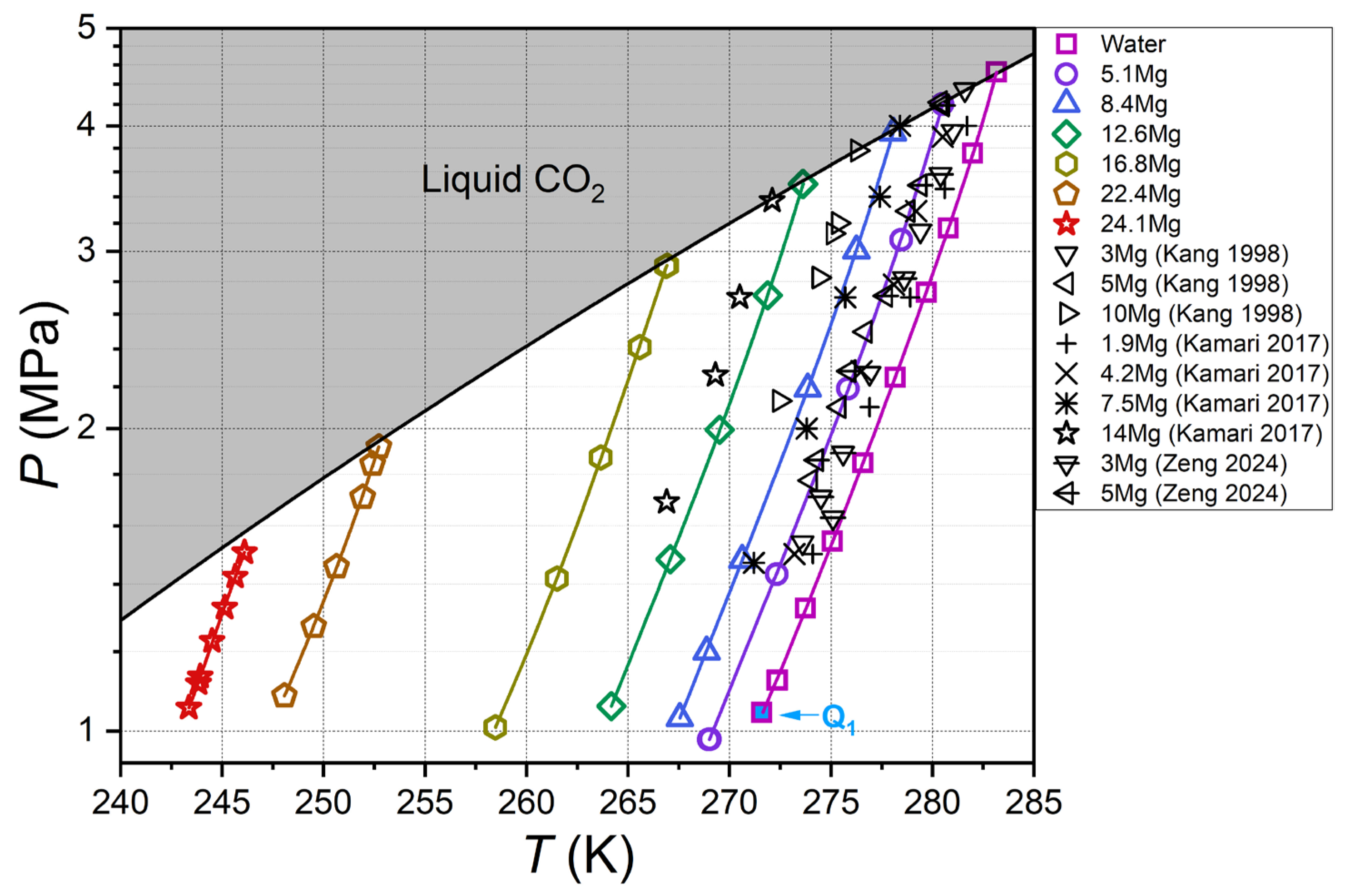
Tables S1 and S2 present the numerical data on the measured equilibrium temperatures and dissociation pressures of CO2 hydrate. The results are presented graphically in Figure 2 and Figure 3, in comparison with literature data. Equation (1) was utilized to approximate the temperature–pressure dependence on the V–Lw–H equilibrium line for each MeOH and MgCl2 concentration.
T = a 1 P 2 + a 2 P + a 3 P + b 1 ,
In this equation, T denotes the equilibrium temperature, P symbolizes the equilibrium pressure, and a1a3 and b1 represent coefficients. This equation accurately describes hydrate equilibrium curves in various systems, including those containing THIs [57,58]. The approximation results for aqueous MeOH solutions are shown in Table S3 and Figure S1. The results for aqueous MgCl2 solutions are documented in Table S4 and Figure S2. The determination coefficient, R2, for MeOH solutions ranges from 0.9997 to 1.0000, and the average absolute deviation (AAD) of the fitted equilibrium temperatures from the experimental ones is between 0.004 and 0.023 K. For MgCl2 solutions, the R2 coefficient spans from 0.9993 to 1.0000, and the AAD of the equilibrium temperatures is from 0.009 to 0.023 K.
Figure 2. Measured carbon dioxide hydrate equilibrium conditions for aqueous methanol solutions. Color symbols represent data of this work and quadruple point Q1 for CO2–H2O system from [55], black-edge symbols show literature data [39,59,60,61], color lines are approximations based on data from this work (Equation (1), Figure S1 and Table S3), and black line shows vapor–liquid equilibrium for carbon dioxide [56]; legend shows methanol concentration in aqueous solutions in mass%.
Ijms 27 01792 g002
As depicted in Figure 2, the measurements obtained for the CO2–MeOH–H2O system, encompassing methanol concentrations ranging from 0 to 40 mass%, exhibit strong concordance with the data reported by Mohammadi and Richon [59] and Maekawa [39]. However, the equilibrium temperatures of CO2 hydrate dissociation at 10 and 20 mass% methanol reported by Robinson and Ng [60,61] are significantly lower (by 1.2–2 K compared with our data and those reported by [39,59]). The observed discrepancies, in conjunction with the pronounced dispersion of equilibrium points on the logarithmic pressure scale, indicate a potential lack of reliability in the experimental data on the equilibrium of CO2 hydrate in aqueous methanol solutions by Robinson and Ng [60,61].
Some points measured in [59] at 30 and 40 mass% MeOH are above the vapor–liquid equilibrium line of carbon dioxide. Therefore, they fall within the region of liquid carbon dioxide and describe the three-phase equilibrium LCO2–Lw–H. According to [59], it is evident that the equilibrium line of CO2 hydrate for 30 and 40 mass% MeOH in the region above the saturated vapor pressure of CO2 has the same slope as at lower pressures (with gaseous carbon dioxide). In the instance of CO2 hydrate dissociation into liquid carbon dioxide and water, the volume change ∆Vdis is considerably lower than in the case of decomposition into gaseous carbon dioxide and water. Consequently, the slope of the equilibrium line LCO2–Lw–H, dP/dT = ∆Hdis/(TVdis), is substantially greater than that of V–Lw–H (see Figure 1 in reference [55] and data from [62,63]). However, the aforementioned authors [59] did not address this issue.
Figure 3. Measured carbon dioxide hydrate equilibrium conditions for aqueous MgCl2 solutions. Color symbols represent data of this work and quadruple point Q1 for CO2–H2O system from [55], black-edge symbols show literature data [64,65,66], color lines are approximations based on data from this work (Equation (1), Figure S2 and Table S4), and black solid line shows vapor–liquid equilibrium for carbon dioxide [56]; legend shows MgCl2 concentration in aqueous solutions in mass%.
Ijms 27 01792 g003
The phase behavior of carbon dioxide hydrate has been previously investigated only at low magnesium chloride concentrations (2–14 mass% MgCl2) and temperatures no lower than 267 K, as shown in Figure 3. In contrast, our research collected experimental data on the thermodynamic stability of CO2 hydrate at concentrations up to 24.1 mass% MgCl2 and temperatures down to 243 K. The results demonstrate that adding MgCl2 decreases the thermodynamic activity of water in the solution, thus shifting the equilibrium curves of CO2 hydrate to lower temperatures. The equilibrium line for 5.1 mass% MgCl2 aligns closely with the data reported by Kang et al. [64] and Zeng et al. [66] for 5 mass% MgCl2. Furthermore, the positions of the CO2 hydrate equilibrium curves for other magnesium chloride concentrations determined in this study are consistent with the literature data [64,65,66] and complement them.

2.2. Comparison of Thermodynamic Inhibition of Carbon Dioxide Hydrate with Methanol and Magnesium Chloride Aqueous Solutions

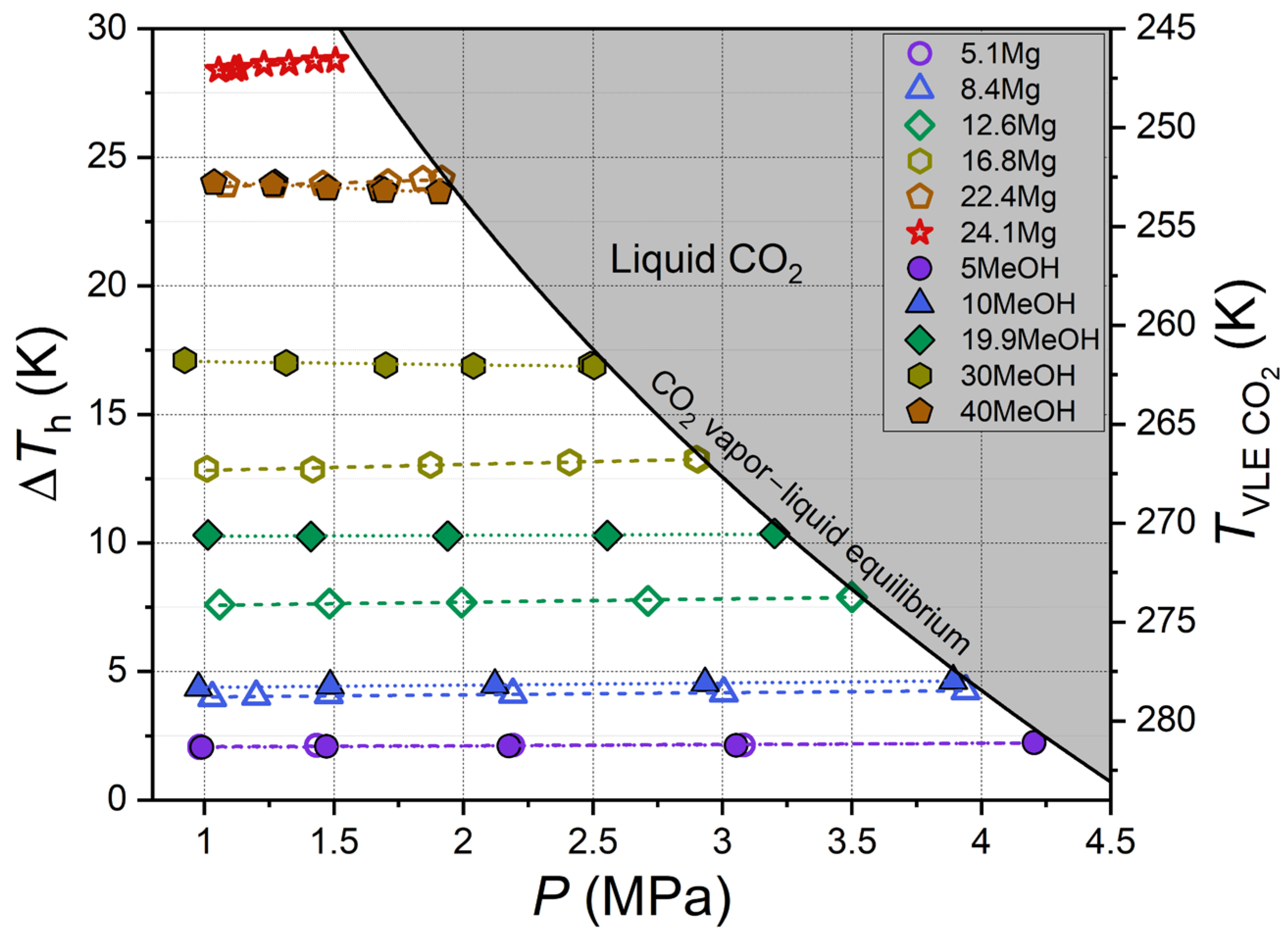
To quantitatively compare the thermodynamic inhibitory effect of carbon dioxide hydrate, the equilibrium temperature suppression, herein referred to as ΔTh, was calculated for each measured equilibrium point. It is defined as the difference between the equilibrium temperatures of CO2 hydrate coexisting with pure water (T0) and a solution of a thermodynamic inhibitor (T) at a fixed concentration and pressure. Geometrically, ΔTh is the distance between the equilibrium curves in Figure 2 and Figure 3 for gas–water and gas–aqueous inhibitor solution systems at constant pressure. The numerical values of ΔTh are tabulated in Tables S1 and S2 for the studied concentrations of MeOH and MgCl2. Figure 4 shows how the parameter ΔTh depends on pressure for all the samples that were studied.
As shown in Figure 4, hydrate equilibrium temperature suppression is weakly dependent on pressure for aqueous solutions of MeOH and MgCl2. For magnesium chloride, the slope dΔTh/dP increases 20.4-fold, rising from 0.044 ± 0.010 K/MPa in the 5.1 Mg sample to 0.897 ± 0.084 K/MPa in the 24.1 Mg sample. For methanol, the slope increases slightly only when transitioning from 5MeOH (0.053 ± 0.011 K/MPa) to 10MeOH (0.084 ± 0.009 K/MPa). Conversely, for more concentrated methanol solutions, the slope decreases and becomes negative for the 30MeOH (−0.122 ± 0.037 K/MPa) and 40MeOH (−0.474 ± 0.058 K/MPa) samples. This variation in behavior is attributed to the differing solubilities of carbon dioxide in aqueous solutions of compounds of varying nature. A case in point is magnesium chloride, which dissociates into ions in an aqueous solution. The solubility of CO2 decreases with the increase in salt content due to the salting-out effect [67,68,69]. In contrast, the solubility of CO2 in aqueous solutions of nonionic methanol is significantly higher and increases with alcohol concentration [70,71,72]. This can result in a reduction in the MeOH concentration in the solution due to the dissolution of CO2. Consequently, there may be a slight decrease in ΔTh with an increase in pressure (i.e., an increase in the system’s carbon dioxide content) for the 30MeOH and 40MeOH samples with high alcohol concentrations.
The comparison presented in Figure 4 indicates that low concentrations (5 mass%) of methanol and magnesium chloride exhibit analogous thermodynamic inhibition effects. At elevated concentrations, the anti-hydrate effect of ionic MgCl2 surpasses that of nonionic MeOH. Consequently, the concentrations of 40 mass% MeOH and 22.4 mass% MgCl2 possess similar values of ΔTh~24 K. Due to the electrolytic dissociation of MgCl2, the total concentration of ions in the solution exceeds the salt concentration. Moreover, salt ions demonstrate a stronger interaction with water dipoles in solution compared with polar methanol molecules. Consequently, given the identical molar and mass contents of MgCl2 and MeOH, the thermodynamic activity of water, as well as the ice freezing point, is considerably lower in aqueous solutions of magnesium chloride than in methanol solutions. This assertion is supported by empirical evidence, as demonstrated in both the extant literature [73,74,75,76,77,78,79] and the findings of this study (see Section 2.3).
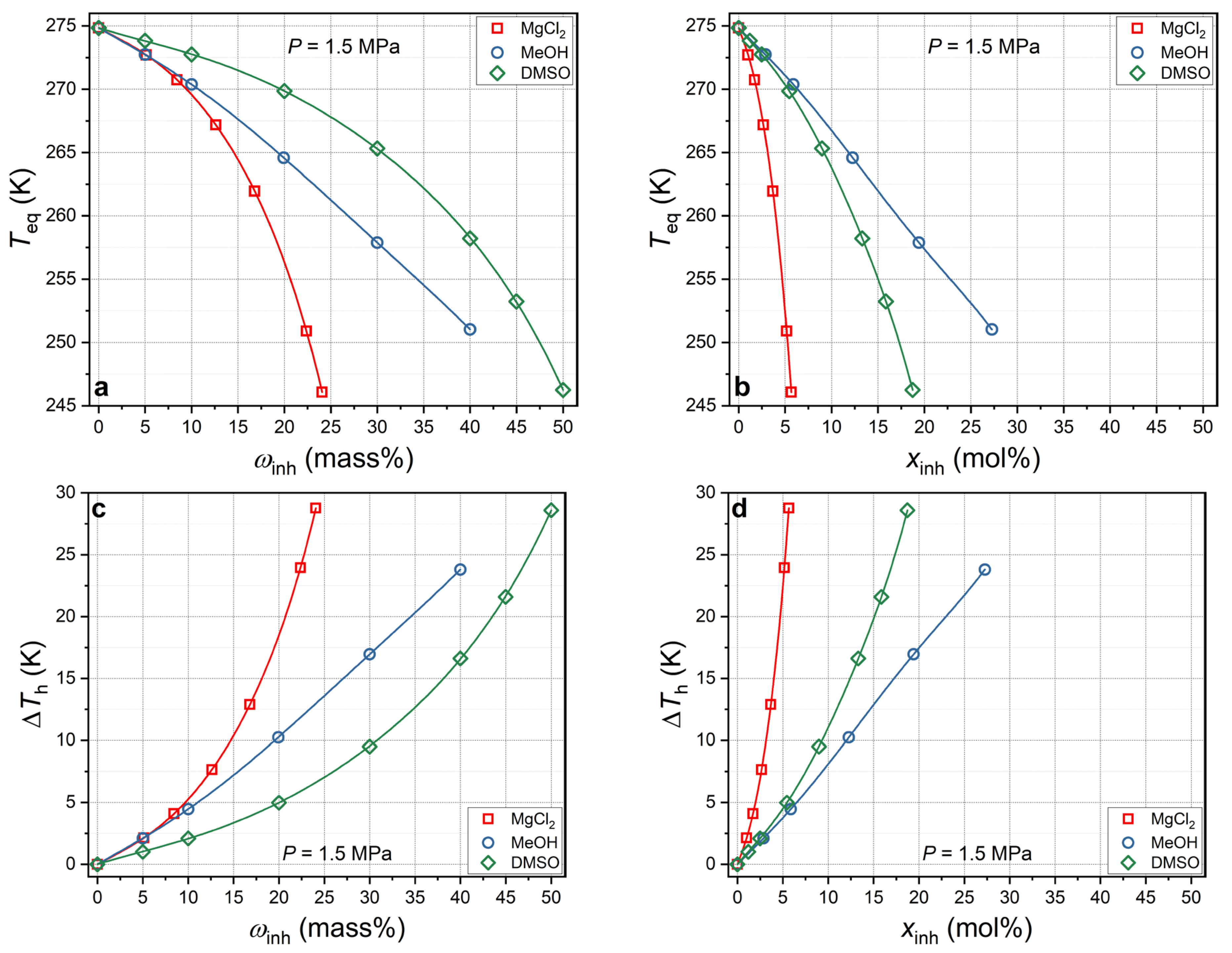
Figure 5 depicts the curves representing the dependence of the equilibrium temperature of CO2 hydrate and ΔTh at 1.5 MPa on the concentrations of methanol and magnesium chloride, expressed in terms of mass and molar percentages. For the purpose of comparison, curves based on experimental data for dimethyl sulfoxide [22,48] are shown.
The curves for MgCl2 and MeOH coincide up to a concentration of ~5.5 mass%. However, at higher mass fractions, magnesium chloride reduces the equilibrium temperature to a greater extent than methanol. Accordingly, at concentrations greater than 5.5 mass%, MgCl2 is a stronger THI than MeOH. On a mass percentage scale, dimethyl sulfoxide (DMSO) is a weaker THI than methanol (MeOH) at concentrations up to 40 mass%. This outcome is attributable to a more pronounced decline in the thermodynamic activity of water (ice freezing point) at a constant mass fraction of methanol in an aqueous solution, compared with DMSO within the specified concentration range. This assertion is corroborated by experimental data [76,77,80,81,82]. The lower molar mass of methanol (32.04 g/mol) compared with DMSO (78.13 g/mol) is a contributing factor in this regard. If the mass fraction remains constant in the aqueous solution, the molar fraction of methanol will exceed that of DMSO. However, the inhibitory effect of DMSO with regard to CO2 hydrate increases more rapidly than that of MeOH, particularly at elevated concentrations (>30 mass%). A similar phenomenon occurs in the inhibition of methane hydrate [82,83] and is associated with greater deviation from the ideal behavior of DMSO aqueous solutions than of MeOH aqueous solutions.
Transitioning from the mass% scale to the mol% scale (see Figure 5b,d) results in an increase in the difference in inhibitory properties between MeOH and MgCl2. This increase is attributable to the electrolytic dissociation of MgCl2 in an aqueous solution, which results in a higher total molar fraction of particles (ions) present in the system. The higher non-ideality of DMSO aqueous solutions compared with MeOH explains the more pronounced inhibitory effect of dimethyl sulfoxide compared with MeOH on a mol% scale.
Equation (2) relates the value of ΔTh to the thermodynamic activity of water aw in the solution:
Δ T h = A ln a w ,
where A is the proportionality coefficient. Equation (2) can be written in an approximate form by replacing the value aw with the molar fraction of water in solution xw:
Δ T h = A ln x w ,
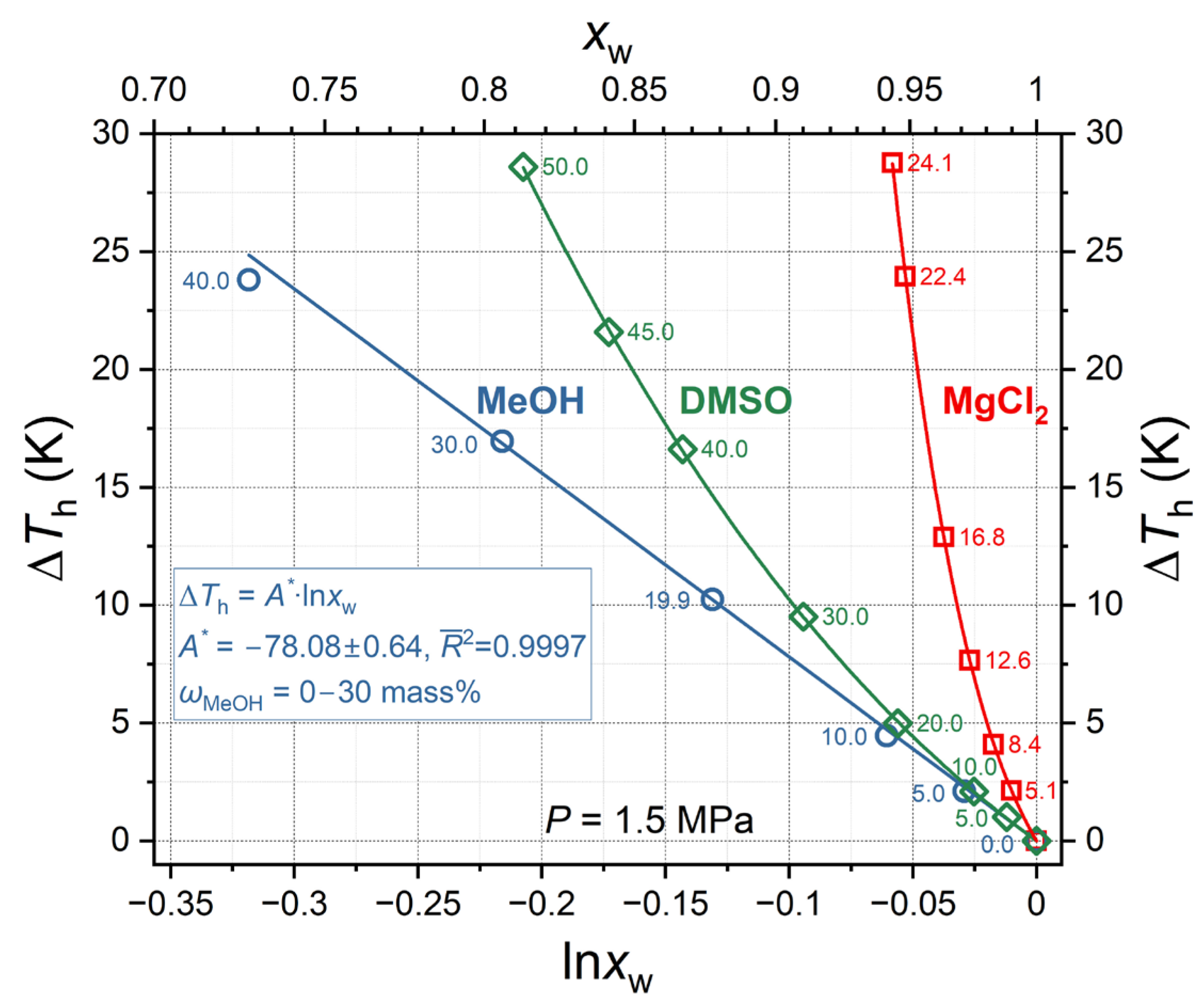
where A* is the proportionality coefficient. Figure 6 displays the correlation between ΔTh and ln xw for MeOH and MgCl2 (this work) and DMSO (data from [22,48]) at a fixed pressure of 1.5 MPa.
As illustrated in Figure 6, the linear correlation in equation 3 is only well observed for aqueous MeOH solutions (R2 = 0.9997) in the range of 0–30 mass%, with a slope parameter A* = −78.08 ± 0.64 K. The dependence of ΔTh on ln xw for DMSO up to 10 mass% coincides with the straight line for methanol. A rapid nonlinear increase in ΔTh is noticeable when DMSO contents exceed 10 mass%. This increase can be accurately described by a cubic polynomial, with a correlation coefficient R2 = 0.99996. In the case of magnesium chloride, a decrease in the molar fraction of water in the solution is associated with the most pronounced increase in ΔTh. This increase can be described by a nonlinear model within the studied concentration range, such as a third-degree polynomial (R2 = 0.99999).
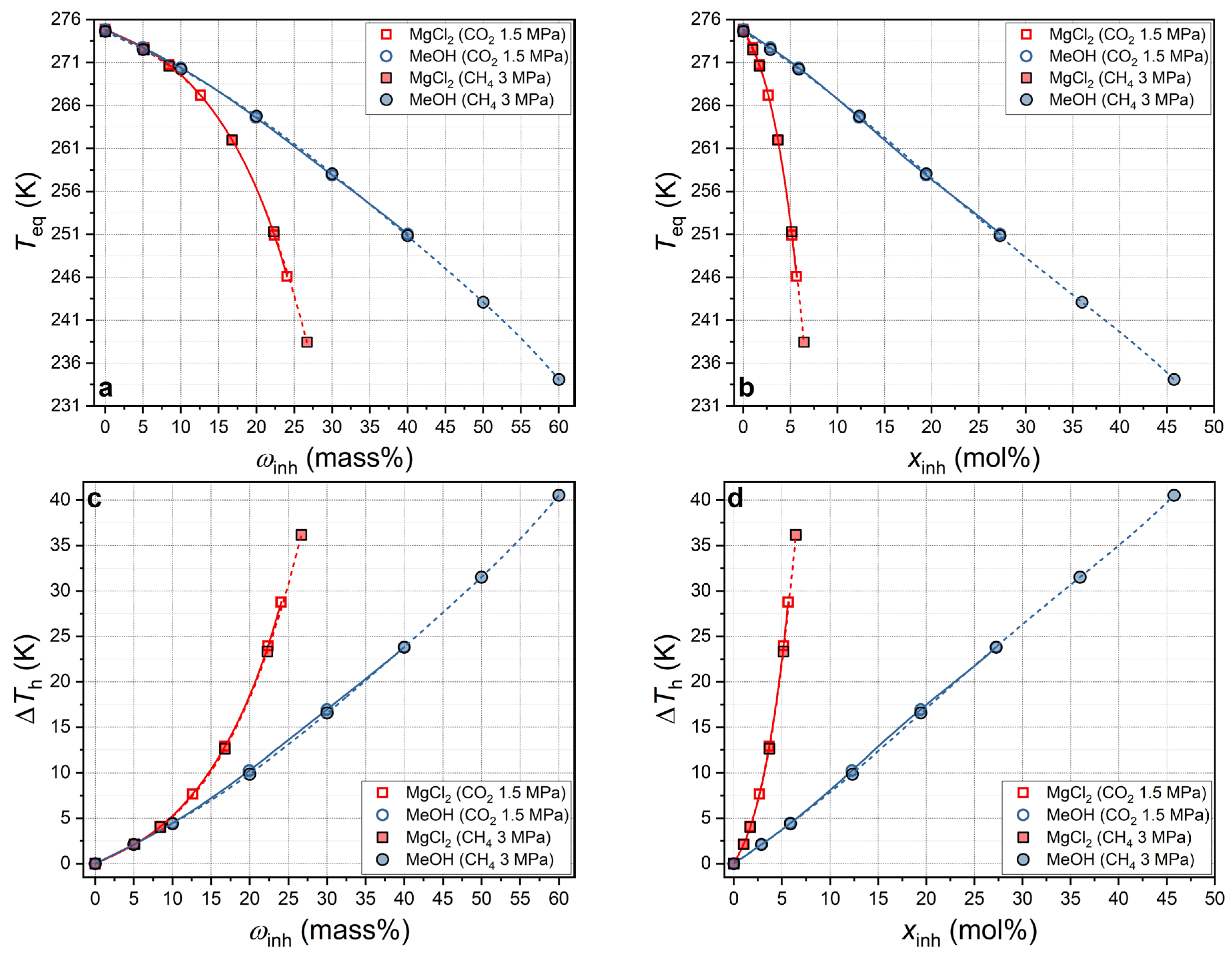
The inhibitory capacity of methanol and magnesium chloride with respect to carbon dioxide was compared with that of methane [78,79]. Methane and carbon dioxide are chemically distinct gases that form thermodynamically stable sI hydrates. Figure 7 provides a visual representation of the relationship between the equilibrium temperatures of CH4 hydrate (V–Lw–H at 3 MPa) and CO2 hydrate (V–Lw–H at 1.5 MPa) and the value of ΔTh as a function of the concentration of thermodynamic inhibitors in solution, expressed in terms of mass% (panels a and c) and mol% (panels b and d).
Figure 7 indicates that the curves for CO2 and CH4 are closely aligned, thereby demonstrating a high degree of agreement. A notable observation is the slightly more pronounced decrease in equilibrium temperature for CO2 hydrate compared with CH4, at a constant concentration of MeOH or MgCl2. These findings are consistent with a similar comparison reported for DMSO (see Figure 10 of reference [22]). For instance, for a sample containing 22.4 mass% MgCl2, ΔTh = 23.95 K (1.5 MPa) for CO2 and ΔTh = 23.54 K (3 MPa) for CH4. Analogously, for a sample containing 30 mass% MeOH, ΔTh = 16.95 K (1.5 MPa) for CO2 and ΔTh = 16.57 K (3 MPa) for CH4.

2.3. Ice Freezing Temperatures for Methanol and Magnesium Chloride Aqueous Solutions

When a thermodynamic inhibitor is introduced into a gas–water system, the temperature of the three-phase equilibrium V–Lw–H decreases at constant pressure. This phenomenon can be attributed to a decrease in the thermodynamic activity of H2O in the solution relative to the pure solvent. A similar phenomenon occurs in the case of the two-phase equilibrium ice–aqueous solution. The melting point of ice Tice decreases in an antifreeze solution compared with pure solvent. To analyze the proportionality of ΔTh and ΔTice, the ice freezing temperatures were measured at an atmospheric pressure of 0.1 MPa for aqueous solutions of MeOH and MgCl2. To ascertain the ice onset and peak ice crystallization temperatures (Tice onset and Tice peak, respectively), three repetitions were conducted at a linear cooling rate of 10 K/h, under an intensive stirring of the aqueous solutions. The melting temperature of the last ice crystals, Tice melt, was also measured using a 5 K/h heating ramp under intensive stirring. The numerical values of these quantities are presented in Tables S5 and S6 for aqueous solutions of methanol and magnesium chloride, respectively. Figures S3–S5 present examples of the thermal curves employed to ascertain the crystallization and melting temperatures of ice. It is well established that the process of crystallization of the solid phase from a supersaturated solution requires a supercooling relative to the equilibrium temperature. Consequently, for the purposes of analysis and correlation, we used Tice melt (hereafter Tice) values more closely aligned with the equilibrium freezing temperature of ice in aqueous solutions.
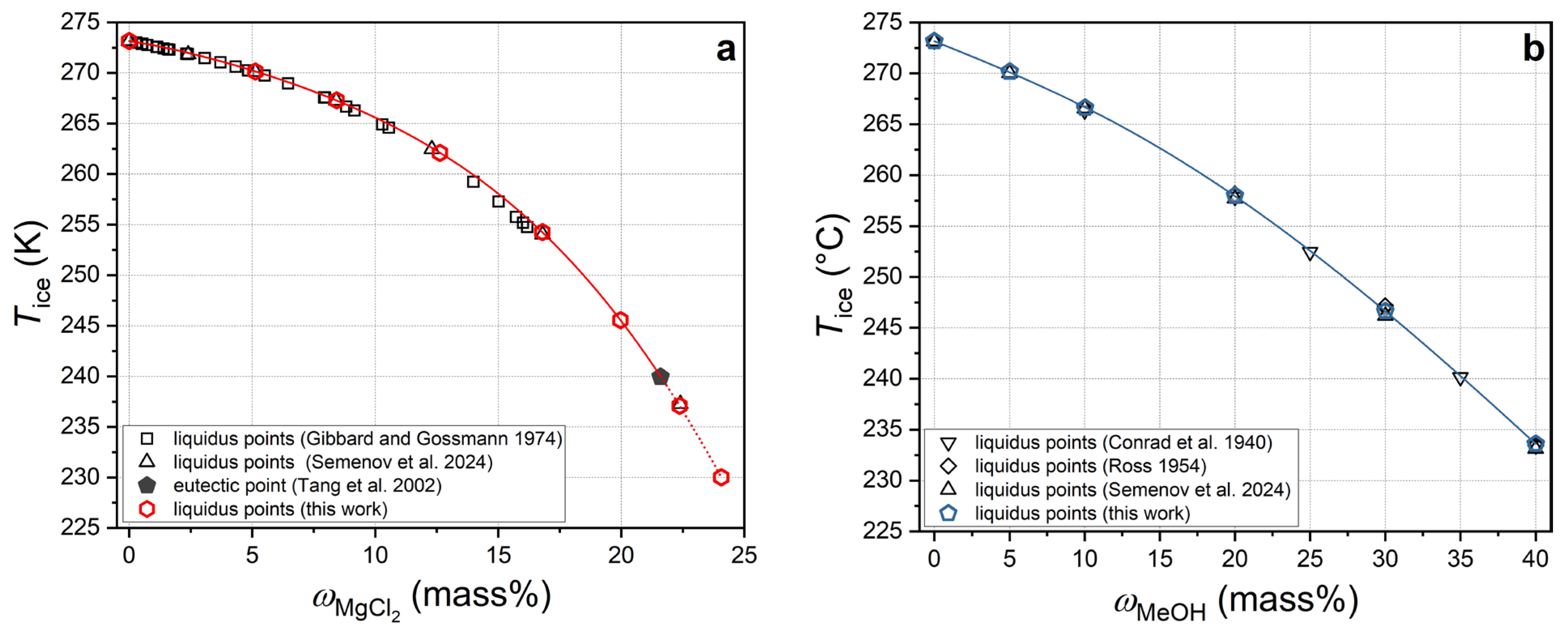
Figure 8 depicts the measured ice freezing temperatures for aqueous solutions as a function of the MeOH and MgCl2 concentrations, in comparison with literature data for methanol [77,78,79,84] and magnesium chloride [75,78,79,85].
The findings of this study concur with the extant data in the literature. In previous works [78,79], the freezing point of ice was measured with the same equipment but a different method: the temperature was decreased in small steps (0.5–1 K). The freezing point of the solution in [78,79] was taken as the Tice peak, which may be underestimated relative to the equilibrium, especially in concentrated solutions, which are more prone to supercooling. The difference between the Tice peak values measured in [78,79] and the Tice melt values in this study increases as the antifreeze component content in the solution increases. Nevertheless, the observed difference was found to be relatively negligible (0.05–0.5 K) within the concentration range examined.
The crystallization and melting temperatures of the metastable ice phase were measured for aqueous solutions of 22.37 and 24.06 mass% MgCl2. For the MgCl2–H2O system at 0.1 MPa, the eutectic composition contains 21.6 mass% MgCl2 and melts at 239.95 K (non-variant equilibrium of an aqueous salt solution, ice, and MgCl2·12H2O crystalline hydrate solid) [85]. Therefore, the thermodynamically stable solid phase for 22.37 and 24.06 mass% aqueous MgCl2 solutions is MgCl2·12H2O, which crystallizes at higher supercooling and melts at higher temperatures than metastable ice. Figures S6 and S7 offer a visual representation of the thermal curves associated with the processes of crystallization and melting of metastable ice, as well as thermodynamically stable crystalline hydrate MgCl2·12H2O.

3. Discussion

3.1. Thermodynamic Consistency of Hydrate Equilibrium Data

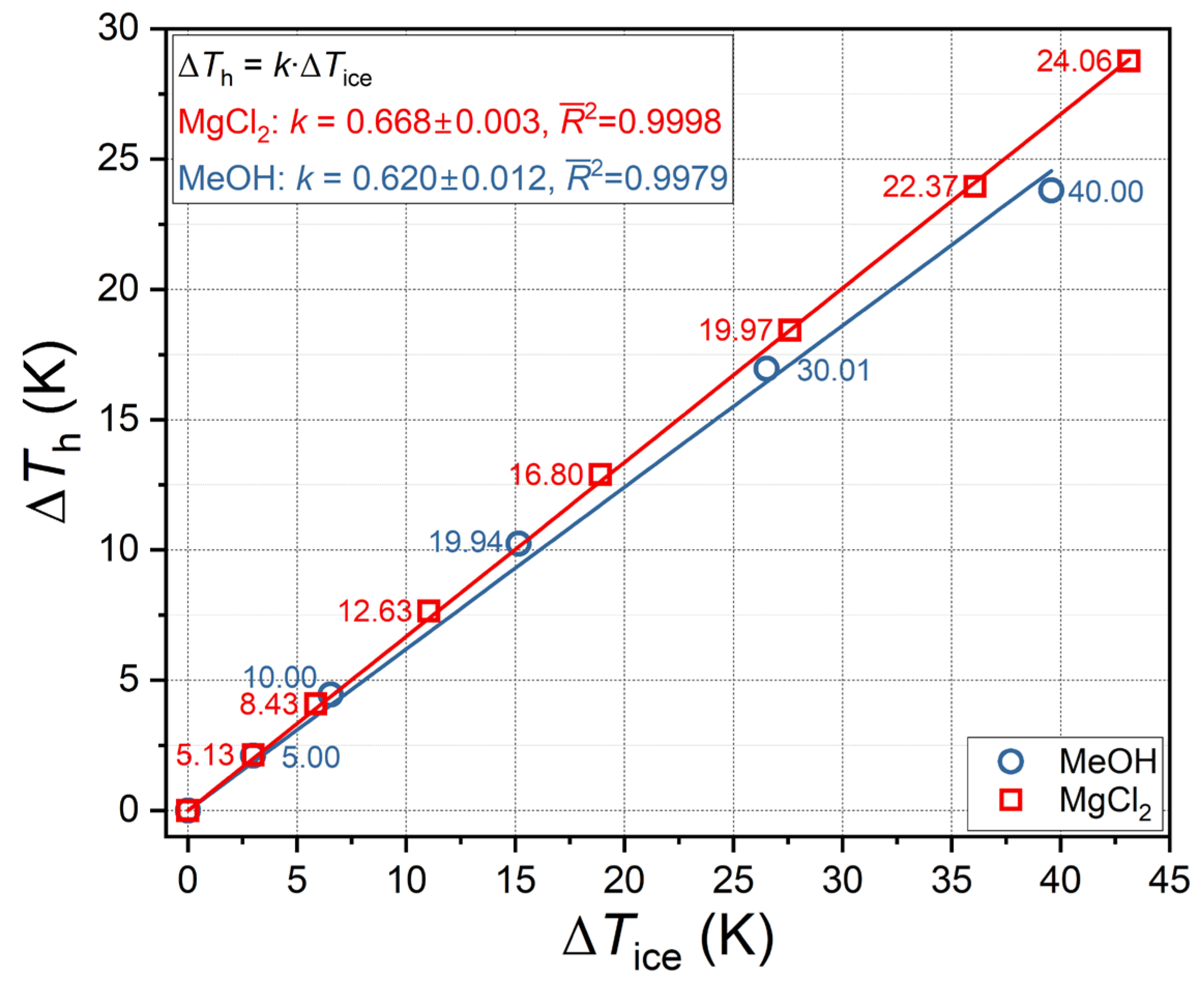
The thermodynamic consistency of the experimental data was evaluated based on the results obtained from analyzing the proportionality between the values of ΔTh and ΔTice for the aqueous solutions studied. For aqueous solutions of compounds exhibiting thermodynamic inhibitor properties, a direct proportionality between the values of ΔTh and ΔTice is to be expected. This relationship can be attributed to the fact that the suppression in the equilibrium ice melting temperature and gas hydrate dissociation temperature are consequences of a single physicochemical phenomenon, namely, the decrease in the thermodynamic activity of water when an inhibitor (antifreeze component) is added to it. The results of the analysis are displayed in Figure 9.
As can be seen, these values are linearly related (R2 = 0.9998 for MgCl2; R2 = 0.9979 for MeOH) and described by equation 4 with a single coefficient, k:
Δ T h = k Δ T i c e
Intriguingly, over a broad range of concentrations, the slope coefficient for MgCl2 is slightly greater than that for MeOH: 0.668 ± 0.003 and 0.620 ± 0.012, respectively. Concurrently, within the ΔTh range of 10 K, all data points align on a single linear trajectory for MgCl2. Conversely, at elevated MeOH concentrations, with the associated increase in the ΔTh values, the anti-hydrate effect of methanol increases more gradually. This is presumably due to the dissolution of carbon dioxide. As previously discussed in Section 2.2, the solubility of carbon dioxide in aqueous solutions of methanol [70,71,72] and magnesium chloride [67,68,69] varies significantly. In the instance of methanol, the solubility of CO2 increases concomitantly with the increase in alcohol concentration. In the case of magnesium chloride, the salting-out effect leads to a decrease in the solubility of CO2 as the salt content rises. Accordingly, in the event of high feed methanol concentrations (30 and 40 mass%), the intensive dissolution of carbon dioxide will result in a decrease in the equilibrium concentration of methanol compared with the initial concentration. This will result in a slower increase in ΔTh for high MeOH concentrations, as observed in Figure 9.
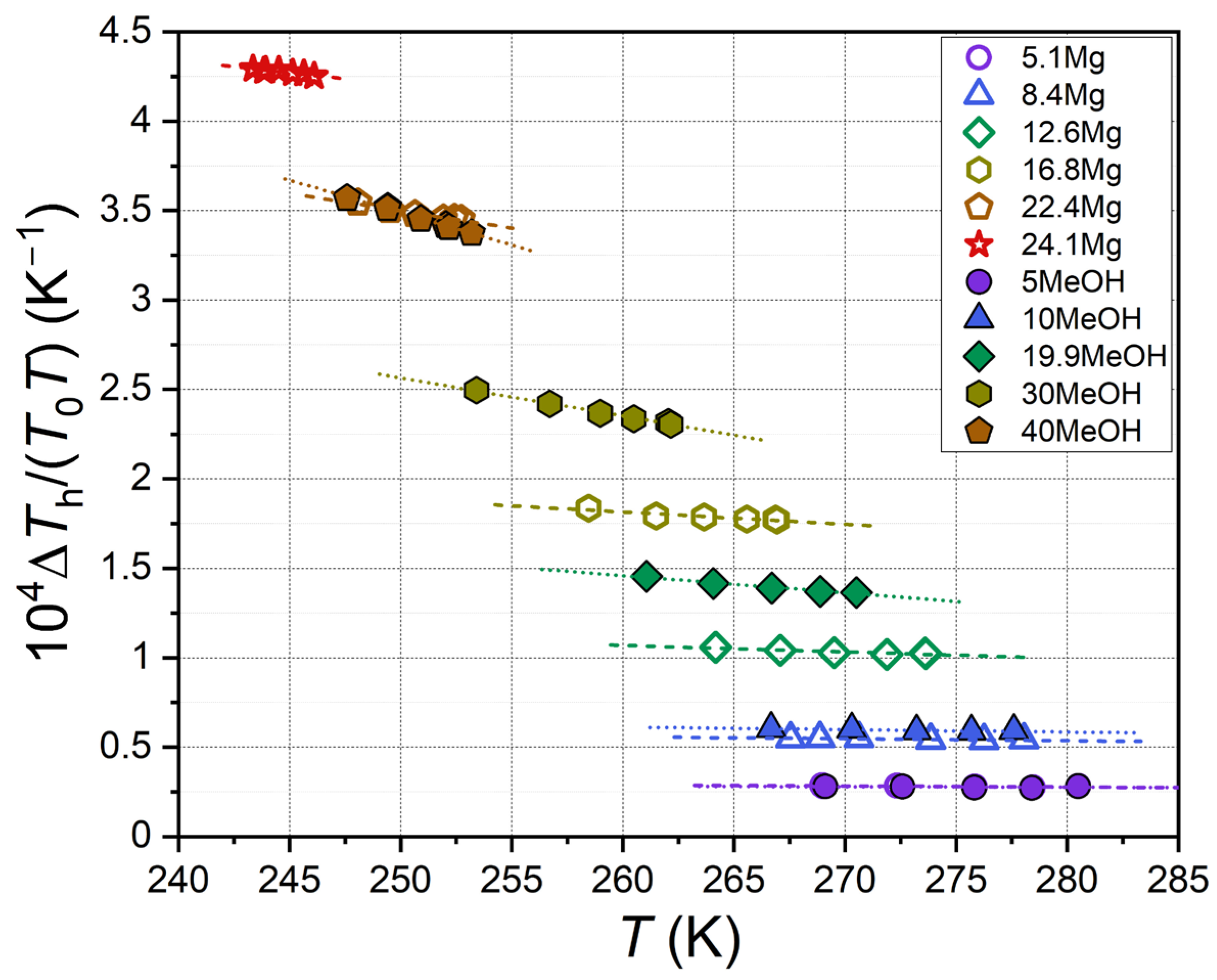
To evaluate thermodynamic consistency, the approach described in [86,87,88,89,90] was also tested. The authors of these works proposed analyzing the change in the parameter ∆Th/(T0T) from the hydrate equilibrium temperature in a solution containing a thermodynamic inhibitor. Their assertion is that this parameter is independent of T and thus can be adequately described by a linear equation with a zero slope for each concentration. Figure 10 presents the outcomes resulting from the implementation of the aforementioned approach.
Figure 10. Parameter ΔTh/(T0T) for studied samples of MeOH and MgCl2 aqueous solutions vs. carbon dioxide hydrate equilibrium temperature. Symbols are equilibrium points, and dashed and dotted lines are linear fits; legend shows MeOH and MgCl2 concentration in aqueous solutions in mass%.
Ijms 27 01792 g010
The linear approximations and analysis of variance (ANOVA) indicate that the slope parameter is statistically insignificant from 0 only for diluted solutions (5.1Mg, 8.4Mg, 5MeOH, and 10MeOH). However, for more concentrated aqueous solutions, the slope parameter of the approximating linear regression model is statistically significant and increases in magnitude (modulo) with the increase in inhibitor concentration. The findings presented in this study, derived from the approach outlined in [86,87,88,89,90], demonstrate a strong congruence with our prior observations concerning other hydrate-forming gases and thermodynamic inhibitors [22,58,78,79,83,91,92,93]. These findings imply that the application of the parameter ∆Th/(T0T) for the evaluation of the thermodynamic consistency of gas hydrate equilibrium data is inadequate, particularly at elevated inhibitor concentrations, when inhibitors crystallize from solution (e.g., urea [93]), or when an aqueous inhibitor solution undergoes phase separation into two liquid phases (e.g., 2-butoxyethanol [58]). The underlying rationales for these findings are discussed in more detail in the referenced literature [78,91].

3.2. Results of PXRD Analysis

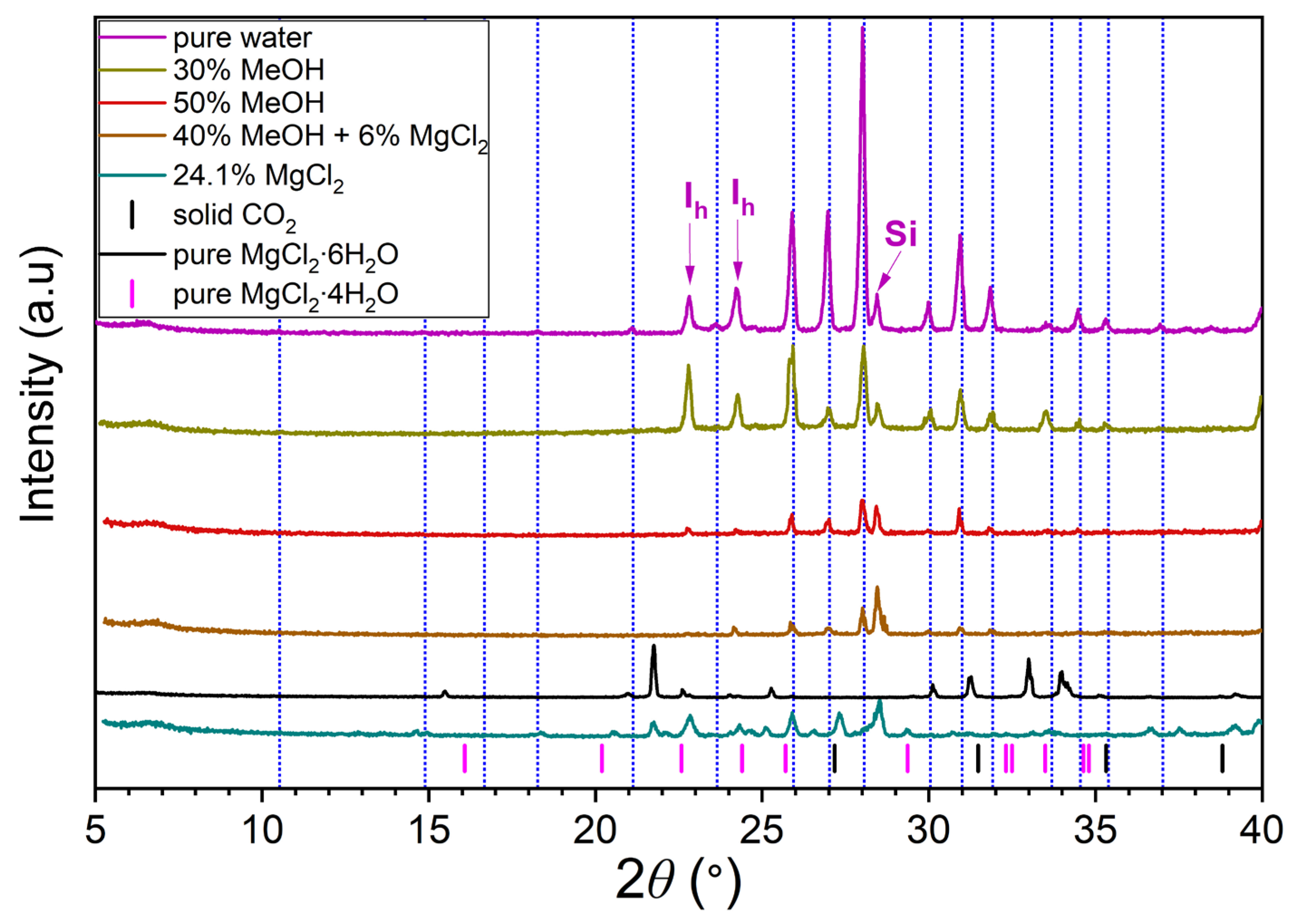
Figure 11 shows the resulting PXRD patterns.
The analysis results indicate that the incorporation of methanol into the large cavities of the sI hydrate framework is unlikely. The unit cell parameter of carbon dioxide hydrate was determined to be 11.86 ± 0.04 Å in all samples at 133 K, which is consistent with literature data for sI hydrate [94]. Additionally, the 24.1 mass% MgCl2 sample was found to contain solid CO2 and a mixture of magnesium chloride crystalline hydrates, most likely MgCl2·4H2O and MgCl2·6H2O. The absence of solid CO2 in the 30 mass% and 50 mass% methanol samples is attributed to the high solubility of CO2 in cold water–methanol solutions.

4. Materials and Methods

This study used the following materials: high-purity carbon dioxide (CO2; 99.99 vol%; NIIKM, Moscow, Russia), chemically pure methanol (MeOH; 99.9 mass%; Vekton, Saint Petersburg, Russia), anhydrous magnesium chloride (MgCl2; 99.21 mass%; Alfa Aesar, Landsmeer, The Netherlands), and distilled water obtained in the laboratory. A series of aqueous solutions of methanol and magnesium chloride at a given concentration were prepared gravimetrically in amounts of at least 350 g using PA413C scales (Ohaus, Parsippany, NY, USA) with a resolution of 0.001 g and a maximum error of ±0.01 g. The uncertainty in the concentrations of methanol and magnesium chloride in the resulting solutions did not exceed 0.02 mass%.
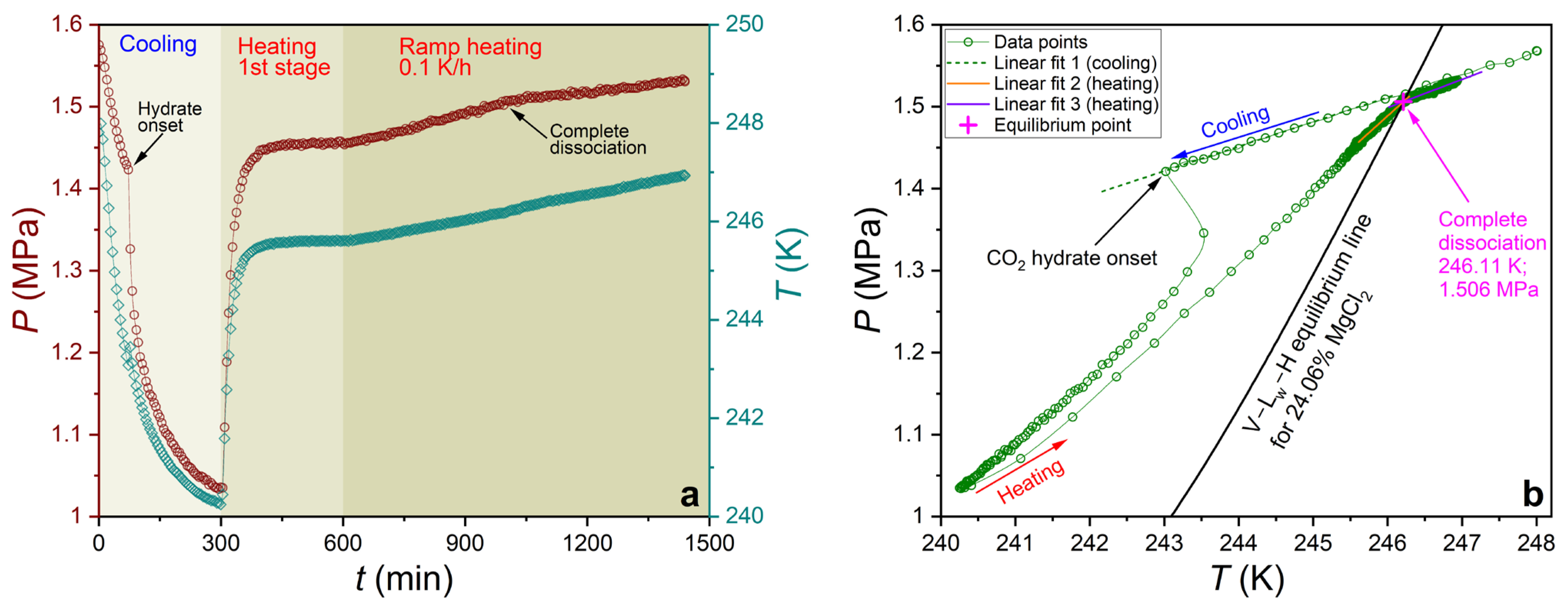
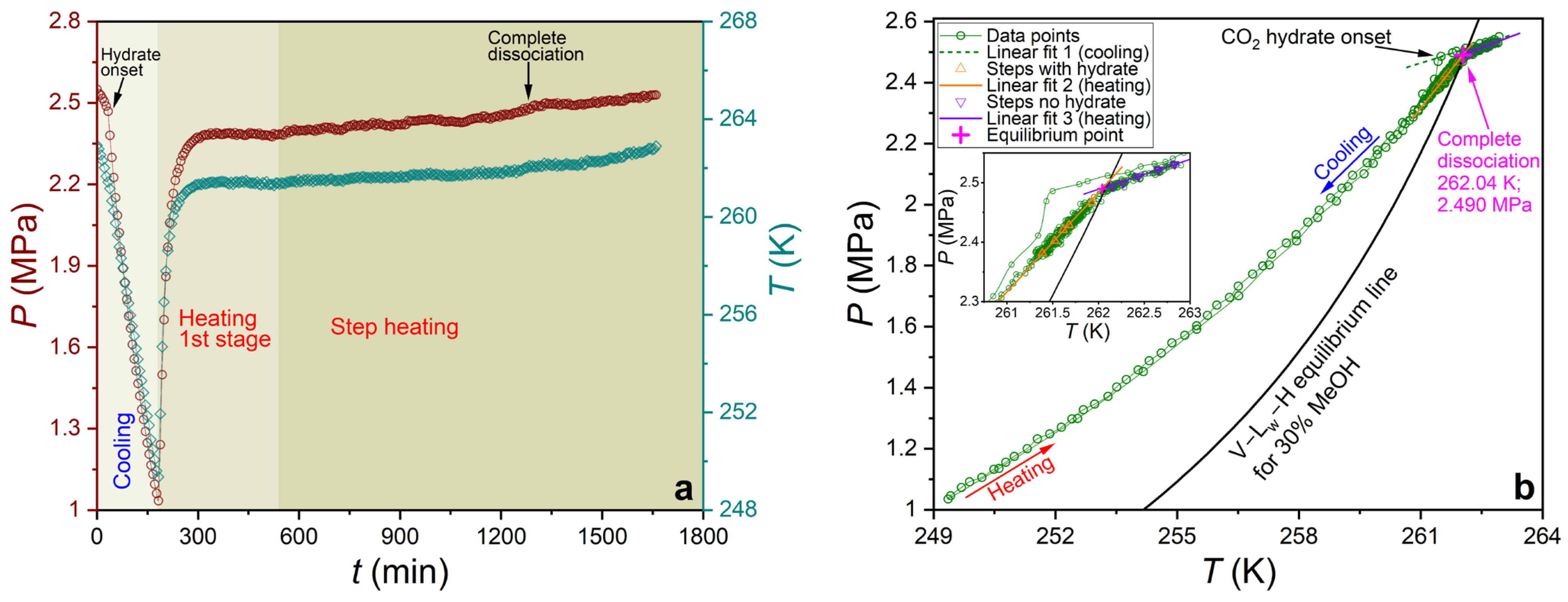
The phase equilibrium of carbon dioxide hydrate was measured using a GHA350 apparatus (PSL Systemtechnik, Osterode am Harz, Germany). A thorough description of the apparatus and the procedure for calibrating pressure/temperature sensors can be found in previous works [83,95]. For the present experiment, 300 mL of the prepared aqueous solution was placed in an autoclave. The equilibrium conditions of the CO2 hydrate were measured following the 0.1 K/h ramp heating and step heating techniques previously analyzed [96]. For the systems examined in this study, both methods yielded equilibrium temperature and pressure values that did not differ from each other by more than the maximum measurement error (±0.1 K and ±0.017 MPa, respectively). Figure 12 and Figure 13 illustrate the experimental curves obtained and the results of determining the coordinates of the equilibrium point (complete dissociation of CO2 hydrate) for the 0.1 K/h ramp heating technique and the step heating technique, respectively.
The ice crystallization and melting temperatures of methanol and magnesium chloride aqueous solutions were measured using a calibrated PRT 5622–10-P temperature sensor (Fluke, Everett, WA, USA) in tandem with a 1524 reference thermometer (Fluke, Everett, WA, USA), which has a maximum error of ±0.04 K. Further information regarding the equipment and measurement methods can be found elsewhere [58].
The phase composition of CO2 hydrate samples obtained from aqueous solutions of methanol and magnesium chloride was studied using powder X-ray diffraction. The measurements were conducted using a D8 Advance diffractometer (Bruker, Ettlingen, Germany) in 2θ scanning mode within the angular range of 5° to 42° at 133 K (Cu Ka X-ray source with a wavelength of 1.5418 Å). To obtain more accurate data, silicon (Si), whose reflex position is known with high precision, was added to each sample as an internal standard.
A series of CO2 hydrate samples was obtained from different solutions to identify the hydrate type. Pure water was selected as the reference sample. The phase state of CO2 hydrate obtained from four distinct aqueous solutions was studied: 30 mass% MeOH, 50 mass% MeOH, 24.1 mass% MgCl2, and a mixed solution of 40 mass% MeOH and 6 mass% MgCl2. According to phase equilibrium data [78,79], the latter three solutions have been shown to possess the same anti-hydrate properties. Carbon dioxide hydrate was obtained from frozen, ground aqueous solutions. For pure water, hydrate synthesis was performed at 274.15 K and 3.5 MPa. For the 30 mass% MeOH sample, the synthesis occurred at 248.15 K and 1.5 MPa. For 50 mass% MeOH, 24.1 mass% MgCl2, and 40 mass% MeOH + 6 mass% MgCl2, the synthesis occurred at 233.15 K and 1 MPa. The pressure was selected in proximity to the CO2 condensation line within the gas phase region. The frozen solutions were thoroughly ground and subsequently placed in a precooled autoclave (at 274.15, 248.15, or 233.15 K, depending on the system). Carbon dioxide was then introduced into the cell to displace the air. The cell was pressurized with CO2 to the specified pressure, and it was maintained for 24 h under isothermal–isochoric conditions. Prior to the removal of the resulting samples, the autoclave was cooled to the boiling point of liquid nitrogen. The resulting samples were meticulously ground in an aluminum mortar under liquid nitrogen, mixed with silicon powder, and transferred with a spatula to the diffractometer sample holder, which had been cooled to 133 K.

5. Conclusions

This paper explores the thermodynamic stability of carbon dioxide hydrate in aqueous solutions of magnesium chloride and methanol across a wide concentration range. New experimental data on the three-phase equilibrium (V–Lw–H) were obtained at salt concentrations up to 24.1 mass% MgCl2 and temperatures down to 243 K. Methanol and magnesium chloride are thermodynamic inhibitors of CO2 hydrate formation because an increase in their concentration in a solution lowers the equilibrium temperature. A detailed analysis of the anti-hydrate effect of MeOH and MgCl2 was performed. It was demonstrated that on a mass percentage scale, the anti-hydrate effect of MeOH and MgCl2 does not differ by up to 5 mass%. However, at higher concentrations, ionic magnesium chloride is a stronger THI than nonionic methanol. The anti-hydrate effect of methanol ΔTh was found to be linearly related to the natural logarithm of the molar fraction of water in solution over a sufficiently wide range. For magnesium chloride, however, a similar dependence is nonlinear and can be well described by a cubic polynomial. The inhibitory effects of methanol and magnesium chloride on carbon dioxide and methane hydrates were compared. It has been established that the inhibitory effects of MeOH and MgCl2 are similar for hydrate-forming gases of different chemical nature. In order to verify the thermodynamic consistency of the data, the ice freezing temperatures of the aqueous solutions were measured at 0.1 MPa. Linear correlations between ΔTh and ΔTice were obtained for MeOH and MgCl2, thereby confirming thermodynamic consistency. The phase composition of CO2 hydrate samples was investigated using PXRD at 133 K. These samples were synthesized from aqueous solutions of methanol and magnesium chloride. The formation of sI hydrate with a unit cell parameter of 11.86 ± 0.04 Å was found in all cases, which is consistent with literature data for pure carbon dioxide hydrate.
The findings of this study suggest the potential of magnesium chloride as a thermodynamic inhibitor of gas hydrates, exhibiting a more pronounced inhibitory effect compared with methanol (industrial THI). Magnesium chloride possesses several noteworthy advantages, including non-volatility, non-flammability, and environmental safety. Additionally, it is readily available due to its prevalence in nature as the mineral bischofite.

Supplementary Materials

The following supporting information can be downloaded at: https://www.mdpi.com/article/10.3390/ijms27041792/s1.

Author Contributions

Conceptualization, A.S. (Anton Semenov); methodology, A.S. (Anton Semenov) and A.S. (Andrey Stoporev); validation, A.S. (Anton Semenov) and R.M.; formal analysis, A.S. (Anton Semenov); investigation, R.M., A.S. (Andrey Stoporev), T.T., M.Y., D.L. and D.S.; data curation, R.M. and A.S. (Anton Semenov); writing—original draft preparation, A.S. (Anton Semenov), A.S. (Andrey Stoporev) and R.F.; writing—review and editing, A.S. (Anton Semenov), A.S. (Andrey Stoporev) and R.F.; visualization, A.S. (Anton Semenov) and A.S. (Andrey Stoporev); supervision, A.S. (Anton Semenov), V.I. and R.F.; resources, R.F.; project administration, A.S. (Anton Semenov). All authors have read and agreed to the published version of the manuscript.

Funding

This study was supported by the Ministry of Science and Higher Education of the Russian Federation (state assignment; Project FSZE-2025-0003).

Institutional Review Board Statement

Not applicable.

Informed Consent Statement

Not applicable.

Data Availability Statement

The original contributions presented in this study are included in the article and Supplementary Materials. Further inquiries can be directed to the corresponding authors.

Conflicts of Interest

The authors declare no conflicts of interest.

References

  1. Sloan, E.D.; Koh, C.A. Clathrate Hydrates of Natural Gases, 3rd ed.; CRC Press: Boca Raton, FL, USA, 2007. [Google Scholar]
  2. Boswell, R.; Hancock, S.; Yamamoto, K.; Collett, T.; Pratap, M.; Lee, S.-R. Natural Gas Hydrates. In Future Energy; Elsevier: Amsterdam, The Netherlands, 2020; pp. 111–131. [Google Scholar]
  3. Hassanpouryouzband, A.; Joonaki, E.; Vasheghani Farahani, M.; Takeya, S.; Ruppel, C.; Yang, J.; English, N.J.; Schicks, J.M.; Edlmann, K.; Mehrabian, H.; et al. Gas Hydrates in Sustainable Chemistry. Chem. Soc. Rev. 2020, 49, 5225–5309. [Google Scholar] [CrossRef]
  4. Zhingel, P.; Pandey, G.; Pletneva, K.A.; Korneva, L.N.; Kibkalo, A.A.; Mittal, A.; Monga, S.; Drachuk, A.O.; Molokitina, N.S. Synthesis of Natural Gas Hydrates in Dispersed Media: Application in Gas Storage and Transport. Energy Fuels 2025, 39, 22730–22738. [Google Scholar] [CrossRef]
  5. Kibkalo, A.A.; Pandey, G.; Pletneva, K.A.; Molokitina, N.S.; Kumar, A.; Zhingel, P.; Grigoriev, B.V. Enhanced Methane Hydrate Formation Kinetics in Frozen Particles of Biopolymer Solutions: Applicable to Methane Storage. Energy Fuels 2023, 37, 13928–13936. [Google Scholar] [CrossRef]
  6. Kudryavtseva, M.S.; Petukhov, A.N.; Shablykin, D.N.; Stepanova, E.A. Influence of Propane on the Efficiency of Hydrogen Sulfide Removal from Natural Gas by Gas Hydrate Crystallization Technology. Theor. Found. Chem. Eng. 2025, 59, 610–614. [Google Scholar] [CrossRef]
  7. Stepanova, E.A.; Atlaskin, A.A.; Kudryavtseva, M.S.; Shablykin, D.N.; Markin, Z.A.; Dokin, E.S.; Zarubin, D.M.; Prokhorov, I.O.; Vshivtsev, M.A.; Kazarina, O.V.; et al. Combining Gas Hydrate Crystallization and Membrane Technology: A Synergistic Approach to Natural Gas Separation. Chem. Eng. Process.—Process Intensif. 2025, 208, 110130. [Google Scholar] [CrossRef]
  8. Petukhov, A.N.; Atlaskin, A.A.; Kudryavtseva, M.S.; Kryuchkov, S.S.; Shablykin, D.N.; Stepanova, E.A.; Smorodin, K.A.; Kazarina, O.V.; Trubyanov, M.M.; Atlaskina, M.E.; et al. CO2 Capture Process through Hybrid Gas Hydrate-Membrane Technology: Complex Approach for the Transition from Theory to Practice. J. Environ. Chem. Eng. 2022, 10, 108104. [Google Scholar] [CrossRef]
  9. Gu, L.; Lu, H. Semi-Clathrate Hydrate Based Carbon Dioxide Capture and Separation Techniques. Front. Environ. Sci. Eng. 2023, 17, 144. [Google Scholar] [CrossRef]
  10. Montazeri, S.M.; Kolliopoulos, G. Hydrate Based Desalination for Sustainable Water Treatment: A Review. Desalination 2022, 537, 115855. [Google Scholar] [CrossRef]
  11. Babu, P.; Nambiar, A.; Chong, Z.R.; Daraboina, N.; Albeirutty, M.; Bamaga, O.A.; Linga, P. Hydrate-Based Desalination (HyDesal) Process Employing a Novel Prototype Design. Chem. Eng. Sci. 2020, 218, 115563. [Google Scholar] [CrossRef]
  12. Matsumoto, Y.; Makino, T.; Sugahara, T.; Ohgaki, K. Phase Equilibrium Relations for Binary Mixed Hydrate Systems Composed of Carbon Dioxide and Cyclopentane Derivatives. Fluid Phase Equilib. 2014, 362, 379–382. [Google Scholar] [CrossRef]
  13. Delahaye, A.; Fournaison, L.; Dalmazzone, D. Use of Hydrates for Cold Storage and Distribution in Refrigeration and Air-Conditioning Applications. In Gas Hydrates 2; John Wiley & Sons, Inc.: Hoboken, NJ, USA, 2018; pp. 315–358. [Google Scholar]
  14. Istomin, V.; Kwon, V. Prevention and Elimination of Gas Hydrates in Gas Production Systems; LLC IRC Gazprom: Saint Petersburg, Russia, 2004. (In Russian) [Google Scholar]
  15. Adisasmito, S.; Frank, R.J.; Sloan, E.D. Hydrates of Carbon Dioxide and Methane Mixtures. J. Chem. Eng. Data 1991, 36, 68–71. [Google Scholar] [CrossRef]
  16. Dholabhai, P.D.; Kalogerakis, N.; Bishnoi, P.R. Equilibrium Conditions for Carbon Dioxide Hydrate Formation in Aqueous Electrolyte Solutions. J. Chem. Eng. Data 1993, 38, 650–654. [Google Scholar] [CrossRef]
  17. Mohammadi, A.H.; Anderson, R.; Tohidi, B. Carbon Monoxide Clathrate Hydrates: Equilibrium Data and Thermodynamic Modeling. AIChE J. 2005, 51, 2825–2833. [Google Scholar] [CrossRef]
  18. Melnikov, V.P.; Nesterov, A.N.; Reshetnikov, A.M.; Istomin, V.A. Metastable States during Dissociation of Carbon Dioxide Hydrates below 273K. Chem. Eng. Sci. 2011, 66, 73–77. [Google Scholar] [CrossRef]
  19. Sami, N.A.; Das, K.; Sangwai, J.S.; Balasubramanian, N. Phase Equilibria of Methane and Carbon Dioxide Clathrate Hydrates in the Presence of (Methanol+MgCl2) and (Ethylene Glycol+MgCl2) Aqueous Solutions. J. Chem. Thermodyn. 2013, 65, 198–203. [Google Scholar] [CrossRef]
  20. Yasuda, K.; Ohmura, R. Phase Equilibrium for Clathrate Hydrates Formed with Methane, Ethane, Propane, or Carbon Dioxide at Temperatures below the Freezing Point of Water. J. Chem. Eng. Data 2008, 53, 2182–2188. [Google Scholar] [CrossRef]
  21. Nema, Y.; Ohmura, R.; Senaha, I.; Yasuda, K. Quadruple Point Determination in Carbon Dioxide Hydrate Forming System. Fluid Phase Equilib. 2017, 441, 49–53. [Google Scholar] [CrossRef]
  22. Semenov, A.P.; Mendgaziev, R.I.; Stoporev, A.S.; Istomin, V.A.; Sergeeva, D.V.; Tulegenov, T.B.; Vinokurov, V.A. Dimethyl Sulfoxide as a Novel Thermodynamic Inhibitor of Carbon Dioxide Hydrate Formation. Chem. Eng. Sci. 2022, 255, 117670. [Google Scholar] [CrossRef]
  23. Tariq, M.; Soromenho, M.R.C.; Piñeiro, M.M.; Pérez-Rodríguez, M.; Kumar, D.; Rodriguez, A.; Deive, F.J.; Esperança, J.M.S.S. CO2 Hydrates Phase Behaviour and Onset Nucleation Temperatures in Mixtures of H2O and D2O: Isotopic Effects. J. Mol. Liq. 2023, 391, 123232. [Google Scholar] [CrossRef]
  24. Bavoh, C.B.; Partoon, B.; Lal, B.; Gonfa, G.; Foo Khor, S.; Sharif, A.M. Inhibition Effect of Amino Acids on Carbon Dioxide Hydrate. Chem. Eng. Sci. 2017, 171, 331–339. [Google Scholar] [CrossRef]
  25. Sa, J.-H.; Lee, B.R.; Park, D.-H.; Han, K.; Chun, H.D.; Lee, K.-H. Amino Acids as Natural Inhibitors for Hydrate Formation in CO2 Sequestration. Environ. Sci. Technol. 2011, 45, 5885–5891. [Google Scholar] [CrossRef]
  26. Mannar, N.; Bavoh, C.B.; Baharudin, A.H.; Lal, B.; Mellon, N.B. Thermophysical Properties of Aqueous Lysine and Its Inhibition Influence on Methane and Carbon Dioxide Hydrate Phase Boundary Condition. Fluid Phase Equilib. 2017, 454, 57–63. [Google Scholar] [CrossRef]
  27. Bharathi, A.; Nashed, O.; Lal, B.; Foo, K.S. Experimental and Modeling Studies on Enhancing the Thermodynamic Hydrate Inhibition Performance of Monoethylene Glycol via Synergistic Green Material. Sci. Rep. 2021, 11, 2396. [Google Scholar] [CrossRef] [PubMed]
  28. Rehman, A.u.; Abdulwahab, A.; Kaur, A.; Khan, M.S.; Zaini, D.B.; Shariff, A.B.M.; Lal, B. Experimental Investigation and Modelling of Synergistic Thermodynamic Inhibition of Diethylene Glycol and Glycine Mixture on CO2 Gas Hydrates. Chemosphere 2022, 308, 136181. [Google Scholar] [CrossRef] [PubMed]
  29. Soromenho, M.R.C.; Keba, A.; Esperança, J.M.S.S.; Tariq, M. Effect of Thiouronium-Based Ionic Liquids on the Formation and Growth of CO2 (SI) and THF (SII) Hydrates. Int. J. Mol. Sci. 2022, 23, 3292. [Google Scholar] [CrossRef]
  30. Tariq, M.; Rodrigues, D.; Anwar, A.F.; Altamash, T.; Kala, K.; Rodriguez, A.; Deive, F.J.; Esperança, J.M.S.S. Assessing IoliLyte® Ionic Liquids Potential as Gas Hydrate Inhibitors: Thermodynamics, Kinetics and Toxicity Evaluation. J. Mol. Liq. 2025, 437, 128335. [Google Scholar] [CrossRef]
  31. Khan, M.S.; Bavoh, C.B.; Partoon, B.; Nashed, O.; Lal, B.; Mellon, N.B. Impacts of Ammonium Based Ionic Liquids Alkyl Chain on Thermodynamic Hydrate Inhibition for Carbon Dioxide Rich Binary Gas. J. Mol. Liq. 2018, 261, 283–290. [Google Scholar] [CrossRef]
  32. Tumba, K.; Reddy, P.; Naidoo, P.; Ramjugernath, D.; Eslamimanesh, A.; Mohammadi, A.H.; Richon, D. Phase Equilibria of Methane and Carbon Dioxide Clathrate Hydrates in the Presence of Aqueous Solutions of Tributylmethylphosphonium Methylsulfate Ionic Liquid. J. Chem. Eng. Data 2011, 56, 3620–3629. [Google Scholar] [CrossRef]
  33. Qasim, A.; Khan, M.S.; Lal, B.; Shariff, A.M. Phase Equilibrium Measurement and Modeling Approach to Quaternary Ammonium Salts with and Without Monoethylene Glycol for Carbon Dioxide Hydrates. J. Mol. Liq. 2019, 282, 106–114. [Google Scholar] [CrossRef]
  34. Shin, B.S.; Kim, E.S.; Kwak, S.K.; Lim, J.S.; Kim, K.S.; Kang, J.W. Thermodynamic Inhibition Effects of Ionic Liquids on the Formation of Condensed Carbon Dioxide Hydrate. Fluid Phase Equilib. 2014, 382, 270–278. [Google Scholar] [CrossRef]
  35. Ul Haq, I.; Lal, B.; Zaini, D.B. Experimental and Modelling Study of Ammonium Based Ionic Liquids in the Absence and Presence of Methanol for CO2 Hydrates. J. Mol. Liq. 2022, 349, 118214. [Google Scholar] [CrossRef]
  36. Shen, X.D.; Long, Z.; Shi, L.L.; Liang, D.Q. Phase Equilibria of CO2 Hydrate in the Aqueous Solutions of N-Butyl-N-Methylpyrrolidinium Bromide. J. Chem. Eng. Data 2015, 60, 3392–3396. [Google Scholar] [CrossRef]
  37. Khan, M.S.; Partoon, B.; Bavoh, C.B.; Lal, B.; Mellon, N.B. Influence of Tetramethylammonium Hydroxide on Methane and Carbon Dioxide Gas Hydrate Phase Equilibrium Conditions. Fluid Phase Equilib. 2017, 440, 1–8. [Google Scholar] [CrossRef]
  38. Khan, M.S.; Bavoh, C.B.; Partoon, B.; Lal, B.; Bustam, M.A.; Shariff, A.M. Thermodynamic Effect of Ammonium Based Ionic Liquids on CO2 Hydrates Phase Boundary. J. Mol. Liq. 2017, 238, 533–539. [Google Scholar] [CrossRef]
  39. Maekawa, T. Equilibrium Conditions for Carbon Dioxide Hydrates in the Presence of Aqueous Solutions of Alcohols, Glycols, and Glycerol. J. Chem. Eng. Data 2010, 55, 1280–1284. [Google Scholar] [CrossRef]
  40. Li, Y.; Chen, J.; Maria Gambelli, A.; Zhao, X.; Gao, Y.; Rossi, F.; Mei, S. In Situ Experimental Study on the Effect of Mixed Inhibitors on the Phase Equilibrium of Carbon Dioxide Hydrate. Chem. Eng. Sci. 2022, 248, 117230. [Google Scholar] [CrossRef]
  41. Dastanian, M.; Izadpanah, A.A.; Mofarahi, M. Experimental Measurement of Dissociation Condition for Carbon Dioxide Hydrates in the Presence of Methanol/Ethylene Glycol and CaCl2 Aqueous Solutions. J. Chem. Eng. Data 2018, 63, 1675–1681. [Google Scholar] [CrossRef]
  42. Dastanian, M.; Izadpanah, A.A.; Mofarahi, M. Phase Equilibria of Carbon Dioxide Hydrates in the Presence of Methanol/Ethylene Glycol and KCl Aqueous Solutions. J. Chem. Eng. Data 2017, 62, 1701–1707. [Google Scholar] [CrossRef]
  43. Guembaroski, A.Z.; Marcelino Neto, M.A.; Bertoldi, D.; Morales, R.E.M.; Sum, A.K. Phase Behavior of Carbon Dioxide Hydrates: A Comparison of Inhibition Between Sodium Chloride and Ethanol. J. Chem. Eng. Data 2017, 62, 3445–3451. [Google Scholar] [CrossRef]
  44. Majumdar, A.; Mahmoodaghdam, E.; Bishnoi, P.R. Equilibrium Hydrate Formation Conditions for Hydrogen Sulfide, Carbon Dioxide, and Ethane in Aqueous Solutions of Ethylene Glycol and Sodium Chloride. J. Chem. Eng. Data 2000, 45, 20–22. [Google Scholar] [CrossRef]
  45. Vasconcelos, L.F.S.d.; Kakitani, C.; Neto, M.A.M.; Morales, R.E.M. Experimental Phase Equilibria of Carbon Dioxide and Methane Hydrates in the Presence of 2-Propanol and Sodium Chloride. J. Chem. Eng. Data 2022, 67, 1528–1540. [Google Scholar] [CrossRef]
  46. Xia, J.; Sun, Z. Effect of Sec-Butyl Alcohol on CO2 Hydrate Equilibrium Conditions. J. Chem. Thermodyn. 2024, 194, 107275. [Google Scholar] [CrossRef]
  47. Xu, Z.; Sun, Q.; Gao, J.; Liu, Z.; Zhang, J.; Wang, Y.; Guo, X.; Liu, A.; Yang, L. Experiment and Model Investigation of D-Sorbitol as a Thermodynamic Hydrate Inhibitor for Methane and Carbon Dioxide Hydrates. J. Nat. Gas Sci. Eng. 2021, 90, 103927. [Google Scholar] [CrossRef]
  48. Semenov, A.P.; Mendgaziev, R.I.; Stoporev, A.S.; Istomin, V.A.; Sergeeva, D.V.; Tulegenov, T.B.; Vinokurov, V.A. Dataset for the Dimethyl Sulfoxide as a Novel Thermodynamic Inhibitor of Carbon Dioxide Hydrate Formation. Data Brief 2022, 42, 108289. [Google Scholar] [CrossRef] [PubMed]
  49. Hou, X.; Sun, Z. Hydrate Equilibrium of Carbon Dioxide in Aqueous Solutions of 1,4-Cyclohexanedione as a Thermodynamic Inhibitor. Fluid Phase Equilib. 2026, 601, 114604. [Google Scholar] [CrossRef]
  50. Ren, J.; Zeng, S.; Liu, Y.; Xu, C.; Lu, H.; Zhao, J.; Linga, P.; Yin, Z. Thermodynamic Inhibition by Chlorides (KCl, NaCl, CaCl2, and MgCl2) on CO2 Hydrates: Implication on Hydrate-Based CO2 Sequestration. Energy Fuels 2025, 39, 12606–12619. [Google Scholar] [CrossRef]
  51. Long, Z.; Zha, L.; Liang, D.; Li, D. Phase Equilibria of CO2 Hydrate in CaCl2-MgCl2 Aqueous Solutions. J. Chem. Eng. Data 2014, 59, 2630–2633. [Google Scholar] [CrossRef]
  52. Shen, X.; Zhang, Y.; Li, Y.; Shen, L.; Shi, J.; Li, Y. Phase Equilibria of CO2 Hydrate in Aqueous Solutions of N-Methyldiethanolamine. J. Chem. Eng. Data 2024, 69, 808–814. [Google Scholar] [CrossRef]
  53. Xia, J.; Sun, Z. Influence of 2-Pyrrolidone on Carbon Dioxide Hydrate Phase Equilibrium. J. Chem. Eng. Data 2025, 70, 2489–2493. [Google Scholar] [CrossRef]
  54. Xia, J.; Sun, Z. 1,2,4-Triazole as a New Thermodynamic Inhibitor of CO2 Hydrate. J. Chem. Thermodyn. 2026, 214, 107620. [Google Scholar] [CrossRef]
  55. Semenov, A.; Mendgaziev, R.; Stoporev, A.; Istomin, V.; Tulegenov, T.; Yarakhmedov, M.; Novikov, A.; Vinokurov, V. Direct Measurement of the Four-Phase Equilibrium Coexistence Vapor–Aqueous Solution–Ice–Gas Hydrate in Water–Carbon Dioxide System. Int. J. Mol. Sci. 2023, 24, 9321. [Google Scholar] [CrossRef] [PubMed]
  56. Duschek, W.; Kleinrahm, R.; Wagner, W. Measurement and Correlation of the (Pressure, Density, Temperature) Relation of Carbon Dioxide II. Saturated-Liquid and Saturated-Vapour Densities and the Vapour Pressure along the Entire Coexistence Curve. J. Chem. Thermodyn. 1990, 22, 841–864. [Google Scholar] [CrossRef]
  57. Semenov, A.P.; Tulegenov, T.B.; Stoporev, A.S.; Novikov, A.A.; Gushchin, P.A.; Vinokurov, V.A. Does Dimethyl Sulfoxide Inhibit or Promote Methane Hydrate Nucleation and Growth? J. Mol. Liq. 2025, 437, 128393. [Google Scholar] [CrossRef]
  58. Semenov, A.P.; Tulegenov, T.B.; Stoporev, A.S.; Lednev, D.A.; Yarakhmedov, M.B.; Novikov, A.A.; Istomin, V.A.; Vinokurov, V.A. Unusual Thermodynamics of Methane Hydrate Formation in Aqueous Solutions. 2-Butoxyethanol as a Case Study. J. Mol. Liq. 2026, 443, 129132. [Google Scholar] [CrossRef]
  59. Mohammadi, A.H.; Richon, D. Phase Equilibria of Hydrogen Sulfide and Carbon Dioxide Simple Hydrates in the Presence of Methanol, (Methanol+NaCl) and (Ethylene Glycol+NaCl) Aqueous Solutions. J. Chem. Thermodyn. 2012, 44, 26–30. [Google Scholar] [CrossRef]
  60. Robinson, D.B.; Ng, H.J. Hydrate Formation and Inhibition in Gas or Gas Condensate Streams. J. Can. Pet. Technol. 1986, 25, 26–30. [Google Scholar] [CrossRef]
  61. Ng, H.-J.; Robinson, D.B. Hydrate Formation in Systems Containing Methane, Ethane, Propane, Carbon Dioxide or Hydrogen Sulfide in the Presence of Methanol. Fluid Phase Equilib. 1985, 21, 145–155. [Google Scholar] [CrossRef]
  62. Adeniyi, K.I.; Deering, C.E.; Grynia, E.; Marriott, R.A. Water Content and Hydrate Dissociation Conditions for Carbon Dioxide Rich Fluid. Int. J. Greenh. Gas Control 2020, 101, 103139. [Google Scholar] [CrossRef]
  63. Vlahakis, J.G.; Chen, H.S.; Suwandi, M.S.; Barduhn, A.J. The Growth Rate of Ice Crystals: Properties of Carbon Dioxide Hydrates, A Review of Properties of 51 Gas Hydrates; United States Department of the Interior: Washington, DC, USA, 1972. [Google Scholar]
  64. Kang, S.-P.; Chun, M.-K.; Lee, H. Phase Equilibria of Methane and Carbon Dioxide Hydrates in the Aqueous MgCl2 Solutions. Fluid Phase Equilib. 1998, 147, 229–238. [Google Scholar] [CrossRef]
  65. Kamari, A.; Hashemi, H.; Babaee, S.; Mohammadi, A.H.; Ramjugernath, D. Phase Stability Conditions of Carbon Dioxide and Methane Clathrate Hydrates in the Presence of KBr, CaBr2, MgCl2, HCOONa, and HCOOK Aqueous Solutions: Experimental Measurements and Thermodynamic Modelling. J. Chem. Thermodyn. 2017, 115, 307–317. [Google Scholar] [CrossRef]
  66. Zeng, S.; Yin, Z.; Ren, J.; Bhawangirkar, D.R.; Huang, L.; Linga, P. Effect of MgCl2 on CO2 Sequestration as Hydrates in Marine Environment: A Thermodynamic and Kinetic Investigation with Morphology Insights. Energy 2024, 286, 129616. [Google Scholar] [CrossRef]
  67. Tong, D.; Trusler, J.P.M.; Vega-Maza, D. Solubility of CO2 in Aqueous Solutions of CaCl2 or MgCl2 and in a Synthetic Formation Brine at Temperatures up to 423 K and Pressures up to 40 MPa. J. Chem. Eng. Data 2013, 58, 2116–2124. [Google Scholar] [CrossRef]
  68. Liu, B.; Mahmood, B.S.; Mohammadian, E.; Khaksar Manshad, A.; Rosli, N.R.; Ostadhassan, M. Measurement of Solubility of CO2 in NaCl, CaCl2, MgCl2 and MgCl2 + CaCl2 Brines at Temperatures from 298 to 373 K and Pressures up to 20 MPa Using the Potentiometric Titration Method. Energies 2021, 14, 7222. [Google Scholar] [CrossRef]
  69. dos Santos, P.F.; André, L.; Ducousso, M.; Contamine, F.; Cézac, P. Experimental Measurements of CO2 Solubility in Aqueous MgCl2 Solution at Temperature between 323.15 and 423.15 K and Pressure up to 20 MPa. J. Chem. Eng. Data 2021, 66, 4166–4173. [Google Scholar] [CrossRef]
  70. Chang, T.; Rousseau, R.W. Solubilities of Carbon Dioxide in Methanol and Methanol-Water at High Pressures: Experimental Data and Modeling. Fluid Phase Equilib. 1985, 23, 243–258. [Google Scholar] [CrossRef]
  71. Xia, J.; Jödecke, M.; Pérez-Salado Kamps, Á.; Maurer, G. Solubility of CO2 in (CH3OH + H2O). J. Chem. Eng. Data 2004, 49, 1756–1759. [Google Scholar] [CrossRef]
  72. Schüler, N.; Hecht, K.; Kraut, M.; Dittmeyer, R. On the Solubility of Carbon Dioxide in Binary Water–Methanol Mixtures. J. Chem. Eng. Data 2012, 57, 2304–2308. [Google Scholar] [CrossRef]
  73. Ha, Z.; Chan, C.K. The Water Activities of MgCl2, Mg(NO3)2, MgSO4, and Their Mixtures. Aerosol Sci. Technol. 1999, 31, 154–169. [Google Scholar] [CrossRef]
  74. Rard, J.A.; Miller, D.G. Isopiestic Determination of the Osmotic and Activity Coefficients of Aqueous Magnesium Chloride Solutions at 25 °C. J. Chem. Eng. Data 1981, 26, 38–43. [Google Scholar] [CrossRef]
  75. Gibbard, H.F.; Gossmann, A.F. Freezing Points of Electrolyte Mixtures. I. Mixtures of Sodium Chloride and Magnesium Chloride in Water. J. Solut. Chem. 1974, 3, 385–393. [Google Scholar] [CrossRef]
  76. Allan, M.; Mauer, L.J. Dataset of Water Activity Measurements of Alcohol:Water Solutions Using a Tunable Diode Laser. Data Brief 2017, 12, 364–369. [Google Scholar] [CrossRef] [PubMed]
  77. Conrad, F.H.; Hill, E.F.; Ballman, E.A. Freezing Points of the System Ethylene Glycol-Methanol-Water. Ind. Eng. Chem. 1940, 32, 542–543. [Google Scholar] [CrossRef]
  78. Semenov, A.P.; Mendgaziev, R.I.; Istomin, V.A.; Sergeeva, D.V.; Vinokurov, V.A.; Gong, Y.; Li, T.; Stoporev, A.S. Searching for Synergy between Alcohol and Salt to Produce More Potent and Environmentally Benign Gas Hydrate Inhibitors. Chem. Eng. Sci. 2024, 283, 119361. [Google Scholar] [CrossRef]
  79. Semenov, A.P.; Mendgaziev, R.I.; Istomin, V.A.; Sergeeva, D.V.; Vinokurov, V.A.; Gong, Y.; Li, T.; Stoporev, A.S. Data on Searching for Synergy between Alcohol and Salt to Produce More Potent and Environmentally Benign Gas Hydrate Inhibitors. Data Brief 2024, 53, 110138. [Google Scholar] [CrossRef]
  80. Qian, X.; Han, B.; Liu, Y.; Yan, H.; Liu, R. Vapor Pressure of Dimethyl Sulfoxide and Water Binary System. J. Solut. Chem. 1995, 24, 1183–1189. [Google Scholar] [CrossRef]
  81. Mohs, A.; Decker, S.; Gmehling, J. The Solid–Liquid Equilibrium of the Binary System H2O–DMSO and the Influence of a Salt (NaCl, KCl) on the Thermodynamic Behavior. Fluid Phase Equilib. 2011, 304, 12–20. [Google Scholar] [CrossRef]
  82. Semenov, A.P.; Mendgaziev, R.I.; Stoporev, A.S. Dataset for the Experimental Study of Dimethyl Sulfoxide as a Thermodynamic Inhibitor of Methane Hydrate Formation. Data Brief 2023, 48, 109283. [Google Scholar] [CrossRef]
  83. Semenov, A.P.; Mendgaziev, R.I.; Stoporev, A.S.; Istomin, V.A.; Sergeeva, D.V.; Ogienko, A.G.; Vinokurov, V.A. The Pursuit of a More Powerful Thermodynamic Hydrate Inhibitor than Methanol. Dimethyl Sulfoxide as a Case Study. Chem. Eng. J. 2021, 423, 130227. [Google Scholar] [CrossRef]
  84. Ross, H.K. Cryoscopic Studies—Concentrated Solutions of Hydroxy Compounds. Ind. Eng. Chem. 1954, 46, 601–610. [Google Scholar] [CrossRef]
  85. Tang, M.; Tao, W.H.; Huang, W.T.; Huang, C.C.; Chen, Y.P. Measurements of the Heat Capacity and Solid-Liquid Equilibrium of Water-Potassium Chloride and Water-Magnesium Chloride Binary Mixtures. J. Chin. Inst. Chem. Eng. 2002, 33, 469–475. [Google Scholar] [CrossRef]
  86. Hu, Y.; Sa, J.-H.; Lee, B.R.; Sum, A.K. Universal Correlation for Gas Hydrates Suppression Temperature of Inhibited Systems: III. Salts and Organic Inhibitors. AIChE J. 2018, 64, 4097–4109. [Google Scholar] [CrossRef]
  87. Sa, J.; Sum, A.K. Universal Correlation for Gas Hydrates Suppression Temperature of Inhibited Systems: IV. Water Activity. AIChE J. 2021, 67, e17293. [Google Scholar] [CrossRef]
  88. Hu, Y.; Lee, B.R.; Sum, A.K. Universal Correlation for Gas Hydrates Suppression Temperature of Inhibited Systems: I. Single Salts. AIChE J. 2017, 63, 5111–5124. [Google Scholar] [CrossRef]
  89. Hu, Y.; Lee, B.R.; Sum, A.K. Universal Correlation for Gas Hydrates Suppression Temperature of Inhibited Systems: II. Mixed Salts and Structure Type. AIChE J. 2018, 64, 2240–2250. [Google Scholar] [CrossRef]
  90. Sa, J.-H.; Hu, Y.; Sum, A.K. Assessing Thermodynamic Consistency of Gas Hydrates Phase Equilibrium Data for Inhibited Systems. Fluid Phase Equilib. 2018, 473, 294–299. [Google Scholar] [CrossRef]
  91. Semenov, A.P.; Gong, Y.; Medvedev, V.I.; Stoporev, A.S.; Istomin, V.A.; Vinokurov, V.A.; Li, T. New Insights into Methane Hydrate Inhibition with Blends of Vinyl Lactam Polymer and Methanol, Monoethylene Glycol, or Diethylene Glycol as Hybrid Inhibitors. Chem. Eng. Sci. 2023, 268, 118387. [Google Scholar] [CrossRef]
  92. Semenov, A.P.; Stoporev, A.S.; Mendgaziev, R.I.; Gushchin, P.A.; Khlebnikov, V.N.; Yakushev, V.S.; Istomin, V.A.; Sergeeva, D.V.; Vinokurov, V.A. Synergistic Effect of Salts and Methanol in Thermodynamic Inhibition of SII Gas Hydrates. J. Chem. Thermodyn. 2019, 137, 119–130. [Google Scholar] [CrossRef]
  93. Gong, Y.; Mendgaziev, R.I.; Hu, W.; Li, Y.; Li, Z.; Stoporev, A.S.; Yu. Manakov, A.; Vinokurov, V.A.; Li, T.; Semenov, A.P. Urea as a Green Thermodynamic Inhibitor of SII Gas Hydrates. Chem. Eng. J. 2022, 429, 132386. [Google Scholar] [CrossRef]
  94. Hester, K.C.; Huo, Z.; Ballard, A.L.; Koh, C.A.; Miller, K.T.; Sloan, E.D. Thermal Expansivity for SI and SII Clathrate Hydrates. J. Phys. Chem. B 2007, 111, 8830–8835. [Google Scholar] [CrossRef]
  95. Semenov, A.P.; Medvedev, V.I.; Gushchin, P.A.; Kotelev, M.S.; Yakushev, V.S.; Stoporev, A.S.; Sizikov, A.A.; Ogienko, A.G.; Vinokurov, V.A. Phase Equilibrium for Clathrate Hydrate Formed in Methane + Water + Ethylene Carbonate System. Fluid Phase Equilib. 2017, 432, 1–9. [Google Scholar] [CrossRef]
  96. Semenov, A.P.; Mendgaziev, R.I.; Tulegenov, T.B.; Stoporev, A.S. Analysis of the Techniques for Measuring the Equilibrium Conditions of Gas Hydrates Formation. Chem. Technol. Fuels Oils 2022, 58, 628–636. [Google Scholar] [CrossRef]
Figure 1. Comparison of V–Lw–H equilibrium data for the CO2–H2O reference system [22] with literature findings [15,16,17,18,19,20,21]. Symbols—experimental values; purple line—approximation based on experimental data [22] using Equation (1). The figure also shows the result of the direct measurement of the quadruple point Q1 (V–Lw–I–H equilibrium) [55] and the vapor–liquid equilibrium curve of carbon dioxide [56].
Ijms 27 01792 g001
Figure 4. Carbon dioxide hydrate equilibrium temperature suppression ∆Th as a function of pressure for aqueous solutions. Color symbols are experimental values, color dashed and dotted lines are linear fits, and black solid line shows vapor–liquid equilibrium for carbon dioxide [56]; legend shows methanol and MgCl2 concentration in aqueous solutions in mass%.
Ijms 27 01792 g004
Figure 5. (a,c) Carbon dioxide hydrate equilibrium temperature Teq and suppression of hydrate equilibrium temperature ∆Th at a constant pressure of 1.5 MPa as a function of inhibitor concentration in aqueous solution ωinh in mass% scale for MeOH and MgCl2 (this work) and DMSO [22,48]. Symbols are measured values, and lines are polynomial approximations; (b,d) the same in mol% scale.
Ijms 27 01792 g005
Figure 6. Carbon dioxide hydrate equilibrium temperature suppression ∆Th as a function of water mole fraction xw in aqueous solution and the same value in logarithm scale for MeOH and MgCl2 (this work) and DMSO [22,48]. Symbols are measured values, straight line for MeOH is a linear fit, curves for DMSO and MgCl2 represent cubic fits, and the numerical values show the mass percentage of solutes.
Ijms 27 01792 g006
Figure 7. (a,c) Carbon dioxide and methane hydrate equilibrium temperature and suppression of hydrate equilibrium temperature as a function of MeOH and MgCl2 concentration in aqueous solution in mass% scale (CO2 at 1.5 MPa—this work; CH4 at 3 MPa—data from [78,79]). Symbols are measured values, and lines are polynomial approximations; (b,d) the same in mol% scale.
Ijms 27 01792 g007
Figure 8. (a) Liquidus for MgCl2–H2O system at 0.1 MPa, where red hexagons show measured ice melting temperatures of this work, black pentagon represents eutectic point from [85], black triangles show ice peak crystallization temperatures from [78,79], black squares show literature data from [75], red solid curve shows liquidus line approximated with polynomial from data of this work (stable ice–aqueous solution equilibrium), and red dotted curve shows metastable continuation (metastable ice–supercooled aqueous solution equilibrium) of liquidus line approximated with polynomial from data of this work. (b) Liquidus MeOH–H2O system at 0.1 MPa, where blue pentagons show measured ice melting temperatures of this work, black triangles show ice peak crystallization temperatures from [78,79], black diamonds and down triangles show literature data from [77,84], and blue solid curve shows liquidus line approximated with polynomial from data of this work.
Ijms 27 01792 g008
Figure 9. Linear correlation between suppression of carbon dioxide hydrate equilibrium temperature (at 1.5 MPa) and ice melting temperature (at 0.1 MPa) for aqueous MeOH and MgCl2 solutions. Symbols are experimental points; solid lines are linear fits; the numerical values show the mass percentage of solutes.
Ijms 27 01792 g009
Figure 11. PXRD patterns of hydrate samples obtained in the CO2–MeOH–H2O, CO2–MgCl2–H2O, and CO2–MeOH–MgCl2–H2O systems. The vertical blue dotted lines indicate the positions of the CO2 hydrate diffraction peaks; the PXRD pattern of pure magnesium chloride hexahydrate and the peak positions of magnesium chloride tetrahydrate are shown for comparison. Silicon (Si) was used as an internal standard. The legend shows MeOH and MgCl2 concentration in aqueous solutions in mass%.
Ijms 27 01792 g011
Figure 12. (a) Experimental pressure and temperature curves versus time for a 24.06 mass% aqueous MgCl2 solution, obtained using the 0.1 K/h ramp heating technique; (b) pressure–temperature trace and the result of determining the equilibrium point for this experiment.
Ijms 27 01792 g012
Figure 13. (a) Experimental pressure and temperature curves versus time for a 30 mass% aqueous MeOH solution, obtained using the step heating technique; (b) pressure–temperature trace and the result of determining the equilibrium point for this experiment.
Ijms 27 01792 g013
Disclaimer/Publisher’s Note: The statements, opinions and data contained in all publications are solely those of the individual author(s) and contributor(s) and not of MDPI and/or the editor(s). MDPI and/or the editor(s) disclaim responsibility for any injury to people or property resulting from any ideas, methods, instructions or products referred to in the content.