Enhancing Cancer Therapy with Hyperthermia: Synergistic Effects with Natural Compounds and Conventional Treatments




Abstract
1. Hyperthermia
1.1. Cellular Changes
1.2. Hyperthermia and Physiological Changes
1.3. Thermotolerance Induction and HSPs
1.4. HSPs
2. Hyperthermia in Cancer Therapy
2.1. The TME as a Target of Hyperthermia
2.2. Key Conditions for Tumor Escape in the Hyperthermal Microenvironment
2.3. Clinical Methods of Hyperthermia Application
2.4. Cytotoxicity of Hyperthermia in Cancer Therapy
2.5. Heat Stress, ROS Production and Apoptosis
2.6. The Role of Hypoxia-Inducible Factor-1 in Hyperthermia-Induced Tumor Reoxygenation and Therapy Resistance
2.7. Cancer Stem Cells as a Target of Hyperthermia
2.8. Hyperthermia and Immunity
3. Hyperthermic Oncology
3.1. Hyperthermia in Combination with Chemotherapy
3.2. The Influence of Hypertemia on Reversing Chemotherapeutic Resistance
3.3. Hyperthermia and Radiotheraphy
3.4. Inhibition of DNA Repair by Hyperthermal Treatment
4. Hyperthermia in Combination with Natural Compounds
4.1. The Use of Natural Compounds in Combination with Hyperthermia and Other Forms of Tumor Therapy
4.2. Natural Compounds Increase the Chemosensitivity and Immunomodulation
4.3. Natural Compaunds in Combination with Hyperthermic Intraperitoneal Chemotherapy
4.4. Natural Compaunds Increase the Clastogenic Activity of Alkylating Agents Under Hyperthermal Conditions
4.5. The Pro-Oxidative Effect of Natural Compaunds Increases Hyperthermia-Induced DNA Damage and Promotes Tumor Cell Apoptosis
4.6. Flavonoids as HDAC Inhibitors and Modulators of HSPs in Hyperthermal Chemotherapy
4.7. Targeting Cancer Stem Cells with Natural Compounds and Hyperthermia: A Multimodal Strategy to Overcome Resistance
4.8. Hyperthermia as an Adjuvant in Chemoimmunotherapy with Natural Compounds Modulates the Tumor Immune Microenvironment via Macrophage Activation and Inhibition of the PD1/PD1L Axis
4.9. Nanoparticles: Characterization and Application in Cancer Therapy with Hyperthermal Treatment
4.9.1. Epigenetic Modulation and Antitumor Mechanisms of Resveratrol Nanocrystals
4.9.2. Flavonoids as Nanoinhibitors in Overcoming HSP Expression
4.9.3. Modulated Electro-Hyperthermia (mEHT) with Flavonoids
5. Hyperthermia, Radiation, and Flavonoids
5.1. Immunomodulatory Effects of Hyperthermia in Combination with RT
5.2. Role of Flavonoids and Hyperthermal Treatment in Radiosensitization and Immunomodulation
5.3. Flavonoids Can Overcome Thermotolerance in Tumor Cells in Fractionated thermoRT
6. Challenges and Future Trends
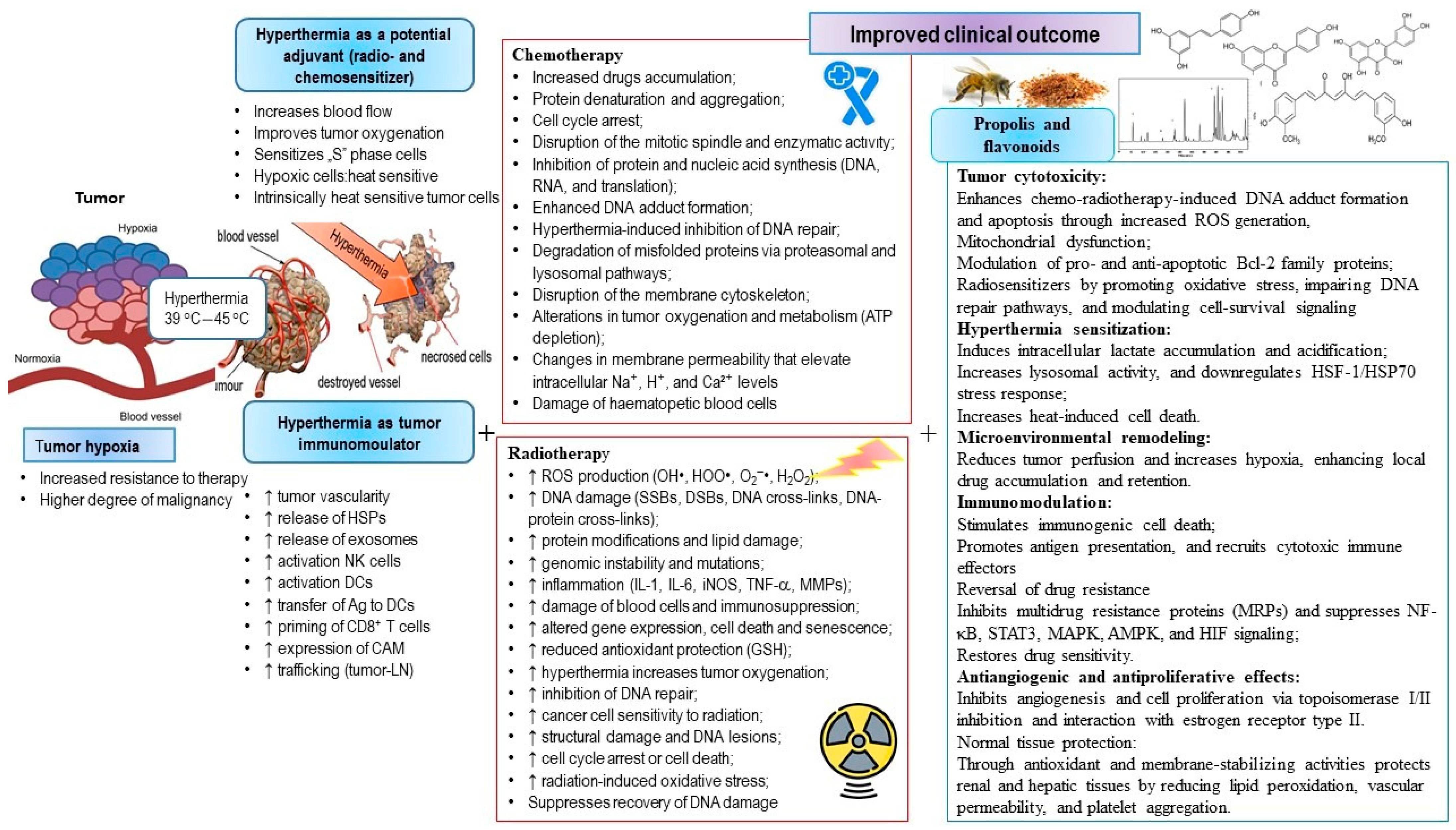
- Tumor cytotoxicity and apoptotic pathways
- −
- Induction of mitochondrial dysfunction and activation of intrinsic apoptotic pathways.
- −
- Enhancement of HT sensitivity through intracellular lactate accumulation and acidification, increased lysosomal activity, and downregulation of the HSF-1/HSP70 stress response, thereby intensifying heat-induced tumor cell death.
- Drug accumulation and delivery
- −
- HT increases membrane permeability, tumor blood flow, and thermally induced membrane changes that facilitate drug uptake.
- TME modulation and angiogenesis
- −
- Reduction in blood vessel density and attenuation of hypoxic gradients through inhibition of VEGF signaling.
- −
- Flavonoid-mediated remodeling of the TME, reduced perfusion, and increased hypoxia, enhancing intratumoral local drug retention and efficacy.
- Immunomodulation
- −
- HT promotes T-cell infiltration, reduces regulatory T-cells, modulates immunosuppressive mediators, and enhances dendritic cell activation.
- −
- Flavonoids downregulate PD-L1 expression, modulate JAK-STAT pathways, and promote CD8+ T-cell-mediated antitumor responses.
- −
- Both modalities synergistically promote immunogenic cell death, improve antigen presentation, and enhance recruitment of cytotoxic immune effector cells.
- Induction of danger-associated molecular patterns (DAMPs)
- −
- Upregulation of HSPs and other heat-induced proteins functioning as immunostimulatory signals.
- −
- Release of HMGB1 and surface exposure of calreticulin and HSP70, promoting immunogenic cell death.
- Suppression of HSPs and thermotolerance
- −
- Flavonoids reduce the expression of key stress proteins, including HSP70 and HSP27, thereby diminishing thermotolerance.
- −
- Given the role of HSPs in immune recognition, their inhibition may further enhance antitumor immunity.
- Reversal of drug resistance
- −
- Inhibition of MRPs and suppression of signaling pathways involved in survival and stress response, including NF-κB, STAT3, MAPK, AMPK, and HIF s, thereby restoring CP sensitivity.
- Antiangiogenic and antiproliferative effects
- −
- Inhibition of angiogenesis and tumor cell proliferation through topoisomerase I/II inhibition and interactions with estrogen receptor β-induced signaling pathways.
- Regulation of apoptosis-related gene expression
- −
- Downregulation of antiapoptotic genes (Bcl-2 and Bcl-xL) and upregulation of proapoptotic genes (Bax and PUMA), accompanied by activation of p53 and caspase cascades.
- Oxidative stress and ROS modulation
- −
- HT increases intracellular ROS levels, contributing to cytotoxicity.
- −
- Flavonoids exert dual effects by enhancing ROS within tumor cells while protecting normal tissues from oxidative stress.
- DNA damage and repair inhibition
- −
- HT inhibits DNA repair pathways (e.g., homologous recombination), potentiating the effects of DNA damaging agents.
- −
- Flavonoids may further inhibit repair mechanisms (e.g., ATM kinase activity), prolonging DNA damage.
- Protection of normal tissues
- −
- Through antioxidant, anti-inflammatory and membrane-stabilizing properties, flavonoids such as QU protect renal and hepatic tissues by reducing lipid peroxidation, vascular permeability, and platelet aggregation.
Challenges and Research Needs
7. Conclusions
Author Contributions
Funding
Data Availability Statement
Conflicts of Interest
Abbreviations
| AIF | Apoptosis-inducing factor |
| AP-1 | Activator protein-1 |
| APCs | Antigen presenting cells |
| bFGF | Basic fibroblast growth factor |
| CAAs | Cancer-associated fibroblasts |
| CAFs | Cancer-associated fibroblasts |
| CP | Cisplatin |
| CPL | Caucalis platycarpos |
| CSC | Cancer stem cell |
| CTLs | Cytotoxic T-lymphocytes |
| DCs | Dendritic cells |
| EAT | Ehrlich ascites tumor |
| EGCG | Epigallocatechin gallate |
| EGFR | Epidermal growth factor receptor |
| EMT | Epithelial–mesenchymal transition |
| EPR | Enhanced permeability and retention |
| ER | Endoplasmic reticulum |
| ERK1/2 | Extracellular signal-regulated kinase 1/2 |
| GM-SCF | Granulocyte-macrophage colony-stimulating factor |
| GSH | Glutathione |
| H202 | Hydrogen peroxide |
| HDAC | Histone deacetylase |
| HIF-1 | Hypoxia-inducible factor-1 |
| HIPEC | Hyperthermic intraperitoneal chemotherapy |
| HMT | Hematoxylin |
| HR | Homologous recombination |
| HSEs | Heat shock elements |
| HSF1 | Heat shock factor 1 |
| HSPs | Heat shock proteins |
| HT | Hyperthermia |
| IFN | Interferon |
| IFP | Interstitial fluid pressure |
| IL | Interleukin |
| ILS | Increased lifespan |
| iNOS | Inducible nitric oxide synthase |
| MAPK | Mitogen-activated protein kinase |
| MDR | Multidrug resistance |
| MDSCs | Myeloid-derived suppressor cells |
| mEHT | Modulated electro-hyperthermia |
| MHT | Magnetic hyperthermia |
| MIH | Magnetic induction hyperthermia |
| MMP | Mitochondrial membrane potential |
| MMPs | Matrix metalloproteinases |
| MMP2 | Matrix metalloproteinase 2 |
| MMP9 | Matrix metalloproteinase 9 |
| MNs | Micronuclei |
| mTOR | Mammalian target of rapamycin |
| NAR | Naringenin |
| NC | Nanocrystalline |
| NETs | Neutrophil extracellular traps |
| NF-κB | Nuclear factor kappa B |
| NHEJ | Non-homologous end joining |
| NK | Natural killer |
| NO | Nitric oxide |
| NPs | Nanoparticles |
| PAMPs | Pathogen-associated molecular patterns |
| PARP | Poly (ADP-ribose) polymerase 1 |
| PI3K/Akt | Phosphatidyl inositol-3-kinase (PI3K)/Akt |
| PTAs | Photothermal agents |
| PTT | Photothermal therapy |
| QU | Quercetin |
| ROS | Reactive oxygen species |
| RT | Radiotherapy |
| SOD | Superoxide dismutase |
| TAMs | Tumor-associated macrophages |
| TAN | Tumor-associated neutrophil |
| TASCs | Tumor-associated stromal cells |
| TANCs | Tumor-associated natural killer cells |
| TC-HT | Thermal cycling-hyperthermia |
| TGF | Tumor growth factor |
| TLRs | Toll-like receptors |
| TNF-α | Tumor necrosis factor alpha |
| TME | Tumor microenvironment |
| VEGF | Vascular endothelial growth factor |
| WSDP | Aqueous propolis solution |
References
- Zhu, W.; Pan, S.; Zhang, J.; Xu, J.; Zhang, R.; Zhang, Y.; Fu, Z.; Wang, Y.; Hu, C.; Xu, Z. The role of hyperthermia in the treatment of tumor. Crit. Rev. Oncol. Hematol. 2024, 204, 104541. [Google Scholar] [CrossRef] [Scilit] [PubMed]
- Abreu, M.M.; Chocron, A.F.; Smadja, D.M. From cold to hot: Mechanisms of hyperthermia in modulating tumor immunology for enhanced immunotherapy. Front. Immunol. 2025, 16, 1487296. [Google Scholar] [CrossRef] [Scilit]
- Mezzacappo, N.F.; Inada, N.M.; Vollet-Filho, J.D.; Denton, M.L.; Yakovlev, V.V.; Bagnato, V.S. Uncovering the time–temperature thresholds of in vitro mitochondrial bioenergetics dysfunction under hyperthermic stress. Int. J. Hyperth. 2025, 42, 2560017. [Google Scholar] [CrossRef] [Scilit] [PubMed]
- Lukácsi, S.; Munkácsy, G.; Győrffy, B. Harnessing hyperthermia: Molecular, cellular, and immunological insights for enhanced anticancer therapies. Integr. Cancer Ther. 2024, 23, 15347354241242094. [Google Scholar] [CrossRef] [Scilit]
- Cheng, Y.; Weng, S.; Yu, L.; Zhu, N.; Yang, M.; Yuan, Y. The role of hyperthermia in the multidisciplinary treatment of malignant tumors. Integr. Cancer Ther. 2019, 18, 1534735419876345. [Google Scholar] [CrossRef] [Scilit] [PubMed]
- Lee, S.; Son, B.; Park, G.; Kim, H.; Kang, H.; Jeon, J.; Youn, H.; Youn, B. Immunogenic effect of hyperthermia on enhancing radiotherapeutic efficacy. Int. J. Mol. Sci. 2018, 19, 2795. [Google Scholar] [CrossRef] [Scilit]
- Hurwitz, M.; Stauffer, P. Hyperthermia, radiation and chemotherapy: The role of heat in multidisciplinary cancer care. Semin. Oncol. 2014, 41, 714–729. [Google Scholar] [CrossRef] [Scilit]
- Hildebrandt, B.; Wust, P.; Ahlers, O.; Dieing, A.; Sreenivasa, G.; Kerner, T.; Felix, R.; Riess, H. The cellular and molecular basis of hyperthermia. Crit. Rev. Oncol. Hematol. 2002, 43, 33–56. [Google Scholar] [CrossRef] [Scilit]
- Oršolić, N.; Car, N. Quercetin and hyperthermia modulate cisplatin-induced DNA damage in tumor and normal tissues in vivo. Tumour Biol. 2014, 35, 6445–6454. [Google Scholar] [CrossRef] [Scilit]
- Oršolić, N.; Car, N.; Lisičić, D.; Benković, V.; Knežević, A.H.; Dikić, D.; Petrik, J. Synergism between propolis and hyperthermal intraperitoneal chemotherapy with cisplatin on Ehrlich ascites tumor in mice. J. Pharm. Sci. 2013, 102, 4395–4405. [Google Scholar] [CrossRef] [Scilit]
- Enomoto, A.; Fukasawa, T. The role of calcium–calpain pathway in hyperthermia. Front. Mol. Med. 2022, 2, 1005258. [Google Scholar] [CrossRef] [Scilit]
- Slimen, I.B.; Najar, T.; Ghram, A.; Dabbebi, H.; Ben Mrad, M.; Abdrabbah, M. Reactive oxygen species, heat stress and oxidative-induced mitochondrial damage: A review. Int. J. Hyperth. 2014, 30, 513–523. [Google Scholar] [CrossRef] [Scilit] [PubMed]
- Kučan, D.; Oršolić, N.; Odeh, D.; Ramić, S.; Jakopović, B.; Knežević, J.; Jazvinšćak Jembrek, M. The role of hyperthermia in potentiation of anti-angiogenic effect of cisplatin and resveratrol in mice bearing solid form of Ehrlich ascites tumour. Int. J. Mol. Sci. 2023, 24, 11073. [Google Scholar] [CrossRef] [Scilit]
- Ahmed, K.; Zaidi, S.F.; Mati-Ur-Rehman; Rehman, R.; Kondo, T. Hyperthermia and protein homeostasis: Cytoprotection and cell death. J. Therm. Biol. 2020, 91, 102615. [Google Scholar] [CrossRef] [Scilit]
- Lord-Fontaine, S.; Averill-Bates, D.A. Heat shock inactivates cellular antioxidant defenses against hydrogen peroxide: Protection by glucose. Free Radic. Biol. Med. 2002, 32, 752–765. [Google Scholar] [CrossRef] [Scilit] [PubMed]
- Terasaki, A.; Kurokawa, H.; Ito, H.; Komatsu, Y.; Matano, D.; Terasaki, M.; Bando, H.; Hara, H.; Matsui, H. Elevated production of mitochondrial reactive oxygen species via hyperthermia enhanced cytotoxic effect of doxorubicin in human breast cancer cell lines MDA-MB-453 and MCF-7. Int. J. Mol. Sci. 2020, 21, 9522. [Google Scholar] [CrossRef] [Scilit]
- Petrova, N.V.; Velichko, A.K.; Razin, S.V.; Kantidze, O.L. Early S-phase cell hypersensitivity to heat stress. Cell Cycle 2016, 15, 337–344. [Google Scholar] [CrossRef] [Scilit]
- Righini, M.F.; Durham, A.; Tsoutsou, P.G. Hyperthermia and radiotherapy: Physiological basis for a synergistic effect. Front. Oncol. 2024, 14, 1428065. [Google Scholar] [CrossRef] [Scilit]
- Tempel, N.; Horsman, M.R.; Kanaar, R. Improving efficacy of hyperthermia in oncology by exploiting biological mechanisms. Int. J. Hyperth. 2016, 32, 446–454. [Google Scholar] [CrossRef] [Scilit]
- Song, C.W.; Park, H.J.; Lee, C.K.; Griffin, R. Implications of increased tumor blood flow and oxygenation caused by mild temperature hyperthermia in tumor treatment. Int. J. Hyperth. 2005, 21, 761–767. [Google Scholar] [CrossRef] [Scilit]
- Li, Z.; Howell, S.H. Heat stress responses and thermotolerance in maize. Int. J. Mol. Sci. 2021, 22, 948. [Google Scholar] [CrossRef] [Scilit]
- Pizzinga, M.; Harvey, R.F.; Garland, G.D.; Mordue, R.; Dezi, V.; Ramakrishna, M.; Sfakianos, A.; Monti, M.; Mulroney, T.E.; Poyry, T.; et al. The cell stress response: Extreme times call for post-transcriptional measures. Wiley Interdiscip. Rev. RNA 2020, 11, e1578. [Google Scholar] [CrossRef] [Scilit] [PubMed]
- Zuo, W.F.; Pang, Q.; Zhu, X.; Yang, Q.Q.; Zhao, Q.; He, G.; Han, B.; Huang, W. Heat shock proteins as hallmarks of cancer: Insights from molecular mechanisms to therapeutic strategies. J. Hematol. Oncol. 2024, 17, 81. [Google Scholar] [CrossRef] [Scilit]
- Ferretti, G.D.S.; Quaas, C.E.; Bertolini, I.; Zuccotti, A.; Saatci, O.; Kashatus, J.A.; Sharmin, S.; Lu, D.Y.; Poli, A.N.R.; Quesnelle, A.F.; et al. HSP70-mediated mitochondrial dynamics and autophagy represent a novel vulnerability in pancreatic cancer. Cell Death Differ. 2024, 31, 881–896. [Google Scholar] [CrossRef] [Scilit]
- Vaupel, P.; Piazena, H.; Notter, M.; Thomsen, A.R.; Grosu, A.-L.; Scholkmann, F.; Pockley, A.G.; Multhoff, G. From Localized Mild Hyperthermia to Improved Tumor Oxygenation: Physiological Mechanisms Critically Involved in Oncologic Thermo-Radio-Immunotherapy. Cancers 2023, 15, 1394. [Google Scholar] [CrossRef] [Scilit]
- Ostberg, J.R.; Kaplan, K.C.; Repasky, E.A. Induction of stress proteins in a panel of mouse tissues by fever-range whole body hyperthermia. Int. J. Hyperth. 2002, 18, 552–562. [Google Scholar] [CrossRef] [Scilit] [PubMed]
- Bettaieb, A.; Averill-Bates, D.A. Thermotolerance induced at a fever temperature of 40 °C protects cells against hyperthermia-induced apoptosis mediated by death receptor signalling. Biochem. Cell Biol. 2008, 86, 521–538. [Google Scholar] [CrossRef] [Scilit]
- Soleimani, A.; Jalili-Nik, M.; Avan, A.; Ferns, G.A.; Khazaei, M.; Hassanian, S.M. The role of HSP27 in the development of drug resistance of gastrointestinal malignancies: Current status and perspectives. J. Cell Physiol. 2019, 234, 8241–8248. [Google Scholar] [CrossRef] [Scilit]
- Lampros, M.; Vlachos, N.; Voulgaris, S.; Alexiou, G.A. The role of HSP27 in chemotherapy resistance. Biomedicines 2022, 10, 897. [Google Scholar] [CrossRef] [Scilit]
- Birbo, B.; Madu, E.E.; Madu, C.O.; Jain, A.; Lu, Y. Role of HSP90 in cancer. Int. J. Mol. Sci. 2021, 22, 10317. [Google Scholar] [CrossRef] [Scilit] [PubMed]
- Park, A.M.; Tsunoda, I.; Yoshie, O. Heat shock protein 27 promotes cell cycle progression by down-regulating E2F transcription factor 4 and retinoblastoma family protein p130. J. Biol. Chem. 2018, 293, 15815–15826. [Google Scholar] [CrossRef] [Scilit]
- Rich, J.N. Cancer stem cells: Master gatekeepers and regulators of cancer growth and metastasis. Medicine 2016, 95, S1. [Google Scholar] [CrossRef] [Scilit]
- Haddadin, L.; Sun, X. Stem cells in cancer: From mechanisms to therapeutic strategies. Cells 2025, 14, 538. [Google Scholar] [CrossRef] [Scilit]
- Sreepadmanabh, M.; Toley, B.J. Investigations into the cancer stem cell niche using in vitro 3-D tumor models and microfluidics. Biotechnol. Adv. 2018, 36, 1094–1110. [Google Scholar] [CrossRef] [Scilit]
- Kunachowicz, D.; Król-Kulikowska, M.; Raczycka, W.; Sleziak, J.; Błażejewska, M.; Kulbacka, J. Heat shock proteins, a double-edged sword: Significance in cancer progression, chemotherapy resistance and novel therapeutic perspectives. Cancers 2024, 16, 1500. [Google Scholar] [CrossRef] [Scilit]
- Hinshaw, D.C.; Shevde, L.A. The tumor microenvironment innately modulates cancer progression. Cancer Res. 2019, 79, 4557–4566. [Google Scholar] [CrossRef] [Scilit] [PubMed]
- Arneth, B. Tumor microenvironment. Medicina 2020, 56, 15. [Google Scholar] [CrossRef] [Scilit] [PubMed]
- Bussard, K.M.; Mutkus, L.; Stumpf, K.; Gomez-Manzano, C.; Marini, F.C. Tumor-associated stromal cells as key contributors to the tumor microenvironment. Breast Cancer Res. 2016, 18, 84. [Google Scholar] [CrossRef] [Scilit]
- Oršolić, N.; Jazvinšćak Jembrek, M. Potential strategies for overcoming drug resistance pathways using propolis and its polyphenolic/flavonoid compounds in combination with chemotherapy and radiotherapy. Nutrients 2024, 16, 3741. [Google Scholar] [CrossRef] [Scilit] [PubMed]
- Biray Avci, C.; Goker Bagca, B.; Nikanfar, M.; Takanlou, L.S.; Takanlou, M.S.; Nourazarian, A. Tumor microenvironment and cancer metastasis: Molecular mechanisms and therapeutic implications. Front. Pharmacol. 2024, 15, 1442888. [Google Scholar] [CrossRef] [Scilit]
- Oršolić, N.; Kunštić, M.; Jazvinšćak Jembrek, M. Antitumor and antiangiogenic effect of tannic acid in the advanced stage of Ehrlich ascites tumor in mice. Int. J. Mol. Sci. 2025, 26, 9070. [Google Scholar] [CrossRef] [Scilit]
- Martínez-Reyes, I.; Chandel, N.S. Cancer metabolism: Looking forward. Nat. Rev. Cancer 2021, 21, 669–680. [Google Scholar] [CrossRef] [Scilit]
- Ančić, D.; Oršolić, N.; Odeh, D.; Tomašević, M.; Pepić, I.; Ramić, S. Resveratrol and its nanocrystals: A promising approach for cancer therapy? Toxicol. Appl. Pharmacol. 2022, 435, 115851. [Google Scholar] [CrossRef] [Scilit]
- Shiravand, Y.; Khodadadi, F.; Kashani, S.M.A.; Hosseini-Fard, S.R.; Hosseini, S.; Sadeghirad, H.; Ladwa, R.; O’Byrne, K.; Kulasinghe, A. Immune checkpoint inhibitors in cancer therapy. Curr. Oncol. 2022, 29, 3044–3060. [Google Scholar] [CrossRef] [Scilit] [PubMed]
- Ye, H.; Liao, W.; Pan, J.; Shi, Y.; Wang, Q. Immune checkpoint blockade for cancer therapy: Current progress and perspectives. J. Zhejiang Univ. Sci. B 2025, 26, 203–226. [Google Scholar] [CrossRef] [Scilit] [PubMed]
- Chicheł, A.; Skowronek, J.; Kubaszewska, M.; Kanikowski, M. Hyperthermia—Description of a method and a review of clinical applications. Rep. Pract. Oncol. Radiother. 2007, 12, 267–275. [Google Scholar] [CrossRef] [Scilit]
- Behrouzkia, Z.; Joveini, Z.; Keshavarzi, B.; Eyvazzadeh, N.; Aghdam, R.Z. Hyperthermia: How can it be used? Oman Med. J. 2016, 31, 89–97. [Google Scholar] [CrossRef] [Scilit]
- Koç, M.M.; Paksu, U.; Kurnaz Yetim, N.; Coşkun, B.; Hasanoğlu Özkan, E.; Erkovan, M. Nanoparticles in photothermal therapy-based medical and theranostic applications: An extensive review. Eur. Phys. J. Plus 2025, 140, 514. [Google Scholar] [CrossRef] [Scilit]
- Kumar, C.S.; Mohammad, F. Magnetic nanomaterials for hyperthermia-based therapy and controlled drug delivery. Adv. Drug Deliv. Rev. 2011, 63, 789–808. [Google Scholar] [CrossRef] [Scilit] [PubMed]
- Hader, M.; Frey, B.; Fietkau, R.; Hecht, M.; Gaipl, U.S. Immune biological rationales for the design of combined radio- and immunotherapies. Cancer Immunol. Immunother. 2020, 69, 293–306. [Google Scholar] [CrossRef] [Scilit]
- Baronzio, G.; Gramaglia, A.; Fiorentini, G. Hyperthermia and immunity: A brief overview. In Vivo 2006, 20, 689–695. [Google Scholar]
- Lee, S.Y.; Fiorentini, G.; Szasz, A.M.; Szigeti, G.; Szasz, A.; Minnaar, C.A. Quo vadis oncological hyperthermia (2020)? Front. Oncol. 2020, 10, 1690. [Google Scholar] [CrossRef] [Scilit]
- Mahmood, J.; Alexander, A.A.; Samanta, S.; Kamlapurkar, S.; Singh, P.; Saeed, A.; Carrier, F.; Cao, X.; Shukla, H.D.; Vujaskovic, Z. A combination of radiotherapy, hyperthermia, and immunotherapy inhibits pancreatic tumor growth and prolongs the survival of mice. Cancers 2020, 12, 1015. [Google Scholar] [CrossRef] [Scilit]
- Tu, Y.C.; Yeh, W.C.; Fang, Y.W.; Lo, K.H.; Liang, L.N.; Liu, X.C.; Tsai, C.C.; Cheng, C.C.; Lin, M.C.; Yu, H.H.; et al. Hyperthermia-induced cytotoxicity and modulation of PD-L1 and MHC-I expression in human non-small cell lung cancer cell lines. Exp. Physiol. 2025; in press. [CrossRef] [Scilit]
- Bala, V.-M.; Lampropoulou, D.I.; Grammatikaki, S.; Kouloulias, V.; Lagopati, N.; Aravantinos, G.; Gazouli, M. Nanoparticle-mediated hyperthermia and cytotoxicity mechanisms in cancer. Int. J. Mol. Sci. 2024, 25, 296. [Google Scholar] [CrossRef] [Scilit] [PubMed]
- Song, C.W.; Rhee, J.G.; Levitt, S.H. Blood flow in normal tissues and tumors during hyperthermia. J. Natl. Cancer Inst. 1980, 64, 119–124. [Google Scholar] [PubMed]
- Horsman, M.R. Tissue physiology and the response to heat. Int. J. Hyperth. 2006, 22, 197–203. [Google Scholar] [CrossRef] [Scilit]
- Ohara, G.; Okabe, K.; Toyama, N.; Ohta, Y.; Xinman, S.; Ichimura, N.; Sato, K.; Urata, Y.; Hibi, H. Hyperthermia maintains death receptor expression and promotes TRAIL-induced apoptosis. J. Oral Pathol. Med. 2023, 52, 718–726. [Google Scholar] [CrossRef] [Scilit]
- Yang, Y.; Huangfu, L.; Li, H.; Yang, D. Research progress of hyperthermia in tumor therapy by influencing metabolic reprogramming of tumor cells. Int. J. Hyperth. 2023, 40, 2270654. [Google Scholar] [CrossRef] [Scilit]
- Multhoff, G.; Pockley, A.G.; Streffer, C.; Gaipl, U.S. Dual role of heat shock proteins in anti-tumor immunity. Curr. Mol. Med. 2012, 12, 1174–1182. [Google Scholar] [CrossRef] [Scilit]
- Hu, C.; Yang, J.; Qi, Z.; Wu, H.; Wang, B.; Zou, F.; Mei, H.; Liu, J.; Wang, W.; Liu, Q. Heat shock proteins: Biological functions, pathological roles, and therapeutic opportunities. MedComm 2022, 3, e161. [Google Scholar] [CrossRef] [Scilit]
- Wrzal, P.K.; Bettaieb, A.; Averill-Bates, D.A. Molecular mechanisms of apoptosis activation by heat shock in multidrug-resistant Chinese hamster cells. Radiat. Res. 2008, 170, 498–511. [Google Scholar] [CrossRef] [Scilit]
- Nakahata, K.; Miyakoda, M.; Suzuki, K.; Kodama, S.; Watanabe, M. Heat shock induces centrosomal dysfunction and causes non-apoptotic mitotic catastrophe in human tumour cells. Int. J. Hyperth. 2002, 18, 332–343. [Google Scholar] [CrossRef] [Scilit] [PubMed]
- Nijhuis, E.H.A.; Poot, A.A.; Feijen, J.; Vermes, I. Induction of apoptosis by heat and γ-radiation in a human lymphoid cell line: Role of mitochondrial changes and caspase activation. Int. J. Hyperth. 2006, 22, 687–698. [Google Scholar] [CrossRef] [Scilit]
- Hou, C.H.; Lin, F.L.; Hou, S.M.; Liu, J.F. Hyperthermia induces apoptosis through endoplasmic reticulum and reactive oxygen species in human osteosarcoma cells. Int. J. Mol. Sci. 2014, 15, 17380–17395. [Google Scholar] [CrossRef] [Scilit] [PubMed]
- Sakaguchi, Y.; Makino, M.; Kaneko, T.; Stephens, L.C.; Strebel, F.R.; Danhauser, L.L.; Jenkins, G.N.; Bull, J.M. Therapeutic efficacy of long duration–low temperature whole body hyperthermia combined with tumor necrosis factor and carboplatin in rats. Cancer Res. 1994, 54, 2223–2227. [Google Scholar]
- Iba, T.; Kondo, Y.; Maier, C.L.; Helms, J.; Ferrer, R.; Levy, J.H. Impact of hyper- and hypothermia on cellular and whole-body physiology. J. Intensive Care 2025, 13, 4. [Google Scholar] [CrossRef] [Scilit] [PubMed]
- Li, L.; Tan, H.; Yang, H.; Li, F.; He, X.; Gu, Z.; Zhao, M.; Su, L. Reactive oxygen species mediate heat stress-induced apoptosis via ERK dephosphorylation and Bcl-2 ubiquitination in human umbilical vein endothelial cells. Oncotarget 2017, 8, 12902–12916. [Google Scholar] [CrossRef] [Scilit]
- Kassis, S.; Grondin, M.; Averill-Bates, D.A. Heat shock increases levels of reactive oxygen species, autophagy and apoptosis. Biochim. Biophys. Acta Mol. Cell Res. 2021, 1868, 118924. [Google Scholar] [CrossRef] [Scilit]
- Tabuchi, Y.; Ahmed, K.; Kondo, T. Induction of oxidative stress by hyperthermia and enhancement of hyperthermia-induced apoptosis by oxidative stress modification. In Hyperthermic Oncology from Bench to Bedside; Kokura, S., Yoshikawa, T., Ohnishi, T., Eds.; Springer: Singapore, 2016; pp. 17–31. [Google Scholar] [CrossRef] [Scilit]
- Liu, Y.; Wang, Y.; Song, S.; Zhang, H. Cancer therapeutic strategies based on metal ions. Chem. Sci. 2021, 12, 12234–12247. [Google Scholar] [CrossRef] [Scilit]
- Shukla, P.; Choudhury, K.K.; Kajol; Behera, S.; Panigrahy, J.; Pathak, R.K. Development of a tumor microenvironment-responsive Co(III)-chrysin prodrug: Synthesis, activation profiling, and in vitro antineoplastic evaluation. ChemMedChem 2025, 20, e202500232. [Google Scholar] [CrossRef] [Scilit]
- Zhang, Y.; Song, Q.; Zhang, Y.; Xiao, J.; Deng, X.; Xing, X.; Hu, H.; Zhang, Y. Iron-based nanovehicle delivering Fin56 for hyperthermia-boosted ferroptosis therapy against osteosarcoma. Int. J. Nanomed. 2024, 19, 91–107. [Google Scholar] [CrossRef] [Scilit]
- Song, Q.; Zhang, Y.; Deng, X.; Zhao, H.; Zhang, Y.; Li, J.; Chen, W.; Hu, H.; Zhang, Y. Amplification of oxidative stress with a hyperthermia-enhanced chemodynamic process and MTH1 inhibition for sequential tumor nanocatalytic therapy. J. Mater. Chem. B 2023, 11, 3836–3850. [Google Scholar] [CrossRef] [Scilit] [PubMed]
- Chen, K.; Tang, T.; Song, Q. Transcription analysis of stress and immune response genes to temperature stress in Ostrinia furnacalis. Front. Physiol. 2019, 10, 1289. [Google Scholar] [CrossRef] [Scilit] [PubMed]
- Hendrickson, M.D.; Poyton, R.O. Crosstalk between nitric oxide and hypoxia-inducible factor signaling pathways: An update. Res. Rep. Biochem. 2015, 5, 147–161. [Google Scholar] [CrossRef] [Scilit]
- Keshet, R.; Erez, A. Arginine and the metabolic regulation of nitric oxide synthesis in cancer. Dis. Model. Mech. 2018, 11, dmm033332. [Google Scholar] [CrossRef] [Scilit]
- Olson, N.; van der Vliet, A. Interactions between nitric oxide and hypoxia-inducible factor signaling pathways in inflammatory disease. Nitric Oxide 2011, 25, 125–137. [Google Scholar] [CrossRef] [Scilit]
- Logghe, T.; van Zwol, E.; Immordino, B.; Van den Cruys, K.; Peeters, M.; Giovannetti, E.; Bogers, J. Hyperthermia in combination with emerging targeted and immunotherapies as a new approach in cancer treatment. Cancers 2024, 16, 505. [Google Scholar] [CrossRef] [Scilit] [PubMed]
- Ratcliffe, P.J. HIF-1 and HIF-2: Working alone or together in hypoxia? J. Clin. Investig. 2007, 117, 862–865. [Google Scholar] [CrossRef] [Scilit]
- Moon, E.J.; Sonveaux, P.; Porporato, P.E. NADPH oxidase-mediated reactive oxygen species production activates hypoxia-inducible factor-1 via the ERK pathway after hyperthermia treatment. Proc. Natl. Acad. Sci. USA 2010, 107, 20477–20482. [Google Scholar] [CrossRef] [Scilit]
- Rey, S.; Semenza, G.L. Hypoxia-inducible factor-1-dependent mechanisms of vascularization and vascular remodelling. Cardiovasc. Res. 2010, 86, 236–242. [Google Scholar] [CrossRef] [Scilit] [PubMed]
- Oršolić, N.; Jazvinšćak Jembrek, M. Molecular and cellular mechanisms of propolis and its polyphenolic compounds against cancer. Int. J. Mol. Sci. 2022, 23, 10479. [Google Scholar] [CrossRef] [Scilit] [PubMed]
- Chen, Z.; Guo, W.; Wu, Q.; Tan, L.; Ma, T.; Fu, C.; Yu, J.; Ren, X.; Wang, J.; Liang, P.; et al. Tumor reoxygenation for enhanced combination of radiation therapy and microwave thermal therapy using oxygen generation in situ by CuO nanosuperparticles under microwave irradiation. Theranostics 2020, 10, 4659–4675. [Google Scholar] [CrossRef] [Scilit]
- Bristow, R.G.; Hill, R.P. Hypoxia, DNA repair and genetic instability. Nat. Rev. Cancer 2008, 8, 180–192. [Google Scholar] [CrossRef] [Scilit]
- Oei, A.L.; Vriend, L.E.M.; Krawczyk, P.M.; Horsman, M.R.; Franken, N.A.P.; Crezee, J. Targeting therapy-resistant cancer stem cells by hyperthermia. Int. J. Hyperth. 2017, 33, 419–427. [Google Scholar] [CrossRef] [Scilit]
- Li, Y.; Wang, Z.; Ajani, J.A.; Song, S. Drug resistance and cancer stem cells. Cell Commun. Signal. 2021, 19, 19. [Google Scholar] [CrossRef] [Scilit]
- Sengedorj, A.; Hader, M.; Frey, B.; Fietkau, R.; Ott, O.J.; Gaipl, U.S.; Rückert, M. Interaction of radiotherapy and hyperthermia with the immune system: A brief current overview. Curr. Stem Cell Rep. 2022, 8, 129–138. [Google Scholar] [CrossRef] [Scilit]
- Huang, H.; Yu, K.; Mohammadi, A.; Karanthanasis, E.; Godley, A.; Yu, J.S. It’s getting hot in here: Targeting cancer stem-like cells with hyperthermia. J. Stem Cell Transplant. Biol. 2017, 2, 113. [Google Scholar] [PubMed]
- Yagawa, Y.; Tanigawa, K.; Kobayashi, Y.; Yamamoto, M. Cancer immunity and therapy using hyperthermia with immunotherapy, radiotherapy, chemotherapy, and surgery. J. Cancer Metastasis Treat. 2017, 3, 218–230. [Google Scholar] [CrossRef] [Scilit]
- Boneva, E.; Shivarov, V.; Ivanova, M. A concise review of the role of the NKG2D receptor and its ligands in cancer. Immuno 2025, 5, 9. [Google Scholar] [CrossRef] [Scilit]
- Foerster, E.G.; Mukherjee, T.; Cabral-Fernandes, L.; Rocha, J.D.B.; Girardin, S.E.; Philpott, D.J. How autophagy controls the intestinal epithelial barrier. Autophagy 2022, 18, 86–103. [Google Scholar] [CrossRef] [Scilit]
- Huang, W.C.; Wu, C.C.; Hsu, Y.T.; Chang, C.L. Effect of hyperthermia on improving neutrophil restoration after intraperitoneal chemotherapy. Int. J. Hyperth. 2019, 36, 1255–1263. [Google Scholar] [CrossRef] [Scilit]
- Jia, Y.; Zhang, F.; Zou, K.; Zou, L. Efficacy of concurrent chemoradiotherapy combined with targeted therapy and hyperthermia in patients with locally advanced cervical cancer. Transl. Oncol. 2025, 61, 102516, Correction in Transl. Oncol. 2026, 64, 102656. https://doi.org/10.1016/j.tranon.2025.102656. [Google Scholar] [CrossRef] [Scilit]
- Oršolić, N.; Odeh, D.; Jazvinšćak Jembrek, M.; Knežević, J.; Kučan, D. Interactions between cisplatin and quercetin at physiological and hyperthermic conditions on cancer cells in vitro and in vivo. Molecules 2020, 25, 3271. [Google Scholar] [CrossRef] [Scilit] [PubMed]
- Souslova, T.; Averill-Bates, D.A. Multidrug-resistant HeLa cells overexpressing MRP1 exhibit sensitivity to cell killing by hyperthermia: Interactions with etoposide. Int. J. Radiat. Oncol. Biol. Phys. 2004, 60, 1538–1551. [Google Scholar] [CrossRef] [Scilit] [PubMed]
- Bergs, J.W.; Krawczyk, P.M.; Borovski, T.; Cate, R.T.; Rodermond, H.M.; Stap, J.; Medema, J.P.; Haveman, J.; Essers, J.; van Bree, C.; et al. Inhibition of homologous recombination by hyperthermia shunts early double-strand break repair to non-homologous end-joining. DNA Repair 2013, 12, 38–45. [Google Scholar] [CrossRef] [Scilit]
- Krawczyk, P.M.; Eppink, B.; Essers, J.; Stap, J.; Rodermond, H.; Odijk, H.; Zelensky, A.; van Bree, C.; Stalpers, L.J.; Buist, M.R.; et al. Mild hyperthermia inhibits homologous recombination, induces BRCA2 degradation, and sensitizes cancer cells to poly(ADP-ribose) polymerase-1 inhibition. Proc. Natl. Acad. Sci. USA 2011, 108, 9851–9856. [Google Scholar] [CrossRef] [Scilit]
- Ihara, M.; Takeshita, S.; Okaichi, K.; Okumura, Y.; Ohnishi, T. Heat exposure enhances radiosensitivity by depressing DNA-PK kinase activity during double-strand break repair. Int. J. Hyperth. 2014, 30, 102–109. [Google Scholar] [CrossRef] [Scilit]
- Li, H.; Liu, Z.Y.; Wu, N.; Chen, Y.-C.; Cheng, Q.; Wang, J. PARP inhibitor resistance: The underlying mechanisms and clinical implications. Mol. Cancer 2020, 19, 107. [Google Scholar] [CrossRef] [Scilit]
- García, M.E.G.; Kirsch, D.G.; Reitman, Z.J. Targeting the ATM kinase to enhance the efficacy of radiotherapy and outcomes for cancer patients. Semin. Radiat. Oncol. 2022, 32, 3–14. [Google Scholar] [CrossRef] [Scilit] [PubMed]
- Maréchal, A.; Zou, L. DNA damage sensing by the ATM and ATR kinases. Cold Spring Harb. Perspect. Biol. 2013, 5, a012716. [Google Scholar] [CrossRef] [Scilit]
- Oei, A.L.; Vriend, L.E.; Crezee, J.; Franken, N.A.P.; Krawczyk, P.M. Effects of hyperthermia on DNA repair pathways: One treatment to inhibit them all. Radiat. Oncol. 2015, 10, 165. [Google Scholar] [CrossRef] [Scilit]
- Ahmed, M.B.; Alghamdi, A.A.A.; Islam, S.U.; Ahsan, H.; Lee, Y.S. The complex roles of DNA repair pathways, inhibitors, hyperthermia, and contact inhibition in cell cycle halts. Mini Rev. Med. Chem. 2023, 23, 514–529. [Google Scholar] [CrossRef] [Scilit]
- Oršolić, N.; Jazvinšćak Jembrek, M. Royal jelly: Biological action and health benefits. Int. J. Mol. Sci. 2024, 25, 6023. [Google Scholar] [CrossRef] [Scilit] [PubMed]
- Sitarek, P.; Merecz-Sadowska, A.; Sikora, J.; Dudzic, M.; Wiertek-Płoszaj, N.; Picot, L.; Śliwiński, T.; Kowalczyk, T. Flavonoids and their derivatives as DNA topoisomerase inhibitors with anticancer activity in various cell models: Exploring a novel mode of action. Pharmacol. Res. 2024, 209, 107457. [Google Scholar] [CrossRef] [Scilit]
- Mohamad, E.A.; El-Garhy, M.R.; Rageh, M.M. Improving cisplatin chemotherapy in vivo by niosomal propolis and chrysin as nanoadjuvants. Med. Oncol. 2025, 42, 539. [Google Scholar] [CrossRef] [Scilit] [PubMed]
- Maniwang, J.R.C.; Tang, Y.; Desamero, M.J.M.; Wang, C.; Fujii, W.; Eer, D.; Kyuwa, S.; Chambers, J.K.; Uchida, K.; Kominami, Y.; et al. Stingless bee propolis promotes hair follicle regeneration and melanocyte function in a chemotherapy-induced alopecia mouse model. Exp. Anim. 2025; in press. [CrossRef] [Scilit] [PubMed]
- Oliveira, D.S.; Oliveira, M.R.; Silva, G.A.D.; Corrêa, C.B.; Silva, A.V.C.D.; Carregosa, J.C.; Wisniewski, A., Jr.; Oliveira, M.B.P.P.; Dariva, C.; Santos, K.S. Ultrasound-assisted pressurized fluid extraction of antioxidant and anticancer molecules from a mangaba, cambuí and red propolis blend. Molecules 2025, 30, 3857. [Google Scholar] [CrossRef] [Scilit]
- Pierański, M.K.; Kaniowski, D.; Szweda, P. Therapeutic potential of propolis in preclinical models of cancer and infectious diseases: A review. Int. J. Mol. Sci. 2025, 26, 8041. [Google Scholar] [CrossRef] [Scilit]
- Aravand, S.; Esfahani, A.J.; Gheibi, N.; Khoei, S.G.; Dibazar, S.P.; Zolghadr, L.; Ahmadpour Yazdi, H. Anti-gastric cancer activity of mixed-region Iranian propolis nanoparticles: Potential therapeutic applications. Curr. Ther. Res. Clin. Exp. 2025, 103, 100806. [Google Scholar] [CrossRef] [Scilit]
- Orsolic, N.; Sver, L.; Terzic, S.; Tadic, Z.; Basic, I. Inhibitory Effect of Water-Soluble Derivative of Propolis and Its Polyphenolic Compounds on Tumor Growth and Metastasizing Ability: A Possible Mode of Antitumor Action. Nutr. Cancer 2003, 47, 156–163. [Google Scholar] [CrossRef] [Scilit]
- Oršolić, N. A review of propolis antitumor action in vivo and in vitro. J. ApiProd. ApiMed. Sci. 2010, 2, 1–20. [Google Scholar] [CrossRef] [Scilit]
- Forma, E.; Bryś, M. Anticancer activity of propolis and its compounds. Nutrients 2021, 13, 2594. [Google Scholar] [CrossRef] [Scilit] [PubMed]
- Campos, J.F.; dos Santos, H.F.; Bonamigo, T.; de Campos Domingues, N.L.; de Picoli Souza, K.; dos Santos, E.L. Stingless bee propolis: New insights for anticancer drugs. Oxid. Med. Cell. Longev. 2021, 2021, 2169017. [Google Scholar] [CrossRef] [Scilit]
- Elumalai, P.; Muninathan, N.; Megalatha, S.T.; Suresh, A.; Kumar, K.S.; Jhansi, N.; Kalaivani, K.; Krishnamoorthy, G. An insight into anticancer effect of propolis and its constituents: A review of molecular mechanisms. Evid.-Based Complement. Altern. Med. 2022, 2022, 5901191. [Google Scholar] [CrossRef] [Scilit]
- Oršolić, N.; Bevanda, M.; Kujundzić, N.; Plazonić, A.; Stajcar, D.; Kujundzić, M. Prevention of peritoneal carcinomatosis in mice by combining hyperthermal intraperitoneal chemotherapy with water extract from Caucalis platycarpos L. Planta Med. 2010, 76, 773–779. [Google Scholar] [CrossRef] [Scilit]
- Bevanda, M.; Oršolić, N.; Bašić, I.; Vukojević, K.; Benković, V.; Horvat Knežević, A.; Lisicic, D.; Dikic, D.; Kujundzic, M. Prevention of peritoneal carcinomatosis in mice with combination hyperthermal intraperitoneal chemotherapy and IL-2. Int. J. Hyperth. 2009, 25, 132–140. [Google Scholar] [CrossRef] [Scilit]
- Oršolić, N.; Bevanda, M.; Bendelja, K.; Horvat-Knežević, A.; Benković, V.; Bašić, I. Propolis and related polyphenolic compounds: Relevance in host resistance and interaction with chemotherapy. In Ethnopharmacology—Review Book; Oršolić, N., Bašić, I., Eds.; Transworld Research Network: Kerala, India, 2008; pp. 223–250. [Google Scholar]
- Tiwari, S.B.; Udupa, V.N.; Rao, S.; Devi, P.U. Thermochemotherapy: Synergism between hyperthermia and liposomal bleomycin in mice bearing melanoma B16F1. Pharm. Pharmacol. Commun. 2000, 6, 19–23. [Google Scholar] [CrossRef] [Scilit]
- Borkamo, E.D.; Fluge, Ø.; Mella, O.; Akslen, L.A.; Bruland, Ø.; Dahl, O. Hyperthermia improves the antitumour effect of metronomic cyclophosphamide in a rat transplantable brain tumour. Radiother. Oncol. 2008, 86, 435–442. [Google Scholar] [CrossRef] [Scilit] [PubMed]
- Beaujard, A.C.; Glehen, O.; Caillot, J.L.; François, Y.; Bienvenu, J.; Panteix, G.; Garbit, F.; Grandclément, E.; Vignal, J.; Gilly, F.N. Intraperitoneal chemohyperthermia with mitomycin C for digestive tract cancer patients with peritoneal carcinomatosis. Cancer 2000, 88, 2512–2519. [Google Scholar] [CrossRef] [Scilit] [PubMed]
- Al-Jamal, W.T.; Kostarelos, K. Mild hyperthermia accelerates doxorubicin clearance from tumour-extravasated temperature-sensitive liposomes. Nanotheranostics 2022, 6, 230–242. [Google Scholar] [CrossRef] [Scilit]
- Sebeke, L.C.; Castillo Gómez, J.D.; Heijman, E.; Rademann, P.; Simon, A.C.; Ekdawi, S.; Vlachakis, S.; Toker, D.; Mink, B.L.; Schubert-Quecke, C.; et al. Hyperthermia-induced doxorubicin delivery from thermosensitive liposomes via MR-HIFU in a pig model. J. Control. Release 2022, 343, 798–812. [Google Scholar] [CrossRef] [Scilit]
- Urano, M.; Majima, H.; Miller, R.; Kahn, J. Cytotoxic effect of 1,3-bis(2-chloroethyl)-N-nitrosourea at elevated temperatures: Arrhenius plot analysis and tumour response. Int. J. Hyperth. 1991, 7, 499–510. [Google Scholar] [CrossRef] [Scilit]
- Silva, V.D.; Tofilon, P.J.; Gutin, P.H.; Dewey, W.C.; Buckley, N.; Deen, D.F. Comparative study of the effects of hyperthermia and BCNU on BCNU-sensitive and BCNU-resistant 9L rat brain tumor cells. Radiat. Res. 1985, 103, 363–372. [Google Scholar] [CrossRef] [Scilit]
- He, Q.; Zheng, Y.; Lu, L.; Shen, H.; Gu, W.; Yang, J.; Zhang, X.; Jin, H. Hyperthermia improves gemcitabine sensitivity of pancreatic cancer cells by suppressing the EFNA4/β-catenin axis and activating dCK. Heliyon 2024, 10, e28488. [Google Scholar] [CrossRef] [Scilit] [PubMed]
- Kim, W.; Lee, S.; Seo, D.; Kim, D.; Kim, K.; Kim, E.; Kang, J.; Seong, K.M.; Youn, H.; Youn, B. Cellular stress responses in radiotherapy. Cells 2019, 8, 1105. [Google Scholar] [CrossRef] [Scilit] [PubMed]
- Fu, Q.; Wang, J.; Huang, T. The effect of hyperthermia on the DNA damage response induced by γ-rays as determined through in situ cell tracking. J. Radiat. Res. 2018, 59, 577–582. [Google Scholar] [CrossRef] [Scilit]
- Ni, L.P.; Sun, H.T.; Wang, P.; Wang, J.; Zhou, J.H.; Cao, R.Q.; Yue, L.; Chen, Y.G.; Shen, F.R. Hyperthermia enhances the efficacy of chemotherapeutic drugs in heat-sensitive cells through interfering with DNA damage repair. Ann. Transl. Med. 2022, 10, 463. [Google Scholar] [CrossRef] [Scilit]
- Asanami, S.; Shimono, K.; Kaneda, S. Effect of temperature on the frequency of chromosome aberrations and micronuclei in cultured Chinese hamster cells. J. Toxicol. Sci. 2001, 26, 323–326. [Google Scholar] [CrossRef] [Scilit]
- Asanami, S.; Shimono, K. The effect of hyperthermia on micronucleus induction by mutagens in mice. Mutat. Res. 1999, 446, 149–154. [Google Scholar] [CrossRef] [Scilit]
- Asea, A.; Ara, G.; Teicher, B.A.; Stevenson, M.A.; Calderwood, S.K. Effects of the flavonoid drug quercetin on the response of human prostate tumours to hyperthermia in vitro and in vivo. Int. J. Hyperth. 2001, 17, 347–356. [Google Scholar] [CrossRef] [Scilit] [PubMed]
- Lagunas-Rangel, F.A.; Bermúdez-Cruz, R.M. Natural compounds that target DNA repair pathways and their therapeutic potential to counteract cancer cells. Front. Oncol. 2020, 10, 598174. [Google Scholar] [CrossRef] [Scilit]
- Lu, C.-H.; Chen, W.-T.; Hsieh, C.-H.; Kuo, Y.-Y.; Chao, C.-Y. Thermal cycling-hyperthermia in combination with polyphenols, epigallocatechin gallate and chlorogenic acid, exerts synergistic anticancer effect against human pancreatic cancer PANC-1 cells. PLoS ONE 2019, 14, e0217676. [Google Scholar] [CrossRef] [Scilit]
- Chen, W.T.; Chen, Y.M.; Lin, G.B.; Kuo, Y.Y.; Liu, H.H.; Chao, C.Y. Combination of cycling hyperthermia and echinacoside creates a synergistic curing effect on pancreatic cancer PANC-1 cells. Ann. Med. Surg. 2025, 87, 7067–7077. [Google Scholar] [CrossRef] [Scilit]
- Kuo, Y.Y.; Chen, W.T.; Lin, G.B.; Lu, C.H.; Chao, C.Y. Study on the effect of a triple cancer treatment of propolis, thermal cycling-hyperthermia, and low-intensity ultrasound on PANC-1 cells. Aging 2023, 15, 7496–7512. [Google Scholar] [CrossRef] [Scilit]
- Oršolić, N.; Jazvinšćak Jembrek, M. Multimodal approach to tumor therapy with quercetin, chemotherapy, radiotherapy and hyperthermia. In Quercetin: Food Sources, Antioxidant Properties and Health Effects; Malone, G., Ed.; Nova Science Publishers: Hauppauge, NY, USA, 2015; pp. 43–84. [Google Scholar]
- Liskova, A.; Samec, M.; Koklesova, L.; Brockmueller, A.; Zhai, K.; Abdellatif, B.; Siddiqui, M.; Biringer, K.; Kudela, E.; Pec, M.; et al. Flavonoids as an effective sensitizer for anti-cancer therapy: Insights into multi-faceted mechanisms and applicability towards individualized patient profiles. EPMA J. 2021, 12, 155–176. [Google Scholar] [CrossRef] [Scilit]
- Miyagawa, T.; Saito, H.; Minamiya, Y.; Mitobe, K.; Takashima, S.; Takahashi, N.; Ito, A.; Imai, K.; Motoyama, S.; Ogawa, J. Inhibition of Hsp90 and 70 sensitizes melanoma cells to hyperthermia using ferromagnetic particles with a low Curie temperature. Int. J. Clin. Oncol. 2014, 19, 722–730. [Google Scholar] [CrossRef] [Scilit]
- Longo, T.A.; Gopalakrishna, A.; Tsivian, M.; Van Noord, M.; Rasch, C.R.; Inman, B.A.; Geijsen, E.D. A systematic review of regional hyperthermia therapy in bladder cancer. Int. J. Hyperth. 2016, 32, 381–389. [Google Scholar] [CrossRef] [Scilit] [PubMed]
- Oršolić, N.; Karač, I.; Sirovina, D.; Kukolj, M.; Kunštić, M.; Gajski, G.; Garaj-Vrhovac, V.; Štajcar, D. Chemotherapeutic potential of quercetin on human bladder cancer cells. J. Environ. Sci. Health A Toxic Hazard Subst. Environ. Eng. 2016, 51, 776–781. [Google Scholar] [CrossRef] [Scilit]
- Manikanta, K.; NaveenKumar, S.K.; Mahalingam, S.S.; Sandesha, V.D.; Tejas, C.; Sumedini, M.L.; Sunitha, K.; Kemparaju, K.; Girish, K.S. Quercetin protects red blood cells from aggregation, eryptosis, and delayed hemolysis caused by cell-free histones through sialic acid interaction. Biochem. Biophys. Res. Commun. 2025, 767, 151859. [Google Scholar] [CrossRef] [Scilit] [PubMed]
- Wachsberger, P.R.; Burd, R.; Bhala, A.; Bobyock, S.B.; Wahl, M.L.; Owen, C.S.; Rifat, S.B.; Leeper, D.B. Quercetin sensitizes cells in a tumour-like low pH environment to hyperthermia. Int. J. Hyperth. 2003, 19, 507–519. [Google Scholar] [CrossRef] [Scilit]
- Ye, Q.; Liu, K.; Shen, Q.; Li, Q.; Hao, J.; Han, F.; Jiang, R.W. Reversal of multidrug resistance in cancer by multi-functional flavonoids. Front. Oncol. 2019, 9, 487. [Google Scholar] [CrossRef] [Scilit] [PubMed]
- Hon, K.W.; Naidu, R. Synergistic mechanisms of selected polyphenols in overcoming chemoresistance and enhancing chemosensitivity in colorectal cancer. Antioxidants 2024, 13, 815. [Google Scholar] [CrossRef] [Scilit]
- Oršolić, N.; Sirovina, D.; Krbavcic, M.; Car, N. Effect of flavonoids and hyperthermal intraperitoneal chemotherapy on tumour growth and micronucleus induction in mouse tumour model. Hum. Exp. Toxicol. 2013, 32, 604–613. [Google Scholar] [CrossRef] [Scilit]
- Hu, K.; Miao, L.; Goodwin, T.J.; Li, J.; Liu, Q.; Huang, L. Quercetin remodels the tumor microenvironment to improve the permeation, retention, and antitumor effects of nanoparticles. ACS Nano 2017, 11, 4916–4925. [Google Scholar] [CrossRef] [Scilit]
- Wei, Q.; Zhang, Y.H. Flavonoids with anti-angiogenesis function in cancer. Molecules 2024, 29, 1570. [Google Scholar] [CrossRef] [Scilit] [PubMed]
- Khater, M.; Greco, F.; Osborn, H.M.I. Antiangiogenic activity of flavonoids: A systematic review and meta-analysis. Molecules 2020, 25, 4712. [Google Scholar] [CrossRef] [Scilit] [PubMed]
- Masoud, G.N.; Li, W. HIF-1α pathway: Role, regulation and intervention for cancer therapy. Acta Pharm. Sin. B 2015, 5, 378–389. [Google Scholar] [CrossRef] [Scilit]
- Kim, M.; Kwon, H.; Lee, Y.; Baek, J.H.; Jang, J.-E.; Lee, S.-W.; Moon, E.-J.; Kim, H.-S.; Lee, S.-K.; Chung, H.Y.; et al. Histone deacetylases induce angiogenesis by negative regulation of tumor suppressor genes. Nat. Med. 2001, 7, 437–443. [Google Scholar] [CrossRef] [Scilit]
- Kim, J.A.; Lee, S.; Kim, D.E.; Kim, M.; Kwon, B.M.; Han, D.C. Fisetin, a dietary flavonoid, induces apoptosis of cancer cells by inhibiting HSF1 activity through blocking its binding to the hsp70 promoter. Carcinogenesis 2015, 36, 696–706. [Google Scholar] [CrossRef] [Scilit]
- Hrgovic, I.; Doll, M.; Pinter, A.; Kaufmann, R.; Kippenberger, S.; Meissner, M. Histone deacetylase inhibitors interfere with angiogenesis by decreasing endothelial VEGFR-2 protein half-life in part via a VE-cadherin-dependent mechanism. Exp. Dermatol. 2017, 26, 194–201. [Google Scholar] [CrossRef] [Scilit]
- Venturelli, S.; Berger, A.; Böcker, A. Resveratrol as a pan-HDAC inhibitor alters the acetylation status of histone proteins in human-derived hepatoblastoma cells. PLoS ONE 2013, 8, e73097, Correction in PLoS ONE 2013, 8, e73097. https://doi.org/10.1371/annotation/5b9a8614-1009-40ca-b90b-db817fe445c9. [Google Scholar] [CrossRef] [Scilit]
- Yang, M.D.; Sun, Y.; Zhou, W.J. Resveratrol enhances the inhibitory effects of cisplatin on cell migration, invasion, and tumor growth in breast cancer MDA-MB-231 cell models in vivo and in vitro. Molecules 2021, 26, 2204. [Google Scholar] [CrossRef] [Scilit]
- Chhabra, G.; Singh, C.K.; Amiri, D.; Akula, N.; Ahmad, N. Recent advancements on immunomodulatory mechanisms of resveratrol in the tumor microenvironment. Molecules 2021, 26, 1343. [Google Scholar] [CrossRef] [Scilit]
- Narita, N.; Fujieda, S.; Tokuriki, M.; Takahashi, N.; Tsuzuki, H.; Ohtsubo, T.; Matsumoto, H. Inhibition of histone deacetylase 3 stimulates apoptosis induced by heat shock under acidic conditions in human maxillary cancer. Oncogene 2005, 24, 7346–7354. [Google Scholar] [CrossRef] [Scilit]
- Wang, D.C.; Zhang, Y.; Chen, H.Y.; Li, X.L.; Qin, L.J.; Li, Y.J.; Zhang, H.Y.; Wang, S. Hyperthermia promotes apoptosis and suppresses invasion in C6 rat glioma cells. Asian Pac. J. Cancer Prev. 2012, 13, 3239–3245. [Google Scholar] [CrossRef] [Scilit] [PubMed]
- Moar, K.; Brahma, M.; Pant, A.; Maruthi, M.; Maurya, P.K. Synergistic anticancer activity of resveratrol with cisplatin and carboplatin in A549 lung adenocarcinoma cells. Int. J. Clin. Exp. Pathol. 2024, 17, 411–420. [Google Scholar] [CrossRef] [Scilit] [PubMed]
- Hankittichai, P.; Thaklaewphan, P.; Wikan, N.; Ruttanapattanakul, J.; Potikanond, S.; Smith, D.R.; Nimlamool, W. Resveratrol enhances cytotoxic effects of cisplatin by inducing cell cycle arrest and apoptosis in ovarian adenocarcinoma SKOV-3 cells through activating the p38 MAPK and suppressing AKT. Pharmaceuticals 2023, 16, 755. [Google Scholar] [CrossRef] [Scilit] [PubMed] [PubMed Central]
- Sawaji, Y.; Sato, T.; Takeuchi, A.; Hirata, M.; Ito, A. Anti-angiogenic action of hyperthermia by suppressing gene expression and production of tumour-derived vascular endothelial growth factor in vivo and in vitro. Br. J. Cancer 2002, 86, 1597–1603. [Google Scholar] [CrossRef] [Scilit] [PubMed] [PubMed Central]
- Ramer, R.; Schmied, T.; Wagner, C.; Haustein, M.; Hinz, B. The antiangiogenic action of cisplatin on endothelial cells is mediated through the release of tissue inhibitor of matrix metalloproteinases-1 from lung cancer cells. Oncotarget 2018, 9, 34038–34055. [Google Scholar] [CrossRef] [Scilit]
- Bouyahya, A.; El Hachlafi, N.; Aanniz, T.; Bourais, I.; Mechchate, H.; Benali, T.; Shariati, M.A.; Burkov, P.; Lorenzo, J.M.; Wilairatana, P.; et al. Natural bioactive compounds targeting histone deacetylases in human cancers: Recent updates. Molecules 2022, 27, 2568. [Google Scholar] [CrossRef] [Scilit]
- Pandey, M.; Kaur, P.; Shukla, S.; Abbas, A.; Fu, P.; Gupta, S. Plant flavone apigenin inhibits HDAC and remodels chromatin to induce growth arrest and apoptosis in human prostate cancer cells: In vitro and in vivo study. Mol. Carcinog. 2012, 51, 952–962. [Google Scholar] [CrossRef] [Scilit]
- Divya Rajaselvi, N.; Jida, M.D.; Nair, D.B.; Sujith, S.; Beegum, N.; Nisha, A.R. Toxicity prediction and analysis of flavonoid apigenin as a histone deacetylase inhibitor: An in-silico approach. In Silico Pharmacol. 2023, 11, 34. [Google Scholar] [CrossRef] [Scilit]
- Karatayli, E.; Sadiq, S.C.; Schattenberg, J.M.; Grabbe, S.; Biersack, B.; Kaps, L. Curcumin and its derivatives in hepatology: Therapeutic potential and advances in nanoparticle formulations. Cancers 2025, 17, 484. [Google Scholar] [CrossRef] [Scilit] [PubMed] [PubMed Central]
- Piantelli, M.; Tatone, D.; Castrilli, G.; Savini, F.; Maggiano, N.; Larocca, L.M.; Ranelletti, F.O.; Natali, P.G. Quercetin and tamoxifen sensitize human melanoma cells to hyperthermia. Melanoma Res. 2001, 11, 469–476. [Google Scholar] [CrossRef] [Scilit] [PubMed]
- Hurwitz, M.D. Hyperthermia and immunotherapy: Clinical opportunities. Int. J. Hyperth. 2019, 36, 4–9. [Google Scholar] [CrossRef] [Scilit] [PubMed]
- Meerson, A.; Khatib, S.; Mahajna, J. Natural products targeting cancer stem cells for augmenting cancer therapeutics. Int. J. Mol. Sci. 2021, 22, 13044. [Google Scholar] [CrossRef] [Scilit]
- Opzoomer, J.W.; Sosnowska, D.; Anstee, J.E.; Spicer, J.F.; Arnold, J.N. Cytotoxic chemotherapy as an immune stimulus: A molecular perspective on turning up the immunological heat on cancer. Front. Immunol. 2019, 10, 1654. [Google Scholar] [CrossRef] [Scilit]
- Teleanu, R.I.; Chircov, C.; Grumezescu, A.M.; Teleanu, D.M. Tumor angiogenesis and antiangiogenic strategies for cancer treatment. J. Clin. Med. 2019, 9, 84. [Google Scholar] [CrossRef] [Scilit] [PubMed]
- Gagliano, N.; Moscheni, C.; Torri, C.; Magnani, I.; Bertelli, A.A.; Gioia, M. Effect of resveratrol on matrix metalloproteinase-2 (MMP-2) and Secreted Protein Acidic and Rich in Cysteine (SPARC) on human cultured glioblastoma cells. Biomed. Pharmacother. 2005, 59, 359–364. [Google Scholar] [CrossRef] [Scilit]
- Ménard, C.; Martin, F.; Apetoh, L.; Bouyer, F.; Ghiringhelli, F. Cancer chemotherapy: Not only a direct cytotoxic effect, but also an adjuvant for antitumor immunity. Cancer Immunol. Immunother. 2008, 57, 1579–1587. [Google Scholar] [CrossRef] [Scilit]
- Ren, B.; Kwah, M.X.; Liu, C. Resveratrol for cancer therapy: Challenges and future perspectives. Cancer Lett. 2021, 515, 63–72. [Google Scholar] [CrossRef] [Scilit]
- Verdura, S.; Cuyàs, E.; Cortada, E.; Brunet, J.; Lopez-Bonet, E.; Martin-Castillo, B.; Bosch-Barrera, J.; Encinar, J.A.; Menendez, J.A. Resveratrol targets PD-L1 glycosylation and dimerization to enhance antitumor T-cell immunity. Aging 2020, 12, 8–34. [Google Scholar] [CrossRef] [Scilit]
- Delmas, D.; Hermetet, F.; Aires, V. PD-1/PD-L1 checkpoints and resveratrol: A controversial new way for a therapeutic strategy. Cancers 2021, 13, 4509. [Google Scholar] [CrossRef] [Scilit] [PubMed] [PubMed Central]
- Rath, M.; Müller, I.; Kropf, P.; Closs, E.I.; Munder, M. Metabolism via arginase or nitric oxide synthase: Two competing arginine pathways in macrophages. Front. Immunol. 2014, 5, 532. [Google Scholar] [CrossRef] [Scilit]
- Salimian Rizi, B.; Achreja, A.; Nagrath, D. Nitric oxide: The forgotten child of tumor metabolism. Trends Cancer 2017, 3, 659–672. [Google Scholar] [CrossRef] [Scilit]
- Navasardyan, I.; Bonavida, B. Regulation of T cells in cancer by nitric oxide. Cells 2021, 10, 2655. [Google Scholar] [CrossRef] [Scilit]
- Giatromanolaki, A.; Tsolou, A.; Daridou, E.; Kouroupi, M.; Chlichlia, K.; Koukourakis, M.I. iNOS expression by tumor-infiltrating lymphocytes, PD-L1 and prognosis in non-small-cell lung cancer. Cancers 2020, 12, 3276. [Google Scholar] [CrossRef] [Scilit]
- Khan, F.H.; Dervan, E.; Bhattacharyya, D.D.; McAuliffe, J.D.; Miranda, K.M.; Glynn, S.A. The role of nitric oxide in cancer: Master regulator or not? Int. J. Mol. Sci. 2020, 21, 9393. [Google Scholar] [CrossRef] [Scilit] [PubMed]
- McGinity, C.L.; Palmieri, E.M.; Somasundaram, V. Nitric oxide modulates metabolic processes in the tumor immune microenvironment. Int. J. Mol. Sci. 2021, 22, 7068. [Google Scholar] [CrossRef] [Scilit] [PubMed]
- Fukumura, D.; Kashiwagi, S.; Jain, R.K. The role of nitric oxide in tumour progression. Nat. Rev. Cancer 2006, 6, 521–534. [Google Scholar] [CrossRef] [Scilit] [PubMed]
- Zea, A.H.; Rodriguez, P.C.; Atkins, M.B. Arginase-producing myeloid suppressor cells in renal cell carcinoma patients: A mechanism of tumor evasion. Cancer Res. 2005, 65, 3044–3048. [Google Scholar] [CrossRef] [Scilit] [PubMed]
- Nan, J.; Xing, Y.F.; Hu, B. Endoplasmic reticulum stress induced LOX-1+ CD15+ polymorphonuclear myeloid-derived suppressor cells in hepatocellular carcinoma. Immunology 2018, 154, 144–155. [Google Scholar] [CrossRef] [Scilit]
- Lowe, M.M.; Boothby, I.; Clancy, S. Regulatory T cells use arginase 2 to enhance their metabolic fitness in tissues. JCI Insight 2019, 4, e129756. [Google Scholar] [CrossRef] [Scilit]
- Sahin, E.; Haubenwallner, S.; Kuttke, M. Macrophage PTEN regulates expression and secretion of arginase I modulating innate and adaptive immune responses. J. Immunol. 2014, 193, 1717–1727, Correction in J. Immunol. 2014, 193, 5350. https://doi.org/10.4049/jimmunol.1490039. [Google Scholar] [CrossRef] [Scilit]
- Singh, A.; Veeriah, V.; Xi, P. Angiocrine signals regulate quiescence and therapy resistance in bone metastasis. JCI Insight 2019, 4, e125679. [Google Scholar] [CrossRef] [Scilit]
- Chen, J.; Sivan, U.; Tan, S.L. High-resolution 3D imaging uncovers organ-specific vascular control of tissue aging. Sci. Adv. 2021, 7, eabd7819. [Google Scholar] [CrossRef] [Scilit] [PubMed]
- Labinskyy, N.; Csiszar, A.; Veress, G. Vascular dysfunction in aging: Potential effects of resveratrol, an anti-inflammatory phytoestrogen. Curr. Med. Chem. 2006, 13, 989–996. [Google Scholar] [CrossRef] [Scilit]
- Ribatti, D.; Solimando, A.G.; Pezzella, F. The anti-VEGF(R) drug discovery legacy: Improving attrition rates by breaking the vicious cycle of angiogenesis in cancer. Cancers 2021, 13, 3433. [Google Scholar] [CrossRef] [Scilit]
- Jing, L.; Lin, J.; Yang, Y.; Tao, L.; Li, Y.; Liu, Z.; Zhao, Q.; Diao, A. Quercetin inhibiting the PD-1/PD-L1 interaction for immune-enhancing cancer chemopreventive agent. Phytother. Res. 2021, 35, 6441–6451. [Google Scholar] [CrossRef] [Scilit] [PubMed]
- Guo, Y.; Tong, J.; Liang, J.; Shi, K.; Song, X.; Guo, Z.; Liu, B.; Xu, J. Molecular insight into binding affinities and blockade effects of selected flavonoid compounds on the PD-1/PD-L1 pathway. RSC Adv. 2024, 14, 25908–25917. [Google Scholar] [CrossRef] [Scilit]
- Sartori, G.R.; Albuquerque, A.O.; Santos-Costa, A.H.; Andrade, L.M.; Almeida, D.S.; Gaieta, E.M.; Sampaio, J.V.; Albuquerque, V.T.M.L.; Martins Da Silva, J.H. In silico mapping of the dynamic interactions and structure-activity relationship of flavonoid compounds against the immune checkpoint programmed-cell death 1 pathway. Front. Drug Discov. 2022, 2, 1032587. [Google Scholar] [CrossRef] [Scilit]
- Freeman, G.J.; Long, A.J.; Iwai, Y.; Bourque, K.; Chernova, T.; Nishimura, H.; Fitz, L.J.; Malenkovich, N.; Okazaki, T.; Byrne, M.C.; et al. Engagement of the PD-1 immunoinhibitory receptor by a novel B7 family member leads to negative regulation of lymphocyte activation. J. Exp. Med. 2000, 192, 1027–1034. [Google Scholar] [CrossRef] [Scilit]
- Dong, H.; Strome, S.E.; Salomao, D.R.; Tamura, H.; Hirano, F.; Flies, D.B.; Roche, P.C.; Lu, J.; Zhu, G.; Tamada, K.; et al. Tumor-associated B7-H1 promotes T-cell apoptosis: A potential mechanism of immune evasion. Nat. Med. 2002, 8, 793–800, Correction in Nat. Med. 2002, 8, 1032. https://doi.org/10.1038/nm0902-1039c. [Google Scholar] [CrossRef] [Scilit]
- Li, H.; Seeram, N.P.; Liu, C.; Ma, H. Further investigation of blockade effects and binding affinities of selected natural compounds to immune checkpoint PD-1/PD-L1. Front. Oncol. 2022, 12, 995461. [Google Scholar] [CrossRef] [Scilit] [PubMed]
- Reilly, R.M.; Sandhu, J.; Alvarez-Diez, T.M.; Gallinger, S.; Kirsh, J.; Stern, H. Problems of delivery of monoclonal antibodies: Pharmaceutical and pharmacokinetic solutions. Clin. Pharmacokinet. 1995, 28, 126–142. [Google Scholar] [CrossRef] [Scilit] [PubMed]
- Akinleye, A.; Rasool, Z. Immune checkpoint inhibitors of PD-L1 as cancer therapeutics. J. Hematol. Oncol. 2019, 12, 92. [Google Scholar] [CrossRef] [Scilit] [PubMed]
- Uniyal, P.; Akhtar, A.; Rawat, R. Flavonoid-Based Combination Therapies and Nano-Formulations: An Emerging Frontier in Breast Cancer Treatment. Pharmaceuticals 2025, 18, 1486. [Google Scholar] [CrossRef] [Scilit]
- Khan, H.; Ullah, H.; Martorell, M.; Valdes, S.E.; Belwal, T.; Tejada, S.; Sureda, A.; Kamal, M.A. Flavonoids Nanoparticles in Cancer: Treatment, Prevention and Clinical Prospects. Semin. Cancer Biol. 2021, 69, 200–211. [Google Scholar] [CrossRef] [Scilit]
- Farhan, M.; Rizvi, A.; Aatif, M.; Ahmad, A. Current Understanding of Flavonoids in Cancer Therapy and Prevention. Metabolites 2023, 13, 481. [Google Scholar] [CrossRef] [Scilit]
- Hristova-Panusheva, K.; Xenodochidis, C.; Georgieva, M.; Krasteva, N. Nanoparticle-Mediated Drug Delivery Systems for Precision Targeting in Oncology. Pharmaceuticals 2024, 17, 677. [Google Scholar] [CrossRef] [Scilit]
- Paul, G.; Gupta, U.; Shah, H.; Mazahir, F.; Yadav, A. Inorganic and Metal-Based Nanoparticles. In Molecular Pharmaceutics and Nano Drug Delivery; Elsevier: Amsterdam, The Netherlands, 2024; pp. 203–235. [Google Scholar]
- Ultimo, A.; Jain, A.; Gomez-Gonzalez, E.; Alex, T.S.; Moreno-Borrallo, A.; Jana, S.; Ghosh, S.; Ruiz-Hernandez, E. Nanotherapeutic Formulations for the Delivery of Cancer Antiangiogenics. Mol. Pharm. 2025, 22, 2322–2349. [Google Scholar] [CrossRef] [Scilit]
- Bonferoni, M.C.; Rossi, S.; Sandri, G.; Ferrari, F. Nanoparticle Formulations to Enhance Tumor Targeting of Poorly Soluble Polyphenols with Potential Anticancer Properties. Semin. Cancer Biol. 2017, 46, 205–214. [Google Scholar] [CrossRef] [Scilit] [PubMed]
- Ghazal, H.; Waqar, A.; Yaseen, F.; Shahid, M.; Sultana, M.; Tariq, M.; Bashir, M.K.; Tahseen, H.; Raza, T.; Ahmad, F. Role of Nanoparticles in Enhancing Chemotherapy Efficacy for Cancer Treatment. Next Mater. 2024, 2, 100128. [Google Scholar] [CrossRef] [Scilit]
- Gavas, S.; Quazi, S.; Karpiński, T.M. Nanoparticles for Cancer Therapy: Current Progress and Challenges. Nanoscale Res. Lett. 2021, 16, 173. [Google Scholar] [CrossRef] [Scilit] [PubMed]
- Cardoso, V.F.; Francesko, A.; Ribeiro, C.; Bañobre-López, M.; Martins, P.; Lanceros-Mendez, S. Advances in Magnetic Nanoparticles for Biomedical Applications. Adv. Healthc. Mater. 2018, 7, 1700845. [Google Scholar] [CrossRef] [Scilit]
- Hollis, C.P.; Weiss, H.L.; Evers, B.M.; Gemeinhart, R.A.; Li, T. In Vivo Investigation of Hybrid Paclitaxel Nanocrystals with Dual Fluorescent Probes for Cancer Theranostics. Pharm. Res. 2014, 31, 1450–1459. [Google Scholar] [CrossRef] [Scilit] [PubMed]
- Ying, H.; Zhang, X.; Duan, Y. Non-Cytomembrane PD-L1: An Atypical Target for Cancer. Pharmacol. Res. 2021, 170, 105741. [Google Scholar] [CrossRef] [Scilit]
- Yousefi, M.; Shadnoush, M.; Sohrabvandi, S.; Khorshidian, N.; Mortazavian, A.M. Encapsulation Systems for Delivery of Flavonoids: A. Biointerface Res. Appl. Chem. 2021, 11, 12345–12360. [Google Scholar] [CrossRef] [Scilit]
- Chen, S.; Arnold, W.A.; Novak, P.J. Encapsulation Technology to Improve Biological Resource Recovery: Recent Advancements and Research Opportunities. Environ. Sci. Water Res. Technol. 2021, 7, 16–23. [Google Scholar] [CrossRef] [Scilit]
- Nagarajan, P.; Al-Najar, B.; Manoharan, R.; Bououdina, M.; Mohandas, M. Synergistic Dual Responsive Chemo-Hyperthermia Anti-Cancer Treatment of Naringenin Encapsulated Nano Vehicle for Targeting Non-Small Cell Lung Cancer. J. Drug Deliv. Sci. Technol. 2025, 109, 106953. [Google Scholar] [CrossRef] [Scilit]
- Mehranfard, N.; Ghasemi, M.; Rajabian, A.; Ansari, L. Protective Potential of Naringenin and Its Nanoformulations in Redox Mechanisms of Injury and Disease. Heliyon 2023, 9, e22820. [Google Scholar] [CrossRef] [Scilit]
- Kakran, M.; Sahoo, N.G.; Bao, H.; Pan, Y.; Li, L. Functionalized Graphene Oxide as Nanocarrier for Loading and Delivery of Ellagic Acid. Curr. Med. Chem. 2011, 18, 4503–4512. [Google Scholar] [CrossRef] [Scilit]
- Wang, B.; Guo, H.; Xu, H.; Chen, Y.; Zhao, G.; Yu, H. The Role of Graphene Oxide Nanocarriers in Treating Gliomas. Front. Oncol. 2022, 12, 736177. [Google Scholar] [CrossRef] [Scilit]
- Shakeri, A.; Panahi, Y.; Johnston, T.P.; Sahebkar, A. Biological Properties of Metal Complexes of Curcumin. Biofactors 2019, 45, 304–317. [Google Scholar] [CrossRef] [Scilit] [PubMed]
- Wanninger, S.; Lorenz, V.; Subhan, A.; Edelmann, F.T. Metal Complexes of Curcumin–Synthetic Strategies, Structures and Medicinal Applications. Chem. Soc. Rev. 2015, 44, 4986–5002. [Google Scholar] [CrossRef] [Scilit]
- Micale, N.; Molonia, M.S.; Citarella, A.; Cimino, F.; Saija, A.; Cristani, M.; Speciale, A. Natural Product-Based Hybrids as Potential Candidates for the Treatment of Cancer: Focus on Curcumin and Resveratrol. Molecules 2021, 26, 4665. [Google Scholar] [CrossRef] [Scilit] [PubMed]
- He, X.; Zhu, H.; Shang, J.; Li, M.; Zhang, Y.; Zhou, S.; Gong, G.; He, Y.; Blocki, A.; Guo, J. Intratumoral Synthesis of Transformable Metal-Phenolic Nanoaggregates with Enhanced Tumor Penetration and Retention for Photothermal Immunotherapy. Theranostics 2022, 12, 6258–6272. [Google Scholar] [CrossRef] [Scilit]
- Bernal, G.; Aquea, G.; Ramírez-Rivera, S. Metal-Based Molecules in the Treatment of Cancer: From Bench to Bedside. Oncol. Res. 2025, 33, 759–779. [Google Scholar] [CrossRef] [Scilit]
- Sharma, A.; Shambhwani, D.; Pandey, S.; Singh, J.; Lalhlenmawia, H.; Kumarasamy, M.; Singh, S.K.; Chellappan, D.K.; Gupta, G.; Prasher, P.; et al. Advances in Lung Cancer Treatment Using Nanomedicines. ACS Omega 2022, 8, 10–41. [Google Scholar] [CrossRef] [Scilit] [PubMed]
- Liang, T.; Wang, F.; Elhassan, R.M.; Cheng, Y.; Tang, X.; Chen, W.; Fang, H.; Hou, X. Targeting Histone Deacetylases for Cancer Therapy: Trends and Challenges. Acta Pharm. Sin. B 2023, 13, 2425–2463. [Google Scholar] [CrossRef] [Scilit]
- Li, Y.; Seto, E. HDACs and HDAC Inhibitors in Cancer Development and Therapy. Cold Spring Harb. Perspect. Med. 2016, 6, a026831. [Google Scholar] [CrossRef] [Scilit]
- Urias, B.S.; Pavan, A.R.; Albuquerque, G.R.; Prokopczyk, I.M.; Alves, T.M.F.; de Melo, T.R.F.; Sartori, G.R.; da Silva, J.H.M.; Chin, C.M.; Santos, J.L.D. Optimization of Resveratrol Used as a Scaffold to Design Histone Deacetylase (HDAC-1 and HDAC-2) Inhibitors. Pharmaceuticals 2022, 15, 1260. [Google Scholar] [CrossRef] [Scilit] [PubMed]
- Samec, M.; Liskova, A.; Koklesova, L.; Mersakova, S.; Strnadel, J.; Kajo, K.; Pec, M.; Zhai, K.; Smejkal, K.; Mirzaei, S.; et al. Flavonoids Targeting HIF-1: Implications on Cancer Metabolism. Cancers 2021, 13, 130. [Google Scholar] [CrossRef] [Scilit]
- Munshi, A.; Kurland, J.F.; Nishikawa, T. Histone Deacetylase Inhibitors Radiosensitize Human Melanoma Cells by Suppressing DNA Repair Activity. Clin. Cancer Res. 2005, 11, 4912–4922. [Google Scholar] [CrossRef] [Scilit] [PubMed]
- Zhang, J.; Zhong, Q. Histone Deacetylase Inhibitors and Cell Death. Cell. Mol. Life Sci. 2014, 71, 3885–3901. [Google Scholar] [CrossRef] [Scilit]
- Kim, J.; Lee, H.; Yi, S.J.; Kim, K. Gene regulation by histone-modifying enzymes under hypoxic conditions: A focus on histone methylation and acetylation. Exp. Mol. Med. 2022, 54, 878–889. [Google Scholar] [CrossRef] [Scilit]
- Mu, Q.; Najafi, M. Resveratrol for targeting the tumor microenvironment and its interactions with cancer cells. Int. Immunopharmacol. 2021, 98, 107895. [Google Scholar] [CrossRef] [Scilit] [PubMed]
- Summerlin, N.; Soo, E.; Thakur, S.; Qu, Z.; Jambhrunkar, S.; Popat, A. Resveratrol nanoformulations: Challenges and opportunities. Int. J. Pharm. 2015, 479, 282–290. [Google Scholar] [CrossRef] [Scilit]
- Pandey, P.; Lakhanpal, S.; Mahmood, D.; Kang, H.N.; Kim, B.; Kang, S.; Choi, J.; Choi, M.; Pandey, S.; Bhat, M.; et al. An updated review summarizing the anticancer potential of flavonoids via targeting NF-κB pathway. Front. Pharmacol. 2025, 15, 1513422. [Google Scholar] [CrossRef] [Scilit]
- van der Zee, J. Heating the patient: A promising approach? Ann. Oncol. 2002, 13, 1173–1184. [Google Scholar] [CrossRef] [Scilit]
- Almatroodi, S.A.; Almatroudi, A.; Khan, A.A.; Alhumaydhi, F.A.; Alsahli, M.A.; Rahmani, A.H. Potential therapeutic targets of epigallocatechin gallate (EGCG), the most abundant catechin in green tea, and its role in the therapy of various types of cancer. Molecules 2020, 25, 3146. [Google Scholar] [CrossRef] [Scilit] [PubMed] [PubMed Central]
- Aggarwal, V.; Tuli, H.S.; Tania, M.; Srivastava, S.; Ritzer, E.E.; Pandey, A.; Aggarwal, D.; Barwal, T.S.; Jain, A.; Kaur, G.; et al. Molecular mechanisms of action of epigallocatechin gallate in cancer: Recent trends and advancement. Semin. Cancer Biol. 2022, 80, 256–275. [Google Scholar] [CrossRef] [Scilit]
- Viana, P.; Hamar, P. Targeting the heat shock response induced by modulated electro-hyperthermia (mEHT) in cancer. Biochim. Biophys. Acta Rev. Cancer 2024, 1879, 189069. [Google Scholar] [CrossRef] [Scilit] [PubMed]
- Tsang, Y.W.; Chi, K.H.; Huang, C.C.; Chi, M.S.; Chiang, H.C.; Yang, K.L.; Li, W.T.; Wang, Y.S. Modulated electro-hyperthermia-enhanced liposomal drug uptake by cancer cells. Int. J. Nanomed. 2019, 14, 1269–1279, Correction in Int. J. Nanomed. 2019, 14, 1995–1996. https://doi.org/10.2147/IJN.S207678. [Google Scholar] [CrossRef] [Scilit]
- Nagata, T.; Kanamori, M.; Sekine, S.; Arai, M.; Moriyama, M.; Fujii, T. Clinical study of modulated electro-hyperthermia for advanced metastatic breast cancer. Mol. Clin. Oncol. 2021, 14, 103. [Google Scholar] [CrossRef] [Scilit]
- Minnaar, C.A.; Maposa, I.; Kotzen, J.A.; Baeyens, A. Effects of modulated electro-hyperthermia (mEHT) on two and three year survival of locally advanced cervical cancer patients. Cancers 2022, 14, 656. [Google Scholar] [CrossRef] [Scilit] [PubMed] [PubMed Central]
- Yoo, H.J.; Lim, M.C.; Seo, S.S.; Kang, S.; Joo, J.; Park, S.Y. Phase I/II clinical trial of modulated electro-hyperthermia treatment in patients with relapsed, refractory or progressive heavily treated ovarian cancer. Jpn. J. Clin. Oncol. 2019, 49, 832–838. [Google Scholar] [CrossRef] [Scilit] [PubMed]
- Kim, S.; Lee, J.H.; Cha, J.; You, S.H. Beneficial effects of modulated electro-hyperthermia during neoadjuvant treatment for locally advanced rectal cancer. Int. J. Hyperth. 2021, 38, 144–151. [Google Scholar] [CrossRef] [Scilit] [PubMed]
- Fiorentini, G.; Sarti, D.; Ranieri, G.; Gadaleta, C.D.; Fiorentini, C.; Milandri, C.; Mambrini, A.; Guadagni, S. Modulated electro-hyperthermia in stage III and IV pancreatic cancer: Results of an observational study on 158 patients. World J. Clin. Oncol. 2021, 12, 1064–1071. [Google Scholar] [CrossRef] [Scilit] [PubMed] [PubMed Central]
- Petenyi, F.G.; Garay, T.; Muhl, D.; Izso, B.; Karaszi, A.; Borbenyi, E.; Herold, M.; Herold, Z.; Szasz, A.M.; Dank, M. Modulated electro-hyperthermic (mEHT) treatment in the therapy of inoperable pancreatic cancer patients—A single-center case-control study. Diseases 2021, 9, 81. [Google Scholar] [CrossRef] [Scilit] [PubMed] [PubMed Central]
- Mousavi, M.; Baharara, J.; Shahrokhabadi, K. The synergic effects of Crocus sativus L. and low frequency electromagnetic field on VEGFR2 gene expression in human breast cancer cells. Avicenna J. Med. Biotechnol. 2014, 6, 123–127. [Google Scholar] [PubMed] [PubMed Central]
- Minnaar, C.A.; Szasz, A. Forcing the antitumor effects of HSPs using a modulated electric field. Cells 2022, 11, 1838. [Google Scholar] [CrossRef] [Scilit] [PubMed] [PubMed Central]
- Szász, A.; Lóránt, G.; Szász, A.; Szigeti, G. The immunogenic connection of thermal and nonthermal molecular effects in modulated electro-hyperthermia. Open J. Biophys. 2023, 13, 103–142. [Google Scholar] [CrossRef]
- Tsang, Y.W.; Huang, C.C.; Yang, K.L.; Chi, M.S.; Chiang, H.C.; Wang, Y.S.; Andocs, G.; Szasz, A.; Li, W.T.; Chi, K.H. Improving immunological tumor microenvironment using electro-hyperthermia followed by dendritic cell immunotherapy. BMC Cancer 2015, 15, 708. [Google Scholar] [CrossRef] [Scilit] [PubMed] [PubMed Central]
- Qin, W.; Akutsu, Y.; Andocs, G.; Suganami, A.; Hu, X.; Yusup, G.; Komatsu-Akimoto, A.; Hoshino, I.; Hanari, N.; Mori, M.; et al. Modulated electro-hyperthermia enhances dendritic cell therapy through an abscopal effect in mice. Oncol. Rep. 2014, 32, 2373–2379. [Google Scholar] [CrossRef] [Scilit] [PubMed]
- Vancsik, T.; Máthé, D.; Horváth, I.; Várallyaly, A.A.; Benedek, A.; Bergmann, R.; Krenács, T.; Benyó, Z.; Balogh, A. Modulated electro-hyperthermia facilitates NK-cell infiltration and growth arrest of human A2058 melanoma in a xenograft model. Front. Oncol. 2021, 11, 590764. [Google Scholar] [CrossRef] [Scilit] [PubMed] [PubMed Central]
- Lee, S.Y.; Lorant, G.; Grand, L.; Szasz, A.M. The clinical validation of modulated electro-hyperthermia (mEHT). Cancers 2023, 15, 4569. [Google Scholar] [CrossRef] [Scilit]
- Chi, M.S.; Mehta, M.P.; Yang, K.L.; Lai, H.C.; Lin, Y.C.; Ko, H.L.; Wang, Y.S.; Liao, K.W.; Chi, K.H. Putative abscopal effect in three patients treated by combined radiotherapy and modulated electrohyperthermia. Front. Oncol. 2020, 10, 254. [Google Scholar] [CrossRef] [Scilit] [PubMed] [PubMed Central]
- Chi, M.S.; Wu, J.H.; Shaw, S.; Wu, C.J.; Chen, L.K.; Hsu, H.C.; Chi, K.H. Marked local and distant response of heavily treated breast cancer with cardiac metastases treated by combined low dose radiotherapy, low dose immunotherapy and hyperthermia: A case report. Ther. Radiol. Oncol. 2021, 5, 17. [Google Scholar] [CrossRef] [Scilit]
- Kuo, I.M.; Lee, J.J.; Wang, Y.S.; Chiang, H.C.; Huang, C.C.; Hsieh, P.J.; Han, W.; Ke, C.H.; Liao, A.T.C.; Lin, C.S. Potential enhancement of host immunity and anti-tumor efficacy of nanoscale curcumin and resveratrol in colorectal cancers by modulated electro-hyperthermia. BMC Cancer 2020, 20, 603. [Google Scholar] [CrossRef] [Scilit] [PubMed] [PubMed Central]
- Chakraborty, P.K.; Mustafi, S.B.; Ganguly, S.; Chatterjee, M.; Raha, S. Resveratrol induces apoptosis in K562 (chronic myelogenous leukemia) cells by targeting a key survival protein, heat shock protein 70. Cancer Sci. 2008, 99, 1109–1116. [Google Scholar] [CrossRef] [Scilit] [PubMed] [PubMed Central]
- Chen, H.W.; Lee, J.Y.; Huang, J.Y.; Wang, C.C.; Chen, W.J.; Su, S.F.; Huang, C.W.; Ho, C.C.; Chen, J.J.; Tsai, M.F.; et al. Curcumin inhibits lung cancer cell invasion and metastasis through the tumor suppressor HLJ1. Cancer Res. 2008, 68, 7428–7438. [Google Scholar] [CrossRef] [Scilit] [PubMed]
- Liu, T.; Long, T.; Li, H. Curcumin suppresses the proliferation of oral squamous cell carcinoma through a specificity protein 1/nuclear factor-κB-dependent pathway. Exp. Ther. Med. 2021, 21, 202. [Google Scholar] [CrossRef] [Scilit] [PubMed] [PubMed Central]
- Danics, L.; Schvarcz, C.A.; Viana, P.; Vancsik, T.; Krenács, T.; Benyó, Z.; Kaucsár, T.; Hamar, P. Exhaustion of protective heat shock response induces significant tumor damage by apoptosis after modulated electro-hyperthermia treatment of triple negative breast cancer isografts in mice. Cancers 2020, 12, 2581. [Google Scholar] [CrossRef] [Scilit] [PubMed] [PubMed Central]
- Nagai, N.; Nakai, A.; Nagata, K. Quercetin suppresses heat shock response by down regulation of HSF1. Biochem. Biophys. Res. Commun. 1995, 208, 1099–1105. [Google Scholar] [CrossRef] [Scilit] [PubMed]
- Chin, Y.; Gumilar, K.E.; Li, X.G.; Tjokroprawiro, B.A.; Lu, C.H.; Lu, J.; Zhou, M.; Sobol, R.W.; Tan, M. Targeting HSF1 for cancer treatment: Mechanisms and inhibitor development. Theranostics 2023, 13, 2281–2300. [Google Scholar] [CrossRef] [Scilit]
- Whitesell, L.; Lindquist, S. Inhibiting the transcription factor HSF1 as an anticancer strategy. Expert Opin. Ther. Targets 2009, 13, 469–478. [Google Scholar] [CrossRef] [Scilit]
- Jiang, J.; Li, H.; Ma, Q.; Liu, J.; Ren, F.; Song, Y.; Wang, T.; Li, K.; Li, N. Synergies between radiotherapy and immunotherapy: A systematic review from mechanism to clinical application. Front. Immunol. 2025, 16, 1554499. [Google Scholar] [CrossRef] [Scilit]
- Zhang, B.; Qi, R. The dual-function of HSP70 in immune response and tumor immunity: From molecular regulation to therapeutic innovations. Front. Immunol. 2025, 16, 1587414. [Google Scholar] [CrossRef] [Scilit] [PubMed]
- Wang, H.; Li, X.; Xi, X.; Hu, B.; Zhao, L.; Liao, Y.; Tang, J. Effects of magnetic induction hyperthermia and radiotherapy alone or combined on a murine 4T1 metastatic breast cancer model. Int. J. Hyperth. 2011, 27, 563–572. [Google Scholar] [CrossRef] [Scilit]
- Werthmöller, N.; Frey, B.; Rückert, M.; Lotter, M.; Fietkau, R.; Gaipl, U.S. Combination of ionising radiation with hyperthermia increases the immunogenic potential of B16-F10 melanoma cells in vitro and in vivo. Int. J. Hyperth. 2016, 32, 23–30. [Google Scholar] [CrossRef] [Scilit]
- Ouellette, M.M.; Zhou, S.; Yan, Y. Cell signaling pathways that promote radioresistance of cancer cells. Diagnostics 2022, 12, 656. [Google Scholar] [CrossRef] [Scilit]
- Slika, H.; Mansour, H.; Wehbe, N.; Nasser, S.A.; Iratni, R.; Nasrallah, G.; Shaito, A.; Ghaddar, T.; Kobeissy, F.; Eid, A.H. Therapeutic potential of flavonoids in cancer: ROS-mediated mechanisms. Biomed. Pharmacother. 2022, 146, 112442. [Google Scholar] [CrossRef] [Scilit]
- Baruah, D.; Goswami, M.; Yadav, R.N.S.; Yadav, A.; Das, A.M. Biogenic synthesis of gold nanoparticles and their application in photocatalytic degradation of toxic dyes. J. Photochem. Photobiol. B 2018, 186, 51–58. [Google Scholar] [CrossRef] [Scilit] [PubMed]
- Eghbaliferiz, S.; Iranshahi, M. Prooxidant activity of polyphenols, flavonoids, anthocyanins and carotenoids: Updated review of mechanisms and catalyzing metals. Phytother. Res. 2016, 30, 1379–1391. [Google Scholar] [CrossRef] [Scilit]
- Samsonowicz, M.; Regulska, E.; Kalinowska, M. Hydroxyflavone metal complexes—Molecular structure, antioxidant activity and biological effects. Chem. Biol. Interact. 2017, 273, 245–256. [Google Scholar] [CrossRef] [Scilit] [PubMed]
- Arif, H.; Sohail, A.; Farhan, M.; Rehman, A.A.; Ahmad, A.; Hadi, S.M. Flavonoids-induced redox cycling of copper ions leads to generation of reactive oxygen species: A potential role in cancer chemoprevention. Int. J. Biol. Macromol. 2018, 106, 569–578. [Google Scholar] [CrossRef] [Scilit]
- Li, X.; Yu, L.; Xu, H.; Xing, X.; Wu, W.; Feng, Y.; Ma, L.; Zhou, Z.; Li, B.; He, Y. Research on the mechanisms of natural products in radiation protection. Front. Bioeng. Biotechnol. 2025, 13, 1640682. [Google Scholar] [CrossRef] [Scilit]
- Tutt, A.; Robson, M.; Garber, J.E.; Domchek, S.M.; Audeh, M.W.; Weitzel, J.N.; Friedlander, M.; Arun, B.; Loman, N.; Schmutzler, R.K.; et al. Oral poly(ADP-ribose) polymerase inhibitor olaparib in patients with BRCA1 or BRCA2 mutations and advanced breast cancer: A proof-of-concept trial. Lancet 2010, 376, 235–244. [Google Scholar] [CrossRef] [Scilit]
- Cai, Y.; Tu, Y.; Cheng, H.; Yu, J. Investigating the interaction mechanism of five flavonoids and PD-L1 based on multi-spectroscopy and molecular dynamics. Chem. Biol. Interact. 2025, 421, 111741. [Google Scholar] [CrossRef] [Scilit]
- Yan, C.; Wang, G. Advances in research on flavonoids in tumor immunotherapy. Mol. Med. Rep. 2025, 31, 150. [Google Scholar] [CrossRef] [Scilit]
- Bardhan, K.; Anagnostou, T.; Boussiotis, V.A. The PD1:PD-L1/2 pathway from discovery to clinical implementation. Front. Immunol. 2016, 7, 550. [Google Scholar] [CrossRef] [Scilit]
- Han, Y.; Liu, D.; Li, L. PD-1/PD-L1 pathway: Current researches in cancer. Am. J. Cancer Res. 2020, 10, 727–742. [Google Scholar]
- Oršolić, N.; Kunštić, M.; Kukolj, M.; Gračan, R.; Nemrava, J. Oxidative stress, polarization of macrophages and tumour angiogenesis: Efficacy of caffeic acid. Chem. Biol. Interact. 2016, 256, 111–124. [Google Scholar] [CrossRef] [Scilit] [PubMed]
- Oršolić, N.; Kunštić, M.; Kukolj, M.; Odeh, D.; Ančić, D. Natural phenolic acid, product of the honey bee, for the control of oxidative stress, peritoneal angiogenesis, and tumor growth in mice. Molecules 2020, 25, 5583. [Google Scholar] [CrossRef] [Scilit]
- Xu, P.; Yan, F.; Zhao, Y.; Chen, X.; Sun, S.; Wang, Y.; Ying, L. Green tea polyphenol EGCG attenuates MDSCs-mediated immunosuppression through canonical and non-canonical pathways in a 4T1 murine breast cancer model. Nutrients 2020, 12, 1042. [Google Scholar] [CrossRef] [Scilit]
- Chauvin, C.; Josien, R. Dendritic cells as killers: Mechanistic aspects and potential roles. J. Immunol. 2008, 181, 11–16. [Google Scholar] [CrossRef] [Scilit] [PubMed]
- LaCasse, C.J.; Janikashvili, N.; Larmonier, C.B.; Alizadeh, D.; Hanke, N.; Kartchner, J.; Situ, E.; Centuori, S.; Har-Noy, M.; Bonnotte, B.; et al. Th-1 lymphocytes induce dendritic cell tumor killing activity by an IFN-γ-dependent mechanism. J. Immunol. 2011, 187, 6310–6317. [Google Scholar] [CrossRef] [Scilit] [PubMed]
- Wesa, A.K.; Storkus, W.J. Killer dendritic cells: Mechanisms of action and therapeutic implications for cancer. Cell Death Differ. 2008, 15, 51–57. [Google Scholar] [CrossRef] [Scilit]
- Verna, G.; Liso, M.; Cavalcanti, E.; Bianco, G.; Di Sarno, V.; Santino, A.; Campiglia, P.; Chieppa, M. Quercetin administration suppresses the cytokine storm in myeloid and plasmacytoid dendritic cells. Int. J. Mol. Sci. 2021, 22, 8349. [Google Scholar] [CrossRef] [Scilit] [PubMed]
- Paul, S.; Lal, G. The molecular mechanism of natural killer cells function and its importance in cancer immunotherapy. Front. Immunol. 2017, 8, 1124. [Google Scholar] [CrossRef] [Scilit] [PubMed]
- He, M.; Chen, S.; Yu, H.; Fan, X.; Wu, H.; Wang, Y.; Wang, H.; Yin, X. Advances in nanoparticle-based radiotherapy for cancer treatment. iScience 2024, 28, 111602. [Google Scholar] [CrossRef] [Scilit]
- Smeu, A.; Marcovici, I.; Dehelean, C.A.; Dumitrel, S.I.; Borza, C.; Lighezan, R. Flavonoids and flavonoid-based nanopharmaceuticals as promising therapeutic strategies for colorectal cancer—An updated literature review. Pharmaceuticals 2025, 18, 231. [Google Scholar] [CrossRef] [Scilit]
- Baldea, I.; Iacoviță, C.; Gurgu, R.A.; Vizitiu, A.S.; Râzniceanu, V.; Mitrea, D.R. Magnetic hyperthermia with iron oxide nanoparticles: From toxicity challenges to cancer applications. Nanomaterials 2025, 15, 1519. [Google Scholar] [CrossRef] [Scilit]
- Tousi, M.S.; Sepehri, H.; Khoee, S.; Farimani, M.M.; Delphi, L.; Mansourizadeh, F. Evaluation of apoptotic effects of mPEG-b-PLGA coated iron oxide nanoparticles as a eupatorin carrier on DU-145 and LNCaP human prostate cancer cell lines. J. Pharm. Anal. 2021, 11, 108–121. [Google Scholar] [CrossRef] [Scilit] [PubMed]
- Sysak, S.; Czarczynska-Goslinska, B.; Szyk, P.; Koczorowski, T.; Mlynarczyk, D.T.; Szczolko, W.; Lesyk, R.; Goslinski, T. Metal nanoparticle-flavonoid connections: Synthesis, physicochemical and biological properties, as well as potential applications in medicine. Nanomaterials 2023, 13, 1531. [Google Scholar] [CrossRef] [Scilit]
- Elming, P.B.; Sørensen, B.S.; Oei, A.L.; Franken, N.A.P.; Crezee, J.; Overgaard, J.; Horsman, M.R. Hyperthermia: The optimal treatment to overcome radiation resistant hypoxia. Cancers 2019, 11, 60. [Google Scholar] [CrossRef] [Scilit]
- Takahashi, A.; Yamakawa, N.; Mori, E.; Ohnishi, K.; Yokota, S.; Sugo, N.; Aratani, Y.; Koyama, H.; Ohnishi, T. Development of thermotolerance requires interaction between polymerase-beta and heat shock proteins. Cancer Sci. 2008, 99, 973–978. [Google Scholar] [CrossRef] [Scilit]
- Singh, M.K.; Shin, Y.; Ju, S.; Han, S.; Choe, W.; Yoon, K.S.; Kim, S.S.; Kang, I. Heat shock response and heat shock proteins: Current understanding and future opportunities in human diseases. Int. J. Mol. Sci. 2024, 25, 4209. [Google Scholar] [CrossRef] [Scilit]
- Kim, J.H.; Kim, S.H.; Alfieri, A.A.; Young, C.W. Quercetin, an inhibitor of lactate transport and a hyperthermic sensitizer of HeLa cells. Cancer Res. 1984, 44, 102–106. [Google Scholar]
- Wang, R.E.; Kao, J.L.; Hilliard, C.A.; Pandita, R.K.; Roti Roti, J.L.; Hunt, C.R.; Taylor, J.S. Inhibition of heat shock induction of heat shock protein 70 and enhancement of heat shock protein 27 phosphorylation by quercetin derivatives. J. Med. Chem. 2009, 52, 1912–1921. [Google Scholar] [CrossRef] [Scilit] [PubMed]
- Kıyga, E.; Şengelen, A.; Adıgüzel, Z.; Önay Uçar, E. Investigation of the role of quercetin as a heat shock protein inhibitor on apoptosis in human breast cancer cells. Mol. Biol. Rep. 2020, 47, 4957–4967. [Google Scholar] [CrossRef] [Scilit] [PubMed]
- Boly, R.; Gras, T.; Lamkami, T.; Guissou, P.; Serteyn, D.; Kiss, R.; Dubois, J. Quercetin inhibits a large panel of kinases implicated in cancer cell biology. Int. J. Oncol. 2011, 38, 833–842. [Google Scholar] [CrossRef] [Scilit]
- Abdel-Rafei, M.K.; Hassan, A.A.B. Radiosensitizing efficacy of diosmin-hesperidin complex against Ehrlich solid carcinoma in mice: A potential role of histone deacetylase and pro-angiogenic chaperones targeting. Int. J. Cancer Res. 2017, 13, 59–70. [Google Scholar]
- Kong, X.; Lin, Z.; Liang, D.; Fath, D.; Sang, N.; Caro, J. Histone deacetylase inhibitors induce VHL and ubiquitin-independent proteasomal degradation of hypoxia-inducible factor 1alpha. Mol. Cell. Biol. 2006, 26, 2019–2028. [Google Scholar] [CrossRef] [Scilit]
- Yu, F.; White, S.B.; Zhao, Q.; Lee, F.S. HIF-1alpha binding to VHL is regulated by stimulus-sensitive proline hydroxylation. Proc. Natl. Acad. Sci. USA 2001, 98, 9630–9635, Correction in Proc. Natl. Acad. Sci. USA 2001, 98, 14744. https://doi.org/10.1073/pnas.98.25.14744-c. [Google Scholar] [CrossRef] [Scilit]
- Murphy, P.B.; Richman, C.M. Normal and malignant human myeloid progenitors differ in their sensitivity to hyperthermia. Exp. Hematol. 1989, 17, 1105–1109. [Google Scholar] [PubMed]
- Al Faruque, H.; Choi, E.S.; Lee, H.R.; Kim, J.H.; Park, S.; Kim, E. Targeted removal of leukemia cells from the circulating system by whole-body magnetic hyperthermia in mice. Nanoscale 2020, 12, 2773–2786. [Google Scholar] [CrossRef] [Scilit]
- Deezagi, A. Differential sensitivity of telomerase from human hematopoietic stem cells and leukemic cell lines to mild hyperthermia. Cell Biochem. Biophys. 2014, 69, 681–691. [Google Scholar] [CrossRef] [Scilit]
- Wierenga, P.K.; Setroikromo, R.; Kamps, G.; Kampinga, H.H.; Vellenga, E. Peripheral blood stem cells differ from bone marrow stem cells in cell cycle status, repopulating potential, and sensitivity toward hyperthermic purging in mice mobilized with cyclophosphamide and granulocyte colony-stimulating factor. J. Hematother. Stem Cell Res. 2002, 11, 523–532. [Google Scholar] [CrossRef] [Scilit] [PubMed]
- Annaloro, C.; Onida, F.; Saporiti, G.; Lambertenghi Deliliers, G. Cancer stem cells in hematological disorders: Current and possible new therapeutic approaches. Curr. Pharm. Biotechnol. 2011, 12, 217–225. [Google Scholar] [CrossRef] [Scilit]
- Rampazzo, E.; Bonaldi, L.; Trentin, L.; Visco, C.; Keppel, S.; Giunco, S.; Frezzato, F.; Facco, M.; Novella, E.; Giaretta, I.; et al. Telomere length and telomerase levels delineate subgroups of B-cell chronic lymphocytic leukemia with different biological characteristics and clinical outcomes. Haematologica 2012, 97, 56–63. [Google Scholar] [CrossRef] [Scilit]
- Parekh, N.; Garg, A.; Choudhary, R.; Gupta, M.; Kaur, G.; Ramniwas, S.; Shahwan, M.; Tuli, H.S.; Sethi, G. The role of natural flavonoids as telomerase inhibitors in suppressing cancer growth. Pharmaceuticals 2023, 16, 605. [Google Scholar] [CrossRef] [Scilit] [PubMed]
- Affonso, J.M.; D’Amico, T.P.; Horst, M.A.; Moreno, F.S.; Heidor, R. Telomeres and telomerase: Targets for chemoprevention of hepatocellular carcinoma with bioactive food compounds. Mol. Nutr. Food Res. 2025, 69, e70088. [Google Scholar] [CrossRef] [Scilit]
- Bartoszewska, E.; Molik, K.; Woźniak, M.; Choromańska, A. Telomerase inhibition in the treatment of leukemia: A comprehensive review. Antioxidants 2024, 13, 427. [Google Scholar] [CrossRef] [Scilit]
- Tan, L.T.; Lim, L.S.; Letchumanan, V.; Law, J.W.-F.; Lee, L.-H. Gut microbiota-targeted interventions for heat stress from preclinical models and human trial. Gut 2025, 74, A181–A182. [Google Scholar]
- Hylander, B.L.; Repasky, E.A. Temperature as a modulator of the gut microbiome: What are the implications and opportunities for thermal medicine? Int. J. Hyperth. 2019, 36, 83–89. [Google Scholar] [CrossRef] [Scilit]
- Tian, J.; Long, L.; Zang, J.; Liu, W.; Liu, P.; Zhao, L.; Liang, X.; Xiao, J. Effect of Hyperthermia on Intestinal Microecology, Immune Function, and Progression-Free Survival in Patients with Advanced Unresectable Lung Adenocarcinoma. Sci. Rep. 2023, 13, 17223. [Google Scholar] [CrossRef] [Scilit] [PubMed]



| Effect on Cellular Components | Mechanism Action and Functional Alterations | References |
|---|---|---|
| Cell membrane |
| [3,4,5,8,9,10,11,12] |
| ||
| ||
| ||
| Cytoplasm |
| |
| ||
| ||
| ||
| Mitochondria |
| |
| ||
| ||
| Endoplasmic reticulum (ER) |
| |
| Nucleus |
| |
| Effects of hyperthermia on the body level |
| [3,4,5,6,7,8,14,15,16,17,18,19,20,21,22,23,24,25] |
| ||
| ||
| ||
| ||
| ||
| ||
| ||
| ||
| ||
| ||
| ||
| ||
| ||
| ||
| [2,4,6,13,19,25] | |
|
| Hyperthermia as a Potential Adjuvant | Molecular Mechanisms | References |
|---|---|---|
| Cell-killing effects: |
| [1,4,5,8,17] |
| Vascular effects: |
| [8,9,10,11,12,13,14,15,18] |
| Genomic effects: |
| [8,9,10,17,18,19,20,25] |
| Immune effects |
| [2,4,6,13,23,25] |
| Effects on TME |
| [13,20,23,25] |
| ||
| Effects on tumor metabolism and oxygenation |
| [1,3,4,5,8,13,14,15,16,17,18,19,20,24,25,26] |
| ||
| ||
| ||
| ||
| ||
| ||
| ||
| ||
| ||
| ||
| ||
|
| Types of Hyperthermia | |||
|---|---|---|---|
| Local HT: | Regional HT: | Whole-Body HT (Systemic) | References |
|
| [46,47,48,49,50,51,52,53] | |
| Type/site of tumor | |||
|
|
| [46,47,48,49,50,51,52,53] |
| Clinical application | |||
|
|
| [46,47,48,49,50,51,52,53] |
| Type of energy/equipment | |||
|
|
| |
| Hot sources | |||
|
| [46,47,48,49,50,51,52,53] | |
| Mild Hyperthermia | Moderate Hyperthermia | Thermal Ablation |
|---|---|---|
| ↑ blood perfusion into tumors | ↑ heat shock and inhibition of DNA repair mechanisms | ↑ necrotic cell death |
| ↓ DNA repair mechanisms | ↑ replication errors | ↑ release of tumor antigens |
| ↑ sensitization for CT and RT | ↑ cell cycle arrest | ↑ antigen presentation |
| ↑ blood flow | ↑ apoptosis | ↑ antitumor immune response |
| ↑ oxygenation | ↓ blood flow | ↓ blood flow |
| ↑ efficacy of chemotherapy and RT | ↑ hypoxia | ↑ hypoxia |
| ↑ antitumor immune response | ↑ metabolism | ↓ DNA repair |
| ↑ death by mitotic catastrophe | ↓ DNA repair | ↑ DNA damage |
| ↑ DNA damage | ||
| ↑ antitumor immune response |
| Modality | Advantages | Disadvantages | References |
|---|---|---|---|
| Thermoradiotheraphy |
|
| [85,97,99,102,103,104] |
| Thermochemotheraphy |
|
| |
| Themochemo-radiotheraphy |
|
|
Disclaimer/Publisher’s Note: The statements, opinions and data contained in all publications are solely those of the individual author(s) and contributor(s) and not of MDPI and/or the editor(s). MDPI and/or the editor(s) disclaim responsibility for any injury to people or property resulting from any ideas, methods, instructions or products referred to in the content. |
© 2026 by the authors. Licensee MDPI, Basel, Switzerland. This article is an open access article distributed under the terms and conditions of the Creative Commons Attribution (CC BY) license.
Share and Cite
Oršolić, N.; Kučan, D.; Jazvinšćak Jembrek, M. Enhancing Cancer Therapy with Hyperthermia: Synergistic Effects with Natural Compounds and Conventional Treatments. Int. J. Mol. Sci. 2026, 27, 1650. https://doi.org/10.3390/ijms27041650
Oršolić N, Kučan D, Jazvinšćak Jembrek M. Enhancing Cancer Therapy with Hyperthermia: Synergistic Effects with Natural Compounds and Conventional Treatments. International Journal of Molecular Sciences. 2026; 27(4):1650. https://doi.org/10.3390/ijms27041650
Chicago/Turabian StyleOršolić, Nada, Darko Kučan, and Maja Jazvinšćak Jembrek. 2026. "Enhancing Cancer Therapy with Hyperthermia: Synergistic Effects with Natural Compounds and Conventional Treatments" International Journal of Molecular Sciences 27, no. 4: 1650. https://doi.org/10.3390/ijms27041650
APA StyleOršolić, N., Kučan, D., & Jazvinšćak Jembrek, M. (2026). Enhancing Cancer Therapy with Hyperthermia: Synergistic Effects with Natural Compounds and Conventional Treatments. International Journal of Molecular Sciences, 27(4), 1650. https://doi.org/10.3390/ijms27041650