Circulating Tumor DNA in Melanoma: Advances in Detection, Clinical Applications, and Integration with Emerging Technologies

 , , ,
, , ,  , , ,
, , ,
Abstract
1. Introduction
2. Principles and Technologies of ctDNA Analysis
2.1. Biology and Origin of ctDNA
2.2. Digital Droplet PCR
2.3. Next-Generation Sequencing
2.4. ctDNA in Context: Comparison with Other Liquid Biopsy Biomarkers
3. Clinical Applications of ctDNA in Melanoma
3.1. Early-Stage Melanoma
3.1.1. Role of ctDNA in Staging, Treatment Monitoring and Detecting Disease Progression in Early-Stage Melanoma
3.1.2. Challenges Due to Low Tumor Burden and Detection Sensitivity
3.1.3. Strategies to Enhance ctDNA Detection Sensitivity
3.2. Advanced-Stage Melanoma
ctDNA Applications in Uveal Melanoma
3.3. Recurrence Monitoring
3.3.1. Longitudinal ctDNA Dynamics During and Post-Treatment
3.3.2. Identification of MRD and Recurrence Prediction
4. Emerging Approaches and Future Directions
4.1. Integration of Artificial Intelligence
4.2. Combining ctDNA with Imaging
4.3. Emerging Technologies and Biomarker Discovery Advancements
4.4. Prospects for Personalized and Adaptive ctDNA-Guided Treatments
5. Conclusions
Author Contributions
Funding
Institutional Review Board Statement
Informed Consent Statement
Data Availability Statement
Conflicts of Interest
Abbreviations
| AI | Artificial intelligence |
| bp | Base pairs |
| CI | Confidence interval |
| cfDNA | Cell-free DNA |
| CNN | Convolutional neural network |
| ctDNA | Circulating tumor DNA |
| DCNN | Deep convolutional neural network |
| ddPCR | Digital droplet polymerase chain reaction |
| GE | Genome equivalent |
| H&E | Hematoxylin and eosin |
| HR | Hazard ratio |
| ICI | Immune checkpoint inhibitor |
| LDH | Lactate dehydrogenase |
| MAF | Mutant allele frequency |
| ML | Machine learning |
| MRD | Minimal residual disease |
| mUM | Metastatic uveal melanoma |
| NGS | Next-generation sequencing |
| OS | Overall survival |
| PFS | Progression-free survival |
| TMB | Tumor mutation burden |
References
- Saginala, K.; Barsouk, A.; Aluru, J.S.; Rawla, P.; Barsouk, A. Epidemiology of Melanoma. Med. Sci. 2021, 9, 63. [Google Scholar] [CrossRef] [Scilit]
- Siegel, R.L.; Miller, K.D.; Fuchs, H.E.; Jemal, A. Cancer statistics, 2022. CA Cancer J. Clin. 2022, 72, 7–33. [Google Scholar] [CrossRef] [Scilit]
- Waseh, S.; Lee, J.B. Advances in melanoma: Epidemiology, diagnosis, and prognosis. Front. Med. 2023, 10, 1268479. [Google Scholar] [CrossRef] [Scilit]
- Knight, A.; Karapetyan, L.; Kirkwood, J.M. Immunotherapy in Melanoma: Recent Advances and Future Directions. Cancers 2023, 15, 1106. [Google Scholar] [CrossRef] [Scilit]
- Yang, T.T.; Yu, S.; Ke, C.K.; Cheng, S.T. The Genomic Landscape of Melanoma and Its Therapeutic Implications. Genes 2023, 14, 1021. [Google Scholar] [CrossRef] [Scilit]
- Slusher, N.; Jones, N.; Nonaka, T. Liquid biopsy for diagnostic and prognostic evaluation of melanoma. Front. Cell Dev. Biol. 2024, 12, 1420360. [Google Scholar] [CrossRef] [Scilit]
- Kalloniati, E.; Cavouras, D.; Plachouri, K.M.; Geropoulou, E.; Sakellaropoulos, G.; Georgiou, S. Clinical, dermoscopic and histological assessment of melanocytic lesions: A comparative study of the accuracy of the diagnostic methods. Hippokratia 2021, 25, 156–161. [Google Scholar] [PubMed]
- Martínez-Vila, C.; Teixido, C.; Aya, F.; Martín, R.; González-Navarro, E.A.; Alos, L.; Castrejon, N.; Arance, A. Detection of Circulating Tumor DNA in Liquid Biopsy: Current Techniques and Potential Applications in Melanoma. Int. J. Mol. Sci. 2025, 26, 861. [Google Scholar] [CrossRef] [Scilit] [PubMed]
- Garbe, C.; Leiter, U.; Ellwanger, U.; Blaheta, H.J.; Meier, F.; Rassner, G.; Schittek, B. Diagnostic value and prognostic significance of protein S-100beta, melanoma-inhibitory activity, and tyrosinase/MART-1 reverse transcription-polymerase chain reaction in the follow-up of high-risk melanoma patients. Cancer 2003, 97, 1737–1745. [Google Scholar] [CrossRef] [Scilit] [PubMed]
- Andrés, R.; Mayordomo, J.I.; Visus, C.; Isla, D.; Godino, J.; Escudero, P.; Saenz, A.; Ortega, E.; Lastra, R.; Lambea, J.; et al. Prognostic significance and diagnostic value of protein S-100 and tyrosinase in patients with malignant melanoma. Am. J. Clin. Oncol. 2008, 31, 335–339. [Google Scholar] [CrossRef] [Scilit] [PubMed]
- Tivey, A.; Britton, F.; Scott, J.A.; Rothwell, D.; Lorigan, P.; Lee, R. Circulating Tumour DNA in Melanoma-Clinic Ready? Curr. Oncol. Rep. 2022, 24, 363–373. [Google Scholar] [CrossRef] [Scilit] [PubMed]
- Váraljai, R.; Wistuba-Hamprecht, K.; Seremet, T.; Diaz, J.M.S.; Nsengimana, J.; Sucker, A.; Griewank, K.; Placke, J.M.; Horn, P.A.; von Neuhoff, N.; et al. Application of Circulating Cell-Free Tumor DNA Profiles for Therapeutic Monitoring and Outcome Prediction in Genetically Heterogeneous Metastatic Melanoma. JCO Precis. Oncol. 2020, 3, 1–10. [Google Scholar] [CrossRef] [Scilit] [PubMed]
- Scaini, M.C.; Catoni, C.; Poggiana, C.; Pigozzo, J.; Piccin, L.; Leone, K.; Scarabello, I.; Facchinetti, A.; Menin, C.; Elefanti, L.; et al. A multiparameter liquid biopsy approach allows to track melanoma dynamics and identify early treatment resistance. NPJ Precis. Oncol. 2024, 8, 78. [Google Scholar] [CrossRef] [Scilit] [PubMed]
- Braune, J.; Keller, L.; Schiller, F.; Graf, E.; Rafei-Shamsabadi, D.; Wehrle, J.; Follo, M.; Philipp, U.; Hussung, S.; Pfeifer, D.; et al. Circulating Tumor DNA Allows Early Treatment Monitoring in BRAF- and NRAS-Mutant Malignant Melanoma. JCO Precis. Oncol. 2020, 4, 20–31. [Google Scholar] [CrossRef] [Scilit]
- Zheng, J.; Qin, C.; Wang, Q.; Tian, D.; Chen, Z. Circulating tumour DNA-Based molecular residual disease detection in resectable cancers: A systematic review and meta-analysis. EBioMedicine 2024, 103, 105109. [Google Scholar] [CrossRef] [Scilit]
- Dang, D.K.; Park, B.H. Circulating tumor DNA: Current challenges for clinical utility. J. Clin. Investig. 2022, 132, e154941. [Google Scholar] [CrossRef] [Scilit]
- Lee, J.H.; Long, G.V.; Menzies, A.M.; Lo, S.; Guminski, A.; Whitbourne, K.; Peranec, M.; Scolyer, R.; Kefford, R.F.; Rizos, H.; et al. Association Between Circulating Tumor DNA and Pseudoprogression in Patients With Metastatic Melanoma Treated With Anti-Programmed Cell Death 1 Antibodies. JAMA Oncol. 2018, 4, 717–721. [Google Scholar] [CrossRef] [Scilit]
- Mouliere, F.; Rosenfeld, N. Circulating tumor-derived DNA is shorter than somatic DNA in plasma. Proc. Natl. Acad. Sci. USA 2015, 112, 3178–3179. [Google Scholar] [CrossRef] [Scilit]
- Roth, C.; Pantel, K.; Müller, V.; Rack, B.; Kasimir-Bauer, S.; Janni, W.; Schwarzenbach, H. Apoptosis-related deregulation of proteolytic activities and high serum levels of circulating nucleosomes and DNA in blood correlate with breast cancer progression. BMC Cancer 2011, 11, 4. [Google Scholar] [CrossRef] [Scilit]
- Schreuer, M.; Meersseman, G.; Van Den Herrewegen, S.; Jansen, Y.; Chevolet, I.; Bott, A.; Wilgenhof, S.; Seremet, T.; Jacobs, B.; Buyl, R.; et al. Quantitative assessment of BRAF V600 mutant circulating cell-free tumor DNA as a tool for therapeutic monitoring in metastatic melanoma patients treated with BRAF/MEK inhibitors. J. Transl. Med. 2016, 14, 95. [Google Scholar] [CrossRef] [Scilit]
- Egger, M.E.; Alexander, E.; Van Meter, T.; Kong, M.; Maung, A.A.; Valdes, R., Jr.; Hall, M.B.; Linder, M.W. Corresponding ctDNA and tumor burden dynamics in metastatic melanoma patients on systemic treatment. Transl. Oncol. 2024, 42, 101883. [Google Scholar] [CrossRef] [Scilit]
- Kustanovich, A.; Schwartz, R.; Peretz, T.; Grinshpun, A. Life and death of circulating cell-free DNA. Cancer Biol. Ther. 2019, 20, 1057–1067. [Google Scholar] [CrossRef] [Scilit] [PubMed]
- Stejskal, P.; Goodarzi, H.; Srovnal, J.; Hajdúch, M.; van’t Veer, L.J.; Magbanua, M.J.M. Circulating tumor nucleic acids: Biology, release mechanisms, and clinical relevance. Mol. Cancer 2023, 22, 15. [Google Scholar] [CrossRef] [Scilit]
- Gracie, L.; Pan, Y.; Atenafu, E.G.; Ward, D.G.; Teng, M.; Pallan, L.; Stevens, N.M.; Khoja, L. Circulating tumour DNA (ctDNA) in metastatic melanoma, a systematic review and meta-analysis. Eur. J. Cancer 2021, 158, 191–207. [Google Scholar] [CrossRef] [Scilit] [PubMed]
- Forthun, R.B.; Hovland, R.; Schuster, C.; Puntervoll, H.; Brodal, H.P.; Namløs, H.M.; Aasheim, L.B.; Meza-Zepeda, L.A.; Gjertsen, B.T.; Knappskog, S.; et al. ctDNA detected by ddPCR reveals changes in tumour load in metastatic malignant melanoma treated with bevacizumab. Sci. Rep. 2019, 9, 17471. [Google Scholar] [CrossRef] [Scilit] [PubMed]
- Sacco, A.; Forgione, L.; Carotenuto, M.; Luca, A.; Ascierto, P.A.; Botti, G.; Normanno, N. Circulating Tumor DNA Testing Opens New Perspectives in Melanoma Management. Cancers 2020, 12, 2914. [Google Scholar] [CrossRef] [Scilit]
- Fitzgerald, S.; Blenkiron, C.; Stephens, R.; Mathy, J.A.; Somers-Edgar, T.; Rolfe, G.; Martin, R.; Jackson, C.; Eccles, M.; Robb, T.; et al. Dynamic ctDNA Mutational Complexity in Patients with Melanoma Receiving Immunotherapy. Mol. Diagn. Ther. 2023, 27, 537–550. [Google Scholar] [CrossRef] [Scilit]
- Tzanikou, E.; Haselmann, V.; Markou, A.; Duda, A.; Utikal, J.; Neumaier, M.; Lianidou, E.S. Direct comparison study between droplet digital PCR and a combination of allele-specific PCR, asymmetric rapid PCR and melting curve analysis for the detection of BRAF V600E mutation in plasma from melanoma patients. Clin. Chem. Lab. Med. 2020, 58, 1799–1807. [Google Scholar] [CrossRef] [Scilit]
- Diefenbach, R.J.; Lee, J.H.; Menzies, A.M.; Carlino, M.S.; Long, G.V.; Saw, R.P.M.; Howle, J.R.; Spillane, A.J.; Scolyer, R.A.; Kefford, R.F.; et al. Design and Testing of a Custom Melanoma Next Generation Sequencing Panel for Analysis of Circulating Tumor DNA. Cancers 2020, 12, 2228. [Google Scholar] [CrossRef] [Scilit]
- Diefenbach, R.J.; Lee, J.H.; Stewart, A.; Menzies, A.M.; Carlino, M.S.; Saw, R.P.M.; Stretch, J.R.; Long, G.V.; Scolyer, R.A.; Rizos, H. Anchored Multiplex PCR Custom Melanoma Next Generation Sequencing Panel for Analysis of Circulating Tumor DNA. Front. Oncol. 2022, 12, 820510. [Google Scholar] [CrossRef] [Scilit]
- Szeto, S.; Kytölä, S.; Erkan, E.P.; Ahtiainen, M.; Mecklin, J.P.; Kuopio, T.; Sallinen, V.; Lepistö, A.; Koskenvuo, L.; Renkonen-Sinisalo, L.; et al. Performance Comparison of Droplet Digital PCR and Next-Generation Sequencing for Circulating Tumor DNA Detection in Non-Metastatic Rectal Cancer. Cancer Med. 2025, 14, e70943. [Google Scholar] [CrossRef] [Scilit] [PubMed]
- Kramer, A.; Schuuring, E.; Vessies, D.C.L.; van der Leest, P.; Geerlings, M.J.; Rozendal, P.; Lanfermeijer, M.; Linders, T.C.; van Kempen, L.C.; Fijneman, R.J.A.; et al. A Micro-Costing Framework for Circulating Tumor DNA Testing in Dutch Clinical Practice. J. Mol. Diagn. 2023, 25, 36–45, Correction in J. Mol. Diagn. 2024, 26, 739. [Google Scholar] [CrossRef] [Scilit] [PubMed]
- Costa, J.; Membrino, A.; Zanchetta, C.; Rizzato, S.; Cortiula, F.; Rossetto, C.; Pelizzari, G.; Aprile, G.; Macerelli, M. The Role of ctDNA in the Management of Non-Small-Cell Lung Cancer in the AI and NGS Era. Int. J. Mol. Sci. 2024, 25, 3669. [Google Scholar] [CrossRef] [Scilit] [PubMed]
- Gandini, S.; Zanna, I.; De Angelis, S.P.; Cocorocchio, E.; Queirolo, P.; Lee, J.H.; Carlino, M.S.; Mazzarella, L.; Achutti Duso, B.; Palli, D.; et al. Circulating tumour DNA and melanoma survival: A systematic literature review and meta-analysis. Crit. Rev. Oncol. Hematol. 2021, 157, 103187. [Google Scholar] [CrossRef] [Scilit]
- Marsavela, G.; Johansson, P.A.; Pereira, M.R.; McEvoy, A.C.; Reid, A.L.; Robinson, C.; Warburton, L.; Khattak, M.A.; Meniawy, T.M.; Amanuel, B.; et al. The Prognostic Impact of Circulating Tumour DNA in Melanoma Patients Treated with Systemic Therapies-Beyond BRAF Mutant Detection. Cancers 2020, 12, 3793. [Google Scholar] [CrossRef] [Scilit]
- Gray, E.S.; Rizos, H.; Reid, A.L.; Boyd, S.C.; Pereira, M.R.; Lo, J.; Tembe, V.; Freeman, J.; Lee, J.H.; Scolyer, R.A.; et al. Circulating tumor DNA to monitor treatment response and detect acquired resistance in patients with metastatic melanoma. Oncotarget 2015, 6, 42008–42018. [Google Scholar] [CrossRef] [Scilit]
- Syeda, M.M.; Long, G.V.; Garrett, J.; Atkinson, V.; Santinami, M.; Schadendorf, D.; Hauschild, A.; Millward, M.; Mandala, M.; Chiarion-Sileni, V.; et al. Clinical validation of droplet digital PCR assays in detecting BRAF(V600)-mutant circulating tumour DNA as a prognostic biomarker in patients with resected stage III melanoma receiving adjuvant therapy (COMBI-AD): A biomarker analysis from a double-blind, randomised phase 3 trial. Lancet Oncol. 2025, 26, 641–653. [Google Scholar] [CrossRef] [Scilit]
- Ansstas, G.; Khaddour, K.; Sudhaman, S.; Lin, K.; Budde, G.; Poklepovic, A.S.; Doonan, B.P.; Mooradian, M.; Sullivan, R.J.; Ma, V.T.-L.; et al. Longitudinal ctDNA monitoring for post-surgical molecular residual disease in patients with stage I-IIIb melanoma. J. Clin. Oncol. 2025, 43, 9571. [Google Scholar] [CrossRef] [Scilit]
- Kollipara, R.; Budde, G.; Aushev, V.N.; Brunsgaard, E.K.; Kuzel, T.; O’Donoghue, C.; Riddell, T.; Palsuledesai, C.C.; Krainock, M.; Liu, M.C.; et al. Longitudinal circulating tumor DNA monitoring for detection of molecular residual disease in patients with surgically resected stage II/III melanoma. J. Clin. Oncol. 2023, 41, 9582. [Google Scholar] [CrossRef] [Scilit]
- Marsavela, G.; McEvoy, A.C.; Pereira, M.R.; Reid, A.L.; Al-Ogaili, Z.; Warburton, L.; Khattak, M.A.; Abed, A.; Meniawy, T.M.; Millward, M.; et al. Detection of clinical progression through plasma ctDNA in metastatic melanoma patients: A comparison to radiological progression. Br. J. Cancer 2022, 126, 401–408. [Google Scholar] [CrossRef] [Scilit]
- Beylergil, V.; Collins, L.; Schwartz, L.H.; Eche, T.; Zhao, B.; Champiat, S.; Carvajal, R.; Abedin, S.E.; Dercle, L. Radiomic markers associated with clinical benefit in patients with radiographic progression of advanced uveal melanoma on tebentafusp. Eur. J. Cancer 2025, 220, 115386. [Google Scholar] [CrossRef] [Scilit] [PubMed]
- Jakobsen, A.K.M.; Spindler, K.G. ctDNA-Response evaluation criteria in solid tumors—A new measure in medical oncology. Eur. J. Cancer 2023, 180, 180–183. [Google Scholar] [CrossRef] [Scilit] [PubMed]
- Calapre, L.; Warburton, L.; Millward, M.; Gray, E.S. Circulating tumour DNA (ctDNA) as a biomarker in metachronous melanoma and colorectal cancer- a case report. BMC Cancer 2019, 19, 1109. [Google Scholar] [CrossRef] [Scilit] [PubMed]
- Woof, V.G.; Lee, R.J.; Lorigan, P.; French, D.P. Circulating tumour DNA monitoring and early treatment for relapse: Views from patients with early-stage melanoma. Br. J. Cancer 2022, 126, 1450–1456. [Google Scholar] [CrossRef] [Scilit]
- Mumford, S.L.; Towler, B.P.; Pashler, A.L.; Gilleard, O.; Martin, Y.; Newbury, S.F. Circulating MicroRNA Biomarkers in Melanoma: Tools and Challenges in Personalised Medicine. Biomolecules 2018, 8, 21. [Google Scholar] [CrossRef] [Scilit]
- Huang, N.; Lee, K.J.; Stark, M.S. Current Trends in Circulating Biomarkers for Melanoma Detection. Front. Med. 2022, 9, 873728. [Google Scholar] [CrossRef] [Scilit]
- Fischer, R.A.; Ryan, I.; De La Torre, K.; Barnett, C.; Sehgal, V.S.; Levy, J.B.; Luke, J.J.; Poklepovic, A.S.; Hurlbert, M.S. US physician perspective on the use of biomarker and ctDNA testing in patients with melanoma. Crit. Rev. Oncol. Hematol. 2024, 196, 104289. [Google Scholar] [CrossRef] [Scilit]
- Mouliere, F.; Chandrananda, D.; Piskorz, A.M.; Moore, E.K.; Morris, J.; Ahlborn, L.B.; Mair, R.; Goranova, T.; Marass, F.; Heider, K.; et al. Enhanced detection of circulating tumor DNA by fragment size analysis. Sci. Transl. Med. 2018, 10, eaat4921. [Google Scholar] [CrossRef] [Scilit]
- Herbreteau, G.; Vallée, A.; Knol, A.C.; Théoleyre, S.; Quéreux, G.; Varey, E.; Khammari, A.; Dréno, B.; Denis, M.G. Circulating Tumor DNA Early Kinetics Predict Response of Metastatic Melanoma to Anti-PD1 Immunotherapy: Validation Study. Cancers 2021, 13, 1826. [Google Scholar] [CrossRef] [Scilit]
- Aoude, L.G.; Brosda, S.; Ng, J.; Lonie, J.M.; Belle, C.J.; Patel, K.; Koufariotis, L.T.; Wood, S.; Atkinson, V.; Smithers, B.M.; et al. Circulating Tumor DNA: A Promising Biomarker for Predicting Recurrence in Patients with BRAF-Negative Melanoma. J. Mol. Diagn. 2023, 25, 771–781. [Google Scholar] [CrossRef] [Scilit]
- Di Nardo, L.; Del Regno, L.; Di Stefani, A.; Mannino, M.; Fossati, B.; Catapano, S.; Quattrini, L.; Pellegrini, C.; Cortellini, A.; Parisi, A.; et al. The dynamics of circulating tumour DNA (ctDNA) during treatment reflects tumour response in advanced melanoma patients. Exp. Dermatol. 2023, 32, 1785–1793, Correction in Exp. Dermatol. 2025, 34, e70091. [Google Scholar] [CrossRef] [Scilit] [PubMed]
- Carvajal, R.D.; Butler, M.O.; Shoushtari, A.N.; Hassel, J.C.; Ikeguchi, A.; Hernandez-Aya, L.; Nathan, P.; Hamid, O.; Piulats, J.M.; Rioth, M.; et al. Clinical and molecular response to tebentafusp in previously treated patients with metastatic uveal melanoma: A phase 2 trial. Nat. Med. 2022, 28, 2364–2373. [Google Scholar] [CrossRef] [Scilit] [PubMed]
- Burkey, C.; Hollnagel, F.; Patel, J.D.; Steimle, A.; Mannino, M.C.; Schehr, J.L.; Zhao, S.; Lang, J.M.; Birbrair, A.; Victor, A.I.; et al. Circulating tumor DNA (ctDNA) dynamics during anti-PD-1 based therapy to predict clinical outcomes in advanced stage melanoma: A multicenter retrospective study. J. Clin. Oncol. 2025, 43, 9523. [Google Scholar] [CrossRef] [Scilit]
- Liu, L.; Hou, S.; Zhu, A.; Yan, B.; Li, L.; Song, D. The prognostic value of circulating tumor DNA in malignant melanoma patients treated with immune checkpoint inhibitors: A systematic review and meta-analysis. Front. Immunol. 2024, 15, 1520441. [Google Scholar] [CrossRef] [Scilit] [PubMed]
- Stetson, D.; Labrousse, P.; Russell, H.; Shera, D.; Abbosh, C.; Dougherty, B.; Barrett, J.C.; Hodgson, D.; Hadfield, J. Next-Generation Molecular Residual Disease Assays: Do We Have the Tools to Evaluate Them Properly? J. Clin. Oncol. 2024, 42, 2736–2740. [Google Scholar] [CrossRef] [Scilit]
- Genta, S.; Araujo, D.V.; Hueniken, K.; Pipinikas, C.; Ventura, R.; Rojas, P.; Jones, G.; Butler, M.O.; Saibil, S.D.; Yu, C.; et al. Bespoke ctDNA for longitudinal detection of molecular residual disease in high-risk melanoma patients. ESMO Open 2024, 9, 103978. [Google Scholar] [CrossRef] [Scilit]
- Carlino, M.S.; Khattak, A.; Weber, J.S.; Meniawy, T.; Sullivan, R.J.; Taylor, M.H.; Kim, K.B.; McKean, M.; Faries, M.B.; Cowey, C.L.; et al. Minimal residual disease by circulating tumor DNA as a biomarker of recurrence free survival in resected high-risk melanoma patients treated with mRNA-4157/V940, a personalized cancer vaccine, and pembrolizumab. J. Clin. Oncol. 2023, 41, LBA9515. [Google Scholar] [CrossRef] [Scilit]
- Ma, V.T.-L.; Hollnagel, F.; Harris, M.S.; Patel, J.D.; Mannino, M.C.; Schehr, J.L.; Birbrair, A.; Lang, J.M.; Zhao, S. Sensitivity of circulating tumor DNA (ctDNA) for disease recurrence or relapse in melanoma patients. J. Clin. Oncol. 2025, 43, 9584. [Google Scholar] [CrossRef] [Scilit]
- Obinah, M.P.B.; Al-Halafi, S.A.; Dreisig, K.; Poulsen, T.S.; Johansen, C.; Litman, T.; Bojesen, S.E.; Høgdall, E.; Chakera, A.H.; Hölmich, L.R. Circulating tumor DNA for surveillance in high-risk melanoma patients: A study protocol. Acta Oncol. 2025, 64, 229–233. [Google Scholar] [CrossRef] [Scilit]
- Lee, R.; Rothwell, D.G.; Jackson, R.; Smith, N.; Wong, S.Q.; Kelso, N.; Burghel, G.; Hewitt, C.; Clarke, H.; Mitchell, J.; et al. DETECTION phase II/III trial: Circulating tumor DNA–guided therapy for stage IIB/C melanoma after surgical resection. J. Clin. Oncol. 2022, 40, TPS9603. [Google Scholar] [CrossRef] [Scilit]
- Trebeschi, S.; Drago, S.G.; Birkbak, N.J.; Kurilova, I.; Calin, A.M.; Delli Pizzi, A.; Lalezari, F.; Lambregts, D.M.J.; Rohaan, M.W.; Parmar, C.; et al. Predicting response to cancer immunotherapy using noninvasive radiomic biomarkers. Ann. Oncol. 2019, 30, 998–1004. [Google Scholar] [CrossRef] [Scilit] [PubMed]
- Brohet, R.M.; de Boer, E.C.S.; Mossink, J.M.; van der Eerden, J.J.N.; Oostmeyer, A.; Idzerda, L.H.W.; Maring, J.G.; Paardekooper, G.; Beld, M.; Lijffijt, F.; et al. Using Real-World Data for Machine-Learning Algorithms to Predict the Treatment Response in Advanced Melanoma: A Pilot Study for Personalizing Cancer Care. JCO Clin. Cancer Inform. 2025, 9, e2400181. [Google Scholar] [CrossRef] [Scilit] [PubMed]
- Romain, G.; Frenard, C.; Maubec, E.; Muller, P.; Martin, L.; Legoupil, D.; Aubin, F.; de Quatrebarbes, J.; Jouary, T.; Hervieu, A.; et al. Machine learning models to predict the response to anti-cancer therapy in metastatic melanoma patients. J. Clin. Oncol. 2020, 38, e14071. [Google Scholar] [CrossRef] [Scilit]
- Shofty, B.; Artzi, M.; Shtrozberg, S.; Fanizzi, C.; DiMeco, F.; Haim, O.; Peleg Hason, S.; Ram, Z.; Bashat, D.B.; Grossman, R. Virtual biopsy using MRI radiomics for prediction of BRAF status in melanoma brain metastasis. Sci. Rep. 2020, 10, 6623. [Google Scholar] [CrossRef] [Scilit]
- Tabari, A.; Cox, M.; D’Amore, B.; Mansur, A.; Dabbara, H.; Boland, G.; Gee, M.S.; Daye, D. Machine Learning Improves the Prediction of Responses to Immune Checkpoint Inhibitors in Metastatic Melanoma. Cancers 2023, 15, 2700. [Google Scholar] [CrossRef] [Scilit]
- Haenssle, H.A.; Fink, C.; Schneiderbauer, R.; Toberer, F.; Buhl, T.; Blum, A.; Kalloo, A.; Hassen, A.B.H.; Thomas, L.; Enk, A.; et al. Man against machine: Diagnostic performance of a deep learning convolutional neural network for dermoscopic melanoma recognition in comparison to 58 dermatologists. Ann. Oncol. 2018, 29, 1836–1842. [Google Scholar] [CrossRef] [Scilit]
- Johannet, P.; Coudray, N.; Donnelly, D.M.; Jour, G.; Illa-Bochaca, I.; Xia, Y.; Johnson, D.B.; Wheless, L.; Patrinely, J.R.; Nomikou, S.; et al. Using Machine Learning Algorithms to Predict Immunotherapy Response in Patients with Advanced Melanoma. Clin. Cancer Res. 2021, 27, 131–140. [Google Scholar] [CrossRef] [Scilit]
- Chen, G.; Huang, A.C.; Zhang, W.; Zhang, G.; Wu, M.; Xu, W.; Yu, Z.; Yang, J.; Wang, B.; Sun, H.; et al. Exosomal PD-L1 contributes to immunosuppression and is associated with anti-PD-1 response. Nature 2018, 560, 382–386. [Google Scholar] [CrossRef] [Scilit]
- Diggs, L.P.; Hsueh, E.C. Utility of PD-L1 immunohistochemistry assays for predicting PD-1/PD-L1 inhibitor response. Biomark. Res. 2017, 5, 12. [Google Scholar] [CrossRef] [Scilit]
- Wang, R.; Shao, X.; Zheng, J.; Saci, A.; Qian, X.; Pak, I.; Roy, A.; Bello, A.; Rizzo, J.I.; Hosein, F.; et al. A Machine-Learning Approach to Identify a Prognostic Cytokine Signature That Is Associated With Nivolumab Clearance in Patients With Advanced Melanoma. Clin. Pharmacol. Ther. 2020, 107, 978–987. [Google Scholar] [CrossRef] [Scilit]
- Sun, R.; Limkin, E.J.; Vakalopoulou, M.; Dercle, L.; Champiat, S.; Han, S.R.; Verlingue, L.; Brandao, D.; Lancia, A.; Ammari, S.; et al. A radiomics approach to assess tumour-infiltrating CD8 cells and response to anti-PD-1 or anti-PD-L1 immunotherapy: An imaging biomarker, retrospective multicohort study. Lancet Oncol. 2018, 19, 1180–1191. [Google Scholar] [CrossRef] [Scilit] [PubMed]
- Braman, N.M.; Etesami, M.; Prasanna, P.; Dubchuk, C.; Gilmore, H.; Tiwari, P.; Plecha, D.; Madabhushi, A. Intratumoral and peritumoral radiomics for the pretreatment prediction of pathological complete response to neoadjuvant chemotherapy based on breast DCE-MRI. Breast Cancer Res. 2017, 19, 57, Correction in Breast Cancer Res. 2017, 19, 70. [Google Scholar] [CrossRef] [Scilit]
- Lanitis, E.; Dangaj, D.; Irving, M.; Coukos, G. Mechanisms regulating T-cell infiltration and activity in solid tumors. Ann. Oncol. 2017, 28, xii18–xii32. [Google Scholar] [CrossRef] [Scilit] [PubMed]
- Atkins, M.B.; Curiel-Lewandrowski, C.; Fisher, D.E.; Swetter, S.M.; Tsao, H.; Aguirre-Ghiso, J.A.; Soengas, M.S.; Weeraratna, A.T.; Flaherty, K.T.; Herlyn, M.; et al. The State of Melanoma: Emergent Challenges and Opportunities. Clin. Cancer Res. 2021, 27, 2678–2697. [Google Scholar] [CrossRef] [Scilit] [PubMed]
- Bartolomucci, A.; Nobrega, M.; Ferrier, T.; Dickinson, K.; Kaorey, N.; Nadeau, A.; Castillo, A.; Burnier, J.V. Circulating tumor DNA to monitor treatment response in solid tumors and advance precision oncology. npj Precis. Oncol. 2025, 9, 84. [Google Scholar] [CrossRef] [Scilit]
- Gianmarco, M.; Carolina, P.; Gregorio, M.; Michela, V.; Monica, P.; Claire, G.G.; Michele, M.; Giulia, M.; Roberta, M.; Cinzia, A.; et al. Circulating tumor DNA monitoring in advanced mutated melanoma (LIQUID-MEL). J. Liq. Biopsy 2025, 8, 100295. [Google Scholar] [CrossRef] [Scilit]
- De Simoni, E.; Spagnolo, F.; Gandini, S.; Gaeta, A.; Rizzetto, G.; Molinelli, E.; Simonetti, O.; Offidani, A.; Queirolo, P. Circulating tumor DNA-based assessment of molecular residual disease in non-metastatic melanoma. Cancer Treat. Rev. 2024, 129, 102788. [Google Scholar] [CrossRef] [Scilit]
- Ignatiadis, M.; Sledge, G.W.; Jeffrey, S.S. Liquid biopsy enters the clinic—Implementation issues and future challenges. Nat. Rev. Clin. Oncol. 2021, 18, 297–312. [Google Scholar] [CrossRef] [Scilit]


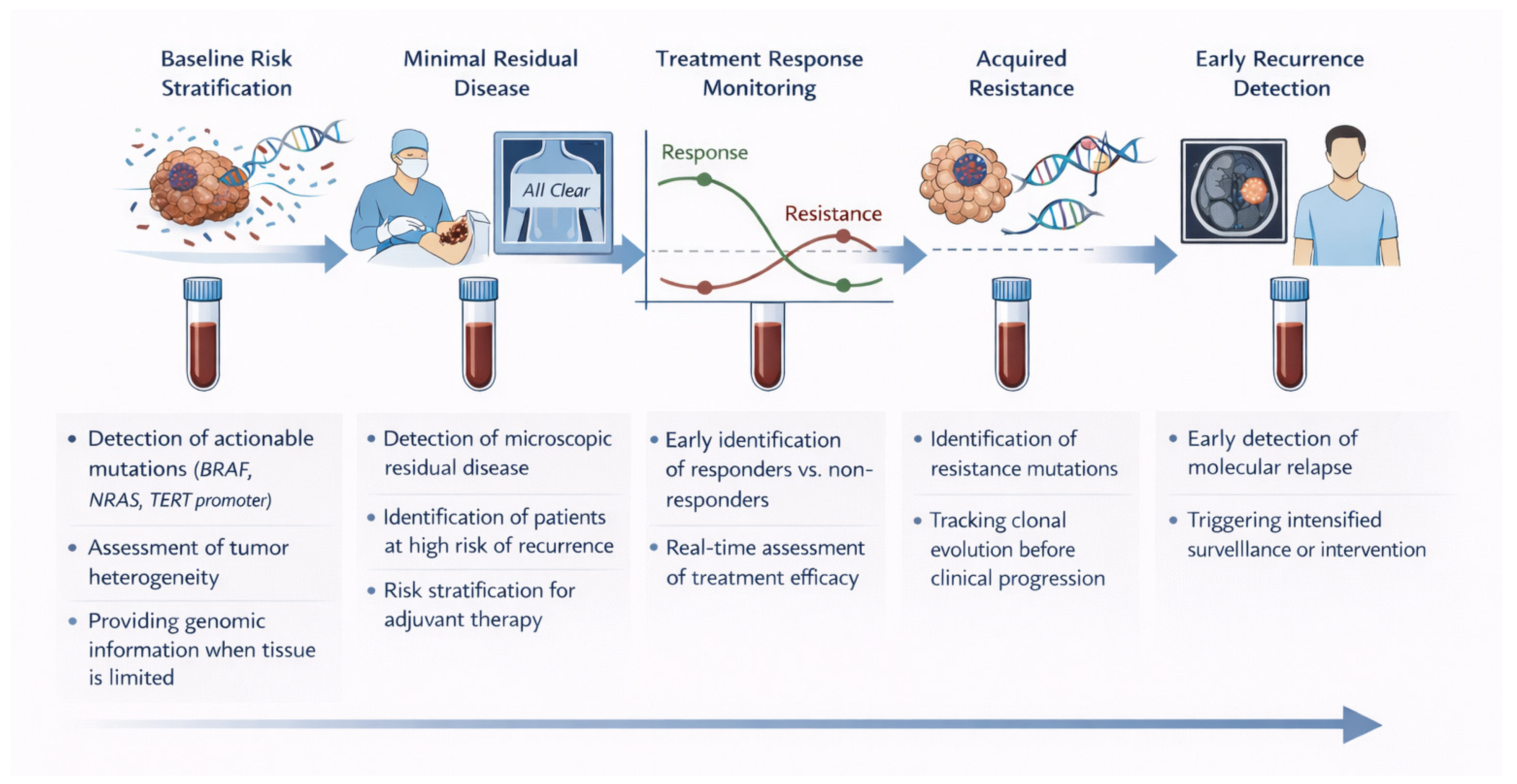
| Clinical Context | Application of ctDNA | Clinical Utility | Key Limitations | Representative References |
|---|---|---|---|---|
| Initial diagnosis and molecular profiling | Detection of driver mutations (e.g., BRAF, NRAS, TERT promoter) | Non-invasive identification of actionable mutations when tissue is unavailable or insufficient; assessment of tumor heterogeneity | Limited sensitivity in low-tumor-burden disease; cannot replace histopathology | [11,26] |
| Baseline risk stratification (advanced disease) | Quantification of baseline ctDNA levels | Prognostic stratification for progression-free and overall survival; correlation with tumor burden | Variability in shedding by metastatic site; lack of standardized cut-offs | [21,34] |
| Treatment response monitoring | Serial ctDNA measurements during systemic therapy | Early identification of responders and non-responders; real-time assessment of therapeutic efficacy | Transient fluctuations may occur; interpretation requires longitudinal trends | [14,35] |
| Detection of acquired resistance | Identification of emerging resistance mutations | Early molecular detection of treatment resistance before radiologic progression | Requires broad sequencing panels; higher cost and technical complexity | [27,36] |
| Minimal residual disease after surgery | Postoperative ctDNA detection | Identification of residual microscopic disease; strong prediction of recurrence risk | False negatives in early-stage disease; limited sensitivity with low ctDNA levels | [15,37] |
| Recurrence surveillance | Longitudinal ctDNA monitoring after definitive therapy | Earlier detection of relapse compared with imaging; enables pre-emptive clinical intervention | Optimal surveillance intervals not yet standardized | [38,39] |
| Distinguishing true progression from pseudoprogression | ctDNA kinetics during immunotherapy | Supports differentiation between immune-related pseudoprogression and true disease progression | Not reliable in isolated intracranial disease | [17,40] |
| Integration with imaging and AI | Combined ctDNA, radiomics, and ML models | Improved risk stratification, response prediction, and adaptive treatment decisions | Requires validation, interoperability, and clinical workflow integration | [41,42] |
| Study/Trial | Disease Stage | ctDNA Methodology | Number of Patients | Clinical Application | Key Findings | Reference |
|---|---|---|---|---|---|---|
| COMBI-AD biomarker analysis | Resected stage III (BRAF V600) | ddPCR (BRAF V600) | 870 | Prognosis; MRD | Baseline ctDNA positivity associated with significantly worse recurrence-free survival and overall survival | [37] |
| KEYNOTE-942 (ctDNA analysis) | Resected high-risk melanoma | Tumor-informed NGS (bespoke) | 157 | MRD; recurrence prediction | Baseline ctDNA positivity strongly associated with early recurrence; ctDNA-negative patients showed prolonged recurrence-free survival | [57] |
| Longitudinal MRD monitoring study | Stage I–III melanoma after surgery | Tumor-informed NGS | 66 | MRD detection | ctDNA re-emergence preceded radiologic recurrence by a median of ~ 3–5 months | [38] |
| Longitudinal ctDNA surveillance | Resected stage II–III melanoma | Tumor-informed NGS | 69 | MRD; surveillance | Postoperative ctDNA positivity predicted recurrence with high specificity | [39] |
| Anti–PD-1 monitoring (multicenter retrospective) | Stage III–IV | ddPCR and NGS | 142 | Treatment response | Early ctDNA clearance associated with improved progression-free and overall survival | [51] |
| Anti–PD-1 early kinetics study | Metastatic melanoma | ddPCR | 49 | Early resistance detection | Rising ctDNA within 2–4 weeks predicted poor response and survival | [49] |
| Tebentafusp phase II trial (uveal melanoma) | Metastatic uveal melanoma | ddPCR/NGS | 127 | Response monitoring | Early ctDNA decline correlated with overall survival, outperforming RECIST | [52] |
| DETECTION trial (ongoing) | Stage IIB–IIC post-surgery | Tumor-informed ctDNA | Planned ~500 | ctDNA-guided therapy | Randomized trial testing early intervention based on ctDNA positivity | [60] |
| Disease Stage | Biomarker | Sample Type | Clinical Application | Strength of Evidence | Key Limitations | Representative References |
|---|---|---|---|---|---|---|
| Early-stage melanoma | ctDNA (tumor-informed NGS) | Plasma | Detection of minimal residual disease; recurrence risk stratification | High (prospective studies and meta-analyses) | Limited sensitivity at very low tumor burden; false negatives possible | [15,39] |
| Early-stage melanoma | S100B | Serum | Prognostic marker during follow-up | Moderate | Low sensitivity and specificity; limited MRD utility | [9] |
| Early-stage melanoma | LDH | Serum | Baseline prognostic marker | Low | Poor sensitivity in early disease; non-specific | [10] |
| Advanced-stage melanoma | ctDNA kinetics | Plasma | Treatment response monitoring; early resistance detection | High | Variability by metastatic site; requires serial sampling | [14,35] |
| Advanced-stage melanoma | LDH | Serum | Prognosis; disease burden estimation | Moderate | Limited dynamic sensitivity; late marker | [34] |
| Advanced-stage melanoma | Radiomics | Imaging-derived | Response prediction; outcome stratification | Emerging | Requires validation and standardization | [61] |
| Recurrent melanoma | ctDNA re-emergence | Plasma | Early detection of molecular relapse | High | Reduced sensitivity in isolated intracranial disease | [17,38] |
| Recurrent melanoma | ctDNA clearance | Plasma | Assessment of treatment efficacy | High | Interpretation requires longitudinal trends | [51] |
| Recurrent melanoma | Circulating tumor cells | Whole blood | Cellular characterization of relapse | Low-moderate | Low detection rate; technical complexity | [6] |
Disclaimer/Publisher’s Note: The statements, opinions and data contained in all publications are solely those of the individual author(s) and contributor(s) and not of MDPI and/or the editor(s). MDPI and/or the editor(s) disclaim responsibility for any injury to people or property resulting from any ideas, methods, instructions or products referred to in the content. |
© 2026 by the authors. Licensee MDPI, Basel, Switzerland. This article is an open access article distributed under the terms and conditions of the Creative Commons Attribution (CC BY) license.
Share and Cite
Charbel, N.; Rizkallah, J.; Bal, M.N.; El Masri, A.; Armache, E.; Ghezzawi, M.; Awada, A.; Kreidieh, L.; Mehdi, J.; Kreidieh, F. Circulating Tumor DNA in Melanoma: Advances in Detection, Clinical Applications, and Integration with Emerging Technologies. Int. J. Mol. Sci. 2026, 27, 1569. https://doi.org/10.3390/ijms27031569
Charbel N, Rizkallah J, Bal MN, El Masri A, Armache E, Ghezzawi M, Awada A, Kreidieh L, Mehdi J, Kreidieh F. Circulating Tumor DNA in Melanoma: Advances in Detection, Clinical Applications, and Integration with Emerging Technologies. International Journal of Molecular Sciences. 2026; 27(3):1569. https://doi.org/10.3390/ijms27031569
Chicago/Turabian StyleCharbel, Nicole, Joe Rizkallah, Mark Nicolas Bal, Amal El Masri, Elsa Armache, Malak Ghezzawi, Ali Awada, Lara Kreidieh, Jad Mehdi, and Firas Kreidieh. 2026. "Circulating Tumor DNA in Melanoma: Advances in Detection, Clinical Applications, and Integration with Emerging Technologies" International Journal of Molecular Sciences 27, no. 3: 1569. https://doi.org/10.3390/ijms27031569
APA StyleCharbel, N., Rizkallah, J., Bal, M. N., El Masri, A., Armache, E., Ghezzawi, M., Awada, A., Kreidieh, L., Mehdi, J., & Kreidieh, F. (2026). Circulating Tumor DNA in Melanoma: Advances in Detection, Clinical Applications, and Integration with Emerging Technologies. International Journal of Molecular Sciences, 27(3), 1569. https://doi.org/10.3390/ijms27031569