Gut Microbiota Dysbiosis in Depression: Pathological Correlations, Molecular Pathways, and Therapeutic Interventions


Abstract
1. Introduction
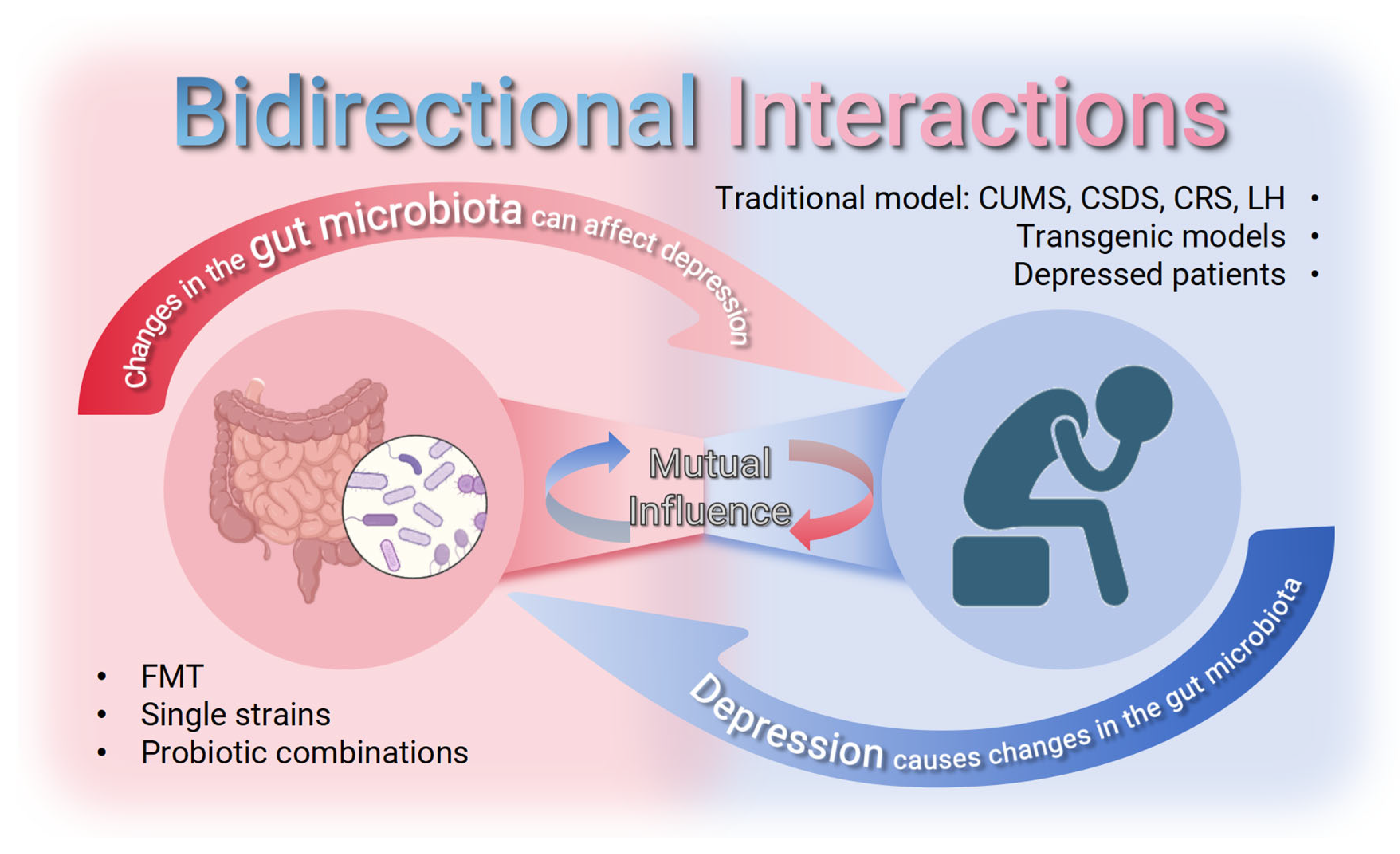
2. Bidirectional Interactions Between GM and MDD in Both Directions
2.1. Changes in GM Occurred in Depressed Model Animals and Depressed Patients
2.2. Alterations of GM Can Affect Depressive States
2.3. GM and Depression Interact with Each Other
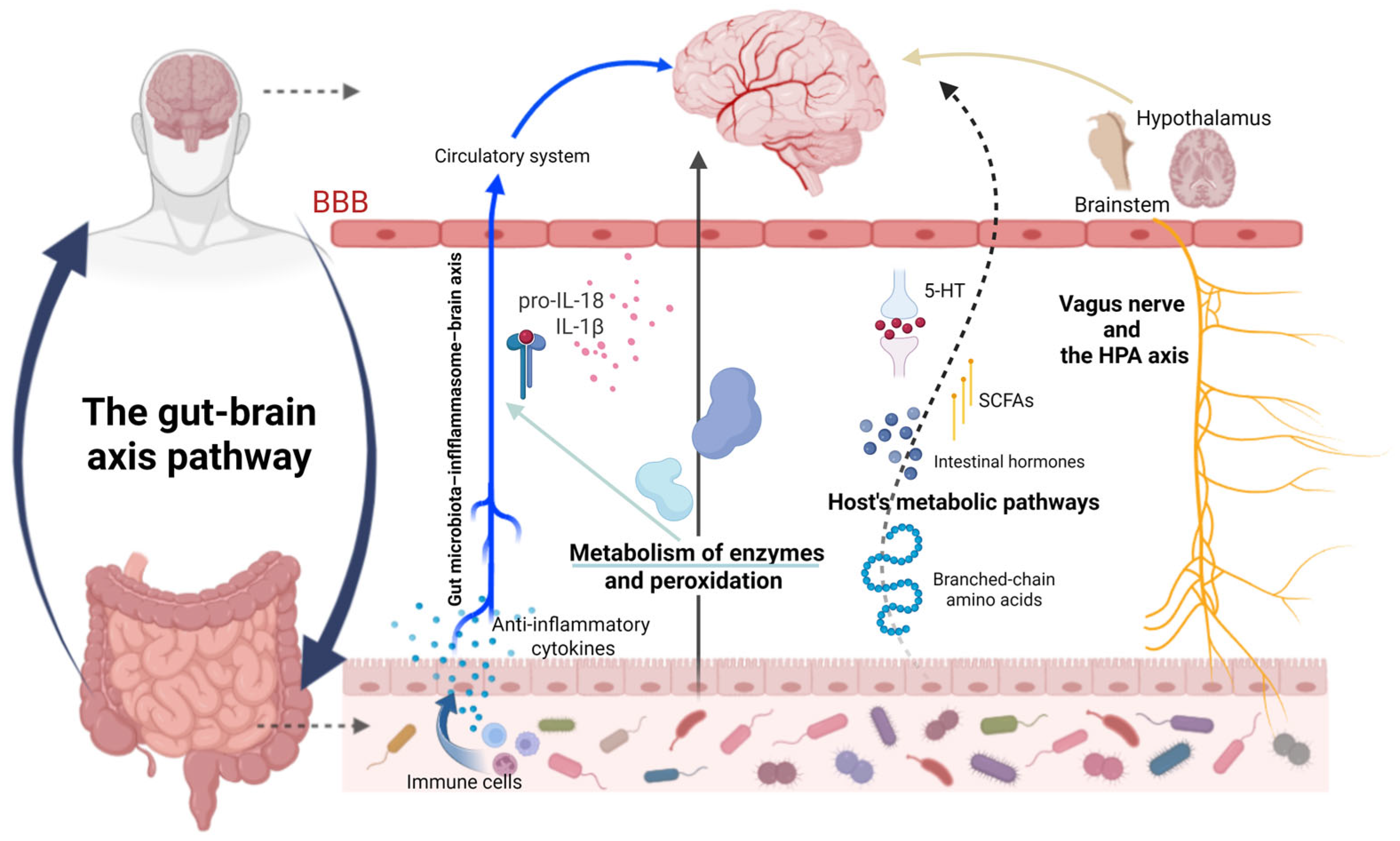
3. The Mechanism by Which the GM Acts on Depression
3.1. The GM Influences Depression Through the Vagus Nerve and the HPA Axis
3.2. The GM Influences Depression Through Inflammatory Pathways
3.3. The GM Influences Depression via Host’s Metabolic Pathways
3.4. The Intestinal Microbiota Influences Depression Through the Metabolism of Enzymes and Energy Metabolism
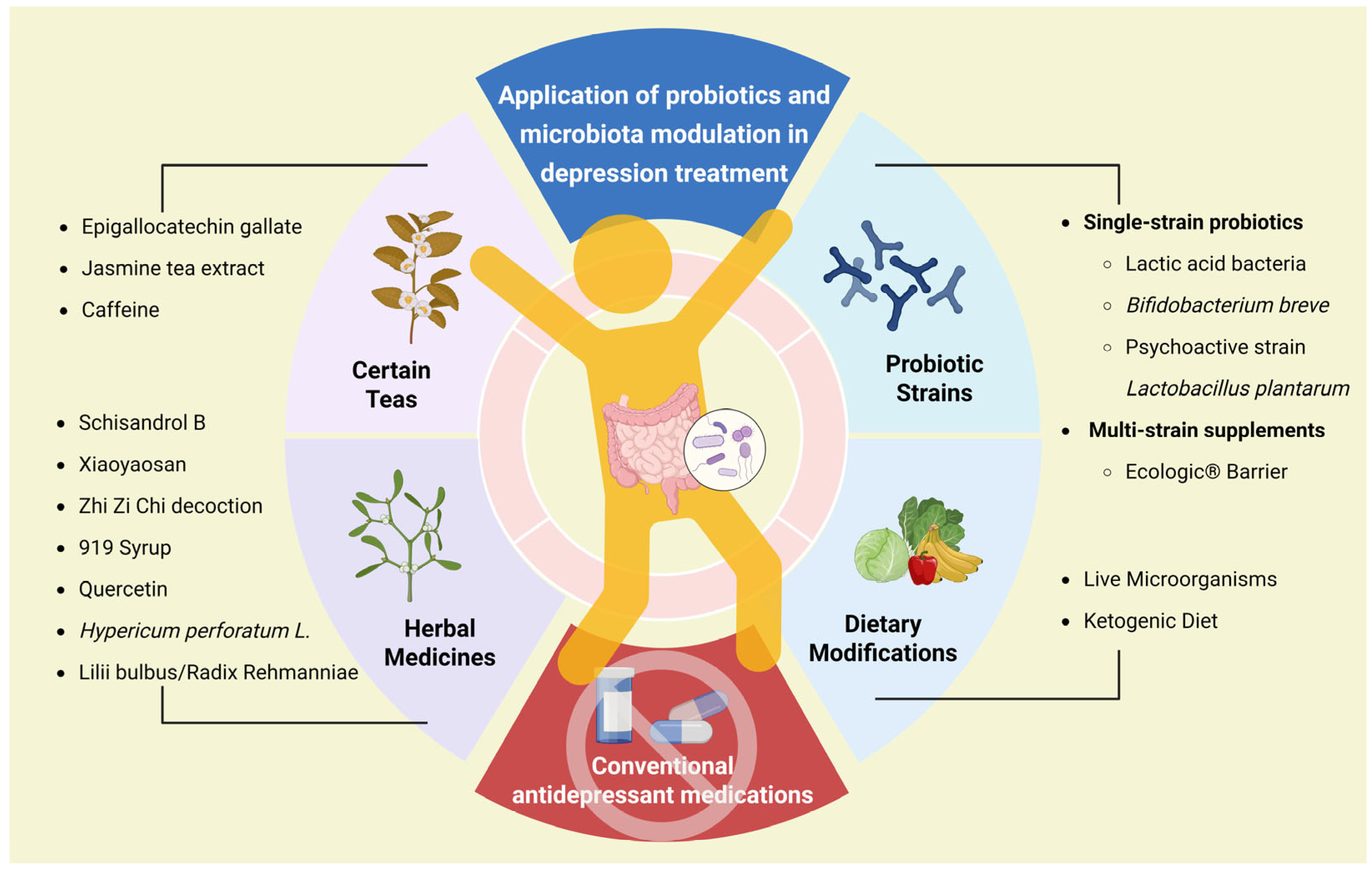
4. Application of Probiotics and Microbiota Modulation in Depression Treatment
4.1. Multiple Probiotics and Prebiotics Have Been Applied in the Treatment of Depression
4.2. Traditional Herbal Medicines, Specific Foods, and Dietary Patterns Can Ameliorate Depressive Symptoms Through Modulation of the GM
5. Application of GM in the Diagnosis of Depression
6. Deficiencies and Prospects
Author Contributions
Funding
Institutional Review Board Statement
Informed Consent Statement
Data Availability Statement
Conflicts of Interest
References
- Marx, W.; Penninx, B.; Solmi, M.; Furukawa, T.A.; Firth, J.; Carvalho, A.F.; Berk, M. Major depressive disorder. Nat. Rev. Dis. Primers. 2023, 9, 44. [Google Scholar] [CrossRef]
- Eken, H.N.; Dee, E.C.; Powers, A.R.; Jordan, A. Racial and ethnic differences in perception of provider cultural competence among patients with depression and anxiety symptoms: A retrospective, population-based, cross-sectional analysis. Lancet Psychiatry 2021, 8, 957–968. [Google Scholar] [CrossRef] [PubMed]
- McCarron, R.M.; Shapiro, B.; Rawles, J.; Luo, J. Depression. Ann. Intern. Med. 2021, 174, C65–C80. [Google Scholar] [CrossRef] [PubMed]
- Rush, A.J.; Trivedi, M.H.; Wisniewski, S.R.; Nierenberg, A.A.; Stewart, J.W.; Warden, D.; Niederehe, G.; Thase, M.E.; Lavori, P.W.; Lebowitz, B.D.; et al. Acute and longer-term outcomes in depressed outpatients requiring one or several treatment steps: A STAR*D report. Am. J. Psychiatry 2006, 163, 1905–1917. [Google Scholar] [CrossRef] [PubMed]
- Katon, W.; Lin, E.H.; Kroenke, K. The association of depression and anxiety with medical symptom burden in patients with chronic medical illness. Gen. Hosp. Psychiatry 2007, 29, 147–155. [Google Scholar] [CrossRef]
- Dantzer, R. Cytokine, sickness behavior, and depression. Neurol. Clin. 2006, 24, 441–460. [Google Scholar] [CrossRef]
- Evrensel, A.; Ceylan, M.E. The Gut-Brain Axis: The Missing Link in Depression. Clin. Psychopharmacol. Neurosci. 2015, 13, 239–244. [Google Scholar] [CrossRef]
- Ridaura, V.; Belkaid, Y. Gut microbiota: The link to your second brain. Cell 2015, 161, 193–194. [Google Scholar] [CrossRef]
- Luqman, A.; He, M.; Hassan, A.; Ullah, M.; Zhang, L.; Rashid, K.M.; Din, A.U.; Ullah, K.; Wang, W.; Wang, G. Mood and microbes: A comprehensive review of intestinal microbiota’s impact on depression. Front. Psychiatry 2024, 15, 1295766. [Google Scholar] [CrossRef]
- Eckburg, P.B.; Bik, E.M.; Bernstein, C.N.; Purdom, E.; Dethlefsen, L.; Sargent, M.; Gill, S.R.; Nelson, K.E.; Relman, D.A. Diversity of the human intestinal microbial flora. Science 2005, 308, 1635–1638. [Google Scholar] [CrossRef]
- Iannone, L.F.; Preda, A.; Blottière, H.M.; Clarke, G.; Albani, D.; Belcastro, V.; Carotenuto, M.; Cattaneo, A.; Citraro, R.; Ferraris, C.; et al. Microbiota-gut brain axis involvement in neuropsychiatric disorders. Expert. Rev. Neurother. 2019, 19, 1037–1050. [Google Scholar] [CrossRef]
- Van de Wouw, M.; Boehme, M.; Dinan, T.G.; Cryan, J.F. Monocyte mobilisation, microbiota & mental illness. Brain Behav. Immun. 2019, 81, 74–91. [Google Scholar]
- Cao, Y.; Cheng, Y.; Pan, W.; Diao, J.; Sun, L.; Meng, M. Gut microbiota variations in depression and anxiety: A systematic review. Bmc Psychiatry 2025, 25, 443. [Google Scholar] [CrossRef] [PubMed]
- Lai, Y.; Xiong, P. Analysis of gut microbiota and depression and anxiety: Mendelian randomization from three datasets. Gen. Hosp. Psychiatry 2025, 94, 206–218. [Google Scholar] [CrossRef] [PubMed]
- Li, J.; Hu, X.; Tao, X.; Li, Y.; Jiang, W.; Zhao, M.; Ma, Z.; Chen, B.; Sheng, S.; Tong, J.; et al. Deconstruct the link between gut microbiota and neurological diseases: Application of Mendelian randomization analysis. Front. Cell. Infect. Microbiol. 2025, 15, 1433131. [Google Scholar] [CrossRef] [PubMed]
- Butler, M.I.; Bastiaanssen, T.; Long-Smith, C.; Morkl, S.; Berding, K.; Ritz, N.L.; Strain, C.; Patangia, D.; Patel, S.; Stanton, C.; et al. The gut microbiome in social anxiety disorder: Evidence of altered composition and function. Transl. Psychiatry 2023, 13, 95. [Google Scholar] [CrossRef]
- Sudo, N.; Chida, Y.; Aiba, Y.; Sonoda, J.; Oyama, N.; Yu, X.N.; Kubo, C.; Koga, Y. Postnatal microbial colonization programs the hypothalamic-pituitary-adrenal system for stress response in mice. J. Physiol. Lond. 2004, 558, 263–275. [Google Scholar] [CrossRef]
- Neufeld, K.M.; Kang, N.; Bienenstock, J.; Foster, J.A. Reduced anxiety-like behavior and central neurochemical change in germ-free mice. Neurogastroenterol. Motil. 2011, 23, 255–264.e119. [Google Scholar] [CrossRef]
- Diaz, H.R.; Wang, S.; Anuar, F.; Qian, Y.; Björkholm, B.; Samuelsson, A.; Hibberd, M.L.; Forssberg, H.; Pettersson, S. Normal gut microbiota modulates brain development and behavior. Proc. Natl. Acad. Sci. USA 2011, 108, 3047–3052. [Google Scholar]
- Bercik, P.; Denou, E.; Collins, J.; Jackson, W.; Lu, J.; Jury, J.; Deng, Y.; Blennerhassett, P.; Macri, J.; McCoy, K.D.; et al. The intestinal microbiota affect central levels of brain-derived neurotropic factor and behavior in mice. Gastroenterology 2011, 141, 599–609. [Google Scholar] [CrossRef]
- Li, B.; Guo, K.; Zeng, L.; Zeng, B.; Huo, R.; Luo, Y.; Liu, Z.; Fang, L.; Wei, H.; Xie, P. Metabolite identification in fecal microbiota transplantation mouse livers and combined proteomics with chronic unpredictive mild stress mouse livers. Transl. Psychiatry 2018, 8, 34. [Google Scholar] [CrossRef]
- Bravo, J.A.; Forsythe, P.; Chew, M.V.; Escaravage, E.; Savignac, H.M.; Dinan, T.G.; Bienenstock, J.; Cryan, J.F. Ingestion of Lactobacillus strain regulates emotional behavior and central GABA receptor expression in a mouse via the vagus nerve. Proc. Natl. Acad. Sci. USA 2011, 108, 16050–16055. [Google Scholar] [CrossRef] [PubMed]
- Gacias, M.; Gaspari, S.; Santos, P.M.; Tamburini, S.; Andrade, M.; Zhang, F.; Shen, N.; Tolstikov, V.; Kiebish, M.A.; Dupree, J.L.; et al. Microbiota-driven transcriptional changes in prefrontal cortex override genetic differences in social behavior. eLife 2016, 5, e13442. [Google Scholar] [CrossRef] [PubMed]
- Guida, F.; Turco, F.; Iannotta, M.; De Gregorio, D.; Palumbo, I.; Sarnelli, G.; Furiano, A.; Napolitano, F.; Boccella, S.; Luongo, L.; et al. Antibiotic-induced microbiota perturbation causes gut endocannabinoidome changes, hippocampal neuroglial reorganization and depression in mice. Brain Behav. Immun. 2018, 67, 230–245. [Google Scholar] [CrossRef]
- Huang, D. Huang Di Nei Jing Su Wen: The Yellow Emperor’s Classic of Internal Medicine; University of California Press: Berkeley, CA, USA, 2002; pp. 120–122. [Google Scholar]
- Drossman, D.A. Presidential address: Gastrointestinal illness and the biopsychosocial model. Psychosom. Med. 1998, 60, 258–267. [Google Scholar] [CrossRef]
- Zheng, P.; Zeng, B.; Zhou, C.; Liu, M.; Fang, Z.; Xu, X.; Zeng, L.; Chen, J.; Fan, S.; Du, X.; et al. Gut microbiome remodeling induces depressive-like behaviors through a pathway mediated by the host’s metabolism. Mol. Psychiatry 2016, 21, 786–796. [Google Scholar] [CrossRef] [PubMed]
- Kelly, J.R.; Borre, Y.; O’Brien, C.; Patterson, E.; El Aidy, S.; Deane, J.; Kennedy, P.J.; Beers, S.; Scott, K.; Moloney, G.; et al. Transferring the blues: Depression-associated gut microbiota induces neurobehavioural changes in the rat. J. Psychiatr. Res. 2016, 82, 109–118. [Google Scholar] [CrossRef]
- Liu, L.; Wang, H.; Chen, X.; Zhang, Y.; Zhang, H.; Xie, P. Gut microbiota and its metabolites in depression: From pathogenesis to treatment. eBiomedicine 2023, 90, 104527. [Google Scholar] [CrossRef]
- Zhang, Y.; Huang, R.; Cheng, M.; Wang, L.; Chao, J.; Li, J.; Zheng, P.; Xie, P.; Zhang, Z.; Yao, H. Gut microbiota from NLRP3-deficient mice ameliorates depressive-like behaviors by regulating astrocyte dysfunction via circHIPK. Microbiome 2019, 7, 116. [Google Scholar] [CrossRef]
- Sun, L.; Zhang, H.; Cao, Y.; Wang, C.; Zhao, C.; Wang, H.; Cui, G.; Wang, M.; Pan, Y.; Shi, Y.; et al. Fluoxetine ameliorates dysbiosis in a depression model induced by chronic unpredicted mild stress in mice. Int. J. Med. Sci. 2019, 16, 1260–1270. [Google Scholar] [CrossRef]
- Marin, I.A.; Goertz, J.E.; Ren, T.; Rich, S.S.; Onengut-Gumuscu, S.; Farber, E.; Wu, M.; Overall, C.C.; Kipnis, J.; Gaultier, A. Microbiota alteration is associated with the development of stress-induced despair behavior. Sci. Rep. 2017, 7, 43859. [Google Scholar] [CrossRef]
- Li, H.; Xiang, Y.; Zhu, Z.; Wang, W.; Jiang, Z.; Zhao, M.; Cheng, S.; Pan, F.; Liu, D.; Ho, R.C.M.; et al. Rifaximin-mediated gut microbiota regulation modulates the function of microglia and protects against CUMS-induced depression-like behaviors in adolescent rat. J. Neuroinflamm. 2021, 18, 254. [Google Scholar] [CrossRef]
- He, H.; He, H.; Mo, L.; You, Z.; Zhang, J. Priming of microglia with dysfunctional gut microbiota impairs hippocampal neurogenesis and fosters stress vulnerability of mice. Brain Behav. Immun. 2024, 115, 280–294. [Google Scholar] [CrossRef] [PubMed]
- Hong, R.; Luo, L.; Wang, L.; Hu, Z.L.; Yin, Q.R.; Li, M.; Gu, B.; Wang, B.; Zhuang, T.; Zhang, X.Y.; et al. Lepidium meyenii Walp (Maca)-derived extracellular vesicles ameliorate depression by promoting 5-HT synthesis via the modulation of gut-brain axis. Imeta 2023, 2, e116, Erratum in Imeta 2024, 3, e259. https://doi.org/10.1002/imt2.259. [Google Scholar] [CrossRef] [PubMed]
- Hao, W.; Ma, Q.; Wang, L.; Yuan, N.; Gan, H.; He, L.; Li, X.; Huang, J.; Chen, J. Gut dysbiosis induces the development of depression-like behavior through abnormal synapse pruning in microglia-mediated by complement C3. Microbiome 2024, 12, 34. [Google Scholar] [CrossRef] [PubMed]
- Zhao, M.; Ren, Z.; Zhao, A.; Tang, Y.; Kuang, J.; Li, M.; Chen, T.; Wang, S.; Wang, J.; Zhang, H.; et al. Gut bacteria-driven homovanillic acid alleviates depression by modulating synaptic integrity. Cell Metab. 2024, 36, 1000–1012. [Google Scholar] [CrossRef]
- Li, J.; Jia, X.; Wang, C.; Wu, C.; Qin, X. Altered gut metabolome contributes to depression-like behaviors in rats exposed to chronic unpredictable mild stress. Transl. Psychiatry 2019, 9, 40, Erratum in Transl. Psychiatry 2019, 9, 275. https://doi.org/10.1038/s41398-019-0645-9. [Google Scholar]
- Yan, H.C.; Cao, X.; Das, M.; Zhu, X.H.; Gao, T.M. Behavioral animal models of depression. Neurosci. Bull. 2010, 26, 327–337. [Google Scholar] [CrossRef]
- Zhang, J.C.; Yao, W.; Dong, C.; Yang, C.; Ren, Q.; Ma, M.; Hashimoto, K. Blockade of interleukin-6 receptor in the periphery promotes rapid and sustained antidepressant actions: A possible role of gut-microbiota-brain axis. Transl. Psychiatry 2017, 7, e1138. [Google Scholar] [CrossRef]
- Deng, Y.; Zhou, M.; Wang, J.; Yao, J.; Yu, J.; Liu, W.; Wu, L.; Wang, J.; Gao, R. Involvement of the microbiota-gut-brain axis in chronic restraint stress: Disturbances of the kynurenine metabolic pathway in both the gut and brain. Gut Microbes 2021, 13, 1–16. [Google Scholar] [CrossRef]
- Zhang, K.; Fujita, Y.; Chang, L.; Qu, Y.; Pu, Y.; Wang, S.; Shirayama, Y.; Hashimoto, K. Abnormal composition of gut microbiota is associated with resilience versus susceptibility to inescapable electric stress. Transl. Psychiatry 2019, 9, 231. [Google Scholar] [CrossRef] [PubMed]
- Takajo, T.; Tomita, K.; Tsuchihashi, H.; Enomoto, S.; Tanichi, M.; Toda, H.; Okada, Y.; Furuhashi, H.; Sugihara, N.; Wada, A.; et al. Depression Promotes the Onset of Irritable Bowel Syndrome Through Unique Dysbiosis in Rats. Gut Liver 2019, 13, 325–332. [Google Scholar] [CrossRef] [PubMed]
- Galley, J.D.; Mashburn-Warren, L.; Blalock, L.C.; Lauber, C.L.; Carroll, J.E.; Ross, K.M.; Hobel, C.; Coussons-Read, M.; Dunkel Schetter, C.; Gur, T.L. Maternal anxiety, depression and stress affects offspring gut microbiome diversity and bifidobacterial abundances. Brain Behav. Immun. 2023, 107, 253–264. [Google Scholar] [CrossRef] [PubMed]
- Flint, J.; Kendler, K.S. The genetics of major depression. Neuron 2014, 81, 484–503. [Google Scholar] [CrossRef]
- Pu, Y.; Tan, Y.; Qu, Y.; Chang, L.; Wang, S.; Wei, Y.; Wang, X.; Hashimoto, K. A role of the subdiaphragmatic vagus nerve in depression-like phenotypes in mice after fecal microbiota transplantation from Chrna7 knock-out mice with depression-like phenotypes. Brain Behav. Immun. 2021, 94, 318–326. [Google Scholar] [CrossRef]
- Cheng, L.; Wu, H.; Cai, X.; Zhang, Y.; Yu, S.; Hou, Y.; Yin, Z.; Yan, Q.; Wang, Q.; Sun, T.; et al. A Gpr35-tuned gut microbe-brain metabolic axis regulates depressive-like behavior. Cell Host Microbe 2024, 32, 227–243. [Google Scholar] [CrossRef]
- Hwang, H.G.; Park, J.W.; Lee, H.J.; Ko, M.Y.; Ka, M.; Lee, Y.K.; Choi, J.; In, S.A.; Lee, Y.E.; Lee, S.; et al. Akkermansia muciniphila reverses neuronal atrophy in Negr1 knockout mice with depression-like phenotypes. Gut Microbes 2025, 17, 2508424. [Google Scholar] [CrossRef]
- Yang, Y.; Eguchi, A.; Mori, C.; Hashimoto, K. Splenic nerve denervation attenuates depression-like behaviors in Chrna7 knock-out mice via the spleen-gut-brain axis. J. Affect. Disord. 2024, 362, 114–125. [Google Scholar] [CrossRef]
- Tao, Y.; Zhou, H.; Li, Z.; Wu, H.; Wu, F.; Miao, Z.; Shi, H.; Huang, F.; Wu, X. TGR5 deficiency-induced anxiety and depression-like behaviors: The role of gut microbiota dysbiosis. J. Affect. Disord. 2024, 344, 219–232. [Google Scholar] [CrossRef]
- Hernandez-Cacho, A.; Garcia-Gavilan, J.F.; Atzeni, A.; Konstanti, P.; Belzer, C.; Vioque, J.; Corella, D.; Fitó, M.; Vidal, J.; Mela, V.; et al. Multi-omics approach identifies gut microbiota variations associated with depression. npj Biofilms Microbiomes 2025, 11, 68. [Google Scholar] [CrossRef]
- Kouraki, A.; Kelly, A.; Vijay, A.; Gohir, S.; Astbury, S.; Georgopoulos, V.; Millar, B.; Walsh, D.A.; Ferguson, E.; Menni, C.; et al. Reproducible microbiome composition signatures of anxiety and depressive symptoms. Comput. Struct. Biotechnol. J. 2023, 21, 5326–5336. [Google Scholar] [CrossRef] [PubMed]
- Tremaroli, V.; Bäckhed, F. Functional interactions between the gut microbiota and host metabolism. Nature 2012, 489, 242–249. [Google Scholar] [CrossRef] [PubMed]
- Guo, F.; Jing, L.; Xu, Y.; Zhang, K.; Li, Y.; Sun, N.; Liu, P.; Zhang, H. Gut microbiota and inflammatory factor characteristics in major depressive disorder patients with anorexia. BMC Psychiatry 2024, 24, 334. [Google Scholar] [CrossRef] [PubMed]
- Jiang, H.; Ling, Z.; Zhang, Y.; Mao, H.; Ma, Z.; Yin, Y.; Wang, W.; Tang, W.; Tan, Z.; Shi, J.; et al. Altered fecal microbiota composition in patients with major depressive disorder. Brain Behav. Immun. 2015, 48, 186–194. [Google Scholar] [CrossRef]
- Naseribafrouei, A.; Hestad, K.; Avershina, E.; Sekelja, M.; Linløkken, A.; Wilson, R.; Rudi, K. Correlation between the human fecal microbiota and depression. Neurogastroenterol. Motil. 2014, 26, 1155–1162. [Google Scholar] [CrossRef]
- Zhao, Q.; Baranova, A.; Cao, H.; Zhang, F. Gut microbiome and major depressive disorder: Insights from two-sample Mendelian randomization. BMC Psychiatry 2024, 24, 493. [Google Scholar]
- Xie, Z.; Huang, J.; Sun, G.; He, S.; Luo, Z.; Zhang, L.; Li, L.; Yao, M.; Du, C.; Yu, W.; et al. Integrated multi-omics analysis reveals gut microbiota dysbiosis and systemic disturbance in major depressive disorder. Psychiatry Res. 2024, 334, 115804. [Google Scholar] [CrossRef]
- Radjabzadeh, D.; Bosch, J.A.; Uitterlinden, A.G.; Zwinderman, A.H.; Ikram, M.A.; van Meurs, J.; Luik, A.I.; Nieuwdorp, M.; Lok, A.; van Duijn, C.M.; et al. Gut microbiome-wide association study of depressive symptoms. Nat. Commun. 2022, 13, 7128. [Google Scholar] [CrossRef]
- Liu, P.; Jing, L.; Guo, F.; Xu, Y.; Cheng, J.; Liu, S.; Liu, L.; Liu, Z.; Zhang, K.; Sun, N. Characteristics of gut microbiota and its correlation with hs-CRP and somatic symptoms in first-episode treatment-naive major depressive disorder. J. Affect. Disord. 2024, 356, 664–671. [Google Scholar]
- Hu, X.; Li, Y.; Wu, J.; Zhang, H.; Huang, Y.; Tan, X.; Wen, L.; Zhou, X.; Xie, P.; Olasunkanmi, O.I.; et al. Changes of gut microbiota reflect the severity of major depressive disorder: A cross sectional study. Transl. Psychiatry 2023, 13, 137. [Google Scholar] [CrossRef]
- Gao, M.; Wang, J.; Liu, P.; Tu, H.; Zhang, R.; Zhang, Y.; Sun, N.; Zhang, K. Gut microbiota composition in depressive disorder: A systematic review, meta-analysis, and meta-regression. Transl. Psychiatry 2023, 13, 379. [Google Scholar] [CrossRef]
- Chin, F.C.; Asbury, S.; Jha, M.K.; Minhajuddin, A.; Sethuram, S.; Mayes, T.; Kennedy, S.H.; Foster, J.A.; Trivedi, M.H. Leveraging the microbiome to understand clinical heterogeneity in depression: Findings from the T-RAD study. Transl. Psychiatry 2023, 13, 139. [Google Scholar] [CrossRef] [PubMed]
- Xie, Y.; Zhu, H.; Yuan, Y.; Guan, X.; Xie, Q.; Dong, Z. Baseline gut microbiota profiles affect treatment response in patients with depression. Front. Microbiol. 2024, 15, 1429116. [Google Scholar] [CrossRef] [PubMed]
- Xu, S.; Xiong, J.; Qin, X.; Ma, M.; Peng, Y.; Cheng, J.; Nie, X.; Fan, X.; Deng, Y.; Ju, Y.; et al. Association between gut microbiota and perinatal depression and anxiety among a pregnancy cohort in Hunan, China. Brain Behav. Immun. 2025, 125, 168–177. [Google Scholar] [CrossRef] [PubMed]
- Chi, R.; Li, M.; Zhang, M.; Zhang, N.; Zhang, G.; Cui, L.; Ma, G. Exploring the Association between Anxiety, Depression, and Gut Microbiota during Pregnancy: Findings from a Pregnancy Cohort Study in Shijiazhuang, Hebei Province, China. Nutrients 2024, 16, 1460. [Google Scholar] [CrossRef]
- Xie, T.; Fan, X.; Pang, H.; Zang, T.; Wu, N.; Liu, J.; Li, Z.; Li, S.; Zhu, Q.; Slack, J.E.; et al. Association between gut microbiota and its functional metabolites with prenatal depression in women. Neurobiol. Stress. 2024, 28, 100592. [Google Scholar] [CrossRef]
- Sun, Y.; Fan, C.; Lei, D. Association between gut microbiota and postpartum depression: A bidirectional Mendelian randomization study. J. Affect. Disord. 2024, 362, 615–622. [Google Scholar] [CrossRef]
- Cui, J.; Zhai, Q.; Yang, Z.; Liu, Y. The role of gut microbiota and blood metabolites in postpartum depression: A Mendelian randomization analysis. Front. Cell. Infect. Microbiol. 2024, 14, 1416298. [Google Scholar] [CrossRef]
- Tsai, C.F.; Chuang, C.H.; Tu, P.C.; Chang, W.C.; Wang, Y.P.; Liu, P.Y.; Wu, P.S.; Lin, C.Y.; Lu, C.L. Interaction of the gut microbiota and brain functional connectivity in late-life depression. J. Psychiatry Neurosci. 2024, 49, E289–E300. [Google Scholar] [CrossRef]
- Liu, S.; Wang, Y.; Zhang, Y.; Zeng, L.; Ling, L.; Luo, Y.; Liu, W. The gut microbiota and post-traumatic major depression disorder: Insights from bidirectional two-sample Mendelian randomization. Front. Psychiatry 2024, 15, 1383664. [Google Scholar]
- Guo, Z.; Xiao, S.; Chen, G.; Zhong, S.; Zhong, H.; Sun, S.; Chen, P.; Tang, X.; Yang, H.; Jia, Y.; et al. Disruption of the gut microbiota-inflammation-brain axis in unmedicated bipolar disorder II depression. Transl. Psychiatry 2024, 14, 495. [Google Scholar] [CrossRef]
- Ortega, M.A.; Alvarez-Mon, M.A.; Garcia-Montero, C.; Fraile-Martinez, O.; Monserrat, J.; Martinez-Rozas, L.; Rodríguez-Jiménez, R.; Álvarez-Mon, M.; Lahera, G. Microbiota-gut-brain axis mechanisms in the complex network of bipolar disorders: Potential clinical implications and translational opportunities. Mol. Psychiatry 2023, 28, 2645–2673. [Google Scholar] [CrossRef] [PubMed]
- Brushett, S.; Gacesa, R.; Vich, V.A.; Brandao, G.M.; Andreu-Sanchez, S.; Swarte, J.C.; Klaassen, M.A.Y.; Collij, V.; Sinha, T.; Bolte, L.A.; et al. Gut feelings: The relations between depression, anxiety, psychotropic drugs and the gut microbiome. Gut Microbes 2023, 15, 2281360. [Google Scholar] [CrossRef] [PubMed]
- Wang, G.; Cao, L.; Li, S.; Zhang, M.; Li, Y.; Duan, J.; Li, Y.; Hu, Z.; Wu, J.; Ni, J.; et al. Gut microbiota dysbiosis-mediated ceramides elevation contributes to corticosterone-induced depression by impairing mitochondrial function. npj Biofilms Microbiomes 2024, 10, 111. [Google Scholar] [CrossRef] [PubMed]
- Pearson-Leary, J.; Zhao, C.; Bittinger, K.; Eacret, D.; Luz, S.; Vigderman, A.S.; Dayanim, G.; Bhatnagar, S. The gut microbiome regulates the increases in depressive-type behaviors and in inflammatory processes in the ventral hippocampus of stress vulnerable rats. Mol. Psychiatry 2020, 25, 1068–1079. [Google Scholar] [CrossRef]
- Xu, Q.; Sun, L.; Chen, Q.; Jiao, C.; Wang, Y.; Li, H.; Xie, J.; Zhu, F.; Wang, J.; Zhang, W.; et al. Gut microbiota dysbiosis contributes to depression-like behaviors via hippocampal NLRP3-mediated neuroinflammation in a postpartum depression mouse model. Brain Behav. Immun. 2024, 119, 220–235. [Google Scholar] [CrossRef]
- Koopman, M.; El, A.S. Depressed gut? The microbiota-diet-inflammation trialogue in depression. Curr. Opin. Psychiatry 2017, 30, 369–377. [Google Scholar] [CrossRef]
- Mohajeri, M.H.; La Fata, G.; Steinert, R.E.; Weber, P. Relationship between the gut microbiome and brain function. Nutr. Rev. 2018, 76, 481–496. [Google Scholar] [CrossRef]
- Zhang, H.; Wei, H.; Qin, X.; Song, H.; Yang, M.; Zhang, L.; Liu, Y.; Wang, Z.; Zhang, Y.; Lai, Y.; et al. Is anxiety and depression transmissible? Depressed mother rats transmit anxiety- and depression-like phenotypes to cohabited rat pups through gut microbiota assimilation. J. Affect. Disord. 2024, 366, 124–135. [Google Scholar] [CrossRef]
- Green, J.E.; Berk, M.; Mohebbi, M.; Loughman, A.; McGuinness, A.J.; Castle, D.; Chatterton, M.L.; Perez, J.; Strandwitz, P.; Athan, E.; et al. Feasibility, Acceptability, and Safety of Faecal Microbiota Transplantation in the Treatment of Major Depressive Disorder: A Pilot Randomized Controlled Trial. Can. J. Psychiatry-Rev. Can. Psychiatr. 2023, 68, 315–326. [Google Scholar] [CrossRef]
- Zhang, Q.; Bi, Y.; Zhang, B.; Jiang, Q.; Mou, C.K.; Lei, L.; Deng, Y.; Li, Y.; Yu, J.; Liu, W.; et al. Current landscape of fecal microbiota transplantation in treating depression. Front. Immunol. 2024, 15, 1416961. [Google Scholar] [CrossRef]
- McVey, N.K.; Kay, S.; Bienenstock, J. Mouse Strain Affects Behavioral and Neuroendocrine Stress Responses Following Administration of Probiotic Lactobacillus rhamnosus JB-1 or Traditional Antidepressant Fluoxetine. Front. Neurosci. 2018, 12, 294. [Google Scholar] [CrossRef] [PubMed]
- Feng, J.; Cen, Q.; Cui, Y.; Hu, X.; Li, M.; Wang, L.; Wei, J.; Sun, N.; Wang, J.; Zhang, A. Lactobacillus rhamnosus: An emerging probiotic with therapeutic potential for depression. Pharmacol. Res. 2025, 211, 107541. [Google Scholar] [CrossRef] [PubMed]
- Liang, S.; Wang, T.; Hu, X.; Luo, J.; Li, W.; Wu, X.; Duan, Y.; Jin, F. Administration of Lactobacillus helveticus NS8 improves behavioral, cognitive, and biochemical aberrations caused by chronic restraint stress. Neuroscience 2015, 310, 561–577. [Google Scholar] [CrossRef] [PubMed]
- Xie, S.; Wang, C.; Song, J.; Zhang, Y.; Wang, H.; Chen, X.; Suo, H. Lacticaseibacillus rhamnosus KY16 Improves Depression by Promoting Intestinal Secretion of 5-HTP and Altering the Gut Microbiota. J. Agric. Food Chem. 2024, 72, 21560–21573. [Google Scholar] [CrossRef]
- Alatan, H.; Liang, S.; Shimodaira, Y.; Wu, X.; Hu, X.; Wang, T.; Luo, J.; Iijima, K.; Jin, F. Supplementation with Lactobacillus helveticus NS8 alleviated behavioral, neural, endocrine, and microbiota abnormalities in an endogenous rat model of depression. Front. Immunol. 2024, 15, 1407620. [Google Scholar] [CrossRef]
- Yang, C.; Fujita, Y.; Ren, Q.; Ma, M.; Dong, C.; Hashimoto, K. Bifidobacterium in the gut microbiota confer resilience to chronic social defeat stress in mice. Sci. Rep. 2017, 7, 45942. [Google Scholar] [CrossRef]
- Desbonnet, L.; Garrett, L.; Clarke, G.; Kiely, B.; Cryan, J.F.; Dinan, T.G. Effects of the probiotic Bifidobacterium infantis in the maternal separation model of depression. Neuroscience 2010, 170, 1179–1188. [Google Scholar] [CrossRef]
- Ding, Y.; Bu, F.; Chen, T.; Shi, G.; Yuan, X.; Feng, Z.; Duan, Z.; Wang, R.; Zhang, S.; Wang, Q.; et al. A next-generation probiotic: Akkermansia muciniphila ameliorates chronic stress-induced depressive-like behavior in mice by regulating gut microbiota and metabolites. Appl. Microbiol. Biotechnol. 2021, 105, 8411–8426. [Google Scholar]
- Abildgaard, A.; Elfving, B.; Hokland, M.; Wegener, G.; Lund, S. Probiotic treatment reduces depressive-like behaviour in rats independently of diet. Psychoneuroendocrinology 2017, 79, 40–48. [Google Scholar] [CrossRef]
- Tian, P.; Chen, Y.; Zhu, H.; Wang, L.; Qian, X.; Zou, R.; Zhao, J.; Zhang, H.; Qian, L.; Wang, Q.; et al. Bifidobacterium breve CCFM1025 attenuates major depression disorder via regulating gut microbiome and tryptophan metabolism: A randomized clinical trial. Brain Behav. Immun. 2022, 100, 233–241. [Google Scholar] [CrossRef]
- Halabitska, I.; Petakh, P.; Kamyshna, I.; Oksenych, V.; Kainov, D.E.; Kamyshnyi, O. The interplay of gut microbiota, obesity, and depression: Insights and interventions. Cell. Mol. Life Sci. 2024, 81, 443. [Google Scholar] [CrossRef]
- Varesi, A.; Campagnoli, L.; Chirumbolo, S.; Candiano, B.; Carrara, A.; Ricevuti, G.; Esposito, C.; Pascale, A. The brain-gut-microbiota interplay in depression: A key to design innovative therapeutic approaches. Pharmacol. Res. 2023, 192, 106799. [Google Scholar] [CrossRef]
- Li, D.; Liu, R.; Wang, M.; Peng, R.; Fu, S.; Fu, A.; Le, J.; Yao, Q.; Yuan, T.; Chi, H.; et al. 3beta-Hydroxysteroid dehydrogenase expressed by gut microbes degrades testosterone and is linked to depression in males. Cell Host Microbe 2022, 30, 329–339. [Google Scholar] [CrossRef]
- Chevalier, G.; Siopi, E.; Guenin-Macé, L.; Pascal, M.; Laval, T.; Rifflet, A.; Boneca, I.G.; Demangel, C.; Colsch, B.; Pruvost, A.; et al. Effect of gut microbiota on depressive-like behaviors in mice is mediated by the endocannabinoid system. Nat. Commun. 2020, 11, 6363. [Google Scholar] [CrossRef]
- Wang, P.; Wu, P.F.; Wang, H.J.; Liao, F.; Wang, F.; Chen, J.G. Gut microbiome-derived ammonia modulates stress vulnerability in the host. Nat. Metab. 2023, 5, 1986–2001. [Google Scholar] [CrossRef]
- Ouyang, H.; Yang, Y.; Zhang, X.; Cui, Y.; Zhang, Y. Microbial orchestration of neuroimmune crosstalk: From homeostasis to disease. Front. Immunol. 2025, 16, 1679286. [Google Scholar] [CrossRef]
- Faraji, N.; Payami, B.; Ebadpour, N.; Gorji, A. Vagus nerve stimulation and gut microbiota interactions: A novel therapeutic avenue for neuropsychiatric disorders. Neurosci. Biobehav. Rev. 2025, 169, 105990. [Google Scholar] [CrossRef]
- Lee, Y.B.; Cho, Y.J.; Kim, J.K. The unique role of fluoxetine in alleviating depression and anxiety by regulating gut microbiota and the expression of vagus nerve-mediated serotonin and melanocortin-4 receptors. Biomed. Pharmacother. 2025, 182, 117748. [Google Scholar] [CrossRef]
- Qu, Y.; Eguchi, A.; Ma, L.; Wan, X.; Mori, C.; Hashimoto, K. Role of the gut-brain axis via the subdiaphragmatic vagus nerve in stress resilience of 3,4-methylenedioxymethamphetamine in mice exposed to chronic restrain stress. Neurobiol. Dis. 2023, 189, 106348. [Google Scholar] [CrossRef]
- Siopi, E.; Galerne, M.; Rivagorda, M.; Saha, S.; Moigneu, C.; Moriceau, S.; Bigot, M.; Oury, F.; Lledo, P.M. Gut microbiota changes require vagus nerve integrity to promote depressive-like behaviors in mice. Mol. Psychiatry 2023, 28, 3002–3012. [Google Scholar] [CrossRef] [PubMed]
- Berthoud, H.R.; Shin, A.C.; Zheng, H. Obesity surgery and gut-brain communication. Physiol. Behav. 2011, 105, 106–119. [Google Scholar] [CrossRef] [PubMed]
- Bertollo, A.G.; Santos, C.F.; Bagatini, M.D.; Ignacio, Z.M. Hypothalamus-pituitary-adrenal and gut-brain axes in biological interaction pathway of the depression. Front. Neurosci. 2025, 19, 1541075. [Google Scholar] [CrossRef] [PubMed]
- Park, A.J.; Collins, J.; Blennerhassett, P.A.; Ghia, J.E.; Verdu, E.F.; Bercik, P.; Collins, S.M. Altered colonic function and microbiota profile in a mouse model of chronic depression. Neurogastroenterol. Motil. 2013, 25, 575–733. [Google Scholar] [CrossRef]
- Liu, Y.; Wang, H.; Gui, S.; Zeng, B.; Pu, J.; Zheng, P.; Zeng, L.; Luo, Y.; Wu, Y.; Zhou, C.; et al. Proteomics analysis of the gut-brain axis in a gut microbiota-dysbiosis model of depression. Transl. Psychiatry 2021, 11, 568. [Google Scholar] [CrossRef]
- Kouba, B.R.; de Araujo, B.L.; Borges, D.S.P.; Gil-Mohapel, J.; Rodrigues, A. Role of Inflammatory Mechanisms in Major Depressive Disorder: From Etiology to Potential Pharmacological Targets. Cells 2024, 13, 423. [Google Scholar] [CrossRef]
- Madison, A.A.; Bailey, M.T. Stressed to the Core: Inflammation and Intestinal Permeability Link Stress-Related Gut Microbiota Shifts to Mental Health Outcomes. Biol. Psychiatry 2024, 95, 339–347. [Google Scholar] [CrossRef]
- Vanuytsel, T.; van Wanrooy, S.; Vanheel, H.; Vanormelingen, C.; Verschueren, S.; Houben, E.; Salim Rasoel, S.; Tόth, J.; Holvoet, L.; Farré, R.; et al. Psychological stress and corticotropin-releasing hormone increase intestinal permeability in humans by a mast cell-dependent mechanism. Gut 2014, 63, 1293–1299. [Google Scholar] [CrossRef]
- Wong, M.L.; Inserra, A.; Lewis, M.D.; Mastronardi, C.A.; Leong, L.; Choo, J.; Kentish, S.; Xie, P.; Morrison, M.; Wesselingh, S.L.; et al. Inflammasome signaling affects anxiety- and depressive-like behavior and gut microbiome composition. Mol. Psychiatry 2016, 21, 797–805. [Google Scholar] [CrossRef]
- Yao, H.; Zhang, D.; Yu, H.; Yuan, H.; Shen, H.; Lan, X.; Liu, H.; Chen, X.; Meng, F.; Wu, X.; et al. Gut microbiota regulates chronic ethanol exposure-induced depressive-like behavior through hippocampal NLRP3-mediated neuroinflammation. Mol. Psychiatry 2023, 28, 919–930. [Google Scholar] [CrossRef]
- Liu, P.; Liu, Z.; Wang, J.; Wang, J.; Gao, M.; Zhang, Y.; Yang, C.; Zhang, A.; Li, G.; Li, X.; et al. Immunoregulatory role of the gut microbiota in inflammatory depression. Nat. Commun. 2024, 15, 3003. [Google Scholar] [CrossRef] [PubMed]
- Lai, J.; Zhang, P.; Jiang, J.; Mou, T.; Li, Y.; Xi, C.; Wu, L.; Gao, X.; Zhang, D.; Chen, Y.; et al. New Evidence of Gut Microbiota Involvement in the Neuropathogenesis of Bipolar Depression by TRANK1 Modulation: Joint Clinical and Animal Data. Front. Immunol. 2021, 12, 789647. [Google Scholar] [CrossRef] [PubMed]
- Simpson, C.A.; Diaz-Arteche, C.; Eliby, D.; Schwartz, O.S.; Simmons, J.G.; Cowan, C. The gut microbiota in anxiety and depression—A systematic review. Clin. Psychol. Rev. 2021, 83, 101943. [Google Scholar] [CrossRef] [PubMed]
- Cheng, Y.; Zhu, Z.; Yang, Z.; Liu, X.; Qian, X.; Zhu, J.; Hu, X.; Jiang, P.; Cui, T.; Wang, Y.; et al. Alterations in fecal microbiota composition and cytokine expression profiles in adolescents with depression: A case-control study. Sci. Rep. 2025, 15, 12177. [Google Scholar] [CrossRef]
- Medina-Rodriguez, E.M.; Watson, J.; Reyes, J.; Trivedi, M.; Beurel, E. Th17 cells sense microbiome to promote depressive-like behaviors. Microbiome 2023, 11, 92. [Google Scholar] [CrossRef]
- Qu, S.; Yu, Z.; Zhou, Y.; Wang, S.; Jia, M.; Chen, T.; Zhang, X. Gut microbiota modulates neurotransmitter and gut-brain signaling. Microbiol. Res. 2024, 287, 127858. [Google Scholar] [CrossRef]
- Chen, C.Y.; Wang, Y.F.; Lei, L.; Zhang, Y. Impacts of microbiota and its metabolites through gut-brain axis on pathophysiology of major depressive disorder. Life Sci. 2024, 351, 122815. [Google Scholar] [CrossRef]
- Amin, N.; Liu, J.; Bonnechere, B.; MahmoudianDehkordi, S.; Arnold, M.; Batra, R.; Chiou, Y.J.; Fernandes, M.; Ikram, M.A.; Kraaij, R.; et al. Interplay of Metabolome and Gut Microbiome in Individuals with Major Depressive Disorder vs. Control Individuals. JAMA Psychiatry 2023, 80, 597–609. [Google Scholar] [CrossRef]
- Wang, Y.; Zhou, J.; Ye, J.; Sun, Z.; He, Y.; Zhao, Y.; Ren, S.; Zhang, G.; Liu, M.; Zheng, P.; et al. Multi-omics reveal microbial determinants impacting the treatment outcome of antidepressants in major depressive disorder. Microbiome 2023, 11, 195. [Google Scholar] [CrossRef]
- Zhang, H.; Wang, Z.; Wang, G.; Song, X.; Qian, Y.; Liao, Z.; Sui, L.; Ai, L.; Xia, Y. Understanding the Connection between Gut Homeostasis and Psychological Stress. J. Nutr. 2023, 153, 924–939. [Google Scholar] [CrossRef]
- Sun, J.; Wang, F.; Hu, X.; Yang, C.; Xu, H.; Yao, Y.; Liu, J. Clostridium butyricum Attenuates Chronic Unpredictable Mild Stress-Induced Depressive-Like Behavior in Mice via the Gut-Brain Axis. J. Agric. Food Chem. 2018, 66, 8415–8421. [Google Scholar] [CrossRef]
- Tian, P.; Wang, G.; Zhao, J.; Zhang, H.; Chen, W. Bifidobacterium with the role of 5-hydroxytryptophan synthesis regulation alleviates the symptom of depression and related microbiota dysbiosis. J. Nutr. Biochem. 2019, 66, 43–51. [Google Scholar] [CrossRef]
- Ma, J.; Wang, R.; Chen, Y.; Wang, Z.; Dong, Y. 5-HT attenuates chronic stress-induced cognitive impairment in mice through intestinal flora disruption. J. Neuroinflamm. 2023, 20, 23. [Google Scholar] [CrossRef]
- Xie, R.; Jiang, P.; Lin, L.; Jiang, J.; Yu, B.; Rao, J.; Liu, H.; Wei, W.; Qiao, Y. Oral treatment with Lactobacillus reuteri attenuates depressive-like behaviors and serotonin metabolism alterations induced by chronic social defeat stress. J. Psychiatr. Res. 2020, 122, 70–78. [Google Scholar] [CrossRef] [PubMed]
- Xie, X.; Li, W.; Xiong, Z.; Xu, J.; Liao, T.; Sun, L.; Xu, H.; Zhang, M.; Zhou, J.; Xiong, W.; et al. Metformin reprograms tryptophan metabolism via gut microbiome-derived bile acid metabolites to ameliorate depression-like behaviors in mice. Brain Behav. Immun. 2025, 123, 442–455. [Google Scholar] [CrossRef] [PubMed]
- Teng, T.; Huang, F.; Xu, M.; Li, X.; Zhang, L.; Yin, B.; Cai, Y.; Chen, F.; Zhang, L.; Zhang, J.; et al. Microbiota alterations leading to amino acid deficiency contribute to depression in children and adolescents. Microbiome 2025, 13, 128. [Google Scholar] [CrossRef] [PubMed]
- Wang, X.; Hu, M.; Wu, W.; Lou, X.; Gao, R.; Ma, T.; Dheen, S.T.; Cheng, J.; Xiong, J.; Chen, X.; et al. Indole derivatives ameliorated the methamphetamine-induced depression and anxiety via aryl hydrocarbon receptor along “microbiota-brain” axis. Gut Microbes 2025, 17, 2470386. [Google Scholar] [CrossRef]
- Zhou, M.; Fan, Y.; Xu, L.; Yu, Z.; Wang, S.; Xu, H.; Zhang, J.; Zhang, L.; Liu, W.; Wu, L.; et al. Microbiome and tryptophan metabolomics analysis in adolescent depression: Roles of the gut microbiota in the regulation of tryptophan-derived neurotransmitters and behaviors in human and mice. Microbiome 2023, 11, 145. [Google Scholar] [CrossRef]
- Mayneris-Perxachs, J.; Castells-Nobau, A.; Arnoriaga-Rodriguez, M.; Martin, M.; de la Vega-Correa, L.; Zapata, C.; Burokas, A.; Blasco, G.; Coll, C.; Escrichs, A.; et al. Microbiota alterations in proline metabolism impact depression. Cell Metab. 2022, 34, 681–701. [Google Scholar] [CrossRef]
- Tian, T.; Mao, Q.; Xie, J.; Wang, Y.; Shao, W.H.; Zhong, Q.; Chen, J.J. Multi-omics data reveals the disturbance of glycerophospholipid metabolism caused by disordered gut microbiota in depressed mice. J. Adv. Res. 2022, 39, 135–145. [Google Scholar] [CrossRef]
- Su, Q.; Tun, H.M.; Liu, Q.; Yeoh, Y.K.; Mak, J.; Chan, F.K.; Ng, S.C. Gut microbiome signatures reflect different subtypes of irritable bowel syndrome. Gut Microbes 2023, 15, 2157697. [Google Scholar] [CrossRef] [PubMed]
- Van de Wouw, M.; Boehme, M.; Lyte, J.M.; Wiley, N.; Strain, C.; O’Sullivan, O.; Clarke, G.; Stanton, C.; Dinan, T.G.; Cryan, J.F. Short-chain fatty acids: Microbial metabolites that alleviate stress-induced brain-gut axis alterations. J. Physiol. Lond. 2018, 596, 4923–4944. [Google Scholar] [CrossRef] [PubMed]
- Shen, H.; Zhang, C.; Zhang, Q.; Lv, Q.; Liu, H.; Yuan, H.; Wang, C.; Meng, F.; Guo, Y.; Pei, J.; et al. Gut microbiota modulates depressive-like behaviors induced by chronic ethanol exposure through short-chain fatty acids. J. Neuroinflamm. 2024, 21, 290. [Google Scholar] [CrossRef] [PubMed]
- Paciolla, C.; Manganelli, M.; Di Chiano, M.; Montenegro, F.; Gallone, A.; Sallustio, F.; Guida, G. Valeric Acid: A gut-derived metabolite as a potential epigenetic modulator of neuroinflammation in the gut-brain axis. Cells 2025, 14, 1823. [Google Scholar] [CrossRef]
- Zhang, K.; Chen, L.; Yang, J.; Liu, J.; Li, J.; Liu, Y.; Li, X.; Chen, L.; Hsu, C.; Zeng, J.; et al. Gut microbiota-derived short-chain fatty acids ameliorate methamphetamine-induced depression- and anxiety-like behaviors in a Sigmar-1 receptor-dependent manner. Acta Pharm. Sin. B 2023, 13, 4801–4822. [Google Scholar] [CrossRef]
- Gao, J.; He, Y.; Shi, F.; Hou, F.; Wu, X.; Yi, Y.; Zhang, Y.; Gong, Q. Activation of Sirt6 by icariside II alleviates depressive behaviors in mice with poststroke depression by modulating microbiota-gut-brain axis. J. Adv. Res. 2025, 78, 633–645. [Google Scholar]
- Cao, Y.; Fan, X.; Zang, T.; Li, Y.; Tu, Y.; Wei, Y.; Bai, J.; Liu, Y. Gut microbiota causes depressive phenotype by modulating glycerophospholipid and sphingolipid metabolism via the gut-brain axis. Psychiatry Res. 2025, 346, 116392. [Google Scholar] [CrossRef]
- Duan, J.; Sun, J.; Ma, X.; Du, P.; Dong, P.; Xue, J.; Lu, Y.; Jiang, T. Association of escitalopram-induced shifts in gut microbiota and sphingolipid metabolism with depression-like behavior in wistar-kyoto rats. Transl. Psychiatry 2025, 15, 54. [Google Scholar] [CrossRef]
- Zhang, W.; Jia, J.; Yang, Y.; Ye, D.; Li, Y.; Li, D.; Wang, J. Estradiol metabolism by gut microbiota in women’s depression pathogenesis: Inspiration from nature. Front. Psychiatry 2025, 16, 1505991. [Google Scholar] [CrossRef]
- Li, D.; Sun, T.; Tong, Y.; Le, J.; Yao, Q.; Tao, J.; Liu, H.; Jiao, W.; Mei, Y.; Chen, J.; et al. Gut-microbiome-expressed 3β-hydroxysteroid dehydrogenase degrades estradiol and is linked to depression in premenopausal females. Cell Metab. 2023, 35, 685–694. [Google Scholar] [CrossRef]
- Zhao, H.; Qiu, X.; Wang, S.; Wang, Y.; Xie, L.; Xia, X.; Li, W. Multiple pathways through which the gut microbiota regulates neuronal mitochondria constitute another possible direction for depression. Front. Microbiol. 2025, 16, 1578155. [Google Scholar] [CrossRef] [PubMed]
- Wang, Y.; Lai, H.; Zhang, T.; Wu, J.; Tang, H.; Liang, X.; Ren, D.; Huang, J.; Li, W. Mitochondria of intestinal epithelial cells in depression: Are they at a crossroads of gut-brain communication? Neurosci. Biobehav. Rev. 2023, 153, 105403. [Google Scholar] [CrossRef] [PubMed]
- Ikeda, Y.; Saigo, N.; Nagasaki, Y. Direct evidence for the involvement of intestinal reactive oxygen species in the progress of depression via the gut-brain axis. Biomaterials 2023, 295, 122053. [Google Scholar] [CrossRef] [PubMed]
- Yang, Z.; Li, J.; Gui, X.; Shi, X.; Bao, Z.; Han, H.; Li, M.D. Updated review of research on the gut microbiota and their relation to depression in animals and human beings. Mol. Psychiatry 2020, 25, 2759–2772. [Google Scholar] [CrossRef]
- Sanada, K.; Nakajima, S.; Kurokawa, S.; Barceló-Soler, A.; Ikuse, D.; Hirata, A.; Yoshizawa, A.; Tomizawa, Y.; Salas-Valero, M.; Noda, Y.; et al. Gut microbiota and major depressive disorder: A systematic review and meta-analysis. J. Affect. Disord. 2020, 266, 1–13. [Google Scholar] [CrossRef]
- Alli, S.R.; Gorbovskaya, I.; Liu, J.; Kolla, N.J.; Brown, L.; Müller, D.J. The Gut Microbiome in Depression and Potential Benefit of Prebiotics, Probiotics and Synbiotics: A Systematic Review of Clinical Trials and Observational Studies. Int. J. Mol. Sci. 2022, 23, 4494. [Google Scholar] [CrossRef]
- Huang, L.; Ma, Z.; Ze, X.; Zhao, X.; Zhang, M.; Lv, X.; Zheng, Y.; Liu, H. Gut microbiota decreased inflammation induced by chronic unpredictable mild stress through affecting NLRP3 inflammasome. Front. Cell. Infect. Microbiol. 2023, 13, 1189008. [Google Scholar] [CrossRef]
- Hu, J.; Zhang, Y.; Liu, C.; Gkaravella, A.; Yu, J. Effects of microbiota-based interventions on depression and anxiety in children and adolescents-A systematic review. J. Pediatr. Gastroenterol. Nutr. 2025, 26, 404–416. [Google Scholar] [CrossRef]
- Ye, Z.; Yu, S.; Yang, Y.; Li, S.; Li, S.; Ma, R.; Fu, W.; Li, X.; Luo, D. Association of probiotics, prebiotics, synbiotics or yogurt supplement with prevalence and all-cause mortality of depression: NHANES 2005–2016. J. Affect. Disord. 2025, 368, 547–554. [Google Scholar] [CrossRef]
- Zhao, S.; Liang, S.; Tao, J.; Peng, Y.; Chen, S.; Wai, H.; Chung, F.Y.; Sin, Z.Y.; Wong, M.K.L.; Haqq, A.M.; et al. Probiotics for adults with major depressive disorder compared with antidepressants: A systematic review and network meta-analysis. Nutr. Rev. 2025, 83, 72–82. [Google Scholar] [CrossRef]
- Dziedzic, A.; Maciak, K.; Blizniewska-Kowalska, K.; Galecka, M.; Kobierecka, W.; Saluk, J. The Power of Psychobiotics in Depression: A Modern Approach through the Microbiota-Gut-Brain Axis: A Literature Review. Nutrients 2024, 16, 1054. [Google Scholar] [CrossRef]
- Radford-Smith, D.E.; Anthony, D.C. Prebiotic and Probiotic Modulation of the Microbiota-Gut-Brain Axis in Depression. Nutrients 2023, 15, 1880. [Google Scholar] [CrossRef] [PubMed]
- Qian, X.; Li, Q.; Zhu, H.; Chen, Y.; Lin, G.; Zhang, H.; Chen, W.; Wang, G.; Tian, P. Bifidobacteria with indole-3-lactic acid-producing capacity exhibit psychobiotic potential via reducing neuroinflammation. Cell Rep. Med. 2024, 5, 101798. [Google Scholar] [CrossRef] [PubMed]
- Zhu, R.; Fang, Y.; Li, H.; Liu, Y.; Wei, J.; Zhang, S.; Wang, L.; Fan, R.; Wang, L.; Li, S.; et al. Psychobiotic Lactobacillus plantarum JYLP-326 relieves anxiety, depression, and insomnia symptoms in test anxious college via modulating the gut microbiota and its metabolism. Front. Immunol. 2023, 14, 1158137. [Google Scholar] [CrossRef] [PubMed]
- Godzien, J.; Kalaska, B.; Rudzki, L.; Barbas-Bernardos, C.; Swieton, J.; Lopez-Gonzalvez, A.; Ostrowska, L.; Szulc, A.; Waszkiewicz, N.; Ciborowski, M.; et al. Probiotic Lactobacillus plantarum 299v supplementation in patients with major depression in a double-blind, randomized, placebo-controlled trial: A metabolomics study. J. Affect. Disord. 2025, 368, 180–190. [Google Scholar] [CrossRef]
- Schaub, A.C.; Schneider, E.; Vazquez-Castellanos, J.F.; Schweinfurth, N.; Kettelhack, C.; Doll, J.; Yamanbaeva, G.; Mählmann, L.; Brand, S.; Beglinger, C.; et al. Clinical, gut microbial and neural effects of a probiotic add-on therapy in depressed patients: A randomized controlled trial. Transl. Psychiatry 2022, 12, 227. [Google Scholar] [CrossRef]
- Nikolova, V.L.; Cleare, A.J.; Young, A.H.; Stone, J.M. Acceptability, Tolerability, and Estimates of Putative Treatment Effects of Probiotics as Adjunctive Treatment in Patients with Depression: A Randomized Clinical Trial. JAMA Psychiatry 2023, 80, 842–847. [Google Scholar] [CrossRef]
- Steenbergen, L.; Sellaro, R.; van Hemert, S.; Bosch, J.A.; Colzato, L.S. A randomized controlled trial to test the effect of multispecies probiotics on cognitive reactivity to sad mood. Brain Behav. Immun. 2015, 48, 258–264. [Google Scholar] [CrossRef]
- Huang, R.; Wang, K.; Hu, J. Effect of Probiotics on Depression: A Systematic Review and Meta-Analysis of Randomized Controlled Trials. Nutrients 2016, 8, 483. [Google Scholar] [CrossRef]
- Bambling, M.; Edwards, S.C.; Hall, S.; Vitetta, L. A combination of probiotics and magnesium orotate attenuate depression in a small SSRI resistant cohort: An intestinal anti-inflammatory response is suggested. Inflammopharmacology 2017, 25, 271–274. [Google Scholar] [CrossRef]
- Morkl, S.; Narrath, M.; Schlotmann, D.; Sallmutter, M.T.; Putz, J.; Lang, J.; Brandstätter, A.; Pilz, R.; Karl Lackner, H.; Goswami, N.; et al. Multi-species probiotic supplement enhances vagal nerve function—Results of a randomized controlled trial in patients with depression and healthy controls. Gut Microbes 2025, 17, 2492377. [Google Scholar] [CrossRef]
- Tian, P.; Zou, R.; Wang, L.; Chen, Y.; Qian, X.; Zhao, J.; Zhang, H.; Qian, L.; Wang, Q.; Wang, G.; et al. Multi-Probiotics ameliorate Major depressive disorder and accompanying gastrointestinal syndromes via serotonergic system regulation. J. Adv. Res. 2022, 45, 117–125. [Google Scholar] [CrossRef]
- Westfall, S.; Caracci, F.; Estill, M.; Frolinger, T.; Shen, L.; Pasinetti, G.M. Chronic Stress-Induced Depression and Anxiety Priming Modulated by Gut-Brain-Axis Immunity. Front. Immunol. 2021, 12, 670500. [Google Scholar] [CrossRef] [PubMed]
- Westfall, S.; Caracci, F.; Zhao, D.; Wu, Q.L.; Frolinger, T.; Simon, J.; Pasinetti, G.M. Microbiota metabolites modulate the T helper 17 to regulatory T cell (Th17/Treg) imbalance promoting resilience to stress-induced anxiety- and depressive-like behaviors. Brain Behav. Immun. 2021, 91, 350–368. [Google Scholar] [CrossRef] [PubMed]
- Liang, S.; Sin, Z.Y.; Yu, J.; Zhao, S.; Xi, Z.; Bruzzone, R.; Tun, H.M. Multi-cohort analysis of depression-associated gut bacteria sheds insight on bacterial biomarkers across populations. Cell. Mol. Life Sci. 2022, 80, 9. [Google Scholar] [CrossRef] [PubMed]
- Yang, J.; Zheng, P.; Li, Y.; Wu, J.; Tan, X.; Zhou, J.; Sun, Z.; Chen, X.; Zhang, G.; Zhang, H.; et al. Landscapes of bacterial and metabolic signatures and their interaction in major depressive disorders. Sci. Adv. 2020, 6, eaba8555. [Google Scholar] [CrossRef]
- Sun, J.R.; Kong, C.F.; Qu, X.K.; Deng, C.; Lou, Y.N.; Jia, L.Q. Efficacy and safety of probiotics in irritable bowel syndrome: A systematic review and meta-analysis. Saudi J. Gastroenterol. 2020, 26, 66–77. [Google Scholar] [CrossRef]
- Wang, P.; Ouyang, H.; Bi, G.; Liang, F.; Hu, S.; Wu, C.; Jiang, X.; Zhou, W.; Li, D.; Zhang, S.; et al. Schisandrol B alleviates depression-like behavior in mice by regulating bile acid homeostasis in the brain-liver-gut axis via the pregnane X receptor. Phytomedicine 2025, 137, 156340. [Google Scholar] [CrossRef]
- Liu, X.; Liu, H.; Wu, X.; Zhao, Z.; Wang, S.; Wang, H.; Qin, X. Xiaoyaosan against depression through suppressing LPS mediated TLR4/NLRP3 signaling pathway in “microbiota-gut-brain” axis. J. Ethnopharmacol. 2024, 335, 118683. [Google Scholar] [CrossRef]
- Tian, X.; Wang, G.; Teng, F.; Xue, X.; Pan, J.; Mao, Q.; Guo, D.; Song, X.; Ma, K. Zhi Zi Chi decoction (Gardeniae fructus and semen Sojae Praeparatum) attenuates anxious depression via modulating microbiota-gut-brain axis in corticosterone combined with chronic restraint stress-induced mice. Cns Neurosci. Ther. 2024, 30, e14519. [Google Scholar] [CrossRef]
- Mao, Q.; Zhang, H.; Zhang, Z.; Lu, Y.; Pan, J.; Guo, D.; Huang, L.; Tian, H.; Ma, K. Co-decoction of Lilii bulbus and Radix Rehmannia Recens and its key bioactive ingredient verbascoside inhibit neuroinflammation and intestinal permeability associated with chronic stress-induced depression via the gut microbiota-brain axis. Phytomedicine 2024, 129, 155510. [Google Scholar] [CrossRef]
- Jiang, Z.M.; Wang, F.F.; Zhao, Y.Y.; Lu, L.F.; Jiang, X.Y.; Huang, T.Q.; Lin, Y.; Guo, L.; Weng, Z.B.; Liu, E.H. Hypericum perforatum L. attenuates depression by regulating Akkermansia muciniphila, tryptophan metabolism and NFkappaB-NLRP2-Caspase1-IL1beta pathway. Phytomedicine 2024, 132, 155847. [Google Scholar]
- Zheng, Q.; Wang, S.; Tian, X.; Liu, W.; Gao, P. Fecal microbiota transplantation confirmed that 919 Syrup reduced the ratio of erucamide to 5-AVAB in hippocampus to alleviate postpartum depression by regulating gut microbes. Front. Immunol. 2023, 14, 1203015. [Google Scholar] [CrossRef]
- Li, B.; Yan, Y.; Zhang, T.; Xu, H.; Wu, X.; Yao, G.; Li, X.; Yan, C.; Wu, L.L. Quercetin reshapes gut microbiota homeostasis and modulates brain metabolic profile to regulate depression-like behaviors induced by CUMS in rats. Front. Pharmacol. 2024, 15, 1362464. [Google Scholar] [CrossRef]
- Zhang, Y.; Liu, C.; Zhu, Q.; Wu, H.; Liu, Z.; Zeng, L. Relationship Between Depression and Epigallocatechin Gallate from the Perspective of Gut Microbiota: A Systematic Review. Nutrients 2025, 17, 259. [Google Scholar] [CrossRef] [PubMed]
- Zhou, J.; Zhao, Y.; Li, Y.; Li, J.; Huang, J.; Liu, L.; Liu, Z.; Zhu, M. Jasmine tea extract prevents CUMS-induced depression-like behaviors through the modulation of microbiota-gut-brain axis. Food Res. Int. 2025, 209, 116214. [Google Scholar] [PubMed]
- Wu, W.; Wang, J.; Chen, J.; Xie, J.; Xu, K.; Ren, Y.; Zhong, Q.; He, F.; Wang, Y.; Xie, P. Caffeine plays a prevention role in stress-induced depression by modulating gut-brain axis function. Eur. J. Pharmacol. 2025, 1000, 177721. [Google Scholar] [PubMed]
- Jiang, X.; Wang, X.; Zhang, M.; Yu, L.; He, J.; Wu, S.; Yan, J.; Zheng, Y.; Zhou, Y.; Chen, Y. Associations between specific dietary patterns, gut microbiome composition, and incident subthreshold depression in Chinese young adults. J. Adv. Res. 2024, 65, 183–195. [Google Scholar] [CrossRef]
- Yao, Y.; Qi, X.; Jia, Y.; Ye, J.; Chu, X.; Wen, Y.; Cheng, B.; Cheng, S.; Liu, L.; Liang, C.; et al. Evaluating the interactive effects of dietary habits and human gut microbiome on the risks of depression and anxiety. Psychol. Med. 2023, 53, 3047–3055. [Google Scholar]
- Li, K.; Lyu, H.; Zhang, L.; Ma, S.; Wang, K.; Fu, Y.; Zhang, Y.; Zhang, X.; Liu, Z. Association between dietary patterns and suicide ideation among depressed adults: Insights from NHANES 2007–2020. J. Affect. Disord. 2025, 377, 235–244. [Google Scholar] [CrossRef]
- Chen, M.; Huang, H.; Jiang, Q.; Wu, Y. Effect of dietary live microbe intake on the prevalence and mortality risks of depression and suicidal ideation in adults: Evidence from a nationwide population-based study. J. Affect. Disord. 2025, 368, 847–856. [Google Scholar] [CrossRef] [PubMed]
- Clerici, L.; Bottari, D.; Bottari, B. Gut Microbiome, Diet and Depression: Literature Review of Microbiological, Nutritional and Neuroscientific Aspects. Curr. Nutr. Rep. 2025, 14, 30. [Google Scholar] [CrossRef] [PubMed]
- Xiong, R.G.; Li, J.; Cheng, J.; Zhou, D.D.; Wu, S.X.; Huang, S.Y.; Saimaiti, A.; Yang, Z.J.; Gan, R.Y.; Li, H.B. The Role of Gut Microbiota in Anxiety, Depression, and Other Mental Disorders as Well as the Protective Effects of Dietary Components. Nutrients 2023, 15, 3258. [Google Scholar] [CrossRef] [PubMed]
- Ross, F.C.; Mayer, D.E.; Gupta, A.; Gill, C.; Del, R.D.; Cryan, J.F.; Lavelle, A.; Ross, R.P.; Stanton, C.; Mayer, E.A. Existing and Future Strategies to Manipulate the Gut Microbiota With Diet as a Potential Adjuvant Treatment for Psychiatric Disorders. Biol. Psychiatry 2024, 95, 348–360. [Google Scholar] [CrossRef]
- Kumar, A.; Pramanik, J.; Goyal, N.; Chauhan, D.; Sivamaruthi, B.S.; Prajapati, B.G.; Chaiyasut, C. Gut Microbiota in Anxiety and Depression: Unveiling the Relationships and Management Options. Pharmaceuticals 2023, 16, 565. [Google Scholar] [CrossRef]
- Donoso, F.; Cryan, J.F.; Olavarria-Ramirez, L.; Nolan, Y.M.; Clarke, G. Inflammation, Lifestyle Factors, and the Microbiome-Gut-Brain Axis: Relevance to Depression and Antidepressant Action. Clin. Pharmacol. Ther. 2023, 113, 246–259. [Google Scholar] [CrossRef]
- Jiang, Y.; Chen, Y.; Chen, Y.; Gong, X.; Chen, Z.; Zhang, X. Ketogenic Diet and Gut Microbiota: Exploring New Perspectives on Cognition and Mood. Foods 2025, 14, 1215. [Google Scholar] [CrossRef]
- Nikdasti, A.; Khodadadi, E.S.; Ferdosi, F.; Dadgostar, E.; Yahyazadeh, S.; Heidari, P.; Ehtiati, S.; Vakili, O.; Khatami, S.H. Nutritional Strategies in Major Depression Disorder: From Ketogenic Diet to Modulation of the Microbiota-Gut-Brain Axis. Mol. Neurobiol. 2025, 62, 2973–2994. [Google Scholar] [CrossRef]
- Dai, H.; Yang, H.; Wang, R.; Wang, X.; Zhang, X. Modulating Gut Microbiota with Dietary Components: A Novel Strategy for Cancer-Depression Comorbidity Management. Nutrients 2025, 17, 1505. [Google Scholar] [CrossRef]
- Green, M.; Trivedi, M.H.; Foster, J.A. Microbes and mood: Innovative biomarker approaches in depression. Trends Mol. Med. 2025, 31, 50–63. [Google Scholar] [CrossRef]
- Jia, M.; Fan, Y.; Ma, Q.; Yang, D.; Wang, Y.; He, X.; Zhao, B.; Zhan, X.; Qi, Z.; Ren, Y.; et al. Gut microbiota dysbiosis promotes cognitive impairment via bile acid metabolism in major depressive disorder. Transl. Psychiatry 2024, 14, 503. [Google Scholar] [CrossRef] [PubMed]
- Zhang, X.; Yang, Q.; Huang, J.; Lin, H.; Luo, N.; Tang, H. Association of the newly proposed dietary index for gut microbiota and depression: The mediation effect of phenotypic age and body mass index. Eur. Arch. Psychiatry Clin. Neurosci. 2024, 275, 1037–1048. [Google Scholar] [CrossRef] [PubMed]
- Martin, R.; Rios-Covian, D.; Huillet, E.; Auger, S.; Khazaal, S.; Bermudez-Humaran, L.G.; Sokol, H.; Chatel, J.M.; Langella, P. Faecalibacterium: A bacterial genus with promising human health applications. Fems Microbiol. Rev. 2023, 47, fuad039. [Google Scholar] [CrossRef] [PubMed]
- Averina, O.V.; Poluektova, E.U.; Zorkina, Y.A.; Kovtun, A.S.; Danilenko, V.N. Human Gut Microbiota for Diagnosis and Treatment of Depression. Int. J. Mol. Sci. 2024, 25, 5782. [Google Scholar] [CrossRef]
- Kovtun, A.S.; Averina, O.V.; Angelova, I.Y.; Yunes, R.A.; Zorkina, Y.A.; Morozova, A.Y.; Pavlichenko, A.V.; Syunyakov, T.S.; Karpenko, O.A.; Kostyuk, G.P.; et al. Alterations of the Composition and Neurometabolic Profile of Human Gut Microbiota in Major Depressive Disorder. Biomedicines 2022, 10, 2162. [Google Scholar] [CrossRef]
- Allen, N.B.; Badcock, P.B. Darwinian models of depression: A review of evolutionary accounts of mood and mood disorders. Prog. Neuro-Psychopharmacol. Biol. Psychiatry 2006, 30, 815–826. [Google Scholar] [CrossRef]
- Badcock, P.B.; Friston, K.J.; Ramstead, M.; Ploeger, A.; Hohwy, J. The hierarchically mechanistic mind: An evolutionary systems theory of the human brain, cognition, and behavior. Cogn. Affect. Behav. Neurosci. 2019, 19, 1319–1351. [Google Scholar] [CrossRef]
- Kennedy, N.A.; Walker, A.W.; Berry, S.H.; Duncan, S.H.; Farquarson, F.M.; Louis, P.; Thomson, J.M.; UK IBD Genetics Consortium; Satsangi, J.; Flint, H.J.; et al. The impact of different DNA extraction kits and laboratories upon the assessment of human gut microbiota composition by 16S rRNA gene sequencing. PLoS ONE 2014, 9, e88982. [Google Scholar] [CrossRef]
- Xu, Z.; Yeoh, Y.K.; Tun, H.M.; Fei, N.; Zhang, J.; Morrison, M.; Kamm, M.A.; Yu, J.; Chan, F.K.L.; Ng, S.C. Variation in the metagenomic analysis of fecal microbiome composition calls for a standardized operating approach. Microbiol. Spectr. 2024, 12, e0151624. [Google Scholar] [CrossRef]
- Kang, X.; Deng, D.M.; Crielaard, W.; Brandt, B.W. Reprocessing 16S rRNA gene amplicon sequencing studies: (Meta)data issues, robustness, and reproducibility. Front. Cell Infect. Microbiol. 2021, 11, 720637. [Google Scholar] [CrossRef]
- Roume, H.; Mondot, S.; Saliou, A.; Le Fresne-Languille, S.; Doré, J. Multicenter evaluation of gut microbiome profiling by next-generation sequencing reveals major biases in partial-length metabarcoding approach. Sci. Rep. 2023, 13, 22593. [Google Scholar] [CrossRef] [PubMed]
- Rinninella, E.; Raoul, P.; Cintoni, M.; Franceschi, F.; Miggiano, G.; Gasbarrini, A.; Mele, M.C. What is the Healthy Gut Microbiota Composition? A Changing Ecosystem across Age, Environment, Diet, and Diseases. Microorganisms 2019, 7, 14. [Google Scholar] [CrossRef] [PubMed]
- Hasan, N.; Yang, H. Factors affecting the composition of the gut microbiota, and its modulation. PeerJ 2019, 7, e7502. [Google Scholar] [CrossRef] [PubMed]
- Conlon, M.A.; Bird, A.R. The impact of diet and lifestyle on gut microbiota and human health. Nutrients 2014, 7, 17–44. [Google Scholar] [CrossRef]
- Góralczyk-Bińkowska, A.; Szmajda-Krygier, D.; Kozłowska, E. The Microbiota-Gut-Brain Axis in Psychiatric Disorders. Int. J. Mol. Sci. 2022, 23, 11245. [Google Scholar] [CrossRef]
- Pan, B.; Pan, Y.; Huang, Y.S.; Yi, M.; Hu, Y.; Lian, X.; Shi, H.Z.; Wang, M.; Xiang, G.; Yang, W.Y.; et al. Efficacy and safety of gut microbiome-targeted treatment in patients with depression: A systematic review and meta-analysis. BMC Psychiatry 2025, 25, 64. [Google Scholar] [CrossRef]
- Qiao, Y.; Guo, J.; Xiao, Q.; Wang, J.; Zhang, X.; Liang, X.; Wei, L.; Bi, H.; Gao, T. A study on the differences in the gut microbiota and metabolism between male and female mice in different stress periods. Exp. Biol. Med. 2025, 250, 10204. [Google Scholar] [CrossRef]
- Zheng, Z.; Xu, M.; Xiao, K.; Yu, K. Association between oral microbiome and depression: A population-based study. J. Affect. Disord. 2025, 379, 441–447. [Google Scholar] [CrossRef]
- Lou, F.; Luo, S.; Kang, N.; Yan, L.; Long, H.; Yang, L.; Wang, H.; Liu, Y.; Pu, J.; Xie, P.; et al. Oral microbiota dysbiosis alters chronic restraint stress-induced depression-like behaviors by modulating host metabolism. Pharmacol. Res. 2024, 204, 107214. [Google Scholar] [CrossRef]
- Wang, W.; Liu, Y.; Yao, Z.; Chen, D.; Tang, Y.; Cui, J.; Zhang, J.; Liu, H.; Hao, Z. A microfluidic-based gut-on-a-chip model containing the gut microbiota of patients with depression reveals physiological characteristics similar to depression. Lab Chip 2024, 24, 2537–2550. [Google Scholar] [CrossRef]



| Subject | Sequencing Method | Main Findings | Ref. |
|---|---|---|---|
| CUMS C57BL/6J mice | 16S rRNA sequencing | Helicobacter, Bacteroides and Desulfovibrio ↑ Lactobacillus, Bifidobacterium and Akkermansia ↓ | [34] |
| CUMS C57BL/6J mice | Metagenomic sequencing | Bifidobacterium longum, Roseburia intestinalis ↓ | [35] |
| CUMS C57BL/6J mice | 16S rRNA sequencing | Lactobacillus, Escherichia Shigella, Enterococcus ↑ | [36] |
| CUMS C57BL/6J mice | 16S rRNA sequencing | Escherichia, Shigella, Enterococcus, Vagococcus, and Aerococcus ↑ | [31] |
| CUMS C57BL/6J mice | 16S rRNA sequencing | Lactobacillus ↓ | [30] |
| CSDS C57BL/6 mice | 16S rRNA sequencing | Bifidobacterium ↑ Firmicutes ↓ | [40] |
| CRS C57BL/6J mice | 16S rRNA sequencing | Parabacteroides ↓ | [41] |
| LH SD rats | 16S rRNA sequencing | Lactobacillaceae ↑ | [42] |
| LH Wistar rats | 16S rRNA sequencing | Clostridiales incertae sedis ↓ | [43] |
| Chrna7 KO C57BL/6 mice | 16S rRNA sequencing | Dorea, Blautia ↓ Candidatus Arthromitus ↑ | [46] |
| Gpr35 KO C57BL/6J mice | 16S rRNA sequencing | Parabacteroides distasonis ↑ | [47] |
| Negr1 KO C57BL/6J mice | 16S rRNA sequencing | Akkermansia ↓ | [48] |
| TGR5 KO C57BL/6J mice | 16S rRNA sequencing | Anaeroplasma, Prevotella, Staphylococcus, Jeotgalicoccus, and Helicobacter ↑ Bifidobacterium ↓ | [50] |
| Subject | Sequencing Method | Main Findings | Ref. |
|---|---|---|---|
| MDD patients | TSMR analysis | Clostridiales and Parasutterella ↓ Oxalobacteraceae, Deltaproteobacteria, and Desulfovibrionales ↑ | [27] |
| MDD patients | 16S rRNA sequencing | Eggerthella, Holdemania, Gelria, Turicibacter, Paraprevotella and Anaerofilum ↑ Prevotella and Dialister ↓ | [14] |
| MDD patients | 16S rRNA sequencing | Faecalibacterium, Bacteroides, Roseburia, Parabacteroides ↓ | [54] |
| MDD patients | TSMR analysis | Bacteroidetes, Parabacteroides and Bacteroides ↑ | [55] |
| MDD patients | High-throughput pyrosequencing | Bacteroides, Proteobacteria, Actinomycetes ↑ Firmicutes, Faecalibacterium prausnitzii ↓ | [56] |
| MDD patients | 16S rRNA sequencing | Lachnospiraceae ↓ | [57] |
| MDD patients | 16S rRNA sequencing | Enterococcus ↑ | [58] |
| MDD patients | 16S rRNA sequencing | Sellimonas, Eggerthella, Lachnoclostridium, Hungatella ↑ Parvimonas micra, Coprococcus, Ruminococcus (UCG002, UCG003, and UCG005), Lachnospira UCG001, Eubacterium ventriosum, Ruminococcus gauvreauiigroup, Ruminococcaceae ↓ | [59] |
| MDD patients | Metagenomic sequencing | Bifidobacterium longum and Roseburia intestinalis ↓ | [37] |
| MDD patients | 16S rRNA sequencing | Bifidobacterium, Blautia, Haemophilus ↑ Bacteroides, Faecalibacterium, Roseburia, Dialister, Sutterella, Parabacteroides, Bordetella, Phascolarctobacterium ↓ | [60] |
| Perinatal depression patients | 16S rRNA sequencing | Anaerostipes, Lachnospiraceae_UCG-001 ↑ | [65] |
| Depressed pregnant women | Metagenomic sequencing | Oscillibacter sp. KLE 1745 ↑ | [66] |
| Prenatal depression women | 16S rRNA sequencing | Candidatus Soleaferrea ↓ | [67] |
| PPD patients | Genome-wide association study | Ruminococcaceae UCG011, Veillonellaceae, class Clostridia ↓ Alphaproteobacteria, Slackia ↑ | [69] |
| Late-life depression patients | 16S rRNA sequencing | Enterobacter, Akkermansiaceae, Hemophilus, Burkholderia, Rothia ↑ | [70] |
| BD II depression | 16S rRNA sequencing | Bacteroides, Parabacteroides ↑ | [71] |
| Any depressive disorder | Metagenomic sequencing | R. Bromii, Oscillibacter ↓ | [74] |
| Subject | Treatment(s) | Outcomes | Ref. |
|---|---|---|---|
| Abx C57BL6/J mice | FMT from CORT-treated mice | Transferred both depressive-like phenotypes and associated gut microbial alterations | [76] |
| MDD patients | FMT from donor | Led to improvements in gastrointestinal symptoms and quality of life | [81] |
| PPD model mice | FMT from healthy donors | Alleviated depressive-like behaviors and inflammation | [78] |
| GF Kunming mice | FMT from MDD patients | Demonstrated significant social avoidance and depression-like behaviors | [27] |
| SD rats | FMT from MDD patients | Exhibited anhedonia and depression-like behaviors | [28] |
| SD rats | FMT from LL/resilient rats | Exhibited depression-like behaviors | [77] |
| Acute restraint stress BALB/c mice | Lactobacillus rhamnosus JB-1™ | Reduced immobility time and corticosterone stress | [83] |
| CUMS mice | Lactobacillu | Reversed depression-like behavior | [32] |
| CUMS SD rats | L. helveticus NS8 | Improved depression-like behavior and cognitive function | [84] |
| CSDS C57BL/6 mice | Bifidobacterium | Improved the depressive symptoms and enhanced stress resistance | [88] |
| MS SD rats | Bififi-dobacterium infantis 35624 | Improved the depressive state | [89] |
| CRS C57BL/6 mice | Akkermansia muciniphila | Improved depression-like behaviors and restored abnormal changes in depression-related molecules | [90] |
| HFD or CON SD rats | A probiotic panel | Improved depressive-like behavior | [91] |
Disclaimer/Publisher’s Note: The statements, opinions and data contained in all publications are solely those of the individual author(s) and contributor(s) and not of MDPI and/or the editor(s). MDPI and/or the editor(s) disclaim responsibility for any injury to people or property resulting from any ideas, methods, instructions or products referred to in the content. |
© 2026 by the authors. Licensee MDPI, Basel, Switzerland. This article is an open access article distributed under the terms and conditions of the Creative Commons Attribution (CC BY) license.
Share and Cite
Cao, J.; Ma, J.; Zha, X.; Bian, X.; Wang, W.; Liu, X. Gut Microbiota Dysbiosis in Depression: Pathological Correlations, Molecular Pathways, and Therapeutic Interventions. Int. J. Mol. Sci. 2026, 27, 1530. https://doi.org/10.3390/ijms27031530
Cao J, Ma J, Zha X, Bian X, Wang W, Liu X. Gut Microbiota Dysbiosis in Depression: Pathological Correlations, Molecular Pathways, and Therapeutic Interventions. International Journal of Molecular Sciences. 2026; 27(3):1530. https://doi.org/10.3390/ijms27031530
Chicago/Turabian StyleCao, Jiaqi, Jiayang Ma, Xu Zha, Xiaomei Bian, Wei Wang, and Xicheng Liu. 2026. "Gut Microbiota Dysbiosis in Depression: Pathological Correlations, Molecular Pathways, and Therapeutic Interventions" International Journal of Molecular Sciences 27, no. 3: 1530. https://doi.org/10.3390/ijms27031530
APA StyleCao, J., Ma, J., Zha, X., Bian, X., Wang, W., & Liu, X. (2026). Gut Microbiota Dysbiosis in Depression: Pathological Correlations, Molecular Pathways, and Therapeutic Interventions. International Journal of Molecular Sciences, 27(3), 1530. https://doi.org/10.3390/ijms27031530