1. Introduction
Gastric cancer (GC) currently ranks third in the global causes of deaths related to cancer, with close to 783,000 deaths each year [
1,
2]. As the fifth-most-diagnosed malignancy, nearly one million new incidents are reported every year, with nearly half the cases presenting in advanced or nonresectable stages due to a lack of early signs and symptoms [
2,
3]. The incidence of advanced gastric cancer (AGC) is highest in the Eastern/Central Asia and Latin America regions, primarily driven by shared risk factors including a higher prevalence of
Helicobacter pylori (H. pylori) infection, dietary lifestyles, alcohol consumption, and socioeconomic disparities.
The gastrointestinal (GI) microbiome has been vastly overlooked in the pathophysiology of AGC. Pathogenic alterations of the gastric microbiota, known as dysbiosis, reduce the diversity of commensal microorganisms and result in decreased tumor immunity, with pathogenic alterations to the gut microbiome. Identifying and characterizing the functional profiles of altered bacterial taxonomic groups in GC patients holds promise in deriving novel diagnostic and targetable biomarkers, suggesting its emerging role as a valuable predictive tool in precision oncology. Bifidobacterium and Lactobacillus rhamnosus GG, for example, are emerging biomarkers with remarkable tumor-suppressive properties, with recent studies highlighting their role in enhancing immune checkpoint inhibitor therapy. These microbes are frequently observed to be downregulated in GC and are one of a few biomarkers with incredible prospective value in clinical metastatic GC treatment. However, even with the emergence of these novel biomarkers, further investigation is needed before their implementation into actual practice. The objective of this review is to examine bacterial biomarkers within the GI microbiome associated with GC that may serve as predictive markers for the development of metastatic/nonresectable GC, and treatment responses to chemotherapy and immunotherapy, and for recognizing pathologic microbial changes throughout the clinical course, where GI microbiome optimization via probiotic supplementation or fecal transplantation may improve patient outcomes. By integrating microbiome profiling into existing clinical frameworks, we aim to propose a more comprehensive staging approach and evaluate the potential modulatory effects of the microbiome on disease identification, progression, and treatment efficacy in AGC.
2. Key Microbial Signatures That Influence the GC Tumor Microenvironment (TME)
Patients with GC are characterized by gut microbial dysbiosis with significant alterations of up to 52 bacterial genera compared to patients with precancerous lesions [
4,
5,
6]. As noted in
Table 1, the most notable alterations include intratumoral or fecal enrichment in
Fusobacterium,
Streptococcus,
Lactobacillus, and
Prevotella and depletion in
Bifidobacterium [
5,
6,
7,
8]. Identifying the pattern of alterations of these microbial signatures as gastric tissue evolves through Correa’s cascade offers valuable insight into their diagnostic and targetable roles in GC management.
2.1. Fusobacterium Activates the Pro-Inflammatory IL-17/NF-κB/RelB and PI3K/AKT Signaling Cascade
An emerging non-
H. pylori bacterium gaining notoriety as a potential targetable biomarker is
Fusobacterium nucleatum (
F. nucleatum), a Gram-negative anaerobic gut commensal [
12,
13,
14]. Current literature supports that
F. nucleatum’s abundance in GC is directly related to
H. pylori status.
F. nucleatum is enriched throughout in
H. pylori-negative (
HP-negative) GC cases; however, this pathogen’s presence is masked in the early stages of
H. pylori-positive (
HP-positive) cases when
H. pylori dominates the gut as it initiates Correa’s cascade [
14]. As
H. pylori’s relative abundance begins to dwindle with the gastric epithelium assuming a metaplastic or dysplastic phenotype, the opportunistic
F. nucleatum proliferates within the gut as it maintains the pro-inflammatory microenvironment established by
H. pylori.
H. pylori and its virulence factors contributing to GC are extensively studied, with its eradication being the only population-based measure, per American Gastroenterological Association (AGA) guidelines, to prevent GC in the United States [
15]. However, pre-clinical studies demonstrating
F. nucleatum’s potent role in maintaining a pro-inflammatory TME offer novel targets for GC prevention and treatment.
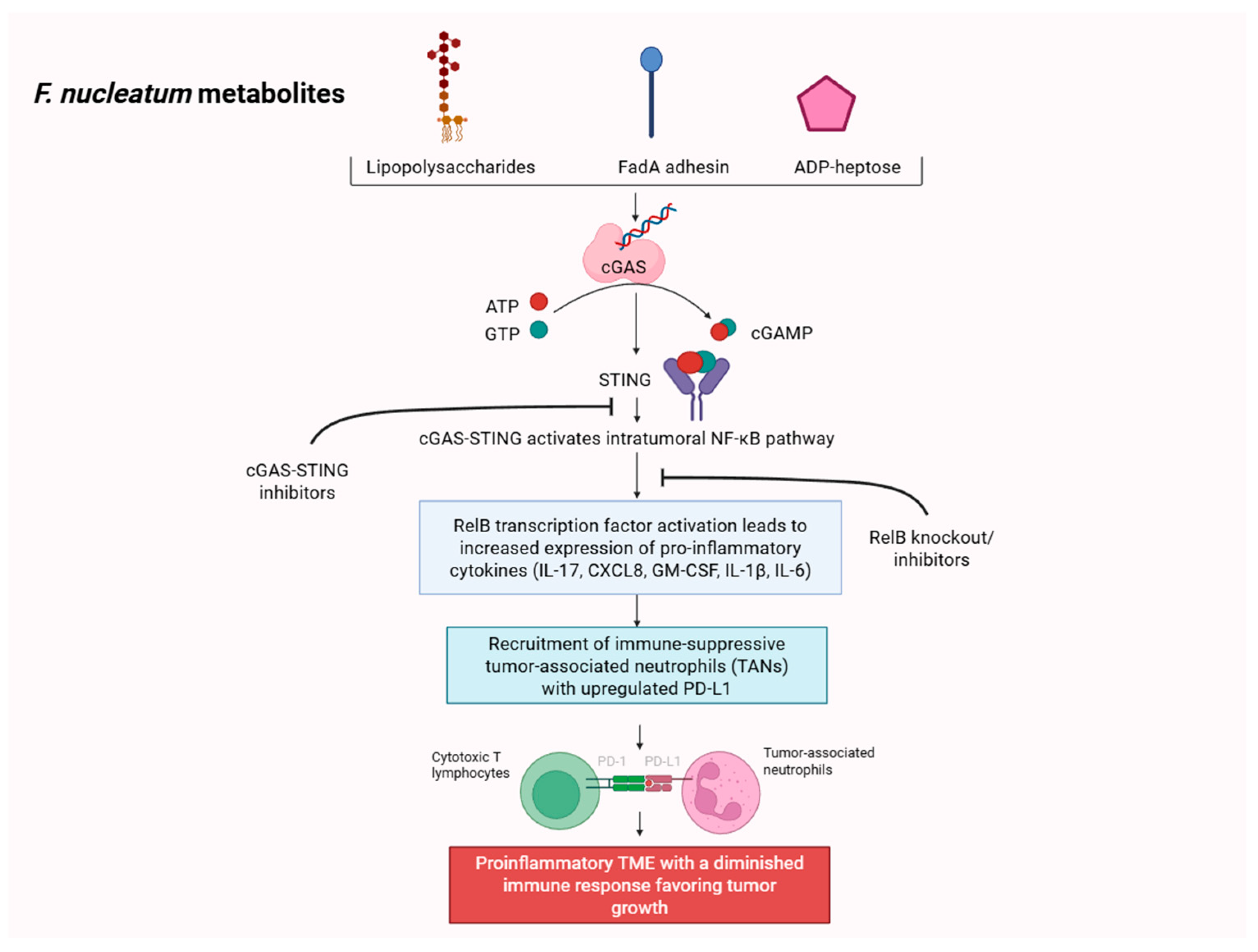
F. nucleatum directly contributes to GC progression by creating a pro-inflammatory and immune-evasive TME by activating the intratumoral IL-17/NF-κB/RelB signaling pathway as depicted in
Figure 1 [
7,
16]. Although
F. nucleatum-specific antigens that activate this pathway in GC are not clearly established, pre-clinical studies that analyzed this pathway in CRC suggest that
F. nucleatum-derived lipopolysaccharides, FadA adhesin, and ADP-heptose are primarily responsible for activating this cascade [
17,
18,
19,
20]. Downstream effects of this cascade result in upregulated expression of pro-inflammatory cyto-/chemokines including TNF-α, CXCL8, CM-CSF, IL-1β, and Il-6 [
7,
21,
22,
23,
24]. Though less studied in GC, these inflammatory markers lead to recruitment of tumor-associated neutrophils (TANs), which acquire the immune-suppressive phenotype with increased expression of PD-L1, dampening the cancer-killing effects of cytotoxic T lymphocytes (CTLs) [
7].
Zhang et al. demonstrated that
F. nucleatum-induced upregulation of PD-L1 expression from TANs was reversable with direct inhibition of the cGAS-STING pathway and RelB knockout [
7]. Integral to the host immune response, the cGAS-STING mechanism plays crucial roles in both innate and adaptive immunity. Therefore, inhibition of the cGAS-STING pathway, upstream of IL-17/NF-κB, resulting in restored immunity suggests its context-dependent role in the setting of a
F. nucleatum-induced dysregulated immune TME. In addition, knockout of RelB, a transcription factor for pro-inflammatory cyto-/chemokines, in GC cells led to significantly reduced IL-17 and recruitment of TANs [
7]. With consideration that first-line treatment for advanced GC includes PD-1 inhibition plus CT,
F. nucleatum’s ability to upregulate PD-L1 poses significant implications as a novel targetable pathway in GC.
Furthermore,
F. nucleatum’s role in GC progression is further elucidated by its role in activating the oncogenic PI3K/AKT signaling pathway by modulating the contents of exosomes secreted by
F. nucleatum-infected GC cells. Xin et al. demonstrated that, in vivo,
F. nucleatum’s infiltration of GC cells was shown to increase exosomal HOTTIP (HOXA transcript at the distal tip) levels [
22]. Translocation of HOTTIP-enriched exosomes into F-nucleatum-absent GC cells subsequently promoted tumor growth and metastasis [
25]. HOTTIP, a long noncoding RNA, acts as a competing RNA and binds to miR-885-3p, suppressing its inhibition of EphB2 expression. Increased levels of EphB2, a tyrosine kinase receptor, leads to increased activation of the oncogenic PI3K/AKT signaling cascade [
26,
27].
F. nucleatum-induced activation of the IL-17/NF-κB/RelB and PI3K/AKT signaling pathways contributes to a diminished immune response and pro-inflammatory TME, a potential target for GC treatment that remains vastly unexplored. Future studies targeting these signaling pathways should consider assessing the GC tumor burden and metastasis in animal models.
2.2. Prevotella Upregulates GC-Perilipin 3 (PLIN3)
Prevotella, an anaerobic Gram-negative rod, is linked with chronic inflammatory disease (e.g., periodontitis, inflammatory bowel disease [IBD], rheumatoid arthritis); its pro-inflammatory properties and enrichment in GC tissue suggest its direct role in GC development [
28,
29]. A pre-clinical study by Liang et al. discovered that
Prevotella intermedia (
P. intermedia) directly contributes to GC progression by upregulating perilipin 3 (PLIN3) in GC cells [
27]. In vitro, GC cell lines were treated with intratumoral-derived
P. intermedia supernatant, with the results showing a much more aggressive and malignant phenotype with increased cellular proliferation, migration, and invasion [
9]. In order to identify dysregulated proteins in GC cells post-exposure to
P. intermedia supernatant, label-free protein analysis identified significant upregulation of PLIN3. As a scaffold protein, PLIN3 essentially contributes as a metabolic stress buffer and ensures the survival and adaptability of cancer cells by regulating the formation of and stabilizing intracellular lipid droplets. The tumor-promoting properties of this protein were supported by its shRNA-mediated knockout, which abrogated its effects [
9].
As there are no other pre-clinical/clinical studies to date that target PLIN3, future studies should focus on the development of novel agents that target GC cell PLIN3 in animal models with potential for clinical application in treating GC in human patients.
2.3. Fusobacterium and Prevotella Can Predict GC Aggressiveness
The previous sections discussed the mechanisms in which both
Fusobacterium and
Prevotella directly contribute to GC development with potential targets for treatment; however, these two genera may also serve as prognostic biomarkers that predict tumor aggressiveness [
30]. A cohort study by Lehr et al. demonstrated that intratumoral enrichment of
Fusobacterium and
Prevotella was correlated with more aggressive tumor phenotypes and poorer clinical outcomes [
30]. Paired tumorous (T-GC) and adjacent non-tumorous tissues (NT-GC) from 64 patients (
n = 128) with GC were biopsied and analyzed via 16S rRNA sequencing, which yielded 19 unique phyla and 296 genera which were correlated with patient survival via Cox regression models. Analysis showed elevated relative abundances of
Fusobacterium and
Prevotella associated with poorer overall survival [
28].
Subgroup analysis was performed based on Lauren’s classification, an established histopathological framework of GC which yet remains underutilized in microbiome-focused research. While no significant survival associations were noted in the intestinal-type subgroup, diffuse-type GC patients with
F. nucleatum-positive tumors exhibited significantly worse overall survival [
30]. To better understand the contribution of
F. nucleatum to GC development, the study extended its analysis to include normal gastric mucosa, as well as samples with chronic non-atrophic gastritis (CNAG), atrophic gastritis, and intestinal metaplasia (AG/IM). The presence of
F. nucleatum was then correlated with clinicopathologic features and long-term outcomes, further supporting its potential role as a targetable biomarker in the diffuse-type GC subtype [
30]. Although the intestinal subtype per Lauren’s criteria is primarily driven by Correa’s cascade, the diffuse subtype is more genetically driven, explained by a germline mutation in the E-cadherin (CDH1) gene resulting in poor cohesion between epithelial cells in the gastric mucosa, increasing the risk of tumor invasion and peritoneal involvement [
31]. Therefore, incorporating
Prevotella and
Fusobacterium into existing predictive and prognostic models may enhance the precision and confidence of risk stratification and guidance in the next steps in management.
2.4. Streptococcus Induces the Pro-Inflammatory ANXA/MAPK and Gasdermin E (GSDME)-Mediated Pyroptosis Pathway
As a microbe responsible for common infections such as strep-throat, pneumonia, and soft-tissue infections, certain strains of
Streptococcus (
Streptococcus anginosus [
S. anginosus] and
Streptococcus constellatus [
S. constellatus]) may directly contribute to GC development by influencing the TME and accelerating Correa’s cascade [
32]. In addition, multiple studies consistently report this genus to be enriched in
HP-negative/-positive GC tissue and fecal samples and, when enriched with
Lactobacillus, to have GC stage diagnostic power with area under the curve (AUC) = 0.7949; this was validated in an independent cohort with AUC = 0.7712 [
32,
33,
34].
Mechanistically,
S. anginosus infection in murine models has been shown to induce acute gastritis and accelerate carcinogenesis by upregulating activation of the MAPK signaling cascade.
S. anginosus colonization of gastric epithelium is mediated by the expression of
Trepenoma pallidum membrane protein C (TMPC), which binds to the gastric epithelial Annexin A2 (ANXA2) receptor, activating the MAPK signaling pathway [
35]. Downstream effects of the MAPK cascade ultimately result in upregulated cellular proliferation and production of pro-inflammatory cytokines, effectively accelerating Correa’s cascade towards the dysplastic/carcinoma stages [
35,
36].
S. anginosus further induces and maintains a pro-inflammatory TME by activating the GSDME-mediated pyroptosis pathway. Pyroptosis, otherwise known as inflammatory cell death, plays a crucial role in regulating cell survival. In the setting of an acute infection, acute pyroptosis stimulates immune cell recruitment to areas of infection and eliminates damaged cells. However, in vivo and in vitro studies demonstrated that persistent and dysregulated activation of GSDME by cleaved caspase-3 and NLRP3 (NOD-like receptor family pyrin domain containing 3) leads to excess and prolonged release of pro-inflammatory cytokines, conferring a tumor-conducive microenvironment [
5,
37].
Pre-clinical studies utilizing MAPK inhibitors in GC murine models have been shown to mitigate the pathway’s tumor-promoting effects, with reduced inflammatory markers, cellular proliferation, and tumor migration/invasion [
37]. Meanwhile, no studies to date have targeted
S. anginosus-mediated GSDME activation and its downstream pyroptosis pathway. Within the broader scope of GC risk stratification and treatment,
Sreptococcus shows promise as a diagnostic and targetable biomarker. Future studies should investigate the effects of MAPK inhibitors in human GC patients enriched with
Streptococcus and develop inhibitors targeting the GSDME-mediated pyroptosis pathway.
2.5. Lactobacillus and Its Dual Role in GC
Lactobacillus, a Gram-positive lactate-producing bacilli, is a popular ingredient in modern-day probiotics to support gut health; however, recent studies reporting enrichment of
Lactobacillus in GC patients emphasize strain-specific variation in function [
5,
9,
10]. As a lactate-producing genus, the pro-tumorigenic properties of
Lactobacillus stem from their preference for utilizing glycolysis as the primary source of energy production in tumor cells, also known as the Warburg effect [
38]. First described by Zhang et al., post-translational histone lactylation of lysine residues in vitro driven by increased lactate upregulates chromatin gene transcription [
39]. Implicated in GC, upregulation of arginase 1 (Arg1) expression in macrophages promotes the transition of M1 tumor-associated macrophages (TAMs) to the tumor-conducive M2 TAM phenotype [
39,
40]. The pro-tumorigenic M2 TAMs contribute to an immune-evasive TME by increasing the secretion of immunosuppressive cytokines (IL-4, IL-10, IL-13, IL-1RA, TGF-β) and facilitate the epithelial-to-mesenchymal transition (EMT) with growth factors and matrix metalloproteinases [
41,
42,
43].
Pre-clinical studies targeting lactate production with lactate dehydrogenase A (LDHA) inhibitors and histone lactylation with inhibition of the respective transferase (p300/CBP) in murine models have shown inhibition of their tumor-promoting effects in pancreatic cancer and glioblastoma, respectively [
44,
45]. However, these targets and effects in GC animal models with enriched
Lactobacillus have not yet been studied.
Although current literature suggests
Lactobacillus as a contributor to GC development, specific strains of this genus (e.g.,
Lactobacillus rhamnosus GG [
L. rhamnosus GG],
Lactobacillus gasseri [
L. gasseri]) display remarkable antagonistic effects against
H. pylori-induced tumorigenesis in vivo and in vitro.
L. gasseri, for example, inhibits
H. pylori cytotoxin-associated gene A (CagA) phosphorylation, preventing its interaction with host Src homology-2 protein tyrosine phosphatase (SHP-2) [
46]. This mitigates downstream pro-inflammatory effects such as NF-κB activation and upregulated release of IL-8, an inflammatory cytokine involved in intestinal metaplasia transformation [
47,
48]. Additionally, both
L. gasseri and
L. rhamnosus GG have been shown to reduce EMT by directly decreasing the expression of EMT-inducing transcription factors, Snail and Zeb-1. As Snail and Zeb-1 block transcription of E-cadherin, inhibition of Snail and Zeb-1 by
L. gasseri and
L. rhamnosus GG reduces the loss of epithelial integrity and subsequent migration and invasion of tumor cells [
49,
50]. Specific strains of
Lactobacillus such as
L. rhamnosus GG and
L. gasseri show promise as personalized therapy to optimize the GI microbiome in GC. However, as these beneficial effects are primarily observed in animal models, future studies should focus on human applications to assess the tumor burden with
L. rhamnosus GG and
L. gasseri supplementation.
2.6. Bifidobacterium Directly Inhibits H. pylori-Induced miR-145 Expression and Enhances Dendritic Cell (DC)-Mediated Immunity
Bifidobacterium is widely considered to be a protective genus in the human gut, with its depletion associated with an increased risk of
H. pylori-induced ulcers and tumor transformation. The anti-tumor effects of
Bifidobacterium are multi-modal, with substantial ability to enhance the immune response to cancer cells, promote apoptosis, and inhibit
H. pylori-mediated carcinogenic pathways [
51].
The anti-tumorigenic properties of
Bifidobacterium supplementation were initially tested in vitro with
H. pylori-infected human gastric epithelial cell lines (GES-1) [
51]. Through NGS analysis of cell lysates, investigators determined
H. pylori-induced elevation of microRNA (miR)-145 as a positive regulator of the Wnt/β-catenin and COX-2 signaling pathways, which promote proliferative and metastatic changes [
52]. However,
Bifidobacterium lactis (B. lactis) supplementation significantly reduced the expression of miR-145 in a dose-dependent fashion, with suppressed Wnt/β-catenin and COX-2 signaling. With these results, the investigators administered
B. lactis probiotics to
HP-positive patients with IM (
n = 48) and observed a significantly higher rate of IM regression compared to control [
52].
Bifidobacterium also demonstrates the unique ability to enhance the host immune response against GC [
53]. This genus directly promotes dendritic cell (DC) maturation, with the subsequent release of cytokines conducive to cytotoxic T-cell and natural killer (NK) cell activity against tumor cells [
54,
55,
56,
57]. Butyrate is a short-chain fatty acid (SCFA) and a natural metabolite produced by
Bifidobacterium that has also demonstrated immune regulatory properties by reducing peripheral mononuclear cell expression of PD-L1 and IL-10, optimizing effector and regulatory cell functions [
58]. In vivo studies demonstrate that administration of butyrate significantly reduced PD-L1/IL-10 expression and gastric tumor size [
58].
Lastly,
Bifidobacterium has shown to play a key role in regulating colon cancer cell survival in vitro by upregulating expression of the pro-apoptotic Bax and caspases, with downregulation of the anti-apoptotic Bcl-2 [
59]. However, its effects on human GC lines have not yet been studied.
Bifidobacterium is a hallmark of gut homeostasis and antagonist of
H. pylori-induced carcinogenesis through the establishment of an anti-inflammatory/proliferative gut microenvironment, enhancement of anti-tumor immunity, and regulation of cell survival [
60,
61,
62]. However, more evidence is needed before its application into the
HP-positive GC management framework. For example, the histologic-regression effects of
B. lactis have only been established in IM patients but not in those with GC.
3. Inter-Study Variations in Reported Microbial Signatures
There are countless large-scale studies identifying compositional differences in gastric tissue or fecal samples from patients with GC compared to healthy controls; however, the variations in reported microbial signatures altered in GC weaken their potential role as diagnostic/targetable biomarkers. These discrepancies are likely a consequence of study design heterogeneity, including differences in patient demographics, patient selection criteria, statistical analysis, and the application of the validation of cohorts.
There is also a clear lack of distinction between significantly altered and discriminatory signatures in GC. Significantly altered microbes are not specific to the cancerous stage but provide insight into how their populations change through Correa’s cascade. On the other hand, GC discriminatory markers were identified with additional statistical analysis, which provide diagnostic value. For example, as noted in
Table 1, Liu et al. [
5], Coker et al. [
6], and Abate et al. [
10] report significant enrichment of
Fusobacterium in GC tissue, but this was not included in GC discriminatory signatures identified by Liu et al. [
5] after application of a backward stepwise algorithm. This implies that
Fusobacterium abundance likely increases through Correa’s cascade but is not specific to GC staging; Wang et al. [
9] reports significant enrichment of this genus in precancerous intraepithelial neoplasia. Additionally, the external validity of these findings is uncertain considering that most existing studies are conducted in East Asia in which GC-contributing risk factors such as diet and lifestyle may significantly differ from those in Latin American populations. Although no large-scale studies consisting of primarily Latin American populations have been published, the EU-LATAM partnered LEGACy observational study is an ongoing endeavor to comprehensively characterize the epidemiology of GC and utilize multi-omics to identify treatment-guiding biomarkers [
63]. The choice of sample collection (gastric tissue versus fecal sample) also has clinical implications, in which the more invasive approach with tissue biopsy may be indicated in symptomatic/high-risk patients, while fecal samples may serve as noninvasive screening tools.
As current studies are largely conducted in European and East Asian regions, future studies with aims to identify microbial biomarkers in GC via standard 16S rRNA sequencing should include a representative Latin American patient population, which may be extracted from the LEGACy study to account for differences in H. pylori strains, diet, environmental exposures, and socioeconomic disparities. Subgroup analysis should also be considered, with categorization by age, sex, gender, region, sample type (gastric tissue vs. fecal), history of gastric resection or neoadjuvant chemotherapy, and H. pylori status, to help individualize risk stratification and guide patient-specific treatment. Countless studies exist with aims to characterize the GC microbiome; however, the lack of regional representation and standardization of study methods serves as a barrier to incorporating our knowledge of the microbiome into GC clinical practice.
4. Key Microbial Signatures That Modulate and Predict Responses to Immune Checkpoint Inhibitors (ICIs)
ICIs plus systemic chemotherapy is the first-line treatment for HER2-negative advanced GC/GEJ in PD-L1-positive patients. Although ICIs significantly improve patient OS and PFS, the overall prognosis remains poor, with certain subgroups receiving attenuated benefit. GC and its common sites of metastases including the peritoneum and liver are known to confer an immune-suppressed TME, which may explain patient-specific resistance to immunotherapy [
64,
65,
66,
67]. The GI microbiome remains clinically unexplored as an adjunctive treatment in non-surgical HER2-negative AGC patients; however, several pre-clinical/clinical studies have demonstrated the ability of certain microbial signatures to enhance the effects of ICIs.
4.1. Bifidobacterium and L. rhamnosus GG Enhance ICI by Inducing Type I Interferon (IFN) Signaling
Bifidobacterium and
L. rhamnosus GG show immense potential as adjunctive treatment to ICIs in the clinical setting when treating patients with HER2-negative AGC. Mechanistically, in vitro and in vivo studies demonstrate that
Bifidobacterium and
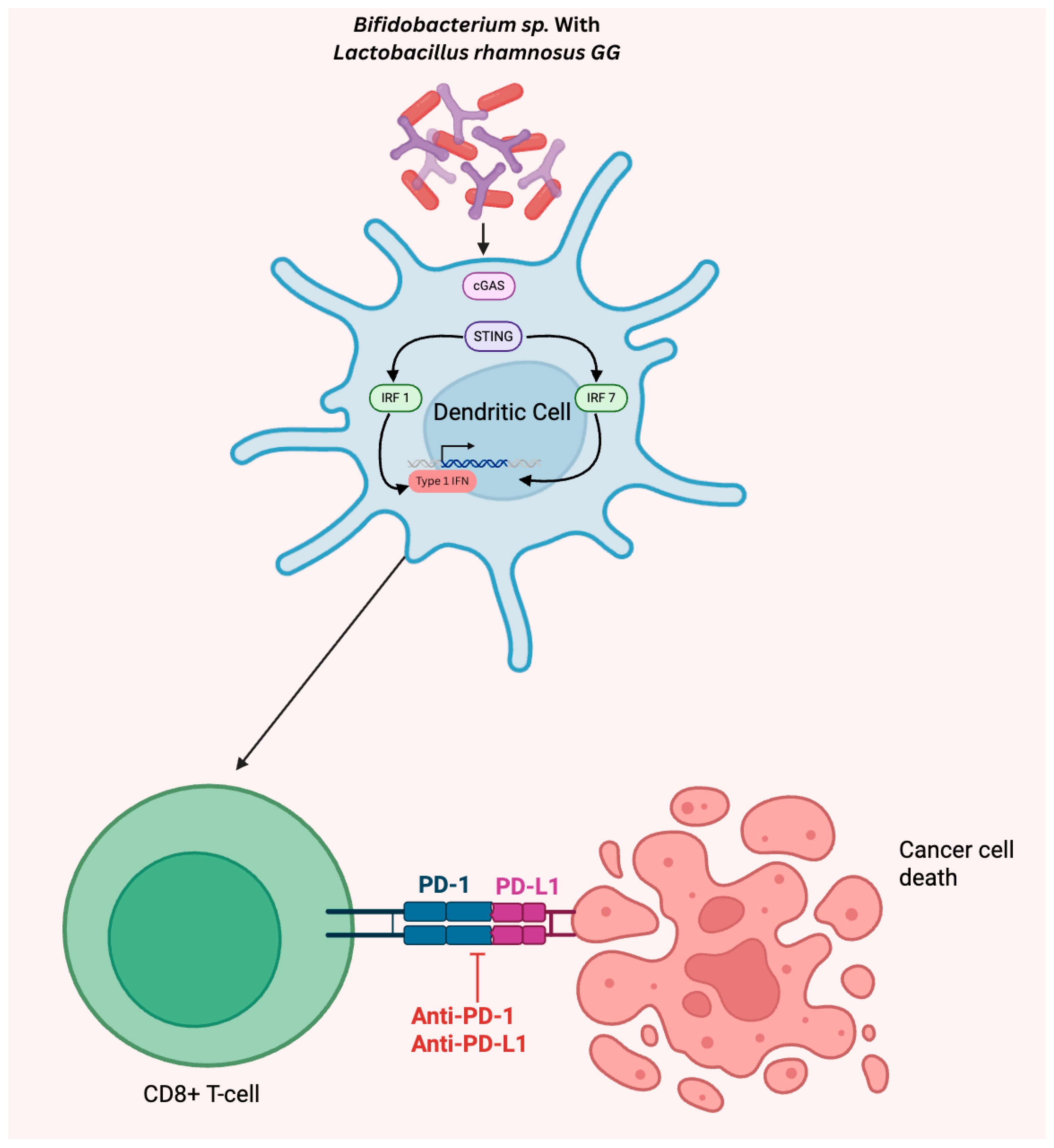
L. rhamnosus GG induce a robust immune response by inducing type I interferon (IFN) signaling through the cGAS/STING pathway, with downstream effects leading to the enhanced priming, differentiation, and proliferation of CTLs as depicted in
Figure 2 [
57,
68]. The synergistic effects of
Bifidobacterium or
L. rhamnosus GG with ICIs have been studied in murine models with solid tumors such as melanoma, CRC, and NSCLC, with the results demonstrating that oral supplementation of either
Bifidobacterium or
L. rhamnosus GG upregulated the tumor infiltration of CTLs and significantly reduced the tumor burden [
69,
70,
71]. However, their effects remain unknown in the setting of GC. In order to further elucidate the synergistic properties of
Bifidobacterium and
L. rhamnosus GG with ICIs, future studies should investigate whether these benefits are consistent in murine models with human GC lines receiving oral supplementation of both
Bifidobacterium and
L. rhamnosus GG compared to monotherapy alone. Although there are no RCTs evaluating the benefits of
Bifidobacterium and
L. rhamnosus GG supplementation in GC patients, one retrospective study determined that probiotic supplementation did not improve outcomes in patients with GC undergoing CT [
72]. However, its influence on survival has not yet been studied in patients undergoing ICI treatment.
4.2. Microbial Signatures May Predict Response to ICIs in Patients with Advanced GC
GI microbial signatures have the potential to predict immunotherapy responses and may be considered with the current treatment framework in patients with HER2-negative AGC. The DELIVER trial (2021) conducted in Japan was a prospective observational study aiming to determine the efficacy of nivolumab monotherapy in patients with AGC; however, secondary aims included the identification of microbial biomarkers associated with nivolumab response. Metagenomic shotgun sequencing from patient fecal samples identified enrichment of two biomarkers,
Odoribacter and
Veillonella, associated with favorable responses to nivolumab, which were validated in a separate cohort [
73]. Outside of The DELIVER trial, evidence supporting these two microbial signatures as ICI-predictive markers is limited. In addition, the observational nature of this study precludes the causative vs. correlative role of
Odoribacter and
Veillonella in GC and ICI modulation.
The enrichment in responders to ICIs is consistent with a systematic review that identified short-chain fatty acid (SCFA)-producing microbial signatures in human fecal samples associated with favorable ICI responses in patients with various types of cancers [
74]. Pre-clinical studies evaluating GC burden in animal models suggest that SCFAs, such as butyrate and propionate, upregulate CD8+ T-cell activity, suppress inflammation by stimulating regulatory T cells, downregulate macrophage PD-L1 and IL-10, and enhance gut epithelial integrity to mitigate tumor invasion and migration [
58,
75,
76]. Although SCFA-producing bacteria have shown to enhance ICI with significantly reduced tumor burden in GC animal models, their immune-augmenting effects in human patients with GC remain unknown. Future studies should focus on prospective trials evaluating tumor burden with a control arm consisting of first-line ICIs plus CT and an intervention arm consisting of combination ICIs plus CT with probiotic supplementation consisting of beneficial SCFA-producing bacteria.
4.3. The Potential Benefit of Probiotics Remains Unexplored in Advanced/Nonresectable GC Patients Undergoing ICI
There is limited data that support probiotic supplementation adjunctive treatment in advanced/nonresectable GC patients. The vast majority of studies that have demonstrated benefit with probiotic supplementation have been in patients receiving CT monotherapy, patients in the perioperative window, and patients with treatment-related adverse effects (AEs) [
77,
78]. Multiple RCTs and prospective studies support probiotic supplementation in GC patients undergoing partial gastrectomy or neoadjuvant CT with minimally invasive surgery, as it has been shown to reduce perioperative complications (infection/inflammation, gut motility recovery) in addition to facilitating earlier hospital discharges and reduced patient costs [
77,
78,
79,
80]. However, the lack of evidence demonstrating improved patient outcomes with probiotic supplementation in non-surgical advanced GC patients deters its integration into the overall treatment framework. A meta-analysis evaluating the effects of oral probiotic supplementation in non-surgical GC patients undergoing CT determined that there was no significant benefit in terms of OS/PFS, although the incidence of CT-related diarrhea was reduced [
81].
With the emergence of ICIs as part of first-line treatment in advanced GC patients, we believe that
Bifidobacterium and
L. rhamnosus GG have not been able to exert their potent immunomodulatory effects in these treated patient populations. Although multiple phase III RCTs (CHECKMATE-649, RATIONALE-305, ATTRACTION-4) show OS/PFS benefits with the addition of ICIs to CT, the overall prognosis remains poor, with close to 25% of patients receiving ICIs experiencing immune-related adverse events (irAEs). Currently, the AGA only recommends probiotics for specific patient populations (e.g., high-risk C. diff infection, necrotizing enterocolitis prevention in infants) and emphasizes that their effects are highly regimen-based [
82,
83]. With this in mind, future studies should initiate phase I clinical trials to determine the safety profile of varying doses of oral
Bifidobacterium/
L. rhamnosus GG in advanced GC patients. This will serve as a crucial step in microbiome-targeted therapeutics, as there have been rare cases of probiotics regimented with
Bifidobacterium/L. rhamnosus inducing sepsis in neonates and critically ill adults [
84,
85,
86,
87,
88]. By phase III, OS/PFS and adverse event rates should be re-assessed in all randomized patients and those with positive PD-L1 expression (CPS or TAPs) who are initiating first-line ICIs plus CT.
The immunomodulatory effects of oral probiotics containing
Bifidobacterium/
L. rhamnosus GG in nonresectable advanced GC patients undergoing ICI treatment remain unknown. Obstacles needing to be addressed prior to clinical translation are the lack of studies assessing probiotics’ benefit in human GC patients undergoing ICI treatment, standardized probiotics’ dosing and included strains, the consideration of patient-specific microbiome changes, and concerns regarding probiotic-induced infection/sepsis [
81,
89].
5. Future Considerations
The clinical application of microbiome research in GC offers promising avenues for innovation but is accompanied by substantial challenges. A primary limitation is the lack of standardization across methodologies, including sample-collection techniques (e.g., biopsy vs. stool), sequencing strategies (16S rRNA vs. shotgun metagenomics), selection of control groups (SG versus healthy gastric tissue), and data-processing pipelines. Furthermore, confounding variables such as geographic diversity, H. pylori status, antibiotic exposure, and dietary patterns complicate microbial profile interpretations. These inconsistencies contribute to variable outcomes and hinder cross-study comparisons.
Another critical barrier is the current reliance on observational data, which precludes definitive conclusions about correlative versus causal relationships between microbiome alterations and clinical outcomes. In order to determine the correlative versus causal nature of these microbial signatures in AGC, future studies should utilize shotgun metagenomics in longitudinal cohort studies to affirm microbial alterations, with analysis of their respective functional gene profiles that precede advanced or nonresectable staging of GC [
90]. As shown in
Table 2, metagenomic profiling provides a higher level of resolution of taxonomic differences and is capable of generating comprehensive functional gene profiles which may effectively differentiate GC causative vs. correlative microbial signatures. A downfall of metagenomics, however, is its increased cost compared to 16S rRNA sequencing, a cost-efficient technique more standardized in identifying biomarkers but with lower taxonomic resolution and limited in inferring biomarker function [
91]. Follow-up studies may include attempts to induce pro-/anti-tumorigenic states in animal models with key microbial signatures derived from shotgun metagenomics to determine targetable pathways with therapeutic implications. Furthermore, there is a lack in distinction between altered versus discriminatory signatures in GC, as the former likely reflect significant compositional changes over time through Correa’s cascade but nonspecific to staging. Follow-up studies should apply backward stepwise algorithms or random forest models to clearly identify GC discriminatory signatures, potential novel biomarkers that may be utilized for the risk stratification and early diagnosis of GC.
Additionally, therapeutic strategies aimed at microbiome modulation with oral probiotic administration represent compelling approaches to augmenting treatment efficacy and minimizing adverse effects in AGC management.
6. Conclusions
Key biomarkers within the gastrointestinal microbiome hold significant promise for improving the early diagnosis, risk stratification, and personalized treatment of GC. Given the typically late-stage diagnosis of GC and its associated poor prognosis, identifying targetable and diagnostic microbiome-derived indicators is critical. Although H. pylori infection confers the highest risk of GC, F. nucleatum is also observed to be consistently enriched in GC states across multiple studies. Furthermore, its activation of the pro-inflammatory IL-17/NF-κB pathway presents a targetable pathway in the treatment of GC. Contrarily, recent studies elucidate the robust anti-tumor properties of Bifidobacterium sp. and L. rhamnosus GG through modulation of the cGAS/STING signaling pathway, directly activating DCs and CTL activity. Diagnostic markers for GC include enriched Streptococcus and Lactobacillus in gastric/stool samples, and depleted Helicobacter in stool samples; however, these identifiers remain inconsistent between studies with multiple confounding variables, including geographic differences, sample type, and statistical analysis.
With current evidence supporting the microbiome’s role in GC pathogenesis and modulating host immunity, microbial biomarkers should be integrated into comprehensive diagnostic and treatment frameworks to identify at-risk individuals and optimize treatment responses. Future research should prioritize representative large-scale longitudinal cohort studies with standardized sequencing techniques to identify significantly altered genera in GC with consideration of shotgun genomics to determine species/strain-specific taxa and their respective functional gene profiles. Subgroup analysis may identify demographic-specific variations in microbial signatures, critical to personalized risk stratification and treatment of GC when considering probiotic administration. Additionally, prospective human-based trials should aim to compare patient outcomes when supplementing Bifidobacterium and L. rhamnosus GG in patients initiating treatment with ICIs plus CT compared to CT alone.
Author Contributions
Study conception and design: D.C. and G.B. Project supervision: D.C., G.B., K.-i.J.K., and H.Z. Manuscript preparation: K.-i.J.K., H.Z., D.T., P.S., D.P., V.G., J.L., C.J., L.K., S.G., and D.C. Manuscript review and editing: All co-authors. All authors have read and agreed to the published version of the manuscript.
Funding
This research received no external funding.
Data Availability Statement
No new data were created or analyzed in this study. Data sharing is not applicable to this article.
Conflicts of Interest
The authors declare no conflicts of interest.
References
- Rawla, P.; Barsouk, A. Epidemiology of gastric cancer: Global trends, risk factors and prevention. Prz. Gastroenterol. 2019, 14, 26–38. [Google Scholar] [CrossRef] [PubMed]
- Wang, M.; Yang, G.; Tian, Y.; Zhang, Q.; Liu, Z.; Xin, Y. The role of the gut microbiota in gastric cancer: The immunoregulation and immunotherapy. Front. Immunol. 2023, 14, 1183331. [Google Scholar] [CrossRef] [PubMed]
- Ajani, J.A.; D’Amico, T.A.; Bentrem, D.J.; Chao, J.; Cooke, D.; Corvera, C.; Das, P.; Enzinger, P.C.; Enzler, T.; Fanta, P.; et al. Gastric Cancer, Version 2.2022, NCCN Clinical Practice Guidelines in Oncology. J. Natl. Compr. Cancer Netw. 2022, 20, 167–192. [Google Scholar] [CrossRef] [PubMed]
- Hsieh, Y.-Y.; Tung, S.-Y.; Pan, H.-Y.; Yen, C.-W.; Xu, H.-W.; Lin, Y.-J.; Deng, Y.-F.; Hsu, W.-T.; Wu, C.-S.; Li, C. Increased Abundance of Clostridium and Fusobacterium in Gastric Microbiota of Patients with Gastric Cancer in Taiwan. Sci. Rep. 2018, 8, 158. [Google Scholar] [CrossRef]
- Liu, C.; Ng, S.-K.; Ding, Y.; Lin, Y.; Liu, W.; Wong, S.H.; Sung, J.J.-Y.; Yu, J. Meta-analysis of mucosal microbiota reveals universal microbial signatures and dysbiosis in gastric carcinogenesis. Oncogene 2022, 41, 3599–3610. [Google Scholar] [CrossRef]
- Coker, O.O.; Dai, Z.; Nie, Y.; Zhao, G.; Cao, L.; Nakatsu, G.; Wu, W.K.; Wong, S.H.; Chen, Z.; Sung, J.J.Y.; et al. Mucosal microbiome dysbiosis in gastric carcinogenesis. Gut 2018, 67, 1024–1032. [Google Scholar] [CrossRef]
- Zhang, T.; Li, Y.; Zhai, E.; Zhao, R.; Qian, Y.; Huang, Z.; Liu, Y.; Zhao, Z.; Xu, X.; Liu, J.; et al. Intratumoral Fusobacterium nucleatum Recruits Tumor-Associated Neutrophils to Promote Gastric Cancer Progression and Immune Evasion. Cancer Res. 2025, 85, 1819–1841. [Google Scholar] [CrossRef]
- Zhou, C.-B.; Pan, S.-Y.; Jin, P.; Deng, J.-W.; Xue, J.-H.; Ma, X.-Y.; Xie, Y.-H.; Cao, H.; Liu, Q.; Xie, W.-F.; et al. Fecal Signatures of Streptococcus anginosus and Streptococcus constellatus for Noninvasive Screening and Early Warning of Gastric Cancer. Gastroenterology 2022, 162, 1933–1947.e18. [Google Scholar] [CrossRef]
- Wang, Y.; Wang, Y.; Han, W.; Han, M.; Liu, X.; Dai, J.; Dong, Y.; Sun, T.; Xu, J. Intratumoral and fecal microbiota reveals microbial markers associated with gastric carcinogenesis. Front. Cell. Infect. Microbiol. 2024, 14, 1397466. [Google Scholar] [CrossRef] [PubMed]
- Abate, M.; Vos, E.; Gonen, M.; Janjigian, Y.Y.; Schattner, M.; Laszkowska, M.; Tang, L.; Maron, S.B.; Coit, D.G.; Vardhana, S.; et al. A Novel Microbiome Signature in Gastric Cancer: A Two Independent Cohort Retrospective Analysis. Ann. Surg. 2022, 276, 605–615. [Google Scholar] [CrossRef]
- Yang, I.; Woltemate, S.; Piazuelo, M.B.; Bravo, L.E.; Yepez, M.C.; Romero-Gallo, J.; Delgado, A.G.; Wilson, K.T.; Peek, R.M.; Correa, P.; et al. Different gastric microbiota compositions in two human populations with high and low gastric cancer risk in Colombia. Sci. Rep. 2016, 6, 18594. [Google Scholar] [CrossRef]
- Shah, S.C.; Wang, A.Y.; Wallace, M.B.; Hwang, J.H. AGA Clinical Practice Update on Screening and Surveillance in Individuals at Increased Risk for Gastric Cancer in the United States: Expert Review. Gastroenterology 2025, 168, 405–416.e1. [Google Scholar] [CrossRef] [PubMed]
- Sorino, J.; Della Mura, M.; Ingravallo, G.; Cazzato, G.; Pizzimenti, C.; Zuccalà, V.; Pepe, L.; Germanà, E.; Martini, M.; Ieni, A.; et al. Fusobacterium nucleatum and Gastric Cancer: An Emerging Connection. Int. J. Mol. Sci. 2025, 26, 7915. [Google Scholar] [CrossRef]
- Yang, Y.; Weng, W.; Peng, J.; Hong, L.; Yang, L.; Toiyama, Y.; Gao, R.; Liu, M.; Yin, M.; Pan, C.; et al. Fusobacterium nucleatum Increases Proliferation of Colorectal Cancer Cells and Tumor Development in Mice by Activating Toll-Like Receptor 4 Signaling to Nuclear Factor−κB, and Up-regulating Expression of MicroRNA-21. Gastroenterology 2017, 152, 851–866.e24. [Google Scholar] [CrossRef]
- Consolo, P.; Giorgi, C.; Crisafulli, C.; Fiorica, F.; Pinton, P.; Maurea, N.; Missiroli, S.; Quagliariello, V.; Mantoan, B.; Ottaiano, A.; et al. Investigating the Impact of Fusobacterium nucleatum on Oxidative Stress, Chemoresistance, and Inflammation in Inflammatory Bowel Disease and Colorectal Cancer: Rationale and Design of a Clinical Trial. Int. J. Mol. Sci. 2025, 26, 7823. [Google Scholar] [CrossRef] [PubMed]
- Gibbs, R.J.; Chambers, A.C.; Hill, D.J. The emerging role of Fusobacteria in carcinogenesis. Eur. J. Clin. Investig. 2024, 54, e14353. [Google Scholar] [CrossRef]
- Gholizadeh, P.; Eslami, H.; Kafil, H.S. Carcinogenesis mechanisms of Fusobacterium nucleatum. Biomed. Pharmacother. 2017, 89, 918–925. [Google Scholar] [CrossRef] [PubMed]
- Li, T.-J.; Jiang, Y.-M.; Hu, Y.-F.; Huang, L.; Yu, J.; Zhao, L.-Y.; Deng, H.-J.; Mou, T.-Y.; Liu, H.; Yang, Y.; et al. Interleukin-17–Producing Neutrophils Link Inflammatory Stimuli to Disease Progression by Promoting Angiogenesis in Gastric Cancer. Clin. Cancer Res. 2017, 23, 1575–1585. [Google Scholar] [CrossRef]
- Li, S.; Cong, X.; Gao, H.; Lan, X.; Li, Z.; Wang, W.; Song, S.; Wang, Y.; Li, C.; Zhang, H.; et al. Tumor-associated neutrophils induce EMT by IL-17a to promote migration and invasion in gastric cancer cells. J. Exp. Clin. Cancer Res. 2019, 38, 6, Correction in J. Exp. Clin. Cancer Res. 2019, 38, 177. [Google Scholar] [CrossRef]
- Li, W.; Huang, X.; Han, X.; Zhang, J.; Gao, L.; Chen, H. IL-17A in gastric carcinogenesis: Good or bad? Front. Immunol. 2024, 15, 1501293. [Google Scholar] [CrossRef]
- Raja, U.M.; Gopal, G.; Shirley, S.; Ramakrishnan, A.S.; Rajkumar, T. Immunohistochemical expression and localization of cytokines/chemokines/growth factors in gastric cancer. Cytokine 2017, 89, 82–90. [Google Scholar] [CrossRef] [PubMed]
- Xin, Y.; Li, X.; Zhang, M.; Shang, Z.; Luo, Z.; Wang, Y.; Gui, X.; Liu, Q.; Li, T.; Zeng, S.; et al. Fusobacterium nucleatum-induced exosomal HOTTIP promotes gastric cancer progression through the MICRORNA-885-3p/EPHB2 axis. Cancer Sci. 2023, 114, 2360–2374. [Google Scholar] [CrossRef]
- Liu, W.; Yu, C.; Li, J.; Fang, J. The Roles of EphB2 in Cancer. Front. Cell Dev. Biol. 2022, 10, 788587. [Google Scholar] [CrossRef]
- Yin, J.; Li, Z.; Ye, L.; Birkin, E.; Li, L.; Xu, R.; Chen, G.; Ji, J.; Zhang, Z.; Jiang, W.G.; et al. EphB2 represents an independent prognostic marker in patients with gastric cancer and promotes tumour cell aggressiveness. J. Cancer 2020, 11, 2778–2787. [Google Scholar] [CrossRef] [PubMed]
- Iljazovic, A.; Amend, L.; Galvez, E.J.C.; De Oliveira, R.; Strowig, T. Modulation of inflammatory responses by gastrointestinal Prevotella spp.—From associations to functional studies. Int. J. Med. Microbiol. 2021, 311, 151472. [Google Scholar] [CrossRef] [PubMed]
- Sharma, G.; Garg, N.; Hasan, S.; Shirodkar, S. Prevotella: An insight into its characteristics and associated virulence factors. Microb. Pathog. 2022, 169, 105673. [Google Scholar] [CrossRef]
- Liang, W.; Zhou, Z.; Gao, Q.; Zhu, Z.; Zhu, J.; Lin, J.; Wen, Y.; Qian, F.; Wang, L.; Zhai, Y.; et al. Tumor-derived Prevotella intermedia aggravates gastric cancer by enhancing Perilipin 3 expression. Cancer Sci. 2024, 115, 1141–1153, Correction in Cancer Sci. 2025, 116, 1156. [Google Scholar] [CrossRef]
- Lehr, K.; Nikitina, D.; Vilchez-Vargas, R.; Steponaitiene, R.; Thon, C.; Skieceviciene, J.; Schanze, D.; Zenker, M.; Malfertheiner, P.; Kupcinskas, J.; et al. Microbial composition of tumorous and adjacent gastric tissue is associated with prognosis of gastric cancer. Sci. Rep. 2023, 13, 4640. [Google Scholar] [CrossRef]
- Monster, J.L.; Kemp, L.J.; Busslinger, G.A.; Vliem, M.J.; Derks, L.L.; Staes, A.A.; Bisseling, T.M.; Clevers, H.; Van Der Post, R.S.; Gloerich, M. Cell division-dependent dissemination following E-cadherin loss underlies initiation of diffuse-type gastric cancer. J. Pathol. 2024, 263, 226–241. [Google Scholar] [CrossRef]
- Dicksved, J.; Lindberg, M.; Rosenquist, M.; Enroth, H.; Jansson, J.K.; Engstrand, L. Molecular characterization of the stomach microbiota in patients with gastric cancer and in controls. J. Med. Microbiol. 2009, 58, 509–516. [Google Scholar] [CrossRef]
- Eun, C.S.; Kim, B.K.; Han, D.S.; Kim, S.Y.; Kim, K.M.; Choi, B.Y.; Song, K.S.; Kim, Y.S.; Kim, J.F. Differences in Gastric Mucosal Microbiota Profiling in Patients with Chronic Gastritis, Intestinal Metaplasia, and Gastric Cancer Using Pyrosequencing Methods. Helicobacter 2014, 19, 407–416. [Google Scholar] [CrossRef]
- Hara, Y.; Baba, Y.; Oda, E.; Harada, K.; Yamashita, K.; Toihata, T.; Kosumi, K.; Iwatsuki, M.; Miyamoto, Y.; Tsutsuki, H.; et al. Presence of Fusobacterium nucleatum in relation to patient survival and an acidic environment in oesophagogastric junction and gastric cancers. Br. J. Cancer 2024, 131, 797–807. [Google Scholar] [CrossRef] [PubMed]
- Fu, K.; Cheung, A.H.K.; Wong, C.C.; Liu, W.; Zhou, Y.; Wang, F.; Huang, P.; Yuan, K.; Coker, O.O.; Pan, Y.; et al. Streptococcus anginosus promotes gastric inflammation, atrophy, and tumorigenesis in mice. Cell 2024, 187, 882–896.e17, Correction in Cell 2024, 187, 6783. https://doi.org/10.1016/j.cell.2024.10.036. [Google Scholar] [CrossRef]
- Xia, K.; Zhou, Y.; Wang, W.; Cai, Y. Streptococcus anginosus: The potential role in the progression of gastric cancer. J. Cancer Res. Clin. Oncol. 2025, 151, 143. [Google Scholar] [CrossRef]
- Wang, Z.; Mou, R.; Jin, S.; Wang, Q.; Ju, Y.; Sun, P.; Xie, R.; Wang, K. Streptococcus anginosus promotes gastric cancer progression via GSDME-mediated pyroptosis pathway: Molecular mechanisms of action of GSDME, cleaved caspase-3, and NLRP3 proteins. Int. J. Biol. Macromol. 2025, 307, 142341. [Google Scholar] [CrossRef]
- Wang, S.; Wang, J.; Chen, Z.; Luo, J.; Guo, W.; Sun, L.; Lin, L. Targeting M2-like tumor-associated macrophages is a potential therapeutic approach to overcome antitumor drug resistance. NPJ Precis. Oncol. 2024, 8, 31. [Google Scholar] [CrossRef]
- Morgos, D.-T.; Stefani, C.; Miricescu, D.; Greabu, M.; Stanciu, S.; Nica, S.; Stanescu-Spinu, I.-I.; Balan, D.G.; Balcangiu-Stroescu, A.-E.; Coculescu, E.-C.; et al. Targeting PI3K/AKT/mTOR and MAPK Signaling Pathways in Gastric Cancer. Int. J. Mol. Sci. 2024, 25, 1848. [Google Scholar] [CrossRef]
- Che, X.; Zhang, Y.; Chen, X.; Xie, G.; Li, J.; Xu, C.; Zhang, C.; Zhu, Y.; Yang, X. The lactylation-macrophage interplay: Implications for gastrointestinal disease therapeutics. Front. Immunol. 2025, 16, 1608115. [Google Scholar] [CrossRef]
- Zhang, D.; Tang, Z.; Huang, H.; Zhou, G.; Cui, C.; Weng, Y.; Liu, W.; Kim, S.; Lee, S.; Perez-Neut, M.; et al. Metabolic regulation of gene expression by histone lactylation. Nature 2019, 574, 575–580. [Google Scholar] [CrossRef] [PubMed]
- Al-Malsi, K.; Xie, S.; Cai, Y.; Mohammed, N.; Xie, K.; Lan, T.; Wu, H. The role of lactylation in tumor growth and cancer progression. Front. Oncol. 2025, 15, 1516785. [Google Scholar] [CrossRef] [PubMed]
- He, Y.; Huang, Y.; Peng, P.; Yan, Q.; Ran, L. Lactate and lactylation in gastrointestinal cancer: Current progress and perspectives (Review). Oncol. Rep. 2024, 53, 6. [Google Scholar] [CrossRef]
- Pérez-Tomás, R.; Pérez-Guillén, I. Lactate in the Tumor Microenvironment: An Essential Molecule in Cancer Progression and Treatment. Cancers 2020, 12, 3244. [Google Scholar] [CrossRef] [PubMed]
- Gao, C.; Li, J.; Shan, B. Research progress on the regulatory role of lactate and lactylation in tumor microenvironment. Biochim. Biophys. Acta Rev. Cancer 2025, 1880, 189339. [Google Scholar] [CrossRef] [PubMed]
- Sharma, H.; Elliott, T.; Good, A.; Sharma, P.; Mondal, S.; Luckett Chastain, L.; Ihnat, M.A. Synthesis, molecular modeling, biological and pharmacokinetic evaluation of hydroxy pyrimidinones and pyrimidinediones as novel LDHA inhibitors. Eur. J. Med. Chem. 2025, 300, 118156. [Google Scholar] [CrossRef]
- Wang, S.; Huang, T.; Wu, Q.; Yuan, H.; Wu, X.; Yuan, F.; Duan, T.; Taori, S.; Zhao, Y.; Snyder, N.W.; et al. Lactate reprograms glioblastoma immunity through CBX3-regulated histone lactylation. J. Clin. Investig. 2024, 134, e176851. [Google Scholar] [CrossRef]
- Baud, J.; Varon, C.; Chabas, S.; Chambonnier, L.; Darfeuille, F.; Staedel, C. Helicobacter pylori Initiates a Mesenchymal Transition through ZEB1 in Gastric Epithelial Cells. PLoS ONE 2013, 8, e60315. [Google Scholar] [CrossRef] [PubMed]
- Zhang, Z.; Chen, S.; Li, S.; Zheng, Y.; Mai, L.; Zhang, X. Association of Helicobacter pylori related chronic atrophic gastritis and gastric cancer risk: A literature review. Front. Med. 2025, 12, 1504749, Corrigendum in Front. Med. 2025, 12, 1586952. [Google Scholar]
- He, Z.; Zhou, Y.; Liu, J.; Li, N.; Fan, H. The intersection of Helicobacter pylori and gastric cancer: Signaling pathways and molecular mechanisms. Front. Cell. Infect. Microbiol. 2025, 15, 1601501. [Google Scholar] [CrossRef]
- Sánchez-Tilló, E.; Lázaro, A.; Torrent, R.; Cuatrecasas, M.; Vaquero, E.C.; Castells, A.; Engel, P.; Postigo, A. ZEB1 represses E-cadherin and induces an EMT by recruiting the SWI/SNF chromatin-remodeling protein BRG1. Oncogene 2010, 29, 3490–3500. [Google Scholar] [CrossRef]
- Guaita, S.; Puig, I.; Franci, C.; Garrido, M.; Dominguez, D.; Batlle, E.; Sancho, E.; Dedhar, S.; De Herreros, A.G.; Baulida, J. Snail Induction of Epithelial to Mesenchymal Transition in Tumor Cells Is Accompanied by MUC1 Repression andZEB1 Expression. J. Biol. Chem. 2002, 277, 39209–39216. [Google Scholar] [CrossRef]
- Yang, Y.-J.; Wu, C.-T.; Cheng, H.-C.; Chen, W.-Y.; Tseng, J.T.; Chang, W.-L.; Sheu, B.-S. Probiotics ameliorate H. pylori-associated gastric β-catenin and COX-2 carcinogenesis signaling by regulating miR-185. J. Biomed. Sci. 2025, 32, 55. [Google Scholar] [CrossRef]
- Cong, N.; Du, P.; Zhang, A.; Shen, F.; Su, J.; Pu, P.; Wang, T.; Zjang, J.; Kang, C.; Zhang, Q. Downregulated microRNA-200a promotes EMT and tumor growth through the Wnt/β-catenin pathway by targeting the E-cadherin repressors ZEB1/ZEB2 in gastric adenocarcinoma. Oncol. Rep. 2013, 29, 1579–1587. [Google Scholar] [CrossRef]
- Longhi, G.; Van Sinderen, D.; Ventura, M.; Turroni, F. Microbiota and Cancer: The Emerging Beneficial Role of Bifidobacteria in Cancer Immunotherapy. Front. Microbiol. 2020, 11, 575072. [Google Scholar] [CrossRef]
- Finn, O.J. Cancer Immunology. N. Engl. J. Med. 2008, 358, 2704–2715. [Google Scholar] [CrossRef] [PubMed]
- López, P.; Gueimonde, M.; Margolles, A.; Suárez, A. Distinct Bifidobacterium strains drive different immune responses in vitro. Int. J. Food Microbiol. 2010, 138, 157–165. [Google Scholar] [CrossRef]
- Pellicanò, A.; Sebkova, L.; Monteleone, G.; Guarnieri, G.; Imeneo, M.; Pallone, F.; Luzza, F. Interleukin-12 Drives the Th1 Signaling Pathway in Helicobacter pylori-Infected Human Gastric Mucosa. Infect. Immun. 2007, 75, 1738–1744. [Google Scholar] [CrossRef]
- Liu, L.; Shah, K. The Potential of the Gut Microbiome to Reshape the Cancer Therapy Paradigm: A Review. JAMA Oncol. 2022, 8, 1059–1067. [Google Scholar] [CrossRef] [PubMed]
- Lee, S.Y.; Jhun, J.; Woo, J.S.; Lee, K.H.; Hwang, S.-H.; Moon, J.; Park, G.; Choi, S.S.; Kim, S.J.; Jung, Y.J.; et al. Gut microbiome-derived butyrate inhibits the immunosuppressive factors PD-L1 and IL-10 in tumor-associated macrophages in gastric cancer. Gut Microbes 2024, 16, 2300846. [Google Scholar] [CrossRef] [PubMed]
- Soraya, M.; Moazamian, E.; Shamsdin, S.A.; Dehghani, M. Bifidobacterium apoptosis induction by measuring bax and caspases on SW948 human colon cancer cell line. Int. J. Biochem. Cell Biol. 2025, 186, 106813. [Google Scholar] [CrossRef]
- Janjigian, Y.Y.; Ajani, J.A.; Moehler, M.; Shen, L.; Garrido, M.; Gallardo, C.; Wyrwicz, L.; Yamaguchi, K.; Cleary, J.M.; Elimova, E.; et al. First-Line Nivolumab Plus Chemotherapy for Advanced Gastric, Gastroesophageal Junction, and Esophageal Adenocarcinoma: 3-Year Follow-Up of the Phase III CheckMate 649 Trial. J. Clin. Oncol. 2024, 42, 2012–2020. [Google Scholar] [CrossRef]
- Rha, S.Y.; Oh, D.-Y.; Yañez, P.; Bai, Y.; Ryu, M.-H.; Lee, J.; Rivera, F.; Alves, G.V.; Garrido, M.; Shiu, K.-K.; et al. Pembrolizumab plus chemotherapy versus placebo plus chemotherapy for HER2-negative advanced gastric cancer (KEYNOTE-859): A multicentre, randomised, double-blind, phase 3 trial. Lancet Oncol. 2023, 24, 1181–1195, Correction in Lancet Oncol. 2024, 25, e626. [Google Scholar] [CrossRef] [PubMed]
- Kang, Y.-K.; Chen, L.-T.; Ryu, M.-H.; Oh, D.-Y.; Oh, S.C.; Chung, H.C.; Lee, K.-W.; Omori, T.; Shitara, K.; Sakuramoto, S.; et al. Nivolumab plus chemotherapy versus placebo plus chemotherapy in patients with HER2-negative, untreated, unresectable advanced or recurrent gastric or gastro-oesophageal junction cancer (ATTRACTION-4): A randomised, multicentre, double-blind, placebo-controlled, phase 3 trial. Lancet Oncol. 2022, 23, 234–247. [Google Scholar]
- Van Schooten, T.S.; Derks, S.; Jiménez-Martí, E.; Carneiro, F.; Figueiredo, C.; Ruiz, E.; Alsina, M.; Molero, C.; Garrido, M.; Riquelme, A.; et al. The LEGACy study: A European and Latin American consortium to identify risk factors and molecular phenotypes in gastric cancer to improve prevention strategies and personalized clinical decision making globally. BMC Cancer 2022, 22, 646. [Google Scholar] [CrossRef]
- Li, Y.; Zheng, Y.; Huang, J.; Nie, R.-C.; Wu, Q.-N.; Zuo, Z.; Yuan, S.; Yu, K.; Liang, C.-C.; Pan, Y.-Q.; et al. CAF-macrophage crosstalk in tumour microenvironments governs the response to immune checkpoint blockade in gastric cancer peritoneal metastases. Gut 2025, 74, 350–363. [Google Scholar] [CrossRef]
- Kim, H.; Kwon, M.; Lee, S.K.; Son, S.-M.; Lee, O.-J.; Man Yoon, S.; Kim, H.K.; Yang, Y.; Lee, K.H.; Han, H.S. Distinct Immunosuppressive Tumor Microenvironment in Gastric Cancer With Peritoneal Metastasis. J. Gastric Cancer 2025, 25, 605–620. [Google Scholar] [CrossRef]
- Sun, W.; Jiang, Z.; Deng, Z. Comprehensive analysis of the tumor immune microenvironment in gastric cancer and peritoneal metastasis based on single-cell RNA sequencing analysis. Sci. Rep. 2025, 15, 32090. [Google Scholar] [CrossRef]
- Groen-van Schooten, T.S.; Franco Fernandez, R.; Van Grieken, N.C.T.; Bos, E.N.; Seidel, J.; Saris, J.; Martínez-Ciarpaglini, C.; Fleitas, T.C.; Thommen, D.S.; De Gruijl, T.D.; et al. Mapping the complexity and diversity of tertiary lymphoid structures in primary and peritoneal metastatic gastric cancer. J. Immunother. Cancer 2024, 12, e009243. [Google Scholar] [CrossRef] [PubMed]
- Sivan, A.; Corrales, L.; Hubert, N.; Williams, J.B.; Aquino-Michaels, K.; Earley, Z.M.; Benyamin, F.W.; Man Lei, Y.; Jabri, B.; Alegre, M.-L.; et al. Commensal Bifidobacterium promotes antitumor immunity and facilitates anti–PD-L1 efficacy. Science 2015, 350, 1084–1089. [Google Scholar] [CrossRef]
- Lee, S.-H.; Cho, S.-Y.; Yoon, Y.; Park, C.; Sohn, J.; Jeong, J.-J.; Jeon, B.-N.; Jang, M.; An, C.; Lee, S.; et al. Bifidobacterium bifidum strains synergize with immune checkpoint inhibitors to reduce tumour burden in mice. Nat. Microbiol. 2021, 6, 277–288. [Google Scholar] [CrossRef]
- Si, W.; Liang, H.; Bugno, J.; Xu, Q.; Ding, X.; Yang, K.; Fu, Y.; Weichselbaum, R.R.; Zhao, X.; Wang, L. Lactobacillus rhamnosus GG induces cGAS/STING- dependent type I interferon and improves response to immune checkpoint blockade. Gut 2022, 71, 521–533. [Google Scholar] [CrossRef] [PubMed]
- Lu, S.; Xu, J.; Zhao, Z.; Guo, Y.; Zhang, H.; Jurutka, P.W.; Huang, D.; Cao, C.; Cheng, S. Dietary Lactobacillus rhamnosus GG extracellular vesicles enhance antiprogrammed cell death 1 (anti-PD-1) immunotherapy efficacy against colorectal cancer. Food Funct. 2023, 14, 10314–10328. [Google Scholar] [CrossRef]
- Nakamura, T.; Watanabe, R.; Yamamura, T.; Harada, K.; Kawamoto, Y.; Yuki, S.; Sakamoto, N.; Komatsu, Y. Retrospective analysis of drug intake affecting the intestinal microbiota and the therapeutic effects of chemotherapy on gastric cancer. J. Clin. Oncol. 2023, 41, 379. [Google Scholar] [CrossRef]
- Sunakawa, Y.; Matoba, R.; Inoue, E.; Sakamoto, Y.; Kawabata, R.; Ishiguro, A.; Akamaru, Y.; Kito, Y.; Takahashi, M.; Matsuyama, J.; et al. Genomic pathway of gut microbiome to predict efficacy of nivolumab in advanced gastric cancer: DELIVER trial (JACCRO GC-08). J. Clin. Oncol. 2021, 39, 161. [Google Scholar] [CrossRef]
- Zeriouh, M.; Raskov, H.; Kvich, L.; Gögenur, I.; Bennedsen, A.L.B. Checkpoint inhibitor responses can be regulated by the gut microbiota—A systematic review. Neoplasia 2023, 43, 100923. [Google Scholar] [CrossRef]
- Yu, X.; Ou, J.; Wang, L.; Li, Z.; Ren, Y.; Xie, L.; Chen, Z.; Liang, J.; Shen, G.; Zou, Z.; et al. Gut microbiota modulate CD8+ T cell immunity in gastric cancer through Butyrate/GPR109A/HOPX. Gut Microbes 2024, 16, 2307542. [Google Scholar] [CrossRef]
- Saadh, M.J.; Allela, O.Q.B.; Ballal, S.; Mahdi, M.S.; Chahar, M.; Verma, R.; Al-Hussein, R.K.A.; Adil, M.; Jawad, M.J.; Al-Nuaimi, A.M.A. The effects of microbiota-derived short-chain fatty acids on T lymphocytes: From autoimmune diseases to cancer. Semin. Oncol. 2025, 52, 152398. [Google Scholar] [CrossRef] [PubMed]
- Tang, X.; Wang, X.; Man, C.; Zhang, S.; Gong, D.; Lang, Y.; Fan, Y. The role of gut microbiota in the perioperative management of gastric cancer and intervention methods: A systematic review. Eur. J. Surg. Oncol. 2025, 51, 110343. [Google Scholar] [CrossRef] [PubMed]
- Liu, G.; Cao, S.; Liu, X.; Tian, Y.; Yu, W.; Chai, J.; Li, L.; Wang, X.; Chu, X.; Duan, Q.; et al. Effect of perioperative probiotic supplements on the short-term clinical outcomes of patients undergoing laparoscopic or robotic radical gastrectomy after neoadjuvant chemotherapy: Study protocol for a multicenter randomized controlled trial (GISSG2023-01 Study). BMC Cancer 2025, 25, 776. [Google Scholar]
- Xiong, H.; He, Z.; Wei, Y.; Li, Q.; Xiao, Q.; Yang, L.; Deng, X.; Wu, K.; Wang, K.; Deng, X. Probiotic Compounds Enhanced Recovery after Surgery for Patients with Distal Gastric Cancer: A Prospective, Controlled Clinical Trial. Ann. Surg. Oncol. 2024, 31, 5240–5251. [Google Scholar] [CrossRef]
- Zheng, C.; Chen, T.; Wang, Y.; Gao, Y.; Kong, Y.; Liu, Z.; Deng, X. A randomised trial of probiotics to reduce severity of physiological and microbial disorders induced by partial gastrectomy for patients with gastric cancer. J. Cancer 2019, 10, 568–576. [Google Scholar] [CrossRef]
- Qureshi, Z.; Jamil, A.; Altaf, F.; Siddique, R. Efficacy and Safety of Probiotics as Adjunctive Therapy in Cancer Treatment: A Comprehensive Systematic Review and Meta-Analysis. Am. J. Clin. Oncol. 2025, 48, 148–161. [Google Scholar] [CrossRef] [PubMed]
- Su, G.L.; Ko, C.W.; Bercik, P.; Falck-Ytter, Y.; Sultan, S.; Weizman, A.V.; Morgan, R.L. AGA Clinical Practice Guidelines on the Role of Probiotics in the Management of Gastrointestinal Disorders. Gastroenterology 2020, 159, 697–705. [Google Scholar] [CrossRef]
- Preidis, G.A.; Weizman, A.V.; Kashyap, P.C.; Morgan, R.L. AGA Technical Review on the Role of Probiotics in the Management of Gastrointestinal Disorders. Gastroenterology 2020, 159, 708–738.e4. [Google Scholar] [CrossRef]
- Feldman, K.; Noel-MacDonnell, J.R.; Pappas, L.B.; Romald, J.H.; Olson, S.L.; Oschman, A.; Cuna, A.C.; Sampath, V. Incidence of probiotic sepsis and morbidity risk in premature infants: A meta-analysis. Pediatr. Res. 2025, ahead of print. Available online: https://www.nature.com/articles/s41390-025-04072-3 (accessed on 17 November 2025).
- Kulkarni, T.; Majarikar, S.; Deshmukh, M.; Ananthan, A.; Balasubramanian, H.; Keil, A.; Patole, S. Probiotic sepsis in preterm neonates—A systematic review. Eur. J. Pediatr. 2022, 181, 2249–2262. [Google Scholar] [CrossRef]
- Farella, I.; Fortunato, M.; Martinelli, D.; De Carlo, C.; Sparapano, E.; Stolfa, S.; Romanelli, F.; De Laurentiis, V.; Martinotti, S.; Capozzi, L.; et al. Lactobacillus rhamnosus Sepsis in a Preterm Infant Following Probiotic Administration: Challenges in Diagnosis. Microorganisms 2025, 13, 265. [Google Scholar] [CrossRef] [PubMed]
- Chiang, M.-C.; Chen, C.-L.; Feng, Y.; Chen, C.-C.; Lien, R.; Chiu, C.-H. Lactobacillus rhamnosus sepsis associated with probiotic therapy in an extremely preterm infant: Pathogenesis and a review for clinicians. J. Microbiol. Immunol. Infect. 2021, 54, 575–580. [Google Scholar] [CrossRef] [PubMed]
- Mayer, S.; Bonhag, C.; Jenkins, P.; Cornett, B.; Watts, P.; Scherbak, D. Probiotic-Associated Central Venous Catheter Bloodstream Infections Lead to Increased Mortality in the ICU*. Crit. Care Med. 2023, 51, 1469–1478. [Google Scholar] [CrossRef]
- McQuade, J.L.; Daniel, C.R.; Helmink, B.A.; Wargo, J.A. Modulating the microbiome to improve therapeutic response in cancer. Lancet Oncol. 2019, 20, e77–e91. [Google Scholar] [CrossRef]
- Ranjan, R.; Rani, A.; Metwally, A.; McGee, H.S.; Perkins, D.L. Analysis of the microbiome: Advantages of whole genome shotgun versus 16S amplicon sequencing. Biochem. Biophys. Res. Commun. 2016, 469, 967–977. [Google Scholar] [CrossRef]
- La Reau, A.J.; Strom, N.B.; Filvaroff, E.; Mavrommatis, K.; Ward, T.L.; Knights, D. Shallow shotgun sequencing reduces technical variation in microbiome analysis. Sci. Rep. 2023, 13, 7668, Correction in Sci. Rep. 2024, 14, 6116. [Google Scholar] [CrossRef]
| Disclaimer/Publisher’s Note: The statements, opinions and data contained in all publications are solely those of the individual author(s) and contributor(s) and not of MDPI and/or the editor(s). MDPI and/or the editor(s) disclaim responsibility for any injury to people or property resulting from any ideas, methods, instructions or products referred to in the content. |



 ,
,