Dietary Polyphenols (Flavonoids) Derived from Plants for Use in Therapeutic Health: Antioxidant Performance, ROS, Molecular Mechanisms, and Bioavailability Limitations


Abstract
1. Introduction
- (i)
- Chemical antioxidant capacity, which refers to its ability to directly eliminate free radicals;
- (ii)
- Modulation of cellular pathways, where polyphenols activate specific signaling pathways, inducing protective mechanisms in cells [18]. Chemical antioxidant mechanisms primarily involve electron donation to neutralize ROS [19]. Some flavonoids, such as quercetin, have been extensively studied for their antioxidant properties and their ability to interact with various biological molecules, which could influence cellular redox states [20]. Meanwhile, modulation of cellular pathways often extends beyond immediate antioxidant actions, potentially affecting long-term cellular conditions such as inflammatory responses and metabolic adaptations [21]. This can be observed through contributions to intracellular signaling pathways via sirtuins in adipose tissue, where polyphenols stimulate the darkening process and thus enhance thermogenesis [22].
- (i)
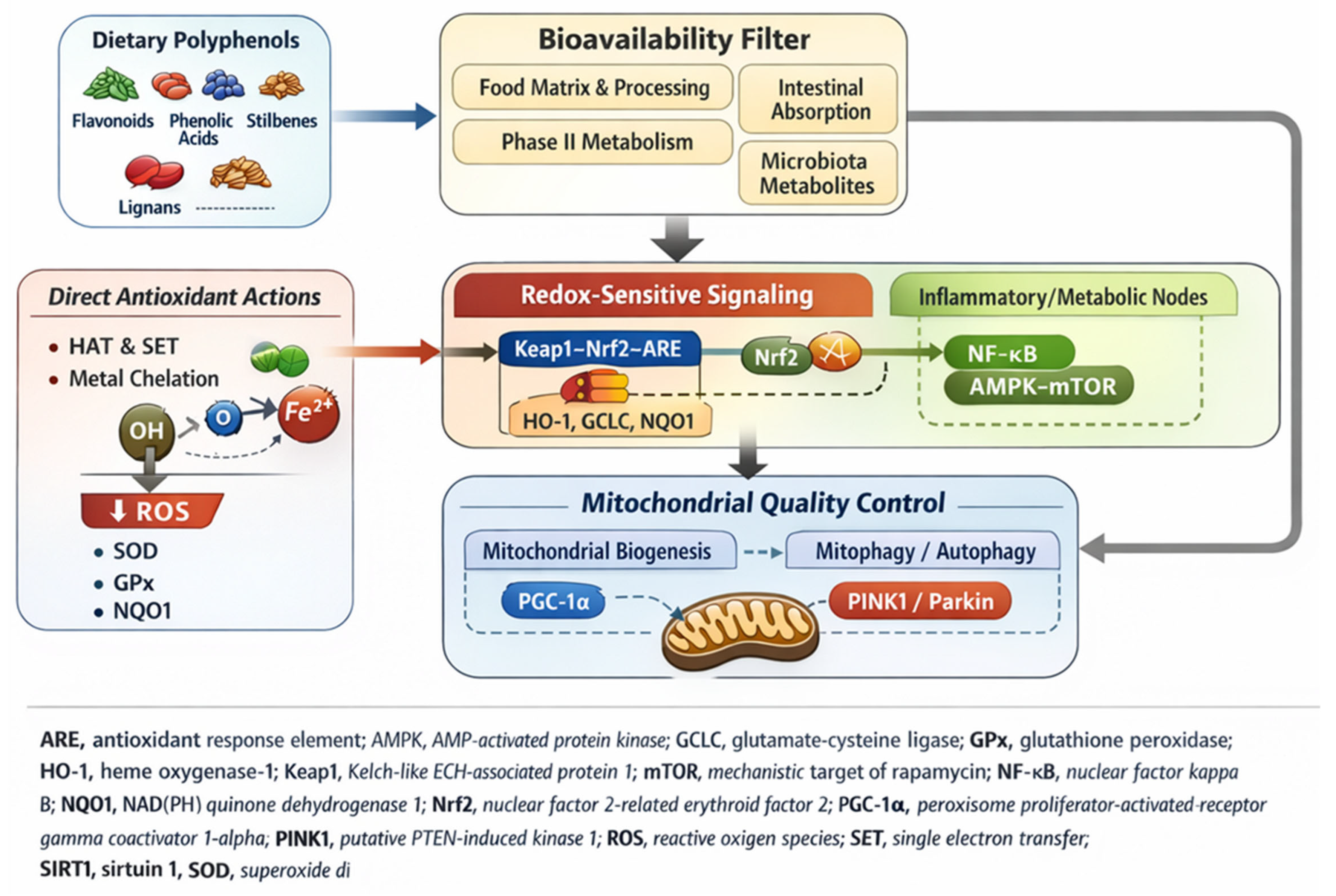
- Includes direct antioxidant chemistry (HAT/SET and metal chelation) with oxidation–reduction-sensitive signaling (Keap1–Nrf2/ARE and key inflammatory pathways) and mitochondrial quality control processes within a unified mechanistic framework;
- (ii)
- Maps the limitations, contradictions and context dependencies that explain divergent results in in vitro, in vivo, and human studies (including dose realism and metabolite predominance) through summaries focused on the strength of evidence and its respective limitations;
- (iii)
- Consolidates translational constraints (bioavailability, microbiota-driven biotransformation, and diet/drug interactions), along with a synthesis of clinical evidence to support the mechanistic interpretation that is most likely to be clinically relevant;
- (iv)
- Highlights the problems related to nutraceuticals and the importance of regulations;
- (v)
- Analyzes the topic of bioavailability, which considers metabolites as a determinant of in vivo efficacy;
- (vi)
- Examines the relationship between antioxidants and the prevention of chronic diseases (cardiovascular, oncological, neurodegenerative, and immune).
- Integrated mechanistic map unifying redox chemistry → signaling → mitochondrial quality control (Figure 1; Section 2.1).
- Synthesis of the strength of evidence at the mechanistic level with explicit limitations/contradictions (end of Section 2; synthesis table), including assay dependence, supraphysiological dosage, and metabolite predominance.
- Bioavailability is considered a key determinant of in vivo relevance (Section 5.1, Section 5.2, Section 5.3, Section 5.4 and Section 5.5), integrating microbiota-driven biotransformation and interindividual variability as a key translational axis.
- Structured clinical evidence table across outcome domains, explicitly outlining comparability limits (population, matrix, dose, assessment criteria).
- Explicit mapping of translational constraints (food matrix effects, first-pass metabolism, realism of supplement versus diet dosage, diet–drug interactions/risks of polypharmacy) to maintain a clinically sound mechanistic interpretation (Section 5.3, Section 5.4, Section 5.5 and Section 5.6).
- Encapsulation framed as exposure optimization (Section 5.7) rather than an independent extraction technology—the extract content is removed, while retaining processing variables relevant to exposure (particle size, fermentation).
- Regulatory perspective + nutraceuticals + market implementation (Section 6), linking evidence quality to claims, standardization, and governance.
- (i)
- Original peer-reviewed studies, systematic reviews, or authoritative mechanistic reviews;
- (ii)
- Explicit evaluation of antioxidant mechanisms and/or redox-sensitive signaling;
- (iii)
- Studies that report on the identity of polyphenols (or well-defined extracts) and the experimental context (in vitro, in vivo, or human); and
- (iv)
- Articles in English published within the time period specified in the manuscript (extended when further in-depth work was required to explain the core mechanisms).
- (v)
- Each word was selected for its relevance using “AND” and “OR”.
- (i)
- Studies that lacked characterization of polyphenols;
- (ii)
- Purely descriptive antioxidant assays, without mechanistic or biological endpoints;
- (iii)
- Conference abstracts and non-peer-reviewed articles;
- (iv)
- Articles written in a language other than English;
- (v)
- Duplicate records.
2. Polyphenols: Identification, Chemical Structure, and Classification
2.1. Different Molecular Mechanisms of Action of Polyphenols
2.2. Dietary Sources of Polyphenols
2.3. Flavonoids: Antioxidant Properties
2.4. Analytical and Classification Limitations and Evidence Quality Considerations
3. Reduction in Oxidative Stress and Antioxidant Mechanisms
3.1. Fundamental Mechanisms and Implications for Health
3.2. Oxidative Stress in the Development of Chronic Diseases
3.3. Antioxidant Mechanisms of Bioactive Compounds Derived from Plants
Elimination of Free Radicals and Neutralization of ROS
3.4. Improvement of Endogenous Antioxidant Defense Systems
3.5. Mechanistic Evidence Appraisal: Limitations, Contradictions, and Strength of Evidence
4. Polyphenols for Disease Prevention and Therapeutic Applications Flavonoid Derivatives
4.1. Prevention and Treatment of Cardiovascular Diseases
4.1.1. Some Molecular Pathways and Signaling Mechanisms Associated with the Vascular Effects of Flavonoids
4.1.2. Prevention and Management of Cardiovascular Diseases. Reduction in Cardiovascular Risk
4.1.3. Endothelial Protection and Vascular Function
4.2. Prevention of Metabolic Diseases and Management of Diabetes
4.3. Prevention and Treatment of Neurodegenerative Diseases
4.4. Cancer Prevention and Therapeutic Potential
4.5. Inflammatory and Autoimmune Diseases
4.6. Limitations and Contradictions
5. Bioavailability, Clinical Efficacy and Encapsulation of Polyphenols (Flavonoids)
5.1. Bioavailability and Metabolism of Polyphenols (Flavonoids)
5.2. Factors That Can Affect Bioavailability
5.2.1. Chemical Structure and Food Matrix
5.2.2. Bioaccessibility, Digestion, and Metabolism
5.2.3. Particle Size and Extraction Preparation
5.2.4. Role of Metabolites and the Intestinal Microbiota
5.2.5. Implications for Health and Nutrition
5.3. Interactions Between Polyphenols (Food Matrix, Microbiome, Drugs/Nutrients)
5.4. Interactions with Other Compounds (Dietary Components, Drugs, Supplements) Some Related Mechanisms: Chelation, Antioxidant Activity, Synergies, and Microbiota
5.4.1. Chelation of Metal Ions
5.4.2. Biomolecular Interaction of Flavonoids
5.5. Microbiotransformation Driven by the Microbiota and Interindividual Variability
5.6. Some Clinical Evidence Related to Dietary Flavonoids
5.7. Microencapsulation and Spray Drying
5.8. Contributions, Limitations, and Contradictions
6. Nutraceuticals and Regulatory Considerations
6.1. Growth and Applications of Flavonoids
6.2. Market Dynamics and Consumer Trends
7. Discussion
8. Conclusions
9. Some Challenges and Future Prospects
Funding
Data Availability Statement
Conflicts of Interest
References
- Aatif, M. Current Understanding of Polyphenols to Enhance Bioavailability for Better Therapies. Biomedicines 2023, 11, 2078. [Google Scholar] [CrossRef] [Scilit]
- Rudrapal, M.; Rakshit, G.; Singh, R.P.; Garse, S.; Khan, J.; Chakraborty, S. Dietary Polyphenols: Review on Chemistry/Sources, Bioavailability/Metabolism, Antioxidant Effects, and Their Role in Disease Management. Antioxidants 2024, 13, 429. [Google Scholar] [CrossRef] [Scilit]
- Ciupei, D.; Colişar, A.; Leopold, L.; Stănilă, A.; Diaconeasa, Z.M. Polyphenols: From Classification to Therapeutic Potential and Bioavailability. Foods 2024, 13, 4131. [Google Scholar] [CrossRef] [Scilit] [PubMed]
- Saad, A.M.; Mohammed, D.M.; Alkafaas, S.S.; Ghosh, S.; Negm, S.H.; Salem, H.M.; Fahmy, M.A.; Semary, H.E.; Ibrahim, E.H.; AbuQamar, S.F.; et al. Dietary polyphenols and human health: Sources, biological activities, nutritional and immunological aspects, and bioavailability—A comprehensive review. Front. Immunol. 2025, 16, 1653378. [Google Scholar] [CrossRef] [Scilit] [PubMed]
- Silva, A.; Silva, V.; Igrejas, G.; Aires, A.; Falco, V.; Valentão, P.; Poeta, P. Phenolic compounds classification and their distribution in winemaking by-products. Eur. Food Res. Technol. 2022, 249, 207–239. [Google Scholar] [CrossRef] [Scilit]
- Zagoskina, N.V.; Zubova, M.Y.; Nechaeva, T.L.; Kazantseva, V.V.; Goncharuk, E.A.; Katanskaya, V.M.; Baranova, E.N.; Aksenova, M.A. Polyphenols in Plants: Structure, Biosynthesis, Abiotic Stress Regulation, and Practical Applications (Review). Int. J. Mol. Sci. 2023, 24, 13874. [Google Scholar] [CrossRef] [Scilit] [PubMed]
- Sánchez, R.; Arroyo, L.; Luaces, P.; Sanz, C.; Pérez, A.G. Olive polyphenol oxidase gene family. Int. J. Mol. Sci. 2023, 24, 3233. [Google Scholar] [CrossRef] [Scilit]
- Shah, M.A.; Faheem, H.I.; Hamid, A.; Yousaf, R.; Haris, M.; Saleem, U.; Shah, G.M.; Alhasani, R.H.; Althobaiti, N.A.; Alsharif, I.; et al. The entrancing role of dietary polyphenols against the most frequent aging-associated diseases. Med. Res. Rev. 2023, 44, 235–274. [Google Scholar] [CrossRef] [Scilit]
- Chen, S.; Wang, X.; Cheng, Y.; Gao, H.; Chen, X. A review of classification, biosynthesis, biological activities and potential applications of flavonoids. Molecules 2023, 28, 4982. [Google Scholar] [CrossRef] [Scilit] [PubMed]
- Fiore, M.; Tonchev, A.B.; Pancheva, R.Z.; Yamashima, T.; Venditti, S.; Ferraguti, G.; Terracina, S. Increasing life expectancy with plant polyphenols: Lessons from the mediterranean and Japanese diets. Molecules 2025, 30, 2888. [Google Scholar] [CrossRef] [Scilit] [PubMed]
- Wan, S.; Luo, J.; Zhu, Y.; An, P.; Luo, Y.; Xing, Q. The Effect of Antioxidant Polyphenol Supplementation on Cardiometabolic Risk Factors: A Systematic Review and Meta-Analysis. Nutrients 2024, 16, 4206. [Google Scholar] [CrossRef] [Scilit]
- Dai, L.; Cai, S.; Chu, D.; Pang, R.; Deng, J.; Zheng, X.; Dai, W. Identification of Chemical Constituents in Blumea balsamifera Using UPLC–Q–Orbitrap HRMS and Evaluation of Their Antioxidant Activities. Molecules 2023, 28, 4504. [Google Scholar] [CrossRef] [Scilit]
- Tsai, C.; Liou, Y.; Li, S.; Liao, H.; Chen, J. Antioxidant, anti-α-glucosidase, anti-tyrosinase, and anti-acetylcholinesterase components from stem of Rhamnus formosana with molecular docking study. Antioxidants 2024, 14, 8. [Google Scholar] [CrossRef] [Scilit] [PubMed]
- Rauf, A.; Khalil, A.A.; Awadallah, S.; Khan, S.A.; Abu-Izneid, T.; Kamran, M.; Hemeg, H.A.; Mubarak, M.S.; Khalid, A.; Wilairatana, P. Reactive oxygen species in biological systems: Pathways, associated diseases, and potential inhibitors—A review. Food Sci. Nutr. 2023, 12, 675–693. [Google Scholar] [CrossRef] [Scilit] [PubMed]
- Sultana, N.; Saini, P.K.; Kiran, K.; Rout, S.; Kanaka, S. Exploring the antioxidant potential of medicinal plant species: A comprehensive review. JPB 2023, 2, 9–13. [Google Scholar] [CrossRef] [Scilit]
- Jomova, K.; Raptova, R.; Alomar, S.Y.; Alwasel, S.; Nepovimová, E.; Kuča, K.; Valko, M. Reactive oxygen species, toxicity, oxidative stress, and antioxidants: Chronic diseases and aging. Arch. Toxicol. 2023, 97, 2499–2574. [Google Scholar] [CrossRef] [Scilit] [PubMed]
- Kaur, K.; Narang, R.K.; Singh, S. Role of Nrf2 in Oxidative Stress, Neuroinflammation and Autophagy in Alzheimer’s Disease: Regulation of Nrf2 by Different Signaling Pathways. Curr. Mol. Med. 2025, 25, 372–387. [Google Scholar] [CrossRef] [Scilit] [PubMed]
- Zahra, M.; Abrahamse, H.; George, B.P. Flavonoids: Antioxidant Powerhouses and Their Role in Nanomedicine. Antioxidants 2024, 13, 922. [Google Scholar] [CrossRef] [Scilit]
- Klitou, P.; Parisi, E.; Bordignon, S.; Bravetti, F.; Rosbottom, I.; Dell’aEra, M.; Cuocci, C.; Chierotti, M.R.; Altomare, A.; Simone, E. Navigating the Complex Solid Form Landscape of the Quercetin Flavonoid Molecule. Cryst. Growth Des. 2023, 23, 6034–6045. [Google Scholar] [CrossRef] [Scilit] [PubMed]
- Kim, K.; Ki, M.; Min, K.; Pack, S. Advanced Delivery System of Polyphenols for Effective Cancer Prevention and Therapy. Antioxidants 2023, 12, 1048. [Google Scholar] [CrossRef] [Scilit]
- Xue, S.; Liu, J.; Li, X.; Zhang, X.; Xin, Z.; Jiang, W.; Zhang, J. First Natural Yeast Strain Trichosporon asahii HZ10 with Robust Flavonoid Productivity and Its Potential Biosynthetic Pathway. J. Agric. Food Chem. 2023, 71, 17130–17140. [Google Scholar] [CrossRef] [Scilit]
- Fatima, G.; Khan, S.; Shukla, V.; Awaida, W.; Li, D.; Gushchina, Y.S. Nutraceutical Formulations and Natural Compounds for the Management of Chronic Diseases. Front. Nutr. 2025, 12, 1682590. [Google Scholar] [CrossRef] [Scilit] [PubMed]
- Bochenek, H.; Francis, N.; Santhakumar, A.; Blanchard, C.; Chinkwo, K. The Antioxidant and Anticancer Properties of Chickpea Water and Chickpea Polyphenol Extracts in Vitro. Cereal Chem. 2023, 100, 895–903. [Google Scholar] [CrossRef] [Scilit]
- Flori, L.; Piragine, E.; Spezzini, J.; Citi, V.; Calderone, V.; Martelli, A. Influence of Polyphenols on Adipose Tissue: Sirtuins as Pivotal Players in the Browning Process. Int. J. Mol. Sci. 2023, 24, 9276. [Google Scholar] [CrossRef] [Scilit] [PubMed]
- Aranda-Rivera, A.K.; Cruz-Gregorio, A.; Arancibia-Hernández, Y.L.; Hernández-Cruz, E.Y.; Pedraza-Chaverri, J. RONS and Oxidative Stress: An Overview of Basic Concepts. Oxygen 2022, 2, 437–478. [Google Scholar] [CrossRef] [Scilit]
- Saha, S.; Sachivkina, N.; Karamyan, A.; Novikova, E.; Chubenko, T. Advances in Nrf2 Signaling Pathway by Targeted Nanostructured-Based Drug Delivery Systems. Biomedicines 2024, 12, 403. [Google Scholar] [CrossRef] [Scilit] [PubMed]
- Kaur, P.; Morden, K.; Subramanian, J.; Singh, A. Comparative analysis of physicochemical characteristics, bioactive components, and volatile profile of sour cherry (Prunus cerasus). Can. J. Plant Sci. 2023, 103, 541–557. [Google Scholar] [CrossRef] [Scilit]
- Sharbafshaaer, M.; Pepe, R.; Notariale, R.; Canale, F.; Tedeschi, G.; Tessitore, A.; Bergamo, P.; Trojsi, F. Beyond Antioxidants: The Emerging Role of Nrf2 Activation in Amyotrophic Lateral Sclerosis (ALS). Int. J. Mol. Sci. 2025, 26, 9872. [Google Scholar] [CrossRef] [Scilit]
- Hammad, M.; Raftari, M.; Cesário, R.; Salma, R.; Godoy, P.; Emami, S.N.; Haghdoost, S. Roles of Oxidative Stress and Nrf2 Signaling in Pathogenic and Non-Pathogenic Cells: A Possible General Mechanism of Resistance to Therapy. Antioxidants 2023, 12, 1371. [Google Scholar] [CrossRef] [Scilit]
- Park, J.-S.; Rustamov, N.; Roh, Y.-S. The Roles of NFR2-Regulated Oxidative Stress and Mitochondrial Quality Control in Chronic Liver Diseases. Antioxidants 2023, 12, 1928. [Google Scholar] [CrossRef] [Scilit]
- Vicente-Zurdo, D.; Gómez-Mejía, E.; Morante-Zarcero, S.; Rosales-Conrado, N.; Sierra, I. Analytical Strategies for Green Extraction, Characterization, and Bioactive Evaluation of Polyphenols, Tocopherols, Carotenoids, and Fatty Acids in Agri-Food Bio-Residues. Molecules 2025, 30, 1326. [Google Scholar] [CrossRef] [Scilit]
- Page, M.J.; McKenzie, J.E.; Bossuyt, P.M.; Boutron, I.; Hoffmann, T.C.; Mulrow, C.D.; Shamseer, L.; Tetzlaff, J.M.; Akl, E.A.; Brennan, S.E.; et al. The PRISMA 2020 Statement: An Updated Guideline for Reporting Systematic Reviews. BMJ 2021, 372, 71. [Google Scholar] [CrossRef] [Scilit]
- Xie, R.; Ahmadi, F.; Islam, M.A.; Dunshea, F.R.; Suleria, H.A.R.; Ponnampalam, E.N. A Systematic Review Using the PRISMA Methodology on Nutrients and Antioxidant Capacity in Moringa (Moringa oleifera Lam.) and Its Applications in the Food Industry. Food Rev. Int. 2025, 41, 2308–2324. [Google Scholar] [CrossRef] [Scilit]
- Cheng, S.; Gao, H.; Yang, Y.; Zhang, M.; Wang, J.; Li, N.; Ji, Y.; Wang, H.; Zhou, Y. Pharmacological diversity of flavonoids and their clinical application prospects in neurological disorders. Phytother. Res. 2025, 39, 5222–5248. [Google Scholar] [CrossRef] [Scilit] [PubMed]
- Dong, H.; Ye, H.; Bai, W.; Zeng, X.; Wu, Q. A comprehensive review of structure–activity relationships and effect mechanisms of polyphenols on heterocyclic aromatic amines formation in thermal-processed food. Compr. Rev. Food Sci. Food Saf. 2024, 23, e70032. [Google Scholar] [CrossRef] [Scilit] [PubMed]
- Tuladhar, P.; Sasidharan, S.; Saudagar, P. Chapter 17–Role of phenols and polyphenols in plant defense response to biotic and abiotic stresses. In Biocontrol Agents and Secondary Metabolites; Woodhead Publishing: Sawston, UK, 2021; pp. 419–444. [Google Scholar] [CrossRef] [Scilit]
- Kejík, Z.; Kaplánek, R.; Masařík, M.; Babula, P.; Matkowski, A.; Filipenský, P.; Veselá, K.; Gburek, J.; Sýkora, D.; Martásek, P.; et al. Iron Complexes of Flavonoids-Antioxidant Capacity and Beyond. Int. J. Mol. Sci. 2021, 22, 646. [Google Scholar] [CrossRef] [Scilit]
- Kumar, K.; Debnath, P.; Singh, S.; Kumar, N. An Overview of Plant Phenolics and Their Involvement in Abiotic Stress Tolerance. Stresses 2023, 3, 570–585. [Google Scholar] [CrossRef] [Scilit]
- Utpal, B.K.; Roy, S.C.; Zehravi, M.; Sweilam, S.H.; Raja, A.D.; Haque, M.A.; Nayak, C.; Balakrishnan, S.; Singh, L.P.; Panigrahi, S.; et al. Polyphenols as Wnt/β-catenin pathway modulators: A promising strategy in clinical neurodegeneration. Anim. Model. Exp. Med. 2025, 8, 266–286. [Google Scholar] [CrossRef] [Scilit] [PubMed]
- Peres, M.; Gouveia, C.; Vitorino, C.; Oliveira, H.; Ferreira-Dias, S. How the “olive oil polyphenols” health claim depends on anthracnose and olive fly on fruits. Foods 2024, 13, 1734. [Google Scholar] [CrossRef] [Scilit] [PubMed]
- Murai, T.; Matsuda, S. The Chemopreventive Effects of Chlorogenic Acids, Phenolic Compounds in Coffee, against Inflammation, Cancer, and Neurological Diseases. Molecules 2023, 28, 2381. [Google Scholar] [CrossRef] [Scilit]
- Zalewska, K.; Kulawik, M.; Gierszewska, J.; Gramala, Z.; Kalus, O.; Karpiński, M.; Maćkowiak, J.; Staniewski, A.; Szymańska, Z.; Zalewska, B.; et al. Chlorogenic Acid’s Role in Metabolic Health: Mechanisms and Therapeutic Potential. Nutrients 2025, 17, 3303. [Google Scholar] [CrossRef] [Scilit]
- Martínez, X.H.; Contreras-Ochoa, C.O.; Mir-Garcia, M.; Aguilar-García, N.; Martínez, H.C.; Morales-Hipólito, E.A.; Hernández-Ojeda, S.L.; Dolores-Hernández, M.; Solis-Cruz, B.; Espinosa-Aguirre, J.J.; et al. Development and in vitro cytotoxicity evaluation of individual and combined injectable solutions of curcumin and resveratrol against lung cancer cells. Antioxidants 2025, 14, 983. [Google Scholar] [CrossRef] [Scilit]
- Bērziņa, L.; Mieriņa, I. Antiradical and Antioxidant Activity of Compounds Containing 1,3-Dicarbonyl Moiety: An Overview. Molecules 2023, 28, 6203. [Google Scholar] [CrossRef] [Scilit]
- Smirnova, E.; Moniruzzaman, M.; Chin, S.; Sureshbabu, A.; Karthikeyan, A.; Do, K.; Min, T. A Review of the Role of Curcumin in Metal Induced Toxicity. Antioxidants 2023, 12, 243. [Google Scholar] [CrossRef] [Scilit] [PubMed]
- Mittal, A.; Nagpal, M.; Vashistha, V.K.; Arora, R.; Issar, U. Recent advances in the antioxidant activity of metal-curcumin complexes: A combined computational and experimental review. Free. Radic. Res. 2024, 58, 11–26. [Google Scholar] [CrossRef] [Scilit]
- Tang, S.; Wang, B.; Liu, X.; Xi, W.; Yue, Y.; Tan, X.; Bai, J.; Huang, L. Structural insights and biological activities of flavonoids: Implications for novel applications. Food Front. 2024, 6, 218–247. [Google Scholar] [CrossRef] [Scilit]
- Pandey, P.; Lakhanpal, S.; Mahmood, D.; Na Kang, H.; Kim, B.; Kang, S.; Choi, J.; Choi, M.; Pandey, S.; Bhat, M.; et al. An updated review summarizing the anticancer potential of flavonoids via targeting NF-kB pathway. Front. Pharmacol. 2025, 15, 1513422. [Google Scholar] [CrossRef] [Scilit] [PubMed]
- Jeayeng, S.; Kwanthongdee, J.; Jittreeprasert, R.; Runganantchai, K.; Naksavasdi, K.; Rirkkrai, R.; Wongcharoenthavorn, V.; Mahikul, W.; Chatsirisupachai, A. Natural products as promising therapeutics for fine particulate matter–induced skin damage: A review of pre-clinical studies on skin inflammation and barrier dysfunction. PeerJ 2025, 13, e19316. [Google Scholar] [CrossRef] [Scilit]
- Petruskevicius, A.; Viskelis, J.; Urbonaviciene, D.; Viskelis, P. Anthocyanin Accumulation in Berry Fruits and Their Antimicrobial and Antiviral Properties: An Overview. Horticulturae 2023, 9, 288. [Google Scholar] [CrossRef] [Scilit]
- Bezerra, M.; Ribeiro, M.; Cosme, F.; Nunes, F.M. Overview of the distinctive characteristics of strawberry, raspberry, and blueberry in berries, berry wines, and berry spirits. Compr. Rev. Food Sci. Food Saf. 2024, 23, e13354. [Google Scholar] [CrossRef] [Scilit] [PubMed]
- Carpio, A.; Talubo, N.; Tsai, P.; Chen, B.; Tayo, L. Berries as nature’s therapeutics: Exploring the potential of Vaccinium metabolites in gastric cancer treatment through computational insights. Life 2025, 15, 406. [Google Scholar] [CrossRef] [Scilit] [PubMed]
- Baqer, S.H.; Al-Shawi, S.G.; Al-Younis, Z.K. Quercetin, the Potential Powerful Flavonoid for Human and Food: A Review. Front. Biosci. 2024, 16, 30. [Google Scholar] [CrossRef] [Scilit] [PubMed]
- Kumar, D.; Sharma, P.K. Quercetin: A Comprehensive Review. Curr. Nutr. Food Sci. 2024, 20, 143–166. [Google Scholar] [CrossRef] [Scilit]
- Cizmarova, B.; Hubkova, B.; Birkova, A. Quercetin as an effective antioxidant against superoxide radical. Funct. Food Sci. 2023, 3, 15. [Google Scholar] [CrossRef] [Scilit]
- Tumilaar, S.G.; Hardianto, A.; Dohi, H.; Kurnia, D. A comprehensive review of free radicals, oxidative stress, and antioxidants: Overview, clinical applications, global perspectives, future directions, and mechanisms of antioxidant activity of flavonoid compounds. J. Chem. 2024, 2024, 5594386. [Google Scholar] [CrossRef] [Scilit]
- Buljeta, I.; Pichler, A.; Šimunović, J.; Kopjar, M. Beneficial effects of red wine polyphenols on human health: Comprehensive review. Curr. Issues Mol. Biol. 2023, 45, 782–798. [Google Scholar] [CrossRef] [Scilit]
- Patanè, G.T.; Putaggio, S.; Tellone, E.; Barreca, D.; Ficarra, S.; Maffei, C.; Calderaro, A.; Laganà, G. Catechins and Proanthocyanidins Involvement in Metabolic Syndrome. Int. J. Mol. Sci. 2023, 24, 9228. [Google Scholar] [CrossRef] [Scilit]
- Nie, F.; Liu, L.; Cui, J.; Zhao, Y.; Zhang, D.; Zhou, D.; Wu, J.; Li, B.; Wang, T.; Li, M.; et al. Oligomeric Proanthocyanidins: An Updated Review of Their Natural Sources, Synthesis, and Potentials. Antioxidants 2023, 12, 1004. [Google Scholar] [CrossRef] [Scilit]
- Shilpa, V.; Shams, R.; Dash, K.K.; Pandey, V.K.; Dar, A.H.; Mukarram, S.A.; Harsányi, E.; Kovács, B. Phytochemical Properties, Extraction, and Pharmacological Benefits of Naringin: A Review. Molecules 2023, 28, 5623. [Google Scholar] [CrossRef] [Scilit]
- Javed, M.; Mal, T. A review on estimation of quercetin, rutin, apigenin, naringin and hesperidin from citrus plant using HPLC. J. Pharmacogn. Phytochem. 2025, 14, 469–479. [Google Scholar] [CrossRef] [Scilit]
- Tabassum, S.; Misrani, A.; Huang, H.-X.; Zhang, Z.-Y.; Li, Q.-W.; Long, C. Resveratrol attenuates chronic unpredictable mild stress-induced alterations in the SIRT1/PGC1α/SIRT3 pathway and associated mitochondrial dysfunction in mice. Mol. Neurobiol. 2023, 60, 5102–5116. [Google Scholar] [CrossRef] [Scilit] [PubMed]
- Dawood, R.A.; Alghetaa, H.F. Deleterious effects of mercuric chloride toxicity initiated partially from physiological disorder of kidney, immunocytes and redox system, can be reversed by resveratrol administration. Adv. Anim. Vet. Sci. 2023, 11, 1465–1471. [Google Scholar] [CrossRef] [Scilit]
- Duta-Bratu, C.-G.; Nitulescu, G.M.; Mihai, D.P.; Olaru, O.T. Resveratrol and Other Natural Oligomeric Stilbenoid Compounds and Their Therapeutic Applications. Plants 2023, 12, 2935. [Google Scholar] [CrossRef] [Scilit] [PubMed]
- Al-Khayri, J.M.; Mascarenhas, R.; Harish, H.M.; Gowda, Y.; Lakshmaiah, V.V.; Nagella, P.; Al-Mssallem, M.Q.; Alessa, F.M.; Almaghasla, M.I.; Rezk, A.A.-S. Stilbenes, a Versatile Class of Natural Metabolites for Inflammation—An Overview. Molecules 2023, 28, 3786. [Google Scholar] [CrossRef] [Scilit]
- Hattori, Y.; Minami, M.; Omae, K.; Yoshimoto, T.; Abe, S.; Yamamoto, H.; Iida, H.; Ihara, M. REsveratrol for VAscular cognitive impairment investigating cerebral Metabolism and Perfusion (REVAMP trial): A study protocol for a randomized, double-blind, placebo-controlled trial. Front. Nutr. 2024, 11, 1359330. [Google Scholar] [CrossRef] [Scilit]
- Visvanathan, R.; Le, T.; Dhital, S.; Rali, T.; Davis, R.; Williamson, G. Inhibition of human salivary and pancreatic α-amylase by resveratrol oligomers. J. Med. Chem. 2024, 67, 18753–18763. [Google Scholar] [CrossRef] [Scilit] [PubMed]
- Agbadua, O.G.; Kúsz, N.; Berkecz, R.; Vass, E.; Csámpai, A.; Tóth, G.; Balogh, G.T.; Marcourt, L.; Wolfender, J.-L.; Queiroz, E.F.; et al. New Insights into the French Paradox: Free Radical Scavenging by Resveratrol Yields Cardiovascular Protective Metabolites. J. Med. Chem. 2025, 68, 10031–10047. [Google Scholar] [CrossRef] [Scilit] [PubMed]
- Cervantes, F.V.; Fernandez-Arrojo, L.; Coscolin, C.; Berrojo, A.; Gonzalez-Alfonso, J.L.; de la Lastra, J.; Ferrer, M.; Curieses-Andres, C.M.; Andres-Juan, C.; Ballesteros, A.O.; et al. Inhibition of Yeast hexokinase by acyl glucosides of phloretin and its implication in the warburg effect. ChemistrySelect 2024, 9, e202401086. [Google Scholar] [CrossRef] [Scilit]
- Butnariu, M. Plant Genome Engineering for Improved Flavonoids Production. In Plants as Bioreactors for Industrial Molecules; Upadhyay, S.K., Singh, S.P., Eds.; John Wiley & Sons: Hoboken, NJ, USA, 2023; pp. pp 215–240. [Google Scholar] [CrossRef] [Scilit]
- Kauffmann, A.C.; Castro, V.S. Phenolic Compounds in Bacterial Inactivation: A Perspective from Brazil. Antibiotics 2023, 12, 645. [Google Scholar] [CrossRef] [Scilit]
- Martirosyan, D.; Hayes, A.; Shen, N. Phenolic compounds and their potential in cancer management. Agric. Food Bioact. Compd. 2025, 2, 47–61. [Google Scholar] [CrossRef] [Scilit]
- Spagnuolo, L.; Posta, S.; Fanali, C.; Dugo, L.; Gara, L. Chemical composition of hazelnut skin food waste and protective role against advanced glycation end-products (AGEs) damage in THP-1-derived macrophages. Molecules 2023, 28, 2680. [Google Scholar] [CrossRef] [Scilit] [PubMed]
- Kola, A.; Vigni, G.; Baratto, M.; Valensin, D. A Combined NMR and UV–Vis approach to evaluate radical scavenging activity of rosmarinic acid and other polyphenols. Molecules 2023, 28, 6629. [Google Scholar] [CrossRef] [Scilit] [PubMed]
- Geng, Y.; Liu, X.; Yu, Y.; Li, W.; Mou, Y.; Chen, F.; Hu, X.; Ji, J.; Ma, L. From polyphenol to o-quinone: Occurrence, significance, and intervention strategies in foods and health implications. Compr. Rev. Food Sci. Food Saf. 2023, 22, 3254–3291. [Google Scholar] [CrossRef] [Scilit] [PubMed]
- Janigashvili, G.; Chkhikvishvili, I.; Ratiani, L.; Maminaishvili, T.; Chkhikvishvili, D.; Sanikidze, T. Effects and medical application of plant-origin polyphenols: A narrative review. Bioact. Compd. Health Dis. 2024, 7, 375–385. [Google Scholar] [CrossRef] [Scilit]
- Wu, L.; Chen, Q.; Dong, B.; Geng, H.; Wang, Y.; Han, D.; Zhu, X.; Liu, H.; Zhang, Z.; Yang, Y.; et al. Resveratrol alleviates lipopolysaccharide-induced liver injury by inducing SIRT1/P62-mediated mitophagy in gibel carp (Carassius gibelio). Front. Immunol. 2023, 14, 1177140. [Google Scholar] [CrossRef] [Scilit] [PubMed]
- Cecerska-Heryć, E.; Wiśniewska, Z.; Serwin, N.; Polikowska, A.; Goszka, M.; Engwert, W.; Michałów, J.; Pękała, M.; Budkowska, M.; Michalczyk, A.; et al. Can compounds of natural origin be important in chemoprevention? anticancer properties of quercetin, resveratrol, and curcumin—A comprehensive review. Int. J. Mol. Sci. 2024, 25, 4505. [Google Scholar] [CrossRef] [Scilit]
- Guan, T.; Bian, C.; Ma, Z. In vitro and in silico perspectives on the activation of antioxidant responsive element by citrus-derived flavonoids. Front. Nutr. 2023, 10, 1257172. [Google Scholar] [CrossRef] [Scilit] [PubMed]
- Steinberg, G.R.; Hardie, D.G. New insights into activation and function of the AMPK. Nat. Rev. Mol. Cell Biol. 2022, 24, 255–272. [Google Scholar] [CrossRef] [Scilit]
- Jhuo, C.; Chen, C.; Tzen, J.T.; Chen, W. Teaghrelin protected dopaminergic neurons in MPTP-induced Parkinson’s disease animal model by promoting PINK1/Parkin-mediated mitophagy and AMPK/SIRT1/PGC1-α-mediated mitochondrial biogenesis. Environ. Toxicol. 2024, 39, 4022–4034. [Google Scholar] [CrossRef] [Scilit]
- Rosencrans, W.M.; Lee, R.; McGraw, L.; Horsburgh, I.; Wang, T.; Quan, B.; Huynh, D.; Johnston, J.A.; Chan, D.C.; Chou, T.-F. Putative PINK1/Parkin activators lower the threshold for mitophagy by sensitizing cells to mitochondrial stress. Sci. Adv. 2025, 11, eady0240. [Google Scholar] [CrossRef] [Scilit] [PubMed]
- Livraghi, V.; Mazza, L.; Chiappori, F.; Cardano, M.; Cazzalini, O.; Puglisi, R.; Capoferri, R.; Pozzi, A.; Stivala, L.A.; Zannini, L.; et al. A proteasome-dependent inhibition of SIRT-1 by the resveratrol analogue 4,4′-dihydroxy-trans-stilbene. J. Tradit. Complement. Med. 2024, 14, 534–543. [Google Scholar] [CrossRef] [Scilit]
- Morgenstern, C.; Lastres-Becker, I.; Demirdöğen, B.C.; Costa, V.M.; Daiber, A.; Foresti, R.; Motterlini, R.; Kalyoncu, S.; Arioz, B.I.; Genc, S.; et al. Biomarkers of NRF2 signalling: Current status and future challenges. Redox Biol. 2024, 72, 103134. [Google Scholar] [CrossRef] [Scilit] [PubMed]
- Kaur, G.; Mankoo, O.; Goyal, D.; Goyal, B. Unveiling how hydroxytyrosol destabilizes α-syn oligomers using molecular simulations. J. Phys. Chem. B 2023, 127, 5620–5632. [Google Scholar] [CrossRef] [Scilit] [PubMed]
- Liu, Y.; Wang, X.; Podio, N.; Wang, X.; Xu, S.; Jiang, S.; Wei, X.; Han, Y.; Cai, Y.; Chen, X.; et al. Research progress on the regulation of oxidative stress by phenolics: The role of gut microbiota and Nrf2 signaling pathway. J. Sci. Food Agric. 2023, 104, 1861–1873. [Google Scholar] [CrossRef] [Scilit] [PubMed]
- Khalequeuzzaman, M.; Das, A.K.; Alam, M.R.; Afroz, S.A.; Sumaiya, K.; Siraj, S. Evaluation of Antioxidant and Anti-inflammatory Activity of Ethanolic Extract of Ficus heterophylla var. assamica Fruits. Eur. J. Pharm. Res. 2023, 3, 7–10. [Google Scholar] [CrossRef] [Scilit]
- Mazur, T.; Malik, M.; Bieńko, D.C. The impact of chelating compounds on Cu2+, Fe2+/3+, and Zn2+ ions in Alzheimer’s disease treatment. J. Inorg. Biochem. 2024, 257, 112601. [Google Scholar] [CrossRef] [Scilit]
- Leri, M.; Vasarri, M.; Carnemolla, F.; Oriente, F.; Cabaro, S.; Stio, M.; Degl’innocenti, D.; Stefani, M.; Bucciantini, M. Evoo polyphenols exert anti-inflammatory effects on the microglia cell through TREM2 signaling pathway. Pharmaceuticals 2023, 16, 933. [Google Scholar] [CrossRef] [Scilit] [PubMed]
- Zodio, S.; Serreli, G.; Melis, M.P.; Franchi, B.; Boronat, A.; Torre, R.; Deiana, M. Protective effect of hydroxytyrosol and tyrosol metabolites in LPS-induced vascular barrier derangement in vitro. Front. Nutr. 2024, 11, 1350378. [Google Scholar] [CrossRef] [Scilit]
- Marrero, A.D.; Castilla, L.; Bernal, M.; Manrique, I.; Posligua-García, J.D.; Moya-Utrera, F.; Porras-Alcalá, C.; Espartero, J.L.; Sarabia, F.; Quesada, A.R.; et al. Inhibition of endothelial inflammatory response by HT-C6, a hydroxytyrosol alkyl ether derivative. Antioxidants 2023, 12, 1513. [Google Scholar] [CrossRef] [Scilit]
- González-Acedo, A.; Illescas-Montes, R.; de Luna-Bertos, E.; Ruiz, C.; Ramos-Torrecillas, J.; García-Martínez, O.; Melguizo-Rodríguez, L. Extra virgin olive oil phenolic compounds modulate the gene expression of biomarkers involved in fibroblast proliferation and differentiation. Genes 2024, 15, 173. [Google Scholar] [CrossRef] [Scilit]
- Duarte, M.S.; Fuhro, V.M.; Nogueira, J.; Romana-Souza, B. Polyphenol hydroxytyrosol present olive oil improves skin wound healing of diabetic mice. Wound Repair Regen. 2024, 32, 904–915. [Google Scholar] [CrossRef] [Scilit]
- Fan, L.; Zhao, L.; Zhu, Y.; Li, L.; Yang, X.; Ma, P.; Liu, J.; Zhao, Q.; Li, X. Hydroxytyrosol ameliorates stress-induced liver injury through activating autophagy via HDAC1/2 inhibition. Food Funct. 2024, 15, 5103–5117. [Google Scholar] [CrossRef] [Scilit] [PubMed]
- Chedea, V.S.; Tomoiagă, L.L.; Ropota, M.; Marc, G.; Ranga, F.; Comșa, M.; Muntean, M.D.; Sîrbu, A.D.; Giurca, I.S.; Răcoare, H.S.; et al. Phenolic Profile, Fatty Acid Composition, and Antioxidant Activity of Italian Riesling Grape Pomace from Two Transylvanian Microclimates. Plants 2025, 14, 1809. [Google Scholar] [CrossRef] [Scilit]
- Zhang, Y.; Zhang, C.; Xu, C.; Deng, Y.; Wen, B.; Xie, P.; Huang, L. Effect of Geographical Location and Soil Fertility on Main Phenolic Compounds and fatty Acids Compositions of Virgin Olive Oil from Leccino Cultivar in China. Food Res. Int. 2022, 157, 111207. [Google Scholar] [CrossRef] [Scilit]
- Silva, E.; Gonçalves, A.; Martins, S.; Brito, C.; Ferreira, H.; Ferreira, L.M.M.; Moutinho-Pereira, J.; Rodrigues, M.Â.; Correia, C.M. Olive Yield and Physicochemical Properties of Olives and Oil in Response to Nutrient Application under Rainfed Conditions. Molecules 2023, 28, 831. [Google Scholar] [CrossRef] [Scilit] [PubMed]
- Nurzyńska-Wierdak, R. Phenolic Compounds from New Natural Sources—Plant Genotype and Ontogenetic Variation. Molecules 2023, 28, 1731. [Google Scholar] [CrossRef] [Scilit] [PubMed]
- Mare, R.; Pujia, R.; Maurotti, S.; Greco, S.; Cardamone, A.; Coppoletta, A.R.; Bonacci, S.; Procopio, A.; Pujia, A. Assessment of Mediterranean Citrus Peel Flavonoids and Their Antioxidant Capacity Using an Innovative UV-Vis Spectrophotometric Approach. Plants 2023, 12, 4046. [Google Scholar] [CrossRef] [Scilit]
- Morales, J.; Medina, A.; Bermejo, A. Sustainable Extraction of Flavonoids from Citrus Waste: A Fast and Simple Approach with UHPLC-PDA ESI-MS Characterization. Sci 2025, 7, 156. [Google Scholar] [CrossRef] [Scilit]
- Yong, X.; He, P.; He, B.; Chen, Z. Bioactive Flavonoids Metabolites in Citrus Species: Their Potential Health Benefits and Medical Potentials. Front. Pharmacol. 2025, 16, 1552171. [Google Scholar] [CrossRef] [Scilit] [PubMed]
- Borghini, F.; Tamasi, G.; Loiselle, S.A.; Baglioni, M.; Ferrari, S.; Bisozzi, F.; Costantini, S.; Tozzi, C.; Riccaboni, A.; Rossi, C. Phenolic Profiles in Olive Leaves from Different Cultivars in Tuscany and Their Use as a Marker of Varietal and Geographical Origin on a Small Scale. Molecules 2024, 29, 3617. [Google Scholar] [CrossRef] [Scilit] [PubMed]
- Zakraoui, M.; Hannachi, H.; Pasković, I.; Vidović, N.; Pasković, M.P.; Palčić, I.; Major, N.; Ban, S.G.; Hamrouni, L. Effect of Geographical Location on the Phenolic and Mineral Composition of Chetoui Olive Leaves. Foods 2023, 12, 2565. [Google Scholar] [CrossRef] [Scilit] [PubMed]
- Yang, C.; Xu, Y.; Xie, X.; Wu, Y.; Gao, Z.; Li, K.; Guo, J.; Zhang, X.; Wang, H.; Liu, M. Post-harvest Physiology of Vegetable Crops and Its Regulation. In Growth Regulation and Quality Improvement of Vegetable Crops; Springer: Singapore, 2025; pp. 495–557. [Google Scholar] [CrossRef] [Scilit]
- Ringseis, R.; Eder, K.; Gessner, D.K. Efficacy of feeding grape by-products on performance, nutrient digestibility, gut morphology, gut microbial community, oxidative stress and immune response in fast-growing broilers. Animals 2025, 15, 1943. [Google Scholar] [CrossRef] [Scilit]
- Deepa, P.; Hong, M.; Sowndhararajan, K.; Kim, S. A Review of the Role of an Anthocyanin, Cyanidin-3-O-β-glucoside in Obesity-Related Complications. Plants 2023, 12, 3889. [Google Scholar] [CrossRef] [Scilit]
- Kasnazany, S.; Mirza, A.; Mahmood, A.; Rahman, S.; Hameed, J.; Nasrulla, K. A comparison of nine grape vitis vinifera l. cultivars growing in iraq’s kurdistan region in terms of their vegetative growth and physicochemical traits. IOP Conf. Ser. Earth Environ. Sci. 2023, 1213, 012044. [Google Scholar] [CrossRef] [Scilit]
- Rouxinol, M.I.; Martins, M.R.; Salgueiro, V.; Costa, M.J.; Barroso, J.M.; Rato, A.E. Climate Effect on Morphological Traits and Polyphenolic Composition of Red Wine Grapes of Vitis vinifera. Beverages 2023, 9, 8. [Google Scholar] [CrossRef] [Scilit]
- Kaya, O. Harmony in the vineyard: Exploring the eco-chemical interplay of Bozcaada Çavuşu (Vitis vinifera L.) grape cultivar and pollinator varieties on some phytochemicals. Eur. Food Res. Technol. 2024, 250, 1327–1339. [Google Scholar] [CrossRef] [Scilit]
- Poiana, M.-A.; Alexa, E.; Radulov, I.; Raba, D.-N.; Cocan, I.; Negrea, M.; Misca, C.D.; Dragomir, C.; Dossa, S.; Suster, G. Strategies to formulate value-added pastry products from composite flours based on spelt flour and grape pomace powder. Foods 2023, 12, 3239. [Google Scholar] [CrossRef] [Scilit] [PubMed]
- Maqbool, Z.; Khalid, W.; Atiq, H.T.; Koraqi, H.; Javaid, Z.; Alhag, S.K.; Al-Shuraym, L.A.; Bader, D.M.D.; Almarzuq, M.; Afifi, M.; et al. Citrus Waste as Source of Bioactive Compounds: Extraction and Utilization in Health and Food Industry. Molecules 2023, 28, 1636. [Google Scholar] [CrossRef] [Scilit] [PubMed]
- Lubinska-Szczygeł, M.; Kuczyńska-Łażewska, A.; Rutkowska, M.; Polkowska, Ż.; Katrich, E.; Gorinstein, S. Determination of the Major By-Products of Citrus hystrix Peel and Their Characteristics in the Context of Utilization in the Industry. Molecules 2023, 28, 2596. [Google Scholar] [CrossRef] [Scilit] [PubMed]
- Shinali, T.S.; Zhang, Y.; Altaf, M.; Nsabiyeze, A.; Han, Z.; Shi, S.; Shang, N. The Valorization of Wastes and Byproducts from Cruciferous Vegetables: A Review on the Potential Utilization of Cabbage, Cauliflower, and Broccoli Byproducts. Foods 2024, 13, 1163. [Google Scholar] [CrossRef] [Scilit] [PubMed]
- La Scala, S.; Naselli, F.; Quatrini, P.; Gallo, G.; Caradonna, F. Drought-adapted mediterranean diet plants: A source of bioactive molecules able to give nutrigenomic effects per sè or to obtain functional foods. Int. J. Mol. Sci. 2024, 25, 2235. [Google Scholar] [CrossRef] [Scilit]
- Murokore, B.J.; Vuzi, P.C.; Wacoo, A.P.; Wangalwa, R.; Ajayi, C.O.; Gumisiriza, H.; Masawi, A.N. Effect of Extraction Period on Total Phenolics, Total Flavonoids, and Antioxidant Capacity of Ugandan Camellia sinensis (L) Kuntze, Black Primary Grades and Green Tea. J. Food Qual. 2023, 1, 3504280. [Google Scholar] [CrossRef] [Scilit]
- Ayele, G.; Admassu, H.; Mosisa, G.; Desalegn, A.; Abeje, M. Emerging techniques for catechin extraction from green tea (Camellia sinensis): Extraction technologies, functional potential, Toxicology, and food-industry applications: A systematic review. Cogent Food Agric. 2025, 11, 2598723. [Google Scholar] [CrossRef] [Scilit]
- Shitandi, A.A. Tea processing and impact on catechins, theaflavin and thearubigin formation. In Tea in Health and Disease Prevention; Academic Press: Cambridge, MA, USA, 2025; pp. 133–144. [Google Scholar] [CrossRef] [Scilit]
- Nobari, H.; Saedmocheshi, S. Linking exercise and green tea consumption as an antioxidant strategy. In Tea in Health and Disease Prevention; Academic Press: Cambridge, MA, USA, 2025; pp. 369–377. [Google Scholar] [CrossRef] [Scilit]
- Mehrabi, M.; Amiri, M.; Razavi, R.; Najafi, A.; Hajian-Tilaki, A. Influence of varied processing methods on the antioxidant capacity, antibacterial activity, and bioavailability of Iranian black, oolong, and green leafy teas. Food Chem. 2024, 464, 141793. [Google Scholar] [CrossRef] [Scilit] [PubMed]
- Pyrzynska, K. Spent Coffee Grounds as a Source of Chlorogenic Acid. Molecules 2025, 30, 613. [Google Scholar] [CrossRef] [Scilit] [PubMed]
- Kobylińska, Z.; Biesiadecki, M.; Kuna, E.; Galiniak, S.; Mołoń, M. Coffee as a Source of Antioxidants and an Elixir of Youth. Antioxidants 2025, 14, 285. [Google Scholar] [CrossRef] [Scilit]
- Tsoupras, A.; Ni, V.L.J.; O’mahony, É.; Karali, M. Winemaking: “With one stone, two birds”? a holistic review of the bio-functional compounds, applications and health benefits of wine and wineries’ by-products. Fermentation 2023, 9, 838. [Google Scholar] [CrossRef] [Scilit]
- El Rayess, Y.; Nehme, N.; Azzi-Achkouty, S.; Julien, S.G. Wine Phenolic Compounds: Chemistry, Functionality and Health Benefits. Antioxidants 2024, 13, 1312. [Google Scholar] [CrossRef] [Scilit]
- Geana, E.-I.; Ciucure, C.T.; Apetrei, I.M.; Clodoveo, M.L.; Apetrei, C. Discrimination of olive oil and extra-virgin olive oil from other vegetable oils by targeted and untargeted HRMS profiling of phenolic and triterpenic compounds combined with chemometrics. Int. J. Mol. Sci. 2023, 24, 5292. [Google Scholar] [CrossRef] [Scilit] [PubMed]
- Ussia, S.; Ritorto, G.; Mollace, R.; Serra, M.; Tavernese, A.; Altomare, C.; Muscoli, C.; Fini, M.; Barillà, F.; Indolfi, C.; et al. Exploring the benefits of extra virgin olive oil on cardiovascular health enhancement and disease prevention: A systematic review. Nutrients 2025, 17, 1843. [Google Scholar] [CrossRef] [Scilit]
- Taiti, C.; Masi, E.; Flamminii, F.; Di Mattia, C.; Mancuso, S.; Marone, E. Does the Harvest Type Affect Olive Health? Influence of the Harvesting System and Storage Time on the Chemical, Volatile and Sensory Qualities of Extra Virgin Olive Oils. Plants 2023, 12, 3843. [Google Scholar] [CrossRef] [Scilit]
- Laidi, O.; Ghanam, J.; Omor, A.; Elkarrach, K.; Rokni, Y.; Merzouki, M. Good pre-harvest and extraction practices enhance the polyphenols content in extra virgin olive oil and maintain its oxidative stability at high temperatures. Sci. Afr. 2025, 30, e03094. [Google Scholar] [CrossRef] [Scilit]
- Korkmaz, A. Characterization and Comparison of Extra Virgin Olive Oils of Turkish Olive Cultivars. Molecules 2023, 28, 1483. [Google Scholar] [CrossRef] [Scilit] [PubMed]
- Martins, V.F.R.; Ribeiro, T.B.; Lopes, A.I.; Pintado, M.E.; Morais, R.M.S.C.; Morais, A.M.M.B. Comparison among Different Green Extraction Methods of Polyphenolic Compounds from Exhausted Olive Oil Pomace and the Bioactivity of the Extracts. Molecules 2024, 29, 1935. [Google Scholar] [CrossRef] [Scilit] [PubMed]
- Bubulac, L.; Bogdan-Andreescu, C.F.; Voica, D.V.; Cristea, B.M.; Chiș, M.S.; Slăvescu, D.A. From Olive Oil to Pomace: Sustainable Valorization Pathways Linking Food Processing and Human Health. Appl. Sci. 2025, 15, 10717. [Google Scholar] [CrossRef] [Scilit]
- Romeu, M.F.C.; Bernardo, J.; Daniel, C.I.; Costa, N.; Crespo, J.G.; Pinto, L.S.; da Ponte, M.N.; Nunes, A. Hydroxytyrosol recovery from olive pomace: A simple process using olive mill industrial equipment and membrane technology. J. Food Sci. Technol. 2023, 61, 161–168. [Google Scholar] [CrossRef] [Scilit] [PubMed]
- Kim, Y.-R.; Kim, G.-C.; Nam, S.-H. Evaluation of antioxidant and antifungal activity of Chamaecyparis obtuse extract for use in oral herbal medicine. Appl. Sci. 2023, 13, 10236. [Google Scholar] [CrossRef] [Scilit]
- Manful, C.F.; Fordjour, E.; Subramaniam, D.; Sey, A.A.; Abbey, L.; Thomas, R. Antioxidants and Reactive Oxygen Species: Shaping Human Health and Disease Outcomes. Int. J. Mol. Sci. 2025, 26, 7520. [Google Scholar] [CrossRef] [Scilit] [PubMed]
- Chaudhary, P.; Janmeda, P.; Docea, A.O.; Yeskaliyeva, B.; Razis, A.F.A.; Modu, B.; Calina, D.; Sharifi-Rad, J. Oxidative stress, free radicals and antioxidants: Potential crosstalk in the pathophysiology of human diseases. Front. Chem. 2023, 11, 1158198. [Google Scholar] [CrossRef] [Scilit]
- Rahmatillah, B.K.; Pelupessy, A.H.; Putri, A.; Pertiwi, A.E.; Majid, A.R.; Rhamadianto, M.I. Studi in silico dari senyawa turunan flavonoid pada bahan alam sebagai terapi antinyeri dan inflamasi dalam menghambat COX 2. J. Ris. Rumpun. Mat. Dan Ilmu. Pengetah. Alam. 2025, 4, 142–153. [Google Scholar] [CrossRef] [Scilit]
- Chauhan, R.; Sirasanagandla, S.R.; Veeraraghavan, V.P.; Jayaraman, S.; Chandrasekar, S. Therapeutic potential of flavonoids in diabetes mellitus management: Molecular insights and the future directions for drug design. Curr. Drug Discov. Technol. 2025, 22, e15701638333208. [Google Scholar] [CrossRef] [Scilit]
- Ain, H.B.U.; Tufail, T.; Bashir, S.; Ijaz, N.; Hussain, M.; Ikram, A.; Farooq, M.A.; Saewan, S.A. Nutritional importance and industrial uses of pomegranate peel: A critical review. Food Sci. Nutr. 2023, 11, 2589–2598. [Google Scholar] [CrossRef] [Scilit] [PubMed]
- Yerushalmy, Y.; Nov, G.; Hacham, Y.; Holland, D.; Tian, L.; Amir, R. Overexpression of Pgbhlh94-like Increases shikimate, hydrolyzable tannin, and lignin levels in pomegranate (Punica granatum L.) hairy roots. Physiol. Plant. 2025, 177, e70578. [Google Scholar] [CrossRef] [Scilit]
- Sun, D.; Gokhale, V. Role of human DNA ligases in mediating pharmacological activities of flavonoids. Int. J. Mol. Sci. 2025, 26, 1456. [Google Scholar] [CrossRef] [Scilit]
- Alamuoye, O.F.; Alamuoye, N.O.; Adebayo, F.B.; Oniyilo, V. Evaluation of carcass, growth performance, hematological and biochemical parameters of broiler chickens fed additive of onion bulb peel powder. Asian J. Res. Agric. For. 2024, 10, 74–85. [Google Scholar] [CrossRef] [Scilit]
- Aytac, K.Y.; Ozkaya, A.; Oztekin, A.; Cinar, V.; Akbulut, T.; Demirdag, R.; Comaklı, V.; Bozbay, K. The effect of pomegranate-black carrot juice on serum and erythrocytes of sedentary subjects exposed to exhausting exercise. J. Chem. 2023, 1, 9489018. [Google Scholar] [CrossRef] [Scilit]
- Tian, Y.; Liu, X.; Chen, X.; Wang, B.; Dong, M.; Chen, L.; Yang, Z.; Li, Y.; Sun, H. Integrated untargeted metabolome, full-length sequencing and transcriptome analyses reveal the mechanism of flavonoid biosynthesis in blueberry (Vaccinium spp.) fruit. Int. J. Mol. Sci. 2024, 25, 4137. [Google Scholar] [CrossRef] [Scilit]
- Huang, Q.; Liu, J.; Peng, C.; Han, X.; Tan, Z. Hesperidin ameliorates H2O2-induced bovine mammary epithelial cell oxidative stress via the Nrf2 signaling pathway. J. Anim. Sci. Biotechnol. 2024, 15, 57. [Google Scholar] [CrossRef] [Scilit] [PubMed]
- Santos, A.; Mateus, M.; Khan, H.; Aschner, M. Oranges, potatoes and phytonutrients; why are they good for human health. PHYTONutrients 2024, 3, 120–135. [Google Scholar] [CrossRef] [Scilit] [PubMed]
- Nguyen, N.H.; Pham, T.H.T.; Nguyen, N.T.T.; Bui, V.K.H.; Van Vo, G. Herbal medicine in diabetes treatment: An updated strategy with flavonoid compounds in preclinical and clinical studies. Chem. Biodivers. 2025, 22, e02806. [Google Scholar] [CrossRef] [Scilit] [PubMed]
- Zhou, Y.; Gu, K.; Zhou, F. Dietary flavonoid intake and cancer mortality: A population-based cohort study. Nutrients 2023, 15, 976. [Google Scholar] [CrossRef] [Scilit]
- Diéguez, T.; Palma-Morales, M.; Bernal, G.I.C.; López, E.N.V.; Rodríguez-Pérez, C.; Cruz-Cansino, N.d.S.; Nieto, J.A. Modulation of the hyperglycemia condition in diabetic lab rats with extracts of the creole jamaica flower (Hibiscus sabdariffa L.) from the Morelia region (Mexico). Antioxidants 2024, 13, 1010. [Google Scholar] [CrossRef] [Scilit]
- Widowati, W.; Priyandoko, D.; Lenny, L.; Revika, R.; Novianti, S.; Kusuma, H.S.W.; Rizal, R. Camellia sinensis L. Extract suppresses inflammation on acute respiratory distress syndrome cells models via decreasing IL-1ß, IL-6 and COX-2 expressions. Trends Sci. 2023, 21, 7010. [Google Scholar] [CrossRef] [Scilit]
- Sharma, R.; Singh, S. A comprehensive study of recent breakthroughs in the management of dynamic viral infections. Int. J. Curr. Pharm. Res. 2023, 15, 23–30. [Google Scholar] [CrossRef] [Scilit]
- Aziz, N.S.; Bakar, M.F.; Farid, D.F.; Juliant, T.B. Development of kombucha tea with Gac and mango fruits: Sensory, nutritional, phytochemical, physicochemical and antioxidant evaluation. TJNPR 2023, 7, 2904–2910. [Google Scholar] [CrossRef] [Scilit]
- Malayaperumal, S.; Marotta, F.; Kumar, M.M.; Somasundaram, I.; Ayala, A.; Pinto, M.M.; Banerjee, A.; Pathak, S. The emerging role of senotherapy in cancer: A comprehensive review. Clin. Pract. 2023, 13, 838–852. [Google Scholar] [CrossRef] [Scilit] [PubMed]
- Yan, Q.; Liu, S.; Sun, Y.; Chen, C.; Yang, S.; Lin, M.; Long, J.; Yao, J.; Lin, Y.; Yi, F.; et al. Targeting oxidative stress as a preventive and therapeutic approach for cardiovascular disease. J. Transl. Med. 2023, 21, 519. [Google Scholar] [CrossRef] [Scilit]
- Dou, B.; Zhu, Y.; Sun, M.; Wang, L.; Tang, Y.; Tian, S.; Wang, F. Mechanisms of Flavonoids and Their Derivatives in Endothelial Dysfunction Induced by Oxidative Stress in Diabetes. Molecules 2024, 29, 3265. [Google Scholar] [CrossRef] [Scilit] [PubMed]
- Geertsema, S.; Jansen, B.H.; Goor, H.; Dijkstra, G.; Faber, K.N.; Bourgonje, A.R. Unsuitability of the Oxidation-reduction potential measurement for the quantification of fecal redox status in inflammatory bowel disease. Biomedicines 2023, 11, 3107. [Google Scholar] [CrossRef] [Scilit] [PubMed]
- Sadiq, I.Z. Free Radicals and Oxidative Stress: Signaling Mechanisms, Redox Basis for Human Diseases, and Cell Cycle Regulation. Curr. Mol. Med. 2023, 23, 13–35. [Google Scholar] [CrossRef] [Scilit]
- Sachdev, S.; Ansari, S.A.; Ansari, M.I. Reactive Oxygen Species (ROS): An Introduction. In Reactive Oxygen Species in Plants; Springer: Berlin/Heidelberg, Germany, 2023; pp. 1–22. [Google Scholar] [CrossRef] [Scilit]
- Ansari, W.A.; Srivastava, K.; Nasibullah, M.; Khan, M.F. Reactive oxygen species (ROS): Sources, generation, disease pathophysiology, and antioxidants. Discov. Chem. 2025, 2, 191. [Google Scholar] [CrossRef] [Scilit]
- Tonon, C.R.; Monte, M.G.; Balin, P.S.; Fujimori, A.S.S.; Ribeiro, A.P.D.; Ferreira, N.F.; Vieira, N.M.; Cabral, R.P.; Okoshi, M.P.; Okoshi, K.; et al. Liraglutide pretreatment does not improve acute doxorubicin-induced cardiotoxicity in rats. Int. J. Mol. Sci. 2024, 25, 5833. [Google Scholar] [CrossRef] [Scilit]
- Gollwitzer, M.; Mazanec, V.; Steindl, M.; Atli, B.; Stroh-Holly, N.; Hauser, A.; Sardi, G.; Rossmann, T.; Aspalter, S.; Rauch, P.; et al. Early prediction of cerebral vasospasm after aneurysmal subarachnoid hemorrhage using a machine learning model and interactive web application. Brain Sci. 2025, 15, 1187. [Google Scholar] [CrossRef] [Scilit]
- Chuaiphichai, S.; Chu, S.M.; Carnicer, R.; Kelly, M.; Bendall, J.K.; Simon, J.N.; Douglas, G.; Crabtree, M.J.; Casadei, B.; Channon, K.M. Endothelial cell-specific roles for tetrahydrobiopterin in myocardial function, cardiac hypertrophy, and response to myocardial ischemia-reperfusion injury. Front. Pharmacol. 2023, 324, H430–H442. [Google Scholar] [CrossRef] [Scilit] [PubMed]
- Chang, N.; Hou, C.; Zhai, Y.; Zhang, W.; Hu, Z.; Wang, X. Detoxification and benefits on acute heart failure in mice- of fuziline using glycyrrhetinic acid: An integrated biochemical analysis. Front. Pharmacol. 2024, 15, 1419663. [Google Scholar] [CrossRef] [Scilit] [PubMed]
- Joca, S.; Guimarães, F.S. The therapeutic potential of cannabidiol in neuropsychiatric and neurodegenerative disorders. Acta Neuropsychiatr. 2024, 36, 253–254. [Google Scholar] [CrossRef] [Scilit] [PubMed]
- Braicu, C.; Mureșanu, F.D.; Isachesku, E.; Bornstein, N.; Filipović, S.R.; Strilciuc, S.; Pana, A. Role of miR-181 family members in stroke: Insights into mechanisms and therapeutic potential. Int. J. Mol. Sci. 2025, 26, 440. [Google Scholar] [CrossRef] [Scilit]
- Jomova, K.; Alomar, S.Y.; Valko, R.; Fresser, L.; Nepovimova, E.; Kuca, K.; Valko, M. Interplay of oxidative stress and antioxidant mechanisms in cancer development and progression. Arch. Toxicol. 2025; in press. [CrossRef] [Scilit]
- Ali, A.; Kumar, M.; Srivastava, N.; Khan, M.M.; Khan, M.A. Free radicals and diabetes mellitus. Int. J. Pharm. Sci. Med. 2023, 8, 1–19. [Google Scholar] [CrossRef] [Scilit]
- Vidjeyamannane, C.; Joy, A.; Prakash, K.; Saravanakumar, R. A comprehensive review on the role of plant-derived bioactive metabolites driving ROS-mediated apoptosis in cancer. Med. Oncol. 2025, 42, 420. [Google Scholar] [CrossRef] [Scilit]
- Mokale, M.J.; Pillai, S.K.; Sivakumar, D. Effects of encapsulation and in vitro digestion on anthocyanin composition and antioxidant activity of raspberry juice powder. Foods 2025, 14, 2492. [Google Scholar] [CrossRef] [Scilit] [PubMed]
- Wu, K.; Fu, M.; Zhao, Y.; Gerhard, E.; Li, Y.; Yang, J.; Guo, J. Anti-oxidant anti-inflammatory and antibacterial tannin-crosslinked citrate-based mussel-inspired bioadhesives facilitate scarless wound healing. Bioact. Mater. 2023, 20, 93–110. [Google Scholar] [CrossRef] [Scilit]
- Huang, Y.; Ebrahimi, H.; Berselli, E.; Foti, M.C.; Amorati, R. Essential Oils as Antioxidants: Mechanistic Insights from Radical Scavenging to Redox Signaling. Antioxidants 2026, 15, 37. [Google Scholar] [CrossRef] [Scilit]
- Halliwell, B. Understanding mechanisms of antioxidant action in health and disease. Nat. Rev. Mol. Cell Biol. 2023, 25, 13–33. [Google Scholar] [CrossRef] [Scilit] [PubMed]
- Fulga, A.; Protopop, S.; Andronache, L.; Tagadiuc, O. The modulatory action of taraxacum officinale on the glutathione system. Bull. Acad. Sci. Mold. Med Sci. 2023, 74, 235–241. [Google Scholar] [CrossRef] [Scilit]
- Tanasa, M.; Olariu, L.; Negreanu–Pîrjol, T.; Lepadatu, A.; Anghel, L.; Rosoiu, N. Bioactive Compounds from Vegetal Organs of Taraxacum Species (Dandelion) with Biomedical Applications: A Review. Int. J. Mol. Sci. 2025, 26, 450. [Google Scholar] [CrossRef] [Scilit] [PubMed]
- Chen, Y.; Fei, S.; Yu, X.; Tan, M. Dandelion (Taraxacum mongolicum) Extract Alleviated H2O2-Induced Oxidative Damage: The Underlying Mechanism Revealed by Metabolomics and Lipidomics. Foods 2023, 12, 3314. [Google Scholar] [CrossRef] [Scilit]
- Jomova, K.; Alomar, S.Y.; Alwasel, S.H.; Nepovimova, E.; Kuca, K.; Valko, M. Several lines of antioxidant defense against oxidative stress: Antioxidant enzymes, nanomaterials with multiple enzyme-mimicking activities, and low-molecular-weight antioxidants. Arch. Toxicol. 2024, 98, 1323–1367. [Google Scholar] [CrossRef] [Scilit]
- Nguyen, P.A.; Kwon, Y.; Kim, N.; Lee, M.; Hwang, I.H.; Kim, S. Quercetin and Its Derivatives from Lotus (Nelumbo nucifera) Seedpod Extract Combat Radioresistance by Suppressing ACSL 4. BioFactors 2024, 51, e2118. [Google Scholar] [CrossRef] [Scilit] [PubMed]
- Mohammed, Y.; Kabiru, A.; Hamzah, R.; Lukman, H.; Aliu, T.; Alqarni, M.; Batiha, G.E.-S.; De Waard, M.; Lawal, B. Rutin-Rich Flavonoid Subfraction of Annona senegalensis Mitigates Trypanosoma brucei brucei Infection and Hematobiochemical Changes in Infected Mice. BioMed Res. Int. 2023, 2023, 6820338. [Google Scholar] [CrossRef] [Scilit]
- Xu, H.; Yuan, M.; Niu, K.; Yang, W.; Jiang, M.; Zhang, L.; Zhou, J. Involvement of Bile Acid Metabolism and Gut Microbiota in the Amelioration of Experimental Metabolism-Associated Fatty Liver Disease by Nobiletin. Molecules 2024, 29, 976. [Google Scholar] [CrossRef] [Scilit] [PubMed]
- El-Saadony, M.T.; Saad, A.M.; Mohammed, D.M.; Korma, S.A.; Alshahrani, M.Y.; Ahmed, A.E.; Ibrahim, E.H.; Salem, H.M.; Alkafaas, S.S.; Saif, A.M.; et al. Medicinal Plants: Bioactive Compounds, Biological Activities, Combating Multidrug-Resistant Microorganisms, And Human Health Benefits—A Comprehensive Review. Front. Immunol. 2025, 16, 1491777. [Google Scholar] [CrossRef] [Scilit] [PubMed]
- Gonçalves, A.C.; Pinto, A.R.; Cima, A.; Olo-Fontinha, E.; Martins, J.C.L.; Garcia, J.; Lemos, A.; Saavedra, M.J.; Pintado, M.M.; Alves, M.J. Plant-Derived Bioactive Compounds: One Health Perspective. Appl. Sci. 2026, 16, 327. [Google Scholar] [CrossRef] [Scilit]
- Shah, A.B.; Baiseitova, A.; Lee, G.; Kim, J.H.; Park, K.H. Analogues of Dihydroflavonol and Flavone as Protein Tyrosine Phosphatase 1B Inhibitors from the Leaves of Artocarpus elasticus. ACS Omega 2024, 9, 9053–9062. [Google Scholar] [CrossRef] [Scilit]
- Stachelska, M.A.; Karpiński, P.; Kruszewski, B. A Comprehensive Review of Biological Properties of Flavonoids and Their Role in the Prevention of Metabolic, Cancer and Neurodegenerative Diseases. Appl. Sci. 2025, 15, 10840. [Google Scholar] [CrossRef] [Scilit]
- Koay, Y.C.; Liu, R.P.; McIntosh, B.; Vigder, N.; Lauren, S.; Bai, A.Y.; Tomita, S.; Li, D.; Harney, D.; Hunter, B.; et al. The efficacy of risk factor modification compared to NAD+ repletion in diastolic heart failure. JACC Basic Transl. Sci. 2024, 9, 733–750. [Google Scholar] [CrossRef] [Scilit]
- Iqbal, I.; Wilairatana, P.; Saqib, F.; Nasir, B.; Wahid, M.; Latif, M.F.; Iqbal, A.; Naz, R.; Mubarak, M.S. Plant Polyphenols and Their Potential Benefits on Cardiovascular Health: A Review. Molecules 2023, 28, 6403. [Google Scholar] [CrossRef] [Scilit] [PubMed]
- Caminiti, R.; Carresi, C.; Mollace, R.; Macrì, R.; Scarano, F.; Oppedisano, F.; Maiuolo, J.; Serra, M.; Ruga, S.; Nucera, S.; et al. The potential effect of natural antioxidants on endothelial dysfunction associated with arterial hypertension. Front. Cardiovasc. Med. 2024, 11, 1345218. [Google Scholar] [CrossRef] [Scilit]
- Prananda, A.T.; Halim, P.; Syahputra, R.A. Targeting miRNA with flavonoids: Unlocking novel pathways in cardiovascular disease management. Front. Pharmacol. 2025, 16, 1532986. [Google Scholar] [CrossRef] [Scilit] [PubMed]
- Harahap, U.; Syahputra, R.A.; Ahmed, A.; Nasution, A.; Wisely, W.; Sirait, M.L.; Dalimunthe, A.; Zainalabidin, S.; Taslim, N.A.; Nurkolis, F.; et al. Current insights and future perspectives of flavonoids: A promising antihypertensive approach. Phytother. Res. 2024, 38, 3146–3168. [Google Scholar] [CrossRef] [Scilit] [PubMed]
- Drożdż, D.; Drożdż, M.; Wójcik, M. Endothelial dysfunction as a factor leading to arterial hypertension. Pediatr. Nephrol. 2022, 38, 2973–2985. [Google Scholar] [CrossRef] [Scilit]
- Rocha-Velasco, O.A.; Morales-Suárez-Varela, M.; González, A. Dietary flavonoids: Mitigating air pollution’s cardiovascular risks. Nutrients 2024, 16, 2647. [Google Scholar] [CrossRef] [Scilit]
- Festa, J.; Hussain, A.; Al-Hareth, Z.; Singh, H.; Da Boit, M. Anthocyanins and vascular health: A matter of metabolites. Foods 2023, 12, 1796. [Google Scholar] [CrossRef] [Scilit] [PubMed]
- Zhang, L.; Wang, Y.; Cao, Y.; Wang, F.; Li, F. Review: Enhancing the Bioavailability and Stability of Anthocyanins for the Prevention and Treatment of Central Nervous System-Related Diseases. Foods 2025, 14, 2420. [Google Scholar] [CrossRef] [Scilit]
- Li, H.; Zhang, Q. Research Progress of Flavonoids Regulating Endothelial Function. Pharmaceuticals 2023, 16, 1201. [Google Scholar] [CrossRef] [Scilit] [PubMed]
- Moon, D.O. Plant-Derived Flavonoids as AMPK Activators: Unveiling Their Potential in Type 2 Diabetes Management through Mechanistic Insights, Docking Studies, and Pharmacokinetics. Appl. Sci. 2024, 14, 8607. [Google Scholar] [CrossRef] [Scilit]
- Fan, L.; Zhang, X.; Huang, Y.; Zhang, B.; Li, W.; Shi, Q.; Lin, Y.; Wu, F. Homoplantaginin attenuates high glucose-induced vascular endothelial cell apoptosis through promoting autophagy via the AMPK/TFEB pathway. Phytother. Res. 2023, 37, 3025–3041. [Google Scholar] [CrossRef] [Scilit] [PubMed]
- Mehiou, A.; Lucau-Danila, A.; Akissi, Z.L.E.; Alla, C.; Bouanani, N.; Legssyer, A.; Hilbert, J.; Sahpaz, S.; Ziyyat, A. Nutrigenomic insights and cardiovascular benefits of blackberry (Rubus ulmifolius Schott.) and mugwort (Artemisia campestris L.). Exp. Physiol. 2025, 110, 1217–1232. [Google Scholar] [CrossRef] [Scilit]
- Tain, Y.-L.; Hou, C.-Y.; Chang-Chien, G.-P.; Lin, S.; Hsu, C.-N. Resveratrol butyrate ester supplementation blunts the development of offspring hypertension in a maternal Di-2-ethylhexyl phthalate exposure rat model. Nutrients 2023, 15, 697. [Google Scholar] [CrossRef] [Scilit]
- Diao, N.; Liu, Y.; Wang, W.; Cao, M.; Liu, X.; Yang, W.; Cao, Y.; Sun, T.; Pei, H.; Guo, C.; et al. Resveratrol nanocrystals based dissolving microneedles with highly efficient for rheumatoid arthritis. Drug Deliv. Transl. Res. 2024, 15, 203–215. [Google Scholar] [CrossRef] [Scilit]
- Bal, N.B.; Yilmaz, E.D. Resveratrol and regular exercise can restore hepatic alterations induced by hypertension in rats. J. Res. Pharm. 2024, 28, 29–39. [Google Scholar] [CrossRef] [Scilit]
- Durante, A.; Mazzapicchi, A.; Redaelli, M.B. Systemic and Cardiac Microvascular Dysfunction in Hypertension. Int. J. Mol. Sci. 2024, 25, 13294. [Google Scholar] [CrossRef] [Scilit] [PubMed]
- Aljuraiban, G.S.; Gibson, R.; Chan, D.S.; Van Horn, L.; Chan, Q. The role of diet in the prevention of hypertension and management of blood pressure: An umbrella review of meta-analyses of interventional and observational studies. Adv. Nutr. Int. Rev. J. 2024, 15, 100123. [Google Scholar] [CrossRef] [Scilit]
- Iakovis, N.; Ikonomidis, I.; Andreadou, I.; Xanthopoulos, A.; Chamaidi, A.; Chrysakis, N.; Giamouzis, G.; Skoularigis, J.; Tseti, I.; Triposkiadis, F. The short-term effect of olive oil extract enriched with hydroxytyrosol on cardiovascular function. J. Med. Food 2023, 26, 939–942. [Google Scholar] [CrossRef] [Scilit]
- Guzowski, C.; Murawska, J.; Michalska, M.; Winiarek, K.; Czernicka, A.; Kędziora-Kornatowska, K. Tyrosol and hydroxytyrosol: Their role in cardioprotection. J. Educ. Health Sport 2024, 63, 40–54. [Google Scholar] [CrossRef] [Scilit]
- Aghababaei, F.; Hadidi, M. Recent advances in potential health benefits of quercetin. Pharmaceuticals 2023, 16, 1020. [Google Scholar] [CrossRef] [Scilit]
- Mladenov, M.; Lubomirov, L.; Grisk, O.; Avtanski, D.; Mitrokhin, V.; Sazdova, I.; Keremidarska-Markova, M.; Danailova, Y.; Nikolaev, G.; Konakchieva, R.; et al. Oxidative stress, reductive stress and antioxidants in vascular pathogenesis and aging. Antioxidants 2023, 12, 1126. [Google Scholar] [CrossRef] [Scilit] [PubMed]
- Haș, I.M.; Teleky, B.-E.; Vodnar, D.-C.; Ștefănescu, B.E.; Tit, D.M.; Nițescu, M. Polyphenols and Cardiometabolic Health: Knowledge and Concern among Romanian People. Nutrients 2023, 15, 2281. [Google Scholar] [CrossRef] [Scilit] [PubMed]
- Ramian, J.; Bator, P.; Razik, M.; Rozwadowska, P.; Rybak, J.; Magiera, B.; Magiera, K.; Razik, W. Effects of red wine on cardiovascular diseases. J. Educ. Health Sport 2024, 61, 155–166. [Google Scholar] [CrossRef] [Scilit]
- Salvo, A.; Tuttolomondo, A. The role of olive oil in cardiometabolic risk. Metabolites 2025, 15, 190. [Google Scholar] [CrossRef] [Scilit] [PubMed]
- Zhao, W.; Wei, H.; Lu, J.; Sha, W.; Sun, D.; Pan, T.; Lei, T. Tyrosol attenuates lipopolysaccharide-induced inflammation in HUVECs to promote vascular health against atherosclerosis challenge. Exp. Ther. Med. 2023, 25, 240. [Google Scholar] [CrossRef] [Scilit] [PubMed]
- Hareer, L.W.; Lau, Y.Y.; Mole, F.; Reidlinger, D.P.; O’NEill, H.M.; Mayr, H.L.; Greenwood, H.; Albarqouni, L. The Effectiveness of the Mediterranean Diet for Primary and Secondary Prevention of Cardiovascular Disease: An Umbrella Review. Nutr. Diet. 2024, 82, 8–41. [Google Scholar] [CrossRef] [Scilit] [PubMed]
- Furbatto, M.; Lelli, D.; Incalzi, R.A.; Pedone, C. Mediterranean Diet in Older Adults: Cardiovascular Outcomes and Mortality from Observational and Interventional Studies—A Systematic Review and Meta-Analysis. Nutrients 2024, 16, 3947. [Google Scholar] [CrossRef] [Scilit]
- Baroutis, D.; Papadopoulos, A.; Giannakaki, A.-G.; Katsianou, E.; Antsaklis, P.; Theodora, M.; Daskalakis, G.; Kotsis, T. Mediterranean diet in Preeclampsia Prevention: Mechanisms of Action and Clinical Evidence. Front. Nutr. 2025, 12, 1626022. [Google Scholar] [CrossRef] [Scilit]
- Liu, K.; Qiu, S.; Fang, L.; Cui, L.; Dong, J.; Guo, L.; Meng, X.; Li, J.; Wang, H. The effect of meloxicam on inflammatory response and oxidative stress induced by Klebsiella pneumoniae in bovine mammary epithelial Cells. Vet. Sci. 2024, 11, 607. [Google Scholar] [CrossRef] [Scilit]
- Adetunji, J.A.; Fasae, K.D.; Awe, A.I.; Paimo, O.K.; Adegoke, A.M.; Akintunde, J.K.; Sekhoacha, M.P. The protective roles of citrus flavonoids, naringenin, and naringin on endothelial cell dysfunction in diseases. Heliyon 2023, 9, e17166. [Google Scholar] [CrossRef] [Scilit] [PubMed]
- Souza, C.; Souza, G.; Miguel, T.; Junior, J.; Matos, A.C.; Huguenin, G.V.B. Cocoa effects on blood pressure, endothelial function, and inflammation: A systematic review. Braz. J. Health Rev. 2023, 6, 27095–27113. [Google Scholar] [CrossRef] [Scilit]
- Kasal, D.A.; Sena, V.; Huguenin, G.V.B.; De Lorenzo, A.; Tibirica, E. Microvascular endothelial dysfunction in vascular senescence and disease. Front. Cardiovasc. Med. 2025, 12, 1505516. [Google Scholar] [CrossRef] [Scilit] [PubMed]
- Reis, A.; Rocha, B.S.; Laranjinha, J.; de Freitas, V. Dietary (poly)phenols as modulators of the biophysical properties in endothelial cell membranes: Its impact on nitric oxide bioavailability in hypertension. FEBS Lett. 2024, 598, 2190–2210. [Google Scholar] [CrossRef] [Scilit] [PubMed]
- Mhatre, K.J.; Patil, J.R.; Nikalje, G.C. Role of flavonoids in vasodilation. In The Flavonoids; Apple Academic Press: Cambridge, MA, USA, 2023; pp. 245–261. [Google Scholar] [CrossRef] [Scilit]
- Wan, Y.; Ma, D.; Shang, Q.; Xu, H. Association between dietary flavonoid intake and hypertension among U.S. adults. Front. Immunol. 2024, 15, 1380493. [Google Scholar] [CrossRef] [Scilit] [PubMed]
- Roşian, Ş.H.; Boarescu, I.; Boarescu, P.-M. Antioxidant and Anti-Inflammatory Effects of Bioactive Compounds in Atherosclerosis. Int. J. Mol. Sci. 2025, 26, 1379. [Google Scholar] [CrossRef] [Scilit] [PubMed]
- Ebrahimi, F.; Ghazimoradi, M.M.; Fatima, G.; Bahramsoltani, R. Citrus flavonoids and adhesion molecules: Potential role in the management of atherosclerosis. Heliyon 2023, 9, e21849. [Google Scholar] [CrossRef] [Scilit]
- Ziółkiewicz, A.; Kasprzak-Drozd, K.; Rusinek, R.; Markut-Miotła, E.; Oniszczuk, A. The influence of polyphenols on atherosclerosis development. Int. J. Mol. Sci. 2023, 24, 7146. [Google Scholar] [CrossRef] [Scilit]
- Hua, Z.; Wang, X.; Qin, L.-L.; Zhu, K.-P.; Li, D.-Y.; Zhang, X.-Y.; Zhang, L.; Zhai, F.-T. Plant-derived natural products targeting inflammation in treatment of atherosclerosis. Front. Pharmacol. 2025, 16, 1642183. [Google Scholar] [CrossRef] [Scilit]
- Ding, M.; Zhu, Y.; Xu, X.; He, H.; Jiang, T.; Mo, X.; Wang, Z.; Yu, W.; Ou, H. Naringenin inhibits acid sphingomyelinase-mediated membrane raft clustering to reduce NADPH oxidase activation and vascular inflammation. J. Agric. Food Chem. 2024, 72, 7130–7139. [Google Scholar] [CrossRef] [Scilit]
- Kang, Y.; Chen, X.; Long, Q.; Gou, S.; Guo, Y.; Yu, Y.; Jiang, C. Anti-atherosclerotic effect of alfalfa flavonoid extract by regulating inflammation and oxidative stress in HUVEC cells and rats. J. Funct. Foods 2024, 121, 106426. [Google Scholar] [CrossRef] [Scilit]
- Wu, J.; Huang, H.; Gong, L.; Tian, X.; Peng, Z.; Zhu, Y.; Wang, W. A flavonoid glycoside compound from Siraitia grosvenorii with anti-inflammatory and hepatoprotective effects in vitro. Biomolecules 2024, 14, 450. [Google Scholar] [CrossRef] [Scilit] [PubMed]
- Fang, H.-Y.; Zhao, X.-N.; Zhang, M.; Ma, Y.-Y.; Huang, J.-L.; Zhou, P. Beneficial effects of flavonoids on cardiovascular diseases by influencing NLRP3 inflammasome. Inflammopharmacology 2023, 31, 1715–1729. [Google Scholar] [CrossRef] [Scilit] [PubMed]
- Dri, E.; Lampas, E.; Lazaros, G.; Lazarou, E.; Theofilis, P.; Tsioufis, C.; Tousoulis, D. Inflammatory mediators of endothelial dysfunction. Life 2023, 13, 1420. [Google Scholar] [CrossRef] [Scilit]
- Matsuzaki, H.; Arai, A.; Xuan, M.; Yuan, B.; Takayama, J.; Sakamoto, T.; Okazaki, M. Cud003, a novel curcumin derivative, ameliorates lps-induced impairment of endothelium-dependent relaxation and vascular inflammation in mice. Int. J. Mol. Sci. 2025, 26, 8850. [Google Scholar] [CrossRef] [Scilit] [PubMed]
- Ajoolabady, A.; Chiong, M.; Lavandero, S.; Klionsky, D.J.; Ren, J. Mitophagy in cardiovascular diseases: Molecular mechanisms, pathogenesis, and treatment. Trends Mol. Med. 2022, 28, 836–849. [Google Scholar] [CrossRef] [Scilit] [PubMed]
- Bkaily, G.; Jacques, D. Morphological and functional remodeling of vascular endothelium in cardiovascular diseases. Int. J. Mol. Sci. 2023, 24, 1998. [Google Scholar] [CrossRef] [Scilit]
- Calabriso, N.; Massaro, M.; Scoditti, E.; Carluccio, C.; Verri, T.; Carluccio, M.A. Epigenetic mechanisms in vascular inflammation: Modulation of endothelial adhesion molecules and endothelium-leukocyte adhesion. Front. Biosci. 2023, 28, 194. [Google Scholar] [CrossRef] [Scilit]
- Xue, J.; Zhang, Z.; Sun, Y.; Jin, D.; Guo, L.; Li, X.; Zhao, D.; Feng, X.; Qi, W.; Zhu, H. Research progress and molecular mechanisms of endothelial cells inflammation in vascular-related diseases. J. Inflamm. Res. 2023, 16, 3593–3617. [Google Scholar] [CrossRef] [Scilit]
- Masenga, S.K.; Kabwe, L.S.; Chakulya, M.; Kirabo, A. Mechanisms of Oxidative Stress in Metabolic Syndrome. Int. J. Mol. Sci. 2023, 24, 7898. [Google Scholar] [CrossRef] [Scilit]
- Badrunanto, B.; Asoka, S.F.; Wahyuni, W.T.; Farid, M.; Wahyudi, S.T.; Batubara, I. Component discrimination and anti-skin-aging potency of emprit and red ginger essential oil: Chemometric, molecular docking and molecular dynamics study. J. Kim. Val. 2023, 9, 183–194. [Google Scholar] [CrossRef] [Scilit]
- Habibi, E.; Baâti, T.; Selmi, S.; M’rAbet, Y.; Njim, L.; Ashraf, S.A.; Humaidi, J.R.; Hamadou, W.S.; Snoussi, M.; Emira, N.; et al. Improving the anti-diabetic and anti-hyperlipidemic activities of extra virgin olive oil by the incorporation of diallyl sulfide. Cell. Mol. Biol. 2024, 70, 59–68. [Google Scholar] [CrossRef] [Scilit] [PubMed]
- Jiang, R. Beneficial effects of extra virgin olive oil on type 2 diabetes. Theor. Nat. Sci. 2024, 44, 215–220. [Google Scholar] [CrossRef] [Scilit]
- Ciurea, A.V.; Mohan, A.G.; Covache-Busuioc, R.-A.; Costin, H.-P.; Glavan, L.-A.; Corlatescu, A.-D.; Saceleanu, V.M. Unraveling Molecular and Genetic Insights into Neurodegenerative Diseases: Advances in Understanding Alzheimer’s, Parkinson’s, and Huntington’s Diseases and Amyotrophic Lateral Sclerosis. Int. J. Mol. Sci. 2023, 24, 10809. [Google Scholar] [CrossRef] [Scilit] [PubMed]
- Zhao, Y.; Jiang, C.; Lu, J.; Sun, Y.; Cui, Y. Research progress of proanthocyanidins and anthocyanidins. Phytother. Res. 2023, 37, 2552–2577. [Google Scholar] [CrossRef] [Scilit] [PubMed]
- Zhang, X.; Yan, B.; Fu, C.; Li, L.; Bai, R.; Cheng, N.; Chen, J. Therapeutic targets and molecular mechanisms of resveratrol in amyotrophic lateral sclerosis: A systematic study of network pharmacology incorporating molecular docking. Meds. Clin. Med. 2023, 4, 71–80. [Google Scholar] [CrossRef] [Scilit]
- Hickey, J.P.; Collins, A.E.; Nelson, M.L.; Chen, H.; Kalisch, B.E. Modulation of Oxidative Stress and Neuroinflammation by Cannabidiol (CBD): Promising Targets for the Treatment of Alzheimer’s Disease. Curr. Issues Mol. Biol. 2024, 46, 4379–4402. [Google Scholar] [CrossRef] [Scilit]
- Gallardo-Fernández, M.; Hornedo-Ortega, R.; Cerezo, A.B.; Troncoso, A.M.; Garcia-Parrilla, M.C. Hydroxytyrosol and dopamine metabolites: Anti-aggregative effect and neuroprotective activity against α-synuclein-induced toxicity. Food Chem. Toxicol. 2023, 171, 113542. [Google Scholar] [CrossRef] [Scilit] [PubMed]
- Zhang, Y.; Fu, K.; Wang, C.; Ma, C.; Gong, L.; Zhou, H.; Xue, X.; Peng, C.; Li, Y. Protective effects of dietary quercetin on cerebral ischemic injury: Pharmacology, pharmacokinetics and bioavailability-enhancing nanoformulations. Food Funct. 2023, 14, 4470–4489. [Google Scholar] [CrossRef] [Scilit] [PubMed]
- Arnoldy, L.; Gauci, S.; Young, L.M.; Macpherson, H.; Civier, O.; Scholey, A.; Pipingas, A.; White, D.J. Assessing the association between the Mediterranean, Dietary Approaches to Stop Hypertension and Mediterranean-DASH Intervention for Neurodegenerative Delay dietary patterns, structural connectivity and cognitive function. Br. J. Nutr. 2025, 133, 901–917. [Google Scholar] [CrossRef] [Scilit] [PubMed]
- Porcel-Pastrana, F.; Montero-Hidalgo, A.J.; G-García, M.E.; Gil-Duque, I.; Prats-Escribano, A.; Gahete, M.D.; Sarmento-Cabral, A.; Luque, R.M.; León-González, A.J. Cellular and molecular evidence of the synergistic antitumour effects of hydroxytyrosol and metformin in prostate cancer. Int. J. Mol. Sci. 2025, 26, 1341. [Google Scholar] [CrossRef] [Scilit]
- Tovar-Parra, D.; Mangion, M.Z. Hydroxytyrosol reprograms the tumor microenvironment in 3D Melanoma models by suppressing ERBB family and kinase pathways. Int. J. Mol. Sci. 2025, 26, 6957. [Google Scholar] [CrossRef] [Scilit] [PubMed]
- Ferreira, D.M.; Oliveira, M.B.P.P.; Alves, R.C. A Comprehensive Review of the Antitumor Activity of Olive Compounds: The Case of Olive Oil, Pomace, and Leaf Extracts, Phenolic Alcohols, Secoiridoids, and Triterpenes. Antioxidants 2025, 14, 237. [Google Scholar] [CrossRef] [Scilit] [PubMed]
- Kahraman, G.; Özkaya, M.T.; Yildirim, Ö. Potential anti-cancer effects of extra virgin olive oil and its phenolic extracts on hepatocellular carcinoma cells. Int. J. Nat. Life Sci. 2023, 7, 112–122. [Google Scholar] [CrossRef] [Scilit]
- Zamanian, M.Y.; Turkadze, K.A.; Ivraghi, M.S.; Golmohammadi, M.; Sharifi, M.; Amlashi, Z.K. Curcumin and Resveratrol as Dual Modulators of the STAT3 Pathway in Lung Cancer: A Comprehensive Review. Food Sci. Nutr. 2025, 13, e70829. [Google Scholar] [CrossRef] [Scilit]
- Sun, K.; Yu, J.; Hu, J.; Xu, Q.; Liu, M.; Cai, Z.; Lu, Z.; Zhang, L.; You, C.; Wang, Z. Pemetrexed–poly(salicylic acid) assemblies reshape immunosuppressive tumor microenvironment for enhanced chemo-immunotherapy. ACS Mater. Lett. 2023, 5, 1581–1592. [Google Scholar] [CrossRef] [Scilit]
- Tamburini, B.; Di Liberto, D.; Pratelli, G.; Rizzo, C.; La Barbera, L.; Lauricella, M.; Carlisi, D.; Maggio, A.; Piccionello, A.P.; D’anneo, A.; et al. Extra virgin olive oil polyphenol-enriched extracts exert antioxidant and anti-inflammatory effects on peripheral blood mononuclear cells from rheumatoid arthritis patients. Antioxidants 2025, 14, 171. [Google Scholar] [CrossRef] [Scilit] [PubMed]
- Bakinowska, E.; Stańska, W.; Kiełbowski, K.; Szwedkowicz, A.; Boboryko, D.; Pawlik, A. Gut dysbiosis and dietary interventions in rheumatoid arthritis—A narrative review. Nutrients 2024, 16, 3215. [Google Scholar] [CrossRef] [Scilit]
- Gonçalves, A.C.; Rodrigues, S.; Fonseca, R.; Silva, L.R. Potential role of dietary phenolic compounds in the prevention and treatment of rheumatoid arthritis: Current reports. Pharmaceuticals 2024, 17, 590. [Google Scholar] [CrossRef] [Scilit] [PubMed]
- Ye, Y.; Zhou, J. The protective activity of natural flavonoids against osteoarthritis by targeting NF-κB signaling pathway. Front. Endocrinol. 2023, 14, 1117489. [Google Scholar] [CrossRef] [Scilit]
- Vithalkar, M.P.; Pradhan, S.; Sandra, K.S.; Bharath, H.B.; Nayak, Y. Modulating NLRP3 Inflammasomes in idiopathic pulmonary fibrosis: A comprehensive review on flavonoid-based interventions. Cell Biochem. Biophys. 2025, 83, 2669–2701. [Google Scholar] [CrossRef] [Scilit] [PubMed]
- Davidson, C.B.; Sabbagh, D.E.S.E.; Machado, A.K.; Pappis, L.; Sagrillo, M.R.; Somacal, S.; Emanuelli, T.; Schultz, J.V.; da Rocha, J.A.P.; dos Santos, A.F.; et al. Euterpe oleracea Mart. Bioactive molecules: Promising agents to modulate the NLRP3 inflammasome. Biology 2024, 13, 729. [Google Scholar] [CrossRef] [Scilit]
- Direito, R.; Barbalho, S.M.; Figueira, M.E.; Minniti, G.; de Carvalho, G.M.; Zanuso, B.d.O.; Santos, A.R.d.O.d.; Corrêa, N.d.G.; Rodrigues, V.D.; Goulart, R.d.A.; et al. Medicinal Plants, Phytochemicals and Regulation of the NLRP3 Inflammasome in Inflammatory Bowel Diseases: A Comprehensive Review. Metabolites 2023, 13, 728. [Google Scholar] [CrossRef] [Scilit] [PubMed]
- Lu, P. Application of Flavonoids in anti-aging and neuroprotection. Highlights Sci. Eng. Technol. 2023, 80, 272–279. [Google Scholar] [CrossRef] [Scilit]
- Tasya, S.C.; Kustiawan, P.M. Bioactivity of purple sweet potato (Ipomea batatas) as anti inflammatory agent: Review. J. Syifa Sci. Clin. Res. 2023, 5. [Google Scholar] [CrossRef] [Scilit]
- Kieronska-Rudek, A.; Kij, A.; Bar, A.; Kurpinska, A.; Mohaissen, T.; Grosicki, M.; Stojak, M.; Sternak, M.; Buczek, E.; Proniewski, B.; et al. Phylloquinone improves endothelial function, inhibits cellular senescence, and vascular inflammation. GeroScience 2024, 46, 4909–4935. [Google Scholar] [CrossRef] [Scilit] [PubMed]
- Sun, X.; Ge, N.; Liang, Q.; Wang, Q.; Yu, H.; Jin, M. Effect of the total flavonoids of Dracocephalum moldavica L. on metabolic associated fatty liver disease in rats. Front. Pharmacol. 2025, 16, 1549515. [Google Scholar] [CrossRef] [Scilit]
- Bas, T.G. Bioactivity and Bioavailability of Carotenoids Applied in Human Health: Technological Advances and Innovation. Int. J. Mol. Sci. 2024, 25, 7603. [Google Scholar] [CrossRef] [Scilit]
- Lanuza, F.; Romero-López, C.; Nova-Luna, R.; Cuyul-Vásquez, I.; Sáez-Venegas, M.; Guzmán, N.; Díaz-Velis, L.; Zamora-Ros, R.; Martínez-Huélamo, M.; Andrés-Lacueva, C. Effect of plant-based foods and (poly)phenol supplementation on gut-microbiota metabolism in participants with overweight or obesity and cardiometabolic risk: A study protocol for a single-blind, parallel and randomised controlled trial. BMJ Open 2025, 15, e105461. [Google Scholar] [CrossRef] [Scilit]
- Jaa, A.; de Moura, P.H.B.; Ruiz-Larrea, M.B.; Sanz, J.I.R.; Richard, T. Potential transformation of food resveratrol: Mechanisms and biological impact. Molecules 2025, 30, 536. [Google Scholar] [CrossRef] [Scilit] [PubMed]
- Debnath, I.; Ghosh, S.; Jha, S.K.; Bhunia, S.; Nayak, A.; Basak, S.; Nandi, S.; Bhattacharjee, S. Mechanistic Insights and therapeutic potential of quercetin in neuroprotection: A comprehensive review of pathways and clinical perspectives. BIO Integr. 2025, 6, 978. [Google Scholar] [CrossRef] [Scilit]
- Lopresti, A.L.; Smith, S.J.; Pouchieu, C.; Pourtau, L.; Gaudout, D.; Pallet, V.; Drummond, P.D. Effects of A Polyphenol-Rich Grape and Blueberry Extract (Memophenol™) on cognitive Function in Older Adults with Mild Cognitive Impairment: A randomized, Double-Blind, Placebo-Controlled Study. Front. Psychol. 2023, 14, 1144231. [Google Scholar] [CrossRef] [Scilit] [PubMed]
- Carrillo, J.Á.; Arcusa, R.; Xandri-Martínez, R.; Cerdá, B.; Zafrilla, P.; Marhuenda, J. Impact of Polyphenol-Rich Nutraceuticals on Cognitive Function and Neuroprotective Biomarkers: A Randomized, Double-Blind, Placebo-Controlled Clinical Trial. Nutrients 2025, 17, 601. [Google Scholar] [CrossRef] [Scilit] [PubMed]
- Grabska-Kobyłecka, I.; Szpakowski, P.; Król, A.; Książek-Winiarek, D.; Kobyłecki, A.; Głąbiński, A.; Nowak, D. Polyphenols and Their Impact on the Prevention of Neurodegenerative Diseases and Development. Nutrients 2023, 15, 3454. [Google Scholar] [CrossRef] [Scilit] [PubMed]
- Basu, A.; Izuora, K.; Hooyman, A.; Scofield, H.R.; Ebersole, J.L. Dietary Strawberries Improve Serum Metabolites of Cardiometabolic Risks in Adults with Features of the Metabolic Syndrome in a Randomized Controlled Crossover Trial. Int. J. Mol. Sci. 2023, 24, 2051. [Google Scholar] [CrossRef] [Scilit] [PubMed]
- Alkhudaydi, H.; Spencer, J. Effects of Raspberry Leaf Tea Polyphenols on Postprandial Glucose and Insulin Responses in Healthy Adults. Nutrients 2025, 17, 2849. [Google Scholar] [CrossRef] [Scilit] [PubMed]
- Xiang, S.; Li, Y.; Li, Y.; Pan, W.; Wang, X.; Lu, Y.; Liu, S. Higher Anthocyanin Intake is Associated with a Lower Risk of non-Alcoholic Fatty Liver Disease in the United States Adult Population. Front. Nutr. 2023, 10, 1265507. [Google Scholar] [CrossRef] [Scilit]
- Bell, W.; Jennings, A.; Thompson, A.; Bondonno, N.; Tresserra-Rimbau, A.; Kühn, T.; Cassidy, A. Dietary Flavonoid Intakes Are Associated with Lower Risk of NAFLD: A UK Biobank Study. Proc. Nutr. Soc. 2024, 83, OCE4. [Google Scholar] [CrossRef] [Scilit]
- Grijalva-Guiza, R.E.; Grijalva-Montano, T.L.; Cuautle, M.; Quiroga-González, E.; Hernández, L.R.; Aguilar, A.O.; Jiménez-Garduño, A.M. Analysis of Beneficial Effects of Flavonoids in Patients with Atherosclerosis Risk on Blood Pressure or Cholesterol during Random Controlled Trials: A Systematic Review and Meta-Analysis. Sci. Pharm. 2023, 91, 55. [Google Scholar] [CrossRef] [Scilit]
- Arisi, T.O.P.; da Silva, D.S.; Stein, E.; Weschenfelder, C.; de Oliveira, P.C.; Marcadenti, A.; Lehnen, A.M.; Waclawovsky, G. Effects of Cocoa Consumption on Cardiometabolic Risk Markers: Meta-Analysis of Randomized Controlled Trials. Nutrients 2024, 16, 1919. [Google Scholar] [CrossRef] [Scilit]
- Pormlikul, T.; On-Nom, N.; Suttisansanee, U.; Temviriyanukul, P.; Trachootham, D.; Khemthong, C.; Muangpracha, N.; Thangsiri, S.; Praengam, K.; Chupeerach, C. The Effect of Green Tea Beverage on Blood Cardiometabolic Risk Biomarkers in Dyslipidemia Subjects. Food Sci. Nutr. 2025, 13, e70415. [Google Scholar] [CrossRef] [Scilit] [PubMed]
- Liu, Y.; Jiao, A. Flavonoids as Immunoregulators: Molecular Mechanisms in Regulating Immune Cells and Their Therapeutic Applications in Inflammatory Diseases. Front. Immunol. 2025, 16, 1703672. [Google Scholar] [CrossRef] [Scilit] [PubMed]
- Zhou, S.; Zhang, J. A Randomized Controlled Trial Evaluating the Impact of Dietary Supplementation with Polyphenols on Disease Severity and Quality of Life in Adults with Moderate to Severe Atopic Dermatitis in Beijing, China. Sci. J. Dermatol. Venereol. 2023, 1, 32–43. [Google Scholar] [CrossRef] [Scilit]
- Hou, C.; Shi, H.; Xiao, J.; Song, X.; Luo, Z.; Ma, X.; Shi, L.; Wei, H.; Li, J. Pomegranate Juice Supplemented with Inulin Modulates Gut Microbiota and Promotes the Production of Microbiota-Associated Metabolites in Overweight/Obese Individuals: A Randomized, Double-Blind, Placebo-Controlled Trial. J. Agric. Food Chem. 2024, 72, 14663–14677. [Google Scholar] [CrossRef] [Scilit]
- Cesar, T.; Oliveira, M.R.; Sandrim, V.; Mendes, A.; Bruder, R.; Oliveira, R.; Sivieri, K.; Milenkovic, D. Citrus flavonoid supplement enhances glycemic and metabolic control in prediabetic patients on metformin: A randomized controlled trial. Front. Nutr. 2025, 12, 1639901. [Google Scholar] [CrossRef] [Scilit]
- Dahiya, A.; Majee, C.; Mazumder, R.; Priya, N.; Salahauddin, S.; Atriya, A. Insight into the Glycosylation Methods of the Flavonoids as an Approach to Enhance its Bioavailability and Pharmacological Activities. Indian J. Pharm. Educ. Res. 2023, 57, 354–371. [Google Scholar] [CrossRef] [Scilit]
- Hu, L.; Luo, Y.; Yang, J.; Cheng, C. Botanical Flavonoids: Efficacy, Absorption, Metabolism and Advanced Pharmaceutical Technology for Improving Bioavailability. Molecules 2025, 30, 1184. [Google Scholar] [CrossRef] [Scilit] [PubMed]
- An, H.; Li, G.; Yang, Z.; Xiong, M.; Wang, N.; Cao, X.; Yu, A. Denovo Production of Resveratrol by Engineered Rice Wine Strain Saccharomyces cerevisiae HJ08 and Its Application in Rice Wine Brewing. J. Fungi 2024, 10, 513. [Google Scholar] [CrossRef] [Scilit]
- Le Bloch, J.; Rouault, M.; Iriantsoa, V.; Michelet, O. Polyphenols in Human Nutrition: European Regulations and Potential Classification as a Novel Food or Food Additive. J. Agric. Food Chem. 2024, 72, 26936–26942. [Google Scholar] [CrossRef] [Scilit] [PubMed]
- Pergola, M.; Falco, E.; Belliggiano, A.; Ievoli, C. The Most Relevant Socio-Economic Aspects of Medicinal and Aromatic Plants through a Literature Review. Agriculture 2024, 14, 405. [Google Scholar] [CrossRef] [Scilit]
- Xiong, H.-H.; Lin, S.-Y.; Chen, L.-L.; Ouyang, K.-H.; Wang, W.-J. The Interaction between Flavonoids and Intestinal Microbes: A Review. Foods 2023, 12, 320. [Google Scholar] [CrossRef] [Scilit]
- Cheatham, C.L.; Nieman, D.C.; Neilson, A.P.; Lila, M.A. Enhancing the Cognitive Effects of Flavonoids With Physical Activity: Is There a Case for the Gut Microbiome? Front. Neurosci. 2022, 16, 833202. [Google Scholar] [CrossRef] [Scilit]
- Hasan, S.; Khatri, N.; Rahman, Z.N.; Menezes, A.A.; Martini, J.; Shehjar, F.; Mujeeb, N.; Shah, Z.A. Neuroprotective Potential of Flavonoids in Brain Disorders. Brain Sci. 2023, 13, 1258. [Google Scholar] [CrossRef] [Scilit] [PubMed]
- Chen, L.; Cao, H.; Huang, Q.; Xiao, J.; Teng, H. Absorption, metabolism and bioavailability of flavonoids: A review. Crit. Rev. Food Sci. Nutr. 2021, 62, 7730–7742. [Google Scholar] [CrossRef] [Scilit] [PubMed]
- Teng, H.; Zheng, Y.; Cao, H.; Huang, Q.; Xiao, J.; Chen, L. Enhancement of bioavailability and bioactivity of diet-derived flavonoids by application of nanotechnology: A review. Crit. Rev. Food Sci. Nutr. 2021, 63, 378–393. [Google Scholar] [CrossRef] [Scilit]
- Naeem, A.; Yang, M.; Hu, P.; Kang, Y.J.; Liu, Y.; Zhang, H.; Xiao, S.; Li, W.; Wu, L.; Zhang, M.X.; et al. The fate of flavonoids after oral administration: A comprehensive overview of its bioavailability. Crit. Rev. Food Sci. Nutr. 2021, 62, 6169–6186. [Google Scholar] [CrossRef] [Scilit] [PubMed]
- Li, C.X.; Wang, F.R.; Zhang, B.; Deng, Z.Y.; Li, H.Y. Stability and antioxidant activity of phenolic compounds during in vitro digestion. J. Food Sci. 2023, 88, 696–716. [Google Scholar] [CrossRef] [Scilit] [PubMed]
- Barreca, M.M.; Alessandro, R.; Corrado, C. Effects of Flavonoids on Cancer, Cardiovascular and Neurodegenerative Diseases: Role of NF-κB Signaling Pathway. Int. J. Mol. Sci. 2023, 24, 9236. [Google Scholar] [CrossRef] [Scilit]
- Oliveira, T.S.d.C.; Gusmão, J.V.F.; Rigolon, T.C.B.; Wischral, D.; Campelo, P.H.; Martins, E.; Stringheta, P.C. Bioactive Compounds and the Performance of Proteins as Wall Materials for Their Encapsulation. Micro 2025, 5, 36. [Google Scholar] [CrossRef] [Scilit]
- Zhou, M.; Ma, J.; Kang, M.; Tang, W.; Xia, S.; Yin, J.; Yin, Y. Flavonoids, gut microbiota, and host lipid metabolism. Eng. Life Sci. 2023, 24, 2300065. [Google Scholar] [CrossRef] [Scilit]
- Williamson, G. Bioavailability of Food Polyphenols: Current State of Knowledge. Annu. Rev. Food Sci. Technol. 2025, 16, 315–332. [Google Scholar] [CrossRef] [Scilit]
- Cattivelli, A.; Zannini, M.; De Angeli, M.; Trovato, R.; Conte, A.; Tagliazucchi, D. The Food Matrix Protects Dark Chocolate Flavan-3-Ols and Onion Flavonols from Degradation During In Vitro Gastrointestinal Digestion. Biology 2025, 15, 88. [Google Scholar] [CrossRef] [Scilit] [PubMed]
- Hossain, S.; Wazed, A.; Asha, S.; Amin, R.; Shimul, I.M. Dietary Phytochemicals in Health and Disease: Mechanisms, Clinical Evidence, and Applications—A Comprehensive Review. Food Sci. Nutr. 2025, 13, e70101. [Google Scholar] [CrossRef] [Scilit]
- Li, J.; Ge, L.; Liu, P.; Huang, Z.; Tan, S.; Wu, W.; Chen, T.; Xi, J.; Huang, X.; Yi, K.; et al. Exploring cadmium stress responses in sisal roots: Insights from biochemical and transcriptome analysis. PLoS ONE 2023, 18, e0288476. [Google Scholar] [CrossRef] [Scilit] [PubMed]
- Buccato, D.G.; Ullah, H.; De Lellis, L.F.; Piccinocchi, R.; Baldi, A.; Xiao, X.; Arciola, C.R.; Di Minno, A.; Daglia, M. In Vitro Assessment of Cortisol Release Inhibition, Bioaccessibility and Bioavailability of a Chemically Characterized Scutellaria lateriflora L. Hydroethanolic Extract. Molecules 2024, 29, 586. [Google Scholar] [CrossRef] [Scilit] [PubMed]
- Zagórska, J.; Pietrzak, K.; Kukula-Koch, W.; Czop, M.; Laszuk, J.; Koch, W. Influence of Diet on the Bioavailability of Active Components from Zingiber officinale Using an In Vitro Digestion Model. Foods 2023, 12, 3897. [Google Scholar] [CrossRef] [Scilit]
- Aimjongjun, S.; Khamto, N.; Buangamdee, V.; Sornda, T.; Srivilai, J.; Limpeanchob, N. Inhibitory Effect of Boesenbergia rotunda and Its Major Flavonoids, Pinostrobin and Pinocembrin on Carbohydrate Digestive Enzymes and Intestinal Glucose Transport in Caco-2 Cells. Int. J. Mol. Sci. 2025, 26, 10158. [Google Scholar] [CrossRef] [Scilit]
- Boachie, R.T.; Di Stefano, E.D. Fundamental Basis of Absorption, Distribution, Metabolism, and Excretion (ADME) of Dietary Compounds. In Bioavailability of Nutraceuticals and Bioactive Compounds; CRC Press: Boca Raton, FL, USA, 2025; pp. 1–20. [Google Scholar] [CrossRef] [Scilit]
- Ahmad, A.; Afzaal, M.; Saeed, F.; Ali, S.W.; Imran, A.; Zaidi, S.Y.R.; Saleem, M.A.; Hussain, M.; Al Jbawi, E. A comprehensive review of the therapeutic potential of citrus bioflavonoid hesperidin against lifestyle-related disorders. Cogent Food Agric. 2023, 9, 2226427. [Google Scholar] [CrossRef] [Scilit]
- Yuan, Y.; Zhong, S.; Deng, Z.; Li, G.; Li, H. Impact of particle size on the nutrition release and antioxidant activity of rape, buckwheat and rose bee pollens. Food Funct. 2023, 14, 1897–1908. [Google Scholar] [CrossRef] [Scilit]
- Milani, R.F.; Mauri, A.A.; Sanches, V.L.; Morgano, M.A.; Cadore, S. Trace Elements in Soy-Based Beverages: A Comprehensive Study of Total Content and In Vitro Bioaccessibility. Int. J. Environ. Res. Public Health 2023, 20, 4986. [Google Scholar] [CrossRef] [Scilit] [PubMed]
- Yang, F.; Chen, C.; Ni, D.; Yang, Y.; Tian, J.; Li, Y.; Chen, S.; Ye, X.; Wang, L. Effects of Fermentation on Bioactivity and the Composition of Polyphenols Contained in Polyphenol-Rich Foods: A Review. Foods 2023, 12, 3315. [Google Scholar] [CrossRef] [Scilit] [PubMed]
- Islam, S.; Miah, A.S.; Islam, F.; Tisa, K.J.; Bhuiyan, H.R.; Bhuiyan, M.N.I.; Afrin, S.; Ahmed, K.S.; Hossain, H. Fermentation with lactic acid bacteria enhances the bioavailability of bioactive compounds of whole wheat flour. Appl. Food Res. 2024, 4, 100610. [Google Scholar] [CrossRef] [Scilit]
- Deveci, G.; Çelik, E.; Ağagündüz, D.; Bartkiene, E.; Rocha, J.M.F.; Özogul, F. Certain Fermented Foods and Their Possible Health Effects with a Focus on Bioactive Compounds and Microorganisms. Fermentation 2023, 9, 923. [Google Scholar] [CrossRef] [Scilit]
- Scarano, A.; Laddomada, B.; Blando, F.; De Santis, S.; Verna, G.; Chieppa, M.; Santino, A. The Chelating Ability of Plant Polyphenols Can Affect Iron Homeostasis and Gut Microbiota. Antioxidants 2023, 12, 630. [Google Scholar] [CrossRef] [Scilit]
- Hochma, E.; Ben Ishai, P.; Firer, M.A.; Minnes, R. Phyto-Photodynamic Therapy of Prostate Cancer Cells Mediated by Yemenite ‘Etrog’ Leave Extracts. Nutrients 2024, 16, 1820. [Google Scholar] [CrossRef] [Scilit]
- Cattivelli, A.; Zannini, M.; De Angeli, M.; D’arca, D.; Minischetti, V.; Conte, A.; Tagliazucchi, D. Bioaccessibility of Flavones, Flavanones, and Flavonols from Vegetable Foods and Beverages. Biology 2024, 13, 1081. [Google Scholar] [CrossRef] [Scilit]
- Zeroual, S.; Daoud, I.; Gaouaoui, R.; Kherachi, R. Polyphenolic Profile and In vitro, In Silico Study of Stem Extracts from J. Maritimus (Juncaceae) Harvested from Eastern Algeria as Potential Anti-Inflammatory and Antioxidant Agents. Chem. Biodivers. 2024, 22, e202401770. [Google Scholar] [CrossRef] [Scilit] [PubMed]
- Steinbauer, S.; Wallner, M.; Karl, L.-M.; Gramatte, T.; Essl, K.; Iken, M.; Weghuber, J.; Blank-Landeshammer, B.; Röhrl, C. Differential Enhancement of Fat-Soluble Vitamin Absorption and Bioefficacy via Micellization in Combination with Selected Plant Extracts In Vitro. Nutrients 2025, 17, 359. [Google Scholar] [CrossRef] [Scilit]
- Agnovia, A.M. Natural Plant-Derived Inhibitors of Digestive Enzymes: A Novel Approach for Managing Obesity and Type 2 Diabetes. Res. Inven. J. Sci. Exp. Sci. 2025, 5, 17–23. [Google Scholar] [CrossRef] [Scilit] [PubMed]
- Gul, S.; Miano, T.F.; Mujeeb, A.; Chachar, M.; Majeedano, M.I.; Murtaza, G.; Ahmed, W.; Khanzada, Y.A.; Ansari, M. Advancements in Nutraceutical Delivery: Integrating Nanotechnology and Microencapsulation for Enhanced Efficacy and Bioavailability. Matrix Sci. Pharma 2024, 8, 1–6. [Google Scholar] [CrossRef] [Scilit]
- Chen, Y. Research Progress on Delivery of Flavonoids by Nanocrystal Delivery Technology. Highlights Sci. Eng. Technol. 2025, 125, 233–238. [Google Scholar] [CrossRef] [Scilit]
- Popovici, V.; Boldianu, A.-B.; Pintea, A.; Caraus, V.; Ghendov-Mosanu, A.; Subotin, I.; Druta, R.; Sturza, R. In Vitro Antioxidant Activity of Liposomal Formulations of Sea Buckthorn and Grape Pomace. Foods 2024, 13, 2478. [Google Scholar] [CrossRef] [Scilit] [PubMed]
- Witkowska, A.; Salem, J. Pharmacological and Nutritional Modulation of Metabolome and Metagenome in Cardiometabolic Disorders. Biomolecules 2023, 13, 1340. [Google Scholar] [CrossRef] [Scilit] [PubMed]
- Spanakis, M.; Patelarou, E.; Patelarou, A. Drug-Food Interactions with a Focus on Mediterranean Diet. Appl. Sci. 2022, 12, 10207. [Google Scholar] [CrossRef] [Scilit]
- Dehghani, F.; Soltani, S.; Kolahdouz-Mohammadi, R.; Clark, C.; Abdollahi, S. The Effects of Grape/Grape Products on Inflammatory and Oxidative Stress Markers: Systematic Review and Meta-Analysis of Randomized Controlled Trials. J. Food Biochem. 2024. [Google Scholar] [CrossRef] [Scilit]
- Gheorghita, R.; Lupaescu, A.; Gâtlan, A.; Dabija, D.; Lobiuc, A.; Iatcu, O.; Buculei, A.; Andriesi, A.; Dabija, A. Biopolymers-Based Macrogels with Applications in the Food Industry: Capsules with Berry Juice for Functional Food Products. Gels 2024, 10, 71. [Google Scholar] [CrossRef] [Scilit]
- Freitas, B.; Censon, D.; Leal, G.F.; Silva, R.R.; Almeida, A.F.; Santos, C.; de Abreu-Lima, T.L.; Morais, R.A.; Martins, G.A.d.S. Fruits of the Brazilian Cerrado are a potential alternative for food tourism and regional development. Braz. J. Food Technol. 2024, 27, 11723. [Google Scholar] [CrossRef] [Scilit]
- Huang, X.; Sun, Y.; Li, S.; Kitaoka, M.; Li, T. Encapsulation of Lacto-N-biose based on ovalbumin and carboxymethyl cellulose microparticles: Fabrication, characterisation and thermal stability. Int. J. Food Sci. Technol. 2023, 58, 2590–2598. [Google Scholar] [CrossRef] [Scilit]
- Lv, M.; Sun, Q.; Yu, Y.; Bao, J. Nanocurcumin in myocardial infarction therapy: Emerging trends and future directions. Front. Bioeng. Biotechnol. 2025, 12, 1511331. [Google Scholar] [CrossRef] [Scilit]
- Bukowska, B.; Grzegorowska, A.; Szczerkowska-Majchrzak, E.; Bukowski, K.; Kadac-Czapska, K.; Grembecka, M.; Broncel, M. Hazardous Interactions Between Food, Herbs, and Drugs in the First Stage of Biotransformation: Case Reports of Adverse Drug Interactions in Humans. Int. J. Mol. Sci. 2025, 26, 5188. [Google Scholar] [CrossRef] [Scilit]
- Mansoor, K.; Bardees, R.; Alkhawaja, B.; Mallah, E.; AbuQatouseh, L.; Schmidt, M.; Matalka, K. Impact of Pomegranate Juice on the Pharmacokinetics of CYP3A4- and CYP2C9-Mediated Drugs Metabolism: A Preclinical and Clinical Review. Molecules 2023, 28, 2117. [Google Scholar] [CrossRef] [Scilit]
- Bešlo, D.; Golubić, N.; Rastija, V.; Agić, D.; Karnaš, M.; Šubarić, D.; Lučić, B. Antioxidant Activity, Metabolism, and Bioavailability of Polyphenols in the Diet of Animals. Antioxidants 2023, 12, 1141. [Google Scholar] [CrossRef] [Scilit] [PubMed]
- Minerdi, D.; Sabbatini, P. Impact of Cytochrome P450 Enzyme on Fruit Quality. Int. J. Mol. Sci. 2024, 25, 7181. [Google Scholar] [CrossRef] [Scilit] [PubMed]
- Hernández-Lorca, M.; Timón, I.M.; Ballester, P.; Henarejos-Escudero, P.; García-Muñoz, A.M.; Victoria-Montesinos, D.; Barcina-Pérez, P. Dietary Modulation of CYP3A4 and Its Impact on Statins and Antidiabetic Drugs: A Narrative Review. Pharmaceuticals 2025, 18, 1351. [Google Scholar] [CrossRef] [Scilit]
- Dubey, A.K.; Chandragiri, S.S.; Geevarghese, A.V.; Kapoor, B.; Gulati, M.; Rani, P.; Singh, G.; Chavda, V.P.; Gundamaraju, R.; Bansal, H.; et al. Exploring the pharmacokinetics, drug-likeness, and toxicological features of anticancer flavonoids: A Boulevard to explore their clinical translational potential. Front. Pharmacol. 2025, 16, 1648395. [Google Scholar] [CrossRef] [Scilit] [PubMed]
- Krüger, D.; Weng, A.; Baecker, D. Development and Application of an Atomic Absorption Spectrometry-Based Method to Quantify Magnesium in Leaves of Dioscorea polystachya. Molecules 2023, 29, 109. [Google Scholar] [CrossRef] [Scilit]
- Dwivedi, K.; Mandal, A.K.; Afzal, O.; Altamimi, A.S.A.; Sahoo, A.; Alossaimi, M.A.; Almalki, W.H.; Alzahrani, A.; Barkat, A.; Almeleebia, T.M.; et al. Emergence of Nano-Based Formulations for Effective Delivery of Flavonoids against Topical Infectious Disorders. Gels 2023, 9, 671. [Google Scholar] [CrossRef] [Scilit]
- Alexander, N.; McDonald, L.; Wesdemiotis, C.; Pang, Y. Native mass spectrometry analysis of conjugated HSA and BSA complexes with various flavonoids. Analyst 2024, 149, 1929–1938. [Google Scholar] [CrossRef] [Scilit] [PubMed]
- Zangade, S.B.; Dhulshette, B.S.; Patil, P.B. Flavonoid-metal ion Complexes as Potent Anticancer Metallodrugs: A Comprehensive Review. Mini-Rev. Med. Chem. 2024, 24, 1046–1060. [Google Scholar] [CrossRef] [Scilit]
- Walencik, P.K.; Choińska, R.; Gołębiewska, E.; Kalinowska, M. Metal–Flavonoid Interactions—From Simple Complexes to Advanced Systems. Molecules 2024, 29, 2573. [Google Scholar] [CrossRef] [Scilit] [PubMed]
- Gulcin, I.; Alwasel, S.H. Metal Ions, Metal Chelators and Metal Chelating Assay as Antioxidant Method. Processes 2022, 10, 132. [Google Scholar] [CrossRef] [Scilit]
- Jomova, K.; Alomar, S.Y.; Valko, R.; Nepovimova, E.; Kuca, K.; Valko, M. The role of redox-active iron, copper, manganese, and redox-inactive zinc in toxicity, oxidative stress, and human diseases. EXCLI J. 2025, 24, 880–954. [Google Scholar] [CrossRef] [Scilit]
- Al-Zharani, M.; Mubarak, M.; Rudayni, H.A.; Al-Doaiss, A.A.; Abd-Elwahab, M.M.; Al-Eissa, M.S. Quercetin as a Dietary Supplementary Flavonoid Alleviates the Oxidative Stress Induced by Lead Toxicity in Male Wistar Rats. Nutrients 2023, 15, 1888. [Google Scholar] [CrossRef] [Scilit] [PubMed]
- Ding, L.; Wang, K.; Zhu, H.; Liu, Z.; Wang, J. Protective effect of quercetin on cadmium-induced kidney apoptosis in rats based on PERK signaling pathway. J. Trace Elem. Med. Biol. 2024, 82, 127355. [Google Scholar] [CrossRef] [Scilit] [PubMed]
- Ijaz, M.U.; Ahmed, A.; Al-Ghanim, K.A.; Al-Misned, F.; Riaz, M.N.; Kaimkhani, Z.A.; Mahboob, S. Evaluation of the Possible Protective Role of Nobiletin against Arsenic-Induced Liver Damage in Male Albino Rats. Toxics 2023, 11, 110. [Google Scholar] [CrossRef] [Scilit]
- Tomar, R.; Das, S.S.; Balaga, V.K.R.; Tambe, S.; Sahoo, J.; Rath, S.K.; Ruokolainen, J.; Kesari, K.K. Therapeutic Implications of Dietary Polyphenols-Loaded Nanoemulsions in Cancer Therapy. ACS Appl. Bio Mater. 2024, 7, 2036–2053. [Google Scholar] [CrossRef] [Scilit]
- Sharafan, M.; Malinowska, M.A.; Ekiert, H.; Kwaśniak, B.; Sikora, E.; Szopa, A. Vitis vinifera (Vine Grape) as a Valuable Cosmetic Raw Material. Pharmaceutics 2023, 15, 1372. [Google Scholar] [CrossRef] [Scilit] [PubMed]
- Ysrafil, Y.; Sapiun, Z.; Slamet, N.S.; Mohamad, F.; Hartati, H.; A Damiti, S.; Alexandra, F.D.; Rahman, S.; Masyeni, S.; Harapan, H.; et al. Anti-inflammatory activities of flavonoid derivates. ADMET DMPK 2023, 11, 331–359. [Google Scholar] [CrossRef] [Scilit]
- Solnier, J.; Chang, C.; Pizzorno, J. Consideration for Flavonoid-Containing Dietary Supplements to Tackle Deficiency and Optimize Health. Int. J. Mol. Sci. 2023, 24, 8663. [Google Scholar] [CrossRef] [Scilit] [PubMed]
- Wang, Y.; Liu, B.; Han, H.; Hu, Y.; Zhu, L.; Rimm, E.B.; Hu, F.B.; Sun, Q. Associations between plant-based dietary patterns and risks of type 2 diabetes, cardiovascular disease, cancer, and mortality—A systematic review and meta-analysis. Nutr. J. 2023, 22, 1–15, Correction in Nutr. J. 2024, 23, 6. https://doi.org/10.1186/s12937-023-00891-4. [Google Scholar] [CrossRef] [Scilit]
- Koca, B.E.; Sarıtaş, S.; Bechelany, M.; Karav, S. The Functional Role of Polyphenols Across the Human Lifespan. Int. J. Mol. Sci. 2025, 26, 11074. [Google Scholar] [CrossRef] [Scilit] [PubMed]
- Pentu, N.; Sai, M.B.; Rao., T.R. Flavanoids: An era of nutraceuticals turning in to medicinal agents. Asian J. Pharm. Clin. Res. 2024, 17, 9–17. [Google Scholar] [CrossRef] [Scilit]
- Amin, S.; Hurry, Z.A.Z.; Sumantri, T.A.; Fauzi, R.A. Studi Komputasional Senyawa Flavonoid Tanaman Obat sebagai Kandidat Agen Antidiabetik. J. Ilmu Medis Indones. 2024, 4, 21–40. [Google Scholar] [CrossRef] [Scilit]
- Liang, L.; Liu, Y.; Wu, L.; Weng, L.; Qiu, H.; Zhong, W.; Meng, F. Advances in Extraction Protocols, Degradation Methods, and Bioactivities of Proanthocyanidins. Molecules 2024, 29, 2179. [Google Scholar] [CrossRef] [Scilit]
- Vedova, L.; Gado, F.; Vieira, T.; Grandini, N.; Palácio, T.; Siqueira, J.S.; Carini, M.; Bombardelli, E.; Correa, C.R.; Aldini, G.; et al. Chemical, Nutritional and Biological Evaluation of a Sustainable and Scalable Complex of Phytochemicals from Bergamot By-Products. Molecules 2023, 28, 2964. [Google Scholar] [CrossRef] [Scilit]
- Syed, R.U.; Moni, S.S.; Bin Break, M.K.; Khojali, W.M.A.; Jafar, M.; Alshammari, M.; Abdelsalam, K.; Taymour, S.; Alreshidi, K.S.M.; Taha, M.M.E.; et al. Broccoli: A Multi-Faceted Vegetable for Health: An In-Depth Review of Its Nutritional Attributes, Antimicrobial Abilities, and Anti-inflammatory Properties. Antibiotics 2023, 12, 1157. [Google Scholar] [CrossRef] [Scilit] [PubMed]
- Delgado-Pujol, E.; Martínez, G.; Casado-Jurado, D.; Vázquez, J.; León-Barberena, J.; Rodríguez-Lucena, D.; Torres, Y.; Alcudia, A.; Begines, B. Hydrogels and Nanogels: Pioneering the Future of Advanced Drug Delivery Systems. Pharmaceutics 2025, 17, 215. [Google Scholar] [CrossRef] [Scilit]
- Iriti, M.; Varoni, E.M.; Vitalini, S. Bioactive Compounds in Health and Disease—Focus on Rutin. Bioact. Compd. Health Dis. 2023, 6, 235. [Google Scholar] [CrossRef] [Scilit]
- Jovanović, A.A.; Dekanski, D.; Milošević, M.D.; Mitić, N.; Rašković, A.; Martić, N.; Pirković, A. Liposomal Encapsulation of Carob (Ceratonia siliqua L.) Pulp Extract: Design, Characterization, and Controlled Release Assessment. Pharmaceutics 2025, 17, 776. [Google Scholar] [CrossRef] [Scilit]
- Kechagias, A.; Leontiou, A.A.; Vardakas, A.; Stathopoulos, P.; Xenaki, M.; Stathopoulou, P.; Proestos, C.; Giannelis, E.P.; Chalmpes, N.; Salmas, C.E.; et al. Antioxidant Nanohybrid Materials Derived via Olive Leaf Extract Incorporation in Layered Double Hydroxide: Preparation, Characterization, and Evaluation for Applications. Antioxidants 2025, 14, 1010. [Google Scholar] [CrossRef] [Scilit] [PubMed]
- Wieloch, D.; Konopacka, D. Black chokeberry extracts (Aronia melanocarpa) as an Ingredient of functional food—Potential, challenges and directions of development. Molecules 2025, 30, 4237. [Google Scholar] [CrossRef] [Scilit]
- Coşkun, N.; Sarıtaş, S.; Jaouhari, Y.; Bordiga, M.; Karav, S. The Impact of Freeze Drying on Bioactivity and Physical Properties of Food Products. Appl. Sci. 2024, 14, 9183. [Google Scholar] [CrossRef] [Scilit]
- Gębczyński, P.; Tabaszewska, M.; Kur, K.; Zbylut-Górska, M.; Słupski, J. Effect of the Drying Method and Storage Conditions on the Quality and Content of Selected Bioactive Compounds of Green Legume Vegetables. Molecules 2024, 29, 1732. [Google Scholar] [CrossRef] [Scilit] [PubMed]
- Santini, C.; Supino, S.; Bailetti, L. The Nutraceutical Industry: Trends and dynamics. In Case Studies on the Business of Nutraceuticals, Functional and Super Foods; Woodhead Publishing: Cambridge, UK, 2023; pp. 3–20. [Google Scholar] [CrossRef] [Scilit]
- Adhikari, B.; Venkatesh, D.N. The Nutraceutical Market: Intellectual Property, Clinical Research, and Future Insights. Int. J. Appl. Pharm. 2025, 17, 39–52. [Google Scholar] [CrossRef] [Scilit]
- Păcularu-Burada, B.; Cîrîc, A.-I.; Begea, M. Anti-Aging Effects of Flavonoids from Plant Extracts. Foods 2024, 13, 2441. [Google Scholar] [CrossRef] [Scilit] [PubMed]
- Romero-Muñoz, M.; Pérez-Jiménez, M. Optimizing Brassica oleracea L. Breeding Through Somatic Hybridization Using Cytoplasmic Male Sterility (CMS) Lines: From Protoplast Isolation to Plantlet Regeneration. Plants 2024, 13, 3247. [Google Scholar] [CrossRef] [Scilit]
- Arshad, M.T.; Saddique, I.; Maqsood, S.; Naveed, F.; Ikram, A.; Tufail, T.; Gnedeka, K.T. Sustainable Methods for Extracting Antioxidants From Vegetable and Fruit Waste (VFW). J. Food Sci. 2025, 90, 70596. [Google Scholar] [CrossRef] [Scilit] [PubMed]
- Wah, L.; Flores, S.; Mosibo, O.; Fatoki, T.; Aluko, R.; Udenigwe, C. Peptide–Polyphenol Interactions: The Antagonistic Effect of Pea Pentapeptide (VNRFR) on the Antioxidant Properties of Quercetin and Rutin in Caenorhabditis elegans. ACS Food Sci. Technol. 2024, 4, 2080–2089. [Google Scholar] [CrossRef] [Scilit]
- Conte, R.; De Luca, I.; Calarco, A.; Finicelli, M.; Peluso, G. Polyphenol-Loaded Nanodevices as Innovative Therapeutic Strategies for Dry Eye Disease: Advances and Perspectives. Antioxidants 2025, 14, 1280. [Google Scholar] [CrossRef] [Scilit]
- Berga, M.; Logviss, K.; Lauberte, L.; Paulausks, A.; Mohylyuk, V. Flavonoids in the Spotlight: Bridging the Gap between Physicochemical Properties and Formulation Strategies. Pharmaceuticals 2023, 16, 1407. [Google Scholar] [CrossRef] [Scilit]
- Komala, M.G.; Ong, S.G.; Qadri, M.U.; Elshafie, L.M.; Pollock, C.A.; Saad, S. Investigating the Regulatory Process, Safety, Efficacy and Product Transparency for Nutraceuticals in the USA, Europe and Australia. Foods 2023, 12, 427. [Google Scholar] [CrossRef] [Scilit] [PubMed]
- Deswal, H.; Goyal, S. Assessing Factors Influencing Drug Interactions: Insights from Healthcare Practitioners at a North Indian Tertiary Care Hospital. J. Med. Sci. Health 2025, 10, 268–274. [Google Scholar] [CrossRef] [Scilit]
- Eruaga, M.A. The role of regulatory authorities in the regulation and control of herbal medicines: A case study of nafdac. Int. Med. Sci. Res. J. 2024, 4, 259–265. [Google Scholar] [CrossRef] [Scilit]
- Cuevas-Cianca, S.I.; Romero-Castillo, C.; Gálvez-Romero, J.L.; Juárez, Z.N.; Hernández, L.R. Antioxidant and Anti-Inflammatory Compounds from Edible Plants with Anti-Cancer Activity and Their Potential Use as Drugs. Molecules 2023, 28, 1488. [Google Scholar] [CrossRef] [Scilit]
- Arabi, S.M.; Jazinaki, M.S.; Chambari, M.; Bahrami, L.S.; Maleki, M.; Sukhorukov, V.N.; Sahebkar, A. The effects of Quercetin supplementation on cardiometabolic outcomes: An umbrella review of meta-analyses of randomized controlled trials. Phytother. Res. 2023, 37, 5080–5091. [Google Scholar] [CrossRef] [Scilit]
- Yue, M.; Liu, M.; Gao, S.; Ren, X.; Zhou, S.; Rao, Y.; Zhou, J. High-Level De Novo Production of (2S)-Eriodictyol in Yarrowia Lipolytica by Metabolic Pathway and NADPH Regeneration Engineering. J. Agric. Food Chem. 2024, 72, 4292–4300. [Google Scholar] [CrossRef] [Scilit] [PubMed]
- Garza-Juárez, A.; Pérez-Carrillo, E.; Arredondo-Espinoza, E.U.; Islas, J.F.; Benítez-Chao, D.F.; Escamilla-García, E. Nutraceuticals and Their Contribution to Preventing Noncommunicable Diseases. Foods 2023, 12, 3262. [Google Scholar] [CrossRef] [Scilit]
- Malik, N.; Javaid, S.; Ashraf, W.; Siddique, F.; Rasool, M.F.; Alqahtani, F.; Ahmad, T.; Abrar, M.A.; Imran, I. Long-Term Supplementation of Syzygium cumini (L.) Skeels Concentrate Alleviates Age-Related Cognitive Deficit and Oxidative Damage: A Comparative Study of Young vs. Old Mice. Nutrients 2023, 15, 666. [Google Scholar] [CrossRef] [Scilit]
- Jadhav, H.B.; Sablani, S.; Gogate, P.; Annapure, U.; Casanova, F.; Nayik, G.A.; Alaskar, K.; Sarwar, N.; Raina, I.A.; Ramniwas, S.; et al. Factors governing consumers buying behavior concerning nutraceutical product. Food Sci. Nutr. 2023, 11, 4988–5003. [Google Scholar] [CrossRef] [Scilit] [PubMed]
- El-Saadony, M.T.; Saad, A.M.; Mohammed, D.M.; Alkafaas, S.S.; El-Mageed, T.A.A.; Fahmy, M.A.; Ahmed, A.E.; Algopishi, U.B.; Abu-Elsaoud, A.M.; Mosa, W.F.A.; et al. Plant bioactive compounds: Extraction, biological activities, immunological, nutritional aspects, food application, and human health benefits—A comprehensive review. Front. Nutr. 2025, 12, 1659743. [Google Scholar] [CrossRef] [Scilit] [PubMed]
- More, B.H.; Bhat, P.S.; Singh, M.R.; Tasgaonkar, R.R. Nutraceuticals: An alternative to pharmaceuticals. World J. Biol. Pharm. Health Sci. 2024, 19, 362–370. [Google Scholar] [CrossRef] [Scilit]
- Bisaria, C. Strategic Penetration And Market Expansion In The Nutraceutical Industry: A Case Study On XYZ Company, Haridwar. EATP 2024, 30, 3458–3468. [Google Scholar] [CrossRef] [Scilit]
- Kamath, A.J.; Donadkar, A.D.; Nair, B.; Kumar, A.R.; Sabitha, M.; Sethi, G.; Chauhan, A.S.; Nath, L.R. Smart Polymer-Based Delivery Systems for Curcumin in Colon Cancer Therapy: A Review. Phytother. Res. 2024, 39, 698–713. [Google Scholar] [CrossRef] [Scilit] [PubMed]
- Cola, G.; Cavenago, B.; Gardana, C.S.; Spinardi, A. Effect of Elicitor Treatments on Quality Attributes in Blueberry: Implications of Cultivar and Environmental Conditions. Plants 2024, 13, 1105. [Google Scholar] [CrossRef] [Scilit] [PubMed]
- Zhao, L.; Ju, W.; Wang, L.; Ye, Y.; Liu, Z.; Cavender, G.; Sun, Y.-J.; Sun, S.-Q. Functional Ingredients: From Molecule to Market—AI-Enabled Design, Bioavailability, Consumer Impact, and Clinical Evidence. Foods 2025, 14, 3141. [Google Scholar] [CrossRef] [Scilit] [PubMed]
- Altanam, S.Y.; Darwish, N.; Bakillah, A. Exploring the Interplay of antioxidants, inflammation, and oxidative stress: Mechanisms, therapeutic potential, and clinical implications. Diseases 2025, 13, 309. [Google Scholar] [CrossRef] [Scilit]
- Krishnamoorthi, A.; Anushi, Y.G.; Minz, V.; Behera, S.D.; Singh, S.K.; Shilpa; Prasad, L.; Jain, S. Bioactive compounds from horticulture crops and their utilization: A comprehensive review. Int. J. Plant Soil Sci. 2023, 35, 268–277. [Google Scholar] [CrossRef] [Scilit]
- Wang, L.; Lan, W.; Chen, D. Blueberry (Vaccinium spp.) Anthocyanins and Their Functions, Stability, Bioavailability, and Applications. Foods 2024, 13, 2851. [Google Scholar] [CrossRef] [Scilit]
- Liu, Y.; Luo, J.; Peng, L.; Zhang, Q.; Rong, X.; Luo, Y.; Li, J. Flavonoids: Potential therapeutic agents for cardiovascular disease. Heliyon 2024, 10, e32563. [Google Scholar] [CrossRef] [Scilit]
- Li, G.; Li, X.; Gao, Y.; Guan, K.; Gao, X.; Wang, Y.; Guo, W.; He, S.; Huang, J. Sweet potato starch noodles enriched with tannin-rich fraction from pomegranate rind: Physicochemical properties, structure, stability, and in vitro starch digestibility. Starch-Starke 2025, 77, e202400170. [Google Scholar] [CrossRef] [Scilit]
- Servida, S.; Panzeri, E.; Tomaino, L.; Marfia, G.; Garzia, E.; Appiani, G.C.; Moroncini, G.; Colonna, V.D.G.; La Vecchia, C.; Vigna, L. Overview of Curcumin and Piperine Effects on Glucose Metabolism: The Case of an Insulinoma Patient’s Loss of Consciousness. Int. J. Mol. Sci. 2023, 24, 6621. [Google Scholar] [CrossRef] [Scilit] [PubMed]
- Ghosh, S. Enhancement of antioxidant activity in plant-based foods through fermentation. J. Food Biotechnol. 2025, 06, 44–48. [Google Scholar] [CrossRef] [Scilit]
- Zhang, X.; Zeng, Q.; He, W. From Broad-Spectrum Health to Targeted Prevention: A Review of Functional Foods in Chronic Disease Management. Molecules 2025, 31, 103. [Google Scholar] [CrossRef] [Scilit] [PubMed]
- Narra, F.; Galgani, G.; Harris, C.B.; Moreno, D.A.; Núñez-Gómez, V. Bioavailability, Human Metabolism, and Dietary Interventions of Glucosinolates and Isothiocyanates: Critical Insights and Future Perspectives. Foods 2025, 14, 2876. [Google Scholar] [CrossRef] [Scilit]
- Shahidi, F.; Samarasinghe, A. How to assess antioxidant activity? Advances, limitations, and applications of in vitro, in vivo, and ex vivo approaches. Food Prod. Process. Nutr. 2025, 7, 50. [Google Scholar] [CrossRef] [Scilit] [PubMed]
- Hao, M.; Tan, X.; Liu, K.; Xin, N. Nanoencapsulation of nutraceuticals: Enhancing stability and bioavailability in functional foods. Front. Nutr. 2026, 12, 1746176. [Google Scholar] [CrossRef] [Scilit]
- Horvat, A.; Vlašić, I.; Štefulj, J.; Oršolić, N.; Jembrek, M.J. Flavonols as a Potential Pharmacological Intervention for Alleviating Cognitive Decline in Diabetes: Evidence from Preclinical Studies. Life 2023, 13, 2291. [Google Scholar] [CrossRef] [Scilit]
- Adhikary, K.; Ganguly, K.; Sarkar, R.; Abubakar, M.; Banerjee, P.; Karak, P. Phytonutrients and their neuroprotective role in brain disorders. Front. Mol. Biosci. 2025, 12, 1607330. [Google Scholar] [CrossRef] [Scilit] [PubMed]
- Melrose, J. The Potential of Flavonoids and Flavonoid Metabolites in the Treatment of Neurodegenerative Pathology in Disorders of Cognitive Decline. Antioxidants 2023, 12, 663. [Google Scholar] [CrossRef] [Scilit]
- Kubiak, J.; Szyk, P.; Czarczynska-Goslinska, B.; Goslinski, T. Flavonoids, Chalcones, and Their Fluorinated Derivatives—Recent Advances in Synthesis and Potential Medical Applications. Molecules 2025, 30, 2395. [Google Scholar] [CrossRef] [Scilit] [PubMed]
- Hsu, C.-N.; Lin, Y.-J.; Hou, C.-Y.; Chen, Y.-W.; Chang-Chien, G.-P.; Lin, S.-F.; Tain, Y.-L. Antioxidants, Gut Microbiota, and Cardiovascular Programming: Unraveling a Triad of Early-Life Interactions. Antioxidants 2025, 14, 1049. [Google Scholar] [CrossRef] [Scilit]
- Bhasin, A.; Kaur, M.; Morya, S. Secondary metabolites: Regulatory, safety, ethical, and sustainability perspectives. In Novel Bioproducts Through Metabolic Engineering of Secondary Metabolites; Academic Press: Cambridge, MA, USA, 2026; pp. 273–298. [Google Scholar]
- Sahiner, M.; Yilmaz, A.S.; Gungor, B.; Ayoubi, Y.; Sahiner, N. Therapeutic and Nutraceutical Effects of Polyphenolics from Natural Sources. Molecules 2022, 27, 6225. [Google Scholar] [CrossRef] [Scilit] [PubMed]
- Šalić, A.; Šepić, L.; Turkalj, I.; Zelić, B.; Šamec, D. Comparative analysis of enzyme-, ultrasound-, mechanical-, and chemical-assisted extraction of biflavonoids from ginkgo leaves. Processes 2024, 12, 982. [Google Scholar] [CrossRef] [Scilit]
- Gonzalez, Y.; Zea, F.; Espinoza, A.; Galatro, D.; Pilozo, G.; Angulo, W.; Hernández, M.R.; Urrucsaca, J.; Muzzio, M.; Rendón-Morán, M.; et al. Framework for scaling-up extraction processes in nutraceutical beverages: A simulation, techno-economic, and environmental analysis approach. Food Bioprod. Process. 2024, 147, 544–553. [Google Scholar] [CrossRef] [Scilit]
- Cao, F.; Chen, X.; Huang, A.; Hu, J.; Yang, D. Optimisation of ultrasonic-assisted enzyme extraction to analyse total flavonoids and antioxidant activity of purple potato using response surface and artificial neural networks model. Int. Food Res. J. 2025, 32, 552–564. [Google Scholar] [CrossRef] [Scilit]


| Polyphenol Class | Description | Examples and Sources | References |
|---|---|---|---|
| Phenolic acids | Simple, non-flavonoid, low molecular weight polyphenols with an aromatic ring substituted with at least one carboxylic acid group. They are classified as benzoic acid derivatives (C6–C1) and cinnamic acid derivatives (C6–C3). They contribute significantly to the total antioxidant capacity of the diet and to the modulation of oxidative stress by neutralizing free radicals. |
| [8,39,40,41,42,43,44,45,46] |
| Flavonoids | The most abundant subclass of polyphenols in nature, representing 60% of total polyphenols. They are characterized by a C6–C3–C6 skeleton composed of two aromatic rings (A and B) connected by a three-carbon chain that forms a heterocyclic ring (C). Variations in the degree of oxidation and in the substitution patterns (hydroxyls, methoxyls, sugars) give rise to different subclasses (flavonols, flavones, flavanones, flavan-3-ols, anthocyanins, isoflavones). They are generally found in the form of glycosides that require intestinal hydrolysis or hydrolysis by the intestinal microbiota to release the bioactive aglycone. They possess antioxidant, anti-inflammatory, and photoprotective properties. |
| [47,48,49,50,51,52,53,54,55] |
| Stilbenes | Non-flavonoid polyphenols characterized by a C6–C2–C6 skeleton, composed of two phenolic rings joined by an ethylene bridge. The geometric configuration (trans-or cis) modulates their stability and biological activity. They are notable for their cardioprotective, antioxidant, anti-inflammatory, and cell signaling pathway modulation potential. |
| [56,57,58,59,60,61,62,63,64,65,66,67,68,69] |
| Lignans | Polyphenols derived from the phenylpropanoid pathway, consisting of two units of phenylpropane (C6–C3) joined through their central carbons. In the human intestine, they are transformed by the microbiota into enterolignans (enterodiol, enterolactone) with phytoestrogenic activity and potential cardioprotective and metabolic effects. |
| [39,40,70,71] |
| Tannins | Heterogeneous group of high molecular weight polyphenols capable of forming complexes and precipitating proteins. They are divided into hydrolyzable tannins (esters of sugars with gallic or ellagic acid) and condensed tannins or proanthocyanidins (polymers of flavan-3-ol units). They possess a high antioxidant capacity, astringent effects, and antimicrobial activity. |
| [8,12,48,58,59,60,72] |
| Test Problem/Limitation | Scientific Interpretation | Implications for Data Interpretation | References |
|---|---|---|---|
| Substrate dependence of SIRT1 activation | Direct activation of SIRT1 by resveratrol depends on the experimental substrates and the assay conditions, leading to inconsistent results between studies. | Resveratrol should be described as a context-dependent modulator rather than a universal direct activator of SIRT1. | [79,83] |
| Indirect signaling mechanisms | Resveratrol can indirectly influence SIRT1-related pathways through AMPK activation and modulation of NAD+ metabolism. | SIRT1 can arise from network-level regulation rather than direct enzyme activation. | [80,81] |
| Complexity of mitophagy regulation | The regulation of PINK1/Parkin signaling and autophagy flux varies according to models, doses, and time points, resulting in heterogeneous findings. | Interpretation must distinguish between marker expression and validated autophagy flux measurements. | [82] |
| Main Mechanism | Biological Target Level | Description of the Mechanism | Examples of Polyphenols Involved | References |
|---|---|---|---|---|
| Antioxidant mechanisms | Direct elimination of ROS and free radicals | Polyphenols act as direct scavengers of free radicals and ROS by donating electrons or hydrogen atoms from their phenolic hydroxyl groups. The presence of catechol motifs and dopamine-like structures increases the efficiency of radical scavenging. | Hydroxytyrosol and other polyphenols with catechol fraction. Phenolic compounds with multiple aromatic OH groups. | [8,85] |
| Antioxidant mechanisms | Endogenous (enzymatic) antioxidant systems | Polyphenols improve the activity of endogenous antioxidant enzymes such as SOD, catalase, and glutathione peroxidase. This effect is exerted in part through the activation of the Nrf2 signaling pathway, which induces the expression of genes with antioxidant response elements (AREs). | Various flavonoids and non-flavonoid polyphenols that activate Nrf2 and regulate the transcription of antioxidant enzymes. | [86] |
| Antioxidant mechanisms | Flavonoids act primarily at the cellular level by interrupting oxidative chain reactions and strengthening endogenous defenses. They chelate transition metals and eliminate reactive oxygen species (ROS); for example, quercetin can stabilize iron and thus reduce Fenton-type reactions. | Metal chelation (Fe2+/Cu2+): the binding of transition metals limits the formation of metal-catalyzed ROS, including Fenton-type reactions. Elimination of free radicals: direct neutralization by electron transfer (SET) and/or hydrogen atom transfer (HAT), reducing oxidative damage. SET readings: the reduction capacity is commonly captured by FRAP and ABTS type assays. | Quercetin: abundant in apples and onions; chelates metals and eliminates free radicals. Kaempferol: present in fruits and vegetables; reduces oxidative stress by neutralizing free radicals. Luteolin: exhibits antioxidant and anti-inflammatory actions; activates chelation and detoxification pathways. | [87,88,89] |
| Anti-inflammatory mechanisms | Modulation of cytokine and endothelial adhesion molecules | Polyphenols reduce the production of pro-inflammatory cytokines and inhibit inflammatory signaling cascades. Hydroxytyrosol decreases the expression of VCAM-1, ICAM-1, and E-selectin in endothelial cells, thus reducing the adhesion of monocytes and lymphocytes. | Hydroxytyrosol and related phenolic compounds from olive oil. | [90,91] |
| Anti-inflammatory mechanisms | TREM2 in microglial cells | Polyphenols activate the TREM2-dependent anti-inflammatory pathway (trigger receptor expressed in myeloid cells 2) in microglia, reducing the release of pro-inflammatory cytokines such as IL-6, IL-8, IP-10 and RANTES. | Polyphenols with the ability to signal through TREM2 in microglia (including oleic compounds). | [90] |
| Modulation of gene expression | SIRT1/PGC1 Pathway α/SIRT3 and mitochondrial biogenesis | Resveratrol activates the SIRT1/PGC1α/SIRT3 pathway, promoting mitochondrial biogenesis and function. This pathway is a key in the stress response and metabolic regulation. | Resveratrol and other stilbenes capable of activating sirtuins. | [62] |
| Modulation of gene expression | Wnt/β-catenin | Wnt/β-catenin, which is involved in cell proliferation, differentiation, and neuroprotection. Regulation of this pathway may contribute to neuroprotective effects and preservation of tissue integrity. | Flavonoids and other polyphenols that interact with components of the Wnt/β-catenin pathway. | [39] |
| Modulation of gene expression | Genetic regulation in fibroblasts and tissue regeneration | Hydroxytyrosol and related polyphenols in olive oil positively regulate genes involved in fibroblast cell proliferation and differentiation, promoting wound healing and tissue regeneration. | Hydroxytyrosol and phenols from olive oil (including secoiridoid derivatives). | [92,93] |
| Function and autophagy | Activation of autophagy and the cellular stress response | Hydroxytyrosol induces autophagy by inhibiting histone deacetylases 1 and 2 (HDAC1/2), contributing to an improved stress response and metabolic homeostasis. This mechanism is particularly relevant in the cases of liver injury and metabolic diseases. | Hydroxytyrosol and other polyphenols with HDAC activity. | [94] |
| Food Group/Matrix | Specific Examples | Main Polyphenols | Factors that Modulate the Content | References |
|---|---|---|---|---|
| Overview | Plant-based foods (fruits, vegetables, beverages, oils, spices, legumes and seeds) | Mixture of phenolic acids, flavonoids (flavonols, flavanones, flavan-3-ols, anthocyanins), lignans, and other non-flavonoid polyphenols. | Type of food, fraction consumed (pulp, skin, seeds, shell), growing conditions, extraction and processing | [31] |
| Fruits and vegetables (general) | Fresh fruits and vegetables | Phenolic acids, flavonoids (flavonols, flavanones), anthocyanins, proanthocyanidins | Cultivar, harvest maturity, environmental conditions, post-harvest handling, and type of processing. | [104] |
| Berries | Blueberries, blackberries, strawberries, and other berries. | Anthocyanins (e.g., cyanidin-3-O-glucoside) and other flavonoids | The phenolic content increases during fruit development; it reaches its peak at full maturity; it is influenced by the crop and the growing conditions. | [52,105,106] |
| Grapes and by-products | Grapes (Vitis vinifera), skins, seeds, and grape pomace | Anthocyanins (skin), catechins, and proanthocyanidins (seeds), resveratrol (skin and pulp) | Cultivar, degree of ripeness, cultivation practices, and winemaking technology; grape pomace retains a high content of polyphenols after the production of juice or wine. | [57,58,106,107,108,109,110] |
| Citrus fruits | Oranges, lemons, grapefruits, tangerines; pulp and peel | Flavanones (hesperidin, naringenin) and other flavonoids | Species and cultivars; higher concentration of polyphenols in the peel than in the pulp; influence of industrial citrus processing | [58,111,112] |
| Cruciferous and leafy vegetables | Broccoli, spinach, artichokes and other Mediterranean cruciferous vegetables | Quercetin and other flavonoids; also, glucosinolates, anthocyanins, and carotenoids. | Growing conditions; Mediterranean varieties adapted to drought show a higher accumulation of polyphenols than cultivars in environments with greater water availability | [113,114] |
| Plant-based beverages: Green tea | Infusions of minimally oxidized Camellia sinensis leaves | Catechins (EGCG and others) and other flavonoids | Minimal oxidation during processing; scalding and drying conditions; and infusion time and temperature. | [115,116] |
| Plant-based beverages: Black tea | Fermented/oxidized camellia sinensis leaf infusions | Theaflavins, thearubigins, and polymerized derivatives of catechins | Fermentation and oxidation of leaves; technological differences compared to green tea (boiling vs. fermentation); processing and infusion parameters. | [117,118,119] |
| Plant-based beverages: Coffee | Filter coffee, espresso, and other brewing methods. | Chlorogenic acid and other related phenolic acids | Bean variety, roast level, brewing method (filter, espresso, French press, etc.) | [8,120,121] |
| Plant-based drinks: red wine | Red wine made with red grapes | Anthocyanins, catechins, quercetin, resveratrol, and other proanthocyanidins | Winemaking process (maceration, fermentation, and aging); oxidative polymerization and condensation reactions during fermentation. | [122,123] |
| Vegetable oils: EVOO | Extra virgin olive oil | Hydroxytyrosol, tyrosol, and secoiridoid derivatives, in addition to other minor phenols | Olive variety, harvest time (early harvest oils have higher levels of polyphenols), extraction techniques, storage, and exposure to oxygen and light. | [124,125,126,127,128] |
| Products: Olive pomace | Olive pomace (solid residue after oil extraction) | Hydroxytyrosol, tyrosol, and other remaining phenolic compounds | Olive variety, oil extraction conditions, technologies applied to pomace processing (drying, solid–liquid extraction, etc.) | [129,130,131] |
| Source/Category | Predominant Flavonoids | Main Mechanisms of Action | Health Benefits | References |
|---|---|---|---|---|
| Pomegranate (Punica granatum) and by-products | Anthocyanins, quercetin, catechins, ellagitannins, and other polyphenols | Antioxidant and anti-inflammatory activity; modulation of signaling pathways involved in apoptosis and cell proliferation; regulation of mechanisms associated with lipid metabolism and insulin sensitivity. | Antioxidant properties and possible anticancer effects; reduction in inflammation; improvement of arterial function; potential positive impact on metabolic syndromes by modulating lipid metabolism and insulin sensitivity. | [137,138,139] |
| Onion (Allium cepa), especially the peel | Quercetin, kaempferol (flavonoids) | Powerful antioxidant activity; modulation of biochemical pathways related to inflammation and cell survival. | Protection against chronic diseases, including heart disease and cancer, through anti-inflammatory and antioxidant effects. | [140,141] |
| Blueberries (Vaccinium spp.) | Anthocyanins (a subclass of flavonoids) and other flavonoids | Biosynthesis of flavonoids regulated by proteins and plant transcription factors that promote their accumulation; potent antioxidant activity with neutralization of free radicals. | Reduction in oxidative stress and inflammation; potential decrease in the risk of cardiovascular and neurodegenerative diseases. | [142] |
| Citrus fruits (oranges, lemons, grapefruits) | Hesperidin, naringenin, quercetin, and other citrus flavonoids | Anti-inflammatory, antimicrobial and antioxidant properties; activation of the Nrf2 pathway, which regulates the expression of antioxidant genes; modulation of blood glucose levels. | Significant contribution to cardiovascular health; beneficial effects in the management of diabetes by reducing blood glucose and mitigating oxidative stress. | [143,144,145] |
| Quercetin (specific flavonol) | Quercetin (present in pomegranate, onion, citrus fruits and other plant sources) | Anti-inflammatory and antioxidant activity; modulation of intracellular signaling pathways; inhibition of pro-inflammatory mediators such as IL-1β and IL-6; competitive inhibition of ENPP1 (along with myricetin), a regulator of metabolic pathways related to insulin resistance and inflammation. | Chemopreventive and cardioprotective; potential in the management of metabolic syndromes (including diabetes) by attenuating inflammation and improving insulin sensitivity. | [139,146,147] |
| Kaempferol (specific flavonol) | Kaempferol (present in pomegranate, onion, and other vegetables) | Induction of apoptosis in malignant cells; inhibition of signaling pathways related to tumor proliferation. | Anticancer and chemopreventive, contributing to the reduction in tumor proliferation. | [148] |
| Myricetin and other flavonoids associated with ENPP1 | Myricetin and structurally related flavonoids | Competitive inhibition of ectonucleotide pyrophosphatase/phosphodiesterase 1 (ENPP1), a key regulator in metabolic pathways related to insulin resistance and inflammation. | Potential application in the management of metabolic syndromes, including diabetes, by improving insulin signaling and reducing inflammatory processes. | [147] |
| Flavonoids and epigenetic modulation | Quercetin, kaempferol, luteolin, and other flavonoids | Modulation of gene expression through epigenetic mechanisms, including changes in miRNA profiles related to inflammation and immune response. | Possible improvement of diseases ranging from allergies to cancer by adjusting genetic and immune networks. | [149] |
| Summary: Wide range of health benefits | Dietary flavonoids (quercetin, kaempferol, catechins, anthocyanins, hesperidin, naringenin, among others) | Combined antioxidant, anti-inflammatory, chemopreventive, and modulator of cell signaling and epigenetics. | Prevention and possible management of chronic diseases (cancer, metabolic syndrome, type II diabetes, cardiovascular diseases, chronic inflammatory processes); the bioavailability and effective action of these flavonoids are critical for their therapeutic impact. | [150,151] |
| Mechanism | Typical Biological Assessment Criteria | Strength of Evidence (In Vitro/Animal/Human) | General Force | Key Limitations/Contradictions |
|---|---|---|---|---|
| Direct radical scavenging (HAT/SET) and reducing capacity (FRAP/ABTS type tests) | Chemical antioxidant capacity; ROS cell probes; lipid and protein oxidation markers | High/Low–Moderate/Low | Low–Moderate | Dependence on test conditions; supraphysiological dose in vitro; metabolites predominate in vivo; ROS probes may be nonspecific |
| Metal chelation (Fe2+/Cu2+) and inhibition of metal-catalyzed oxidation | Chelation constants; inhibition of Fenton-type reactions; markers of oxidative damage | High/Moderate/Low | Moderate | Competition with endogenous ligands/proteins; pH and matrix effects; limited validation of human biomarkers |
| Induction of endogenous defenses (Keap1–Nrf2/ARE) | of Nrf2; ARE-driven genes (e.g., HO-1, NQO1, GCLC); antioxidant enzyme activity | Moderate/Moderate/Low–Moderate | Moderate | Cell and tissue-specific responses; time/dose (hormesis); inconsistent enzyme endpoints between models |
| Modulation of anti-inflammatory signaling (e.g., NF-κB/cytokines; endothelial adhesion markers) | Cytokine panels; NF-κB activity; adhesion molecules (VCAM-1/ICAM-1); inflammatory biomarkers | Moderate/Moderate/Low | Low–Moderate | Heterogeneous models and assessment criteria; mixing effects; confounding factors in human studies; limited standardized clinical outcomes |
| Mitochondrial homeostasis and quality control (AMPK–mTOR; SIRT1/PGC-1α; mitophagy) | Markers of mitochondrial respiration/biogenesis; mitophagy reporters (PINK1/Parkin); autophagy flux | Moderate/Low–Moderate/Low | Low | Assay dependence and context sensitivity; conflicting findings for direct SIRT1 activation; Dose realism and tissue exposure |
| Assessment of the variability of dietary sources and exposure | Estimated intake; variability in food composition; exposure based on biomarkers (when available) | Moderate (observational); Low–Moderate (intervention) | Moderate (association)/Low–Moderate (causal) | Residual confounding and measurement error; cultivar/region/processing variability; difficulty in attributing effects to individual subclasses |
| Species (Scientific Name) | Common Name | Plant Bioactives | Associated Enzymatic Defenses (SOD/CAT/GPX) |
|---|---|---|---|
| Camellia sinensis | Green tea/Tea | Catechins (e.g., EGCG) | SOD, CAT, GPX |
| Curcuma longa | Turmeric | Curcuminoids (curcumin) | SOD, CAT, GPX |
| Vitis vinifera | Grape | Stilbenes (resveratrol) and flavan-3-oles | SOD, CAT, GPX |
| Ginkgo biloba | Ginkgo | Flavonoids; terpenoids (ginkgolides, bilobalides) | SOD, CAT, GPX |
| Panax ginseng | Ginseng | Saponins (ginsenosides) | SOD, CAT, GPX |
| Rosmarinus officinalis | Rosemary | Rosmarinic acid; phenolic diterpenes (carnosol/carnosic acid) | SOD, CAT, GPX |
| Allium sativum | Garlic | Sulfur compounds (allicin; S-allylcysteine) | SOD, CAT, GPX |
| Ginger officinale | Ginger | Gingerols and shogaols | SOD, CAT, GPX |
| Olea europaea | Olive/Olive | Secoiridoids (oleuropein); phenolic alcohols (hydroxytyrosol, tyrosol) | SOD, CAT, GPX |
| Withania, sleep aid | Ashwagandha | Withanolides (withaferin A and related) | SOD, CAT, GPX |
| Issue | Key Limitations | Contradictions/Variability | Implications for Interpretation/Reporting Needs |
|---|---|---|---|
| Concepts and definitions of oxidative stress | The definitions are consistent, but the mechanistic framework often merges radicals and non-radicals into a single category; biomarkers are not interchangeable across different studies. | Different studies operationalize oxidative stress using different endpoints (e.g., MDA, 8-OHdG, protein carbonyls, antioxidant enzyme activity), which produces non-comparable effect sizes. | Specify which biomarkers are used and why; avoid treating single marker as definitive evidence of modulation of oxidative stress. |
| Oxidative stress and pathogenesis of chronic diseases | Oxidative stress is frequently described as a common pathway, but causality is difficult to infer because oxidative markers may be subsequent consequences rather than primary drivers. | The strength of the association varies depending on the context, stage, and tissue of the disease; interventions that improve oxidative markers do not always translate into clinical outcomes. | Framing oxidative stress as a contributing mechanism; distinguishing biomarker enhancement from disease modification; prioritizing studies with clinically relevant results or validated surrogate endpoints. |
| Direct elimination of radicals/ROS | Many in vitro assays (e.g., DPPH/ABTS/FRAP) reflect chemical reduction capacity under non-physiological conditions and do not capture metabolism, protein binding, or cell compartmentalization. | A strong antioxidant capacity in vitro may coexist with weak or inconsistent in vivo effects due to low exposure and rapid conjugation; different radical/assays may classify compounds differently. | Avoid equating the potency of the chemical assay with the biological efficacy; report realistic concentrations, consideration of metabolites, and cellular/animal validation when available. |
| Positive regulation of endogenous antioxidant defenses | Changes in enzyme activity may reflect adaptive responses to stress rather than direct protection; tissue specificity and timing (acute vs. chronic) influence the direction and magnitude of the effects. | Some studies report an increase in SOD/GPx/CAT, while others report no change or bidirectional effects depending on the dose, model, and initial redox state. | Interpret enzyme induction in context (dose, duration, tissue); include pathway-level evidence (e.g., Nrf2 targets, glutathione status) and recognize dose-dependent hormesis. |
| Pathway/Mechanism | Primary Biological Function | Description of the Effect of Flavonoids | Examples/Featured Compounds | References |
|---|---|---|---|---|
| PI3K-AKT | Endothelial function, vasodilation, and oxidative stress control | The PI3K-AKT pathway constitutes a signaling cascade through which flavonoids improve endothelial function and reduce oxidative stress. Activation of this pathway is associated with improved endothelium-dependent vasodilation, increased cell survival, and reduced oxidative damage, which generally contributes to cardiovascular protection. | The diet flavonoids present in fruits and vegetables modulate PI3K-AKT and promote vasodilation and vascular health. | [153,188,191] |
| AMPK | Metabolic sensor and regulator of energy homeostasis | Flavonoids activate AMP-activated protein kinase (AMPK), a crucial metabolic sensor involved in regulating energy homeostasis and the cellular stress response. Homoplantaginin activates AMPK and inhibits phosphorylation of mTOR, p70S6K, and TFEB; these effects are attenuated by the AMPK inhibitor (Compound C). Molecular coupling studies show a favorable interaction between homoplantaginin and the AMPK protein. | Homoplantaginin and other flavonoids capable of activating AMPK and modulating mTOR/p70S6K/TFEB signaling. | [192,193] |
| Bioavailability of nitric oxide (NO) | Endothelial function, vasodilation, and regulation of blood pressure | Flavonoids improve endothelial function by increasing the bioavailability of nitric oxide (NO), a key molecule for vasodilation and maintenance of vascular homeostasis. Increased NO availability improves vascular function and reduces blood pressure. Consumption of fruits and vegetables rich in flavonoids has been associated with increases in plasma NO levels and improvements in vascular function. | Flavonoids present in fruits and vegetables (e.g., flavonols, flavanones, and other subtypes that promote NO synthesis and bioavailability). | [184,186,194] |
| Cardiovascular Condition | Main Mechanisms | Physiological/Clinical Effects | Behavior | Types of Flavonoids and Plant Sources (Examples) | References |
|---|---|---|---|---|---|
| Regulation of blood pressure | Modulation of vasoactive factors (including angiotensin-converting enzyme) and endothelial signaling; antioxidant properties that reduce oxidative stress; increased NO bioavailability and vasodilation. | Maintenance of vascular homeostasis and contribution to normalization of blood pressure; reduction in hypertension by improving endothelial function and decreasing oxidative damage. | The diet flavonoids of fruits and vegetables act on ACE, the endothelium, and NO production. |
| [186,191,215,216,217] |
| Atherosclerosis | Modulation of oxidative stress and inflammation through multiple molecular pathways; inhibition of key pathways involved in the progression of atherosclerosis; vascular anti-inflammatory action. | Prevention and slowing of the progression of atherosclerosis; reduction in vascular inflammation and endothelial damage associated with plaque formation. | Naringenin decreases endothelial infiltration of monocytes/macrophages and vascular inflammation; natural products of plant origin that target inflammation as a therapeutic approach. |
| [218,219,220,221,222,223] |
| Hypertension | Antioxidant properties that mitigate oxidative stress (a central contributor to endothelial dysfunction and hypertension); improvement of endothelial function by increasing NO bioavailability, vasodilation, and preservation of vascular homeostasis. | Antihypertensive effects mediated by reduction in oxidative stress, improvement of vasoreactivity, and endothelial protection; lower risk of hypertension associated with increased intake of flavonoids. | Association studies show that the dietary intake of flavonoids is inversely related to hypertension in American adults. |
| [11,186,191,216] |
| Vascular inflammation | Inhibition of vascular inflammatory signaling, including modulation of NF-κB, inhibition of inflammasome activation, and reduction in pro-inflammatory cytokine production. | Reduction in vascular inflammation, a key pathological process in cardiovascular disease; substantial contribution to the cardioprotective properties of flavonoids. | Reduction in pro-inflammatory cytokines and inflammatory mediators that perpetuate inflammation of the vascular wall. |
| [224,225] |
| Endothelial dysfunction and vascular health | State characterized by imbalance between vasodilation and vasoconstriction, increased ROS, inflammatory responses, platelet aggregation, autophagy, and apoptosis; endothelial activation with increased inflammatory mediators and cell adhesion molecules. | It contributes critically to the pathogenesis of multiple cardiovascular diseases; it promotes the adhesion, rolling, and transmigration of leukocytes, perpetuating vascular inflammation. | The endothelium acts as a key component of the vascular system and the inflammatory response; preserving its integrity is essential for cardiovascular health. |
| [191,226,227,228,229,230,231] |
| Disease Section/Area | Key Limitations | Contradictions/Sources of Heterogeneity | Implications for Interpretation and Future Perspectives |
|---|---|---|---|
| Cardiovascular diseases | Heterogeneity of interventions (food vs. supplements; variable doses and duration) and frequent dependence on indirect outcome measures (volume of fever, blood pressure, lipids). Characterization of polyphenols and metabolites is often incomplete, limiting comparability. | The effects in different trials and cohorts are inconsistent, probably reflecting differences in food matrices, baseline risk, and concomitant medication; null results are also reported. | Interpret mechanistic plausibility independently of the magnitude of the clinical effect. Future studies should standardize exposure characterization, use validated biomarkers of intake/metabolism, and extend duration with predefined cardiovascular endpoints. |
| Metabolic diseases and diabetes | Many studies are preclinical or short-term, and the doses used in vitro and in animals can exceed the circulating concentrations achievable in humans. Human trials are often small and heterogeneous in terms of endpoints (fasting glucose, insulin, HbA1c) and baseline diet. | The reported effects on insulin sensitivity and glycemic control vary depending on the baseline phenotype, the context of the intestinal microbiome, and the formulation. The benefits observed for specific compounds are not generalizable to different classes of polyphenols. | Stratify by metabolic phenotype and medication status and prioritize clinically relevant endpoints and dose–response designs. Whenever possible, link results to measured metabolites and mechanisms, rather than relying solely on inferred intake. |
| Neurodegenerative diseases | Translational interpretation is limited by uncertainty about brain exposure, transport across the blood–brain barrier, and the long latency of neurodegenerative outcomes. Clinical evidence remains comparatively limited and endpoints differ between studies. | The strong neuroprotective signals observed in cell models may not be translated to in vivo because conjugated metabolites predominate in systemic exposure, and neuronal targets may require sustained dosing. Observational associations can be influenced by diet and overall lifestyle. | Emphasize pharmacokinetics and metabolite-driven mechanisms and use biomarker-based assays (oxidative stress, neuroinflammation, mitochondrial markers) with appropriate duration and cognitive or functional results. |
| Cancer prevention and therapeutic potential | Many anticancer mechanisms are derived from in vitro studies at concentrations that cannot be achieved through diet. The antioxidant versus pro-oxidant behavior depends on the context (cell type, redox state, metal availability), and clinical evidence is limited. | The epidemiological findings are mixed and some interventions show no effect. In oncology, antioxidant activity can have a double effect if it interferes with therapies based on oxidative mechanisms. | Anticancer claims should be framed conservatively, distinguishing between prevention and adjuvant therapy. Future work should prioritize physiologically relevant dosing, tumor context specificity, and safety and interaction assessments, along with mechanism of action. |
| Inflammatory and autoimmune diseases | Most of the evidence is mechanical or preclinical, with few statistically powerful clinical trials. The heterogeneity of the disease, the variability in endpoints, and the limitations in bioavailability make comparisons between studies and compounds difficult. | Inhibition of the observed pathway in vitro (e.g., modulation of NF-κB or inflammasome) may not be reproduced in vivo due to dose, metabolism and tissue distribution. Therefore, clinical signals vary depending on the indication and patient population. | Use standardized inflammatory biomarkers and clinically meaningful outcomes, and consider patient stratification (disease activity, immunomodulatory therapy). Connect the proposed mechanisms with the measured exposure and interaction with the target. |
| Domain/Health Context | Type of Study | Population | Intervention (Source) | Key Results | References |
|---|---|---|---|---|---|
| Cognition/neuroprotection | Randomized double-blind trial | Older adults with mild cognitive impairment | Grape and blueberry extract rich in polyphenols | Improved cognitive outcomes vs. control | [264] |
| Cognition/neuroprotection | Synthesis of clinical evidence (systematic review) | Mixed adults; varies by trial | Higher intake of flavonoids/foods rich in flavonoids | RCTs report significant cognitive improvements; heterogeneity persists | [266,267] |
| Neurotrophic signaling | Narrative clinical evidence (nutraceutical approach) | It varies depending on the studies included. | Nutraceuticals rich in polyphenols | Reported increases in BDNF/CREB activity associated with neuronal function | [265] |
| Glycemic control (risk of type 2 diabetes) | Human intervention study | healthy adults | Flavonoids from raspberry leaf tea | Improved glycemic/insulinemic responses | [268] |
| NAFLD risk | Cohort evidence | population cohorts | The diet intake of anthocyanins | A higher intake of anthocyanins is associated with a lower risk of NAFLD. | [269,270] |
| CVD risk factors | Meta-analysis | Populations at risk | Anthocyanins/flavonols (dietary) | It improves lipid profiles and blood pressure. | [271] |
| CVD + glycemic markers | Randomized controlled trials | Adults (varies) | Dark chocolate, green tea (foods rich in flavonoids) | Improved glycemic control and cardiovascular risk markers | [272,273] |
| Inflammation/immune function | Synthesis of clinical evidence | It varies depending on the condition | Dietary flavonoids/polyphenols | Potential immunomodulation; reduction in markers of chronic inflammation | [274] |
| Atopic dermatitis | Dietary supplementation (clinical) | Patients with atopic dermatitis | Polyphenol supplementation | Reduced inflammatory markers | [275] |
| Overweight/metabolic inflammation | Evidence of human intervention | Overweight populations | Pomegranate juice (rich in flavonoids) | Beneficial effects on metabolic and inflammatory markers; modulation of the microbiota | [276] |
| Metabolic/inflammatory results | Human studies | It varies | citrus flavonoids | Results of positive metabolic control and inflammatory response | [277] |
| Focus Area | Key Contribution | Limitations/Contradictions/Sources of Heterogeneity |
|---|---|---|
| Bioavailability as a determinant of in vivo efficacy | The therapeutic relevance is framed as limited by exposure: efficacy depends on bioavailability and pharmacokinetics, not just on in vitro antioxidant capacity. | Many mechanistic studies use concentrations that cannot be achieved in vivo; the original compounds may be lower relative to the conjugated forms/metabolites, which complicates attribution. |
| Structure-matrix effects (glycosides vs. aglycones; solubility/stability) | Summarize how the chemical structure and food matrix govern solubility, stability, hydrolysis, and absorption (glycosides require hydrolysis; aglycones are often absorbed faster). | Not all subclasses behave similarly; processing can increase (release/fermentation) and decrease (degradation) bioavailability; the effects depend on the matrix and the class of flavonoids. |
| Digestion, bioaccessibility, and first-pass metabolism | Introduces bioaccessibility as a determining factor and details degradation during gastric/intestinal digestion; it highlights enzymatic interactions and first-pass metabolism. | In vitro digestion models differ (protocols, enzymes, bile), creating inconsistent stability estimates; circulating levels often reflect conjugates rather than original compounds. |
| Biotransformation and metabolites driven by the microbiota | The hydrolysis/fermentation of the microbiota and the generation of metabolites are emphasized as central to bioactivity; a concrete example (hesperidin aglycone) is provided. | Bidirectional interactions between the microbiome and flavonoids introduce interindividual variability; the bioactivity of the metabolites may exceed or differ from that of the original compounds, complicating claims about the mechanism. |
| Processing/particle size and preparation of extracts (without a section focused on extraction) | Retention of only the aspects relevant to the exposure: smaller particles/fermentation can increase release and absorption, thus favoring practical optimization. | Processing can also degrade flavonoids; results vary depending on the technique, temperature, oxygen exposure, and matrix; not all improvements translate into systemic exposure in humans. |
| Dietary interactions (co-ingestion of fats; matrix synergy) | Highlights dietary interactions (e.g., fats facilitate the absorption of fat-soluble flavonoids; fibers/probiotics improve bioaccessibility). | The effects of interaction depend on the dose, timing and dietary patterns; co-ingestion varies between trials, reducing comparability and reproducibility. |
| Drug-nutrient interactions and safety in polypharmacy | Integrates clinically relevant interaction risks: modulation of CYP450, transporters, and altered pharmacokinetics of co-administered drugs. | The direction and magnitude of CYP effects vary depending on the flavonoid, formulation, and dose; supplement-level exposures may differ from dietary intake; clinical evidence may be limited for specific drug classes. |
| Synthesis of clinical evidence across all domains | Provides a structured synthesis based on domains (cognition/neuroprotection, cardiometabolic risk, inflammation/immunity) and points out design-related limitations. | Heterogeneity in populations, doses, matrices, duration, and assessment criteria limits comparability; some tests are associative (cohort/meta-analysis) rather than causal; selection of outcomes varies widely. |
| Encapsulation and stabilization to improve exposure. | It positions encapsulation (liposomes/nanoparticles, spray drying, maltodextrin, and lyophilization) as a pragmatic strategy to improve stability/bioaccessibility and potentially pharmacokinetics. | Many encapsulation studies are based on in vitro assays; the improvement in stability does not always translate into clinically significant results; variability in carriers and characterization methods limits comparisons between studies. |
| Health Application/Use Case | Main Rationale/Claimed Function | Illustrative Flavonoids/Product Context | Representative Outcomes | References |
|---|---|---|---|---|
| Dietary supplements & functional foods (general) | Increased demand driven by reported antioxidant, anti-inflammatory, and antitumor activity. | Flavonoid-based dietary supplements; functional foods enriched with flavonoid. | Growing consumer uptake for preventive health routines and mitigation of chronic-disease risk. | [368,371] |
| General health support (commonly studied flavonoid) | Flavonoids associated with improvements in multiple health parameters. | Quercetin (highly studied; common in supplement products). | Linked to improvements in health parameters, supporting increased demand. | [19,369] |
| Broad health promotion (emerging plant flavonoids) | Interest in structurally distinct plant flavonoids with beneficial health qualities. | Eriodictyol (plant-derived flavonoid; emerging nutraceutical interest). | Attracting attention to beneficial health qualities (specific endpoints depend on the study context). | [370] |
| Sports performance/exercise recovery | Mitigation of exercise-associated oxidative stress as a mechanism of performance and health benefits. | Flavonoid supplementation in athletic/active populations. | Reported improvements in athletic performance and overall health by reducing oxidative stress associated with exercise. | [343] |
| Cognitive function support | Potential contribution to improved cognitive function, plausibly through antioxidant-related mechanisms. | Flavonoid supplementation; flavonoid-rich dietary patterns/products. | Potential improvements in cognitive function (endpoint definitions vary between studies). | [372] |
| Area/Challenge | Main Limitation | Future Perspectives and Course of Action | References |
|---|---|---|---|
| Improved bioavailability and therapeutic application | Inherently low bioavailability makes it difficult to achieve the systemic concentrations necessary for therapeutic efficacy. | Develop strategies to increase bioavailability through advanced encapsulation, chemical modification, and biotechnological synthesis. | [397] |
| Standardization and marketing | Marketing requires confirming the safety profile and demonstrating efficacy through clinical trials. | Strengthen safety assessment, standardization of formulations, and design/execution of robust clinical trials. | [251] |
| Individual variation in response | Interindividual variability in metabolism and response to polyphenol supplementation. | Incorporate microbiota/genetic stratification, response biomarkers, and personalized nutrition approaches. | [261] |
| Optimization and standardization | The extraction efficiency varies according to the source of the plant, the target compounds, and the operating conditions, making comparability and implementation difficult. | Optimize parameters per matrix/composite and standardize protocols to facilitate comparative analysis and industrial adoption. | [398] |
| Degradation and preservation of compounds | Thermal degradation, oxidation, and hydrolysis during extraction/processing reduce bioactivity. | Develop extraction and stabilization strategies that minimize degradation and maximize recovery efficiency and bioactivity. | [397] |
| Optimization, scalability, and industrial implementation | Gap between laboratory-scale performance and industrial adoption due to equipment costs, operational complexity, and scale limitations. | Addressing costs/benefits, simplifying operations, validating scalability, and designing robust industrial processes. | [399] |
| Neural networks and machine learning for extraction | Traditional models may be insufficient for complex nonlinear relationships in extraction processes. | Apply RNA/ML to predict and optimize performance; integrate with assisted extraction (e.g., enzymatic + ultrasound) to obtain more accurate predictive models. | [400] |
Disclaimer/Publisher’s Note: The statements, opinions and data contained in all publications are solely those of the individual author(s) and contributor(s) and not of MDPI and/or the editor(s). MDPI and/or the editor(s) disclaim responsibility for any injury to people or property resulting from any ideas, methods, instructions or products referred to in the content. |
© 2026 by the author. Licensee MDPI, Basel, Switzerland. This article is an open access article distributed under the terms and conditions of the Creative Commons Attribution (CC BY) license.
Share and Cite
Bas, T.G. Dietary Polyphenols (Flavonoids) Derived from Plants for Use in Therapeutic Health: Antioxidant Performance, ROS, Molecular Mechanisms, and Bioavailability Limitations. Int. J. Mol. Sci. 2026, 27, 1404. https://doi.org/10.3390/ijms27031404
Bas TG. Dietary Polyphenols (Flavonoids) Derived from Plants for Use in Therapeutic Health: Antioxidant Performance, ROS, Molecular Mechanisms, and Bioavailability Limitations. International Journal of Molecular Sciences. 2026; 27(3):1404. https://doi.org/10.3390/ijms27031404
Chicago/Turabian StyleBas, Tomas Gabriel. 2026. "Dietary Polyphenols (Flavonoids) Derived from Plants for Use in Therapeutic Health: Antioxidant Performance, ROS, Molecular Mechanisms, and Bioavailability Limitations" International Journal of Molecular Sciences 27, no. 3: 1404. https://doi.org/10.3390/ijms27031404
APA StyleBas, T. G. (2026). Dietary Polyphenols (Flavonoids) Derived from Plants for Use in Therapeutic Health: Antioxidant Performance, ROS, Molecular Mechanisms, and Bioavailability Limitations. International Journal of Molecular Sciences, 27(3), 1404. https://doi.org/10.3390/ijms27031404