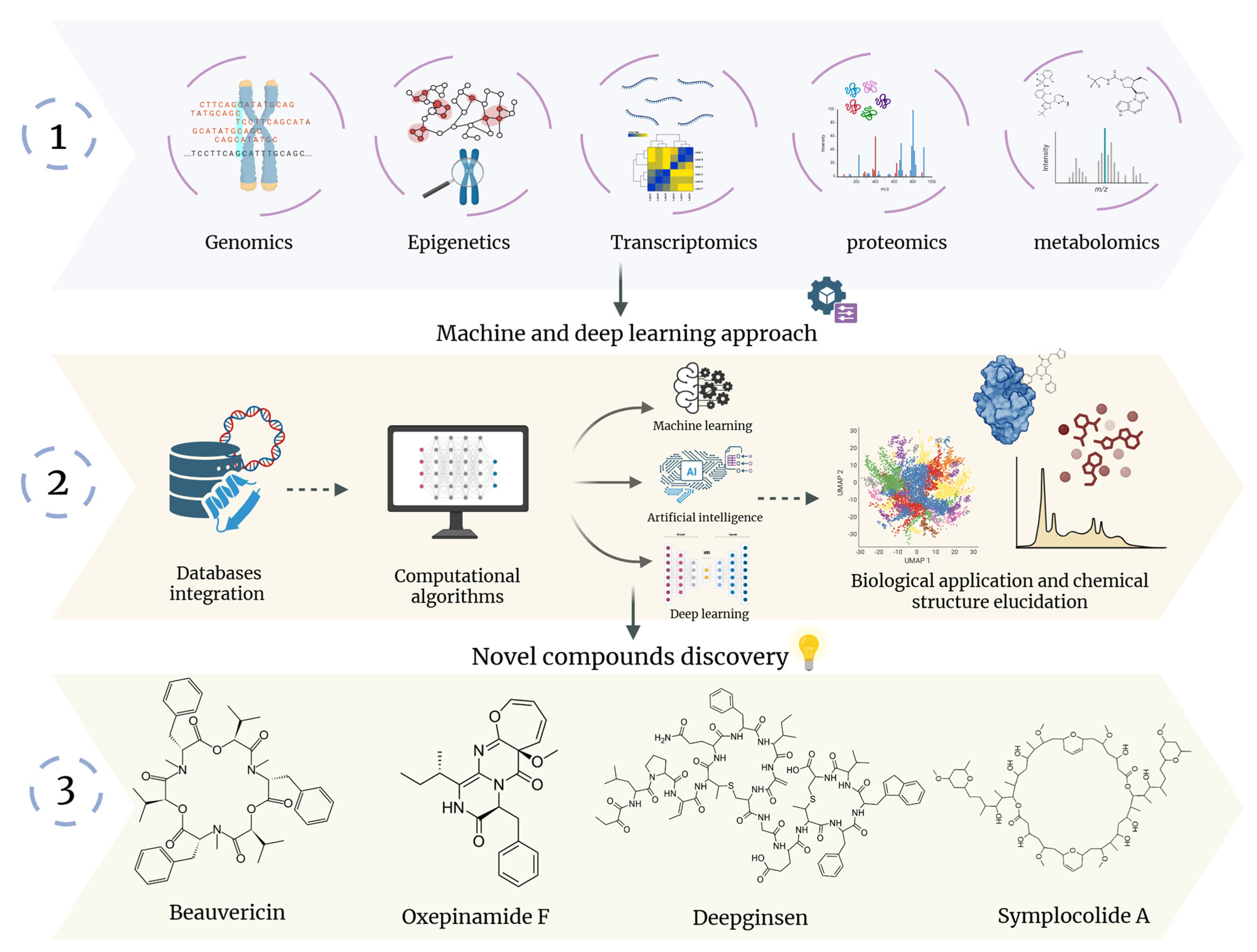
Mining the Hidden Pharmacopeia: Fungal Endophytes, Natural Products, and the Rise of AI-Driven Drug Discovery


Abstract
1. Introduction
2. Endophytes: Definition, Characteristics, and Diversity
3. Unveiling the Metabolic Capacity of Endophytic Fungi
3.1. Alkaloids
3.2. Polyketides
3.3. Terpenes and Terpenoids
3.4. Nonribosomal Peptides (NRPs)
3.5. Phenolic Derivatives
3.6. Flavonoids
3.7. Steroids
3.8. Hybrid Metabolites
4. Clinical Translation Pipeline of Endophytic Fungi-Derived Natural Products
4.1. Examples of Clinically Approved Drugs Isolated from Endophytic Fungi
4.1.1. Palixital (Taxol)
4.1.2. Vinblastine
4.1.3. Camptothecin-Derived Analogs
5. Traditional Discovery Methods: Addressing Challenges and Limitations
6. From Concept to Implementation: Artificial Intelligence in Natural Product Discovery
6.1. Artificial Intelligence and Deep Learning Algorithms: Promising Tools for Natural Product Discovery
6.2. Genome Mining of Endophytic Fungi: A Case Study for AI-Assisted Fungal Metabolite Discovery
7. Limitations and Future Perspective
8. Conclusions
Author Contributions
Funding
Data Availability Statement
Conflicts of Interest
References
- Newman, D.J.; Cragg, G.M. Natural Products as Sources of New Drugs over the Nearly Four Decades from 01/1981 to 09/2019. J. Nat. Prod. 2020, 83, 770–803. [Google Scholar] [CrossRef]
- Atanasov, A.G.; Zotchev, S.B.; Dirsch, V.M.; Orhan, I.E.; Banach, M.; Rollinger, J.M.; Barreca, D.; Weckwerth, W.; Bauer, R.; Bayer, E.A.; et al. Natural products in drug discovery: Advances and opportunities. Nat. Rev. Drug Discov. 2021, 20, 200–216. Available online: https://www.nature.com/articles/s41573-020-00114-z (accessed on 20 December 2025). [CrossRef] [PubMed]
- Newman, D.J.; Cragg, G.M. Natural Products as Sources of New Drugs over the 30 Years from 1981 to 2010. J. Nat. Prod. 2012, 75, 311–335. Available online: https://pubs.acs.org/doi/abs/10.1021/np200906s (accessed on 17 December 2025). [CrossRef] [PubMed]
- Prajapati, C.; Rai, S.N.; Singh, A.K.; Chopade, B.A.; Singh, Y.; Singh, S.K.; Haque, S.; Prieto, M.A.; Ashraf, G.M. An Update of Fungal Endophyte Diversity and Strategies for Augmenting Therapeutic Potential of Their Potent Metabolites: Recent Advancement. Appl. Biochem. Biotechnol. 2025, 197, 2799–2866. Available online: https://link.springer.com/article/10.1007/s12010-024-05098-9 (accessed on 17 December 2025). [CrossRef]
- Gunatilaka, A.A.L. Natural Products from Plant-Associated Microorganisms: Distribution, Structural Diversity, Bioactivity, and Implications of Their Occurrence. J. Nat. Prod. 2006, 69, 509–526. Available online: https://pubs.acs.org/doi/abs/10.1021/np058128n (accessed on 17 December 2025). [CrossRef]
- Singh, S.B.; Pelaez, F. Biodiversity, chemical diversity and drug discovery. Prog. Drug Res. 2008, 65, 141–174. Available online: https://link.springer.com/chapter/10.1007/978-3-7643-8117-2_4 (accessed on 17 December 2025).
- Keller, N.P. Fungal secondary metabolism: Regulation, function and drug discovery. Nat. Rev. Microbiol. 2019, 17, 167–180. Available online: https://www.nature.com/articles/s41579-018-0121-1 (accessed on 17 December 2025). [CrossRef] [PubMed]
- Riedling, O.L.; Rokas, A. mGem: How many fungal secondary metabolites are produced by filamentous fungi? Conservatively, at least 1.4 million. mBio 2025, 16, e0138125. [Google Scholar] [CrossRef]
- Yang, X.; Feng, P.; Yin, Y.; Bushley, K.; Spatafora, J.W.; Wang, C. Cyclosporine biosynthesis in Tolypocladium inflatum benefits fungal adaptation to the environment. mBio 2018, 9, e01211-18. [Google Scholar] [CrossRef]
- Aris, P.; Wei, Y.; Mohamadzadeh, M.; Xia, X. Griseofulvin: An Updated Overview of Old and Current Knowledge. Molecules 2022, 27, 7034. [Google Scholar] [CrossRef]
- Chen, L.; Yue, Q.; Li, Y.; Niu, X.; Xiang, M.; Wang, W.; Bills, G.F.; Liu, X.; An, Z. Engineering of Glarea lozoyensis for Exclusive Production of the Pneumocandin B0 Precursor of the Antifungal Drug Caspofungin Acetate. Appl. Environ. Microbiol. 2014, 81, 1550–1558. [Google Scholar] [CrossRef] [PubMed]
- Men, P.; Zhou, Y.; Xie, L.; Zhang, X.; Zhang, W.; Huang, X.; Lu, X. Improving the production of the micafungin precursor FR901379 in an industrial production strain. Microb. Cell Factories 2023, 22, 44. Available online: https://pubmed.ncbi.nlm.nih.gov/36879280/ (accessed on 17 December 2025). [CrossRef]
- Pfaller, M.A.; Boyken, L.; Hollis, R.J.; Messer, S.A.; Tendolkar, S.; Diekema, D.J. In Vitro Activities of Anidulafungin against More than 2,500 Clinical Isolates of Candida spp., Including 315 Isolates Resistant to Fluconazole. J. Clin. Microbiol. 2005, 43, 5425–5427. [Google Scholar] [CrossRef]
- Brinkmann, V.; Billich, A.; Baumruker, T.; Heining, P.; Schmouder, R.; Francis, G.; Aradhye, S.; Burtin, P. Fingolimod (FTY720): Discovery and development of an oral drug to treat multiple sclerosis. Nat. Rev. Drug Discov. 2010, 9, 883–897, Erratum in Nat. Rev. Drug Discov. 2010, 9, 955.. [Google Scholar] [CrossRef]
- Tiwari, P.; Bae, H.; Tiwari, P.; Bae, H. Endophytic Fungi: Key Insights, Emerging Prospects, and Challenges in Natural Product Drug Discovery. Microorganisms 2022, 10, 360. Available online: https://www.mdpi.com/2076-2607/10/2/360/htm (accessed on 17 December 2025). [CrossRef]
- Guo, B.; Wang, Y.; Sun, X.; Tang, K. Bioactive natural products from endophytes: A review. Appl. Biochem. Microbiol. 2008, 44, 136–142. Available online: https://link.springer.com/article/10.1134/S0003683808020026 (accessed on 17 December 2025). [CrossRef]
- Koehn, F.E.; Carter, G.T. The evolving role of natural products in drug discovery. Nat. Rev. Drug Discov. 2005, 4, 206–220. Available online: https://www.nature.com/articles/nrd1657 (accessed on 17 December 2025). [CrossRef]
- Liu, R.; Peng, X.P.; Newman, D.J.; Purchase, D.; Li, G.; Kusari, S. Unlocking the metabolic potential of endophytic fungi through epigenetics: A paradigm shift for natural product discovery and plant–microbe interactions. Nat. Prod. Rep. 2025, 42, 1690–1716. Available online: https://pubs.rsc.org/en/content/articlehtml/2025/np/d5np00028a (accessed on 17 December 2025). [CrossRef]
- Domingo-Fernández, D.; Gadiya, Y.; Preto, A.J.; Krettler, C.A.; Mubeen, S.; Allen, A.; Healey, D.; Colluru, V. Natural Products Have Increased Rates of Clinical Trial Success Throughout the Drug Development Process. J. Nat. Prod. 2024, 87, 1844–1851. [Google Scholar] [CrossRef] [PubMed]
- Saldívar-González, F.I.; Aldas-Bulos, V.D.; Medina-Franco, J.L.; Plisson, F. Natural product drug discovery in the artificial intelligence era. Chem. Sci. 2022, 13, 1526–1546. Available online: https://pubs.rsc.org/en/content/articlehtml/2022/sc/d1sc04471k (accessed on 20 December 2025). [CrossRef]
- Merzbacher, C.; Oyarzún, D.A. Applications of artificial intelligence and machine learning in dynamic pathway engineering. In Biochemical Society Transactions; Portland Press: London, UK, 2023; Available online: https://portlandpress.com/biochemsoctrans/article/51/5/1871/233483 (accessed on 20 December 2025).
- Szelogowski, D. Deep Learning for Protein Structure Prediction: Advancements in Structural Bioinformatics. bioRxiv 2025, 24, 538026. Available online: https://www.biorxiv.org/content/10.1101/2023.04.26.538026v3 (accessed on 20 December 2025).
- Bertoline, L.M.F.; Lima, A.N.; Krieger, J.E.; Teixeira, S.K. Before and after AlphaFold2, An overview of protein structure prediction. Front. Bioinform. 2023, 3, 1120370. [Google Scholar] [CrossRef]
- Kusari, S.; Hertweck, C.; Spiteller, M. Chemical Ecology of Endophytic Fungi: Origins of Secondary Metabolites. Chem. Biol. 2012, 19, 792–798. Available online: https://www.sciencedirect.com/science/article/pii/S1074552112001998?via%3Dihub (accessed on 17 December 2025). [CrossRef]
- Agrawal, S.; Bhatt, A. Microbial Endophytes: Emerging Trends and Biotechnological Applications. Curr. Microbiol. 2023, 80, 249. Available online: https://pubmed.ncbi.nlm.nih.gov/37347454/ (accessed on 17 December 2025). [CrossRef]
- Kaul, S.; Gupta, S.; Ahmed, M.; Dhar, M.K. Endophytic fungi from medicinal plants: A treasure hunt for bioactive metabolites. Phytochem. Rev. 2012, 11, 487–505. Available online: https://link.springer.com/article/10.1007/s11101-012-9260-6 (accessed on 17 December 2025). [CrossRef]
- Meshram, V.; Elazar, M.; Maymon, M.; Sharma, G.; Shawahna, R.; Belausov, E.; Charuvi, D.; Freeman, S. Endophytic Fusarium clavum confers growth and salt tolerance in Cucumis melo. Environ. Exp. Bot. 2023, 206, 105153. Available online: https://www.sciencedirect.com/science/article/abs/pii/S0098847222003756?via%3Dihub (accessed on 17 December 2025). [CrossRef]
- Strobel, G.; Daisy, B.; Castillo, U.; Harper, J. Natural Products from Endophytic Microorganisms. J. Nat. Prod. 2004, 67, 257–268. Available online: https://pubs.acs.org/doi/abs/10.1021/np030397v (accessed on 17 December 2025). [CrossRef] [PubMed]
- Staniek, A.; Woerdenbag, H.J.; Kayser, O. Endophytes: Exploiting biodiversity for the improvement of natural product-based drug discovery. J. Plant Interact. 2008, 3, 75–93. [Google Scholar] [CrossRef]
- Chowdhary, K.; Kaushik, N.; Coloma, A.G.; Raimundo, C.M. Endophytic fungi and their metabolites isolated from Indian medicinal plant. Phytochem. Rev. 2012, 11, 467–485. [Google Scholar] [CrossRef]
- Mishra, Y.; Singh, A.; Batra, A.; Sharma, M.M. Understanding the Biodiversity and Biological Applications of Endophytic Fungi: A Review. J. Microb. Biochem. Technol. 2014, S8, 4. [Google Scholar]
- Sun, X.; Guo, L.D. Endophytic fungal diversity: Review of traditional and molecular techniques. Mycology 2012, 3, 65–76. Available online: https://www.tandfonline.com/doi/pdf/10.1080/21501203.2012.656724 (accessed on 17 December 2025). [CrossRef]
- Stierle, A.; Strobel, G.; Stierle, D. Taxol and taxane production by Taxomyces andreanae, an endophytic fungus of Pacific yew. Science 1993, 260, 214–216. Available online: https://pubmed.ncbi.nlm.nih.gov/8097061/ (accessed on 17 December 2025). [CrossRef]
- Porras-Alfaro, A.; Bayman, P. Hidden fungi, emergent properties: Endophytes and microbiomes. Annu. Rev. Phytopathol. 2011, 49, 291–315. Available online: https://www.annualreviews.org/content/journals/10.1146/annurev-phyto-080508-081831 (accessed on 17 December 2025). [CrossRef] [PubMed]
- Rashmi, M.; Kushveer, J.S.; Sarma, V.V. A worldwide list of endophytic fungi with notes on ecology and diversity. Mycosphere 2019, 10, 798–1079. [Google Scholar] [CrossRef]
- Fontana, D.C.; de Paula, S.; Torres, A.G.; de Souza, V.H.M.; Pascholati, S.F.; Schmidt, D.; Neto, D.D. Endophytic Fungi: Biological Control and Induced Resistance to Phytopathogens and Abiotic Stresses. Pathogens 2021, 10, 570. Available online: https://pubmed.ncbi.nlm.nih.gov/34066672/ (accessed on 17 December 2025). [CrossRef]
- Vishwakarma, S.; Chaudhry, V.; Chand, S.; Sagar, K.; Gupta, K.K.; Bhardwaj, N.; Prasad, R.; Kumar, P.; Chandra, H. The Potential of Fungal Endophytes in Plants: Sources of Bioactive Compounds. Indian J. Microbiol. 2024, 65, 1813–1827. Available online: https://link.springer.com/article/10.1007/s12088-024-01406-3 (accessed on 17 December 2025). [CrossRef] [PubMed]
- Elsarkasi, R.F.; Rabie, G.H.; El-Gazzar, N. Article review on bioactivity of secondary metabolites of endophytic fungi. Bull. Fac. Sci. Zagazig Univ. 2025, 2025, 243–251. Available online: https://bfszu.journals.ekb.eg/article_432015.html (accessed on 17 December 2025). [CrossRef]
- Soliman, S.S.M.; Raizada, M.N. Interactions between co-habitating fungi elicit synthesis of Taxol from an endophytic fungus in host Taxus plants. Front. Microbiol. 2013, 4, 40831. Available online: www.frontiersin.org (accessed on 14 January 2026). [CrossRef]
- Aly, A.H.; Debbab, A.; Kjer, J.; Proksch, P. Fungal endophytes from higher plants: A prolific source of phytochemicals and other bioactive natural products. Fungal Divers. 2010, 41, 1–16. [Google Scholar] [CrossRef]
- Kumar, A.; Patil, D.; Rajamohanan, P.R.; Ahmad, A. Isolation, Purification and Characterization of Vinblastine and Vincristine from Endophytic Fungus Fusarium oxysporum Isolated from Catharanthus roseus. PLoS ONE 2013, 8, e71805. Available online: https://journals.plos.org/plosone/article?id=10.1371/journal.pone.0071805 (accessed on 17 December 2025). [CrossRef]
- Hu, X.; Li, W.; Yuan, M.; Li, C.; Liu, S.; Jiang, C.; Wu, Y.; Cai, K.; Liu, Y. Homoharringtonine production by endophytic fungus isolated from Cephalotaxus hainanensis Li. World J. Microbiol. Biotechnol. 2016, 32, 110. Available online: https://link.springer.com/article/10.1007/s11274-016-2073-9 (accessed on 17 December 2025). [CrossRef]
- Ma, Y.M.; Qiao, K.; Kong, Y.; Li, M.Y.; Guo, L.X.; Miao, Z.; Fan, C. A new isoquinolone alkaloid from an endophytic fungus R22 of Nerium indicum. Nat. Prod. Res. 2017, 31, 951–958. Available online: https://www.tandfonline.com/doi/abs/10.1080/14786419.2016.1258556 (accessed on 17 December 2025). [CrossRef]
- Mousa, W.K.; Schwan, A.; Davidson, J.; Strange, P.; Liu, H.; Zhou, T.; Auzanneau, F.I.; Raizada, M.N. An endophytic fungus isolated from finger millet (Eleusine coracana) produces anti-fungal natural products. Front. Microbiol. 2015, 6, 148505. Available online: www.frontiersin.org (accessed on 17 December 2025). [CrossRef]
- Zhang, Y.; Han, T.; Ming, Q.; Wu, L.; Rahman, K.; Qin, L. Alkaloids Produced by Endophytic Fungi: A Review. Nat. Prod. Commun. 2012, 7, 963–968. [Google Scholar] [CrossRef]
- Kumara, P.M.; Soujanya, K.N.; Ravikanth, G.; Vasudeva, R.; Ganeshaiah, K.N.; Shaanker, R.U. Rohitukine, a chromone alkaloid and a precursor of flavopiridol, is produced by endophytic fungi isolated from Dysoxylum binectariferum Hook.f and Amoora rohituka (Roxb).Wight & Arn. Phytomedicine 2014, 21, 541–546. Available online: https://pubmed.ncbi.nlm.nih.gov/24215673/ (accessed on 17 December 2025).
- El-Hawary, S.S.; Mohammed, R.; Abouzid, S.F.; Bakeer, W.; Ebel, R.; Sayed, A.M.; Rateb, M.E. Solamargine production by a fungal endophyte of Solanum nigrum. J. Appl. Microbiol. 2016, 120, 900–911. [Google Scholar] [CrossRef]
- Nicholson, M.J.; Koulman, A.; Monahan, B.J.; Pritchard, B.L.; Payne, G.A.; Scott, B. Identification of Two Aflatrem Biosynthesis Gene Loci in Aspergillus flavus and Metabolic Engineering of Penicillium paxilli to Elucidate Their Function. Appl. Environ. Microbiol. 2009, 75, 7469. Available online: https://pmc.ncbi.nlm.nih.gov/articles/PMC2786402/ (accessed on 20 December 2025). [CrossRef] [PubMed]
- Yin, H.; Sun, Y.H. Vincamine-producing endophytic fungus isolated from Vinca minor. Phytomedicine 2011, 18, 802–805. Available online: https://www.sciencedirect.com/science/article/abs/pii/S0944711311000067?via%3Dihub (accessed on 18 December 2025). [CrossRef] [PubMed]
- Singh, A.; Singh, D.K.; Kharwar, R.N.; White, J.F.; Gond, S.K. Fungal Endophytes as Efficient Sources of Plant-Derived Bioactive Compounds and Their Prospective Applications in Natural Product Drug Discovery: Insights, Avenues, and Challenges. Microorganisms 2021, 9, 197. Available online: https://www.mdpi.com/2076-2607/9/1/197/htm (accessed on 17 December 2025). [CrossRef] [PubMed]
- Lin, Z.; Wen, J.; Zhu, T.; Fang, Y.; Gu, Q.; Zhu, W. Chrysogenamide A from an Endophytic Fungus Associated with Cistanche deserticola and Its Neuroprotective Effect on SH-SY5Y Cells. J. Antibiot. 2008, 61, 81–85. Available online: https://www.nature.com/articles/ja2008114 (accessed on 17 December 2025). [CrossRef]
- Devari, S.; Jaglan, S.; Kumar, M.; Deshidi, R.; Guru, S.; Bhushan, S.; Kushwaha, M.; Gupta, A.P.; Gandhi, S.G.; Sharma, J.P.; et al. Capsaicin production by Alternaria alternata, an endophytic fungus from Capsicum annum; LC–ESI–MS/MS analysis. Phytochemistry 2014, 98, 183–189. Available online: https://www.sciencedirect.com/science/article/abs/pii/S0031942213004780?via%3Dihub (accessed on 17 December 2025). [CrossRef]
- Dong, L.H.; Fan, S.W.; Ling, Q.Z.; Huang, B.B.; Wei, Z.J. Indentification of huperzine A-producing endophytic fungi isolated from Huperzia serrata. World J. Microbiol. Biotechnol. 2013, 30, 1011–1017. Available online: https://link.springer.com/article/10.1007/s11274-013-1519-6 (accessed on 17 December 2025). [CrossRef]
- Verma, V.C.; Lobkovsky, E.; Gange, A.C.; Singh, S.K.; Prakash, S. Piperine production by endophytic fungus Periconia sp. Isolated from Piper longum L. J. Antibiot. 2011, 64, 427–431. Available online: https://www.nature.com/articles/ja201127 (accessed on 17 December 2025). [CrossRef]
- Chithra, S.; Jasim, B.; Sachidanandan, P.; Jyothis, M.; Radhakrishnan, E.K. Piperine production by endophytic fungus Colletotrichum gloeosporioides isolated from Piper nigrum. Phytomedicine 2014, 21, 534–540. Available online: https://www.sciencedirect.com/science/article/abs/pii/S0944711313004297?via%3Dihub (accessed on 17 December 2025). [CrossRef]
- Chithra, S.; Jasim, B.; Anisha, C.; Mathew, J.; Radhakrishnan, E.K. LC-MS/MS Based Identification of Piperine Production by Endophytic Mycosphaerella sp. PF13 from Piper nigrum. Appl. Biochem. Biotechnol. 2014, 173, 30–35. Available online: https://link.springer.com/article/10.1007/s12010-014-0832-3 (accessed on 17 December 2025). [CrossRef] [PubMed]
- Hellwig, V.; Grothe, T.; Mayer-Bartschmid, A.; Endermann, R.; Geschke, F.U.; Henkel, T.; Stadler, M. Altersetin, a new antibiotic from cultures of endophytic Alternaria spp. Taxonomy, fermentation, isolation, structure elucidation and biological activities. J. Antibiot. 2002, 55, 881–892. Available online: https://pubmed.ncbi.nlm.nih.gov/12523821/ (accessed on 17 December 2025). [CrossRef] [PubMed]
- Singh, N.; Sharma, B. Toxicological effects of berberine and sanguinarine. Front. Mol. Biosci. 2018, 5, 332547. Available online: www.frontiersin.org (accessed on 17 December 2025). [CrossRef]
- Wang, X.J.; Min, C.L.; Ge, M.; Zuo, R.H. An Endophytic Sanguinarine-Producing Fungus from Macleaya cordata, Fusarium proliferatum BLH51. Curr. Microbiol. 2013, 68, 336–341. Available online: https://link.springer.com/article/10.1007/s00284-013-0482-7 (accessed on 17 December 2025). [CrossRef]
- Yang, K.; Liang, J.; Li, Q.; Kong, X.; Chen, R.; Jin, Y. Cladosporium cladosporioides XJ-AC03, an aconitine-producing endophytic fungus isolated from Aconitum leucostomum. World J. Microbiol. Biotechnol. 2012, 29, 933–938. Available online: https://link.springer.com/article/10.1007/s11274-012-1246-4 (accessed on 17 December 2025). [CrossRef]
- Kajula, M.; Ward, J.M.; Turpeinen, A.; Tejesvi, M.V.; Hokkanen, J.; Tolonen, A.; Häkkänen, H.; Picart, P.; Ihalainen, J.; Sahl, H.G.; et al. Bridged Epipolythiodiketopiperazines from Penicillium raciborskii, an Endophytic Fungus of Rhododendron tomentosum Harmaja. J. Nat. Prod. 2016, 79, 685–690. Available online: https://pubs.acs.org/doi/abs/10.1021/np500822k (accessed on 17 December 2025). [CrossRef] [PubMed]
- Tanney, J.B.; McMullin, D.R.; Green, B.D.; Miller, J.D.; Seifert, K.A. Production of antifungal and antiinsectan metabolites by the Picea endophyte Diaporthe maritima sp. nov. Fungal Biol 2016, 120, 1448–1457. Available online: https://www.sciencedirect.com/science/article/abs/pii/S1878614616300496?via%3Dihub (accessed on 17 December 2025). [CrossRef] [PubMed]
- Mondol, M.A.M.; Farthouse, J.; Islam, M.T.; Schüffler, A.; Laatsch, H. Metabolites from the Endophytic Fungus Curvularia sp. M12 Act as Motility Inhibitors against Phytophthora capsici Zoospores. J. Nat. Prod. 2017, 80, 347–355. Available online: https://pubs.acs.org/doi/abs/10.1021/acs.jnatprod.6b00785 (accessed on 17 December 2025). [CrossRef]
- Liu, S.; Liu, X.; Guo, L.; Che, Y.; Liu, L. 2H-pyran-2-one and 2H-furan-2-one derivatives from the plant endophytic fungus Pestalotiopsis fici. Chem. Biodivers. 2013, 10, 2007–2013. [Google Scholar] [CrossRef]
- Mousa, W.K.; Schwan, A.L.; Raizada, M.N. Characterization of Antifungal Natural Products Isolated from Endophytic Fungi of Finger Millet (Eleusine coracana). Molecules 2016, 21, 1171. [Google Scholar] [CrossRef]
- Li, W.; Xu, J.; Li, F.; Xu, L.; Li, C. A New Antifungal Isocoumarin from The Endophytic Fungus Trichoderma sp. 09 of Myoporum bontioides A. Gray. Pharmacogn. Mag. 2016, 12, 259. Available online: https://pmc.ncbi.nlm.nih.gov/articles/PMC5096270/ (accessed on 17 December 2025). [PubMed]
- Silva, G.H.; Zeraik, M.L.; De Oliveira, C.M.; Teles, H.L.; Trevisan, H.C.; Pfenning, L.H.; Nicolli, C.P.; Young, M.C.M.; Mascarenhas, Y.P.; Abreu, L.M.; et al. Lactone Derivatives Produced by a Phaeoacremonium sp., an Endophytic Fungus from Senna spectabilis. J. Nat. Prod. 2017, 80, 1674–1678. Available online: https://pubs.acs.org/doi/abs/10.1021/acs.jnatprod.5b00828 (accessed on 17 December 2025). [CrossRef] [PubMed]
- McMullin, D.R.; Green, B.D.; Miller, J.D. Antifungal sesquiterpenoids and macrolides from an endophytic Lophodermium species of Pinus strobus. Phytochem. Lett. 2015, 14, 148–152. Available online: https://www.sciencedirect.com/science/article/abs/pii/S1874390015300811?via%3Dihub (accessed on 17 December 2025). [CrossRef]
- Carvalho, C.R.; Wedge, D.E.; Cantrell, C.L.; Silva-Hughes, A.F.; Pan, Z.; Moraes, R.M.; Madoxx, V.L.; Rosa, L.H. Molecular Phylogeny, Diversity, and Bioprospecting of Endophytic Fungi Associated with Wild Ethnomedicinal North American Plant Echinacea purpurea (Asteraceae). Chem. Biodivers. 2016, 13, 918–930. [Google Scholar] [CrossRef] [PubMed]
- Shan, T.; Tian, J.; Wang, X.; Mou, Y.; Mao, Z.; Lai, D.; Dai, J.; Peng, Y.; Zhou, L.; Wang, M. Bioactive Spirobisnaphthalenes from the Endophytic Fungus Berkleasmium sp. J. Nat. Prod. 2014, 77, 2151–2160. Available online: https://pubs.acs.org/doi/abs/10.1021/np400988a (accessed on 17 December 2025). [CrossRef] [PubMed]
- Liu, K.; Yang, Y.; Miao, C.P.; Zheng, Y.K.; Chen, J.L.; Chen, Y.W.; Xu, L.H.; Guang, H.L.; Ding, Z.T.; Zhao, L.X. Koningiopisins A–H, Polyketides with Synergistic Antifungal Activities from the Endophytic Fungus Trichoderma koningiopsis. Planta Medica 2016, 82, 371–376. Available online: http://www.thieme-connect.com/products/ejournals/html/10.1055/s-0035-1558228 (accessed on 17 December 2025). [CrossRef] [PubMed]
- Wang, J.; Wang, G.; Zhang, Y.; Zheng, B.; Zhang, C.; Wang, L. Isolation and identification of an endophytic fungus Pezicula sp. in Forsythia viridissima and its secondary metabolites. World J. Microbiol. Biotechnol. 2014, 30, 2639–2644. Available online: https://link.springer.com/article/10.1007/s11274-014-1686-0 (accessed on 17 December 2025). [CrossRef]
- Meng, X.; Mao, Z.; Lou, J.; Xu, L.; Zhong, L.; Peng, Y.; Zhou, L.; Wang, M. Benzopyranones from the Endophytic Fungus Hyalodendriella sp. Ponipodef12 and Their Bioactivities. Molecules 2012, 17, 11303–11314. Available online: https://www.mdpi.com/1420-3049/17/10/11303/htm (accessed on 17 December 2025). [CrossRef] [PubMed]
- Talontsi, F.M.; Dittrich, B.; Schüffler, A.; Sun, H.; Laatsch, H. Epicoccolides: Antimicrobial and antifungal polyketides from an endophytic fungus Epicoccum sp. associated with Theobroma cacao. Eur. J. Org. Chem. 2013, 2013, 3174–3180. [Google Scholar] [CrossRef]
- Anh, N.M.; Huyen, V.T.T.; Quyen, V.T.; Dao, P.T.; Quynh, D.T.; Huong, D.T.M.; Van Cuong, P.; Dat, T.T.H.; Minh, L.T.H. Antimicrobial and Cytotoxic Secondary Metabolites from a Marine-Derived Fungus Penicillium citrinum VM6. Curr. Microbiol. 2023, 81, 32. Available online: https://link.springer.com/article/10.1007/s00284-023-03568-7 (accessed on 17 December 2025). [CrossRef] [PubMed]
- Ola, A.R.B.; Debbab, A.; Kurtán, T.; Brötz-Oesterhelt, H.; Aly, A.H.; Proksch, P. Dihydroanthracenone metabolites from the endophytic fungus Diaporthe melonis isolated from Annona squamosa. Tetrahedron Lett. 2014, 55, 3147–3150. Available online: https://www.sciencedirect.com/science/article/abs/pii/S0040403914005425?via%3Dihub (accessed on 18 December 2025). [CrossRef]
- Hussain, H.; Kock, I.; Al-Harrasi, A.; Al-Rawahi, A.; Abbas, G.; Green, I.R.; Shah, A.; Badshah, A.; Saleem, M.; Draeger, S.; et al. Antimicrobial chemical constituents from endophytic fungus Phoma sp. Asian Pac. J. Trop. Med. 2014, 7, 699–702. Available online: https://www.sciencedirect.com/science/article/pii/S199576451460119X?via%3Dihub (accessed on 18 December 2025). [CrossRef]
- Li, Y.; Song, Y.C.; Liu, J.Y.; Ma, Y.M.; Tan, R.X. Anti-Helicobacter pylori substances from endophytic fungal cultures. World J. Microbiol. Biotechnol. 2005, 21, 553–558. Available online: https://link.springer.com/article/10.1007/s11274-004-3273-2 (accessed on 18 December 2025). [CrossRef]
- Rukachaisirikul, V.; Buadam, S.; Sukpondma, Y.; Phongpaichit, S.; Sakayaroj, J.; Hutadilok-Towatana, N. Indanone and mellein derivatives from the Garcinia-derived fungus Xylaria sp. PSU-G12. Phytochem. Lett. 2013, 6, 135–138. Available online: https://www.sciencedirect.com/science/article/abs/pii/S1874390012002273?via%3Dihub (accessed on 18 December 2025). [CrossRef]
- Sica, V.P.; Rees, E.R.; Tchegnon, E.; Bardsley, R.H.; Raja, H.A.; Oberlies, N.H. Spatial and temporal profiling of griseofulvin production in Xylaria cubensis using mass spectrometry mapping. Front. Microbiol. 2016, 7, 191615. Available online: www.frontiersin.org (accessed on 18 December 2025). [CrossRef]
- Debbab, A.; Aly, A.H.; Edrada-Ebel, R.A.; Wray, V.; Müller, W.E.G.; Totzke, F.; Zirrgiebel, U.; Schächtele, C.; Kubbutat, M.H.G.; Wen, H.L.; et al. Bioactive Metabolites from the Endophytic Fungus Stemphylium globuliferum Isolated from Mentha pulegium. J. Nat. Prod. 2009, 72, 626–631. Available online: https://pubs.acs.org/doi/abs/10.1021/np8004997 (accessed on 18 December 2025). [CrossRef]
- Aly, A.H.; Edrada-Ebel, R.A.; Wray, V.; Müller, W.E.G.; Kozytska, S.; Hentschel, U.; Proksch, P.; Ebel, R. Bioactive metabolites from the endophytic fungus Ampelomyces sp. isolated from the medicinal plant Urospermum picroides. Phytochemistry 2008, 69, 1716–1725. Available online: https://www.sciencedirect.com/science/article/abs/pii/S0031942208001064?via%3Dihub (accessed on 18 December 2025). [CrossRef]
- Aly, A.H.; Debbab, A.; Edrada-Ebel, R.; Wray, V.; Müller, W.E.; Lin, W.; Ebel, R.; Proksch, P. A new tetrahydrofuran derivative from the Endophytic Fungus Chaetomium sp. isolated from Otanthus maritimus. Z. Naturforschung—Sect. C J. Biosci. 2009, 64, 350–354. Available online: https://www.degruyterbrill.com/document/doi/10.1515/znc-2009-5-608/html (accessed on 18 December 2025). [CrossRef] [PubMed]
- Liu, L.; Tian, R.; Liu, S.; Chen, X.; Guo, L.; Che, Y. Pestaloficiols A–E, bioactive cyclopropane derivatives from the plant endophytic fungus Pestalotiopsis fici. Bioorg. Med. Chem. 2008, 16, 6021–6026. Available online: https://www.sciencedirect.com/science/article/abs/pii/S0968089608003805 (accessed on 18 December 2025). [CrossRef]
- Li, E.; Tian, R.; Liu, S.; Chen, X.; Guo, L.; Che, Y. Pestalotheols A-D, bioactive metabolites from the plant endophytic fungus Pestalotiopsis theae. J. Nat. Prod. 2008, 71, 664–668. Available online: https://pubs.acs.org/doi/abs/10.1021/np700744t (accessed on 18 December 2025). [CrossRef] [PubMed]
- Martínez-Luis, S.; Della-Togna, G.; Coley, P.D.; Kursar, T.A.; Gerwick, W.H.; Cubilla-Rios, L. Antileishmanial Constituents of the Panamanian Endophytic Fungus Edenia sp. J. Nat. Prod. 2008, 71, 2011–2014. Available online: https://pubs.acs.org/doi/abs/10.1021/np800472q (accessed on 18 December 2025). [CrossRef] [PubMed]
- Cota, B.B.; Rosa, L.H.; Caligiorne, R.B.; Rabello, A.L.T.; Almeida Alves, T.M.; Rosa, C.A.; Zani, C.L. Altenusin, a biphenyl isolated from the endophytic fungus Alternaria sp., inhibits trypanothione reductase from Trypanosoma cruzi. FEMS Microbiol. Lett. 2008, 285, 177–182. [Google Scholar] [CrossRef]
- Xiao, J.; Zhang, Q.; Gao, Y.Q.; Tang, J.J.; Zhang, A.L.; Gao, J.M. Secondary Metabolites from the Endophytic Botryosphaeria dothidea of Melia azedarach and Their Antifungal, Antibacterial, Antioxidant, and Cytotoxic Activities. J. Agric. Food Chem. 2014, 62, 3584–3590. Available online: https://pubs.acs.org/doi/abs/10.1021/jf500054f (accessed on 18 December 2025). [CrossRef]
- Cao, L.L.; Zhang, Y.Y.; Liu, Y.J.; Yang, T.T.; Zhang, J.L.; Zhang, Z.G.; Shen, L.; Liu, J.Y.; Ye, Y.H. Anti-phytopathogenic activity of sporothriolide, a metabolite from endophyte Nodulisporium sp. A21 in Ginkgo biloba. Pestic. Biochem. Physiol. 2016, 129, 7–13. Available online: https://www.sciencedirect.com/science/article/abs/pii/S0048357515300420?via%3Dihub (accessed on 18 December 2025). [CrossRef]
- Nalli, Y.; Mirza, D.N.; Wani, Z.A.; Wadhwa, B.; Mallik, F.A.; Raina, C.; Chaubey, A.; Riyaz-Ul-Hassan, S.; Ali, A. Phialomustin A–D, new antimicrobial and cytotoxic metabolites from an endophytic fungus, Phialophora mustea. RSC Adv. 2015, 5, 95307–95312. Available online: https://pubs.rsc.org/en/content/articlehtml/2015/ra/c5ra18121f (accessed on 18 December 2025). [CrossRef]
- Budhiraja, A.; Nepali, K.; Sapra, S.; Gupta, S.; Kumar, S.; Dhar, K.L. Bioactive metabolites from an endophytic fungus of Aspergillus species isolated from seeds of Gloriosa superba Linn. Med. Chem. Res. 2012, 22, 323–329. Available online: https://link.springer.com/article/10.1007/s00044-012-0032-z (accessed on 18 December 2025). [CrossRef]
- Lai, D.; Wang, A.; Cao, Y.; Zhou, K.; Mao, Z.; Dong, X.; Tian, J.; Xu, D.; Dai, J.; Peng, Y.; et al. Bioactive Dibenzo-α-pyrone Derivatives from the Endophytic Fungus Rhizopycnis vagum Nitaf22. J. Nat. Prod. 2016, 79, 2022–2031. Available online: https://pubs.acs.org/doi/abs/10.1021/acs.jnatprod.6b00327 (accessed on 18 December 2025). [CrossRef]
- Hussain, H.; Root, N.; Jabeen, F.; Al-Harrasi, A.; Al-Rawahi, A.; Ahmad, M.; Hassan, Z.; Abbas, G.; Mabood, F.; Shah, A.; et al. Seimatoric acid and colletonoic acid: Two new compounds from the endophytic fungi, Seimatosporium sp. and Colletotrichum sp. Chin. Chem. Lett. 2014, 25, 1577–1579. Available online: https://www.sciencedirect.com/science/article/abs/pii/S1001841714002708?via%3Dihub (accessed on 18 December 2025). [CrossRef]
- Shah, A.; Rather, M.A.; Hassan, Q.P.; Aga, M.A.; Mushtaq, S.; Shah, A.M.; Hussain, A.; Baba, S.A.; Ahmad, Z. Discovery of anti-microbial and anti-tubercular molecules from Fusarium solani: An endophyte of Glycyrrhiza glabra. J. Appl. Microbiol. 2017, 122, 1168–1176. [Google Scholar] [CrossRef]
- Barreto, D.L.C.; Cantrell, C.L.; Kim, S.J.; De CARVALHO, C.R.; DE QUEIROZ, S.C.N.; Bajsa-Hirschel, J.; Tamang, P.; Duke, S.O.; Rosa, L.H. Phytotoxic and antifungal compounds for agriculture are interestingly produced by the endophytic fungus Fusarium sp. (Ascomycota) isolated from Piper sp. (Piperaceae). An. Acad. Bras. Ciências 2025, 97, e20241059. Available online: https://www.scielo.br/j/aabc/a/WFjqRfm6STscLyWNkDz4rmn/?lang=en (accessed on 18 December 2025). [CrossRef]
- Dai, J.; Krohn, K.; Draeger, S.; Schulz, B. New naphthalene-chroman coupling products from the endophytic fungus, Nodulisporium sp. from Erica arboreal. Eur. J. Org. Chem. 2009, 2009, 1564–1569. [Google Scholar] [CrossRef]
- Sun, P.; Huo, J.; Kurtán, T.; Mándi, A.; Antus, S.; Tang, H.; Draeger, S.; Schulz, B.; Hussain, H.; Krohn, K.; et al. Structural and stereochemical studies of hydroxyanthraquinone derivatives from the endophytic fungus Coniothyrium sp. Chirality 2013, 25, 141–148. [Google Scholar] [CrossRef] [PubMed]
- Ibrahim, S.R.M.; Elkhayat, E.S.; Mohamed, G.A.; Khedr, A.I.M.; Fouad, M.A.; Kotb, M.H.R.; Ross, S.A. Aspernolides F and G, new butyrolactones from the endophytic fungus Aspergillus terreus. Phytochem. Lett. 2015, 14, 84–90. Available online: https://www.sciencedirect.com/science/article/abs/pii/S1874390015300665?via%3Dihub (accessed on 18 December 2025). [CrossRef]
- Hussain, H.; Kliche-Spory, C.; Al-Harrasi, A.; Al-Rawahi, A.; Abbas, G.; Green, I.R.; Schulz, B.; Krohn, K.; Shah, A. Antimicrobial constituents from three endophytic fungi. Asian Pac. J. Trop. Med. 2014, 7, S224–S227. Available online: https://www.sciencedirect.com/science/article/pii/S1995764514602364?via%3Dihub (accessed on 17 December 2025). [CrossRef]
- Liu, K.; Ding, X.; Deng, B.; Chen, W. Isolation and characterization of endophytic taxol-producing fungi from Taxus chinensis. J. Ind. Microbiol. Biotechnol. 2009, 36, 1171. [Google Scholar] [CrossRef]
- Perez-Matas, E.; Garcia-Perez, P.; Miras-Moreno, B.; Lucini, L.; Bonfill, M.; Palazon, J.; Hidalgo-Martinez, D. Exploring the Interplay Between Metabolic Pathways and Taxane Production in Elicited Taxus baccata Cell Suspensions. Plants 2023, 12, 2696. Available online: https://pubmed.ncbi.nlm.nih.gov/37514310/ (accessed on 20 December 2025). [CrossRef] [PubMed]
- Caruso, M.; Colombo, A.L.; Fedeli, L.; Pavesi, A.; Quaroni, S.; Saracchi, M.; Ventrella, G. Isolation of endophytic fungi and Actinomycetes taxane producers. Annu. Microbiol. 2000, 50, 3–14. [Google Scholar]
- Staniek, A.; Woerdenbag, H.J.; Kayser, O. Screening the endophytic flora of Wollemia nobilis for alternative paclitaxel sources. J. Plant Interact. 2010, 5, 189–195. Available online: https://www.tandfonline.com/doi/pdf/10.1080/17429141003714721 (accessed on 18 December 2025). [CrossRef]
- Sathiyabama, M.; Parthasarathy, R. Withanolide production by fungal endophyte isolated from Withania somnifera. Nat. Prod. Res. 2018, 32, 1573–1577. Available online: https://www.tandfonline.com/doi/abs/10.1080/14786419.2017.1389934 (accessed on 18 December 2025). [CrossRef]
- Morandini, L.M.B.; Neto, A.T.; Pedroso, M.; Antoniolli, Z.I.; Burrow, R.A.; Bortoluzzi, A.J.; Mostardeiro, M.A.; Da Silva, U.F.; Dalcol, I.I.; Morel, A.F. Lanostane-type triterpenes from the fungal endophyte Scleroderma UFSMSc1 (Persoon) Fries. Bioorg. Med. Chem. Lett. 2016, 26, 1173–1176. Available online: https://www.sciencedirect.com/science/article/abs/pii/S0960894X16300440?via%3Dihub (accessed on 18 December 2025). [CrossRef] [PubMed]
- Shentu, X.; Zhan, X.; Ma, Z.; Yu, X.; Zhang, C. Antifungal activity of metabolites of the endophytic fungus Trichoderma brevicompactum from garlic. Braz. J. Microbiol. 2014, 45, 248–254. Available online: https://www.scielo.br/j/bjm/a/PnbSqKdSCZR8jxYqTr8xcSK/?lang=en (accessed on 18 December 2025). [CrossRef]
- Li, T.X.; Yang, M.H.; Wang, X.B.; Wang, Y.; Kong, L.Y. Synergistic Antifungal Meroterpenes and Dioxolanone Derivatives from the Endophytic Fungus Guignardia sp. J. Nat. Prod. 2015, 78, 2511–2520. Available online: https://pubs.acs.org/doi/abs/10.1021/acs.jnatprod.5b00008 (accessed on 18 December 2025). [CrossRef]
- Chen, Y.M.; Yang, Y.H.; Li, X.N.; Zou, C.; Zhao, P.J. Diterpenoids from the Endophytic Fungus Botryosphaeria sp. P483 of the Chinese Herbal Medicine Huperzia serrata. Molecules 2015, 20, 16924–16932. Available online: https://www.mdpi.com/1420-3049/20/9/16924/htm (accessed on 18 December 2025). [CrossRef] [PubMed]
- Wang, J.; Zhang, Y.Y.; Ding, D.D.; Yu, S.P.; Wang, L.W. A study on the secondary metabolites of endophytic fungus Chaetomium cupreum ZJWCF079 in Macleaya cordata. Health Res. 2013, 33, 94–96. [Google Scholar]
- Liang, X.A.; Ma, Y.M.; Zhang, H.C.; Liu, R. A new helvolic acid derivative from an endophytic Fusarium sp. of Ficus carica. Nat. Prod. Res. 2016, 30, 2407–2412. Available online: https://www.tandfonline.com/doi/abs/10.1080/14786419.2016.1190722 (accessed on 18 December 2025). [CrossRef]
- Xu, D.; Zhang, B.Y.; Yang, X.L. Antifungal Monoterpene Derivatives from the Plant Endophytic Fungus Pestalotiopsis foedan. Chem. Biodivers. 2016, 13, 1422–1425. [Google Scholar] [CrossRef] [PubMed]
- Deshmukh, S.K.; Prakash, V.; Ranjan, N. Recent advances in the discovery of bioactive metabolites from Pestalotiopsis. Phytochem. Rev. 2017, 16, 883–920. Available online: https://link.springer.com/article/10.1007/s11101-017-9495-3 (accessed on 18 December 2025). [CrossRef]
- Wijeratne, E.M.K.; Paranagama, P.A.; Marron, M.T.; Gunatilaka, M.K.; Arnold, A.E.; Gunatilaka, A.A.L. Sesquiterpene Quinones and Related Metabolites from Phyllosticta spinarum, a Fungal Strain Endophytic in Platycladus orientalis of the Sonoran Desert. J. Nat. Prod. 2008, 71, 218–222. Available online: https://pubs.acs.org/doi/abs/10.1021/np070600c (accessed on 18 December 2025). [CrossRef]
- Qian, Y.X.; Kang, J.C.; Luo, Y.K.; Zhao, J.J.; He, J.; Geng, K. A Bilobalide-Producing Endophytic Fungus, Pestalotiopsis uvicola from Medicinal Plant Ginkgo biloba. Curr. Microbiol. 2016, 73, 280–286. Available online: https://link.springer.com/article/10.1007/s00284-016-1060-6 (accessed on 18 December 2025). [CrossRef] [PubMed]
- Cui, Y.; Yi, D.; Bai, X.; Sun, B.; Zhao, Y.; Zhang, Y. Ginkgolide B produced endophytic fungus (Fusarium oxysporum) isolated from Ginkgo biloba. Fitoterapia 2012, 83, 913–920. Available online: https://www.sciencedirect.com/science/article/abs/pii/S0367326X12001165?via%3Dihub (accessed on 18 December 2025). [CrossRef]
- Suwannarach, N.; Kumla, J.; Bussaban, B.; Nuangmek, W.; Matsui, K.; Lumyong, S. Biofumigation with the endophytic fungus Nodulisporium spp. CMU-UPE34 to control postharvest decay of citrus fruit. Crop Prot. 2013, 45, 63–70. Available online: https://www.sciencedirect.com/science/article/abs/pii/S0261219412003286?via%3Dihub (accessed on 18 December 2025). [CrossRef]
- Nibret, E.; Youns, M.; Krauth-Siegel, R.L.; Wink, M. Biological activities of xanthatin from Xanthium strumarium leaves. Phytother. Res. 2011, 25, 1883–1890. [Google Scholar] [CrossRef]
- Xu, L.L.; Han, T.; Wu, J.Z.; Zhang, Q.Y.; Zhang, H.; Huang, B.K.; Rahman, K.; Qin, L.P. Comparative research of chemical constituents, antifungal and antitumor properties of ether extracts of Panax ginseng and its endophytic fungus. Phytomedicine 2009, 16, 609–616. Available online: https://www.sciencedirect.com/science/article/abs/pii/S0944711309000828?via%3Dihub (accessed on 18 December 2025). [CrossRef]
- Zaher, A.M.; Moharram, A.M.; Davis, R.; Panizzi, P.; Makboul, M.A.; Calderón, A.I. Characterisation of the metabolites of an antibacterial endophyte Botryodiplodia theobromae Pat. of Dracaena draco L. by LC-MS/MS. Nat. Prod. Res. 2015, 29, 2275–2281. Available online: https://www.tandfonline.com/doi/abs/10.1080/14786419.2015.1012715 (accessed on 18 December 2025). [CrossRef]
- Kusari, S.; Verma, V.C.; Lamshoeft, M.; Spiteller, M. An endophytic fungus from Azadirachta indica A. Juss. that produces azadirachtin. World J. Microbiol. Biotechnol. 2011, 28, 1287–1294. Available online: https://link.springer.com/article/10.1007/s11274-011-0876-2 (accessed on 18 December 2025). [CrossRef]
- Gupta, S.; Bhatt, P.; Chaturvedi, P. Determination and quantification of asiaticoside in endophytic fungus from Centella asiatica (L.) Urban. World J. Microbiol. Biotechnol. 2018, 34, 111. Available online: https://link.springer.com/article/10.1007/s11274-018-2493-9 (accessed on 18 December 2025). [CrossRef] [PubMed]
- Yuan, L.; Zhao, P.J.; Ma, J.; Lu, C.H.; Shen, Y.M. Labdane and tetranorlabdane diterpenoids from Botryosphaeria sp. MHF, an endophytic fungus of Maytenus hookeri. Helv. Chim. Acta 2009, 92, 1118–1125. [Google Scholar] [CrossRef]
- Kamdem, R.S.T.; Wang, H.; Wafo, P.; Ebrahim, W.; Özkaya, F.C.; Makhloufi, G.; Janiak, C.; Sureechatchaiyan, P.; Kassack, M.U.; Lin, W.; et al. Induction of new metabolites from the endophytic fungus Bionectria sp. through bacterial co-culture. Fitoterapia 2018, 124, 132–136. Available online: https://www.sciencedirect.com/science/article/abs/pii/S0367326X17312406?via%3Dihub (accessed on 18 December 2025). [CrossRef]
- Yan, C.; Liu, W.; Li, J.; Deng, Y.; Chen, S.; Liu, H. Bioactive terpenoids from Santalum album derived endophytic fungus Fusarium sp. YD-2. RSC Adv. 2018, 8, 14823–14828. Available online: https://pubs.rsc.org/en/content/articlehtml/2018/ra/c8ra02430h (accessed on 18 December 2025). [CrossRef]
- Taware, R.; Abnave, P.; Patil, D.; Rajamohananan, P.R.; Raja, R.; Soundararajan, G.; Kundu, G.C.; Ahmad, A. Isolation, purification and characterization of Trichothecinol-A produced by endophytic fungus Trichothecium sp. and its antifungal, anticancer and antimetastatic activities. Sustain. Chem. Process. 2014, 2, 8. Available online: https://link.springer.com/article/10.1186/2043-7129-2-8 (accessed on 18 December 2025). [CrossRef]
- Wu, L.S.; Jia, M.; Chen, L.; Zhu, B.; Dong, H.X.; Si, J.P.; Peng, W.; Han, T. Cytotoxic and Antifungal Constituents Isolated from the Metabolites of Endophytic Fungus DO14 from Dendrobium officinale. Molecules 2016, 21, 14. Available online: https://www.mdpi.com/1420-3049/21/1/14/htm (accessed on 18 December 2025). [CrossRef]
- Davis, R.A.; Longden, J.; Avery, V.M.; Healy, P.C. The isolation, structure determination and cytotoxicity of the new fungal metabolite, trichodermamide C. Bioorg. Med. Chem. Lett. 2008, 18, 2836–2839. Available online: https://www.sciencedirect.com/science/article/abs/pii/S0960894X08003752?via%3Dihub (accessed on 18 December 2025). [CrossRef] [PubMed]
- Ibrahim, S.R.M.; Elkhayat, E.S.; Mohamed, G.A.A.; Fat’hi, S.M.; Ross, S.A. Fusarithioamide A, a new antimicrobial and cytotoxic benzamide derivative from the endophytic fungus Fusarium chlamydosporium. Biochem. Biophys. Res. Commun. 2016, 479, 211–216. Available online: https://www.sciencedirect.com/science/article/abs/pii/S0006291X16314929?via%3Dihub (accessed on 18 December 2025). [CrossRef]
- Lösgen, S.; Magull, J.; Schulz, B.; Draeger, S.; Zeeck, A. Isofusidienols: Novel chromone-3-oxepines produced by the endophytic fungus Chalara sp. Eur. J. Org. Chem. 2008, 2008, 698–703. [Google Scholar] [CrossRef]
- Kjer, J.; Wray, V.; Edrada-Ebel, R.A.; Ebel, R.; Pretsch, A.; Lin, W.; Proksch, P. Xanalteric Acids I and II and Related Phenolic Compounds from an Endophytic Alternaria sp. Isolated from the Mangrove Plant Sonneratia alba. J. Nat. Prod. 2009, 72, 2053–2057. Available online: https://pubs.acs.org/doi/abs/10.1021/np900417g (accessed on 18 December 2025). [CrossRef]
- Chapla, V.M.; Zeraik, M.L.; Leptokarydis, I.H.; Silva, G.H.; Bolzani, V.S.; Young, M.C.M.; Pfenning, L.H.; Araújo, A.R. Antifungal Compounds Produced by Colletotrichum gloeosporioides, an Endophytic Fungus from Michelia champaca. Molecules 2014, 19, 19243–19252. [Google Scholar] [CrossRef]
- Ouyang, J.; Mao, Z.; Guo, H.; Xie, Y.; Cui, Z.; Sun, J.; Wu, H.; Wen, X.; Wang, J.; Shan, T. Mollicellins O–R, Four New Depsidones Isolated from the Endophytic Fungus Chaetomium sp. Eef-10. Molecules 2018, 23, 3218. [Google Scholar] [CrossRef]
- Tian, Y.; Amand, S.; Buisson, D.; Kunz, C.; Hachette, F.; Dupont, J.; Nay, B.; Prado, S. The fungal leaf endophyte Paraconiothyrium variabile specifically metabolizes the host-plant metabolome for its own benefit. Phytochemistry 2014, 108, 95–101. Available online: https://www.sciencedirect.com/science/article/abs/pii/S0031942214004026?via%3Dihub (accessed on 18 December 2025). [CrossRef]
- Gao, Y.; Zhao, J.; Zu, Y.; Fu, Y.; Liang, L.; Luo, M.; Wang, W.; Efferth, T. Antioxidant properties, superoxide dismutase and glutathione reductase activities in HepG2 cells with a fungal endophyte producing apigenin from pigeon pea [Cajanus cajan (L.) Millsp.]. Food Res. Int. 2012, 49, 147–152. Available online: https://www.sciencedirect.com/science/article/abs/pii/S0963996912003092?via%3Dihub (accessed on 18 December 2025). [CrossRef]
- Zhou, S.L.; Zhou, S.L.; Wang, M.X.; Chen, S.L. Two compounds from the endophytic Colletotrichum sp. of Ginkgo biloba. Nat. Prod. Commun. 2011, 6, 1131–1132. [Google Scholar] [CrossRef]
- Shukla, S.; Gupta, S. Apigenin: A Promising Molecule for Cancer Prevention. Pharm. Res. 2010, 27, 962–978. Available online: https://link.springer.com/article/10.1007/s11095-010-0089-7 (accessed on 18 December 2025). [CrossRef] [PubMed]
- Zhao, J.; Li, C.; Wang, W.; Zhao, C.; Luo, M.; Mu, F.; Fu, Y.; Zu, Y.; Yao, M. Hypocrea lixii, novel endophytic fungi producing anticancer agent cajanol, isolated from pigeon pea (Cajanus cajan [L.] Millsp.). J. Appl. Microbiol. 2013, 115, 102–113. [Google Scholar] [CrossRef] [PubMed]
- Seetharaman, P.; Gnanasekar, S.; Chandrasekaran, R.; Chandrakasan, G.; Kadarkarai, M.; Sivaperumal, S. Isolation and characterization of anticancer flavone chrysin (5,7-dihydroxy flavone)-producing endophytic fungi from Passiflora incarnata L. leaves. Annu. Microbiol. 2017, 67, 321–331. Available online: https://link.springer.com/article/10.1007/s13213-017-1263-5 (accessed on 18 December 2025). [CrossRef]
- Wang, J.; Yao, L.Y.; Lu, Y.H. Ceriporia lacerata DMC1106, a new endophytic fungus: Isolation, identification, and optimal medium for 2′,4′-dihydroxy-6′-methoxy-3′,5′-dimethylchalcone production. Biotechnol. Bioprocess Eng. 2013, 18, 669–678. Available online: https://link.springer.com/article/10.1007/s12257-012-0846-z (accessed on 18 December 2025). [CrossRef]
- Wang, Y.; Xu, L.; Ren, W.; Zhao, D.; Zhu, Y.; Wu, X. Bioactive metabolites from Chaetomium globosum L18, an endophytic fungus in the medicinal plant Curcuma wenyujin. Phytomedicine 2012, 19, 364–368. Available online: https://www.sciencedirect.com/science/article/abs/pii/S094471131100523X?via%3Dihub (accessed on 18 December 2025). [CrossRef]
- Ebada, S.S.; Eze, P.; Okoye, F.B.C.; Esimone, C.O.; Proksch, P. The Fungal Endophyte Nigrospora oryzae Produces Quercetin Monoglycosides Previously Known Only from Plants. ChemistrySelect 2016, 1, 2767–2771. [Google Scholar] [CrossRef]
- Cheng, M.J.; Wu, M.D.; Yuan, G.F.; Chen, Y.L.; Su, Y.S.; Hsieh, M.T.; Chen, I.S. Secondary metabolites and cytotoxic activities from the endophytic fungus Annulohypoxylon squamulosum. Phytochem. Lett. 2012, 5, 219–223. Available online: https://www.sciencedirect.com/science/article/abs/pii/S1874390011001911?via%3Dihub (accessed on 18 December 2025). [CrossRef]
- Qiu, M.; Xie, R.S.; Shi, Y.; Zhang, H.; Chen, H.M. Isolation and identification of two flavonoid-producing endophytic fungi from Ginkgo biloba L. Annu. Microbiol. 2010, 60, 143–150. Available online: https://link.springer.com/article/10.1007/s13213-010-0016-5 (accessed on 18 December 2025).
- Cheng, M.J.; Wu, M.D.; Hsieh, S.Y.; Su, Y.S.; Chen, I.S.; Yuan, G.F. Secondary metabolites from the endophytic fungus Annulohypoxylon boveri var. microspora BCRC 34012. Chem. Nat. Compd. 2011, 47, 536. Available online: https://link.springer.com/article/10.1007/s10600-011-9990-5 (accessed on 18 December 2025). [CrossRef]
- Huang, J.X.; Zhang, J.; Zhang, X.R.; Zhang, K.; Zhang, X.; He, X.R. Mucor fragilis as a novel source of the key pharmaceutical agents podophyllotoxin and kaempferol. Pharm. Biol. 2014, 52, 1237–1243. Available online: https://www.tandfonline.com/doi/pdf/10.3109/13880209.2014.885061 (accessed on 18 December 2025). [CrossRef]
- Chaturvedi, P.; Gajbhiye, S.; Roy, S.; Dudhale, R.; Chowdhary, A. Determination of Kaempferol in extracts of Fusarium chlamydosporum, an endophyticfungi of Tylophora indica (Asclepeadaceae) and its anti-microbial activity. IOSR J. Pharm. Biol. Sci. 2014, 9, 51–55. [Google Scholar] [CrossRef]
- Hu, M.Y.; Zhong, G.H.; Sun, Z.T.; Sh, G.S.; Liu, H.M.; Liu, X.Q. Insecticidal activities of secondary metabolites of endophytic Pencillium sp. in Derris elliptica Benth. J. Appl. Entomol. 2005, 129, 413–417. [Google Scholar] [CrossRef]
- El-Elimat, T.; Raja, H.A.; Graf, T.N.; Faeth, S.H.; Cech, N.B.; Oberlies, N.H. Flavonolignans from Aspergillus iizukae, a Fungal Endophyte of Milk Thistle (Silybum marianum). J. Nat. Prod. 2014, 77, 193–199. Available online: https://pubs.acs.org/doi/abs/10.1021/np400955q (accessed on 18 December 2025). [CrossRef]
- Gu, C.B.; Ma, H.; Ning, W.J.; Niu, L.L.; Han, H.Y.; Yuan, X.H.; Fu, Y.J. Characterization, culture medium optimization and antioxidant activity of an endophytic vitexin-producing fungus Dichotomopilus funicola Y3 from pigeon pea [Cajanus cajan (L.) Millsp.]. J. Appl. Microbiol. 2018, 125, 1054–1065. [Google Scholar] [CrossRef] [PubMed]
- Patil, M.P.; Patil, R.H.; Maheshwari, V.L. Biological Activities and Identification of Bioactive Metabolite from Endophytic Aspergillus flavus L7 Isolated from Aegle marmelos. Curr. Microbiol. 2015, 71, 39–48. Available online: https://link.springer.com/article/10.1007/s00284-015-0805-y (accessed on 18 December 2025). [CrossRef] [PubMed]
- Liu, X.; Dong, M.; Chen, X.; Jiang, M.; Lv, X.; Yan, G. Antioxidant activity and phenolics of an endophytic Xylaria sp. from Ginkgo biloba. Food Chem. 2007, 105, 548–554. Available online: https://www.sciencedirect.com/science/article/abs/pii/S0308814607003482?via%3Dihub (accessed on 18 December 2025). [CrossRef]
- Huang, W.Y.; Cai, Y.Z.; Hyde, K.D.; Corke, H.; Sun, M. Endophytic fungi from Nerium oleander L (Apocynaceae): Main constituents and antioxidant activity. World J. Microbiol. Biotechnol. 2007, 23, 1253–1263. Available online: https://link.springer.com/article/10.1007/s11274-007-9357-z (accessed on 18 December 2025). [CrossRef]
- Zhao, J.T.; Ma, D.H.; Luo, M.; Wang, W.; Zhao, C.J.; Zu, Y.G.; Fu, Y.J.; Wink, M. In vitro antioxidant activities and antioxidant enzyme activities in HepG2 cells and main active compounds of endophytic fungus from pigeon pea [Cajanus cajan (L.) Millsp.]. Food Res. Int. 2014, 56, 243–251. Available online: https://www.sciencedirect.com/science/article/abs/pii/S0963996913006820?via%3Dihub (accessed on 18 December 2025). [CrossRef]
- Li, W.; Li, M.; Su, X.; Qin, L.; Miao, M.; Yu, C.; Shen, Y.; Luo, Q.; Chen, Q. Mycoepoxydiene induces apoptosis and inhibits TPA-induced invasion in human cholangiocarcinoma cells via blocking NF-κB pathway. Biochimie 2014, 101, 183–191. Available online: https://www.sciencedirect.com/science/article/abs/pii/S0300908414000303?via%3Dihub (accessed on 18 December 2025). [CrossRef]
- Aly, A.H.; Edrada-Ebel, R.A.; Indriani, I.D.; Wray, V.; Müller, W.E.G.; Totzke, F.; Zirrgiebel, U.; Schächtele, C.; Kubbutat, M.H.G.; Lin, W.H.; et al. Cytotoxic Metabolites from the Fungal Endophyte Alternaria sp. and Their Subsequent Detection in Its Host Plant Polygonum senegalense. J. Nat. Prod. 2008, 71, 972–980. Available online: https://pubs.acs.org/doi/abs/10.1021/np070447m (accessed on 18 December 2025). [CrossRef]
- Wang, F.; Zhao, W.; Zhang, C.; Chang, S.; Shao, R.; Xing, J.; Chen, M.; Zhang, Y.; Si, S. Cytotoxic metabolites from the endophytic fungus Chaetomium globosum 7951. RSC Adv. 2019, 9, 16035–16039. Available online: https://pubs.rsc.org/en/content/articlehtml/2019/ra/c9ra02647a (accessed on 18 December 2025). [CrossRef]
- Silva, G.H.; De Oliveira, C.M.; Teles, H.L.; Da S. Bolzani, V.; Araujo, A.R.; Pfenning, L.H.; Young, M.C.M.; Costa-Neto, C.M.; Haddad, R.; Eberlin, M.N. Citocalasinas produzidas por Xylaria sp., um fungo endofítico de Piper aduncum (piperaceae). Quim. Nova 2010, 33, 2038–2041. Available online: https://www.scielo.br/j/qn/a/WJnnpt6sFfwQytfP6FKXttw/?format=html&lang=pt (accessed on 18 December 2025). [CrossRef]
- Zhao, S.S.; Zhang, Y.Y.; Yan, W.; Cao, L.L.; Xiao, Y.; Ye, Y.H. Chaetomium globosum CDW7, a potential biological control strain and its antifungal metabolites. FEMS Microbiol. Lett. 2017, 364, fnw287. [Google Scholar] [CrossRef] [PubMed]
- Pereira, C.B.; De Oliveira, D.M.; Hughes, A.F.S.; Kohlhoff, M.; La Vieira, M.; Martins Vaz, A.B.; Ferreira, M.C.; Carvalho, C.R.; Rosa, L.H.; Rosa, C.A.; et al. Endophytic fungal compounds active against Cryptococcus neoformans and C. gattii. J. Antibiot. 2015, 68, 436–444. Available online: https://www.nature.com/articles/ja201511 (accessed on 18 December 2025). [CrossRef]
- Hussain, H.; Root, N.; Jabeen, F.; Al-Harrasi, A.; Ahmad, M.; Mabood, F.; Hassan, Z.; Shah, A.; Green, I.R.; Schulz, B.; et al. Microsphaerol and Seimatorone: Two New Compounds Isolated from the Endophytic Fungi, Microsphaeropsis sp. and Seimatosporium sp. Chem. Biodivers. 2015, 12, 289–294. [Google Scholar] [CrossRef] [PubMed]
- Bungihan, M.E.; Tan, M.A.; Kitajima, M.; Kogure, N.; Franzblau, S.G.; Dela Cruz, T.E.E.; Takayama, H.; Nonato, M.G. Bioactive metabolites of Diaporthe sp. P133, an endophytic fungus isolated from Pandanus amaryllifolius. J. Nat. Med. 2011, 65, 606–609. Available online: https://link.springer.com/article/10.1007/s11418-011-0518-x (accessed on 18 December 2025). [CrossRef] [PubMed]
- Shu, R.G.; Wang, F.W.; Yang, Y.M.; Liu, Y.X.; Tan, R.X. Antibacterial and xanthine oxidase inhibitory cerebrosides from Fusarium sp. IFB-121, and endophytic fungus in Quercus variabilis. Lipids 2004, 39, 667–673. [Google Scholar] [CrossRef] [PubMed]
- Zuck, K.M.; Shipley, S.; Newman, D.J. Induced Production of N-Formyl Alkaloids from Aspergillus fumigatus by Co-culture with Streptomyces peucetius. J. Nat. Prod. 2011, 74, 1653–1657. Available online: https://pubs.acs.org/doi/abs/10.1021/np200255f (accessed on 17 December 2025). [CrossRef]
- Kusari, S.; Zühlke, S.; Spiteller, M. An Endophytic Fungus from Camptotheca acuminata That Produces Camptothecin and Analogues. J. Nat. Prod. 2009, 72, 2–7. Available online: https://pubs.acs.org/doi/abs/10.1021/np800455b (accessed on 13 January 2026). [CrossRef] [PubMed]
- Xu, D.; Xu, Z. Indole Alkaloids with Potential Anticancer Activity. Curr. Top. Med. Chem. 2020, 20, 1938–1949. Available online: https://www.eurekaselect.com/article/107572 (accessed on 13 January 2026). [CrossRef]
- Pérez-Ortega, H.U.; Córdova-Espíritu, R.R.; Cano-Serrano, S.; García-González, E.; Bravo-Sánchez, M.G.; Orozco-Mosqueda, M.d.C.; Jiménez-Islas, H.; Luna-Bárcenas, G.; Villaseñor-Ortega, F.; Pérez-Ortega, H.U.; et al. Camptothecin in Cancer Therapy: Current Challenges and Emerging Strategies with Nanoemulsions. Pharmaceutics 2025, 17, 1414. Available online: https://www.mdpi.com/1999-4923/17/11/1414 (accessed on 18 December 2025). [CrossRef] [PubMed]
- Hu, M.; Yang, X.Q.; Wang, C.F.; Zhao, T.D.; Wang, D.L.; Yang, Y.B.; Ding, Z.T. Paraverrucsins A–F, Antifeedant, and Antiphytopathogenic Polyketides from Rhizospheric Paraphaeosphaeria verruculosa and Induced Bioactivity Enhancement by Coculturing with Host Plant Dendrobium officinale. ACS Omega 2020, 5, 30596–30602. [Google Scholar] [CrossRef]
- González-Hernández, R.A.; Valdez-Cruz, N.A.; Macías-Rubalcava, M.L.; Trujillo-Roldán, M.A. Overview of fungal terpene synthases and their regulation. World J. Microbiol. Biotechnol. 2023, 39, 194. Available online: https://link.springer.com/article/10.1007/s11274-023-03635-y (accessed on 17 December 2025). [CrossRef]
- Kim, S.; Shin, D.S.; Lee, T.; Oh, K.B. Periconicins, Two New Fusicoccane Diterpenes Produced by an Endophytic Fungus Periconia sp. with Antibacterial Activity. J. Nat. Prod. 2004, 67, 448–450. Available online: https://pubs.acs.org/doi/abs/10.1021/np030384h (accessed on 18 December 2025). [CrossRef]
- Miller, B.R.; Gulick, A.M. Structural Biology of Nonribosomal Peptide Synthetases. Methods Mol. Biol. 2016, 1401, 3–29. Available online: https://pubmed.ncbi.nlm.nih.gov/26831698/ (accessed on 17 December 2025).
- Strobel, G.A.; Miller, R.V.; Martinez-Miller, C.; Condron, M.M.; Teplow, D.B.; Hess, W.M. Cryptocandin, a potent antimycotic from the endophytic fungus Cryptosporiopsis cf. quercina. Microbiology 1999, 145, 1919–1926. Available online: https://www.microbiologyresearch.org/content/journal/micro/10.1099/13500872-145-8-1919 (accessed on 18 December 2025). [CrossRef]
- Tousif, M.I.; Tauseef, S.; Nabeelah, S.; Sharmeen, J.; Zengin, G.; Legoabe, L.; Imran, M.; Mahomoodally, M.F. Phenolics from endophytic fungi as natural α-glucosidase inhibitors: A comprehensive review. J. Mol. Struct. 2023, 1291, 135852. Available online: https://www.sciencedirect.com/science/article/abs/pii/S0022286023009481?via%3Dihub (accessed on 17 December 2025). [CrossRef]
- Toppo, P.; Jangir, P.; Mehra, N.; Kapoor, R.; Mathur, P. Bioprospecting of endophytic fungi from medicinal plant Anisomeles indica L. for their diverse role in agricultural and industrial sectors. Sci. Rep. 2024, 14, 588. Available online: https://www.nature.com/articles/s41598-023-51057-5 (accessed on 17 December 2025). [CrossRef]
- Zakariyah, R.F.; Ajijolakewu, K.A.; Ayodele, A.J.; Folami-A, B.I.; Samuel, E.P.; Otuoze, S.O.; Abdulrauf, L.B.; Ahmed, R.N. Progress in endophytic fungi secondary metabolites: Biosynthetic gene cluster reactivation and advances in metabolomics. Bull. Natl. Res. Cent. 2024, 48, 44. Available online: https://link.springer.com/article/10.1186/s42269-024-01199-x (accessed on 17 December 2025). [CrossRef]
- Lee, J.C.; Strobel, G.A.; Lobkovsky, E.; Clardy, J. Torreyanic Acid: A Selectively Cytotoxic Quinone Dimer from the Endophytic Fungus Pestalotiopsis microspora. J. Org. Chem. 1996, 61, 3232–3233. Available online: https://pubs.acs.org/doi/abs/10.1021/jo960471x (accessed on 18 December 2025). [CrossRef]
- De Andrade, H.F.; de Araújo, L.C.A.; dos Santos, B.S.; Paiva, P.M.G.; Napoleão, T.H.; Correia, M.T.d.S.; de Oliveira, M.B.M.; Lima, G.M.d.S.; Ximenes, R.M.; da Silva, T.D.; et al. Screening of endophytic fungi stored in a culture collection for Taxol production. Braz. J. Microbiol. 2018, 49, 59–63. [Google Scholar] [CrossRef]
- Subban, K.; Kempken, F. Insights into Taxol® biosynthesis by endophytic fungi. Appl. Microbiol. Biotechnol. 2023, 107, 6151–6162. Available online: https://link.springer.com/article/10.1007/s00253-023-12713-y (accessed on 13 January 2026). [CrossRef]
- Wani, M.C.; Horwitz, S.B. Nature as a remarkable chemist: A personal story of the discovery and development of Taxol. Anticancer. Drugs 2014, 25, 482–487. Available online: https://journals.lww.com/anti-cancerdrugs/fulltext/2014/06000/nature_as_a_remarkable_chemist__a_personal_story.2.aspx (accessed on 13 January 2026). [CrossRef]
- Moudi, M.; Go, R.; Yien, C.Y.S.; Nazre, M. Vinca Alkaloids. Int. J. Prev. Med. 2013, 4, 1231. Available online: https://pmc.ncbi.nlm.nih.gov/articles/PMC3883245/ (accessed on 13 January 2026). [PubMed]
- Wang, Y.N.; Wang, Y.Y.; Wang, J.; Bai, W.J.; Miao, N.J.; Wang, J. Vinblastine resets tumor-associated macrophages toward M1 phenotype and promotes antitumor immune response. J. Immunother. Cancer 2023, 11, 7253. Available online: https://jitc.bmj.com/content/11/8/e007253 (accessed on 13 January 2026). [CrossRef] [PubMed]
- Ogbiko, C.; Jonathan, E.C.; Joseph, I.C.; Chiedu, O.F.B. Isolation, characterization, and screening of secondary metabolites from endophytic fungi isolated from Nigerian Piliostigma thonningii for antimicrobial activities. J. Drug Deliv. Ther. 2024, 14, 15–22. [Google Scholar] [CrossRef]
- Serag, M.S.; Baka, Z.A.; Shehata, R.M.; Kardosha, T.A.; Mohesien, M.T. Secondary metabolites production by endophytic fungi. In Endophytic Fungi: The Full Story of the Untapped Treasure; Academic Press: Cambridge, MA, USA, 2024; pp. 215–233. Available online: https://www.sciencedirect.com/science/chapter/edited-volume/abs/pii/B9780323993142000188 (accessed on 17 December 2025).
- Mishra, S.; Sahu, P.K.; Agarwal, V.; Singh, N. Exploiting endophytic microbes as micro-factories for plant secondary metabolite production. Appl. Microbiol. Biotechnol. 2021, 105, 6579–6596. Available online: https://link.springer.com/article/10.1007/s00253-021-11527-0 (accessed on 17 December 2025). [CrossRef]
- Wang, Q.; Sun, B.; Yi, Y.; Velkov, T.; Shen, J.; Dai, C.; Jiang, H. Progress of AI-Driven Drug–Target Interaction Prediction and Lead Optimization. Int. J. Mol. Sci. 2025, 26, 10037. [Google Scholar] [CrossRef] [PubMed]
- Chavali, A.K.; Rhee, S.Y. Bioinformatics tools for the identification of gene clusters that biosynthesize specialized metabolites. Brief. Bioinform. 2018, 19, 1022–1034. [Google Scholar] [CrossRef] [PubMed]
- Donia, M.S.; Cimermancic, P.; Schulze, C.J.; Wieland Brown, L.C.; Martin, J.; Mitreva, M.; Clardy, J.; Linington, R.G.; Fischbach, M.A. A systematic analysis of biosynthetic gene clusters in the human microbiome reveals a common family of antibiotics. Cell 2014, 158, 1402–1414. Available online: https://pubmed.ncbi.nlm.nih.gov/25215495/ (accessed on 17 December 2025). [CrossRef] [PubMed]
- Prihoda, D.; Maritz, J.M.; Klempir, O.; Dzamba, D.; Woelk, C.H.; Hazuda, D.J.; Bitton, D.A.; Hannigan, G.D. The application potential of machine learning and genomics for understanding natural product diversity, chemistry, and therapeutic translatability. Nat. Prod. Rep. 2021, 38, 1100–1108. Available online: https://pubs.rsc.org/en/content/articlehtml/2021/np/d0np00055h (accessed on 17 December 2025). [CrossRef]
- Chen, T.; Pang, Z.; He, S.; Li, Y.; Shrestha, S.; Little, J.M.; Yang, H.; Chung, T.C.; Sun, J.; Whitley, H.C.; et al. Machine intelligence-accelerated discovery of all-natural plastic substitutes. Nat. Nanotechnol. 2024, 19, 782–791. Available online: https://www.nature.com/articles/s41565-024-01635-z (accessed on 20 December 2025). [CrossRef]
- Gupta, Y.D.; Bhandary, S. Artificial Intelligence for Understanding Mechanisms of Antimicrobial Resistance and Antimicrobial Discovery: A New Age Model for Translational Research. Artif. Intell. Mach. Learn. Drug Des. Dev. 2024, 117–156. [Google Scholar] [CrossRef]
- Paul, D.; Sanap, G.; Shenoy, S.; Kalyane, D.; Kalia, K.; Tekade, R.K. Artificial intelligence in drug discovery and development. Drug Discov. Today 2021, 26, 80–93. Available online: https://www.sciencedirect.com/science/article/pii/S1359644620304256?via%3Dihub (accessed on 18 December 2025). [CrossRef]
- Blin, K.; Shaw, S.; Kloosterman, A.M.; Charlop-Powers, Z.; Van Wezel, G.P.; Medema, M.H.; Weber, T. antiSMASH 6.0, Improving cluster detection and comparison capabilities. Nucleic Acids Res. 2021, 49, W29–W35. [Google Scholar] [CrossRef]
- Blin, K.; Wolf, T.; Chevrette, M.G.; Lu, X.; Schwalen, C.J.; Kautsar, S.A.; Suarez Duran, H.G.; De Los Santos, E.L.C.; Kim, H.U.; Nave, M.; et al. antiSMASH 4.0—Improvements in chemistry prediction and gene cluster boundary identification. Nucleic Acids Res. 2017, 45, W36–W41. [Google Scholar] [CrossRef]
- Blin, K.; Shaw, S.; Steinke, K.; Villebro, R.; Ziemert, N.; Lee, S.Y.; Medema, M.H.; Weber, T. antiSMASH 5.0, Updates to the secondary metabolite genome mining pipeline. Nucleic Acids Res. 2019, 47, W81–W87. [Google Scholar] [CrossRef]
- Skinnider, M.A.; Johnston, C.W.; Gunabalasingam, M.; Merwin, N.J.; Kieliszek, A.M.; MacLellan, R.J.; Li, H.; Ranieri, M.R.M.; Webster, A.L.H.; Cao, M.P.T.; et al. Comprehensive prediction of secondary metabolite structure and biological activity from microbial genome sequences. Nat. Commun. 2020, 11, 6058. Available online: https://www.nature.com/articles/s41467-020-19986-1 (accessed on 17 December 2025). [CrossRef]
- Skinnider, M.A.; Merwin, N.J.; Johnston, C.W.; Magarvey, N.A. PRISM 3, Expanded prediction of natural product chemical structures from microbial genomes. Nucleic Acids Res. 2017, 45, W49–W54. [Google Scholar] [CrossRef] [PubMed]
- Hannigan, G.D.; Prihoda, D.; Palicka, A.; Soukup, J.; Klempir, O.; Rampula, L.; Durcak, J.; Wurst, M.; Kotowski, J.; Chang, D.; et al. A deep learning genome-mining strategy for biosynthetic gene cluster prediction. Nucleic Acids Res. 2019, 47, e110. [Google Scholar] [CrossRef] [PubMed]
- Kloosterman, A.M.; Cimermancic, P.; Elsayed, S.S.; Du, C.; Hadjithomas, M.; Donia, M.S.; Fischbach, M.A.; van Wezel, G.P.; Medema, M.H. Expansion of RiPP biosynthetic space through integration of pan-genomics and machine learning uncovers a novel class of lanthipeptides. PLoS Biol. 2020, 18, e3001026. Available online: https://journals.plos.org/plosbiology/article?id=10.1371/journal.pbio.3001026 (accessed on 17 December 2025). [CrossRef]
- Merwin, N.J.; Mousa, W.K.; Dejong, C.A.; Skinnider, M.A.; Cannon, M.J.; Li, H.; Dial, K.; Gunabalasingam, M.; Johnston, C.; Magarvey, N.A. DeepRiPP integrates multiomics data to automate discovery of novel ribosomally synthesized natural products. Proc. Natl. Acad. Sci. USA 2020, 117, 371–380. [Google Scholar] [CrossRef]
- Carroll, L.M.; Larralde, M.; Fleck, J.S.; Ponnudurai, R.; Milanese, A.; Cappio, E.; Zeller, G. Accurate de novo identification of biosynthetic gene clusters with GECCO. bioRxiv 2021, 442509. Available online: https://www.biorxiv.org/content/10.1101/2021.05.03.442509v1 (accessed on 17 December 2025). [CrossRef]
- Shu, H.; Zhou, J.; Lian, Q.; Li, H.; Zhao, D.; Zeng, J.; Ma, J. Modeling gene regulatory networks using neural network architectures. Nat. Comput. Sci. 2021, 1, 491–501. Available online: https://www.nature.com/articles/s43588-021-00099-8 (accessed on 17 December 2025). [CrossRef]
- Wang, M.; Carver, J.J.; Phelan, V.V.; Sanchez, L.M.; Garg, N.; Peng, Y.; Nguyen, D.D.; Watrous, J.; Kapono, C.A.; Luzzatto-Knaan, T.; et al. Sharing and community curation of mass spectrometry data with Global Natural Products Social Molecular Networking. Nat. Biotechnol. 2016, 34, 828–837. Available online: https://www.nature.com/articles/nbt.3597 (accessed on 17 December 2025). [CrossRef]
- Qin, G.F.; Zhang, X.; Zhu, F.; Huo, Z.Q.; Yao, Q.Q.; Feng, Q.; Liu, Z.; Zhang, G.M.; Yao, J.C.; Liang, H.B. MS/MS-Based Molecular Networking: An Efficient Approach for Natural Products Dereplication. Molecules 2023, 28, 157. Available online: https://www.mdpi.com/1420-3049/28/1/157/htm (accessed on 17 December 2025). [CrossRef] [PubMed]
- Reher, R.; Kim, H.W.; Zhang, C.; Mao, H.H.; Wang, M.; Nothias, L.F.; Caraballo-Rodriguez, A.M.; Glukhov, E.; Teke, B.; Leao, T.; et al. A Convolutional Neural Network-Based Approach for the Rapid Annotation of Molecularly Diverse Natural Products. J. Am. Chem. Soc. 2020, 142, 4114–4120. Available online: https://pubs.acs.org/doi/abs/10.1021/jacs.9b13786 (accessed on 17 December 2025). [CrossRef]
- Howarth, A.; Ermanis, K.; Goodman, J.M. DP4-AI automated NMR data analysis: Straight from spectrometer to structure. Chem. Sci. 2020, 11, 4351–4359. Available online: https://pubs.rsc.org/en/content/articlehtml/2020/sc/d0sc00442a (accessed on 17 December 2025). [CrossRef] [PubMed]
- Das, S.; Edison, A.S.; Merz, K.M. Metabolite Structure Assignment Using In Silico NMR Techniques. Anal. Chem. 2020, 92, 10412–10419. Available online: https://pubs.acs.org/doi/abs/10.1021/acs.analchem.0c00768 (accessed on 17 December 2025). [CrossRef]
- Wang, C.; Timári, I.; Zhang, B.; Li, D.W.; Leggett, A.; Amer, A.O.; Bruschweiler-Li, L.; Kopec, R.E.; Brüschweiler, R. COLMAR Lipids Web Server and Ultrahigh-Resolution Methods for Two-Dimensional Nuclear Magnetic Resonance- and Mass Spectrometry-Based Lipidomics. J. Proteome Res. 2020, 19, 1674–1683. Available online: https://pubs.acs.org/doi/abs/10.1021/acs.jproteome.9b00845 (accessed on 17 December 2025). [CrossRef] [PubMed]
- Dührkop, K.; Fleischauer, M.; Ludwig, M.; Aksenov, A.A.; Melnik, A.V.; Meusel, M.; Dorrestein, P.C.; Rousu, J.; Böcker, S. SIRIUS 4, A rapid tool for turning tandem mass spectra into metabolite structure information. Nat. Methods 2019, 16, 299–302. Available online: https://www.nature.com/articles/s41592-019-0344-8 (accessed on 17 December 2025). [CrossRef]
- Wandy, J.; Zhu, Y.; Van Der Hooft, J.J.J.; Daly, R.; Barrett, M.P.; Rogers, S. Ms2lda.org: Web-based topic modelling for substructure discovery in mass spectrometry. Bioinformatics 2018, 34, 317–318. [Google Scholar] [CrossRef]
- Yang, K.; Swanson, K.; Jin, W.; Coley, C.; Eiden, P.; Gao, H.; Guzman-Perez, A.; Hopper, T.; Kelley, B.; Mathea, M.; et al. Analyzing Learned Molecular Representations for Property Prediction. J. Chem. Inf. Model. 2019, 59, 3370–3388, Erratum in J. Chem. Inf. Model. 2019, 59, 5304–5305. [Google Scholar] [CrossRef]
- Reker, D.; Perna, A.M.; Rodrigues, T.; Schneider, P.; Reutlinger, M.; Mönch, B.; Koeberle, A.; Lamers, C.; Gabler, M.; Steinmetz, H.; et al. Revealing the macromolecular targets of complex natural products. Nat. Chem. 2014, 6, 1072–1078. Available online: https://www.nature.com/articles/nchem.2095 (accessed on 17 December 2025). [CrossRef]
- Bian, Y.; Xie, X.Q. Generative chemistry: Drug discovery with deep learning generative models. J. Mol. Model. 2021, 27, 71. Available online: https://pmc.ncbi.nlm.nih.gov/articles/PMC10984615/ (accessed on 17 December 2025). [CrossRef] [PubMed]
- De Cao, N.; Kipf, T. MolGAN: An implicit generative model for small molecular graphs. arXiv. 2018. Available online: https://arxiv.org/pdf/1805.11973 (accessed on 17 December 2025).
- Alakhdar, A.; Poczos, B.; Washburn, N. Diffusion Models in De Novo Drug Design. J. Chem. Inf. Model. 2024, 64, 7238–7256. [Google Scholar] [CrossRef]
- Huang, L.; Xu, T.; Yu, Y.; Zhao, P.; Chen, X.; Han, J.; Xie, Z.; Li, H.; Zhong, W.; Wong, K.C.; et al. A dual diffusion model enables 3D molecule generation and lead optimization based on target pockets. Nat. Commun. 2024, 15, 2657. Available online: https://www.nature.com/articles/s41467-024-46569-1 (accessed on 17 December 2025). [CrossRef]
- Hekkelman, M.L.; de Vries, I.; Joosten, R.P.; Perrakis, A. AlphaFill: Enriching AlphaFold models with ligands and cofactors. Nat. Methods 2022, 20, 205–213. Available online: https://www.nature.com/articles/s41592-022-01685-y (accessed on 17 December 2025). [CrossRef]
- Lutz, K.C.; Yang, S.; Bedi, T.; Neugent, M.L.; Madhavaram, N.; Yao, B.; Zhan, X.; De Nisco, N.J.; Li, Q. MiCoDe: A web tool for performing microbiome community detection using a Bayesian weighted stochastic block model. Bioinformatics 2025, 41, btaf384. [Google Scholar] [CrossRef]
- Finnigan, W.; Hepworth, L.J.; Flitsch, S.L.; Turner, N.J. RetroBioCat as a computer-aided synthesis planning tool for biocatalytic reactions and cascades. Nat. Catal. 2021, 4, 98–104. Available online: https://www.nature.com/articles/s41929-020-00556-z (accessed on 17 December 2025). [CrossRef] [PubMed]
- Venkataraman, M.; Rao, G.C.; Madavareddi, J.K.; Maddi, S.R. Leveraging machine learning models in evaluating ADMET properties for drug discovery and development: Review article. ADMET DMPK 2025, 13, 2772. Available online: https://pub.iapchem.org/ojs/index.php/admet/article/view/2772 (accessed on 13 January 2026). [CrossRef]
- Pathan, I.; Raza, A.; Sahu, A.; Joshi, M.; Sahu, Y.; Patil, Y.; Raza, M.A.; Ajazuddin. Revolutionizing pharmacology: AI-powered approaches in molecular modeling and ADMET prediction. Med. Drug Discov. 2025, 28, 100223. Available online: https://www.sciencedirect.com/science/article/pii/S259009862500020X?via%3Dihub (accessed on 13 January 2026). [CrossRef]
- Khambhawala, A.; Lee, C.H.; Pahari, S.; Kwon, J.S.I. Minimizing late-stage failure in drug development with transformer models: Enhancing drug screening and pharmacokinetic predictions. Chem. Eng. J. 2025, 508, 160423. Available online: https://www.sciencedirect.com/science/article/abs/pii/S1385894725012288?via%3Dihub (accessed on 15 January 2026). [CrossRef]
- Ming, Q.; Huang, X.; He, Y.; Qin, L.; Tang, Y.; Liu, Y.; Huang, Y.; Zhang, H.; Li, P. Mining and Screening for Secondary Metabolite Production in the Endophytic Fungus Dactylonectria alcacerensis CT-6. Microorganisms 2023, 11, 968. [Google Scholar] [CrossRef] [PubMed]
- Cain, J.W.; Miller, K.I.; Kalaitzis, J.A.; Chau, R.; Neilan, B.A. Genome mining of a fungal endophyte of Taxus yunnanensis (Chinese yew) leads to the discovery of a novel azaphilone polyketide, lijiquinone. Microb. Biotechnol. 2020, 13, 1415–1427. [Google Scholar] [CrossRef]
- Chigozie, V.U.; Ugochukwu, C.G.; Igboji, K.O.; Okoye, F.B. Application of artificial intelligence in bioprospecting for natural products for biopharmaceutical purposes. BMC Artif. Intell. 2025, 1, 4. Available online: https://link.springer.com/article/10.1186/s44398-025-00004-7 (accessed on 14 January 2026). [CrossRef]
- Cech, N.B.; Medema, M.H.; Clardy, J. Benefiting from big data in natural products: Importance of preserving foundational skills and prioritizing data quality. Nat. Prod. Rep. 2021, 38, 1947–1953. Available online: https://pubs.rsc.org/en/content/articlehtml/2021/np/d1np00061f (accessed on 17 December 2025). [CrossRef] [PubMed]
- Ni, Z.; Stine, A.E.; Tyo, K.E.J.; Broadbelt, L.J. Curating a comprehensive set of enzymatic reaction rules for efficient novel biosynthetic pathway design. Metab. Eng. 2021, 65, 79–87. Available online: https://www.sciencedirect.com/science/article/abs/pii/S1096717621000288?utm_source=chatgpt.com (accessed on 14 January 2026). [CrossRef]
- Jumper, J.; Evans, R.; Pritzel, A.; Green, T.; Figurnov, M.; Ronneberger, O.; Tunyasuvunakool, K.; Bates, R.; Žídek, A.; Potapenko, A.; et al. Highly accurate protein structure prediction with AlphaFold. Nature 2021, 596, 583–589. Available online: https://www.nature.com/articles/s41586-021-03819-2 (accessed on 17 December 2025). [CrossRef] [PubMed]
- Nazir, A.; Puthuveettil, A.R.; Hussain, F.H.N.; Hamed, K.E.; Munawar, N. Endophytic fungi: Nature’s solution for antimicrobial resistance and sustainable agriculture. Front. Microbiol. 2024, 15, 1461504. [Google Scholar] [CrossRef] [PubMed]

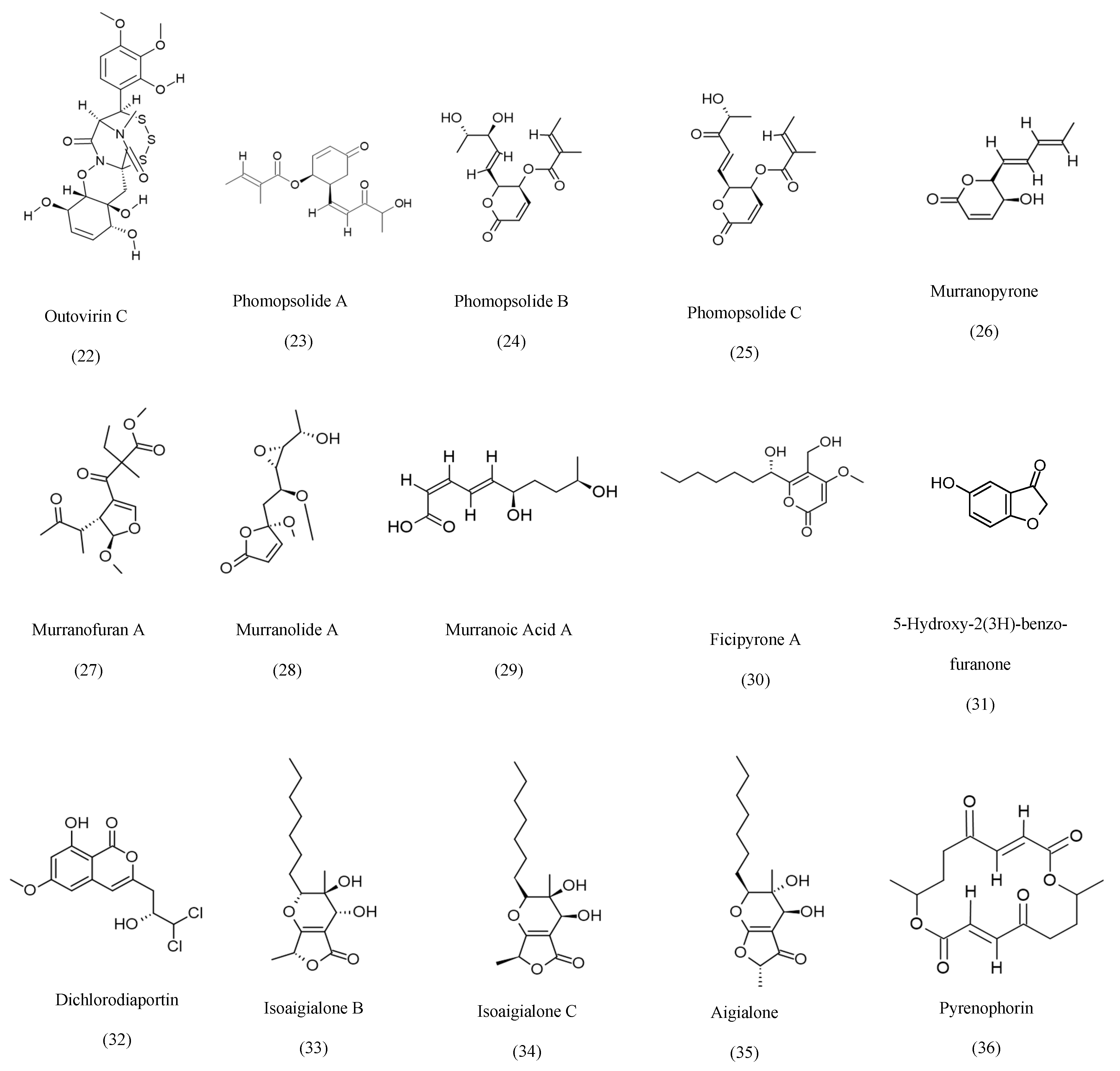







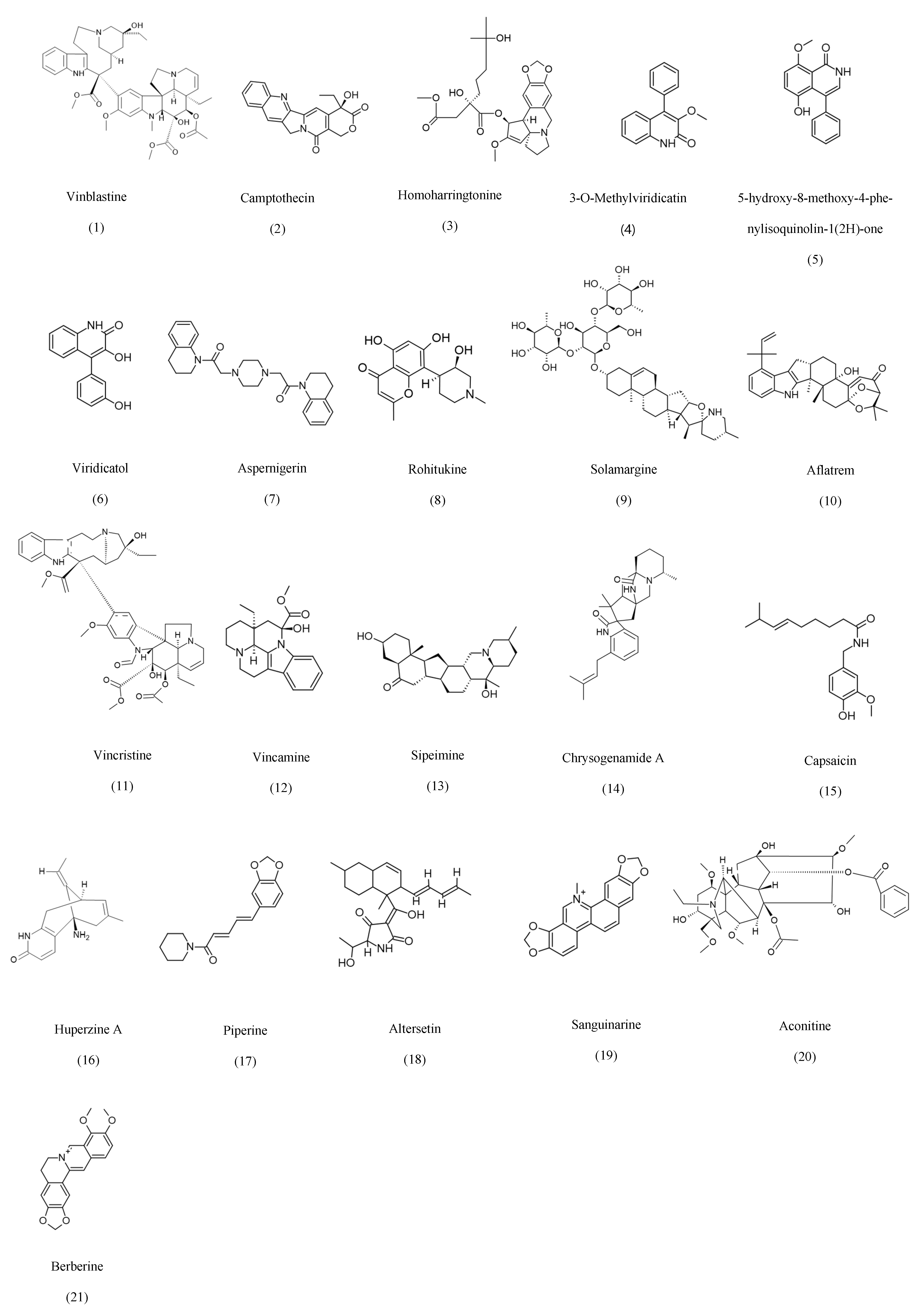
| Alkaloids and Nitrogen-Containing Derived Metabolites | ||||
| Compounds | Endophytic Fungus | Host Plants | Reported Biological Activity | References |
| Vinblastine | Fusarium oxysporum | Catharanthus roseus | Anticancer activity | [41] |
| Camptothecin | Entrophospora infrequens | Camptotheca acuminata | [15] | |
| Homoharringtonine | Alternaria tenuissima | Cephalotaxus sp. | [42] | |
| 3-O-methylviridicatin | Penicillium sp. R22 | Nerium indicum | Antifungal activity | [43] |
| 5-hydroxy-8-methoxy-4-phenylisoquinolin-1(2H)-one | ||||
| Viridicatol | Phoma sp. WF4 | Eleusine coracana | [44] | |
| Aspernigerin | Aspergillus niger | Cynodon dactylon | Cytotoxic activity | [45] |
| Rohitukine | Fusarium oxysporum, | Dysoxylum binectariferum | Anticancer and cytotoxic activities | [46] |
| Fusarium solani | ||||
| Solamargine | Aspergillus flavus | Solanum nigrum | [47] | |
| Aflatrem | Many plants | Neurotoxic activity | [48] | |
| Vincristine | Fusarium oxysporum | Catharanthus roseus | Antitumor activity | [41] |
| Vincamine | - | Vinca minor | Antihypertensive activity. | [49] |
| Sipeimine | Cephalosporium corda | Fritillaria ussuriensis | Anti-ulcer activity | [50] |
| Chrysogenamide A | Penicillium chrysogenum | Cistanche deserticola | Neuroprotective activity | [51,52] |
| Capsaicin | Alternaria alternata | Capsicum annuum | Anti-inflammatory activity | [52] |
| Huperzine A | Colletotrichum sp. Trichoderma sp. | Huperzia serrata | Acetylcholinesterase inhibitor activity. | [53] |
| Piperine | Colletotrichum gloeosporioides | Piper nigrum | Anti-cancer, Anti-microbial, Anti-inflammatory, antidepressant, and hepatoprotective activities. | [54] |
| Periconia sp. | [55] | |||
| Mycosphaerella sp. | [56] | |||
| altersetin | Alternaria sp. | - | Anti-Gram-positive activity | [57] |
| Sanguinarine | Fusarium proliferatum | Macleaya cordata | Antimicrobial, anticancer, antioxidant, anti-inflammatory, neuroprotective, and anthelmintic activity. | [58] [59] |
| Aconitine | Cladosporium cladosporioides | Aconitum leucostomum | Anti-cancer, Anti-neurologic, and anti-inflammatory activity | [60] |
| Berberine | Alternaria sp. | Phellodendron amurense | Anti-bacterial, antihypertensive, anti-diabetic, antiproliferative, anti-hyperlipidaemic, and vasodilator activity | [50] |
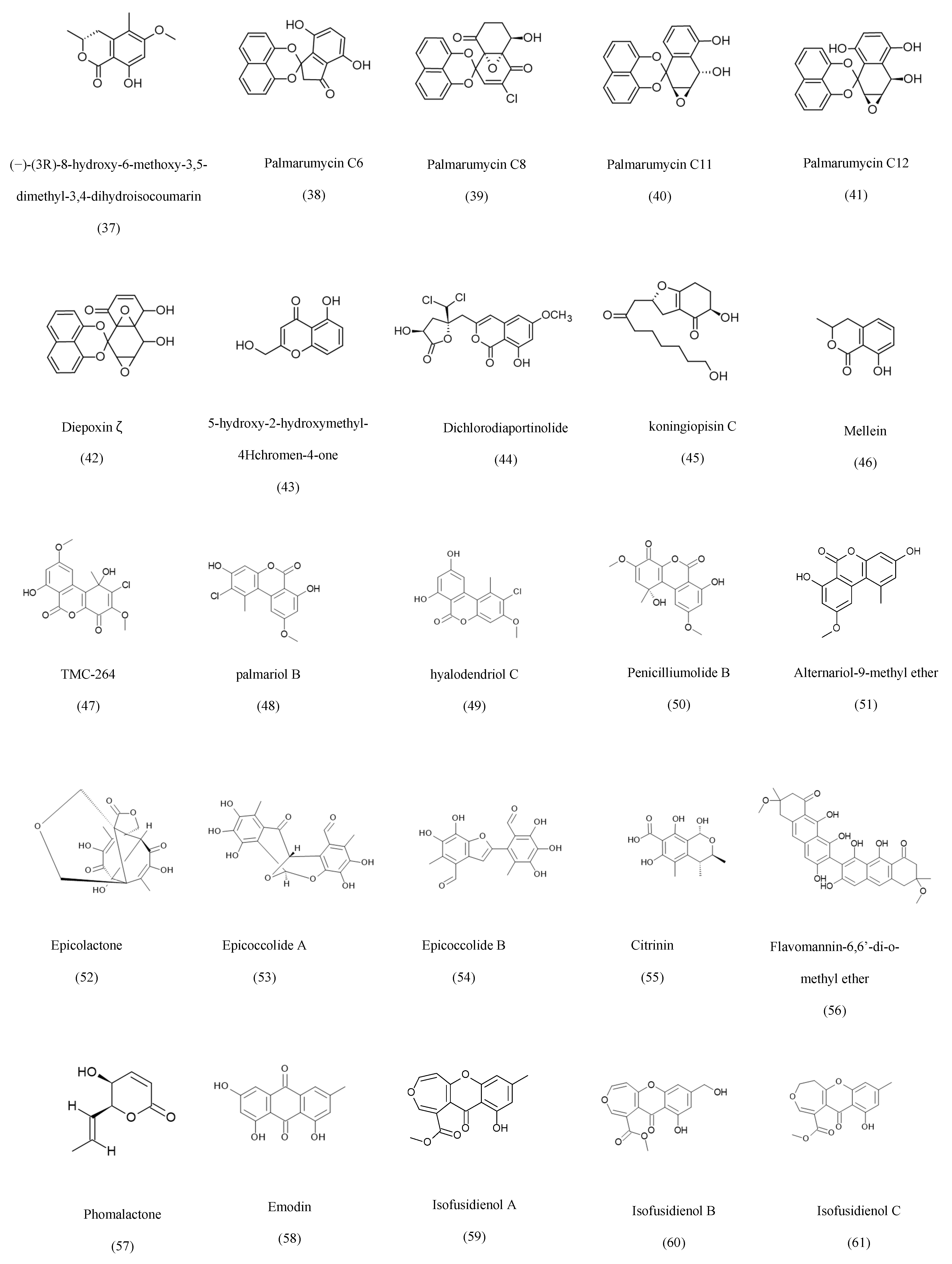
| Polyketide-derived metabolites | ||||
| Outovirin C | Penicillium raciborskii | Rhododendron tomentosum | Antifungal activity | [61] |
| Phomopsolide A | Diaporthe maritima | Picea sp. | [62] | |
| Phomopsolide B | ||||
| Phomopsolide C | ||||
| Murranopyrone | Curvularia sp. strain M12 | Murraya koenigii | [63] | |
| Murranofuran A | ||||
| Murranolide A | ||||
| Murranoic acid A | ||||
| Ficipyrone A | Pestalotiopsis fici | Camellia sinensis | [64] | |
| 5-hydroxy 2(3H)-benzofuranone | Fusarium fujikuroi (WF5) | Eleusine coracana | [65] | |
| Dichlorodiaportin | Trichoderma sp. 09 | Myoporum bontioides | [66] | |
| Isoaigialone B | Phaeoacremonium sp. | Senna spectabilis | [67] | |
| Isoaigialone C | ||||
| Aigialone | ||||
| Pyrenophorin | Lophodermium nitens DAOM 250027 | Pinus strobus | [68] | |
| (−)-(3R)-8-hydroxy-6-methoxy-3,5- dimethyl-3,4-dihydroisocoumarin | Biscogniauxia mediterranea | Echinacea purpurea | [69] | |
| Palmarumycin C6 | Berkleasmium sp. | Dioscorea zingiberensis | [70] | |
| Palmarumycin C8 | ||||
| Palmarumycin C11 | ||||
| Palmarumycin C12 | ||||
| Diepoxin ζ | ||||
| Cladospirone B* | ||||
| 5-hydroxy-2-hydroxymethyl-4Hchromen-4-one | Nodulisporium sp. | Erica arborea | [15] | |
| Dichlorodiaportinolide | Trichoderma sp. 09 | Myoporum bontioides | [66] | |
| Koningiopisin C | Trichoderma koningiopsis | Panax notoginseng | [71] | |
| Mellein | Pezicula sp. | Forsythia viridissima | [72] | |
| TMC-264 | Hyalodendriella sp. | Populus deltoides Marsh | Antimicrobial activity | [73] |
| Palmariol B | ||||
| Hyalodendriol C | ||||
| Penicilliumolide B | ||||
| Alternariol 9-methyl ether | ||||
| Epicolactone | Epicoccum sp. | Theobroma cacao | [74] | |
| Epicoccolide A | ||||
| Epicoccolide B | ||||
| Citrinin | Penicillium citrinum | - | [75] | |
| Flavomannin-6,6’ -di-O-methyl ether | Diaporthe melonis | Annona squamosa | [76] | |
| Phomalacton | Phoma sp. | Fucus serratus | [77] | |
| Emodin | Aspergillus glaucus | Ulva lactuca (Seaweed) | [15] | |
| Isofusidienol A | Chalara sp. | Artemisia vulgaris | Antibacterial activity | [15] |
| Isofusidienol B | ||||
| Isofusidienol C | ||||
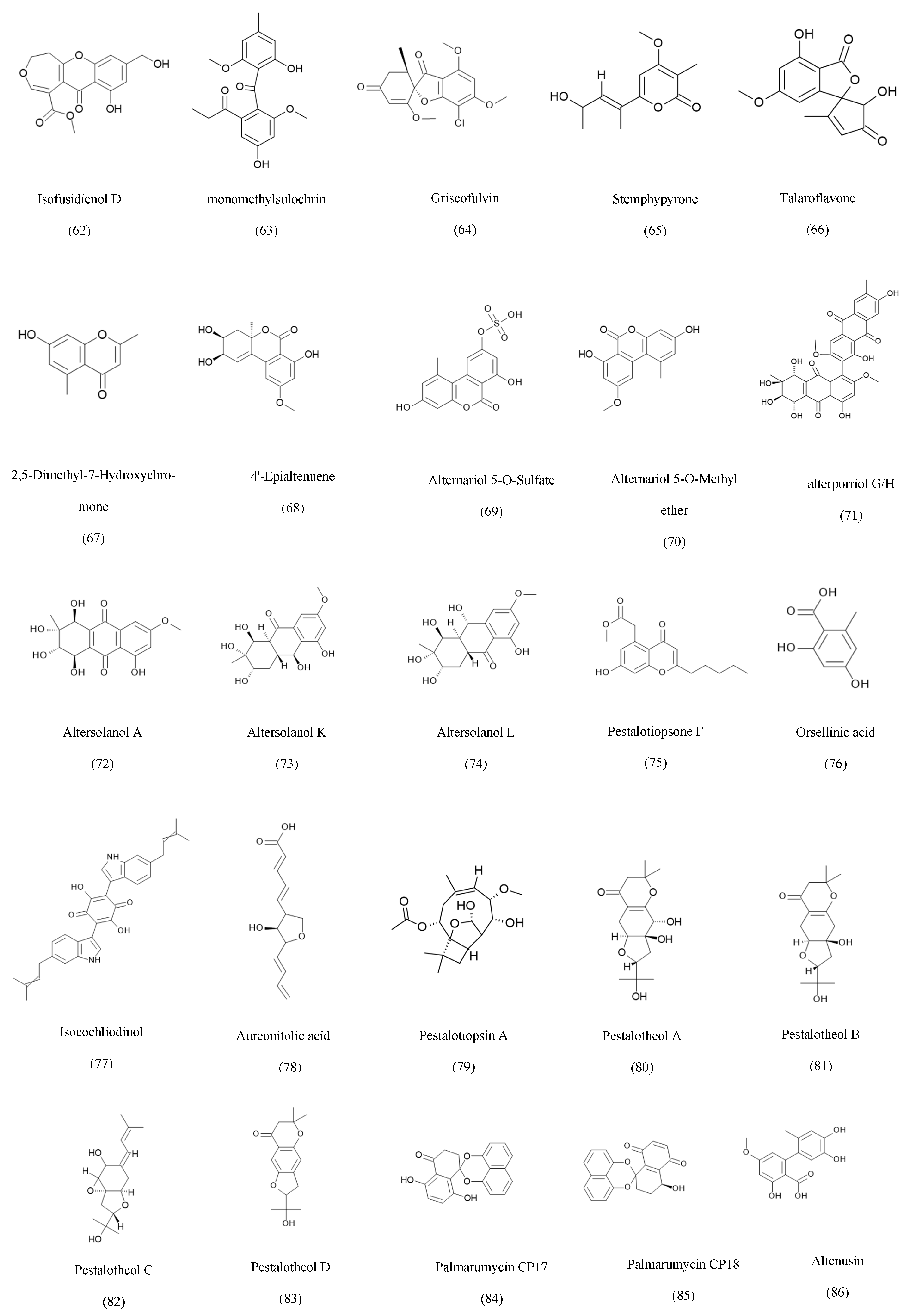
| Isofusidienol D | ||||
| Monomethylsulochrin | Aspergillus sp. strain CY725 | - | [78] | |
| Griseofulvin | Xylaria sp. strain F0010 | Abies holophylla Garcinia hombroniana | Antioxidant activity | [79,80] |
| Stemphypyrone | Stemphylium globuliferum | Mentha pulegium | Anticancer activity | [81] |
| Talaroflavone | Alternaria sp. | Polygonum senegalense | [15] | |
| 3′-hydroxyalternariol 5-O-methyl ether * | ||||
| Alternaric acid * | ||||
| Alterlactone * | ||||
| Altenuene * | ||||
| Altertoxin I * | ||||
| 2,5-dimethyl-7-hydroxychromone | ||||
| 4′-epialtenuene | ||||
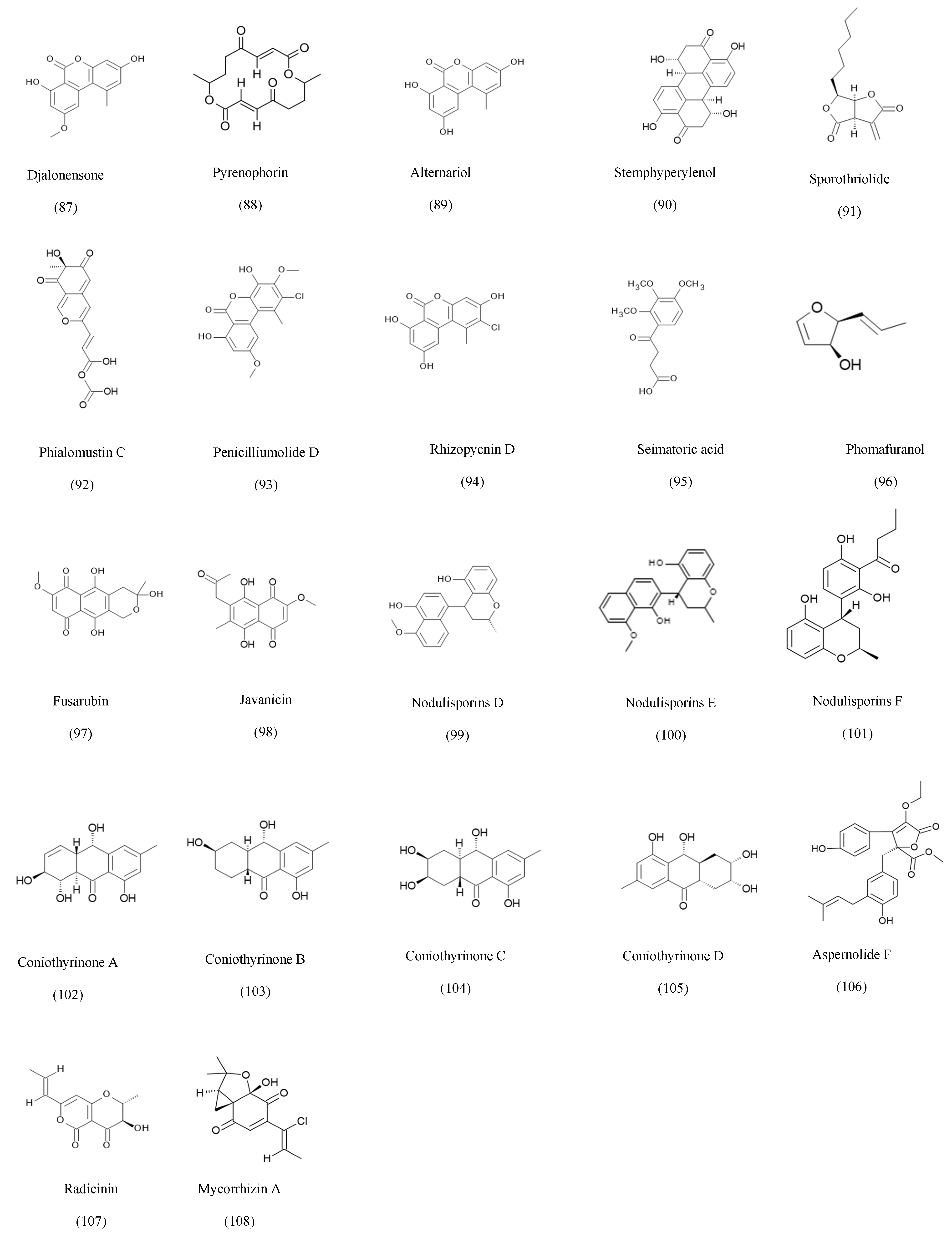
| Alternariol 5-O-sulfate | ||||
| Alternariol 5-O-methyl ether | ||||
| Alterporriol G | Stemphylium globuliferum | Mentha pulegium | [81] | |
| Altersolanol A | Ampelomyces sp. | Urospermum picroides | [82] | |
| Altersolanol K | Stemphylium globuliferum | Mentha pulegium | [81] | |
| Altersolanol L | ||||
| Pestalotiopsone F | Pestalotiopsis sp. | Rhizophora mucronata | [15] | |
| Orsellinic acid | Chaetomium sp. | Otanthus maritimus | [83] | |
| Isocochliodinol | ||||
| Aureonitolic acid | ||||
| Pestalotiopsin A | Pestalotiopsis fici | Taxus wallichiana | Anti-HIV activity | [84] |
| Pestalotheol A | Pestalotiopsis theae | - | [85] | |
| Pestalotheol B | ||||
| Pestalotheol C | ||||
| Pestalotheol D | ||||
| Palmarumycin CP17 | Edenia sp. | Petrea volubilis | Antiparasitic activity | [86] |
| Palmarumycin CP18 | ||||
| 2′,3′-dihydrosorbicillin(9Z,12Z)-2,3-dihydroxypropyloctadeca9,12-dienoate * | penicillium chrysogenum | Cistanche deserticola | Neuroprotective activity | [51] |
| Altenusin | Alternaria sp. | Trixis vauthieri | Anti-leishmaniasis activity | [87] |
| Djalonensone | Botryosphaeria dothidea KJ-1 | Melia azedarach | Antioxidant, Antibacterial, cytotoxic, and Antifungal activities. | [88] |
| Pycnophorin | ||||
| Alternariol | ||||
| Stemphyperylenol | ||||
| Sporothriolide | Nodulisporium sp. A21 | Ginkgo biloba | Antifungal, and Anti-phytopathogenic activities | [89] |
| Phialomustin C | Phialophora mustea | Crocus sativus | Cytotoxic, and antimicrobial activities | [90] |
| Penicilliumolide D | ||||
| 6-methyl-1,2,3-trihydroxy-7,8-cyclohepta-9,12-diene-11-one-5,6,7,8- tetralene-7-acetamide (KL-4) * | Aspergillus sp. | Gloriosa superba | [91] | |
| Rhizopycnin D | Rhizopycnis vagum Nitaf 22 | Nicotiana tabacum | [92] | |
| Seimatoric acid | Colletotrichum sp. | Gomera | Antibacterial and Antifungal activities. | [93] |
| Phomafuranol | Phoma sp. | Fucus serratus | [77] | |
| Fusarubin | Fusarium solani | Glycyrrhiza glabra | Anti-microbial and anti-tubercular Activities | [94] |
| Javanicin | Fusarium sp. | Piper sp. (Piperaceae | Phytotoxic and antifungal activities | [95] |
| Nodulisporins D | Nodulisporium sp. | Erica arborea | Antifungal and Antialgal Activities | [96] |
| Nodulisporins E | ||||
| Nodulisporins F | ||||
| Coniothyrinones A | Coniothyrium sp. | Salsola oppostifolia | Antifungal, Antibacterial, and Algicidal activities | [97] |
| Coniothyrinones B | ||||
| Coniothyrinones C | ||||
| Coniothyrinones D | ||||
| Aspernolides F | Aspergillus terreus | Carthamus lanatus | Anti-microbial, Anti-malarial, Anti-leishmanial, and cytotoxic activities | [98] |
| Radicinin | Physalospora sp. | - | Antifungal, Antibacterial, and Herbicidal activities | [99] |
| Mycorrhizin A | Plectophomella sp. | |||
| Terpenes and Terpenoids—derived metabolites | ||||
| Taxol | Aspergillus sp. | Taxus chinensis | Anticancer activity | [100] |
| Ceratobasidium sp. | ||||
| Cladosporium Tenuissimum | ||||
| Xylaria sp. | ||||
| Trichoderma sp. | ||||
| Sordaria sp. | ||||
| Phomopsis sp. | ||||
| Pezicula sp. | ||||
| Fusarium solani | ||||
| Coniothyrium diplodiella | ||||
| Epacris sp. | ||||
| Metarhizium anisopliae | ||||
| Paraconiothyrium brasiliense | ||||
| Taxane | Alternaria sp. | Taxus baccata | [101,102] | |
| Aspergillus sp. | ||||
| Beauveria sp. | ||||
| Fusarium sp. | ||||
| Epicoccum sp. | ||||
| Geotrichum sp. | ||||
| Phoma sp. | ||||
| Phomopsis sp. | ||||
| Gelasinospora sp. | ||||
| Cladosporium sp. | Wollemia nobilis | [103] | ||
| Langeronii sp. | ||||
| Phomopsis sp. | ||||
| Withanolide | Taleromyces pinophilus | Withania somnifera | [104] | |
| Sclerodol A * | Scleroderma UFSM Sc1 | Eucalyptus grandis | Antifungal activity | [105] |
| Sclerodol B | ||||
| Trichodermin | trichoderma brevicompactum 0248 | Allium sativum | [106] | |
| Guignardone N | Guignardia sp. | Euphorbia sieboldiana | [107] | |
| Guignardic acid | ||||
| Botryosphaerin H | Botryosphaeria sp. P483 | Huperzia serrata | [108] | |
| 13,14,15,16-tetranorlabd-7-en19,6β:12,17-diolide | ||||
| Ergosta-5,7,22-trien-3beta-ol | Chaetomium cupreum ZJWCF079 | Macleaya cordata | [109] | |
| Helvolic acid methyl ester | Fusarium sp. | Ficus carica | [110] | |
| Hydrohelvolic acid * | ||||
| Helvolic acid | ||||
| (3R,4R,6R,7S)-7-hydroxyl-3,7-dimethyl-oxabicyclo [3.3.1] nonan-2-one * | Pestalotiopsis foedan | Bruguiera sexangula | [111] | |
| (3R,4R)-3-(7-methylcyclohexenyl)-propanoic acid * | [112] | |||
| Phyllospinarone | Phyllosticta spinarum | Platycladus orientalis | Cytotoxic activity | [113] |
| 3-ketotauranin | ||||
| Tauranin -(+)-(5 S,10 S)-4′-hydroxymethylcyclozonarone * | ||||
| 3 alpha-hydroxytauranin | ||||
| 12-hydroxytauranin | ||||
| 3b-hydroxy-5a, 8a-epidioxy-ergosta-6, 22-diene * | Aspergillus sp. strain CY725 | Not reported | Antibacterial activity | [15] |
| Periconicins A | Periconia sp. | Taxus cuspidata | [15] | |
| Periconicins B | ||||
| Bilobalide | Pestalotiopsis uvicola | Ginkgo biloba | Neuroprotective activity | [114] |
| Ginkgolide | Fusarium oxysporum | Ginkgo biloba | Anti-inflammatory activity | [115] |
| Camphor | Nodulisporium sp. | Lagerstroemia loudoni | Antimicrobial activity | [116] |
| β-sitosterol glucoside * | Botryosphaeria dothidea KJ-1 | Melia azedarach | Antioxidant, Antibacterial, and anti-fungal activities. | [88] |
| Xanthatin | Paecilomyces sp. | Panax ginseng | Antitumor activity | [117,118] |
| Dihydrocumambrin A | Botryodiplodia theobromae | Dracaena draco | Cytotoxic and Antibacterial activities. | [119] |
| Azadirachtin | Penicillium sp. | Azadirachta indica | Hepatoprotective and insecticidal activities. | [120] |
| Asiaticoside | Colletotrichum gloeosporioides | Centella asiatica | Anti-inflammatory, Immunomodulatory, and antioxidant activities. | [121] |
| Agathic acid | Botryosphaeria sp. | Maytenus hookeri | Anti-inflammatory and anticancer activities | [122] |
| Bionectria sp. | Raphia taedigera | [123] | ||
| Fusarium sp. | Santalum album | [124] | ||
| Trichothecinol A | Trichothecium sp. | Phyllanthus amarus | Antifungal, anticancer, and antimetastatic activities | [125] |
| (4S,6S)-6-[(1S,2R)-1,2-dihydroxybutyl]-4-hydroxy-4-methoxytetrahydro-2H-pyran-2-one | Pestalotiopsis sp. DO14 | Dendrobium officinale | Cytotoxic and Antifungal Activities | [126] |
| (6S,2E)-6-hydroxy-3-methoxy-5-oxodec-2-enoic acid | ||||
| Peptides and amino acid-derived compounds | ||||
| Trichodermamide C | Cryptosporiopsis quercina | Tripterigium wilfordii | Antifungal activity | [127] |
| Fusarithioamide A | Eupenicillium sp. | Glochidion ferdinandi | Cytotoxic activity | [127] |
| Circumdatin G | fusarium chlamydosporium | Anvillea garcinii | Cytotoxic and Antimicrobial activities. | [128] |
| Cryptocandin | Fusarium sp. | Mentha longifolia | Antifungal and antimalarial activities. | [15] |
| Phenolic and aromatic—derived compounds | ||||
| Ergosterol | Chalara sp. | Artemisia vulgaris | Antibacterial activity | [129] |
| Xanalteric acid II | Alternaria sp. | Sonneratia alba | [130] | |
| Mollicellin O | ||||
| Xanalteric acid I | Coniothyrium sp. | Salsola oppostifolia | Antimicrobial activity | [97] |
| 4-hydroxy-benzamide | Colletotrichum gloeosporioides | Michelia champaca | Antifungal activity | [131] |
| Colletonoic acid * | Penicillium chrysogenum | Cistanche deserticola | Neuroprotective activity | [93] |
| Colletotric acid | Colletotrichum sp. | Gomera | Antibacterial, antifungal, and antialgal activities | [93] |
| Mollicellin G | Chaetomium sp. | Eucalyptus exserta | Antibacterial, antioxidant, and cytotoxic activities | [132] |
| Mollicellin H | ||||
| Mollicellin I | ||||
| Steroid-Derived Metabolites | ||||
| (22E,24R)-stigmasta 5,7,22-trien-3-β-ol * | Aspergillus terreus | Carthamus lanatus | Antimalarial, antimicrobial, and anti-leishmanial activities. | [98] |
| Flavonoids—derived Metabolites | ||||
| Apigenin | Colletotrichum sp. | Ginkgo biloba | Antidiabetic, antioxidant, anticancer, and Antibacterial activities | [133,134,135,136] |
| Chaetomium globosum | Cajanus cajan | |||
| Paraconiothyrium variabile | Cephalotaxus harringtonia | |||
| Cajanol | Hypocrea lixii | Cajanus cajan | Antimicrobial and Anticancer activities. | [137] |
| Chrysin | Alternaria alternata | Passiflora incarnata | Anticancer activity | [138] |
| Colletotrichum capsici | ||||
| Colletotrichum taiwanense | ||||
| Chalcone | Ceriporia lacerata | Cleistocalyx operculatus | Anti-inflammatory, Antibacterial, antitumor, and antifungal activities. | [139] |
| Curcumin | Chaetomium globosum | Curcuma wenyujin | Antioxidant, antitumor, and Anti-inflammatory activities. | [140] |
| Quercetin | Aspergillus nidulans | Ginkgo biloba | [141,142,143] | |
| Aspergillus oryzae | ||||
| Annulohypoxylon squamulosum | Cinnamomum sp. | |||
| Nigrospora oryzae | Loranthus micranthus | |||
| Kaempferol | Fusarium chlamydosporum | Tylophora indica | Antitumor, Antibacterial, anti-inflammatory, antioxidant, and antidiabetic activities. | [142,144,145,146] |
| Mucor fragilis | Podophyllum hexandrum | |||
| Annulohypoxylon boveri var. microspora | Cinnamomum sp. | |||
| Annulohypoxylon squamulosum | ||||
| Rotenone | Penicillium sp. | Derris elliptica | Pesticide and Insecticide activities. | [147] |
| Silymarin | Aspergillus iizukae | Silybum marianum | Hepatoprotective, cardioprotective, anti-inflammatory, antioxidant, and Anticancer activities. | [148] |
| Vitexin | Dichotomopilus funicola | Cajanus cajan | Neuroprotective, antitumor, and Antioxidant activities. | [135,149] |
| Colletotrichum sp. | Ginkgo biloba | |||
| Rutin | Chaetomium sp. | Nerium oleander | Neuroprotective, cardioprotective, and Antioxidant activities. | [150,151,152] |
| Xylaria sp. | Ginkgo biloba | |||
| Aspergillus flavus | Aegle marmelos | |||
| Luteolin | Aspergillus fumigatus | Cajanus cajan | Antioxidant activity | [153] |
| Hybrid and Other types of metabolites | ||||
| Torreyanic acid | Diaporthe sp. | mangroves | Cytotoxic activity | [154] |
| Diaportheone B | Pestalotiopsis microspora | Torreya taxifolia | [50] | |
| Chaetoglobosin A | Alternaria sp. | Polygonum senegalense | [155] | |
| Cytochalasin E | Chaetomium globosum | Panax notoginseng | [156] | |
| Indole-3-carboxylic acid | Chaetomium sp. | Otanthus maritimus | [83] | |
| Cytochalasin Z28 | Xylaria hypoxylon | Piper aduncum | [157] | |
| Penicillium chrysogenum | Cistanche deserticola | Neuroprotective activity | [51] | |
| Chaetoglobosin A * | Chaetomium globosum CDW7 | Ginkgo biloba | Antifungal activity | [158] |
| Chaetoglobosin D | ||||
| 2-amino-3,4-dihydroxy-2-25-(hydroxymethyl)-14-oxo-6,12- eicosenoic acid * | Mycosphaerella sp. | Eugenia bimarginata | [159] | |
| Myriocin | ||||
| Microsphaerol | Microsphaeropsis sp. | Salsola oppositifolia | [160] | |
| 2(2-hydroxyphenyl) acetic acid * | ||||
| 2-phenylethyl 1H-indol-3-yl-acetate | ||||
| Phomopsichalasin | Diaporthe sp. P133 | Pandanus amaryllifolius | Antibacterial Activity | [161] |
| Fusaruside | Fusarium sp. IFB-121 | Quercus variabilis | [162] | |
| 2S,20R,3R,30E,4E,8E)-1-O-beta-Dglucopyranosyl-2-N-(20 -hydroxy-30-octadecenoyl)-3-hydroxy-9-methyl4,8-sphingadienine * | ||||
| Cytochalasin D | Aspergillus clavatus | Taxus mairei | Antiangiogenic activity | [4] |
| Cytochalasins E | Phomopsis sp. | Anti-microbial activity | ||
| Cytochalasins K | Plectophomella sp. | - | Antifungal, Antibacterial, and Herbicidal Activities | [99] |
| Physalospora sp. | ||||
| (6S,2E)-6-hydroxy-3-methoxy-5-oxodec-2-enoic acid | Pestalotiopsis sp. DO14 | Dendrobium officinale | Cytotoxic and Antifungal Activities | [126] |
| 3-(2,3-dihydroxyphenoxy)-butanoic acid | Nodulisporium sp. | Erica arborea | Antialgal and Antifungal activities | [96] |
| 5-hydroxymethylfurfural | Botryosphaeria dothidea KJ-1 | Melia azedarach | Cytotoxic, Antibacterial, Antifungal, and Antioxidant activities | [88] |
| AI Tool | AI Technology | Advantages | Limitations | Application | References |
|---|---|---|---|---|---|
| Genome Mining and Biosynthetic Gene Cluster (BGC) Prediction | |||||
| antiSMASH | BGC detection using ML-supported heuristics. |
|
|
| [191,192,193] |
| PRISM | Predicts and identifies NP scaffolds from BGC using ML models |
|
|
| [194,195] |
| ClusterFinder | Use Hidden Markov Models (HMM)-based generative probabilistic modeling to detect noncanonical fungal and bacterial BGCs. |
|
|
| [185,186] |
| DeepBGC | Use the Deep Learning (using Pfam2vec and Random Forest classifiers) algorithm. |
|
|
| [187,196] |
| decRiPPter | Support Vector Machines (SVM)/Machine Learning algorithms. |
|
|
| [197] |
| DeepRiPP | Deep Learning (Natural language processing). |
|
|
| [198] |
| GECCO | Deep Learning (CRF-based) |
|
|
| [199] |
| DRNMs | These models use deep learning to predict transcription factor binding and regulatory elements controlling BGC expression. |
|
|
| [200] |
| AI-Assisted Metabolomics and MS/MS Analysis and Structure Elucidation | |||||
| GNPS | It uses machine learning on MS/MS spectral networks to cluster structurally related metabolites. Employ feature-based molecular networking (FBMN) |
|
|
| [201,202] |
| SMART 2.0 | Convolutional Neural Networks (CNN) for structure elucidation |
|
|
| [203] |
| DP4-AI | Bayesian Approach combined with Quantum Chemistry |
|
|
| [204] |
| ASE-ANI | Machine Learning |
|
|
| [205] |
| COLMAR | AI/Database Matching | Identifies and annotates primary metabolites from the NMR spectra of complex mixtures. |
|
| [206] |
| SIRIUS + CSI | Fragmentation-tree algorithms Deep neural networks to predict structural fingerprints and candidate structures |
|
|
| [207] |
| MS2LDA | Applies topic modeling (LDA) to MS/MS substructure motifs |
|
|
| [208] |
| AI-assisted for Target identification and Bioactivity Prediction | |||||
| Chemprop | A graph neural network model for predicting physicochemical and biological properties of NPs. |
|
|
| [209] |
| SPIDER | Utilize Self-Organizing Maps (SOM) algorithms |
|
|
| [210] |
| Generative AI and In Silico NP Design | |||||
| Generative Models (Original Tool) | Generative models (GANs, VAEs, diffusion models) create NP-like scaffolds. |
|
|
| [211,212] |
| Molecular Diffusion Models for NP Design | Diffusion-based models generate novel NP scaffolds with improved realism and chemical diversity. |
|
|
| [213,214] |
| AI-assisted tool for Protein Structure Prediction | |||||
| AlphaFill for Substrate-Bound Models | enhances AlphaFold models by adding cofactors, substrates, or ligands. |
|
|
| [215] |
| AI-assisted tool Microbial Networking and Ecology | |||||
| Microbiome ML Co-Occurrence Models | These models detect ecological patterns linked to NP biosynthesis. |
|
|
| [216] |
| AI-assisted tool Synthetic Biology & BGC Engineering | |||||
| RetroBioCat AI | Machine-learning tools for retrosynthesis and biosynthesis route design and enzyme selection. |
|
|
| [217] |
Disclaimer/Publisher’s Note: The statements, opinions and data contained in all publications are solely those of the individual author(s) and contributor(s) and not of MDPI and/or the editor(s). MDPI and/or the editor(s) disclaim responsibility for any injury to people or property resulting from any ideas, methods, instructions or products referred to in the content. |
© 2026 by the authors. Licensee MDPI, Basel, Switzerland. This article is an open access article distributed under the terms and conditions of the Creative Commons Attribution (CC BY) license.
Share and Cite
Al Shami, R.; Mousa, W.K. Mining the Hidden Pharmacopeia: Fungal Endophytes, Natural Products, and the Rise of AI-Driven Drug Discovery. Int. J. Mol. Sci. 2026, 27, 1365. https://doi.org/10.3390/ijms27031365
Al Shami R, Mousa WK. Mining the Hidden Pharmacopeia: Fungal Endophytes, Natural Products, and the Rise of AI-Driven Drug Discovery. International Journal of Molecular Sciences. 2026; 27(3):1365. https://doi.org/10.3390/ijms27031365
Chicago/Turabian StyleAl Shami, Ruqaia, and Walaa K. Mousa. 2026. "Mining the Hidden Pharmacopeia: Fungal Endophytes, Natural Products, and the Rise of AI-Driven Drug Discovery" International Journal of Molecular Sciences 27, no. 3: 1365. https://doi.org/10.3390/ijms27031365
APA StyleAl Shami, R., & Mousa, W. K. (2026). Mining the Hidden Pharmacopeia: Fungal Endophytes, Natural Products, and the Rise of AI-Driven Drug Discovery. International Journal of Molecular Sciences, 27(3), 1365. https://doi.org/10.3390/ijms27031365