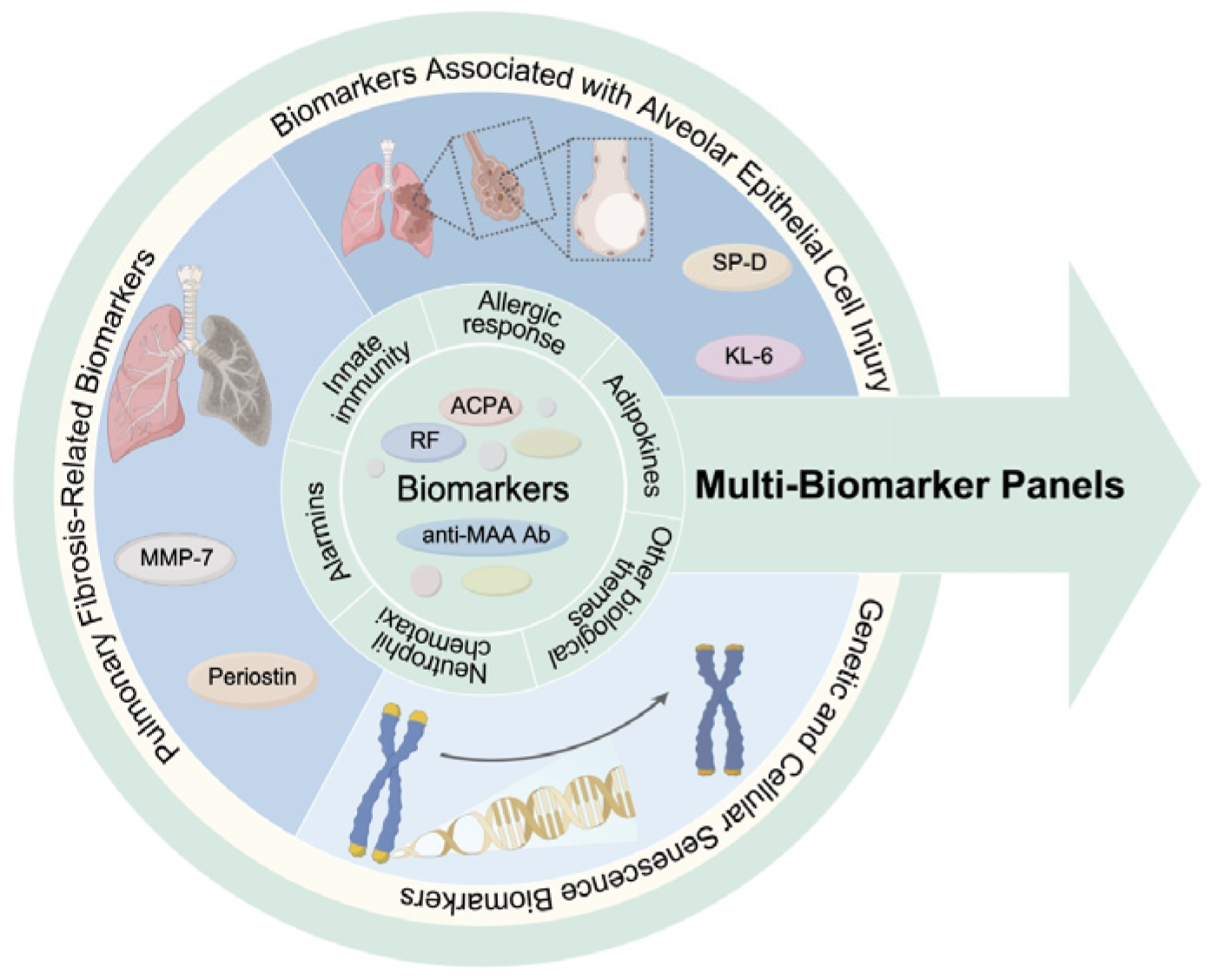


Advances in the Diagnosis of Rheumatoid Arthritis-Associated Interstitial Lung Disease: Integrating Conventional Tools and Emerging Biomarkers


Abstract
1. Introduction
2. Epidemiology of RA-ILD
3. The Evolution of Diagnostic Criteria and Guidelines: Core Recommendations of the 2025 ERS/EULAR CTD-ILD Clinical Practice Guidelines
4. Clinical Application of Conventional Diagnostic Tools: HRCT and PFTs
4.1. Clinical Application of HRCT in RA-ILD
4.1.1. Advantages and Limitations of HRCT
4.1.2. Current Status and Prospects of AI-Assisted HRCT Diagnosis
4.2. Clinical Application of PFTs in RA-ILD
5. Research Advances in Emerging Biomarkers for the Diagnosis of RA-ILD
5.1. Biomarkers Associated with Alveolar Epithelial Cell Injury
5.2. Pulmonary Fibrosis-Related Biomarkers
5.3. Genetic and Cellular Senescence Biomarkers
5.4. Multi-Biomarker Panels
5.5. Summary and Future Perspectives
6. Conclusions and Future Perspectives
Author Contributions
Funding
Institutional Review Board Statement
Informed Consent Statement
Data Availability Statement
Conflicts of Interest
Abbreviations
| ACPA | Anti-Citrullinated Protein Antibody |
| AI | Artificial Intelligence |
| AUC | Area Under the receiver operating characteristic Curve |
| BAL | Bronchoalveolar Lavage |
| CI | Confidence Interval |
| CRP | C-Reactive Protein |
| CTD-ILD | Connective Tissue Disease-associated Interstitial Lung Disease |
| DLCO | Diffusion Capacity of the Lung for Carbon Monoxide |
| DLR | Deep Learning Reconstruction |
| ERS | European Respiratory Society |
| EULAR | European Alliance of Associations for Rheumatology |
| FVC | Forced Vital Capacity |
| HRCT | High-Resolution Computed Tomography |
| ILD | Interstitial Lung Disease |
| IPF | Idiopathic Pulmonary Fibrosis |
| KL-6 | Krebs von den Lungen-6 |
| LDH | Lactate Dehydrogenase |
| LIP | Lymphoid Interstitial Pneumonia |
| LUS | Lung Ultrasound |
| MDHAQ | Multidimensional Health Assessment Questionnaire |
| MDT | Multidisciplinary Team |
| MMP-7 | Matrix Metalloproteinase-7 |
| NSIP | Nonspecific Interstitial Pneumonia |
| OP | Organizing Pneumonia |
| OR | Odds Ratio |
| PFTs | Pulmonary Function Tests |
| RA | Rheumatoid Arthritis |
| RA-ILD | Rheumatoid Arthritis-associated Interstitial Lung Disease |
| RF | Rheumatoid Factor |
| SASP | Senescence-Associated Secretory Phenotype |
| SP-D | Surfactant Protein D |
| TERF1 | Telomeric Repeat-Binding Factor 1 |
| TL | Telomere Length |
| TGF-β1 | Transforming Growth Factor-Beta 1 |
| UIP | Usual Interstitial Pneumonia |
| α-SMA | Alpha-Smooth Muscle Actin |
References
- Figus, F.A.; Piga, M.; Azzolin, I.; McConnell, R.; Iagnocco, A. Rheumatoid arthritis: Extra-articular manifestations and comorbidities. Autoimmun. Rev. 2021, 20, 102776. [Google Scholar] [CrossRef] [PubMed]
- Conforti, A.; Di Cola, I.; Pavlych, V.; Ruscitti, P.; Berardicurti, O.; Ursini, F.; Giacomelli, R.; Cipriani, P. Beyond the joints, the extra-articular manifestations in rheumatoid arthritis. Autoimmun. Rev. 2021, 20, 102735. [Google Scholar] [CrossRef] [PubMed]
- Kadura, S.; Raghu, G. Rheumatoid arthritis-interstitial lung disease: Manifestations and current concepts in pathogenesis and management. Eur. Respir. Rev. 2021, 30, 210011. [Google Scholar] [CrossRef] [PubMed]
- Akiyama, M.; Kaneko, Y. Pathogenesis, clinical features, and treatment strategy for rheumatoid arthritis-associated interstitial lung disease. Autoimmun. Rev. 2022, 21, 103056. [Google Scholar] [CrossRef]
- Ubhayasiri, S.K.; Ravindran, Y.; Mahmood, A.; Douglas, K.; Erb, N. E035 Prevalence and Clinical Characteristics of Lung Diseases in Patients with Immune-Mediated Rheumatic Diseases Referred for Biological Disease-Modifying Antirheumatic Drug Therapy. Rheumatology 2025, 64, keaf142.272. [Google Scholar] [CrossRef]
- Xie, K.; Che, Q.; Chen, J.; Wang, H.; Ren, B.; Chen, X.; Wang, F.; Wang, X.; Wang, J.; Shu, Q. SLAMF7-expressing B cells as crucial mediators in the pathogenesis of rheumatoid arthritis-interstitial lung disease. Int. Immunopharmacol. 2025, 152, 114392. [Google Scholar] [CrossRef]
- Kamiya, M.; Carter, H.; Espindola, M.S.; Doyle, T.J.; Lee, J.S.; Merriam, L.T.; Zhang, F.; Kawano-Dourado, L.; Sparks, J.A.; Hogaboam, C.M.; et al. Immune mechanisms in fibrotic interstitial lung disease. Cell 2024, 187, 3506–3530. [Google Scholar] [CrossRef]
- Cela, E.; Bonini, C.; Cavalli, F.; Luciano, A.; Kroegler, B.; Ora, J.; Bergamini, A.; Chiocchi, M.; Rogliani, P.; Chimenti, M.S.; et al. Validation of “Clinical Red Flags” for RA-ILD in an Italian cohort. Front. Med. 2025, 12, 1625742. [Google Scholar] [CrossRef]
- Vermant, M.; Kalkanis, A.; Jacob, J.; Goos, T.; Cortesi, E.E.; Cypers, H.; De Crem, N.; Follet, T.; Gogaert, S.; Neerinckx, B.; et al. Lung ultrasound outperforms symptom-based screening to detect interstitial lung disease associated with rheumatoid arthritis. RMD Open 2025, 11, e005283. [Google Scholar] [CrossRef]
- Guiot, J.; Miedema, J.; Cordeiro, A.; De Vries-Bouwstra, J.K.; Dimitroulas, T.; Søndergaard, K.; Tzouvelekis, A.; Smith, V. Practical guidance for the early recognition and follow-up of patients with connective tissue disease-related interstitial lung disease. Autoimmun. Rev. 2024, 23, 103582, Correction in Autoimmun. Rev. 2024, 23, 103641. https://doi.org/10.1016/j.autrev.2024.103641. [Google Scholar] [CrossRef]
- Wang, D.; Zhang, J.; Lau, J.; Wang, S.; Taneja, V.; Matteson, E.L.; Vassallo, R. Mechanisms of lung disease development in rheumatoid arthritis. Nat. Rev. Rheumatol. 2019, 15, 581–596. [Google Scholar] [CrossRef] [PubMed]
- Juge, P.A.; Wemeau, L.; Ottaviani, S.; Desjeux, G.; Zhuo, J.; Vannier-Moreau, V.; Flipo, R.M.; Crestani, B.; Dieudé, P. Increased mortality in patients with RA-associated interstitial lung disease: Data from a French administrative healthcare database. RMD Open 2023, 9, e003491, Correction in RMD Open 2024, 10, e003491corr1. https://doi.org/10.1136/rmdopen-2023-003491corr1. [Google Scholar] [CrossRef] [PubMed]
- Tschalèr, L.; Jordan, S.; Aaløkken, T.M.; Becker, M.; Brunborg, C.; Bruni, C.; Clarenbach, C.; Dobrota, R.; Durheim, M.T.; Elhai, M.; et al. Validation of a semi-quantitative method to assess interstitial lung disease severity and progression in systemic sclerosis by standard and low-dose HRCT scans. RMD Open 2025, 11, e004938. [Google Scholar] [CrossRef] [PubMed]
- Pulito-Cueto, V.; Atienza-Mateo, B.; Batista-Liz, J.C.; Sebastián Mora-Gil, M.; Mora-Cuesta, V.M.; Iturbe-Fernández, D.; Izquierdo Cuervo, S.; Aguirre Portilla, C.; Blanco, R.; López-Mejías, R. Matrix metalloproteinases and their tissue inhibitors as upcoming biomarker signatures of connective tissue diseases-related interstitial lung disease: Towards an earlier and accurate diagnosis. Mol. Med. 2025, 31, 70. [Google Scholar] [CrossRef]
- Guo, L.; Wang, J.; Li, J.; Yao, J.; Zhao, H. Biomarkers of rheumatoid arthritis-associated interstitial lung disease: A systematic review and meta-analysis. Front. Immunol. 2024, 15, 1455346. [Google Scholar] [CrossRef]
- Román Ivorra, J.A.; Trallero-Araguas, E.; Lopez Lasanta, M.; Cebrián, L.; Lojo, L.; López-Muñíz, B.; Fernández-Melon, J.; Núñez, B.; Silva-Fernández, L.; Veiga Cabello, R.; et al. Prevalence and clinical characteristics of patients with rheumatoid arthritis with interstitial lung disease using unstructured healthcare data and machine learning. RMD Open 2024, 10, e003353. [Google Scholar] [CrossRef]
- Qiu, M.; Jiang, J.; Nian, X.; Wang, Y.; Yu, P.; Song, J.; Zou, S. Factors associated with mortality in rheumatoid arthritis-associated interstitial lung disease: A systematic review and meta-analysis. Respir. Res. 2021, 22, 264. [Google Scholar] [CrossRef]
- Sparks, J.A.; Jin, Y.; Cho, S.K.; Vine, S.; Desai, R.; Doyle, T.J.; Kim, S.C. Prevalence, incidence and cause-specific mortality of rheumatoid arthritis-associated interstitial lung disease among older rheumatoid arthritis patients. Rheumatology 2021, 60, 3689–3698. [Google Scholar] [CrossRef]
- Joy, G.M.; Arbiv, O.A.; Wong, C.K.; Lok, S.D.; Adderley, N.A.; Dobosz, K.M.; Johannson, K.A.; Ryerson, C.J. Prevalence, imaging patterns and risk factors of interstitial lung disease in connective tissue disease: A systematic review and meta-analysis. Eur. Respir. Rev. 2023, 32, 220210. [Google Scholar] [CrossRef]
- Rojas-Serrano, J.; Herrera-Bringas, D.; Pérez-Román, D.I.; Pérez-Dorame, R.; Mateos-Toledo, H.; Mejía, M. Rheumatoid Arthritis-Related Interstitial Lung Disease (RA-ILD): Methotrexate and the Severity of Lung Disease Are Associated to Prognosis. Clin. Rheumatol. 2017, 36, 1493–1500. [Google Scholar] [CrossRef]
- Lucchino, B.; Paolo, M.D.; Gioia, C.; Vomero, M.; Diacinti, D.; Mollica, C.; Alessandri, C.; Diacinti, D.; Palange, P.; Franco, M.D. Identification of Subclinical Lung Involvement in ACPA-Positive Subjects Through Functional Assessment and Serum Biomarkers. Int. J. Mol. Sci. 2020, 21, 5162. [Google Scholar] [CrossRef]
- Palomäki, A.; Palotie, A.; Koskela, J.; Eklund, K.K.; Pirinen, M.; Ripatti, S.; Laitinen, T.; Mars, N. Lifetime risk of rheumatoid arthritis-associated interstitial lung disease in MUC5B mutation carriers. Ann. Rheum. Dis. 2021, 80, 1530–1536. [Google Scholar] [CrossRef] [PubMed]
- Chen, N.; Diao, C.Y.; Gao, J.; Zhao, D.B. Risk factors for the progression of rheumatoid arthritis-related interstitial lung disease: Clinical features, biomarkers, and treatment options. Semin. Arthritis Rheum. 2022, 55, 152004. [Google Scholar] [CrossRef] [PubMed]
- Kronzer, V.L.; Huang, W.; Dellaripa, P.F.; Huang, S.; Feathers, V.; Lu, B.; Iannaccone, C.K.; Gill, R.R.; Hatabu, H.; Nishino, M.; et al. Lifestyle and Clinical Risk Factors for Incident Rheumatoid Arthritis-associated Interstitial Lung Disease. J. Rheumatol. 2021, 48, 656–663. [Google Scholar] [CrossRef] [PubMed]
- Parks, C.G.; Costenbader, K.H. The Exposome: What is It, Really, and Does It Help to Understand Environmental Influences on Human Health and Rheumatic Disease? Arthritis Rheumatol. 2024, 76, 839–841. [Google Scholar] [CrossRef]
- McDermott, G.; Gill, R.; Gagne, S.; Byrne, S.; Huang, W.; Cui, J.; Prisco, L.; Zaccardelli, A.; Martin, L.; Kronzer, V.L.; et al. Associations of the MUC5B promoter variant with timing of interstitial lung disease and rheumatoid arthritis onset. Rheumatology 2022, 61, 4915–4923. [Google Scholar] [CrossRef]
- Juge, P.A.; Solomon, J.J.; van Moorsel, C.H.M.; Garofoli, R.; Lee, J.S.; Louis-Sydney, F.; Rojas-Serrano, J.; González-Pérez, M.I.; Mejia, M.; Buendia-Roldán, I.; et al. MUC5B promoter variant rs35705950 and rheumatoid arthritis associated interstitial lung disease survival and progression. Semin. Arthritis Rheum. 2021, 51, 996–1004. [Google Scholar] [CrossRef]
- Natalini, J.G.; Baker, J.F.; Singh, N.; Mahajan, T.D.; Roul, P.; Thiele, G.M.; Sauer, B.C.; Johnson, C.R.; Kawut, S.M.; Mikuls, T.R.; et al. Autoantibody Seropositivity and Risk for Interstitial Lung Disease in a Prospective Male-Predominant Rheumatoid Arthritis Cohort of U.S. Veterans. Ann. Am. Thorac. Soc. 2021, 18, 598–605. [Google Scholar] [CrossRef]
- Sparks, J.A.; He, X.; Huang, J.; Fletcher, E.A.; Zaccardelli, A.; Friedlander, H.M.; Gill, R.R.; Hatabu, H.; Nishino, M.; Murphy, D.J.; et al. Rheumatoid Arthritis Disease Activity Predicting Incident Clinically Apparent Rheumatoid Arthritis-Associated Interstitial Lung Disease: A Prospective Cohort Study. Arthritis Rheumatol. 2019, 71, 1472–1482. [Google Scholar] [CrossRef]
- Narváez, J.; Aburto, M.; Seoane-Mato, D.; Bonilla, G.; Acosta, O.; Candelas, G.; Cano-Jiménez, E.; Castellví, I.; González-Ruiz, J.M.; Corominas, H.; et al. Screening criteria for interstitial lung disease associated to rheumatoid arthritis: Expert proposal based on Delphi methodology. Reumatol. Clin. (Engl. Ed.) 2023, 19, 74–81. [Google Scholar] [CrossRef]
- Sambataro, G.; Libra, A.; Spicuzza, L.; Palmucci, S.; Conti, P.; Spagnolo, E.; Colaci, M.; Malatino, L.; Orlandi, M.; Sambataro, D.; et al. Clinical Presentation of Connective Tissue Disease Patients with and Without Interstitial Lung Disease: A Retrospective Study. Respiration 2023, 102, 405–415. [Google Scholar] [CrossRef]
- Fraenkel, L.; Bathon, J.M.; England, B.R.; St Clair, E.W.; Arayssi, T.; Carandang, K.; Deane, K.D.; Genovese, M.; Huston, K.K.; Kerr, G.; et al. 2021 American College of Rheumatology Guideline for the Treatment of Rheumatoid Arthritis. Arthritis Care Res. 2021, 73, 924–939. [Google Scholar] [CrossRef]
- Montesi, S.B. Practice guidelines for interstitial lung diseases: Widening the reach. Lung India 2020, 37, 289–291. [Google Scholar] [CrossRef] [PubMed]
- Antoniou, K.M.; Distler, O.; Gheorghiu, A.M.; Moor, C.C.; Vikse, J.; Bizymi, N.; Galetti, I.; Brown, G.; Bargagli, E.; Allanore, Y.; et al. ERS/EULAR clinical practice guidelines for connective tissue disease-associated interstitial lung disease Developed by the task force for connective tissue disease-associated interstitial lung disease of the European Respiratory Society (ERS) and the European Alliance of Associations for Rheumatology (EULAR)Endorsed by the European Reference Network on rare respiratory diseases (ERN-LUNG). Ann. Rheum. Dis. 2026, 85, 22–60. [Google Scholar] [CrossRef] [PubMed]
- England, B.R.; Hershberger, D. Management issues in rheumatoid arthritis-associated interstitial lung disease. Curr. Opin. Rheumatol. 2020, 32, 255–263. [Google Scholar] [CrossRef] [PubMed]
- Raghu, G.; Remy-Jardin, M.; Thomson, C.C.; Inoue, Y.; Johkoh, T.; Kreuter, M.; Lynch, D.A.; Maher, T.M.; Martinez, F.J.; Molina-Molina, M.; et al. Idiopathic Pulmonary Fibrosis (an Update) and Progressive Pulmonary Fibrosis in Adults: An Official ATS/ERS/JRS/ALAT Clinical Practice Guideline. Allergy 2022, 205. [Google Scholar] [CrossRef]
- Atienza-Mateo, B.; Fernandez-Diaz, C.; Vicente-Rabaneda, E.F.; Melero-Gonzalez, R.B.; Ortiz-Sanjuan, F.; Casafont-Sole, I.; Rodriguez-Garcia, S.C.; Ferraz-Amaro, I.; Castaneda, S.; Blanco, R. Abatacept in Usual and in Non-Specific Interstitial Pneumonia Associated with Rheumatoid Arthritis. Arthritis Rheumatol. 2024, 119, 118–124. [Google Scholar] [CrossRef]
- Yoo, H.; Hino, T.; Han, J.; Franks, T.J.; Im, Y.; Hatabu, H.; Chung, M.P.; Lee, K.S. Connective Tissue Disease-Related Interstitial Lung Disease (CTD-ILD) and Interstitial Lung Abnormality (ILA): Evolving Concept of CT Findings, Pathology and Management. Eur. J. Radiol. Open 2022, 9, 100419. [Google Scholar] [CrossRef]
- Drimus, J.C.; Duma, R.C.; Trăilă, D.; Mogoșan, C.D.; Manolescu, D.L.; Fira-Mladinescu, O. High-Resolution CT Findings in Interstitial Lung Disease Associated with Connective Tissue Diseases: Differentiating Patterns for Clinical Practice-A Systematic Review with Meta-Analysis. J. Clin. Med. 2025, 14, 6164. [Google Scholar] [CrossRef]
- Messina, R.; Guggino, G.; Benfante, A.; Scichilone, N. Interstitial Lung Disease in Elderly Rheumatoid Arthritis Patients. Drugs Aging 2020, 37, 11–18. [Google Scholar] [CrossRef]
- Bini, F.; Lauretis, A.D.; Arosio, C.; Bodini, B.D.; Zucchetti, S.C.; Papetti, M.C.; Vaghi, A. Retrospective Evaluation of Our Cohort of CTD-ILD RA Patients Treated with Rituximab: 5 Years Follow Up. Allergy 2021, 58, PA2373. [Google Scholar] [CrossRef]
- Sebastiani, M.; Venerito, V.; Laurino, E.; Gentileschi, S.; Atzeni, F.; Canofari, C.; Andrisani, D.; Cassone, G.; Lavista, M.; D’Alessandro, F.; et al. Fibrosing Progressive Interstitial Lung Disease in Rheumatoid Arthritis: A Multicentre Italian Study. J. Clin. Med. 2023, 12, 7041. [Google Scholar] [CrossRef]
- Lee, J.S.; Kim, G.-H.J.; Ha, Y.-J.; Kang, E.H.; Lee, Y.J.; Goldin, J.G.; Lee, E.Y. The Extent and Diverse Trajectories of Longitudinal Changes in Rheumatoid Arthritis Interstitial Lung Diseases Using Quantitative HRCT Scores. J. Clin. Med. 2021, 10, 3812. [Google Scholar] [CrossRef]
- Yamakawa, H.; Sato, S.; Tsumiyama, E.; Nishizawa, T.; Kawabe, R.; Oba, T.; Kamikawa, T.; Horikoshi, M.; Akasaka, K.; Amano, M.; et al. Predictive Factors of Mortality in Rheumatoid Arthritis-Associated Interstitial Lung Disease Analysed by Modified HRCT Classification of Idiopathic Pulmonary Fibrosis According to the 2018 ATS/ERS/JRS/ALAT Criteria. J. Thorac. Dis. 2019, 11, 5247–5257. [Google Scholar] [CrossRef] [PubMed]
- Ciaffi, J.; Leeuwen, N.M.v.; Boonstra, M.; Kroft, L.J.M.; Schouffoer, A.A.; Ninaber, M.K.; Huizinga, T.W.J.; Vries-Bouwstra, J.K.d. Evolution of Systemic Sclerosis–Associated Interstitial Lung Disease One Year after Hematopoietic Stem Cell Transplantation or Cyclophosphamide. Arthritis Care Res. 2022, 74, 433–441. [Google Scholar] [CrossRef] [PubMed]
- Ley, S.; Fidler, L.; Schenk, H.; Durand, M.; Marras, T.; Paul, N.; Shapera, S.; Mittoo, S. Low Dose Computed Tomography of the Lung for Detection and Grading of Interstitial Lung Disease: A Systematic Simulation Study. Pulmonology 2021, 27, 14–25. [Google Scholar] [CrossRef] [PubMed]
- Sullivan, D.I.; Ascherman, D.P. Rheumatoid Arthritis-Associated Interstitial Lung Disease (RA-ILD): Update on Prevalence, Risk Factors, Pathogenesis, and Therapy. Curr. Rheumatol. Rep. 2024, 26, 431–449. [Google Scholar] [CrossRef]
- Mira-Avendano, I.; Abril, A.; Burger, C.D.; Dellaripa, P.F.; Fischer, A.; Gotway, M.B.; Lee, A.S.; Lee, J.S.; Matteson, E.L.; Yi, E.S.; et al. Interstitial Lung Disease and Other Pulmonary Manifestations in Connective Tissue Diseases. Mayo Clin. Proc. 2019, 94, 309–325. [Google Scholar] [CrossRef]
- Exarchos, K.P.; Gkrepi, G.; Kostikas, K.; Gogali, A. Recent Advances of Artificial Intelligence Applications in Interstitial Lung Diseases. Diagnostics 2023, 13, 2303. [Google Scholar] [CrossRef]
- Walsh, S.L.F.; De Backer, J.; Prosch, H.; Langs, G.; Calandriello, L.; Cottin, V.; Brown, K.K.; Inoue, Y.; Tzilas, V.; Estes, E. Towards the adoption of quantitative computed tomography in the management of interstitial lung disease. Eur. Respir. Rev. 2024, 33, 230055. [Google Scholar] [CrossRef]
- Higaki, T.; Nakamura, Y.; Zhou, J.; Yu, Z.; Nemoto, T.; Tatsugami, F.; Awai, K. Deep Learning Reconstruction at CT: Phantom Study of the Image Characteristics. Acad. Radiol. 2020, 27, 82–87. [Google Scholar] [CrossRef]
- Gumuyang, Z.; Xiaoxiao, Z.; Lili, X.; Xin, B.; Ru, J.; Min, X.; Jing, Y.; Zhengyu, J.; Hao, S. Value of Deep Learning Reconstruction at Ultra-Low-dose CT for Evaluation of Urolithiasis. Eur. Radiol. 2022, 32, 5954–5963. [Google Scholar] [CrossRef]
- Beysang, A.; Villani, N.; Boubaker, F.; Puel, U.; Eliezer, M.; Hossu, G.; Haioun, K.; Blum, A.; Teixeira, P.A.G.; Parietti-Winkler, C.; et al. Ultra-high-resolution CT of the Temporal Bone: Comparison Between Deep Learning Reconstruction and Hybrid and Model-Based Iterative Reconstruction. Diagn. Interv. Imaging 2024, 105, 233–242. [Google Scholar] [CrossRef] [PubMed]
- Kijowski, R.; Fritz, J. Emerging Technology in Musculoskeletal MRI and CT. Radiology 2023, 306, 6–19. [Google Scholar] [CrossRef] [PubMed]
- Lin, Q.; Zhang, Z.; Xiong, X.; Chen, X.; Ma, T.; Chen, Y.; Li, T.; Long, Z.; Luo, Q.; Sun, Y.; et al. nnU-Net-based high-resolution CT features quantification for interstitial lung diseases. Eur. Radiol. 2025, 35, 7140–7149. [Google Scholar] [CrossRef]
- Colligiani, L.; Marzi, C.; Uggenti, V.; Colantonio, S.; Tavanti, L.; Pistelli, F.; Alì, G.; Neri, E.; Romei, C. Unlocking the potential of radiomics in identifying fibrosing and inflammatory patterns in interstitial lung disease. Radiol. Med. 2025, 130, 1797–1807. [Google Scholar] [CrossRef]
- Mastella, E.; Calderoni, F.; Manco, L.; Ferioli, M.; Medoro, S.; Turra, A.; Giganti, M.; Stefanelli, A. A systematic review of the role of artificial intelligence in automating computed tomography-based adaptive radiotherapy for head and neck cancer. Phys. Imaging Radiat. Oncol. 2025, 33, 100731. [Google Scholar] [CrossRef]
- Haixian, L.; Shu, P.; Zhao, L.; Chunfeng, L.; Lun, L. Machine Learning Approaches for EGFR Mutation Status Prediction in NSCLC: An Updated Systematic Review. Front. Oncol. 2025, 15, 1576461. [Google Scholar] [CrossRef]
- Böttcher, B.; Assen, M.v.; Fari, R.; Doeberitz, P.L.v.K.; Kim, E.Y.; Berkowitz, E.A.; Meinel, F.G.; Cecco, C.N.D. Evaluation of a Content-Based Image Retrieval System for Radiologists in High-Resolution CT of Interstitial Lung Diseases. Eur. Radiol. Exp. 2025, 9, 4. [Google Scholar] [CrossRef]
- Hsu, W.; Hippe, D.S.; Nakhaei, N.; Wang, P.-C.; Zhu, B.; Siu, N.; Ahsen, M.E.; Lotter, W.; Sorensen, A.G.; Naeim, A.; et al. External Validation of an Ensemble Model for Automated Mammography Interpretation by Artificial Intelligence. JAMA Netw. Open 2022, 5, e2242343. [Google Scholar] [CrossRef]
- Cadario, R.; Longoni, C.; Morewedge, C.K. Understanding, Explaining, and Utilizing Medical Artificial Intelligence. Nat. Hum. Behav. 2021, 5, 1636–1642. [Google Scholar] [CrossRef] [PubMed]
- Duran, J.M.; Jongsma, K.R. Who is Afraid of Black Box Algorithms? On the Epistemological and Ethical Basis of Trust in Medical AI. J. Med. Ethics 2021, 47, 329–335. [Google Scholar] [CrossRef] [PubMed]
- Bell, L.C.; Shimron, E. Sharing Data Is Essential for the Future of AI in Medical Imaging. Radiol. Artif. Intell. 2024, 6, e230337. [Google Scholar] [CrossRef]
- Denis, A.; Henket, M.; Ernst, M.; Maes, N.; Thys, M.; Regnier, C.; Malaise, O.; Frix, A.N.; Gester, F.; Desir, C.; et al. Progressive fibrosing interstitial lung disease in rheumatoid arthritis: A retrospective study. Front. Med. 2022, 9, 1024298. [Google Scholar] [CrossRef] [PubMed]
- Giles, J.T.; Danoff, S.K.; Sokolove, J.; Wagner, C.A.; Winchester, R.; Pappas, D.A.; Siegelman, S.; Connors, G.; Robinson, W.H.; Bathon, J.M. Association of Fine Specificity and Repertoire Expansion of Anticitrullinated Peptide Antibodies with Rheumatoid Arthritis Associated Interstitial Lung Disease. Ann. Rheum. Dis. 2014, 73, 1487–1494. [Google Scholar] [CrossRef]
- Wang, Y.; Chen, S.; Zheng, S.; Lin, J.; Hu, S.; Zhuang, J.; Lin, Q.; Xie, X.; Zheng, K.; Zhang, W.; et al. The Role of Lung Ultrasound B-lines and Serum KL-6 in the Screening and Follow-Up of Rheumatoid Arthritis Patients for an Identification of Interstitial Lung Disease: Review of the Literature, Proposal for a Preliminary Algorithm, and Clinical Application to Cases. Arthritis Res. Ther. 2021, 23, 212. [Google Scholar] [CrossRef]
- Reichenberger, F.; Popp, F.; Hoffmann, M.; Fischinger, C.; von Wulffen, W.; Kneidinger, N.; Welcker, M. Proposal of a radiation-free screening protocol for early detection of interstitial lung involvement in seropositive and ACPA-positive rheumatoid arthritis. BMC Pulm. Med. 2024, 24, 581. [Google Scholar] [CrossRef]
- Hyldgaard, C.; Harders, S.; Blegvad, J.; Herly, M.; Masic, D.; Sofíudóttir, B.K.; Urbonaviciene, G.; Andersen, F.D.; Isaksen, C.; Løgstrup, B.; et al. Clinical and preclinical pulmonary disease in newly diagnosed rheumatoid arthritis: A two-year follow-up study. Scand. J. Rheumatol. 2023, 52, 601–608. [Google Scholar] [CrossRef]
- Koduri, G.; Solomon, J.J. Identification, Monitoring, and Management of Rheumatoid Arthritis-Associated Interstitial Lung Disease. Arthritis Rheumatol. 2023, 75, 2067–2077. [Google Scholar] [CrossRef]
- Matson, S.; Mrad, A.; Trofimoff, A.; Ngo, L.; Azeem, I.; Harrison, A.; Mathai, S.K.; Humphries, M.; Solomon, J.; Lee, J.S. Multi-site, Real-world Study of the Impact of Pre-treatment Quantitative Fibrosis Score on Forced Vital Capacity Response for Patients with Rheumatoid Arthritis Interstitial Lung Disease Treated with Immunosuppression. Allergy 2024, 209, A2854. [Google Scholar] [CrossRef]
- Kim, E.J.; Elicker, B.M.; Maldonado, F.; Webb, W.R.; Ryu, J.H.; Van Uden, J.H.; Lee, J.S.; King, T.E., Jr.; Collard, H.R. Usual interstitial pneumonia in rheumatoid arthritis-associated interstitial lung disease. Eur. Respir. J. 2010, 35, 1322–1328. [Google Scholar] [CrossRef]
- Hyldgaard, C.; Ellingsen, T.; Hilberg, O.; Bendstrup, E. Rheumatoid Arthritis-Associated Interstitial Lung Disease: Clinical Characteristics and Predictors of Mortality. Respiration 2019, 98, 455–460. [Google Scholar] [CrossRef] [PubMed]
- Brea Folco, J.C.; Legarreta, C.G.; Onofre, G.K. Complex restrictive pulmonary function pattern in connective tissue disorders (CTD) with interstitial lung disease (ILD). Eur. Respir. J. 2019, 54, PA773. [Google Scholar] [CrossRef]
- Maher, T.M.; Nambiar, A.M.; Wells, A.U. The role of precision medicine in interstitial lung disease. Eur. Respir. J. 2022, 60, 2102146. [Google Scholar] [CrossRef] [PubMed]
- Jiang, Y.; Zhong, S.; He, S.; Weng, J.; Liu, L.; Ye, Y.; Chen, H. Biomarkers (mRNAs and non-coding RNAs) for the diagnosis and prognosis of rheumatoid arthritis. Front. Immunol. 2023, 14, 1087925. [Google Scholar] [CrossRef]
- Matama, G.; Okamoto, M.; Fujimoto, K.; Johkoh, T.; Tominaga, M.; Mukae, H.; Sakamoto, N.; Komiya, K.; Umeki, K.; Komatsu, M.; et al. Periostin Is a Biomarker of Rheumatoid Arthritis-Associated Interstitial Lung Disease. J. Clin. Med. 2023, 12, 7100. [Google Scholar] [CrossRef]
- Lee, J.S.; Lee, E.Y.; Ha, Y.J.; Kang, E.H.; Lee, Y.J.; Song, Y.W. Serum KL-6 levels reflect the severity of interstitial lung disease associated with connective tissue disease. Arthritis Res. Ther. 2019, 21, 58. [Google Scholar] [CrossRef]
- Chang, S.H.; Park, Y.B.; McDermott, G.C.; Paudel, M.L.; Hayashi, K.; Ha, Y.J.; Lee, J.S.; Kim, M.U.; Park, C.H.; Kim, J.W.; et al. Serum Biomarkers of Pulmonary Damage and Risk for Progression of Rheumatoid Arthritis-Associated Interstitial Lung Disease. J. Rheumatol. 2025, 52, 323–333. [Google Scholar] [CrossRef]
- Moon, J.; Lee, J.S.; Yoon, Y.I.; Chang, S.H.; Lee, Y.A.; Ha, Y.-J.; Kang, E.H.; Park, Y.-B.; Lee, H.; Choe, J.-Y.; et al. Association of Serum Biomarkers with Pulmonary Involvement of Rheumatoid Arthritis Interstitial Lung Disease: From KORAIL Cohort Baseline Data. J. Rheum. Dis. 2021, 28, 234–241. [Google Scholar] [CrossRef]
- Lu, P.-J.; Wang, G.; Cai, X.-D.; Zhang, P.; Wang, H.-K. Sequencing Analysis of Matrix Metalloproteinase 7-Induced Genetic Changes in Schwann Cells. Neural Regen. Res. 2020, 15, 2116–2122. [Google Scholar] [CrossRef]
- Xiong, L.; Liang, L.M.; Ye, S.Y.; Cui, X.L.; Hu, S.H.; Lian, C.Y.; Sun, W.J.; Lv, Y.P.; Zhang, H.D.; Wang, M.; et al. Inhibition of Matrix Metalloproteinase-7 Attenuates Subpleural Fibrosis in Rheumatoid Arthritis-Associated Interstitial Lung Disease. Biomedicines 2025, 13, 1581. [Google Scholar] [CrossRef] [PubMed]
- Kalafatis, D.; Löfdahl, A.; Näsman, P.; Elowsson Rendin, L.; Westergren-Thorsson, G.; Sköld, M. Released mediators in ex vivo 3D-model of lung fibrosis correspond to elevated serum biomarkers in IPF. Eur. Respir. J. 2021, 58, OA4333. [Google Scholar] [CrossRef]
- Sonnenberg-Riethmacher, E.; Miehe, M.; Riethmacher, D. Periostin in Allergy and Inflammation. Front. Immunol. 2021, 12, 722170. [Google Scholar] [CrossRef] [PubMed]
- Su, J.-Y.; Yu, C.-C.; Peng, C.-Y.; Liao, Y.-W.; Hsieh, P.-L.; Yang, L.-C.; Yu, C.-H.; Chou, M.-Y. Silencing Periostin Inhibits Myofibroblast Transdifferentiation of Fibrotic Buccal Mucosal Fibroblasts. J. Formos. Med. Assoc. 2021, 120, 2010–2015. [Google Scholar] [CrossRef]
- Rossiello, F.; Jurk, D.; Passos, J.F.; Fagagna, F.d.A.d. Telomere Dysfunction in Ageing and Age-Related Diseases. Nat. Cell Biol. 2022, 24, 135–147. [Google Scholar] [CrossRef]
- Benedittis, G.D.; Latini, A.; Morgante, C.; Bonini, C.; Cela, E.; Kroegler, B.; Luciano, A.; Chiocchi, M.; Cavalli, F.; Ora, J.; et al. Alteration of Telomere Length and Mtdna Copy Number in Interstitial Lung Disease Associated with Rheumatoid Arthritis. Autoimmunity 2025, 58, 2473741. [Google Scholar] [CrossRef]
- Doyle, T.J.; Juge, P.A.; Peljto, A.L.; Lee, S.; Walts, A.D.; Esposito, A.J.; Poli, S.; Gill, R.; Hatabu, H.; Nishino, M.; et al. Short peripheral blood leukocyte telomere length in rheumatoid arthritis-interstitial lung disease. Thorax 2024, 79, 182–185. [Google Scholar] [CrossRef]
- Wheeler, A.M.; Baker, J.F.; Riley, T.R., IV; Johnson, T.M.; Yang, Y.; Roul, P.; Wysham, K.D.; Cannon, G.W.; Kunkel, G.; Kerr, G.; et al. Peripheral Biomarker Signatures in Rheumatoid Arthritis-Associated Interstitial Lung Disease. Arthritis Rheumatol. 2025, 77, 971–980. [Google Scholar] [CrossRef]
- Vermant, M.; Goos, T.; Gogaert, S.; De Cock, D.; Verschueren, P.; Wuyts, W.A. Are genes the missing link to detect and prognosticate RA-ILD? Rheumatol. Adv. Pract. 2023, 7, rkad023. [Google Scholar] [CrossRef]
- Tanaka, S.; Hattori, N.; Ishikawa, N.; Shoda, H.; Takano, A.; Nishino, R.; Okada, M.; Arihiro, K.; Inai, K.; Hamada, H.; et al. Krebs Von Den Lungen-6 (Kl-6) is A Prognostic Biomarker in Patients with Surgically Resected Nonsmall Cell Lung Cancer. Int. J. Cancer 2012, 130, 377–387. [Google Scholar] [CrossRef]
- Qin, Y.; Wang, Y.; Meng, F.; Feng, M.; Zhao, X.; Gao, C.; Luo, J. Identification of biomarkers by machine learning classifiers to assist diagnose rheumatoid arthritis-associated interstitial lung disease. Arthritis Res. Ther. 2022, 24, 115. [Google Scholar] [CrossRef] [PubMed]
- d’Alessandro, M.; Conticini, E.; Bergantini, L.; Mazzei, M.A.; Bellisai, F.; Selvi, E.; Cameli, P.; Frediani, B.; Bargagli, E. Krebs von den Lungen-6 as biomarker of the new progressive fibrotic phenotype of interstitial lung disease. Tissue Cell 2024, 90, 102516. [Google Scholar] [CrossRef] [PubMed]
- Arroyo, R.; Kingma, P.S. Surfactant protein D and bronchopulmonary dysplasia: A new way to approach an old problem. Respir. Res. 2021, 22, 141. [Google Scholar] [CrossRef]
- García-Mouton, C.; Hidalgo, A.; Arroyo, R.; Echaide, M.; Cruz, A.; Pérez-Gil, J. Pulmonary Surfactant and Drug Delivery: An Interface-Assisted Carrier to Deliver Surfactant Protein SP-D Into the Airways. Front. Bioeng. Biotechnol. 2020, 8, 613276. [Google Scholar] [CrossRef] [PubMed]
- Eijk, M.v.; Hillaire, M.L.B.; Rimmelzwaan, G.F.; Rynkiewicz, M.J.; White, M.R.; Hartshorn, K.L.; Hessing, M.; Koolmees, P.A.; Tersteeg, M.H.; Es, M.H.v.; et al. Enhanced Antiviral Activity of Human Surfactant Protein D by Site-Specific Engineering of the Carbohydrate Recognition Domain. Front. Immunol. 2019, 10, 2476. [Google Scholar] [CrossRef]
- Jiaravuthisan, P.; Maeda, A.; Takakura, C.; Wang, H.-T.; Sakai, R.; Shabri, A.M.; Lo, P.-C.; Matsuura, R.; Kodama, T.; Eguchi, H.; et al. A Membrane-Type Surfactant Protein D (SP-D) Suppresses Macrophage-Mediated Cytotoxicity in Swine Endothelial Cells. Trans. Immunol. 2018, 47, 44–48. [Google Scholar] [CrossRef]
- Peukert, K.; Seeliger, B.; Fox, M.; Feuerborn, C.; Sauer, A.; Schuss, P.; Schneider, M.; David, S.; Welte, T.; Putensen, C.; et al. SP-D Serum Levels Reveal Distinct Epithelial Damage in Direct Human ARDS. J. Clin. Med. 2021, 10, 737. [Google Scholar] [CrossRef]
- Yu, M.; Guo, Y.; Zhang, P.; Xue, J.; Yang, J.; Cai, Q.; You, X.; Ma, J.; Yang, D.; Jia, Y.; et al. Increased circulating Wnt5a protein in patients with rheumatoid arthritis-associated interstitial pneumonia (RA-ILD). Immunobiology 2019, 224, 551–559. [Google Scholar] [CrossRef]
- Xu, J.; Zhang, W.; Bai, W.; Gai, N.; Li, J.; Bao, Y. A multi-biomarker machine learning approach for early prediction of interstitial lung disease in rheumatoid arthritis. BMC Pulm. Med. 2025, 25, 394. [Google Scholar] [CrossRef]
- Yang, Y.; Ma, L.; Wang, C.; Song, M.; Li, C.; Chen, M.; Zhou, J.; Mei, C. Matrix metalloproteinase-7 in platelet-activated macrophages accounts for cardiac remodeling in uremic mice. Basic Res. Cardiol. 2020, 115, 30. [Google Scholar] [CrossRef]
- Kaminski, A.R.; Moore, E.T.; Daseke, M.J., 2nd; Valerio, F.M.; Flynn, E.R.; Lindsey, M.L. The compendium of matrix metalloproteinase expression in the left ventricle of mice following myocardial infarction. Am. J. Physiol. Heart Circ. Physiol. 2020, 318, H706–H714. [Google Scholar] [CrossRef]
- Yang, M.M.; Lee, S.; Neely, J.; Hinchcliff, M.; Wolters, P.J.; Sirota, M. Gene expression meta-analysis reveals aging and cellular senescence signatures in scleroderma-associated interstitial lung disease. Front. Immunol. 2024, 15, 1326922. [Google Scholar] [CrossRef]
- Alder, J.K.; Armanios, M. Telomere-mediated lung disease. Physiol. Rev. 2022, 102, 1703–1720. [Google Scholar] [CrossRef]
- Smith, E.M.; Pendlebury, D.F.; Nandakumar, J. Structural Biology of Telomeres and Telomerase. Cell Mol. Life Sci. 2020, 77, 61–79. [Google Scholar] [CrossRef]
- Hernandez-Gonzalez, F.; Faner, R.; Rojas, M.; Agusti, A.; Serrano, M.; Sellares, J. Cellular Senescence in Lung Fibrosis. Int. J. Mol. Sci. 2021, 22, 7012. [Google Scholar] [CrossRef]
- Jee, A.S.; Sahhar, J.; Youssef, P.; Bleasel, J.; Adelstein, S.; Nguyen, M.; Corte, T.J. Review: Serum biomarkers in idiopathic pulmonary fibrosis and systemic sclerosis associated interstitial lung disease—Frontiers and horizons. Pharmacol. Ther. 2019, 202, 40–52. [Google Scholar] [CrossRef]


| HRCT Manifestation | Main Characteristics | Differential Diagnosis | References |
|---|---|---|---|
| UIP Pattern | Reticular opacities, traction bronchiectasis/bronchiolectasis, honeycombing, predominantly subpleural and basal | Idiopathic pulmonary fibrosis, chronic hypersensitivity pneumonitis, NSIP | [39,47] |
| NSIP Pattern | Ground-glass opacities, fine reticulation, diffuse or basal distribution, relatively symmetrical | Hypersensitivity pneumonitis, UIP, drug-induced lung injury | [39,47,48] |
| OP Pattern | Consolidation, air bronchogram, subpleural or peribronchial distribution | Cryptogenic organizing pneumonia, infection | [47,48] |
| LIP Pattern | Ground-glass opacities, centrilobular nodules, thin-walled cysts, diffuse | Lymphoproliferative disorders, Sjögren’s syndrome | [39,47] |
| Aspect of Application | Key PFT Parameters | Typical Findings in RA-ILD | Clinical Significance & Notes | References |
|---|---|---|---|---|
| Screening & Diagnosis | DLCOFVC |
| PFTs are important non-invasive tools for diagnosing RA-ILD, and combining them with other non-invasive methods can improve the early diagnostic rate of RA-ILD. | [21,65,66,67,68] |
| Severity Assessment & Monitoring Progression | FVC DLCO | Dynamic changes in FVC and DLCO serve as key physiological indicators for predicting prognosis. A decline in FVC of ≥10% or a decrease in DLCO of ≥15% within one year both indicate disease progression and reduced survival rates in patients with RA-ILD. | These specific thresholds of lung function decline are crucial for guiding treatment decisions in RA-ILD, such as initiating or escalating anti-fibrotic therapy. | [65,69] |
| Correlation with Imaging | FVC TLC DLCO | The extent of certain HRCT findings, such as reticular opacity and honeycombing, is negatively correlated with FVC, TLC, and DLCO, and this association is particularly strong in the UIP pattern of RA-ILD. | PFTs provide functional data that complements the structural information from HRCT, offering a more comprehensive assessment. | [66,70,71] |
| Characteristic PFT Pattern | FEV1/FVC ratio TLC DLCO |
| This pattern is the hallmark of RA-ILD and helps differentiate it from obstructive lung diseases. | [47,72,73] |
| Biomarker Category | Example(s) | Reported Diagnostic Performance (AUC) | Major Limitations/Current Challenges | Current Evidence Landscape | Key Supporting References |
|---|---|---|---|---|---|
| Alveolar Epithelial Injury | KL-6, SP-D | KL-6: 0.939; SP-D: 0.803 |
| Primarily from observational studies. Multiple cross-sectional and cohort studies confirm association with RA-ILD and correlation with disease severity/progression. | [66,76,77,78] |
| Pulmonary Fibrosis | MMP-7, Periostin | MMP-7: Consistently elevated in meta-analysis; periostin: Data emerging, specific AUCs for RA-ILD not yet robustly established. |
| Evidence varies in maturity. MMP-7 is supported by a systematic review/meta-analysis; periostin’s association with fibrosis is suggested by preliminary clinical studies, but diagnostic performance data are limited and lack large-scale validation. | [15,76,79,80,81,82,83,84] |
| Genetic & Cellular Senescence | TL | TL: Shorter TL associated with RA-ILD presence and progression. |
| Evidence for TL’s association with disease comes from multiple cohorts, but methodological standardization and clinical translation require refinement. | [85,86,87] |
| Multi-Biomarker Panels | Combinations of autoantibodies, cytokines, MMPs, adipokines | Superior to clinical factors alone (AUC: 0.739–0.751 vs. 0.630). |
| Proof-of-concept stage. Initial cross-sectional studies demonstrate potential superiority over clinical models, but they lack independent cohort validation and standardized panels have not been established. | [88] |
Disclaimer/Publisher’s Note: The statements, opinions and data contained in all publications are solely those of the individual author(s) and contributor(s) and not of MDPI and/or the editor(s). MDPI and/or the editor(s) disclaim responsibility for any injury to people or property resulting from any ideas, methods, instructions or products referred to in the content. |
© 2026 by the authors. Licensee MDPI, Basel, Switzerland. This article is an open access article distributed under the terms and conditions of the Creative Commons Attribution (CC BY) license.
Share and Cite
Bai, J.; Yu, F.; He, X. Advances in the Diagnosis of Rheumatoid Arthritis-Associated Interstitial Lung Disease: Integrating Conventional Tools and Emerging Biomarkers. Int. J. Mol. Sci. 2026, 27, 1165. https://doi.org/10.3390/ijms27031165
Bai J, Yu F, He X. Advances in the Diagnosis of Rheumatoid Arthritis-Associated Interstitial Lung Disease: Integrating Conventional Tools and Emerging Biomarkers. International Journal of Molecular Sciences. 2026; 27(3):1165. https://doi.org/10.3390/ijms27031165
Chicago/Turabian StyleBai, Jing’an, Fenghua Yu, and Xiaojuan He. 2026. "Advances in the Diagnosis of Rheumatoid Arthritis-Associated Interstitial Lung Disease: Integrating Conventional Tools and Emerging Biomarkers" International Journal of Molecular Sciences 27, no. 3: 1165. https://doi.org/10.3390/ijms27031165
APA StyleBai, J., Yu, F., & He, X. (2026). Advances in the Diagnosis of Rheumatoid Arthritis-Associated Interstitial Lung Disease: Integrating Conventional Tools and Emerging Biomarkers. International Journal of Molecular Sciences, 27(3), 1165. https://doi.org/10.3390/ijms27031165