GPR18 Deletion in Mice Inversely Affects Vasoactive Signaling and Passive Biomechanical Properties of the Thoracic Aorta and Femoral Artery

 , , ,
, , ,  and
and 
Abstract
1. Introduction
2. Results
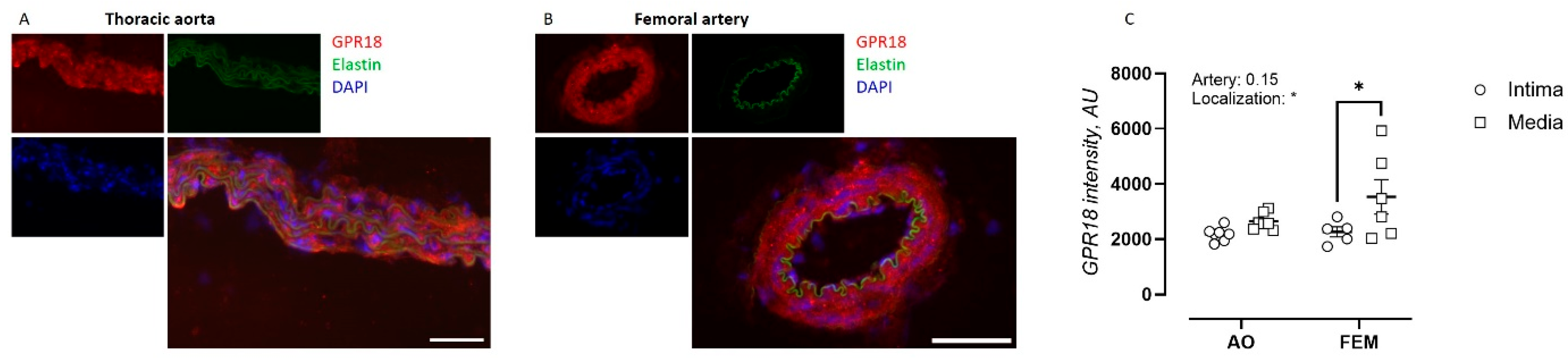
2.1. GPR18 Expression in the Arterial Wall of the Thoracic Aorta and Femoral Artery
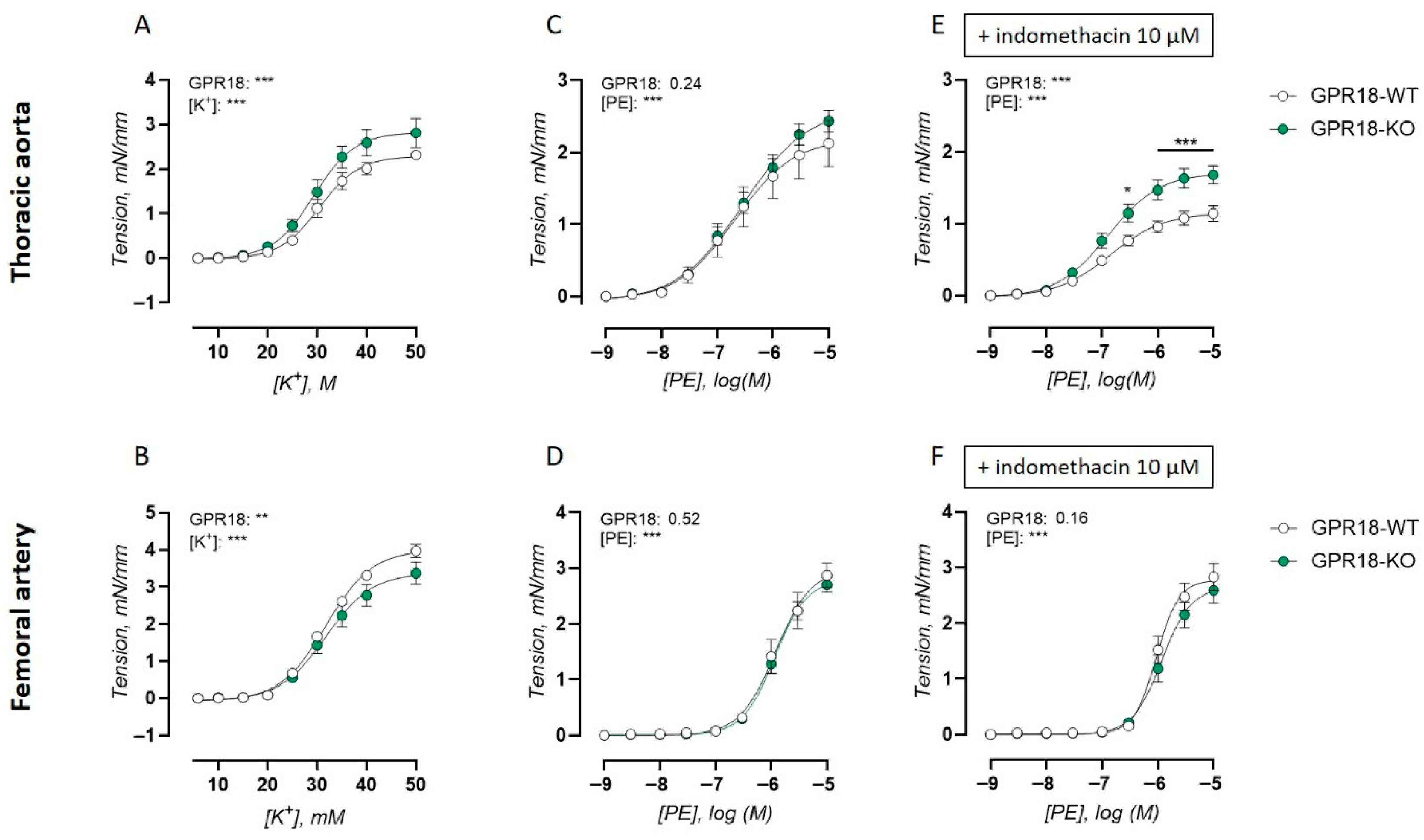
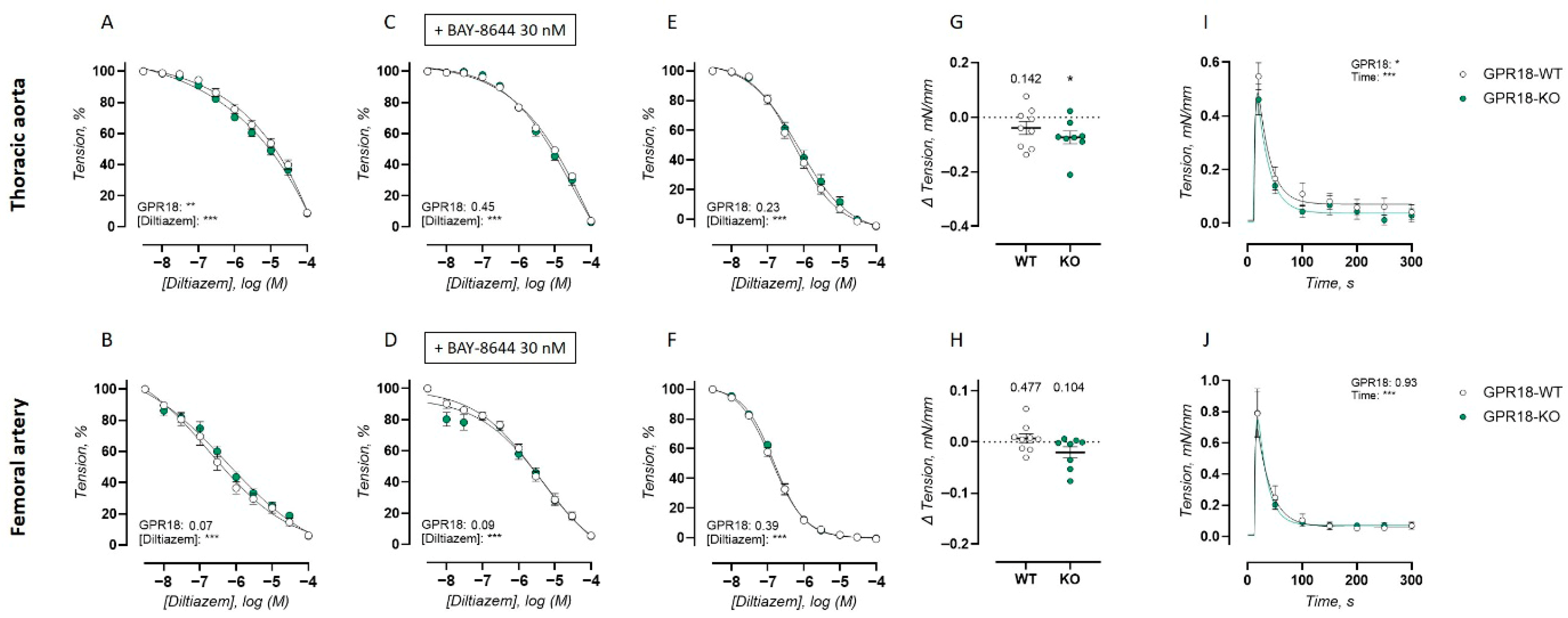
2.2. GPR18 Deletion Inversely Affects Contractility and VSMC Calcium Handling of the Thoracic Aorta and Femoral Artery
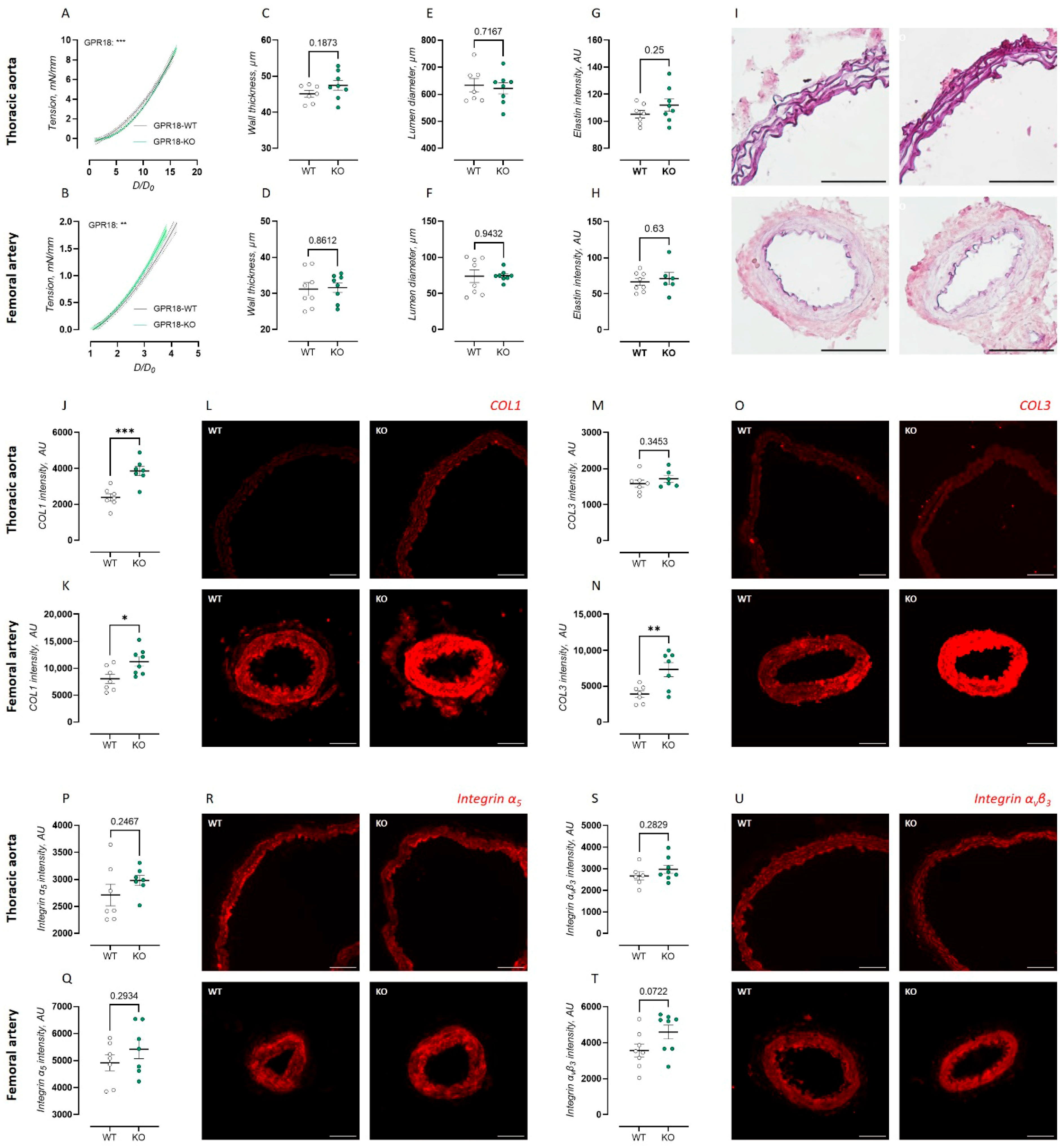
2.3. GPR18 KO Mice Display Inverse Changes in Passive Biomechanical Properties in the Thoracic Aorta and Femoral Artery
3. Discussion
4. Materials and Methods
4.1. Laboratory Animals
4.2. Ex Vivo Isometric Vasoreactivity
4.3. Immunohistochemistry
4.4. Histological Orcein Staining
4.5. Statistical Analysis
5. Conclusions
Author Contributions
Funding
Institutional Review Board Statement
Informed Consent Statement
Data Availability Statement
Acknowledgments
Conflicts of Interest
Abbreviations
| Abn-CBD | Abnormal cannabidiol |
| Ach | Acetylcholine |
| COX | Cyclooxygenase |
| CVD | Cardiovascular disease |
| DHA | Docosahexaenoic acid |
| EC50, | Half-maximal excitatory concentration |
| ECmax | Maximal effect |
| ECM | Extracellular matrix |
| GPR | G protein-coupled receptor |
| Indo | Indomethacin |
| KO | Knockout |
| L-NAME | L-NG-Nitroarginine Methyl Ester |
| NAGlyc | N-arachidonylglycine |
| NO | Nitric oxide |
| NOS | Nitric oxide synthase |
| PE | Phenylepinephrine |
| PUFA | Polyunsaturated fatty acids |
| RvD2 | Resolvin D2 |
| SPM | Specialized pro-resolving mediators |
| VGCC | Voltage-gated calcium channel |
| VSMC | Vascular smooth muscle cells |
| WT | Wildtype |
References
- Serhan, C.N. Pro-resolving lipid mediators are leads for resolution physiology. Nature 2014, 510, 92–101. [Google Scholar] [CrossRef] [PubMed]
- Pirault, J.; Bäck, M. Lipoxin and Resolvin Receptors Transducing the Resolution of Inflammation in Cardiovascular Disease. Front. Pharmacol. 2018, 9, 1273. [Google Scholar] [CrossRef] [PubMed]
- Bardin, M.; Pawelzik, S.C.; Lagrange, J.; Mahdi, A.; Arnardottir, H.; Regnault, V.; Feve, B.; Lacolley, P.; Michel, J.B.; Mercier, N.; et al. The resolvin D2-GPR18 axis is expressed in human coronary atherosclerosis and transduces atheroprotection in apolipoprotein E deficient mice. Biochem. Pharmacol. 2022, 201, 115075. [Google Scholar] [CrossRef] [PubMed]
- Lipscomb, M.; Walis, S.; Marinello, M.; Mena, H.A.; MacNamara, K.C.; Spite, M.; Fredman, G. Resolvin D2 limits atherosclerosis progression via myeloid cell-GPR18. FASEB J. 2024, 38, e23555. [Google Scholar] [CrossRef]
- Zhao, M.; Zheng, Z.; Yin, Z.; Zhang, J.; Qin, J.; Wan, J.; Wang, M. Resolvin D2 and its receptor GPR18 in cardiovascular and metabolic diseases: A promising biomarker and therapeutic target. Pharmacol. Res. 2023, 195, 106832. [Google Scholar] [CrossRef]
- Bellotti, P.; Ladd, Z.; Leroy, V.; Su, G.; Sharma, S.; Hartman, J.B.; Krebs, J.; Viscardi, C.; Maile, R.; Moldawer, L.L.; et al. Resolvin D2/GPR18 signaling enhances monocytic myeloid-derived suppressor cell function to mitigate abdominal aortic aneurysm formation. FASEB J. 2024, 38, e70067. [Google Scholar] [CrossRef]
- Rodrigues-Diez, R.; Ballesteros-Martinez, C.; Moreno-Carriles, R.M.; Nistal, F.; Diaz Del Campo, L.S.; Cachofeiro, V.; Dalli, J.; Garcia-Redondo, A.B.; Redondo, J.M.; Salaices, M.; et al. Resolvin D2 prevents vascular remodeling, hypercontractility and endothelial dysfunction in obese hypertensive mice through modulation of vascular and proinflammatory factors. Biomed. Pharmacother. 2024, 174, 116564. [Google Scholar] [CrossRef]
- Spite, M.; Norling, L.V.; Summers, L.; Yang, R.; Cooper, D.; Petasis, N.A.; Flower, R.J.; Perretti, M.; Serhan, C.N. Resolvin D2 is a potent regulator of leukocytes and controls microbial sepsis. Nature 2009, 461, 1287–1291. [Google Scholar] [CrossRef]
- de Moudt, S.; Sitek, B.; Bar, A.; Lourenco-Rodrigues, M.D.; Lagrange, J.; Yen, F.T.; Chlopicki, S.; Mercier, N.; Back, M. Vascular Bed-Specific Endothelial Dysfunction and Age-Dependent Circadian Hypertension in Mice Lacking the Resolvin D2 Receptor GPR18. FASEB J. 2025, 39, e71245. [Google Scholar] [CrossRef]
- Bondarenko, A.I.; Panasiuk, O.; Drachuk, K.; Montecucco, F.; Brandt, K.J.; Mach, F. The quest for endothelial atypical cannabinoid receptor: BK(Ca) channels act as cellular sensors for cannabinoids in in vitro and in situ endothelial cells. Vasc. Pharmacol. 2018, 102, 44–55. [Google Scholar] [CrossRef]
- Kozlowska, H.; Malinowska, B.; Baranowska-Kuczko, M.; Kusaczuk, M.; Nesterowicz, M.; Kozlowski, M.; Muller, C.E.; Kiec-Kononowicz, K.; Schlicker, E. GPR18-Mediated Relaxation of Human Isolated Pulmonary Arteries. Int. J. Mol. Sci. 2022, 23, 1427. [Google Scholar] [CrossRef] [PubMed]
- Al Suleimani, Y.M.; Al Mahruqi, A.S. The endogenous lipid N-arachidonoyl glycine is hypotensive and nitric oxide-cGMP-dependent vasorelaxant. Eur. J. Pharmacol. 2017, 794, 209–215. [Google Scholar] [CrossRef] [PubMed]
- MacIntyre, J.; Dong, A.; Straiker, A.; Zhu, J.; Howlett, S.E.; Bagher, A.; Denovan-Wright, E.; Yu, D.Y.; Kelly, M.E. Cannabinoid and lipid-mediated vasorelaxation in retinal microvasculature. Eur. J. Pharmacol. 2014, 735, 105–114. [Google Scholar] [CrossRef] [PubMed]
- Matouk, A.I.; Taye, A.; El-Moselhy, M.A.; Heeba, G.H.; Abdel-Rahman, A.A. The Effect of Chronic Activation of the Novel Endocannabinoid Receptor GPR18 on Myocardial Function and Blood Pressure in Conscious Rats. J. Cardiovasc. Pharmacol. 2017, 69, 23–33. [Google Scholar] [CrossRef]
- Kotanska, M.; Kubacka, M.; Bednarski, M.; Nicosia, N.; Szafarz, M.; Jawien, W.; Muller, C.E.; Kiec-Kononowicz, K. The GPR18 Agonist PSB-KD-107 Exerts Endothelium-Dependent Vasorelaxant Effects. Pharmaceuticals 2021, 14, 799. [Google Scholar] [CrossRef]
- Fransen, P.; Van Hove, C.E.; Leloup, A.J.; Schrijvers, D.M.; De Meyer, G.R.; De Keulenaer, G.W. Effect of angiotensin II-induced arterial hypertension on the voltage-dependent contractions of mouse arteries. Pflug. Arch. 2016, 468, 257–267. [Google Scholar] [CrossRef]
- Fransen, P.; Van Hove, C.E.; van Langen, J.; Schrijvers, D.M.; Martinet, W.; De Meyer, G.R.; Bult, H. Contribution of transient and sustained calcium influx, and sensitization to depolarization-induced contractions of the intact mouse aorta. BMC Physiol. 2012, 12, 9. [Google Scholar] [CrossRef]
- Hasko, J.; Fazakas, C.; Molnar, J.; Nyul-Toth, A.; Herman, H.; Hermenean, A.; Wilhelm, I.; Persidsky, Y.; Krizbai, I.A. CB2 receptor activation inhibits melanoma cell transmigration through the blood-brain barrier. Int. J. Mol. Sci. 2014, 15, 8063–8074. [Google Scholar] [CrossRef]
- Wilhelmsen, K.; Khakpour, S.; Tran, A.; Sheehan, K.; Schumacher, M.; Xu, F.; Hellman, J. The endocannabinoid/endovanilloid N-arachidonoyl dopamine (NADA) and synthetic cannabinoid WIN55,212-2 abate the inflammatory activation of human endothelial cells. J. Biol. Chem. 2014, 289, 13079–13100. [Google Scholar] [CrossRef]
- Ulu, A.; Sahoo, P.K.; Yuil-Valdes, A.G.; Mukherjee, M.; Van Ormer, M.; Muthuraj, P.G.; Thompson, M.; Anderson Berry, A.; Hanson, C.K.; Natarajan, S.K.; et al. Omega-3 Fatty Acid-Derived Resolvin D2 Regulates Human Placental Vascular Smooth Muscle and Extravillous Trophoblast Activities. Int. J. Mol. Sci. 2019, 20, 4402. [Google Scholar] [CrossRef]
- Jannaway, M.; Torrens, C.; Warner, J.A.; Sampson, A.P. Resolvin E1, resolvin D1 and resolvin D2 inhibit constriction of rat thoracic aorta and human pulmonary artery induced by the thromboxane mimetic U46619. Br. J. Pharmacol. 2018, 175, 1100–1108. [Google Scholar] [CrossRef]
- Diaz Del Campo, L.S.; Garcia-Redondo, A.B.; Rodriguez, C.; Zaragoza, C.; Duro-Sanchez, S.; Palmas, F.; de Benito-Bueno, A.; Socuellamos, P.G.; Peraza, D.A.; Rodrigues-Diez, R.; et al. Resolvin D2 Attenuates Cardiovascular Damage in Angiotensin II-Induced Hypertension. Hypertension 2023, 80, 84–96. [Google Scholar] [CrossRef] [PubMed]
- Viola, J.R.; Lemnitzer, P.; Jansen, Y.; Csaba, G.; Winter, C.; Neideck, C.; Silvestre-Roig, C.; Dittmar, G.; Doring, Y.; Drechsler, M.; et al. Resolving Lipid Mediators Maresin 1 and Resolvin D2 Prevent Atheroprogression in Mice. Circ. Res. 2016, 119, 1030–1038. [Google Scholar] [CrossRef] [PubMed]
- Penumarti, A.; Abdel-Rahman, A.A. Neuronal nitric oxide synthase-dependent elevation in adiponectin in the rostral ventrolateral medulla underlies g protein-coupled receptor 18-mediated hypotension in conscious rats. J. Pharmacol. Exp. Ther. 2014, 351, 44–53. [Google Scholar] [CrossRef] [PubMed]
- Penumarti, A.; Abdel-Rahman, A.A. The novel endocannabinoid receptor GPR18 is expressed in the rostral ventrolateral medulla and exerts tonic restraining influence on blood pressure. J. Pharmacol. Exp. Ther. 2014, 349, 29–38. [Google Scholar] [CrossRef]
- Kohno, M.; Hasegawa, H.; Inoue, A.; Muraoka, M.; Miyazaki, T.; Oka, K.; Yasukawa, M. Identification of N-arachidonylglycine as the endogenous ligand for orphan G-protein-coupled receptor GPR18. Biochem. Biophys. Res. Commun. 2006, 347, 827–832. [Google Scholar] [CrossRef]
- Bradshaw, H.B.; Rimmerman, N.; Hu, S.S.; Benton, V.M.; Stuart, J.M.; Masuda, K.; Cravatt, B.F.; O’Dell, D.K.; Walker, J.M. The endocannabinoid anandamide is a precursor for the signaling lipid N-arachidonoyl glycine by two distinct pathways. BMC Biochem. 2009, 10, 14. [Google Scholar] [CrossRef]
- del Campo, L.; Ferrer, M. Wire Myography to Study Vascular Tone and Vascular Structure of Isolated Mouse Arteries. Methods Mol. Biol. 2015, 1339, 255–276. [Google Scholar]
- Slezak, P.; Waczulikova, I.; Balis, P.; Puzserova, A. Accurate normalization factor for wire myography of rat femoral artery. Physiol. Res. 2010, 59, 1033–1036. [Google Scholar] [CrossRef]
- Van Hove, C.E.; Van der Donckt, C.; Herman, A.G.; Bult, H.; Fransen, P. Vasodilator efficacy of nitric oxide depends on mechanisms of intracellular calcium mobilization in mouse aortic smooth muscle cells. Br. J. Pharmacol. 2009, 158, 920–930. [Google Scholar] [CrossRef]
- Fransen, P.; Van Hove, C.E.; Leloup, A.J.; Martinet, W.; De Meyer, G.R.; Lemmens, K.; Bult, H.; Schrijvers, D.M. Dissecting out the complex Ca2+-mediated phenylephrine-induced contractions of mouse aortic segments. PLoS ONE 2015, 10, e0121634. [Google Scholar] [CrossRef]
- Brizzolara-Gourdie, A.; Webb, J.G. Angiotensin II potentiates vasodilation of rat aorta by cAMP elevating agonists. J. Pharmacol. Exp. Ther. 1997, 281, 354–359. [Google Scholar] [CrossRef]
- Dogan, M.; Peker, R.O.; Donmez, S.; Gokalp, O. Magnesium and diltiazem relaxes phenylephrine-precontracted rat aortic rings. Interact. Cardiovasc. Thorac. Surg. 2012, 15, 1–4. [Google Scholar] [CrossRef][Green Version]



| WT | KO | p-Value | |
|---|---|---|---|
| n | |||
| Thoracic aorta | 7 | 7 | |
| Femoral artery | 7 | 8 | |
| EC50, log(M) | |||
| Thoracic aorta | 31.53 ± 1.37 | 29.76 ± 0.78 | 0.28 |
| Femoral artery | 32.15 ± 0.42 | 32.69 ± 0.98 | 0.55 |
| Emax, mN/mm | |||
| Thoracic aorta | 2.44 ± 0.13 | 2.91 ± 0.37 | 0.25 |
| Femoral artery | 4.2 ± 0.22 | 3.56 ± 0.28 | 0.10 |
| WT-Baseline | WT-Indo | KO-Baseline | KO-Indo | Overall p-Value | |||
|---|---|---|---|---|---|---|---|
| GPR18 | Indo | Interaction | |||||
| n | |||||||
| Thoracic aorta | 8 | 7 | 8 | 7 | |||
| Femoral artery | 7 | 7 | 10 | 10 | |||
| EC50, log(M) | |||||||
| Thoracic aorta | −6.6 ± 0.11 | −6.83 ± 0.07 | −6.54 ± 0.13 | −6.87 ± 0.07 (#) | 0.93 | * | 0.62 |
| Femoral artery | −5.84 ± 0.17 | −5.98 ± 0.06 | −5.94 ± 0.06 | −5.87 ± 0.11 | 0.93 | 0.74 | 0.34 |
| Emax, % | |||||||
| Thoracic aorta | 2.2 ± 0.32 | 1.16 ± 0.12 (##) | 2.62 ± 0.19 | 1.71 ± 0.13 (##) | * | *** | 0.76 |
| Femoral artery | 3.3 ± 0.41 | 2.81 ± 0.22 | 2.77 ± 0.13 | 2.67 ± 0.18 | 0.16 | 0.22 | 0.40 |
Disclaimer/Publisher’s Note: The statements, opinions and data contained in all publications are solely those of the individual author(s) and contributor(s) and not of MDPI and/or the editor(s). MDPI and/or the editor(s) disclaim responsibility for any injury to people or property resulting from any ideas, methods, instructions or products referred to in the content. |
© 2026 by the authors. Licensee MDPI, Basel, Switzerland. This article is an open access article distributed under the terms and conditions of the Creative Commons Attribution (CC BY) license.
Share and Cite
De Moudt, S.; Herzine, A.; Rodrigues, M.-D.L.; Collin, M.; Bäck, M.; Yen, F.T.; Mercier, N. GPR18 Deletion in Mice Inversely Affects Vasoactive Signaling and Passive Biomechanical Properties of the Thoracic Aorta and Femoral Artery. Int. J. Mol. Sci. 2026, 27, 841. https://doi.org/10.3390/ijms27020841
De Moudt S, Herzine A, Rodrigues M-DL, Collin M, Bäck M, Yen FT, Mercier N. GPR18 Deletion in Mice Inversely Affects Vasoactive Signaling and Passive Biomechanical Properties of the Thoracic Aorta and Femoral Artery. International Journal of Molecular Sciences. 2026; 27(2):841. https://doi.org/10.3390/ijms27020841
Chicago/Turabian StyleDe Moudt, Sofie, Ameziane Herzine, Marc-Damien Lourenco Rodrigues, Maud Collin, Magnus Bäck, Frances T. Yen, and Nathalie Mercier. 2026. "GPR18 Deletion in Mice Inversely Affects Vasoactive Signaling and Passive Biomechanical Properties of the Thoracic Aorta and Femoral Artery" International Journal of Molecular Sciences 27, no. 2: 841. https://doi.org/10.3390/ijms27020841
APA StyleDe Moudt, S., Herzine, A., Rodrigues, M.-D. L., Collin, M., Bäck, M., Yen, F. T., & Mercier, N. (2026). GPR18 Deletion in Mice Inversely Affects Vasoactive Signaling and Passive Biomechanical Properties of the Thoracic Aorta and Femoral Artery. International Journal of Molecular Sciences, 27(2), 841. https://doi.org/10.3390/ijms27020841