iPSC-Derived Endothelial Cells as Experimental Models for Predictive and Personalized Strategies in Cardiovascular and Cerebrovascular Disease


 , ,
, , 
Abstract
1. Introduction
2. Endothelial Cells from iPSCs: Differentiation and Characterization
3. Patient-Specific iPSC-ECs as Predictive and Personalized Models for Cardiovascular Applications
4. Patient-Specific iPSC-ECs as Predictive and Personalized Models for Cerebrovascular Studies
5. Limitations
6. Future Applications
Author Contributions
Funding
Data Availability Statement
Acknowledgments
Conflicts of Interest
Abbreviations
| aHUS | Atypical hemolytic uremic syndrome |
| BMP | Bone morphogenetic protein |
| CADASIL | Cerebral Autosomal Dominant Arteriopathy with Subcortical Infarcts and Leukoencephalopathy |
| ECs | Endothelial cells |
| eNOS | Endothelial nitric oxide synthase |
| FH | Familial hypercholesterolemia |
| H9-ECs | H9 human embryonic stem cell-derived endothelial cells |
| hiPSC-ECs | Human-induced pluripotent stem cell-derived endothelial cells |
| MMD | Moyamoya disease |
| MMP | Matrix metalloproteinases |
| PRC | Polycomb Repressive Complex |
| TEnCs | Tumor-associated endothelial cells |
| VSMCs | Vascular smooth muscle cells |
| vWF | Von Willebrand factor |
References
- Trimm, E.; Red-Horse, K. Vascular Endothelial Cell Development and Diversity. Nat. Rev. Cardiol. 2023, 20, 197–210. [Google Scholar] [CrossRef]
- Petrova, T.V.; Koh, G.Y. Biological Functions of Lymphatic Vessels. Science 2020, 369, eaax4063. [Google Scholar] [CrossRef] [PubMed]
- Krüger-Genge, A.; Blocki, A.; Franke, R.-P.; Jung, F. Vascular Endothelial Cell Biology: An Update. Int. J. Mol. Sci. 2019, 20, 4411. [Google Scholar] [CrossRef]
- dela Paz, N.G.; D’Amore, P.A. Arterial versus Venous Endothelial Cells. Cell Tissue Res. 2009, 335, 5–16. [Google Scholar] [CrossRef] [PubMed]
- Wu, D.; Chen, Q.; Chen, X.; Han, F.; Chen, Z.; Wang, Y. The Blood–Brain Barrier: Structure, Regulation and Drug Delivery. Signal Transduct. Target. Ther. 2023, 8, 217. [Google Scholar] [CrossRef]
- Favero, G.; Paganelli, C.; Buffoli, B.; Rodella, L.F.; Rezzani, R. Endothelium and Its Alterations in Cardiovascular Diseases: Life Style Intervention. BioMed Res. Int. 2014, 2014, 801896. [Google Scholar] [CrossRef]
- Gimbrone, M.A.; García-Cardeña, G. Endothelial Cell Dysfunction and the Pathobiology of Atherosclerosis. Circ. Res. 2016, 118, 620–636. [Google Scholar] [CrossRef] [PubMed]
- Nguyen, D.V.; Shaw, L.C.; Grant, M.B. Inflammation in the Pathogenesis of Microvascular Complications in Diabetes. Front. Endocrinol. 2012, 3, 170. [Google Scholar] [CrossRef]
- Kurakula, K.; Smolders, V.F.E.D.; Tura-Ceide, O.; Jukema, J.W.; Quax, P.H.A.; Goumans, M.-J. Endothelial Dysfunction in Pulmonary Hypertension: Cause or Consequence? Biomedicines 2021, 9, 57. [Google Scholar] [CrossRef]
- Liu, L.; Zhao, B.; Yu, Y.; Gao, W.; Liu, W.; Chen, L.; Xia, Z.; Cao, Q. Vascular Aging in Ischemic Stroke. J. Am. Heart Assoc. 2024, 13, e033341. [Google Scholar] [CrossRef]
- Mekala, A.; Qiu, H. Interplay Between Vascular Dysfunction and Neurodegenerative Pathology: New Insights into Molecular Mechanisms and Management. Biomolecules 2025, 15, 712. [Google Scholar] [CrossRef]
- Moncada, S.; Higgs, E.A. The Discovery of Nitric Oxide and Its Role in Vascular Biology. Br. J. Pharmacol. 2006, 147, 193–201. [Google Scholar] [CrossRef]
- Cai, H.; Harrison, D.G. Endothelial Dysfunction in Cardiovascular Diseases: The Role of Oxidant Stress. Circ. Res. 2000, 87, 840–844. [Google Scholar] [CrossRef]
- Chistiakov, D.A.; Orekhov, A.N.; Bobryshev, Y.V. Endothelial Barrier and Its Abnormalities in Cardiovascular Disease. Front. Physiol. 2015, 6, 365. [Google Scholar] [CrossRef]
- Paik, D.T.; Chandy, M.; Wu, J.C. Patient and Disease–Specific Induced Pluripotent Stem Cells for Discovery of Personalized Cardiovascular Drugs and Therapeutics. Pharmacol. Rev. 2020, 72, 320–342. [Google Scholar] [CrossRef]
- Nashun, B.; Hill, P.W.; Hajkova, P. Reprogramming of Cell Fate: Epigenetic Memory and the Erasure of Memories Past. EMBO J. 2015, 34, 1296–1308. [Google Scholar] [CrossRef]
- Sriram, G.; Tan, J.Y.; Islam, I.; Rufaihah, A.J.; Cao, T. Efficient Differentiation of Human Embryonic Stem Cells to Arterial and Venous Endothelial Cells under Feeder- and Serum-Free Conditions. Stem Cell Res. Ther. 2015, 6, 261. [Google Scholar] [CrossRef]
- Qiu, J.; Hirschi, K.K. Endothelial Cell Development and Its Application to Regenerative Medicine. Circ. Res. 2019, 125, 489–501. [Google Scholar] [CrossRef]
- Chen, D.; Schwartz, M.A.; Simons, M. Developmental Perspectives on Arterial Fate Specification. Front. Cell Dev. Biol. 2021, 9, 691335. [Google Scholar] [CrossRef] [PubMed]
- Aranguren, X.L.; Beerens, M.; Coppiello, G.; Wiese, C.; Vandersmissen, I.; Lo Nigro, A.; Verfaillie, C.M.; Gessler, M.; Luttun, A. COUP-TFII Orchestrates Venous and Lymphatic Endothelial Identity by Homo- or Hetero-Dimerisation with PROX1. J. Cell Sci. 2013, 126, 1164–1175. [Google Scholar] [CrossRef] [PubMed]
- Arora, S.; Yim, E.K.F.; Toh, Y.-C. Environmental Specification of Pluripotent Stem Cell Derived Endothelial Cells Toward Arterial and Venous Subtypes. Front. Bioeng. Biotechnol. 2019, 7, 143. [Google Scholar] [CrossRef]
- Selim, M.S.; Matani, B.R.; Henry-Ojo, H.O.; Narayanan, S.P.; Somanath, P.R. Claudin 5 Across the Vascular Landscape: From Blood–Tissue Barrier Regulation to Disease Mechanisms. Cells 2025, 14, 1346. [Google Scholar] [CrossRef]
- Goncharov, N.V.; Popova, P.I.; Avdonin, P.P.; Kudryavtsev, I.V.; Serebryakova, M.K.; Korf, E.A.; Avdonin, P.V. Markers of Endothelial Cells in Normal and Pathological Conditions. Biochem. Suppl. Ser. A Membr. Cell Biol. 2020, 14, 167–183. [Google Scholar] [CrossRef]
- de Boer, S.; Laan, S.; Dirven, R.; Eikenboom, J. Approaches to Induce the Maturation Process of Human Induced Pluripotent Stem Cell Derived-Endothelial Cells to Generate a Robust Model. PLoS ONE 2024, 19, e0297465. [Google Scholar] [CrossRef]
- Belt, H.; Koponen, J.K.; Kekarainen, T.; Puttonen, K.A.; Mäkinen, P.I.; Niskanen, H.; Oja, J.; Wirth, G.; Koistinaho, J.; Kaikkonen, M.U.; et al. Temporal Dynamics of Gene Expression During Endothelial Cell Differentiation from Human IPS Cells: A Comparison Study of Signalling Factors and Small Molecules. Front. Cardiovasc. Med. 2018, 5, 16. [Google Scholar] [CrossRef]
- Lanner, F.; Sohl, M.; Farnebo, F. Functional Arterial and Venous Fate Is Determined by Graded VEGF Signaling and Notch Status During Embryonic Stem Cell Differentiation. Arterioscler. Thromb. Vasc. Biol. 2007, 27, 487–493. [Google Scholar] [CrossRef]
- Gerhold, K.A.; Schwartz, M.A. Ion Channels in Endothelial Responses to Fluid Shear Stress. Physiology 2016, 31, 359–369. [Google Scholar] [CrossRef]
- Beverley, K.M.; Ahn, S.J.; Levitan, I. Flow-sensitive ion channels in vascular endothelial cells: Mechanisms of activation and roles in mechanotransduction. Biophys. J. 2025, 124, 4395–4406. [Google Scholar] [CrossRef]
- Abutaleb, N.O.; Truskey, G.A. Differentiation and characterization of human iPSC-derived vascular endothelial cells under physiological shear stress. STAR Protoc. 2021, 2, 100394. [Google Scholar] [CrossRef]
- Carcamo-Orive, I.; Hoffman, G.E.; Cundiff, P.; Beckmann, N.D.; D’Souza, S.L.; Knowles, J.W.; Patel, A.; Hendry, C.; Papatsenko, D.; Abbasi, F.; et al. Analysis of Transcriptional Variability in a Large Human IPSC Library Reveals Genetic and Non-Genetic Determinants of Heterogeneity. Cell Stem Cell 2017, 20, 518–532.e9, Erratum in Cell Stem Cell 2022, 29, 1505. [Google Scholar] [CrossRef]
- Kim, K.; Doi, A.; Wen, B.; Ng, K.; Zhao, R.; Cahan, P.; Kim, J.; Aryee, M.J.; Ji, H.; Ehrlich, L.I.R.; et al. Epigenetic Memory in Induced Pluripotent Stem Cells. Nature 2010, 467, 285–290. [Google Scholar] [CrossRef] [PubMed]
- Manganelli, M.; Mazzoldi, E.L.; Ferraro, R.M.; Pinelli, M.; Parigi, M.; Aghel, S.A.M.; Bugatti, M.; Collo, G.; Stocco, G.; Vermi, W.; et al. Progesterone receptor is constitutively expressed in induced Pluripotent Stem Cells (iPSCs). Stem Cell Rev. Rep. 2024, 20, 2303–2317. [Google Scholar] [CrossRef]
- Jiménez-Torres, J.A.; Virumbrales-Muñoz, M.; Sung, K.E.; Lee, M.H.; Abel, E.J.; Beebe, D.J. Patient-Specific Organotypic Blood Vessels as an in Vitro Model for Anti-Angiogenic Drug Response Testing in Renal Cell Carcinoma. EBioMedicine 2019, 42, 408–419. [Google Scholar] [CrossRef]
- Zakharova, I.S.; Shevchenko, A.I.; Arssan, M.A.; Sleptcov, A.A.; Nazarenko, M.S.; Zarubin, A.A.; Zheltysheva, N.V.; Shevchenko, V.A.; Tmoyan, N.A.; Saaya, S.B.; et al. IPSC-Derived Endothelial Cells Reveal LDLR Dysfunction and Dysregulated Gene Expression Profiles in Familial Hypercholesterolemia. Int. J. Mol. Sci. 2024, 25, 689. [Google Scholar] [CrossRef]
- Brown, M.S.; Goldstein, J.L. Familial Hypercholesterolemia: Defective Binding of Lipoproteins to Cultured Fibroblasts Associated with Impaired Regulation of 3-Hydroxy-3-Methylglutaryl Coenzyme a Reductase Activity. Proc. Natl. Acad. Sci. USA 1974, 71, 788–792. [Google Scholar] [CrossRef]
- Nair, P. Brown and Goldstein: The Cholesterol Chronicles. Proc. Natl. Acad. Sci. USA 2013, 110, 14829–14832. [Google Scholar] [CrossRef]
- Chrzanowska-Wodnicka, M. Rap1 in Endothelial Biology. Curr. Opin. Hematol. 2017, 24, 248–255. [Google Scholar] [CrossRef]
- Singh, B.; Kosuru, R.; Lakshmikanthan, S.; Sorci-Thomas, M.G.; Zhang, D.X.; Sparapani, R.; Vasquez-Vivar, J.; Chrzanowska, M. Endothelial Rap1 (Ras-Association Proximate 1) Restricts Inflammatory Signaling to Protect from the Progression of Atherosclerosis. Arterioscler. Thromb. Vasc. Biol. 2021, 41, 638–650. [Google Scholar] [CrossRef]
- Zhou, D.; Tan, Y.; Liu, X.; Tang, L.; Wang, H.; Shen, J.; Wang, W.; Zhuang, L.; Tao, J.; Su, J.; et al. Patient-Specific IPSC-Derived Endothelial Cells Reveal Aberrant P38 MAPK Signaling in Atypical Hemolytic Uremic Syndrome. Stem Cell Rep. 2021, 16, 2305–2319. [Google Scholar] [CrossRef]
- Kavanagh, D.; Goodship, T.H.J. Atypical Hemolytic Uremic Syndrome, Genetic Basis, and Clinical Manifestations. Hematology 2011, 2011, 15–20. [Google Scholar] [CrossRef]
- Chu, L.-Y.; Wang, Y.-F.; Cheng, H.-H.; Kuo, C.-C.; Wu, K.K. Endothelium-Derived 5-Methoxytryptophan Protects Endothelial Barrier Function by Blocking P38 MAPK Activation. PLoS ONE 2016, 11, e0152166. [Google Scholar] [CrossRef]
- Dejana, E.; Orsenigo, F.; Lampugnani, M.G. The Role of Adherens Junctions and VE-Cadherin in the Control of Vascular Permeability. J. Cell Sci. 2008, 121, 2115–2122. [Google Scholar] [CrossRef] [PubMed]
- Cao, S.; Reece, E.A.; Shen, W.-B.; Yang, P. Restoring BMP4 Expression in Vascular Endothelial Progenitors Ameliorates Maternal Diabetes-Induced Apoptosis and Neural Tube Defects. Cell Death Dis. 2020, 11, 859. [Google Scholar] [CrossRef]
- Mace, K.A.; Hansen, S.L.; Myers, C.; Young, D.M.; Boudreau, N. HOXA3 Induces Cell Migration in Endothelial and Epithelial Cells Promoting Angiogenesis and Wound Repair. J. Cell Sci. 2005, 118, 2567–2577. [Google Scholar] [CrossRef]
- Sauteur, L.; Krudewig, A.; Herwig, L.; Ehrenfeuchter, N.; Lenard, A.; Affolter, M.; Belting, H.-G. Cdh5/VE-Cadherin Promotes Endothelial Cell Interface Elongation via Cortical Actin Polymerization during Angiogenic Sprouting. Cell Rep. 2014, 9, 504–513. [Google Scholar] [CrossRef]
- Gorashi, R.; Rivera-Bolanos, N.; Dang, C.; Chai, C.; Kovacs, B.; Alharbi, S.; Ahmed, S.S.; Goyal, Y.; Ameer, G.; Jiang, B. Modeling Diabetic Endothelial Dysfunction with Patient-specific Induced Pluripotent Stem Cells. Bioeng. Transl. Med. 2023, 8, e10592. [Google Scholar] [CrossRef]
- Gu, M.; Mordwinkin, N.M.; Kooreman, N.G.; Lee, J.; Wu, H.; Hu, S.; Churko, J.M.; Diecke, S.; Burridge, P.W.; He, C.; et al. Pravastatin Reverses Obesity-Induced Dysfunction of Induced Pluripotent Stem Cell-Derived Endothelial Cells via a Nitric Oxide-Dependent Mechanism. Eur. Heart J. 2015, 36, 806–816. [Google Scholar] [CrossRef] [PubMed]
- Gu, M.; Donato, M.; Guo, M.; Wary, N.; Miao, Y.; Mao, S.; Saito, T.; Otsuki, S.; Wang, L.; Harper, R.L.; et al. IPSC–Endothelial Cell Phenotypic Drug Screening and in Silico Analyses Identify Tyrphostin-AG1296 for Pulmonary Arterial Hypertension. Sci. Transl. Med. 2021, 13, eaba6480. [Google Scholar] [CrossRef]
- Chandy, M.; Obal, D.; Wu, J.C. Elucidating Effects of Environmental Exposure Using Human-induced Pluripotent Stem Cell Disease Modeling. EMBO Mol. Med. 2022, 14, e13260. [Google Scholar] [CrossRef]
- Sgromo, C.; Cucci, A.; Venturin, G.; Follenzi, A.; Olgasi, C. Bridging the Gap: Endothelial Dysfunction and the Role of IPSC-Derived Endothelial Cells in Disease Modeling. Int. J. Mol. Sci. 2024, 25, 13275. [Google Scholar] [CrossRef] [PubMed]
- Tang, L.; Su, J.; Liang, P. Modeling Cadmium-Induced Endothelial Toxicity Using Human Pluripotent Stem Cell-Derived Endothelial Cells. Sci. Rep. 2017, 7, 14811. [Google Scholar] [CrossRef]
- Tellez-Plaza, M.; Navas-Acien, A.; Menke, A.; Crainiceanu, C.M.; Pastor-Barriuso, R.; Guallar, E. Cadmium Exposure and All-Cause and Cardiovascular Mortality in the U.S. General Population. Environ. Health Perspect. 2012, 120, 1017–1022. [Google Scholar] [CrossRef]
- Straessler, E.T.; Kraenkel, N.; Landmesser, U. RNA-Sequencing Reveals Significant Differences in the Inflammatory Response of IPSC-Derived Endothelial Cells from ACS Patients and Healthy Controls. Eur. Heart J. 2022, 43, ehac544.3058. [Google Scholar] [CrossRef]
- Straessler, E.T.; Kiamehr, M.; Aalto-Setala, K.; Kraenkel, N.K.; Landmesser, U.L. IPSC-Derived Endothelial Cells Reflect Accelerated Senescence and Increased Inflammatory Response in a CVD-Risk Stratified Manner. Eur. Heart J. 2020, 41, ehaa946.3747. [Google Scholar] [CrossRef]
- Chabriat, H.; Joutel, A.; Dichgans, M.; Tournier-Lasserve, E.; Bousser, M.-G. CADASIL. Lancet Neurol. 2009, 8, 643–653. [Google Scholar] [CrossRef]
- Zhang, W.; Zhao, X.; Qi, X.; Kimber, S.J.; Hooper, N.M.; Wang, T. Induced Pluripotent Stem Cell Model Revealed Impaired Neurovascular Interaction in Genetic Small Vessel Disease Cerebral Autosomal Dominant Arteriopathy with Subcortical Infarcts and Leukoencephalopathy. Front. Cell Neurosci. 2023, 17, 1195470. [Google Scholar] [CrossRef] [PubMed]
- Ihara, M.; Yamamoto, Y.; Hattori, Y.; Liu, W.; Kobayashi, H.; Ishiyama, H.; Yoshimoto, T.; Miyawaki, S.; Clausen, T.; Bang, O.Y.; et al. Moyamoya Disease: Diagnosis and Interventions. Lancet Neurol. 2022, 21, 747–758. [Google Scholar] [CrossRef]
- Hitomi, T.; Habu, T.; Kobayashi, H.; Okuda, H.; Harada, K.H.; Osafune, K.; Taura, D.; Sone, M.; Asaka, I.; Ameku, T.; et al. Downregulation of Securin by the Variant RNF213 R4810K (Rs112735431, G & gt; A) Reduces Angiogenic Activity of Induced Pluripotent Stem Cell-Derived Vascular Endothelial Cells from Moyamoya Patients. Biochem. Biophys. Res. Commun. 2013, 438, 13–19. [Google Scholar] [CrossRef] [PubMed]
- Hamauchi, S.; Shichinohe, H.; Uchino, H.; Yamaguchi, S.; Nakayama, N.; Kazumata, K.; Osanai, T.; Abumiya, T.; Houkin, K.; Era, T. Cellular Functions and Gene and Protein Expression Profiles in Endothelial Cells Derived from Moyamoya Disease-Specific IPS Cells. PLoS ONE 2016, 11, e0163561. [Google Scholar] [CrossRef]
- Stupack, D.G.; Cheresh, D.A. Integrins and Angiogenesis. Curr. Top. Dev. Biol. 2004, 64, 207–238. [Google Scholar] [CrossRef]
- Tokairin, K.; Hamauchi, S.; Ito, M.; Kazumata, K.; Sugiyama, T.; Nakayama, N.; Kawabori, M.; Osanai, T.; Houkin, K. Vascular Smooth Muscle Cell Derived from IPS Cell of Moyamoya Disease-Comparative Characterization with Endothelial Cell Transcriptome. J. Stroke Cerebrovasc. Dis. 2020, 29, 105305. [Google Scholar] [CrossRef]
- Arce, M.; Erzar, I.; Yang, F.; Senthilkumar, N.; Onyeogaziri, F.C.; Ronchi, D.; Ahlstrand, F.C.; Noll, N.; Lugano, R.; Richards, M.; et al. KRIT1 Heterozygous Mutations Are Sufficient to Induce a Pathological Phenotype in Patient-Derived IPSC Models of Cerebral Cavernous Malformation. Cell Rep. 2025, 44, 115576. [Google Scholar] [CrossRef]
- Queisser, A.; Seront, E.; Boon, L.M.; Vikkula, M. Genetic Basis and Therapies for Vascular Anomalies. Circ. Res. 2021, 129, 155–173. [Google Scholar] [CrossRef] [PubMed]
- Bassett, A.R. Editing the genome of hiPSC with CRISPR/Cas9: Disease models. Mamm. Genome 2017, 28, 348–364. [Google Scholar] [CrossRef] [PubMed]
- Cerneckis, J.; Cai, H.; Shi, Y. Induced Pluripotent Stem Cells (IPSCs): Molecular Mechanisms of Induction and Applications. Signal Transduct. Target. Ther. 2024, 9, 112. [Google Scholar] [CrossRef]
- Li, G.; Gao, J.; Ding, P.; Gao, Y. The Role of Endothelial Cell–Pericyte Interactions in Vascularization and Diseases. J. Adv. Res. 2025, 67, 269–288. [Google Scholar] [CrossRef] [PubMed]
- Méndez-Barbero, N.; Gutiérrez-Muñoz, C.; Blanco-Colio, L. Cellular Crosstalk between Endothelial and Smooth Muscle Cells in Vascular Wall Remodeling. Int. J. Mol. Sci. 2021, 22, 7284. [Google Scholar] [CrossRef]
- Pober, J.S.; Sessa, W.C. Evolving Functions of Endothelial Cells in Inflammation. Nat. Rev. Immunol. 2007, 7, 803–815. [Google Scholar] [CrossRef]
- Schaeffer, S.; Iadecola, C. Revisiting the Neurovascular Unit. Nat. Neurosci. 2021, 24, 1198–1209. [Google Scholar] [CrossRef]
- Segarra, M.; Aburto, M.R.; Hefendehl, J.; Acker-Palmer, A. Neurovascular Interactions in the Nervous System. Annu. Rev. Cell Dev. Biol. 2019, 35, 615–635. [Google Scholar] [CrossRef]
- Vozzi, F.; Campolo, J.; Cozzi, L.; Politano, G.; Di Carlo, S.; Rial, M.; Domenici, C.; Parodi, O. Computing of Low Shear Stress-Driven Endothelial Gene Network Involved in Early Stages of Atherosclerotic Process. BioMed Res. Int. 2018, 2018, 1–12. [Google Scholar] [CrossRef]
- Ceccherini, E.; Persiani, E.; Cabiati, M.; Guiducci, L.; Del Ry, S.; Gisone, I.; Falleni, A.; Cecchettini, A.; Vozzi, F. A Dynamic Cellular Model as an Emerging Platform to Reproduce the Complexity of Human Vascular Calcification In Vitro. Int. J. Mol. Sci. 2024, 25, 7427. [Google Scholar] [CrossRef]
- Gisone, I.; Boffito, M.; Persiani, E.; Pappalardo, R.; Ceccherini, E.; Alliaud, A.; Cabiati, M.; Laurano, R.; Guiducci, L.; Caselli, C.; et al. Integration of Co-Culture Conditions and 3D Gelatin Methacryloyl Hydrogels to Improve Human-Induced Pluripotent Stem Cells-Derived Cardiomyocytes Maturation. Front. Bioeng. Biotechnol. 2025, 13, 1576824. [Google Scholar] [CrossRef]
- Aoki, H.; Yamashita, M.; Hashita, T.; Ogami, K.; Hoshino, S.; Iwao, T.; Matsunaga, T. Efficient differentiation and purification of human induced pluripotent stem cell-derived endothelial progenitor cells and expansion with the use of inhibitors of ROCK, TGF-β, and GSK3β. Heliyon 2020, 6, e03493. [Google Scholar] [CrossRef]
- Rabino, M.; Sommariva, E.; Zacchigna, S.; Pompilio, G. From bedside to the bench: Patient-specific hiPSC-EC models uncover endothelial dysfunction in genetic cardiomyopathies. Front. Physiol. 2023, 14, 1237101. [Google Scholar] [CrossRef] [PubMed]
- Helle, E.; Ampuja, M.; Dainis, A.; Antola, L.; Temmes, E.; Tolvanen, E.; Mervaala, E.; Kivelä, R. HiPS-Endothelial Cells Acquire Cardiac Endothelial Phenotype in Co-culture with hiPS-Cardiomyocytes. Front. Cell Dev. Biol. 2021, 9, 715093. [Google Scholar] [CrossRef] [PubMed]
- Wang, Y.T.; Meng, X.T. A review of the evidence to support electrical stimulation-induced vascularization in engineered tissue. Regen. Ther. 2023, 24, 237–244. [Google Scholar] [CrossRef] [PubMed]
- Shakeri, A.; Wang, Y.; Zhao, Y.; Landau, S.; Perera, K.; Lee, J.; Radisic, M. Engineering Organ-on-a-Chip Systems for Vascular Diseases. Arterioscler. Thromb. Vasc. Biol. 2023, 43, 2241–2255. [Google Scholar] [CrossRef]
- Nair, A.L.; Groenendijk, L.; Overdevest, R.; Fowke, T.M.; Annida, R.; Mocellin, O.; de Vries, H.E.; Wevers, N.R. Human BBB-on-a-chip reveals barrier disruption, endothelial inflammation, and T cell migration under neuroinflammatory conditions. Front. Mol. Neurosci. 2023, 16, 1250123. [Google Scholar] [CrossRef]
- Fontanelli, L.; Nisini, N.; Pirola, S.; Recchia, F.A. Neuromuscular and Cardiac Organoids and Assembloids: Advanced Platforms for Drug Testing. Pharmacol. Ther. 2025, 272, 108876. [Google Scholar] [CrossRef]



| Cardiovascular Diseases and Associated Conditions | iPSC-ECs as Predictive Models | iPSC-ECs as Personalized Models |
|---|---|---|
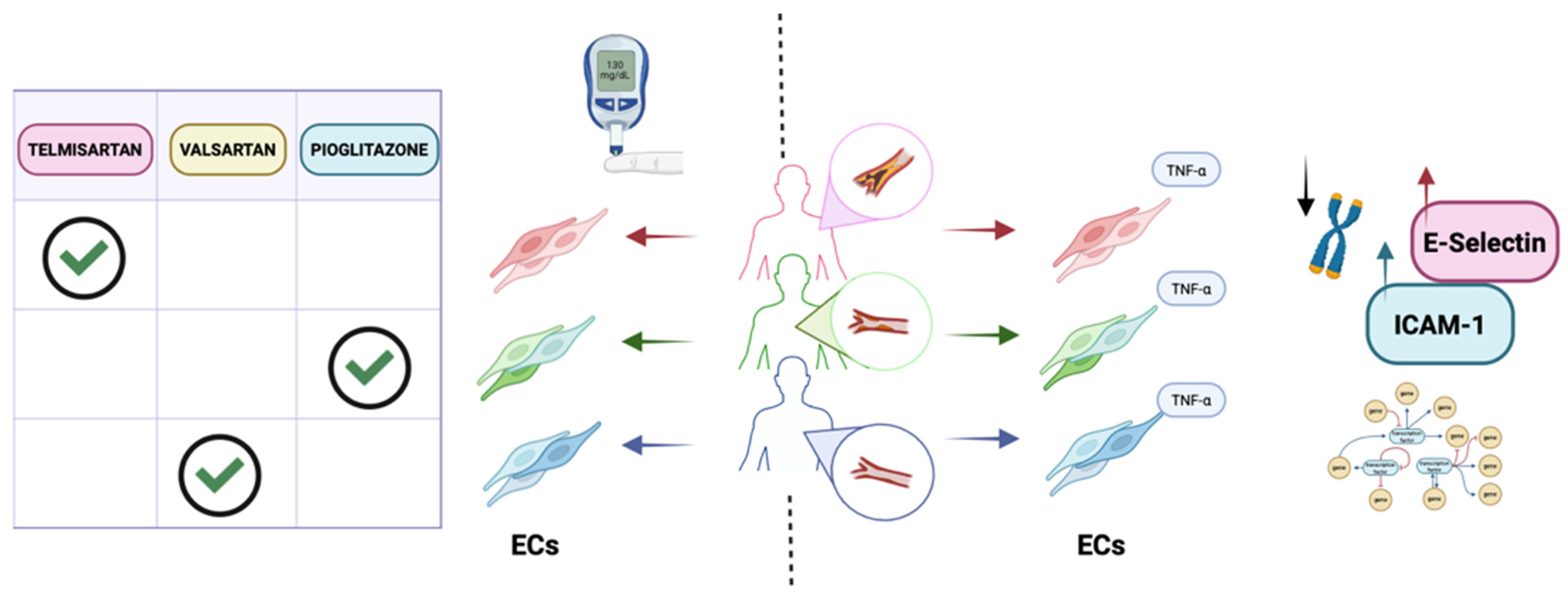
| Familiar hypercholesterolemia (FH) | Patient-derived iPSC-ECs were found to display reduced expression of LDL receptors, impaired angiogenic capacity, and heightened inflammatory and oxidative stress signatures, regardless of cholesterol levels [34] | Expression levels of mature LDL receptors in iPSC-ECs depend on specific patient mutations [34] |
| Anti-complement factor H autoantibody-associated atypical hemolytic uremic syndrome (aHUS) | Patient-derived ECs exhibit intrinsic endothelial defects as complement-mediated cytotoxicity, increased apoptosis rates, and exacerbated inflammatory signaling, thus recreating the pathological phenotype. Activation of p38 signaling reconstitutes endothelial integrity [39] | - |
| Diabetic endothelial dysfunction | ECs derived from diabetic patient iPSCs expressed inflammation-related markers, higher intracellular ROS levels, and a higher proportion of platelet-adherent cells compared to controls. Interestingly, data show that unhealthy lines may better tolerate an environment which simulates diabetic plasma [46] | It is possible to develop patient-specific drug therapies to restore endothelial functionality [46] |
| Obesity | iPSC-ECs from diet-induced obesity mice exhibited significantly reduced migration and NO production, while increasing apoptosis and inflammation. Pravastatin significantly reduced the occurrence of these dysfunctions in both in vitro and in vivo models [47] | - |
| Pulmonary arterial hypertension | iPSC-ECs from different patients had reduced survival under stress, impaired angiogenesis, reduced adhesion to extracellular matrices, and decreased migration. AG1296 enhanced survival by restoring BMPR2 signaling, as also confirmed with in vivo analyses [48] (BMPR2 = Bone morphogenic receptor − 2) | - |
| Cadmium toxicity | By exposing H9-ECs to cadmium chloride, it is possible to observe reduced EC proliferation and angiogenic capacity. Inhibiting p38 and ERK pathways, EC function can be partially restored [51] (H9-ECs = H9 human embryonic stem cells − derived endothelial cells) | - |
| Coronary artery disease | Following endothelial differentiation, iPSCs from different coronaropathic patients all show increased epigenetic “mitotic age” estimates derived from DNA methylation [53] | ECs from young patients with acute coronary syndrome tend to show stronger TNF-α-induced upregulation of adhesion molecules and an increased monocyte recruitment [53], while ECs from old high-risk donors display a more rapid telomere shortening [54] |
| Cerebrovascular Diseases and Associated Conditions | iPSC-ECs as Predictive Models | iPSC-ECs as Personalized Models |
|---|---|---|
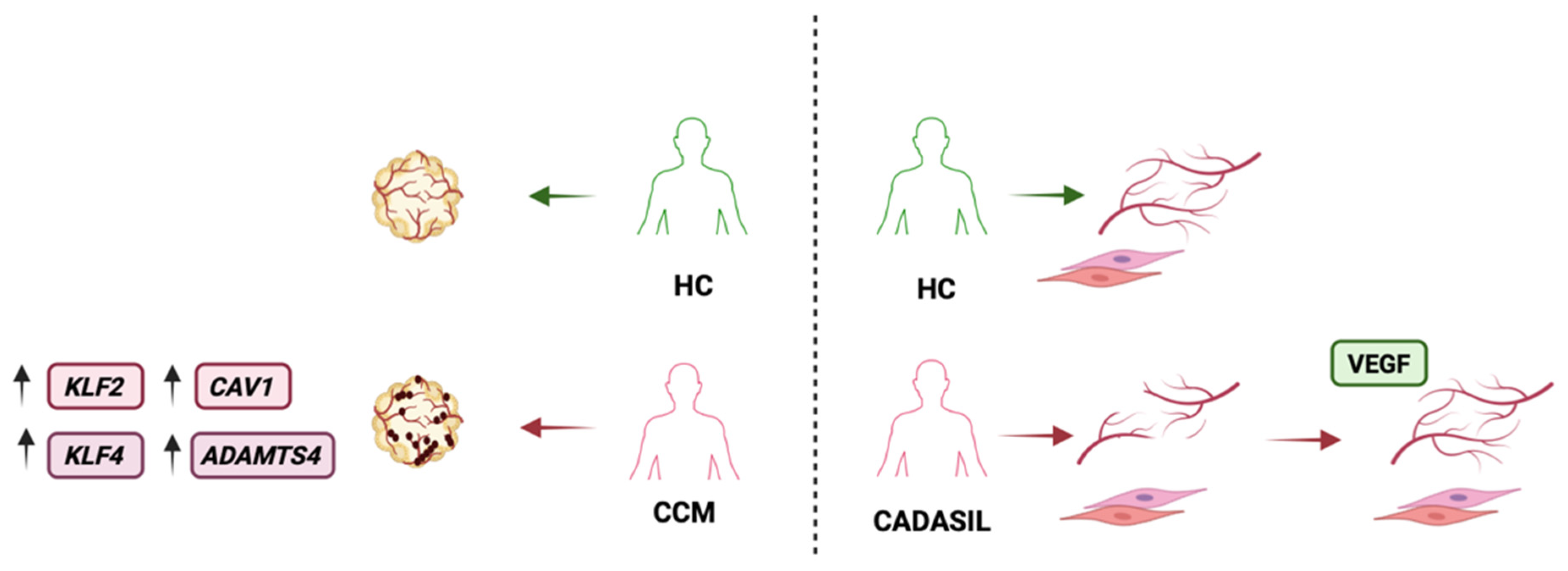
| Cerebral Autosomal Dominant Arteriopathy with Subcortical Infarcts and Leukoencephalopathy (CADASIL) | Co-cultured CADASIL–VSMCs and CADASIL–ECs show an inability to support microvessel network formation. Adding VEGF and knocking down mutant NOTCH3 partially restores capillary stability [56] (VSMC = vascular smooth muscle cell) | CADASIL cells can be tested with various Notch pathway modulators or with metabolic treatments to guide therapy tailored to every single patient’s molecular defect |
| Moyamoya disease (MMD) | MMD patient-derived iPSC-ECs form fewer, shorter tube-like structures than controls, even under pro-angiogenic conditions, but without impeding endothelial growth (mitosis-related genes were actually upregulated) [58]. Nevertheless, endothelial structure is compromised in MMD-ECs, while MMD-VSMCs have fairly no differences compared to controls [61] | - |
| Familial cerebral cavernous malformation | Patient-specific organoids develop abnormally dilated, leaky vascular structures resembling cavernomas, showing compromised endothelial barrier integrity. Interestingly, patient-derived ECs can successfully integrate into ex vivo mouse brain explants by reshaping and remodeling pre-existing vessels, leading to increased vessel diameter and reorganization of nearby vascular smooth muscle cells [62] | - |
Disclaimer/Publisher’s Note: The statements, opinions and data contained in all publications are solely those of the individual author(s) and contributor(s) and not of MDPI and/or the editor(s). MDPI and/or the editor(s) disclaim responsibility for any injury to people or property resulting from any ideas, methods, instructions or products referred to in the content. |
© 2026 by the authors. Licensee MDPI, Basel, Switzerland. This article is an open access article distributed under the terms and conditions of the Creative Commons Attribution (CC BY) license.
Share and Cite
Fontanelli, L.; Castronovo, A.; Ferri, C.; Vozzi, F.; Recchia, F.A.; Borghini, A. iPSC-Derived Endothelial Cells as Experimental Models for Predictive and Personalized Strategies in Cardiovascular and Cerebrovascular Disease. Int. J. Mol. Sci. 2026, 27, 780. https://doi.org/10.3390/ijms27020780
Fontanelli L, Castronovo A, Ferri C, Vozzi F, Recchia FA, Borghini A. iPSC-Derived Endothelial Cells as Experimental Models for Predictive and Personalized Strategies in Cardiovascular and Cerebrovascular Disease. International Journal of Molecular Sciences. 2026; 27(2):780. https://doi.org/10.3390/ijms27020780
Chicago/Turabian StyleFontanelli, Lorenzo, Alessio Castronovo, Carolina Ferri, Federico Vozzi, Fabio A. Recchia, and Andrea Borghini. 2026. "iPSC-Derived Endothelial Cells as Experimental Models for Predictive and Personalized Strategies in Cardiovascular and Cerebrovascular Disease" International Journal of Molecular Sciences 27, no. 2: 780. https://doi.org/10.3390/ijms27020780
APA StyleFontanelli, L., Castronovo, A., Ferri, C., Vozzi, F., Recchia, F. A., & Borghini, A. (2026). iPSC-Derived Endothelial Cells as Experimental Models for Predictive and Personalized Strategies in Cardiovascular and Cerebrovascular Disease. International Journal of Molecular Sciences, 27(2), 780. https://doi.org/10.3390/ijms27020780