


Abstract
Arthropod-borne orthoflaviviruses, including dengue, Zika, Japanese encephalitis, yellow fever and West Nile viruses, pose a significant global public health threat, causing hundreds of millions of infections annually with severe clinical symptoms. However, the lack of effective vaccines and antiviral drugs, coupled with the biosafety risks associated with handling live highly pathogenic strains, hinders progress in antiviral research. Pseudovirus technology, which uses single-round infectious viral particles lacking replication competence, has thus gained prominence as a safe and versatile tool for antiviral research. This review systematically summarizes the construction, optimization, and applications of orthoflavivirus pseudoviruses in antiviral research. The primary construction strategies of orthoflavivirus pseudoviruses rely on multi-plasmid co-transfection of viral replicons and structural protein expression vectors, leveraging the host cell secretory pathway to mimic natural viral assembly and maturation. The core applications of pseudovirus technology are highlighted, including high-throughput screening and detection of neutralizing antibodies, identification of antiviral drugs targeting viral entry or replication, and evaluation of vaccine immunogenicity. Despite these strengths, the approach still faces limitations, such as incomplete simulation of native viral structures and batch-to-batch titer variability, which may affect the physiological relevance of findings. In summary, orthoflavivirus pseudovirus technology has become an essential platform in both basic virology research and translational medicine, providing critical insights and tools in the ongoing fight against arthropod-borne orthoflaviviruses diseases.
1. Introduction
Over the past decades, substantial efforts and resources have been dedicated to controlling diseases caused by arthropod-borne orthoflaviviruses, a group of enveloped, positive-sense, single-stranded RNA viruses belonging to the Flaviviridae family that includes prominent human pathogens such as Dengue virus (DENV), Zika virus (ZIKV), Japanese encephalitis virus (JEV), Yellow fever virus (YFV), and West Nile virus (WNV) [1,2]. Collectively, these viruses account for approximately 400 million infections and 100 million symptomatic cases globally each year [3]. Human infections with orthoflaviviruses can lead to severe outcomes, including hemorrhagic fever, serious neurological complications, and fatal diseases, thereby posing a significant threat to public health [4,5]. Recently, warming climate trends, ongoing urbanization, and the expanding distribution of arthropod vectors have jointly promoted the increasing prevalence of orthoflaviviruses, particularly in tropical and subtropical regions [6]. This emerging trend has heightened the global disease burden and exacerbated public health challenges. Given the lack of effective antiviral drugs and the absence of broad-spectrum vaccines for most orthoflavivirus infections [7,8], there is an urgent need to develop effective control strategies for orthoflavivirus. To achieve this goal, key challenges in orthoflavivirus control have to be addressed, including how to handle highly pathogenic orthoflavivirus when high-biosafety level facilities are limited, and how to establish efficient screening platforms for antiviral molecule discovery.
Given the limited availability of high-biosafety level facilities, pseudoviruses have achieved prominent progress in research on antibodies and antiviral drugs targeting live highly pathogenic viruses such as SARS-CoV-2 [9,10]. As replication-defective recombinant viral particles, they possess only single-round infectivity, meaning they do not propagate new viral progeny after infecting host cells [11]. This unique characteristic allows for safe manipulation with reduced biosafety risks [11]. Notably, pseudoviruses enable the safe and efficient simulation of viral entry mechanisms, and are widely applied in research fields such as neutralizing antibody evaluation, viral receptor identification, and antiviral drug screening [12]. With the development of molecular biology technology, pseudoviruses have demonstrated increasingly critical application value in responding to emerging flavivirus outbreaks and conducting research on variant strains [13]. Owing to their safety, operability and functional fidelity, pseudovirus technology has significantly promoted the basic research of flaviviruses and the development of antiviral strategies, providing key technical support for addressing such global public health threats.
The present review aims to investigate the construction and optimization strategies of orthoflavivirus pseudovirus, and provide a comprehensive overview of their applications in detection of neutralizing antibodies, evaluation of antiviral drugs, and vaccine development. Furthermore, the latest cutting-edge advances and challenges of orthoflavivirus pseudovirus technology in antiviral research are discussed.
2. Generation of Orthoflavivirus Pseudovirus
2.1. Construction Strategy of Orthoflavivirus Pseudovirus
The selection of an appropriate packaging system is the critical step in pseudovirus construction. Currently, the most widely used systems are based on either the vesicular stomatitis virus glycoprotein-deleted vector (VSVΔG) or lentiviral vector, each with distinct strength. By replacing the VSV-G protein with the envelope protein of a target virus (e.g., prM-E of flaviviruses), the VSVΔG system allows efficient production of high-titer pseudoviral particles [14,15,16]. Owing to its robust ability to activate innate immunity, this system exhibits unique advantages in vaccine immunogenicity research, as it typically elicits potent humoral and cellular immune responses [17]. In contrast, the lentiviral vector system is more extensively employed in investigations into viral entry mechanisms, receptor identification, and experimental settings requiring long-term reporter gene expression. This is attributable to its ability to integrate into the host genome for stable transduction and its high compatibility with heterologous envelope proteins during packaging process [18,19]. Nevertheless, both systems are subject to packaging constraints. The RNA packaging efficiency of lentiviral vector systems is strictly regulated by the interaction between Gag protein and the packaging signal. While achieving an optimal balance between helper plasmids and packaging plasmids is essential during production for VSVΔG system to avoid reduced packaging efficiency due to improper structural proteins expression [20,21,22]. Notably, particularly for orthoflavivirus pseudovirus construction, the orthoflavivirus backbone-based pseudovirus construction strategy achieves improved safety compared with the lentiviral vector-based pseudovirus construction strategy, owing to its independence from gene integration. In contrast to the VSVΔG -based pseudovirus construction strategy, the orthoflavivirus backbone-based pseudovirus construction strategy exhibits greater similarity to native viruses, with an immune activation capacity more comparable to that of native orthoflavivirus, attributable to its homologous mimicry of the orthoflavivirus capsid and core expression and structures [17,18,22].
Native orthoflaviviruses possess a conserved genome organization, encoding three structural proteins, the capsid protein (C), precursor membrane protein (prM), and envelope protein (E), as well as seven non-structural proteins of NS1, NS2A, NS2B, NS3, NS4A, NS4B, and NS5 [23,24] (Figure 1A,B). Consistent with the native orthoflaviviral genome, viral replicon, a self-replicating viral RNA vector, is typically designed to be derived from the orthoflaviviral non-structural genes but lack viral structural genes. Orthoflavivirus pseudovirus are generally generated using two strategies: either (1) co-transfection of a viral replicon harboring all non-structural protein genes together with an expression vector carrying the C-prM-E structural protein genes or (2) co-transfection of a viral replicon containing the C gene plus all non-structural protein genes with a separate prM-E expression vector [25,26]. In both strategies, viral replicons and structural proteins are expressed in a heterologous expression system via multi-plasmid co-transfection. This process leverages the host cell’s secretory pathway to mimic the assembly and maturation processes of natural orthoflavivirus virions [25,26,27] (Figure 1C,D).
Figure 1.
Schematic diagram of dengue virus (DENV) replication and orthoflavivirus pseudovirus generation. (A) Schematic diagram of DENV particle; (B) DENV genome; (C) Schematic diagram of DENV pseudovirus particle; (D) DENV replicon and structural protein plasmids; (E) DENV life cycle: ① Virus binds to host cell receptors; ② Virus enters cells via receptor-mediated endocytosis; ③ Virus disassembly; ④ Viral RNA is released into the cytoplasm; ⑤ Ribosomes translate viral RNA, Structural protein precursor (prM/E) is synthesized and modified in the endoplasmic reticulum (ER); ⑥ Viral assembly; ⑦ prM protein is cleaved by furin protease to form mature M protein; ⑧ Virus maturation; ⑨ Mature virus particles are released from the cell via budding; (F) Orthoflavivirus pseudoviruses generation process: ① Co-transfection of plasmids; ② Plasmids enter cells via endocytosis; ③ Plasmid DNA is transcribed into mRNA; ④ Ribosomes translate replicons and structural proteins separately; ⑤ Structural prM/E is synthesized and modified in the ER; ⑥ Pseudovirus assembly; ⑦ prM protein is cleaved by furin protease to form mature M protein; ⑧ Pseudovirus maturation; ⑨ Pseudovirus release: Mature pseudovirus particles are released from cells via exocytosis and are available for subsequent experiments. (Created with https://BioRender.com/).
Orthoflavivirus infection is initiated with the binding of envelope protein E to a cognate receptor on the host cell plasma membrane, which induces clathrin-mediated endocytosis. Within the early endosome, protonation of E triggers fusion between the viral and endosomal membranes, releasing the positive-strand genomic RNA into the cytosol. This viral RNA acts as mRNA and is translated by host ribosomes into a single polyprotein [28]. Through co- and post-translational processing by viral and host proteases, the polyprotein is cleaved to produce three structural proteins (C, prM, E) and seven non-structural (NS) proteins. NS proteins remodel endoplasmic reticulum (ER) membranes to form viral replication factories, where RNA synthesis occurs [29,30]. Meanwhile, structural proteins are translocated into the ER lumen. Newly synthesized genomic RNA is packaged by capsid (C) proteins to assemble nucleocapsids, which are subsequently enveloped by prM-E heterodimers to produce immature virions. These immature particles are transported through the secretory pathway to the trans-Golgi network. There, the acidic environment and the host protease furin cleave prM into the mature M protein. This proteolytic cleavage stabilizes the E protein in its mature conformation and renders the particle infectious. Mature virions are finally released by budding at the plasma membrane, thereby initiating a new round of infection (Figure 1E) [31,32].
Similar to natural orthoflavivirus replication, the replicon RNA, serving as the substitute viral genome, is translated by host ribosomes on the rough endoplasmic reticulum (ER), producing a precursor polyprotein encoded by the replicon sequence [33,34]. Proteolytic processing of this precursor polyprotein is primarily mediated by the NS2B-NS3 protease complex [35]. NS2B, a transmembrane cofactor, forms an active complex with the N-terminal serine protease domain of NS3. This complex first undergoes autolysis at the NS2A/NS2B and NS2B/NS3 junctions, followed by cis- and trans-cleavage at the boundaries of other non-structural proteins (including NS1, NS2A, NS3, NS4A, NS4B, and NS5). Concurrently, host signal peptidase localized in the ER membrane completes intramembrane cleavage at the C-terminal site of NS1, releasing the NS1 monomer [35]. To balance replication efficiency and biosafety, viral replicons are engineered to delete structural protein coding regions such as C-prM-E, retaining only non-structural protein regions to block progeny virus assembly. Replicon expression is driven by the strong Human Cytomegalovirus (CMV) promoter ensure efficient transcription [36] (Figure 1F).
Subsequently, the assembly and maturation of pseudoviruses involve multiple host–virus interactions, as follows. During the nucleocapsid formation, the C protein is translated on cytoplasmic ribosomes, then undergoes dimerization and hexamerization to bind replicon RNA, assembling into a nucleocapsid core and completing genome packaging [37]. The interaction between the C protein and intracellular lipid droplets is crucial for efficient viral particle assembly. For specific serotype orthoflaviviruses, such as DENV-2, co-expression of the C protein is essential for pseudovirus production, as it overcomes the low secretion efficiency caused by the strong ER retention signal in the stem-anchor region of the E protein [38] (Figure 1F).
During immature particle assembly, the E protein and its auxiliary prM protein are synthesized on the ER membrane, where they interact to form stable prM-E heterodimers [28,39]. These heterodimers serve as basic structural units, oligomerizing within the ER to assemble into immature particles (~50 nm in diameter) with 60 prM-E trimer spikes on their surface (Figure 1F). For particle maturation, immature particles are transported to the Golgi apparatus via secretory pathway (Figure 1F). Here, the host furin protease cleaves the prM protein, removing the “pr” peptide segment, a molecular chaperone, to generate the mature M protein [28,39]. This cleavage triggers an irreversible conformational rearrangement of the E protein: prM-E heterodimers dissociate, E proteins reassemble into 90 homodimers [40], reshaping the particle surface from a spiky to a smooth, icosahedrally symmetric mature morphology.
Finally, mature pseudoviral particles are released extracellularly via exocytosis. Due to the deletion of structural protein-coding regions in the replicon, these pseudoviruses exhibit only single-round infectivity [38,41].
To facilitate the subsequent detection of viral infection efficiency, a reporter gene, such as a gene encoding green fluorescent protein (GFP) or luciferase (Luc), is typically incorporated into the vector. Successful infection drives reporter gene expression, producing real-time detectable fluorescent or chemiluminescent signals [42]. Promoter selection plays a pivotal role in pseudovirus packaging. Replicon expression vectors commonly use CMV promoter, whose strong transient transcriptional activity enables efficient initiation of non-structural protein expression and genomic RNA replication [36]. In contrast, structural protein expression vectors often employ promoters with stable expression characteristics to maintain continuous, controllable expression of prM/E and other proteins. This design avoids cytotoxicity caused by overexpression [43], and facilitates efficient assembly and secretion of pseudoviral particles, thereby improving pseudovirus packaging efficiency and system safety [44].
2.2. Production and Optimization of Orthoflavivirus Pseudovirus
To substantially improve the yield and infectivity of orthoflavivirus pseudoviruses, researchers have implemented a multi-level, systematic optimization strategy covering viral genome modification, host cell selection, and culture system refinement (Table 1).
At the viral genome level, the core objective of viral genome optimization is to enhance the efficiency and fidelity of viral protein expression, thereby laying a foundation for high-quality pseudovirus assembly [45]. Key strategies include genomic sequence engineering, codon optimization, and high-efficiency vector selection [45,46]. In genomic sequence engineering, rational design of viral structural gene sequences, such as truncating non-essential regions of the E protein or optimizing signal peptide sequences, effectively reduces cytotoxicity caused by aberrant protein accumulation, while promoting proper subcellular localization and correct folding of structural proteins (e.g., prM-E heterodimers) [45,47,48]. In addition, as a universal and highly effective approach, codon optimization adapts viral gene sequences to the codon usage bias of host cells, improving translation efficiency and significantly increasing protein expression levels. This strategy is particularly critical for flaviviruses with complex RNA secondary structures, such as DENV-2 and ZIKV [22,46,49]. Additionally, employing engineered expression vectors with enhanced transcriptional activity (e.g., vectors containing modified CMV promoters or enhancer elements) directly boosts the expression of key structural proteins (e.g., E protein and prM protein), thereby increasing pseudovirus production [50]. Furthermore, selecting a viral vector with high compatibility for orthoflaviviral glycoproteins and optimization of its compatibility with the prM-E expression cassette are key to enhancing pseudovirus production efficiency.
Optimization at the host cell and culture level focuses on constructing an optimal microenvironment for pseudovirus packaging, ensuring efficient coordination between viral components and host cellular machinery. Packaging cell line selection is fundamental to pseudovirus production, requiring matching of the cell’s gene expression capacity, secretory pathway efficiency, and assembly compatibility with the specific orthoflavivirus. For example, HEK-293T cells are widely used for broad-spectrum flavivirus pseudovirus packaging due to their high transfection efficiency and robust secretory pathway, while C6/36 cells are preferred for insect-specific flavivirus vectors [11,42,51]. Once an appropriate cell line is selected, the intracellular environment can be further engineered to accelerate the viral protein processing and assembly [26,52]. A key intervention is overexpression of furin, the important host protease responsible for prM cleavage in the trans-Golgi network (Figure 1F). This cleavage releases the pr peptide and generates mature M protein, converting spiky, non-infectious virions into smooth, fully infectious particles. Incomplete processing yields immature or partially mature virions that present alternative antigen conformations and reduced infectivity [53,54,55]. Precise adjustment of culture parameters including medium composition, culture temperature, and pH value. These parameters ensure host cells maintain a healthy metabolic state, which is crucial for sustained high-level production of viral proteins [56]. Finally, adjusting key parameters such as the molar ratio of replicon plasmid to structural protein plasmid, initial cell seeding density and harvest timing, maximizes final yield and infectivity of pseudoviruses [22].
Notably, structural heterogeneity of flavivirus particles is a conserved morphogenetic feature that significantly influences viral immune recognition, host cell tropism, and adaptive capacity [28]. Therefore, during pseudovirus production, strict quality control measures including monitoring particle uniformity via transmission electron microscopy or dynamic light scattering, and structural integrity via Western blot detection of mature M/E proteins, are essential to ensure the reliability and reproducibility of pseudoviruses in subsequent applications.
Table 1.
Production and optimization strategies of orthoflavivirus pseudovirus.
4. Latest Advances and Challenges
4.1. Latest Advances
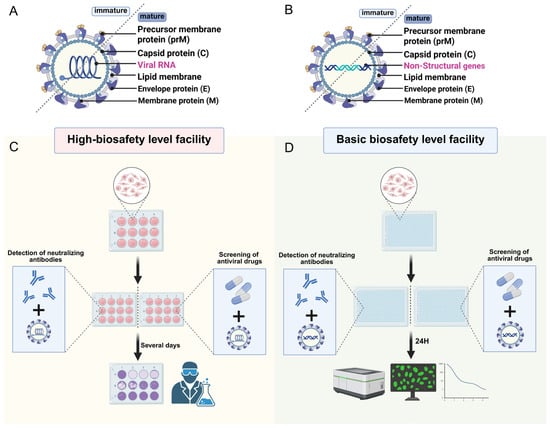
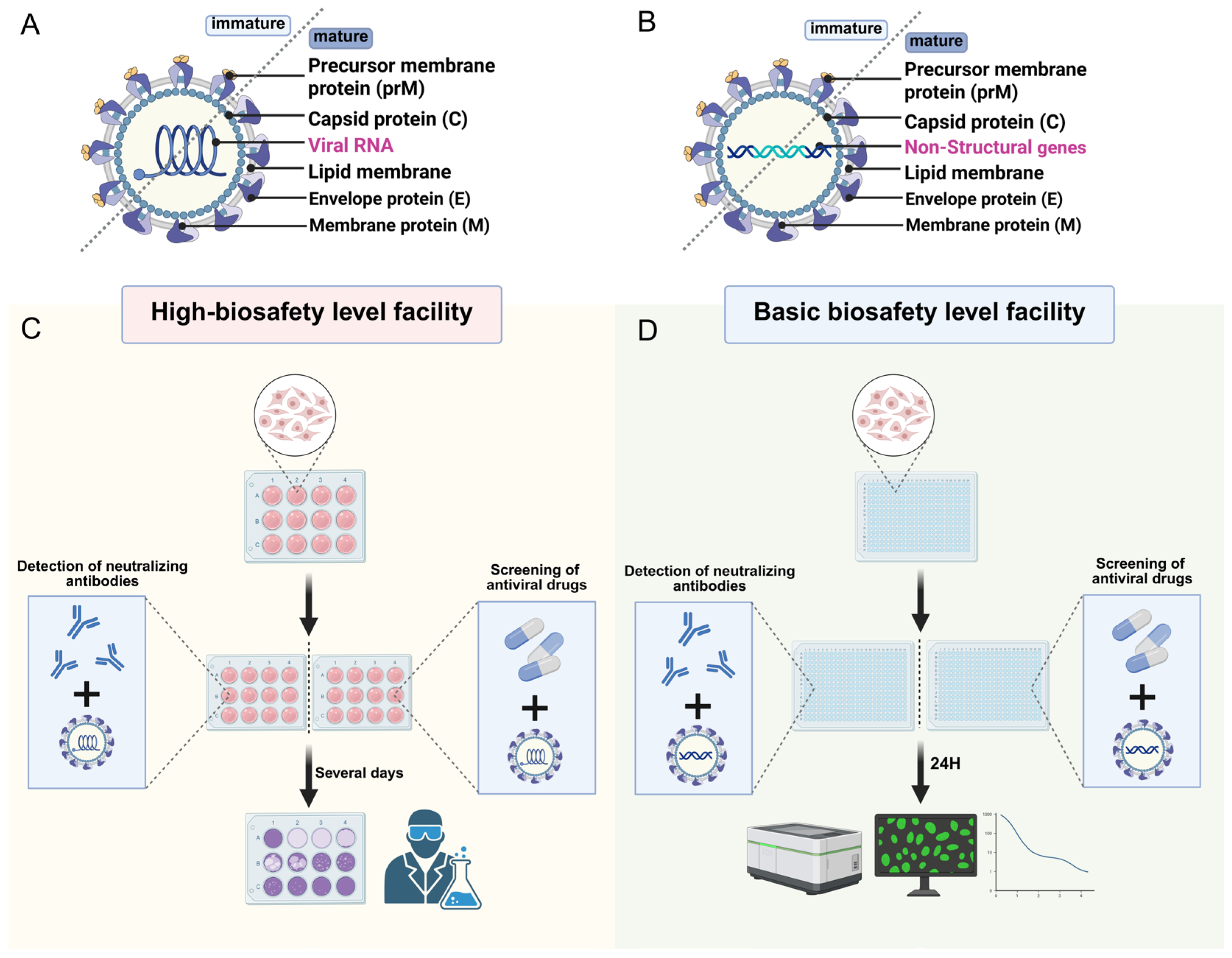
Pseudovirus technology significantly reduces biosafety risk by enabling only a single round of infectivity, which prevents viral spread beyond initial entry. This feature allows researchers to safely assess neutralizing antibody activity, screen antiviral compounds, and characterize the antigenicity of specific viral strains. In contrast, live virus system more accurately replicates natural infection and thus offer higher clinical relevance for antiviral drug and vaccine development [78,79]. However, they require high biosafety level facilities and carry the inherent risk of viral mutation during experimentation [79]. These constraints substantially increase the difficulty of conducting early-stage antiviral research. Consequently, pseudovirus technology provides a more practical and biosafety-friendly alternative, particularly in standard laboratory environments.
Pseudovirus technology substantially shortens the testing cycle and greatly reduces the time required for research and screening of antiviral compounds and vaccines. It transforms traditionally labor-intensive neutralization assays and drug screening into efficient, scalable, and standardized workflows [74,92]. This approach allows researchers to assess the neutralizing or inhibitory effects of antibodies or antiviral molecules on viral infection within 24 h post infection, overcoming the time constraints associated with live-virus assays that depend on a complete viral replication cycle [92]. Moreover, the fluorescent reporter genes encoded in pseudoviruses enable seamless integration with high-throughput automated fluorescence analysis systems. This integration establishes an efficient and automated platform for rapid viral identification and diagnosis, large-scale serological surveillance, and high-throughput screening of antiviral compounds and neutralizing antibodies [93].
Pseudovirus technology retains the ability to mediate viral entry and incorporate viral replicon encoding non-structural proteins. This design not only enables its use not only in studying viral invasion mechanisms, receptor recognition, and neutralization assays [18], but also in recapitulate key steps of live viral replication, such as glycosylation-dependent endoplasmic reticulum homeostasis and viral replication compartments formation, through NS1 protein [94]. Compared with virus-like particles (VLPs), pseudovirus offer a more dynamic model for investigating virus–host interactions within cells. VLPs, are composed of self-assembled viral structural proteins, closely resemble native virions in morphology. Owing to their favorable modifiability, carrier properties, and lacking viral nucleic acid, they present reduced biosafety risks and can effectively elicit robust humoral and cellular immune responses. These characteristics make VLPs particularly valuable for vaccine design and antigen characterization [80,81,95], with additional applications in targeted delivery [96,97,98]. Nevertheless, VLPs still faces challenges such as limited immunogenicity and variable protein self-assembly efficiency [15,99] (Table 3).
Table 3.
The comparison of pseudoviruses and virus-like particles (VLPs).
In summary, pseudoviruses, VLPs, and live viruses form a complementary toolkit in modern antiviral research. Integrating their respective strengths can advance both foundational understanding and translational development, ultimately accelerating the discovery of antiviral drugs and vaccines and improving preparedness against emerging viral caused public health threats.
4.2. Limitations
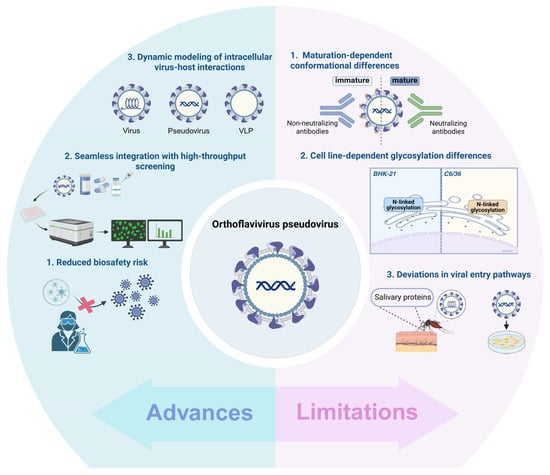
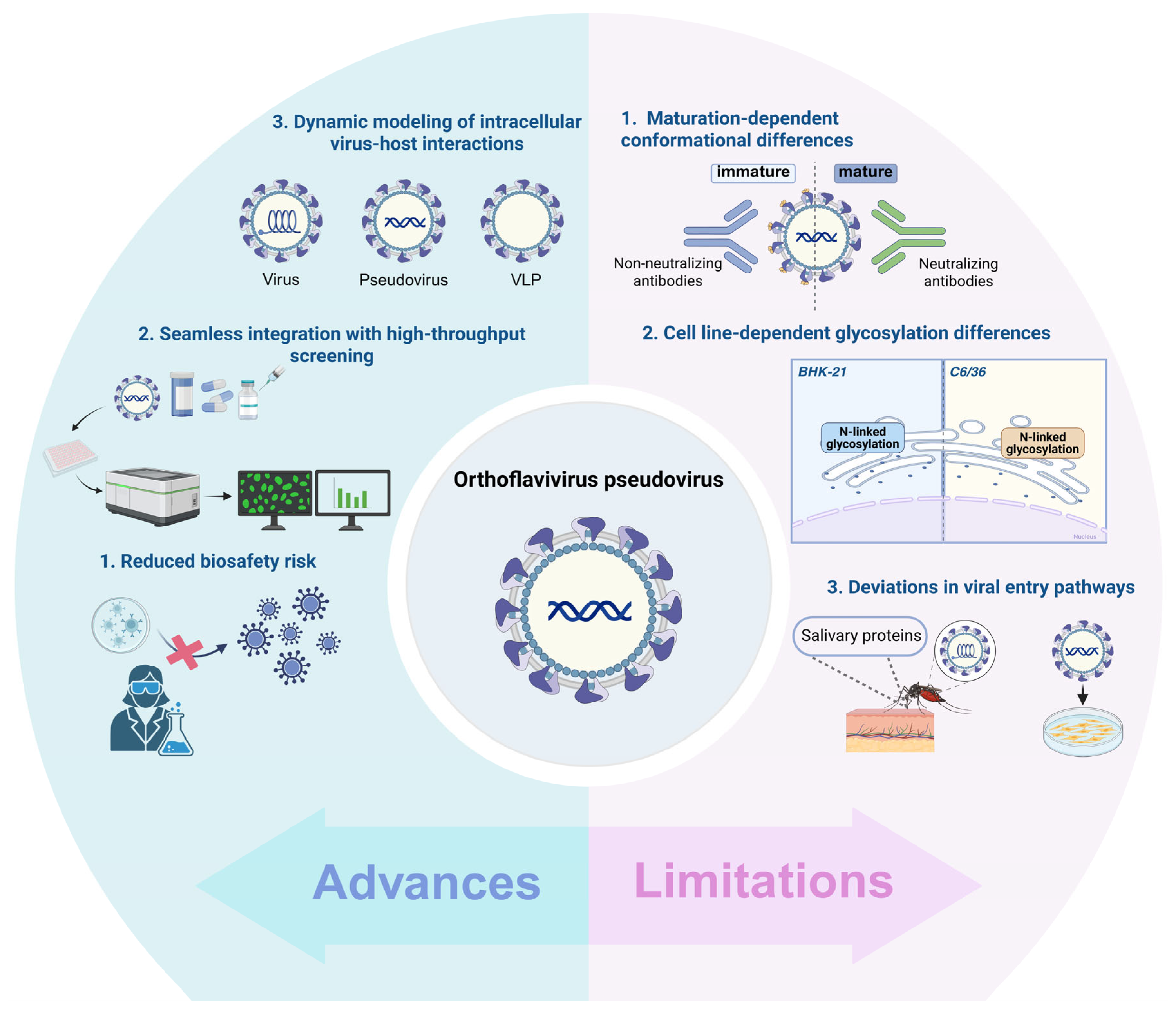
Although pseudovirus technology has shown great potential in flavivirus research, it still has several technical limitations that warrant attention (Figure 3).
Figure 3.
A schematic diagram of the frontier applications and challenges of orthoflavivirus pseudovirus technology. The left panel highlights important advances: ① Reduced biosafety risk: Pseudovirus technology allows safe study of orthoflavivirus under basic biosafety level facility, significantly reducing the risk associated with handling live viruses; ② Seamless integration with high-throughput screening: Pseudovirus technology seamlessly integrates with high-throughput screening processes, enabling automation and rapid screening of extensive antibody/drug libraries; ③ Dynamic modeling of intracellular virus–host interactions: Pseudovirus technology retains the capability to mediate viral entry and incorporate viral replicon encoding non-structural proteins. The right panel highlights notable limitations: ① Maturation-dependent conformational differences: Immature pseudoviruses may lack mature conformations, which could potentially skew immune evaluations and affect the accuracy of research outcomes; ② Cell line-dependent glycosylation differences: Glycosylation patterns in producer cells differ from those in target cells, which might impact antibody recognition; ③ Deviations in viral entry pathways: Pseudovirus technology may not fully recapitulate the complex, multi-step entry process of live viruses associated with salivary proteins. (Created with https://BioRender.com/).
First of all, heterologous viral glycoproteins displayed on immature pseudoviruses may not fully replicate the distribution, conformation, and density on native live viruses [50], which may alter antibody or drug recognition of E protein epitopes and lead to pseudovirus-based neutralization results that do not fully reflect immune responses in genuine infections [15,50]. Moreover, viral particles undergo dynamic conformational changes during maturation and entry, which immature pseudovirus may not fully recapitulate these continuous conformational dynamics. Therefore, the evaluation of certain neutralizing antibodies or inhibitors may be influenced by the intermediate conformational states [29,105]. Additionally, uneven antigen density on the pseudovirus surface may cause “epitope masking” phenomenon, where high-affinity antibodies preferentially bind to exposed epitopes and physically hinder B cell recognition of adjacent epitopes, potentially skewing immune evaluation [106].
Secondly, glycosylation differences associated with production cell lines pose another limitation. The N-linked glycosylation of flavivirus envelope proteins (such as the E protein of ZIKV and DENV) is critical for proper protein folding, immune evasion, and sensitivity to antibody neutralization [107,108]. If pseudoviruses are produced in heterologous cell lines, where glycosylation enzymes and modification patterns often differ substantially from those of the virus’s natural target cells (e.g., human or mosquito cells) [109,110]. This can lead to alterations in the glycoforms at key glycosylation sites of the E protein, thereby affecting relevant biological functions and assay outcomes.
Thirdly, pseudoviruses may exhibit deviations in viral entry pathways. Natural infection by orthoflavivirus typically triggers viral entry pathways (e.g., via the TLR2 pathway) with the assistance of vector salivary proteins, which modulates local host immunity and facilitates infection [111]. Such complex biological contextual factors are generally not recapitulated in in vitro pseudovirus infection assays.
4.3. Key Challenges
While pseudovirus technology is widely applied, standardization across laboratories remains a significant challenge. Currently, international standards for anti-SARS-CoV-2 immunoglobulin (e.g., WHO NIBSC 20/136) have been established to calibrate neutralization assays and provide critical guidelines for pseudovirus-based experiments [112,113]. However, the absence of specific national standards for pseudovirus detection limits broader consistency. Establishing such standards would greatly enhance data comparability and reproducibility across diverse research and clinical settings, thereby supporting more reliable application in vaccine evaluation and drug development. It is a direction that deserves further investigation. Furthermore, batch-to-batch variability in pseudovirus production poses a challenge to quality control. This inconsistency primarily stems from three factors: (1) the cis-acting RNA elements in the viral genome may not retain their native conformation in pseudovirus system, thereby reducing packaging efficiency [29]; (2) fluctuations in the expression of key host factors such as the endoplasmic reticulum remodeling protein TMEM41B can lead to unstable pseudovirus yields [30,114]; (3) the maturation of flaviviruses depends on the precise cleavage of the prM protein; however, the efficiency of protease processing in pseudovirus systems is variable, which further impacts pseudovirus yield and infectivity [54,115]. Given these limitations, caution is necessary when interpreting pseudovirus experimental results. It is highly recommended to verify the determination results of pseudoviruses with experiments based on live viruses, and to employ a combination of complementary techniques for comprehensive evaluation [12,116].
5. Conclusions
As an important biomedical research tool, orthoflavivirus pseudovirus technology has achieved remarkable contributions to antiviral research. In basic research, it has been instrumental in elucidating the structural mechanisms of virus–host interaction, viral maturation, and identifying conserved targets, thereby providing a theoretical foundation for the design of broad-spectrum antiviral drugs and vaccines [117,118]. At the application level, pseudovirus systems facilitate the clarification of critical immune mechanisms (e.g., antibody-mediated “epitope masking”) and have promoted the development of novel antiviral strategies, including defective interfering particles (DIPs) and engineered extracellular vesicle (EV) delivery systems [119,120]. Crucially, it provides a safer alternative model for studying highly pathogenic viruses under standard laboratory conditions. However, it should be noted that work with pseudoviruses still requires appropriate biosafety facilities and strict compliance with operational protocols [47,121].
Despite the widespread application of pseudovirus technology, further efforts are still required to advance its standardization. Factors such as different production cell lines and plasmid construction strategy may lead to batch-to-batch variations in the production of pseudoviruses, while the lack of standardized reference materials also limits the quantitative comparison between different research [47,122]. In addition, preliminary screening results based on pseudoviruses must be validated through in vitro and in vivo experiments using live viruses [123]. Therefore, to scientifically guide the application of this technology in antiviral research, a tiered research strategy is recommended: in the early stages of drug or antibody development, high-throughput screening is recommended for pseudoviruses; in subsequent critical stages, functional validation via live virus experiments in in vitro and in vivo models must be performed to ensure the reliability and translational value of the results.
Looking forward to the future, several strategic directions will be critical for advancing this technology. These include developing novel targeted nano-delivery systems to improve drug efficacy and bioavailability, integrating advanced technologies such as cryo-electron microscopy to resolve key steps in viral entry, and constructing comprehensive pseudovirus libraries covering circulating strains and variants to keep pace with viral evolution [120,124,125,126]. In addition, innovative strategies such as nucleic acid hydrolysis-targeting chimeras (NATAC) represent a promising avenue for developing broad-spectrum antivirals [127]. Furthermore, establishing a standardized and quality-controlled framework is essential to guarantee the quality of pseudoviruses. This framework should encompass the development of widely recognized reference pseudovirus libraries, standardized titration methodologies, and unified reporting guidelines, all of which will significantly enhance the comparability and reproducibility of experimental data. Achieving these goals will require deeper interdisciplinary collaboration across virology, nanotechnology, structural biology, and computational science focusing on core challenges such as targeted drug delivery, real-time monitoring of viral escape mutations, and the design of broad-spectrum antiviral strategies [117,120,125,126]. Through sustained innovation and cross-disciplinary synergy, flavivirus pseudovirus technology will continue to serve as a central research engine, providing robust and sustained support for in-depth elucidation of viral pathogenic mechanisms and accelerated development of efficient antiviral interventions.
Author Contributions
Y.Z. (Yalan Zhang): Writing—original draft, Writing—review and editing, Conceptualization. Y.Z. (Yaqi Zhao), C.W., Y.Z. (Yuanyuan Zhou) and H.Y.: Writing—original draft. X.L.: Writing—review and editing. Y.W.: Writing—review and editing. X.P.: Writing—review and editing, Writing—original draft, Supervision, Funding acquisition, Conceptualization. All authors have read and agreed to the published version of the manuscript.
Funding
This work was supported by the Key Program of Natural Science Foundation of Hunan Province of China (2024JJ3025).
Data Availability Statement
No new data were created or analyzed in this study. Data sharing is not applicable to this article.
Conflicts of Interest
The authors declare no conflicts of interest.
References
- Wilder-Smith, A.; Lindsay, S.W.; Scott, T.W.; Ooi, E.E.; Gubler, D.J.; Das, P. The Lancet Commission on dengue and other Aedes-transmitted viral diseases. Lancet 2020, 395, 1890–1891. [Google Scholar] [CrossRef] [Scilit]
- Postler, T.S.; Beer, M.; Blitvich, B.J.; Bukh, J.; de Lamballerie, X.; Drexler, J.F.; Imrie, A.; Kapoor, A.; Karganova, G.G.; Lemey, P.; et al. Renaming of the genus Flavivirus to Orthoflavivirus and extension of binomial species names within the family Flaviviridae. Arch. Virol. 2023, 168, 224. [Google Scholar] [CrossRef] [Scilit] [PubMed]
- Srisawat, N.; Gubler, D.J.; Pangestu, T.; Limothai, U.; Thisyakorn, U.; Ismail, Z.; Goh, D.; Capeding, M.R.; Bravo, L.; Yoksan, S.; et al. Proceedings of the 6th Asia Dengue Summit, June 2023. PLoS Negl. Trop. Dis. 2024, 18, e0012060. [Google Scholar] [CrossRef] [Scilit] [PubMed]
- Gould, E.A.; Solomon, T. Pathogenic flaviviruses. Lancet 2008, 371, 500–509. [Google Scholar] [CrossRef] [Scilit] [PubMed]
- Puerta-Guardo, H.; Glasner, D.R.; Espinosa, D.A.; Biering, S.B.; Patana, M.; Ratnasiri, K.; Wang, C.; Beatty, P.R.; Harris, E. Flavivirus NS1 Triggers Tissue-Specific Vascular Endothelial Dysfunction Reflecting Disease Tropism. Cell Rep. 2019, 26, 1598–1613.e8. [Google Scholar] [CrossRef] [Scilit]
- Wang, M.Y.; Zhao, R.; Wang, Y.L.; Wang, D.P.; Cao, J.M. Challenges with the discovery of RNA-based therapeutics for flaviviruses. Expert. Opin. Drug Discov. 2023, 18, 371–383. [Google Scholar] [CrossRef] [Scilit]
- van den Elsen, K.; Chew, B.L.A.; Ho, J.S.; Luo, D. Flavivirus nonstructural proteins and replication complexes as antiviral drug targets. Curr. Opin. Virol. 2023, 59, 101305. [Google Scholar] [CrossRef] [Scilit]
- Lim, S.P. Dengue drug discovery: Progress, challenges and outlook. Antivir. Res. 2019, 163, 156–178. [Google Scholar] [CrossRef] [Scilit]
- Cao, Y.; Su, B.; Guo, X.; Sun, W.; Deng, Y.; Bao, L.; Zhu, Q.; Zhang, X.; Zheng, Y.; Geng, C.; et al. Potent Neutralizing Antibodies against SARS-CoV-2 Identified by High-Throughput Single-Cell Sequencing of Convalescent Patients’ B Cells. Cell 2020, 182, 73–84.e16. [Google Scholar] [CrossRef] [Scilit]
- Westendorf, K.; Žentelis, S.; Wang, L.; Foster, D.; Vaillancourt, P.; Wiggin, M.; Lovett, E.; van der Lee, R.; Hendle, J.; Pustilnik, A.; et al. LY-CoV1404 (bebtelovimab) potently neutralizes SARS-CoV-2 variants. Cell Rep. 2022, 39, 110812. [Google Scholar] [CrossRef] [Scilit]
- Thimmiraju, S.R.; Kimata, J.T.; Pollet, J. Pseudoviruses, a safer toolbox for vaccine development against enveloped viruses. Expert. Rev. Vaccines 2024, 23, 174–185. [Google Scholar] [CrossRef] [Scilit] [PubMed]
- Xiang, Q.; Li, L.; Wu, J.; Tian, M.; Fu, Y. Application of pseudovirus system in the development of vaccine, antiviral-drugs, and neutralizing antibodies. Microbiol. Res. 2022, 258, 126993. [Google Scholar] [CrossRef] [Scilit] [PubMed]
- Zhang, N.; Li, C.; Jiang, S.; Du, L. Recent Advances in the Development of Virus-like Particle-Based Flavivirus Vaccines. Vaccines 2020, 8, 481. [Google Scholar] [CrossRef] [Scilit] [PubMed]
- Biswas, B. A tool of the trade for a newly identified filovirus: Pseudovirus-based system for Dehong virus entry and neutralization. Microbiol. Spectr. 2025, 13, e0103525. [Google Scholar] [CrossRef] [Scilit]
- Tani, H.; Shiokawa, M.; Kaname, Y.; Kambara, H.; Mori, Y.; Abe, T.; Moriishi, K.; Matsuura, Y. Involvement of ceramide in the propagation of Japanese encephalitis virus. J. Virol. 2010, 84, 2798–2807. [Google Scholar] [CrossRef] [Scilit]
- Grunwald, V.; Ngo, H.D.; Formanski, J.P.; Jonas, J.S.; Pöhlking, C.; Schwalbe, B.; Schreiber, M. Development of Zika Virus E Variants for Pseudotyping Retroviral Vectors Targeting Glioblastoma Cells. Int. J. Mol. Sci. 2023, 24, 14487. [Google Scholar] [CrossRef] [Scilit]
- Cooper, C.L.; Morrow, G.; Yuan, M.; Postler, T.S.; Neal, M.L.; Cross, R.W.; Woolsey, C.; Agans, K.N.; Borisevich, V.; McNamara, R.P.; et al. Preclinical development of a replication-competent vesicular stomatitis virus-based Lassa virus vaccine candidate advanced into human clinical trials. eBioMedicine 2025, 114, 105647. [Google Scholar] [CrossRef] [Scilit]
- Ku, M.W.; Authie, P.; Nevo, F.; Souque, P.; Bourgine, M.; Romano, M.; Charneau, P.; Majlessi, L. Lentiviral vector induces high-quality memory T cells via dendritic cells transduction. Commun. Biol. 2021, 4, 713. [Google Scholar] [CrossRef] [Scilit]
- Hossain, M.S.; Kerkvliet, J.G.; Hoppe, A.D. Whole genome CRISPR screening strategy to identify genes contributing to SARS-CoV-2 spike and VSV-G mediated entry. J. Med. Virol. 2023, 95, e29087. [Google Scholar] [CrossRef] [Scilit]
- Alnaji, F.G.; Reiser, W.K.; Rivera-Cardona, J.; Te Velthuis, A.J.W.; Brooke, C.B. Influenza A Virus Defective Viral Genomes Are Inefficiently Packaged into Virions Relative to Wild-Type Genomic RNAs. mBio 2021, 12, e0295921. [Google Scholar] [CrossRef] [Scilit]
- Wan, S.; Cao, S.; Wang, X.; Zhou, Y.; Yan, W.; Gu, X.; Wu, T.C.; Pang, X. Evaluation of Vertebrate-Specific Replication-Defective Zika Virus, a Novel Single-Cycle Arbovirus Vaccine, in a Mouse Model. Vaccines 2021, 9, 338. [Google Scholar] [CrossRef] [Scilit]
- He, Y.; Guo, J.; Wang, X.; Zhang, S.; Mao, L.; Hu, T.; Wang, M.; Jia, R.; Zhu, D.; Liu, M.; et al. Assembly-defective Tembusu virus ectopically expressing capsid protein is an approach for live-attenuated flavivirus vaccine development. npj Vaccines 2022, 7, 51. [Google Scholar] [CrossRef] [Scilit] [PubMed]
- Zhang, Y.; Zhang, W.; Ogata, S.; Clements, D.; Strauss, J.H.; Baker, T.S.; Kuhn, R.J.; Rossmann, M.G. Conformational changes of the flavivirus E glycoprotein. Structure 2004, 12, 1607–1618. [Google Scholar] [CrossRef] [Scilit] [PubMed]
- van Leur, S.W.; Heunis, T.; Munnur, D.; Sanyal, S. Pathogenesis and virulence of flavivirus infections. Virulence 2021, 12, 2814–2838. [Google Scholar] [CrossRef] [Scilit] [PubMed]
- Suzuki, R.; Ishikawa, T.; Konishi, E.; Matsuda, M.; Watashi, K.; Aizaki, H.; Takasaki, T.; Wakita, T. Production of single-round infectious chimeric flaviviruses with DNA-based Japanese encephalitis virus replicon. J. Gen. Virol. 2014, 95, 60–65. [Google Scholar] [CrossRef] [Scilit]
- Boigard, H.; Alimova, A.; Martin, G.R.; Katz, A.; Gottlieb, P.; Galarza, J.M. Zika virus-like particle (VLP) based vaccine. PLoS Negl. Trop. Dis. 2017, 11, e0005608. [Google Scholar] [CrossRef] [Scilit]
- Mukhopadhyay, S.; Kuhn, R.J.; Rossmann, M.G. A structural perspective of the flavivirus life cycle. Nat. Rev. Microbiol. 2005, 3, 13–22. [Google Scholar] [CrossRef] [Scilit]
- McAuliffe, J.; Bentkowska, K.; Sanyal, S. Flavivirus Morphogenesis and Its Implications for Pathogenesis. Annu. Rev. Virol. 2025, 12, 355–377. [Google Scholar] [CrossRef] [Scilit]
- Barnard, T.R.; Abram, Q.H.; Lin, Q.F.; Wang, A.B.; Sagan, S.M. Molecular Determinants of Flavivirus Virion Assembly. Trends Biochem. Sci. 2021, 46, 378–390. [Google Scholar] [CrossRef] [Scilit]
- Ci, Y.; Han, K.; Kong, J.; Huang, S.; Yang, Y.; Qin, C.F.; Shi, L. Flavivirus Concentrates Host ER in Main Replication Compartments to Facilitate Replication. Adv. Sci. 2023, 10, e2305093. [Google Scholar] [CrossRef] [Scilit]
- Giraldo, M.I.; Xia, H.; Aguilera-Aguirre, L.; Hage, A.; van Tol, S.; Shan, C.; Xie, X.; Sturdevant, G.L.; Robertson, S.J.; McNally, K.L.; et al. Envelope protein ubiquitination drives entry and pathogenesis of Zika virus. Nature 2020, 585, 414–419. [Google Scholar] [CrossRef] [Scilit]
- Mackenzie, J.M.; Westaway, E.G. Assembly and maturation of the flavivirus Kunjin virus appear to occur in the rough endoplasmic reticulum and along the secretory pathway, respectively. J. Virol. 2001, 75, 10787–10799. [Google Scholar] [CrossRef] [Scilit] [PubMed]
- Rana, J.; Slon Campos, J.L.; Leccese, G.; Francolini, M.; Bestagno, M.; Poggianella, M.; Burrone, O.R. Role of Capsid Anchor in the Morphogenesis of Zika Virus. J. Virol. 2018, 92, e01174-18. [Google Scholar] [CrossRef] [Scilit] [PubMed]
- Rana, J.; Slon Campos, J.L.; Poggianella, M.; Burrone, O.R. Dengue virus capsid anchor modulates the efficiency of polyprotein processing and assembly of viral particles. J. Gen. Virol. 2019, 100, 1663–1673. [Google Scholar] [CrossRef] [Scilit] [PubMed]
- Kiemel, D.; Kroell, A.H.; Denolly, S.; Haselmann, U.; Bonfanti, J.F.; Andres, J.I.; Ghosh, B.; Geluykens, P.; Kaptein, S.J.F.; Wilken, L.; et al. Pan-serotype dengue virus inhibitor JNJ-A07 targets NS4A-2K-NS4B interaction with NS2B/NS3 and blocks replication organelle formation. Nat. Commun. 2024, 15, 6080. [Google Scholar] [CrossRef] [Scilit]
- Wu, Z.; Hu, T.; Zhou, Z.; He, Y.; Wang, T.; Wang, M.; Jia, R.; Zhu, D.; Liu, M.; Zhao, X.; et al. Development of a reverse genetics system for West Nile virus (Kunjin type). Front. Vet. Sci. 2025, 12, 1671591. [Google Scholar] [CrossRef] [Scilit]
- Shang, Z.; Song, H.; Shi, Y.; Qi, J.; Gao, G.F. Crystal Structure of the Capsid Protein from Zika Virus. J. Mol. Biol. 2018, 430, 948–962. [Google Scholar] [CrossRef] [Scilit]
- Blazevic, J.; Rouha, H.; Bradt, V.; Heinz, F.X.; Stiasny, K. Membrane Anchors of the Structural Flavivirus Proteins and Their Role in Virus Assembly. J. Virol. 2016, 90, 6365–6378. [Google Scholar] [CrossRef] [Scilit]
- Sui, L.; Zhao, Y.; Wang, W.; Chi, H.; Tian, T.; Wu, P.; Zhang, J.; Zhao, Y.; Wei, Z.K.; Hou, Z.; et al. Flavivirus prM interacts with MDA5 and MAVS to inhibit RLR antiviral signaling. Cell Biosci. 2023, 13, 9. [Google Scholar] [CrossRef] [Scilit]
- Lorenz, I.C.; Allison, S.L.; Heinz, F.X.; Helenius, A. Folding and dimerization of tick-borne encephalitis virus envelope proteins prM and E in the endoplasmic reticulum. J. Virol. 2002, 76, 5480–5491. [Google Scholar] [CrossRef] [Scilit]
- Zhang, Y.; Corver, J.; Chipman, P.R.; Zhang, W.; Pletnev, S.V.; Sedlak, D.; Baker, T.S.; Strauss, J.H.; Kuhn, R.J.; Rossmann, M.G. Structures of immature flavivirus particles. Embo J. 2003, 22, 2604–2613. [Google Scholar] [CrossRef] [Scilit]
- Dong, H.L.; He, M.J.; Wang, Q.Y.; Cui, J.Z.; Chen, Z.L.; Xiong, X.H.; Zhang, L.C.; Cheng, H.; Xiong, G.Q.; Hu, A.; et al. Rapid Generation of Recombinant Flaviviruses Using Circular Polymerase Extension Reaction. Vaccines 2023, 11, 1250. [Google Scholar] [CrossRef] [Scilit] [PubMed]
- Baker, C.; Liu, Y.; Zou, J.; Muruato, A.; Xie, X.; Shi, P.Y. Identifying optimal capsid duplication length for the stability of reporter flaviviruses. Emerg. Microbes Infect. 2020, 9, 2256–2265. [Google Scholar] [CrossRef] [Scilit] [PubMed]
- Song, J.; Hong, J.; Yang, C.; Zhang, Y.; Li, Z.; He, P.; Ding, Q. Recapitulation of the Powassan virus life cycle in cell culture. mBio 2024, 15, e0346823. [Google Scholar] [CrossRef] [Scilit] [PubMed]
- Hardy, J.M.; Newton, N.D.; Modhiran, N.; Scott, C.A.P.; Venugopal, H.; Vet, L.J.; Young, P.R.; Hall, R.A.; Hobson-Peters, J.; Coulibaly, F.; et al. A unified route for flavivirus structures uncovers essential pocket factors conserved across pathogenic viruses. Nat. Commun. 2021, 12, 3266. [Google Scholar] [CrossRef] [Scilit]
- Chin, W.X.; Kong, H.Y.; Zhu, I.X.Y.; Teo, Z.Y.; Faruk, R.; Lee, R.C.H.; Ho, S.X.; Aw, Z.Q.; Yi, B.; Hou, X.J.; et al. Flavivirus genome recoding by codon optimisation confers genetically stable in vivo attenuation in both mice and mosquitoes. PLoS Pathog. 2023, 19, e1011753. [Google Scholar] [CrossRef] [Scilit]
- Liang, Z.; Tong, J.; Wu, X.; Liu, S.; Wu, J.; Yu, Y.; Zhang, L.; Zhao, C.; Lu, Q.; Nie, J.; et al. Development of a SARS-CoV-2 neutralization assay based on a pseudotyped virus using a HIV system. MedComm 2024, 5, e517. [Google Scholar] [CrossRef] [Scilit]
- Young, E.; Yount, B.; Pantoja, P.; Henein, S.; Meganck, R.M.; McBride, J.; Munt, J.E.; Baric, T.J.; Zhu, D.; Scobey, T.; et al. A live dengue virus vaccine carrying a chimeric envelope glycoprotein elicits dual DENV2-DENV4 serotype-specific immunity. Nat. Commun. 2023, 14, 1371. [Google Scholar] [CrossRef] [Scilit]
- Doyle, M.P.; Genualdi, J.R.; Bailey, A.L.; Kose, N.; Gainza, C.; Rodriguez, J.; Reeder, K.M.; Nelson, C.A.; Jethva, P.N.; Sutton, R.E.; et al. Isolation of a Potently Neutralizing and Protective Human Monoclonal Antibody Targeting Yellow Fever Virus. mBio 2022, 13, e0051222. [Google Scholar] [CrossRef] [Scilit]
- Li, Q.; Liu, Q.; Huang, W.; Li, X.; Wang, Y. Current status on the development of pseudoviruses for enveloped viruses. Rev. Med. Virol. 2018, 28, e1963. [Google Scholar] [CrossRef] [Scilit]
- Baldwin, W.R.; Giebler, H.A.; Stovall, J.L.; Young, G.; Bohning, K.J.; Dean, H.J.; Livengood, J.A.; Huang, C.Y. Single dose of chimeric dengue-2/Zika vaccine candidate protects mice and non-human primates against Zika virus. Nat. Commun. 2021, 12, 7320. [Google Scholar] [CrossRef] [Scilit] [PubMed]
- Huang, Y.; Peng, Q.; Tian, X.; Chen, C.; Zhu, X.; Huang, C.; Huo, Z.; Liu, Y.; Yang, C.; Liu, C.; et al. Nuclear membrane protein SUN2 promotes replication of flaviviruses through modulating cytoskeleton reorganization mediated by NS1. Nat. Commun. 2024, 15, 296. [Google Scholar] [CrossRef] [Scilit] [PubMed]
- Vaney, M.C.; Dellarole, M.; Duquerroy, S.; Medits, I.; Tsouchnikas, G.; Rouvinski, A.; England, P.; Stiasny, K.; Heinz, F.X.; Rey, F.A. Evolution and activation mechanism of the flavivirus class II membrane-fusion machinery. Nat. Commun. 2022, 13, 3718. [Google Scholar] [CrossRef] [Scilit] [PubMed]
- Anastasina, M.; Fuzik, T.; Domanska, A.; Pulkkinen, L.I.A.; Smerdova, L.; Formanova, P.P.; Strakova, P.; Novacek, J.; Ruzek, D.; Plevka, P.; et al. The structure of immature tick-borne encephalitis virus supports the collapse model of flavivirus maturation. Sci. Adv. 2024, 10, eadl1888. [Google Scholar] [CrossRef] [Scilit]
- Dowd, K.A.; Sirohi, D.; Speer, S.D.; VanBlargan, L.A.; Chen, R.E.; Mukherjee, S.; Whitener, B.M.; Govero, J.; Aleshnick, M.; Larman, B.; et al. prM-reactive antibodies reveal a role for partially mature virions in dengue virus pathogenesis. Proc. Natl. Acad. Sci. USA 2023, 120, e2218899120. [Google Scholar] [CrossRef] [Scilit]
- Fan, Y.C.; Chen, J.M.; Chen, Y.Y.; Hsu, W.L.; Chang, G.J.; Chiou, S.S. Low-temperature culture enhances production of flavivirus virus-like particles in mammalian cells. Appl. Microbiol. Biotechnol. 2024, 108, 242. [Google Scholar] [CrossRef] [Scilit]
- Nie, J.; Li, Q.; Wu, J.; Zhao, C.; Hao, H.; Liu, H.; Zhang, L.; Nie, L.; Qin, H.; Wang, M.; et al. Establishment and validation of a pseudovirus neutralization assay for SARS-CoV-2. Emerg. Microbes Infect. 2020, 9, 680–686. [Google Scholar] [CrossRef] [Scilit]
- Sewall, L.M.; de Paiva Froes Rocha, R.; Gibson, G.; Louie, M.; Xie, Z.; Bangaru, S.; Tran, A.S.; Ozorowski, G.; Mohanty, S.; Beutler, N.; et al. Microfluidics combined with electron microscopy for rapid and high-throughput mapping of antibody-viral glycoprotein complexes. Nat. Biomed. Eng. 2025, 9, 1938–1951. [Google Scholar] [CrossRef] [Scilit]
- Weissman, D.; Alameh, M.G.; de Silva, T.; Collini, P.; Hornsby, H.; Brown, R.; LaBranche, C.C.; Edwards, R.J.; Sutherland, L.; Santra, S.; et al. D614G Spike Mutation Increases SARS CoV-2 Susceptibility to Neutralization. Cell Host Microbe 2021, 29, 23–31.e4. [Google Scholar] [CrossRef] [Scilit]
- Lee, K.K. How a broadly neutralizing antibody grapples with antigenic and conformational diversity in dengue virus. Cell 2021, 184, 6015–6016. [Google Scholar] [CrossRef] [Scilit]
- Bos, S.; Graber, A.L.; Cardona-Ospina, J.A.; Duarte, E.M.; Zambrana, J.V.; Ruiz Salinas, J.A.; Mercado-Hernandez, R.; Singh, T.; Katzelnick, L.C.; de Silva, A.; et al. Protection against symptomatic dengue infection by neutralizing antibodies varies by infection history and infecting serotype. Nat. Commun. 2024, 15, 382. [Google Scholar] [CrossRef] [Scilit] [PubMed]
- Liu, X.; Li, Z.; Li, X.; Wu, W.; Jiang, H.; Zheng, Y.; Zhou, J.; Ye, X.; Lu, J.; Wang, W.; et al. A single-dose circular RNA vaccine prevents Zika virus infection without enhancing dengue severity in mice. Nat. Commun. 2024, 15, 8932. [Google Scholar] [CrossRef] [Scilit] [PubMed]
- Dai, L.; Xu, K.; Li, J.; Huang, Q.; Song, J.; Han, Y.; Zheng, T.; Gao, P.; Lu, X.; Yang, H.; et al. Protective Zika vaccines engineered to eliminate enhancement of dengue infection via immunodominance switch. Nat. Immunol. 2021, 22, 958–968. [Google Scholar] [CrossRef] [Scilit] [PubMed]
- Bewley, K.R.; Coombes, N.S.; Gagnon, L.; McInroy, L.; Baker, N.; Shaik, I.; St-Jean, J.R.; St-Amant, N.; Buttigieg, K.R.; Humphries, H.E.; et al. Quantification of SARS-CoV-2 neutralizing antibody by wild-type plaque reduction neutralization, microneutralization and pseudotyped virus neutralization assays. Nat. Protoc. 2021, 16, 3114–3140. [Google Scholar] [CrossRef] [Scilit]
- Cao, Y.; Wang, J.; Jian, F.; Xiao, T.; Song, W.; Yisimayi, A.; Huang, W.; Li, Q.; Wang, P.; An, R.; et al. Omicron escapes the majority of existing SARS-CoV-2 neutralizing antibodies. Nature 2022, 602, 657–663. [Google Scholar] [CrossRef]
- Hein, L.D.; Castillo, I.N.; Medina, F.A.; Vila, F.; Segovia-Chumbez, B.; Munoz-Jordan, J.L.; Whitehead, S.S.; Adams, L.E.; Paz-Bailey, G.; de Silva, A.M.; et al. Multiplex sample-sparing assay for detecting type-specific antibodies to Zika and dengue viruses: An assay development and validation study. Lancet Microbe 2025, 6, 100951. [Google Scholar] [CrossRef] [Scilit]
- Song, K.Y.; Zhao, H.; Jiang, Z.Y.; Li, X.F.; Deng, Y.Q.; Jiang, T.; Zhu, S.Y.; Shi, P.Y.; Zhang, B.; Zhang, F.C.; et al. A novel reporter system for neutralizing and enhancing antibody assay against dengue virus. BMC Microbiol. 2014, 14, 44. [Google Scholar] [CrossRef] [Scilit]
- Odio, C.D.; Daag, J.V.; Crisostomo, M.V.; Voirin, C.J.; Coello Escoto, A.; Adams, C.; Dahora Hein, L.; Aogo, R.A.; Mpingabo, P.I.; Raimundi Rodriguez, G.; et al. Dengue virus IgG and neutralizing antibody titers measured with standard and mature viruses are protective. Nat. Commun. 2025, 16, 191. [Google Scholar] [CrossRef] [Scilit]
- Wilson, H.L.; Tran, T.; Druce, J.; Dupont-Rouzeyrol, M.; Catton, M. Neutralization Assay for Zika and Dengue Viruses by Use of Real-Time-PCR-Based Endpoint Assessment. J. Clin. Microbiol. 2017, 55, 3104–3112. [Google Scholar] [CrossRef] [Scilit]
- Haga, K.; Chen, Z.N.; Himeno, M.; Majima, R.; Moi, M.L. Utility of an In-Vitro Micro-Neutralizing Test in Comparison to a Plaque Reduction Neutralization Test for Dengue Virus, Japanese Encephalitis Virus, and Zika Virus Serology and Drug Screening. Pathogens 2023, 13, 8. [Google Scholar] [CrossRef] [Scilit]
- Karim, M.; Lo, C.W.; Einav, S. Preparing for the next viral threat with broad-spectrum antivirals. J. Clin. Investig. 2023, 133, e170236. [Google Scholar] [CrossRef] [Scilit] [PubMed]
- Balingit, J.C.; Phu Ly, M.H.; Matsuda, M.; Suzuki, R.; Hasebe, F.; Morita, K.; Moi, M.L. A Simple and High-Throughput ELISA-Based Neutralization Assay for the Determination of Anti-Flavivirus Neutralizing Antibodies. Vaccines 2020, 8, 297. [Google Scholar] [CrossRef] [Scilit] [PubMed]
- Tang, H.; Qin, H.; He, S.; Li, Q.; Xu, H.; Sun, M.; Li, J.; Lu, S.; Luo, S.; Mao, P.; et al. Anti-Coronaviral Nanocluster Restrain Infections of SARS-CoV-2 and Associated Mutants through Virucidal Inhibition and 3CL Protease Inactivation. Adv. Sci. 2023, 10, e2207098. [Google Scholar] [CrossRef] [Scilit] [PubMed]
- Liu, S.; Zhang, L.; Fu, W.; Liang, Z.; Yu, Y.; Li, T.; Tong, J.; Liu, F.; Nie, J.; Lu, Q.; et al. Optimization and validation of a virus-like particle pseudotyped virus neutralization assay for SARS-CoV-2. MedComm 2024, 5, e615. [Google Scholar] [CrossRef] [Scilit]
- Zhang, L.; Jackson, C.B.; Mou, H.; Ojha, A.; Peng, H.; Quinlan, B.D.; Rangarajan, E.S.; Pan, A.; Vanderheiden, A.; Suthar, M.S.; et al. SARS-CoV-2 spike-protein D614G mutation increases virion spike density and infectivity. Nat. Commun. 2020, 11, 6013. [Google Scholar] [CrossRef] [Scilit]
- Liu, B.; Liu, H.; Han, P.; Wang, X.; Wang, C.; Yan, X.; Lei, W.; Xu, K.; Zhou, J.; Qi, J.; et al. Enhanced potency of an IgM-like nanobody targeting conserved epitope in SARS-CoV-2 spike N-terminal domain. Signal Transduct. Target. Ther. 2024, 9, 131. [Google Scholar] [CrossRef] [Scilit]
- Li, T.; Han, X.; Gu, C.; Guo, H.; Zhang, H.; Wang, Y.; Hu, C.; Wang, K.; Liu, F.; Luo, F.; et al. Potent SARS-CoV-2 neutralizing antibodies with protective efficacy against newly emerged mutational variants. Nat. Commun. 2021, 12, 6304. [Google Scholar] [CrossRef] [Scilit]
- Chen, Y.L.; Bao, C.J.; Duan, J.L.; Xie, Y.; Lu, W.L. Overcoming biological barriers by virus-like drug particles for drug delivery. Adv. Drug Deliv. Rev. 2023, 203, 115134. [Google Scholar] [CrossRef] [Scilit]
- Liu, Z.H.; Deng, Z.F.; Lu, Y.; Fang, W.H.; He, F. A modular and self-adjuvanted multivalent vaccine platform based on porcine circovirus virus-like nanoparticles. J. Nanobiotechnol. 2022, 20, 493. [Google Scholar] [CrossRef] [Scilit]
- Sun, X.; Lian, Y.; Tian, T.; Cui, Z. Advancements in Functional Nanomaterials Inspired by Viral Particles. Small 2024, 20, e2402980. [Google Scholar] [CrossRef] [Scilit]
- Subramani, C.; Meyer, M.N.; Hyde, M.A.; Comeaux, M.E.; Hao, H.; Crowe, J.E., Jr.; Popov, V.L.; Thaker, H.; Himansu, S.; Carfi, A.; et al. Marburg virus glycoprotein mRNA vaccine is more protective than a virus-like particle-forming mRNA vaccine. J. Clin. Investig. 2025, 135, e194586. [Google Scholar] [CrossRef] [Scilit] [PubMed]
- Qing, M.; Liu, W.; Yuan, Z.; Gu, F.; Shi, P.Y. A high-throughput assay using dengue-1 virus-like particles for drug discovery. Antivir. Res. 2010, 86, 163–171. [Google Scholar] [CrossRef] [Scilit] [PubMed]
- Dai, S.; Zhang, Y.; Zhang, T.; Zhang, B.; Wang, H.; Deng, F. Establishment of Baculovirus-Expressed VLPs Induced Syncytial Formation Assay for Flavivirus Antiviral Screening. Viruses 2018, 10, 365. [Google Scholar] [CrossRef] [Scilit] [PubMed]
- Fink, S.L.; Vojtech, L.; Wagoner, J.; Slivinski, N.S.J.; Jackson, K.J.; Wang, R.; Khadka, S.; Luthra, P.; Basler, C.F.; Polyak, S.J. The Antiviral Drug Arbidol Inhibits Zika Virus. Sci. Rep. 2018, 8, 8989. [Google Scholar] [CrossRef] [Scilit]
- Puig-Basagoiti, F.; Deas, T.S.; Ren, P.; Tilgner, M.; Ferguson, D.M.; Shi, P.Y. High-throughput assays using a luciferase-expressing replicon, virus-like particles, and full-length virus for West Nile virus drug discovery. Antimicrob. Agents Chemother. 2005, 49, 4980–4988. [Google Scholar] [CrossRef] [Scilit]
- Fernandes, P.O.; Chagas, M.A.; Rocha, W.R.; Moraes, A.H. Non-structural protein 5 (NS5) as a target for antiviral development against established and emergent flaviviruses. Curr. Opin. Virol. 2021, 50, 30–39. [Google Scholar] [CrossRef] [Scilit]
- Meena, K.; Babu, R.; Pancholi, B.; Garabadu, D. Exploring therapeutic potential of claudin in Flavivirus infection: A review on current advances and future perspectives. Int. J. Biol. Macromol. 2025, 309, 142936. [Google Scholar] [CrossRef] [Scilit]
- Pawlak, J.B.; Hsu, J.C.; Xia, H.; Han, P.; Suh, H.W.; Grove, T.L.; Morrison, J.; Shi, P.Y.; Cresswell, P.; Laurent-Rolle, M. CMPK2 restricts Zika virus replication by inhibiting viral translation. PLoS Pathog. 2023, 19, e1011286. [Google Scholar] [CrossRef] [Scilit]
- Gallo, F.N.; Marquez, A.B.; Fidalgo, D.M.; Dana, A.; Dellarole, M.; Garcia, C.C.; Bollini, M. Antiviral drug discovery: Pyrimidine entry inhibitors for Zika and dengue viruses. Eur. J. Med. Chem. 2024, 272, 116465. [Google Scholar] [CrossRef] [Scilit]
- Xiao, Y.; Yang, J.; Zou, L.; Wu, P.; Li, W.; Yan, Y.; Li, Y.; Li, S.; Song, H.; Zhong, W.; et al. Synthesis of 10,10′-bis(trifluoromethyl) marinopyrrole A derivatives and evaluation of their antiviral activities in vitro. Eur. J. Med. Chem. 2022, 238, 114436. [Google Scholar] [CrossRef] [Scilit]
- Velasquez-Lopez, Y.; Ruiz-Escudero, A.; Arrasate, S.; Gonzalez-Diaz, H. Implementation of IFPTML Computational Models in Drug Discovery Against Flaviviridae Family. J. Chem. Inf. Model. 2024, 64, 1841–1852. [Google Scholar] [CrossRef] [Scilit]
- Cai, Z.; Kalkeri, R.; Zhu, M.; Cloney-Clark, S.; Haner, B.; Wang, M.; Osman, B.; Dent, D.; Feng, S.L.; Longacre, Z.; et al. A Pseudovirus-Based Neutralization Assay for SARS-CoV-2 Variants: A Rapid, Cost-Effective, BSL-2-Based High-Throughput Assay Useful for Vaccine Immunogenicity Evaluation. Microorganisms 2024, 12, 501. [Google Scholar] [CrossRef] [Scilit] [PubMed]
- Zhang, X.; Wang, Y.; Li, M.; Li, H.; Zhang, X.; Xu, X.; Ma, Q.; Hu, D.; Jia, Y.; Liang, T.; et al. A High-Throughput Broad Neutralizing Antibody Assay for Detecting SARS-CoV-2 Variant Immunity in Population. ACS Infect. Dis. 2025, 11, 2766–2779. [Google Scholar] [CrossRef] [Scilit] [PubMed]
- Huang, S.; Shi, P.D.; Fan, X.X.; Yang, Y.; Qin, C.F.; Zhao, H.; Shi, L.; Ci, Y. The glycosylation deficiency of flavivirus NS1 attenuates virus replication through interfering with the formation of viral replication compartments. J. Biomed. Sci. 2024, 31, 60. [Google Scholar] [CrossRef] [Scilit] [PubMed]
- Suffian, I.; Al-Jamal, K.T. Bioengineering of virus-like particles as dynamic nanocarriers for in vivo delivery and targeting to solid tumours. Adv. Drug Deliv. Rev. 2022, 180, 114030. [Google Scholar] [CrossRef] [Scilit]
- Mohsen, M.O.; Bachmann, M.F. Virus-like particle vaccinology, from bench to bedside. Cell Mol. Immunol. 2022, 19, 993–1011. [Google Scholar] [CrossRef] [Scilit]
- Sheng, Y.; Li, Z.; Lin, X.; Wang, L.; Zhu, H.; Su, Z.; Zhang, S. In situ bio-mineralized Mn nanoadjuvant enhances anti-influenza immunity of recombinant virus-like particle vaccines. J. Control. Release 2024, 368, 275–289. [Google Scholar] [CrossRef] [Scilit]
- Li, M.; Liang, Z.; Chen, C.; Yu, G.; Yao, Z.; Guo, Y.; Zhang, L.; Bao, H.; Fu, D.; Yang, X.; et al. Virus-Like Particle-Templated Silica-Adjuvanted Nanovaccines with Enhanced Humoral and Cellular Immunity. ACS Nano 2022, 16, 10482–10495. [Google Scholar] [CrossRef] [Scilit]
- Graham, M.E.; Merrick, C.; Akiyama, B.M.; Szucs, M.J.; Leach, S.; Kieft, J.S.; Beckham, J.D. Zika virus dumbbell-1 structure is critical for sfRNA presence and cytopathic effect during infection. mBio 2023, 14, e0110823. [Google Scholar] [CrossRef] [Scilit]
- Nooraei, S.; Bahrulolum, H.; Hoseini, Z.S.; Katalani, C.; Hajizade, A.; Easton, A.J.; Ahmadian, G. Virus-like particles: Preparation, immunogenicity and their roles as nanovaccines and drug nanocarriers. J. Nanobiotechnol. 2021, 19, 59. [Google Scholar] [CrossRef] [Scilit]
- Ning, W.; Yan, S.; Song, Y.; Xu, H.; Zhang, J.; Wang, X. Virus-like particle: A nano-platform that delivers cancer antigens to elicit an anti-tumor immune response. Front. Immunol. 2024, 15, 1504124. [Google Scholar] [CrossRef] [Scilit] [PubMed]
- Srivastava, V.; Nand, K.N.; Ahmad, A.; Kumar, R. Yeast-Based Virus-like Particles as an Emerging Platform for Vaccine Development and Delivery. Vaccines 2023, 11, 479. [Google Scholar] [CrossRef] [Scilit] [PubMed]
- Dodla, A.; Giergiel, M.; McLean, A.; Kochan, K.; Earnest, L.; Edeling, M.A.; McAuley, J.L.; Godfrey, D.I.; Purcell, D.F.J.; Yap, A.H.Y.; et al. Spectroscopic Characterization and Differentiation of SARS-CoV-2 Virus-like Particles. Anal. Chem. 2025, 97, 17405–17414. [Google Scholar] [CrossRef] [Scilit] [PubMed]
- Kuijpers, L.; Giannopoulou, E.A.; Feng, Y.; van den Braak, W.; Freydoonian, A.; Ramlal, R.; Meiring, H.; Solano, B.; Roos, W.H.; Jakobi, A.J.; et al. Enterovirus-like particles encapsidate RNA and exhibit decreased stability due to lack of maturation. PLoS Pathog. 2025, 21, e1012873. [Google Scholar] [CrossRef] [Scilit]
- Zhang, J.; Fang, X. Empowering the molecular ruler techniques with unnatural base pair system to explore conformational dynamics of flaviviral RNAs. Curr. Opin. Struct. Biol. 2024, 89, 102944. [Google Scholar] [CrossRef] [Scilit]
- Petro, C.D.; Hooper, A.T.; Peace, A.; Mohammadi, K.; Eagan, W.; Elbashir, S.M.; DiPiazza, A.; Makrinos, D.; Pascal, K.; Bandawane, P.; et al. Monoclonal antibodies against the spike protein alter the endogenous humoral response to SARS-CoV-2 vaccination and infection. Sci. Transl. Med. 2024, 16, eadn0396. [Google Scholar] [CrossRef] [Scilit]
- Zhang, Y.; Zheng, S.; Zhao, W.; Mao, Y.; Cao, W.; Zeng, W.; Liu, Y.; Hu, L.; Gong, M.; Cheng, J.; et al. Sequential Analysis of the N/O-Glycosylation of Heavily Glycosylated HIV-1 gp120 Using EThcD-sceHCD-MS/MS. Front. Immunol. 2021, 12, 755568. [Google Scholar] [CrossRef] [Scilit]
- Contreras, M.; Stuart, J.B.; Levoir, L.M.; Belmont, L.; Goo, L. Defining the impact of flavivirus envelope protein glycosylation site mutations on sensitivity to broadly neutralizing antibodies. mBio 2024, 15, e0304823. [Google Scholar] [CrossRef] [Scilit]
- Yang, M.; Sun, H.; Lai, H.; Neupane, B.; Bai, F.; Steinkellner, H.; Chen, Q. Plant-Produced Anti-Zika Virus Monoclonal Antibody Glycovariant Exhibits Abrogated Antibody-Dependent Enhancement of Infection. Vaccines 2023, 11, 755. [Google Scholar] [CrossRef] [Scilit]
- Dobrica, M.O.; van Eerde, A.; Tucureanu, C.; Onu, A.; Paruch, L.; Caras, I.; Vlase, E.; Steen, H.; Haugslien, S.; Alonzi, D.; et al. Hepatitis C virus E2 envelope glycoprotein produced in Nicotiana benthamiana triggers humoral response with virus-neutralizing activity in vaccinated mice. Plant Biotechnol. J. 2021, 19, 2027–2039. [Google Scholar] [CrossRef] [Scilit]
- Willen, L.; Oliveira, F. The bite that binds: Mosquito saliva mediates TLR2-driven flavivirus infection. Trends Parasitol. 2025, 41, 831–833. [Google Scholar] [CrossRef] [Scilit] [PubMed]
- Kristiansen, P.A.; Page, M.; Bernasconi, V.; Mattiuzzo, G.; Dull, P.; Makar, K.; Plotkin, S.; Knezevic, I. WHO International Standard for anti-SARS-CoV-2 immunoglobulin. Lancet 2021, 397, 1347–1348. [Google Scholar] [CrossRef] [Scilit] [PubMed]
- Infantino, M.; Pieri, M.; Nuccetelli, M.; Grossi, V.; Lari, B.; Tomassetti, F.; Calugi, G.; Pancani, S.; Benucci, M.; Casprini, P.; et al. The WHO International Standard for COVID-19 serological tests: Towards harmonization of anti-spike assays. Int. Immunopharmacol. 2021, 100, 108095. [Google Scholar] [CrossRef] [Scilit] [PubMed]
- Hoffmann, H.H.; Schneider, W.M.; Rozen-Gagnon, K.; Miles, L.A.; Schuster, F.; Razooky, B.; Jacobson, E.; Wu, X.; Yi, S.; Rudin, C.M.; et al. TMEM41B Is a Pan-flavivirus Host Factor. Cell 2021, 184, 133–148.e120. [Google Scholar] [CrossRef] [Scilit]
- Zoladek, J.; El Kazzi, P.; Caval, V.; Vivet-Boudou, V.; Cannac, M.; Davies, E.L.; Rossi, S.; Bribes, I.; Rouilly, L.; Simonin, Y.; et al. A specific domain within the 3′ untranslated region of Usutu virus confers resistance to the exonuclease ISG20. Nat. Commun. 2024, 15, 8528. [Google Scholar] [CrossRef] [Scilit]
- Harrison, J.J.; Hobson-Peters, J.; Bielefeldt-Ohmann, H.; Hall, R.A. Chimeric Vaccines Based on Novel Insect-Specific Flaviviruses. Vaccines 2021, 9, 1230. [Google Scholar] [CrossRef] [Scilit]
- Li, L.H.; Chiu, W.; Huang, Y.A.; Rasulova, M.; Vercruysse, T.; Thibaut, H.J.; Ter Horst, S.; Rocha-Pereira, J.; Vanhoof, G.; Borrenberghs, D.; et al. Multiplexed multicolor antiviral assay amenable for high-throughput research. Nat. Commun. 2024, 15, 42. [Google Scholar] [CrossRef] [Scilit]
- Biering, S.B. One antibody to treat them all. Science 2022, 375, 803. [Google Scholar] [CrossRef] [Scilit]
- Okuwa, T.; Himeda, T.; Kobayashi, K.; Nomura, N.; Utani, K.; Koike, S.; Nakamura, A.; Higuchi, M. Saffold virus exploits integrin alphavbeta8 and sulfated glycosaminoglycans as cooperative attachment receptors for infection. Nat. Commun. 2025, preprint. [Google Scholar] [CrossRef] [Scilit]
- Fu, Y.; Xiong, S. Tagged extracellular vesicles with the RBD of the viral spike protein for delivery of antiviral agents against SARS-COV-2 infection. J. Control. Release 2021, 335, 584–595. [Google Scholar] [CrossRef] [Scilit]
- Zhu, Q.; Zhou, X. A colorimetric sandwich-type bioassay for SARS-CoV-2 using a hACE2-based affinity peptide pair. J. Hazard. Mater. 2022, 425, 127923. [Google Scholar] [CrossRef] [Scilit]
- Tang, C.; Verwilligen, A.; Sadoff, J.; Brandenburg, B.; Sneekes-Vriese, E.; van den Kerkhof, T.; Dillen, L.; Rutten, L.; Juraszek, J.; Callewaert, K.; et al. Absolute quantitation of binding antibodies from clinical samples. npj Vaccines 2024, 9, 8. [Google Scholar] [CrossRef] [Scilit]
- Cantoni, D.; Wilkie, C.; Bentley, E.M.; Mayora-Neto, M.; Wright, E.; Scott, S.; Ray, S.; Castillo-Olivares, J.; Heeney, J.L.; Mattiuzzo, G.; et al. Correlation between pseudotyped virus and authentic virus neutralisation assays, a systematic review and meta-analysis of the literature. Front. Immunol. 2023, 14, 1184362. [Google Scholar] [CrossRef] [Scilit]
- Yang, Q.; Xue, B.; Liu, F.; Lu, Y.; Tang, J.; Yan, M.; Wu, Q.; Chen, R.; Zhou, A.; Liu, L.; et al. Farnesyltransferase inhibitor lonafarnib suppresses respiratory syncytial virus infection by blocking conformational change of fusion glycoprotein. Signal Transduct. Target. Ther. 2024, 9, 144. [Google Scholar] [CrossRef] [Scilit]
- Han, P.; Su, C.; Zhang, Y.; Bai, C.; Zheng, A.; Qiao, C.; Wang, Q.; Niu, S.; Chen, Q.; Zhang, Y.; et al. Molecular insights into receptor binding of recent emerging SARS-CoV-2 variants. Nat. Commun. 2021, 12, 6103. [Google Scholar] [CrossRef] [Scilit]
- Zhou, J.; Krishnan, N.; Jiang, Y.; Fang, R.H.; Zhang, L. Nanotechnology for virus treatment. Nano Today 2021, 36, 101031. [Google Scholar] [CrossRef] [Scilit]
- Su, X.; Ma, W.; Feng, D.; Cheng, B.; Wang, Q.; Guo, Z.; Zhou, D.; Tang, X. Efficient Inhibition of SARS-CoV-2 Using Chimeric Antisense Oligonucleotides through RNase L Activation. Angew. Chem. Int. Ed. Engl. 2021, 60, 21662–21667. [Google Scholar] [CrossRef] [Scilit]



Disclaimer/Publisher’s Note: The statements, opinions and data contained in all publications are solely those of the individual author(s) and contributor(s) and not of MDPI and/or the editor(s). MDPI and/or the editor(s) disclaim responsibility for any injury to people or property resulting from any ideas, methods, instructions or products referred to in the content. |
© 2026 by the authors. Licensee MDPI, Basel, Switzerland. This article is an open access article distributed under the terms and conditions of the Creative Commons Attribution (CC BY) license.