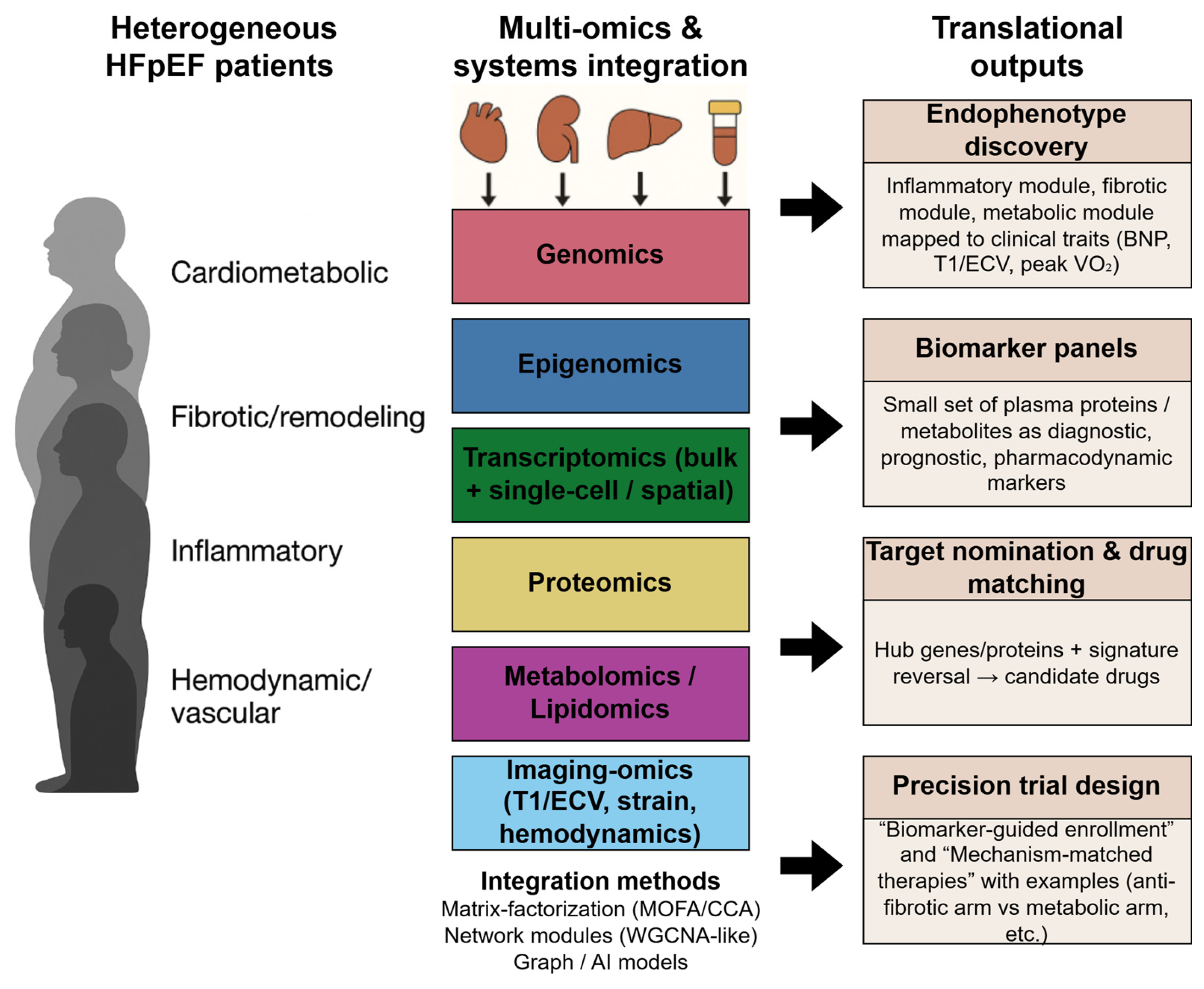
Addressing Unmet Needs in Heart Failure with Preserved Ejection Fraction: Multi-Omics Approaches to Therapeutic Discovery

Abstract
1. Introduction
2. The Challenge of Heterogeneity in HFpEF
2.1. Defining Endophenotypes in HFpEF
2.1.1. The Inflammatory Endophenotype
2.1.2. The Fibrotic Endophenotype
2.1.3. The Cardiometabolic Endophenotype
2.1.4. The Hemodynamic/Vascular Endophenotype
2.2. Shared Comorbidities and Systemic Cross-Talk
2.3. Why Heterogeneity Explains Trial Failures
2.4. Translational Implications of Heterogeneity
3. Limitations of Traditional Diagnostics and Therapeutics
3.1. Why Ejection Fraction, Natriuretic Peptides, and Imaging Fall Short
3.1.1. Ejection Fraction
3.1.2. Natriuretic Peptides
3.1.3. Imaging Modalities
3.2. Lessons from Major Clinical Trials
3.2.1. TOPCAT
3.2.2. PARAGON-HF
3.2.3. EMPEROR-Preserved
3.2.4. DELIVER
3.3. The Need for Phenotype-Specific Enrichment Strategies
4. Multi-Omics in Cardiovascular Research: Principles and Promise
4.1. Lessons from Other Disciplines
4.2. Emerging Omics Insights in HFpEF
5. Integrative Multi-Omics Framework for HFpEF
5.1. An Actionable Pipeline for Integrated Omics in HFpEF
5.1.1. Driver Nomination (Causal Prioritization)
5.1.2. Biomarker Discovery (Diagnostic, Prognostic, and Pharmacodynamic)
5.1.3. Target Nomination and Drug Matching
6. Practical Challenges and Solutions in Multi-Omics HFpEF Research
6.1. Cohort Design and Phenotyping
6.2. Batch Effects and Platform Drift
6.3. Causality vs. Correlation
6.4. Cost and Scalability
6.5. Reproducibility and Data Sharing
7. Future Directions in Precision Cardiology
7.1. AI- and Machine Learning-Based Multi-Omics Integration
7.2. Cross-Organ Multi-Omics and the Systems View of Heart Failure
7.3. Precision-Guided Clinical Trial Design
7.4. Collaborative Infrastructure and FAIR Data Ecosystems
8. Take-Home Messages
- HFpEF is not a single disease, but a heterogeneous syndrome composed of inflammatory, fibrotic, cardiometabolic, and hemodynamic/vascular endophenotypes.
- Traditional diagnostic tools (LVEF, natriuretic peptides, standard imaging) inadequately capture HFpEF biology and contribute to heterogeneous trial populations.
- Neutral or modest results of prior HFpEF trials largely reflect biological dilution rather than therapeutic inefficacy.
- Multi-omics approaches enable molecular stratification of HFpEF beyond clinical features, revealing mechanistically coherent endotypes.
- Integrative systems-biology frameworks linking genomics, transcriptomics, proteomics, and metabolomics can identify causal drivers, biomarkers, and drug targets.
- Network-based and genetic methods strengthen causal inference and prioritize actionable therapeutic targets.
- Biomarker-guided enrichment strategies offer a path toward mechanism-matched, precision clinical trials in HFpEF.
- Cross-organ and longitudinal multi-omics profiling is essential to capture HFpEF’s systemic nature.
- Successful implementation of precision cardiology will require standardized phenotyping, scalable omics pipelines, and FAIR data-sharing practices.
9. Conclusions
Author Contributions
Funding
Data Availability Statement
Acknowledgments
Conflicts of Interest
Abbreviations
| ACEi | Angiotensin-Converting Enzyme Inhibitor |
| ARB | Angiotensin Receptor Blocker |
| ARNI | Angiotensin Receptor–Neprilysin Inhibitor |
| BCAA | Branched-Chain Amino Acids |
| NP | Natriuretic Peptide |
| BNP | B-type Natriuretic Peptide |
| cGMP | Cyclic Guanosine Monophosphate |
| CRISPR | Clustered Regularly Interspaced Short Palindromic Repeats |
| DELIVER | Dapagliflozin Evaluation to Improve the Lives of Patients with Preserved Ejection Fraction Heart Failure |
| ECV | Extracellular Volume |
| EMPEROR-Preserved | Empagliflozin Outcome Trial in HFpEF |
| eQTL | Expression Quantitative Trait Locus |
| FAIR | Findable, Accessible, Interoperable, and Reusable |
| HF | Heart Failure |
| HFmrEF | Heart Failure with Mildly Reduced Ejection Fraction |
| HFpEF | Heart Failure with Preserved Ejection Fraction |
| HFrEF | Heart Failure with Reduced Ejection Fraction |
| LVEF | Left Ventricular Ejection Fraction |
| MOFA | Multi-Omics Factor Analysis |
| MRI | Magnetic Resonance Imaging |
| MRA | Mineralocorticoid Receptor Antagonist |
| NO | Nitric Oxide |
| NT-proBNP | N-terminal pro–B-type Natriuretic Peptide |
| PARAGON-HF | Prospective Comparison of ARNI with ARB Global Outcomes in HF with Preserved Ejection Fraction |
| PICP | Procollagen Type I C-Peptide |
| PIIINP | Procollagen Type III N-Terminal Propeptide |
| PKG | Protein Kinase G |
| pQTL | Protein Quantitative Trait Locus |
| QTL | Quantitative Trait Locus |
| RNA-seq | RNA Sequencing |
| RV | Right Ventricle/Right Ventricular |
| SGLT2 | Sodium–Glucose Cotransporter-2 |
| smFISH | Single-Molecule Fluorescence In Situ Hybridization |
| TOPCAT | Treatment of Preserved Cardiac Function Heart Failure with an Aldosterone Antagonist |
| TWAS | Transcriptome-Wide Association Study |
| WGCNA | Weighted Gene Co-Expression Network Analysis |
| CKD | Chronic Kidney Disease |
| CMR | Cardiovascular Magnetic Resonance |
| RAAS | Renin–Angiotensin–Aldosterone System |
| NAFLD | Nonalcoholic Fatty Liver Disease |
| HTN | Hypertension |
| CCA | Canonical Correlation Analysis |
| PRIDE | PRoteomics IDentifications Exchange |
| GEO | Gene Expression Omnibus |
References
- Tanai, E.; Frantz, S. Pathophysiology of Heart Failure. Compr. Physiol. 2015, 6, 187–214. [Google Scholar] [CrossRef]
- Bozkurt, B.; Coats, A.J.S.; Tsutsui, H.; Abdelhamid, C.M.; Adamopoulos, S.; Albert, N.; Anker, S.D.; Atherton, J.; Bohm, M.; Butler, J.; et al. Universal definition and classification of heart failure: A report of the Heart Failure Society of America, Heart Failure Association of the European Society of Cardiology, Japanese Heart Failure Society and Writing Committee of the Universal Definition of Heart Failure: Endorsed by the Canadian Heart Failure Society, Heart Failure Association of India, Cardiac Society of Australia and New Zealand, and Chinese Heart Failure Association. Eur. J. Heart Fail. 2021, 23, 352–380. [Google Scholar] [CrossRef] [PubMed]
- Simmonds, S.J.; Cuijpers, I.; Heymans, S.; Jones, E.A.V. Cellular and Molecular Differences between HFpEF and HFrEF: A Step Ahead in an Improved Pathological Understanding. Cells 2020, 9, 242. [Google Scholar] [CrossRef]
- Youn, J.C.; Ahn, Y.; Jung, H.O. Pathophysiology of Heart Failure with Preserved Ejection Fraction. Heart Fail. Clin. 2021, 17, 327–335. [Google Scholar] [CrossRef] [PubMed]
- Campbell, P.; Rutten, F.H.; Lee, M.M.; Hawkins, N.M.; Petrie, M.C. Heart failure with preserved ejection fraction: Everything the clinician needs to know. Lancet 2024, 403, 1083–1092, Correction in Lancet 2024, 403, 1026. [Google Scholar] [CrossRef] [PubMed]
- Lin, Y.; Fu, S.; Yao, Y.; Li, Y.; Zhao, Y.; Luo, L. Heart failure with preserved ejection fraction based on aging and comorbidities. J. Transl. Med. 2021, 19, 291. [Google Scholar] [CrossRef]
- Shahim, A.; Hourqueig, M.; Lund, L.H.; Savarese, G.; Oger, E.; Venkateshvaran, A.; Benson, L.; Daubert, J.C.; Linde, C.; Donal, E.; et al. Long-term outcomes in heart failure with preserved ejection fraction: Predictors of cardiac and non-cardiac mortality. ESC Heart Fail. 2023, 10, 1835–1846. [Google Scholar] [CrossRef]
- Tribouilloy, C.; Rusinaru, D.; Mahjoub, H.; Souliere, V.; Levy, F.; Peltier, M.; Slama, M.; Massy, Z. Prognosis of heart failure with preserved ejection fraction: A 5 year prospective population-based study. Eur. Heart J. 2008, 29, 339–347. [Google Scholar] [CrossRef]
- Heidenreich, P.A.; Albert, N.M.; Allen, L.A.; Bluemke, D.A.; Butler, J.; Fonarow, G.C.; Ikonomidis, J.S.; Khavjou, O.; Konstam, M.A.; Maddox, T.M.; et al. Forecasting the impact of heart failure in the United States: A policy statement from the American Heart Association. Circ. Heart Fail. 2013, 6, 606–619. [Google Scholar] [CrossRef]
- Butler, J.; Fonarow, G.C.; Zile, M.R.; Lam, C.S.; Roessig, L.; Schelbert, E.B.; Shah, S.J.; Ahmed, A.; Bonow, R.O.; Cleland, J.G.; et al. Developing therapies for heart failure with preserved ejection fraction: Current state and future directions. JACC Heart Fail. 2014, 2, 97–112. [Google Scholar] [CrossRef]
- Pfeffer, M.A.; Claggett, B.; Assmann, S.F.; Boineau, R.; Anand, I.S.; Clausell, N.; Desai, A.S.; Diaz, R.; Fleg, J.L.; Gordeev, I.; et al. Regional variation in patients and outcomes in the Treatment of Preserved Cardiac Function Heart Failure with an Aldosterone Antagonist (TOPCAT) trial. Circulation 2015, 131, 34–42. [Google Scholar] [CrossRef] [PubMed]
- Rasooly, D.; Pereira, A.C.; Joseph, J. Drug Discovery and Development for Heart Failure Using Multi-Omics Approaches. Int. J. Mol. Sci. 2025, 26, 2703. [Google Scholar] [CrossRef]
- Jani, V.P.; Yoo, E.J.; Binek, A.; Guo, A.; Kim, J.S.; Aguilan, J.; Keykhaei, M.; Jenkin, S.R.; Sidoli, S.; Sharma, K.; et al. Myocardial Proteome in Human Heart Failure with Preserved Ejection Fraction. J. Am. Heart Assoc. 2025, 14, e038945. [Google Scholar] [CrossRef]
- Shah, S.J.; Katz, D.H.; Selvaraj, S.; Burke, M.A.; Yancy, C.W.; Gheorghiade, M.; Bonow, R.O.; Huang, C.C.; Deo, R.C. Phenomapping for novel classification of heart failure with preserved ejection fraction. Circulation 2015, 131, 269–279. [Google Scholar] [CrossRef] [PubMed]
- Kaplon-Cieslicka, A.; Kupczynska, K.; Dobrowolski, P.; Michalski, B.; Jaguszewski, M.J.; Banasiak, W.; Burchardt, P.; Chrzanowski, L.; Darocha, S.; Domienik-Karlowicz, J.; et al. On the search for the right definition of heart failure with preserved ejection fraction. Cardiol. J. 2020, 27, 449–468. [Google Scholar] [CrossRef] [PubMed]
- Anker, S.D.; Usman, M.S.; Anker, M.S.; Butler, J.; Bohm, M.; Abraham, W.T.; Adamo, M.; Chopra, V.K.; Cicoira, M.; Cosentino, F.; et al. Patient phenotype profiling in heart failure with preserved ejection fraction to guide therapeutic decision making. A scientific statement of the Heart Failure Association, the European Heart Rhythm Association of the European Society of Cardiology, and the European Society of Hypertension. Eur. J. Heart Fail. 2023, 25, 936–955. [Google Scholar] [CrossRef]
- Joseph, J.; Liu, C.; Hui, Q.; Aragam, K.; Wang, Z.; Charest, B.; Huffman, J.E.; Keaton, J.M.; Edwards, T.L.; Demissie, S.; et al. Genetic architecture of heart failure with preserved versus reduced ejection fraction. Nat. Commun. 2022, 13, 7753. [Google Scholar] [CrossRef]
- Palazzuoli, A.; Caravita, S.; Paolillo, S.; Ghio, S.; Tocchetti, C.G.; Ruocco, G.; Correale, M.; Ambrosio, G.; Perrone Filardi, P.; Senni, M.; et al. Current gaps in HFpEF trials: Time to reconsider patients’ selection and to target phenotypes. Prog. Cardiovasc. Dis. 2021, 67, 89–97. [Google Scholar] [CrossRef]
- Sethi, Y.; Patel, N.; Kaka, N.; Kaiwan, O.; Kar, J.; Moinuddin, A.; Goel, A.; Chopra, H.; Cavalu, S. Precision Medicine and the future of Cardiovascular Diseases: A Clinically Oriented Comprehensive Review. J. Clin. Med. 2023, 12, 1799. [Google Scholar] [CrossRef]
- Shin, S.H.; Bode, A.M.; Dong, Z. Addressing the challenges of applying precision oncology. NPJ Precis. Oncol. 2017, 1, 28. [Google Scholar] [CrossRef]
- Bayes-Genis, A.; Liu, P.P.; Lanfear, D.E.; de Boer, R.A.; Gonzalez, A.; Thum, T.; Emdin, M.; Januzzi, J.L. Omics phenotyping in heart failure: The next frontier. Eur. Heart J. 2020, 41, 3477–3484. [Google Scholar] [CrossRef] [PubMed]
- Reitz, C.J.; Kuzmanov, U.; Gramolini, A.O. Multi-omic analyses and network biology in cardiovascular disease. Proteomics 2023, 23, e2200289. [Google Scholar] [CrossRef] [PubMed]
- Gabbin, B.; Meraviglia, V.; Mummery, C.L.; Rabelink, T.J.; van Meer, B.J.; van den Berg, C.W.; Bellin, M. Toward Human Models of Cardiorenal Syndrome in vitro. Front. Cardiovasc. Med. 2022, 9, 889553. [Google Scholar] [CrossRef] [PubMed]
- Gabbin, B.; Meraviglia, V.; Angenent, M.L.; Ward-van Oostwaard, D.; Sol, W.; Mummery, C.L.; Rabelink, T.J.; van Meer, B.J.; van den Berg, C.W.; Bellin, M. Heart and kidney organoids maintain organ-specific function in a microfluidic system. Mater. Today Bio 2023, 23, 100818. [Google Scholar] [CrossRef]
- Yildirim, Z.; Swanson, K.; Wu, X.; Zou, J.; Wu, J. Next-Gen Therapeutics: Pioneering Drug Discovery with iPSCs, Genomics, AI, and Clinical Trials in a Dish. Annu. Rev. Pharmacol. Toxicol. 2025, 65, 71–90. [Google Scholar] [CrossRef]
- Zhou, R.; Xia, Y.Y.; Li, Z.; Wu, L.D.; Shi, Y.; Ling, Z.Y.; Zhang, J.X. HFpEF as systemic disease, insight from a diagnostic prediction model reminiscent of systemic inflammation and organ interaction in HFpEF patients. Sci. Rep. 2024, 14, 5386. [Google Scholar] [CrossRef]
- Shah, A.M.; Myhre, P.L.; Arthur, V.; Dorbala, P.; Rasheed, H.; Buckley, L.F.; Claggett, B.; Liu, G.; Ma, J.; Nguyen, N.Q.; et al. Large scale plasma proteomics identifies novel proteins and protein networks associated with heart failure development. Nat. Commun. 2024, 15, 528. [Google Scholar] [CrossRef]
- Kriegel, A.J.; Gartz, M.; Afzal, M.Z.; de Lange, W.J.; Ralphe, J.C.; Strande, J.L. Molecular Approaches in HFpEF: MicroRNAs and iPSC-Derived Cardiomyocytes. J. Cardiovasc. Transl. Res. 2017, 10, 295–304. [Google Scholar] [CrossRef]
- Shahim, B.; Kapelios, C.J.; Savarese, G.; Lund, L.H. Global Public Health Burden of Heart Failure: An Updated Review. Card. Fail. Rev. 2023, 9, e11. [Google Scholar] [CrossRef]
- Heinzel, F.R.; Shah, S.J. The future of heart failure with preserved ejection fraction: Deep phenotyping for targeted therapeutics. Perspektiven bei Herzinsuffizienz mit erhaltener Ejektionsfraktion: Zielgerichtete Therapie durch tiefe Phanotypisierung. Herz 2022, 47, 308–323. [Google Scholar] [CrossRef]
- Borlaug, B.A. The pathophysiology of heart failure with preserved ejection fraction. Nat. Rev. Cardiol. 2014, 11, 507–515. [Google Scholar] [CrossRef]
- Epelde, F. Heterogeneity in Heart Failure with Preserved Ejection Fraction: A Systematic Review of Phenotypic Classifications and Clinical Implications. J. Clin. Med. 2025, 14, 4820. [Google Scholar] [CrossRef]
- Peh, Z.H.; Dihoum, A.; Hutton, D.; Arthur, J.S.C.; Rena, G.; Khan, F.; Lang, C.C.; Mordi, I.R. Inflammation as a therapeutic target in heart failure with preserved ejection fraction. Front. Cardiovasc. Med. 2023, 10, 1125687. [Google Scholar] [CrossRef]
- Hutten, C.G.; Tekumulla, A.; Ismail, A.; Vasbinder, A.; Farhat, T.; Kunkle, P.; Goonewardena, S.N.; Abdel-Latif, A.; Pitt, B.; Hayek, S.S. Soluble urokinase plasminogen activator receptor and outcomes in HFpEF: A TOPCAT ancillary study. ESC Heart Fail. 2025, 12, 4208–4218. [Google Scholar] [CrossRef] [PubMed]
- Hunter, W.G.; Kelly, J.P.; McGarrah, R.W., 3rd; Khouri, M.G.; Craig, D.; Haynes, C.; Ilkayeva, O.; Stevens, R.D.; Bain, J.R.; Muehlbauer, M.J.; et al. Metabolomic Profiling Identifies Novel Circulating Biomarkers of Mitochondrial Dysfunction Differentially Elevated in Heart Failure with Preserved Versus Reduced Ejection Fraction: Evidence for Shared Metabolic Impairments in Clinical Heart Failure. J. Am. Heart Assoc. 2016, 5, e003190. [Google Scholar] [CrossRef] [PubMed]
- O’Sullivan, J.F.; Li, M.; Koay, Y.C.; Wang, X.S.; Guglielmi, G.; Marques, F.Z.; Nanayakkara, S.; Mariani, J.; Slaughter, E.; Kaye, D.M. Cardiac Substrate Utilization and Relationship to Invasive Exercise Hemodynamic Parameters in HFpEF. JACC Basic Transl. Sci. 2024, 9, 281–299. [Google Scholar] [CrossRef]
- van Dalen, B.M.; Chin, J.F.; Motiram, P.A.; Hendrix, A.; Emans, M.E.; Brugts, J.J.; Westenbrink, B.D.; de Boer, R.A. Challenges in the diagnosis of heart failure with preserved ejection fraction in individuals with obesity. Cardiovasc. Diabetol. 2025, 24, 71. [Google Scholar] [CrossRef] [PubMed]
- Remmelzwaal, S.; van Ballegooijen, A.J.; Schoonmade, L.J.; Dal Canto, E.; Handoko, M.L.; Henkens, M.; van Empel, V.; Heymans, S.R.B.; Beulens, J.W.J. Natriuretic peptides for the detection of diastolic dysfunction and heart failure with preserved ejection fraction-a systematic review and meta-analysis. BMC Med. 2020, 18, 290. [Google Scholar] [CrossRef]
- Lau, E.S.; Panah, L.G.; Zern, E.K.; Liu, E.E.; Farrell, R.; Schoenike, M.W.; Namasivayam, M.; Churchill, T.W.; Curreri, L.; Malhotra, R.; et al. Arterial Stiffness and Vascular Load in HFpEF: Differences Among Women and Men. J. Card. Fail. 2022, 28, 202–211. [Google Scholar] [CrossRef]
- Borbely, A.; van der Velden, J.; Papp, Z.; Bronzwaer, J.G.; Edes, I.; Stienen, G.J.; Paulus, W.J. Cardiomyocyte stiffness in diastolic heart failure. Circulation 2005, 111, 774–781. [Google Scholar] [CrossRef]
- Paulus, W.J.; Tschope, C. A novel paradigm for heart failure with preserved ejection fraction: Comorbidities drive myocardial dysfunction and remodeling through coronary microvascular endothelial inflammation. J. Am. Coll. Cardiol. 2013, 62, 263–271. [Google Scholar] [CrossRef] [PubMed]
- Aboonabi, A.; McCauley, M.D. Myofilament dysfunction in diastolic heart failure. Heart Fail. Rev. 2024, 29, 79–93. [Google Scholar] [CrossRef] [PubMed]
- Nikolov, A.; Popovski, N. Extracellular Matrix in Heart Disease: Focus on Circulating Collagen Type I and III Derived Peptides as Biomarkers of Myocardial Fibrosis and Their Potential in the Prognosis of Heart Failure: A Concise Review. Metabolites 2022, 12, 297. [Google Scholar] [CrossRef] [PubMed]
- Peikert, A.; Fontana, M.; Solomon, S.D.; Thum, T. Left ventricular hypertrophy and myocardial fibrosis in heart failure with preserved ejection fraction: Mechanisms and treatment. Eur. Heart J. 2025, ehaf524. [Google Scholar] [CrossRef]
- Zhou, D.; Lin, S.; Liu, Z.; Yuan, J.; Ren, H.; Tan, H.; Guo, Y.; Jiang, X. Metabolic syndrome, left ventricular diastolic dysfunction and heart failure with preserved ejective fraction. Front. Endocrinol. 2025, 16, 1544908. [Google Scholar] [CrossRef]
- Lee, C.J.M.; Kosyakovsky, L.B.; Khan, M.S.; Wu, F.; Chen, G.; Hill, J.A.; Ho, J.E.; Foo, R.S.; Zannad, F. Cardiovascular, Kidney, Liver, and Metabolic Interactions in Heart Failure: Breaking Down Silos. Circ. Res. 2025, 136, 1170–1207. [Google Scholar] [CrossRef]
- Lin, C.Y.; Sung, H.Y.; Chen, Y.J.; Yeh, H.I.; Hou, C.J.; Tsai, C.T.; Hung, C.L. Personalized Management for Heart Failure with Preserved Ejection Fraction. J. Pers. Med. 2023, 13, 746. [Google Scholar] [CrossRef]
- Rasooly, D.; Giambartolomei, C.; Peloso, G.M.; Dashti, H.; Ferolito, B.R.; Golden, D.; Horimoto, A.; Pietzner, M.; Farber-Eger, E.H.; Wells, Q.S.; et al. Large-scale multi-omics identifies drug targets for heart failure with reduced and preserved ejection fraction. Nat. Cardiovasc. Res. 2025, 4, 293–311. [Google Scholar] [CrossRef]
- Peters, A.E.; Tromp, J.; Shah, S.J.; Lam, C.S.P.; Lewis, G.D.; Borlaug, B.A.; Sharma, K.; Pandey, A.; Sweitzer, N.K.; Kitzman, D.W.; et al. Phenomapping in heart failure with preserved ejection fraction: Insights, limitations, and future directions. Cardiovasc. Res. 2023, 118, 3403–3415, Correction in Cardiovasc. Res. 2023, 119, 1096. [Google Scholar] [CrossRef]
- Israr, M.Z.; Heaney, L.M.; Suzuki, T. Proteomic Biomarkers of Heart Failure. Heart Fail. Clin. 2018, 14, 93–107. [Google Scholar] [CrossRef]
- Wu, C.K.; Su, M.M.; Wu, Y.F.; Hwang, J.J.; Lin, L.Y. Combination of Plasma Biomarkers and Clinical Data for the Detection of Myocardial Fibrosis or Aggravation of Heart Failure Symptoms in Heart Failure with Preserved Ejection Fraction Patients. J. Clin. Med. 2018, 7, 427. [Google Scholar] [CrossRef]
- Zaborska, B.; Sikora-Frac, M.; Smarz, K.; Pilichowska-Paszkiet, E.; Budaj, A.; Sitkiewicz, D.; Sygitowicz, G. The Role of Galectin-3 in Heart Failure-The Diagnostic, Prognostic and Therapeutic Potential-Where Do We Stand? Int. J. Mol. Sci. 2023, 24, 13111. [Google Scholar] [CrossRef] [PubMed]
- Gorica, E.; Geiger, M.A.; Di Venanzio, L.; Atzemian, N.; Kleeberger, J.A.; Grigorian, D.; Mongelli, A.; Emini Veseli, B.; Mohammed, S.A.; Ruschitzka, F.; et al. Cardiometabolic heart failure with preserved ejection fraction: From molecular signatures to personalized treatment. Cardiovasc. Diabetol. 2025, 24, 265. [Google Scholar] [CrossRef] [PubMed]
- Schiattarella, G.G.; Alcaide, P.; Condorelli, G.; Gillette, T.G.; Heymans, S.; Jones, E.A.V.; Kallikourdis, M.; Lichtman, A.; Marelli-Berg, F.; Shah, S.; et al. Immunometabolic Mechanisms of Heart Failure with Preserved Ejection Fraction. Nat. Cardiovasc. Res. 2022, 1, 211–222. [Google Scholar] [CrossRef] [PubMed]
- Hernandez-Resendiz, S.; Prakash, A.; Loo, S.J.; Semenzato, M.; Chinda, K.; Crespo-Avilan, G.E.; Dam, L.C.; Lu, S.; Scorrano, L.; Hausenloy, D.J. Targeting mitochondrial shape: At the heart of cardioprotection. Basic Res. Cardiol. 2023, 118, 49. [Google Scholar] [CrossRef]
- Boutagy, N.E.; Singh, A.K.; Sessa, W.C. Targeting the vasculature in cardiometabolic disease. J. Clin. Investig. 2022, 132, e148556. [Google Scholar] [CrossRef]
- McMurray, J.J.V.; Jackson, A.M.; Lam, C.S.P.; Redfield, M.M.; Anand, I.S.; Ge, J.; Lefkowitz, M.P.; Maggioni, A.P.; Martinez, F.; Packer, M.; et al. Effects of Sacubitril-Valsartan Versus Valsartan in Women Compared with Men with Heart Failure and Preserved Ejection Fraction: Insights from PARAGON-HF. Circulation 2020, 141, 338–351. [Google Scholar] [CrossRef]
- Zhang, Z.; Wang, Y.; Chen, X.; Wu, C.; Zhou, J.; Chen, Y.; Liu, X.; Tang, X. The aging heart in focus: The advanced understanding of heart failure with preserved ejection fraction. Ageing Res. Rev. 2024, 101, 102542. [Google Scholar] [CrossRef]
- Guaricci, A.I.; Sturda, F.; Russo, R.; Basile, P.; Baggiano, A.; Mushtaq, S.; Fusini, L.; Fazzari, F.; Bertandino, F.; Monitillo, F.; et al. Assessment and management of heart failure in patients with chronic kidney disease. Heart Fail. Rev. 2024, 29, 379–394. [Google Scholar] [CrossRef]
- Packer, M.; Lam, C.S.P.; Lund, L.H.; Maurer, M.S.; Borlaug, B.A. Characterization of the inflammatory-metabolic phenotype of heart failure with a preserved ejection fraction: A hypothesis to explain influence of sex on the evolution and potential treatment of the disease. Eur. J. Heart Fail. 2020, 22, 1551–1567. [Google Scholar] [CrossRef]
- Lund, L.H.; Savarese, G.; Venkateshvaran, A.; Benson, L.; Lundberg, A.; Donal, E.; Daubert, J.C.; Oger, E.; Linde, C.; Hage, C. Eligibility of patients with heart failure with preserved ejection fraction for sacubitril/valsartan according to the PARAGON-HF trial. ESC Heart Fail. 2022, 9, 164–177. [Google Scholar] [CrossRef] [PubMed]
- Anker, S.D.; Butler, J.; Filippatos, G.; Ferreira, J.P.; Bocchi, E.; Bohm, M.; Brunner-La Rocca, H.P.; Choi, D.J.; Chopra, V.; Chuquiure-Valenzuela, E.; et al. Empagliflozin in Heart Failure with a Preserved Ejection Fraction. N. Engl. J. Med. 2021, 385, 1451–1461. [Google Scholar] [CrossRef] [PubMed]
- Echouffo-Tcheugui, J.B.; Lewsey, S.C.; Weiss, R.G. SGLT2 inhibitors: Further evidence for heart failure with preserved ejection fraction as a metabolic disease? J. Clin. Investig. 2021, 131, e156309. [Google Scholar] [CrossRef] [PubMed]
- van de Veerdonk, M.C.; Savarese, G.; Handoko, M.L.; Beulens, J.W.J.; Asselbergs, F.; Uijl, A. Multimorbidity in Heart Failure: Leveraging Cluster Analysis to Guide Tailored Treatment Strategies. Curr. Heart Fail. Rep. 2023, 20, 461–470. [Google Scholar] [CrossRef]
- Rosano, G.M.C.; Vitale, C.; Spoletini, I. Precision Cardiology: Phenotype-targeted Therapies for HFmrEF and HFpEF. Int. J. Heart Fail. 2024, 6, 47–55. [Google Scholar] [CrossRef]
- Desai, N.; Olewinska, E.; Famulska, A.; Remuzat, C.; Francois, C.; Folkerts, K. Heart failure with mildly reduced and preserved ejection fraction: A review of disease burden and remaining unmet medical needs within a new treatment landscape. Heart Fail. Rev. 2024, 29, 631–662. [Google Scholar] [CrossRef]
- Formiga, F.; Nunez, J.; Castillo Moraga, M.J.; Cobo Marcos, M.; Egocheaga, M.I.; Garcia-Prieto, C.F.; Trueba-Saiz, A.; Matali Gilarranz, A.; Fernandez Rodriguez, J.M. Diagnosis of heart failure with preserved ejection fraction: A systematic narrative review of the evidence. Heart Fail. Rev. 2024, 29, 179–189, Correction in Heart Fail. Rev. 2024, 29, 301. [Google Scholar] [CrossRef]
- Guo, X.; Song, Y.; Liu, S.; Gao, M.; Qi, Y.; Shang, X. Linking genotype to phenotype in multi-omics data of small sample. BMC Genom. 2021, 22, 537. [Google Scholar] [CrossRef]
- Hagendorff, A.; Helfen, A.; Brandt, R.; Altiok, E.; Breithardt, O.; Haghi, D.; Knierim, J.; Lavall, D.; Merke, N.; Sinning, C.; et al. Expert proposal to characterize cardiac diseases with normal or preserved left ventricular ejection fraction and symptoms of heart failure by comprehensive echocardiography. Clin. Res. Cardiol. 2023, 112, 1–38. [Google Scholar] [CrossRef]
- Solomon, S.D.; Ostrominski, J.W.; Vaduganathan, M.; Claggett, B.; Jhund, P.S.; Desai, A.S.; Lam, C.S.P.; Pitt, B.; Senni, M.; Shah, S.J.; et al. Baseline characteristics of patients with heart failure with mildly reduced or preserved ejection fraction: The FINEARTS-HF trial. Eur. J. Heart Fail. 2024, 26, 1334–1346. [Google Scholar] [CrossRef]
- Forman, D.E.; de Lemos, J.A.; Shaw, L.J.; Reuben, D.B.; Lyubarova, R.; Peterson, E.D.; Spertus, J.A.; Zieman, S.; Salive, M.E.; Rich, M.W.; et al. Cardiovascular Biomarkers and Imaging in Older Adults: JACC Council Perspectives. J. Am. Coll. Cardiol. 2020, 76, 1577–1594. [Google Scholar] [CrossRef] [PubMed]
- Raymond, I.; Groenning, B.A.; Hildebrandt, P.R.; Nilsson, J.C.; Baumann, M.; Trawinski, J.; Pedersen, F. The influence of age, sex and other variables on the plasma level of N-terminal pro brain natriuretic peptide in a large sample of the general population. Heart 2003, 89, 745–751. [Google Scholar] [CrossRef] [PubMed]
- Singh, S.; Pandey, A.; Neeland, I.J. Diagnostic and prognostic considerations for use of natriuretic peptides in obese patients with heart failure. Prog. Cardiovasc. Dis. 2020, 63, 649–655. [Google Scholar] [CrossRef] [PubMed]
- Kozhuharov, N.; Martin, J.; Wussler, D.; Lopez-Ayala, P.; Belkin, M.; Strebel, I.; Flores, D.; Diebold, M.; Shrestha, S.; Nowak, A.; et al. Clinical effect of obesity on N-terminal pro-B-type natriuretic peptide cut-off concentrations for the diagnosis of acute heart failure. Eur. J. Heart Fail. 2022, 24, 1545–1554. [Google Scholar] [CrossRef]
- Pitt, B.; Pfeffer, M.A.; Assmann, S.F.; Boineau, R.; Anand, I.S.; Claggett, B.; Clausell, N.; Desai, A.S.; Diaz, R.; Fleg, J.L.; et al. Spironolactone for heart failure with preserved ejection fraction. N. Engl. J. Med. 2014, 370, 1383–1392. [Google Scholar] [CrossRef]
- Zawadzka, M.M.; Grabowski, M.; Kaplon-Cieslicka, A. Phenotyping in heart failure with preserved ejection fraction: A key to find effective treatment. Adv. Clin. Exp. Med. 2022, 31, 1163–1172. [Google Scholar] [CrossRef]
- Clerico, A.; Zaninotto, M.; Passino, C.; Plebani, M. Obese phenotype and natriuretic peptides in patients with heart failure with preserved ejection fraction. Clin. Chem. Lab. Med. 2018, 56, 1015–1025. [Google Scholar] [CrossRef]
- Kim, H.Y.; Park, S.J.; Lee, S.C.; Chang, S.Y.; Kim, E.K.; Chang, S.A.; Choi, J.O.; Park, S.W.; Kim, S.M.; Choe, Y.H.; et al. Comparison of global and regional myocardial strains in patients with heart failure with a preserved ejection fraction vs hypertension vs age-matched control. Cardiovasc. Ultrasound 2020, 18, 44. [Google Scholar] [CrossRef]
- Del Torto, A.; Guaricci, A.I.; Pomarico, F.; Guglielmo, M.; Fusini, L.; Monitillo, F.; Santoro, D.; Vannini, M.; Rossi, A.; Muscogiuri, G.; et al. Advances in Multimodality Cardiovascular Imaging in the Diagnosis of Heart Failure with Preserved Ejection Fraction. Front. Cardiovasc. Med. 2022, 9, 758975. [Google Scholar] [CrossRef]
- Scatteia, A.; Dellegrottaglie, S. Cardiac magnetic resonance in ischemic cardiomyopathy: Present role and future directions. Eur. Heart J. Suppl. 2023, 25, C58–C62. [Google Scholar] [CrossRef]
- Wattanachayakul, P.; Kittipibul, V.; Salah, H.M.; Yaku, H.; Gustafsson, F.; Baratto, C.; Caravita, S.; Fudim, M. Invasive haemodynamic assessment in heart failure with preserved ejection fraction. ESC Heart Fail. 2025, 12, 1558–1570. [Google Scholar] [CrossRef] [PubMed]
- Albani, S.; Zilio, F.; Scicchitano, P.; Musella, F.; Ceriello, L.; Marini, M.; Gori, M.; Khoury, G.; D’Andrea, A.; Campana, M.; et al. Comprehensive diagnostic workup in patients with suspected heart failure and preserved ejection fraction. Hell. J. Cardiol. 2024, 75, 60–73. [Google Scholar] [CrossRef] [PubMed]
- Patel, R.B.; Shah, S.J. Drug Targets for Heart Failure with Preserved Ejection Fraction: A Mechanistic Approach and Review of Contemporary Clinical Trials. Annu. Rev. Pharmacol. Toxicol. 2019, 59, 41–63. [Google Scholar] [CrossRef] [PubMed]
- Bayes-Genis, A.; Aimo, A.; Jhund, P.; Richards, M.; de Boer, R.A.; Arfsten, H.; Fabiani, I.; Lupon, J.; Anker, S.D.; Gonzalez, A.; et al. Biomarkers in heart failure clinical trials. A review from the Biomarkers Working Group of the Heart Failure Association of the European Society of Cardiology. Eur. J. Heart Fail. 2022, 24, 1767–1777, Correction in Eur. J. Heart Fail.. 2023, 25, 443. [Google Scholar] [CrossRef]
- Solomon, S.D.; McMurray, J.J.V.; Anand, I.S.; Ge, J.; Lam, C.S.P.; Maggioni, A.P.; Martinez, F.; Packer, M.; Pfeffer, M.A.; Pieske, B.; et al. Angiotensin-Neprilysin Inhibition in Heart Failure with Preserved Ejection Fraction. N. Engl. J. Med. 2019, 381, 1609–1620. [Google Scholar] [CrossRef]
- Savarese, G.; Uijl, A.; Lund, L.H.; Anker, S.D.; Asselbergs, F.; Fitchett, D.; Inzucchi, S.E.; Koudstaal, S.; Ofstad, A.P.; Schrage, B.; et al. Empagliflozin in Heart Failure with Predicted Preserved Versus Reduced Ejection Fraction: Data from the EMPA-REG OUTCOME Trial. J. Card. Fail. 2021, 27, 888–895. [Google Scholar] [CrossRef]
- Solomon, S.D.; McMurray, J.J.V.; Claggett, B.; de Boer, R.A.; DeMets, D.; Hernandez, A.F.; Inzucchi, S.E.; Kosiborod, M.N.; Lam, C.S.P.; Martinez, F.; et al. Dapagliflozin in Heart Failure with Mildly Reduced or Preserved Ejection Fraction. N. Engl. J. Med. 2022, 387, 1089–1098. [Google Scholar] [CrossRef]
- Wagdy, K.; Nagy, S. EMPEROR-Preserved: SGLT2 inhibitors breakthrough in the management of heart failure with preserved ejection fraction. Glob. Cardiol. Sci. Pract. 2021, 2021, e202117. [Google Scholar] [CrossRef]
- Matteucci, A.; Pandozi, C.; Bonanni, M.; Mariani, M.V.; Sgarra, L.; Nesti, L.; Pierucci, N.; La Fazia, V.M.; Lavalle, C.; Nardi, F.; et al. Impact of empagliflozin and dapagliflozin on sudden cardiac death: A systematic review and meta-analysis of adjudicated randomized evidence. Heart Rhythm 2025. [Google Scholar] [CrossRef]
- Galli, E.; Bourg, C.; Kosmala, W.; Oger, E.; Donal, E. Phenomapping Heart Failure with Preserved Ejection Fraction Using Machine Learning Cluster Analysis: Prognostic and Therapeutic Implications. Heart Fail. Clin. 2021, 17, 499–518. [Google Scholar] [CrossRef]
- Nassif, M.E.; Windsor, S.L.; Borlaug, B.A.; Kitzman, D.W.; Shah, S.J.; Tang, F.; Khariton, Y.; Malik, A.O.; Khumri, T.; Umpierrez, G.; et al. The SGLT2 inhibitor dapagliflozin in heart failure with preserved ejection fraction: A multicenter randomized trial. Nat. Med. 2021, 27, 1954–1960. [Google Scholar] [CrossRef]
- Nauffal, V.; Di Achille, P.; Klarqvist, M.D.R.; Cunningham, J.W.; Hill, M.C.; Pirruccello, J.P.; Weng, L.C.; Morrill, V.N.; Choi, S.H.; Khurshid, S.; et al. Genetics of myocardial interstitial fibrosis in the human heart and association with disease. Nat. Genet. 2023, 55, 777–786. [Google Scholar] [CrossRef] [PubMed]
- Palazzuoli, A.; Tramonte, F.; Beltrami, M. Laboratory and Metabolomic Fingerprint in Heart Failure with Preserved Ejection Fraction: From Clinical Classification to Biomarker Signature. Biomolecules 2023, 13, 173. [Google Scholar] [CrossRef] [PubMed]
- Delrue, C.; Speeckaert, M.M. Decoding Kidney Pathophysiology: Omics-Driven Approaches in Precision Medicine. J. Pers. Med. 2024, 14, 1157. [Google Scholar] [CrossRef] [PubMed]
- Raufaste-Cazavieille, V.; Santiago, R.; Droit, A. Multi-omics analysis: Paving the path toward achieving precision medicine in cancer treatment and immuno-oncology. Front. Mol. Biosci. 2022, 9, 962743. [Google Scholar] [CrossRef]
- Gonzalez-Reymundez, A.; Vazquez, A.I. Multi-omic signatures identify pan-cancer classes of tumors beyond tissue of origin. Sci. Rep. 2020, 10, 8341. [Google Scholar] [CrossRef]
- Ramazzotti, D.; Lal, A.; Wang, B.; Batzoglou, S.; Sidow, A. Multi-omic tumor data reveal diversity of molecular mechanisms that correlate with survival. Nat. Commun. 2018, 9, 4453. [Google Scholar] [CrossRef]
- Joensuu, H.; Fraser, J.; Wildiers, H.; Huovinen, R.; Auvinen, P.; Utriainen, M.; Nyandoto, P.; Villman, K.K.; Halonen, P.; Granstam-Bjorneklett, H.; et al. Effect of Adjuvant Trastuzumab for a Duration of 9 Weeks vs. 1 Year with Concomitant Chemotherapy for Early Human Epidermal Growth Factor Receptor 2-Positive Breast Cancer: The SOLD Randomized Clinical Trial. JAMA Oncol. 2018, 4, 1199–1206. [Google Scholar] [CrossRef]
- Lewis, W.E.; Hong, L.; Mott, F.E.; Simon, G.; Wu, C.C.; Rinsurongkawong, W.; Lee, J.J.; Lam, V.K.; Heymach, J.V.; Zhang, J.; et al. Efficacy of Targeted Inhibitors in Metastatic Lung Squamous Cell Carcinoma with EGFR or ALK Alterations. JTO Clin. Res. Rep. 2021, 2, 100237. [Google Scholar] [CrossRef]
- Gandara, D.R.; Agarwal, N.; Gupta, S.; Klempner, S.J.; Andrews, M.C.; Mahipal, A.; Subbiah, V.; Eskander, R.N.; Carbone, D.P.; Riess, J.W.; et al. Tumor mutational burden and survival on immune checkpoint inhibition in >8000 patients across 24 cancer types. J. Immunother. Cancer 2025, 13, e010311, Correction in J. Immunother. Cancer 2025, 13, e010311corr1. [Google Scholar] [CrossRef]
- Sha, Q.; Lyu, J.; Zhao, M.; Li, H.; Guo, M.; Sun, Q. Multi-Omics Analysis of Diabetic Nephropathy Reveals Potential New Mechanisms and Drug Targets. Front. Genet. 2020, 11, 616435. [Google Scholar] [CrossRef] [PubMed]
- Fava, A.; Buyon, J.; Mohan, C.; Zhang, T.; Belmont, H.M.; Izmirly, P.; Clancy, R.; Trujillo, J.M.; Fine, D.; Zhang, Y.; et al. Integrated urine proteomics and renal single-cell genomics identify an IFN-gamma response gradient in lupus nephritis. JCI Insight 2020, 5, e138345. [Google Scholar] [CrossRef] [PubMed]
- Adamo, L.; Yu, J.; Rocha-Resende, C.; Javaheri, A.; Head, R.D.; Mann, D.L. Proteomic Signatures of Heart Failure in Relation to Left Ventricular Ejection Fraction. J. Am. Coll. Cardiol. 2020, 76, 1982–1994. [Google Scholar] [CrossRef] [PubMed]
- Regan, J.A.; Truby, L.K.; Tahir, U.A.; Katz, D.H.; Nguyen, M.; Kwee, L.C.; Deng, S.; Wilson, J.G.; Mentz, R.J.; Kraus, W.E.; et al. Protein biomarkers of cardiac remodeling and inflammation associated with HFpEF and incident events. Sci. Rep. 2022, 12, 20072. [Google Scholar] [CrossRef]
- Culler, K.L.; Sinha, A.; Filipp, M.; Giro, P.; Allen, N.B.; Taylor, K.D.; Guo, X.; Thorp, E.; Freed, B.H.; Greenland, P.; et al. Metabolomic profiling identifies novel metabolites associated with cardiac dysfunction. Sci. Rep. 2024, 14, 20694. [Google Scholar] [CrossRef]
- Xiao, X.; Wu, W.; Mao, Q.; Li, B.; Wang, J.; Liu, S.; Zhao, H.; Long, E.; Wang, J. Single-cell transcriptomic profiling reveals cell type heterogeneity between HFpEF and HFrEF. Commun. Biol. 2025, 8, 1436. [Google Scholar] [CrossRef]
- Litvinukova, M.; Talavera-Lopez, C.; Maatz, H.; Reichart, D.; Worth, C.L.; Lindberg, E.L.; Kanda, M.; Polanski, K.; Heinig, M.; Lee, M.; et al. Cells of the adult human heart. Nature 2020, 588, 466–472. [Google Scholar] [CrossRef]
- Perry, A.S.; Amancherla, K.; Huang, X.; Lance, M.L.; Farber-Eger, E.; Gajjar, P.; Amrute, J.; Stolze, L.; Zhao, S.; Sheng, Q.; et al. Clinical-transcriptional prioritization of the circulating proteome in human heart failure. Cell Rep. Med. 2024, 5, 101704. [Google Scholar] [CrossRef]
- Giambartolomei, C.; Vukcevic, D.; Schadt, E.E.; Franke, L.; Hingorani, A.D.; Wallace, C.; Plagnol, V. Bayesian test for colocalisation between pairs of genetic association studies using summary statistics. PLoS Genet. 2014, 10, e1004383. [Google Scholar] [CrossRef]
- Gusev, A.; Ko, A.; Shi, H.; Bhatia, G.; Chung, W.; Penninx, B.W.; Jansen, R.; de Geus, E.J.; Boomsma, D.I.; Wright, F.A.; et al. Integrative approaches for large-scale transcriptome-wide association studies. Nat. Genet. 2016, 48, 245–252. [Google Scholar] [CrossRef]
- Subramanian, A.; Narayan, R.; Corsello, S.M.; Peck, D.D.; Natoli, T.E.; Lu, X.; Gould, J.; Davis, J.F.; Tubelli, A.A.; Asiedu, J.K.; et al. A Next Generation Connectivity Map: L1000 Platform and the First 1,000,000 Profiles. Cell 2017, 171, 1437–1452 e1417. [Google Scholar] [CrossRef] [PubMed]
- Langfelder, P.; Horvath, S. WGCNA: An R package for weighted correlation network analysis. BMC Bioinform. 2008, 9, 559. [Google Scholar] [CrossRef] [PubMed]
- Argelaguet, R.; Velten, B.; Arnol, D.; Dietrich, S.; Zenz, T.; Marioni, J.C.; Buettner, F.; Huber, W.; Stegle, O. Multi-Omics Factor Analysis-a framework for unsupervised integration of multi-omics data sets. Mol. Syst. Biol. 2018, 14, e8124. [Google Scholar] [CrossRef] [PubMed]
- Lau, E.S.; Roshandelpoor, A.; Zarbafian, S.; Wang, D.; Guseh, J.S.; Allen, N.; Varadarajan, V.; Nayor, M.; Shah, R.V.; Lima, J.A.C.; et al. Eicosanoid and eicosanoid-related inflammatory mediators and exercise intolerance in heart failure with preserved ejection fraction. Nat. Commun. 2023, 14, 7557. [Google Scholar] [CrossRef]
- Tibshirani, R. Regression Shrinkage and Selection Via the Lasso. J. R. Stat. Soc. Ser. B Stat. Methodol. 1996, 58, 267–288. [Google Scholar] [CrossRef]
- Zou, H.; Hastie, T. Regularization and Variable Selection Via the Elastic Net. J. R. Stat. Soc. Ser. B Stat. Methodol. 2005, 67, 301–320. [Google Scholar] [CrossRef]
- Juncheng, J.; Lei, C.; Hao, L.; Fei, L. Integrated analysis of gene networks and cellular functions identifies novel heart failure biomarkers. Hereditas 2025, 162, 152. [Google Scholar] [CrossRef]
- Kolur, V.; Vastrad, B.; Vastrad, C.; Kotturshetti, S.; Tengli, A. Identification of candidate biomarkers and therapeutic agents for heart failure by bioinformatics analysis. BMC Cardiovasc. Disord. 2021, 21, 329. [Google Scholar] [CrossRef]
- Bian, W.; Wang, Z.; Li, X.; Jiang, X.X.; Zhang, H.; Liu, Z.; Zhang, D.M. Identification of vital modules and genes associated with heart failure based on weighted gene coexpression network analysis. ESC Heart Fail. 2022, 9, 1370–1379. [Google Scholar] [CrossRef]
- Levin, M.G.; Tsao, N.L.; Singhal, P.; Liu, C.; Vy, H.M.T.; Paranjpe, I.; Backman, J.D.; Bellomo, T.R.; Bone, W.P.; Biddinger, K.J.; et al. Genome-wide association and multi-trait analyses characterize the common genetic architecture of heart failure. Nat. Commun. 2022, 13, 6914. [Google Scholar] [CrossRef]
- Schmidt, A.F.; Bourfiss, M.; Alasiri, A.; Puyol-Anton, E.; Chopade, S.; van Vugt, M.; van der Laan, S.W.; Gross, C.; Clarkson, C.; Henry, A.; et al. Druggable proteins influencing cardiac structure and function: Implications for heart failure therapies and cancer cardiotoxicity. Sci. Adv. 2023, 9, eadd4984. [Google Scholar] [CrossRef] [PubMed]
- Xie, L.; He, S.; Wen, Y.; Bo, X.; Zhang, Z. Discovery of novel therapeutic properties of drugs from transcriptional responses based on multi-label classification. Sci. Rep. 2017, 7, 7136. [Google Scholar] [CrossRef] [PubMed]
- Zhang, S.D.; Gant, T.W. A simple and robust method for connecting small-molecule drugs using gene-expression signatures. BMC Bioinform. 2008, 9, 258. [Google Scholar] [CrossRef] [PubMed]
- Lewis, G.A.; Schelbert, E.B.; Naish, J.H.; Bedson, E.; Dodd, S.; Eccleson, H.; Clayton, D.; Jimenez, B.D.; McDonagh, T.; Williams, S.G.; et al. Pirfenidone in Heart Failure with Preserved Ejection Fraction-Rationale and Design of the PIROUETTE Trial. Cardiovasc. Drugs Ther. 2019, 33, 461–470. [Google Scholar] [CrossRef]
- Webber, M.; Jackson, S.P.; Moon, J.C.; Captur, G. Myocardial Fibrosis in Heart Failure: Anti-Fibrotic Therapies and the Role of Cardiovascular Magnetic Resonance in Drug Trials. Cardiol. Ther. 2020, 9, 363–376. [Google Scholar] [CrossRef]
- Yu, Y.; Zhang, N.; Mai, Y.; Ren, L.; Chen, Q.; Cao, Z.; Chen, Q.; Liu, Y.; Hou, W.; Yang, J.; et al. Correcting batch effects in large-scale multiomics studies using a reference-material-based ratio method. Genome Biol. 2023, 24, 201. [Google Scholar] [CrossRef]
- Zheng, Y.; Liu, Y.; Yang, J.; Dong, L.; Zhang, R.; Tian, S.; Yu, Y.; Ren, L.; Hou, W.; Zhu, F.; et al. Multi-omics data integration using ratio-based quantitative profiling with Quartet reference materials. Nat. Biotechnol. 2024, 42, 1133–1149. [Google Scholar] [CrossRef]
- Yazdani, A.; Yazdani, A.; Mendez-Giraldez, R.; Samiei, A.; Kosorok, M.R.; Schaid, D.J. From classical mendelian randomization to causal networks for systematic integration of multi-omics. Front. Genet. 2022, 13, 990486. [Google Scholar] [CrossRef]
- Hu, M.; Lei, X.Y.; Larson, J.D.; McAlonis, M.; Ford, K.; McDonald, D.; Mach, K.; Rusert, J.M.; Wechsler-Reya, R.J.; Mali, P. Integrated genome and tissue engineering enables screening of cancer vulnerabilities in physiologically relevant perfusable ex vivo cultures. Biomaterials 2022, 280, 121276. [Google Scholar] [CrossRef]
- Ravichandran, M.; Maddalo, D. Applications of CRISPR-Cas9 for advancing precision medicine in oncology: From target discovery to disease modeling. Front. Genet. 2023, 14, 1273994. [Google Scholar] [CrossRef]
- Lancaster, S.M.; Sanghi, A.; Wu, S.; Snyder, M.P. A Customizable Analysis Flow in Integrative Multi-Omics. Biomolecules 2020, 10, 1606. [Google Scholar] [CrossRef]
- Mayerhofer, C.C.K.; Ueland, T.; Broch, K.; Vincent, R.P.; Cross, G.F.; Dahl, C.P.; Aukrust, P.; Gullestad, L.; Hov, J.R.; Troseid, M. Increased Secondary/Primary Bile Acid Ratio in Chronic Heart Failure. J. Card. Fail. 2017, 23, 666–671. [Google Scholar] [CrossRef]
- Hamberger, F.; Legchenko, E.; Chouvarine, P.; Mederacke, Y.S.; Taubert, R.; Meier, M.; Jonigk, D.; Hansmann, G.; Mederacke, I. Pulmonary Arterial Hypertension and Consecutive Right Heart Failure Lead to Liver Fibrosis. Front. Cardiovasc. Med. 2022, 9, 862330. [Google Scholar] [CrossRef]
- Di Fusco, S.A.; Alonzo, A.; Aimo, A.; Matteucci, A.; Intravaia, R.C.M.; Aquilani, S.; Cipriani, M.; De Luca, L.; Navazio, A.; Valente, S.; et al. ANMCO position paper on vericiguat use in heart failure: From evidence to place in therapy. Eur. Heart J. Suppl. 2023, 25, D278–D286. [Google Scholar] [CrossRef]


| Endophenotype | Core Clinical, Mechanistic, and Biomarker Features | Representative Therapeutic Approaches |
|---|---|---|
| Inflammatory | Obesity, diabetes, hypertension, CKD; cytokine-mediated endothelial activation; NO–cGMP–PKG impairment; oxidative stress; ↑ IL-6, TNF-α, CRP; inflammatory pathways on transcriptomics/proteomics | Anti-inflammatory approaches; SGLT2i; RAAS modulation; weight loss; CKD-directed therapies |
| Fibrotic/Increased Myocardial Stiffness/Remodeling | Elderly hypertensive women; LVH; TGF-β activation; collagen deposition; altered titin phosphorylation; ↑ PICP/PIIINP; galectin-3; ECM activation signatures; ↑ T1/ECV on CMR | Anti-fibrotics; RAAS/ARNI in selected patients; intensive BP control |
| Cardiometabolic/Obese | Obesity, IR, dyslipidemia, NAFLD; lipotoxicity; mitochondrial dysfunction; microvascular rarefaction; altered acylcarnitines/BCAA metabolism; low NP levels | SGLT2i; GLP-1RA; weight loss; metabolic modulation |
| Hemodynamic/Vascular | Older age; long-standing HTN; arterial stiffness; pulmonary hypertension; RV dysfunction; abnormal ventricular–vascular coupling; endothelin/vascular remodeling signatures | Therapies targeting vascular stiffness; pulmonary vasodilators in select phenotypes; exercise training |
| Trial (Year) & Intervention | Key Findings and Heterogeneity Signals | Implications for Omics-Guided Trial Design |
|---|---|---|
| TOPCAT (2014) Spironolactone vs. placebo | Neutral primary endpoint. Benefit in Americas subgroup. Heterogeneity due to regional differences and NP-based vs. hospitalization entry; adherence issues; latent-class-defined subphenotypes with differential response. | Need biologically consistent inclusion criteria. Use omics to define inflammatory/fibrotic subphenotypes most likely to benefit. |
| PARAGON-HF (2019) Sacubitril–valsartan vs. valsartan | Narrow miss on primary composite endpoint. Signals of benefit in EF 45–57% and in women. | Rather than EF, future trials should stratify by vascular stiffness, fibrosis, and sex-specific pathways. |
| EMPEROR-Preserved (2021) Empagliflozin vs. placebo | Reduced HF hospitalizations; neutral CV mortality. Benefits especially in EF 41–49% (“HFmrEF”). Consistent across diabetes status. | Metabolic–renal pathways cut across EF. Omics can identify metabolic endotypes with strongest SGLT2i response. |
| DELIVER (2022) Dapagliflozin vs. placebo (EF > 40%, including improved EF) | Similar reduction in HF hospitalizations as EMPEROR. No major heterogeneity. | Broad EF inclusion is viable when mechanism is systemic. Future trials should apply omics to cluster metabolic vs. fibrotic vs. inflammatory responders. |
Disclaimer/Publisher’s Note: The statements, opinions and data contained in all publications are solely those of the individual author(s) and contributor(s) and not of MDPI and/or the editor(s). MDPI and/or the editor(s) disclaim responsibility for any injury to people or property resulting from any ideas, methods, instructions or products referred to in the content. |
© 2026 by the authors. Licensee MDPI, Basel, Switzerland. This article is an open access article distributed under the terms and conditions of the Creative Commons Attribution (CC BY) license.
Share and Cite
Kim, T.; Sheen, M.; Ryan, D.; Joseph, J. Addressing Unmet Needs in Heart Failure with Preserved Ejection Fraction: Multi-Omics Approaches to Therapeutic Discovery. Int. J. Mol. Sci. 2026, 27, 673. https://doi.org/10.3390/ijms27020673
Kim T, Sheen M, Ryan D, Joseph J. Addressing Unmet Needs in Heart Failure with Preserved Ejection Fraction: Multi-Omics Approaches to Therapeutic Discovery. International Journal of Molecular Sciences. 2026; 27(2):673. https://doi.org/10.3390/ijms27020673
Chicago/Turabian StyleKim, Taemin, Michael Sheen, Daniel Ryan, and Jacob Joseph. 2026. "Addressing Unmet Needs in Heart Failure with Preserved Ejection Fraction: Multi-Omics Approaches to Therapeutic Discovery" International Journal of Molecular Sciences 27, no. 2: 673. https://doi.org/10.3390/ijms27020673
APA StyleKim, T., Sheen, M., Ryan, D., & Joseph, J. (2026). Addressing Unmet Needs in Heart Failure with Preserved Ejection Fraction: Multi-Omics Approaches to Therapeutic Discovery. International Journal of Molecular Sciences, 27(2), 673. https://doi.org/10.3390/ijms27020673