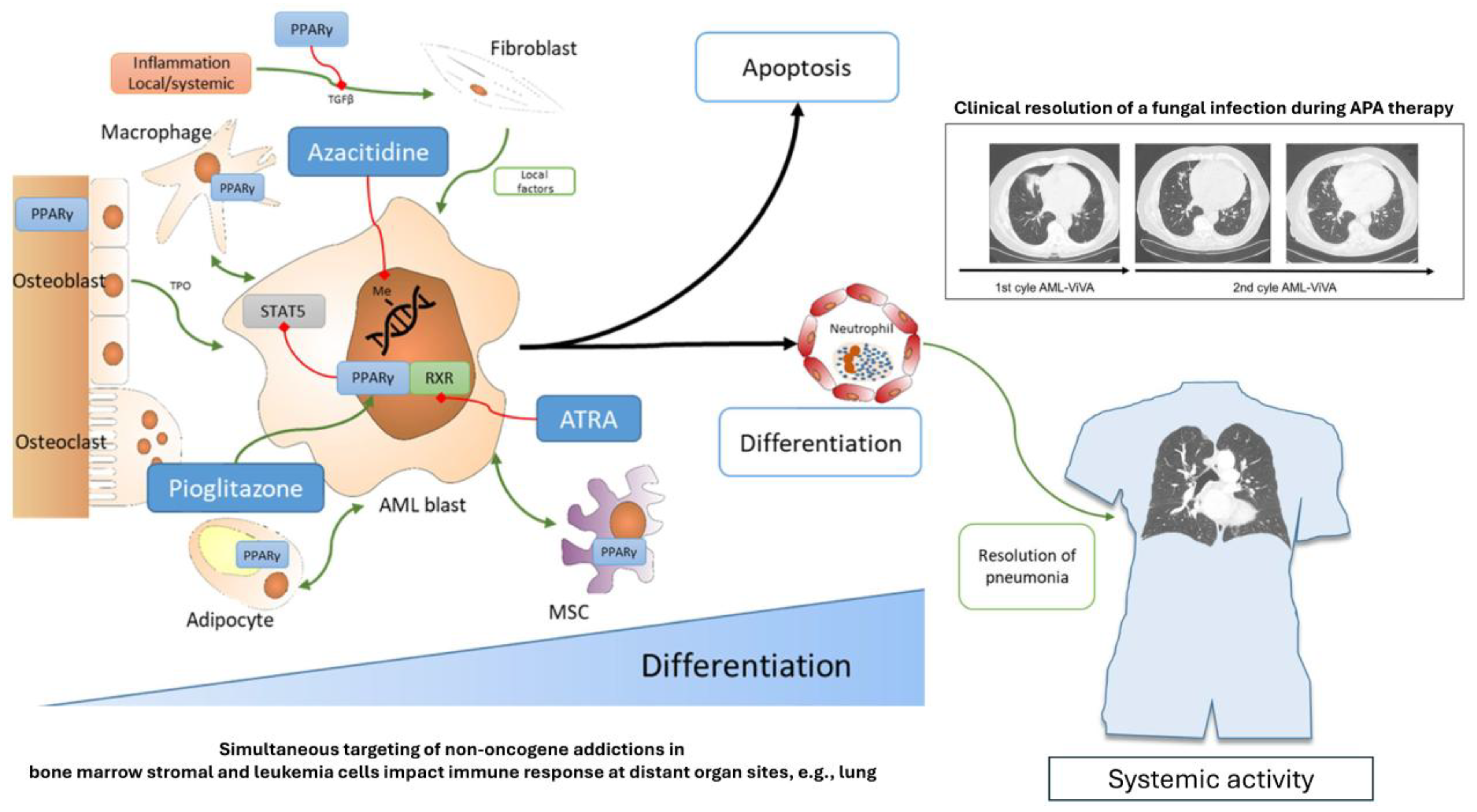
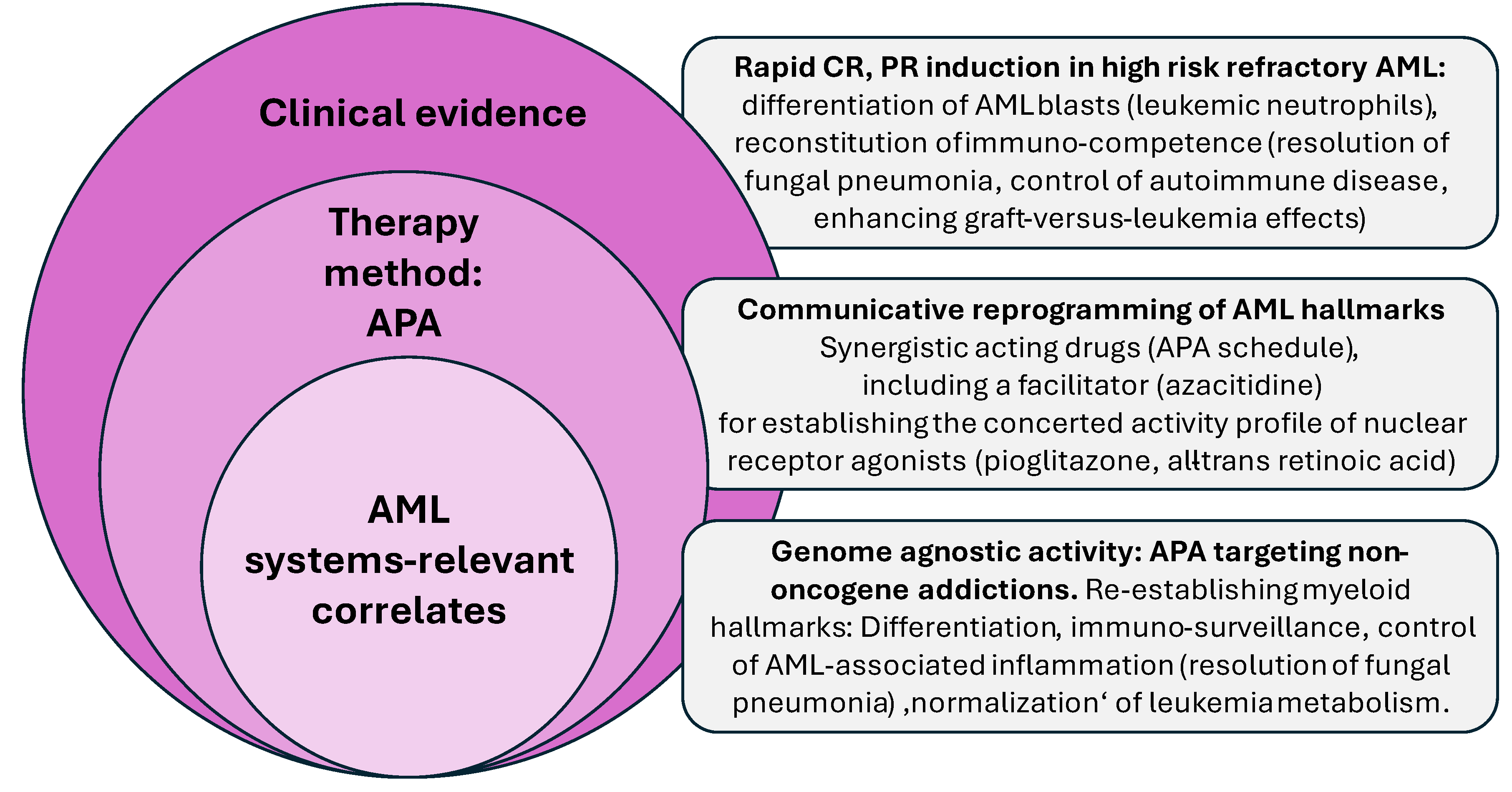
Genome Agnostic Reprogramming of Acute Myelocytic Leukemia Hallmarks by Targeting Non-Oncogene Addictions with Azacitidine Plus Pioglitazone and All-Trans Retinoic Acid

 , , and
Abstract
1. Introduction
2. APA Therapy
3. Activity Profile of APA Therapy in Refractory or Relapsed Non-PML AML
4. Adverse Events on Patient Basis
5. APA as Rescue Therapy for Azacitidine Failure
6. APA and Re-Establishment of Immuno Surveillance
7. Differential AML Hallmarks Targeted with Pioglitazone, ATRA
8. APA and AML Microenvironment
9. APA Therapy Predominantly Targets Non-Oncogene Addictions
10. APA, a Genome Agnostic Therapy
11. Second-Line Aza/Ven Versus APA in r/r Non-PML AML
12. No Long-Term Continuous Complete Remission Without Allo-HSCT Consolidation
13. Discussion
Author Contributions
Funding
Institutional Review Board Statement
Informed Consent Statement
Data Availability Statement
Conflicts of Interest
References
- Lancet, J.E.; Uy, G.L.; Cortes, J.E.; Newell, L.F.; Lin, T.L.; Ritchie, E.K.; Stuart, R.K.; Strickland, S.A.; Hogge, D.; Solomon, S.R.; et al. CPX-351 (cytarabine and daunorubicin) Liposome for Injection Versus Conventional Cytarabine Plus Daunorubicin in Older Patients with Newly Diagnosed Secondary Acute Myeloid Leukemia. J. Clin. Oncol. 2018, 36, 2684–2692. [Google Scholar] [CrossRef]
- Kawamura, K. Allogeneic Hematopoietic Stem Cell Transplantation for Older Patients with Hematological Malignancies. Yonago Acta Medica 2025, 68, 169–179. [Google Scholar] [CrossRef]
- Poiré, X.; Labopin, M.; Polge, E.; Blaise, D.; Chevallier, P.; Maertens, J.; Kröger, N.; Besley, C.; Nguyen, S.; Castilla-Llorente, C.; et al. Older matched sibling donor vs young haploidentical donor for older patients with acute myeloid leukemia. Blood Adv. 2025, 9, 5192–5200. [Google Scholar] [CrossRef] [PubMed]
- Cao, J.; Zhuang, X.; Luo, D.; Pei, R.; Lu, Y.; Chen, D.; Li, S.; Du, X.; Liu, X. Efficacy of Haploidentical Allogeneic Hematopoietic Cell Transplantation following Two Courses of Venetoclax and Azacytidine Therapy in Patients over 55 Years Old with Acute Myelogenous Leukemia. Acta Haematol. 2025, 148, 427–436. [Google Scholar] [CrossRef]
- Silva, H.J.; Martin, G.; Birocchi, F.; Wehrli, M.; Kann, M.C.; Supper, V.; Parker, A.; Graham, C.; Bratt, A.; Bouffard, A.; et al. CD70 CAR T cells secreting an anti-CD33/anti-CD3 dual-targeting antibody overcome antigen heterogeneity in AML. Blood 2025, 145, 720–731. [Google Scholar] [CrossRef]
- Haubner, S.; Subklewe, M.; Sadelain, M. Honing CAR T cells to tackle acute myeloid leukemia. Blood 2025, 145, 1113–1125. [Google Scholar] [CrossRef]
- Kantarjian, H.M.; DeAngelo, D.J.; Stelljes, M.; Martinelli, G.; Liedtke, M.; Stock, W.; Gökbuget, N.; O’Brien, S.; Wang, K.; Wang, T.; et al. Inotuzumab Ozogamicin versus Standard Therapy for Acute Lymphoblastic Leukemia. N. Engl. J. Med. 2016, 375, 740–753. [Google Scholar] [CrossRef] [PubMed]
- Castro-Muñoz, L.J.; Ulloa, E.V.; Sahlgren, C.; Lizano, M.; de La Cruz-Hernández, E.; Contreras-Paredes, A. Modulating epigenetic modifications for cancer therapy. Oncol. Rep. 2023, 49, 59. [Google Scholar] [CrossRef]
- Sekeres, M.A.; Montesinos, P.; Novak, J.; Wang, J.; Jeyakumar, D.; Tomlinson, B.; Mayer, J.; Jou, E.; Robak, T.; Taussig, D.C.; et al. Glasdegib plus intensive or non-intensive chemotherapy for untreated acute myeloid leukemia: Results from the randomized, phase 3 BRIGHT AML 1019 trial. Leukemia 2023, 37, 2017–2026. [Google Scholar] [CrossRef]
- Gao, S.; Wang, X.; Zhao, X.; Xiao, Z. Rational design of next-generation FLT3 inhibitors in acute myeloid leukemia: From laboratory to clinics. Eur. J. Med. Chem. 2025, 301, 118214. [Google Scholar] [CrossRef] [PubMed]
- Maschmeyer, G.; Bullinger, L.; Garcia-Vidal, C.; Herbrecht, R.; Maertens, J.; Menna, P.; Pagano, L.; Thiebaut-Bertrand, A.; Calandra, T. Infectious complications of targeted drugs and biotherapies in acute leukemia. Clinical practice guidelines by the European Conference on Infections in Leukemia (ECIL), a joint venture of the European Group for Blood and Marrow Transplantation (EBMT), the European Organization for Research and Treatment of Cancer (EORTC), the International Immunocompromised Host Society (ICHS) and the European Leukemia Net (ELN). Leukemia 2022, 36, 1215–1226, Correction in Leukemia 2022, 36, 1450. [Google Scholar] [CrossRef] [PubMed]
- Issa, G.C.; Stein, E.M.; DiNardo, C.D. How I treat acute myeloid leukemia with differentiation therapy. Blood 2025, 145, 1251–1259. [Google Scholar] [CrossRef]
- Kantarjian, H.M.; DiNardo, C.D.; Kadia, T.M.; Daver, N.G.; Altman, J.K.; Stein, E.M.; Jabbour, E.; Schiffer, C.A.; Lang, A.; Ravandi, F. Acute myeloid leukemia management and research in 2025. CA Cancer J. Clin. 2025, 75, 46–67. [Google Scholar] [CrossRef]
- Wenger, V.; Garcia-Manero, G.; Zeiser, R.; Lübbert, M. DNA methyltransferase inhibitors in hematological malignancies and solid tumors. Int. J. Cancer 2025, 158, 433–461. [Google Scholar] [CrossRef]
- Haumschild, R.; Kennerly-Shah, J.; Barbarotta, L.; Zeidan, A.M. Clinical activity, pharmacokinetics, and pharmacodynamics of oral hypomethylating agents for myelodysplastic syndromes/neoplasms and acute myeloid leukemia: A multidisciplinary review. J. Oncol. Pharm. Pract. 2024, 30, 721–736. [Google Scholar] [CrossRef]
- Short, N.J.; Daver, N.; DiNardo, C.D.; Kadia, T.; Nasr, L.F.; Macaron, W.; Yilmaz, M.; Borthakur, G.; Montalban-Bravo, G.; Garcia-Manero, G.; et al. Azacitidine, Venetoclax, and Gilteritinib in Newly Diagnosed and Relapsed or Refractory FLT3-Mutated AML. J. Clin. Oncol. 2024, 42, 1499–1508. [Google Scholar] [CrossRef]
- Stein, E.M.; DiNardo, C.D.; Pollyea, D.A.; Fathi, A.T.; Roboz, G.J.; Altman, J.K.; Stone, R.M.; DeAngelo, D.J.; Levine, R.L.; Flinn, I.W.; et al. Enasidenib in mutant IDH2 relapsed or refractory acute myeloid leukemia. Blood 2017, 130, 722–731. [Google Scholar] [CrossRef]
- Heudobler, D.; Luke, F.; Hahn, J.; Grube, M.; Schlosser, P.; Kremers, S.; Sudhoff, T.; Westermann, J.; Hutter-Kronke, M.L.; Schlenk, R.F.; et al. Low-dose azacitidine, pioglitazone and all-trans retinoic acid is safe in patients aged ≥60 years with acute myeloid leukemia refractory to standard induction chemotherapy (AMLSG 26-16/AML-ViVA): Results of the safety run-in phase. Haematologica 2024, 109, 1274–1278. [Google Scholar] [CrossRef] [PubMed]
- Reville, P.K.; Wang, B.; Marvin-Peek, J.; Yuan, B.; Kuo, Y.-A.; Garza, A.; Root, J.; Qiao, W.; Arruda, A.; Veletic, I.; et al. Blood-based proteomic profiling identifies OSMR as a novel biomarker of AML outcomes. Blood 2025, 145, 3015–3029. [Google Scholar] [CrossRef] [PubMed]
- Hegde, S.; Giotti, B.; Soong, B.Y.; Halasz, L.; Le Berichel, J.; Schaefer, M.M.; Kloeckner, B.; Mattiuz, R.; Park, M.D.; Magen, A.; et al. Myeloid progenitor dysregulation fuels immunosuppressive macrophages in tumours. Nature 2025, 646, 1214–1222. [Google Scholar] [CrossRef]
- Gozdecka, M.; Dudek, M.; Wen, S.; Gu, M.; Stopforth, R.J.; Rak, J.; Damaskou, A.; Grice, G.L.; McLoughlin, M.A.; Bond, L.; et al. Mitochondrial metabolism sustains DNMT3A-R882-mutant clonal haematopoiesis. Nature 2025, 642, 431–441. [Google Scholar] [CrossRef]
- Atas, E.; Berchtold, K.; Schlederer, M.; Prodinger, S.; Sternberg, F.; Pucci, P.; Steel, C.; Matthews, J.D.; James, E.R.; Philippe, C.; et al. The anti-diabetic PPARγ agonist Pioglitazone inhibits cell proliferation and induces metabolic reprogramming in prostate cancer. Mol. Cancer 2025, 24, 134. [Google Scholar] [CrossRef] [PubMed]
- Reichle, A.; Hildebrandt, G.C. Principles of Modular Tumor Therapy. Cancer Microenviron. 2009, 2, 227–237. [Google Scholar] [CrossRef]
- Meier, R.; Greve, G.; Zimmer, D.; Bresser, H.; Berberich, B.; Langova, R.; Stomper, J.; Rubarth, A.; Feuerbach, L.; Lipka, D.B.; et al. The antileukemic activity of decitabine upon PML/RARA-negative AML blasts is supported by all-trans retinoic acid: In vitro and in vivo evidence for cooperation. Blood Cancer J. 2022, 12, 122. [Google Scholar] [CrossRef]
- Klobuch, S.; Steinberg, T.; Bruni, E.; Mirbeth, C.; Heilmeier, B.; Ghibelli, L.; Herr, W.; Reichle, A.; Thomas, S. Biomodulatory Treatment with Azacitidine, All-trans Retinoic Acid and Pioglitazone Induces Differentiation of Primary AML Blasts Into Neutrophil Like Cells Capable of ROS Production and Phagocytosis. Front. Pharmacol. 2018, 9, 1380. [Google Scholar] [CrossRef]
- Chen, Y.; Tong, X.; Lu, R.; Zhang, Z.; Ma, T. All-trans retinoic acid in hematologic disorders: Not just acute promyelocytic leukemia. Front. Pharmacol. 2024, 15, 1404092. [Google Scholar] [CrossRef]
- Thomas, S.; Schelker, R.; Klobuch, S.; Zaiss, S.; Troppmann, M.; Rehli, M.; Haferlach, T.; Herr, W.; Reichle, A. Biomodulatory therapy induces complete molecular remission in chemorefractory acute myeloid leukemia. Haematologica 2015, 100, e4–e6. [Google Scholar] [CrossRef]
- Heudobler, D.; Klobuch, S.; Thomas, S.; Hahn, J.; Herr, W.; Reichle, A. Cutaneous Leukemic Infiltrates Successfully Treated with Biomodulatory Therapy in a Rare Case of Therapy-Related High Risk MDS/AML. Front. Pharmacol. 2018, 9, 1279. [Google Scholar] [CrossRef] [PubMed]
- Kattner, A.-S.; Holler, E.; Herr, W.; Reichle, A.; Wolff, D.; Heudobler, D. Successful Treatment of Early Relapsed High-Risk AML After Allogeneic Hematopoietic Stem Cell Transplantation with Biomodulatory Therapy. Front. Oncol. 2020, 10, 443. [Google Scholar] [CrossRef] [PubMed]
- Wei, A.H.; Loo, S.; Daver, N. How I treat patients with AML using azacitidine and venetoclax. Blood 2025, 145, 1237–1250. [Google Scholar] [CrossRef]
- Lehmann, S.; Paul, C.; Törmä, H. Retinoid receptor expression and its correlation to retinoid sensitivity in non-M3 acute myeloid leukemia blast cells. Clin. Cancer Res. 2001, 7, 367–373. [Google Scholar]
- Yamatani, K.; Watanabe, T.; Saito, K.; Khasawneh, A.; Maiti, A.; Zeng, Z.; Hayes, K.; Kimura, S.; DiNardo, C.D.; Su, X.; et al. PPARγ-induced upregulation of fatty acid metabolism confers resistance to venetoclax and decitabine therapy in AML. Blood Neoplasia 2025, 2, 100121. [Google Scholar] [CrossRef]
- Lindblad, K.E.; Goswami, M.; Hourigan, C.S.; Oetjen, K.A. Immunological effects of hypomethylating agents. Expert Rev. Hematol. 2017, 10, 745–752. [Google Scholar] [CrossRef]
- Stein, A.; Platzbecker, U.; Cross, M. How Azanucleosides Affect Myeloid Cell Fate. Cells 2022, 11, 2589. [Google Scholar] [CrossRef] [PubMed]
- Harrer, D.C.; Lüke, F.; Pukrop, T.; Ghibelli, L.; Gerner, C.; Reichle, A.; Heudobler, D. Peroxisome proliferator-activated receptorα/γ agonist pioglitazone for rescuing relapsed or refractory neoplasias by unlocking phenotypic plasticity. Front. Oncol. 2023, 13, 1289222. [Google Scholar] [CrossRef] [PubMed]
- Di Martino, O.; Welch, J.S. Retinoic Acid Receptors in Acute Myeloid Leukemia Therapy. Cancers 2019, 11, 1915. [Google Scholar] [CrossRef]
- Bornhäuser, M.; Schliemann, C.; Schetelig, J.; Röllig, C.; Kramer, M.; Glass, B.; Platzbecker, U.; Burchert, A.; Hänel, M.; Müller, L.P.; et al. Allogeneic Hematopoietic Cell Transplantation vs Standard Consolidation Chemotherapy in Patients with Intermediate-Risk Acute Myeloid Leukemia: A Randomized Clinical Trial. JAMA Oncol. 2023, 9, 519–526. [Google Scholar] [CrossRef]
- Shahswar, R.; Gabdoulline, R.; Krueger, K.; Wichmann, M.; Götze, K.S.; Braitsch, K.; Meggendorfer, M.; Schmalbrock, L.; Bullinger, L.; Modemann, F.; et al. A novel prognostic risk model for patients with refractory/relapsed acute myeloid leukemia receiving venetoclax plus hypomethylating agents. Leukemia 2025, 39, 614–622. [Google Scholar] [CrossRef] [PubMed]
- Döhner, H.; Pratz, K.W.; DiNardo, C.D.; Wei, A.H.; Jonas, B.A.; Pullarkat, V.A.; Thirman, M.J.; Récher, C.; Schuh, A.C.; Babu, S.; et al. Genetic risk stratification and outcomes among treatment-naive patients with AML treated with venetoclax and azacitidine. Blood 2024, 144, 2211–2222. [Google Scholar] [CrossRef]
- Bresser, H.; Schmoor, C.; Grishina, O.; Pfeifer, D.; Thomas, J.; Rehman, U.-U.; Crysandt, M.; Jost, E.; Thol, F.; Heuser, M.; et al. Impact of TP53 Mutation Status in Elderly AML Patients When Adding All-Trans Retinoic Acid or Valproic Acid to Decitabine. Eur. J. Haematol. 2025, 114, 231–237. [Google Scholar] [CrossRef]
- Daver, N.; Schlenk, R.F.; Russell, N.H.; Levis, M.J. Targeting FLT3 mutations in AML: Review of current knowledge and evidence. Leukemia 2019, 33, 299–312. [Google Scholar] [CrossRef]
- Garciaz, S.; Hospital, M.-A.; Alary, A.-S.; Saillard, C.; Hicheri, Y.; Mohty, B.; Rey, J.; D’Incan, E.; Charbonnier, A.; Villetard, F.; et al. Azacitidine Plus Venetoclax for the Treatment of Relapsed and Newly Diagnosed Acute Myeloid Leukemia Patients. Cancers 2022, 14, 2025. [Google Scholar] [CrossRef]
- Petit, C.; Saillard, C.; Mohty, B.; Hicheri, Y.; Villetard, F.; Maisano, V.; Charbonnier, A.; Rey, J.; D’Incan, E.; Rouzaud, C.; et al. Azacitidine-venetoclax versus azacitidine salvage treatment for primary induction failure or first relapsed acute myeloid leukaemia patients. Eur. J. Haematol. 2024, 112, 530–537. [Google Scholar] [CrossRef] [PubMed]
- Stahl, M.; Menghrajani, K.; Derkach, A.; Chan, A.; Xiao, W.; Glass, J.; King, A.C.; Daniyan, A.F.; Famulare, C.; Cuello, B.M.; et al. Clinical and molecular predictors of response and survival following venetoclax therapy in relapsed/refractory AML. Blood Adv. 2021, 5, 1552–1564. [Google Scholar] [CrossRef] [PubMed]
- Piccini, M.; Pilerci, S.; Merlini, M.; Grieco, P.; Scappini, B.; Bencini, S.; Peruzzi, B.; Caporale, R.; Signori, L.; Pancani, F.; et al. Venetoclax-Based Regimens for Relapsed/Refractory Acute Myeloid Leukemia in a Real-Life Setting: A Retrospective Single-Center Experience. J. Clin. Med. 2021, 10, 1684. [Google Scholar] [CrossRef]
- Angotzi, F.; Lessi, F.; Leoncin, M.; Filì, C.; Endri, M.; Lico, A.; Visentin, A.; Pravato, S.; Candoni, A.; Trentin, L.; et al. Efficacy and safety of venetoclax plus hypomethylating agents in relapsed/refractory acute myeloid leukemia: A multicenter real-life experience. Front. Oncol. 2024, 14, 1370405. [Google Scholar] [CrossRef] [PubMed]
- Aktimur, S.H.; Gunes, A.; Akidan, O.; Karatas, A.; Turgut, M. Efficacy of the Combination of Venetoclax and Azacitidine in Elderly of Frail Relapsed/Refractory Patients with Acute Myeloid Leukemia, First Multi-Institutional Real World Experience from Turkey. Uluslar. Hematol.-Onkol. Derg. 2020, 30, 213–221. [Google Scholar] [CrossRef]
- Lou, Y.; Shao, L.; Mao, L.; Lu, Y.; Ma, Y.; Fan, C.; Jiang, H.; Li, J.; Jin, J. Efficacy and predictive factors of venetoclax combined with azacitidine as salvage therapy in advanced acute myeloid leukemia patients: A multicenter retrospective study. Leuk. Res. 2020, 91, 106317. [Google Scholar] [CrossRef]
- Labrador, J.; Martínez-Cuadrón, D.; de La Fuente, A.; Rodríguez-Veiga, R.; Serrano, J.; Tormo, M.; Rodriguez-Arboli, E.; Ramos, F.; Bernal, T.; López-Pavía, M.; et al. Azacitidine vs. Decitabine in Unfit Newly Diagnosed Acute Myeloid Leukemia Patients: Results from the PETHEMA Registry. Cancers 2022, 14, 2342. [Google Scholar] [CrossRef]
- Bouligny, I.M.; Murray, G.; Doyel, M.; Patel, T.; Boron, J.; Tran, V.; Gor, J.; Hang, Y.; Alnimer, Y.; Ho, T.; et al. Venetoclax with decitabine or azacitidine in relapsed or refractory acute myeloid leukemia. Med. Oncol. 2024, 41, 80. [Google Scholar] [CrossRef]
- Xu, X.; Liu, R.; Chen, H.; Yang, R.; Gao, G.; He, A.; Wang, F. Single-center experience of venetoclax combined with azacitidine in young patients with newly diagnosed acute myeloid leukemia. Ther. Adv. Hematol. 2025, 16, 20406207241311776. [Google Scholar] [CrossRef] [PubMed]
- Morsia, E.; McCullough, K.; Joshi, M.; Cook, J.; Alkhateeb, H.B.; Al-Kali, A.; Begna, K.; Elliott, M.; Hogan, W.; Litzow, M.; et al. Venetoclax and hypomethylating agents in acute myeloid leukemia: Mayo Clinic series on 86 patients. Am. J. Hematol. 2020, 95, 1511–1521. [Google Scholar] [CrossRef]
- Yu, S.; Zhang, Y.; Yu, G.; Wang, Y.; Shao, R.; Du, X.; Xu, N.; Lin, D.; Zhao, W.; Zhang, X.; et al. Sorafenib plus triplet therapy with venetoclax, azacitidine and homoharringtonine for refractory/relapsed acute myeloid leukemia with FLT3-ITD: A multicenter phase 2 study. J. Intern. Med. 2024, 295, 216–228. [Google Scholar] [CrossRef] [PubMed]
- Jin, H.; Zhang, Y.; Yu, S.; Du, X.; Xu, N.; Shao, R.; Lin, D.; Chen, Y.; Xiao, J.; Sun, Z.; et al. Venetoclax Combined with Azacitidine and Homoharringtonine in Relapsed/Refractory AML: A Multicenter, Phase 2 Trial. J. Hematol. Oncol. 2023, 16, 42. [Google Scholar] [CrossRef] [PubMed]
- Yu, G.; Zhang, Y.; Yu, S.; Yin, Z.; Weng, G.; Xu, N.; Du, X.; Lin, D.; Xiao, J.; Sun, Z.; et al. Homoharringtonine Added to Venetoclax and Azacitidine Improves Outcome and Mitigates Genetic Impact in Relapsed/Refractory AML: A Multicenter Cohort Study. Clin. Cancer Res. 2025, 31, 87–97. [Google Scholar] [CrossRef] [PubMed]
- Short, N.J.; Borthakur, G.; Pemmaraju, N.; DiNardo, C.D.; Kadia, T.M.; Jabbour, E.; Konopleva, M.; Macaron, W.; Ning, J.; Ma, J.; et al. A multi-arm phase Ib/II study designed for rapid, parallel evaluation of novel immunotherapy combinations in relapsed/refractory acute myeloid leukemia. Leuk. Lymphoma 2022, 63, 2161–2170. [Google Scholar] [CrossRef]
- Zhao, P.; Ni, M.; Ma, D.; Fang, Q.; Zhang, Y.; Li, Y.; Huang, Y.; Chen, Y.; Chai, X.; Zhan, Y.; et al. Venetoclax plus azacitidine and donor lymphocyte infusion in treating acute myeloid leukemia patients who relapse after allogeneic hematopoietic stem cell transplantation. Ann. Hematol. 2022, 101, 119–130. [Google Scholar] [CrossRef]
- Desikan, S.P.; Ravandi, F.; Pemmaraju, N.; Konopleva, M.; Loghavi, S.; Jabbour, E.J.; Daver, N.; Jain, N.; Chien, K.S.; Maiti, A.; et al. A Phase II Study of Azacitidine, Venetoclax, and Trametinib in Relapsed or Refractory Acute Myeloid Leukemia Harboring RAS Pathway-Activating Mutations. Acta Haematol. 2022, 145, 529–536. [Google Scholar] [CrossRef]
- You, L.; Liu, Y.; Mai, W.; Xie, W.; Zhou, D.; Mao, L.; Chen, L.; Zhou, X.; Ma, L.; Zheng, X.; et al. Venetoclax plus cytarabine and azacitidine in relapsed/refractory AML: An open-label, single-arm, phase 2 study. Eur. J. Cancer 2024, 202, 113979. [Google Scholar] [CrossRef]
- Wen, Y.; Yang, J.; Zhang, X.; Liu, Q.; Gao, W.; Dong, L.; Zhao, W.; Huang, S.; Liu, D.; Jing, Y.; et al. Phase 1 study of chidamide in combination with venetoclax, azacitidine, aclarubicin, cytarabine and G-CSF for refractory/relapsed acute myeloid leukemia: Clinical safety, efficacy, and correlative analysis. Front. Immunol. 2025, 16, 1698710. [Google Scholar] [CrossRef]
- Taylor, S.M.; Jones, P.A. Mechanism of action of eukaryotic DNA methyltransferase. Use of 5-azacytosine-containing DNA. J. Mol. Biol. 1982, 162, 679–692. [Google Scholar] [CrossRef]
- Zhu, J.; Guérineau, H.; Lefebvre-Fortané, A.-M.; Largeaud, L.; Lambert, J.; Rousselot, P.; Boudouin, M.; Calvo, J.; Prost, S.; Clauser, S.; et al. The AXL inhibitor bemcentinib overcomes microenvironment-mediated resistance to pioglitazone in acute myeloid leukemia. FEBS J. 2025, 292, 115–128. [Google Scholar] [CrossRef] [PubMed]
- Luo, X.; Zhong, L.; Yu, L.; Xiong, L.; Dan, W.; Li, J.; Ye, J.; Chu, X.; Liu, C.; Liu, B. TRIB3 destabilizes tumor suppressor PPARα expression through ubiquitin-mediated proteasome degradation in acute myeloid leukemia. Life Sci. 2020, 257, 118021. [Google Scholar] [CrossRef] [PubMed]
- Ricote, M.; Glass, C.K. PPARs and molecular mechanisms of transrepression. Biochim. Biophys. Acta 2007, 1771, 926–935. [Google Scholar] [CrossRef] [PubMed]
- Zhou, H.; Jiang, Y.; Huang, Y.; Zhong, M.; Qin, D.; Xie, C.; Pan, G.; Tan, J.; Deng, M.; Zhao, H.; et al. Therapeutic inhibition of PPARα-HIF1α-PGK1 signaling targets leukemia stem and progenitor cells in acute myeloid leukemia. Cancer Lett. 2023, 554, 215997. [Google Scholar] [CrossRef]
- Xie, C.; Zhou, H.; Qin, D.; Zheng, H.; Tang, Y.; Li, W.; Zhou, J.; Liu, L.; Yu, X.; Duan, H.; et al. Bcl-2 inhibition combined with PPARα activation synergistically targets leukemic stem cell-like cells in acute myeloid leukemia. Cell Death Dis. 2023, 14, 573. [Google Scholar] [CrossRef]
- Lübbert, M.; Grishina, O.; Schmoor, C.; Schlenk, R.F.; Jost, E.; Crysandt, M.; Heuser, M.; Thol, F.; Salih, H.R.; Schittenhelm, M.M.; et al. Valproate and Retinoic Acid in Combination with Decitabine in Elderly Nonfit Patients with Acute Myeloid Leukemia: Results of a Multicenter, Randomized, 2 × 2, Phase II Trial. J. Clin. Oncol. 2020, 38, 257–270. [Google Scholar] [CrossRef]
- Kucharova, S.; Farkas, R. Hormone nuclear receptors and their ligands: Role in programmed cell death. Endocr. Regul. 2002, 36, 37–60. [Google Scholar]
- Contractor, R.; Samudio, I.J.; Estrov, Z.; Harris, D.; McCubrey, J.A.; Safe, S.H.; Andreeff, M.; Konopleva, M. A novel ring-substituted diindolylmethane,1,1-bis3′-(5-methoxyindolyl)-1-(p-t-butylphenyl) methane, inhibits extracellular signal-regulated kinase activation and induces apoptosis in acute myelogenous leukemia. Cancer Res. 2005, 65, 2890–2898. [Google Scholar] [CrossRef]
- Heudobler, D.; Lüke, F.; Vogelhuber, M.; Klobuch, S.; Pukrop, T.; Herr, W.; Gerner, C.; Pantziarka, P.; Ghibelli, L.; Reichle, A. Anakoinosis: Correcting Aberrant Homeostasis of Cancer Tissue-Going Beyond Apoptosis Induction. Front. Oncol. 2019, 9, 1408. [Google Scholar] [CrossRef]
- Heudobler, D.; Rechenmacher, M.; Lüke, F.; Vogelhuber, M.; Klobuch, S.; Thomas, S.; Pukrop, T.; Hackl, C.; Herr, W.; Ghibelli, L.; et al. Clinical Efficacy of a Novel Therapeutic Principle, Anakoinosis. Front. Pharmacol. 2018, 9, 1357. [Google Scholar] [CrossRef]
- Harrer, D.C.; Lüke, F.; Pukrop, T.; Ghibelli, L.; Reichle, A.; Heudobler, D. Addressing Genetic Tumor Heterogeneity, Post-Therapy Metastatic Spread, Cancer Repopulation, and Development of Acquired Tumor Cell Resistance. Cancers 2023, 16, 180. [Google Scholar] [CrossRef]
- Harrer, D.C.; Lüke, F.; Pukrop, T.; Ghibelli, L.; Reichle, A.; Heudobler, D. MEPED as salvage therapy for relapsed/refractory Hodgkin’s lymphoma incorporating edited non-oncogene addiction: mTOR as a bottleneck. Front. Pharmacol. 2025, 16, 1553331. [Google Scholar] [CrossRef] [PubMed]
- Plumber, S.A.; Tate, T.; Al-Ahmadie, H.; Chen, X.; Choi, W.; Basar, M.; Lu, C.; Viny, A.; Batourina, E.; Li, J.; et al. Rosiglitazone and trametinib exhibit potent anti-tumor activity in a mouse model of muscle invasive bladder cancer. Nat. Commun. 2024, 15, 6538. [Google Scholar] [CrossRef] [PubMed]
- Ishay-Ronen, D.; Christofori, G. Targeting Cancer Cell Metastasis by Converting Cancer Cells into Fat. Cancer Res. 2019, 79, 5471–5475. [Google Scholar] [CrossRef] [PubMed]
- Vogt, T.; Coras, B.; Hafner, C.; Landthaler, M.; Reichle, A. Antiangiogenic therapy in metastatic prostate carcinoma complicated by cutaneous lupus erythematodes. Lancet Oncol. 2006, 7, 695–697. [Google Scholar] [CrossRef]
- Nasrabadi, M.E.; Al-Harrasi, A.; Mohammadi, S.; Zarif Azam Kardani, F.; Rahmati, M.; Memarian, A. Pioglitazone as a potential modulator in autoimmune diseases: A review on its effects in systemic lupus erythematosus, psoriasis, inflammatory bowel disease, and multiple sclerosis. Expert Rev. Clin. Immunol. 2025, 21, 5–15. [Google Scholar] [CrossRef] [PubMed]
- Ge, Y.; Domschke, C.; Stoiber, N.; Schott, S.; Heil, J.; Rom, J.; Blumenstein, M.; Thum, J.; Sohn, C.; Schneeweiss, A.; et al. Metronomic cyclophosphamide treatment in metastasized breast cancer patients: Immunological effects and clinical outcome. Cancer Immunol. Immunother. 2012, 61, 353–362. [Google Scholar] [CrossRef]
- Singh, A.; Chaudhary, R. Potentials of peroxisome proliferator-activated receptor (PPAR) α, β/δ, and γ: An in-depth and comprehensive review of their molecular mechanisms, cellular Signalling, immune responses and therapeutic implications in multiple diseases. Int. Immunopharmacol. 2025, 155, 114616. [Google Scholar] [CrossRef]
- Luo, N.; Nixon, M.J.; Gonzalez-Ericsson, P.I.; Sanchez, V.; Opalenik, S.R.; Li, H.; Zahnow, C.A.; Nickels, M.L.; Liu, F.; Tantawy, M.N.; et al. DNA methyltransferase inhibition upregulates MHC-I to potentiate cytotoxic T lymphocyte responses in breast cancer. Nat. Commun. 2018, 9, 248. [Google Scholar] [CrossRef]
- Kamel, G.A.M.; Elariny, H.A. Pioglitazone attenuates tamoxifen-induced liver damage in rats via modulating Keap1/Nrf2/HO-1 and SIRT1/Notch1 signaling pathways: In-vivo investigations, and molecular docking analysis. Mol. Biol. Rep. 2023, 50, 10219–10233. [Google Scholar] [CrossRef] [PubMed]
- Vallée, A.; Lecarpentier, Y. Crosstalk Between Peroxisome Proliferator-Activated Receptor Gamma and the Canonical WNT/β-Catenin Pathway in Chronic Inflammation and Oxidative Stress During Carcinogenesis. Front. Immunol. 2018, 9, 745. [Google Scholar] [CrossRef] [PubMed]
- Zhu, W.; Yan, H.; Li, S.; Nie, W.; Fan, F.; Zhu, J. PPAR-γ agonist pioglitazone regulates dendritic cells immunogenicity mediated by DC-SIGN via the MAPK and NF-κB pathways. Int. Immunopharmacol. 2016, 41, 24–34. [Google Scholar] [CrossRef]
- Molldrem, J.J.; Komanduri, K.; Wieder, E. Overexpressed differentiation antigens as targets of graft-versus-leukemia reactions. Curr. Opin. Hematol. 2002, 9, 503–508. [Google Scholar] [CrossRef] [PubMed]
- Scheibenbogen, C.; Letsch, A.; Thiel, E.; Schmittel, A.; Mailaender, V.; Baerwolf, S.; Nagorsen, D.; Keilholz, U. CD8 T-cell responses to Wilms tumor gene product WT1 and proteinase 3 in patients with acute myeloid leukemia. Blood 2002, 100, 2132–2137. [Google Scholar] [CrossRef]
- Hu, L.; Zhang, X.; Zhang, W.; Jin, S.; Zhao, J.; Zheng, J.; Song, W.; Shen, Z. Targeting TCMR-associated cytokine genes for drug screening identifies PPARγ agonists as novel immunomodulatory agents in transplantation. Front. Immunol. 2025, 16, 1539645. [Google Scholar] [CrossRef]
- Chiappinelli, K.B.; Strissel, P.L.; Desrichard, A.; Li, H.; Henke, C.; Akman, B.; Hein, A.; Rote, N.S.; Cope, L.M.; Snyder, A.; et al. Inhibiting DNA Methylation Causes an Interferon Response in Cancer via dsRNA Including Endogenous Retroviruses. Cell 2015, 162, 974–986, Correction in Cell 2016, 164, 1073. Correction in Cell 2017, 169, 361. [Google Scholar] [CrossRef]
- Lasry, A.; Nadorp, B.; Fornerod, M.; Nicolet, D.; Wu, H.; Walker, C.J.; Sun, Z.; Witkowski, M.T.; Tikhonova, A.N.; Guillamot-Ruano, M.; et al. An inflammatory state remodels the immune microenvironment and improves risk stratification in acute myeloid leukemia. Nat. Cancer 2023, 4, 27–42, Correction in Nat. Cancer 2023, 4, 149. [Google Scholar] [CrossRef]
- Montaigne, D.; Butruille, L.; Staels, B. PPAR control of metabolism and cardiovascular functions. Nat. Rev. Cardiol. 2021, 18, 809–823. [Google Scholar] [CrossRef]
- Goleij, P.; Khazeei Tabari, M.A.; Ahmed, A.R.D.; Mohamed, L.M.E.; Saleh, G.A.H.; Abdu Hassan, M.T.M.; Moahmmednoor, A.G.M.; Khan, H. Molecular Secrets Revealed: How Diabetes may be Paving the Way for Leukemia. Curr. Treat. Options Oncol. 2024, 25, 1563–1579. [Google Scholar] [CrossRef]
- Lüke, F.; Harrer, D.C.; Pantziarka, P.; Pukrop, T.; Ghibelli, L.; Gerner, C.; Reichle, A.; Heudobler, D. Drug Repurposing by Tumor Tissue Editing. Front. Oncol. 2022, 12, 900985. [Google Scholar] [CrossRef]
- Prost, S.; Relouzat, F.; Spentchian, M.; Ouzegdouh, Y.; Saliba, J.; Massonnet, G.; Beressi, J.-P.; Verhoeyen, E.; Raggueneau, V.; Maneglier, B.; et al. Erosion of the chronic myeloid leukaemia stem cell pool by PPARγ agonists. Nature 2015, 525, 380–383. [Google Scholar] [CrossRef]
- Ben-Yishay, R.; Globus, O.; Balint-Lahat, N.; Arbili-Yarhi, S.; Bar-Hai, N.; Bar, V.; Aharon, S.; Kosenko, A.; Zundelevich, A.; Berger, R.; et al. Class Effect Unveiled: PPARγ Agonists and MEK Inhibitors in Cancer Cell Differentiation. Cells 2024, 13, 1506. [Google Scholar] [CrossRef] [PubMed]
- To, K.K.W.; Wu, W.K.K.; Loong, H.H.F. PPARgamma agonists sensitize PTEN-deficient resistant lung cancer cells to EGFR tyrosine kinase inhibitors by inducing autophagy. Eur. J. Pharmacol. 2018, 823, 19–26. [Google Scholar] [CrossRef] [PubMed]
- Vunta, H.; Davis, F.; Palempalli, U.D.; Bhat, D.; Arner, R.J.; Thompson, J.T.; Peterson, D.G.; Reddy, C.C.; Prabhu, K.S. The anti-inflammatory effects of selenium are mediated through 15-deoxy-Delta12,14-prostaglandin J2 in macrophages. J. Biol. Chem. 2007, 282, 17964–17973. [Google Scholar] [CrossRef]
- Sánchez-Mendoza, S.E.; de Deus-Wagatsuma, V.M.; do Nascimento, M.C.; Lima, K.; Machado-Neto, J.A.; Djavaheri-Mergny, M.; Rego, E.M. All-trans retinoic acid potentiates cell death induced by quizartinib in acute myeloid leukemia with FLT3-ITD mutations. Ann. Hematol. 2024, 103, 5405–5416. [Google Scholar] [CrossRef] [PubMed]
- Lüke, F.; Harrer, D.C.; Menhart, K.; Wolff, D.; Holler, E.; Hellwig, D.; Herr, W.; Grube, M.; Vogelhuber, M.; Reichle, A.; et al. Biomodulatory Treatment Regimen, MEPED, Rescues Relapsed and Refractory Classic Hodgkin’s Disease. Front. Pharmacol. 2021, 12, 599561. [Google Scholar] [CrossRef]
- Harrer, D.C.; Jakob, M.; Vogelhuber, M.; Lüke, F.; Utpatel, K.; Corbacioglu, S.; Herr, W.; Reichle, A.; Heudobler, D. Biomodulatory therapy induces durable remissions in multi-system Langerhans cell histiocytosis. Leuk. Lymphoma 2022, 63, 2858–2868. [Google Scholar] [CrossRef]
- Reichle, A.; Grassinger, J.; Bross, K.; Wilke, J.; Suedhoff, T.; Walter, B.; Wieland, W.-F.; Berand, A.; Andreesen, R. C-reactive Protein in Patients with Metastatic Clear Cell Renal Carcinoma: An Important Biomarker for Tumor-associated Inflammation. Biomark. Insights 2007, 1, 87–98. [Google Scholar] [CrossRef]
- Wouters, B.J.; Delwel, R. Epigenetics and approaches to targeted epigenetic therapy in acute myeloid leukemia. Blood 2016, 127, 42–52. [Google Scholar] [CrossRef]
- Mulet-Lazaro, R.; van Herk, S.; Nuetzel, M.; Sijs-Szabo, A.; Díaz, N.; Kelly, K.; Erpelinck-Verschueren, C.; Schwarzfischer-Pfeilschifter, L.; Stanewsky, H.; Ackermann, U.; et al. Epigenetic alterations affecting hematopoietic regulatory networks as drivers of mixed myeloid/lymphoid leukemia. Nat. Commun. 2024, 15, 5693. [Google Scholar] [CrossRef]
- Esmaeili, S.; Safaroghli-Azar, A.; Pourbagheri-Sigaroodi, A.; Salari, S.; Gharehbaghian, A.; Hamidpour, M.; Bashash, D. Stimulation of Peroxisome Proliferator-Activated Receptor-Gamma (PPARγ) using Pioglitazone Decreases the Survival of Acute Promyelocytic Leukemia Cells through Up-Regulation of PTEN Expression. Anti-Cancer Agents Med. Chem. 2021, 21, 108–119. [Google Scholar] [CrossRef]
- Symeonidou, V.; Metzner, M.; Usukhbayar, B.; Jackson, A.E.; Fox, S.; Craddock, C.F.; Vyas, P. Heterogeneous genetic and non-genetic mechanisms contribute to response and resistance to azacitidine monotherapy. EJHaem 2022, 3, 794–803. [Google Scholar] [CrossRef]
- Bogenberger, J.M.; Kornblau, S.M.; Pierceall, W.E.; Lena, R.; Chow, D.; Shi, C.-X.; Mantei, J.; Ahmann, G.; Gonzales, I.M.; Choudhary, A.; et al. BCL-2 family proteins as 5-Azacytidine-sensitizing targets and determinants of response in myeloid malignancies. Leukemia 2014, 28, 1657–1665. [Google Scholar] [CrossRef] [PubMed]
- Jin, S.; Cojocari, D.; Purkal, J.J.; Popovic, R.; Talaty, N.N.; Xiao, Y.; Solomon, L.R.; Boghaert, E.R.; Leverson, J.D.; Phillips, D.C. 5-Azacitidine Induces NOXA to Prime AML Cells for Venetoclax-Mediated Apoptosis. Clin. Cancer Res. 2020, 26, 3371–3383. [Google Scholar] [CrossRef]
- Esmaeili, S.; Salari, S.; Kaveh, V.; Ghaffari, S.H.; Bashash, D. Alteration of PPAR-GAMMA (PPARG; PPARγ) and PTEN gene expression in acute myeloid leukemia patients and the promising anticancer effects of PPARγ stimulation using pioglitazone on AML cells. Mol. Genet. Genom. Med. 2021, 9, e1818. [Google Scholar] [CrossRef]
- Yasugi, E.; Horiuchi, A.; Uemura, I.; Okuma, E.; Nakatsu, M.; Saeki, K.; Kamisaka, Y.; Kagechika, H.; Yasuda, K.; Yuo, A. Peroxisome proliferator-activated receptor gamma ligands stimulate myeloid differentiation and lipogenensis in human leukemia NB4 cells. Dev. Growth Differ. 2006, 48, 177–188. [Google Scholar] [CrossRef] [PubMed]
- Zang, C.; Wächter, M.; Liu, H.; Posch, M.G.; Fenner, M.H.; Stadelmann, C.; von Deimling, A.; Possinger, K.; Black, K.L.; Koeffler, H.P.; et al. Ligands for PPARgamma and RAR cause induction of growth inhibition and apoptosis in human glioblastomas. J. Neurooncol. 2003, 65, 107–118. [Google Scholar] [CrossRef] [PubMed]
- Liu, H.; Zang, C.; Fenner, M.H.; Possinger, K.; Elstner, E. PPARgamma ligands and ATRA inhibit the invasion of human breast cancer cells in vitro. Breast Cancer Res. Treat. 2003, 79, 63–74. [Google Scholar] [CrossRef]
- Liccardo, F.; Śniegocka, M.; Tito, C.; Iaiza, A.; Ottone, T.; Divona, M.; Travaglini, S.; Mattei, M.; Cicconi, R.; Miglietta, S.; et al. Retinoic acid and proteotoxic stress induce AML cell death overcoming stromal cell protection. J. Exp. Clin. Cancer Res. 2023, 42, 223. [Google Scholar] [CrossRef]
- Li, B.; Zheng, L.; Yang, J.; Qu, L. Targeting oncogene-induced cellular plasticity for tumor therapy. Adv. Biotechnol. 2024, 2, 24. [Google Scholar] [CrossRef]
- Fu, S.; He, K.; Tian, C.; Sun, H.; Zhu, C.; Bai, S.; Liu, J.; Wu, Q.; Xie, D.; Yue, T.; et al. Impaired lipid biosynthesis hinders anti-tumor efficacy of intratumoral iNKT cells. Nat. Commun. 2020, 11, 438. [Google Scholar] [CrossRef] [PubMed]
- Reichle, A.; Vogt, T. Systems biology: A therapeutic target for tumor therapy. Cancer Microenviron. 2008, 1, 159–170. [Google Scholar] [CrossRef] [PubMed]
- Huls, G.; Woolthuis, C.M.; Schuringa, J.J. Menin inhibitors in the treatment of acute myeloid leukemia. Blood 2025, 145, 561–566. [Google Scholar] [CrossRef]
- Issa, G.C.; Aldoss, I.; DiPersio, J.; Cuglievan, B.; Stone, R.; Arellano, M.; Thirman, M.J.; Patel, M.R.; Dickens, D.S.; Shenoy, S.; et al. The menin inhibitor revumenib in KMT2A-rearranged or NPM1-mutant leukaemia. Nature 2023, 615, 920–924. [Google Scholar] [CrossRef]
- Halik, A.; Tilgner, M.; Silva, P.; Estrada, N.; Altwasser, R.; Jahn, E.; Heuser, M.; Hou, H.-A.; Pratcorona, M.; Hills, R.K.; et al. Genomic characterization of AML with aberrations of chromosome 7: A multinational cohort of 519 patients. J. Hematol. Oncol. 2024, 17, 70. [Google Scholar] [CrossRef]
- Gottfried, E.; Rogenhofer, S.; Waibel, H.; Kunz-Schughart, L.A.; Reichle, A.; Wehrstein, M.; Peuker, A.; Peter, K.; Hartmannsgruber, G.; Andreesen, R.; et al. Pioglitazone modulates tumor cell metabolism and proliferation in multicellular tumor spheroids. Cancer Chemother. Pharmacol. 2011, 67, 117–126. [Google Scholar] [CrossRef]
- Wattad, M.; Weber, D.; Döhner, K.; Krauter, J.; Gaidzik, V.I.; Paschka, P.; Heuser, M.; Thol, F.; Kindler, T.; Lübbert, M.; et al. Impact of salvage regimens on response and overall survival in acute myeloid leukemia with induction failure. Leukemia 2017, 31, 1306–1313. [Google Scholar] [CrossRef] [PubMed]
- Thol, F.; Schlenk, R.F.; Heuser, M.; Ganser, A. How I treat refractory and early relapsed acute myeloid leukemia. Blood 2015, 126, 319–327. [Google Scholar] [CrossRef]
- Westermann, J.; Bullinger, L. Precision medicine in myeloid malignancies. Semin. Cancer Biol. 2022, 84, 153–169. [Google Scholar] [CrossRef]
- DiNardo, C.D.; Jonas, B.A.; Pullarkat, V.; Thirman, M.J.; Garcia, J.S.; Wei, A.H.; Konopleva, M.; Döhner, H.; Letai, A.; Fenaux, P.; et al. Azacitidine and Venetoclax in Previously Untreated Acute Myeloid Leukemia. N. Engl. J. Med. 2020, 383, 617–629. [Google Scholar] [CrossRef]
- Bill, M.; Eckardt, J.-N.; Döhner, K.; Röhnert, M.-A.; Rausch, C.; Metzeler, K.H.; Spiekermann, K.; Stasik, S.; Wurm, A.A.; Sauer, T.; et al. Differential prognostic impact of myelodysplasia-related gene mutations in a European cohort of 4978 intensively treated AML patients. Leukemia 2025, 40, 63–71. [Google Scholar] [CrossRef]
- Döhner, H.; Wei, A.H.; Appelbaum, F.R.; Craddock, C.; DiNardo, C.D.; Dombret, H.; Ebert, B.L.; Fenaux, P.; Godley, L.A.; Hasserjian, R.P.; et al. Diagnosis and management of AML in adults: 2022 recommendations from an international expert panel on behalf of the ELN. Blood 2022, 140, 1345–1377. [Google Scholar] [CrossRef]
- Cai, Q.; Xiao, J.; Weng, C.; Chen, H. Efficacy and safety of venetoclax plus azacitidine based regimens in the treatment of relapsed or refractory acute myeloid leukemia: A systematic review and meta-analysis. Ann. Hematol. 2025, 104, 4931–4948. [Google Scholar] [CrossRef]
- Labrador, J.; Saiz-Rodríguez, M.; de Miguel, D.; de Laiglesia, A.; Rodríguez-Medina, C.; Vidriales, M.B.; Pérez-Encinas, M.; Sánchez-Sánchez, M.J.; Cuello, R.; Roldán-Pérez, A.; et al. Use of Venetoclax in Patients with Relapsed or Refractory Acute Myeloid Leukemia: The PETHEMA Registry Experience. Cancers 2022, 14, 1734. [Google Scholar] [CrossRef]
- DiNardo, C.D.; Maiti, A.; Rausch, C.R.; Pemmaraju, N.; Naqvi, K.; Daver, N.G.; Kadia, T.M.; Borthakur, G.; Ohanian, M.; Alvarado, Y.; et al. 10-day decitabine with venetoclax for newly diagnosed intensive chemotherapy ineligible, and relapsed or refractory acute myeloid leukaemia: A single-centre, phase 2 trial. Lancet Haematol. 2020, 7, e724–e736. [Google Scholar] [CrossRef]
- Maiti, A.; Rausch, C.R.; Cortes, J.E.; Pemmaraju, N.; Daver, N.G.; Ravandi, F.; Garcia-Manero, G.; Borthakur, G.; Naqvi, K.; Ohanian, M.; et al. Outcomes of relapsed or refractory acute myeloid leukemia after frontline hypomethylating agent and venetoclax regimens. Haematologica 2021, 106, 894–898. [Google Scholar] [CrossRef]
- DiNardo, C.D.; Tiong, I.S.; Quaglieri, A.; MacRaild, S.; Loghavi, S.; Brown, F.C.; Thijssen, R.; Pomilio, G.; Ivey, A.; Salmon, J.M.; et al. Molecular patterns of response and treatment failure after frontline venetoclax combinations in older patients with AML. Blood 2020, 135, 791–803. [Google Scholar] [CrossRef] [PubMed]
- Müller-Tidow, C.; Tschanter, P.; Röllig, C.; Thiede, C.; Koschmieder, A.; Stelljes, M.; Koschmieder, S.; Dugas, M.; Gerss, J.; Butterfaß-Bahloul, T.; et al. Azacitidine in combination with intensive induction chemotherapy in older patients with acute myeloid leukemia: The AML-AZA trial of the Study Alliance Leukemia. Leukemia 2016, 30, 555–561. [Google Scholar] [CrossRef] [PubMed]
- Thomas, J.; Rehman, U.-U.; Bresser, H.; Grishina, O.; Pfeifer, D.; Sollier, E.; Döhner, K.; Plass, C.; Becker, H.; Schmoor, C.; et al. Continued decitabine/all-trans retinoic acid treatment: Extended complete remission in an elderly AML patient with multi-hit TP53 lesions and complex-monosomal karyotype. Clin. Epigenet. 2024, 16, 126. [Google Scholar] [CrossRef] [PubMed]
- Wang, L.; Zhang, Q.; Ye, L.; Ye, X.; Yang, W.; Zhang, H.; Zhou, X.; Ren, Y.; Ma, L.; Zhang, X.; et al. All-trans retinoic acid enhances the cytotoxic effect of decitabine on myelodysplastic syndromes and acute myeloid leukaemia by activating the RARα-Nrf2 complex. Br. J. Cancer 2023, 128, 691–701. [Google Scholar] [CrossRef]
- Gehrmann, M.; Brunner, M.; Pfister, K.; Reichle, A.; Kremmer, E.; Multhoff, G. Differential up-regulation of cytosolic and membrane-bound heat shock protein 70 in tumor cells by anti-inflammatory drugs. Clin. Cancer Res. 2004, 10, 3354–3364. [Google Scholar] [CrossRef]
- Doloff, J.C.; Waxman, D.J. Transcriptional profiling provides insights into metronomic cyclophosphamide-activated, innate immune-dependent regression of brain tumor xenografts. BMC Cancer 2015, 15, 375. [Google Scholar] [CrossRef]
- Stelmach, P.; Trumpp, A. Leukemic stem cells and therapy resistance in acute myeloid leukemia. Haematologica 2023, 108, 353–366. [Google Scholar] [CrossRef] [PubMed]
- Feld, J.; Tremblay, D.; Dougherty, M.; Czaplinska, T.; Sanchez, G.; Brady, C.; Kremyanskaya, M.; Bar-Natan, M.; Keyzner, A.; Marcellino, B.K.; et al. Safety and Efficacy: Clinical Experience of Venetoclax in Combination with Hypomethylating Agents in Both Newly Diagnosed and Relapsed/Refractory Advanced Myeloid Malignancies. Hemasphere 2021, 5, e549. [Google Scholar] [CrossRef] [PubMed]
- Heudobler, D.; Reichle, A.; Ghibelli, L. Editorial: Anakoinosis: An Innovative Anticancer Therapy Targeting the Aberrant Cancer Tissue Homeostasis. Front. Pharmacol. 2021, 12, 779021. [Google Scholar] [CrossRef]
- Loke, J.; Buka, R.; Craddock, C. Allogeneic Stem Cell Transplantation for Acute Myeloid Leukemia: Who, When, and How? Front. Immunol. 2021, 12, 659595. [Google Scholar] [CrossRef] [PubMed]
- Meier-Menches, S.M.; Neuditschko, B.; Janker, L.; Gerner, M.C.; Schmetterer, K.G.; Reichle, A.; Gerner, C. A Proteomic Platform Enables to Test for AML Normalization In Vitro. Front. Chem. 2022, 10, 826346. [Google Scholar] [CrossRef]
- Bhatia, H.S.; Brunner, A.-D.; Öztürk, F.; Kapoor, S.; Rong, Z.; Mai, H.; Thielert, M.; Ali, M.; Al-Maskari, R.; Paetzold, J.C.; et al. Spatial proteomics in three-dimensional intact specimens. Cell 2022, 185, 5040–5058.e19. [Google Scholar] [CrossRef]



| Variable | Best Response | N Cycles/No. of Days on APA Treatment | N = 17 |
|---|---|---|---|
| Sex, N (%) | 17 (100) | ||
| Male | - | - | 11 (65) |
| Female | - | - | 6 (35) |
| Age in years, median (range) | - | - | 66 (55–76) |
| Age >= 70 years | 3x CR, 1x SD (1x tAML, 3x de novo) | - | 4 (70–76) |
| Type of AML, N (%) | |||
| de novo AML | 3x CR, 1x PR, 4x SD, 1x NA | CR 10/350, 4/240, 4/140; 5/175; PR 14/490; SD 1 to 3; NA- | 9 (52) |
| secondary AML | 2x SD, 1x PR, 1x CR | SD 2x 1/30; PR 3/110; CR 5/210 | 4 (24) |
| treatment-related AML | 2x CR, 1x Cri, 1x CR skin and SD of MDS-RS-MLD | 2 to 6/70 to 210 | 4 (24) |
| ECOG performance score, N (%) | |||
| 0 | - | - | 3 (18) |
| 1 | - | - | 12 (70) |
| 2 | - | - | 2 (12) |
| Cytogenetics at baseline, N (%) | |||
| complex karyotype (+/− molecular genetic aberrations) | SD, PR, CR | - | 14 (82) |
| § Complex karyotype involving chromosomes 5, 7, 8, 12, 13, 18, 21, and 22 | 1 CR skin | 6/210 | 1 (6) |
| del(9), del(3) (each with molecular genetic aberrations) | 2 Cri | 4/140; 5/210 | 2 (12) |
| No complex karyotype (MLL-PTD, FLT3-TKD mutation, 1x no aberration: AML from CMML) | 2x CR, 1x PR | 2/74; 5/175; 3/110 | 3 (17) |
| Molecular genetics (mutations) at baseline, N (%) | |||
| None * but complex karyotype | 1x PD, 5x SD, 1xPR | 1 to 4/30 to 140 | 7 (40) |
| No aberration (secondary AML from CMML with 25% ** blasts) | PR (CMML-2) | 3/110 | 1 (6) |
| TP53 | PR | 14/ 426 | 1 (6) |
| TP53, ASXL1 | CR | 10/ 350 | 1 (6) |
| TP53, NF1 | CR *** | 2/70 | 1 (6) |
| ASXL1, IDH2, SF3B1, U2AF1 | CR *** | 2/75 | 1 (6) |
| t(8;21), monosomy Y, RUNX1-RUNX1T1, ETV6 | Cri/c/m | 4/240 | 1 (6) |
| del(3), MLL-PTD, FLT3-ITD, RUNX mutation | Cri/c/m | 5/210 | 1 (6) |
| del(9), trisomy 4, MLL-PTD | CR, CRc/m | 4/140 | 1 (6) |
| MLL-PTD | Cri *** | 2/74 | 1 (6) |
| FLT3-TKD mutation | Complete chimerism after 1cycle | 5/175 | 1 (6) |
| ELN 2022 genetic risk category, N (%) | |||
| adverse | - | - | 17 (100) |
| N and type of pretreatment, N (%) | |||
| 1 cycle | 9 (53) | ||
| cytarabine/daunorubicin (DA) | CR, SD | - | 7 (41) |
| thioguanine/cytarabine/daunorubicin (TAD) | NA, SD | - | 1 (6) |
| Azacitidine (AZA) | SD | - | 1 (6) |
| 2 cycles | 6 (35) | ||
| cytarabine/daunorubicin (DA); mitoxantrone/cytarabine (HAM) | CR | - | 3 (17) |
| thioguanine/cytarabine/daunorubicin (TAD); mitoxantrone/cytarabine (HAM) | PD | - | 1 (6) |
| Azacitidine (AZA); cytarabine/daunorubicin (DA) | CRi | - | 2 (12) |
| 3 cycles | 2 (12) | ||
| cytarabine/daunorubicin (DA); mitoxantrone/cytarabine (HAM); mitoxantrone/etoposide/m-amsacrine/cytarabine (MAMAC) | CR | - | 1 (6) |
| cytarabine/daunorubicin (DA); mitoxantrone/cytarabine (HAM)/midostaurin; allo-HSCT ***, azacitidine | CR | - | 1 (6) |
| Variable | Readout |
|---|---|
| Hemoglobin g/dL, median (range) | 8.8 (6.3–10.6) |
| Platelets ×109/L, median (range) | 48.3 (5–175) |
| White blood count ×109/L, median (range) | 0.93 (0.33–4.8) |
| Neutrophils ×109/L, median (range) | 0.19 (0–2.7) |
| Bone marrow blasts %, median (range) | 58 (10–90) |
| Peripheral blood blasts %, median (range) | 0 (0–26) |
| Aza/Ven | Clinical Outcome | Adverse Events >= Grade 3 | ||||||
|---|---|---|---|---|---|---|---|---|
| Relapsed/Refractory AML No of Patients Retro-/Prospective Study | Median Overall Survival (Months) 4.0 to 17 Months | Anemia % | Thrombo-Cytopenia % | Neutropenia % | Neutropenic Fever % | Infection % | Literature | |
| Garciaz S, 2022 | 39 retrospective | 5.9 | n | n | n | n | n | [42] |
| Petit C, 2024 | 35 retrospective | 12.8 | n | n | n | 51.4 | n | [43] |
| Stahl M, 2021 | 35 retrospective | 25 | n | n | n | n | n | [44] |
| Piccini M, 2021 | 47 retrospective | 10.7 | n | 95.7 | 100 | 45 | n | [45] |
| Angotzi F, 2024 | 37 retrospective | 11.9 | n | n | n | n | n | [46] |
| Aktimur SH, 2020 | 30 retrospective | 7.0 | - | 100 | 83.3 | 70 | n | [47] |
| Lou Y, 2020 | 48 retrospective | 9.6 | n | n | n | n | n | [48] |
| Labrador, 2022 | 30 retrospective | 4.0 | n | n | n | n | n | [49] |
| Bouligny, 2022 | 22 retrospective | 17.0 | 81 | 85.7 | 95.2 | 38.1 | 38.1 | [50] |
| Xu X, 2023 | 31 retrospective | - | 87.1 | 83.9 | 90.3 | n | n | [51] |
| Morsia E, 2020 | 42 retrospective | 5.0 (17 vs. 3 months without CR/CRi, p < 0.001 | n | n | n | n | n | [52] |
| Shahswar R, 2025 | 258 retrospective Molecular cohort: n = 174 | |||||||
| adverse (n = 53) | 4.6 | |||||||
| (Risk factors for inferior survival included the presence of extramedullary disease, HMA pretreatment and mutations in NF1, PTPN11, FLT3, and TP53) | - | - | - | - | - | [38] | ||
| Intermediate (n = 75) | 7.5 (p < 0.001) | |||||||
| Azacitidine, Pioglitazone and ATRA | ||||||||
| Heudobler D, 2023 | 10 prospective | 4.3 Risk factors (Table 1): extramedullary disease, NF1, FLT3, TP53, preceding azacitidine failure, t-AML | 60 | 40 | 50 | 20 | 40 | [18] |
| Aza/Ven +/− additional drugs | ||||||||
| Mean values of studies (Table 3 and Table 4, bold text) | retro-/prospective | - | 77.7 (6 studies) | 98.7 (8 studies) | 90.8 (8 studies) | 49.2 (7 studies) | 38.6 (5 studies) | - |
| Aza/Ven Plus | Phase | Clinical Outcome | Adverse Events >= Grade 3 | ||||||
|---|---|---|---|---|---|---|---|---|---|
| Relapsed/Refractory | Number of Patients | Median Overall Survival (Months) | Anemia % | Thrombo-Cytopenia % | Neutropenia % | Neutropenic Fever % | Infection % | Literature | |
| Yu S, 2024 | Homoharringtoine, sorafenib | 51 Phase II | 18.1 | 68.6 | 80.4 | 92.2 | 56.9 | 37.2 | [53] |
| Jin H, 2023 | Homoharringtoine | 96 Phase II | 22.1 | 66.7 | 75 | 82.3 | 37.5 | 38.5 | [54] |
| Yu G, 2025 | Homoharringtoine | 172 Phase II | n | 66.3 | 73.3 | 83.1 | 45.9 | 36 | [55] |
| Short, 2022 | Gemtuzumab ozogamicin | 21 Phase IB/II | 7.6 | n | n | n | 28.6 | 30.1 | [56] |
| Zhao P, 2022 | Donor lymphocyte infusion (DLI) | 26 retrospective | 9.5 | 53.8 | 100 | 100 | n | n | [57] |
| Desikan SP, 2022 | Trametinib (RAS mutated) | 15 Phase II | 2.4 | n | n | n | n | n | [58] |
| You L, 2024 | Cytarabine | 30 Phase II | Not reached Median follow-up 10.7 months | 96.7 | 90 | 100 | n | 43.3 | [59] |
| Wen Y, 2025 | Chidamide and CAG (cytarabine, aclarubicin, G-CSF) | 34 Phase I | 1-year OS 86.5% | n | n | n | n | n | [60] |
Disclaimer/Publisher’s Note: The statements, opinions and data contained in all publications are solely those of the individual author(s) and contributor(s) and not of MDPI and/or the editor(s). MDPI and/or the editor(s) disclaim responsibility for any injury to people or property resulting from any ideas, methods, instructions or products referred to in the content. |
© 2026 by the authors. Licensee MDPI, Basel, Switzerland. This article is an open access article distributed under the terms and conditions of the Creative Commons Attribution (CC BY) license.
Share and Cite
Harrer, D.C.; Lüke, F.; Pukrop, T.; Reichle, A.; Heudobler, D. Genome Agnostic Reprogramming of Acute Myelocytic Leukemia Hallmarks by Targeting Non-Oncogene Addictions with Azacitidine Plus Pioglitazone and All-Trans Retinoic Acid. Int. J. Mol. Sci. 2026, 27, 1067. https://doi.org/10.3390/ijms27021067
Harrer DC, Lüke F, Pukrop T, Reichle A, Heudobler D. Genome Agnostic Reprogramming of Acute Myelocytic Leukemia Hallmarks by Targeting Non-Oncogene Addictions with Azacitidine Plus Pioglitazone and All-Trans Retinoic Acid. International Journal of Molecular Sciences. 2026; 27(2):1067. https://doi.org/10.3390/ijms27021067
Chicago/Turabian StyleHarrer, Dennis Christoph, Florian Lüke, Tobias Pukrop, Albrecht Reichle, and Daniel Heudobler. 2026. "Genome Agnostic Reprogramming of Acute Myelocytic Leukemia Hallmarks by Targeting Non-Oncogene Addictions with Azacitidine Plus Pioglitazone and All-Trans Retinoic Acid" International Journal of Molecular Sciences 27, no. 2: 1067. https://doi.org/10.3390/ijms27021067
APA StyleHarrer, D. C., Lüke, F., Pukrop, T., Reichle, A., & Heudobler, D. (2026). Genome Agnostic Reprogramming of Acute Myelocytic Leukemia Hallmarks by Targeting Non-Oncogene Addictions with Azacitidine Plus Pioglitazone and All-Trans Retinoic Acid. International Journal of Molecular Sciences, 27(2), 1067. https://doi.org/10.3390/ijms27021067