Targeting the Gut Vascular Axis in Atherosclerosis: Probiotic and Phytoantioxidant Crosstalk as a Hypothesis-Generating Framework for Residual Cardiovascular Risk

Abstract
1. Introduction
1.1. Atherosclerosis as a Chronic Inflammatory Vascular Disease
1.2. The Gut–Vascular Axis: A Systemic Regulator of Vascular Health
1.3. Problem Statement: The Residual Risk Gap
1.4. Objective and Scope of This Review
2. Materials and Methods
2.1. Review Type and Rationale
2.2. Search Strategy and Selection Criteria
2.3. Risk of Bias Assessment
3. Pathophysiology: Molecular Drivers of Atherogenesis
3.1. Molecular Drivers of Atherogenesis
3.2. Sex-Specific Differences in Gut Microbiota and Atherosclerosis
4. Probiotics: Molecular Mechanisms in Vascular Protection
4.1. Restoration of Gut-Barrier Integrity
4.2. Short-Chain Fatty Acid Signaling
4.3. Bile Acid Metabolism
4.4. Modulation of the TMA–TMAO Axis
4.5. Clinical Evidence for Probiotic Modulation of the Gut–Vascular Axis
4.6. Strain-Specific Evidence and Consensus Considerations

| Probiotic Agent/Strain | Dosage | Duration | Indication/Model | Reported Outcome(s) | Ref. | Evidence Level/RoB |
|---|---|---|---|---|---|---|
| Preclinical/Mechanistic Evidence | ||||||
| Multi-strain consortium: L. rhamnosus LR32, B. longum BB536, B. lactis BL04 (gut barrier-restorative strains) | ~106–109 CFU (preclinical dose range) | 10-day pretreatment; assessed 6–16 h post-infection | Preclinical murine model of enteropathogenic (Salmonella typhimurium) infection | Preserved mucus layer and ZO-1 tight-junction expression; prevented PV1 upregulation (gut–vascular barrier preservation); reduced bacterial translocation | [17] | Preclinical (murine model) |
| BSH-active Lactobacillus (recombinant strain YB334) with Bifidobacterium pseudolongum | Preclinical oral administration (human-equivalent CFU/day not reported) | ~6–7 weeks | High-cholesterol-diet hypercholesterolemic mice | Increased B. pseudolongum abundance; suppressed ileal FXR–FGF15; de-repressed hepatic CYP7A1; lowered serum cholesterol | [19] | Preclinical (mouse model) |
| Nano-functionalized probiotic (PDMF@LGG: polydopamine-coated L. rhamnosus GG + ROS-responsive nanoparticle) | Preclinical construct; strain- and carrier-dependent dosing | Preclinical (ApoE−/− mouse model) | Coronary and aortic atherosclerosis, ApoE-deficient mice | Suppressed TMA-producing taxa; reduced plasma TMAO; attenuated aortic plaque formation | [13] | Preclinical (ApoE−/− mouse model) |
| Clinical Evidence | ||||||
| Lactobacillus rhamnosus GG (single-strain, human RCT) | 1.6 × 10⁹ CFU/day | 12 weeks | Established coronary artery disease (double-blind RCT, n = 44) | Reduced circulating LPS and IL-1β vs. placebo, alongside a calorie-restricted diet | [29] | Clinical: RCT, n = 44; RoB: Low |
| Lactobacillus plantarum 299v (single-strain, human study) | 2 × 10¹⁰ CFU/day | 6 weeks | Men with stable coronary artery disease (nonrandomized pilot, n = 20) | Improved flow-mediated dilation (p = 0.008); reduced circulating IL-8 (p = 0.01) and IL-12 (p = 0.02); no significant change in plasma TMAO (p = 0.27) | [33] | Clinical: nonrandomized pilot, n = 20; RoB: High (no control arm) |
| Lactobacillus reuteri NCIMB 30242 (single-strain, human RCT) | 2.9 × 10⁹ CFU/capsule, 2×/day | 9 weeks | Hypercholesterolemic adults (double-blind, placebo-controlled RCT, n = 127) | Reduced LDL-C (−11.6%) and total cholesterol (−9.1%); no significant change in HDL-C or triglycerides | [32] | Clinical: RCT, n = 127; RoB: Some concerns (per Supplementary S2) |
| Multi-strain consortium (8 species: B. bifidum W23, B. lactis W51/W52, L. acidophilus W37, L. brevis W63, L. casei W56, L. salivarius W24, Lactococcus lactis W19/W58) | 2.5 × 10⁹–1 × 10¹⁰ CFU/day | 12 weeks | Obese postmenopausal women (double-blind, placebo-controlled RCT, n = 81) | Reduced systolic blood pressure and LDL-C; reduced arterial stiffness | [35] | Clinical: RCT, n = 81; RoB: Some concerns (per Supplementary S2) |
| Lactobacillus plantarum GLP3 + trans-resveratrol (combination nutraceutical, not single-strain monotherapy) | 1 × 10⁹ CFU L. plantarum GLP3 + 75 mg trans-resveratrol per capsule (+ red wine extract, inulin), twice daily (~2 × 10⁹ CFU and 150 mg resveratrol/day) | 12 weeks | Established atherosclerotic cardiovascular disease (double-blind RCT; n = 30 randomized, 14 probiotic/15 placebo evaluable) | Reduced plasma TMAO (284 → 202.5 µg/L; p = 0.044 vs. no significant change in placebo); increased relative Lactobacillus abundance | [27] | Clinical: RCT, n = 29 evaluable; RoB: Some concerns (per Supplementary S2) |
5. Phytoantioxidants: Molecular Targets in Vascular Protection
5.1. Resveratrol
5.2. Quercetin
5.3. Curcumin
5.4. Coffee
5.5. Cohort Evidence for Habitual Phytoantioxidant Intake and Subclinical Atherosclerosis
5.6. Convergent Molecular Targets: Nrf2, MAPK/NF-κB, and SIRT1
6. Potential Molecular Crosstalk Between Probiotics and Phytoantioxidants: Mechanisms, Evidence, and Limits
6.1. Mechanistic Basis for Crosstalk
6.2. Preliminary Direct Combination Evidence
7. Therapeutic Advances, Delivery Systems, and Clinical Evidence
8. Future Perspectives and Translational Challenges
8.1. Broader Phytoantioxidant Classes, Microbiota-Derived Metabolites, and Dietary Confounding
8.2. Regulatory and Manufacturing Considerations
8.3. Priorities for Definitive Clinical Trials
9. Conclusions
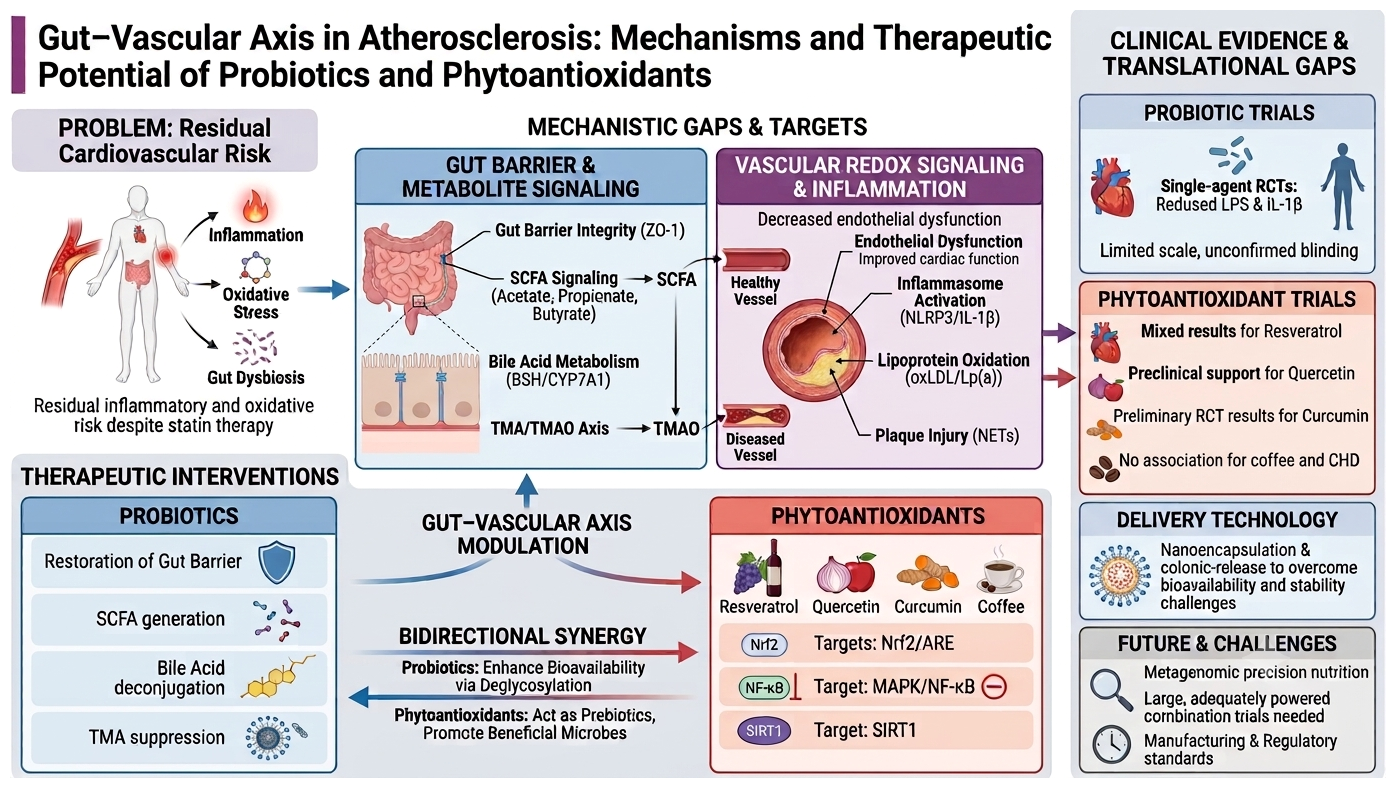
An Integrated Model of the Gut–Vascular Axis: Mechanisms, Interventions, and Translational Gaps
Supplementary Materials
Author Contributions
Funding
Institutional Review Board Statement
Informed Consent Statement
Data Availability Statement
Conflicts of Interest
References
- Wang, X.; He, B. Endothelial dysfunction: Molecular mechanisms and clinical implications. MedComm 2024, 5, e651. [Google Scholar] [CrossRef] [Scilit] [PubMed]
- Mo, B.; Ding, Y.; Ji, Q. NLRP3 inflammasome in cardiovascular diseases: An update. Front. Immunol. 2025, 16, 1550226. [Google Scholar] [CrossRef] [Scilit] [PubMed]
- Zhang, X.; Li, Z.; Zhang, H.; Chen, Z.; Duan, G.; Huang, S.; Shi, H.; Zhang, Y.; Du, J.; Xiao, G.; et al. Prediction of stroke recurrence for patients with middle cerebral artery atherosclerotic disease by CT perfusion. Front. Neurol. 2025, 16, 1739005. [Google Scholar] [CrossRef] [Scilit] [PubMed]
- Tang, W.H.W.; Backhed, F.; Landmesser, U.; Hazen, S.L. Intestinal microbiota in cardiovascular health and disease: JACC state-of-the-art review. J. Am. Coll. Cardiol. 2019, 73, 2089–2105. [Google Scholar] [CrossRef] [Scilit] [PubMed]
- Kenny, D.J.; Plichta, D.R.; Shungin, D.; Koppel, N.; Hall, A.B.; Fu, B.; Vasan, R.S.; Shaw, S.Y.; Vlamakis, H.; Balskus, E.P.; et al. Cholesterol metabolism by uncultured human gut bacteria influences host cholesterol level. Cell Host Microbe 2020, 28, 245–257.e6. [Google Scholar] [CrossRef] [Scilit] [PubMed]
- Juste, C.; Gérard, P. Cholesterol-to-coprostanol conversion by the gut microbiota: What we know, suspect, and ignore. Microorganisms 2021, 9, 1881. [Google Scholar] [CrossRef] [Scilit] [PubMed]
- Sun, C.; Wang, Z.; Hu, L.; Zhang, X.; Chen, J.; Yu, Z.; Liu, L.; Wu, M. Targets of statins intervention in LDL-C metabolism: Gut microbiota. Front. Cardiovasc. Med. 2022, 9, 972603. [Google Scholar] [CrossRef] [Scilit] [PubMed]
- Saarinen, H.J.; Lahtela, J.; Mähönen, P.; Palomäki, A.; Hämeenlinna Metabolic Syndrome Research Program Study Group. The association between inflammation, arterial stiffness, oxidized LDL and cardiovascular disease in Finnish men with metabolic syndrome—A 15-year follow-up study. BMC Cardiovasc. Disord. 2024, 24, 162. [Google Scholar] [CrossRef] [Scilit] [PubMed]
- Baethge, C.; Goldbeck-Wood, S.; Mertens, S. SANRA-a scale for the quality assessment of narrative review articles. Res. Integr. Peer Rev. 2019, 4, 5. [Google Scholar] [CrossRef] [Scilit] [PubMed]
- Guo, J.; Du, L. An update on ox-LDL-inducing vascular smooth muscle cell-derived foam cells in atherosclerosis. Front. Cell Dev. Biol. 2024, 12, 1481505. [Google Scholar] [CrossRef] [Scilit] [PubMed]
- Erlinge, D.; Tsimikas, S.; Maeng, M.; Maehara, A.; Larsen, A.I.; Engstrøm, T.; Kjøller-Hansen, L.; Matsumura, M.; Ben-Yehuda, O.; Bøtker, H.E.; et al. Lipoprotein(a), cholesterol, triglyceride levels, and vulnerable coronary plaques: A PROSPECT II substudy. J. Am. Coll. Cardiol. 2025, 85, 2011–2024. [Google Scholar] [CrossRef] [Scilit] [PubMed]
- Shetty, S.; Subramanian, M. Neutrophil extracellular traps (NETs) as drivers of atherosclerosis: Pathogenic mechanisms and therapeutic opportunities. Pharmacol. Ther. 2025, 274, 108917. [Google Scholar] [CrossRef] [Scilit] [PubMed]
- Chen, Z.; Zhu, Q.; Xu, H.; Hu, Y.; Wang, Y.; Chen, Z.; Wang, Y.; Huang, X.; Fu, G.; Ma, B.; et al. Nano-functionalized probiotic treats atherosclerosis via inhibiting intestinal microbiota-TMA-TMAO axis. Nat. Commun. 2025, 16, 11294. [Google Scholar] [CrossRef] [Scilit] [PubMed]
- Chong-Nguyen, C.; Fuentes Artiles, R.; Pilgrim, T.; Yilmaz, B.; Döring, Y. The gut–heart axis in coronary artery disease: A scoping and narrative review of sex-based microbial and metabolic disparities. Biol. Sex. Differ. 2026, 17, 24. [Google Scholar] [CrossRef] [Scilit] [PubMed]
- Temp, J.; Strässler, E.T.; Freitag, J.; Wu, H.; Haritonow, N.; Landmesser, U.; Podzniakova, S.; Barcena, M.L. Sex-specific effects of resveratrol and metformin on mitochondrial function and inflammatory activation in a TNF-α-driven human iPSC-derived endothelial dysfunction model. Front. Immunol. 2026, 17, 1903774. [Google Scholar] [CrossRef] [Scilit] [PubMed]
- Cai, Y. Probiotics in atherosclerosis: Mechanisms, efficacy and future directions—A review study. Front. Immunol. 2026, 17, 1722134. [Google Scholar] [CrossRef] [Scilit] [PubMed]
- Naso, A.M.; Lizier, M.; Correale, C.; Silvestri, A.; Penna, G.; Brescia, P.; Rescigno, M. A multi-strain probiotic formulation preserves intestinal epithelial and vascular barriers during enteropathogenic infection. Front. Microbiol. 2025, 16, 1631322. [Google Scholar] [CrossRef] [Scilit] [PubMed]
- Chulenbayeva, L.; Issilbayeva, A.; Sailybayeva, A.; Bekbossynova, M.; Kozhakhmetov, S.; Kushugulova, A. Short-chain fatty acids and their metabolic interactions in heart failure. Biomedicines 2025, 13, 343. [Google Scholar] [CrossRef] [Scilit] [PubMed]
- Liu, Y.; Kuang, W.; Li, M.; Wang, Z.; Liu, Y.; Zhao, M.; Huan, H.; Yang, Y. Cholesterol-lowering mechanism of Lactobacillus bile salt hydrolase through regulation of Bifidobacterium pseudolongum in the gut microbiota. Nutrients 2025, 17, 3019. [Google Scholar] [CrossRef] [Scilit] [PubMed]
- Xu, L.; Yang, H.; He, C.; Zhang, H.; Jiang, Z.; Zhang, Y.; Luan, K.; Hu, H. Bile acids: The contribution of the gut microbiota to atherosclerosis. Rev. Cardiovasc. Med. 2026, 27, 44050. [Google Scholar] [CrossRef] [Scilit] [PubMed]
- Chu, Y.; Huang, K.-H.; Tseng, C.-N. Targeting the gut-heart axis in diabetic heart failure: Microbiota and SGLT2is as converging therapeutic frontiers. Int. J. Mol. Sci. 2026, 27, 4101. [Google Scholar] [CrossRef] [Scilit] [PubMed]
- Chung, J.; An, S.H.; Kang, S.W.; Kwon, K. Ursodeoxycholic acid (UDCA) exerts anti-atherogenic effects by inhibiting RAGE signaling in diabetic atherosclerosis. PLoS ONE 2016, 11, e0147839. [Google Scholar] [CrossRef] [Scilit] [PubMed]
- Chong Nguyen, C.; Duboc, D.; Rainteau, D.; Sokol, H.; Humbert, L.; Seksik, P.; Bellino, A.; Abdoul, H.; Bouazza, N.; Treluyer, J.-M.; et al. Circulating bile acids concentration is predictive of coronary artery disease in human. Sci. Rep. 2021, 11, 22661. [Google Scholar] [CrossRef] [Scilit] [PubMed]
- López Espinosa, V.M.; Amaro-Gahete, F.J.; Osuna-Prieto, F.J. Reduced systemic levels of bile acids in individuals with coronary artery disease: Insights from a systematic review. Int. J. Mol. Sci. 2025, 26, 8764. [Google Scholar] [CrossRef] [Scilit] [PubMed]
- Tonch-Cerbu, A.-K.; Boicean, A.-G.; Stoia, O.M.; Teodoru, M. Gut microbiota-derived metabolites in atherosclerosis: Pathways, biomarkers, and targets. Int. J. Mol. Sci. 2025, 26, 8488. [Google Scholar] [CrossRef] [Scilit] [PubMed]
- Zhang, D.; He, X.; Shi, Y.; Chen, X.; Yu, K.; Wang, S. Gut microbiota regulate atherosclerosis via the gut-vascular axis: A scoping review of mechanisms and therapeutic interventions. Front. Microbiol. 2025, 16, 1606309. [Google Scholar] [CrossRef] [Scilit] [PubMed]
- Spasova, N.; Somleva, D.; Krastev, B.; Tropcheva, R.; Svinarov, D.; Kundurzhiev, T.; Kinova, E.; Goudev, A. Effect of Lactobacillus plantarum supplementation on trimethylamine-N-oxide levels in 30 patients with atherosclerotic cardiovascular disease: A double-blind randomized controlled trial. Folia Med. 2024, 66, 682–691. [Google Scholar] [CrossRef] [Scilit] [PubMed]
- Dong, J.; Chen, L.; Zheng, N.; Yang, M. The beneficial effects of probiotics on patients with coronary heart disease: A systematic review and meta-analysis. Front. Nutr. 2025, 12, 1612021. [Google Scholar] [CrossRef] [Scilit] [PubMed]
- Moludi, J.; Kafil, H.S.; Qaisar, S.A.; Gholizadeh, P.; Alizadeh, M.; Jafari Vayghyan, H. Effect of probiotic supplementation along with calorie restriction on metabolic endotoxemia, and inflammation markers in coronary artery disease patients: A double-blind placebo-controlled randomized clinical trial. Nutr. J. 2021, 20, 47. [Google Scholar] [CrossRef] [Scilit] [PubMed]
- Dong, J.; Chen, L.; Zheng, N.; Yang, M. Effects of probiotics combined with statins on blood lipids, TMAO, and inflammatory and oxidative stress markers in patients with atherosclerosis: A systematic review and meta-analysis. Front. Cardiovasc. Med. 2026, 13, 1897708. [Google Scholar] [CrossRef] [Scilit] [PubMed]
- Qiu, L.; Tao, X.; Xiong, H.; Yu, J.; Wei, H. Lactobacillus plantarum ZDY04 exhibits a strain-specific property of lowering TMAO via the modulation of gut microbiota in mice. Food Funct. 2018, 9, 4299–4309. [Google Scholar] [CrossRef] [Scilit] [PubMed]
- Jones, M.L.; Martoni, C.J.; Prakash, S. Cholesterol lowering and inhibition of sterol absorption by Lactobacillus reuteri NCIMB 30242: A randomized controlled trial. Eur. J. Clin. Nutr. 2012, 66, 1234–1241. [Google Scholar] [CrossRef] [Scilit] [PubMed]
- Malik, M.; Suboc, T.M.; Tyagi, S.; Salzman, N.; Wang, J.; Ying, R.; Tanner, M.J.; Kakarla, M.; Baker, J.E.; Widlansky, M.E. Lactobacillus plantarum 299v supplementation improves vascular endothelial function and reduces inflammatory biomarkers in men with stable coronary artery disease. Circ. Res. 2018, 123, 1091–1102. [Google Scholar] [CrossRef] [Scilit] [PubMed]
- Zhai, T.; Ren, W.; Wang, P.; Zheng, L. Lactobacillus rhamnosus GG protects against atherosclerosis by improving ketone body synthesis. Appl. Microbiol. Biotechnol. 2022, 106, 8233–8243. [Google Scholar] [CrossRef] [Scilit] [PubMed]
- Szulińska, M.; Łoniewski, I.; Skrypnik, K.; Sobieska, M.; Korybalska, K.; Suliburska, J.; Bogdański, P. Multispecies probiotic supplementation favorably affects vascular function and reduces arterial stiffness in obese postmenopausal women—A 12-week placebo-controlled and randomized clinical study. Nutrients 2018, 10, 1672. [Google Scholar] [CrossRef] [Scilit] [PubMed]
- Godos, J.; Romano, G.L.; Gozzo, L.; Laudani, S.; Paladino, N.; Dominguez Azpíroz, I.; Martínez López, N.M.; Giampieri, F.; Quiles, J.L.; Battino, M.; et al. Resveratrol and vascular health: Evidence from clinical studies and mechanisms of action related to its metabolites produced by gut microbiota. Front. Pharmacol. 2024, 15, 1368949. [Google Scholar] [CrossRef] [Scilit] [PubMed]
- Domi, E.; Hoxha, M. Natural compounds targeting SIRT1 and beyond: Promising nutraceutical strategies against atherosclerosis. Nutrients 2025, 17, 3316. [Google Scholar] [CrossRef] [Scilit] [PubMed]
- Lu, T.; Gao, J.; Zhu, P.; Cao, R.; Ye, K. The multi-target protective effects of quercetin in cerebrovascular diseases: A dietary strategy for endothelial repair and neuroprotection. Front. Nutr. 2026, 13, 1775964. [Google Scholar] [CrossRef] [Scilit] [PubMed]
- Chen, D.; Wang, J.; Lei, Z.; Qu, L.; Zou, W. Evidence synthesis and mechanism analysis of quercetin treatment for atherosclerosis: A preclinical systematic review and meta-analysis. Int. J. Mol. Sci. 2026, 27, 527. [Google Scholar] [CrossRef] [Scilit] [PubMed]
- El-Rakabawy, O.M.; Elkholy, A.A.; Mahfouz, A.A.; Abdelsalam, M.M.; El Wakeel, L.M. Curcumin supplementation improves the clinical outcomes of patients with diabetes and atherosclerotic cardiovascular risk. Sci. Rep. 2025, 15, 28358. [Google Scholar] [CrossRef] [Scilit] [PubMed]
- Park, Y.; Cho, H.; Myung, S.-K. Effect of coffee consumption on risk of coronary heart disease in a systematic review and meta-analysis of prospective cohort studies. Am. J. Cardiol. 2023, 186, 17–29. [Google Scholar] [CrossRef] [Scilit] [PubMed]
- Bondonno, N.P.; Parmenter, B.H.; Murray, K.; Bondonno, C.P.; Blekkenhorst, L.C.; Wood, A.C.; Post, W.S.; Allison, M.A.; Criqui, M.H.; Lewis, J.R.; et al. Associations between flavonoid intake and subclinical atherosclerosis: The Multi-Ethnic Study of Atherosclerosis. Arterioscler. Thromb. Vasc. Biol. 2024, 44, 2347–2359. [Google Scholar] [CrossRef] [Scilit] [PubMed]
- Tseng, C.-N.; Chu, Y. Probiotics and phytoantioxidants target coronary endothelial dysfunction in irregular sleep- and obesity-associated cardiometabolic syndrome. Life 2025, 15, 1740. [Google Scholar] [CrossRef] [Scilit] [PubMed]
- Brito Sampaio, K.; Luiz de Brito Alves, J.; Mangueira do Nascimento, Y.; Fechine Tavares, J.; Sobral da Silva, M.; Dos Santos Nascimento, D.; Lima, M.D.S.; de Araújo Rodrigues, N.P.; Garcia, E.F.; de Souza, E.L. Nutraceutical formulations combining Limosilactobacillus fermentum, quercetin, and or resveratrol with beneficial impacts on the abundance of intestinal bacterial populations, metabolite production, and antioxidant capacity during colonic fermentation. Food Res. Int. 2022, 161, 111800. [Google Scholar] [CrossRef] [Scilit] [PubMed]
- Brasil, J.M.A.; Melo, N.C.D.O.; Sampaio, K.B.; da Costa, P.C.T.; Duman, H.; Karav, S.; Lima, M.D.S.; de Brito Alves, J.L. Impact of a Limosilactobacillus fermentum, quercetin, and resveratrol nutraceutical on fecal microbiota composition and metabolic activity in healthy and hypertensive subjects. Foods 2025, 14, 986. [Google Scholar] [CrossRef] [Scilit] [PubMed]
- Trindade, L.R.; da Silva, D.V.T.; Baião, D.D.S.; Paschoalin, V.M.F. Increasing the power of polyphenols through nanoencapsulation for adjuvant therapy against cardiovascular diseases. Molecules 2021, 26, 4621. [Google Scholar] [CrossRef] [Scilit] [PubMed]
- Huang, L.; Wang, J.; Kong, L.; Wang, X.; Li, Q.; Zhang, L.; Shi, J.; Duan, J.; Mu, H. ROS-responsive hyaluronic acid hydrogel for targeted delivery of probiotics to relieve colitis. Int. J. Biol. Macromol. 2022, 222, 1476–1486. [Google Scholar] [CrossRef] [Scilit] [PubMed]
- Wang, L.; Song, M.; Zhao, Z.; Chen, X.; Cai, J.; Cao, Y.; Xiao, J. Lactobacillus acidophilus loaded pickering double emulsion with enhanced viability and colon-adhesion efficiency. LWT 2020, 121, 108928. [Google Scholar] [CrossRef] [Scilit]
- Tang, Z. Cyanidin-3-glucoside: Targeting atherosclerosis through gut microbiota and anti-inflammation. Front. Nutr. 2025, 12, 1627868. [Google Scholar] [CrossRef] [Scilit] [PubMed]
- Wang, Y.; Zhang, Y.; Wang, X.; Liu, Y.; Xia, M. Supplementation with cyanidin-3-O-β-glucoside protects against hypercholesterolemia-mediated endothelial dysfunction and attenuates atherosclerosis in apolipoprotein E-deficient mice. J. Nutr. 2012, 142, 1033–1037. [Google Scholar] [CrossRef] [Scilit] [PubMed]
- Turner, R.; Etienne, N.; Alonso, M.G.; de Pascual-Teresa, S.; Minihane, A.M.; Weinberg, P.D.; Rimbach, G. Antioxidant and anti-atherogenic activities of olive oil phenolics. Int. J. Vitam. Nutr. Res. 2005, 75, 61–70. [Google Scholar] [CrossRef] [Scilit] [PubMed]
- Sheng, Y.; Sun, Y.; Tang, Y.; Yu, Y.; Wang, J.; Zheng, F.; Li, Y.; Sun, Y. Catechins: Protective mechanism of antioxidant stress in atherosclerosis. Front. Pharmacol. 2023, 14, 1144878. [Google Scholar] [CrossRef] [Scilit] [PubMed]
- Palozza, P.; Parrone, N.; Simone, R.E.; Catalano, A. Lycopene in atherosclerosis prevention: An integrated scheme of the potential mechanisms of action from cell culture studies. Arch. Biochem. Biophys. 2010, 504, 26–33. [Google Scholar] [CrossRef] [Scilit] [PubMed]
- Nishimoto, Y.; Fujisawa, K.; Ukawa, Y.; Kudoh, M.; Funahashi, K.; Kishimoto, Y.; Fukuda, S. Effect of urolithin A on the improvement of vascular endothelial function depends on the gut microbiota. Front. Nutr. 2023, 9, 1077534. [Google Scholar] [CrossRef] [Scilit] [PubMed]
- Istas, G.; Feliciano, R.P.; Weber, T.; Garcia-Villalba, R.; Tomas-Barberan, F.; Heiss, C.; Rodriguez-Mateos, A. Plasma urolithin metabolites correlate with improvements in endothelial function after red raspberry consumption: A double-blind randomized controlled trial. Arch. Biochem. Biophys. 2018, 651, 43–51. [Google Scholar] [CrossRef] [Scilit] [PubMed]

| Phytoantioxidant | Dosage | Duration | Indication/Model | Reported Outcome(s) | Ref. | Evidence Level/RoB |
|---|---|---|---|---|---|---|
| Preclinical/Mechanistic Evidence | ||||||
| Quercetin | Not established in humans for atherosclerosis; dosing varies by preclinical model | Variable (preclinical systematic review) | Experimental atherosclerosis across multiple animal models | Consistent attenuation of atherosclerosis across preclinical models; activation of Nrf2–heme oxygenase-1 axis and blood–brain barrier preservation reported in related neurovascular literature | [38,39] | Preclinical (systematic review/meta-analysis); RoB: N/A (secondary synthesis) |
| Clinical Evidence | ||||||
| Resveratrol | Highly variable across reviewed RCTs; whole-food sources (e.g., red wine) vs. concentrated tablet supplementation | Variable across the RCTs reviewed | Vascular disease (evidence synthesized from clinical trials) | Contrasting, non-dose-dependent clinical effects on endothelial and blood-pressure endpoints; red-wine-source interventions showed effects at lower resveratrol content than high-dose tablets, which frequently showed null findings | [36] | Clinical: narrative synthesis of multiple RCTs; RoB not pooled |
| Curcumin | 500 mg three times daily (1500 mg/day) | 12 weeks | Type 2 diabetes mellitus with elevated ASCVD risk (RCT, n = 72) | Reduced SBP/DBP, LDL-C, TNF-α, and MDA; increased HDL-C; improved ASCVD risk classification | [40] | Clinical: RCT, n = 72; RoB: High (open-label, no placebo arm) |
| Coffee (chlorogenic-acid-type phytoantioxidants) | Habitual consumption level, not a supplement dose | Pooled across 32 prospective cohort studies | General population; coronary heart disease | No significant overall association with CHD risk (RR 1.05, 95% CI 0.97–1.14); effects vary by preparation method and subgroup | [41] | Clinical: pooled meta-analysis, 32 cohorts; RoB not pooled |
| Dietary flavonoids (habitual intake) | Habitual dietary intake, estimated by food-frequency questionnaire (not a supplement dose) | Prospective cohort, exam 1 (2000–2002) to exam 5 (2010–2011) | General adult population; MESA cohort (n = 5599) | Higher intake associated with lower odds of low ABI and carotid plaque; no significant association with IMT or coronary artery calcium; associations did not differ by sex, race/ethnicity, or smoking status | [42] | Clinical: prospective cohort; RoB: Moderate (per Supplementary S2) |
Disclaimer/Publisher’s Note: The statements, opinions and data contained in all publications are solely those of the individual author(s) and contributor(s) and not of MDPI and/or the editor(s). MDPI and/or the editor(s) disclaim responsibility for any injury to people or property resulting from any ideas, methods, instructions or products referred to in the content. |
© 2026 by the authors. Licensee MDPI, Basel, Switzerland. This article is an open access article distributed under the terms and conditions of the Creative Commons Attribution (CC BY) license.
Share and Cite
Chu, Y.; Huang, K.-H.; Tseng, C.-N. Targeting the Gut Vascular Axis in Atherosclerosis: Probiotic and Phytoantioxidant Crosstalk as a Hypothesis-Generating Framework for Residual Cardiovascular Risk. Int. J. Mol. Sci. 2026, 27, 8535. https://doi.org/10.3390/ijms27198535
Chu Y, Huang K-H, Tseng C-N. Targeting the Gut Vascular Axis in Atherosclerosis: Probiotic and Phytoantioxidant Crosstalk as a Hypothesis-Generating Framework for Residual Cardiovascular Risk. International Journal of Molecular Sciences. 2026; 27(19):8535. https://doi.org/10.3390/ijms27198535
Chicago/Turabian StyleChu, Yen, Kuo-Hsiung Huang, and Chi-Nan Tseng. 2026. "Targeting the Gut Vascular Axis in Atherosclerosis: Probiotic and Phytoantioxidant Crosstalk as a Hypothesis-Generating Framework for Residual Cardiovascular Risk" International Journal of Molecular Sciences 27, no. 19: 8535. https://doi.org/10.3390/ijms27198535
APA StyleChu, Y., Huang, K.-H., & Tseng, C.-N. (2026). Targeting the Gut Vascular Axis in Atherosclerosis: Probiotic and Phytoantioxidant Crosstalk as a Hypothesis-Generating Framework for Residual Cardiovascular Risk. International Journal of Molecular Sciences, 27(19), 8535. https://doi.org/10.3390/ijms27198535