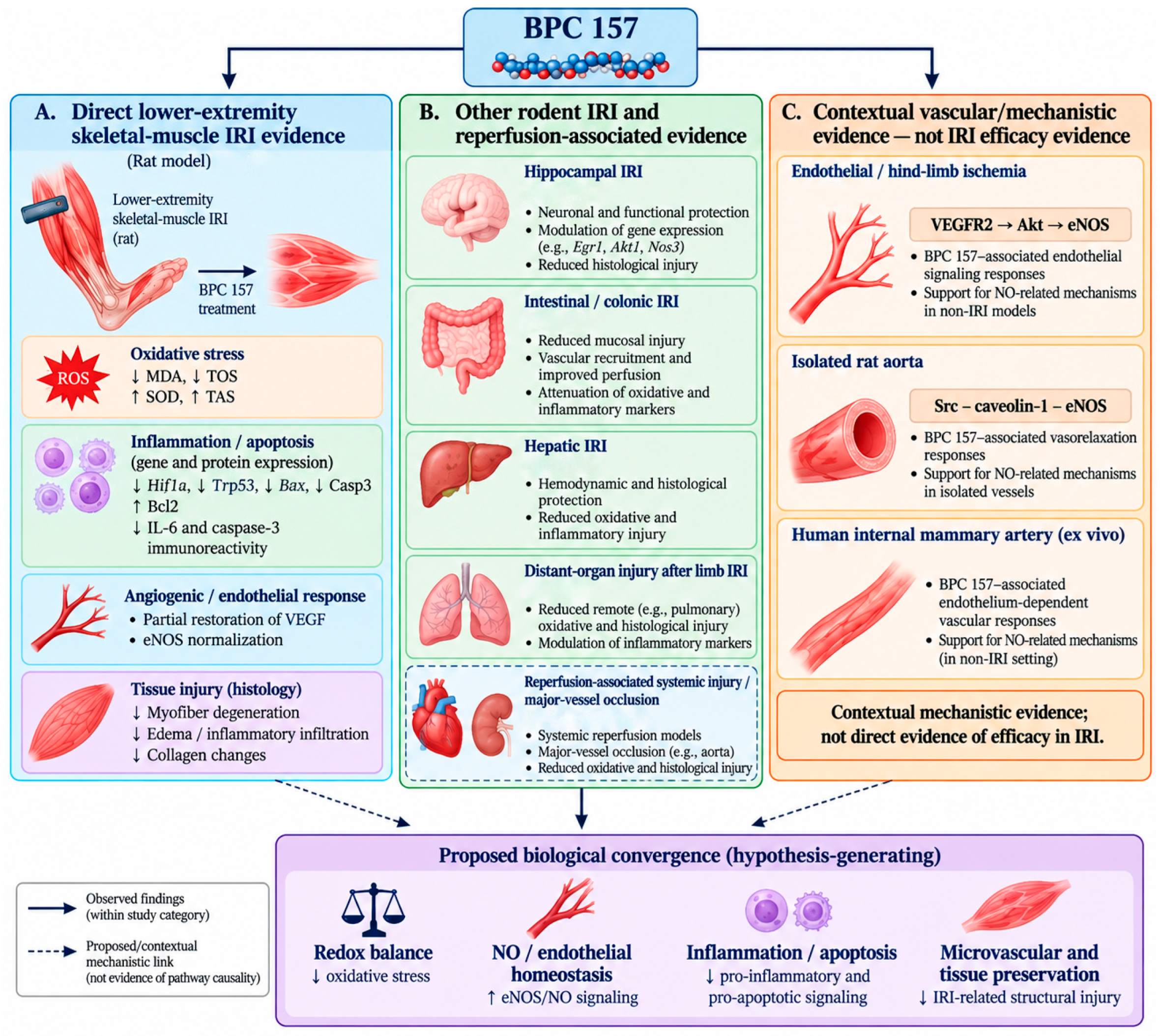
Abstract
Ischemia–reperfusion injury (IRI) is a clinically important consequence of blood-flow restoration after ischemia and contributes to tissue damage across multiple organ systems. This critical review evaluates the preclinical evidence for BPC 157 in rodent IRI and related reperfusion-associated vascular injury models, with particular attention to oxidative stress, endothelial and nitric oxide (NO)-related responses, inflammation, apoptosis, angiogenic signaling, and tissue injury. Searches were performed up to 24 June 2026 across PubMed/MEDLINE, Web of Science Core Collection, Scopus, PMC, publisher/DOI metadata, ClinicalTrials.gov, FDA materials, and WADA materials. Peer-reviewed rodent studies involving conventional organ-specific IRI or reperfusion-associated systemic injury were evaluated as the core IRI/reperfusion evidence according to the experimental model, BPC 157 dose, route and timing, measured outcomes, and methodological limitations, while selected major-vessel occlusion models were considered separately as related in vivo vascular evidence. Endothelial, vascular-ring, human ex vivo, and regulatory/clinical sources were used as contextual evidence rather than as evidence of IRI efficacy. Meta-analysis was not performed because of substantial heterogeneity in organ systems, injury paradigms, doses, routes, treatment timing, and outcome measures. Across the available rodent literature, BPC 157 administration has been associated with attenuation of oxidative injury, modulation of NO-related vascular responses, reductions in inflammatory and apoptotic markers, and changes in VEGF/VEGFR2–Akt–eNOS-related signaling. Organ-specific findings include biochemical, molecular, and histological protection in lower-extremity skeletal-muscle IRI; attenuation of distant-organ injury following limb IRI; neuronal and functional effects in hippocampal IRI; vascular and tissue-protective responses in intestinal/colonic IRI; and hemodynamic and histological effects in hepatic Pringle-maneuver IRI. However, the evidence base remains heterogeneous and frequently relies on short observation periods, single-dose paradigms, and incompletely characterized risk-of-bias domains. Reperfusion-like systemic and major-vessel occlusion models provide additional mechanistic context but should not be considered equivalent to conventional organ-specific IRI. Current evidence therefore supports BPC 157 as a hypothesis-generating investigational candidate for further preclinical IRI research rather than as an established therapy. Independent blinded replication, dose–response and therapeutic-window studies, pharmacokinetic/pharmacodynamic characterization, rigorous toxicology, and ultimately controlled human studies would be required before clinical translation could be considered.