WHO Critical Priority Fungi: A Comprehensive Review of Antifungal Resistance, Emerging Therapeutic Strategies, and the Potential of Antifungal Peptides

 ,
,  and
and
Abstract
1. Introduction
2. Conventional and Novel Antifungals, and Resistance in WHO Critical Priority Fungi
2.1. Azoles
2.2. Polyenes
2.3. Echinocandins
2.4. Nucleoside Analogs, Antimetabolites
2.5. Hydroxypyridones
2.6. Novel Antifungals
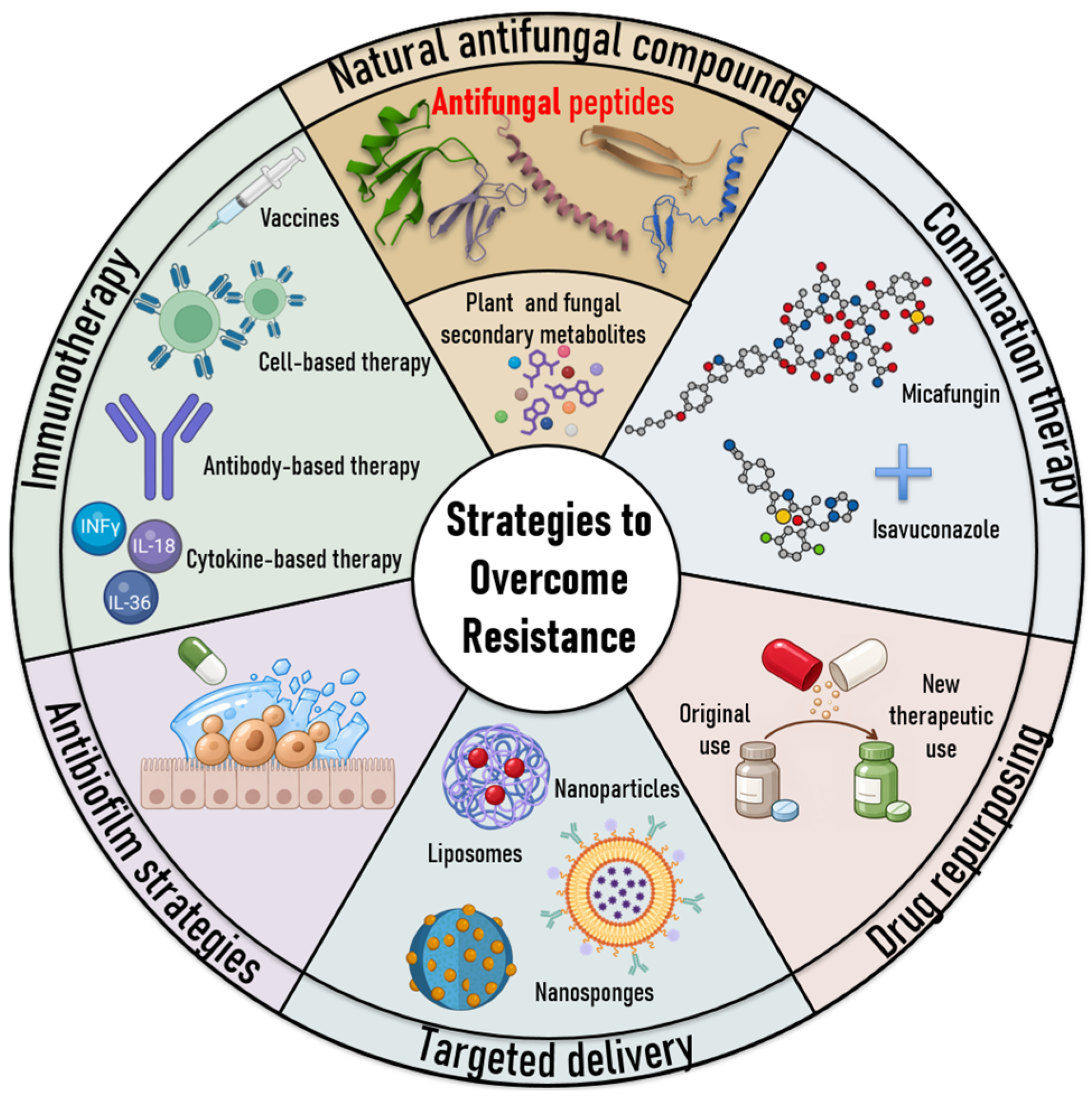
3. Strategies to Overcome Resistance in WHO Critical Priority Fungi
3.1. Combination Therapy
3.2. Drug Repurposing
3.3. Targeted Delivery
3.4. Antibiofilm Strategies
3.5. Immunotherapy
3.5.1. Vaccines
3.5.2. Cell-Based Therapy
3.5.3. Cytokine-Based Therapy
3.5.4. Antibody-Based Therapy
3.6. Natural Antifungal Compounds
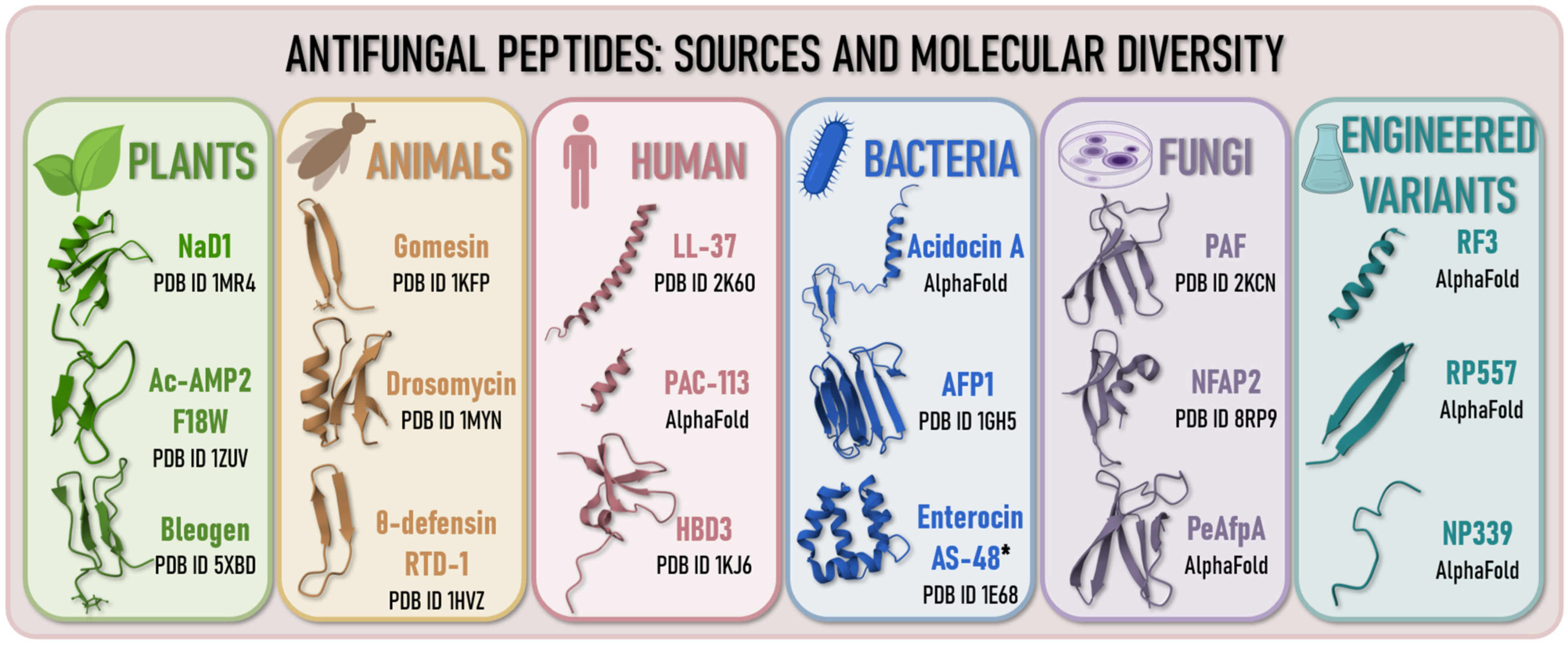
4. Antifungal Peptides Active Against WHO Critical Priority Fungi
4.1. Plants
4.2. Animals
4.3. Humans
4.4. Bacteria
4.5. Fungi
4.6. Engineered Peptide Variants
4.7. Translational Barriers to the Clinical Application of AFPs
5. Resistance to Antifungal Peptides and Its Possible Mechanisms
6. Conclusions
Author Contributions
Funding
Institutional Review Board Statement
Informed Consent Statement
Data Availability Statement
Conflicts of Interest
References
- Almeida, F.; Rodrigues, M.L.; Coelho, C. The Still Underestimated Problem of Fungal Diseases Worldwide. Front. Microbiol. 2019, 10, 214. [Google Scholar] [CrossRef] [Scilit] [PubMed]
- Li, D.; Fan, S.; Zhao, H.; Song, J.; Guo, L.; Li, W.; Xu, X.; Li, Q. Worldwide Trends and Future Projections of Fungal Skin Disease Burden: A Comprehensive Analysis from the Global Burden of Diseases Study 2021. Front. Public Health 2025, 13, 1580221. [Google Scholar] [CrossRef] [Scilit] [PubMed]
- Sharma, B.; Nonzom, S. Superficial Mycoses, a Matter of Concern: Global and Indian Scenario—An Updated Analysis. Mycoses 2021, 64, 890–908. [Google Scholar] [CrossRef] [Scilit] [PubMed]
- Denning, D.W. Global Incidence and Mortality of Severe Fungal Disease. Lancet Infect. Dis. 2024, 24, e428–e438. [Google Scholar] [CrossRef] [Scilit] [PubMed]
- von Lilienfeld-Toal, M.; Wagener, J.; Einsele, H.; Cornely, O.A.; Kurzai, O. Invasive Fungal Infection. Dtsch. Arztebl. Int. 2019, 116, 271–278. [Google Scholar] [CrossRef] [Scilit] [PubMed]
- Thomas-Rüddel, D.O.; Schlattmann, P.; Pletz, M.; Kurzai, O.; Bloos, F. Risk Factors for Invasive Candida Infection in Critically Ill Patients: A Systematic Review and Meta-analysis. Chest 2022, 161, 345–355. [Google Scholar] [CrossRef] [Scilit] [PubMed]
- Cifaldi, C.; Ursu, G.M.; D’Alba, I.; Paccoud, O.; Danion, F.; Lanternier, F.; Chiriaco, M. Main Human Inborn Errors of Immunity Leading to Fungal Infections. Clin. Microbiol. Infect. 2022, 28, 1435–1440. [Google Scholar] [CrossRef] [Scilit] [PubMed]
- Glocker, E.-O.; Hennigs, A.; Nabavi, M.; Schäffer, A.A.; Woellner, C.; Salzer, U.; Pfeifer, D.; Veelken, H.; Warnatz, K.; Tahami, F.; et al. A homozygous CARD9 mutation in a family with susceptibility to fungal infections. N. Engl. J. Med. 2009, 361, 1727–1735. [Google Scholar] [CrossRef] [Scilit] [PubMed]
- Hoenigl, M.; Seidel, D.; Sprute, R.; Cunha, C.; Oliverio, M.; Goldman, G.H.; Ibrahim, A.S.; Carvalho, A. COVID-19-Associated Fungal Infections. Nat. Microbiol. 2022, 7, 1127–1140. [Google Scholar] [CrossRef] [Scilit] [PubMed]
- Colaneri, M.; Giusti, E.M.; Genovese, C.; Galli, L.; Lombardi, A.; Gori, A. Mortality of Patients with Candidemia and COVID-19: A Systematic Review with Meta-Analysis. Open Forum Infect. Dis. 2023, 10, ofad358. [Google Scholar] [CrossRef] [Scilit] [PubMed]
- Mitaka, H.; Kuno, T.; Takagi, H.; Patrawalla, P. Incidence and Mortality of COVID-19-Associated Pulmonary Aspergillosis: A Systematic Review and Meta-Analysis. Mycoses 2021, 64, 993–1001. [Google Scholar] [CrossRef] [Scilit] [PubMed]
- World Health Organization. WHO Fungal Priority Pathogens List to Guide Research, Development and Public Health Action. Available online: https://www.who.int/publications/i/item/9789240060241 (accessed on 10 September 2025).
- Costa-de-Oliveira, S.; Rodrigues, A.G. Candida albicans Antifungal Resistance and Tolerance in Bloodstream Infections: The Triad Yeast–Host–Antifungal. Microorganisms 2020, 8, 154. [Google Scholar] [CrossRef] [Scilit] [PubMed]
- Kim, H.Y.; Nguyen, T.A.; Kidd, S.; Chambers, J.; Alastruey-Izquierdo, A.; Shin, J.-H.; Dao, A.; Forastiero, A.; Wahyuningsih, R.; Chakrabarti, A.; et al. Candida auris—A systematic review to inform the World Health Organization fungal priority pathogens list. Med. Mycol. 2024, 62, myae042. [Google Scholar] [CrossRef] [Scilit] [PubMed]
- Bongomin, F.; Gago, S.; Oladele, R.O.; Denning, D.W. Global and Multi-National Prevalence of Fungal Diseases—Estimate Precision. J. Fungi 2017, 3, 57. [Google Scholar] [CrossRef] [Scilit] [PubMed]
- Denning, D.W.; Kneale, M.; Sobel, J.D.; Rautemaa-Richardson, R. Global Burden of Recurrent Vulvovaginal Candidiasis: A Systematic Review. Lancet Infect. Dis. 2018, 18, e339–e347. [Google Scholar] [CrossRef] [Scilit] [PubMed]
- Chang, C.C.; Harrison, T.S.; Bicanic, T.A.; Chayakulkeeree, M.; Sorrell, T.C.; Warris, A.; Hagen, F.; Spec, A.; Oladele, R.O.; Govender, N.P.; et al. Global guideline for the diagnosis and management of cryptococcosis: An initiative of the ECMM and ISHAM in cooperation with the ASM. Lancet Infect. Dis. 2024, 24, e495–e512, Erratum in Lancet Infect. Dis. 2024, 24, e485. [Google Scholar] [CrossRef] [Scilit] [PubMed]
- Bongomin, F.; Oladele, R.O.; Gago, S.; Moore, C.B.; Richardson, M.D. A Systematic Review of Fluconazole Resistance in Clinical Isolates of Cryptococcus Species. Mycoses 2018, 61, 290–297. [Google Scholar] [CrossRef] [Scilit] [PubMed]
- Latgé, J.-P.; Chamilos, G. Aspergillus fumigatus and Aspergillosis in 2019. Clin. Microbiol. Rev. 2020, 33, e00140-18. [Google Scholar] [CrossRef] [Scilit] [PubMed]
- Patterson, T.F.; Thompson, G.R., 3rd; Denning, D.W.; Fishman, J.A.; Hadley, S.; Herbrecht, R.; Kontoyiannis, D.P.; Marr, K.A.; Morrison, V.A.; Nguyen, M.H.; et al. Practice guidelines for the diagnosis and management of aspergillosis: 2016 update by the Infectious Diseases Society of America. Clin. Infect. Dis. 2016, 63, e1–e60. [Google Scholar] [CrossRef] [Scilit] [PubMed]
- Cui, X.; Wang, L.; Lü, Y.; Yue, C. Development and research progress of anti-drug resistant fungal drugs. J. Infect. Public Health 2022, 15, 986–1000. [Google Scholar] [CrossRef] [Scilit] [PubMed]
- Nobile, C.J.; Johnson, A.D. Candida albicans Biofilms and Human Disease. Annu. Rev. Microbiol. 2015, 69, 71–92. [Google Scholar] [CrossRef] [Scilit] [PubMed]
- Dominguez, E.; Zarnowski, R.; Sanchez, H.; Covelli, A.S.; Westler, W.M.; Azadi, P.; Nett, J.; Mitchell, A.P.; Andes, D.R. Conservation and Divergence in the Candida Species Biofilm Matrix Mannan–Glucan Complex Structure, Function, and Genetic Control. mBio 2018, 9, e00451-18. [Google Scholar] [CrossRef] [Scilit] [PubMed]
- Seidel, D.; Wurster, S.; Jenks, J.D.; Sati, H.; Gangneux, J.P.; Egger, M.; Alastruey-Izquierdo, A.; Ford, N.P.; Chowdhary, A.; Sprute, R.; et al. Impact of Climate Change and Natural Disasters on Fungal Infections. Lancet Microbe 2024, 5, e594–e605. [Google Scholar] [CrossRef] [Scilit] [PubMed]
- Muñoz, P.; Bouza, E.; COMIC (Collaboration Group on Mycosis) Study Group. The current treatment landscape: The need for antifungal stewardship programmes. J. Antimicrob. Chemother. 2016, 71, ii5–ii12. [Google Scholar] [CrossRef] [Scilit] [PubMed][Green Version]
- Berger, S.; El Chazli, Y.; Babu, A.F.; Coste, A.T. Azole Resistance in Aspergillus fumigatus: A Consequence of Antifungal Use in Agriculture? Front. Microbiol. 2017, 8, 1024. [Google Scholar] [CrossRef] [Scilit] [PubMed]
- CLSI M27; Reference Method for Broth Dilution Antifungal Susceptibility Testing of Yeasts, 4th ed. Clinical and Laboratory Standards Institute: Wayne, PA, USA, 2017.
- CLSI M38; Reference Method for Broth Dilution Antifungal Susceptibility Testing of Filamentous Fungi, 3rd ed. Clinical and Laboratory Standards Institute: Wayne, PA, USA, 2017.
- European Committee on Antimicrobial Susceptibility Testing. Method for the Determination of Broth Dilution Minimum Inhibitory Concentrations of Antifungal Agents for Yeasts; EUCAST Definitive Document E.Def 7.4. 2023. Available online: https://www.eucast.org/fungi-afst/methodology-and-instructions/ast-of-yeasts/ (accessed on 31 July 2026).
- European Committee on Antimicrobial Susceptibility Testing. Method for the Determination of Broth Dilution Minimum Inhibitory Concentrations of Antifungal Agents for Conidia-Forming Moulds; EUCAST Definitive Document E.Def 9.4. 2022. Available online: https://www.eucast.org/fungi-afst/methodology-and-instructions/ast-of-moulds/ (accessed on 31 July 2026).
- European Committee on Antimicrobial Susceptibility Testing. Breakpoint Tables for Interpretation of MICs for Antifungal Agents, Version 12.1. 2026. Available online: https://www.eucast.org/fungi-afst/clinical-breakpoints-and-interpretation/clinical-breakpoint-table/ (accessed on 17 July 2026).
- World Health Organization. Antifungal Agents in Clinical and Preclinical Development. Overview and Analysis. Available online: https://iris.who.int/bitstream/handle/10665/380498/9789240105140-eng.pdf (accessed on 31 July 2026).
- Mourad, A.; Perfect, J.R. Tolerability Profile of the Current Antifungal Armoury. J. Antimicrob. Chemother. 2018, 73, i26–i32. [Google Scholar] [CrossRef] [Scilit] [PubMed]
- Carmo, A.; Rocha, M.; Pereirinha, P.; Tomé, R.; Costa, E. Antifungals: From Pharmacokinetics to Clinical Practice. Antibiotics 2023, 12, 884. [Google Scholar] [CrossRef] [Scilit] [PubMed]
- Gómez-López, A. Antifungal Therapeutic Drug Monitoring: Focus on Drugs without a Clear Recommendation. Clin. Microbiol. Infect. 2020, 26, 1481–1487. [Google Scholar] [CrossRef] [Scilit] [PubMed]
- Ramage, G.; Rajendran, R.; Sherry, L.; Williams, C. Fungal Biofilm Resistance. Int. J. Microbiol. 2012, 2012, 528521. [Google Scholar] [CrossRef] [Scilit] [PubMed]
- Wiederhold, N.P. Pharmacodynamics, Mechanisms of Action and Resistance, and Spectrum of Activity of New Antifungal Agents. J. Fungi 2022, 8, 857. [Google Scholar] [CrossRef] [Scilit] [PubMed]
- Kadariswantiningsih, I.N.; Empitu, M.A.; Santosa, T.I.; Alimu, Y. Antifungal resistance: Emerging mechanisms and implications (Review). Mol. Med. Rep. 2025, 32, 247. [Google Scholar] [CrossRef] [Scilit] [PubMed]
- Hoenigl, M.; Sprute, R.; Egger, M.; Arastehfar, A.; Cornely, O.A.; Krause, R.; Lass-Flörl, C.; Prattes, J.; Spec, A.; Thompson, G.R., 3rd; et al. The Antifungal Pipeline: Fosmanogepix, Ibrexafungerp, Olorofim, Opelconazole, and Rezafungin. Drugs 2021, 81, 1703–1729. [Google Scholar] [CrossRef] [Scilit] [PubMed]
- Puumala, E.; Fallah, S.; Robbins, N.; Cowen, L.E. Advancements and challenges in antifungal therapeutic development. Clin. Microbiol. Rev. 2024, 37, e0014223. [Google Scholar] [CrossRef] [Scilit] [PubMed]
- Roy, M.; Karhana, S.; Shamsuzzaman, M.; Khan, M.A. Recent drug development and treatments for fungal infections. Braz. J. Microbiol. 2023, 54, 1695–1716. [Google Scholar] [CrossRef] [Scilit] [PubMed]
- Deng, H.; Song, J.; Huang, Y.; Yang, C.; Zang, X.; Zhou, Y.; Li, H.; Dai, B.; Xue, X. Combating increased antifungal drug resistance in Cryptococcus, what should we do in the future? Acta Biochim. Biophys. Sin. 2023, 55, 540–547. [Google Scholar] [CrossRef] [Scilit] [PubMed]
- Orsi, C.F.; Colombari, B.; Ardizzoni, A.; Peppoloni, S.; Neglia, R.; Posteraro, B.; Morace, G.; Fadda, G.; Blasi, E. The ABC transporter-encoding gene AFR1 affects the resistance of Cryptococcus neoformans to microglia-mediated antifungal activity by delaying phagosomal maturation. FEMS Yeast Res. 2009, 9, 301–310. [Google Scholar] [CrossRef] [Scilit] [PubMed]
- Li, Y.; Hind, C.; Furner-Pardoe, J.; Sutton, J.M.; Rahman, K.M. Understanding the mechanisms of resistance to azole antifungals in Candida species. JAC-Antimicrob. Resist. 2025, 7, dlaf106. [Google Scholar] [CrossRef] [Scilit] [PubMed]
- Whaley, S.G.; Berkow, E.L.; Rybak, J.M.; Nishimoto, A.T.; Barker, K.S.; Rogers, P.D. Azole Antifungal Resistance in Candida albicans and Emerging Non-albicans Candida Species. Front. Microbiol. 2017, 7, 2173. [Google Scholar] [CrossRef] [Scilit] [PubMed]
- Santana, D.J.; Cauldron, N.C.; Rogers, P.D.; Cuomo, C.A. Deciphering the multidrug resistance paradigm in Candida auris. Antimicrob. Agents Chemother. 2026, 70, e0106224. [Google Scholar] [CrossRef] [Scilit] [PubMed]
- De Francesco, M.A. Drug-Resistant Aspergillus spp.: A Literature Review of Its Resistance Mechanisms and Its Prevalence in Europe. Pathogens 2023, 12, 1305. [Google Scholar] [CrossRef] [Scilit] [PubMed]
- Qiao, J.; Liu, W.; Li, R. Antifungal resistance mechanisms of Aspergillus. Jpn. J. Med. Mycol. 2008, 49, 157–163. [Google Scholar] [CrossRef] [Scilit] [PubMed]
- Alcazar-Fuoli, L.; Mellado, E.; Garcia-Effron, G.; Buitrago, M.J.; Lopez, J.F.; Grimalt, J.O.; Cuenca-Estrella, J.M.; Rodriguez-Tudela, J.L. Aspergillus fumigatus C-5 sterol desaturases Erg3A and Erg3B: Role in sterol biosynthesis and antifungal drug susceptibility. Antimicrob. Agents Chemother. 2006, 50, 453–460. [Google Scholar] [CrossRef] [Scilit] [PubMed]
- Carolus, H.; Pierson, S.; Lagrou, K.; Van Dijck, P. Amphotericin B and Other Polyenes—Discovery, Clinical Use, Mode of Action and Drug Resistance. J. Fungi 2020, 6, 321. [Google Scholar] [CrossRef] [Scilit] [PubMed]
- Cao, C.; Wang, Y.; Husain, S.; Soteropoulos, P.; Xue, C. A Mechanosensitive Channel Governs Lipid Flippase-Mediated Echinocandin Resistance in Cryptococcus neoformans. mBio 2019, 10, e01952-19. [Google Scholar] [CrossRef] [Scilit] [PubMed]
- Huang, W.; Liao, G.; Baker, G.M.; Wang, Y.; Lau, R.; Paderu, P.; Perlin, D.S.; Xue, C. Lipid Flippase Subunit Cdc50 Mediates Drug Resistance and Virulence in Cryptococcus neoformans. mBio 2016, 7, e00478-16. [Google Scholar] [CrossRef] [Scilit] [PubMed]
- Stover, K.R.; Hawkins, B.K.; Keck, J.M.; Barber, K.E.; Cretella, D.A. Antifungal resistance, combinations and pipeline: Oh my! Drugs Context 2023, 12, 2023-7-1. [Google Scholar] [CrossRef] [Scilit] [PubMed]
- Yadav, A.; Sah, S.K.; Perlin, D.S.; Rustchenko, E. Candida albicans Genes Modulating Echinocandin Susceptibility of Caspofungin-Adapted Mutants Are Constitutively Expressed in Clinical Isolates with Intermediate or Full Resistance to Echinocandins. J. Fungi 2024, 10, 224. [Google Scholar] [CrossRef] [Scilit] [PubMed]
- Silva, A.P.; Miranda, I.M.; Branco, J.; Oliveira, P.; Faria-Ramos, I.; Silva, R.M.; Rodrigues, A.G.; Costa-de-Oliveira, S. FKS1 mutation associated with decreased echinocandin susceptibility of Aspergillus fumigatus following anidulafungin exposure. Sci. Rep. 2020, 10, 11976. [Google Scholar] [CrossRef] [Scilit] [PubMed]
- Sigera, L.S.M.; Denning, D.W. Flucytosine and its clinical usage. Ther. Adv. Infect. Dis. 2023, 10, 20499361231161387. [Google Scholar] [CrossRef] [Scilit] [PubMed]
- Sastré-Velásquez, L.E.; Mach, N.; Mertens, B.; Kühbacher, A.; Merschak, P.; Dallemulle, A.; Lechner, L.; Baldin, C.; Diallinas, G.; Gsaller, F. Simultaneous multigene integration in Aspergillus fumigatus using CRISPR/Cas9 and endogenous counter-selectable markers. J. Biol. Eng. 2025, 19, 69. [Google Scholar] [CrossRef] [Scilit] [PubMed]
- Kovyrshin, S.V.; Venchakova, V.V.; Vybornova, I.V.; Dolgo-Saburova, Y.V.; Zhorzh, O.N.; Guseva, A.O.; Oganesyan, E.G.; Bogomolova, T.S.; Taraskina, A.E.; Zhang, F.; et al. Recurrent Vulvovaginal Candidiasis: Focus on Candida albicans Resistance to Antifungal Drugs. Probl. Med. Mycol. 2024, 26, 61–66. [Google Scholar] [CrossRef]
- Li, Y.; Liu, Y.; Jiang, Y.; Yang, Y.; Ni, W.; Zhang, W.; Tan, L. New antifungal strategies and drug development against WHO critical priority fungal pathogens. Front. Cell. Infect. Microbiol. 2025, 15, 1662442. [Google Scholar] [CrossRef] [Scilit] [PubMed]
- Hui, S.T.; Gifford, H.; Rhodes, J. Emerging Antifungal Resistance in Fungal Pathogens. Curr. Clin. Microbiol. Rep. 2024, 11, 43–50. [Google Scholar] [CrossRef] [Scilit] [PubMed]
- Gonzalez-Jimenez, I.; Perlin, D.S.; Shor, E. Reactive oxidant species induced by antifungal drugs: Identity, origins, functions, and connection to stress-induced cell death. Front. Cell. Infect. Microbiol. 2023, 13, 1276406. [Google Scholar] [CrossRef] [Scilit] [PubMed]
- van der Linden, J.W.M.; Arendrup, M.C.; Warris, A.; Lagrou, K.; Pelloux, H.; Hauser, P.M.; Chryssanthou, E.; Mellado, E.; Kidd, S.E.; Tortorano, A.M.; et al. Prospective Multicenter International Surveillance of Azole Resistance in Aspergillus fumigatus. Emerg. Infect. Dis. 2015, 21, 1041–1044. [Google Scholar] [CrossRef] [Scilit] [PubMed]
- Mottola, A.; Hartl, J.; Ralser, M.; Berman, J. Metabolic sensing tips the balance of drug tolerance in fungal meningitis. Nat. Microbiol. 2024, 9, 316–317. [Google Scholar] [CrossRef] [Scilit] [PubMed]
- Papon, N.; Goldman, G.H. Unraveling Caspofungin Resistance in Cryptococcus neoformans. mBio 2021, 12, e00156-21. [Google Scholar] [CrossRef] [Scilit] [PubMed]
- Mukaremera, L. The Cryptococcus wall: A different wall for a unique lifestyle. PLoS Pathog. 2023, 19, e1011141. [Google Scholar] [CrossRef] [Scilit] [PubMed]
- Moreira-Walsh, B.; Ragsdale, A.; Lam, W.; Upadhya, R.; Xu, E.; Lodge, J.K.; Donlin, M.J. Membrane Integrity Contributes to Resistance of Cryptococcus neoformans to the Cell Wall Inhibitor Caspofungin. mSphere 2022, 7, e0013422. [Google Scholar] [CrossRef] [Scilit] [PubMed]
- Fortwendel, J.R.; Juvvadi, P.R.; Perfect, B.Z.; Rogg, L.E.; Perfect, J.R.; Steinbach, W.J. Transcriptional regulation of chitin synthases by calcineurin controls paradoxical growth of Aspergillus fumigatus in response to caspofungin. Antimicrob. Agents Chemother. 2010, 54, 1555–1563. [Google Scholar] [CrossRef] [Scilit] [PubMed]
- Tao, S.; Huang, S. Repositioning the Old Fungicide Ciclopirox for New Medical Uses. Curr. Pharm. Des. 2016, 22, 4443–4450. [Google Scholar] [CrossRef] [Scilit] [PubMed]
- Lin, J.; Zangi, M.; Kumar, T.V.N.H.; Shakar Reddy, M.; Reddy, L.V.R.; Sadhukhan, S.K.; Bradley, D.P.; Moreira-Walsh, B.; Edwards, T.C.; O’Dea, A.T.; et al. Synthetic Derivatives of Ciclopirox are Effective Inhibitors of Cryptococcus neoformans. ACS Omega 2021, 6, 8477–8487. [Google Scholar] [CrossRef] [Scilit] [PubMed]
- Subissi, A.; Monti, D.; Togni, G.; Mailland, F. Ciclopirox: Recent nonclinical and clinical data relevant to its use as a topical antimycotic agent. Drugs 2012, 70, 2133–2152. [Google Scholar] [CrossRef] [Scilit] [PubMed]
- Warrilow, A.G.S.; Hull, C.M.; Parker, J.E.; Garvey, E.P.; Hoekstra, W.J.; Moore, W.R.; Schotzinger, R.J.; Kelly, D.E.; Kelly, S.L. The clinical candidate VT-1161 is a highly potent inhibitor of Candida albicans CYP51 but fails to bind the human enzyme. Antimicrob. Agents Chemother. 2014, 58, 7121–7127. [Google Scholar] [CrossRef] [Scilit] [PubMed]
- U.S. Food and Drug Administration. VIVJOA (Oteseconazole) Prescribing Information. 2022. Available online: https://www.accessdata.fda.gov/drugsatfda_docs/label/2022/215888s000lbl.pdf (accessed on 31 July 2026).
- Nishimoto, A.T.; Wiederhold, N.P.; Flowers, S.A.; Zhang, Q.; Kelly, S.L.; Morschhäuser, J.; Yates, C.M.; Hoekstra, W.J.; Schotzinger, R.J.; Garvey, E.P.; et al. In Vitro Activities of the Novel Investigational Tetrazoles VT-1161 and VT-1598 Compared to the Triazole Antifungals against Azole-Resistant Strains and Clinical Isolates of Candida albicans. Antimicrob. Agents Chemother. 2019, 63, e00341-19. [Google Scholar] [CrossRef] [Scilit] [PubMed]
- Monk, B.C.; Keniya, M.V.; Sabherwal, M.; Wilson, R.K.; Graham, D.O.; Hassan, H.F.; Chen, D.; Tyndall, J.D.A. Azole Resistance Reduces Susceptibility to the Tetrazole Antifungal VT-1161. Antimicrob. Agents Chemother. 2019, 63, e02114-18. [Google Scholar] [CrossRef] [Scilit] [PubMed]
- Nishimoto, A.T.; Whaley, S.G.; Wiederhold, N.P.; Zhang, Q.; Yates, C.M.; Hoekstra, W.J.; Schotzinger, R.J.; Garvey, E.P.; Rogers, P.D. Impact of the Major Candida glabrata Triazole Resistance Determinants on the Activity of the Novel Investigational Tetrazoles VT-1598 and VT-1161. Antimicrob. Agents Chemother. 2019, 63, e01304-19. [Google Scholar] [CrossRef] [Scilit] [PubMed]
- Lakota, E.A.; Ong, V.; Flanagan, S.; Rubino, C.M. Population Pharmacokinetic Analyses for Rezafungin (CD101) Efficacy Using Phase 1 Data. Antimicrob. Agents Chemother. 2018, 62, e02603-17. [Google Scholar] [CrossRef] [Scilit] [PubMed]
- Sandison, T.; Ong, V.; Lee, J.; Thye, D. Safety and Pharmacokinetics of CD101 IV, a Novel Echinocandin, in Healthy Adults. Antimicrob. Agents Chemother. 2017, 61, e01627-16. [Google Scholar] [CrossRef] [Scilit] [PubMed]
- Garcia-Effron, G. Rezafungin—Mechanisms of Action, Susceptibility and Resistance: Similarities and Differences with the Other Echinocandins. J. Fungi 2020, 6, 262. [Google Scholar] [CrossRef] [Scilit] [PubMed]
- U.S. Food and Drug Administration. REZZAYO (Rezafungin) Prescribing Information. 2023. Available online: https://www.accessdata.fda.gov/drugsatfda_docs/nda/2023/217417Orig1s000Lbl.pdf (accessed on 31 July 2026).
- Locke, J.B.; Almaguer, A.L.; Zuill, D.E.; Bartizal, K. Characterization of In Vitro Resistance Development to the Novel Echinocandin CD101 in Candida Species. Antimicrob. Agents Chemother. 2016, 60, 6100–6107. [Google Scholar] [CrossRef] [Scilit] [PubMed]
- Castanheira, M.; Deshpande, L.M.; Kimbrough, J.H.; Winkler, M. Activity of Rezafungin against Echinocandin Non-Wild-Type Candida glabrata Clinical Isolates from a Global Surveillance Program. Open Forum Infect. Dis. 2025, 12, ofae702. [Google Scholar] [CrossRef] [Scilit] [PubMed]
- Helleberg, M.; Jørgensen, K.M.; Hare, R.K.; Datcu, R.; Chowdhary, A.; Arendrup, M.C. Rezafungin In Vitro Activity against Contemporary Nordic Clinical Candida Isolates and Candida auris Determined by the EUCAST Reference Method. Antimicrob. Agents Chemother. 2020, 64, e02438-19. [Google Scholar] [CrossRef] [Scilit] [PubMed]
- Walley, A.H.; Dupuis, L.N.; Woodahl, E.L.; Killam, S.R. Ibrexafungerp: Mechanism of Action, Clinical, and Translational Science. Clin. Transl. Sci. 2025, 18, e70362. [Google Scholar] [CrossRef] [Scilit] [PubMed]
- U.S. Food and Drug Administration. BREXAFEMME (Ibrexafungerp) Prescribing Information. 2022. Available online: https://www.accessdata.fda.gov/drugsatfda_docs/label/2022/214900s002lbl.pdf (accessed on 31 July 2026).
- Pfaller, M.A.; Messer, S.A.; Rhomberg, P.R.; Borroto-Esoda, K.; Castanheira, M. Differential Activity of the Oral Glucan Synthase Inhibitor SCY-078 against Wild-Type and Echinocandin-Resistant Strains of Candida Species. Antimicrob. Agents Chemother. 2017, 61, e00161-17. [Google Scholar] [CrossRef] [Scilit] [PubMed]
- Nunnally, N.S.; Etienne, K.A.; Angulo, D.; Lockhart, S.R.; Berkow, E.L. In Vitro Activity of Ibrexafungerp, a Novel Glucan Synthase Inhibitor, against Candida glabrata Isolates with FKS Mutations. Antimicrob. Agents Chemother. 2019, 63, e01692-19. [Google Scholar] [CrossRef] [Scilit] [PubMed]
- Schell, W.A.; Jones, A.M.; Borroto-Esoda, K.; Alexander, B.D. Antifungal Activity of SCY-078 and Standard Antifungal Agents against 178 Clinical Isolates of Resistant and Susceptible Candida Species. Antimicrob. Agents Chemother. 2017, 61, e01102-17. [Google Scholar] [CrossRef] [Scilit] [PubMed]
- Jiménez-Ortigosa, C.; Perez, W.B.; Angulo, D.; Borroto-Esoda, K.; Perlin, D.S. De Novo Acquisition of Resistance to SCY-078 in Candida glabrata Involves FKS Mutations That Both Overlap and Are Distinct from Those Conferring Echinocandin Resistance. Antimicrob. Agents Chemother. 2017, 61, e00833-17. [Google Scholar] [CrossRef] [Scilit] [PubMed]
- Ghannoum, M.; Long, L.; Larkin, E.L.; Isham, N.; Sherif, R.; Borroto-Esoda, K.; Barat, S.; Angulo, D. Activity of a Novel 1,3-Beta-D-Glucan Synthase Inhibitor, Ibrexafungerp (Formerly SCY-078), against Candida glabrata. Antimicrob. Agents Chemother. 2019, 63, e01510-19. [Google Scholar] [CrossRef] [Scilit] [PubMed]
- Mesquida, A.; Díaz-García, J.; Sánchez-Carrillo, C.; Martín-Rabadán, P.; Alcalá, L.; Muñoz, P.; Escribano, P.; Guinea, J. ΔF659 and F659S Substitutions at the HS1 of the FKS2 Gene, along with E655A and W715L Upstream and Downstream Substitutions, Correlate with High Ibrexafungerp MICs against Candida glabrata. Clin. Microbiol. Infect. 2022, 28, 1154.e5–1154.e8. [Google Scholar] [CrossRef] [Scilit] [PubMed]
- Aldejohann, A.M.; Menner, C.; Thielemann, N.; Martin, R.; Walther, G.; Kurzai, O. In Vitro Activity of Ibrexafungerp against Clinically Relevant Echinocandin-Resistant Candida Strains. Antimicrob. Agents Chemother. 2024, 68, e01324-23. [Google Scholar] [CrossRef] [Scilit] [PubMed]
- Shaw, K.J.; Ibrahim, A.S. Fosmanogepix: A Review of the First-in-Class Broad-Spectrum Agent for the Treatment of Invasive Fungal Infections. J. Fungi 2020, 6, 239. [Google Scholar] [CrossRef] [Scilit] [PubMed]
- Dai, X.; Liu, X.; Li, J.; Chen, H.; Yan, C.; Li, Y.; Liu, H.; Deng, D.; Wang, X. Structural Insights into the Inhibition Mechanism of Fungal GWT1 by Manogepix. Nat. Commun. 2024, 15, 9194. [Google Scholar] [CrossRef] [Scilit] [PubMed]
- ClinicalTrials.gov. A Phase 3 Efficacy and Safety Study of Fosmanogepix for the Treatment of Adult Participants with Candidemia and/or Invasive Candidiasis. Identifier: NCT05421858. U.S. National Library of Medicine. Available online: https://clinicaltrials.gov/study/NCT05421858 (accessed on 31 July 2026).
- ClinicalTrials.gov. A Phase 3 Efficacy and Safety Study of Fosmanogepix for the Treatment of Adult Patients with Invasive Mold Infections. Identifier: NCT06925321. U.S. National Library of Medicine. Available online: https://clinicaltrials.gov/study/NCT06925321 (accessed on 31 July 2026).
- Pfaller, M.A.; Huband, M.D.; Flamm, R.K.; Bien, P.A.; Castanheira, M. Antimicrobial Activity of Manogepix, a First-in-Class Antifungal, and Comparator Agents Tested against Contemporary Invasive Fungal Isolates from an International Surveillance Programme (2018–2019). J. Glob. Antimicrob. Resist. 2021, 26, 117–127. [Google Scholar] [CrossRef] [Scilit] [PubMed]
- Kapoor, M.; Moloney, M.; Soltow, Q.A.; Pillar, C.M.; Shaw, K.J. Evaluation of Resistance Development to the Gwt1 Inhibitor Manogepix (APX001A) in Candida Species. Antimicrob. Agents Chemother. 2020, 64, e01387-19. [Google Scholar] [CrossRef] [Scilit] [PubMed]
- Liston, S.D.; Whitesell, L.; Kapoor, M.; Shaw, K.J.; Cowen, L.E. Enhanced Efflux Pump Expression in Candida Mutants Results in Decreased Manogepix Susceptibility. Antimicrob. Agents Chemother. 2020, 64, e00261-20. [Google Scholar] [CrossRef] [Scilit] [PubMed]
- Hirayama, T.; Miyazaki, T.; Tanaka, R.; Kitahori, N.; Yoshida, M.; Takeda, K.; Ide, S.; Iwanaga, N.; Tashiro, M.; Takazono, T.; et al. TAC1b Mutation in Candida auris Decreases Manogepix Susceptibility Owing to Increased CDR1 Expression. Antimicrob. Agents Chemother. 2025, 69, e01508-24. [Google Scholar] [CrossRef] [Scilit] [PubMed]
- Barker, K.S.; Patterson, H.P.; Morschhäuser, J.; Cuomo, C.A.; Wiederhold, N.P.; Rogers, P.D. Mutations in Transcription Factors That Confer Fluconazole Resistance Also Confer Reduced Susceptibility to Manogepix in Candida auris, Candida albicans, Candida parapsilosis, and Candida glabrata. Antimicrob. Agents Chemother. 2025, 69, e00680-25. [Google Scholar] [CrossRef] [Scilit] [PubMed]
- Oliver, J.D.; Sibley, G.E.M.; Beckmann, N.; Dobb, K.S.; Slater, M.J.; McEntee, L.; du Pré, S.; Livermore, J.; Bromley, M.J.; Wiederhold, N.P.; et al. F901318 Represents a Novel Class of Antifungal Drug That Inhibits Dihydroorotate Dehydrogenase. Proc. Natl. Acad. Sci. USA 2016, 113, 12809–12814. [Google Scholar] [CrossRef] [Scilit] [PubMed]
- du Pré, S.; Beckmann, N.; Almeida, M.C.; Sibley, G.E.M.; Law, D.; Brand, A.C.; Birch, M.; Read, N.D.; Oliver, J.D. Effect of the Novel Antifungal Drug F901318 (Olorofim) on Growth and Viability of Aspergillus fumigatus. Antimicrob. Agents Chemother. 2018, 62, e00231-18. [Google Scholar] [CrossRef] [Scilit] [PubMed]
- Shionogi & Co., Ltd.; F2G Ltd. F2G and Shionogi Announce Positive Topline Results from Global Phase 3 OASIS Study Evaluating Oral Olorofim Versus AmBisome Followed by Standard of Care in Patients with Invasive Aspergillosis. 18 June 2026. Available online: https://www.shionogi.com/global/en/news/2026/06/e20260618_1.html (accessed on 31 July 2026).
- Buil, J.B.; Oliver, J.D.; Law, D.; Baltussen, T.; Zoll, J.; Hokken, M.W.J.; Tehupeiory-Kooreman, M.; Melchers, W.J.G.; Birch, M.; Verweij, P.E. Resistance Profiling of Aspergillus fumigatus to Olorofim Indicates Absence of Intrinsic Resistance and Unveils the Molecular Mechanisms of Acquired Olorofim Resistance. Emerg. Microbes Infect. 2022, 11, 703–714. [Google Scholar] [CrossRef] [Scilit] [PubMed]
- van Rhijn, N.; Storer, I.S.R.; Birch, M.; Oliver, J.D.; Bottery, M.J.; Bromley, M.J. Aspergillus fumigatus Strains That Evolve Resistance to the Agrochemical Fungicide Ipflufenoquin In Vitro Are Also Resistant to Olorofim. Nat. Microbiol. 2024, 9, 29–34. [Google Scholar] [CrossRef] [Scilit] [PubMed]
- Bottery, M.J.; van Rhijn, N.; Chown, H.; Rhodes, J.L.; Celia-Sanchez, B.N.; Brewer, M.T.; Momany, M.; Fisher, M.C.; Knight, C.G.; Bromley, M.J. Elevated Mutation Rates in Multi-Azole-Resistant Aspergillus fumigatus Drive Rapid Evolution of Antifungal Resistance. Nat. Commun. 2024, 15, 10654. [Google Scholar] [CrossRef] [Scilit] [PubMed]
- Colley, T.; Alanio, A.; Kelly, S.L.; Sehra, G.; Kizawa, Y.; Warrilow, A.G.S.; Parker, J.E.; Kelly, D.E.; Kimura, G.; Anderson-Dring, L.; et al. In Vitro and In Vivo Antifungal Profile of a Novel and Long-Acting Inhaled Azole, PC945, on Aspergillus fumigatus Infection. Antimicrob. Agents Chemother. 2017, 61, e02280-16. [Google Scholar] [CrossRef] [Scilit] [PubMed]
- Cass, L.; Murray, A.; Davis, A.; Woodward, K.; Albayaty, M.; Ito, K.; Strong, P.; Ayrton, J.; Brindley, C.; Prosser, J.; et al. Safety and Nonclinical and Clinical Pharmacokinetics of PC945, a Novel Inhaled Triazole Antifungal Agent. Pharmacol. Res. Perspect. 2021, 9, e00690. [Google Scholar] [CrossRef] [Scilit] [PubMed]
- ClinicalTrials.gov. Safety and Efficacy of PC945 (Opelconazole) in Combination with Other Antifungal Therapy for the Treatment of Refractory Invasive Pulmonary Aspergillosis (OPERA-T Study). Identifier: NCT05238116. U.S. National Library of Medicine. Available online: https://clinicaltrials.gov/study/NCT05238116 (accessed on 31 July 2026).
- Colley, T.; Sehra, G.; Daly, L.; Kimura, G.; Nakaoki, T.; Nishimoto, Y.; Kizawa, Y.; Strong, P.; Rapeport, G.; Ito, K. Antifungal Synergy of a Topical Triazole, PC945, with a Systemic Triazole against Respiratory Aspergillus fumigatus Infection. Sci. Rep. 2019, 9, 9482. [Google Scholar] [CrossRef] [Scilit] [PubMed]
- Toepfer, S.; Keniya, M.V.; Lackner, M.; Monk, B.C. Azole Combinations and Multi-Targeting Drugs That Synergistically Inhibit Candidozyma auris. J. Fungi 2024, 10, 698. [Google Scholar] [CrossRef] [Scilit] [PubMed]
- Murphy, S.E.; Bicanic, T. Drug Resistance and Novel Therapeutic Approaches in Invasive Candidiasis. Front. Cell. Infect. Microbiol. 2021, 11, 759408. [Google Scholar] [CrossRef] [Scilit] [PubMed]
- Du, W.; Wang, Q.; Zhao, M. Innovative antifungal strategies to combat drug-resistant Candida auris: Recent advances and clinical implications. Front. Cell. Infect. Microbiol. 2025, 15, 1641373. [Google Scholar] [CrossRef] [Scilit] [PubMed]
- Liu, D.; Zhou, R.; Gao, X. Recent innovations and challenges in the treatment of fungal infections. Front. Cell. Infect. Microbiol. 2025, 15, 1676009. [Google Scholar] [CrossRef] [Scilit] [PubMed]
- Zhang, S.; Zhang, R.; Zheng, L.; Liu, Y.; Fan, Q.; Liu, Y.; Ning, X.; Zhang, Y.; Chen, Y.; Liu, H. Drug repurposing: A promising drug discovery strategy for the treatment of emerging epidemic infectious disease. Mol. Divers. 2026, 30, 241–271. [Google Scholar] [CrossRef] [Scilit] [PubMed]
- Zhai, B.; Zhou, H.; Yang, L.; Zhang, J.; Jung, K.; Giam, C.Z.; Xiang, X.; Lin, X. Polymyxin B, in combination with fluconazole, exerts a potent fungicidal effect. J. Antimicrob. Chemother. 2010, 65, 931–938. [Google Scholar] [CrossRef] [Scilit] [PubMed]
- Rossi, S.A.; de Oliveira, H.C.; Agreda-Mellon, D.; Lucio, J.; Mendes-Giannini, M.J.S.; García-Cambero, J.P.; Zaragoza, O. Identification of Off-Patent Drugs That Show Synergism with Amphotericin B or That Present Antifungal Action against Cryptococcus neoformans and Candida spp. Antimicrob. Agents Chemother. 2020, 64, e01921-19. [Google Scholar] [CrossRef] [Scilit] [PubMed]
- Gómez-Gaviria, M.; Contreras-López, L.M.; Aguilera-Domínguez, J.I.; Mora-Montes, H.M. Strategies of Pharmacological Repositioning for the Treatment of Medically Relevant Mycoses. Infect. Drug Resist. 2024, 17, 2641–2658. [Google Scholar] [CrossRef] [Scilit] [PubMed]
- Abd EI Gawad, M.M.; Shady, R.M. Advanced Strategic Nanocarriers Containing Posaconazole as an Antifungal Drug for the Treatment of Fungal infection, Targeting topical, Ocular, Vaginal, and Systemic Delivery. J. Pharm. Innov. 2026, 21, 201. [Google Scholar] [CrossRef] [Scilit]
- Stone, N.R.; Bicanic, T.; Salim, R.; Hope, W. Liposomal Amphotericin B (AmBisome(®)): A Review of the Pharmacokinetics, Pharmacodynamics, Clinical Experience and Future Directions. Drugs 2016, 76, 485–500. [Google Scholar] [CrossRef] [Scilit] [PubMed]
- Ambati, S.; Pham, T.; Lewis, Z.A.; Lin, X.; Meagher, R.B. DC-SIGN targets amphotericin B-loaded liposomes to diverse pathogenic fungi. Fungal Biol. Biotechnol. 2021, 8, 22. [Google Scholar] [CrossRef] [Scilit] [PubMed]
- El-Ridy, M.S.; Abdelbary, A.; Essam, T.; Abd EL-Salam, R.M.; Aly Kassem, A.A. Niosomes as a potential drug delivery system for increasing the efficacy and safety of nystatin. Drug Dev. Ind. Pharm. 2011, 37, 1491–1508. [Google Scholar] [CrossRef] [Scilit] [PubMed]
- Fox, E.P.; Singh-Babak, S.D.; Hartooni, N.; Nobile, C.J. Biofilms and Antifungal Resistance. In Antifungals: From Genomics to Resistance and the Development of Novel Agents; Coste, A.T., Vandeputte, P., Eds.; Caister Academic Press: Norfolk, UK, 2015; pp. 71–90. [Google Scholar] [CrossRef] [Scilit]
- Yang, J.E.; Lee, J.H.; Boya, B.R.; Kim, Y.G.; Byun, Y.; Lee, J. Novel Pyrone-Based Biofilm Inhibitors against Azole-Resistant Candida albicans. ACS Omega 2025, 10, 36441–36454. [Google Scholar] [CrossRef] [Scilit] [PubMed]
- Ceballos-Garzon, A.; Lebrat, J.; Holzapfel, M.; Josa, D.F.; Welsch, J.; Mercer, D. Antibiofilm activity of manogepix, ibrexafungerp, amphotericin B, rezafungin, and caspofungin against Candida spp. biofilms of reference and clinical strains. Antimicrob. Agents Chemother. 2025, 69, e00137-25. [Google Scholar] [CrossRef] [Scilit] [PubMed]
- Uppuluri, P.; Nett, J.; Heitman, J.; Andes, D. Synergistic effect of calcineurin inhibitors and fluconazole against Candida albicans biofilms. Antimicrob. Agents Chemother. 2008, 52, 1127–1132. [Google Scholar] [CrossRef] [Scilit] [PubMed]
- Edwards, J.E., Jr.; Schwartz, M.M.; Schmidt, C.S.; Sobel, J.D.; Nyirjesy, P.; Schodel, F.; Marchus, E.; Lizakowski, M.; DeMontigny, E.A.; Hoeg, J.; et al. A Fungal Immunotherapeutic Vaccine (NDV-3A) for Treatment of Recurrent Vulvovaginal Candidiasis—A Phase 2 Randomized, Double-Blind, Placebo-Controlled Trial. Clin. Infect. Dis. 2018, 66, 1928–1936. [Google Scholar] [CrossRef] [Scilit] [PubMed]
- ClinicalTrials.gov. Assessing the Safety, Immune Response, and Early Efficacy of a Candida Vaccine in Women with Recurrent Vulvovaginal Candidiasis: A Randomized Controlled Study. Available online: https://www.centerwatch.com/clinical-trials/listings/NCT06190509/assessing-the-safety-immune-response-and-early-efficacy-of-a-candida-vaccine-in-women-with-recurrent-vulvovaginal-candidiasis-a-randomized-controlled-study (accessed on 31 July 2026).
- ClinicalTrials.gov. Safety and Immunogenicity Study of a Virosomal Vaccine Against Recurrent Vulvovaginal Candida Infection. Available online: https://clinicaltrials.gov/study/NCT01067131?tab=study (accessed on 31 July 2026).
- Slarve, M.; Holznecht, N.; Reza, H.; Gilkes, A.; Slarve, I.; Olson, J.; Ernst, W.; Ho, S.O.; Adler-Moore, J.; Fujii, G. Recombinant Aspergillus fumigatus antigens Asp f 3 and Asp f 9 in liposomal vaccine protect mice against invasive pulmonary aspergillosis. Vaccine 2022, 40, 4160–4168. [Google Scholar] [CrossRef] [Scilit] [PubMed]
- Specht, C.A.; Homan, E.J.; Lee, C.K.; Mou, Z.; Gomez, C.L.; Hester, M.M.; Abraham, A.; Rus, F.; Ostroff, G.R.; Levitz, S.M. Protection of Mice against Experimental Cryptococcosis by Synthesized Peptides Delivered in Glucan Particles. mBio 2022, 13, e03367-21. [Google Scholar] [CrossRef] [Scilit] [PubMed]
- Moses, M.; Huang, X.; Xue, X.; Chen, C. Advances in fungal vaccine development: Progress in the face of emerging challenges. iScience 2025, 28, 114091. [Google Scholar] [CrossRef] [Scilit] [PubMed]
- Masso-Silva, J.; Espinosa, V.; Liu, T.B.; Wang, Y.; Xue, C.; Rivera, A. The F-Box Protein Fbp1 Shapes the Immunogenic Potential of Cryptococcus neoformans. mBio 2018, 9, 10-1128. [Google Scholar] [CrossRef] [Scilit] [PubMed]
- Wang, Y.; Wang, K.; Masso-Silva, J.A.; Rivera, A.; Xue, C. A Heat-Killed Cryptococcus Mutant Strain Induces Host Protection against Multiple Invasive Mycoses in a Murine Vaccine Model. mBio 2019, 10, e02145-19. [Google Scholar] [CrossRef] [Scilit] [PubMed]
- Wang, Y.; Wang, K.; Rivera, A.; Xue, C. Development of a Heat-Killed fbp1 Mutant Strain as a Therapeutic Agent To Treat Invasive Cryptococcus Infection. Microbiol. Spectr. 2023, 11, e04955-22. [Google Scholar] [CrossRef] [Scilit] [PubMed]
- Fernandes, C.M.; Normile, T.G.; Fabri, J.H.T.M.; Brauer, V.S.; de S Araújo, G.R.; Frases, S.; Nimrichter, L.; Malavazi, I.; Del Poeta, M. Vaccination with Live or Heat-Killed Aspergillus fumigatus ΔsglA Conidia Fully Protects Immunocompromised Mice from Invasive Aspergillosis. mBio 2022, 13, e02328-22. [Google Scholar] [CrossRef] [Scilit] [PubMed]
- Li, Y.; Ambati, S.; Meagher, R.B.; Lin, X. Developing mRNA lipid nanoparticle vaccine effective for cryptococcosis in a murine model. npj Vaccines 2025, 10, 24. [Google Scholar] [CrossRef] [Scilit] [PubMed]
- Loreto, É.S.; Tondolo, J.S.M.; Alves, S.H.; Santurio, J.M. Immunotherapy for Fungal Infections. In Immunotherapy—Myths, Reality, Ideas, Future; InTech: Houston, TX, USA, 2017. [Google Scholar] [CrossRef] [Scilit] [PubMed]
- Schmidt, S.; Bochennek, K.; Rudolph, H.; Lehrnbecher, T. Immunotherapeutic Approaches to Invasive Fungal Disease in the Immunocompromised Child. Curr. Fungal Infect. Rep. 2026, 20, 18. [Google Scholar] [CrossRef] [Scilit]
- Mousset, S.; Hermann, S.; Klein, S.A.; Bialleck, H.; Duchscherer, M.; Bomke, B.; Wassmann, B.; Böhme, A.; Hoelzer, D.; Martin, H. Prophylactic and interventional granulocyte transfusions in patients with haematological malignancies and life-threatening infections during neutropenia. Ann. Hematol. 2005, 84, 734–741. [Google Scholar] [CrossRef] [Scilit] [PubMed]
- Seidel, M.G.; Peters, C.; Wacker, A.; Northoff, H.; Moog, R.; Boehme, A.; Silling, G.; Grimminger, W.; Einsele, H. Randomized phase III study of granulocyte transfusions in neutropenic patients. Bone Marrow Transplant. 2008, 42, 679–684. [Google Scholar] [CrossRef] [Scilit] [PubMed]
- Price, T.H.; Boeckh, M.; Harrison, R.W.; McCullough, J.; Ness, P.M.; Strauss, R.G.; Nichols, W.G.; Hamza, T.H.; Cushing, M.M.; King, K.E.; et al. Efficacy of Transfusion with Granulocytes from G-CSF/Dexamethasone–Treated Donors in Neutropenic Patients with Infection. Blood 2015, 126, 2153–2161. [Google Scholar] [CrossRef] [Scilit] [PubMed]
- Thakur, R.; Anand, R.; Tiwari, S.; Singh, A.P.; Tiwary, B.N.; Shankar, J. Cytokines induce effector T-helper cells during invasive aspergillosis; what we have learned about T-helper cells? Front. Microbiol. 2015, 6, 429. [Google Scholar] [CrossRef] [Scilit] [PubMed]
- Xin, H.; Dziadek, S.; Bundle, D.R.; Cutler, J.E. Synthetic glycopeptide vaccines combining β-mannan and peptide epitopes induce protection against candidiasis. Proc. Natl. Acad. Sci. USA 2008, 105, 13526–13531. [Google Scholar] [CrossRef] [Scilit] [PubMed]
- Ueno, K.; Kinjo, Y.; Okubo, Y.; Aki, K.; Urai, M.; Kaneko, Y.; Shimizu, K.; Wang, D.-N.; Okawara, A.; Nara, T.; et al. Dendritic Cell-Based Immunization Ameliorates Pulmonary Infection with Highly Virulent Cryptococcus gattii. Infect. Immun. 2015, 83, 1577–1586. [Google Scholar] [CrossRef] [Scilit] [PubMed]
- Park, S.J.; Hughes, M.A.; Burdick, M.; Strieter, R.M.; Mehrad, B. Early NK Cell-Derived IFN-γ Is Essential to Host Defense in Neutropenic Invasive Aspergillosis. J. Immunol. 2009, 182, 4306–4312. [Google Scholar] [CrossRef] [Scilit] [PubMed]
- Soe, W.M.; Lim, J.H.J.; Williams, D.L.; Goh, J.G.; Tan, Z.; Sam, Q.H.; Chotirmall, S.H.; Ali, N.A.B.M.; Lee, S.C.; Seet, J.E.; et al. Using Expanded Natural Killer Cells as Therapy for Invasive Aspergillosis. J. Fungi 2020, 6, 231. [Google Scholar] [CrossRef] [Scilit] [PubMed]
- Lauruschkat, C.D.; Einsele, H.; Loeffler, J. Immunomodulation as a Therapy for Aspergillus Infection: Current Status and Future Perspectives. J. Fungi 2018, 4, 137. [Google Scholar] [CrossRef] [Scilit] [PubMed]
- Cenci, E.; Mencacci, A.; Bacci, A.; Bistoni, F.; Kurup, V.P.; Romani, L. T Cell Vaccination in Mice with Invasive Pulmonary Aspergillosis. J. Immunol. 2000, 165, 381–388. [Google Scholar] [CrossRef] [Scilit] [PubMed]
- Stuehler, C.; Khanna, N.; Bozza, S.; Zelante, T.; Moretti, S.; Kruhm, M.; Lurati, S.; Conrad, B.; Worschech, E.; Stevanović, S.; et al. Cross-Protective TH1 Immunity against Aspergillus fumigatus and Candida albicans. Blood 2011, 117, 5881–5891. [Google Scholar] [CrossRef] [Scilit] [PubMed]
- Tramsen, L.; Koehl, U.; Tonn, T.; Latgé, J.-P.; Schuster, F.R.; Borkhardt, A.; Uharek, L.; Quaritsch, R.; Beck, O.; Seifried, E.; et al. Clinical-Scale Generation of Human Anti-Aspergillus T Cells for Adoptive Immunotherapy. Bone Marrow Transplant. 2008, 43, 13–19. [Google Scholar] [CrossRef] [Scilit] [PubMed]
- Papadopoulou, A.; Alvanou, M.; Koukoulias, K.; Athanasiou, E.; Lazaridou, A.; Savvopoulos, N.; Kaloyannidis, P.; Markantonatou, A.-M.; Vyzantiadis, T.-A.; Yiangou, M.; et al. Clinical-Scale Production of Aspergillus-Specific T Cells for the Treatment of Invasive Aspergillosis in the Immunocompromised Host. Bone Marrow Transplant. 2019, 54, 1963–1972. [Google Scholar] [CrossRef] [Scilit] [PubMed]
- Seif, M.; Kakoschke, T.K.; Ebel, F.; Bellet, M.M.; Trinks, N.; Renga, G.; Pariano, M.; Romani, L.; Tappe, B.; Espie, D.; et al. CAR T Cells Targeting Aspergillus fumigatus Are Effective at Treating Invasive Pulmonary Aspergillosis in Preclinical Models. Sci. Transl. Med. 2022, 14, eabh1209. [Google Scholar] [CrossRef] [Scilit] [PubMed]
- Velasco-de-Andrés, M.; Català, C.; Carrillo-Serradell, L.; Planells-Romeo, V.; Aragón-Serrano, L.; Español-Rego, M.; Pérez-Amill, L.; Puerta-Alcalde, P.; García-Vidal, C.; Juan, M.; et al. Adoptive Transfer of NK Cells Engineered with a CD5-Based Chimeric Antigen Receptor (SRCD5CAR) to Treat Invasive Fungal Infections. Mol. Ther. 2025, 33, 5442–5452. [Google Scholar] [CrossRef] [Scilit] [PubMed]
- Sionov, E.; Mendlovic, S.; Segal, E. Experimental systemic murine aspergillosis: Treatment with polyene and caspofungin combination and G-CSF. J. Antimicrob. Chemother. 2005, 56, 594–597. [Google Scholar] [CrossRef] [Scilit] [PubMed]
- Gonzalez, C.E.; Lyman, C.A.; Lee, S.; Del Guercio, C.; Roilides, E.; Bacher, J.; Gehrt, A.; Feuerstein, E.; Tsokos, M.; Walsh, T.J. Recombinant Human Macrophage Colony-Stimulating Factor Augments Pulmonary Host Defences Against Aspergillus Fumigatus. Cytokine 2001, 15, 87–95. [Google Scholar] [CrossRef] [Scilit] [PubMed]
- Pappas, P.G.; Bustamante, B.; Ticona, E.; Hamill, R.J.; Johnson, P.C.; Reboli, A.; Aberg, J.; Hasbun, R.; Hsu, H.H. Recombinant Interferon-γ1b as Adjunctive Therapy for AIDS-Related Acute Cryptococcal Meningitis. J. Infect. Dis. 2004, 189, 2185–2191. [Google Scholar] [CrossRef] [Scilit] [PubMed]
- Delsing, C.E.; Gresnigt, M.S.; Leentjens, J.; Preijers, F.; Frager, F.A.; Kox, M.; Monneret, G.; Venet, F.; Bleeker-Rovers, C.P.; van de Veerdonk, F.L.; et al. Interferon-Gamma as Adjunctive Immunotherapy for Invasive Fungal Infections: A Case Series. BMC Infect. Dis. 2014, 14, 166. [Google Scholar] [CrossRef] [Scilit] [PubMed]
- Jarvis, J.N.; Meintjes, G.; Rebe, K.; Williams, G.N.; Bicanic, T.; Williams, A.; Schutz, C.; Bekker, L.-G.; Wood, R.; Harrison, T.S. Adjunctive interferon-γ immunotherapy for the treatment of HIV-associated cryptococcal meningitis. AIDS 2012, 26, 1105–1113. [Google Scholar] [CrossRef] [Scilit] [PubMed]
- Gresnigt, M.S.; Rösler, B.; Jacobs, C.W.M.; Becker, K.L.; Joosten, L.A.; van der Meer, J.W.; Netea, M.G.; Dinarello, C.A.; van de Veerdonk, F.L. The IL-36 receptor pathway regulates Aspergillus fumigatus-induced Th1 and Th17 responses. Eur. J. Immunol. 2013, 43, 416–426. [Google Scholar] [CrossRef] [Scilit] [PubMed]
- Ketelut-Carneiro, N.; Silva, G.K.; Rocha, F.A.; Milanezi, C.M.; Cavalcanti-Neto, F.F.; Zamboni, D.S.; Silva, J.S. IL-18 Triggered by the Nlrp3 Inflammasome Induces Host Innate Resistance in a Pulmonary Model of Fungal Infection. J. Immunol. 2015, 194, 4507–4517. [Google Scholar] [CrossRef] [Scilit] [PubMed]
- Gómez-Gaviria, M.; Baruch-Martínez, D.A.; Mora-Montes, H.M. Natural Source-Derived Compounds with Antifungal Activity Against Medically Relevant Fungi. Infect. Drug Resist. 2025, 18, 6389–6406. [Google Scholar] [CrossRef] [Scilit] [PubMed]
- Guimarães, A.; Venâncio, A. The Potential of Fatty Acids and Their Derivatives as Antifungal Agents: A Review. Toxins 2022, 14, 188. [Google Scholar] [CrossRef] [Scilit] [PubMed]
- Ivanov, M.; Kannan, A.; Stojković, D.S.; Glamočlija, J.; Calhelha, R.C.; Ferreira, I.C.F.R.; Sanglard, D.; Soković, M. Camphor and Eucalyptol-Anticandidal Spectrum, Antivirulence Effect, Efflux Pumps Interference and Cytotoxicity. Int. J. Mol. Sci. 2021, 22, 483. [Google Scholar] [CrossRef] [Scilit] [PubMed]
- Ivanov, M.; Kannan, A.; Stojković, D.S.; Glamočlija, J.; Calhelha, R.C.; Ferreira, I.C.F.R.; Sanglard, D.; Soković, M. Flavones, Flavonols, and Glycosylated Derivatives-Impact on Candida albicans Growth and Virulence, Expression of CDR1 and ERG11, Cytotoxicity. Pharmaceuticals 2020, 14, 27. [Google Scholar] [CrossRef] [Scilit] [PubMed]
- Butassi, E.; Svetaz, L.A.; Zhou, S.; Wolfender, J.L.; Cortés, J.C.G.; Ribas, J.C.; Díaz, C.; Palacio, J.P.; Vicente, F.; Zacchino, S.A. The antifungal activity and mechanisms of action of quantified extracts from berries, leaves and roots of Phytolacca tetramera. Phytomedicine 2019, 60, 152884. [Google Scholar] [CrossRef] [Scilit] [PubMed]
- Deshmukh, S.K.; Gupta, M.K.; Prakash, V.; Saxena, S. Endophytic Fungi: A Source of Potential Antifungal Compounds. J. Fungi 2018, 4, 77. [Google Scholar] [CrossRef] [Scilit] [PubMed]
- Finkina, E.I.; Shevchenko, O.V.; Fateeva, S.I.; Tagaev, A.A.; Ovchinnikova, T.V. Antifungal Plant Defensins as an Alternative Tool to Combat Candidiasis. Plants 2024, 13, 1499. [Google Scholar] [CrossRef] [Scilit] [PubMed]
- Shevchenko, O.V.; Voropaev, A.D.; Bogdanov, I.V.; Ovchinnikova, T.V.; Finkina, E.I. Effects of the Tobacco Defensin NaD1 Against Susceptible and Resistant Strains of Candida albicans. Pathogens 2024, 13, 1092. [Google Scholar] [CrossRef] [Scilit] [PubMed]
- Shevchenko, O.V.; Bogdanov, I.V.; Fateeva, S.I.; Melnikova, D.N.; Ignatova, A.A.; Toropygin, I.Y.; Ovchinnikova, T.V.; Finkina, E.I. Anticandidal Activity and Low Cytotoxicity of Modified Analogues of the Tobacco Defensin NaD1. Antibiotics 2025, 14, 1129. [Google Scholar] [CrossRef] [Scilit] [PubMed]
- Tavares, P.M.; Thevissen, K.; Cammue, B.P.; François, I.E.; Barreto-Bergter, E.; Taborda, C.P.; Marques, A.F.; Rodrigues, M.L.; Nimrichter, L. In vitro activity of the antifungal plant defensin RsAFP2 against Candida isolates and its in vivo efficacy in prophylactic murine models of candidiasis. Antimicrob. Agents Chemother. 2008, 52, 4522–4525. [Google Scholar] [CrossRef] [Scilit] [PubMed]
- Vriens, K.; Cools, T.L.; Harvey, P.J.; Craik, D.J.; Spincemaille, P.; Cassiman, D.; Braem, A.; Vleugels, J.; Nibbering, P.H.; Drijfhout, J.W.; et al. Synergistic Activity of the Plant Defensin HsAFP1 and Caspofungin against Candida albicans Biofilms and Planktonic Cultures. PLoS ONE 2015, 10, e0132701. [Google Scholar] [CrossRef] [Scilit] [PubMed]
- Szerencsés, B.; Papp, C.; Pál, A.; Jenei, S.; Németh, N.; Vágvölgyi, C.; Ayaydin, F.; Endre, G.; Kondorosi, É.; Pfeiffer, I. Plant-derived nodule-specific cysteine-rich peptides as potent antifungal agents against Cryptococcus neoformans: Mechanisms of action, chimeric peptide enhancement, and immunomodulatory effects. Curr. Res. Microb. Sci. 2025, 9, 100407. [Google Scholar] [CrossRef] [Scilit] [PubMed]
- Finkina, E.I.; Gerasimova, A.A.; Shevchenko, O.V.; Bogdanov, I.V.; Tagaev, A.A.; Voropaev, A.D.; Ovchinnikova, T.V. Modified Hevein-like Peptide from Amaranthus caudatus as a Promising Agent Against Pathogenic Candida Species. Pharmaceutics 2025, 17, 1406. [Google Scholar] [CrossRef] [Scilit] [PubMed]
- Gonçalves, G.R.; de Azevedo Dos Santos, L.; da Silva, M.S.; Taveira, G.B.; da Silva, T.M.; Almeida, F.A.; Ferreira, S.R.; Oliveira, A.E.A.; Silveira, V.; de Oliveira Carvalho, A.; et al. Purification, Structural Characterization, and Anticandidal Activity of a Chitin-Binding Peptide with High Similarity to Hevein and Endochitinase Isolated from Pepper Seeds. Curr. Microbiol. 2024, 81, 319. [Google Scholar] [CrossRef] [Scilit] [PubMed]
- Finkina, E.I.; Melnikova, D.N.; Bogdanov, I.V.; Ovchinnikova, T.V. Peptides of the Innate Immune System of Plants. Part I. Structure, Biological Activity and Mechanisms of Action. Russ. J. Bioorg. Chem. 2019, 45, 3–16. [Google Scholar] [CrossRef] [Scilit]
- Seyedjavadi, S.S.; Khani, S.; Zare-Zardini, H.; Halabian, R.; Goudarzi, M.; Khatami, S.; Imani Fooladi, A.A.; Amani, J.; Razzaghi-Abyaneh, M. Isolation, functional characterization, and biological properties of MCh-AMP1, a novel antifungal peptide from Matricaria chamomilla L. Chem. Biol. Drug Des. 2019, 93, 949–959. [Google Scholar] [CrossRef] [Scilit] [PubMed]
- Loo, S.; Kam, A.; Xiao, T.; Tam, J.P. Bleogens: Cactus-Derived Anti-Candida Cysteine-Rich Peptides with Three Different Precursor Arrangements. Front. Plant Sci. 2017, 8, 2162. [Google Scholar] [CrossRef] [Scilit] [PubMed]
- Vieira Bard, G.C.; Nascimento, V.V.; Oliveira, A.E.; Rodrigues, R.; Da Cunha, M.; Dias, G.B.; Vasconcelos, I.M.; Carvalho, A.O.; Gomes, V.M. Vicilin-like peptides from Capsicum baccatum L. seeds are α-amylase inhibitors and exhibit antifungal activity against important yeasts in medical mycology. Biopolymers 2014, 102, 335–343. [Google Scholar] [CrossRef] [Scilit] [PubMed]
- Mandal, S.M.; Migliolo, L.; Franco, O.L.; Ghosh, A.K. Identification of an antifungal peptide from Trapa natans fruits with inhibitory effects on Candida tropicalis biofilm formation. Peptides 2011, 32, 1741–1747. [Google Scholar] [CrossRef] [Scilit] [PubMed]
- Miao, F.; Tai, Z.; Wang, Y.; Zhu, Q.; Fang, J.K.-H.; Hu, M. Tachyplesin I Analogue Peptide as an Effective Antimicrobial Agent Against Candida Albicans–Staphylococcus Aureus Poly-Biofilm Formation and Mixed Infection. ACS Infect. Dis. 2022, 8, 1839–1850. [Google Scholar] [CrossRef] [Scilit] [PubMed]
- Michira, B.B.; Wang, Y.; Mwangi, J.; Wang, K.; Asmamaw, D.; Tadese, D.A.; Gao, J.; Khalid, M.; Lu, Q.-M.; Lai, R.; et al. A Tachyplesin Antimicrobial Peptide from Theraphosidae Spiders with Potent Antifungal Activity Against Cryptococcus neoformans. Microorganisms 2024, 12, 2648. [Google Scholar] [CrossRef] [Scilit] [PubMed]
- Barbosa, F.M.; Daffre, S.; Maldonado, R.A.; Miranda, A.; Nimrichter, L.; Rodrigues, M.L. Gomesin, a Peptide Produced by the Spider Acanthoscurria Gomesiana, Is a Potent Anticryptococcal Agent That Acts in Synergism with Fluconazole. FEMS Microbiol. Lett. 2007, 274, 279–286. [Google Scholar] [CrossRef] [Scilit] [PubMed]
- Rossi, D.C.; Muñoz, J.E.; Carvalho, D.D.; Belmonte, R.; Faintuch, B.; Borelli, P.; Miranda, A.; Taborda, C.P.; Daffre, S. Therapeutic Use of a Cationic Antimicrobial Peptide from the Spider Acanthoscurria Gomesiana in the Control of Experimental Candidiasis. BMC Microbiol. 2012, 12, 28. [Google Scholar] [CrossRef] [Scilit] [PubMed]
- Bolosov, I.A.; Finkina, E.I.; Bogdanov, I.V.; Safronova, V.N.; Panteleev, P.V.; Ovchinnikova, T.V. Natural Gomesin-Like Peptides with More Selective Antifungal Activities. Pharmaceutics 2024, 16, 1606. [Google Scholar] [CrossRef] [Scilit] [PubMed]
- Wakabayashi, H.; Hiratani, T.; Uchida, K.; Yamaguchi, H. Antifungal Spectrum and Fungicidal Mechanism of an N-terminal Peptide of Bovine Lactoferrin. J. Infect. Chemother. 1996, 1, 185–189. [Google Scholar] [CrossRef] [Scilit] [PubMed]
- Fernandes, K.E.; Carter, D.A. The Antifungal Activity of Lactoferrin and Its Derived Peptides: Mechanisms of Action and Synergy with Drugs Against Fungal Pathogens. Front. Microbiol. 2017, 8, 2. [Google Scholar] [CrossRef] [Scilit] [PubMed]
- Chang, C.-K.; Kao, M.-C.; Lan, C.-Y. Antimicrobial Activity of the Peptide LfcinB15 Against Candida albicans. J. Fungi 2021, 7, 519. [Google Scholar] [CrossRef] [Scilit] [PubMed]
- Zhang, Z.T.; Zhu, S.Y. Drosomycin, an Essential Component of Antifungal Defence in Drosophila. Insect Mol. Biol. 2009, 18, 549–556. [Google Scholar] [CrossRef] [Scilit] [PubMed]
- Zhu, S.; Gao, B. Nematode-Derived Drosomycin-Type Antifungal Peptides Provide Evidence for Plant-To-Ecdysozoan Horizontal Transfer of a Disease Resistance Gene. Nat. Commun. 2014, 5, 3154. [Google Scholar] [CrossRef] [Scilit] [PubMed]
- Lamberty, M.; Zachary, D.; Lanot, R.; Bordereau, C.; Robert, A.; Hoffmann, J.A.; Bulet, P. Insect Immunity. Isolation from the Lepidopteran Heliothis Virescens of a Novel Insect Defensin with Potent Antifungal Activity. J. Biol. Chem. 1999, 274, 9320–9326. [Google Scholar] [CrossRef] [Scilit] [PubMed]
- Lamberty, M.; Caille, A.; Landon, C.; Tassin-Moindrot, S.; Hetru, C.; Bulet, P.; Vovelle, F. Solution Structures of the Antifungal Heliomicin and a Selected Variant with Both Antibacterial and Antifungal Activities. Biochemistry 2001, 40, 11995–12003. [Google Scholar] [CrossRef] [Scilit] [PubMed]
- Thevissen, K.; Warnecke, D.C.; François, I.E.J.A.; Leipelt, M.; Heinz, E.; Ott, C.; Zähringer, U.; Thomma, B.P.H.J.; Ferket, K.K.A.; Cammue, B.P.A. Defensins from Insects and Plants Interact with Fungal Glucosylceramides. J. Biol. Chem. 2004, 279, 3900–3905. [Google Scholar] [CrossRef] [Scilit] [PubMed]
- Rochard, C.; Bigot, J.; Millet, N.; Balloy, V.; Valsecchi, I.; Botterel, F.; Morichon, R.; Fontaine, T.; Guillot, L.; Bulet, P.; et al. Antifungal Activity of ETD151 Against Azole-Susceptible and -Resistant Aspergillus fumigatus Clinical Isolates. Curr. Res. Microb. Sci. 2025, 9, 100486. [Google Scholar] [CrossRef] [Scilit] [PubMed]
- Lamberty, M.; Zachary, D.; Lanot, R.; Bordereau, C.; Robert, A.; Hoffmann, J.A.; Bulet, P. Insect Immunity. Constitutive Expression of a Cysteine-Rich Antifungal and a Linear Antibacterial Peptide in a Termite Insect. J. Biol. Chem. 2001, 276, 4085–4092. [Google Scholar] [CrossRef] [Scilit] [PubMed]
- Liu, Z.; Yuan, K.; Zhang, R.; Ren, X.; Liu, X.; Zhao, S.; Wang, D. Cloning and Purification of the First Termicin-Like Peptide from the Cockroach Eupolyphaga sinensis. J. Venom. Anim. Toxins Incl. Trop. Dis. 2016, 22, 5. [Google Scholar] [CrossRef] [Scilit] [PubMed]
- Basso, V.; Tran, D.Q.; Schaal, J.B.; Tran, P.; Eriguchi, Y.; Ngole, D.; Cabebe, A.E.; Park, A.M.; Beringer, P.M.; Ouellette, A.J.; et al. Rhesus Theta Defensin 1 Promotes Long Term Survival in Systemic Candidiasis by Host Directed Mechanisms. Sci. Rep. 2019, 9, 16905. [Google Scholar] [CrossRef] [Scilit] [PubMed]
- Mor, A.; Hani, K.; Nicolas, P. The vertebrate peptide antibiotics dermaseptins have overlapping structural features but target specific microorganisms. J. Biol. Chem. 1994, 269, 31635–31641. [Google Scholar] [CrossRef] [Scilit]
- Memariani, M.; Memariani, H. Antifungal properties of cathelicidin LL-37: Current knowledge and future research directions. World J. Microbiol. Biotechnol. 2024, 40, 34. [Google Scholar] [CrossRef] [Scilit] [PubMed]
- Luo, X.-L.; Li, J.-X.; Huang, H.-R.; Duan, J.-L.; Dai, R.-X.; Tao, R.-J.; Yang, L.; Hou, J.; Jia, X.-M.; Xu, J.-F. LL37 Inhibits Aspergillus fumigatus Infection via Directly Binding to the Fungus and Preventing Excessive Inflammation. Front. Immunol. 2019, 10, 283. [Google Scholar] [CrossRef] [Scilit] [PubMed]
- Ciornei, C.D.; Sigurdardóttir, T.; Schmidtchen, A.; Bodelsson, M. Antimicrobial and chemoattractant activity, lipopolysaccharide neutralization, cytotoxicity, and inhibition by serum of analogs of human cathelicidin LL-37. Antimicrob. Agents Chemother. 2005, 49, 2845–2850. [Google Scholar] [CrossRef] [Scilit] [PubMed]
- Scarsini, M.; Tomasinsig, L.; Arzese, A.; D’Este, F.; Oro, D.; Skerlavaj, B. Antifungal activity of cathelicidin peptides against planktonic and biofilm cultures of Candida species isolated from vaginal infections. Peptides 2015, 71, 211–221. [Google Scholar] [CrossRef] [Scilit] [PubMed]
- Peters, B.M.; Zhu, J.; Fidel, P.L., Jr.; Scheper, M.A.; Hackett, W.; El Shaye, S.; Jabra-Rizk, M.A. Protection of the oral mucosa by salivary histatin-5 against Candida albicans in an ex vivo murine model of oral infection. FEMS Yeast Res. 2010, 10, 597–604. [Google Scholar] [CrossRef] [Scilit] [PubMed][Green Version]
- Liao, H.; Liu, S.; Wang, H.; Su, H.; Liu, Z. Efficacy of Histatin5 in a murine model of vulvovaginal candidiasis caused by Candida albicans. Pathog. Dis. 2017, 75, ftx072. [Google Scholar] [CrossRef] [Scilit] [PubMed]
- Krishnakumari, V.; Rangaraj, N.; Nagaraj, R. Antifungal activities of human beta-defensins HBD-1 to HBD-3 and their C-terminal analogs Phd1 to Phd3. Antimicrob. Agents Chemother. 2009, 53, 256–260. [Google Scholar] [CrossRef] [Scilit] [PubMed]
- Järvå, M.; Phan, T.K.; Lay, F.T.; Caria, S.; Kvansakul, M.; Hulett, M.D. Human β-defensin 2 kills Candida albicans through phosphatidylinositol 4,5-bisphosphate-mediated membrane permeabilization. Sci. Adv. 2018, 4, eaat0979. [Google Scholar] [CrossRef] [Scilit] [PubMed]
- Chang, H.T.; Tsai, P.W.; Huang, H.H.; Liu, Y.S.; Chien, T.S.; Lan, C.Y. LL37 and hBD-3 elevate the β-1,3-exoglucanase activity of Candida albicans Xog1p, resulting in reduced fungal adhesion to plastic. Biochem. J. 2012, 441, 963–970. [Google Scholar] [CrossRef] [Scilit] [PubMed]
- Shaban, S.; Patel, M.; Ahmad, A. Antifungal activity of human antimicrobial peptides targeting apoptosis in Candida auris. J. Med. Microbiol. 2024, 73, 001835. [Google Scholar] [CrossRef] [Scilit] [PubMed]
- Shaban, S.; Patel, M.; Ahmad, A. Anti-virulence and anti-efflux pump activity of synthetic defensins and histatin in Candida auris. Microb. Pathog. 2025, 205, 107644. [Google Scholar] [CrossRef] [Scilit] [PubMed]
- Chairatana, P.; Chiang, I.L.; Nolan, E.M. Human α-Defensin 6 Self-Assembly Prevents Adhesion and Suppresses Virulence Traits of Candida albicans. Biochemistry 2017, 56, 1033–1041. [Google Scholar] [CrossRef] [Scilit] [PubMed]
- Morici, P.; Fais, R.; Rizzato, C.; Tavanti, A.; Lupetti, A. Inhibition of Candida albicans Biofilm Formation by the Synthetic Lactoferricin Derived Peptide hLF1-11. PLoS ONE 2016, 11, e0167470. [Google Scholar] [CrossRef] [Scilit] [PubMed]
- Lupetti, A.; Brouwer, C.P.J.M.; Bogaards, S.J.P.; Welling, M.M.; de Heer, E.; Campa, M.; van Dissel, J.T.; Friesen, R.H.E.; Nibbering, P.H. Human Lactoferrin-Derived Peptide’s Antifungal Activities against Disseminated Candida albicans Infection. J. Infect. Dis. 2007, 196, 1416–1424. [Google Scholar] [CrossRef] [Scilit] [PubMed]
- Brouwer, C.; van der Linden, Y.; Rios Carrasco, M.; Alwasel, S.; Abalkhail, T.; Al-Otibi, F.O.; Boekhout, T.; Welling, M.M. Synthetic Human Lactoferrin Peptide hLF(1-11) Shows Antifungal Activity and Synergism with Fluconazole and Anidulafungin Towards Candida albicans and Various Non-Albicans Candida Species, Including Candidozyma auris. Antibiotics 2025, 14, 671. [Google Scholar] [CrossRef] [Scilit] [PubMed]
- Fais, R.; Rizzato, C.; Franconi, I.; Tavanti, A.; Lupetti, A. Synergistic Activity of the Human Lactoferricin-Derived Peptide hLF1-11 in Combination with Caspofungin against Candida Species. Microbiol. Spectr. 2022, 10, e01240-22. [Google Scholar] [CrossRef] [Scilit] [PubMed]
- Lupetti, A.; van Dissel, J.T.; Brouwer, C.P.J.M.; Nibbering, P.H. Human Antimicrobial Peptides’ Antifungal Activity against Aspergillus fumigatus. Eur. J. Clin. Microbiol. Infect. Dis. 2008, 27, 1125–1129. [Google Scholar] [CrossRef] [Scilit] [PubMed]
- van der Does, A.M.; Bogaards, S.J.P.; Ravensbergen, B.; Beekhuizen, H.; van Dissel, J.T.; Nibbering, P.H. Antimicrobial Peptide hLF1-11 Directs Granulocyte-Macrophage Colony-Stimulating Factor-Driven Monocyte Differentiation toward Macrophages with Enhanced Recognition and Clearance of Pathogens. Antimicrob. Agents Chemother. 2010, 54, 811–816. [Google Scholar] [CrossRef] [Scilit] [PubMed]
- van der Velden, W.J.F.M.; van Iersel, T.M.P.; Blijlevens, N.M.A.; Donnelly, J.P. Safety and Tolerability of the Antimicrobial Peptide Human Lactoferrin 1-11 (hLF1-11). BMC Med. 2009, 7, 44. [Google Scholar] [CrossRef] [Scilit] [PubMed]
- Kanatani, K.; Oshimura, M.; Sano, K. Isolation and Characterization of Acidocin A and Cloning of the Bacteriocin Gene from Lactobacillus acidophilus. Appl. Environ. Microbiol. 1995, 61, 1061–1067. [Google Scholar] [CrossRef] [Scilit] [PubMed]
- Tahara, T.; Kanatani, K.; Yoshida, K.; Miura, H.; Sakamoto, M.; Oshimura, M. Purification and Some Properties of Acidocin 8912, a Novel Bacteriocin Produced by Lactobacillus acidophilus TK8912. Biosci. Biotechnol. Biochem. 1992, 56, 1212–1215. [Google Scholar] [CrossRef] [Scilit] [PubMed][Green Version]
- Antoshina, D.V.; Balandin, S.V.; Finkina, E.I.; Bogdanov, I.V.; Eremchuk, S.I.; Kononova, D.V.; Kovrizhnykh, A.A.; Ovchinnikova, T.V. Acidocin A and Acidocin 8912 Belong to a Distinct Subfamily of Class II Bacteriocins with a Broad Spectrum of Antimicrobial Activity. Int. J. Mol. Sci. 2024, 25, 10059. [Google Scholar] [CrossRef] [Scilit] [PubMed]
- Balandin, S.V.; Finkina, E.I.; Kovrizhnykh, A.A.; Guseinov, A.O.; Ovchinnikova, T.V. Bacterial Antimicrobial Peptide Acidocin A Inhibits Growth of Clinically Relevant Pathogens. Russ. J. Bioorg. Chem. 2026, 52, 116. [Google Scholar] [CrossRef] [Scilit]
- Grande Burgos, M.J.; Pulido, R.P.; López Aguayo, M.d.C.; Gálvez, A.; Lucas, R. The Cyclic Antibacterial Peptide Enterocin AS-48: Isolation, Mode of Action, and Possible Food Applications. Int. J. Mol. Sci. 2014, 15, 22706–22727. [Google Scholar] [CrossRef] [Scilit] [PubMed]
- Cohen, D.G.; Heidenreich, T.M.; Schorey, J.W.; Ross, J.N.; Hammers, D.E.; Vu, H.M.; Moran, T.E.; Winski, C.J.; Stuckey, P.V.; Ross, R.L.; et al. Minimal Domain Peptides Derived from Enterocins Exhibit Potent Antifungal Activity. Front. Fungal Biol. 2024, 5, 1506315. [Google Scholar] [CrossRef] [Scilit] [PubMed]
- Bormann, C.; Baier, D.; Hörr, I.; Raps, C.; Berger, J.; Jung, G.; Schwarz, H. Characterization of a Novel, Antifungal, Chitin-Binding Protein from Streptomyces tendae Tü901 That Interferes with Growth Polarity. J. Bacteriol. 1999, 181, 7421–7429. [Google Scholar] [CrossRef] [Scilit] [PubMed]
- Campos-Olivas, R.; Hörr, I.; Bormann, C.; Jung, G.; Gronenborn, A.M. Solution Structure, Backbone Dynamics and Chitin Binding of the Anti-Fungal Protein from Streptomyces tendae TU901. J. Mol. Biol. 2001, 308, 765–782. [Google Scholar] [CrossRef] [Scilit] [PubMed]
- Kovács, R.; Holzknecht, J.; Hargitai, Z.; Papp, C.; Farkas, A.; Borics, A.; Tóth, L.; Váradi, G.; Tóth, G.K.; Kovács, I.; et al. In Vivo Applicability of Neosartorya fischeri Antifungal Protein 2 (NFAP2) in Treatment of Vulvovaginal Candidiasis. Antimicrob. Agents Chemother. 2019, 63, e01777-18. [Google Scholar] [CrossRef] [Scilit] [PubMed]
- Marx, F. Small, Basic Antifungal Proteins Secreted from Filamentous Ascomycetes: A Comparative Study Regarding Expression, Structure, Function and Potential Application. Appl. Microbiol. Biotechnol. 2004, 65, 133–142. [Google Scholar] [CrossRef] [Scilit] [PubMed]
- Batta, G.; Barna, T.; Gáspári, Z.; Sándor, S.; Kövér, K.E.; Binder, U.; Sarg, B.; Kaiserer, L.; Chhillar, A.K.; Eigentler, A.; et al. Functional Aspects of the Solution Structure and Dynamics of PAF, a Highly Stable Antifungal Protein from Penicillium chrysogenum. FEBS J. 2009, 276, 2875–2890. [Google Scholar] [CrossRef] [Scilit] [PubMed]
- Hegedűs, N.; Leiter, É.; Kovács, B.; Tomori, V.; Kwon, N.-J.; Emri, T.; Marx, F.; Batta, G.; Csernoch, L.; Haas, H.; et al. The Small Molecular Mass Antifungal Protein of Penicillium chrysogenum—A Mechanism of Action Oriented Review. J. Basic Microbiol. 2011, 51, 561–571. [Google Scholar] [CrossRef] [Scilit] [PubMed]
- Garrigues, S.; Gandía, M.; Castillo, L.; Coca, M.; Marx, F.; Marcos, J.F.; Manzanares, P. Three Antifungal Proteins from Penicillium expansum: Different Patterns of Production and Antifungal Activity. Front. Microbiol. 2018, 9, 2370. [Google Scholar] [CrossRef] [Scilit] [PubMed]
- Giner-Llorca, M.; Ropero-Pérez, C.; Moreno-Giménez, E.; Marcos, J.F.; Manzanares, P. Novel Findings about the Mode of Action of the Antifungal Protein PeAfpA against Saccharomyces cerevisiae. Appl. Microbiol. Biotechnol. 2023, 107, 6811–6829. [Google Scholar] [CrossRef] [Scilit] [PubMed]
- Zhang, Y.; Zhou, L.; Liu, Y.; Zhao, X.; Lian, X.; Zhang, J.; Zhao, D.; Wang, Y.; Zhong, J.; Wang, J.; et al. A Peptide from Budding Yeast GAPDH Serves as a Promising Antifungal against Cryptococcus neoformans. Microbiol. Spectr. 2022, 10, e00826-21. [Google Scholar] [CrossRef] [Scilit] [PubMed]
- Yang, Y.; Wang, C.; Gao, N.; Lyu, Y.; Zhang, L.; Zhang, S.; Wang, J.; Shan, A. A Novel Dual-Targeted α-Helical Peptide With Potent Antifungal Activity Against Fluconazole-Resistant Candida albicans Clinical Isolates. Front. Microbiol. 2020, 11, 548620. [Google Scholar] [CrossRef] [Scilit] [PubMed]
- Schöpf, C.; Geschwindt, A.; Knapp, M.; Seybold, A.C.; Coraça-Huber, D.C.; Ausserlechner, M.J.; Romanelli, A.; Marx, F. Amphibian-Derived Peptide Analog TB_KKG6K: A Powerful Drug Candidate against Candida albicans with Anti-Biofilm Efficacy. J. Fungi 2026, 12, 11. [Google Scholar] [CrossRef] [Scilit] [PubMed]
- Song, J.; Zhang, S.; Xing, J.; Zhang, L.; Wang, J.; Shan, A. Optimizing therapeutic efficacy of antifungal peptides via strategic terminal amino acid modification. J. Adv. Res. 2025, 74, 555–570. [Google Scholar] [CrossRef] [Scilit] [PubMed]
- Chou, S.; Li, Q.; Wu, H.; Li, J.; Chang, Y.-F.; Shang, L.; Li, J.; Wang, Z.; Shan, A. Selective Antifungal Activity and Fungal Biofilm Inhibition of Tryptophan Center Symmetrical Short Peptide. Int. J. Mol. Sci. 2021, 22, 8231. [Google Scholar] [CrossRef] [Scilit] [PubMed]
- Duncan, V.; Smith, D.; Simpson, L.; Lovie, E.; Katvars, L.; Berge, L.; Robertson, J.; Smith, S.; Munro, C.; Mercer, D.; et al. Preliminary Characterization of NP339, a Novel Polyarginine Peptide with Broad Antifungal Activity. Antimicrob. Agents Chemother. 2021, 65, e0234520. [Google Scholar] [CrossRef] [Scilit] [PubMed]
- Woodburn, K.W.; Clemens, L.E.; Jaynes, J.; Joubert, L.-M.; Botha, A.; Nazik, H.; Stevens, D.A. Designed Antimicrobial Peptides for Recurrent Vulvovaginal Candidiasis Treatment. Antimicrob. Agents Chemother. 2019, 63, e02690-18. [Google Scholar] [CrossRef] [Scilit] [PubMed]
- Poester, V.R.; Xavier, M.O.; Hidalgo, J.E.D.; Dos Santos, M.C.; Trápaga, M.R.; Al-Hatmi, A.M.S.; Jaynes, J.; Stevens, D.A. Antifungal activity of the antimicrobial peptide RP557 against priority fungal pathogens. Microbiology 2026, 172, 001663. [Google Scholar] [CrossRef] [Scilit] [PubMed]
- Zhu, J.; Huang, Y.; Chen, M.; Hu, C.; Chen, Y. Functional Synergy of Antimicrobial Peptides and Chlorhexidine Acetate Against Gram-Negative/Gram-Positive Bacteria and a Fungus In Vitro and In Vivo. Infect. Drug Resist. 2019, 12, 3227–3239. [Google Scholar] [CrossRef] [Scilit] [PubMed]
- Chen, Y.; Chen, M.; Huang, Y.; Li, Y.; Wang, Y.; Qu, L.; Wang, W. Antibiotic Peptide and Preparation Method Therefor and Application Therefor. U.S. Patent US9273095B2, 1 March 2016. [Google Scholar]
- Butler, M.S.; Capon, R.J.; Blaskovich, M.A.T.; Henderson, I.R. Natural Product-Derived Compounds in Clinical Trials and Drug Approvals. Nat. Prod. Rep. 2026, 43, 20–88. [Google Scholar] [CrossRef] [Scilit] [PubMed]
- Ji, H.-X.; Zou, Y.-L.; Duan, J.-J.; Jia, Z.-R.; Li, X.-J.; Wang, Z.; Li, L.; Li, Y.-W.; Liu, G.-Y.; Tong, M.-Q.; et al. The Synthetic Melanocortin (CKPV)2 Exerts Anti-Fungal and Anti-Inflammatory Effects against Candida albicans Vaginitis via Inducing Macrophage M2 Polarization. PLoS ONE 2013, 8, e56004. [Google Scholar] [CrossRef] [Scilit] [PubMed]
- Gatti, S.; Carlin, A.; Sordi, A.; Leonardi, P.; Colombo, G.; Fassati, L.R.; Lipton, J.M.; Catania, A. Inhibitory Effects of the Peptide (CKPV)2 on Endotoxin-Induced Host Reactions. J. Surg. Res. 2006, 131, 209–214. [Google Scholar] [CrossRef] [Scilit] [PubMed]
- Zengen Inc. Zengen Reports Positive Phase I/II Trial Results of Its Peptide Molecule for Vaginal Yeast Infection. Available online: https://www.eurekalert.org/news-releases/796451 (accessed on 21 August 2026).
- Silva, P.I., Jr.; Daffre, S.; Bulet, P. Isolation and characterization of gomesin, an 18-residue cysteine-rich defense peptide from the spider Acanthoscurria gomesiana hemocytes with sequence similarities to horseshoe crab antimicrobial peptides of the tachyplesin family. J. Biol. Chem. 2000, 275, 33464–33470. [Google Scholar] [CrossRef] [Scilit] [PubMed]
- Sousa, C.; Sahoo, A.; Swain, S.S.; Gupta, P.; Silva, F.; Azevedo, A.S.; Rodrigues, C.F. In Silico and In Vitro Potential Antifungal Insights of Insect-Derived Peptides in the Management of Candida sp. Infections. Int. J. Mol. Sci. 2025, 26, 7449. [Google Scholar] [CrossRef] [Scilit] [PubMed]
- Ikonomopoulou, M.P.; Fernandez-Rojo, M.A.; Pineda, S.S.; Cabezas-Sainz, P.; Winnen, B.; Morales, R.A.V.; Brust, A.; Sánchez, L.; Alewood, P.F.; Ramm, G.A.; et al. Gomesin inhibits melanoma growth by manipulating key signaling cascades that control cell death and proliferation. Sci. Rep. 2018, 8, 11519. [Google Scholar] [CrossRef] [Scilit] [PubMed]
- Tanner, J.D.; Deplazes, E.; Mancera, R.L. The Biological and Biophysical Properties of the Spider Peptide Gomesin. Molecules 2018, 23, 1733. [Google Scholar] [CrossRef] [Scilit] [PubMed]
- Fázio, M.A.; Oliveira, V.X., Jr.; Bulet, P.; Miranda, M.T.; Daffre, S.; Miranda, A. Structure-activity relationship studies of gomesin: Importance of the disulfide bridges for conformation, bioactivities, and serum stability. Pept. Sci. Orig. Res. Biomol. 2006, 84, 205–218. [Google Scholar] [CrossRef] [Scilit] [PubMed]
- Edwards, I.A.; Elliott, A.G.; Kavanagh, A.M.; Zuegg, J.; Blaskovich, M.A.T.; Cooper, M.A. Contribution of Amphipathicity and Hydrophobicity to the Antimicrobial Activity and Cytotoxicity of β-Hairpin Peptides. ACS Infect. Dis. 2016, 2, 442–450. [Google Scholar] [CrossRef] [Scilit] [PubMed]
- Buri, M.V.; Domingues, T.M.; Paredes-Gamero, E.J.; Casaes-Rodrigues, R.L.; Rodrigues, E.G.; Miranda, A. Resistance to Degradation and Cellular Distribution Are Important Features for the Antitumor Activity of Gomesin. PLoS ONE 2013, 8, e80924. [Google Scholar] [CrossRef] [Scilit] [PubMed]
- Simon, A.; Kullberg, B.J.; Tripet, B.; Boerman, O.C.; Zeeuwen, P.; van der Ven-Jongekrijg, J.; Verweij, P.; Schalkwijk, J.; Hodges, R.; van der Meer, J.W.; et al. Drosomycin-Like Defensin, a Human Homologue of Drosophila melanogaster Drosomycin with Antifungal Activity. Antimicrob. Agents Chemother. 2008, 52, 1407–1412. [Google Scholar] [CrossRef] [Scilit] [PubMed]
- Tzou, P.; Reichhart, J.M.; Lemaitre, B. Constitutive expression of a single antimicrobial peptide can restore wild-type resistance to infection in immunodeficient Drosophila mutants. Proc. Natl. Acad. Sci. USA 2002, 99, 2152–2157. [Google Scholar] [CrossRef] [Scilit] [PubMed]
- Basso, V.; Garcia, A.; Tran, D.Q.; Schaal, J.B.; Tran, P.; Ngole, D.; Aqeel, Y.; Tongaonkar, P.; Ouellette, A.J.; Selsted, M.E. Fungicidal Potency and Mechanisms of θ-Defensins against Multidrug-Resistant Candida Species. Antimicrob. Agents Chemother. 2018, 62, e00111-18. [Google Scholar] [CrossRef] [Scilit] [PubMed]
- Tang, Y.Q.; Yuan, J.; Osapay, G.; Osapay, K.; Tran, D.; Miller, C.J.; Ouellette, A.J.; Selsted, M.E. A cyclic antimicrobial peptide produced in primate leukocytes by the ligation of two truncated α-defensins. Science 1999, 286, 498–502. [Google Scholar] [CrossRef] [Scilit] [PubMed]
- Tran, D.; Tran, P.A.; Tang, Y.Q.; Yuan, J.; Cole, T.; Selsted, M.E. Homodimeric θ-Defensins from Rhesus macaque Leukocytes: Isolation, Synthesis, Antimicrobial Activities, and Bacterial Binding Properties of the Cyclic Peptides. J. Biol. Chem. 2002, 277, 3079–3084. [Google Scholar] [CrossRef] [Scilit] [PubMed]
- Tran, D.; Tran, P.; Roberts, K.; Osapay, G.; Schaal, J.; Ouellette, A.; Selsted, M.E. Microbicidal Properties and Cytocidal Selectivity of Rhesus Macaque Theta Defensins. Antimicrob. Agents Chemother. 2008, 52, 944–953. [Google Scholar] [CrossRef] [Scilit] [PubMed]
- Beringer, P.M.; Bensman, T.J.; Ho, H.; Agnello, M.; Denovel, N.; Nguyen, A.; Wong-Beringer, A.; She, R.; Tran, D.Q.; Moskowitz, S.M.; et al. Rhesus θ-defensin-1 (RTD-1) exhibits in vitro and in vivo activity against cystic fibrosis strains of Pseudomonas aeruginosa. J. Antimicrob. Chemother. 2016, 71, 181–188. [Google Scholar] [CrossRef] [Scilit] [PubMed]
- Antoshina, D.V.; Balandin, S.V.; Bogdanov, I.V.; Vershinina, M.A.; Sheremeteva, E.V.; Toropygin, I.Y.; Finkina, E.I.; Ovchinnikova, T.V. Antimicrobial Activity and Immunomodulatory Properties of Acidocin A, the Pediocin-like Bacteriocin with the Non-Canonical Structure. Membranes 2022, 12, 1253. [Google Scholar] [CrossRef] [Scilit] [PubMed]
- Huber, A.; Galgóczy, L.; Váradi, G.; Holzknecht, J.; Kakar, A.; Malanovic, N.; Leber, R.; Koch, J.; Keller, M.A.; Batta, G.; et al. Two small, cysteine-rich and cationic antifungal proteins from Penicillium chrysogenum: A comparative study of PAF and PAFB. Biochim. Biophys. Acta Biomembr. 2020, 1862, 183246. [Google Scholar] [CrossRef] [Scilit] [PubMed]
- Sonderegger, C.; Váradi, G.; Galgóczy, L.; Kocsubé, S.; Posch, W.; Borics, A.; Dubrac, S.; Tóth, G.K.; Wilflingseder, D.; Marx, F. The Evolutionary Conserved γ-Core Motif Influences the Anti-Candida Activity of the Penicillium chrysogenum Antifungal Protein PAF. Front. Microbiol. 2018, 9, 1655. [Google Scholar] [CrossRef] [Scilit] [PubMed]
- Marx, F.; Binder, U.; Leiter, E.; Pócsi, I. The Penicillium chrysogenum antifungal protein PAF, a promising tool for the development of new antifungal therapies and fungal cell biology studies. Cell. Mol. Life Sci. 2008, 65, 445–454. [Google Scholar] [CrossRef] [Scilit] [PubMed]
- Huber, A.; Hajdu, D.; Bratschun-Khan, D.; Gáspári, Z.; Varbanov, M.; Philippot, S.; Fizil, Á.; Czajlik, A.; Kele, Z.; Sonderegger, C.; et al. New Antimicrobial Potential and Structural Properties of PAFB: A Cationic, Cysteine-Rich Protein from Penicillium chrysogenum Q176. Sci. Rep. 2018, 8, 1751. [Google Scholar] [CrossRef] [Scilit] [PubMed]
- Szappanos, H.; Szigeti, G.P.; Pál, B.; Rusznák, Z.; Szucs, G.; Rajnavölgyi, E.; Balla, J.; Balla, G.; Nagy, E.; Leiter, E.; et al. The Penicillium chrysogenum-derived antifungal peptide shows no toxic effects on mammalian cells in the intended therapeutic concentration. Naunyn-Schmiedeberg’s Arch. Pharmacol. 2005, 371, 122–132. [Google Scholar] [CrossRef] [Scilit] [PubMed]
- Palicz, Z.; Jenes, A.; Gáll, T.; Miszti-Blasius, K.; Kollár, S.; Kovács, I.; Emri, M.; Márián, T.; Leiter, E.; Pócsi, I.; et al. In vivo application of a small molecular weight antifungal protein of Penicillium chrysogenum (PAF). Toxicol. Appl. Pharmacol. 2013, 269, 8–16. [Google Scholar] [CrossRef] [Scilit] [PubMed]
- Kaiserer, L.; Oberparleiter, C.; Weiler-Görz, R.; Burgstaller, W.; Leiter, E.; Marx, F. Characterization of the Penicillium chrysogenum antifungal protein PAF. Arch. Microbiol. 2003, 180, 204–210. [Google Scholar] [CrossRef] [Scilit] [PubMed]
- Binder, U.; Chu, M.; Read, N.D.; Marx, F. The Antifungal Activity of the Penicillium chrysogenum Protein PAF Disrupts Calcium Homeostasis in Neurospora crassa. Eukaryot. Cell 2010, 9, 1374–1382. [Google Scholar] [CrossRef] [Scilit] [PubMed]
- Palicz, Z.; Gáll, T.; Leiter, É.; Kollár, S.; Kovács, I.; Miszti-Blasius, K.; Pócsi, I.; Csernoch, L.; Szentesi, P. Application of a low molecular weight antifungal protein from Penicillium chrysogenum (PAF) to treat pulmonary aspergillosis in mice. Emerg. Microbes Infect. 2016, 5, e114. [Google Scholar] [CrossRef] [Scilit] [PubMed]
- Tóth, L.; Váradi, G.; Borics, A.; Batta, G.; Kele, Z.; Vendrinszky, Á.; Tóth, R.; Ficze, H.; Tóth, G.K.; Vágvölgyi, C.; et al. Anti-Candidal Activity and Functional Mapping of Recombinant and Synthetic Neosartorya fischeri Antifungal Protein 2 (NFAP2). Front. Microbiol. 2018, 9, 393. [Google Scholar] [CrossRef] [Scilit] [PubMed]
- Tóth, L.; Kele, Z.; Borics, A.; Nagy, L.G.; Váradi, G.; Virágh, M.; Takó, M.; Vágvölgyi, C.; Galgóczy, L. NFAP2, a novel cysteine-rich anti-yeast protein from Neosartorya fischeri NRRL 181: Isolation and characterization. AMB Express 2016, 6, 75. [Google Scholar] [CrossRef] [Scilit] [PubMed]
- Kovács, R.; Nagy, F.; Tóth, Z.; Forgács, L.; Tóth, L.; Váradi, G.; Tóth, G.K.; Vadászi, K.; Borman, A.M.; Majoros, L.; et al. The Neosartorya fischeri Antifungal Protein 2 (NFAP2): A New Potential Weapon against Multidrug-Resistant Candida auris Biofilms. Int. J. Mol. Sci. 2021, 22, 771. [Google Scholar] [CrossRef] [Scilit] [PubMed]
- Giner-Llorca, M.; Gallego Del Sol, F.; de Ovalle, S.; Thomson, D.D.; Bignell, E.M.; Marina, A.; Marcos, J.F.; Manzanares, P. Engineering Penicillium expansum Antifungal Proteins Unveils New Clues about Their Mode of Action. Appl. Microbiol. Biotechnol. 2026, 110, 154. [Google Scholar] [CrossRef] [Scilit] [PubMed]
- Hayes, B.M.; Bleackley, M.R.; Wiltshire, J.L.; Anderson, M.A.; Traven, A.; van der Weerden, N.L. Identification and mechanism of action of the plant defensin NaD1 as a new member of the antifungal drug arsenal against Candida albicans. Antimicrob. Agents Chemother. 2013, 57, 3667–3675. [Google Scholar] [CrossRef] [Scilit] [PubMed]
- Loo, S.; Kam, A.; Li, B.B.; Feng, N.; Wang, X.; Tam, J.P. Discovery of Hyperstable Noncanonical Plant-Derived Epidermal Growth Factor Receptor Agonist and Analogs. J. Med. Chem. 2021, 64, 7746–7759. [Google Scholar] [CrossRef] [Scilit] [PubMed]
- Rather, I.A.; Sabir, J.S.M.; Asseri, A.H.; Ali, S. Antifungal Activity of Human Cathelicidin LL-37, a Membrane Disrupting Peptide, by Triggering Oxidative Stress and Cell Cycle Arrest in Candida auris. J. Fungi. 2022, 8, 204. [Google Scholar] [CrossRef] [Scilit] [PubMed]
- Han, F.F.; Liu, Y.F.; Xie, Y.G.; Gao, Y.H.; Luan, C.; Wang, Y.Z. Antimicrobial peptides derived from different animals: Comparative studies of antimicrobial properties, cytotoxicity and mechanism of action. World J. Microbiol. Biotechnol. 2011, 27, 1847–1857. [Google Scholar] [CrossRef] [Scilit]
- Finkina, E.I.; Bogdanov, I.V.; Ignatova, A.A.; Kanushkina, M.D.; Egorova, E.A.; Voropaev, A.D.; Stukacheva, E.A.; Ovchinnikova, T.V. Antifungal Activity, Structural Stability, and Immunomodulatory Effects on Human Immune Cells of Defensin from the Lentil Lens culinaris. Membranes 2022, 12, 855. [Google Scholar] [CrossRef] [Scilit] [PubMed]
- Shaban, S.; Patel, M.; Ahmad, A. Fungicidal activity of human antimicrobial peptides and their synergistic interaction with common antifungals against multidrug-resistant Candida auris. Int. Microbiol. 2023, 26, 165–177. [Google Scholar] [CrossRef] [Scilit] [PubMed]
- Liu, S.; Zhou, L.; Li, J.; Suresh, A.; Verma, C.; Foo, Y.H.; Yap, E.P.; Tan, D.T.; Beuerman, R.W. Linear analogues of human beta-defensin 3: Concepts for design of antimicrobial peptides with reduced cytotoxicity to mammalian cells. ChemBioChem 2008, 9, 964–973. [Google Scholar] [CrossRef] [Scilit] [PubMed]
- Taggart, C.C.; Greene, C.M.; Smith, S.G.; Levine, R.L.; McCray, P.B., Jr.; O’Neill, S.; McElvaney, N.G. Inactivation of human beta-defensins 2 and 3 by elastolytic cathepsins. J. Immunol. 2003, 171, 931–937. [Google Scholar] [CrossRef] [Scilit] [PubMed]
- Lin, G.Y.; Chen, H.F.; Xue, Y.P.; Yeh, Y.C.; Chen, C.L.; Liu, M.S.; Cheng, W.C.; Lan, C.Y. The Antimicrobial Peptides P-113Du and P-113Tri Function against Candida albicans. Antimicrob. Agents Chemother. 2016, 60, 6369–6373. [Google Scholar] [CrossRef] [Scilit] [PubMed]
- Paquette, D.W.; Waters, G.S.; Stefanidou, V.L.; Lawrence, H.P.; Friden, P.M.; O’Connor, S.M.; Sperati, J.D.; Oppenheim, F.G.; Hutchens, L.H.; Williams, R.C. Inhibition of experimental gingivitis in beagle dogs with topical salivary histatins. J. Clin. Periodontol. 1997, 24, 216–222. [Google Scholar] [CrossRef] [Scilit] [PubMed]
- Woodburn, K.W.; Jaynes, J.M.; Clemens, L.E. Evaluation of the Antimicrobial Peptide, RP557, for the Broad-Spectrum Treatment of Wound Pathogens and Biofilm. Front. Microbiol. 2019, 10, 1688. [Google Scholar] [CrossRef] [Scilit] [PubMed]
- Kakar, A.; Sastré-Velásquez, L.E.; Hess, M.; Galgóczy, L.; Papp, C.; Holzknecht, J.; Romanelli, A.; Váradi, G.; Malanovic, N.; Marx, F. The Membrane Activity of the Amphibian Temporin B Peptide Analog TB_KKG6K Sheds Light on the Mechanism That Kills Candida albicans. mSphere 2022, 7, e00290-22. [Google Scholar] [CrossRef] [Scilit] [PubMed]
- Song, J.; Wang, J.; Zhan, N.; Sun, T.; Yu, W.; Zhang, L.; Shan, A.; Zhang, A. Therapeutic Potential of Trp-Rich Engineered Amphiphiles by Single Hydrophobic Amino Acid End-Tagging. ACS Appl. Mater. Interfaces 2019, 11, 43820–43834. [Google Scholar] [CrossRef] [Scilit] [PubMed]
- Li, S.; Wang, Y.; Zhou, J.; Wang, J.; Zhang, M.; Chen, H. Structural Characterization, Cytotoxicity, and the Antifungal Mechanism of a Novel Peptide Extracted from Garlic (Allium sativa L.). Molecules 2023, 28, 3098. [Google Scholar] [CrossRef] [Scilit] [PubMed]
- McColl, A.I.; Bleackley, M.R.; Anderson, M.A.; Lowe, R.G.T. Resistance to the Plant Defensin NaD1 Features Modifications to the Cell Wall and Osmo-Regulation Pathways of Yeast. Front. Microbiol. 2018, 9, 1648. [Google Scholar] [CrossRef] [Scilit] [PubMed]
- Bende, G.; Zsindely, N.; Laczi, K.; Kristóffy, Z.; Papp, C.; Farkas, A.; Tóth, L.; Sáringer, S.; Bodai, L.; Rákhely, G.; et al. The Neosartorya (Aspergillus) fischeri antifungal protein NFAP2 has low potential to trigger resistance development in Candida albicans in vitro. Microbiol. Spectr. 2025, 13, e01273-24, Erratum in Microbiol. Spectr. 2026, 14, e00611-26. https://doi.org/10.1128/spectrum.00611-26. [Google Scholar] [CrossRef] [Scilit] [PubMed]
- Dán, K.; Zsindely, N.; Kele, Z.; Laczi, K.; Karemera, J.K.; Papp, C.; Farkas, A.; Maróti, G.; Borics, A.; Bodai, L.; et al. Beyond plasma membrane disruption: Novel antifungal mechanism of Neosartorya (Aspergillus) fischeri antifungal protein 2 in Candida albicans. Int. J. Biol. Macromol. 2025, 327, 146558. [Google Scholar] [CrossRef] [Scilit] [PubMed]
- Fitzgerald, D.H.; Coleman, D.C.; O’Connell, B.C. Binding, internalisation and degradation of histatin 3 in histatin-resistant derivatives of Candida albicans. FEMS Microbiol. Lett. 2003, 220, 247–253. [Google Scholar] [CrossRef] [Scilit] [PubMed]
- Fitzgerald-Hughes, D.H.; Coleman, D.C.; O’Connell, B.C. Differentially expressed proteins in derivatives of Candida albicans displaying a stable histatin 3-resistant phenotype. Antimicrob. Agents Chemother. 2007, 51, 2793–2800. [Google Scholar] [CrossRef] [Scilit] [PubMed]
- Tati, S.; Jang, W.S.; Li, R.; Kumar, R.; Puri, S.; Edgerton, M. Histatin 5 Resistance of Candida glabrata Can Be Reversed by Insertion of Candida albicans Polyamine Transporter-Encoding Genes DUR3 and DUR31. PLoS ONE 2013, 8, e61480. [Google Scholar] [CrossRef] [Scilit] [PubMed]
- Hampe, I.A.I.; Friedman, J.; Edgerton, M.; Morschhäuser, J. An acquired mechanism of antifungal drug resistance simultaneously enables Candida albicans to escape from intrinsic host defenses. PLoS Pathog. 2017, 13, e1006655. [Google Scholar] [CrossRef] [Scilit] [PubMed]
- Bleackley, M.R.; Wiltshire, J.L.; Perrine-Walker, F.; Vasa, S.; Burns, R.L.; van der Weerden, N.L.; Anderson, M.A. Agp2p, the Plasma Membrane Transregulator of Polyamine Uptake, Regulates the Antifungal Activities of the Plant Defensin NaD1 and Other Cationic Peptides. Antimicrob. Agents Chemother. 2014, 58, 2688–2698. [Google Scholar] [CrossRef] [Scilit] [PubMed]
- Parisi, K.; Doyle, S.R.; Lee, E.; Lowe, R.G.T.; van der Weerden, N.L.; Anderson, M.A.; Bleackley, M.R. Screening the Saccharomyces cerevisiae Nonessential Gene Deletion Library Reveals Diverse Mechanisms of Action for Antifungal Plant Defensins. Antimicrob. Agents Chemother. 2019, 63, e01097-19. [Google Scholar] [CrossRef] [Scilit] [PubMed]
- Thevissen, K.; Cammue, B.P.A.; Lemaire, K.; Winderickx, J.; Dickson, R.C.; Lester, R.L.; Ferket, K.K.A.; Van Even, F.; Parret, A.H.A.; Broekaert, W.F. A gene encoding a sphingolipid biosynthesis enzyme determines the sensitivity of Saccharomyces cerevisiae to an antifungal plant defensin from dahlia (Dahlia merckii). Proc. Natl. Acad. Sci. USA 2000, 97, 9531–9536. [Google Scholar] [CrossRef] [Scilit] [PubMed]
- Thevissen, K.; Idkowiak-Baldys, J.; Im, Y.-J.; Takemoto, J.; François, I.E.J.A.; Ferket, K.K.A.; Aerts, A.M.; Meert, E.M.K.; Winderickx, J.; Roosen, J.; et al. SKN1, a Novel Plant Defensin-Sensitivity Gene in Saccharomyces cerevisiae, Is Implicated in Sphingolipid Biosynthesis. FEBS Lett. 2005, 579, 1973–1977. [Google Scholar] [CrossRef] [Scilit] [PubMed]
- Harris, M.; Mora-Montes, H.M.; Gow, N.A.R.; Coote, P.J. Loss of mannosylphosphate from Candida albicans cell wall proteins results in enhanced resistance to the inhibitory effect of a cationic antimicrobial peptide via reduced peptide binding to the cell surface. Microbiology 2009, 155, 1058–1070. [Google Scholar] [CrossRef] [Scilit] [PubMed]
- Vylkova, S.; Li, X.S.; Berner, J.C.; Edgerton, M. Distinct Antifungal Mechanisms: β-Defensins Require Candida albicans Ssa1 Protein, while Trk1p Mediates Activity of Cysteine-Free Cationic Peptides. Antimicrob. Agents Chemother. 2006, 50, 324–331. [Google Scholar] [CrossRef] [Scilit] [PubMed]
- Gyurko, C.; Lendenmann, U.; Troxler, R.F.; Oppenheim, F.G. Candida albicans Mutants Deficient in Respiration Are Resistant to the Small Cationic Salivary Antimicrobial Peptide Histatin 5. Antimicrob. Agents Chemother. 2000, 44, 348–354. [Google Scholar] [CrossRef] [Scilit] [PubMed]
- Aerts, A.M.; Bammens, L.; Govaert, G.; Carmona-Gutierrez, D.; Madeo, F.; Cammue, B.P.A.; Thevissen, K. The Antifungal Plant Defensin HsAFP1 from Heuchera sanguinea Induces Apoptosis in Candida albicans. Front. Microbiol. 2011, 2, 47. [Google Scholar] [CrossRef] [Scilit] [PubMed]
- Lis, M.; Liu, T.T.; Barker, K.S.; Rogers, P.D.; Bobek, L.A. Antimicrobial peptide MUC7 12-mer activates the calcium/calcineurin pathway in Candida albicans. FEMS Yeast Res. 2010, 10, 579–586. [Google Scholar] [CrossRef] [Scilit] [PubMed][Green Version]
- Binder, U.; Oberparleiter, C.; Meyer, V.; Marx, F. The antifungal protein PAF interferes with PKC/MPK and cAMP/PKA signalling of Aspergillus nidulans. Mol. Microbiol. 2010, 75, 294–307. [Google Scholar] [CrossRef] [Scilit] [PubMed]
- Jung, S.-I.; Finkel, J.S.; Solis, N.V.; Chaili, S.; Mitchell, A.P.; Yeaman, M.R.; Filler, S.G. Bcr1 Functions Downstream of Ssd1 to Mediate Antimicrobial Peptide Resistance in Candida albicans. Eukaryot. Cell 2013, 12, 411–419. [Google Scholar] [CrossRef] [Scilit] [PubMed]
- Gank, K.D.; Yeaman, M.R.; Kojima, S.; Yount, N.Y.; Park, H.; Edwards, J.E., Jr.; Filler, S.G.; Fu, Y. SSD1 Is Integral to Host Defense Peptide Resistance in Candida albicans. Eukaryot. Cell 2008, 7, 1318–1327. [Google Scholar] [CrossRef] [Scilit] [PubMed]
- Lis, M.; Bhatt, S.; Schoenly, N.E.; Lee, A.Y.; Nislow, C.; Bobek, L.A. Chemical Genomic Screening of a Saccharomyces cerevisiae Genomewide Mutant Collection Reveals Genes Required for Defense against Four Antimicrobial Peptides Derived from Proteins Found in Human Saliva. Antimicrob. Agents Chemother. 2013, 57, 840–847. [Google Scholar] [CrossRef] [Scilit] [PubMed]
- Jiang, L.; Yang, S.; Li, Y.; Zhang, Y.; Ren, X.; Liu, W.; Fu, H.; Bao, C.; Qi, Q.; Liu, T.; et al. Integrative computational-experimental discovery and translation of antifungal peptides for multidrug-resistant fungi. Front. Microbiol. 2026, 17, 1861239. [Google Scholar] [CrossRef] [Scilit] [PubMed]
- Wu-Mo, C.; Flores-González, A.; Meléndez-Delgado, J.; Ortiz-Gómez, V.; Meléndez-González, H.; Maldonado-Hernández, R. Artificial Intelligence-Driven Discovery and Optimization of Antimicrobial Peptides Targeting ESKAPE Pathogens and Multidrug-Resistant Fungi. Microorganisms 2026, 14, 591. [Google Scholar] [CrossRef] [Scilit] [PubMed]
- Saleem, N.; Kumar, N.; El-Omar, E.; Willcox, M.; Jiang, X.T. Harnessing Machine Learning Approaches for the Identification, Characterization, and Optimization of Novel Antimicrobial Peptides. Antibiotics 2025, 14, 1263. [Google Scholar] [CrossRef] [Scilit] [PubMed]
- Tang, Z.; Ma, Q.; Chen, X.; Chen, T.; Ying, Y.; Xi, X.; Wang, L.; Ma, C.; Shaw, C.; Zhou, M. Recent Advances and Challenges in Nanodelivery Systems for Antimicrobial Peptides (AMPs). Antibiotics 2021, 10, 990. [Google Scholar] [CrossRef] [Scilit] [PubMed]


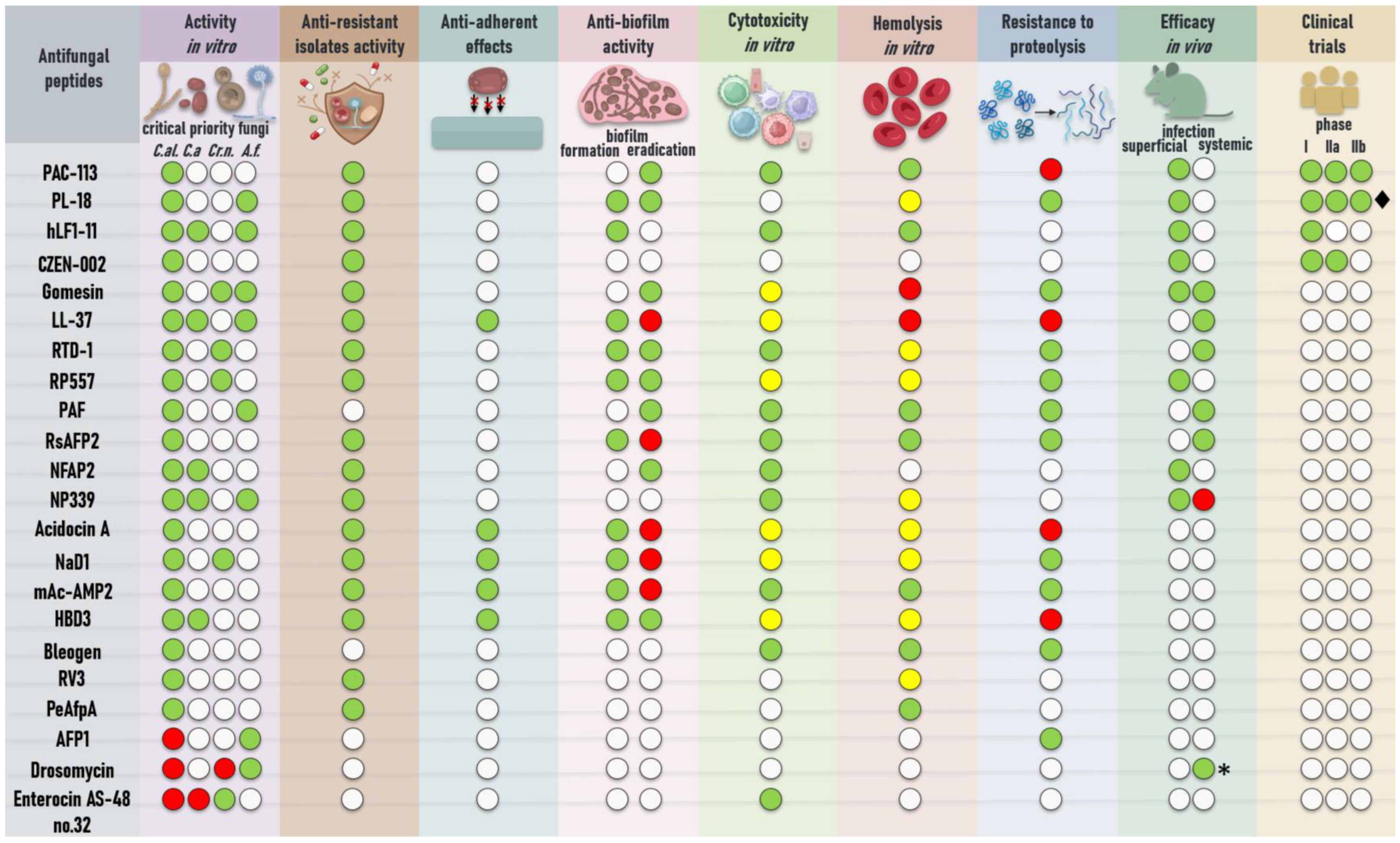

| Conventional Antifungals | Source | Mechanism of Antifungal Action | Species | Mechanism of Fungal Resistance |
|---|---|---|---|---|
| Azoles (fluconazole, voriconazole, posaconazole, itraconazole, isavuconazole) | Synthetic | Azoles selectively inhibit lanosterol 14-α-demethylase (ERG11/CYP51), a cytochrome P450–dependent enzyme that catalyzes a rate-limiting step in the biosynthesis of ergosterol from lanosterol. This leads to the accumulation of 14-methylsterols in the plasma membrane, which disrupts the integrity and fluidity of the lipid bilayer, impairs membrane permeability, and compromises the function of key membrane proteins and transport systems. Moreover, azoles promote the production of reactive oxygen species (ROS) and subsequent oxidative damage, potentiating cell death. | Cr. neoformans | ERG11 amino acid substitutions; overexpression of ABC efflux pumps; MSH2 mismatch repair defects [42,43]. |
| C. albicans | ERG11 amino acid substitutions; ERG11 overexpression; Upc2-mediated activation of sterol biosynthesis genes; overexpression of ABC and MFS efflux pumps [44,45]. | |||
| C. auris | ERG11 amino acid substitutions and overexpression; TAC1b gain-of-function and efflux pump overexpression; subtelomeric deletions and SNP accumulation [44,46]. | |||
| A. fumigatus | cyp51A alterations (promoter tandem repeats and/or point mutations); overexpression of efflux pumps; HapE mutations; mitochondrial complex I alterations; cytochrome b5–CybE redox changes; SrbA/AtrR transcription factor dysregulation [47,48,49]. | |||
| Polyenes (amphotericin B (AmB), nystatin, natamycin, candicidin, trichomycin, mepartricin) | Natural (Strepto-myces spp.) | Polyenes bind with high affinity to ergosterol in the fungal cell membrane (and to cholesterol in human cells with lower efficiency), leading to the formation of transmembrane pores. These pores facilitate the leakage of intracellular contents and disrupt osmotic and ionic balance, causing rapid fungal cell death. AmB can also assemble into extramembranous aggregates that sequester ergosterol from the lipid bilayer (“sterol sponge” mechanism) and induce ROS-mediated oxidative damage. | Cr. neoformans | Defects or alterations in sterol isomerase (Erg2) and related sterol pathway enzymes (Erg3, Erg6); dysregulation of transcription factors (Sre1, Mbs1, Hob1) controlling ergosterol biosynthesis [42,50]. |
| C. albicans | ERG-pathway mutations (ERG3/other ERG genes); Upc2p-mediated dysregulation of sterol biosynthesis; Hsp90-dependent stress response pathways [44,50]. | |||
| C. auris | ERG6 frameshift mutation abolishing ergosterol production. ERG3 frameshift mutation leading to altered sterol composition [46,50]. | |||
| A. fumigatus | Incompletely understood; data do not consistently map to classical ergosterol biosynthesis genes [41,48,49]. | |||
| Echinocandins (caspofungin, micafungin, anidulafungin) | Semi-synthetic | By noncompetitively inhibiting the β-(1,3)-D-glucan synthase complex, echinocandins disrupt β-(1,3)-D-glucan synthesis, compromise cell wall integrity, induce osmotic instability, and trigger cell lysis. Caspofungin promotes ROS accumulation and ROS-mediated apoptotic responses. | Cr. neoformans | Data are lacking as they are not used to treat cryptococcal infections [51,52]. |
| C. albicans | FKS1 amino acid substitutions (e.g., S645F/P/Y, F641S) [53,54]. | |||
| C. auris | FKS1 amino acid substitutions (e.g., S639F/P/Y, F635C) [46,53]. | |||
| A. fumigatus | FKS1 amino acid substitution (e.g., S678P) [55]. | |||
| Nucleoside analogs (5-flucytosine (5-FC)) | Synthetic | 5-FC enters fungal cells through a cytosine permease and is deaminated by cytosine deaminase to 5-fluorouracil (5-FU), which is metabolized further. 5-FU is converted to 5-fluorodeoxyuridylate (5-FdUMP), thereby inhibiting thymidylate synthase and downstream DNA synthesis, and to 5-fluorouridine monophosphate (5-FUMP), which is phosphoryla-ted to 5-fluorouridine triphosphate (5-FUTP) and incorporated into fungal RNA, causing its miscoding and impaired protein synthesis. | Cr. neoformans C. albicans | Loss-of-function mutations in pyrimidine salvage pathway genes: FCY2/FCY21/FCY22 (cytosine permeases); FCA1/FCY1 (cytosine deaminase); FUR1 (uracil phosphoribosyltransferase) [39,56]. |
| C. auris | Loss-of-function mutations in pyrimidine salvage pathway genes FCY1, FCY2, FUR1 [46,56]. | |||
| A. fumigatus | pH-dependent downregulation or dysfunction of FcyB [57]. |
| Strategy | Representative Agents/ Approaches | In Vitro Activity | In Vivo Efficacy | Clinical Trials | Current Clinical Use |
|---|---|---|---|---|---|
| Combination therapy | ISZ + MIF; 5-FC + ECH or 5-FC + AmB; AmB + FLC | ISZ + MIF—multidrug-resistant C. auris; 5-FC + ECH and 5-FC + AmB—echinocandin- and polyene-resistant C. auris | ISZ + MIF therapy—in rabbit invasive aspergillosis model | ACTA trial: AmB deoxycholate + 5-FC/FLC as induction therapy for HIV-associated cryptococcal meningitis; AMBITION-cm trial: single high-dose liposomal AmB + 5-FC + FLC | AmB + 5-FC for induction therapy of cryptococcal meningitis, central nervous system infections, and Candida endocarditis (AmB + FLC when 5-FC is unavailable) |
| Drug repurposing | Colistin, erythromycin, tamoxifen, statins, ibuprofen, neuroleptics | Colistin—multidrug-resistant Candida and Cryptococcus; erythromycin invigorates AmB against Candida, and Cr. neoformans; tamoxifen—C. albicans and Cr. neoformans; statins—Candida, Cr. neoformans and A. fumigatus; ibuprofen—Cryptococcus; neuroleptics—all WHO critical priority fungi | — | — | — |
| Targeted delivery | Liposomal AmB or NYS; DC-SIGN-functionalized AmB liposomes; NYS-loaded niosomes | Liposomal AmB or NYS, DC-SIGN-functionalized AmB liposomes, NYS-loaded niosomes—Candida, Cryptococcus, Aspergillus | DC-SIGN-AmB liposomes and liposomal NYS—in murine models of invasive candidiasis and aspergillosis; NYS-loaded niosomes—invasive candidiasis | Liposomal NYS (Nyotran®) underwent clinical trials for the treatment of different systemic infections but was not approved by the FDA | Liposomal AmB (AmBisome®, Fungisome®) for different invasive fungal infections when the use of triazoles or ECHs is undermined |
| Antibiofilm strategies | Combination of conventional antimycotics with antiseptics, calcineurin inhibitors, statins, antibiotics, natural compounds, or other antifungal agents | Calcineurin inhibitors (FK506, cyclosporine A) synergize with FLC against C. albicans biofilms, restoring fungicidal activity | Calcineurin inhibitor + FLC—in rat central-venous-catheter biofilm model | — | — |
| Immuno-therapy | Vaccines, cell-based therapy, cytokine-based therapy, antibody-based therapy | SRCD5CAR-based CAR-NK cells active against C. albicans and Cr. neoformans | Vaccines in a mouse model: VesiVax® Af3/9 and ΔsglA A. fumigatus conidia vaccine—invasive aspergillosis; Cda2-Pep1 GP and CDA1-LNP mRNA vaccine—cryptococcosis; heat-killed fbp1Δ mutant Cr. neoformans vaccine—broad-spectrum of invasive fungal infections. Cell-based therapy in mouse model: adoptive NK-cell transfer—aspergillosis; A. fumigatus-specific T-cell transfusion—aspergillosis and lethal infection with C. albicans; SRCD5CAR CAR-NK cells—invasive infections caused by C. albicans, A. fumigatus, and Cr. neoformans. GM-CSF/G-CSF—in a mouse model of aspergillosis. Efungumab—in mouse model of disseminated candidiasis | NDV-3/NDV-3A (phase Ib/IIa); Candi5V (phase I/II); PEV7 (phase I); A. fumigatus-specific T cells (small clinical trials); IFN-γ (phase I, II as an adjuvant immunotherapy to combat critical-priority fungal infection) | Granulocyte transfusion for neutropenic patients with invasive mycoses |
| Natural antifungal compounds * | Fatty acids, plant terpenoids, saponins and flavonoids, fungal secondary metabolites | Broad activity against Candida, A. fumigatus, and Cr. neoformans; camphor, eucalyptol, and flavonoids also inhibit fungal biofilm formation | — | — | — |
| AFP | Source | Mechanism of Action | Fungal Species Tested | Resistance and Possible Mechanism | References |
|---|---|---|---|---|---|
| RF3 | Synthetic rationally designed α-helical peptide | Plasma membrane permeabilization, intracellular ROS accumulation | C. albicans | No MIC increase after 10 serial passages; fluconazole showed 8 × MIC | [233] |
| TB_KKG6K | Amphibian-derived temporin B analog | Plasma membrane depolarization and permeabilization, intracellular ROS accumulation, destruction of subcellular structures in yeast cells | C. albicans | Adaptation to MIC90, but not to 2 × MIC90 in an in vitro microevolution experiment; fluconazole adaptation reached 32 × MIC90 | [234,285] |
| GW4 | Synthetic N-glycine-capped derivative of peptide W4 | Plasma membrane permeabilization, intracellular ROS accumulation, mitochondrial membrane depolarization | C. albicans | Fluctuations in the MIC value, ranging from 1× to 2× during 20 serial passages; fluconazole showed 32 × MIC | [235,286] |
| P19 | Synthetic central-symmetric short peptide | Lipid binding and membrane dysfunction | C. albicans | Fluctuations in the MIC value, ranging from 0.5× to 2× during 20 serial passages; fluconazole and AmB showed 1024 × MIC | [236] |
| NpRS | Garlic (Allium sativum L.) | Plasma membrane permeabilization, disruption of ribosome-related intracellular pathways, downregulation of the gene CDR1 | C. albicans | Fluctuations in the MIC value, ranging from 1× to 2× during 21 days of serial passaging; fluconazole showed 16 × MIC after 8 serial passages | [287] |
| RP557, RP554, RP556 | Synthetic peptides rationally derived from tachyplesin I | Plasma membrane permeabilization | C. tropicalis | No MIC increase after 9 serial passages | [238] |
| NP339 | Synthetic polyarginine peptide | Plasma membrane permeabilization | C. auris, C. albicans, C. glabrata, C. tropicalis | No MIC increase after 30 serial passages; caspofungin, fluconazole, and AmB showed an increase in MICs ranging from 4× to 8×, 2× to 256× or 4×, respectively (depending on the strain) | [237] |
| ETD151 | Engineered from a sequence shared by the insect-derived peptides, heliomicin and ARD1 isolated from Heliothis virescens and Archaeoprepona demophon | Lipid binding (GlCer) and membrane dysfunction, triggering fungal stress response and disruption of cell wall homeostasis | A. fumigatus | No minimal effective concentration (MEC) change after 16 serial passages | [194] |
| NaD1 | Plant defensin from the flowers of Nicotiana alata | Interaction with fungal cell wall, lipid binding (PI(4,5)P2, PA), plasma membrane permeabilization, intracellular ROS accumulation | S. cerevisiae, C. albicans | In S. cerevisiae, the MIC increased 32-fold after 20 serial passages and it was associated with polygenic adaptation involving cell wall remodeling and osmoregulatory pathways; caspofungin showed 32 × MIC after 15 serial passages. No MIC increase was observed in C. albicans after 24 serial passages; caspofungin showed 8 × MIC after 21 serial passages | [174,288] |
| mAc-AMP2 | Modified hevein-like peptide from Amaranthus caudatus seeds | Chitin-binding activity, membrane permeability disruption (at higher concentrations) | C. albicans | The MIC increased 4-fold during 24 serial passages, but returned to baseline after peptide withdrawal; caspofungin showed 8 × MIC after 21 serial passages | [174] |
| LL-37 | Human cathelicidin | Disruption of cell wall integrity, plasma membrane permeabilization, modulation of signaling pathways, inhibition of cell cycle progression, intracellular ROS accumulation, disruption of endoplasmic reticulum homeostasis, and formation of autophagy-like structures | C. albicans | MIC increased 2-fold during 24 serial passages; caspofungin showed 8 × MIC after 21 serial passages | [174,199] |
| NFAP2 | Neosartorya (Aspergillus) fischeri | Lipid binding and membrane dysfunction, reduces the metabolic activity by interacting with Gad1p, Atp1p, and Eno1p | C. albicans | Adaptation to the MIC, but not to 2 × MIC in in vitro microevolution experiment; fluconazole adaptation reached 32 × MIC. Tolerance is associated with mutations likely involved in stress responses and reduced AFP uptake | [289,290] |
| Histatin 3 | Human salivary peptide | Binding to cell surface receptors, intracellular targeting, nonlytic ATP release | C. albicans | 5-fold decrease in killing capacity after exposure to increasing concentrations; the phenotype was associated with impaired metabolism, reduced oxygen consumption, and multiple intracellular metabolic alterations | [291,292] |
Disclaimer/Publisher’s Note: The statements, opinions and data contained in all publications are solely those of the individual author(s) and contributor(s) and not of MDPI and/or the editor(s). MDPI and/or the editor(s) disclaim responsibility for any injury to people or property resulting from any ideas, methods, instructions or products referred to in the content. |
© 2026 by the authors. Licensee MDPI, Basel, Switzerland. This article is an open access article distributed under the terms and conditions of the Creative Commons Attribution (CC BY) license.
Share and Cite
Finkina, E.I.; Shevchenko, O.V.; Gerasimova, A.A.; Fateeva, S.I.; Balandin, S.V.; Ovchinnikova, T.V. WHO Critical Priority Fungi: A Comprehensive Review of Antifungal Resistance, Emerging Therapeutic Strategies, and the Potential of Antifungal Peptides. Int. J. Mol. Sci. 2026, 27, 8141. https://doi.org/10.3390/ijms27188141
Finkina EI, Shevchenko OV, Gerasimova AA, Fateeva SI, Balandin SV, Ovchinnikova TV. WHO Critical Priority Fungi: A Comprehensive Review of Antifungal Resistance, Emerging Therapeutic Strategies, and the Potential of Antifungal Peptides. International Journal of Molecular Sciences. 2026; 27(18):8141. https://doi.org/10.3390/ijms27188141
Chicago/Turabian StyleFinkina, Ekaterina I., Olga V. Shevchenko, Anastasia A. Gerasimova, Serafima I. Fateeva, Sergey V. Balandin, and Tatiana V. Ovchinnikova. 2026. "WHO Critical Priority Fungi: A Comprehensive Review of Antifungal Resistance, Emerging Therapeutic Strategies, and the Potential of Antifungal Peptides" International Journal of Molecular Sciences 27, no. 18: 8141. https://doi.org/10.3390/ijms27188141
APA StyleFinkina, E. I., Shevchenko, O. V., Gerasimova, A. A., Fateeva, S. I., Balandin, S. V., & Ovchinnikova, T. V. (2026). WHO Critical Priority Fungi: A Comprehensive Review of Antifungal Resistance, Emerging Therapeutic Strategies, and the Potential of Antifungal Peptides. International Journal of Molecular Sciences, 27(18), 8141. https://doi.org/10.3390/ijms27188141