Comparative Genomic and Functional Characterization of Pediococcus acidilactici Isolated from Fermented Cacao with Anti-ESKAPE Activity
 , , , and
Abstract
1. Introduction
2. Results
2.1. Sample Collection and Isolation of Pediococcus acidilactici
2.2. Preliminary Antimicrobial Activity Against ESKAPE Pathogens
2.3. Tolerance to Gastrointestinal Tract Condition
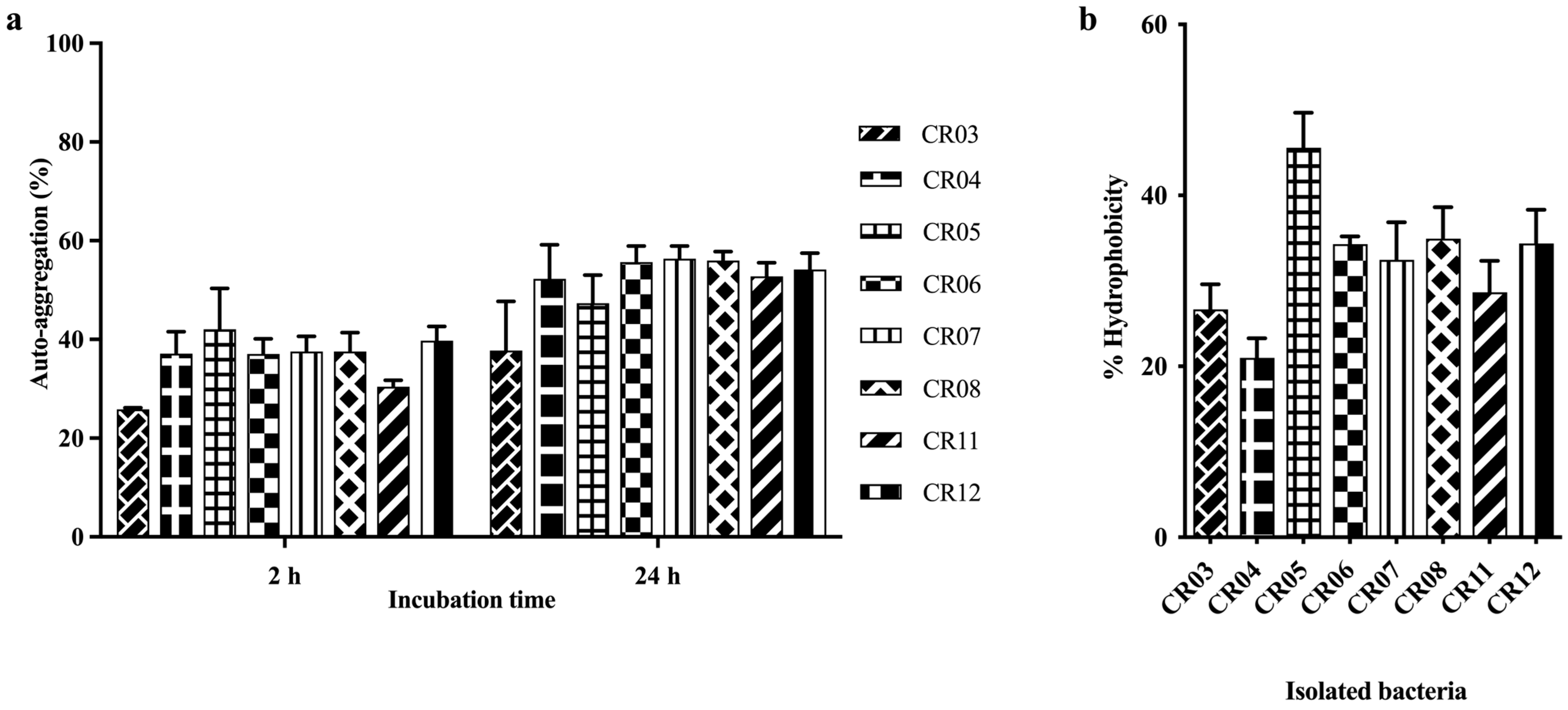
2.4. Auto-Aggregation Ability
2.5. Cell Surface Hydrophobicity Ability
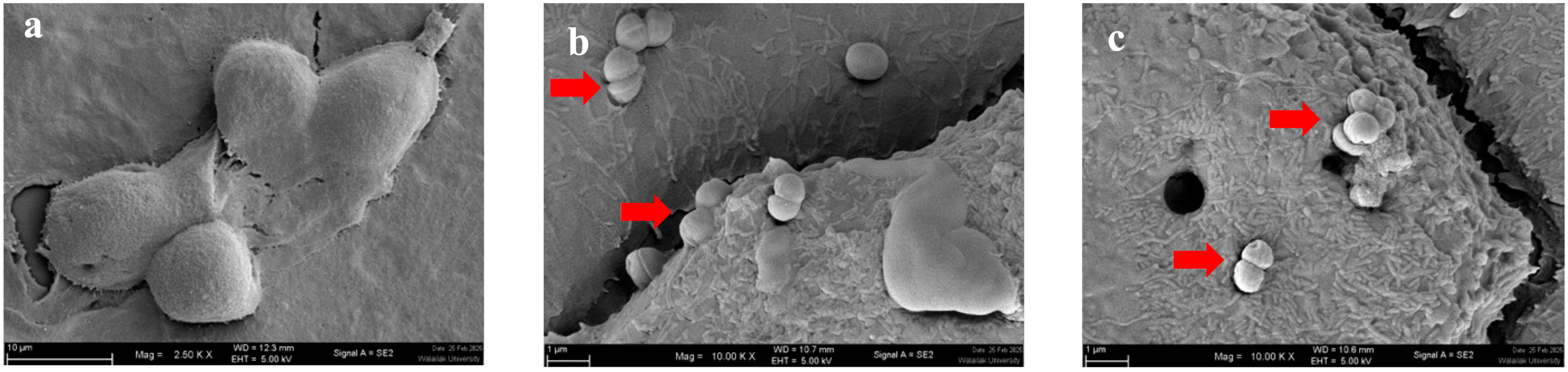
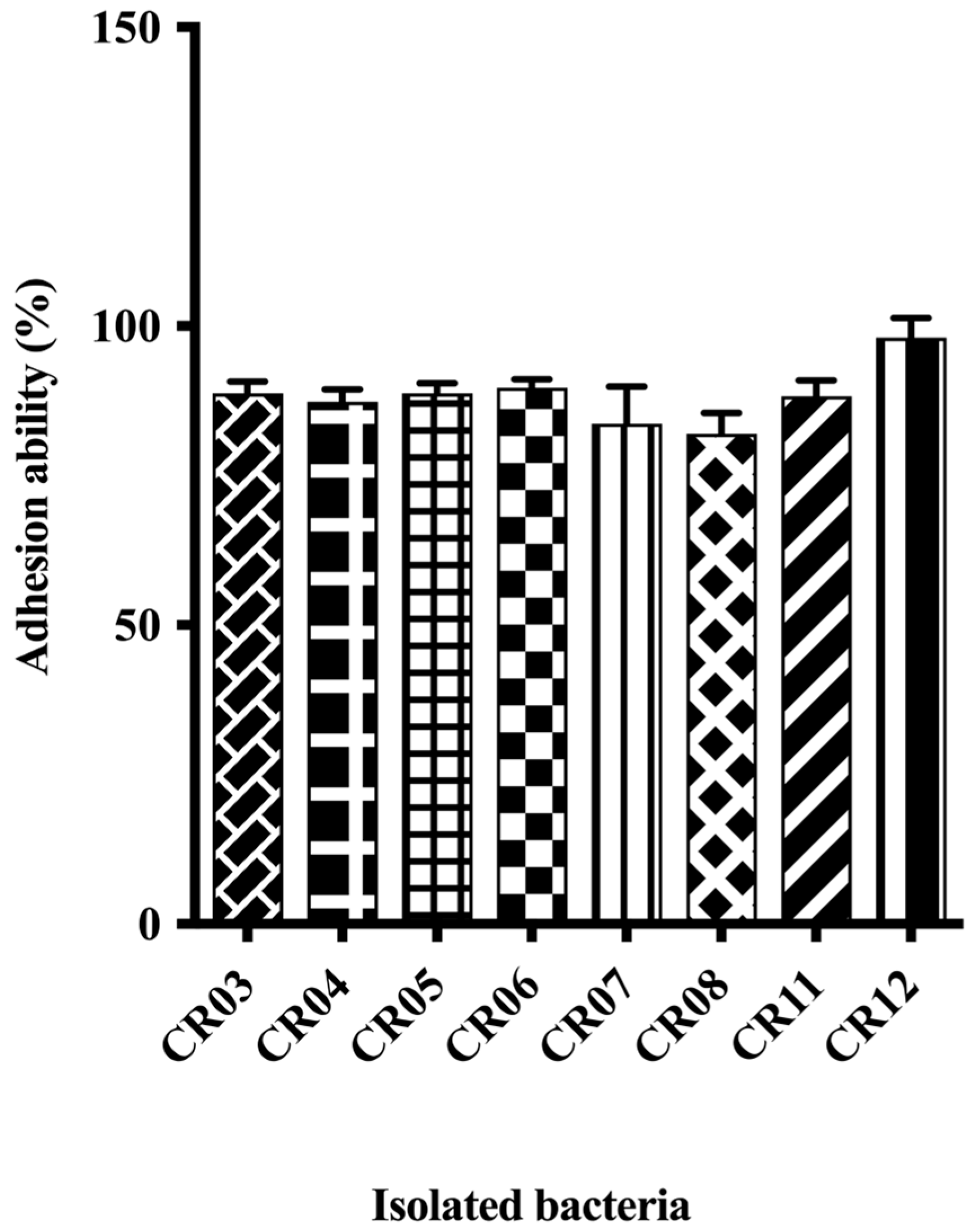
2.6. Adhesion Ability to Human Intestinal Epithelial Cells
2.7. Safety Profile Assessment
2.8. MIC and MBC
2.9. Characterization of Antimicrobial Substances
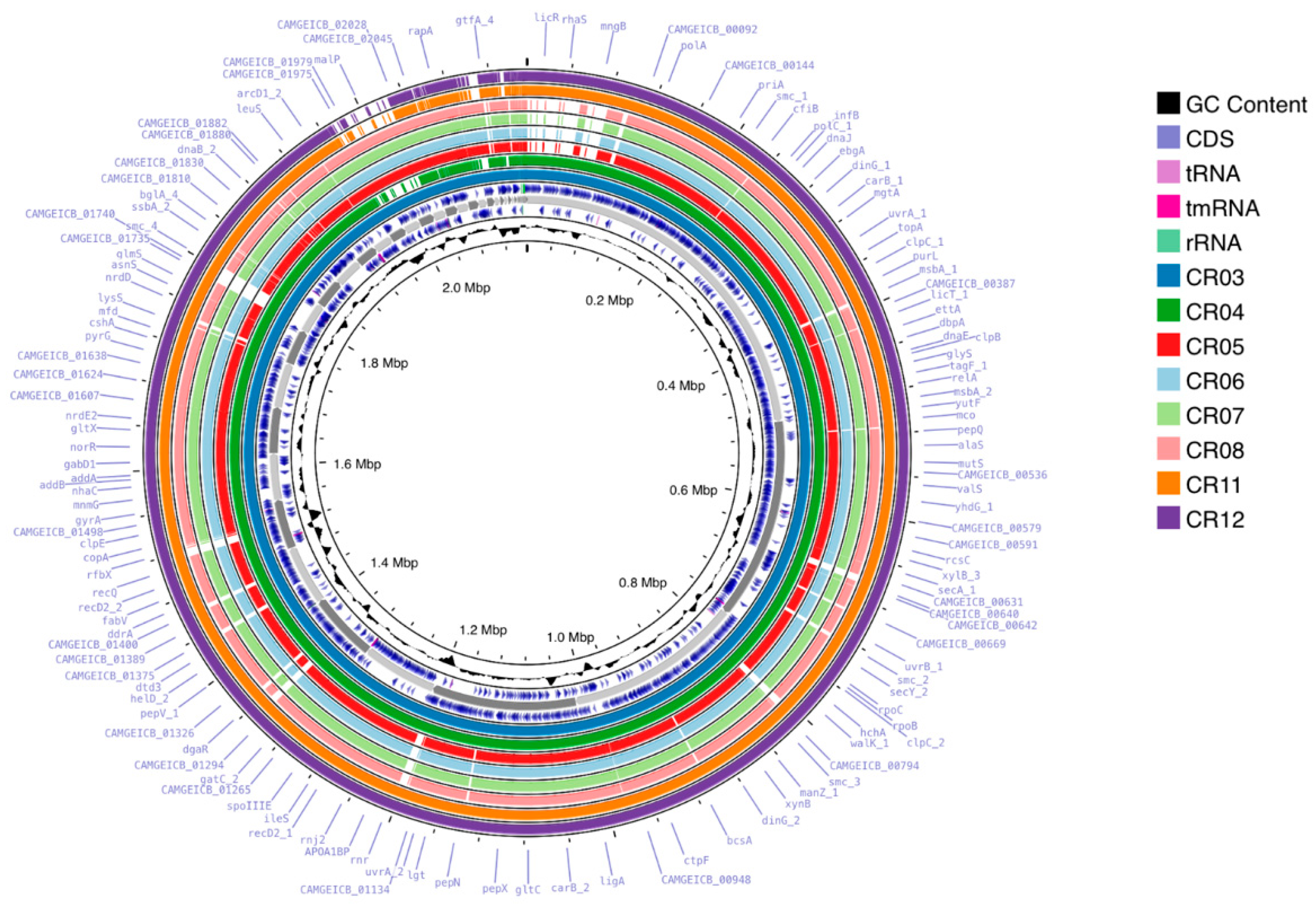
2.10. Genome Characteristics, Functional Analysis, Genomic Safety Assessment
3. Discussion
4. Materials and Methods
4.1. Bacterial Strains and Culture Conditions
4.2. Sample Collection and Isolation of LAB
4.3. Screening of Fermented Cacao Isolates Against ESKAPE Pathogens
4.4. LAB Identification
4.5. Characterization of Probiotic Properties
4.5.1. Acid Tolerance
4.5.2. Tolerance to Pepsin and Pancreatin
4.5.3. Bile Salt Tolerance
4.5.4. Auto-Aggregation Assay
4.5.5. Cell Surface Hydrophobicity Assay
4.5.6. Adhesion to Human Intestinal Epithelial Cells
4.5.7. Scanning Electron Microscopy (SEM) of Adhered Isolated Lactobacillus Toward Human Intestinal Epithelial Cells
4.6. Safety Assessment
4.6.1. Hemolytic Test
4.6.2. Susceptibility to Antibiotics
4.7. Characterization of Antimicrobial Activity
4.7.1. Determination of Minimum Inhibitory Concentration (MIC) and Minimum Bactericidal Concentration (MBC)
4.7.2. Characterization of Antimicrobial Substances by pH Neutralization and Proteinase K Treatment
4.8. DNA Extraction and Genomic Analysis
4.9. Statistical Analysis
5. Conclusions
Supplementary Materials
Author Contributions
Funding
Institutional Review Board Statement
Data Availability Statement
Acknowledgments
Conflicts of Interest
References
- Gruber, D.; Vogel, V.; Walter, J.-C.; Bolotnikov, G.; Rodríguez, A.; Preising, N.; Ständker, L.; Firacative, C.; Spellerberg, B.; Kissmann, A.-K.; et al. The Antimicrobial Peptide C14R Is Active Against All Pathogenic Species of the ESKAPE Group. Antibiotics 2026, 15, 211. [Google Scholar] [CrossRef] [PubMed]
- Singh, A.; Tanwar, M.; Singh, T.P.; Sharma, S.; Sharma, P. An escape from ESKAPE pathogens: A comprehensive review on current and emerging therapeutics against antibiotic resistance. Int. J. Biol. Macromol. 2024, 279, 135253. [Google Scholar] [CrossRef] [PubMed]
- Saini, P.; Ayyanna, R.; Kumar, R.; Bhowmick, S.K.; Bhaskar, V.; Dey, B. Restriction of growth and biofilm formation of ESKAPE pathogens by caprine gut-derived probiotic bacteria. Front. Microbiol. 2024, 15, 1428808. [Google Scholar] [CrossRef] [PubMed]
- Ayivi, R.D.; Gyawali, R.; Krastanov, A.; Aljaloud, S.O.; Worku, M.; Tahergorabi, R.; Silva, R.C.; Ibrahim, S.A. Lactic Acid Bacteria: Food Safety and Human Health Applications. Dairy 2020, 1, 202–232. [Google Scholar] [CrossRef]
- Sim, E.A.; Kim, S.-Y.; Kim, S.; Mun, E.-G. Probiotic Potential and Enhanced Adhesion of Fermented Foods-Isolated Lactic Acid Bacteria to Intestinal Epithelial Caco-2 and HT-29 Cells. Microorganisms 2025, 13, 32. [Google Scholar]
- Latif, A.; Shehzad, A.; Niazi, S.; Zahid, A.; Ashraf, W.; Iqbal, M.W.; Rehman, A.; Riaz, T.; Aadil, R.M.; Khan, I.M.; et al. Probiotics: Mechanism of action, health benefits and their application in food industries. Front. Microbiol. 2023, 14, 1216674, Erratum in Front. Microbiol. 2024, 15, 1378225. [Google Scholar] [CrossRef] [PubMed]
- Anjana, A.; Tiwari, S.K. Bacteriocin-Producing Probiotic Lactic Acid Bacteria in Controlling Dysbiosis of the Gut Microbiota. Front. Cell. Infect. Microbiol. 2022, 12, 851140. [Google Scholar] [CrossRef] [PubMed]
- Chan, S.; Jantama, K.; Prasitpuriprecha, C.; Wansutha, S.; Phosriran, C.; Yuenyaow, L.; Cheng, K.-C.; Jantama, S.S. Harnessing Fermented Soymilk Production by a Newly Isolated Pediococcus acidilactici F3 to Enhance Antioxidant Level with High Antimicrobial Activity against Food-Borne Pathogens during Co-Culture. Foods 2024, 13, 2150. [Google Scholar] [CrossRef] [PubMed]
- Millette, M.; Cornut, G.; Dupont, C.; Shareck, F.; Archambault, D.; Lacroix, M. Capacity of human nisin- and pediocin-producing lactic Acid bacteria to reduce intestinal colonization by vancomycin-resistant enterococci. Appl. Environ. Microbiol. 2008, 74, 1997–2003. [Google Scholar] [PubMed]
- Fugaban, J.I.I.; Vazquez Bucheli, J.E.; Park, Y.J.; Suh, D.H.; Jung, E.S.; Franco, B.; Ivanova, I.V.; Holzapfel, W.H.; Todorov, S.D. Antimicrobial properties of Pediococcus acidilactici and Pediococcus pentosaceus isolated from silage. J. Appl. Microbiol. 2022, 132, 311–330. [Google Scholar] [PubMed]
- Yan, X.; Gu, S.; Cui, X.; Shi, Y.; Wen, S.; Chen, H.; Ge, J. Antimicrobial, anti-adhesive and anti-biofilm potential of biosurfactants isolated from Pediococcus acidilactici and Lactobacillus plantarum against Staphylococcus aureus CMCC26003. Microb. Pathog. 2019, 127, 12–20. [Google Scholar] [PubMed]
- Song, D.H.; Lee, J.M.; Chung, K.H.; An, J.H. Penicillin Binding Protein from Pediococcus acidilactici Isolated from Nuruk for Food Biopreservative. Iran. J. Public Health 2018, 47, 1653–1659. [Google Scholar] [PubMed]
- Chandla, S.; Harjai, K.; Shukla, G. Synergistic Effect of Biogenics Derived from Potential Probiotics Together with Zingerone Against Biofilm Formation by Pseudomonas aeruginosa PAO1. Probiotics Antimicrob. Proteins 2021, 13, 1481–1497. [Google Scholar]
- Nwachukwu, E.; Obi, C.; Anab-Atulomah, C.; Itaman, V. Antimicrobial Activities of Lactic Acid Bacteria Isolated from Fermented Food on Some Food Spoilage Organisms. South Asian J. Res. Microbiol. 2025, 19, 18–27. [Google Scholar] [CrossRef]
- Javadi, K.; Emadzadeh, M.R.; Mohammadzadeh Hosseini Moghri, S.A.H.; Halaji, M.; Parsian, H.; Rajabnia, M.; Pournajaf, A. Anti-biofilm and antibacterial effect of bacteriocin derived from Lactobacillus plantarum on the multidrug-resistant Acinetobacter baumannii. Protein Expr. Purif. 2025, 226, 106610. [Google Scholar] [PubMed]
- Pipitò, L.; Rubino, R.; D’Agati, G.; Bono, E.; Mazzola, C.V.; Urso, S.; Zinna, G.; Distefano, S.A.; Firenze, A.; Bonura, C.; et al. Antimicrobial Resistance in ESKAPE Pathogens: A Retrospective Epidemiological Study at the University Hospital of Palermo, Italy. Antibiotics 2025, 14, 186. [Google Scholar] [CrossRef] [PubMed]
- Habteweld, H.A.; Asfaw, T. Novel Dietary Approach with Probiotics, Prebiotics, and Synbiotics to Mitigate Antimicrobial Resistance and Subsequent Out Marketplace of Antimicrobial Agents: A Review. Infect. Drug Resist. 2023, 16, 3191–3211. [Google Scholar] [CrossRef] [PubMed]
- Deng, Z.; Hou, K.; Zhao, J.; Wang, H. The Probiotic Properties of Lactic Acid Bacteria and Their Applications in Animal Husbandry. Curr. Microbiol. 2021, 79, 22. [Google Scholar] [CrossRef] [PubMed]
- De Filippis, F.; Pasolli, E.; Ercolini, D. The food-gut axis: Lactic acid bacteria and their link to food, the gut microbiome and human health. FEMS Microbiol. Rev. 2020, 44, 454–489. [Google Scholar] [CrossRef] [PubMed]
- Illeghems, K.; Pelicaen, R.; De Vuyst, L.; Weckx, S. Assessment of the contribution of cocoa-derived strains of Acetobacter ghanensis and Acetobacter senegalensis to the cocoa bean fermentation process through a genomic approach. Food Microbiol. 2016, 58, 68–78. [Google Scholar] [CrossRef] [PubMed]
- De Vuyst, L.; Leroy, F. Functional role of yeasts, lactic acid bacteria and acetic acid bacteria in cocoa fermentation processes. FEMS Microbiol. Rev. 2020, 44, 432–453. [Google Scholar] [CrossRef] [PubMed]
- FAO/WHO. Guidelines for the Evaluation of Probiotics in Food; Food and Agriculture Organization of the United Nations: Rome, Italy; World Health Organization: Geneva, Switzerland, 2002. [Google Scholar]
- Sornsenee, P.; Chimplee, S.; Saengsuwan, P.; Romyasamit, C. Characterization of probiotic properties and development of banana powder enriched with freeze-dried Lacticaseibacillus paracasei probiotics. Heliyon 2022, 8, e11063. [Google Scholar] [CrossRef] [PubMed]
- Sornsenee, P.; Pattaranggoon, N.C.; Suksabay, P.; Leepromma, Y.; Turni, C.; Romyasamit, C. Probiotic Potential, Genomic Characterization, and In Silico Insights of Five Lactiplantibacillus plantarum Strains Isolated from Fermented Cacao Beans Against Multidrug-Resistant Pseudomonas aeruginosa. Antibiotics 2026, 15, 334. [Google Scholar] [CrossRef] [PubMed]
- Surachat, K.; Kantachote, D.; Deachamag, P.; Wonglapsuwan, M. Genomic Insight into Pediococcus acidilactici HN9, a Potential Probiotic Strain Isolated from the Traditional Thai-Style Fermented Beef Nhang. Microorganisms 2020, 9, 50. [Google Scholar] [CrossRef] [PubMed]
- Romyasamit, C.; Thatrimontrichai, A.; Aroonkesorn, A.; Chanket, W.; Ingviya, N.; Saengsuwan, P.; Singkhamanan, K. Enterococcus faecalis Isolated From Infant Feces Inhibits Toxigenic Clostridioides (Clostridium) difficile. Front. Pediatr. 2020, 8, 572633. [Google Scholar] [CrossRef] [PubMed]
- De Vos, P.; Garrity, G.; Jones, D.; Krieg, N.R.; Ludwig, W.; Rainey, F.A.; Schleifer, K.-H.; Whitman, W.B. Bergey’s Manual of Systematic Bacteriology. Volume Three: The Firmicutes, 2nd ed.; Springer: Dordrecht, The Netherlands; New York, NY, USA, 2009; Volume 3. [Google Scholar]
- Zommara, M.; El-Ghaish, S.; Haertle, T.; Chobert, J.-M.; Ghanimah, M. Probiotic and technological characterization of selected Lactobacillus strains isolated from different egyptian cheeses. BMC Microbiol. 2023, 23, 160. [Google Scholar] [CrossRef] [PubMed]
- Guney, D.; Başdoğan, M.G.B.; Sengun, I. Probiotic characterisation of lactic acid bacteria isolated from pickles and their potential application as presumptive probiotic starter culture in cucumber pickles. J. Food Meas. Charact. 2025, 19, 2077–2097. [Google Scholar] [CrossRef]
- Bentahar, M.C.; Benabdelmoumene, D.; Robert, V.; Dahmouni, S.; Qadi, W.S.M.; Bengharbi, Z.; Langella, P.; Benbouziane, B.; Al-Olayan, E.; Dawoud, E.A.; et al. Evaluation of Probiotic Potential and Functional Properties of Lactobacillus Strains Isolated from Dhan, Traditional Algerian Goat Milk Butter. Foods 2024, 13, 3781. [Google Scholar] [CrossRef] [PubMed]
- Kumari, M.; Patel, H.K.; Kokkiligadda, A.; Bhushan, B.; Tomar, S.K. Characterization of probiotic lactobacilli and development of fermented soymilk with improved technological properties. LWT 2022, 154, 112827. [Google Scholar] [CrossRef]
- Alameri, F.; Tarique, M.; Osaili, T.; Obaid, R.; Abdalla, A.; Masad, R.; Al-Sbiei, A.; Fernandez-Cabezudo, M.; Liu, S.-Q.; Al-Ramadi, B.; et al. Lactic Acid Bacteria Isolated from Fresh Vegetable Products: Potential Probiotic and Postbiotic Characteristics Including Immunomodulatory Effects. Microorganisms 2022, 10, 389. [Google Scholar] [CrossRef] [PubMed]
- Sornsenee, P.; Singkhamanan, K.; Sangkhathat, S.; Saengsuwan, P.; Romyasamit, C. Probiotic Properties of Lactobacillus Species Isolated from Fermented Palm Sap in Thailand. Probiotics Antimicrob. Proteins 2021, 13, 957–969. [Google Scholar] [CrossRef] [PubMed]
- Zhang, W.; Lai, S.; Zhou, Z.; Yang, J.; Liu, H.; Zhong, Z.; Fu, H.; Ren, Z.; Shen, L.; Cao, S.; et al. Screening and evaluation of lactic acid bacteria with probiotic potential from local Holstein raw milk. Front. Microbiol. 2022, 13, 918774. [Google Scholar] [CrossRef] [PubMed]
- EFSA Panel on Additives and Products or Substances used in Animal Feed (FEEDAP). Guidance on the assessment of bacterial susceptibility to antimicrobials of human and veterinary importance. EFSA J. 2012, 10, 2740. [Google Scholar]
- CLSI. Performance Standards for Antimicrobial Susceptibility Testing; Clinical and Laboratory Standards Institute: Malvern, PA, USA, 2025. [Google Scholar]
- Sornsenee, P.; Surachat, K.; Kang, D.-K.; Mendoza, R.; Romyasamit, C. Probiotic Insights from the Genomic Exploration of Lacticaseibacillus paracasei Strains Isolated from Fermented Palm Sap. Foods 2024, 13, 1773. [Google Scholar] [CrossRef] [PubMed]
- Hölzer, M.; Marz, M. De novo transcriptome assembly: A comprehensive cross-species comparison of short-read RNA-Seq assemblers. GigaScience 2019, 8, giz039. [Google Scholar] [PubMed]
- Seemann, T. Prokka: Rapid prokaryotic genome annotation. Bioinformatics 2014, 30, 2068–2069. [Google Scholar] [CrossRef] [PubMed]
- Gurevich, A.; Saveliev, V.; Vyahhi, N.; Tesler, G. QUAST: Quality assessment tool for genome assemblies. Bioinformatics 2013, 29, 1072–1075. [Google Scholar] [CrossRef] [PubMed]
- Huang, J.; Zhu, J.; Gong, D.; Wu, L.; Zhu, Y.; Hu, L. Whole genome sequence of EC16, a bla(NDM-5)-, bla(CTX-M-55)-, and fosA3-coproducing Escherichia coli ST167 clinical isolate from China. J. Glob. Antimicrob. Resist. 2022, 29, 296–298. [Google Scholar] [PubMed]
- Teber, R.; Asakawa, S. In Silico Screening of Bacteriocin Gene Clusters within a Set of Marine Bacillota Genomes. Int. J. Mol. Sci. 2024, 25, 2566. [Google Scholar] [CrossRef] [PubMed]
- Bortolaia, V.; Kaas, R.S.; Ruppe, E.; Roberts, M.C.; Schwarz, S.; Cattoir, V.; Philippon, A.; Allesoe, R.L.; Rebelo, A.R.; Florensa, A.F.; et al. ResFinder 4.0 for predictions of phenotypes from genotypes. J. Antimicrob. Chemother. 2020, 75, 3491–3500. [Google Scholar] [CrossRef] [PubMed]
- Tetzschner, A.M.M.; Johnson, J.R.; Johnston, B.D.; Lund, O.; Scheutz, F. In Silico Genotyping of Escherichia coli Isolates for Extraintestinal Virulence Genes by Use of Whole-Genome Sequencing Data. J. Clin. Microbiol. 2020, 58, 10-1128. [Google Scholar] [CrossRef]
- Stothard, P.; Grant, J.R.; Van Domselaar, G. Visualizing and comparing circular genomes using the CGView family of tools. Brief. Bioinform. 2019, 20, 1576–1582. [Google Scholar] [PubMed]
- Camacho, C.; Coulouris, G.; Avagyan, V.; Ma, N.; Papadopoulos, J.; Bealer, K.; Madden, T.L. BLAST+: Architecture and applications. BMC Bioinform. 2009, 10, 421. [Google Scholar] [CrossRef]




| Bacteria | CR03 | CR04 | CR05 | CR06 | CR07 | CR08 | CR11 | CR12 |
|---|---|---|---|---|---|---|---|---|
| E. faecium ATCC 700221 | 13.33 ± 0.58 | 13.00 ± 0.00 | 14.33 ± 0.58 | 12.33 ± 0.58 | 11.67 ± 0.58 | 14.33 ± 1.15 | 14.00 ± 1.73 | 14.33 ± 0.58 |
| S. aureus ATCC 4745 | 13.33 ± 0.58 | 12.33 ± 0.58 | 11.33 ± 0.58 | 11.33 ± 0.58 | 11.67 ± 0.58 | 15.00 ± 0.00 | 14.33 ± 0.58 | 15.33 ± 0.58 |
| K. pneumoniae ATCC 8216 | 15.33 ± 0.58 | 15.67 ± 0.58 | 13.67 ± 0.58 | 13.67 ± 0.58 | 11.67 ± 0.58 | 15.00 ± 1.00 | 14.00 ± 0.00 | 13.00 ± 0.00 |
| A. baumannii ATCC 19606 | 19.33 ± 0.58 | 20.33 ± 0.58 | 20.33 ± 0.58 | 20.33 ± 0.58 | 15.33 ± 0.58 | 17.00 ± 1.73 | 23.00 ± 0.00 | 22.00 ± 0.00 |
| P. aeruginosa ATCC 15692 | 21.67 ± 0.58 | 21.33 ± 0.58 | 22.33 ± 0.58 | 22.33 ± 0.58 | 20.33 ± 0.58 | 23.00 ± 0.00 | 19.00 ± 0.00 | 22.00 ± 0.00 |
| E. aerogenes | 14.67 ± 0.58 | 10.00 ± 1.00 | 19.33 ± 0.58 | 15.33 ± 1.15 | 10.67 ± 0.58 | 10.67 ± 0.58 | 13.67 ± 0.58 | 15.33 ± 0.58 |
| Isolates | pH 2 | pH 3 | Pepsin | Pancretin | 0.3% Bile Salt |
|---|---|---|---|---|---|
| CR03 | 42.12 ± 1.43 | 45.55 ± 7.34 | NG | 99.28 ± 1.22 | 98.01 ± 0.55 |
| CR04 | 30.18 ± 2.56 | 80.70 ± 8.03 | 89.03 ± 2.64 | 99.43 ± 0.59 | 98.49 ± 0.32 |
| CR05 | 69.65 ± 6.66 | 66.62 ± 1.59 | 89.11 ± 2.38 | 99.95 ± 0.10 | 98.65 ± 0.33 |
| CR06 | 57.95 ± 7.61 | 82.69 ± 10.22 | 85.76 ± 0.50 | 99.70 ± 0.14 | 97.12 ± 1.11 |
| CR07 | 57.01 ± 1.39 | 80.89 ± 0.32 | 96.27 ± 0.80 | 98.38 ± 0.22 | 98.37 ± 0.55 |
| CR08 | 18.48 ± 3.83 | 87.43 ± 3.05 | 81.99 ± 1.38 | 99.74 ± 0.27 | 97.63 ± 0.77 |
| CR11 | 14.17 ± 2.20 | 28.73 ± 8.13 | 93.13 ± 1.32 | 91.73 ± 0.50 | 97.90 ± 1.07 |
| CR12 | 7.99 ± 3.53 | 7.29 ± 4.18 | 96.49 ± 1.15 | 99.88 ± 0.20 | 97.98 ± 0.28 |
| Bacteria Stain | CR05 | CR06 | CR07 | |||
|---|---|---|---|---|---|---|
| MIC | MBC | MIC | MBC | MIC | MBC | |
| E. faecium ATCC 700221 | 25 | >50 | 25 | >50 | 25 | >50 |
| S. aureus ATCC 4745 | 25 | >50 | 25 | >50 | 25 | >50 |
| K. pneumoniae ATCC 8216 | 25 | 25 | 25 | >50 | 25 | 50 |
| A. baumannii ATCC 19606 | 12.5 | >50 | 12.5 | >50 | 12.5 | >50 |
| P. aeruginosa ATCC 15692 | 12.5 | >50 | 12.5 | >50 | 12.5 | >50 |
| E. aerogenes | 12.5 | >50 | 12.5 | >50 | 25 | >50 |
| E. coli DMST 12743 | 25 | 25 | 25 | 25 | 12.5 | >50 |
| Feature | CR03 | CR04 | CR05 | CR06 | CR07 | CR08 | CR11 | CR12 |
|---|---|---|---|---|---|---|---|---|
| Total length | 2,154,778 | 2,016,767 | 2,032,184 | 2,031,513 | 2,031,833 | 2,044,570 | 2,016,379 | 2,016,495 |
| GC (%) | 42.07 | 42.18 | 42.13 | 42.13 | 42.13 | 42.10 | 42.18 | 42.18 |
| N50 | 196,543 | 274,725 | 351,304 | 351,314 | 351,314 | 351,314 | 274,725 | 274,725 |
| L50 | 4 | 3 | 3 | 3 | 3 | 3 | 3 | 3 |
| Contigs | 44 | 24 | 21 | 19 | 20 | 21 | 24 | 25 |
| CDS | 2105 | 1942 | 1963 | 1963 | 1963 | 1977 | 1943 | 1942 |
| rRNA | 4 | 5 | 6 | 5 | 5 | 3 | 4 | 4 |
| tRNA | 52 | 53 | 53 | 53 | 53 | 52 | 52 | 52 |
| tmRNA | 1 | 1 | 1 | 1 | 1 | 1 | 1 | 1 |
| Function | Gene | CR03 | CR04 | CR05 | CR06 | CR07 | CR08 | CR11 | CR12 |
|---|---|---|---|---|---|---|---|---|---|
| Temperature stress | dnaK | + | + | + | + | + | + | + | + |
| dnaJ | + | + | + | + | + | + | + | + | |
| grpE | + | + | + | + | + | + | + | + | |
| hrcA | + | + | + | + | + | + | + | + | |
| clcP | − | − | − | − | − | − | − | − | |
| cspA | − | − | − | − | − | − | − | − | |
| groS | + | + | + | + | + | + | + | + | |
| groL | + | + | + | + | + | + | + | + | |
| Acid tolerance | atpA | + | + | + | + | + | + | + | + |
| atpB | + | + | + | + | + | + | + | + | |
| atpC | + | + | + | + | + | + | + | + | |
| atpD | + | + | + | + | + | + | + | + | |
| atpE | + | + | + | + | + | + | + | + | |
| atpF | + | + | + | + | + | + | + | + | |
| atpG | + | + | + | + | + | + | + | + | |
| atpH | + | + | + | + | + | + | + | + | |
| Bile salt tolerance | acrD | − | − | − | − | − | − | − | − |
| nagB | + | + | + | + | + | + | + | + | |
| pyrG | + | + | + | + | + | + | + | + | |
| bsh | − | − | − | − | − | − | − | − | |
| Osmotic stress | opuA | − | − | − | − | − | − | − | − |
| opuC | + | + | + | + | + | + | + | + | |
| opuBD | − | − | − | − | − | − | − | − | |
| opuCD | + | + | + | + | + | + | + | + | |
| opuCC | + | + | + | + | + | + | + | + | |
| gbuA | − | − | − | − | − | − | − | − | |
| gbuB | − | − | − | − | − | − | − | − | |
| gbuC | − | − | − | − | − | − | − | − | |
| Bacteriocin | EnterolysinA (class lll bacteriocin) | + | + | + | + | + | + | + | + |
Disclaimer/Publisher’s Note: The statements, opinions and data contained in all publications are solely those of the individual author(s) and contributor(s) and not of MDPI and/or the editor(s). MDPI and/or the editor(s) disclaim responsibility for any injury to people or property resulting from any ideas, methods, instructions or products referred to in the content. |
© 2026 by the authors. Licensee MDPI, Basel, Switzerland. This article is an open access article distributed under the terms and conditions of the Creative Commons Attribution (CC BY) license.
Share and Cite
Suksabay, P.; Leepromma, Y.; Prakit, B.; Puchong, T.; Tan, J.S.; Romyasamit, C. Comparative Genomic and Functional Characterization of Pediococcus acidilactici Isolated from Fermented Cacao with Anti-ESKAPE Activity. Int. J. Mol. Sci. 2026, 27, 5996. https://doi.org/10.3390/ijms27135996
Suksabay P, Leepromma Y, Prakit B, Puchong T, Tan JS, Romyasamit C. Comparative Genomic and Functional Characterization of Pediococcus acidilactici Isolated from Fermented Cacao with Anti-ESKAPE Activity. International Journal of Molecular Sciences. 2026; 27(13):5996. https://doi.org/10.3390/ijms27135996
Chicago/Turabian StyleSuksabay, Pinkanok, Yosita Leepromma, Benyapa Prakit, Tansuda Puchong, Joo Shun Tan, and Chonticha Romyasamit. 2026. "Comparative Genomic and Functional Characterization of Pediococcus acidilactici Isolated from Fermented Cacao with Anti-ESKAPE Activity" International Journal of Molecular Sciences 27, no. 13: 5996. https://doi.org/10.3390/ijms27135996
APA StyleSuksabay, P., Leepromma, Y., Prakit, B., Puchong, T., Tan, J. S., & Romyasamit, C. (2026). Comparative Genomic and Functional Characterization of Pediococcus acidilactici Isolated from Fermented Cacao with Anti-ESKAPE Activity. International Journal of Molecular Sciences, 27(13), 5996. https://doi.org/10.3390/ijms27135996