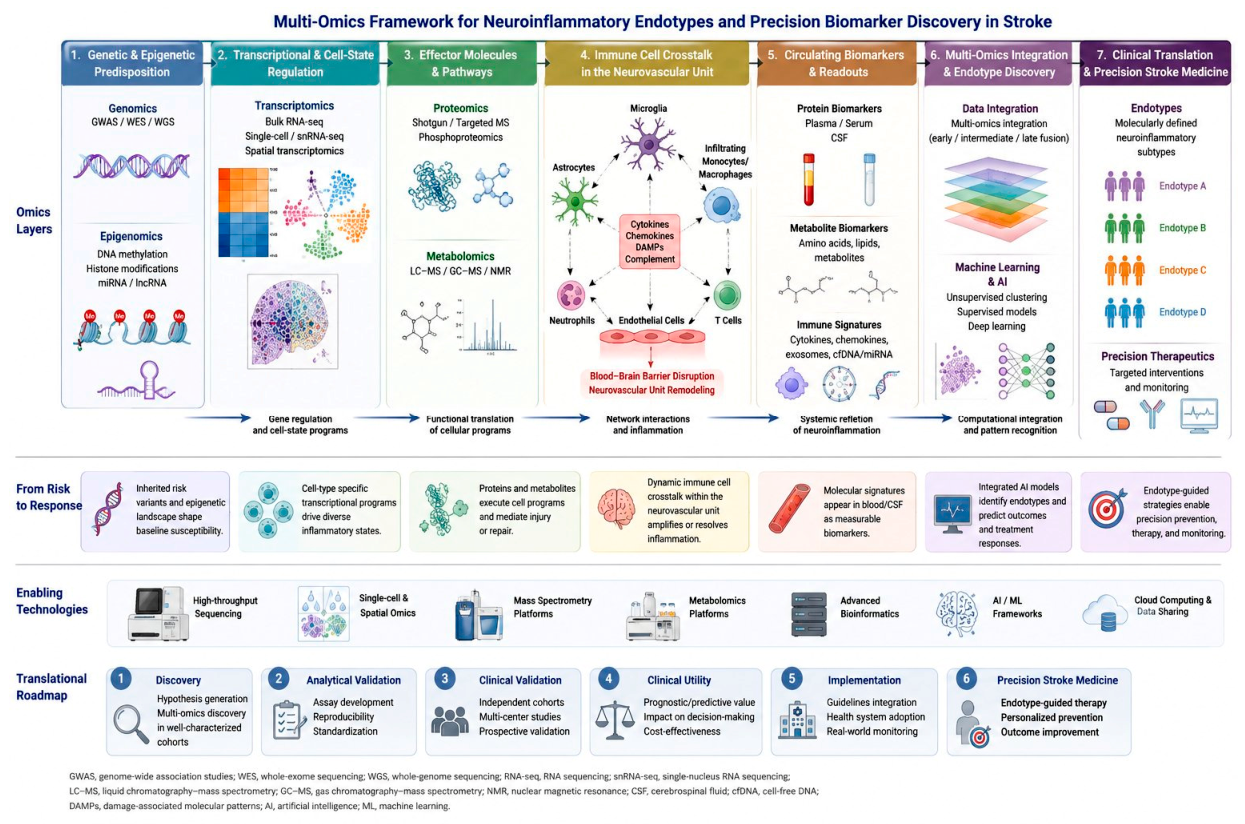
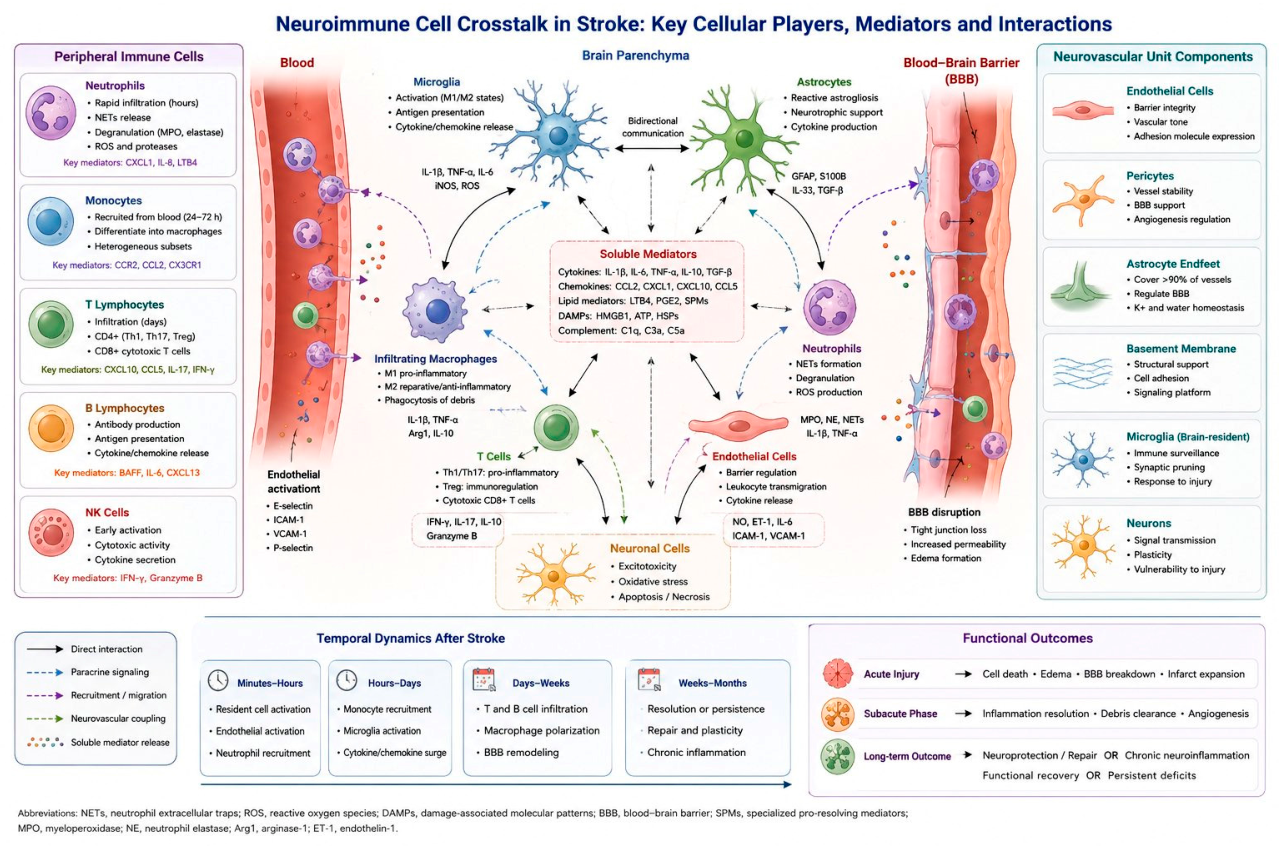
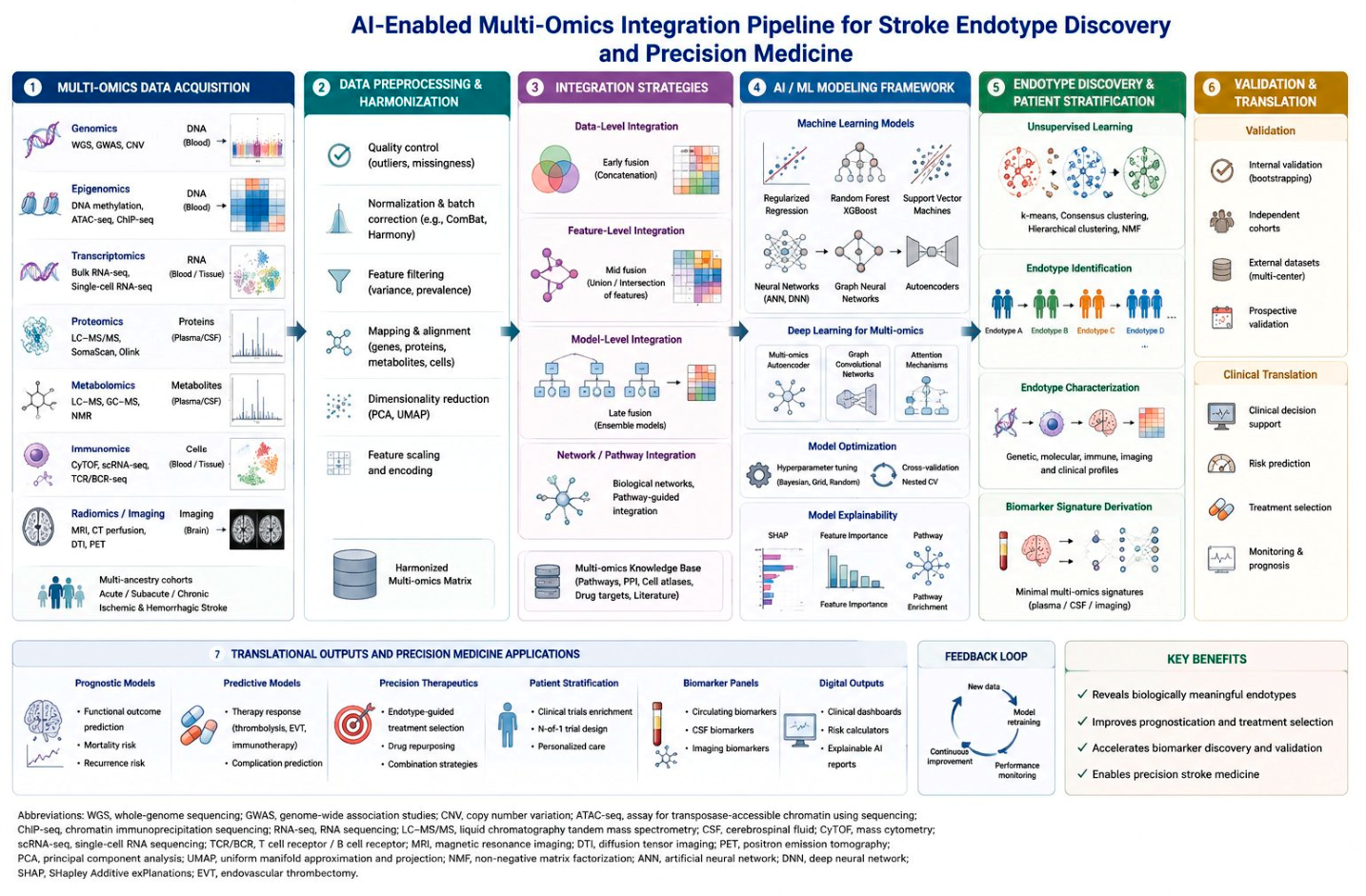
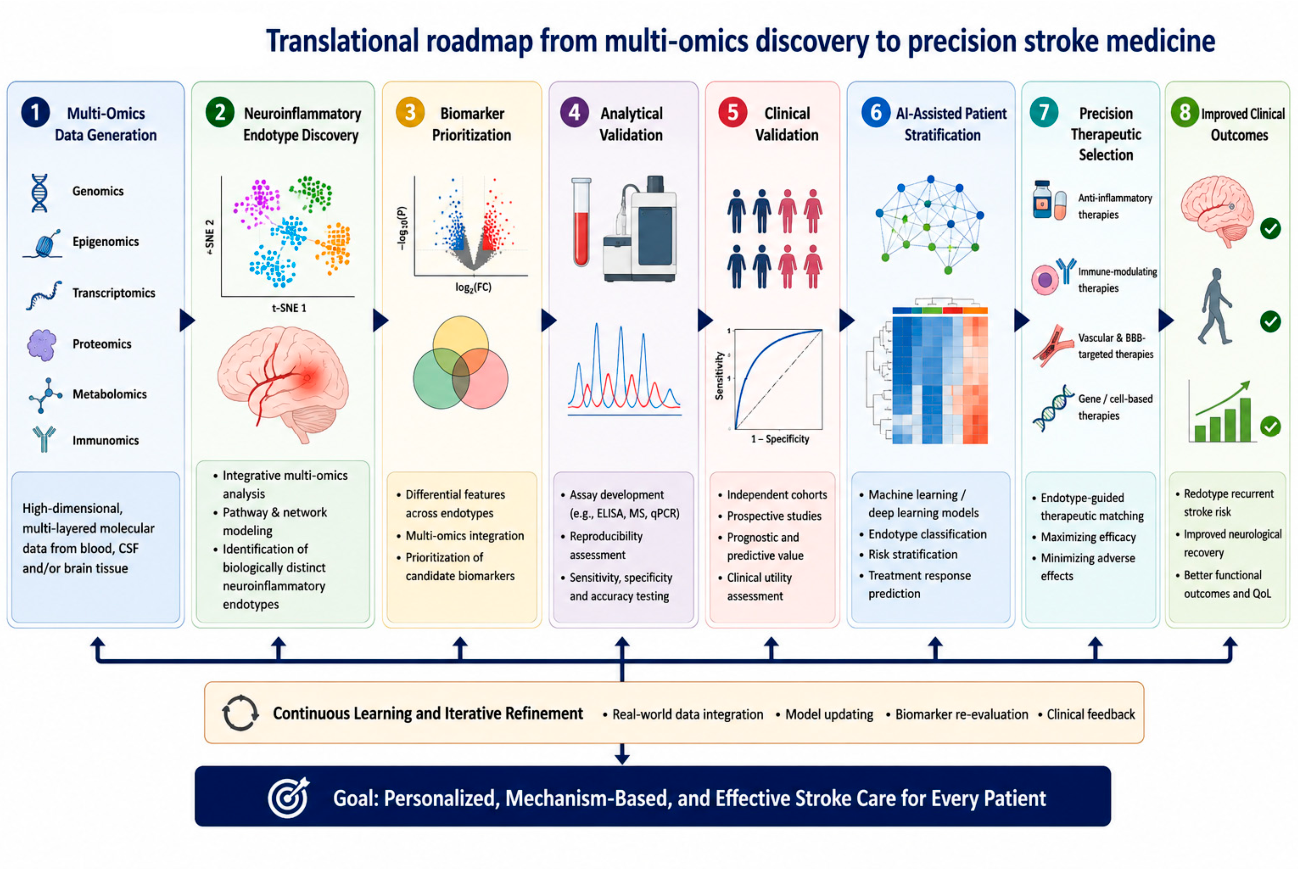
Multi-Omics Integration in Stroke: Neuroinflammatory Endotypes, Immune Cell Crosstalk, and Precision Biomarker Discovery


Abstract
1. Introduction
2. Clinical Heterogeneity of Stroke and the Importance of Neuroinflammatory Endotyping
Cerebral Small Vessel Disease: A New Multi-Omics Target
3. Multi-Omics Layers in Stroke: From Genetic Architecture to Molecular Phenotypes
3.1. Genomics: Heritable Risk Architecture and Stroke Susceptibility Loci
3.2. Epigenomics: Regulatory State, DNA Methylation, and Non-Coding Variant Interpretation
3.3. Transcriptomics: Gene Expression Programs, Single-Cell Atlases, and Spatial Resolution
3.4. Proteomics: Circulating Agents, Post-Translational Modifications, and Biomarker Candidates
3.5. Metabolomics: Systemic Biochemical Signatures of Neuroinflammatory Stress
3.6. Immunomics: High-Dimensional Immune Profiling and Endotype Resolution
4. Neuroimmune Cell Crosstalk: Microglia, Infiltrating Myeloid Cells, Astrocytes, and Neurovascular Unit
4.1. Microglia: Sentinel Cells and State-Specific Responses
4.2. Infiltrating Myeloid Cells: Monocyte-Derived Macrophages and Neutrophils
4.3. Spatial Architecture of Astrocytes, Oligodendrocytes, and Glial Responses
4.4. Blood–Brain Barrier Disruption: A Target Defined by Multi-Omics
4.5. Glymphatic Dysfunction and Perivascular Clearance Pathways
5. Biomarker Discovery and Endotype Classification from Integrated Multi-Omics Data
5.1. Circulating Biomarkers: From Discovery to Patient Stratification
5.2. Endotype Classification: From Research Clusters to Patient Stratification
6. Artificial Intelligence and Machine Learning for Multi-Omics Data Integration in Stroke Research
6.1. Integration Strategies and Model Architectures
6.2. Explainability, Validation, and Regulatory Considerations
7. Translation Barriers: Standardization, Generalizability, and Clinical Translation
7.1. Analytical Standardization and Pre-Analytical Variation
7.2. Multi-Ancestry Representation and Generalizability
7.3. Clinical Scalability and Application Pathways
7.4. Health-Economic and Implementation Considerations
8. Precision Medicine Roadmap for Multi-Omics Integration in Stroke Treatment
- Harmonized multi-omics stroke cohorts: Large-scale, prospectively assembled biobanks with standardized multi-omics sampling at defined time points across acute, subacute, and chronic phases are essential for robust endotype discovery and cross-population validation.
- Genetically anchored biomarker prioritization: Candidate biomarkers should be prioritized using convergent genetic evidence, including pQTL colocalization, MR, and GWAS-epigenome integration, to distinguish causal mediators from reactive downstream signatures.
- Single-cell and spatial multi-omics reference atlases: Human post-stroke brain and blood atlases from clinically well-characterized samples, supported by matched genetic and clinical outcome data, will help translate mouse model discoveries into human endotype biology.
- AI-enabled endotype classification tools: ML models should follow TRIPOD and PROBAST guidelines, with external validation in multicenter, multi-ancestry cohorts, predefined explainability reporting, and post-implementation performance monitoring aligned with SaMD regulatory expectations.
- Biomarker-stratified clinical trial design: Clinical trials should enrich for specific endotype populations using validated biomarker entry criteria, rather than enrolling unselected stroke populations in whom treatment effects may be diluted by biological heterogeneity.
- Precision neuroimmunology as an intellectual framework: The field should shift from viewing inflammation as a complication of stroke to viewing neuroinflammatory endotypes as determinants of stroke biology.
9. Conclusions
Author Contributions
Funding
Institutional Review Board Statement
Informed Consent Statement
Data Availability Statement
Conflicts of Interest
References
- GBD 2021 Stroke Risk Factor Collaborators. Global, regional, and national burden of stroke and its risk factors, 1990–2021: A systematic analysis for the Global Burden of Disease Study 2021. Lancet Neurol. 2024, 23, 973–1003. [CrossRef] [PubMed]
- Grigorean, V.T.; Pantu, C.; Breazu, A.; Oprea, S.; Munteanu, O.; Radoi, M.P.; Giuglea, C.; Marin, A. Mapping the Ischemic Continuum: Dynamic Multi-Omic Biomarker and AI for Personalized Stroke Care. Int. J. Mol. Sci. 2026, 27, 502. [Google Scholar] [CrossRef]
- Simats, A.; García-Berrocoso, T.; Montaner, J. Neuroinflammatory biomarkers: From stroke diagnosis and prognosis to therapy. Biochim Biophys. Acta 2016, 1862, 411–424. [Google Scholar] [CrossRef] [PubMed]
- Abraham, G.; Rutten-Jacobs, L.; Inouye, M. Risk Prediction Using Polygenic Risk Scores for Prevention of Stroke and Other Cardiovascular Diseases. Stroke 2021, 52, 2983–2991. [Google Scholar] [CrossRef] [PubMed]
- Debette, S.; Markus, H.S. Stroke Genetics: Discovery, Insight Into Mechanisms, and Clinical Perspectives. Circ. Res. 2022, 130, 1095–1111. [Google Scholar] [CrossRef] [PubMed]
- Jung, J.; Lu, Z.; de Smith, A.; Mancuso, N. Novel insight into the etiology of ischemic stroke gained by integrative multiome-wide association study. Hum. Mol. Genet. 2024, 33, 170–181. [Google Scholar] [CrossRef] [PubMed]
- Joshi, A.; Rienks, M.; Theofilatos, K.; Mayr, M. Systems biology in cardiovascular disease: A multiomics approach. Nat. Rev. Cardiol. 2021, 18, 313–330. [Google Scholar] [CrossRef] [PubMed]
- Labarga, A.; Martínez-Gonzalez, J.; Barajas, M. Integrative Multi-Omics Analysis for Etiology Classification and Biomarker Discovery in Stroke: Advancing towards Precision Medicine. Biology 2024, 13, 338. [Google Scholar] [CrossRef] [PubMed]
- Iadecola, C.; Buckwalter, M.S.; Anrather, J. Immune responses to stroke: Mechanisms, modulation, and therapeutic potential. J. Clin. Investig. 2020, 130, 2777–2788. [Google Scholar] [CrossRef] [PubMed]
- Chamorro, Á.; Meisel, A.; Planas, A.M.; Urra, X.; van de Beek, D.; Veltkamp, R. The immunology of acute stroke. Nat. Rev. Neurol. 2012, 8, 401–410. [Google Scholar] [CrossRef] [PubMed]
- Maïer, B.; Tsai, A.S.; Einhaus, J.F.; Desilles, J.P.; Ho-Tin-Noé, B.; Gory, B.; Sirota, M.; Leigh, R.; Lemmens, R.; Albers, G.; et al. Neuroimaging is the new "spatial omic": Multi-omic approaches to neuro-inflammation and immuno-thrombosis in acute ischemic stroke. Semin Immunopathol. 2023, 45, 125–143. [Google Scholar] [CrossRef] [PubMed]
- Garcia-Bonilla, L.; Shahanoor, Z.; Sciortino, R.; Nazarzoda, O.; Racchumi, G.; Iadecola, C.; Anrather, J. Analysis of brain and blood single-cell transcriptomics in acute and subacute phases after experimental stroke. Nat. Immunol. 2024, 25, 357–370. [Google Scholar] [CrossRef] [PubMed]
- Vandereyken, K.; Sifrim, A.; Thienpont, B.; Voet, T. Methods and applications for single-cell and spatial multi-omics. Nat. Rev. Genet. 2023, 24, 494–515. [Google Scholar] [CrossRef] [PubMed]
- Li, X.; Lyu, J.; Li, R.; Jain, V.; Shen, Y.; Del Águila, Á.; Hoffmann, U.; Sheng, H.; Yang, W. Single-cell transcriptomic analysis of the immune cell landscape in the aged mouse brain after ischemic stroke. J. Neuroinflammation 2022, 19, 83. [Google Scholar] [CrossRef] [PubMed]
- Raffield, L.M.; Dang, H.; Pratte, K.A.; Jacobson, S.; Gillenwater, L.A.; Ampleford, E.; Barjaktarevic, I.; Basta, P.; Clish, C.B.; Comellas, A.P.; et al. Comparison of Proteomic Assessment Methods in Multiple Cohort Studies. Proteomics 2020, 20, e1900278. [Google Scholar] [CrossRef] [PubMed] [PubMed Central]
- Ding, L.; Zhang, M.; Fan, B.; Deng, F.; Li, Z.; Han, Y.; Wu, Y.; Zeng, J.; Lu, L. Metabolomics reveals key biomarkers for ischemic stroke: A systematic review of emerging evidence. Front. Neurol. 2025, 16, 1630390. [Google Scholar] [CrossRef] [PubMed]
- Yoo, H.Y.; Shin, H.; Kim, E.J.; Son, Y.J. Machine Learning for Predicting Stroke Risk Stratification Using Multiomics Data: Systematic Review. J. Med. Internet Res. 2026, 28, e85654. [Google Scholar] [CrossRef] [PubMed]
- Lin, L.; Guo, C.; Jin, H.; Huang, H.; Luo, F.; Wang, Y.; Li, D.; Zhang, Y.; Xu, Y.; Zhu, C.; et al. Integrative multi-omics approach using random forest and artificial neural network models for early diagnosis and immune infiltration characterization in ischemic stroke. Front. Neurol. 2024, 15, 1475582. [Google Scholar] [CrossRef] [PubMed]
- Barthels, D.; Das, H. Current advances in ischemic stroke research and therapies. Biochim Biophys. Acta Mol. Basis Dis. 2020, 1866, 165260. [Google Scholar] [CrossRef] [PubMed]
- Bonkhoff, A.K.; Grefkes, C. Precision medicine in stroke: Towards personalized outcome predictions using artificial intelligence. Brain 2022, 145, 457–475. [Google Scholar] [CrossRef] [PubMed]
- Hein, Z.M.; Arbain, M.F.F.; Che Ramli, M.D.; Jaffer, U.; Che Mohd Nassir, C.M.N. Glymphopathy and Reduced Processing Speed in Community-Dwelling Adults with Silent Cerebral Small Vessel Disease: A DTI-ALPS Study. J. Clin. Med. 2025, 14, 6039. [Google Scholar] [CrossRef] [PubMed]
- Rasmussen, M.K.; Mestre, H.; Nedergaard, M. The glymphatic pathway in neurological disorders. Lancet Neurol. 2018, 17, 1016–1024. [Google Scholar] [CrossRef] [PubMed]
- Hristovska, I.; Pichet Binette, A.; Kumar, A.; Wennström, M.; Gaiteri, C.; Karlsson, L.; Strandberg, O.; Janelidze, S.; van Westen, D.; Stomrud, E.; et al. Identification of distinct and shared biomarker panels in different manifestations of cerebral small-vessel disease through proteomic profiling. Nat. Aging 2026, 6, 703–721. [Google Scholar] [CrossRef] [PubMed]
- Jagodic, A.; Zivalj, D.; Krsek, A.; Baticic, L. Genetic Architecture of Ischemic Stroke: Insights from Genome-Wide Association Studies and Beyond. J. Cardiovasc Dev. Dis. 2025, 12, 281. [Google Scholar] [CrossRef] [PubMed]
- Surakka, I.; Wu, K.H.; Hornsby, W.; Wolford, B.N.; Shen, F.; Zhou, W.; Huffman, J.E.; Pandit, A.; Hu, Y.; Brumpton, B.; et al. Multi-ancestry meta-analysis identifies 5 novel loci for ischemic stroke and reveals heterogeneity of effects between sexes and ancestries. Cell Genom. 2023, 3, 100345. [Google Scholar] [CrossRef] [PubMed]
- Visscher, P.M.; Wray, N.R.; Zhang, Q.; Sklar, P.; McCarthy, M.I.; Brown, M.A.; Yang, J. 10 Years of GWAS Discovery: Biology, Function, and Translation. Am. J. Hum. Genet. 2017, 101, 5–22. [Google Scholar] [CrossRef] [PubMed]
- Hemani, G.; Zheng, J.; Elsworth, B.; Wade, K.H.; Haberland, V.; Baird, D.; Laurin, C.; Burgess, S.; Bowden, J.; Langdon, R.; et al. The MR-Base platform supports systematic causal inference across the human phenome. Elife 2018, 7, e34408. [Google Scholar] [CrossRef] [PubMed]
- Peng, H.; Palma-Gudiel, H.; Soriano-Tarraga, C.; Jimenez-Conde, J.; Zhang, M.; Zhang, Y.; Zhao, J. Epigenome-wide association study identifies novel genes associated with ischemic stroke. Clin. Epigenetics 2023, 15, 106. [Google Scholar] [CrossRef] [PubMed]
- Kelsey, G.; Stegle, O.; Reik, W. Single-cell epigenomics: Recording the past and predicting the future. Science 2017, 358, 69–75. [Google Scholar] [CrossRef] [PubMed]
- Zucha, D.; Abaffy, P.; Kirdajova, D.; Jirak, D.; Kubista, M.; Anderova, M.; Valihrach, L. Spatiotemporal transcriptomic map of glial cell response in a mouse model of acute brain ischemia. Proc. Natl. Acad. Sci. USA 2024, 121, e2404203121. [Google Scholar] [CrossRef] [PubMed]
- Hansen, L.M.B.; Dam, V.S.; Guldbrandsen, H.Ø.; Staehr, C.; Pedersen, T.M.; Kalucka, J.M.; Beck, H.C.; Postnov, D.D.; Lin, L.; Matchkov, V.V. Spatial Transcriptomics and Proteomics Profiling After Ischemic Stroke Reperfusion: Insights Into Vascular Alterations. Stroke 2025, 56, 1036–1047. [Google Scholar] [CrossRef] [PubMed]
- Scott, E.Y.; Safarian, N.; Casasbuenas, D.L.; Dryden, M.; Tockovska, T.; Ali, S.; Peng, J.; Daniele, E.; Lim, I.N.X.; Bang, K.W.A.; et al. Integrating single-cell and spatially resolved transcriptomic strategies to survey the astrocyte response to stroke in male mice. Nat. Commun. 2024, 15, 1584. [Google Scholar] [CrossRef] [PubMed]
- Liu, F.; Cheng, X.; Zhao, C.; Zhang, X.; Liu, C.; Zhong, S.; Liu, Z.; Lin, X.; Qiu, W.; Zhang, X. Single-Cell Mapping of Brain Myeloid Cell Subsets Reveals Key Transcriptomic Changes Favoring Neuroplasticity after Ischemic Stroke. Neurosci. Bull. 2024, 40, 65–78. [Google Scholar] [CrossRef] [PubMed]
- Sun, B.B.; Maranville, J.C.; Peters, J.E.; Stacey, D.; Staley, J.R.; Blackshaw, J.; Burgess, S.; Jiang, T.; Paige, E.; Surendran, P.; et al. Genomic atlas of the human plasma proteome. Nature 2018, 558, 73–79. [Google Scholar] [CrossRef] [PubMed]
- Cao, Z.; Wang, Y.; Sun, M.; Du, R.; Feng, X.; Wang, L.; Zhao, Z.; Sun, W. Single-cell and multi-omics analysis identifies mitophagy-related biomarkers and therapeutic targets in ischemic stroke. Sci. Rep. 2026, 16, 12433. [Google Scholar] [CrossRef] [PubMed]
- Ali, M.; Timsina, J.; Xu, Y.; Chen, Y.; Gong, K.; Western, D.; Heo, G.; Liu, M.; Budde, J.; Pottier, C.; et al. Large-scale CSF and plasma proteomics reveal immune, synaptic, and extracellular matrix disruptions across neurodegenerative diseases. Neuron 2026, 114, 1–17. [Google Scholar]
- Wishart, D.S. Metabolomics for Investigating Physiological and Pathophysiological Processes. Physiol. Rev. 2019, 99, 1819–1875. [Google Scholar] [CrossRef] [PubMed]
- Laaksonen, R.; Ekroos, K.; Sysi-Aho, M.; Hilvo, M.; Vihervaara, T.; Kauhanen, D.; Suoniemi, M.; Hurme, R.; März, W.; Scharnagl, H.; et al. Plasma ceramides predict cardiovascular death in patients with stable coronary artery disease and acute coronary syndromes beyond LDL-cholesterol. Eur. Heart J. 2016, 37, 1967–1976. [Google Scholar] [CrossRef] [PubMed]
- Buergel, T.; Steinfeldt, J.; Ruyoga, G.; Pietzner, M.; Bizzarri, D.; Vojinovic, D.; Belzen, J.U.; Loock, L.; Kittner, P.; Christmann, L.; et al. Metabolomic profiles predict individual multidisease outcomes. Nat. Med. 2022, 28, 2309–2320. [Google Scholar] [CrossRef] [PubMed]
- Iadecola, C.; Anrather, J. The immunology of stroke: From mechanisms to translation. Nat. Med. 2011, 17, 796–808. [Google Scholar] [CrossRef] [PubMed]
- Kim, G.S.; Harmon, E.; Gutierrez, M.; Stephenson, J.; Chauhan, A.; Banerjee, A.; Wise, Z.; Doan, A.; Wu, T.; Lee, J.; et al. Single-cell analysis identifies Ifi27l2a as a novel gene regulator of microglial inflammation in the context of aging and stroke. Research Square 2023. [Google Scholar] [CrossRef] [PubMed]
- Ardic, N.; Dinc, R. Neutrophil extracellular traps and microglia/macrophages interactions in stroke: From thromboinflammation to immunotherapy. Front. Immunol. 2026, 17, 1752471. [Google Scholar] [CrossRef] [PubMed]
- Pfau, S.J.; Langen, U.H.; Fisher, T.M.; Prakash, I.; Nagpurwala, F.; Lozoya, R.A.; Lee, W.-C.A.; Wu, Z.; Gu, C. Characteristics of blood-brain barrier heterogeneity between brain regions revealed by profiling vascular and perivascular cells. Nat. Neurosci. 2024, 27, 1892–1903. [Google Scholar] [CrossRef] [PubMed]
- Vlegels, N.; Knuth, N.L.; Steiner, K.A.; Zhang, L.; Vix, A.L.; Moumin, D.; Mirzen, I.; Khalifeh, N.; Forster, C.; Gesierich, B.; et al. Brain-derived tau for monitoring brain injury in acute ischemic stroke. Sci. Transl. Med. 2026, 18, eadz1280. [Google Scholar] [CrossRef] [PubMed]
- Lin, B.; Leong, Y.Y.; Mohamad, M. Glymphatic system dysfunction in cerebral infarction: Advances and perspectives based on DTI-derived ALPS measures. Am. J. Transl. Res. 2025, 17, 1630–1642. [Google Scholar] [CrossRef] [PubMed]
- Hein, Z.M.; Che Mohd Nassir, C.M.N. Perivascular pathology, not macrovascular complexity, governs glympha-tic-related dysfunction in preclinical cerebral small vessel disease. Sci. Rep. 2026, 16, 4528. [Google Scholar] [CrossRef] [PubMed]
- Lee, J.; Giannaris, P.S.; Yilmaz, C.E.; Yilmaz, G. Emerging biomarkers in ischemic stroke. Vessel Plus 2025, 9, 11. [Google Scholar] [CrossRef] [PubMed]
- Anwar, L.; Ahmad, E.; Imtiaz, M.; Ahmad, B.; Awais Ali, M.; Mahnoor. Biomarkers for Early Detection of Stroke: A Systematic Review. Cureus 2024, 16, e70624. [Google Scholar] [CrossRef] [PubMed]
- Ashley, E.A. Towards precision medicine. Nat. Rev. Genet. 2016, 17, 507–522. [Google Scholar] [CrossRef] [PubMed]
- Topol, E.J. High-performance medicine: The convergence of human and artificial intelligence. Nat. Med. 2019, 25, 44–56. [Google Scholar] [CrossRef] [PubMed]
- Wang, Y.; Liu, D.; Wang, S.; Zhang, R.; Wang, X.; Yu, Y. Multi-dimensional Multi-omics Integrative Study to Identify Target Genes for Ischemic Stroke and Related Chronic Pain. Cell. Mol. Neurobiol. 2025, 45, 81. [Google Scholar] [CrossRef] [PubMed]
- U.S. Food and Drug Administration (FDA). Artificial Intelligence/Machine Learning (AL/ML)-Based Software as a Medical Device (SaMD) Action Plan. 2021. Available online: https://www.fda.gov/media/145022/download (accessed on 6 May 2026).
- Collins, G.S.; Reitsma, J.B.; Altman, D.G.; Moons, K.G. Transparent Reporting of a multivariable prediction model for Individual Prognosis or Diagnosis (TRIPOD): The TRIPOD statement. Ann. Intern. Med. 2015, 162, 55–63. [Google Scholar] [CrossRef] [PubMed]
- Wolff, R.F.; Moons, K.G.M.; Riley, R.D.; Whiting, P.F.; Westwood, M.; Collins, G.S.; Reitsma, J.B.; Kleijnen, J.; Mallett, S.; for the PROBAST Group. PROBAST: A Tool to Assess the Risk of Bias and Applicability of Prediction Model Studies. Ann. Intern. Med. 2019, 170, 51–58. [Google Scholar] [CrossRef] [PubMed]
- Ardic, N.; Dinc, R. Artificial Intelligence-Enabled Bioengineering of Extracellular Vesicle Platforms in Cardiovascular Medicine. Bioengineering 2026, 13, 573. [Google Scholar] [CrossRef] [PubMed]
- Fatumo, S.; Chikowore, T.; Choudhury, A.; Ayub, M.; Martin, A.R.; Kuchenbaecker, K. A roadmap to increase diversity in genomic studies. Nat. Med. 2022, 28, 243–250. [Google Scholar] [CrossRef] [PubMed]
- Xiao, R.; Zang, M.; Liu, X.; Zhu, Q.; Fu, X. Decoding Stroke Etiology: Multi-Omics Advancements in Genetic Mechanisms and Clinical Implication. Brain Behav. 2025, 15, e70792. [Google Scholar] [CrossRef] [PubMed]
- Gao, Q.; Jin, Y.; Sun, Y.; Jin, M.; Tang, L.; Chen, Y.; She, Y.; Li, M. Transforming Intracerebral Hemorrhage Care with Artificial Intelligence: Opportunities, Challenges, and Future Directions. Diagnostics 2026, 16, 752. [Google Scholar] [CrossRef] [PubMed]
- Fornage, M. Grand challenges in stroke genomics. Front. Stroke 2022, 1, 984176. [Google Scholar] [CrossRef] [PubMed]
- Jiang, Z.; Zhang, H.; Gao, Y.; Sun, Y. Multi-omics strategies for biomarker discovery and application in personalized oncology. Mol. Biomed. 2025, 6, 115. [Google Scholar] [CrossRef] [PubMed]



| Omic Layer | Key Technologies | Primary Output | Role in Stroke Endotyping | References |
|---|---|---|---|---|
| Genomics | WGS, GWAS, SNP arrays, PRS | Genetic variants, susceptibility loci | Inherited risk stratification, causal inference, variant annotation | [4,5,21,22] |
| Epigenomics | ATAC-seq, ChIP-seq, EWAS | Chromatin accessibility, DNA methylation | Regulatory interpretation of non-coding variants, immune state transitions | [25,26] |
| Transcriptomics | Bulk RNA-seq, scRNA-seq, spatial transcriptomics | Gene expression programs, cell states | Single-cell endotype mapping, temporal immune dynamics, cell crosstalk | [12,13,14,27,28,29,30] |
| Proteomics | DIA-MS, LC-MS/MS, affinity-based platforms | Protein abundance, PTMs | Circulating biomarker discovery, functional effector identification, pQTL integration | [15,28,31,33] |
| Metabolomics/Lipidomics | LC-MS, NMR | Metabolite and lipid profiles | Systemic biochemical endotypes, lipid-inflammation convergence | [16,34,35,36] |
| Immunomics | CyTOF, flow cytometry, scRNA-seq multimodal | Immune cell composition and activation states | Inflammatory endotype resolution, therapeutic target identification | [9,10,37,39] |
| Cohort/Model | Validation Status | Omics Layer | Key Finding | Translational Output | References |
|---|---|---|---|---|---|
| Post-stroke brain and blood atlas | Discovery study | scRNA-seq (brain and blood) | Temporal immune divergence and monocyte-to-macrophage transdifferentiation after stroke | Cellular endotype atlas and therapeutic timing targets | [12] |
| Integrated multi-omics stroke cohort | Internal validation | Genomics, methylation, mRNA, circRNA, miRNA + GNN | Multi-omics integration improves stroke etiology classification compared to single-layer approach | Multi-marker framework for subtype stratification | [8] |
| Acute ischemic stroke tissue samples | Discovery study | Spatial transcriptomics | Spatial-temporal mapping of glial activation in acute ischemia | Region-specific neuroinflammatory endotype signatures | [27] |
| Reperfusion stroke cohort | Independent validation | Spatial transcriptomics + proteomics | CLDN5 downregulation and IL-6-associated BBB disruption after reperfusion | Multi-omics index of BBB integrity | [28] |
| Systematic review | Literature synthesis | Metabolomics systematic review | Amino acid and sphingolipid signatures associated with ischemic stroke subtypes | Metabolite panel for ischemic stroke prediction | [16] |
| Multi-cohort ML datasets | External validation | Machine learning across metabolomics, proteomics, and lipidomics | Multi-omics ML improves stroke risk stratification accuracy | AI-assisted integration framework for clinical ML models | [17] |
| Conceptual precision medicine framework | Translational framework | Multi-omics biomarkers + AI | Dynamic multi-omics profiling supports personalized stroke care | AI-assisted precision stroke management pathway | [2] |
| Method | Integration Strategy | Strengths | Limitations | Application in Stroke | References |
|---|---|---|---|---|---|
| LASSO/Elastic Net | Early fusion | Interpretable, low risk of overfitting | Linear, misses interactions | Biomarker panel selection, risk score construction | [17,20] |
| Random Forest/XGBoost | Early/late fusion | Nonlinear, handles noise | Limited interpretability, requires tuning | Stroke outcome prediction, immune infiltration profiling | [17,18] |
| Multi-view learning (MOFA) | Mid-level fusion | Preserves modality structure, cross-layer correlation | Computationally intensive | Endotype discovery, cross-omics disease subtyping | [8,13] |
| Variational Autoencoders | Mid-level fusion | Latent shared structure, handles missing data | Reduced biological interpretability | Cross-omics dimensionality reduction | [17,45] |
| Graph Neural Networks (GNN) | Mid-level fusion | Incorporates biological networks | Dependent on network quality | Stroke etiology classification | [17,46] |
| Transformer/Attention Models | Early/mid fusion | Long-range dependencies modeling, multimodal integration | Requires large training datasets | Dynamic multi-omics biomarker trajectories | [17,45] |
| Bayesian Networks | Mid/late fusion | Quantitative uncertainty estimation, causal reasoning | Computational complexity | Probabilistic endotype classification | [18,47] |
Disclaimer/Publisher’s Note: The statements, opinions and data contained in all publications are solely those of the individual author(s) and contributor(s) and not of MDPI and/or the editor(s). MDPI and/or the editor(s) disclaim responsibility for any injury to people or property resulting from any ideas, methods, instructions or products referred to in the content. |
© 2026 by the authors. Licensee MDPI, Basel, Switzerland. This article is an open access article distributed under the terms and conditions of the Creative Commons Attribution (CC BY) license.
Share and Cite
Ardic, N.; Dinc, R. Multi-Omics Integration in Stroke: Neuroinflammatory Endotypes, Immune Cell Crosstalk, and Precision Biomarker Discovery. Int. J. Mol. Sci. 2026, 27, 5984. https://doi.org/10.3390/ijms27135984
Ardic N, Dinc R. Multi-Omics Integration in Stroke: Neuroinflammatory Endotypes, Immune Cell Crosstalk, and Precision Biomarker Discovery. International Journal of Molecular Sciences. 2026; 27(13):5984. https://doi.org/10.3390/ijms27135984
Chicago/Turabian StyleArdic, Nurittin, and Rasit Dinc. 2026. "Multi-Omics Integration in Stroke: Neuroinflammatory Endotypes, Immune Cell Crosstalk, and Precision Biomarker Discovery" International Journal of Molecular Sciences 27, no. 13: 5984. https://doi.org/10.3390/ijms27135984
APA StyleArdic, N., & Dinc, R. (2026). Multi-Omics Integration in Stroke: Neuroinflammatory Endotypes, Immune Cell Crosstalk, and Precision Biomarker Discovery. International Journal of Molecular Sciences, 27(13), 5984. https://doi.org/10.3390/ijms27135984