Functional Engineering of Bioactive Peptides: Chemical Modifications and Synthetic Biology Approaches


Abstract
1. Introduction
2. Chemical Modification Strategies for Bioactive Peptides
2.1. Main Chain Modification
2.1.1. Terminal Modification
2.1.2. Cyclization Strategies
2.1.3. Chemical Skeleton Modification
2.2. Modification of Side Chains and Functional Groups
2.2.1. Macromolecular Polymer Modification
2.2.2. Lipid-Based Modification
2.2.3. Glycosylation Modification
2.3. Co-Modification of Main and Side Chains
3. Synthetic Biology Modification Strategies for Bioactive Peptides
3.1. Main-Chain Modification Sequence Engineering
3.1.1. Amino Acid Substitution
3.1.2. Truncation and Hybridization (Sequence Deletion)
3.2. Side-Chain Modification
3.3. Combining Main-Chain and Side-Chain Modifications
3.4. Comparison and Analysis of Various Modification Strategies
4. Challenges and Prospects
4.1. Challenges Faced
4.2. Future Trends
5. Summary
Author Contributions
Funding
Institutional Review Board Statement
Informed Consent Statement
Data Availability Statement
Conflicts of Interest
References
- Ulug, S.K.; Jahandideh, F.; Wu, J. Novel technologies for the production of bioactive peptides. Trends Food Sci. Technol. 2021, 108, 27–39. [Google Scholar] [CrossRef]
- Pabona, J.M.; Dave, B.; Su, Y.; Montales, M.T.; de Lumen, B.O.; de Mejia, E.G.; Rahal, O.M.; Simmen, R.C. The soybean peptide lunasin promotes apoptosis of mammary epithelial cells via induction of tumor suppressor PTEN: Similarities and distinct actions from soy isoflavone genistein. Genes Nutr. 2013, 8, 79–90. [Google Scholar] [CrossRef] [PubMed]
- Akbarian, M.; Khani, A.; Eghbalpour, S.; Uversky, V.N. Bioactive Peptides: Synthesis, Sources, Applications, and Proposed Mechanisms of Action. Int. J. Mol. Sci. 2022, 23, 1445. [Google Scholar] [CrossRef] [PubMed]
- Daliri, E.B.-M.; Oh, D.H.; Lee, B.H. Bioactive Peptides. Foods 2017, 6, 32. [Google Scholar] [CrossRef] [PubMed]
- Zhou, J.; Han, Q.; Koyama, T.; Ishizaki, S. Preparation, Purification and Characterization of Antibacterial and ACE Inhibitory Peptides from Head Protein Hydrolysate of Kuruma Shrimp, Marsupenaeus japonicus. Molecules 2023, 28, 894. [Google Scholar] [CrossRef] [PubMed]
- Wen, C.; Zhang, J.; Zhang, H.; Duan, Y.; Ma, H. Study on the structure-activity relationship of watermelon seed antioxidant peptides by using molecular simulations. Food Chem. 2021, 364, 130432. [Google Scholar] [CrossRef] [PubMed]
- He, W.; Su, G.; Sun-Waterhouse, D.; Waterhouse, G.I.N.; Zhao, M.; Liu, Y. In vivo anti-hyperuricemic and xanthine oxidase inhibitory properties of tuna protein hydrolysates and its isolated fractions. Food Chem. 2019, 272, 453–461. [Google Scholar] [CrossRef] [PubMed]
- Wen, L.; Huang, L.; Li, Y.; Feng, Y.; Zhang, Z.; Xu, Z.; Chen, M.L.; Cheng, Y. New peptides with immunomodulatory activity identified from rice proteins through peptidomic and in silico analysis. Food Chem. 2021, 364, 130357. [Google Scholar] [CrossRef] [PubMed]
- Qu, T.; Wen, S.; Hu, L.; Wu, Y.; Huang, R.; Wu, H.; Mu, D.; Huang, Q.; Hu, J.; Wen, L. Rice-Derived Peptides Exhibit Wound Healing Properties in Human Keratinocytes: Screening, Identification, and Mechanism Revelation. Plant Foods Hum. Nutr. 2026, 81, 86. [Google Scholar] [CrossRef] [PubMed]
- Avilés-Gaxiola, S.; García-Aguiar, I.; Jiménez-Ortega, L.A.; Gutiérrez-Grijalva, E.P.; Heredia, J.B. Bioactive Plant Peptides: Physicochemical Features, Structure-Function Insights and Mechanism of Action. Molecules 2025, 30, 3683. [Google Scholar] [CrossRef] [PubMed]
- Ibieta, G.; Ortiz-Sempértegui, J.; Peñarrieta, J.M.; Linares-Pastén, J.A. Bioactive peptides as functional food ingredients: Production, mechanisms of action, market trends, and future perspectives with emphasis on andean crops. J. Funct. Foods 2025, 135, 107109. [Google Scholar] [CrossRef]
- Shriwastav, S.; Kaur, N.; Hassan, M.; Ahmed Mohammed, S.; Chauhan, S.; Mittal, D.; Aman, S.; Bibi, A. Antimicrobial peptides: A promising frontier to combat antibiotic resistant pathogens. Ann. Med. Surg. 2025, 87, 2118–2132. [Google Scholar] [CrossRef] [PubMed]
- He, S.; Deber, C.M. Interaction of designed cationic antimicrobial peptides with the outer membrane of gram-negative bacteria. Sci. Rep. 2024, 14, 1894. [Google Scholar] [CrossRef] [PubMed]
- Birk, A.; Arain, S.; Musumeci, D.; Garcia-Marin, V.; MacNeil, M.A. Targeting High-Density Aromatic Peptides to Cardiolipin Optimizes the Mitochondrial Membrane Potential and Inhibits Oxidative Stress. FASEB Bioadv. 2025, 7, e70052. [Google Scholar] [CrossRef] [PubMed]
- Shen, D.Y.; Begum, N.; Song, H.L.; Zhang, Y.; Wang, L.J.; Zhao, Y.J.; Zhang, L.; Liu, P. In vitro and in vivo antioxidant activity and umami taste of peptides (<1 kDa) from porcine bone protein extract. Food Biosci. 2021, 40, 100901. [Google Scholar] [CrossRef]
- Liu, X.; Guan, F.; Luo, H.; Yao, B.; Tian, J. Artificial Intelligence-Driven Discovery of Bioactive Peptides: Computational Approaches and Future Perspectives. Abiotech 2025, 7, 100014. [Google Scholar] [CrossRef] [PubMed]
- Panyayai, T.; Ngamphiw, C.; Tongsima, S.; Mhuantong, W.; Limsripraphan, W.; Choowongkomon, K.; Sawatdichaikul, O. FeptideDB: A web application for new bioactive peptides from food protein. Heliyon 2019, 5, e02076. [Google Scholar] [CrossRef] [PubMed]
- Nong, N.T.P.; Hsu, J.-L. Bioactive Peptides: An Understanding from Current Screening Methodology. Processes 2022, 10, 1114. [Google Scholar] [CrossRef]
- Baral, K.C.; Choi, K.Y. Barriers and Strategies for Oral Peptide and Protein Therapeutics Delivery: Update on Clinical Advances. Pharmaceutics 2025, 17, 397. [Google Scholar] [CrossRef] [PubMed]
- Xiao, W.; Jiang, W.; Chen, Z.; Huang, Y.; Mao, J.; Zheng, W.; Hu, Y.; Shi, J. Advances in Peptide-Based Drug Development: Delivery Platforms, Therapeutics, and Vaccines. Signal Transduct. Target. Ther. 2025, 10, 74. [Google Scholar] [CrossRef] [PubMed]
- Pei, J.; Gao, X.; Pan, D.; Hua, Y.; He, J.; Liu, Z.; Dang, Y. Advances in the stability challenges of bioactive peptides and improvement strategies. Curr. Res. Food Sci. 2022, 5, 2162–2170. [Google Scholar] [CrossRef] [PubMed]
- Jia, L.; Wang, L.; Liu, C.; Liang, Y.; Lin, Q. Bioactive peptides from foods: Production, function, and application. Food Funct. 2021, 12, 7108–7125. [Google Scholar] [CrossRef] [PubMed]
- Alzaydi, A.; Barbhuiya, R.I.; Routray, W.; Elsayed, A.; Singh, A. Bioactive peptides: Synthesis, applications, and associated challenges. Food Bioeng. 2023, 2, 273–290. [Google Scholar] [CrossRef]
- Soleymani-Goloujeh, M.; Nokhodchi, A.; Niazi, M.; Najafi-Hajivar, S.; Shahbazi-Mojarrad, J.; Zarghami, N.; Zakeri-Milani, P.; Mohammadi, A.; Karimi, M.; Valizadeh, H. Effects of N-terminal and C-terminal modification on cytotoxicity and cellular uptake of amphiphilic cell penetrating peptides. Artif. Cells Nanomed. Biotechnol. 2018, 46, 91–103. [Google Scholar] [CrossRef] [PubMed]
- Li, D.; Yang, Y.; Li, R.; Huang, L.; Wang, Z.; Deng, Q.; Dong, S. N-terminal acetylation of antimicrobial peptide L163 improves its stability against protease degradation. J. Pept. Sci. 2021, 27, e3337. [Google Scholar] [CrossRef] [PubMed]
- Hung, K.Y.; Harris, P.W.R.; Desai, A.; Marshall, J.F.; Brimble, M.A. Structure-activity relationship study of the tumor-targeting peptide A20FMDV2 via modification of Lys16, Leu13, and N- and/or C-terminal functionality. Eur. J. Med. Chem. 2017, 136, 154–164. [Google Scholar] [CrossRef] [PubMed]
- McTiernan, N.; Kjosås, I.; Arnesen, T. Illuminating the impact of N-terminal acetylation: From protein to physiology. Nat. Commun. 2025, 16, 703. [Google Scholar] [CrossRef] [PubMed]
- Muhar, M.F.; Farnung, J.; Cernakova, M.; Hofmann, R.; Henneberg, L.T.; Pfleiderer, M.M.; Denoth-Lippuner, A.; Kalčic, F.; Nievergelt, A.S.; Peters Al-Bayati, M.; et al. C-terminal amides mark proteins for degradation via SCF–FBXO31. Nature 2025, 638, 519–527. [Google Scholar] [CrossRef] [PubMed]
- Fang, P.; Pang, W.K.; Xuan, S.; Chan, W.L.; Leung, K.C. Recent advances in peptide macrocyclization strategies. Chem. Soc. Rev. 2024, 53, 11725–11771. [Google Scholar] [CrossRef] [PubMed]
- Tang, J.; Chen, H.; He, Y.; Sheng, W.; Bai, Q.; Wang, H. Peptide-guided functionalization and macrocyclization of bioactive peptidosulfonamides by Pd(II)-catalyzed late-stage C-H activation. Nat. Commun. 2018, 9, 3383. [Google Scholar] [CrossRef] [PubMed]
- Yang, R.; Ma, X.; Peng, F.; Wen, J.; Allahou, L.W.; Williams, G.R.; Knowles, J.C.; Poma, A. Advances in antimicrobial peptides: From mechanistic insights to chemical modifications. Biotechnol. Adv. 2025, 81, 108570. [Google Scholar] [CrossRef] [PubMed]
- Pei, Z.; Song, Q.; Xu, J.; Yu, S.; Ma, H. The Cyclic Antimicrobial Peptide C-LR18 Has Enhanced Antibacterial Activity, Improved Stability, and a Longer Half-Life Compared to the Original Peptide. Antibiotics 2025, 14, 312. [Google Scholar] [CrossRef] [PubMed]
- He, J.; Ghosh, P.; Nitsche, C. Biocompatible strategies for peptide macrocyclisation. Chem. Sci. 2024, 15, 2300–2322. [Google Scholar] [CrossRef] [PubMed]
- Al Musaimi, O.; Lombardi, L.; Williams, D.R.; Albericio, F. Strategies for Improving Peptide Stability and Delivery. Pharmaceuticals 2022, 15, 1283. [Google Scholar] [CrossRef] [PubMed]
- Lombardi, L.; Genio, V.D.; Albericio, F.; Williams, D.R. Advances in Peptidomimetics for Next-Generation Therapeutics: Strategies, Modifications, and Applications. Chem. Rev. 2025, 125, 7099–7166. [Google Scholar] [CrossRef] [PubMed]
- Wang, L.; Wang, N.; Zhang, W.; Cheng, X.; Yan, Z.; Shao, G.; Wang, X.; Wang, R.; Fu, C. Therapeutic peptides: Current applications and future directions. Signal Transduct. Target. Ther. 2022, 7, 48. [Google Scholar] [CrossRef] [PubMed]
- Nyembe, P.L.; Ntombela, T.; Makatini, M.M. Review: Structure-Activity Relationship of Antimicrobial Peptoids. Pharmaceutics 2023, 15, 1506. [Google Scholar] [CrossRef] [PubMed]
- Yang, W.; Seo, J.; Kim, J.H. Protein-mimetic peptoid nanoarchitectures for pathogen recognition and neutralization. Nanoscale 2023, 15, 975–986. [Google Scholar] [CrossRef] [PubMed]
- Oh, J.; Choi, S.; Yun, Y.; Choi, J.; Barron, A.E.; Park, K.; Seo, J. Local enhancement of cationic charge density via polyamine side chain incorporation improves the selectivity of antimicrobial peptoids. Eur. J. Med. Chem. 2025, 297, 117920. [Google Scholar] [CrossRef] [PubMed]
- Zhao, Z.; Laps, S.; Gichtin, J.S.; Metanis, N. Selenium chemistry for spatio-selective peptide and protein functionalization. Nat. Rev. Chem. 2024, 8, 211–229. [Google Scholar] [CrossRef] [PubMed]
- Hong, J.; Kim, J.; Gong, J.; Jeong, S.; Park, Y.S.; Yoo, S.H.; Kim, J.; Lee, H.S. Programmable Helicity and Macrocycle Symmetry in β-Peptides via Site-Selective Thioamide Substitution. J. Am. Chem. Soc. 2025, 147, 44216–44224. [Google Scholar] [CrossRef] [PubMed]
- Schissel, C.K.; Roberts-Mataric, H.; Garcia, I.J.; Kang, H.; Mowzoon-Mogharrabi, R.; Francis, M.B.; Schepartz, A. Peptide Backbone Editing via Post-Translational O to C Acyl Shift. J. Am. Chem. Soc. 2025, 147, 6503–6513. [Google Scholar] [CrossRef] [PubMed]
- Veronese, F.M.; Mero, A. The impact of PEGylation on biological therapies. Biodrugs 2008, 22, 315–329. [Google Scholar] [CrossRef] [PubMed]
- Jia, Y.; Fernandez, A.; Sampath, J. PEGylation of Insulin and Lysozyme To Stabilize against Thermal Denaturation: A Molecular Dynamics Simulation Study. J. Phys. Chem. B 2023, 127, 6856–6866. [Google Scholar] [CrossRef] [PubMed]
- Mehrizi, T.Z.; Mirzaei, M.; Ardestani, M.S. Pegylation, a Successful Strategy to Address the Storage and Instability Problems of Blood Products: Review 2011–2021. Curr. Pharm. Biotechnol. 2024, 25, 247–267. [Google Scholar] [CrossRef] [PubMed]
- Li, C.; Li, T.; Tian, X.; An, W.; Wang, Z.; Han, B.; Tao, H.; Wang, J.; Wang, X. Research progress on the PEGylation of therapeutic proteins and peptides (TPPs). Front. Pharmacol. 2024, 15, 1353626. [Google Scholar] [CrossRef] [PubMed]
- Zhang, P.; Sun, F.; Liu, S.; Jiang, S. Anti-PEG antibodies in the clinic: Current issues and beyond PEGylation. J. Control. Release 2016, 244, 184–193. [Google Scholar] [CrossRef] [PubMed]
- Lee, C.S.; Kulkarni, Y.; Pierre, V.; Maski, M.; Wanner, C. Adverse Impacts of PEGylated Protein Therapeutics: A Targeted Literature Review. BioDrugs 2024, 38, 795–819. [Google Scholar] [CrossRef] [PubMed]
- Lin, Y.C.; Chen, B.M.; Tran, T.T.M.; Chang, T.C.; Al-Qaisi, T.S.; Roffler, S.R. Accelerated clearance by antibodies against methoxy PEG depends on pegylation architecture. J. Control. Release 2023, 354, 354–367. [Google Scholar] [CrossRef] [PubMed]
- Mu, J.; Vong, E.; Carmali, S. Artificial lipidation of proteins and peptides: From mechanism to clinical applications. FEBS J. 2026, 293, 1269–1284. [Google Scholar] [CrossRef] [PubMed]
- Knudsen, L.B.; Lau, J. The Discovery and Development of Liraglutide and Semaglutide. Front. Endocrinol. 2019, 10, 155. [Google Scholar] [CrossRef] [PubMed]
- Mendes, B.; Edwards-Gayle, C.; Barrett, G. Peptide lipidation and shortening optimises antibacterial, antibiofilm and membranolytic actions of an amphiphilic polylysine-polyphenyalanine octapeptide. Curr. Res. Biotechnol. 2024, 8, 100240. [Google Scholar] [CrossRef]
- Myšková, A.; Sýkora, D.; Kuneš, J.; Maletínská, L. Lipidization as a tool toward peptide therapeutics. Drug Deliv. 2023, 30, 2284685. [Google Scholar] [CrossRef] [PubMed]
- Mehrotra, S.; Kalyan Bg, P.; Nayak, P.G.; Joseph, A.; Manikkath, J. Recent Progress in the Oral Delivery of Therapeutic Peptides and Proteins: Overview of Pharmaceutical Strategies to Overcome Absorption Hurdles. Adv. Pharm. Bull. 2024, 14, 11–33. [Google Scholar] [CrossRef] [PubMed]
- Wang, X.; Yang, Z.; Zhang, W.; Xing, L.; Luo, R.; Cao, S. Obstacles, research progress, and prospects of oral delivery of bioactive peptides: A comprehensive review. Front. Nutr. 2024, 11, 1496706. [Google Scholar] [CrossRef] [PubMed]
- Gangavarapu, A.; Tapia-Lopez, L.V.; Sarkar, B.; Pena-Zacarias, J.; Badruddoza, A.Z.M.; Nurunnabi, M. Lipid nanoparticles for enhancing oral bioavailability. Nanoscale 2024, 16, 18319–18338. [Google Scholar] [CrossRef] [PubMed]
- Berselli, E.; Coccolini, C.; Tosi, G.; Gökçe, E.H.; Oliveira, M.B.P.; Fathi, F.; Krambeck, K.; Souto, E.B. Therapeutic Peptides and Proteins: Stabilization Challenges and Biomedical Applications by Means of Nanodelivery Systems. Int. J. Pept. Res. Ther. 2024, 30, 15. [Google Scholar] [CrossRef]
- Bellavita, R.; Braccia, S.; Galdiero, S.; Falanga, A. Glycosylation and Lipidation Strategies: Approaches for Improving Antimicrobial Peptide Efficacy. Pharmaceuticals 2023, 16, 439. [Google Scholar] [CrossRef] [PubMed]
- Rossi, L.; Alexander, J.A.N.; Ramírez, A.S.; Locher, K.P. GLYCO-BUILD: An enzymatic pipeline for the synthesis of peptides carrying eukaryotic N-glycans. Nat. Commun. 2025, 17, 369. [Google Scholar] [CrossRef] [PubMed]
- Tortorella, A.; Leone, L.; Lombardi, A.; Pizzo, E.; Bosso, A.; Winter, R.; Petraccone, L.; Del Vecchio, P.; Oliva, R. The impact of N-glycosylation on the properties of the antimicrobial peptide LL-III. Sci. Rep. 2023, 13, 3733. [Google Scholar] [CrossRef] [PubMed]
- Zhang, Q.; Mei, X.; Li, Y.; Wang, Z.; Li, A.; Liu, D.; Kumar, S.; Kong, D.; Hamilton, A.D.; Zhang, C. O-glycosylated peptides curtail the aggregation and toxicity of human islet amyloid polypeptide. Commun. Biol. 2025, 8, 1532. [Google Scholar] [CrossRef] [PubMed]
- Ramírez-Cortés, F.; Ménová, P. Hepatocyte targeting via the asialoglycoprotein receptor. RSC Med. Chem. 2024, 16, 525–544. [Google Scholar] [CrossRef] [PubMed]
- Zhang, Y.; Liu, H.; Zhen, W.; Jiang, T.; Cui, J. Advancement of drugs conjugated with GalNAc in the targeted delivery to hepatocytes based on asialoglycoprotein receptor. Carbohydr. Res. 2025, 552, 109426. [Google Scholar] [CrossRef] [PubMed]
- Gao, Y.; Chen, X.; Duan, J.A.; Xiao, P. A review of pharmacological mechanisms, challenges and prospects of macromolecular glycopeptides. Int. J. Biol. Macromol. 2025, 300, 140294. [Google Scholar] [CrossRef] [PubMed]
- Balana, A.T.; Mahul-Mellier, A.L.; Nguyen, B.A.; Horvath, M.; Javed, A.; Hard, E.R.; Jasiqi, Y.; Singh, P.; Afrin, S.; Pedretti, R.; et al. O-GlcNAc forces an α-synuclein amyloid strain with notably diminished seeding and pathology. Nat. Chem. Biol. 2024, 20, 646–655, Correction in Nat. Chem. Biol. 2024, 20, 656. https://doi.org/10.1038/s41589-024-01587-4. [Google Scholar] [CrossRef]
- Gamage, K.; Wang, B.; Hard, E.R.; Van, T.; Galesic, A.; Phillips, G.R.; Pratt, M.; Lapidus, L.J. O-GlcNAc Modification of α-Synuclein Can Alter Monomer Dynamics to Control Aggregation Kinetics. ACS Chem. Neurosci. 2024, 15, 3044–3052, Correction in ACS Chem. Neurosci. 2025, 17, 315. https://doi.org/10.1021/acschemneuro.5c00965. [Google Scholar] [CrossRef] [PubMed]
- Ma, J.; Yan, L.; Yang, J.; He, Y.; Wu, L. Effect of Modification Strategies on the Biological Activity of Peptides/Proteins. ChemBioChem 2024, 25, e202300481. [Google Scholar] [CrossRef] [PubMed]
- Das, K.; Balaram, H.; Sanyal, K. Amino Acid Chirality: Stereospecific Conversion and Physiological Implications. ACS Omega 2024, 9, 5084–5099. [Google Scholar] [CrossRef] [PubMed]
- Qi, Y.K.; Zheng, J.S.; Liu, L. Mirror-image protein and peptide drug discovery through mirror-image phage display. Chem 2024, 10, 2390–2407. [Google Scholar] [CrossRef]
- Sarkar, T.; Ghosh, S.; Sundaravadivelu, P.K.; Pandit, G.; Debnath, S.; Thummer, R.P.; Satpati, P.; Chatterjee, S. Mechanism of Protease Resistance of D-Amino Acid Residue Containing Cationic Antimicrobial Heptapeptides. ACS Infect. Dis. 2024, 10, 562–581. [Google Scholar] [CrossRef] [PubMed]
- Enninful, G.N.; Kuppusamy, R.; Tiburu, E.K.; Kumar, N.; Willcox, M.D.P. Non-canonical amino acid bioincorporation into antimicrobial peptides and its challenges. J. Pept. Sci. 2024, 30, e3560. [Google Scholar] [CrossRef] [PubMed]
- Hickey, J.L.; Sindhikara, D.; Zultanski, S.L.; Schultz, D.M. Beyond 20 in the 21st Century: Prospects and Challenges of Non-canonical Amino Acids in Peptide Drug Discovery. ACS Med. Chem. Lett. 2023, 14, 557–565. [Google Scholar] [CrossRef] [PubMed]
- Castro, T.G.; Melle-Franco, M.; Sousa, C.E.A.; Cavaco-Paulo, A.; Marcos, J.C. Non-Canonical Amino Acids as Building Blocks for Peptidomimetics: Structure, Function, and Applications. Biomolecules 2023, 13, 981. [Google Scholar] [CrossRef] [PubMed]
- Brouwer, B.; Della-Felice, F.; Illies, J.H.; Iglesias-Moncayo, E.; Roelfes, G.; Drienovská, I. Noncanonical Amino Acids: Bringing New-to-Nature Functionalities to Biocatalysis. Chem. Rev. 2024, 124, 10877–10923. [Google Scholar] [CrossRef] [PubMed]
- Zheng, B.; Wang, X.; Guo, M.; Tzeng, C.-M. Therapeutic Peptides: Recent Advances in Discovery, Synthesis, and Clinical Translation. Int. J. Mol. Sci. 2025, 26, 5131. [Google Scholar] [CrossRef] [PubMed]
- Yin, L.; Li, X.; Wang, R.; Zeng, Y.; Zeng, Z.; Xie, T. Recent Research Progress of RGD Peptide–Modified Nanodrug Delivery Systems in Tumor Therapy. Int. J. Pept. Res. Ther. 2023, 29, 53. [Google Scholar] [CrossRef]
- van Wier, S.P.; Beekman, A.M. Peptide design to control protein-protein interactions. Chem. Soc. Rev. 2025, 54, 1684–1698. [Google Scholar] [CrossRef] [PubMed]
- Todaro, B.; Ottalagana, E.; Luin, S.; Santi, M. Targeting Peptides: The New Generation of Targeted Drug Delivery Systems. Pharmaceutics 2023, 15, 1648. [Google Scholar] [CrossRef] [PubMed]
- Vadevoo, S.M.P.; Gurung, S.; Lee, H.S.; Gunassekaran, G.R.; Lee, S.M.; Yoon, J.W.; Lee, Y.K.; Lee, B. Peptides as multifunctional players in cancer therapy. Exp. Mol. Med. 2023, 55, 1099–1109. [Google Scholar] [CrossRef] [PubMed]
- Peng, H.; Wang, J.; Chen, J.; Peng, Y.; Wang, X.; Chen, Y.; Kaplan, D.L.; Wang, Q. Challenges and opportunities in delivering oral peptides and proteins. Expert Opin. Drug Deliv. 2023, 20, 1349–1369. [Google Scholar] [CrossRef] [PubMed]
- Zhong, X.; Xie, Y.; Chen, Y.; Lu, Y.; Hou, M. Recent Progress in Peptide-Based Fluorescent Probes Biomedical Applications: A Review. Int. J. Nanomed. 2025, 20, 10751–10770. [Google Scholar] [CrossRef] [PubMed]
- Gkika, K.S.; Cullinane, D.; Keyes, T.E. Metal Peptide Conjugates in Cell and Tissue Imaging and Biosensing. Top. Curr. Chem. 2022, 380, 30. [Google Scholar] [CrossRef] [PubMed]
- Barzinmehr, H.; Ramezanpour, S.; Shiri, P.; Meghrazi Ahadi, E.; Mohammadi, S.; Yazdian, F.; Tavatoni, P. A review of fluorescent peptide-based chemosensors with selectivity for metal ions. Coord. Chem. Rev. 2024, 518, 216055. [Google Scholar] [CrossRef]
- Gong, L.; Zhao, H.; Liu, Y.; Wu, H.; Liu, C.; Chang, S.; Chen, L.; Jin, M.; Wang, Q.; Gao, Z.; et al. Research advances in peptide-drug conjugates. Acta Pharm. Sin. B 2023, 13, 3659–3677. [Google Scholar] [CrossRef] [PubMed]
- Rizvi, S.F.A.; Zhang, L.; Zhang, H.; Fang, Q. Peptide-Drug Conjugates: Design, Chemistry, and Drug Delivery System as a Novel Cancer Theranostic. ACS Pharmacol. Transl. Sci. 2024, 7, 309–334. [Google Scholar] [CrossRef] [PubMed]
- Zhang, S.; De Leon Rodriguez, L.M.; Li, F.F.; Brimble, M.A. Recent developments in the cleavage, functionalization, and conjugation of proteins and peptides at tyrosine residues. Chem. Sci. 2023, 14, 7782–7817. [Google Scholar] [CrossRef] [PubMed]
- Wang, M.; Liu, J.; Xia, M.; Yin, L.; Zhang, L.; Liu, X.; Cheng, Y. Peptide-drug conjugates: A new paradigm for targeted cancer therapy. Eur. J. Med. Chem. 2024, 265, 116119. [Google Scholar] [CrossRef] [PubMed]
- Muttenthaler, M.; King, G.F.; Adams, D.J.; Alewood, P.F. Trends in peptide drug discovery. Nat. Rev. Drug Discov. 2021, 20, 309–325. [Google Scholar] [CrossRef] [PubMed]
- Li, H.; Ding, W.; Zhang, Q. Discovery and engineering of ribosomally synthesized and post-translationally modified peptide (RiPP) natural products. RSC Chem. Biol. 2023, 5, 90–108. [Google Scholar] [CrossRef] [PubMed]
- Montalbán-López, M.; Scott, T.A.; Ramesh, S.; Rahman, I.R.; van Heel, A.J.; Viel, J.H.; Bandarian, V.; Dittmann, E.; Genilloud, O.; Goto, Y.; et al. New developments in RiPP discovery, enzymology and engineering. Nat. Prod. Rep. 2021, 38, 130–239. [Google Scholar] [CrossRef] [PubMed]
- Kim, D.G.; Gu, B.; Cha, Y.; Ha, J.; Lee, Y.; Kim, G.; Cho, B.K.; Oh, M.K. Engineered CRISPR-Cas9 for Streptomyces sp. genome editing to improve specialized metabolite production. Nat. Commun. 2025, 16, 874. [Google Scholar] [CrossRef] [PubMed]
- Lee, Y.; Hwang, S.; Kim, W.; Kim, J.H.; Palsson, B.O.; Cho, B.K. CRISPR-aided genome engineering for secondary metabolite biosynthesis in Streptomyces. J. Ind. Microbiol. Biotechnol. 2024, 51, kuae009. [Google Scholar] [CrossRef] [PubMed]
- Guo, S.; Wang, J.; Wang, Q.; Wang, J.; Qin, S.; Li, W. Advances in peptide-based drug delivery systems. Heliyon 2024, 10, e26009. [Google Scholar] [CrossRef] [PubMed]
- Smith, A.B.; Ejindu, R.C.; Chekan, J.R. Engineering RiPP pathways: Strategies for generating complex bioactive peptides. Trends Biochem. Sci. 2025, 50, 495–507. [Google Scholar] [CrossRef] [PubMed]
- Li, Q.; Chao, W.; Qiu, L. Therapeutic peptides: Chemical strategies fortify peptides for enhanced disease treatment efficacy. Amino Acids 2025, 57, 25. [Google Scholar] [CrossRef] [PubMed]
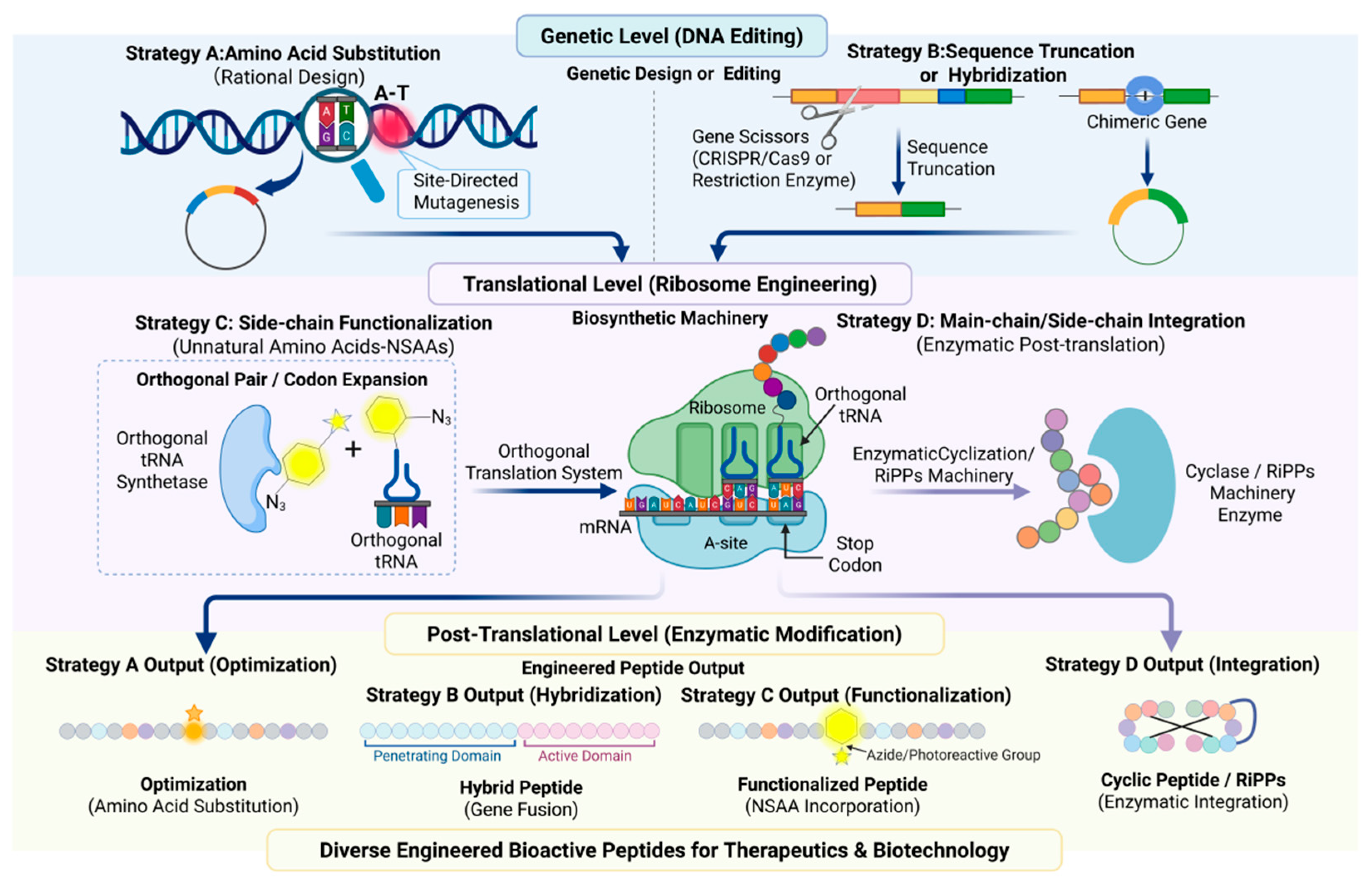
- Hu, L. Schematic Illustration of Bioactive Peptide Modification Based on Synthetic Biology. Created in BioRender. 2026. Available online: https://BioRender.com/klg0iwy (accessed on 28 June 2026).
- Liu, B.; Gong, X.; Chang, S.; Sun, P.; Wu, J. Generation of mature Nα-terminal acetylated thymosin α 1 by cleavage of recombinant prothymosin α. Sci. World J. 2013, 2013, 387282. [Google Scholar] [CrossRef] [PubMed]
- Shirley, M. Zilucoplan: First Approval. Drugs 2024, 84, 99–104, Correction in Drugs 2024, 84, 373. https://doi.org/10.1007/s40265-024-02019-2. [Google Scholar] [CrossRef]
- Merz, M.L.; Habeshian, S.; Li, B.; David, J.A.G.; Nielsen, A.L.; Ji, X.; Il Khwildy, K.; Duany Benitez, M.M.; Phothirath, P.; Heinis, C. De novo development of small cyclic peptides that are orally bioavailable. Nat. Chem. Biol. 2024, 20, 624–633. [Google Scholar] [CrossRef] [PubMed]
- Song, X.; Wen, Y.; Li, A.W.L.; Zhu, J.; Koh, C.Y.; Kini, R.M.; Chan, M.Y.Y.; Li, J. PEGylation of New Thrombin Inhibitor Peptide Ultravariegin for Prolonged In Vivo Circulation and Enhanced Antithrombotic Effects. Mol. Pharm. 2024, 21, 6302–6310. [Google Scholar] [CrossRef] [PubMed]
- Li, R.; Wang, X.; Yin, K.; Xu, Q.; Ren, S.; Wang, X.; Wang, Z.; Yi, Y. Fatty acid modification of antimicrobial peptide CGA-N9 and the combats against Candida albicans infection. Biochem. Pharmacol. 2023, 211, 115535. [Google Scholar] [CrossRef] [PubMed]
- Zhang, X.; Li, C.; Deng, Z.; Liang, C.; Li, J. Development of a Mechanism of Action-Reflective Cell-Based Reporter Gene Assay for Measuring Bioactivities of Therapeutic Glucagon-like Peptide-2 Analogues. Molecules 2025, 30, 1915. [Google Scholar] [CrossRef] [PubMed]
- Chowdhary, R.; Mubarak, M.M.; Kantroo, H.A.; Ur Rahim, J.; Malik, A.; Sarkar, A.R.; Bashir, G.; Ahmad, Z.; Rai, R. Synthesis, Characterization, and Antimicrobial Activity of Ultra-Short Cationic β-Peptides. ACS Infect. Dis. 2023, 9, 1437–1448. [Google Scholar] [CrossRef] [PubMed]
- Shirley, M. Abaloparatide: First Global Approval. Drugs 2017, 77, 1363–1368. [Google Scholar] [CrossRef] [PubMed]
- Wei, X.; Zhang, L.; Zhang, R.; Koci, M.; Si, D.; Ahmad, B.; Cheng, J.; Wang, J.; Aihemaiti, M.; Zhang, M. A Novel Cecropin-LL37 Hybrid Peptide Protects Mice Against EHEC Infection-Mediated Changes in Gut Microbiota, Intestinal Inflammation, and Impairment of Mucosal Barrier Functions. Front. Immunol. 2020, 11, 1361. [Google Scholar] [CrossRef] [PubMed]
- Hernandez, J.R.; Xiong, C.; Pietrantonio, P.V. A fluorescently-tagged tick kinin neuropeptide triggers peristalsis and labels tick midgut muscles. Sci. Rep. 2024, 14, 10863. [Google Scholar] [CrossRef] [PubMed]
- Nunes, L.G.P.; Reichert, T.; Machini, M.T. His-Rich Peptides, Gly- and His-Rich Peptides: Functionally Versatile Compounds with Potential Multi-Purpose Applications. Int. J. Pept. Res. Ther. 2021, 27, 2945–2963. [Google Scholar] [CrossRef]
- Wang, D.; Shi, J.; Chen, C.; Wang, Z.; Liu, Y. Truncated Pleurocidin Derivative with High Pepsin Hydrolysis Resistance to Combat Multidrug-Resistant Pathogens. Pharmaceutics 2022, 14, 2025. [Google Scholar] [CrossRef] [PubMed]
- Lau, J.L.; Dunn, M.K. Therapeutic peptides: Historical perspectives, current development trends, and future directions. Bioorg. Med. Chem. 2018, 26, 2700–2707. [Google Scholar] [CrossRef] [PubMed]
- Morgan, H.E.; Turnbull, W.B.; Webb, M.E. Challenges in the use of sortase and other peptide ligases for site-specific protein modification. Chem. Soc. Rev. 2022, 51, 4121–4145. [Google Scholar] [CrossRef] [PubMed]
- Henninot, A.; Collins, J.C.; Nuss, J.M. The Current State of Peptide Drug Discovery: Back to the Future? J. Med. Chem. 2018, 61, 1382–1414. [Google Scholar] [CrossRef] [PubMed]
- Huang, H.; Zhao, W.; Qin, N.; Duan, X. Recent Progress on Physiologically Based Pharmacokinetic (PBPK) Model: A Review Based on Bibliometrics. Toxics 2024, 12, 433. [Google Scholar] [CrossRef] [PubMed]
- Achilleos, K.; Petrou, C.; Nicolaidou, V.; Sarigiannis, Y. Beyond Efficacy: Ensuring Safety in Peptide Therapeutics through Immunogenicity Assessment. J. Pept. Sci. 2025, 31, e70016. [Google Scholar] [CrossRef] [PubMed]
- Puig, M.; Shubow, S. Immunogenicity of therapeutic peptide products: Bridging the gaps regarding the role of product-related risk factors. Front. Immunol. 2025, 16, 1608401. [Google Scholar] [CrossRef] [PubMed]
- Hamadou, M. Bioactive peptides and metabolic health: A mechanistic review of the impact on insulin sensitivity, lipid profiles, and inflammation. Appl. Food Res. 2025, 5, 101056. [Google Scholar] [CrossRef]
- Mamoudou, H.; Mune, M.A.M. AI-driven bioactive peptide discovery of next-generation metabolic biotherapeutics. Appl. Food Res. 2025, 5, 101291. [Google Scholar] [CrossRef]
- Liu, Y.; Ji, A.; Jia, H.; Sun, H. Advanced applications of synthetic biology technology in biosynthesis of bioactive compounds from medicinal plants. Chin. Herb. Med. 2025, 18, 11–28. [Google Scholar] [CrossRef] [PubMed]
- Ahmad, S.; Jaiswal, R.; Yadav, R.; Verma, S. Recent advances in green chemistry approaches for pharmaceutical synthesis. Sustain. Chem. One World 2024, 4, 100029. [Google Scholar] [CrossRef]
- Srivastava, A.; Ahmad, A.; Siddiqui, S.; Islam, A. Innovations in targeted drug delivery: From nanotechnology to clinical applications. Next Nanotechnol. 2026, 9, 100336. [Google Scholar] [CrossRef]
- Li, X.; Peng, X.; Zoulikha, M.; Boafo, G.F.; Magar, K.T.; Ju, Y.; He, W. Multifunctional nanoparticle-mediated combining therapy for human diseases. Signal Transduct. Target. Ther. 2024, 9, 1. [Google Scholar] [CrossRef] [PubMed]
- Tian, H.; Li, G.; Chiu, C.K.C.; Li, E.; Chen, Y.; Zhu, T.; Hu, M.; Wang, Y.; Wen, S.; Li, J.; et al. Rapid and direct discovery of functional tumor-specific neoantigens by high-resolution mass spectrometry and novel algorithm prediction. Cell Insight 2025, 4, 100251. [Google Scholar] [CrossRef] [PubMed]
- Duy, H.A.; Srisongkram, T. Accurate structure-activity relationship prediction of antioxidant peptides using a multimodal deep learning framework. J. Cheminform. 2025, 17, 166. [Google Scholar] [CrossRef] [PubMed]
- Ekambaram, S.; Dokholyan, N.V. Peptide-based drug design using generative AI. Chem. Commun. 2026, 62, 672–691. [Google Scholar] [CrossRef] [PubMed]



| Number | Peptide Name | Modification Strategy | Level of Evidence | Primary Mechanism of Action | Key Advantages | Key Limitations |
|---|---|---|---|---|---|---|
| 1 | Thymosin α1 [97] | N-terminal acetylation | Clinical | Modulates immune responses by promoting T-cell differentiation and regulating dendritic-cell/macrophage activity | Terminal protection and preserved active peptide structure | Short half-life; repeated dosing required |
| 2 | Zilucoplan [98] | Cyclization | Clinical | Inhibits complement C5 cleavage and C5b–C6 binding to block terminal complement activation | Convenient subcutaneous administration; strong complement inhibition. | Risk of meningococcal infection; requires vaccination and safety monitoring |
| 3 | Thrombin-binding cyclic peptide [99] | N-methylation | In vivo/preclinical | Promoting the formation of intramolecular hydrogen bonds | Significantly improved oral absorption | Potential reduction in receptor-binding activity |
| 4 | Ultravariegin [100] | PEGylation | In vivo/preclinical | Performing spatial shielding and molecular capacitance modification | Extended circulation time in vivo | Reduced activity due to excessive PEG |
| 5 | Antimicrobial peptides CGA-N9 [101] | Lipidation | In vivo/preclinical | Enhancing membrane-hydrophobic interactions | Significantly enhanced antifungal activity | Reduced solubility and increased toxicity risk |
| 6 | Glycosylated LL-III [60] | Glycosylation | In vitro/ex vivo | Introducing glycosyl steric hindrance at the N-terminal Asn site | Significantly improved protease resistance | Glycosylation sites are residue-specific |
| 7 | Teduglutide [102] | Amino acid substitution | Clinical | An Ala-to-Gly substitution at position 2 | Improved proteolytic stability and extended half-life | Daily injection; long-term intestinal safety monitoring |
| 8 | β-peptide [103] | Introduction of non-natural amino acids | In vitro | Introducing a β-amino acid backbone | Improved structural stability and resistance to proteolytic degradation | The type and arrangement of β-amino acids significantly affect activity |
| 9 | Abaloparatide [104] | Sequence truncation and analog design | Clinical | Preservation of the active core | Enhanced bactericidal efficacy | Structural shortening may affect stability and selectivity |
| 10 | Cecropin-LL37 Hybrid peptide [105] | Modular hybridization | In vivo/preclinical | Activates PTH1R signaling to promote bone formation | Retains the bioactive PTHrP(1–34) region; broadens the table beyond antimicrobial peptides | Daily injection; duration and skeletal safety require monitoring |
| 11 | TMR-RK8 [106] | Fluorescent labeling | In vitro/ex vivo | Embedding imaging functional modules into the peptide chain | No significant reduction in biological activity; enhanced real-time imaging | May slightly affect local spatial conformation, thereby affecting activity |
| 12 | Histidine-rich peptide [107] | Metal coordination sites | In vitro | Peptide conformation regulation and functional modular expansion | Conferred multiple biological activities | Insufficient selectivity and potential oxidative toxicity |
| 13 | Pleurocidin truncated derivative peptide [108] | Combinations of multiple modifications | In vitro | C-terminal truncation and Trp/Lys substitution synergistically enhance performance | Excellent resistance to pepsin hydrolysis; significantly improved antimicrobial activity | Limited by ion sensitivity and potential membrane toxicity |
| Number | Generic or Proper Name | Trade Name | Modification Strategy | Therapeutic Indication | Approval Year |
|---|---|---|---|---|---|
| 1 | Enfuvirtide | Fuzeon | Terminal modification: a linear 36-amino acid synthetic peptide with the N-terminus acetylated and the C-terminus a carboxamide | HIV-1 infection in treatment-experienced patients, in combination with other antiretroviral agents | 2003 |
| 2 | Octreotide Acetate | Sandostatin Lar | Cyclization strategy: cyclic somatostatin octapeptide analog containing a disulfide-constrained ring and D-amino acid residue | Reduction in growth hormone; acromegaly; severe diarrhea/flushing associated with carcinoid tumors and VIPomas | 1998 |
| 3 | Pegcetacoplan | Empaveli | Macromolecular polymer modification: two identical cyclic pentadecapeptides covalently linked to a linear PEG molecule | A complement inhibitor indicated for the treatment of adult patients with paroxysmal nocturnal hemoglobinuria (PNH) | 2003 |
| 4 | Semaglutide | Ozempic | Lipidation combined with amino acid substitution: GLP-1 analog containing amino acid substitutions and a C18 fatty diacid side chain for albumin binding | Type 2 diabetes mellitus; chronic weight management | 2017 |
| 5 | Dalbavancin | Dalvance | Glycosylation modification: Semisynthetic lipoglycopeptide with a glycopeptide scaffold and lipophilic side-chain modification | Acute bacterial skin and skin structure infections | 2014 |
| 6 | Degarelix | Firmago | Amino acid substitution: a synthetic linear decapeptide amide containing multiple D-amino acid and non-natural amino acid residues | A GnRH receptor antagonist indicated for treatment of patients with advanced prostate cancer | 2008 |
| 7 | Abaloparatide | Tymlos | Sequence truncation and analog design: a synthetic human parathyroid hormone-related peptide | the treatment of postmenopausal women with osteoporosis at high risk for fracture | 2017 |
| 8 | Lutetium Lu 177 dotatate | Lutathera | Side-chain functionalization (peptide–drug conjugate): DOTA-chelated and radiolabeled somatostatin analog peptide | A radiolabeled somatostatin analog indicated for the treatment of somatostatin receptor-positive gastroenteropancreatic neuroendocrine tumors (GEP-NETs) | 2018 |
| 9 | Tirzepatide | Mounjaro | Co-modification of main and side chains: GIP/GLP-1 receptor agonist peptide with non-natural amino acids and C20 fatty diacid side chain | An adjunct to diet and exercise to improve glycemic control in adults with type 2 diabetes mellitus | 2022 |
Disclaimer/Publisher’s Note: The statements, opinions and data contained in all publications are solely those of the individual author(s) and contributor(s) and not of MDPI and/or the editor(s). MDPI and/or the editor(s) disclaim responsibility for any injury to people or property resulting from any ideas, methods, instructions or products referred to in the content. |
© 2026 by the authors. Licensee MDPI, Basel, Switzerland. This article is an open access article distributed under the terms and conditions of the Creative Commons Attribution (CC BY) license.
Share and Cite
Hu, L.; Zhang, Z.; Li, X.; Liang, Y.; Huang, R.; Wen, L. Functional Engineering of Bioactive Peptides: Chemical Modifications and Synthetic Biology Approaches. Int. J. Mol. Sci. 2026, 27, 5939. https://doi.org/10.3390/ijms27135939
Hu L, Zhang Z, Li X, Liang Y, Huang R, Wen L. Functional Engineering of Bioactive Peptides: Chemical Modifications and Synthetic Biology Approaches. International Journal of Molecular Sciences. 2026; 27(13):5939. https://doi.org/10.3390/ijms27135939
Chicago/Turabian StyleHu, Liangjie, Zhimin Zhang, Xinxi Li, Yisheng Liang, Ruibo Huang, and Li Wen. 2026. "Functional Engineering of Bioactive Peptides: Chemical Modifications and Synthetic Biology Approaches" International Journal of Molecular Sciences 27, no. 13: 5939. https://doi.org/10.3390/ijms27135939
APA StyleHu, L., Zhang, Z., Li, X., Liang, Y., Huang, R., & Wen, L. (2026). Functional Engineering of Bioactive Peptides: Chemical Modifications and Synthetic Biology Approaches. International Journal of Molecular Sciences, 27(13), 5939. https://doi.org/10.3390/ijms27135939