Article

Phylogenetic and Genomic Characterization of Whole Genome Sequences of a Herpes Simplex Virus Type 1 Isolate Identified Genomic Variant Characteristics in a Human Subject with Fulminant Hepatitis


1
Department of Translational Medicine, Università del Piemonte Orientale, 28100 Novara, Italy
2
Internal Medicine Unit, San Giovanni Bosco Hospital, ASL Città di Torino, 10154 Turin, Italy
3
Microbiology and Virology Department, Fondazione IRCCS Policlinico San Matteo, 27100 Pavia, Italy
4
Laboratory of Molecular Virology, Maggiore della Carità Hospital, 28100 Novara, Italy
5
Clinical Biochemistry Laboratory, Department of Laboratory Medicine, City of Health and Science University Hospital, 10126 Turin, Italy
*
Authors to whom correspondence should be addressed.
These authors contributed equally to this work.
Int. J. Mol. Sci. 2026, 27(13), 5640; https://doi.org/10.3390/ijms27135640 (registering DOI)
Submission received: 16 May 2026 / Revised: 8 June 2026 / Accepted: 19 June 2026 / Published: 23 June 2026

Abstract

Herpes simplex virus 1 (HSV-1) is a rare cause of acute hepatitis, especially in patients with chronic immunosuppression. We performed whole-genome HSV-1 sequencing with a metagenomics approach on peripheral blood samples from an Italian case of fatal acute liver failure with high circulating HSV-1 (1,129,900,000 copies/mL), followed by phylogenetic analysis. After multiple sequence alignment, a final dataset of 182 whole-genome sequences was selected. The sequenced HSV-1 strain belonged to a phylogenetic clade isolated in Florida in 2002 (OQ724868.1). A characterization of single nucleotide polymorphisms and indels was performed to determine their effects on the viral genome: only one variant, classified as an indel, was detected with a high impact effect (c.905_906insGTTTT) in the UL49A gene, which is known to encode a membrane protein regulating virion morphogenesis, replication and assembly. In addition, this study also detected variants in other genes involved in crucial steps of the HSV-1 life cycle, like alpha-regulation (US7), capsid transport (UL36) and viral polymerase function (UL30). In conclusion, the results of this variant analysis confirmed that in HSV-1 hepatitis, some viral regions may be hotspots for adaptive mutations with a substantial impact on viral replication or immune evasion.

1. Introduction

Herpes simplex virus 1 (HSV-1), belonging to the Herpesviridae family, is a rare cause of acute hepatitis, first described in 1969. Indeed, this condition has been described to cause acute liver failure (ALF) and death, although it accounts for less than 1% of all ALF cases and less than 2% of all viral-related etiologies [1,2]. This occurrence is reported especially in subjects with chronic immunosuppression, such as recipients of solid organ transplants or subjects affected by systemic lupus erythematosus or rectal cancer, and in pregnant women in their third trimester [1,3,4,5,6]. However, it is noteworthy that around 25% of patients who present with HSV-1 hepatitis are immunocompetent, with several proposed viral and host mechanisms to explain these disseminated infections [1,7,8,9]. Notoriously, the presenting signs and symptoms can be non-specific, thus causing frequent cases of missed or underestimated diagnosis, especially in individuals without risk factors for disseminated infection. This possibly leads to rapid progression to ALF in the absence of early antiviral therapy (whereas, on the contrary, early treatment with acyclovir can decrease reported death or liver transplant rates from 88% to 51%) [1,10].
In this respect, the phylogenetic and genomic characterization of HSV-1, which is already considered crucial for mapping viral evolution, monitoring human migration or viral recombination patterns, and understanding strain-specific virulence or drug resistance mechanisms [11,12,13,14,15], could also have a role in the clinical diagnostics and epidemiology of the aforementioned severe liver manifestations.
HSV-1 displays considerable genetic diversity, and whole-genome sequencing has enabled the reconstruction of its global phylogenetic structure. Early analyses based on complete genomic sequences identified a six-clade structure reflecting geographic origin and human migration history: Clade I encompasses European and North American strains, Clade II comprises East Asian strains, while Clades III–VI are represented by East African isolates [16]. Conventional genotyping of HSV-1 has relied on intragenic sequence polymorphisms in US2, glycoprotein G (gG/US4), and gI (US7). However, the numerous recombination events shaping HSV-1 evolution mean that single nucleotide polymorphism (SNP)-based schemes do not always yield results consistent with phylogroup classification, limiting their discriminatory value [17]. At the functional level, SNP analysis has proven informative for identifying clinically relevant mutations: acyclovir resistance is predominantly caused by SNP changes in the thymidine kinase gene (TK/UL23), with over 130 confirmed resistance-associated polymorphisms, followed by mutations in the DNA polymerase gene UL30 [18]. Furthermore, even when HSV-1 strains do not cluster phylogenetically by clinical phenotype, individual SNPs are considered more likely to influence virulence, as supported by comparative genomic studies [19]. However, the vast majority of HSV-1 genomic epidemiology efforts have focused on strains associated with orolabial, ocular, or encephalitic disease. Data on the genetic diversity and virulence gene profiles of HSV-1 isolates from other specific clinical contexts remain limited, with the paucity of sequenced isolates constraining the investigation of strain-specific factors influencing disease outcome [19]. In this regard, to the best of our knowledge, no studies have specifically characterized HSV-1 strains recovered from cases of hepatitis and/or ALF, leaving the potential contribution of viral genomic features to these severe manifestations entirely unexplored.
Based on these premises, the aim of the present research was to try to shed light on this specific issue by conducting an in-depth study of the isolates from an Italian subject who experienced a dramatic course of fulminant HSV-1 hepatitis.

2. Results

2.1. Clinical Evaluation of the Index Patient

A 49-year-old Caucasian immunosuppressed woman presented to the Emergency Department complaining of fever, malaise vomit and onset of abdominal pain. The patient rapidly developed an ALF that led to multiple organ dysfunction syndrome and death within six days from admission. The complete timeline of this case is presented in Figure S1, while a more exhaustive description is reported in File S1. Summarizing, the most clinically salient aspect was that this subject—despite not demonstrating a significant anti-HSV-1 antibody response—tested positive for plasma HSV-1 DNA at a very high load (Table 1). As soon as the molecular biology results were available (that is, a few hours before her untimely death), a rescue therapy with intravenous acyclovir was started, with no noticeable change in her clinical course at this point.

2.2. Whole Genome Sequencing and Phylogenetic Analysis

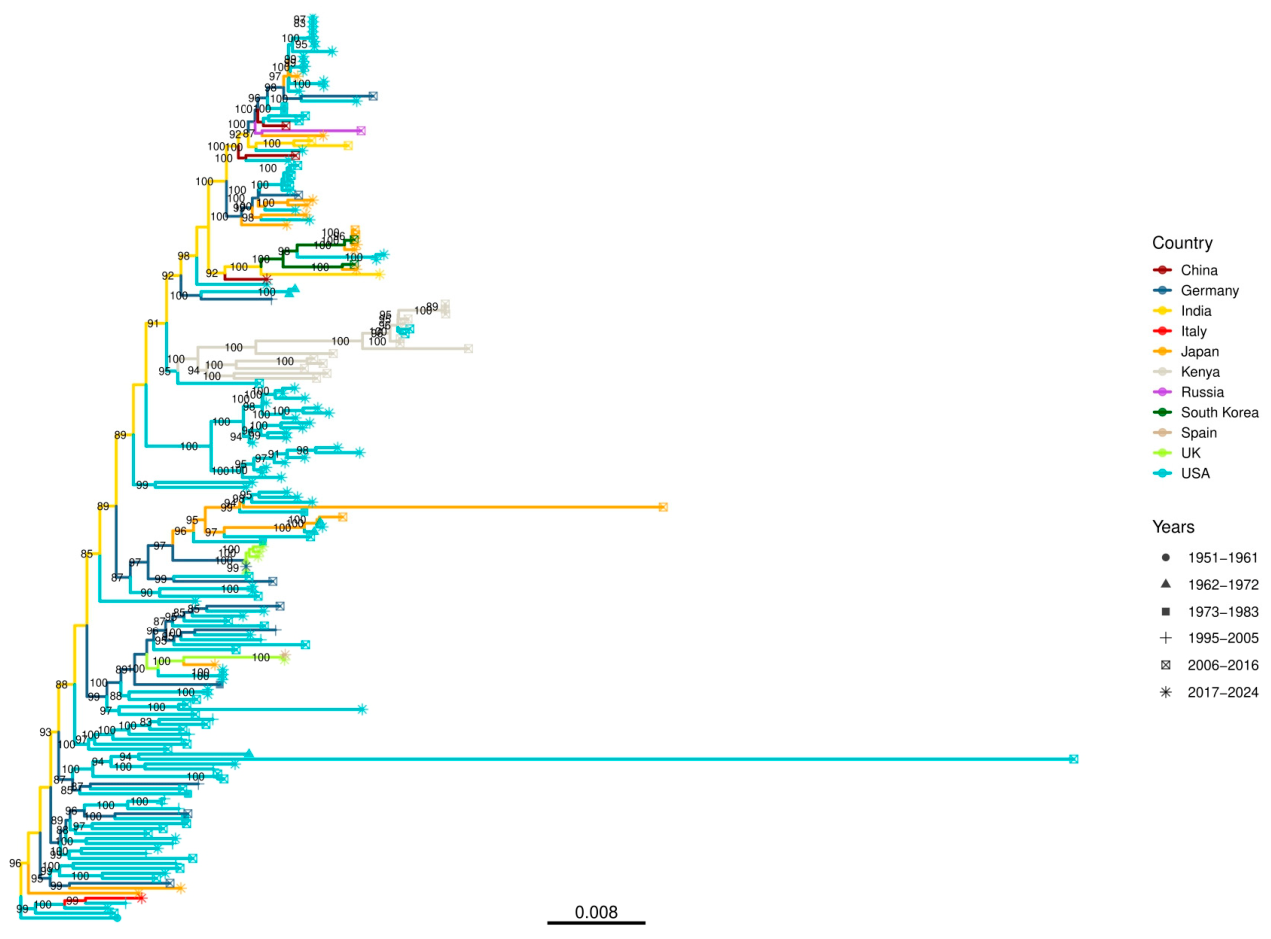
The whole-genome sequencing (WGS) of the strain was obtained with high-throughput sequencing technology. The sequence was multiple-aligned with HSV-1 genomes retrieved from National Center for Biotechnology Information (NCBI) databases. The final dataset contained 182 whole-genome HSV-1 sequences with associated metadata (sampling date and country information) (Figure 1, sky blue). The phylogenetic analysis showed that the Italian HSV-1 strain clustered in a specific branch with the USA clade (strains from Florida of 2002) (OQ724868.1). Overall, the study genome clustered with five closely related HSV-1 genomes originating from the USA (in addition to the aforementioned OQ724868.1, also OP297882.1, OQ724939.1, MN136523.1, and MH999847.1) and circulating between 2005 and 2024. Pairwise genome-wide comparisons with the five closest phylogenetic neighbors showed nucleotide identities ranging from 99.40% to 99.68%, corresponding to 453–835 SNPs across the aligned genome. According to the available metadata, none of these closely related genomes were associated with hepatitis cases but rather originated from ocular or genital clinical specimens.

2.3. Sequence Analysis and Variant Calling of the HSV-1 Strain

A characterization of SNPs and insertions/deletions (indels) was conducted to determine their effects on the viral genome. The impact of variant effect was evaluated with a classification in four categories (high, moderate, modifier, low) (Table 2).
A total of 2631 variants were identified; the vast majority were classified as modifiers (87.6%). This category mainly included downstream gene variants (1227; 46.4%) and upstream gene variants (1057; 40.0%), with a smaller contribution from 3′UTR variants (8; 0.3%) and intron variants (12; 0.5%). Variants with moderate impact accounted for 105 (4.0%) of the total and were largely represented by missense variants (103; 3.9%), while conservative in-frame deletions were rare (2; 0.1%). Low-impact variants amounted to 221 (8.4%) and were almost exclusively synonymous variants (220; 8.3%), with a single splice region/intron variant (1; <0.1%). Finally, only one high-impact variant was detected (1; <0.1%), corresponding to a frameshift variant associated with a splice region variant.
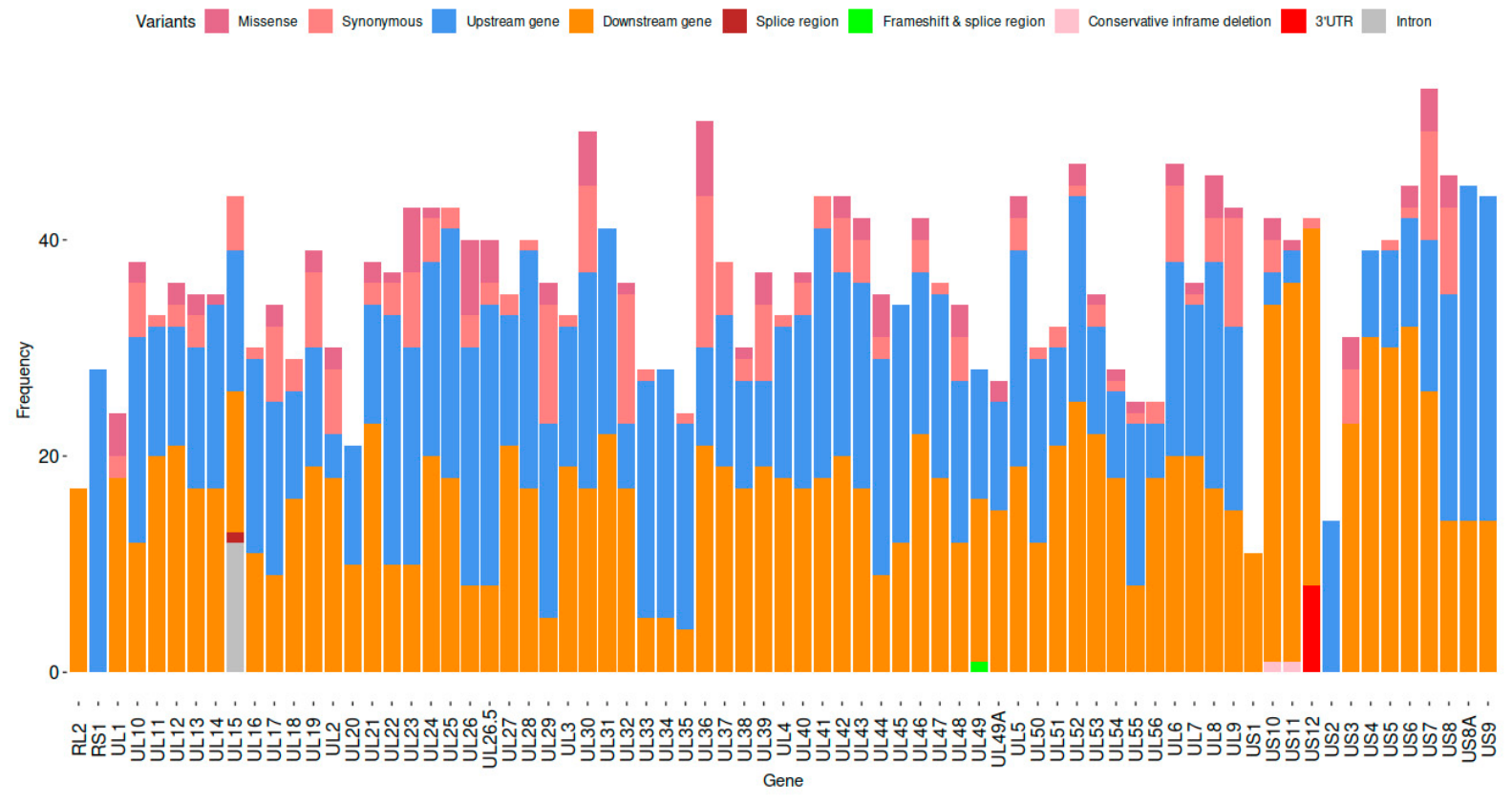
Figure 2 shows the frequency of these variants in the genes of HSV-1 (n = 71) on the basis of the functional classification. Overall, the mean frequency per gene was 10.7 mutations. The highest mutational burden was observed in US7 (n = 54), UL30 (n = 51), and UL36 (n = 50), which displayed the largest number of variants overall. Among the variants with high impact, only UL49 was affected, reporting one mutation. A total of 42 genes were affected by moderate-impact variants. In detail, UL36 and UL26 genes showed the highest number of missense variants (n = 7), while US10 and US11 were the only ones with a conservative in-frame deletion (n = 1). Moderate variants were presented among all the genes and were mainly represented by upstream (range 3–31 mutations) and downstream (range 4–35 mutations) gene variants, with additional contributions from 3′UTR and intron variants. The four exceptions were RL2, US1, RS1 and US2, which presented downstream and upstream variants only, respectively. Finally, low-impact variants affected 58 out of 73 genes.

3. Discussion

Fulminant hepatitis caused by most Herpesviridae is a rare but highly fatal form of ALF [4,20,21,22,23]. The most common culprit is HSV, predominantly type 1 or 2 [1,2,24,25]. Specifically, in view of the high mortality and the fact that HSV-1 hepatitis is one of the few causes of fulminant hepatic failure for which potentially effective therapy is available, this pathogen has to be considered early in any case of unexplained ALF. While liver biopsy remains the gold standard for diagnosis (showing characteristic coagulative necrosis and Cowdry type A inclusion bodies), it is often difficult to perform due to severe coagulopathy in patients with ALF. So, if HSV is suspected, HSV DNA detection by PCR on peripheral blood should be requested immediately, as it is a fast and effective screening method, often preferred for its sensitivity over serological testing, especially in immunocompromised subjects. This is because, as reported above, only a rapid start of a specific antiviral therapy, possibly even empirical, can improve the serious prognosis of this illness [26].
Taking these considerations into account, the case described here is not, in itself, entirely exceptional, although it does offer some very interesting insights even from a purely clinical perspective. First of all, to the best of our knowledge, only very few cases with such high levels of circulating viremia have been reported in the literature to date (which, in turn, suggests the presence of an even higher viral load within the liver) (further details about this limited evidence are reported in Table S2) [2,4,5,8,27,28,29]. On the other hand, the complete absence of an IgM antibody response to HSV-1 is noteworthy, especially considering that the patient had been experiencing symptoms for more than a week. The most obvious explanation lies in the immunosuppression caused by the patient’s adjuvant chemotherapy. In detail, carboplatin, a platinum-based agent, usually produces myelosuppression that is characterized, amongst other things, by granulocytopenia, while paclitaxel, the most common taxane, has neutropenia as its main recognized adverse effect [30,31]. However, other contributing factors could also be possible. First of all, this picture could be explained by the known limitations of commercial HSV serology in immunocompromised hosts. Alternatively, it may suggest either a primary infection or a viral reactivation due to an ineffective or delayed host immune response, as for the phenomenon of original antigenic sin, i.e., the cross-reactivity of the HSV-1 and HSV-2 antigens resulting in lower titers of antibodies to the second HSV infection. More prosaically, an analytical error might also be conceivable, in that commonly used serological tests in clinical practice, as in the case of this study, including immunofluorescence, Western blot, and enzyme-linked immunosorbent assays, generally cannot provide highly quantitative and high-throughput results, and many are also unable to make a clear distinction between HSV-1 and HSV-2 [32,33].
However, as mentioned earlier, in our view, the significance of this research extends beyond purely clinical considerations. In fact, using high-throughput sequencing technology, we obtained the whole genome of the strain and evaluated the potential functional impact of genetic variants in this dysfunction syndrome.
The phylogenetic analysis revealed distinct geographic clades within the HSV-1 genome, consistent with previous reports indicating that viral population structure is influenced by geographic isolation and human migration patterns [34,35]. The phylogenetic analysis did not reveal clustering of the study strain within a distinct lineage, as it grouped with HSV-1 strains circulating during the last decade, suggesting that the study strain belongs to a lineage that has been circulating globally during at least the past ten years rather than to a genetically distinct HSV-1 lineage (Figure 1). Moreover, none of these closely related genomes were associated with hepatitis cases, but rather, originated from ocular or genital clinical specimens.
Although a direct association between phylogenetic clustering and increased virulence cannot be established, this finding underscores the relevance of genomic surveillance even for ubiquitous and traditionally conserved viruses such as HSV-1, as distinct viral clades may differ in pathogenicity, immune evasion, or drug resistance [36].
Genome-wide variant analysis revealed a high degree of genetic variability, with more than 2600 variants identified, the vast majority being classified as modifier (n = 2304) or low-impact ones (n = 221) (Table 2). Specifically, modifier variants are generally located in non-coding regions or affect genes with limited known functional impact, while low-impact variants are assumed to be mostly neutral. Moderate-effect variants that could influence protein function were also found, though to a lesser extent (n = 105) (Table 2). These latest variants were detected across 42 viral genes, including key genes involved in viral replication (UL30), capsid maturation (UL26), alpha-regulation (US7) and intracellular transport and egress (UL36) (Figure 2). The high mutational burden observed in UL36 and UL30, both central to HSV-1 replication and pathogenicity, raises the possibility that cumulative genomic changes may have contributed to enhanced viral fitness or altered replication kinetics, potentially influencing disease severity.
Only one high-impact variant was identified: an indel in the UL49A gene (c.905_906insGTTTT) at position 105483 in the protein-coding region of the open reading frame (ORF), functionally classified as a frameshift and splice region variant (Table 2, Figure 2 green variant). According to analogies with other alphaherpesviruses (e.g., VZV), UL49A is involved in syncytia formation, contributing to cell–cell fusion and immune evasion [37], and is a potential component of the virion envelope that may be O-glycosylated [38]. Moreover, this gene was shown to be involved in viral replication in tissue cultures, as HSV-1 mutants with UL49A insertions or deletions could not be isolated [34]. However, no direct association between UL49A variants and HSV-1 pathogenicity has been reported so far, and the biological significance of this mutation remains to be elucidated.
Among other key genes, US7, UL36, and UL30 exhibited the highest numbers of variants (Figure 2): US7 showed 54 variants, followed by UL36 (51 variants) and UL30 (50 variants). From a pathophysiological perspective, US7 encodes glycoprotein I (gI), a viral membrane component that together with gE forms a complex (gE/gI) that acts as a fragment crystallizable (Fc) receptor and aids cell-to-cell transmission of the virus, thereby avoiding elimination by antibodies [39]. In turn, UL36 is one of the largest genes in the HSV-1 genome (~3159 amino acids). It encodes VP1/2 (also called pUL36), a large viral tegument protein essential for virion assembly, maturation and release [39]. The function of UL36 seems to be highly conserved, so significant natural mutations tend to be rarely observed in clinical strains because they would compromise viral replication. However, a study of Desai et al. showed how an induced null mutation in the UL36 gene can result in accumulation of unenveloped DNA-filled capsids in the cytoplasm of infected cells [39]. Finally, UL30 encodes the viral polymerase and constitutes the target of antiviral nucleosides (such as acyclovir and foscarnet). Thus, specific variants may confer resistance or altered sensitivity to these specific drugs [40]. Further studies showed that mutations in conserved regions of UL30, by altering the replicative capacities of herpesviruses, can reduce the efficacy of other selected antiviral treatments as well [40,41]. Most variants in these genes were located in upstream or downstream regions with predicted modifier effects (Figure 2). In the present study, missense and synonymous variants were detected in all three genes (US7: 4 missense, 10 synonymous; UL36: 7 missense, 14 synonymous; UL30: 5 missense, 8 synonymous). While synonymous variants notoriously do not alter the amino acid sequence, missense variants may change amino acids without necessarily disrupting protein function. Unfortunately, the premature death of the patient precluded the assessment of the in vivo functional consequences of these variants.
The significance of the present report lies in the integration of detailed clinical, virological, and genomic data from a rare manifestation of HSV-1 infection. While HSV-1 hepatitis is a recognized cause of ALF, comprehensive genomic characterization of the infecting strain is rarely available. In the present case, the combination of extremely high viremia, absence of a detectable IgM response, and WGS enabled a more comprehensive investigation of the viral and host factors potentially contributing to disease severity.
Importantly, whole-genome analysis showed that the strain was not associated with a distinct or previously recognized hepatitis-related lineage, but rather belonged to a globally circulating HSV-1 lineage. This finding suggests that severe clinical outcomes such as fulminant hepatitis may occur in the absence of major phylogenetic divergence and are likely the result of a complex interplay between host susceptibility, immune status, and viral genetic background. Furthermore, the identification of numerous variants affecting genes involved in viral replication, intracellular transport, immune evasion, and antiviral response highlights the value of genomic surveillance in improving our understanding of HSV-1 pathogenesis and in generating hypotheses for future functional studies.
Overall, our results indicate that HSV-1 can accumulate numerous variants, primarily in non-coding regions or in genes with limited known function. While most of these are likely neutral or of minor effect, high-impact mutations such as the UL49A frameshift may affect viral replication, at least in in vitro models [42]. Variants in genes like US7, UL36, and UL30 may also represent regions potentially prone to adaptive mutations, with the hypothetical ability to contribute to immune evasion or antiviral resistance [42,43,44,45].
That being said, it is important to acknowledge that this study also has some important limitations. Specifically, although WGS enabled the reconstruction of the HSV-1 genome and the identification of putatively relevant genetic variants, the sequencing data achieved a genome coverage breadth of approximately 83%. Consequently, a significant fraction of the viral genome could not be reliably characterized, and additional variants may have remained undetected. Moreover, although WGS identified numerous genetic variants, including mutations affecting genes involved in viral replication, intracellular transport, and immune evasion, the pathogenetic significance of these variants remains uncertain. The functional impact of most detected mutations was inferred exclusively through bioinformatic prediction tools, and no in vitro or in vivo experiments were available to validate their biological effects. Therefore, any potential association between the observed genetic profile and the fulminant clinical presentation should be considered hypothesis-generating rather than causative. Finally, although the phylogenetic analysis provided useful information regarding the evolutionary placement of the study strain, it does not support the existence of a specific hepatitis-associated or intrinsically more virulent HSV-1 lineage. Consequently, the phylogenetic findings should be interpreted primarily as evidence of the genetic relationship of the study strain to currently circulating HSV-1 populations rather than as indicators of enhanced pathogenicity.
Nevertheless, despite these shortcomings, we considered it important to perform a genomic characterization of the infecting strain, as studies investigating the whole-genome features of HSV-1 isolates associated with ALF remain, as above reported, extremely scarce. In this respect, the present analysis could provide at least some preliminary insights into the genomic background of a strain associated with this severe clinical presentation and might potentially serve as a starting point for future investigations involving larger case series and more complete genome datasets.

4. Materials and Methods

4.1. Main Clinical Viral Serology Tests

The assays that were used in the local laboratory for viral serology are amongst those normally used in routine diagnostics during hepatitis workup and included both primary hepatotropic viruses (hepatitis viruses A, B, C, D, and E), and other agents such as herpesviruses and human immunodeficiency virus (HIV). For the purposes of this research, the detailed methods used for HSV detection were as follows: for HSV-1/2 immunoglobulin (Ig) M, LIAISON® HSV-1/2 IgM (DiaSorin, Saluggia, Italy); for HSV-1/2 IgG, LIAISON® HSV-1/2 IgG (DiaSorin); for HSV-1 IgG, LIAISON® HSV-1 IgG (DiaSorin); for HSV-2 IgG, LIAISON® HSV-2 IgG (DiaSorin). Further details on serological tests for HSV are provided in Table S1, panel A.

4.2. Main Clinical Viral Molecular Tests

The routine assays used in our laboratory for the molecular detection of HSV-1, HSV-2 and all the other viruses of interest for this research are detailed in Table S1, panel B.

4.3. Genomic Analyses

WGS of HSV-1 was performed using a metagenomic approach as previously described [46]. Libraries were prepared with the Illumina DNA Prep kit (Illumina, Inc., San Diego, CA, USA) and sequenced on an Illumina MiSeq System using a MiSeq Reagent Kit v2 (300-cycle format; 2 × 150 bp paired-end sequencing) (Illumina). Sequencing was completed in a 24 h run and generated a total of 7,787,452 raw reads. Sequence data were processed through the Infectious Disease Sequencing Platform (IDseq) pipeline (accessed on 1 October 2024) [47], which was used for quality control filtering, removal of human host reads, reference-guided genome assembly using the HSV-1 reference genome (GenBank accession number: NC_001806.2), and variant calling. Overall, 85.7% of the raw reads passed quality filtering and, after host-read removal, were assembled to reconstruct the complete HSV-1 genome. The sequencing data achieved an average genome coverage depth of approximately 10× and a genome coverage breadth of approximately 83%. Variant calling was performed within the default IDseq metagenomic workflow using samtools mpileup (accessed on 10 October 2024) [47]. The resulting variant call format (VCF) file was directly retrieved from the IDseq output. The following parameters were applied: -aa, reporting all genomic positions including those with zero coverage; -u, generating uncompressed binary call format (BCF) output; -Q 20, excluding bases with a Phred quality score below 20; -d 100000000, setting the maximum per-file read depth to 100,000,000 reads; -L 100000000, setting the maximum number of reads per input file to 100,000,000; and -t AD, reporting allelic depth information for each variant. Variant annotation and prediction of their functional consequences were performed using Single Nucleotide Polymorphism Effect (SnpEff) toolbox version 5.3c (accessed on 1 October 2024) [48].
For phylogenetic analysis, the HSV-1 genome obtained in this study was combined with whole-genome HSV-1 sequences retrieved from the NCBI database. Multiple sequence alignment was performed using Multiple Alignment using Fast Fourier Transform (MAFFT) version 7.525 (accessed on 13 March 2024) [49]. The final dataset comprised 182 HSV-1 whole-genome sequences with associated metadata, including sampling date and country of origin. Maximum-likelihood phylogenetic reconstruction was carried out using IQ-TREE multicore version 2.3.3 (accessed on 12 October 2024) [50]. The robustness of the inferred phylogeny was assessed using the ultrafast bootstrap approximation method with 1000 replicates (accessed on 12 October 2024) [50].

5. Conclusions

This case reinforces the importance of early consideration of HSV-1 infection in patients with ALF and highlights the potential value of integrating clinical, virological and genomic data to better understand the wide spectrum of severity typically observed in HSV-1-associated disease. Thus, understanding the functional implications of these genetic variations could potentially inform the development of more effective antiviral therapies that account for the diversity of circulating HSV-1 strains.

Supplementary Materials

The following supporting information can be downloaded at: https://www.mdpi.com/article/10.3390/ijms27135640/s1.

Author Contributions

Conceptualization, C.S. and A.P. (Antonio Piralla); methodology, C.S. and G.R.; software, M.G.C. and A.M.; validation, A.P. (Antonio Piralla), G.R., P.R. and M.G.C.; formal analysis, M.G.C.; investigation, G.R., P.R., G.F. and A.P. (Antonia Palumbo); resources, C.S.; data curation, C.S., P.R., M.G.C. and A.P. (Antonio Piralla); writing—original draft preparation, C.S., G.R. and A.P. (Antonio Piralla); writing—review and editing, C.S., G.R., E.G. and A.P. (Antonio Piralla); visualization, A.M. and E.G.; supervision, E.G. and M.P.; project administration, P.R.; funding acquisition, C.S. All authors have read and agreed to the published version of the manuscript.

Funding

This research was partially supported by funding within the Center for Disease Prevention and Control (CCM) of the Italian Ministry of Health (SURVEID Project, program 2022) and by EU funding within the NextGenerationEU-MUR PNRR Extended Partnership initiative on Emerging Infectious Diseases (Project no. PE00000007, INF-ACT).

Institutional Review Board Statement

All procedures performed in this study involving human participants were in accordance with the 1964 Helsinki Declaration and its later amendments or comparable ethical standards. This study was granted exemption from requiring ethics approval because the local Ethics Committee (Comitato Etico Interaziendale Novara, https://comitatoetico.maggioreosp.novara.it/) (accessed on 14 May 2026) does not require this procedure for case reports involving up to three patients.

Informed Consent Statement

Written informed consent to publish the case was obtained from the next of kin of the patient (father and mother).

Data Availability Statement

All data generated or analyzed during this study are included in this published article and its Supplementary Information files. The raw sequencing data generated in this study have been deposited in the NCBI Sequence Read Archive (SRA) under BioProject accession number PRJNA1475492.

Acknowledgments

All authors are grateful to Arianna Rossini and Matteo Gabrielli (Borgosesia, Italy) for support with clinical data acquisition. C.S. would like to thank Gino Amisano and the Fondazione Valenza Anziani (Valenza, Italy) for partially funding his researcher position for studies in internal medicine/geriatric medicine.

Conflicts of Interest

The authors declare no conflicts of interest.

Abbreviations

The following abbreviations are used in this manuscript:
Abantibodies
ALFacute liver failure
ALPalkaline phosphatase
ALTalanine transaminase
aPTTactivated partial thromboplastin time
ASTaspartate transaminase
AUarbitrary units
AUCarea under the curve
BCFbinary call format
CCMCenter for Disease Prevention and Control
cpcopies
CRPC-reactive protein
Ctcycle of threshold
CTcomputed tomography
CUchemiluminescent units
CVCcentral venous catheter
DICdisseminated intravascular coagulation
dRVVTdiluted Russell viper venom time
eGFRestimated glomerular filtration rate
EAearly antigen
EBNAEpstein–Barr nuclear antigen
EBVEpstein–Barr virus
ETIendotracheal intubation
Ffemale
Fcfragment crystallizable
FEUfibrinogen equivalent unit
FIGOInternational Federation of Gynecology and Obstetrics
GEgenome equivalents
GGTgamma-glutamyl transferase
gEglycoprotein E
gIglycoprotein I
HAVhepatitis A virus
Hbhemoglobin
HBcAbanti-hepatitis B core antibodies
HBeAbanti-hepatitis e antigen antibodies
HBeAghepatitis B e antigen
HBsAbanti-hepatitis B surface antibodies
HBsAghepatitis B surface antigen
HBVhepatitis B virus
HCMVhuman cytomegalovirus
HCVhepatitis C virus
HDVhepatitis delta virus
HEVhepatitis E virus
HDLhigh-density lipoprotein
HHVhuman herpesvirus
HIVhuman immunodeficiency virus
HSVherpes simplex virus
ICUintensive care unit
IDseqInfectious Disease Sequencing Platform
Igimmunoglobulin
IL-1Rainterleukin-1 receptor antagonist
indelinsertion/deletion
IPFimmature platelet fraction
IUinternational units
Kpotassium
LAlupus anticoagulant
LDHlactate dehydrogenase
LDLlow-density lipoprotein
LLOQlower limit of quantification
LODlimit of detection
Mmale
MAFFTMultiple Alignment using Fast Fourier Transform
MASmacrophage activation syndrome
MOFmulti-organ failure
Nasodium
NCBINational Center for Biotechnology Information
NRnormal range
ORFopen reading frame
PCTprocalcitonin
PLTplatelets
PT-INRprothrombin time-international normalized ratio
PVperipheral veins
RFUrelative fluorescence units
SARS-CoV-2severe acute respiratory syndrome coronavirus 2
SCTsilica clotting time
SNPsingle nucleotide polymorphism
SnpEffSingle Nucleotide Polymorphism Effect
SRASequence Read Archive
T0at time
T120 minat 2 h
TMAthrombotic microangiopathy
TStransferrin saturation
ULOQupper limit of quantification
UTRuntranslated region.
VZVvaricella-zoster virus
VCAviral capsid antigen
VCFvariant call format
WBCwhite blood cells
WGSwhole-genome sequencing

References

  1. Norvell, J.P.; Blei, A.T.; Jovanovic, B.D.; Levitsky, J. Herpes Simplex Virus Hepatitis: An Analysis of the Published Literature and Institutional Cases. Liver Transpl. 2007, 13, 1428–1434. [Google Scholar] [CrossRef] [PubMed]
  2. Spahn, S.; Riessen, R.; Berg, C.P.; Malek, N.P.; Emrich, M.H.; Lohrengel, K.; Ganzenmueller, T.; Iftner, T.; Kleymann, G.; Hamprecht, K. Comprehensive Clinical and Virological Characterization of Three Cases of Fulminant Liver Failure Owing to HSV1 Primary Infection. Liver Int. 2022, 42, 1005–1011. [Google Scholar] [CrossRef] [PubMed]
  3. Arana, C.; Cofan, F.; Ruiz, P.; Hermida, E.; Fernández, J.; Colmenero, J.; Forns, X.; Escude, L.; Cucchiari, D.; Moreno, A.; et al. Primary Herpes Simplex Virus Type 1 Infection with Acute Liver Failure in Solid Organ Transplantation: Report of Three Cases and Review. IDCases 2022, 28, e01485. [Google Scholar] [CrossRef] [PubMed]
  4. Al Midani, A.; Pinney, J.; Field, N.; Atkinson, C.; Haque, T.; Harber, M. Fulminant Hepatitis Following Primary Herpes Simplex Virus Infection. Saudi J. Kidney Dis. Transpl. 2011, 22, 107–111. [Google Scholar] [PubMed]
  5. Haag, L.M.; Hofmann, J.; Kredel, L.I.; Holzem, C.; Kühl, A.A.; Taube, E.T.; Schubert, S.; Siegmund, B.; Epple, H.J. Herpes Simplex Virus Sepsis in a Young Woman with Crohn’s Disease. J. Crohns Colitis 2015, 9, 1169–1173. [Google Scholar] [CrossRef] [PubMed][Green Version]
  6. Jacques, S.M.; Qureshi, F. Herpes Simplex Virus Hepatitis in Pregnancy: A Clinicopathologic Study of Three Cases. Hum. Pathol. 1992, 23, 183–187. [Google Scholar] [CrossRef] [PubMed]
  7. Marshall, C.; Khatoon, N.; Lynch, E. Disseminated Herpes Simplex Virus in an Immunocompetent Patient Without Presence of Epidermal or Mucosal Lesions. Am. J. Forensic Med. Pathol. 2021, 42, e13–e15. [Google Scholar] [CrossRef] [PubMed]
  8. Ikuta, K.; Roychoudhury, P.; Xie, H.; McClurkan, C.L.; Walkiewicz, M.; Makhsous, N.; Huang, M.L.; Beru, Y.; Alam, M.; Shepherd, A.; et al. Trillions and Trillions: Herpes Simplex Virus-1 Hepatitis in an Immunocompetent Adult. Open Forum Infect. Dis. 2019, 6, ofz465. [Google Scholar] [CrossRef] [PubMed]
  9. Franco, A.R.; Mendo, R.; Barosa, R.; Figueiredo, P. HSV-1 Hepatitis in an Immunocompetent Patient–Act before You Know. IDCases 2022, 30, e01605. [Google Scholar] [CrossRef] [PubMed]
  10. Velasco, M.; Llamas, E.; Guijarro-Rojas, M.; Ruiz-Yagüe, M. Fulminant Herpes Hepatitis in a Healthy Adult: A Treatable Disorder? J. Clin. Gastroenterol. 1999, 28, 386–389. [Google Scholar] [CrossRef] [PubMed]
  11. Rojas, J.M.; Dopazo, J.; Martín-Blanco, E.; López-Galíndez, C.; Tabarés, E. Analysis of Genetic Variability of Populations of Herpes Simplex Viruses. Virus Res. 1993, 28, 249–261. [Google Scholar] [CrossRef] [PubMed]
  12. Guellil, M.; van Dorp, L.; Inskip, S.A.; Dittmar, J.M.; Saag, L.; Tambets, K.; Hui, R.; Rose, A.; D’Atanasio, E.; Kriiska, A.; et al. Ancient Herpes Simplex 1 Genomes Reveal Recent Viral Structure in Eurasia. Sci. Adv. 2022, 8, eabo4435. [Google Scholar] [CrossRef] [PubMed]
  13. Norberg, P.; Bergström, T.; Rekabdar, E.; Lindh, M.; Ke Liljeqvist, J.-A. Phylogenetic Analysis of Clinical Herpes Simplex Virus Type 1 Isolates Identified Three Genetic Groups and Recombinant Viruses. J. Virol. 2004, 78, 10755–10764. [Google Scholar] [CrossRef] [PubMed]
  14. Da Silva, A.P.; De Oliveira Lopes, A.; Vieira, Y.R.; De Almeida, A.J.; Sion, F.S.; Grinsztejn, B.; Wagner, S.; De Paula, V.S. Genotypic Characterization of Herpes Simplex Virus Type 1 Isolates in Immunocompromised Patients in Rio de Janeiro, Brazil. PLoS ONE 2015, 10, e0136825. [Google Scholar] [CrossRef] [PubMed]
  15. Nyayanit, D.A.; Sahay, R.R.; Sakpal, G.N.; Shete, A.M.; Chaubal, G.C.; Sarkale, P.; Srivastava, R.; Mohandas, S.; Yadav, P.D. Identification and Phylogenetic Analysis of Herpes Simplex Virus-1 from Clinical Isolates in India. Access Microbiol. 2019, 1, e000047. [Google Scholar] [CrossRef] [PubMed]
  16. Kolb, A.W.; Ané, C.; Brandt, C.R. Using HSV-1 genome phylogenetics to track past human migrations. PLoS ONE 2013, 8, e76267, Erratum in PLoS ONE 2019, 14, e0217890. https://doi.org/10.1371/journal.pone.0217890. [Google Scholar] [CrossRef] [PubMed]
  17. Pfaff, F.; Groth, M.; Sauerbrei, A.; Zell, R. Genotyping of herpes simplex virus type 1 by whole-genome sequencing. J. Gen. Virol. 2016, 97, 2732–2741. [Google Scholar] [CrossRef] [PubMed]
  18. Sauerbrei, A.; Bohn, K.; Heim, A.; Hofmann, J.; Weissbrich, B.; Schnitzler, P.; Hoffmann, D.; Zell, R.; Jahn, G.; Wutzler, P.; et al. Novel resistance-associated mutations of thymidine kinase and DNA polymerase genes of Herpes simplex virus type 1 and type 2. Antivir. Ther. 2011, 16, 1297–1308. [Google Scholar] [CrossRef] [PubMed]
  19. Kolb, A.W.; Adams, M.; Cabot, E.L.; Craven, M.; Brandt, C.R. Multiplex sequencing of seven ocular herpes simplex virus type-1 genomes: Phylogeny, sequence variability, and SNP distribution. Invest. Ophthalmol. Vis. Sci. 2011, 52, 9061–9073. [Google Scholar] [CrossRef] [PubMed]
  20. Vassia, V.; Croce, A.; Ravanini, P.; Leutner, M.; Saglietti, C.; Fangazio, S.; Quaglia, M.; Smirne, C. Unusual Presentation of Fatal Disseminated Varicella Zoster Virus Infection in a Patient with Lupus Nephritis: A Case Report. BMC Infect. Dis. 2020, 20, 538. [Google Scholar] [CrossRef] [PubMed]
  21. Papatheodoridis, G.V.; Delladetsima, J.K.; Kavallierou, L.; Kapranos, N.; Tassopoulos, N.C. Fulminant Hepatitis Due to Epstein-Barr Virus Infection. J. Hepatol. 1995, 23, 348–350. [Google Scholar] [CrossRef]
  22. Yu, Y.D.; Park, G.C.; Park, P.J.; Choi, Y.I.; Hwang, S.; Song, G.W.; Jung, D.H.; Ahn, C.S.; Kim, K.H.; Moon, D.B.; et al. Cytomegalovirus Infection-Associated Fulminant Hepatitis in an Immunocompetent Adult Requiring Emergency Living-Donor Liver Transplantation: Report of a Case. Surg. Today 2013, 43, 424–428. [Google Scholar] [CrossRef] [PubMed]
  23. Arribas Anta, J.; Zaera de la Fuente, C.; Graus Morales, J.; López Durán, S.; Cañete Ruiz, Á.; Gea Rodríguez, F.; Albillos Martínez, A. Hepatitis fulminante por herpes virus tipo 6 en adultos inmunocompetentes [Fulminant hepatitis caused by herpes virus 6 in immunocompetent adults]. Gastroenterol. Hepatol. 2016, 39, 533–534. [Google Scholar] [CrossRef] [PubMed]
  24. Rösner, T.; Grenz, J.; Schaumäker, M.; Cuntz, S.; Blank, N.; Charbel, A.; Flechtenmacher, C.; Michl, P.; Pfeiffenberger, J.; Boxberger, M.; et al. Fatal Liver Failure After Herpes-Simplex-Virus-2-Induced Acute Necrotizing Hepatitis: A Case Report. Case Rep. Hepatol. 2025, 2025, 1414531. [Google Scholar] [CrossRef] [PubMed]
  25. Ahmed, R.; Green, K.; Litovsky, S.; Al Diffalha, S. Fulminating Herpes Simplex Hepatitis. Autops. Case Rep. 2022, 12, e2021410. [Google Scholar] [CrossRef] [PubMed]
  26. Grimm, B.; Padberg, B.; Ruhstaller, T.; Fleisch, F.; Von Moos, R. Fatal Herpes Simplex Virus Hepatitis in a Patient with Esophageal Cancer under Radiochemotherapy. Onkologie 2008, 31, 620–622. [Google Scholar] [CrossRef] [PubMed]
  27. Boussetta-Charfi, O.; Duprey, F.; Balluet, R.; Lutz, M.F.; Gonzalo, S.; Faure, A.C.; Evers, A.; Chenafi-Adham, S.; Botelho-Nevers, E.; Dupont, G.; et al. Prolonged Acyclovir Therapy for Herpes Simplex Virus (HSV)-1–Associated Hepatitis in an Immunocompetent Man. IDCases 2025, 41, e2021410. [Google Scholar] [CrossRef] [PubMed]
  28. Roncati, L.; Manenti, A.; Fabbiani, L.; Malagoli, C.; Nasillo, V.; Lusenti, B.; Lupi, M.; Zanelli, G.; Salviato, T.; Costantini, M.; et al. HSV1 Viremia with Fulminant Hepatitis as Opportunistic Sequela in Severe COVID-19. Ann. Hematol. 2022, 101, 229–231. [Google Scholar] [CrossRef] [PubMed]
  29. Levitsky, J.; Duddempudi, A.T.; Lakeman, F.D.; Whitley, R.J.; Luby, J.P.; Lee, W.M.; Fontana, R.J.; Blei, A.T.; Ison, M.G.; Polson, J.; et al. Detection and Diagnosis of Herpes Simplex Virus Infection in Adults with Acute Liver Failure. Liver Transpl. 2008, 14, 1498–1504. [Google Scholar] [CrossRef] [PubMed]
  30. Ostios-Garcia, L.; Pérez, D.M.; Castelo, B.; Herradón, N.H.; Zamora, P.; Feliu, J.; Espinosa, E. Classification of Anticancer Drugs: An Update with FDA- and EMA-Approved Drugs. Cancer Metastasis Rev. 2024, 43, 1561–1571. [Google Scholar] [CrossRef] [PubMed]
  31. Basak, D.; Arrighi, S.; Darwiche, Y.; Deb, S. Comparison of Anticancer Drug Toxicities: Paradigm Shift in Adverse Effect Profile. Life 2021, 12, 48. [Google Scholar] [CrossRef] [PubMed]
  32. Burbelo, P.D.; Hoshino, Y.; Leahy, H.; Krogmann, T.; Hornung, R.L.; Iadarola, M.J.; Cohen, J.I. Serological Diagnosis of Human Herpes Simplex Virus Type 1 and 2 Infections by Luciferase Immunoprecipitation System Assay. Clin. Vaccine Immunol. 2009, 16, 366–371. [Google Scholar] [CrossRef] [PubMed]
  33. Wald, A.; Ashley-Morrow, R. Serological Testing for Herpes Simplex Virus (HSV)-1 and HSV-2 Infection. Clin. Infect. Dis. 2002, 35, S173–S182. [Google Scholar] [CrossRef] [PubMed]
  34. Szpara, M.L.; Gatherer, D.; Ochoa, A.; Greenbaum, B.; Dolan, A.; Bowden, R.J.; Enquist, L.W.; Legendre, M.; Davison, A.J. Evolution and Diversity in Human Herpes Simplex Virus Genomes. J. Virol. 2014, 88, 1209–1227. [Google Scholar] [CrossRef] [PubMed]
  35. Newman, R.M.; Lamers, S.L.; Weiner, B.; Ray, S.C.; Colgrove, R.C.; Diaz, F.; Jing, L.; Wang, K.; Saif, S.; Young, S.; et al. Genome Sequencing and Analysis of Geographically Diverse Clinical Isolates of Herpes Simplex Virus 2. J. Virol. 2015, 89, 8219–8232. [Google Scholar] [CrossRef] [PubMed]
  36. Rathbun, M.M.; Shipley, M.M.; Bowen, C.D.; Selke, S.; Wald, A.; Johnston, C.; Szpara, M.L. Comparison of Herpes Simplex Virus 1 Genomic Diversity between Adult Sexual Transmission Partners with Genital Infection. PLoS Pathog. 2022, 18, e1010437. [Google Scholar] [CrossRef] [PubMed]
  37. Cohen, J.I. The Varicella-Zoster Virus Genome. In Current Topics in Microbiology and Immunology; Springer: Berlin/Heidelberg, Germany, 2010; Volume 342, pp. 1–14. [Google Scholar] [CrossRef] [PubMed]
  38. Adams, R.; Cunningham, C.; Davison, M.D.; MacLean, C.A.; Davison, A.J. Characterization of the Protein Encoded by Gene UL49A of Herpes Simplex Virus Type 1. J. Gen. Virol. 1998, 79, 813–823. [Google Scholar] [CrossRef] [PubMed]
  39. Heath, J.R.; Dembowski, J.A. Fashionably Late: Temporal Regulation of HSV-1 Late Gene Transcription. PLoS Pathog. 2022, 18, e1010536. [Google Scholar] [CrossRef] [PubMed]
  40. Desai, P.J. A Null Mutation in the UL36 Gene of Herpes Simplex Virus Type 1 Results in Accumulation of Unenveloped DNA-Filled Capsids in the Cytoplasm of Infected Cells. J. Virol. 2000, 74, 11608–11618. [Google Scholar] [CrossRef] [PubMed]
  41. Dähne, T.; Jaki, L.; Gosert, R.; Fuchs, J.; Krumbholz, A.; Nägele, K.; Pletz, M.W.; Khanna, N.; Leuzinger, K.; Panning, M. Herpes Simplex Virus and Drug Resistance—Comprehensive Update on Resistance Mutations and Implications for Clinical Management: A Narrative Review. Clin. Microbiol. Infect. 2025, 31, 1484–1490, Erratum in Clin. Microbiol. Infect. 2026, S1198-743X(26)00011-X. https://doi.org/10.1016/j.cmi.2026.01.010. [Google Scholar] [CrossRef] [PubMed]
  42. Bestman-Smith, J.; Boivin, G. Drug Resistance Patterns of Recombinant Herpes Simplex Virus DNA Polymerase Mutants Generated with a Set of Overlapping Cosmids and Plasmids. J. Virol. 2003, 77, 7820–7829. [Google Scholar] [CrossRef] [PubMed]
  43. Barker, D.E.; Roizman, B. The Unique Sequence of the Herpes Simplex Virus 1 L Component Contains an Additional Translated Open Reading Frame Designated UL49.5. J. Virol. 1992, 66, 562–566. [Google Scholar] [CrossRef] [PubMed]
  44. Watson, G.; Xu, W.; Reed, A.; Babra, B.; Putman, T.; Wick, E.; Wechsler, S.L.; Rohrmann, G.F.; Jin, L. Sequence and Comparative Analysis of the Genome of HSV-1 Strain McKrae. Virology 2012, 433, 528–537. [Google Scholar] [CrossRef] [PubMed][Green Version]
  45. Melchjorsen, J.; Matikainen, S.; Paludan, S.R. Activation and Evasion of Innate Antiviral Immunity by Herpes Simplex Virus. Viruses 2009, 1, 737–759. [Google Scholar] [CrossRef] [PubMed]
  46. Piralla, A.; Giardina, F.; Ferrari, G.; Gaiarsa, S.; Romano, G.; Pellegrinelli, L.; Galli, C.; Seiti, A.; Binda, S.; Pitrolo, A.M.G.; et al. Molecular Characterization of Emerging Echovirus 11 (E11) Shed Light on the Recombinant Origin of a Variant Associated with Severe Hepatitis in Neonates. J. Med. Virol. 2024, 96, e29658. [Google Scholar] [CrossRef] [PubMed]
  47. Kalantar, K.L.; Carvalho, T.; De Bourcy, C.F.A.; Dimitrov, B.; Dingle, G.; Egger, R.; Han, J.; Holmes, O.B.; Juan, Y.F.; King, R.; et al. IDseq-An Open Source Cloud-Based Pipeline and Analysis Service for Metagenomic Pathogen Detection and Monitoring. Gigascience 2021, 9, giaa111. [Google Scholar] [CrossRef]
  48. Cingolani, P.; Platts, A.; Wang, L.L.; Coon, M.; Nguyen, T.; Wang, L.; Land, S.J.; Lu, X.; Ruden, D.M. A Program for Annotating and Predicting the Effects of Single Nucleotide Polymorphisms, SnpEff: SNPs in the Genome of Drosophila Melanogaster Strain W1118; Iso-2; Iso-3. Fly 2012, 6, 80–92. [Google Scholar] [CrossRef] [PubMed]
  49. Katoh, K.; Standley, D.M. MAFFT multiple sequence alignment software version 7: Improvements in performance and usability. Mol. Biol. Evol. 2013, 30, 772–780. [Google Scholar] [CrossRef] [PubMed]
  50. Minh, B.Q.; Schmidt, H.A.; Chernomor, O.; Schrempf, D.; Woodhams, M.D.; Von Haeseler, A.; Lanfear, R.; Teeling, E. IQ-TREE 2: New Models and Efficient Methods for Phylogenetic Inference in the Genomic Era. Mol. Biol. Evol. 2020, 37, 1530–1534, Erratum in Mol. Biol. Evol. 2020, 37, 2461. https://doi.org/10.1093/molbev/msaa131. [Google Scholar] [CrossRef] [PubMed]
Figure 1. Phylogenetic Maximum Likelihood tree of HSV-1 complete genome sequences. The branches are colored according to origin country; the shape of the nodes is related to sampling date, divided into six 10-year blocks. This graph-based network was generated by aligning the consensus sequences of HSV-1 viral genome with 181 published viral genomes that encompass the known global genetic diversity of HSV-1. HSV-1 strain sequenced here is highlighted in red.
Ijms 27 05640 g001
Figure 2. Frequency and functional classification of variants for affected genes of HSV-1.
Ijms 27 05640 g002
Table 1. Main patient’s molecular microbiology findings.
Tested VirusResult
SARS-CoV-2 RNA 1negative
HBV-DNA 2negative
HCV RNA 2negative
HCMV DNA 2negative
EBV DNA 2124 IU/mL
Parvovirus B19 DNA 2985 IU/mL
VZV DNA 2negative
HHV-6 DNA 2279 IU/mL
HHV-8 DNA 2negative
Enterovirus RNA 2negative
HSV-1 DNA 2,31,129,900,000 cp/mL
HSV-2 DNA 2negative
1 nasal swab; 2 in plasma; 3 a comparable strong positivity was confirmed post-mortem on a second available sample, which had been collected and stored the day before this analysis.
Table 2. Classification of variants by their effects.
Impact of Variant EffectVariant EffectNumber of VariantsTotal
HighFrameshift variant and splice region variant11
ModerateConservative in-frame deletion2105
Missense variant103
Modifier3′UTR variant82304
Downstream gene variant1227
Upstream gene variant1057
Intron variant12
LowSynonymous variant220221
Splice region variant and intron variant1
Disclaimer/Publisher’s Note: The statements, opinions and data contained in all publications are solely those of the individual author(s) and contributor(s) and not of MDPI and/or the editor(s). MDPI and/or the editor(s) disclaim responsibility for any injury to people or property resulting from any ideas, methods, instructions or products referred to in the content.