


Abstract
Cyclodextrin glycosyltransferase (CGTase) is a highly valuable biocatalyst in industrial starch conversion, particularly for the synthesis of cyclic oligosaccharides. In this study, a CGTase, designated HfCGT, was cloned from Haloferax sp. and heterologously expressed in Escherichia coli. The recombinant enzyme was purified and biochemically characterized. HfCGT exhibited maximal catalytic activity at 70 °C and pH 8.0, tolerance to metal ions and EDTA, and enhanced activity in the presence of 1 M NaCl and Ca2+. High-performance liquid chromatography (HPLC) and high-resolution mass spectrometry (HRMS) analyses revealed that the starch products by HfCGT degradation were mainly large-ring cyclodextrins (LR-CDs) with polymerization degrees of 9 to 20. Altogether, the thermostability, haloalkaliphilic, and distinctive product profile make HfCGT a promising biocatalyst for pharmaceutical, food, and biotechnological applications.
1. Introduction
Cyclodextrins (CDs) are cyclic oligosaccharides that consist of six to eight glucose units linked by α-(1,4)-glycosidic bonds. These molecules possess a hydrophilic exterior and a relatively hydrophobic internal cavity, and this unique structural configuration enables them to encapsulate various compounds and modify their physicochemical properties. Thus, CDs have been widely applied in the fields of food, pharmaceuticals, cosmetics, environmental protection, and chemicals [1,2,3,4,5,6]. In contrast, large-ring cyclodextrins (LR-CDs) are cyclic glucans composed of nine or more glucose units [7]. Compared with conventional CDs, LR-CDs exhibit higher aqueous solubility, a larger hydrophobic cavity, and a unique flexible structure, which confer considerable application potential across multiple fields. In the pharmaceutical industry, LR-CDs have been used to improve the physicochemical properties of drugs, including stability, solubility, and bioavailability [8,9,10]. In the food industry, LR-CDs are used to enhance flavor and texture, inhibit starch retrogradation, and prevent oxidative discoloration of fruit juices [11,12]. In biological systems, LR-CDs have also been used as artificial molecular chaperones that facilitate the correct refolding of denatured proteins, thereby restoring enzymatic activity [13]. Thus, LR-CDs attract much interest from industries due to their high values and versatile uses.
Cyclodextrin glycosyltransferase (CGTase, EC 2.4.1.19), belonging to the glycoside hydrolase family 13 (GH 13), is a key enzyme for catalyzing reversible intermolecular and intramolecular α-1,4-transglycosylation reactions of starch [14,15]. Through these reactions, CGTase is capable of producing various CDs and LR-CDs, and has attracted considerable interest in applied research. To date, CGTases have been predominantly identified from bacterial sources, particularly the genus Bacillus. In contrast, only a limited number of archaeal CGTases have been reported, including those from the thermophilic Thermococcus sp. strain B1001, Thermococcus kodakaraensis KOD1, and Pyrococcus furiosus DSM3638, as well as the halophilic Haloferax mediterranei. Most microbial CGTases, including the known archaeal copartners, initially produce LR-CDs, which decrease progressively along with the reaction and release α/β/γ-CDs as the final products [11,16,17,18,19]. Thus, LR-CDs are difficult to obtain by enzymatic conversion of starch.
Halophilic archaea are capable of adapting to extreme environments, such as high temperature, high salinity, and extreme pHs. Among them, strains of the genus Haloferax grow well over wide salt concentration ([Na+] = 1.0–5.2 M) and temperature ranges (15–55 °C) [20]. In addition, archaeal enzymes have unique advantages in reduced risk of microbial contamination and improved solubility of substrates and products for industrial starch conversion under stringent conditions. The extraordinary stability of archaeal enzymes arises from the combined effects of multiple factors, including an increased number of surface acidic residues, strengthened ion pair networks, and the formation of hydration layers. These mechanisms lay a foundation for subsequent protein engineering to further improve the robustness of enzymes in industrial applications [21,22]. In this study, we identified and characterized an archaeal CGTase from Haloferax sp. EPS crtB. The enzyme showed distinguished catalytic properties, stability under high salinity and alkaline conditions, as well as the ability to synthesize LR-CDs. These excellent properties make it promising as a biocatalyst in various industries.
2. Results
2.1. Sequence Analysis of the HfCGT
The gene HfCGT is 2 142 bp in length, and codes for a polypeptide of 713 amino acids with a molecular weight of 78 599.44 Da. The theoretical isoelectric point was predicted by ProtParam is 4.19. According to the Carbohydrate-Active enZYmes (CAZy) database, HfCGT is classified into the glycoside hydrolase family 13 (GH13). Further predictions with SignalP 5.0 and CD-Search indicated that deduced HfCGT consists of a signal peptide of 38 residues, an N-terminal catalytic domain of GH13, a linker peptide, and a C-terminal starch-binding domain of carbohydrate-binding module family 20 (CBM20) (Figure 1).
Figure 1.
The schematic representation of the structure elements of deduced HfCGT.
2.1.1. Three-Dimensional Modeling and Multiple Sequence Alignment
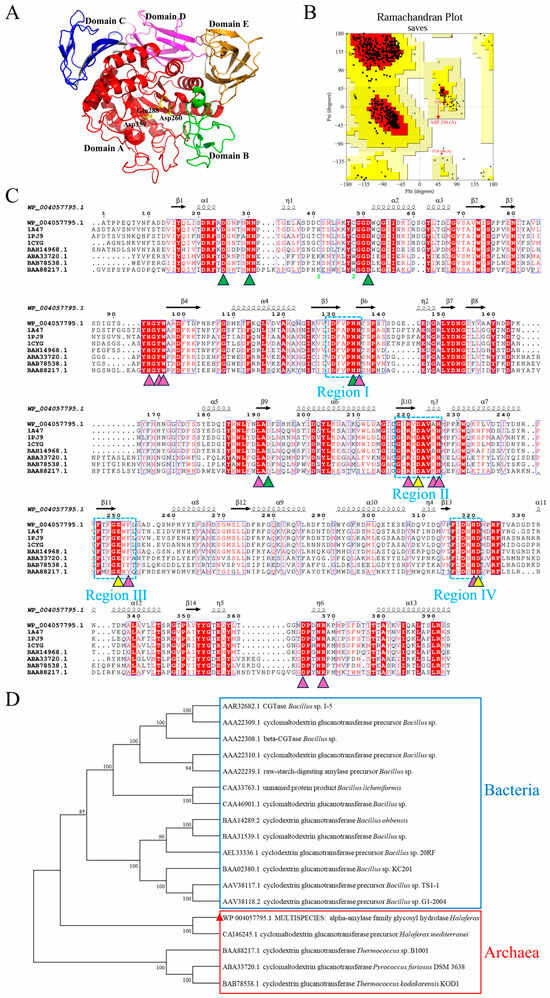
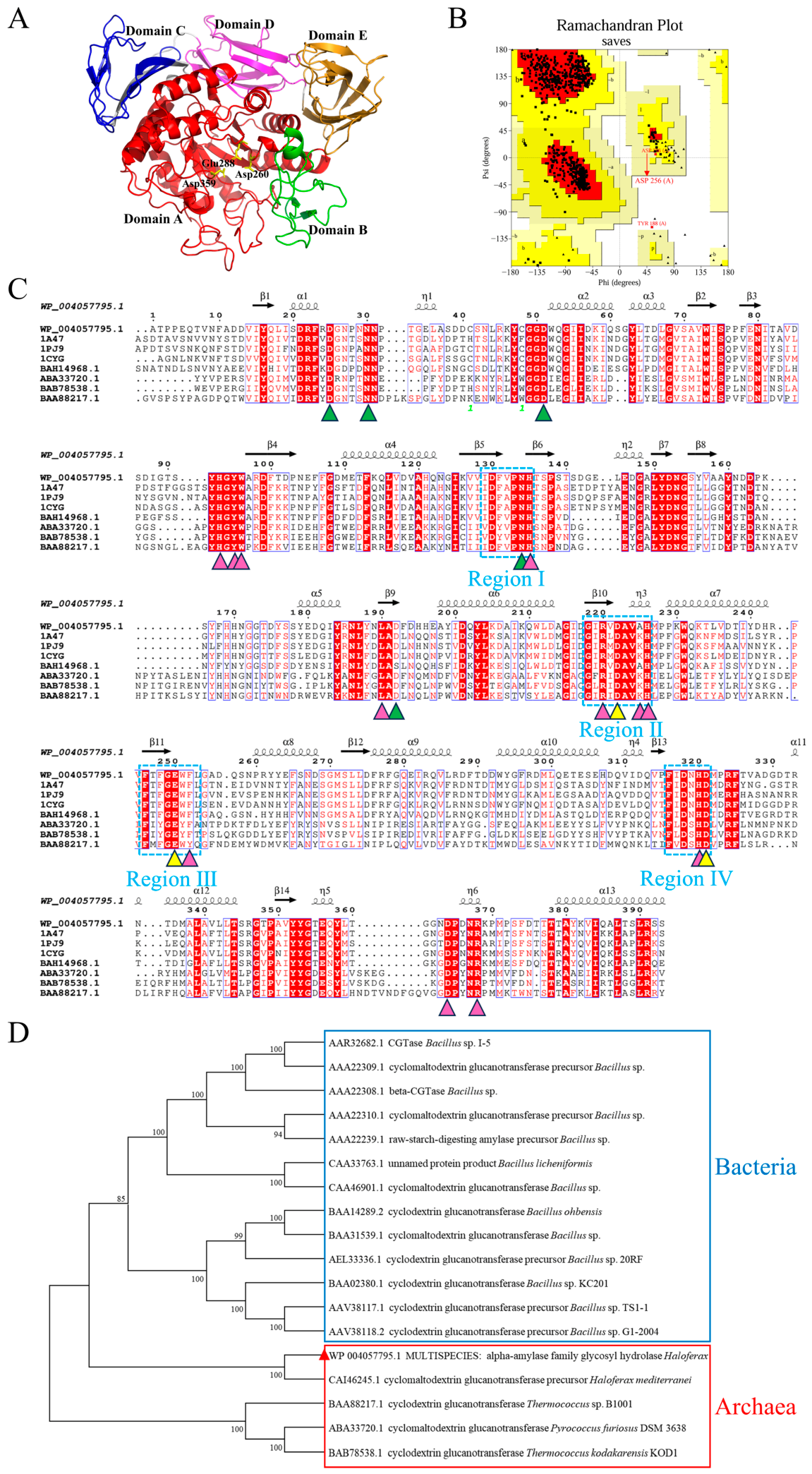
As shown in Figure 2A, the three-dimensional structure of HfCGT was modeled and visualized using the AlphaFold3 (v 3.0.1) and PyMOL (v 3.1.3) software. The overall average of the predicted Local Distance Difference Test (pLDDT) score was 96.5, indicating a high-confidence prediction. Additionally, the model quality was assessed using the SAVES v6.1 online platform. As presented in Figure 2B, the Ramachandran plot showed that 91.4% of the amino acid residues were located in the most favored regions, which is higher than the generally accepted threshold for structural reliability (>90%), indicating that the predicted three-dimensional structure model is conformationally reasonable and can be used for subsequent structural feature analysis. HfCGT consists of five distinct domains (A–E) and contains four conserved α-amylase characteristic motifs (Regions I–IV) in its amino acid sequence, located at 167IDFVPNH173, 256GIRVDAVAH264, 284FTFGEWFL291, and 354FIDNHD359, respectively. The catalytic domain of HfCGT is a typical (β/α)8 barrel containing two aspartic acid and one glutamic acid residue (i.e., Asp260, Asp359, and Glu288) as the catalytic residues.
Figure 2.
Sequence analysis of HfCGT. (A) The three-dimensional structure of modeled HfCGT with putative catalytic residues Asp260, Glu288, and Asp359, marked in yellow; (B) Ramachandran plot; (C) multiple sequence alignment of HfCGT and the CGTases from Thermoanaerobacterium thermosulfurigenes (PDB ID: 1A47), Bacillus circulans (PDB ID: 1PJ9), Geobacillus stearothermophilus (PDB ID: 1CYG), Evansella clarkii (GenBank Accession No.: BAH14968.1), Haloferax mediterranei (GenBank Accession No.: CAI46245.1), Pyrococcus furiosus DSM 3638 (GenBank Accession No.: ABA33720.1), Thermococcus kodakarensis KOD1 (GenBank Accession No.: BAB78538.1), and Thermococcus sp. B1001 (GenBank Accession No.: BAA88217.1). The characteristic motifs (blue boxes), the catalytic residues (yellow triangles), the active sites (pink triangles), and the Ca2+ binding sites (green triangles) are indicated; (D) phylogenetic analyses of HfCGT and known counterparts of GH13. The red triangle represents HfCGT.
Multiple sequence alignment of HfCGT and other reported homologues revealed that the catalytic residues and four conserved amino acid sequences are highly conserved across the known CGTases (Figure 2C). The active site and calcium ion-binding site also exhibit a high degree of conservation. Notably, HfCGT shares 99.16% amino acid sequence identity with the CGTase from the archaeon Haloferax mediterranei, suggesting that they may share a common evolutionary ancestor and potentially possess similar catalytic properties. HfCGT also shows high identity (59.73%) with the CGTase from Geobacillus stearothermophilus, but exhibits low sequence similarities (32–38%) to other archaeal CGTases in the SwissPro database, which may indicate potential divergence in functional characteristics among these enzymes.
2.1.2. Phylogenetic Analysis
To further elucidate the evolutionary relationship between HfCGT and other GH13 CGTases of different sources, a phylogenetic tree was constructed based on protein sequences using the Neighbor-Joining (NJ) method. As shown in Figure 2D, the CGTases under study cluster into two distinct clades: Clade I contains CGTases of bacterial origin, while Clade II includes those from archaea. HfCGT and the archaeal enzyme belong to the same clade and are most closely related to the CGTase from Haloferax mediterranei; they may share similar mechanisms of halophilic adaptation.
2.2. Expression and Purification of Recombinant HfCGT
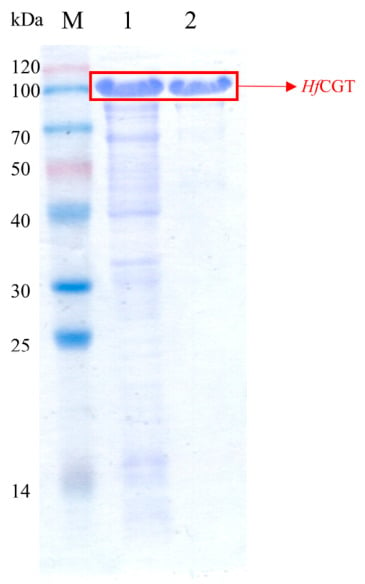
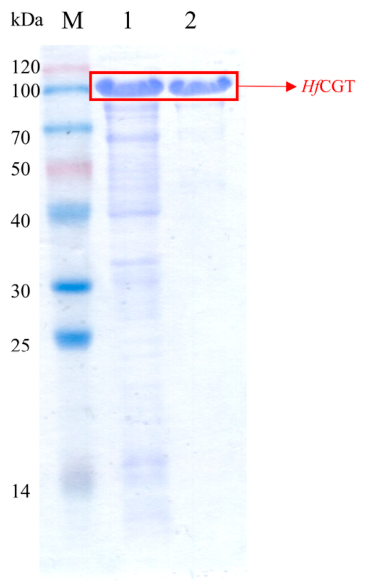
Recombinant HfCGT was expressed in soluble form in E. coli BL21 (DE3). Induction at 30 °C for 10 h was then used in subsequent experiments (Figure S1). Through nickel affinity chromatography, the recombinant HfCGT was purified to apparent homogeneity with a purification fold of 6.85 and a recovery rate of 48.4%, respectively (Table S1). SDS-PAGE analysis, using a 12% separating gel, demonstrated that the apparent molecular weight of the purified protein was 90.2 kDa (Figure 3), which was consistent with the theoretical molecular weight of the mature HfCGT protein fused with an N-terminal His6-tag, a C-terminal His6-tag, and a SUMO-tag.
Figure 3.
SDS-PAGE analysis of the purified HfCGT. Lane M: Protein molecular weight marker; Lane 1: crude cell extract after IPTG induction; Lane 2: purified HfCGT after Ni-NTA affinity chromatography.
2.3. Biochemical Characterization of Recombinant HfCGT
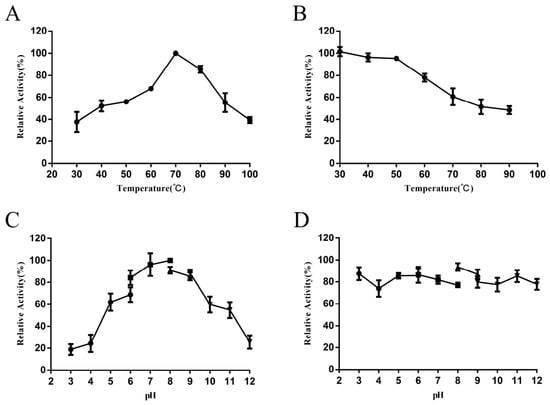
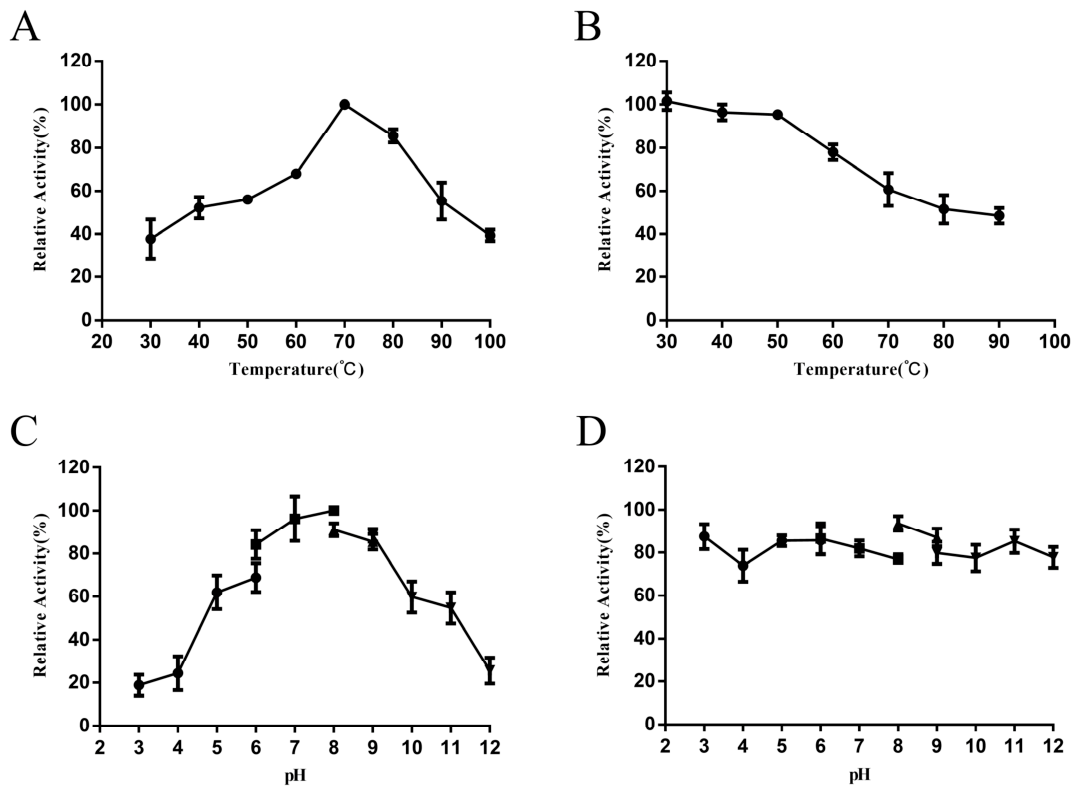
The purified recombinant HfCGT exhibited high activity within the temperature range of 60–80 °C, with maximum activity detected at 70 °C (Figure 4A). The highest activity of the purified recombinant HfCGT was observed at pH 8.0 (Figure 4B). The enzyme showed excellent thermal stability, retaining over 90% of its initial activity after incubation at 30–60 °C for 1 h, and more than 50% of its initial activity even after incubation at 70–80 °C for 1 h (Figure 4C). Moreover, HfCGT maintained stability over a broad pH range, with more than 80% of its enzymatic activity after incubation at pH 5.0–12.0 for 1 h (Figure 4D).
Figure 4.
Enzymatic properties of purified recombinant HfCGT: (A) optimal temperature; (B) thermal stability; (C) optimal pH; (D) pH stability. (●) citrate-Na2HPO4 buffer (pH 3.0–6.0); (■) NaH2PO4-Na2HPO4 buffer (pH 6.0–8.0); (▲) tris-HCl buffer (pH 8.0–9.0); (▼) Gly-NaOH buffer (pH 9.0–12.0). Error bars represent SD (n = 3).
The effects of various metal ions and chemical reagents on HfCGT activity were determined under optimal conditions (Table 1). HfCGT was activated in the presence of Na+, Ca2+, and K+, and showed tolerance to Mg2+, Mn2+, and EDTA. Partial inhibition of HfCGT activity was observed in the presence of Fe2+, Fe3+, Zn2+, and Ni2+, whereas Al3+, Cu2+, Ag+, Hg2+, SDS, and β-mercaptoethanol completely inhibited HfCGT activity.
Table 1.
Effects of metal ions and chemical reagents on HfCGT activity.
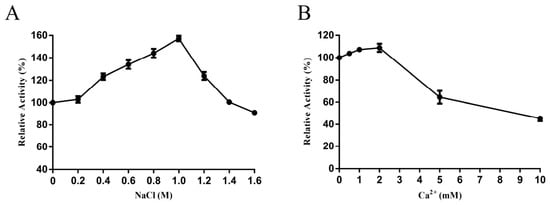
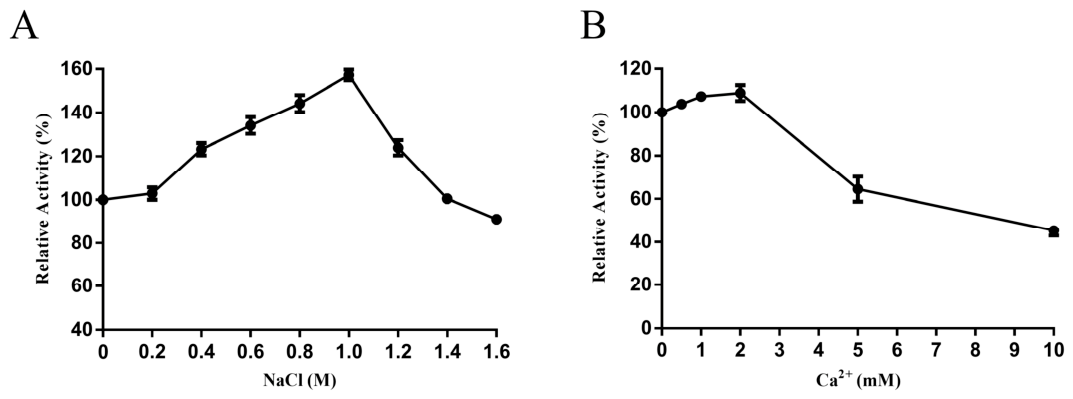
Given that Haloferax sp. EPS crtB belongs to the halophilic archaea, the salt tolerance of HfCGT under varying concentrations of Na+ was also determined. Moreover, considering Ca2+ as a classical stabilizing cofactor for CGTase, the effect of Ca2+ on HfCGT activity was also evaluated. Using 1% (w/v) soluble starch as the substrate, HfCGT achieved the highest activity in the presence of 1 M NaCl (Figure 5A), and the activity was enhanced by 12% when the Ca2+ concentration was set to 2 mM (Figure 5B).
Figure 5.
Enhanced activity of HfCGT in the presence of NaCl (A) and CaCl2 (B). Error bars represent SD (n = 3).
2.4. Substrate Specificity and Kinetics
To identify the substrate specificity of HfCGT, soluble starch, amylose, and amylopectin were selected as the substrates. HfCGT exhibited the highest activity towards amylose (36.78 ± 1.88 U/mg), moderate on soluble starch (28.16 ± 2.97 U/mg), and weak on amylopectin (3.06 ± 3.76 U/mg), respectively.
The kinetic parameters, Vₘₐₓ, Kₘ, Kcat, and Kcat/Kₘ, of HfCGT towards soluble starch were determined to be 28.91 ± 7.61 μmol/min/mL, 0.344 ± 1.03 mg/mL, 300.73 ± 2.83 s−1, and 847.13 ± 6.97 s−1·mL/mg, respectively.
2.5. Analysis of the Hydrolytic Products
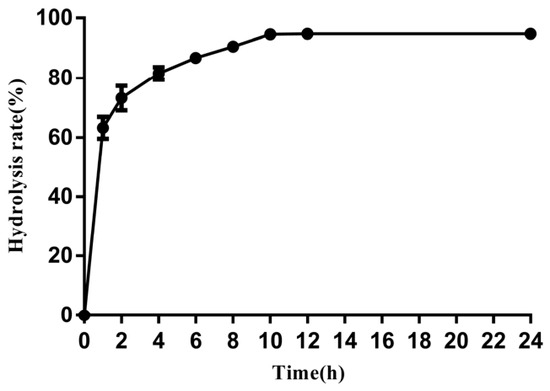
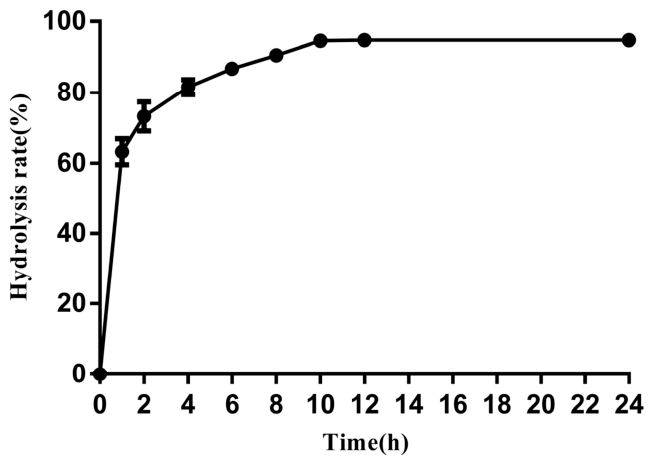
The hydrolysis process of soluble starch by HfCGT is shown in Figure 6. Within 0–10 h, the hydrolysis rate kept increasing, reaching the maximum conversion rate of 94.82% at 12 h. After that, the substrate was completely hydrolyzed, and the reaction reached equilibrium.
Figure 6.
Time-course of soluble starch hydrolysis by HfCGT. Error bars represent SD (n = 3).
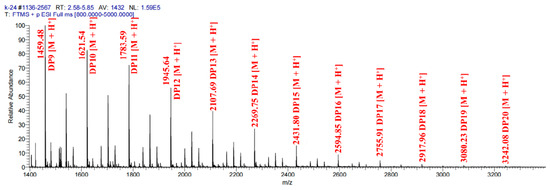
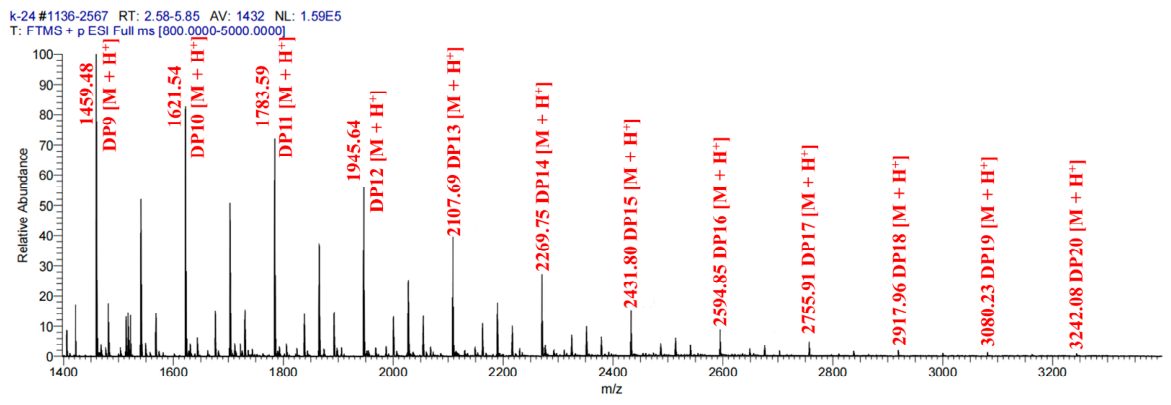
The high-performance liquid chromatography (HPLC) results indicated that no α/β/γ-CD was formed during the starch degradation by HfCGT. Further product analysis with high-resolution mass spectrometry (HRMS) indicated that the dominant hydrolysis products of HfCGT were primarily LR-CDs of DP 9–20 (Figure 7 and Supplementary Table S2).
Figure 7.
HRMS spectra of LR-CD products. Major peaks correspond to [M + Na]+ of LR-CDs with DP 9–20. The m/z to DP assignments are detailed in Supplementary Table S2.
To highlight the unique product profile of HfCGT, its catalytic characteristics were compared with those of representative CGTases derived from bacteria and archaea (Table 2). The wild-type HfCGT characterized in this study preferentially produces LR-CDs with DP 9 to 20 under optimal conditions, while maintaining high thermostability and excellent tolerance to high-salt and alkaline environments. These distinct features endow this archaeal CGTase with unique advantages for industrial starch conversion applications.
Table 2.
Comparison of the properties of microbial and archaeal CGTases.
3. Discussion
In this study, a CGTase derived from the haloalkaliphilic archaeon Haloferax sp. EPS crtB was successfully cloned and heterologously expressed in E. coli. Sequence analysis revealed that HfCGT consists of five distinct domains (A–E) and three catalytic residues, which are highly conserved in CGTases of GH13 [25]. The catalytic domain A adopts a typical (β/α)8-barrel fold with four conserved α-amylase motifs, with Asp260, Glu288, and Asp359 serving as essential catalytic residues. Similar to other known crystal structures of CGTases, a short domain B is located within domain A [26,27,28,29]. Domains B and C contribute to the structural stability of the catalytic domain and substrate-binding capacity [30,31], which accounts for the ability of HfCGT to remain active under varying temperature and pH conditions. Domain E belongs to the CBM20 that contains two starch-binding sites, thus facilitating the enzyme–substrate interactions by disrupting the surface structure of starch and enhancing the catalytic efficiency of domain A [32,33,34]. In contrast, the specific function of domain D remains unclear. It may encode unique structural elements associated with the salt tolerance of the enzyme. In future studies, site-directed mutagenesis, molecular docking, and molecular dynamics simulations can be applied to verify this hypothesis.
Comprehensive enzymatic characterization revealed that HfCGT exhibits an optimal catalytic temperature of 70 °C and an optimal pH of 8.0. Most CGTases from Bacillus spp. exhibit optimal performance at moderate temperatures (40–60 °C) and a near-neutral pH, consistent with mesophilic growth conditions [29,35]. Although certain bacterial CGTases retain partial activity under alkaline conditions, their stability and catalytic efficiency are often compromised when exposed to elevated temperatures or prolonged alkaline stress [23,36]. Furthermore, HfCGT exhibited maximum activity in the presence of 1 M NaCl and maintained good stability over a broad pH range, demonstrating halophilic characteristics consistent with the living environment of halophilic archaea. Similarly, the CGTase from Haloferax mediterranei exhibited optimal activity at 1.5 M NaCl, suggesting that halophilic archaeal CGTases may share common mechanisms of salt adaptation [19]. The abundance of acidic residues on the protein surface likely promotes cation binding and hydration layer formation, thereby helping prevent dehydration and denaturation under high-salt conditions. Although HfCGT has a lower optimal temperature than CGTases from hyperthermophilic archaea such as Thermococcus kodakaraensis KOD1 and Pyrococcus furiosus DSM3638 [17,18], it exhibits superior tolerance to high salinity and alkaline conditions. Recent enzyme engineering strategies have focused on enhancing thermostability and halotolerance through rational design and directed evolution [37,38]. The inherent stability of HfCGT under high-salt and alkaline conditions renders further engineering unnecessary, highlighting the great potential of exploring extremophilic microorganisms for the direct development of efficient biocatalysts.
In addition to its adaptation to alkaline and moderate to high temperature conditions, HfCGT exhibits a distinctive product profile. Most previously reported CGTases predominantly produce α-, β-, and γ-CDs, with β-CD frequently being the major product. Some researchers have found that LR-CDs were abundant in the early stages of starch degradation reactions, but as the reaction time extended, they were ultimately degraded into regular CDs, making it difficult to stably accumulate [39,40]. To obtain LR-CDs, researchers typically need to engineer CGTases through laborious and time-consuming methods. Sonnendecker et al. achieved the specific synthesis of LR-CDs with a degree of DP 8–12 through multiple site-directed mutations of CGTase from Bacillus sp. G-825-6 [41]. Kaulpiboon et al. used a molecular imprinting method with a DP 12 LR-CD as a template to treat CGTase from Paenibacillus sp. A11, thereby achieving a high yield of LR-CDs (DP 12) [42]. In both cases, extensive protein engineering or template-assisted manipulation was required. In this study, HfCGT primarily produced LR-CDs with DP 9–20 after degrading soluble starch, and no major common CDs were detected even after 24 h of reaction. Notably, as a wild-type CGTase derived from archaea, HfCGT can stably produce LR-CDs without any protein engineering modifications, which is extremely rare among the currently reported GH13 family CGTases. This natural ability positions HfCGT as a rare and valuable biocatalyst. However, the final product of starch degradation by H. mediterranei CGTase, which shares a high sequence similarity with HfCGT, was β-CD. Sequence alignment revealed differences at amino acid positions 433–438 between the two enzymes, suggesting that these six amino acid residues may influence the product specificity of the enzyme during starch degradation. Further site-directed mutagenesis and molecular dynamics simulations will be performed to verify the proposed structure–function relationship. Previous structure–function studies have demonstrated that CGTase hydrolysis specificity is primarily governed by the overall architecture of the active site, including the configuration of the substrate-binding groove and surrounding flexible regions, rather than by a single catalytic residue [43,44,45]. The production of LR-CDs may be related to structural features that favor the binding and stabilization of longer glucan chains during cyclization.
In conclusion, an archaeal CGTase from Haloferax sp. EPS crtB was successfully cloned and heterologously expressed in E. coli BL21(DE3). The recombinant enzyme, HfCGT, exhibited high thermostability and pH stability under moderate to high temperature ranges and alkaline conditions. Notably, HfCGT displayed a distinct CD product profile, preferentially producing LR-CDs under optimal conditions. Structural factors governing the product specificity of CGTases include subsite architectures and key amino acid residues [46]. On this basis, AI-driven enzyme engineering is expected to further improve the LR-CD yield, catalytic efficiency, and operational stability of HfCGT during industrial starch conversion [47]. Although further studies are required to elucidate the underlying catalytic mechanism, these findings expand the current knowledge of CGTase diversity and provide a basis for future structure–function investigations and biosynthetic studies of LR-CDs.
4. Materials and Methods
4.1. Chemicals and Strains
E. coli DH5α and E. coli BL21(DE3) (BioMed, Beijing, China) were used as host strains for DNA manipulation and heterologous expression, respectively. Soluble starch, amylose, and amylopectin were purchased from Yuanye Bio-Technology Co., Ltd. (Shanghai, China). All chemicals used were of analytical grade and commercially available.
4.2. Sequence Analysis and Synthesis
The gene sequence of HfCGT (NCBI Reference Sequence: WP_004057795.1) was retrieved from the NCBI database. Putative signal peptide as well as the module structure were predicted using SignalP 5.0 (https://services.healthtech.dtu.dk/services/SignalP-5.0/, accessed on 8 February 2026) and a simple module structure study tool (https://www.ncbi.nlm.nih.gov/Structure/cdd/wrpsb.cgi, accessed on 8 February 2026). At the same time, the predicted protein conformations were analyzed using the SAVES v6.1 online platform (https://saves.mbi.ucla.edu/) to assess their reasonableness. Subsequently, the HfCGT sequence without the signal peptide was synthesized after codon optimization by GenScript Biotech Co., Ltd. (Nanjing, China), and flanked with BamH I and Hind III restriction sites. The target fragment was cloned into the pET-28a-SUMO vector. The resulting recombinant plasmid Hfcgt-pET-28a-SUMO was verified by Sanger sequencing.
4.3. Homology Modeling and Multiple Sequence Alignment
Homology modeling of HfCGT was performed using AlphaFold3 (https://alphafoldserver.com), followed by visualization analysis via PyMOL software, with the key residues of HfCGT annotated. Sequence alignment of HfCGT and close homologues was performed using ClustalW (https://www.genome.jp/tools-bin/clustalw, accessed on 2 April 2026), and the alignment results were color-coded using ESPript 3.2 (https://espript.ibcp.fr/ESPript/ESPript/, accessed on 2 April 2026). A phylogenetic tree of HfCGT and other GH13 counterparts was constructed using MEGA 11.0 software with the Neighbor-Joining method. The Poisson model was used to calculate evolutionary distances, and a bootstrap analysis was performed with 1000 replicates.
4.4. Expression and Purification of the Recombinant HfCGT
The recombinant plasmid Hfcgt-pET-28a-SUMO was transformed into E. coli BL21 (DE3). Transformants were grown in LB medium containing 100 μg/mL of kanamycin at 37 °C with shaking. When 600 nm (OD600) reached 0.6–0.8, protein expression was induced with 0.1 mM IPTG at 20 °C for 22 h, 25 °C for 16 h, 30 °C for 10 h, and 37 °C for 6 h, respectively.
HfCGT was purified by nickel affinity chromatography (TransGen Biotech, Beijing, China). After induction of HfCGT at 30 °C for 10 h, cells were harvested by centrifugation and resuspended in Ni-NTA equilibration buffer (50 mM NaH2PO4 containing 10 mM imidazole and 300 mM NaCl, pH 8.0). Cell disruption was performed with a 3 s sonication pulse, 5 s interval, 30% power, and a total disruption time of 30 min. The crude enzyme was collected by centrifuging at 12,000 rpm and 4 °C for 10 min to remove insoluble cell debris, followed by loading onto a Ni-NTA agarose column. The target HfCGT was obtained with an elution buffer (50 mM NaH2PO4 containing 350 mM imidazole and 300 mM NaCl, pH 8.0). Following desalination using an Amicon Ultra-30K centrifugal filter unit (Millipore, Billerica, MA, USA), HfCGT was concentrated and stored in 50 mM NaH2PO4-Na2HPO4 buffer (pH 8.0) at −20 °C.
Sodium dodecyl sulfate-polyacrylamide gel electrophoresis (SDS-PAGE) was performed with a 12% separating gel. Using bovine serum albumin (BSA) as the standard, the concentration of the target protein HfCGT was determined by the Bradford method.
4.5. Enzyme Activity Assay
The reaction mixture contained 0.5–1 μg of purified HfCGT, 200 μL of 1% (w/v) soluble starch, and 200 μL of 50 mM NaH2PO4-Na2HPO4 (pH 8.0). After incubation at 70 °C for 10 min, the reaction was stopped with 0.5 mL of 0.5 M acetic acid, followed by the addition of 3 mL of 0.005% (w/v) iodine solution. Absorbance was measured at 700 nm. One unit of activity was defined as the amount of enzyme causing a 10% reduction in absorbance under these conditions.
4.6. Biochemical Characterization
Optimal temperature and pH: An optimal temperature was determined as 30–90 °C at pH 8.0. Optimal pH was tested at 70 °C using citrate-Na2HPO4 buffer (pH 3.0–6.0), NaH2PO4-Na2HPO4 buffer (pH 6.0–8.0), Tris-HCl buffer (pH 8.0–9.0), and Gly-NaOH buffer (pH 9.0–12.0). Activity under optimal conditions was set as 100%.
Thermal and pH stability: For thermal stability, the enzyme was incubated at 30–90 °C for 1 h prior to activity measurement. For pH stability, the enzyme was incubated in buffers with pHs of 3.0–12.0 for 1 h before assaying residual activity. The untreated enzyme served as the control (100%).
Metal ions and reagents: The enzyme was assayed at 70 °C and pH 8.0 with 1 mM of various metal ions or reagents (NaCl, KCl, MgCl2, ZnCl2, FeCl2, CaCl2, AlCl3, CuSO4, NiCl2, MnCl2, FeCl3, HgCl2, AgNO3, EDTA, SDS, and β-mercaptoethanol). Activity without additives was defined as 100%.
Effects of Na+ and Ca2+ on HfCGT activity: Using 1% soluble starch as the substrate, reactions were performed at 70 °C, pH 8.0, using NaCl (0–1.6 M) or CaCl2 (0–10 mM). Activity was measured under standard conditions.
All experiments were repeated three times. The results of multiple experiments are reported as means ± standard deviation (SD). A p-value less than 0.05 was considered statistically significant.
4.7. Substrate Specificity
The substrate specificity of HfCGT was evaluated using 1% (w/v) of soluble starch, amylose, and amylopectin as the substrates. Enzyme activity was assayed under standard conditions, absorbance (A) was measured at 700 nm, and the specific activities of HfCGT for degrading the three substrates were calculated, respectively. All experiments were repeated three times. The results of multiple experiments are reported as means ± SD.
4.8. Kinetic Analysis
The kinetic parameters of HfCGT were determined using soluble starch as the substrate at final concentrations ranging from 0.5 to 2.0 mg/mL in 50 mM NaH2PO4-Na2HPO4 buffer (pH 8.0) containing 2 mM Ca2+ under standard assay conditions. GraphPad Prism 5 software was used for non-linear regression analysis to fit the Michaelis–Menten equation, and kinetic parameters, including Kₘ, Vₘₐₓ, Kcat, and Kcat/Kₘ, were calculated. All experiments were repeated three times. The results of multiple experiments are reported as means ± SD.
4.9. Determination of Hydrolytic Products
The hydrolytic activity of HfCGT was determined using soluble starch as the substrate. The reaction system containing 1 mg/mL of HfCGT, 1% soluble starch in 50 mM NaH2PO4-Na2HPO4 buffer (pH 8.0), and 2 mM Ca2+ was incubated at 70 °C for 24 h. Samples were collected at different time intervals. The reaction was terminated by adding 0.5 M acetic acid, followed by 0.005% (w/v) iodine solution for color development. Absorbance was measured at a wavelength of 700 nm.
Hydrolysis products were analyzed using the Agilent 1260 Series High-Performance Liquid Chromatography (HPLC) system equipped with a refractive index detector (RID). Separation was achieved on a COSMOSIL Sugar-D column (4.6 mm I.D. × 250 mm). The mobile phase consisted of acetonitrile/water (65:35, v/v) at a flow rate of 1 mL/min. The injection volume was 10 μL, and the column temperature was maintained at 30 °C.
High-resolution mass spectrometry (HRMS) analysis was performed using a Q Exactive Plus mass spectrometer (Thermo Fisher Scientific, Waltham, MA, USA) equipped with an electrospray ionization (ESI) source operating in positive ion mode. The mobile phases consisted of 0.1% (v/v) formic acid in water (A) and 0.1% (v/v) formic acid in acetonitrile (B). The elution program was as follows: 0–1.5 min, 99% A; 1.5–15 min, 1–99% B; 15–20 min, 99% B; 20–21 min, 99–1% B; and 21–30 min, 99% A for column re-equilibration. The flow rate was set at 0.3 mL/min [48]. The spray voltage was set to 3.5 kV, the capillary temperature was 320 °C, and the heater temperature was 350 °C. Sheath gas and auxiliary gas were set to 35 and 10 arbitrary units, respectively. Full-scan mass spectra were acquired over an m/z range of 800–5000, enabling the detection of LR-CDs. Data acquisition and analysis were performed using Xcalibur (v 4.5.474.0) software (Thermo Fisher Scientific, Waltham, MA, USA).
Supplementary Materials
The following supporting information can be downloaded at: https://www.mdpi.com/article/10.3390/ijms27125532/s1.
Author Contributions
Conceptualization, Y.L., A.L. and G.Z.; methodology, Y.L., A.L. and X.L.; validation, X.L., Y.C. and A.Z.; formal analysis, Y.L. and A.L.; investigation, Y.L., A.L. and X.L.; resources, G.Z.; data curation, Y.L. and A.L.; writing—original draft preparation, Y.L. and A.L.; writing—review and editing, R.M. and G.Z.; visualization, Y.L. and A.L.; supervision, J.G., R.M. and G.Z.; project administration, J.G.; funding acquisition, G.Z. All authors have read and agreed to the published version of the manuscript.
Funding
This work was supported by the National Natural Science Foundation of China (Grant Nos. 32272605 and 32471477), the project of Open Bidding for Selecting the Best Candidates from Baoding City (Grant 2022 Innovation No. 028), the project of Improvement of Innovation Ability from Baoding City (Grant No. 2394G017), and the Start Funding from Hebei Agricultural University (Grant No. ZD201605).
Institutional Review Board Statement
Not applicable.
Informed Consent Statement
Not applicable.
Data Availability Statement
The original contributions presented in this study are included in the article. Further inquiries can be directed to the corresponding authors.
Acknowledgments
All authors thank Haijiao Dong from the State Key Laboratory of North China Crop Improvement and Regulation, Hebei Agricultural University, for technical assistance with mass spectrometry analysis.
Conflicts of Interest
The authors declare no conflicts of interest.
Abbreviations
The following abbreviations are used in this manuscript:
| CGTase | Cyclodextrin glucosyltransferase |
| CDs | Cyclodextrins |
| LR-CDs | Large-ring cyclodextrins |
| DP | Degree of polymerization |
| SBD | Starch-binding domain |
| I.D. | Inner diameter |
References
- Moriwaki, C.; Ferreira, L.R.; Rodella, J.R.T.; Matioli, G. A Novel Cyclodextrin Glycosyltransferase from Bacillus sphaericus Strain 41: Production, Characterization and Catalytic Properties. Biochem. Eng. J. 2009, 48, 124–131. [Google Scholar] [CrossRef] [Scilit]
- Ibrahim, A.S.S.; Al-Salamah, A.A.; El-Tayeb, M.A.; El-Badawi, Y.B.; Antranikian, G. A Novel Cyclodextrin Glycosyltransferase from Alkaliphilic Amphibacillus sp. NPST-10: Purification and Properties. Int. J. Mol. Sci. 2012, 13, 10505–10522. [Google Scholar] [CrossRef] [Scilit] [PubMed]
- Li, Z.; Wang, M.; Wang, F.; Gu, Z.; Du, G.; Wu, J.; Chen, J. γ-Cyclodextrin: A Review on Enzymatic Production and Applications. Appl. Microbiol. Biotechnol. 2007, 77, 245–255. [Google Scholar] [CrossRef] [Scilit] [PubMed]
- Al-Marzouqi, A.H.; Elwy, H.M.; Shehadi, I.; Adem, A. Physicochemical Properties of Antifungal Drug–Cyclodextrin Complexes Prepared by Supercritical Carbon Dioxide and by Conventional Techniques. J. Pharm. Biomed. Anal. 2009, 49, 227–233. [Google Scholar] [CrossRef] [Scilit] [PubMed]
- Otero-Espinar, F.J.; Luzardo-Alvarez, A.; Blanco-Méndez, J. Cyclodextrins: More than Pharmaceutical Excipients. Mini-Rev. Med. Chem. 2010, 10, 715–725. [Google Scholar] [CrossRef] [Scilit] [PubMed]
- Pishtiyski, I.; Popova, V.; Zhekova, B. Characterization of Cyclodextrin Glucanotransferase Produced by Bacillus megaterium. Appl. Biochem. Biotechnol. 2008, 144, 263–272. [Google Scholar] [CrossRef] [Scilit] [PubMed]
- Sonnendecker, C.; Thürmann, S.; Przybylski, C.; Zitzmann, F.D.; Heinke, N.; Krauke, Y.; Monks, K.; Robitzki, A.A.; Belder, D.; Zimmermann, W. Large-ring Cyclodextrins as Chiral Selectors for Enantiomeric Pharmaceuticals. Angew. Chem. Int. Ed. 2019, 58, 6411–6414. [Google Scholar] [CrossRef] [Scilit] [PubMed]
- Baek, H.H.; Kim, D.-H.; Kwon, S.Y.; Rho, S.-J.; Kim, D.-W.; Choi, H.-G.; Kim, Y.-R.; Yong, C.S. Development of Novel Ibuprofen-Loaded Solid Dispersion with Enhanced Bioavailability Using Cycloamylose. Arch. Pharmacal Res. 2012, 35, 683–689. [Google Scholar] [CrossRef] [Scilit] [PubMed]
- Jeong, H.-M.; Lee, Y.; Shin, Y.-J.; Woo, S.-H.; Kim, J.-S.; Jeong, D.-W.; Shin, S.; Jeon, S.H.; Shim, J.-H. Development of an Enzymatic Encapsulation Process for a Cycloamylose Inclusion Complex with Resveratrol. Food Chem. 2021, 345, 128777. [Google Scholar] [CrossRef] [Scilit] [PubMed]
- Ismail, A.; Kerdpol, K.; Rungrotmongkol, T.; Tananuwong, K.; Ueno, T.; Ekasit, S.; Muangsin, N.; Krusong, K. Solubility Enhancement of Poorly Water Soluble Domperidone by Complexation with the Large Ring Cyclodextrin. Int. J. Pharm. 2021, 606, 120909. [Google Scholar] [CrossRef] [Scilit] [PubMed]
- Zheng, M.; Endo, T.; Zimmermann, W. Enzymatic Synthesis and Analysis of Large-Ring Cyclodextrins. Aust. J. Chem. 2002, 55, 39–48. [Google Scholar] [CrossRef] [Scilit]
- Rho, S.-J.; Mun, S.; Park, J.; Kim, Y.-R. Retarding Oxidative and Enzymatic Degradation of Phenolic Compounds Using Large-Ring Cycloamylose. Foods 2021, 10, 1457. [Google Scholar] [CrossRef] [Scilit] [PubMed]
- Machida, S.; Ogawa, S.; Xiaohua, S.; Takaha, T.; Fujii, K.; Hayashi, K. Cycloamylose as an Efficient Artificial Chaperone for Protein Refolding. FEBS Lett. 2000, 486, 131–135. [Google Scholar] [CrossRef] [Scilit] [PubMed]
- Henrissat, B. A Classification of Glycosyl Hydrolases Based on Amino Acid Sequence Similarities. Biochem. J. 1991, 280, 309–316. [Google Scholar] [CrossRef] [Scilit] [PubMed]
- Kelly, R.M.; Dijkhuizen, L.; Leemhuis, H. The Evolution of Cyclodextrin Glucanotransferase Product Specificity. Appl. Microbiol. Biotechnol. 2009, 84, 119–133. [Google Scholar] [CrossRef] [Scilit] [PubMed]
- Tachibana, Y.; Kuramura, A.; Shirasaka, N.; Suzuki, Y.; Yamamoto, T.; Fujiwara, S.; Takagi, M.; Imanaka, T. Purification and Characterization of an Extremely Thermostable Cyclomaltodextrin Glucanotransferase from a Newly Isolated Hyperthermophilic Archaeon, a Thermococcus sp. Appl. Environ. Microbiol. 1999, 65, 1991–1997. [Google Scholar] [CrossRef] [Scilit]
- Rashid, N.; Cornista, J.; Ezaki, S.; Fukui, T.; Atomi, H.; Imanaka, T. Characterization of an Archaeal Cyclodextrin Glucanotransferase with a Novel C-Terminal Domain. J. Bacteriol. 2002, 184, 777–784. [Google Scholar] [CrossRef] [Scilit] [PubMed]
- Lee, M.-H.; Yang, S.-J.; Kim, J.-W.; Lee, H.-S.; Kim, J.-W.; Park, K.-H. Characterization of a Thermostable Cyclodextrin Glucanotransferase from Pyrococcus furiosus DSM3638. Extremophiles 2007, 11, 537–541. [Google Scholar] [CrossRef] [Scilit] [PubMed]
- Bautista, V.; Esclapez, J.; Pérez-Pomares, F.; Martínez-Espinosa, R.M.; Camacho, M.; Bonete, M.J. Cyclodextrin Glycosyltransferase: A Key Enzyme in the Assimilation of Starch by the Halophilic Archaeon Haloferax mediterranei. Extremophiles 2012, 16, 147–159. [Google Scholar] [CrossRef] [Scilit] [PubMed]
- Bowers, K.J.; Wiegel, J. Temperature and pH Optima of Extremely Halophilic Archaea: A Mini-Review. Extremophiles 2011, 15, 119–128. [Google Scholar] [CrossRef] [Scilit] [PubMed]
- Chakravorty, D.; Khan, M.F.; Patra, S. Multifactorial Level of Extremostability of Proteins: Can They Be Exploited for Protein Engineering? Extremophiles 2017, 21, 419–444. [Google Scholar] [CrossRef] [Scilit] [PubMed]
- Shi, J.; Yuan, B.; Yang, H.; Sun, Z. Recent Advances on Protein Engineering for Improved Stability. Biodes. Res. 2025, 7, 100005. [Google Scholar] [CrossRef] [Scilit] [PubMed]
- Atanasova, N.; Kitayska, T.; Bojadjieva, I.; Yankov, D.; Tonkova, A. A Novel Cyclodextrin Glucanotransferase from Alkaliphilic Bacillus pseudalcaliphilus 20RF: Purification and Properties. Process Biochem. 2011, 46, 116–122. [Google Scholar] [CrossRef] [Scilit]
- Abdalla, M.; Hassanin, H.A.; Yao, X.; Iqbal, M.W.; Karrar, E.; Jiang, B. Genetic and Biochemical Characterization of Thermophilic β-cyclodextrin Glucanotransferase from Gracilibacillus alcaliphilus SK51.001. J. Sci. Food Agric. 2021, 101, 3308–3318. [Google Scholar] [CrossRef] [Scilit] [PubMed]
- Klein, C.; Schulz, G.E. Structure of Cyclodextrin Glycosyltransferase Refined at 2.0 a Resolution. J. Mol. Biol. 1991, 217, 737–750. [Google Scholar] [CrossRef] [Scilit] [PubMed]
- Knegtel, R.M.A.; Strokopytov, B.; Penninga, D.; Faber, O.G.; Rozeboom, H.J.; Kalk, K.H.; Dijkhuizen, L.; Dijkstra, B.W. Crystallographic Studies of the Interaction of Cyclodextrin Glycosyltransferase from Bacillus circulans Strain 251 with Natural Substrates and Products. J. Biol. Chem. 1995, 270, 29256–29264. [Google Scholar] [CrossRef] [Scilit] [PubMed]
- Qi, Q.; Zimmermann, W. Cyclodextrin Glucanotransferase: From Gene to Applications. Appl. Microbiol. Biotechnol. 2005, 66, 475–485. [Google Scholar] [CrossRef] [Scilit] [PubMed]
- MacGregor, E.A.; Janecek, S.; Svensson, B. Relationship of Sequence and Structure to Specificity in the Alpha-Amylase Family of Enzymes. Biochim. Biophys. Acta 2001, 1546, 1–20. [Google Scholar] [CrossRef] [Scilit] [PubMed]
- Pardhi, D.S.; Rabadiya, K.J.; Panchal, R.R.; Raval, V.H.; Joshi, R.G.; Rajput, K.N. Cyclodextrin Glucanotransferase: Fundamentals and Biotechnological Implications. Appl. Microbiol. Biotechnol. 2023, 107, 5899–5907. [Google Scholar] [CrossRef] [Scilit] [PubMed]
- Knegtel, R.M.; Wind, R.D.; Rozeboom, H.J.; Kalk, K.H.; Buitelaar, R.M.; Dijkhuizen, L.; Dijkstra, B.W. Crystal Structure at 2.3 a Resolution and Revised Nucleotide Sequence of the Thermostable Cyclodextrin Glycosyltransferase from Thermonanaerobacterium thermosulfurigenes EM1. J. Mol. Biol. 1996, 256, 611–622. [Google Scholar] [CrossRef] [Scilit] [PubMed]
- Penninga, D.; Van Der Veen, B.A.; Knegtel, R.M.A.; Van Hijum, S.A.F.T.; Rozeboom, H.J.; Kalk, K.H.; Dijkstra, B.W.; Dijkhuizen, L. The Raw Starch Binding Domain of Cyclodextrin Glycosyltransferase from Bacillus circulans Strain 251. J. Biol. Chem. 1996, 271, 32777–32784. [Google Scholar] [CrossRef] [Scilit] [PubMed]
- Svensson, B.; Jespersen, H.; Sierks, M.R.; MacGregor, E.A. Sequence Homology between Putative Raw-Starch Binding Domains from Different Starch-Degrading Enzymes. Biochem. J. 1989, 264, 309–311. [Google Scholar] [CrossRef] [Scilit] [PubMed]
- Dalmia, B.K.; Schütte, K.; Nikolov, Z.L. Domain E of Bacillus macerans Cyclodextrin Glucanotransferase: An Independent Starch-Binding Domain. Biotechnol. Bioeng. 1995, 47, 575–584. [Google Scholar] [CrossRef] [Scilit] [PubMed]
- Machovič, M.; Janeček, Š. Starch-Binding Domains in the Post-Genome Era. Cell. Mol. Life Sci. 2006, 63, 2710–2724. [Google Scholar] [CrossRef] [Scilit] [PubMed]
- Rabadiya, K.; Pardhi, D.; Thaker, K.; Patoliya, J.; Rajput, K.; Joshi, R. A Review on Recent Upgradation and Strategies to Enhance Cyclodextrin Glucanotransferase Properties for Its Applications. Int. J. Biol. Macromol. 2024, 259, 129315. [Google Scholar] [CrossRef] [Scilit] [PubMed]
- Gawande, B.N.; Goel, A.; Patkar, A.Y.; Nene, S.N. Purification and Properties of a Novel Raw Starch Degrading Cyclomaltodextrin Glucanotransferase from Bacillus firmus. Appl. Microbiol. Biotechnol. 1999, 51, 504–509. [Google Scholar] [CrossRef] [Scilit] [PubMed]
- Wang, L.; Wu, D.; Chen, J.; Wu, J. Enhanced Production of γ-Cyclodextrin by Optimization of Reaction of γ-Cyclodextrin Glycosyltransferase as Well as Synchronous Use of Isoamylase. Food Chem. 2013, 141, 3072–3076. [Google Scholar] [CrossRef] [Scilit] [PubMed]
- Khan, M.F.; Kundu, D.; Hazra, C.; Patra, S. A Strategic Approach of Enzyme Engineering by Attribute Ranking and Enzyme Immobilization on Zinc Oxide Nanoparticles to Attain Thermostability in Mesophilic Bacillus subtilis Lipase for Detergent Formulation. Int. J. Biol. Macromol. 2019, 136, 66–82. [Google Scholar] [CrossRef] [Scilit] [PubMed]
- Terada, Y.; Sanbe, H.; Takaha, T.; Kitahata, S.; Koizumi, K.; Okada, S. Comparative Study of the Cyclization Reactions of Three Bacterial Cyclomaltodextrin Glucanotransferases. Appl. Environ. Microbiol. 2001, 67, 1453–1460. [Google Scholar] [CrossRef] [Scilit] [PubMed]
- Qi, Q.; She, X.; Endo, T.; Zimmermann, W. Effect of the Reaction Temperature on the Transglycosylation Reactions Catalyzed by the Cyclodextrin Glucanotransferase from Bacillus macerans for the Synthesis of Large-Ring Cyclodextrins. Tetrahedron 2004, 60, 799–806. [Google Scholar] [CrossRef] [Scilit]
- Sonnendecker, C.; Melzer, S.; Zimmermann, W. Engineered Cyclodextrin Glucanotransferases from Bacillus sp. G-825-6 Produce Large-Ring Cyclodextrins with High Specificity. Microbiol. Open 2019, 8, e00757. [Google Scholar] [CrossRef] [Scilit]
- Kaulpiboon, J.; Pongsawasdi, P.; Zimmermann, W. Altered Product Specificity of a Cyclodextrin Glycosyltransferase by Molecular Imprinting with Cyclomaltododecaose. J. Mol. Recognit. 2010, 23, 481–485. [Google Scholar] [CrossRef] [Scilit] [PubMed]
- Uitdehaag, J.C.M.; Kalk, K.H.; Van Der Veen, B.A.; Dijkhuizen, L.; Dijkstra, B.W. The Cyclization Mechanism of Cyclodextrin Glycosyltransferase (CGTase) as Revealed by a γ-Cyclodextrin-CGTase Complex at 1.8-Å Resolution. J. Biol. Chem. 1999, 274, 34868–34876. [Google Scholar] [CrossRef] [Scilit] [PubMed]
- Van Der Veen, B.A.; Leemhuis, H.; Kralj, S.; Uitdehaag, J.C.M.; Dijkstra, B.W.; Dijkhuizen, L. Hydrophobic Amino Acid Residues in the Acceptor Binding Site Are Main Determinants for Reaction Mechanism and Specificity of Cyclodextrin-Glycosyltransferase. J. Biol. Chem. 2001, 276, 44557–44562. [Google Scholar] [CrossRef] [Scilit] [PubMed]
- Leemhuis, H.; Kelly, R.M.; Dijkhuizen, L. Engineering of Cyclodextrin Glucanotransferases and the Impact for Biotechnological Applications. Appl. Microbiol. Biotechnol. 2010, 85, 823–835. [Google Scholar] [CrossRef] [Scilit] [PubMed]
- Van Der Veen, B.A.; Uitdehaag, J.C.M.; Dijkstra, B.W.; Dijkhuizen, L. Engineering of Cyclodextrin Glycosyltransferase Reaction and Product Specificity. Biochim. Biophys. Acta (BBA)-Protein Struct. Mol. Enzymol. 2000, 1543, 336–360. [Google Scholar] [CrossRef] [Scilit] [PubMed]
- Khan, M.F.; Khan, M.T. AI-Driven Enzyme Engineering: Emerging Models and next-Generation Biotechnological Applications. Molecules 2025, 31, 45. [Google Scholar] [CrossRef] [Scilit] [PubMed]
- Liu, H.; Shang, T.; Mazurkewich, S.; Zhang, Z.; Hu, J.; Cai, T.; Luo, X.; Zhang, D.; Wang, L.; Yin, Y.; et al. Cyclization Decoded: Engineering Amylomaltase for Efficient α-Glucan Transformations. J. Am. Chem. Soc. 2025, 147, 33162–33176. [Google Scholar] [CrossRef] [Scilit] [PubMed]



Disclaimer/Publisher’s Note: The statements, opinions and data contained in all publications are solely those of the individual author(s) and contributor(s) and not of MDPI and/or the editor(s). MDPI and/or the editor(s) disclaim responsibility for any injury to people or property resulting from any ideas, methods, instructions or products referred to in the content. |
© 2026 by the authors. Licensee MDPI, Basel, Switzerland. This article is an open access article distributed under the terms and conditions of the Creative Commons Attribution (CC BY) license.