CLC-Pred Synergy: Web Application for Predicting Pairwise Drug Combinations with Synergistic Activity Against NCI60 Cancer Cell Lines
 , and
, and 
Abstract
1. Introduction
2. Results
2.1. Main Results
2.2. CLC-Pred Synergy Web Application
2.3. Validation of CLC-Pred Synergy on Drug Combinations Used in Clinics
3. Discussion
4. Materials and Methods
4.1. NCI-ALMANAC Database
4.2. Training Sets
4.3. SAR Models
4.4. Model Validation

Supplementary Materials
Author Contributions
Funding
Institutional Review Board Statement
Informed Consent Statement
Data Availability Statement
Conflicts of Interest
Abbreviations
| CLC | Cell Line Cytotoxicity |
| DDI | Drug-Drug Interaction |
| LOO CO CV | Leave-One-Out Compounds Out Cross-Validation |
| MNA | Multilevel Neighborhoods of Atoms |
| PASS | Prediction of Activity Spectra for Substance |
| PoSMNA | Pairs of Substances MNA |
| SAR | Structure-Activity Relationship |
| SDF | Structure-Data File |
References
- Bray, F.; Ferlay, J.; Soerjomataram, I.; Siegel, R.L.; Torre, L.A.; Jemal, A. Global Cancer Statistics 2018: GLOBOCAN Estimates of Incidence and Mortality Worldwide for 36 Cancers in 185 Countries. CA Cancer J. Clin. 2018, 68, 394–424, Erratum in CA Cancer J. Clin. 2020, 70, 313. [Google Scholar] [CrossRef]
- Lopez, J.S.; Banerji, U. Combine and Conquer: Challenges for Targeted Therapy Combinations in Early Phase Trials. Nat. Rev. Clin. Oncol. 2017, 14, 57–66. [Google Scholar] [CrossRef]
- Roell, K.R.; Reif, D.M.; Motsinger-Reif, A.A. An Introduction to Terminology and Methodology of Chemical Synergy-Perspectives from Across Disciplines. Front. Pharmacol. 2017, 8, 158. [Google Scholar] [CrossRef]
- He, L.; Kulesskiy, E.; Saarela, J.; Turunen, L.; Wennerberg, K.; Aittokallio, T.; Tang, J. Methods for High-Throughput Drug Combination Screening and Synergy Scoring. Methods Mol. Biol. 2018, 1711, 351–398. [Google Scholar] [CrossRef] [PubMed]
- Abd El-Hafeez, T.; Shams, M.Y.; Elshaier, Y.A.M.M.; Farghaly, H.M.; Hassanien, A.E. Harnessing Machine Learning to Find Synergistic Combinations for FDA-Approved Cancer Drugs. Sci. Rep. 2024, 14, 2428. [Google Scholar] [CrossRef] [PubMed]
- Wu, L.; Wen, Y.; Leng, D.; Zhang, Q.; Dai, C.; Wang, Z.; Liu, Z.; Yan, B.; Zhang, Y.; Wang, J.; et al. Machine Learning Methods, Databases and Tools for Drug Combination Prediction. Brief. Bioinform. 2022, 23, bbab355. [Google Scholar] [CrossRef] [PubMed]
- Di Veroli, G.Y.; Fornari, C.; Wang, D.; Mollard, S.; Bramhall, J.L.; Richards, F.M.; Jodrell, D.I. Combenefit: An Interactive Platform for the Analysis and Visualization of Drug Combinations. Bioinformatics 2016, 32, 2866–2868. [Google Scholar] [CrossRef]
- Wooten, D.J.; Albert, R. Synergy: A Python Library for Calculating, Analyzing and Visualizing Drug Combination Synergy. Bioinformatics 2021, 37, 1473–1474. [Google Scholar] [CrossRef]
- Menden, M.P.; Wang, D.; Mason, M.J.; Szalai, B.; Bulusu, K.C.; Guan, Y.; Yu, T.; Kang, J.; Jeon, M.; Wolfinger, R.; et al. Community Assessment to Advance Computational Prediction of Cancer Drug Combinations in a Pharmacogenomic Screen. Nat. Commun. 2019, 10, 2674. [Google Scholar] [CrossRef] [PubMed]
- O’Neil, J.; Benita, Y.; Feldman, I.; Chenard, M.; Roberts, B.; Liu, Y.; Li, J.; Kral, A.; Lejnine, S.; Loboda, A.; et al. An Unbiased Oncology Compound Screen to Identify Novel Combination Strategies. Mol. Cancer Ther. 2016, 15, 1155–1162. [Google Scholar] [CrossRef]
- Holbeck, S.L.; Camalier, R.; Crowell, J.A.; Govindharajulu, J.P.; Hollingshead, M.; Anderson, L.W.; Polley, E.; Rubinstein, L.; Srivastava, A.; Wilsker, D.; et al. The National Cancer Institute ALMANAC: A Comprehensive Screening Resource for the Detection of Anticancer Drug Pairs with Enhanced Therapeutic Activity. Cancer Res. 2017, 77, 3564–3576. [Google Scholar] [CrossRef]
- Seo, H.; Tkachuk, D.; Ho, C.; Mammoliti, A.; Rezaie, A.; Madani Tonekaboni, S.A.; Haibe-Kains, B. SYNERGxDB: An Integrative Pharmacogenomic Portal to Identify Synergistic Drug Combinations for Precision Oncology. Nucleic Acids Res. 2020, 48, W494–W501. [Google Scholar] [CrossRef]
- Liu, H.; Zhang, W.; Zou, B.; Wang, J.; Deng, Y.; Deng, L. DrugCombDB: A Comprehensive Database of Drug Combinations toward the Discovery of Combinatorial Therapy. Nucleic Acids Res. 2020, 48, D871–D881, Correction in Nucleic Acids Res. 2021, 49, 10801–10802. [Google Scholar] [CrossRef]
- Abbasi, F.; Rousu, J. New Methods for Drug Synergy Prediction: A Mini-Review. Curr. Opin. Struct. Biol. 2024, 86, 102827. [Google Scholar] [CrossRef] [PubMed]
- Chen, D.; Wang, X.; Zhu, H.; Jiang, Y.; Li, Y.; Liu, Q.; Liu, Q. Predicting Anticancer Synergistic Drug Combinations Based on Multi-Task Learning. BMC Bioinform. 2023, 24, 448. [Google Scholar] [CrossRef]
- Eckhart, L.; Lenhof, K.; Herrmann, L.; Rolli, L.-M.; Lenhof, H.-P. How to Predict Effective Drug Combinations-Moving beyond Synergy Scores. iScience 2025, 28, 112622. [Google Scholar] [CrossRef] [PubMed]
- Guo, Y.; Hu, H.; Chen, W.; Yin, H.; Wu, J.; Hsieh, C.-Y.; He, Q.; Cao, J. SynergyX: A Multi-Modality Mutual Attention Network for Interpretable Drug Synergy Prediction. Brief. Bioinform. 2024, 25, bbae015. [Google Scholar] [CrossRef]
- Han, J.; Kang, M.J.; Lee, S. DRSPRING: Graph Convolutional Network (GCN)-Based Drug Synergy Prediction Utilizing Drug-Induced Gene Expression Profile. Comput. Biol. Med. 2024, 174, 108436. [Google Scholar] [CrossRef]
- Jiang, P.; Huang, S.; Fu, Z.; Sun, Z.; Lakowski, T.M.; Hu, P. Deep Graph Embedding for Prioritizing Synergistic Anticancer Drug Combinations. Comput. Struct. Biotechnol. J. 2020, 18, 427–438. [Google Scholar] [CrossRef] [PubMed]
- Liu, M.; Srivastava, G.; Ramanujam, J.; Brylinski, M. Augmented Drug Combination Dataset to Improve the Performance of Machine Learning Models Predicting Synergistic Anticancer Effects. Sci. Rep. 2024, 14, 1668. [Google Scholar] [CrossRef]
- Meng, F.; Li, F.; Liu, J.-X.; Shang, J.; Liu, X.; Li, Y. NEXGB: A Network Embedding Framework for Anticancer Drug Combination Prediction. Int. J. Mol. Sci. 2022, 23, 9838. [Google Scholar] [CrossRef]
- Preto, A.J.; Matos-Filipe, P.; Mourão, J.; Moreira, I.S. SYNPRED: Prediction of Drug Combination Effects in Cancer Using Different Synergy Metrics and Ensemble Learning. Gigascience 2022, 11, giac087. [Google Scholar] [CrossRef]
- Preuer, K.; Lewis, R.P.I.; Hochreiter, S.; Bender, A.; Bulusu, K.C.; Klambauer, G. DeepSynergy: Predicting Anti-Cancer Drug Synergy with Deep Learning. Bioinformatics 2018, 34, 1538–1546. [Google Scholar] [CrossRef]
- Torkamannia, A.; Omidi, Y.; Ferdousi, R. SYNDEEP: A Deep Learning Approach for the Prediction of Cancer Drugs Synergy. Sci. Rep. 2023, 13, 6184. [Google Scholar] [CrossRef] [PubMed]
- Wang, Z.; Dong, J.; Wu, L.; Dai, C.; Wang, J.; Wen, Y.; Zhang, Y.; Yang, X.; He, S.; Bo, X. DEML: Drug Synergy and Interaction Prediction Using Ensemble-Based Multi-Task Learning. Molecules 2023, 28, 844. [Google Scholar] [CrossRef]
- Yan, X.; Yang, Y.; Chen, Z.; Yin, Z.; Deng, Z.; Qiu, T.; Tang, K.; Cao, Z. H-RACS: A Handy Tool to Rank Anti-Cancer Synergistic Drugs. Aging 2020, 12, 21504–21517. [Google Scholar] [CrossRef]
- Xia, F.; Shukla, M.; Brettin, T.; Garcia-Cardona, C.; Cohn, J.; Allen, J.E.; Maslov, S.; Holbeck, S.L.; Doroshow, J.H.; Evrard, Y.A.; et al. Predicting Tumor Cell Line Response to Drug Pairs with Deep Learning. BMC Bioinform. 2018, 19, 486. [Google Scholar] [CrossRef] [PubMed]
- Julkunen, H.; Cichonska, A.; Gautam, P.; Szedmak, S.; Douat, J.; Pahikkala, T.; Aittokallio, T.; Rousu, J. Leveraging Multi-Way Interactions for Systematic Prediction of Pre-Clinical Drug Combination Effects. Nat. Commun. 2020, 11, 6136. [Google Scholar] [CrossRef]
- Sukhachev, V.S.; Ivanov, S.M.; Dmitriev, A.V. Prediction of Adverse Effects of Drug-Drug Interactions on Cardiovascular System Based on the Analysis of Structure-Activity Relationships. Biochemistry 2023, 88, 630–639. [Google Scholar] [CrossRef]
- Lagunin, A.A.; Dubovskaja, V.I.; Rudik, A.V.; Pogodin, P.V.; Druzhilovskiy, D.S.; Gloriozova, T.A.; Filimonov, D.A.; Sastry, N.G.; Poroikov, V.V. CLC-Pred: A Freely Available Web-Service for in Silico Prediction of Human Cell Line Cytotoxicity for Drug-like Compounds. PLoS ONE 2018, 13, e0191838. [Google Scholar] [CrossRef] [PubMed]
- Lagunin, A.A.; Rudik, A.V.; Pogodin, P.V.; Savosina, P.I.; Tarasova, O.A.; Dmitriev, A.V.; Ivanov, S.M.; Biziukova, N.Y.; Druzhilovskiy, D.S.; Filimonov, D.A.; et al. CLC-Pred 2.0: A Freely Available Web Application for In Silico Prediction of Human Cell Line Cytotoxicity and Molecular Mechanisms of Action for Druglike Compounds. Int. J. Mol. Sci. 2023, 24, 1689. [Google Scholar] [CrossRef]
- Dmitriev, A.V.; Filimonov, D.A.; Rudik, A.V.; Pogodin, P.V.; Karasev, D.A.; Lagunin, A.A.; Poroikov, V.V. Drug-Drug Interaction Prediction Using PASS. SAR QSAR Environ. Res. 2019, 30, 655–664. [Google Scholar] [CrossRef]
- Dmitriev, A.V.; Rudik, A.V.; Karasev, D.A.; Pogodin, P.V.; Lagunin, A.A.; Filimonov, D.A.; Poroikov, V.V. In Silico Prediction of Drug-Drug Interactions Mediated by Cytochrome P450 Isoforms. Pharmaceutics 2021, 13, 538. [Google Scholar] [CrossRef]
- Filimonov, D.A.; Poroikov, V.V. Probabilistic approach in activity prediction. In Chemoinformatics Approaches to Virtual Screening; Varnek, A., Tropsha, A., Eds.; RSC Publishing: Cambridge, UK, 2008; pp. 182–216. [Google Scholar]
- Filimonov, D.A.; Lagunin, A.A.; Gloriozova, T.A.; Rudik, A.V.; Druzhilovskii, D.S.; Pogodin, P.V.; Poroikov, V.V. Prediction of the Biological Activity Spectra of Organic Compounds Using the Pass Online Web Resource. Chem. Heterocycl. Comp. 2014, 50, 444–457. [Google Scholar] [CrossRef]
- Fudio, S.; Sellers, A.; Pérez Ramos, L.; Gil-Alberdi, B.; Zeaiter, A.; Urroz, M.; Carcas, A.; Lubomirov, R. Anti-Cancer Drug Combinations Approved by US FDA from 2011 to 2021: Main Design Features of Clinical Trials and Role of Pharmacokinetics. Cancer Chemother. Pharmacol. 2022, 90, 285–299. [Google Scholar] [CrossRef]
- Davis, J.; Wayman, M. Encorafenib and Binimetinib Combination Therapy in Metastatic Melanoma. J. Adv. Pract. Oncol. 2022, 13, 450–455. [Google Scholar] [CrossRef]
- Chambers, A.F. MDA-MB-435 and M14 Cell Lines: Identical but Not M14 Melanoma? Cancer Res. 2009, 69, 5292–5293. [Google Scholar] [CrossRef]
- Cetin, B.; Erdem, D.; Karaman, I.; Gumusay, O. Beyond CDK4/6 Inhibition: Current Strategies in Hormone Receptor-Positive Metastatic Breast Cancer. Curr. Treat. Options Oncol. 2026, 27, 21. [Google Scholar] [CrossRef]
- Sahin, T.K.; Rizzo, A.; Guven, D.C.; Aksoy, S. Post-Progression Treatment Options after CDK4/6 Inhibitors in Hormone Receptor-Positive, HER2-Negative Metastatic Breast Cancer. Cancer Treat. Rev. 2025, 135, 102924. [Google Scholar] [CrossRef]
- Liu, B.; Du, H.; Zhang, J.; Jiang, J.; Zhang, X.; He, F.; Niu, B. Developing a new sepsis screening tool based on lymphocyte count, international normalized ratio and procalcitonin (LIP score). Sci. Rep. 2022, 12, 20002. [Google Scholar] [CrossRef]
- Zhou, R.; Lu, Z.; Luo, H.; Xiang, J.; Zeng, M.; Li, M. NEDD: A network embedding based method for predicting drug-disease associations. BMC Bioinform. 2020, 21, 387. [Google Scholar] [CrossRef]
- Vottero, P.; Tuszynski, J.; Tam, Y.K.; Tseng, C.Y. Synergism or mirage: Current progress and an empirical approach for elucidating combination drug effects. Drug Discov. Today 2025, 30, 104381. [Google Scholar] [CrossRef]
- Karasev, D.A.; Savosina, P.I.; Sobolev, B.N.; Filimonov, D.A.; Lagunin, A.A. Application of molecular descriptors for recognition of phosphorylation sites in amino acid sequences. Biomed. Khim. 2017, 63, 423–427. [Google Scholar] [CrossRef]
- Lebedev, N.V.; Filimonov, D.A.; Poroikov, V.V.; Lagunin, A.A. Prediction of New Nε-Acetylation Sites in the Human Proteome Based on Molecular Multilevel Neighborhoods of Atom Descriptors. Mol. Biol. 2025, 59, 855–870. [Google Scholar] [CrossRef]
- Porfireva, E.S.; Zadorozhny, A.D.; Rudik, A.V.; Filimonov, D.A.; Lagunin, A.A. Sequence-structure based prediction of pathogenicity for amino acid substitutions in proteins associated with primary immunodeficiencies. Front. Immunol. 2025, 16, 1492751. [Google Scholar] [CrossRef]
- Smirnov, A.S.; Rudik, A.V.; Filimonov, D.A.; Lagunin, A.A. TCR-Pred: A new web-application for prediction of epitope and MHC specificity for CDR3 TCR sequences using molecular fragment descriptors. Immunology 2023, 169, 447–453. [Google Scholar] [CrossRef]
- Zadorozhny, A.; Smirnov, A.; Filimonov, D.; Lagunin, A. Prediction of pathogenic single amino acid substitutions using molecular fragment descriptors. Bioinformatics 2023, 39, btad484. [Google Scholar] [CrossRef]
- Cheng, F.; Kovács, I.A.; Barabási, A.L. Network-based prediction of drug combinations. Nat. Commun. 2019, 10, 1197, Correction in Nat. Commun. 2019, 10, 1806. [Google Scholar] [CrossRef]
- Liu, D.Y.; Liu, J.C.; Liang, S.; Meng, X.H.; Greenbaum, J.; Xiao, H.M.; Tan, L.J.; Deng, H.W. Drug Repurposing for COVID-19 Treatment by Integrating Network Pharmacology and Transcriptomics. Pharmaceutics 2021, 13, 545. [Google Scholar] [CrossRef]
- Li, X.; Xiang, J.; Wu, F.X.; Li, M. A Dual Ranking Algorithm Based on the Multiplex Network for Heterogeneous Complex Disease Analysis. IEEE/ACM Trans. Comput. Biol. Bioinform. 2022, 19, 1993–2002. [Google Scholar] [CrossRef]
- Zhou, Y.; Hou, Y.; Shen, J.; Huang, Y.; Martin, W.; Cheng, F. Network-based drug repurposing for novel coronavirus 2019-nCoV/SARS-CoV-2. Cell Discov. 2020, 6, 14. [Google Scholar] [CrossRef]
- Huang, C.; Liu, X.; Wang, W.; Guo, Z. Exploring the Mechanism of Centipeda minima in Treating Nasopharyngeal Carcinoma Based on Network Pharmacology. Curr. Comput. Aided Drug Des. 2026, 22, 1–13. [Google Scholar] [CrossRef]
- Wang, Z.; Li, Y.; Wang, X.; Zhang, W.; Chen, Y.; Lu, X.; Jin, C.; Tu, L.; Jiang, T.; Yang, Y.; et al. Precision Strike Strategy for Liver Diseases Trilogy with Xiao-Chai-Hu Decoction: A Meta-Analysis with Machine Learning. Phytomedicine 2025, 142, 156796. [Google Scholar] [CrossRef]
- Holbeck, S.L.; Collins, J.M.; Doroshow, J.H. Analysis of Food and Drug Administration-Approved Anticancer Agents in the NCI60 Panel of Human Tumor Cell Lines. Mol. Cancer Ther. 2010, 9, 1451–1460, Erratum in Am. J. Psychiatry 2012, 169, 540. [Google Scholar] [CrossRef]
- Bliss, C.I. The Toxicity of Poisons Applied Jointly1. Ann. Appl. Biol. 1939, 26, 585–615. [Google Scholar] [CrossRef]
- Dalby, A.; Nourse, J.G.; Hounshell, W.D.; Gushurst, A.K.I.; Grier, D.L.; Leland, B.A.; Laufer, J. Description of Several Chemical Structure File Formats Used by Computer Programs Developed at Molecular Design Limited. J. Chem. Inf. Comput. Sci. 1992, 32, 244–255. [Google Scholar] [CrossRef]
- Dmitriev, A.; Filimonov, D.; Lagunin, A.; Karasev, D.; Pogodin, P.; Rudik, A.; Poroikov, V. Prediction of Severity of Drug-Drug Interactions Caused by Enzyme Inhibition and Activation. Molecules 2019, 24, 3955. [Google Scholar] [CrossRef]
- Filimonov, D.; Poroikov, V.; Borodina, Y.; Gloriozova, T. Chemical Similarity Assessment through Multilevel Neighborhoods of Atoms: Definition and Comparison with the Other Descriptors. J. Chem. Inf. Comput. Sci. 1999, 39, 666–670. [Google Scholar] [CrossRef]
- Filimonov, D.A.; Poroikov, V.V. Prediction of biological activity spectra for organic compounds. Russ. Chem. J. 2006, 50, 66–75. [Google Scholar]
- Poroikov, V.V.; Filimonov, D.A.; Borodina, Y.V.; Lagunin, A.A.; Kos, A. Robustness of biological activity spectra predicting by computer program PASS for noncongeneric sets of chemical compounds. J. Chem. Inf. Comput. Sci. 2000, 40, 1349–1355. [Google Scholar] [CrossRef]
- Cortellis Drug Discovery Intelligence. Available online: https://clarivate.com/life-sciences-healthcare/cortellis/ (accessed on 4 June 2026).
- Levy, J.; Yagev, R.; Petrova, A.; Lifshitz, T. Topiramate-induced bilateral angle-closure glaucoma. Can. J. Ophthalmol. 2006, 41, 221–225. [Google Scholar] [CrossRef]
- Janssen Pharmaceuticals. TOPAMAX® (Topiramate) Prescribing Information. Available online: https://www.jnjlabels.com/package-insert/product-monograph/prescribing-information/TOPAMAX-pi.pdf (accessed on 4 June 2026).
- Bandini, F.; Arena, E.; Mauro, G. Pre-orgasmic sexual headache responsive to topiramate: A case report. Cephalalgia 2012, 32, 797–798. [Google Scholar] [CrossRef]
- Wermuth, C.G. Selective optimization of side activities: The SOSA approach. Drug Discov. Today 2006, 11, 160–164. [Google Scholar] [CrossRef]




| Combination | Cancer Type | Number of Predicted Cell Lines | Pa-Pi | Most Probable Cell Line | Synergy Models |
|---|---|---|---|---|---|
| Dabrafenib–Trametinib * | Brain cancer (glioblastoma) | - | −0.071 | - | - |
| Abemaciclib–Anastrozole | Breast cancer | - | −0.773 | - | - |
| Abemaciclib–Fulvestrant | Breast cancer | - | −0.170 | - | - |
| Abemaciclib–Tamoxifen | Breast cancer | - | −0.335 | - | - |
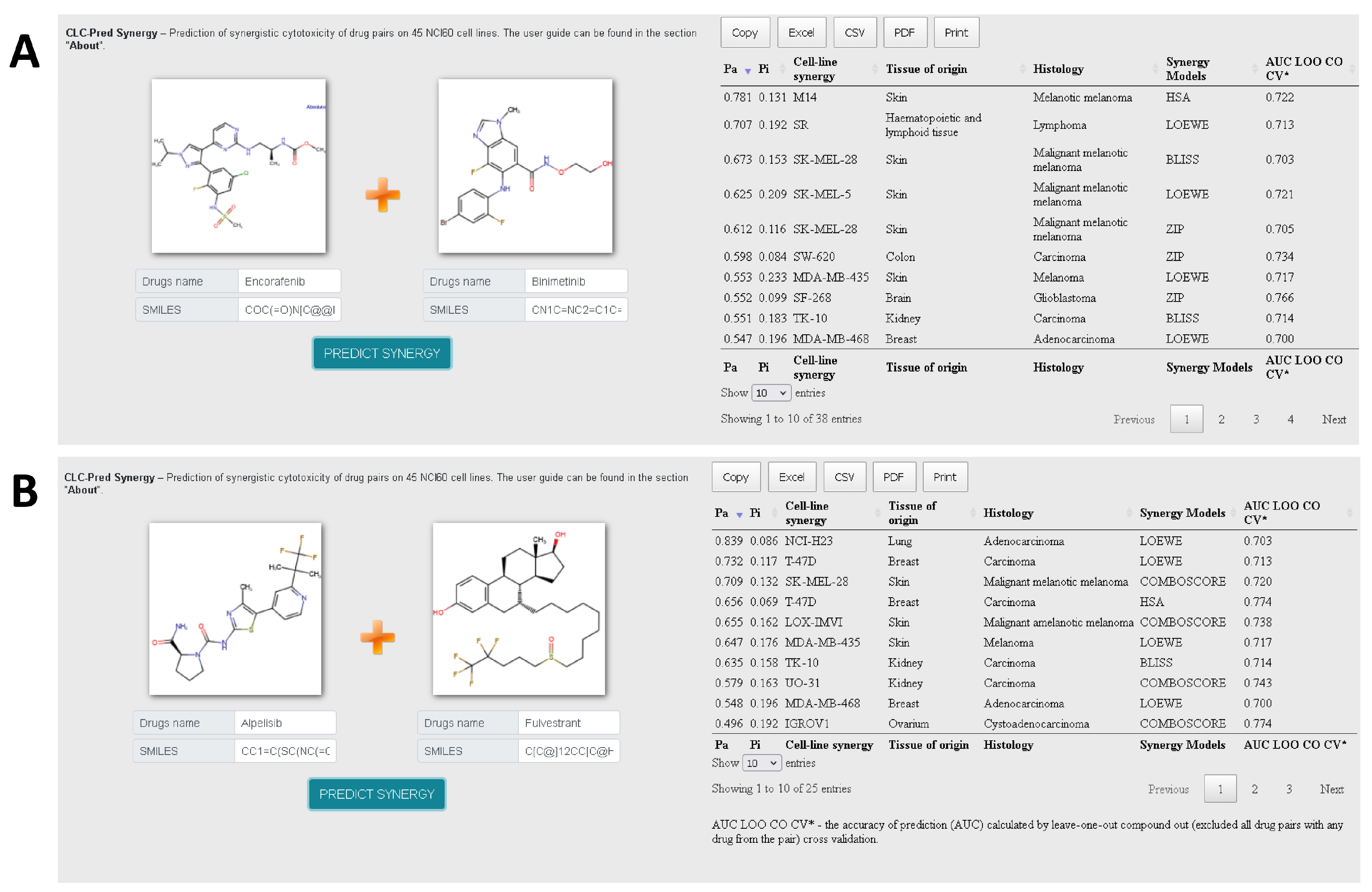
| Alpelisib–Fulvestrant | Breast cancer | 3 | 0.615 | T-47D | HSA, Loewe |
| Capivasertib–Fulvestrant | Breast cancer | 5 | 0.853 | T-47D | HSA, Loewe |
| Neratinib–Capecitabine | Breast cancer | 3 | 0.211 | MDA-MB-468 | Bliss, Loewe, ZIP |
| Palbociclib–Fulvestrant | Breast cancer | 5 | 0.440 | T-47D | HSA, Loewe |
| Palbociclib–Letrozole | Breast cancer | - | −0.096 | - | - |
| Ribociclib–Letrozole | Breast cancer | 1 | 0.150 | BT-549 | HSA |
| Ribociclib–Fulvestrant | Breast cancer | 3 | 0.290 | T-47D | HSA, Loewe |
| Encorafenib–Binimetinib * | Colorectal cancer | 3 | 0.514 | SW-620 | Bliss, HSA, ZIP |
| Belzutifan–Cabozantinib * | Renal cancer | 3 | 0.448 | TK-10 | Bliss, HSA |
| Belzutifan–Lenvatinib * | Renal cancer | 3 | 0.490 | TK-10 | Bliss, HSA |
| Lenvatinib–Everolimus | Renal cancer | 4 | 0.519 | TK-10 | HSA, Loewe, ZIP |
| Dabrafenib–Trametinib * | Lung cancer | - | −0.090 | - | - |
| Encorafenib–Binimetinib * | Lung cancer | 1 | 0.071 | NCI-H23 | Bliss, HSA |
| Avutometinib–Defactinib * | Ovarian cancer | 2 | 0.162 | OVCAR-5 | ComboScore, ZIP |
| Olaparib–Cediranib * | Ovarian cancer | 4 | 0.551 | IGROV1 | ComboScore |
| Paclitaxel–Relacorilant | Ovarian cancer | 6 | 0.970 | OVCAR-5 | ComboScore, ZIP |
| Dabrafenib–Trametinib * | Melanoma | 4 | 0.416 | M14 | HSA |
| Encorafenib–Binimetinib * | Melanoma | 5 | 0.650 | M14 | HSA |
| Vemurafenib–Cobimetinib | Melanoma | 6 | 0.916 | SK-MEL-5 | ComboScore, HSA, Loewe, ZIP |
Disclaimer/Publisher’s Note: The statements, opinions and data contained in all publications are solely those of the individual author(s) and contributor(s) and not of MDPI and/or the editor(s). MDPI and/or the editor(s) disclaim responsibility for any injury to people or property resulting from any ideas, methods, instructions or products referred to in the content. |
© 2026 by the authors. Licensee MDPI, Basel, Switzerland. This article is an open access article distributed under the terms and conditions of the Creative Commons Attribution (CC BY) license.
Share and Cite
Sukhachev, V.S.; Ivanov, S.M.; Rudik, A.V.; Dublin, A.R.; Filimonov, D.A.; Lagunin, A.A.; Poroikov, V.V. CLC-Pred Synergy: Web Application for Predicting Pairwise Drug Combinations with Synergistic Activity Against NCI60 Cancer Cell Lines. Int. J. Mol. Sci. 2026, 27, 5208. https://doi.org/10.3390/ijms27125208
Sukhachev VS, Ivanov SM, Rudik AV, Dublin AR, Filimonov DA, Lagunin AA, Poroikov VV. CLC-Pred Synergy: Web Application for Predicting Pairwise Drug Combinations with Synergistic Activity Against NCI60 Cancer Cell Lines. International Journal of Molecular Sciences. 2026; 27(12):5208. https://doi.org/10.3390/ijms27125208
Chicago/Turabian StyleSukhachev, Vladislav S., Sergey M. Ivanov, Anastasia V. Rudik, Arseny R. Dublin, Dmitry A. Filimonov, Alexey A. Lagunin, and Vladimir V. Poroikov. 2026. "CLC-Pred Synergy: Web Application for Predicting Pairwise Drug Combinations with Synergistic Activity Against NCI60 Cancer Cell Lines" International Journal of Molecular Sciences 27, no. 12: 5208. https://doi.org/10.3390/ijms27125208
APA StyleSukhachev, V. S., Ivanov, S. M., Rudik, A. V., Dublin, A. R., Filimonov, D. A., Lagunin, A. A., & Poroikov, V. V. (2026). CLC-Pred Synergy: Web Application for Predicting Pairwise Drug Combinations with Synergistic Activity Against NCI60 Cancer Cell Lines. International Journal of Molecular Sciences, 27(12), 5208. https://doi.org/10.3390/ijms27125208