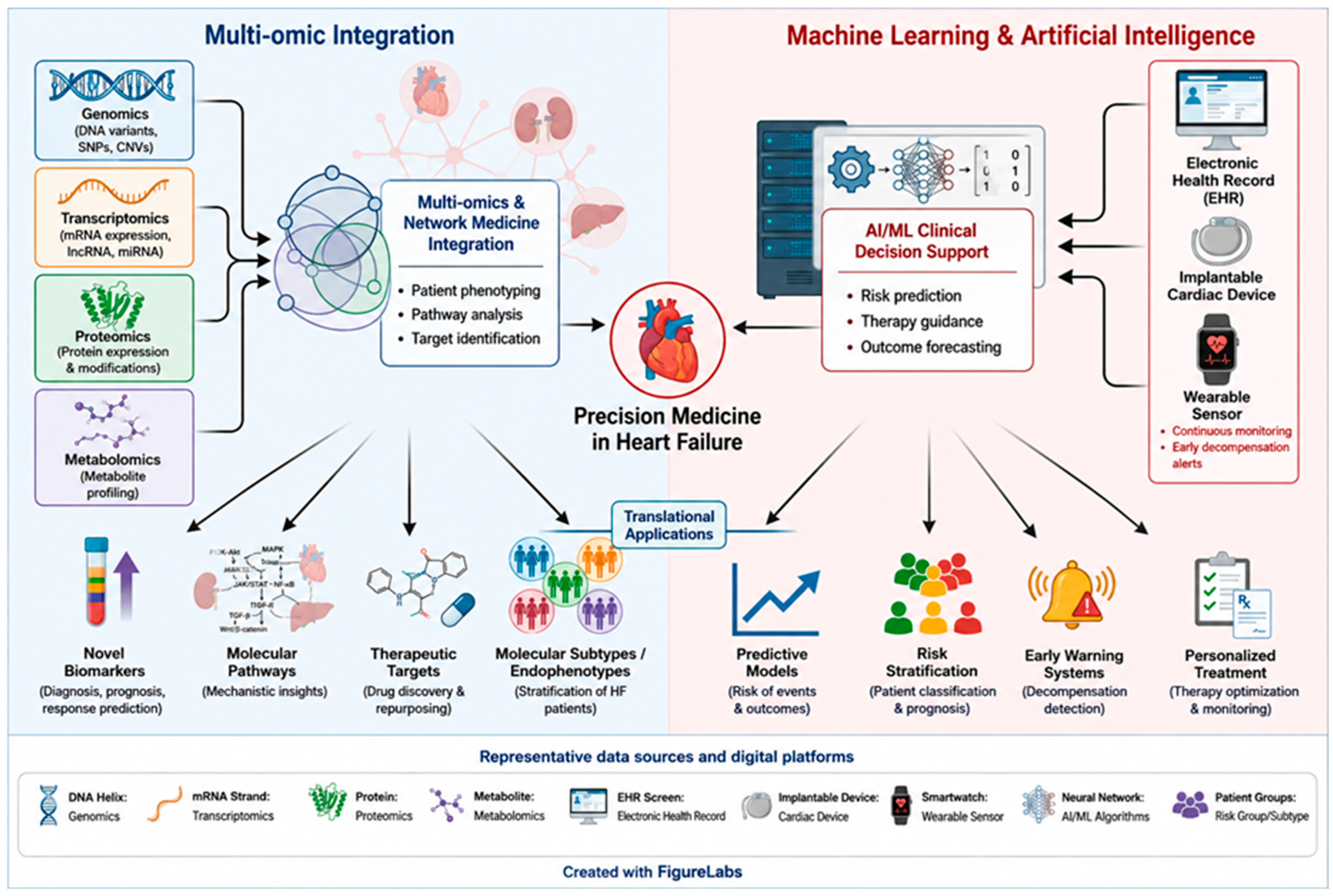
Molecular Mechanisms and Multi-Omics Integration in Heart Failure: From Pathophysiology to Precision Medicine

 , , , , ,
Abstract
1. Introduction
2. Molecular and Cellular Remodelling in Heart Failure
2.1. Neurohormonal–Metabolic Crosstalk
2.2. Inflammation and Endothelial Dysfunction
2.3. Mitochondrial Dysfunction and Energetic Remodelling
2.4. Regulated Cell Death and Maladaptive Remodelling
3. Genomic, Epigenetic, and Transcriptomic Regulation
4. Proteomics and Post-Translational Modifications
5. Metabolomics and Energetic Remodelling
6. Integrated Multi-Omics Signatures and System Biology
7. Translational Targets, Biomarkers, and Precision Medicine
8. Future Directions
9. Conclusions
Author Contributions
Funding
Data Availability Statement
Acknowledgments
Conflicts of Interest
References
- Savarese, G.; Becher, P.M.; Lund, L.H.; Seferovic, P.; Rosano, G.M.C.; Coats, A.J.S. Global Burden of Heart Failure: A Comprehensive and Updated Review of Epidemiology. Cardiovasc. Res. 2023, 118, 3272–3287, Erratum in Cardiovasc. Res. 2023, 119, 1453. [Google Scholar] [CrossRef]
- Metra, M.; Teerlink, J.R. Heart Failure. Lancet 2017, 390, 1981–1995. [Google Scholar] [CrossRef]
- WRITING COMMITTEE MEMBERS. HF STATS 2025: Heart Failure Epidemiology and Outcomes Statistics An Updated 2025 Report from the Heart Failure Society of America. J. Card. Fail. 2026, 32, 439–498. [Google Scholar] [CrossRef]
- Triposkiadis, F.; Briasoulis, A.; Kitai, T.; Magouliotis, D.; Athanasiou, T.; Skoularigis, J.; Xanthopoulos, A. The Sympathetic Nervous System in Heart Failure Revisited. Heart Fail. Rev. 2024, 29, 355–365. [Google Scholar] [CrossRef]
- Heusch, G.; Libby, P.; Gersh, B.; Yellon, D.; Böhm, M.; Lopaschuk, G.; Opie, L. Cardiovascular Remodelling in Coronary Artery Disease and Heart Failure. Lancet 2014, 383, 1933–1943. [Google Scholar] [CrossRef]
- Zhihao, L.; Jingyu, N.; Lan, L.; Michael, S.; Rui, G.; Xiyun, B.; Xiaozhi, L.; Guanwei, F. SERCA2a: A Key Protein in the Ca2+ Cycle of the Heart Failure. Heart Fail. Rev. 2020, 25, 523–535. [Google Scholar] [CrossRef] [PubMed]
- Bertero, E.; Maack, C. Calcium Signaling and Reactive Oxygen Species in Mitochondria. Circ. Res. 2018, 122, 1460–1478. [Google Scholar] [CrossRef]
- Granzier, H.L.; Labeit, S. Discovery of Titin and Its Role in Heart Function and Disease. Circ. Res. 2025, 136, 135–157. [Google Scholar] [CrossRef] [PubMed]
- Fonseka, O.; Gare, S.R.; Chen, X.; Zhang, J.; Alatawi, N.H.; Ross, C.; Liu, W. Molecular Mechanisms Underlying Heart Failure and Their Therapeutic Potential. Cells 2025, 14, 324. [Google Scholar] [CrossRef] [PubMed]
- Chow, S.L.; Maisel, A.S.; Anand, I.; Bozkurt, B.; de Boer, R.A.; Felker, G.M.; Fonarow, G.C.; Greenberg, B.; Januzzi, J.L.; Kiernan, M.S.; et al. Role of Biomarkers for the Prevention, Assessment, and Management of Heart Failure: A Scientific Statement From the American Heart Association. Circulation 2017, 135, e1054–e1091, Erratum in Circulation 2017, 136, 19. [Google Scholar] [CrossRef]
- Schrier, R.W.; Abraham, W.T. Hormones and Hemodynamics in Heart Failure. N. Engl. J. Med. 1999, 341, 577–585. [Google Scholar] [CrossRef]
- Hartupee, J.; Mann, D.L. Neurohormonal Activation in Heart Failure with Reduced Ejection Fraction. Nat. Rev. Cardiol. 2017, 14, 30–38. [Google Scholar] [CrossRef] [PubMed]
- Floras, J.S. Sympathetic Nervous System Activation in Human Heart Failure: Clinical Im-plications of an Updated Model. J. Am. Coll. Cardiol. 2009, 54, 375–385. [Google Scholar] [CrossRef]
- Ronco, C.; Cicoira, M.; McCullough, P.A. Cardiorenal Syndrome Type 1: Pathophysiological Crosstalk Leading to Combined Heart and Kidney Dysfunction in the Setting of Acutely Decompensated Heart Failure. J. Am. Coll. Cardiol. 2012, 60, 1031–1042. [Google Scholar] [CrossRef]
- Tilley, D.G.; Zhu, W.; Myers, V.D.; Barr, L.A.; Gao, E.; Li, X.; Song, J.; Carter, R.L.; Makarewich, C.A.; Yu, D.; et al. β-Adrenergic Receptor-Mediated Cardiac Contractility Is Inhibited via Vasopressin Type 1A-Receptor-Dependent Signaling. Circulation 2014, 130, 1800–1811. [Google Scholar] [CrossRef]
- Vergaro, G.; Aimo, A.; Prontera, C.; Ghionzoli, N.; Arzilli, C.; Zyw, L.; Taddei, C.; Gabutti, A.; Poletti, R.; Giannoni, A.; et al. Sympathetic and Renin-Angiotensin-Aldosterone System Activation in Heart Failure with Preserved, Mid-Range and Reduced Ejection Fraction. Int. J. Cardiol. 2019, 296, 91–97. [Google Scholar] [CrossRef] [PubMed]
- Packer, M. The Adipokine Hypothesis of Heart Failure With a Preserved Ejection Fraction: A Novel Framework to Explain Pathogenesis and Guide Treatment. J. Am. Coll. Cardiol. 2025, 86, 1269–1373. [Google Scholar] [CrossRef]
- Khan, S.S.; Berwanger, O.; Fiuzat, M.; McMurray, J.J.; Narula, J.; Prabhakaran, D.; Sliwa, K.; Tromp, J.; Vaduganathan, M. Prioritising the Primary Prevention of Heart Failure. Lancet 2025, 406, 1138–1153. [Google Scholar] [CrossRef]
- Saotome, M.; Ikoma, T.; Hasan, P.; Maekawa, Y. Cardiac Insulin Resistance in Heart Failure: The Role of Mitochondrial Dynamics. Int. J. Mol. Sci. 2019, 20, 3552. [Google Scholar] [CrossRef] [PubMed]
- Mericskay, M.; Zuurbier, C.J.; Heather, L.C.; Karlstaedt, A.; Inserte, J.; Bertrand, L.; Kararigas, G.; Ruiz-Meana, M.; Maack, C.; Schiattarella, G.G. Cardiac Intermediary Metabolism in Heart Failure: Substrate Use, Signalling Roles and Therapeutic Targets. Nat. Rev. Cardiol. 2025, 22, 704–727. [Google Scholar] [CrossRef]
- Razvi, S.; Jabbar, A.; Pingitore, A.; Danzi, S.; Biondi, B.; Klein, I.; Peeters, R.; Zaman, A.; Iervasi, G. Thyroid Hormones and Cardiovascular Function and Diseases. J. Am. Coll. Cardiol. 2018, 71, 1781–1796. [Google Scholar] [CrossRef]
- Marra, A.M.; D’Assante, R.; De Luca, M.; Arcopinto, M.; Gargiulo, P.; Valente, V.; Crisci, G.; Rainone, C.; Modestino, M.; Giardino, F.; et al. Growth Hormone Replacement Therapy in Heart Failure With Reduced Ejection Fraction: A Randomized, Double-Blind, Placebo-Controlled Trial. JACC Heart Fail 2025, 13, 602–614. [Google Scholar] [CrossRef] [PubMed]
- Ebong, I.A.; Appiah, D.; Mauricio, R.; Narang, N.; Honigberg, M.C.; Ilonze, O.J.; Aggarwal, N.R.; Zanni, M.V.; Mohammed, S.F.; Cho, L.; et al. Sex Hormones and Heart Failure Risk. JACC Adv. 2025, 4, 101650. [Google Scholar] [CrossRef]
- Violi, F.; Castellani, V.; Menichelli, D.; Pignatelli, P.; Pastori, D. Gut Barrier Dysfunction and Endotoxemia in Heart Failure: A Dangerous Connubium? Am. Heart J. 2023, 264, 40–48. [Google Scholar] [CrossRef] [PubMed]
- Miao, K.; Zhou, L.; Ba, H.; Li, C.; Gu, H.; Yin, B.; Wang, J.; Yang, X.-P.; Li, Z.; Wang, D.W. Transmembrane Tumor Necrosis Factor Alpha Attenuates Pressure-Overload Cardiac Hypertrophy via Tumor Necrosis Factor Receptor 2. PLoS Biol. 2020, 18, e3000967. [Google Scholar] [CrossRef]
- Toldo, S.; Abbate, A. The Role of the NLRP3 Inflammasome and Pyroptosis in Cardiovascular Diseases. Nat. Rev. Cardiol. 2024, 21, 219–237. [Google Scholar] [CrossRef]
- Cheng, X.; Zhao, H.; Wen, X.; Li, G.; Guo, S.; Zhang, D. NLRP3-Inflammasome Inhibition by MCC950 Attenuates Cardiac and Pulmonary Artery Remodelling in Heart Failure with Preserved Ejection Fraction. Life Sci. 2023, 333, 122185. [Google Scholar] [CrossRef]
- Shrestha, S.; Dick, S.A. Cardiac Macrophages Across Space and Time: Roles in Homeostasis, Disease, and Remodeling. Can. J. Cardiol. 2026. [Google Scholar] [CrossRef]
- Dunlay, S.M.; Givertz, M.M.; Aguilar, D.; Allen, L.A.; Chan, M.; Desai, A.S.; Deswal, A.; Dickson, V.V.; Kosiborod, M.N.; Lekavich, C.L.; et al. Type 2 Diabetes Mellitus and Heart Failure: A Scientific Statement From the American Heart Association and the Heart Failure Society of America: This Statement Does Not Represent an Update of the 2017 ACC/AHA/HFSA Heart Failure Guideline Update. Circulation 2019, 140, e294–e324, Reeatum in Circulation 2019, 140, e692. [Google Scholar] [CrossRef]
- Murphy, S.P.; Kakkar, R.; McCarthy, C.P.; Januzzi, J.L. Inflammation in Heart Failure: JACC State-of-the-Art Review. J. Am. Coll. Cardiol. 2020, 75, 1324–1340. [Google Scholar] [CrossRef] [PubMed]
- Srikanth, S.; DeVito, L.; Constantinesco, N.J.; Gopal, R. The Role of Chemokines and Their Receptors in Cardiovascular Diseases. Front. Immunol. 2026, 17, 1758588. [Google Scholar] [CrossRef]
- Dusi, V.; Ghidoni, A.; Ravera, A.; De Ferrari, G.M.; Calvillo, L. Chemokines and Heart Disease: A Network Connecting Cardiovascular Biology to Immune and Autonomic Nervous Systems. Mediat. Inflamm. 2016, 2016, 5902947, Erratum in Mediat. Inflamm. 2018, 2018, 4128049. [Google Scholar] [CrossRef]
- Zhang, H.; Yang, K.; Chen, F.; Liu, Q.; Ni, J.; Cao, W.; Hua, Y.; He, F.; Liu, Z.; Li, L.; et al. Role of the CCL2-CCR2 Axis in Cardiovascular Disease: Pathogenesis and Clinical Implications. Front. Immunol. 2022, 13, 975367. [Google Scholar] [CrossRef]
- Hanna, A.; Frangogiannis, N.G. Inflammatory Cytokines and Chemokines as Therapeutic Targets in Heart Failure. Cardiovasc. Drugs Ther. 2020, 34, 849–863. [Google Scholar] [CrossRef]
- van den Borne, P.; Quax, P.H.A.; Hoefer, I.E.; Pasterkamp, G. The Multifaceted Functions of CXCL10 in Cardiovascular Disease. Biomed. Res. Int. 2014, 2014, 893106. [Google Scholar] [CrossRef]
- Szklarczyk, D.; Nastou, K.; Koutrouli, M.; Kirsch, R.; Mehryary, F.; Hachilif, R.; Hu, D.; Peluso, M.E.; Huang, Q.; Fang, T.; et al. The STRING Database in 2025: Protein Networks with Directionality of Regulation. Nucleic Acids Res. 2025, 53, D730–D737. [Google Scholar] [CrossRef] [PubMed]
- Paulus, W.J.; Tschöpe, C. A Novel Paradigm for Heart Failure with Preserved Ejection Fraction: Comorbidities Drive Myocardial Dysfunction and Remodeling through Coronary Microvascular Endothelial Inflammation. J. Am. Coll. Cardiol. 2013, 62, 263–271. [Google Scholar] [CrossRef] [PubMed]
- Münzel, T.; Camici, G.G.; Maack, C.; Bonetti, N.R.; Fuster, V.; Kovacic, J.C. Impact of Oxidative Stress on the Heart and Vasculature: Part 2 of a 3-Part Series. J. Am. Coll. Cardiol. 2017, 70, 212–229. [Google Scholar] [CrossRef] [PubMed]
- Borlaug, B.A.; Sharma, K.; Shah, S.J.; Ho, J.E. Heart Failure With Preserved Ejection Fraction: JACC Scientific Statement. J. Am. Coll. Cardiol. 2023, 81, 1810–1834. [Google Scholar] [CrossRef]
- Hulshoff, M.S.; Xu, X.; Krenning, G.; Zeisberg, E.M. Epigenetic Regulation of Endothelial-to-Mesenchymal Transition in Chronic Heart Disease. Arterioscler. Thromb. Vasc. Biol. 2018, 38, 1986–1996. [Google Scholar] [CrossRef]
- Murdoch, C.E.; Chaubey, S.; Zeng, L.; Yu, B.; Ivetic, A.; Walker, S.J.; Vanhoutte, D.; Heymans, S.; Grieve, D.J.; Cave, A.C.; et al. Endothelial NADPH Oxidase-2 Promotes Interstitial Cardiac Fibrosis and Diastolic Dysfunction through Proinflammatory Effects and Endothelial-Mesenchymal Transition. J. Am. Coll. Cardiol. 2014, 63, 2734–2741. [Google Scholar] [CrossRef] [PubMed]
- Charfeddine, S.; Hbaieb, M.A.; Laribi, N.; Jabeur, M.; Bahloul, A.; Jarraya, M.; Gargouri, H.; Ghrab, A.; Triki, Z.; Ellouze, T.; et al. Endothelial Function: A Novel Marker to Evaluate the Prognosis of Heart Failure with Reduced Ejection Fraction. Am. J. Physiol. Heart Circ. Physiol. 2026, 330, H1065–H1072. [Google Scholar] [CrossRef]
- Hinton, A.; Claypool, S.M.; Neikirk, K.; Senoo, N.; Wanjalla, C.N.; Kirabo, A.; Williams, C.R. Mitochondrial Structure and Function in Human Heart Failure. Circ. Res. 2024, 135, 372–396. [Google Scholar] [CrossRef]
- Del Re, D.P.; Amgalan, D.; Linkermann, A.; Liu, Q.; Kitsis, R.N. Fundamental Mechanisms of Regulated Cell Death and Implications for Heart Disease. Physiol. Rev. 2019, 99, 1765–1817. [Google Scholar] [CrossRef] [PubMed]
- Sheng, S.-Y.; Li, J.-M.; Hu, X.-Y.; Wang, Y. Regulated Cell Death Pathways in Cardiomyopathy. Acta Pharmacol. Sin. 2023, 44, 1521–1535. [Google Scholar] [CrossRef] [PubMed]
- Ye, M.; Feng, S.; Xu, Z.; He, W.; Liu, C.; Zhu, W. Aging and Metabolism in HFpEF: Pathophysiology and Therapeutic Implications. Metabolism 2026, 176, 156460. [Google Scholar] [CrossRef]
- Yoshii, A.; McMillen, T.S.; Wang, Y.; Zhou, B.; Chen, H.; Banerjee, D.; Herrero, M.; Wang, P.; Muraoka, N.; Wang, W.; et al. Blunted Cardiac Mitophagy in Response to Metabolic Stress Contributes to HFpEF. Circ. Res. 2024, 135, 1004–1017, Erratum in Circ. Res. 2024, 135, e154. [Google Scholar] [CrossRef]
- Tromp, J.; Westenbrink, B.D.; Ouwerkerk, W.; van Veldhuisen, D.J.; Samani, N.J.; Ponikowski, P.; Metra, M.; Anker, S.D.; Cleland, J.G.; Dickstein, K.; et al. Identifying Pathophysiological Mechanisms in Heart Failure With Reduced Versus Preserved Ejection Fraction. J. Am. Coll. Cardiol. 2018, 72, 1081–1090. [Google Scholar] [CrossRef]
- Guo, X.; Chen, Y.; Liu, Q. Necroptosis in Heart Disease: Molecular Mechanisms and Therapeutic Implications. J. Mol. Cell Cardiol. 2022, 169, 74–83. [Google Scholar] [CrossRef]
- Jarabicová, I.; Horváth, C.; Hrdlička, J.; Boroš, A.; Olejníčková, V.; Zábrodská, E.; Hubáčková, S.Š.; Šutovská, H.M.; Molčan, Ľ.; Kopkan, L.; et al. Necrosis-like Cell Death Modes in Heart Failure: The Influence of Aetiology and the Effects of RIP3 Inhibition. Basic. Res. Cardiol. 2025, 120, 373–392. [Google Scholar] [CrossRef]
- Zhu, H.; Sun, A. Programmed Necrosis in Heart Disease: Molecular Mechanisms and Clinical Implications. J. Mol. Cell Cardiol. 2018, 116, 125–134. [Google Scholar] [CrossRef]
- Takemura, G.; Kanamori, H.; Okada, H.; Miyazaki, N.; Watanabe, T.; Tsujimoto, A.; Goto, K.; Maruyama, R.; Fujiwara, T.; Fujiwara, H. Anti-Apoptosis in Nonmyocytes and pro-Autophagy in Cardiomyocytes: Two Strategies against Postinfarction Heart Failure through Regulation of Cell Death/Degeneration. Heart Fail. Rev. 2018, 23, 759–772. [Google Scholar] [CrossRef] [PubMed]
- Karampinos, K.I.; Farmakis, D.; Gurung, R.; Foo, R.S.Y.; Filippatos, G.S.; Cokkinos, D.V. Ferroptosis in Heart Failure: From Molecular Insights to Therapeutic Implications. Cardiovasc. Res. 2026, 122, 313–335. [Google Scholar] [CrossRef]
- Chen, Y.; Guo, X.; Zeng, Y.; Mo, X.; Hong, S.; He, H.; Li, J.; Steinmetz, R.; Liu, Q. Ferroptosis Contributes to Catecholamine-Induced Cardiotoxicity and Pathological Remodeling. Free Radic. Biol. Med. 2023, 207, 227–238. [Google Scholar] [CrossRef]
- Fang, X.; Wang, H.; Han, D.; Xie, E.; Yang, X.; Wei, J.; Gu, S.; Gao, F.; Zhu, N.; Yin, X.; et al. Ferroptosis as a Target for Protection against Cardiomyopathy. Proc. Natl. Acad. Sci. USA 2019, 116, 2672–2680. [Google Scholar] [CrossRef]
- Zhao, Y.; Linkermann, A.; Takahashi, M.; Li, Q.; Zhou, X. Ferroptosis in Cardiovascular Disease: Regulatory Mechanisms and Therapeutic Implications. Eur. Heart J. 2025, 46, 3247–3260. [Google Scholar] [CrossRef] [PubMed]
- Fang, X.; Cai, Z.; Wang, H.; Han, D.; Cheng, Q.; Zhang, P.; Gao, F.; Yu, Y.; Song, Z.; Wu, Q.; et al. Loss of Cardiac Ferritin H Facilitates Cardiomyopathy via Slc7a11-Mediated Ferroptosis. Circ. Res. 2020, 127, 486–501. [Google Scholar] [CrossRef] [PubMed]
- Wu, J.; Dong, E.; Zhang, Y.; Xiao, H. The Role of the Inflammasome in Heart Failure. Front. Physiol. 2021, 12, 709703. [Google Scholar] [CrossRef]
- Gao, Y.; Shi, H.; Dong, Z.; Zhang, F.; Sun, A.; Ge, J. Current Knowledge of Pyroptosis in Heart Diseases. J. Mol. Cell Cardiol. 2022, 171, 81–89. [Google Scholar] [CrossRef]
- Habimana, O.; Modupe Salami, O.; Peng, J.; Yi, G.-H. Therapeutic Implications of Targeting Pyroptosis in Cardiac-Related Etiology of Heart Failure. Biochem. Pharmacol. 2022, 204, 115235. [Google Scholar] [CrossRef]
- Zeng, C.; Duan, F.; Hu, J.; Luo, B.; Huang, B.; Lou, X.; Sun, X.; Li, H.; Zhang, X.; Yin, S.; et al. NLRP3 Inflammasome-Mediated Pyroptosis Contributes to the Pathogenesis of Non-Ischemic Dilated Cardiomyopathy. Redox Biol. 2020, 34, 101523. [Google Scholar] [CrossRef]
- Chen, X.; Xu, S.; Zhao, C.; Liu, B. Role of TLR4/NADPH Oxidase 4 Pathway in Promoting Cell Death through Autophagy and Ferroptosis during Heart Failure. Biochem. Biophys. Res. Commun. 2019, 516, 37–43. [Google Scholar] [CrossRef]
- Lee, D.S.M.; Cardone, K.M.; Zhang, D.Y.; Tsao, N.L.; Abramowitz, S.; Sharma, P.; DePaolo, J.S.; Conery, M.; Aragam, K.G.; Biddinger, K.; et al. Common-Variant and Rare-Variant Genetic Architecture of Heart Failure across the Allele-Frequency Spectrum. Nat. Genet. 2025, 57, 829–838, Erratum in Nat. Genet. 2025, 57, 3201. [Google Scholar] [CrossRef]
- Levin, M.G.; Tsao, N.L.; Singhal, P.; Liu, C.; Vy, H.M.T.; Paranjpe, I.; Backman, J.D.; Bellomo, T.R.; Bone, W.P.; Biddinger, K.J.; et al. Genome-Wide Association and Multi-Trait Analyses Characterize the Common Genetic Architecture of Heart Failure. Nat. Commun. 2022, 13, 6914. [Google Scholar] [CrossRef]
- Rasooly, D.; Peloso, G.M.; Pereira, A.C.; Dashti, H.; Giambartolomei, C.; Wheeler, E.; Aung, N.; Ferolito, B.R.; Pietzner, M.; Farber-Eger, E.H.; et al. Genome-Wide Association Analysis and Mendelian Randomization Proteomics Identify Drug Targets for Heart Failure. Nat. Commun. 2023, 14, 3826. [Google Scholar] [CrossRef]
- Patel, A.P.; Dron, J.S.; Wang, M.; Pirruccello, J.P.; Ng, K.; Natarajan, P.; Lebo, M.; Ellinor, P.T.; Aragam, K.G.; Khera, A.V. Association of Pathogenic DNA Variants Predisposing to Cardiomyopathy With Cardiovascular Disease Outcomes and All-Cause Mortality. JAMA Cardiol. 2022, 7, 723–732. [Google Scholar] [CrossRef] [PubMed]
- Haller, P.M.; Melloni, G.E.M.; Berg, D.D.; Kamanu, F.K.; Lai, Y.-P.; Antman, E.M.; Bhatt, D.L.; Bonaca, M.P.; Cannon, C.P.; Giugliano, R.P.; et al. A Polygenic Risk Score to Predict Incident Heart Failure Across the Spectrum of Cardiovascular Risk. J. Am. Coll. Cardiol. 2025, 86, 860–873. [Google Scholar] [CrossRef] [PubMed]
- Enzan, N.; Miyazawa, K.; Koyama, S.; Kurosawa, R.; Ieki, H.; Yoshida, H.; Takechi, F.; Fukuyama, M.; Osako, R.; Tomizuka, K.; et al. Genome-Wide Analysis of Heart Failure Yields Insights into Disease Heterogeneity and Enables Prognostic Prediction in the Japanese Population. Nat. Commun. 2025, 16, 9680. [Google Scholar] [CrossRef] [PubMed]
- Cresci, S.; Pereira, N.L.; Ahmad, F.; Byku, M.; de las Fuentes, L.; Lanfear, D.E.; Reilly, C.M.; Owens, A.T.; Wolf, M.J. Heart Failure in the Era of Precision Medicine: A Scientific Statement From the American Heart Association. Circ. Genom. Precis. Med. 2019, 12, 458–485. [Google Scholar] [CrossRef]
- Cardone, K.M.; Kim, D.; Ritchie, M.D. Integrating Polygenic Scores with Clinical, Lifestyle, and Social Risk Factors to Improve Heart Failure Risk Prediction. Pac. Symp. Biocomput. 2026, 31, 629–643. [Google Scholar] [CrossRef]
- Landstrom, A.P.; Ferguson, J.F.; James, C.A.; Key, K.V.; Lanfear, D.; Natarajan, P.; Rasmussen-Torvik, L.J.; Reza, N.; Roden, D.M.; Tsao, P.S.; et al. Genetic and Genomic Testing in Cardiovascular Disease: A Policy Statement From the American Heart Association. Circulation 2025, 152, e474–e489. [Google Scholar] [CrossRef] [PubMed]
- Pepin, M.E.; Drakos, S.; Ha, C.-M.; Tristani-Firouzi, M.; Selzman, C.H.; Fang, J.C.; Wende, A.R.; Wever-Pinzon, O. DNA Methylation Reprograms Cardiac Metabolic Gene Expression in End-Stage Human Heart Failure. Am. J. Physiol. Heart Circ. Physiol. 2019, 317, H674–H684. [Google Scholar] [CrossRef]
- Flowers, B.; Duric, B. Metabolic-Epigenetic Interactions in Heart Failure: Current Understanding and Future Directions. Biochem. Biophys. Res. Commun. 2025, 783, 152608. [Google Scholar] [CrossRef] [PubMed]
- Lahue, C.; Wong, E.; Dalal, A.; Tan Lek Wen, W.; Ren, S.; Foo, R.; Wang, Y.; Rau, C.D. Mapping DNA Methylation to Cardiac Pathologies Induced by Beta-Adrenergic Stimulation in a Large Panel of Mice. Epigenetics 2025, 20, 2524411. [Google Scholar] [CrossRef]
- Liao, X.; Kennel, P.J.; Liu, B.; Nash, T.R.; Zhuang, R.Z.; Godier-Furnemont, A.F.; Xue, C.; Lu, R.; Colombo, P.C.; Uriel, N.; et al. Effect of Mechanical Unloading on Genome-Wide DNA Methylation Profile of the Failing Human Heart. JCI Insight 2023, 8, e161788. [Google Scholar] [CrossRef]
- El-Osta, A. Current Opinion in Cardiology, Epigenetics of Heart Failure. Curr. Opin. Cardiol. 2026, 41, 129–137. [Google Scholar] [CrossRef]
- Napoli, C.; Bontempo, P.; Palmieri, V.; Coscioni, E.; Maiello, C.; Donatelli, F.; Benincasa, G. Epigenetic Therapies for Heart Failure: Current Insights and Future Potential. Vasc. Health Risk Manag. 2021, 17, 247–254. [Google Scholar] [CrossRef]
- Jeong, M.Y.; Lin, Y.H.; Wennersten, S.A.; Demos-Davies, K.M.; Cavasin, M.A.; Mahaffey, J.H.; Monzani, V.; Saripalli, C.; Mascagni, P.; Reece, T.B.; et al. Histone Deacetylase Activity Governs Diastolic Dysfunction through a Nongenomic Mechanism. Sci. Transl. Med. 2018, 10, eaao0144. [Google Scholar] [CrossRef]
- Ren, Z.; Zhao, W.; Li, D.; Yu, P.; Mao, L.; Zhao, Q.; Yao, L.; Zhang, X.; Liu, Y.; Zhou, B.; et al. INO80-Dependent Remodeling of Transcriptional Regulatory Network Underlies the Progression of Heart Failure. Circulation 2024, 149, 1121–1138, Erratum in Circulation 2024, 149, 14. [Google Scholar] [CrossRef] [PubMed]
- Feng, Y.; Cai, L.; Hong, W.; Zhang, C.; Tan, N.; Wang, M.; Wang, C.; Liu, F.; Wang, X.; Ma, J.; et al. Rewiring of 3D Chromatin Topology Orchestrates Transcriptional Reprogramming and the Development of Human Dilated Cardiomyopathy. Circulation 2022, 145, 1663–1683. [Google Scholar] [CrossRef]
- Tanno, M.; Kuno, A.; Yano, T.; Miura, T.; Hisahara, S.; Ishikawa, S.; Shimamoto, K.; Horio, Y. Emerging beneficial roles of sirtuins in heart failure. Basic Res. Cardiol. 2012, 107, 273. [Google Scholar] [CrossRef]
- Gholaminejad, A.; Zare, N.; Dana, N.; Shafie, D.; Mani, A.; Javanmard, S.H. A Meta-Analysis of microRNA Expression Profiling Studies in Heart Failure. Heart Fail. Rev. 2021, 26, 997–1021. [Google Scholar] [CrossRef]
- Barwari, T.; Joshi, A.; Mayr, M. MicroRNAs in Cardiovascular Disease. J. Am. Coll. Cardiol. 2016, 68, 2577–2584. [Google Scholar] [CrossRef]
- Paim, L.R.; da Silva, L.M.; Antunes-Correa, L.M.; Ribeiro, V.C.; Schreiber, R.; Minin, E.O.Z.; Bueno, L.C.M.; Lopes, E.C.P.; Yamaguti, R.; Coy-Canguçu, A.; et al. Profile of Serum microRNAs in Heart Failure with Reduced and Preserved Ejection Fraction: Correlation with Myocardial Remodeling. Heliyon 2024, 10, e27206. [Google Scholar] [CrossRef]
- Braunwald, E. The War against Heart Failure: The Lancet Lecture. Lancet 2015, 385, 812–824. [Google Scholar] [CrossRef]
- Das, S.; Shah, R.; Dimmeler, S.; Freedman, J.E.; Holley, C.; Lee, J.-M.; Moore, K.; Musunuru, K.; Wang, D.-Z.; Xiao, J.; et al. Noncoding RNAs in Cardiovascular Disease: Current Knowledge, Tools and Technologies for Investigation, and Future Directions: A Scientific Statement From the American Heart Association. Circ. Genom. Precis Med. 2020, 13, e000062. [Google Scholar] [CrossRef]
- Gomes, C.P.C.; Schroen, B.; Kuster, G.M.; Robinson, E.L.; Ford, K.; Squire, I.B.; Heymans, S.; Martelli, F.; Emanueli, C.; Devaux, Y.; et al. Regulatory RNAs in Heart Failure. Circulation 2020, 141, 313–328. [Google Scholar] [CrossRef]
- Ren, Y.; Zhao, B.; Lv, L.; Yang, J.; Nan, X.; Li, B.; Yang, B. Non-Coding RNAs in Heart Failure: Epigenetic Regulatory Mechanisms and Therapeutic Potential. Front. Genet. 2025, 16, 1677797, Erratum in. Front. Genet. 2025, 16, 2025. [Google Scholar] [CrossRef] [PubMed]
- Fumarulo, I.; De Prisco, A.; Salerno, E.N.M.; Ravenna, S.E.; Vaccarella, M.; Garramone, B.; Burzotta, F.; Aspromonte, N. New Frontiers of microRNA in Heart Failure: From Clinical Risk to Therapeutic Applications. J. Clin. Med. 2025, 14, 6361. [Google Scholar] [CrossRef] [PubMed]
- Adamo, L.; Yu, J.; Rocha-Resende, C.; Javaheri, A.; Head, R.D.; Mann, D.L. Proteomic Signatures of Heart Failure in Relation to Left Ventricular Ejection Fraction. J. Am. Coll. Cardiol. 2020, 76, 1982–1994. [Google Scholar] [CrossRef] [PubMed]
- Andrzejczyk, K.; Abou Kamar, S.; van Ommen, A.-M.; Canto, E.D.; Petersen, T.B.; Valstar, G.; Akkerhuis, K.M.; Cramer, M.J.; Umans, V.; Rutten, F.H.; et al. Identifying Plasma Proteomic Signatures from Health to Heart Failure, across the Ejection Fraction Spectrum. Sci. Rep. 2024, 14, 14871. [Google Scholar] [CrossRef] [PubMed]
- Jani, V.P.; Yoo, E.J.; Binek, A.; Guo, A.; Kim, J.S.; Aguilan, J.; Keykhaei, M.; Jenkin, S.R.; Sidoli, S.; Sharma, K.; et al. Myocardial Proteome in Human Heart Failure With Preserved Ejection Fraction. J. Am. Heart Assoc. 2025, 14, e038945. [Google Scholar] [CrossRef] [PubMed]
- Soetkamp, D.; Gallet, R.; Parker, S.J.; Holewinski, R.; Venkatraman, V.; Peck, K.; Goldhaber, J.I.; Marbán, E.; Van Eyk, J.E. Myofilament Phosphorylation in Stem Cell Treated Diastolic Heart Failure. Circ. Res. 2021, 129, 1125–1140. [Google Scholar] [CrossRef]
- Ravichandran, V.S.; Patel, H.J.; Pagani, F.D.; Westfall, M.V. Cardiac Contractile Dysfunction and Protein Kinase C-Mediated Myofilament Phosphorylation in Disease and Aging. J. Gen. Physiol. 2019, 151, 1070–1080. [Google Scholar] [CrossRef]
- Bers, D.M. Altered Cardiac Myocyte Ca Regulation in Heart Failure. Physiology 2006, 21, 380–387. [Google Scholar] [CrossRef]
- Liu, X.; Zhang, Y.; Deng, Y.; Yang, L.; Ou, W.; Xie, M.; Ding, L.; Jiang, C.; Yu, H.; Li, Q.; et al. Mitochondrial Protein Hyperacetylation Underpins Heart Failure with Preserved Ejection Fraction in Mice. J. Mol. Cell Cardiol. 2022, 165, 76–85. [Google Scholar] [CrossRef]
- Wang, Y.; Guo, D.; Zhu, J.; Yang, X.; Wu, C.; Geng, J.; Liang, Q.; Sun, N.; Niu, X.; Liu, Y.; et al. Pyruvate Metabolism Enzyme Dlat Induces Mitochondria Protein Hyperacetylation to Limit Fatty Acid Oxidation in the HFpEF Heart. Nat. Commun. 2026, 17, 3929. [Google Scholar] [CrossRef]
- Hu, Y.; Zheng, Y.; Liu, C.; You, Y.; Wu, Y.; Wang, P.; Wu, Y.; Ba, H.; Lu, J.; Yuan, Y.; et al. Mitochondrial MOF Regulates Energy Metabolism in Heart Failure via ATP5B Hyperacetylation. Cell Rep. 2024, 43, 114839. [Google Scholar] [CrossRef] [PubMed]
- Stewart, J.E.; Crawford, J.M.; Mullen, W.E.; Jacques, A.; Stoner, M.W.; Scott, I.; Thapa, D. Cardiomyocyte-Specific Deletion of GCN5L1 Reduces Lysine Acetylation and Attenuates Diastolic Dysfunction in Aged Mice by Improving Cardiac Fatty Acid Oxidation. Biochem. J. 2024, 481, 423–436. [Google Scholar] [CrossRef]
- Weissman, D.; Maack, C. Redox Signaling in Heart Failure and Therapeutic Implications. Free Radic. Biol. Med. 2021, 171, 345–364. [Google Scholar] [CrossRef]
- Burgoyne, J.R.; Mongue-Din, H.; Eaton, P.; Shah, A.M. Redox Signaling in Cardiac Physiol-ogy and Pathology. Circ. Res. 2012, 111, 1091–1106. [Google Scholar] [CrossRef]
- Lopaschuk, G.D.; Karwi, Q.G.; Tian, R.; Wende, A.R.; Abel, E.D. Cardiac Energy Metabolism in Heart Failure. Circ. Res. 2021, 128, 1487–1513. [Google Scholar] [CrossRef]
- Pietrangelo, D.; Lopa, C.; Litterio, M.; Cotugno, M.; Rubattu, S.; Lombardi, A. Metabolic Disturbances Involved in Cardiovascular Diseases: The Role of Mitochondrial Dysfunction, Altered Bioenergetics and Oxidative Stress. Int. J. Mol. Sci. 2025, 26, 6791. [Google Scholar] [CrossRef]
- Murphy, E.; Ardehali, H.; Balaban, R.S.; DiLisa, F.; Dorn, G.W.; Kitsis, R.N.; Otsu, K.; Ping, P.; Rizzuto, R.; Sack, M.N.; et al. Mitochondrial Function, Biology, and Role in Disease: A Scientific Statement From the American Heart Association. Circ. Res. 2016, 118, 1960–1991. [Google Scholar] [CrossRef]
- Doenst, T.; Nguyen, T.D.; Abel, E.D. Cardiac Metabolism in Heart Failure: Implications Beyond ATP Production. Circ. Res. 2013, 113, 709–724. [Google Scholar] [CrossRef]
- Zhang, X.; Wang, D.; Liu, J.; Zhang, D.; Wang, C. Untargeted-Targeted Metabolomics: Energy Metabolism Characteristics in Heart Failure Staging and Discovery of Novel Biomarkers. J. Transl. Med. 2026, 24, 259. [Google Scholar] [CrossRef]
- Rodolico, D.; Schiattarella, G.G.; Taegtmeyer, H. The Lure of Cardiac Metabolism in the Diagnosis, Prevention, and Treatment of Heart Failure. JACC Heart Fail. 2023, 11, 637–645. [Google Scholar] [CrossRef]
- Bayes-Genis, A.; Liu, P.P.; Lanfear, D.E.; de Boer, R.A.; González, A.; Thum, T.; Emdin, M.; Januzzi, J.L. Omics Phenotyping in Heart Failure: The next Frontier. Eur. Heart J. 2020, 41, 3477–3484. [Google Scholar] [CrossRef] [PubMed]
- Liang, L.W.; Shimada, Y.J. Endotyping in Heart Failure—Identifying Mechanistically Meaningful Subtypes of Disease. Circ. J. 2021, 85, 1407–1415. [Google Scholar] [CrossRef] [PubMed]
- Kim, T.; Sheen, M.; Ryan, D.; Joseph, J. Addressing Unmet Needs in Heart Failure with Preserved Ejection Fraction: Multi-Omics Approaches to Therapeutic Discovery. Int. J. Mol. Sci. 2026, 27, 673. [Google Scholar] [CrossRef] [PubMed]
- Olsen, C.R.; Mentz, R.J.; Anstrom, K.J.; Page, D.; Patel, P.A. Clinical Applications of Machine Learning in the Diagnosis, Classification, and Prediction of Heart Failure. Am. Heart J. 2020, 229, 1–17. [Google Scholar] [CrossRef]
- Bazoukis, G.; Stavrakis, S.; Zhou, J.; Bollepalli, S.C.; Tse, G.; Zhang, Q.; Singh, J.P.; Armoundas, A.A. Machine Learning versus Conventional Clinical Methods in Guiding Management of Heart Failure Patients-a Systematic Review. Heart Fail. Rev. 2021, 26, 23–34. [Google Scholar] [CrossRef]
- Saha, S.; Ross, H.; Velmovitsky, P.E.; Wang, C.X.; Vishram-Nielsen, J.K.K.; Manlhiot, C.; Wang, B.; Cafazzo, J.A. Machine Learning Enhanced Expert System for Detecting Heart Failure Decompensation Using Patient Reported Vitals and Electronic Health Records. Sci. Rep. 2025, 15, 30979. [Google Scholar] [CrossRef]
- Maddox, T.M.; Januzzi, J.L.; Allen, L.A.; Breathett, K.; Brouse, S.; Butler, J.; Davis, L.L.; Fonarow, G.C.; Ibrahim, N.E.; Lindenfeld, J.; et al. 2024 ACC Expert Consensus Decision Pathway for Treatment of Heart Failure With Reduced Ejection Fraction: A Report of the American College of Cardiology Solution Set Oversight Committee. J. Am. Coll. Cardiol. 2024, 83, 1444–1488. [Google Scholar] [CrossRef]
- van Essen, B.J.; Tharshana, G.N.; Ouwerkerk, W.; Yeo, P.S.D.; Sim, D.; Jaufeerally, F.; Ong, H.Y.; Ling, L.H.; Soon, D.K.N.; Lee, S.G.S.; et al. Distinguishing Heart Failure with Reduced Ejection Fraction from Heart Failure with Preserved Ejection Fraction: A Phenomics Approach. Eur. J. Heart Fail. 2024, 26, 841–850. [Google Scholar] [CrossRef] [PubMed]
- Joseph, J.; Liu, C.; Hui, Q.; Aragam, K.; Wang, Z.; Charest, B.; Huffman, J.E.; Keaton, J.M.; Edwards, T.L.; Demissie, S.; et al. Genetic Architecture of Heart Failure with Preserved versus Reduced Ejection Fraction. Nat. Commun. 2022, 13, 7753. [Google Scholar] [CrossRef] [PubMed]
- Ouwerkerk, W.; Belo Pereira, J.P.; Maasland, T.; Emmens, J.E.; Figarska, S.M.; Tromp, J.; Koekemoer, A.L.; Nelson, C.P.; Nath, M.; Romaine, S.P.R.; et al. Multiomics Analysis Provides Novel Pathways Related to Progression of Heart Failure. J. Am. Coll. Cardiol. 2023, 82, 1921–1931. [Google Scholar] [CrossRef]
- Sotomi, Y.; Matsuoka, Y.; Ebert, C.; Wang, Z.; Ohtani, T.; Kammerhoff, K.; Liu, L.; Schafer, P.; Chang, C.-P.; Gordon, D.; et al. Subphenogroups of Acute Heart Failure with Preserved Ejection Fraction: Comprehensive Proteomics and Pathway Analysis. Heart 2026, 112, 504–513. [Google Scholar] [CrossRef]
- Li, R.; Liu, Y.; Zhao, Z.; Zhang, C.; Dong, W.; Qi, Y.; Gao, J.; Gu, F.; Carlson, B.E.; Beard, D.A.; et al. Machine Learning-Based Phenotyping and Assessment of Treatment Responses in Heart Failure with Preserved Ejection Fraction. EClinicalMedicine 2025, 88, 103462. [Google Scholar] [CrossRef]
- Gao, L.; Zhang, G.; Kang, K.; Xu, L.; Zhang, W.; Chi, C.; Zhu, E.; Sheheryar, T.; Lv, B.; Xie, B. Heart Failure with Preserved Ejection Fraction (HFpEF): Translational Mechanisms, Diagnostic Evolution and Therapeutic Frontiers. Diabetes Res. Clin. Pract. 2026, 232, 113116. [Google Scholar] [CrossRef]
- Versnjak, J.; Kuehne, T.; Fahjen, P.; Jovanovic, N.; Löber, U.; Schiattarella, G.G.; Wilck, N.; Gerhardt, H.; Müller, D.N.; Edelmann, F.; et al. Deep Phenotyping of Heart Failure with Preserved Ejection Fraction through Multi-Omics Integration. Eur. J. Heart Fail. 2025, 27, 3243–3259. [Google Scholar] [CrossRef]
- Longo, S.; Mollace, R.; Casagrande, V.; Bucciarelli, L.; Martelli, E.; Menghini, R.; Fernández-Real, J.M.; Federici, M. Glycometabolic Cardiac Dysfunction in HFpEF: Lessons from Multi-Omics Studies. Pharmacol. Res. 2025, 222, 108032. [Google Scholar] [CrossRef]
- Summer, G.; Kuhn, A.R.; Munts, C.; Miranda-Silva, D.; Leite-Moreira, A.F.; Lourenço, A.P.; Heymans, S.; Falcão-Pires, I.; van Bilsen, M. A Directed Network Analysis of the Cardiome Identifies Molecular Pathways Contributing to the Development of HFpEF. J. Mol. Cell Cardiol. 2020, 144, 66–75. [Google Scholar] [CrossRef] [PubMed]
- Henry, A.; Gordillo-Marañón, M.; Finan, C.; Schmidt, A.F.; Ferreira, J.P.; Karra, R.; Sundström, J.; Lind, L.; Ärnlöv, J.; Zannad, F.; et al. Therapeutic Targets for Heart Failure Identified Using Proteomics and Mendelian Randomization. Circulation 2022, 145, 1205–1217. [Google Scholar] [CrossRef]
- Huang, C.-H.; Yang, T.-T.; Lin, K.-I. Mechanisms and Functions of SUMOylation in Health and Disease: A Review Focusing on Immune Cells. J. Biomed. Sci. 2024, 31, 16. [Google Scholar] [CrossRef]
- Celen, A.B.; Sahin, U. Sumoylation on Its 25th Anniversary: Mechanisms, Pathology, and Emerging Concepts. FEBS J. 2020, 287, 3110–3140. [Google Scholar] [CrossRef]
- Rasooly, D.; Giambartolomei, C.; Peloso, G.M.; Dashti, H.; Ferolito, B.R.; Golden, D.; Horimoto, A.R.V.R.; Pietzner, M.; Farber-Eger, E.H.; Wells, Q.S.; et al. Large-Scale Multi-Omics Identifies Drug Targets for Heart Failure with Reduced and Preserved Ejection Fraction. Nat. Cardiovasc. Res. 2025, 4, 293–311. [Google Scholar] [CrossRef]
- Yu, Y.-D.; Xue, Y.-T.; Li, Y. Identification and Verification of Feature Biomarkers Associated in Heart Failure by Bioinformatics Analysis. Sci. Rep. 2023, 13, 3488. [Google Scholar] [CrossRef] [PubMed]
- Aboumsallem, J.P.; Shi, C.; De Wit, S.; Markousis-Mavrogenis, G.; Bracun, V.; Eijgenraam, T.R.; Hoes, M.F.; Meijers, W.C.; Screever, E.M.; Schouten, M.E.; et al. Multi-Omics Analyses Identify Molecular Signatures with Prognostic Values in Different Heart Failure Aetiologies. J. Mol. Cell Cardiol. 2023, 175, 13–28. [Google Scholar] [CrossRef]
- Chadwick, J.; Hinterberg, M.A.; Asselbergs, F.W.; Biegel, H.; Boersma, E.; Cappola, T.P.; Chirinos, J.A.; Coresh, J.; Ganz, P.; Gordon, D.A.; et al. Harnessing the Plasma Proteome to Predict Mortality in Heart Failure Subpopulations. Circ. Heart Fail. 2025, 18, e011208. [Google Scholar] [CrossRef] [PubMed]
- Khera, R.; Oikonomou, E.K.; Nadkarni, G.N.; Morley, J.R.; Wiens, J.; Butte, A.J.; Topol, E.J. Transforming Cardiovascular Care With Artificial Intelligence: From Discovery to Practice: JACC State-of-the-Art Review. J. Am. Coll. Cardiol. 2024, 84, 97–114. [Google Scholar] [CrossRef]
- Lteif, C.; Huang, Y.; Guerra, L.A.; Gawronski, B.E.; Duarte, J.D. Using Omics to Identify Novel Therapeutic Targets in Heart Failure. Circ. Genom. Precis. Med. 2024, 17, e004398. [Google Scholar] [CrossRef]
- Licordari, R.; Correale, M.; Bonanno, S.; Beltrami, M.; Ciccarelli, M.; Micari, A.; Palazzuoli, A.; Dattilo, G. Beyond Natriuretic Peptides: Unveiling the Power of Emerging Biomarkers in Heart Failure. Biomolecules 2024, 14, 309. [Google Scholar] [CrossRef]
- Lee, S.E.; Joo, J.H.; Hwang, H.S.; Chen, S.-F.; Evans, D.; Lee, K.Y.; Kim, K.-H.; Hyun, J.; Kim, M.-S.; Jung, S.-H.; et al. Spatial Transcriptional Landscape of Human Heart Failure. Eur. Heart J. 2025, 46, 3098–3114. [Google Scholar] [CrossRef]
- Cheng, X.; Manandhar, I.; Aryal, S.; Joe, B. Application of Artificial Intelligence in Cardiovascular Medicine. Compr. Physiol. 2021, 11, 2455–2466. [Google Scholar] [CrossRef]
- Ranka, S.; Reddy, M.; Noheria, A. Artificial Intelligence in Cardiovascular Medicine. Curr. Opin. Cardiol. 2021, 36, 26–35. [Google Scholar] [CrossRef]
- Elias, P.; Jain, S.S.; Poterucha, T.; Randazzo, M.; Lopez Jimenez, F.; Khera, R.; Perez, M.; Ouyang, D.; Pirruccello, J.; Salerno, M.; et al. Artificial Intelligence for Cardiovascular Care-Part 1: Advances: JACC Review Topic of the Week. J. Am. Coll. Cardiol. 2024, 83, 2472–2486. [Google Scholar] [CrossRef]
- Lin, M.; Guo, J.; Gu, Z.; Tang, W.; Tao, H.; You, S.; Jia, D.; Sun, Y.; Jia, P. Machine Learning and Multi-Omics Integration: Advancing Cardiovascular Translational Research and Clinical Practice. J. Transl. Med. 2025, 23, 388. [Google Scholar] [CrossRef] [PubMed]
- Van den Eynde, J.; Lachmann, M.; Laugwitz, K.-L.; Manlhiot, C.; Kutty, S. Successfully Implemented Artificial Intelligence and Machine Learning Applications in Cardiology: State-of-the-Art Review. Trends. Cardiovasc. Med. 2023, 33, 265–271. [Google Scholar] [CrossRef] [PubMed]
- Gill, S.K.; Karwath, A.; Uh, H.-W.; Cardoso, V.R.; Gu, Z.; Barsky, A.; Slater, L.; Acharjee, A.; Duan, J.; Dall’Olio, L.; et al. Artificial Intelligence to Enhance Clinical Value across the Spectrum of Cardiovascular Healthcare. Eur. Heart J. 2023, 44, 713–725. [Google Scholar] [CrossRef] [PubMed]



| Category | Regulator | Type | Mechanism of Action | Functional Impact in Heart Failure | Therapeutic Potential |
|---|---|---|---|---|---|
| Genetic variants (common) | GWAS loci (e.g., PRKAG2, ANKS1A, MOSPD3) | SNPs | Polygenic modulation of gene expression and pathways | Influence susceptibility, progression, and clinical heterogeneity | Polygenic risk scores (PRs) for risk stratification |
| Genetic variants (rare) | TTN, MYBPC3, FLNC, BAG3 | Loss-of-function mutations | Structural and sarcomeric dysfunction | High-impact drivers of cardiomyopathy and HF | Genetic screening, family stratification |
| DNA methylation | CpG loci (56 identified) | Epigenetic modification | Promoter hyper-/hypomethylation | Suppression of oxidative metabolism; activation of glycolysis | DNMT inhibitors (e.g., RG108) |
| Histone acetylation | p300/CBP | Histone acetyltransferases | Acetylation of transcription factors (MEF2, GATA4) | Drives pathological hypertrophy | Targetable with small-molecule inhibitors |
| Histone deacetylation | HDACs | Epigenetic enzymes | Removal of acetyl groups from histones | Promotes maladaptive remodeling | HDAC inhibitors (e.g., Givinostat) |
| Chromatin readers | BRD4 (BET family) | Acetyl-lysine readers | Enhancer activation and transcriptional amplification | Sustains hypertrophic and fibrotic programs | BET inhibitors (e.g., apabetalone) |
| Chromatin remodeling | INO80 complex | Remodeling complex | Alters nucleosome positioning and TF accessibility | Rapid induction or reversal of HF phenotype | Emerging therapeutic target |
| 3D chromatin structure | H3K27ac enhancer loops, HAND1 | Epigenomic architecture | Rewiring of enhancer-promoter interactions | Drives transcriptional reprogramming in DCM | Targeting enhancer regulation (experimental) |
| microRNAs | miR-21, miR-133, miR-1, miR-208 | Small ncRNAs | Post-transcriptional gene silencing | Regulate hypertrophy, fibrosis, contractility | Antagomirs (e.g., anti-miR-25, anti-miR-208a) |
| lncRNAs | Mhrt, Chast, Chaer, LIPCAR | Long ncRNAs | Chromatin interaction and transcriptional control | Modulate hypertrophy, autophagy, remodeling | RNA-targeted therapies, biomarkers |
| circRNAs | Multiple (miRNA sponges) | Circular ncRNAs | miRNA sequestration | Fine-tune gene regulatory networks | Stable biomarkers; delivery platforms |
| Metabolic-epigenetic mediators | Acetyl-CoA, NAD+, α-ketoglutarate | Metabolites | Cofactors for epigenetic enzymes | Link metabolism to chromatin state | Metabolic modulation strategies |
| Metabolic Pathway | Representative Metabolites | Direction of Change in Heart Failure | Biological Interpretation | Clinical/Biomarker Relevance |
|---|---|---|---|---|
| Fatty acid metabolism (β-oxidation) | Long-chain acylcarnitines (C16, C18), free fatty acids | ↑ acylcarnitines, ↓ efficient FA oxidation | Incomplete β-oxidation due to mitochondrial dysfunction | Associated with disease severity and adverse prognosis |
| Glucose metabolism/Glycolysis | Glucose, lactate, pyruvate | ↑ lactate, ↑ glycolytic intermediates | Shift toward glycolysis and reduced oxidative glucose metabolism | Reflects energetic stress and impaired perfusion |
| Tricarboxylic acid (TCA) cycle | Succinate, fumarate, malate, citrate | ↑ circulating intermediates | Mitochondrial dysfunction with metabolite overflow and impaired oxidative metabolism | Succinate linked to hypoxia, inflammation, worse outcomes |
| Ketone body metabolism | β-hydroxybutyrate, acetoacetate | ↑ ketone bodies | Compensatory increase in ketone utilization as alternative fuel | Correlates with disease stage and metabolic adaptation |
| Amino acid metabolism | Branched-chain amino acids (leucine, isoleucine, valine), glutamine, glycine | ↑ BCAAs, altered AA profiles | Impaired BCAA catabolism and altered nitrogen balance | Predictive of insulin resistance and HF progression |
| Redox and oxidative stress pathways | NAD+/NADH ratio, glutathione (GSH/GSSG) | ↓ NAD+ availability, ↑ oxidative stress markers | Redox imbalance contributing to metabolic and contractile dysfunction | Associated with mitochondrial failure and prognosis |
| Lipid signaling and membrane metabolism | Ceramides, sphingomyelins, phosphatidylcholines | ↑ ceramides, altered phospholipid composition | Lipotoxicity and pro-inflammatory signaling | Strongly linked to mortality risk |
| Purine metabolism | Hypoxanthine, xanthine, uric acid | ↑ purine degradation products | Increased ATP breakdown and energetic stress | Marker of severe energetic impairment |
| Pathophysiological Pathway/Molecular Domain | Main Biological Signal | Representative Biomarkers/Omics Readouts | Therapeutic Implications | Validation/Development Status | Main Barriers to Clinical Implementation | Specific Actionable Targets (Genes/Proteins) | Clinical Indications/Patient Subgroups | Multi-omics/AI Evidence Source & Key Findings |
|---|---|---|---|---|---|---|---|---|
| Cardiac Energy Metabolism | Fatty acid oxidation ↑, Glucose utilization ↓, Mitochondrial dysfunction, NAD+ depletion | ACADVL, CPT1B, PPARα; NAD+, Acetyl-CoA, acylcarnitines; lactate; TCA intermediates (metabolomics) | Enhance metabolic flexibility; stimulate mitochondrial biogenesis; novel metabolic modulators | Advanced clinical validation (Metabolomics signatures replicated in multiple cohorts and linked to outcomes) | Limited phenotype specificity; inter-omic biological variability; assay standardization; HF population heterogeneity | PPARα, PGC-1α, AMPK, SIRT3, ACADVL, CPT1B | HFrEF, HFpEF with metabolic impairment; exercise intolerance, insulin resistance | Metabolomics + transcriptomics; AI identifies metabolic endophenotypes and predicts response to metabolic modulators |
| Inflammation and Immune Activation | IL-6, TNF-α, CRP ↑, NLRP3 inflammasome activation, immune cell infiltration | CRP, Galectin-3, ST2; IL-6, TNF-α, IL-1β; immune cell signatures (transcriptomics, proteomics) | Anti-inflammatory therapies; NLRP3 inhibitors; immune modulation; IL-1β pathway targeting | Early clinical investigation (Prospective studies and trials ongoing) | Biological heterogeneity; need for longitudinal validation; lack of patient-stratified biomarkers | NLRP3, IL1B, IL6, TNFRSF1A, TGFBR1, ST2L (IL1RL1) | HFrEF with systemic inflammation; HFpEF with immune activation; post-infection HF | Transcriptomics + proteomics; network analysis reveals immune-inflammatory endotypes and fibrosis risk |
| Fibrosis and Extracellular Matrix Remodelling | TGF-β activation, Collagen deposition ↑, Myofibroblast activation | Galectin-3, PIIINP, MMPs, TIMP-1; miR-21, miR-29; collagen turnover markers (proteomics, epigenomics) | Antifibrotic therapies; TGF-β pathway inhibitors; ECM modulation; RAS/MRA blockade optimization | Phase I/II clinical evaluation (Biomarkers tested in small clinical trials) | Lack of antifibrotic drug end-point outcome benefit; standardization of fibrosis assessment | TGFBR1, CTGF, MMP2/MMP9, COL1A1, LOX | HFrEF and HFpEF with structural remodelling; diastolic dysfunction | Proteomics + metabolomics + imaging; AI models fibrosis trajectories and predict response to therapies |
| Oxidative Stress and Redox Imbalance | ROS production ↑, Antioxidant defenses ↓, Protein oxidation, Lipid peroxidation | 8-OHdG, 4-HNE, MDA; Nrf2 pathway components; oxidized proteins (proteomics, metabolomics) | Antifibrotic strategies; Nrf2 activators; redox balancing; mitochondrial protection | Early clinical investigation (Preliminary clinical evidence) | Non-specificity of biomarkers, fluctuation with acute events; analytical variability | NFE2L2 (Nrf2), SOD2, GPX4, PRDXs | HF with oxidative stress phenotype; ischemic and diabetic cardiomyopathy | Metabolomics + proteomics; AI improves prediction of oxidative stress-related outcomes |
| Epigenetic and Chromatin Remodelling | DNA methylation changes, Histone modifications, miRNA dysregulation, Chromatin remodelling | DNA methylation patterns; Histone marks (H3K27ac, H3K9me3); miR-34a, miR-133 (epigenomics) | Epigenetic drugs (HDAC, DNMT inhibitors); miRNA therapeutics; chromatin modulators | Preclinical evidence (Validation in experimental models and pilot studies) | Tissue accessibility; lack of standardization of epigenomic assays; long-term safety | DNMT1, HDAC1/2/3, EZH2, KDM6A, miR-34a, miR-133a | HFrEF and HFpEF with adverse remodelling; therapy-resistant phenotypes | Epigenomics + transcriptomics; AI identifies epigenetic endotypes and predicts therapeutic response |
| Cell Death Pathways (Apoptosis, Necroptosis, Pyroptosis, Ferroptosis) | Caspase activation; MLKL pathway; Inflammasome activation; iron-dependent lipid peroxidation | BAX, caspases, MLKL, GPX4, iron, GSH; transcriptomic signatures (proteomics, metabolomics) | Inhibitors of apoptosis/necroptosis/ferroptosis; iron chelators; anti-inflammatory strategies | Preclinical evidence (Experimental models; early human data limited) | Complexity of pathways; need for specific and safe inhibitors | BAX, CASP3/8/9, MLKL, GPX4, FTH1, ACSL4 | HFrEF with cell death phenotype; post-MI remodelling; advanced HF | Proteomics + metabolomics + transcriptomics; AI links cell death signatures with outcomes |
| AI and Systems Integration | Multi-omic integration, Network modelling, Predictive algorithms, Digital phenotyping | Multi-omic signatures; Imaging + omics; Wearable/device data (omics + digital) | Precision medicine; risk prediction; personalized therapy optimization | Phase I/II clinical evaluation (Pilot studies and prototypes) | Data privacy issues; need for large, high-quality datasets; model interpretability | Multi-gene/protein signatures, network hubs; composite risk scores | All HF phenotypes; risk prediction, prognosis, therapy personalization | AI/ML + multi-omics improves prediction, patient stratification, and clinical decision support |
| Therapeutic Targets (Pharmacogenomics and Precision Therapy) | Genetic variants, Drug response pathways, Molecular target expression | Pharmacogenomic markers; Drug targets (SGLT2, ARNI, MR, neprilysin); Polygenic risk scores (genomics, proteomics) | Drug selection; response prediction; combination therapies; precision prescribing | Advanced clinical validation (Targets in clinical use; ongoing trials for new targets) | Cost; accessibility; implementation in routine practice; healthcare disparities | SLC5A2 (SGLT2), NPR1/3 (ARNI), NR3C2 (MR), ACE2, neprilysin | HF patients selected by genetic/omics profile; responders vs non-responders | Integrative genomics + proteomics + clinical data; AI predicts drug response and adverse events |
Disclaimer/Publisher’s Note: The statements, opinions and data contained in all publications are solely those of the individual author(s) and contributor(s) and not of MDPI and/or the editor(s). MDPI and/or the editor(s) disclaim responsibility for any injury to people or property resulting from any ideas, methods, instructions or products referred to in the content. |
© 2026 by the authors. Licensee MDPI, Basel, Switzerland. This article is an open access article distributed under the terms and conditions of the Creative Commons Attribution (CC BY) license.
Share and Cite
Maida, C.D.; Pacinella, G.; Daidone, M.; Bona, M.M.; Scaglione, S.; Malfitano, R.; Norrito, R.; Cassataro, G.; Dell’Ajra, L.; Ferrantelli, S.; et al. Molecular Mechanisms and Multi-Omics Integration in Heart Failure: From Pathophysiology to Precision Medicine. Int. J. Mol. Sci. 2026, 27, 4814. https://doi.org/10.3390/ijms27114814
Maida CD, Pacinella G, Daidone M, Bona MM, Scaglione S, Malfitano R, Norrito R, Cassataro G, Dell’Ajra L, Ferrantelli S, et al. Molecular Mechanisms and Multi-Omics Integration in Heart Failure: From Pathophysiology to Precision Medicine. International Journal of Molecular Sciences. 2026; 27(11):4814. https://doi.org/10.3390/ijms27114814
Chicago/Turabian StyleMaida, Carlo Domenico, Gaetano Pacinella, Mario Daidone, Mariarita Margherita Bona, Stefania Scaglione, Rachele Malfitano, Rosario Norrito, Giuliano Cassataro, Luigi Dell’Ajra, Sergio Ferrantelli, and et al. 2026. "Molecular Mechanisms and Multi-Omics Integration in Heart Failure: From Pathophysiology to Precision Medicine" International Journal of Molecular Sciences 27, no. 11: 4814. https://doi.org/10.3390/ijms27114814
APA StyleMaida, C. D., Pacinella, G., Daidone, M., Bona, M. M., Scaglione, S., Malfitano, R., Norrito, R., Cassataro, G., Dell’Ajra, L., Ferrantelli, S., Vassallo, G. A., & Tuttolomondo, A. (2026). Molecular Mechanisms and Multi-Omics Integration in Heart Failure: From Pathophysiology to Precision Medicine. International Journal of Molecular Sciences, 27(11), 4814. https://doi.org/10.3390/ijms27114814