Ocular Surface Inflammation as a Driver of Cornea Limbal Stem Cell Deficiency: Mechanisms and Implications


Abstract
1. Introduction
2. Understanding Ocular Surface Inflammation
3. Understanding Limbal Stem Cells and Limbal Stem Cell Deficiency
3.1. Role of Limbal Stem Cells (LSCs)
3.2. Markers of Limbal Stem Cells of the Cornea

| Marker | Expression Pattern | Functional Relevance | Limitation/Notes | Reference |
|---|---|---|---|---|
| ΔNp63α(p63) | Nuclei of limbal basal cells | Maintains proliferative potential | Not fully specific to LSCs | [14] |
| ABCG2 | Limbal basal cells | Associated with colony-forming efficiency | Also expressed in other stem-like cells | [33] |
| ABCB5 | Limbal epithelium | Corneal epithelial development and repair | Proposed LSC marker | [34] |
| K15 | Basal cells of limbus & conjunctiva | Helps distinguish limbal phenotype | Absent in central cornea | [36] |
| N-Cadherin | Putative LSCs, melanocytes | Maintains progenitor phenotype | Niche-associated marker | [27] |
| Pax6 | Corneal epithelial lineage | Lineage specification; aniridia-associated LSCD | Not LSC-specific | [38] |
| Sox9 | Limbal stem/progenitor cells | Regulates asymmetric cell fate | Emerging marker | [39] |
| GPHA2 | Limbal crypt cells | Enriched in quiescent LSC population | Recently identified | [40] |
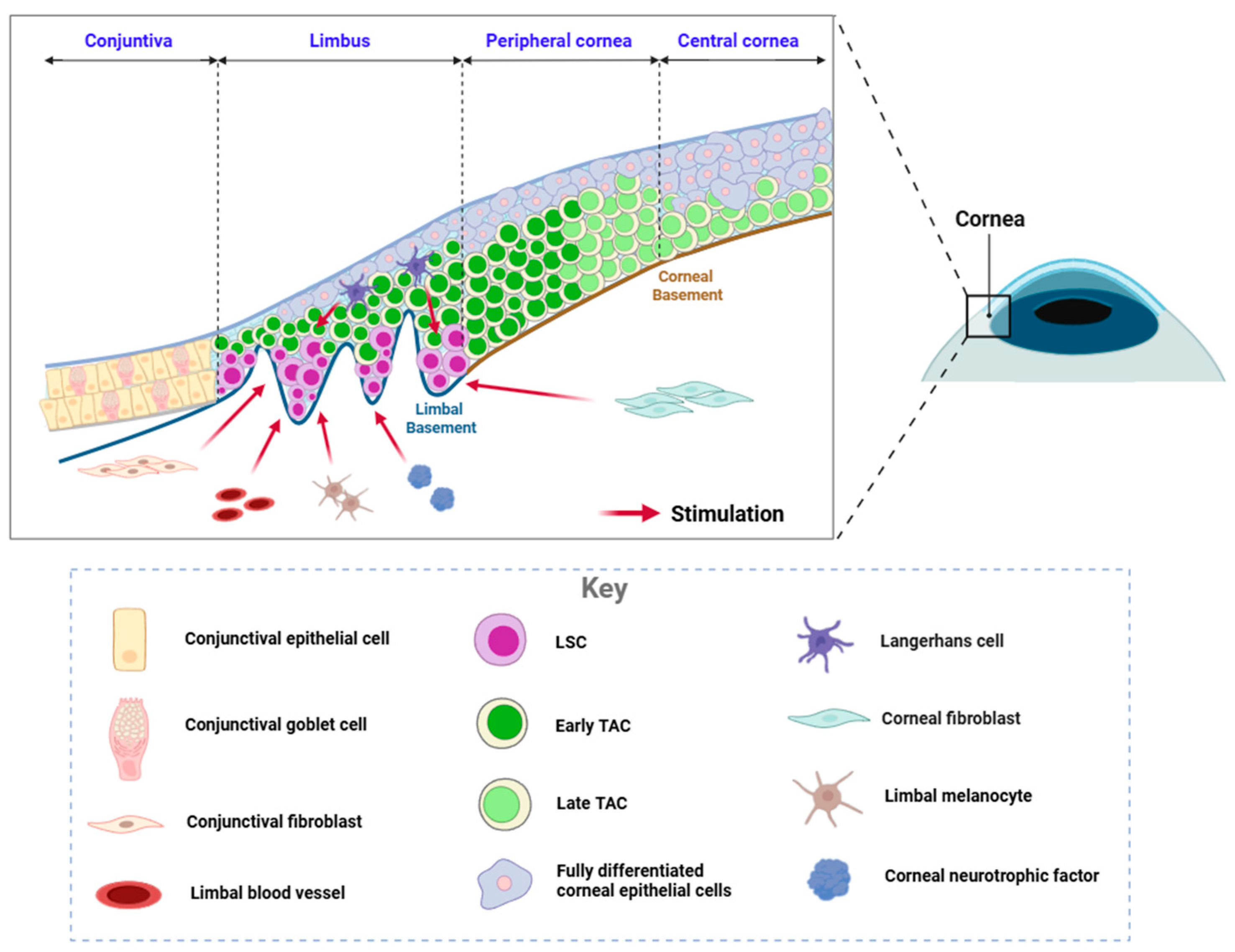
3.3. Transit Amplifying Cells (Tac)
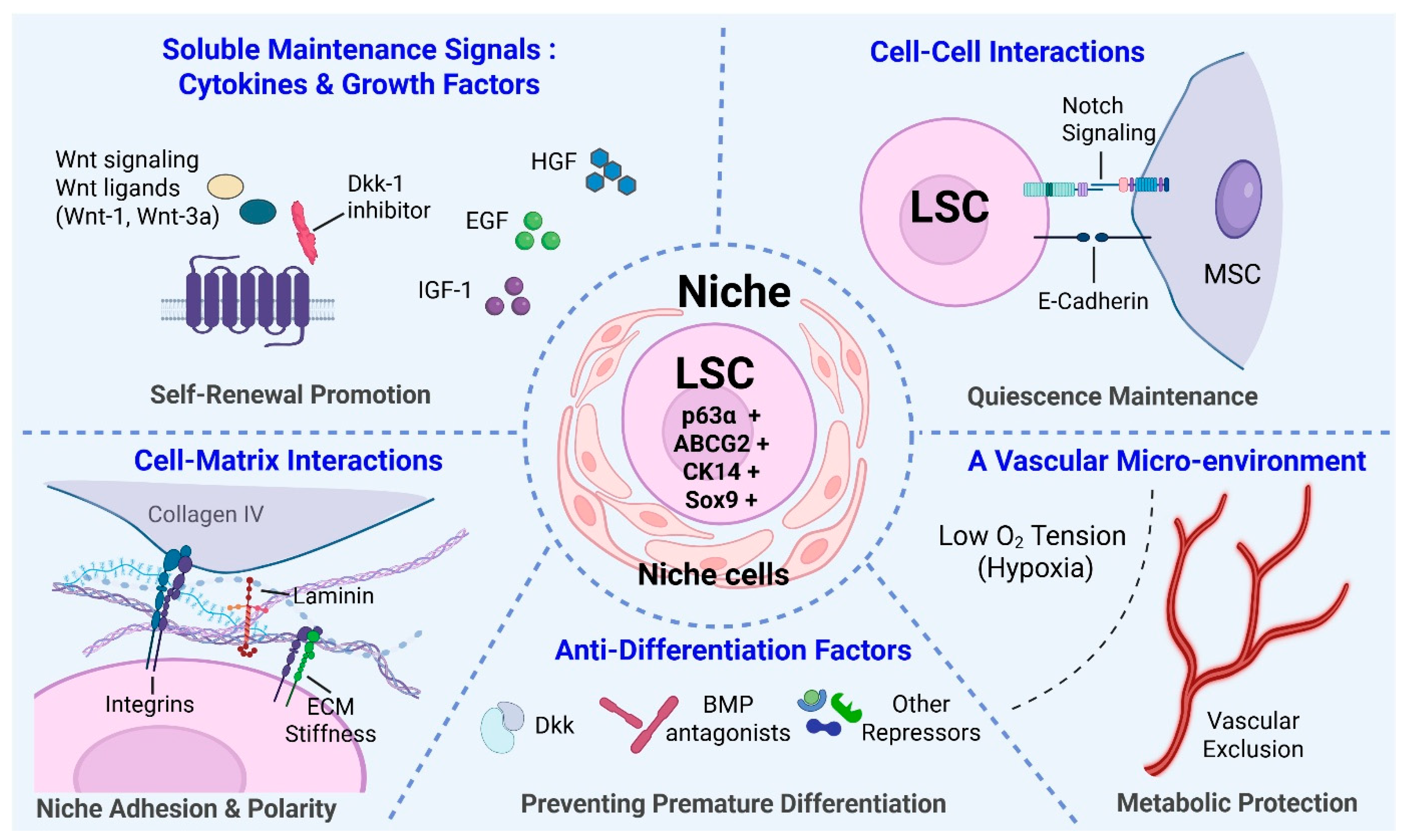
3.4. Factors Maintaining Limbal Stem Cell Survival
3.5. Characteristics of Limbal Stem Cell Deficiency
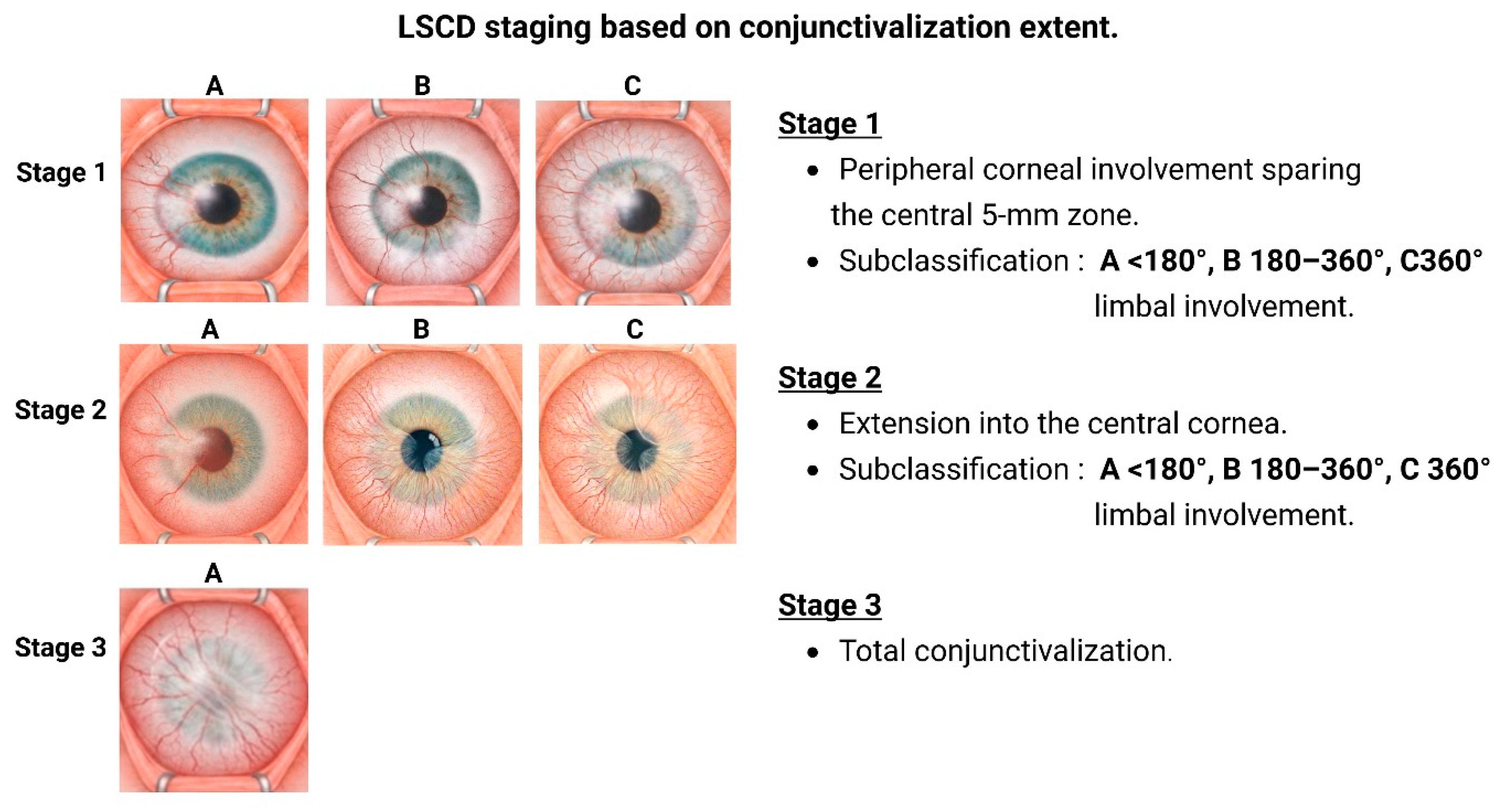
3.6. Classification and Staging of Limbal Stem Cell Deficiency
4. Differentiation Between LSC Depletion and LSC Dysfunction
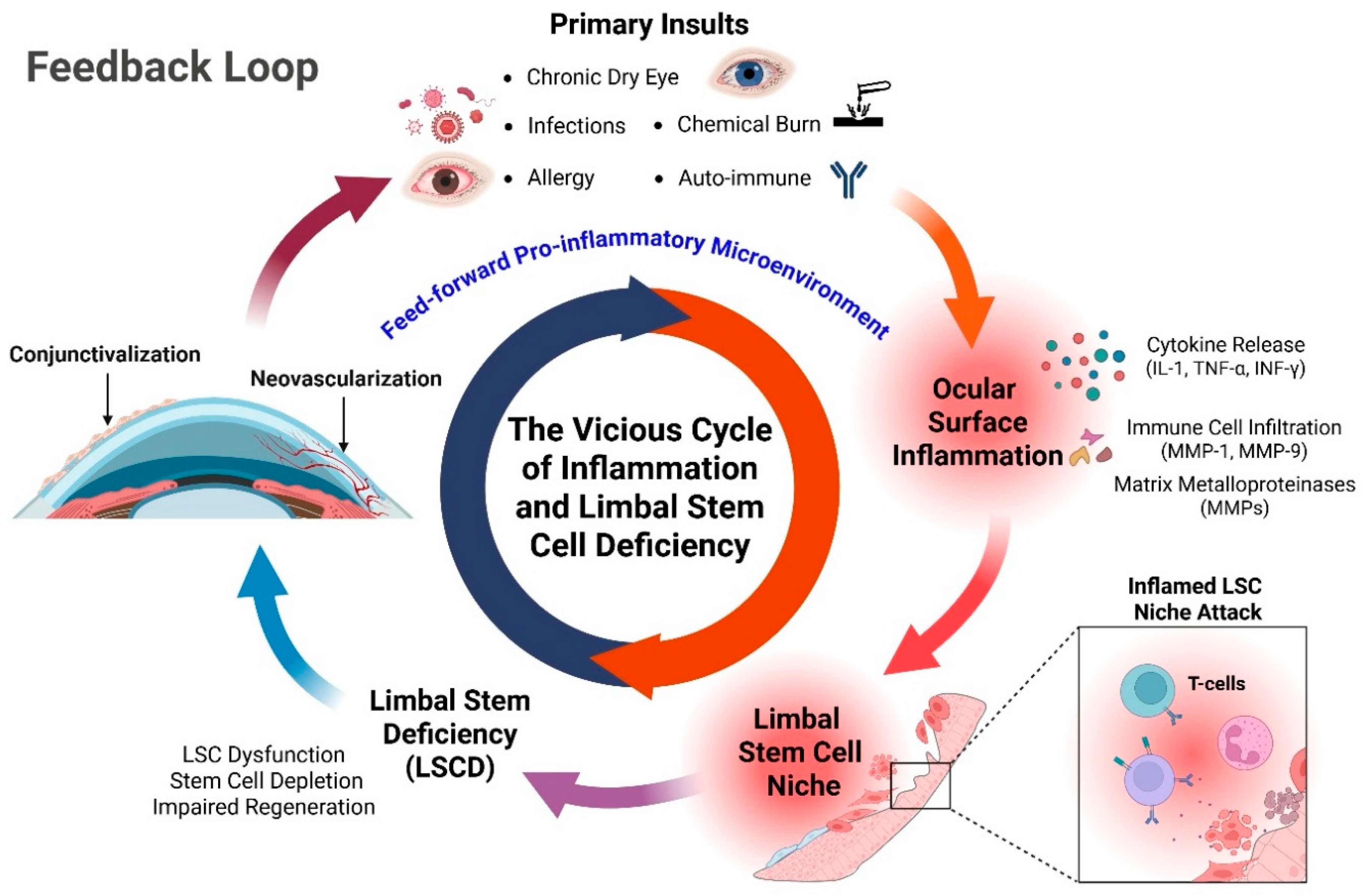
5. The Connection Between Inflammation and Stem Cell Damage
6. Experimental Evidence Linking Ocular Surface Inflammation and Limbal Stem Cell Deficiency
6.1. In Vitro Studies
6.2. In Vivo Studies
6.3. Clinical Findings: Association of Inflammatory Conditions with LSCD
| Etiology | Summary |
|---|---|
| Dry Eye Syndrome (DES) and Meibomian Gland Dysfunction (MGD) | DES and MGD disrupt tear film homeostasis, leading to inflammation and damage to the central cornea and LSCs, resulting in LSCD. Treatment includes topical medications, blood products, amniotic membranes for DES, and meibomian gland expression, intense pulsed therapy, and probing for MGD [7]. |
| Contact Lens (CL)-Induced LSCD | Contact lens-induced LSCD is characterized by whorl-like epitheliopathy and neovascularization. Pathogenesis involves tear film disruption, irritation from lens preservatives, and CL-induced inflammation, hypoxia, and hyperosmolarity. Treatment includes cessation of CL wear, topical steroids, artificial tears, and potentially surgical interventions like amniotic membrane transplant or limbal stem cell transplant [20]. |
| Atopic and Vernal Keratoconjunctivitis (AKC/VKC) | AKC and VKC are allergic diseases causing conjunctiva edema, eyelid thickening, corneal scarring, neovascularization, and tear film instability. Inflammation damages the limbal niche, leading to LSCs loss. Treatment includes topical antihistamines, corticosteroids, immunomodulators, and systemic immunosuppression. Amniotic membrane transplantation with penetrating keratoplasty is useful in advanced cases [114]. |
| Medication Toxicity-Induced LSCD | Medications like Mitomycin C, 5-fluorouracil, benzalkonium and systemic chemotherapy drugs (hydroxycarbamide, S-1) can cause LSCD. Treatment involves cessation of the medication, amniotic membrane transplantation, limbal transplantation and aggressive anti-inflammatory therapy [112,115]. |
| Ocular Burn-Induced LSCD | Chemical or thermal burns cause corneal and limbal ischemia, leading to neovascularization and conjunctivalization. Severity is classified based on LSC loss. Treatment includes autologous serum, bandage contact lens, topical steroid and antibiotics and amniotic membrane or limbal stem cell transplantation [116]. |
| Radiation-Induced LSCD | Radiation therapy can damage LSCs and results in corneal epithelial abnormality and inflammation leading to stem cell dysfunction and vision loss. Treatment includes topical steroids, artificial tears, autologous serum, and potentially surgical interventions like amniotic membrane transplant or limbal stem cell transplant in advanced LSCD [117]. |
| Severe Infection-Induced LSCD | Severe ocular infections such as herpes simplex keratitis, herpes zoster ophthalmicus, microbial keratitis, and trachoma can lead to LSCD due to inflammation and damage to the limbal stem cells and niche. Infection control with adequate anti-microbial therapies is essential. Treatment includes cessation topical steroids, artificial tears, autologous serum, and potentially surgical interventions like amniotic membrane transplant or limbal stem cell transplant in advanced LSCD [118,119]. |
| Stevens–Johnson Syndrome (SJS) and Toxic Epidermal Necrolysis (TEN)-Induced LSCD | SJS and TEN are severe immune reactions causing inflammation of the skin and mucous membranes leading to dry eye, corneal neovascularization, and LSCD. Management in the acute stage includes amniotic membrane grafting, systemic/topical corticosteroids, immunoglobulins, and cyclosporin A [120,121]. |
| Graft vs. Host Disease (GVHD) | GVHD following hematopoietic stem cell transplantation can cause ocular surface inflammation and dry eye, potentially leading to LSCD. Treatment includes topical/systemic steroids, artificial tears, autologous serum, and potentially surgical interventions like amniotic membrane transplant or limbal stem cell transplant in advanced LSCD. Allogenic LSCs transplantation from the same bone marrow donor may be more favorable in long term management [122]. |
| Pemphigoid-Related LSCD | Ocular mucous membrane pemphigoid is an autoimmune disease causing conjunctival scarring and potentially leading to corneal vascularization, opacification, and LSCD, possibly due to lacrimal duct scarring and severe dry eye. Treatment includes managing ocular surface disease, systemic immunosuppression, and preventing conjunctival fibrosis [123]. |
| Rosacea-Induced LSCD | Ocular rosacea, a chronic inflammatory disease, can cause corneal neovascularization suggesting LSC damage. Treatment includes topical/systemic steroids, artificial tears, autologous serum, and potentially surgical interventions like amniotic membrane transplant or limbal stem cell transplant in advanced LSCD [110]. |
| Bullous Keratopathy | Bullous keratopathy, characterized by a reduction in corneal endothelial cells, can lead to conjunctivalization of the peripheral cornea and delayed postoperative epithelialization, suggesting LSCD. Treatment includes penetrating keratoplasty or endothelial keratoplasty [124]. |
| Ocular Surface Squamous Neoplasia (OSSN) | OSSN is a rare condition that can originate from the limbus and disrupt the Palisades of Vogt, potentially causing LSCD. Treatment includes excising malignancy, followed by limbal stem cell transplantation depending on the extent of the disease [125]. |
7. Underlying Mechanisms to Link Between Ocular Surface Inflammation and Limbal Stem Cell Deficiency:
7.1. Limbal Niche Destruction
7.2. Inflammatory Cytokines and Cells
7.3. Cornea Neovascularization
7.4. Cornea Nerve Damage
7.5. Oxidative Damage of LSC
8. Current Treatment Strategies and Management of Limbal Stem Cell Deficiency
8.1. Prevention and Early Intervention
8.2. Medical Management
8.3. Surgical Interventions
9. Recent Advances in Diagnostic and Therapeutic Approaches of Limbal Stem Cell Deficiency
9.1. Emerging Diagnostic Approaches
9.2. Recent Advances in Therapeutic Approaches
10. Therapeutic Potential of Selectively Targeting Inflammation in Limbal Stem Cell Deficiency
11. Conclusions
Author Contributions
Funding
Institutional Review Board Statement
Informed Consent Statement
Data Availability Statement
Conflicts of Interest
References
- Ambroziak, A.M.; Szaflik, J.; Szaflik, J.P.; Ambroziak, M.; Witkiewicz, J.; Skopinski, P. Immunomodulation on the ocular surface: A review. Cent.-Eur. J. Immunol. 2016, 41, 195–208. [Google Scholar] [CrossRef]
- Kate, A.; Basu, S. A Review of the Diagnosis and Treatment of Limbal Stem Cell Deficiency. Front Med. 2022, 9, 836009. [Google Scholar] [CrossRef]
- Atalay, E.; Altug, B.; Caliskan, M.E.; Ceylan, S.; Ozler, Z.S.; Figueiredo, G.; Lako, M.; Figueiredo, F. Animal Models for Limbal Stem Cell Deficiency: A Critical Narrative Literature Review. Ophthalmol. Ther. 2024, 13, 671–696. [Google Scholar] [CrossRef]
- Ghareeb, A.E.; Lako, M.; Figueiredo, F.C. Recent Advances in Stem Cell Therapy for Limbal Stem Cell Deficiency: A Narrative Review. Ophthalmol. Ther. 2020, 9, 809–831. [Google Scholar] [CrossRef]
- Kahook, M.Y.; Rapuano, C.J.; Messmer, E.M.; Radcliffe, N.M.; Galor, A.; Baudouin, C. Preservatives and ocular surface disease: A review. Ocul. Surf. 2024, 34, 213–224. [Google Scholar] [CrossRef]
- Kemer, O.E.; Mekala, P.; Dave, B.; Kooner, K.S. Managing Ocular Surface Disease in Glaucoma Treatment: A Systematic Review. Bioengineering 2024, 11, 1010. [Google Scholar] [CrossRef]
- Lin, S.; Cai, M.; Zhang, L.; Mao, Y.; Wu, H.; Liu, X.; Li, Y.; Liang, M.; Cheng, X.; Yu, F.; et al. Limbal Stem Cell Dysfunction Induced by Severe Dry Eye via Activation of the p38 MAPK Signaling Pathway. Am. J. Pathol. 2023, 193, 1863–1878. [Google Scholar] [CrossRef]
- Soifer, M.; Azar, N.S.; Mousa, H.M.; Perez, V.L. Ocular Surface Inflammatory Disorders (OSID): A Collective of Systemic Etiologies Which Cause or Amplify Dry Eye Syndrome. Front. Med. 2022, 9, 949202. [Google Scholar] [CrossRef]
- Baudouin, C.; Rolando, M.; Benitez Del Castillo, J.M.; Messmer, E.M.; Figueiredo, F.C.; Irkec, M.; Van Setten, G.; Labetoulle, M. Reconsidering the central role of mucins in dry eye and ocular surface diseases. Prog. Retin. Eye Res. 2019, 71, 68–87. [Google Scholar] [CrossRef]
- Moshirfar, M.; Masud, M.; Harvey, D.H.; Payne, C.; Bruce, E.; Ronquillo, Y.C.; Hoopes, P.C. The Multifold Etiologies of Limbal Stem Cell Deficiency: A Comprehensive Review on the Etiologies and Additional Treatment Options for Limbal Stem Cell Deficiency. J. Clin. Med. 2023, 12, 4418. [Google Scholar] [CrossRef]
- Ruiz-Lozano, R.E.; Colorado-Zavala, M.F.; Ramos-Davila, E.M.; Quiroga-Garza, M.E.; Azar, N.S.; Mousa, H.M.; Hernandez-Camarena, J.C.; Stinnett, S.S.; Daluvoy, M.; Kim, T.; et al. Ocular Mucous Membrane Pemphigoid: The Effect of Risk Factors at Presentation on Treatment Outcomes. Ophthalmology 2024, 131, 1064–1075. [Google Scholar] [CrossRef]
- Vazirani, J.; Nair, D.; Shanbhag, S.; Wurity, S.; Ranjan, A.; Sangwan, V. Limbal Stem Cell Deficiency-Demography and Underlying Causes. Am. J. Ophthalmol. 2018, 188, 99–103. [Google Scholar] [CrossRef]
- Catt, C.J.; Hamilton, G.M.; Fish, J.; Mireskandari, K.; Ali, A. Ocular Manifestations of Stevens-Johnson Syndrome and Toxic Epidermal Necrolysis in Children. Am. J. Ophthalmol. 2016, 166, 68–75. [Google Scholar] [CrossRef]
- Afsharkhamseh, N.; Movahedan, A.; Gidfar, S.; Huvard, M.; Wasielewski, L.; Milani, B.Y.; Eslani, M.; Djalilian, A.R. Stability of limbal stem cell deficiency after mechanical and thermal injuries in mice. Exp. Eye Res. 2016, 145, 88–92. [Google Scholar] [CrossRef]
- Vera-Duarte, G.R.; Jimenez-Collado, D.; Kahuam-Lopez, N.; Ramirez-Miranda, A.; Graue-Hernandez, E.O.; Navas, A.; Rosenblatt, M.I. Neurotrophic keratopathy: General features and new therapies. Surv. Ophthalmol. 2024, 69, 789–804. [Google Scholar] [CrossRef]
- Li, G.; Akpek, E.K.; Ahmad, S. Glaucoma and Ocular Surface Disease: More than Meets the Eye. Clin. Ophthalmol. 2022, 16, 3641–3649. [Google Scholar] [CrossRef]
- Iqbal, S.; Ramini, A.; Kaja, S. Impact of particulate matter and air pollution on ocular surface disease: A systematic review of preclinical and clinical evidence. Ocul. Surf. 2025, 35, 100–116. [Google Scholar] [CrossRef]
- Jones, L.; Efron, N.; Bandamwar, K.; Barnett, M.; Jacobs, D.S.; Jalbert, I.; Pult, H.; Rhee, M.K.; Sheardown, H.; Shovlin, J.P.; et al. TFOS Lifestyle: Impact of contact lenses on the ocular surface. Ocul. Surf. 2023, 29, 175–219. [Google Scholar] [CrossRef]
- Nuzzi, R.; Caselgrandi, P. Sex Hormones and Their Effects on Ocular Disorders and Pathophysiology: Current Aspects and Our Experience. Int. J. Mol. Sci. 2022, 23, 3269. [Google Scholar] [CrossRef]
- Lee, Y.F.; Yong, D.W.W.; Manotosh, R. A Review of Contact Lens-Induced Limbal Stem Cell Deficiency. Biology 2023, 12, 1490. [Google Scholar] [CrossRef]
- Yoon, J.J.; Ismail, S.; Sherwin, T. Limbal stem cells: Central concepts of corneal epithelial homeostasis. World J. Stem Cells 2014, 6, 391–403. [Google Scholar] [CrossRef]
- Ahmad, S. Concise review: Limbal stem cell deficiency, dysfunction, and distress. Stem Cells Transl. Med. 2012, 1, 110–115. [Google Scholar] [CrossRef]
- O’Sullivan, F.; Clynes, M. Limbal stem cells, a review of their identification and culture for clinical use. Cytotechnology 2007, 53, 101–106. [Google Scholar] [CrossRef][Green Version]
- Li, Y.; Liu, Y. Recent Advances in Stem Cells of Corneal Epithelia. Investig. Ophthalmol. Vis. Sci. 2025, 66, 45. [Google Scholar] [CrossRef]
- Ma, D.H.; Chen, J.K.; Zhang, F.; Lin, K.Y.; Yao, J.Y.; Yu, J.S. Regulation of corneal angiogenesis in limbal stem cell deficiency. Prog. Retin. Eye Res. 2006, 25, 563–590. [Google Scholar] [CrossRef] [PubMed]
- Le, Q.; Xu, J.; Deng, S.X. The diagnosis of limbal stem cell deficiency. Ocul. Surf. 2018, 16, 58–69. [Google Scholar] [CrossRef] [PubMed]
- Schlotzer-Schrehardt, U.; Kruse, F.E. Identification and characterization of limbal stem cells. Exp. Eye Res. 2005, 81, 247–264. [Google Scholar] [CrossRef] [PubMed]
- Joe, A.W.; Yeung, S.N. Concise review: Identifying limbal stem cells: Classical concepts and new challenges. Stem Cells Transl. Med. 2014, 3, 318–322. [Google Scholar] [CrossRef]
- Vattulainen, M.; Ilmarinen, T.; Viheriala, T.; Jokinen, V.; Skottman, H. Corneal epithelial differentiation of human pluripotent stem cells generates ABCB5(+) and ∆Np63alpha(+) cells with limbal cell characteristics and high wound healing capacity. Stem Cell Res. Ther. 2021, 12, 609. [Google Scholar] [CrossRef]
- Yao, J.Y.; Chen, J.K. Over-expression of DeltaNp63alpha facilitates rat corneal wound healing in vivo. Biosci. Biotechnol. Biochem. 2017, 81, 2279–2284. [Google Scholar] [CrossRef]
- Robertson, D.M.; Ho, S.I.; Cavanagh, H.D. Characterization of DeltaNp63 isoforms in normal cornea and telomerase-immortalized human corneal epithelial cells. Exp. Eye Res. 2008, 86, 576–585. [Google Scholar] [CrossRef] [PubMed]
- Espana, E.M.; Di Pascuale, M.A.; He, H.; Kawakita, T.; Raju, V.K.; Liu, C.Y.; Tseng, S.C. Characterization of corneal pannus removed from patients with total limbal stem cell deficiency. Investig. Ophthalmol. Vis. Sci. 2004, 45, 2961–2966. [Google Scholar] [CrossRef]
- de Paiva, C.S.; Chen, Z.; Corrales, R.M.; Pflugfelder, S.C.; Li, D.Q. ABCG2 transporter identifies a population of clonogenic human limbal epithelial cells. Stem Cells 2005, 23, 63–73. [Google Scholar] [CrossRef] [PubMed]
- Ksander, B.R.; Kolovou, P.E.; Wilson, B.J.; Saab, K.R.; Guo, Q.; Ma, J.; McGuire, S.P.; Gregory, M.S.; Vincent, W.J.; Perez, V.L.; et al. ABCB5 is a limbal stem cell gene required for corneal development and repair. Nature 2014, 511, 353–357. [Google Scholar] [CrossRef] [PubMed]
- Meshko, B.; Volatier, T.L.A.; Hadrian, K.; Deng, S.; Hou, Y.; Kluth, M.A.; Ganss, C.; Frank, M.H.; Frank, N.Y.; Ksander, B.; et al. ABCB5+ Limbal Epithelial Stem Cells Inhibit Developmental but Promote Inflammatory (Lymph) Angiogenesis While Preventing Corneal Inflammation. Cells 2023, 12, 1731. [Google Scholar] [CrossRef]
- Yoshida, S.; Shimmura, S.; Kawakita, T.; Miyashita, H.; Den, S.; Shimazaki, J.; Tsubota, K. Cytokeratin 15 can be used to identify the limbal phenotype in normal and diseased ocular surfaces. Investig. Ophthalmol. Vis. Sci. 2006, 47, 4780–4786. [Google Scholar] [CrossRef]
- Li, G.; Xu, F.; Zhu, J.; Krawczyk, M.; Zhang, Y.; Yuan, J.; Patel, S.; Wang, Y.; Lin, Y.; Zhang, M.; et al. Transcription Factor PAX6 (Paired Box 6) Controls Limbal Stem Cell Lineage in Development and Disease. J. Biol. Chem. 2015, 290, 20448–20454. [Google Scholar] [CrossRef]
- Latta, L.; Figueiredo, F.C.; Ashery-Padan, R.; Collinson, J.M.; Daniels, J.; Ferrari, S.; Szentmary, N.; Sola, S.; Shalom-Feuerstein, R.; Lako, M.; et al. Pathophysiology of aniridia-associated keratopathy: Developmental aspects and unanswered questions. Ocul. Surf. 2021, 22, 245–266. [Google Scholar] [CrossRef]
- Rice, G.; Farrelly, O.; Huang, S.; Kuri, P.; Curtis, E.; Ohman, L.; Li, N.; Lengner, C.; Lee, V.; Rompolas, P. Sox9 marks limbal stem cells and is required for asymmetric cell fate switch in the corneal epithelium. bioRxiv 2024. [Google Scholar] [CrossRef]
- Davidson, K.C.; Sung, M.; Brown, K.D.; Contet, J.; Belluschi, S.; Hamel, R.; Moreno-Moral, A.; Dos Santos, R.L.; Gough, J.; Polo, J.M.; et al. Single nuclei transcriptomics of the in situ human limbal stem cell niche. Sci. Rep. 2024, 14, 6749. [Google Scholar] [CrossRef]
- Li, Y.; Ge, L.; Ren, B.; Zhang, X.; Yin, Z.; Liu, H.; Yang, Y.; Liu, Y.; Xu, H. De-Differentiation of Corneal Epithelial Cells Into Functional Limbal Epithelial Stem Cells After the Ablation of Innate Stem Cells. Investig. Ophthalmol. Vis. Sci. 2024, 65, 32. [Google Scholar] [CrossRef]
- Zhu, L.; Zhang, W.; Zhu, J.; Chen, C.; Mo, K.; Guo, H.; Wu, S.; Huang, H.; Li, L.; Li, M.; et al. Cotransplantation of Limbal Epithelial and Stromal Cells for Ocular Surface Reconstruction. Ophthalmol. Sci. 2022, 2, 100148. [Google Scholar] [CrossRef]
- Jurkunas, U.V.; Kaufman, A.R.; Yin, J.; Ayala, A.; Maguire, M.; Samarakoon, L.; Johns, L.K.; Parekh, M.; Li, S.; Gauthier, A.; et al. Cultivated autologous limbal epithelial cell (CALEC) transplantation for limbal tem cell deficiency: A phase I/II clinical trial of the first xenobiotic-free, serum-free, antibiotic-free manufacturing protocol developed in the US. Nat. Commun. 2025, 16, 1607. [Google Scholar] [CrossRef] [PubMed]
- Verma, S.; Lin, X.; Coulson-Thomas, V.J. The Potential Reversible Transition between Stem Cells and Transient-Amplifying Cells: The Limbal Epithelial Stem Cell Perspective. Cells 2024, 13, 748. [Google Scholar] [CrossRef]
- Li, J.M.; Kim, S.; Zhang, Y.; Bian, F.; Hu, J.; Lu, R.; Pflugfelder, S.C.; Chen, R.; Li, D.Q. Single-Cell Transcriptomics Identifies a Unique Entity and Signature Markers of Transit-Amplifying Cells in Human Corneal Limbus. Investig. Ophthalmol. Vis. Sci. 2021, 62, 36. [Google Scholar] [CrossRef]
- Fabiani, C.; Barabino, S.; Rashid, S.; Dana, M.R. Corneal epithelial proliferation and thickness in a mouse model of dry eye. Exp. Eye Res. 2009, 89, 166–171. [Google Scholar] [CrossRef] [PubMed]
- Walczysko, P.; Rajnicek, A.M.; Collinson, J.M. Contact-mediated control of radial migration of corneal epithelial cells. Mol. Vis. 2016, 22, 990–1004. [Google Scholar]
- Jiang, H.; Liu, M.; Yang, W.; Hong, Y.K.; Xu, D.; Nalbant, E.K.; Clutter, E.D.; Foroozandeh, P.; Kaplan, N.; Wysocki, J.; et al. Activation of limbal epithelial proliferation is partly controlled by the ACE2-LCN2 pathway. iScience 2024, 27, 110534. [Google Scholar] [CrossRef]
- Wee, P.; Wang, Z. Epidermal Growth Factor Receptor Cell Proliferation Signaling Pathways. Cancers 2017, 9, 52. [Google Scholar] [CrossRef] [PubMed]
- Yu, F.S.; Yin, J.; Xu, K.; Huang, J. Growth factors and corneal epithelial wound healing. Brain Res. Bull. 2010, 81, 229–235. [Google Scholar] [CrossRef]
- Chen, J.; Chen, P.; Backman, L.J.; Zhou, Q.; Danielson, P. Ciliary Neurotrophic Factor Promotes the Migration of Corneal Epithelial Stem/progenitor Cells by Up-regulation of MMPs through the Phosphorylation of Akt. Sci. Rep. 2016, 6, 25870. [Google Scholar] [CrossRef]
- Pastar, I.; Stojadinovic, O.; Yin, N.C.; Ramirez, H.; Nusbaum, A.G.; Sawaya, A.; Patel, S.B.; Khalid, L.; Isseroff, R.R.; Tomic-Canic, M. Epithelialization in Wound Healing: A Comprehensive Review. Adv. Wound Care 2014, 3, 445–464. [Google Scholar] [CrossRef]
- Meneux, L.; Pernot, S.; Feret, N.; Girard, M.; Caballero Megido, A.; Decoudu, M.; Nhiri, N.; Miessen, E.; Jacquet, E.; Daien, V.; et al. Injury-specific pathways shape corneal nerve regeneration dynamics. Sci. Rep. 2025, 15, 25755. [Google Scholar] [CrossRef]
- Li, Z.; Burns, A.R.; Miller, S.B.; Smith, C.W. CCL20, gammadelta T cells, and IL-22 in corneal epithelial healing. FASEB J. 2011, 25, 2659–2668. [Google Scholar] [CrossRef] [PubMed]
- Jammes, M.; Tabasi, A.; Bach, T.; Ritter, T. Healing the cornea: Exploring the therapeutic solutions offered by MSCs and MSC-derived EVs. Prog. Retin. Eye Res. 2025, 105, 101325. [Google Scholar] [CrossRef]
- Ordonez, P.; Di Girolamo, N. Limbal epithelial stem cells: Role of the niche microenvironment. Stem Cells 2012, 30, 100–107. [Google Scholar] [CrossRef]
- Soleimani, M.; Cheraqpour, K.; Koganti, R.; Baharnoori, S.M.; Djalilian, A.R. Concise Review: Bioengineering of Limbal Stem Cell Niche. Bioengineering 2023, 10, 111. [Google Scholar] [CrossRef] [PubMed]
- Gesteira, T.F.; Sun, M.; Coulson-Thomas, Y.M.; Yamaguchi, Y.; Yeh, L.K.; Hascall, V.; Coulson-Thomas, V.J. Hyaluronan Rich Microenvironment in the Limbal Stem Cell Niche Regulates Limbal Stem Cell Differentiation. Investig. Ophthalmol. Vis. Sci. 2017, 58, 4407–4421. [Google Scholar] [CrossRef] [PubMed]
- Notara, M.; Lentzsch, A.; Coroneo, M.; Cursiefen, C. The Role of Limbal Epithelial Stem Cells in Regulating Corneal (Lymph)angiogenic Privilege and the Micromilieu of the Limbal Niche following UV Exposure. Stem Cells Int. 2018, 2018, 8620172. [Google Scholar] [CrossRef]
- Collin, J.; Queen, R.; Zerti, D.; Bojic, S.; Dorgau, B.; Moyse, N.; Molina, M.M.; Yang, C.; Dey, S.; Reynolds, G.; et al. A single cell atlas of human cornea that defines its development, limbal progenitor cells and their interactions with the immune cells. Ocul. Surf. 2021, 21, 279–298. [Google Scholar] [CrossRef]
- Yeung, A.M.; Schlotzer-Schrehardt, U.; Kulkarni, B.; Tint, N.L.; Hopkinson, A.; Dua, H.S. Limbal epithelial crypt: A model for corneal epithelial maintenance and novel limbal regional variations. Arch. Ophthalmol. 2008, 126, 665–669. [Google Scholar] [CrossRef][Green Version]
- Shanmuganathan, V.A.; Foster, T.; Kulkarni, B.B.; Hopkinson, A.; Gray, T.; Powe, D.G.; Lowe, J.; Dua, H.S. Morphological characteristics of the limbal epithelial crypt. Br. J. Ophthalmol. 2007, 91, 514–519. [Google Scholar] [CrossRef][Green Version]
- Wilson, S.E.; He, Y.G.; Weng, J.; Zieske, J.D.; Jester, J.V.; Schultz, G.S. Effect of epidermal growth factor, hepatocyte growth factor, and keratinocyte growth factor, on proliferation, motility and differentiation of human corneal epithelial cells. Exp. Eye Res. 1994, 59, 665–678. [Google Scholar] [CrossRef]
- Ho, T.C.; Chen, S.L.; Wu, J.Y.; Ho, M.Y.; Chen, L.J.; Hsieh, J.W.; Cheng, H.C.; Tsao, Y.P. PEDF promotes self-renewal of limbal stem cell and accelerates corneal epithelial wound healing. Stem Cells 2013, 31, 1775–1784. [Google Scholar] [CrossRef]
- Chuephanich, P.; Supiyaphun, C.; Aravena, C.; Bozkurt, T.K.; Yu, F.; Deng, S.X. Characterization of the Corneal Subbasal Nerve Plexus in Limbal Stem Cell Deficiency. Cornea 2017, 36, 347–352. [Google Scholar] [CrossRef]
- Ouyang, H.; Xue, Y.; Lin, Y.; Zhang, X.; Xi, L.; Patel, S.; Cai, H.; Luo, J.; Zhang, M.; Zhang, M.; et al. WNT7A and PAX6 define corneal epithelium homeostasis and pathogenesis. Nature 2014, 511, 358–361. [Google Scholar] [CrossRef] [PubMed]
- Gonzalez, S.; Halabi, M.; Ju, D.; Tsai, M.; Deng, S.X. Role of Jagged1-mediated Notch Signaling Activation in the Differentiation and Stratification of the Human Limbal Epithelium. Cells 2020, 9, 1945. [Google Scholar] [CrossRef]
- Braunsperger, M.V.; Martin, G.; Herzig, T.; Kussberger, I.; Giessl, A.; Steimle, S.; Schlotzer-Schrehardt, U.; Schlunck, G.; Reinhard, T.; Polisetti, N. Proteomic Insights into Human Limbal Epithelial Progenitor-Derived Small Extracellular Vesicles. Stem Cell Rev. Rep. 2025, 21, 1578–1593. [Google Scholar] [CrossRef]
- Niruthisard, D.; Bonnet, C.; Fung, S.S.M.; Unhale, R.; Tseng, C.H.; Muntham, D.; Deng, S.X. Co-existence of Neurotrophic Keratopathy in Eyes with Limbal Stem Cell Deficiency. Am. J. Ophthalmol. 2024, 267, 249–256. [Google Scholar] [CrossRef]
- Kolli, S.; Bojic, S.; Ghareeb, A.E.; Kurzawa-Akanbi, M.; Figueiredo, F.C.; Lako, M. The Role of Nerve Growth Factor in Maintaining Proliferative Capacity, Colony-Forming Efficiency, and the Limbal Stem Cell Phenotype. Stem Cells 2019, 37, 139–149. [Google Scholar] [CrossRef] [PubMed]
- Zhou, Q.; Chen, P.; Di, G.; Zhang, Y.; Wang, Y.; Qi, X.; Duan, H.; Xie, L. Ciliary neurotrophic factor promotes the activation of corneal epithelial stem/progenitor cells and accelerates corneal epithelial wound healing. Stem Cells 2015, 33, 1566–1576. [Google Scholar] [CrossRef] [PubMed]
- Arboleda, A.; Ta, C.N. Observational study of cenegermin for the treatment of limbal stem cell deficiency associated with neurotrophic keratopathy. Ther. Adv. Ophthalmol. 2022, 14, 25158414221134598. [Google Scholar] [CrossRef]
- Schlotzer-Schrehardt, U.; Dietrich, T.; Saito, K.; Sorokin, L.; Sasaki, T.; Paulsson, M.; Kruse, F.E. Characterization of extracellular matrix components in the limbal epithelial stem cell compartment. Exp. Eye Res. 2007, 85, 845–860. [Google Scholar] [CrossRef]
- Robertson, S.Y.T.; Roberts, J.S.; Deng, S.X. Regulation of Limbal Epithelial Stem Cells: Importance of the Niche. Int. J. Mol. Sci. 2021, 22, 11975. [Google Scholar] [CrossRef]
- Bains, K.K.; Young, R.D.; Koudouna, E.; Lewis, P.N.; Quantock, A.J. Cell-Cell and Cell-Matrix Interactions at the Presumptive Stem Cell Niche of the Chick Corneal Limbus. Cells 2023, 12, 2334. [Google Scholar] [CrossRef] [PubMed]
- Funderburgh, J.L.; Funderburgh, M.L.; Du, Y. Stem Cells in the Limbal Stroma. Ocul. Surf. 2016, 14, 113–120. [Google Scholar] [CrossRef]
- Mei, H.; Gonzalez, S.; Deng, S.X. Extracellular Matrix is an Important Component of Limbal Stem Cell Niche. J. Funct. Biomater. 2012, 3, 879–894. [Google Scholar] [CrossRef] [PubMed]
- Zhu, J.; Wang, L.Y.; Li, C.Y.; Wu, J.Y.; Zhang, Y.T.; Pang, K.P.; Wei, Y.; Du, L.Q.; Liu, M.; Wu, X.Y. SPARC promotes self-renewal of limbal epithelial stem cells and ocular surface restoration through JNK and p38-MAPK signaling pathways. Stem Cells 2020, 38, 134–145. [Google Scholar] [CrossRef]
- Lent-Schochet, D.; Akbar, M.; Hou, J.H.; Farooq, A.V. Diagnostic approach to limbal stem cell deficiency. Front. Ophthalmol. 2024, 4, 1524595. [Google Scholar] [CrossRef]
- Deng, S.X.; Borderie, V.; Chan, C.C.; Dana, R.; Figueiredo, F.C.; Gomes, J.A.P.; Pellegrini, G.; Shimmura, S.; Kruse, F.E. Global Consensus on Definition, Classification, Diagnosis, and Staging of Limbal Stem Cell Deficiency. Cornea 2019, 38, 364–375. [Google Scholar] [CrossRef]
- Henderson, T.R.; Findlay, I.; Matthews, P.L.; Noble, B.A. Identifying the origin of single corneal cells by DNA fingerprinting: Part II—Application to limbal allografting. Cornea 2001, 20, 404–407. [Google Scholar] [CrossRef]
- Henderson, T.R.; Findlay, I.; Matthews, P.L.; Noble, B.A. Identifying the origin of single corneal cells by DNA fingerprinting: Part I—Implications for corneal limbal allografting. Cornea 2001, 20, 400–403. [Google Scholar] [CrossRef] [PubMed]
- Dua, H.S.; King, A.J.; Joseph, A. A new classification of ocular surface burns. Br. J. Ophthalmol. 2001, 85, 1379–1383. [Google Scholar] [CrossRef]
- Chan, E.; Le, Q.; Codriansky, A.; Hong, J.; Xu, J.; Deng, S.X. Existence of Normal Limbal Epithelium in Eyes With Clinical Signs of Total Limbal Stem Cell Deficiency. Cornea 2016, 35, 1483–1487. [Google Scholar] [CrossRef]
- Daya, S.M.; Watson, A.; Sharpe, J.R.; Giledi, O.; Rowe, A.; Martin, R.; James, S.E. Outcomes and DNA analysis of ex vivo expanded stem cell allograft for ocular surface reconstruction. Ophthalmology 2005, 112, 470–477. [Google Scholar] [CrossRef] [PubMed]
- Korkmaz, I.; Eratilgan, N.F.; Palamar, M.; Egrilmez, S.; Yagci, A.; Barut Selver, O. Evaluation of Medically Reversible Limbal Stem Cell Deficiency. Turk. J. Ophthalmol. 2024, 54, 251–256. [Google Scholar] [CrossRef]
- Kizil, C.; Kyritsis, N.; Brand, M. Effects of inflammation on stem cells: Together they strive? EMBO Rep. 2015, 16, 416–426. [Google Scholar] [CrossRef] [PubMed]
- Bogeska, R.; Mikecin, A.M.; Kaschutnig, P.; Fawaz, M.; Buchler-Schaff, M.; Le, D.; Ganuza, M.; Vollmer, A.; Paffenholz, S.V.; Asada, N.; et al. Inflammatory exposure drives long-lived impairment of hematopoietic stem cell self-renewal activity and accelerated aging. Cell Stem Cell 2022, 29, 1273–1284 e1278. [Google Scholar] [CrossRef]
- Franceschi, C.; Garagnani, P.; Parini, P.; Giuliani, C.; Santoro, A. Inflammaging: A new immune-metabolic viewpoint for age-related diseases. Nat. Rev. Endocrinol. 2018, 14, 576–590. [Google Scholar] [CrossRef]
- Fulop, T.; Witkowski, J.M.; Olivieri, F.; Larbi, A. The integration of inflammaging in age-related diseases. Semin. Immunol. 2018, 40, 17–35. [Google Scholar] [CrossRef]
- Iosif, R.E.; Ekdahl, C.T.; Ahlenius, H.; Pronk, C.J.; Bonde, S.; Kokaia, Z.; Jacobsen, S.E.; Lindvall, O. Tumor necrosis factor receptor 1 is a negative regulator of progenitor proliferation in adult hippocampal neurogenesis. J. Neurosci. 2006, 26, 9703–9712. [Google Scholar] [CrossRef]
- Zhou, C.; Lei, F.; Mittermaier, M.; Dana, R.; Dohlman, C.H.; Chodosh, J.; Paschalis, E.I. TNF-alpha Suppression Attenuates Limbal Stem Cell Damage in Ocular Injury. Cornea 2024, 44, 762–771. [Google Scholar] [CrossRef]
- Chen, M.; Reed, R.R.; Lane, A.P. Chronic Inflammation Directs an Olfactory Stem Cell Functional Switch from Neuroregeneration to Immune Defense. Cell Stem Cell 2019, 25, 501–513 e505. [Google Scholar] [CrossRef] [PubMed]
- Naik, S.; Larsen, S.B.; Gomez, N.C.; Alaverdyan, K.; Sendoel, A.; Yuan, S.; Polak, L.; Kulukian, A.; Chai, S.; Fuchs, E. Inflammatory memory sensitizes skin epithelial stem cells to tissue damage. Nature 2017, 550, 475–480, Correction in Nature 2018, 560, E2. https://doi.org/10.1038/s41586-018-0229-5. [Google Scholar] [CrossRef]
- Ryu, J.S.; Kim, S.Y.; Kim, M.K.; Oh, J.Y. Inflammation Confers Healing Advantage to Corneal Epithelium Following Subsequent Injury. Int. J. Mol. Sci. 2023, 24, 3329. [Google Scholar] [CrossRef] [PubMed]
- Fok, E.; Sandeman, S.R.; Guildford, A.L.; Martin, Y.H. The use of an IL-1 receptor antagonist peptide to control inflammation in the treatment of corneal limbal epithelial stem cell deficiency. Biomed. Res. Int. 2015, 2015, 516318. [Google Scholar] [CrossRef]
- Yang, L.; Zhang, S.; Duan, H.; Dong, M.; Hu, X.; Zhang, Z.; Wang, Y.; Zhang, X.; Shi, W.; Zhou, Q. Different Effects of Pro-Inflammatory Factors and Hyperosmotic Stress on Corneal Epithelial Stem/Progenitor Cells and Wound Healing in Mice. Stem Cells Transl. Med. 2019, 8, 46–57. [Google Scholar] [CrossRef] [PubMed]
- Chen, Z.; Tong, L.; Li, Z.; Yoon, K.C.; Qi, H.; Farley, W.; Li, D.Q.; Pflugfelder, S.C. Hyperosmolarity-induced cornification of human corneal epithelial cells is regulated by JNK MAPK. Investig. Ophthalmol. Vis. Sci. 2008, 49, 539–549. [Google Scholar] [CrossRef]
- Notara, M.; Behboudifard, S.; Kluth, M.A.; Masslo, C.; Ganss, C.; Frank, M.H.; Schumacher, B.; Cursiefen, C. UV light-blocking contact lenses protect against short-term UVB-induced limbal stem cell niche damage and inflammation. Sci. Rep. 2018, 8, 12564. [Google Scholar] [CrossRef] [PubMed]
- Notara, M.; Refaian, N.; Braun, G.; Steven, P.; Bock, F.; Cursiefen, C. Short-term uvb-irradiation leads to putative limbal stem cell damage and niche cell-mediated upregulation of macrophage recruiting cytokines. Stem Cell Res. 2015, 15, 643–654. [Google Scholar] [CrossRef]
- Singh, V.K.; Kethiri, A.R.; Pingali, T.; Sahoo, A.; Salman, M.; Koduri, M.A.; Prasad, D.; Bokara, K.K.; Basu, S.; Singh, V. Development and validation of a reliable rabbit model of limbal stem cell deficiency by mechanical debridement using an ophthalmic burr. Exp. Eye Res. 2023, 236, 109667. [Google Scholar] [CrossRef] [PubMed]
- Selver, O.B.; Durak, I.; Gurdal, M.; Baysal, K.; Ates, H.; Ozbek, Z.; Wang, Z.; Wu, A.; Wolosin, J.M. Corneal recovery in a rabbit limbal stem cell deficiency model by autologous grafts of tertiary outgrowths from cultivated limbal biopsy explants. Mol. Vis. 2016, 22, 138–149. [Google Scholar] [PubMed]
- Amin, S.; Jalilian, E.; Katz, E.; Frank, C.; Yazdanpanah, G.; Guaiquil, V.H.; Rosenblatt, M.I.; Djalilian, A.R. The Limbal Niche and Regenerative Strategies. Vision 2021, 5, 43. [Google Scholar] [CrossRef] [PubMed]
- Kadar, T.; Horwitz, V.; Cohen, M.; Egoz, I.; Gutman, H.; Gez, R.; Dachir, S. Limbal stem cell deficiency (LSCD) in rats and mice following whole body exposure to sulfur mustard (SM) vapor. Exp. Eye Res. 2022, 223, 109195. [Google Scholar] [CrossRef]
- Li, J.; Xiao, Y.; Coursey, T.G.; Chen, X.; Deng, R.; Lu, F.; Pflugfelder, S.C.; Li, D.Q. Identification for Differential Localization of Putative Corneal Epithelial Stem Cells in Mouse and Human. Sci. Rep. 2017, 7, 5169. [Google Scholar] [CrossRef]
- Nasser, W.; Amitai-Lange, A.; Soteriou, D.; Hanna, R.; Tiosano, B.; Fuchs, Y.; Shalom-Feuerstein, R. Corneal-Committed Cells Restore the Stem Cell Pool and Tissue Boundary following Injury. Cell Rep. 2018, 22, 323–331. [Google Scholar] [CrossRef]
- Someya, H.; Shirahama, S.; Karg, M.M.; Gregory-Ksander, M.S.; Dana, R.; Ksander, B.R. A limbal stem cell deficiency murine model with residual limbal stem cells. bioRxiv 2024. [Google Scholar] [CrossRef]
- Chen, Y.; Yang, W.; Zhang, X.; Yang, S.; Peng, G.; Wu, T.; Zhou, Y.; Huang, C.; Reinach, P.S.; Li, W.; et al. MK2 inhibitor reduces alkali burn-induced inflammation in rat cornea. Sci. Rep. 2016, 6, 28145. [Google Scholar] [CrossRef]
- Mehta, U.; Farid, M. Dupilumab Induced Limbal Stem Cell Deficiency. Int. Med. Case Rep. J. 2021, 14, 275–278. [Google Scholar] [CrossRef]
- Kim, B.Y.; Riaz, K.M.; Bakhtiari, P.; Chan, C.C.; Welder, J.D.; Holland, E.J.; Basti, S.; Djalilian, A.R. Medically reversible limbal stem cell disease: Clinical features and management strategies. Ophthalmology 2014, 121, 2053–2058. [Google Scholar] [CrossRef]
- Bocanegra-Oyola, N.; Pardo-Pizza, D.; Cifuentes-Gonzalez, C.; Oliver-Hernandez, M.V.; Romero-Osorio, M.J.; Romero-Santos, S.; Parra-Tanoux, D.; Barragan, A.M.; de-la-Torre, A. Clinical Characteristics of Ocular Mucous Membrane Pemphigoid: A Systematic Review and Meta-Analysis. Ocul. Immunol. Inflamm. 2024, 32, 2388–2404. [Google Scholar] [CrossRef] [PubMed]
- Ding, X.; Bishop, R.J.; Herzlich, A.A.; Patel, M.; Chan, C.C. Limbal stem cell deficiency arising from systemic chemotherapy with hydroxycarbamide. Cornea 2009, 28, 221–223. [Google Scholar] [CrossRef] [PubMed]
- Figueiredo, G.S.; Hogg, J.; Okonkwo, A.; Baylis, O.J.; Berry, M.; Ali, S.; Lako, M.; Figueiredo, F.C. Understanding Ocular Surface Inflammation in Tears Before and After Autologous Cultivated Limbal Epithelial Stem Cell Transplantation. Ophthalmol. Ther. 2023, 12, 1097–1107. [Google Scholar] [CrossRef]
- Jabbehdari, S.; Starnes, T.W.; Kurji, K.H.; Eslani, M.; Cortina, M.S.; Holland, E.J.; Djalilian, A.R. Management of advanced ocular surface disease in patients with severe atopic keratoconjunctivitis. Ocul. Surf. 2019, 17, 303–309. [Google Scholar] [CrossRef]
- Prusek, A.; Sikora, B.; Skubis-Sikora, A.; Czekaj, P. Assessment of the toxic effect of benzalkonium chloride on human limbal stem cells. Sci. Rep. 2025, 15, 12295. [Google Scholar] [CrossRef]
- Crawford, A.Z.; McGhee, C.N. Management of limbal stem cell deficiency in severe ocular chemical burns. Clin. Exp. Ophthalmol. 2012, 40, 227–229. [Google Scholar] [CrossRef] [PubMed]
- Smith, G.T.; Deutsch, G.P.; Cree, I.A.; Liu, C.S. Permanent corneal limbal stem cell dysfunction following radiotherapy for orbital lymphoma. Eye 2000, 14, 905–907. [Google Scholar] [CrossRef]
- Carreno-Galeano, J.T.; Dohlman, T.H.; Yin, J.; Dana, R. Limbal Stem Cell Deficiency Associated With Herpes Keratitis. Cornea 2021, 40, 967–971. [Google Scholar] [CrossRef]
- Dawson, C.R.; Juster, R.; Marx, R.; Daghfous, M.T.; Ben Djerad, A. Limbal disease in trachoma and other ocular chlamydial infections: Risk factors for corneal vascularisation. Eye 1989, 3, 204–209. [Google Scholar] [CrossRef]
- Choi, S.H.; Kim, M.K.; Oh, J.Y. Corneal Limbal Stem Cell Deficiency in Children with Stevens-Johnson Syndrome. Am. J. Ophthalmol. 2019, 199, 1–8. [Google Scholar] [CrossRef]
- Sawires, K.; Tao, B.K.; Nithianandan, H.; Menant-Tay, L.; O’Connor, M.; Yan, P.; Arjmand, P. Stevens-Johnson Syndrome and Toxic Epidermal Necrolysis: A Systematic Review of Ophthalmic Management and Treatment. Vision 2025, 9, 78. [Google Scholar] [CrossRef]
- Jarade, E.F.; El Rami, H.; Abdelmassih, Y.; Amro, M. Chronic ocular GVHD: Limbal and conjunctival stem cell allografts from the same hematopoietic stem cell donor. Int. J. Ophthalmol. 2018, 11, 1569–1572. [Google Scholar] [CrossRef]
- Memar, O.; Jabbehdari, S.; Caughlin, B.; Djalilian, A.R. Ocular surface involvement in pemphigus vulgaris: An interdisciplinary review. Ocul. Surf. 2020, 18, 40–46. [Google Scholar] [CrossRef]
- Uchino, Y.; Goto, E.; Takano, Y.; Dogru, M.; Shinozaki, N.; Shimmura, S.; Yagi, Y.; Tsubota, K.; Shimazaki, J. Long-standing bullous keratopathy is associated with peripheral conjunctivalization and limbal deficiency. Ophthalmology 2006, 113, 1098–1101. [Google Scholar] [CrossRef]
- Devebacak, A.; Yaman, B.; Palamar, M. Limbal Stem Cell Deficiency After Treatment of Ocular Surface Squamous Neoplasia. Cornea 2025, 44, 1458–1462. [Google Scholar] [CrossRef] [PubMed]
- Yazdanpanah, G.; Haq, Z.; Kang, K.; Jabbehdari, S.; Rosenblatt, M.L.; Djalilian, A.R. Strategies for reconstructing the limbal stem cell niche. Ocul. Surf. 2019, 17, 230–240. [Google Scholar] [CrossRef]
- Roda, M.; Corazza, I.; Bacchi Reggiani, M.L.; Pellegrini, M.; Taroni, L.; Giannaccare, G.; Versura, P. Dry Eye Disease and Tear Cytokine Levels-A Meta-Analysis. Int. J. Mol. Sci. 2020, 21, 3111. [Google Scholar] [CrossRef]
- Shahriary, A.P.; Sabzevari, M.M.; Jadidi, K.M.; Yazdani, F.M.; Aghamollaei, H.P. The Role of Inflammatory Cytokines in Neovascularization of Chemical Ocular Injury. Ocul. Immunol. Inflamm. 2022, 30, 1149–1161. [Google Scholar] [CrossRef] [PubMed]
- Javadi, M.A.; Yazdani, S.; Sajjadi, H.; Jadidi, K.; Karimian, F.; Einollahi, B.; Ja’farinasab, M.R.; Zare, M. Chronic and delayed-onset mustard gas keratitis: Report of 48 patients and review of literature. Ophthalmology 2005, 112, 617–625. [Google Scholar] [CrossRef]
- Fu, X.; Xiao, J.; Wei, Y.; Li, S.; Liu, Y.; Yin, J.; Sun, K.; Sun, H.; Wang, H.; Zhang, Z.; et al. Combination of inflammation-related cytokines promotes long-term muscle stem cell expansion. Cell Res. 2015, 25, 655–673, Erratum in Cell Res. 2015, 25, 1082–1083. https://doi.org/10.1038/cr.2015.102. [Google Scholar] [CrossRef] [PubMed]
- Jahandideh, B.; Derakhshani, M.; Abbaszadeh, H.; Akbar Movassaghpour, A.; Mehdizadeh, A.; Talebi, M.; Yousefi, M. The pro-Inflammatory cytokines effects on mobilization, self-renewal and differentiation of hematopoietic stem cells. Hum. Immunol. 2020, 81, 206–217. [Google Scholar] [CrossRef]
- Smolin, G. Cellular response to inflammation at the limbus. Eye 1989, 3, 167–171. [Google Scholar] [CrossRef]
- Moore, J.E.; McMullen, T.C.; Campbell, I.L.; Rohan, R.; Kaji, Y.; Afshari, N.A.; Usui, T.; Archer, D.B.; Adamis, A.P. The inflammatory milieu associated with conjunctivalized cornea and its alteration with IL-1 RA gene therapy. Investig. Ophthalmol. Vis. Sci. 2002, 43, 2905–2915. [Google Scholar]
- Stachon, T.; Suiwal, S.; Amini, M.; Corton, M.; Fries, F.N.; Seitz, B.; Ludwig, N.; Rishik, S.; Keller, A.; Szentmary, N. mRNA Sequencing of Limbal Epithelial Cells and mRNA/miRNA Profiling of Limbal Stromal Cells in PAX6-Related Congenital Aniridia. Cells 2026, 15, 340. [Google Scholar] [CrossRef] [PubMed]
- Drzyzga, L.; Spiewak, D.; Dorecka, M.; Wygledowska-Promienska, D. Available Therapeutic Options for Corneal Neovascularization: A Review. Int. J. Mol. Sci. 2024, 25, 5479. [Google Scholar] [CrossRef]
- Wu, D.; Chan, K.E.; Lim, B.X.H.; Lim, D.K.; Wong, W.M.; Chai, C.; Manotosh, R.; Lim, C.H.L. Management of corneal neovascularization: Current and emerging therapeutic approaches. Indian. J. Ophthalmol. 2024, 72, S354–S371. [Google Scholar] [CrossRef]
- Nicholas, M.P.; Mysore, N. Corneal neovascularization. Exp. Eye Res. 2021, 202, 108363. [Google Scholar] [CrossRef]
- Lim, P.; Fuchsluger, T.A.; Jurkunas, U.V. Limbal stem cell deficiency and corneal neovascularization. Semin. Ophthalmol. 2009, 24, 139–148. [Google Scholar] [CrossRef]
- Kadar, T.; Amir, A.; Cohen, L.; Cohen, M.; Sahar, R.; Gutman, H.; Horwitz, V.; Dachir, S. Anti-VEGF therapy (bevacizumab) for sulfur mustard-induced corneal neovascularization associated with delayed limbal stem cell deficiency in rabbits. Curr. Eye Res. 2014, 39, 439–450. [Google Scholar] [CrossRef] [PubMed]
- Bhattacharya, S.; Mukherjee, A.; Pisano, S.; Dimri, S.; Knaane, E.; Altshuler, A.; Nasser, W.; Dey, S.; Shi, L.; Mizrahi, I.; et al. The biophysical property of the limbal niche maintains stemness through YAP. Cell Death Differ. 2023, 30, 1601–1614. [Google Scholar] [CrossRef] [PubMed]
- Bath, C.; Yang, S.; Muttuvelu, D.; Fink, T.; Emmersen, J.; Vorum, H.; Hjortdal, J.; Zachar, V. Hypoxia is a key regulator of limbal epithelial stem cell growth and differentiation. Stem Cell Res. 2013, 10, 349–360. [Google Scholar] [CrossRef]
- Ferrari, G.; Hajrasouliha, A.R.; Sadrai, Z.; Ueno, H.; Chauhan, S.K.; Dana, R. Nerves and neovessels inhibit each other in the cornea. Investig. Ophthalmol. Vis. Sci. 2013, 54, 813–820. [Google Scholar] [CrossRef] [PubMed]
- Byun, Y.S.; Mok, J.W.; Chung, S.H.; Kim, H.S.; Joo, C.K. Ocular surface inflammation induces de novo expression of substance P in the trigeminal primary afferents with large cell bodies. Sci. Rep. 2020, 10, 15210. [Google Scholar] [CrossRef] [PubMed]
- Yoon, J.S.; Choi, S.H.; Lee, J.H.; Lee, S.J.; Lee, S.Y. Ocular surface inflammation, and nerve growth factor level in tears in active thyroid-associated ophthalmopathy. Graefes Arch. Clin. Exp. Ophthalmol. 2010, 248, 271–276. [Google Scholar] [CrossRef]
- Di, G.; Qi, X.; Zhao, X.; Zhang, S.; Danielson, P.; Zhou, Q. Corneal Epithelium-Derived Neurotrophic Factors Promote Nerve Regeneration. Investig. Ophthalmol. Vis. Sci. 2017, 58, 4695–4702. [Google Scholar] [CrossRef]
- Lambiase, A.; Manni, L.; Bonini, S.; Rama, P.; Micera, A.; Aloe, L. Nerve growth factor promotes corneal healing: Structural, biochemical, and molecular analyses of rat and human corneas. Investig. Ophthalmol. Vis. Sci. 2000, 41, 1063–1069. [Google Scholar]
- Park, R.; Spritz, S.; Zeng, A.Y.; Erukulla, R.; Zavala, D.; Merchant, T.; Gascon, A.; Jung, R.; Bigit, B.; Azar, D.T.; et al. Corneal Sensory Receptors and Pharmacological Therapies to Modulate Ocular Pain. Int. J. Mol. Sci. 2025, 26, 4663. [Google Scholar] [CrossRef]
- Vereertbrugghen, A.; Pizzano, M.; Sabbione, F.; Keitelman, I.A.; Shiromizu, C.M.; Aguilar, D.V.; Fuentes, F.; de Paiva, C.S.; Giordano, M.; Trevani, A.; et al. An ocular Th1 immune response promotes corneal nerve damage independently of the development of corneal epitheliopathy. J. Neuroinflamm. 2023, 20, 120. [Google Scholar] [CrossRef]
- Xu, P.; Lin, X.; Dong, X.; Liu, Y.; Wang, Z.; Wang, S. Trigeminal nerve-derived substance P regulates limbal stem cells by the PI3K-AKT pathway. iScience 2023, 26, 106688. [Google Scholar] [CrossRef]
- Labetoulle, M.; Baudouin, C.; Calonge, M.; Merayo-Lloves, J.; Boboridis, K.G.; Akova, Y.A.; Aragona, P.; Geerling, G.; Messmer, E.M.; Benitez-Del-Castillo, J. Role of corneal nerves in ocular surface homeostasis and disease. Acta Ophthalmol. 2019, 97, 137–145. [Google Scholar] [CrossRef]
- Mastropasqua, L.; Massaro-Giordano, G.; Nubile, M.; Sacchetti, M. Understanding the Pathogenesis of Neurotrophic Keratitis: The Role of Corneal Nerves. J. Cell Physiol. 2017, 232, 717–724. [Google Scholar] [CrossRef]
- Mittal, M.; Siddiqui, M.R.; Tran, K.; Reddy, S.P.; Malik, A.B. Reactive oxygen species in inflammation and tissue injury. Antioxid. Redox Signal. 2014, 20, 1126–1167. [Google Scholar] [CrossRef]
- Fortingo, N.; Melnyk, S.; Sutton, S.H.; Watsky, M.A.; Bollag, W.B. Innate Immune System Activation, Inflammation and Corneal Wound Healing. Int. J. Mol. Sci. 2022, 23, 14933. [Google Scholar] [CrossRef]
- Altanam, S.Y.; Darwish, N.; Bakillah, A. Exploring the Interplay of Antioxidants, Inflammation, and Oxidative Stress: Mechanisms, Therapeutic Potential, and Clinical Implications. Diseases 2025, 13, 309. [Google Scholar] [CrossRef]
- Alves, M.; Asbell, P.; Dogru, M.; Giannaccare, G.; Grau, A.; Gregory, D.; Kim, D.H.; Marini, M.C.; Ngo, W.; Nowinska, A.; et al. TFOS Lifestyle Report: Impact of environmental conditions on the ocular surface. Ocul. Surf. 2023, 29, 1–52. [Google Scholar] [CrossRef]
- Haagdorens, M.; Van Acker, S.I.; Van Gerwen, V.; Ni Dhubhghaill, S.; Koppen, C.; Tassignon, M.J.; Zakaria, N. Limbal Stem Cell Deficiency: Current Treatment Options and Emerging Therapies. Stem Cells Int. 2016, 2016, 9798374. [Google Scholar] [CrossRef] [PubMed]
- Nakakura, S.; Maruoka, S.; Chikama, T.; Nagata, Y.; Terao, E.; Ueda, K.; Dote, S.; Oogi, S. Case report: Medical treatment for limbal epithelial stem cell deficiency in patients treated for glaucoma. Front Med. 2023, 10, 1161568. [Google Scholar] [CrossRef] [PubMed]
- Lam, P.D.; Chan, J.W.T.; Tsui, R.W.Y.; Liu, K.; Chow, V.W.S.; Chan, J.Y.Y. The evidence-based indications of 0.1% topical tacrolimus in ophthalmology: A scoping review. Ther. Adv. Ophthalmol. 2026, 18, 25158414251405461. [Google Scholar] [CrossRef] [PubMed]
- Schornack, M.M. Limbal stem cell disease: Management with scleral lenses. Clin. Exp. Optom. 2011, 94, 592–594. [Google Scholar] [CrossRef]
- Bonnet, C.; Lee, A.; Shibayama, V.P.; Tseng, C.H.; Deng, S.X. Clinical outcomes and complications of fluid-filled scleral lens devices for the management of limbal stem cell deficiency. Cont. Lens Anterior Eye 2023, 46, 101528. [Google Scholar] [CrossRef]
- Azari, A.A.; Rapuano, C.J. Autologous serum eye drops for the treatment of ocular surface disease. Eye Contact Lens 2015, 41, 133–140. [Google Scholar] [CrossRef] [PubMed]
- Shtein, R.M.; Shen, J.F.; Kuo, A.N.; Hammersmith, K.M.; Li, J.Y.; Weikert, M.P. Autologous Serum-Based Eye Drops for Treatment of Ocular Surface Disease: A Report by the American Academy of Ophthalmology. Ophthalmology 2020, 127, 128–133. [Google Scholar] [CrossRef]
- Liu, L.; Hartwig, D.; Harloff, S.; Herminghaus, P.; Wedel, T.; Kasper, K.; Geerling, G. Corneal epitheliotrophic capacity of three different blood-derived preparations. Investig. Ophthalmol. Vis. Sci. 2006, 47, 2438–2444. [Google Scholar] [CrossRef]
- Alvarado-Villacorta, R.; Garcia-Carmona, K.P.; Martinez-Pardo, M.E.; Vazquez-Maya, L. Allogeneic Limbal Epithelial Transplantation Modified With Solid Platelet-Rich Plasma for Bilateral Limbal Stem Cell Deficiency. Cornea 2020, 39, 1311–1314. [Google Scholar] [CrossRef]
- Perez, M.L.; Barreales, S.; Sabater-Cruz, N.; Martinez-Conesa, E.M.; Vilarrodona, A.; Casaroli-Marano, R.P. Amniotic membrane extract eye drops: A new approach to severe ocular surface pathologies. Cell Tissue Bank. 2022, 23, 473–481. [Google Scholar] [CrossRef]
- Murri, M.S.; Moshirfar, M.; Birdsong, O.C.; Ronquillo, Y.C.; Ding, Y.; Hoopes, P.C. Amniotic membrane extract and eye drops: A review of literature and clinical application. Clin. Ophthalmol. 2018, 12, 1105–1112. [Google Scholar] [CrossRef]
- Hall, A. Rho GTPases and the actin cytoskeleton. Science 1998, 279, 509–514. [Google Scholar] [CrossRef]
- Guan, G.; Cannon, R.D.; Coates, D.E.; Mei, L. Effect of the Rho-Kinase/ROCK Signaling Pathway on Cytoskeleton Components. Genes 2023, 14, 272. [Google Scholar] [CrossRef]
- Syed, Z.A.; Rapuano, C.J. Rho kinase (ROCK) inhibitors in the management of corneal endothelial disease. Curr. Opin. Ophthalmol. 2021, 32, 268–274. [Google Scholar] [CrossRef] [PubMed]
- Miyashita, H.; Yokoo, S.; Yoshida, S.; Kawakita, T.; Yamagami, S.; Tsubota, K.; Shimmura, S. Long-term maintenance of limbal epithelial progenitor cells using rho kinase inhibitor and keratinocyte growth factor. Stem Cells Transl. Med. 2013, 2, 758–765. [Google Scholar] [CrossRef] [PubMed]
- Sun, C.C.; Chiu, H.T.; Lin, Y.F.; Lee, K.Y.; Pang, J.H. Y-27632, a ROCK Inhibitor, Promoted Limbal Epithelial Cell Proliferation and Corneal Wound Healing. PLoS ONE 2015, 10, e0144571. [Google Scholar] [CrossRef]
- Kahuam-Lopez, N.; Yeung, S.N.; Iovieno, A. Resolution of limbal stem cell deficiency with the use of a topical Rho kinase inhibitor. Can. J. Ophthalmol. 2024, 59, e271–e272. [Google Scholar] [CrossRef]
- Sijnave, D.; Van Bergen, T.; Castermans, K.; Kindt, N.; Vandewalle, E.; Stassen, J.M.; Moons, L.; Stalmans, I. Inhibition of Rho-Associated Kinase Prevents Pathological Wound Healing and Neovascularization After Corneal Trauma. Cornea 2015, 34, 1120–1129. [Google Scholar] [CrossRef] [PubMed]
- Zeng, P.; Pi, R.B.; Li, P.; Chen, R.X.; Lin, L.M.; He, H.; Zhou, S.Y. Fasudil hydrochloride, a potent ROCK inhibitor, inhibits corneal neovascularization after alkali burns in mice. Mol. Vis. 2015, 21, 688–698. [Google Scholar] [PubMed]
- Shanbhag, S.S.; Patel, C.N.; Goyal, R.; Donthineni, P.R.; Singh, V.; Basu, S. Simple limbal epithelial transplantation (SLET): Review of indications, surgical technique, mechanism, outcomes, limitations, and impact. Indian. J. Ophthalmol. 2019, 67, 1265–1277. [Google Scholar] [CrossRef]
- Leal-Marin, S.; Kern, T.; Hofmann, N.; Pogozhykh, O.; Framme, C.; Borgel, M.; Figueiredo, C.; Glasmacher, B.; Gryshkov, O. Human Amniotic Membrane: A review on tissue engineering, application, and storage. J. Biomed. Mater. Res. B Appl. Biomater. 2021, 109, 1198–1215. [Google Scholar] [CrossRef] [PubMed]
- Hu, Z.; Luo, Y.; Ni, R.; Hu, Y.; Yang, F.; Du, T.; Zhu, Y. Biological importance of human amniotic membrane in tissue engineering and regenerative medicine. Mater. Today Bio 2023, 22, 100790. [Google Scholar] [CrossRef]
- Chen, S.Y.; Han, B.; Zhu, Y.T.; Mahabole, M.; Huang, J.; Beebe, D.C.; Tseng, S.C. HC-HA/PTX3 Purified from Amniotic Membrane Promotes BMP Signaling in Limbal Niche Cells to Maintain Quiescence of Limbal Epithelial Progenitor/Stem Cells. Stem Cells 2015, 33, 3341–3355. [Google Scholar] [CrossRef]
- Konomi, K.; Satake, Y.; Shimmura, S.; Tsubota, K.; Shimazaki, J. Long-term results of amniotic membrane transplantation for partial limbal deficiency. Cornea 2013, 32, 1110–1115. [Google Scholar] [CrossRef]
- Shanbhag, S.S.; Saeed, H.N.; Paschalis, E.I.; Chodosh, J. Boston keratoprosthesis type 1 for limbal stem cell deficiency after severe chemical corneal injury: A systematic review. Ocul. Surf. 2018, 16, 272–281. [Google Scholar] [CrossRef]
- Chidambaranathan, G.P.; Mathews, S.; Panigrahi, A.K.; Mascarenhas, J.; Prajna, N.V.; Muthukkaruppan, V. In vivo Confocal Microscopic Analysis of Limbal Stroma in Patients with Limbal Stem Cell Deficiency. Cornea 2015, 34, 1478–1486. [Google Scholar] [CrossRef] [PubMed]
- Banayan, N.; Georgeon, C.; Grieve, K.; Ghoubay, D.; Baudouin, F.; Borderie, V. In vivo confocal microscopy and optical coherence tomography as innovative tools for the diagnosis of limbal stem cell deficiency. J. Fr. Ophtalmol. 2018, 41, e395–e406. [Google Scholar] [CrossRef]
- Zhu, W.; Hong, J.; Zheng, T.; Le, Q.; Xu, J.; Sun, X. Age-related changes of human conjunctiva on in vivo confocal microscopy. Br. J. Ophthalmol. 2010, 94, 1448–1453. [Google Scholar] [CrossRef]
- Caro-Magdaleno, M.; Alfaro-Juarez, A.; Montero-Iruzubieta, J.; Fernandez-Palacin, A.; Munoz-Morales, A.; Castilla-Martino, M.A.; Spinola-Munoz, C.; Rodriguez-de-la-Rua, E. In vivo confocal microscopy indicates an inverse relationship between the sub-basal corneal plexus and the conjunctivalisation in patients with limbal stem cell deficiency. Br. J. Ophthalmol. 2019, 103, 327–331. [Google Scholar] [CrossRef] [PubMed]
- Binotti, W.W.; Nose, R.M.; Koseoglu, N.D.; Dieckmann, G.M.; Kenyon, K.; Hamrah, P. The utility of anterior segment optical coherence tomography angiography for the assessment of limbal stem cell deficiency. Ocul. Surf. 2021, 19, 94–103. [Google Scholar] [CrossRef]
- Garcia, I.; Etxebarria, J.; Merayo-Lloves, J.; Torras, J.; Boto-de-Los-Bueis, A.; Diaz-Valle, D.; Mendez-Fernandez, R.; Acera, A.; Suarez-Cortes, T. Novel molecular diagnostic system of limbal stem cell deficiency based on MUC5AC transcript detection in corneal epithelium by PCR-reverse dot blot. Investig. Ophthalmol. Vis. Sci. 2013, 54, 5643–5652. [Google Scholar] [CrossRef] [PubMed]
- Liang, Q.; Le, Q.; Wang, L.; Cordova, D.; Baclagon, E.; Garrido, S.G.; Levin, M.; Jin, Y.; Tseng, C.H.; Rao, J.; et al. Cytokeratin 13 Is a New Biomarker for the Diagnosis of Limbal Stem Cell Deficiency. Cornea 2022, 41, 867–873. [Google Scholar] [CrossRef]
- Villatoro, A.J.; Alcoholado, C.; Martin-Astorga, M.D.C.; Rico, G.; Fernandez, V.; Becerra, J. Characterization of the secretory profile and exosomes of limbal stem cells in the canine species. PLoS ONE 2020, 15, e0244327. [Google Scholar] [CrossRef]
- Leszczynska, A.; Kulkarni, M.; Ljubimov, A.V.; Saghizadeh, M. Exosomes from normal and diabetic human corneolimbal keratocytes differentially regulate migration, proliferation and marker expression of limbal epithelial cells. Sci. Rep. 2018, 8, 15173. [Google Scholar] [CrossRef]
- Kalaimani, L.; Devarajan, B.; Subramanian, U.; Ayyasamy, V.; Namperumalsamy, V.P.; Veerappan, M.; Chidambaranathan, G.P. MicroRNA Profiling of Highly Enriched Human Corneal Epithelial Stem Cells by Small RNA Sequencing. Sci. Rep. 2020, 10, 7418. [Google Scholar] [CrossRef]
- Verma, N.; Khare, D.; Poe, A.J.; Amador, C.; Ghiam, S.; Fealy, A.; Ebrahimi, S.; Shadrokh, O.; Song, X.Y.; Santiskulvong, C.; et al. MicroRNA and Protein Cargos of Human Limbal Epithelial Cell-Derived Exosomes and Their Regulatory Roles in Limbal Stromal Cells of Diabetic and Non-Diabetic Corneas. Cells 2023, 12, 2524. [Google Scholar] [CrossRef]
- Winkler, M.A.; Dib, C.; Ljubimov, A.V.; Saghizadeh, M. Targeting miR-146a to treat delayed wound healing in human diabetic organ-cultured corneas. PLoS ONE 2014, 9, e114692. [Google Scholar] [CrossRef]
- Diener, C.; Keller, A.; Meese, E. Emerging concepts of miRNA therapeutics: From cells to clinic. Trends Genet. 2022, 38, 613–626. [Google Scholar] [CrossRef]
- Chen, L.; Li, S.; Fu, Y. MicroRNAs in corneal Diseases: Emerging roles as biomarkers, regulators, and therapeutics. Ocul. Surf. 2025, 38, 14–30. [Google Scholar] [CrossRef]
- Momin, M.Y.; Gaddam, R.R.; Kravitz, M.; Gupta, A.; Vikram, A. The Challenges and Opportunities in the Development of MicroRNA Therapeutics: A Multidisciplinary Viewpoint. Cells 2021, 10, 3097. [Google Scholar] [CrossRef]
- Samiei, A.; Aliabadi, P.; Parandavar, M.; Shirvani, M.; Hoseinzade Firozabdi, M.S.; Fazlinejad, N. Mesenchymal stem cell -derived exosomes as natural nanoparticles (NPs) stimulate the growth of limbal stem cells (LSCs) by regulating Wnt/β-catenin, p38 MPAK and ERK pathway. Nanomed. Res. J. 2022, 7, 378–384. [Google Scholar]
- Li, X.; Hayashi, R.; Imaizumi, T.; Harrington, J.; Kudo, Y.; Takayanagi, H.; Baba, K.; Nishida, K. Extracellular vesicles from adipose-derived mesenchymal stem cells promote colony formation ability and EMT of corneal limbal epithelial cells. PLoS ONE 2025, 20, e0321579. [Google Scholar] [CrossRef] [PubMed]
- Ge, P.; Wang, J.; Xie, P.; Hu, Z. Exosomes in treating Eye Diseases: Targeting strategies. Life Sci. 2025, 371, 123598. [Google Scholar] [CrossRef] [PubMed]
- Rezaie, J.; Feghhi, M.; Etemadi, T. A review on exosomes application in clinical trials: Perspective, questions, and challenges. Cell Commun. Signal 2022, 20, 145. [Google Scholar] [CrossRef] [PubMed]
- Soma, T.; Oie, Y.; Takayanagi, H.; Matsubara, S.; Yamada, T.; Nomura, M.; Yoshinaga, Y.; Maruyama, K.; Watanabe, A.; Takashima, K.; et al. Induced pluripotent stem-cell-derived corneal epithelium for transplant surgery: A single-arm, open-label, first-in-human interventional study in Japan. Lancet 2024, 404, 1929–1939. [Google Scholar] [CrossRef]
- Lan, Y.; Kodati, S.; Lee, H.S.; Omoto, M.; Jin, Y.; Chauhan, S.K. Kinetics and function of mesenchymal stem cells in corneal injury. Investig. Ophthalmol. Vis. Sci. 2012, 53, 3638–3644. [Google Scholar] [CrossRef]
- Branch, M.J.; Hashmani, K.; Dhillon, P.; Jones, D.R.; Dua, H.S.; Hopkinson, A. Mesenchymal stem cells in the human corneal limbal stroma. Investig. Ophthalmol. Vis. Sci. 2012, 53, 5109–5116. [Google Scholar] [CrossRef]
- Acar, U.; Pinarli, F.A.; Acar, D.E.; Beyazyildiz, E.; Sobaci, G.; Ozgermen, B.B.; Sonmez, A.A.; Delibasi, T. Effect of allogeneic limbal mesenchymal stem cell therapy in corneal healing: Role of administration route. Ophthalmic Res. 2015, 53, 82–89. [Google Scholar] [CrossRef]
- Majo, F.; Rochat, A.; Nicolas, M.; Jaoude, G.A.; Barrandon, Y. Oligopotent stem cells are distributed throughout the mammalian ocular surface. Nature 2008, 456, 250–254. [Google Scholar] [CrossRef]
- Chang, C.Y.; Green, C.R.; McGhee, C.N.; Sherwin, T. Acute wound healing in the human central corneal epithelium appears to be independent of limbal stem cell influence. Investig. Ophthalmol. Vis. Sci. 2008, 49, 5279–5286. [Google Scholar] [CrossRef] [PubMed]
- Brawley, C.; Matunis, E. Regeneration of male germline stem cells by spermatogonial dedifferentiation in vivo. Science 2004, 304, 1331–1334. [Google Scholar] [CrossRef]
- Kai, T.; Spradling, A. Differentiating germ cells can revert into functional stem cells in Drosophila melanogaster ovaries. Nature 2004, 428, 564–569. [Google Scholar] [CrossRef]
- Sareen, D.; Saghizadeh, M.; Ornelas, L.; Winkler, M.A.; Narwani, K.; Sahabian, A.; Funari, V.A.; Tang, J.; Spurka, L.; Punj, V.; et al. Differentiation of human limbal-derived induced pluripotent stem cells into limbal-like epithelium. Stem Cells Transl. Med. 2014, 3, 1002–1012. [Google Scholar] [CrossRef]
- Wang, M.; Li, Y.; Wang, H.; Li, M.; Wang, X.; Liu, R.; Zhang, D.; Xu, W. Corneal regeneration strategies: From stem cell therapy to tissue engineered stem cell scaffolds. Biomed. Pharmacother. 2023, 165, 115206. [Google Scholar] [CrossRef] [PubMed]
- Calonge, M.; Nieto-Miguel, T.; de la Mata, A.; Galindo, S.; Herreras, J.M.; Lopez-Paniagua, M. Goals and Challenges of Stem Cell-Based Therapy for Corneal Blindness Due to Limbal Deficiency. Pharmaceutics 2021, 13, 1483. [Google Scholar] [CrossRef] [PubMed]
- Yang, W.; Lee, S.K.; Lehmann, O.J.; Wu, Z.; Hiriyanna, S.; Swaroop, A.; Lavker, R.M.; Peng, H.; Kume, T. FoxC1 activates limbal epithelial stem cells following corneal epithelial debridement. Exp. Eye Res. 2023, 234, 109599. [Google Scholar] [CrossRef] [PubMed]
- Mohan, R.R.; Martin, L.M.; Sinha, N.R. Novel insights into gene therapy in the cornea. Exp. Eye Res. 2021, 202, 108361. [Google Scholar] [CrossRef] [PubMed]
- Kumar, R.; Sinha, N.R.; Mohan, R.R. Corneal gene therapy: Structural and mechanistic understanding. Ocul. Surf. 2023, 29, 279–297. [Google Scholar] [CrossRef]
- Murphy, A.J.; Woollard, K.J.; Hoang, A.; Mukhamedova, N.; Stirzaker, R.A.; McCormick, S.P.; Remaley, A.T.; Sviridov, D.; Chin-Dusting, J. High-density lipoprotein reduces the human monocyte inflammatory response. Arterioscler. Thromb. Vasc. Biol. 2008, 28, 2071–2077. [Google Scholar] [CrossRef]
- Kayaalp Nalbant, E.; Feliciano, T.J.; Mohammadlou, A.; Xiong, V.L.; Trujillo, J.E.; Calvert, A.E.; Kaplan, N.; Foroozandeh, P.; Kim, J.; Bai, E.M.; et al. A novel therapy to ameliorate nitrogen mustard-induced limbal stem cell deficiency using lipoprotein-like nanoparticles. npj Regen. Med. 2025, 10, 14. [Google Scholar] [CrossRef]
- Zhou, X.; Backman, L.J.; Danielson, P. Activation of NF-kappaB signaling via cytosolic mitochondrial RNA sensing in kerotocytes with mitochondrial DNA common deletion. Sci. Rep. 2021, 11, 7360. [Google Scholar] [CrossRef]
- Nakano, Y.; Uchiyama, M.; Arima, T.; Nagasaka, S.; Igarashi, T.; Shimizu, A.; Takahashi, H. PPARalpha Agonist Suppresses Inflammation after Corneal Alkali Burn by Suppressing Proinflammatory Cytokines, MCP-1, and Nuclear Translocation of NF-kappaB. Molecules 2018, 24, 114. [Google Scholar] [CrossRef]
- Lennikov, A.; Mirabelli, P.; Mukwaya, A.; Schaupper, M.; Thangavelu, M.; Lachota, M.; Ali, Z.; Jensen, L.; Lagali, N. Selective IKK2 inhibitor IMD0354 disrupts NF-kappaB signaling to suppress corneal inflammation and angiogenesis. Angiogenesis 2018, 21, 267–285. [Google Scholar] [CrossRef]
- Oh, J.Y.; Choi, H.; Lee, R.H.; Roddy, G.W.; Ylostalo, J.H.; Wawrousek, E.; Prockop, D.J. Identification of the HSPB4/TLR2/NF-kappaB axis in macrophage as a therapeutic target for sterile inflammation of the cornea. EMBO Mol. Med. 2012, 4, 435–448. [Google Scholar] [CrossRef] [PubMed]
- Yu, Q.; Biswas, S.; Ma, G.; Zhao, P.; Li, B.; Li, J. Canonical NF-kappaB signaling maintains corneal epithelial integrity and prevents corneal aging via retinoic acid. eLife 2021, 10, e67315. [Google Scholar] [CrossRef]
- Tseng, S.C. HC-HA/PTX3 Purified From Amniotic Membrane as Novel Regenerative Matrix: Insight Into Relationship Between Inflammation and Regeneration. Investig. Ophthalmol. Vis. Sci. 2016, 57, ORSFh1–ORSFh8. [Google Scholar] [CrossRef]
- Gupta, S.C.; Sundaram, C.; Reuter, S.; Aggarwal, B.B. Inhibiting NF-kappaB activation by small molecules as a therapeutic strategy. Biochim. Biophys. Acta 2010, 1799, 775–787. [Google Scholar] [CrossRef] [PubMed]
- Dalmizrak, A.; Dalmizrak, O. Mesenchymal stem cell-derived exosomes as new tools for delivery of miRNAs in the treatment of cancer. Front. Bioeng. Biotechnol. 2022, 10, 956563. [Google Scholar] [CrossRef] [PubMed]
- Prusek-Kucharek, A.; Sikora, B.; Czekaj, P. Potential Therapeutic Effects of Epithelial and Mesenchymal Stem Cell Secretome in Benzalkonium Chloride-Induced Limbal Stem Cell Dysfunction. Cells 2025, 14, 1790. [Google Scholar] [CrossRef]
- Jaisser, F.; Farman, N. Emerging Roles of the Mineralocorticoid Receptor in Pathology: Toward New Paradigms in Clinical Pharmacology. Pharmacol. Rev. 2016, 68, 49–75. [Google Scholar] [CrossRef] [PubMed]
- Belden, Z.; Deiuliis, J.A.; Dobre, M.; Rajagopalan, S. The Role of the Mineralocorticoid Receptor in Inflammation: Focus on Kidney and Vasculature. Am. J. Nephrol. 2017, 46, 298–314. [Google Scholar] [CrossRef]
- Zhao, M.; Gelize, E.; Levy, R.; Moulin, A.; Azan, F.; Berdugo, M.; Naud, M.C.; Guegan, J.; Delaunay, K.; Pussard, E.; et al. Mineralocorticoid Receptor Pathway and Its Antagonism in a Model of Diabetic Retinopathy. Diabetes 2021, 70, 2668–2682. [Google Scholar] [CrossRef]
- Zhao, M.; Mantel, I.; Gelize, E.; Li, X.; Xie, X.; Arboleda, A.; Seminel, M.; Levy-Boukris, R.; Dernigoghossian, M.; Prunotto, A.; et al. Mineralocorticoid receptor antagonism limits experimental choroidal neovascularization and structural changes associated with neovascular age-related macular degeneration. Nat. Commun. 2019, 10, 369. [Google Scholar] [CrossRef]
- Rodrigues-Braz, D.; Bonnet, C.; Zhu, L.; Yesilirmak, N.; Gelize, E.; Jonet, L.; Jaisser, F.; Bourges, J.L.; Behar-Cohen, F.; Zhao, M. Mineralocorticoid receptor antagonism improves corneal integrity in a rat model of limbal stem cell deficiency. Biomed. Pharmacother. 2025, 185, 117979. [Google Scholar] [CrossRef]
- Sato, S.; Ogawa, Y.; Wong, C.W.; Le, H.L.; Yee, R.W.; Gombos, D.S.; Negishi, K.; Hirayama, M. Mineralocorticoid receptor expression and the effects of the mineralocorticoid receptor antagonist spironolactone in a murine model of graft-versus-host disease. Ocul. Surf. 2024, 34, 477–488. [Google Scholar] [CrossRef]
- Wang, X.; Zhang, S.; Dong, M.; Li, Y.; Zhou, Q.; Yang, L. The proinflammatory cytokines IL-1beta and TNF-alpha modulate corneal epithelial wound healing through p16(Ink4a) suppressing STAT3 activity. J. Cell Physiol. 2020, 235, 10081–10093. [Google Scholar] [CrossRef] [PubMed]
- Coxon, A.; Bolon, B.; Estrada, J.; Kaufman, S.; Scully, S.; Rattan, A.; Duryea, D.; Hu, Y.L.; Rex, K.; Pacheco, E.; et al. Inhibition of interleukin-1 but not tumor necrosis factor suppresses neovascularization in rat models of corneal angiogenesis and adjuvant arthritis. Arthritis Rheum. 2002, 46, 2604–2612. [Google Scholar] [CrossRef] [PubMed]
- Dong, M.; Yang, L.; Qu, M.; Hu, X.; Duan, H.; Zhang, X.; Shi, W.; Zhou, Q. Autocrine IL-1beta mediates the promotion of corneal neovascularization by senescent fibroblasts. Am. J. Physiol. Cell Physiol. 2018, 315, C734–C743. [Google Scholar] [CrossRef] [PubMed]


| Category | Specific Examples |
|---|---|
| Systemic Disorders | Graft versus host disease, Stevens Johnson syndrome, cicatrizing conjunctivitis |
| Environmental Factors | Dry air, wind, dust, microparticles, smoke, fume, allergens (dust, pollen, and grass) |
| Infections | Bacterial keratoconjunctivitis, viral keratitis, fungal keratitis |
| Allergies | Allergic conjunctivitis (seasonal, perennial, vernal, and atopic) |
| Autoimmune Diseases | Sjögren’s syndrome, ocular rosacea, mucous membrane pemphigoid |
| Trauma/Injury | Chemical burns, thermal burns, ocular surgery |
| Medications | Antihistamines, antidepressants, anticancer drug, topical glaucoma medications (especially with preservatives) |
| Contact Lens Wear | Poor fitting and hygiene, extended wear, sensitivity to solutions, contamination |
| Meibomian Gland Dysfunction | Terminal duct obstruction, qualitative/quantitative changes in lipid secretion |
| Other Ocular Conditions | Blepharitis, uveitis, episcleritis, scleritis, superficial punctate keratitis, neurotrophic keratitis |
| Key Molecular Signaling Pathways | |
|---|---|
| ACE2-TGFα-EGFR-LCN2 Axis | Corneal injury causes a downregulation of ACE2, which in turn activates limbal epithelial and TACs proliferation. This occurs via a pathway involving TGFα and EGFR [48] |
| EGFR Transactivation | EGFR acts as a central mediator, converging multiple extracellular “injury” signals into intracellular pathways like PI3K/Akt and ERK pathways [49] |
| ATP and “Alarmins” | Injured cells release extracellular ATP, which acts as a “damage signal” to activate P2Y receptors, leading to EGFR transactivation [50] |
| Soluble Growth Factors and Cytokines | |
| EGF and Heparin binding EGF (HB-EGF) | Potent mitogens that initiate DNA synthesis and cell division [50] |
| KGF and HGF | Potent mitogens that initiate DNA synthesis and cell division. KGF enhances proliferation of TACs while HGF enhances both proliferation and motility of TACs [50] |
| CNTF | Upregulated after injury and directly promotes the expansion of progenitor-like cells [51] |
| Physical and Environmental Cues | |
| Loss of Contact Inhibition | The physical defect in the epithelium reduces spatial constraints, signaling neighboring cells to enter the cell cycle and migrate into the wound bed [52] |
| Extracellular Matrix (ECM) Changes | Wounding alters the basement membrane, exposing TACs to cues like Fibronectin and Laminin, which guide their migration and support proliferation [52] |
| Nerve Damage | Corneal nerve injury itself can disrupt normal homeostasis, inducing a marked and sustained increase in epithelial proliferation to compensate for the loss of neurotrophic support [53] |
| Immune Cell Contribution | |
| Neutrophils and T-cells | Infiltrating neutrophils and γδ T-cells release growth factors (like IL-22) that directly stimulate corneal epithelial division and migration [54] |
| Amphiregulin | Resident innate lymphoid cells in the limbus produce amphiregulin, an EGF-like factor, to drive rapid cell division following injury [55] |
| Category | Components | Role in LSC Maintenance |
|---|---|---|
| Cellular | Stromal cells, melanocytes, immune cells | Paracrine support, protection |
| ECM | HA, basement membrane | Stemness preservation |
| Growth factors | EGF, NGF, HGF, IGF-1, PEDF | Proliferation, survival |
| Signaling | Wnt, Notch, BMP, Shh | Fate regulation |
| Neural | NGF, CNTF | Colony-forming efficiency |
| Functional Stage | Definition | Stage A | Stage B | Stage C |
|---|---|---|---|---|
| Stage 1 | Central 5 mm corneal epithelium preserved | Stage 1A Early LSCD with preserved visual axis and substantial residual limbal stem cell reservoir | Stage 1B Preserved central vision with significant limbal stem cell loss | Stage 1C Preserved central epithelium despite complete circumferential limbal deficiency |
| Stage 2 | Central 5 mm corneal epithelium damaged | Stage 2A Visual axis involvement with residual limbal stem cells | Stage 2B Visual axis involvement with marked reduction in limbal stem cells | Stage 2C Visual axis involvement with near-complete loss of limbal stem cells |
| Stage 3 | Entire corneal epithelium compromised | Stage 3A Severe LSCD with limited residual limbal stem cells | Stage 3B Severe LSCD with minimal limbal stem cell reserve | Stage 3C End-stage LSCD with complete loss of functional limbal stem cell niche |
| LSC Depletion | LSC Dysfunction | |
|---|---|---|
| Stem cell status | Actual loss of LSC population | Residual LSCs preserved but functionally impaired |
| Primary mechanism | Severe acute injury or long-standing chronic injury | Chronic inflammation, genetic defects, environmental stress |
| Reversibility | Largely irreversible | Potentially reversible |
| Conjunctivalization pattern | Diffuse, 360° involvement | Patchy or peripheral involvement |
| Central cornea | Loss of corneal epithelial phenotype | CK12 or K3 expressions are often preserved |
| Impression cytology | CK12-, Muc5ac+ | CK12+ centrally |
| Therapeutic focus | Stem cell replacement | Niche restoration and inflammation control |
| Clinical implication | Requires transplantation | Early intervention may prevent progression |
| Mechanism | Key Mediators/Events | Impact on LSCs |
|---|---|---|
| Niche destruction | HA loss, ECM remodeling | Stemness ↓ |
| Cytokine toxicity | IL-1b, TNF-a | Proliferation, apoptosis ↓ |
| Neovascularization | VEGF, MMPs | Barrier breakdown |
| Nerve damage | NGF loss | Trophic support ↓ |
| Oxidative stress | ROS | DNA/mitochondrial damage |
| Inflammatory Mediator | Primary Role in Inflammation and Potential Impact on LSCs/LSCD |
|---|---|
| IL-1β | Potent pro-inflammatory; can inhibit LSC proliferation and induce apoptosis. |
| TNF-α | Pro-inflammatory; can inhibit LSC proliferation and survival. |
| IL-6 | Pro-inflammatory; stimulates inflammatory cells and VEGF secretion, contributing to neovascularization. |
| IL-8 | Attracts neutrophils; can induce corneal neovascularization. |
| MCP-1/CCL2 | Recruit monocytes and macrophages, contributing to chronic inflammation. |
| VEGF | Potent pro-angiogenic factor; upregulated in inflamed corneas with LSCD, leading to neovascularization. IL-6 can stimulate its production. |
| MMPs | Involved in ECM degradation and tissue remodeling during inflammation; can contribute to corneal damage and neovascularization. |
| Adhesion molecules | Facilitate the recruitment of inflammatory cells to the limbal region and cornea. |
| Reactive oxygen species | Can cause oxidative damage to LSCs and the limbal microenvironment. |
Disclaimer/Publisher’s Note: The statements, opinions and data contained in all publications are solely those of the individual author(s) and contributor(s) and not of MDPI and/or the editor(s). MDPI and/or the editor(s) disclaim responsibility for any injury to people or property resulting from any ideas, methods, instructions or products referred to in the content. |
© 2026 by the authors. Licensee MDPI, Basel, Switzerland. This article is an open access article distributed under the terms and conditions of the Creative Commons Attribution (CC BY) license.
Share and Cite
Choi, Y.; Jung, M.-Y.; Han, E.; Park, C.Y. Ocular Surface Inflammation as a Driver of Cornea Limbal Stem Cell Deficiency: Mechanisms and Implications. Int. J. Mol. Sci. 2026, 27, 4718. https://doi.org/10.3390/ijms27114718
Choi Y, Jung M-Y, Han E, Park CY. Ocular Surface Inflammation as a Driver of Cornea Limbal Stem Cell Deficiency: Mechanisms and Implications. International Journal of Molecular Sciences. 2026; 27(11):4718. https://doi.org/10.3390/ijms27114718
Chicago/Turabian StyleChoi, Yura, Mi-Young Jung, Eunsun Han, and Choul Yong Park. 2026. "Ocular Surface Inflammation as a Driver of Cornea Limbal Stem Cell Deficiency: Mechanisms and Implications" International Journal of Molecular Sciences 27, no. 11: 4718. https://doi.org/10.3390/ijms27114718
APA StyleChoi, Y., Jung, M.-Y., Han, E., & Park, C. Y. (2026). Ocular Surface Inflammation as a Driver of Cornea Limbal Stem Cell Deficiency: Mechanisms and Implications. International Journal of Molecular Sciences, 27(11), 4718. https://doi.org/10.3390/ijms27114718