Extracellular Vesicles in Endometriosis: A Comprehensive Review of Biological Insights and Methodological Challenges
 ,
,  , , , ,
Abstract
1. Introduction
2. Analysis of Current EV Studies in Endometriosis
3. Current Evidence and Methodological Challenges
3.1. Extracellular Vesicle Classification and Characterization in Endometriosis Research
3.2. Methodological Variability in EV Isolation and Characterization
3.3. EV-Associated microRNAs in Endometriosis
4. Outlook and Conclusions
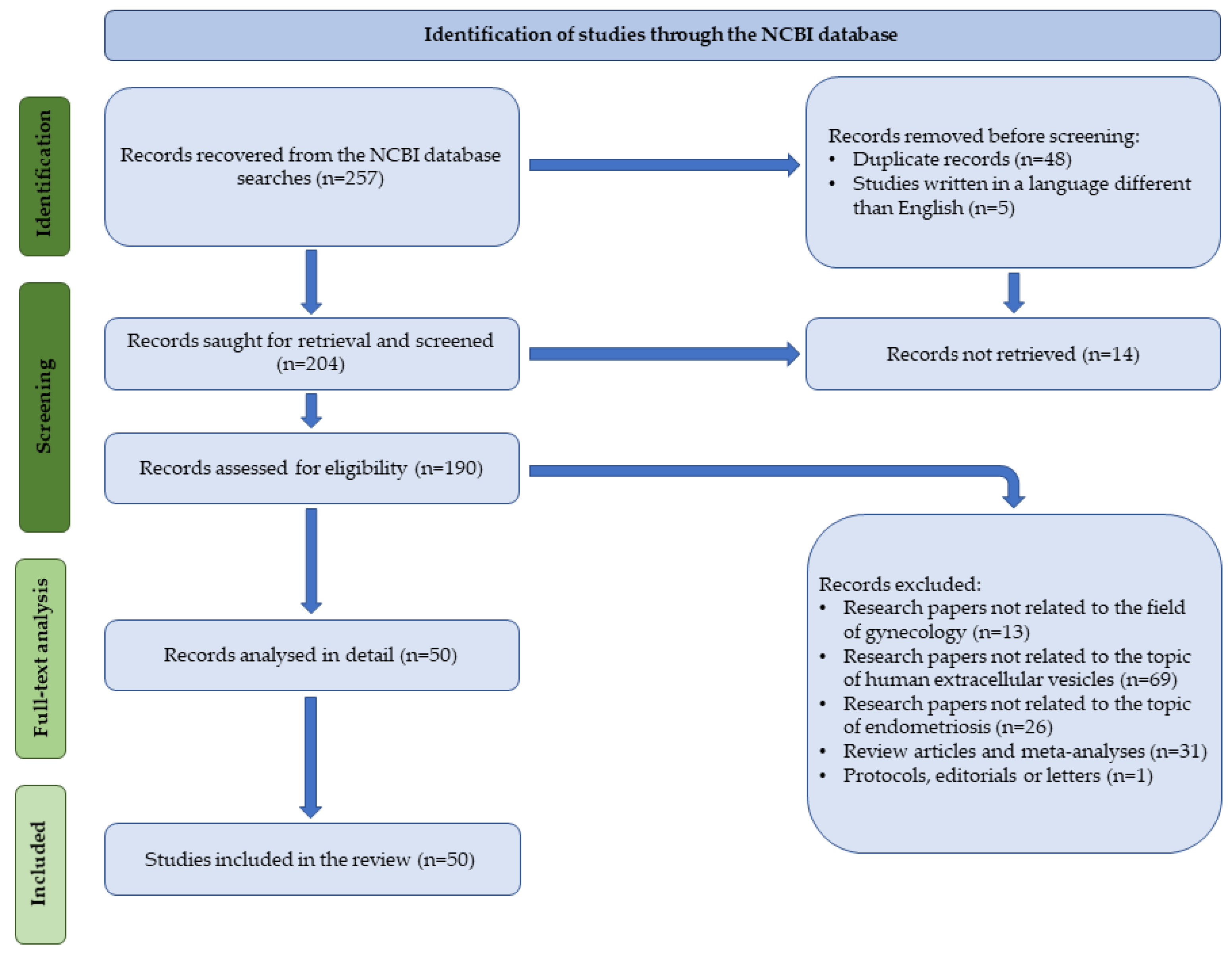
5. Methodology of the Literature Selection Process
Author Contributions
Funding
Institutional Review Board Statement
Informed Consent Statement
Data Availability Statement
Conflicts of Interest
Abbreviations
| ISEV | International Society for Extracellular Vesicles |
| EV | Extracellular Vesicles |
| ESC | Endometrial Stem Cells |
| WB | Western Blot |
| NTA | Nanoparticle Tracking Analysis |
| FC | Flow Cytometry |
| TEM | Transmission Electron Microscopy |
| DLS | Dynamic Light Scattering |
References
- Saunders, P.T.K.; Horne, A.W. Endometriosis: Etiology, pathobiology, and therapeutic prospects. Cell 2021, 184, 2807–2824. [Google Scholar] [CrossRef] [PubMed]
- Lamceva, J.; Uljanovs, R.; Strumfa, I. The Main Theories on the Pathogenesis of Endometriosis. Int. J. Mol. Sci. 2023, 24, 4254. [Google Scholar] [CrossRef]
- Harder, C.; Velho, R.V.; Brandes, I.; Sehouli, J.; Mechsner, S. Assessing the true prevalence of endometriosis: A narrative review of literature data. Int. J. Gynaecol. Obstet. 2024, 167, 883–900. [Google Scholar] [CrossRef]
- Chu, X.; Hou, M.; Li, Y.; Zhang, Q.; Wang, S.; Ma, J. Extracellular vesicles in endometriosis: Role and potential. Front. Endocrinol. 2024, 15, 1365327. [Google Scholar] [CrossRef]
- Welsh, J.A.; Goberdhan, D.C.I.; O’Driscoll, L.; Buzas, E.I.; Blenkiron, C.; Bussolati, B.; Cai, H.; Di Vizio, D.; Driedonks, T.A.P.; Erdbrugger, U.; et al. Minimal information for studies of extracellular vesicles (MISEV2023): From basic to advanced approaches. J. Extracell. Vesicles 2024, 13, e12404. [Google Scholar] [CrossRef] [PubMed]
- Shan, S.; Yang, Y.; Jiang, J.; Yang, B.; Yang, Y.; Sun, F.; Zhang, J.; Lin, Y.; Xu, H. Extracellular vesicle-derived long non-coding RNA as circulating biomarkers for endometriosis. Reprod. Biomed. Online 2022, 44, 923–933. [Google Scholar] [CrossRef] [PubMed]
- Kajdos, M.; Szymanski, J.; Jerczynska, H.; Stetkiewicz, T.; Wilczynski, J.R. Microvesicles released from ectopic endometrial foci as a potential biomarker of endometriosis. Ginekol. Pol. 2023, 94, 780–791. [Google Scholar] [CrossRef]
- Chen, D.; Zhou, L.; Qiao, H.; Wang, Y.; Xiao, Y.; Fang, L.; Yang, B.; Wang, Z. Comparative proteomics identify HSP90A, STIP1 and TAGLN-2 in serum extracellular vesicles as potential circulating biomarkers for human adenomyosis. Exp. Ther. Med. 2022, 23, 374. [Google Scholar] [CrossRef]
- Martínez-Zamora, M.A.; Armengol-Badia, O.; Quintas-Marquès, L.; Carmona, F.; Closa, D. Macrophage Phenotype Induced by Circulating Small Extracellular Vesicles from Women with Endometriosis. Biomolecules 2024, 14, 737. [Google Scholar] [CrossRef]
- Khashchenko, E.P.; Vysokikh, M.Y.; Marey, M.V.; Sidorova, K.O.; Manukhova, L.A.; Shkavro, N.N.; Uvarova, E.V.; Chuprynin, V.D.; Fatkhudinov, T.K.; Adamyan, L.V.; et al. Altered Glycolysis, Mitochondrial Biogenesis, Autophagy and Apoptosis in Peritoneal Endometriosis in Adolescents. Int. J. Mol. Sci. 2024, 25, 4238. [Google Scholar] [CrossRef] [PubMed]
- Khalaj, K.; Miller, J.E.; Lingegowda, H.; Fazleabas, A.T.; Young, S.L.; Lessey, B.A.; Koti, M.; Tayade, C. Extracellular vesicles from endometriosis patients are characterized by a unique miRNA-lncRNA signature. JCI Insight 2019, 4, e128846. [Google Scholar] [CrossRef]
- Carrillo Torres, P.; Martínez-Zamora, M.; Tàssies, D.; Castillo, H.; Gracia, M.; Feixas, G.; Reverter, J.C.; Carmona, F. Impact of Continuous Estroprogestin Treatment on Circulating Microparticle Levels in Deep Endometriosis Patients. Int. J. Mol. Sci. 2023, 24, 11802. [Google Scholar] [CrossRef] [PubMed]
- Wu, Y.; Yuan, W.; Ding, H.; Wu, X. Serum exosomal miRNA from endometriosis patients correlates with disease severity. Arch. Gynecol. Obstet. 2022, 305, 117–127. [Google Scholar] [CrossRef]
- Qiu, J.J.; Lin, X.J.; Zheng, T.T.; Tang, X.Y.; Zhang, Y.; Hua, K.Q. The Exosomal Long Noncoding RNA aHIF is Upregulated in Serum from Patients with Endometriosis and Promotes Angiogenesis in Endometriosis. Reprod. Sci. 2019, 26, 1590–1602. [Google Scholar] [CrossRef] [PubMed]
- Qiu, J.J.; Lin, Y.Y.; Tang, X.Y.; Ding, Y.; Yi, X.F.; Hua, K.Q. Extracellular vesicle-mediated transfer of the lncRNA-TC0101441 promotes endometriosis migration/invasion. Exp. Cell Res. 2020, 388, 111815. [Google Scholar] [CrossRef] [PubMed]
- Sun, S.G.; Guo, J.J.; Qu, X.Y.; Tang, X.Y.; Lin, Y.Y.; Hua, K.Q.; Qiu, J.J. The extracellular vesicular pseudogene LGMNP1 induces M2-like macrophage polarization by upregulating LGMN and serves as a novel promising predictive biomarker for ovarian endometriosis recurrence. Hum. Reprod. 2022, 37, 447–465. [Google Scholar] [CrossRef]
- Zhang, L.; Li, H.; Yuan, M.; Li, D.; Sun, C.; Wang, G. Serum Exosomal MicroRNAs as Potential Circulating Biomarkers for Endometriosis. Dis. Markers 2020, 2020, 2456340. [Google Scholar] [CrossRef] [PubMed]
- Björk, E.; Israelsson, P.; Nagaev, I.; Nagaeva, O.; Lundin, E.; Ottander, U.; Mincheva-Nilsson, L. Endometriotic Tissue-derived Exosomes Downregulate NKG2D-mediated Cytotoxicity and Promote Apoptosis: Mechanisms for Survival of Ectopic Endometrial Tissue in Endometriosis. J. Immunol. 2024, 213, 567–576. [Google Scholar] [CrossRef]
- Muraoka, A.; Yokoi, A.; Yoshida, K.; Kitagawa, M.; Bayasula; Murakami, M.; Miyake, N.; Sonehara, R.; Nakamura, T.; Osuka, S.; et al. Serum-derived small extracellular vesicles as biomarkers for predicting pregnancy and delivery on assisted reproductive technology in patients with endometriosis. Front. Endocrinol. 2024, 15, 1442684. [Google Scholar] [CrossRef]
- Huang, Y.; Zhu, L.; Li, H.; Ye, J.; Lin, N.; Chen, M.; Pan, D.; Chen, Z. Endometriosis derived exosomal miR-301a-3p mediates macrophage polarization via regulating PTEN-PI3K axis. Biomed. Pharmacother. 2022, 147, 112680. [Google Scholar] [CrossRef]
- Li, W.N.; Hsiao, K.Y.; Wang, C.A.; Chang, N.; Hsu, P.L.; Sun, C.H.; Wu, S.R.; Wu, M.H.; Tsai, S.J. Extracellular vesicle-associated VEGF-C promotes lymphangiogenesis and immune cells infiltration in endometriosis. Proc. Natl. Acad. Sci. USA 2020, 117, 25859–25868. [Google Scholar] [CrossRef]
- Zhang, Y.; Chang, X.; Wu, D.; Deng, M.; Miao, J.; Jin, Z. Down-regulation of Exosomal miR-214-3p Targeting CCN2 Contributes to Endometriosis Fibrosis and the Role of Exosomes in the Horizontal Transfer of miR-214-3p. Reprod. Sci. 2021, 28, 715–727. [Google Scholar] [CrossRef] [PubMed]
- Gurung, S.; Piskopos, J.; Steele, J.; Schittenhelm, R.; Shah, A.; Cousins, F.L.; Tapmeier, T.T.; Gargett, C.E. Potential Role of Menstrual Fluid-Derived Small Extracellular Vesicle Proteins in Endometriosis Pathogenesis. J. Extracell. Vesicles 2025, 14, e70048. [Google Scholar] [CrossRef]
- Ji, S.; Qi, H.; Yan, L.; Zhang, D.; Wang, Y.; MuDanLiFu, H.; He, C.; Xia, W.; Zhu, Q.; Liang, Y.; et al. miR-4443 Contained Extracellular Vesicles: A Factor for Endometriosis Progression by PI3K/AKT/ACSS2 Cascade in-vitro. Int. J. Nanomed. 2024, 19, 6085–6098. [Google Scholar] [CrossRef] [PubMed]
- Ababzadeh, S.; Davoodi Asl, F.; Fazaeli, H.; Sheykhhasan, M.; Naserpour, L.; Farsani, M.E.; Sheikholeslami, A. Effects of Exosomes from Menstrual Blood-derived Stem Cells and Ginger on Endometriotic Stem Cells. Curr. Med. Sci. 2024, 44, 1293–1302. [Google Scholar] [CrossRef] [PubMed]
- Davoodi Asl, F.; Sahraei, S.S.; Kalhor, N.; Fazaeli, H.; Sheykhhasan, M.; Soleimani Moud, S.; Naserpour, L.; Sheikholeslami, A. Promising effects of exosomes from menstrual blood-derived mesenchymal stem cells on endometriosis. Reprod. Biol. 2023, 23, 100788. [Google Scholar] [CrossRef]
- Bortot, B.; Di Florio, R.; Merighi, S.; Peacock, B.; Lees, R.; Valle, F.; Brucale, M.; Mangogna, A.; Di Lorenzo, G.; Romano, F.; et al. Platelets as key cells in endometriosis patients: Insights from small extracellular vesicles in peritoneal fluid and endometriotic lesions analysis. FASEB J. 2024, 38, e70267. [Google Scholar] [CrossRef]
- Nazri, H.M.; Imran, M.; Fischer, R.; Heilig, R.; Manek, S.; Dragovic, R.A.; Kessler, B.M.; Zondervan, K.T.; Tapmeier, T.T.; Becker, C.M. Characterization of exosomes in peritoneal fluid of endometriosis patients. Fertil. Steril. 2020, 113, 364–373.e362. [Google Scholar] [CrossRef]
- Chen, Y.; Wang, K.; Xu, Y.; Guo, P.; Hong, B.; Cao, Y.; Wei, Z.; Xue, R.; Wang, C.; Jiang, H. Alteration of Myeloid-Derived Suppressor Cells, Chronic Inflammatory Cytokines, and Exosomal miRNA Contribute to the Peritoneal Immune Disorder of Patients with Endometriosis. Reprod. Sci. 2019, 26, 1130–1138. [Google Scholar] [CrossRef]
- Liu, T.; Liu, M.; Zheng, C.; Zhang, D.; Li, M.; Zhang, L. Exosomal lncRNA CHL1-AS1 Derived from Peritoneal Macrophages Promotes the Progression of Endometriosis via the miR-610/MDM2 Axis. Int. J. Nanomed. 2021, 16, 5451–5464. [Google Scholar] [CrossRef]
- Zhang, L.; Li, H.H.; Yuan, M.; Li, D.; Wang, G.Y. Exosomal miR-22-3p derived from peritoneal macrophages enhances proliferation, migration, and invasion of ectopic endometrial stromal cells through regulation of the SIRT1/NF-κB signaling pathway. Eur. Rev. Med. Pharmacol. Sci. 2020, 24, 571–580. [Google Scholar] [CrossRef]
- Jiang, Y.; Chai, X.; Chen, S.; Chen, Z.; Tian, H.; Liu, M.; Wu, X. Exosomes from the Uterine Cavity Mediate Immune Dysregulation via Inhibiting the JNK Signal Pathway in Endometriosis. Biomedicines 2022, 10, 3110. [Google Scholar] [CrossRef]
- Chen, S.; Jiang, Y.; Chai, X.; Chen, Z.; Tian, H.; Liu, M.; Zhu, T.; ShangGuan, W.; Wu, X. Uterine-derived exosomes induce the M2 polarization of macrophages via miR-210-3p/ATP5D to promote endometriosis progression. Life Sci. 2025, 363, 123383. [Google Scholar] [CrossRef]
- Li, X.; Fu, J.; Jiang, W.; Zhang, W.; Xu, Y.; Gu, R.; Qu, R.; Zou, Y.; Li, Z.; Sun, Y.; et al. Extracellular vesicles-derived MicroRNA-145-5p is upregulated in the uterine fluid of women with endometriosis and impedes mouse and human blastocyst development. J. Ovarian Res. 2024, 17, 253. [Google Scholar] [CrossRef]
- Zhang, Z.; Xiong, Y.; Jiang, H.; Wang, Q.; Hu, X.; Wei, X.; Chen, Q.; Chen, T. Vaginal extracellular vesicles impair fertility in endometriosis by favoring Th17/Treg imbalance and inhibiting sperm activity. J. Cell. Physiol. 2024, 239, e31188. [Google Scholar] [CrossRef]
- Li, Y.; Cui, S.; Xu, Z.; Zhang, Y.; Wu, T.; Zhang, J.; Chen, Y. Exosomal tRF-Leu-AAG-001 derived from mast cell as a potential non-invasive diagnostic biomarker for endometriosis. BMC Women’s Health 2022, 22, 253. [Google Scholar] [CrossRef]
- Zheng, L.; Sun, D.F.; Tong, Y. Exosomal miR-202 derived from leukorrhea as a potential biomarker for endometriosis. J. Int. Med. Res. 2023, 51, 3000605221147183. [Google Scholar] [CrossRef] [PubMed]
- Texidó, L.; Romero, C.; Vidal, A.; García-Valero, J.; Fernández Montoli, M.E.; Baixeras, N.; Condom, E.; Ponce, J.; García-Tejedor, A.; Martín-Satué, M. Ecto-nucleotidases activities in the contents of ovarian endometriomas: Potential biomarkers of endometriosis. Mediat. Inflamm. 2014, 2014, 120673. [Google Scholar] [CrossRef] [PubMed]
- Harp, D.; Driss, A.; Mehrabi, S.; Chowdhury, I.; Xu, W.; Liu, D.; Garcia-Barrio, M.; Taylor, R.N.; Gold, B.; Jefferson, S.; et al. Exosomes derived from endometriotic stromal cells have enhanced angiogenic effects in vitro. Cell Tissue Res. 2016, 365, 187–196. [Google Scholar] [CrossRef] [PubMed]
- Zhou, W.; Lian, Y.; Jiang, J.; Wang, L.; Ren, L.; Li, Y.; Yan, X.; Chen, Q. Differential expression of microRNA in exosomes derived from endometrial stromal cells of women with endometriosis-associated infertility. Reprod. Biomed. Online 2020, 41, 170–181. [Google Scholar] [CrossRef]
- Lee, I.; Kim, S.; Jung, G.S.; Shin, Y.; Lee, M.J.; Im, W.; Lee, J.H.; Choi, Y.S.; Cho, S. Effects of Exosomes Derived from Eutopic Endometrial Cells in Endometriosis and the Discovery of Related Serum miRNA Biomarkers for Endometriosis. Am. J. Reprod. Immunol. 2025, 94, e70155. [Google Scholar] [CrossRef] [PubMed]
- Zhang, L.; Yu, Z.; Qu, Q.; Li, X.; Lu, X.; Zhang, H. Exosomal lncRNA HOTAIR Promotes the Progression and Angiogenesis of Endometriosis via the miR-761/HDAC1 Axis and Activation of STAT3-Mediated Inflammation. Int. J. Nanomed. 2022, 17, 1155–1170. [Google Scholar] [CrossRef] [PubMed]
- Zhu, Y.; Zheng, B.; Zhang, Y.; Li, M.; Jiang, Y.; Zhou, J.; Zhang, Y.; Kang, N.; Wu, M.; Yan, Y.; et al. Ectopic endometrial stromal cell-derived extracellular vesicles encapsulating microRNA-25-3p induce endometrial collagen I deposition impairing decidualization in endometriosis. Mol. Hum. Reprod. 2024, 30, gaae042. [Google Scholar] [CrossRef]
- Hsu, C.Y.; Hsieh, T.H.; Lin, H.Y.; Lu, C.Y.; Lo, H.W.; Tsai, C.C.; Tsai, E.M. Characterization and Proteomic Analysis of Endometrial Stromal Cell-Derived Small Extracellular Vesicles. J. Clin. Endocrinol. Metab. 2021, 106, 1516–1529. [Google Scholar] [CrossRef]
- Zhu, Y.; Gao, L.; Zhang, J.; Li, M.; Zhou, J.; Zhou, J. Extracellular vesicle-packaged PKM2 from endometriotic stromal cells promotes endometrial collagen I deposition by inhibiting autophagy in endometriosis. Cell. Signal. 2025, 127, 111523. [Google Scholar] [CrossRef]
- Wang, X.; Zhang, M.; Jiang, L.; Fang, X.; Zhang, T. Exosomal AFAP1-AS1 binds to microRNA-15a-5p to promote the proliferation, migration, and invasion of ectopic endometrial stromal cells in endometriosis. Reprod. Biol. Endocrinol. 2022, 20, 77. [Google Scholar] [CrossRef]
- Ji, J.; Wang, H.; Yuan, M.; Li, J.; Song, X.; Lin, K. Exosomes from ectopic endometrial stromal cells promote M2 macrophage polarization by delivering miR-146a-5p. Int. Immunopharmacol. 2024, 128, 111573. [Google Scholar] [CrossRef]
- Sun, L.; Cheng, Y.; Wang, J.; Wu, D.; Yuan, L.; Wei, X.; Li, Y.; Gao, J.; Zhang, G. Exosomal miR-21-5p derived from endometrial stromal cells promotes angiogenesis by targeting TIMP3 in ovarian endometrial cysts. J. Mol. Med. 2024, 102, 1327–1342. [Google Scholar] [CrossRef]
- Wu, J.; Fang, X.; Huang, H.; Huang, W.; Wang, L.; Xia, X. Construction and topological analysis of an endometriosis-related exosomal circRNA-miRNA-mRNA regulatory network. Aging 2021, 13, 12607–12630. [Google Scholar] [CrossRef]
- Zipponi, M.; Lee, D.Y.; Stratopoulou, C.A.; Camboni, A.; Cacciottola, L.; Dolmans, M.M. Characterization of microRNA exosome content from endometrioma wall in vitro culture. Fertil. Steril. 2024, 122, 174–177. [Google Scholar] [CrossRef]
- Zhang, F.; Li, F.; Lu, J. microRNA-100 shuttled by human umbilical cord MSC-secreted extracellular vesicles induces endometriosis by inhibiting HS3ST2. Cell. Signal. 2023, 102, 110532. [Google Scholar] [CrossRef]
- Wang, X.; Wu, P.; Li, X.; Zeng, C.; Zhu, J.; Zhou, Y.; Lu, Y.; Xue, Q. Extracellular Vesicles Inhibit Proliferation and Invasion of Ovarian Endometrial Stromal Cells and Their Expression of SF-1, ERβ, and Aromatase. Front. Endocrinol. 2021, 12, 666195. [Google Scholar] [CrossRef]
- Feng, Y.; Zhan, F.; Zhong, Y.; Tan, B. Effects of human umbilical cord mesenchymal stem cells derived from exosomes on migration ability of endometrial glandular epithelial cells. Mol. Med. Rep. 2020, 22, 715–722. [Google Scholar] [CrossRef]
- Ou, S.; Jiao, X.; Li, Y.; Pan, P.; Li, R.; Huang, J.; Sun, X.; Wang, W.; Zhang, Q.; Cao, C.; et al. Comparison of chromatin accessibility remodeling of granulosa cells in patients with endometrioma or pelvic/tubal infertility. J. Assist. Reprod. Genet. 2025, 42, 599–609. [Google Scholar] [CrossRef]
- Zhang, Y.; Zhang, H.; Yan, L.; Liang, G.; Zhu, C.; Wang, Y.; Ji, S.; He, C.; Sun, J.; Zhang, J. Exosomal microRNAs in tubal fluid may be involved in damage to tubal reproductive function associated with tubal endometriosis. Reprod. Biomed. Online 2023, 47, 103249. [Google Scholar] [CrossRef]
- Kumar, M.A.; Baba, S.K.; Sadida, H.Q.; Marzooqi, S.A.; Jerobin, J.; Altemani, F.H.; Algehainy, N.; Alanazi, M.A.; Abou-Samra, A.B.; Kumar, R.; et al. Extracellular vesicles as tools and targets in therapy for diseases. Signal Transduct. Target. Ther. 2024, 9, 27. [Google Scholar] [CrossRef]
- Sheta, M.; Taha, E.A.; Lu, Y.; Eguchi, T. Extracellular Vesicles: New Classification and Tumor Immunosuppression. Biology 2023, 12, 110. [Google Scholar] [CrossRef]
- Doyle, L.M.; Wang, M.Z. Overview of Extracellular Vesicles, Their Origin, Composition, Purpose, and Methods for Exosome Isolation and Analysis. Cells 2019, 8, 727. [Google Scholar] [CrossRef]
- Thery, C.; Witwer, K.W.; Aikawa, E.; Alcaraz, M.J.; Anderson, J.D.; Andriantsitohaina, R.; Antoniou, A.; Arab, T.; Archer, F.; Atkin-Smith, G.K.; et al. Minimal information for studies of extracellular vesicles 2018 (MISEV2018): A position statement of the International Society for Extracellular Vesicles and update of the MISEV2014 guidelines. J. Extracell. Vesicles 2018, 7, 1535750. [Google Scholar] [CrossRef]
- Morozumi, M.; Izumi, H.; Shimizu, T.; Takeda, Y. Comparison of isolation methods using commercially available kits for obtaining extracellular vesicles from cow milk. J. Dairy Sci. 2021, 104, 6463–6471. [Google Scholar] [CrossRef]
- Brennan, K.; Martin, K.; FitzGerald, S.P.; O’Sullivan, J.; Wu, Y.; Blanco, A.; Richardson, C.; Mc Gee, M.M. A comparison of methods for the isolation and separation of extracellular vesicles from protein and lipid particles in human serum. Sci. Rep. 2020, 10, 1039. [Google Scholar] [CrossRef]
- Suresh, P.S.; Zhang, Q. Comprehensive Comparison of Methods for Isolation of Extracellular Vesicles from Human Plasma. J. Proteome Res. 2025, 24, 2956–2967. [Google Scholar] [CrossRef]


| Ref. | Endo. | Cont. | EV Sample Source | EV Isolation Method | Additional Purification/ Reagent | Phenotype Characterization Techniques | Analyzed Markers | |||||||||
|---|---|---|---|---|---|---|---|---|---|---|---|---|---|---|---|---|
| (T)EM | NTA | WB | FC | Other | CD9 | CD63 | CD81 | HSP70 | TSG101 | Other | ||||||
| [6] | 5 | 6 | Blood plasma | Affinity-based isolation | exoRNeasy Serum/Plasma Midi Kit (Qiagen, Hilden, Germany) | + | + | + | + | |||||||
| [7] | 30 | 10 | Blood plasma | Centrifugation | - | + | MMP9, VEGF | |||||||||
| [8] | 25 * (adenomyosis) | 31 | Blood plasma | Differential ultracentrifugation | Iodixanol gradient | + | + | + | LVSEM, LC-MS | + | + | Flotillin-2 | ||||
| [9] | 12 | 12 | Blood plasma | Ultracentrifugation | - | + | + | + | Alix, calnexin | |||||||
| [10] | 45 | 15 | Blood plasma | Ultracentrifugation | - | N/A | N/A | N/A | N/A | N/A | N/A | N/A | N/A | N/A | N/A | N/A |
| [11] | 6 | 6 | Blood plasma | Ultracentrifugation + Precipitation-based isolation | miRCURY Exosome Isolation Kit (Exiqon, Vedbæk, Denmark) | + | + | + | Calnexin | |||||||
| [12] | 86 | 43 | Blood plasma | N/A | - | N/A | N/A | N/A | N/A | N/A | N/A | N/A | N/A | N/A | N/A | N/A |
| [13] | 32 | 24 | Serum | Affinity-based isolation | Exosome Binding Enhancer (Wako, Tokyo, Japan) | + | + | + | + | |||||||
| [14] | 30 | 16 | Serum | Polymer-based precipitation | ExoQuick Exosome Precipitation Solution (System Biosciences, Palo Alto, CA, USA) | + | + | + | + | |||||||
| [15] | 29 | 16 | Serum | Polymer-based precipitation | ExoQuick Exosome Precipitation Solution (System Biosciences, USA) | + | + | + | + | + | + | + | ||||
| [16] | 52 | 21 | Serum | Polymer-based precipitation | ExoQuick Exosome Precipitation Solution (System Biosciences, USA) | + | + | + | + | + | Calnexin | |||||
| [17] | 25 | 25 | Serum | Differential centrifugation | + | + | + | + | + | |||||||
| [18] | 7 | 6 | Serum | Ultracentrifugation | Sucrose gradient | + | + | + | + | + | ||||||
| [19] | 14 | 34 | Serum | Ultracentrifugation | + | + | + | + | + | + | ||||||
| [20] | N/A | N/A | Serum | Ultracentrifugation | + | + | + | + | + | Calnexin | ||||||
| [21] | 111 | 35 | Serum | Size-exclusion chromatography (SEC) | + | + | + | VEGF-C | ||||||||
| [22] | 20 | 20 | Serum | N/A | - | |||||||||||
| [23] | 8 | 9 | Menstrual blood | Differential centrifugation | + | + | + | + | + | + | + | |||||
| [24] | 5 | 7 | Menstrual blood | Differential centrifugation → ultracentrifugation | + | + | + | + | + | Flotillin-1 | ||||||
| [25] | n/a | n/a | Menstrual blood stem cells | Polymer-based precipitation | EXOCIB Exosome Isolation Kit (Cib Biotech, Shiraz, Iran) | + | + | DLS | + | + | + | |||||
| [26] | 5 | 10 | Menstrual blood stem cells | Polymer-based precipitation | EXOCIB Exosome Isolation Kit (Cib Biotech, Iran) | + | + | DLS | + | + | + | |||||
| [27] | 6 | 6 | Peritoneal fluid | Polymer-based precipitation | Total Exosome Isolation Reagent (Invitrogen, Carlsbad, CA, USA) | + | AFM | CD61 | ||||||||
| [7] | 26 | 11 | Peritoneal fluid | Centrifugation | + | MMP9, VEGF | ||||||||||
| [28] | 22 | 6 | Peritoneal fluid | Centrifugation → SEC | + | + | + | + | Syntenin, Alix | |||||||
| [29] | 54 | 13 | Peritoneal fluid | Differential centrifugation | N/A | N/A | N/A | N/A | N/A | N/A | N/A | N/A | N/A | N/A | N/A | |
| [24] | 6 | 6 | Peritoneal fluid | Differential centrifugation | + | + | + | + | + | Flotillin-1 | ||||||
| [30] | 50 | 50 | Peritoneal fluid macrophage culture | Sequential centrifugation | + | + | + | + | + | |||||||
| [11] | 6 | 6 | Peritoneal fluid | Ultracentrifugation + Precipitation-based isolation | miRCURY Exosome Isolation Kit (Exiqon, Denmark) | + | + | + | Calnexin | |||||||
| [10] | 45 | 15 | Peritoneal fluid | Ultracentrifugation | N/A | N/A | N/A | N/A | N/A | N/A | N/A | N/A | N/A | N/A | N/A | |
| [31] | 20 | 20 | Macrophage from peritoneal fluid | Differential centrifugation | + | + | + | + | + | |||||||
| [32] | 22 | 25 | Uterine fluid | Size-exclusion chromatography (SEC) | Exosupur Exosome Purification Kit (Echo Biotech, Beijing, China) | + | + | + | + | + | + | Calnexin | ||||
| [33] | N/A | N/A | Uterine fluid | Size-exclusion chromatography (SEC) | Exosupur Exosome Purification Kit (Echo Biotech, China) | + | + | + | + | + | + | |||||
| [34] | 30 | 30 | Uterine fluid | Ultracentrifugation | + | + | + | + | + | + | Calnexin | |||||
| [35] | 10 | 10 | Vaginal discharge | Polymer-based precipitation | ExoQuick Exosome Precipitation Solution (Cell Guidance Systems, Cambridge, UK) | + | + | N/A | N/A | N/A | N/A | N/A | N/A | |||
| [36] | 26 | 25 | Vaginal discharge | Differential centrifugation | + | + | + | + | + | Flotillin-1, Calnexin | ||||||
| [37] | 11 | 11 | Vaginal discharge | Differential ultracentrifugation | + | + | + | + | + | |||||||
| [38] | 14 | 13 | Endometriomas | Polymer-based precipitation | ExoQuick Exosome Precipitation Solution (System Biosciences, USA) | + | + | + | + | + | + | |||||
| [8] | 31, but adenomyosis | 0 | Adenomyotic tissue | Differential ultracentrifugation | iodixanol gradient | + | + | + | LVSEM, LC-MS | + | + | Flotillin-2 | ||||
| [36] | 26 | 25 | Endometrial ectopic tissue | Differential centrifugation | + | + | + | + | + | Flotillin-1, Calnexin | ||||||
| [20] | n/a | n/a | Ectopic endometrial tissue | Ultracentrifugation | + | + | + | + | + | Calnexin | ||||||
| [11] | 6 | 6 | Endometriotic tissue | Ultracentrifugation + Precipitation-based isolation | miRCURY Exosome Isolation Kit (Exiqon, Denmark) | + | + | + | Calnexin | |||||||
| [39] | 5 | 5 | Eutopic ESC | Ultracentrifugation + Commercial kit | Exosome Isolation Kit (Invitrogen) | + | + | N/A | N/A | N/A | N/A | N/A | N/A | |||
| [21] | 111 | 35 | Eutopic ESC | Polymer-based precipitation | ExoQuick Exosome Precipitation Solution (System Biosciences, USA) | + | + | + | VEGF-C | |||||||
| [40] | 3 | 3 | Eutopic ESC | Polymer-based precipitation | ExoQuick Exosome Precipitation Solution (System Biosciences, USA) | + | + | + | + | |||||||
| [41] | 10 | 10 | Eutopic ESC | Polymer-based precipitation | ExoQuick Exosome Precipitation Solution (System Biosciences, USA) | N/A | N/A | N/A | N/A | N/A | N/A | N/A | N/A | N/A | N/A | N/A |
| [42] | 50 | 50 | Eutopic ESC | Sequential centrifugation | + | + | + | + | + | |||||||
| [43] | 6 | 6 | Eutopic ESC | Differential centrifugation | + | + | + | + | + | Alix, Calnexin | ||||||
| [37] | 6 | 5 | Eutopic ESC | Differential ultracentrifugation | + | + | + | + | + | |||||||
| [44] | 3 | n/a | Eutopic ESC | Differential centrifugation | + | + | + | + | + | + | + | |||||
| [45] | 20 | 20 | Eutopic ESC | Ultracentrifugation | + | + | + | + | + | Alix, Calnexin, GM130 | ||||||
| [11] | 6 | 6 | Eutopic ESC | Ultracentrifugation + Precipitation-based isolation | miRCURY Exosome Isolation Kit (Exiqon, Denmark) | + | + | + | Calnexin | |||||||
| [46] | 30 | 20 | Ectopic ESC | Polymer-based precipitation | Exo Extraction Kit (ExoQuick; System Biosciences, USA) | + | + | + | + | + | + | + | ||||
| [47] | n/a | n/a | Ectopic ESC | Polymer-based precipitation | Exo Extraction Kit (ExoQuick; System Biosciences, USA) | + | + | + | + | |||||||
| [46] | 30 | 20 | Eutopic ESC | Polymer-based precipitation | Exo Extraction Kit (ExoQuick; System Biosciences, USA) | + | + | + | + | + | + | + | ||||
| [47] | n/a | n/a | Eutopic ESC | Polymer-based precipitation | Exo Extraction Kit (ExoQuick; System Biosciences, USA) | + | + | + | + | |||||||
| [15] | 10 | 10 | Ectopic ESC | Polymer-based precipitation | Total Exosome Isolation Reagent (Thermo Fisher Scientific, Waltham, MA, USA) | + | + | + | + | + | + | + | ||||
| [39] | 5 | 5 | Ectopic ESC | Ultracentrifugation + Polymer-based precipitation | Total Exosome Isolation Reagent (Thermo Fisher Scientific, USA) | + | + | N/A | N/A | N/A | N/A | N/A | N/A | |||
| [16] | 2 | 0 | Ectopic ESC | Polymer-based precipitation | ExoQuick Exosome Precipitation Solution (System Biosciences, USA) | + | + | + | + | + | Calnexin | |||||
| [21] | 111 | 35 | Ectopic ESC | Polymer-based precipitation | ExoQuick Exosome Precipitation Solution (System Biosciences, USA) | + | + | + | VEGF-C | |||||||
| [22] | 20 | 20 | Ectopic ESC | Polymer-based precipitation | ExoQuick Exosome Precipitation Solution (System Biosciences, USA) | + | + | + | + | |||||||
| [14] | 30 | 16 | Ectopic ESC | Polymer-based precipitation + centrifugation | Total Exosome Isolation Reagent (Thermo Fisher Scientific, USA) | + | + | + | + | |||||||
| [43] | 6 | 6 | Ectopic ESC | Differential centrifugation | + | + | + | + | + | Alix, Calnexin | ||||||
| [37] | 6 | 5 | Ectopic ESC | Differential ultracentrifugation | + | + | + | + | + | |||||||
| [45] | 20 | 20 | Ectopic ESC | Ultracentrifugation | + | + | + | + | + | Alix, Calnexin, GM130 | ||||||
| [44] | 3 | n/a | Ectopic ESC | Differential centrifugation | + | + | + | + | + | + | + | |||||
| [48] | 50 | 50 | Ectopic ESC | Ultracentrifugation | + | + | + | + | + | + | Calnexin | |||||
| [11] | 6 | 6 | Ectopic ESC | Ultracentrifugation + Precipitation-based isolation | miRCURY Exosome Isolation Kit (Exiqon, Denmark) | + | + | + | Calnexin | |||||||
| [18] | 5 | 0 | Other: cells isolated from endometriotic tissue | Ultracentrifugation | Sucrose gradient | + | + | + | + | + | CA125 | |||||
| [49] | 13 | 13 | Other: cells isolated from ovarian endometrioma and endometriotic tissue | Polymer-based precipitation | ExoQuick Exosome Precipitation Solution (System Biosciences, USA) | + | + | + | N/A | N/A | N/A | N/A | N/A | N/A | ||
| [50] | 8 | 0 | Other: ectopic endometrioma wall explant culture | Differential centrifugation | + | + | + | + | + | |||||||
| [51] | 15 | 8 | Other: hUC-MSCs | Ultracentrifugation | Exosome Extraction Kit (Bioruo, Beijing, China) | + | + | + | + | + | + | + | ||||
| [52] | n/a | n/a | Other: hUC-MSCs | Ultracentrifugation | + | + | + | + | + | |||||||
| [53] | 5 | 6 | Other: hUC-MSCs | Principle not reported | Exosome Extraction Kit (Bioruo, China) | + | N/A | N/A | N/A | N/A | N/A | N/A | ||||
| [27] | 6 | 6 | Other: Follicular fluid | Centrifugation | Total Exosome Isolation Reagent (Thermo Fisher Scientific, USA) | + | AFM | CD61 | ||||||||
| [54] | 10 (*) endometrioma | 10 | Other: Follicular fluid | Ultracentrifugation | + | + | + | + | + | |||||||
| [55] | 4 | 5 | Other: Fallopian tube fluid | Ultracentrifugation | + | + | + | + | + | Flotillin-1 | ||||||
| [24] | 4 | 5 | Other: Fallopian tube fluid | Differential centrifugation | + | + | + | + | + | Flotillin-1 | ||||||
| Publication | EV Sample Source | Implemented EV Analyses: | Conclusions | |||
|---|---|---|---|---|---|---|
| EV Cargo Analysis * | Gene Expression | EV Uptake | Further Analyses | |||
| [8] | Blood plasma, Adenomyotic tissue | Proteomics | Identification of potential biomarkers, Influence on cell invasion | |||
| [6] | Blood plasma | lncRNA | Identification of potential biomarker: EV-associated lncRNAs | |||
| [21] | Serum, Eutopic, Ectopic ESC | (Gene knockout studies) | + | Transwell migration, cell proliferation, Western blot | Identification of potential biomarker: VEGF-C; Pro-angiogenic signalling | |
| [19] | Serum | miRNA | Identification of potential biomarker: EV miRNAs associated with reproductive outcomes | |||
| [13] | Serum | miRNA | Identification of potential biomarker: EV miRNAs | |||
| [17] | Serum | miRNA | Identification of potential biomarker: miR-22-3p, miR-320a | |||
| [14] | Serum, Ectopic ESC | + | + | Tube formation, wound healing | Identification of potential biomarker: antisense hypoxia-inducing factor (aHIF); Pro-angiogenic signalling | |
| [15] | Serum, Ectopic ESC | + | + | Transwell migration; Wound healing | Identification of potential biomarker: lncRNA TC0101441; Involvement in transport of metastasis factors | |
| [16] | Serum, Ectopic ESC | + | + | Identification of potential biomarker: EV-LGMNP1; Macrophage phenotype modulation: LGMNP1 | ||
| [22] | Serum, Ectopic ESC | Effects of EV-derived miRNA | Identification of potential biomarker: miR-214-3p; Fibrosis-related signalling | |||
| [23] | Menstrual blood | Proteomics | EV co-culture with mesothelial cells | Identification of potential biomarker: EV proteins’ role in endometriosis lesion establishment | ||
| [24] | Menstrual blood, Peritoneal fluid, Fallopian tube fluid | miRNA | + | Identification of potential biomarker: miR-4443, contributing to endometriosis pathogenesis | ||
| [27] | Peritoneal fluid | Network analysis: proteomic STRING analysis | Identification of potential biomarker: platelet-derived EVs | |||
| [28] | Peritoneal fluid | Proteomics | Identification of potential biomarker: PRDX1, ANXA2, ITIH4 | |||
| [54] | Follicular fluid | + | Identification of potential biomarker, Altered EV molecular profile | |||
| [36] | Endometriotic tissue, Vaginal discharge | + | Pathway analysis: proteomics (KEGG) | Identification of potential biomarker: tRF-Leu-AAG-001 (promoting inflammation and angiogenesis) | ||
| [37] | Vaginal discharge, Eutopic ESC, Ectopic ESC | miRNA | Identification of potential biomarker: miR-202-3p, miR-202-5p | |||
| [42] | Eutopic ESC | + | + | Transwell migration; Wound healing; Tube formation; Analysis of EV lncRNA effects | Identification of potential biomarker: EV lncRNA sponges up miR-761 | |
| [49] | Other: cells are isolated from endometriotic tissue and endometrioma | Network analysis: construction and topological analysis of exosomal RNA network | Identification of potential biomarker: circRNA–miRNA–mRNA network | |||
| [18] | Serum, Other: cells isolated from endometriotic tissue | EV surface analysis: IF, FC | EV-mediated immune modulation (NK activity impairment) | |||
| [30] | Peritoneal fluid macrophage culture | + | + | Transwell migration; wound healing, Dual reporter gene assay | EV-mediated immune modulation: lncRNA CHL-AS1 (sponge for miR-610) | |
| [29] | Peritoneal fluid | miRNA | EV-mediated immune modulation | |||
| [31] | Macrophage from peritoneal fluid | + | + | Transwell migration; Wound healing | EV-mediated immune modulation: miR-22-3p | |
| [38] | Endometriomas | Ectonucleotidase activity | EV-mediated immune modulation | |||
| [9] | Blood plasma | + | Macrophage phenotype modulation | |||
| [33] | Uterine fluid | miRNA | + | Wound healing; Colony formation, Decidualization assay, Transwell migration | Macrophage phenotype modulation: miR-210-3p | |
| [32] | Uterine fluid | miRNA | + | + | Transwell migration; EV co-culture with macrophages | Macrophage phenotype modulation:miR-210-3p |
| [47] | Ectopic ESC | miRNA | Co-culture with macrophages | Macrophage phenotype modulation: miR-146a-5p | ||
| [20] | Ectopic endometrial tissue, serum | miRNA | + | Macrophage phenotype modulation: miR-301a-3p | ||
| [7] | Blood plasma, Peritoneal fluid | + | Pro-angiogenic signalling | |||
| [39] | Eutopic ESC | miRNA | Tube formation | Pro-angiogenic signalling (miR-21) | ||
| [48] | Ectopic ESC | miRNA | + | Proliferation; wound healing; Tube formation; transwell migration | Pro-angiogenic, enhancing proliferation and migration signalling: miR-21-5p | |
| [43] | Eutopic ESC, Ectopic ESC | miRNA | + | EV co-culture with ESCs | Fibrosis-related signalling: miR-25-3p | |
| [45] | Eutopic ESC, Ectopic ESC | + | EV co-culture with ESCs | Fibrosis-related signalling: PKM2 | ||
| [40] | Eutopic ESC | miRNA | + | Influence on fertility | ||
| [34] | Uterine fluid | miRNA | Influence on fertility: miR-145-5p (negative impact) | |||
| [35] | Vaginal discharge | EV co-culture with human sperm | Influence on fertility | |||
| [46] | Ectopic ESC, Eutopic ESC | + | + | Transwell migration | Influence on cell proliferation and migration: AFAP1-AS1 | |
| [44] | Ectopic ESC, Eutopic ESC | Proteomics | + | Transwell migration, Tube formation | Influence on cell proliferation and migration: Annexin A2 | |
| [51] | Other: hUC-MSCs | miRNA | + | + | Transwell migration; Wound healing | Influence on cell proliferation and migration: miR-100 |
| [11] | Blood plasma, Peritoneal fluid, Ectopic ESC, Eutopic ESC, Endometriotic tissue | Proteomics, miRNA | + | Altered EV molecular profile in patients with endometriosis | ||
| [12] | Blood plasma | cMP-TF activity (ELISA) | Altered EV molecular profile and levels of EV in patients with endometriosis | |||
| [41] | Eutopic ESC | miRNA | Apoptosis; Transwell migration; Wound healing; Proliferation | Altered EV molecular profile, influence on cell proliferation | ||
| [50] | Ectopic endometrioma wall explant culture | miRNA | Altered EV molecular profile | |||
| [26] | Menstrual blood-derived stem cells | + | Apoptosis, Wound healing (scratch); IF; ELISA | Gene expression modulation of EVs, influence on cell proliferation and migration | ||
| [55] | Other: Fallopian tube fluid | miRNA | + | Gene expression modulation | ||
| [10] | Blood plasma, Peritoneal fluid | + | Metabolic pathway alterations | |||
| [25] | Menstrual blood-derived stem cells | NEMenSC-derived EV effects on E-MenSCs (apoptosis, inflammatory markers) | Potential therapeutic effect of EVs | |||
| [52] | Other: hUC-MSCs | + | Matrigel invasion, Western blot, | Potential therapeutic effect of hUC-MSC-derived EVs from healthy patients | ||
| [53] | Other: hUC-MSCs | + | + | Transwell migration; Wound healing; Western blot | Potential therapeutic effect | |
Disclaimer/Publisher’s Note: The statements, opinions and data contained in all publications are solely those of the individual author(s) and contributor(s) and not of MDPI and/or the editor(s). MDPI and/or the editor(s) disclaim responsibility for any injury to people or property resulting from any ideas, methods, instructions or products referred to in the content. |
© 2026 by the authors. Licensee MDPI, Basel, Switzerland. This article is an open access article distributed under the terms and conditions of the Creative Commons Attribution (CC BY) license.
Share and Cite
Chodowiec, A.; Dec, M.; Łuszczyński, K.; Zdanowski, R.; Szafarowska, M.; Szewczak, L.; Synowiec, A.; Mitkowski, P.; Włodarski, P.K.; Lutyńska, A.; et al. Extracellular Vesicles in Endometriosis: A Comprehensive Review of Biological Insights and Methodological Challenges. Int. J. Mol. Sci. 2026, 27, 4666. https://doi.org/10.3390/ijms27114666
Chodowiec A, Dec M, Łuszczyński K, Zdanowski R, Szafarowska M, Szewczak L, Synowiec A, Mitkowski P, Włodarski PK, Lutyńska A, et al. Extracellular Vesicles in Endometriosis: A Comprehensive Review of Biological Insights and Methodological Challenges. International Journal of Molecular Sciences. 2026; 27(11):4666. https://doi.org/10.3390/ijms27114666
Chicago/Turabian StyleChodowiec, Aleksander, Magdalena Dec, Krzysztof Łuszczyński, Robert Zdanowski, Monika Szafarowska, Ludmiła Szewczak, Agnieszka Synowiec, Paweł Mitkowski, Paweł K. Włodarski, Anna Lutyńska, and et al. 2026. "Extracellular Vesicles in Endometriosis: A Comprehensive Review of Biological Insights and Methodological Challenges" International Journal of Molecular Sciences 27, no. 11: 4666. https://doi.org/10.3390/ijms27114666
APA StyleChodowiec, A., Dec, M., Łuszczyński, K., Zdanowski, R., Szafarowska, M., Szewczak, L., Synowiec, A., Mitkowski, P., Włodarski, P. K., Lutyńska, A., & Ścieżyńska, A. (2026). Extracellular Vesicles in Endometriosis: A Comprehensive Review of Biological Insights and Methodological Challenges. International Journal of Molecular Sciences, 27(11), 4666. https://doi.org/10.3390/ijms27114666